08. Paper Boats Chapter Solution

Let us do these activities before we read (Page 109)

I. Read the questions given below. Share your answers with your classmates and the teacher.

Q1: What comes to mind when you think about ‘paper boats’?
Ans: Paper boats make me think of folding paper into small boats and floating them on water, like in a stream or puddle, for fun.
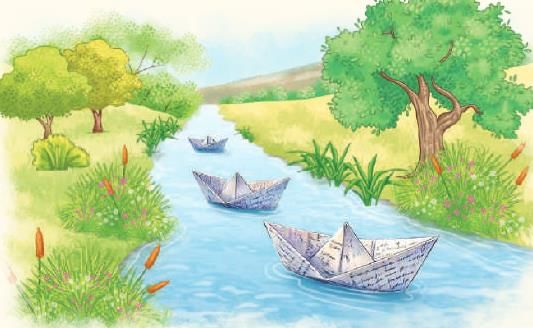
Q2: What do you think someone might hope for when they send a paper boat down a stream?
Ans: Someone might hope their paper boat reaches a faraway place or that someone finds it and learns about them.

Q3: Read the title of the poem ‘Paper Boats’ and predict what the poem might be about.
Ans: The poem might be about a child making paper boats, floating them on a stream, and imagining where they go or who finds them.

II: Read the given paragraph and match the highlighted words with their meanings given in the box below.

I love to play beside a 1. running stream at a short distance from my grandparent’s house. I love to see it 2. skipping along to join a river. On the river, I can see boats with 3. bulging sails moving swiftly. Some of them take the people from one shore to the other, while in some of thempeople can be seen 4. lading things too. I can spend hours watching the busy river and dreaming about them, 5. burying my head in my pillow at night.
Ans: 1. running – speedily flowing
2. skipping – bouncing
3. bulging – swelling
4. lading – loading
5. burying – putting

Let us discuss (Page 111)

QI: Choose the correct words from the brackets to complete the summary of the poem given below.

The poet sends paper boats down a 1. __________ (stream/river) each day, writing his name and the name of his 2. __________ (school/ village) on them. He hopes that someone in a 3. __________ (strange/familiar) land will find them and know who he is. The poet fills his boats with 4. __________(rose/shiuli) flowers from his garden, hoping they will be safely carried to another land at 5. __________ (night/morning). As he launches his boats, he imagines that the 6. __________ (clouds/birds) in the sky are like friends, racing with his boats. At night, he dreams that his paper boats continue to 7. __________ (swim/float) under the midnight stars, with the fairies of sleep sailing in them, their baskets full of 8. __________ (dreams/fruits).

Ans: The poet sends paper boats down a 1. stream each day, writing his name and the name of his 2. village on them. He hopes that someone in a 3. strange land will find them and know who he is. The poet fills his boats with 4. shiuli flowers from his garden, hoping they will be safely carried to another land at 5. night. As he launches his boats, he imagines that the 6. clouds in the sky are like friends, racing with his boats. At night, he dreams that his paper boats continue to 7. float under the midnight stars, with the fairies of sleep sailing in them, their baskets full of 8. dreams.

QII: Choose the correct option for the following. The theme of the poem is ________________.
1. innocence 2. imagination 3. ignorance 4. playfulness 5. travel
(i) 1, 2 and 3 
(ii) 3, 4 and 5 
(iii) 1, 4 and 5 
(iv) 1, 2 and 4
Ans: (iv) 1, 2 and 4 (innocence, imagination, playfulness)

QIII: Identify whether the following statement is true or false. 
The setting of the poem is a natural, outdoor environment.
Ans: True

QIV: Complete the following sentence by choosing the correct word given within the brackets.
The tone is ____________________ (sad and serious/gentle and wishful) and the mood is ____________________ (thoughtful/boring).
Ans: The tone is gentle and wishful and the mood is thoughtful.

QV: Identify the examples of alliteration from the poem.
Ans: 
1. big black letters
2. paper boats

QVI: Fill in the blanks with suitable words from the poem.
1. The repetition of words ___________ and ___________ emphasises thepassage of time.
2. The poet uses imagery like ___________ and ___________ to create aclear picture in the minds of the readers.
Ans: 1. The repetition of words day by day and one by one emphasises the passage of time.
2. The poet uses imagery like midnight stars and fairies of sleep to create a clear picture in the minds of the readers.

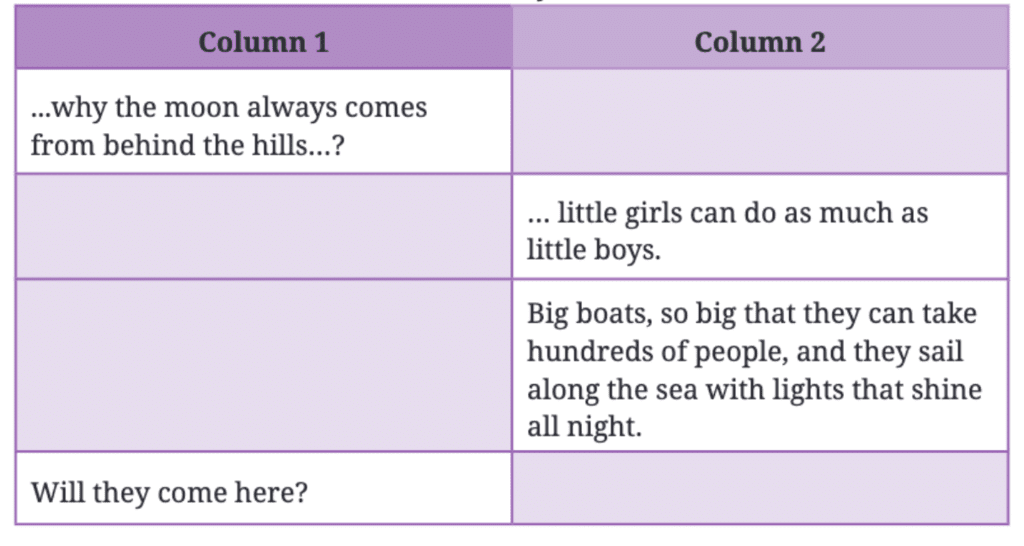
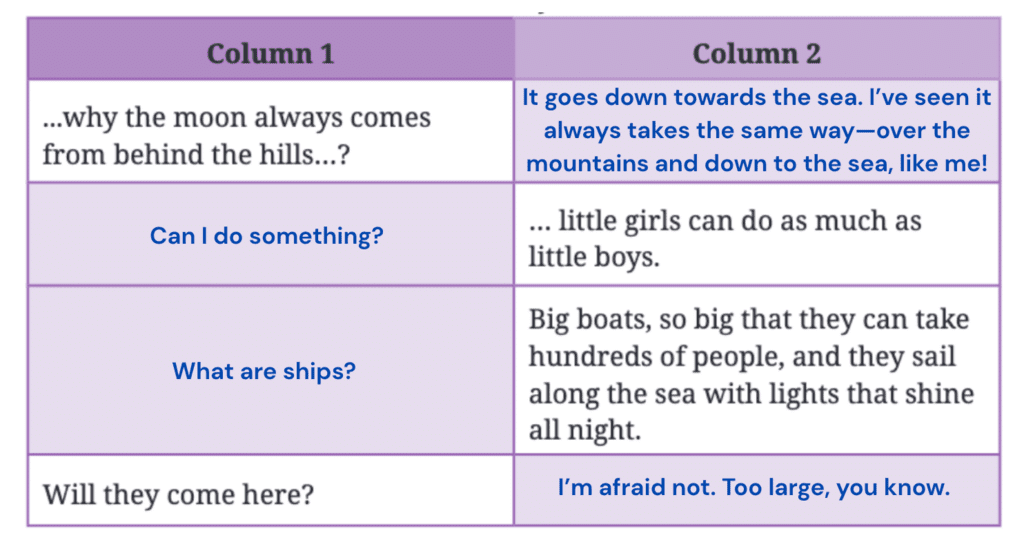
QVII: Match the descriptions in Column 1 with what they symbolise in Column 2.
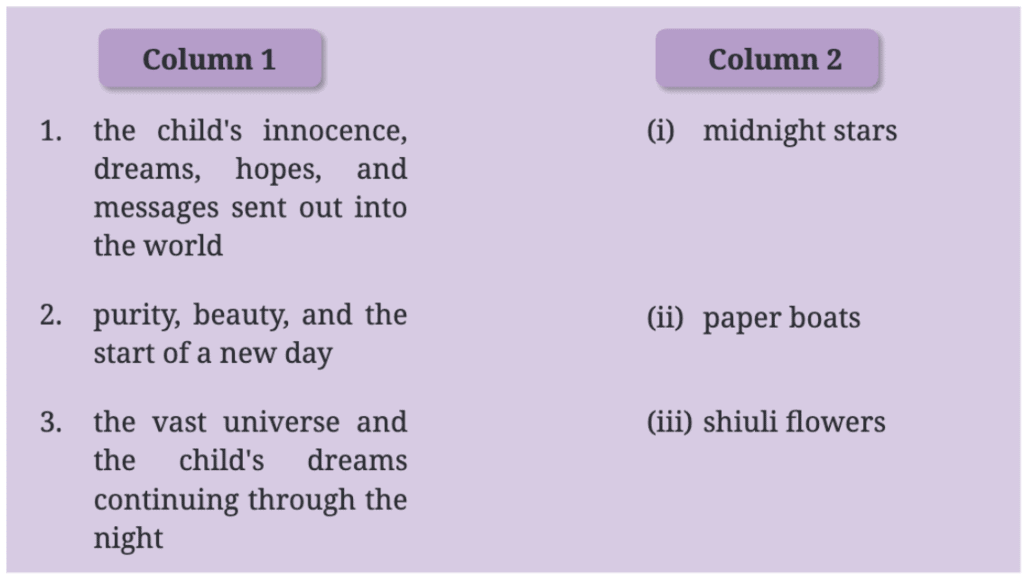
Ans: 
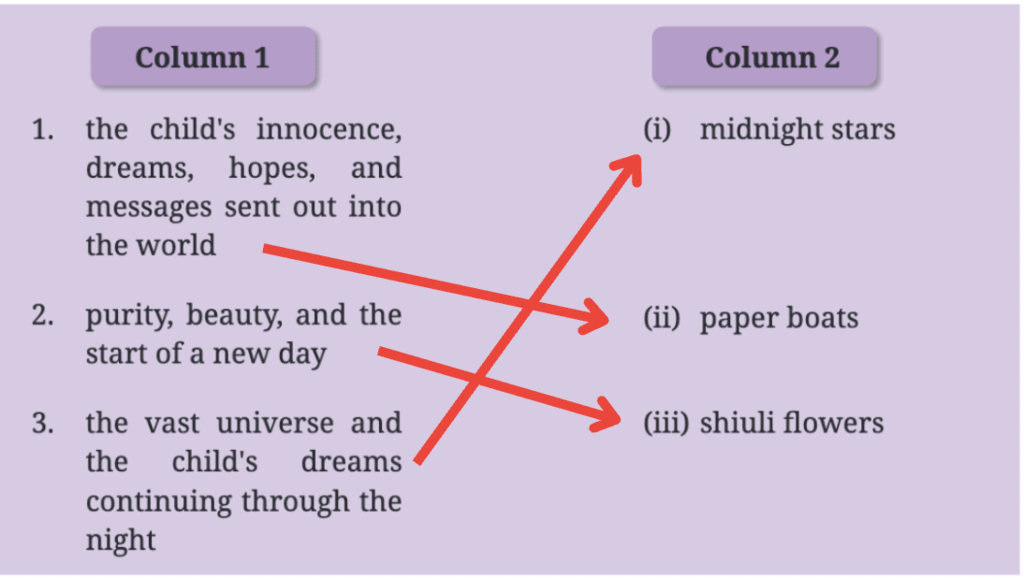
Let us think and reflect (Page 112)

QI. Read the extract given below and answer the questions that follow.

1. When night comes I bury my face in my arms and dream that my paper boats float on and on under the midnight stars.The fairies of sleep are sailing in them, and the lading is their basketsfull of dreams.

(i): Select the option that is most likely to be the speaker as per the extract.
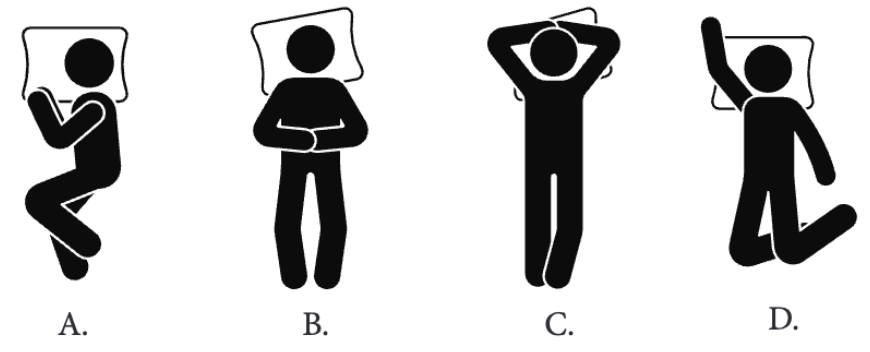

Ans: C.

(ii): What can be inferred about the speaker’s feelings when night comes?
Ans: The speaker feels dreamy and imaginative, thinking about paper boats floating under the stars.

(iii): What kind of beings are the ‘fairies of sleep’ imagined as? Select the most appropriate option.
A. mischievous 
B. gentle 
C. fearsome 
D. playful
Ans: B. gentle

(iv): Fill in the blank by selecting the correct option from those given in the brackets.
The phrase ‘lading is their baskets full of dreams’ suggests that thespeaker imagines the fairies of sleep carefully _________________(carrying his dreams /collecting his wishes) in their baskets.
Ans: The phrase ‘lading is their baskets full of dreams’ suggests that the speaker imagines the fairies of sleep carefully carrying his dreams in their baskets.

QII. Answer the following questions.

1: Why do you think the poet writes his personal details on the paper boats?
Ans: The poet writes his name and village on the paper boats to share who he is, hoping someone far away will find them and know about him.

2: The poet talks about the imagination of a child. Support this view with examples from the poem.
Ans: The poet shows a child’s imagination by dreaming that paper boats float under midnight stars, imagining clouds racing with the boats, and picturing fairies of sleep sailing with baskets of dreams.

3: How does the poet bring together imagination and reality to make the poem more interesting?
Ans: The poet mixes reality, like making paper boats and floating them in a stream, with imagination, like dreaming they travel to strange lands or carry fairies with dreams, making the poem magical and engaging.

Let us learn (Page 113)

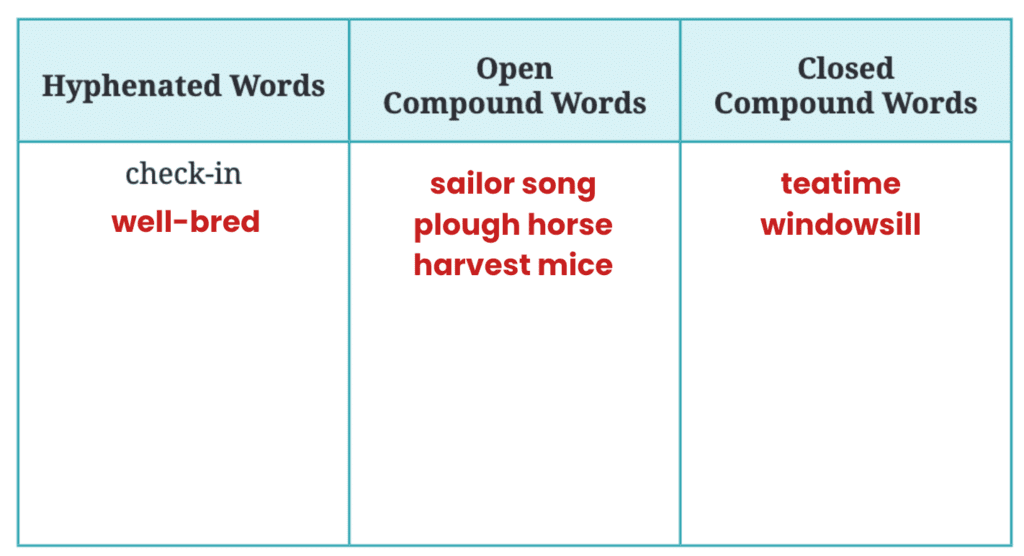
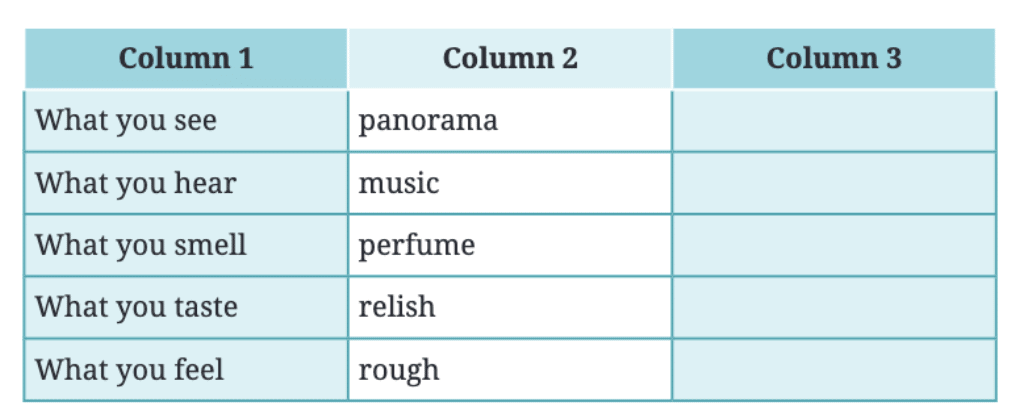
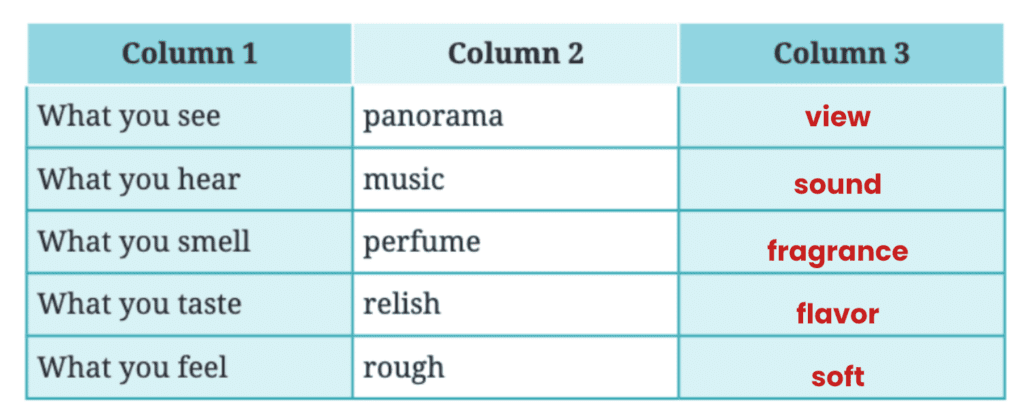
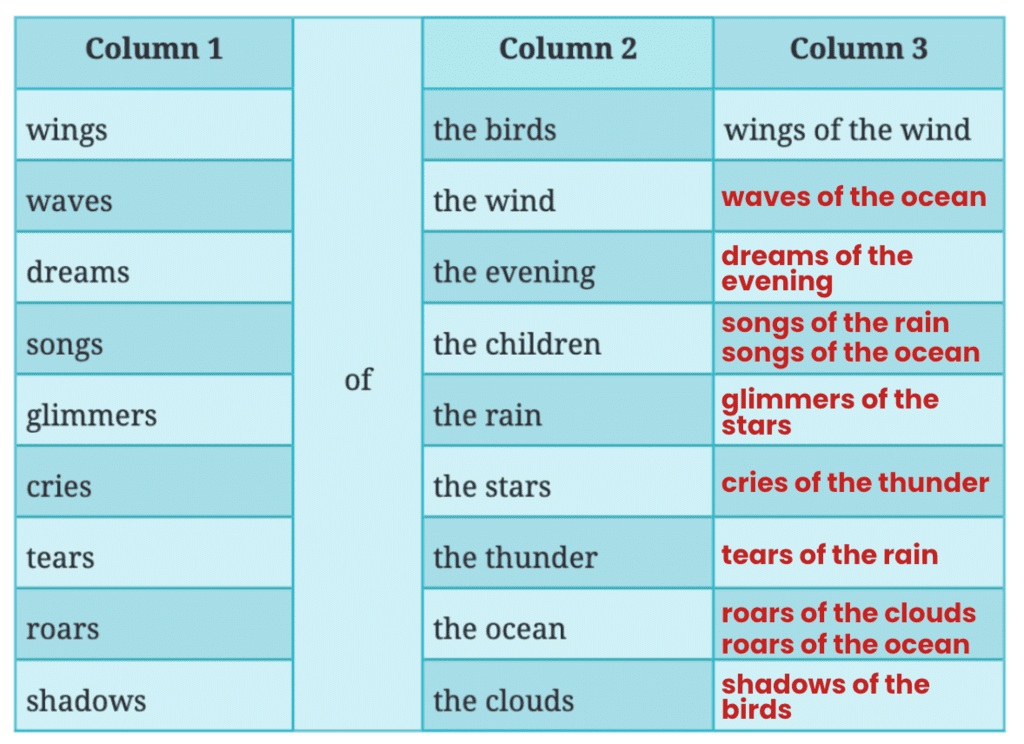
QI: The poet has used phrases like ‘blooms of the dawn’ and ‘fairies of sleep’ in the poem. In the same way we can create phrases. Now, select words from Column 1 and Column 2 and combine them with ‘of’. Write as many phrases as possible in Column 3.
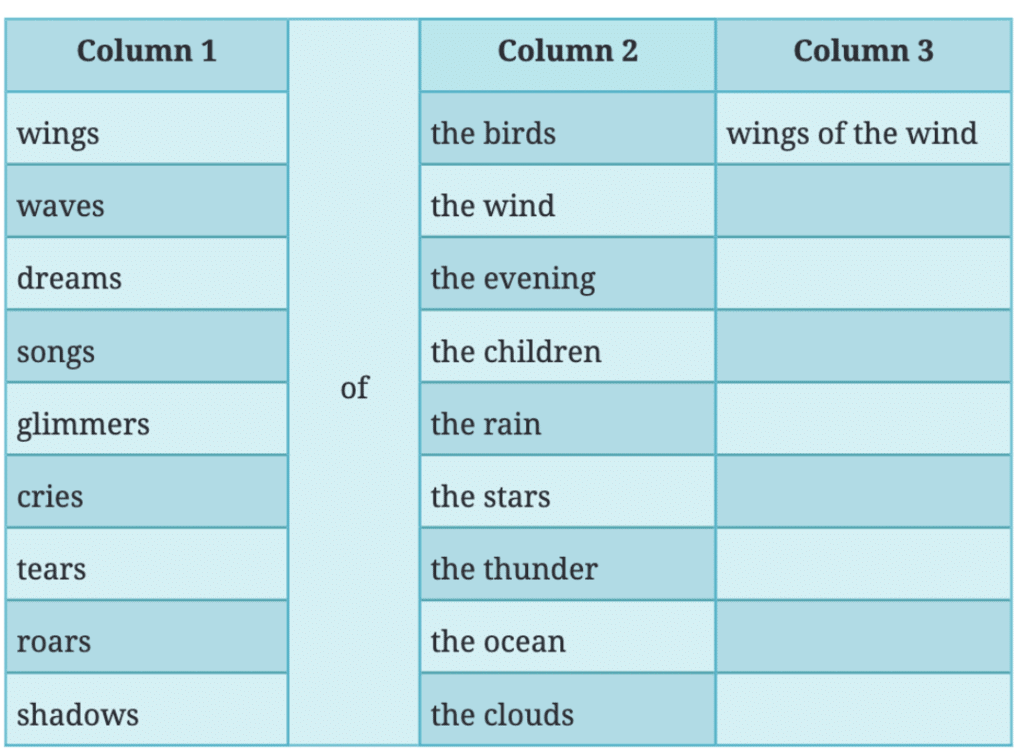
Ans:
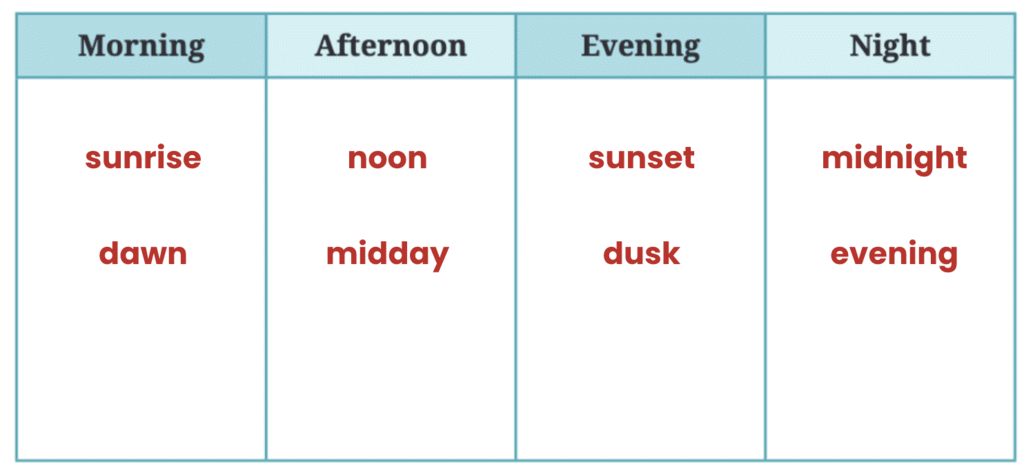
QII: The poet uses words like ‘dawn’, ‘night’ and ‘midnight’ to show different parts of the day. The box given below has some more words. Write the words in the appropriate columns.

Ans: 
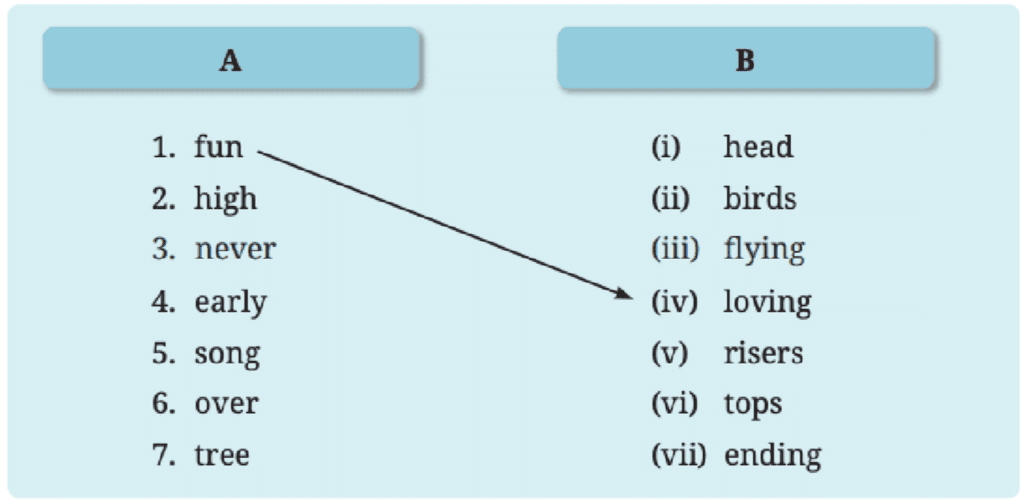
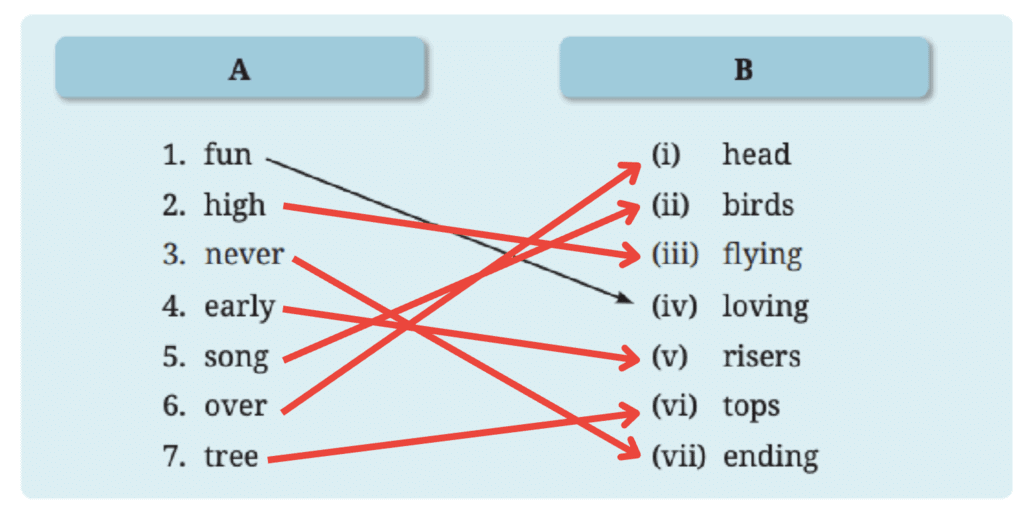
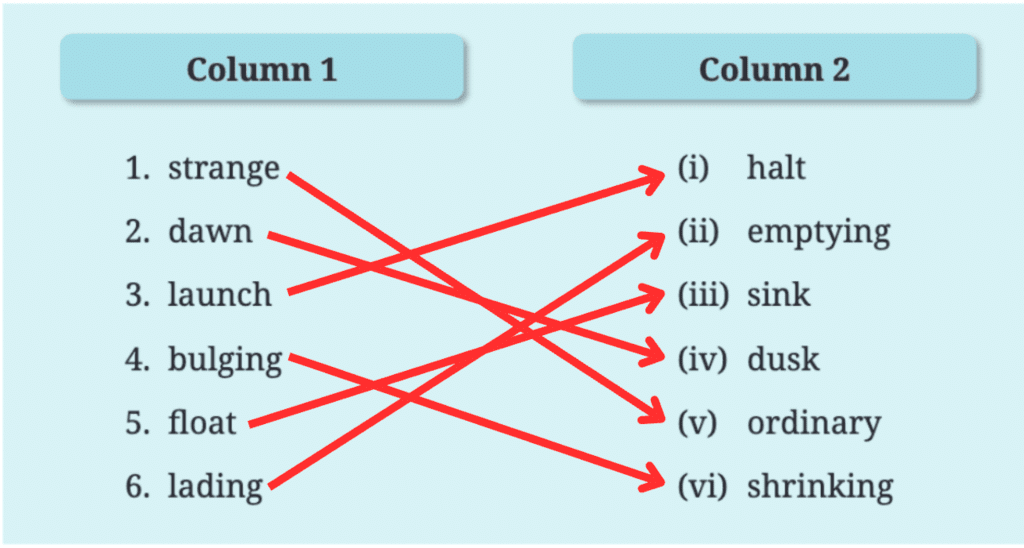
QIII: Match the words from the text given in Column 1 with their opposites in Column 2.
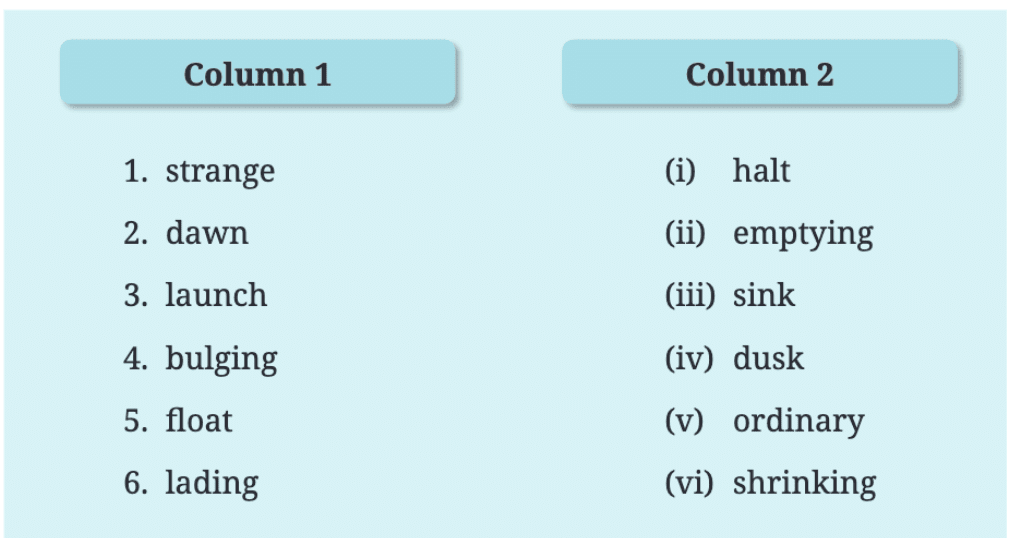
Ans: 
Let us listen (Page 114)

Let us listen You will listen to a conversation between a girl and her father about the art of paper folding called origami. As you listen, select the true statements from 1–7. (Transcript for the teacher on pg. 137) 

  • Father : Sai dear! What are you working on there with all that paper? 
  • Sai : Baba, I am trying to make an origami crane, but it’s a bit tricky. I keep messing up the folds. 
  • Father : Ah, origami! I remember doing that when I was your age. You know, Sai, origami has a really interesting history. 
  • Sai : Really? I thought it was just something fun to do with paper. 
  • Father :It is fun, but it’s also an age-old art form. Origami started in Japan over a thousand years ago. Back then, paper was really expensive, so it was only used for special occasions, like religious ceremonies. 
  • Sai : Wow, I didn’t know that. So, it wasn’t just for doing crafts? 
  • Father :It wasn’t until the seventeenth century that people began making animals, flowers and other designs just for fun. 
  • Sai : So, people have been making paper cranes for hundreds of years? 
  • Father : Yes, and the crane is especially important in Japanese culture. It’s a symbol of peace and long life. There’s even a belief that if you fold a thousand paper cranes, you can make a wish, and it will come true. 
  • Sai : A thousand cranes? That’s a lot! But it sounds like a really nice tradition. 
  • Father :It is. Origami isn’t just about the final shape—it’s about the process, the patience and the creativity involved. And over the years, it’s spread all over the world, with people adding their own styles and techniques. 
  • Sai :I had no idea origami had such a long history. It makes folding this crane feel even more special.
  • Father :I’m glad you think so, Sai. Perhaps we can start with something simpler next time. How about we make an origami paper boat next? It’s easier, and we can float it in the stream outside. 
  • Sai : A boat sounds awesome! Let’s do it! But first, I want to finish this crane. Can you help me with the last few steps? 
  • Father : Of course! Let’s finish this crane together. After that, we’ll sail our paper boat. 

Statements

  1. Sai was trying to make an origami boat. 
  2. Sai’s father used to do origami as a child. 
  3. Paper was very expensive so it was used only for special occasions. 
  4. People have been making paper cranes for thousands of years. 
  5. There is a belief that if you make a thousand paper cranes, your wish will come true. 
  6. The art of origami is about enjoying the process. 
  7. Sai’s father suggests making a paper bookmark next time.

Ans:

1. Sai was trying to make an origami boat.
False. She was trying to make an origami crane.

2. Sai’s father used to do origami as a child.
True. He mentions that he remembers doing origami when he was Sai’s age.

3. Paper was very expensive so it was used only for special occasions.
True. The father explains that in ancient times, paper was costly and used mainly for religious ceremonies.

4. People have been making paper cranes for thousands of years.
False. Origami began over a thousand years ago, but making cranes and decorative items for fun started around the 17th century.

5. There is a belief that if you make a thousand paper cranes, your wish will come true.
True. Sai’s father shares this cultural belief during the conversation.

6. The art of origami is about enjoying the process.
True. The father says origami is about the process, patience, and creativity—not just the final shape.

7. Sai’s father suggests making a paper bookmark next time.
False. He suggests making a paper boat next time.

Let us speak (Page 115)

Create any craft item using eco-friendly materials. Make a presentation in front of your classmates and teacher about the craft item you have made.
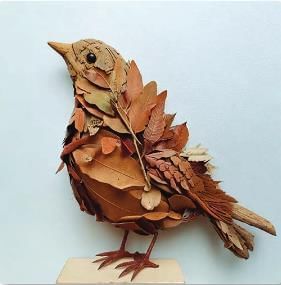
Your presentation should include the following information: 

  • Introduction of the item 
  • Description of how you made it 
  • Reason why you like the craft 
  • Conclusion

Use the phrases given below to make your presentation. 

  • Today, I’m going to show you a… I made. 
  • This… is made of… (materials) 
  • It’s… (describe colour, shape, size) 
  • It can be used to… 
  • First, I started by… 
  • Then, I used… (tool or material) to… 
  • The most difficult part was to… 
  • This… is special to me because… 
  • I hope you enjoyed seeing my craft and learning about it. 
  • Thank you for your attention.

Ans: 
Here is a sample eco-friendly craft presentation using the given structure and phrases. You can use it as a script for your classroom activity:

Craft Presentation: Newspaper Photo Frame

  • Today, I’m going to show you a photo frame I made.
  • This photo frame is made of old newspapers, cardboard, glue, and natural colours.
  • It’s rectangular in shape, grey and brown in colour, and medium in size.
  • It can be used to display your favourite photograph on a study table or wall.

How I Made It

  • First, I started by folding strips of newspaper tightly into sticks.
  • Then, I used cardboard as a base and arranged the rolled newspaper sticks around it like a border. I glued everything in place and let it dry.
  • After that, I painted the frame using colours made from turmeric and beetroot juice to make it more attractive.
  • The most difficult part was to roll the newspaper tightly and evenly, but I practised and got better at it!

Why I Like This Craft

  • This photo frame is special to me because I made it using things we usually throw away. 
  • It helped me understand how we can reuse materials and reduce waste. 
  • I also enjoyed decorating it in my own style.

Conclusion

I hope you enjoyed seeing my craft and learning about it.
Thank you for your attention!

Let us write (Page 116)

A diary entry is a personal document. It records an individual’s account ofa day of her or his life expressing the thoughts, feelings and opinions in the individual’s mind.

The guidelines to compose a diary entry include:

  • mentioning day, date and time of writing it
  • beginning with a general sentence describing the day or feelings towards an event or experience
  • giving details
  • concluding with a final remark

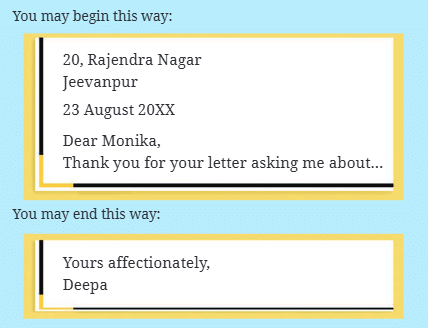
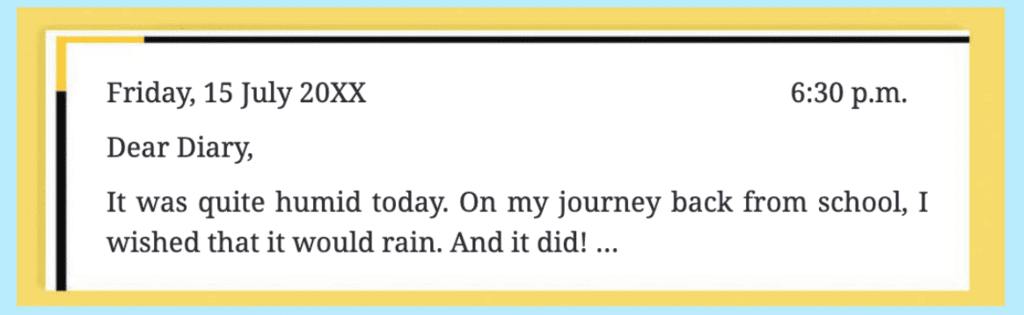
Now, write a diary entry expressing your joy in experiencing a rainy day. You may begin as given below:
Ans:

Friday, 15 July 20XX               6:30 p.m. 

Dear Diary, 

It was quite humid today. On my journey back from school, I wished that it would rain. And it did! The sky turned dark, and raindrops started falling. I ran outside and felt the cool water on my face. I made paper boats and floated them in a small stream near my house. It was so fun watching them sail! The sound of rain was calming, and everything looked fresh and green. I danced in the rain with my friends, laughing loudly. Today was a happy day, and I hope it rains again soon. 

Yours, 
[Your Name]

Let us explore (Page 116)

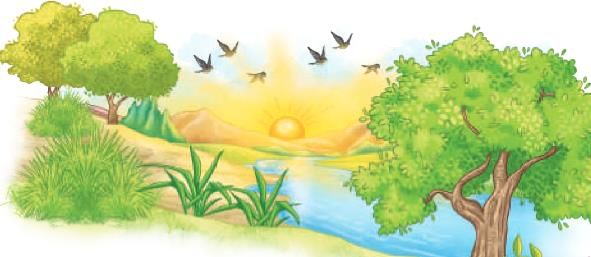
I) Shiuli flowers often find a mention in Rabindranath Tagore’s poems. These flowers are found in many parts of our country. 
Look at the pictures of shiuli flowers and recall what you call them in your language
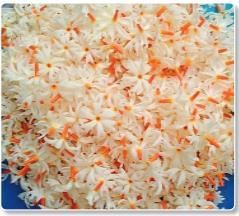
1. Find out names of some more trees or plants in your locality which have fragrant flowers. Write their names in your language and English language. Draw any two flowers and colour them.
Ans: Name of Shiuli Flower in Different Languages:

  • English: Night Jasmine / Coral Jasmine
  • Hindi: हरसिंगार (Harsingar)
  • Bengali: শিউলি (Shiuli)
  • Tamil: பரிஜாதம் (Parijatam)
  • Telugu: పారిజాతం (Parijatam)
  • Marathi: पारिजातक (Parijatak)

Other Trees or Plants with Fragrant Flowers:Local Language NameEnglish Nameचमेली (Chameli)Jasmineगुलाब (Gulab)Roseबेला (Bela)Arabian Jasmineरजनीगंधा (Rajnigandha)Tuberoseमोगरा (Mogra)Jasmine (variety)चम्पा (Champa)Plumeria / Frangipani

Draw and Colour Any Two Flowers:
You can draw:

  1. Rose – Colour it red or pink
  2. Jasmine – Colour it white with green leaves

II Solve the riddles given below. Share your answers with your classmates and the teacher. 
Riddle 1:
I have water that you cannot drink,
People come to see how in me the Sun sinks.
I can be rough, I can be calm,
I hold within myself plenty of charm.
My depths tell a never-ending tale.
Who am I with dolphins and the whale?
Answer: Sea or Ocean

Riddle 2:
I sit in stillness, but move with the wind,
My surface mirrors the world you are in.
The trees around me live happily,
In me, you can take a dip daily.
Home to ducks, frogs, fish, and all,
Can you guess what I am, after all?
Answer: Pond or Lake

Riddle 3:
I gently travel through valleys deep,
My soft murmur can make you sleep.
Little paper boats float on me in rain
The merry laughter of the kids I gain.
You may sit beside me without any fear,
Who am I who skips along, crystal clear?
Answer: Stream or Brook

Riddle 4:
I have a bed, but I do not sleep.
I have a bank, but no money I keep.
I carry stories, old and new,
High mountains to the oceans blue.
I journey far to meet the sea,
Can you guess, who I can be?
Answer: River
07. My Brother’s Great Invention Chapter Solution

Let us do these activities before we read (Page 92)

QI. Guess the invention: 

1: I am a concept invented by ancient Indian mathematicians. I add value to numbers. Without me, calculations in the modern digital world would be impossible. Who am I?
Ans: Zero

2: I am an ancient Indian practice, now popular globally. I focus on physical and mental well-being. What am I?
Ans: Yoga

QII: Discuss in groups of four what you think the world today would have been like without inventions and discoveries.
Ans: Without inventions, life would be hard. No electricity, phones, or cars. People would travel on foot or animals, communicate by letters, and live without modern medicine or machines.

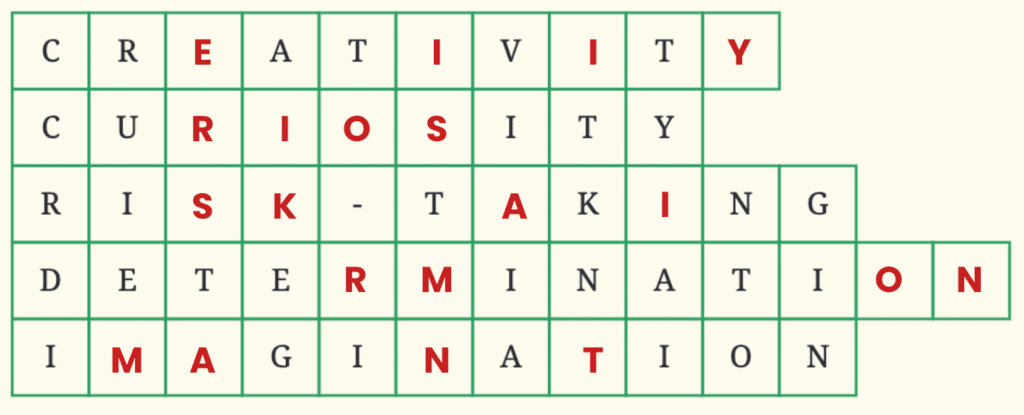
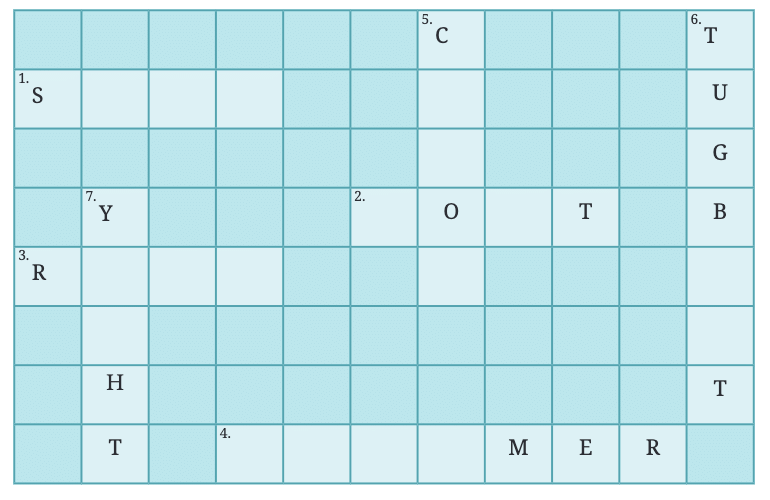
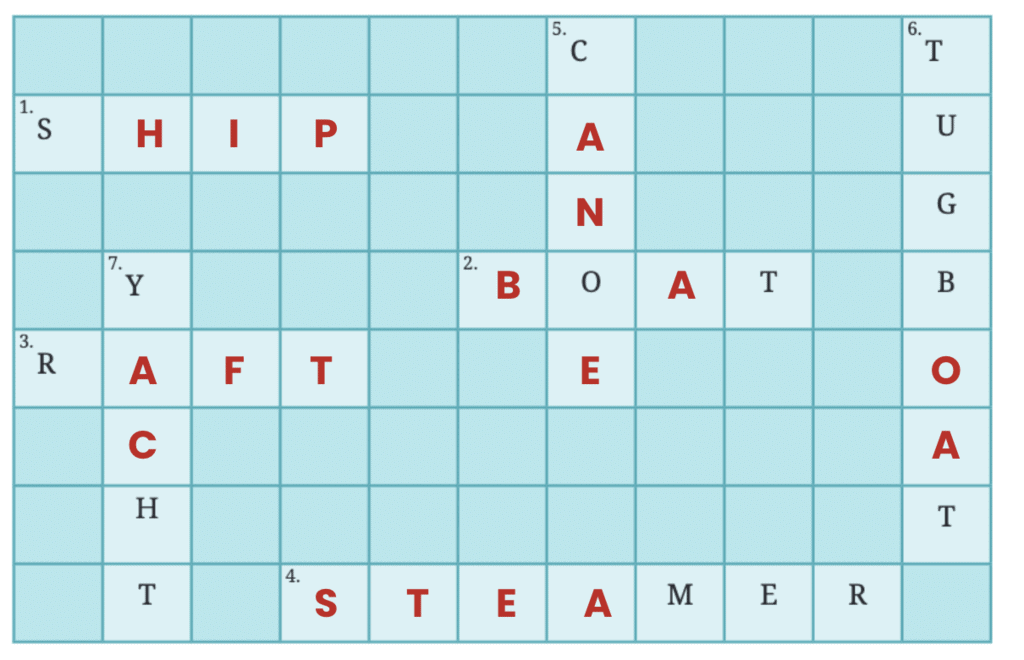
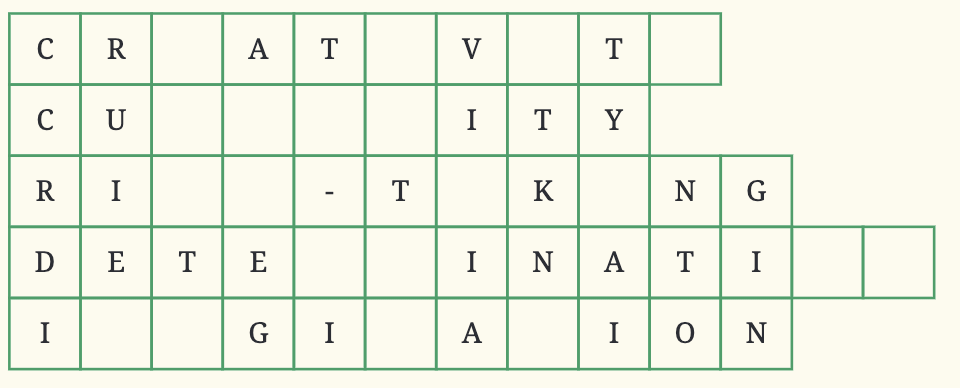
QIII: Fill the grid given below with missing letters to complete the words. These words display qualities of an inventor.

Ans: 

Let us discuss (Page 94)

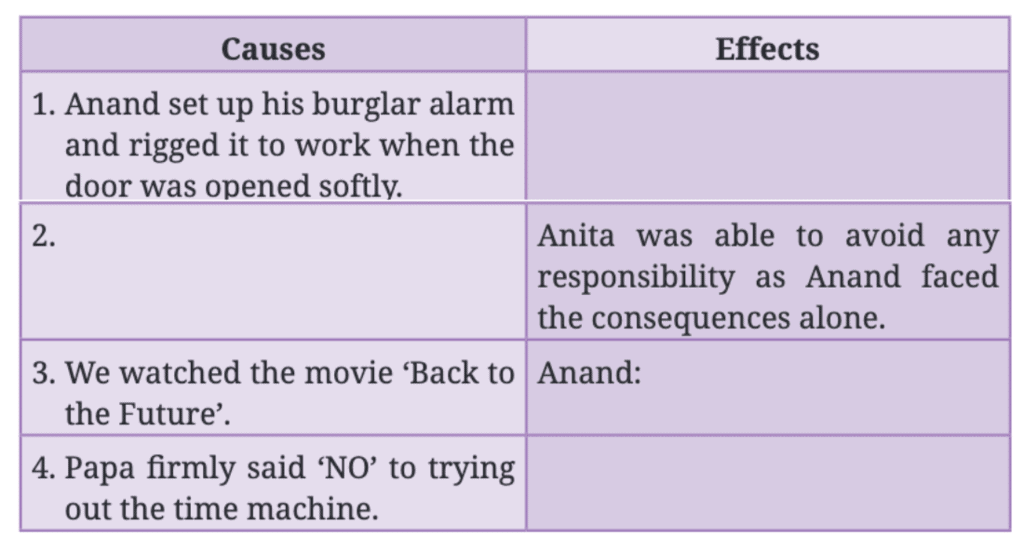
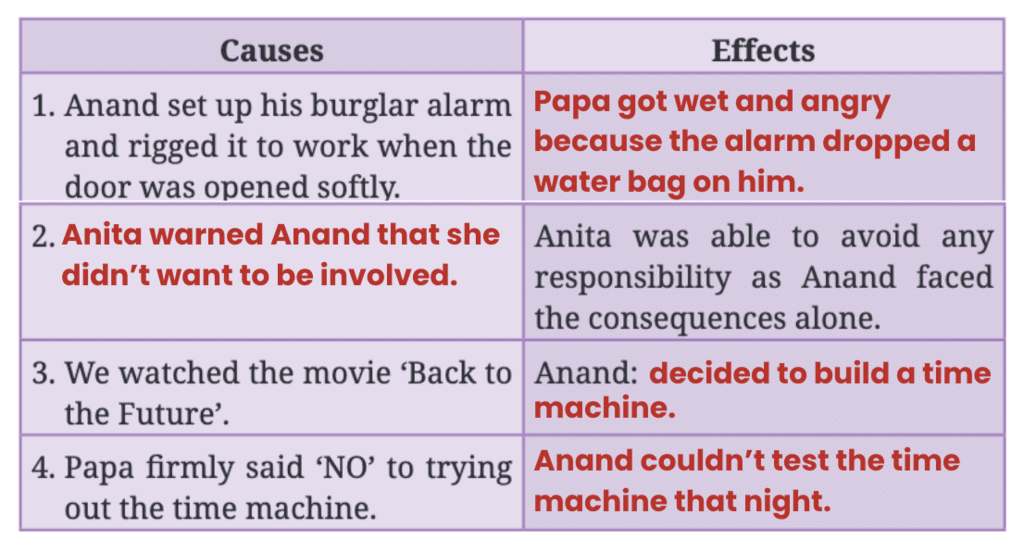
QI: Complete the cause-and-effect table given below.

Ans: 

QII: Do you think Anand was able to keep his promise regarding the time machine? If yes, why? If no, why not?
Ans: No, Anand likely didn’t keep his promise. He was excited about his time machine and offended when his parents didn’t trust it, so he might have tested it when alone.

Let us discuss (Page 98)

Q: Arrange the following events in the correct order of occurrence.

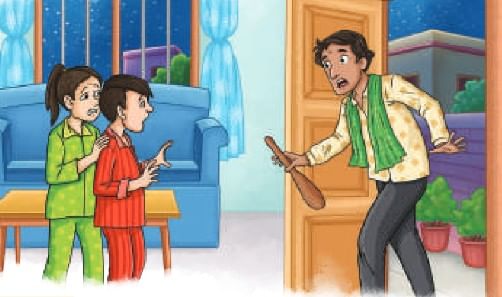
1. The door swings open, and they see Boppa, standing there with an evil grin.
2. Boppa is nowhere to be found, but his green scarf is lying near the time machine.
3. Mrs. Sharma, her husband, and Dr. Mohan unlock the door and enter the house to help the children.
4. Anita wakes Anand up, informing him that someone is trying to get into the house.
5. Anand misleads Boppa into entering his room instead of his father’s room.

Ans: 1. Anita wakes Anand up, informing him that someone is trying to get into the house.
2. The door swings open, and they see Boppa, standing there with an evil grin.
3. Anand misleads Boppa into entering his room instead of his father’s room.
4. Mrs. Sharma, her husband, and Dr. Mohan unlock the door and enter the house to help the children.
5. Boppa is nowhere to be found, but his green scarf is lying near the time machine.

Let us think and reflect (Page 99)

QI. Read the extracts given below and answer the questions that follow.

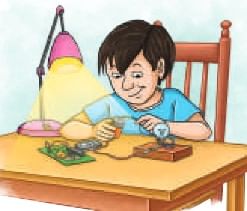
1. Before beginning this story, let me put you in the picture. I am Anita, fourteen years old. My brother Anand, one year younger than me, caused all that hoo-ha with his burglar alarm. The trouble with him is that he thinks he is a scientist. He loves tinkering with all sorts of electrical gadgets, tools, dynamos, planks of wood, and things like that. And he keeps creating ‘inventions’ that never work out as they are supposed to.

(i): Complete the following sentence suitably by choosing the correct option from those given in the brackets.

When Anita says, “…let me put you in the picture”, she wants to __________ (introduce/summarise) the situation for the benefit of the readers.
Ans: introduce

(ii): Anand loves ‘tinkering’ with all sorts of electrical gadgets. This means that he enjoys ______ gadgets.
A. dismantling and creating 
B. labelling or naming
C. repairing or improving 
D. collecting and displaying
Ans: A. dismantling and creating

(iii): Which of the following options most suitably describes Anand’s personality?
A. methodical and cautious 
B. creative and experimental
C. energetic and hasty 
D. shy and reserved
Ans: B. creative and experimental

(iv): Based on the extract, compare what Anita thinks of her brother Anand with what he thinks of himself.
Ans: Anita thinks Anand’s inventions are troublesome and don’t work, causing problems. Anand thinks he is a scientist and his inventions are great.

2. I was about to direct him upstairs when Anand said quickly, “The one next to this one.” 
“You silly goose!” I said angrily as soon as the man had gone. “That’s your room. He’ll come back as mad as mad can be.” 

“At least it will give us some time to think of something,” Anand said. “He’ll take a while to locate the light switch. Let’s shout.”All of a sudden there was a crash followed by a loud scream. More strange noises emerged from the next room—a few muffled thumps, an eerie whine, and a low, humming sound.

(i): Anita was angry with Anand because __________
Ans: he sent the thief to his room, which could make the thief angrier and more dangerous.

(ii): Which action of Anand shows his presence of mind?
Ans: Anand quickly misled Boppa to his room instead of his father’s room to buy time.

(iii): What might be the cause of the strange noises emerging from the next room?
A. The intruder moving furniture around
B. Anand’s time machine getting activated
C. The intruder locating the light switch
D. Anand’s invention malfunctioning
Ans: B. Anand’s time machine getting activated

(iv): Which of the following best describes the atmosphere in this extract?
A. relaxing B. peaceful C. tense D. sad E. suspenseful F. joyful
(a) A, D and E 
(b) B and F 
(c) C and E 
(d) Only D
Ans: c. tense and suspenseful

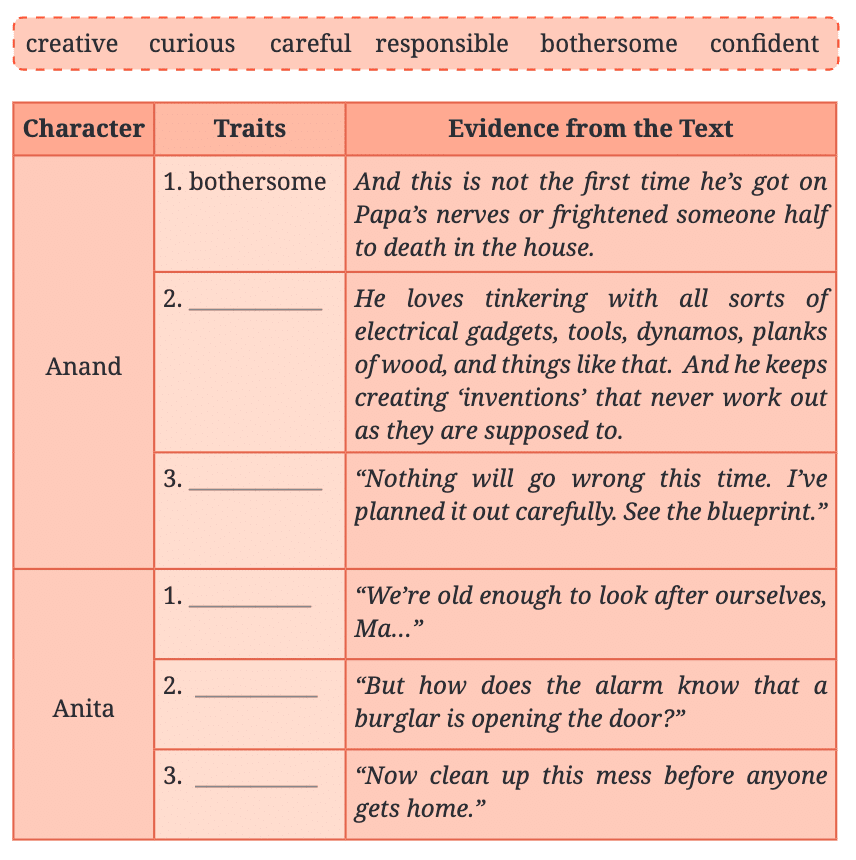
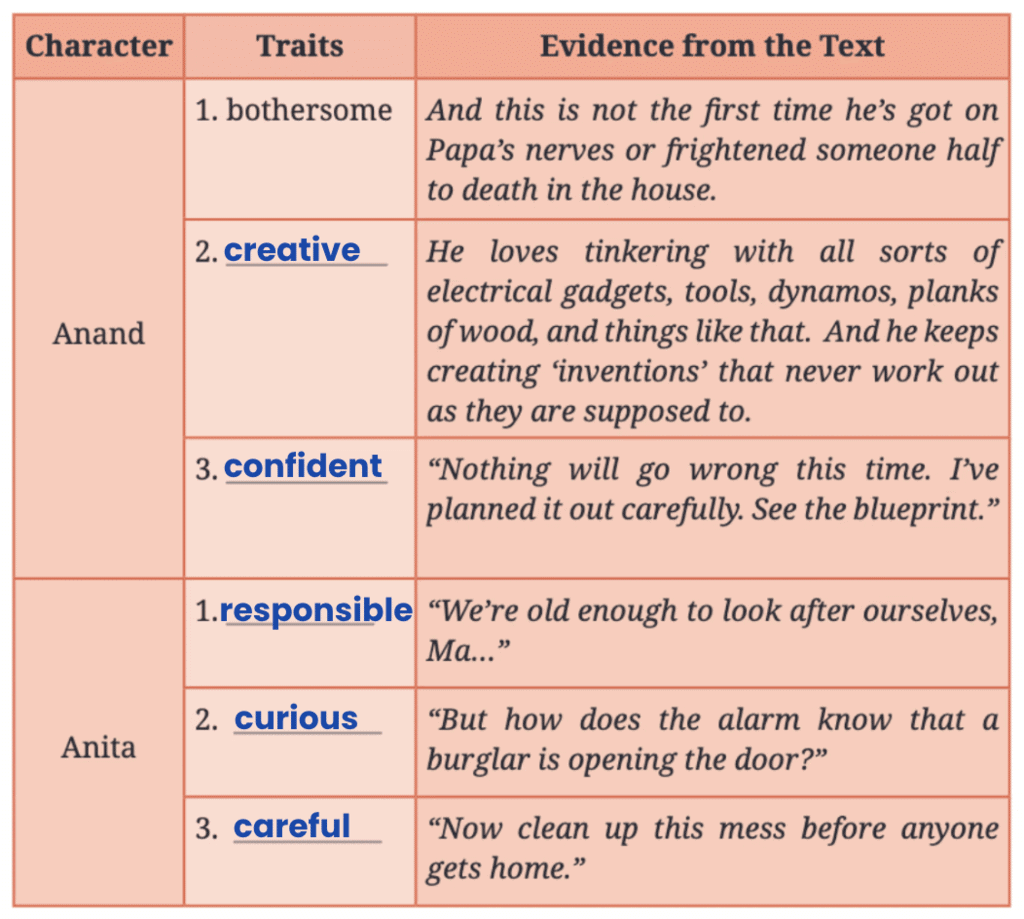
QII: Complete the table with the suitable traits of the characters based on evidence from the text.

Ans:

QIII. Answer the following questions.

1: What prompted Anand to create the burglar alarm?
Ans: A rush of thefts in the colony made Anand think a burglar alarm was needed.

2: How did Anand’s father become the target of the burglar alarm?
Ans: The alarm was set to work when the door was opened softly, and Papa opened the door softly, triggering the water bag.

3: How did Anand’s parents and sister react to his ideas?
Ans: Papa was annoyed and didn’t trust Anand’s inventions. Ma was kinder but worried. Anita was doubtful and didn’t want to be involved.

4: How did Anand behave when he was on his ‘inventing binges’?
Ans: Anand was messy, didn’t comb his hair, made noise with hammering and sawing, and took apart gadgets for parts.

5: Why did Mr. Sharma not believe Anand when he spoke about his time machine?
Ans: Mr. Sharma thought Anand’s idea that the time machine worked was just his imagination, as it seemed impossible.

6: Give an ending to this story, explaining what might have happened to Boppa.
Ans: Boppa might have been scared by the time machine’s noises and ran away, dropping his scarf. He left the house before the neighbours arrived, which is why they couldn’t find him.

Let us learn (Page 101)

I. Read the highlighted word in the following sentence. 

It’s quite simple. The moment the door opens, this alarm is tripped off and makes a clanging sound. 

Such sound words are called onomatopoeic words.

Onomatopoeia is the use of words that imitate actual sounds of the thing they describe. The ‘boom’ of a firework exploding, the ‘ding-dong’ of a bell, the ‘pitter-patter’ of rain drops, the ‘tick-tock’ of a clock are all examples of onomatopoeia.

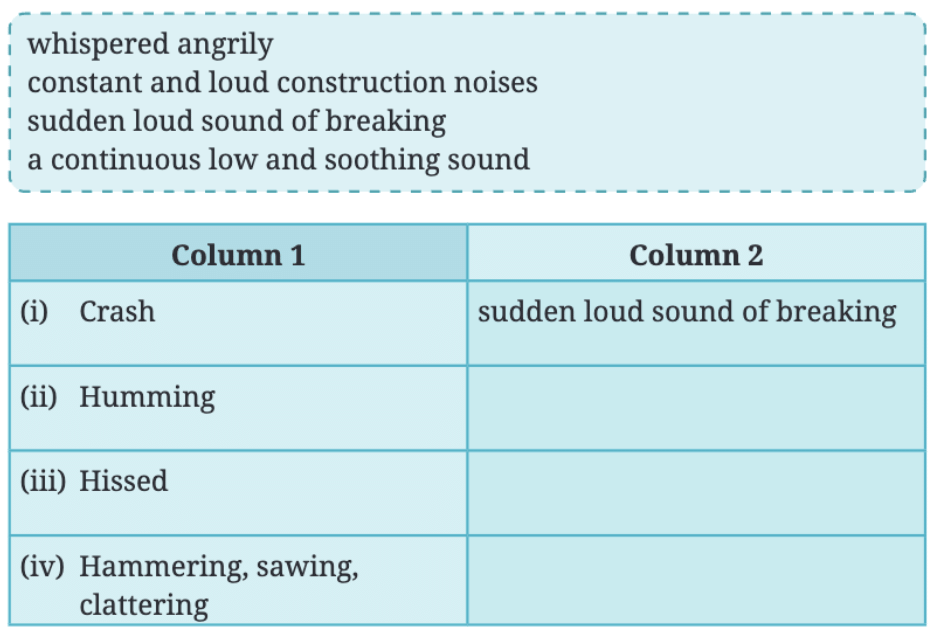
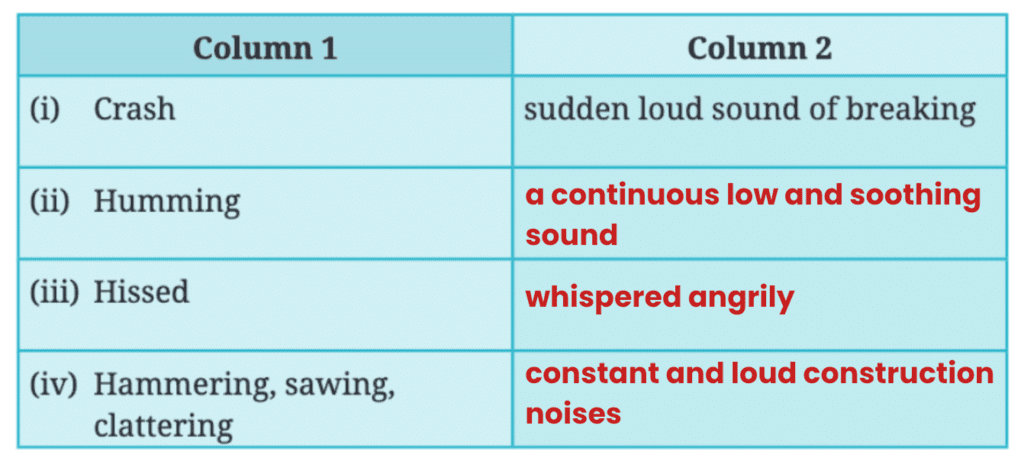
1: Read the sound words used in the story in Column 1. Complete Column 2 by matching expressions from the box given below. An example has been done for you.

Ans:

II. Read the highlighted phrase in the following sentence from the text. 

Well, that was the end of peace and quiet in the house. 

The highlighted phrase displays a combination of two words generally used together in a fixed order. Such phrases are called binomials.

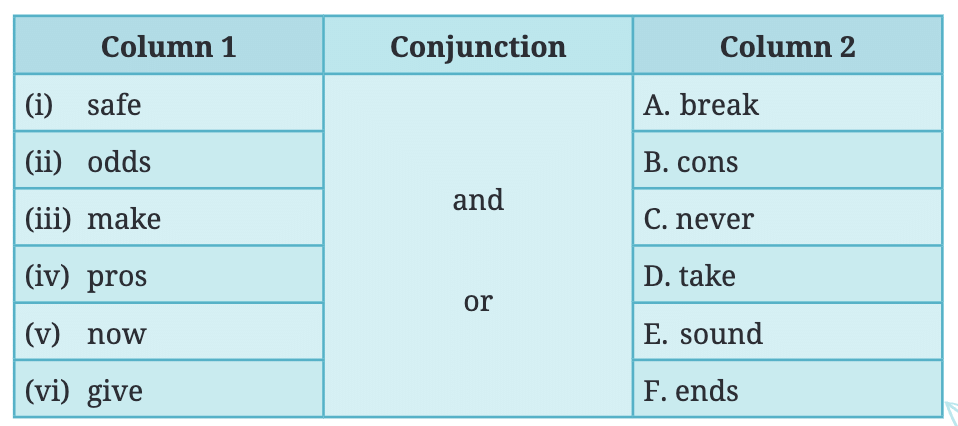
Binomials are expressions consisting of two words, usually linked by a conjunction such as ‘and’ or ‘or’, that are commonly used together in a fixed order. The two words convey a single meaning or an opposite.

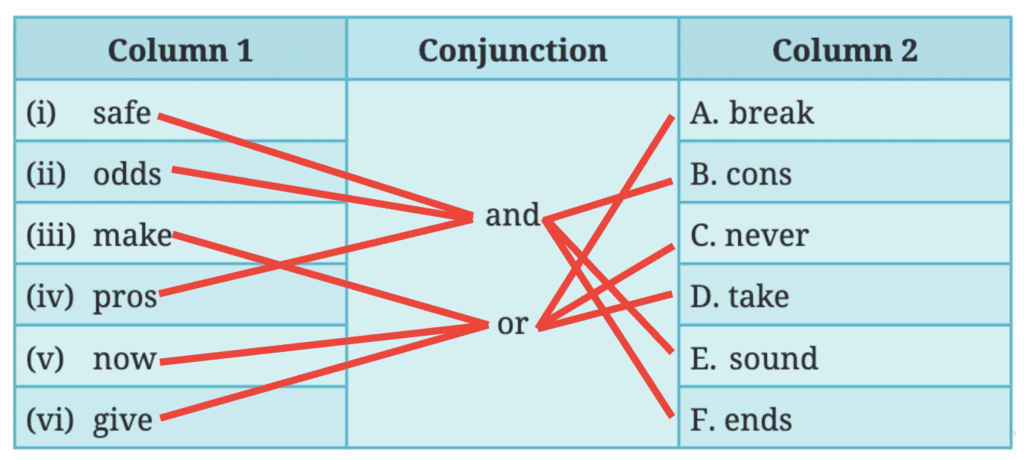
1: Match the words in Column 1 with the correct pairs in Column 2 to make binomials.

Ans: 

2: Complete the following sentences with suitable binomials from 1.

(i) This project will be a ______________ moment for our team’s success.
(ii) After a long journey, we were relieved to arrive home______________.
(iii) Every friendship works well when there is a balance of______________.
(iv) She organised all the ______________ in the cupboard, to make space for new clothes.
(v) Before making a decision, it is important to weigh the______________ carefully.
(vi) This is our final chance to perform on stage, it is ______________.

Ans:

 (i) This project will be a make-or-break moment for our team’s success.
(ii) After a long journey, we were relieved to arrive home safe and sound.
(iii) Every friendship works well when there is a balance of give and take.
(iv) She organised all the odds and ends in the cupboard, to make space for new clothes.
(v) Before making a decision, it is important to weigh the pros and cons carefully.
(vi) This is our final chance to perform on stage, it is now or never.

3: Complete the paragraph by using the phrasal verbs given in the box below.

It had been raining and we (i) ___________ time to set up for the function, so we quickly (ii) ___________ some decorations using whatever materials we had. We accidentally (iii) ___________ the fire alarm because of the smoke from the bonfire. Thankfully, the rain(iv) ___________ just as the guests were arriving, and despite all the chaos, the function (v) ___________ to be a huge success.

Ans: It had been raining and we (i) ran out of time to set up for the function, so we quickly (ii) rigged up some decorations using whatever materials we had. We accidentally (iii) tripped off the fire alarm because of the smoke from the bonfire. Thankfully, the rain (iv)  let up  just as the guests were arriving, and despite all the chaos, the function (v) turned out to be a huge success.

QIII: Read the highlighted expressions in the following sentence from the text.

And this is not the first time he’s got on Papa’s nerves or frightened someone half to death in the house. 

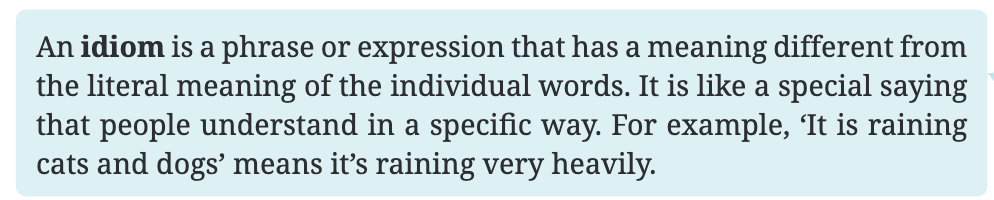
The highlighted expressions are called idioms.

Complete the following sentences by filling in the blanks with suitable idioms from the text given in the box below.

1. Shekhar knew he would _______________________ for breaking his mother’s favourite flower vase.
2. We _______________________ trying to help the injured dog and get it to the vet as quickly as possible.
3. Faizy distracted Kanchan, _______________________ for us to get inside the room to prepare the birthday surprise.
4. The constant power fluctuations during meetings can_______________________.
5. When I am alone at home, any unexpected loud noise in the night can _______________________.
Ans: 1. Shekhar knew he would get a shelling for breaking his mother’s favourite flower vase.
2. We fell over ourselves trying to help the injured dog and get it to the vet as quickly as possible.
3. Faizy distracted Kanchan, leaving the coast clear for us to get inside the room to prepare the birthday surprise.
4. The constant power fluctuations during meetings can get on our nerves.
5. When I am alone at home, any unexpected loud noise in the night can frighten me half to death.

QIV. Read the highlighted words in the given sentence. 

It was indeed the fellow who had recently begun sweeping out the compounds in our row of houses. 

Here we refer to two completed actions─the recent past (new action) and the later past (old action).

1: Underline the verbs in simple past and past perfect tense for the following sentences from the text.

(i) Ma had rushed in to see what the racket was all about and found Papa standing there, sopping wet and scowling.
(ii) Anand had vanished by this time and reappeared only after dinner when Papa had cooled down.

Ans: (i) Ma had rushed in to see what the racket was all about and found Papa standing there, sopping wet and scowling.
(ii) Anand had vanished by this time and reappeared only after dinner when Papa had cooled down.

2: Fill in the blanks with the simple past or past perfect form of the verbs given in brackets.

(i) After Rohan A. __________ (finish) his homework, he B. __________(decide) to go for a walk. He C. __________ (leave) the house and D. __________ (realise) he E. __________ (forget) his keys inside.
(ii) By the time we A. __________ (reach) the station, the train B. __________ (already/leave). We C. __________ (wait) for the next one to arrive.
Ans: (i) After Rohan had finished his homework, he decided to go for a walk. He left the house and realised he had forgotten his keys inside.
(ii) By the time we reached the station, the train had already left. We waited for the next one to arrive.

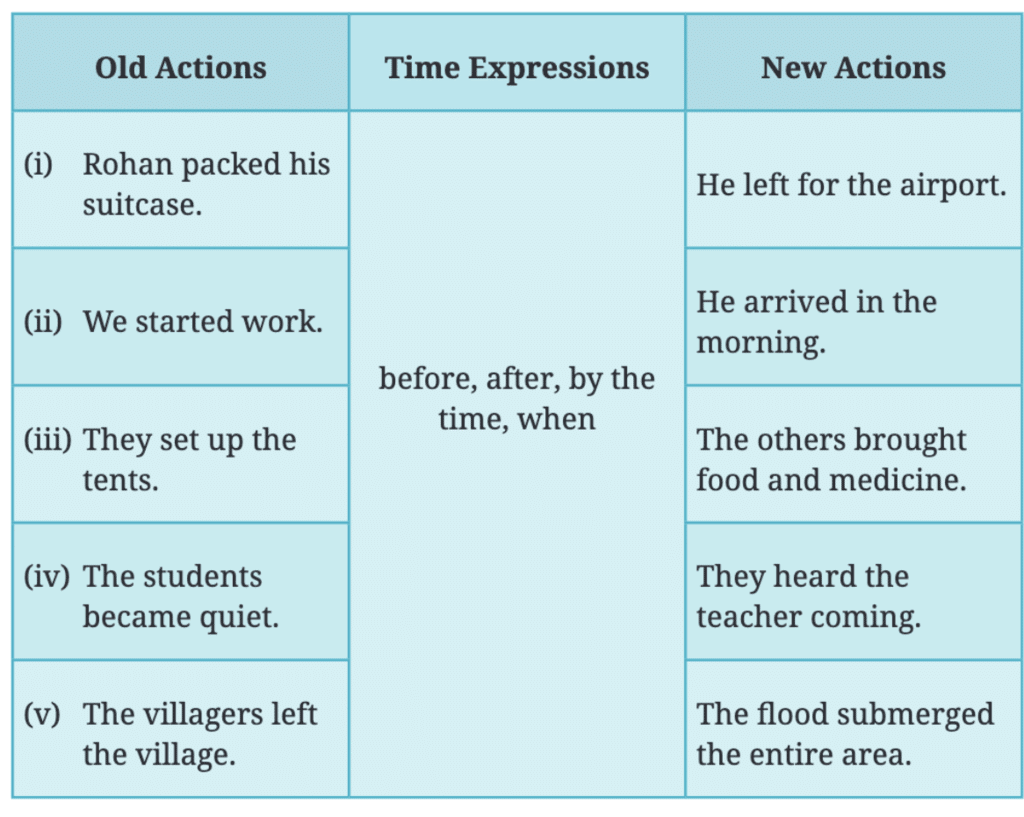
3: Combine the pairs of sentences using the time expressions in the boxes given below and rewrite them using the past perfect tenses.

Ans: (i) Rohan had packed his suitcase before he left for the airport.
(ii) We had started work before he arrived in the morning.
(iii) They had set up the tents before the others brought food and medicine.
(iv) The students had become quiet when they heard the teacher coming.
(v) The villagers had left the village by the time the flood submerged the entire area.

Let us listen (Page 105)I) You will listen to a conversation between Anita and Toby. Toby is a Martian and is stranded on Earth. He has become Anita’s friend. As you listen, choose the true statements from 1–5 given below. (Transcript for the teacher on pg. 136) 
Anita : Hi, Toby! Do you miss your planet? 
Toby : Very much, Anita! I miss my people and home. 
Anita : Oh! I wish I could do something about it! But I am happy to have you as my friend. 
Toby : Thank you, Anita! Anita : Er… could you tell me something more about yourself? 
Toby : Why not! What do you want to know about me, Anita? 
Anita : What do you eat for breakfast? 
Toby : Well, we Martians don’t need to eat anything. We get our energy from the Sun.
Anita : Oh! Don’t you ever feel like having ice creams and chocolates? I can’t think of life without them! 
Toby : No, Anita! We are made of different stuff. 
Anita : Okay, tell me one thing. How are you able to see with only one eye? I see only one big eye in the centre of your face. 
Toby : My friend, we Martians need only one eye to see clearly. In fact, I can see even with my eye closed. I can see beyond mountains and clouds, wood and even metals. I can see that you are carrying a toy in your pocket. It’s a blue aeroplane. Isn’t it? And yes! That apple you just had for breakfast is going round-and-round in your stomach right now! 
Anita : (gasps in disbelief) Oh my goodness!

Statements: 
1. Toby misses his school. 
2. Anita accepts Toby as her friend. 
3. Anita asks Toby about one of his facial features. 
4. Toby tells Anita that she had a banana for breakfast. 
5. Toby shares that he can see much clearer with a closed eye. 

Ans: 
Correct True Statements:

  • Anita accepts Toby as her friend.
  • Anita asks Toby about one of his facial features.
  • Toby shares that he can see much clearer with a closed eye.

False Statements:

  • Toby misses his school. (Incorrect – He says he misses his people and home, not school.)
  • Toby tells Anita that she had a banana for breakfast. (Incorrect – He says she had an apple.)

II) Listen to the conversation again and fill in the blanks with the exact words you hear. 
1. Toby: I miss my _________________ and home. 
2. Toby: Well, we _________________ don’t need to eat anything. We get our _________________ from the Sun. 
3. Anita: Oh! Don’t you ever feel like having ice creams and _________________? 
4. Anita: Okay, tell me one thing. How are you able to see with only_________________ eye? 
5. Toby: I can see beyond mountains and _________________, woods and even _________________. 

Ans: 

  1. Toby: I miss my people and home.
  2. Toby: Well, we Martians don’t need to eat anything. We get our energy from the Sun.
  3. Anita: Oh! Don’t you ever feel like having ice creams and chocolates?
  4. Anita: Okay, tell me one thing. How are you able to see with only one eye?
  5. Toby: I can see beyond mountains and clouds, woods and even metals.

Let us speak (Page 105)

QI: I Read the following sentences from the text.

As usual, I had to be involved, though I’d have preferred to finish my novel. 
“We’re old enough to look after ourselves, Ma,” I said. 

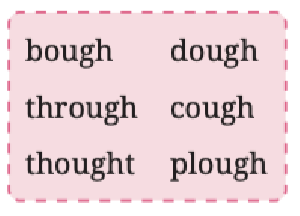
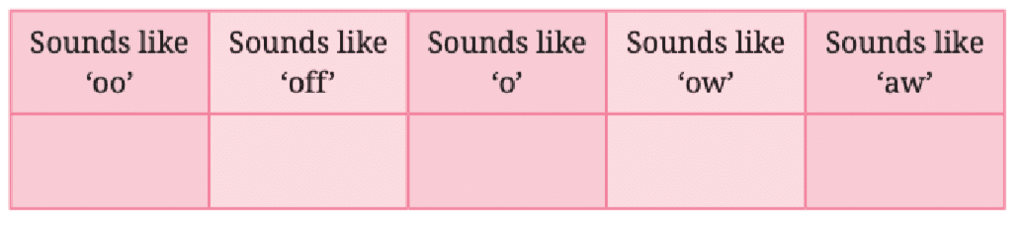
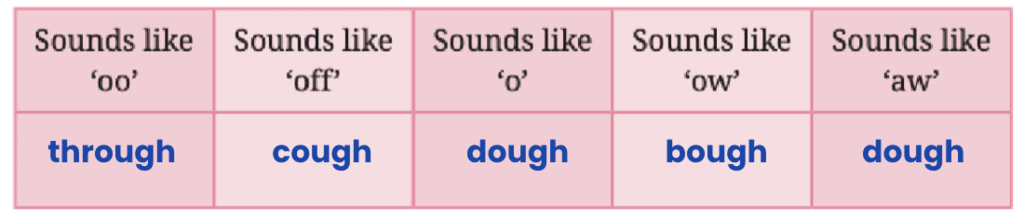
The word ‘though’ is pronounced to rhyme with the word ‘low’. The word ‘enough’ is pronounced to rhyme with the word ‘puff’.

In English there are many words ending with –ough, which are pronounced very differently. Listen to the teacher say these words aloud and notice how they are pronounced.

Pronounce these words out loud and put them in the correct boxes given below.


Ans: 

Let us write (Page 106)

Think about different vocations that you see around or you are currently studying. For example: electrician, mechanic, chef, nurse, graphic designer. You may add more vocations to the list given here.

Now, choose a vocation and write a paragraph. You may use the hints given below.

  • why you like this vocation 
  • what training is needed 
  • what tools and equipment are required 
  • who would your co-workers be 
  • highlight the importance of team work 
  • how you would deal with the customers 
  • how you plan to pursue it with a sense of pride

Ans: 

I want to become a chef because I love cooking and enjoy creating new dishes. Chefs bring joy to people through tasty and healthy food. To become a good chef, I would need to attend a cooking school or take special training in culinary arts. I would learn about different recipes, food safety, and kitchen skills.

Chefs use many tools like knives, frying pans, ovens, blenders, and measuring cups. My co-workers would be other chefs, kitchen assistants, waiters, and restaurant managers. Teamwork is very important in a kitchen. Everyone must work together and help each other so that food is prepared on time and served properly.

As a chef, I would always be polite and respectful to customers. I would listen to their feedback and try to improve. I plan to work hard, stay creative, and feel proud of my job. Cooking for others is not just work—it’s a way to make people happy.

Let us explore (Page 107)

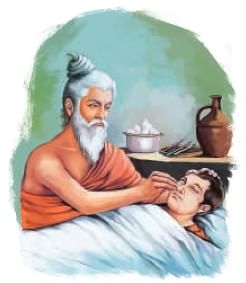
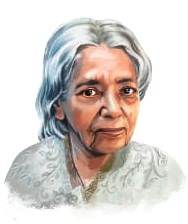
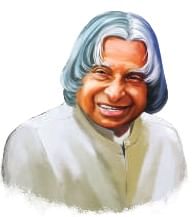
Human beings are naturally very curious and creative, and this has led to many scientific and technological inventions. You must have heard about many famous inventions. Some of them are mentioned below. You may look for the names of more such Indian inventors and their inventions.

  • Sushruta (sixth century B.C.), was a pioneer figure in medical science. His innovations in surgery paved the way for modern surgery.
  • Dr. Janaki Ammal (Padma Shri) was a brilliant woman scientist of India who made a significant contribution to the field of cytogenetics. 
  • Under the directorship of Dr. A.P.J. Abdul Kalam (Bharat Ratna), Indian Space Research Organisation (ISRO) launched the satellite Rohini in near-earth orbit with India’s first Satellite Launch Vehicle in 1980 (the project was named ‘SLV-III’)
  • Dr. Narinder Singh Kapany (Padma Vibhushan) is known as Father of Fibre Optics. He played a pivotal role in inventing fibre optics. He was named one of the seven ‘Unsung Heroes of the Twentieth Century’ for his invention.

06. Say the Right Thing Chapter Solution

Let us do these activities before we read (Page 70)

QI: Work in pairs and discuss.

1: What does ‘Athithi Devo Bhava’ mean?
Ans: It means “Guest is God.” It teaches us to treat guests with respect and kindness, like they are divine.

2: Why is it important to be polite to guests?
Ans: Being polite makes guests feel welcome and happy. It shows respect and builds good relationships.

QII: Choose the statements that display polite behaviour when you have guests at home.
1. Offer the guests a glass of water.
2. Enquire about the well-being of the guests.
3. Ask the guests when they would leave.
4. Comment critically about the habits of guests.
5. Accompany the guests to the door when they leave.
Ans: The statements that display polite behaviour include: 

  1. Offer the guests a glass of water.
  2. Enquire about the well-being of the guests.
  3. Accompany the guests to the door when they leave.

QIII: Sometimes you find that a few friends in class are rude while disagreeing with each other on certain issues. Work in groups. How would you deal with such a situation? Share at least three ways in which you can do this.


Ans:

  1. Tell them to speak calmly and listen to each other.
  2. Remind them to use polite words like “please” and “sorry.”
  3. Suggest taking turns to share their ideas without interrupting.

Let us discuss (Page 74)

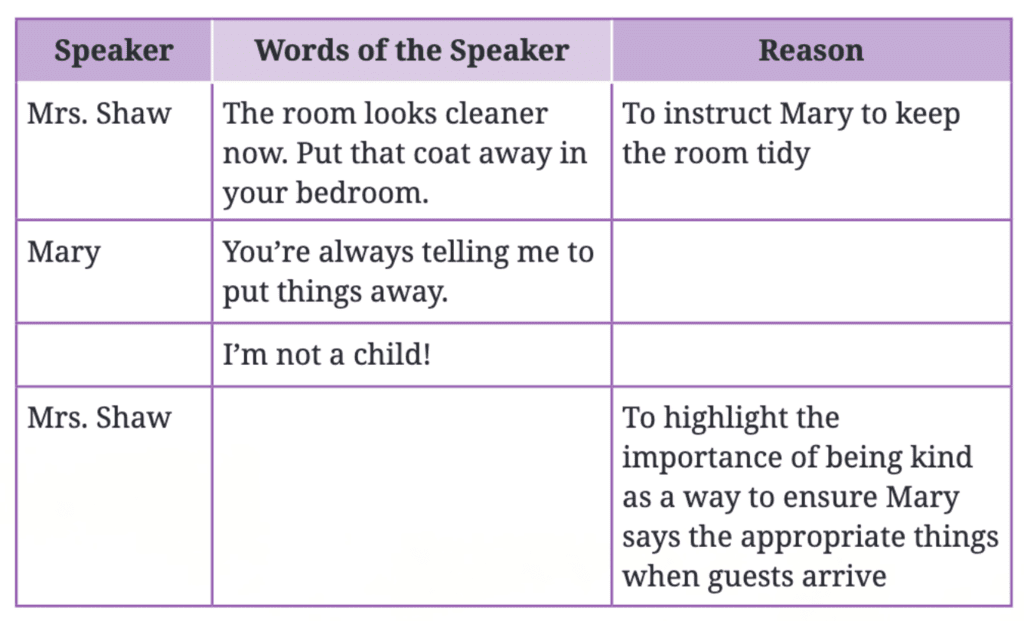
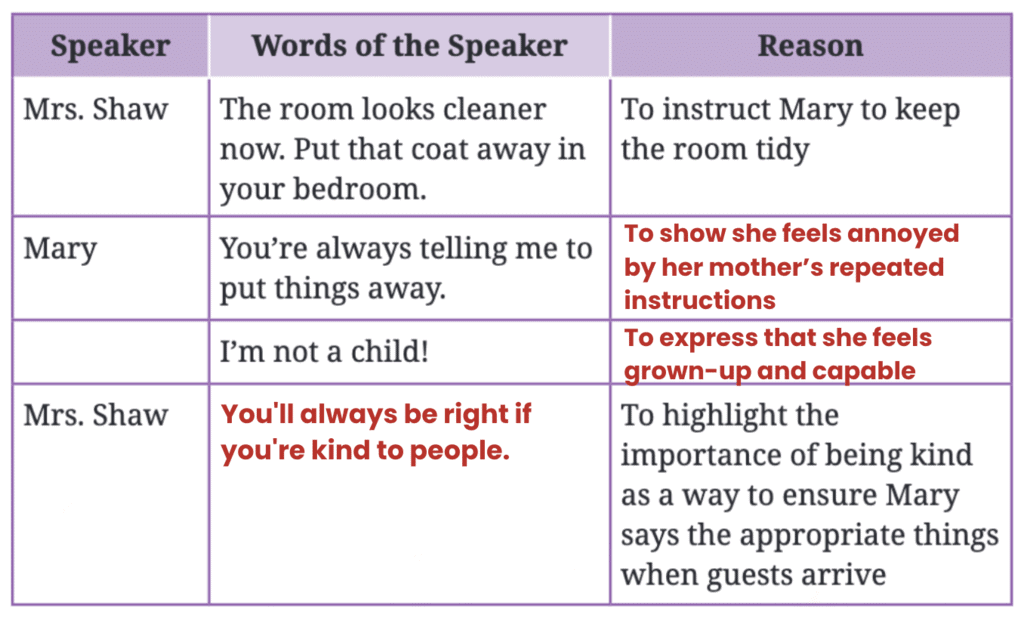
QI: Complete the table given below based on Scene I of the play. An example has been done for you. Share your answers with your classmates and the teacher.

Ans:

QII: Do you think Mary will be able to follow her mother’s advice successfully when Mrs. Harding and Mrs. Lee visit? Why or why not?
Ans: No, Mary might not follow her mother’s advice successfully. She is overconfident and doesn’t fully understand how to be polite. She talks too much and might say the wrong things.

Let us discuss (Page 77)

QI: Rectify the false statements given below from Scene II of the play. An example has been done for you. Share your answers with your classmates and the teacher.

1: Mrs. Harding states that they do not like London as it is not the same as Lanfield.
Ans: Rectification: Mrs. Harding states that they like Lanfield very much even though it is not the same as London.

Mrs. Harding says, “Yes, we like it very much. It’s not the same as London,” showing they like Lanfield.

2: Mrs. Harding was pleased to know that Mary was familiar with her children.
Ans: Rectification: Mrs. Harding was not pleased because she has no children, and Mary’s comment made her uncomfortable.

Mrs. Harding says, “I have no children; believe me,” showing she was not happy with Mary’s assumption.

3: Mrs. Shaw shared that she liked Mrs. Best as she read a lot of newspapers.
Ans: Rectification: Mrs. Shaw said she liked Mrs. Best because she is a nice woman, not because she read newspapers.

Mrs. Shaw says, “She’s a nice woman. I like her,” not mentioning newspapers.

4: Mrs. Harding and Mrs. Shaw agree that wearing a blue dress with a red coat is unfashionable.
Ans: Rectification: Mrs. Shaw says she likes blue dresses and red coats, and Mrs. Harding wears them, so they don’t think it’s unfashionable.

Mrs. Harding says she wears a blue dress with a red coat, and Mrs. Shaw supports it by saying, “I like blue dresses and red coats.”

5: Mary shares that she finds the dog outside the window cute.
Ans: Rectification: Mary says she doesn’t like the dog and calls it dirty, not cute.

Mary says, “It always looks very dirty. I don’t like dogs,” showing she doesn’t find it cute.

Let us think and reflect (Page 78)

QI: Read the extracts given below and answer the questions that follow.

1. 
Mary : What are you going to talk about? 
Mrs. Shaw : I don’t know. All kinds of things. One day you’ll have to go to some of these houses yourself and talk to the people there.
Mary : I can talk now. I’ve been able to talk for a long time. 
Mrs. Shaw : Yes, that’s true. You always talk too much. But does anyone want to hear the things that you say?
Mary : I can talk very well when I like. I’ll stay with you today and talk to them when they come. 
Mrs. Shaw : Oh, I don’t think so. You can go out for a walk. It will be better if you do that.

(i): What does Mrs. Shaw imply when she says, “One day you’ll have to go to some of these houses yourself and talk to the people there”?
A. She believes Mary should start learning about hosting guests then.
B. She thinks Mary is ready to visit these houses independently.
C. She wants Mary to develop social skills for the future.D. She hopes Mary will avoid these social interactions entirely.
Ans: C. She wants Mary to develop social skills for the future.

Mrs. Shaw means Mary needs to learn how to talk politely to people, which will help her in the future when she visits others.

(ii): Complete the following sentence with the correct option from the brackets. 
Mrs. Shaw and Mary are discussing how to __________ (have a polite conversation/ get to know people better)
Ans: have a polite conversation.

Mrs. Shaw gives Mary advice on how to talk kindly and politely to guests, like saying nice things and asking them to stay longer.

(iii): Why did Mary insist on staying with her mother when the guests arrived?
Ans: Mary wanted to prove she could talk well and handle the guests. She says, “I can talk very well when I like. I’ll stay with you today and talk to them.”

(iv): Match the following character traits to the characters in the extract:
Ans:

  • Mary: A. eager – She is excited to stay and talk to the guests.
  • Mary: B. inexperienced – She doesn’t know how to talk politely yet.
  • Mrs. Shaw: C. cautious – She worries Mary might say the wrong things and suggests she go for a walk.

2.

Mary : I saw Mrs. Cotter this afternoon. I met her in the street. No one sees her in the morning because she always stays in bed then. And she’s always asking the doctor to go to see her. I can’t understand women who stay in bed in the morning. And why must she always ask for the doctor? I’ve never been to a doctor in my life.
Mrs. Harding : I stay in bed in the morning myself.

(i): Complete the following sentence suitably. 
Mary could spot Mrs. Cotter in the street because ______________.
Ans: she often walks there in the afternoon.

Mary says, “I saw Mrs. Cotter this afternoon. I met her in the street,” meaning she saw her while passing by.

(ii): What does Mary’s comment about Mrs. Cotter staying in bed and calling the doctor suggest about her understanding?
A. She is worried about why Mrs. Cotter stays in bed all morning.
B. She is unable to understand why people need medical help.
C. She thinks Mrs. Cotter is scared and lonely for staying in bed.
D. She believes Mrs. Cotter is right to rest and take care of herself.

Ans: B. She is unable to understand why people need medical help.

Mary says, “I can’t understand women who stay in bed in the morning,” and “I’ve never been to a doctor,” showing she doesn’t get why someone might need a doctor.

(iii): How can we say that Mary enjoyed good health?
Ans: Mary says, “I’ve never been to a doctor in my life,” which means she has never been sick and is healthy.

(iv): Identify whether the following statement is true or false. 
Mary might have unintentionally offended Mrs. Harding.
Ans: True.

Mary talks about Mrs. Cotter staying in bed, but Mrs. Harding says, “I stay in bed in the morning myself,” so Mary’s comment might have made her feel bad.

QII: Answer the following questions.

1: What does Mary’s comment about Mr. Best’s routine and profession reveal about her viewpoint on bankers and their way of life?
Ans: Mary thinks bankers like Mr. Best have a boring life. She says, “He lives in trains! What kind of life is that?” and “bankers can’t think,” showing she doesn’t respect their job or lifestyle.

2: What can we say about Mary’s understanding of polite conversation based on her interactions with the guests?
Ans: Mary doesn’t understand polite conversation. She says rude things, like calling Mrs. Best’s clothes funny and criticizing the dog, which upsets the guests. She doesn’t follow her mother’s advice to be kind.

3: What do you think the repeated stage direction ‘no one speaks’ indicates about the atmosphere in the room when Mary speaks?
Ans: It shows the room becomes awkward and silent. Mary’s rude comments make the guests uncomfortable, so they don’t know what to say, and the mood becomes tense.

4: How does Mary’s attitude towards the guests change throughout the play?
Ans: At first, Mary is confident and eager to talk to the guests. But after making mistakes, she feels sorry and embarrassed, saying “Oh, I’m sorry” many times. At the end, she still says the wrong thing, asking, “Can’t you go?”

5: What do Mrs. Harding’s and Mrs. Lee’s responses to Mary’s blunders during their visit reveal about their characters?
Ans: Mrs. Harding and Mrs. Lee are polite but firm. They correct Mary, like when Mrs. Harding says, “I have no children,” and Mrs. Lee says, “My brother’s a banker.” They stay calm but leave early, showing they are patient but not happy with Mary’s rudeness.

6: In what way does the play show the importance of knowing how to engage in polite conversation?
Ans: The play shows that polite conversation makes people feel comfortable and happy. Mary’s rude words upset the guests, making the visit awkward. Her mother’s advice to be kind shows that politeness helps build good relationships.

Let us learn (Page 80)

I: Study the following words taken from the text.
humorous, hilariously, coming, beautiful 

The given words are made by adding word endings like -ous, -ly, -ing, and -ful to the root words humour, hilarious, come, and beauty. Such word endings are called suffixes.

  • humour + -ous
  • hilarious + -ly
  • come + -ing
  • beauty + -ful

Q1. Now, divide the following words from the text as root words and suffixes. Check your answer with the teacher.

Ans:

  • Gladly: glad + -ly
  • Banker: bank + -er
  • Guidance: guide + -ance
  • Quietly: quiet + -ly
  • Walking: walk + -ing

Q2: Study the words in Column 1. Match the suffixes in Column 2 with their meanings or purpose in Column 3. Write a few examples for each in Column 4. Share your answers with the teacher.

Ans: 

Q3: Fill in the blanks using words given in the brackets by adding suitable suffixes.

To communicate (i) ___________ (effective), choose your words and topics (ii) ___________ (wise). Avoid (iii) ___________ (discuss) things you don’t know much about or that could upset someone. Remember to be (iv) ___________ (respect) towards others, including yourself, and express your (v) ___________ (appreciate). Finally, always be(vi) ___________ (response) by replying promptly to communicate.

Ans:
(i) To communicate effectively (effective).
(ii) Choose your words and topics wisely (wise).
(iii) Avoid discussing (discuss).
(iv) Remember to be respectful (respect).
(v) Express your appreciation (appreciate).
(vi) Always be responsive (response).

II: Read the highlighted words in the following sentences from the text.

  • But does anyone want to hear the things that you say?
  • I can’t tell you everything. 

Select the correct answer. 

Is there a difference in the meanings of ‘say’ and ‘tell’? (Yes/ No)

  • Say’ focuses on the message and does not always require a listener.
  • Tell’ focuses on who receives the message and always needs a listener.

1: Fill in the blanks with suitable words from the sets of words given in the box below. Make changes in the verb forms (tense), if necessary.

(i) I _________ at the photo, but I didn’t _________ anyone familiar.
(ii) I’d better go and _________ my mother from the station, and then_________ her home.
(iii) I need to _________ for my mathematics exam this weekend, so I hope to _________ new concepts along the way.
(iv) I can _________ the music from my neighbour’s house, but I need to _________ to it carefully to understand the lyrics.
(v) “Could I _________ to Mrs. Kalpana, who is going to _________ to us about gardening,” said Ritu.
(vi) I _________ in a small town, but I often _________ with my relatives in the city

Ans:

(i) I looked at the photo, but I didn’t see anyone familiar.

(ii) I’d better go and fetch my mother from the station, and then bring her home.

(iii) I need to study for my mathematics exam this weekend, so I hope to learn new concepts along the way.

(iv) I can hear the music from my neighbour’s house, but I need to listen to it carefully to understand the lyrics.

(v) “Could I speak to Mrs. Kalpana, who is going to talk to us about gardening,” said Ritu.

(vi) I live in a small town, but I often stay with my relatives in the city.

QIII: Read the following sentences from the text and underline the verbs.

  • They lived in London before.
  • I met her in a shop and asked her to come. 

As you know, the verbs you have underlined are in the simple past tense. (actions that happened in the past or distant past)

Read the following sentence from the text and underline the verb. 
She has been staying with them for a while. 

The verb you have underlined is in the present perfect continuous tense.

1: Fill in the blanks using the verbs given in brackets in the present continuous or present perfect continuous tense.

The students (i) ______________ (organise) a play and setting up the stage. They (ii) ______________ (prepare) for weeks to make everything perfect. The performers (iii) ______________ (rehearse) every day, and their excitement (iv) ______________ (grow). The sound in-charge (v)______________ (test) the microphones to check the sound quality.Everyone (vi) ______________ (work) hard, and now the place (vii)______________ (buzz) with energy and excitement.

Ans:
(i) The students are organising (organise) a play and setting up the stage.
(ii) They have been preparing (prepare) for weeks to make everything perfect.
(iii) The performers are rehearsing (rehearse) every day.
(iv) Their excitement is growing (grow).
(v) The sound in-charge is testing (test) the microphones to check the sound quality.
(vi) Everyone is working (work) hard.
(vii) Now the place is buzzing (buzz) with energy and excitement.

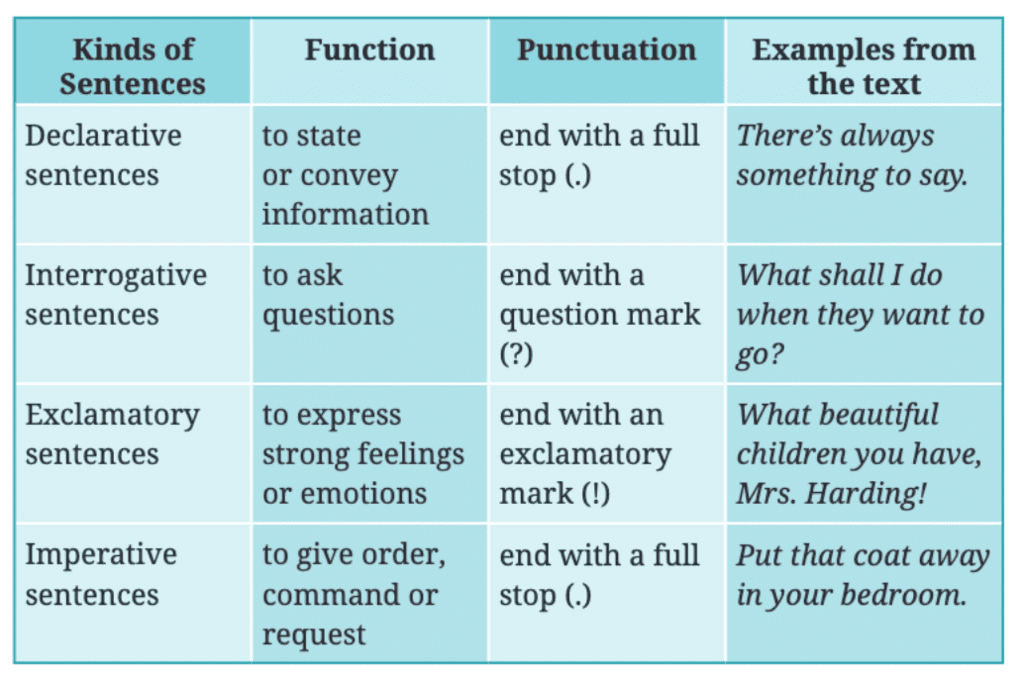
IV: Read the explanation about the kinds of sentences given in the table below.

1: Identify the kinds of sentences and punctuate them appropriately.
(i) The meeting starts at 10.00 a.m. in the conference room. 
Ans: 
Declarative
(ii) What an exciting adventure it was! 
Ans: 
Exclamatory
(iii) How did you solve the problem so quickly?
Ans:
 Interrogative
(iv) What is the weather forecast today?
Ans: 
Interrogative
(v) How beautiful is the rainbow!
Ans: 
Exclamatory
(vi) Clean up your room before dinner.
Ans:
 Imperative
(vii) The children are planning a surprise party for their mom. 
Ans:
 Declarative
(viii) Turn off the music.
Ans: 
Imperative

Let us listen (Page 84)

I) Mrs. Shaw wanted Mary to learn to say the right thing. You will listen to a conversation between a mother and her son about basic manners. As you listen, fill in the blanks given below by selecting the correct option. (Transcript for the teacher on pg. 89 ) 
Mother : Why were you getting impatient in the grocery store? 
Son : Was I really? I just didn’t like waiting so long. 
Mother : I know waiting can be boring, but remember, we always stand in queues and wait for our turn. It’s fair for everyone, right? 
Son : Hmm, I guess. Even if it takes a lot of time? 
Mother : Well, that’s when we practise patience. And when it’s our turn, what do we say to the shopkeeper? 
Son : We say, ‘Thank you’. And ‘Please’ if we ask for something, right? 
Mother : Yes! Those are polite words. Why do you think they’re important?
Son : Maybe because they make people feel respected? 
Mother : Exactly! It shows gratitude and kindness. And what about yesterday when you bumped into that lady with the blue sari? 
Son : Oh, I said sorry right away. You always tell me it’s important to apologise. 
Mother : That’s true. Why do you think it’s important to apologise? 
Son : Um… so people know I didn’t mean to do it and that I care? 
Mother : Yes, it shows you’re responsible. And how about when we’re in places like the library? What kind of voice should we use? 
Son : Oh, I know this! We speak softly so we don’t bother others. 
Mother : Right again! It’s called using an ‘inside voice’. 
Son : I know. I also know that we should cover our mouth when we yawn, sneeze or cough in a gathering or a public place. 
Mother : Absolutely! You’re getting really good at remembering these things. And when we talk at home or school, what should we do when someone else is speaking? 
Son : We wait for our turn. It’s not well-mannered to interrupt. 
Mother : You’ve got it, Rohan. You’re becoming a really polite young man. 
Son : Thanks, Ma. So, do you think I’ll be ready to handle the grocery queue next time? 
Mother : Certainly! And maybe we can get some ice cream as a reward if you do it well. Son : Deal! And… thank you!

Answer These:
1. How did the son behave in the grocery queue? 
(i) strangely 
(ii) impatiently 
(iii) politely 

Ans: (ii) impatiently

2. The mother finally refers to her son as a __________________. 
(i) polite young man 
(ii) responsible son 
(iii) grateful person

Ans: (i) polite young man

II) You will once again listen to the conversation. As you listen, select four true statements from 1– 7 given below. 
1. The mother uses the grocery store incident as an opportunity to teach her son about patience and fairness. 
2. The son recognises the value of apologising and understands that it shows he notices others. 
3. The son is gradually learning the importance of polite words and actions from his mother’s guidance. 
4. The mother discourages her son from speaking softly in public, suggesting that people should adjust to his voice level. 
5. The son feels that covering his mouth when coughing is only important when he’s at home. 
6. The son receives all advice readily while understanding its importance. 
7. The mother uses praise to support the polite behaviours she wants her son to continue practising.

Ans: 
True statements:
1. The mother uses the grocery store incident as an opportunity to teach her son about patience and fairness.
2. The son recognises the value of apologising and understands that it shows he notices others.
3. The son is gradually learning the importance of polite words and actions from his mother’s guidance.
7. The mother uses praise to support the polite behaviours she wants her son to continue practising.
False statements:

4. Statement 4 is false because the mother encourages her son to speak softly in public, especially in places like the library.
5. Statement 5 is false because the son mentions that covering his mouth when coughing, sneezing, or yawning is important in public places, not just at home.
6. Statement 6 is false because the son sometimes questions or reflects on the advice before understanding and accepting it. He does not always receive it immediately or without hesitation.

Let us speak (Page 84)

As you know

  • Intonation is the rise and fall of the pitch of tone while speaking. 

Let us learn about sentence stress.

  • Sentence stress is laying emphasis on certain word (s) in a sentence.

→ The emphasis on particular words helps to convey the meaning and importance of the sentence.

→ Content words like book, run, beautiful, quickly, etc., are mostly stressed instead of function words like she, in, is, etc., in a sentence.

QI: Speak the given declarative sentence aloud. 
I saw Mrs. Cotter this afternoon.
Ans: Say it with falling intonation at the end and stress “Mrs. Cotter.”
Stress “Mrs. Cotter” to emphasise who was seen, and use falling intonation for a declarative sentence.

Remember, stress does not mean to say the word louder than others. Itmeans to say a word with more emphasis than others.

QII: Speak the following declarative sentences with falling intonation and stress the highlighted words.

1. The room looks cleaner now
2. You always talk too much.
3. You leave your clothes all over the house.

QIII: Work in pairs and speak the following sentences 1-5 aloud, as Mary. Apply stress and falling intonation. Match each of the sentences to the meaning they convey in (i)-(v).

Ans:

  1. I didn’t hurt anyone today. – (iv) I, specifically, did not hurt anyone, possibly implying someone else might have.
  2. didn’t hurt anyone today. – (iii) The action of hurting anyone did not occur.
  3. I didn’t hurt anyone today. – (i) I might have done other things but did not hurt anyone.
  4. I didn’t hurt anyone today. – (v) I may have spoken a lot many things but not a single person was hurt.
  5. I didn’t hurt anyone today. – (ii) I might cause hurt usually, but not anyone on this day.

QIV: Now, speak the given declarative sentence with rising intonation towards the end of sentence and stress the highlighted words. I saw Mrs. Cotter this afternoon.
Ans: Say it with rising intonation at the end and stress “Mrs. Cotter.”

Remember: The way we use stress and intonation in a sentence can change the meaning of what we wish to say if we are not careful.

Let us write (Page 86)

Rewrite the play ‘Say the Right Thing’ as a short story, focusing on Mary’s interactions with her mother and the guests. 

  • Ensure the story captures the main events, character emotions, and humorous moments effectively. 
  • Use paragraphs to organise your story and include descriptive language to bring the characters and events to life. 

You may refer to the following hints: 

  • Begin with an introduction: describe Mary and Mrs. Shaw, their relationship and the setting of the story. 
  • Explain Mrs. Shaw’s instructions to Mary before the guests arrive and Mary’s confidence in handling the situation. 
  • Narrate the events when Mrs. Harding and Mrs. Lee visit, highlighting Mary’s remarks and the guests’ reactions. 
  • Include key moments of humour and awkwardness to maintain the tone of the play.
  • Conclude by commenting on how the visit ended and Mary’s impact on the situation.

Ans: 
Say the Right Thing

A Short Story

Mary Shaw was a lively young girl who loved to talk. She lived with her mother, Mrs. Shaw, in the quiet town of Lanfield. Mrs. Shaw was careful and proper in her ways and believed in good manners, especially while speaking to others. Mary, on the other hand, often spoke without thinking, which sometimes led to trouble.

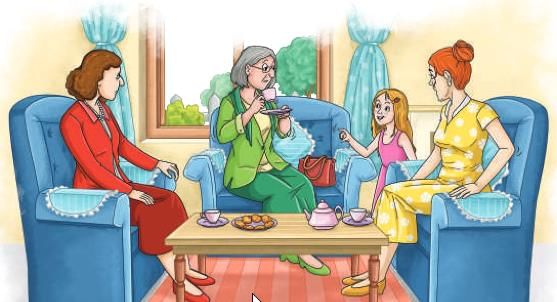
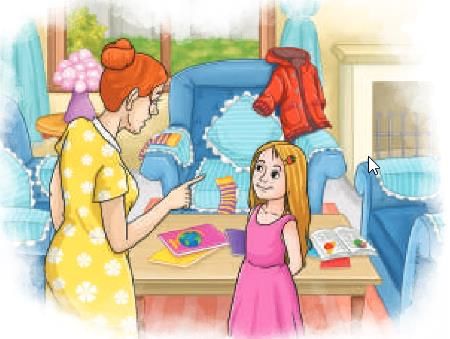
One afternoon, Mrs. Shaw was busy cleaning the living room. She informed Mary that two guests were coming over—Mrs. Harding, the wife of a wealthy man who had recently moved to Lanfield, and her sister-in-law, Mrs. Lee. Mrs. Shaw hoped to make a good impression, and she was nervous about how Mary might behave during the visit.

Although Mrs. Shaw suggested Mary go out for a walk, Mary insisted on staying. She was confident that she could speak politely and promised to follow her mother’s advice. Mrs. Shaw reminded her to speak kindly, make people feel welcome, and to say things that would make others happy. She also warned Mary to look sad when the guests got up to leave and say something like, “Must you go? Can’t you stay?”

Mary listened carefully and repeated the polite phrases out loud to remember them. She then changed into a clean dress, determined to show her mother that she could handle the guests well.

Soon, Mrs. Harding and Mrs. Lee arrived, and Mrs. Shaw welcomed them warmly. After a short conversation about Lanfield, there was a pause. Mrs. Shaw looked at Mary, hoping she would say something pleasant. Mary smiled and said, “What beautiful children you have, Mrs. Harding! I’ve seen them walking down the road.” Mrs. Harding, looking slightly uncomfortable, replied, “I haven’t any children.” Mary insisted she had seen them, making the moment awkward.

Trying to steer the conversation in another direction, Mrs. Shaw mentioned Mr. Best, a man who lived nearby. But Mary made things worse. She laughed and said that Mr. Best lived “in trains” because he travelled to London every day and read newspapers instead of books. Then she added, “But he’s only a banker, and bankers can’t think.” Mrs. Lee quietly replied, “My brother is a banker.” Mary was embarrassed and quickly apologised.

Unfortunately, that was not the end of Mary’s blunders. She laughed at someone’s clothes, not realising that Mrs. Harding wore the same outfit. She criticised people who stayed in bed in the morning and often called the doctor—only to find out that both Mrs. Harding and Mrs. Lee did exactly that. Mary then called Mrs. Grantley, one of Mrs. Shaw’s close friends, “too talkative,” which offended Mrs. Lee, as her mother was also very talkative.

The most embarrassing moment came when Mary complained about a dirty dog she had seen near their house. Mrs. Harding calmly replied that the dog, named Towzer, belonged to her. Mary turned red and said she didn’t know. She then made fun of a man riding a horse and practising shooting, only to hear that Mrs. Lee’s brother did those things and had even moved to Lanfield for them.

By this time, the room was filled with silence and discomfort. Mrs. Harding gently said that they should leave. Mrs. Shaw politely invited them to stay longer, hoping to fix the situation. But Mary, completely forgetting her mother’s advice, blurted out, “Oh, must you stay? Can’t you go?”

The guests left soon after, and the visit ended in an awkward silence. Mary had tried her best to be polite, but her careless remarks turned the meeting into a comedy of errors. While it was an uncomfortable afternoon for Mrs. Shaw, it was also a humorous reminder that knowing what to say—and when to say it—is a very important part of growing up.

Let us explore  (Page 86)

I) Work in groups. Enact your favourite part of the play. Points to remember: 

  • Allot a specific role to each member in the group. For example: director, narrator, and characters.
  • Include the actions and expressions as indicated in brackets in the play.

Ans: 

  • Form a group with your classmates.
  • Assign roles to everyone. Some ideas:
    • Director – guides the group and gives instructions
    • Narrator – introduces the scene and explains actions
    • Characters – like Mary, Mrs. Shaw, Mrs. Harding, and Mrs. Lee
  • Choose a funny or important scene from the play.
  • Include actions and expressions mentioned in the brackets (e.g., Mary turns red with shameMrs. Harding smiles, etc.).
  • Practice and perform it in class for fun and learning!

II) Find out how people greet guests who visit their homes in different languages. Share it with your classmates and the teacher. 
Ans:
LanguageGreeting for GuestsHindiNamasteTamilVanakkamPunjabiSat Sri AkalBengaliNomoshkarUrduAdaabEnglishWelcome, nice to meet you!SpanishBienvenidoFrenchBienvenueJapaneseIrasshaimase


 III) ‘Vasudhaiva Kuṭumbakaṁ is a Sanskrit phrase which means the world is one family. Vasudha means Earth; eva  translates to ‘is thus’ and Kuṭumbakaṁ means ‘family’. The phrase originates from ancient Indian texts like the Maha Upanishad and the Hitopadesha. 

This saying highlights the interconnectedness of all people, suggesting that humanity is part of a single global family. It encourages unity, cooperation, and treating others with kindness and empathy, regardless of differences in nationality, race, or religion. The message is often used to promote global peace and mutual understanding among diverse cultures and nations. ‘Vasudhaiva Kutumbakam’ was chosen as the theme for the G20 Summit which captured the essence of global unity, common bonds, and shared aspirations for a better future.

05. A Funny Man Chapter Solution

Let us do these activities before we read. 

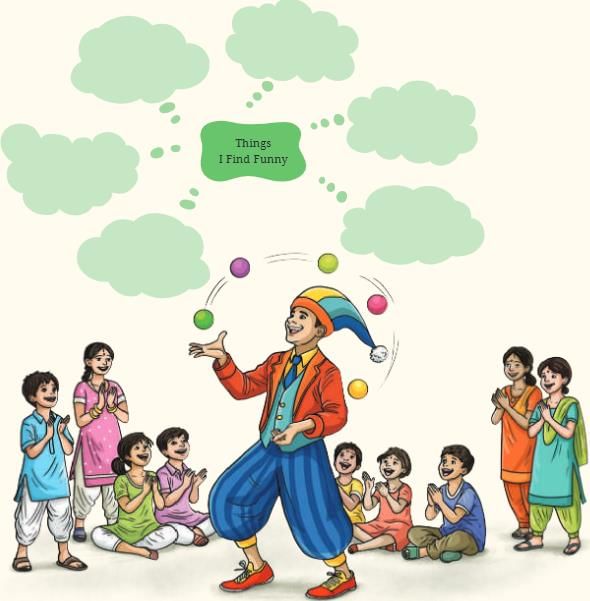
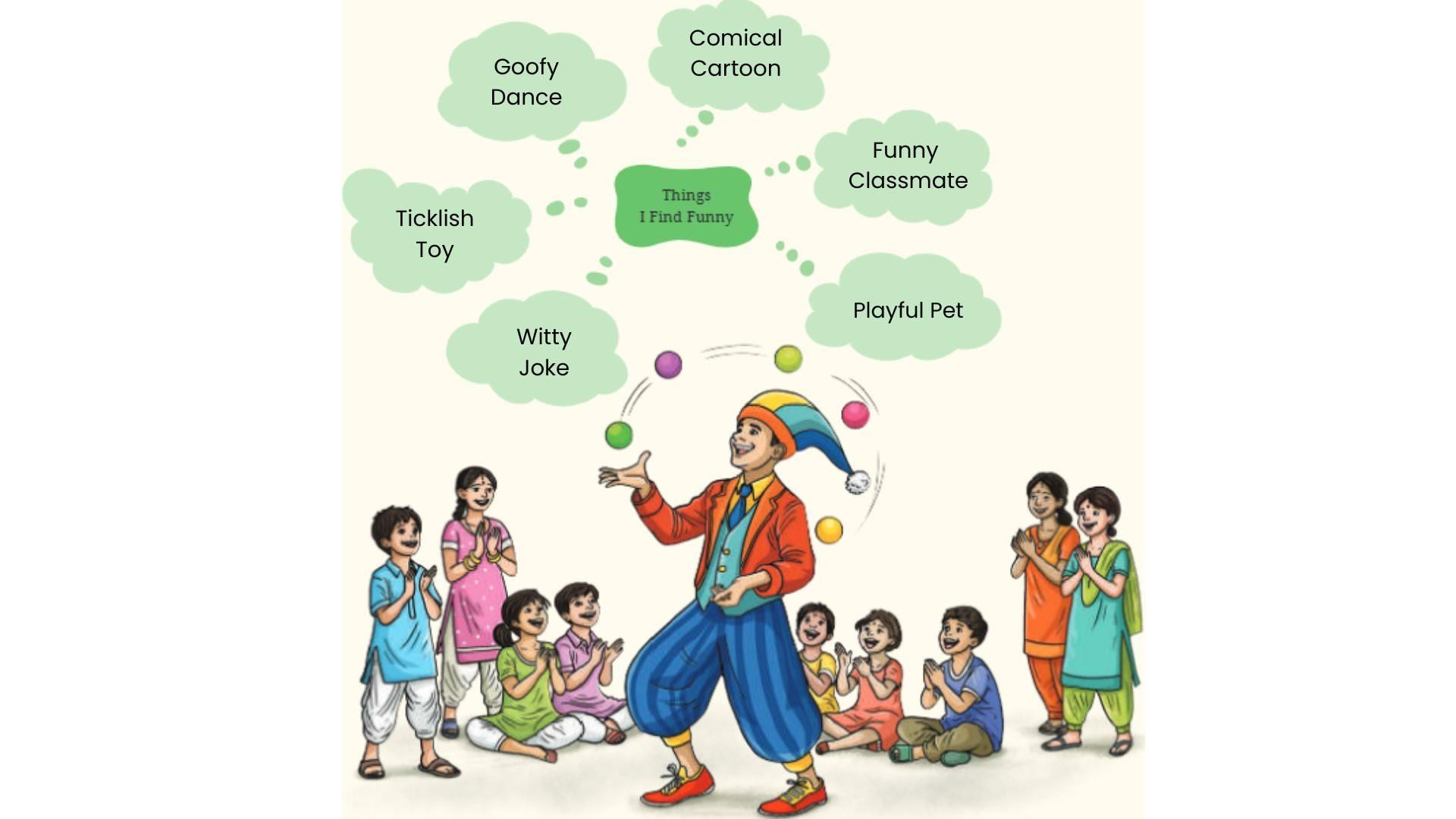
Look around you for things or people that make you laugh. Write them in the bubbles given below. Share the reasons for your answers with your classmates and the teacher.

Ans: Here are six things or people around me tha make me laugh, along with reasons why they’re funny.

1. A Playful Pet
Reason: My dog chases its tail in circles, thinking it’s a game, which is hilarious because it never catches it but keeps trying with such enthusiasm!

2. A Funny Classmate
Reason: My friend makes silly faces during boring lessons, mimicking the teacher’s expressions, which cracks everyone up without getting caught.

3. A Comical Cartoon on TV
Reason: Watching a cartoon like Tom and Jerry is funny because Tom’s plans to catch Jerry always fail in the most ridiculous, over-the-top ways.

4. A Sibling’s Goofy Dance
Reason: My younger sibling dances wildly to any music, flailing arms and legs like a robot gone haywire, making everyone laugh at their confidence.

5. A Ticklish Toy
Reason: A toy that makes weird noises or wiggles when you press it, like a giggling plushie, is funny because it surprises you every time.

6. A Teacher’s Witty Joke
Reason: My teacher sometimes tells cheesy jokes, like “Why did the cow become a motivational speaker? Because it was outstanding in its field!”—it’s so bad it’s funny.

Let us discuss

QI: Work in pairs. Identify the true statements. Check your answers with the teacher.

1. The poet says that she had never heard such an amusing song.
2. The funny man was quite ill-mannered.
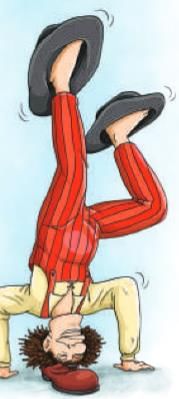
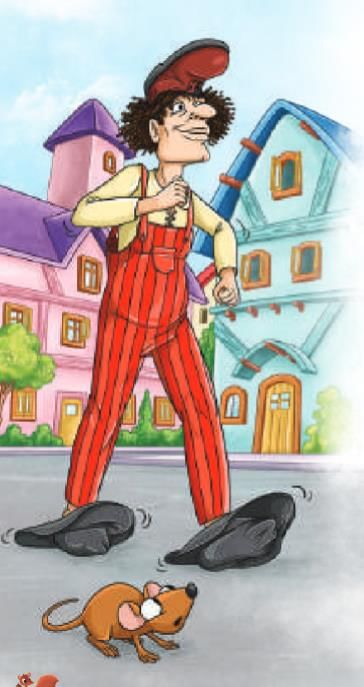
3. The funny man wore two hats on his feet.
4. The funny man hopped on his head to reach home.
5. The funny man gave a rose to the poet.
6. The funny man smiled at the poet.

Ans:

  1. Statement 1 is true: The poet says, “You never heard in all your life Such a funny feeling sound.”
  2. Statement 2 is false: The funny man was polite, not ill-mannered.
  3. Statement 3 is true: The poem states, “He wore… hats upon his feet.”
  4. Statement 4 is true: The funny man “hopped home on his head.”
  5. Statement 5 is false: He gave a currant bun, not a rose.
  6. Statement 6 is true: “He raised the shoe and smiled at me.”

QII: Identify the words from the poem based on the meanings given. Share your answers with your classmates and the teacher.

1. a small seedless raisin – C _ R _ _ _ T
Ans: 
Currant

2. moved unsteadily –  S _ _ G G _ _ _ D
Ans: Staggered
Explanation:

  • “Currant” is from “currant bun,” a small seedless raisin.
  • “Staggered” is from “I staggered back,” meaning moved unsteadily.

QIII: Complete the following sentences with a reason.

1. The tone of the poem is ___________ because ___________.
2. The rhyme scheme of the poem is ___________; and it gives a ___________quality to the poem.
3. The poet has frequently repeated the word ‘funny’ in order to___________.
Ans:

  1. The tone of the poem is funny because the funny man does silly things like wearing hats on his feet and hopping on his head.
  2. The rhyme scheme of the poem is AABCCB; and it gives a playful quality to the poem.
  3. The poet has frequently repeated the word ‘funny’ in order to make the poem humorous and show the man’s silly actions.

QIV: Choose the correct answer from the options given in the brackets.
1. The poem uses vivid imagery to create a _______________________(humorous and nonsensical/ confusing but thought-provoking) scene.
2. The structure of the poem is in ___________ (monologue/ dialogue) form.
3. The phrases ‘sounding sight’ and ‘hopped home’ are examples of___________. (alliteration/simile)
Ans:

  1. The poem uses vivid imagery to create a humorous and nonsensical scene.
  2. The structure of the poem is in dialogue form.
  3. The phrases ‘sounding sight’ and ‘hopped home’ are examples of alliteration.

QV: Rewrite the following line from the poem in the correct order.

1. But never had I seen before
Such a funny sounding sight

Ans: I had never seen such a funny-sounding sight before.

The original line “But never had I seen before Such a funny sounding sight” is rewritten in natural order.

2. Why has the poet used phrases like ‘funny sounding sight’ and ‘funny feeling sound’ with reference to the funny man?
Ans: The poet uses these phrases to make the funny man’s actions seem silly and strange. “Funny sounding sight” describes the odd way he looks, like wearing hats on his feet, which is unusual to see. “Funny feeling sound” shows his song sounds weird and makes the poet laugh. These phrases add humour and show how the funny man’s behaviour is playful and not normal.

QVI: Can you think of any real-world situations where people do similar things for fun, entertainment, or performance? Share with your classmates and the teacher.
Ans: Example:

  • Clowns at a circus wear funny costumes and do silly acts to make people laugh, like the funny man.
  • Street performers juggle or dress oddly to entertain, similar to the funny man’s actions.

Let us think and reflect

QI: Read the extracts given below and answer the questions that follow.

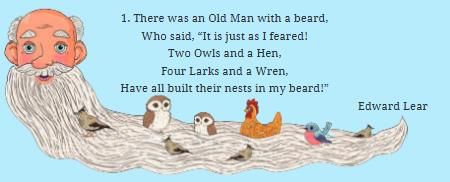
1. He said, “Allow me to present Your Highness with a rose.” 
And taking out a currant bun 
He held it to my nose. 
I staggered back against the wall
And then I answered, “Well!”

(i): Why does the funny man address the poet as ‘Your Highness’?
Ans: To be polite and playful.

(ii): Choose a phrase from the extract which indicates a polite request.
Ans: The funny man says, “Allow me to present Your Highness with a rose,” which is a polite way to ask.

 (iii): Choose the option which shows a ‘currant bun’.


Ans: Image 2 likely represents a currant bun. 

(iv): Complete the sentence with an appropriate reason. 
When the poet says, ‘Well!’, it expresses surprise. This was so because ______
Ans: the funny man gave her a currant bun but called it a rose.

The poet was surprised because a currant bun doesn’t look or smell like a rose.

2. You never heard in all your life 
Such a funny feeling sound. 
“My friend, why do you wear two hats 
Upon your feet?” I said. 
He turned the other way about, 
And hopped home on his head.

(i): Choose the line from the extract which tells us that the sound was unique.
Ans: “You never heard in all your life Such a funny feeling sound.”

This line shows the sound was unique because the poet had never heard it before.

(ii): Complete the sentence with an appropriate reason. The poet calls the funny man ‘my friend’ because __________
Ans: she wants to be friendly and ask him a question.

(iii): What does the reaction of the funny man to the poet’s question tell us about him?
Ans: Instead of answering the question, he turns around and hops on his head. This shows us that he is silly and playful.

(iv): Choose the correct option to complete the sentence. The last line of the extract makes the readers feel ______
A. dreamy B. impatient C. worried D. cheerful
Ans: D. cheerful

The funny man hopping on his head is silly and makes readers smile, so it feels cheerful.

QII: Answer the following questions.

1: Which character trait of the funny man was most appealing to you? Why?
Ans: His playfulness. He does funny things like wearing hats on his feet and hopping on his head, which makes the poem enjoyable.

2: The funny man does unusual things in the poem. How does it affect the overall mood of the poem?
Ans: It makes the mood funny and light. His actions like giving a currant bun as a rose and hopping on his head create laughter.

3: What alternative title would you suggest for the poem? Give reason(s) for your choice.
Ans: “The Silly Man’s Adventure” because the funny man does silly things like wearing a shoe on his head and singing a funny song.

4: Why do you think the poet has included dialogues in the poem?
Ans: To make the poem lively and show the funny man’s actions directly. Lines like “I said” and “He said” make it more engaging.

5: What does the poet wish to convey by highlighting the unusual behaviour of the funny man?
Ans: The poet wants to show that being silly can bring joy. The funny man’s actions, like wearing hats on his feet, make people smile.

Let us learn

Read the following phrases from the poem.

• walking down • taking out • sat down

These are phrasal verbs.

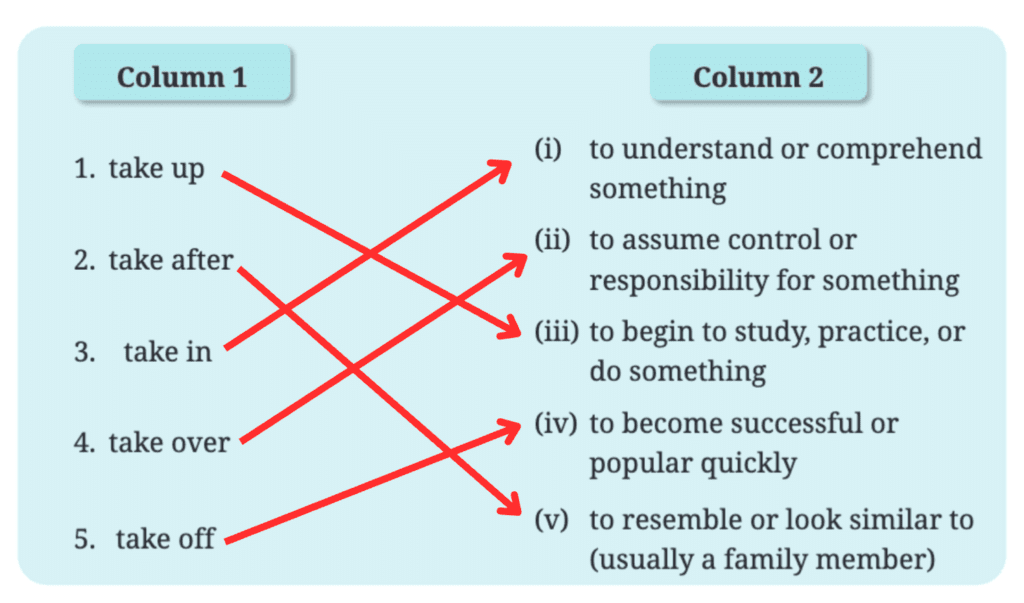
Phrasal verbs are combinations of a verb with a preposition or adverb that together function as a single unit. They often have meanings that are different from the individual words used alone. The same verb followed by different prepositions or adverbs conveys different meanings. 

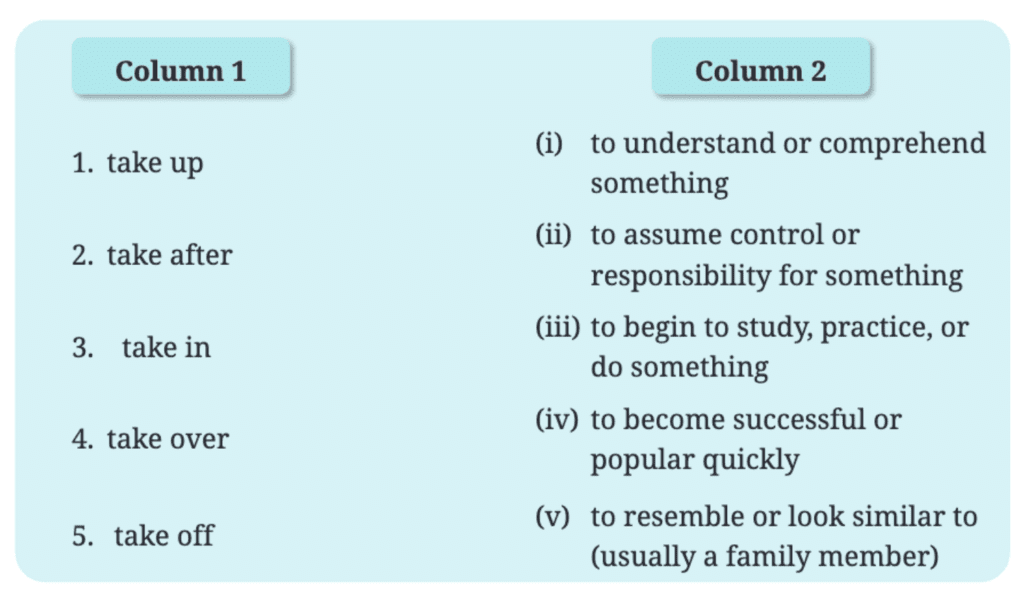
QI: Match the phrasal verbs in Column 1 with their correct meaning in Column 2.

Ans:

Now, fill in the blanks with suitable phrasal verbs from the table given in I. You may change the tense of the verb, if required.
Ans:

  1. The new technology is set to take over traditional methods of communication.
  2. I tried hard to take in what the writer wanted to say but was unsuccessful.
  3. Arjun decided to take up painting as a hobby.
  4. The smartphone quickly took off the sales in the market.
  5. Sheela takes after her father; they have the same smile.

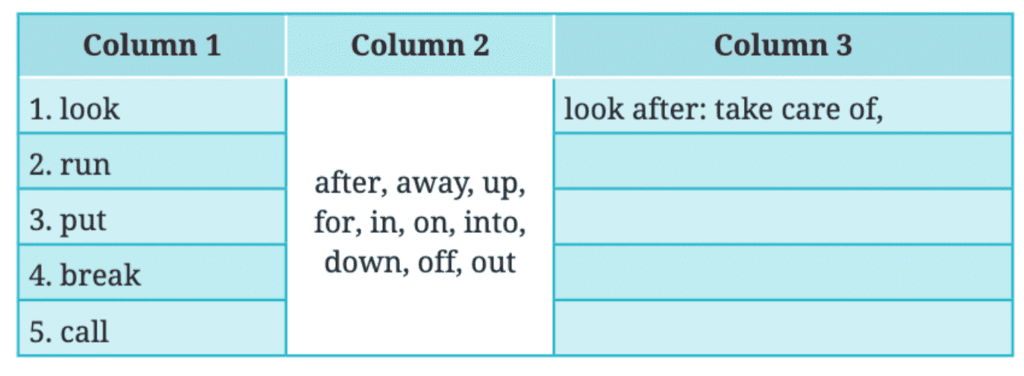
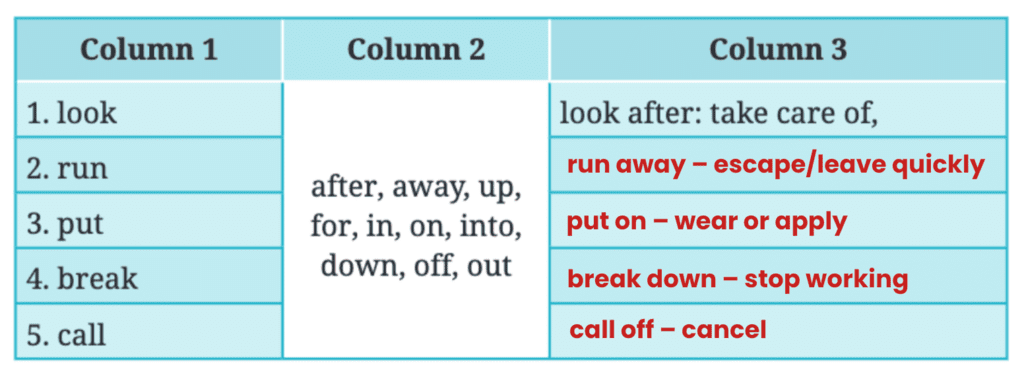
QII: Match the verbs in Column 1 with any suitable adverbs or prepositions in Column 2. Write their meanings in Column 3. An example has been done for you.


Ans:

Now, frame sentences of your own using any five phrasal verbs.
Ans:

  1. I will look after my dog while my parents are away.
  2. The cat ran away when it heard a loud noise.
  3. She put on her jacket before going outside.
  4. The car broke down on the way to school.
  5. They called off the match because of rain.

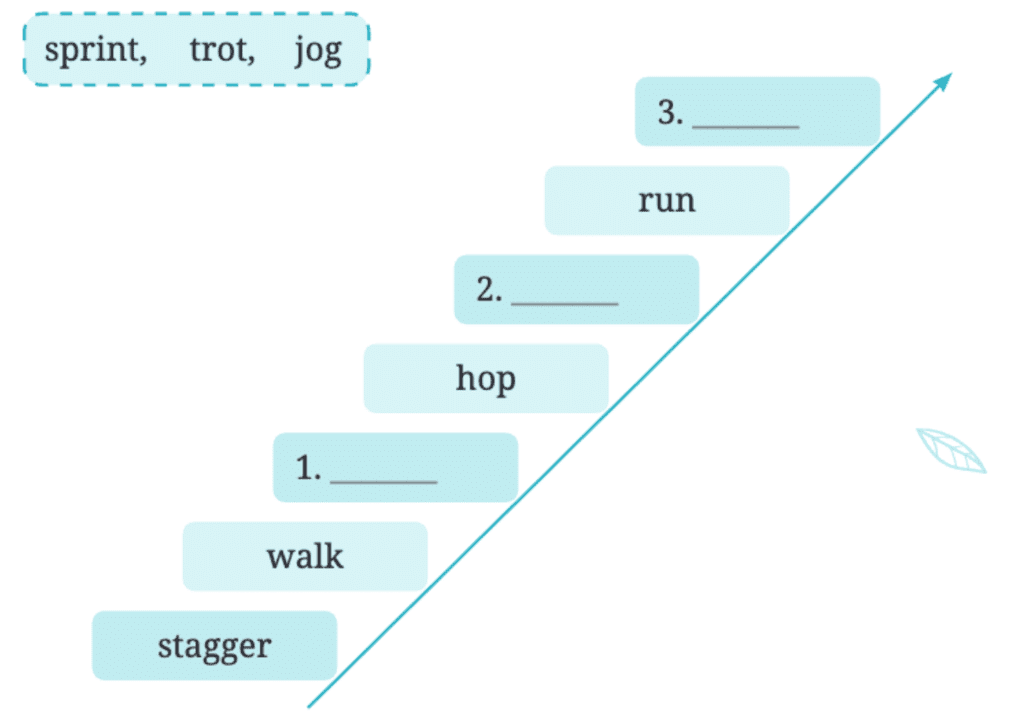
QIII: Read the following words from the poem. 
walking, staggered, hopped 

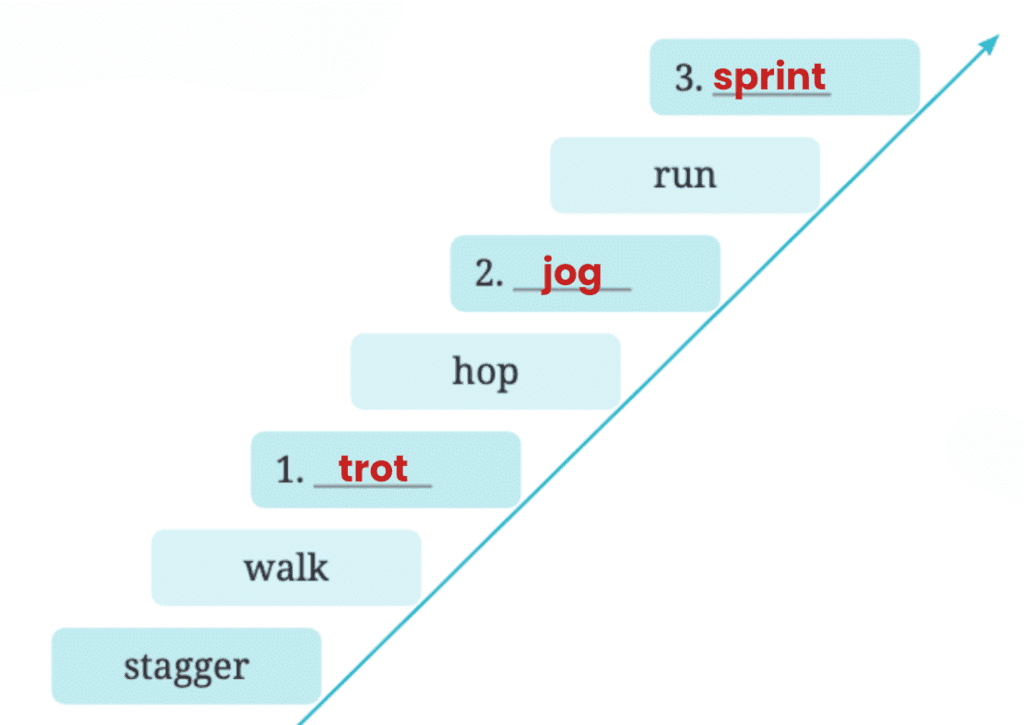
The given words denote the different ways of walking. Arrange the words given in the box in increasing order of pace.

Ans: 

Let us listen

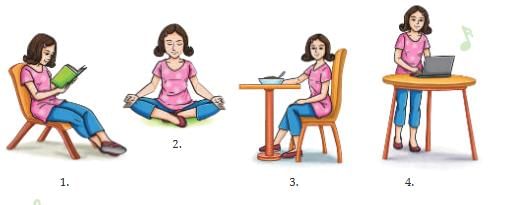
I) You will listen to a girl narrate a personal incident. As you listen, select the picture related to the narration. (Transcript for the teacher on pg. 88)


Transcript: Hello. This is quite a funny incident. One day, I was so preoccupied with preparing for my presentation. After a long day of studying at a friend’s place, I finally came home. Exhausted, I removed my shoes at the door and headed straight to the kitchen for some lunch. I served myself dal-chawal and ate it, still thinking about all the topics I needed to cover. 

Once I finished my lunch, I got up to put my shoes away in my room and placed my plate in the kitchen. However, being so preoccupied, I ended up doing the opposite! I walked to my room with my plate in hand and left it on my desk. Then, I took my shoes and placed them in the kitchen!

As I stood there, confused, I realised what I had done. I couldn’t help but laugh at myself. I shook my head, recovered my shoes from the kitchen and kept the plate in the kitchen. 

Ans: The correct picture is picture 3 where the girl can be seen eating food.

II) You will once again listen to the girl narrate a personal incident. As you listen, arrange the events in order of occurrence. 
1. Ate lunch 
2. Took off shoes 
3. Put shoes in the room 
4. Laughed at the mistake 
5. Placed the plate in the room 
6. Prepared for the presentation 
7. Put the plate in the kitchen

Ans: Here is the correct order of events based on the narration:

  1. Prepared for the presentation
  2. Took off shoes
  3. Ate lunch
  4. Placed the plate in the room
  5. Put shoes in the kitchen (Note: The option given is “Put shoes in the room,” but from the narration, the shoes were mistakenly placed in the kitchen.)
  6. Laughed at the mistake
  7. Put the plate in the kitchen

Let us speak
Read the joke given below. 
A man is talking to God. 
The man says, “God, how long is a million years?” 
God replies, “For me, it’s about a minute.” 
The man asks, “How much is a million rupees?” 
God smiles and replies, “It’s less than a rupee for me.” 
The man quickly requests, “God, may I have a rupee?” 
God promptly says, “Wait a minute.” 
Work in pairs and take turns to tell the joke. 
Remember: 


• Narrator’s voice – your own voice (speak in a matter-of-fact manner) 
• Man’s voice – change to louder voice (speak with respect) 
• God’s voice – deep voice (speak in a pleasant tone) 
Now, work in pairs to create a joke and tell it in front of the class.

Ans: Here’s an original joke for you and your partner to practice and perform:

  • Narrator: A cat visits a wise owl in the forest.
  • Cat (in a curious, meowing tone): “Owl, why do you stay up all night?”
  • Owl (in a slow, hooting tone): “Because the night is when I’m wide awake!”
  • Cat (excitedly): “Can you teach me to stay up like you?”
  • Owl (with a chuckle): “Sure, but you’ll need to catch a nap first!”

Performance Tips:

  • Narrator: Speak in your natural voice, calmly setting up the scene.
  • Cat’s Voice: Use a high-pitched, playful tone to mimic a curious cat.
  • Owl’s Voice: Use a slow, deep tone to sound wise and slightly amused.
  • Practice switching roles, emphasizing the punchline (“catch a nap first”) with a pause for effect.
  • Perform confidently in front of the class, using gestures like mimicking a cat’s whiskers or an owl’s head turn to make it funnier.

Sharing with Class: After performing, explain why you chose the characters and punchline (e.g., “We picked a cat and owl because their opposite sleep habits make a funny contrast”). Encourage classmates to share their jokes, creating a lively, humorous class session.

Let us write

QI: A limerick is a nonsensical and funny verse consisting of five lines. Study the limerick given below and identify the rhyme scheme.

Ans: The rhyme scheme is AABBA.

Lines 1, 2, and 5 rhyme (“beard,” “feared,” “beard”), and lines 3 and 4 rhyme (“Hen,” “Wren”).

QII: Follow the structure given below and write a limerick on your own.

Ans:
There was a child from the city,
Who loved to chase a small kitty,
It ran up a tree,
The child laughed with glee,
But fell in the mud—what a pity!

Let us explore

I) In ancient Indian literature and mythology, there are several humorous or funny characters who play important roles in the stories. These characters often represent wit, humour and mischief while conveying deeper moral lessons. Here are a few well-known funny characters:

Take any story to read and share it with your classmates and the teacher. 
Ans: In ancient Indian literature and mythology, many funny and clever characters appear in stories. These characters use wit, humour, and sometimes mischief to teach important lessons.

Some well-known funny characters are:

  • Tenali Raman – A witty poet and advisor in the court of King Krishnadevaraya, famous for his clever solutions to difficult problems.
  • Birbal – A wise and humorous advisor in Emperor Akbar’s court, known for his quick thinking and humorous stories.
  • Gopal Bhar – A court jester in the kingdom of Bengal, who used humour to solve problems and entertain.

II) We can identify the acts of the funny man with certain modernday activities that have playfulness, or unconventional behaviour. For example: 

  • Street Performers or Clowns: Like the funny man in the poem, modernday street performers or clowns often dress in unusual ways and do unexpected acts to entertain people.  
  • Performance Art or Abstract Theatre: The funny man’s actions, such as singing a song and hopping on his head, resemble performance art or abstract theatre, where artists break conventional rules to create thought-provoking, often humorous experiences.
  • Children’s Entertainment and Comedy Shows: The funny man’s behaviour is reflected in children’s shows to evoke laughter. In these examples, the common theme is humour, imagination, and defying logic or expectation, which is exactly what the funny man in the poem represents.

Ans: In all these activities, the main idea is to use humour, creativity, and surprise, just like the funny man in the poem.

III) Sukumar Ray, an Indian poet and illustrator, wrote poems in a similar style in his book Abol Tabol. You may also share a similar poem from your native language with your classmates and the teacher
Ans: You can also find and share a funny or imaginative poem from your own native language with your classmates and teacher. This will help everyone enjoy the fun and creativity in poetry from different cultures.

IV) Read and enjoy the poem
My Lost Pencil
Oh pencil, dear pencil, where have you gone?
 I just had you here a minute at dawn! 
You were sharp and perfect, ready to write, 
Now you’re missing—gone from sight!
Did you roll off my desk? 
Did you fall to the floor? 
Did someone swipe you for sure?
It’s always the same, I’ve lost fifty this year, 
By the end of the month, they just disappear! 
Next time, I’ll tie you with tape or a string, 
Because losing my pencils is a real thing.

04. Animals, Birds, and Dr. Dolittle Chapter Solution

Let us do these activities before we read (Page 43)

Q1: Do you have a pet or a domestic animal? If yes, why? If not, why not? How do people usually spend time with a pet or domestic animal? Share your thoughts with your classmates and the teacher.
Ans: Example: I have a dog because it is loyal and fun. People spend time with pets by playing, feeding, or walking them. If I don’t have a pet, it might be because of less space or time.

Q2: You must have read stories where animals and birds talk. If you had a chance to communicate with an animal or a bird, who would you like to speak to and why? Share your thoughts with your classmates and the teacher.
Ans: Example: I would speak to a parrot because it is colorful and smart. I want to know what it thinks about flying and living in trees.

Q3: If we closely observe the body language of animals and birds, we can understand what they want to tell us. Work in pairs and study the pictures given below. Find out what emotions these animals and birds are trying to convey. Share your observations with your classmates and the teacher.
Ans: Example:

  1. Happy (dog wagging tail)
  2. Curious (cat looking up)
  3. Angry (bird puffing feathers)
  4. Tired (horse with droopy eyes)

Let us discuss (Page 46)

QI: Complete the following sentence by selecting a suitable reason. The Cat’s-food-Man suggests to Doctor Dolittle that he should become an animal doctor because he believes that Dolittle _______________
1. earns less fee by treating human patients
2. enjoys the company of animals as they speak less
3. dislikes spending time with human patients
4. knows more about animals than the local veterinarians
Ans: 4. knows more about animals than the local veterinarians

The Cat’s-food-Man says, “you know all about animals—much more than what these vets here do”, showing he believes Dolittle is better than local veterinarians.

QII: Fill in the blanks by choosing the suitable option given in the brackets. 

Doctor Dolittle reacts to Polynesia’s information about animal languages with both excitement and ___________ (certainty/curiosity). He rushes to _____________ (write/memorise) the bird words she provides and is interested in learning more.
Ans: excitement and curiosity; write

The story states, “Tell me some more,’ said the Doctor, all excited, showing excitement and curiosity. He rushes to get a book and pencil to “write it down,” confirming he writes the words.

QIII: Do you think Doctor Dolittle would be famous as an animal doctor? If yes, why? If not, why not?
Ans: Yes, Doctor Dolittle would be famous because he can talk to animals and understand their problems, like prescribing glasses for a horse. This makes him unique and effective, attracting many animals.

Let us discuss (Page 49)

QI: What became a common sight in Puddleby after Doctor Dolittle started treating animals?
1. Humans talking to farm animals
2. Farm animals wearing glasses
3. Farm animals learning bird language
4. Birds riding atop farm animals
Ans: 2. Farm animals wearing glasses

The story says, “soon it became a common sight to see farm animals wearing glasses in the countryside, round Puddleby”, after Dolittle prescribed glasses for a horse.

QII: What challenges do you think Doctor Dolittle might face if more and more animals come to him for help? How might he overcome these challenges to ensure that he provides good treatment?
Ans: 

  • Challenges: Too many animals crowding his garden, difficulty managing time, and different animal needs.
  • Solutions: He makes special doors for different animals, organises treatment by type, and learns their languages to diagnose quickly.

QIII: Arrange the following events in correct order according to the story. Two have been done for you. Share your answers with your classmates and the teacher.

Ans:

Let us think and reflect (Page 50)

QI. Read the extracts given below and answer the questions that follow.

1. “If I say, ‘Polly wants a cracker’, you understand me. But hear this: Kaka oi-ee, fee-fee?” 

“Good Gracious!” cried the Doctor. “What does that mean?” 

“That means, ‘Is the porridge hot yet?’—in bird language.” 

“My! You don’t say so!” said the Doctor. “You never talked that way to me before.”

“What would have been the good?” said Polynesia, dusting some cracker crumbs off her left wing. “You wouldn’t have understood me if I had.”

(i): Complete the sentence by choosing the correct option. In the line, “Good Gracious!” cried the Doctor, the expression ‘Good Gracious’ can be replaced by______!
A. bravo 
B. gosh 
C. alas 
D. hurray
Ans: B. gosh

“Good Gracious” expresses surprise, as does “gosh.” The Doctor is surprised to learn bird language (page 50). “Bravo” (praise), “alas” (sadness), and “hurray” (joy) do not fit.

(ii): Why had Polynesia never used bird language with the Doctor earlier?
Ans: This is because the Doctor wouldn’t have understood her.

Polynesia says, “You wouldn’t have understood me if I had”, as he didn’t know bird language before.

(iii): Identify whether the following statement is true or false. Polynesia had been munching on a food item while talking to Doctor Dolittle.
Ans: True

The story mentions Polynesia “dusting some cracker crumbs off her left wing”, indicating she was eating crackers.

(iv): How did Doctor Dolittle feel according to the extract?
A. anxious 
B. surprised 
C. angry 
D. relaxed
Ans: B. surprised

The Doctor’s reactions like “Good Gracious!” and “My! You don’t say so!” show he is surprised by Polynesia’s revelation about bird language.

2. “I would like a pair like yours,” said the horse—“only green. They’ll keep the Sun out of my eyes while I’m ploughing the field.” 

Certainly,” said the Doctor. “Green ones you shall have.” 

“You know, the trouble is, Sir,” said the plough horse as the Doctor opened the front door to let him out—“the trouble is that anybody thinks she can doctor animals— just because the animals don’t complain. As a matter of fact, it takes a much cleverer man to be a really good animal doctor than it does to be a good people’s doctor.”

(i): Choose a word from the extract to complete the analogy. digging: flower bed :: ______ : field
Ans: ploughing

The horse says, “While I’m ploughing the field”. Digging is an action done in a flower bed, and ploughing is an action done in a field.

(ii): Choose the correct word to complete the sentence. Doctor Dolittle’s attitude in the extract is
A. respectful 
B. sentimental 
C. understanding 
D. careful
Ans: C. understanding

The Doctor listens to the horse’s need for glasses and agrees, saying, “Of course—of course”, showing he understands the horse’s problem.

(iii): Complete the sentence with an appropriate reason. Based on the extract, we can conclude that doctors take animals for granted because ________.
Ans: animals don’t complain.

The horse says, “anybody thinks he can doctor animals—just because the animals don’t complain”, suggesting doctors assume animals are easy to treat since they don’t speak.

(iv): Do you agree with the concluding sentence of the extract? Why/why not?
Ans: Yes, I agree because being a good animal doctor requires understanding animal languages and their unique needs, which is harder than treating humans who can explain their symptoms (page 51).

QII. Answer the following questions.

1: How can we say that Polynesia was a good trainer of animal language?
Ans: Polynesia was a good trainer because she taught Dolittle bird language patiently, starting with simple words like “Ka-ka oi-ee, fee-fee”, and helped him understand animal body language, like Jip’s nose twitch (page 46).

2: Explain how Doctor Dolittle gave equal and individual attention to each animal who came to him for treatment.
Ans: He made special doors for different animals (horses, cows, sheep, mice) to organise visits. He listened to each animal’s specific problem, like prescribing green glasses for a horse, ensuring individual care.

3: How does Doctor Dolittle’s readiness to follow the parrot’s advice highlight the importance of listening to different viewpoints?
Ans: Dolittle listens to Polynesia’s advice to become an animal doctor and learns animal languages. This shows that considering others’ ideas, even from a parrot, can lead to success, like his fame among animals.

4: Which qualities of Doctor Dolittle made him famous among the animals? Explain with evidence from the text.
Ans: 1. Communication: He learned animal languages, allowing him to understand their problems.
2. Care: He prescribed glasses for a horse, solving its blindness.
3. Organisation: He made special doors for different animals, making treatment easier. These qualities made animals trust him.

5: What changes do you think would happen in the world if people suddenly gained the ability like Doctor Dolittle, to understand and communicate with animals?
Ans: People would treat animals better, understanding their needs and pain. Vets would diagnose problems easily, like Dolittle did with the horse. Animals might live happier lives, and humans would respect nature more.

Let us learn (Page 52)

I. Read the following words from the text. 
Cat’s-food-Man, bird language, flowerpots 

Are all the words that are combined to form another word written the same way?

Compound words are formed by combining two words of different parts of speech to create a new word that has an entirely new meaning. They are of three types─hyphenated (Cat’s-food-Man), open compound words (bird language) and closed compound words (flowerpots).

Complete the following table correctly by choosing words from the box given below.

Ans:

QII: Create compound words from the table given below. 

Ans:


Now, complete the paragraph with suitable compound words from the table.

Ans: 
After being treated by Doctor Dolittle, the fun-loving dolphins danced playfully in his sanctuary. The never-ending chatter of monkeys echoed through the tree-tops, their ailments cured. High-flying eagles soared gracefully over-tops, their health restored. Song-birds among the early-risers, chirped joyfully from the branches. All creatures were happy with Doctor Dolittle’s care.

QIII: Underline the names of animals that are hidden in the sentences given below. Clues are given within the brackets.

1. Dr. Dolittle was eating oatmeal for his breakfast. (a farm animal)
Ans:
 goat

2. Old ladies began to bring him their pets. (an insect)
Ans: ant

3. The author sees the connection between humans and animals. (a farm animal)
Ans:
 horse

4. The three baby dinosaurs are from ice age. (field animal)
Ans: 
mice

5. The patients who came late didn’t know where to go. (ship of the desert)
Ans:
 camel

QIV: Read the following sentence from the text. Study the highlighted words. 

But that stupid man over the hill never even looked at my eyes. 

The highlighted words spell and read the same backwards too.

A word, phrase, or sequence that reads the same backwards as forwards is a palindrome. 
Some of the common palindromes include ‘Was it a car or a cat I saw?’, ‘Madam, I’m Adam’ and ‘A man, a plan, a canal—Panama’.

Read the sentences below and identify the palindrome words and sentences.

1. Step on no pets.
2. Naman saw a race car at the show.
3. Nitin speaks in Malayalam.
4. The engineer used a rotator to check the surface level.
5. The pilot relied on the radar to navigate safely.
6. Eva can I see bees in a cave?

Ans:

1. Step on no pets.
2. Naman saw a race car at the show.
3. Nitin speaks in Malayalam.
4. The engineer used a rotator to check the surface level.
5. The pilot relied on the radar to navigate safely.
6. Eva can I see bees in a cave?

Now, create your own palindrome.
Ans:

  • level
  • noon
  • radar
  • civic
  • pop
  • wow
  • deed

QV: Underline the verbs and identify the tense form in the following sentences from the text.

1. He is asking you a question.
2. Oh, there are plenty of animal doctors.
3. I am going blind in one eye.
4. … the trouble is that anybody thinks he can doctor animals.

Ans:

  1. He is asking you a question. (Present continuous)
  2. Oh, there are plenty of animal doctors. (Simple present)
  3. am going blind in one eye. (Present continuous)
  4. … the trouble is that anybody thinks he can doctor animals. (Simple present)

QVI: Read the following sentences from the text.

  • That man’s (man has) got sense.
  • Can’t you see that it has stopped raining?

In the first sentence the verbs, ‘has got’ denote an action that is relevant at the time of speaking. In the second sentence, the verbs‘has stopped’ denote an action that is recently completed.

We use present perfect tense to indicate:
• a recently completed action
• an action that started in the past and is relevant even at the moment of speaking
• an action in the past where the focus is on the action and not on the time of occurrence (but relevant at the time of speaking)
Structure of Present Perfect Tense:has/ have + V3 (past participle)

Fill in the blanks using the correct form of verbs (present perfect) given within brackets.

Since becoming an animal doctor, Doctor Dolittle 1. _________(learn) to communicate with all animals and birds. He 2. _________ (treat) countless farm animals and pets with care.The parrot, Polynesia, 3. _________ (teach) him bird-language, and he 4. _________ (write) books about his adventures. Many people 5. _________ (bring) their sick animals to his door. Over the years, Dolittle 6. _________ (become) renowned worldwide for his unique abilities.
Ans:

  1. has learned
  2. has treated
  3. has taught
  4. has written
  5. have brought
  6. has become

Let us listen (Page 55)

I) You will listen to an announcement. As you listen, state whether the following statement is true or false. (Transcript for the teacher on pg. 88) 

Statement: Dr. Dolittle’s new clinic presents an offer of free medicines.

Transcript: 
Greetings and attention everyone! We are excited to announce the opening of Dr. John Dolittle’s new clinic in the town of Woodstock. The clinic is located at 12, Rose Lane. It will be open Monday to Friday from 9 a.m. to 5 p.m. Special timings for birds are on Saturdays from 11 a.m. to 2 p.m. Dr. Dolittle is renowned for his ability to communicate with animals and shall ensure that they receive the best care possible. All animals are welcome, from horses and cows to pets and wild animals. For the best veterinary care, visit Dr. John Dolittle’s new clinic in Woodstock. Thank you.
Ans: False – The announcement does not mention an offer of free medicines at Dr. Dolittle’s new clinic. It focuses on the clinic’s opening, location, hours, and Dr. Dolittle’s ability to care for animals.

II) You will listen to the announcement again. As you listen, complete the details given below with one or two exact words you hear.

1. The new clinic is located in the town of ______________. 
2. The address is 12, ______________ Lane. 
3. The clinic is open Monday to Friday from ______________ a.m. to 5 p.m. 
4. Special timings for ______________ are on Saturdays from 11 a.m. to 2 p.m. 
5. Dr. Dolittle will ensure that animals get the ______________. 
6. All animals—horses, cows, ______________, wild animals, and others are welcome.

Ans: Based on the provided transcript of the announcement, here are the completed details with one or two exact words:

  1. The new clinic is located in the town of Woodstock.
  2. The address is 12, Rose Lane.
  3. The clinic is open Monday to Friday from 9 a.m. to 5 p.m.
  4. Special timings for birds are on Saturdays from 11 a.m. to 2 p.m.
  5. Dr. Dolittle will ensure that animals get the best care.
  6. All animals—horses, cows, pets, wild animals, and others are welcome.

Let us speak (Page 55)
Conversation between a doctor and a patient 
• Read the information about the problems 1–4. 
• Use the cue cards provided to guide your conversation. 
• Take turns to play parts of doctor and patient.

Problem 1: Cough and cold 
• Solution: Ginger and honey mix 
• Additional Advice: Drink warm fluids and rest.
Problem 2: Dry lips 
• Solution: Apply ghee 
• Additional Advice: Stay hydrated and avoid wetting your lips.
Problem 3: Sore throat 
• Solution: Gargle with warm salt water. 
• Additional Advice: Drink herbal teas and avoid cold drinks.
Problem 4: Fatigue 
• Solution: Ensure adequate sleep and a balanced diet. 
• Additional Advice: Take short walks to increase energy levels. 

Ans: Below is a sample conversation between a doctor and a patient based on the provided problems and cue cards. The structure is for Problem 1: Cough and Cold, but the format can be adapted for the other problems by substituting the relevant solution and advice. The conversation follows the cue cards for both roles.

  • Doctor: Good morning! Welcome to my clinic. How can I assist you today?
  • Patient: Good morning, Doctor. I’ve been having a cough and cold for a few days now.
  • Doctor: I’m sorry to hear that. Can you describe your symptoms in more detail?
  • Patient: Sure. I’ve got a runny nose, a dry cough, and I feel a bit tired. It started about three days ago.
  • Doctor: Alright, it sounds like a common cold. I recommend mixing ginger and honey to soothe your cough. Take a teaspoon of this mix twice a day.
  • Patient: Ginger and honey? How does that help?
  • Doctor: It helps reduce irritation in your throat and boosts your immunity. Additionally, make sure to drink warm fluids, like tea or soup, and get plenty of rest to help your body recover.
  • Patient: Okay, that makes sense. Anything else I should know?
  • Doctor: Just keep monitoring your symptoms. Let’s schedule a follow-up appointment in a week to ensure you’re feeling better. How about next Tuesday at 10 a.m.?
  • Patient: Next Tuesday at 10 a.m. works for me. Thank you, Doctor, I’ll follow your advice.
  • Doctor: You’re welcome! Take care and see you next week.

Adapting for Other Problems
To adapt this conversation for Problems 2–4, replace the relevant details:

  • Problem 2 (Dry Lips): Diagnosis: “You have dry lips, likely due to dehydration.” Solution: “Apply ghee to your lips twice daily.” Additional Advice: “Stay hydrated and avoid wetting your lips with your tongue.”
  • Problem 3 (Sore Throat): Diagnosis: “It sounds like a sore throat, possibly from irritation or infection.” Solution: “Gargle with warm salt water twice a day.” Additional Advice: “Drink herbal teas and avoid cold drinks.”
  • Problem 4 (Fatigue): Diagnosis: “You’re experiencing fatigue, possibly due to lack of sleep or poor nutrition.” Solution: “Ensure adequate sleep and eat a balanced diet.” Additional Advice: “Take short walks to boost your energy levels.”

Notes for Enactment

  • Role-Playing: Assign one person as the doctor and another as the patient, then switch roles for practice. Use a friendly tone for greetings and a concerned tone when discussing symptoms.
  • Cue Card Adherence: Ensure each step (greeting, enquiring, diagnosing, etc.) is covered as per the cue cards.
  • Classroom Activity: If in a group, rehearse and perform the dialogue in front of classmates, incorporating gestures like the doctor writing a note or the patient nodding in agreement.

This format ensures a clear, concise conversation that aligns with the activity’s requirements. Let me know if you’d like a specific dialogue for another problem!

Let us write (Page 57)

notice is a means of formal communication for a particular group ofpersons. It informs them about some important event, such as an invitationto a meeting, an announcement, to give instructions, make appeals, etc.

Write a notice in about 50 words about the Annual Health Check-up forstudents of Grades 6–8. Remind students to collect their health check-upcards from the class teacher. Include all other necessary details about date,time, and venue.

Complete the draft of the notice by using the words and phrases given in the box below.


Ans:
Name of the School
NOTICE
12 July 20XX
Annual Health Check-up
This is to inform all the students of Grades 6-8 about the Annual Health Check-up.
Date: 27 and 28 July 20XX
Time: 9:00 a.m. to 12:15 p.m.
Venue: Assembly hall
All students are requested to bring their health card for the check-up. For queries or further details, please contact the undersigned.
Asma
In-charge

Let us explore (Page 58)

​I) The word ‘goshala’ translates to ‘cowshed’ in English. It is a Sanskrit word that is made up of the words ‘go’, which means ‘cow’, and śālā, which means ‘shed’ or ‘hall’.

Plan a visit with the teacher to a ‘goshala’ and find out how the cows are looked after

II) Ayurveda is the oldest existing medical system in India. Animals received good medicinal care in ancient India. Indian medical treatises like Charaka Samhita, Sushruta Samhita, and Harita Samhita contain references of care of animals. Find out names of different organisations that work for the welfare of animals with the help of the teacher.

Ans: Ayurveda is the oldest medical system in India. It not only helped humans but also cared for animals. Ancient Indian medical books like Charaka Samhita, Sushruta Samhita, and Harita Samhita mention how animals were treated and cared for.

Different organisations working for animal welfare today include:

  • People for Animals (PFA)
  • Blue Cross of India
  • Animal Welfare Board of India (AWBI)
  • Society for Prevention of Cruelty to Animals (SPCA)
  • WWF India (World Wildlife Fund)
  • Humane Society International India

These organisations work to protect animals, provide shelter, medical care, and raise awareness about animal rights.

III) What is the best way to take care of stray and abandoned animals? 
1. Provide food and water for the animal 
2. Take them to an animal shelter 
3. Adopt them by taking them home 
Give reasons for your responses

Ans: 

Best Ways to Take Care of Stray and Abandoned Animals

  1. Provide food and water for the animal
    • Reason: Stray animals often don’t get enough to eat or drink. Providing food and water helps them survive.
  2. Take them to an animal shelter
    • Reason: Animal shelters offer safety, medical care, and proper living conditions for abandoned animals.
  3. Adopt them by taking them home
    • Reason: Adoption gives stray animals a loving and permanent home where they are cared for, protected, and loved.

03. Three Days to See Chapter Solution

Let us do these activities before we read (Page 28)

Q1: Work in pairs. Recall a visit to a place that you liked. Discuss the details of that place and write about the following: 
1. Name of the place
2. The person(s) you went with
3. The things that you could: see, listen, smell, taste, touch and feel

Ans: Example:
– Name: Dalhousie
– Person(s): Family
– See: Green mountains, clouds
– Listen: Birds chirping, wind
– Smell: Fresh flowers, pine trees
– Taste: Local tea, snacks
– Touch and feel: Cool breeze, soft grass

Q2: How does this memory make you feel?
Ans: This memory makes me feel happy and relaxed because it reminds me of fun times with my family.

Q3: Do you think your visit/experience would be different if you could not see or hear? Share your answers with your classmates and the teacher.
Ans: Yes, the visit would be different. Without seeing, I couldn’t enjoy the mountains’ beauty. Without hearing, I’d miss the birds and wind. I’d rely more on touch, smell, and taste.

Let us discuss (Page 31)

QI Work in pairs. Identify the statements that are true from the ones given below. Share your answers with the teacher.

1. The author expresses a deep longing to experience the world through the sense of hearing.
Ans: False.

The author talks mainly about how much she wishes to see the world. While she does mention other senses like hearing, touch, and smell, her strongest desire is to see the beauty of people, nature, and the city.

2. The author would like exploring the city only to observe how people are suffering.
Ans: False.

The author wants to explore the city to understand how people live their daily lives. She mentions seeing smilesdetermination, and suffering. She doesn’t focus only on suffering but wants to observe the complete human experience.

3. The author would spend the first day seeing the people whose kind-heartedness and friendship have enriched her life.
Ans: True.

The author clearly says she would spend her first day seeing her friends and loved ones, whose kindness has made her life meaningful. She wants to look into their eyes and faces, which she usually feels through touch.

4. The author acknowledges that even in three days, she would not be able to see everything.
Ans: True.

She admits that three days are too short to see everything she wants. She says only after darkness returns will she realize how much she missed.

5. The author feels that everyone can find the greatest joy merely by the sense of touch.
Ans: False.

Although she finds joy in touch, she clearly says that sight is the most delightful of all senses. She believes it brings the most beauty and understanding of the world.

6. The author advises those who can see to appreciate every moment as if they might lose their senses tomorrow.
Ans: True.

The author gives a strong message to use all senses fully. She asks people to see, hear, touch, taste, and smell everything as if they may not have these senses tomorrow. This teaches us to value what we have.

7. On the third day, the author would like to observe people in their daily lives and understand their experiences.
Ans: True.

She says she would spend her third day in the city, watching people at work and in daily routines, trying to understand their lives through their actions, expressions, and interactions.

QII: Complete the table given below with what Helen Keller wanted to do on the three days if she had sight.

Ans:

QIII: The author says that you need eyes to be able to ‘see’ the true self of a person. Therefore, she refers to the eye as ‘window of the soul’. How is the narrator able to understand the feelings of a person?

Ans: The narrator understands feelings by touching people’s faces. She feels laughter, sorrow, and other emotions through her fingertips.

Let us think and reflect (Page 32)

QI. Read the extracts given below and answer the questions that follow.

1. I feel the delicate symmetry of a leaf. I pass my hands lovingly about the smooth skin of a silver birch, or the rough, shaggy bark of a pine. In spring, I touch the branches of trees hopefully in search of a bud, the first sign of awakening Nature after her winter’s sleep. Occasionally, I am very fortunate; I place my hand gently on a small tree and feel the happy quiver of a bird in full song.

(i): What does the ‘delicate symmetry of a leaf’ symbolise?
Ans: It symbolises the beauty and balance in nature.

(ii): List two phrases from the extract that describe the texture of objects in nature.
Ans:
1. Smooth skin of a silver birch
2. Rough, shaggy bark of a pine

(iii): Complete the sentence appropriately. The phrase ‘awakening Nature after her winter’s sleep’ refers to
Ans: the start of spring when nature comes alive with new growth.

(iv): What is the tone of the writer in this extract?
Ans: C. admiring

2. The next day I should arise with the dawn and see the thrilling miracle by which night is transformed into day.  I should behold with awe the magnificent panorama of light with which the sun awakens the sleeping earth. This day I should devote to a hasty glimpse of the world, past and present. I should want to see the pageant of man’s progress, and so I should go to the museums.

(i): The word ‘thrilling’ has been used with ‘miracle’. Which of the following words does not match with the word ‘thrilling’?
A. experience B. tale C. knowledge D. adventure

Ans: C. knowledge

(ii): Why does the writer refer to the earth as ‘sleeping earth’?
Ans: The earth is called ‘sleeping’ because it seems quiet and still at night before the sun brings it to life.

(iii): Complete the sentence with an appropriate reason. The writer wishes to dedicate the day to a brief look at the present and past world because
Ans: she wants to see the progress of humans and the history of the earth in museums.

(iv): Why does the writer use ‘should’ multiple times in the extract?
Ans: The writer uses ‘should’ to show her strong desire and plan for what she would do if she could see.

QII. Answer the following questions.

1: The sense of touch makes up for the loss of sight and hearing. Explain this statement with reference to the text.
Ans: The author feels the texture of leaves, tree bark, and a bird’s quiver through touch. This helps her enjoy nature and understand emotions, making up for not seeing or hearing.

2: Why does the author believe that the sense of sight is the most wonderful?
Ans: The author believes sight is the most wonderful because it reveals more beauty, like the colors of nature and people’s expressions, which she can only imagine through touch.

3: How might the author’s opinion on making the most of our senses guide us to be kinder towards people with special abilities?
Ans: The author’s advice to value senses teaches us to appreciate what others might lack. This makes us more understanding and supportive of people with special abilities.

4: What is the significance of imagining the loss of a sense, according to the author?
Ans: Imagining the loss of a sense makes us value it more and use it fully, appreciating the world’s beauty before it’s gone.

5: How does the author encourage people to approach their everyday sensory experiences?
Ans: The author encourages people to use their senses fully, as if they might lose them tomorrow, to enjoy the world’s beauty and pleasures.

6: What do the author’s choices for the three days tell us about her values and priorities?
Ans: Her choices show she values relationships (seeing friends on Day 1), learning about history and progress (museums on Day 2), and understanding people’s lives (city on Day 3).

Let us learn (Page 34-35)

I. Sensory words are descriptive—they describe how we experience the world: how we see, hear, smell, taste or feel something. 

Complete the following table with sensory words from the text in Column 2 for the five senses in Column 1. Add new words in Column 3.

Complete the following table with sensory words from the text in Column 2 for the five senses in Column 1. Add new words in Column 3.

Ans:

QII: Read the following sentences from the text and underline the verbs. 

• I should divide the period into three parts.
• On the first day, I should want to see…
• The next day I should arise with the dawn…
• I should behold with awe… 

Ans: 

• I should divide the period into three parts.
• On the first day, I should want to see…
• The next day I should arise with the dawn…
• I should behold with awe… 

The words you have underlined are a combination of two verbs. In each of these sentences, ‘should’ is the modal verb (suggestion), and the second verb (divide, want, arise, behold) is the main verb.

Modal verbs are auxiliary verbs that express necessity, possibility, permission, or ability. They are used before the main verb to give additional information about the function of the main verb. Common modal verbs include can, could, may, might, shall, should, will, would, must, and ought to.

QIII: Identify the modal verbs in the following sentences. Choose the functions they express from those given in the box below.

1. You can learn a lot from this experience. 
Ans: 
Modal: can, Function: ability

2. They might arrive late due to traffic. 
Ans: 
Modal: might, Function: possibility

3. She must finish her homework before dinner.
Ans: 
Modal: must, Function: necessity

4. They ought to apologise for their mistake.
Ans:
 Modal: ought to, Function: moral obligation

5. He would like to have some lassi, please.
Ans:
 Modal: would, Function: polite request

QIV: Read the situations in Column 1 and functions in Column 2. Fill in the blanks in the sentences in Column 4 with appropriate modal verbs from Column 3. After filling in the blanks, explain the function of each modal verb you used to your classmates and the teacher.

Ans:Column 1Column 2Column 4You want to leave work early.permission(i) I may leave early today if I finish all my tasks? – Function: permissionYou have an important deadline tomorrow.obligation(ii) I must finish this report by tomorrow. – Function: obligationYour friend is thinking whether to join Art class.advice(iii) You should consider all the pros and cons before making a decision. – Function: adviceThere are dark clouds in the sky.possibility(iv) It might rain later today. – Function: possibilityAsking someone to pass the salt at the dinner tablepolite request(v) Would you pass the salt, please? – Function: polite requestAdvising someone to apologise for a mistakemoral obligation(vi) You ought to apologise for the mistake you made. – Function: moral obligationDeciding where to go for picnicsuggestion(vii) We shall go to any park nearby for picnic. – Function: suggestion

Let us listen (Page 36)You will listen to a conversation between a mother and son. As you listen, select four true statements from 1–7 given below. (Transcript for the teacher on pg. 41)
Transcript: 
Anuj : Ma, we have a new student in our class, Tara. She’s quite talkative and pleasant. You know, the writing in her books doesn’t look like ours. It’s different. She told us that it’s called Braille. 
Mother : It’s great to know that your school has facilities to address the needs of the visually impaired. Thanks to the Digital India Initiative, which is paving the way for inclusion of the visually impaired. 
Anuj : Oh, Digital India! That’s about being computer literate, isn’t it? 
Mother : Well, Digital India is about more than just internet access. It aims to include everyone, including people with disabilities, by providing digital infrastructure and services. For the visually impaired, it means access to assistive technologies like screen readers, voice-overenabled smartphones and apps that can make daily activities easier. 
Anuj : Ohh… interesting. What is a screen reader, Ma? 
Mother : I knew you’d ask about it! Well, a screen reader is a software application that helps people who are visually impaired use computers and smartphones. It reads out the text displayed on the screen and provides audio feedback. 
Anuj : That’s amazing! So, Tara can use a computer just like we do? 
Mother : Yes, she can. Anuj : So, it makes a big difference in their daily lives. 
Mother : It certainly does. It ensures that people who are visually impaired can use digital services independently, without help from others. This can improve their quality of life. It also opens up more job opportunities in fields like IT, banking, and more, where they can work just efficiently like anybody else. 
Anuj : Wow! So that means people who are visually impaired can work and do things on their own? I’m so proud of my school. 
Mother : Yes, and this way, we can ensure that the benefits of Digital India reach everyone, helping them to participate fully in all areas of life. 
Remember, inclusion is not just about having the right tools, but also about having the right mindset.

Ans:

  1. Anuj finds the concept of Braille fascinating and wants to learn more about it.
    Answer: False
    Anuj finds it interesting but does not express a desire to learn more about Braille.
  2. Mother is unsure of the school’s efforts to include students with visual impairment.
    Answer: False
    Mother appreciates the school’s efforts and praises the inclusion supported by the Digital India initiative.
  3. Anuj initially thinks that Digital India is only about learning how to use computers.
    Answer: True
    He says, “Oh, Digital India! That’s about being computer literate, isn’t it?”
  4. Mother believes that screen readers are very effective for persons who are visually impaired.
    Answer: True
    She explains how screen readers work and how helpful they are for visually impaired users.
  5. Anuj already knew that persons who are visually impaired can use computers and smartphones.
    Answer: False
    Anuj is surprised and says, “That’s amazing! So, Tara can use a computer just like we do?”
  6. Anuj wants to know about the effectiveness of assistive technologies for persons who are visually impaired.
    Answer: True
    He shows curiosity by asking about screen readers and their use.
  7. Mother believes a right mindset is the best support for persons who are visually impaired.
    Answer: True
    She says, “Inclusion is not just about having the right tools, but also about having the right mindset.”

Let us speak (Page 36)

Q: Work in pairs, Take turns to speak for a minute on any one of the senses you value the most. Use the given prompts to frame your response before you speak.

Ans: Example response:
I value my sense of sight the most because it lets me see the world’s beauty. One of my favorite experiences is watching sunsets. This is so because the colors are so vibrant. I appreciate being able to see my family’s faces. God forbid, if I were to lose the sense of sight, it would make me feel sad. I would not be able to see nature. I thank God that I am able to see.

Let us write (Page 37)

Q: A descriptive paragraph describes a person, place, object or event to create a memorable experience for the reader. Write a descriptive paragraph describing a place that you visited recently.
Follow the guidelines given below to draft this paragraph. 
1. In the opening line, begin with something interesting to capture the reader’s attention. Introduce the place you visited. 
2. In the supporting lines, describe the place using adjectives and specific details that appealed to your five senses—sight, sound, smell, taste, and touch. You may include alliterations, similes, and personifications to hold the reader’s attention. 
3. In the concluding lines, summarise the description to provide a final impression. Mention what was the most important thing about that place which others should also experience. 

Ans: Last weekend, I stepped into a world of calm and colour when I visited the Rose Garden in Chandigarh. As soon as I entered, a wave of sweet floral fragrance greeted me like a gentle whisper of nature. The garden was bursting with vibrant roses of every shade—ruby reds, sunshine yellows, soft pinks, and even rare blues—that danced in the breeze like cheerful butterflies. The leaves rustled softly, and birds chirped in a rhythm that sounded like nature’s own melody. The air was fresh and cool, brushing gently against my skin like a silk scarf. As I walked along the winding stone paths, I tasted the crisp freshness of the morning air and felt the soft crunch of gravel under my feet. Every corner of the garden seemed to tell a story, as if the flowers were whispering secrets to the wind.

The most magical moment was standing near the central fountain, where water sparkled in the sunlight like scattered diamonds. What made the Rose Garden unforgettable was not just its beauty, but the peaceful feeling it gave—like pressing pause on a busy life. Everyone should visit this place to experience how nature can refresh the heart and calm the mind.

Let us explore (Page 37)

I. Do you know how persons with visual challenges are able to read and write? They read through touch with the help of Braille, a code of raised dots that represents the letters of the alphabet. This tactile code was developed over a period of nine years by Louis Braille, who became blind at a very young age due to an accident. 

Study the code given below and write your name using it. You may use bindis or grains of daal to make the dots that you can touch and feel.

Ans: 

Here’s how you can write your name using Braille:

  • Read the Braille code carefully. Braille consists of six dots arranged in two columns of three dots each. Different combinations of these raised dots represent different letters of the alphabet.
  • Look up the Braille code for each letter of your name. For example, here is the Braille representation for the first few letters:

LetterBraille Dots (1 = raised)A⠁ (Dot 1)B⠃ (Dots 1,2)C⠉ (Dots 1,4)D⠙ (Dots 1,4,5)E⠑ (Dots 1,5)F⠋ (Dots 1,2,4)G⠛ (Dots 1,2,4,5)H⠓ (Dots 1,2,5)I⠊ (Dots 2,4)J⠚ (Dots 2,4,5)

  • Write your name using bindis, daal grains, or sketch dots on paper arranged in the Braille pattern for each letter. For example, if your name is RAVI, you would look up the Braille for R, A, V, and I and represent them using touchable dots.

II. Have you heard about the International Day of Persons with Disabilities? Find out when and how it is observed in India. Write your findings on a sheet and put it up on the class board.

Ans: 

International Day of Persons with Disabilities – December 3

The International Day of Persons with Disabilities is observed every year on December 3. This special day is dedicated to promoting the rights, dignity, and well-being of people with disabilities in every part of society.

How It Is Observed in India:

In India, the day is marked with awareness programs, cultural events, and activities that focus on inclusion and accessibility. Schools, colleges, government institutions, and various organizations take part in celebrating this day by organizing events that highlight the importance of equal opportunities for everyone.

One major step taken in India is the Accessible India Campaign, which works to make public spaces, transport systems, and digital platforms more friendly and usable for people with disabilities.

India has also passed the Rights of Persons with Disabilities Act, which supports the rights and needs of individuals with disabilities, encouraging their full participation in education, employment, and social life.

Why This Day Matters:

This day reminds us that people with disabilities are an important part of our society. We should remove all barriers that stop them from living freely and support their dreams and talents. By creating an inclusive and respectful environment, we can build a better and kinder world for all.

III Do you want to know about sign language? Go to the link given below to learn about the Indian sign language.
https://ncert.nic.in/pdf/accessibility/ISL_200word_v15.pdf 

02. Try Again Chapter Solution

Page 16: Let us do these activities before we read

Q1: Who inspires you to do your best?
Ans: This is a personal response question. For example, you could say: My parents inspire me to do my best because they always encourage me to work hard and never give up.

Q2: Work in pairs, identify what you see in the pictures given below. What can we learn from them? Share your answers with your classmates and the teacher.


Ans: 

  1. Honey bees: The picture shows honey bees working together in a hive, collecting nectar. We learn the importance of teamwork and hard work, as bees work tirelessly to make honey and support their colony.
  2. Spiders: The picture shows a spider spinning its web, trying again even if the web breaks. We learn to be persistent and keep trying, just like the spider in the poem, even when we face difficulties.
  3. Migratory birds: The picture shows a flock of migratory birds flying in a V-shape over a long distance. We learn about determination and endurance, as these birds travel thousands of miles to reach their destination.
  4. Bird: The picture shows a single bird building a nest or feeding its young. We learn about care and responsibility, as the bird works hard to protect and provide for its family.
  5. Ants: The picture shows ants carrying food in a line to their anthill. We learn about cooperation and discipline, as ants work together and follow a system to achieve their goals.
  6. Apple tree: The picture shows an apple tree growing strong, bearing fruit after years of growth. We learn about patience and perseverance, as the tree takes time to grow, but eventually produces fruit.

Page 19: Let us discuss

QI: Complete the summary of the poem by filling in the blanks with suitable words from the text given in the box below. Share your answers with the teacher.

The poem, written in a narrative style, tells the story of King Bruce of Scotland, who was feeling 1. _____________ after failing multiple times to achieve something 2. _____________ for his people. In a moment of 3. _____________, he observed a spider trying to reach its web high above. The spider 4. _____________ every time it fell after getting close to its goal. It made nine 5. _____________ and finally succeeded. The king said that the spider had 6. _____________ and so would he. Inspired by the spider’s determination, King Bruce decided to 7. _____________. When he 8. _____________ this time, he ultimately succeeded.
Ans:

  1. low
  2. great
  3. despair
  4. tried
  5. attempts
  6. conquered
  7. try
  8. mounted

QII. Complete the following sentences suitably

1: We can say that the poet uses the narrative style because _________. 
Ans: The poem tells a story about King Bruce and the spider, describing events in a sequence like a tale.

2: The central idea of the poem is ________. 
Ans: perseverance and not giving up, even after repeated failures.

QIII. Pick three examples from the poem for each of the following:

1: lines that describe the spider’s efforts.
Ans:

  1. “It soon began to cling and crawl / Straight up with strong endeavour”
  2. “Up, up it ran, not a second to stay”
  3. “Steadily, steadily, inch by inch, / Higher and higher he got”

2: alliteration (the repetition of the same consonant sounds at the beginning of closely connected words).
Ans:

  1. “cling and crawl”
  2. “silken, filmy clue”
  3. “brave attempts”

QIV: Why does the poet repeat the following words or phrases in the poem? 
tried and tried; steadily, steadily; up, up
Ans: The poet repeats these words to emphasise the spider’s determination, persistence, and continuous effort to reach its goal despite falling multiple times.

QV. Fill in the blanks by choosing the correct answer from within the brackets

1: The rhyme scheme of the poem is (AABB/ABBA/ABAB)
Ans: AABB

2: ‘Bravo’ is an example of (conjunction/interjection/adjective)
Ans: interjection

3: The poet uses ‘twas and ‘tis for the sake of (rhythm/rhyme/contraction)
Ans: contraction

QVI. The spider’s climbing is compared to King Bruce’s own struggles. Just as the spider repeatedly attempts to reach its web, Bruce is trying to achieve a great deed for his people. This poetic device is called a metaphor. It strengthens the poem’s message about perseverance—keep trying till we succeed.

metaphor is a figure of speech that involves an implied comparison between two unlike things without using ‘like’, ‘as’, or ‘as…as’. It suggests that one thing is another, highlighting similarities between them to add deeper meaning or understanding.

1: Read the following sentences and identify metaphors and similes. Write M for metaphor and S for simile.
Ans:
(i) He ran as fast as a cheetah. – S
(ii) The world is a stage. – M
(iii) The night was as dark as coal. – S
(iv) He sang like an angel. – S
(v) Her voice was music to his ears. – M


(vi) The classroom was a zoo. – M
(vii) The baby slept like a log. – S
(viii) Her smile was as bright as the sun. – S
(ix) The lake was a mirror, reflecting the sky. – M

2: Read the following sentences and transform the similes to metaphors and metaphors to similes.
(i) Knowledge spreads like the branches of a mighty tree. 
Knowledge is a spreading branch of a mighty tree.

(ii) His courage was a beacon, guiding us through the storm.
His courage was as bright as a beacon guiding us through the storm.
His courage was like a beacon guiding us through the storm
.
(iii) The book was a treasure chest, filled with endless adventures.
Ans: 
Simile: The book was like a treasure chest, filled with endless adventures.
(iv) Her laughter was a melody that brightened the darkest days.
Ans:
 Simile: Her laughter was like a melody that brightened the darkest days.

(v) The mountain stood as a guard, watching over the valley below.
Ans:
 Metaphor: The mountain was a guard, watching over the valley below.

(vi) The night was like a velvet cloak, wrapping the world in mystery.
Ans: 
Metaphor: The night was a velvet cloak, wrapping the world in mystery.

(vii) Her thoughts were like butterflies in a summer meadow.
Ans: 
Metaphor: Her thoughts were butterflies in a summer meadow.

Page 21: Let us think and reflect

QI.Read the extracts given below and answer the questions that follow.

1. He flung himself down in low despair,
As grieved as man could be;
And after a while he pondered there,
“I’ll give it all up,” said he. 

Now just at that moment a spider dropped,
With its silken, filmy clue;

(i): Select the phrase which shows the physical expression of the King’s emotional state.
Ans: “He flung himself down”

(ii): Why does the poet use the word ‘low’ before despair?
Ans: The word ‘low’ emphasises the depth of King Bruce’s sadness and hopelessness, showing he felt very down emotionally.

(iii): In the line, ‘And after a while he pondered there’, the word ‘pondered’ means ___________
A. paused B. thought C. noticed D. rested
Ans: B. thought

(iv): The phrase ‘silken filmy clue’ creates an image of something that is (long and light/very delicate and soft).
Ans: very delicate and soft

2. “…when it toils so hard to reach and cling, And tumbles every time.” 

But up the insect went once more,
Ah me! ‘tis an anxious minute;
He’s only a foot from his cobweb door,
Oh say, will he lose or win it?

(i): Choose the correct option to complete the analogy. 
toil: hard:: ___________

A. roll: tumble 
B. tumble: circle
C. compress: roll 
D. jump: tumble
Ans: D. jump: tumble

(ii): List any two characteristics of the spider highlighted in the line, ‘But up the insect went once more’.
Ans:

  1. Persistence
  2. Determination

(iii): The expression ‘Ah me!’ in the extract indicates a sense of
A. happiness 
B. stress
C. relief 
D. loneliness
Ans: B. stress

(iv): Complete the sentence with an appropriate reason.
Readers are able to relate to this extract because ______________
Ans: it describes the spider’s struggle and effort, which is similar to the challenges people face when trying to achieve their goals.

QII. Answer the following questions.

1: How does the first stanza help in setting the mood of the poem?
Ans: The first stanza describes King Bruce feeling sad and hopeless, creating a mood of despair and disappointment.

2: Describe how King Bruce’s attitude changes from the beginning towards the end of the poem.
Ans: At the beginning, King Bruce is sad and ready to give up. By the end, he is inspired by the spider’s persistence, becomes determined, and tries again successfully.

3: The poet describes every action of the spider in great detail. What does this tell us about his attitude towards the spider?
Ans: The poet admires the spider’s hard work and determination, showing respect for its effort and persistence.

4: How does the spider inspire us to overcome despair and not give up?
Ans: The spider keeps trying to reach its web despite falling many times, teaching us to stay strong and keep working towards our goals even after failures.

5: The poem teaches us that failures are stepping stones to success. Explain.
Ans: The poem shows that the spider failed nine times but succeeded on the tenth try. Similarly, King Bruce failed but succeeded after trying again, proving that failures help us learn and lead to success.

6: The spider’s journey tells us that anyone can be a source of inspiration in our lives. Elaborate.
Ans: The spider, a small creature, inspires King Bruce to keep trying. This shows that inspiration can come from unexpected sources, like nature or everyday things, encouraging us to stay determined.

Page 22: Let us learn

QI: Write the opposites of the following words taken from the poem.
Ans:

  1. up – down
  2. fast – slow
  3. glad – sad
  4. win – lose
  5. succeed – fail

QII: Choose the correct meaning of the underlined words in the following sentences from the box given below. Frame sentences of your own for these words.


Ans:
(i) endeavour – an attempt to do something new or difficult

  • Sentence: I will make every endeavour to finish my project on time.

(ii) toil – work very hard and/or for a long time

  • Sentence: Farmers toil in the fields to grow crops for us.

(iii) strive – to try very hard to achieve something

  • Sentence: Students should strive to improve their skills every day.

(iv) braced – prepared themselves for something difficult

  • Sentence: The team braced itself for the tough match ahead.

QIII: The poem uses words that show distance. For example: a long way up, inch by inch, higher and higher, half-yard higher. Classify the words or phrases in the box given below based on the distance (far or near) and write in the space provided. You may take the help of a dictionary.

Ans:
Far: middle of nowhere, remoteness, yonder, afar, light year
Near: proximity, vicinity, adjacent, a stone’s throw

QIV: Read the following line from the poem. 

‘Twas a delicate thread it had to tread,”

Now repeat the lines five to six times. Are you able to say it clearly?  Create more tongue twisters of your own.
Ans:

  • Yes, I can say the line clearly after repeating it five to six times.
  • Tongue twisters:
    1. Swift spiders spin strong silk strands.
    2. Clever crabs crawl cautiously close.
    3. Tiny turtles tap tough twigs tightly.

Page 24: Let us listen

I. You will listen to a story about an ant. Read the questions given below and before you listen, guess the answers to these questions.

 (Transcript for the teacher)

Hello everyone, I’m sure you have enjoyed learning about King Bruce and the spider. Let me share another story with you. 
In a thick green forest, there lived a little ant. She was known for her determination and never-give-up attitude. One sunny day, the ant found a delicious piece of roti that was too big for her to carry alone.

“This crumb is huge, but I must get it back to the anthill. My family will be so happy!” she thought to herself. 

She tried to lift the crumb with all her might, but it was too heavy. She tried pushing it, pulling it and even rolling it, but nothing seemed to work. Exhausted and saddened, she sat down and began to cry. 

As the ant sat there, feeling beaten, she noticed a small bird nearby. The bird was trying to build a nest. It picked up twigs and leaves, but every time it tried to place them, the wind would blow them away. However, the bird did not give up. It kept trying, over and over again, until finally, it managed to build a strong nest.

“If that bird can keep trying and succeed, then I shouldn’t give up either,” she thought, feeling inspired. 

Determined once more, the ant gathered all her strength and decided to try again. She called her fellow ants for help. Together, they formed a chain and lifted the crumb with their combined strength. Slowly but surely, they carried the crumb back to the anthill.

“We did it! Thank you, everyone! We showed that with teamwork and never giving up, we can achieve anything!” the ant shouted, excited and grateful. 

She and her friends celebrated their success. 

We too should learn this lesson from the ant’s experience—never give up, no matter how difficult the situation may seem. 

Hope you all liked the story. 

Thank you!

Ans: 

1. What was the ant known for?
(i) determination

2. Why was the ant unable to take the roti home?
(ii) It was too heavy to carry.

3. What was the bird doing?
(iii) picking up leaves

4. How did the bird make the ant feel?
(ii) inspired

5. How did the fellow ants help?
(iii) by joining the ant in her efforts

II. Now, listen to the story once again and as you listen, check whether your answers are correct. 

1. What was the ant known for?
Correct answer: (i) determination
The story states: “She was known for her determination and never-give-up attitude.”

2. Why was the ant unable to take the roti home?
Correct answer: (ii) It was too heavy to carry
It is mentioned that “She tried to lift the crumb with all her might, but it was too heavy.”

3. What was the bird doing?
Correct answer: (iii) picking up leaves
The bird was building a nest using twigs and leaves.

4. How did the bird make the ant feel?
Correct answer: (ii) inspired
After watching the bird’s repeated attempts, the ant felt inspired to try again.

5. How did the fellow ants help?
Correct answer: (iii) by joining the ant in her efforts
The ants worked together and carried the crumb back to the anthill using teamwork.

Page 25: Let us speak

Q: Narrate a personal experience about a time when you were motivated by someone or something to carry on and never give up. Your perseverance helped you.
Ans: 

My Experience of Perseverance

Introduction:
I remember a time when I felt like giving up. It was when I was trying to learn how to ride a bicycle last summer during my school holidays.

Describe the challenge:
The challenge I faced was balancing on the bicycle without falling. I was struggling with keeping the bike steady, and every time I pedaled, I would wobble and fall off. The problem seemed too big because I kept falling and scraping my knees, and I thought I would never learn.

Feeling disheartened:
At first, I felt discouraged and thought about giving up because I was tired of falling again and again. I didn’t think I could succeed because my friends could already ride, and I felt I was too clumsy. I felt upset and wanted to leave because it was so hard, and I was scared of getting hurt.

The source of motivation:
But then, I remembered the poem “King Bruce and the Spider” that we read in class. In the poem, the spider kept trying to climb its web even after falling nine times, and it finally succeeded. The spider inspired me to keep going because if a tiny spider could be so brave and not give up, then I could try harder too.

Taking action:
After feeling inspired, I decided to practice every day, even if I fell. I gathered my strength and asked for help from my older brother, who held the bike for me while I pedaled. With a new sense of willpower, I kept trying, focusing on balancing and pedaling slowly.

The result:
In the end, I was able to ride the bicycle all by myself after a week of practice! Thanks to standing firm and never giving up, I achieved my goal of riding without falling. I felt proud because I could now ride with my friends in the park, and they cheered for me. It was worth it because I had so much fun and felt braver.

Reflection:
This experience taught me that even when things are hard, I should keep trying and not give up. I learned that perseverance is the key to success, just like the spider in the poem. Now, I always remember to be patient and keep practicing when I face something difficult. The lesson I learned from this is that if I don’t give up, I can achieve anything!

Note for Class 7 Students: You can change the story to something that happened to you, like learning to swim, solving a tough math problem, or winning a race. Use the prompts to tell your own story, and think about what motivated you—like a story, a person, or even the spider from the poem!

Page 26: Let us write

Q: Think about the steps you can take to overcome a difficult situation and write them down. Now, write a letter to your cousin on how you plan to overcome any difficult situation. Also, advise not to quit and persevere.
Remember to use transition words like ‘To begin with…,’ ‘Next…,’ ‘After that…,’ ‘Then…,’ ‘Finally…,’ to share the steps of your plan. You may begin this way:
Ans:
Steps to overcome a difficult situation:

  1. Stay calm and think clearly about the problem.
  2. Make a plan with small, achievable steps.
  3. Ask for help from family, friends, or teachers.
  4. Keep trying, even if I fail at first.
  5. Stay positive and believe in myself.

Letter:
20, Rajendra Nagar
Jeevanpur
23 August 20XX
Dear Monika,
Thank you for your letter asking me about how I deal with tough situations. I’ve thought about it, and I have a plan to overcome difficulties. To begin with, I stay calm and think about the problem clearly. Next, I make a plan with small steps to solve it. After that, I ask for help from my family or teachers if needed. Then, I keep trying, even if I fail at first. Finally, I stay positive and believe in myself.
My advice to you is to never give up, no matter how hard things seem. Like the spider in the poem “Try Again,” keep trying until you succeed. Perseverance always pays off!
Yours affectionately,
Deepa

Page 26: Let us Explore

(I) Collect folk songs in your own language that connect us with nature and compile them as a class project.
Ans: Folk songs are traditional songs that people have been singing for many years. They often tell stories about nature, daily life, festivals, and our culture. Collecting folk songs in our own language helps us connect with our roots and understand how people appreciate nature around them.

For the class project, we can:

  • Ask family members, elders, and neighbors to share folk songs they know about rivers, trees, animals, seasons, and farming.
  • Write down the lyrics and record the songs if possible.
  • Find out what these songs mean and how they show love and respect for nature.
  • Compile all the songs in a booklet or a digital file and present it in class.

This project will help us learn about our culture and how nature has inspired people through songs.

(II) Did you know that spiders are not insects? They belong to a group called the arachnids. Observe a spider and an ant from a distance and note down the differences between them. Share your observations with your classmates. Ask your Science teacher for more information to know about spiders better.
Ans: FeatureSpiderAntBody PartsTwo main parts: cephalothorax and abdomenThree main parts: head, thorax, and abdomenNumber of LegsEight legsSix legsAntennaeNo antennaeHas antennaeWingsSome spiders don’t have wings; some types can glideSome ants have wings (especially reproductive ants)EyesUsually eight simple eyesTwo compound eyesMovementMoves by crawling on eight legsMoves on six legs, can run fastHabitat and BehaviorSpiders often build webs to catch preyAnts live in colonies and work together

Additional Information:
Spiders belong to a group called arachnids, not insects. Arachnids have eight legs and two main body parts, while insects have six legs and three body parts.

I observed a spider and an ant from a distance and noted these differences. I will share these observations with my classmates and ask my Science teacher to learn more about spiders.

III Let us learn how to weave a spider web. 
1. Take three sticks (each about eight inches long) and a roll of old wool.
2. Tie the sticks together in the centre with the wool (Fig. 1). 
3. Start weaving the web by putting a loop around every stick (Figs. 2 and 3).
4. Complete the web and tie the thread in a knot on the stick where the web is complete (Fig. 4).
Now, decorate it with words and phrases you learnt about the spider in the poem or anything else that you like.


Ans: Now, let’s decorate the web with words and phrases from the poem about the spider! We can write these on small pieces of paper and stick them on the web, or use a marker to write on the wool. Here are some words and phrases from the poem:

  • Silken thread (the poem says “silken, filmy clue” for the spider’s web).
  • Cobweb home (the spider is trying to reach its “cobweb home”).
  • Strong endeavour (the spider climbs with “strong endeavour”).
  • Nine attempts (the spider tries nine times to reach its goal).
  • Defied despair (the poem says the spider “defied despair”).

You can also add a fun phrase like “Bravo, spider!” because King Bruce cheers for the spider when it succeeds. If you want, you can draw a little spider on the web or add glitter to make it look shiny like a real web!

01. The Day the River Spoke Chapter Solution
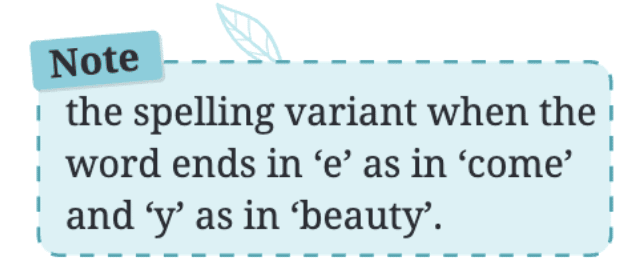
Let us do these activities before we read. (Page 1)

I. Close your eyes and quietly listen to the sounds around you for a minute.

Q1: Are they trying to tell you something?
Ans: 
Yes, the sounds around us can often communicate different messages. 

  • For example, birds chirping might be a sign that it’s morning or the start of a new day. 
  • The rustling of leaves could mean that the wind is blowing gently. 
  • Traffic noises might suggest that people are going about their daily activities. 
  • Even the sound of water flowing could tell us that a river or stream is nearby. 
  • Each sound can give us a clue about what’s happening around us or what time of day it is!

Q2: Do you think the things around you also listen to you all day long?
Ans: 
Things like trees, rivers, or animals don’t listen like humans, but it feels like they do when we talk to them or spend time with them.

II. Jahnavi was a bright young girl who lived with her parents and three brothers in a coastal village in India. Her parents worked on the farm. She had a dream.

Q1: What could that dream be?
Ans: 
Jahnavi’s dream could be something that she wants to achieve in life, like becoming a teacher, a doctor, or even traveling the world. She might dream of something that excites her or helps others in her community.

Q2: How could she make her dream come true?
Ans:
 To make her dream come true, Jahnavi would need to work hard and stay focused. She could learn from others, read books, ask questions, and practice the skills needed to reach her goal.

Q3: What is your dream? What can you do to make your dream come true?
Ans: 
My dream is to become a doctor. I can study hard, focus on science, and ask for help from teachers to achieve it. (Answers may vary based on personal dreams.)

Let us discuss (Page 3)

Q1: What was Jahnavi’s dream? Was it important to her? Why?
Ans: 
Jahnavi’s dream was to go to school and learn to read and write. It was important to her because she wanted to understand things like why spiders are yellow, why bamboo rustles, and other questions. Learning would make her happy and help her feel equal to her siblings.

Q2: Do you think the river can help her in fulfilling her dream? How?
Ans: 
Yes, the river helps Jahnavi by encouraging her to be brave and go to school. It tells her to try sitting in class and listening, which gives her the courage to take the first step toward her dream.

Let us discuss (Page 6)

Complete the table given below with Jahnavi’s questions in Column 1 and the River’s answers in Column 2.

Ans: 

Let us think and reflect (Page 7)

I. Read the extracts given below and answer the questions that follow.

1.  “You shouldn’t cry, you know,” the voice went on. “And you really shouldn’t be scared, when you have been coming here to see me everyday, well, almost every day.” She was puzzled. It was such a voice, like the river. It couldn’t be the river! “Well, tell me all about it,” said the River, for it was the River. “I’ve got to hurry to reach the sea, you know.”

(i): The tone of the River in the given extract is (assuring/sympathising)

Ans:
 The tone of the River is assuring.
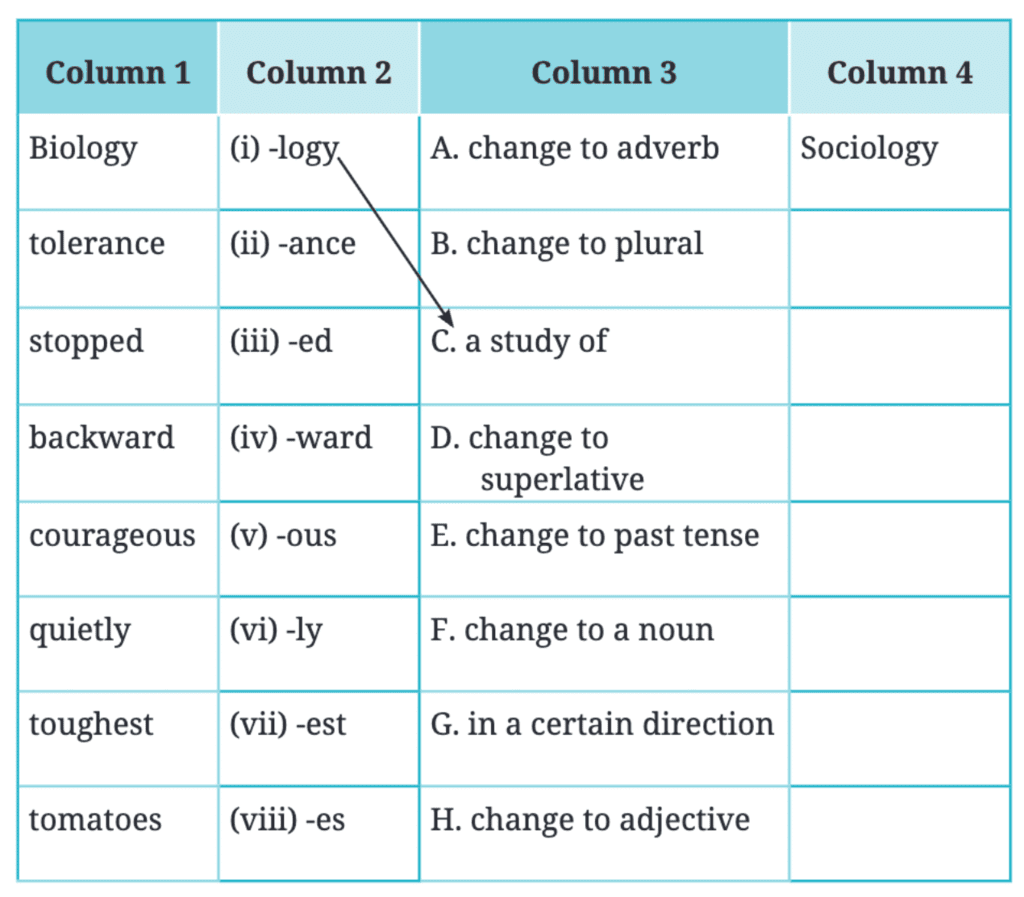
(ii): Select a phrase from the extract which shows that Jahnavi was a frequent visitor to the spot.
Ans:
 “when you have been coming here to see me every day, well, almost every day.”

(iii): The use of an exclamation mark at the end of the line, ‘It couldn’t be the river!’ expresses ___________
A. excitement B. hesitation C. irritation D. disbelief
Ans:
 D. disbelief

(iv): Choose three qualities of the River highlighted in the extract from the words in the box given below.
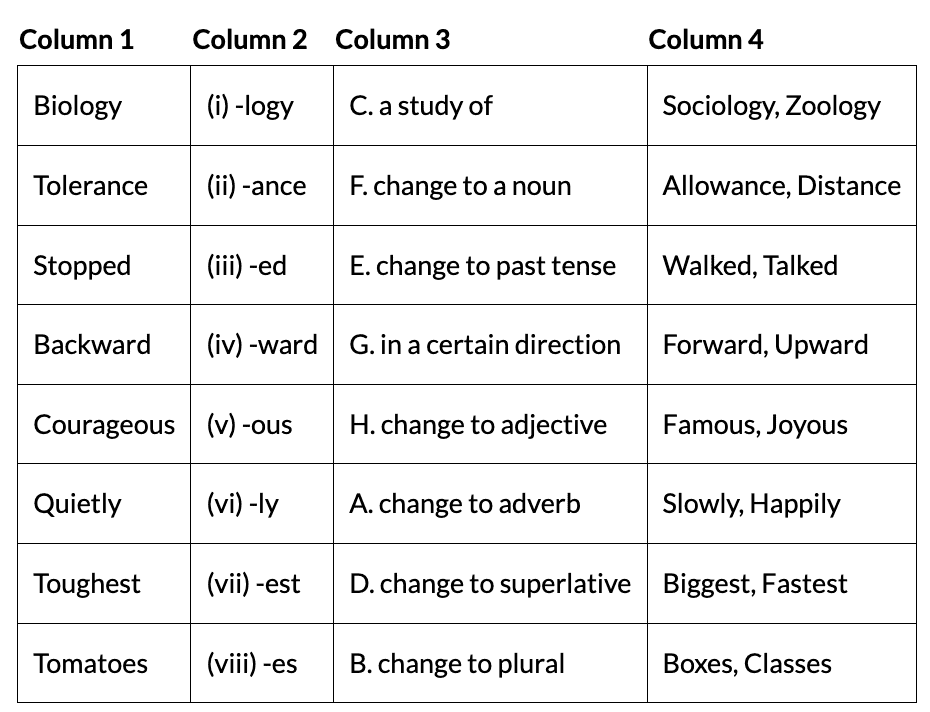
Ans: affectionate, thoughtful, kind-hearted

2. “Can I do something?” asked Jahnavi. “Well, it’s up to you,” said the River. “Seems to me little girls can do as much as little boys—they swim as fast as little boys. You just slip along one morning and sit there in the school and listen to what’s going on, and maybe the teacher will let you stay.” 
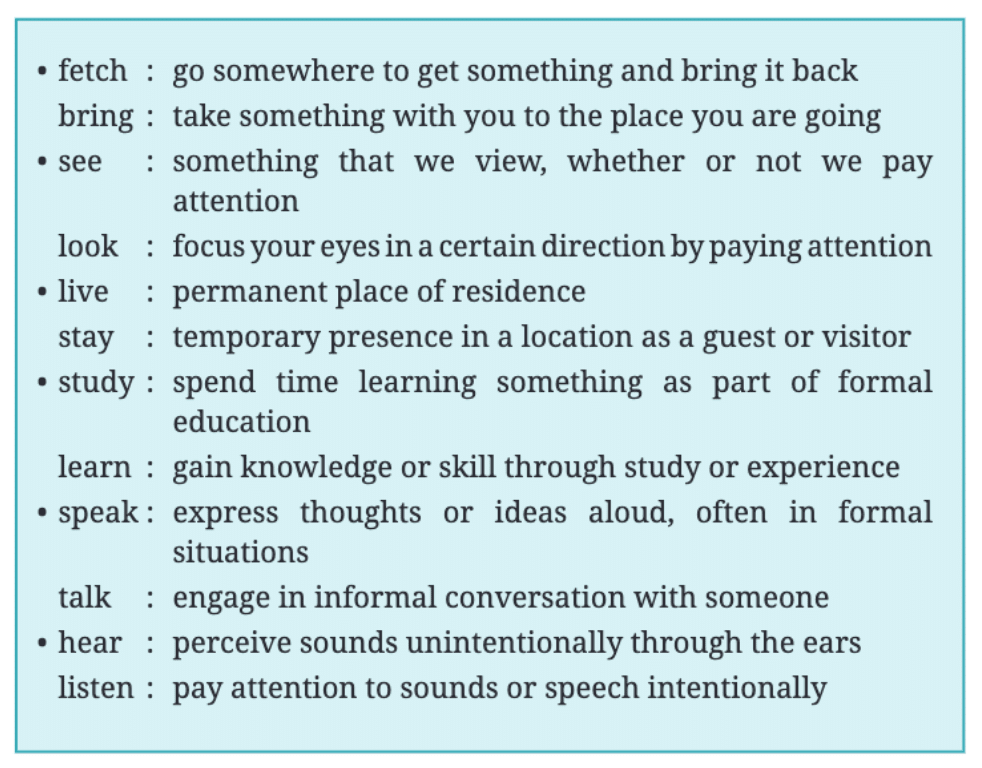
“I couldn’t,” gasped Jahnavi. “I couldn’t! They’d scare me! They’d chase me out.”

(i) According to the River, there was no difference between girls and boys because ____________
Ans:
 little girls can do as much as little boys, like swimming as fast as them.

ii) Identify whether the following statement is true or false. 
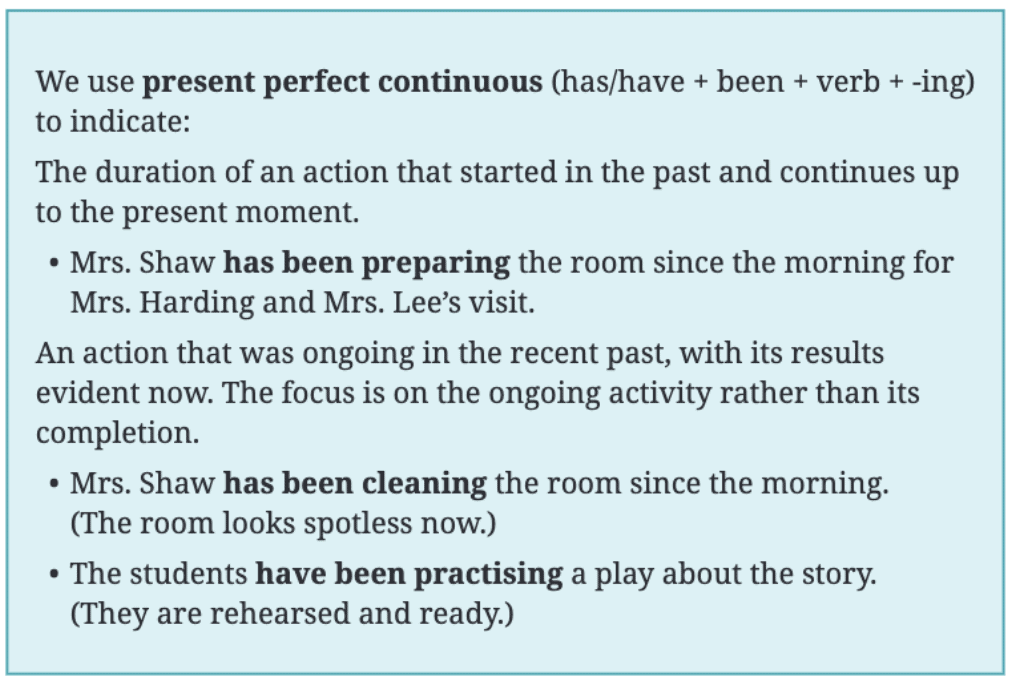
The River encourages Jahnavi to have faith in herself and fulfil her desire to go to school.
Ans:
 True

(iii): When the River suggests that Jahnavi should ‘slip along’, it means that she should move
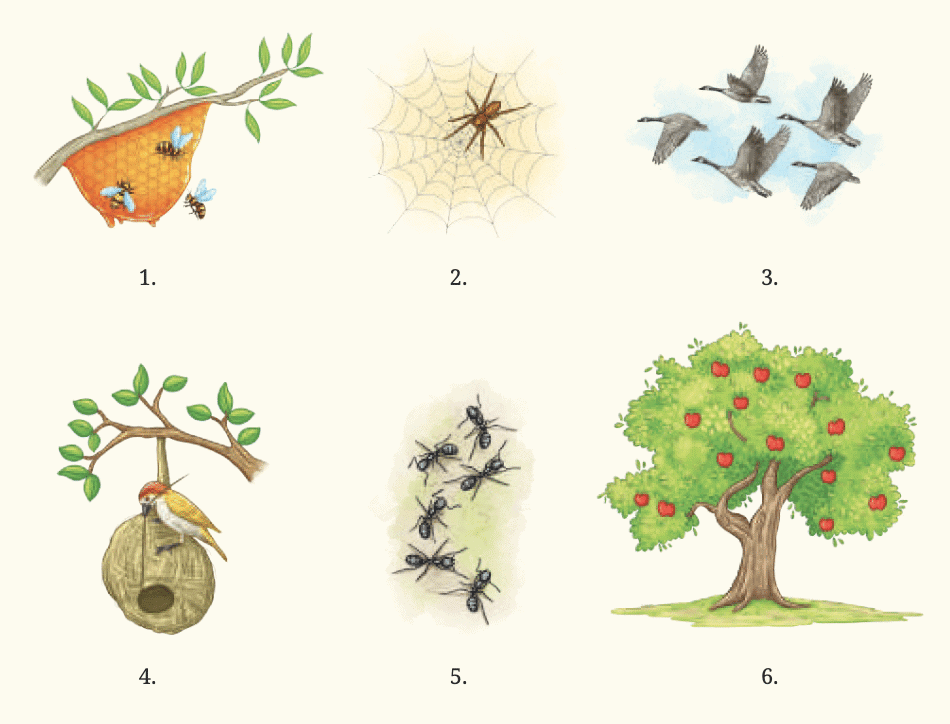
A. quickly B. casually C. quietly D. confidently
Ans:
 C. quietly

(iv): What does the repetition of the phrase “I couldn’t” tell us?
Ans:
 It shows Jahnavi’s fear and lack of confidence about going to school, thinking she will be scared or chased away.

II. Answer the following questions

Q1: Why does the writer describe different aspects of nature in great detail at the beginning of the story? Why do you think the writer does this?
Ans:
 The writer describes nature, such as the kingfisher, lizard, and river, to set a lively and peaceful atmosphere. This helps readers feel connected to Jahnavi’s world and highlights how nature, especially the river, plays a significant role in her life.

Q2: How did the River know so much about Jahnavi?

Ans:
 The River knew so much about Jahnavi because she visited it almost every day, sharing her thoughts and feelings. The River had been a silent listener and understood her dreams and fears.

Q3: Jahnavi says, “And I’m so old now, they’ll never let me go.” What can you infer about Jahnavi and the school from this line?
Ans:
 Jahnavi feels she is too old to start school. Since she is nearly ten and has never been allowed to attend, she might believe that it’s too late for her to start learning. This suggests that the school may not easily accept older children who haven’t had the chance to study earlier.

Q4: Why did the River laugh when Jahnavi said she would be scared at school?
Ans: 
The River laughed because it knew Jahnavi had already faced challenges in nature, like lizards, snakes, and trains, and had been brave. The River found it funny that she was scared of going to school, which seemed far less dangerous compared to what she had already encountered.

Q5: Why should Jahnavi follow the River’s advice?
Ans:
 Jahnavi should follow the River’s advice because it encourages her to be brave, take the first step towards her goal, and believe in herself. This can help her achieve her dream of going to school despite her fears.

Q6: How does the conversation between Jahnavi and the River make the story more appealing?
Ans:
 The conversation makes the story more appealing by giving the River a voice, making it feel wise and friendly. This adds a magical element to the story, as the River becomes a character that supports and encourages Jahnavi, keeping the readers engaged.

Q7: What is the main message that the writer intends to convey?
Ans:
 The main message is that with courage and determination, anyone can overcome obstacles and achieve their dreams. The story particularly highlights how girls, who may face barriers to education, can break those barriers with courage and determination.

Let us learn (Page 8)

Q1: Why has the author used a capital letter for the ‘River’ even when it is a common noun? (Clue: Has the River been given qualities of a human being?)
Ans:
 The author uses a capital letter for ‘River’ because it is given human qualities, like talking, laughing, and giving advice, making it a character like a person.

Q2: There are a few words related to sound in the text. Pick the words from the text and write them next to the correct definition.

1. made a high-pitched piercing sound
Ans:
 shrieked

2. to cause liquid to strike or fall on something
Ans:
 splashed

3. a low continuous background noise
Ans: 
murmuring

4. cry with loud uncontrollable gasps
Ans
: sob

5. to make a soft dry sound, like paper or leaves moving
Ans:
 rustle

6. took a short quick breath through the mouth due to surprise, pain or shock
Ans: 
gasped

7. shaking rapidly to make continuous short, sharp sounds
Ans:
 rattling

8. making a lot of noise
Ans:
 noisy

9. made a long, high cry, usually because of pain or sadness
Ans: 
wailed

Fill in the blanks with suitable sound words from exercise (II).

The classroom grew (i) noisy as the students noticed the teacher carrying the answer papers. As the teacher turned the pages with a (ii) rustle, the children (iii) gasped, wondering what comments awaited. Someone (iv) sobbed in frustration, and the (v) murmuring of the students steadily increased. Finally, when the teacher praised the students for their excellent performance, the students (vi) shrieked with excitement.

Q3: The word ‘catamaran’ is used in the text. The word originates from Tamil language ‘kattu maram’ meaning ‘tied wood’. Find out the meanings of these words. From which Indian language these words were borrowed.

1. karma (Sanskrit)
Ans:
 Meaning: Action or deed that affects future life. Language: Sanskrit

2. sahib
Ans:
 Meaning: Respectful address for a man, like ‘sir’. Language: Hindi/Urdu

3. chutney
Ans:
 Meaning: A spicy sauce or relish. Language: Hindi

4. guru
Ans:
 Meaning: A spiritual teacher or guide. Language: Sanskrit

5. verandah
Ans:
 Meaning: An open porch or balcony. Language: Hindi/Portuguese

6. jungle
Ans:
 Meaning: A dense forest or wilderness. Language: Hindi

7. areca
Ans:
 Meaning: A type of palm tree or its nut. Language: Malayalam

8. palanquin
Ans: 
Meaning: A covered seat carried by people. Language: Hindi/Sanskrit

Q4: Chandu, the fisherman, has a catamaran that the River preferred to a ship. Given below are some boats that are used in different parts of our country.

(i) Which one would you like to travel in?
Ans:
 I would like to travel in a shikara because it looks beautiful and peaceful on lakes like Dal Lake. (Answers may vary.)(ii) Make a colourful drawing of a boat that you would like to travel in.

Ans: (This is a drawing activity, so no written answer is required.)

Q5: Solve the crossword puzzle based on words related to water transport.

Ans: 

Q6. Read the highlighted words in the following lines from the text. 

“She goes down towards the sea. I’ve seen her; she always takes the same way—over the mountains and down to the sea, like me!” 

Prepositions are words that indicate the relationship between nouns or pronouns and other elements in a sentence. They show direction, location, time or logical relationships between ideas.

Now, fill in the blanks with suitable prepositions given within the brackets.

Jahnavi takes the River’s advice and goes to school. On her first day 1. _________ (at/in/on) school, Jahnavi stood nervously 2. _________ (in/outside/above) the gate, clutching her bag close to her. The bell rang and she hurried 3. _________ (outside/through/inside) the bustling classroom. She found a seat 4. _________ (among/between/from) two friendly classmates. The teacher greeted them warmly and started the lesson 5._________ (about/in/for) numbers. Jahnavi listened attentively, feeling excited 6. _________ (at/about/for) the new adventure ahead.

Ans: 

Jahnavi takes the River’s advice and goes to school. On her first day 1. at (at/in/on) school, Jahnavi stood nervously 2. outside (in/outside/above) the gate, clutching her bag close to her. The bell rang and she hurried 3. inside the bustling classroom. She found a seat 4. between two friendly classmates. The teacher greeted them warmly and started the lesson 5. about numbers. Jahnavi listened attentively, feeling excited 6. about the new adventure ahead.

Q7: Read the highlighted words in the following sentence from the text.

A kingfisher swept down, its wings a narrow of blue in the sunlight. Words like on, off, up, down can function both as prepositions and as adverbs. For example:

She ran up the stairs. (preposition)

She rang me up. (adverb)

Remember, a preposition will always be followed by an object (noun), whereas an adverb will tell you more about the action (verb).

Fill in the blanks with prepositions or adverbs.

1. The cat jumped ___________ the table. (preposition)
Ans:
 The cat jumped onto the table.

2. The children played ___________ until dark. (adverb)
Ans:
 The children played on until dark.

3. She quickly ran ___________ the park. (preposition)
Ans
: She quickly ran to the park.

4. The helicopter was hovering ___________. (adverb)
Ans:
 The helicopter was hovering above.

5. We were just walking ___________, chatting. (adverb)
Ans:
 We were just walking along, chatting.

6. After thoroughly wiping his shoes, he stepped ___________. (adverb)
Ans:
 After thoroughly wiping his shoes, he stepped inside.

7. She drove slowly ___________ the sharp curve. (preposition)
Ans: 
She drove slowly around the sharp curve.

8. He placed the keys ___________ the mat before leaving. (preposition)
Ans: 
He placed the keys on the mat before leaving.

Let us listen (Page 12)

(I) Read the words given in the box below. You will listen to five people speak about school life. As you listen, circle the words that are used by the speakers. There are two words you do not need. (Transcript for the teacher is given below)

  • Speaker (i): (Father) Should girls attend school? Yes, they should. I do my best to ensure that both my son and daughter get equal opportunities. I look forward to their successful careers and rewarding lives. I feel education gives freedom to make choices in life. Whether my daughter wants to work in an organisation or be a homemaker, it should be her choice and the same applies to my son. 
  • Speaker (ii): (Grandmother) I went to school but many girls at that time could not attend school because some elders in the village felt that girls should help in the house and take care of their little brothers and sisters. I am happy that the situation has changed today. 
  • Speaker (iii): (Teacher) The school prepares students for meaningful and useful participation in the world of work by learning hands-on abilities and skills, developing equal respect for head-hands-heart, valuing the dignity of labour, and understanding vocational choices for the future. 
  • Speaker (iv): (Student) I like to go to school. I feel that by coming to school and reading the books, I learn about things from all over the world. I also have friends with whom I can share my feelings. 
  • Speaker (v): (Principal) Everyone should attend school. You must’ve noticed that the girls are doing very well. However, as the Head of an institution, I know that all students can work hard. My message to students is that they should attend school regularly and take part in every school activity without bothering whether it is for girls or boys. The idea is to focus on learning. 

Ans: 

The words used by the speakers from the box are:

  • careers (by the father)
  • homemaker (by the father)
  • books (by the student)

The words not used are:

  • lawyer
  • desks
  • principal
  • posters
  • newspapers
  • marriage
  • advertisements

(II) You will once again listen to the five speakers. As you listen, match each statement 1–7 to each speaker (i)–(v). There are two statements that you do not need.

Ans:

  • Statement 1: The principal wants all students to join school activities, so this matches Speaker (v).
  • Statement 2: No one talks about Mathematics, so this is not used.
  • Statement 3: The father says education helps his children choose what they want to do, like work or be a homemaker, so this matches Speaker (i).
  • Statement 4: The student talks about friends at school, which means companionship, so this matches Speaker (iv).
  • Statement 5: No one says boys and girls have different abilities—they all talk about equal chances—so this is not used.
  • Statement 6: No one is trying to convince a parent to let their child go to school. The grandmother talks about the past, and the father already agrees girls should go to school, so this is not used.
  • Statement 7: The teacher says school teaches skills to all students for work, not just boys or girls, so this matches Speaker (iii).
  • The grandmother (Speaker ii) doesn’t have a matching statement because she only talks about how things were in the past, which doesn’t fit any of the given statements.

Note: The question expects 5 matches, but we only matched 4 statements because the grandmother’s statement doesn’t fit any of the options. Since we need 2 statements to be unused, and we have 3 unused statements (2, 5, and 6), this still works. If your teacher has more details, you can ask them!

Let us speak (Page 13)

Q1: The River spoke to Jahnavi in a ‘sleepy’ voice. Work in pairs and take turns to speak the same sentence in ‘other’ voices. Some hints are given below: happy, surprised, angry, scared, sad, worried.
Ans:
 (This is a speaking activity, so no written answer is required. Students practice saying the River’s lines in different tones.)

Q2: Janhavi asks the River for advice and the River gives advice. Read the given situations and work in pairs to ask for and give advice. Take turns to change your roles.

Situation (i): You wish to play football at school but it has an all-boys’ team only.
Ans: 
Asking: What do you think I should do about joining the football team? It’s only for boys.
Giving: I think you should talk to the coach and ask if girls can try out. You’re just as good as the boys!

Situation (ii): You have been unable to score well in Mathematics due to nervousness during exams.
Ans: 

Asking: Do you think I should do something about my nervousness in Maths exams?
Giving: Why don’t you practice deep breathing before the exam to stay calm?

Situation (iii): You really enjoy music classes but do not get enough time to practise for it.
Ans:
 
Asking: What would you do if you loved music but had no time to practice?
Giving: The best thing to do is set a small time each day, like 15 minutes, to practice music.

Situation (iv): You cannot see the blackboard clearly from the last bench.
Ans: 

Asking: I’d appreciate your advice on not seeing the blackboard from the last bench.
Giving: If I were you, I would politely ask the teacher to move to a closer seat.

Let us write (Page 14)


Ans: The Dancing River
Every day, I see the river near my house, sparkling under the sun like a silver ribbon. Its water ripples softly, making a gentle gurgling sound, and feels cool when I touch it. The green leaves of trees along the bank sway in the breeze, their rough bark contrasting with the smooth pebbles on the shore. I find it very interesting that tiny fish dart in the clear water, their scales shining like rainbows. I feel peaceful watching the river flow, as it seems to carry away all worries. My advice to all is to spend time with nature to feel calm and happy.
(Note: This is a sample response; actual answers will vary based on personal observations.)

Let us explore (Page 14)

(I) Discuss why rivers in India are considered to be sacred and most of them are referred to as female. Some rivers are referred to as male, for example, the Brahmaputra and the Sone.
Ans:
 Rivers in India are sacred because they give life, water crops, and are part of religious stories. Many, like Ganga and Yamuna, are seen as female goddesses who nurture and protect. Some, like Brahmaputra and Sone, are called male, possibly due to their strength or myths associating them with male gods.

(II) Whole Class Activity

Q1. India is a multilingual country, and many of us can speak two to three languages easily. Make a list of the languages that everyone in the class can speak and display it on a chart paper in the classroom.

Sample answer/idea: Here is a list of languages that most of the students in the class can speak:

  • Hindi
  • English
  • Punjabi

Q2. In which language do you enjoy reading and learning the most?

Sample answer/idea:

  • Many students may say English, especially if the textbook and classroom instruction are in English.
  • Some may prefer their mother tongue or regional language, like Hindi, Tamil, Marathi, etc., because it is easier to understand and relate to.
  • Some may enjoy bilingual reading, using both English and their native language.

Example student responses:

  • “I enjoy reading and learning in English because most of my books are in English.”
  • “I like reading in Hindi because I understand the stories better.”
  • “I enjoy learning in Tamil because it is my first language and I can read quickly.”

(III) Read the poster given below and answer the questions that follow.

Q1. What can you see in the poster?
The poster shows four girls who look very happy. They are smiling and sitting close to each other. The girls are holding a pencil and writing in a notebook, so they might be studying or learning. They are wearing colorful clothes, and the simple background suggests they are in a classroom. There is a message on the poster that says, “The Happiness of a Nation lies in the Dignity of its Daughters,” written in white and orange letters on a teal and orange background.

Q2. Why do you think the girls look happy?
The girls look happy because they might be learning something new, like studying or writing, which makes them feel good. They are smiling, so they probably feel safe and cared for. Maybe they have nice teachers or friends who make them laugh and feel important.

Q3. Dignity means ‘self-respect’. What is the relation between ‘dignity’ and ‘happiness’?
Dignity means feeling proud of yourself and being respected by others. When the girls are treated nicely and given chances to study and grow, they feel good about themselves—this is dignity. When they have dignity, they feel happy because they know they are important and loved. So, dignity makes happiness grow, just like sunlight helps a plant grow!

Q4. How does a Nation prosper when its daughters are happy?
When a nation’s daughters are happy, it means they are healthy, going to school, and learning new things. Happy girls can grow up to be smart women who do great things, like becoming doctors, teachers, or leaders. They can help their families and make their country better. If girls are happy, everyone in the nation feels happier, and the country becomes stronger and more successful because everyone works together.

(IV) The Government has launched many schemes for the education of the girl child. Some of them are ‘Beti Bachao Beti Padhao’, ‘Balika Samridhi Yojana’, ‘Samagra Shiksha Scheme–Kasturba Gandhi Balika Vidyalayas’, etc. Find out more such schemes from the internet or from your teacher and spread awareness in your neighbourhood
Ans: The Government of India has started many schemes to help girls go to school and learn. Some schemes you already know are ‘Beti Bachao Beti Padhao’, ‘Balika Samridhi Yojana’, and ‘Samagra Shiksha Scheme–Kasturba Gandhi Balika Vidyalayas’. Let’s learn about a few more schemes that help girls like you study and grow strong. Then, you can tell your friends and neighbors about them to spread awareness!

  1. Sukanya Samriddhi Yojana (SSY)
    This is a savings plan for girls. Parents can open an account for a girl under 10 years old at a post office or bank. They can save money for her education or marriage. The money grows with a good interest rate, around 8.2% in 2025, and can be taken out when the girl turns 21 or gets married after 18. It helps parents plan for a girl’s future so she can study well and be happy.
  2. CBSE Udaan Scheme
    This scheme helps girls who want to become engineers. It’s for girls from weaker families who are in Class 11 or 12. The government gives free study materials, videos, and classes to help them prepare for engineering exams like IIT or NIT. If a girl gets into a good college, she can also get money for fees and hostel costs. It helps girls dream big and study hard!
  3. National Scheme of Incentive to Girls for Secondary Education (NSIGSE)
    This scheme is for girls who have passed Class 8 and are between 14 to 18 years old. It gives Rs. 3,000 to girls from SC/ST families or those who studied in Kasturba Gandhi Balika Vidyalayas. The money is kept in a bank and can be taken out with interest when the girl turns 18 and passes Class 10. It helps girls stay in school and not drop out.
  4. Rajiv Gandhi Scheme for Empowerment of Adolescent Girls (SABLA)
    This scheme is for girls aged 11 to 18 years. It helps them learn life skills, stay healthy, and eat good food. It also teaches them about hygiene and gives them training for jobs. Girls can join this scheme through Anganwadi Centers. It makes girls strong and ready for a bright future.

How to Spread Awareness in Your Neighborhood:

  • Tell Your Friends and Family: Share what you learned about these schemes with your friends, parents, and neighbors. Explain how they can help girls study and grow.
  • Make Posters: Draw simple posters with the names of these schemes and what they do. Stick them in your building or near your home where people can see them.
  • Talk to Your Teacher: Ask your teacher to tell the class about these schemes so everyone knows. Maybe your school can have a small event to talk about girls’ education.
  • Visit an Anganwadi Center: Go with your parents to a nearby Anganwadi Center and ask them about these schemes. They can help tell more families in your area.

When girls study and are happy, they can do great things for their families and the country. Let’s tell everyone about these schemes so more girls can go to school and shine!

15. Rani Abbakka Chapter Notes

Introduction

  • This story is about Rani Abbakka, a brave queen of Ullal who fought against the Portuguese to protect her land’s freedom.
  • It shows her couragedetermination, and leadership as she stood up to a powerful enemy.
  • She inspired her people and other rulers to defend their country.

Explanation of the Story

Rani Abbakka and the Portuguese Threat

The story begins with Rani Abbakka, the queen of Ullal, a small coastal kingdom in India. At the time, Ullal was under pressure from the Portuguese, who had captured it and demanded tribute (money or goods) to maintain control. Rani Abbakka, however, believed Ullal was a sovereign (free) country and boldly refused to pay. When a Portuguese envoy visited to collect the overdue tribute, she firmly declared,

“We are a sovereign country. We don’t pay tribute to Portugal. And we don’t take orders from the Portuguese!”
Though the envoy warned her of the consequences, Abbakka stood her ground.

Conflict at Home

Soon after her coronation (the ceremony of becoming queen), Abbakka shared her plan to resist the Portuguese with her husband, Veera Narasimha, the king of Bangadi. While she was determined to fight for Ullal’s independence, he was worried. He feared that her bold move might anger the Portuguese, bringing danger to his own kingdom. He called her decision rash and tried to persuade her to change her mind. Despite his concerns, Abbakka refused to back down. When she declared she wasn’t afraid of the Portuguese, Veera Narasimha even ordered his soldiers to stop her. But Abbakka’s determination remained strong.

Gathering Allies and Strategic Planning

Rani Abbakka reached out to local rajas (kings) for support. She held a meeting to unite them against the Portuguese threat. Although many of the rajas were unsure if their small forces could match the Portuguese army, Abbakka’s confidence and leadership encouraged them. To further strengthen Ullal, she ordered the building of merchant ships and formed an alliance with the Zamorin of Kozhikode, a powerful coastal ruler. This move allowed her to defy the Portuguese and establish successful trade with Arabia, boosting Ullal’s economy and position in the region.

The Battle for Ullal

Furious at her defiance, the Portuguese launched an attack on Ullal. Rani Abbakka bravely led her soldiers into battle, fighting alongside them. The battle lasted four days, with the people of Ullal showing great courage. In the end, the Portuguese were defeated and forced to retreat, never to trouble Ullal again. Abbakka even attacked the Portuguese fort, displaying her dauntless spirit and fierce commitment to her people and land.

Legacy of a Brave Queen

The people of Ullal stood by Abbakka, inspired by her courage and strong leadership. Her victory over the powerful Portuguese brought great pride to the kingdom and inspired other Indian rulers to resist foreign powers. Rani Abbakka’s story is a powerful reminder that with unity, strategic thinking, and fearless leadership, even the strongest enemies can be defeated.

Moral of the Story

  • The story teaches us the importance of couragedetermination, and standing up for what is right.
  • Rani Abbakka’s bravery shows that even in the face of a powerful enemy, one person’s leadership and belief in freedom can inspire others and lead to victory.
  • It encourages us to value independence and work together for a common goal.

Difficult Words

  • Vassal: A state controlled by a more powerful country, forced to pay money or goods.
  • Coronation: A ceremony where someone is officially made king or queen.
  • Successor: A person who takes over a position or role from someone else.
  • Rash: Acting quickly without thinking about the results.
  • Sovereign: Free and independent, not controlled by others.
  • League: A partnership or alliance.
  • Wrath: Extreme anger.
  • Seize: To take something suddenly or by force.
  • Resolve: Strong determination to achieve a goal.
  • Raged: Happened in a fierce or violent way.
  • Decisive: Able to make decisions quickly and effectively.
  • Apprehended: Captured or arrested.
  • Dauntless: Fearless and brave.
  • Avenge: To take revenge for a wrong done.

14. My Dear soldiers Chapter

Introduction

  • This poem is a heartfelt tribute to soldiers who protect the nation with courage and dedication.
  • It celebrates their sacrificesbravery, and tireless efforts in guarding the country under tough conditions.
  • The poet expresses deep gratitude and prays for their well-being, highlighting their selfless service.

ExplanationStanza 1

Oh! Defenders of borders
You are great sons of my land
When we are all asleep
You still hold on to your deed  

Explanation
The poet begins by addressing soldiers as “Defenders of borders,” showing their role in protecting the country’s boundaries. Calling them “great sons” (meaning all soldiers, men and women) reflects their importance to the nation. While people sleep peacefully, soldiers stay awake, committed to their duty of safeguarding the country. This highlights their vigilance and sacrifice.

Stanza 2

Windy season or snowy days
Or scorching sun’s sweltering rays
You are there guarding all the time awake
Treading the lonely expanses as yogis  

Explanation
This stanza describes the harsh conditions soldiers face. Whether it’s windy, snowy, or extremely hot, they remain on duty, always alert. The phrase “treading the lonely expanses as yogis” compares soldiers to yogis (spiritual seekers) who walk alone with focus. It shows their determination and strength in patrolling remote, lonely areas.

Stanza 3

Climbing the heights or striding the valleys
Defending the deserts or guarding the marshes
Surveillance in seas and by securing the air
Prime of your youth given to the nation!!  

Explanation
The poet explains the diverse terrains where soldiers work—mountains, valleys, deserts, marshes, seas, and air. They climb high peaks, patrol lowlands, and monitor all areas to keep the nation safe. The line “Prime of your youth given to the nation” emphasizes that soldiers dedicate their youthful years, a precious time, to serve the country, showing their immense sacrifice.

Stanza 4

Wind chimes of my land vibrate your feat
We pray for you brave men!!
May the Lord bless you all!!  

Explanation
In the final stanza, the poet uses “wind chimes” to symbolise the nation’s pride and respect for soldiers’ brave actions (“feat”). The poet, along with the people, prays for the soldiers’ safety and well-being, asking for divine blessings. This shows gratitude and admiration for their courage and service.

Moral of the Poem

  • The poem teaches us to value and respect the sacrifices made by soldiers.
  • It encourages gratitude for their selfless service, as they protect the nation under tough conditions.
  • They give up personal comforts and safety.
  • We should honour their dedication and pray for their strength and safety.

Difficult Words

  • Defenders: Protectors or guardians.  
  • Borders: Boundaries of a country.  
  • Deed: Duty or task.  
  • Scorching: Very hot.  
  • Sweltering: Uncomfortably hot.  
  • Treading: Walking or stepping on.  
  • Expanses: Large, open areas.  
  • Yogis: Spiritual people who meditate and live simply.  
  • Surveillance: Close watch or monitoring.  
  • Feat: A brave or impressive act.  
  • Vibrate: Shake or move to show energy or emotion.