04. Expression Using Letter-Numbers Chapter worksheet Solution

Section A: Multiple-Choice Questions (MCQs)

Q1: One plate of dosa costs ₹50, and one plate of idlis costs ₹30. If x plates of dosa and y plates of idli are ordered, which expression represents the total amount earned in rupees?
a) 50x – 30y
b) 50x + 30y
c) (50 + 30) x (x + y)
d) 30x + 50y

Ans: b) 50x + 30y
Explanation: The total amount is the cost of x dosas (50 × x) plus the cost of y idlis (30 × y). Thus, the expression is 50x + 30y. 
Option b is correct. 

Q2: A flour mill takes 12 seconds to start and 6 seconds per kg of grain to grind. Which expression describes the time to grind z kg of grain, starting from off?
a) 12 + 6 + z
b) 12 x 6 x z
c) 12 + 6 x z
d) (12 + 6) x z

Ans: c) 12 + 6 x z
Explanation: The total time includes 12 seconds to start plus 6 seconds per kg for z kg (6 x z). 
Thus, the expression is 12 + 6 x z. 
Option c is correct. 

Q3:  For a matchstick pattern, the number of matchsticks in step y is given by 4y + 1. How many matchsticks are needed for step 5?
a) 22
b) 21
c) 18
d) 28 

Ans: b) 21
Explanation: Substitute y = 5 into the expression 4y + 1:
4 x 5 + 1 = 20 + 1 = 21
Option b is correct. 

Q4: A shop rents out chairs and tables. The net cost for x chairs and y tables is 25x + 60y. What is the cost for 3 chairs and 2 tables?
a) 195
b) 206
c) 155
d) 135

Ans: a) ₹195
Explanation: Substitute x = 3 and y = 2 into 25x + 60y:
25 x 3 + 60 x 2 = 75 + 120 = 195
Option a is correct. 

Q5: In a quiz, Meera’s score in one round is 5p – 2q, where p is the points for a correct answer and q is the penalty. If p = 6 and q = 1, what is her score?
a) 29
b) 24
c) 28
d) 32

Ans: c) 28
Explanation: Substitute p = 6 and q = 1 into 5p – 2q:
5 x 6 – 2 x 1 = 30 – 2 = 28
Option c  is correct. 

Section B: True or False
a) The terms 5xy and 2yx are like terms.
Ans: True

Like terms have the same variables raised to the same powers. Since yx is the same as xy (commutative property), these terms can be combined.

b) If 4, then the value of 5n3 is 17.
Ans: True

Substituting n = 4:
5(4)−3=20−3=175(4)−3=20−3=17.
The calculation is correct.

c) The expression 2y+7 has three terms: 
2y, and 7.
Ans: False

The expression 2y+7 has two terms: 2y (a single term with coefficient and variable) and 7 (a constant term). Terms are separated by addition or subtraction operators.

d) 3 (x + 2) = 3x + 6.
Ans: True

Applying the distributive property correctly: 3 multiplies both x and 2 inside the parentheses, resulting in 3x+6. This is an example of proper algebraic expansion.

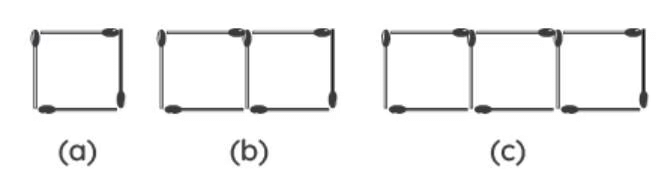
Section C: Patterns Based QuestionQ1: Matchsticks form squares: 1 square = 4 matchsticks, 2 squares = 7 matchsticks, 3 squares = 10 matchsticks. Find the rule for n squares. How many matchsticks are needed for 12 squares?
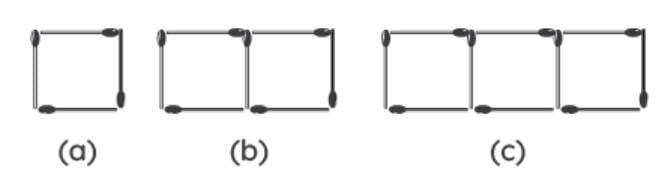
a) Rule for n squares: Observe the pattern:
1 square → 4 matchsticks
2 squares → 7 matchsticks (4 + 3)
3 squares → 10 matchsticks (7 + 3)
Pattern: Each new square adds 3 matchsticks (because one side is shared between squares).
General formula: Matchsticks = 4 + 3 (n−1) = 3n + 1

b) Matchsticks for 12 squares:

Substitute n=12 into the formula:

3(12)+1 = 36 + 1 = 37 matchsticks.

Section D: Word Problems

Q1Arjun is 6 years older than Bhavna. If Bhavna’s age is b years, write an expression for Arjun’s age and find Arjun’s age when Bhavna is 14 years old.

Ans: Expression: a = b + 6; Arjun’s age = 20 years
Explanation: Arjun’s age is 6 years more than Bhavna’s, so the expression is a = b + 6. Substitute b = 14:
a = 14 + 6 = 20
Arjun is 20 years old. 

Q2: Maya makes matchstick patterns with W’s, each requiring 5 matchsticks. Write an expression for the number of matchsticks needed for n W’s and calculate the number needed for 10 W’s.

Ans: Expression: 5n; 50 matchsticks
Explanation: Each W needs 5 matchsticks, so the expression is 5n. For n = 10:
5 x 10 = 50
50 matchsticks are needed. 

Q3Rakesh buys oranges at ₹25 each and 1 kg of flour at ₹45. Write an expression for the total cost of o oranges and f kg of flour, and find the cost for 4 oranges and 3 kg of flour.

Ans: Expression: 25o + 45f; Cost = ₹235
Explanation: The total cost is 25o + 45f. Substitute o = 4 and f = 3:
25 x 4 + 45 x 3 = 100 + 135 = 235
The cost is ₹235. 

Q4The perimeter of a regular pentagon is 5 times the side length. Write an expression for the perimeter if the side length is q cm, and find the perimeter when q = 6 cm.

Ans: Expression: 5q; Perimeter = 30 cm
Explanation: The perimeter is 5q. Substitute q = 6:
5 x 6 = 30
The perimeter is 30 cm. 

Q5In a quiz, Vikram’s scores in three rounds are 4p – 3q, 5p – 2q, and 3p – q, where p is points for a correct answer and q is the penalty. Find his total score expression and calculate it if p = 7 and q = 2.

Ans: Expression: 12p – 6q; Score = 78
Explanation: Add the scores:
(4p – 3q) + (5p – 2q) + (3p – q) = (4p + 5p + 3p) + (-3q – 2q – q) = 12p – 6q
Substitute p = 7 and q = 2:
12 x 7 – 6 x 2 = 84 – 12 = 78
Vikram’s total score is 78. 
03. A PEEK Beyond The Point Chapter worksheet Solution

Section A: Multiple Choice Questions

Q1: Ananya reads a three-page story every day except on Wednesdays and Sundays. How many stories would she complete reading in 6 weeks? Which expression describes this scenario? 
a) 5 × 3 × 6
b) (7 – 3) × 6
c) 6 × 7
d) (7 + 2) × 3 × 6

Ans: a) 5 × 3 × 6. 
Sol: Ananya reads a three-page story every day except Wednesdays and Sundays, so she reads on 7 – 2 = 5 days per week. 
In 6 weeks, she reads for 5 × 6 = 30 days. 
Each day, she reads a three-page story, so the total number of stories is 5 × 3 × 6. 

Q2: Which expression is equal to 76 – 29 – 14 without computation? 
a) 77 – 30 – 14
b) 76 – (29 + 14)
c) 76 – 30 – 15
d) -29 + 76 – 13

Ans: b) 76 – (29 + 14) 
Sol: Rewrite 76 – 29 – 14 as 76 + (-29) + (-14). 
Option b) 76 – (29 + 14) = 76 – 43 = 76 + (-29) + (-14), which is equivalent.

Q3: Which expression is equivalent to 4 × (7 + 3)?
a) 4 × 7 + 4 × 3
b) 4 + 7 × 3
c) 7 × (4 + 3)
d) 4 × 7 + 3

Ans: a) 4 × 7 + 4 × 3
Sol: Using the distributive property, 4 × (7 + 3) = 4 × 7 + 4 × 3. 
Option b) 4 + 7 × 3 prioritizes multiplication (7 × 3 = 21, then 4 + 21 = 25), which is incorrect. 
Option c) 7 × (4 + 3) changes the structure. 
Option d) 4 × 7 + 3 omits distributing to the 3. 

Q4: Which expression matches the arrangement of 4 groups of 3 red squares plus 2 extra blue squares?
a) 4 × 3 + 2
b) 3 × (4 + 2)
c) 4 + 3 × 2
d) 4 × (3 + 2)

Ans: a) 4 × 3 + 2
Sol: The arrangement has 4 groups of 3 red squares (4 × 3) plus 2 extra blue squares (+ 2). 
Thus, the expression is 4 × 3 + 2. 
Option d) 4 × (3 + 2) would mean 4 groups of 5 squares each, which does not match.

Q5: Which symbol (‘<‘, ‘>’, or ‘=’) compares 156 + 278 and 157 + 275 correctly? 
a) <
b) >
c) =
d) Cannot determin
e

Ans: b) >
Sol: Compare 156 + 278 and 157 + 275. 
Initially, 156 is 1 less than 157. 
The second terms are 278 and 275, where 275 is 3 less than 278. 
Thus, 157 + 275 gains 1 but loses 3 compared to 156 + 278, making 157 + 275 = 156 + 278 – 2. 
Hence, 156 + 278 > 157 + 275, 

Section B: Fill in the Blanks

Q6: Fill in the blank to make the expressions equal: 19 + 7 = __ + 9. 

Ans: 17
Sol: To make 19 + 7 = __ + 9 equal, evaluate the left side: 
19 + 7 = 26. Thus, __ + 9 = 26, so __ = 26 – 9 = 17. 
The expression is 17 + 9.

Q7: Complete the expression to make it equal: 35 + __ = 8 × 6. 

Ans: 13

Sol: To make 35 + __ = 8 × 6 equal, 
evaluate the right side: 
8 × 6 = 48. 
Thus, 35 + __ = 48, 
so __ = 48 – 35 = 13. 
The expression is 35 + 13.

Q8: Identify the terms in the expression 7 + 4 × 5. Write the sum of terms __.  

Ans: 7 + (4 × 5), Terms: 7, 4 × 5
Sol: The expression 7 + 4 × 5 has terms separated by ‘+’. 
Sum of terms = 7 + 20 = 27

Q9: Fill in the blank to make the expressions equal using reasoning: 512 + __ = 508 + 7. 

Ans: 3
Sol: To make 512 + __ = 508 + 7, 
evaluate the right side: 508 + 7 = 515. 
Thus, 512 + __ = 515, so __ = 515 – 512 = 3. 

Section C: Word Problems

Q10: Priya spends ₹30 every day on snacks at school. Write the expression for the total amount she spends on snacks in a week from Monday to Friday. Evaluate the expression. 

Sol: 5 × 30, Value: 150
Priya spends ₹30 daily on snacks from Monday to Friday (5 days). 
The expression for the total amount = 5 × 30 (5 days × ₹30 per day). 
Evaluate: 5 × 30 = 150. Thus, Priya spends ₹150 per week.

Q11: Vikram gave 80 coins to  Arjun and 80 coins to Kiran last year. Arjun invested his coins and tripled their value.  Kiran spent half of his coins on a charity. Write an expression for the total number of coins they have now, identify its terms, and evaluate it. 

Sol: Expression: 3 × 80 + 80 ÷ 2, Terms: 3 × 80, 80 ÷ 2, Value: 280

Arjun’s coins tripled: 3 × 80. = 240 coins
Kiran spent half, so he has 80 ÷ 2 coins = 40 coins
Total = 240 coins  + 40 coins = 280 coins
The total is 3 × 80 + 80 ÷ 2. 
Terms are 3 × 80 and 80 ÷ 2 . 

Q12: Aman bought a pack of pens for ₹20 and a notebook for ₹65. He gave the shopkeeper ₹100. Write an expression using brackets to calculate the change Aman will get back and find its value. 

Sol: Expression: 100 – (20 + 65), Value: 15

Aman spends ₹20 on pens and ₹65 on a notebook, totaling 20 + 65. 
He pays ₹100, so the change is 100 – (20 + 65). 
20 + 65 = 85,
then 100 – 85 = 15. 

Q13: During the day, a caterpillar climbs 5 cm up a tree, and at night, it slips down 3 cm. The tree is 11 cm high, and a leaf is at the top. Write an expression for the net progress per day and determine how many days it will take to reach the leaf

Sol: Expression: 5 – 3, Days: 5
The caterpillar climbs 5 cm up and slips 3 cm down per day, so the net progress per day is 5 – 3 = 2 cm. 
The tree is 11 cm high. 
On day 1, it reaches 2 cm; 
day 3, 6 cm; 
day 4, 8 cm; 
day 5, 10 cm. 
On the morning of day 5, it climbs 5 cm from 8 cm, reaching 13 cm, which is above the 11 cm mark, so it gets the leaf. 
Thus, it takes 5 days.

Q14In a parade, boy scouts march in 5 rows with 6 scouts each, and girl guides march in 2 rows with 6 guides each. Write two different expressions for the total number of scouts and guides and verify they give the same value. 

Sol: Expressions: 5 × 6 + 2 × 6, (5 + 2) × 6, Value: 42

Boy scouts: 5 rows × 6 scouts = 5 × 6. 
Girl guides: 2 rows × 6 guides = 2× 6. 
Total: 5 × 6 + 2 × 6.

Section D: Think and Answer

Q15: Rewrite the following expressions using brackets to get the given result:

a) 8+4×2=24× 24
b) 
20−5÷5=1920 − ÷ 19

Sol:
a) (8+4)×2=24(8+4)×2=24
b) 20−(5÷5)=1920−(5÷5)=19

Q16:  Create two different expressions that evaluate to 16 using at least two operations each.

Sol: Possible answers:

  • 4×3+4=164 × 3 + 4 = 16
  • 20−(8÷2)=1620 − (8 ÷ 2) = 16

02. Arithmetic Expressions Chapter worksheet Solution

Section A: Multiple Choice Questions

Q1: Ananya reads a three-page story every day except on Wednesdays and Sundays. How many stories would she complete reading in 6 weeks? Which expression describes this scenario? 
a) 5 × 3 × 6
b) (7 – 3) × 6
c) 6 × 7
d) (7 + 2) × 3 × 6

Ans: a) 5 × 3 × 6. 
Sol: Ananya reads a three-page story every day except Wednesdays and Sundays, so she reads on 7 – 2 = 5 days per week. 
In 6 weeks, she reads for 5 × 6 = 30 days. 
Each day, she reads a three-page story, so the total number of stories is 5 × 3 × 6. 

Q2: Which expression is equal to 76 – 29 – 14 without computation? 
a) 77 – 30 – 14
b) 76 – (29 + 14)
c) 76 – 30 – 15
d) -29 + 76 – 13

Ans: b) 76 – (29 + 14) 
Sol: Rewrite 76 – 29 – 14 as 76 + (-29) + (-14). 
Option b) 76 – (29 + 14) = 76 – 43 = 76 + (-29) + (-14), which is equivalent.

Q3: Which expression is equivalent to 4 × (7 + 3)?
a) 4 × 7 + 4 × 3
b) 4 + 7 × 3
c) 7 × (4 + 3)
d) 4 × 7 + 3

Ans: a) 4 × 7 + 4 × 3
Sol: Using the distributive property, 4 × (7 + 3) = 4 × 7 + 4 × 3. 
Option b) 4 + 7 × 3 prioritizes multiplication (7 × 3 = 21, then 4 + 21 = 25), which is incorrect. 
Option c) 7 × (4 + 3) changes the structure. 
Option d) 4 × 7 + 3 omits distributing to the 3. 

Q4: Which expression matches the arrangement of 4 groups of 3 red squares plus 2 extra blue squares?
a) 4 × 3 + 2
b) 3 × (4 + 2)
c) 4 + 3 × 2
d) 4 × (3 + 2)

Ans: a) 4 × 3 + 2
Sol: The arrangement has 4 groups of 3 red squares (4 × 3) plus 2 extra blue squares (+ 2). 
Thus, the expression is 4 × 3 + 2. 
Option d) 4 × (3 + 2) would mean 4 groups of 5 squares each, which does not match.

Q5: Which symbol (‘<‘, ‘>’, or ‘=’) compares 156 + 278 and 157 + 275 correctly? 
a) <
b) >
c) =
d) Cannot determin
e

Ans: b) >
Sol: Compare 156 + 278 and 157 + 275. 
Initially, 156 is 1 less than 157. 
The second terms are 278 and 275, where 275 is 3 less than 278. 
Thus, 157 + 275 gains 1 but loses 3 compared to 156 + 278, making 157 + 275 = 156 + 278 – 2. 
Hence, 156 + 278 > 157 + 275, 

Section B: Fill in the Blanks

Q6: Fill in the blank to make the expressions equal: 19 + 7 = __ + 9. 

Ans: 17
Sol: To make 19 + 7 = __ + 9 equal, evaluate the left side: 
19 + 7 = 26. Thus, __ + 9 = 26, so __ = 26 – 9 = 17. 
The expression is 17 + 9.

Q7: Complete the expression to make it equal: 35 + __ = 8 × 6. 

Ans: 13

Sol: To make 35 + __ = 8 × 6 equal, 
evaluate the right side: 
8 × 6 = 48. 
Thus, 35 + __ = 48, 
so __ = 48 – 35 = 13. 
The expression is 35 + 13.

Q8: Identify the terms in the expression 7 + 4 × 5. Write the sum of terms __.  

Ans: 7 + (4 × 5), Terms: 7, 4 × 5
Sol: The expression 7 + 4 × 5 has terms separated by ‘+’. 
Sum of terms = 7 + 20 = 27

Q9: Fill in the blank to make the expressions equal using reasoning: 512 + __ = 508 + 7. 

Ans: 3
Sol: To make 512 + __ = 508 + 7, 
evaluate the right side: 508 + 7 = 515. 
Thus, 512 + __ = 515, so __ = 515 – 512 = 3. 

Section C: Word Problems

Q10: Priya spends ₹30 every day on snacks at school. Write the expression for the total amount she spends on snacks in a week from Monday to Friday. Evaluate the expression. 

Sol: 5 × 30, Value: 150
Priya spends ₹30 daily on snacks from Monday to Friday (5 days). 
The expression for the total amount = 5 × 30 (5 days × ₹30 per day). 
Evaluate: 5 × 30 = 150. Thus, Priya spends ₹150 per week.

Q11: Vikram gave 80 coins to  Arjun and 80 coins to Kiran last year. Arjun invested his coins and tripled their value.  Kiran spent half of his coins on a charity. Write an expression for the total number of coins they have now, identify its terms, and evaluate it. 

Sol: Expression: 3 × 80 + 80 ÷ 2, Terms: 3 × 80, 80 ÷ 2, Value: 280

Arjun’s coins tripled: 3 × 80. = 240 coins
Kiran spent half, so he has 80 ÷ 2 coins = 40 coins
Total = 240 coins  + 40 coins = 280 coins
The total is 3 × 80 + 80 ÷ 2. 
Terms are 3 × 80 and 80 ÷ 2 . 

Q12: Aman bought a pack of pens for ₹20 and a notebook for ₹65. He gave the shopkeeper ₹100. Write an expression using brackets to calculate the change Aman will get back and find its value. 

Sol: Expression: 100 – (20 + 65), Value: 15

Aman spends ₹20 on pens and ₹65 on a notebook, totaling 20 + 65. 
He pays ₹100, so the change is 100 – (20 + 65). 
20 + 65 = 85,
then 100 – 85 = 15. 

Q13: During the day, a caterpillar climbs 5 cm up a tree, and at night, it slips down 3 cm. The tree is 11 cm high, and a leaf is at the top. Write an expression for the net progress per day and determine how many days it will take to reach the leaf

Sol: Expression: 5 – 3, Days: 5
The caterpillar climbs 5 cm up and slips 3 cm down per day, so the net progress per day is 5 – 3 = 2 cm. 
The tree is 11 cm high. 
On day 1, it reaches 2 cm; 
day 3, 6 cm; 
day 4, 8 cm; 
day 5, 10 cm. 
On the morning of day 5, it climbs 5 cm from 8 cm, reaching 13 cm, which is above the 11 cm mark, so it gets the leaf. 
Thus, it takes 5 days.

Q14In a parade, boy scouts march in 5 rows with 6 scouts each, and girl guides march in 2 rows with 6 guides each. Write two different expressions for the total number of scouts and guides and verify they give the same value. 

Sol: Expressions: 5 × 6 + 2 × 6, (5 + 2) × 6, Value: 42

Boy scouts: 5 rows × 6 scouts = 5 × 6. 
Girl guides: 2 rows × 6 guides = 2× 6. 
Total: 5 × 6 + 2 × 6.

Section D: Think and Answer

Q15: Rewrite the following expressions using brackets to get the given result:

a) 8+4×2=24× 24
b) 
20−5÷5=1920 − ÷ 19

Sol:
a) (8+4)×2=24(8+4)×2=24
b) 20−(5÷5)=1920−(5÷5)=19

Q16:  Create two different expressions that evaluate to 16 using at least two operations each.

Sol: Possible answers:

  • 4×3+4=164 × 3 + 4 = 16
  • 20−(8÷2)=1620 − (8 ÷ 2) = 16

01. Large Numbers Around Us Chapter worksheet Solution

Section A: Multiple Choice Questions

Q1: Compare and write ‘<‘, ‘>’ or ‘=’: 40 thousand _____ 5 lakhs.
a) <
b) >
c) =
d) Cannot be determined

Ans: a) <
Sol: 40 thousand = 40,000; 5 lakhs = 500,000. Since 40,000 < 500,000, the correct option is ‘<‘.

Q2: In the Indian system, how are commas placed for the number 12345678?
a) 1,23,45,678
b) 12,34,56,78
c) 123,456,78
d) 1,234,56,78

Ans: a) 1,23,45,678
Sol: 
In the Indian system, commas are placed in a 3-2-2-2 pattern from right to left: 1,23,45,678.

Q3 : How many zeros does a hundred lakh have?
a) 5
b) 6
c) 7
d) 8

Ans: c) 7
Sol: Hundred lakh = 100 × 1,00,000 = 1,00,00,000, which has 7 zeros.

Q4: Will the sum of 5,72,345 and 3,19,876 be greater than 8,90,000 or less than 8,90,000?
a) Greater than 8,90,000
b) Less than 8,90,000
c) Equal to 8,90,000
d) Cannot be determined

Ans: a) Greater than 8,90,000
Sol: 5,72,345 + 3,19,876 = 8,92,221. 
Since 8,92,221 > 8,90,000, the sum is greater than 8,90,000. 

Q5 : What is the product of 111 × 111?
a) 12321
b) 12221
c) 12331
d) 12121

Ans: a) 12321

Sol: 111 × 111 = 12321
pattern: 11 × 11 = 121, 
111 × 111 = 12321, 
1111 × 1111 = 1234321.

Section B: Fill in the Blanks

Q6 : Exact value of 3,82,456 + 2,97,543 = ________.

Ans: 6,79,999

Q7 : Write the number 4,50,700 in words: ________.

Ans: Four lakh fifty thousand seven hundred

Q8 : The game of Thoughtful Thousands only has a +1000 button. It should be pressed ________ times to show 70,000.

Ans: 7
Sol: To show 70,000 using a +1000 button, 
press it 70,000 ÷ 1000 = 70 times.

Q9 : According to a census, the population of a town was 82,345 in 2011. Approximately, it was (Round to the nearest ten thousand for approximation) ________.

Ans: 80,000
Sol: 82,345 ≈ 80,000 (round to the nearest ten thousand for approximation).

Section C: Word Problems

Q10: If Priya ate 4 varieties of fruits every day, will she be able to taste all 1 lakh varieties in a 100-year lifetime? Find out.

Ans: Yes, Priya will be able to taste all 1 lakh varieties in a 100-year lifetime.

Sol: 1 lakh = 1,00,000 varieties. 
Priya eats 4 varieties per day. 
In 100 years, days = 100 × 365 = 36,500 (ignoring leap years). 
Varieties tasted = 36,500 × 4 = 1,46,000. Since 1,46,000 > 1,00,000,
Priya can taste all 1 lakh varieties and more.

Q11: Find out how many coins should be stacked to match the height of a monument 150 meters tall. Assume each coin is 2 mm thick.

Ans: 75,000 coins are needed.

Sol: Monument height = 150 meters = 150,000 mm. 
Coin thickness = 2 mm. 
Number of coins = 150,000 ÷ 2 = 75,000.

Q12: A waterfall is 400 meters tall. A building is 4 times the height of a person who is 2 meters tall. How much taller is the waterfall than the building? 

Ans: The waterfall is 392 meters taller than the building.
Sol: Person’s height = 2 meters. Building height = 4 × 2 = 8 meters. Waterfall height = 400 meters. Difference = 400 − 8 = 392 meters.

Q13 : If Sanjay could travel 200 kilometers every day, could he reach a planet 5,00,000 km away in 8 years?

Ans: Yes, Sanjay can reach the planet in 8 years.

Sol: Sanjay travels 200 km/day. 
 In 1 year = 365 days, 
distance = 200 × 365 = 73,000 km. 
In 8 years = 8 × 73,000 = 5,84,000 km. Since 5,84,000 km is greater than 5,00,000 km, Sanjay can reach the planet.

Q14 : A calculator has buttons: +1, +10, +100, +1000, +10000, +100000. One way to get 6083 uses 25 button clicks. Is there another way to get 6083 using fewer button clicks? Write the expression for the same.

Ans: Expression: (6 × 1000) + (8 × 10) + (3 × 1), using 17 clicks.
Sol: To get 6083 with minimal clicks: 6 × 1000 + 8 × 10 + 3 × 1 = 6000 + 80 + 3 = 6083. Clicks = 6 + 8 + 3 = 17. 
The given method uses 25 clicks, and 17 < 25, so this is fewer.

Section D: Think and Answer

Q15: Write any 8-digit number, show its Indian and International place values, and write it in words in both systems.

Ans: Let’s take the number: 84237612

  • Indian Place Values: 8,42,37,612
    → 8 crore 42 lakh 37 thousand 612
    In words (Indian): Eight crore forty-two lakh thirty-seven thousand six hundred twelve
  • International Place Values: 84,237,612
    → 84 million 237 thousand 612
    In words (International): Eighty-four million two hundred thirty-seven thousand six hundred twelve

08. Working with Fraction Chapter worksheet

Section A: Multiple Choice Questions

Q1: Maria bought 8 m of lace to decorate bags, using 1/4 m for each bag. How many bags did she decorate?
(a) 16
(b) 24
(c) 32
(d) 40

Q2: 1/2 meter of ribbon is used to make 8 badges. What is the length of ribbon used for each badge?
(a) 1/4 meter
(b) 1/8 meter
(c) 1/12 meter
(d) 1/16 meter

Q3: When one number is between 0 and 1, the product is ___ than the other number.
(a) greater
(b) less
(c) equal
(d) none of these

Section B: Fill in the Blanks

Q4: 

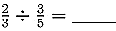
Q5:

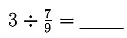
Q6:

Section C: Word Problems

Q7: Maya plants four saplings in a row, with 3/4 m between two saplings. Find the distance between the first and last saplings?

Q8: A car runs 16 km using 1 litre of petrol. How far will it go using litres of petrol?

Q9: Tanish drinks 1/2 glass of milk every day. How many glasses of milk does he drink in a week?

Q10: Leena made 5 cups of tea using 1/4 litre of milk. How much milk is in each cup of tea?

07. A Tale Of Three Intersecting Lines Chapter worksheet

Section A: Multiple Choice Questions (MCQs)

Q1: Which of the following sets of side lengths can form a triangle?
a) 2 cm, 3 cm, 6 cm
b) 4 cm, 5 cm, 7 cm
c) 1 cm, 1 cm, 3 cm
d) 5 cm, 10 cm, 16 cm

Q2 : If two angles of a triangle are 80° and 60°, what is the measure of the third angle?
a) 30°
b) 40°
c) 50°
d) 60°

Q3: In triangle ABC, the exterior angle at B is 130°, and ∠A = 50°. The measure of ∠C is
a) 85°
b) 70°
c) 75°
d) 80°

Q4: In a triangle PQR, if ∠P = 45° and ∠Q = 75°, can a triangle be formed with these angles and an included side of 5 cm?
a) Yes, because the sum of angles is less than 180°
b) No, because the sum of angles is equal to 180°
c) No, because the sum of angles is greater than 180°
d) Yes, but only if the side length is greater than 5 cm

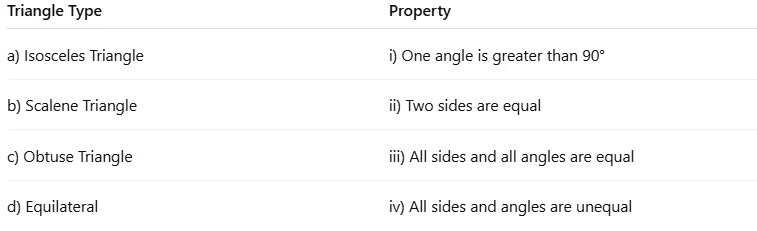
Section B: Match the Following

Section C: Spot the Error

Q1: Isha wrote the following steps to construct a triangle:

  • Step 1: Draw AB = 6 cm
  • Step 2: At A, draw a 120° angle
  • Step 3: Mark a point C on the ray such that AC = 5 cm
  • Step 4: Join BC

She claims the triangle formed is equilateral.
Is she correct? Explain the mistake.

Section D: Think and Answer

Q1: A triangle has angles measuring 30°, 60°, and 90°.
a) 
Name the triangle based on its angles.
b) 
Will this triangle have an altitude inside or outside?

Q2: A triangle has exactly one line of symmetry.
What kind of triangle is it and why?
a) 
All angles obtuse?
b) 
Two right angles?
Explain your answers.

06. Number Play Chapter worksheet

Section A: Multiple Choice Questions

Q1: Two consecutive numbers in the Virahãnka sequence are 377 and 610. What is the first of the next 2 numbers?
A) 
987
B) 1597
C) 
2584
D) 
4181

Q2: The expression 4n + 3 generates numbers for different values of n. What is the parity of 4n + 3 when n = 3?
A) 0
B) 1
C) 2
D) 4

Q3: Anil wants to find the parity of the 10th term of the Virahãnka sequence. What is the parity?
A) 0
B) 1
C) 2
D) 3

Section B: Fill in the Blanks 

Q4: Solve the cryptarithm: X4 + Y = Z11. The value of X is ______.

Q5: Uneek wants to find all 5-beat rhythms (sums of 1’s and 2’s). The number of ways to write 5 as a sum of 1’s and 2’s is ______. 

Q6: Ishan has number cards with values 1, 3, 5, 7, and 9. She wants to select 3 cards that sum to 21. The number of ways to select 3 cards summing to 21 is _______. 

Section C: Word Problems

Q7: Priya and Rohan, two siblings born one year apart, celebrate their birthdays. Priya claims the sum of their ages is 25. Is this possible? 

Q8: Write the next 3 numbers in the sequence: 1, 2, 3, 5, 8, 13, 21, 34, 55, 89. 

Q9: Two consecutive numbers in the Virahãnka sequence are 987 and 1597. What are the next 2 numbers in the sequence? 

Q10: A light bulb is OFF. A student toggles its switch 50 times. How many times is the bulb ON after 50 toggles? [Count ON state, 1 for ON, 0 for OFF.]

Q11: Using the generalized form, find a magic square if the center number is 13. 

Q12: Vanshika wants to climb a 9-step staircase, taking either 1 or 2 steps at a time. In how many different ways can she reach the top?

05. Parallel and Intersecting Lines Chapter worksheet

Q1. Classify the following pairs of lines as Parallel (P), Perpendicular (⊥), or Intersecting (I):
a) Opposite edges of a book
b) Hands of a clock at 9:00
c) Letter “T”
d) Railway tracks
e) Corners of a window frame

Section B: Numerical Based Questions

Q2. Two lines intersect to form four angles. If one angle is 70°, find the measures of the other three angles.

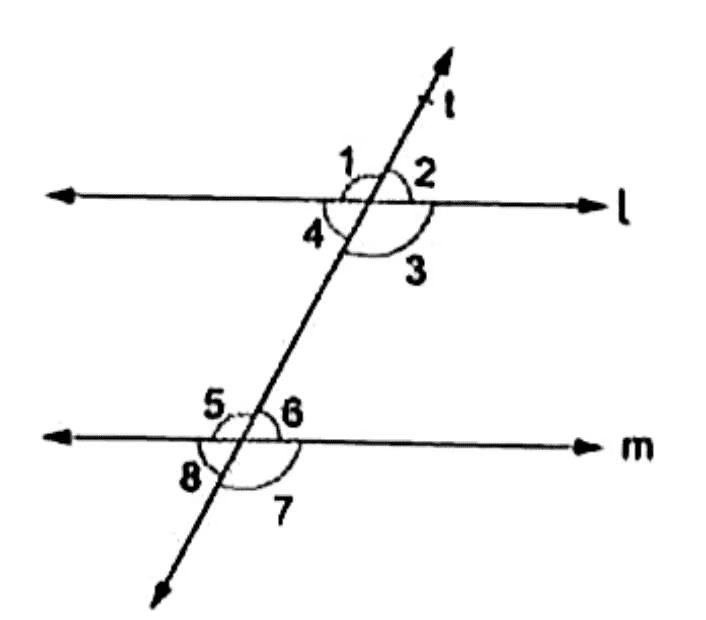
Q3. In the figure below, line l∥m and transversal t cuts them. If ∠2=65°, find ∠6.

Section C: Theory Based Questions

Q4. Define:
a) 
Parallel lines
b) 
Perpendicular lines

Q5. Identify the type of angles formed when two lines intersect:
a) 
Angles opposite each other
b) 
Adjacent angles forming a straight line

Q6. Two railway tracks are said to be parallel. A boy standing on a bridge drops a straight stick that cuts across both tracks.
What is the name of the stick in geometric terms?
Also, name any two pairs of angles formed and say if they are equal.

04. Expression Using Letter- numbers Chapter worksheet

Section A: Multiple-Choice Questions (MCQs)

Q1: One plate of dosa costs ₹50, and one plate of idlis costs ₹30. If x plates of dosa and y plates of idli are ordered, which expression represents the total amount earned in rupees?
a) 50x – 30y
b) 50x + 30y
c) (50 + 30) x (x + y)
d) 30x + 50y

Q2: A flour mill takes 12 seconds to start and 6 seconds per kg of grain to grind. Which expression describes the time to grind z kg of grain, starting from off?
a) 12 + 6 + z
b) 12 x 6 x z
c) 12 + 6 x z
d) (12 + 6) x z

Q3:  For a matchstick pattern, the number of matchsticks in step y is given by 4y + 1. How many matchsticks are needed for step 5?
a) 22
b) 21
c) 18
d) 28 

Q4: A shop rents out chairs and tables. The net cost for x chairs and y tables is 25x + 60y. What is the cost for 3 chairs and 2 tables?
a) 195
b) 206
c) 155
d) 135

Q5: In a quiz, Meera’s score in one round is 5p – 2q, where p is the points for a correct answer and q is the penalty. If p = 6 and q = 1, what is her score?
a) 29
b) 24
c) 28
d) 32

Section B: True or False
a) The terms 5xy and −2yx are like terms.

b) If n = 4, then the value of 5n−3 is 17.

c) The expression 2y+7 has three terms: 
2, y, and 7.

d) 3 (x + 2) = 3x + 6.

Section C: Patterns Based QuestionQ1: Matchsticks form squares: 1 square = 4 matchsticks, 2 squares = 7 matchsticks, 3 squares = 10 matchsticks. Find the rule for n squares. How many matchsticks are needed for 12 squares?

Section D: Word Problems

Q1: Arjun is 6 years older than Bhavna. If Bhavna’s age is b years, write an expression for Arjun’s age and find Arjun’s age when Bhavna is 14 years old.

Q2Maya makes matchstick patterns with W’s, each requiring 5 matchsticks. Write an expression for the number of matchsticks needed for n W’s and calculate the number needed for 10 W’s.

Q3Rakesh buys oranges at ₹25 each and 1 kg of flour at ₹45. Write an expression for the total cost of o oranges and f kg of flour, and find the cost for 4 oranges and 3 kg of flour.

Q4: The perimeter of a regular pentagon is 5 times the side length. Write an expression for the perimeter if the side length is q cm, and find the perimeter when q = 6 cm.

Q5: In a quiz, Vikram’s scores in three rounds are 4p – 3q, 5p – 2q, and 3p – q, where p is points for a correct answer and q is the penalty. Find his total score expression and calculate it if p = 7 and q = 2.

03. A Peek Beyond The Point Chapter worksheet

Section A: Multiple Choice Questions

Q1:  On a number line, the segment between 3 and 4 is divided into 10 equal parts. Which decimal represents the 6th division after 3?
(a) 3.66
(b) 3.006
(c)

(d) 

Q2: What is the decimal form of 4 ones, 7 tenths, and 2 hundredths?
(a) 4.72
(b) 47.2
(c) 4.072
(d) 

Q3: Which of the following is the largest?

(a) 

(b) 

(c) 

(d) 

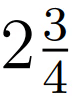
Section B: Fill in the BlanksQ4: The sum of and   (represented as mixed fraction is) _______

Q5: The decimal 6.45 represents _____units and _____ hundredths. 

Q6: In the sequence 4.2, 4.5, 4.8, …, the next term is _____ .

Section C:  Conversion Questions (m to cm or cm to m)

Q7: 

Section D: Word Problems

Q8: Observe the sequence of numbers: Identify the pattern and find the next three terms

Q9: A ribbon is meters long. How many centimeters is this?

Q10: The length of Arjun’s forearm is units, and his upper arm is 2.6 units. What is the total length of his arm in decimal form?