(ii) Candle clocks were used to measure time in ancient India.
(iii) In non-uniform motion, the speed of the object remains the same.
(iv) All pendulums of the same length have the same time period at the same location.
(v) Distance is measured in metres and time in seconds.
Q.2. Fill in the blanks. (i) The metallic ball is called the ____ of the pendulum.
(ii) The symbols of all units are written in ____.
(iii) The time taken by the pendulum to complete one oscillation is called its ____.
(iv) One microsecond is one ____ of a second.
(v) A nanosecond is one ____ of a second.
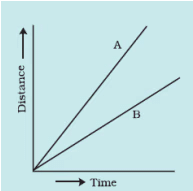
(vi) The distance-time graph for the motion of an object moving with a constant speed is a ____.
Answer the following Questions
Q.3. Give an example of oscillatory motion. Q.4. What is uniform motion?
Q.5. An object moving along a straight line with a constant speed is said to be in uniform motion.
Q.6. What is distance-time graph? Q.7. What is oscillatory motion?
Q.8. What is non-uniform motion? Q.9. What is the basic unit of speed?
Q.10. A simple pendulum takes 32 s to complete 20 oscillations. What is the time period of the pendulum?
Q.11. When pendulum is said to have one complete oscillation?
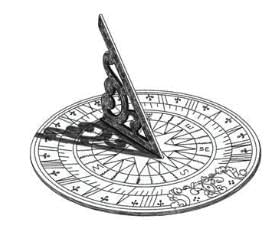
Q.12. Explain how in ancient time a day, a month and a year were measured? Q.13. The distance between two stations is 240 km. A train takes 4 hours to cover this distance. Calculate the speed of the train.
Q.14. Salma takes 15 minutes from her house to reach her school on a bicycle. If the bicycle has a speed of 2 m/s, calculate the distance between her house and the school.
Q1: What is the main reason for the development of pimples during adolescence?
a)Lack of sleep
b) Increase in oily secretions from the skin
c) Excessive washing of the face
d) Change in diet
Q2: What is the term used to describe the natural signs that the body is preparing for adulthood?
a) Puberty
b) Maturity
c) Secondary sexual characteristics
d) Adolescence
Q3: At what age does adolescence typically begin?
a) 5–6 years
b) 10–12 years
c) 13–14 years
d) 19–20 years
Q4: What does the onset of the menstrual cycle in girls indicate?
a) Beginning of adolescence
b) The start of puberty
c) Both a and b
d) End of childhood
Q5: Which of the following is a secondary sexual characteristic in boys?
a) Development of breasts
b) Voice deepening
c) Menstruation
d) None of the above2. Fill in the Blanks:
Q1: The stage of life when the body undergoes changes to prepare for adulthood is called __________.
Q2: The growth of facial hair in boys is one of the __________ sexual characteristics that occur during adolescence.
Q3: The natural process in adolescent girls that involves the release of blood is called __________.
Q4: During adolescence, boys and girls experience growth in __________ in the pubic region and underarms.
Q5: __________ refers to the time period when the body undergoes internal and external changes to reach reproductive capability.3. True/False Questions:
Q1: Adolescence is marked only by physical changes in the body.
Q2: The onset of menstruation is an important internal change in adolescent girls.
Q3: Acne is a common skin condition that may develop due to increased oily secretions during adolescence.
Q4: Boys and girls develop the same type of secondary sexual characteristics during adolescence.
Q5: The menstrual cycle is an indicator of a girl’s reproductive health.Very Short Answer Questions:
Q1: What are secondary sexual characteristics?
Q2: What is menstruation?
Q3: Why do boys experience voice changes during adolescence?
Q4: How does physical activity help adolescents?
Q5: What is the role of hormones during adolescence?Long Answer Questions:
Q1: Explain the physical and emotional changes that occur during adolescence.
Q2: How can adolescents manage emotional changes effectively?
Q3: What are the key nutritional needs of adolescents, and why are they important?
Q4: What is the significance of the menstrual cycle in adolescent girls?
Q5: Discuss the impact of substance abuse during adolescence and the importance of saying ‘NO’ to harmful substances.
(iv) Burning of magnesium ribbon produces a white powder.
(v) Bioluminescence produces light without heat.
Q.2. Fill in the blanks.
(i) Cutting a log of wood into pieces is a ____ change.
(ii) Condensation is a ____ change.
(iii) When carbon dioxide is passed through lime water, it turns milky due to the formation of ____.
(iv) Two methods by which rusting of iron can be prevented are ____ and ____.
(v) Changes in which only ____ properties of a substance change are called physical changes.
(vi) A medicine is the end product of a chain of ____.
Answer the following Questions
Q3. What is the white substance formed when lime water reacts with carbon dioxide?
Q4. What kind of change is chopping vegetables?
Q5. Name the three requirements of the fire triangle.
Q6. Which process breaks down rocks into soil over time?
Q7. What kind of change is melting wax?
Q8. What happens when magnesium ribbon is burnt in air? Q.9. What do you understand by chemical change? Q.10. Why formation of manure from leaves is a chemical change?
Q.11. Why tearing of paper into pieces is a physical change?
Q.12. What is rusting?
Q.13. Explain why burning of wood and cutting it into small pieces are considered as two different types of changes.
Q.14. What is a physical change?
Q.15. Explain the changes that occur when a candle burns.
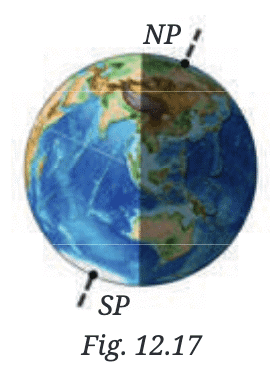
Q1: In Fig. 12.17, how many hours of sunlight do the North Pole and the South Pole receive during one rotation of the Earth? Ans: During one rotation of the Earth, the North and South Poles experience 24 hours of either sunlight or darkness, depending on the season. This is because the Earth’s axial tilt causes these poles to either face the sun constantly (24 hours of sunlight) or be completely shielded from the sun (24 hours of darkness) for periods of several months.
According to the figure, the South Pole is receiving 24 hours of sunlight, while the North Pole is in complete darkness.
Q2: Fill in the blanks
(i) Stars rise in the _________ and set in the ___________.
Ans: Stars rise in the East and set in the West.
(ii) Day and night are caused by the Earth’s __________________.
Ans: Day and night are caused by the Earth’s rotation.
(iii) When the Moon fully covers the Sun from our view, it is called a _____________ solar eclipse.
Ans: When the Moon fully covers the Sun from our view, it is called a total solar eclipse.
Q3: State whether True or False (i) Lunar eclipse occurs when the Sun comes between the Earth and the Moon.
Ans: False A lunar eclipse happens when the Earth is between the Sun and the Moon. This causes the Earth’s shadow to fall on the Moon, blocking the Sun’s light.
(ii) Sunrise happens earlier in Gujarat than in Jharkhand.
Ans: True Gujarat is located to the west of Jharkhand, so the Sun rises earlier in Gujarat because of its position relative to the Earth’s rotation.
(iii) In Chennai, the longest day occurs on the summer solstice.
Ans: True The longest day of the year happens on the summer solstice, which occurs around June 21st. Chennai, being in the Northern Hemisphere, experiences its longest day during this time.
(iv) We should watch the solar eclipse directly with our naked eye.
Ans: False Looking at a solar eclipse directly without protective glasses can damage your eyes, as the Sun’s rays are harmful.
(v) Seasons occur due to the tilt of Earth’s axis of rotation and its spherical shape.
Ans: True The tilt of the Earth’s axis and its spherical shape cause the Sun’s rays to hit different parts of the Earth at different angles throughout the year, creating the four seasons.
(vi) The Earth’s revolution around the Sun causes day and night.
Ans: False Day and night are caused by the Earth’s rotation on its axis, not its revolution around the Sun. The Earth rotates, creating the cycle of day and night.
Q4: Padmashree saw the Orion constellation nearly overhead at 8 pm yesterday. When will she see Orion overhead today? Ans: She will see Orion overhead approximately 4 minutes earlier each day due to the Earth’s rotation and revolution.
Q5: Nandhini saw a group of stars rising at midnight on 21 June. When will she see the same group of stars rising at midnight next year? Ans: Nandhini will see the same group of stars rising at midnight on 21 June next year as well, since the Earth completes one full revolution around the Sun in about 365 days, so the position of the stars is similar each year.
Q6: Abhay noticed that when it was daytime in India, his uncle who was in the USA was generally sleeping as it was night-time there. What is the reason behind this difference? Ans: This difference is due to the Earth’s rotation. As the Earth rotates, different parts of the world experience day and night at different times. India and the USA are in different time zones.
Q7: Four friends used the following ways to see the solar eclipse. Who among them was being careless? (i) Ravikiran used a solar eclipse goggle. Ans:Safe (ii) Jyothi used a mirror to project the Sun’s image. Ans: Safe (iii) Adithya saw the Sun directly with his eyes. Ans: Careless (iv) Aruna attended a programme arranged by a planetarium. Safe
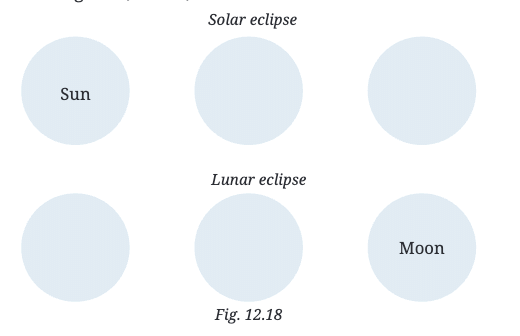
Q8: Fill in the circles in Fig. 12.18 appropriately with one of the following: Sun, Moon, Earth. Ans:
Solar Eclipse:Sun – Moon – Earth
Lunar Eclipse:Sun – Earth – Moon
Q9: The Moon is much smaller than the Sun, yet it can block the Sun completely from our view during a total solar eclipse. Why is it possible? Ans: The Moon can block the Sun completely during a total solar eclipse because it is much closer to the Earth than the Sun. The apparent sizes of the Moon and the Sun are similar when viewed from Earth.
Q10: The Indian cricket team matches in Australia are often held in December. Should they pack winter or summer clothes for their trip? Ans: The Indian cricket team should pack summer clothes for their trip to Australia in December because, in the Southern Hemisphere, December is summer. While India experiences winter during this time, Australia has warm weather, so they will need light and comfortable clothing suitable for summer.
Q11: Why do you think lunar eclipses can be seen from a large part of the Earth when they happen, but total solar eclipse can be seen by only a small part of the Earth? Ans: Lunar eclipses are visible from a larger part of the Earth because the Earth’s shadow is large, and it covers a wide area. A solar eclipse, however, is visible only from a small part of the Earth because the Moon’s shadow is much smaller and concentrated in specific regions.
Q12: If the Earth’s axis were not tilted with respect to the axis of revolution, explain what would be the effect on seasons? Ans: If the Earth’s axis were not tilted, there would be no seasonal changes. The amount of sunlight received at different latitudes would remain the same throughout the year, leading to a uniform climate year-round.
Ans: Luminous objects- Sun, Pole Star, and Venus are luminous objects because they emit their own light.
Non-Luminous objects- The Moon and Mars are non-luminous objects as they reflect light and don’t have light of their own.
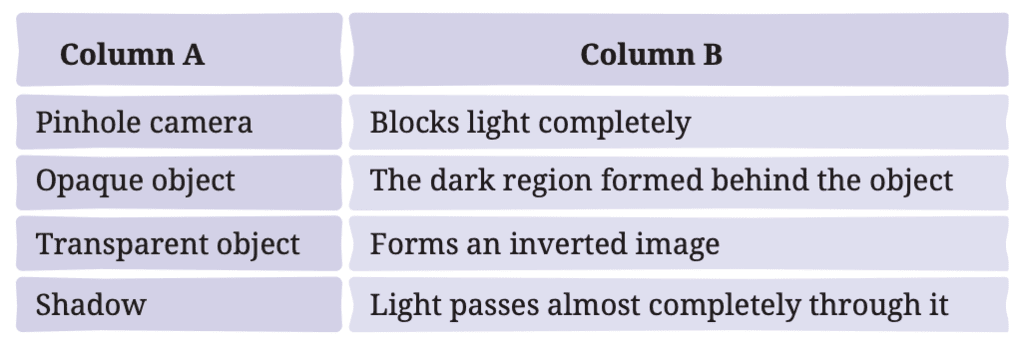
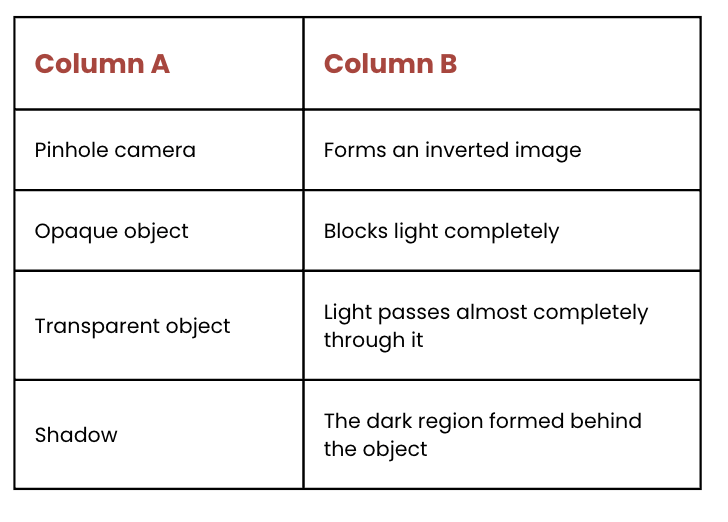
Q2: Match the items in Column A with those in Column B.
Ans:
Pinhole camera → Forms an inverted image A pinhole camera creates an inverted image due to the way light passes through the small hole.
Opaque object → Blocks light completely An opaque object does not let light pass through it, so it blocks light completely.
Transparent object → Light passes almost completely through it A transparent object allows most of the light to pass through, making things visible through it.
Shadow → The dark region formed behind the object A shadow is formed when an object blocks light, creating a dark area behind it.
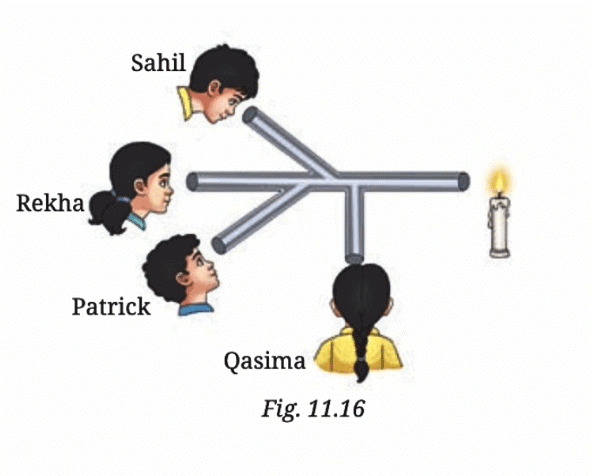
Q3: Sahil, Rekha, Patrick, and Qasima are trying to observe the candle flame through the pipe as shown in Fig. 11.16. Who can see the flame?
Ans: Rekha can see the flame through the pipe because the light from the flame travels in a straight line. For the light to pass through the pipe, it must follow a direct path without any obstructions or bends.
For Sahil, Patrick, and Qasima pipe is bent. Hence, the light would not be able to travel and reach their eyes.
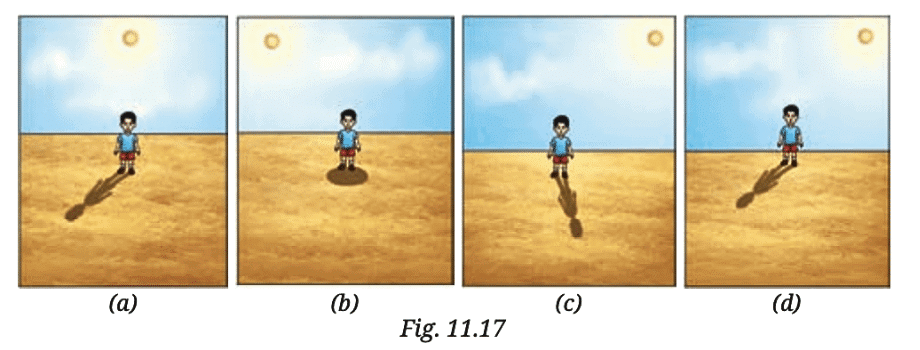
Q3: Look at the images shown in Fig. 11.17 and select the correct image showing the shadow formation of the boy
Ans: The shadow formed will be based on the position of the light source relative to the object (the boy). If the light is positioned in front of the boy, the shadow will fall behind him.
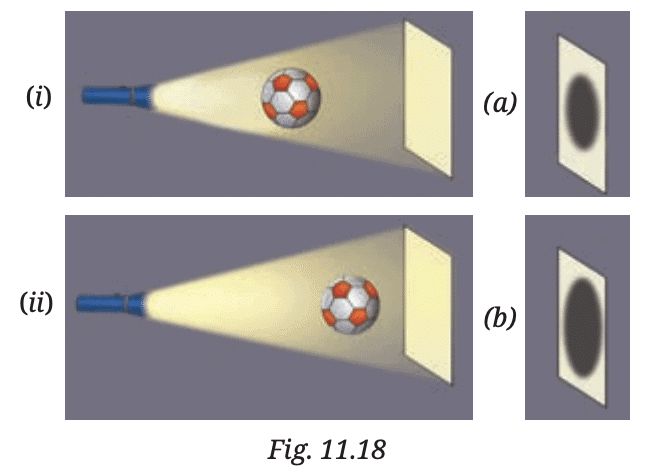
Q4: The shadow of a ball is formed on a wall by placing the ball in front of a fixed torch as shown in Fig. 11.18. In scenario (i) the ball is closer to the torch, while in scenario (ii) the ball is closer to the wall. Choose the most accurate representation of the shadows formed in both scenarios from the options provided (a and b).
Ans: Scenario (i): When the ball is closer to the torch, the shadow will be larger because the light is spreading out more and the ball blocks more light.
Scenario (ii): When the ball is closer to the wall, the shadow will be smaller because the ball is farther from the torch, so it blocks less light.
In simple terms:
Closer to the torch → bigger shadow
Closer to the wall → smaller shadow
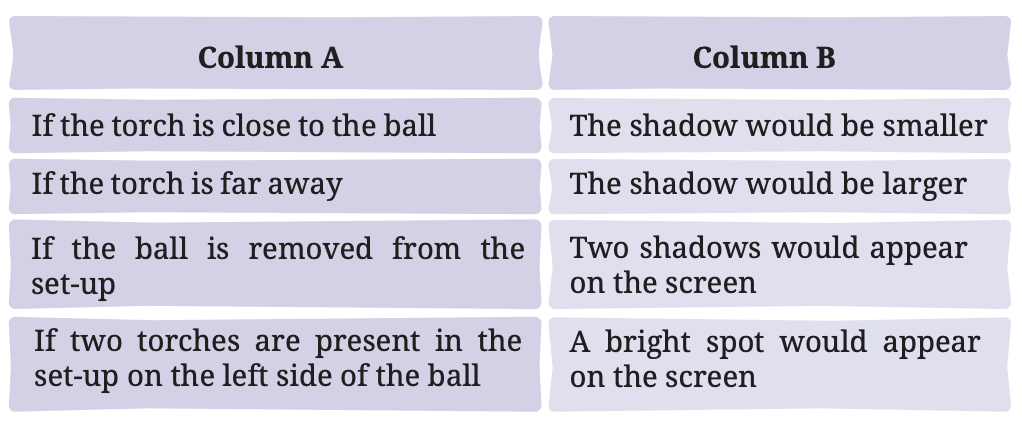
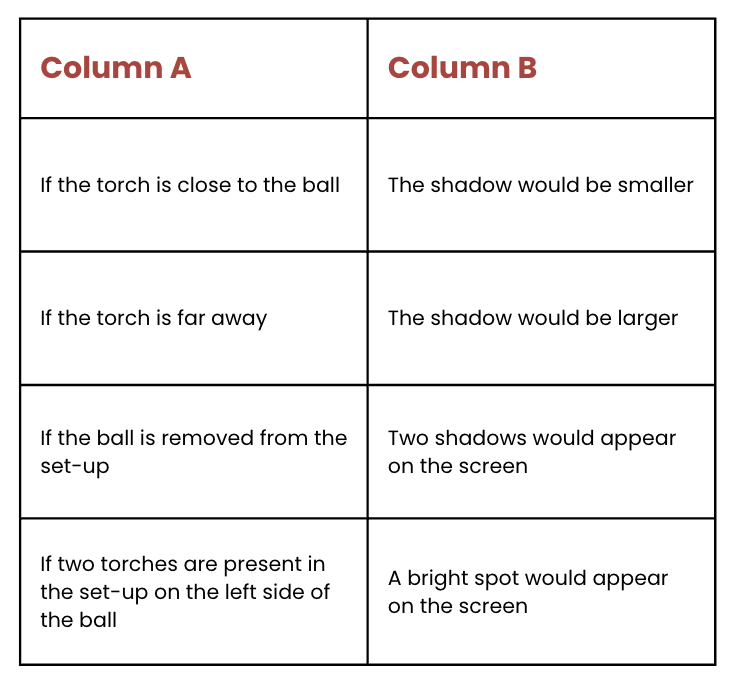
Q6: Based on Fig. 11.18, match the position of the torch in Column A with the characteristics of the ball’s shadow in Column B.
Ans:
If the torch is close to the ball → The shadow would be smaller The shadow would be smaller because the light is more spread out when the torch is close.
If the torch is far away → The shadow would be larger The shadow would be larger because the light will cover a wider area as the torch is far away.
If the ball is removed from the setup → Two shadows would appear on the screen Two shadows would appear on the screen because without the ball blocking the light, both torches will create shadows.
If two torches are present in the setup on the left side of the ball → A bright spot would appear on the screen A bright spot would appear on the screen where the two light sources meet and overlap.
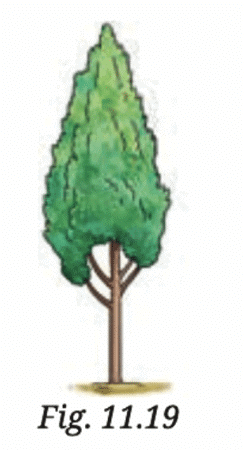
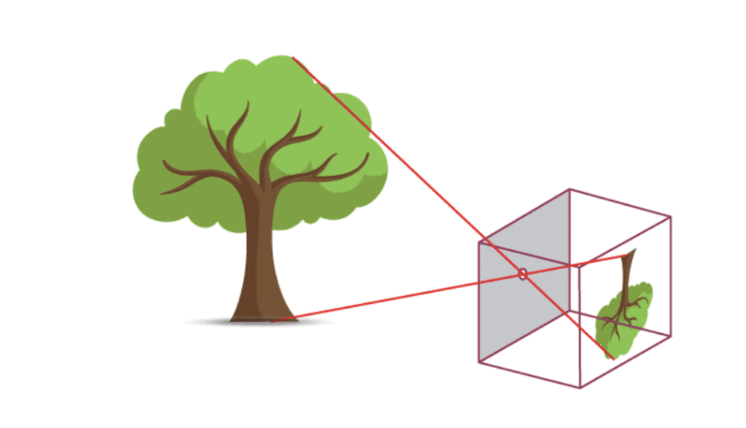
Q7: Suppose you view the tree shown in Fig. 11.19 through a pinhole camera. Sketch the outline of the image of the tree formed in the pinhole camera.
Ans: In a pinhole camera, the image is upside down and inverted because light travels in straight lines. The top of the object (the tree) hits the bottom of the screen, and the left side hits the right side, causing the image to appear reversed.
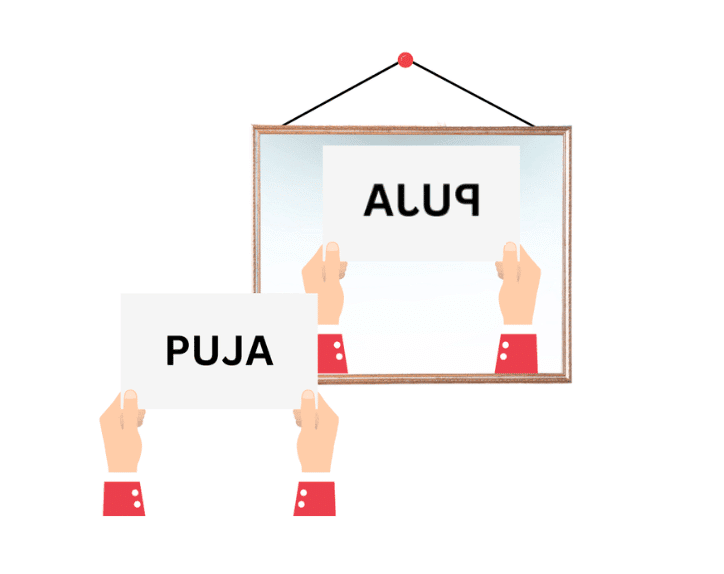
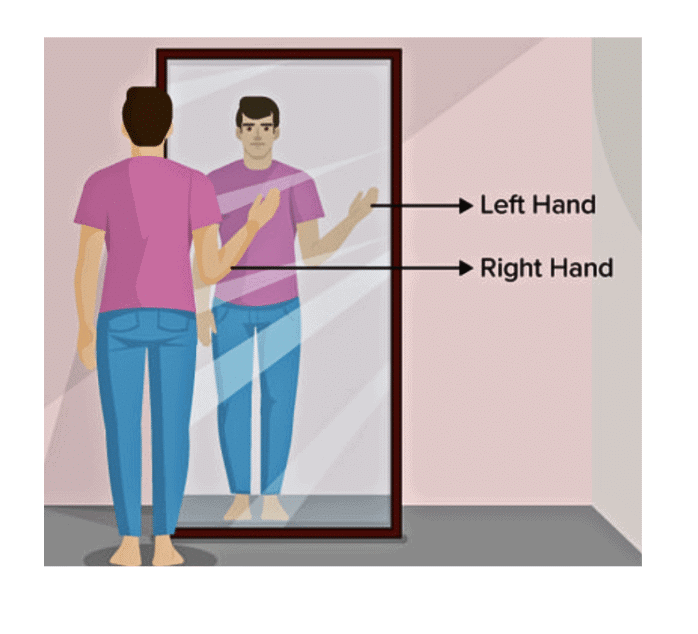
Q8: Write your name on a piece of paper and hold it in front of a plane mirror such that the paper is parallel to the mirror. Sketch the image. What difference do you notice? Explain the reason for the difference.
Ans: The image of the name will be reversed, as mirrors cause lateral inversion. The left side of the name will appear as the right side in the mirror and vice versa.
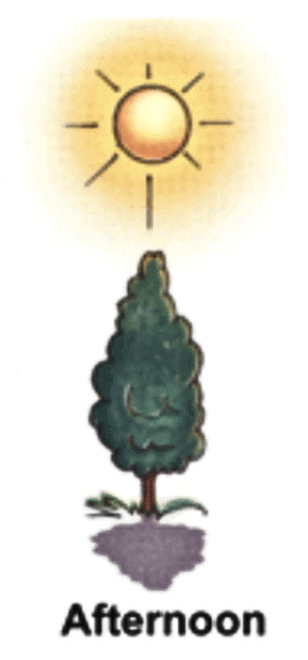
Q9: Measure the length of your shadow at 9 AM, 12 PM, and 4 PM with the help of your friend. Write down your observations: (i) At which of the given times is your shadow the shortest?
Ans: The shadow is the shortest at 12 PM when the Sun is directly overhead.
During the day, as the Earth rotates, the angle at which the Sun’s rays hit the ground changes. In the morning (9 AM) and late afternoon (4 PM), the Sun is lower in the sky, so its rays strike the ground at a steeper angle, causing a longer shadow.
(ii) Why do you think this happens?
Ans: This is because:
At this time, the Sun is at its highest point in the sky, meaning it is directly above you.
The Sun’s rays are shining down almost vertically, so the shadow is at its shortest.
The angle between the Sun’s rays and the ground is the smallest, resulting in a small, short shadow.
Q10: On the basis of following statements, choose the correct option.
Statement A: Image formed by a plane mirror is laterally inverted.
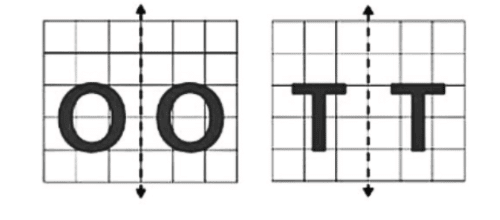
Statement B: Images of alphabets T and O appear identical to themselves in a plane mirror.
(i) Both statements are true (ii) Both statements are false (iii) Statement A is true, but statement B is false (iv) Statement A is false, but statement B is true
Ans: (i) Both statements are true.
Statement A is true as plane mirrors create laterally inverted images.
Statement B is true because some letters (like T and O) look the same in a mirror.
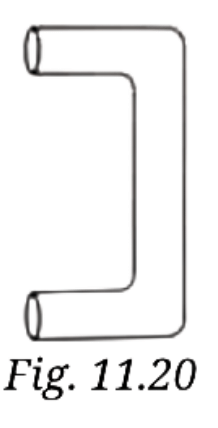
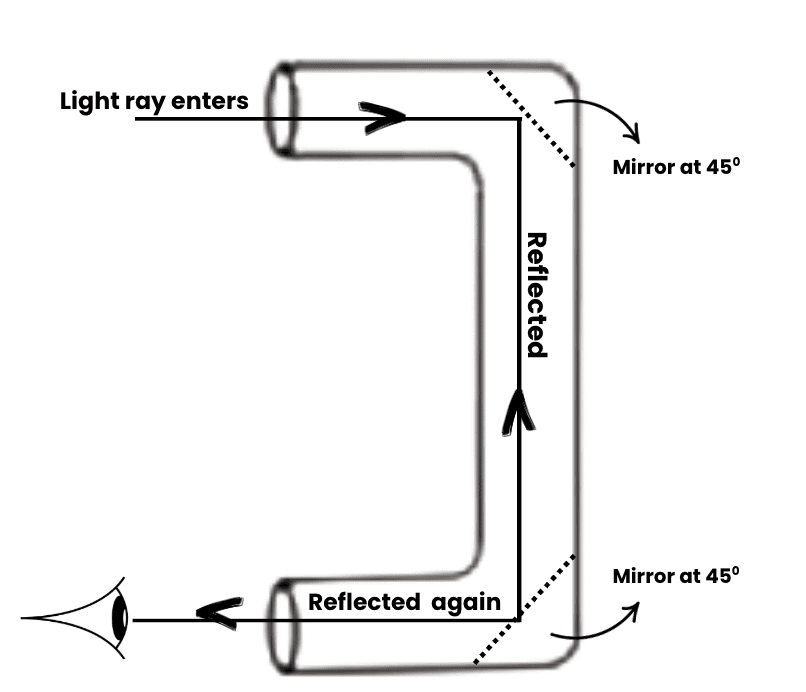
Q11: Suppose you are given a tube of the shape shown in Fig. 11.20 and two plane mirrors smaller than the diameter of the tube. Can this tube be used to make a periscope? If yes, mark where you will fix the plane mirrors.
Ans: Yes, the tube can be used to make a periscope.
Positioning the mirrors: To construct the periscope, you would place the two plane mirrors at 45-degree angles inside the tube.
First mirror: Place the first mirror at the top of the tube, facing down at a 45-degree angle.
Second mirror: Place the second mirror at the bottom of the tube, facing up at a 45-degree angle to reflect light from the outside to the viewer’s eyes.
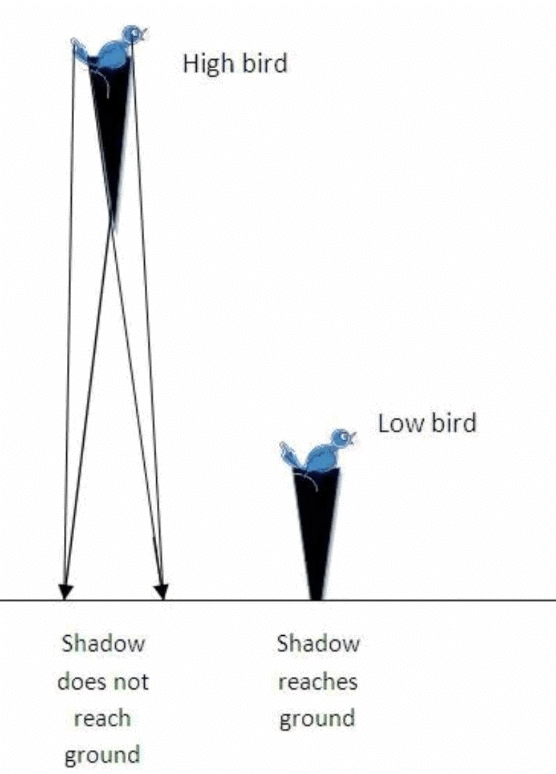
Q12: We do not see the shadow on the ground of a bird flying high in the sky. However, the shadow is seen on the ground when the bird swoops near the ground. Think and explain why it is so.
Ans: The bird flying high in the sky is too far from the ground for its shadow to be visible.
When the bird swoops closer to the ground, its shadow becomes more visible because the light from the Sun is blocked closer to the surface.