06. The Age Of Reorganisation Chapter worksheet Solution

Multiple Choice Questions (MCQs)

Q1: What was the main reason for the formation of new kingdoms after the Maurya Empire?
a) Rise of new empires
b) Internal conflicts and invasions
c) Religious conversion
d) Peace treaties

Ans: b) Internal conflicts and invasions

After the Maurya Empire collapsed, internal conflicts and foreign invasions led to the rise of new kingdoms.
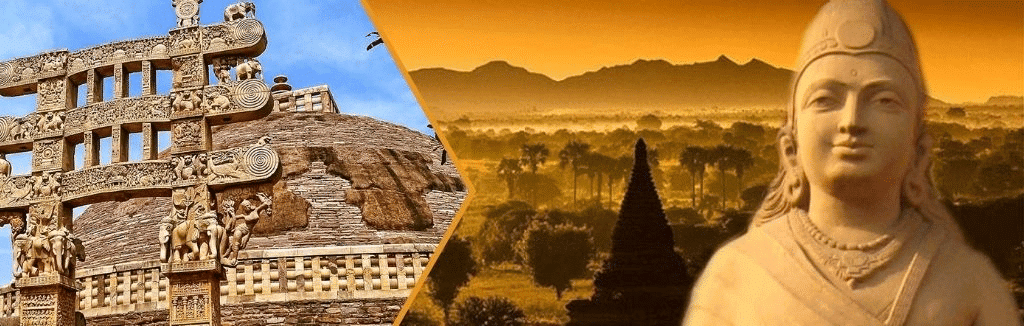
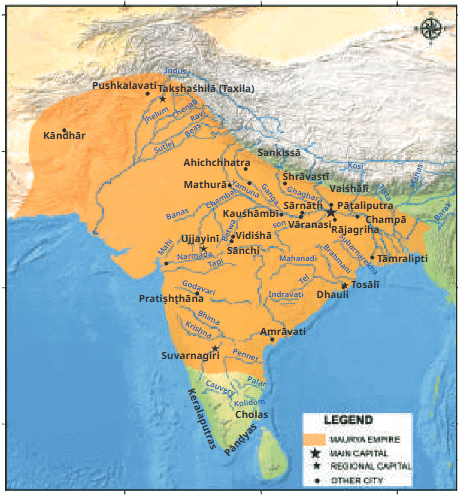
Maurya Empire

Q2: Who started the Śhunga dynasty?
a) Ashoka
b) Chandragupta Maurya
c) Puṣhyamitra Śhunga
d) Dhanananda

Ans: c) Puṣhyamitra Śhunga

Puṣhyamitra Śhunga, a Mauryan commander, killed the last Maurya emperor and started the Śhunga dynasty.

Q3: What was the primary feature of the Śhunga Empire?
a) Large expansion across the subcontinent
b) Promotion of Buddhism
c) Revival of Vedic rituals
d) Invasion of the south

Ans: c) Revival of Vedic rituals

The Śhunga Empire revived Vedic rituals, such as the Ashvamedha yajña, and supported art and architecture.
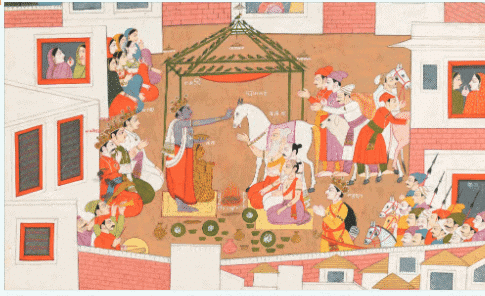
King Rama Performing Ashwamedha Yajna

Q4: Which ancient city was the capital of the Sātavāhana dynasty?
a) Ujjain
b) Pataliputra
c) Amrāvatī
d) Kausambi

Ans: c) Amrāvatī

Amrāvatī was one of the capitals of the Sātavāhana dynasty, located in present-day Andhra Pradesh.

Q5: What was the primary trade item for the Sātavāhanas?
a) Spices
b) Gold
c) Pearls
d) Textiles

Ans: a) Spices

The Sātavāhanas traded spices, textiles, gold-plated pearls, and ivory, especially with the Roman Empire.

Q6: Which ruler of the Chedi dynasty was a supporter of Jainism?
a) Khāravela
b) Dhanananda
c) Chandragupta Maurya
d) Ashoka

Ans: a) Khāravela

King Khāravela of the Chedi dynasty was a follower of Jainism, known for his patronage of Jain culture.

Q7: What was the contribution of the Sātavāhanas to literature?
a) Development of Sanskrit literature
b) Promotion of Tamil poetry
c) Support for Sangam literature
d) Spread of Vedic texts

Ans: c) Support for Sangam literature

The Sātavāhanas supported Tamil literature, particularly the Sangam poems, which focused on love and heroism.

Q8: What role did the Indo-Greeks play in India?
a) They formed the first Indian empire.
b) They blended Greek and Indian cultures.
c) They conquered all of India.
d) They promoted Hinduism.

Ans: b) They blended Greek and Indian cultures.

The Indo-Greeks adopted Indian culture while introducing Greek styles in art, architecture, and governance.

Q9: Which famous art styles did the Kuṣhāṇas contribute to?
a) Gandhara and Mathura
b) Ajanta and Ellora
c) Mughal art
d) Rajasthani miniature painting

Ans: a) Gandhara and Mathura

The Kuṣhāṇas influenced the Gandhara and Mathura art styles, blending Indian and Greek elements.
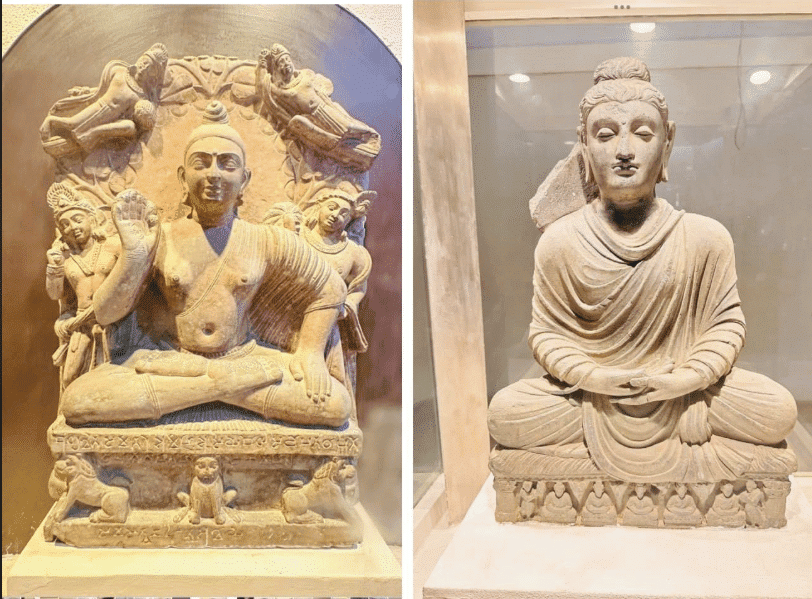
Gandhara and Mathura Art Styles

Q10: Which dynasty ruled parts of south India during the period of reorganisation?
a) Mauryas
b) Cholas
c) Guptas
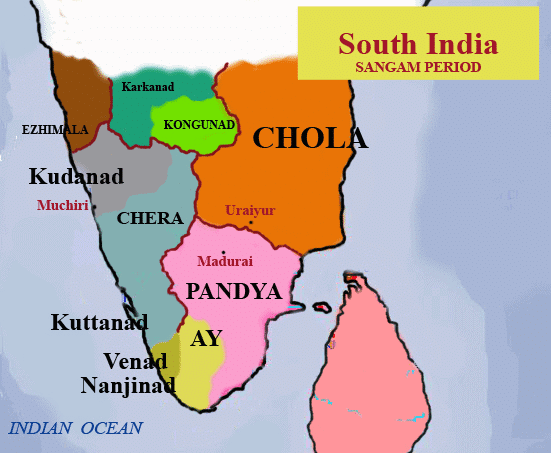
d) Cheras, Cholas, and Pāṇḍyas

Ans: d) Cheras, Cholas, and Pāṇḍyas

The Cheras, Cholas, and Pāṇḍyas ruled parts of south India, boosting trade and culture.

Fill in the Blanks

Q1: The Śhunga dynasty was started by __________, a Mauryan commander.
Ans: Puṣhyamitra Śhunga

Puṣhyamitra Śhunga killed the last Maurya emperor and founded the Śhunga dynasty.

Q2: The Sātavāhanas ruled the __________ region.
Ans: Deccan

The Sātavāhanas controlled the Deccan region, which includes present-day Andhra Pradesh, Telangana, and Maharashtra)
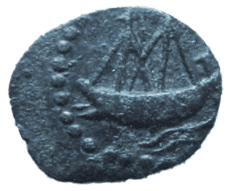
Satavahana Coin

Q3: The __________ caves in Odisha were built by King Khāravela for Jain monks.
Ans: Udayagiri-Khandagiri

These caves have intricate carvings and are significant examples of Jain rock-cut architecture.

Q4: The __________ was a Vedic ritual performed by the Śhunga kings.
Ans: Ashvamedha yajña

The Ashvamedha yajña was performed by Śhunga rulers, where a horse roamed freely to claim land or establish dominance.

Q5: The Sātavāhanas were known for their __________, showing their trade connections.
Ans: Coins

The Sātavāhanas used coins that often depicted ships, indicating their strong maritime trade.

Q6: The Indo-Greek ruler __________ built the Heliodorus pillar in Madhya Pradesh.
Ans: Antialcidas

The Heliodorus pillar praises the god Vāsudeva and represents the blending of Greek and Indian cultures.
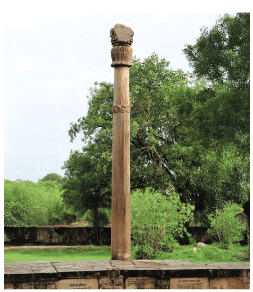
Heliodorus Pillar Near Vidisha

Q7: The __________ dynasty had an empire that stretched from Central Asia to northern India.
Ans: Kuṣhāṇa

The Kuṣhāṇa Empire was a Central Asian dynasty that significantly influenced northern India.

Q8: The __________ art style was influenced by the Kuṣhāṇas and mixed Indian and Greek elements.
Ans: Gandhara

Gandhara art, developed under the Kuṣhāṇas, combined Greek artistic techniques with Indian religious themes.

Q9: The __________ kingdom of south India was known for trading pearls with the Romans.
Ans: Pāṇḍya

The Pāṇḍyas were known for their prosperous pearl trade, especially with the Romans.
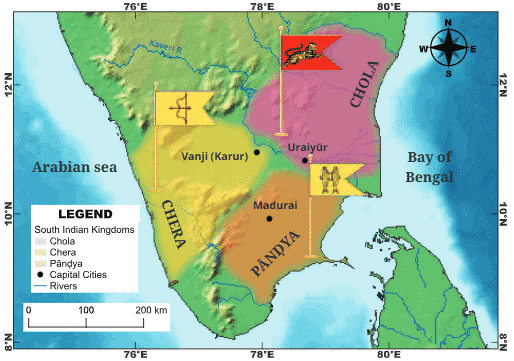
Chera, Chola, Pandya

Q10: The __________ period in south India is known for its Sangam literature.
Ans: Sangam

The Sangam Age produced Tamil poetry that described love, heroism, and social values.

Very Short Answer Questions

Q1: Who founded the Śhunga dynasty?
Ans: Puṣhyamitra Śhunga.

Q2: What were the Sātavāhana rulers known for in terms of trade?
Ans: They had strong maritime trade, trading spices and textiles.

Q3: Which ruler promoted Jainism in the Chedi dynasty?
Ans: Khāravela.

Q4: Where did the Indo-Greeks establish their presence in India?
Ans: Northwest India.

Q5: What was the major contribution of the Kuṣhāṇas to Indian art?
Ans: Gandhara and Mathura art styles.
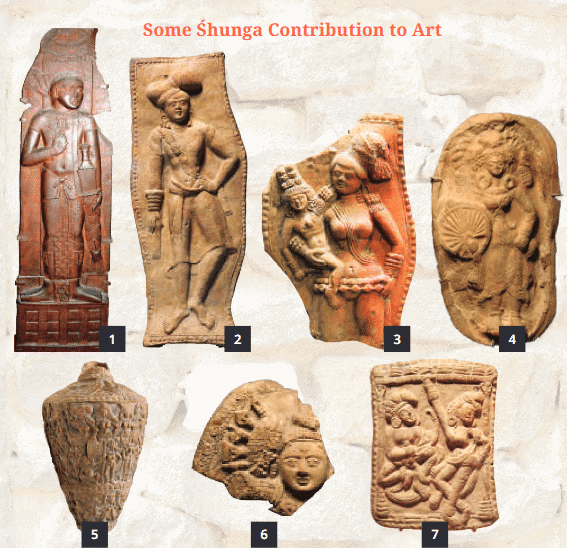
Shunga Contribution to Art

Short Answer Questions

Q1: How did the Śhunga Empire influence Indian culture?
Ans: The Śhunga Empire revived Vedic rituals, promoted Sanskrit literature, and contributed to art by building the Bharhut Stūpa with beautiful carvings.

Q2: What role did trade play in the Sātavāhana Empire?
Ans: The Sātavāhanas thrived on trade, especially maritime trade, importing goods like glass and perfumes while exporting spices, textiles, and ivory.

Q3: How did the Indo-Greek rulers blend their culture with Indian traditions?
Ans: The Indo-Greeks adopted Indian culture, blending Greek and Indian artistic styles and religious practices, as seen in their coins and sculptures.

Q4: Why did the Sātavāhanas support multiple religions?
Ans: The Sātavāhanas, while supporting Vedic rituals, allowed Jains, Buddhists, and other groups to thrive by providing them with land and patronage.

Q5: What was the significance of the Kalinga War in Ashoka’s life?
Ans: The Kalinga War led Ashoka to embrace Buddhism and non-violence, promoting peace and moral governance through his edicts.

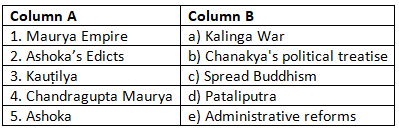
Match the Following

(Match Column A with the correct option in Column B)
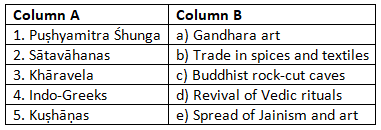
Ans: Matched Pairs and Explanations:

  • 1 → d: Puṣhyamitra Śhunga revived Vedic rituals and expanded the Śhunga Empire.
  • 2 → b: The Sātavāhanas thrived on trade, particularly in spices and textiles with foreign countries.
  • 3 → c: Khāravela built Jain rock-cut caves in Odisha and supported Jainism.
  • 4 → a: The Indo-Greeks contributed to Gandhara art, blending Greek and Indian elements.
  • 5 → e: The Kuṣhāṇas promoted Jainism, Buddhism, and art, blending Indian and Greek styles.
05. The Rise of Empires Chapter worksheet Solution

Multiple Choice Questions (MCQs)

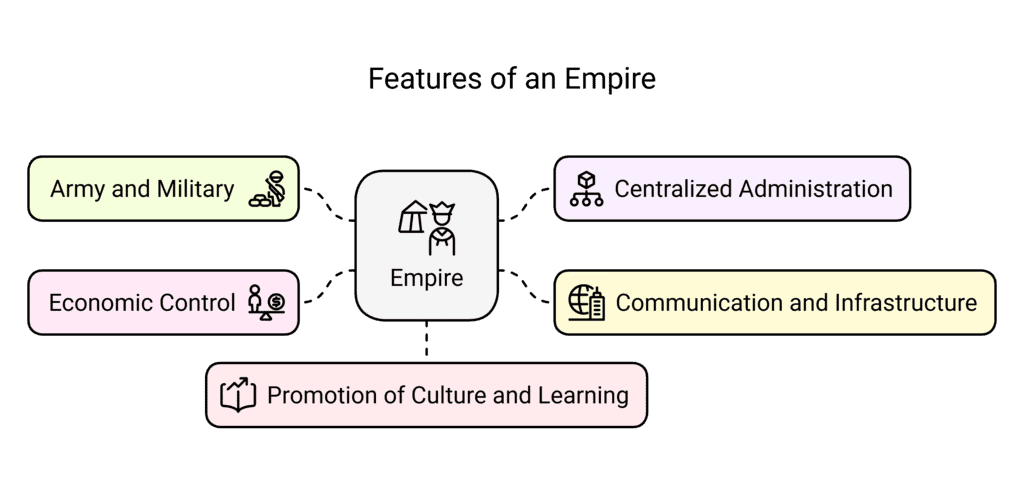
Q1: What is the main feature of an empire?
a) A ruler governs one kingdom.
b) A ruler controls many smaller kingdoms.
c) The kingdom is independent of others.
d) The ruler is elected by the people.

Ans: b) A ruler controls many smaller kingdoms.

An empire is a large territory where a powerful emperor governs many smaller kingdoms or regions.

Q2: What did tributary kingdoms do in an empire?
a) They were fully independent.
b) They paid tribute to the emperor.
c) They ruled their own territories.
d) They supported military campaigns.

Ans: b) They paid tribute to the emperor.

Tributary kingdoms paid money, goods, or services to the emperor in exchange for protection and loyalty.

Q3: Which of the following was a reason for the expansion of empires?
a) To maintain peace
b) To gain fame and resources
c) To form alliances
d) To promote democracy

Ans: b) To gain fame and resources

One of the main reasons for empire expansion was the desire for resources, wealth, and fame.

Q4: Who helped Chandragupta Maurya to establish the Maurya Empire?
a) Dhanananda
b) Alexander the Great
c) Kauṭilya
d) Ashoka

Ans: c) Kauṭilya

Kauṭilya, also known as Chanakya, guided Chandragupta Maurya in founding the Maurya Empire and overthrowing the Nanda dynasty.

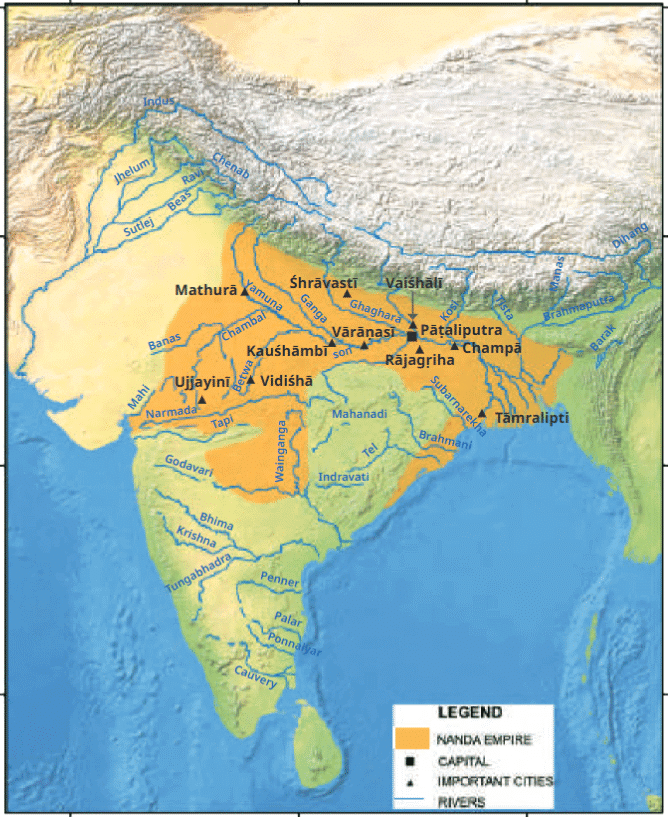
Maurya Empire

Q5: What was the capital of the Maurya Empire under Chandragupta?
a) Pataliputra
b) Rajagriha
c) Kausambi
d) Ujjain

Ans: a) Pataliputra

Pataliputra (modern-day Patna) was the capital of the Maurya Empire, strategically located for administration and trade.

Q6: What did Kauṭilya’s Arthashastra primarily focus on?
a) Religion
b) Warfare and governance
c) Literature
d) Agriculture

Ans: b) Warfare and governance

Kauṭilya’s Arthashastra is a treatise on statecraft, economics, and military strategy.

Q7: Who succeeded Chandragupta Maurya as emperor of the Maurya Empire?
a) Dhanananda
b) Ashoka
c) Ajatashatru
d) Mahapadma Nanda

Ans: b) Ashoka

Ashoka, the grandson of Chandragupta, succeeded him and expanded the empire significantly.

Q8: What was the significant change in Ashoka’s rule after the Kalinga War?
a) He focused on expanding the empire further.
b) He became a pacifist and embraced Buddhism.
c) He implemented stricter laws for the empire.
d) He strengthened military power.

Ans: b) He became a pacifist and embraced Buddhism.

After the brutal Kalinga War, Ashoka adopted Buddhism and promoted non-violence and peace.

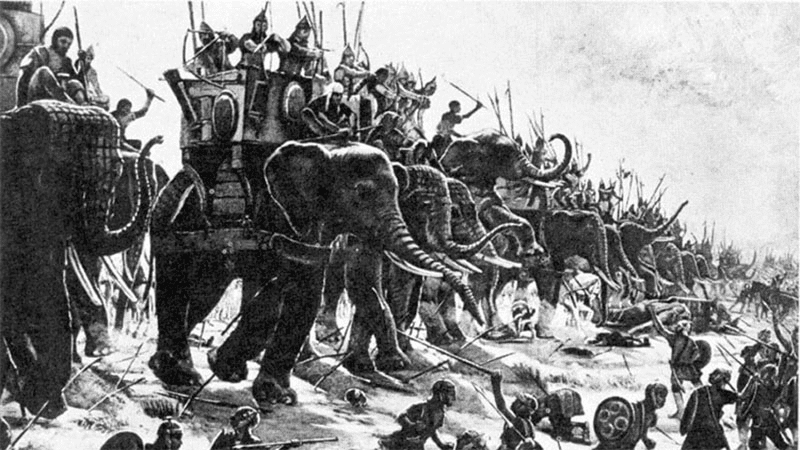
Kalinga War

Q9: Which of the following was a key feature of the Maurya Empire’s governance?
a) Decentralized rule with local rulers in charge
b) Centralized administration with a strong military
c) Democracy where people voted for rulers
d) Isolation from foreign empires

Ans: b) Centralized administration with a strong military

The Maurya Empire had a strong centralized administration with a powerful military that helped maintain control over vast regions.

Q10: What was the primary purpose of Ashoka’s edicts?
a) To celebrate military victories
b) To promote Buddhism and moral values
c) To establish a monarchy
d) To create a system of taxation

Ans: b) To promote Buddhism and moral values

Ashoka’s edicts, written in Prakrit and inscribed on pillars and rocks, promoted dharma (moral duties) and Buddhist teachings.

Fill in the Blanks

Q1: An empire is ruled by a powerful __________.
Ans: Emperor

The emperor has control over many smaller kingdoms or regions within the empire.

Q2: The capital of the Maurya Empire under Chandragupta was __________.
Ans: Pataliputra

Pataliputra (Patna) was the capital city of the Maurya Empire, serving as the center of governance.

Q3: The Maurya Empire’s administration was based on __________.
Ans: Centralization

The empire was centralized, with the emperor controlling all important decisions, supported by a bureaucracy.

Q4: Ashoka’s transformation after the Kalinga War led him to promote __________.
Ans: Buddhism

Ashoka embraced Buddhism and promoted its peaceful teachings after witnessing the devastation caused by the Kalinga War.

Q5: Kauṭilya, also known as Chanakya, wrote the __________ on governance and economics.
Ans: Arthashastra

The Arthashastra provides a detailed guide on statecraft, governance, and military strategy.

Q6: The Maurya Empire used __________ as a tool for managing and expanding the empire.
Ans: Warfare

Emperors like Chandragupta used military power to expand and maintain control over large territories.

Q7: The __________ dynasty ruled Magadha before the Mauryas.
Ans: Nanda

The Nanda dynasty was overthrown by Chandragupta Maurya, marking the rise of the Maurya Empire.

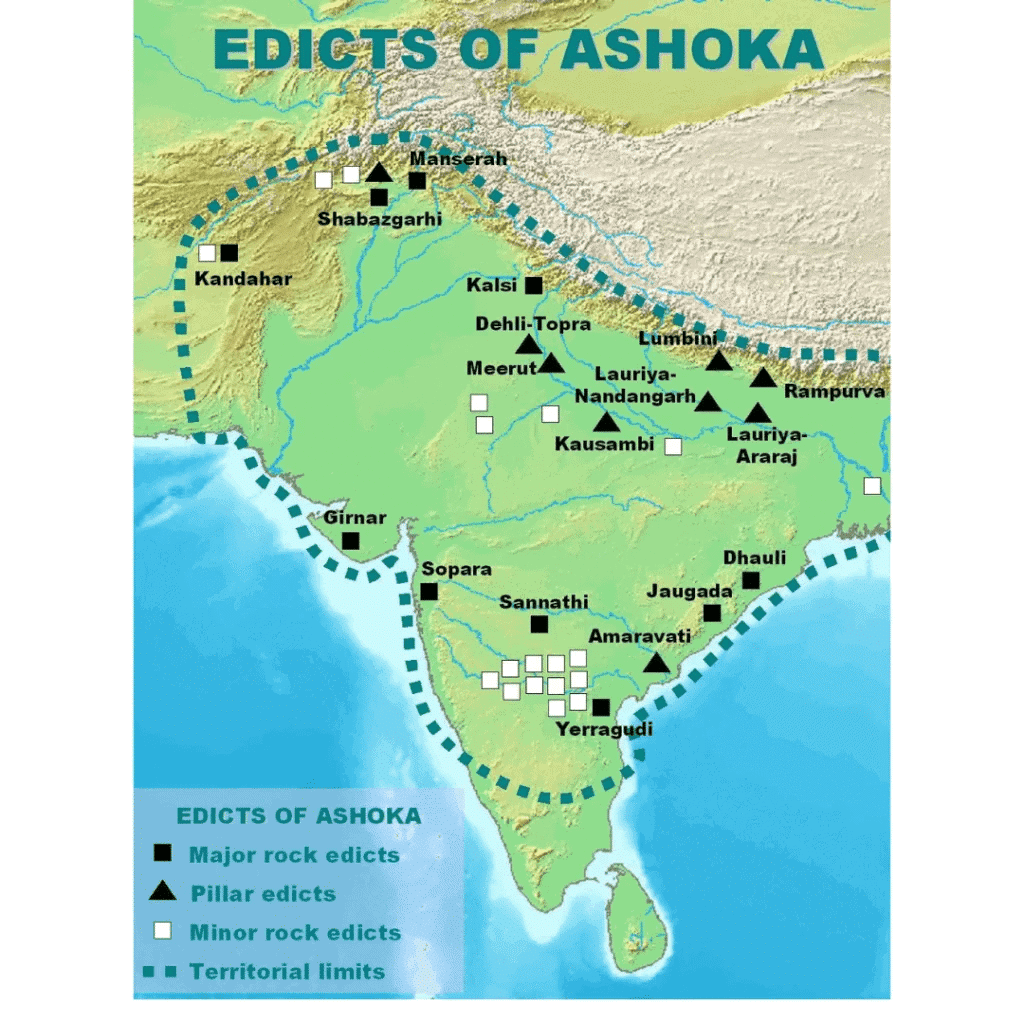
Q8: Ashoka’s __________ were inscribed on pillars and rocks throughout the empire.
Ans: Edicts

Ashoka’s edicts promoted Buddhist values and moral conduct, encouraging peace and welfare.

Q9: The Maurya Empire was known for its __________, which was used to manage its vast territory.
Ans: Administration

The Maurya Empire had a highly structured administration to manage its large territory and diverse population.

Q10: __________ was a major resource for the Maurya Empire’s army, used for weapons and tools.
Ans: Iron

Iron was crucial for the Maurya Empire’s military, as it was used to make weapons and tools.

Mauryan Empire

Very Short Answer Questions

Q1: What is the Latin origin of the word ’empire’?
Ans: Imperium, meaning “supreme power.”

Q2: Who helped Chandragupta Maurya in establishing the Maurya Empire?
Ans: Kauṭilya (Chanakya).

Q3: What was the main contribution of Ashoka’s edicts?
Ans: Promoting Buddhist values and moral duties.

Q4: Which battle made Ashoka choose non-violence?
Ans: The Kalinga War.

Q5: What was the capital of the Maurya Empire?
Ans: Pataliputra.

Edicts of Ashoka

Short Answer Questions

Q1: How did the Nanda dynasty contribute to the rise of the Maurya Empire?
Ans: The Nanda dynasty helped consolidate the region of Magadha, making it an ideal base for Chandragupta Maurya to rise to power and expand the empire.

Q2: What was the role of Kauṭilya in the formation of the Maurya Empire?
Ans: Kauṭilya, also known as Chanakya, provided strategic advice, helped overthrow the Nandas, and guided Chandragupta in establishing and expanding the Maurya Empire.

Q3: How did the Maurya Empire impact trade and administration?
Ans: The Mauryas built a strong administrative system and protected trade routes, facilitating economic growth, especially in trade and cities.

Q4: What were Ashoka’s views on governance, as seen in his edicts?
Ans: Ashoka promoted moral governance based on dharma, emphasizing non-violence, justice, and the welfare of his people.

Q5: Why was the Kalinga War significant for Ashoka’s rule?
Ans: The Kalinga War caused massive destruction, leading Ashoka to adopt Buddhism and promote peace, non-violence, and welfare through his edicts.

Match the Following

(Match Column A with the correct option in Column B)

Ans: Matched Pairs and Explanations:

  • 1 → d: The Maurya Empire had its capital in Pataliputra, from where governance was centralized)
  • 2 → c: Ashoka’s edicts promoted the spread of Buddhism and moral values across the empire.
  • 3 → b: Kauṭilya wrote the Arthashastra, a book on governance and strategy.
  • 4 → e: Chandragupta Maurya introduced administrative reforms that helped manage the empire.
  • 5 → a: Ashoka’s reign was marked by the Kalinga War, which led to his conversion to Buddhism and promotion of peace.

04. New Beginning: Cities and states Chapter worksheet Solution

Multiple Choice Questions (MCQs)

Q1: What does the term ‘Second Urbanisation’ refer to?
a) Growth of cities during the British era
b) Rebuilding of Harappan cities
c) Growth of new cities in the 1st millennium BCE
d) Urban development in the Gupta period

Ans: c) Growth of new cities in the 1st millennium BCE

The Second Urbanisation marks the emergence of new cities after the Harappan civilisation.

Q2: Which ancient capital was located in the mahajanapada of Magadha?
a) Ujjain
b) Rajagriha
c) Kausambi
d) Pataliputra

Ans: b) Rajagriha

Rajagriha was the capital of Magadha, one of the strongest mahajanapadas.

Q3: What was the role of the sabhā or samiti in janapadas?
a) They collected taxes
b) They conducted rituals
c) They advised the raja
d) They built fortifications

Ans: c) They advised the raja

The sabhā or samiti was a council of elders advising the ruler.

Samiti

Q4: Which of the following was a gana or sangha rather than a monarchy?
a) Magadha
b) Kosala
c) Vajji
d) Avanti

Ans: c) Vajji

Vajji had a republican form of government with decision-making councils.

Q5: What helped the mahajanapadas grow in the Ganga plains?
a) Lack of enemies
b) Coastal trade
c) Fertile land and iron tools
d) Influence of Harappan cities

Ans: c) Fertile land and iron tools

Fertile plains and access to iron tools supported agriculture and defense.

Q6: Which of these was a key innovation in the economic system of the mahajanapadas?
a) Use of bronze coins
b) Stone seals
c) Punch-marked coins
d) Gold jewellery

Ans: c) Punch-marked coins

These silver coins with symbols were used for trade.

Q7: Which southern kingdom was known for trade in spices and precious stones?
a) Mauryas
b) Cheras
c) Guptas
d) Kushanas

Ans: b) Cheras

The Cheras, along with Cholas and Pandyas, traded valuable goods in south India.

CholasCheras, and Pandyas.

Q8: What term describes the social group associated with a specific job passed through families?
a) Varna
b) Samiti
c) Jāti
d) Sabha

Ans: c) Jāti

Jātis were job-based social groups inherited by families.

Q9: Which trade route connected the Ganga plains with south India?
a) Uttarapatha
b) Dakshinapatha
c) Silk Route
d) Spice Route

Ans: b) Dakshinapatha

Dakshinapatha was the southern trade route of ancient India.

Q10: Which of the following varnas included traders and farmers?
a) Brahmins
b) Kshatriyas
c) Vaishyas
d) Shudras

Ans: c) Vaishyas

Vaishyas were involved in trade, farming, and generating wealth.

Fill in the Blanks 

Q1: The term janapada means “where people __________.”
Ans: Set foot

It refers to territories settled by early groups or clans.

Q2: The __________ was a council of elders that advised the raja.
Ans: Sabha

Sabha or samiti was part of early democratic governance.

Q3: Fortified cities often had __________ and narrow gateways for defense.
Ans: Moats

Moats added an extra layer of protection to city walls.

Q4: The capital of Vatsa mahajanapada was __________.
Ans: Kausambi

Kausambi was one of the prominent cities during this time.

Q5: __________ coins were early silver coins stamped with symbols.
Ans: Punch-marked

These coins supported trade within and beyond regions.

Q6: In a __________, the raja’s power passed to his son.
Ans: Monarchy

Monarchies were hereditary systems of rule.

Q7: __________ is the term for a job-based group in society.
Ans: Jāti

Jātis were often tied to occupations and social customs.

Q8: The term varna comes from __________ texts.
Ans: Vedic

Vedic literature describes the four varnas.

Q9: The __________ kingdom in south India is mentioned in ancient Tamil texts.
Ans: Chola

The Cholas were one of the three major southern kingdoms.

Q10: __________ connected northwest India with the Ganga plains.
Ans: Uttarapatha

Uttarapatha was a key trade and travel route in early India.

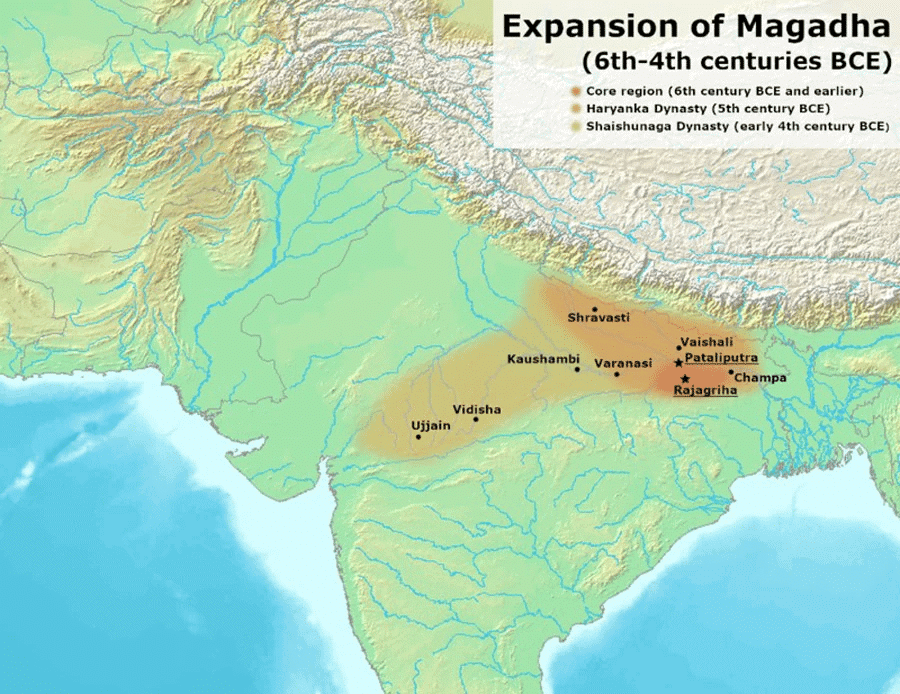
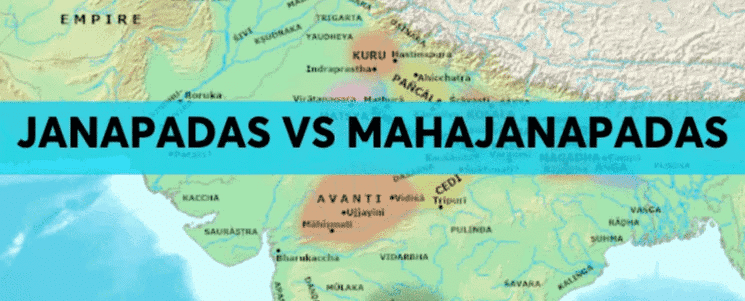
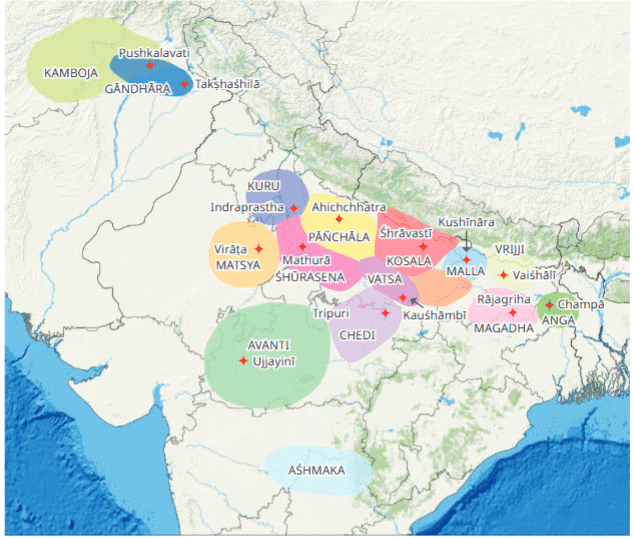
Map of 16 Mahajanpadas

Very Short Answer Questions 

Q1: What does the word janapada literally mean?
Ans: Where people set foot.

Q2: Name any one mahajanapada with a republican form of government.
Ans: Vajji.

Q3: What metal became common for tools and weapons in this period?
Ans: Iron.

Q4: What were early Indian coins called?
Ans: Punch-marked coins.

Q5: Which ancient capital is now near modern-day Patna?
Ans: Rajagriha.

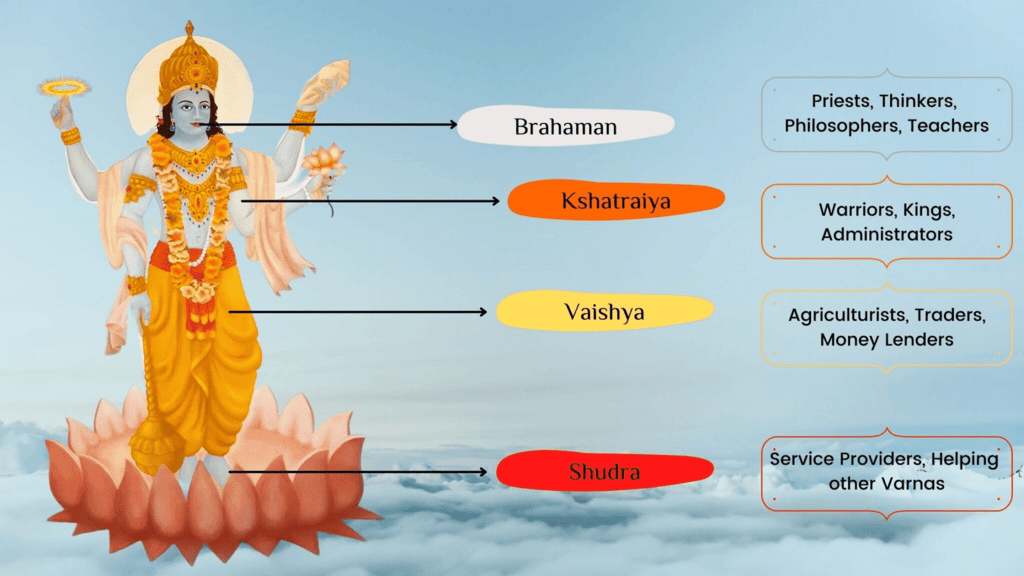
Varna System

Short Answer Questions

Q1: What were mahajanapadas and why were they important?
Ans: Mahajanapadas were large states formed from janapadas. They marked India’s Second Urbanisation with cities, trade, and governance.

Q2: What was the role of sabhā and samiti in governance?
Ans: They were councils of elders who advised or even elected rulers, especially in ganas and sanghas with democratic traditions.

Q3: How did iron tools impact agriculture?
Ans: Iron tools were stronger and sharper, making farming more efficient and supporting larger food production.

Q4: Describe the social structure based on varnas.
Ans: Vedic society had four varnas – Brahmins (priests), Kshatriyas (warriors), Vaishyas (traders), and Shudras (workers).

Q5: What was Dakshinapatha and why was it significant?
Ans: It was a major route from central to south India, helping trade, military, and cultural exchange.

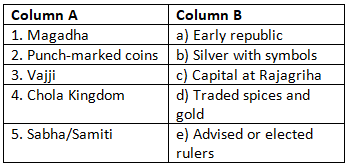
Match the Following

(Match Column A with the correct option in Column B)

Ans: Matched Pairs and Explanations:

  • 1 → c: Magadha’s capital was Rajagriha, a strong fortified city.
  • 2 → b: Punch-marked coins were made of silver and used in trade.
  • 3 → a: Vajji was a gana with a republican government.
  • 4 → d: The Cholas in south India traded spices and precious stones.
  • 5 → e: Sabha and samiti were councils that guided or chose rulers.

03. Climates Of India Chapter worksheet Solution

Multiple Choice Questions (MCQs)

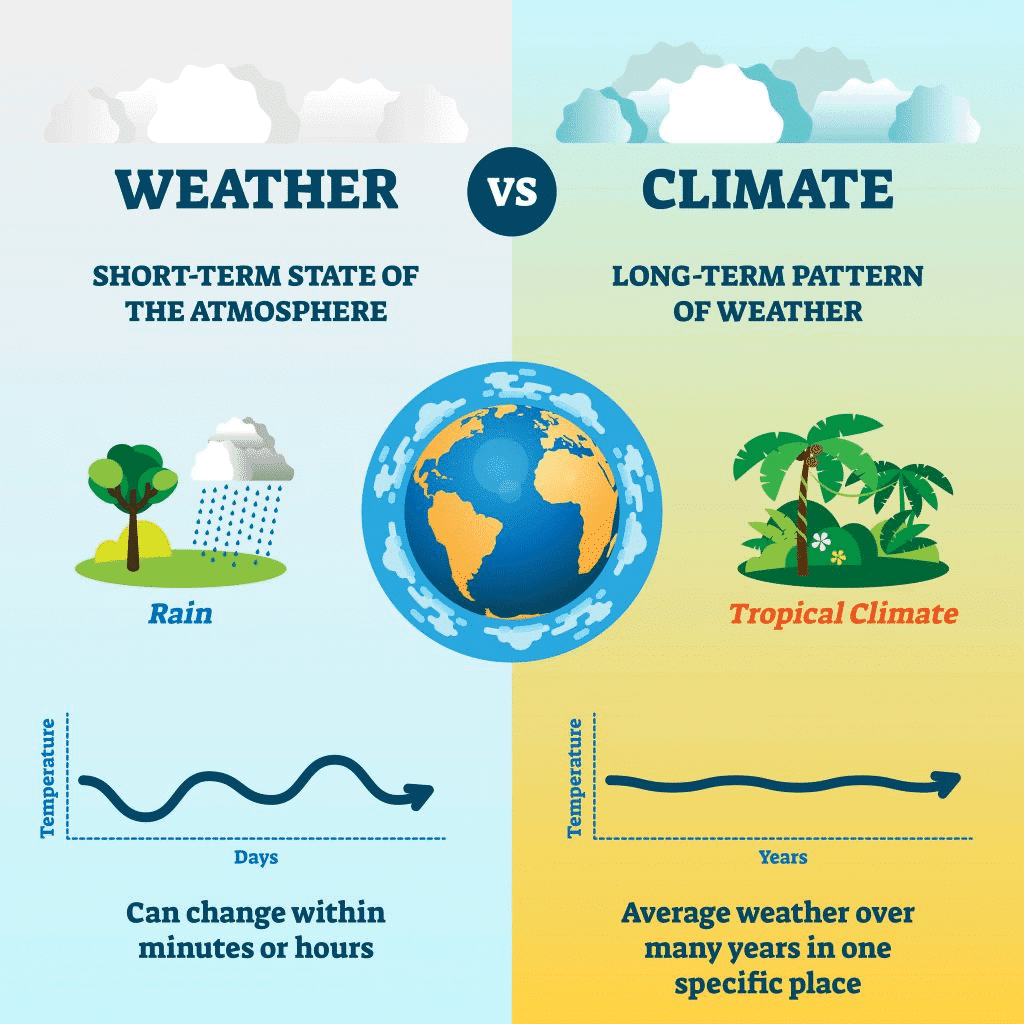
Q1: What is the main difference between weather and climate?
a) Weather is the average condition over many years, while climate is the short-term condition.
b) Weather is the short-term condition, while climate is the average condition over many years.
c) Weather occurs only in tropical areas, while climate is for the entire planet.
d) Weather and climate are the same thing.

Ans: b) Weather is the short-term condition, while climate is the average condition over many years.

Weather refers to daily atmospheric conditions, while climate is the long-term average of weather patterns in a region.


Difference between Weather and Climate

Q2: Which region of India experiences an alpine climate?
a) Western Ghats
b) Himalayan region
c) Ganga Plains
d) Thar Desert

Ans: b) Himalayan region

The Himalayan region experiences an alpine climate with cold winters and cool summers.

Q3: Which of the following is not a factor affecting India’s climate?
a) Latitude
b) Altitude
c) Longitude
d) Proximity to the sea

Ans: c) Longitude

Latitude, altitude, and proximity to the sea all influence India’s climate, but longitude doesn’t have a direct effect.

Q4: What does the term ‘microclimate’ refer to?
a) A region with a climate similar to the surrounding areas.
b) A small area with a unique climate different from its surrounding areas.
c) A type of tropical climate.
d) A specific seasonal weather pattern.

Ans: b) A small area with a unique climate different from its surrounding areas.

Microclimates are localized weather conditions that differ from the overall climate of the region.

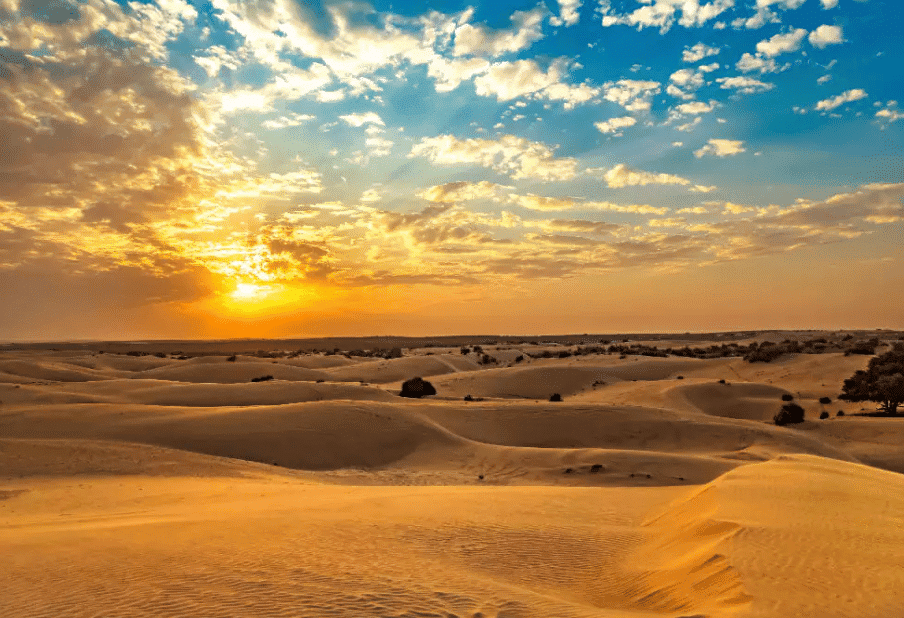
Q5: Which of the following is a primary characteristic of the Thar Desert?
a) Cold winters with snowfall
b) Hot days with cool nights
c) Tropical wet climate
d) Mild summers and winters

Ans: b) Hot days with cool nights

The Thar Desert experiences extreme temperature variations, with hot days and cool nights.

Thar Desert

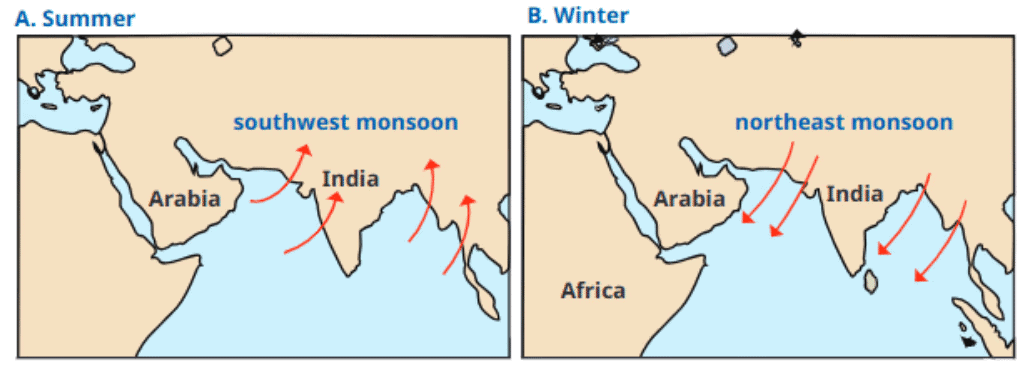
Q6: What is the main reason for the monsoon rains in India?
a) Winds from the Arctic
b) Wind patterns caused by pressure differences between land and sea
c) Heavy snowmelt from the Himalayas
d) Winds from the Bay of Bengal only

Ans: b) Wind patterns caused by pressure differences between land and sea

The monsoon rains are caused by low-pressure systems over land, which draw in moisture-laden winds from the ocean.

Q7: Which climate type is found in the Western Coast of India?
a) Arid climate
b) Tropical wet climate
c) Alpine climate
d) Temperate climate

Ans: b) Tropical wet climate

The Western Coast experiences a tropical wet climate, with heavy monsoon rainfall ideal for growing rice and spices.

Q8: What is the role of the Himalayas in India’s climate?
a) They block cold desert winds from Central Asia.
b) They warm the air in the northern plains.
c) They prevent rainfall in the southern parts.
d) They help control the monsoon winds.

Ans: a) They block cold desert winds from Central Asia.

The Himalayas act as a barrier, preventing cold desert winds from reaching India’s northern plains.

Q9: Which region of India is most affected by the Northeast Monsoon?
a) Western Ghats
b) Deccan Plateau
c) Eastern India and Southern Peninsula
d) Himalayan region

Ans: c) Eastern India and Southern Peninsula

The Northeast Monsoon brings rain to parts of eastern India and the southern peninsula)

Q10: Which of the following cities experiences a larger range of temperatures between summer and winter?
a) Mumbai
b) Delhi
c) Chennai
d) Kolkata

Ans: b) Delhi

Delhi, being inland, experiences extreme temperatures, with hot summers and cold winters, unlike coastal cities.


Monsoons 

Fill in the Blanks

Q1: The weather of India is greatly influenced by the __________ system.
Ans: Monsoon

The monsoon system brings seasonal rains to India, significantly impacting its weather.

Q2: The __________ climate is found in the Himalayan region, where temperatures stay below freezing in the highest peaks.
Ans: Alpine

The alpine climate in the Himalayas is characterized by cold winters and cool summers.

Q3: __________ is the term for the small area’s unique climate that differs from its surrounding region.
Ans: Microclimate

Microclimates are areas with weather conditions that vary from those of the surrounding region.

Q4: The __________ Desert has hot days and cool nights, with very little rainfall.
Ans: Thar

The Thar Desert is an arid region with extreme temperature fluctuations and minimal rainfall.

Q5: The __________ Monsoon brings rain to the eastern and southern parts of India during winter.
Ans: Northeast

The Northeast Monsoon is responsible for rainfall in the southeastern regions of India.

Q6: The __________ climate in India is ideal for growing rice and spices due to heavy monsoon rainfall.
Ans: Tropical wet

The tropical wet climate on the western coast of India supports rice and spice farming.

Q7: The __________ Plateau experiences a semi-arid climate with hot summers and mild winters.
Ans: Deccan

The Deccan Plateau, in central India, has a semi-arid climate and moderate rainfall during the monsoon season.

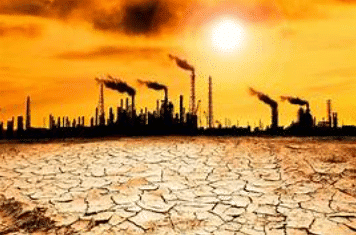
Q8: __________ is the term for the rise in global temperatures caused by the accumulation of greenhouse gases.
Ans: Global warming

Global warming is the result of increased levels of greenhouse gases in the atmosphere, which trap heat.

Global Warming

Q9: The __________ ranges influence rainfall by blocking moist air coming from the sea.
Ans: Western Ghats

The Western Ghats play a crucial role in rainfall patterns by blocking moist winds from the Arabian Sea.

Q10: __________ refers to the average weather pattern in an area over many years.
Ans: Climate

Climate is the long-term average of weather conditions in a region, measured over many years.

Very Short Answer Questions

Q1: What does the word “monsoon” mean?
Ans: Monsoon comes from the Arabic word “mausim,” meaning season.

Q2: What is a microclimate?
Ans: A small area’s unique climate different from its surrounding region.

Q3: Which climate is found in the Deccan Plateau?
Ans: Semi-arid climate.

Q4: What causes the monsoon rains in India?
Ans: Seasonal winds caused by temperature differences between land and sea.

Q5: Which region has the coldest climate in India?
Ans: The Himalayan region.

Short Answer Questions

Q1: What is the difference between weather and climate?
Ans: Weather refers to the short-term conditions of the atmosphere, while climate is the long-term average of these conditions over many years.

Q2: How does altitude affect India’s climate?
Ans: Higher altitudes, like hill stations, have cooler climates, while lower areas experience warmer temperatures.

Q3: Why is the Western Ghats important in determining the climate of India?
Ans: The Western Ghats influence monsoon rainfall by blocking moist air from the sea, leading to heavy rainfall on the western side.

Q4: What role does latitude play in India’s climate?
Ans: Areas closer to the Equator, like Kanyakumari, remain warm year-round, while regions further north, like Srinagar, experience cooler climates.

Q5: How does proximity to the sea influence the climate?
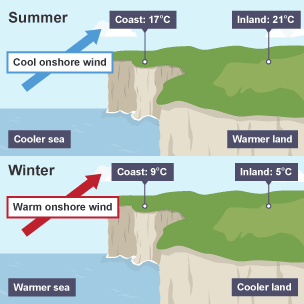
Ans: Coastal areas have milder temperatures due to the sea’s ability to moderate both summer and winter temperatures.

Proximity to Sea

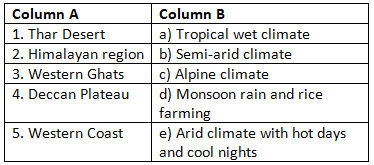
Match the Following 

(Match Column A with the correct option in Column B)

Ans: Matched Pairs and Explanations:

  • 1 → e: The Thar Desert is an arid region with extreme temperature fluctuations.
  • 2 → c: The Himalayan region has an alpine climate with cold temperatures year-round)
  • 3 → a: The Western Ghats receive heavy monsoon rains, supporting tropical wet climates.
  • 4 → b: The Deccan Plateau experiences a semi-arid climate with hot summers.
  • 5 → d: The Western Coast has a tropical wet climate, ideal for rice farming due to heavy monsoon rains.

02. Understanding the weather Chapter worksheet Solution

Multiple Choice Questions (MCQs)

Q1: Which layer of the atmosphere is responsible for weather phenomena?
a) Stratosphere
b) Thermosphere
c) Troposphere
d) Mesosphere

Ans: c) Troposphere

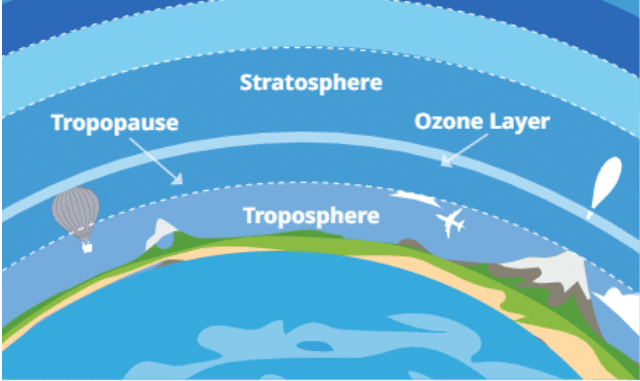
Weather events like rain and wind occur in the troposphere, the lowest layer of the atmosphere.

Troposphere

Q2: Which instrument is used to measure atmospheric pressure?
a) Thermometer
b) Barometer
c) Hygrometer
d) Anemometer

Ans: b) Barometer

A barometer measures air pressure, helping predict storms and depressions.

Q3: What is the unit of measurement for rainfall in a rain gauge?
a) Kilometers
b) Degrees
c) Millimeters
d) Millibars

Ans: c) Millimeters

Rainfall is measured by the depth of water collected, usually in millimeters.

Q4: Which weather condition is caused by low atmospheric pressure?
a) Snowfall
b) Depression
c) Fog
d) Lightning

Ans: b) Depression

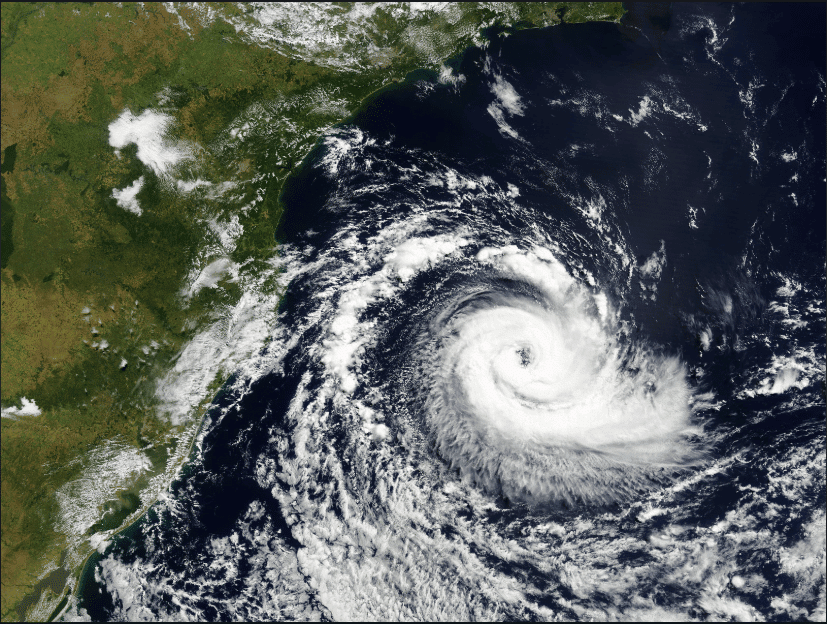
Depressions are areas of low pressure that often lead to storms or cyclones.

Cyclones

Q5: Which of the following instruments is used to measure humidity?
a) Hygrometer
b) Thermometer
c) Barometer
d) Wind Vane

Ans: a) Hygrometer

A hygrometer measures the amount of water vapor in the air.

Q6: What is used to measure wind speed?
a) Wind Vane
b) Barometer
c) Anemometer
d) Rain Gauge

Ans: c) Anemometer

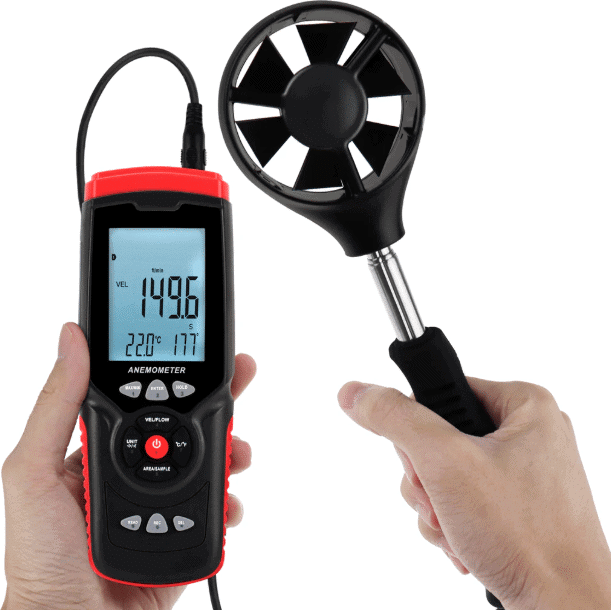
An anemometer uses rotating cups to measure wind speed in km/h.

Q7: What is the normal atmospheric pressure at sea level?
a) 1000 mb
b) 650 mb
c) 1013 mb
d) 950 mb

Ans: c) 1013 mb

Standard atmospheric pressure at sea level is about 1013 millibars.

Q8: Which state has high humidity, making clothes dry slower?
a) Delhi
b) Jaipur
c) Kochi
d) Shimla

Ans: c) Kochi

Kochi, being coastal, has high humidity around 84%, slowing evaporation.

Q9: Which of the following best describes weather?
a) Monthly climate of a region
b) Permanent atmospheric condition
c) Short-term atmospheric condition
d) Long-term rainfall pattern

Ans: c) Short-term atmospheric condition

Weather refers to atmospheric conditions at a specific time and place.

Q10: Which department in India issues weather warnings?
a) IMD
b) WHO
c) NDRF
d) UNESCO

Ans: a) IMD

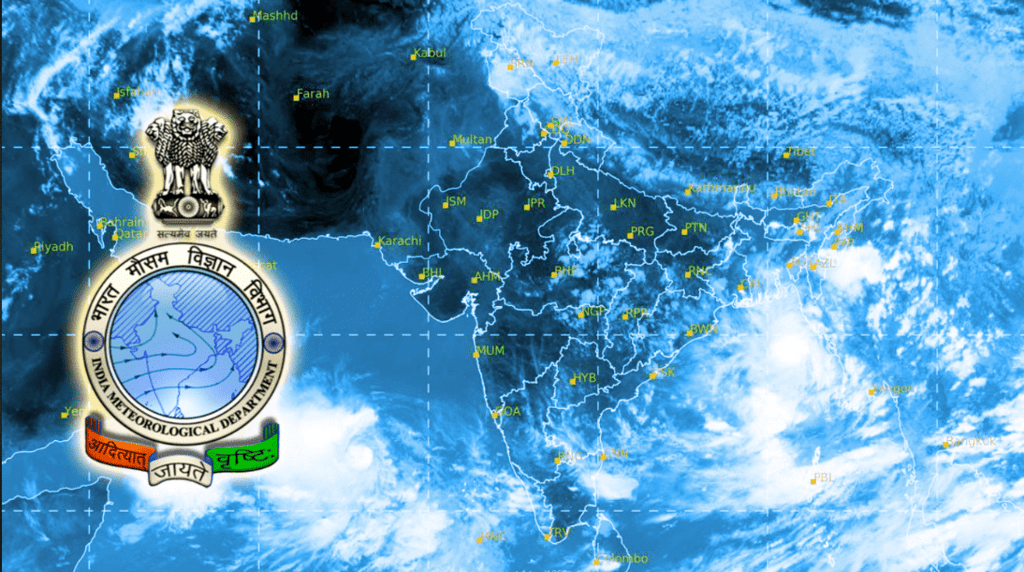
The India Meteorological Department (IMD) was set up in 1875 to predict weather and issue warnings.

Fill in the Blanks

Q1: The __________ is the lowest layer of the atmosphere where all weather happens.
Ans: Troposphere

Weather events occur in the troposphere, which is closest to Earth.

Q2: A __________ is used to measure temperature.
Ans: Thermometer

Thermometers show how hot or cold the air is.

Q3: A rain gauge measures __________ in millimeters.
Ans: Precipitation

Rainfall is measured by the rain gauge in terms of water depth.

Q4: __________ is the weight of air pressing down on the Earth’s surface.
Ans: Atmospheric Pressure

This pressure changes with height and is measured in millibars.

Q5: The __________ measures wind direction.
Ans: Wind Vane

A wind vane shows from which direction the wind is blowing.

Q6: The instrument used to measure wind speed is the __________.
Ans: Anemometer

Anemometers measure how fast the wind is blowing.

Aemometer

Q7: The __________ measures humidity in the air.
Ans: Hygrometer

Humidity is measured using a hygrometer, important for weather forecasts.

Q8: __________ stations combine instruments to measure all weather elements.
Ans: Weather

Weather stations record temperature, humidity, wind, rainfall, and pressure.

Q9: The mean daily temperature is calculated by adding maximum and minimum temperatures and dividing by __________.
Ans: Two

This gives the average temperature of the day.

Q10: High humidity __________ the rate of evaporation.
Ans: Decreases

When air is full of water vapor, evaporation slows down.

Very Short Answer Questions 

Q1: What is the standard atmospheric pressure at sea level?
Ans: 1013 millibars.

Q2: Which tool is used to measure rainfall?
Ans: Rain gauge.

Q3: Name the instrument used to measure humidity.
Ans: Hygrometer.

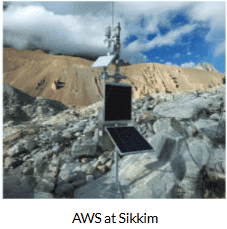
Q4: In which Indian city was an AWS set up in 2023 at over 4800 meters?
Ans: Sikkim.

Q5: What does IMD stand for?
Ans: India Meteorological Department.

Short Answer Questions 

Q1: Why are weather predictions important?
Ans: Weather predictions help people prepare for natural events like storms, droughts, or heat waves and ensure safety in fields like farming, aviation, and disaster management.

Q2: What does an anemometer do and how does it work?
Ans: An anemometer measures wind speed using rotating cups—the faster they spin, the stronger the wind.

Q3: How does atmospheric pressure affect mountaineers?
Ans: At high altitudes, pressure drops and oxygen becomes scarce, causing breathlessness for mountaineers and soldiers.

Q4: What is the role of AWS in weather monitoring?
Ans: An Automated Weather Station records weather data using sensors without human help, providing accurate information for forecasting and agriculture.

Q5: How is humidity measured and why is it important?
Ans: Humidity is measured with a hygrometer and is vital in weather forecasting, preserving materials in museums, and in industries.

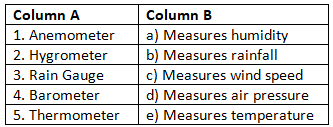
Match the Following 

(Match Column A with the correct option in Column B)

Ans: Matched Pairs and Explanations:

  • 1 → C: Anemometers measure wind speed with spinning cups.
  • 2 → A: Hygrometers are used to check humidity levels in the air.
  • 3 → B: Rain gauges collect and measure rainfall in millimeters.
  • 4 → D: Barometers record atmospheric pressure to forecast storms.
  • 5 → E: Thermometers are used for measuring air temperature.

01. Geographical Diversity of India Chapter worksheet Solution

Multiple Choice Questions (MCQs)

Q1: What is the meaning of the word ‘Himalaya’ in Sanskrit?
a) Frozen peaks
b) Land of snowstorms
c) Abode of snow
d) Cold mountains

Ans: c) Abode of snow

‘Himalaya’ is derived from Sanskrit where ‘Hima’ means snow and ‘Alaya’ means abode or home.

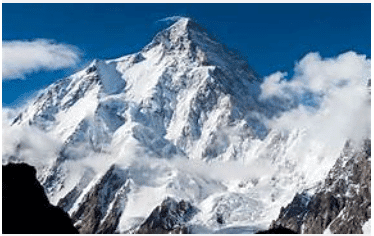
Himalayas

Q2: Which of the following is India’s only active volcano?
a) Mount Abu
b) Barren Island
c) Kanchenjunga
d) Deomali

Ans: b) Barren Island

Barren Island in the Andaman Sea is home to India’s only active volcano.

Q3: The Gangetic Plains are considered ideal for agriculture because of:
a) Rocky terrain
b) Mineral-rich soil from rivers
c) Frequent snowfall
d) Presence of deserts

Ans: b) Mineral-rich soil from rivers

Rivers like the Ganga bring mineral-rich soil from the Himalayas, making the plains very fertile.

Q4: Which desert festival is celebrated in the Thar region?
a) Diwali
b) Pushkar Mela
c) Losar
d) Pongal

Ans: b) Pushkar Mela

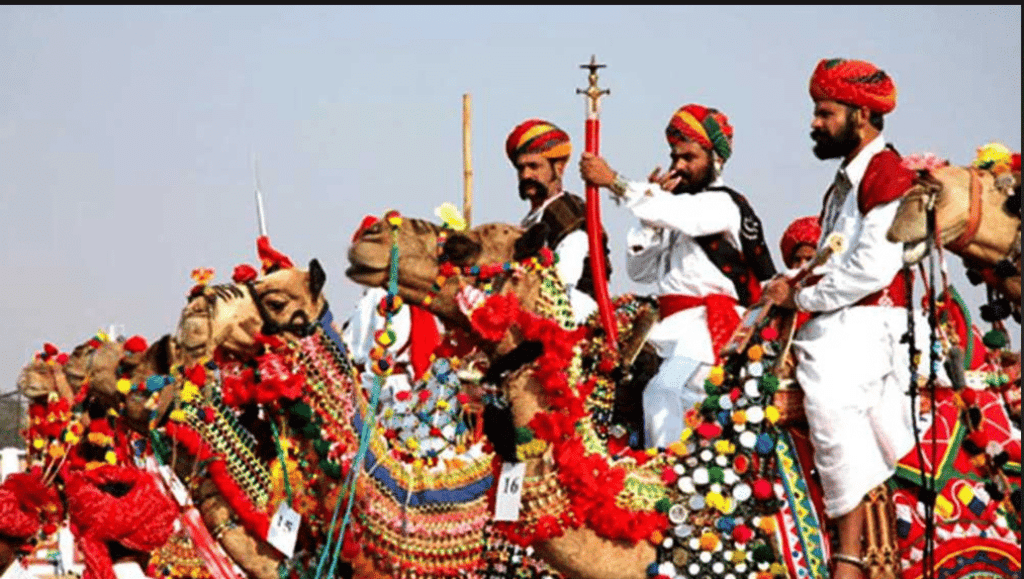
Pushkar Mela is a popular camel and cultural fair held in Rajasthan’s Thar Desert region.

Pushkar Mela

Q5: Which river flows westward into the Arabian Sea instead of eastward into the Bay of Bengal?
a) Godavari
b) Krishna
c) Narmada
d) Kaveri

Ans: c) Narmada

Unlike most rivers, Narmada flows west into the Arabian Sea.

Q6: What kind of landform is the Peninsular Plateau?
a) Flat desert
b) High mountain
c) Elevated flat land with steep slopes
d) River valley

Ans: c) Elevated flat land with steep slopes

Plateaus are high flat areas with steep sides.

Q7: Which Indian region is called a cold desert?
a) Ladakh
b) Sundarbans
c) Sikkim
d) Arunachal Pradesh

Ans: a) Ladakh

Ladakh has extremely cold weather and very little rainfall, making it a cold desert.

Q8: Which Indian mountain range helps stop the spread of the Thar Desert?
a) Himalayas
b) Western Ghats
c) Vindhyas
d) Aravallis

Ans: d) Aravallis

The Aravalli range acts as a natural barrier to prevent the eastward spread of the Thar Desert.

Q9: Which plateau region is known for heavy rainfall and root bridges?
a) Deccan Plateau
b) Bundelkhand Plateau
c) Meghalaya Plateau
d) Malwa Plateau

Ans: c) Meghalaya Plateau

The Meghalaya Plateau experiences heavy rainfall and has famous living root bridges.

Q10: Which animal is important for transport and daily life in Ladakh?
a) Tiger
b) Yak
c) Camel
d) Elephant

Ans: b) Yak

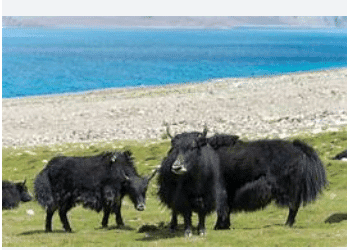
Yaks are vital in Ladakh for transport, milk, wool, and dung.

Yak at Laddakh

Fill in the Blanks 

Q1: India is a part of the __________ Subcontinent.
Ans: Indian

India along with its neighboring countries forms the Indian Subcontinent.

Q2: The highest peaks of the Himalayas are located in the __________ Himalayas.
Ans: Himadri

Himadri or Greater Himalayas contain the tallest peaks like Mount Everest.

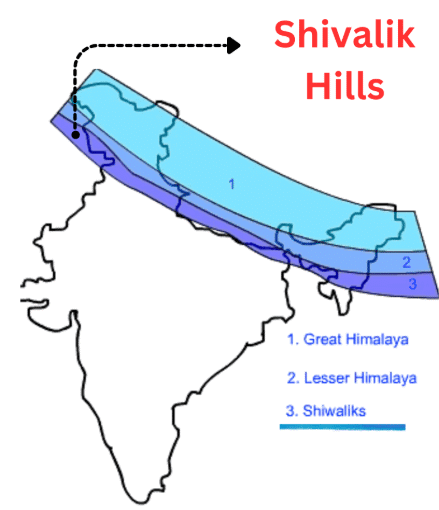
Q3: The outermost range of the Himalayas is called the __________ Hills.
Ans: Shivalik

The Shivalik Hills are the lowest and outermost part of the Himalayan range.

Q4: The Thar Desert covers states like Rajasthan and __________.
Ans: Gujarat

The Thar Desert spans across western India, including Gujarat.

Q5: Ladakh is also called the __________ desert of India.
Ans: Cold

Ladakh is a cold desert due to its icy weather and dry climate.

Q6: __________ and Tapti are the two major west-flowing rivers of India.
Ans: Narmada

Both Narmada and Tapti flow westwards into the Arabian Sea.

Q7: The peacock, India’s national bird, is found in the __________ Plains.
Ans: Gangetic

The fertile Gangetic Plains support rich wildlife including the peacock.

Q8: The Western Ghats are recognized as a __________ World Heritage Site.
Ans: UNESCO

The Western Ghats are a biodiversity hotspot declared by UNESCO.

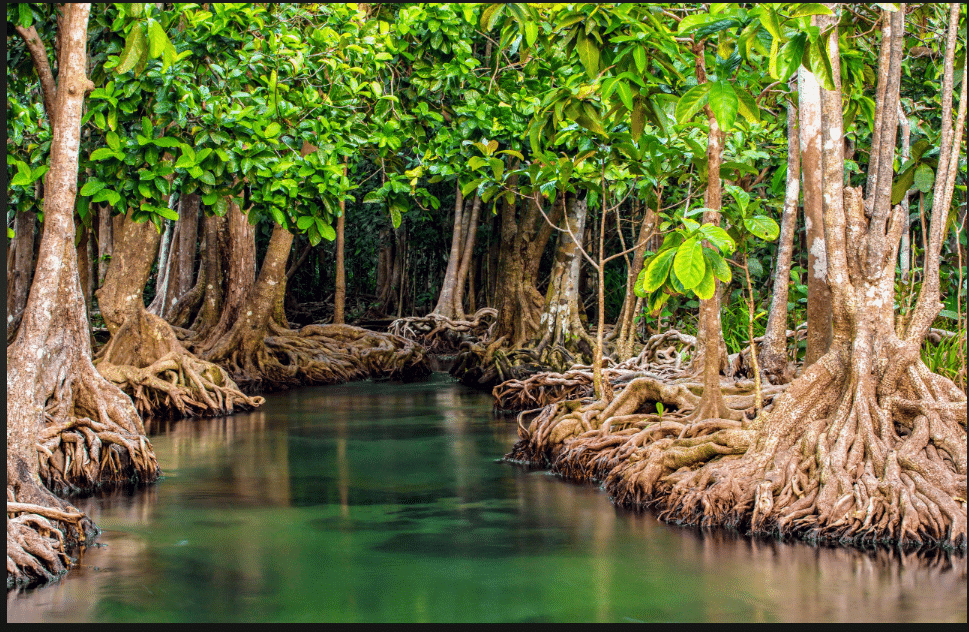
Q9: The Sundarbans are known for their __________ forests.
Ans: Mangrove

Sundarbans are famous for mangrove trees growing in salty coastal areas.

Mangroves

Q10: An __________ is a group or chain of islands.
Ans: Archipelago

Lakshadweep is an archipelago consisting of 36 coral islands.

Very Short Answer Questions 

Q1: What is the approximate length of the Himalayas?
Ans: About 2,500 km.

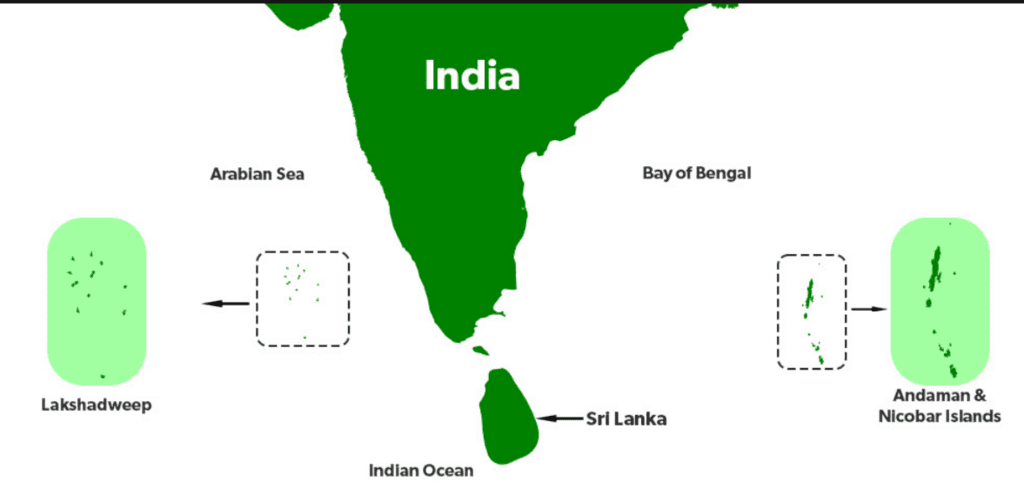
Q2: Name the two island groups of India.
Ans: Lakshadweep and Andaman & Nicobar Islands.

Islands of India

Q3: What is the cleanest village in Asia?
Ans: Mawlynnong in Meghalaya.

Q4: Which hill stations are found in the Himachal range?
Ans: Shimla, Mussoorie, Darjeeling.

Q5: Which mineral is extracted in Zawar mines of the Aravallis?
Ans: Zinc.

Short Answer Questions

Q1: Why are the Himalayas called the ‘Water Tower of Asia’?
Ans: Because they store snow and glaciers which melt in summer and feed rivers like the Ganga, Brahmaputra, and Indus, providing water to millions of people.

Q2: What are some adaptations seen in the Thar Desert region?
Ans: People use camels for transport, clean utensils with sand, and harvest rainwater using tankas and kunds due to water scarcity.

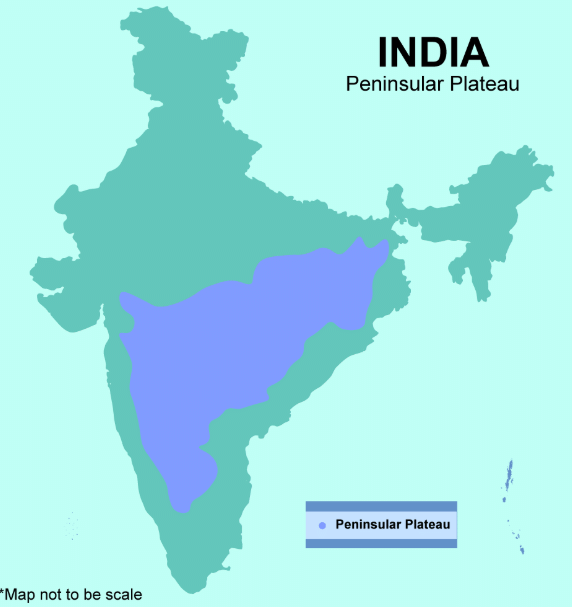
Q3: Describe two features of the Peninsular Plateau.
Ans: It is a triangular plateau surrounded by water on three sides and is rich in minerals and forests, supporting agriculture and hydroelectric power.

Peninsular Plateau

Q4: How are the islands of Andaman and Nicobar ecologically important?
Ans: They have coral reefs, tropical forests, unique wildlife, and are home to some of the oldest tribes in India, contributing to biodiversity.

Q5: What makes the Ganga and Brahmaputra rivers culturally special?
Ans: They are considered sacred in Indian culture and are personified as deities like Ganga and Brahmaputra, playing a role in rituals and beliefs.

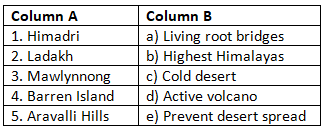
Match the Following 

(Match Column A with the correct option in Column B)

Ans: Matched Pairs and Explanations:

  • 1 → b: Himadri is the highest Himalayan range with peaks over 8000 m.
  • 2 → c: Ladakh is India’s cold desert with extreme winters.
  • 3 → d: Mawlynnong is known for eco-tourism and root bridges.
  • 4 → d: Barren Island hosts India’s only active volcano.
  • 5 → e: The Aravallis block the expansion of the Thar Desert.

12. Understanding Markets Chapter worksheet

Multiple Choice Questions (MCQS)

Q1: What is the primary function of a market?
a) To provide education
b) To buy and sell goods and services
c) To offer loans
d) To promote traditions

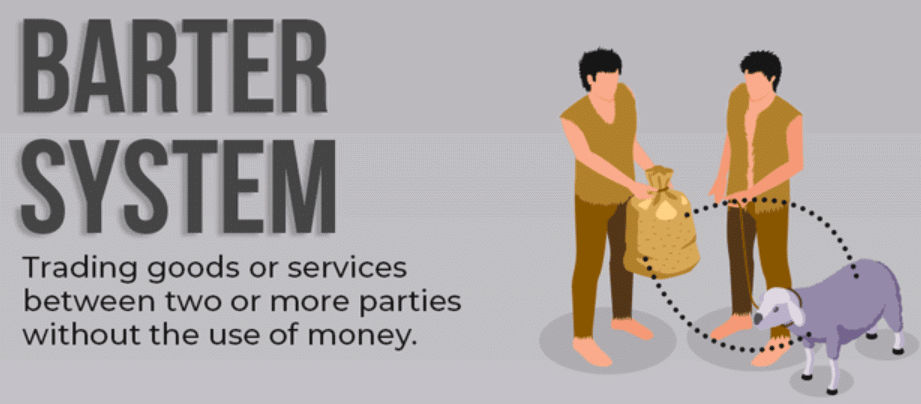
Q2: What is one of the main problems with the barter system?
a) Difficulty in measuring value
b) High transportation costs
c) Lack of demand for goods
d) Limited goods to exchange

Q3: Which of the following is an example of an online market?
a) Haat
b) A local grocery store
c) An app for shopping
d) A farmer’s market

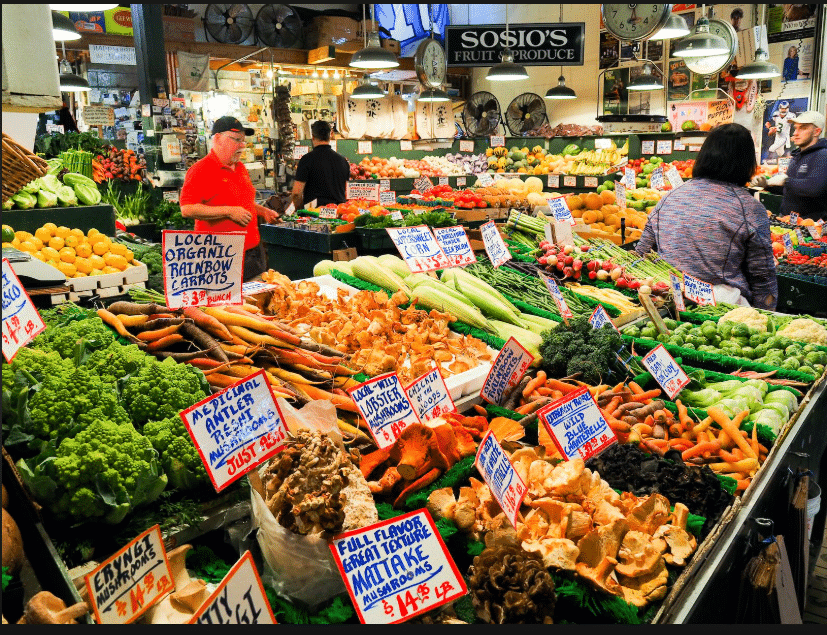
Market

Q4: Which market is used for exchanging large quantities of goods?
a) Retail market
b) Online market
c) Wholesale market
d) Digital market

Q5: What term refers to the amount of goods and services that sellers are willing to offer at different prices?
a) Demand
b) Supply
c) Transaction
d) Price

Q6: Which of these products is commonly traded in domestic markets?
a) Aircraft
b) Gold
c) Fruits and vegetables
d) Electronics

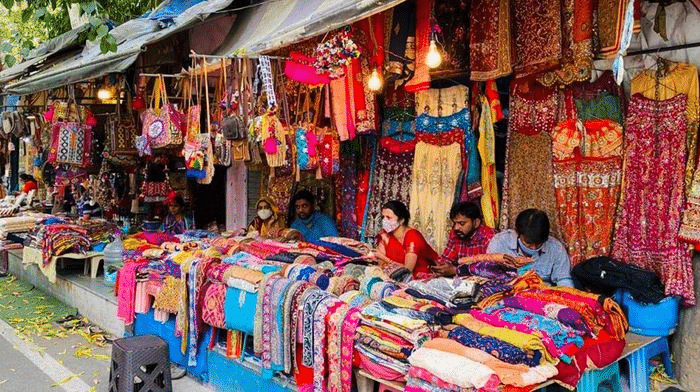
Wholesale Market of Cloth

Q7: What is the role of government in markets?
a) To ensure fair pricing and quality
b) To limit the supply of goods
c) To increase demand
d) To make all decisions for sellers

Q8: What is one of the benefits of a market for society?
a) It decreases competition among sellers
b) It encourages innovation and better products
c) It reduces the availability of goods
d) It promotes only local products

Q9: Which type of market allows goods to be bought from international sellers?
a) Domestic market
b) Wholesale market
c) International market
d) Retail market

Q10: Which of these is an example of a public good?
a) A private restaurant
b) A public park
c) A commercial store
d) A private gym

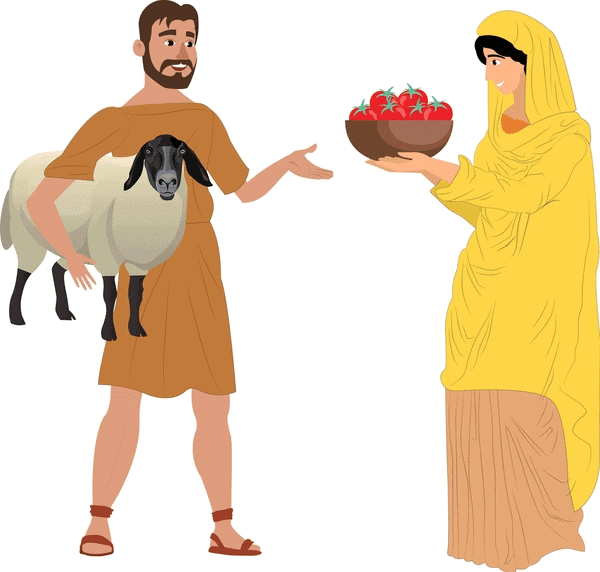
Barter System

Fill in the Blanks

Q1: The barter system had the problem of ________, where both parties had to want what the other had.

Q2: A market where buyers and sellers meet in person to exchange goods is called a ________ market.

Q3: A market where transactions happen over apps or websites is known as an ________ market.

Q4: ________ refers to the quantity of goods that buyers want to buy at different prices.

Q5: The process of ________ involves setting rules to ensure fair pricing, quality, and safety in markets.

Q6: A market where goods are bought in large quantities and sold to smaller retailers is called a ________ market.

Q7: The ________ is a mark that ensures the quality of agricultural products like honey and vegetables.
Q8: The ________ Mela is a major pilgrimage event that takes place every six years at four river sites in India.

Q9: ________ is a method of assessing the quality of goods by looking at reviews, certifications, and personal experience.

Q10: The ________ market refers to the buying and selling of goods within a country’s boundaries.

IGI Mark

Very Short Answer Questions

Q1: What is a physical market?

Q2: What does “demand” mean in the context of markets?

Q3: What is an online market?

Q4: What is the role of a wholesaler in the market?

Q5: What is AGMARK?

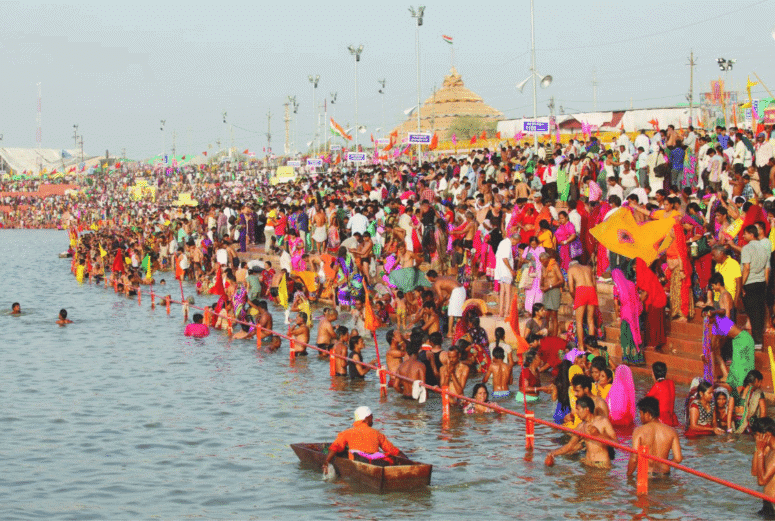
Kumbh Mela

Short Answer Questions

Q1: Explain the role of the government in regulating markets.
Q2: How does demand affect prices in a market?

Q3: What are the key features of a wholesale market?

Q4: What is the significance of the Kumbh Mela in India?

Q5: How does the online market differ from the physical market?

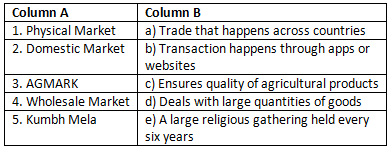
Match the Following

(Match Column A with the correct option in Column B)

11. From Barter to Money Chapter worksheet
Multiple Choice Questions (MCQs)

Q1: What was the main problem with the barter system?
a) Lack of variety of goods
b) Double coincidence of wants
c) Lack of trust between traders
d) Inability to measure value

Barter System

Q2: What is money primarily used for?
a) To save for future use
b) To measure value
c) To buy and sell goods and services
d) To store commodities

Q3: Which of these is an example of modern digital money?
a) Cowrie shells
b) Wheat
c) UPI
d) Paper notes

Q4: What is the main reason why money is more efficient than the barter system?
a) Money can be saved and used later
b) Money is harder to carry
c) Money only works with coins
d) Money has no value

Q5: Which of the following was one of the earliest forms of money?
a) Digital currency
b) Cowrie shells
c) Coins with currency symbols
d) Banknotes

Digital Currency

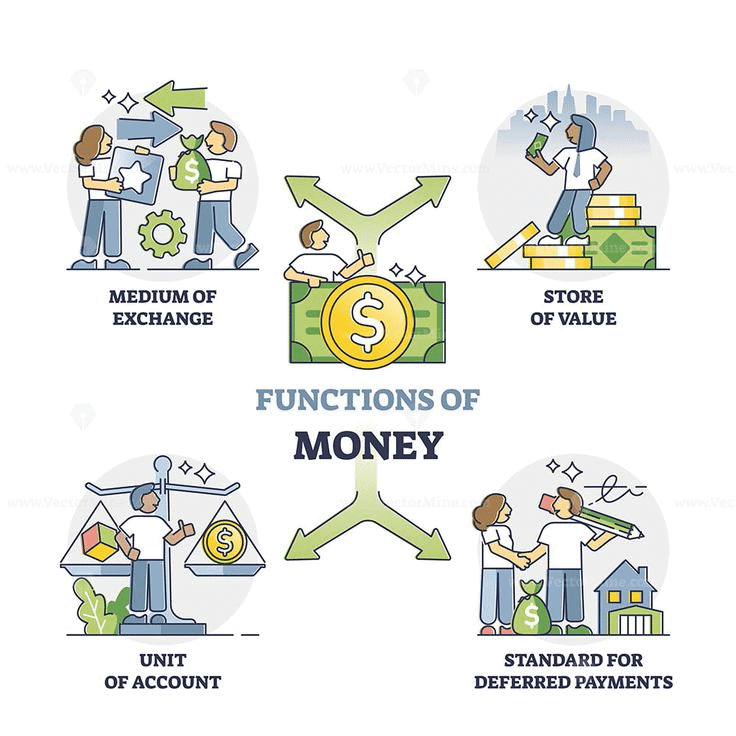
Q6: What does the term “medium of exchange” refer to?
a) A tool used to measure trade
b) A method to store wealth
c) Something that is accepted for buying and selling
d) A product for trade

Q7: Which item was commonly used as money in ancient India?
a) Cattle
b) Paper notes
c) Digital codes
d) Credit cards

Q8: What is the main advantage of money over bartering goods like wheat or cattle?
a) Money is portable, divisible, and durable
b) Money can be eaten
c) Money is easier to store than goods
d) Money does not need to be traded

Q9: What did John Maynard Keynes say about money?
a) Money is only useful for buying goods
b) Money connects the present to the future
c) Money is not important for trade
d) Money should only be used in the form of coins

Q10: What was one problem with using cattle in the barter system?
a) Cattle were not accepted by all traders
b) Cattle could be divided into smaller parts
c) Cattle rotted quickly
d) Cattle were difficult to transport

Fill in the Blanks

Q1: The barter system was inefficient because it required a ________ of wants.

Q2: Money solves the problems of the barter system by being ________, meaning it can be carried easily.

Q3: In the barter system, a farmer could not split an ________ into smaller units for trade.

Q4: The modern form of money used in transactions is ________ currency.

Q5: One early form of money used in ancient India was called ________ or panas.

Q6: ________ is an example of digital money that allows users to transfer money between accounts.

Q7: The ________ is the symbol used on Indian banknotes, designed in 2010.

Q8: The ________ system, introduced in ancient China, was the first use of paper money.

Q9: A major disadvantage of using the barter system was that goods like ________ could spoil quickly.

Q10: The modern form of payment involving scanning a ________ code is called digital money.

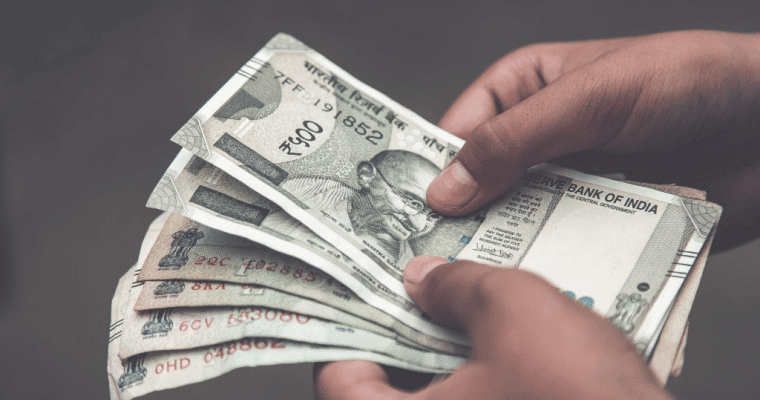
Paper Currency

Very Short Answer Questions

Q1: What was the primary problem with the barter system?

Q2: What does “money as a store of value” mean?

Q3: How did the invention of money help in trade?

Q4: What is the modern equivalent of money used in daily transactions?

Q5: What does “durability” mean in the context of money?

Short Answer Questions

Q1: Why was the barter system not effective for long-distance trade?

Q2: Explain the difference between the barter system and money.

Q3: What was the first form of paper currency used in India?

Q4: How did money evolve from coins to digital money?

Q5: How did John Maynard Keynes describe the role of money?

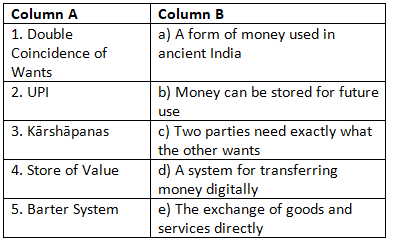
Match the Following

(Match Column A with the correct option in Column B)

10. The constitution of India- An Introduction Chapter worksheet

Multiple Choice Questions (MCQs)

Q1: What is the primary role of the Constitution of India?
a) To make laws
b) To protect citizens’ rights and outline the rules of government
c) To ensure religious harmony
d) To create a system of elections

Ans: b) To protect citizens’ rights and outline the rules of government

The Constitution of India serves as a rulebook that outlines how the government works, protects citizens’ rights, and defines duties.

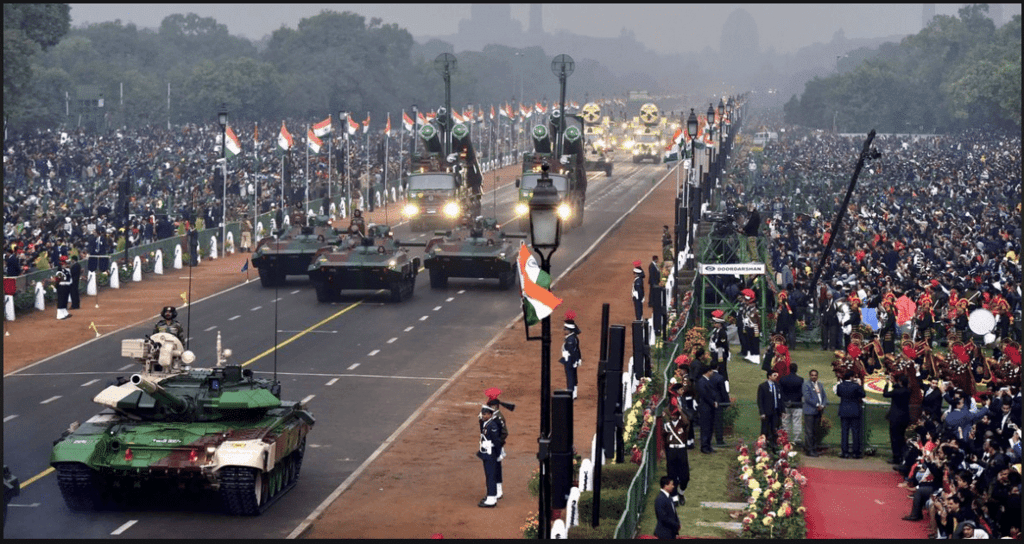
Republic Day Parade

Q2: When did the Constitution of India come into effect?
a) 15th August 1947
b) 26th January 1950
c) 15th August 1948
d) 26th November 1949

Ans: b) 26th January 1950

The Constitution of India came into effect on 26th January 1950, which is celebrated as Republic Day.

Q3: What does the term “Sovereign” in the Preamble of the Constitution refer to?
a) India is governed by religious leaders
b) India has the authority to make its own decisions without external interference
c) India is a monarchy
d) India’s leaders are elected

Ans: b) India has the authority to make its own decisions without external interference

“Sovereign” means India has full control over its own decisions without being controlled by other countries.

Q4: Which document lists the rules and laws for governing India?
a) The Preamble
b) The Constitution
c) The Bill of Rights
d) The Declaration of Independence

Ans: b) The Constitution

The Constitution of India is the primary document that lists the rules, laws, and rights for governing India.

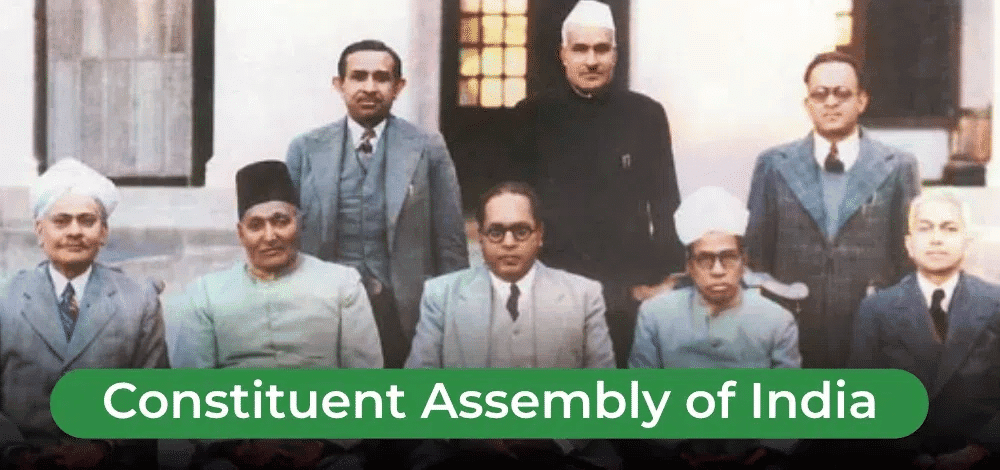
Q5: Who was the Chairman of the Constituent Assembly?
a) Dr. B.R. Ambedkar
b) Dr. Rajendra Prasad
c) Jawaharlal Nehru
d) Dr. Sachidananda Sinha

Ans: b) Dr. Rajendra Prasad

Dr. Rajendra Prasad was the Chairman of the Constituent Assembly and played a significant role in the formation of the Constitution.

Q6: Which of the following is NOT a source of influence for the Indian Constitution?
a) The Indian Freedom Movement
b) France’s Constitution
c) USA’s Constitution
d) Russia’s Revolution

Ans: d) Russia’s Revolution

The Indian Constitution was influenced by various sources, including the Indian Freedom Movement, the USA’s Constitution, and France’s Constitution, but not Russia’s Revolution.

Q7: What does the “separation of powers” in the Constitution mean?
a) The executive controls the legislative and judicial powers
b) The legislature, executive, and judiciary function independently without interfering with each other
c) The legislature is more powerful than the executive
d) The judiciary makes laws

Ans: b) The legislature, executive, and judiciary function independently without interfering with each other

The separation of powers ensures that the three branches of government—legislature, executive, and judiciary—work independently and fairly.

Q8: What is the Preamble of the Indian Constitution?
a) A list of laws
b) A summary of the Constitution’s main values
c) The introduction to the Parliament
d) A legal document for voting

Ans: b) A summary of the Constitution’s main values

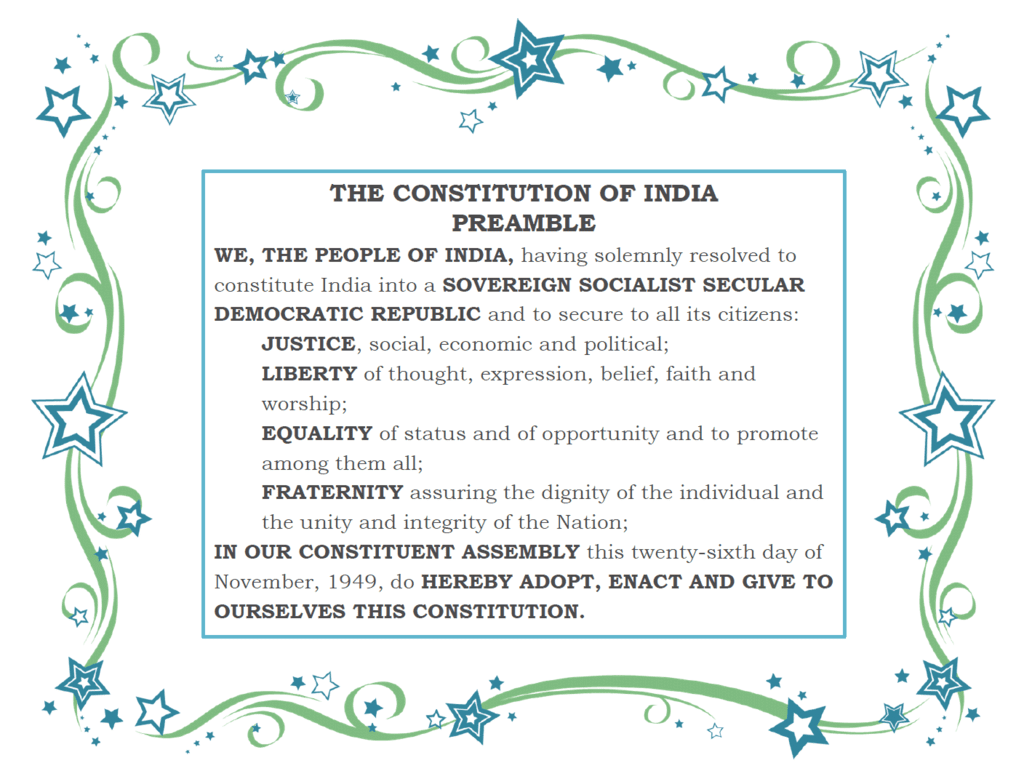
The Preamble is the introduction to the Constitution that summarizes its core values, including justice, liberty, and equality.

Q9: Which of these was included in the Indian Constitution after it was adopted?
a) Universal adult franchise
b) Democracy
c) Separation of powers
d) All of the above

Ans: d) All of the above

The Indian Constitution includes principles like universal adult franchise, democracy, and separation of powers.

Q10: Who was the Chairman of the Drafting Committee that prepared the Constitution?
a) Jawaharlal Nehru
b) Dr. Rajendra Prasad
c) Dr. B.R. Ambedkar
d) Mahatma Gandhi

Ans: c) Dr. B.R. Ambedkar

Dr. B.R. Ambedkar was the Chairman of the Drafting Committee and played a key role in shaping the Constitution of India.

Preamble

Fill in the Blanks

Q1: The Constitution of India was adopted on ________ and came into effect on ________.
Ans: 26th November 1949; 26th January 1950

The Constitution was adopted on 26th November 1949 and came into effect on 26th January 1950, which is celebrated as Republic Day.

Q2: The Constitution of India is stored in a ________-filled glass case in Parliament.
Ans: Helium

The Constitution is kept in a helium-filled glass case in Parliament to preserve its integrity.

Q3: The Constitution’s main features include fundamental rights, fundamental duties, and ________.
Ans: Directive Principles of State Policy

The Directive Principles of State Policy guide the government’s actions but are not enforceable in court.

Q4: India’s Constitution is shaped by the ________ struggle, which inspired the values of equality, freedom, and justice.
Ans: Freedom

The Indian Freedom Movement contributed significantly to the values included in the Constitution.

Q5: Dr. ________ was the first Law and Justice Minister of India and is called the Architect of the Indian Constitution.
Ans: B.R. Ambedkar

Dr. B.R. Ambedkar, as the Law and Justice Minister, played a key role in drafting the Indian Constitution.

Q6: The ________ of India includes values like justice, liberty, and equality.
Ans: Preamble

The Preamble summarizes the core values that guide the Constitution and government.

Q7: The Constitution provides for the ________ system, dividing power among the central, state, and local governments.
Ans: Three-tier

The three-tier system refers to the division of government powers into Central, State, and Local levels.

Q8: ________ is the part of the government that makes laws.
Ans: Legislature

The legislature is responsible for creating and passing laws.

Q9: ________ are basic rights that protect citizens against discrimination and exploitation.
Ans: Fundamental Rights

Fundamental Rights are guaranteed to all citizens and ensure equality, freedom, and protection.

Q10: ________ refers to the principle of shared values and mutual respect among different communities.
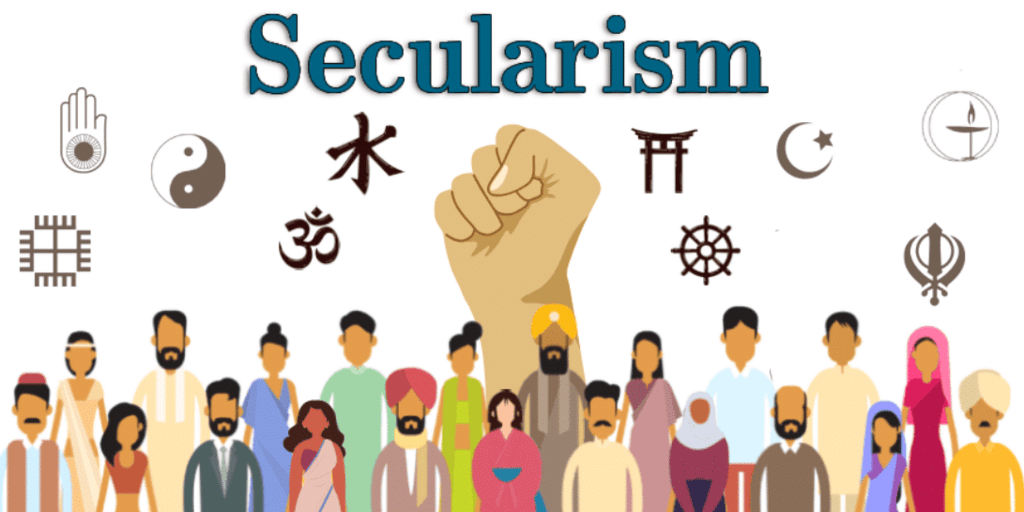
Ans: Secularism

Secularism in the Indian Constitution ensures that all religions are treated equally.

Secularism

Very Short Answer Questions

Q1: When was the Indian Constitution adopted?
Ans: The Indian Constitution was adopted on 26th November 1949.

Q2: What is the Preamble to the Indian Constitution?
Ans: The Preamble is the introduction to the Constitution, outlining its core values and goals.

Q3: Who was the first President of the Constituent Assembly?
Ans: Dr. Sachidananda Sinha was the first President of the Constituent Assembly.

Q4: Who played a key role in drafting the Indian Constitution?
Ans: Dr. B.R. Ambedkar played a key role in drafting the Indian Constitution.

Q5: What does the term “sovereign” in the Constitution mean?
Ans: “Sovereign” means India has the right to make its own decisions without outside control.

Short Answer Questions

Q1: What are the main parts of the government as outlined in the Constitution?
Ans: The three main parts of the government are the legislature, executive, and judiciary. They each have separate functions to ensure fairness and accountability.

Q2: How is the Constitution of India a “living document”?
Ans: The Constitution is a living document because it can be amended to meet the changing needs of society, as seen in the addition of Fundamental Duties and other changes over time.

Q3: Why is the Constitution important for the citizens of India?
Ans: The Constitution protects citizens’ rights, outlines their duties, and ensures fairness by setting rules for governance, making it essential for maintaining justice and equality.

Q4: What role did the freedom struggle play in shaping the Indian Constitution?
Ans: The freedom struggle influenced the Constitution by promoting values like equality, justice, freedom, and fraternity, which were key principles in the document.

Q5: How did the Indian Constitution borrow ideas from other countries?
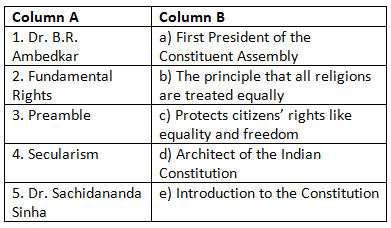
Ans: The Indian Constitution incorporated ideas from various countries, like the USA’s independent judiciary, France’s liberty, equality, and fraternity, and Ireland’s Directive Principles.Match the Following

(Match Column A with the correct option in Column B)

Ans: Matched Pairs and Explanations:

  • 1 → d: Dr. B.R. Ambedkar was the Architect of the Indian Constitution.
  • 2 → c: Fundamental Rights protect citizens’ rights such as equality and freedom.
  • 3 → e: The Preamble introduces the Constitution and outlines its values.
  • 4 → b: Secularism means that all religions are treated equally.
  • 5 → a: Dr. Sachidananda Sinha was the first President of the Constituent Assembly.

09. From the Rulers to the Ruled: Types Of Governments Chapter worksheet

Multiple Choice Questions (MCQs)

Q1: What does the term ‘democracy’ mean?
a) A government where one person has all the power
b) A government run by religious leaders
c) A government run by the people
d) A government controlled by military force

Q2: What is the main function of a democratic government?
a) To provide a king with wealth
b) To ensure people’s safety and welfare
c) To limit people’s freedoms
d) To create military power

Q3: Which is a characteristic of a representative democracy?
a) Every citizen directly makes laws
b) Citizens elect representatives to govern
c) A king or queen makes all the decisions
d) The government has no interaction with citizens

Q4: In which type of government does the king or queen have complete control?
a) Democracy
b) Monarchy
c) Theocracy
d) Dictatorship

Monarchy

Q5: What is the primary role of the judiciary in a democracy?
a) To create laws
b) To enforce laws
c) To ensure that laws are followed and settle disputes
d) To make military decisions

Q6: In which type of government are rulers chosen by religious leaders?
a) Democracy
b) Monarchy
c) Theocracy
d) Dictatorship

Q7: Which of the following is NOT a principle of democracy?
a) Equality
b) Freedom of speech
c) Separation of powers
d) Rule by one leader

Q8: What is the main difference between parliamentary and presidential democracy?
a) In parliamentary democracy, the president is elected
b) In presidential democracy, the president is elected separately
c) In parliamentary democracy, there is no separation of powers
d) In presidential democracy, the prime minister is the head of the state

Q9: Which system of government has a ruler who has absolute power?
a) Democracy
b) Monarchy
c) Dictatorship
d) Oligarchy

Q10: What is the role of citizens in a representative democracy?
a) To create laws
b) To elect representatives who make decisions for them
c) To follow orders from a king
d) To control the economy

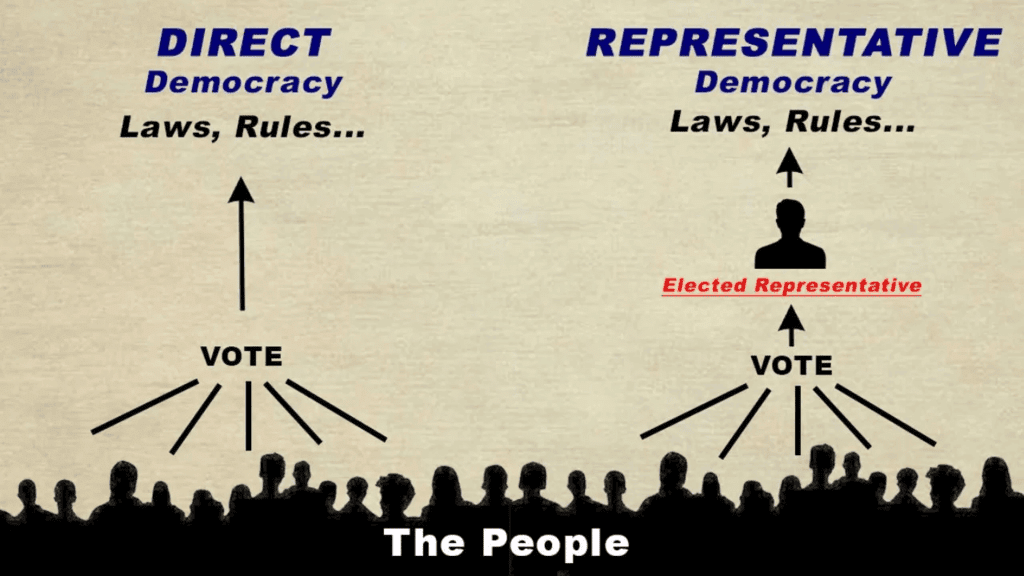
Difference: Direct and Representative Democracy

Fill in the Blanks

Q1: In a __________, the people elect representatives to make decisions on their behalf.

Q2: A __________ government is ruled by religious leaders or based on religious laws.

Q3: The __________ is the branch of government responsible for enforcing laws.

Q4: In a __________ monarchy, the king’s power is limited by a constitution or laws.

Q5: __________ is a form of government where power is held by one person or a small group.

Q6: __________ is a system of government where the king or queen has complete control.

Q7: __________ refers to the right of every adult to vote in elections.

Q8: The __________ is the group responsible for making laws in a democracy.

Q9: In a __________ democracy, all citizens directly participate in making laws and decisions.

Q10: The __________ ensures that laws are followed and resolves legal disputes in a democracy.

Very Short Answer Questions

Q1: What is democracy?

Q2: What is the role of the executive in a democracy?

Q3: Which type of government allows the people to vote for their leaders?

Q4: What is the purpose of the judiciary in a democracy?

Q5: What is an oligarchy?

Short Answer Questions

Q1: What are the three main functions of government in a democracy?

Q2: How does a monarchy differ from a democracy?

Q3: What is the difference between direct and representative democracy?

Q4: What is meant by “universal adult franchise”?

Q5: How did the Chola period influence democracy in ancient India?

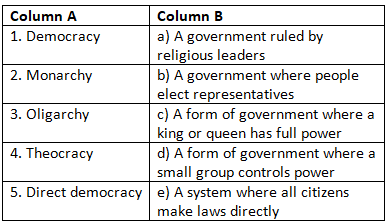
Match the Following

(Match Column A with the correct option in Column B)