Thinking about the Text I. Answer these questions. Q.1. “At last a sympathetic audience.” (i) Who says this? (ii) Why does he say it? (iii) Is he sarcastic or serious? Ans. (i) The speaker of the given line is Gerrard. (ii) He says it as he is asked by the intruder to speak about himself. (iii) This line is delivered with a sense of sarcasm, as Gerrard is not genuinely pleased but rather mocking the situation he finds himself in.
Q.2. Why does the intruder choose Gerrard as the man whose identity he wants to take on? Ans. The intruder selects Gerrard because he resembles him closely. As a murderer on the run from the police, the intruder believes he can easily take on Gerrard’s identity. This impersonation is his plan to evade capture.
Q.3. “I said it with bullets.” (i) Who says this? (ii) What does it mean? (iii) Is it the truth? What is the speaker’s reason for saying this? Ans. (i) Gerrard says this. (ii) It means that when things went wrong, he used his gun to shoot someone for his escape. (iii) No, it is not the truth. The speaker says this to save himself from getting shot by the intruder.
Q.4. What is Gerrard’s profession? Quote the parts of the play that support your answer. Ans. Gerrard is a playwright by profession. Several parts of the play reflect this. Some of these are:
“This is all very melodramatic, not very original, perhaps, but…”
“At last a sympathetic audience!”
“In most melodramas, the villain is foolish enough to delay his killing long enough to be frustrated”.
“I said, you were luckier than most melodramatic villains.”
“That’s a disguise outfit; false moustaches and what not”.
“Sorry I can’t let you have the props in time for rehearsal, I’ve had a spot of bother – quite amusing. I think I’ll put it in my next play.”
Q.5. “You’ll soon stop being smart.” (i) Who says this? (ii) Why does the speaker say it? (iii) What according to the speaker will stop Gerrard from being smart? Ans. (i) The intruder says the line. (ii) The intruder says this to frighten Gerrard. He intends to intimidate him and assert control over the situation. (iii) According to the intruder, Gerrard would stop being smart once he knew what was going to happen to him. The intruder’s plan was to kill Gerard and take over his identity. He felt that when Gerrard would know this, he would stop being smart and start getting scared.Page No. 145
Q.6. “They can’t hang me twice.” (i) Who says this? (ii) Why does the speaker say it? Ans. (i) The intruder says the line. (ii) The intruder had been telling Gerrard that he had murdered one man and that he would not shy away from murdering him too. This is because the police could not hang him twice for two murders.
Q.7. “A mystery I propose to explain.” What is the mystery the speaker proposes to explain? Ans. The mystery that Gerrard sought to explain was a fabricated story he created to evade the intruder and protect his life. He claimed to be a criminal like the intruder, questioning why he had no dealings with tradespeople and was perceived as a mystery man. Gerrard suggested that the intruder’s plan had gone awry, as he had committed murder and narrowly escaped capture. He explained that one of his accomplices had been arrested, and crucial evidence had been overlooked. Anticipating trouble that night, Gerrard had packed his bag, ready to flee.
Q.8. “This is your big surprise.” (i) Where has this been said in the play? (ii) What is the surprise? Ans. (i) This has been said twice in the play. On the first occasion, it is spoken by the intruder while revealing his plan to kill Gerrard. Secondly, it is spoken by Gerrard before he reveals his fictitious identity to the intruder. (ii) The intruder’s surprise is his plan to kill Gerrard and take on his identity to lead a secure and hassle-free life. Whereas, Gerrard’s surprise is his fictitious identity, his way of refraining the intruder from killing him.
Thinking about the Language
I. Consult your dictionary and choose the correct word from the pairs given in brackets. (i) The (site, cite) of the accident was (ghastly/ghostly). (ii) Our college (principle/principal) is very strict. (iii)I studied (continuously/continually) for eight hours. (iv) The fog had an adverse (affect/effect) on the traffic. (v) Cezanne, the famous French painter, was a brilliant (artist/artiste). (vi) The book that you gave me yesterday is an extraordinary (collage/college) of science fiction and mystery. (vii) Our school will (host/hoist) an exhibition on cruelty to animals and wildlife conservation. (viii) Screw the lid tightly onto the top of the bottle and (shake/shape) well before using the contents. Ans. (i)The site of the accident was ghastly. (ii) Our college principal is very strict. (iii) I studied continuously for eight hours. (iv) The fog had an adverse effect on the traffic. (v) Cezanne, the famous French painter, was a brilliant artist. (vi) The book that you gave me yesterday is an extraordinary collage of science fiction and mystery. (vii) Our school will host an exhibition on cruelty to animals and wildlife conservation. (viii) Screw the lid tightly onto the top of the bottle and shake well before using the contents.
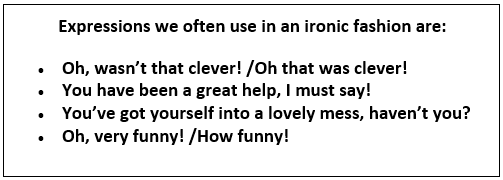
II. The irony is when we say one thing but mean another, usually the opposite of what we say. When someone makes a mistake and you say, “Oh! That was clever!” that is irony. You’re saying ‘clever’ to mean ‘not clever’.
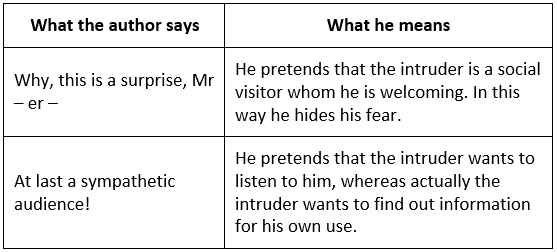
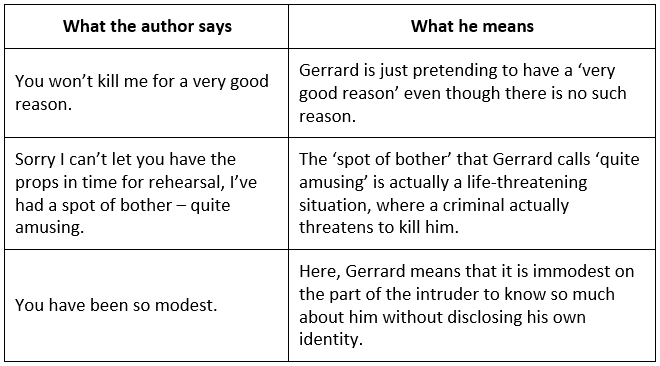
We use a slightly different tone of voice when we use these words ironically. Read the play carefully and find the words and expressions Gerrard uses in an ironic way. Then say what these expressions really mean. Two examples have been given below. Write down three such expressions along with what they really mean.
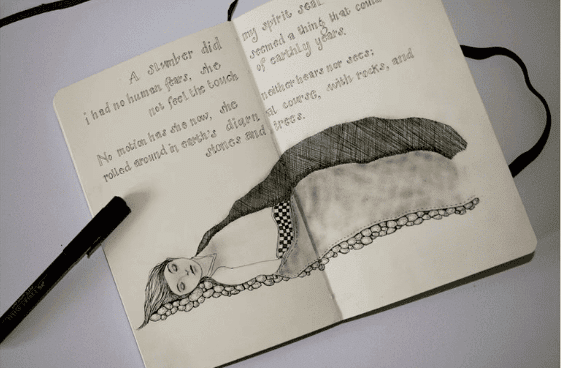
Q1. “A slumber did my spirit seal,” says the poet. That is, a deep sleep ‘closed off’ his soul (or mind). How does the poet react to his loved one’s death? Does he feel bitter grief? Or does he feel a great peace? Answer – The poet’s reaction to his loved one’s death is not one of bitter grief expressed through tears. Instead, he experiences a sense of calm. Upon her passing, he does not feel the usual human fears; rather, he reflects on her appearance and what she might be experiencing in death. This contemplation leads to a state of mind that is neither filled with sorrow nor completely peaceful. Thus, it is challenging to determine if he is engulfed in grief or enveloped in a tranquil acceptance of her fate.
Q2. The passing of time will no longer affect her, says the poet. Which lines of the poem say this? Answer – The lines of the poem that show that the passing of time will no longer affect her are as follows: “She seemed a thing that could not feel The touch of earthly years.”
Q3. How does the poet imagine her to be, after death? Does he think of her as a person living in a very happy state (a ‘heaven’)? Or does he see her now as a part of nature? In which lines of the poem do you find your answer? Answer – The poet thinks that she is now a part of nature. After her death, he imagines her buried inside the earth with other rocks, stones, and trees and rolling around with the earth in its daily rotation. The following lines express this idea- Rolled round in earth’s diurnal course With rocks and stones and trees.
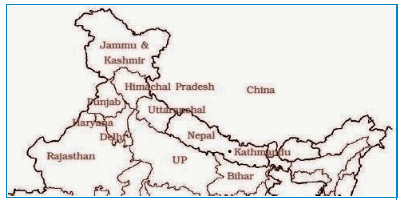
Q1. On the following map mark out the route, that the author thought of but did not take, to Delhi.
Ans: The author considered a route from Kathmandu to Delhi that involved several stages. First, he would travel by bus and train from Kathmandu to Patna. Next, he would sail from Patna to Allahabad along the Ganges River. Finally, he would continue his journey from Allahabad to Delhi by boat on the Yamuna River.
Page No: 132 I. Answer these questions in one or two words or short phrases. Q1. Name the two temples the author visited in Kathmandu. Ans:The two temples the author visited in Kathmandu were the Pashupatinath temple and the Baudhnath Stupa.
Q2. The writer says, “All this I wash down with Coca-Cola.” What does ‘all this’ refer to? Ans:‘All this’ refers to the writer indulging in a bar of marzipan, a corn-on-the-cob roasted over a charcoal brazier, seasoned with salt, chili powder, and lemon, while also enjoying a couple of love story comics and a Reader’s Digest. This assortment is washed down with Coca-Cola and a sickening orange drink, which makes him feel much better.
Q3. What does Vikram Seth compare to the quills of a porcupine? Ans: Vikram Seth compares the fifty or sixty bansuris that extend from the pole of a flute seller to the quills of a porcupine. These flutes, made of bamboo, resemble the sharp quills in their arrangement, protruding in various directions.
Q4. Name five kinds of flutes. Ans:The reed neh, the Japanese shakuhachi, the deep bansuri of Hindustani classical music, the clear or breathy flutes of South America, and the high-pitched Chinese flutes.
II. Answer each question in a short paragraph. Q1. What difference does the author note between the flute seller and the other hawkers? Ans:The author observes a distinct difference between the flute seller and the other hawkers. While the other hawkers loudly advertised their goods, the flute seller chose a quieter approach. He played his flute slowly and meditatively, allowing the music to rise above the surrounding noise without any excessive display or shouting. His manner of selling was casual, as if making a sale was merely incidental to his music.
Q2. What is the belief at Pashupatinath about the end of Kaliyug? Ans:At Pashupatinath, there is a small shrine that protrudes from the stone platform on the river bank of Bagmati. It is believed that when the shrine emerges fully, the goddess inside it will escape. The evil period of Kaliyug on earth will then end.
Q3. The author has drawn powerful images and pictures. Pick out three examples of each of (i) the atmosphere of ‘febrile confusion’ outside the temple of Pashupatinath (for example: some people trying to get the priest’s attention are elbowed aside…) (ii) the things he sees (iii) the sounds he hears Ans: (i) The author has drawn powerful images and pictures of the atmosphere of ‘febrile confusion’ outside the temple of Pashupatinath. These include the following: a group of saffron-clad Westerners struggling to enter the main gate as only Hindus were allowed to enter the temple; a fight that breaks out between two monkeys; and a royal Nepalese princess for whom everyone makes way.
(ii) In terms of sights, he observes the Baudhnath Stupa, characterised by its immense white dome surrounded by a road. Small shops line the outer edge, selling items such as felt bags, Tibetan prints, and silver jewellery, and the area is notably free of crowds. On the bustling streets of Kathmandu, he sees fruit sellers, flute vendors, and hawkers selling postcards, Western cosmetics, film rolls, chocolate, copper utensils, and Nepalese antiques.
(iii) The sounds he hears include film songs blaring from radios, car horns, bicycle bells, and vendors shouting their wares. He also enjoys the flute music, which he describes as both the most universal and the most particular of sounds.
III. Answer the following questions in not more than 100 − 150 words each.
Q1. Compare and contrast the atmosphere in and around the Baudhnath shrine with the Pashupathinath temple. Ans:The atmosphere at the Pashupatinath temple is characterised by chaos and noise. Worshippers jostle to get the priest’s attention, while others push to the front. Saffron-clad Westerners struggle for entry, and monkeys fight, adding to the din. Nearby, a corpse is cremated on the banks of the Bagmati river, where washerwomen work and children bathe. This vibrant scene is filled with activity and confusion. In contrast, the Baudhnath stupa offers a sense of serenity. Its large white dome stands amidst busy streets, yet it remains a peaceful haven. There are no crowds, allowing for a tranquil atmosphere at this Buddhist shrine. Small shops run by Tibetan immigrants line the outer edge, selling items like felt bags and silver jewellery, contributing to the calm rather than the chaos.
Q2. How does the author describe Kathmandu’s busiest streets? Ans:Kathmandu’s narrowest and busiest streets are alive with activity. Small shrines and flower-adorned deities can be found alongside various vendors. The streets are bustling with fruit sellers, flute sellers, and hawkers offering postcards, as well as shops selling Western cosmetics, film rolls, chocolate, copper utensils, and Nepalese antiques. The air is filled with the sounds of film songs blaring from radios, car horns, bicycle bells, and vendors shouting their wares. Stray cows roam the roads, adding to the lively atmosphere. Among the vendors, a flute seller stands out, with many bansuris displayed on his pole. His serene music rises above the surrounding noise, creating a unique auditory experience in the midst of the chaos.
Q3. “To hear any flute is to be drawn into the commonality of all mankind.” Why does the author say this? Ans:The author views flute music as both universal and unique. Flutes exist in every culture, including the reed neh, the recorder, the Japanese shakuhachi, the deep bansuri of Hindustani classical music, and the high-pitched Chinese flutes. Each type has its own fingering and range, yet they all share a commonality. Listening to any flute connects us to the essence of humanity, as the music closely resembles the human voice. The motive force behind this music is the breath, which is essential for playing. This reflects how, despite our differences in caste, culture, and religion, all humans share the same living breath, highlighting our fundamental similarities.
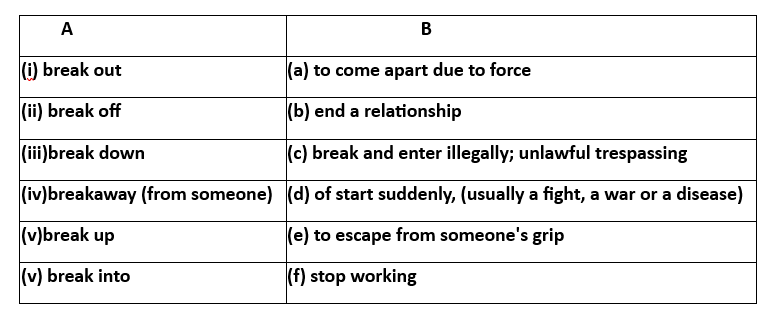
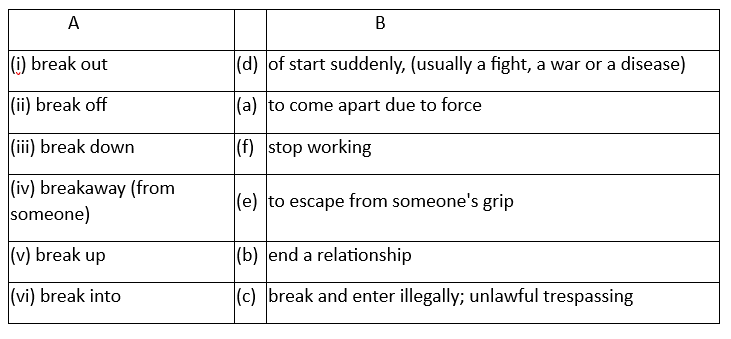
Thinking about Language I. Read the following sentences carefully to understand the meaning of the italicized phrases. Then match the phrasal verbs in Column A with their meanings in Column B. 1. A communal war broke out when the princess was abducted by the neighboring prince. 2. The cockpit broke off from the plane during the plane crash. 3. The car broke down on the way and we were left stranded in the jungle. 4. The dacoit broke away from the police as they took him to court. 5. The brothers broke up after the death of their father. 6. The thief broke into our house when we were away.
Ans:
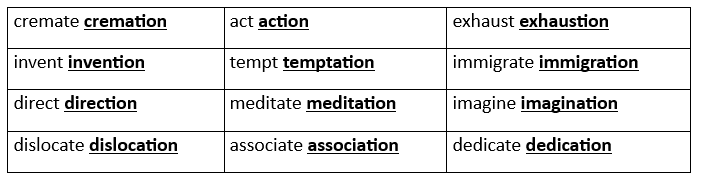
II. Q1. Use the suffix −ion or −tion to form nouns from the following verbs. Make the necessary changes in the spelling of the words. Example: proclaim − proclamation
Ans: 1.
Q2. Now fill in the blanks with suitable words from the ones that you have formed.
(i) Mass literacy was possible only after the ___________ of the printing machine. (ii) Ramesh is unable to tackle the situation as he lacks ____________. (iii) I could not resist the _____________ to open the letter. (iv) Hardwork and ___________are the main keys to success. (v) The children were almost fainting with ______________after being made to stand in the sun. Ans: (i) Mass literacy was possible only after theinvention of the printing machine. (ii) Ramesh is unable to tackle the situation as he lacks direction. (iii) I could not resist the temptationto open the letter. (iv) Hard work and dedication are the main keys to success. (v) The children were almost fainting with exhaustion after being made to stand in the sun.
III. Punctuation Use capital letters, full stops, question marks, commas and inverted commas wherever necessary in the following paragraph. an arrogant lion was wandering through the jungle one day he asked the tiger who is stronger than you you O lion replied the tiger who is more fierce than a leopard asked the lion you sir replied the leopard he marched up to an elephant and asked the same question the elephant picked him up in his trunk swung him in the air and threw him down look said the lion there is no need to get mad just because you don’t know the answer Answer An arrogant lion was wandering through the jungle. One day, he asked the tiger, “Who is stronger than you?” “You, O lion!” replied the tiger. “Who is more fierce than a leopard?” asked the lion. “You sir,” replied the leopard. He marched up to an elephant and asked the same question. The elephant picked him up in his trunk, swung him in the air, and threw him down. “Look,” said the lion, “there is no need to get mad just because you don’t know the answer.”
Page No: 134 IV. Simple Present Tense In these sentences words like every day, often, seldom, never, every month, generally, usually, etc. may be used. 1. Fill in the blanks with the correct form of the verb in brackets.
(i) The heart is a pump that ____________(send) the blood circulating through our body. The pumping action ____________(take place) when the left ventricle of the heart ____________(contract). This ____________(force) the blood out into the arteries, which ____________(expand) to receive the oncoming blood.
(ii) The African lungfish can live without water for up to four years. During drought, it ____________(dig) a pit and ____________(enclose) itself in a capsule of slime and earth, leaving a tiny opening for air. The capsule ____________(dry) and ____________(harden), but when rain ____________(come), the mud ____________(dissolve) and the lungfish ____________(swim) away.
(iii) Mahesh: We have to organise a class party for our teacher. ____________(Do) anyone play an instrument? Vipul:Rohit ____________(play) the flute. Mahesh: ____________(Do) he also act? Vipul: No, he ____________(compose) music. Mahesh: That’s wonderful!
Ans: (i) The heart is a pump that sendsthe blood circulating through our body. The pumping action takes place when the left ventricle of the heartcontracts. Thisforces the blood out into the arteries, whichexpandsto receive the oncoming blood.
(ii) The African lungfish can live without water for up to four years. During drought, it digsa pit and enclosesitself in a capsule of slime and earth, leaving a tiny opening for air. The capsule dries and hardens, but when the rain comes, the mud dissolvesand the lungfishswims away.
(iii) Mahesh: We have to organise a class party for our teacher. Does anyone play an instrument? Vipul: Rohitplays the flute. Mahesh: Doeshe also act? Vipul: No, he composes music. Mahesh: That’s wonderful!
Q1. Can a “simple jab of the knife” kill a tree? Why not? Ans: No, a simple jab of a knife cannot kill a tree. Trees grow slowly and establish strong roots over time. A single cut is not enough; trees have the ability to heal and continue growing. Even after damage, they can produce new leaves and branches. To effectively kill a tree, the roots must be completely removed from the ground.
Q2. How has the tree grown to its full size? List the words suggestive of its life and activity. Ans: The tree grows to its full size by absorbing sunlight, water, and air over many years. It sprouts leaves and rises from the earth. Words that suggest its life and activity include: grown slowly, feeding upon the earth’s crust, andabsorbing years of sunlight, air, and water.
Q3. What is the meaning of “bleeding bark”? What makes it bleed? Ans: Bleeding bark refers to the area on a tree trunk that has been damaged, typically from an axe or other cutting tool. The tree seems to “bleed” because it is wounded, allowing its sap to flow out. This sap plays a crucial role in the tree’s defense system, helping to protect it from diseases and pests.
Q4. The poet says “No” in the beginning of the third stanza. What does he mean by this? Ans: The poet states “No” to emphasise that merely chopping a tree does not kill it. The tree can regrow and can return to its original size, showcasing its remarkable resilience. This indicates that more severe actions are necessary to eliminate the tree truly.
Q5. What is the meaning of “anchoring earth” and “earth cave”? Ans: Anchoring earth refers to the roots of a tree that lie within the soil, providing a secure base for its growth. These roots are essential as they keep the tree stable and supply it with water and nutrients. In contrast, an earth cave describes the soil that supports the tree’s roots.
Q6. What does he mean by “the strength of the tree exposed”? Ans: The phrase “the strength of the tree exposed” refers to the roots of the tree being revealed to sunlight and air. The strength of a tree primarily comes from its roots. When these roots are exposed, they lose their protection and nourishment, making the tree vulnerable to damage.
Q7. What finally kills the tree? Ans: The tree is ultimately killed by the uprooting of its roots. These roots, which have securely anchored the tree in the earth for years, are essential for its stability and nourishment. When they are removed, the tree’s strength is compromised, leading to its death. Once uprooted, the tree dries up, as it can no longer access the vital resources it needs to survive.
Thinking about the Text (Page 87)I. Answer these questions in one or two sentences each. (The paragraph numbers within brackets provide clues to the answers.) Q.1. Why was the ‘holy man’ who gave Santosh’s mother his blessings surprised? (1)
Ans. The ‘holy man’ was surprised because he had assumed that Santosh’s mother wanted a son. But grandmother told him that they did not want a son.
Q.2. Give an example to show that even as a young girl, Santosh was not ready to accept anything unreasonable. (2)
Ans. Santosh, from the very beginning, lived life on her own terms. She was not content with the traditional way of life and was not ready to accept anything unreasonable. Where other girls wore traditional Indian dresses, Santosh preferred shorts.
Q.3. Why was Santosh sent to the local school? (3)
Ans. Even though Santosh’s parents could afford to send their children to the best schools, she was sent to the local village school due to the prevailing custom in the family.
Q.4. When did she leave home for Delhi, and why? (4)
Ans. When she turned sixteen and was under pressure to get married, Santosh threatened her parents that she would never marry if she did not get a proper education. Therefore, she left home and got herself enrolled in a school in Delhi.
Santosh YadavQ.5. Why did Santosh’s parents agree to pay for her schooling in Delhi? What mental qualities of Santosh are brought into light by this incident? (4)
Ans. When Santosh’s parents refused to pay for her education, she politely informed them of her plans to earn money by working part-time to pay her school fees. Then, her parents agreed to pay for her schooling in Delhi. This shows that Santosh was a mentally-strong girl and was determined to work very hard to get herself properly educated.
II. Answer each of these questions in a short paragraph (about 30 words). (Page 88)
Q.1. How did Santosh begin to climb mountains?
Ans. Santosh began climbing mountains after observing people ascending the Aravalli Hills from her hostel room. She discovered they were mountaineers and asked to join them. They agreed, encouraged her passion, and she later accompanied them on climbing expeditions.
Q.2. What incidents during the Everest expedition show Santosh’s concern for her teammates?
Ans. During the Everest mission, Santosh showed immense concern for her fellow climbers. Though she was unsuccessful in saving the life of one of them, she did manage to save another climber through artificial respiration.
Q.3. What shows her concern for the environment?
Ans. Santosh was a fervent environmentalist. Her concern for the environment is evident from the fact that she collected and brought down 500 kilograms of garbage from the Himalayas.
Q.4. How does she describe her feelings at the summit of the Everest?
Ans. Santosh asserted that her feeling at the summit of the Everest was“indescribable”. Unfurling the Indian flag on the top of the world was a spiritual moment for her and she felt proud as an Indian.
Q.5. Santosh Yadav got into the record books both times she scaled Mt Everest. What were the reasons for this?
Ans. When Santosh Yadav first scaled Mt Everest, she becamethe youngest woman in the world to achieve the feat. When she scaled Everest the second time, she became the only woman to have scaled it twice.
III. Complete the following statements.
(a) From her room in Kasturba Hostel, Santosh used to _________ (b) When she finished college, Santosh had to write a letter of apology to her father because of _________ (c) During the Everest expedition, her seniors in the team admired her _________ while _________endeared her to fellow climbers.
Ans.
(a) From her room in Kasturba Hostel, Santosh used to watch villagers going up the hill and suddenly vanish after a while.
(b) When she finished college, Santosh had to write a letter of apology to her father because she had got herself enrolled at Uttarkashi’s Nehru Institute of Mountaineering without his permission.
(c) During the Everest expedition, her seniors in the team admired her climbing skills, physical fitness, and mental strength while her concern for others and desire to work together with them endeared her to fellow climbers.
IV. Pick out words from the text that mean the same as the following words or expressions. (Look in the paragraphs indicated.)
(a) Took to be true without proof (1): _________ (b) Based on reason; sensible; reasonable (2): _________ (c) The usual way of doing things (3): _________ (d) A strong desire arising from within (5): _________ (e) The power to endure, without falling ill (7): _________
Ans.
(a) Took to be true without a proof (1): Assumed
(b) Based on reason; sensible; reasonable (2): Rational
(c) The usual way of doing things (3): Custom
(d) A strong desire arising from within (5): Urge
(e) The power to endure, without falling ill (7): Resistance
Thinking about the Text (Page 92)
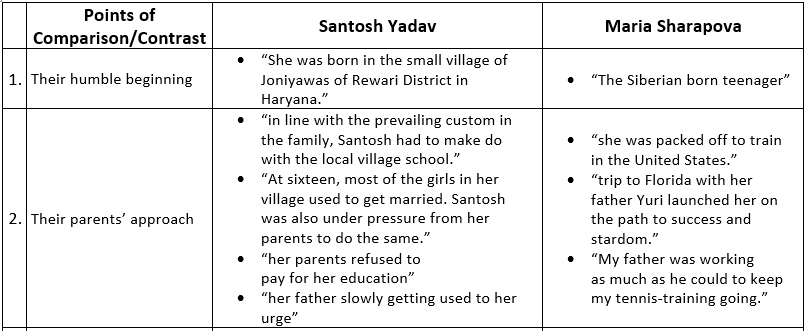
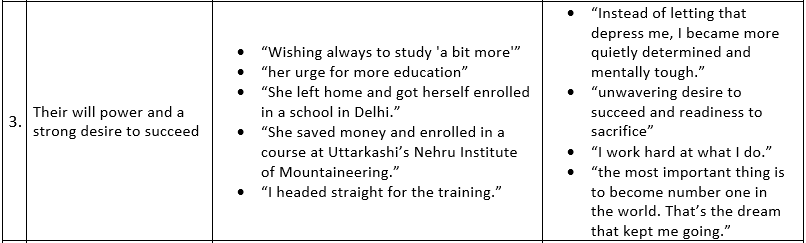
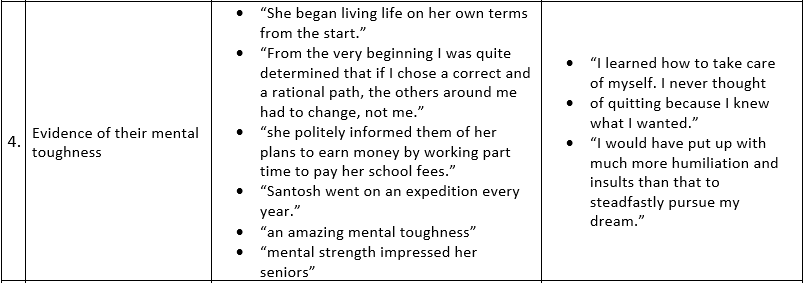
Working in small groups of 4−5 students, go back over the two passages on Santosh Yadav and Maria Sharapova and complete the table given below with relevant phrases or sentences.
Ans.
Maria Sharapova
Thinking about the Language (Page 92)
Look at the following sentences. They each have two clauses, or two parts each with their own subject and verb or verb phrase. Often, one part (italicised) tells us when or why something happened.
I reached the marketwhen most of the shops had closed. (Tells us when I reached.)
When Rahul Dravid walked back towards the pavilion, everyone stood up. (Tells us when everyone stood up.)
The telephone rang and Ganga picked it up. (Tells us what happened next.)
Gunjan has been with usever since the school began. (Tells us for how long he has been with us.)
I. Identify the two parts in the sentences below by underlining the part that gives us the information in brackets.
(a) Where other girls wore traditional Indian dresses, Santosh preferred shorts. (Contrasts her dress with that of others) (b) She left home and got herself enrolled in a school in Delhi. (Tells us what happened after the first action.) (c) She decided to fight the system when the right moment arrived. (Tells us when she was going to fight the system.) (d) Little Maria had not yet celebrated her tenth birthday when she was packed off to train in the United States. (Tells us when Maria was sent to the U.S.)
Ans.
(a) Where other girls wore traditional Indian dresses, Santosh preferred shorts.
(b) She left home and got herself enrolled in a school in Delhi.
(c) She decided to fight the system when the right moment arrived.
(d) Little Maria had not yet celebrated her tenth birthday when she was packed off to train in the United States.
II. Now rewrite the pairs of sentences given below as one sentence. (Page 93)
(a) Grandfather told me about the old days. All books were printed on paper then. (b) What do you do after you finish the book? Perhaps you just throw it away. (c) He gave the little girl an apple. He took the computer apart. (d) You have nothing. That makes you very determined. (e) I never thought of quitting. I knew what I wanted.
Ans.
(a) Grandfather told me about the old days when all books were printed on paper.
(b) After finishing the book, perhaps you just throw it away.
(c) He gave the little girl an apple and took the computer apart.
(d) Having nothing makes you very determined.
(e) I never thought of quitting as I knew what I wanted.
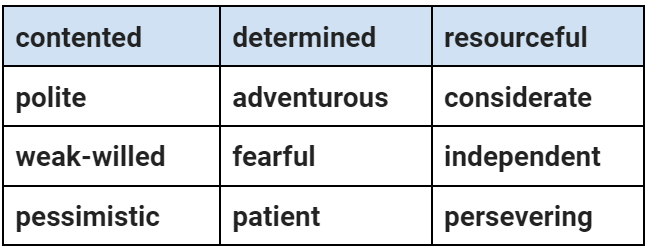
II. Which of these words would you use to describe Santosh Yadav? Find reasons in the text to support your choices, and write a couple of paragraphs describing Santosh’s character. (Page 94)
Ans. Santosh Yadav was determined, considerate, polite and hard working.
She was a rebel who did not want to follow the traditional ways of living. She developed a remarkable resistance to cold and altitude that is required for mountaineering. She proved herself repeatedly because of her iron will, physical endurance and amazing mental toughness. She was a fervent environmentalist who brought 500 kgs of garbage from the Himalayas.
Q.1. (a) “Beneath all uniforms…” What uniforms do you think the poet is speaking about? (b) How does the poet suggest that all people on earth are the same? Ans. (a) The poet is probably speaking about the uniforms that the soldiers wear at the time of war. The word “uniform” here could also mean the traditional dresses of a country. (b) The poet conveys that all humans are fundamentally the same by highlighting shared experiences. We all breathe, love, hate, and labour. The essentials of life, such as sun, air, and water, are vital for everyone. Additionally, all people desire peace and suffer from starvation during wars.
Q.2. In stanza 1, find five ways in which we all are alike. Pick out the words. Ans. Words that suggest the five ways in which we all are like are:
Each of us has a similar body.
All of us breathe.
All of us walk.
All of us lie.
We live and die on the same earth.
Q.3. How many common features can you find in stanza 2? Pick out the words. Ans. There are five common features in stanza 2. These features are the sun, the air, the water, peaceful harvest, hands, and the labour.
Q.4. “…whenever we are told to hate our brothers…” When do you think this happens? Why? Who ‘tells’ us? Should we do as we are told at such times? What does the poet say? Ans. During times of war, leaders often encourage us to hate those from other countries. They do this for their own benefit, manipulating our emotions for personal gain. However, we should resist being mere puppets and instead critically assess the situation before reacting. The poet warns that if we engage in conflict, we ultimately harm ourselves. He emphasises that fighting against one another leads to a loss of our shared humanity and defiles the world we all inhabit.
I. Answer these questions in one or two sentences each. Q1. Where was Abdul Kalam’s house? Ans: Abdul Kalam’s house was on Mosque Street in Rameswaram.
Q2. What do you think Dinamaniis the name of? Give a reason for your answer.
Ans: Dinamani is the name of a local newspaper. It is so because Kalam traced the stories of the war in the head lives of Dinamani.
Q3. Who were Abdul Kalam’s school friends? What did they later become?
Ans: Ramanadha Sastry, Aravindan, and Shivaprakasan were Abdul Kalam’s school friends. Ramanadha Shastry became the high priest of the Rameswaram temple, Aravindan was a transport businessman and Shivaprakasan was the catering contractor for the southern railways.
Q4. How did Abdul Kalam earn his first wages? Ans: During the Second World War, the newspapers were bundled and thrown out of a moving train. Abdul Kalam earned his first wages by helping his cousin, who distributed newspapers in Rameswaram, to catch these bundles.
Q5. Had he earned any money before that? In what way? Ans: Yes, Abdul Kalam had earned some money before he started helping his cousin. When the Second World War broke out, there was a sudden demand for tamarind seeds in the market. He collected the seeds and sold them at a provision shop on Mosque Street. Usually, a day’s collection earned him one anna.
II. Answer each of these questions in a short paragraph (about 30 words).
Q1. How does the author describe (a) His father (b) His mother (c) Himself? Ans: (a) Kalam’s father, Jainulabdeen, was not a wealthy or educated person. However, he was an honest and generous man with great innate wisdom. He was self-disciplined and avoided all inessential luxuries.
(b) Kalam’s mother, Ashiamma, was an ideal helpmate to her husband. She believed in goodness and profound kindness and fed many people every day.
(c) The author describes himself as a short boy with undistinguished looks, who had a secure childhood. He is an honest and self-disciplined person who believes in goodness and deep kindness.
Q2. What characteristics does he say he inherited from his parents? Ans: He says that he inherited honesty and self-discipline from his father. He further says that he inherited faith in goodness and deep kindness from his mother.
III. Discuss these questions in class with your teacher and then write down your answers in two or three paragraphs each.
Q1. “On the whole, the small society of Rameswaram was very rigid in terms of the segregation of different social groups,” says the author. (a) Which social groups does he mention? Were these groups easily identifiable (for example, by the way they dressed)?
Ans: He mentions two social groups of Rameswaram – orthodox Brahmins and Muslims. Yes, these groups were easily identifiable. Example: by the way they dressed, Kalam wore a cap, which marked him as a Muslim. Ramanadha Sastry wore a seared thread, which marked him a Hindu.
(b) Were they aware only of their differences or did they also naturally share friendships and experiences? (Think of the bedtime stories in Kalam’s house, of who his friends were, and of what used to take place in the pond near his house.)
Ans: No, they were not only aware of their differences, but also they naturally shared friendships and experiences. Kalam’s mother and grandmother would tell the children of his family bedtime stories about the events from the Ramayana and the life of the prophet. During the Shri Sita Rama Kalyanam ceremony, his family used to arrange boats with a special platform for carrying idols of the Lord from the temple to the marriage site, situated in the middle of the pond called Rama Tirtha near his house.
(c) The author speaks both of people who were very aware of the differences among them and those who tried to bridge these differences. Can you identify such people in the text? Ans. The people who were very aware of the differences among them were the young teacher who joined the Rameswaram elementary school and came to teach Kalam’s class, the fifth standard, and his science teacher’s conservative wife, who refused to serve Kalam in her ritually pull kitchen. Those who tried to bridge these differences were Kalam’s science teacher, Sivasubramania Iyer, who invited, served, and dined with him to break social barriers so that people could mingle easily, and Lakshmana Sastry, who conveyed a strong sense of conviction to the new young teacher to reform him.
(d) Narrate two incidents that show how differences can be created, and also how they can be resolved. How can people change their attitudes? Ans: The first incident to show how differences can be created is that when the new young teacher found a Muslim student sitting beside a Hindu student, he asked Kalam to sit in the last row. His friend Ramanadha Sastry was heartbroken. They informed their respective parents. Lakshmana Sastry summoned the teacher and conveyed a strong sense of conviction, which ultimately reformed him. The other incident shows how differences can be resolved. The author’s science teacher, Sivasubramania Iyer, though an orthodox Brahmin with a very conservative, tried to bridge these differences. People can change their attitudes by observing no difference in the way Hindus and Muslims eat meals, drink water, and clean the floor.
Q2. (a) Why did Abdul Kalam want to leave Rameswaram? (b) What did his father say to this? (c) What do you think his words mean? Why do you think he spoke those words? Ans: (a) Kalam wanted to leave Rameswaram for further studies. He wanted to study at the district headquarters in Ramanathapuram.
(b) Kalam’s father said that he knew that one day Kalam had to go away to grow. He gave him the analogy of a seagull that flies across the sun alone and without a nest. He then quoted Khalil Gibran to Kalam’s mother, saying that her children were not their children. They were the sons and daughters of Life’s longing for itself. They come through their parents, but not from them. They may give them their love, but not their thoughts, as the children have their thoughts.
(c) Abdul Kalam’s father’s words bear great meaning. First, he inspired his son to go ahead above, giving the example of the seagull. Secondly, he explained to Kalam’s mother to give his son opportunities to get higher education and to make progress. I think he spoke those words to encourage Abdul Kalam and to control the emotional attachment of his wife to Kalam.Thinking about Language
I. Find the sentences in the text where these words occur
Look these words up in a dictionary that gives examples of how they are used. Now answer the following questions. Q1. What are the things that can erupt? Use examples to explain the various meanings of erupt. Now do the same for the word surge. What things can surge? Ans: A few things that can erupt are anger, volcano, tooth, rash, riots, unrest, etc. Erupt has several meanings. Their explanation, with examples, is given as follows:
Start unexpectedly. Example: Riots erupted in the city.
It starts to burn or burst into flames. Example: The spark soon erupted into flames.
Become active and spew forth lava and rocks. Example: The molten lava erupted out of the active volcano.
Forceful and violent release of something pent up. Example: The difference in their views soon erupted in a fight.
Sudden appearance on the skin. Example: On the party day, a pimple erupted on her face.
Break out. Example: Eruption of the wisdom tooth causes a lot of pain.
Things that can surge are pride, anxiety, waves, boats, army, etc. The several meanings it has can be explained with the following examples:
Sudden forceful flow. Example: The boy drowned in the surging waves.
Rise and move forward. Example: The army surged towards their enemy.
Heave upward under the influence of a natural force. Example: The boat surged in the high tide.
See one’s performance improve. Example: Hard work helped to surge Sandra’s scores.
A sudden or abrupt strong increase. Example: The surge in the stock market left people in shock.
Rise rapidly. Example: As time passed, her tension surged.
Q2. What are the meanings of the word trace and which of the meanings is closest to the word in the text? Ans: The following are the meanings of the word trace:
Follow, discover, or ascertain the course of development of something.
Make a mark or lines on a surface.
To go back over again.
Pursue or chase relentlessly.
Find or discover through investigation.
Make one’s course or travel along a path; travel or pass over, around, or along.
Read with difficulty.
The closest meaning of the word ‘trace’ in the text is ‘to find or discover through investigation’.
Q3. Can you find undistinguished in your dictionary? (If not, look for the word distinguished and say what undistinguished means.) Ans: No, the word undistinguished does not exist in the dictionary. However, its meaning can be derived from the meaning of the word ‘distinguished’, which denotes the ‘special or eminent appearance or behavior of a person’. Thus, undistinguished symbolizes the ‘ordinary appearance or behaviour of a person.’
Page No. 76
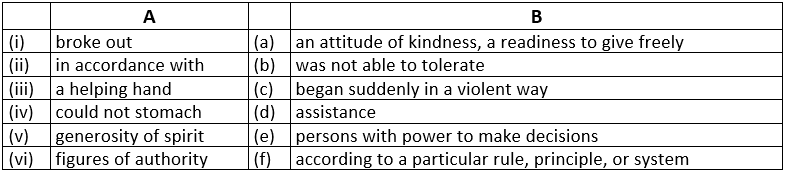
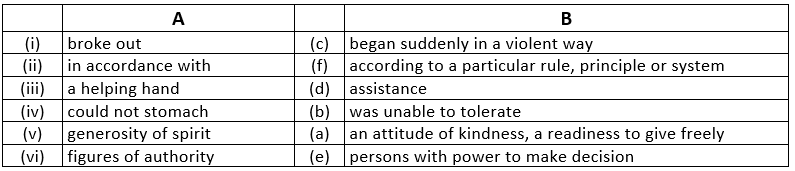
II. Q1. Match the phrases in Column A with their meanings in Column B.
Ans:
Q2. Study the words in italics in the sentences below. They are formed by prefixing un – or in – to their antonyms (words opposite in meaning).
I was a short boy with rather undistinguished looks. (un + distinguished)
My austere father used to avoid all inessential comforts.(in + essential)
The area was completely unaffected by the war. (un + affected)
He should not spread the poison of social inequality and communal intolerance. (in + equality, in + tolerance)
Now form the opposites of the words below by prefixing un– or in-. The prefix in- can also have the forms il-, ir-, or im– (for example illiterate –il + literate, impractical –im + practical, irrational – ir + rational). You may consult a dictionary if you wish.
Ans:
Page No. 77
IV. Rewrite the sentences below, changing the verbs in brackets into the passive form. 1. In yesterday’s competition the prizes (give away) by the Principal. 2. In spite of financial difficulties, the laborers (pay) on time. 3. On Republic Day, vehicles (not allow) beyond this point. 4. Second-hand books (buy and sell) on the pavement every Saturday. 5. Elections to the Lok Sabha (hold) every five years. 6. Our National Anthem (compose) Rabindranath Tagore. Ans: 1. In yesterday’s competition, the prizes were given away by the Principal. 2. In spite of financial difficulties, the laborers were paid on time. 3. On Republic Day, vehicles are not allowed beyond this point. 4. Second-hand books are bought and sold on the pavement every Saturday. 5. Elections to the Lok Sabha are held every five years. 6. Our National Anthem was composed by Rabindranath Tagore.
V. Rewrite the paragraphs below, using the correct form of the verb given in brackets.
Q1. How Helmets Came To Be Used in Cricket Nari Contractor was the Captain and an opening batsman for India in the 1960s. The Indian cricket team went on a tour to the West Indies in 1962. In a match against Barbados in Bridgetown, Nari Contractor (seriously injured and collapsed). In those days helmets (not wear). Contractor (hit) on the head by a bouncer from Charlie Griffith. Contractor’s skull (fracture). The entire team (deeply concerned). The West Indies players (worry). Contractor (rush) to hospital. He (was accompanied) by Frank Worrell, the Captain of the West Indies Team. Blood (donated) by the West Indies players. Thanks to the timely help, Contractor (save). Nowadays, helmets (routinely used) against bowlers.
Q2. Oil from Seeds Vegetable oils (made) from seeds and fruits of many plants growing all over the world, from tiny sesame seeds to big, juicy coconuts. Oil (produced) from cotton seeds, groundnuts, soya beans, and sunflower seeds. Olive oil (use) for cooking, salad dressing, etc. Olives (shake) from the trees and (gather) up, usually by hand. The olives (ground) to a thick paste which is spread onto special mats. Then the mats (layer) upon the pressing machine will be gently squeezed to produce olive oil. Ans: 1. How Helmets Came To Be Used in Cricket Nari Contractor was the Captain and an opening batsman for India in the 1960s. The Indian cricket team went on a tour to the West Indies in 1962. In a match against Barbados in Bridgetown, Nari Contractor got seriously injured and collapsed. In those days, helmets were not worn. The contractor was hit on the head by a bouncer from Charlie Griffith. The contractor’s skull had fractured. The entire team was deeply concerned. The West Indies players were worried. The contractor was rushed to hospital. He was accompanied by Frank Worrell, the Captain of the West Indies Team. Blood was donated by the West Indies players. Thanks to the timely help, the Contractor was saved. Nowadays, helmets are routinely used against bowlers.
2. Oil from Seeds Vegetable oils are made from seeds and fruits of many plants growing all over the world, from tiny sesame seeds to big, juicy coconuts. Oil is produced from cotton seeds, groundnuts, soya beans and sunflower seeds. Olive oil is used for cooking, salad dressing, etc. Olives are shaken from the trees and gathered up, usually by hand. The olives are ground to a thick paste which is spread onto special mats. Then the mats are layered upon the pressing machine, which will gently squeeze them to produce olive oil.
Q1. Which country or countries do you think “the Northland” refers to? Ans: The Northland likely refers to very cold areas in the northern part of the world. This includes Greenland, the northern regions of Russia, Canada, and Norway. These regions are known for their severe, icy climates.
Q2. What did Saint Peter ask the old lady for? What was the lady’s reaction? Ans: Saint Peter asked the old lady for one of her baked cakes to satisfy his hunger. In response, the lady tried to make him a small cake but found it difficult to part with it. She first baked a tiny cake, yet thought it was too large to give away. Next, she kneaded an even smaller cake, but it still appeared too big. Finally, she rolled a tiny scrap of dough into a wafer-thin cake, but she still couldn’t bring herself to give it to him. She reasoned that her cakes, which seemed small when she ate them, were too large to share.
Q3. How did he punish her? Ans: He punished the lady by transforming her into a woodpecker. In this new form, she had to build her home like birds do, spend all day boring into hard, dry wood, and gather only a scant amount of food. As a result, she now lives in the trees, constantly searching for food.
Q4. How does the woodpecker get her food? Ans: The woodpecker gets her food by boring holes into trees to find insects and larvae hidden within the wood. She uses her strong beak to create openings, allowing her to access food that is not visible on the surface.
Q5. Do you think that the old lady would have been so ungenerous if she had known who Saint Peter was? What would she have done then? Ans: No, the old lady would not have been so ungenerous if she had known who Saint Peter was. Instead, she would have attempted to please him by offering her cakes and likely given him a larger one to satisfy her own desires. Her actions would have shown a wish to gain his favour, contrasting with her initial selfishness.
Q6. Is this a true story? Which part of this poem do you feel is the most important? [Old NCERT] Ans: No, this is not a true story; it is a legend. The most important part of the poem is when the old lady is transformed into a woodpecker. This moment highlights the consequences of her actions and teaches us the value of generosity and charity.
Q7. What is a legend? Why is this poem called a legend? Ans: A legend is a traditional story from the past that many people believe, although its truth cannot be confirmed. These tales often include a moral lesson and are frequently shared with children. In the poem, the poet expresses doubt about the story’s truth. It is titled a legend because it highlights the significance of generosity towards others.
Q8. Write the story of ‘A Legend of the Northland’ in about ten sentences. Ans: Once, Saint Peter visited an old lady’s cottage, feeling hungry after fasting. She was baking cakes and he asked her for one. However, she was too selfish to share, believing each cake was too large to give away. After several attempts, she finally made a wafer-thin cake but still refused to part with it. Angered by her actions, Saint Peter declared that she was too selfish to remain human. He punished her by transforming her into a woodpecker, forcing her to find food by boring into trees. Her clothes burned away, leaving only her scarlet cap as she flew out through the chimney. To this day, she lives in the woods, where country schoolboys often see her. She spends her time boring for food, a reminder of her past greed.
Q9. Let’s look at the words at the end of the second and fourth lines, viz., ‘snows’ and ‘clothes’, true’ and ‘you’, ‘below’ and ‘know’. We find that ‘snows’ rhymes with ‘clothes’, ‘true’ rhymes with ‘you’ and ‘below’ rhymes with ‘know’. Ans: The rhyming words include:
Few and through
Earth and hearth
Done and one
Lay and away
One and done
Flat and that
Myself and shelf
Faint and saint
Form and warm
Food and wood
Word and bird
Same and flame
Wood and food
Q10. Go to the local library or talk to older persons in your locality and find legends in your language. Tell the class these legends. Ans:Echo was a nymph who loved to talk and always wanted the last word. One day, she rudely spoke to the great Juno, who punished her by taking away her voice. From then on, Echo could only repeat the last words she heard, much like a parrot. Ashamed, she hid in the forest. In the same forest lived Narcissus, a young man with golden hair and blue eyes, which were rare in Greece. While hiding, Echo admired him from afar. One day, Narcissus called out, “Who’s here?” Echo replied, “Here,” and stepped out to meet him. However, Narcissus was surprised to see a stranger and quickly walked away. After this encounter, Echo never showed herself again and eventually faded away, becoming just a voice. This voice could be heard for many years in the forests and mountains, especially in caves. Hunters often heard it, sometimes mimicking their dogs or repeating their last words, creating a haunting and lonely atmosphere.
I. Discuss in pairs and answer each question below in a short paragraph (30 − 40 words). Q1: “The sound was a familiar one.” What sound did the doctor hear? What did he think it was? How many times did he hear it? (Find the places in the text.) When and why did the sounds stop? Ans: The doctor lived in a room which was full of rats. He heard the sounds of the rats. There was regular traffic of rats to and from the beam. The rats stopped making noise upon sensing the presence of the snake.
Q2: What two “important” and “earth-shaking” decisions did the doctor take while he was looking into the mirror? Ans: The doctor took two important and earth-shaking decisions while looking into the mirror. First, he decided to shave daily and grow a thin mustache. Second, always to keep an attractive smile on his face.
Q3: “I looked into the mirror and smiled,” says the doctor. A little later he says, “I forgot my danger and smiled feebly at myself.” What is the doctor’s opinion about himself when: (i) he first smiles, and (ii) he smiles again? In what way do his thoughts change in between, and why? Ans: (i) When the doctor first smiles, he has an inflated opinion of himself, admiring his looks and profession. (ii) In the second instance, the doctor smiles at his foolishness and helplessness. His thoughts change after his encounter with the snake—from being a proud doctor he moves on to accept his stupidity.
II. This story about a frightening incident is narrated in a humorous way. What makes it humorous? (Think of the contrasts it presents between dreams and reality. Some of them are listed below. Write short paragraphs on each of these to get your answer.
Q1: (i) The kind of person the doctor is (money, possessions) Ans: The doctor is a poor person. He has hardly any money. he lives in an unelectrified house. It is a small rented room with plenty of rats living in it. He has just started his medical practice. So he is not a man of possessions or money. (ii) The kind of person he wants to be (appearance, ambition) Ans: The Person wants to be rich, he also would like to have a good appearance. That’s why he decides to grow a thin mustache.
Q2: (i) The person he wants to marry Ans: The doctor wants to marry a woman doctor with good medical practice and a lot of money. She would be fat as not to run after him and catch him (ii) The person he actually marries Ans: He marries a thin reedy woman who has a gift of the sprinter.
Q3: (i) His thoughts when he looks into the mirror Ans: His thoughts are full of joy and satisfaction. He decides to grow thin mustache and keep smiling always. He finds his smile attractive (ii) His thoughts when the snake is coiled around his arm Ans: He turned to stone. He sat like a stone image in the flesh. However, his mind was very active. He felt the great presence of the creator. He decides to write the words ‘O God’ outside his little heart.
Thinking about Language I. Q1: Here are some sentences from the text. Say which of them tell you, that the author: (a) was afraid of the snake, (b) was proud of his appearance, (c) had a sense of humour, (d) was no longer afraid of the snake. 1. I was turned to stone. 2. I was no mere image cut in granite. 3. The arm was beginning to be drained of strength. 4. I tried in my imagination to write in bright letters outside my little heart the words, ‘O God’. 5. I didn’t tremble. I didn’t cry out. 6. I looked into the mirror and smiled. It was an attractive smile. 7. I was suddenly a man of flesh and blood. 8. I was after all a bachelor, and a doctor too on top of it! 9. The fellow had such a sense of cleanliness…! The rascal could have taken it and used it after washing it with soap and water. 10. Was it trying to make an important decision about growing a mustache or using eye shadow and mascara or wearing a vermilion spot on its forehead Ans: (a) was afraid of the snake -I was turned to stone. -The arm was beginning to be drained of strength. -The arm was beginning to be drained of strength. -I didn’t tremble. I didn’t cry out.
(b) was proud of his appearance – I looked into the mirror and smiled. It was an attractive smile. -I was after all a bachelor, and a doctor too on top of it!
(c) had a sense of humour -I tried in my imagination to write in bright letters outside my little heart the words, ‘O God’. -The fellow had such a sense of cleanliness…! The rascal could have taken it and used it after washing it with soap and water. -Was it trying to make an important decision about growing a moustache or using eye shadow and mascara or wearing a vermilion spot on its forehead.
(d) was no longer afraid of the snake -I was no mere image cut in granite. -I was suddenly a man of flesh and blood.
II. Expressions used to show fear Q1: Can you find the expressions in the story that tell you that the author was frightened? Read the story and complete the following sentences. i. I was turned ___________________________________________________. Ans: I was turned to stone. ii. I sat there holding _______________________________________________. Ans: I sat there holding my breath. iii. In the light of the lamp I sat there like _______________________________. Ans: In the light of the lamp I sat there like a stone image in the flesh.
III. In the sentences given below some words and expressions are italicised. They are variously mean that one
is very frightened.
is too scared to move.
is frightened by something that happens suddenly.
makes another feel frightened.
Match the meanings with the words/expressions in italics, and write the appropriate meaning next to the sentence. The first one has been done for you. Q1. I knew a man was following me, I was scared out of my wits. (very frightened) Ans: I knew a man was following me, I was scared out of my wits. (very frightened)
Q2. I got a fright when I realised how close I was to the cliff edge. Ans: I got a fright when I realized how close I was to the cliff edge. (frightened by something that happens suddenly)
Q3. He nearly jumped out of his skin when he saw the bull coming towards him. Ans: He nearly jumped out of his skin when he saw the bull coming towards him. (very frightened)
Q4. You really gave me a fright when you crept up behind me like that. Ans: You really gave me a fright when you crept up behind me like that. (frightened by something that happens suddenly)
Q5: Wait until I tell his story — it will make your hair stand on end. Ans: Wait until I tell his story — it will make your hair stand on end. (makes another feel frightened)
Q6. Paralyzed with fear, the boy faced his abductors. Ans: Paralysed with fear, the boy faced his abductors. (too scared to move)
Q7: The boy hid behind the door, not moving a muscle. Ans: The boy hid behind the door, not moving a muscle. (too scared to move)
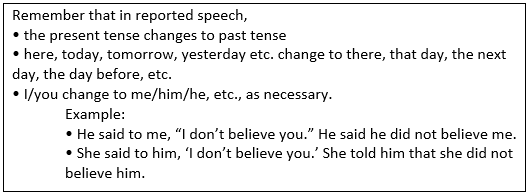
IV. Reported questions Study these sentences:
His friend asked, “Did you see the snake the next day, doctor?” His friend asked the doctor whether/if he had seen the snake the next day.
The little girl wondered, “Will I be home before the TV show begins? The little girl wondered if/whether she would be home before the TV show began.
Someone asked, “Why has the thief left the vest behind?” Someone asked why the thief had left the vest behind.
The words if/whether are used to report questions which begin with: do, will, can, have, are etc. These questions can be answered ‘yes’ or ‘no’. Questions beginning with why/when/where/how/which/what are reported using these same words. The reporting verbs we use in questions with if/whether/why/when etc. are: ask, inquire and wonder. Report these questions using if/whether or why/when/where/how/which/what. Remember the italicized verbs change into the past tense. Q1: Meena asked her friend, “Do you think your teacher will come today?” Ans: Meena asked her friend if she thought her teacher would come that day.
Q2: David asked his colleague, “Where will you go this summer?” Ans: David asked his colleague where he would go that summer.
Q3: He asked the little boy, “Why are you studying English?” Ans: He asked the little boy why he was studying English.
Q4: She asked me, “When are we going to leave?” Ans: She asked me when we were going to leave.
Q5: Pran asked me, “Have you finished reading the newspaper?” Ans: Pran asked me if I had finished reading the newspaper.
Q6: Seema asked her, “How long have you lived here?” Ans: Seema asked her how long she had lived there.
Q7: Sheila asked the children “Are you ready to do the work?” Ans: Sheila asked the children if they were ready to do the work.
Q1: What kind of place is Innisfree? Think about: (i) the three things the poet wants to do when he goes back there (stanza I); Ans: (a) The poet wants to build a small cabin of clay and wattles. (b) He wants to plant nine rows of beans. (c) he wants to have a hive for honeybees.
(ii) what he hears and sees there and its effect on him (stanza II); Ans: (a) He hears the cricket’s song. (b) He hears linnets flying in the sky. (c) He sees glimmering midnight and glowing rooms.
(iii) what he hears in his “heart’s core” even when he is far away from Innisfree (stanza III). Ans: When the poet is far away from Innisfree he hears the sound of the lake water washing the shorein his “heart’s core”, which resonates deeply within him, even when he is far removed from Innisfree. This connection to the natural sounds of Innisfree continues to soothe him no matter where he is.
Q2: By now you may have concluded that Innisfree is a simple, natural place, full of beauty and peace. How does the poet contrast it with where he now stands? (Read stanza III). Ans: The poet contrasts the vibrant natural beauty of Innisfree with the dull and lifeless roadways and grey pavements of the city he now resides. The term “grey” symbolises the absence of colour and vitality, highlighting the city’s lack of liveliness compared to Innisfree’s serene and colourful environment.
Q3: Do you think Innisfree is only a place or a state of mind? Does the poet actually miss the place of his boyhood days? Ans: Innisfree is not just a physical location but also a state of mind for the poet. While it represents the poet’s boyhood memories, it symbolizes an idealized escape from the chaotic city life to a place of peace and serenity. The poet longs for the tranquility that Innisfree offers, a contrast to his current surroundings. Though he is physically distant from Innisfree, he carries its soothing memories within him, which continuously resonate through the sound of the lake water in his heart.
II. Q1: Look at the words the poet uses to describe what he sees and hears at Innisfree (i) Bee-loud glade (ii) Evenings full of the linnet’s wings (iii) Lake water lapping with low sounds What pictures do these words create in your mind? Ans: (i) “Bee-loud glade” evokes an image of a forest clearing filled with the gentle buzzing of honeybees, creating a tranquil and natural atmosphere. (ii) “Evenings full of the linnet’s wings” paints a picture of a red-orange sky brimming with linnets. These beautiful birds enhance the place’s scenic beauty as they flutter and fly, adding a sense of liveliness to the evening. (iii) “Lake water lapping with low sounds” immerses us in a peaceful scene where the lake’s gently flowing water produces a soothing sound, contributing to the serene ambience of the setting.
Q2: Look at these words; …peace comes dropping slow Dropping from the veils of the morning to where the cricket sings What do these words mean to you? What do you think “comes dropping slow…from the veils of the morning”? What does “to where the cricket sings” mean? Ans: The given lines indicate that peace of mind can be slowly acquired from the natural surroundings. It is peace that “comes dropping slow…from the veils of the morning”. The phrase “to where the cricket sings” indicates a peaceful place where one can hear the vibrant sounds of nature− sounds such as the songs of the crickets at the time of dawn.