12. Statistics – Textbook Solutions (Exercise 12.1)

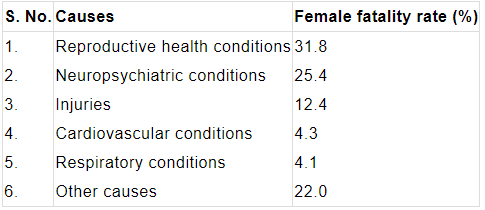
Q1. A survey conducted by an organisation for the cause of illness and death among the women between the ages 15–44 (in years) worldwide, found the following figures (in %):
(i) Represent the information given above graphically.
(ii) Which condition is the major cause of women’s ill health and death worldwide?
(iii) Try to find out, with the help of your teacher, any two factors which play a major role in the cause in (ii) above being the major cause.
Ans: 
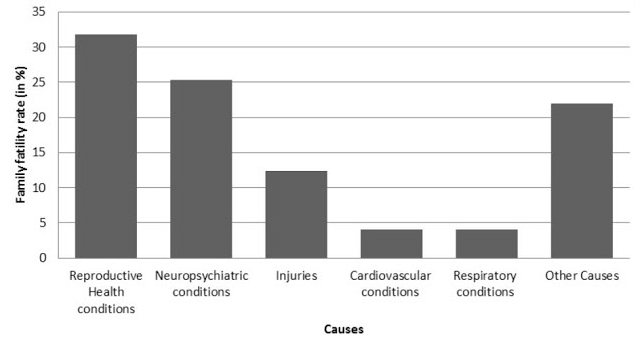
(i) The information given in the question is represented below graphically.

(ii) We can observe from the graph that reproductive health conditions is the major cause of women’s ill health and death worldwide.
(iii) Two factors responsible for cause in (ii) are:

  • Lack of proper care and understanding.
  • Lack of medical facilities.


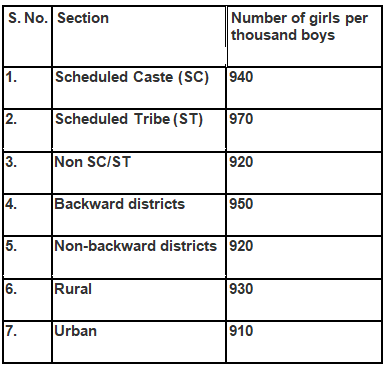
Q2. The following data on the number of girls (to the nearest ten) per thousand boys in different sections of Indian society is given below.

(i) Represent the above information by a bar graph.
Ans: (i) The information given in the question is represented below graphically.
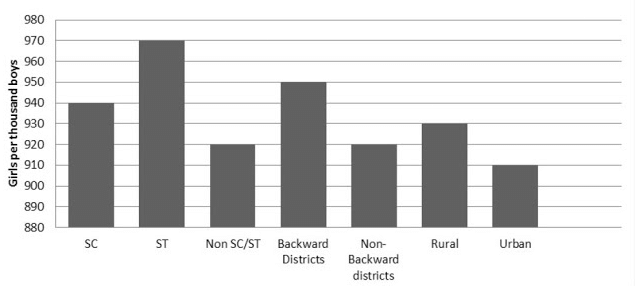
(ii) From the above graph, we can conclude that the maximum number of girls per thousand boys is present in the section ST. We can also observe that the backward districts and rural areas have more number of girls per thousand boys than non-backward districts and urban areas.

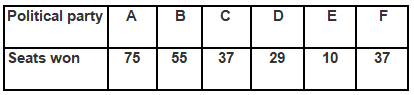
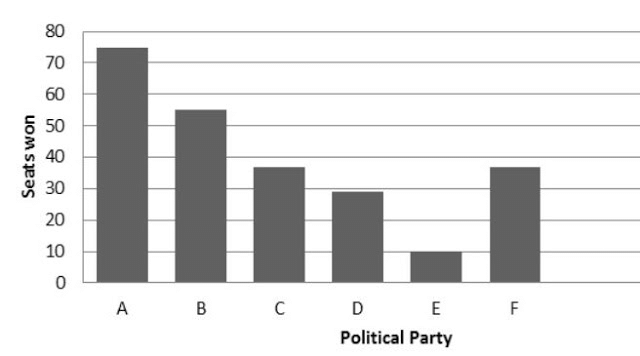
Q3. Given below are the seats won by different political parties in the polling outcome of a state assembly elections:
(i) Draw a bar graph to represent the polling results.
(ii) Which political party won the maximum number of seats?
Ans:
(i) The bar graph representing the polling results is given below:

(ii) From the bar graph it is clear that Party A won the maximum number of seats.
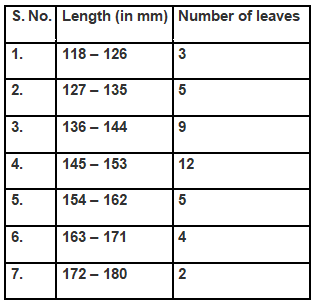
Q4. The length of 40 leaves of a plant are measured correct to one millimetre, and the obtained data is represented in the following table:
 (i) Draw a histogram to represent the given data. [Hint: First make the class intervals continuous]
 (ii) Is there any other suitable graphical representation for the same data?
 (iii) Is it correct to conclude that the maximum number of leaves are 153 mm long? Why?
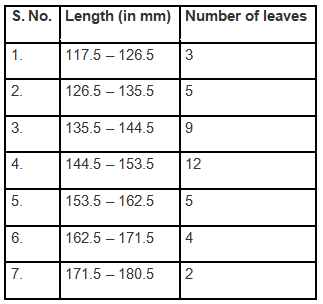
Ans: (i) The data given in the question is represented in discontinuous class interval. So, we have to make it in continuous class interval. The difference is 1, so taking half of 1, we subtract ½ = 0.5 from lower limit and add 0.5 to the upper limit. Then the table becomes:
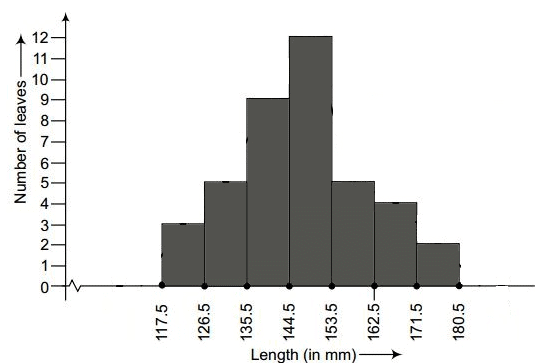
(ii) Yes, the data given in the question can also be represented by frequency polygon.
No, we cannot conclude that the maximum number of leaves are 153 mm long because the maximum number of leaves are lying in-between the length of 144.5 – 153.5
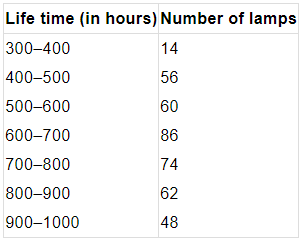

Q5. The following table gives the life times of 400 neon lamps:

(i) Represent the given information with the help of a histogram.
(ii) How many lamps have a life time of more than 700 hours?
Ans:
(i) The histogram representation of the given data is given below:
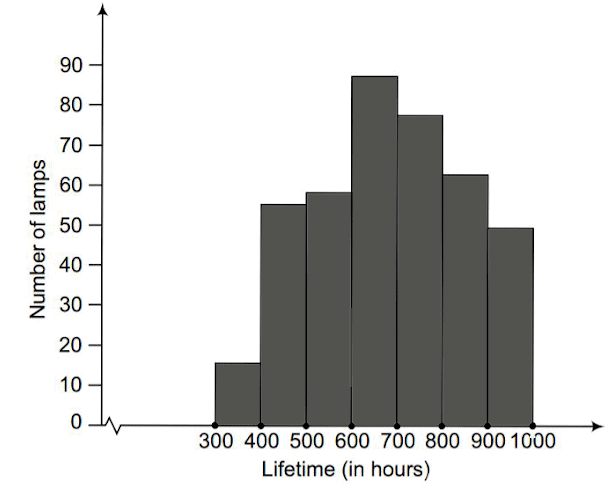
(ii) Number of lamps having life time more than 700 hours = 74 + 62 + 48 = 184.
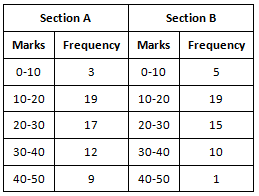

Q6. The following table gives the distribution of students of two sections according to the marks obtained by them:
Represent the marks of the students of both the sections on the same graph by two frequency polygons. From the two polygons compare the performance of the two sections.
Ans: 
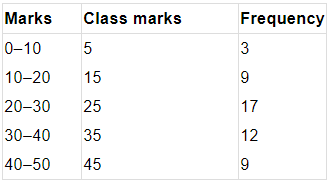
The class-marks = (lower limit + upper limit)/2
For section A,
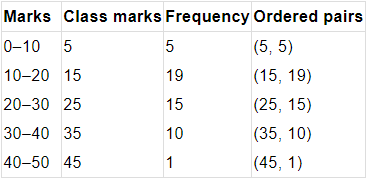
For section B:

 Representing these data on a graph using two frequency polygon we get,
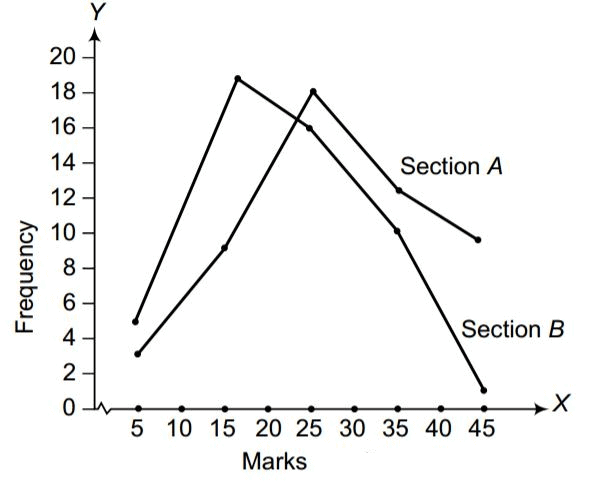
 From the graph, we can conclude that the students of Section A performed better than Section B.

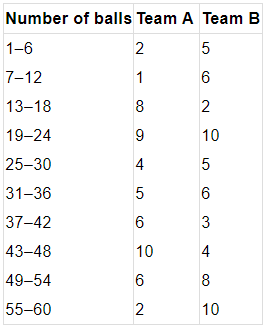
Q7. The runs scored by two teams A and B on the first 60 balls in a cricket match are given below:
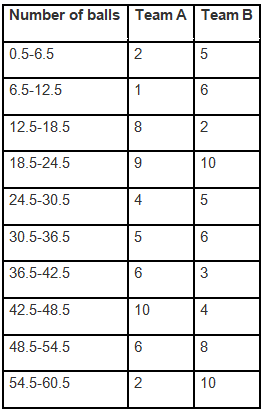
Represent the data of both the teams on the same graph by frequency polygons.
Note: The given class intervals are not continuous. Therefore, we first modify the distribution as continuous.
Ans: 
The data given in the question is represented in discontinuous class interval. So, we have to make it in continuous class interval. The difference is 1, so taking half of 1, we subtract ½ = 0.5 = 0.5 from lower limit and add 0.5 to the upper limit. Then the table becomes:
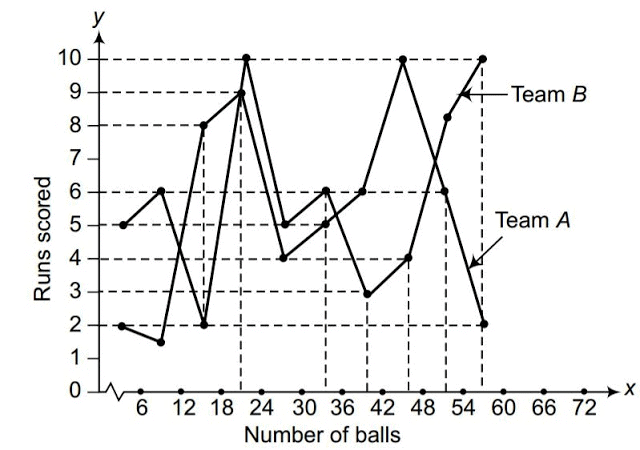
The data of both the teams are represented on the graph below by frequency polygons.

Q8. A random survey of the number of children of various age groups playing in a park was found as follows:
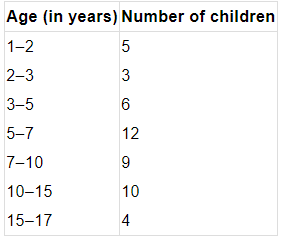
Draw a histogram to represent the above data.
Ans: 
The width of the class intervals in the given data is varying.
We know that,
The area of rectangle is proportional to the frequencies in the histogram.
Thus, the proportion of the children per year can be calculated as given in the table below.
Now, we draw the histogram taking ages (in years) on the x-axis and corresponding adjusted frequencies on the y-axis as shown below:
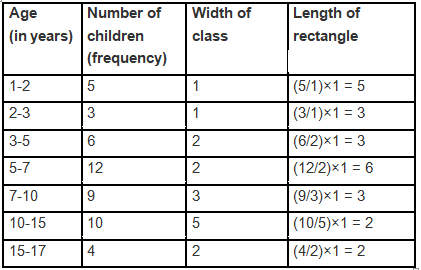
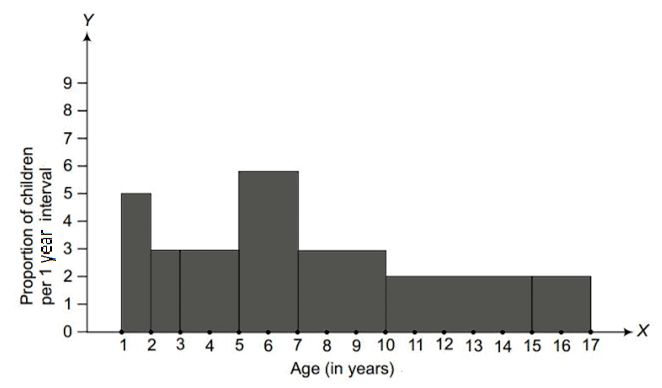
Let x-axis = the age of children
y-axis = proportion of children per 1 year interval

Q9. 100 surnames were randomly picked up from a local telephone directory and a frequency distribution of the number of letters in the English alphabet in the surnames was found as follows:
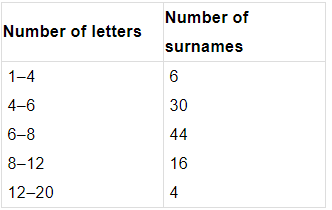
(i) Draw a histogram to depict the given information.
(ii) Write the class interval in which the maximum number of surnames lie.

Ans: 
(i) The width of the class intervals in the given data is varying.
We know that,
The area of rectangle is proportional to the frequencies in the histogram.
Thus, the proportion of the number of surnames per 2 letters interval can be calculated as given in the table below.
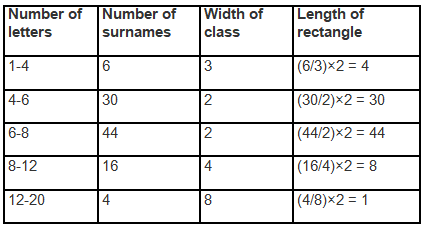
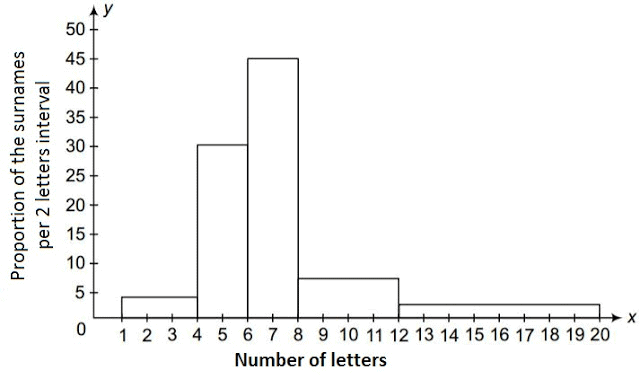
(ii) 6-8 is the class interval in which the maximum number of surnames lie.


MEASURES OF CENTRAL TENDENCY

We can make out some important features of given data by considering only certain representatives.

These representatives are called the measures of central tendency or averages. There are three main averages: Mean, Median and Mode.
Mean The mean (or average) of a number of observations is the sum of the values of all the observations divided by the total number of observations. It is denoted by the symbol x and we read it as x-bar.
Thus, the mean
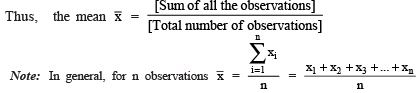
Here, ∑ is a Greek symbol called sigma.
The summation  is read as the sum of the x as i varies from 1 to n.


Mode 

The mode is the value of the observation which occurs most frequently, i.e., an observation with the maximum frequency is called the mode of the data.
Note: In a given data, the value around which there is greatest concentration, is called the mode of the data.

Median After arranging the given data in an ascending or a descending order of magnitude, the value of the middle-most observation is called the median of the data.
Note: For ‘n’ observations (taken in order),

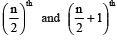
(i) if n is odd, the median = value of observation.
(ii) if n is even, the median = mean of   observations.
11. Surface Areas and Volumes – Textbook Solutions (Exercise 11.1, 11.2, 11.3 and 11.4)

Exercise 11.1

Q1. Diameter of the base of a cone is 10.5 cm and its slant height is 10 cm. Find its curved surface area (Assume π = 22 / 7)
Ans: Radius of cone r = 10.5/2 = 5.25 cm and Slant height (l) = 10 cm
Curved surface area of cone = πrl
= 22/7 × 5.25 × 10
= 22 × 0.75 × 10 = 165 cm2
Hence, the curved surface area of cone is 165 cm2.


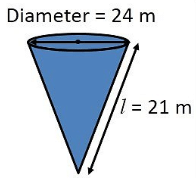
Q2. Find the total surface area of a cone, if its slant height is 21 m and diameter of its base is 24 m. (Assume π = 22 / 7)
Ans:
 

Radius (r) = 24/2 m = 12 m
Slant height (l) = 21 m
Total surface area of the cone = πr (l + r) m
= 22/7 × 12 × (21 + 12) m
= (22/7 × 12 × 33) m
= 1244.57 m2


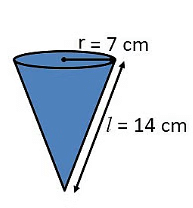
Q3. Curved surface area of a cone is 308 cm2 and its slant height is 14 cm. Find
(i) radius of the base and
(ii) total surface area of the cone. (Assume π = 22 / 7)

Ans: (i) Curved surface area of cone = 308 cm2 and slant height / = 14 cm
Let, the radius of base of cone = r cm
Curved surface area of cone = πrl
⇒ 308 = 22/7 × r × 14
⇒ 308 = 44r
⇒ r = 308/44 = 7 cm
Hence, the radius of base of cone is 7 cm.
(ii) Total surface area of cone = πr(r + l)
= 22/7 × 7 × (7 + 14)
= 22 × 21 = 462 cm
Hence, the total surface area of cone is 462 cm2.


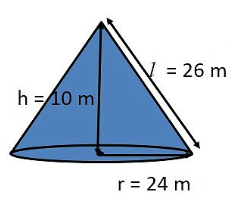
Q4. A conical tent is 10 m high and the radius of its base is 24 m. Find
(i) slant height of the tent.
(ii) cost of the canvas required to make the tent, if the cost of 1 m2 canvas is Rs 70. (Assume π = 22 / 7)
Ans:
 (i) Radius of cone r = 24 m and height h = 10 m
Let, the slant height = l m
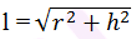
We know that, l2 = r2 + h2
⇒ l2 =24+102 = 576 + 100 = 676
l = √676 = 26m
(ii) Area of canvas to make the tent = πrl
22/7 × 24 × 26 m2
Cost of 1 m2 canvas = ₹ 70
Therefore, the cost of 22/7 × 24 × 26 m2 canvas = ₹ 70 × 22/7 × 24 × 26 = ₹ 137280
Hence, the cost of canvas to make the tent is ₹ 137280.


Q5. What length of tarpaulin 3 m wide will be required to make conical tent of height 8 m and base radius 6m? Assume that the extra length of material that will be required for stitching margins and wastage in cutting is approximately 20 cm. [Use π = 3.14]
Ans: Radius of cone r = 6 m and height h = 8 m
Let, the slant height = l m
We know that, l2 = r2 + h
⇒ l2 = 62 + 82 = 36 + 64 = 100 ⇒ l = √100 = 10 m
Area of tarpaulin to make the tent = πrl
= 3.14 × 6 × 10 = 188.40m
Let, the length of 3 m wide tarpaulin = L, therefore, the area of tarpaulin required = 3 × L
According to question,
3 × L = 188.40 ⇒ L = 188.40/3 = 62.80 m
Extra tarpaulin for stitching margins and wastage = 20 cm = 0.20 m
Therefore, the total length of tarpaulin = 62.80 + 0.20 = 63 m
Hence, the length of 3 m wide tarpaulin is 63 m to make the tent.


Q6. The slant height and base diameter of conical tomb are 25m and 14 m respectively. Find the cost of white-washing its curved surface at the rate of Rs. 210 per 100 m2. (Assume π = 22 / 7).
Ans: Radius of conical tomb r = 14/2 = 7 m and slant height / = 25 m/
Curved surface area of conical tomb = πrl
= 22/7 × 7 × 25 = 550 m
Cost of white washing at the rate of ₹ 210 per 100 m2 = ₹550 × 210/100 = ₹1155
Hence, the cost of white washing curved surface area is ₹ 1155.


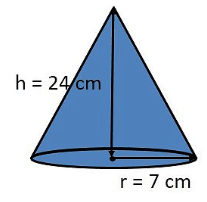
Q.7. A joker’s cap is in the form of right circular cone of base radius 7 cm and height 24cm. Find the area of the sheet required to make 10 such caps. (Assume π = 22 / 7)
Ans:
 Radius of conical cap, r = 7 cm
Height of conical cap, h = 24cm We know that, l2 = (r2 + h2)
⇒ l2 = 72 + 242 = 49 + 576 = 625 ⇒ l = √625 = 25 cm
Area of sheet required to make 1 cap = πrl
= 22/7 × 7 × 25 = 550 cm2
Therefore, area of sheet required to make 10 such caps = 10 × 550 = 5500 cm2
Hence, area of sheet to make 10 such caps is 5500 cm2.


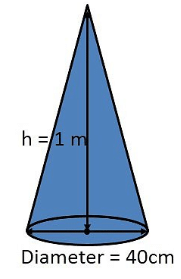
Q8. A bus stop is barricaded from the remaining part of the road, by using 50 hollow cones made of recycled cardboard. Each cone has a base diameter of 40 cm and height 1 m. If the outer side of each of the cones is to be painted and the cost of painting is Rs. 12 per m2, what will be the cost of painting all these cones? (Use π = 3.14 and take √(1.04) = 1.02).
Ans: 
Radius of cone r = 40/2 = 20 cm = 0.2 m and height h = 1 m
Let the slant height = l m
 We know that l2 = r2 + h
⇒ l2= (0.2)2 + 12 = 0.04 + 1 = 1.04
⇒ l= √1.04 = 1.02 m
Curved surface area of cone = πrl
= 3.14 × 0.2 × 1.02 = 6.4056m
Curved surface area of 50 cones
= 50 × 6.4056
= 32.028 m
Cost of painting at the rate of ₹12 per m
= ₹12 × 32.028
= ₹384.34 (approx.)
Hence, the cost of painting the curved surface of 50 cones is ₹384.34


Exercise 11.2

Q1. Find the surface area of a sphere of radius:
(i) 10.5cm
(ii) 5.6cm
(iii) 14cm
(Assume π = 22 / 7)

Ans: (i) Radius of sphere r = 10.5 cm
Surface area of sphere = 4πr
= 4 × 22/7 × 10.5 × 10.5 = 4 × 22 × 1.5 × 10.5 = 1386.00 cm2
Hence, the surface area of sphere is 1386 cm2.
(ii) Radius of sphere r = 5.6 cm
Surface area of sphere = 4πr
= 4 × 22/7 × 5.6 × 5.6 = 4 × 22 × 0.8 × 5.6 = 394.24 cm
Hence, the surface area of sphere is 394.24 cm2.
(iii) Radius of sphere r = 14 cm
Surface area of sphere = 4πr
= 4 × 22/7 × 14 × 14 = 4 × 22 × 2 × 14 = 2464 cm
Hence, the surface area of sphere is 2464 cm2.


Q2. Find the surface area of a sphere of diameter:
(i) 14 cm
(ii) 21 cm
(iii) 3.5 cm
(Assume π = 22 / 7)

Ans: (i) Radius of sphere r = 14/2 = 7 cm
Surface area of sphere = 4πr
= 4 × 22/7 × 7 × 7 = 4 × 22 × 7 = 616 cm
Hence, the surface area of sphere is 616 cm2.
(ii) Radius of sphere r = 21/2 = 10.5 cm
Surface area of sphere = 4πr
= 4 × 22/7 × 10.5 × 10.5 = 4 × 22 × 1.5 × 10.5 = 1386 cm
Hence, the surface area of sphere is 1386 cm2.
(iii) Radius of sphere r = 3.5/2 = 1.75 cm
Surface area of sphere = 4π
= 4 × 22/7 × 1.75 × 1.75 = 4 × 22 × 0.25 × 1.75
= 38.50 cm
Hence, the surface area of sphere is 38.5 cm2.


Q3. Find the total surface area of a hemisphere of radius 10 cm. [Use π = 3.14]
Ans:
 Radius of hemisphere r = 10 cm
Surface area of hemisphere = 3πr2
= 3 × 3.14 × 10 × 10 = 942 cm2
Hence, the total surface area of hemisphere is 942 cm2.


Q4. The radius of a spherical balloon increases from 7 cm to 14 cm as air is being pumped into it. Find the ratio of surface areas of the balloon in the two cases.
Ans: Let r be the initial radius and R be the increased radius of balloons.
r = 7cm and R = 14cm
Ratio of the surface area =4πr2/4πR2
= r2/R2
= (7 × 7)/(14 × 14) = 1/4
Thus, the ratio of surface areas = 1 : 4


Q5. A hemispherical bowl made of brass has inner diameter 10.5 cm. Find the cost of tin-plating it on the inside at the rate of Rs 16 per 100 cm2. (Assume π = 22 / 7)
Ans: Radius of the bowl (r) = 10.5/2 cm = 5.25 cm
Curved surface area of the hemispherical bowl = 2πr2
= (2 × 22/7 × 5.25 × 5.25) cm2
= 173.25 cm2
Rate of tin – plating is = ₹16 per 100 cm2
Therefor, cost of 1 cm= ₹16/100 
Total cost of tin-plating the hemisphere bowl = 173.25 × 16/100
= ₹27.72

Q6. Find the radius of a sphere whose surface area is 154 cm2. (Assume π = 22/7)
Ans:
 Let r be the radius of the sphere.
Surface area = 154 cm2
⇒ 4πr= 154
⇒ 4 × 22/7 × r= 154
⇒ r= 154/(4 × 22/7)
⇒ r= 49/4
⇒ r = 7/2 = 3.5 cm

Q7. The diameter of the moon is approximately one fourth of the diameter of the earth. Find the ratio of their surface areas.
Ans: Let the diameter of earth be r and that of the moon will be r/4
Radius of the earth = r/2
Radius of the moon = r/8
Ratio of their surface area = 4π(r/8)2/4π(r/2)2
= (1/64)/(1/4)
= 4/64 = 1/16
Thus, the ratio of their surface areas is 1:16

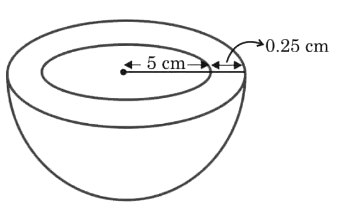
Q8. A hemispherical bowl is made of steel, 0.25 cm thick. The inner radius of the bowl is 5cm. Find the outer curved surface of the bowl. (Assume π = 22 / 7)
Ans: 

Internal radius of hemispherical bowl r = 5 cm and thickness = 0.25 cm
Therefore,
The outer radius of hemispherical bowl
= R = 5 + 0.25 = 5.25 cm
Outer curved surface area of hemispherical bowl = 2πR
= 2 × 22/7 × 5.25 × 5.25
= 2 × 22 × 0.75 × 5.25
= 173.25 cm
Hence, the outer curved surface area of hemispherical bowl is 173.25 cm2.


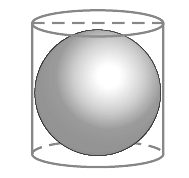
Q9. A right circular cylinder just encloses a sphere of radius r (see Fig). Find
(i) surface area of the sphere,
(ii) curved surface area of the cylinder,
(iii) ratio of the areas obtained in(i) and (ii).

Ans: (i) Radius of sphere = radius of cylinder = r
Hence, the surface area of sphere = 4πr
(ii) Radius of cylinder = r and height h = diameter of sphere = 2r
Hence, the curved surface area of cylinder = 2πrh = 2πr(2r) = 4πr
(iii) Now, Surface area of sphere/Curved surface area of cylinder = 4πr2/4πr= 1/1
Hence, the ratio of surface area of sphere to curved surface area of cylinder is 1 : 1.

Exercise 11.3

Q1. Find the volume of the right circular cone with
(i) radius 6 cm, height 7 cm
(ii) radius 3.5 cm, height 12 cm (Assume π = 22 / 7)
Ans: 
(i) Radius (r) = 6 cm
Height (h) = 7 cm
Volume of the cone = 1/3 πr2h
= (1/3 × 22/7 × 6 × 6 × 7) cm
= 264 cm
(ii) Radius (r) = 3.5 cm
Height (h) = 12 cm
Volume of the cone = 1/3 πr2h
= 154 cm3


Q2. Find the capacity in litres of a conical vessel with
(i) radius 7 cm, slant height 25 cm
(ii) height 12 cm, slant height 13 cm (Assume π = 22 / 7)
Ans: (i) 
Radius (r) = 7 cm
Slant height (l) = 25 cm
Let h be the height of the conical vessel.
∴ h = √l2 – r2
⇒ h = √252 – 7
⇒ h = √576 
⇒ h = 24 cm
Volume of the cone = 1/3 πr2h
= (1/3 × 22/7 × 7 × 7 × 24) cm3
= 1232 cm3  
Capacity of the vessel = (1232/1000) = 1.232 litres
(ii) Height (h) = 12 cm
Slant height (l) = 13 cm
Let r be the radius of the conical vessel.
∴ r = √l2 – h
⇒ r = √132 – 122
⇒ r = √25 
⇒ r = 5 cm
Volume of the cone = 1/3 πr2h
= (1/3 × 22/7 × 5 × 5 × 12) cm
= (2200/7) cm
Capacity of the vessel = (2200/7000) l = 11/35 litres


Q3. The height of a cone is 15cm. If its volume is 1570cm3, find the diameter of its base. (Use π = 3.14)
Ans: 
 Height (h) = 15 cm
Volume = 1570 cm3
Let the radius of the base of cone be r cm
∴ Volume = 1570 cm
⇒ 1/3 πr2h = 1570
⇒ 13 × 3.14 × r2 × 15 = 1570
⇒ r2 = 1570/(3.14×5) = 100
⇒ r = 10 cm 
Diameter of base = 2r = 2 x 10 = 20 cm 


Q4. If the volume of a right circular cone of height 9 cm is 48π cm3, find the diameter of its base.
Ans: 
 Given height of a cone, h = 9 cm
Volume of the cone = 48
(1/3)r2h = 48
(1/3)r× 9 = 48
3r2 = 48
r2 = 48/3 = 16
r = 4
So diameter = 2 × radius
= 2 × 4
= 8 cm
Hence the diameter of the cone is 8 cm.


Q5. A conical pit of top diameter 3.5 m is 12 m deep. What is its capacity in kilolitres? (Assume π = 22 / 7)
Ans: 
 Radius of pit r = 3.5/2 = 1.75 m and height h = 12 m.
Volume of pit = 1/3 πr2h
= 1/3 × 22/7 × 1.75 × 1.75 × 12 = 38.5 m3
= 38.5 Kilolitres [∴ 1 m3 = 1 kilolitres]
Hence, the capacity of the pit is 38.5 kilolitres.

Q6. The volume of a right circular cone is 9856 cm3. If the diameter of the base is 28 cm, find
(i) height of the cone
(ii) slant height of the cone
(iii) curved surface area of the cone (Assume π = 22 / 7)

Ans:  (i) Diameter of the base of the cone = 28 cm
Radius (r) = 28/2 cm = 14 cm
Let the height of the cone be h cm
Volume of the cone = 13πr2h = 9856 cm3 
⇒ 1/3 πr2h = 9856
⇒ 1/3 × 22/7 × 14 × 14 × h = 9856
⇒ h = (9856 × 3)/(22/7 × 14 × 14)
⇒ h = 48 cm
(ii) Radius (r) = 14 m
Height (h) = 48 cm
Let l be the slant height of the cone
l2 = h+ r2
⇒ l2 = 48+ 142
⇒ l2 = 2304+196
⇒ l= 2500
⇒ ℓ = √2500 = 50 cm

(iii) Radius (r) = 14 m
Slant height (l) = 50 cm
Curved surface area = πrl
= (22/7 × 14 × 50) cm2
= 2200 cm2

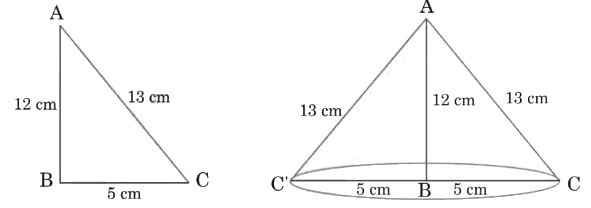
Q7. A right triangle ABC with sides 5 cm, 12 cm and 13 cm is revolved about the side 12 cm. Find the volume of the solid so obtained.
Ans: 
If the triangle is revolved about 12 cm side, a cone will be formed.

Therefore, the radius of cone r = 5 cm, height h = 12 cm and slant height l =13 cm.
Volume of solid (cone) = 1/3 πr2
= 1/3 × π × 5 × 5 × 12 = 100 π cm
Hence, the volume of solid is 100π cm3.


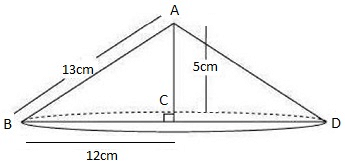
Q8. If the triangle ABC in the Question 7 is revolved about the side 5cm, then find the volume of the solids so obtained. Find also the ratio of the volumes of the two solids obtained in Questions 7 and 8.
Ans: 

A right-angled ΔABC is revolved about its side 5cm, a cone will be formed of radius as 12 cm, height as 5 cm, and slant height as 13 cm.

Volume of cone = (1/3) πr2h; where r is the radius and h be the height of cone

= (1/3) × π × 12 × 12 × 5

= 240 π

The volume of the cones of formed is 240π cm3.

So, required ratio = (result of question 7) / (result of question 8) = (100π) / (240π) = 5 / 12 = 5 : 12.


Q9. A heap of wheat is in the form of a cone whose diameter is 10.5 m and height is 3 m. Find its volume. The heap is to be covered by canvas to protect it from rain. Find the area of the canvas. (Assume π = 22 / 7)
Ans:  
Radius (r) of heap = (10.5 / 2) m = 5.25

Height (h) of heap = 3m

Volume of heap = (1 / 3)πr2h

= (1 / 3) × (22 / 7) × 5.25 × 5.25 × 3

= 86.625 m3

The volume of the heap of wheat is 86.625 m3. Again,

Area of canvas required = CSA of cone = πrl, where l = 

After substituting the values, we have

= (22 / 7) × 5.25 × 6.05

= 99.825

Therefore, the area of the canvas is 99.825 m2.

Exercise 11.4

Q1. Find the volume of a sphere whose radius is
(i) 7 cm
(ii) 0.63 m (Assume π = 22 / 7)
Ans: (i)
 Radius of sphere, r = 7 cm
Using, Volume of sphere = (4 / 3) πr3
= (4 / 3) × (22 / 7) × 73 = 4312 / 3
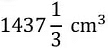
Hence, volume of the sphere is 
(ii) Radius of sphere, r = 0.63 m
Using, volume of sphere = (4 / 3) πr3
= (4 / 3) × (22 / 7) × 0.633 = 1.0478
Hence, volume of the sphere is 1.05 m3 (approx).

Q2. Find the amount of water displaced by a solid spherical ball of diameter
(i) 28 cm
(ii) 0.21 m (Assume π = 22 / 7)
Ans: (i) 
Radius of spherical ball r = 28/2 = 14 cm
Volume of water displaced by spherical ball = 4/3 πr3
= 4/3 × 22/7 × 14 × 14 × 14
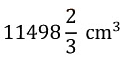
= 4/3 × 22 × 2 × 14 × 14 = 

or =11498.67 cm3

(ii) Radius of spherical ball r = 0.21/2 = 0.105 m

Volume of water displaced by spherical ball = 4/3 πr

= 4/3 × 22/7 × 0.105 × 0.105 × 0.105 = 4 × 22 × 0.005 × 0.63 × 0.63 = 0.004861 m

Hence, the volume of water displaced by spherical ball is 0.004861 m3.


Q3. The diameter of a metallic ball is 4.2cm. What is the mass of the ball, if the density of the metal is 8.9 g per cm3? (Assume π = 22 / 7)
Ans:  
Radius of metallic ball r = 4.2/2 = 2.1 cm
Therefore, the volume of metallic ball = 4/3 πr
= 4/3 × 22/7 × 2.1 × 2.1 × 2.1 
= 4 × 22 × 0.1 × 2.1 × 2.1 = 38.808 cm3
Here, the mass of 1 cm3 = 8.9 g 
So, the mass of 38.808 cm3 = 8.9 × 38.808 = 345.39 g (approx.)
Hence, the mass of the ball is 345.39 gram.

Q4. The diameter of the moon is approximately one-fourth of the diameter of the earth. What fraction of the volume of the earth is the volume of the moon?
Ans: 
 Let the diameter of earth be “d”. Therefore, the radius of earth will be will be d/2
Diameter of moon will be d / 4 and the radius of moon will be d/8
Find the volume of the moon:
Volume of the moon = (4 / 3) πr3 = (4 / 3) π (d / 8)3 = 4 / 3π(d3 / 512)
Find the volume of the earth:
Volume of the earth = (4 / 3) πr3 = (4 / 3) π (d / 2)3 = 4 / 3π(d3 / 8)
Fraction of the volume of the earth is the volume of the moon

Volume of moon is of the 1 / 64 volume of earth.

Q5. How many litres of milk can a hemispherical bowl of diameter 10.5cm hold? (Assume π = 22 / 7)
Ans: 
 Diameter of hemispherical bowl = 10.5 cm
Radius of hemispherical bowl, r = 10.5 / 2 cm = 5.25 cm
Formula for volume of the hemispherical bowl = (2 / 3) πr3
Volume of the hemispherical bowl = (2 / 3) × (22 / 7) × 5.253 = 303.1875
Volume of the hemispherical bowl is 303.1875 cm3
Capacity of the bowl = (303.1875) / 1000 L = 0.303 litres(approx.)
Therefore, hemispherical bowl can hold 0.303 litres of milk.

Q6. A hemi spherical tank is made up of an iron sheet 1cm thick. If the inner radius is 1 m, then find the volume of the iron used to make the tank. (Assume π = 22/7)
Ans: 
 Inner Radius of the tank, (r) = 1m
Outer Radius (R) = 1.01m
Volume of the iron used in the tank = (2 / 3) π (R3 – r3)
Put values,
Volume of the iron used in the hemispherical tank = (2 / 3) × (22 / 7) × (1.013 – 13) = 0.06348
So, volume of the iron used in the hemispherical tank is 0.06348 m3.

Q7. Find the volume of a sphere whose surface area is 154 cm2. (Assume π = 22 / 7)
Ans: 
 Surface area of sphere A = 154 cm2
Let, the radius of sphere = r cm
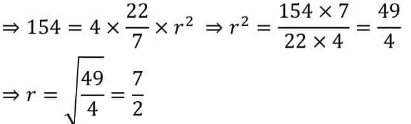
We know that the surface area of sphere = 4πr

Volume of surface 4/3 πr3

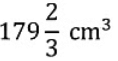
Hence, the volume of sphere is .


Q8. A dome of a building is in the form of a hemisphere. From inside, it was white-washed at the cost of ₹ 4989.60. If the cost of white-washing is ₹ 20 per square meter, find the
(i) Inside surface area of the dome
(ii) volume of the air inside the dome (Assume π = 22 / 7)
Ans: (i) 
Let the internal radius of dome = r m
Internal surface area of dome = 2πr
Cost of white washing at the rate of ₹2 = 2πr2 × ₹2 = ₹4πr2
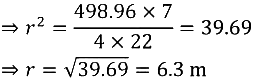
⇒ ₹4πr2 = ₹498.96
⇒ 4 × 22/7 × r2 = 498.96

Therefore, the internal surface of dome = 2πr
= 2 × 22/7 × (6.3)2
= 2 × 22/7 × 6.3 × 6.3 
= 2 × 22 × 0.9 × 6.3
= 249.48 m
Hence, the inside surface area of the dome is 249.48 m2.
(ii) Volume of the air inside the dome = 2/3 πr
= 2/3 × 22/7 × (6.3)
= 2/3 × 22/7 × 6.3 × 6.3 × 6.3
= 2 × 22 × 0.3 × 6.3 × 6.3
= 523.9 cm
= Hence, the volume of the air inside the dome is 523.9 cm3.


Q9. Twenty-seven solid iron spheres, each of radius r and surface area S are melted to form a sphere with surface area S’. Find the
(i) radius r’ of the new sphere,
(ii) ratio of Sand S’.
Ans:  Volume of the solid sphere = (4 / 3)πr3
Volume of twenty seven solid sphere = 27 × (4 / 3)πr3 = 36 πr3
(i) New solid iron sphere radius = r’
Volume of this new sphere = (4/3)π(r’)3
(4 / 3)π(r’)3 = 36 πr3
(r’)3 = 27r3
r’= 3r
Radius of new sphere will be 3r (thrice the radius of original sphere)
(ii) Surface area of iron sphere of radius r, S = 4πr2
Surface area of iron sphere of radius r’= 4π (r’)2
Now
S / S’ = (4πr2) / ( 4π (r’)2)
S / S’ = r2 / (3r’)2 = 1 / 9
The ratio of S and S’ is 1: 9.


Q10. A capsule of medicine is in the shape of a sphere of diameter 3.5 mm. How much medicine (in mm3) is needed to fill this capsule? (Assume π = 22 / 7)
Ans: 
 Radius of capsule r = 3.5/2 = 1.75 mm
Volume of medicine to fill the capsule = 4/3πr3  
= 4/3 × 22/7 × 1.75 × 1.75 × 1.75
= 4/3 × 22 × 0.25 × 1.75 × 1.75
= 22.46 mm3 (approx.)
Hence, 22.46 mmmedicine is required to fill this capsule.

10. Heron’s Formula – Textbook Solutions (Exercise 10.1)

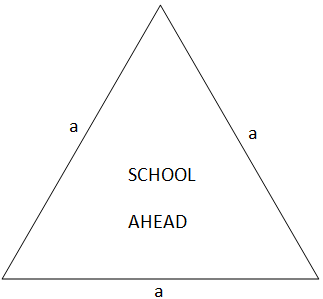
Q1. A traffic signal board, indicating ‘SCHOOL AHEAD’, is an equilateral triangle with side ‘a’. Find the area of the signal board, using Heron’s formula. If its perimeter is 180 cm, what will be the area of the signal board?
Ans: For an equilateral triangle with side ‘a’, area = (√3/4) a2 

∵ Each side of the triangle = a cm

The perimeter of the signal board will be
∴ a + a + a = 180 cm
3a = 180 cm
a= (180/3) = 60 cm
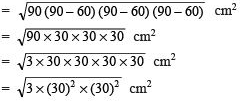
Now, Semi-perimeter (s)= (180/2) = 90 cm
∵ Area of triangle 
Area of the given triangle

= 30 x 30 x√3 = 900√3 cm2
Thus, the area of the given triangle = 900√3 cm2.


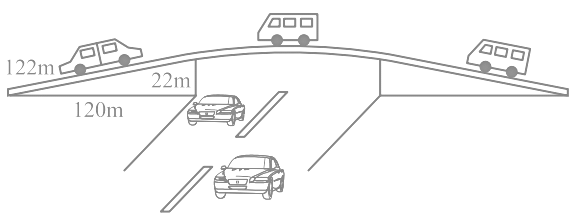
Q2. The triangular side walls of a flyover have been used for advertisements. The sides of the walls are 122 m, 22 m and 120 m (see Fig). The advertisements yield an earning of ₹ 5000 per m2 per year. A company hired one of its walls for 3 months. How much rent did it pay?
Ans: The sides of the triangular wall are a = 122 m, b = 120 m, c = 22 m.

Now, the perimeter will be 

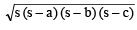
∵ The area of a triangle is given by

∵ Rent for 1 year (i.e. 12 months) per m2 = Rs 5000
∴ Rent for 3 months per m2 = Rs 5000 x (3/12)
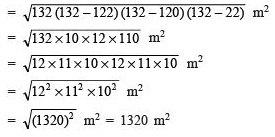
⇒ Rent for 3 months for 1320 m2 = 5000 x (3/12) x 1320 = 5000 x 3 x 110 = Rs 16,50,000.


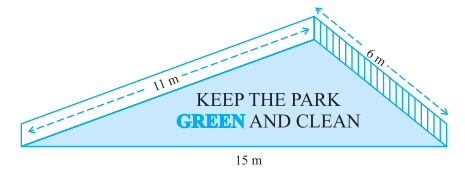
Q3. There is a slide in a park. One of its side walls has been painted in some colour with the message “KEEP THE PARK GREEN AND CLEAN” (see Fig). If the sides of the wall are 15 m, 11 m and 6 m, find the area painted in colour.

Ans: Sides of the wall a = 15 m, b = 11 m, c = 6 m.

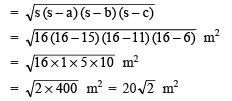
 The area of the triangular surface of the wall

Thus, the required area painted in colour = 20√2 m2.


Q4. Find the area of a triangle, two sides of which are 18 cm and 10 cm and the perimeter is 42 cm.
Ans: Let the sides of the triangle be a = 18 cm, b = 10 cm and c =?
∵ Perimeter (2s) = 42 cm
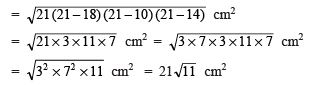
s = (42/2)  = 21 cm
c = 42 – (18 + 10) cm = 14 cm
∵ Area of a triangle = 
∴ Area of the given triangle

Thus, the required area of the triangle = 21√11 cm2.


Q5. Side of a triangle is in the ratio of 12: 17: 25 and its perimeter is 540 cm. Find its area.
Ans: The perimeter of the triangle = 540 cm.
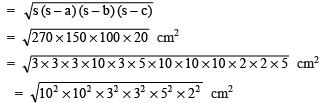
Semi-perimeter of the triangle, s= (540/2) = 270 cm
∵ The sides are in the ratio of 12: 17: 25.
∴ Let, the side be a = 12x cm, b = 17x cm, c = 25x cm.
12x + 17x + 25x = 540
54x = 540
x = (540/54) = 10
∴ a = 12 x 10 = 120 cm, b = 17 x 10 = 170 cm, c = 25 x 10 = 250 cm.
(s – a) = (270 – 120) cm = 150 cm
(s – b) = (270 – 170) cm = 100 cm
(s – c) = (270 – 250) cm = 20 cm
∴ Area of the triangle

= 10 x 10 x 3 x 3 x 5 x 2 cm2 = 9,000 cm2
Thus, the required area of the triangle = 9,000 cm2.

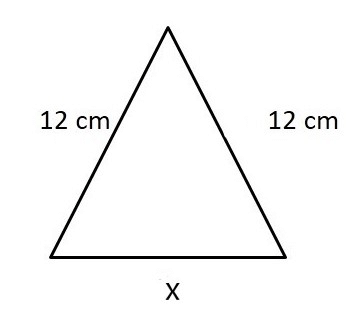
Q6. An isosceles triangle has a perimeter of 30 cm and each of the equal sides is 12 cm. Find the area of the triangle.
Ans: Equal sides of the triangle are 12 cm each.
Let the third side = x cm.

∵ Perimeter = 30 cm
∴ 12 cm + 12 cm + x cm = 30 cm
x = 30 – 12 – 12 = 6 cm
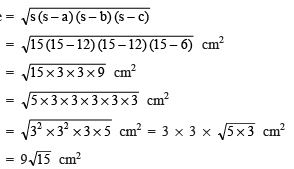
Semi-perimeter = (30/2) cm = 15 cm
∴ Area of the triangle

Thus, the required area of the triangle = 9√15 cm2.

09. Circles – Textbook Solutions (Exercise 9.1, 9.2 and 9.3)

Exercise 9.1

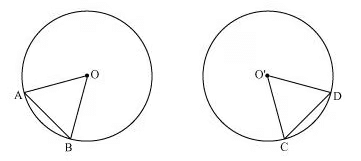
Q1. Recall that two circles are congruent if they have the same radii. Prove that equal chords of congruent circles subtend equal angles at their centres.
Ans: To recall, a circle is a collection of points whose every point is equidistant from its centre. So, two circles can be congruent only when the distance of every point of both circles is equal from the centre.
In the second part of the question, it is given that AB = CD, i.e. two equal chords. Now, it is to be proven that angle AOB is equal to angle COD.
Proof:
Consider the triangles ΔAOB and ΔCOD,
OA = OC and OB = OD (Since they are the radii of the circle)
AB = CD (As given in the question)
So, by SSS congruency, ΔAOB ≅ ΔCOD
∴ By CPCT, we get
∠AOB = ∠COD. 
Hence proved.


Q2. Prove that if chords of congruent circles subtend equal angles at their centres, then the chords are equal.
Ans: Consider the following diagramHere, it is given that ∠AOB = ∠COD, i.e. they are equal angles. Now, we will have to prove that the line segments AB and CD are equal, i.e. AB = CD.
Proof:
In triangles ΔAOB and ΔCOD,
∠AOB = ∠COD (as given in the question)
OA = OC and OB = OD (these are the radii of the circle)
So, by SAS congruency, ΔAOB ≅ ΔCOD.
∴ By the rule of CPCT, we get AB = CD
Hence proved.

Exercise 9.2

Q1. Two circles of radii 5 cm and 3 cm intersect at two points and the distance between their centres is 4 cm. Find the length of the common chord.
Ans: Given parameters are:
OP = 5cm
OS = 4cm and
PS = 3cm
Also, PQ = 2PR
Now, suppose RS = x. The diagram for the same is shown below.
Consider the ΔPOR,
OP2 = OR2 + PR2
⇒ 52 = (4 – x)2 + PR2
⇒ 25 = 16 + x2 – 8x + PR2
∴ PR2 = 9 – x2 + 8x — (i)
Now consider ΔPRS,
PS2 = PR2 + RS2
⇒ 32 = PR2 + x2
∴ PR2 = 9 – x2 — (ii)
By equating equation (i) and equation (ii) we get,
9 – x2 + 8x = 9 – x2
⇒ 8x = 0
⇒ x = 0
Now, put the value of x in equation (i)
PR2 = 9 – 02
⇒ PR = 3cm
∴ The length of the cord i.e. PQ = 2PR
So, PQ = 2 × 3 = 6cm.

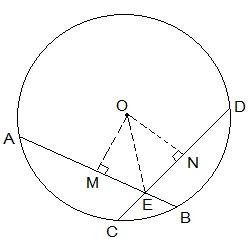
Q2. If two equal chords of a circle intersect within the circle, prove that the segments of one chord are equal to corresponding segments of the other chord.
Ans:
 Let AB and CD be two equal cords (i.e. AB = CD). In the above question, it is given that AB and CD intersect at a point, say, E.
It is now to be proven that the line segments AE = DE and CE = BE
Construction Steps:
Step 1: From the center of the circle, draw a perpendicular to AB i.e. OM ⊥ AB
Step 2: Similarly, draw ON ⊥ CD.
Step 3: Join OE. Now, the diagram is as follows-
Proof:
From the diagram, it is seen that OM bisects AB and so, OM ⊥ AB
Similarly, ON bisects CD and so, ON ⊥ CD
It is known that AB = CD. So,
AM = ND — (i)
and MB = CN — (ii)
Now, triangles ΔOME and ΔONE are similar by RHS congruency since
∠OME = ∠ONE (They are perpendiculars)
OE = OE (It is the common side)
OM = ON (AB and CD are equal and so, they are equidistant from the centre)
∴ ΔOME≅ ΔONE
ME = EN (by CPCT) — (iii)
Now, from equations (i) and (ii) we get,
AM + ME = ND + EN
So, AE = ED
Now from equations (ii) and (iii) we get,
MB – ME = CN – EN
So, EB = CE (Hence proved).

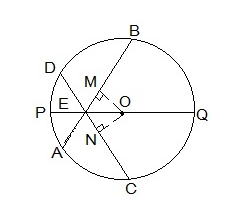
Q3. If two equal chords of a circle intersect within the circle, prove that the line joining the point of intersection to the centre makes equal angles with the chords.
Ans: From the question we know the following:
AB and CD are 2 chords which are intersecting at point E.
PQ is the diameter of the circle.
AB = CD.
Now, we will have to prove that BEQ = CEQ
For this, the following construction has to be done:
Construction:
Draw two perpendiculars are drawn as OM ⊥ AB and ON ⊥ D. Now, join OE. The constructed diagram will look as follows:
Now, consider the triangles ΔOEM and ΔOEN.
Here,
OM = ON [Since the equal chords are always equidistant from the centre]
OE = OE [It is the common side]
∠OME = ∠ONE [These are the perpendiculars]
So, by RHS congruency criterion, ΔOEM ≅ ΔOEN.
Hence, by CPCT rule, MEO = NEO
∴ BEQ = CEQ (Hence proved).

Q4. If a line intersects two concentric circles (circles with the same centre) with centre O at A, B, C and D, prove that AB = CD (see Fig).
Ans: The given image is as follows:
First, draw a line segment from O to AD such that OM ⊥ AD.
So, now OM is bisecting AD since OM ⊥ AD.
Therefore, AM = MD — (i)
Also, since OM ⊥ BC, OM bisects BC.
Therefore, BM = MC — (ii)
From equation (i) and equation (ii),
AM – BM = MD – MC
∴ AB = CD.

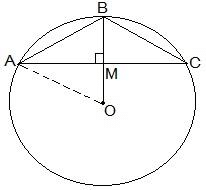
Q5. Three girls Reshma, Salma and Mandip are playing a game by standing on a circle of radius 5m drawn in a park. Reshma throws a ball to Salma, Salma to Mandip, Mandip to Reshma. If the distance between Reshma and Salma and between Salma and Mandip is 6m each, what is the distance between Reshma and Mandip?
Ans:
Let the positions of Reshma, Salma and Mandip be represented as A, B and C respectively.
From the question, we know that AB = BC = 6cm.
So, the radius of the circle i.e. OA = 5cm
Now, draw a perpendicular BM ⊥ AC.
Since AB = BC, ABC can be considered as an isosceles triangle. M is mid-point of AC. BM is the perpendicular bisector of AC and thus it passes through the centre of the circle.
Now,
let AM = y and
OM = x
So, BM will be = (5 – x).
By applying Pythagorean theorem in ΔOAM we get,
OA2 = OM2 +AM2
⇒ 52 = x2 +y2 — (i)
Again, by applying Pythagorean theorem in ΔAMB,
AB2 = BM2 +AM2
⇒ 62 = (5 – x)2 + y2 — (ii)
Subtracting equation (i) from equation (ii), we get
36 – 25 = (5 – x)2 + y2 – x2 – y2
Now, solving this equation we get the value of x as
x = 7 / 5
Substituting the value of x in equation (i), we get
y2 + (49 / 25) = 25
⇒ y2 = 25 – (49 / 25)
Solving it we get the value of y as
y = 24 / 5
Thus,
AC = 2 × AM
= 2 × y
= 2 × (24 / 5) m
AC = 9.6 m
So, the distance between Reshma and Mandip is 9.6 m.

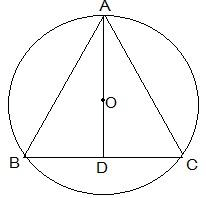
Q6. A circular park of radius 20m is situated in a colony. Three boys Ankur, Syed and David are sitting at equal distance on its boundary each having a toy telephone in his hands to talk each other. Find the length of the string of each phone.
Ans: First, draw a diagram according to the given statements. The diagram will look as follows.
Here the positions of Ankur, Syed and David are represented as A, B and C respectively. Since they are sitting at equal distances, the triangle ABC will form an equilateral triangle.
AD ⊥ BC is drawn. Now, AD is median of ΔABC and it passes through the centre O.
Also, O is the centroid of the ΔABC. OA is the radius of the triangle.
OA = 2 / 3 AD
Let the side of a triangle a metres then BD = a / 2 m.
Applying Pythagoras theorem in ΔABD,
AB2 = BD2 + AD2
⇒ AD2 = AB2 – BD2
⇒ AD2 = a2 – (a / 2)2
⇒ AD2 = 3a2 / 4
⇒ AD = √3a / 2
OA = 2 / 3 AD
20 m = 2 / 3 × √3a / 2
a = 20√3 m
So, the length of the string of the toy is 20√3 m.

Exercise 9.3

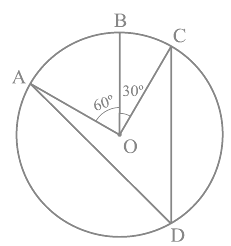
Q1. In Fig, A, B and C are three points on a circle with centre O such that ∠ BOC = 30° and ∠ AOB = 60°. If D is a point on the circle other than the arc ABC, find ∠ADC.

Ans: It is given that,
AOC = AOB+BOC
So, AOC = 60°+30°
∴ AOC = 90°
It is known that an angle which is subtended by an arc at the centre of the circle is double the angle subtended by that arc at any point on the remaining part of the circle.
So,
ADC = (½)AOC
= (½)× 90° = 45°


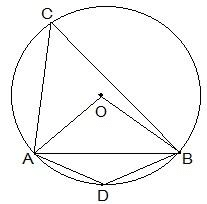
Q2. A chord of a circle is equal to the radius of the circle. Find the angle subtended by the chord at a point on the minor arc and also at a point on the major arc.

Ans:

Given: In circle C (O, r), OA = AB.
To find: ∠ADB and ∠ACB.

Solution:
In △OAB:
OA = AB
OA = OB
Hence, OA = OB = AB

⇒ ABC is an equilateral triangle.
Therefore, ∠AOB = 60° [Each angle of an equilateral triangle is 60°]

∠AOB = 2∠ADB
⇒ ∠ADB = ½ ∠AOB
⇒ ∠ADB = ½ × 60° = 30°

ACBD is a cyclic quadrilateral.
Therefore, ∠ACB + ∠ADB = 180° [The sum of either pair of opposite angles of a cyclic quadrilateral is 180°]

⇒ ∠ACB + 30° = 180°
⇒ ∠ACB = 180° – 30° = 150°


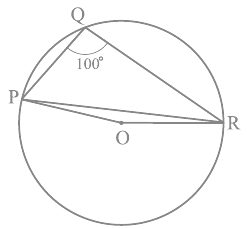
Q3. In Fig, ∠ PQR = 100°, where P, Q and R are points on a circle with centre O. Find ∠ OPR.

Ans: The angle which is subtended by an arc at the centre of the circle is double the angle subtended by that arc at any point on the remaining part of the circle.
So, the reflex POR = 2×PQR
We know the values of angle PQR as 100°
So, POR = 2×100° = 200°
∴ POR = 360°-200° = 160°
Now, in ΔOPR,
OP and OR are the radii of the circle
So, OP = OR
Also, OPR = ORP
Now, we know the sum of the angles in a triangle is equal to 180 degrees
So,
POR+OPR+ORP = 180°
OPR+OPR = 180°-160°
As OPR = ORP
2OPR = 20°
Thus, OPR = 10°


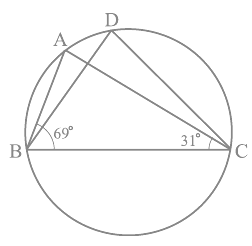
Q4. In Fig, ∠ ABC = 69°, ∠ ACB = 31°, find ∠ BDC.

Ans: We know that angles in the segment of the circle are equal so,
∠BAC = ∠BDC
Now in the in ΔABC, the sum of all the interior angles will be 180°
So, ∠ABC + ∠BAC + ∠ACB = 180°
Now, by putting the values,
∠BAC = 180° – 69° – 31°
So, ∠BAC = 80°
∴ ∠BDC = 80°.


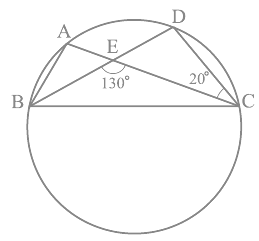
Q5. In Fig, A, B, C and D are four points on a circle. AC and BD intersect at a point E such that ∠ BEC = 130° and ∠ ECD = 20°. Find ∠ BAC.

Ans: We know that the angles in the segment of the circle are equal.
So,
∠ BAC = ∠ CDE
Now, by using the exterior angles property of the triangle
In ΔCDE we get,
∠ CEB = ∠ CDE + ∠ DCE
We know that ∠ DCE is equal to 20°
So, ∠ CDE = 110°
∠ BAC and ∠ CDE are equal
∴ ∠ BAC = 110°.


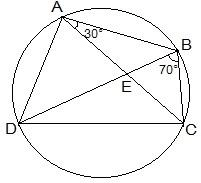
Q6. ABCD is a cyclic quadrilateral whose diagonals intersect at a point E. If ∠ DBC = 70°, ∠ BAC is 30°, find ∠ BCD. Further, if AB = BC, find ∠ ECD.

Ans: Consider the following diagram.
Consider the chord CD,
We know that angles in the same segment are equal.
So, ∠ CBD = ∠ CAD
∴ ∠ CAD = 70°
Now, ∠ BAD will be equal to the sum of angles BAC and CAD.
So, ∠ BAD = ∠ BAC + ∠ CAD
= 30° + 70°
∴ ∠ BAD = 100°
We know that the opposite angles of a cyclic quadrilateral sums up to 180 degrees.
So,
∠ BCD + ∠ BAD = 180°
It is known that ∠ BAD = 100°
So, ∠ BCD = 80°
Now consider the ΔABC.
Here, it is given that AB = BC
Also, ∠ BCA = ∠ CAB (They are the angles opposite to equal sides of a triangle)
∠ BCA = 30°
also, ∠ BCD = 80°
∠ BCA + ∠ ACD = 80°
Thus, ∠ ACD = 50° and ∠ ECD = 50°.


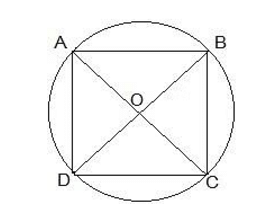
Q7. If diagonals of a cyclic quadrilateral are diameters of the circle through the vertices of the quadrilateral, prove that it is a rectangle.

Ans:  Given:

1. The diagonals of the cyclic quadrilateral are diameters of the circle.

2. The quadrilateral is cyclic (its vertices lie on the circle).

Proof: 

A diameter of a circle subtends a 90 angle on the circumference of the circle (by the property of a semicircle).

Let the cyclic quadrilateral be ABCD, and let the diagonals AC and BD be the diameters of the circle.

Since AC is a diameter:

∠ABC=90∘ and   ∠ADC=90(Both ∠ABC and ∠ADC are subtended by AC on opposite sides of the circle).

Similarly, since BD is a diameter:

∠BAD = 90 and ∠BCD = 90 (Both ∠BAD  and ∠BCD are subtended by BD).

From the above, all four angles of the quadrilateral ABCD are 90. Hence, ABCD is a quadrilateral where:

∠ABC = ∠BCD = ∠CDA = ∠DAB = 90


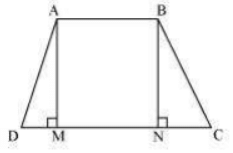
Q8. If the non-parallel sides of a trapezium are equal, prove that it is cyclic.

Ans: Construction:
Consider a trapezium ABCD with AB ║CD and BC = AD.
Draw AM ⊥ CD and BN ⊥ CD.
In ΔAMD and ΔBNC,
The diagram will look as follows:
In ΔAMD and ΔBNC,
AD = BC (Given)
∠AMD = ∠BCN (By construction, each is 90º)
AM = BN (Perpendicular distance between two parallel lines is same)
ΔAMD ≅ ΔBNC (RHS congruence rule)
∠ADC = ∠BCD (CPCT)…(1)
∠BAD and ∠ADC = 180º….(2) [Sum of the co-interior angles]
∠BAD and ∠BCD = 180º [Using equation (1)]
This equation shows that the opposite angle are supplementary.
Therefore, ABCD is a cyclic quadrilateral.


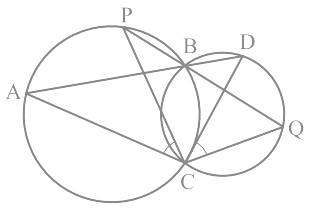
Q9. Two circles intersect at two points B and C. Through B, two line segments ABD and PBQ are drawn to intersect the circles at A, D and P, Q respectively (see Fig). Prove that ∠ACP = ∠ QCD.

Ans: Construction:
Join the chords AP and DQ.
For chord AP, we know that angles in the same segment are equal.
So, ∠ PBA = ∠ ACP ……(i)
Similarly for chord DQ,
∠ DBQ = ∠ QCD …..(ii)
It is known that ABD and PBQ are two line segments which are intersecting at B.
At B, the vertically opposite angles will be equal.
∴ ∠ PBA = ∠ DBQ ……(iii)
From equation (i), equation (ii) and equation (iii) we get,
∠ ACP = ∠ QCD.


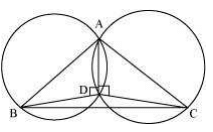
Q10. If circles are drawn taking two sides of a triangle as diameters, prove that the point of intersection of these circles lie on the third side.

Ans: First draw a triangle ABC and then two circles having diameter as AB and AC respectively.
We will have to now prove that D lies on BC and BDC is a straight line.
Proof:
We know that angle in the semi-circle are equal
So, ∠ ADB = ∠ ADC = 90°
Hence, ∠ ADB + ∠ ADC = 180°
∴ ∠ BDC is straight line.
So, it can be said that D lies on the line BC.


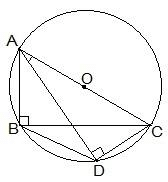
Q11. ABC and ADC are two right triangles with common hypotenuse AC. Prove that ∠CAD = ∠CBD.

Ans: We know that AC is the common hypotenuse and ∠ B = ∠ D = 90°.
Now, it has to be proven that ∠ CAD = ∠ CBD
Since, ∠ ABC and ∠ ADC are 90°, it can be said that They lie in the semi-circle.
So, triangles ABC and ADC are in the semi-circle and the points A, B, C and D are concyclic.
Hence, CD is the chord of the circle with center O.
We know that the angles which are in the same segment of the circle are equal.
∴ ∠ CAD = ∠ CBD


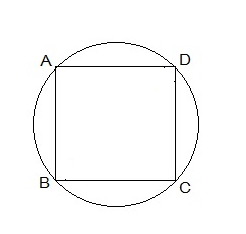
Q12. Prove that a cyclic parallelogram is a rectangle.

Ans: It is given that ABCD is a cyclic parallelogram and we will have to prove that ABCD is a rectangle.
Proof:
Let ABCD be a cyclic parallelogram.
∠A + ∠C = 180º (Opposite angles of a cyclic quadrilateral)….(1)
We know that opposite angles of a parallelogram are equal.
∠A = ∠C and ∠B = ∠D
From equation (1),
∠A + ∠C = 180º
∠A + ∠A = 180º
2∠A = 180º
∠A = 90°
Parallelogram ABCD has one of its interior angles as 90º.
Thus, ABCD is a rectangle.

08. Quadrilaterals – Textbook Solutions

Exercise 8.1

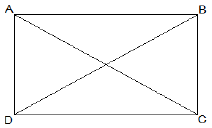
Q1. If the diagonals of a parallelogram are equal, then show that it is a rectangle.
Ans: 

Given that,
AC = BD
To Prove:  ABCD is a rectangle if the diagonals of a parallelogram are equal.
To show ABCD is a rectangle, we have to prove that one of its interior angles is right-angled.
Proof,
In ΔABC and ΔBAD,
AB = BA (Common)
BC = AD (Opposite sides of a parallelogram are equal)
AC = BD (Given)
Therefore, ΔABC ≅ ΔBAD [SSS congruency]
∠A = ∠B [Corresponding parts of Congruent Triangles]
also,
∠A+∠B = 180° (Sum of the angles on the same side of the transversal)
⇒ 2∠A = 180°
⇒ ∠A = 90° = ∠B
Therefore, ABCD is a rectangle.
Hence Proved.


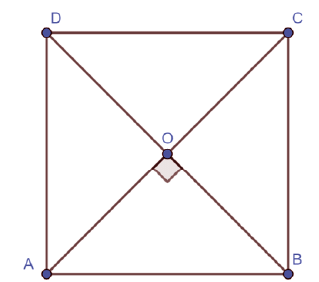
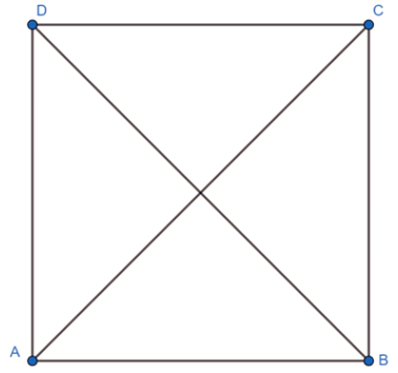
Q2. Show that the diagonals of a square are equal and bisect each other at right angles.
Ans: Given: A square is given.
To Prove: The diagonals of a square are the same and bisect each other at 90
Proof: Consider ABCD to be a square.

Consider the diagonals AC and BD intersect each other at a point O.
We have to show that the diagonals of a square are equal and bisect each other at right angles,
AC  =  BD, OA  =  OC, OB  =  OD .
In ΔABC and ΔDCB,
AB = DC (Sides of the square are equal)
∠ABC = ∠DCB (All the interior angles are of the value 90o)
BC = CB (Common side)
∴ ΔABC ≅ ΔDCB (By SAS congruency)
∴ AC= DB (By CPCT)
Hence, the diagonals of a square are equal in length.
In ΔAOB and ΔCOD,
∠AOB = ∠COD (Vertically opposite angles)
∠ABO = ∠CDO (Alternate interior angles)
AB = CD (Sides of a square are always equal)
∴ ΔAOB ≅ ΔCOD (By AAS congruence rule)
∴ AO = CO and OB = OD (By CPCT)
As a result, the diagonals of a square are bisected.
In ΔAOB and ΔCOB,
Because we already established that diagonals intersect each other,
AO = CO
AB = CB (Sides of a square are equal)
BO = BO (Common)
∴ ΔAOB ≅ ΔCOB (By SSS congruency)
∴ ∠AOB = ∠COB (By CPCT)
However, ∠AOB + ∠COB = 180° (Linear pair)
∠AOB +∠AOB = 180°
2 x ∠AOB = 180°
∠AOB = 90°

As a result, the diagonals of a square are at right angles to each other.


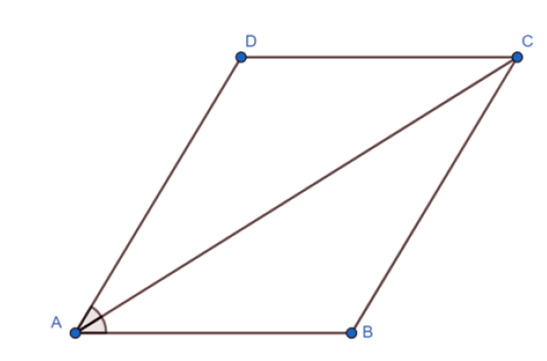
Q3. Diagonal AC of a parallelogram ABCD bisects ∠A (see Fig.). Show that

Show that
(i) It is bisecting ∠C also, 
(ii) ABCD is a rhombus

Ans: Given: Diagonal AC of a parallelogram ABCD is bisecting ∠A
(i) ABCD is a parallelogram.
∠DAC = ∠BCA (Alternate interior angles) … (1)
And ∠BAC = ∠DCA (Alternate interior angles) … (2)
However, it is given that AC is bisecting ∠A
∠DAC = ∠BAC … (3)
Putting the values of eq (1) and eq (2) in eq (3)
∠BCA = ∠DCA
Hence, AC is bisecting ∠C
(ii) From Equation (4), we obtain
∠DAC = ∠DCA
DA = DC (Side opposite to equal angles are equal)
However, DA = BC and AB = CD (Opposite sides of a parallelogram)
AB = BC = CD = DA
As a result, ABCD is a rhombus.


Q4. ABCD is a rectangle in which diagonal AC bisects A as well as C . Show that:
(i) ABCD is a square 
(ii) Diagonal BD bisects 
B as well as D.
Ans: Given: ABCD is a rectangle where the diagonal AC bisects ∠A as well as ∠C.

(i) It is given that ABCD is a square.
∠A = ∠C
⇒ 1/2 ∠A = 1/2 ∠C (AC bisects ∠A and ∠C)
⇒ ∠DAC = 1/2 ∠DCA
CD = DA (Sides that are opposite to the equal angles are also equal)
Also, DA = BC and AB = CD (Opposite sides of the rectangle are same)
AB = BC = CD = DA
ABCD is a rectangle with equal sides on all sides.
Hence, ABCD is a square.
(ii) Let us now join BD.
In ΔBCD,
BC = CD (Sides of a square are equal to each other)
∠CDB = ∠CBD (Angles opposite to equal sides are equal)
However, ∠CDB = ∠ABD (Alternate interior angles for AB || CD)
∠CBD = ∠ABD
BD bisects ∠B.
Also, ∠CBD = ∠ADB (Alternate interior angles for BC || AD)
∠CDB = ∠ABD
BD bisects ∠D and ∠B.


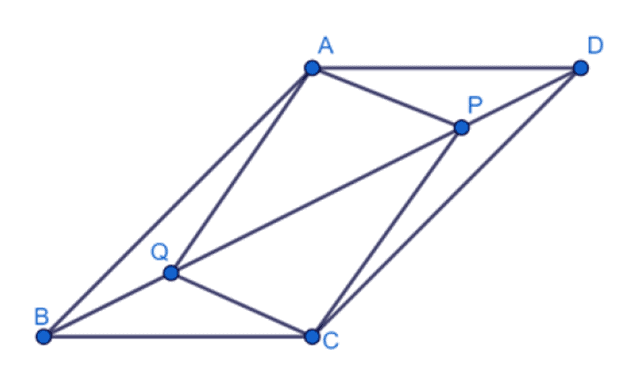
Q5. In parallelogram ABCD, two points P and Q are taken on diagonal BD such that DP = BQ (see the given figure).

Show that: 
(i) ΔAPD ≅ ΔCQB 

(ii) AP = CQ 

(iii) ΔAQB ≅ ΔCPD 

(iv) AQ = CP

(v) APCQ is a Parallelogram
Ans: 
(i) In ΔAPD and ΔCQB,
AD = CB (Opposite sides of the parallelogram ABCD)
∠ADP = ∠CBQ (Alternate interior angles for BC || AD)
DP = BQ (Given)
∴ ΔAPD  ΔCQB (Using SAS congruence rule)
(ii) As we had observed that ΔAPD  ΔCQB,
∴ AP= CQ (CPCT)
(iii) In ΔAQB and ΔCPD,
∠ABQ = ∠CDP (Alternate interior angles for AB || CD )
AB = CD (Opposite sides of parallelogram ABCD)
BQ = DP (Given)
∴ ΔAQB  ΔCPD (Using SAS congruence rule)
(iv) Since we had observed that ΔAQB  ΔCPD,
∴ AQ = CP (CPCT)
(v) From the results obtained in (ii) and (iv),
AQ = CP and AP = CQ
APCQ is a parallelogram because the opposite sides of the quadrilateral are equal.


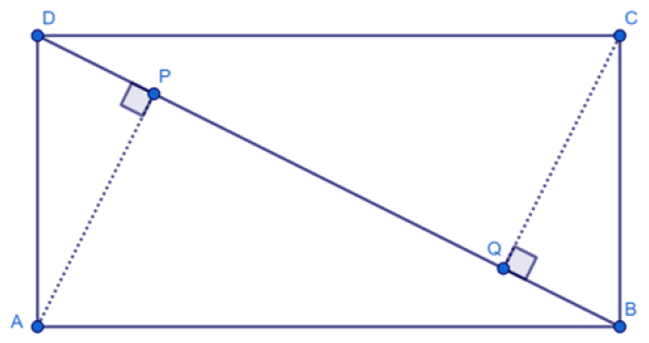
Q6. ABCD is a parallelogram and AP and CQ are perpendiculars from vertices A and C on diagonal BD (See the given figure).
Show that 
(i) ΔAPB ≅ ΔCQD 
(ii) AP = CQ
Ans: 
(i) In ΔAPB and ΔCQD,
∠APB = ∠CQD (Each 90°)
AB = CD (The opposite sides of a parallelogram ABCD)
∠ABP = ∠CDQ (Alternate interior angles for AB || CD)
∴ ΔAPB  ΔCQD (By AAS congruency)
(ii) By using
∴ ΔAPB  ΔCQD , we obtain
AP = CQ (By CPCT)


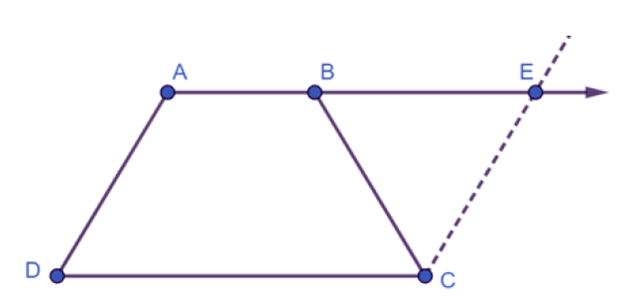
Q7. ABCD is a trapezium in which AB || CD and AD = BC (see the given figure).
Show that 
(i) ∠A = ∠B 
(ii) ∠C = ∠D 
(iii) 
ΔABC  ΔBAD 
(iv) diagonal AC = diagonal BD
(Hint: Extend AB and draw a line through C parallel to DA intersecting AB produced at E.)

Ans: Let us extend AB by drawing a line through C, which is parallel to AD, intersecting AE at point E. It is clear that AECD is a parallelogram.
(i) AD = CE (Opposite sides of parallelogram AECD)
However, AD = BC (Given)
Therefore, BC = CE
∠CEB = ∠CBE (Angle opposite to the equal sides are also equal)
Considering parallel lines AD and CE.
AE is the transversal line for them (Angles on a same side of transversal)
(Using the relation ∠CEB = ∠CBE) … (1)
However,  ∠CBE +  ∠CBA  = 180° (Linear pair angles) … (2)
From Equations (1) and (2), we obtain ∠A = ∠B
(ii) AB || CD
Also, ∠C + ∠B = 180° (Angles on a same side of a transversal)
∴ ∠A + ∠D = ∠C + ∠B
However, ∠A = ∠B (Using the result obtained in (i))
∴ ∠C = ∠D
(iii) In ΔABC and ΔBAD,
AB = BA (Common side)
BC = AD (Given)
∠B = ∠A (Proved before)
∴ ΔABC ≅ ΔBAD (SAS congruence rule)
(iv) We had seen that, ΔABC ≅ ΔBAD
∴ AC= BD (By CPCT)

Exercise 8.2

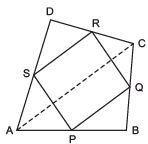
Q1. ABCD is a quadrilateral in which P, Q, R and S are mid-points of the sides AB, BC, CD and DA (see the given figure). AC is diagonal. Show that:
(i) SR || AC and SR = (1/2) AC
(ii) PQ = SR 
(iii) PQRS is a parallelogram.

Ans: Given: ABCD is a quadrilateral
To prove: (i) SR || AC and SR = 1/2 AC
(ii) PQ = SR
(iii) PQRS is a parallelogram.
(i) In ΔADC, S and R are the mid-points of sides AD and CD respectively.
In a triangle, the line segment connecting the midpoints of any two sides is parallel to and half of the third side.
∴ SR || AC and SR = 1/2 AC … (1)
(ii) In ΔABC, P and Q are mid-points of sides AB and BC respectively. Therefore, by using midpoint theorem,
PQ || AC and  PQ = 1/2 AC … (2)
Using Equations (1) and (2), we obtain
PQ || SR and PQ = SR
(iii) From Equation (3), we obtained
PQ || SR and PQ = SR
Clearly, one pair of quadrilateral PQRS opposing sides is parallel and equal. PQRS is thus a parallelogram.


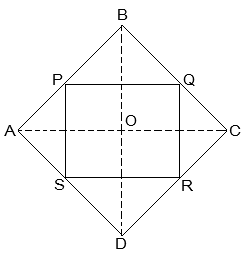
Q2. ABCD is a rhombus and P, Q, R and S are the mid-points of the sides AB, BC, CD and DA respectively. Show that the quadrilateral PQRS is a rectangle.
Ans: 

Given: ABCD is a rhombus and P, Q, R and S are the mid-points of the sides AB, BC, CD and DA, respectively.
To Prove: PQRS is a rectangle.
Construction:
Join AC and BD.
Proof:
In ΔDRS and ΔBPQ,
DS = BQ (Halves of the opposite sides of the rhombus)
∠SDR = ∠QBP (Opposite angles of the rhombus)
DR = BP (Halves of the opposite sides of the rhombus)
ΔDRS ≅ ΔBPQ [SAS congruency]
RS = PQ [CPCT]———————- (i)
In ΔQCR and ΔSAP,
RC = PA (Halves of the opposite sides of the rhombus)
∠RCQ = ∠PAS (Opposite angles of the rhombus)
CQ = AS (Halves of the opposite sides of the rhombus)
ΔQCR ≅ ΔSAP [SAS congruency]
RQ = SP [CPCT]———————- (ii)
Now,
In ΔCDB,
R and Q are the mid points of CD and BC, respectively.
⇒ QR || BD
also,
P and S are the mid points of AD and AB, respectively.
⇒ PS || BD
⇒ QR || PS
PQRS is a parallelogram.
also, ∠PQR = 90°
Now,
In PQRS,
RS = PQ and RQ = SP from (i) and (ii)
∠Q = 90°
PQRS is a rectangle.


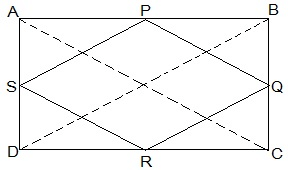
Q3. ABCD is a rectangle and P, Q, R and S are mid-points of the sides AB, BC, CD and DA respectively. Show that the quadrilateral PQRS is a rhombus.
Ans: 

Given: ABCD is a rectangle and P, Q, R and S are mid-points of the sides AB, BC, CD and DA respectively.
To prove: The quadrilateral PQRS is a rhombus.
Proof: Let us join AC and BD.
In ΔABC, P and Q are the mid-points of AB and BC respectively.
∴ PQ || AC and PQ = 1/2 AC (Mid-point theorem) … (1)
Similarly, in ΔADC , SR ||  AR, SR = 1/2 AC (Mid-point theorem) … (2)
Clearly,  PQ || SR and  PQ = SR
It is a parallelogram because one pair of opposing sides of quadrilateral PQRS is equal and parallel to each other.
∴ PS || QR , PS = QR (Opposite sides of parallelogram) … (3)
In ΔBCD, Q and R are the mid-points of side BC and CD respectively.
∴ QR || BD, QR = 1/2 BD (Mid-point theorem) … (4)
Also, the diagonals of a rectangle are equal.
∴ AC = BD … (5)
By using Equations (1), (2), (3), (4), and (5), we obtain
PQ = QR = SR = PS
So, PQRS is a rhombus


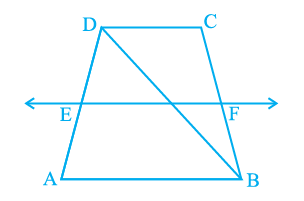
Q4. ABCD is a trapezium in which  AB || DC , BD is a diagonal and E is the mid – point of AD. A line is drawn through E parallel to AB intersecting BC at F (see the given figure). Show that F is the mid-point of BC.

Ans: Given: ABCD is a trapezium in which AB || DC , BD is a diagonal and E is the mid – point of AD. A line is drawn through E parallel to AB intersecting BC at F.
To prove: F is the mid-point of BC.
Proof: Let EF intersect DB at G.
We know that a line traced through the mid-point of any side of a triangle and parallel to another side bisects the third side by the reverse of the mid-point theorem.
In  ΔABD, EF || AB and E is the mid-point of AD.
Hence, G will be the mid-point of DB.
As  EF || AB, AB || CD,
∴ EF || CD (Two lines parallel to the same line are parallel)
In  ΔBCD, GF || CD and G is the mid-point of line BD. 
So, by using the converse of mid-point theorem, F is the mid-point of BC.


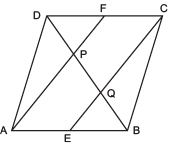
Q5. In a parallelogram ABCD, E and F are the mid-points of sides AB and CD respectively (see the given figure). Show that the line segments AF and EC trisect the diagonal BD.
Ans: Given: In a parallelogram ABCD, E and F are the mid-points of sides AB and CD respectively to prove: The line segments AF and EC trisect the diagonal BD.

To Prove: The line segments AF and EC trisect the diagonal BD. 

Proof: ABCD is a parallelogram.
AB || CD
And hence, AE || FC
Again, AB = CD (Opposite sides of parallelogram ABCD)
1/2 AB = 1/2 CD
AE = FC (E and F are mid-points of side AB and CD)
In quadrilateral AECF, one pair of opposite sides (AE and CF) is parallel and the same as each other. So, AECF is a parallelogram.
∴ AF || EC (Opposite sides of a parallelogram)
In  ΔDQC, F is the mid-point of side DC and  FP || CQ (as  AF || EC ). 
So, by using the converse of mid-point theorem, it can be said that P is the mid-point of DQ.
∴ DP= PQ … (1)
Similarly, in ΔAPB , E is the mid-point of side AB and EQ || AP (as  AF || EC ).
As a result, the reverse of the mid-point theorem may be used to say that Q is the mid-point of PB.
∴ PQ = QB … (2)
From Equations (1) and (2),
DP = PQ= BQ
Hence, the line segments AF and EC trisect the diagonal BD.


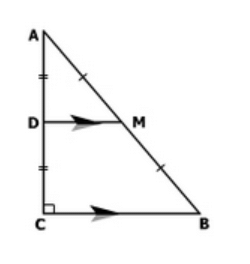
Q6. ABC is a triangle right angled at C. A line through the mid-point M of hypotenuse AB and parallel to BC intersects AC at D. Show that
(i) D is the mid-point of AC 
(ii) MD ⊥ AC
(iii) CM = MA = 1/2 AB
Ans: Given: ABC is a triangle right angled at C. A line through the mid-point M of hypotenuse AB and parallel to BC intersects AC at D.
(i) In ΔABC,
It is given that M is the mid-point of AB and MD || BC.
Therefore, D is the mid-point of AC. (Converse of the mid-point theorem)
(ii) As DM || CB and AC is a transversal line for them, therefore,(Co-interior angles)
(iii) Join MC.
In ΔAMD and  ΔCMD,
AD = CD (D is the mid-point of side AC)
∠ADM = ∠CDM (Each)
DM = DM (Common)
∴ ΔAMD ≅ ΔCMD (By SAS congruence rule)
Therefore,
AM = CM (By CPCT)
However, 
AM = 1/2 AB (M is mid-point of AB)
Therefore, it is said that CM = AM = 1/2 AB.

07. Triangles – Textbook Solutions (Exercise 7.1-7.3)

Exercise 7.1

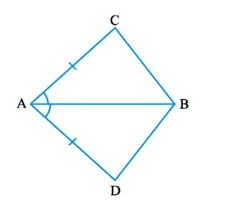
Q1. In quadrilateral ACBD, AC = AD and AB bisects ∠ A. Show that ∆ ABC ≅ ∆ ABD. What can you say about BC and BD?

Ans: It is given that AC and AD are equal i.e. AC = AD and the line segment AB bisects ∠A.
We will have to now prove that the two triangles ABC and ABD are similar i.e. ΔABC ≅ ΔABD
Proof:
Consider the triangles ΔABC and ΔABD,
(i) AC = AD (It is given in the question)
(ii) AB = AB (Common
(iii) ∠CAB = ∠DAB (Since AB is the bisector of angle A)
So, by SAS congruency criterion, ΔABC ≅ ΔABD.
For the 2nd part of the question, BC and BD are of equal lengths by the rule of C.P.C.T.


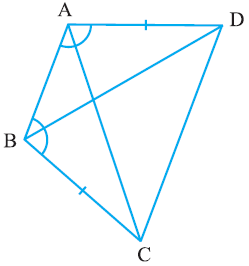
Q2. ABCD is a quadrilateral in which AD = BC and ∠ DAB = ∠ CBA. Prove that
(i) ∆ ABD ≅ ∆ BAC
(ii) BD = AC 
(iii) ∠ ABD = ∠ BAC

Ans: The given parameters from the questions are DAB = CBA and AD = BC.
(i) ΔABD and ΔBAC are similar by SAS congruency as
AB = BA (It is the common arm)
DAB = CBA and AD = BC (These are given in the question)
So, triangles ABD and BAC are similar i.e. ΔABD ≅ ΔBAC. (Hence proved).
(ii) It is now known that ΔABD ≅ ΔBAC so,
BD = AC (by the rule of CPCT).
(iii) Since ΔABD ≅ ΔBAC so,
Angles ABD = BAC (by the rule of CPCT).


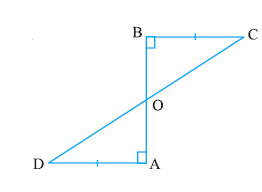
Q3. AD and BC are equal perpendiculars to a line segment AB. Show that CD bisects AB.

Ans: It is given that AD and BC are two equal perpendiculars to AB.
We will have to prove that CD is the bisector of AB
Now,
Triangles ΔAOD and ΔBOC are similar by AAS congruency since:
(i) ∠A = ∠B (They are perpendiculars)
(ii) AD = BC (As given in the question)
(iii) ∠AOD = ∠BOC (They are vertically opposite angles)
∴ ΔAOD ≅ ΔBOC.
So, AO = OB (by the rule of CPCT).
Thus, CD bisects AB (Hence proved).


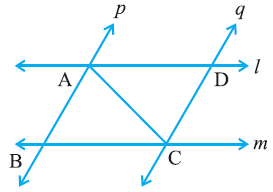
Q4. l and m are two parallel lines intersected by another pair of parallel lines p and q. Show that ∆ ABC ≅ ∆ CDA.

Ans: It is given that p || q and l || m
To prove:
Triangles ABC and CDA are similar i.e. ΔABC ≅ ΔCDA
Proof:
Consider the ΔABC and ΔCDA,
(i) ∠BCA = ∠DAC and ∠BAC = ∠DCA Since they are alternate interior angles
(ii) AC = CA as it is the common arm
So, by ASA congruency criterion, ΔABC ≅ ΔCDA.


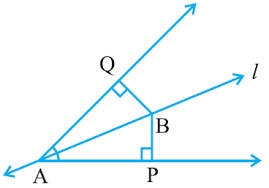
Q5. Line l is the bisector of an angle ∠ A and B is any point on l. BP and BQ are perpendiculars from B to the arms of ∠ A. Show that:
(i) ∆ APB ≅ ∆ AQB
(ii) BP = BQ or B is equidistant from the arms of ∠ A.

Ans: It is given that the line “l” is the bisector of angle ∠A and the line segments BP and BQ are perpendiculars drawn from l.
(i) ΔAPB and ΔAQB are similar by AAS congruency because:
∠P = ∠Q (They are the two right angles)
AB = AB (It is the common arm)
∠BAP = ∠BAQ (As line is the bisector of angle A)
So, ΔAPB ≅ ΔAQB.
(ii) By the rule of CPCT, BP = BQ. So, it can be said the point B is equidistant from the arms of ∠A.


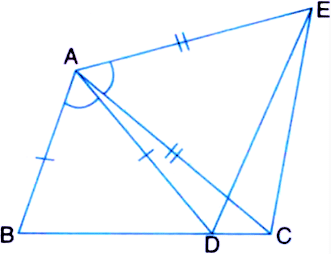
Q6. In the following figure, AC = AE, AB = AD and ∠ BAD = ∠ EAC. Show that BC = DE.

Ans: It is given in the question that AB = AD, AC = AE, and ∠BAD = ∠EAC
To prove:
The line segment BC and DE are similar i.e. BC = DE
Proof:
We know that ∠BAD = ∠EAC
Now, by adding ∠DAC on both sides we get,
∠BAD + ∠DAC = ∠EAC +∠DAC
This implies, ∠BAC = ∠EAD
Now, ΔABC and ΔADE are similar by SAS congruency since:
(i) AC = AE (As given in the question)
(ii) ∠BAC = ∠EAD
(iii) AB = AD (It is also given in the question)
∴ Triangles ABC and ADE are similar i.e. ΔABC ≅ ΔADE.
So, by the rule of CPCT, it can be said that BC = DE.


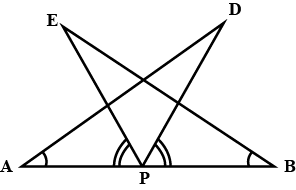
Q7. AB is a line segment and P is its mid-point. D and E are points on the same side of AB such that ∠ BAD = ∠ ABE and ∠ EPA = ∠ DPB. Show that
(i) ∆ DAP ≅ ∆ EBP
(ii) AD = BE

Ans: In the question, it is given that P is the mid-point of line segment AB. Also, ∠BAD = ∠ABE and ∠EPA = ∠DPB
(i) It is given that ∠EPA = ∠DPB
Now, add ∠DPE on both sides,
∠EPA +∠DPE = ∠DPB+∠DPE
This implies that angles DPA and EPB are equal i.e. ∠DPA = ∠EPB
Now, consider the triangles DAP and EBP.
∠DPA = ∠EPB
AP = BP (Since P is the mid-point of the line segment AB)
∠BAD = ∠ABE (As given in the question)
So, by ASA congruency, ΔDAP ≅ ΔEBP.
(ii) By the rule of CPCT, AD = BE.


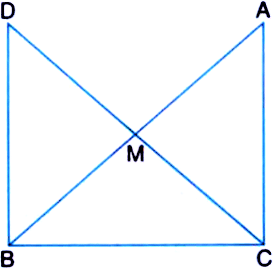
Q8. In right triangle ABC, right angled at C, M is the mid-point of hypotenuse AB. C is joined to M and produced to a point D such that DM = CM. Point D is joined to point B. Show that:
(i) ∆ AMC ≅ ∆ BMD
(ii) ∠ DBC is a right angle.
(iii) ∆ DBC ≅ ∆ ACB
(iv) CM = ½ AB

Ans: It is given that M is the mid-point of the line segment AB, ∠C = 90°, and DM = CM
(i) Consider the triangles ΔAMC and ΔBMD:
AM = BM (Since M is the mid-point)
CM = DM (Given in the question)
∠CMA = ∠DMB (They are vertically opposite angles)
So, by SAS congruency criterion, ΔAMC ≅ ΔBMD.
(ii) ∠ACM = ∠BDM (by CPCT)
∴ AC || BD as alternate interior angles are equal.
Now, ∠ACB +∠DBC = 180° (Since they are co-interiors angles)
⇒ 90° +∠B = 180°
∴ ∠DBC = 90°
(iii) In ΔDBC and ΔACB,
BC = CB (Common side)
∠ACB = ∠DBC (They are right angles)
DB = AC (by CPCT)
So, ΔDBC ≅ ΔACB by SAS congruency.
(iv) DC = AB (Since ΔDBC ≅ ΔACB)
⇒ DM = CM = AM = BM (Since M the is mid-point)
So, DM + CM = BM+AM
Hence, CM + CM = AB
⇒ CM = (½) AB


Exercise 7.2

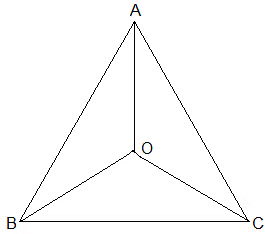
Q1. In an isosceles triangle ABC, with AB = AC, the bisectors of ∠ B and ∠ C intersect each other at O. Join A to O. Show that:
(i) OB = OC
(ii) AO bisects ∠ A

Ans:
Given:
AB = AC and
the bisectors of ∠B and ∠C intersect each other at O
(i) Since ABC is an isosceles with AB = AC,
∠B = ∠C
½ ∠B = ½ ∠C
⇒ ∠OBC = ∠OCB (Angle bisectors)
∴ OB = OC (Side opposite to the equal angles are equal.)
(ii) In ΔAOB and ΔAOC,
AB = AC (Given in the question)
AO = AO (Common arm)
OB = OC (As Proved Already)
So, ΔAOB ≅ ΔAOC by SSS congruence condition.
BAO = CAO (by CPCT)
Thus, AO bisects ∠A.


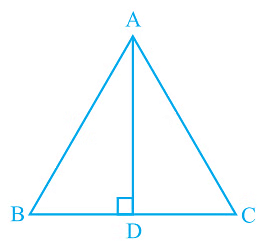
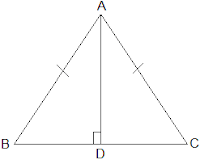
Q2. In ΔABC, AD is the perpendicular bisector of BC (see Fig.). Show that ΔABC is an isosceles triangle in which AB = AC.

Ans: It is given that AD is the perpendicular bisector of BC
To prove:
AB = AC
Proof:
In ΔADB and ΔADC,
AD = AD (It is the Common arm)
∠ADB = ∠ADC
BD = CD (Since AD is the perpendicular bisector)
So, ΔADB ≅ ΔADC by SAS congruency criterion.
Thus,
AB = AC (by CPCT)


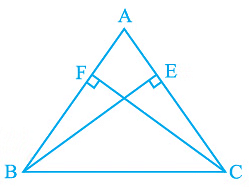
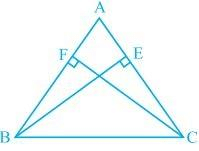
Q3. ABC is an isosceles triangle in which altitudes BE and CF are drawn to equal sides AC and AB respectively (see Fig.). Show that these altitudes are equal.

Ans:
Given:
(i) BE and CF are altitudes.
(ii) AC = AB
To prove:
BE = CF
Proof:
Triangles ΔAEB and ΔAFC are similar by AAS congruency since
∠A = ∠A (It is the common arm)
∠AEB = ∠AFC (They are right angles)
AB = AC (Given in the question)
∴ ΔAEB ≅ ΔAFC and so, BE = CF (by CPCT).


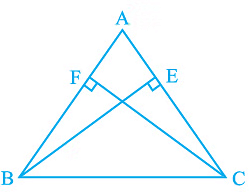
Q4. ABC is a triangle in which altitudes BE and CF to sides AC and AB are equal (see Fig). Show that
(i) ∆ ABE ≅ ∆ ACF
(ii) AB = AC, i.e., ABC is an isosceles triangle.

Ans: It is given that BE = CF
(i) In ΔABE and ΔACF,
∠A = ∠A (It is the common angle)
∠AEB = ∠AFC (They are right angles)
BE = CF (Given in the question)
∴ ΔABE ≅ ΔACF by AAS congruency condition.
(ii) AB = AC by CPCT and so, ABC is an isosceles triangle.


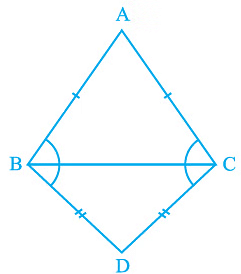
Q5. ABC and DBC are two isosceles triangles on the same base BC (see Fig). Show that ∠ ABD = ∠ ACD.

Ans: In the question, it is given that ABC and DBC are two isosceles triangles.
We will have to show that ∠ABD = ∠ACD
Proof:
Triangles ΔABD and ΔACD are similar by SSS congruency since
AD = AD (It is the common arm)
AB = AC (Since ABC is an isosceles triangle)
BD = CD (Since BCD is an isosceles triangle)
So, ΔABD ≅ ΔACD.
∴ ∠ABD = ∠ACD by CPCT.


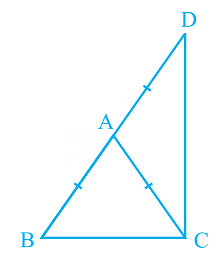
Q6. ∆ABC is an isosceles triangle in which AB = AC. Side BA is produced to D such that AD = AB (see Fig). Show that ∠ BCD is a right angle.

Ans: It is given that AB = AC and AD = AB
We will have to now prove ∠BCD is a right angle.
Proof:
Consider ΔABC,
AB = AC (It is given in the question)
Also, ∠ACB = ∠ABC (They are angles opposite to the equal sides and so, they are equal)
Now, consider ΔACD,
AD = AB
Also, ∠ADC = ∠ACD (They are angles opposite to the equal sides and so, they are equal)
Now,
In ΔABC,
∠CAB + ∠ACB + ∠ABC = 180°
So, ∠CAB + 2∠ACB = 180°
⇒ ∠CAB = 180° – 2∠ACB — (i)
Similarly, in ΔADC,
∠CAD = 180° – 2∠ACD — (ii)
also,
∠CAB + ∠CAD = 180° (BD is a straight line.)
Adding (i) and (ii) we get,
∠CAB + ∠CAD = 180° – 2∠ACB+180° – 2∠ACD
⇒ 180° = 360° – 2∠ACB-2∠ACD
⇒ 2(∠ACB+∠ACD) = 180°
⇒ ∠BCD = 90°


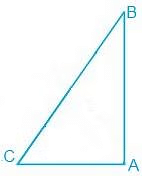
Q7. ABC is a right angled triangle in which ∠ A = 90° and AB = AC. Find ∠ B and ∠ C.
Ans:

In the question, it is given that

∠A = 90° and AB = AC
AB = AC
⇒ ∠B = ∠C (They are angles opposite to the equal sides and so, they are equal)
Now,
∠A+∠B+∠C = 180° (Since the sum of the interior angles of the triangle)
∴ 90° + 2∠B = 180°
⇒ 2∠B = 90°
⇒ ∠B = 45°
So, ∠B = ∠C = 45°


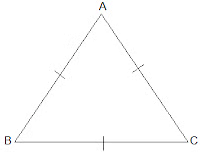
Q8. Show that the angles of an equilateral triangle are 60° each.
Ans: Let ABC be an equilateral triangle as shown below:
Here, BC = AC = AB (Since the length of all sides is same)⇒ ∠A = ∠B =∠C (Sides opposite to the equal angles are equal.)Also, we know that
∠A+∠B+∠C = 180°
⇒ 3∠A = 180°
⇒ ∠A = 60°
∴ ∠A = ∠B = ∠C = 60°
So, the angles of an equilateral triangle are always 60° eac


Exercise 7.3

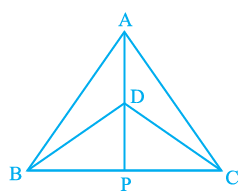
Q1. ∆ ABC and ∆ DBC are two isosceles triangles on the same base BC and vertices A and D are on the same side of BC (see Fig). If AD is extended to intersect BC at P, show that
(i) ΔABD ≅ ΔACD 
(ii) ΔABP ≅ ΔACP 
(iii) AP bisects ∠A as well as ∠D. 
(iv) AP is the perpendicular bisector of BC.

Ans: In the above question, it is given that ΔABC and ΔDBC are two isosceles triangles.
(i) ΔABD and ΔACD are similar by SSS congruency because:
AD = AD (It is the common arm)
AB = AC (Since ΔABC is isosceles)
BD = CD (Since ΔDBC is isosceles)
∴ ΔABD ≅ ΔACD.
(ii) ΔABP and ΔACP are similar as:
AP = AP (It is the common side)
∠PAB = ∠PAC (by CPCT since ΔABD ≅ ΔACD)
AB = AC (Since ΔABC is isosceles)
So, ΔABP ≅ ΔACP by SAS congruency condition.
(iii) ∠PAB = ∠PAC by CPCT as ΔABD ≅ ΔACD.
AP bisects ∠A. — (i)
Also, ΔBPD and ΔCPD are similar by SSS congruency as
PD = PD (It is the common side)
BD = CD (Since ΔDBC is isosceles.)
BP = CP (by CPCT as ΔABP ≅ ΔACP)
So, ΔBPD ≅ ΔCPD.
Thus, ∠BDP = ∠CDP by CPCT. — (ii)
Now by comparing (i) and (ii) it can be said that AP bisects ∠A as well as ∠D.
(iv) ∠BPD = ∠CPD (by CPCT as ΔBPD ΔCPD)
and BP = CP — (i)
also,
∠BPD +∠CPD = 180° (Since BC is a straight line.)
⇒ 2∠BPD = 180°
⇒ ∠BPD = 90° —(ii)
Now, from equations (i) and (ii), it can be said that
AP is the perpendicular bisector of BC.


Q2. AD is an altitude of an isosceles triangle ABC in which AB = AC. Show that
(i) AD bisects BC 
(ii) AD bisects ∠ A.
Ans: It is given that AD is an altitude and AB = AC. The diagram is as follows:

(i) In ΔABD and ΔACD,

∠ADB = ∠ADC = 90°
AB = AC (It is given in the question)
AD = AD (Common arm)
∴ ΔABD ≅ ΔACD by RHS congruence condition.
Now, by the rule of CPCT,
BD = CD.
So, AD bisects BC
(ii) Again, by the rule of CPCT, ∠BAD = ∠CAD
Hence, AD bisects ∠A.


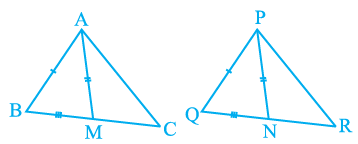
Q3. Two sides AB and BC and median AM of one triangle ABC are respectively equal to sides PQ and QR and median PN of ΔPQR (see Fig). Show that:
(i) ΔABM  ΔPQN 
(ii) ΔABC ≅ ΔPQR

Ans: Given parameters are:
AB = PQ,
BC = QR and
AM = PN
(i) ½ BC = BM and ½ QR = QN (Since AM and PN are medians)
Also, BC = QR
So, ½ BC = ½ QR
⇒ BM = QN
In ΔABM and ΔPQN,
AM = PN and AB = PQ (As given in the question)
BM = QN (Already proved)
∴ ΔABM ≅ ΔPQN by SSS congruency.
(ii) In ΔABC and ΔPQR,
AB = PQ and BC = QR (As given in the question)
∠ABC = ∠PQR (by CPCT)
So, ΔABC ≅ ΔPQR by SAS congruency.


Q4. BE and CF are two equal altitudes of a triangle ABC. Using RHS congruence rule, prove that the triangle ABC is isosceles.

Ans: It is known that BE and CF are two equal altitudes.
Now, in ΔBEC and ΔCFB,
∠BEC = ∠CFB = 90° (Same Altitudes)
BC = CB (Common side)
BE = CF (Common side)
So, ΔBEC ≅ ΔCFB by RHS congruence criterion.
Also, ∠C = ∠B (by CPCT)
Therefore, AB = AC as sides opposite to the equal angles is always equal.


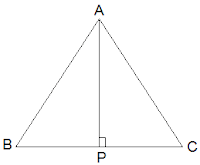
Q5. ABC is an isosceles triangle with AB = AC. Draw AP ⊥ BC to show that ∠ B = ∠ C.
Ans:

In the question, it is given that AB = AC

Now, ΔABP and ΔACP are similar by RHS congruency as
∠APB = ∠APC = 90° (AP is altitude)
AB = AC (Given in the question)
AP = AP (Common side)
So, ΔABP ≅ ΔACP.
∴ ∠B = ∠C (by CPCT)

06. Lines and Angles – Textbook Solutions

Exercise 6.1

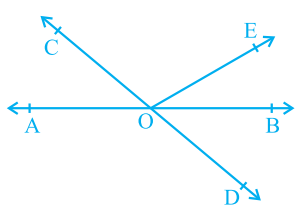
Q1. In Fig. 6.13, lines AB and CD intersect at O. If ∠AOC +∠BOE = 70° and ∠BOD = 40°, find ∠BOE and reflex ∠COE.
Ans: From the diagram, we have

Since AB is a straight line,
∴ ∠AOC + ∠COE + ∠EOB = 180°
or (∠AOC + ∠BOE) + ∠COE = 180° or 70° + ∠COE = 180° [ ∵∠AOC + ∠BOE = 70° (Given)]
or ∠COE = 180° – 70° = 110°
∴ Reflex ∠COE = 360° – 110° = 250°
Also, AB and CD intersect at O.
∴∠COA = ∠BOD [Vertically opposite angles]
But ∠BOD = 40° [Given]
∴ ∠COA = 40°
Also, ∠AOC + ∠BOE = 70°
∴ 40° + ∠BOE = 70° or ∠BOE = 70° -40° = 30°
Thus, ∠BOE = 30° and reflex ∠COE = 250°.


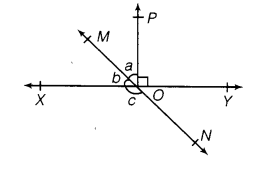
Q2. In the following figure, lines XY and MN intersect at O. If ∠POY = 90° and a : b = 2 : 3, find c.

Ans:We know that the sum of linear pair are always equal to 180°
So,
POY +a +b = 180°
Putting the value of POY = 90° (as given in the question) we get,
a+b = 90°
Now, it is given that a : b = 2 : 3 so,
Let a be 2x and b be 3x
∴ 2x+3x = 90°
Solving this we get
5x = 90°
So, x = 18°
∴ a = 2×18° = 36°
Similarly, b can be calculated and the value will be
b = 3×18° = 54°
From the diagram, b+c also forms a straight angle so,
b+c = 180°
c+54° = 180°
∴ c = 126°


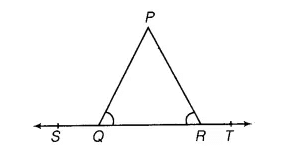
Q3. In the following figure, ∠PQR = ∠PRQ, then prove that ∠PQS = ∠PRT.

Ans: Since ST is a straight line so,
∠PQS+∠PQR = 180° (linear pair) and
∠PRT+∠PRQ = 180° (linear pair)
Now, ∠PQS + ∠PQR = ∠PRT+∠PRQ = 180°
Since ∠PQR =∠PRQ (as given in the question)
∠PQS = ∠PRT. (Hence proved).


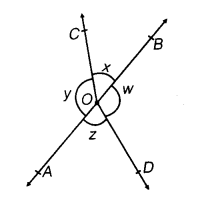
Q4. In the following figure, if x + y = w + z, then prove that AOB is a line.

Ans: For proving AOB is a straight line, we will have to prove x+y is a linear pair
i.e. x+y = 180°
We know that the angles around a point are 360° so,
x + y + w + z = 360°
In the question, it is given that,
x+y = w+z
So, (x+y)+(x+y) = 360°
2(x+y) = 360°
∴ (x+y) = 180° (Hence proved).


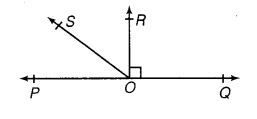
Q5. In the adjoining figure, POQ is a line. Ray OR is perpendicular to line PQ. OS is another ray lying between rays OP and OR. Prove that ∠ROS = ½ (∠QOS – ∠POS).

Ans: In the question, it is given that (OR ⊥ PQ) and POQ = 180°
So, POS+ROS+ROQ = 180°
Now, POS+ROS = 180°- 90° (Since POR = ROQ = 90°)
∴ POS + ROS = 90°
Now, QOS = ROQ+ROS
It is given that ROQ = 90°,
∴ QOS = 90° +ROS
Or, QOS – ROS = 90°
As POS + ROS = 90° and QOS – ROS = 90°, we get
POS + ROS = QOS – ROS
2 ROS + POS = QOS
Or, ROS = ½ (QOS – POS) (Hence proved).


Q6. It is given that ∠XYZ = 64° and XY is produced to point P. Draw a figure from the given information. If ray YQ bisects ∠ZYP, find ∠XYQ and reflex ∠QYP.
Ans:

Here, XP is a straight lineSo, XYZ +ZYP = 180°
Putting the value of XYZ = 64° we get,
64° +ZYP = 180°
∴ ZYP = 116°
From the diagram, we also know that ZYP = ZYQ + QYP
Now, as YQ bisects ZYP,
ZYQ = QYP
Or, ZYP = 2ZYQ
∴ ZYQ = QYP = 58°
Again, XYQ = XYZ + ZYQ
By putting the value of XYZ = 64° and ZYQ = 58° we get.
XYQ = 64°+58°
Or, XYQ = 122°
Now, reflex QYP = 180°+XYQ
We computed that the value of XYQ = 122°.
So,
QYP = 180°+122°
∴ QYP = 302°


Exercise 6.2

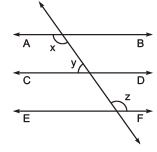
Q1. In the following Figure, if AB CD, CD EF and y : z = 3 : 7, find x.

Ans: AB || CD, and CD || EF [Given]
∴ AB || EF
∴ x = z [Alternate interior angles] ….(1)
Again, AB || CD
⇒ x + y = 180° [Co-interior angles]
⇒ z + y = 180° … (2) [By (1)]
But y : z = 3 : 7
⇒ 10z = 7 x 180°
⇒ z = 7 x 180° /10 = 126°
From (1) and (3), we have
x = 126°.


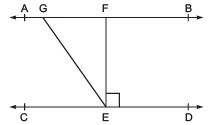
Q2. In the following figure, if AB || CD, EF ⊥ CD and ∠GED = 126°, find ∠AGE, ∠GEF and ∠FGE.
Ans: Since AB || CD, GE is a transversal.
It is given that ∠GED = 126°
So, ∠GED = ∠AGE = 126° (As they are alternate interior angles)
Also,
∠GED = ∠GEF +∠FED
As EF⊥ CD, ∠FED = 90°
∴ ∠GED = ∠GEF+90°
Or, ∠GEF = 126° – 90° = 36°
Again, ∠FGE +∠GED = 180° (Transversal)
Putting the value of ∠GED = 126°, we get
∠FGE = 54°
So,
∠AGE = 126°
∠GEF = 36° and
∠FGE = 54°


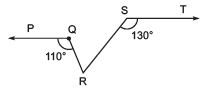
Q3. In the following figure, if PQ || ST, ∠PQR = 110° and ∠RST = 130°, find ∠QRS.
[Hint : Draw a line parallel to ST through point R.]

Ans: First, construct a line XY parallel to PQ.

We know that the angles on the same side of transversal is equal to 180°.
So, ∠PQR+∠QRX = 180°
Or, ∠QRX = 180°-110°
∴ ∠QRX = 70°
Similarly,
∠RST +∠SRY = 180°
Or, ∠SRY = 180°- 130°
∴ ∠SRY = 50°
Now, for the linear pairs on the line XY-
∠QRX+∠QRS+∠SRY = 180°
Putting their respective values, we get
∠QRS = 180° – 70° – 50°
Hence, ∠QRS = 60°


Q4. In the following figure, if AB || CD, ∠ APQ = 50° and ∠ PRD = 127°, find x and y
Ans: From the diagram,
∠APQ = ∠PQR (Alternate interior angles)
Now, putting the value of ∠APQ = 50° and ∠PQR = x, we get
x = 50°
Also,
∠APR = ∠PRD (Alternate interior angles)
Or, ∠APR = 127° (As it is given that ∠PRD = 127°)
We know that
∠APR = ∠APQ+∠QPR
Now, putting values of ∠QPR = y and ∠APR = 127°, we get
127° = 50°+ y
Or, y = 77°
Thus, the values of x and y are calculated as:
x = 50° and y = 77°


Q5. In the following figure, PQ and RS are two mirrors placed parallel to each other. An incident ray AB strikes the mirror PQ at B, the reflected ray moves along the path BC and strikes the mirror RS at C and again reflects back along CD. Prove that AB || CD.

Ans: First, draw two lines, BE and CF, such that BE ⊥ PQ and CF ⊥ RS.
Now, since PQ || RS,
So, BE || CF

We know that,
Angle of incidence = Angle of reflection (By the law of reflection)
So,
∠1 = ∠2 and
∠3 = ∠4
We also know that alternate interior angles are equal. Here, BE ⊥ CF and the transversal line BC cuts them at B and C
So, ∠2 = ∠3 (As they are alternate interior angles)
Now, ∠1 +∠2 = ∠3 +∠4
Or, ∠ABC = ∠DCB
So, AB || CD (alternate interior angles are equal)

05. Introduction to Euclid’s Geometry – Textbook Solutions (Exercise 5.1)

Q1: Which of the following statements are true and which are false? Give reasons for your answers.
(i) Only one line can pass through a single point.
(ii) There are an infinite number of lines which pass through two distinct points.
(iii) A terminated line can be produced indefinitely on both the sides
(iv) If two circles are equal, then their radii are equal.
(v) In Fig. 5.9, if AB = PQ and PQ = XY, then AB = XY.

Ans: (i) False

Reason: There can be infinite number of lines that can be drawn through a single point. Hence, the statement mentioned is False

(ii) False

Reason: Through two distinct points, there can be only one line that can be drawn. Hence, the statement mentioned is False

(iii) True

Reason: A line that is terminated can be indefinitely produced on both sides as a line can be extended on both its sides infinitely. Hence, the statement mentioned is True.

(iv) True

Reason: The radii of two circles are equal when the two circles are equal. The circumference and the centre of both the circles coincide; and thus, the radius of the two circles should be equal. Hence, the statement mentioned is True.

(v) True

Reason: According to Euclid’s 1st axiom- “Things which are equal to the same thing are also equal to one another”. Hence, the statement mentioned is True.


Q2: Give a definition for each of the following terms. Are there other terms that need to be defined first? What are they, and how might you define them?
(i) parallel lines 
(ii) perpendicular lines 
(iii) line segment 
(iv) radius of a circle 
(v) square
Ans: 
Yes, we need to have an idea about the terms, point, line, ray, angle, plane, circle and quadrilateral, etc. before defining the required terms.
Point: A small dot made by a sharp pencil on the surface of paper gives an idea about a point.
It has no dimensions. It has only a position.
Line: A line is an idea that it should be straight and that it should extend indefinitely in both directions. It has no endpoints and has no definite length.
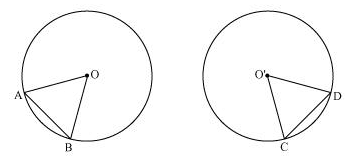
Note: In geometry, a line means “The line in its totality and not a portion of it. Whereas a physical example of a perfect line is not possible. A line extends indefinitely in both directions, so we cannot draw or show it wholly on paper. That is why we mark arrowheads on both ends, indicating that it extends indefinitely in both directions.
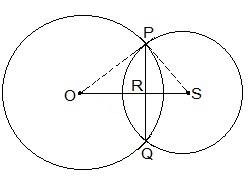
Ray: A part of a line that has only one endpoint and extends indefinitely in one direction. A ray has no definite length.
Angle: Two rays having a common endpoint form an angle.
Plane: A plane is a surface such that every point of the line joining any two points on it, lies on it.
Circle: A circle is the set of all those points in a given plane that are equidistant from a fixed point in the same plane. The fixed point is called the centre of the circle.
Quadrilateral: A closed figure made of four line segments is called a quadrilateral.
Definitions of the required terms are given below: 
(i) Parallel Lines: Two lines ‘n’ and ‘m’ in a plane are said to be parallel if they have no common point and we write them as n || m.

Note: The distance between two parallel lines always remains the same.

(ii) Perpendicular Lines: Two lines ‘p’ and ‘q’ lying in the same plane are said to be perpendicular if they form a right angle and we write them as p ⊥ q.

(iii) Line Segment: A line segment is a part of the line having a definite length. It has two end-points.
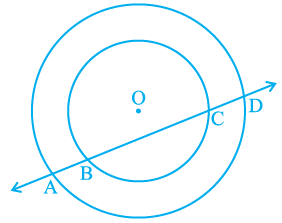
In the figure, a line segment is shown having endpoints ‘A’ and ‘B’. It is written as  or 
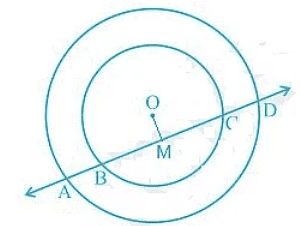
(iv) Radius of a circle: The distance from the centre to a point on the circle is called the radius of the circle. In the figure, P is the centre and Q is a point on the circle, then PQ is the radius.
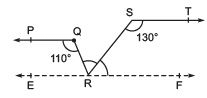
(v) Square: A quadrilateral in which all the four angles are right angles and all the four sides are equal is called a square. In the figure, PQRS is a square.
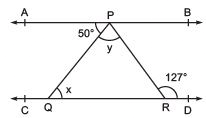

Q3. Consider two ‘postulates’ given below:
(i) Given any two distinct points A and B, there exists a third point C which is in between A and B.
(ii) There exist at least three points that are not on the same line.
Do these postulates contain any undefined terms? Are these postulates consistent?
Do they follow Euclid’s postulates? Explain.
Ans: Yes, these postulates contain undefined terms. Undefined terms in the postulates are

  • There are many points that lie in a plane. But, in the postulates given here, the position of point C is not given as to whether it lies on the line segment joining AB or not.
  • On top of that, there is no information about whether the points are in the same plane or not.

And
Yes, these postulates are consistent when we deal with these two situations:

  • Point C is lying on the line segment AB in between A and B.
  • Point C does not lie on line segment AB.

No, they don’t follow Euclid’s postulates. They follow the axioms.


Q4. If a point C lies between two points A and B such that AC = BC, then prove that AC =  (1/2)AB. Explain by drawing the figure.
Ans: 

Given that, AC = BC
Now, adding AC on both sides,
L.H.S.+AC = R.H.S.+AC
AC+AC = BC+AC
2AC = BC+AC
We know that BC+AC = AB (as it coincides with line segment AB)
∴ 2 AC = AB (If equals are added to equals, the wholes are equal.)
⇒ AC = (½)AB

Q5. In Question 4, point C is called a mid-point of line segment AB. Prove that every line segment has one and only one mid-point.
Ans: Let AB be the line segment.
Assume that points P and Q are the two different midpoints of AB.
Now,
∴ P and Q are the midpoints of AB.
Therefore,
AP = PB and AQ = QB
also,
PB+AP = AB (as it coincides with line segment AB)
Similarly, QB+AQ = AB
Now,
Adding AP to the L.H.S. and R.H.S. of the equation AP = PB
We get AP+AP = PB+AP (If equals are added to equals, the wholes are equal.)
⇒ 2AP = AB — (i)
Similarly,
2 AQ = AB — (ii)
From (i) and (ii), Since R.H.S. are the same, we equate the L.H.S.
2 AP = 2 AQ (Things which are equal to the same thing are equal to one another.)
⇒ AP = AQ (Things which are double of the same things are equal to one another.)
Thus, we conclude that P and Q are the same points.
This contradicts our assumption that P and Q are two different midpoints of AB.
Thus, it is proved that every line segment has one and only one midpoint.
Hence, proved.

Q6. In the figure, given below, if AC = BD, then prove that AB = CD.
Ans:

It is given AC = BD
From the given figure, we get
AC = AB+BC
BD = BC+CD
⇒ AB+BC = BC+CD [AC = BD, given]
We know that, according to Euclid’s axiom, when equals are subtracted from equals, remainders are also equal.
Subtracting BC from the L.H.S. and R.H.S. of the equation AB+BC = BC+CD, we get
AB+BC-BC = BC+CD-BC
AB = CD
Hence, proved.

Q7. Why is Axiom 5, in the list of Euclid’s axioms, considered a ‘universal truth’? (Note that the question is not about the fifth postulate.)
Ans: Axiom 5: The whole is always greater than the part.
For Example: A cake. When it is whole or complete, assume that it measures 2 pounds but when a part from it is taken out and measured, its weight will be smaller than the previous measurement. So, the fifth axiom of Euclid is true for all the materials in the universe. Hence, Axiom 5, in the list of Euclid’s axioms, is considered a ‘universal truth’.

04. Linear Equations in Two Variables – Textbook Solutions

Exercise 4.1

Q1. The cost of a notebook is twice the cost of a pen. Write a linear equation in two variables to represent this statement. (Take the cost of a notebook to be ₹ x and that of a pen to be ₹ y)
Ans: Let the cost of a notebook be = ₹ x
Let the cost of a pen be = ₹ y
According to the question,
The cost of a notebook is twice the cost of a pen.
i.e., cost of a notebook = 2×cost of a pen
x = 2 × y
x = 2y
x – 2y = 0
x – 2y = 0 is the linear equation in two variables to represent the statement, ‘The cost of a notebook is twice the cost of a pen.’


Q2. Express the following linear equations in the form ax + by + c = 0 and indicate the values of a, b and c in each case:
(i) 2x + 3y= 
Ans: Consider 2x + 3y=     Equation (1)
⇒ 2x + 3y – = 0
Comparing this equation with the standard form of the linear equation in two variables, ax + by + c = 0 we have,
a = 2
b = 3
c = – 


(ii) x – (y/5) – 10 = 0
Ans: The equation x –(y/5)-10 = 0 can be written as,
(1)x+(-1/5)y +(–10) = 0
Now comparing x+(-1/5)y+(–10) = 0 with ax+by+c = 0
We get,
a = 1
b = -(1/5)
c = -10


(iii) –2x + 3y = 6
Ans: –2x+3y = 6
Re-arranging the equation, we get,
–2x+3y–6 = 0
The equation –2x+3y–6 = 0 can be written as,
(–2)x+(3)y+(– 6) = 0
Now, comparing (–2)x+(3)y+(–6) = 0 with ax+by+c = 0
We get, a = –2
b = 3
c =-6


(iv) x = 3y
Ans: x = 3y
Re-arranging the equation, we get,
x-3y = 0
The equation x-3y=0 can be written as,
(1)x+(-3)y+(0)c = 0
Now comparing 1x+(-3)y+(0)c = 0 with ax+by+c = 0
We get a = 1
b = -3
c = 0


(v) 2x = –5y
Ans: 2x = –5y
Re-arranging the equation, we get,
2x+5y = 0
The equation 2x+5y = 0 can be written as,
2x+5y+0 = 0
Now, comparing (2)x+(5)y+0= 0 with ax+by+c = 0
We get a = 2
b = 5
c = 0


(vi) 3x + 2 = 0
Ans: 3x+2 = 0
The equation 3x+2 = 0 can be written as,
3x+0y+2 = 0
Now comparing 3x+0+2= 0 with ax+by+c = 0
We get a = 3
b = 0
c = 2


(vii) y–2 = 0
Ans: y–2 = 0
The equation y–2 = 0 can be written as,
(0)x+(1)y+(–2) = 0
Now comparing (0)x+(1)y+(–2) = 0with ax+by+c = 0
We get a = 0
b = 1
c = –2


(viii) 5 = 2x
Ans: 5 = 2x
Re-arranging the equation, we get,
2x = 5
i.e., 2x–5 = 0
The equation 2x–5 = 0 can be written as,
2x+0y–5 = 0
Now comparing 2x+0y–5 = 0 with ax+by+c = 0
We get a = 2
b = 0
c = -5


Exercise 4.2

Q1. Which one of the following options is true, and why?
y = 3x + 5 has

(i) A unique solution

(ii) Only two solutions

(iii) Infinitely many solutions

Ans: Let us substitute different values for x in the linear equation y = 3x + 5,

From the table, it is clear that x can have infinite values, and for all the infinite values of x, there are infinite values of y as well.
Hence, (iii) infinitely many solutions is the only option true.


Q2. Write four solutions for each of the following equations:
(i) 2x + y = 7
Ans: To find the four solutions of 2x + y =7 we substitute different values for x and y

Let x = 0
Then,
2x + y = 7
(2)(0) + y = 7
y = 7

(0, 7)
Let x = 1
Then,
2x + y = 7
(2 × 1) + y = 7
2 + y = 7
y = 7 – 2
y = 5
(1, 5)
Let y = 1
Then,
2x + y = 7
(2x) + 1 = 7
2x = 7 – 1
2x = 6
x = 6/2
x = 3
(3, 1)
Let x = 2
Then,
2x + y = 7
(2 × 2) + y = 7
4 + y = 7
y =7 – 4
y = 3
(2, 3)
The solutions are (0, 7), (1, 5), (3, 1), (2, 3)

(ii) πx + y = 9
Ans: To find the four solutions of πx+y = 9 we substitute different values for x and y
Let x = 0
Then,
πx + y = 9
(π)(0) + y = 9
y = 9
(0, 9)
Let x = 1
Then,
πx + y = 9
(π × 1) + y = 9
π + y = 9
y = 9-π
(1, 9-π)
Let y = 0
Then,
πx + y = 9
πx + 0 = 9
πx = 9
x = 9/π
(9/π,0)
Let x = -1
Then,
πx + y = 9
π(-1)+y = 9

-π+y=9
y = 9 + π
(-1, 9+π)
The solutions are (0, 9), (1, 9-π), (9/π, 0), (-1, 9+π)
(iii) x = 4y
Ans:
 To find the four solutions of x = 4y we substitute different values for x and y
Let x = 0
Then,
x = 4y
0 = 4y
4y = 0
y = 0/4
y = 0
(0, 0)
Let x = 1
Then,
x = 4y
1 = 4y
4y = 1
y = 1/4
(1, 1/4)
Let y = 4
Then,
x = 4y
x= 4 × 4
x = 16
(16, 4)
Let y =
Then,
x = 4y
x = 4×1
x = 4
(4,1)
The solutions are (0,0), (1,1/4), (16,4), (4,1)


Q3. Check which of the following are solutions of the equation x–2y = 4 and which are not:
(i) (0, 2)
Ans: (x, y) = (0, 2)
Here, x = 0 and y = 2
Substituting the values of x and y in the equation x – 2y = 4, we get,
x – 2y = 4
⟹ 0 – (2 × 2) = 4
But, -4 ≠4
Therefore, (0, 2) is not a solution of the equation x – 2y = 4


(ii) (2, 0)
Ans: (x,y) = (2, 0)
Here, x = 2 and y = 0
Substituting the values of x and y in the equation x – 2y = 4, we get,
x – 2y = 4
⟹ 2-(2 × 0) = 4
⟹ 2 – 0 = 4
But, 2 ≠ 4
(2, 0) is not a solution of the equation x – 2y = 4


(iii) (4, 0)
Ans: (x, y) = (4, 0)
Here, x = 4 and y = 0
Substituting the values of x and y in the equation x – 2y = 4, we get,
x – 2y = 4
⟹ 4 – 2 × 0 = 4
⟹ 4-0 = 4
⟹ 4 = 4
(4, 0) is a solution of the equation x – 2y = 4


(iv) (√2, 4√2)
Ans: (x, y) = (√2, 4√2)
Here, x = √2 and y = 4√2
Substituting the values of x and y in the equation x – 2y = 4, we get,
x –2y = 4
⟹ √2-(2×4√2) = 4
√2-8√2 = 4
But, -7√2 ≠ 4
(√2, 4√2) is not a solution of the equation x – 2y = 4


(v) (1, 1)
Ans: (x, y) = (1, 1)
Here, x = 1 and y = 1
Substituting the values of x and y in the equation x – 2y = 4, we get,
x – 2y = 4
⟹ 1 -(2 × 1) = 4
⟹ 1 – 2 = 4
But, -1 ≠ 4
(1, 1) is not a solution of the equation x–2y = 4


Q4. Find the value of k, if x = 2, y = 1 is a solution of the equation 2x+3y = k.
Ans: The given equation is
2x + 3y = k
According to the question, x = 2 and y = 1.
Now, Substituting the values of x and y in the equation 2x + 3y = k,
We get,
(2 × 2)+(3 × 1) = k
⟹ 4 + 3 = k
⟹ 7 = k
k = 7
The value of k, if x = 2, y = 1 is a solution of the equation 2x + 3y = k, is 7.

03. Coordinate Geometry – Textbook Solutions (Exercise 3.1 and 3.2)

Exercise 3.1

Q1. How will you describe the position of a table lamp on your study table to another person?
Ans:

The above figure is a 3-D shows a study table, on which a study lamp is placed.
Now let us consider only the top surface of the table which becomes a 2-D rectangle figure.

From the Figure Above,

  • Consider the lamp on the table as a point
  • Consider the table as a 2-D plane.

The table has a shorter side (20 cm) and a longer side (30 cm).

  • Let us measure the distance of the lamp from the shorter side and the longer side.
  • Let us assume
    • Distance of the lamp from the shorter side is 5 cm.
    • Distance of the lamp from the longer side is 5 cm.

Therefore, we can conclude that the position of the lamp on the table can be described with respect to the order of the axes as (5,15).


Q2. (Street Plan): A city has two main roads which cross each other at the center of the city.
These two roads are along the North–South direction and East– West direction.
All the other streets of the city run parallel to these roads and are 200 m apart. There are 5 streets in each direction. Using 1cm = 200 m, draw a model of the city on your notebook. Represent the roads/streets by single lines. There are many cross- streets in your model. A particular cross-street is made by two streets, one running in the North–South direction and another in the East– West direction. Each cross street is referred to in the following manner:
If the 2nd street running in the North–South direction and 5th in the East–West direction meet at some crossing, then we will call this cross-street (2, 5).
Using this convention, find:
(i) How many cross – streets can be referred to as (4, 3).
(ii) How many cross – streets can be referred to as (3, 4).
Ans: Let us draw two perpendicular lines as the two main roads of the city that cross each other at the center. Let us mark them as North–South and East–West.
As given in the question, let us take the scale as 1cm = 200 m.
Draw five streets that are parallel to both the main roads (which intersect), to get the given below figure.
Street plan is as shown in the figure:

(i) There is only one cross street, which can be referred as (4, 3).
(ii) There is only one cross street, which can be referred as (3, 4).
Exercise 3.2

Q1. Write the answer of each of the following questions:
(i) What is the name of horizontal and the vertical lines drawn to determine the position of any point in the Cartesian plane?
(ii) What is the name of each part of the plane formed by these two lines?
(iii) Write the name of the point where these two lines intersect.
Ans: (i) The horizontal line that is drawn to determine the position of any point in the Cartesian plane is called as x-axis. The vertical line that is drawn to determine the position of any point in the Cartesian plane is called as y-axis.

(ii) The name of each part of the plane that is formed by x-axis and y-axis is called as quadrant.

(iii) The point, where the x-axis and the y-axis intersect is called as origin (O).


Q2. See the given figure, and write the following:
(i) The coordinates of B.
(ii) The coordinates of C.
(iii) The point identified by the coordinates (–3, –5).
(iv) The point identified by the coordinates (2, –4).
(v) The abscissa of the point D.
(vi) The ordinate of the point H.
(vii) The coordinates of the point L.
(viii) The coordinates of the point M.
Ans:

From the Figure above,
(i) The co-ordinates of point B is the distance of point B from x-axis and y-axis.
Therefore, the co-ordinates of point B are (–5, 2).
(ii) The co-ordinates of point C is the distance of point C from x-axis and y-axis.
Therefore, the co-ordinates of point C are (5, –5).
(iii) The point that represents the co-ordinates (–3, –5) is E.
(iv) The point that represents the co-ordinates (2, –4) is G.
(v) The abscissa of point D is the distance of point D from the y-axis. Therefore, the abscissa of point D is 6.
(vi) The ordinate of point H is the distance of point H from the x-axis. Therefore, the abscissa of point H is –3.
(vii) The co-ordinates of point L in the above figure is the distance of point L from x-axis and y-axis. Therefore, the co-ordinates of point L are (0, 5).
(viii) The co-ordinates of point M in the above figure is the distance of point M from x-axis and y-axis. Therefore, the co-ordinates of point M are (–3, 0).