05. Democratic Rights – Textbook Solutions

Q1. Which of the following is not an instance of an exercise of a fundamental right?
(a) Workers from Bihar go to the Punjab to work on the farms
(b) Christian missions set up a chain of missionary schools
(c) Men and women government employees get the same salary
(d) Parents’ property is inherited by their children
Ans:
 (d) Parents’ property is inherited by their children

Inheritance of property is governed by civil law and is not an instance of the exercise of a fundamental right. The other options involve fundamental rights such as the right to freedom of movement, religion, and equality.

Q2. Which of the following freedoms is not available to an Indian citizen?
(a) Freedom to criticise the government
(b) Freedom to participate in armed revolution
(c) Freedom to start a movement to change the government
(d) Freedom to oppose the central values of the Constitution
Ans: 
(b) Freedom to participate in armed revolution

Indian citizens do not have the freedom to participate in an armed revolution, as it is against the law. While citizens are free to criticize the government and start movements for change, they must do so peacefully and within the framework of the Constitution. Opposing the central values of the Constitution is also not permissible.

Q3. Which of the following rights is available under the Indian Constitution?
(a) Right to work
(b) Right to adequate livelihood
(c) Right to protect one’s culture
(d) Right to privacy

Ans: (c) Right to protect one’s culture

Under the Indian Constitution, citizens have the right to preserve their language, script, and culture (Articles 29 and 30). This is a fundamental right under the Cultural and Educational Rights section.

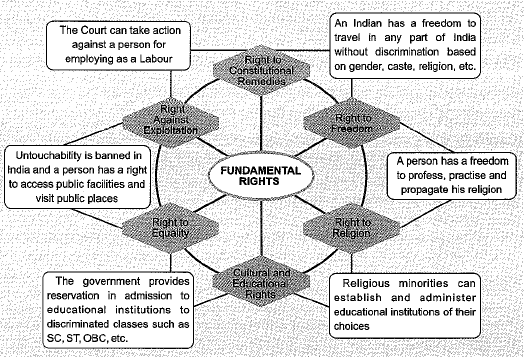
Q4. Name the Fundamental Right under which each of the following rights falls:
(a) Freedom to propagate one’s religion
(b) Right to life
(c) Abolition of untouchability
(d) Ban on bonded labour

Ans:  
(a) Right to Freedom of Religion
(b) Right to Freedom
(c) Right to Equality
(d) Right against Exploitation

Q5. Which of these statements about the relationship between democracy and rights is more valid? Give reasons for your preference.
(a) Every country that is a democracy gives rights to its citizens.
(b) Every country that gives rights to its citizens is a democracy.
(c) Giving rights is good, but it is not necessary for a democracy.
Ans: (a) Every country that is a democracy gives rights to its citizens.
Reasons:
(i) Rights are necessary for the very existence of democracy.
(ii) In a democracy, every citizen has the right to vote.


Q6. Are there restrictions on the right to freedom justified? Give reasons for your answer.
(a) Indian citizens need permission to visit some border areas of the country for reasons of security.
(b) Outsiders are not allowed to buy property in some areas to protect the interest of the local population.
(c) The government bans the publication of a book that can go against the ruling party in the next elections.

Ans: 
(a) It is justified. The security of the country is the first duty of a government, and this cause can stop the people from visiting the border areas.
(b) This action is also justified. The local population may not be financially strong to protect its interests. Outsiders can take away their rights in their own area, so such a step of the government is correct.
(c) Not justified. The publication of a book can only be banned if it disturbs the peace and hurts the sentiments of a section of people, and not on the grounds of protecting the ruling party’s prospects in the next election.


Q7. Manoj went to a college to apply for admission into an MBA course. The clerk refused to take his application and said “You, the son of a sweeper, wish to be a manager! Has anyone done this job in your community? Go to the municipality office and apply for a sweeper’s position”. Which of Manoj’s fundamental rights are being violated in this instance? Spell these out in a letter from Manoj to the district collector.
Ans: 

To,
The District Collector,
Address___________
Date_______________
Subject- Violation of a Fundamental Right
Respected Sir/Ma’am,
I had applied for an MBA course In order to fulfill my dream to become a Manager. But the Clerk in the office rejected my application and passed discriminatory comments. He made this decision on the basis of class bias. This is a clear violation of my Right to Freedom and equality. I am free to choose the profession I want to practice and nobody should discriminate against me on the basis of my class or caste. I request that you look into the matter and take the necessary action. 
Thank You Sir/Ma’am.
With Regards,
Manoj


Q8. When Madhurima went to the property registration office, the Registrar told her. “You can’t write your name as Madhurima Banerjee d/o Α. K. Banerjee. You are married, so you must give your husband’s name. Your husband’s surname is Rao. So your name should be changed to Madhurima Rao.” She did not agree. She said “If my husband’s name has not changed after marriage, why should mine?” In your opinion who is right in this dispute? And why?
Ans: Madhurima Banerjee is right. It is her freedom to choose the surname she wants. It cannot be obligated by others to force her to change her surname. The property registration officer has no legal right to ask her to change her name nor the authority to deny her work. She can forward a complaint to the Court on the violation of her rights.


Q9. Thousands of tribals and other forest dwellers gathered at Piparia in Hoshangabad district in Madhya Pradesh to protest against their proposed displacement from the Satpura National Park, Bori Wildlife Sanctuary and Panchmarhi Wildlife Sanctuary. They argue that such a displacement is an attack on their livelihood and beliefs. Government claims that their displacement is essential for the development of the area and for protection of wildlife. Write a petition on behalf of the forest dwellers to the NHRC, a response from the government and a report of the NHRC on this matter.
Ans: 
(a)
Letter from the Tribals to NHRC
To,
The Chairman,
National Human Rights Commission,
Delhi, India
Date:_____________
Subject: Displacement of Tribals
Respected Sir/Ma’am,
I want to draw your attention to plight of forest dwellers in Satpura National Park, Bori Wildlife Sanctuary and Panchmarhi Wildlife Sanctuary. The government wants to displace these people. The proposal of the government is a violation of the human rights of the forest dwellers. It is asking away their right to livelihood and to follow their beliefs. There has been no alternative suggestion by the government with regard to the future of the forest dwellers. We urge you to please look into the matter and provide the much-required help to these people.
Thank You Sir/Ma’am.
Regards,
Rohan or [Your Name]
Piparia, Hoshangabad
District, Madhya Pradesh or [Your Address]
(b) Response from the Government

  • The government had given a warning to the people two years ago. 
  • There has been an alarming rise in poaching, cutting of trees and killing of wildlife. 
  • Environmental pollution has also increased. 
  • It is the government’s duty to protect the endangered species. 
  • The government has offered compensation and promised rehabilitation in alternative places. 
  • Offered jobs to the men. 

(c) NHRC’s Report

  • Both sides have a point 
  • The Tribals have tradition, practice and decades of residence behind them. It is their world and life. 
  • Sudden uprooting will leave them emotionally disturbed, turn them into vagabonds and force them into jobs or occupations that they have never followed. 
  • The government is right in its concern for wildlife. It is its duty to save certain species from becoming extinct. Poachers are having a field day, and every day the environment is threatened.

Q10. Draw a web interconnecting different rights discussed in this chapter. For example right to freedom of movement is connected to the freedom of occupation. One reason for this is that freedom of movement enables a person to go to place of work within one’s village or city or to another village, city or state. Similarly this right can be used for pilgrimage, connected with freedom to follow one’s religion. Draw a circle for each right and mark arrows that show connection between or among different rights. For each arrow, give an example that shows the linkage.
Ans:
04. Working of Institutions – Textbook Solutions

Q1. If you are elected as the President of India which of the following decisions can you take on your own?
(a) Select the person you like as Prime Minister.
(b) Dismiss a Prime Minister who has a majority in Lok Sabha.
(c) Ask for reconsideration of a bill passed by both the Houses.
(d) Nominate the leaders of your choice to the Council of Ministers.

Ans: (c) Ask for reconsideration of a bill passed by both Houses.

As President of India, you can:

  • Request that Parliament review a bill.
  • Delay the bill’s assent, but must sign it if passed again.

However, you cannot:

  • Select a Prime Minister on your own.
  • Dismiss a Prime Minister with a majority.
  • Nominate leaders to the Council of Ministers independently.

Q2. Who among the following is a part of the political executive?
(a) District Collector
(b) Secretary of the Ministry of Home Affairs
(c) Home Minister
(d) Director General of Police
Ans:
 (c) Home Minister

The Home Minister is part of the political executive, while the others are part of the bureaucracy or civil services (administrative executive).

Q3. Which of the following statements about the judiciary is false?
(a) Every law passed by the Parliament needs the approval of the Supreme Court.
(b) Judiciary can strike down a law if it goes against the spirit of the Constitution.
(c) Judiciary is independent of the Executive.
(d) Any citizen can approach the courts if her rights are violated
Ans: 
(a) Every law passed by the Parliament needs the approval of the Supreme Court.

This statement is false because laws passed by Parliament do not require prior approval from the Supreme Court. However, the judiciary can review and strike down laws if they are found to be unconstitutional.

Q4. Which of the following institutions can make changes to an existing law of the country?
(a) The Supreme Court
(b) The President
(c) The Prime Minister
(d) The Parliament
Ans:
 (d) The Parliament

Only Parliament has the authority to make, amend, or repeal laws in the country. The other institutions can influence laws but cannot directly change them.

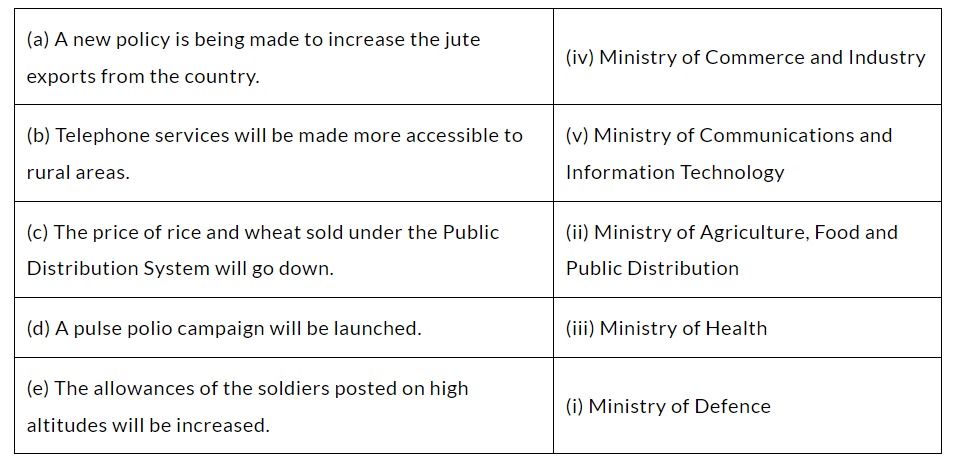
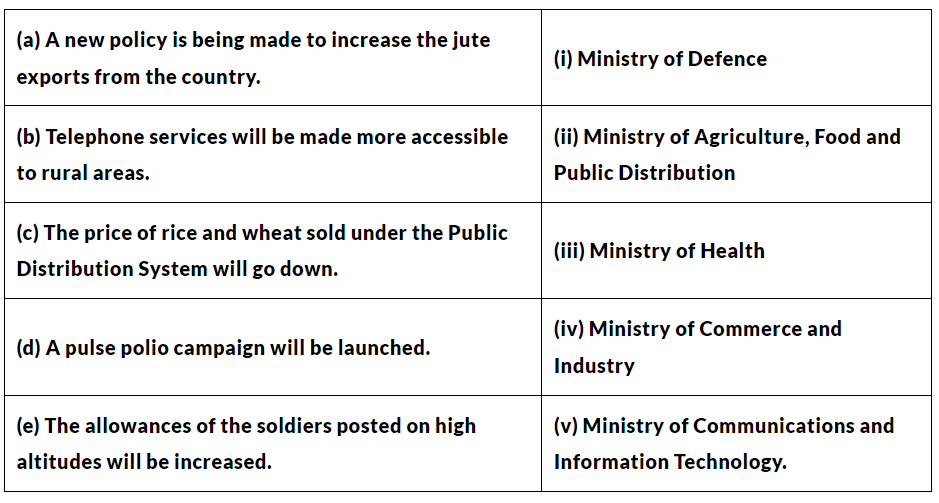
Q5. Match the ministry with the news that the ministry may have released:

Ans:

Q6. Of all the institutions that we have studied in this chapter, name the one that exercises the powers on each of the following matters.
(a) Decision on allocation of money for developing infrastructure like roads, irrigation etc. and different welfare activities for the citizens.
(b) Considers the recommendation of a Committee on a law to regulate the stock exchange.
(c) Decides on a legal dispute between two state governments.
(d) Implements the decision to provide relief for the victims of an earthquake.
Ans:

(a) Lok Sabha (The Finance Ministry) decides on the allocation of money for developing infrastructure, such as roads and irrigation, and for various welfare activities for citizens.
(b) The Parliament considers recommendations from a Committee regarding laws to regulate the stock exchange.
(c) The Supreme Court resolves legal disputes between two state governments.
(d) The Executive implements decisions to provide relief for victims of an earthquake.

Q7. Why is the Prime Minister in India not directly elected by the people?
Choose the most appropriate answer and give reasons for your choice.
(a) In a Parliamentary democracy only the leader of the majority party in the Lok Sabha can become the Prime Minister.
(b) Lok Sabha can remove the Prime Minister and the Council of Ministers even before the expiry of their term.
(c) Since the Prime Minister is appointed by the President there is no need for it.
(d) Direct election of the Prime Minister will involve lot of expenditure on election.

Ans: The most appropriate answer is (a). This is because:

  • In a Parliamentary democracy, the Prime Minister is the leader of the majority party in the Lok Sabha.
  • This ensures that the Prime Minister has the support of the majority, preventing them from becoming a puppet or a dictator.
  • The Prime Minister works alongside a council of ministers, which promotes collaboration and accountability.


Q8. Three friends went to watch a film that showed the hero becoming Chief Minister for a day and making big changes in the state. Imran said this is what the country needs. Rizwan said this kind of personal rule without institutions is dangerous. Shankar said all this is a fantasy. No minister can do anything in one day. What would be your reaction to such a film?
Ans: Such a film is unrealistic and undemocratic. Key points include:

  • The Chief Minister should be chosen through a fair election process.
  • A personal rule without institutions is dangerous.
  • Implementing reforms requires careful planning and time.


Q9. A teacher was making preparations for a mock parliament. She called two students to act as leaders of two political parties. She gave them an option: Each one could choose to have a majority either in the mock Lok Sabha or in the mock Rajya Sabha. If this choice was given to you. Which one would you choose and why?
Ans: I would choose to have a majority in the Lok Sabha, as the Lok Sabha is more powerful than the Rajya Sabha because:

  • If any law is not passed by both the houses, the final decision is taken in the joint session in which members of both the houses sit together but because of the larger number of members, the view of the Lok Sabha is likely to prevail.
  • The Lok Sabha exercises more powers in money matters too. Once the Lok Sabha passes the budget of the government or any other money-related law, the Rajya Sabha cannot reject it.
  • Most importantly, the Lok Sabha controls the Council of Ministers. If the majority of the Lok Sabha members say they have no confidence in the Council of Ministers, it has to quit, whereas the Rajya Sabha does not have this power.


Q10. After reading the example of the reservation order, three students had different reactions about the role of the judiciary. Which view, according to you, is a correct reading of the role of judiciary?
(a) Srinivas argues that since the Supreme Court agreed with the government, it is not independent.
(b) Anjaiah says that judiciary is independent because it could have given a verdict against the government order. The Supreme Court did direct the government to modify it.
(c) Vijaya thinks that the judiciary is neither independent nor conformist, but acts as a mediator between opposing parties. The court struck a good balance between those who supported and those who opposed the order.

Ans: (b) Anjaiah’s view on the role of the judiciary is correct because:

  • The judiciary is independent and impartial.
  • It operates separately from the legislature and the executive.
  • Judges do not follow the government’s wishes or the ruling party’s agenda.
  • The Supreme Court’s directive to modify the government order shows its ability to check governmental power.

03. Electoral Politics – Textbook Solutions

Q1. Which of the following statements about the reasons for conducting elections are false?
(a) Elections enable people to judge the performance of the government.
(b) People select the representative of their choice in an election.
(c) Elections enable people to evaluate the performance of the judiciary.
(d) People can indicate which policies they prefer.

Ans: Statement (c).

This statement is incorrect because the judiciary works separately from elections. Elections let people choose their representatives and check how well the government is working. They also show what policies the elected leaders will follow. However, elections cannot judge how well the courts are doing.

Q2. Which of these is not a good reason to say that Indian elections are democratic?

(a) India has the largest number of voters in the world.
(b) India’s Election Commission is very powerful.
(c) In India, everyone above the age of 18 has a right to vote.
(d) In India, the losing parties accept the electoral verdict.

Ans: Statement (a).

India is the largest democracy in the world, and its constitution grants its people a wide number of rights. In India, elections are held under the direct control of the Election Commission of India, which is an autonomous Constitutional body and the right to vote is based on the principle of Universal Adult Franchise. The success of an election is based upon the active participation of people in maximum numbers; however, voting cannot be compelled, and this right is exercised by the citizens as per their discretion. Hence, saying that India has the largest number of voters in the world does not quantify the stronghold of Indian elections to be democratic.

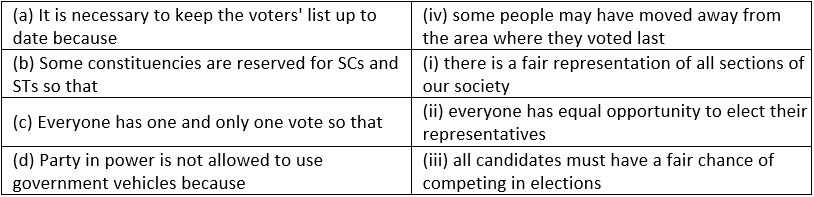
Q3. Match the following

Ans:

Q4. List all the different election-related activities mentioned in the chapter and arrange them in a time sequence, beginning with the first activity and ending with the last. Some of these activities are given below: releasing election manifestos; counting of votes; making of voters’ list; election campaign; declaration of election results; casting of votes; ordering of re-poll; announcing election schedule; filing nomination.
Ans: Election-related activities:
(i) Announcing the election schedule
(ii) Filing nominations
(iii) Making of voters’ list
(iv) Releasing election manifesto
(v) Election campaign
(vi) Casting of votes
(vii) Counting of votes
(viii) Declaration of election results
(ix) Ordering of re-poll


Q5. Surekha is an officer in-charge of ensuring free and fair elections in an assembly constituency in a state. Describe what should she focus on for each of the following stages of election:
(a) Election Campaign
(b) Polling Day
(c) Counting Day
Ans:
(a) Election Campaign 

  • For this, Surekha will have to focus on seeing that the candidates do not bribe or threaten the voters; appeal to them in the name of caste or religion; use government resources for the election campaign, do not spend excessive amounts of money in terms of expenditure or use a place of worship for campaigning. 
  • In addition to this, she will have to see that ministers do not use government vehicles for their campaigns and that they do not make major policy decisions after the elections are announced.

(b) Polling Day

  • For this, Surekha will have to cross-check the voters’ list and check their Voter IDs. She will also need to ensure that incidents of rigging and booth capturing do not take place.

(c) Counting Day

  • For this, Surekha will have to see that the polling agents are present to ensure that counting is done properly.

Q6. The table below gives the proportion of different communities among the candidates who won elections to the US Congress. Compare these to the proportion of these communities in the population of the US. Based on this, would you suggest a system of reservations in the US Congress? If yes, why and for which communities? If no, why not?

Ans:
Based on the table, a reservation for the Hispanic and Black communities is a good idea. This is to make their representation in proportion to the percentage of their population, which is currently less for both classes. On the other hand, Whites do not need any reservation because they have more seats (86% in the House of Representatives) compared to their population (70%). 

Q7. Can we draw the following conclusions from the information given in this chapter? Give two facts to support your position for each of these.
(a) Election Commission of India does not have enough powers to conduct free and fair elections in the country.
(b) There is a high level of popular participation in the elections in our country.
(c) It is very easy for the party in power to win an election.
(d) Many reforms are needed to make our elections completely free and fair.

Ans:
(a)  This is an incorrect conclusion. 

  • The Election Commission of India is powerful enough to conduct free and fair elections. It implements the code of conduct and punishes any candidate or party that violates it. 
  • While on election duty, government officials work under the EC and not the government.

(b) This is a correct conclusion. 

  • The facts support that voter turnout has increased over the past years. 
  • At the same time, election-related activities in the last few years have seen larger participation by the people.

(c)  This is an incorrect conclusion. 

  • The ruling parties routinely lose elections. 
  • Candidates who are known to spend a lot of money often lose elections.

(d) This is a correct conclusion. 

  • Reforms are needed because candidates and parties with a lot of money enjoy an unfair advantage. 
  • Also, some candidates have criminal connections which they use to terrorise the voters and other candidates.


Q8. Chinappa was convicted for torturing his wife for dowry. Satbir was held guilty of practicing untouchability. The court did not allow either of them to contest elections. Does this decision go against the principles of democratic elections?
Ans: This decision does not go against the principles of democratic elections as both Chinappa and Satbir are criminals. Hence, they should be prevented from holding positions in the central or state assemblies.


Q9. Here are some reports of electoral malpractices from different parts of the world. Is there anything that these countries can learn from India to improve their elections? What would you suggest in each case?
(a) During an election in Nigeria, the officer in charge of counting votes deliberately increased the votes of one candidate and declared him elected. The court later found out that more than five lakh votes cast for one candidate were counted in favour of another.
(b) Just before elections in Fiji, a pamphlet was distributed warning voters that a vote for former Prime Minister, Mahendra Chaudhry will lead to bloodshed. This was a threat to voters of Indian origin.
(c) In the US, each state has its own method of voting, its own procedure of counting and its own authority for conducting elections. Authorities in the state of Florida took many controversial decisions that favoured Mr Bush in the presidential elections in 2000. But no one could change those decisions.

Ans:
(a) In this case, representatives of each candidate should be present to make sure that the votes are counted in a fair way.
(b) The election commission should set up an enquiry into the case and debar the candidate or party involved in distributing such pamphlets.
(c) There should be a single election commission that should be free from political influence and should be responsible for conducting elections throughout the country.


Q10. Here are some reports of malpractices in the Indian elections. Identify what the problem in each case is. What should be done to correct the situation?
(a) Following the announcement of elections, the minister promised to provide financial aid to reopen the closed sugar mill.
(b) Opposition parties alleged that their statements and campaign was not given due attention in Doordarshan and All India Radio.
(c) An inquiry by the Election Commission showed that electoral rolls of a state contain the name of 20 lakh fake voters.
(d) The hoodlums of a political party were moving with guns, physically preventing supporters of other political parties to meet the voters and attacking meetings of other parties.

Ans:
(a) 

  • By promising financial aid to the sugar mill, the minister announced a policy decision. 
  • This is not right since policy decisions cannot be made after the elections are announced. The minister should not be allowed to contest the elections.

(b) 

  • By not giving the opposition party’s statements and campaign due attention in Doordarshan and All India Radio, the government gained an unfair advantage over the opposition. 
  • To counter this, the opposition should be given sufficient time on the national media.

(c) 

  • The presence of fake voters means that the elections were rigged by the authorities who prepared the electoral rolls. 
  • The election commission should supervise the preparation of fresh electoral rolls.

(d) By using hoodlums, the political party is terrorising its rivals. The election commission should order the arrest of the hoodlums and bar the party from the elections.


Q11. Ramesh was not in class when this chapter was being taught. He came the next day and repeated what he had heard from his father. Can you tell Ramesh what is wrong with these statements?
(a) Women always vote the way men tell them to. So what is the point of giving them the right to vote?
(b) Party politics creates tension in society. Elections should be decided by consensus, not by competition.
(c) Only graduates should be allowed to stand as candidates for elections.

Ans:
(a) 

  • The statement is wrong because the policy of the secret ballot ensures that an individual can vote for whoever he/she want. 
  • Women are fully capable of making decisions on their own and selecting the candidate they like.

(b) 

  • It is true that party politics creates tension in society, but it is wrong to say that elections should be decided by consensus. 
  • Competition in politics works out for the good of the people as politicians compete with each other in fulfilling their promises. 
  • They might not be honest, but they know that they need to work to be elected. Thus, even their selfish actions benefit people.

(c) Educational qualification is not required to understand the people’s needs and to represent their interests. Thus, it is not necessary for politicians to be graduates.

02. Constitutional Design – Textbook Solutions

Q1. Here are some false statements. Identify the mistake in each case and rewrite these correctly based on what you have read in this chapter.
(a) Leaders of the freedom movement had an open mind about whether the country should be democratic or not after independence.
(b) Members of the Constituent Assembly of India held the same views on all provisions of the Constitution.
(c) A country that has a constitution must be a democracy.
(d) Constitution cannot be amended because it is the supreme law of a country.

Ans:
(a) Leaders of the freedom movement agreed that the country should be a democratic nation after independence.
(b) Members of the Constituent Assembly worked in a systematic, open, and consensual manner to resolve differences among them.
(c) It is not necessary for a country to have a constitution to be a democracy. The constitution of a country can even make provisions for dictatorship or monarchy.  
(d) A constitution can be amended to keep up with the changes in aspirations of the society.


Q2. Which of these was the most salient underlying conflict in the making of a democratic constitution in South Africa?
(a) Between South Africa and its neighbours
(b) Between men and women
(c) Between the white majority and the black minority
(d) Between the coloured minority and the black majority

Ans: (c) Between the white majority and the black minority

The most salient underlying conflict in the making of a democratic constitution in South Africa was between the white minority and the black majority.

Q3. Which of these is a provision that a democratic constitution does not have?
(a) Powers of the head of the state
(b) Name of the head of the state
(c) Powers of the legislature
(d) Name of the country

Ans: (b) Name of the head of the state

The democratic constitution does not have the name of the head of the state, as the head of the state is elected by the citizen of the country. The head of the state changes after after a specific term; hence, there is a provision that a democratic constitution does not have the name of the head of the state.


Q4. Match the following leaders with their roles in the making of the Constitution

Ans:

Q5. Read again the extracts from Nehru’s speech “Tryst with Destiny” and answer the following:
(a) Why did Nehru use the expression “not wholly or in full measure” in the first sentence?
(b) What pledge did he want the makers of the Indian Constitution to take?
(c) “The ambition of the greatest man of our generation has been to wipe every tear from every eye”. Who was he referring to?

Ans:
(a) Nehru used the phrase “not wholly or in full measure” because he believed the work they had started was not yet finished. He knew it wasn’t possible to fulfil their promises all at once, but that they would be achieved gradually over time.
(b) The pledge Nehru wanted the makers of the Indian Constitution to take was to commit their lives to serving India, its people, and humanity as a whole.
(c) He was referring to Mahatma Gandhi, the father of our nation.

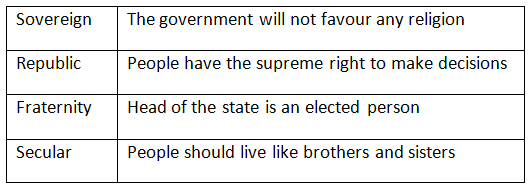
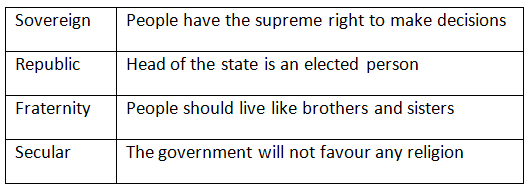
Q6. Here are some of the guiding values of the Constitution and its meaning. Rewrite them by matching them correctly.

Ans:


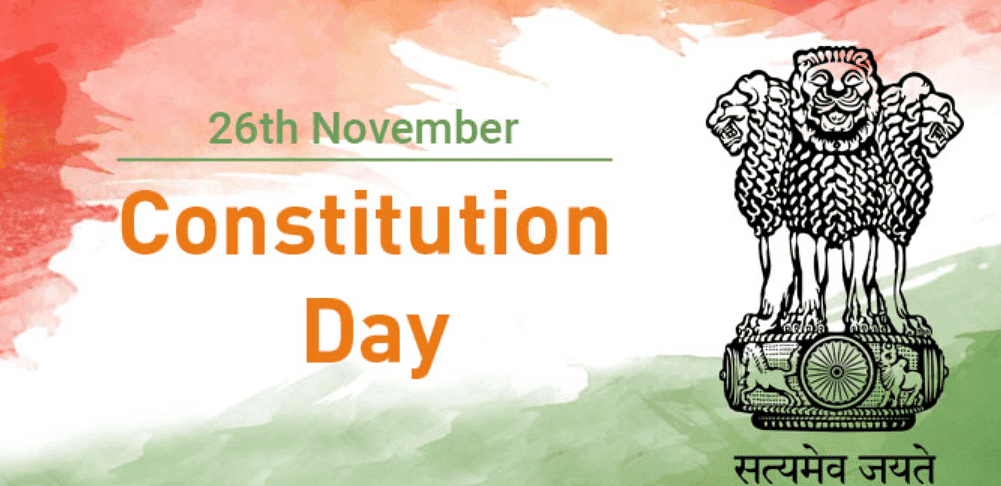
Q7. How did your school celebrate Constitution Day on November 26th? Prepare a brief report.
Ans: Students should write their report on their own if they have celebrated Constitution Day on November 26th.


Q8. Here are different opinions about what made India a democracy. How much importance would you give to each of these factors?
(a) Democracy in India is a gift of the British rulers. We received training to work with representative legislative institutions under the British rule.
(b) Freedom Struggle challenged the colonial exploitation and denial of different freedoms to Indians. Free India could not be anything but democratic.
(c) We were lucky to have leaders who had democratic convictions. The denial of democracy in several other newly independent countries shows the important role of these leaders.

Ans: 
(a) Democracy was chosen as the prime value of our nation during the freedom struggle against the British. Yes, with the Indian Councils Act, Indians started participating in the councils, and hence, their experiences paved the way for legislative institutions in independent India.
(b) The freedom struggle did challenge colonial exploitation, but it worked for democracy by making laws with consensus and not imposing anything on anyone.
(c) Our freedom struggle fought a bloodless struggle with tools like ‘Satyagraha’ and ‘Ahimsa.’ These struggles were undertaken to free India from the clutches of the British and give Indians the freedom they deserved.


Q9. Read the following extract from a conduct book for ‘married women’, published in 1912. ‘God has made the female species delicate and fragile both physically and emotionally, pitiably incapable of self-defence. They are destined thus by God to remain in male protection – of father, husband and son – all their lives. Women should, therefore, not despair, but feel obliged that they can dedicate themselves to the service of men’. Do you think the values expressed in this para reflected the values underlying our constitution? Or does this go against the constitutional values?
Ans: 
The values expressed in the above-mentioned paragraph do not reflect the values underlying our Constitution. Our constitution gives fundamental rights to each of its citizens regardless of gender, caste, sex, place of birth, and religion. Women are given equal rights to men in our constitution, i.e., equality is ensured through Fundamental Rights as well as protected under various articles such as Article 14 (equality before the law) and Article 15 (prohibition of discrimination).


Q10. Read the following statements about a constitution. Give reasons why each of these is true or not true.
(a) The authority of the rules of the constitution is the same as that of any other law.
(b) Constitution lays down how different organs of the government will be formed.
(c) Rights of citizens and limits on the power of the government are laid down in the constitution.
(d) A constitution is about institutions, not about values.
Ans:
(a) Not True

The constitution is the supreme law of the land, meaning it holds higher authority than ordinary laws. All other laws must comply with the constitution. If a law contradicts the constitution, it can be declared unconstitutional and invalid by the courts. The constitution provides the framework for governance, outlines the rights of citizens, and sets limits on the powers of the government, making it superior to regular laws.

(b) True

The constitution lays down the framework for government formation. It defines in detail the composition and functions of the different organs of government, namely the executive, the judiciary and the legislature.

(c) True

The constitution lays down the fundamental rights of every citizen of the country. These rights are enforceable in a court of law. By defining the structure and functions of the different organs of government and by making them independent in their own spheres, yet keeping each organ under check by the other organs, the constitution ensures that there are proper limits to the powers exercised by the government.

(d) Not True

A constitution lays down the composition and functions of the different institutions of government, thereby providing the framework and laws for the working of these institutions. However, providing such laws and frameworks, it is strongly guided by democratic principles and values. Hence, a constitution is as much about values as it is about the institutions based on these values.

1. What is Democracy? Why Democracy? – Textbook Solutions

Q1. Here is some information about the four countries. Based on this information, how would you classify each of these countries? Write ‘democratic’, ‘undemocratic’ or ‘not sure’ against each of these.
(a) Country A: People who do not accept the country’s official religion do not have a right to vote.
(b) Country B: The same party has been winning elections for the last twenty years.
(c) Country C: The Ruling party has lost in the last three elections.
(d) Country D: There is no independent election commission.

Ans:
(a) Country A: Undemocratic

This country is undemocratic because it does not grant equal voting rights to all its citizens. In a true democracy, every citizen, regardless of their religion, should have the right to vote.

(b) Country B: Not sure

We cannot tell if this country is democratic or not just from the information given. A party winning elections for twenty years might mean it’s popular and doing a good job. But if the party is staying in power through corruption or by cheating in elections, then it is not democratic.

(c) Country C: Democratic

This country is democratic because the ruling party has lost the last three elections. This shows that there are free and fair elections and that power is transferred peacefully, which are key features of a democratic system.

(d) Country D: Undemocratic

This country is undemocratic because it doesn’t have an independent election commission. This can lead to election fraud or manipulation by the ruling party, which weakens the democratic process.

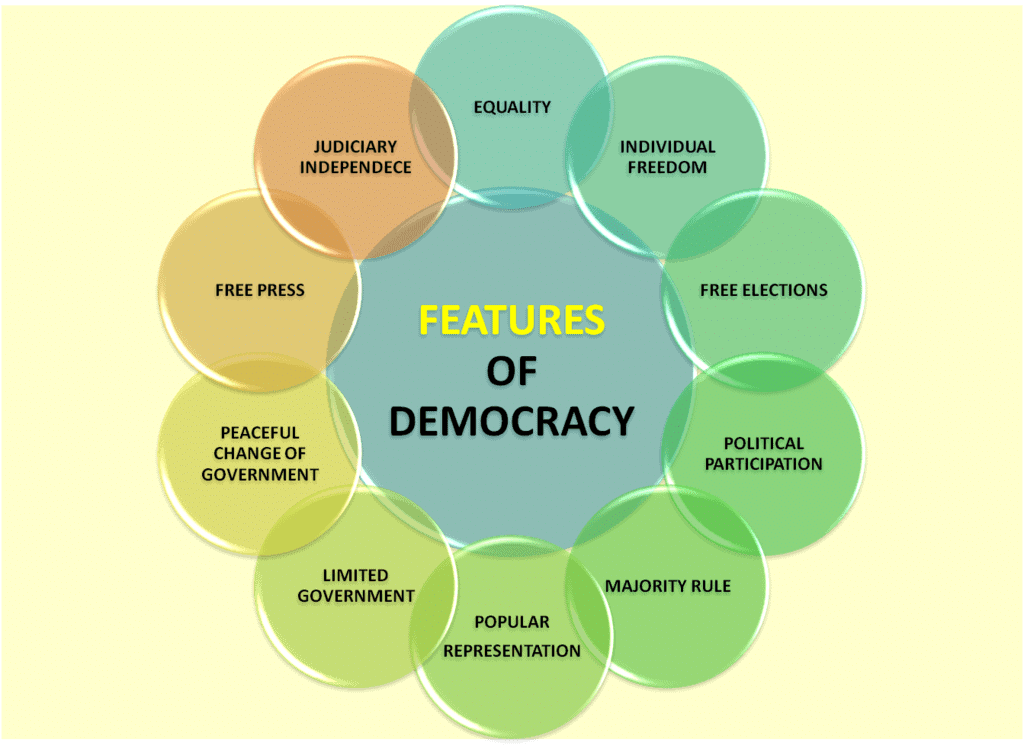
Features of Democracy

Q2. Here is some information about four countries. Based on this information, how would you classify each of these countries. Write ‘democratic’, ‘undemocratic’ or ‘not sure’ against each of these. 
(a) Country P: The parliament cannot pass a law about the army without the consent of the Chief of Army.
(b) Country Q: The parliament cannot pass a law reducing the powers of the judiciary.
(c) Country R: The country’s leaders cannot sign any treaty with another country without taking permission from its neighbouring country
(d) Country S: All the major economic decisions about the country are taken by officials of the central bank which the ministers cannot change.

Ans:
(a) Country P: Undemocratic

Country P is considered undemocratic because, in a democratic system, the military should be controlled by civilians and not have the power to influence laws. In this country, the Chief of Army has too much power, which can weaken the democratic process.

(b) Country Q: Democratic

Country Q is classified as democratic because the judiciary is independent and its powers cannot be limited by the parliament. This independence ensures checks and balances among the different branches of government.

(c) Country R: Undemocratic

Country R is considered undemocratic because, in a democracy, leaders should be able to make important decisions for their country, like signing treaties with other nations. If they need permission from a neighboring country, it takes away their freedom to decide.

(d) Country S: Undemocratic

Country S is seen as undemocratic because, in a democracy, important economic choices should be made by elected leaders who answer to the public. If unelected central bank officials make these decisions, they might not represent what the people want.


Q3. Which of these is not a good argument in favour of democracy? Why?
(a) People feel free and equal in a democracy.
(b) Democracies resolve conflict in a better way than others.
(c) Democratic government is more accountable to the people.
(d) Democracies are more prosperous than others.
Ans: (d)

Democracies are more prosperous than others is not a good argument in favour of democracy because some democratic countries, like Sri Lanka and India, aren’t very prosperous. In contrast, countries like China and Saudi Arabia, which have communist and monarchy systems, are more successful. A country’s prosperity depends more on good government policies and natural resources than on its type of government. Democracy doesn’t ensure prosperity.


Q4. Each of these statements contains a democratic and an undemocratic element. Write out the two separately for each statement.
(a) A minister said that some laws have to be passed by the parliament in order to conform to the regulations decided by the World Trade Organisation (WTO).
(b) The Election Commission ordered re-polling in a constituency where large-scale rigging was reported.
(c) Women’s representation in the parliament has barely reached 10 per cent. This led women’s organisations to demand one-third seats for women.

Ans:
(a) Democratic element – A minister said that some laws have to be passed by the parliament.
Undemocratic element – Conform to the regulations decided by the World Trade Organisation (WTO).

(b) Democratic element – The Election Commission ordered re-polling in a constituency.
Undemocratic element – Large-scale rigging was reported.

(c) Democratic element – Women’s organisations to demand one-third of seats for women.
Undemocratic element – Women’s representation in parliament has barely reached 10 per cent.

Q5. Which of these is not a valid reason for arguing that there is a lesser possibility of famine in a democratic country?
(a) Opposition parties can draw attention to hunger and starvation.
(b) Free press can report suffering from famine in different parts of the country.
(c) Government fears its defeat in the next elections.
(d) People are free to believe in and practise any religion. 
Ans: (d) People are free to believe in and practice any religion.

Option ‘d’ is not a valid reason for arguing that there is a lesser possibility of famine in a democratic country. This is because practising religion has nothing to do with preventing famine.

Q6. There are 40 villages in a district where the government has made no provision for drinking water. These villagers met and considered many methods of forcing the government to respond to their need. Which of these is not a democratic method?
(a) Filing a case in the courts claiming that water is part of right to life.
(b) Boycotting the next elections to give a message to all parties.
(c) Organising public meetings against government’s policies. 
(d) Paying money to government officials to get water. 

Ans: (d) Paying money to government officials to get water.

Option ‘d’, which advocates paying the government officials money, is an undemocratic method.


Q7. Write a response to the following arguments against democracy:
(a) Army is the most disciplined and corruption-free organisation in the country. Therefore army should rule the country.
(b) Rule of the majority means the rule of ignorant people. What we need is the rule of the wise, even if they are in small numbers.
(c) If we want religious leaders to guide us in spiritual matters, why not invite them to guide us in politics as well. The country should be ruled by religious leaders.

Ans: 
(a) 

  • If the army is allowed to rule the country, it will lead to the concentration of all powers in the army. Power should be divided among the three organs of the government i.e., legislature, executive and judiciary. 
  • The concentration of all powers with the army will lead to a dictatorship.
    Example: Pinochet’s rule in Chile.

(b) 

  • Democracy is a form of government where all adults have the right to vote. 
  • Restricting people to rule and govern only by a minority having ‘wise people’ would harm representational democracy.

(c) 

  • Politics and religion are two different fields. Religion takes us towards spirituality by teaching us what is good or bad. 
  • The combination of religion and politics leads to communalism or communal politics which is very dangerous.

Q8. Are the following statements in keeping with democracy as a value? Why?
(a) Father to daughter: I don’t want to hear your opinion about your marriage. In our family children marry where the parents tell them to.
(b) Teacher to student: Don’t disturb my concentration by asking me questions in the classroom.
(c) Employee to the officer: Our working hours must be reduced according to the law.

Ans:
(a) This statement is undemocratic because it goes against the democratic values of individual freedom and the right to express opinions. In a democracy, everyone has the right to take part in decisions that affect their lives, including personal matters like marriage. By not allowing his daughter to share her thoughts on her own marriage, the father is denying her this right, which is undemocratic.
(b) This statement is undemocratic because it goes against the value of open conversation and sharing ideas. In a learning environment, students should be encouraged to ask questions and discuss topics, as this helps them think critically, which is important in a democracy. By not allowing questions, the teacher is stopping open conversation.
(c) This statement is democratic because it supports democratic values. The employee is claiming their right to fair working conditions, which is a basic right in a democracy. By asking for the law to be followed, they are taking part in a democratic process and respecting the rule of law, which is important in a democracy.

Q9. Consider the following facts about a country and decide if you would call it a democracy. Give reasons to support your decision.
(a) All the citizens of the country have right to vote. Elections are held regularly
(b) The country took loan from international agencies. One of the conditions for giving loan was that the government would reduce its expenses on education and health.
(c) People speak more than seven languages but education is available only in one language, the language spoken by 52 percent people of that country.
(d) Several organisations have given a call for peaceful demonstrations and nation wide strikes in the country to oppose these policies. Government has arrested these leaders.
(e) The government owns the radio and television in the country. All the newspapers have to get permission from the government to publish any news about government’s policies and protests.

Ans:
(a) From this statement, we can understand that it is a democratic country where citizens are allowed to vote and choose their government.
(b) While taking a loan from international agencies, the country is compromising on the welfare of the people by reducing their expenditure on education and health, which is totally undemocratic.
(c) The provision of making education accessible in only one language is undemocratic. It is the fundamental right for people to have an education, and it is the government’s duty to provide them with the language they know.
(d) The right to assemble and peacefully demonstrate is a basic right of an individual. Hence, arresting the protestors is undemocratic.
(e) When the government owns the radio and television, it is preventing people from availing their right to a free press. It is undemocratic.

Q10. In 2004 a report published in USA pointed to the increasing inequalities in that country. Inequalities in income reflected in the participation of people in democracy. It also shaped their abilities to influence the decisions taken by the government. The report highlighted that:

  • If an average Black family earns $ 100 then the income of average White family is $ 162. A White family has twelve times more wealth than the average Black family.
  • In a President’s election, ‘nearly 9 out of 10 individuals in families with income over $ 75,000 have voted. These people are in the top 20% of the population in terms of their income. On the other hand, only 5 people out of 10 from families with income less than $ 15,000 have voted. They are in the bottom 20% of the population in terms of their income.
  • About 95% of the contribution to the political parties comes from the rich. This gives the opportunity to express their opinions and concerns, which is not available to most citizens.
  • As poor sections participate less in politics, the government does not listen to their concerns – coming out of poverty, getting the job, education, health care and housing for them. Politicians hear most regularly about the concerns of business persons and the rich.

Write an essay on ‘Democracy and Poverty’ using the information given in this report but using examples from India.
Ans:

  • Poverty and Democracy highlight an important, complicated relationship between the two. It points out how fundamental rights of democracy are given to the elite section, but the poor are still being deprived of them.
  • Issues like unfair business practices and unequal opportunities have widened the gap between the rich and poor. The rich keep getting richer, while the poor struggle more. Wealthy people are influencing government decisions, which creates an imbalance in power and goes against the core ideas of democracy.
  • Poverty has become a serious threat, with political parties relying on money from the wealthy. As a result, these parties often ignore the needs of the poor. The glamorous growth of industries and tall buildings cannot hide the poor living conditions in many areas.
  • During the 2014 and 2019 Indian elections, big donations from corporations and wealthy individuals influenced campaigns and political agendas. Democracy is built on political equality, where the poorest and least educated have the same value as the rich and educated. 
  • However, when the system favors the wealthy, true democracy cannot survive for long, leading to conflicts in the fight to improve it.