05. Forest Society and Colonialism – Textbook Solutions

Q1. Discuss how the changes in forest management in the colonial period affected the following groups of people:
(a) Shifting cultivators
(b) Nomadic and pastoralist communities
(c) Firms trading in timber/forest produce
(d) Plantation owners
(e) Kings/British officials engaged in shikar (hunting)
Ans:

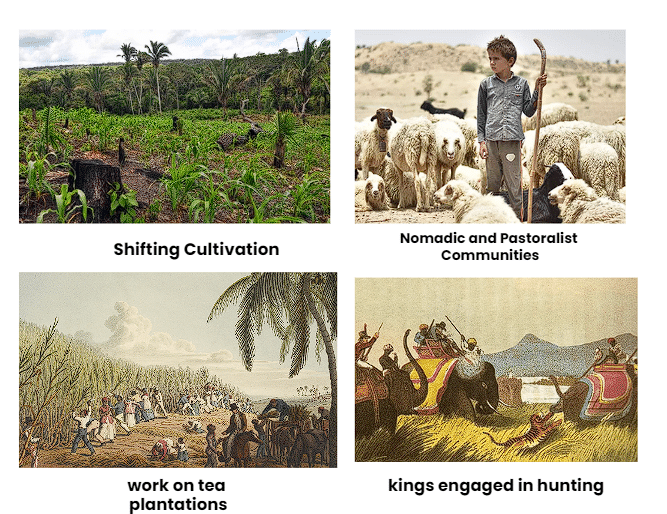
(a) Shifting Cultivators: The colonial government banned shifting cultivation to protect forests, which forced tribal communities to leave their homes and find new jobs. Some of these communities protested the changes.

(b) Nomadic and Pastoralist Communities: In the Madras Presidency, many nomadic groups like the Korava, Karacha, and Yerukula lost their ways of life. Some were labelled as criminal tribes and had to work in factories and plantations.

(c) Firms Trading in Timber/Forest Produce: Before British rule, Adivasi communities could trade forest goods freely. The British restricted this and gave exclusive trading rights to European companies, which hurt local economies.

(d) Plantation Owners: Forest communities like Santhals, Oraons, and Gonds were recruited to work on tea plantations in Assam. They faced low wages, poor working conditions, and difficulties returning home.

(e) Kings/British Officials Engaged in Shikar: British hunting laws restricted locals from hunting, while British officials indulged in hunting for sport. This led to the extinction of some species. Conservationists later argued for wildlife protection.

Q2. What are the similarities between colonial management of the forests in Bastar and in Java?
Ans: 
The similarities between the colonial management of forests in Bastar and in Java include the following:

  • Restriction of traditional practices: Both in Bastar and Java, the colonial government imposed restrictions on local practices such as shifting cultivation, hunting, and collection of forest produce.
  • Exploitation of local population: In both regions, villagers faced increased rents and demands for free labour and goods by colonial officials, resulting in their suffering.
  • Forced labour in forest management: In Bastar, villagers were required to work for free in the forest department, while in Java, the Dutch introduced the blandongdiensten system, which required villagers to provide free labour and resources for cutting and transporting timber.
  • Creation of forest villages: Both regions saw the establishment of forest villages, where villagers were allowed to stay in the forests but had to work for the colonial government, either directly or indirectly through systems like the blandongdiensten in Java.

Q3. Between 1880 and 1920, forest cover in the Indian subcontinent declined by 9.7 million hectares, from 108.6 million hectares to 98.9 million hectares. Discuss the role of the following factors in this decline:
(i) Railways
(ii) Shipbuilding
(iii) Agricultural expansion
(iv) Commercial farming
(v) Tea/Coffee plantations
(vi) Adivasis and other peasant users
Ans: 

(i) Railways: They were essential for colonial trade and the movement of troops. To run locomotives, wood was needed as fuel, and to lay the railway lines sleepers were essential to hold the track together. By 1890, about 25,500 km of tracks were laid and more and more trees were cut. In Madras Presidency alone 35,000 trees were being cut annually for sleepers.
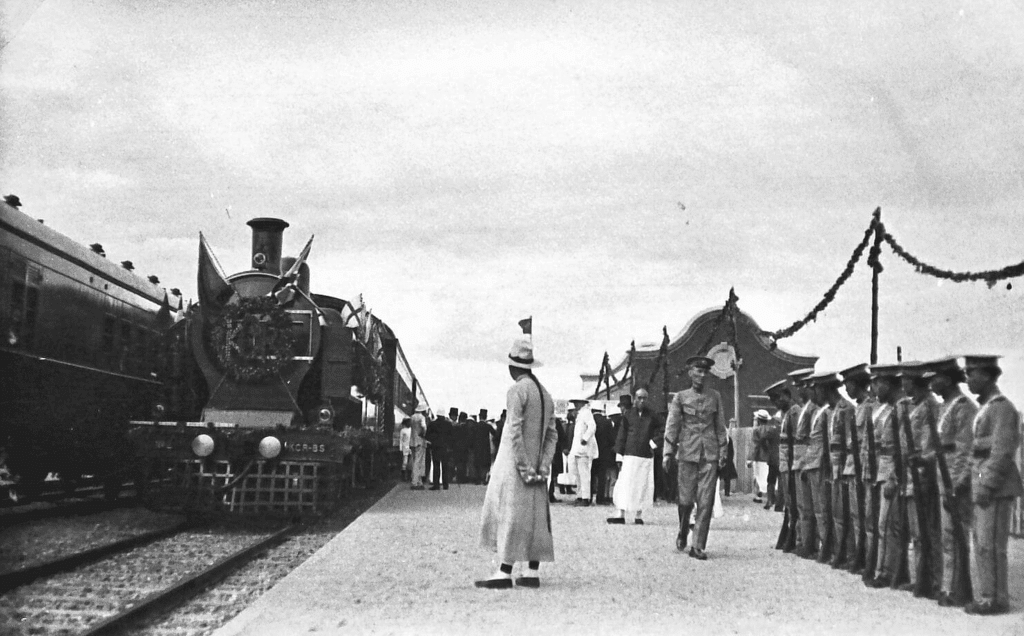
Railways during British Rule

(ii) Shipbuilding: In early 19th-century England, oak forests were disappearing, leading to a timber shortage for the Royal Navy. Without strong timber, ships couldn’t be built, which was crucial for protecting colonies and trade. Within a decade, large-scale tree cutting began in India to supply the timber needed.
Shipbuliding

(iii) Agricultural expansion: The colonial government believed that forests were unproductive. They had to be brought under cultivation so that they could yield agricultural products and generate revenue. So between 1880 and 1920, the cultivation increased by 6.7 million hectares.
(iv) Commercial farming: The British encouraged the production of commercial crops like jute, sugar, wheat and cotton. The demand for these crops increased in 19th-century Europe, where food grains were needed for a growing population and raw materials for industries.
(v) Tea/Coffee plantations: To meet the growing needs for tea, coffee and rubber, large areas of forests were cleared for their plantation. The colonial government took over the forests and gave vast areas to European planters at cheap rates. These areas were planted with tea, coffee and rubber.
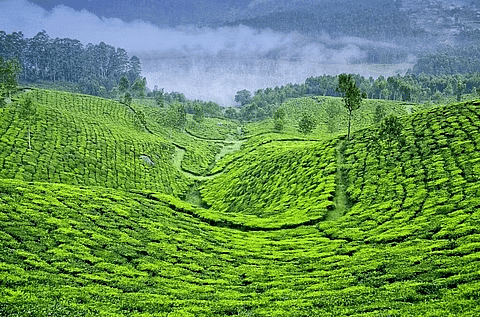
Tea/Coffee Plantations

(vi) Adivasis and other peasant users: From early times, Adivasis communities traded in goods like hides, horns, silk cocoons, ivory, bamboo, spices, fibres, grasses, gums and resins through nomadic communities like the banjaras. This further declined forest cover.

Q4. Why are forests affected by wars?
Ans: Forests are affected by wars for several reasons. 

  • Firstly, during conflicts, the demand for resources like wood for construction and fuel increased, leading to extensive deforestation. For example, during the World Wars, many trees were cut down to meet the needs of countries like Britain.
  • Secondly, in some cases, warring parties use destructive tactics like the “scorched earth” policy. For example, the Dutch in Java destroyed sawmills and burned large piles of teak logs to prevent the enemy from accessing resources. This strategy can severely damage forests and ecosystems.
  • Lastly, wars can cause local populations to exploit forests and their resources. For example, during the Japanese occupation of Java, villagers were forced to cut down forests to expand their farmland, leading to increased deforestation and damage to forest ecosystems.
04. Pastoralists in the Modern World – Textbook Solutions

Q1. Explain why nomadic tribes need to move from one place to another. What are the advantages to the environment of this continuous movement?
Ans. Nomadic tribes move from place to place to earn a living and find pastures for their animals. They adjust to seasonal changes and use different pastures effectively. When pastures are depleted, they move their herds to new areas. This constant movement helps the environment in two ways:

  • It allows vegetation to naturally restore itself.
  • The animals’ manure fertilises the fields.

Q2. Discuss why the colonial government in India brought in the following laws. In each case, explain how the law changed the lives of pastoralists:
(a) Waste Land rules
(b) Forest Acts
(c) Criminal Tribes Act
(d) Grazing Tax

Ans. (a) Waste Land rules: Colonial officials viewed uncultivated land as unproductive and wasted, as it didn’t generate revenue or crops. They believed it needed to be ploughed and used for agriculture. In the mid-19th century, wasteland rules were introduced, which allowed the government to take over uncultivated land and give it to selected individuals. This often included grazing lands used by pastoralists, reducing the pastures available for their animals.
(b) Forest Acts: In the mid-19th century, the British passed several Forest Acts in different provinces. These Acts divided forests into Reserved and Protected Forests. Pastoralists were not allowed to enter the Reserved Forests. In Protected Forests, they were given limited grazing rights, but their movement was controlled. The British believed that grazing harmed young plants.

These Forest Acts changed the lives of pastoralists. They could no longer enter many forests that once provided good grazing. Now, they needed a permit to enter, which stated how long they could stay. If they stayed longer, they were fined—even if there was still grass left for their animals.
(c) Criminal Tribes Act: The colonial government wanted people to live in fixed locations with set rights to make ruling easier. They saw settled people as peaceful and obedient, but were suspicious of nomadic and pastoral tribes who moved around and didn’t have fixed homes. In 1871, they passed the Criminal Tribes Act, labelling many pastoralists, craftsmen, and traders as Criminal Tribes. These groups had to stay in designated villages and needed permits to move. The police closely monitored them.
(d) Grazing Tax: The aim of the colonial government was to collect as much revenue as possible, so a tax was imposed on land, water, salt, trade goods, and animals. By 1880, each pastoralist was given a pass. Each cattle herder had to pay tax for each cattle head. The amount paid was entered on the pass.

Q3. Give reasons to explain why the Maasai community lost their grazing lands.
Ans. The Maasai community lost their grazing lands because:

(i) Before colonial times, Maasailand stretched from northern Kenya to northern Tanzania. By 1885, it was divided between British Kenya and German Tanganyika. European settlers took the best grazing lands, leaving the Maasai with only a small area. They lost 60% of their land and were pushed into arid regions.

(ii) In the late 19th century, the British colonial government encouraged peasants to expand farming, turning pasturelands into cultivated lands.

(iii) Many Maasai grazing lands were made into game reserves, like Maasai Mara and Serengeti Park. Pastoralists couldn’t enter these reserves to graze or hunt.


Q4. There are many similarities in the way in which the modern world forced changes in the lives of pastoral communities in India and East Africa. Write about any two examples of changes which were similar for Indian pastoralists and the Massai herders.
Ans. 

(a) By the mid-19th century, various Forest Acts were passed in India. Through these acts, some forests which produced commercially valuable timber like deodar and sal were declared ‘reserved’. No pastoralist was allowed access to these forests. In ‘protected’ forests, pastoralists had some rights but faced restrictions on their movement. In Maasailand, large grazing areas were turned into game reserves where pastoralists couldn’t hunt or graze their herds.

(b) The Forest Acts significantly impacted pastoralists. They lost access to many forests that once provided forage for their cattle. They needed permits to enter, with set times for entry, stay, and departure. Similarly, in Africa, pastoral groups had to stay within reserve boundaries and faced difficulties obtaining permits to move their livestock.

03. Nazism and the Rise of Hitler – Textbook Solutions

Q1: Describe the problems faced by the Weimar Republic.
Ans: 
After Germany lost World War I, Emperor Wilhelm II abdicated, and the Weimar Republic was formed. The Republic faced the following problems:

  • Versailles Treaty: The treaty that ended the war, took German territories, and resources, and required 6 billion pounds in reparations, making the Republic unpopular.
  • Economic Crisis: War debts depleted gold reserves, causing the German mark to fall and prices to soar.
  • Political Flaws: The Weimar Republic had a weak constitution with issues like proportional representation and Article 48, which allowed the President to rule by decree during emergencies. This made it hard for the Republic to handle economic crises effectively.

Q2: Discuss why Nazism became popular in Germany by 1930.
Ans: 
The end of World War I brought significant changes to Germany’s political landscape, and the newly formed Weimar Republic faced many challenges right from the start.

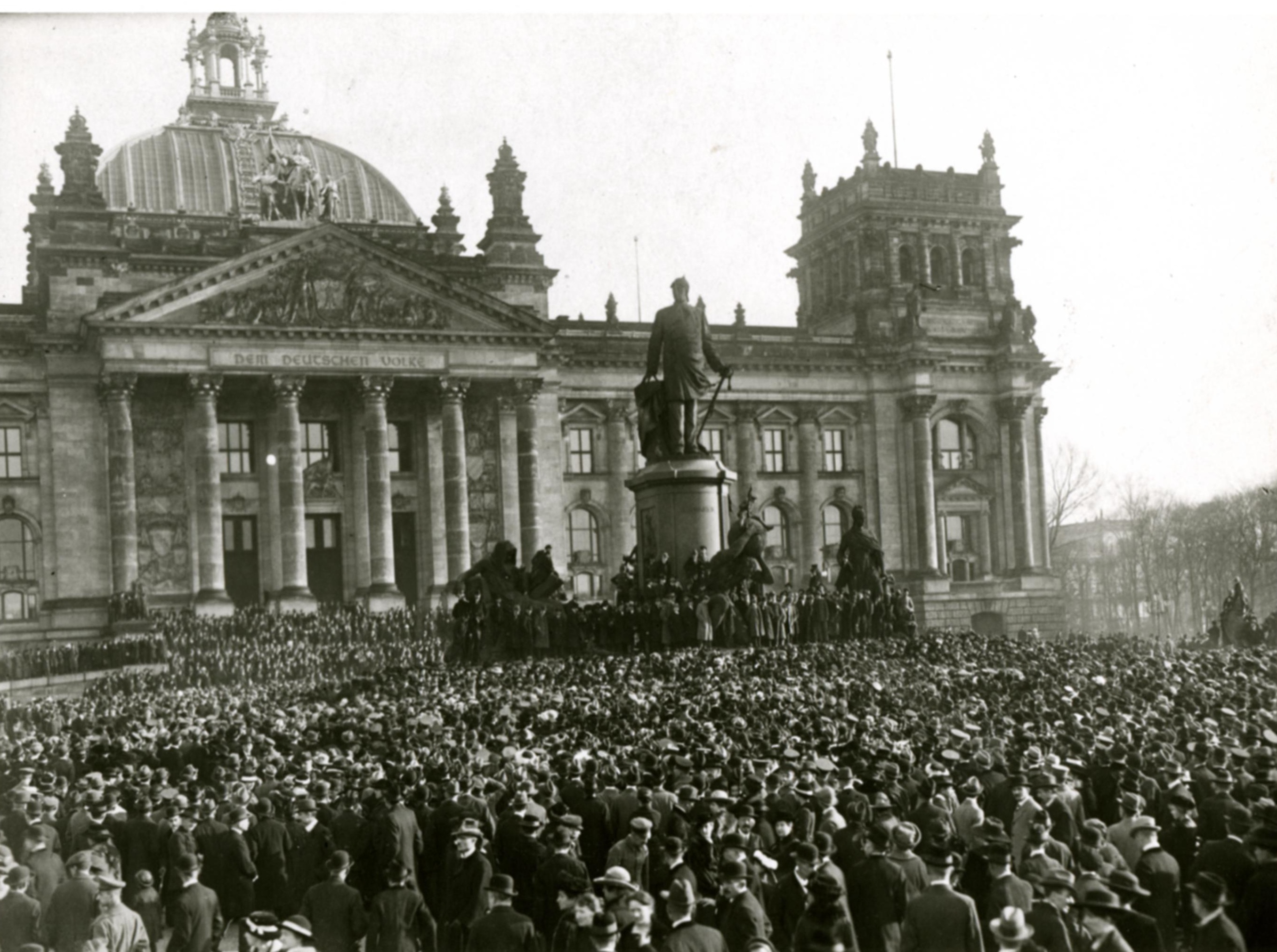
  • One of the biggest problems was the Great Depression. The Weimar Republic did little to address the economic crisis, and this created an opportunity for Hitler to present himself as a saviour to the German people, who were suffering from economic hardship and political instability.
  • Hitler’s powerful speeches promised to build a strong nation, reverse the injustices of the Versailles Treaty, restore the dignity of the German people, and create jobs for everyone. These promises gave people hope.
  • Nazi propaganda was also very effective. The use of red banners with the Swastika, the Nazi salute, and enthusiastic applause during rallies made Nazism increasingly popular among the people.

Q3: What are the peculiar features of Nazi thinking?
Ans: The Nazi thinking was synonymous with Hitler’s worldview. The features of such thinking are as follows:

  • Nazi ideology ranked races with Nordic Germans at the top and Jews at the bottom, while others were placed in between. 
  • They wanted more land (Lebensraum) for Germany, even if it meant taking it from others.
  • Nazis twisted Darwin’s theory to justify that only the strongest races should survive. 
  • They valued ‘racial purity,’ deeming those with disabilities and certain ethnic groups as undesirable and subject to extermination. 
  • They saw war as a means to prove German superiority and rejected peace as weak.


Q4: Explain why Nazi propaganda was effective in creating a hatred for Jews.
Ans:
 The Nazi propaganda was highly effective in creating hatred for the Jews due to the following reasons:

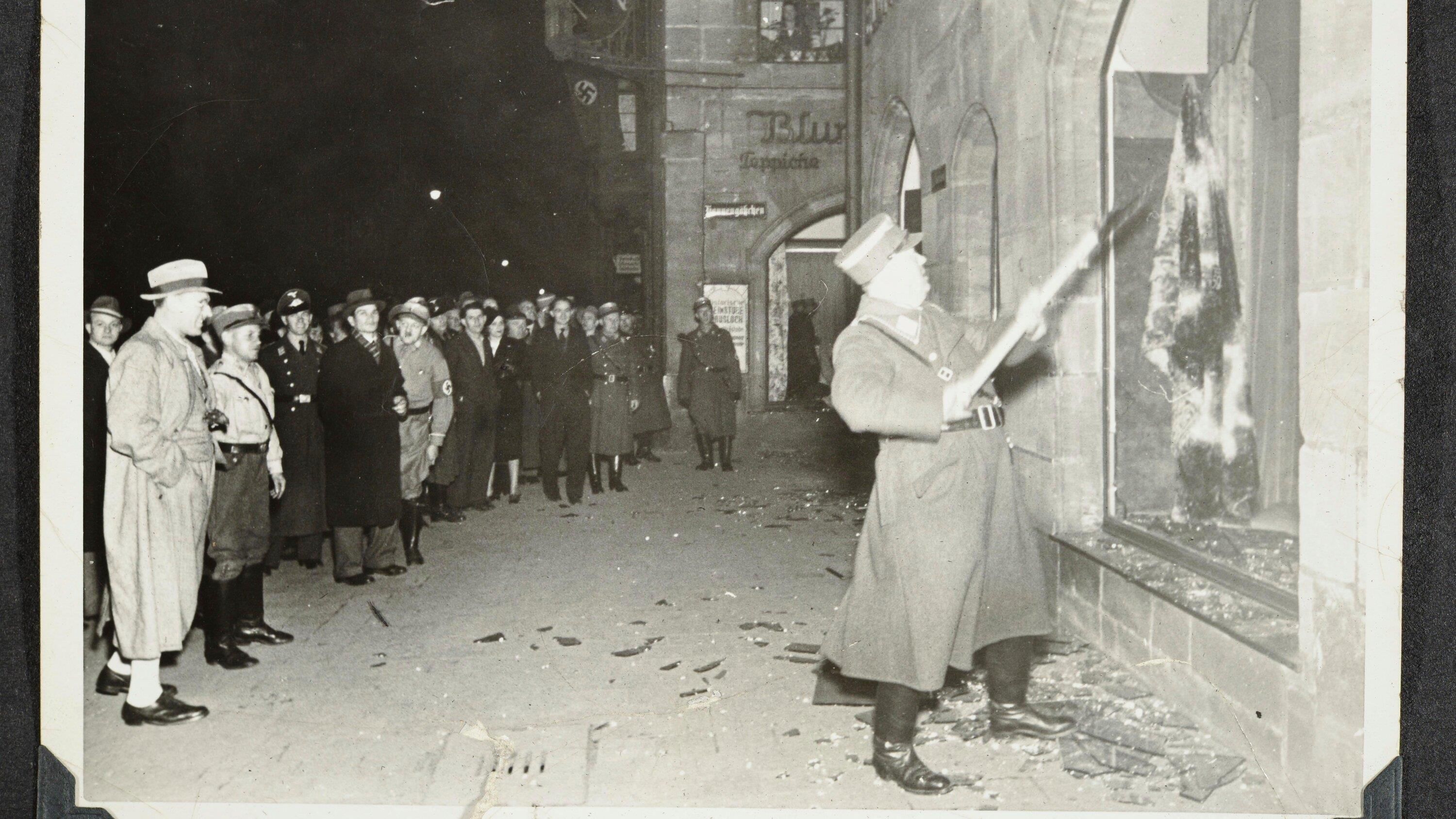
  • The Nazis used language and media very carefully to spread their ideas. They claimed Jews were inferior and undesirable. 
  • They took advantage of old Christian hatred of Jews, who were blamed for killing Christ, to increase German prejudice against them. 
  • Nazis taught children to hate Jews from a young age, firing Jewish teachers and expelling Jewish students. 
  • They made propaganda films, like “The Eternal Jew,” to reinforce negative stereotypes and hatred of Jews.

Such kinds of propaganda made the Germans believe that the Jews were inferior to them. 

Q5: Explain the role of women in Nazi society. Return to Chapter 1 on the French Revolution. Write a paragraph comparing and contrasting the role of women in the two periods.
Ans: 

  • In Nazi society, women were expected to be housewives, have many pure-blooded children, and avoid ‘undesirables.’ 
  • Those who complied received benefits like hospital perks and discounts. However, women who didn’t follow these rules faced severe punishment, including public shame, loss of family, jail, or death.
  • This was very different from women’s roles during the French Revolution. French women fought for education, equal wages, and freedom from forced marriage. They could pursue careers, become artists, run businesses, and own property.


Q6: In what ways did the Nazi state seek to establish total control over its people?
Ans:
 The Nazis established control over its people by various means: 

  • The Nazis used posters and films to promote their ideas and gain support. 
  • They carefully controlled the media to shape public opinion and stir up hatred against those they labelled ‘undesirable.’ 
  • They created special security forces to enforce their rules and used police power to act without limits. 
  • Genocide and fear helped them maintain tight control over society.

02. Socialism in Europe and the Russian Revolution – Textbook Solutions

Q1. What were the social, economic, and political conditions in Russia before 1905?
Ans: The following were the social, economic, and political conditions in Russia before 1905:
(a) Social Conditions

  • The majority religion was Russian Orthodox Christianity— which had grown out of the Greek Orthodox Church. But the empire also included Catholics, Protestants, Muslims, and Buddhists.

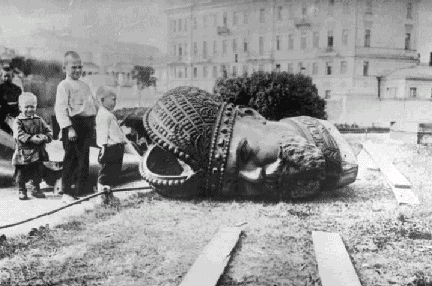
Cross of the Russian Orthodox Church

  • The non-Russian nationalities were not treated equally to the Russian nationalities. 
  • Workers were a divided group on the basis of skill and training. 

(b) Economic Conditions

  • The majority of Russians were agriculturists
  • Industries were few. Much of the production was done by the craftsmen. 
  • With the expansion of the Russian rail network, foreign investment in factories grew. 
  • There was huge coal, iron, and steel production. The workers were exploited by capitalists who made their lives miserable.

(c) Political Conditions

  • Russia was a monarchy.
  • The Tsars believed in the divine rights of kings
  • They were not responsible to the Parliament. 
  • All political parties were illegal in Russia.


Q2. In what ways was the working population in Russia different from other countries in Europe, before 1917?

Ans:

  • Compared to people in Europe, the situation for Russians, especially workers like farmers and factory workers, was very poor.
  • This was mainly because of Tsar Nicholas II’s harsh and corrupt rule.
  • Much of what the peasants produced went to landowners and the wealthy.
  • Large estates were controlled by the nobility, the crown, and the Orthodox Church.
  • In Europe, peasants supported and fought for nobles, but in Russia, they wanted the nobles’ land for themselves.
  • They often refused to pay rent and sometimes even killed landlords due to frustration with harsh policies.
  • Factory workers also suffered; they couldn’t form unions or political groups to voice their complaints.
  • They were exploited by industrialists, often receiving low wages and working long hours with no limits.


Q3. Why did the Tsarist autocracy collapse in 1917?

Ans: 

  • There was widespread anger against the Tsar’s autocratic rule. The Russian people wanted an end to the war and peace, but the Tsar, who had mishandled the war, insisted on continuing it. The peasants, in particular, wanted land for themselves, but the corrupt government ignored their demands.
  • Workers also faced terrible conditions. They couldn’t form trade unions or political parties to voice their concerns. Private industrialists ran most industries, and workers often received less than minimum wages and worked 12-15 hours a day with no set limits.
  • The Tsar’s rule had become ineffective. He was corrupt, oppressive, and indifferent to the people’s welfare.
  • Karl Marx’s ideas inspired people to demand change.
  • The Tsar’s involvement and defeat in World War I was the final blow that led to the collapse of his rule.

Q4. Make two lists: one with the main events and the effects of the February Revolution and the other with the main events and effects of the October Revolution. Write a paragraph on who was involved in each, who the leaders were, and what the impact of each was on Soviet history.
Ans:
(a) The February Revolution

  • In February 1917, there were severe food shortages in the workers’ areas. Parliamentarians were against the Tsar’s decision to dissolve the Duma.
  • On 22nd February, a factory lockout happened, with many women leading strikes. The strikes spread, with workers surrounding important areas in Petrograd, like Nevskii Prospekt.
  • On 25th February, the Duma was dissolved, leading to the ransacking of the Police Headquarters on 27th February. The cavalry refused to shoot at the protesters. By evening, soldiers and workers joined together to form the Petrograd Soviet, a “council.”
  • The Tsar abdicated his power on 2nd March, and the Soviet and Duma leaders set up a Provisional Government for Russia. The February Revolution was led by the people, not any political party. Petrograd was crucial in ending the monarchy and had an important place in Soviet history.

February Revolution

(b) The October Revolution

  • The conflict between the Provisional Government and the Bolsheviks led to the October Revolution.
  • In September 1917, Vladimir Lenin began organizing an uprising. On 16th October, he convinced the Petrograd Soviet and the Bolshevik Party to support a socialist takeover. Leon Trotsky led the Military Revolutionary Committee to carry out the plan.
  • On 24th October, as the uprising began, Prime Minister Kerensky left the city for reinforcements. The Military Revolutionary Committee quickly took action: the ship Aurora shelled the Winter Palace, and by evening, the city was under Bolshevik control.
  • After fierce fighting, the Bolsheviks secured the Moscow-Petrograd area. Their actions were approved by the All-Russian Congress of Soviets. The October Revolution, led by Lenin and Trotsky, marked the start of Lenin’s rule with Bolshevik leadership.


Q5. What were the main changes brought about by the Bolsheviks immediately after the October Revolution?

Ans: 

  • Industries and banks were nationalized, meaning the government took over their ownership and management.
  • Land was declared social property, allowing peasants to take land from the nobility. In cities, the Bolsheviks divided large houses to fit family needs.
  • The use of old aristocratic titles was banned, and new uniforms for the army and officials were introduced. The Bolshevik Party was renamed the Russian Communist Party (Bolshevik).
  • Despite opposition from their allies, the Bolsheviks made peace with Germany and withdrew from World War I.
  • Later, the Bolsheviks were the only party in elections to the All-Russian Congress of Soviets, which became Russia’s Parliament.


Q6. Write a few lines to show what you know about
(a) Kulaks
(b) The Duma
(c) Women workers Between 1900 and 1930
(d) The Liberals
(e) Stalin’s Collectivisation Programme

Ans: 
(a) Kulaks

  • They were the well-to-do peasants who were supposed to be holding stocks in the hope of higher prices. 
  • They were raided so that they may be eliminated in order to develop modern farms and establish state-controlled large farms.

(b) The Duma
The Duma was a consultative parliament that was created with the permission of the Tsar during the 1905 Revolution.
(c) Women Workers Between 1900 and 1930

  • Women made up 31% of the factory labour force but were paid between 1/2 and 3/4 of a man’s wages. 
  • They actively led the strikes in many factories. They even worked in the collective farms.

(d) The Liberals

  • They were a group that looked to change society. They wanted a nation that tolerated all religions and opposed the uncontrolled power of dynastic rulers. 
  • They argued for a representative, elected parliamentary government with laws interpreted by a well-trained, independent judiciary that was separate from rulers and officials.

(e) Stalin’s Collectivisation Programme

  • Stalin hoped to solve the problem of food shortage by combining small farms with large and modern farms. 
  • This was a collectivisation programme that began in 1929. Peasants were forced to work in these state-controlled collective farms called Kolkhoz.

01. The French Revolution – Textbook Solutions

Q1. Describe the circumstances leading to the outbreak of revolutionary protest in France?
Ans: Several factors contributed to the revolutionary protests in France in 1789:

  • Social Inequality: French society was divided into three estates. The clergy (First Estate) and the nobility (Second Estate) enjoyed privileges, while the commoners (Third Estate) bore heavy taxes and had no say in political matters. This inequality fueled anger among the Third Estate.
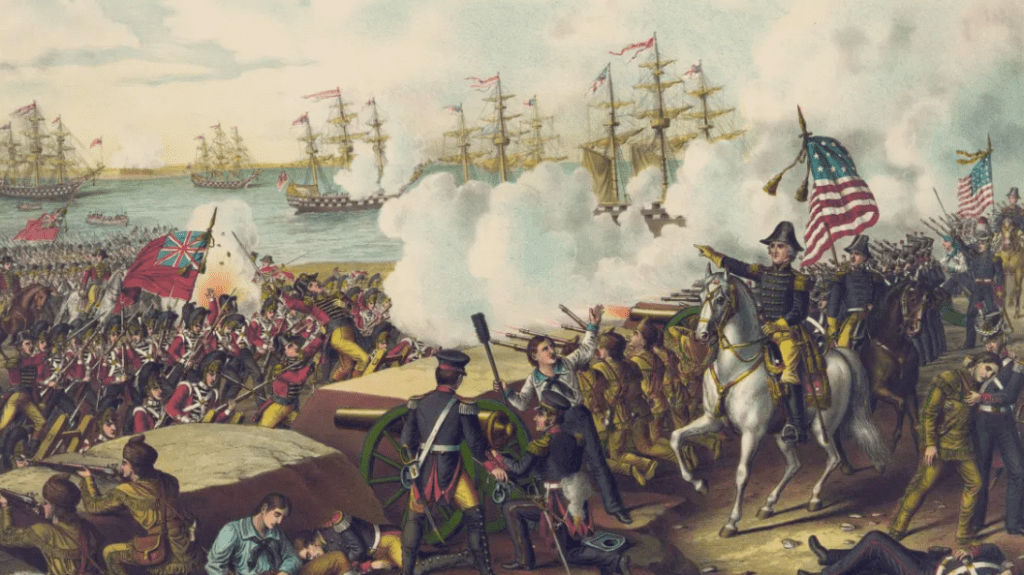
    American War of Independence
  • Economic Crisis: France faced a severe financial crisis due to costly wars (like the American War of Independence) and extravagant spending by the monarchy. This led to increased taxation and widespread poverty.
  • Enlightenment Ideas: Enlightenment philosophers like Rousseau criticized absolute monarchy and advocated ideas of liberty, equality, and fraternity. Their writings inspired revolutionary thinking.
  • Weak Monarchy: King Louis XVI was seen as an ineffective leader who failed to address the grievances of the people. His inability to reform taxation and government deepened the crisis.
  • Famine and Unemployment: Bad harvests in the 1780s led to food shortages and inflation, worsening the economic conditions. Widespread unemployment in urban areas further fueled dissatisfaction.

Q2. Which groups of French society benefited from the revolution? Which groups were forced to relinquish power? Which sections of society would have been disappointed with the outcome of the revolution?
Ans:  

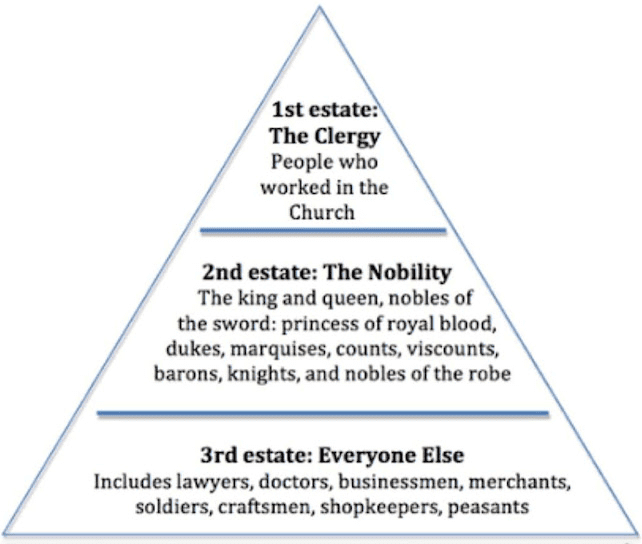
The French society was divided into three estates before the revolution:

The Three Estates

  • Beneficiaries: The Third Estate, which included peasants, artisans, small farmers, landless labourers, servants, businessmen, merchants, court officials, and lawyers, benefited the most from the revolution. They gained rights such as freedom from feudal dues and the abolition of privileges enjoyed by the nobility and clergy.
  • Groups that lost power: The First Estate (clergy) and Second Estate (nobility) were forced to relinquish power. These estates had long enjoyed privileges by birth, including exemption from taxes and special political influence. After the revolution, these privileges were removed.
  • Disappointed groupsWomen and the poorer working class were disappointed with the revolution’s outcomes. Women were not granted equal rights or the right to vote, and the poor continued to face economic hardships, as the revolution did not fully address their needs.

Q3. Describe the legacy of the French Revolution for the peoples of the world during the nineteenth and twentieth centuries.
Ans: 

The French Revolution left a lasting impact on the world during the 19th and 20th centuries:

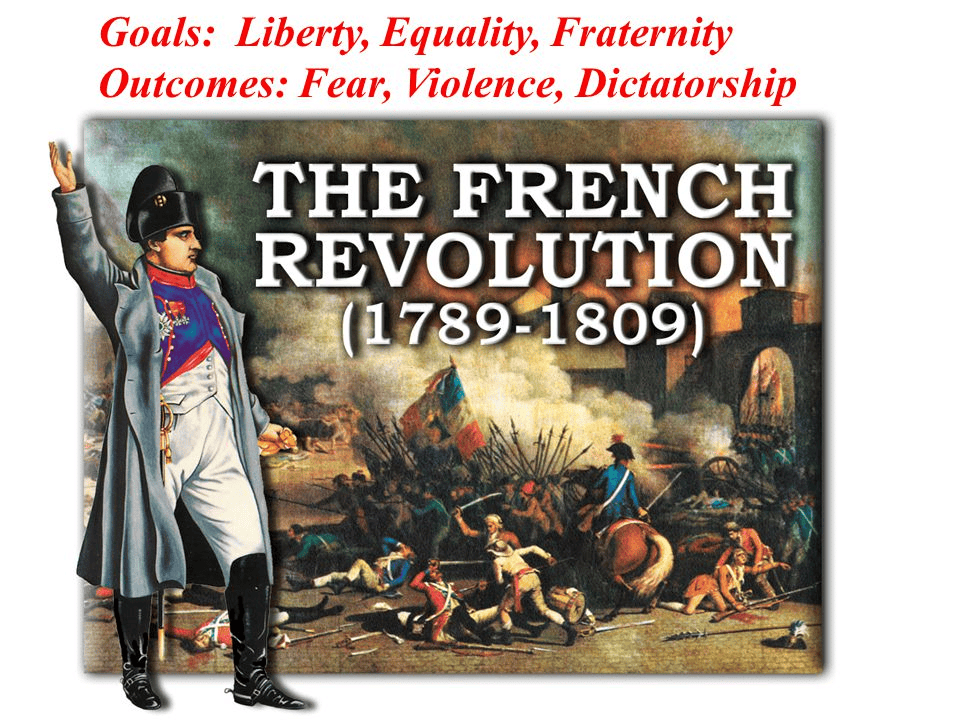
Liberty, Equality & Fraternity

  • Spread of revolutionary ideas: The ideals of libertyequality, and fraternity inspired people across Europe and other parts of the world. The revolution led to the abolition of feudal systems in many countries during the 19th century.
  • Influence on independence movements: Colonized people adapted the ideas of freedom and equality to fight for independence. The concept of a sovereign nation-state became a powerful idea that motivated many to resist colonial rule.
  • Influence on notable figures: Leaders such as Tipu Sultan and Raja Ram Mohan Roy were inspired by the revolutionary ideas of France, which encouraged reforms in their own societies.

Q4. Draw up a list of democratic rights we enjoy today whose origins could be traced to the French Revolution.
Ans: Many democratic rights we enjoy today can be traced back to the French Revolution:

  • Freedom of speech
  • Freedom of expression
  • Freedom of the press
  • Abolition of censorship
  • Right to vote
  • Abolition of slavery
  • Right to liberty
  • Right to property
  • Right to security
  • Right to education
  • Divorce laws

These rights form the foundation of modern democracies, where equality and justice are fundamental principles.

Q5. Would you agree with the view that the message of universal rights was beset with contradictions? Explain.
Ans: Yes, the message of universal rights during the French Revolution was indeed marked by contradictions:

  • Exclusion of women: While the revolution promoted equality, women were excluded from many basic rights. They were not allowed to vote, hold public office, or have a say in the law-making process.
  • Limited reach of rights: The rights to liberty, property, and security were not extended to women, and they were denied equal opportunities based on their abilities. This created a significant gap between the ideals of the revolution and its implementation.

Thus, while the revolution pushed for universal rights, it failed to include everyone equally, particularly women and certain marginalized groups.

Q6. How would you explain the rise of Napoleon?
Ans: The rise of Napoleon Bonaparte can be attributed to several factors:

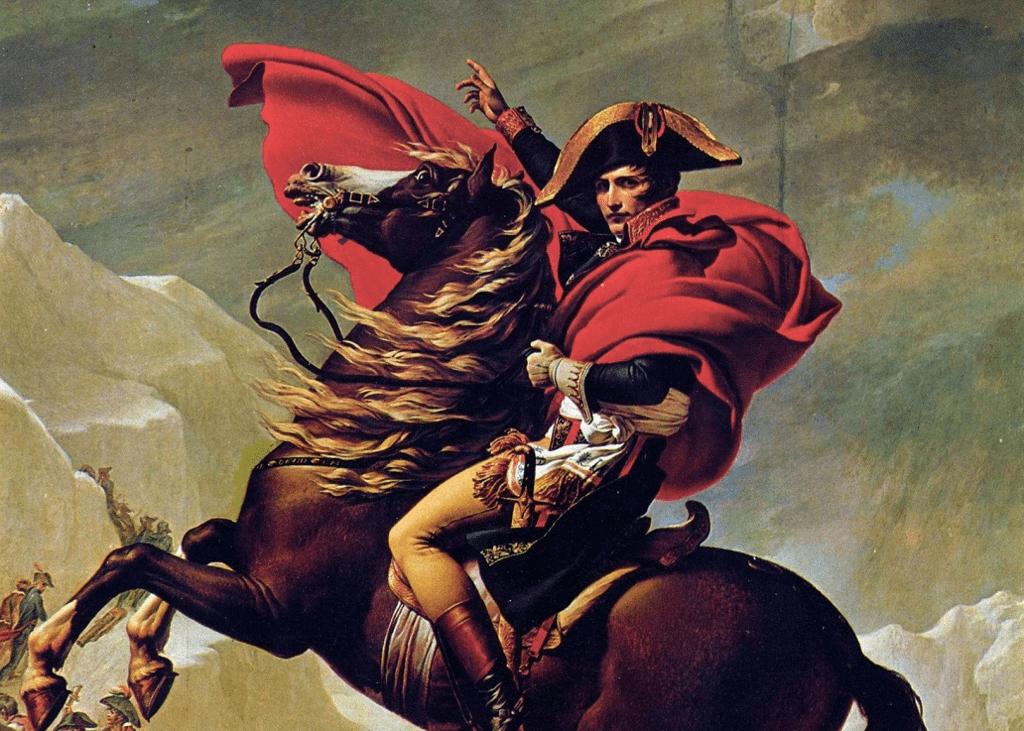
Napoleon Bonaparte

  • Political instability: After the revolution, France was left in a state of political turmoil. The weak and unstable government under the Directory created an opportunity for a strong leader to emerge.
  • Military success: Napoleon’s military victories made him a national hero. His successful campaigns in Italy and Egypt boosted his popularity and increased his influence in French politics.
  • Support from the army: Napoleon had the loyalty of the French army, which helped him seize power through a coup in 1799, overthrowing the Directory and establishing himself as the ruler.
  • Introduction of reforms: As emperor, Napoleon introduced reforms such as the protection of private property and the establishment of a uniform system of weights and measures. His legal reforms, known as the Napoleonic Code, carried forward revolutionary principles of equality and modern governance.

Though Napoleon’s reign ended with his defeat at the Battle of Waterloo, his impact on France and Europe remained, with many of his reforms continuing to influence modern societies.