01.  The Fun they had – Long Answer Type Questions

Q1. How did the chance discovery of a paper book leave Margie and Tommy stunned?

Mergie studying in her room

Ans: In the year 2157, Margie and Tommy are friends living in a world dominated by automation and technology. Instead of attending traditional schools, children learn from a mechanical teacher that customises lessons based on their individual needs.

One day, Tommy discovers an old, dusty paper book in his attic. He excitedly shares this find with Margie, and they are both amazed, as they have never seen a book without a screen. They find it fascinating that:

  • The book has fixed text on pages that must be flipped manually.
  • Ancient schools were large buildings where many children studied together.
  • Students learned the same subjects and participated in the same activities.
  • Real human teachers taught them using actual books.

Margie reflects on how much fun it must have been for children in the past to learn together, which contrasts sharply with her own experience of studying alone with a mechanical teacher.

Q2. What are the main features of the mechanical teachers and the schoolrooms that Margie and Tommy have in the story?

Ans: In the year 2157, Margie and Tommy attend a unique form of education featuring:

  • Home-based schoolrooms: Their classrooms are located in their own homes, eliminating the need for a separate school building.
  • Mechanical teachers: Each student learns with a mechanical teacher that provides lessons and assessments.
  • Individualised learning: Students study alone, with the mechanical teacher adjusting the pace based on their age and progress.
  • Assessment process: Homework is submitted through a slot in the mechanical teacher for grading.
  • Technical support: If the mechanical teacher breaks down, engineers are available for repairs, although this can take time.

This system represents a significant shift from traditional education, focusing on technology and individual learning.

Q3. Why did Margie hate school? Why did she think the old kind of school must have been fun?

Ans: Margie hated school because it lacked fun and excitement. Her daily schedule was strict, requiring her to study at set times throughout the week, except on weekends. She had no classmates to interact with or seek help from, which made learning feel isolating. Additionally, her mechanical teacher sometimes malfunctioned, leading to challenging tests that she often struggled to pass. This constant disappointment made her wish for a break, but the advanced technology of 2157 offered her no respite.

Margie believed that the old kind of school must have been enjoyable because it was a lively environment. In those schools, children from the neighbourhood gathered together, laughing and playing. They learned in the same room, taught by human teachers, which allowed them to support one another with homework and share experiences. This sense of community and camaraderie in the old schools contrasted sharply with her own solitary learning experience.

Q4. Suppose you are Margie. Write a diary entry dated 17th May 2157 about Tommy’s real book that he found in his attic.

Ans: Tuesday, 17th May 2157, 10.00 p.m.

Dear Diary,

Today has been amazing! I saw a real, hard-bound printed book for the first time. Tommy discovered it while cleaning his grandfather’s attic. Here are some details:

  • The book has around 200 pages that are yellow and crinkly from age.
  • Reading it is different; the words are fixed on the pages, unlike my telebooks that scroll.
  • It tells about a school from two centuries ago, which was a dedicated building for teaching.
  • Students of the same age learned together in a classroom.
  • Teachers were real people, not machines!

It’s fascinating to think about how much fun it must have been for children back then—playing, laughing, and helping each other with lessons. I wish I could travel back in time and experience one of those schools!

Q5. Do you agree with Margie that schools today are more fun than the school in the story? Give reasons for your answer.

Ans: There is no doubt that today’s schools are more fun than the schools discussed in the story.

  • In the story, Margie has a mechanical teacher that lacks emotions and understanding.
  • This robot-like teacher teaches based on fixed instructions, ignoring each child’s unique needs.
  • Modern schools, in contrast, focus on the overall development of children.
  • They provide training in areas such as leadership, sports, politics, and science.
  • Students learn to adapt, meet new people, and thrive in diverse environments.
  • Today’s classrooms promote unity and inclusion, bringing together students of all backgrounds.
  • These activities foster a sense of belonging, helping to prevent feelings of loneliness or exclusion.

Q6. Will the existing schools and teachers become totally irrelevant in future ‘schools’? Give a reasoned answer.

Ans: Schools will undoubtedly change over the centuries. The future of education will be:

  • Highly computerized and mechanical.
  • Without a separate building for schools.
  • Utilising mechanical teachers, like large screens capable of accessing vast amounts of information.
  • Personalised to each student’s age and ability.

However, it is an exaggeration to claim that traditional schools and teachers will become completely irrelevant. Key points include:

  • Future schools will still require a human element.
  • The institution of schools and the role of teachers may persist.
  • Human involvement in education is essential and cannot be entirely replaced.

Q7. Describe the characteristics of old schools. How did they arouse so much interest in Margie and Tommy?

Ans: The characteristics of old schools were quite different from those of Margie and Tommy’s mechanical school:

  • Each school had its own unique buildings.
  • Students from the entire town attended, creating a sense of community.
  • Everyone learned the same subjects and had similar homework, making it easier to help each other.
  • Teachers were real people, and students used paper books.

This sense of excitement and adventure in old schools intrigued Margie. She learned about them from Tommy, and compared to her mechanical teacher, these schools seemed almost magical. The idea of children learning together and supporting one another fascinated her.

17. If I were you – Worksheet Solutions

Q.1. What was the profession of Gerrard? How did he manage his work?

Gerrard was a playwright. He managed his work from his cottage and managing the actors at the theaters.


Q.2. How did Gerrard react on seeing the intruder?

Gerrard reacted very calmly on seeing the intruder. He did not express any anxiety or concern or even get afraid of him.


Q.3. Why did Gerrard tell the intruder ‘you will not kill me for a very good reason’?

Gerrard told the intruder ‘you will not kill me for a very good reason’ because he had planned to present himself as a murderer who is wanted by the law.


Q.4. The way Gerrard behaved when the intruder entered his cottage presented that he was amused to see him. Do you think that he was really amused, or he was pretending?

The way Gerrard behaved when the intruder entered his cottage presented that he was amused to see him. No, Gerrard was not really amused but was pretending to be amused. He did not want to give away to the intruder that he was afraid of him. He continued to plan how he would be able to get rid of the intruder. When the intruder threatened to kill him with his pistol, he declared himself a fugitive who was wanted for a murder and the police was on his track and were on their way to arrest him.


Q.5. What was the intention of the intruder when he entered Gerrard’s cottage?

The intruder had been following Gerrard for over a period. He had seen him in Aylesbury and had listened to the conversation of other two people who were talking about Gerrard. He could gather that he was a queer man. He also found out that Gerrard used to place his orders on phone, disappear suddenly and reappear similarly. He had planned to enter Gerrard’s cottage, enter conversation to know how he used to work and adopt his identity after killing him. He was wanted for a murder and was on the run. By taking Gerrard’s identity, he wanted to lead a free and fearless life.


Q.6. What does the intruder threaten?

He threatens that he will make Gerrard crawl.


Q.7. What was Gerrard doing when the intruder entered his cottage?

Gerrard was packing his bag and was preparing to leave to go out and work on a play when the intruder entered his cottage.


Q.8. What was the intention of the intruder when he trespassed into the cottage?

The intention of the intruder was to kill Gerrard and take his identity when he trespassed into the cottage.


Q.9. What does Gerrard start telling?

He starts telling the story of his life.


Q.10.What does Gerrard want?

He wants to change his position. 

Reference to Context Questions

Q1: Read the extracts given below and answer the questions that follow.
Why, this is a surprise, Mr— er—
(a) Who speaks these words and to whom?
Ans:
 Vincent Gerrard speaks these words to the Intruder.

(b) Where are they at the time?
Ans:
 They are in Gerrard’s cottage, in his sitting room, at the time. The Intruder, who is carrying a revolver has just entered Gerrard’s cottage.

(c) What is the speaker’s tone at the time?
Ans: 
The speaker is speaking in a very pleasant tone.

(d) What does this tell you about the speaker?
Ans: 
The speaker is a level-headed person. He should have been afraid of the Intruder who was holding a gun, but he was talking in a normal, pleasant manner.

Q2: Read the extracts given below and answer the questions that follow.
I’m glad you ’re pleased to see me. I don’t think you ’ll be pleased for long. Put those paws up!
(a) Who is speaking these lines and to whom? Where is the conversation taking place?
Ans: 
The Intruder is speaking to Gerrard. The conversation is taking place in Gerrard’s lonely cottage situated in the wilds of Essex.

(b) Why is ‘the speaker’ so sure that ‘his listener’ won’t be pleased for long?
Ans:
 The speaker is sure that his listener, Gerrard, will not be pleased for long because the speaker plans to kill him and steal his identity.

(c) What does ‘paws’ mean here? Why does the Intruder use the expression?
Ans: 
‘Paws’ here stands for ‘hands’. The Intruder wants to convey to Gerrard that he is an American gangster.

(d) Why is the speaker asking the listener ‘to put those paws up’?
Ans:
 The Intruder asks Gerrard to put his ‘paws up’ to threaten and intimidate him. He wants to ensure that Gerrard is not able to use his hands for self-defence.

Q3: Read the extracts given below and answer the questions that follow.
Thanks a lot. You ’ll soon stop being smart. I’ll make you crawl. I want td know a few things, see.
(a) Who is the speaker? Why is he thanking the listener?
Ans: 
The Intruder is the speaker here. He is thanking the listener, Gerrard, as the latter had helped him while he was fumbling for a word and Gerrard had suggested the word ‘nonchalant’.

(b) Why does the speaker think that the listener is trying to be smart?
Ans: 
The Intruder feels that Gerrard is trying to be smart because instead of displaying any signs of fear, he acts casual and helps the Intruder complete his sentence when the former fails to find the right word.

(c) Why does the speaker expect the listener to soon stop being smart?
Ans:
 The speaker feels that Gerrard will be frightened out of his wits the moment he discloses his intention of killing him and will then forget all the witty retorts that he had been making till then.

(d) What does the speaker mean by ‘I’ll make you crawl’?
Ans: 
The speaker means that he would bring the listener down on his knees and make him beg for mercy.

Q4: Read the extracts given below and answer the questions that follow.
At last a sympathetic audience!
(a) Who speaks these words? To whom?
Ans:
 Gerrard, the protagonist of the play, speaks these words. He is speaking to the Intruder.

(b) Why does he say it?
Ans: 
He wants to throw the Intruder off course by showing him that he does not feel threatened by his presence.

(c) Is he sarcastic or serious?
Ans:
 He is certainly sarcastic because he knows that the Intruder wants to gather information about him only to misuse it and he plans to give incorrect information.

(d) Why does the listener wish to know the story of the speaker’s life?
Ans: 
The listener is a criminal who resembles Gerrard and wishes to impersonate him. So he wants to know more about him.

Q5: Read the extracts given below and answer the questions that follow.
I’m sorry. I thought you were telling me, not asking me. A question of inflection; your voice is unfamiliar.
(a) Who is the speaker and who does he speak to?
Ans:
 The speaker is Gerrard. He is speaking to the Intruder.

(b) What had the listener asked the speaker?
Ans:
 The listener had asked the speaker if he lived in the cottage all by himself.

(c) What does ‘inflection’ mean here? What logic does the speaker give for misinterpreting the inflection of his voice?
Ans:
 ‘Inflection’ here means ‘tone of voice’. Gerrard says that since the Intruder’s voice was unfamiliar, he couldn’t know whether he was asking a question or telling something.

(d) What do these lines tell us about the speaker?
Ans: 
These lines show that the speaker is a very cool-headed man who can think of many ways to elude a question.

Q6: Read the extracts given below and answer the questions that follow.
That, ’s a lie. You ’re not dealing with a fool. I’m as smart as you and smarter, and I know you run a car. Better be careful, wise guy!
(a) Who is the speaker? Which Tie’ is he talking about?
Ans:
 The Intruder is the speaker here. He is talking about the Tie’ that Gerrard told him about not running a car.

(b) Why did the speaker think he was smarter than the listener?
Ans: 
The Intruder considered himself smarter because to succeed in his plan of taking on Gerrard’s identity, he had already gathered as much information about Gerrard as he could from the local people.

(c) Why did he warn the listener to be careful?
Ans: 
The Intruder wanted to make it clear that Gerrard could not be fool him by telling a lie.

(d) What does the extract reveal about the Intruder?
Ans:
 The extract reveals that the Intruder is over-confident about his abilities and that he also under-estimates Gerrard, who is not afraid of him.

Q7: Read the extracts given below and answer the questions that follow.
You seem to have taken a considerable amount of trouble. Since you know so much about me, won’t you say something about yourself? You have been so modest.
(a) Who speaks these words and to whom?
Ans: 
Gerrard speaks these words to the Intruder.

(b) What is his tone when he speaks these words?
Ans: 
He is being sarcastic at the time.

(c) Why does he want to know more about the Intruder?
Ans: 
He wants to find out more about the Intruder to see if he can get the better of him. He also wants to keep him talking till he receives his telephone call.

(d) What light does this throw on the speaker’s character?
Ans:
 The speaker is a quick-thinking person, who does not give way to fear but is looking for a way out of the situation he finds himself in.

Q8: Read the extracts given below and answer the questions that follow.
I could tell you plenty. You think you ’re smart, but I’m the top of the class round here. I’ve got brains and I use them. That’s how I’ve got where have.
(a) Who speaks these words to whom and in what context?
Ans: 
These words are spoken by the Intruder to Gerrard. He utters these words when Gerrard asks him to tell him something about himself

(b) Why does the speaker say “I could tell you plenty”?
Ans: 
The Intruder says so because he is over-confident and thinks that he is smart enough to get the better of Gerrard.

(c) What does he mean by ‘the top of the class round here’?
Ans: 
The Intruder means to say that no one else is as smart as he is and thatbGerrard, too, is no match for him.

(d) What is his tone at the moment?
Ans: 
There is a ring of pride in his words and his ego makes him over-estimate himself and his abilities.

Q9: Read the extracts given below and answer the questions that follow.
My speciality’s jewel robbery. Your car will do me a treat. It’s certainly a dandy bus.
(a) What does the speaker do? Why does he call it his ‘speciality’?
Ans: 
The speaker is a criminal who robs jewellery. He calls it his speciality because robbing jewellery was a pursuit or skill to which he had devoted much time and effort and in which he was an expert.

(b) What does he call ‘a dandy bus’? What does he mean?
Ans:
 He calls Gerrard’s car a dandy bus. He means to say that it is a splendid or outstanding car. It will be useful for him and will suit his purpose very well.

(c) What do his words tell you about the speaker?
Ans: 
The speaker has made his plans carefully and has found out information about the listener.

(d) What does the speaker intend to do?
Ans:
 The speaker uses his brains by planning and committing crimes without getting caught by the police. He now intends to kill Gerrard and assume his identity to escape the law further.

Q10: Read the extracts given below and answer the questions that follow.

I’m not taking it for fun. I’ve been hunted long enough. I’m wanted for murder already, and they can’t hang me twice.
(a) What ‘step’ is the speaker talking about taking? Why is he taking it?
Ans: 
The speaker is talking about taking the ‘step’ of murdering Gerrard. He claims that he is not taking the step for fun but because of his need to escape the police.

(b) By whom has the speaker been hunted? Why?
Ans:
 The speaker has been hunted by the police because he is a criminal. He killed a policeman when something went wrong with the job that he did in the town quite a while ago, but since then he is dodging the police.

(c) Why does he say “they can’t hang me twice”?
Ans: 
The Intruder has just told Gerrard that he had murdered one man, and that he would not shy away from murdering him too. This is because the police could not hang him twice for two murders.

(d) What light do these lines reflect on the speaker’s state of mind?
Ans:
 The lines reveal that the Intruder does not have any conscience to prick him. He is in a desperate situation now as he fears the punishment he is likely to get if captured.

Q11; Read the extracts given below and answer the questions that follow.
I’ve got freedom to gain. As for myself I’m a poor hunted rat. As Vincent Charles Gerrard I’m free to go places and do nothing. I can eat well and sleep and without having to be ready to beat it at the sight of a cop.
(a) Why is the speaker a ‘hunted rat’?
Ans:
 The Intruder is being chased by the police for having killed a policeman. The fear of being arrested by the police keeps him on the run and he feels that his condition is as miserable as that of a rat being chased.

(b) Why has he chosen to take on Gerrard’s identity?
Ans: 
He has chosen to take on Gerrard’s identity because the have a similar height and build and because Gerrard, being a loner, does not meet many people who may catch him out.

(c) Why does the speaker have to run at the sight of a cop?
Ans: 
Having killed a cop, the Intruder lives in constant fear of being caught by the police. So, he has to run at the sight of a cop in order to avoid being caught.

(d) What advantage will the speaker have once he impersonates Gerrard?
Ans:
 As Gerrard the Intruder will be able to dodge the police. This way he will be able to live in peace and without any fear of the cops.

Q12: Read the extracts given below and answer the questions that follow.
It brought me to Aylesbury. That’s where I saw you in the car. Two other people saw you and started to talk.
I listened. It looks like you ’re a bit queer — kind of a mystery man.
(a) What is ‘it’? Where did it bring him?
Ans:
 ‘It’ here refers to the speaker’s dodging the police. While escaping the police he reached Aylesbury.

(b) What did the speaker overhear about the listener? From whom?
Ans:
 He overheard two men discuss Gerrard. They referred to him as being strange and a mystery man about whom nothing much was known.

(c) What made the two men conclude that the listener was a mystery man?
Ans: 
The two men concluded Gerrard was a mystery man because they did not know much about him. He kept to himself and ordered his supplies on the phone. He did not meet even the tradespeople who delivered the orders. He sometimes went away suddenly and came back just the same.

(d) How did this suit the Intruder’s purpose?
Ans: 
This suited the Intruder’s purpose as no one knew Gerrard well enough to recognise him if the Intruder took on his identity. Also, the Intruder would be able to come and go suddenly as Gerrard did.

Q13: Read the extracts given below and answer the questions that follow.
Don’t be a fool. If you shoot, you ’ll hang for sure. If not as yourself then as Vincent Charles Gerrard.
(a) Why did the speaker say that the listener will be hanged?
Ans: 
The speaker said that even if he shot him and took on the speaker’s identity, the listener would be hanged as Gerrard because he was wanted by the police.

(b) What surprise did the speaker give to the listener?
Ans: 
Gerrard surprised the Intruder by telling him that he was also a criminal and wanted for murder.

(c) What proof does the speaker give the listener about his being a criminal?
Ans: 
Gerrard told the Intruder that he did not meet any trades people and was a bit of a mystery man here today and gone tomorrow because he was a criminal on the run.

(d) What do you think was the speaker’s tone as he spoke to the listener?
Ans:
 The speaker’s tone was serious and confidential. The listener was taken in by the speaker.

Q14: This is your big surprise. I said you wouldn’t kill me and I was right. Why do you think I am here today and gone tomorrow, never see tradespeople? You say my habits would suit you. You are a crook. Do you think I am a Sunday-school teacher?
(a) What was the big surprise given by the speaker?
Ans: 
Gerrard told that the Intruder that he too lived under the threat of being arrested as he too was involved in crime. The Intruder was naturally surprised at this revelation since he was not aware about this aspect of his victim.

(b) What was the speaker right about? Why was he right?
Ans:
 Gerrard, the speaker here, was right about the statement that he had made earlier that the Intruder wouldn’t kill him. He was right because the Intruder intended to kill an ordinary person and impersonate him to evade the police. But Gerrard turned out to be a criminal like him. So, killing and impersonating a criminal would not serve the Intruder’s purpose,

(c) Explain the phrase Sunday school teacher? What does the speaker imply by his words?
Ans: 
A Sunday school teacher is not just an instructor but is also the responsibility for the spiritual welfare of the students. As such, the Sunday school teacher is an important member of the church and one of high moral standing. By saying he is not a Sunday school teacher, the speaker implies he is a crook.

(d) What light does it throw on the character of the speaker and the listener?
Ans:
 The speaker is a quick-thinking cool-headed person, who has retained his presence of mind and lays a trap for the Intruder. He is able to convince the listener. On the other hand, the listener is a gullible person and is taken in by Gerrard’s words.

Q15: Read the extracts given below and answer the questions that follow.
“I said it with bullets and got away ”.
(a) Who says this?
Ans:
 Gerrard, the protagonist of the play ‘If I Were You’, says this.

(b) What does it mean?
Ans:
 Gerrard means that he committed a murder with a gun for his escape because things had gone wrong.

(c) Is it the truth? What is the speaker’s reason for saying this?
Ans: 
No, it is not the truth. The speaker has concocted a story to befool the Intruder. He shows himself to be a wanted criminal on run from the police so that the Intruder should give up his plan of killing him and taking up his identity.

(d) How was he in imminent danger from the police?
Ans:
 One of his men had been caught by the police with some documents.

Q16: Read the extracts given below and answer the questions that follow.
I have got a man posted on the main road. He’ll ring up if he sees the police, but I don’t want to leave… (telephone bell rings,) Come on! They ’re after us. Through here straight to the garage.
(a) Whose call had Gerrard been expecting?
Ans:
 Gerrard had told the person he was speaking to in the beginning to tell someone to call him at once. So, he had been expecting that call.

(b) Whose call had told the Intruder he was expecting?
Ans: 
He told the Intruder he was expecting trouble, and had posted a man on the look out who would tell him if the police were coming.

(c) What did he show the Intruder to convince him that he was going to run away?
Ans:
 He showed him the packed bag and disguise outfit; false moustaches and what not to show he was ready . to run away.

(d) What is his tone like as he says these words?
Ans: 
He says these words in a tone of urgency.

Q17: Read the extracts given below and answer the questions that follow.
For God’s sake clear that muddled head of yours and let’s go. Come with me in the car. I can use you. If you find it’s a frame, you’ve got me in a car, and you still have your gun.
(a) What does the speaker call the listener’s head “muddled”?
Ans: 
The Intruder, who has come to Gerrard’s house to kill him and steal his identity, is told by Gerrard that he, too, is a criminal on the run. The Intruder is thus looking confused.

(b) Where does the speaker invite the other person?
Ans: 
The speaker Gerrard is inviting the other person to accompany him in the car and help him escape

(c) What assurance does he give the listener?
Ans: 
He tells the Intruder that he has the gun so he can over-power him whenever he feels he has been trapped.

(d) What is in the speaker’s mind?
Ans:
 The speaker wants to get the Intruder into a trap where he can hand him over to the police.

16. Poem – A Slumber Did My Spirit Seal – Worksheet Solutions

Q.1. Read the following passages and answer the questions
“No motion has she now, no force.
She neither hears nor sees
Rolled round in earth’s diurnal course
With rocks and stones and trees.”
(i) Name the poem and the poet.

The poem is ‘ A Slumber did my spirit seal’ and the poet is William Wordsworth.

(ii) Why does the beloved has no motion and no force?

The beloved has no motion and no force because she is dead and no more alive.

(iii) What kind of motion does his beloved have now?

She seemed a thing that could not feel any touch.

(iv) What changes have come in his beloved now?

His beloved has become eternal now, nothing can affect her in any way.


Q.2. How much does the poet love his beloved? How can we say that?

The poet loves his beloved a lot because he is filled with grief after her death and he has written a poem in the memory of his beloved.


Q.3. What does the poet feel about his beloved? Is he contented?

The poet has a great love for his beloved. He feels great peace that she has been taken care by the nature. He knows that the world is selfish, so he is contented with the situation.


Q.4. What is the state of mind of the poet when he comes to know that his beloved is no more?

When the poet comes to know that his beloved one has died , he was filled with grief and pain. He loved her so much that he lost his state of mind, he was in a state of extreme loss where he could not feel anything except the company of the nature.


Q.5. How does the poet imagine his beloved to be, after death?

The poet knows that his beloved has died and is no more with him. He is a nature lover and so believes that his beloved has not died but has become immortal and has immersed in the nature. He feels her presence around himself. He could not separate himself from her but feels that she has got relieved from the selfish world. He is in a deep grief and he thinks that she has become immortal because she has not got affected with the passage of time.


Q.6. Read the following passages and answer the questions
“A slumber did my spirit seal.
I had no human fears.
She seemed a thing that could not feel
The touch of earthly years.”
(i) What is the poet talking about in these lines?

The poet is talking about his beloved who has died.

(ii) What does the poet mean by slumber?

The poet means in a deep sleep by slumber.

(iii) Who is she in the above lines?

She is the poet’s beloved in the above lines.

(iv) Why does the poet have no fears?

The poet has no fears now because he feels that his beloved has become immortal.

Q.7. What does William Wordsworth talking about in the poem?

William Wordsworth is talking about his beloved who has died. He is a nature lover, who finds relief in the company of nature. But his heart is filled with grief.


Q.8. How does the poet react to his beloved one’s death?

He says that a slumber did his spirit seal, which means that the death of his beloved one has closed his soul. So he has become busy with the nature and thinks that she is still alive.


Q.9. Which lines of the poem shows that the beloved is no more with the poet?

The beloved has died. This is evident from the following lines, “No motion has she now, no force. She neither hears nor sees.” She shows no movement.


Q.10. The poet has lost his beloved because of which he feels lonely and a great shock. Explain his state of mind.

The poet is a nature lover, he finds relief in the company of nature. Here, in the poem, he is talking about his beloved and her death has filled him with grief and pain. He considers the world as selfish and so he feels contented that his beloved has gone in the lap of nature. He thinks that she is busy with the nature and she is surrounding him. He finds her dead as she is not moving and she can not hear or see anything. He is in a lost state of mind. He feels that she is rather busy in movement with the earth like rocks, stones and trees. He misses her but feels her presence.

Reference to Context Questions

Q1: Read the extracts given below and answer the questions that follow.
A slumber did my spirit seal
I had no human fears.
She seemed a thing that could not feel
The touch of earthly years.
(a) What was the poet’s state of mind when Lucy was alive?
Ans:
 When Lucy was alive the poet was in a state of spiritual peace as he did not even think about her aging or dying.

(b) What was the ‘human fear’ he did not have?
Ans:
 It blinded him to the reality that eventually all things that are born perish or die one day.

(c) Why did he not have this fear?
Ans:
 The poet could not imagine that she was a human being and subject to suffering and death.

(d) How does the poet imagine her to be, after death?
Ans:
 The poet imagines her to now be a part of nature.

Q2: Read the extracts given below and answer the questions that follow.
A slumber did my spirit seal-
I had no human fears.
She seemed a thing that could not feel
The touch of earthly years.
(a) Who does ‘she’ refer to?
Ans: 
The poet does not disclose in the poem the identity of the girl. But because the poem is one of the Lucy Poems, she refers to Lucy, the girl Wordsworth loved.

(b) What could she not feel?
Ans: 
She could not feel the touch of earthly years.

(c) Explain “the touch of earthly years”.
Ans: 
By “the touch of earthly years”, the poet means the ravages of time or the process of aging.

(d) Why does the poet say that his loved one is rolling round in the way of the earth?
Ans:
 The poet says that his beloved is a part of Nature she is also moving round with the earth.

Q3: Read the extracts given below and answer the questions that follow.
No motion has she now, no force –
She neither hears nor sees,
Rolled round in earth’s diurnal course
With rocks and stones and trees.
(a) What happened to the poet’s beloved?
Ans: 
The poet’s beloved was dead.

(b) Where is she now?
Ans: 
After her death she has become one with Nature.

(c) How does she become an inseparable part of nature?
Ans: 
She has become an integral part of nature as she is buried and has become one with the earth.

(d) Explain: she is in “earth’s diurnal course with rocks and stones and trees”?
Ans: 
She is now a participant in the daily routine of the earth and rolls with it along with the rocks and trees and other things of Nature.

Q4: Read the extracts given below and answer the questions that follow.
No motion has she now, no force –
She neither hears nor sees,
Rolled round in earth’s diurnal course
With rocks and stones and trees.
(a) What does the word ‘slumber’ refer to?
Ans: 
The word ‘slumber’ refers to a deep sleep. Here it refers to death.

(b) How will time not affect the poet’s beloved?
Ans: 
The poet’s beloved is dead and therefore has become immortal.

(c) ‘No motion has she now, no force.’ Why is ‘she’ motionless?
Ans: 
‘She’ is the poet’s beloved who is no longer alive. Therefore she is motionless.

(d) What is the central theme of the poem?
Ans: 
The poet wants to convey the idea that though death separates our loved ones from us but they always remain around us in the form of nature.

15. Kathmandu – Worksheet Solutions

Q.1. In which town does the author stay?

He stays in Kathmandu.


Q.2. What is the restriction about entry at Pashupatinath?

Only Hindus are allowed to enter here.


Q.3. Where does a monkey jump?

A monkeys jumps onto a Shivalinga.


Q.4. Why does everyone bow and make away?

Everyone bows and makes way for a princess of the Nepalese royal house. 


Q.5. What did the writer describe about Pashupatinath Temple?

The writer described that Pashupatinath Temple is the main shrine of Hindus in Nepal. It is devoted to lord Shiva. Only Hindus are allowed to enter the temple. There was an atmosphere of utter confusion as animals along with people were there on the temple ground.


Q.6. The writer says, “All this I wash down with Coca Cola.” What does ‘all this’ refer to?

The writer says, “All this I wash down with Coca Cola.” All this refers to the bar or marzipan and a corn on the cob roasted on a charcoal brazier (rubbed with salt, chili powder and lemon) and a couple of love story comics, and a Reader’s Digest.


Q.7. Name five kinds of flutes.

Five kinds of flutes as mentioned by the writer are the (1) reed neh, (2) the recorder, (3) the Japanese shakuhachi, (4) the deep bansuri of Hindustani classical music, (5) the clear or breathy flutes of South America.


Q.8. What is the proclamation at the entrance of Pashupatinath temple? Was it implemented strictly?

The proclamation at the entrance of Pashupatinath temple was ‘Entrance for the Hindus only’. It was implemented strictly as the westerners who were in saffron clothes were prohibited to enter the temple before they could prove that they were Hindus.


Q.9. What difference does the author note between the flute seller and the other hawkers?

The author notes that all the hawkers in the market and streets around the temple were shouting about the wares to attract the customers. They described about their wares and shouted at the pitch of their voice to gain attention. However, the flute seller did not shout or called attention of the customer by calling or describing about his stuff. He played on different flutes displaying his acumen in playing the instrument. He had different varieties of flutes and he picked one after the other and played some beautiful tune on it. This was his way of calling attention of his customers.


Q.10. What is the belief at Pashupatinath about the end of Kaliyug?

Pashupatinath temple is situated on the bank of Baghmati river. There is a small temple half protruding out from the stone platform on the river bank. People believe that there is a goddess in the temple. They say that when the temple emerges fully and becomes completely visible to the people, the goddess inside will escape and disappear. That day the evil period of the Kaliyug will come to an end on the earth. Thus, describing that it will be a dooms day for the world. All the people on this earth will perish.

Reference to Context Questions

Q1: Read the extracts given below and answer the questions that follow.
I get a cheap room in the centre of town and sleep for hours. The next morning, with Mr. Shah’s son and nephew, I visit the two temples in Kathmandu that are most sacred to Hindus and Buddhists.
(a) Who does “I” refer to in the above lines?
Ans:
 I refers to the writer of the travelogue, Vikram Seth.

(b) Where is he at the time?
Ans:
 He is in a cheap room in a hotel in the centre of Kathmandu at the time.

(c) With whom does the author visit the two temples?
Ans:
 The author visits the two temples with Mr. Shah’s son and his nephew.

(d) Which two temples in Kathmandu does he visit? With which religions are they associated?
Ans:
 He visits the two famous temples of Kathmandu – the Pashupatinath, sacred to the Hindus and the Baudhnath Stupa, sacred to the Buddhists.

Q2: Read the extracts given below and answer the questions that follow.
There are so many worshippers that some people trying to get the priest’s attention are elbowed aside by others pushing their way to the front.
(a) Which place of worship is the narrator describing here?
Ans:
 The narrator is describing Kathmandu’s Pashupatinath temple, which is sacred to the Hindus.

(b) How do devotees behave inside the temple?
Ans: 
The devotees at the temple push and jostle with others as they try to move ahead and get the priest’s attention. In this attempt, some people are elbowed aside.

(c) Why do you think some people are pushing their way to the front?
Ans:
 Some people are pushing their way to the front to get a clear view of the deity and also to make their offerings through the priest.

(d) What sort of an atmosphere is being created by the crowd in the temple?
Ans: 
The crowd in the temple is indisciplined and unorganized. They are creating chaos and confusion with their unruly behaviour, which is robbing the temple of its sanctity.

Q3: Read the extracts given below and answer the questions that follow.
A princess of the Nepalese royal house appears; everyone bows and makes way. By the main gate, a party of saffron-clad Westerners struggle for permission to enter.
(a) Which place is being talked about in the above extract?
Ans: 
The writer is talking about the Pashupatinath Temple at Kathmandu.

(b) How had the crowd of worshippers been behaving before the princess appeared? How is their behaviour different now?
Ans: 
The crowd of worshippers were trying to get the priest’s attention and were jostling with each other and were elbowing others aside to push their way to the front, but as soon as the princess appeared, the worshippers bowed and made way for her.

(c) How are the Westerners trying to convince the policeman they are Hindus? Why?
Ans:
 The Westerners were dressed in saffron and were claiming to be Hindus because only Hindus can enter the Pashupatinath temple.

(d) Which river flows next to the temple?
Ans:
 The river Bagmati flows next to the temple.

Q4: Read the extracts given below and answer the questions that follow.
By the main gate, a party of saffron-clad Westerners struggle for permission to enter.
(a) Which place is the author talking about here?
Ans:
 The author is talking of the famous Hindu shrine – the Pashupatinath Temple in Kathmandu.

(b) Who are the saffron-clad Westerners at the main gate?
Ans:
 The saffron-clad Westerners at the main gate are a group of tourists.

(c) Why do they struggle for permission to enter?
Ans: 
They struggle for permission to enter because the temple allows entry only to Hindus.

(d) What does this show about the cultural practices of this place?
Ans:
 It shows that the authorities who look after this shrine are very rigid about maintaining the sanctity of the temple as a place of worship. They do not want it to be treated like a tourist spot.

Q5: Read the extracts given below and answer the questions that follow.
A fight breaks out between two monkeys. One chases the other, who jumps onto a shivalinga, then runs screaming around the temples and down to the river, the holy Bagmati, that flows below.
(a) What are the two monkeys doing?
Ans: 
The two monkeys are fighting each other and chasing each other.

(b) Where are the two monkeys?
Ans:
 The two monkeys are running around the shivalingas and then down to the river.

(c) What is the atmosphere at Pashupatinath Temple?
Ans:
 At Pashupatinath there is an atmosphere of ‘febrile confusion’ as crowds of worshippers and animals jostle and elbow each other.

(d) What is the belief about the shrine that half protrudes from the stone platform on the river bank?
Ans: 
People believe when the shrine emerges fully, the goddess inside will escape, and the evil period of the Kaliyug will end on earth.

Q6: Read the extracts given below and answer the questions that follow.
A corpse is being cremated on its banks; washerwomen are at their work and children bathe. From a balcony a basket of flowers and leaves, old offerings now wilted, is dropped into the river.
(a) Which river is referred to in this extract?
Ans:
 The river Bagmati that flows through Kathmandu and on the banks of which Pashupatinath temple is situated is referred to here.

(b) What is the significance of this river?
Ans: 
The river Bagmati is significant as it is considered sacred by the Hindus. They worship it like a pious deity.

(c) How is the river being polluted and by whom?
Ans:
 A basket of withered away flowers, leaves and old offerings is thrown into the river from the balcony of the Pashupatinath temple. Corpse are cremated on its banks, washerwomen wash clothes in the river and children bathe in it.

(d) What light does this polluting of the river throw on the people?
Ans:
 Throwing of refuse into the sacred Bagmati river, or polluting it by bathing or washing clothes reflects that these people lack concern for environment. They pollute the very river which they consider to be sacred.

Q7: Read the extracts given below and answer the questions that follow.
There are no crowds: this is a haven of quietness in the busy streets around.
(a) Which place is being talked about here?
Ans:
 The writer is talking about the Baudhnath stupa here.

(b) How does this contrast with the other place of worship?
Ans:
 While the Baudhnath Stupa is a quiet, still place, the crowded noisy Pashupatinath temple is a place of feverish activity.

(c) Who owns the shops on the ‘busy streets around’?
Ans:
 Many of the shops outside are owned by Tibetan immigrants.

(d) What did the shops sell?
Ans:
 They sold felt bags, Tibetan prints, silver jewellery etc.

Q8: Read the extracts given below and answer the questions that follow.
Kathmandu is vivid, mercenary, religious, with small shrines to flower-adorned deities along the narrowest and busiest streets; with fruit sellers, flute sellers, hawkers of postcards; shops selling Western cosmetics, film rolls and chocolate; or copper utensils and Nepalese antiques.
(a) Explain the meaning of the word “mercenary”.
Ans:
 The word “mercenary” means interested only in the amount of money that you can be made from a situation even at the expense of ethics. This implies sales in the shops of Kathmandu are not always above board.

(b) How does the author describe the streets of Kathmandu?
Ans: 
The streets of Kathmandu are the narrowest and busiest streets that he has ever seen.

(c) What are the things that the author buys?
Ans:
 The author buys a bar of marzipan, a com-on-the-cob roasted in a charcoal brazier on the pavement (rubbed with salt, chilli powder and lemon), a couple of love story comics, and a Reader’s Digest.

(d) Which things are sold in the market of Kathmandu?
Ans:
 Nepalese antiques, Western cosmetics and film rolls are sold there.

Q9: Read the extracts given below and answer the questions that follow.
Go home, I tell myself: move directly towards home. I enter a Nepal Airlines office and buy a ticket for tomorrow’s flight.
(a) What route had the writer thought of taking?
Ans: 
The writer had thought of going by bus and train to Patna, then sailing up the Ganges past Benaras to Allahabad, then up the Yamuna, past Agra to Delhi.

(b) Why did he change his plan?
Ans:
 The writer was tired as he had been travelling for many days. He was also homesick and wanted to travel home straight.

(c) How did he plan to travel now?
Ans: 
He planned to fly by Nepal Airlines from Kathmandu to Delhi.

(d) When is he leaving Kathmandu?
Ans: 
He is leaving Kathmandu the next day.

Q10: Read the extracts given below and answer the questions that follow.
In his hand is a pole with an attachment at the top from which fifty or sixty bansuris protrude in all directions, like the quills of a porcupine. They are of bamboo: there are cross-flutes and recorders. From time to time, he stands the pole on the ground, selects a flute and plays for a few minutes.
(a) What attracts the writer in the market?
Ans: 
A flute seller and the music being played by him attracts the writer.

(b) How is he different from other hawkers?
Ans:
 He plays on the flute to entertain people. He does not cry out to attract buyers.

(c) Why does he sometimes break off playing flute?
Ans:
 The flute seller sometimes breaks off playing his flute in order to talk to the fruit seller.

(d) What does Vikram Seth compare to the quills of a porcupine?
Ans: 
The flute seller’s stock of flutes protruding in all directions from an attachment on the pole was looking like the quills of a porcupine.

Q11: Read the extracts given below and answer the questions that follow.
I find it difficult to tear myself away from the square.
(a) Which square does the writer refer to?
Ans:
 The writer, Vikram Seth, refers to the square near his hotel in Kathmandu.

(b) What was the writer doing in the square?
Ans: 
The writer was tired and homesick and was going back to his hotel after having bought his air ticket to fly back to India the next day.

(c) Why does ‘he’ find it difficult to tear himself away from the square?
Ans: 
‘He’ finds it difficult to tear himself from the square because he is mesmerised by the sweet notes of the flute-music being played there by the flute seller

(d) Explain the expression ‘tear myself away’. Why does the writer use the expression?
Ans:
 ‘Tear myself away’ means to separate forcibly. Hence the expression shows the effort on the part of the narrator to pull himself away from the enthralling music of the flute.

Q12: Read the extracts given below and answer the questions that follow.
It weaves its own associations. Yet to hear any flute is, it seems to me, to be drawn into the commonality of all mankind, to be moved by music closest in its phrases and sentences to the human voice. Its motive force too is living breath: it too needs to pause and breathe before it can go on.
(a) What does ‘it’ refer to?
Ans:
 ‘It’ refers to the sounds produced by different flutes.

(b) How does ‘it’ weave its own associations?
Ans: 
The expression means that each kind of flute produces a different and a unique type of music associated with some particular place

(c) Why is its music closest to the human voice?
Ans: 
The music of the flute is closest to the human voice because pauses and breaths are needed to produce musical notes of the flute in the same manner in which words, phrases and sentences are uttered in human voice.

(d) Why does it draw the author in the ‘commonality of all mankind’?
Ans: 
The flute draws the author in the “commonality of all mankind” because this instrument is found in all cultures and is played in a similar manner. Hence, it seems to connect the whole mankind.

14. Poem – On Killing a Tree – Worksheet Solutions

Q.1. Do we need to kill trees in the present scenario?

No, we don’t need to kill trees in the present scenario, rather we should protect trees as we see the threat of global warming and drifting seasons, erratic rainfall etc.


Q.2. What do you understand by the lines ‘Rising out of it, feeding upon its crust, absorbing years of sunlight, air, water’.

The tree is rising out of the earth, feeding upon its crust, absorbing years of sunlight, air, water’ thus growing on the generosity of the nature. However, it slowly steals nourishment from earth, food from sunlight through photosynthesis and air to gain strength and vigor.


Q.3. What are the circumstances that compelled the poet to write such a poem?

The development of countries leads to construct industries and factories for development of mankind. Rising population also brings extra pressure on nature. Thus these were the circumstances that compelled the poet to write such a poem.


Q.4.What is the contemplation of the poet when he says, ‘Not so much pain will do it’?

The contemplation of the poet when he says, ‘Not so much pain will do it’ is that little sufferings would not deter the tree from re-sprouting as like human it recovers from small pains and sours.


Q.5. Do you think, the poet is describing the way to kill a tree, or there is something else in his mind?

Although the poet is describing the way to kill a tree, but in his mind he is thinking about the nature. The nature wants us to be friend with the trees as they resurrect the nature. Killing a tree would deprive us of oxygen, shade, greenery and protection of soil from erosion.


Q.6. Why does the poet write such a poem?

The poet writes such a poem to compare the killing of a tree with that of a human being. As little wounds to a man don’t kill him similarly, small strokes of axe wouldn’t kill a tree.


Q.7. Justify the title of the poem ‘On Killing a Tree’.

‘The tile of the poem ‘On Killing a Tree’ is very appropriate as the poet tries to bring in a relationship between the tree and human being. He says that as a man grows on the love, affection of his parents, similarly tree grows on the love and affection of mother earth and father nature. With such strength, it is not easy to kill a tree. We need brutal force to kill a tree as a single jab of knife or hacking and chopping would anything. To drain out the strength of the tree, one needs to expose its roots to the harsh scorching sun light and the rough air.


Q.8. Is this poem ironical or is it a satire on modernization?

This poem is not only ironical, but it also is a satire on modernization. It is ironical as we keep on talking about saving tree and growing more trees but simultaneously we keep felling them to construct buildings to house growing population and setting up industries to help modernization. All over the world we are propagating to save trees and on the other hand don’t even blink an eye when trees are felled to help clear lands in the name of construction or development. Let’s be clear whether we want to save environment, or we want to go for development. We need to bring a balance between the two or develop such ways and means to modernize without compromising on nature.


Q.9. What will be the effect of hacking and the chopping on the tree?

The hacking and chopping of the tree would make the tree bleed i.e. secret a liquid but this pain will be relieved soon and the bleeding bark will heal itself.


Q.10. How can the tree get back to its former size?

The bleeding bark will be heated and from the place closer to the ground, there will be new twigs arising out of it, new boughs will take place which will make the plant grow to its former size.

Reference to Context Questions

Q1: Read the extracts given below and answer the questions that follow.
It takes much time to kill a tree,
Not a simple jab of the knife
Will do it. It has grown
Slowly consuming the earth,
Rising out of it, feeding
Upon its crust, absorbing
Years of sunlight, air, water,
And out of its leprous hide
Sprouting leaves.
(a) Why does it take so much time to kill a tree?
Ans: 
It takes much time to kill because killing a tree is not a simple or easy task.

(b) What does it consume?
Ans:
 The tree consumes nutrients from the soil.

(c) What does a tree absorb?
Ans:
 It absorbs sunlight, air and water

(d) Explain “leprous hide”.
Ans: 
Leprous hide means the disfigured and irregular bark of the tree which seems as if it is diseased or suffering from leprosy.

Q2: Read the extracts given below and answer the questions that follow.
It takes much time to kill a tree,
Not a simple jab of the knife
Will do it. It has grown
Slowly consuming the earth,
Rising out of it, feeding
Upon its crust, absorbing
Years of sunlight, air, water,
And out of its leprous hide ‘
Sprouting leaves.
(a) What kind of task is it to kill a tree?
Ans: 
It is very difficult task to kill a tree and it takes much time

(b) Why can a “simple jab of the knife” not kill a tree?
Ans: 
The tree is too strong to be killed by a simple jab of the knife as it is firmly held by the earth for so many years and its roots are safe.

(c) How is the task of cutting a tree represented in the poem?
Ans:
 The task of cutting a tree is represented as a killing or murder of a tree.

(d) What happens if the branches of a tree are cut off?
Ans: 
The branches that are cut off are replaced by new boughs, which will grow into their former size.

Q3: Read the extracts given below and answer the questions that follow.
So hack and chop
But this alone won’t do it.
Not so much pain will do it.
The bleeding bark will heal
And from close to the ground
Will rise curled green twigs,
Miniature boughs
Which if unchecked will expand again
To former size.
(a) Why does the poet say ‘killing’ a tree rather than cutting it?
Ans: 
The tree has been personified and hence the word ‘killing’ instead of ‘cutting’ has been used.

(b) “But this alone won’t do it..- What does ‘this’ refer to here? What does ‘it’ refer to?
Ans:
 The word ‘this’ refers to hacking and chopping of the tree. ‘It’ refers to the killing of a tree

(c) What does the phrase ‘bleeding bark’ mean?
Ans:
 “Bleeding bark” refers to the area on the tree trunk where it has been hit with the axe, It bleeds because the wood cutter has wounded the tree by cutting and chopping it. The area is oozing sap.

(d) What are processes suggested to do it?
Ans:
 The root of the tree has to be roped, tied and pulled out entirely from the earth-cave till the root of the tree is exposed. It will then shrivel, choke and die.

Q4: Read the extracts given below and answer the questions that follow.
So hack and chop
But this alone won’t do it.
Not so much pain will do it.
The bleeding bark will heal
And from close to the ground
Will rise curled green twigs,
Miniature boughs
Which if unchecked will expand again
To former size.
(a) Explain “hack and chop”?
Ans: 
Hack or chop means to cut off something, usually with a sharp instrument or weapon.

(b) What do you mean by ‘not so much pain will do it’?
Ans:
 It means that hacking and chopping of the tree will cause it pain but will not kill it.

(c) Where will the curling green twigs rise from?
Ans:
 After hacking and chopping the curling green twigs will rise from the remaining part of tree that is close to the ground.

(d) What finally kills the tree?
Ans:
 Uprooting the tree and exposing its roots to heat and scorching and choking them kills the tree.

Q5: Read the extracts given below and answer the questions that follow.
No,
The root is to be pulled out – 
Out of the anchoring earth;
It is to be roped, tied,
And pulled out-snapped out
Or pulled out entirely,
Out from the earth-cave,
And the strength of the tree exposed
The source, white and wet,
The most sensitive, hidden
For years inside the earth.
(a) What does the poet mean by the word “No”?
Ans: 
The poet says “No” in the beginning of the third stanza suggesting that a simple jab of knife will not kill a tree. It will grow again.

(b) Why should the root be pulled out?
Ans: 
Pulling out its root is the only way of killing a tree.

(c) What is the meaning of “anchoring earth”?
Ans:
 Anchoring earth’ implies that the trees are held secure with the help of the roots in the earth. So long as the roots are firmly held by the earth, the tree is safe and cannot be killed by a simple jab of a knife.

(d) What is the condition of the root of the tree?
Ans: 
The root of the tree looks wet and white.

Q6: Read the extracts given below and answer the questions that follow.
No,
The root is to be pulled out –
Out of the anchoring earth;
It is to be roped, tied,
And pulled out-snapped out
Or pulled out entirely,
Out from the earth-cave,
And the strength of the tree exposed
The source, white and wet,
The most sensitive, hidden
For years inside the earth.
(a) Where does the strength of the tree lie?
Ans: 
The real strength of a tree lies in its roots.

(b) How does the earth protect the tree?
Ans: 
The earth protects the tree by giving it nourishment and allowing its root to spread under the earth.

(c) What role do the sun and air play in killing a tree?
Ans: 
The sun and the air play a vital role in killing a tree by scorching and choking the root.

(d) Explain the meaning of “earth cave”?
Ans:
 ‘Earth-cave’ suggests the space created in the earth by uprooting a tree. When the roots are pulled out of the earth, the large hollow where the roots were hidden, is exposed.

Q7: Read the extracts given below and answer the questions that follow.
Then the matter
Of scorching and choking
In sun and air,
Browning, hardening,
Twisting, withering,
And then it is done.
(a) How do the roots look like when they are pulled out?
Ans: 
When the roots are pulled out, they are white and wet.

(b) What happens to the tree after it is pulled out?
Ans:
 The root gets scorched and choked after it is pulled out. It becomes brown, hardens and withers.

(c) What happens to the tree after withering?
Ans:
 It is killed after withering.

(d) “And then it is done” – What is done?
Ans: 
The act of killing a tree completely is accomplished; the tree is killed.

Q8: Read the extracts given below and answer the questions that follow.
Then the matter
Of scorching and choking
In sun and air,
Browning, hardening,
Twisting, withering,
And then it is done.
(a) “Then the matter..” What does ‘Then’ refer to?
Ans:
 ‘Then’ here refers to what happens to the root after it is exposed,

(b) What role do the sun and air play in killing a tree?
Ans:
 The sun and the air play a vital role in killing a tree by scorching and choking the root after it is pulled out.

(c) “The strength of the tree exposed.” Explain.
Ans:
 The root, which is the strength of a tree, must be pulled out of its cave, in order to kill the tree.

(d) What will happen if the miniature boughs are left unchecked?
Ans:
 If the miniature boughs are left unchecked, they will expand to their former size.

13. Reach for the Top – Worksheet Solutions

Q.1. Read the following passages and answer the questions:

Santosh’s parents were affluent landowners who could afford to send their children to the best schools, even to the country’s capital, New Delhi, which was quite close by. But, in line with the prevailing custom in the family, Santosh had to make do with the local village school. So, she decided to fight the system in her own quiet way when the right moment arrived. And the right moment came when she turned sixteen. At sixteen, most of the girls in her village used to get married. Santosh was also under pressure from her parents to do the same.

(i) Why was Santosh sent to the local village school despite being from an affluent family?

Santosh was sent to the local village school despite being from an affluent family because it was the prevailing custom not to send girls out of the village.

(ii) Why was Santosh waiting to turn sixteen?

Santosh was waiting to turn sixteen, because she had decided to fight the system in her own quiet way when the right moment arrived.

(iii) What was the normal custom of the society?

The normal custom of the society was to marry a girl child when she turned sixteen.

(iv) What was the pressure of parents on Santosh?

Parents pressurized Santosh to get married on the turn of sixteen but she was adamant to study further and thus refused to get married.


Q.2. What did the holy man assume the family would ask as a blessing?

The holy man assumed that the family would ask for the birth of a boy as a blessing. But the grandmother who was standing next to the pregnant woman asked the holy man to bless her to give birth to a girl child.


Q.3. How was Santosh’s upbringing?

Santosh was brought up in the same manner as the other girls of the society. Though they were affluent, they made her study in the village school and wanted her to marry at the turn of sixteen.


Q.4. What reason did Santosh give her parents to avoid getting married at the age of sixteen?

Santosh vehemently refused to get married at the age of sixteen and told her parents that she wanted to study further. If they forced her and did not allow her for further education, she would never get married in life.


Q.5. Do you think that Santosh had a nature in accordance with her name?

No, Santosh didn’t have a nature in accordance with her name. Santosh means contentment. But she was not contented right from her childhood. She went against the norms of the society and wore shorts whereas other girls wore traditional dresses. She resented when she was admitted to village school. She rebelled when she was asked to get married at sixteen and told that she would never get married if not allowed to study further. She took admission in Delhi and completed her high school. She then joined Maharani College against her parents wishes. She got herself admitted to Nehru Institute of Mountaineering, Uttarkashi without informing her parents.


Q.6. Read the following passages and answer the questions:
The only woman in the world who has scaled Mt Everest twice was born in a society where the birth of a son was regarded as a blessing, and a daughter, though not considered a curse, was not generally welcome. When her mother was expecting Santosh, a travelling ‘holy man’, giving her his blessing, assumed that she wanted a son. But, to everyone’s surprise, the unborn child’s grandmother, who was standing close by, told him that they did not want a son. The ‘holy man’ was also surprised! Nevertheless, he gave the requested blessing … and as destiny would have it, the blessing seemed to work.

(i) What are the records that Santosh has made while scaling the Mt. Everest?

Santosh became only woman in the world who has scaled Mt. Everest twice. She also became the youngest woman to scale it.

(ii)In which society was Santosh born?

Santosh was born in a society where birth of a daughter, if not considered a curse, is not welcomed.

(iii)Why was the holy man surprised?

The requested blessing that worked was that Santosh’s mother should bear a girl child and not a boy. The blessing worked and Santosh was born in the family.

(iv)What was the requested blessing that worked?

The requested blessing that worked was that Santosh’s mother should bear a girl child and not a boy. The blessing worked and Santosh was born in the family.


Q.7. What is the normal custom of the society about the birth of a girl child?

The birth of a girl child was considered a curse. Only the boys were welcomed in the society. However, Santosh’s family didn’t consider it a curse as was the normal custom of the society.


Q.8. Why did the grandmother ask for a different blessing than one would normally ask for?

The grandmother asked for a different blessing than one would normally ask for because she already had five grandsons and didn’t want another grandson, so she asked for a girl child.


Q.9. How did Santosh think of becoming a mountaineer?

Santosh joined Maharani College in Jaipur and was staying in Kasturba Hostel. The hostel faced the Aravalli Hills. She used to see people climbing and disappearing. She tried to find out personally and met the mountaineers there who encouraged her to become a mountaineer.


Q.10. How did Santosh manage to pursue her mountaineering career?

Santosh, after meeting the mountaineers on the Aravalli hills who encouraged her to take mountaineering as a career, she got herself enrolled in Nehru Institute of Mountaineering without informing her parents. She had to join the institute on 21st May after her final exams in the college. The exams were to get over by April end. However, they got over only on 19th May. She straightway went to Uttarkashi. She wrote a letter of apology to her father as she had joined the Institute without his permission.

Reference to Context

Q1: Read the extracts given below and answer the questions that follow.
There is something disarming about Maria Sharapova, something at odds with her ready smile and glamorous attire. And that something in her lifted her on Monday, 22 August 2005, to the world number one position in women’s tennis. All this happened in almost no time.
(a) What contrast does Maria present?
Ans: 
Maria Sharapova has a charming manner and is quick to smile. This spontaneous behaviour is at odds with her glamorous attire.

(b) What position did Maria achieve in 2005?
Ans:
 She became world number one in women’s tennis.

(c) How long had it taken her to reach this position?
Ans:
 It had taken her merely four years to reach this position.

(d) Where had Maria come from? How old was she then?
Ans: 
Maria had come to the USA from Siberia at the age of nine.

Q2: Read the extracts given below and answer the questions that follow.
However, the rapid ascent in a fiercely competitive world began nine years before with a level of sacrifice few children would be prepared to endure.
(a) What does the phrase “rapid ascent” refer to?
Ans:
 The phrase “rapid ascent” refers to the short period of time in which Maria Sharapova achieved so much success.

(b) What had happened nine years ago?
Ans: 
Nine years ago, Maria came to the USA from Siberia to receive training in tennis.

(c) What sacrifice did Maria have to make?
Ans:
 Maria came to the USA with her father while her mother had to stay back in Russia.

(d) What lesson did this teach the young Maria?
Ans: Maria learnt that tennis excellence would only come at a price, and she would need to pay that price.

Q3: Read the extracts given below and answer the questions that follow.
Little Maria had not yet celebrated her tenth birthday when she was packed off to train in the United States. That trip to Florida with her father Yuri launched her on the path to success and stardom. But it also required a heart-wrenching two-year separation from her mother, Yelena.
(a) How old was Maria when she came to the United States?
Ans: 
Maria Sharapova came to the United States when she was just nine years old.

(b) From where did she make the journey to Florida, and why?
Ans: 
She came to Florida from the frozen plains in Russia with the purpose of taking training in tennis.

(c) What was the ‘heart-wrenching’ thing about the journey?
Ans:
 The ‘heart-wrenching’ thing was that she had to part from her mother for two years.

(d) Why could her mother not accompany her?
Ans:
 Her mother could not accompany her because of visa restrictions.

Q4: Read the extracts given below and answer the questions that follow.
“I used to be so lonely, ” Maria Sharapova recalls. “I missed my mother terribly. My father was working as much as he could to keep my tennis training going. So, he couldn’t see me either. ”
(a) What does the word ‘recalls’ in the passage imply?
Ans: 
The word ‘recalls’ implies that Maria is sharing her memories with someone.

(b) Why was Maria lonely at the time?
Ans:
 Maria was staying at the tennis academy at the time. She was only nine years old and did not speak English, so she could not communicate with the others. That is why she felt very lonely.

(c) Why did Maria’s father have to work so hard?
Ans:
 ‘ Maria’s father worked hard to earn enough money to pay the fees at the tennis training academy in Florida. ‘

(d) Where was Maria’s mother at the time? How long did it take for her to arrive in the USA?
Ans:
 Maria’s mother was still in Russia at the time due to visa restrictions. She joined her husband and Maria after two years.

Q5: Read the extracts given below and answer the questions that follow.
Instead of letting that depress me, I became more quietly determined and mentally tough.
(a) Where was the speaker at the time?
Ans:
 The speaker, Maria Sharapova, was at the tennis academy in Florida.

(b) What was ‘that’ which could not depress her?
Ans:
 The senior trainees in the tennis training academy in Florida bullied and tormented Maria. They would wake her up late at night and order her to tidy up the room and clean it.

(c) What was the impact of ‘that’ on her?
Ans:
 The bullying of her seniors made her more determined and mentally strong.

(d) What does the extract reveal about the speaker’s character?
Ans:
 The extract reveals that the speaker had the ability to face difficult situations boldly and not yield to adverse circumstances.

Q6: Read the extracts given below and answer the questions that follow.
The straight looks and the answers she gives when asked about her ambition make it amply clear that she considers the sacrifices to be worth it. “I am very, very competitive. I work hard at what I do. It’s my job. ” This is her mantra for success.
(a) How does Maria show she is not a sentimental person?
Ans:
 Maria shows she is not sentimental by not talking too much about her struggle and sacrifice.

(b) What does the writer mean by “straight looks”?
Ans:
 The writer means that as she talks about herself, Maria looks boldly and steadily, and does not show much emotion or sentimentality.

(c) What helped Maria win the women’s singles crown at Wimbledon in 2004?
Ans:
 Her ambition and desire to succeed, her toughness and her competitive spirit helped Maria win the women’s singles crown at Wimbledon in 2004.

(d) Why does the writer say there is no room for sentiment in her life?
Ans:
 Sentiment would make her softer and less competitive.

Q7: Read the extracts given below and answer the questions that follow.
“I’m Russian. It’s true that the U.S. is a big part of my life. But I have Russian citizenship. My blood is totally Russian. I will play the Olympics for Russia if they want me. ”

(a) What light does this statement throw on Maria’s character?
Ans: 
Maria Sharapova takes immense pride in her nationality.

(b) What does she say about the US?
Ans: 
Maria acknowledges the contribution of the USA, where she took training in tennis and became the world number one tennis player.

(c) Why does the speaker say, ‘My blood is totally Russian’?
Ans:
 Maria claims this because she was born to Russian parents in Russia. She did spend a large part of her life in the USA, but she proudly declares her Russian identity.

(d) Given a chance, what would Maria like to do for Russia?
Ans: 
Being a Russian and proud of her nationality, Maria would like to represent Russia in the Olympics and make them proud, if given an opportunity.

Q8: Read the extracts given below and answer the questions that follow.
Few would grudge her the riches she is now reaping.

(a) How is she ‘reaping’ the ‘riches’?
Ans:
 Maria has been declared the number one in women’s tennis. She earns a good deal of money from her game.

(b) Why would few grudge her the riches?
Ans:
 Everybody is aware of the fact that Maria has reached the top by making a lot of sacrifices and by working extremely hard. Hence, the riches that she is earning from her game are well deserved, and everybody readily agrees on this.

(c) Why has the word ‘reaping’ been used for riches?
Ans:
 The word ‘reaping’ has been used metaphorically. Just as reaping the harvest is the reward for the hard work of the farmer, similarly, earning money is the reward for Maria Sharapova’s labour and sacrifice.

(d) What, according to her, is the biggest motivation for her to do well?
Ans: 
The biggest motivation for Maria to do well is to become the World number one in tennis.

Q9: Read the extracts given below and answer the questions that follow.
Tennis is a business and a sport, but the most important thing is to become number one in the world.
(a) Why does Maria call tennis “a business”?
Ans: 
For Maria, playing tennis as a professional game requires following rules and regulations and hard work, just as running a business does. Also, as in business, tennis too brings profits in terms of name, fame and money.

(b) According to Maria, why is tennis also a ‘sport’ in addition to being a business?
Ans: 
Maria calls tennis a sport, in addition to being a business, as it gives excitement and thrill, just like other sporting events do. Every match is filled with expectations and anxiety, both among the players and the spectators.

(c) What light does the extract throw on Maria’s personality?
Ans: 
The extract shows that Maria is very practical and pragmatic in her views. She does not deny that winning at tennis is monetarily rewarding.

(d) Why did Maria wish to become number one in the world?
Ans: 
Maria’s childhood dream was to become the number one tennis player in the world. She worked very hard and made a lot of sacrifices to train herself for this feat.

Q10: Read the extracts given below and answer the questions that follow.
Like any number of teenage sensations, Maria Sharapova lists fashion, singing and dancing as her hobbies. She loves reading the novels of Arthur Conan Doyle. Her fondness for sophisticated evening gowns appears at odds with her love of pancakes with chocolate spread and fizzy orange drinks.
(a) What are Maria’s hobbies?
Ans:
 Maria’s hobbies include fashion, singing and dancing.

(b) What does Maria like to read?
Ans: 
Maria likes to read the novels of Arthur Conan Doyle.

(c) What contrast does Maria present in her tastes?
Ans: 
While Maria lists fashion as her hobby and likes to wear sophisticated evening gowns, she is also fond of junk food like pancakes with chocolate spread and fizzy orange drinks.

(d) What light does this throw on Maria’s character?
Ans:
 She combines the sophistication of a fashionista with the simplicity of a teenager.

12. Poem – No Men are Foreign – Worksheet Solutions

Short Answer Questions

Q.1. What is the motive of the poet about the poem?

The motive of the poet is that we should refrain from war and not destroy people of other nations based on religion, culture, race or colour or for land as all are human and have descended from the same ancestors.


Q.2. Why does the poet say that under the uniform the same body lies?

The poet says that under the uniform the same body lies. He wants to express that different countries may have their soldiers in different uniforms, but human body is the same that wears it.


Q.3. What is the poet trying to convey through this poem?

Through this poem the poet is trying to convey that we belong to the same human race and thus have common ancestors. We all have been bestowed with similar bodies and limbs and therefore should not wage a war with others.


Q.4. What was the mood of the poet when he wrote this poem?

The mood of the poet was full of gloom and sadness when he wrote this poem because he saw the ravages and destruction caused by war.


Q.5. Why does the poet say, ‘it is ourselves that we shall dispossess, betray, condemn’?

The poet says, ‘it is ourselves that we shall dispossess, betray, condemn’ for he wants to convey that by destroying people of other countries we are not only harming them but harming ourselves too.


Q.6. What is the attitude of the poet towards human race as a whole?

The attitude of the poet towards human race is very positive. He doesn’t want war among nations for a piece of land or based on religion.


Q.7. The poem is all about ‘Xenophobia’. Does the poet like the idea of the people to create their societies propagating xenophobia or jingoism?

‘Xenophobia’ is the fear and distrust of that which is perceived to be foreign or strange. Xenophobia is a political term and not a recognized medical phobia. It may develop from the perception that other race, culture or religion or country is trying to destroy your identity. Xenophobia can also be exhibited in the form of an “uncritical praise of another culture” in which a culture is recognized “an unreal, labelled and mysterious quality”. The terms xenophobia and racism are sometimes confused and used interchangeably because people who share a national origin may also belong to the same race. Due to this, xenophobia is usually distinguished by opposition to foreign culture.


Q.8. What is the central idea of the poem?

The central idea of the poem is that all people are equal, have descended from the same ancestors and have been bestowed with same body, limbs and mind. The earth is a single entity, but we have divided it into different continents, nations either based on the religion or culture. The poet says we wage wars to acquire a piece of land that belongs to other country but what we do, we destroy not only our neighbor, we destroy our people as well. The destruction caused by war is like a long winter in which the vary people who wage war are at the receiving end.


Q.9. What is the perception of the poet?

From the first stanza we come to know that the poet is against all the borders among the countries and he expressed his wish to remove it. According to him if there will be no border no country will be consider as a foreign country. Everyone will be free to move around. He wanted to state that all people are belonging from a single human race and all the soldiers are our brothers. We all one children of the “Mother Earth”.


Q.10. What are the similarities between them and us?

Here ‘Them’ refers to the foreigners. We always discriminate them and fight with them thought we know that we all belong from a single human race. We as a human being, all enjoy the every beauty of nature. That means for God we all are same. Again we all do farming when there is no war, we starve because of the war, our hands are same and we can put same effort to work hard. So here the poet wanted to convey the message of universal brotherhood.

Multiple Choice Questions

Q1: What is the main theme of the poem?

  1. Love and War
  2. Unity and Brotherhood
  3. Nature and Humanity
  4. Struggle and Victory

Ans:Q1: b

Q2: What do the author’s words suggest about human life?

  1. It is filled with hatred
  2. It is a struggle for power
  3. It is universal and interconnected
  4. It is meant for individual gain

Ans:Q2: c

Q3: What do the lines “Our hells of fire and dust outrage the innocence Of air that is everywhere our own” imply?

  1. Human actions impact the environment negatively
  2. Humanity is inherently destructive
  3. Wars create a polluted atmosphere
  4. People are indifferent to nature

Ans:Q3: a

Q4: What should individuals remember according to the text?

  1. To always prioritize their own country
  2. That all men are foreign
  3. To hate their brothers
  4. To recognize common humanity

Ans:Q4: d

Q5: What is the consequence of taking arms against each other as per the poem?

  1. Victory and glory
  2. Unity and peace
  3. Ruin and desolation
  4. Freedom and prosperity

Ans:Q5: cFill in the Blanks

Q1: The land our brothers walk upon is earth like this, in which we all shall lie. They, too, aware of sun and air and water, are fed by peaceful harvests, by war’s long winter __________.

Ans:Q1: starved

Q2: Their hands are ours, and in their lines we read a labour not different from our __________.

Ans:Q2: own

Q3: Remember they have eyes like ours that wake or __________, and strength that can be won by love.

Ans:Q3: sleep

Q4: In every land is common life that all can __________ and understand.

Ans:Q4: recognise

Q5: Let us remember, whenever we are told to hate our brothers, it is ourselves that we shall __________, betray, condemn.

Ans:Q5: dispossessTrue or False

Q1: All countries are strange and all men are foreign.

Ans:Q1: False

Q2: Human actions do not impact the environment according to the poem.

Ans:Q2: False

Q3: Taking arms against each other defiles the human earth.

Ans:Q3: True

Q4: The author suggests that hatred towards our brothers is justified.

Ans:Q4: False

Q5: Unity and brotherhood are not important values to uphold.

Ans:Q5: False 

Match the FollowingColumn AColumn BNo men are foreignStrength that can be won by loveThe land our brothers walk uponPeaceful harvestsHuman earth that we defileEarth like this War’s long winter starvedOur hells of fire and dustRemember they have eyes like oursUnity and Brotherhood

Answers:

Column A – Column B
No men are foreign – Unity and Brotherhood
The land our brothers walk upon – Earth like this
Human earth that we defile – Our hells of fire and dust
War’s long winter starved – Peaceful harvests
Remember they have eyes like ours – Strength that can be won by love

Reference to Context

Q1: Read the extracts given below and answer the questions that follow.
Remember, no men are strange, no countries foreign
Beneath all uniforms, a single body breathes
Like ours: the land our brothers walk upon
Is earth like this, in which we all shall lie.
(a) Who does the poet address in the poem? Name the poetic device used in line 1.
Ans: 
The poet is addressing the readers in the poem. The poetic device used here is Apostrophe.

(b) What does the word “uniform” mean?
Ans: 
The word “uniform” refers to the distinctive clothing worn by members of the same organization or body or by children attending certain schools.

(c) What breathes beneath all uniforms?
Ans: 
A single body breathes beneath all uniforms. This means beneath superficial differences, there is a similarity.

(d) What is the irony in uniform?
Ans: 
Uniform implies a dress, costume or identification code that is similar to a group or organisation. But because every nation has a different uniform, the world remains divided rather than united.

Q2: Read the extracts given below and answer the questions that follow.
Remember, no men are strange, no countries foreign
Beneath all uniforms, a single body breathes
Like ours: the land our brothers walk upon
Is earth like this, in which we all shall lie.
(a) Why does the poet feel ‘no men are foreign’?
Ans:
 The poet feels that no human beings are strange or different as beneath a different exterior all human beings breathe just like any other person.

(b) Who are referred to as brothers?
Ans: 
All human beings are brothers, irrespective of their superficial differences.

(c) What two things are common to all people as referred to in lines three and four of the extract?
Ans: 
This is because all walk on the same land and will be buried in the same earth after death.

d) ‘In which we shall all lie.’ When will this happen?
Ans: 
We shall lie under the soil, in our grave, after our death.

Q3: Read the extracts given below and answer the questions that follow.
They, too, aware of sun and air and water,
Are fed by peaceful harvests, by war’s long winter starv’d.
Their hands are ours, and in their lines we read
A labour not different from our own.
(a) Whom does ‘they’ refer to?
Ans:
 They refers to those people who hail from countries different from ours.

(b) What is the significance of the word “too”?
Ans:
 The word too is significant because it emphasizes that “they” or people who are said to be our enemies are just like us in their need of sun, air and water.

(c) What does the poet mean by ‘peaceful harvests’?
Ans: 
Peaceful harvests are the crops grown in abundance during times of peace.

(d) What is the message of the poem?
Ans: 
The message of the poem is that no men are strangers in this world because all people on earth are connected through their common humanity. We share a number of similarities even with our supposed enemies.

Q4: Read the extracts given below and answer the questions that follow.
They, too, aware of sun and air and water,
Are fed by peaceful harvests, by war’s long winter starv ’d.
Their hands are ours, and in their lines we read
A labour not different from our own.
(a) What are the common elements in the universe that are shared by all?
Ans:
 All of us share the common elements of sun, air and water.

(b) What happens to people during wartime?
Ans: 
Wars lead to deprivation causing famines, starvation and deaths.

(c) Explain “Their hands are ours.” What can we see in ‘their’ hands?
Ans:
 Our hands, and the hands of our so-called enemies are similar. Our hands show the same signs of hard work and struggle.

(d) “In their lines we read.” What do we read in their lines?
Ans:
 In the lines on their face and body we can read that though they belong to another land, they have worked hard throughout their lives, just like us.

Q5: Read the extracts given below and answer the questions that follow.
Remember they have eyes like ours that wake
Or sleep, and strength that can be won
By love. In every land is common life
That all can recognise and understand.
(a) How does the author show that men from other countries have the same basic requirements as his own countrymen?
Ans:
 Men from other countries have the same requirements as his own countrymen by saying that they enjoy the same sunlight, breathe the same air and drink the same water.

(b) In what respect are their eyes compared to ours?
Ans: 
Their eyes are compared to us in that they too wake and sleep, just as we do.

(c) Whose strength is referred to in the extract?
Ans: 
The poet is referring to the strength of people who are from another country.

(d) Explain how strength can be won by love?
Ans:
 Their strength can be won by love because everybody responds to love and appreciates the feeling of brotherhood.

Q6: Read the extracts given below and answer the questions that follow.
Remember they have eyes like ours that wake
Or sleep, and strength that can be won
By love. In every land is common life
That all can recognise and understand.
(a) Name three basic requirements the author feels that men from other countries have which are the same as his own countrymen.
Ans: 
The author feels that men from other countries enjoy the same sunlight, breathe the same air and drink the same water. Not only this, they also work hard to earn a living.

(b) What is it that can be recognised and understood?
Ans:
 It can be recognised and understood that life is common everywhere.

(c) Explain: In every land is common life That all can recognise and understand.
Ans:
 People living in another land are just like us. They too understand the concept and feeling of universal brotherhood.

(d) What is the poet’s message in this stanza?
Ans: 
Every population of every nation in this world recognizes the similarity in the life of people and that physical strength that can be won by love.

Q7: Read the extracts given below and answer the questions that follow.
Let us remember, whenever we are told
To hate our brothers, it is ourselves
That we shall dispossess, betray, condemn.
Remember, we who take arms against each other
(a) Who are our brothers?
Ans: 
People from countries other than ours are our brothers.

(b) Why do we hate our brothers?
Ans:
 We are told by some selfish people to hate the others.

(c) The poet implies that one picks up arms for three reasons. What are they?
Ans: 
We pick up arms to take away what someone owns, to cheat or betray our brothers, or to condemn them.

(d) What happens when we hate our brothers?
Ans: 
When we hate our brothers, in effect we rob, cheat and condemn our own selves.

Q8: Read the extracts given below and answer the questions that follow.
Let us remember, whenever we are told
To hate our brothers, it is ourselves
That we shall dispossess, betray, condemn.
Remember, we who take arms against each other
(a) Who is the narrator of the poem? To whom is the poem addressed?
Ans: 
The poem appears to have an omniscient narrator and is addressed to all of mankind.

(b) Who tells us to hate our brothers?
Ans:
 Our leaders tell us to hate our brothers who belong to another country or a different religious, social or political group.

(c) Why do they tell us to hate our brothers?
Ans:
 They tell us to hate our brothers for their own personal gains.

(d) Should we believe those who tell us to hate our brothers? Why/why not?
Ans: 
We should not become puppets in the hands of those who incite us to hatred. If we fight our brothers, we condemn ourselves too.

Q9: Read the extracts given below and answer the questions that follow.
It is the human earth that we defile.
Our hells of fire and dust outrage the innocence
Of air that is everywhere our own,
Remember, no men are foreign, and no countries strange.
(a) How do we defile earth?
Ans: 
We defile the human earth by dividing our earth into countries and by developing enmity against another group of people.

(b) What you mean by the innocence of the air?
Ans: 
Air is essentially clean and pure so is it innocent.

(c) How does air become defiled?
Ans:
 We fight wars and carry on other such activities that raise dust and emit smoke. As a result, the air gets defiled.

(d) State briefly the theme of the poem.
Ans:
 The theme of the poem is one of universal brotherhood, internationalism and the renunciation of war.

Q10: Read the extracts given below and answer the questions that follow.
It is the human earth that we defile.
Our hells of fire and dust outrage the innocence
Of air that is everywhere our own,
Remember, no men are foreign, and no countries strange.
(a) What do you understand by ‘human earth?’
Ans: 
Human earth refers to the earth on which human beings live and that is full of human feelings and human values of love and brotherhood.

(b) Explain: hells of fire and dust?
Ans:
 The hells of fire and dust are the fire and dust caused by wars between countries.

(c) How is the innocence of air outraged?
Ans: 
Fire and dust caused by wars make the air impure.

(d) How does the poet bring out the idea that men are not strangers to one another?
Ans:
 The poet specifies that just like us they wake and sleep and respond to love. Even if we look different on the exterior we all can recognise and understand the universal language of love and brotherhood.

11. My Childhood – Worksheet Solutions

Multiple Choice Questions

Q1: Who influenced Prof. Kalam?
(a) His father
(b) His friends
(c) His society people
(d) None of these
Ans: (a) 

Q2: When did Kalam become India’s 11th President? (My Childhood)
(a) 2003
(b) 2000
(c) 2001
(d) 2002
Ans: (d) 

Q3: By whom and when did Kalam second time face discrimination and humiliation on the basis of religion?
(a) By a teacher when he was in elementary school
(b) By Sivasubramania’s wife, when he was invited to their home for a meal
(c) By the priest, during the Sita Rama Kalyanam ceremony
(d) By students, when he went to higher studies

Ans: (b)
Sol: When Sivasubramania Iyer invited Kalam for a meal at his home, his wife denied serving a Muslim in a brahmin’s kitchen.

Q4: What did Kalam think and say about his parents?
(a) Wise
(b) They were tall
(c) Handsome
(b) All of these
Ans: (d) 

Q5: Where was A.P.J. Abdul Kalam born?
(a) Madurai
(b) Bangalore
(c) Chennai
(d) Rameswaram

Ans: (d)
Sol: Kalam was born in 1931 in Rameswaram in Tamil Nadu.

Q6: Who was Kalam’s close friend?
(a) None of these
(b)His father
(c)Samsuddin
(d) Ramanadha Sastri
Ans: (d) 

Q7: Which word in the lesson means unnecessary?
(a) Inessential
(b) Inconvenience
(c) None of these
(d) Essential
Ans: (a) 

Q8: In which standard was Abdul when the new teacher with a conservative mind came to his class?
(a) 5th standard
(b) 6th standard
(c) 7th standard
(d) 4th standard
Ans:(a) 

Q9: Which seeds did Kalam collect during the Second World War?
(a) Guava seeds
(b) Flax seeds
(c) Mango seeds
(d) Tamarind seeds
Ans: (d) 

Q10: Who said this statement, “Kalam, I want you to develop so that you are on par with the highly educated people of the big cities”?
(a) Sivasubramania Iyer
(b) Pakshi Lakshman Sastry
(c) Jainulabdeen
(d) Samsuddin
Ans:(a)
Sol: Sivasubramania Iyer, the science teacher of Kalam, told Kalam.

Short Answer Questions

Q1: Kalam’s childhood was a secure one, both materially and emotionally. Illustrate.
Ans: APJ Abdul Kalam called his childhood a secure one because he had loving and caring parents who gave love and guidance to their children and took care of their emotional and physical needs. They provided their children with all necessities, in terms of food, medicine or clothing.

Q2: What kind of person was Kalam’s father?
Ans: Abdul Kalam’s father, Jainulabdeen, was a tall and handsome man. Although he did not have much of a formal education, he was progressive and valued education. He was an austere man and didn’t have much wealth; however, he was a generous man and provided both material and emotional security to his family. He was a very practical man with a vast store of wisdom and never obstructed the progressive ways of his children.

Q3: How was Kalam’s appearance different from that of his parents?
Ans: Kalam did not take after his tall and handsome parents. He was a rather short boy with average looks. Unlike his parents, who had quite striking features, his appearance was undistinguished.

Q4: How did the Second World War give Abdul Kalam the opportunity to earn his first wages?
Ans: When the stoppage of trains at Rameswaram was cancelled because of World War II, Kalam’s cousin, Samsuddin, who distributed newspapers in Rameswaram, asked him for help in collecting newspaper bundles which were thrown from the moving train. This helped Abdul Kalam earn his first wages.

Q5: Had Kalam earned any money before that? In what way?
Ans: When the Second World War broke out in 1939, there was a sudden demand for tamarind seeds in the market. Kalam collected these seeds and sold them to earn an anna a day, which was a big amount for a small boy like him in those days.

Long Answer Questions
Q1: What incident took place at the Rameswaram Elementary School when a new teacher came to the class?
Ans:
 Kalam, who was a Muslim, used to wear a cap, and his friend, Ramanadha Sastry, the son of the head priest at the Rameswaram temple, wore a sacred thread which marked him to be a Brahmin. When the new teacher came, he could not stomach a Hindu priest’s son sitting with a Muslim boy. In accordance with social ranking, as the new teacher saw it, Abdul Kalam was asked to go and sit on the back bench.

Both boys felt very sad. Ramanadha Sastry looked utterly downcast, and as Kalam shifted to his seat in the last row, he saw tears in his eyes. Both the kids narrated the incident to their parents. Lakshmana Sastry summoned the teacher and reprimanded him for spreading the poison of social inequality and communal intolerance in the minds of innocent children. The teacher was asked to either apologise or quit the school and the island. Not only did the teacher regret his behaviour, but the strong sense of conviction Lakshmana Sastry conveyed ultimately reformed him.

Q2: When Sivasubramania told Kalam, “Once you decide to change the system, such problems have to be confronted”. What system was he referring to? What are “such problems”? What values did he want to teach Kalam?
Ans: Abdul Kalam’s science teacher, Sivasubramania Iyer, was a rebel by nature. He was against the prevalent system of segregation of social groups. He wanted to break these social barriers so that people from varying backgrounds could mingle easily. When he invited Abdul Kalam to his home, his wife, in keeping with the prevailing system, refused to serve Kalam, a Muslim, food in her kitchen.

But, Iyer not only served him food himself but also invited him next week again. He told Abdul Kalam that when one decides to go against the age-old social barriers, one has to face many problems. He proved that if one is determined to face problems and change the system, one succeeds. He also tried to teach him that sometimes it is good to rebel. We should fight for the right reasons and to achieve higher goals.

Q3: How did Abdul Kalam earn his first wages? How did he feel at that time? Explain.
Ans: Abdul Kalam’s cousin, Samsuddin, helped him earn his first wages. He used to collect newspapers from the station and distribute them in Rameswaram. It was the time of the Second World War. Initially, his area, being isolated, was completely unaffected by the War. But, soon, the Indian forces also joined the Allied forces. A state of emergency was declared. The first casualty of the emergency was the suspension of the train halt at Rameswaram.
It affected Samsuddin’s business adversely. Now, the bundles of newspapers had to be thrown from the moving train on the Rameswaram Road between Rameswaram and Dhanuskodi. Samsuddin wanted a helping hand who could catch the bundles thrown from the moving train. Abdul Kalam was engaged for this job by him. Thus, he earned his wages for the first time. Abdul Kalam felt a great sense of pride when he earned his first wages.

Q4: What do you learn about APJ? Abdul Kalam’s family from the lesson “My Childhood”?
Ans: Abdul Kalam tells us that his family was a middle-class Tamil Muslim family from Rameshwaram. His parents were good, kind and wise people who gave their children a childhood that was emotionally and materially secure. His father, Jainulabdeen, was not well-educated, wasn’t rich, but was a generous, wise, simple man. He was austere and used to avoid all inessential comforts and luxuries. However, all necessities were provided for, in terms of food, medicine or clothes.

His mother Ashiamma was a generous lady, and used to feed unlimited numbers of people. The family respected all religions and took part in Hindu festivals. During the annual Shri Sita Rama Kalyanam ceremony, Kalam’s family used to arrange boats with a special platform for carrying idols of the Lord from the temple to the marriage site, situated in the middle of the pond called Rama Tirtha, which was near their house. Events from the Ramayana and from the life of the Prophet were the bedtime stories Kalam’s mother and grandmother would tell the children in the family. The parents always showered their love on their children and never forced their views on them.

Q5: Narrate the incident of the new teacher’s behaviour in the classroom. Was his action appropriate? What values did the new teacher learn after that incident?
Ans: When Abdul Kalam was in the fifth standard, a new teacher, who had a conservative and narrow outlook, came to teach them. He saw Abdul Kalam sitting in the front row with Ramanadha Sastry. He identified Kalam as a Muslim as he used to wear a cap, which marked him as one and Ramanadha Sastry, who wore the sacred thread as a Brahmin. The teacher could not digest a Muslim boy sitting with a Brahmin boy, that too the son of a priest. By their social ranking, as he saw it, he asked Kalam to go and sit on the back bench.

Abdul Kalam and Ramanadha Sastry both felt very sad. His action was not at all appropriate, as all human beings are equal. After this incident, Ramanadha Sastry’s father, Lakshmana Sastry, called the teacher and taught him the lesson that one must have respect for all religions and work for communal harmony. He told the teacher that he should not spread the poison of social inequality and communal intolerance in the minds of innocent children. He bluntly asked the teacher to either apologise or quit the school and the island. His strong sense of conviction ultimately reformed this young teacher.

Reference to Context

Q1: Read the extracts given below and answer the questions that follow.
I was born into a middle-class Tamil family in the island town of Rameswaram in the erstwhile Madras State. My father, Jainulabdeen, had neither much formal education nor much wealth; despite these disadvantages, he possessed great innate wisdom and a true generosity of spirit. He had an ideal helpmate in my mother, Ashiamma.
(a) Where was Abdul Kalam born?
Ans: 
Abdul Kalam was born in the island town of Rameswaram, which fell in the erstwhile Madras State.

(b) What qualities did Abdul Kalam’s father possess?
Ans:
 His father was a wise and generous man.

(c) In what ways was Ashiamma an ideal helpmate for her husband?
Ans: 
Ashiamma was a generous person who fed a large number of people every day.

(d) What characteristics does he say he inherited from his parents?
Ans: 
He inherited honesty and self-discipline from his father. From his mother, he inherited a sense of kindness and faith.

Q2: Read the extracts given below and answer the questions that follow.
I was one of many children – a short boy with rather undistinguished looks, born to tall and handsome parents. We lived in our ancestral house, made of limestone and bricks, on the Mosque Street in Rameshwaram. My austere father used to avoid all inessential comforts and luxuries. However, all necessities were provided for, in terms of food, medicine or clothes. In fact, I would say mine was a very secure childhood, both materially and emotionally.
(a) How was Kalam different from his parents in looks?
Ans: 
While Kalam’s parents were tall, handsome people, he was a short boy with rather ordinary looks.

(b) What does Kalam tell us about his home?
Ans:
 Kalam’s family lived in their ancestral house, made of limestone and bricks, on the Mosque Street in Rameshwaram.

(c) How do we know that Kalam’s father was austere?
Ans:
 Kalam’s father shunned all inessential comforts and luxuries.

(d) What kind of childhood did Kalam have?
Ans: 
Kalam had a comfortable and secure childhood.

Q3: Read the extracts given below and answer the questions that follow.
In fact, I would say mine was a very secure childhood, both materially and emotionally.
(a) In what way was Kalam’s childhood ‘secure’?
Ans:
 Kalam was provided with all the necessities in terms of food, medicine and clothes. Apart from it, his parents loved him a lot. and took good care of him.

(b) What does Kalam mean by ‘material security’?
Ans: 
By material security, Kalam means all the necessities of life that one needs while growing up that can be provided with money.

(c) What is meant by ‘emotional security’?
Ans: 
‘Emotional security’ is the love and care that one needs to flourish and thrive.

(d) How did his parents provide Kalam with material and emotional security?
Ans:
 Kalam’s parents provided him with material security by ensuring that all necessities in terms of food, medicine or clothes were provided for and emotional security by giving him a loving and secure childhood.

Q4: Read the extracts given below and answer the questions that follow.
I used to collect the seeds and sell them to a provision shop on Mosque Street.
(a) Which seeds did the narrator collect?
Ans:
 Kalam collected tamarind seeds.

(b) Why did he collect these seeds?
Ans: 
These seeds were collected by Kalam as they were in great demand in the market during the Second World War and could be sold easily for a good sum of money.

(c) What did he do with the collected seeds?
Ans: 
Kalam would sell off the collected seeds to a provision shop on Mosque Street.

(d) What light does the extract throw on the narrator?
Ans: 
The extract shows that the narrator, Kalam, was very enterprising and hard-working. His faith in the dignity of labour prompted him to collect the seeds and sell them off.

Q5: Read the extracts given below and answer the questions that follow.
The first casualty came in the form of the suspension of the train halt at Rameswaram station. The newspaper had now to be bundled and thrown out from the moving train on the Rameswaram road between Rameswaram and Dhanuskodi. That forced my cousin Samsuddin, who distributed the newspapers in Rameswaram, to look for a helping hand and catch the bundles and as if naturally, I filled the slot.
(a) What does he mean by first casualty?
Ans: 
The first blow that fell on Rameswaram, which had been unaffected by the war so far, was the suspension of the train stop there.

(b) Who was Samsuddin? What did he do?
Ans:
 Samsuddin was Abdul Kalam’s cousin. He used to distribute newspapers in Rameswaram.

(c) Why did the cousin need a helping hand? How did he help Kalam earn a salary?
Ans:
 As the train did not halt at Rameswaram, bundles were thrown off a moving train on the Rameswaram Road between Rameswaram and Dhanuskodi and had to be caught. Samsuddin needed a helping hand to catch the bundles, and he employed Kalam for the job.

(d) How did Kalam feel later about his job?
Ans:
 Kalam felt a sense of pride for earning his own money for the first time.

Q6: Read the extracts given below and answer the questions that follow.
During the annual Shri Sita Rama Kalyanam Ceremony, our family used to arrange boats with a special platform for carrying idols of the Lord from the temple to the marriage site situated in the middle of the pond called Rama Tirtha, which was near our house.
(a) What was the annual event held in Rameswaram?
Ans: 
The annual event held in Rameswaram was the Shri Sita Rama Kalyanam ceremony, or the wedding ceremony of Sita and Rama.

(b) Where did the boats carry the idols of the Lord?
Ans:
 The idols were carried from the temple to the marriage site, which was in the middle of the Rama Tirtha pond.

(c) Who provided the boats for ferrying the idols of Rama and Sita to the marriage site?
Ans: 
Abdul Kalam’s family arranged for the boats required to ferry the idols.

(d) What light does this throw on the Rameswaram society?
Ans: 
This highlights the secular nature of society and the natural Hindu Muslim cooperation in most parts of India. They were aware of their different identities, but they were living harmoniously as people do in any normal society.

Q7: Read the extracts given below and answer the questions that follow.
I inherited honesty and self-discipline from my father; from my mother, I inherited faith in goodness and deep kindness, and so did my three brothers and sister. I had three close friends in my childhood – Ramanadha Sastry, Aravindan and Sivaprakashan. All these boys were from orthodox Hindu Brahmin families. As children, none of us ever felt any difference amongst ourselves because of our religious differences and upbringing.
(a) How does the author describe his father?
Ans:
 The author describes his father as an austere man who looked after all the needs of his family.

(b) In what way did Kalam’s father show his self-discipline?
Ans:
 Abdul Kalam’s father was an austere man who kept away from all inessential comforts and luxuries.

(c) What was the difference between the writer and his friends?
Ans: 
The other three boys were from orthodox Brahmin families, whereas the writer was a Muslim.

(d) How did the difference affect the friendship between the boys?
Ans: 
The boys did not feel any difference between themselves, and it did not affect their friendship in any way.

Q8: Read the extracts given below and answer the questions that follow.
One day, when I was in the fifth standard at Rameswaram Elementary School, a new teacher came to our class. I used to wear a cap which marked me as Muslim, and I always sat in the front row next to Ramanadha Sastry, who wore a sacred thread. The new teacher could not stomach a Hindu priest’s son sitting with a Muslim boy. In accordance with our social ranking, as the new teacher saw it, I was asked to go and sit on the back bench.
(a) Name the school where Kalam studied.
Ans:
 Kalam studied at Rameswaram Elementary School in Rameswaram.

(b) Which social groups existed in Rameswaram?
Ans: 
Kalam has mentioned Hindus and Muslims as two distinct social groups living in Rameshwaram.

(c) How were these groups easily identified?
Ans: 
These groups had their different dress codes and rituals. For example, Kalam used to wear a cap while his friend Ramanadham used to wear the sacred thread.

(d) What did the teacher ask Kalam to do?
Ans: 
He did not want Kalam, a Muslim, sitting with a Hindu priest’s son, and so he told him to go and sit on the back bench.

Q9: Read the extracts given below and answer the questions that follow.
I felt very sad, and so did Ramanadha Sastry. He looked utterly downcast as I shifted to my seat in the last row.
(a) How did the teacher know that Kalam was a Muslim?
Ans:
 The teacher realised Kalam was a Muslim because he wore the cap worn by Muslims.

(b) Why did the narrator feel sad?
Ans: 
The narrator felt sad because his new teacher did not let him sit with his Hindu friend in the front row of the class, but sent him to sit at the back of the class.

(c) Who looked “utterly downcast”? Why?
Ans: 
It was Ramanadha Sastry, Kalam’s close friend, who looked utterly downcast at being separated from his friend.

(d) Why was Kalam’s seat shifted?
Ans: 
The new teacher believed in certain notions of social ranking. He could not bear to see a Muslim boy sitting along with the son of a Hindu priest. So, he shifted Kalam’s seat to the last row.

Q10: Read the extracts given below and answer the questions that follow.
After school, we went home and told our respective parents about the incident. Lakshmana Sastry summoned the teacher and in our presence, told the teacher that he should not spread the poison of social inequality and communal Intolerance in the minds of innocent children. He bluntly asked the teacher to either apologise or quit the school and the island. Not only did the teacher regret his behaviour, but the strong sense of conviction Lakshmana Sastry conveyed ultimately reformed this young teacher.
(a) What incident is the narrator talking about?
Ans: 
The narrator is talking about the time when he was in the fifth standard, a new teacher asked him not to sit in the front row along with the high caste Brahmin boys.

(b) Who was Lakshmana Sastry? What did he accuse the teacher of?
Ans: 
Lakshmana Sastry was the father of Kalam’s friend Ramanadha Sastry and the high priest of the Rameswaram temple. He accused the teacher of spreading the poison of social inequality and communal intolerance in the minds of innocent children.

(c) What brought about a change in the teacher?
Ans: 
The strong disapproval of the teacher’s behaviour and his sense of conviction that Lakshmana Sastry conveyed to the teacher brought about a change in the teacher.

(d) What kind of society did the speaker live in?
Ans: 
The speaker lived in a society that was orthodox, but at the same time was truly secular.

Q11: Read the extracts given below and answer the questions that follow.
Sivasubramania Iyer was not perturbed, nor did he get angry with his wife, but instead, served me with his own hands and sat down beside me to eat his meal.
(a) Who was Sivasubramania Iyer?
Ans: 
Sivasubramania Iyer was Kalam’s science teacher.

(b) What was it that could have perturbed Sivasubramania Iyer?
Ans: 
Sivasubramania Iyer’s conservative wife had refused to serve Kalam, a Muslim. Since Sivasubramania Iyer had invited Kalam to eat with him, this could have perturbed him.

(c) Why did Sivasubramania Iyer not get angry with his wife?
Ans: 
Sivasubramania Iyer wanted to change an existing system. He was prepared for the problems he was sure to encounter. He did not get angry with his wife because he knew she believed in the existing system.

(d) Why did Sivasubramania sit down with Kalam to eat his meal?
Ans:
 Sivasubramania wished to make his wife realise that, irrespective of their religions, all human beings are equal and they all deserve to be treated as we would like to be treated by them.

Q12: Read the extracts given below and answer the questions that follow.
His wife watched us from behind the kitchen door. I wondered whether she had observed any difference in the way I ate rice, drank water or cleaned the floor after the meal. When I was leaving his house, Sivasubramania Iyer invited me to join him for dinner again the next weekend.
(a) Whose wife is being referred to in Line 1?
Ans:
 The narrator refers to the wife of his Science teacher, Sivasubramania Iyer.

(b) Why did she watch them from behind the kitchen door?
Ans: 
The teacher’s wife believed in the segregation of different sections of society. She did not want Kalam, a Muslim, to enter her kitchen and to eat food there. As a result, she hid behind the kitchen door and observed everything.

(c) Why did Sivasubramania invite Kalam again the next weekend?
Ans: 
He invited Kalam again the next weekend because he wanted to bring about a change in the conservative attitude of his wife

(d) What was the narrator’s reaction to the teacher’s invitation?
Ans: 
The narrator was reluctant to accept the teacher’s invitation because he realised the teacher’s wife did not wish to serve him food in her kitchen.

Q13: Read the extracts given below and answer the questions that follow.
Sivasubramania Iyer invited me to join him for dinner again the next weekend. Observing my hesitation, he told me not to get upset, saying, “Once you decide to change the system, such problems have to be confronted. ” When I visited his house the next week, Sivasubramania Iyer’s wife took me inside her kitchen and served me food with her own hands.
(a) Why was the writer reluctant to join his teacher for dinner?
Ans: 
The teacher’s wife was opposed to the idea of a Muslim eating in her kitchen. She had refused to serve him the previous time. That made Kalam reluctant to dine with his teacher.

(b) What “system” was he talking about?
Ans: 
He is talking of breaking social barriers of religious and caste divide between the people.

(c) What was the effect of this on Sivasubramania’s wife?
Ans:
 This time, she let Kalam into the kitchen and served him herself.

(d) What do you learn about Sivasubramania’s character from this episode?
Ans:
 The extract shows that Sivasubramania was a very progressive and broad-minded person who treated everybody as equal and who seriously wanted to bring about a change in society.

Q14: Then the Second World War was over and India’s freedom was imminent “Indians build their own India ”, declared Gandhiji. The whole country was filled with unprecedented optimism. I asked my father’s permission to leave Rameshwaram and study at the district headquarters in Ramanathapuram
(a) What did the Indians expect after the Second World War was over?
Ans:
 Indians expected India would soon get independence after the war.

(b) What did Gandhiji declare, and what did he mean?
Ans: 
Gandhiji declared Indians would have to build their own India. He meant each citizen would have to contribute in her/his way in the task of nation-building.

(c) Why was the whole country optimistic?
Ans:
 The country was optimistic about getting independence from British Rule. Everyone dreamt of a free India.

(d) Where did Kalam decide to go and why?
Ans: 
Kalam decided to go to the district headquarters in Ramanathapuram to study further.

Q15: Read the extracts given below and answer the questions that follow.
He told me as if thinking aloud, “Abul! I know you have to go away to grow. Does the seagull not fly across the Sun, alone and without a nest? ”
(a) Who is ‘he’ in the above lines?
Ans:
 He in the above lines is Kalam’s father, Jainulabdeen.

(b) Why did ‘he’ say so to the listener?
Ans:
 He says these words to Abdul as he wants to encourage his son to go to the district headquarters in Ramanathapuram to study further.

(c) What do you learn about Kalam’s feelings from the speaker’s words?
Ans:
 The speaker’s words show that Abdul Kalam was a little apprehensive of going away to study alone.

(d) What do you learn about the speaker from the above lines?
Ans:
 The speaker was very keen that his son get a good education and was very encouraging. He was very wise and didn’t believe in obstructing his children’s progress. He was of the view that children ought to be allowed to live life according to their own wishes.

Q16: Read the extracts given below and answer the questions that follow.
“Your children are not your children. They are the sons and daughters of Life’s longing for itself. ”
(a) Name the writer who wrote these lines.
Ans: 
These lines are originally written by Khalil Gibran.

(b) Who quotes these words and to whom?
Ans:
 These words are quoted by Abdul Kalam’s father, Jainulabdeen, to Ashiamma, Kalam’s mother.

(c) Why does he speak these words?
Ans:
 After finishing his elementary education, when Kalam sought his father’s permission to leave Rameswaram and study at the district headquarters in Ramanathapuram, his father said these words to Kalam’s mother, who was a bit reluctant to send her young son away.

(d) What does he mean by ‘Sons and daughters of Life’s longing for itself?
Ans:
 Kahlil Gibran says one’s children are not one’s own. It is Life that expresses through them. Parents are merely the soil from which they take birth.
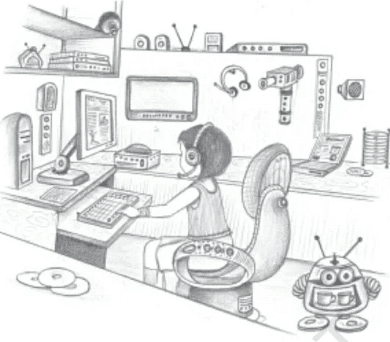
10. Poem – A legend of Northland – Worksheet Solutions

Multiple Choice Questions

Q.1. A legend of the Northland, which is a song narrating a story in short stanzas is also called ________.
(a)
 Song
(b) Poem
(c) Short story
(d)Ballad

Correct Answer is Option (d)
A song narrating a story in short stanzas is called ballad.

Q.2. What did the woman do when Saint Peter asked for a cake?
(a)
 She started making the smallest cake
(b) She refused to give him cake
(c) She gave the largest cake from the bakery
(d) She gave him some fruits

Correct Answer is Option (a)
She didn’t want to give him a large cake so she made a small cake for him.

Q.3. Identify the literary device repetition into the given stanza:
Then she took tiny scrap of dough,
And rolled and rolled it flat;
And baked it thin as a wafer
But she couldn’t part with that.
(a)Then she took
(b) Baked it thin
(c) Part with that
(d) Rolled and rolled

Correct Answer is Option (d)
Rolled and Rolled has the repetition of the term rolled.

Q.4. Who was Saint Peter?
(a)God itself
(b) A begger
(c)Disciple of Christ
(d)A traveller

Correct Answer is Option (c)
Saint Peter was a disciple of Jesus Christ and preaching all over the world.

Q.5. What did Saint Peter ask for from the little woman?
(a)
A single cake
(b) Something to eat
(c)A loaf of bread
(d) A dozen cakes

Correct Answer is Option (a)

Q.6. Which cake was given to Saint Peter finally?
(a)
Second cake
(b)No one
(c)First cake
(d) Third cake

Correct Answer is Option (b)
After baking three small cakes she thought that they were still too large to give anyone. So she put them on the shelf.

Q.7. The animal which is used to pull the sledges in Northland:
(a)
Polar bear
(b) Bull
(c) Reindeer
(d)Sheep

Correct Answer is Option (c)

Q.8. Why did not woman give a cake to Saint Peter?
(a)
Every cake was looking too large to give anyone
(b)No cake was tasty
(c)Saint Peter refused to take cake
(d)Every cake was looking too small

Correct Answer is Option (a)
She thought that her cakes seemed too small when she ate one of them herself but they were looking too large to give away. So she put them on the shelf.

Q.9. When do people go for sledging?
(a)
All of these
(b) During vacations
(c) In summers
(d) When snow falls

Correct Answer is Option (d)

Q.10. The vehicle, which is used to carry things and passengers over the snow in Northland:
(a)
Bus
(b) Cart
(c)Sledge
(d)Train

Correct Answer is Option (c)

Reference to Context

Q1: Read the extracts given below and answer the questions that follow.
Away, away in the Northland,
Where the hours of the day are few,
And the nights are so long in winter
That they cannot sleep them through;
(a) Why is the word ‘away’ repeated twice?
Ans:
 The word away has been repeated to create a sense of distance

(b) Which place is discussed in this stanza?
Ans:
 Northland, or the cold polar region of the North, including Greenland, northern Europe and Siberia are being discussed here.

(c) What does “hours of the day are few” mean?
Ans: 
The days are shorter than the nights

(d) Why can the people not sleep through the night?
Ans: 
The winter nights are long and cold.

Q2: Read the extracts given below and answer the questions that follow.
Where they harness the swift reindeer
To the sledges, when it snows;
And the children look like bear’s cubs
In their funny, furry clothes:
(a) What does ‘Where’ refer to?
Ans: 
Where refers to Northland.

(b) Where are the reindeer harnessed? What does ‘swift reindeer’ convey?
Ans:
 The reindeer are harnessed to the sledges. The phrase ‘swift reindeer’ conveys that the reindeer are very fast when they pull the sledges on the snow.

(c) Why do children look like bear cubs?
Ans:
 Because of the cold, children are made to wear heavy woollen clothes that cover them up fully and make them look like bear cubs.

(d) Mention two characteristics of the place.
Ans: 
The place is very cold; the days are shorter than the nights; people cannot sleep through the night.

Q3: Read the extracts given below and answer the questions that follow.
They tell them a curious story—
I don’t believe ’tis true;
And yet you may learn a lesson
If I tell the tale to you.
(a) What is the ‘curious story’ that the people tell?
Ans:
The curious story is a legend of an old greedy lady who angered St. Peter and he cursed the lady for her greed.

(b) Who does not believe in the story?
Ans: 
The poet does not believe the story to be true.

(c) Why does the poet narrate this tale?
Ans: 
The poet narrates the story because it has a moral lesson.

(d) What lesson does it give?
Ans:
 The tale teaches us a lesson that greed is a vice. One should not be greedy like the old lady who was cursed by St. Peter.

Q4: Read the extracts given below and answer the questions that follow.
Once, when the good Saint Peter
Lived in the world below,
And walked about it, preaching,
Just as he did, you know
(a) Which line shows that St. Peter is not alive today?
Ans: 
‘Once, when the good Saint Peter lived in the world below’ shows that St. Peter is not alive today

(b) Who was St. Peter?
Ans: 
St. Peter was an apostle of Jesus Christ. His mission was to spread the teachings of Jesus Christ.

(c) What does the line “Lived in the world below,” mean?
Ans: 
St Peter lived on earth

(d) What did St Peter do when he ‘Lived in the world below’?
Ans: 
He went about the world preaching the message of God.

Q5: Read the extracts given below and answer the questions that follow.
He came to the door of a cottage,
In travelling round the earth,
Where a little woman was making cakes,
And baking them on the hearth;
(a) Who does “he” refer to in the first line?
Ans: 
He refers to Saint Peter.

(b) What was the little woman doing?
Ans:
 The woman was baking cakes.

(c) What request did “he” make to the woman? Why?
Ans: 
Saint Peter asked the woman for a cake because he was weak with hunger.

(d) Why did Saint Peter curse the woman?
Ans:
 Saint Peter cursed the woman because she was highly stingy and mean and could not spare even a small cake from her large store for a weary traveller.

Q6: Read the extracts given below and answer the questions that follow.
And being faint with fasting,
For the day was almost done,
He asked her, from her store of cakes,
To give him a single one.
(a) Why was St Peter about to faint?
Ans: Saint Peter was tired and hungry, and so ready to faint.

(b) What had Saint Peter been doing?
Ans:
 Saint Peter had been travelling, spreading the message of God.

(c) What time of the day was it?
Ans: 
It was evening

(d) What did he ask the woman for?
Ans:
 Saint Peter asked the woman for a cake from her large store.

Q7: Read the extracts given below and answer the questions that follow.
So she made a very little cake,
But as it baking lay,
She looked at it, and thought it seemed
Too large to give away.
(a) Why did she bake a small cake?
Ans: 
The woman baked a small cake for giving to the saint

(b) What did she think about it as she saw it being baked?
Ans:
 She thought that the cake was too big to be given away in charity.

(c) What aspect of her character does this reveal?
Ans:
 She is selfish and miserly.

(d) How was she punished for her greed?
Ans:
 Saint Peter turned her into a woodpecker.

Q8: Read the extracts given below and answer the questions that follow.
Therefore she kneaded another,
And still a smaller one;
But it looked, when she turned it over,
As large as the first had done.
(a) Who does ‘she’ refer to?
Ans: 
‘She’ refers to the old little woman in the cottage.

(b) Who had come to her door? Why?
Ans:
 Saint Peter had come to her door. He was hungry and wanted something to eat.

(c) Why was she kneading smaller and smaller cakes?
Ans: 
She did not want to give away a large one to Saint Peter.

(d) What quality of the woman do her actions reveal?
Ans: 
She is miserly and selfish.

Q9: Read the extracts given below and answer the questions that follow.
Then she took a tiny scrap of dough,
And rolled and rolled it flat;
And baked it thin as a wafer —
But she couldn’t part with that.
(a) Who had asked the woman for a cake? Why?
Ans: 
Saint Peter had asked the woman for a cake. He had been fasting the whole ay and was weak with hunger.

(b) Why did the old lady take a tiny scrap of dough?
Ans:
 The old lady was a greedy woman. She wanted to give St. Peter, the smallest cake she could make.

(c) Why did she make the thin cake?
Ans:
 She wanted to save her dough. She wanted to give him a very small cake. So, she made a cake as thin as a water.

(d) What did Saint Peter do?
Ans: 
Saint Peter cursed the woman and turned her into a woodpecker.

Q10: Read the extracts given below and answer the questions that follow.
For she said, “My cakes that seem too small
When I eat of them myself
Are yet too large to give away. ”
So she put them on the shelf.
(a) Who is the speaker in these lines?
Ans:
 The woman is the speaker in these lines.

(b) When do the cakes seem too small?
Ans: 
The cakes seemed too small foe eating them herself.

(c) What kind of cakes did the woman make?
Ans:
 The woman made cakes that were smaller and smaller, till the last one was as thin as a wafer.

(d) What did the woman do with her cakes? Why?
Ans:
 The woman put the cakes away because she felt that they were to big to be given away in charity.

Q11: Read the extracts given below and answer the questions that follow.
Then good Saint Peter grew angry,
For he was hungry and faint;
And surely such a woman
Was enough to provoke a saint.
(a) Who was Saint Peter?
Ans:
 Saint Peter was one of the apostles of Jesus Christ.

(b) Who was Saint Peter angry with? Why?
Ans:
 Saint Peter was angry with the woman because of her greed and selfishness.

(c) How had the woman provoked the Saint?
Ans:
 The woman had provoked Saint Peter by not giving him any cake from her plentiful store.

(d) What did Saint Peter do?
Ans: 
Saint Peter cursed the woman and turned her into a woodpecker who would have to bore for her food.

Q12: Read the extracts given below and answer the questions that follow.
And he said, “You are far too selfish
To dwell in a human form,
To have both food and shelter,
Andfire to keep you warm.
(a) Who is ‘he’? Who is he speaking to?
Ans: 
He refers to Saint Peter. He is talking to the woman in the cottage.

(b) What did the saint say about the woman?
Ans: 
He said she was too selfish to live in human form.

(c) Why was he angry with her?
Ans: 
She had refused to give him anything to eat from her plentiful store, when he was faint with hunger.

(d) What benefits did he want her to forego?
Ans: 
He wanted her to forego the basic benefits of food, shelter and a fire to keep her warm.

Q13: Read the extracts given below and answer the questions that follow.
Now, you shall build as the birds do,
And shall get your scanty food
By boring, and boring, and boring,
All day in the hard, dry wood. ”
(a) What did St Peter turn the old woman into?
Ans: 
Saint Peter turned the woman into a bird, a woodpecker.

(b) Why did he curse her?
Ans: 
Saint Peter was angry with her because of her miserliness.

(c) What would she build?
Ans:
 She would build a nest in the woods like other birds.

(d) How would she get her food?
Ans: 
She would get her food by boring into the hard wood.

Q14: Read the extracts given below and answer the questions that follow.
Then up she went through the chimney,
Never speaking a word,
And out of the top flew a woodpecker,
For she was changed to a bird.
(a) Who is ‘she’? How did she go up?
Ans: 
“She’ refers to the woman. She went up through the chimney.

(b) Who changed her into a bird?
Ans: 
Saint Peter had changed her into a bird by cursing her.

(c) Why did she change into a woodpecker?
Ans:
 As the woman passed through the chimney and came out through the top, her clothes were burned and had become black but the scarlet cap on her head remained unchanged.

(d) Where did the woman live?
Ans: 
She lived in a country in the Earth’s north polar region, such as Greenland, the northern regions of Russia, or the Scandinavian countries.

Q15: Read the extracts given below and answer the questions that follow.
She had a scarlet cap on her head,
And that was left the same;
But all the rest of her clothes were burned
Black as a coal in the flame.
(a) What did Saint Peter ask the old lady for?
Ans: 
Saint Peter asked the old lady for one of her baked cakes to satisfy his hunger.

(b) What was the lady’s reaction?
Ans: 
The lady tried to bake a small cake for the Saint, but did not give him even that.

(c) Why did Saint Peter feel the woman should leave her human form?
Ans: 
She was too selfish to live in human form and enjoy food, shelter and warmth.

(d) How does the woodpecker get its food?
Ans:
 The woodpecker gets its food by boring holes into trees.

Q16: Read the extracts given below and answer the questions that follow.
And every country schoolboy
Has seen her in the wood,
Where she lives in the trees till this very day,
Boring and boring for food.
(a) Where can the woman be seen now?
Ans:
 She can be seen in the forest

(b) What is she doing?
Ans:
 She can be seen boring into the trees for food

(c) What lesson do you learn from the poem?
Ans:
 We should not be greedy and must always help the needy. ”

(d) Who was Saint Peter?
Ans:
 Saint Peter was an apostle of Christ, who went about preaching the message of God.

09. The Snake and the Mirror – Worksheet Solutions

Multiple Choice Questions

Q1: While looking at the mirror, the doctor smiled, and he found his smile
(a) Ugly
(b) Wide
(c) Attractive
(d) Unattractive
Ans:(c) 

Q2: The doctor described the snake as the one
(a) That had bitten the thief
(b) Thick and ugly
(c) Taken with its own beauty
(d) Very poisonous
Ans:(c) 

Q3: According to the doctor, the thief had a sense of
(a) Good clothes
(b) Logic
(c) Cleanliness
(d)None of the above
Ans:(c) 

Q4: Why did the doctor have very few things to carry?
(a) A thief had stolen most of the things
(b) The room was too small to keep a lot of things
(c) He was too poor to have many things
(d) Because the storm destroyed most of the things
Ans: (a) 

Q5: What did the doctor do immediately after reaching his friend’s house?
(a) Narrated the incident of the snake
(b) Took medicines
(c)Drank a glass of water
(d) Smeared oil all over his body and took a bath
Ans: (d) 

Q6: How did the doctor’s wife actually look?
(a) Thin
(b) Short
(c) Fat
(d) None of the above
Ans:(a) 

Q7: After the snake moved towards the mirror, the doctor was
(a) A paralysed man
(b) A crying man
(c)A man of flesh and blood
(d) A stone in the flesh
Ans:(c)

Q8: From the doctor’s arm, the snake slithered into his
(a) Back
(b) Head
(c) Lap
(d) Leg
Ans:(c) 

Q9: The snake looked at the mirror. Seeing that, the doctor wondered
(a) If it’s going to smile
(b)If it’s going to make a noise
(c) If it’s going to bite him
(d) If the snake was admiring its own beauty
Ans:(d) 

Q10: While sitting wrapped around by a snake, the doctor felt
(a) The presence of devils
(b)The presence of rats
(c) The presence of the ghost
(d)The presence of God
Ans:(d)

Very Short Answer Questions

Q1: What kind of snake did the doctor say it was?
Ans: The doctor said it was a cobra, but he didn’t know whether it was a male or female snake.

Q2: What kind of house in which the doctor live in?
Ans: The doctor lived in a rented house. It was not electrified. He had an army of rats who were living with him in the room.

Q3: Where did the snake fall from the gable?
Ans: The snake fell from the gable and landed on the floor with a thud. The doctor was not moved as he was used to such sounds.

Q9: Somebody asked, “Doctor, is your wife very fat?”
Ans: Somebody asked the doctor if his wife was fat.

Q10: “Are there any other funny stories related to cobras?” The young wife enquired.
Ans: The young wife enquired if there were any other funny stories related to cobras.

Short Answer Questions
Q1: Where did the snake slither on the doctor?
Ans: The snake moved from the floor, climbed the chair and slithered onto the doctor’s back. It finally settled on the doctor’s arm below the elbow and coiled itself there with its hood barely four inches away from his face.

Q2: Describe the house in which the doctor lived when the snake came?
Ans: The house in which the doctor lived, when the snake came, was a rented house. It was not electrified. It was a small room on the outer side. I opened the two windows in the room. It was an outer room with one wall facing the open yard. It had a tiled roof with long supporting gables that rested on the beam over the wall. There was no ceiling. There was a regular traffic of rats to and from the beam.

Q3: What was the doctor thinking about the creator of the universe when the snake had coiled around his arm?
Ans: When the snake coiled itself on the doctor’s arm, the doctor remembered the creator of the world and the universe. He thought that he might say something that God didn’t like, and what would happen. He then tried in his imagination to write in bright letters, the words ‘O God’ in front of his little heart. He was thinking, if the snake bit him, he didn’t have even medicine in his house, as he was a poor doctor and had just started practice. He smiled feebly. He thought that probably God appreciated the smile, and the snake unwound itself and slithered through his lap to the top of the table in front of the mirror.

Q4: Where was the snake when the doctor ran out of his house?
Ans: The snake was in the room when the doctor ran out of his house. It was sitting in front of the mirror on the table. When the snake had wound itself on the doctor’s arm, it saw its reflection in the mirror and seemed to it like its image.

Q5: Why did the doctor have to stay in an unelectrified house?
Ans: The doctor had to stay in an unelectrified house, since he had just started his practice and was poor; he couldn’t afford anything better and his means were meagre.

Reference to Context

Q1: Read the extracts given below and answer the questions that follow.
I had my meal at the restaurant and returned to my room. I heard a noise from above as I opened the door. The sound was a familiar one.
(a) Who does ‘I’ refer to in this extract?
Ans:
 In this extract, ‘I’ refers to the homeopathic doctor who narrates his encounter with a snake.

(b) At what time did ‘I’ return to his room? Where did he return from?
Ans: 
The doctor returned to his room at ten o’clock at night after having a meal at a restaurant.

(c) When did ‘I’ hear a noise?
Ans:
 The doctor heard a noise when he entered his room.

(d) What type of noise was it?
Ans:
 It was a familiar noise like that made by the rats that lived in his room as they moved about.

Q2: Read the extracts given below and answer the questions that follow.
The sound was a familiar one. One could say that the rats and I shared the room. I took out my box of matches and lighted the kerosene lamp on the table.
(a) What sound did the narrator hear as he entered the room?
Ans: 
The narrator heard a sound as if of the scampering of rats as he entered the room.

(b) Why does the narrator say that it was a familiar sound?
Ans: 
The narrator says that it was a familiar sound because there were many rats in his room, and their constant squeaking or scampering about had become familiar.

(c) How many times did he hear it?
Ans: 
He heard the sound thrice. (He heard it as he opened the door, he heard it again as he sat combing his hair this way and that, and he heard it for the third time when he decided to smile more.)

(d) When and why did the noise stop?
Ans:
 The sound stopped suddenly as the narrator, after pacing about the room, sat down in his chair. Probably, the rats had seen the snake.

Q3: Read the extracts given below and answer the questions that follow.
It had a tiled roof with long supporting gables that rested on the beam over the wall. There was no ceiling. There was a regular traffic of rats to and off.
(a) What did the narrator do after entering the room?
Ans: 
The narrator lit the kerosene lamp and then made his bed.

(b) Why could the narrator not sleep?
Ans:
 The narrator could not sleep because there was a regular traffic of rats to and from the beam and the gables. Moreover, it was warm in the room.

(c) Where did he go and why?
Ans:
 He went out to the veranda for a little air.

(d) Why did he return to his room?
Ans:
 There was no wind blowing outside either.

Q4: Read the extracts given below and answer the questions that follow.
I went back into the room and sat down on the chair. I opened the box beneath the table and took out a book, the Materia Medica. I opened it at the table on which stood the lamp and a large mirror; a small comb lay beside the mirror.
(a) Where was he before going back into the room? Why had he gone out of the room?
Ans: 
The narrator had gone out to the veranda before coming back into the room. He had gone out for some fresh air.

(b) Why did he take a book from the box?
Ans:
 The narrator could not sleep because it was hot and still, and there was no electricity in his room. So, he took out the book to pass some time reading it.

(c) What objects stood on the table?
Ans: 
A kerosene lamp and a large mirror stood on the table. A small comb lay beside the mirror.

(d) What did the speaker do after this?
Ans:
 After this, the speaker looked into the mirror that stood on the table and contemplated his looks.

Q5: Read the extracts given below and answer the questions that follow.
One feels tempted to look into a mirror when it is near one. I took a look. In those days I was a great admirer of beauty and I believed in making myself look handsome. I was unmarried and I was a doctor. I felt I had to make my presence felt. I picked up the comb and ran it through my hair and adjusted the parting so that it looked straight and neat.
(a) Why did the narrator look into the mirror?
Ans:
 The narrator was tempted to look into the mirror because it was there in front of him.

(b) Why did he want to make himself look handsome?
Ans: 
The narrator, who admired beauty in everyone, wanted to make himself look handsome.

(c) What did the narrator do to make his presence felt?
Ans: 
He combed his hair and adjusted the parting.

(d) What two important decisions did the narrator take to improve his appearance?
Ans: 
The narrator decided to improve his appearance by shaving daily and growing a thin moustache. He also decided to smile his attractive smile more often.

Q6: Read the extracts given below and answer the questions that follow.
I was unmarried and I was a doctor. I felt I had to make my presence felt. I picked up the comb and ran it through my hair and adjusted the parting so that it looked straight and neat. 
(a) Explain “I had to make my presence felt.”
Ans:
 The narrator decided that he had to create an impact on people by improving upon his appearance or personality.

(b) Why did the narrator feel he had to make his presence felt?
Ans: 
The narrator felt he was a doctor, a profession that is much respected in society, and was a bachelor. Therefore, he had to make an impact on society.

(c) What did the narrator do to make his presence felt?
Ans: 
In order to make his presence felt, he combed his hair carefully and adjusted the parting.

(d) What do you learn about the narrator from this extract?
Ans: 
The narrator was arrogant because of his profession and vain about his looks.

Q7: Read the extracts given below and answer the questions that follow.
I made an important decision—I would shave, daily and grow a thin moustache to look more handsome. I was after all a bachelor, and a doctor! I looked into the mirror and smiled. It was an attractive smile. I made another earth- shaking decision.
(a) Where is the narrator? What is he doing?
Ans:
 The narrator is in his room admiring himself in the mirror.

(b) What discovery did he make about himself?
Ans: 
The narrator discovered that he was handsome and had an attractive smile.

(c) What two important decisions did he take? Why?
Ans:
 He decided to shave daily and grow a thin moustache to look more handsome and to smile his attractive smile more often. He took these decisions to improve his presence.

(d) What is the narrator’s tone in these lines?
Ans:
 The narrator’s tone is vain, but he is also laughing at himself, as he calls the decisions “earth-shaking”.

Q8: Read the extracts given below and answer the questions that follow.
I got up, paced up and down the room. Then another lovely thought struck me. I would marry.
(a) Where did the narrator get up from? Why?
Ans: 
The narrator, the homeopathic doctor, got up from his chair in his room. He wanted to think about improving his presence in society.

(b) Which lovely thought struck him?
Ans: 
The lovely thought that struck him was that he should get married.

(c) What sort of lady did he wish to marry?
Ans:
 He wished to marry a rich, fat lady-doctor.

(d) What prompted him to make this choice?
Ans: 
He would get married to a woman doctor who had plenty of money and a good medical practice as he did not have much money. She had to be fat so that if he made a silly mistake and needed to run away, she should not be able to run after him and catch him.

Q9: Read the extracts given below and answer the questions that follow.
There was no time to do any such thing. The snake slithered along my shoulder and coiled around my left arm above the elbow.
(a) What alerted the narrator to the snake’s presence?
Ans:
 The narrator was alerted to the snake’s presence by the sudden silence from the rats above. Also, he heard a dull thud as if a rubber tube had fallen to the ground.

(b) What does “any such thing” refer to?
Ans:
 The speaker did not have time to save himself from the snake by jumping away or crying out as it had coiled around his left arm above the elbow.

(c) What did the snake do after crawling over the narrator’s shoulder?
Ans:
 The snake coiled itself tightly around the narrator’s left arm and spread its hood close to his face.

(d) How did the narrator react to the snake’s presence?
Ans: 
The narrator sat motionless as if turned to stone. He could not move or cry out when the snake coiled itself around his arm.

Q10: Read the extracts given below and answer the questions that follow.
I didn ’t jump. I didn ‘t tremble. I didn ’t cry out. There was no time to do any such thing. The snake slithered along my shoulder and coiled around my left arm above the elbow. The hood was spread out and its head was hardly three or four inches from my face!
It would not be correct to say merely that I sat there holding my breath I was turned to stone.
(a) Why did the author not jump, tremble and cry?
Ans: 
The author did not jump, tremble and cry because a snake had fallen on his shoulders. He was both too frightened to move and didn’t want to do anything to provoke the snake.

(b) What did the narrator do as the snake coiled itself round his arm?
Ans: 
As the narrator coiled itself around his arm, the narrator sat still, turned to stone.

(c) Did the snake bite the speaker? What distracted it?
Ans: 
No, the snake did not bite the speaker. A sight of its reflection in the mirror distracted the snake.

(d) What were the narrator’s thoughts as he looked at the snake?
Ans: 
In this moment of fear of death, he realised the presence of God. God had punished him for being too proud and arrogant.

Q11: Read the extracts given below and answer the questions that follow.
At my slightest movement the snake would strike me! Death lurked four inches away. Suppose it struck, what was the medicine I had to take? There were no medicines in the room. I was but a poor, foolish and stupid doctor. I forgot my danger and smiled feebly at myself
(a) What does Death lurked four inches away imply?
Ans: 
The snake was three or four inches away from the writer’s head with its hood spread out. Since it was a cobra, its bite would be fatal.

(b) Why did the doctor call himself a poor and stupid doctor?
Ans: 
The doctor felt poor because he was facing death and stupid because he realised that, though he was a doctor, he still did not have medicines for an emergency like this.

(c) What danger does he refer to?
Ans: 
The doctor refers to the danger posed by a deadly snake that had wrapped itself on his arm and was slowly crushing it with force.

(d) Why did he smile feebly at himself?
Ans: 
The doctor smiled feebly at himself because smiles at his foolishness and helplessness, because just a short while ago he had been arrogantly boasting of being a doctor and a bachelor, but now he was helplessly staring at death.

Q12: Read the extracts given below and answer the questions that follow.
The snake unwound itself from my arm and slowly slithered into my lap. From there it crept onto the table and moved towards the mirror. Perhaps it wanted to enjoy its reflection at closer quarters.
(a) Where was the narrator at the time?
Ans:
 The narrator was sitting in his room, admiring his looks and thinking of ways to improve them.

(b) What did the snake do as it landed on the narrator’s chair?
Ans: 
It slithered down his shoulder, coiled itself around his arm and spread its hood few inches from his face.

(c) Where did the snake go after uncoiling from the writer’s arm?
Ans: 
The snake slid across the narrator’s lap onto the table.

(d) Why did the snake move towards the mirror?
Ans:
 The snake moved towards the mirror to have a closer look at itself.

Q13: Read the extracts given below and answer the questions that follow.
I felt then the great presence of the creator of this world and this universe. God was there. Suppose I said something and he did not like it.
(a) When did the narrator feel the presence of the creator?
Ans: 
The narrator felt the presence of the creator when he was faced with death in the form of the snake.

(b) Why does the narrator feel he may have displeased God?
Ans:
 He felt God may have punished him for being too proud and arrogant. He realised that he was but a mere human, a poor man, nothing to boast about.

(c) What did the narrator do then?
Ans: 
He prayed to God – in his imagination, he tried to write words, ‘O God’ in bright letters outside his heart.

(d) What was the result of his realisation?
Ans: 
The moment he accepted his true worth, God appeared pleased, and the snake of its own free will left him and sat on the table in front of the mirror.

Q14: There was some pain in my left arm. It was as if a thick leaden rod—no, a rod made of molten fire—was slowly but powerfully crushing my arm. The arm was beginning to be drained of all strength. What could I do?
(a) Why did the narrator feel a pain in his arm?
Ans:
 The snake was coiled around his arm and was crushing his arm.

(b) Where had the snake come from?
Ans:
 The snake had fallen from the ceiling of the house.

(c) What had alerted the narrator to the snake’s presence at first? What had been his first reaction?
Ans: 
The narrator was first alerted to the snake’s presence by a dull thud. He had disregarded it at first as being nothing to worry about.

(d) Why did the narrator sit still in the chair?
Ans:
 The narrator sat still on the chair because at his slightest movement, the snake would have struck him.

Q15: Read the extracts given below and answer the questions that follow.
It seemed as if God appreciated that. The snake turned its head. It looked into the mirror and saw its reflection. I do not claim that it was the first snake that had ever looked into a mirror. But it was certain that the snake was looking into the mirror. Was it admiring its own beauty? Was it trying to make an important decision about growing a moustache or using eye shadow and mascara or wearing a vermilion spot on its forehead?
(a) What was it that God appreciated?
Ans:
 God appreciated the narrator getting the realisation that he had been arrogant and vain, and his sincere remembering of God.

(b) What did the snake do as it landed on the narrator’s chair?
Ans: T
he snake wriggled over the back of the chair and landed on his shoulders. It coiled round his left arm above the elbow and spread out its hood, hardly three inches from his face.

(c) Where did the snake move its head?
Ans:
 The snake moved its head towards the mirror.

(d) Why did the narrator call it the “first snake”?
Ans: 
The narrator calls it the “first snake” because this was the first snake he had seen that enjoyed looking into the mirror.

Q16: Read the extracts given below and answer the questions that follow.
I was no mere image cut in granite. I was suddenly a man of flesh and blood. Still holding my breath I got up from the chair. I quietly went through the veranda. From there I leapt into the yard and ran for all I was worth.

(a) What does the narrator mean when he says “I was no mere image cut in granite”?
Ans:
 The narrator no longer sat completely still, unable to move as if he were an image that had been carved in stone.

(b) Why had he been sitting turned to stone?
Ans: 
A snake had coiled itself around his arm and had spread its hood near his face.

(c) Where had the snake gone?
Ans:
 The snake had slithered over to sit in front of the mirror.

(d) What did the narrator do?
Ans: 
He left his room and ran off as fast as could.

Q17: Read the extracts given below and answer the questions that follow.
I was no mere image cut in granite. I was suddenly a man of flesh and blood. Still holding my breath I got up from the chair. I quietly went through the veranda. From there, I leapt into the yard and ran for all I was worth.
(a) When had the narrator felt like an “image cut in granite”?
Ans:
 He felt that he was an ‘image cut in granite’ when he found the snake coiled strongly round his forearm with its hood spread out barely three or four inches away from his face. He was gripped in fear, and he could neither move nor breathe properly.

(b) What is the meaning of ‘a man of flesh and blood’?
Ans:
 ‘A man of flesh and blood’ means a living person with human feelings, and with the strength to move.

(c) What made the narrator suddenly turn into ‘a man of flesh and blood’?
Ans: 
When the snake let go of its hold on his arm, the doctor came out of the state of shock which had made him numb like a stone. He regained his senses and faculties.

(d) What did the narrator do as soon as he turned into ‘a man of flesh and blood’?
Ans: 
When the doctor got over his numbing shock, he got up from his chair, quietly went through the veranda, leapt into the yard and ran as fast as he could.

Q18: Read the extracts given below and answer the questions that follow.
The doctor replied, “I ran and ran till I reached a friend’s house. Immediately I smeared oil all over myself and took a bath. I changed into fresh clothes.
(a) Why did the doctor run?
Ans: 
The doctor ran because the snake that landed on his shoulder had slithered off, and he wanted to escape the snake.

(b) Where did the narrator spend the night?
Ans: 
The narrator spent the night with his friend at his house.

(c) Why did the doctor smear oil all over his body?
Ans: 
The doctor smeared oil all over his body because he wanted to erase the venom of the Snake that had landed on his shoulder.

(d) What did he do the next morning?
Ans: 
The next morning, he took his friends and went back to his room to check whether the snake was still there.

Q19: The next morning at about eight-thirty I took my friend and one or two others to my room to move my things from there. But we found we had little to carry.
(a) What does the narrator mean by the phrase “the next morning”?
Ans:
 The narrator is referring to the morning after the evening when he had the frightening experience with the snake that coiled itself around his arm.

(b) Which friend is being referred to?
Ans:
 The friend with whom the narrator had spent the night after escaping his house and the snake there.

(c) Why did the narrator want to remove his things?
Ans:
 The narrator wanted to remove his things as he wanted to leave his house because of the fear of the snake.

(d) Why was there little to carry?
Ans:
 There was little to carry because thieves had stolen most of his things in the night.

Q20: Read the extracts given below and answer the questions that follow.
“No, ” the doctor said. “God willed otherwise. My life companion is a thin reedy person with the gift of a sprinter. ”
(a) Explain “God willed it otherwise”.
Ans:
 It was God’s will that the narrator’s wishes would not be fulfilled.

(b) What qualities did the narrator want in his wife?
Ans:
 The narrator wanted to get married to a woman doctor who was rich and fat.

(c) Why did he want those qualities?
Ans: 
The narrator had a meagre practice, so he wanted a rich wife with a good practice. He wanted a fat wife as he felt that if he made a silly mistake and needed to run away, she should not be able to run after him and catch him..

(d) What kind of person did he marry?
Ans:
 The woman he married was a thin and slender person who could run like a sprinter.