The poem emphasizes the universal brotherhood among all people, irrespective of nationality or background.
It highlights the shared humanity that binds us all together.
The poem consists of multiple stanzas, each focusing on different aspects of human connection and the futility of hatred and division.
It urges the readers to remember that all individuals, regardless of their origins, share common experiences and emotions.
Detailed Summary
Remember, no men are strange, no countries foreign Beneath all uniforms, a single body breathes Like ours: the land our brothers walk upon Is earth like this, in which we all shall lie.
In this stanza, the poet is reminding us that no person is truly strange or foreign to us. Despite different appearances and nationalities, we all share a common humanity. The poet emphasizes that beneath the clothing that may distinguish us, we all share the same essence of being human. The land that our brothers and sisters inhabit is just like the land we walk on, and ultimately, we all return to the earth when we pass away.
They, too, aware of sun and air and water, Are fed by peaceful harvests, by war’s long winter starv’d. Their hands are ours, and in their lines we read A labour not different from our own.
This stanza highlights the common experiences shared by people in different parts of the world. Just like us, they are aware of the sun, air, and water that sustain life. They rely on peaceful harvests for sustenance, and in times of war and deprivation, they also suffer. The poet emphasizes the unity of humanity by stating that their hands are like ours, and in the lines on their palms, we can see the evidence of hard work that is no different from our own.
Remember they have eyes like ours that wake Or sleep, and strength that can be won By love. In every land is common life That all can recognize and understand.
In this stanza, the poet continues to emphasize the similarities between people across the globe. People everywhere have eyes that open and close, indicating their shared humanity. The poet suggests that strength can be gained through love, a universal emotion that transcends boundaries. Regardless of where we are from, there is a common thread of life that runs through all cultures and societies, something that everyone can relate to and appreciate.
Let us remember, whenever we are told To hate our brothers, it is ourselves That we shall dispossess, betray, condemn. Remember, we who take arms against each other
This stanza serves as a powerful reminder against hatred and division. The poet urges us to remember that when we are encouraged to hate others, it is ultimately ourselves that we harm. By giving in to hate, we dispossess not only others but also ourselves of compassion and understanding. Taking up arms against each other only results in mutual destruction and loss. It’s a plea for unity and peace rather than animosity and conflict.
It is the human earth that we defile. Our hells of fire and dust outrage the innocence Of air that is everywhere our own, Remember, no men are foreign, and no countries strange.
The final stanza underscores the impact of our actions on the world we share. By engaging in conflicts and polluting the environment, we desecrate the earth that sustains all of humanity. The poet highlights the irony of how we tarnish the purity of the air, which belongs to everyone. The message is a call to remember that we are all interconnected, and no one is truly foreign or strange. It’s a plea for understanding, cooperation, and respect for our common home.
Theme/Message
Themes:
The universality of human experience
Brotherhood and unity
Tolerance and empathy
The destructive nature of hatred and division
Message:
Emphasizes the importance of recognizing the humanity in all individuals
Encourages empathy and understanding across cultural and national boundaries
Warns against the dangers of prejudice and discrimination
Calls for unity and compassion in a world often plagued by conflict and division
Difficult Words
Foreign: Belonging to, situated in, or derived from another country.
Breathe: To take air, oxygen, etc., into the lungs and expel it.
Harvests: The yield of produce from plants in a single growing season.
Winter starved: To suffer or die from cold or hunger during the winter season.
Dispossess: Deprive (someone) of something that they own, typically their land or property.
Defile: To sully, mar, or spoil.
Outrage: An extremely strong reaction of anger, shock, or indignation.
Innocence: Lack of guile or corruption; purity.
Recognition: The action or process of recognizing or being recognized.
Condemn: To express complete disapproval of; censure.
Useful Expressions
Beneath all uniforms, … — the people of different countries wear various dresses but the human body is the same beneath them.
… in their lines we read — we all have the same hands by which we all produce the same type of goods, products and literature.
In every land is common life— in every country, the people are leading the same life. They feel pain and sorrow similarly.
whenever we are told To hate our brothers, … — the selfish people instigate the innocent to harm each other.
Remember, no men are foreign, and no countries strange —We should not forget that we all are the citizens of the world. Here, no one is a foreigner and no countries are strange. We have similar body and mind everywhere.
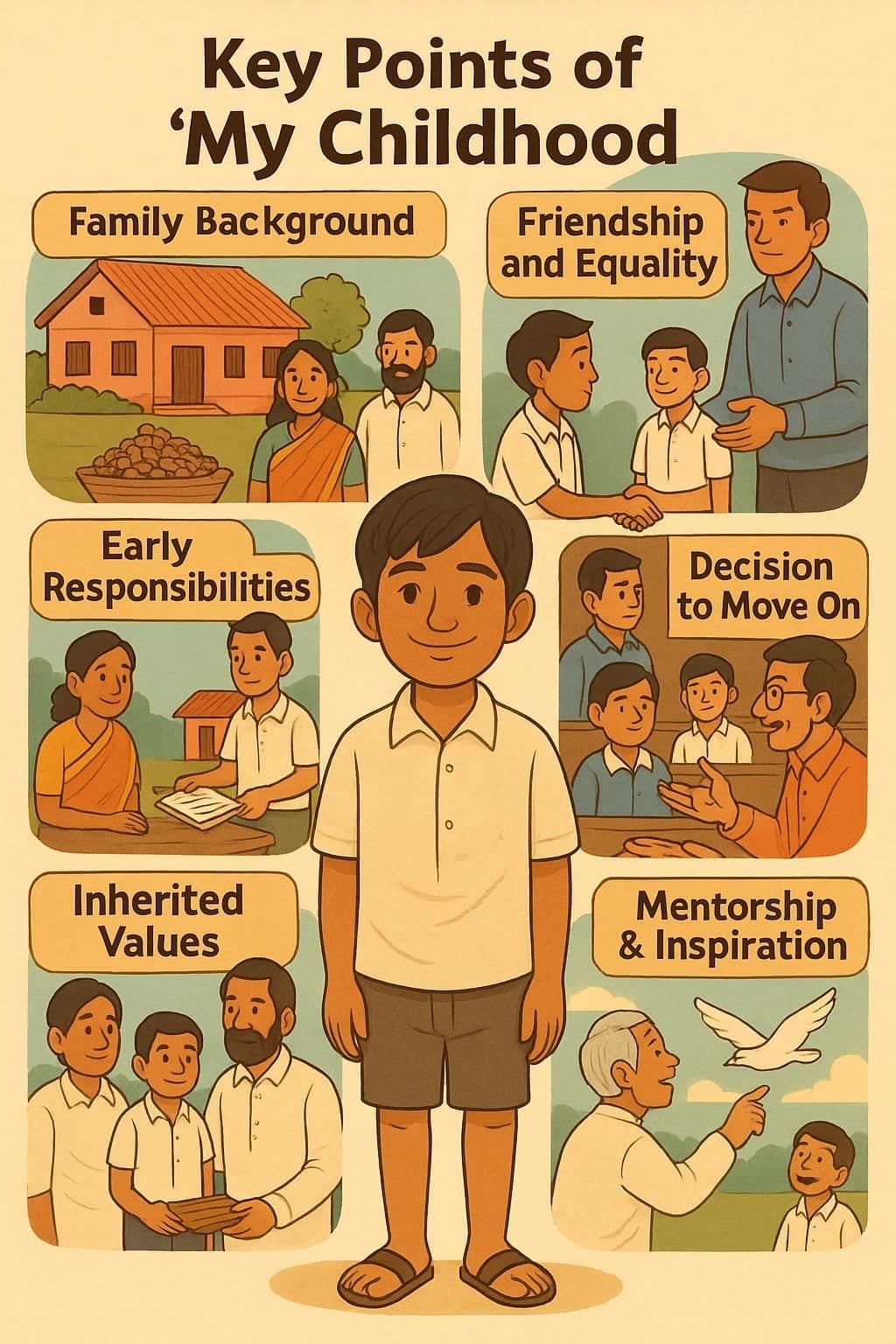
“My Childhood,” an excerpt from Dr. A.P.J. Abdul Kalam’s autobiography Wings of Fire, takes us into his humble beginnings in Rameswaram, a small coastal town. From there, he rose to become India’s beloved President. The chapter shares heartwarming stories of his simple life, shaped by strong family values like kindness, honesty, hospitality, and unity.
About the Author
Dr. A.P.J. Abdul Kalam (1931–2015), fondly called the “Missile Man of India,” was a brilliant scientist and the 11th President of India. He played a key role in India’s space and defence programs, contributing to the development of missiles that strengthened the nation’s defence capabilities.
Key Points of “My Childhood”
Family and Early Life: Kalam was born in a middle-class Tamil Muslim family in Rameswaram. His father, Jainulabdeen, was honest and disciplined; his mother, Ashiamma, was kind and generous. They lived in a spacious ancestral home on Mosque Street.
Early Responsibilities: During World War II, Kalam sold tamarind seeds and later delivered newspapers—his first earnings, which taught him the value of pride and hard work.
Values and Lessons: He inherited honesty and discipline from his father, and kindness from his mother. His friendships crossed religious lines, reflecting values of unity and equality.
Facing Prejudice: Kalam once faced discrimination at school but was supported by his Hindu friend’s father and his teacher, Sivasubramania Iyer, who promoted equality and broke social barriers.
Mentorship and Growth: Iyer’s support and encouragement inspired Kalam to dream big and overcome social limitations.
A New Beginning: With his father’s blessing, Kalam left Rameswaram to pursue higher studies, ready to soar like a seagull.
Detailed Summary
Dr. Kalam was born into a middle-class Tamil Muslim family in Rameswaram, a small town in Tamil Nadu. His father, Jainulabdeen, was a wise and generous man who lived a simple life and provided for the family’s basic needs. His mother, Ashiamma, was equally kind and often fed many people daily, reflecting the family’s spirit of generosity. Kalam describes his childhood home as a secure and peaceful place.
Kalam recalls his days as a curious and hardworking boy. During the Second World War, when he was just eight years old, he earned his first wages by selling tamarind seeds to a provision shop and then by helping his cousin distribute newspapers. This small job instilled a sense of pride and responsibility in him.
His family valued education, kindness, and discipline. Kalam inherited honesty and self-discipline from his father and faith in goodness of people from his mother. He grew up alongside friends from different religious and social backgrounds, such as Ramanadha Sastry, Aravindan, and Sivaprakasan. Despite their religious differences, their bond was strong, and they shared a deep sense of unity.
Try yourself:
What values did Dr. Kalam inherit from his parents in his childhood?
A.Kindness and generosity
B.Honesty and self-discipline
C.Unity and perseverance
D.Simplicity and humility
View Solution
The rigid social structure of Rameswaram was evident when a new teacher asked Kalam to sit at the back of the class because he was Muslim. This act of discrimination deeply saddened both Kalam and his friend Ramanadha Sastry, who cried when Kalam was moved. However, Ramanadha’s father, Lakshmana Sastry, stood up against this injustice, reprimanding the teacher and urging him to change his attitude. This incident left a lasting impact on Kalam.
Kalam’s science teacher, Sivasubramania Iyer, played a significant role in breaking social barriers and inspiring Kalam to aim high. Despite his orthodox beliefs, Iyer encouraged Kalam and treated him as an equal. When Iyer invited Kalam to his home for a meal, his wife initially objected due to their religious differences. However, Iyer served Kalam himself and later persuaded his wife to overcome her biases. This act of kindness and determination left a strong impression on Kalam.
As Kalam grew older, he aspired to study beyond Rameswaram. His father supported his decision, comparing him to a seagull that must fly high and explore. Quoting Khalil Gibran, his father emphasised that children must follow their own paths in life. With his family’s encouragement, Kalam left Rameswaram to pursue his education and build his future.
Theme & Message of “My Childhood”
Theme
The main theme of the chapter is the importance of values, unity, and mentorship in shaping a person’s life. It highlights how family support, childhood experiences, and the guidance of teachers can inspire someone to overcome challenges and achieve greatness. The chapter also touches on breaking social barriers and promoting equality.
Message
The chapter delivers the following messages:
Strong values shape strong people: Honesty, kindness, and discipline, as taught by Kalam’s parents, are the foundation of a successful life.
Unity in diversity: Friendship and harmony can thrive despite religious and social differences.
Mentorship matters: Good teachers and mentors can inspire you to aim high and break barriers.
Overcome social prejudice: Treat everyone equally, regardless of their background, to create a fair and just society.
Follow your dreams: With family support and determination, you can achieve your goals and rise above limitations.
Difficult Words
Austere: Simple, strict, and severe in lifestyle.
Erstwhile: Former or previous.
Inborn: A quality or feeling present from birth.
Princely Sum: A large amount of money, used ironically in this context to refer to a small amount.
Communal Intolerance: Hostility or prejudice against people from different religious or ethnic groups.
Unprecedented: Something that has never been done or experienced before.
Perturbed: Disturbed or troubled by something.
Orthodox: Strictly following traditional religious practices.
Segregation: The separation of people based on differences like race, religion, etc.
The poem “A Legend of the Northland” is written by Phoebe Cary, who was an American poet born on September 4, 1824, in Mount Healthy, Ohio. She, along with her sister Alice Cary, became well known for writing poetry that was simple, thoughtful, and full of moral lessons. Phoebe Cary’s works often reflect her religious beliefs, compassion for people, and her ability to teach values through storytelling.
One of Phoebe Cary’s greatest strengths was her talent for expressing meaningful ideas in language that connected with ordinary readers. She wrote many devotional and moral poems that are still remembered today. Her poetry often draws on folk tales, everyday life, and legends, making them engaging for children as well as adults. In “A Legend of the Northland,” she retells an old tale in the form of a ballad, combining rhythm, music, and a clear message about kindness and generosity.
Cary’s poetry is characterised by its simplicity, musical quality, and moral depth. She believed poetry could guide people toward better values and conduct. Although her life was short—she passed away on July 31, 1871—her works, including this poem, continue to inspire readers with their timeless lessons and gentle storytelling.
Key Points of the Poem
It tells the story of a greedy old woman who refuses to share her food with Saint Peter.
Saint Peter punishes her for her selfishness by transforming her into a bird.
The poem is set in a cold, northern land where the days are short and the nights are long.
It conveys a moral lesson about the consequences of greed and selfishness.
Detailed Summary
Away, away in the Northland, Where the hours of the day are few, And the nights are so long in winter That they cannot sleep them through; Where they harness the swift reindeer To the sledges, when it snows; And the children look like bear’s cubs In their funny, furry clothes: They tell them a curious story — I don’t believe ’tis true; And yet you may learn a lesson If I tell the tale to you.
Explanation: In this stanza, the poet describes the setting of the story. The “Northland” refers to a cold, snowy region near the North Pole, where days are very short and nights are very long in winter. People there use reindeer to pull sledges over the snow, and children wear thick, furry clothes that make them look like little bear cubs. The poet then says that the people of this region tell a strange or curious story. Although the poet admits that it may not be literally true, she suggests that the story carries an important moral lesson for everyone.
Once, when the good Saint Peter Lived in the world below, And walked about it, preaching, Just as he did, you know, He came to the door of a cottage, In travelling round the earth, Where a little woman was making cakes, And baking them on the hearth; And being faint with fasting, For the day was almost done, He asked her, from her store of cakes, To give him a single one.
Explanation: In this stanza, the poet introduces Saint Peter, who was one of the disciples of Jesus Christ. He is described as traveling around the world, preaching and spreading religious teachings. While on his journey, Saint Peter grew very tired and weak because he had been fasting (not eating) the whole day. By evening, he reached a poor cottage where a woman was baking cakes on the hearth (fireplace). Feeling hungry, he humbly requested her to give him just one small cake from the many she had.
So she made a very little cake, But as it baking lay, She looked at it, and thought it seemed Too large to give away. Therefore she kneaded another, And still a smaller one; But it looked, when she turned it over, As large as the first had done. Then she took a tiny scrap of dough, And rolled and rolled it flat; And baked it thin as a wafer — But she couldn’t part with that. For she said, “My cakes that seem too small When I eat of them myself Are yet too large to give away.” So she put them on the shelf.
Explanation: In this stanza, the woman reveals her selfish and greedy nature. When Saint Peter asked her for a cake, she first made a very small one, but as it baked, she felt it looked too large to give away. So, she made another, even smaller than the first, but when she turned it over, it still seemed just as big. Finally, she took a tiny bit of dough and rolled it out very thin, almost like a wafer, yet she could not bring herself to part with it. She reasoned that when she ate the cakes herself, they seemed too small, but when it came to giving them to someone else, they appeared too large. Thus, she put all the cakes on the shelf instead of sharing even a morsel with the hungry Saint Peter. This shows how greed prevents people from being generous, even when they have enough for themselves.
Then good Saint Peter grew angry, For he was hungry and faint; And surely such a woman Was enough to provoke a saint. And he said, “You are far too selfish To dwell in a human form, To have both food and shelter, And fire to keep you warm. Now, you shall build as the birds do, And shall get your scanty food By boring, and boring, and boring, All day in the hard, dry wood.”
Explanation: In this stanza, Saint Peter becomes very angry with the woman. He was already weak and tired with hunger, and her extreme selfishness was enough to upset even a saint, who is usually very patient and forgiving. He tells her that she is too greedy and self-centered to live as a human being, enjoying the comforts of food, shelter, and warmth. As a punishment, he curses her to live like a bird. From now on, she would no longer eat proper food or live in a cozy home. Instead, she would have to build her nest as birds do and spend the whole day boring into the hard, dry wood to search for tiny insects to eat. This transformation was meant to teach her a lesson about the consequences of selfishness and the importance of generosity.
Then up she went through the chimney, Never speaking a word, And out of the top flew a woodpecker, For she was changed to a bird.
Explanation: In this stanza, the poet describes the magical transformation of the selfish woman. As soon as Saint Peter cursed her, she rose up through the chimney without saying a single word. When she came out from the top, she was no longer a woman but had been changed into a bird — the woodpecker. This sudden change symbolises the punishment for her greed and selfishness. From then on, she would have to live like a woodpecker, always searching for her food by pecking into trees, instead of enjoying the comfort of a home and plenty of food.
She had a scarlet cap on her head, And that was left the same; But all the rest of her clothes were burned Black as a coal in the flame. And every country schoolboy Has seen her in the wood, Where she lives in the trees till this very day, Boring and boring for food.
Explanation: In this stanza, the poet describes how the woman looked after her transformation into a woodpecker. The red cap she had been wearing on her head remained unchanged, but the rest of her clothes were burned black in the fire, giving the bird its typical black feathers with a red crown. The poet then adds that every schoolboy can see such a bird in the woods, living on trees. From that day till now, the woodpecker has been spending its life boring holes into the hardwood of trees to find food. This ending connects the legend to real life, showing how a moral story is linked to nature.
Theme/ MessageTheme
Greed: The main theme of the poem is greed. The old woman’s inability to share her food with Saint Peter highlights how greed can lead to negative consequences.
Consequences of Actions: The poem illustrates that every action has consequences. The woman’s selfishness leads to her punishment, teaching us that we must consider the impact of our choices.
Transformation and Redemption: The transformation of the woman into a bird signifies a loss of humanity, but it also opens up a new way of living, suggesting that change can lead to new opportunities.
Humility: The poem underscores the importance of humility and generosity. The old woman’s failure to share reflects a lack of these virtues.
Try yourself:What was the old lady’s reaction when Saint Peter asked for a piece of cake?
A.She gave him the first cake she baked.
B.She gave him the second cake she baked.
C.She gave him the third cake she baked.
D.She did not give him any cake.
View Solution
Message
The poem delivers a strong message about the dangers of selfishness and the importance of sharing. When the old woman refuses to share, she faces a severe consequence that forever alters her existence.
It teaches readers that being greedy can lead to isolation and hardship. The woman’s transformation into a woodpecker symbolizes how her greed has stripped her of human connections and happiness.
The story encourages us to be mindful of our actions and their effects on others. It serves as a reminder that generosity enriches our lives and the lives of those around us.
Finally, the poem suggests that it is never too late to learn a lesson. Even after her transformation, the woman continues to survive, implying that life goes on, and we can always strive to become better individuals.
Literary Devices in the Poem
1. Rhyme Scheme
The poem is written in a ballad form with a regular rhyme scheme ABCB.
Away, away in the Northland, (a) Where the hours of the day are few, (b) And the nights are so long in winter (c) That they cannot sleep them through; (b)
2. Alliteration (repetition of consonant sounds at the beginning of words)
“They tell them a curious story” – repetition of the t sound.
“Build as the birds do” – repetition of the b sound.
3. Repetition
Words like “boring, and boring, and boring” are repeated to emphasise the continuous hard work of the woodpecker.
4. Imagery
Vivid descriptions appeal to the senses: “The children look like bears’ cubs in their funny, furry clothes.” “Scarlet cap on her head… clothes burned black as coal.”
5. Simile (comparison using “like” or “as”)
“The children look like bear cubs” – compares children in furry clothes to bear cubs.
6. Symbolism
The transformation into a woodpecker symbolises punishment for selfishness and greed.
The red cap symbolises the trace of her human identity that remains.
7. Hyperbole (exaggeration)
“Enough to provoke a saint” – exaggerates how selfish the woman was, as even a saint lost patience.
8. Personification
The poem personifies Saint Peter as a traveller who becomes angry and curses the woman, showing human-like emotions.
9. Didactic Tone
The entire poem has a moral, teaching generosity and condemning greed.
Difficult Words
Legend: A traditional story sometimes popularly regarded as historical but not verifiable.
Angered: To make someone very mad or upset.
Greed: An intense and selfish desire for something, especially wealth or power.
Fasting: The act of abstaining from all or some kinds of food or drink for a period of time.
Scarlet: A bright red colour.
Provoked: To stimulate or incite someone to do or feel something, especially to provoke anger.
Selfish: Lacking consideration for others; concerned chiefly with one’s own personal profit or pleasure.
Boring: To make a hole in something by drilling or similar means.
Cottage: A small simple house, typically in the countryside.
Hearth: The floor of a fireplace, often extending into a room; symbolises warmth and home.
Humility: A modest or low view of one’s own importance; humbleness.
Transformation: A thorough or dramatic change in form or appearance.
Woodpecker: A bird known for pecking holes in trees to find food or create nests.
Scanty: Small or insufficient in quantity or amount.
Introduction“The Snake and the Mirror” by Vaikom Muhammad Basheer is a funny and suspenseful story about a young doctor’s encounter with a snake. It highlights human self-admiration and how unexpected events can turn life upside down. Vaikom Muhammad Basheer was a famous Malayalam writer known for his simple stories filled with humor and life lessons. His works are loved for their relatable characters and unique style, making him one of India’s most respected authors.
Key Points of the Story
The story is about a young, unmarried doctor who lived in a small, rented room shared with rats.
One night, while admiring himself in the mirror, the doctor dreamed of improving his looks and marrying a rich, fat woman doctor.
Suddenly, a snake fell on his shoulder and coiled around his arm, its hood just inches from his face.
Frozen with fear, the doctor prayed silently, unable to move, fearing the snake would bite him.
The snake turned its attention to the mirror, seeming fascinated by its reflection, and uncoiled from the doctor’s arm.
The doctor used this opportunity to escape from the room and ran to safety.
Later, he discovered that a thief had stolen most of his belongings that night, leaving behind only his dirty vest.
The doctor humorously reflected on the incident, including the irony of the snake’s vanity and his unrealistic marriage dreams.
This light-hearted story combines humor and suspense, showing how tense situations can later be laughed about.
Detailed Summary
The narrator of the story is a doctor. He is telling this story to some of his friends. He tells the story of his encounter with a deadly snake. He is a homeopath. He says that he had just started his practice in those days when he was living in a rented room.
It was a hot summer night. The time was about ten o’clock. He had just returned home after taking his meals at a restaurant. He lighted the kerosene lamp, as his house was not electrified. After some time, he opened the two windows in the room. Then he sat down on the chair and took out a book to read. Apart from the lamp, there was a large mirror on the table. In those days, the doctor bothered much about his looks, as he was a bachelor. He picked up a comb and parted his hair. He looked at his reflection in the mirror and smiled at his own image. There were rats in the room which constantly made noises.
The doctor got up, and paced up and down the room. He decided that he would marry. He thought that he would marry a woman doctor who had plenty of money and good medical practice. He decided that he would marry a fat lady so that she would not be able to run after him if he wanted to run away. He resumed his seat in the chair in front of the table. There were no more sounds of rats. Suddenly something fell on the back of his chair with a thud. He was horrified to see that there was a large snake on the back of the chair. Just then the snake came on his shoulder. Before the doctor could think and act, the snake coiled itself around his left arm. Its hood was spread and its head was hardly three or four inches from his face.
The doctor was turned to stone with fear. But his mind was active. He prayed to God to save him. It appeared as if God had heard his prayer. The snake turned its head and looked into the mirror. It appeared to like its own image. Then the snake unwound itself from the doctor’s arm and fell into his lap. From there the snake crept onto the table. It moved towards the mirror. Perhaps it wanted to see its image closely. Now the doctor acted quickly. Still holding his breath, he got up slowly from the chair. Then he ran out of the house. He went to the house of one of his friends and spent the night there.
Next morning, he took his friend and one or two others to his room. He had decided to shift to some other house. He was shocked to find that there was nothing left in his room. Some thief had taken away most of his things. There was no sign of the snake either.
Try yourself:
What did the doctor dream of while admiring himself in the mirror before the snake incident?
A.Getting a new job
B.Improving his looks and marrying a rich, fat woman doctor
C.Traveling the world
D.Buying a new house
View Solution
Theme/MessageThemes: The story explores themes of vanity, fear, and humor in unexpected situations. It highlights human tendencies to admire oneself, the sudden unpredictability of life, and how humor can lighten even scary moments.
Message: The story teaches us to stay calm in difficult situations and find humor in life’s challenges. It also reminds us not to be overly proud of our looks or dreams, as life is unpredictable and full of surprises.
Difficult Words1. Coiled: Twisted or wound together in a spiral. 2. Meagre: Insufficient in amount or quantity. 3. Gables: Triangular portions of a wall at the end of a pitched roof. 4. Admiring: Regard with respect or warm approval. 5. Wriggled: Twist and turn with quick writhing movements. 6. Simultaneous: Occurring, operating, or done at the same time. 7. Lurked: Be or remain hidden so as to wait in ambush for someone. 8. Contemplative: Expressing or involving prolonged thought. 9. Unwound: Reverse the winding or twisting of. 10. Composure: The state or feeling of being calm and in control. 11. Ordeal: A painful or horrific experience. 12. Divine: Relating to or proceeding directly from God. 13. Introspection: The examination or observation of one’s own mental and emotional processes. 14. Navigating: Plan and direct the course of a ship, aircraft, or other form of transportation. 15. Circumstances: A fact or condition connected with or relevant to an event or action.
The protagonist decides to leave for Innisfree to build a small cabin and live in solitude.
He plans to have nine bean-rows, a beehive, and enjoy the tranquility of nature.
Peace is described as coming slowly in the morning, with nature’s sounds soothing the soul.
The setting is depicted with vivid imagery of midnight, noon, and evening.
The protagonist hears the sounds of the lake water even when he is away from it.
Summary
I will arise and go now, and go to Innisfree, And a small cabin build there, of clay and wattles made: Nine bean-rows will I have there, a hive for the honeybee, And live alone in the bee-loud glade.
In this stanza, the speaker expresses his desire to leave his current place and travel to Innisfree, where he plans to build a small cabin using clay and wattles. He envisions having nine bean-rows and a beehive for honeybees in this serene location, where he intends to live in solitude surrounded by the buzzing sounds of bees in the tranquil glade.
And I shall have some peace there, for peace comes dropping slow Dropping from the veils of the morning to where the cricket sings; There midnight’s all a glimmer, and noon a purple glow, And evenings full of the linnet’s wings.
In this stanza, the speaker anticipates finding peace in Innisfree. He describes how peace descends slowly, like droplets falling from the morning mist where the crickets chirp. The speaker paints a picturesque scene where midnight shimmers, noon radiates a purple hue, and evenings are filled with the fluttering wings of the linnet bird, all contributing to the tranquility and beauty of the place.
I will arise and go now, for always night and day I hear the lake water lapping with low sounds by the shore; While I stand on the roadway, or on the pavements grey, I hear it in the deep heart’s core.
In this stanza, the speaker reaffirms his determination to depart for Innisfree. He explains that day and night, he hears the gentle, rhythmic sounds of the lake water lapping against the shore. Even when he is amidst the noise of the roadway or the dull pavements, the sound of the lake resonates within his deepest emotions, emphasizing the profound connection he feels towards the natural beauty and serenity of Innisfree.
Theme/ Message
Theme: Connection with Nature
The theme of the poem revolves around the speaker’s deep desire to connect with nature, seeking solace and peace in the simplicity and beauty of the natural world.
Message: Finding Inner Peace
The message conveyed is the importance of finding inner peace and tranquility by immersing oneself in nature, away from the hustle and bustle of daily life.
Useful Expressions
… And live alone in the bee-loud glade —The poet will live in the natural surroundings with the honey bees humming all around.
… bee-loud glade — A green place where the honey bees hum over.
… come dropping slow/Dropping from the veils of the morning— peace comes slowly from everywhere when morning sets in.
… to where the cricket sings —The cricket sings happily and greets the morning.
… evenings full of the linnet’s wings— The linnets sitting in the tree flutter and fly, they create a pleasant sound.
… lake water lapping with low sounds— The lake water striking the shore creates a pleasant murmuring sound.
Difficult Words
Arise: To get up or stand up.
Innisfree: A symbolic place representing peace and tranquility in nature.
Wattles: Framework of twigs used for building.
Hive: A structure where bees are kept.
Bee-loud: Describing the noisy buzzing of bees.
Glimmer: A faint or wavering light.
Linnet: A small songbird.
Lapping: The gentle sound of water against a shore or object.
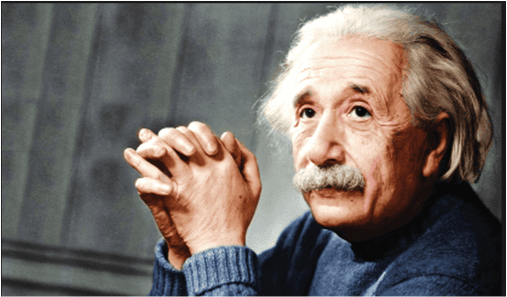
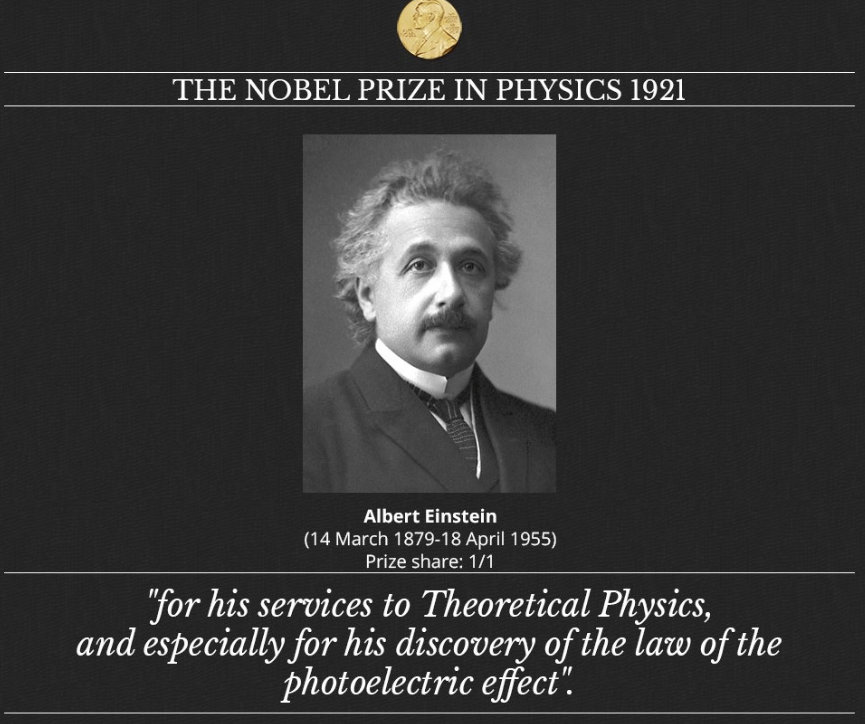
Albert Einstein was born in Ulm, Germany, in 1879.
He was a late talker and often solitary as a child.
Albert Einstein
2. Academic and Personal Achievements
Excelled in mathematics and physics, studying in Switzerland.
Married Mileva Maric, with whom he had two sons, but later divorced.
3. Groundbreaking Theories
Published the Special Theory of Relativity in 1905.
Developed the General Theory of Relativityin 1915, redefining gravity.
4. Migration and Global Impact
Emigrated to the U.S. in 1933 due to the rise of the Nazis in Germany.
Urged U.S. President about the potential devastation of the atomic bomb.
5. Advocacy for Peace
Advocated for world government and peace efforts.
Died in 1955, celebrated for his contributions to science and global citizenship.
Detailed Summary
Early Life and Childhood: Albert Einstein was born on 14th March 1879, in the German city of Ulm. Despite becoming one of the greatest minds in history, his early life did not hint at his future brilliance.
His mother thought he was unusual due to his large head, and he did not begin speaking until the age of two-and-a-half. Even then, he would repeat everything he said, earning him the nickname “Brother Boring” from his peers due to his preference for solitude and lack of interest in playing with other children.
There is even a story, likely more legend than fact, shared by historian Otto Neugebauer. According to the tale, after a long silence at the dinner table, young Einstein finally spoke, declaring, “The soup is too hot.” When asked why he hadn’t spoken before, he replied, “Because up to now everything was in order.”
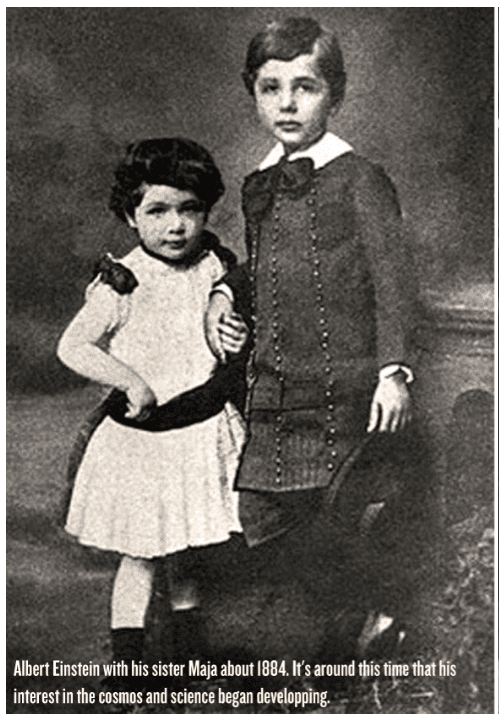
Albert Einstein with his sister
Education and Personal Relationships: Einstein showed early signs of brilliance, particularly in mechanical toys, once wondering why his newborn sister didn’t have wheels.
Though a headmaster predicted he would fail in life, Einstein excelled in most school subjects, especially in Munich, before leaving school at the age of 15 due to his disdain for the rigid rules.
In Switzerland, Einstein pursued higher education in mathematics and physics at the University of Zurich. Here, he met Mileva Maric, a fellow student who shared his love for science. They married and had two sons, although their marriage eventually ended in divorce.
Theories and Scientific Contributions: Despite difficulties in finding a job after university, Einstein began working at a patent office in Bern. Even while fulfilling his official duties, he secretly worked on his scientific ideas, referring to his desk drawer as the “bureau of theoretical physics.”
In 1905, Einstein published his Special Theory of Relativity, which introduced his famous equation, E=mc², revolutionizing the understanding of mass and energy. His personal life faced challenges, including a strained marriage with Mileva, but his professional life continued to flourish.
In 1915, Einstein presented the General Theory of Relativity, a groundbreaking work that redefined gravity. His theory was later confirmed during a solar eclipse in 1919, cementing his reputation as one of the most significant scientific minds of the 20th century.
Migration and Global Citizenship Einstein’s fame grew, and he received the Nobel Prize in Physics in 1921. However, with the rise of the Nazis in Germany, he emigrated to the United States in 1933. There, he witnessed the development of the atomic bomb during World War II. Deeply concerned about the destructive potential of this weapon, Einstein urged U.S. President Franklin D. Roosevelt to consider its implications. Advocacy for Peace and Legacy The devastation caused by the atomic bomb led Einstein to advocate for global peace, calling for the establishment of a world government to prevent further conflict. He spent his later years working for peace and democracy. Einstein passed away in 1955, leaving behind not just a scientific legacy but also a profound impact on the global peace movement.
Themes and Messages of the Chapter
Themes:
The pursuit of knowledge and scientific discovery.
The impact of personal relationships on life choices.
The responsibility of scientists in societal and political matters.
The quest for peace and global cooperation.
Messages:
Intelligence and brilliance do not shield one from personal struggles.
Individual actions can have profound consequences on a global scale.
Continuous learning and adaptation are essential for progress.
Glossary & Difficult Words
Freak: A person who is unusual and doesn’t behave, look, or think like others.
Amateur: Doing something for personal enjoyment rather than as a profession.
Regimentation: Order or discipline taken to an extreme.
Stifled: Unable to breathe; suffocated.
Liberal: Willing to understand and respect others’ opinions.
Philistines: People who do not like art, literature, or music.
Patent: A document granting rights of an invention to the inventor.
Absolute: Measured in itself, not in relation to anything else.
Deflected: Changed direction due to hitting something.
In an Uproar: Very upset.
Faltered: Became weak.
Unraveling: Starting to fail or weaken.
Missive: A letter, especially long and official.
Visionary: A person who can think about the future in an original way.
Advocated: Publicly supported or recommended.
Global Citizenship: A sense of belonging to a community beyond national boundaries.
Profound: Very great or intense.
Consequences: Results or effects of a particular action or situation.
Adaptation: Changing to suit a new situation or environment.
The poem ‘Rain on the Roof’ talks about the poet’s varied reactions to the sound of raindrops falling on the roof of his house. He says that the raindrops at night are like tears shed by the sad, dark night.
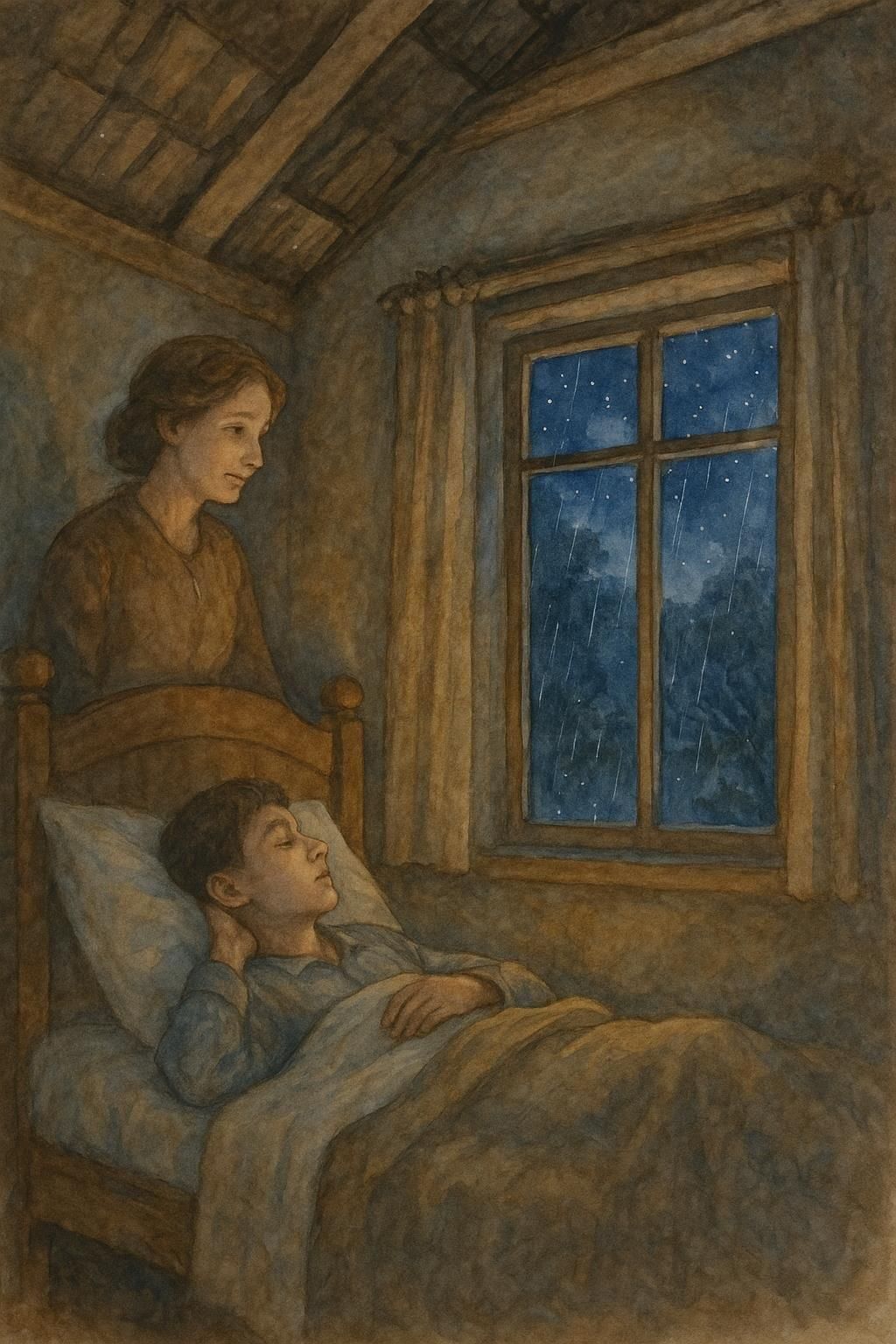
He loves to lie in bed and hear the rain falling on the roof of his room because it brings back sweet memories of the past. He says that the sound of raindrops helps him fall asleep and gives him sweet dreams. He has memories of his loving mother who would put them to sleep.
Detailed summary
In this poem, the poet describes the arrival of rain by depicting the movement of dark, moisture-laden clouds in the sky. The poet interprets these clouds as “humid shadows” and emphasizes their impending release of rain. The night sky, adorned with stars, serves as the backdrop for this atmospheric transformation.
When the humid shadows hover Over all the starry spheres And the melancholy darkness Gently weeps in rainy tears, What a bliss to press the pillow Of a cottage-chamber bed And lie listening to the patter Of the soft rain overhead!
The poet metaphorically likens raindrops to tears, suggesting a profound connection between the weather and the poet’s emotional perception. The notion of the dark sky weeping is reinforced, portraying a melancholic scene. Finding solace in this natural phenomenon, the poet views lying in bed during the rain as a comforting blessing, relishing the soothing sound of raindrops on the roof.
Try yourself:
What does the poet compare raindrops at night to?
A.Footsteps on the ground
B.Whispers of the wind
C.Songs of joy
D.Tears of a sad night
View Solution
Every tinkle on the shingles Has an echo in the heart; And a thousand dreamy fancies Into busy being start, And a thousand recollections Weave their air-threads into woof, As I listen to the patter Of the rain upon the roof.
Transitioning to the next part, the poet expresses the emotional resonance he experiences when raindrops fall on his house’s roof. Each sound, or “tinkle on the shingles,” reverberates in his heart and becomes a part of his dreams. The poet’s imagination is sparked by the rhythmic fall of raindrops, generating various fantastical images and evoking memories of the past.
Now in memory comes my mother, As she used in years agone, To regard the darling dreamers Ere she left them till the dawn: O! I feel her fond look on me As I list to this refrain Which is played upon the shingles By the patter of the rain.
In the final paragraph, the poet introduces the theme of maternal nostalgia. Rain serves as a trigger for memories of his mother, who is no longer alive. Recollecting her love and care, the poet envisions his mother looking at him as he listens to the rain’s song. The sound of raindrops becomes a poignant link between past and present, stirring deep emotions and leaving the poet profoundly moved. Each instance of rainfall rekindles memories of his mother, creating a bittersweet connection between the soothing sound of rain and the cherished moments of the past.
In conclusion, this evocative poem celebrates the joy of listening to raindrops on the roof. With vivid imagery and tender recollections, the poet weaves a timeless narrative that captures the blissful essence of a rainy night. The patter of rain becomes a poetic melody, echoing in the heart and summoning cherished memories, particularly that of the poet’s mother. In its simplicity, the poem beautifully highlights the profound connection between nature, emotion, and enduring comfort.
Theme/Message of the Poem
Themes:
Nostalgia: The poem explores the theme of nostalgia through the speaker’s memories of their mother and past experiences.
Comfort in Nature: Finding solace and comfort in the natural world, specifically in the sound of rain, is a prominent theme.
Message:
The poem conveys the idea that simple, everyday experiences like listening to the rain can evoke deep emotions and memories.
It emphasizes the importance of finding solace and peace in the midst of life’s uncertainties through connecting with nature and memories.
Useful Expressions
… starry spheres – An area in the sky where stars appear in a group.
What bliss — A pleasing movement that the poet is unable to forget.
… a thousand dreamy fancies’ Into busy starting, — The poet remembers his past and finds himself lost in imagination.
… a thousand recollections ‘Weave their air-threads into woof, —A chain of memories that visit the poet’s mind during the rainy season.
… darling dreamers — Refers to children who love and remember their mother equally like the poet.
Try yourself:
What are useful expressions?
A.Words that are hard to understand
B.Common phrases for communication
C.Sentences without meaning
D.Expressions only for writing
View SolutionGlossary
Hover: To stay suspended in the air at a single point, without moving in any particular direction.
Melancholy: A profound feeling of sadness or sorrow, often without a clear cause.
Bliss: A state of pure joy and overwhelming happiness.
Patter: A light, rapid sound made by repeated tapping or striking, like raindrops hitting a surface.
Shingles: Thin, overlapping pieces of material, typically wood or asphalt, used to cover and protect rooftops.
Woof: The horizontal threads woven across a fabric, interlacing with vertical threads to form the structure of the textile.
Refrain: A line or group of lines regularly repeated in a poem, song, or musical piece, often contributing to its rhythm or theme.
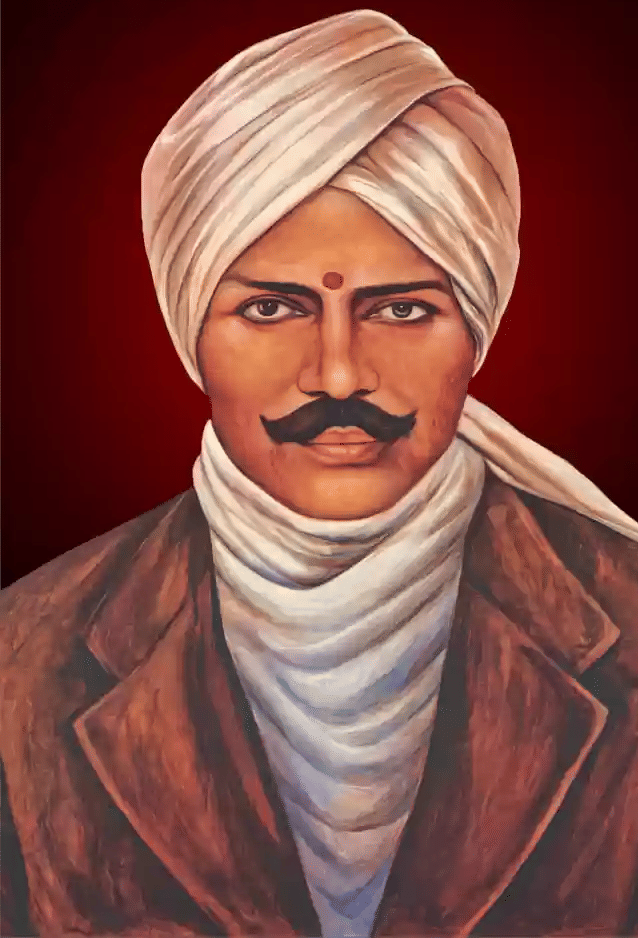
Subramania Bharati is considered a prominent writer and poet in the Tamil literary world. He was also a journalist and an Independence activist. He was regarded as the Father of the modern Tamil style of writing. .
Subramania Bharati
Key Points of the Poem
As the name suggests, this poem is about wind. However, the wind is a natural phenomenon.
In the poem, the poet describes the power of the wind and calls the wind destructive.
Further, he links the destructive power of the wind with the difficulties of life.
He says that weak people break down easily, but stronger people emerge stronger.
Detailed Summary
Wind, come softly. Don’t break the shutters of the windows. Don’t scatter the papers. Don’t throw down the books on the shelf.
In the first stanza, the poet requests the wind to blow gently and not destroy anything with its force. He asks the wind not to break the shutters of the windows and scatter the papers here and there. He also requests the wind not to throw the books on the shelf. At that point, he says to the wind, check out the destruction that you bring about. You have tossed everybody down and disarranged everything. Inferable from your power, the pages of the books have been destroyed. You have brought the heavy rain. Furthermore, the poet says that the wind is very good at making fun of weak people.
There, look what you did — you threw them all down. You tore the pages of the books. You brought rain again.
In these lines of the second stanza, the wind does not pay any attention to the poet’s request of not blowing strongly. The poet says that the wind threw everything down from the shelf and it also tore the pages from the books. The poet gets angry and blames the wind to bring rain along with it. By this, the writer implies that when a solid wind blows, all delicate, powerless, and weak things break without any problem. At first, when the writer presented the wind, he contrasted its power with that of a little youngster; that is the reason he requested that the wind come delicately. In any case, later, the wind becomes dangerous, like an adolescent is ready to go, and there is viciousness and destruction.
You’re very clever at poking fun at weaklings. Frail crumbling houses, crumbling doors, crumbling rafters. crumbling wood, crumbling bodies, crumbling lives, crumbling hearts — the wind god winnows and crushes them all.
Here, the poet says that the wind is entirely strong, to the point that it breaks all that comes in his manner. He says that the powerless houses are falling, the entryways are separating, the bar that supports the top of the structure is falling, and every one of the things made of wood is falling. In this stanza, the poet is sad as well as has a critical tone. The poet calls the wind clever as it makes fun of all weak things. The strong wind in these lines represents all the hardships and struggles that an individual faces in life. The poet says that the wind destroys all weak things such as houses, doors, rafters, and wood. It even destroys people, their lives, and hearts with its mighty power. The wind God continues to destroy or separate weaklings until they become strong enough to face the challenges.
Try yourself:What does the poet compare the wind’s destructive power to in the poem?
A.A gentle breeze
B.A playful child
C.A powerful storm
D.A protective shield
View Solution
He won’t do what you tell him. So, come, let’s build strong homes, Let’s joint the doors firmly. Practise to firm the body. Make the heart steadfast. Do this, and the wind will be friends with us.
In the fourth stanza, the poet addresses the readers and asks them to make themselves strong because the wind will not listen to anybody’s request. The poet asks everyone to build strong houses and lock the doors tightly so that the wind cannot intrude on the house and destroy everything. This is a metaphor by which the poet is encouraging his readers to become bold and strong to face all the troubles in life. The poet asks the readers to practice hard to get a firm mind as well as a strong body so that they can face the wind and any challenge in life. If they can do this, then the wind will become their friend and will not harm them. The poet is tending to the wind as God. He has contrasted individuals and wheat and says that as we winnow the wheat to isolate the grain from the waste, comparatively, the Wind God isolates the resilient individuals from the powerless individuals. Because of the weighty and solid wind, every one of the powerless things falls and gets annihilated.
The wind blows out weak fires. He makes strong fires roar and flourish. His friendship is good. We praise him every day.
In the last stanza of the poem, the poet describes the wind as both a creator and a destroyer. As a destroyer, it blows out the weak fire and as a creator, it encourages and nurtures strong fire. In other words, wind can destroy all things that are weak and feeble and at the same time, it can also flourish a thing that is strong and determined. If we are strong, then wind becomes our friend. That means strong people will stop fearing wind and not allow harming them. We then praise the wind of God every day for building our strength. Through this poem, the poet says that we should be mentally and physically prepared to accept all challenges. The poet says that the wind won’t pay attention to us and do what we say. Thus, rather than training the wind, we ought to set ourselves up. We should fabricate solid homes and close the entryway firmly so that wind doesn’t enter the home. We should make our bodies solid and our hearts firm with the goal of confronting these troubles and conquering every one of the difficulties. He says that by doing this large number of things, the wind will become companions with us. Here, the poet implies that issues would come in our lives; we should make ourselves sufficiently to conquer them. Each obstacle in our life makes us more grounded and assists us with investigating our inward strength.
Try yourself:
Which of the following best describes the poet’s advice in the poem?
A.To make the wind our friend, we should build strong homes, firm our bodies, and make our hearts steadfast.
B.To control the wind, we should ask it to be gentle and not harm us.
C.To be safe from the wind, we should ask for help from others.
D.To avoid the wind, we should hide inside our homes.
View Solution
Title Justification
The title of the poem, “Wind,” is justified because the entire poem revolves around the characteristics and actions of the wind. The wind is portrayed as a powerful force that can be both destructive and nurturing, depending on the circumstances. The poet addresses the wind directly, personifying it as a force that can impact human lives and the environment.
Theme/Message
The poem gives us a very important message that we should not feel bad that we are facing so many challenges and hardships in life. Instead, we should make ourselves mentally and physically strong to face challenges. The poem gives a very important lesson that we should be mentally tough and physically strong in order to survive the hardships of life. However, a weak person crumbles and breakdown like an old building. So it is necessary that we should make these destructive forces our friends with our determination and strength.
Literary Devices
Anaphora – When a word is repeated at the start of two or more consecutive lines, it is the device of Anaphora. Lines 2, 3, 4 begin with ‘don’t’. Lines 6, 7, 8 begin with ‘you’.
Personification – wind has been personified. When the poet says ‘you are’, he is referring to wind as ‘you’ that means he is treating wind as a person.
Repetition – ‘crumbling’ is repeated many times to lay emphasis. The poet wants to say that the wind crushes everything that is weak. That is why he repeats the word crumbling.
Alliteration – the repetition of a consonant sound in close connection. ‘wind winnows’. ‘won’t want’
Symbolism – Symbolism means that the thing refers to some other thing. the wind is a symbol. It refers to the challenges in life. He is using wind as a symbol for the adversities in our life.
Difficult Words
poking fun: making fun of something
weaklings: a person who is weak
crumbling: falling or to cause something to break
rafter: sloping beam which supports the roof of the building
winnows: to broke grain-free of chaff, separate grain from husk by blowing on it
A young girl named Evelyn Glennie, despite being completely deaf, gains admission to the prestigious Royal Academy of Music in London.
Evelyn’s hearing gradually deteriorates due to nerve damage, and by the age of eleven, she requires hearing aids to compensate for her deafness.
Refusing to let her condition dictate her future, Evelyn learns to feel music through vibrations in her body, excelling in percussion.
She achieves tremendous success in music, touring internationally, winning numerous awards, and becoming a world-renowned multipercussionist.
Despite her deafness, Evelyn’s musical performances leave audiences astounded, showcasing her unique connection to the art.
Detailed Summary
The Beginning of Evelyn’s Journey: Amid the bustling rush-hour crowds on a London underground train platform, a small, thin girl stood, awaiting her train. She looked younger than her seventeen years, her face a mixture of nervous anticipation. This was no ordinary day for Evelyn Glennie—it was her first at the prestigious Royal Academy of Music in London. But unlike most aspiring musicians, Evelyn faced a challenge that made her journey all the more daunting—she was profoundly deaf.
Early Struggles with Hearing Loss: Evelyn’s journey toward musical greatness was shaped by her early struggles with hearing loss. Her mother, Isabel Glennie, first noticed something was wrong when, at the age of eight, Evelyn failed to respond to a call while waiting to play the piano. Over time, it became clear that Evelyn’s hearing was steadily deteriorating due to nerve damage. By the age of eleven, her hearing had declined significantly, affecting her schoolwork and social interactions. Eventually, she had to confront the reality of her condition and begin using hearing aids.
Evelyn Glennie
Discovering a New Way to “Hear” Music: However, Evelyn refused to allow her deafness to define her future. After observing a girl playing a xylophone, Evelyn felt a deep connection to the instrument and became determined to pursue music, despite her teachers’ doubt. It was percussionist Ron Forbes who recognized her potential and devised an innovative method to help her “hear” music through vibrations. Instead of listening to sound, Evelyn learned to feel it through different parts of her body—her feet, legs, and even her fingertips.
A Rising Star in the Music World: Her extraordinary ability to sense music allowed her to excel, and her talent shone brightly. Evelyn transitioned from orchestral performances to solo work and gained recognition for her distinctive style. When she auditioned for the Royal Academy of Music, she earned top scores, event ally winning numerous prestigious awards by the end of her studies. Her accomplishments were remarkable, not only because of her deafness but also because of her dedication and resilience in mastering more than a thousand percussion instruments.
Performing Without Sound: What’s most fascinating about Evelyn is her ability to live and perform without sound. She communicates effortlessly and with great confidence, explaining that music is something she feels deeply, with the vibrations of each instrument resonating throughout her body. In 1991, Evelyn was awarded the Royal Philharmonic Society’s Soloist of the Year, a recognition of her incredible contributions to music. The famous percussionist James Blades once remarked on Evelyn’s ability to convey emotions through music in ways others could only dream of, describing her connection to sound as deeply profound.
Dedication to Her Craft and Passion for Education: Evelyn’s work ethic is unmatched; she describes herself as a workaholic, devoting countless hours to honing her craft. She performs not only at major venues around the world but also offers free concerts in unusual settings like prisons and hospitals. Her educational work with young musicians is another testament to her passion for music and her desire to inspire the next generation.
A Legacy of Inspiration: Her story is an inspirational reminder that disabilities are not limitations. Through sheer determination and an unyielding spirit, Evelyn has redefined what it means to experience music, transforming the world of percussion and proving that with passion and perseverance, anything is possible.
Try yourself:
What technique did Evelyn Glennie use to “hear” music despite being profoundly deaf?
A.Listening through hearing aids
B.Feeling vibrations in her body
C.Reading music notes visually
D.Memorizing musical compositions
View Solution
Theme/ Message of Part 1
Themes:
Overcoming adversity is a central theme, as Evelyn’s story demonstrates the triumph of the human spirit over physical challenges.
Determination and perseverance are key, showcasing Evelyn’s refusal to let her deafness deter her from pursuing her passion for music.
Message:
The narrative emphasizes that resilience, hard work, and dedication can help one overcome obstacles and achieve their dreams, no matter the circumstances.
Difficult Words1. Daunting: causing fear or intimidation.
2. Aspiring: having ambitions to achieve something.
3. Impaired: weakened or damaged.
4. Conceal: to hide or keep secret.
5. Orchestral: relating to an orchestra or orchestral music.
6. Solo Performances: musical performances by a single artist.
7. Workaholic: a person who compulsively works excessively hard.
8. Handicapped: having a physical or mental disability.
9. Resonances: choes or vibrations of sounds.
10. Effortlessly: with ease and without effort.
11. Tingles: causes a slight pricking or stinging sensation.
12. Flawlessly: without any fault or mistake.
13. Lilt: a particular way of speaking.
14. Prestigious: inspiring respect and admiration.
15. Triumph: a great victory or achievement.
Try yourself:
What does the word “triumph” mean in the context of the passage?
A.A great defeat or failure.
B.A significant challenge or obstacle.
C.A great victory or achievement.
D.A difficult situation or predicament.
View Solution
Part 2 Summary: Bismillah Khan
Bismillah Khan
Key Points of the Story
The musical instrument pungi was banned by Emperor Aurangzeb, but a barber from a family of musicians invented the shehnai, a more melodious and pleasant instrument.
The shehnai gained recognition for its auspicious sound, becoming integral to North Indian wedding and temple ceremonies.
Ustad Bismillah Khan emerged as a master of the shehnai, achieving global recognition and receiving numerous prestigious awards.
Bismillah Khan’s music transcended borders, earning him international acclaim and helping him shape the landscape of Indian classical music.
Despite his global fame, Bismillah Khan remained deeply attached to his hometowns, Benaras and Dumraon, and his musical legacy continues to embody India’s rich cultural traditions.
Detailed Summary
Once upon a time in a land where music was both forbidden and revered, a young barber dared to challenge tradition. In the royal residence of Emperor Aurangzeb, the playing of a musical instrument known as the pungi was strictly prohibited due to its unpleasant, shrill sound. The pungi, a reeded noisemaker, seemed destined to fade into obscurity.
Shehnai
However, a twist of fate intervened when a barber from a family of musicians, granted access to the royal palace, decided to reinvent the pungi. He crafted a new instrument, with a longer, broader hollow stem and seven holes for producing soft, melodious sounds. This innovation caught the attention of royalty, leading to the birth of a new instrument – the shehnai.
The shehnai’s enchanting sound soon became associated with auspicious occasions, particularly in temples and North Indian weddings. Originally part of the traditional ensemble at royal courts, the shehnai’s transition to the classical stage was credited to the legendary Ustad Bismillah Khan.
Bismillah Khan, hailing from a prestigious lineage of musicians in Bihar, showed early talent in music. From a young age, he immersed himself in the world of shehnai, learning from his uncle and honing his skills by the banks of the Ganga. His dedication and passion for music blossomed, leading him to captivate audiences both in India and abroad.
At the Allahabad Music Conference, a pivotal moment arrived when the renowned Ustad Faiyaz Khan recognized Bismillah’s potential, offering words of encouragement that spurred him on his musical journey. Bismillah Khan’s performance at the Red Fort on India’s Independence Day marked a historic moment, symbolizing the nation’s newfound freedom through the soulful notes of his shehnai.
Internationally acclaimed, Bismillah Khan’s music transcended borders, earning him praises and admiration worldwide. His humility and dedication to his art were exemplified through his refusal to be swayed by the glitz and glamour of the film industry, despite his success in composing music for a few notable films.
With a string of prestigious awards such as the Padmashri, Padma Bhushan, and Padma Vibhushan, Bismillah Khan’s crowning achievement came in 2001 when he was bestowed with India’s highest civilian honor, the Bharat Ratna. His impassioned plea to preserve and propagate India’s rich musical heritage resonated deeply, emphasizing the universal language of music.
Despite his global acclaim and travels, Bismillah Khan’s heart remained rooted in his beloved towns of Benaras and Dumraon. His unwavering connection to his cultural roots and his ability to bridge religious and musical divides embodied the essence of India’s diverse and inclusive heritage.
Ustad Bismillah Khan’s life story serves as a testament to the timeless appeal of India’s cultural legacy, where music transcends boundaries of faith and tradition. His legacy lives on, a reminder of the power of music to unite hearts and souls, creating harmony amidst diversity.
In a emotional moment of national mourning, Ustad Bismillah Khan bid farewell to the world, leaving behind a musical legacy that continues to inspire and enchant generations to come.
Try yourself:
What is the significance of the shehnai in North Indian culture?
A.It is used in temple ceremonies.
B.It is played at royal courts.
C.It is associated with inauspicious occasions.
D.It is primarily used in South Indian weddings.
View Solution
Theme/Message
Themes:
The fusion of tradition and innovation in music.
The power of music to transcend boundaries and touch hearts globally.
The significance of cultural roots and personal connections in an artist’s life.
Message:
Music has the ability to bridge cultural divides and create lasting connections.
Dedication, passion, and hard work can lead to unparalleled success and recognition.
One’s roots and heritage should always be cherished and celebrated, no matter the heights of achievement.
Difficult Words
auspicious: promising to bring good fortune
indispensable: without which a piece of work cannot be done
ensembles: things considered as a group
melodious: pleasant-sounding
maestro: a distinguished musician, especially a conductor
coveted: greatly desired or envied
celluloid: relating to the film industry
replicating: to copy or reproduce
devout: deeply religious
prolonged: extended in time
acclaimed: highly praised or recognized
transcend: to go beyond the limits of
affection: a gentle feeling of fondness or liking
heritage: practices that are handed down from the past by tradition
Reeded: With thin sticks (for sound) Try yourself:Which term describes a musician who is highly praised and recognized for their work?
Poem “The Road Not Taken” by Robert Frost signifies a situation where the poet was walking down a road that had a diversion. He had to choose between the two paths. Here is a brief summary of the poem.
About the Poet
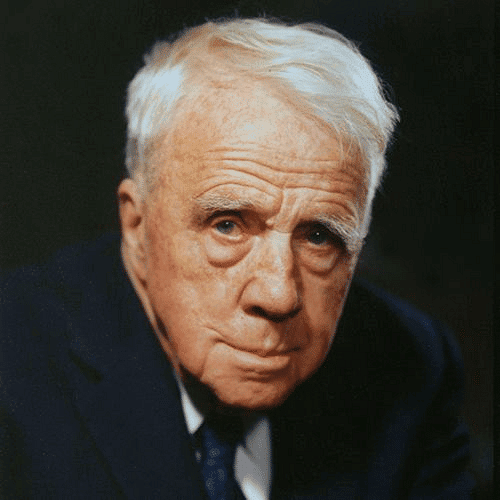
Robert Frost, who was born in 1874 in San Francisco, experienced early tragedy with his father’s death. He studied at Dartmouth and Harvard but left without completing his degree. Frost married Elinor White and they had six children, which is an important part of his personal story. He became well-known for his poetry while living in England, where he was celebrated for his observations of rural life. Despite facing many personal challenges, including the loss of children, Frost continued to write and became a notable American poet, famous for works like “The Road Not Taken” and “Stopping by Woods on a Snowy Evening.” His legacy, marked by simple yet deep themes of nature and choice, continues to inspire readers around the globe.
Robert Frost
Key Points of the Poem
In “The Road Not Taken,” the poet reflects on life’s choices through a symbolic journey in the woods, particularly at a fork in the road. He faces a dilemma about which path to choose.
Although he wishes to explore both paths, he understands he must select just one. He contemplates his choice and ultimately picks the less travelled route, noting its grassy and less worn look. Though as for that the passing there / Had worn them really about the same.
He recognises that both paths have likely been taken by others. Yet knowing how way leads on to way, I doubted if I should ever come back. He opts for the less common path, thinking it will affect his life’s journey.
Looking back on his decision, he imagines sharing his choice with others in the future and how it shaped his life’s direction. I shall be telling this with a sigh / Somewhere ages and ages hence; Through this story, the poet examines the theme of personal choices and their influence on fate. And that has made all the difference.
Detailed Summary
Two roads diverged in a yellow wood, And sorry I could not travel both And be one traveler, long I stood And looked down one as far as I could To where it bent in the undergrowth;
The speaker walks through a forest with yellow leaves in autumn and reaches a fork in the road. Regretting that he cannot travel both paths (as he is only one person), he stands at the fork for a long time, trying to see where one path leads. However, he cannot see far because the forest is thick and the path is not straight.
Then took the other, as just as fair, And having perhaps the better claim, Because it was grassy and wanted wear; Though as for that the passing there Had worn them really about the same,
The speaker takes the other path, judging it to be just as good a choice as the first, and supposing that it may even be the better option of the two, since it is grassy and looks less worn than the other path. Though, now that the speaker has actually walked on the second road, he thinks that in reality the two roads must have been more or less equally worn-in.
Try yourself:
Which road did the speaker ultimately choose in the poem “The Road Not Taken”?
A.The road that was straight and well-traveled.
B.The road that was less worn and grassy.
C.The road that was curvy and surrounded by undergrowth.
D.The road that was bustling with other travelers.
View Solution
And both that morning equally lay In leaves no step had trodden black. Oh, I kept the first for another day! Yet knowing how way leads on to way, I doubted if I should ever come back.
Reinforcing this statement, the speaker recalls that both roads were covered in leaves, which had not yet been turned black by foot traffic. The speaker exclaims that he is in fact just saving the first road, and will travel it at a later date, but then immediately contradicts him or herself with the acknowledgement that, in life, one road tends to lead onward to another, so it’s therefore unlikely that he will ever actually get a chance to return to that first road.
I shall be telling this with a sigh Somewhere ages and ages hence: Two roads diverged in a wood, and I— I took the one less traveled by, And that has made all the difference.
The speaker imagines him or herself in the distant future, recounting, with a sigh, the story of making the choice of which road to take. Speaking as though looking back on his or her life from the future, the speaker states that he was faced with a choice between two roads and chose to take the road that was less traveled, and the consequences of that decision have made all the difference in his or her life.
Try yourself:What central message does the poem “The Road Not Taken” by Robert Frost convey?
A.Life is about taking the easy path
B.Choices made in life have significant consequences
C.There is always a right and wrong path
D.It is better not to make any decisions
View Solution
Title Justification
The title “The Road Not Taken” is fitting for Robert Frost’s poem for a few reasons.
Firstly, the title reflects the main metaphor of the poem, which explores the importance of choices in life. The phrase “The Road Not Taken” signifies the decision the poet faces between two paths, emphasising the theme of making choices and their impact on one’s life.
Additionally, the title suggests a sense of reflection and thought, aligning with the poem’s introspective nature. The speaker reminisces about the critical moment of making a decision and considers the importance of the chosen path, as well as the regret of the path not taken. The phrase “The Road Not Taken” invokes thoughts about the options left unchosen, which is a central idea in the poem. A key line that captures this idea is: “I took the one less travelled by, And that has made all the difference.”
In summary, the title “The Road Not Taken” effectively encapsulates the key themes of decision-making and the importance of the chosen path in shaping one’s life.
Theme/Message
Theme
The theme of Robert Frost’s poem “The Road Not Taken” focuses on the importance of choices in life, the challenges of making decisions, and the uncertainty that comes with them.
It examines the struggles of decision-making and how our choices affect our future.
Message
The poem’s message highlights the need for careful decision-making and the understanding that our choices carry significant consequences.
It warns readers that once a decision is made, it is hard to go back and start over.
Moreover, it conveys that the speaker realises the difficulty of returning to make another choice, as shown in the line, “Yet knowing how way leads on to way, I doubted if I should ever come back.”
Key imagery, such as “Two roads diverged in a yellow wood” and “In leaves no step had trodden black,” is vital for grasping the themes of choice and consequence.
In the end, the poem concludes with the line, “I took the one less travelled by, and that has made all the difference,” underscoring the lasting effects of our choices on life.
Try yourself:What is the central theme of Robert Frost’s poem “The Road Not Taken”?
A.The beauty of nature
B.The significance of choices and their impact
C.The fragility of life
D.The importance of friendship
View Solution
Literary Devices
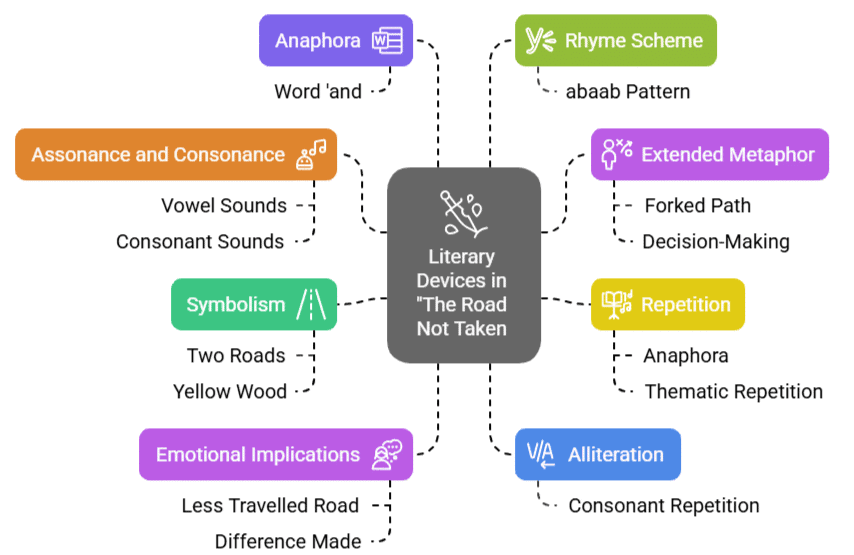
Assonance and Consonance –Repetition of vowel sounds (assonance) and consonant sounds (consonance) in nearby words. For example, in “The Road Not Taken,” Frost uses both to create a balanced and rhythmic effect.
Extended Metaphor –An extended metaphor is developed over several lines and serves as a central theme. In “The Road Not Taken,” Frost’s metaphor of a forked path represents decision-making. This allows readers to connect with the speaker’s dilemma and reflect on their own choices.
Repetition –Frost uses anaphora (the repetition of a word or phrase at the start of successive clauses) and thematic repetition. Examples include phrases like “way leads on to way” and the repeated opening line, which emphasise the poem’s rhythm and themes.
Alliteration –Alliteration involves the repetition of consonant sounds at the beginning of words, which can be observed in various phrases throughout the poem.
Anaphora –The word ‘and’ is repeated at the beginning of lines 2, 3, and 4.
Rhyme Scheme –abaab
Symbolism –The two roads represent choices in life. The line “Two roads diverged in a yellow wood” establishes the poem’s context.
Emotional Implications –The line “I took the one less travelled by, And that has made all the difference” captures the essence of the speaker’s reflection on choices.
Difficult Words
Diverged = branched off, took different directions
Wood = forest, dense group of trees
Travel = to journey, move from one place to another
Traveller = one who journeys, an explorer
Undergrowth = Where clarity ends and uncertainty begins, the hidden segment of a choice or path
Fair = unbiased, equitable, just
Claim = assertion, a declaration of truth or belief
Grassy = covered with grass, verdant
Wanted wear = had not been crushed or worn out under human feet, has not been used and worn so frequently
Trod = walked upon, stepped on
Equally= Similarly, in the same manner, or measure
Lay = was situated or placed
Sigh = deep breath of sorrow, regret
Kept = reserved, saved for later
Telling = narrating, recounting
Difference = distinction, variation in outcome or results
Bent = curved, turned
Doubted = questioned, was uncertain about Try yourself:Which literary device is used when a vowel sound is repeated in nearby words in a poem?