9. From the Diary of Anne Frank – Long Answer Questions

Q1. “Paper has more patience than people.” Elucidate.

Ans: Anne Frank often felt lonely despite having a loving family and friends. While she could discuss everyday topics with them, she struggled to share her deeper feelings. She longed for a patient listener who could understand her emotions but found that people lacked the patience to truly listen. This made her feel as though she had no one to confide in. To express her thoughts and ease her emotional burden, Anne decided to keep a diary. Unlike people, a diary provides the opportunity to express thoughts freely without judgment, offers a sense of companionship that never tires or rejected, and creates a safe space to share personal feelings without fear. This is why Anne Frank famously stated that paper has more patience than people.

Q2. Give a brief sketch of Anne’s life.

Ans: Anne Frank was a young Jewish girl who faced immense challenges during World War II. She lived with her parents in Germany until the rise of Hitler’s Nazi party, which targeted Jews. In 1933, the Frank family fled to the Netherlands to escape persecution. However, in 1940, Germany invaded the Netherlands, leading to increased arrests of Jews.

In July 1942, the Frank family went into hiding, living secretly in the upper floors of her father’s office for 25 months. They were supported by non-Jewish friends who provided food. Anne had begun writing in her diary before they went into hiding. Unfortunately, in August 1944, they were discovered, arrested, and sent to concentration camps.

Tragically, Anne, her sister Margot, and her mother died in a camp, while her father survived. After the war, he published Anne’s diary, which details the struggles faced by her family and other Jews. The diary offers a poignant glimpse into Anne’s life as a schoolgirl before they went into hiding.

Q3. Why did Anne Frank maintain a diary?

Ans: Anne Frank chose to keep a diary because she felt she had no true friends. She believed that paper had more patience than people, allowing her to express her thoughts and feelings freely. Although she had caring parents and a sister, she struggled to discuss anything beyond everyday topics.

Key reasons for her decision included her lack of a confidant, as her conversations with friends were limited to ordinary matters. She felt that her situation was unlikely to change and wanted to create a special bond with her diary, which she named ‘Kitty’. Through her writing, Anne aimed to share her innermost thoughts and feelings, something she found difficult to do with those around her.

Q4. What does Anne say about her parents, elder sister, and her stay in the Montessori School?

Ans: Anne describes her father as adorable. He married her mother when he was thirty-six and she was twenty-five. Anne’s elder sister, Margot, was born in Frankfurt in 1926, three years before Anne, who was born on 12 June 1929. Anne lived in Frankfurt until she was four. In 1933, her father emigrated to Holland, and her mother, Edith Hollander Frank, joined him. During this time, Anne and Margot stayed with their grandmother in Aachen. Margot moved to Holland in December, and Anne followed in February.

Anne began attending the Montessori School and remained there until she was six, when she started in the first form. In the sixth form, her teacher was Mrs Kuperus, the headmistress. They shared a strong bond, and both were in tears when Anne left the school.

Q5. Anne had loving parents and a number of friends. Even then she thought that she was alone. Why?

Ans: Anne Frank was a thirteen-year-old girl who, despite having a loving family and many friends, felt alone in the world. Several factors contributed to her sense of isolation. Firstly, she lacked a true friend with whom she could share her innermost thoughts. While she enjoyed spending time with her friends, their conversations often revolved around ordinary matters, leaving her feeling disconnected. Anne found it difficult to express her deeper emotions, which led to a sense of intimacy missing from her relationships.

To cope with her loneliness, Anne chose to make her diary her confidant, naming it ‘Kitty’. She believed that Kitty would understand her better than anyone else, allowing her to share her experiences and feelings in a way she couldn’t with others.

Q6. Why was the whole class shaking in its boots? How does Anne Frank describe the behavior of her classmates?

Ans: The entire class was nervous due to an upcoming meeting where teachers would decide who would be promoted and who would be held back. This anxiety led to half the class making bets on their chances of passing. Anne and her friend G.N. found it amusing to see classmates C.N. and Jacques wager their entire holiday savings. Throughout the day, students engaged in constant speculation, debating who would pass or fail. Anne felt frustrated, observing that many students were not performing well and believed that about a quarter should be held back. The unpredictability of the teachers added to the stress of the situation.

Despite the chaos, Anne was not overly worried about herself or her friends, as she felt confident they would pass, except for her uncertainty regarding maths. All they could do was wait and encourage each other not to lose heart.

Q7. Describe the three essays written by Anne Frank.

Ans: Anne Frank wrote three essays in response to her Maths teacher, Mr Keesing, who was annoyed by her constant talking in class. Here’s a brief overview of each essay:

In the first essay, titled A Chatterbox, Anne used humour to defend her talking habit. She argued that talking is a natural trait among students and suggested it was something she inherited from her mother.

After continuing to talk in class, Mr Keesing assigned her a second essay called An Incorrigible Chatterbox. Anne wrote this essay without any punishment for two lessons, cleverly handling the situation.

For her third essay, Quack, Quack, Quack, Said Mistress Chatterbox, Anne crafted a whimsical story in verse about a mother duck and a father swan who killed their ducklings for quacking too much. Mr Keesing enjoyed this essay so much that he shared it with the class and even with other classes.

Q8. Anne believed that paper has more patience than people. She could confide more in her diary than in people. Why did she feel so? Was she free from bias and stereotypes? Explain in 100-120 words the values we need to imbibe from the diary as a friend.

Ans: Anne was a sensible and intelligent girl who believed that paper has more patience than people. She felt she could confide more in her diary than in others because paper can keep secrets without judgment. Additionally, she lacked a true friend to share her thoughts and feelings with, as people might not be interested in her emotions or available when needed. Unlike people, paper is free from bias and stereotypes, making it a more reliable companion for her. For Anne, her diary was a true friend, offering her the understanding and support she craved.

Q9. Mr Keesing punished Anne by giving her an essay to write. Did he lack empathy and compassion? Was it not in his attitude to respect differences among the students? What values would you like to build in him and why? Write in 100-120 words.

Ans: Mr. Keesing’s frustration with Anne stemmed from her tendency to be talkative. Despite multiple warnings, she continued to chat, prompting him to assign her an essay as punishment. This action reflects a lack of empathy and compassion on his part. A good teacher should recognise that students have different needs and learning styles. There are various methods to engage and teach students effectively. Anne’s essays ultimately changed his perspective, illustrating that communication is a natural trait among students. It is the teacher’s responsibility to adapt their approach to better meet the needs of their students.

Q10. Anne wanted to write convincing arguments to prove the necessity of talking. What does this tell you about her? Did she possess a sense of freedom? Explain the values she possessed to justify herself in 100-120 words.

Ans: Anne Frank’s essay on being a chatterbox highlights her strong belief in the significance of communication. She argued that talking is a natural trait for students, influenced by her mother’s similar behavior. Even after being punished by Mr. Keesing, Anne cleverly defended her talkative nature.

She expressed her thoughts through a poem, using a story about a father swan to illustrate her point. This creative approach changed Mr. Keesing’s attitude, resulting in a more relaxed classroom environment. Anne’s ability to articulate her views demonstrates her intelligence and sensitivity. Her sense of humour also shines through, making her arguments engaging.

Q11. Anne justified her being a chatterbox in her essay. Do you agree that she dares to defy the injustice? What values do you learn from Anne’s character through this? Write in 100-120 words.

Ans: Anne Frank was a bright and sensible 13-year-old girl known for her talkative nature. When her maths teacher, Mr Keesing, punished her for this trait, she responded by writing three essays on being a chatterbox. In her essays, Anne argued that talking is a natural quality of students. She creatively expressed her feelings, even writing her final essay in verse, which depicted ducklings punished by their father for quacking too much. Her clever approach changed Mr Keesing’s attitude, demonstrating her courage to stand up for her beliefs. From Anne’s character, we learn the importance of self-expression, creativity, and the value of standing up for oneself in the face of injustice.

Q12. On the one hand, Anne Frank says that she is not all alone in the world. On the other hand, she says that she seems ‘to have everything, except my one true friend’. Why can’t she confide in and come closer to her friends?

Ans: Anne Frank seems to have a split personality. On the outside, she has about thirty friends, loving parents, and a caring sister. Yet, she feels deeply lonely.

She finds it difficult to discuss anything beyond everyday topics with her friends. This inability to share personal issues creates a lack of trust in her relationships. Anne believes that “paper has more patience than people,” which is why she turns to her diary for comfort. She seeks to express her most profound emotions and thoughts through her writings, referring to her diary as her only true friend, ‘Kitty’.

Anne Frank

Q13. Give a brief character sketch of Mr Keesing highlighting the transformation that comes to him in the end.

Ans: Mr. Keesing was an old-fashioned maths teacher at Anne Frank’s school, known for his strictness and minimal tolerance for talking in class. Initially, he was frustrated with Anne due to her excessive chatter. He issued several warnings and assigned her essays as punishment, including topics like ‘A Chatterbox’ and ‘An Incorrigible Chatterbox’. However, after reading her creative story about ducklings, he began to appreciate the humour in her arguments.

By the end of the story, Mr. Keesing experienced a notable transformation. He became more relaxed, allowing Anne to speak freely in class and ceasing to assign her extra homework. He even started to make jokes, revealing a lighter side to his character. This change illustrates how humour and understanding can bridge the gap between strictness and openness in teaching.


8. Poem – The Ball Poem – Long Answer Questions

Q1: Should the boy be allowed to grieve for his ball? If his loss is irreparable or irretrievable then how should one handle it? What lessons can be learnt?

Ans: Yes, the boy should be allowed to grieve for his ball, as he had that ball for a long time. He had many old memories associated with it since his childhood. Moreover, when a person is trying to overcome his grief on his own, then one should not intrude or disturb him as it may break his chain of thoughts and may irritate him. One should have self-consolation, and self -understanding in order to bear the loss. Self-realization and understanding are more effective and lasting than when it is done by an external agency or a person.


Q2: Why does the poet say, ‘I would not intrude on him?’ Why doesn’t he offer him money to buy another ball?

Ans: When a person is trying to come over his grief on his own, he is busy making himself understand certain things if then, someone intrudes or disturbs, and his chain of thoughts is broken. It makes him irritated. Moreover, self-consolation, realization or understanding is more effective and lasting than when it is done by an external agency or a person. The poet knows it. So, he does not intrude on him.His offer of money to buy another ball is useless for the boy wants the same ball he is attached to and has been playing for a long time. No other ball will be able to take its place.


Q3: How did the boy really react to the loss of the ball or was he fearful of something or someone ? Can our attention be directed toward his family and other people? 

Ans: The boy was not fearful of anyone, in fact, he was really upset about the loss of the ball. The ball was valuable for him. He was shocked, remained fixed, trembled with grief staring at the place where the ball had fallen. His family must not have been affected by the loss as a ball is an easily available and inexpensive item.The loss of the ball teaches a lesson to us. Money is external in the sense that it can give you only outer happiness or pleasure not inner. Money cannot buy the emotions and heavenly virtues. It cannot be linked with old memories. Moreover, self-consolation, realization or understanding is more effective and lasting than done by an external agency or a person.

Q4: How is the lost ball, the metaphor of the lost childhood of the boy? Why doesn’t the poet want to ‘intrude on’ the boy by offering him money to buy another ball? 

Ans: The boy has a ball. Perhaps he has been keeping it for a long time. He must have developed a lot of attachment and love with the ball.Suddenly while he is playing, the ball bounces down the street. And after a few bounces, it falls down into the harbour. It is lost forever. The boy stands there shocked and fixed to the ground. He constantly goes on staring at the spot where his ball fell down into the water. Outwardly, the loss seems to be quite small. The boy seems to be making a fuss over the loss. Many boys have lost such balls and will lose so in future. A new ball can be easily bought in a dime. The metaphor of the lost ball is beautifully linked to the loss of sweet childhood. No amount of money can buy the ball back that has been lost forever. Similarly, no worldly wealth can buy back the lost childhood. The poet doesn’t want to sermonise on this issue. The boy himself has to learn epistemology or the nature of the loss. He has to move ahead in life forgetting all the losses he has suffered in the past.


Q5: What is the epistemology of loss in this world of possessions? How has the child learned to stand up in life?

Ans: Gain and loss are the two sides of the same coin. Getting, spending and losing things form a natural cycle of life. The boy is inconsolable at the loss of his ball. Actually, it is not the ordinary ball but his long association and attachment with it that makes the loss so unbearable. It is like the good sweet days of childhood that the boy cherishes so much but are lost and gone forever. They will never come back again. So, what is the remedy? He can bear this loss by understanding the epistemology or nature of the loss. In this world of material wealth and possessions, it seems that money can buy anything. However, it is a false conception. Money has its own limitations. Its nature is external. It cannot compensate for the losses that a person suffers emotionally or internally. No wealth can buy back the ball that has been lost forever. Similarly, no wealth can buy back the lost childhood. The child will have to move ahead and stand up in life. He has to stop weeping over his past losses and start living life as it should be lived.


Q6: Why is it important for everyone to experience loss and to stand up after it?

Ans: Everyone experiences a loss at some point in one’s life. It might be the loss of a beloved, or a parent or a close relative or even a pet. Humans have a tendency of getting attached to things and the loss of things or people close to heart causes grievance. But one must not let that pull us down. Loss is an essential and significant experience of one’s life. And one must learn to deal with it and move on. If we keep thinking about it or grieve over that loss, we can never come out of it. It will only affect us psychologically and can have severe consequences. Brooding over a loss will never help in bringing things back to normal. Loss is inevitable sometimes. Once a loss occurs, one must grieve, but only for a short while. Thereafter, one must get over it and move on in life.


Q7: Have you ever lost something you liked very much? Write a paragraph describing how you felt then and saying whether—and how—you got over your loss.

Ans: Last year, our beautiful dog Tommy was lost. All the family loved the dog very much, but I was very deeply attached to Tommy. I used to take full care of him and Tommy would accompany me wherever I allowed him to do so. I felt desperate and upset when Tommy was not traced at all the possible places, where we could find him. I did not feel like eating or going for morning walk. Tommy always used to accompany me when I went for my morning walk, Gradually I reconciled with the situation and consoled myself. I totally engrossed myself in my studies though I did not feel like playing. I never stopped missing Tommy. Then, one day, when I went to another colony to meet a friend, I found Tommy tied in someday else’s home. When I approached them, they said that the beautiful dog seemed to have lost his way and so they had been giving care to him. I thanked them and returned home happily with Tommy.

7. Poem – How to Tell Wild Animals – Long Answer Questions

Q1: ‘Appearances are deceptive.’ Cite examples from the poem, ‘How to Tell Wild Animals’, to corroborate this statement.

Ans: The poem “How to Tell Wild Animals” humorously supports the idea that “appearances are deceptive.” Several examples from the poem show how outward appearances of animals can lead to unexpected or dangerous outcomes.For instance, the Asian Lion’s appearance is not what initially gives it away—it’s the sound of its roar that the person will hear while they are likely in great danger. Similarly, encountering a Bengal Tiger with black stripes on a yellow background might seem striking, but the danger lies in being eaten. The Leopard, with its spotted skin, is deceptive in that roaring in pain won’t help when it attacks, as it will continue to “lep and lep” without mercy.The bear, which might offer a seemingly harmless hug, actually poses a deadly threat. Even the hyena and crocodile are deceptive in their appearances—the hyena “smiles” while the crocodile “weeps,” adding to the confusion. Lastly, the chameleon, often mistaken for nothing, blends in so well with its surroundings that it appears invisible on a tree, further showing how appearances can deceive.


Q2: Every animal is unique and has some special characteristics. What tricks does the poet adopt in distinguishing various wild animals?

Ans: No doubt, every animal is unique. Every wild animal has his own special trait, colour, size and characteristics. The Asian Lion is found in the jungles of the eastern regions. It is a huge and mighty creature with brownish hide. His roar is enough to terrorise a person to death. The Bengal Tiger is a ‘noble’ and impressive wild animals. He has yellowish hide and black stripes all over it. The Leopard has dark spots all over his body. He is very agile. The moment he sees its prey, he pounces upon it without showing any mercy.The bear is known by his strong and tight hug. It becomes rather difficult for a novice to distinguish among wild animals. However, hyenas and crocodiles can be easily recognised. Hyenas come smiling merrily while crocodiles appear to be weeping. The chameleon is a small creature like a lizard. He has no ears and doesn’t have even a single wing. You can find him sitting on a tree.


Q3: Carolyn Wells takes liberties with language and employs humour to describe the wild animals. Give some examples of humorous descriptions in the poem.

Ans: The poem “How to Tell Wild Animals” by Carolyn Wells is filled with humorous descriptions of animals, using playful language to explain how to recognize them. The humor in the poem is light and amusing.For instance, the poet humorously suggests that if an animal kills you while roaring, it must be a Bengal Tiger. If an animal with yellow skin and black spots eats you, then it’s a Leopard. If an animal hugs you tightly enough to kill you, it’s a bear.The poet adds more humor by distinguishing a hyena from a crocodile, saying that while the hyena smiles, the crocodile appears to be crying. Finally, she jokes about the chameleon, noting that if you see nothing on a tree, it could be a chameleon, as they blend into their surroundings by changing color. This playful description adds a fun twist to the way animals are recognized.


Q4: The poet has successfully used humour to be able to ‘tell’ or identify ‘Wild Animals’. How do you think we need lots of it in our daily life?

Ans: Humour is the fuel of life. Without it, it would become difficult to continue living. Today, the life of the common man is typically mired in stress, tension, problems and sadness. It is amazing how the smallest problems may take on epic proportions for a common person. In such a situation, it becomes necessary to have a little humour in life. It gives us the much-needed respite from our monotonous routine and helps us face life more positively. Thus, the poetess’ successful use of humour helps living our minds and brings a smile on our faces.

6. Two Stories about Flying – Long Answer Questions

Q1: Describe the methods used by the seagull family to help the young seagull overcome his fear and fly.
Ans: In “His First Flight” by Liam O’Flaherty, the young seagull is afraid to fly. Unlike his siblings, he is too scared to take the leap. His parents understand that he must fly to survive, so they decide to teach him a lesson through patience and strategy. First, they leave him alone on the ledge, hoping that hunger and loneliness will push him to fly. They do not bring him food, even as he becomes desperate. Then, his mother uses a clever trick. She flies close to him with a piece of fish in her beak but stays just out of his reach. Tempted by hunger, the young seagull jumps to get the food and ends up flying. Through this mix of emotional pressure and temptation, the seagull finally overcomes his fear. His first flight teaches him confidence and independence, showing that sometimes, a little push is all it takes to grow.


Q2: What message does the story ‘His First Flight’ convey?
Ans: The story conveys a powerful message about overcoming fear and gaining confidence through self-belief. The young seagull is afraid to fly, even though his wings are perfectly capable. His fear holds him back, just as fear often stops people from taking important steps in life. The story teaches us that sometimes, we need a little push or challenge to realize our true potential. The seagull’s family uses love, patience, and smart tactics to help him take that first flight. Once he takes the leap, he discovers the joy and freedom of flying.

The message is clear: Courage comes from facing your fears, and success often begins the moment you step out of your comfort zone. Just like the seagull, we all must take that “first flight” in life to grow and become independent.


Q3: What happened after the seagull had learnt how to fly
Ans: The seagull came to the brink of the ledge to get the fish from his mother. But his mother remained in the air. a little away from the ledge. The seagull dived at the fish. But he fell from the rock into space. He cried with fear. But this fear lasted only a moment. The next moment, he flapped his wings. He was surprised to find that he was flying. He screamed with joy. He soared higher and higher. His parents flew around him. They praised him for learning how to fly. Then his parents, brothers and sister landed on the sea. They beckoned the young seagull to come to them. The seagull dropped his legs and came down on the surface of the sea. He had thought that the surface of the sea was green flooring. But his legs started sinking into the water. He again screamed with fear. However, his belly touched the water and he did not drown. He started floating on the water. His family members were also happy. They gave him pieces of fish to eat.


Q4: The mother of a young seagull picked up a piece of fish but still did not come near to give him. Why did she do so? Did she lack love for her son or did she want to make him courageous? What values does the mother depict through her act? Write in 100-120 words.
Ans: The young seagull was afraid to fly. His parents encouraged him to make his first flight. But he could not do so. Then, the mother picked up a piece of fish but did not go near to give him. The seagull was extremely hungry. He started crying so that his mother would give him some food. But after coming towards him, the mother stopped opposite to him but almost within his reach. When the seagull dove to get the piece, she swooped upwards. Maddened by hunger, the young seagull spread his wings upwards and started flying. This shows that the mother wanted her son to become courageous. This shows that sometimes parents take such harsh steps for their kids which may appear wrong at that time but later prove to be beneficial for their kids.


Q5: Was the young seagull the same at the beginning and at the end of the lesson? Compare and contrast the two kinds of the same seagull in the lesson.
Ans: No, the young seagull was not the same bird at the beginning and at the end of the lesson. In the beginning, the young seagull used to be all alone on his ledge. His two brothers and his sister had flown away the day before. He had been afraid of flying with them. Whenever he tried to flap his wings, he was seized with fear. He felt certain that his wings would never support him. His father and mother flew around calling him shrilly. They were constantly scolding and taunting him. They were threatening to let him starve on his ledge unless he flew away. However, the young seagull was more confident and sure of his success in the end. Maddened by hunger, he dived at the fish. After trials and errors, his wings spread outwards. He was soaring gradually downwards forgetting all his hesitations and fears. He could float on the ocean now. His success was welcomed by his family. They were praising him now and their beaks were offering him their scraps of dog-fish.


Q6: ‘All parental acts are for the betterment of the children.’ It is true. However, one has to make efforts through trials and errors shedding off one’s early hesitations and fears to succeed in any enterprise. Justify this statement by taking points from the lesson ‘His First Flight’.
Ans: There is no doubt about it ‘All parental acts are for the betterment of the children’. It is the wish of every parent that they may teach all skills to their young ones so that they may succeed in life. First of all, they can learn all the things that their parents have taught in life. If the young ones don’t act then they also indulge in scolding, taunting and humiliating them to shed off their hesitations and fears. This is exactly what the parents of the young seagull did. They were successful in teaching the art of flying to his two brothers and sister. They also tried their best to embolden him to take the plunge. Particularly, the mother seagull went on flying around him with a piece of fish in her beak. It was her attempt to tempt her starving son to dive at the fish. And she succeeded in her aim. The young seagull did dive at the fish and it led to his success in the end.


Q7: Describe the humiliation and taunting that the young seagull faced from his family when he used to sit alone on his ledge without mustering his courage to fly in the air.
Ans: The young seagull used to sit on the ledge all alone. He used to see his two brothers and sister flying around him. They had learnt flying only the day before. Not that he didn’t try before. He had come to the edge of the ledge and tried to flap his wings. But he became afraid soon. He felt certain that his wings would never support him. So, he bent his head and ran away to the little hole under the ledge. His brothers and sister had far shorter wings than his own. But they succeeded in flapping their wings and flew away. He failed to muster the courage to take the plunge. His father and mother flew around him scolding and taunting him. They also threatened to let him starve on his ledge unless he flew away. The thing that compounded his agony was that his elder brother had caught his first herring and devoured it. His parents circled his brother raising a proud cackle. On the other hand, the family had walked down the opposite chiff taunting him with his cowardice.


Q8: Hesitations and fears play necessary parts in human life but we get success in any enterprise only when we overcome our doubts, hesitations and fears. Justify this statement in light of the young seagull’s efforts to muster the courage to fly in the air.
Ans: Nothing in life can be taken for granted. Skills have to be learnt in life with your efforts. Parents can only help in teaching and encouraging us to learn things. But we have to learn them through our efforts of trial and error. Who doesn’t suffer from hesitations and fears in the beginning? It takes time to take the final plunge. So, it happened with the young seagull. Despite constant encouragement and motivation, he couldn’t muster the courage to fly. He was certain that his wings would not support him. He faced regular taunting and humiliation from his family. They even threatened to let him stare at the ledge unless he flew away. But they say that necessity is the mother of invention. Maddened by hunger, he dived at the fish which his mother was carrying in her beak. He felt his wings spreading outwards. Finally, he soared to come down over the sea. When he floated on the sea, his family celebrated his success by offering pieces of fish to him.

Q9: Describe the flight of the pilot before he encountered dark clouds.
Or
Describe the flight of the Dakota aeroplane until it landed safely at the airport.

Ans: The writer of this story is a pilot. One night he was flying his old Dakota aeroplane over France. It was a starry night. He was going to England. He hoped to spend his holiday with his family. It was an easy journey and he was in a joyful mood. He looked at his watch. It was one-thirty in the morning. Through his wireless, he contacted Paris Control. They told him to turn twelve degrees west. He did as he was advised to do. He was 150 kilometres from Paris. Suddenly the writer saw huge black clouds before him. It was not possible to fly up and over the clouds. He did not have much fuel with him. So, it was not possible to fly around the big mountains of clouds to the right or left. He decided to take the risk and flew his aeroplane straight into the clouds.


Q10: The narrator had two options for avoiding the terrible storm clouds. Why didn’t he use them? Was his decision to fly straight into storm clouds a sound decision? Give a reasoned answer.
Ans: The narrator could see black mountains of clouds all around him. They were storm clouds. He had two options and by using them he could avoid the terrible storm clouds. He could go back to Paris. He had left Paris 150 kilometres behind. He wanted to go back but the temptation of having an early breakfast at home stopped him. He couldn’t fly up and above the storm clouds either. He didn’t have enough fuel to fly around them to the north or south. It seems that flying back to Paris would have been the best option in those circumstances. He couldn’t fly north and south of the storm as he hadn’t enough fuel in the second tank. His decision to fly straight into the storm clouds was motivated by his having an early English breakfast with his family. It was rather a bold but risky decision. He would have been in deep trouble, had the pilot of the strange black aeroplane not helped him to safety.

5. Poem – A Tiger in the Zoo – Long Answer Questions

Q.1. Some animals are becoming extinct; the tiger is one such animal. What do you think could be the reason? Should this decrease in number be stopped? Why?
Ans: The primary threats to the survival of tigers are poaching and habitat loss due to intensive development. The Tigers are getting extinct. The Tigers are on the list of endangered species and the reason behind it is human interference. Humans hunt tigers for their commercial benefits. The loss of habitats also leads to a reduction in prey animals, so the area can support fewer tigers. Moreover, tigers are poached for trophies such as teeth and fur and for traditional medicines. The growing population clears the forest areas to make them agricultural land for food. This creates a problem of the tiger’s habitat. Tigers are the backbone of food web and forest, hence should be protected.
Q.2. Animals, big and small, is being used by humans for their selfish ends? What is your opinion regarding the exploitation of animals? Mention some examples that you can see a possible solution to this problem.
Ans: It is true that animals, big and small are being used by humans for their selfish ends. We use them for our own benefits. Animals are killed, poached and captured for commercial benefits. Humans have encroached on their space and sheltered them in zoos which is truly inhuman. In the poem, the poet has shown the plight of a tiger. He is captured and confined in a small cage. He is frustrated, angry and restless. It longs for freedom. Confinement brings bondage and bondage is cruel.
Every day we see many animals suffering due to humans. Monkeys bear captured and made to dance on roads, Elephants are chained and forced to lift heavy loads. Many animals are sheltered in zoos for the entertainment of human beings. They are kept in poor conditions. They are treated inhumanely. We should learn to respect nature and its inhabitants. After all, these animals to share the earth with us.


Q.3. Freedom is such an essential virtue that is valued not only by human beings but also by animals alike. Justify the statement with reference to Leslie Norris’s poem ‘A Tiger in the Zoo’.
Ans: Freedom is an essential virtue valued by all. Not only humans but even the denizens of the forest value it. No one knows it better than a caged tiger in a zoo. Animals, particularly the animals of the wilds, feel free only in their natural habitats. Any attempt to ‘domesticate’ ferocious and mighty animals like lions or tigers by locking them in concrete cells will be against natural justice. The tiger roams around in the jungle hunting its prey at will. He rarely kills his prey for sport. He kills them only when he is hungry. He knows how to ambush his prey. He lurks unnoticed in the long grass before pouncing upon his prey. He also knows where he can find his favourite plump deer. He may come out of the forest sometimes and terrorise the villagers living at the outskirts of the jungle. He rarely kills them till he is provoked.
The same tiger feels depressed and low in spirits when he is put behind the bars. He stalks constantly the length of his cage in his ‘quiet rage’. He ignores the visitors and feels helpless. Behind the bars, he keeps on staring at the brilliant stars in the open sky. This sadly reminds him of his loss of freedom and intensifies his grief.


Q.4.  Imagine the tiger’s life before it was captured and brought to the zoo. Describe a day in its life in the wild.
Ans: Before the tiger came to the zoo, it lived in the jungle. Each day, it woke up to the warm touch of the sun’s rays on its fur. The jungle was its big playground, where it roamed freely, running without any boundaries to hold it back. The tiger was a skilled hunter, chasing after deer with its powerful legs and sharp claws, in the thrill of the chase. When it caught its prey, it felt a sense of pride and strength. Sometimes, the tiger would take a break from hunting and rest under the shade of towering trees, or it would cool off by taking a refreshing dip in the nearby river.
At night, as darkness covered the jungle, the tiger would gaze up at the stars, feeling a sense of connection to the vast and open world surrounding it. Life in the forest was filled with adventures waiting to be discovered and the freedom to roam wherever it pleased.


Q.5. What can the feelings of the tiger in the poem teach us about our own lives? Reflect on how the tiger’s situation might relate to human experiences of feeling trapped.
Ans: The tiger’s feelings in the poem can teach us a lot about our own lives. It shows how feeling trapped or restricted can affect us. Just like the tiger paces in its small cage, humans can feel stuck too. This could be because of jobs, relationships, or what society expects from us. Feeling trapped like this can stop us from doing what comes naturally, making us feel frustrated and unhappy. When the poem talks about the tiger looking at the stars, it might remind us of times when we’ve felt stuck but wanted something more. It shows us how important it is to seek freedom in our lives. This could mean changing things that hold us back, trying new things, or finding ways to be ourselves. Thinking about the tiger’s situation helps us see how important it is to have control over our lives. We need to create spaces where we can grow and be happy, both for ourselves and for others.


Q.6. And stares with his brilliant eyes, At the brilliant stars.’ We can no longer do that. How do we feel about the ‘tigers in the zoo’? You can even imagine yourself in captivity.
OR
When there is a natural habitat for tigers and other wild animals, is it justified for humans to shift them from there to other locations? Give a reasonable answer to justify it.
OR
The tiger in the poem is feeling miserable in a concrete cell. Does it not amount to cruelty? Express your opinion about keeping wild animals in zoos. Is there any lesson for humans?

Ans: The tiger in the poem is wretched in its cage. It longs for freedom. It may be well looked after, but the fact of the matter is that unless one is free, one is not alive. Confinement brings bondage, and bondage is cruel. One may argue that at least this way they all will not be killed and become extinct. However, taking away one’s freedom to keep one alive kill the desire to live anyhow. Even humans throughout the world oppose the chains of slavery and oppression. How are other living creatures any different? Humans have encroached on their space, and sheltering them in zoos is truly inhuman. Humans must learn to respect nature, for humans exist only due to nature.

4. Nelson Mandela – Long Walk to Freedom – Long Answer Questions

Q1. How was Mandela’s concept of freedom was different in boyhood and youth than what it was in his mature age? How were ‘transitory freedoms’ changed into his hunger for the freedom of his people?
Ans: Nelson Mandela did not start life with a strong desire for freedom. In his boyhood, he experienced a sense of freedom, which was limited to simple pleasures like running in the fields, swimming in the local stream, and riding on the backs of slow-moving bulls. This feeling of freedom was tied to obeying his father and the customs of his tribe. As he grew older, Mandela realised that his boyhood freedom was an illusion. He discovered that his freedom had already been taken away. As a youth, he began to crave transitory freedoms, such as staying out late, reading freely, and going wherever he wished. It was only when he joined the African National Congress that his personal desire for freedom transformed into a deeper hunger for the freedom of his people. Mandela’s desire shifted from seeking personal freedoms to wanting his people to live with dignity and self-respect. This profound hunger for freedom compelled him to become a rebel, leading him to live in secrecy and away from his family.

Q2. What were the difficulties faced by Nelson Mandela in achieving freedom for his people?
Ans: In his quest for freedom from the rule of Apartheid, Nelson Mandela faced numerous challenges and endured significant hardships. This remarkable patriot sacrificed the comfort of his home and the love of his family. He was labelled an outlaw for advocating equality for his fellow black Africans. As a result, he was punished, isolated, and imprisoned. Alongside his comrades, he experienced severe oppression and torture. Despite suffering from hunger, injustice, and oppression, he kept the spirit of independence alive in his heart. His unwavering courage, relentless struggle, and unparalleled sacrifices ultimately led to the liberation of South Africa from Apartheid on 10 May 1994.


Q3. Give the character-sketch of Nelson Mandela.
Ans: Nelson Mandela was a remarkable figure in the fight against apartheid in South Africa. He is celebrated as one of the greatest black heroes who faced immense suffering and torture during his imprisonment. Despite these hardships, he played a crucial role in establishing the country’s first democratically elected government. Mandela’s journey began when he was a child, believing he was free, only to later realise that this freedom was an illusion. Initially, his understanding of freedom was limited to personal liberty. However, after joining the African National Congress, his desire for freedom transformed into a broader quest for the freedom of all his people. This change turned him from a timid young lawyer into a courageous fighter.

As a devoted husband, Mandela lived a life of secrecy, akin to that of a monk. He recognised and appreciated the sacrifices made by countless black heroes in the struggle for freedom. With humility, he acknowledged that freedom is indivisible; he could not be truly free while his people remained oppressed. His vision of humanity was expansive, as he believed that freedom is a fundamental right that cannot be divided.

Q4. The inauguration ceremony symbolised a common victory for justice, for peace, for human dignity against the most hated apartheid regime based on racial discrimination. Comment.
Ans: The inauguration ceremony marking the establishment of a democratically elected government in South Africa was historically significant. Following the Boer War, the white population united to impose a system of racial domination known as apartheid. This ceremony drew global attention, with leaders and dignitaries from over 140 countries gathering at the amphitheatre of the Union Buildings in Pretoria. It was celebrated as a collective victory for justicepeace, and human dignity. The struggle of black South Africans against the oppressive apartheid regime culminated in this momentous event. A spectacular display of jets and a salute from decorated generals to President Mandela showcased the military’s commitment to democracy. The performance of both national anthems represented a new era of equality, transcending race and colour.

Q5. Why was Nelson Mandela overwhelmed with a sense of history? Give the birth and finally the burial of the apartheid regime in South Africa.
Ans: On the day of his inauguration, Nelson Mandela was deeply moved by a sense of history. This feeling was natural for a man who had fought against the oppressive regime for decades. Following the Boer War, white groups in South Africa united to establish a system of racial domination over the majority population. The birth of apartheid marked the beginning of one of the most brutal and inhumane regimes in history, rooted in racial discrimination and oppression. This deep-seated injustice led to the rise of countless black patriots who were willing to sacrifice their lives for freedom. Their determined struggle ultimately resulted in victory, culminating in the establishment of a democratically elected government led by President Mandela on 10th May 1994.


Q6. Which twin obligations does Nelson Mandela mention in the lesson? Why were he and the rest of the blacks able to fulfil those obligations?
Ans: Nelson Mandela discusses that every man has twin obligations in life. The first is to his family, including parents, spouse, and children. The second obligation is to his people, community, and country. In a just society, individuals can fulfil these duties according to their strengths and circumstances. However, in South Africa, it was nearly impossible for someone like Mandela or other black individuals to meet these obligations. If a man sought to live with dignity, he faced punishment and isolation. Those who tried to serve their communities were often forcibly separated from their families and homes. This led to a life shrouded in secrecy and rebellion. Mandela prioritised his people over his family, and in his quest to serve them, he found himself unable to fulfil his roles as a son, brother, father, and husband.

3. Poem – Fire and Ice – Long Answer Questions

Q.1. How does the poem depict the two contrasting ideas— ‘Fire’ and ‘Ice’? Can hatred destroy us and the world? Explain bringing out values that can make this world a better place to live in.
Ans.
 In this poem, Robert Frost refers to two contrasting ideas—’Fire’ and ‘Ice’ as predictions of how the world will end. According to him, some people say that the world will end in a fire while others hold that this will end in ice. The poet equates desire with fire and hatred with ice. Both desire and hatred are growing at such a rapid speed that the world will come to an end either way.
Yes, hatred can destroy us and the world. Intolerance in behaviour creates hatred that leads to fury and cruelty. One becomes hard-hearted and insensitive to the feelings of others.
Love, brotherhood, tolerance, peace, contentment, sensitivity, benevolence, and generosity among people can make this world a better place to live in.

Q.2. What is the rhyme scheme of the poem? How does it help in bringing out the contrasting ideas in the poem?
Ans. The rhyme scheme of the poem is ABAB in the first stanza and ABAAB in the second stanza. The repetition of the same rhyme scheme in the first stanza emphasizes the theme of desire and destruction being two sides of the same coin, while the change in the rhyme scheme in the second stanza represents the contrasting idea of the world ending due to both fire and ice.
The first stanza of the poem begins with the line, “Some say the world will end in fire,” which sets the tone for the rest of the poem. The rhyme scheme in this stanza is ABAB, and the repetition of the word “fire” in the first and last lines emphasizes the destructive power of fire. The second line, “Some say in ice,” introduces the contrasting element of ice and sets up the contrast between fire and ice that is explored throughout the poem. The use of the word “desire” in the third line further emphasizes the destructive power of fire, as desire can lead to destruction. The final line, “From what I’ve tasted of desire,” reinforces this idea and suggests that desire can be dangerous and destructive.
The second stanza of the poem begins with the line, “I think I know enough of hate,” which introduces the contrasting element of hate and sets up the contrast between hate and desire that is explored throughout the stanza. The rhyme scheme in this stanza is ABAAB, which is different from the rhyme scheme in the first stanza, and this change in the rhyme scheme emphasizes the contrast between the two stanzas. The repetition of the word “ice” in the first, third, and fifth lines emphasizes the destructive power of ice, and the use of the word “great” in the second line emphasizes the magnitude of this destruction. The final line, “And would suffice,” suggests that either fire or ice could bring about the end of the world and that both are equally destructive.

Q.3. There are many ideas about how this world will come to an ‘end’. What are they? Do you agree with the poet and his understanding of the poet and his understanding of the issue in this regard?
Ans.
 Almost all think that this world will end at one time or the other. Everything that has a beginning or origin will indeed come to an end too. There are many ideas about how this world will come to an end. Some think that ‘fire’ will be the cause of the ‘end’ of the world. Others believe that ‘ice’ will bring the end of the world. Both of these ideas have valid reasons. The poet sides and stands with those who believe that ‘fire’ will be the cause of the ‘end’. The poet is well aware of how the ‘fire’ of unbridled passions, desires, lust, and fury can lead to the destruction of humanity and the world. But the other view is equally convincing. Cold and ‘icy’ reasoning can create insensitiveness, rigidity, frigidity, and indifference in man. Ultimately, it breeds ‘hatred’ and contempt. This kind of ‘icy’ reasoning which is devoid of all human warmth, sympathy, love, and understanding will only bring destruction and death to this world.
I believe that both ‘fire’ and ‘ice’ have a strong potential to bring disasters and destruction to the world.

Q.4. What do the metaphors of ‘ice’ and ‘fire’ convey to the readers? Don’t they represent the two extremes of human behaviour that can lead to the destruction and death of this world? What is the message that the poet wants to give to the readers?
Ans. 
The poet has touched on the universal issue of the ending of this existing world. He gives a message as well as a warning to human beings. Man is swaying between two extremes — ‘fire’ and ‘ice’. Sometimes he is torn by his unbridled fire of passions, desires, lusts, longings, and fury. This results in greed, avarice and passionate love. All such extremes can lead to unavoidable conflicts and disasters. If not controlled, they can help in bringing an early end to this world.
The other extreme behaviour of human beings is born out of cold and ‘icy’ reasoning. When our cold reasoning becomes completely devoid of human warmth, feelings, love, and sympathy, it breeds hatred. Hatred born out of cold indifference, insensitivity and rigidity is strong enough to cause the end of this world. Humanity can redeem itself and possibly save or delay the end of the world by giving up such extremes of thinking and behaviour.

2. Poem – Dust of Snow – Long Answer Questions

Q1: A positive attitude in life can make the world a better place to live in. Do you agree or disagree with the reference to the poem ‘Dust of Snow’? Express your views, bringing out the inherent values.
Ans: 
I completely agree that a positive attitude can make the world a better place. In Robert Frost’s poem, ‘Dust of Snow’, a bad day is transformed by a simple event involving a crow. This seemingly insignificant moment changes the poet’s mood.

The poem teaches us important lessons. First, it highlights the ability to find brightness amidst gloom. Despite the dark imagery of the crow, hemlock, and snow, the poet discovers happiness. Second, it emphasises the value of small joys. These little moments can help us maintain a sense of positivity even in a negative situation

Q2:  Our attitude towards a situation evokes both negative and positive responses. Analyse this with reference to the poem, ‘Dust of Snow’, to bring out the inherent valuable lessons.
Ans: 
Whatever situation life throws at us, it evokes both positive and negative responses. The poet, in the poem ‘Dust of Snow,’ was in a sorrowful mood. However, when a crow shook down the ‘dust of snow’ on him, his bitter mood changed into a more optimistic one. Now, being in a sorrowful or bad mood already, the poet could have got angry at the crow also. However, the dust of snow becomes a positive medium of change for him. It made him cheerful to some extent and helped him forget his sadness, at least for a few moments. Thus, we see that instead of seeing the negative aspect of a happening, one should see the positive aspect, and one’s response may greatly affect the outcome of incidents.

Q3: The poet has succeeded in giving valuable information in a light-hearted manner. What creates the desired effect? Highlight its importance in present-day life.
Ans: 
Frost has used simple language to drive home a very significant message, that little things sometimes have a big impact. An easy, uncomplicated language, coupled with unusual visual imagery and brevity of words, creates the desired effect. The poet’s bitterness finds reflection even in the environment around him. The noisy, dark crow, the poisonous hemlock, and the icy snow around—all are essentially depressing images. However, despite the negativity, when the crow shakes down the dust of snow onto the poet, it also shakes off some of the author’s regretful thoughts. Today, when all of us live in stressful atmospheres, the poem teaches us to gain happiness from little things.

Q4: There are times when we feel depressed and hopeless. We think that things will never change. Suddenly, a change comes in our mood when cheerfulness replaces the sense of regret. Justify the above statement in the context of the poem ‘Dust of Snow’.
Ans: 
Change is the law of nature. Man’s mood and spirit change like the change of the weather. In the poem, the poet is in a depressed and hopeless mood. He feels that the whole day has been wasted. But fortunately, this is not so. The falling of the fine dust of snow on him brings a sudden change in his mood. He realises that all is not lost. There is still hope for redemption. No doubt, a large part of the day has already been lost. It has been a rather bad day so far. But no more now. Now, a part of the day has been redeemed. The change of landscape has changed his mood. Cheerfulness had replaced the feeling of regret. His spirits are no longer depressed. The sudden change outside also cheers his heart and mood.

Q5: Poets have a great power of imagination. Robert Frost also explains his imagination very well and proves that sometimes the bad symbols change into a boon. Discuss.
Ans:
 It is well known that poets have great imaginative power. Based on this power, the poet gives the world a new idea and pleasure. They do dip down into the ocean of imagination and carry valuable things. Then they present before the world an exotic moment. Robert Frost, in this poem, represents the crow and hemlock tree as inauspicious. But when the crow shakes off the dust of snow from the hemlock tree, it falls on the poet. It changes his dejected mood and saves the day from being spoiled.

Q6: Our mental condition depends on our surroundings, and it can be changed according to them. Explain and prove.
Ans: 
 It is true that our mental condition depends on our surroundings. For example, if we go to greener places or nearby waterfalls, we get immense pleasure. This poem also describes it. The poet was sitting under a hemlock tree in a dejected mood, but when a crow shakes this tree and dust of snow falls on the poet, it changes the poet’s mood. It was a pleasant incident.

1. A Letter to God – Long Answer Questions

Q1: Lencho received the money and a letter from God but still, he was not happy. Was it not in his attitude to be happy with what he achieved? Did he not know the pleasure of being grateful to others? Reflecting on the values required to lead a happy life, explain in about 100-120 words.
Ans: Lencho had full faith in God and hence, had written a letter to God asking for 100 pesos. But when he received the money and a letter from God, he was not happy. It was not his attitude(behaviour) to be happy with what he received, nor was he ungrateful to God. He was angry because he had received 70 pesos instead of 100. He did not doubt God for it. He wrote another letter to God asking him to send the rest of the money but not through the post office as they were a bunch of crooks. This shows that Lencho had full faith in God and was confident(assured) that his desire would be fulfilled. It was Lencho’s innocent optimism(hopeful) that eventually(finally) led to his getting seventy pesos. Optimism and faith can lead to a happy life.

Q2: The postmaster represents such people who still believe in helping others mention those values of the postmaster which you would like to emulate in yourself.
Ans. The postmaster was a kind, generous(readiness to give something), helpful, amiable(friendly) and God-fearing man. He received a letter from Lencho which was written to God asking for 100 pesos so that he could sow his fields again. The postman felt sympathetic(liking) towards Lencho. He decided to help Lencho. He gave up a part of his salary and asked all other employees to help. Even friends were made to contribute to the cause of charity(help in the form of money) and he managed to collect 70 pesos. He sent the money to Lencho along with a reply. He did so in order to preserve the man’s faith in God. This shows the postmaster was a nice man at heart.

Q3: “If you don’t help me, my family and I will go hungry this year.” Lencho had faith in God but he didn’t manage to solve the problem by himself. Did he lack the courage to resolve his matter himself? What values did he lack?
Ans. Lencho was a hardworking farmer. He was completely dependent upon the crops of his fields. His annual crop was destroyed due to heavy rains and hailstorms. In the entire village, there was no one to help him during the times of financial crisis. He had a firm belief in God and hence wrote a letter requesting Him to send 100 pesos so that he could sow his fields again till the next crop. This act did not prove that he lacked the courage to resolve his problem but showed that he did not have any option left for himself. He had a firm belief in God. He was an ox of a man but lacked the money to stand again.

Q4: Show Lencho’s faith and confidence in God with examples from the lesson.
Ans: Lencho had full faith in the help of God. The following sentences in the story tell us about it. ‘Lencho thought only of his one hope: `the help of God’, whose eyes, as he had been instructed, see everything, even what is deep in one’s conscience(values).’
Again, Lencho showed not the slightest surprise on seeing the money in the envelope—such was his confidence. But he became angry when he counted the money. ‘God could not have made a mistake nor could he have denied(refuse) Lencho what he had requested. The above facts from the text prove his deep faith and confidence(trust) in God.

Q5: Give the character sketch of Lencho.
Or
“I wish I had the faith of the man.” Describe Lencho’s character in light of the above statements.
Ans: Lencho was a hardworking farmer. He laboured (worked hard) like an ox. He had good knowledge of farming and knew his crop needed a downpour(heavy rainfall) to give him a good yield(agricultural production).
Lencho had great faith in God. He was literate. So, he wrote a letter to God for help when his crops were ruined(damaged) by hailstones.
He was a simple and innocent farmer. He could not reason out things. He blamed the post-office employees for cheating him of 30 pesos and called them ‘A bunch of crooks’.
But Lencho was a caring head of the family. He got sad and worried that his family would have to suffer from starvation due to the destruction of crops.

Q6: Why did Lencho write a letter to God? Who received the letter and what did he do?
Ans: Lencho was a hard-working farmer. He was expecting a good harvest. But unfortunately, a hail storm came and destroyed his crop completely. Now he had nothing to support the family. He had no money to purchase the seed for sowing. But he had a firm faith in God. He believed that God would help him. He was a simple man. He Wrote a letter to God. He asked God to send him a hundred pesos. He wanted this money in order to sow seeds again and to live until the next harvest season.
Lencho went to town and posted the letter. At the post office, a postman took out the letter from the letterbox. He read the address on it and had a good laugh. He showed the letter to the postmaster and was greatly impressed by the faith of Lencho. He did not want to shake Lencho’s faith in God. He collected money from his employees. He put this money into an envelope and addressed it to Lencho.

Q7: (i) What did the postmaster need to answer the letter? How did he collect it?
(ii) How did Lencho react to help?
Ans: (i) Lencho’s crop had been destroyed. He needed God’s help. So he wrote a letter to God. He posted the letter. At the post office, a postman took the letter out of the letterbox. He laughed at reading the address. He showed the letter to the postmaster. The postmaster also laughed. But he praised Lencho’s firm faith in God. He did not want to shake this faith. He was very kind. He decided to help Lencho. He and the post-office employees collected some money. The postmaster gave a part of his salary. They put the money into an envelope and addressed it to Lencho.
(ii) The next Sunday Lencho came to the post office. He asked if there was any letter for him. The postman gave him the envelope. Lencho opened the letter. He found that the money was less than what he had requested. He thought that God could not have made a mistake. He wrote another letter to God. He asked God to send him the rest of the money. But he should not send it through the mail as the post-office employees were a ‘bunch of crooks’.

Q8: How do you think the postmaster felt when he received Lencho’s second letter? What do you think he did?
Ans: When Lencho opened the letter, he found only seventy pesos in it. He thought that God could not make a mistake. Perhaps the post office employees had cheated him. He wrote another letter to God. He wrote that the post office employees were a bunch of crooks. The story does not tell us what the postmaster felt when he received the second letter. Perhaps he felt shocked. It is possible that he realized that sometimes even good intentions are misunderstood. I think he met Lencho and explained everything to him. He told him that the post office employees were not a bunch of crooks. They were kind and helpful. They had collected money to help him.

Q9: Write the story of Lencho’s faith in God.

Or

Write a brief summary of the story ‘A Letter to God’.
Ans: Lencho was a simple farmer. He was very hard-working. But one year, his harvest was completely destroyed by the hailstorm. He had firm faith in God. He wrote a letter to God asking for a hundred pesos. The postmaster saw the letter. He decided to help Lencho. He collected money from his employees. He gave some part of his own salary also. But the money was less than what Lencho had asked for. The postmaster put the money into an envelope and addressed it to Lencho. Next Sunday Lencho came to collect his letter. When he counted the money he became angry. He wrote another letter to God. He asked God to send him the rest of the money. But he asked God not to send money through the mail as the employees of the post office were a ‘bunch of crooks’.

Q10: Lencho described the post-office employees as a ‘bunch of crooks’. Were they really a bunch of crooks? How would you describe them?
Ans: A crook is a person who cheats on others. He earns his living by dishonest means. Lencho requested God for 100 pesos. He received a letter in the mail. When he opened it he found 70 pesos in it. He thought that the post-office employees had taken the rest of the 30 pesos. So he called them a bunch of crooks. But in fact, they were kind and generous people. They did not want to shake Lencho ‘s faith in God. So they raised money to help him. But they could not raise 100 pesos. So they put 70 pesos in an envelope and addressed it to Lencho. The post-office employees were good people. They did an act of kindness and Charity. It was wrong for Lencho to call them a ‘bunch of crooks’.

Q11: Why did Lencho need God’s help?
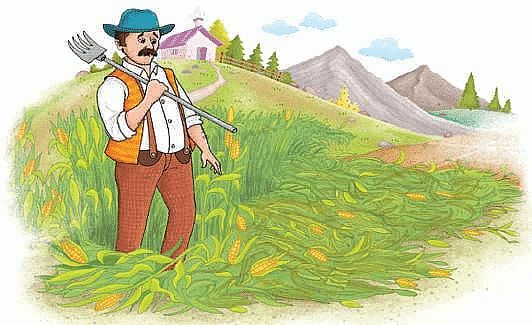
Ans: Lencho was a simple farmer. He was very hard-working. His crops had always been good. One year, he wished that there would be some rain so that his crop would be better. Lencho was sure that the rain would come. In the evening it started raining. But soon the rain changed into a hailstorm. The hail fell on the house, the garden, the hillside and the corn field. The field looked white as if it had been covered with salt. No leaves were left on the trees. The flowers were gone from the plants. Lencho’s crops were completely destroyed. His heart was filled with sorrow. But he had faith in God. He was sure that God would help him. He wanted God’s help for sowing seed and for living until the next harvest.

Q12: Describe Lencho as a farmer. How did the rain gladden(filled with happiness) his heart but the heavy hailstones that followed left him a worried man?
Ans: Lencho was a farmer who lived in a house that was on the top of a small hill. From that height, he could see the river and its fields. Lencho was an ‘ox’ of a man (strong man). He is a strong and hardworking farmer. The only thing the earth and the fields needed was heavy rain. At least, a shower was very necessary. Lencho’s older boys were working in the field. He could see huge mountains of clouds in the north-east. It gladdened his heart. As predicted by him, big drops of rain began to fall. The raindrops were like ‘new coins’.
Unfortunately, Lencho’s happiness was short-lived. Suddenly a strong wind began to blow. Along with the rain, very large hailstones began to fall. Within an hour the house, the garden, the hillside, and the fields were covered with a white sheet of hailstones. The leaves, trees and the flowers were destroyed. The hail had nothing left. The corn was totally destroyed. That year they would have no corn. They would survive on the mercy of God. All such dismal(depression) prospects worried Lencho.

Q13: What circumstances made Lencho write a letter to God? What does this act show about him?
Ans: The rain did come but came with disastrous(causing great damage) hailstones that ruined(destroyed) everything. The leaves, plants, and flowers were ruined. The corn was totally destroyed. The hail had nothing left. That year Lencho and his family would have no corn. They would be on the verge of starvation. All such dismal(depression) prospects worried Lencho. There was only one hope— help from God.
Lencho and his wife were highly religious and had unshaken faith in God. They believed in God’s mercy and also believed that ‘no one dies of hunger’. So, Lencho decided to write a letter to God. He wrote that he needed immediate help. He wrote that without God’s help, his family would face starvation. He needed a hundred pesos in order to sow his fields and live until the fresh crop came. He wrote the letter and wrote ‘To God’ on the envelope and dropped it into the mailbox.

Q14: Writing a letter to God for help really shows not only the unshaken faith in God of the writer Lencho but also shows his utter simplicity and innocence. Comment.
Ans: Lencho was a simple and hardworking farmer who worked like an ox in his fields. When the heavy fall of hailstones destroyed his corn totally, he and his family were rather on the verge of starvation. He was left with one hope, help from God. He believed that God was all-merciful and heard the call of those who were of a clear conscience. He requested him to send a hundred pesos immediately to help him to sow his fields. He and his family also needed some money to live on until the fresh crop came.
Writing a letter to God and addressing it `To God’ shows the writer’s unshaken faith in God. He was a simple man not distrusting that such a letter could reach God. His innocence and firm belief in God’s mercy even deeply impressed and influenced the postmaster who decided to answer his letter. He didn’t want to shake the writer’s faith in God. He collected and sent 70 pesos as help signing the letter with one word, ‘God’. Lencho had so much faith in God and his mercy that he didn’t show any surprise when he received the money sent to him. He wrote another letter requesting him to send the rest of the money immediately but not through the postal mail as the post office employees were a ‘bunch of crooks’.

Q15: Why did the postmaster and his employees decide to help Lencho? Was their effort appreciated by the receiver of that help?
Ans: Lencho was a simple-hearted farmer who had tremendous faith in God. The heavy hailstones destroyed his corn. There was only one hope — help from God. So, Lencho wrote a letter to God describing his and his family’s miserable condition. He requested for a hundred pesos to help in sowing the crop and living till the next crop came. The postmaster himself, a generous man, first laughed at the idea of Lencho’s having a correspondence with God. However, he soon became serious. He was highly impressed by Lencho’s unshaken faith in God. He didn’t want to break his faith in God. So he decided to answer the letter and help Lencho. He needed something more than goodwill. He asked his employees to collect money for this cause. He also contributed a part of his salary. All in all, they collected 70 pesos. The postmaster put the money in an envelope and mailed it to Lencho. He wrote a single word as a signature, God. Ironically, this noble act of charity by the postmaster and employees was not appreciated by Lencho. On the contrary, he called them ‘a bunch of crooks’ who embezzled the remaining 30 pesos. He never knew who the real helpers were . He only wrote God not to send the remaining 30 pesos through the mail as the post office employees were a ‘bunch of crooks’.

Q16: Who does Lencho think has taken the rest of the money? Describe the ironic ending of the story.
Ans: Lencho’s faith in God was complete and unshaken. When he lost all hopes, he looked towards God for help. And he was sure that God would come to the help of a simple man of clear conscience(values) like him. So, when he saw the money, he was not at all surprised as he had been waiting for it. But when he counted the money, he became angry. He was sure that someone had stolen thirty pesos out of the hundred sent by God. Who could be they except the employees at the post office? Therefore, he wrote a second letter to God to send him the rest of the money immediately. He asked him not to send money through the mail as the post office employees were a ‘bunch of crooks.’
The situation at the end becomes quite ironic. It is ironic that men who collected pesos to help Lencho were called `a bunch of crooks, by him. He couldn’t know till the end who had really sent that money.

Q17: Draw a character sketch of Lencho, the farmer in about 120-150 words.
Ans: Lencho was a simple man as farmers usually are everywhere. He was a man of limited means and earned his living by farming his fields. His older sons helped him in farming activities. His wife did the same but also managed the kitchen and other household works. Lencho was highly religious. So was his wife. He had unshaken faith in God. He believed that God always helps people with a clear conscience. Therefore, when he lost all hopes and he and his family were on the verge of starvation, he looked towards God for help. His deep faith in God even impressed the postmaster who decided to help him. He was strong and sturdy like an ox. Not only that, he worked day and night in the fields. Being a farmer, he had a deep knowledge about the weather, the winds and the rains of his region.
He was simple-hearted. He was rustic and inhabitable and thought. He was a little educated to write a letter. He shows his innocence by trying to have a correspondence(connection) with God directly. He wrote ‘To God’ on the top of the envelope and posted the letter into the mail-box.
While he had unshaken faith in God, he mistrusted the motives of men. He could never know and nor did he ever try to know who had sent him those seventy pesos to help him. It is quite ironic that he abused his helpers by calling them ‘a bunch of crooks’.

Q18.:Give a character sketch of the Postmaster in your own words. Don’t you think that he should have deserved a better recognition and appreciation of his act of charity?
Ans: It takes all kinds of people to make this world. The postmaster has all that is good in human thinking and behaviour. He has a thorough understanding of a sharp, sympathetic and sensitive mind. He knows how the mind of a God-fearing rustic like Lencho works. He is sensitive and sympathetic to human feelings. He doesn’t want to break the deep faith of the writer in God. The fat and friendly postmaster had a large heart too. First, he laughed at the man who wanted to have a direct correspondence with God. But he soon became serious. After reading the letter, he was deeply moved and impressed by Lencho’s faith in God.
He knew that merely goodwill was not sufficient. The farmer needed financial help. So he collected a sum of 70 pesos from his employees. He also contributed a part of his salary. He did so as to keep Lencho’s faith in God. He wrote a single word as a signature: God.
It is ironic that a simpleton(innocent person) like Lencho could never know his real benefactor(supporting financially). Nor did he ever try to know how and from whom he received those seventy pesos. Naturally, his work of charity deserved better recognition and appreciation from the receiver. Ironically, the postmaster and his employees who had sent seventy pesos were called ‘a bunch of crooks’ by Lencho.