9. From the Diary of Anne Frank – Worksheet Solutions

Q.1. Anne called 26th July a ‘tumultuous’ day. Explain the reasons behind it.

Anne called 26th July a tumultuous day as it was full of tension and fright. The first warning siren was sent off in the morning but nobody paid any attention to it because it only meant that the planes were crossing the coast. The siren alarmed again around 2 O’clock in the afternoon. Anne and her sister went upstairs but after five minutes they heard loud gunshots. After half an hour, drone of engines faded and life became normal. The city was enveloped in thick fog. But after dinner time,there was another gun-fire round and swarms of planes. The air was buzzing with the drone of engines. Nobody was able to sleep that night because it repeated again at midnight.


Q.2. What does Anne Frank tell about her family in her diary?

Anne Frank tells that she has very lovely and caring family.Her parents and her elder sister love her a lot. There are about thirty people nearby her whom she can call friends. She has loving aunts and a good home but she wants to have a true friend with whom she can share her feelings and thoughts.


Q.3. Why did Anne think that she could confide more in her diary than in the people?

Anne Frank did not have a friend with whom she could share her feelings. Though she had spent a good time with her friends but she was unable to share her views and thoughts with them. When she got her diary, she decided to share everything with it because she believed that nobody would be interested in her musings. So, she treated her diary as her best friend. She felt that it would keep her life a secret and would not react like people. She confided everything in the diary; her family, her fear,her loneliness, her life and considered it her best friend and named it ‘Kitty”.


Q.4. Why does Anne Frank think that ‘paper’ has more patience than ‘people’?

Anne believes that paper has more patience than people because it listens to her more patiently and silently it does not react like other people and also because she can confide in her diary all her secrets.


Q.5. Describe your views about Mr Keesing as a teacher.

Mr Keesing seems to be a strict teacher. He actually believes taking action with good intention and prefers development in children. He tries to control Anne’s talkative habit, but as soon as he is convinced that it does not affect her studies, he overlooks her shortcoming.


Q.6. Anne says teachers are most unpredictable. Is Mr Keesing unpredictable? How?

Yes, Mr Keesing is an unpredictable person. He is angry with Anne for being talkative in class and gives her extra assignments as a punishment. But later, he finds her essays to be witty and amusing. This brings a change in him and he accepts her arguments. He develops a funny bone too and starts cracking jokes in the class. This change in Mr Keesing’s nature shows that he is unpredictable.


Q.7. What makes writing in a diary a strange experience for Anne Frank?

It was the first time Anne was writing in a diary. She felt that later no one would be interested in reading about the thoughts of a young girl. Both these facts made it a strange experience for her.


Q.8. What does Anne write in her first essay?

In her essay, Anne mentions that she will try her best to minimize talking between lectures but this is a trait she inherited from her mother and it is difficult to eliminate an inherited trait. Also, her mother talks as much as she does, if not more. She also stressed that talking was a necessary quality for a good student.


Q.9. Why does Anne want to keep a diary?

Anne wanted to keep a diary and write in it because she had a lot going on in her head. She had no friend with whom she could talk about such personal stuff. Thus, she decided to maintain a diary.


Q.10. How does Anne feel about her father, her grandmother, Mrs Kuperus and Mr Keesing? What do these tell you about her?

According to Anne, her father is the most lovable man one could ever come across. She loved and missed her grandmother more than she showed. She was on good terms with her teachers except the old fogey, Mr Keesing who taught them mathematics. The headmistress, Mrs Kuperus was her class teacher and both were very close to each other. Mr Keesing often punished Anne with extra assignments as a punishment for her talkative nature. These indicate that Anne was affectinate and a loving person.

8. Poem – The Ball Poem – Worksheet Solutions

Q.1. Why does the poet say, ‘I would not intrude on him?’ Why doesn’t he offer him money to buy another ball?

When a person is trying to come over his grief on his own, he is busy making himself understand certain things if then, someone intrudes or disturbs, and his chain of thoughts is broken. It makes him irritated. Moreover, self-consolation, realization or understanding is more effective and lasting than when it is done by an external agency or a person. The poet knows it. So he does not intrude on him.
His offer of money to buy another ball is useless for the boy wants the same ball he is attached to and has been playing for a long time. No other ball will be able to take its place.


Q.2. “… staring down/All his young days into the harbour where/His ball went …” Do you think the boy has had the ball for a long time? Is it linked to the memories of days when he played with it?

Yes we can say that the boy had the ball for a very long time. The line itself describes how the boy recalls those days when he used to play with the ball. The ball was surely linked to some sweet memories of his playing with the ball.


Q.3. Should the boy be allowed to grieve for his ball? If his loss is irreparable or irretrievable then how should one handle it? What lessons can be learnt?

Yes, the boy should be allowed to grieve for his ball, as he had that ball for a long time. He had many old memories associated with it since his childhood. Moreover, when a person is trying to come over his grief on his own, then one should not intrude or disturb him as it may break his chain of thoughts and may irritate him.

One should have self-consolation, and self -understanding in order to bear the loss. Self-realization and understanding are more effective and lasting than when it is done by an external agency or a person.


Q.4. How did the boy really react to the loss of the ball or was he fearful of something or someone……..? Can our attention be directed toward his family and other people? Are there any lessons to be learnt?

(i) The boy was not fearful of anyone, in fact, he was really upset about the loss of the ball. The ball was valuable for him. He was shocked, remained fixed, trembled with grief staring at the place where the ball had fallen. His family must not have been affected by the loss as a ball is an easily available and inexpensive item.

(ii) The loss of the ball teaches a lesson to us. Money is external in the sense that it can give you only outer happiness or pleasure not inner. Money cannot buy the emotions and heavenly virtues. It cannot be linked with old memories. Moreover, self-consolation, realization or understanding is more effective and lasting than done by an external agency or a person.


Q.5. What does the poet say the boy is learning from the loss of the ball? Try to explain this in your own words?

The poet means that the boy will learn the real truth of life. He will learn how to move on in life despite of incurring heavy losses. Everyone experiences this in his/ her life when they lose either something or someone. This harsh reality that lost things never come back make people strong enough to live their life by accepting this truth of life.


Q.6. Why does the poet say, “I would not intrude on him”? Why doesn’t he offer him money to buy another ball?

The poet does not want to intrude so that the boy can get a chance to learn the real truth of life. He has to learn to accept the loss. The loss here means the most important thing or relationship.


Q.7. Do you think the boy has lost anything earlier? Pick out the words that suggest the answer?

The line in the poem “now he senses his first responsibility’ helps us to know that the boy has not lost anything before.


Q.8. What does “in the world of possessions” mean?

In the world of possessions means that the world is full of materialistic things. Materialistic things are those things which bring comfort and luxury in our life.


Q.9. Why did the boy feel so sad at the loss of his ball?

When the boy lost the ball, he plunged in grief. He stood staring down the harbour where his ball was lost. The boy was affected profoundly by the loss of his ball because it had been with him for a long time. It was linked to the memories of the days when he played with it.


Q.10. Why is it important for everyone to experience loss and to stand up after it?

It is important for everyone to experience loss and to stand up after it in order to be strong and to get on with life. One needs to stay strong no matter how much it hurts inside. Staying strong is the only way to survive. Moreover, one needs to learn to accept and let go and not cling to something that they can never have. One should understand that the past is gone and it will never come back. Experiencing loss sometimes helps us to grow up and face hardships, like loss. This helps us in breaking all the boundaries into freedom.

7. Poem – How to Tell Wild Animals – Worksheet Solutions

Q1: Who smiles while catching their prey?
(a) Hyena
(b) Crocodile
(c) Both of them
(d) None of them

Correct Answer is Option (a)


Q2: Which animal’s roar is enough to kill you?
(a)
 Asian Lion
(b) Bengal Tiger
(c) Leopard
(d) Bear

Correct Answer is Option (a)


Q3: Describe the effective use of humour in the poem How to tell wild animals. What are the poetic liberties taken by the poet in the poem?

The poet, in the poem ‘How to tell Wild Animals’ creates humour by describing various beasts of prey. The way the poet explains the things is very funny yet interesting. The poet has depicted the wildlife very vividly and in a lively manner. While reading the poem, the readers enjoy the poet’s work and it leaves them refreshed and happy. The humour used in the poem is suggestive and mild. If the Asian Lion ‘roars’ at you as you are dying, the Bengal Tiger is a ‘noble’ wild beast that ‘greets’ you when you are roaming round in the jungle. The leopard will show no mercy and it will do no good to roar with pain. The bear gives you a very hard ‘hug’ and if you have any doubts whether it is a bear, it will give you just one more caress. The poet humorously says that hyenas come with ‘merry smiles’; but if they ‘weep’ they are crocodiles. Similarly, the poet takes many liberties to make the poem impressive. In order to rhyme with ‘lion’ the poet changes the word dying to ‘dyin’. Instead of leapt and leap the poet writes ‘lept’ and ‘lep’. All these changes make the poem more interesting and enjoyable.


Q4: Why does the poetess use the term ‘noble’ and ‘wild’ for the tiger?

The poetess refers to the Bengal Tiger as ‘noble’ and ‘wild’ both. The tigers look impressive when they walk majestically. But the same tigers become wild and would brutally kill anyone for food.


Q5: How can you distinguish between a hyena and a crocodile?

It is not easy to distinguish among wild animals. But a hyena and a crocodile can easily be distinguished. A hyena laughs as it swallows its victim, whereas a crocodile will have tears as it kills its victim.


Q6: How does a leopard behave when he sees someone?

A leopard has black spots all over its body. As soon as it sees someone, it leaps over him at once. There will be no use of crying with pain. It will not show any mercy, but keep on pouncing continuously on its victim.


Q7: What is the theme of the poem ‘How to tell wild Animals’? 

The theme of the poem is to create humour. The poet creates humour by suggesting dangerous ways of identifying wild animals. You can identify most of the beast while attacking you. Instead of shouting for help or trying to protect yourself. You are busy identifying the attacker- the idea creates humour.


Q8: Why does the poetess say that a bear’s ‘hug’ may confuse a novice? 

It is the tendency of a bear to kill his victim by embracing him. He hugs the victim so tight that he usually dies. But a novice who does not know the way of bears may misunderstand his hug. He may think that it is a loving embrace.


Q9: Describe a few characteristics of a chameleon.

A chameleon is a garden lizard and is an expert at camouflage. It changes its colour as per its surroundings. This ability of camouflage helps it in saving it from the hunters. A chameleon does not have – any ears or wings.


Q10: How can you identify the Asian lion and the Bengal Tiger?

The Asian Lion has a large body and a brownish-yellow coat. It roars loudly when it attacks it’s prey. On the other hand, the Bengal Tiger has black stripes on its yellow coat. It silendy attacks it’s prey.

6. Two Stories about Flying – Worksheet Solutions

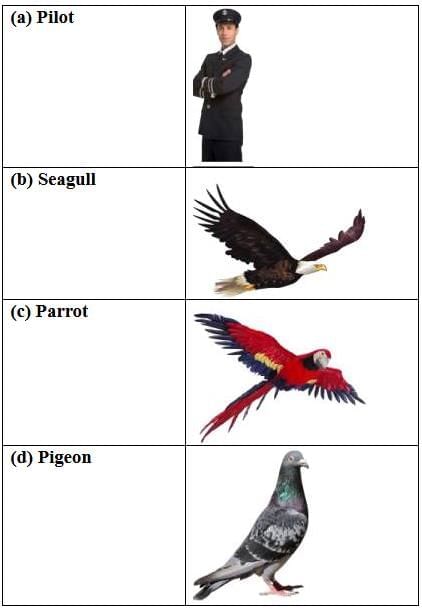
Q1. Fill in the Blanks Using the Suitable options (See, France, India, Seagull, Black Aeroplane, Frederick Forsyth) 
(a) The pilot was unable to ___ anything. 

See

(b) From _____ to _____, the pilot was flying. 

France, India

(c) The title ____ is based on the aeroplane that helped the pilot. 

Black Aeroplane

(d) _____ is the author of Black Aeroplane. 

Frederick Forsyth

(e) ____ is the focus of the lesson “His First Flight.” 

Seagull

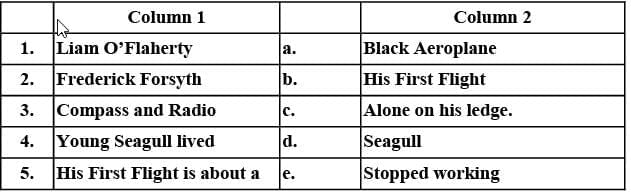
Q2. Match the following. 

Q3. What is the lesson “His First Flight” about?

(b) A Seagull

Q4. Why was he afraid to fly? 
(a) He lacked courage. 
(b) He was concerned that his wings would not support him. 
(c) He was concerned that people would criticise him.
(d) Both 1 and 2.

Correct Answer is Option (b)

Q5. What did his parents threaten to do if he didn’t fly away? 
(a) never speak to him 
(b) punish him 
(c) should starve him 
(d) leave him

Correct Answer is Option (c)

Q6. What lessons did his parents impart to his siblings? 
(a) to master the art of flight 
(b) skimming the waves 
(c) to fish by diving 
(d) All of the above

Correct Answer is Option (d)

Q7. Which control station did he call while travelling? 

He called the Paris control station while traveling.

Q8. What food did the Seagull’s mother purchase for it? 

The Seagull’s mother purchased Fish.

Q9. The young Seagull was alone, why? 

Due to the departure of his two brothers and sister, the baby Seagull was left alone.

Q10. Name the aircraft in which the pilot was operating? 

The aircraft in which the pilot was operating was a Dakota.

Q11. Why didn’t he travel with his brothers and sisters? 

He didn’t travel with his brothers and sisters because he was terrified to fly.

Q12. Why was he frightened to fly?

He was frightened to fly because his wings could never support him, he was scared to fly.

Q13. How far away from Paris was the narrator when he noticed ominous clouds in the sky?

He was 150 km away from Paris was the narrator when he noticed ominous clouds in the sky.

Q14. During the day, what did he observe?

He observed his parents teaching his siblings and brothers how to fly.

Q15. ‘He felt the heat because he had not. eaten since the previous nightfall’ what did the little Seagull do to feed himself?

Due to his inability to fly and the fact that his family had abandoned him, the Seagull was feeling hungry. He was made to eat everything he could find to sate his hunger.

Q16. Why was it impossible for the young Seagull to fly to his parents? 

Because the edge on either side of him terminated in a precipitous drop into a vertical cliff with the sea below, he was unable to reach his parents without using a plane. Then, a large and deep crack appeared in the ground between him and his parents.

Q17. When the Seagull failed to catch their attention, what were his family members doing on the plateau? 

The two brothers, sisters, and siblings of the small Seagull had their heads buried in their necks and were all half asleep. His father was grooming the feathers, his beak lying on his white back. On the plateau, the only person seeing him was his mother, who was seated on a little hill.

Q18. How did the baby Seagull learn to fly? 

The juvenile Seagull dove at the fish in his mother’s beak because he was “maddened by hunger.” He screamed loudly as he plunged downward and forth. He began to fly when his mother soared higher, following her.

Q19. When did the Seagull start to fly? Where does it end? 

He moved to the edge of the cliff and the bird took off. The fish was in his mother’s beak when he dove at it. His struggle came to an end when worn out by his initial flight and feeble, he slid to the water’s surface and floated there.

Q20. What occurred when the young Seagull dove for the fish that his mother had just picked up?

The fledgling Seagull’s first flight started while he was outward and downward into space, diving after the fish that his mother had just picked up. His flight into the water came to an end after a steep plunge.

Q21. When the Seagull’s belly reached the green sea, how did he feel?

The bird was afraid he would drown when his belly touched the green sea. He made an attempt to fly but failed. Due to hunger, he was weak and worn out.

Q22. How did the Seagull conquer his sea phobia?

After his initial journey, the Seagull had become weary of his peculiar ordeal. He let go of both legs and stood on the emerald water. He shouted in terror and tried to rise up once more by flapping his wings. He floated on the sea and overcome his fear of it.

Q23. Do you feel sorry for the Seagull? Why? 

We feel sorry for the Seagull since his family abandoned him and he was left alone and hungry as a result of his fear of flying. He lacked the bravery to soar like his siblings and siblings.

Q24. How did the baby Seagull discover how to float in the water? 

His belly eventually met the green sea, at which point his feet stopped submerging further. He was floating on it as his family yelled at him, showered him with praise, and offered him food with their beaks. He learned to float on the waves in this way.

Q25. What did the little Seagull do to catch his mother’s eye?

The little Seagull stood on one leg and acted as though he was dozing off on the edge of the ledge to get his mother’s attention.

5. Poem – A Tiger in the Zoo – Worksheet Solutions

Q.1. What is the tiger doing in its cage?
(a)
 Jumping
(b) Terrorising
(c) Sleeping
(d) Stalking

Correct Answer is Option (d)
The tiger is stalking along the length of cage behind the bars.


Q.2. Whose noise does tiger hear last at night?
(a)
 Noise of the animals
(b) Noise of the patrolling cars
(c) Noise of the villagers
(d) Noise of the visitors

Correct Answer is Option (b)
The tiger hears the noise of the patrolling cars last at night. 


Q.3. Explain why the Tiger ignores the visitors at the zoo?

The Tiger is caged it has no freedom to roam the vast jungles. He is constrained by the space available in the cage. He is angry and restless. He suppresses his anger by proudly walking the length of his cage and ignoring the visitors who have come to see him.


Q.4. What does the poet mean when he says that the Tiger’s strength is behind the bars?

The poet means that since the Tiger is locked in the cage, he has no freedom and therefore he cannot use his strength. He is angry and restless but proudly walks the length of his cage.


Q.5. Explain how the poet contrasts the Tiger in the cage to the Tiger in the jungle?

The poet says that since the Tiger is caged it has no freedom to roam the vast jungles. He is constrained by the space available in the cage. He is angry and restless but proudly walks the length of his cage, ignoring the visitors who have come to see him. All he can do is stare at the brilliant stars with his brilliant eyes. The poet contrasts this with the Tiger in the jungle, who is free, to roam the wild, sliding through long grass, and enjoying his liberty. He goes near water holes and where he can find deer. He snarls around houses at the edge of the jungle frightening the villagers by baring his fangs and his claws.


Q.6. What is the tiger doing? Why is he ignoring the visitors?

The tiger is slowly and quietly moving along the length of the cage in a threatening manner. He is ignoring the visitors because he considers them devoid of any feelings. None of them thinks of releasing him from his prison. Thus, he stops taking any notice of them.


Q.7. Describe the tiger in the wild.

The tiger in the wild is majestic. He is free and lies under the shades and hunts for prey. He moves near the water because food is in plenty there. Sometimes he growls and terrorises the villagers.


Q.8. Is it right to confine wild animals into cages? Why or why not?

Wild animals are meant to live in the wild. They are not meant to be caged and displayed in the zoos. We all know that the majestic species of tiger is on the verge of extinction. There used to be a time when they used to roam proudly and freely in the jungle. They are not meant to live a life in confinement. They also have the right to freedom like all other living beings. Confinement leads to depression and misery. Moreover, their offsprings lose the hunting capabilities as they are not trained to hunt in the wild. As a result, they would not be able to feed themselves. Furthermore confining wild animals disturbs the whole ecological balance. We should, thus, let the animals run free in the wild. They belong to the forest and not to the cage.


Q.9. How does a tiger create terror for the villagers?

The tiger creates terror for the villagers by snarling around their houses as they are situated near the jungle. He frightens them by showing his white fangs and claws.


Q.10. Why does the tiger express his rage quietly?

The tiger expresses his rage quietly because there is nothing he can do from behind the bars of his cage. He is helpless as his strength now lies inside the cage. He is no longer free as he was in the jungle.

4. Nelson Mandela – Long Walk to Freedom – Worksheet Solutions

Multiple Choice Questions

Q1: What realizations did Mandela have of his boyhood freedom?
(a)
 Freedom was meant for kids
(b) He was born free
(c) It is just an illusion
(d) He had no realizations
The correct Answer is Option (c)

Q2: Nelson Mandela’s wish for the country was _________.
(a) 
to unite all his people together
(b) to push away the enemies
(c) to remain free forever without an oppressor ruling them
(d) none of these
The correct Answer is Option (c)

Q3: According to Mandela, what is the greatest wealth of a nation?
(a) minerals
(b) gems
(c) diamonds
(d) people
The correct Answer is Option (d)

Q4: What unintended effect did the decades of oppression and brutality have?
(a) created men of extraordinary courage, wisdom, and generosity
(b) Poverty and suffering
(c) Boycotts from foreign nations
(d) both 2 and 3
The correct Answer is Option (a)

Q5: What change brought international leaders to South Africa?
(a) End of Apartheid
(b) humanity
(c) peace
(d) trade negotiations
The correct Answer is Option (a)Short Answer Type Questions

Q6: What were Nelson Mandela’s views on the policy of Apartheid?
Ans: Nelson Mandela says that Apartheid created a deep and lasting wound in his country. It cast a shadow on the people of South Africa – deep wounds that would take many years to heal. The oppression and brutality that the people of the nation had been subjected to had no parallel. This situation aroused a spirit of aggression in the minds of men and produced men of extraordinary courage, wisdom, and generosity. Mandela believed that the greatest wealth of South Africa are the people of the nation. The more the oppression rained on them the more the spirit to fight back was triggered in the minds of the people. In the end victory for the people of South Africa prevailed and they attained Independence on 10th May 1994.

Q7: What were the difficulties Nelson Mandela encountered while fighting for freedom?
Ans: Nelson Mandela underwent extreme hardships and suffering. He was a true patriot and sacrificed his comfort and that of his family while demanding freedom and equality for all his countrymen. He and his comrades were oppressed, punished, and imprisoned for resisting the white rule. He was imprisoned for almost thirty years. His persistence and sacrifice culminated in the independence of South Africa.

Q8: How did ‘hunger for freedom’ change Mandela’s life?
Ans: At the beginning of his life, Mandela was not aware of freedom. Later, Mandela found that his freedom had been taken away from him. As a student, he wanted freedom only for himself but slowly his own freedom became the greater hunger for the freedom of his people. This changed him completely.

Q9: What are the ‘twin obligations’ referred to by Nelson Mandela?
Ans: According to Nelson Mandela, every man has two obligations in life. The first obligation is to his family, to his parents, wife, and children. Secondly, he has an obligation to his country, people, and community.

Q10: What was unique in the inauguration ceremony?
Ans: The inauguration ceremony took place in the amphitheater formed by the Union Buildings in Pretoria. For decades, this had been the seat of white supremacy. Now it was the oath-taking ceremony day for South Africa’s first democratic, non-racial government. It was a unique occasion.Long Answer Type Questions

Q11: Describe the views of Mandela for the black people who fought and sacrificed their lives for the country’s political independence.
Ans: Mandela consistently emphasized that the attainment of political freedom was a consequence of the sacrifices made by numerous black individuals who fought for it. According to him, this debt of gratitude could never be fully repaid. Mandela saw himself as the embodiment of all those African patriots and expressed regret that he could never personally thank them. He condemned the apartheid policy, recognizing its deep wounds on his countrymen, wounds that would take centuries to heal.

Moreover, Mandela acknowledged that the oppression and brutality inflicted by the white population gave rise to remarkable freedom fighters such as Oliver Tambo, Walter Sisulu, Luthuli, Dadoo, Fischer, Sobukwe, and many others. These individuals, characterized by their courage, wisdom, and generosity of spirit, endured significant suffering in their quest for the political freedom of the country.

Q12: What were the difficulties faced by Nelson Mandela in achieving freedom for his people? 
Ans: In his quest to secure freedom for his countrymen from the oppressive rule of Apartheid, Nelson Mandela faced numerous hardships and endured significant suffering. This devoted patriot had to forego the comforts of his home and the companionship of his loving family. Declared an outlaw for advocating equality for all fellow black Africans, Mandela experienced punishment, isolation, and imprisonment.
He, along with his comrades, endured oppressive measures and torture beyond endurance. Despite facing hunger, oppression, and injustice, Mandela kept the flame of independence burning in his heart. Through his unwavering courage, persistent struggle, and unparalleled sacrifices, he eventually achieved success. South Africa gained freedom from the grip of Apartheid on May 10, 1994.

Q13: Summarise the chapter ‘Nelson Mandela -Long Walk to Freedom. 
Ans: This chapter is extracted from Nelson Mandela’s autobiography, ‘Long Walk to Freedom,’ where he reflects on a significant event in his life—the inauguration as the first Black President of South Africa. The ceremony unfolded at the Union Buildings amphitheater in Pretoria and drew politicians and dignitaries from over 140 countries worldwide. Following an era of White dominance, South Africa marked its transition to a democratic republic. Mandela hailed this as a collective triumph for justice, peace, and human dignity, describing it as a glorious human achievement.
During his address, Mandela committed to freeing his people from the enduring shackles of poverty, deprivation, suffering, and various forms of discrimination. His struggle was rooted in opposing the British rulers’ apartheid policy, which segregated Black and White populations, deeming it an extraordinary human disaster. Mandela held the conviction that the deeper the oppression, the stronger one’s character becomes. Drawing inspiration from his comrades, he learned that courage was not the absence of fear but the triumph over it.
For Mandela, every individual bore twin obligations—to family and to the nation. He saw no distinction between oppressors and the oppressed, referring to both as prisoners. One group was confined behind physical bars, while the other was imprisoned by the bars of hatred. Mandela, once an enthusiastic young boy yearning for freedom, envisioned a perpetual dawn of freedom shining upon his country and its people.Extract Based Questions

Q14: In life, every man has twin obligations- obligations to his family, to his parents, to his wife and
children; and he has an obligation to his people, his community, and his country. In a civil and humane society, each man is able to fulfill those obligations according to his own inclinations and abilities. But in a country like South Africa, it was almost impossible for a man of my birth and color to fulfil both of those obligations. In South Africa, a man of color who attempted to live as a human being was punished and isolated.
(a) What are the obligations that every man has in his life?
Ans: Family and  Friends.
(b) 
Why was it impossible for a colored man to discharge his obligations in South Africa?
Ans: Because he would be punished and isolated. 
(c) 
What does it mean by the phrase ‘a man of my birth’?
Ans: It means that the person was born into a poor and humble family. 
(d)
 What is the adjective form of ‘punished’?
Ans: punishment.

Q15: On the day of the inauguration, I was overwhelmed with a sense of history. In the first decade of the twentieth century, a few years after the bitter Anglo-Boer war and before my own birth, the white-skinned people of South Africa patched up their differences and erected a system of racial domination against the dark-skinned people of their own land. The structure they created formed the basis of one of the harshest, most inhumane societies the world has ever known. Now, in the last decade of the twentieth century, and my own eighth decade as a man, that system had been overturned forever and replaced by one that recognized the rights and freedoms of all people, regardless of the color of their skin. 
(a) What made the author overwhelmed?
Ans:  The sense of gratitude. 
(b) Which system was created by white-skinned people of South Africa?

Ans: social discrimination against the dark-skinned people. 
(c) What did the new system recognize?

Ans:  the rights and freedom of all people, regardless of the color of their skin. 
(d) Which word in the passage means the same as ‘submerged’? 
Ans: Overwhelmed 
3. Poem – Fire and Ice – Worksheet Solutions

Multiple Choice Questions
Q1: Why are desires compared to fire?
(a) Both are lethal
(b) Both are related to heat
(c) Both burn
(d) Both consume rapidly
The correct Answer is Option (d)
Desires are powerful and can lead to a quick end. Just like fire, desire can spread and consume fast leading to apocalypse.

Q2: According to the poem Fire and Ice, what do some people think the world will end in?
(a) Rain
(b) Moon
(c) Sun
(d) Fire

Correct Answer is Option (d)
According to the poet, some people believe that the world will end in fire because of the violent desires of man.

Q3: “But if it had to perish twice.” What does ‘it’ stand for in this line?
(a) World
(b) Desire
(c) Ice
(d) Fire

Correct Answer is Option (a)
The poet through the poem tries to opine that hate and greed are the greatest malice in this world. The poet says that although he favors the belief that the world would end in fire, he also feels that if the world were to end twice it would end in ice i.e. man’s propensity to hate the other will be the cause of it’s demise.

Q4: Who is the poet of the poem Fire and Ice?
(a) Robert Frost
(b) Ben Jonson
(c) William Cowper
(d) William Blake

The correct Answer is Option (a)
Robert Frost is the poet of ‘Fire and Ice’.

Q5: Name the poetic device used in the line To say that for destruction ice is also great.
(a) 
Oxymoron
(b) Alliteration
(c) Imagery
(d) Metaphor
Correct Answer is Option (c)

Short Answer Type Questions
Q6: Which age-old question does the poem revolve around? 
Ans: The poem revolves around the age-old question of whether the world will end in fire or in ice. People are divided on this issue. Some believe that fire will become the cause of the end and others think that ice will end the world. Here, fire symbolizes human desire and ice symbolizes hatred.

Q7: What do the metaphors of Ice and Fire convey to the reader? Elaborate. What is the message given by the poet?
Ans: Frost presents the two of the darkest traits of humanity; the capacity to hate and the capacity to be consumed by lust or desire. Of the two, he attributes the greater of the two evils, is desire. In giving desire the foremost position with regard to the destruction of the world, Frost provides a powerful statement on the subject of greed and jealousy, saying that above all trait of humanity that is most likely to lead to its demise. Desire represents the greatest problem that contributes to the cause of the war. Frost then attributes hatred to the same capacity to do harm. However, he lessens the relative importance of hatred but still presents it as having the ability to lead to the destruction of the world if it were to happen for a second time.

Q8: What do ‘Fire’ and ‘Ice’ stand for and what is the general opinion regarding the world? 
Ans: Fire’ stands for fury, desire, lust, anger, avarice, cruelty, greed. Ice is symbolic of hatred, coldness, rigidity, insensitivity, and intolerance. The general opinion regarding the world is that the world will end in fire and some say in ice. Both reasons contrast each other and one is equally opposite to each other. People who favor fire believe that it will be the heat and passion that will end the world. On the other side, some people think that it will be the ice that will freeze the world.

Q9: How can fire destroy the world?
Ans: Fire’ symbolizes passion or hatred. It will lead to conflicts and ultimately destroy the world. Fire represents desire that is fervent, consuming, and always wanting more. Ice represents hatred that is hard and cold.

Q10: What is the central idea of the poem ‘Fire and ‘Ice’? 
Ans: The poet presents two possibilities about the end of the world. It will be either due to ‘Fire or ‘Ice’ he prefers the first as he believes the world will end in fire but the ice will not go away.

Long Answer Type Questions
Q11: Discuss how extreme behavior can hasten the end of the world with respect to ‘Fire and Ice’. 
Ans: The concept of ‘Fire’ serves as a representation of intense desire, encompassing a fervent love or craving that directs individuals toward acquiring and possessing materialistic pursuits. Within our society, numerous individuals dedicate their lives to attaining larger TVs, more stylish cars, or more opulent homes. This relentless desire, however, often leads individuals to their downfall, manifesting in financial ruin or fractured relationships. Frost’s poem delves into the theme of greed corrupting both individuals and society at large.
On the other hand, ‘Ice’ symbolizes the potent force of hatred. While desire swiftly consumes, hatred quietly generates restrained devastation. A prime example is the role of hatred in fostering racism and fueling wars, with its impact enduring in the minds of people for generations. Moreover, hatred can consume the hater even more profoundly than the person being hated, ultimately resulting in the ruin of lives.

Q12: The poem ‘Fire and Ice’, carries with it very deep thematic ideas. Elaborate on these darkest traits of humanity.
Ans: Frost explores two of humanity’s darkest traits in his work: the capability for hatred and the susceptibility to be consumed by lust or desire. Interestingly, he assigns the greater degree of malevolence to desire. By emphasizing desire as the primary force behind the world’s destruction, Frost delivers a compelling commentary on the perils of greed and jealousy. He suggests that, above all human traits, desire poses the greatest threat to the world and plays a significant role in the causes of war. Frost then attributes hatred with a comparable potential for harm, albeit he diminishes its relative significance. Still, he underscores its ability to contribute to the world’s destruction, especially if allowed to manifest once again.

Q13: How will the world end? Support your answer with a scientific explanation. 
Ans:  Scientists propose two potential reasons for world destruction:

  • Some believe the Earth could be incinerated from its fiery core. This could lead to natural calamities like volcanic eruptions, earthquakes, and tsunamis, ultimately ending the world.
  • Others argue that an impending ice age, triggered by global warming and melting ice from snowy mountains, poses a significant threat. This scenario envisions the world shrinking as icy waters prevail, resulting in the demise of all living things.
    Frost’s work serves as a cautionary message about these dual challenges facing humanity, highlighting the potential consequences of human vices with increased impact.

Extract Based Questions
Q14: 
Some say the world will end in fire
Some say in ice.
From what I’ve tasted of desire
I hold with those who favor fire.
(a) What is the poet’s opinion of the world in these lines?  
Ans: In the poet’s opinion the world will end in fire. 
(b) What is the poet’s opinion about the world?
Ans: According to the poet, the world will end in fire.
(c) What is the contradictory opinion of the public?
Ans: The contradictory opinion of the public is the debate whether the world will end in fire or ice. 
(d) How are ice and fire similar to each other though they have contradictory traits? 
Ans: Both ice and fire are similar in the sense that both of them would destroy everything in the world. 

Q15: 
 But if it had to perish twice,
I think I know enough of hate
To say that for destruction ice
Is also great
And would suffice.
(a) Why does the poet feel that ‘ice’ is also great for destruction?
Ans: Ice equates with ‘hatred’, which is enough to destroy the world.
(b) What is the rhyme scheme of this stanza of the poem?
Ans: a b a b a
(c) The two things that the poet thinks are good enough for destruction are 
Ans: fire and ice which means ‘hatred’ and ‘desire’.
(d) What does ‘it’ stand for in the first line?
Ans: Here, ‘it’ stands for the world.

2. Poem – Dust of Snow – Worksheet Solutions

Q1: What change come in the poet’s mood?

(a) From joy to sorrow
(b) From hope to despair
(c) From despair to cheer
(d) From anger to harmony

Correct Answer is Option (c)


Q2: Who is the poet of the poem “Dust of Snow”?
(a)
 Leslie Norris
(b) Robert Frost
(c) Carolyn Wells
(d) Robin Klein

Correct Answer is Option (b)


Q3: Where was the crow sitting?


(a)
 on a Banyan tree
(b) on a Hemlock tree
(c) on a Pine tree
(d) on a Gulmohar tree

Correct Answer is Option (b)


Q4: Pick the set of options that are related to the idea conveyed in the poem.
i. The state of sadness neither can be ended nor can be avoided.
ii. The state of depression should last for long.
iii. Everyone has moments of sadness or depression in one’s life.
iv. The sooner one gets over grief or depression the better it is.
v. The state of depression if not ended will end us.
vi. The state of sadness should continue for long.
vii. Everyone mustn’t avoid the state of depression.

a. i, ii, iv
b. iii, iv, v
c. v, vi, vii
d. i, iii, v

Correct Answer is Option (d)


Q5: What did poet realise when dust of snow fell on him?

i. That he had wasted his time being in sorrow
ii. That he should utilise his remaining day in doing some useful tasks.

a. Both (i) and (ii) are correct
b. 
Only (i) is correct
c.
 Only (ii) is correct
d. 
Neither (i) nor (ii) is correct

Correct Answer is Option (a)


Q6: What do the crow, hemlock tree and dust of snow represent in the poem? 

The crow is black and ugly. It is not considered as a pleasant sight. It is a symbol of bad omen. The hemlock tree is a poisonous plant with white flowers. It is a symbol of sorrow. The poet chose the crow and the hemlock tree to present his sadness and depression.

Q7: It is our attitude towards a situation that makes it positive or negative. Do you agree with it? Express your views with reference to the poem ‘Dust of Snow’.

It is true that our attitude towards a problem plays an important role in making it positive or negative. Most of the people in today’s world live a stressful life. They face different types of problems in day to day life. A person can neither keep away from problems completely nor find solutions for them easily. But what makes the situation worse is one’s attitude towards the problems. If we are depressed or sad the whole environment becomes gloomy. But if we are ready to face the problem bravely and positively, it helps in solving the problem also.
The poet in the poem Dust of Snow was in a sorrowful mood. He felt that the whole day was going to be gloomy. But when a crow shook down snowflakes on him, his bitter mood changed into an optimistic one. This small, regular incident wiped away his gloom and made him cheerful. He could have become unhappy when such a thing occurred. But instead of seeing the negative aspect of the incident, he took a positive vibe from it. Thus the the poem teaches us to find happiness from small things and to take everything positively. 


Q8: In the poem ‘Dust of Snow’, how does the poet’s mood get changed?

While sitting under a tree, dust of snow falls on the poet. This seemingly upsetting incident changed the mood of the poet. He realized that he had just wasted a part of his day repenting, rather he could have utilized the same in doing some productive activity. 

Q9: A simple moment proves to be very significant and saves the rest of the day of the poet from being wasted. Explain on the basis of the poem ‘Dust of Snow’.

The poet, Robert Frost tries to convey that even simple and ordinary incidents have great significance in our life. Nothing is good or bad. It is only our thinking that makes it so. Best things in life are free of cost. Life is full of problems and obstacles. We should try to solve them rather than sitting and regretting. Sometimes even the unimportant things change the meaning of life. A simple action of a crow, who shook off the dust of snow on the poet, taught him a great lesson. The poet realized that he had wasted his day in repenting rather than doing some useful activity. He understood how to take adverse season in stride and work for a better life.


Q10: What do the ‘Hemlock’ tree and ‘Crow’ represent? What does the dust of snow metaphorically stand for?

The poet was going somewhere in a snowy morning. He was upset. All the trees were covered with snow dust. A crow sitting on a hemlock tree shook the tree in such a way that some dust of snow fell on the poet. This changed his mood and he became happy and relaxed.

1. A Letter to God – Worksheet Solutions

Q.1. The field of corn dotted with flowers means that
(a) 
not a single flower was bigger than a dot.
(b) 
the flowers were scattered across.
(c) 
the flowers were in shaped like dots.
(d) 
the flowers had shrunk in size.

Correct Answer is Option (b)
The field of corn dotted with flowers means that the flowers were scattered across the field, giving a dotted appearance.


Q.2. Which crop was growing on Lencho’s fields?
(a) 
Corn
(b) 
Barley
(c) 
Rice
(d) 
None of the above

Correct Answer is Option (a)
Lencho’s fields had corn growing on them, as mentioned in the story.


Q.3. Why did the postmaster decide to reply to Lencho’s letter?
(a) 
he was a good man
(b) 
he felt empathetic
(c) 
to preserve Lencho’s faith in God
(d) 
all of the above

Correct Answer is Option (c)
The postmaster replied to Lencho’s letter to preserve his faith in God, ensuring that Lencho continued to believe in divine help.


Q.4. How much money did Lencho ask for?
(a) 100 pesos
(b) 1000 pesos
(c) 10 pesos
(d) 500 pesos

Correct Answer is Option (a)
Lencho asked for 100 pesos to recover from the damage caused by the storm.


Q.5. Where did Lencho expect the downpour to come from?
(a)
 north
(b) north-east
(c) north-west
(d) south-east

Correct Answer is Option (b)
Lencho expected the downpour to come from the north-east, as stated in the story.


Q.6. True and False: 
(a) The letter was read by the postmaster. 
(b) Lencho wished for Rain. 
(c) Lencho compared the raindrops to new coins. 
(d) After the rain ended, Lencho was overcome with sorrow because everything had been Safe. 
(e) He was happy with the difference in the amounts. 

Ans: 
(a) True 

The postmaster read Lencho’s letter to understand his request.

(b) True 

Lencho wished for rain to ensure a good harvest for his crops.

(c) True 

He compared raindrops to new coins because they symbolized prosperity for his farm.

(d) False 

Lencho was sorrowful after the rain because his crops were destroyed, not safe.

(e) False 

He was not happy with the difference in the amounts; he thought the post office employees had stolen his money.


Q.7. Fill in the blanks: 
(a) Lencho wished for favourable rain because a good Harvest required it 
(b) In Lencho’s field, all of the crops Died as a result of the weather. 
(c) The postmaster first  Laughed as he read Lencho’s letter 
(d) Lencho had asked for a Hundred pesos 
(e) He has entire faith in God.


Q.8. Who did Lencho write a letter? What did he ask for?

Lencho wrote a letter to God. He asked God to send him Hundred Pesos to sow his field again and to live until the crops come.


Q.9. How did the rain change? What happened to Lento’s fields?

The rain began on a pleasant note. The air was fresh and sweet. But suddenly a strong wind began to blow and along with the rain very large hailstones began to fall. It did not pass quickly. For an hour the hail rained on the field and the corn was total.


Q.10. What does the postmaster do to answer Lencho’s Letter?

The postmaster decided to answer the letter, but as Lencho very badly needed some money, he asked for money from his employees. He himself gave part of his salary and several of his friends joined him. He could gather only seventy pesos. He put the money in an envelope addressed to Lencho and with it a letter containing only one word as signature: God.


Q.11. People get support from family and friends during bad times. How does Lencho’s family behave after the harvest is ruined?

Lencho’s family is courageous. Despite losing the entire crop to the hailstorm, they retain their faith in God. They believe that no one dies of hunger and so, God will surely help them.

Q.12. What were Lencho’s feelings when he found the letter with money in it? What did he do after opening the letter?

Lencho was so confident that he did not show any surprise on seeing the letter. Later, when he counted the money, he became angry because it was less than the amount that he had asked for.