Q.1. Why does the poet say, ‘I would not intrude on him?’ Why doesn’t he offer him money to buy another ball?
Q.2. “… staring down/All his young days into the harbour where/His ball went …” Do you think the boy has had the ball for a long time? Is it linked to the memories of days when he played with it?
Q.3. Should the boy be allowed to grieve for his ball? If his loss is irreparable or irretrievable then how should one handle it? What lessons can be learnt?
Q.4. How did the boy really react to the loss of the ball or was he fearful of something or someone……..? Can our attention be directed toward his family and other people? Are there any lessons to be learnt?
Q.5. What does the poet say the boy is learning from the loss of the ball? Try to explain this in your own words?
Q.6. Why does the poet say, “I would not intrude on him”? Why doesn’t he offer him money to buy another ball?
Q.7. Do you think the boy has lost anything earlier? Pick out the words that suggest the answer?
Q.8. What does “in the world of possessions” mean?
Q.9. Why did the boy feel so sad at the loss of his ball?
Q.10. Why is it important for everyone to experience loss and to stand up after it?
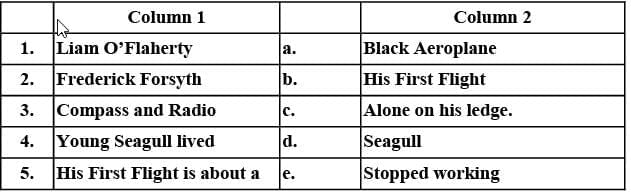
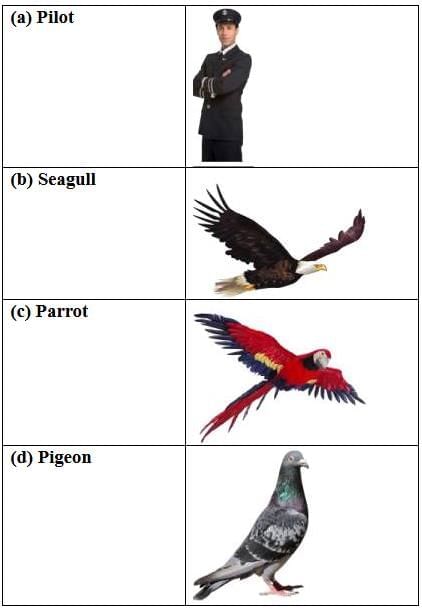
Q1. Fill in the Blanks Using the Suitable options (See, France, India, Seagull, Black Aeroplane, Frederick Forsyth) (a) The pilot was unable to ___ anything. (b) From _____ to _____, the pilot was flying. (c) The title ____ is based on the aeroplane that helped the pilot. (d) _____ is the author of Black Aeroplane. (e) ____ is the focus of the lesson “His First Flight.”
Q2. Match the following.
Q3. What is the lesson “His First Flight” about?
Q4. Why was he afraid to fly? (a) He lacked courage. (b) He was concerned that his wings would not support him. (c) He was concerned that people would criticise him. (d) Both 1 and 2.
Q5. What did his parents threaten to do if he didn’t fly away? (a) never speak to him (b) punish him (c) should starve him (d) leave him
Q6. What lessons did his parents impart to his siblings? (a) to master the art of flight (b) skimming the waves (c) to fish by diving (d) All of the above
Q7. Which control station did he call while travelling?
Q8. What food did the Seagull’s mother purchase for it?
Q9. The young Seagull was alone, why?
Q10. Name the aircraft in which the pilot was operating?
Q11. Why didn’t he travel with his brothers and sisters?
Q12. Why was he frightened to fly?
Q13. How far away from Paris was the narrator when he noticed ominous clouds in the sky?
Q14. During the day, what did he observe?
Q15. ‘He felt the heat because he had not. eaten since the previous nightfall’ what did the little Seagull do to feed himself?
Q16. Why was it impossible for the young Seagull to fly to his parents?
Q17. When the Seagull failed to catch their attention, what were his family members doing on the plateau?
Q18. How did the baby Seagull learn to fly?
Q19. When did the Seagull start to fly? Where does it end?
Q20. What occurred when the young Seagull dove for the fish that his mother had just picked up?
Q21. When the Seagull’s belly reached the green sea, how did he feel?
Q22. How did the Seagull conquer his sea phobia?
Q23. Do you feel sorry for the Seagull? Why?
Q24. How did the baby Seagull discover how to float in the water?
Q25. What did the little Seagull do to catch his mother’s eye?
Q.1. What is the tiger doing in its cage? (a) Jumping (b) Terrorising (c) Sleeping (d) Stalking
Q.2. Whose noise does tiger hear last at night? (a) Noise of the animals (b) Noise of the patrolling cars (c) Noise of the villagers (d) Noise of the visitors
Q.3. Explain why the Tiger ignores the visitors at the zoo?
Q.4. What does the poet mean when he says that the Tiger’s strength is behind the bars?
Q.5. Explain how the poet contrasts the Tiger in the cage to the Tiger in the jungle?
Q.6. What is the tiger doing? Why is he ignoring the visitors?
Q.7. Describe the tiger in the wild.
Q.8. Is it right to confine wild animals into cages? Why or why not?
Q.9. How does a tiger create terror for the villagers?
Q.10. Why does the tiger express his rage quietly?
Multiple Choice Questions Q1: What realizations did Mandela have of his boyhood freedom? (a) Freedom was meant for kids (b) He was born free (c) It is just an illusion (d) He had no realizations
Q2: Nelson Mandela’s wish for the country was _________. (a) to unite all his people together (b) to push away the enemies (c) to remain free forever without an oppressor ruling them (d) none of these
Q3: According to Mandela, what is the greatest wealth of a nation? (a) minerals (b) gems (c) diamonds (d) people
Q4: What unintended effect did the decades of oppression and brutality have? (a) created men of extraordinary courage, wisdom, and generosity (b) Poverty and suffering (c) Boycotts from foreign nations (d) both 2 and 3
Q5: What change brought international leaders to South Africa? (a) End of Apartheid (b) humanity (c) peace (d) trade negotiations
Short Answer Type Questions Q6:What were Nelson Mandela’s views on the policy of Apartheid? Q7: What were the difficulties Nelson Mandela encountered while fighting for freedom? Q8: How did ‘hunger for freedom’ change Mandela’s life? Q9: What are the ‘twin obligations’ referred to by Nelson Mandela? Q10: What was unique in the inauguration ceremony?
Long Answer Type Questions Q11: Describe the views of Mandela for the black people who fought and sacrificed their lives for the country’s political independence. Q12: What were the difficulties faced by Nelson Mandela in achieving freedom for his people? Q13: Summarise the chapter ‘Nelson Mandela -Long Walk to Freedom.
Extract Based Questions Q14: In life, every man has twin obligations- obligations to his family, to his parents, to his wife and children; and he has an obligation to his people, his community, his country. In a civil and humane society, each man is able to fulfil those obligations according to his own inclinations and abilities. But in a country like South Africa, it was almost impossible for a man of my birth and colour to fulfil both of those obligations. In South Africa, a man of colour who attempted to live as a human being was punished and isolated. (a) What are the obligations that every man has in his life? (b) Why was it impossible for a coloured man to discharge his obligations in South Africa? (c) What does it mean by the phrase ‘a man of my birth’? (d) What is the adjective form of ‘punished’?
Q15: On the day of the inauguration, I was overwhelmed with a sense of history. In the first decade of the twentieth century, a few years after the bitter Anglo-Boer war and before my own birth, the white-skinned people of South Africa patched up their differences and erected a system of racial domination against the dark-skinned people of their own land. The structure they created formed the basis of one of the harshest, most inhumane societies the world has ever known. Now, in the last decade of the twentieth century, and my own eighth decade as a man, that system had been overturned forever and replaced by one that recognised the rights and freedoms of all people, regardless of the colour of their skin. (a)What made the author overwhelmed? (b) Which system was created by white-skinned people of South Africa? (c) What did the new system recognize? (d) Which word in the passage means the same as ‘submerged’?
Multiple Choice Questions Q1: Why are desires compared to fire? (a) Both are lethal (b) Both are related to heat (c) Both burn (d) Both consume rapidly
Q2: According to the poem Fire and Ice, what do some people think the world will end in? (a) Rain (b) Moon (c) Sun (d) Fire
Q3: “But if it had to perish twice.” What does ‘it’ stand for in this line? (a) World (b) Desire (c) Ice (d) Fire
Q4: Who is the poet of the poem Fire and Ice? (a) Robert Frost (b) Ben Jonson (c) William Cowper (d) William Blake
Q5: Name the poetic device used in the line To say that for destruction ice is also great. (a) Oxymoron (b) Alliteration (c) Imagery (d) Metaphor
Short Answer Type Questions Q6: Which age-old question does the poem revolves around? Q7:What do the metaphors of Ice and Fire convey to the reader? Elaborate. What is the message given by the poet? Q8: What do ‘Fire’ and ‘Ice’ stand for and what is the general opinion regarding the world? Q9:How can fire destroy the world? Q10: What is the central idea of the poem ‘Fire and ‘Ice’?
Long Answer Type Questions Q11: Discuss how extreme behavior can hasten the end of the world with respect to ‘Fire and Ice’. Q12: The poem ‘Fire and Ice’, carries with it very deep thematic ideas. Elaborate on these darkest traits of humanity. Q13: How will the world end? Support your answer with a scientific explanation.
Extract Based Questions Q14: Some say the world will end in fire Some say in ice. From what I’ve tasted of desire I hold with those who favor fire. (a) What is the poet’s opinion of the world in these lines? (b) What is the poet’s opinion about the world? (c) What is the contradictory opinion of the public? (d) How are ice and fire similar to each other though they have contradictory traits?
Q15: But if it had to perish twice, I think I know enough of hate To say that for destruction ice Is also great And would suffice. (a) Why does the poet feel that ‘ice’ is also great for destruction? (b) What is the rhyme scheme of this stanza of the poem? (c) The two things that the poet thinks are good enough for destruction are (d) What does ‘it’ stand for in the first line?
(a) From joy to sorrow (b) From hope to despair (c) From despair to cheer (d) From anger to harmony
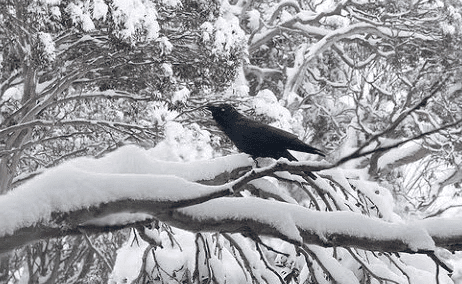
Q2: Who is the poet of the poem “Dust of Snow”? (a) Leslie Norris (b) Robert Frost (c) Carolyn Wells (d) Robin Klein
Q3: Where was the crow sitting?
(a) on a Banyan tree (b) on a Hemlock tree (c) on a Pine tree (d) on a Gulmohar tree
Q4: Pick the set of options that are related to the idea conveyed in the poem. i.The state of sadness neither can be ended nor can be avoided. ii. The state of depression should last for long. iii. Everyone has moments of sadness or depression in one’s life. iv. The sooner one gets over grief or depression the better it is. v. The state of depression if not ended will end us. vi. The state of sadness should continue for long. vii. Everyone mustn’t avoid the state of depression.
a. i, ii, iv b. iii, iv, v c. v, vi, vii d. i, iii, v
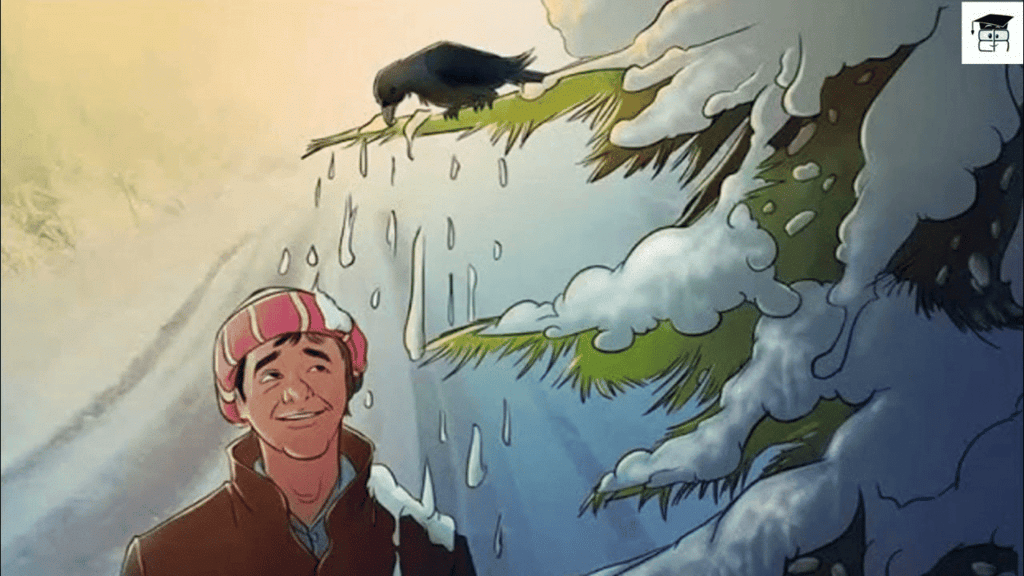
Q5: What did poet realise when dust of snow fell on him?
i. That he had wasted his time being in sorrow ii. That he should utilise his remaining day in doing some useful tasks.
a. Both (i) and (ii) are correct b. Only (i) is correct c. Only (ii) is correct d. Neither (i) nor (ii) is correct
Q6: What do the crow, hemlock tree and dust of snow represent in the poem?
Q7: It is our attitude towards a situation that makes it positive or negative. Do you agree with it? Express your views with reference to the poem ‘Dust of Snow’.
Q8: In the poem ‘Dust of Snow’, how does the poet’s mood get changed?
Q9: A simple moment proves to be very significant and saves the rest of the day of the poet from being wasted.Explain on the basis of the poem ‘Dust of Snow’.
Q10: What do the ‘Hemlock’ tree and ‘Crow’ represent? What does the dust of snow metaphorically stand for?
Q.1. The field of corn dotted with flowers means that (a) not a single flower was bigger than a dot. (b) the flowers were scattered across. (c) the flowers were in shaped like dots. (d) the flowers had shrunk in size.
Q.2. Which crop was growing on Lencho’s fields? (a) Corn (b) Barley (c) Rice (d) None of the above
Q.3. Why did the postmaster decide to reply to Lencho’s letter? (a) he was a good man (b) he felt empathetic (c) to preserve Lencho’s faith in God (d) all of the above Q.4. How much money did Lencho ask for?
Q.5. Where did Lencho expect the downpour to come from? (a) north (b) north-east (c) north-west (d) south-east
6. True and False: (a) The letter was read by the postmaster. (b) Lencho wished for Rain. (c) Lencho compared the raindrops to new coins. (d) After the rain ended, Lencho was overcome with sorrow because everything had been Safe. (e) He was happy with the difference in the amounts.
7. Fill in the blanks: (Harvest, God, Laughed, Died, Hundred) (a) Lencho wished for favourable rain because a good____ required it (b) In Lencho’s field, all of the crops ____as a result of the weather. (c) The postmaster first____ as he read Lencho’s letter (d) Lencho had asked for a____ pesos (e) He has entire faith in___
Q.6. Who did Lencho write a letter? What did he ask for?
Q.7. How did the rain change? What happened to Lencho’s fields?
Q.8. What does the postmaster do to answer Lencho’s Letter?
Q.9. People get support from family and friends during bad times. How does Lencho’s family behave after the harvest is ruined?
Q.10. What were Lencho’s feelings when he found the letter with money in it? What did he do after opening the letter?