9. The Book that Saved the Earth – Textbook Summary

Key Points of the Story

  • The Historian reveals that the Martian invasion of Earth in 2040 never occurred because one book prevented it.
  • Think-Tank, the Martian Commander, intends to invade Earth and sends OmegaIota, and Oop on a mission.
  • The Martian crew arrives in a library and confuses books for sandwiches.
  • Think-Tank misinterprets books as tools for visual communication.
  • The crew reads nursery rhymes, which Think-Tank wrongly sees as Earth’s advanced technology and invasion strategies.
  • In a panic, Think-Tank commands the invasion fleet to evacuate Mars and head for Alpha Centauri.
  • What was the book, you ask? A grand encyclopedia? A book about rockets and missiles? A secret document from outer space? No, it was none of these.
  • The Historian concludes that this misunderstanding stopped the invasion, and as you know, in the twenty-fifth century, five hundred years later, we Earthlings resumed contact with Mars and became very friendly with the Martians.

Detailed Summary

The story is set in the twenty-fifth century at the Museum of Ancient History on Earth, specifically in the Department of the Twentieth Century. The Historian begins by welcoming the audience and explaining the significance of books in the twentieth century. She introduces the story of the Martian invasion of 2040, which was prevented by a single book. Using a historiscope, she shows what happened.

The scene shifts to Mars Space Control, where Think-Tank, the Martian Commander-in-Chief, is preparing to invade Earth. He is assisted by Noodle and a space crew consisting of Captain Omega, Lieutenant Iota, and Sergeant Oop. Think-Tank, with his inflated ego, orders Noodle to establish communication with the space probe headed to Earth.

The Martian crew lands in a library on Earth and is baffled by the books, mistaking them for sandwiches. Think-Tank, believing the books are food, orders Omega to eat one. She hesitates and passes the task to Iota, who then delegates it to Oop. Oop pretends to eat the book and complains about its dryness.

Noodle suggests that the “sandwiches” might be communication devices. Think-Tank orders the crew to listen to the books, but they hear nothing. He then decides they must be for visual communication and tells the crew to decode them. The crew reads nursery rhymes from a book, which Think-Tank misinterprets as advanced Earth technology and military strategies. For example, “Mistress Mary” is seen as a method to grow metals and explosives, and “Hey Diddle Diddle” suggests Earthlings have advanced space techniques and musical culture for animals.

The final nursery rhyme, “Humpty Dumpty,” terrifies Think-Tank because he believes it describes his own downfall. Panicked, he orders an immediate retreat to Alpha Centauri and the evacuation of Mars. The scene returns to the Historian, who explains that the misunderstanding led to the prevention of the Martian invasion. She concludes by saying that Earth and Mars eventually became friends, and Mars learned to read, although they still avoid the book “Mother Goose.”

Characters:

  • Historian: Narrates the story and sets the scene.
  • Think-Tank: The Martian Commander-in-Chief with a huge ego and an egg-shaped head.
  • Noodle: Think-Tank’s assistant, who helps with communications.
  • Captain Omega, Lieutenant Iota, Sergeant Oop: Members of the Martian space crew who explore the Earth library.

The story humorously illustrates how misunderstandings can lead to irrational decisions, emphasizing the importance of knowledge and communication.

Try yourself:

What did Think-Tank initially mistake the books for in the story?

  • A.Communication devices
  • B.Sandwiches
  • C.Weapons
  • D.Music players

View Solution

Theme/ Message

Theme

  • Misinterpretation and Fear: Misunderstandings can lead to unnecessary fear and irrational decisions.
  • Knowledge and Understanding: Understanding and knowledge can prevent conflicts and foster cooperation.
  • The Role of Books: Books are vital in reducing misunderstandings and conflicts by offering knowledge and context.

Message

  • Value of Books: Books hold immense power and can influence events beyond imagination.
  • Friendship Over Conflict: Misunderstandings should be resolved to turn potential conflicts into friendships.

Difficult Words

  1. Musty: Having a stale smell.
  2. Peevishly: Irritably.
  3. Salutation: A gesture or utterance made as a greeting.
  4. Prosaic: Ordinary, dull.
  5. Disillusioned: Disappointed by someone or something previously respected or admired.
  6. Explanatorily: Intended to explain.
  7. Commanding: Impressive, authoritative.
  8. Inflection: A change in the pitch of the voice.
  9. Levity: Lightness of manner or speech, humor.
  10. Haughtily: Arrogantly.
  11. Decipher: To interpret or make out the meaning of.
  12. Trifling: Of little value or importance.
  13. Nuisance: An annoying person or thing.
  14. Primitive: Basic or unsophisticated.
  15. Pantomimes: Acts without speaking, using gestures
8. Bholi – Textbook Summary

Key Points of the Story

  • Bholi, whose real name is Sulekha, was the fourth daughter of Numberdar Ramlal. Due to a childhood injury, she was considered a simpleton, and her name “Bholi” means “simpleton.”
  • She faced difficulties from smallpox, which left her disfigured and caused speech problems.
  • Her father Ramlal decided to send her to school after the Tehsildar advised him to set an example for the villagers by educating his daughters, despite objections from the family.
  • At first, Bholi was scared about going to school, but she found comfort and support from her teacher, which helped her conquer her fears and stammering.
  • Years later, her father brought a marriage proposal from a wealthy man, but Bholi turned it down, showing her new confidence and sense of self-worth.
  • The story ends with Bholi’s determination to become a teacher and help her family.

Detailed Summary

Ramlal had seven children: three sons and four daughters. All his children were healthy, but his youngest daughter, Sulekha, was different. At birth, she was very fair and pretty. However, when she was ten months old, she fell from her cot and injured her brain. At two years old, she had smallpox, leaving her face with deep black pock-marks. She could not speak until she was five, and when she finally did, she stammered. Because of this, everyone called her Bholi, meaning simpleton. She was seen as foolish even by her family, who did not care for her. Ramlal’s eldest daughter, Radha, was already married, and the second daughter, Mangla, had her marriage arranged. Ramlal was only worried about Bholi.

A primary school for girls opened in the village, and the Tehsildar Sahib came to inaugurate it. He told Ramlal, “As a revenue official, you represent the government in the village, so you must set a good example. You should send your daughters to school.” Both Ramlal and his wife were against girls’ education, but Ramlal felt he could not disagree with the Tehsildar. His wife suggested, “Send Bholi to school. With her looks and lack of understanding, there is little chance of her getting married. Let the teachers handle her.”

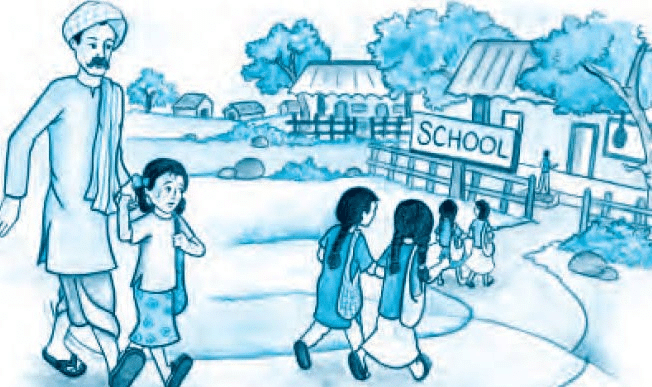
The next day, Ramlal asked Bholi to join him for school. She was very scared and refused to go. Ramlal asked his wife to give Bholi decent clothes. Although she had never had new clothes, that day she received a clean dress. She was bathed, and oil was applied to her dry hair. Only then did she start to think that perhaps she was going to a place better than home.

At the school, Bholi saw many girls her age in the classrooms. The headmistress asked her to sit in a corner of one classroom. The teacher was very kind and asked Bholi her name, but Bholi could not say it fully and began to cry. When school finished, the teacher invited her to come back the next day, and Bholi nodded. As she got to know the teacher, her fears began to fade, and soon she was speaking without stammering.

Bholi was seven when Mangla got married. She had passed several classes, although the exact number is unclear. Her father received a marriage proposal for her from Bishamber, a wealthy grocer from a nearby village. He limped and was around fifty years old, with children from a previous marriage. Ramlal accepted the proposal and asked Bishamber to come with a bar (wedding procession).

Bishamber arrived with great show for the wedding, and everyone was joyful with friends and relatives present. However, when Bishamber was about to place the garland around Bholi’s neck, a woman pulled back her veil. When Bishamber saw Bholi’s face covered in pock-marks, he refused to marry her. After much persuasion, he agreed to marry her only if Ramlal paid him five thousand rupees. Ramlal handed over the money, and Bishamber felt triumphant. Just as he was about to place the garland on Bholi, she knocked it away, declaring that she would not marry such a greedy and cowardly man. The wedding procession left without a bride, leaving Ramlal filled with grief and shame.

Bholi comforted her father, saying that she would care for them in their old age and would become a teacher at the same school where she had received her education.

Try yourself:

What was the reason behind Bholi’s disfigurement and speech issues?

  • A.Falling down from a cot
  • B.Smallpox
  • C.Childhood injury
  • D.Lack of proper education

View Solution

Theme/MessageTheme:

  • Empowerment through Education: The transformative power of education in shaping one’s identity and confidence.
  • Self-Acceptance: Overcoming societal labels and embracing one’s true self despite external judgments.
  • Standing Against Oppression: Resisting oppressive norms and asserting individual agency.

Message:

  • Education as Liberation: Education can break the chains of ignorance and empower individuals to defy societal expectations.
  • Courage in Adversity: The story highlights the importance of courage in facing challenges and standing up for one’s beliefs.
  • Self-Worth and Dignity: Bholi’s refusal to compromise her self-worth emphasizes the significance of dignity and self-respect.

Difficult Words

  1. Simpleton: A person lacking common sense or wit.
  2. Disfigured: Altered in shape or appearance, especially in a negative way.
  3. Stammered: To speak with involuntary pauses or repetitions.
  4. Contempt: The feeling that a person or a thing is beneath consideration, worthless, or deserving scorn.
  5. Izzat: Honor or respect.
  6. Limp: To walk with difficulty, typically due to a damaged or stiff leg or foot.
  7. Triumphant: Having achieved a great victory or success.
  8. Contemptible: Deserving scorn or disdain; worthy of disrespect.
  9. Confused: Unable to think clearly; bewildered.
  10. Adversity: Difficulties or misfortune.
  11. Resist: To withstand the action or effect of something.
  12. Empowerment: The process of becoming stronger and more confident, especially in controlling one’s life and claiming one’s rights.
  13. Agency: The capacity of individuals to act independently and make their own free choices.
  14. Self-Respect: Pride and confidence in oneself; a feeling that one is behaving with honor and dignity.
  15. Transformation: A marked change in form, nature, or appearance.

7. The Necklace – Textbook Summary

Key Points of the Story

  • Matilda Loisel, a pretty young woman, is unhappy with her modest life as the wife of a petty clerk.
  • She longs for wealth, luxury, and social status, feeling out of place in her humble surroundings.
  • Her husband brings home an invitation to a prestigious ball, hoping to make her happy.
  • Matilda is upset because she has nothing suitable to wear and no jewels to adorn herself.
  • Her husband sacrifices his savings for a gun to buy her a dress, and she borrows a diamond necklace from her wealthy friend, Mme Forestier.
  • Matilda is the belle of the ball, enjoying the admiration and attention of everyone present.
  • Upon returning home, she realizes she has lost the borrowed necklace.
  • The Loisels search frantically but cannot find it. They decide to replace it, spending all their savings and borrowing heavily.
  • They buy a replacement necklace for thirty-six thousand francs, plunging into debt to pay it off over the next ten years.
  • Matilda’s life becomes one of hardship and toil as she works tirelessly to repay the debt.
  • After ten years, they finally clear their debt, but Matilda has aged and lost her beauty due to the hard life.
  • She meets Mme Forestier and reveals the truth about the lost necklace, only to learn that the original necklace was a fake worth only 500 francs.

Detailed Summary

The Necklace’ is a touching story. The story centers around Matilda Loisel. She is a very charming young lady. She is married to a clerk. She is not satisfied with her ordinary life. She wants to enjoy the comforts and luxuries of life. She is jealous of her own schoolmates, who are rich.
One day her husband gets an invitation to attend the dance party given by the Minister of Public Instruction. He thinks that she will be happy to get the invitation. But she becomes sad. She tells her husband that she has nothing to wear at the party. Her husband spends all his savings and buys a beautiful gown for her. Now she complains that she has no jewelry or ornaments. Without it, she will be considered a poor lady. Her husband advises her to borrow some ornament from her wealthy I’ fiend Madame Forestier. She goes to Madame Forestier’s house and borrows a beautiful diamond necklace at the party, Matilda looks very beautiful. 

All the men at the party pay attention to her. They want to be introduced to her. They want to dance with her I -Even the Minister pays attention to her. She is filled with joy. She dances with pleasure. She leaves the hall l at four o’clock in the morning. When she reaches home, she stands before the mirror to praise her own beauty. But suddenly she utters a cry. She has lost the diamond necklace somewhere. Her husband goes out to see if he can find it. He searches for the necklace everywhere. 

But he doesn’t find it. Matilda and her hush dare greatly depressed. Matilda’s husband advises her to write to her friend that she has sent the necklace for repairs. It will give them some time to buy another necklace. They go from shop to shop to purchase a similar necklace. At last, they find a necklace similar to the lost one. ‘Ell’ e bargain is settled at 36,000 francs. Matilda’s husband borrows the money at high interest. They buy the necklace and return it to Madame Forestier. She doesn’t even open the box to look at the necklace.


Now Matilda and her husband are with- her heavy debt. They work hard to pay off this debt. Their life becomes miserable. They dismiss their servant. They move to a cheap house. Matilda does all the household work herself. Her husband works in the evening ling and late at night to pay off the debt. They work hard for ten years. At last, they are able to pay off their debt. Now Matilda looks old. She is no longer charming.
One Sunday, Matilda goes out for a walk. She comes across Madame Forestier and talks to her. Madame Forestier is surprised to see Matilda so changed. Matilda tells her the story of her hard life. She tells Madame Forestier that she has suffered greatly because of her. Then she tells Madame Forestier the whole story. She tells her how she lost her necklace and bought ai lather one for thirty-six thousand francs. She tells Madame Forestier that it has taken them ten years to pay off the debts. Madame Forestier is moved to hear the whole story. Then she tells Matilda that her necklace was maile of artificial diamonds. It was worth only five hundred francs.

Try yourself:

What did Matilda do after losing the borrowed necklace at the ball?

  • A.She confessed to her friend Madame Forestier immediately.
  • B.She searched for the necklace with her husband but couldn’t find it.
  • C.She decided to keep the loss a secret and never mentioned it again.
  • D.She borrowed money to buy a replacement necklace without informing her husband.

View Solution

Theme/ MessageTheme

  • Appearance vs. Reality: The story explores the difference between appearance and reality, particularly through the revelation that the borrowed necklace was fake.
  • The Dangers of Vanity: Matilda’s desire for a luxurious lifestyle and social status leads to her downfall, highlighting the perils of vanity.
  • The Irony of Fate: The story demonstrates the ironic twists of fate, as Matilda’s efforts to appear wealthy result in her experiencing real poverty.

Message

  • Contentment: The story conveys the importance of being content with one’s circumstances and not coveting a life of superficial glamour.
  • Honesty: It emphasizes the value of honesty, as Matilda’s failure to admit the loss of the necklace leads to unnecessary suffering.
  • Acceptance: The narrative suggests that accepting and working within one’s means can prevent unnecessary hardship and regret.

Difficult Words

  1. Dowry – Property or money brought by a bride to her husband on their marriage.
  2. Incessantly – Without interruption; constantly.
  3. Tureen – A deep covered dish from which soup is served.
  4. Exquisite – Extremely beautiful and delicate.
  5. Elated – Ecstatically happy.
  6. Spitefully – In a way that shows a desire to harm or upset someone.
  7. Vexation – The state of being annoyed, frustrated, or worried.
  8. Stupefied – Unable to think or feel properly; astonished.
  9. Haggling – Dispute or bargain persistently, especially over the cost of something.
  10. Usurers – People who lend money at unreasonably high rates of interest.
  11. Chaplet – A garland or wreath for a person’s head.
  12. Frigid – Very cold in temperature.
  13. Ruinous – Disastrous or destructive.
  14. Intoxicated – Excited, exhilarated, or elated to the point of impairing one’s faculties.
  15. Necessity – The fact of being required or indispensable.

6. The Making of a Scientist – Textbook Summary

About the Author

Richard Ebright has received the Searle Scholar Award and the Schering-Plough Award for Biochemistry and Molecular Biology. His fascination with butterflies sparked his interest in science, ultimately leading him to a distinguished career in research.Richard H. Ebright

Key Points of the Story

  • Richard H. Ebright, a former ‘scout of the year,’ presented a groundbreaking theory about cell functions at the age of twenty-two.
  • Ebright and his college roommate introduced this theory in the Proceedings of the National Academy of Science.
  • Starting with a passion for collecting butterflies from a young age, Ebright showed exceptional curiosity and drive for learning.
  • Supported by his mother, Ebright excelled in academics and pursued various scientific projects, including studying butterfly migrations and experimenting with insect hormones.
  • His research culminated in a new theory on cell life, which could have significant implications for understanding biological processes and potentially combating diseases like cancer.
  • Despite his deep involvement in science, Ebright also excelled in other areas such as debating, public speaking, and outdoor activities.

Detailed Summary

Once upon a time, there was a remarkable young man named Richard H. Ebright, who, at just twenty-two years old, was honored as the ‘Scout of the Year’. His groundbreaking theory about cell functions made waves in the scientific community, earning him a prestigious place in the Proceedings of the National Academy of Sciences. This was a notable achievement as it marked the first time that college students had their work published in this esteemed journal.

Richard’s fascination with science began in his childhood in Reading, Pennsylvania. As an only child, he found solace in collecting butterflies, rocks, fossils, and coins. His relentless curiosity and intellectual spirit were nurtured by his dedicated mother, who encouraged his interests and supported his academic pursuits. Richard excelled academically from a young age, with his mother playing a crucial role in his intellectual development.

Richard’s early interest in butterflies led him to participate in butterfly tagging research under the guidance of Dr. Frederick A. Urquhart. This experience allowed him to study monarch butterfly migrations, laying the groundwork for his future scientific endeavors. Despite facing setbacks, such as losing in a county science fair, Richard’s competitive drive propelled him to undertake more profound experiments. His high school projects focused on butterfly behavior and insect hormones, earning him significant accolades in various science fairs.

Richard’s groundbreaking research on monarch pupa hormones eventually led to a revolutionary theory on cell life. Alongside his college roommate, James R. Wong, Richard developed a concept explaining how cells interpret DNA blueprints—a crucial aspect of biological processes. Their collaborative work was a testament to Richard’s insatiable curiosity and dedication to understanding life at a cellular level. Beyond his academic pursuits, Richard excelled in debating, public speaking, outdoor activities, and photography, showcasing his diverse talents and interests. His achievements in both science and extracurricular activities highlighted his well-rounded personality and set him on the path to becoming a respected scientist.

Richard Ebright’s story exemplifies the essence of scientific inquiry—a blend of intellect, curiosity, and perseverance in the quest to understand life’s complexities. His journey from a young butterfly enthusiast to a promising scientist at Harvard Medical School reflects the transformative power of relentless curiosity and dedication.

In conclusion, Richard Ebright’s narrative underscores the significance of nurturing curiosity, embracing challenges, and pursuing knowledge with unwavering determination. His remarkable achievements in science stand as a testament to the profound impact of scientific curiosity and the endless possibilities it offers for advancing our understanding of the world.

Try yourself:

What sparked Richard H. Ebright’s interest in science and research?

  • A.Collecting rocks and fossils
  • B.Participating in butterfly tagging research
  • C.Winning awards in debating competitions
  • D.Engaging in public speaking activities

View Solution

Theme

The chapter emphasizes how curiosity and determination drive scientific discovery. It also highlights the role of supportive relationships, like Ebright’s mother and teachers, in shaping his journey. His story shows how diverse interests and early experiences can lead to major achievements.

Message

curious and questioning mind, combined with perseverance and the ability to learn from failure, is essential for success. The story also conveys that encouragement and guidance from others play a vital role in developing one’s talents and reaching one’s full potential.

Glossary

  1. Determination: Firmness of purpose
  2. Curiosity: Strong desire to know or learn something
  3. Entomology: The branch of zoology concerned with insects
  4. Heredity: The passing on of physical or mental characteristics genetically from one generation to another
  5. Hormone: Regulatory substance produced in an organism and transported in tissue fluids
  6. Zoology: The scientific study of the behavior, structure, physiology, classification, and distribution of animals
  7. Caterpillar: The larval stage of a butterfly or moth
  8. Pupa: An insect in the nonfeeding, usually immobile, transformation stage between larva and adult
  9. Microscope: Optical instrument used for viewing very small objects
  10. Monarch: A large migratory orange and black butterfly 

5. Footprints without Feet – Textbook Summary

Key Points of the Story

  • Griffin: Scientist discovers invisibility using rare drugs.
  • Becomes homeless after setting fire to his house and fleeing naked.
  • Leaves muddy footprints in London, attracting attention.
  • Hides in store, steals clothes, food, and becomes visible temporarily.
  • Disguises with bandagesglasses, and robs a theatrical shop.
  • Moves to Iping village, stays at an inn, raises suspicion.
  • Clergyman’s money stolen; furniture behaves oddly.
  • Reveals invisibility by removing disguises during confrontation.
  • Escapes after chaotic encounter with constable and villagers.
  • Themes: misuse of scienceisolation, and fear of the unknown.

Detailed SummaryOnce upon a time in a big city called London, two boys were surprised to see muddy footprints of bare feet on the steps of a house. They wondered why a barefooted man was in the city. Soon, they witnessed fresh footprints appearing mysteriously and followed them as they descended down the street, gradually fading away. The boys were curious until the footprints vanished completely. The reason behind this magical occurrence was simple. 

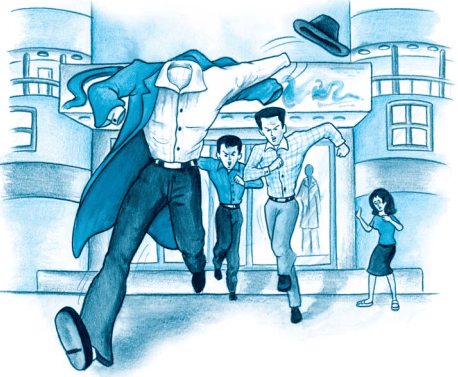
They were unknowingly following a scientist named Griffin who had discovered how to make his body transparent. By swallowing special drugs, Griffin turned invisible yet remained solid. However, he was not a lawful person and had set a house on fire in revenge, which led to his homelessness and invisibility. Griffin’s adventures continued as he roamed London in the winter cold, struggling without clothes. To survive, he sneaked into a store after closing time, clothed himself, and feasted on food he found. Unfortunately, he overslept and had to escape without his newfound clothes, becoming invisible again. Desperate for clothes and a disguise, Griffin plundered a theatrical shop, emerging with bandages, glasses, a false nose, whiskers, and a hat to cover his headless appearance. 

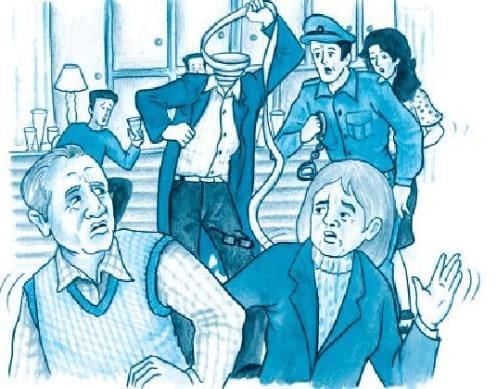
Fleeing the city, he arrived at an inn in Iping, where his strange presence stirred gossip among the locals. The situation escalated when money went missing from a clergyman’s home, leading to suspicions falling on Griffin. The climax arrived when Mrs. Hall, the innkeeper’s wife, confronted Griffin about his strange activities, prompting him to reveal his invisibility by shedding his disguises, shocking everyone present. The village constable, Mr. Jaffers, attempted to arrest the invisible Griffin, resulting in a chaotic struggle where Griffin fought back unseen, eventually knocking out the constable and escaping into the night. 

Despite the villagers’ attempts to capture him, Griffin remained invisible and elusive, causing confusion and chaos wherever he went. The tale of the headless, invisible man became a mystery and a source of fear in the quiet village of Iping. And so, the invisible Griffin’s escapades continued, leaving a trail of bewilderment and disbelief in his wake as he navigated a world that could not see him but felt the impact of his presence.Theme/ MessageTheme:

The story highlights invisibilityisolation, and the misuse of science. Griffin’s invisibility leads to chaos, his solitude reflects loneliness, and his unethical actions show the dangers of unchecked ambition.

Message: 

The story underscores the dangers of isolation, showing how it leads to Griffin’s destructive behavior. It emphasizes the ethical responsibilities associated with scientific advancements and highlights how actions have far-reaching consequences, as seen through Griffin’s choices.

Difficult Words

  • Transparent – see-through, clear 
  • Lawless – without following the law 
  • Revenge – to harm someone in return for being harmed 
  • Eject – to force someone to leave 
  • Homeless – without a home 
  • Assistant – a person who helps someone else 
  • Eccentric – unconventional, strange 
  • Hysterics – a state of extreme emotion 
  • Mysterious – difficult to understand or explain 
  • Constable – a police officer 
  • Magistrate – a judge 
  • Unconscious – not awake or aware 
  • Consequences – results or effects of actions 
  • Misuse – using something in the wrong way 
  • Loneliness – feeling alone and isolated

4. A Question of Trust – Textbook Summary

Key Points of the Story

  • He thinks he could sell them for at least fifteen thousand pounds, enough for his needs.
  • Horace Danby is a decent man but not entirely truthful. He is actually a clever thief who steals to support his book collection.
  • He carefully plans his yearly robberies to gather enough loot to live on for the entire year.
  • For two weeks, he studies the house at Shotover Grange, examining its layout, wiring, paths, and garden, aiming to steal valuable jewels.
  • During the robbery, he unexpectedly meets the lady of the house.
  • Horace tries to negotiate his escape, but the woman sees through his ruse. Surprisingly, she offers him a deal: he can leave if he helps her open the safe, from which she forgot the combination.
  • He agrees, successfully opens the safe, retrieves the jewels, and leaves as promised. The woman explains, “Before we left for London, I promised my husband to take my jewels to our bank; but I left them here in the safe. I want to wear them to a party tonight, so I came down to get them, but…”
  • Even with her promise of freedom, Horace is captured by the police. His fingerprints, left while opening the safe without gloves, lead to his arrest, and no one believes his story about being asked by the owner’s wife.
  • He becomes an assistant librarian in prison, reflecting on his encounter with the clever young woman who outsmarted him.

Detailed SummaryIn this chapter, we are introduced to Horace Danby, who appears to be a good and honest citizen in the eyes of everyone around him. He is around fifty years old, unmarried, and lives with a housekeeper who is concerned about his health, particularly his hay fever episodes during the summer. Horace’s main profession is crafting locks, and he is successful enough to employ two assistants. 

However, despite his outward appearance of respectability, Horace harbors a secret: he is a thief who steals from safes to fund his love for rare and expensive books. Every year, Horace plans a meticulous robbery, ensuring he steals enough to sustain himself for the next twelve months while discreetly purchasing the books he desires through an intermediary. In this particular year, he sets his sights on the safe at Shotover Grange, where he believes there are jewels worth around fifteen thousand poundsHe thinks he could sell them for at least fifteen thousand pounds to finance the purchase of three intriguing books he has his eye on. On the day of the planned robbery, while the house’s servants are away at the movies, Horace makes his move. He carefully observes the house, noting the locations of key items and the layout. With his tools packed, he enters the house through the kitchen door, using a key he retrieved from where the housekeeper had hung it. Inside, he encounters a friendly dog named Sherry, whom he quiets by addressing it by name. Moving to the drawing room, Horace locates the safe hidden behind a painting. 

Try yourself:

What is Horace Danby’s main motivation for committing robberies?

  • A.To fund his luxurious lifestyle
  • B.To support his family
  • C.To travel the world
  • D.To buy rare and expensive books

View Solution

Despite a momentary consideration of collecting paintings instead of books, he decides that books are more suitable for his living space. As he begins to work on the safe, he faces distractions such as a bouquet of flowers causing his hay fever to act up. Just as he is about to crack the safe, a young woman unexpectedly appears in the doorway. She engages Horace in conversation, revealing that she is the owner of the house’s valuable jewels. Initially, Horace tries to negotiate his way out of the situation, but the woman sees through his intentions. However, she surprises Horace by striking a deal with him: she will let him go if he helps her retrieve the jewels she had forgotten the safe combination for. Horace agrees and successfully opens the safe, retrieves the jewels, and departs as promised. For a couple of days, he keeps his word, but eventually, his desire for more books leads him to consider another theft. Before he can act on this plan, he is arrested by the police for the jewel robbery at Shotover Grange

Despite his claims that he was assisting the owner’s wife, his fingerprints and the wife’s denial lead to his conviction. Now serving as an assistant librarian in prison, Horace reflects on his encounter with the clever young lady who outsmarted him. He grapples with feelings of anger and betrayal, disillusioned by the idea of “honour among thieves.” In conclusion, the chapter follows Horace’s elaborate theft plan, his unexpected encounter with the house’s owner, and the twist of fate that lands him in prison, serving as a cautionary tale about the consequences of his criminal actions.

Try yourself:

What deal does the young woman strike with Horace in order to let him go after catching him trying to steal the jewels?

  • A.She asks for a portion of the stolen jewels in exchange for letting him go.
  • B.She requests Horace to help her crack the safe and retrieve the jewels.
  • C.She demands a large sum of money from Horace to keep his secret.
  • D.She calls the police to arrest Horace immediately.

View Solution

Theme/ MessageTheme:

  • Deception: The theme of deception is prominent as characters deceive each other for personal gain.
  • Morality: The story explores moral dilemmas and the consequences of unethical actions.
  • Redemption: Horace’s transformation and acceptance of his fate hint at themes of redemption and consequences.

Message:

  • Crime Doesn’t Pay: The story conveys the message that crime and deceit ultimately lead to negative consequences.
  • Appearance vs. Reality: It highlights how appearances can be deceptive and how people may not always be what they seem.
  • Moral Integrity: Upholding moral values and integrity is essential to avoid the pitfalls of dishonesty and crime.

Glossary

  1. Unmarried – not married
  2. Burglar – a person who commits burglary
  3. Consequences – results or effects of an action or condition
  4. Deception – the act of deceiving someone
  5. Dilemma – a situation requiring a choice between equally undesirable alternatives
  6. Redemption – the action of saving or being saved from sin, error, or evil
  7. Ethical – relating to moral principles or the branch of knowledge dealing with these
  8. Transformation – a thorough or dramatic change in form or appearance
  9. Integrity – the quality of being honest and having strong moral principles
  10. Pitfalls – hidden or unsuspected dangers or difficulties

3. The Midnight Visitor – Textbook Summary

Key Points of the Story

  • Fowler, a writer, meets Ausable, a secret agent, expecting excitement and adventure.
  • Ausable is overweight, speaks with an American accent, and seems unimpressive.
  • Ausable tells Fowler about an important document that several people have risked their lives for.
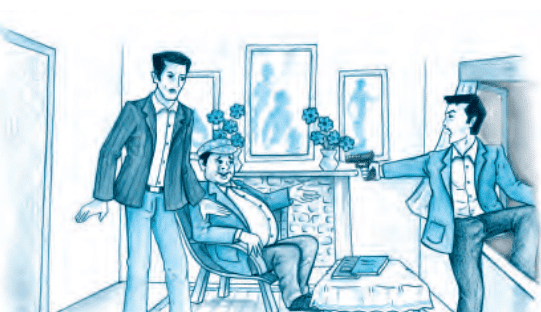
  • They enter Ausable’s room and find a man, Max, holding a gun, demanding the document.
  • Ausable mentions a balcony used to access his room, frustrating Max.
  • Ausable suggests the police are knocking on the door, making Max nervous.
  • Max decides to hide on the balcony, but there is no balcony, and he falls to his death.
  • The knocking is revealed to be a waiter bringing drinks Ausable had ordered.
  • Ausable calmly explains to Fowler that there was no balcony.

Summary

Ausable was a secret agent. He was staying in a French hotel. A young and romantic writer named Fowler came to meet him. Fowler was disappointed to see Ausable. He was a sloppy fat fellow. His room was at the top and sixth floor of that musty and gloomy hotel. When they both entered the room and Ausable switched on they found that a man was standing in the center of the room. He hand a pistol in his hand. It was the first thrill of the day for Fowler.The name of the man with a gun was Max.
He said that he had come there to snatch the report from Ausable which he was expecting to receive. Ausable remained silent and cool. He seemed to be angry with the management of the hotel. He cocked-up a story about the balcony. He told him that there was a balcony just below the window of his room and last month an unknown person had entered the room through that balcony.
Max told Ausable that he had used a master key to enter the door. He wished that he should have entered through the balcony way. It would have been much easier. There was still half an hour for the report to arrive.
There was a sudden knocking at the door. Ausable smiled. He said it must be the police because he himself had called them for the protection of such an important report.
Max was nervous. He jumped through the window to the balcony. But there was no balcony as Ausable had told. He fell down to the ground from the sixth floor and was killed.


Then the door opened. The waiter entered the room with a tray a bottle of wine and two glasses. Ausable had ordered for them. The waiter left. Fowler did not know anything about the balcony. He feared that Max would return soon. But Ausable told him the fact that he would never return. Thus, Fowler was much impressed by his cleverness and presence of mind.

Try yourself:

What did Max come to Ausable’s room for?

  • A.To meet Fowler
  • B.To steal Ausable’s report
  • C.To have a drink with Ausable
  • D.To discuss secret agent missions

View Solution

Theme/ Message

Theme

  • Appearance vs. Reality:
    • Ausable defies the typical image of a secret agent, showing that appearances can be deceptive.
    • The absence of the balcony is a twist, highlighting the gap between appearance and reality.
  • Wit and Intelligence Over Physical Strength:
    • Ausable uses his intelligence and quick thinking to outsmart Max, demonstrating that wit can triumph over physical threats.

Difficult Words

  1. Musty: Having a stale, moldy smell.
  2. Gloomy: Dark or poorly lit, especially so as to appear depressing or frightening.
  3. Passably: In an adequate or satisfactory manner.
  4. Espionage: The practice of spying or using spies.
  5. Prosaic: Having the style or diction of prose; lacking poetic beauty.
  6. Disillusioned: Disappointed in someone or something that one discovers to be less good than one had believed.
  7. Authentic: Of undisputed origin; genuine.
  8. Wheezed: Breathed with a whistling or rattling sound in the chest.
  9. Crafty: Clever at achieving one’s aims by indirect or deceitful methods.
  10. Explanatorily: Serving to explain something.
  11. Commanding: Having a position of authority.
  12. Inflection: A change in the pitch or tone of a person’s voice.
  13. Moodily: Given to unpredictable changes of mood, especially sudden bouts of gloominess or sullenness.
  14. Menacing: Suggesting the presence of danger; threatening.
  15. Prosaic: Lacking imaginativeness or originality.

2. The Thief’s Story – Textbook Summary

Key Points of the Story

  • Ruskin Bond’s ‘The Thief’s Story’ is more than just a tale about a thief. 
  • The story highlights essential human values and relationships
  • Even a thief finds it hard to steal from an honest and careless individual.
  • A young boy becomes friends with Anil. Anil trusts him totally and employs him. 
  • To evade the police and previous employers, he frequently changed his name, and this time he went by Hari Singh.
  • The narrative reveals how the thief tricks Anil by stealing from him but later feels guilty. 
  • Anil’s expression when he realised the theft showed only a hint of sadness, not for the money lost, but for the trust that was broken.

Try yourself:

What does Anil feel when he realizes the theft?

  • A.Fear
  • B.Happiness
  • C.Sadness
  • D.Anger

View Solution

Detailed Summary

The Thief’s Story by Ruskin Bond revolves around Hari Singh, a young but experienced thief who earned his living by befriending people and stealing from them. To keep himself safe from police and former victims, he kept changing his name — this time calling himself Hari Singh.

He met Anil, a simple and easy-going writer, while Anil was watching a wrestling match. Anil, who lived a modest life, earned money irregularly by writing articles for magazines and selling books to publishers. He often borrowed and lent money, earning “by fits and starts”.

When Hari Singh offered to work for Anil, Anil said he could not pay him but could at least feed him if he could cook. Hari lied about knowing how to cook and was hired. His first meal was terrible, but Anil did not get angry. Instead, he offered to teach Hari cooking, reading, writing, and simple mathematics.

Hari Singh worked for Anil and sometimes made small profits while buying groceries, earning about a rupee daily by cheating Anil. However, Anil knew about it and never confronted him.

One day, Anil brought home a bundle of notes after selling a book. At night, while Anil was asleep, Hari Singh stole the money from under Anil’s mattress. He told himself that Anil would only waste the money on friends anyway. As he slipped out quietly, he reached the railway station and was ready to catch the Lucknow Express. But at the last moment, he hesitated and missed the train.

Wandering the streets at night, Hari Singh felt guilty and restless. It started raining heavily, soaking him completely. He sat under the clock tower and thought deeply about his actions. He remembered that stealing from greedy people was easy as they could afford to be robbed, but robbing a careless, trusting person like Anil gave him no satisfaction. Anil would likely feel only sadness, not because of the money lost, but because of the broken trust.

He also realised that Anil’s education was giving him an opportunity for a better life. Without it, he would remain a thief; with it, he could become a respectable man. Overcome by guilt, Hari Singh returned to Anil’s room and quietly placed the money back under the mattress.

The next morning, Anil behaved as usual. He handed Hari Singh a fifty-rupee note — which was damp from the rain — and told him that he would now start paying him regularly. He also said they would begin writing full sentences from that day. Although Anil didn’t say anything directly, Hari Singh understood that Anil knew about the theft but chose to forgive him and give him a second chance.

Try yourself:

What does the story highlight about the difficulty of stealing from an honest person?

  • A.It is easier for a thief to steal from a greedy person.
  • B.It is difficult for a thief to steal from an honest person.
  • C.An honest person is more likely to catch a thief.
  • D.An honest person is less likely to have valuable belongings.

View Solution

Theme

  • The story The Thief’s story by Ruskin Bond is focused on the topics of friendship, treachery, aspirations, connection, trust, guilt, change, kindness, loyalty, retribution, and honesty. 
  • The plot of the narrative is built on the idea that kindness and love have the power to change even the worst crooks and thieves in this harsh planet.
  • The moral of “The Thief’s Story” teaches us not to betray someone’s trust. Although Hari tried to keep the money, he realised that breaking Anil’s trust would leave him with deep regret. Just like Hari, everyone has a chance for redemption.

Message 

  • The message or the moral in ‘The Thief story’ is not to betray the trust reposed on you by a person. 
  • Once the trust of a person is lost, everything is lost. Kindness touches hearts and brings about a change in even in the worst person.
  • This is shown by Hari Singh, the thief, who, despite stealing from Anil, chooses to return because he cannot bear the thought of Anil feeling hurt by his betrayal. Kindness has the power to change even the most troubled individuals.

Glossary

1. A Triumph of Surgery –  Textbook Summary

Key Points of the Story

  • This story is about Tricki, a dog who is the pet of a rich lady named Mrs. Pumphrey. She loves her dog very much and is unable to refuse him anything he wants. 
  • One day, Mr. Herriot meets her on the street and is shocked to see Tricki’s bloated, unhealthy condition, “like a bloated sausage with a leg at each corner.” Mrs. Pumphrey explains that Tricki seems tired and lacking energy, so she has been giving him extra snacks like malt, cod-liver oil, Horlicks, and also cream cakes and chocolates.
  • Mr. Herriot advises her to cut down Tricki’s food and give him more exercise, but she finds it difficult to refuse him treats.
  • A few days later, Mrs. Pumphrey calls, distressed that Tricki is refusing food, vomiting, and unwilling to move. Mr. Herriot insists on taking Tricki to his surgery for treatment, despite Mrs. Pumphrey’s reluctance.
  • At the surgery, Tricki shows no interest in other dogs and is given only water for two days. On the second day, he begins showing interest in his surroundings; on the third day, he joins the other dogs outside and starts eating.
  • Tricki’s health improves rapidly—he plays, competes for food, and becomes active and energetic.
  • Believing Tricki needs “energy foods,” Mrs. Pumphrey sends eggs, wine, and later brandy, which Mr. Herriot and his colleagues consume themselves.
  • After two weeks, Tricki is lean, strong, and fit. Mr. Herriot decides to return him to Mrs. Pumphrey. Tricki joyfully leaps into her lap, and Mrs. Pumphrey, overjoyed, calls his recovery “a triumph of surgery.”

Try yourself:

What does Mrs. Pumphrey think Tricki needs to be healthy?

  • A.More exercise
  • B.Extra snacks
  • C.Less food
  • D.A new toy

View Solution

Detailed Summary

The story begins when Mrs. Pumphrey, a wealthy lady, is out walking her pet dog, TrickiMr. Herriot, a veterinary surgeon who knows her, sees Tricki and is shocked to find him hugely overweight, “like a bloated sausage with a leg at each corner.” Mrs. Pumphrey explains that Tricki seems listless and lacking energy, so she has been giving him extra snacks like malt, cod-liver oil, and Horlicks, along with cream cakes and chocolates. Mr. Herriot advises her to cut down on his food and give him more exercise, but she finds it difficult to refuse him treats.

A few days later, Mrs. Pumphrey calls in distress—Tricki is refusing foodvomiting, and unwilling to do anything. Mr. Herriot decides that the only solution is to take him to his surgery for a fortnight. Though reluctant and worried, Mrs. Pumphrey agrees, sending along numerous items for Tricki’s comfort.

At the surgery, Tricki shows no interest in the other dogs and lies still in his bed. For two days, he is given only water. By the second day, he starts showing interest in his surroundings; on the third day, he joins the other dogs in the yard and begins eating.

From then on, his recovery was rapid. He plays, joins in scrimmages, competes for food at mealtimes, and becomes active and lively. Hearing that Tricki is convalescing, Mrs. Pumphrey starts sending fresh eggs, then bottles of wine, and finally brandy, thinking these will aid his recovery. Mr. Herriot and his colleagues enjoy these luxuries themselves, with eggs for breakfast, wine at lunch, and brandy in the evenings.

After two weeks, Tricki is transformed into a fit, hard-muscled dog. Mr. Herriot decides it is time to return him. When Mrs. Pumphrey’s car arrives, Tricki joyfully leaps into her lap. Overjoyed, she thanks Mr. Herriot and calls the recovery “a triumph of surgery.”

Try yourself:

What was Tricki’s favorite food that Mrs. Pumphrey would often give him?

  • A.Cream cakes and chocolates
  • B.Eggs and bacon
  • C.Milk and cookies
  • D.Carrots and celery

View Solution

Theme

  • The major theme of the chapter is Care vs Over-indulgence.
  • Mrs Pumphrey loved Tricki. Under the influence of her blind love for her pet, she overfed him.
  • Mrs Pumphrey gave him malt, cod-liver oil and a bowl of Horlicks, which she believed would help Tricki regain his strength.
  • This made Tricki overweight and lethargic. Mrs Pumphrey’s over-indulgence in Tricki’s care had, in fact, harmed him.
  • After Tricki’s treatment, Mrs Pumphrey was elated to see her dog active and playful again.

Message

  • The lesson emphasises the importance of responsible pet ownership, cautioning against excessive love that can prove harmful. Mrs. Pumphrey, a wealthy woman, showered her dog Tricky with lavish care and overfeeding. 
  • Her indulgence led to Tricky’s health deterioration, making him lazy and obese. Hospitalised due to his condition, Mrs. Pumphrey continued pampering him with gifts. 
  • The story highlights the message that excessive love and overindulgence can have adverse effects on the well-being of those we care about.

Glossary

  • Gleaming – shining brightly, usually because it is clean or polished.
  • Reverently – with deep respect.
  • Roused – awakened from sleep.
  • Supper – the main evening meal.
  • Tweed –. coarse wool fabric.
  • Bouts – short periods of intense activity.
  • Ceremonial – related to formal public or religious events.
  • Clasped – held tightly in one’s hand.
  • Convalescing – recovering health after an illness.
  • Engulfed – completely surrounded or overwhelmed.
  • Entire – whole, or complete.
  • Fetch – to go and bring back.
  • Flapping – moving in waves.
  • Fortnight –. period of two weeks.
  • Gang –. group of individuals.
  • Gasping – breathing with difficulty.
  • Harness –. set of straps used for control.
  • Hastened – moved or acted quickly.
  • Hovered – stayed in one place in uncertainty.
  • Hugely – very much.
  • Hurtling – moving quickly and uncontrollably.
  • Lolled – relaxed in a lazy manner.
  • Lumbago – pain in the lower back.
  • Panting – breathing quickly and short.
  • Sausage – minced meat in a long casing.
  • Rheumy – watery discharge from the nose or eyes.
  • Listless – lacking energy.
  • Regime –. set plan for diet and exercise.
  • Distraught – extremely upset.
  • Scrimmage –. confused struggle.
  • Lithe – flexible and graceful.