13. Our Home: Earth, a Unique Life Sustaining Planet – Chapter Notes

What would Earth be like if it had never known life at all?
Our planet, Earth, is not just another ball of rock in space. It’s the only known place in the universe that’s bursting with life, from towering mountains to deep oceans and green forests. With the help of powerful satellites like those from ISRO, scientists are uncovering what makes our planet so special. 
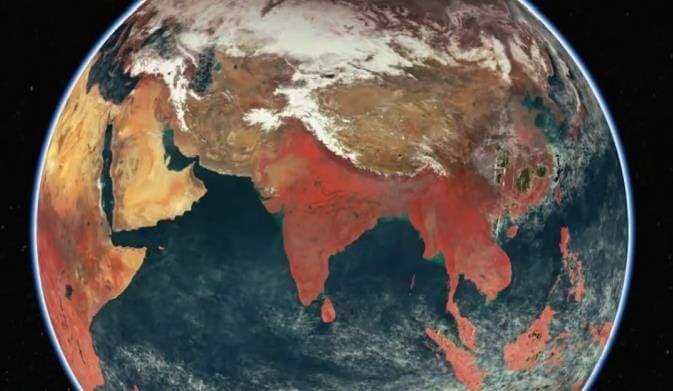
Image by Earth Observation Satellite (ISRO)

In this final chapter, you’ll explore what makes Earth so uniquely fit for life. As we tie together everything you’ve learned so far, get ready to discover the special conditions that make our home a truly life-sustaining planet.

About the Image:

  • The image was captured by an ISRO Earth Observation Satellite.
  • It is a mosaic, created by combining nearly 3,000 smaller images.
  • This is a false colour image—special colours are used to highlight different types of information.
  • Such images help scientists study land, water, plant growth, and environmental changes more clearly.

Why Is Earth a Unique Planet?

Out of the billions of planets in the universe, Earth is the only one we know that has life in so many forms—plants, animals, people, and more.
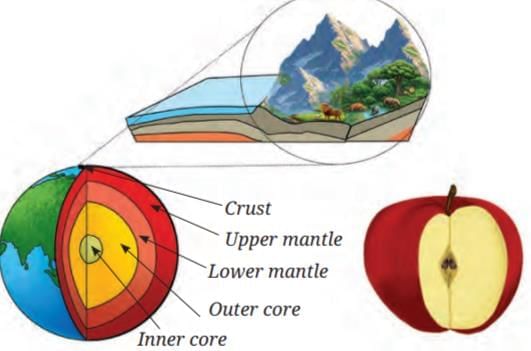
Earth’s Crust is like the thin skin of an apple

  • All living things—from the highest mountain to the deepest ocean—exist on a very thin layer on Earth’s surface called the crust.
  • If the Earth were the size of an apple, the crust where all life exists would be as thin as the apple’s skin.
  • Beneath the crust, there are other layers: upper mantle, lower mantle, outer core, and inner core, but life exists only in the crust.
Activity 13.1: What Makes Earth Special?
Think about and list some interesting features of Earth that we might take for granted, but which matter a lot for our lives. For example:
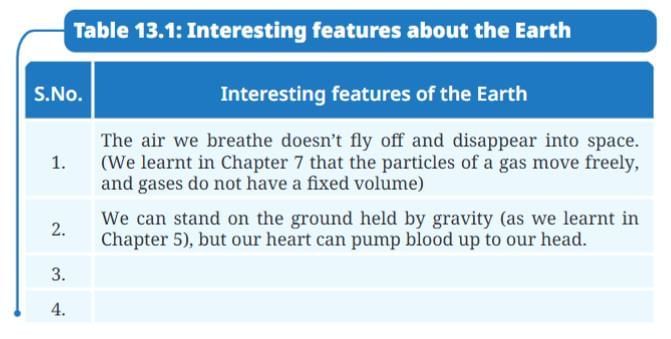
Here is the completed table, but you can add your own observations and discuss:
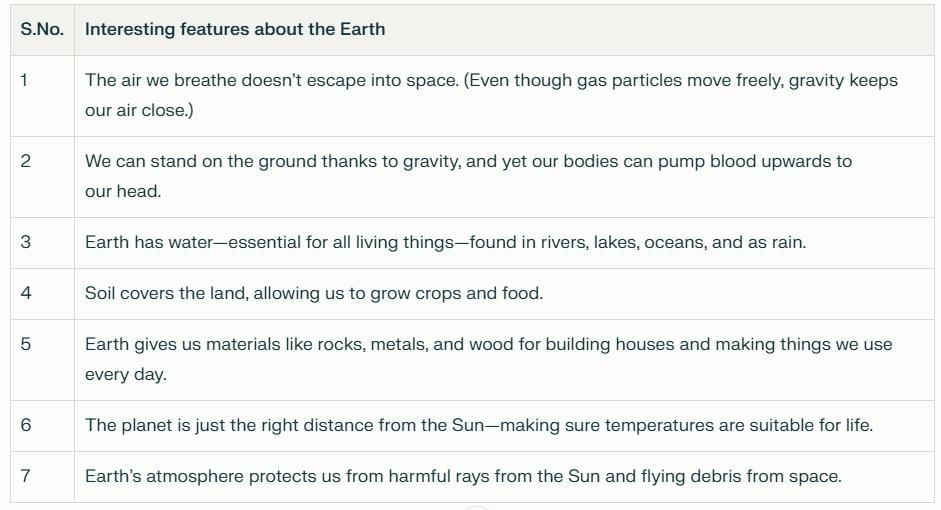
What makes this thin layer so important?

  • Though the crust is very thin compared to the whole Earth, it provides everything needed for life. 
  • Earth gives us the air we need to breathe.
  • It provides water for drinking and other needs.
  • Soil on Earth helps us grow crops and food.
  • Earth supplies materials like rocks, timber, and metals to build homes, buildings, and roads.
  • These features make life possible and help us survive and develop.

What Do the Planets of Our Solar System Look Like?

The Solar System has eight planets that move around the Sun in nearly circular paths (orbits).

Planets in order from the Sun:

  1. Mercury
  2. Venus
  3. Earth
  4. Mars
  5. Jupiter
  6. Saturn
  7. Uranus
  8. Neptune

Types of Planets:

  • Mercury, Venus, Earth, Mars: Smaller, rocky planets.
  • Jupiter, Saturn, Uranus, Neptune: Larger, mostly made of gases.

Activity 13.2: Comparing Planets
Collect and compare information about:

  • The average temperature of each planet.
  • How big it is (radius) compared to Earth.
  • Whether it has an atmosphere.
  • Fill out the missing information in this table: 
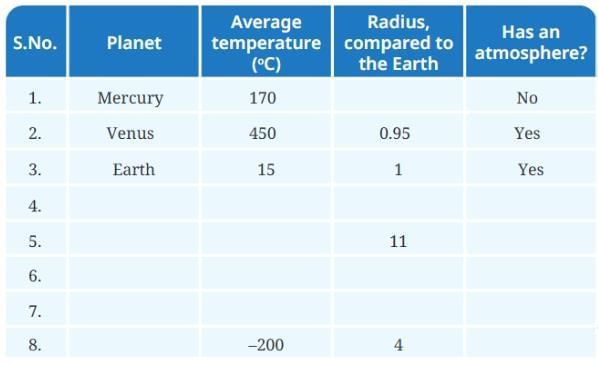
Observation:

  • All planets in the solar system get their energy from the Sun.
  • Generally, planets closer to the Sun are hotter, and those farther away are colder.

Why Is Venus the Hottest Planet?

  • Even though Venus is not the closest planet to the Sun, it is the hottest.
  • This is because Venus has a thick atmosphere made almost entirely of carbon dioxide.
  • Carbon dioxide traps heat—this is called the greenhouse effect.
  • On Venus, the greenhouse effect is very strong, so the planet is even hotter than Mercury.
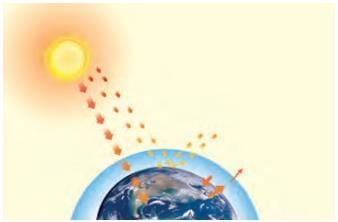
On Earth: The greenhouse effect also works, but less strongly. Gases like carbon dioxide trap some of the heat radiated from Earth, keeping the planet warm enough for life.

Difference between planetary and plant greenhouse:

  • On Venus and Earth: Atmosphere traps heat using greenhouse gases.
  • In a plant greenhouse: Glass walls trap warm air by keeping it from escaping.
  • Both keep things warm, but the process is different.

What Makes the Earth Suitable for Life to Exist?

1. Position of the Earth (“Habitable Zone”)

Earth’s distance from the Sun is just right—not too close and not too far.

  • This perfect distance keeps temperatures so that water mostly exists as a liquid, which is essential for all known life.
  • If Earth were closer to the Sun: too hot, all water would evaporate.
  • If Earth were farther: too cold, all water would freeze.
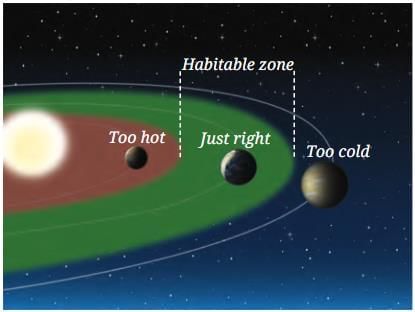
    Habitable Zone
  • Liquid water is needed for life to evolve and survive. While some bacteria can live in ice, complex life forms like plants, animals, and humans need liquid water.
  • The range around a star where liquid water can exist is called the habitable zone or Goldilocks zone (“just right”—not too hot, not too cold).
  • Over 70% of Earth’s surface is covered with water, giving Earth its name: the Blue Planet.
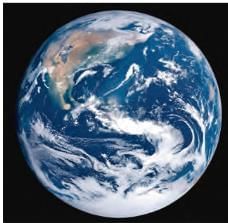
    Blue Planet

Mars and Life: Mars is at the edge of the Sun’s habitable zone.
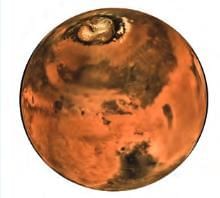
Mars

  • Scientists have sent many spacecraft and rovers to Mars.
  • No proof of current life has been found, but Mars may once have had liquid water and simple life.
  • Science is open to new discoveries—future missions and studies may change what we know.

2. Size of the Earth and it Atmosphere

Earth’s nearly circular orbit keeps sunlight and temperature across the year mostly steady, preventing extreme burns or freezes.

  •  Earth’s size is “just right”: If Earth were smaller, its gravity would be too weak to hold the atmosphere. Most gases would escape into space (just like on Mars and Mercury).
  • If Earth were much bigger, gravity could be so strong it might crush living things.
  • The atmosphere on Earth is essential for life: It provides oxygen for breathing.
  • Some atmospheric oxygen turns into ozone, making the ozone layer.
  • The ozone layer acts as a shield, blocking harmful ultraviolet (UV) rays from the Sun, which can damage living cells.
  • The atmosphere also traps enough heat (greenhouse effect) to keep Earth warm but not too hot.
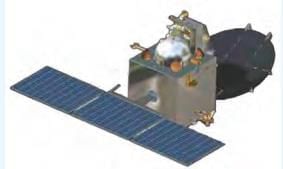
Our Scientific Heritage: Exploring Mars
Mangalyaan

  • India’s Mangalyaan (Mars Orbiter Mission), launched by ISRO in 2013, is a major step in studying Mars.
  • This mission studied Mars’ atmosphere, surface, and searched for signs of past water, asking if Mars could ever have supported life.
  • Mangalyaan proved India’s space science strength, showing what can be done with low-cost, smart technology.

3. Magnetic Field of the Earth

Along with Earth’s right position from the Sun, size, and atmosphere, the magnetic field is another key factor that makes sure Earth is a safe and life-supporting planet.

  • Earth behaves like a giant magnet, which is why a freely suspended magnet (like a compass) always points in a fixed direction.
  • The area around a magnet, where its effects are felt, is called the magnetic field.
  • Scientists believe that the movement of molten iron in Earth’s core creates Earth’s magnetic field.

Why is Earth’s Magnetic Field Important?

Earth is constantly bombarded by tiny, high-energy particles from space:

  • Cosmic rays (from far across the universe)
  • Solar wind (charged particles from the Sun)

These particles can be harmful as:

  • They can damage the atmosphere,
  • Reduce the ozone layer,
  • Increase harmful UV rays reaching Earth,
  • And harm living things.

The magnetic field acts as a shield:

  • It pushes many of these harmful particles away from Earth,
  • Helps keep the atmosphere safe,
  • Protects living beings and life on our planet.
What Allows Life to Be Sustained on Earth?

Earth has the right conditions for life, but it is the connections between living (biotic) and non-living (abiotic) things that truly help life thrive on Earth.

Air, Water, and Sunlight

  • The atmosphere of Earth provides essential oxygen for breathing (respiration) for humans, animals, and plants. Plants, in turn, take in carbon dioxide from the air and water from the soil to produce food through photosynthesis, a process that requires sunlight. During photosynthesis, plants release oxygen back into the air, maintaining the balance needed for life.
  • Sunlight is crucial as it heats the surface of the Earth and provides the energy needed for all life processes. Some of this heat is trapped by the atmosphere in what is known as the greenhouse effect, keeping the planet warm enough for water to stay liquid. Without this protective blanket of air, Earth would lose its heat quickly and become too cold for life to exist.
  • Water, which covers nearly 70% of Earth’s surface and forms the hydrosphere (including ponds, lakes, rivers, seas, oceans, and groundwater), is essential to all living things. Water dissolves and transports nutrients in plants and animals, helps animals regulate temperature and digestion, and ensures hydration.
    – The hydrosphere is home to countless species, from tiny plankton to giant whales—many still undiscovered.
    – Freshwater is needed for growing crops and supporting people everywhere.
    – Water vapor in the air forms clouds, which bring rain and snow, refilling rivers, lakes, and underground sources.
    – Rainfall determines what kinds of plants and animals can live in a place.
  • Air movement (wind) also shapes weather and affects when and where it will rain, which influences farming, water supply, and all life on land.

Soil, Rocks, and Minerals

  • The Earth’s crust, or geosphere, is made up of rocks, soil, and minerals. This layer provides almost everything that living things need to survive.
  • Soil is essential for life. It allows plants to grow and contains nutrients like nitrogen and potassium, which come from the breakdown of rocks and the remains of dead plants and animals.
  • Minerals found in rocks and soil are valuable resources—they give us salt, coal, oil, iron, copper, and many other materials needed for building, manufacturing, and daily life.
  • Geodiversity means the variety of landforms, rocks, and soils on Earth. This diversity creates different habitats and environments, helping many kinds of plants and animals to live and thrive.
  • Non-living parts of nature—like soil, rocks, and water—are not just a background; they play an active role in shaping and supporting every form of life on our planet.

Plants, animals, and microorganisms

The biosphere is the zone where life exists on Earth—including land, water, and the lower atmosphere. It contains all living things: trees, shrubs, herbs, animals, insects, and even microscopic organisms like bacteria and fungi.

Every living thing is connected.

  • Plants use photosynthesis to make their own food from sunlight, water, and carbon dioxide.
  • Animals depend on plants (and sometimes other animals) for food and energy.
  • Microorganisms (like bacteria and fungi) are decomposers. They break down dead plants and animals, returning valuable nutrients to the soil and making them available for new life.
  • These connections mean all living beings depend on one another and on their environment, working together in a balance that supports life on Earth—this is the essence of ecology.

 The Importance of Balance

  • Earth is a massive, interconnected system—land, air, water, and life forms all interact.
  • Even small changes (like cutting down forests) can impact rainfall, soil quality, air, and animals.
  • Life is possible because everything stays balanced—preserving this balance is essential for a healthy and habitable Earth.
  • Protecting clean air, water, soil, and all forms of life keeps Earth healthy for the future.

What Keeps Life from Disappearing?

If plants and animals did not reproduce, living things would eventually disappear from Earth.

What is Reproduction?

  • Reproduction ensures that every kind of organism continues, helping life last through generations.
  • Usually, young ones look similar to their parents (cows have calves, cats have kittens) because parents pass down instructions, called genes or genetic material, to their offspring.
  • Genes work like an instruction manual inside every cell, telling it how to form different body parts.

Why is Reproduction Important?

  • Keeps each species (type of organism) going, generation after generation.
  • Allows for small changes (variations) in genes over time.
  • Sometimes these changes help living things survive better in their environment (e.g., camels evolved humps for desert survival).
  • Microbes can become resistant to antibiotics.
  • Over many generations, these small changes can build up and even create new types of living beings.

How Can Offspring Be Similar Yet Different?

Reproduction can lead to both similarity (children look like their parents) and variety (differences, like height or colour). There are two main types of reproduction:

  1. Asexual reproduction: New organisms are almost exact copies of the parent.
  2. Sexual reproduction: Offspring have features from both parents, with some differences.

Asexual Reproduction

In Asexual reproduction, one parent produces new individuals, which are genetic copies. 
Example: Many plants can reproduce when any part of the plants—leaf, stem, or root—is planted in soil. This kind of reproduction is called vegetative propagation.

Activity 13.3: Vegetative Propagation in Plants

  • Plant stem cuttings (e.g., money plant), potato eyes, or pieces of ginger in moist soil.
  • Give them water, air, and sunlight.
  • Observe daily to see when roots, stems, and new leaves appear.
  • This shows how some plants can grow new individuals from just a part of the original plant.

Other examples of Asexual Reproduction (besides plants):

  • Bacteria, amoeba: Divide into two identical individuals.
  • Algae, Planaria: Can regrow from small pieces.
  • Hydra: Grows buds that break off to form new individuals.
  • Planaria: Flatworm can regrow from a fragment (studied for regeneration).

Sexual Reproduction

Sexual reproduction is the process by which two parents, usually called male and female, give rise to new offspring.

  • This is common in almost all animals and flowering plants. Even some microorganisms, like certain bacteria and yeast, have mating types that act like two parents.

Special Cells for Reproduction: Gametes

Both parents produce special reproductive cells called gametes.

  • Male gametes (sperm in animals, pollen in plants)
  • Female gametes (egg in animals, ovule in plants)

Gametes carry half the genetic information of each parent. When male and female gametes combine (a process known as fertilisation), they form a single new cell called a zygote. The zygote contains a complete set of genetic instructions—half from each parent.

Why Don’t Babies Look Exactly Like Their Parents?

  • Every offspring gets a unique mix of genetic material from both parents.
  • That is why babies, calves, kittens, or chicks are similar to their parents but do not look exactly the same.
  • Even siblings can have different features, like different eye or hair color, depending on which genes are inherited.
  • This mixing of genes provides variation, which is important for evolution and adaptation.

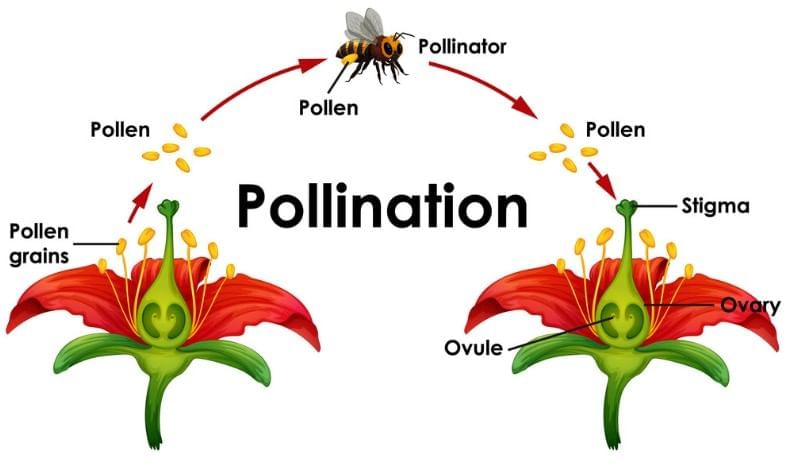
Sexual Reproduction in Plants

  • Flowering plants have both male and female parts:
    – Anther (male part): Produces pollen grains (male gametes).
    – Ovule (female part): Found inside the ovary of the flower; contains female gametes.
  • Pollination: Pollen is transferred (by wind, insects, or animals) from the anther to the stigma of a flower, often a different flower.
  • Fertilisation: Pollen reaches the ovule, and gametes fuse to form a zygote inside the ovule.
    – The zygote develops into a seed.
    – The ovule becomes the seed, and the surrounding part of the flower develops into a fruit.
  • Seed Dispersal: Fruits are often eaten by animals or birds, who carry the seeds far from the parent plant. When seeds fall in a suitable spot with sufficient water, they use stored food to grow roots and shoots (germination).

Sexual Reproduction in Animals

Animals have two types of reproductive cells: sperm (male) and egg (female).

  • Fertilisation happens when a sperm and an egg join to form a new cell called a zygote.
  • In fish and frogs, fertilisation takes place in water. Both parents release their sperm and eggs into the water, where they combine. The embryo then develops in the water.
  • In birds and mammals (including humans), fertilisation takes place inside the female’s body. The male deposits sperm, which swim to meet the egg.

After fertilisation:

  • In birds, the female lays an egg. The embryo develops inside the egg, using food stored in the egg until it hatches.
  • In mammals, the embryo develops inside the mother’s body. The mother provides all food and oxygen until the baby is born.
  • The main difference:
    – Birds (and reptiles) lay eggs, providing food for the embryo in the egg itself.
    – Mammals usually give birth to live young, supplying nutrition directly inside the body.
  • Each way of reproduction helps the baby animal grow safely, depending on what’s best for the animal’s survival.

What Are the Threats to Life on Earth?

Earth’s life depends on a delicate balance between living things (plants, animals, microbes) and non-living things (air, water, soil, sunlight). Human actions are disturbing this balance, leading to big environmental problems.

The three main global challenges today:

  1. Climate Change
  2. Biodiversity Loss
  3. Pollution

1. Climate Change

  • Caused by burning fossil fuels (coal, oil, gas), which release greenhouse gases like carbon dioxide and methane.
  • These gases trap more heat in the atmosphere, causing global warming.
  • Normally, carbon dioxide is absorbed by plants, trees, and plankton in oceans, keeping things in balance.
  • However, when we burn fossil fuels, we release extra carbon locked away underground for millions of years. Earth cannot absorb it fast enough, so more heat gets trapped.
  • Even a small temperature increase can:
    – Melt ice caps and raise sea levels, leading to floods in coastal cities.
    – Cause more extreme weather—like heavier rains, stronger storms, longer droughts, and heatwaves.
    – Make some plants and animals disappear forever.
  • Long-term changes in temperature, rainfall, and weather caused by this are called climate change.

2. Biodiversity Loss

Destroying natural habitats (forests, grasslands, wetlands) makes plants and animals disappear.

This upsets food chains and ecosystems:

  • If grasses vanish, plant-eating animals (like deer and grasshoppers) lose their food.
  • Without herbivores, predators (like tigers or foxes) cannot survive.
  • Every species has a role—losing any weakens nature’s ability to support life.

3. Pollution

Air Pollution:

  • Comes from factories, vehicles, and burning fuels.
  • Harms human health, leads to breathing problems, damages crops, and causes smog and acid rain.

Water and Soil Pollution:

  • Caused by factory waste, farm chemicals, and plastic.
  • Harms aquatic life, makes water unsafe, and lowers crop yields.
  • Polluted soil can spread toxins through the food chain.
  • All these problems together harm people, animals, plants, and ecosystems.

The Importance of Balance

  • Small changes in global temperature, oxygen, or the ozone layer can endanger all life.
  • All Earth’s systems—hydrosphere (water), biosphere (living things), atmosphere (air), geosphere (rocks, soil)—are connected.
  • Harm to one system spreads to others.

What Are We Doing About It? (Global Actions)

Countries have agreed on important treaties to protect Earth:

  • Montreal Protocol (1987): Reduced chemical pollution; helped the ozone layer recover.
  • Earth Summit (1992): United nations to work together on climate and biodiversity.
  • Kyoto Protocol (2005) and Paris Agreement (2015): Countries committed to lowering greenhouse gas emissions.
  • Paris Agreement goal: Keep global warming below 1.5°C.
  • As of 2025, the world has not reached this goal—more action is needed.

How Can We Help?

  • Cut down on pollution.
  • Switch to cleaner energy: Use solar, wind, and renewable energy instead of coal and oil.
  • Use energy and water carefully: Turn off lights, don’t waste water, and travel in eco-friendly ways.
  • Reduce, reuse, and recycle: Fix, repair, and recycle clothes, plastic, and other items to produce less waste.
  • Practice sustainable farming and waste management to protect soil and water.
  • Protect biodiversity: Healthy, diverse ecosystems are stronger and support more life.
  • Local communities can manage natural resources wisely and make a big difference.
12. How Nature Works in Harmony – Chapter Notes

How does nature keep everything in balance—and what happens when that harmony is disturbed?

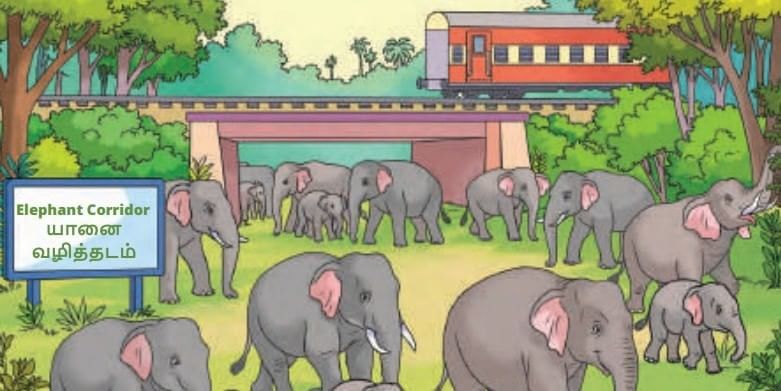
  • From forests and rivers to animals, people, and the land itself, every part of nature is interconnected. 
  • Sometimes, when forests are cut down or rainfall changes, animals like elephants lose their homes and food, forcing them to move into farms or villages, leading to new problems. 
    Elephants moving in search of food and shelter
  • Even small changes in one part of nature can affect everything else around it.

In this chapter, you’ll explore how water, sunlight, plants, animals, and even humans are all linked in a web of relationships. You’ll discover why balance in nature is so important, how living things depend on each other, and how human actions can impact the whole system—for better or worse. Let’s get started!

How Do We Experience and Interpret Our Surroundings?

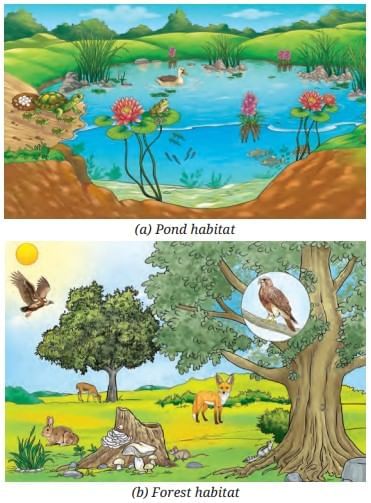
Different habitats have different kinds of plants and animals

Habitat:

  • A habitat is the place where an organism lives.
  • It provides the surroundings and conditions an organism needs to survive.
  • Habitats can be small (like tree bark) or large (like a pond or forest).

Diversity in Habitats:

  • Different habitats have different kinds of plants and animals (living beings).
  • Organisms adapt to survive in their specific habitats.

Activity: Explore two nearby habitats and identify both the living organisms and the non-living components in each.

  • Select two nearby habitats (e.g., a pond and a forest).
  • List the living and non-living components in each habitat.

Common Characteristics of Habitats

Both habitats (like a pond and a forest) have:

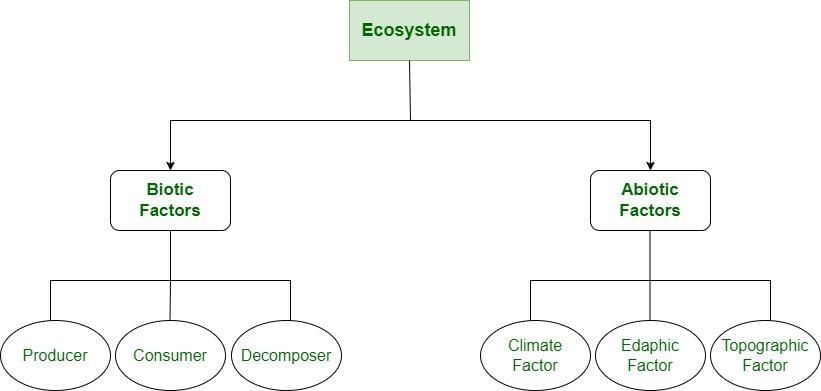
  • Living beings (biotic components): plants, animals, and other organisms.
  • Non-living things (abiotic components): air, water, sunlight, soil, temperature, stones, etc.

Similarities:

  • Both have biotic and abiotic components.

Differences:

  • The types of living beings vary (e.g., fish in a pond, trees in a forest).
  • The types of non-living components also differ (e.g., more water in a pond, more soil and air in a forest).

Biotic and Abiotic Components

  • Biotic components: All living things in a habitat (plants, animals, microbes).
  • Abiotic components: All non-living things in a habitat (sunlight, air, water, soil, temperature).

Why do some organisms live on land and others in water?

  • Every organism needs certain conditions to survive, such as food, water, oxygen, shelter, and space.
  • Example: Fish live in ponds because they get food, oxygen, and shelter there. Pond water provides both biotic needs (food from plants/animals) and abiotic needs (oxygen from water).
  • Many other creatures (frogs, turtles, snakes, insects, birds, plants) share the pond. Each interacts with others and with the non-living parts of the habitat.

Coexistence and Harmony in Habitats

  • Each habitat has its own unique mix of living (biotic) and non-living (abiotic) components, like air, sunlight, water, soil, and temperature.
  • Different species in the same habitat might use resources differently: For example, in a forest, a snake may be active at night, while a rodent is active during the day—helping both survive in the same place but at different times.

Who All Live Together in Nature?

Population

  • Definition: A population is a group of the same kind of organisms (same species) living together in a specific habitat at a given time.
  • Example: All the fish of the same species in a pond form a fish population.

How Do We Measure Population? 

To find the population of a certain plant or animal, you:

  • Mark a fixed area (for example, 1m × 1m in your school garden).
  • Count the number of each type of organism (plants or animals) present in that area.
  • Record this information as the population for that type of organism in that particular area and time. Population means the number of individuals of a particular kind (species) living in a defined area at a certain time.

Community

  • A community is formed by different populations (different types of plants, animals, and microorganisms) living together and interacting in the same habitat.
  • It includes all living (biotic) components of the habitat.

Habitat

  • Definition: A habitat is the physical place or environment where an organism lives.
  • If there is only one type of organism in a habitat, there will be competition for resources like food, water, and space. This can cause shortages and make it hard for other creatures to survive.
  • Diversity in a habitat (many types of organisms living together) helps maintain a balance and supports survival by providing different roles and interactions.

Pollination

  • Flower Structure: Flowers have sepals, petals, stamens (male part), and carpels (female part).
  • Pollination: The process of transferring pollen grains from the stamen of one flower to the carpel of the same or another flower.
  • How it happens: Wind, water, insects, bats, and birds help carry pollen.
  • Why it matters: Pollination is essential for fruits and seeds to form.

Try yourself:

What is a habitat?

  • A.A type of animal
  • B.A process of transferring pollen
  • C.A group of organisms of the same species
  • D.A physical place where an organism lives

View SolutionDoes Every Organism in a Community Matter?

Yes! Every organism in a community plays an important role, helping maintain balance and supporting the survival of other organisms. Here’s how the activities and scientific studies help us understand this:

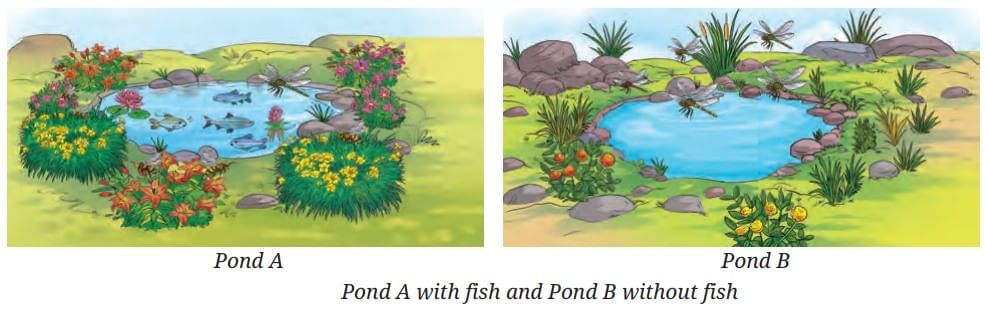
Explanation Using the Pond Example:

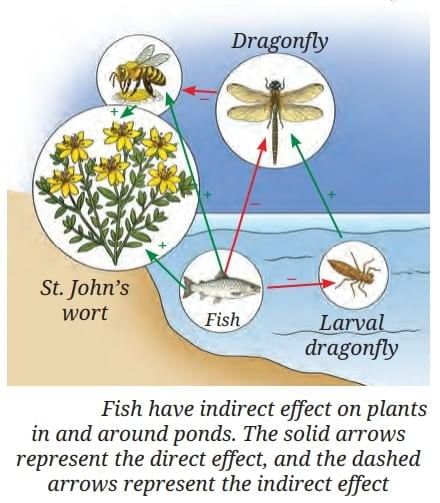
  • Pond A (with fish): There are fewer dragonflies because fish eat the dragonfly larvae in the pond.
  • Pond B (without fish): There are more dragonflies since nothing eats their larvae.

What happens next?

  • Dragonflies are predators of bees, butterflies, and other insects that help pollinate flowers.
  • Fewer dragonflies in Pond A means more bees and butterflies can survive and pollinate the flowers.
  • More pollinators = more pollination, which leads to more flowers producing seeds and more plants.

Scientific studies confirm this: researchers found that plants around ponds with fish were better pollinated than those around ponds without fish, mainly due to this chain of effects.

What Does This Show?

  • Organisms are interconnected. The presence or absence of one type (like fish) can affect many others (like pollinators and plants).
  • Every member of a community has a role (niche): Fish control dragonfly populations, dragonflies affect pollinators, pollinators are essential for plant reproduction, and plants provide food and shelter for all.
  • This is known as a food web or ecological balance, where changes in one group lead to effects (sometimes called a “cascade”) throughout the community.

Impact of Overfishing by Humans

  • Overfishing removes too many fish from ponds or oceans.
  • If too many fish are taken away, dragonfly numbers might rise because their predators have gone. This could lower the number of pollinators, resulting in less pollination for nearby plants.
  • Removing key species like fish upsets the delicate balance of the community, affecting not just other animals but also plants and even the non-living (abiotic) environment.

What Are the Different Types of Interactions Among Organisms and their Surroundings?

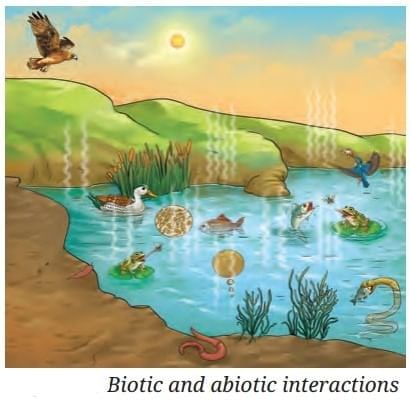
Organisms do not live alone. They constantly interact with both living (biotic) and non-living (abiotic) components in their environment.

1. Interactions Between Biotic and Abiotic Components

Definition: Interactions between living things and non-living things in their environment.

Examples:

  • Plants need sunlight (abiotic) for photosynthesis, water and soil for growth, and air for respiration.
  • Earthworms live in moist soil.
  • Fish lay eggs in water (abiotic).
  • Soil provides nutrients for plants.

2. Interactions Among Abiotic Components

Definition: Interactions between non-living things, which affect the conditions of a habitat.

Examples:

  • Sunlight warms up the day, increasing the temperature.
  • Water evaporation happens faster in strong sunlight.
  • Air currents create gentle waves on the water.

3. Interactions Among Biotic Components

Definition: These are the relationships between living organisms in a community.

Examples:

  • Frogs eat insects (food chain).
  • Water snakes eat fish.
  • Frogs and fish compete for larvae.
  • Many microbes (tiny living beings) interact in the pond, breaking down dead material.
  • Plants provide food and shelter for animals.
  • Mushrooms (fungi) decompose dead plants and animals.

The Concept of Ecosystem

An ecosystem is made up of all the living (biotic) and non-living (abiotic) things in a particular area and all the interactions among them. 

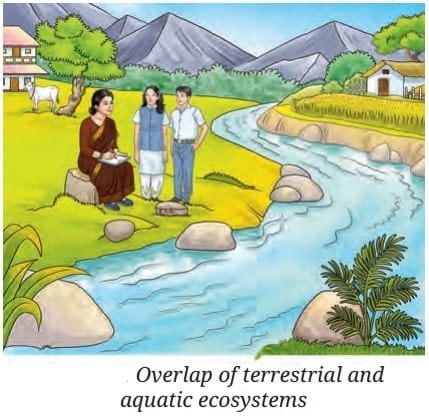
  • Aquatic (water-based) ecosystems include ponds, rivers, and lakes
  • Terrestrial (land-based) ecosystems include forests, grasslands, and farmlands.
  • Ecosystems can overlap—for example, a river running through a forest.

Types of Consumers and Producers

  • Producers (Autotrophs): Make their own food (usually plants via photosynthesis).
  • Consumers (Heterotrophs): Depend on others for food.
    – Herbivores: Eat only plants (deer, horse).
    – Carnivores: Eat only animals (vulture, shikra).
    – Omnivores: Eat both plants and animals (fox, mouse).
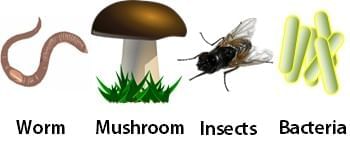
  • Decomposers: Organisms like mushrooms and bacteria that feed on dead plants and animals, recycling nutrients back into the ecosystem.

Who Eats Whom?

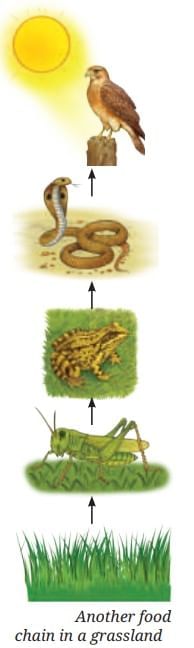
Food Chain: food chain is a simple sequence showing “who eats whom” in an ecosystem.

Example (Grassland Ecosystem):
1. Grass → Hare →TigerGrass is eaten by the hare; hare is eaten by the tiger.
2. Grass → Grasshopper → Frog → Snake → Eagle
Here, each organism is eaten by the next one in the chain.

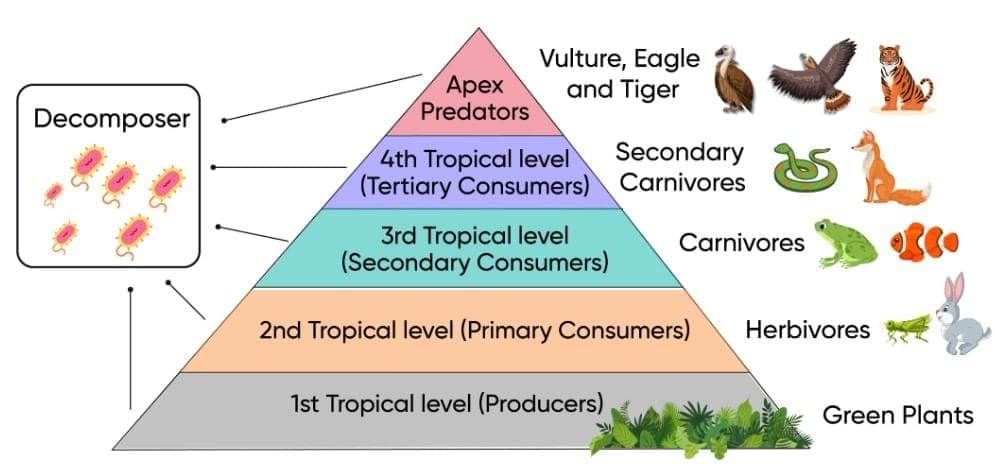
Trophic Levels

Each organism in a food chain occupies a specific position, called a trophic level:

  • First trophic levelProducers (plants, e.g., grass, millet)
  • Second trophic levelHerbivores (organisms that eat plants, e.g., hare, mouse)
  • Third trophic levelSmall carnivores (those that eat herbivores, e.g., frogs)
  • Fourth trophic level (and above)Large carnivores or top predators (e.g., eagle, hawk, fox)

Trophic Level Pyramid

Ecological Pyramid

  • When you count the number of organisms at each level (e.g., many grasses, fewer mice, only one eagle), and arrange these numbers with the highest at the base and lowest at the top, you get a pyramid shape.
  • Producers are always the base, and top predators are at the top, indicating energy loss at each step.

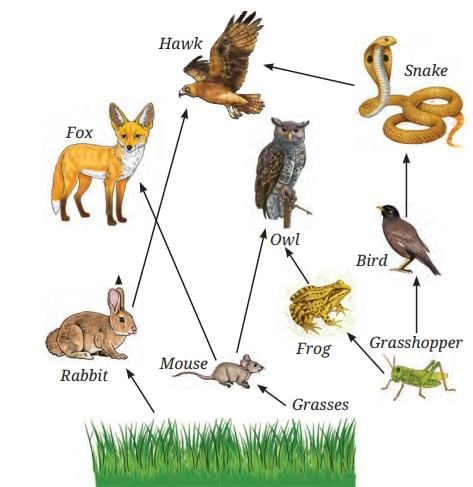
Food Web

In reality, feeding relationships are not simple chains—they’re much more complex, forming a food web.

  • The grass can be eaten by rabbit or mouse.
  • Grasshoppers can be eaten by the bird or frog.
  • Owls can eat mice or frogs

Because each organism may be eaten by two or more types of organisms, the food chains overlap and link together, making a web.
Food Web

What Happens to Waste in Nature?

What are decomposers?

  • Definition: Decomposers are organisms that break down dead plants, animals, and animal waste into simpler substances, returning nutrients to the soil.
  • Examples: Mushrooms (a type of fungi), bacteria, beetles, and flies.
    Examples of Decomposers
How Decomposition Works

  • When plants, animals, or their waste die, decomposers feed on them.
  • Fungi (like mushrooms) and bacteria break down complex substances in these dead materials into simpler forms.
  • Beetles and flies often feed on things like animal dung (e.g., elephant dung), breaking it down further.
  • This entire process is called decomposition.

Importance of Decomposers
  • Nutrient Recycling: Decomposition returns important nutrients to the soil, which plants use to grow.
  • Balance in Nature: Decomposers prevent the buildup of dead materials and waste in the environment.
  • No Waste in Nature: Nothing truly goes to waste in nature—everything is reused in one form or another thanks to decomposers.
  • Saprotrophs: Another name for decomposers. Sapro means “rotten,” and troph means “food.”

What are migratory birds?

  • Birds that travel thousands of kilometers between different habitats and countries to avoid harsh climates or find food.
  • Example: Demoiselle Cranes visit Khichan village in Rajasthan every winter.

Roles of Migratory Birds

  • Enhance Beauty: Add color and vibrancy to habitats.
  • Ecosystem Balance: Act as pollinators (helping flowers reproduce) and seed dispersers, linking different habitats.
  • Pest Control: Feed on insect pests, helping farmers by reducing crop damage.

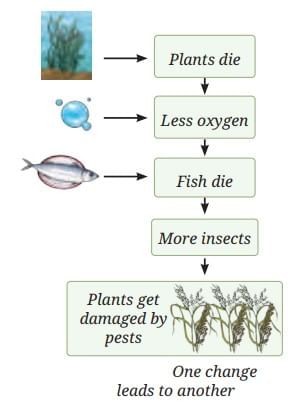
How Does One Change Lead to Another?

If plants in a pond die (e.g., due to pollution), then:

  • Less oxygen is produced in the water.
  • Fish population declines, as they need oxygen.
  • Fewer fish means more insects (fish usually eat them).
  • Extra insects spread to nearby farms and harm crops.
  • Farmers use more pesticides, which further harms the environment.
  • One small change (like plant death) causes a chain reaction or “cascading effects” through the ecosystem.

Effects of Human Intervention: The Frog Leg Export Story

  • In the 1980s, India exported a huge number of Indian bullfrogs.
  • This reduced frog populations.
  • Fewer frogs meant more insects, including pests in farms.
  • Farmers then used more pesticides, harming the environment, water, soil, and health of living beings.
  • The Government banned frog-leg exports to help restore balance.

Ecosystem Balance

  • Interactions between organisms and their environment keep populations and resources stable—this is called ecological balance.
  • This balance is always changing (dynamic), but large disruptions (such as overuse, pollution, loss of species) can harm it.

How Do Interactions Maintain Balance in Ecosystems?

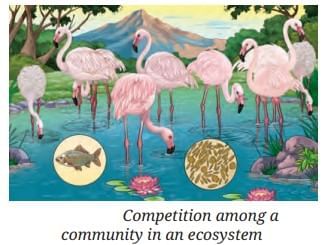
Besides feeding relationships, organisms also compete for common resources like food, water, physical space, or sunlight. This competition helps control population size and keeps the ecosystem balanced. Without it, one species could multiply too much causing an imbalance in the ecosystem

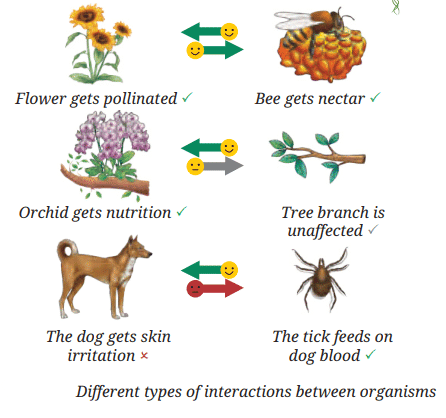
Other Relationships:

  • Mutualism: Both organisms benefit (e.g., bees and flowers).
  • Commensalism: One benefits, the other is unaffected (e.g., orchids on trees).
  • Parasitism: One benefits, the other is harmed (e.g., ticks on dogs).

Benefits of an Ecosystem

  • Forests: Provide clean air, fertile soil, food, timber, medicines, and beauty.
  • Water bodies: Give water and food.
  • All ecosystems: Offer aesthetic value, recreation, and support human well-being.
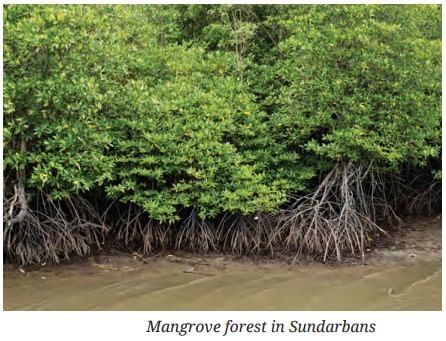
  • Mangroves (e.g., Sundarbans): Protect against floods and storms, absorb carbon dioxide, support unique wildlife; recognized as a World Heritage Site.

Threats to Ecosystems

  • Deforestation, pollution, unsustainable land use, and illegal hunting are harming all types of habitats.
  • The Sundarbans mangroves are under threat from wood cutting, pollution, and resource overuse.
  • Such activities disrupt natural cycles and reduce biodiversity.

How To Protect Ecosystems

  • Protected Areas: Such as national parks, biosphere reserves, and sanctuaries conserve habitats and wildlife. Examples: Jim Corbett, Manas, Nilgiri Biosphere Reserve, Chilika Lake.
  • Community Action: People must work together to conserve resources, avoid pollution, and preserve natural areas.

Human-Made (Artificial) Ecosystems

  • Examples: Farms, fish ponds, parks.
  • When managed well, they can help reduce pollution, support biodiversity, and provide recreational spaces.
  • Need: Continuous care and human management.

Try yourself:

What is the main purpose of interactions?

  • A.To create chaos
  • B.To maintain balance
  • C.To confuse others
  • D.To avoid communication

View Solution

What Are the Benefits of an Ecosystem?

Ecosystems consist of biotic (living) and abiotic (non-living) components that depend on each other to support life processes.

Humans benefit from ecosystems in many ways:

  • Forests provide fresh air, fertile soil, food, fibres, timber, and medicines.
  • Aquatic ecosystems provide water and food.
  • Ecosystems also offer aesthetic (beauty) and recreational (enjoyment) value.
  • This supports human well-being and shows the close connection between nature and humans.
  • However, overusing or misusing natural resources disturbs the balance in nature.

 Real-Life Example: The Sundarbans – A Threatened Ecosystem

  • The Sundarbans have the largest mangrove forests in the world.
  • Located where the Ganges and Brahmaputra Rivers meet, between India and Bangladesh.
  • Home to various flora (plants) and fauna (animals), many of which are endangered.
  • Protects against storms and floods by slowing down strong winds and waves.
  • Trees absorb carbon dioxide from the air and release oxygen.
  • Declared a World Heritage Site by UNESCO (United Nations Educational, Scientific and Cultural Organization) in 1987 due to its importance.

Threats 

  • Mangrove trees are cut for fuelwood and farming.
  • Illegal hunting and overuse of forest resources threaten wildlife.
  • Pollution from industrial waste and untreated sewage damages water and habitat.
  • These human activities disrupt the natural functioning of ecosystems.

Other Threatened Ecosystems in India
Ecosystems across India (forests, rivers, scrublands, wetlands, grasslands, coastal areas) are under threat.

Problems:

  • Deforestation (cutting trees).
  • Overuse of natural resources.
  • Spread of invasive species (non-native plants/animals that harm locals).
  • Unsustainable land use.
  • Pollution.

Call to Action: Think about actions you and your community can take to protect forests, rivers, and wetlands to stop damaging them.

Protected Areas for Conservation

  • Definition: Protected areas are parts of land or water set aside to conserve wildlife and their habitats.
  • India has many protected areas: national parks, wildlife sanctuaries, biosphere reserves, and community conserved areas.
  • Benefits: They protect entire habitats, including endangered animals, birds, and rare plants.

Famous Examples:

  • Jim Corbett National Park (Uttarakhand).
  • Manas National Park (Assam).
  • Nilgiri Biosphere Reserve (Western Ghats).
  • Chilika Lake (Odisha).
  • Eaglenest Wildlife Sanctuary (Arunachal Pradesh).
  • Hemis National Park (Leh).
  • Keibul Lamjao National Park (Manipur).
  • Pirotan Island Marine National Park (Gujarat).
  • Protected areas play a big role in saving nature for future generations.

Our Scientific Heritage

  • The ancient text Vrikshayurveda emphasizes soil health and nourishment.
  • It advocates for continuous soil nourishment through organic manure like Kunapa Jala (a liquid fertilizer made from animal and plant waste by fermentation, which breaks complex substances into simpler ones) and other composted materials.

Human-Made Ecosystems

  • Humans create artificial ecosystems like fish ponds, farms, and parks to meet their needs.
  • When well-designed, they reduce pollution, support biodiversity (variety of life), and provide recreational spaces.
  • Unlike natural ecosystems, these need human care and management.

How Do Healthy Ecosystems Serve Our Farms?

  • Farming is a major livelihood in India but can become unsustainable without environment-friendly practices.
  • Humans have practiced farming for thousands of years to grow food.
  • As population grew, dependence on agriculture increased.
  • Between 1950 and 1965, India faced a food crisis due to low crop production.
  • In the mid-20th century, the Green Revolution used tractors, machines, synthetic fertilizers, and pesticides to increase food production.

However, these methods are now seen as unsustainable due to:

  • Overuse of synthetic chemicals.
  • Excessive groundwater extraction.
  • Growing only one type of crop (monoculture) for commercial gain.

Harms to Environment and Health:

  • Overusing pesticides and monoculture lead to soil degradation (loss of quality).
  • Reduces soil fertility by decreasing friendly microorganisms and organic matter (humus), which binds soil particles.
  • Without humus, soil erodes easily.
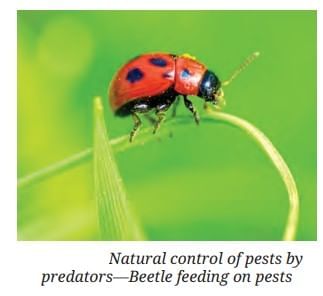
  • Reduces natural predators, increasing pest populations 
  • Heavy irrigation and repeated ploughing disturb soil organisms like earthworms and snails, important for ecological balance.
  • Pests may develop resistance to pesticides, making control harder.
  • Monoculture reduces crop diversity and affects pollinators (e.g., bees), crucial for food production.
  • Understanding ecosystems helps adopt sustainable farming.
  • Some farmers explore organic and natural methods to reduce synthetic fertilizers and minimize interference in natural ecosystems.

Key Terms to Remember 

  • Habitat: A place that provides the right conditions for an organism to live and grow.
  • Components of Habitats: Habitats consist of biotic components (plants, animals, microbes) and abiotic components (air, water, soil, temperature).
  • Ecosystem: The interaction between biotic components and abiotic components in an area, forming a balanced system.
  • Types of Ecosystems: Ecosystems can be terrestrial (such as forests, grasslands, deserts) or aquatic (such as ponds, lakes, seas, oceans).
  • Classification of Organisms: Organisms are often classified as producers (plants), consumers (herbivores, carnivores, omnivores), and decomposers (bacteria, fungi).
  • Producers: Organisms like plants that make their own food.
  • Consumers: Organisms that eat plants or animals for energy.
  • Decomposers: Organisms like bacteria and fungi that break down dead matter and recycle nutrients back into the ecosystem.
  • Food Chains: Sequences that depict who eats whom in an ecosystem.
  • Food Webs: Interconnected food chains showing complex feeding relationships in an ecosystem.
  • Trophic Levels: The positions that different organisms occupy in a food chain, indicating their role in energy transfer.
  • Mutualism: A relationship between organisms where both benefit.
  • Commensalism: A relationship where one organism benefits and the other is unaffected.
  • Parasitism: A relationship where one organism benefits and the other is harmed.
  • Benefits of Ecosystems: The advantages ecosystems provide, which are crucial for human survival and well-being, including clean air, water, food, medicine, and climate regulation.
  • Threats to Ecosystems: Human activities such as pollution, deforestation, habitat loss, climate change, invasive species, and overexploitation of natural resources that endanger ecosystems.
  • Conservation of Ecosystems: Efforts to protect ecosystems, such as establishing national parks and sanctuaries, which are vital for preservation

11. Keeping Time with the Skies – Chapter Notes

Have you ever noticed the Moon shining in the sky during the daytime and wondered why it’s visible when the Sun is also up?

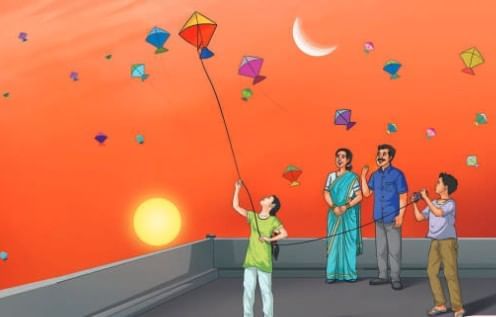
On Makar Sankranti, as Meera watched colorful kites soar above Ahmedabad, she too spotted the Moon in broad daylight—a sight she thought belonged only to the night. 
Kites in the SkyThis surprising view made her curious: Why does the Moon’s shape change night after night, and why doesn’t it always appear as a full circle? If we had no clocks or calendars, how would we track days, months, or years? As we explore these questions, let’s discover how people have “kept time” by simply observing the skies!

How Does the Moon’s Appearance Change and Why?

Phases of the Moon 

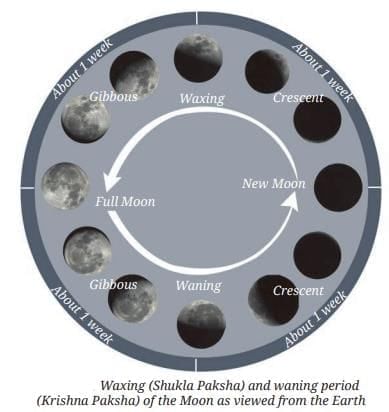
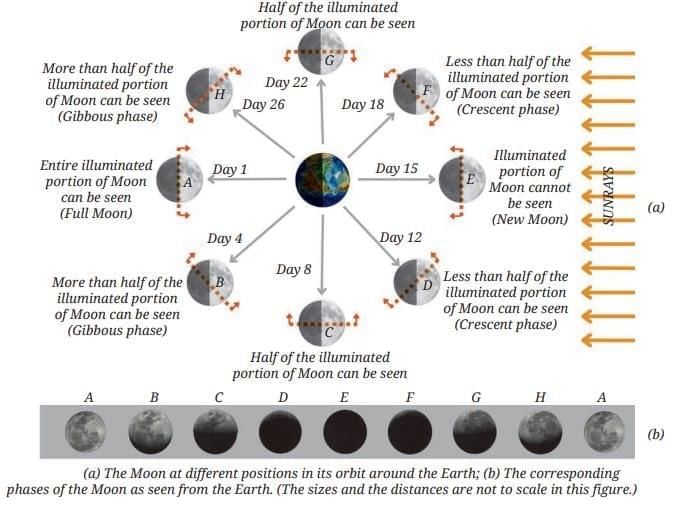
The changing shapes of the Moon’s illuminated (bright) portion, as seen from Earth, are known as the phases of the Moon.

Waning Period (Krishna Paksha):

  • After a full Moon, the bright portion decreases from a full circle to a half circle in about a week.
  • The bright portion continues to shrink, disappearing completely in another week.
  • This two-week shrinking period is called the waning period or Krishna Paksha in India.

New Moon (Amavasya): The day when the Moon is not visible at all.

Waxing Period (Shukla Paksha):

  • After the new Moon, the bright side grows to a half circle in about a week and becomes a full circle (full Moon) in another week.
  • This two-week growing period is called the waxing period or Shukla Paksha in India.
  • The Moon’s waxing and waning occurs in a cyclical (repeating) pattern each month.
  • The full cycle from one full Moon to the next takes about one month.

Important Terms:

  • Full Moon (Purnima): The day when the Moon appears as a full bright circle.
  • New Moon (Amavasya): The day when the Moon is not visible at all.
  • Waxing: The period when the bright part of the Moon increases (after new Moon to full Moon).
  • Waning: The period when the bright part of the Moon decreases (after full Moon to new Moon).
  • Gibbous: More than half but not fully illuminated Moon.
  • Crescent: Less than half illuminated Moon.

Locating the Moon

The Moon’s position in the sky changes each day, even at the same time.

On full Moon day:

  • The Moon is nearly opposite the Sun.
  • When the Sun rises in the east, the Moon is almost setting in the west.

After full Moon:

  • Each morning at sunrise, the bright part of the Moon gets smaller and the Moon appears closer to the Sun’s position in the sky.
  • When the Moon looks like a half circle, it is overhead at sunrise.
  • A few days after, the crescent Moon appears even closer to the Sun.

The phase (shape) of the Moon and its waxing or waning status help you know where and when to look for it in the sky.

  • Waxing Moon: Best seen at sunset.
  • Waning Moon: Best seen at sunrise.

The Moon does not always rise when the Sun sets.

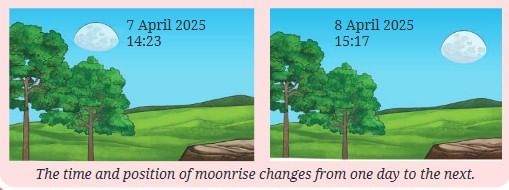
  • The moonrise time gets about 50 minutes later each day.
  • Moonrise can occur in the afternoon (e.g., between 2:00–4:00p.m.), which is why the Moon is sometimes seen in the daylight.
  • After moonrise, you may need to wait about 30 minutes for the Moon to be visible higher in the sky.

Making Sense of Our Observations – The Moon’s Changing Appearance

The Moon’s Shape:
The actual shape of the Moon does not change at all. What changes is how much of the illuminated (bright) part we see from Earth.

The Moon’s Light:
The Moon does not produce its own light. It appears bright because it reflects sunlight that falls on it.

Sunlit and Dark Halves:

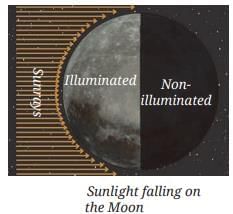
  • At any moment, half of the Moon faces the Sun and becomes illuminated by sunlight.
  • The other half, facing away from the Sun, remains in darkness (non-illuminated).

Appearance from Earth:

  • As the Moon revolves around the Earth, the position and angle at which we see it changes.
  • Although always one half of the Moon faces Earth, that half is not always fully illuminated.
  • The portion of the Moon we see from Earth may be all illuminated, partly illuminated, or not illuminated at all—resulting in phases.

Full Moon and New Moon:

  • Full Moon: When the entire sunlit half faces Earth, we see the Moon as a whole bright circle.
  • New Moon: When the non-illuminated half faces Earth, we do not see the Moon at all.

Reason for Changing Appearance:

The Moon seems to change shape (phase) on different days because:

  • Its position relative to Earth and Sun is constantly changing as it orbits Earth.
  • We only see the illuminated part facing towards us.

The Moon’s Phases with a Simple Model

Model Demonstration:
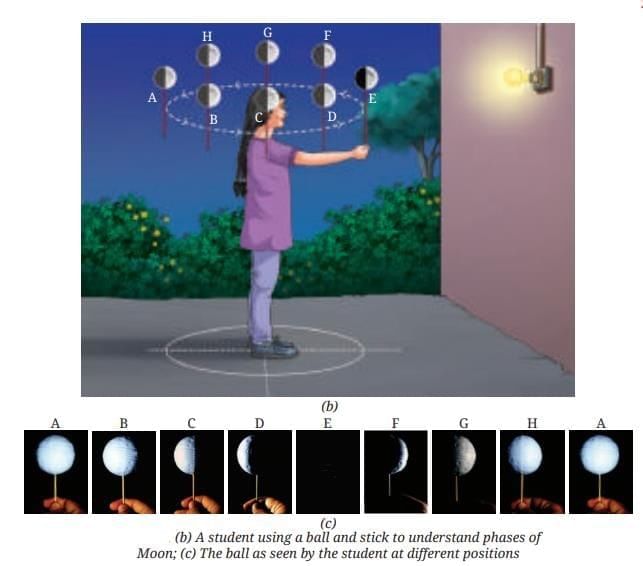
You can use a small ball on a stick to represent the Moon, a torch or lamp as the Sun, and your own head as the Earth.

  • Hold the ball in your hand, slightly above your head.
  • Shine the torch toward the ball to represent sunlight.
  • As you turn in a circle, the ball (“Moon”) shows a changing illuminated portion to your eyes.

What Does the Model Show?

  • Full Moon:
    When the ball is held opposite the lamp (behind you compared to the Sun), the side facing you is fully lit—just like a full Moon.
  • New Moon:
    When the ball is held between your head and the lamp (towards the Sun), you see only the dark side—like a new Moon.
  • Crescent and Gibbous Phases:
    Turning the ball slowly, the visible portion transitions. Sometimes you see a crescent (less than half lit), other times gibbous (more than half lit).
  • The line between the bright and dark parts is always curved—this matches what we see in the real Moon.

The Science Behind the Phases

  • Half Illuminated, Half Dark:
    At every moment, half the Moon is lit by sunlight, and half is in darkness.
  • Moon’s Revolution:
    As the Moon revolves around the Earth, the angle between Earth, Moon, and Sun changes. The part of the Moon we see as bright changes accordingly.

Phase Names:

  • Crescent: Less than half illuminated
  • Gibbous: More than half illuminated
  • Full Moon: Whole face illuminated
  • New Moon: No illuminated part visible

The phases are caused by the changing fraction of the illuminated portion visible from Earth.

 Why Do Moon Phases Occur? (And What Does Not Cause Them)

  • Incorrect Idea: Moon phases are not caused by Earth’s shadow falling on the Moon.
  • Correct Reason: The phases of the Moon occur because of the changing relative positions (orientation) of the Sun, Moon, and Earth as the Moon revolves around Earth.
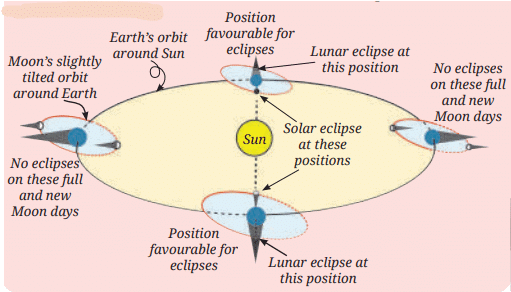
  • Earth’s Shadow and Lunar Eclipse: The only time Earth’s shadow actually falls on the Moon is during a lunar eclipse.
    Lunar eclipses can only happen on a full Moon day.
    Solar eclipses can only happen on a new Moon day.

Why Don’t Eclipses Happen Every Month?

  • Eclipses do not occur every month even though there’s a full Moon and new Moon monthly.
  • This is because the Moon’s orbit is slightly tilted relative to Earth’s orbit around the Sun.
  • Most months, the Sun, Earth, and Moon do not line up perfectly for the Earth’s shadow to cover the Moon (lunar eclipse) or for the Moon’s shadow to fall on Earth (solar eclipse).

How Did Calendars Come into Existence?

Natural Cycles and Time Measurement

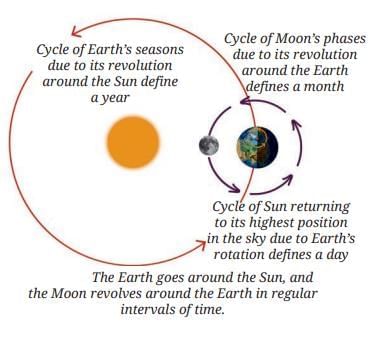
  • The apparent daily motion of the Sun (rising in the east, setting in the west) is due to Earth’s rotation on its axis.
  • This natural cycle forms the basis of the day—the primary unit of timekeeping.
  • Mean Solar Day: The time between one “highest Sun position” (shortest shadow at noon) to the next is about 24 hours, known as a mean solar day.

Shadow Tracking and the Day

  • The shortest shadow during the day marks the Sun’s highest point in the sky (noon).
  • Measuring from one day’s noon to the next gives the length of a day.
  • The average solar day is about 24 hours.

The Month and the Moon

  • The phases of the Moon create another natural cycle—one complete phase cycle (from full Moon to next full Moon) takes about 29.5 days (approximately one month).
  • This lunar cycle is the basis for measuring a month.

The Year and the Seasons

  • One year is the duration for Earth to make a full revolution around the Sun, which is about 365¼ days.
  • The repetition of seasons (spring, summer, autumn, winter) marks the annual cycle.

Try yourself:

What is the primary unit of timekeeping based on Earth’s rotation?

  • A.Month
  • B.Year
  • C.Day
  • D.Hour

View SolutionTypes of Calendars

1. Lunar Calendars

  • Based on the phases of the Moon.
  • Each lunar month is about 29.5 days and 12 lunar months make a year of about 354 days.
  • This lunar year is shorter than a solar year, so the months shift with respect to the seasons over time.

2. Solar Calendars

  • Based on Earth’s revolution around the Sun and the arrival of seasons.
  • The Gregorian calendar is a solar calendar (used worldwide), with months adjusted so the year has 365 days.
  • To correct the extra ¼ day, a leap day is added every 4 years (February 29).
  • Leap year rule: Years divisible by 4 are leap years, with additional adjustments (skip leap years every 100 years, but add them back every 400 years).

3. Luni-Solar Calendars

  • Combine lunar months with corrections to keep in sync with the solar year and seasons.
  • In India and elsewhere, every 2–3 years, an extra month (Adhika Maasa) is added to adjust the calendar with the solar year.
  • The names of months in Indian luni-solar calendars include: Chaitra, Vaisakha, Jyeshtha, Ashadha, Shravana, Bhadrapada, Ashwin, Kartika, Margashirsha (Agrahayan), Pausha, Magha, and Phalguna.
  • Amant Calendars: Month begins after a new Moon and ends on the next new Moon.
  • Purnimant Calendars: Month begins after a full Moon and ends at the next full Moon.

Observations and Heritage

  • Ancient observers noticed 12 cycles of Moon phases fit in one yearly cycle of seasons.
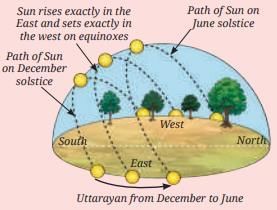
  • The Sun’s position at sunrise changes through the year (northward in summer, southward in winter) due to Earth’s tilt.
  • This movement is described in Indian tradition as Uttarayana (northward, Dec–June) and Dakshinayana (southward, June–Dec).
  • Solstices and equinoxes: Important points for tracking the Sun’s yearly journey and adjusting calendars.

The Indian National Calendar

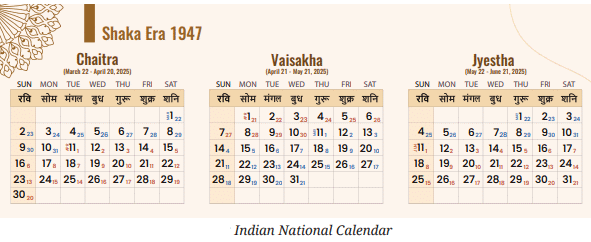
The Indian National Calendar, also known as the Saka Calendar, is a solar calendar officially used by the Government of India along with the Gregorian calendar.

  • It consists of 365 days in a year.
  • The year begins on 22 March (the day after the spring equinox). In leap years, it begins on 21 March.
  • Each month is named after traditional Indian months: Chaitra, Vaisakha, Jyestha, Ashadha, Shravana, Bhadrapada, Ashwin, Kartika, Agrahayana, Pausha, Magha, and Phalguna.
  • Months have 30 or 31 days: In a regular year, months 2–6 have 31 days, the rest have 30 days.
  • In a leap year, a day is added to Chaitra (the first month), making it start on 21 March.
  • The Indian National Calendar was introduced in 1956, based on recommendations by the Calendar Reform Committee (CRC) headed by Meghnad Saha, a famous astrophysicist.
  • The calendar follows principles similar to the ancient Surya Siddhanta.
  • This calendar helps unify timekeeping across India for civil purposes.

Are Festivals Related to Astronomical Phenomena?

Many Indian festivals are linked to the phases of the Moon and thus are based on lunar or luni-solar calendars.

Examples:

  • Diwali: Celebrated on the new Moon of Kartika.
  • Holi: Celebrated on the full Moon of Phalguna.
  • Buddha Purnima: Occurs on the full Moon of Vaisakha.
  • Eid-ul-Fitr: Celebrated after sighting the crescent Moon at the end of Ramazan.
  • Dussehra: Occurs on the tenth day of Ashwina.

These festivals appear on different dates in the Gregorian calendar each year because the lunar year and solar year are not the same length.

  • Luni-solar calendars add an extra (intercalary) month every few years to align lunar months with the solar year, causing date shifts of less than a month in the Gregorian calendar.
  • Pure lunar calendars do not make this adjustment, so festivals like Eid-ul-Fitr can move to different months of the Gregorian calendar over the years.

Solar Festivals

  • Some Indian festivals follow a solar sidereal calendar, so they occur on nearly the same date every year in the Gregorian calendar.
  • Examples: Makar Sankranti, Pongal, Bihu, Vaisakhi, Poila Baisakh, and Puthandu.
  • These were originally linked to solstices or equinoxes, but a slight difference between sidereal and tropical years causes their dates to drift slowly over centuries (e.g., Makar Sankranti shifts by one day every 71 years).

Variations in Festival Dates

  • The exact lunar phase at sunrise can vary for eastern and western parts of India, causing festival dates to differ by a day in different regions even in the same year.
  • To standardize this, the Rashtriya Panchang (national almanac) is published by the Positional Astronomy Centre, Government of India, giving advanced calculations for official festival dates.

Cultural Connection

The Moon and Sun also inspire Indian classical art forms:

  • Music: Ragas like Chandrakauns and Chandranandan are inspired by the Moon.
  • Dance: Gestures (mudras) such as Chandrakala and Ardhachandran in Bharatanatyam and other dances invoke lunar imagery.
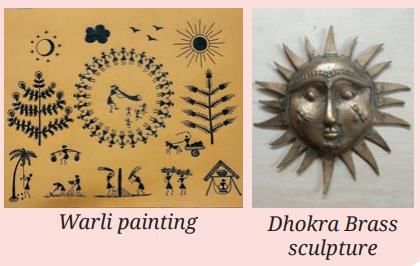
  • Visual Arts: Traditional painting styles (e.g., Madhubani, Warli), sculpture, and pottery frequently depict the Moon and Sun, reflecting their significance in daily life.

Why Do We Launch Artificial Satellites in Space?

Natural vs Artificial Satellites

  • The Moon is Earth’s natural satellite, revolving around our planet.
  • Artificial satellites are man-made objects placed in orbit around Earth by various countries.

Artificial Satellites: Purpose and Functions

  • Appearance: Artificial satellites look like tiny bright spots moving rapidly across the night sky.
  • Orbit: Most orbit at about 800 km above Earth’s surface, completing one orbit in roughly 100 minutes.

Key Uses:

  • Communication (TV, phones, internet)
  • Navigation (GPS, map services)
  • Weather monitoring
  • Disaster management (detecting floods, cyclones, etc.)
  • Scientific research (studying space, environment, and more)

Try yourself:

What is one reason we launch artificial satellites into space?

  • A.To communicate with animals
  • B.To study weather
  • C.To explore oceans
  • D.To grow plants

View Solution

Satellites and Missions by ISRO (Indian Space Research Organisation)

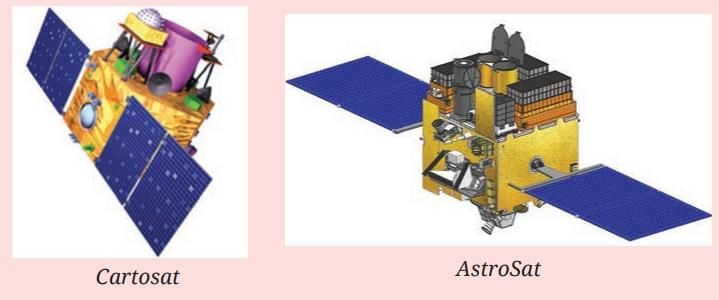
  • Cartosat Series: High-quality imaging satellites for mapping, city planning, and disaster response. 
    Example platform: Bhuvan uses Cartosat images to analyze soil, land use, vegetation, and terrain.
  • AstroSat:
    Observatory satellite for studying stars and celestial objects.
  • Chandrayaan 1, 2, 3:
    Moon missions.
  • Aditya L1:
    Satellite for studying the Sun.
  • Mangalyaan:
    Mars Orbiter Mission.
  • Student Satellites:
    ISRO encourages students to build and launch small satellites, such as: AzaadiSat, InspireSat-1, and Jugnu.

Observing Artificial Satellites

How to Spot:
Look for a small, bright, continuously moving dot in the sky, typically before sunrise or after sunset.

  • Can be seen without a telescope.
  • Satellite-tracking mobile apps or websites help identify visible satellites.

Space Debris (Space Junk)

  • When artificial satellites and rocket parts become old and stop working, they turn into space debris.
  • Risks: Collisions with functional satellites, cluttering orbits.

Disposal:

  • Small debris usually burns up in the atmosphere.
  • Larger fragments can fall and crash to Earth.
  • Countries collaborate on solutions to minimize and remove space debris.

Key Figures in Indian Space Program

Vikram Sarabhai:
Pioneer of India’s space program, known as the “Father of the Indian Space programme”.

  • The Vikram Sarabhai Space Centre (VSSC) in Thiruvananthapuram is named in his honor.
  • VSSC focuses on rocket and launch vehicle technology.

Key Points to Remember

  • Phases of the Moon: The changing shapes of the illuminated part of the Moon observed from day to day, such as new Moon, crescent, and full Moon.
  • Cause of Moon Phases: The phases occur because we see varying portions of the Moon’s illuminated side as it orbits around the Earth.
  • Cycle of Moon Phases: A complete sequence of the Moon’s phases, which takes about a month to finish.
  • Calendars: Systems created based on various natural cycles observed in nature, used to track time.
  • Lunar Calendar: A calendar that follows the cycle of the Moon’s phases.
  • Solar Calendar: A calendar that follows the cycle of seasons, determined by the Earth’s position in its orbit around the Sun.
  • Luni-solar Calendar: A calendar that adapts to both the Moon’s cycles and the seasonal cycles related to the Earth’s orbit.
  • Artificial Satellites: Human-made objects launched from Earth into space, which provide valuable information for human well-being and studies in space science.

10. Light: Mirrors and Lenses – Chapter Notes

Have you ever wondered why the warning “Objects in mirror are closer than they appear” is written on the side-view mirrors of cars?  Or why reading glasses sometimes have a curved line on their lenses?
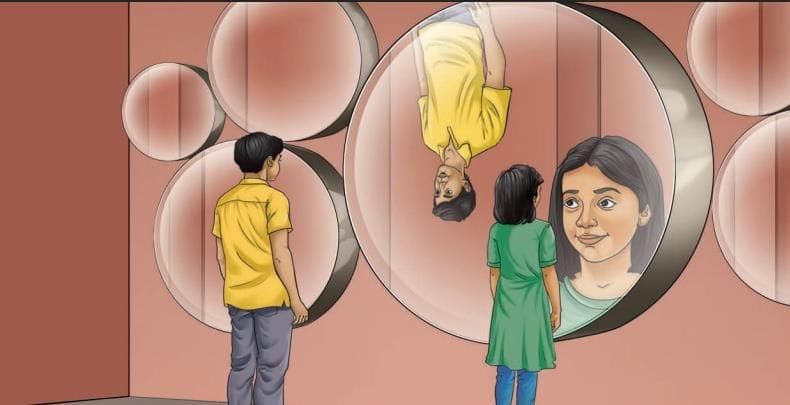
Let’s explore these questions with Meena! On a sunny afternoon during her summer holidays, Meena visited a science centre. Among all the amazing displays, something unusual caught her eye—a row of curved mirrors. 

MirrorsTo her surprise, when she looked into one, her face seemed comically larghe, while her brother, just a little farther away, looked upside down! At another mirror, she saw a tiny version of herself staring back.

Why do mirrors behave this way? Through the world of spherical mirrors and lenses, get ready to discover the secrets of light and learn how mirrors can make images appear bigger, smaller, or even flipped around!

What Are Spherical Mirrors?

Spoon as a Mirror—A Simple Observation

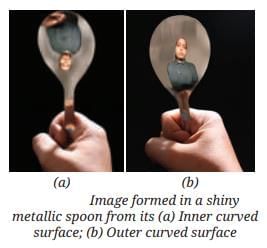
  • shiny metallic spoon can act like a mirror. You can see your face in it if you hold it close. 
  • If you look at the inner (curved inward) side of the spoon, your image appears inverted (upside down).
  • If you look at the outer (bulging outward) side, your image appears erect (upright) but much smaller than your real face.
  • This difference occurs because each side of the spoon curves in a different way, mimicking different types of curved mirrors.

Curved Mirrors and Spherical Mirrors

  • Mirrors like your spoon can be specially made as curved mirrors for scientific and everyday use.
  • The most common type of curved mirror is the spherical mirror.

Definition of Spherical Mirrors:
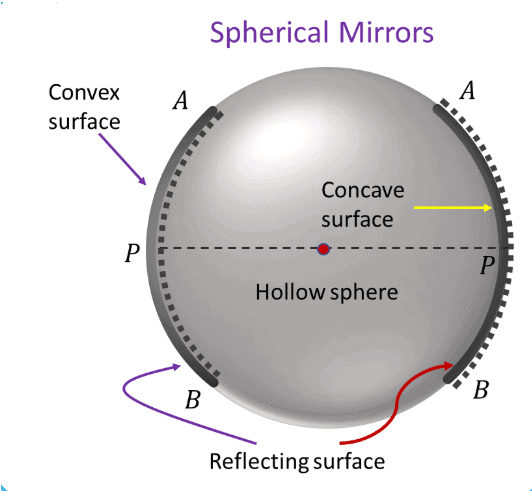
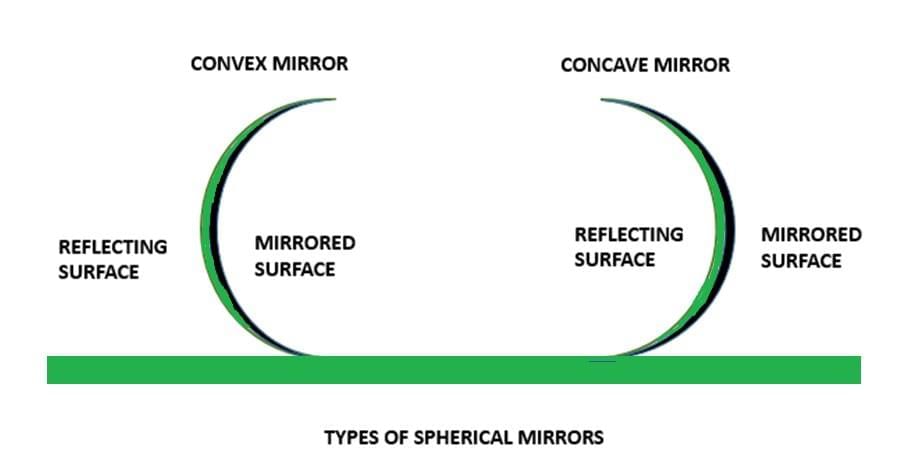
Spherical mirrors are mirrors whose reflecting surfaces are shaped like a part of a hollow glass sphere. Reflecting surfaces of spherical mirrors can curve either inwards or outwards.

Types of Spherical Mirrors

1. Concave Mirror

  • A mirror whose reflecting surface is curved inwards, like the inside of a spoon or a bowl..
  • Edge bulges out, center dips in — think “cave.”
  • The outline of this mirror is part of a circle when viewed from the front.

2. Convex Mirror

  • Reflecting surface curves outwards (like the outer side of a spoon, or the back of a bowl).
  • Center bulges out, edge curves back.

How Spherical Mirrors Are Made?

  • Shape: Spherical mirrors have a shape as if they are parts of an imaginary hollow sphere.
  • Manufacture: Despite their shape, these mirrors are not made by slicing a real hollow glass sphere.
  • Process: They are actually made by grinding and polishing a flat piece of glass into a curved surface. Then, a reflective coating (like a thin layer of aluminum) is added.

Placement of Reflective Coating:

  • If the coating is placed on the outer curved surface, the result is a concave mirror.
  • If the coating is placed on the inner curved surface, the result is a convex mirror.

What Are the Characteristics of Images Formed by Spherical Mirrors?

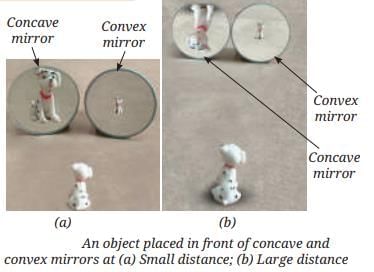
Concave Mirror:

  • When object is close (small distance): Image is erect but larger (enlarged) than the object.
  • When object moves farther: Image becomes inverted. It starts enlarged but gets smaller as distance increases.

Convex Mirror:

  • At any distance: Image is always erect and smaller (diminished) than the object.
  • As object moves farther: Image size decreases slightly.

Common in BothLateral inversion (left-right reversal) is observed in the images.

Comparison to Plane Mirrors:

  • Spherical mirrors differ from plane mirrors.
  • Plane mirrors always form an erect image of the same size as the object.
  • In concave and convex mirrors, image size changes with object distance.
  • In concave mirrors, images also invert when the object is moved away.

Distinguishing Spherical Mirrors

Idea: Identify if a mirror is plane, concave, or convex by observing object images.

  • Concave: Enlarged erect image close up, inverted when far.
  • Convex: Always erect and diminished.
  • Plane: Always erect and same size.

Real-Life Uses of Spherical Mirrors

 Concave and convex mirrors are used in everyday surroundings.

Concave Mirrors:

  • Reflectors in torches, car headlights, and scooters (concave shape).
  • Dental mirrors used by dentists: Provide enlarged view of teeth when held close inside the mouth.

Convex Mirrors:

  • Side-view mirrors on vehicles: Form erect, smaller images of traffic behind; curved outward for wider road view.
  • Installed at road intersections or sharp bends: Provide visibility from both sides to prevent collisions.
  • Used in big stores: Monitor large areas to deter thefts.

Telescopes

  • Most modern telescopes are reflecting telescopes using curved mirrors.
  • The main mirror is a large concave mirror.

What Are the Laws of Reflection?

Reflection is the bouncing back of light from a surface, like a mirror. The laws of reflection explain how light behaves when it strikes any mirror—plane (flat), concave (curved inward), or convex (curved outward).

The Two Laws of Reflection

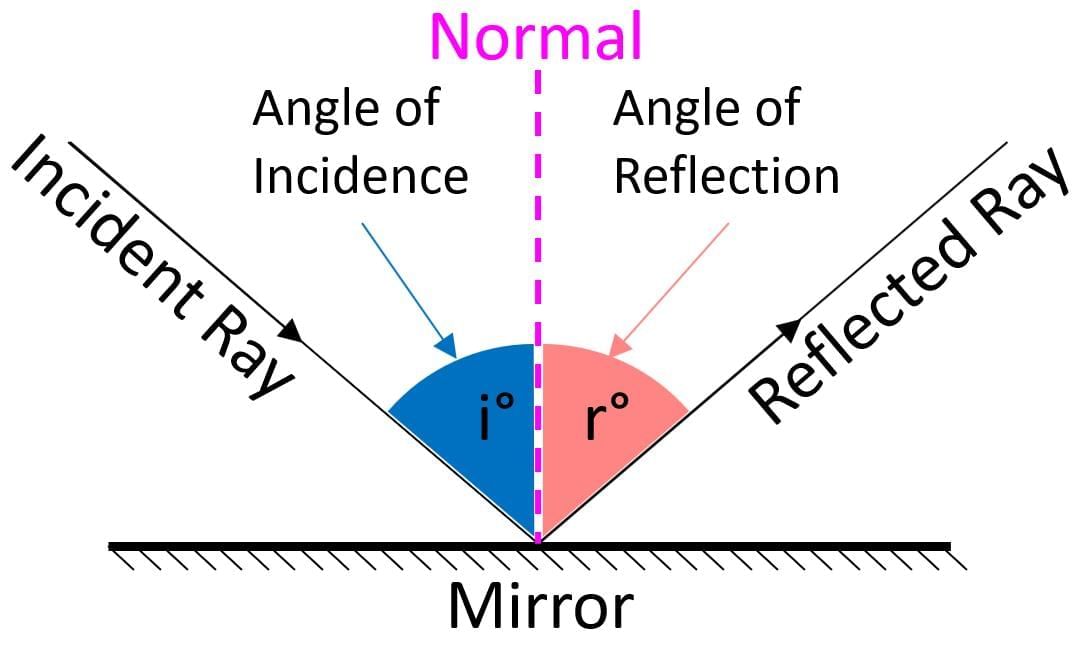
1. First Law of Reflection: Angle of Incidence Equals Angle of Reflection

Definition: The angle at which the incoming light ray hits the mirror (angle of incidence, i) is equal to the angle at which it bounces off (angle of reflection, r). In symbols: i = r.

First Law of Reflection

Key Concepts from Setup:

  • Use a plane mirror with stand, torch, comb (with black paper to make a thin slit), paper clip for holding, white paper sheet, and black paper strip.
  • Spread white paper on a table, place mirror upright, and shine a thin beam through the slit onto the mirror.
  • Adjust the beam to hit at different angles; the reflected beam shifts accordingly.

Terms to Remember:

  • Incident Ray: The incoming light ray that strikes the mirror.
  • Reflected Ray: The outgoing light ray that bounces back from the mirror.
  • Normal: An imaginary line drawn at 90° (right angle) to the mirror at the point of incidence.
  • Angle of Incidence (i): The angle between the incident ray and the normal.
  • Angle of Reflection (r): The angle between the reflected ray and the normal.
  • Light is represented as straight rays (lines with arrows) because light travels in straight lines.

How to Prove First Law of Reflection (Observation Process):

  • Draw the mirror line, incident ray, reflected ray, and normal at point O.
  • Measure i and r for different incident angles; record in Table.
  • Special Case: If the incident ray is along the normal, both i and r = 0 (light bounces straight back).
  • Inference (First Law): Measurements show i always equals r, no matter the incoming angle—this is the first law of reflection.
  • Example: Shine a torch beam on a plane mirror at various angles—the bounce angle matches the incoming angle exactly.

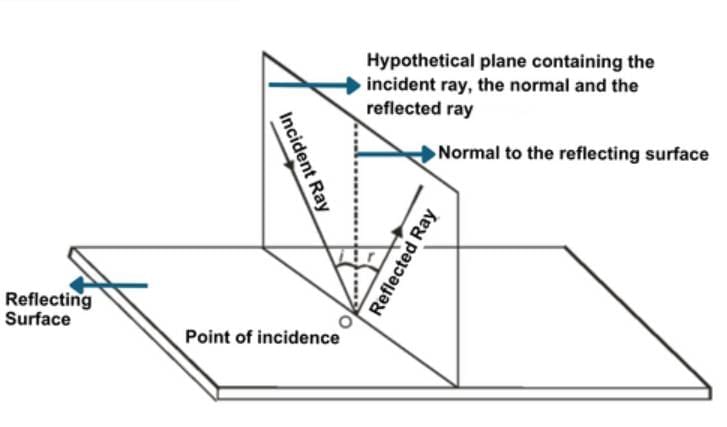
2. Second Law of Reflection: All in the Same Plane 

Definition: The incident ray, the normal to the mirror at the point of incidence, and the reflected ray, all lie in the same plane. 

Key Concepts from Setup:

  • Use the same materials as in activity above but add a stiff chart paper sheet extending beyond the table edge.
  • Shine a beam on the mirror; see the reflected beam on the extended flat paper (Figure (a)).
  • Bend the extended part down along the table edge; the reflected beam disappears (Figure (b)).
  • Flatten the paper; the beam reappears.
  • Inference (Second Law): Bending creates a new plane, breaking alignment—the law ensures the rays stay “flat” together for predictable reflection.
  • Step Further: Even if incident rays come from different directions but hit the same point, the normal remains the same, and all (incident ray, normal, reflected ray) stay in one plane.
  • Example: On flat paper, you see the full path; bending hides it because the plane changes.

How Laws Apply to Spherical Mirrors 

The Laws Are Universal: Both laws (i = r and same plane) apply to all mirrors, including spherical ones.

Key Concepts from Setup:

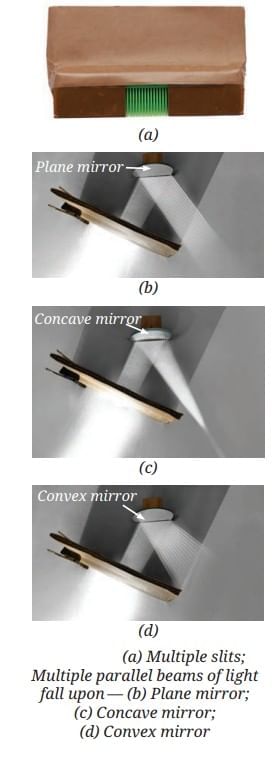
  • Use plane, concave, and convex mirrors with stands, torch, comb (multiple slits uncovered for parallel beams, and paper clip.
  • Shine parallel beams on each mirror one by one.

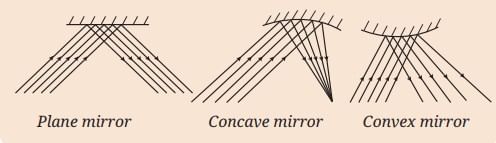
Observations:

  • Plane Mirror: Reflected beams stay parallel
  • Concave Mirror: Reflected beams come together (converge)
  • Convex Mirror: Reflected beams spread out (diverge).
  • Inference: Each ray obeys the laws, but the mirror’s curve causes parallel rays to converge (concave) or diverge (convex)—this explains focusing or widening effects.

Concentrating Light with Concave Mirrors 

Never look at the Sun or into the mirror reflecting sunlight—it can damage eyes. Focus light only on paper, not on faces or people.

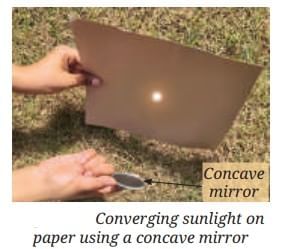
Key Concepts from Setup:

  • Use a concave mirror and thin paper (e.g., newspaper).
  • Hold the mirror facing the Sun; direct reflected light onto the paper.
  • Adjust paper distance for a sharp bright spot.
  • Keep steady for a few minutes.
  • Observation: The paper starts burning and produces smoke.
  • Inference: Concave mirrors converge sunlight to a small point, creating intense heat that can ignite paper—this shows the power of focused reflection.
  • Step Further (Solar Concentrators): Devices using mirrors/lenses to focus sunlight for heating liquids, making steam for electricity, large-scale cooking, or solar furnaces (even melting steel). Recall electric furnaces from an earlier chapter.

What Is a Lens?

Imagine looking through a flat transparent glass window pane—all objects look the same size and shape. But if the surface of the transparent material is curved, objects may not look the same.

How a Water Drop Acts Like a Lens 

Materials: A flat strip of glass or clear plastic (e.g., flat scale), few drops of oil, dropper, water, and a paper or book with printed text.

Key Concepts from Setup:

  • Spread a few drops of oil (or wax) on the glass/plastic strip and rub to make a thin coating (helps water form a round drop).
  • Use a dropper or finger to place a small water drop on the oiled/waxed spot.

Observations as Concepts:

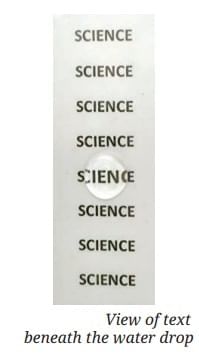
  • The water drop’s surface is curved outward (not flat or curved inward).
  • Place printed text under the strip so it’s directly below the drop.
  • Look down through the drop: Letters below appear different—often larger (enlarged) than nearby letters.
  • Inference: The curved surface of the water drop changes the text’s size, acting like a simple lens.

Definition and Types of Lenses

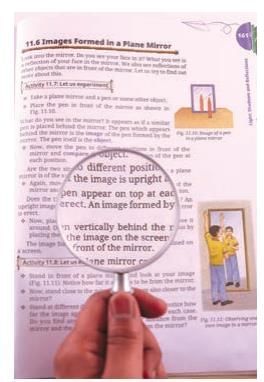
  • magnifying glass is a lens that enlarges small print, making letters look bigger.
  • Lens Definition: A piece of transparent material (usually glass or plastic) with curved surfaces.
  • Lenses can be convex or concave, like mirrors.
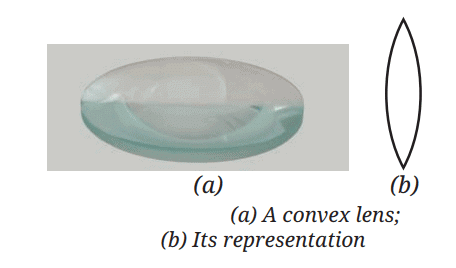
  • Convex Lens: Thicker at the middle than at the edges.
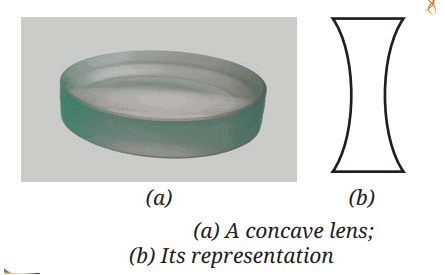
  • Concave Lens: Thicker at the edges than at the middle.
  • Unlike mirrors, lenses allow light to pass through; we see things through a lens, not reflected in it.

How Objects Look Through Lenses 

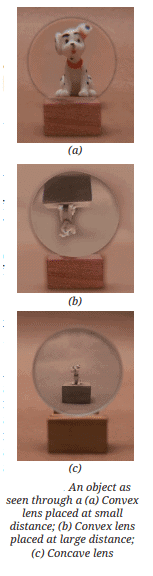
Materials: A convex lens, a concave lens, a lens holder, and a small object.

Setup:

  • Place the lens upright in the holder.
  • Put the object behind the lens (raise it to lens level if needed).
  • Look through the lens from the other side.
  • Move the object farther and observe changes; repeat for both lenses.

Observations :

Convex Lens:

  • At small distance: Object appears erect and enlarged (larger).
  • As distance increases: Object appears inverted; starts enlarged but gets smaller (diminishes).

Concave Lens:

  • At any distance: Object always appears erect and diminished (smaller).
  • Size changes (gets even smaller) as distance increases.
  • Inference: Distance from the lens affects image size and orientation. Convex lenses can enlarge and invert; concave always diminish and keep erect.

Do Lenses Converge or Diverge Light? 

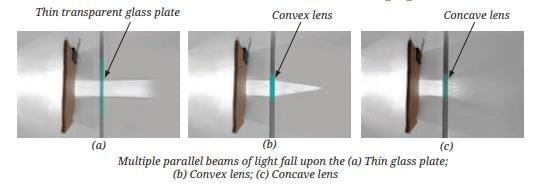
Materials: A thin transparent glass plate, a convex lens, a concave lens, a torch and comb (for multiple parallel beams), paper clip to hold comb, two identical books, and white paper sheets.

Setup:

  • Use books to hold the glass plate or lens upright between them .
  • Spread paper on both books.
  • Shine multiple parallel beams on the glass plate, convex lens, and concave lens one by one 

Observations:

  • Thin glass plate: Parallel beams pass through unchanged.
  • Convex lens: Beams come together (converge).
  • Concave lens: Beams spread out (diverge).
  • Inference: Convex lenses are converging lenses (focus light); concave are diverging lenses (spread light). (Diagrams show rays passing through each.)

 Drawing Light Through Lenses

  • Drawings of Activity show rays passing through: unchanged in glass plate, converging in convex lens, diverging in concave lens.
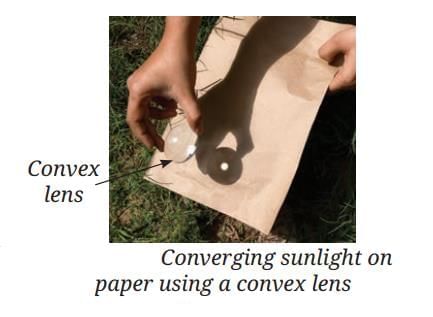
Can a Convex Lens Burn Paper?

  • Setup: Use a convex lens instead of a concave mirror in the path of sunrays.
  • Observation: Yes, you can burn the paper—the lens converges sunlight to a hot point, like a concave mirror.
  • Inference: Convex lenses focus light to create heat, similar to converging mirrors.

Real-Life Uses of Lenses

  • Lenses are important and used everywhere.
  • Eyeglasses: Help people see clearly.
  • Cameras, telescopes, and microscopes: Use lenses to capture or magnify images.
  • Human eye: Has a convex lens that changes shape to focus on near (e.g., reading) or far objects.

Key Points to Remember

  • Concave Mirror Images: A concave mirror forms images that can be bigger (enlarged), smaller (diminished), or the same size as the object. The image can be upright (erect) or upside down (inverted), all depending on how far the object is from the mirror.
  • Convex Mirror Images: A convex mirror always forms images that are upright (erect) and smaller (diminished) than the object, no matter the distance.
  • Laws of Reflection: These are two key rules for how light bounces off mirrors: (1) The angle where the light hits (angle of incidence) is equal to the angle where it bounces back (angle of reflection). (2) The incoming light ray, the normal line (straight up from the mirror at the hit point), and the bouncing ray all stay in the same flat surface (plane).
  • Validity of Reflection Laws: The laws of reflection work the same way for every type of mirror, whether it’s flat (plane), curved inward (concave), or curved outward (convex).
  • Behavior of Mirrors with Light: A concave mirror brings light rays together (converges them), like focusing sunlight to make heat. A convex mirror spreads light rays apart (diverges them), giving a wider view.
  • Convex Lens Images: A convex lens forms images that can be bigger (enlarged), smaller (diminished), or the same size as the object. The image can be upright (erect) or upside down (inverted), depending on how far the object is from the lens.
  • Concave Lens Images: A concave lens always forms images that are upright (erect) and smaller (diminished) than the object, no matter the distance.
  • Behavior of Lenses with Light: A convex lens brings light rays together (converges them), like in a magnifying glass. A concave lens spreads light rays apart (diverges them), like in some eyeglasses.

15. Bibha Chowdhuri: The Beam of Light that Lit the Path for Women in Indian Science – Chapter Notes

Introduction

In a time when women in India had little access to higher education or careers in science, one woman dared to dream differently – Bibha Chowdhuri. Born in 1913 in Kolkata, she rose against the societal expectations of her time and became India’s first woman physicist. Her story is one of courage, brilliance, and quiet strength, told against the backdrop of a male-dominated world of science. Although she worked with world-renowned scientists and made important discoveries, she remained uncelebrated during her lifetime. This story tells us how Bibha Chowdhuri broke barriers in physics, contributed to cosmic ray research, and laid the foundation for the success of today’s Indian women scientists at ISRO and beyond. From being ignored in history to having a star named after her, Bibha’s journey teaches us that true brilliance always finds a way to shine.

Key Points of the Story

  • In India, women are making big achievements in science, technology, engineering, and mathematics (STEM).
  • One of the first women to work in science in India was Bibha Chowdhuri, born in 1913 in Kolkata.
  • At a time when many women did not have equal access to education, Bibha became the first woman physicist in India.
  • She faced many challenges but still succeeded in high-energy particle physics.
  • In 1945, Bibha went to the University of Manchester to study cosmic rays with a famous scientist named Patrick M.S. Blackett.
  • Her research was recognised, and she was called “India’s New Woman Scientist” by newspapers.
  • She discovered pi-mesons, which are tiny particles, and was even nominated for a Nobel Prize in 1950.
  • After returning to India in 1949, she became the first woman teacher at the Tata Institute of Fundamental Research.
  • Throughout her life, Bibha worked quietly but did not get much recognition during her time.
  • Sadly, she passed away in 1991, and many people forgot about her incredible work.
  • In 2019, a star was named after her to honour her contributions to science.
  • Today, women in India, like Dr. Ritu Karidhal Srivastava, are making headlines for their work in space missions like Chandrayaan-3.
  • Women now lead important missions in Indian space programs, showing how far we have come since Bibha’s time.
  • Bibha’s story inspires many young women to pursue their dreams and break barriers in science.

Try yourself:

Who was the first woman physicist in India?

  • A.Dr. Ritu Karidhal Srivastava
  • B.Bibha Chowdhuri
  • C.Anita Gupta
  • D.Patrick M.S. Blackett

View Solution

Detailed Summary

Bibha Chowdhuri was born in 1913 in Kolkata, during a time when Indian women were discouraged from pursuing education, especially in science. But Bibha was different. From an early age, she showed a strong desire to learn and refused to follow the traditional path expected of women in those days. Her determination to study science was rare and courageous, especially because there were hardly any women in scientific fields at the time.

She studied at the Bose Institute, one of India’s leading scientific institutions. There, she became the first Indian woman to make her mark in high-energy particle physics. Her journey was difficult because the scientific world was dominated by men, but Bibha did not give up. She chipped away at the wall of exclusion, slowly gaining respect through her hard work and intelligence.

In 1945, she got an opportunity to study further at the University of Manchester in England. She worked under the guidance of Patrick M.S. Blackett, a famous physicist who later won the Nobel Prize. Bibha’s research focused on cosmic rays, high-energy particles from space that strike the Earth’s atmosphere. Her Ph.D. thesis on cosmic rays received wide praise. Newspapers even called her “India’s New Woman Scientist” and admired her for her skill in understanding cosmic rays.

Despite her talent, Bibha’s contributions often went unrecognised. During a time when many great scientific discoveries were being made, Bibha worked quietly in the background. One of her most important achievements was the discovery of pi-mesons, a tiny particle inside atoms. This was a breakthrough in physics. In 1950, Bibha was nominated for a Nobel Prize by the famous scientist Erwin Schrödinger. Although she didn’t win, the nomination showed how brilliant she was.

In 1949, Bibha returned to India. She was invited by Homi J. Bhabha, the father of India’s nuclear programme, to join the Tata Institute of Fundamental Research (TIFR). She became the first woman faculty member at TIFR. Her research continued at important institutions like the Physical Research Laboratory in Ahmedabad and the Saha Institute of Nuclear Physics in Kolkata. She worked with India’s leading scientists, including Vikram Sarabhai, and conducted experiments deep underground in the Kolar Gold Mines to study cosmic rays.

Yet, throughout her life, Bibha worked in silence. She never received any major awards. She passed away in 1991, her name almost forgotten.

Years later, her efforts were finally recognised. In 2019, the International Astronomical Union named a star in the Leo constellation as “Bibha”, which means “beam of light”. It was a beautiful tribute to a woman who had been a light for Indian science, even if many failed to notice it during her lifetime.

In recent years, Indian women scientists have taken huge leaps forward, building on Bibha’s legacy. At ISRO, women like Dr. Ritu Karidhal Srivastava, known as the Rocket Woman of India, led key missions like the Mars Orbiter Mission and Chandrayaan-2 and 3. Over 50 women contributed to Chandrayaan-3, showing that women are now leaders in space science. They design spacecraft, build autonomous systems, and manage mission control, something unthinkable in Bibha’s time.

Bibha Chowdhuri’s story reminds us how far we’ve come from a time when women had no space in science to now, when they lead space missions. She was the first spark in a long chain of achievements, and though she lived in the shadows, she helped light up the path for others.

Theme/Message

Theme

  • Breaking gender barriers: Bibha Chowdhuri’s life shows how women can succeed in fields where they are often discouraged, like science and technology.
  • Persistence and quiet strength: She worked without fame or rewards but kept going because of her love for science.
  • From invisibility to recognition: Though ignored in her lifetime, her contribution was finally honoured when a star was named after her.
  • Inspiration for future generations: Bibha’s story inspires girls and women to pursue their dreams, no matter how difficult the path may seem.

Message

  • Talent and hard work will shine even if the world doesn’t recognise it right away.
  • Pioneers often go unnoticed, but they lay the foundation for future success.
  • Women belong in every field, including science, and can lead just as well as men.
  • Progress in society depends on recognising and encouraging every person’s potential, regardless of gender.

Try yourself:

What is the main theme of the text?

  • A.Mystery
  • B.Theme/Message
  • C.Friendship
  • D.Adventure

View Solution

Difficult Words

  • Trailblazer: A person who is the first to do something and opens the way for others.
  • Pioneers: People who are among the first to explore or develop a new area of knowledge or activity.
  • Equitable: Fair and just, ensuring everyone has the same rights and opportunities.
  • Persistence: Continuing to do something despite difficulties or challenges.
  • Exclusion: The act of not allowing someone to be part of a group or activity.
  • Recognition: Acknowledgement of someone’s achievements or importance.
  • Contribution: Something that is given or added to a cause or effort.
  • Legacy: Something handed down from one generation to the next, often relating to achievements or memories.
  • Subatomic: Smaller than an atom; refers to particles that make up atoms.
  • Mentorship: Guidance provided by a more experienced person to a less experienced person.
  • Innovative: Introducing new ideas or methods; creative and original.
  • Acclaim: Public praise for someone’s achievements.
  • Illuminate: To light up; to make something clear or easy to understand.
  • Tenacity: The quality of being determined and not giving up easily.
  • Cosmic: Related to the universe or outer space.

14. Magnifying Glass – Chapter Notes

Introduction

Have you ever looked through a magnifying glass and felt like you entered a new world? 

In The Glass”  by Walter de la Mare, the poet talks about the magic of seeing ordinary things extraordinarily. Through the eyes of a curious observer and with the help of a simple round glass (a magnifying lens), the small wonders of nature, chalk, moss, water, and insects suddenly become vast and magical. This poem celebrates how imagination and observation can turn even the tiniest object into something marvellous.

About the Poet

Walter de la Mare (1873–1956) was a British poet and short story writer known for his dreamlike, mysterious, and imaginative poems. Many of his poems explore childhood, nature, and fantasy. He had a special talent for finding magic in ordinary things and creating rich images with simple words. “The Glass” is a perfect example of how he turns scientific observation into poetic wonder, encouraging readers to see more deeply into the world around them.

Key Points of the Poem

  • The poem is about a person using a round glass, a magnifying glass, to look closely at everyday natural objects.
  • This lens makes small things like chalk, moss, or water appear large, detailed, and magical.
  • The speaker sees a whole forest in a piece of moss, and a hive of bees in a drop of water, showing how much beauty and detail are hidden in tiny things.
  • The speaker also watches a spider spinning its web and notices how clever and skilled the spider is, though flies still fall into its trap.
  • The poem shows how observation, combined with curiosity and imagination, can make the world more exciting.
  • It ends by saying that using special lenses (like telescopes), we could even imagine walking on the moon—highlighting the power of science and wonder.
  • The tone of the poem is playful, curious, and filled with admiration for the hidden beauty in nature.
  • It encourages the reader to look closely and never underestimate the power of small things.

Try yourself:

What does the speaker see in a piece of moss?

  • A.A forest
  • B.A spider
  • C.A bee
  • D.A flower

View Solution

Explanation of the Poem

Stanza 1

With this round glass
I can make Magic talk—
A myriad shells show
In a scrap of chalk;
Of but an inch of moss
A forest—flowers and trees;
A drop of water
Like hive of bees.

Explanation:
The speaker begins by talking about a magical round glass—a magnifying glass. When he looks through it, ordinary things become magical. In a small piece of chalk, he can see tiny shell shapes, as if the chalk holds secrets from the ocean. Just an inch of moss appears to be a whole forest, with miniature flowers and trees. A single drop of water looks like a busy beehive, full of activity. This shows how the glass reveals the hidden, detailed world that our eyes normally miss. It also shows the power of observation and imagination.

Stanza 2

I lie in wait and watch
How the deft spider jets
The woven web-silk
From his spinnerets;
The tigerish claws he has!
And oh! the silly flies
The stumble into his net—
With all those eyes!

Explanation:
Now, the speaker watches a spider closely through the glass. He describes how the spider skillfully spins silk from its spinnerets (the part of the body that releases thread). The word “deft” shows the spider is very skilled at its work. The spider’s claws are compared to a tiger’s, showing its strength and danger, even though it’s tiny. The speaker also notices how flies with many eyes still get trapped, showing that even though they can see well, they’re not always careful. This part of the poem shows the cruel but fascinating part of nature and how even small creatures are full of surprises.

Stanza 3

Not even the tiniest thing
But this my glass
Will make more marvellous
And itself surpass.
Yes, and with lenses like it,
Eyeing the moon,
‘Twould seem you’d walk there
In an afternoon!

Explanation:
In the final part, the poet says that even the smallest object becomes wonderful when seen through the glass. It shows more than expected—it “surpasses” itself, meaning it becomes even more amazing. He then takes this idea even further by imagining using powerful lenses (like telescopes) to look at the moon. Through such lenses, it might seem like you could walk on the moon just in an afternoon! This ending blends science and imagination, showing that with the right tools and curiosity, we can explore entire worlds tiny and distant.

Theme/Message

Theme

  • Curiosity and Observation: The poem celebrates how carefully looking at the world can reveal its hidden beauty.
  • Magic in the Everyday: Even common objects like moss, water, and insects hold amazing details when closely observed.
  • Science and Imagination: The magnifying glass and telescope are tools of science, but they also open doors to creativity and wonder.
  • Nature’s Hidden Wonders: Nature is full of life, even in the tiniest spaces. The poem teaches us to pay attention to the small things.

Message

  • There is magic all around us—if we take the time to look closely.
  • Even the smallest object can be full of beauty, life, and mystery.
  • Curiosity is a powerful tool. It can turn learning into an adventure.
  • We should never ignore the little things—sometimes they show us the biggest wonders.

Try yourself:

What is the main idea of the text?

  • A.It shares a message.
  • B.It discusses a theme.
  • C.It provides a summary.
  • D.It gives a lesson.

View Solution

Difficult Words

  • Myriad: A very large number of something.
  • Deft: Skilful and quick in movement.
  • Jet: To move rapidly or shoot out quickly.
  • Spinnerets: The part of a spider that produces silk.
  • Tigerish: Having qualities similar to a tiger, often fierce or aggressive.
  • Marvellous: Causing great wonder; extraordinary.
  • Claws: Sharp, curved nails on animals, used for gripping or holding.
  • Hives: Structures where bees live and store honey.
  • Woven: Made by interlacing threads or materials.
  • Silky: Smooth and soft like silk.
  • Lens: A piece of glass or other transparent material that focuses light.
  • Forest: A large area covered chiefly with trees and undergrowth.
  • Scrap: A small piece or fragment of something.
  • Stumble: To trip or lose balance while walking.
  • Extraordinary: Very unusual or remarkable.

13. Feathered Friend – Chapter Notes

Introduction

Set aboard a space station far from Earth, “Feathered Friend” is a science fiction story that explores how even the smallest life can play a vital role in survival. The story follows Sven Olsen, a technician who secretly brings a canary named Claribel into space. While the bird becomes a cheerful companion to the crew, her true importance is revealed when she senses a drop in oxygen—long before any alarm does. Through this gentle and thoughtful tale, Arthur C. Clarke reminds us that in a world filled with machines, nature can still be our most reliable guardian.

About the Author

Arthur C. Clarke (1917–2008) was a world-famous British science fiction writer, futurist, and inventor. He is best known for his novel 2001: A Space Odyssey and many short stories that explore space, science, and technology in imaginative ways. Clarke had a deep interest in space exploration and often predicted future scientific advancements with great accuracy. In “Feathered Friend,” Clarke mixes humour with science to show how something as simple as a canary can be smarter than all the machines in a space station.

Arthur C. Clarke

Key Points of the Story

  • The story begins with a character named Sven Olsen, who is a skilled construction worker on a space station.
  • Sven has a pet canary named Claribel, which he secretly brought to the station, despite there being no rules against pets.
  • Claribel can fly in the absence of gravity and adapts well to her new environment.
  • The narrator first discovers Claribel while reviewing technical documents in his small office on the space station.
  • Sven initially keeps the ownership of Claribel a secret, but soon everyone on the station knows about her.
  • Claribel becomes a beloved pet among the crew, and they manage to hide her from visiting VIPs.
  • The crew works in twelve-hour shifts, and life on the space station is relatively quiet without day and night.
  • One morning, Sven cannot find Claribel, leading to a sense of worry among the crew.
  • Sven eventually finds Claribel unconscious and heartbroken, and he brings her to the crew for help.
  • The crew’s cook, Jock, tries to check if Claribel is alive by listening for a heartbeat, but cannot find one.
  • They decide to give her oxygen, and to their surprise, she revives momentarily before passing out again.
  • The narrator realises that there is something wrong with the air in the station, recalling that canaries are used as gas detectors in mines.
  • Jim, the duty engineer, initially dismisses the concern, but he is reminded that the backup alarm system is not connected.
  • Later, it is discovered that an eclipse had caused a malfunction in the air purifier, which could have been disastrous without Claribel’s warning.
  • The story ends with a suggestion that having a canary in space stations could serve as an early warning system for air quality issues.

Try yourself:

What does Sven Olsen secretly bring to the space station?

  • A.A fish
  • B.A canary
  • C.A dog
  • D.A cat

View Solution

Detailed Summary

The narrator begins by explaining that there was no rule against keeping pets in the space station, and even if there had been, Sven Olsen would have ignored it. Sven was small and wiry, the kind of person who qualified easily for the space missions where weight mattered a lot. He was also one of the best construction workers in the team, skilled at handling floating girders and welding them into perfect shapes in space’s zero-gravity environment.

One day, the narrator was in his tiny office when he heard a strange musical whistle. At first, he thought it was from the station’s intercom, but when the sound continued, he looked up only to see a small yellow canary floating in mid-air. This bird was Claribel, and she was perfectly comfortable in the weightless conditions. She performed a loop in the air and floated away. The narrator was surprised but also amused at how easily Claribel had adapted to space life.

Sven didn’t admit to bringing Claribel aboard right away. When he finally did, it was too late to scold him because everyone had already grown fond of the bird. He explained that he brought Claribel partly out of scientific curiosity to see how a bird would behave in zero gravity. She didn’t need much food or space, and unlike most animals, she didn’t get scared in space.

Claribel became a quiet but cheerful member of the crew. She was hidden during visits from Earth’s important officials, though her chirping sometimes made it hard to conceal her presence. Still, no one suspected that a bird was aboard the space station.

One “morning,” which in space is only a term since there’s no real day or night, the narrator woke up with a headache and feeling unusually tired. During breakfast, the team noticed that Sven was missing. Someone mentioned that he was looking for Claribel, who usually woke him up with her chirping.

When Sven finally appeared, he looked deeply upset. In his hand was Claribel, motionless and silent. She seemed lifeless. The whole crew was sad and confused. The cook, Jock Duncan, tried to check if she had a heartbeat but couldn’t tell for sure. Someone suggested giving her oxygen using the emergency supply. To everyone’s joy, Claribel came back to life but only briefly. She chirped happily, then fainted again.

The narrator suddenly remembered something important. In olden times, miners used to take canaries into coal mines because the birds were more sensitive to toxic gases than humans. If the bird collapsed, it was a warning that the air was dangerous. He realised that something similar might be happening now.

He told the duty engineer, Jim, that there could be something wrong with the air. At first, Jim dismissed the idea, saying the air alarms would have gone off. But then Jim’s assistant reminded him that the second alarm system hadn’t been connected yet. Jim rushed out without another word.

Ten minutes later, he returned looking embarrassed. It turned out that during an eclipse caused by Earth’s shadow, part of the air purifier had frozen and stopped working. The one alarm that was connected had also failed. Without Claribel’s warning, the crew would not have known about the problem in time and might have died from lack of oxygen.

Thanks to Claribel, the small yellow canary, the whole crew was saved. After this incident, it became common for space stations to keep birds not only as pets but also as natural early warning systems.

Try yourself:

What is a benefit of reading books?

  • A.Takes a lot of time
  • B.Improves vocabulary
  • C.Is always boring
  • D.Requires special skills

View Solution

Theme/ Message

  • The story illustrates the importance of companionship, even in the most unusual environments, as shown by Sven’s bond with Claribel.
  • The narrative highlights the unexpected roles animals can play in human lives, serving as both pets and protectors.
  • It emphasises the need for safety and vigilance in technology-dependent environments like space stations.
  • The story also conveys a sense of teamwork and camaraderie among the crew as they work together to solve the problem posed by Claribel’s condition.
  • Ultimately, the presence of Claribel reinforces the idea that sometimes the smallest beings can have the largest impact on our lives.

Try yourself:

What is the main idea of the text?

  • A.A story about animals
  • B.A lesson on teamwork
  • C.A recipe for soup
  • D.A description of a city

View Solution

Difficult Words

  • Regulation: A rule or directive made and maintained by an authority.
  • Wiry: Lean and strong; slim but muscular.
  • Specialised: Designed or developed for a particular purpose or field.
  • Dovetailed: Fitted together closely or precisely, like pieces of a puzzle.
  • Excels: Performs exceptionally well; surpasses others in a particular skill.
  • Hushed: Quiet; made silent or still.
  • Mournfully: In a way that expresses sadness or grief.
  • Apologetically: In a manner that shows regret or guilt for an action.
  • Revived: Brought back to life or consciousness; restored to health.
  • Safeguarded: Protected from harm or danger.
  • Inexplicable: Unable to be explained or understood.
  • Curious: Eager to know or learn something; inquisitive.

12. Waiting for the Rain – Chapter Notes

Introduction

This story explores the close relationship between nature and humans, especially focusing on a farmer’s bond with his land. Set during a year of severe drought, the story follows a hardworking farmer named Velu who is deeply worried about the lack of rain. Through a chance encounter with an old woman, Velu learns a powerful lesson about the natural world that nature, like humans, also needs rest. The story ends on a hopeful note with the arrival of rain, showing how nature works in its own time.

About the Author

Kamakshi Balasubramanian is a respected Indian author, teacher, and environmental thinker. She has a deep love for storytelling that inspires readers to see the world with more care and understanding. Her writing often focuses on nature, everyday life, and the simple truths we tend to forget. Through her thoughtful and gentle stories, she encourages young readers to notice the beauty in small things and to value the bond between humans and the natural world. In “Waiting for the Rain”, she uses the voice of an old woman to remind us that just like people, even the land needs time to rest and recover.

Key Points of the Story

  • Velu is a hardworking farmer who wakes up early every day, hoping for rain.
  • This year, there has been no rain, which is unusual. Velu and his neighbours are worried about their crops.
  • They wait for weeks and months, but the rain does not come. The fields become dry and cracked.
  • Velu thinks about going to astrologers for help, but he does not believe they can bring rain.
  • He visits the weather office, but the people there also do not know when it will rain.
  • Feeling tired and thirsty, Velu sits under a tree and meets an old woman who is also resting.
  • The old woman smiles at Velu, but they both feel sad because of the lack of rain.
  • Velu expresses his frustration about not being able to work on his land due to the drought.
  • The old woman tells Velu that sometimes the land needs to rest, just like people do.
  • She explains that Nature takes care of everything and that the earth has its cycle.
  • Velu begins to understand that the land might be resting and that rain will eventually come.
  • As Velu walks home, he feels a breeze and sees clouds forming in the sky.
  • He becomes excited as he realises that rain may soon fall, bringing hope for his crops.
  • Velu runs home, feeling happy and hopeful about the future.

Try yourself:

What does the old woman tell Velu about the land?

  • A.It needs rain right away.
  • B.It needs to rest sometimes.
  • C.It is always dry.
  • D.It will never grow crops.

View Solution

Detailed Summary

Velu was a sincere and hardworking farmer who lived in a village. Every day, he woke up early to tend to his land. He loved his work and never took a break, even during festivals or holidays. For the past six years, his land had always yielded good crops like jowar and dal, and this made him proud and hopeful.

One morning, Velu woke up hoping it would rain. He looked at the sky, but there were no clouds, only a bright red sun rising in the sky. Without rain, Velu couldn’t plough his field, and this made him feel worried and helpless. This year, the usual monsoon rains had not come. The earth in the fields had dried up, cracked, and turned lifeless. Farmers like Velu, who depended on rain, had no choice but to wait and hope.

Some villagers began to lose patience. They suggested visiting astrologers to perform rituals or give advice to please the heavens. But Velu didn’t believe in these ideas. He trusted science and nature more. So, he went to the city to talk to people at the weather office. Sadly, even the experts there were confused. They told him that the weather conditions seemed right, but the rain still hadn’t come. Velu returned to his village feeling tired, dusty, and more discouraged than ever.

On the way back, Velu stopped under a shady tree to rest. There, he noticed an old woman already sitting under the tree. She had a kind face, sparkling eyes, and a warm smile. Velu was curious and began speaking with her. He shared his sadness and frustration, telling her how much he had worked over the years and how the lack of rain was affecting his family’s survival.

To Velu’s surprise, the old woman gently suggested that perhaps the land itself was tired. She explained that just like people, the earth also needs time to rest and recover. She reminded him that the soil had been worked for thousands of years and that nature often brings a pause so that everything can regain strength. Her words made Velu stop and think. He realised that maybe this long dry season was nature’s way of giving the land a break.

As Velu walked home, he thought deeply about what the old woman had said. The idea that the earth could be resting gave him peace. He began to feel hopeful again. Just then, he felt a cool breeze and a tiny drop of water on his shoulder. Looking up, he saw clouds gathering in the sky. The air became cooler, the light dimmed, and soon it looked like the rains would finally arrive.

Velu was filled with happiness. He understood that everything in nature happens for a reason and at the right time. Trusting nature, he ran home joyfully, ready to start again with a fresh heart.

Theme/Message

  • The main theme of the story is the connection between humans and nature. It shows how farmers depend on the weather for their crops.
  • Another important theme is patience and understanding. Sometimes, things do not happen right away, and we must wait for nature to take its course.
  • The story also highlights the importance of rest. Just like people need breaks, the land also needs time to recover and rejuvenate.
  • The message of the story is that hard work is important, but it is equally important to respect nature’s rhythms.
  • It teaches us to have hope, even in tough times. Just like Velu learned to trust that rain would come, we should trust that good things will happen in our lives, too.
  • By listening to the wisdom of the old woman, Velu learns that every living thing has a purpose and a cycle, and we must be patient with ourselves and with nature.

Try yourself:

What is the main idea of the theme?

  • A.A character’s action
  • B.A central message
  • C.A specific event
  • D.A plot twist

View Solution

Difficult Words

  • Crimson: A deep red colour.
  • Encouraging: Giving hope or confidence.
  • Dejected: Feeling sad and disappointed.
  • Astrologers: People who study the stars and planets to predict the future.
  • Wrinkled: Having lines or folds in the skin, usually due to age.
  • Fragrant: Having a pleasant smell.
  • Undisturbed: Not being interrupted or disturbed.
  • Jowar: A type of grain used for food, similar to sorghum.
  • Harvesting: Gathering crops when they are ready to be eaten.
  • Cracked: Having lines or breaks on the surface.
  • Frustration: A feeling of being upset or annoyed because you cannot do something.
  • Rejuvenate: To make something feel young or fresh again.

11. Harvest Hymn – Chapter Notes

Introduction

What if nature itself was part of a family—Sun like a father, Earth as a mother, and Rain as a gentle friend? 

In “Harvest Hymn” by Sarojini Naidu, the poet gives voice to grateful villagers who sing in praise of the forces that make life and harvests possible. Through rich and poetic language, the villagers express their thanks to Surya (Sun), Varuna (Rain), Prithvi (Earth), and the Supreme Lord for their roles in giving light, rain, soil, and spirit. It is a song of prayer, unity, and thanksgiving that shows how deeply connected human life is to nature.

About the Poet

Sarojini Naidu (1879–1949), known as the “Nightingale of India,” was a gifted poet, freedom fighter, and the first woman Governor of an Indian state. She wrote lyrical poems about nature, love, Indian traditions, and national pride. Her poetry is known for its melody, emotional depth, and cultural richness. In “Harvest Hymn,” she blends spiritual devotion with the everyday lives of farmers, showing the beauty of rural India and its dependence on natural forces.Sarojini Naidu

Key Points of the Poem

  • The poem is a hymn of gratitude offered by villagers for a successful harvest.
  • It praises different natural forces—Sun (Surya), Rain (Varuna), and Earth (Prithvi)—each of which plays a vital role in farming.
  • The poem shows how deeply connected farming is to nature, and how grateful people are for these blessings.
  • The villagers offer songs, flowers (garlands), and the fruits of their labour as tribute to these divine forces.
  • The poem uses rich language and musical instruments (cymbals, flutes, drums, pipes) to show how joyful and respectful the villagers are.
  • Both men and women participate in the hymn, and in the end, all voices join together to praise the Supreme Lord who is the giver and protector of life.
  • The poem highlights the Indian cultural tradition of treating nature as sacred and alive.
  • It encourages respect, unity, and devotion, reminding us to stay connected to the earth and be thankful for its gifts.

Try yourself:

What do the villagers offer to show gratitude for the harvest?

  • A.Songs and flowers
  • B.Money and gifts
  • C.Food and drinks
  • D.Books and toys

View Solution

Explanation of the Poem

Stanza 1

Men’s Voices:

Lord of the lotus, lord of the harvest,
Bright and munificent lord of the morn!
Thine is the bounty that prospered our sowing,
Thine is the bounty that nurtured our corn.
We bring thee our songs and our garlands for tribute,
The gold of our fields and the gold of our fruit;
O giver of mellowing radiance, we hail thee,
We praise thee, O Surya, with cymbal and flute.

Explanation:

The villagers begin by thanking Surya, the Sun God, who gives light and warmth to the earth. They call him “bright and munificent” because he generously shines every day, helping seeds grow into plants. Without the Sun, there would be no crops. The villagers say that the sunshine “prospered” (helped) their sowing and “nurtured” their corn, meaning the sunlight helped their seeds sprout and grow strong. They offer him songs, garlands, and their golden fields of crops and fruits. The use of musical instruments like cymbals and flutes shows joy and celebration. This stanza shows that Surya is seen not just as a source of light but also as a giver of life.

Stanza 2

Lord of the rainbow, lord of the harvest,
Great and beneficent lord of the main!
Thine is the mercy that cherished our furrows,
Thine is the mercy that fostered our grain.
We bring thee our thanks and our garlands for tribute,
The wealth of our valleys, new-garnered and ripe;
O sender of rain and the dewfall, we hail thee,
We praise thee, Varuna, with cymbal and pipe.

Explanation:

Next, they praise Varuna, the god of rain and water. He is called “lord of the rainbow” and “lord of the main,” meaning the ocean. Rain is shown as a kind and gentle force his “mercy” helps ploughed fields (furrows) and crops to grow. The villagers thank him for watering the earth, helping the grains to ripen. They offer him garlands and the fresh produce from their valleys. The phrase “new-garnered and ripe” means freshly gathered and fully grown crops. They celebrate him with cymbals and pipes, grateful for the rainfall that made the harvest possible.

Stanza 3

Women’s Voices:
Queen of the gourd-flower, queen of the harvest,
Sweet and omnipotent mother, O Earth!
Thine is the plentiful bosom that feeds us,
Thine is the womb where our riches have birth.
We bring thee our love and our garlands for tribute,
With gifts of thy opulent giving we come;
O source of our manifold gladness, we hail thee,
We praise thee, O Prithvi, with cymbal and drum.

Explanation:

Now, the women offer praise to Prithvi, Mother Earth. She is described lovingly as the “queen of the gourd-flower” and the “sweet and omnipotent mother.” The earth is shown as full of life-giving power. Her “plentiful bosom” (chest) feeds all people, and her “womb” (symbol of birth) gives birth to all the riches of the land. This imagery makes us feel how nurturing and important the earth is—like a mother who feeds, protects, and gives life. The women come with garlands and gifts of the harvest, praising her with cymbals and drums. This part of the poem reminds us to love and care for the land that supports us.

Stanza 4

All Voices:
Lord of the Universe, Lord of our being,
Father eternal, ineffable Om!
Thou art the Seed and the Scythe of our harvests,
Thou art our Hands and our Heart and our Home.
We bring thee our lives and our labours for tribute,
Grant us thy succour, thy counsel, thy care.
O Life of all life and all blessing, we hail thee,
We praise thee, O Lord, with cymbal and prayer.

Explanation:

In the final stanza, everyone comes together to pray to the Supreme Lord, called “Lord of the Universe” and “Father eternal.” He is too great to describe (ineffable) and is the source of all life. He is called both the “Seed” (beginning) and “Scythe” (end) of the harvest—meaning he controls all stages of life and death. The villagers offer not just crops, but their own lives and hard work. They ask for his succour (help)counsel (guidance), and care (protection). The poem ends with cymbals and prayer, showing respect, faith, and the idea that God lives in everything nature, work, and people.

Theme /Message

Theme

  • Gratitude to Nature: The poem celebrates nature’s role in human life and farming.
  • Unity of Men, Women, and Nature: Everyone joins in devotion, showing unity and respect for natural forces.
  • Divine Presence in Daily Life: Nature is not just physical—it is divine and deserves our prayers and offerings.
  • Balance and Harmony: The poem shows the harmony between humans and nature when people work with care, prayer, and gratitude.

Message

  • We should be thankful for the natural forces—sun, rain, and earth—that make life and food possible.
  • Hard work, prayer, and respect must go together in life.
  • Nature is sacred and should not be taken for granted.
  • If we respect the land, water, and sky, they will continue to bless us in return.

Try yourself:

What is the main theme of the text?

  • A.Nature
  • B.Learning
  • C.Adventure
  • D.Friendship

View Solution

Difficult Words 

  • Harvest: Collecting ripe crops
  • Munificent: Very generous or kind
  • Bounty: Gifts or blessings of nature
  • Prospered: Helped something grow well
  • Nurtured: Cared for and developed
  • Radiance: Bright light or glow
  • Cymbal: A round metal instrument that makes a clashing sound
  • Beneficent: Kind and helpful
  • Furrows: Long, narrow cuts in soil made for planting seeds
  • Garnered: Gathered or collected
  • Opulent: Rich and full
  • Omnipotent: All-powerful
  • Womb: The part of the body where life begins (used symbolically for Earth)
  • Manifold: Many and varied
  • Ineffable: Too great to be described
  • Scythe: A curved tool used to cut crops
  • Succour: Help or support
  • Counsel: Advice or guidance
  • Hail: To greet with respect

10. The Cherry Tree – Chapter Notes

Introduction

The Cherry Tree is a touching short story written by the renowned Indian author Ruskin Bond. Set in the hill town of Mussoorie, it beautifully captures the bond between a young boy named Rakesh and his grandfather, as they nurture a cherry tree from a single seed to a full-grown tree. The story highlights patience, growth, nature’s wonder, and the quiet joys of rural life. It shows how small acts like planting a seed can grow into something meaningful over time.

About the Author

Ruskin Bond is one of India’s most beloved writers for children. Born in 1934 in Kasauli, he has written hundreds of short stories, novels, and poems that often focus on nature, childhood, and life in the hills. His writing is simple, warm, and filled with gentle humour and wisdom. Bond’s stories reflect his deep love for the natural world and his ability to find magic in everyday life. He has won many awards, including the Padma Shri and Padma Bhushan, for his contribution to literature.

Ruskin Bond

Key Points of the Story

  • Rakesh is a six-year-old boy who loves cherries, brought from the Kashmir Valley, which he buys on his way home from school.
  • He lives with his grandfather in a cottage at the edge of Mussoorie, while his parents live in a village where there are no schools.
  • Rakesh is sent to live with his grandfather so he can go to school and learn.
  • After eating cherries, Rakesh finds the seed and asks his grandfather if it is lucky. His grandfather tells him to plant it to make it lucky.
  • Rakesh digs a small hole in the garden and plants the cherry seed, forgetting about it soon after as he plays cricket with friends.
  • As winter comes, Rakesh and his grandfather enjoy telling stories by the fire, while Rakesh finds joy in reading the newspaper to his grandfather.
  • Spring arrives, and Rakesh discovers the cherry seed has sprouted into a tiny tree, which brings him joy.
  • Rakesh takes care of the tree by watering it and protecting it with pebbles, hoping it will grow strong.
  • During the rainy season, the cherry tree faces challenges, such as being eaten by a goat and being cut in half by a woman with a scythe.
  • Despite these challenges, the cherry tree continues to grow and thrive, showing resilience.
  • As Rakesh grows older, he continues to care for the cherry tree, which grows taller and eventually bears fruit.
  • Rakesh learns the importance of nurturing and caring for something he has planted, as it becomes special to him and his grandfather.
  • The story highlights the bond between Rakesh and his grandfather, as well as the connection they share with nature.

Try yourself:

What does Rakesh plant in the garden?

  • A.A tree branch
  • B.A vegetable
  • C.A cherry seed
  • D.A flower

View Solution

Detailed Summary  

Rakesh was a six-year-old boy living with his grandfather on the outskirts of Mussoorie, near the forest. One day, while walking home from the bazaar, he ate some sweet-and-sour cherries. He gave one to his grandfather and kept one seed in his mouth, rolling it around. Curious, he asked if cherry seeds were lucky. His grandfather replied that luck only comes when we make use of something, so Rakesh decided to plant it.

Rakesh planted the seed in a shady corner of the garden where the earth was soft. He soon forgot about it as he went off to play with his friends. Time passed, and winter came, making the garden bare. Grandfather and Rakesh would sit by the charcoal fire, telling and listening to stories. Rakesh also read aloud from the newspaper for his grandfather, though he found it boring compared to stories.

With the arrival of spring, Rakesh saw wild ducks flying north in a V-shape, a sign that winter had ended. One day, while playing in the garden, he bent to pick up a twig and realised it was the cherry seed he had planted—it had sprouted! Excited, he ran to show Grandfather. The plant was only four inches tall, but it had rooted itself well.

Rakesh began caring for the plant, watering it and surrounding it with pebbles “for privacy.” Though he didn’t notice daily changes, slowly it grew. During the monsoon season, the cherry plant thrived, reaching two feet tall. But one day, a goat entered the garden and ate all the leaves. Rakesh was upset, but Grandfather comforted him, saying Cherry trees are tough.

Soon after, a woman cutting grass accidentally cut the tree in half with her sickle. Grandfather scolded her, but the damage was done. Rakesh thought the tree would die, but once again, it began to grow back, sending out fresh shoots. By next summer, the tree was almost up to Rakesh’s chest.

Rakesh, now eight, went home to his village for the monsoon to help his parents on their farm. He returned stronger, and to his joy, the cherry tree had grown another foot. He continued to water it, even when it rained, to show the tree he was present. One day, he saw a praying mantis on its branch, its first visitor.

Later, a hairy caterpillar began eating its leaves, but Rakesh removed it, telling it to come back as a butterfly. Winter returned with snow covering the land, and Grandfather’s stories turned gloomy because the newspaper couldn’t be delivered. Mice made homes in the roof, and everyone waited for spring.

On Rakesh’s ninth birthday in February, the sun finally came out. Grandfather went to the garden and suddenly shouted for Rakesh to come quickly. On a branch of the cherry tree, there was a single pale pink blossom, the first flower. Rakesh and Grandfather looked at it as if it were a miracle.

The following year, more blossoms appeared, and the tree grew taller than both Rakesh and Grandfather. Birds and bees visited it. Rakesh tasted a cherry but found it too sour, though birds enjoyed them. One warm afternoon, he found Grandfather resting under the tree, enjoying its shade. Rakesh joined him and looked up at the sky through the leaves. As the stars came out and crickets began to chirp, Rakesh wondered why this tree felt so special. Grandfather replied, “Because we planted it ourselves.” Rakesh gently touched the bark and asked, “Is this what it feels to be God?” Through their shared experiences with the cherry tree, Rakesh learned about growth, care, and the bond between nature and family. The cherry tree was not just a tree; it was a symbol of their love and the memories they created together.

Theme/ Message

  • The main theme of the story is the connection between nature and humanity. Rakesh’s relationship with the cherry tree symbolises how nurturing something can lead to growth and happiness.
  • Another important theme is resilience. The cherry tree faces many obstacles, yet it continues to grow stronger, showing that challenges can be overcome with care and persistence.
  • The story emphasises the importance of family, as the bond between Rakesh and his grandfather is central to the narrative. Their shared experiences bring them closer together.
  • The message of the story is that every small action, like planting a seed, can lead to something wonderful. It teaches that with love and care, we can create beautiful things in our lives.
  • Additionally, the story conveys that patience and dedication are essential when nurturing relationships or projects. Rakesh learns that taking care of the cherry tree requires time and effort.
  • Ultimately, the story reminds readers to appreciate the simple joys in life, such as the beauty of nature and the warmth of family connections.

Try yourself:

What is the main idea of the theme?

  • A.A specific event
  • B.A lesson or moral
  • C.A character’s journey
  • D.A historical fact

View Solution

Difficult Words

  • Terraced: Arranged in a series of flat areas or levels, often used for farming on hillsides.
  • Spirited: Full of life and energy; lively.
  • Resilience: The ability to recover quickly from difficulties or challenges.
  • Blossom: A flower or a mass of flowers; the state of flowering.
  • Scythe: A tool used for cutting grass or crops, consisting of a long, curved blade.
  • Feasting: Eating and plentifully enjoying food.
  • Yielding: Soft and easy to work with; giving way under pressure.
  • Peering: Looking closely or carefully at something.
  • Sprouting: The process of a seed beginning to grow and develop.
  • Caterpillar: The larval stage of a butterfly or moth, usually a worm-like creature.
  • Charcoal: A black carbon material made from burning wood, used for cooking and heating.
  • Deodar: A type of tall evergreen tree found in the Himalayas.
  • Bulbul: A type of bird known for its beautiful singing.
  • Whispered: To speak very softly or quietly.