15. Bibha Chowdhuri: The Beam of Light that Lit the Path for Women in Indian Science – Very Short Answer Questions

Q1. Who was Bibha Chowdhuri?
Ans: She was India’s first woman physicist and a pioneer in high-energy particle physics.

Q2. When and where was Bibha Chowdhuri born?
Ans: She was born in 1913 in Kolkata.

Q3. Which institute first gave Bibha a chance to pursue science?
Ans: The Bose Institute.

Q4. In which field did Bibha specialize?
Ans: High-energy particle physics and cosmic rays.

Q5. Who guided Bibha during her research at the University of Manchester?
Ans: Nobel Laureate Patrick M.S. Blackett.

Q6. What was Bibha Chowdhuri’s Ph.D. research about?
Ans: It was on cosmic rays.

Q7. How did newspapers describe her during her Manchester days?
Ans: As “India’s New Woman Scientist—She has an eye for Cosmic Rays.”

Q8. Which subatomic particle is Bibha associated with discovering?
Ans: Pi-mesons.

Q9. Who nominated Bibha for the Nobel Prize in 1950?
Ans: Erwin Schrödinger.

Q10. Did Bibha receive any awards during her lifetime?
Ans: No, she never received any awards.

Q11. Who selected her as the first woman faculty at TIFR?
Ans: Homi J. Bhabha.

Q12. Which mines did Bibha use for her research on cosmic rays?
Ans: The Kolar Gold Mines.

Q13. Which famous scientist mentored her at the Physical Research Laboratory?
Ans: Vikram Sarabhai.

Q14. When did Bibha Chowdhuri pass away?
Ans: She passed away in 1991.

Q15. Which star was renamed in Bibha’s honour in 2019?
Ans: Star HD 86081 in the constellation Leo, renamed “Bibha.”

Q16. What does the name “Bibha” mean?
Ans: It means “beam of light.”

Q17. In which year was a professorship created in her name?
Ans: In 2020.

Q18. Who is popularly called the “Rocket Woman of India”?
Ans: Dr. Ritu Karidhal Srivastava.

Q19. Which ISRO missions did Dr. Ritu Karidhal contribute to?
Ans: The Mars Orbiter Mission, Chandrayaan-2, and Chandrayaan-3.

Q20. How many women scientists contributed to Chandrayaan-3?
Ans: Over 50 women scientists.

Q21. What does Bibha’s story symbolize for women in STEM today?
Ans: It symbolizes courage, perseverance, and inspiration for breaking barriers in science.

Q22. How is Bibha Chowdhuri remembered today?
Ans: As a pioneer whose legacy inspires women scientists and as a “beam of light” guiding Indian science.

14. Magnifying Glass – Very Short Answer Questions

Q1. Who is the poet of the poem Magnifying Glass?
Ans: The poem is written by Walter de la Mare.

Q2. What magical object does the poet describe in the poem?
Ans: He describes a magnifying glass.

Q3. What does the poet call the magnifying glass?
Ans: He calls it “magic.”

Q4. What does the poet see in a scrap of chalk?
Ans: He sees a myriad shells.

Q5. What appears like a forest with flowers and trees?
Ans: An inch of moss appears like a forest.

Q6. What looks like a hive of bees?
Ans: A drop of water looks like a hive of bees.

Q7. What does the poet lie in wait to watch?
Ans: He waits to watch a spider.

Q8. What does the spider produce from its spinnerets?
Ans: It produces web-silk.

Q9. What special feature of the spider is described?
Ans: The spider’s tigerish claws are described.

Q10. What happens to the flies in the poem?
Ans: The silly flies stumble into the spider’s net.

Q11. What is said about the flies’ eyes?
Ans: They have many eyes but still get trapped.

Q12. What does the magnifying glass make marvellous?
Ans: Even the tiniest thing becomes marvellous.

Q13. What does the poet say about lenses like the magnifying glass?
Ans: He says they can be used to look at the moon.

Q14. What would it seem like if one eyed the moon with such lenses?
Ans: It would seem as if you could walk to the moon in an afternoon.

Q15. What tone does the poet use in describing the magnifying glass?
Ans: He uses a tone of wonder and amazement.

Q16. What is the main theme of the poem?
Ans: The theme is the beauty of observation and discovery.

Q17. What tiny object does the poet compare to a forest?
Ans: A moss patch.

Q18. What does the magnifying glass help the poet to do?
Ans: It helps him observe the unseen details of nature.

Q19. How are the flies described in the poem?
Ans: They are called “silly” because they get trapped.

Q20. Why does the poet feel the magnifying glass is magical?
Ans: Because it makes ordinary things appear extraordinary.

Q21. Which natural elements are magnified in the poem?
Ans: Chalk, moss, water, spider, and flies.

Q22. What is the central idea of the poem?
Ans: Even the smallest things in nature are full of wonders when seen closely.

13. Feathered Friend – Very Short Answer Questions

Q1. Who is the poet of the poem Waiting for the Rain?
Ans: The poet is John Agard.

Q2. What are the people in the poem waiting for?
Ans: They are waiting for rain.

Q3. Why are the people waiting for the rain?
Ans: Because their land is dry and crops need water.

Q4. What image does the poet use to describe the sky before rain?
Ans: The sky is described as full of grey clouds.

Q5. How does the earth look in the poem before rain arrives?
Ans: The earth looks dry and thirsty.

Q6. What do children do while waiting for rain?
Ans: They sing and dance, waiting joyfully for the rain.

Q7. How does the poet describe the sound of rain?
Ans: As a drumming sound, like music on the rooftops.

Q8. What role does rain play in people’s lives in the poem?
Ans: It brings life, hope, and happiness to them.

Q9. What natural element is compared to ‘drums’ in the poem?
Ans: The falling rain is compared to the beat of drums.

Q10. How does the mood of the people change when rain comes?
Ans: They feel happy, relieved, and full of joy.

Q11. What is the main theme of the poem?
Ans: The importance of rain for life and survival.

Q12. What happens to crops when there is no rain?
Ans: Crops dry up and the land becomes barren.

Q13. Which human feelings are connected with rain in the poem?
Ans: Hope, joy, relief, and gratitude.

Q14. Why is rain described as a blessing?
Ans: Because it gives water, food, and life to people and nature.

Q15. What do the grey clouds in the poem symbolize?
Ans: They symbolize the arrival of rain and hope.

Q16. What do people hear when the rain finally falls?
Ans: They hear the drumming and rhythm of raindrops.

Q17. What does the waiting for rain show about the villagers’ lives?
Ans: It shows their dependence on nature for survival.

Q18. How do people express their joy after the rain comes?
Ans: They sing, dance, and celebrate.

Q19. What kind of atmosphere is created at the beginning of the poem?
Ans: A dry, tense, and expectant atmosphere.

Q20. What change occurs in the environment after the rain?
Ans: The dry land becomes fresh, fertile, and full of life.

Q21. What lesson does the poem teach us?
Ans: To value nature’s gifts and be grateful for them.

Q22. How is rain described as music in the poem?
Ans: The raindrops are compared to drumbeats creating a rhythmic sound.

12. Waiting for the Rain – Very Short Answer Questions

Q1. Who is the main character of the story?
Ans: Velu, a hardworking farmer.

Q2. What was Velu hoping for when the story begins?
Ans: That it would rain at least that day.

Q3. What crops did Velu usually grow on his land?
Ans: Jowar and dhal.

Q4. For how many years had Velu worked without rest?
Ans: Nearly six years.

Q5. What problem did Velu face this year?
Ans: The rains did not come.

Q6. How did the land look without rain?
Ans: Hardened, cracked, and barren.

Q7. What suggestion did some villagers make to bring rain?
Ans: To consult astrologers.

Q8. Why did Velu not agree with consulting astrologers?
Ans: Because rains had always come without such rituals before.

Q9. Where did Velu go for answers about the weather?
Ans: To the weather office in the city.

Q10. What did the weather office officials tell him?
Ans: They couldn’t predict the rains despite favourable conditions.

Q11. How did Velu feel when he returned from the city?
Ans: Tired and dejected.

Q12. Where did Velu rest on his way back?
Ans: Under the shade of a large tree.

Q13. Who did Velu meet under the tree?
Ans: An old woman with a wrinkled face but sparkling eyes.

A14. What did Velu complain about to the old woman?
Ans: That he worked hard but was punished with no rains.

Q15. What advice did the old woman give Velu?
Ans: To let the land rest, just as humans need rest.

Q16. What did the old woman compare nature to?
Ans: A mother who takes care of her children.

Q17. What did Velu begin to realize after talking to the old woman?
Ans: That the earth too needed a break from continuous cultivation.

Q18. What natural sign did Velu notice as he walked back home?
Ans: A cool breeze and dark clouds gathering.

Q19. What did Velu feel on his shoulder?
Ans: A tiny drop of rain.

Q20. How did the weather finally change?
Ans: The clouds burst with thunder, lightning, and rain.

Q21. How did Velu react to the first drops of rain?
Ans: He laughed and ran home happily.

Q22. What is the central message of the story?
Ans: Patience and trust in nature are essential; even the earth needs rest.

11. Harvest Hymn – Very Short Answer Questions

Q1. Who is the poet of the poem Harvest Hymn?
Ans: Sarojini Naidu.

Q2. To whom is the poem addressed?
Ans: To the gods of nature and creation.

Q3. Who is called the ‘Lord of the lotus’?
Ans: Surya, the Sun God.

Q4. Why is Surya praised in the hymn?
Ans: He gives light and bounty for the harvest.

Q5. Who is the ‘Lord of the rainbow’?
Ans: Varuna, the God of rain.

Q6. How does Varuna help in harvest?
Ans: By sending rain and dew to nourish crops.

Q7. Who is the ‘Queen of the harvest’?
Ans: Prithvi, Mother Earth.

Q8. What does Earth provide to mankind?
Ans: Her bosom yields fruits, grains, and riches.

Q9. Who is called the ‘Life of all life’?
Ans: Brahma, the Creator.

Q10. What is offered as tribute to the Sun?
Ans: Songs and garlands.

Q11. What is offered to the Earth?
Ans: Fruits and grains from the harvest.

Q12. What is offered to Varuna?
Ans: Thanks for his rain and dew.

Q13. What musical instruments are mentioned in the poem?
Ans: Cymbal, flute, pipe, and drum.

Q14. What does the ‘piping flute’ symbolize?
Ans: Joy and celebration of the harvest.

Q15. Why do the people sing and dance in the poem?
Ans: To celebrate and thank the gods for the harvest.

Q16. What kind of hymn is Harvest Hymn?
Ans: A prayer of gratitude for nature’s blessings.

Q17. What mood does the poem create?
Ans: Festive, thankful, and devotional.

Q18. Which natural forces are thanked in the poem?
Ans: Sun, rain, and Earth.

Q19. What role does Mother Earth play in the harvest?
Ans: She nourishes seeds and gives a rich yield.

Q20. Who is praised as the ‘eternal father’?
Ans: Brahma.

Q21. Why are garlands mentioned in the poem?
Ans: They are offerings to the gods.

Q22. What is the central theme of the poem?
Ans: Gratitude to gods and nature for a bountiful harvest.

10. The Cherry Tree – Very Short Answer Questions

Q1. Who is the main character of the story?
Ans: The main character is Rakesh, a young boy living with his grandfather in Mussoorie.\

Q2. Where did Rakesh live?
Ans: He lived with his grandfather on the outskirts of Mussoorie.

Q3. Why did Rakesh live with his grandfather?
Ans: Because there were no schools in his village, his parents sent him to study in Mussoorie.

Q4. What fruit was Rakesh eating at the beginning of the story?
Ans: He was eating cherries bought from the bazaar.

Q5. Where had the cherries come from?
Ans: They had come from the Kashmir Valley.

Q6. How many cherries were left by the time Rakesh reached home?
Ans: Only three cherries were left.

Q7. What did Rakesh offer his grandfather?
Ans: He offered him one cherry.

Q8. What did Rakesh do with the last cherry seed?
Ans: He kept it in his hand, studied it, and later planted it.

Q9. Who suggested planting the cherry seed?
Ans: Grandfather suggested it.

Q10. Where did Rakesh plant the seed?
Ans: In a shady corner of the garden where it wouldn’t be disturbed.

Q11. When did Rakesh discover that the seed had grown into a small plant?
Ans: He discovered it the following spring.

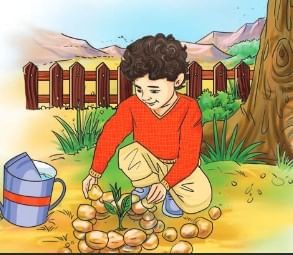
Q12. What did Rakesh do to protect the tiny plant?
Ans: He circled it with pebbles “for privacy.”

Q13. What damaged the cherry tree the first time?
Ans: A goat entered the garden and ate its leaves.

Q14. What damaged the tree the second time?
Ans: A woman cutting grass accidentally cut the tree in two with her scythe.

Q15. What was Rakesh’s reaction when the tree was cut?
Ans: He thought the tree might die.

Q16. Did the tree survive after being cut?
Ans: Yes, it grew again with new shoots.

Q17. What insect did Rakesh find sitting on the tree?
Ans: A bright green praying mantis.

Q18. What did Rakesh do when a caterpillar began eating the leaves?
Ans: He removed it and told it to come back as a butterfly.

Q19. When did the cherry tree first blossom?
Ans: It blossomed when Rakesh was nine years old.

Q20. What was Grandfather doing when Rakesh saw him under the tree one afternoon?
Ans: He was reclining on a cane chair, enjoying the shade of the tree.

Q21. Why did Rakesh and his grandfather feel the cherry tree was special?
Ans: Because they had planted it themselves.

Q22. What did Rakesh feel when he touched the tree’s bark at the end?
Ans: He wondered if that was what it felt like to be God, creating life.

9. Spectacular Wonders – Very Short Answer Questions

Q1. What is the Valley of Flowers famous for?
Ans: It is famous for its 600 species of exotic flowers.

Valley of Flowers

Q2. In which district is the Valley of Flowers located?
Ans: It is located in Chamoli district, Uttarakhand.

Q3. Name one rare animal found in the Valley of Flowers.
Ans: The snow leopard lives there.

Q4. Which title has UNESCO given to the Valley of Flowers?
Ans: It is a UNESCO World Heritage Site.

Q5. What are the living root bridges made of?
Ans: They are made of intertwined roots.

Q6. Which Indian state is home to the living root bridges?
Ans: They are in Meghalaya.

Q7. How long can a living root bridge last?
Ans: It can last for hundreds of years under good conditions.

Q8. What is the length of the state’s longest living root bridge?
Ans: It is about 175 feet long.

Q9. How was the Lonar Crater formed?
Ans: It was formed by the impact of a meteorite.

Q10. Where is the Lonar Crater Lake located?
Ans: It is in Buldhana district, Maharashtra.

Q11. Which rock type makes the Lonar Crater unique?
Ans: It is formed in basaltic rock.

Q12. What strange thing happens at Magnetic Hill in Ladakh?
Ans: Vehicles appear to move uphill on their own.

Q13. What causes this illusion at Magnetic Hill?
Ans: It is caused by the peculiar alignment of slopes and the horizon.

Q14. What is bioluminescence?
Ans: It is light produced by living organisms.

Q15. Where in Kerala can glowing waters be seen?
Ans: They can be seen in Kumbalangi village, near Kochi.

Q16. Which trees are found in abundance in the Sundarbans?
Ans: Sundari trees are abundant there.

Q17. Name one endangered animal found in the Sundarbans.
Ans: The Bengal tiger is found there.

Q18. What natural event happens at Chandipur Beach?
Ans: The sea disappears and reappears daily.

Q19. How far does the sea retreat at Chandipur Beach?
Ans: It retreats 2–5 km during ebb tide.

Q20. Which rivers form the Sundarbans delta?
Ans: The Ganga, Brahmaputra, and Meghna.

Q21. What type of forest is the Sundarbans?
Ans: It is a mangrove forest.

Q22. What message do these wonders give us?
Ans: They show nature’s mystery, beauty, and power.

8. The Magic Brush of Dreams – Very Short Answer Questions

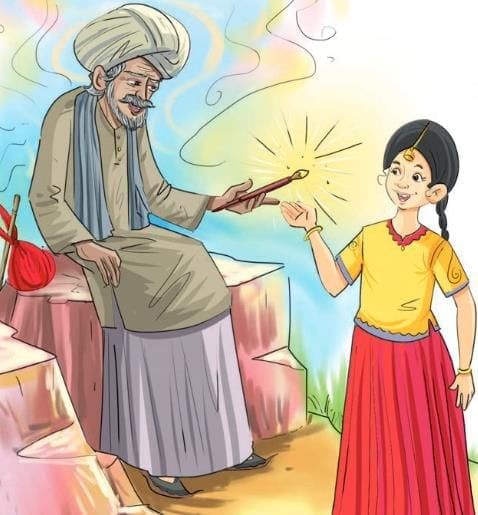
Q1. Who is Gopi in the poem?
Ans: Gopi is a poor but kind-hearted girl who receives a magic brush.

Q2. What was Gopi asked to bring home at the beginning?
Ans: She was asked to bring firewood.

Q3. Where was Gopi sitting when she first appeared?
Ans: She was sitting under a tree.

Q4. What was she drawing pictures with?
Ans: She was drawing with a stick on the ground.

Q5. Who gave Gopi the magic brush?
Ans: An old man gave her the brush.

Q6. What did the man tell Gopi about how to use the brush?
Ans: He told her to use it only to help the poor and needy.

Q7. What was the first thing Gopi painted with the brush?
Ans: She painted a cow.

Q8. What happened when she painted khichdi?
Ans: The khichdi became real and everyone ate happily.

Q9. Whom did she paint a muffler for?
Ans: She painted a muffler for a poor boy.

Q10. What did Gopi paint for a grandmother?
Ans: She painted a walking stick for the grandmother.

Q11. Who heard about the magic brush?
Ans: The greedy Zamindar heard about it.

Q12. What did the Zamindar order Gopi to paint?
Ans: He ordered her to paint gold coins.

Q13. Why did Gopi refuse the Zamindar’s order?
Ans: Because she was told to use the brush only for the poor.

Q14. What punishment did the Zamindar give Gopi?
Ans: He put her in prison.

Q15. What did Gopi paint to escape the prison?
Ans: She painted a key.

Q16. How did Gopi leave the prison?
Ans: She unlocked the door with the key and ran away.

Q17. What did she paint to stop the Zamindar and his men from chasing her?
Ans: She painted a wide river.

Q18. What did Gopi threaten to paint if they kept chasing her?
Ans: She threatened to paint a storm.

Q19. How did the Zamindar react to Gopi’s warning?
Ans: He became frightened and stopped chasing her.

Q20. What did Gopi finally paint for the villagers at the end?
Ans: She painted fields full of crops.

Q21. What lesson does the poem convey about the use of power?
Ans: Power should be used to help others, not for greed.

Q22. What emotion do the villagers feel when Gopi returns?
Ans: They feel joy and gratitude.

7. The Case of the Fifth Word – Very Short Answer Questions

Q1. Who was Encyclopedia Brown?
Ans: He was a young boy named Leroy Brown, nicknamed “Encyclopedia” for his vast knowledge.

Q2. Why was he called ‘Encyclopedia’?
Ans: Because his head was filled with facts, just like an encyclopedia.

Q3. Who was Chief Brown?
Ans: He was Encyclopedia’s father and the Chief of Police in Idaville.

Q4. When did Chief Brown usually discuss cases?
Ans: He discussed difficult cases at the family dinner table.

Q5. What kind of mysteries did Encyclopedia solve?
Ans: He solved cases that even the police found difficult.

Q6. What crime was Tim Nolan suspected of?
Ans: He was suspected of a jewellery store hold-up.

Q7. Who was Daniel Davenport?
Ans: He was Nolan’s friend and suspected partner in the robbery.

Q8. Where did Nolan and Davenport first meet?
Ans: They met in prison in South Carolina.

Q9. What was Nolan’s profession after prison?
Ans: He started a palm-tree nursery in Idaville.

Q10. What happened during the Diamond Mart robbery?
Ans: A clerk thought she recognized Nolan when one robber’s mask slipped.

Q11. Why wasn’t Nolan arrested?
Ans: There was no solid proof and the clerk refused to testify.

Q12. What illness did Nolan suffer from?
Ans: He had a bad heart and eventually died of a stroke.

Q13. What did Nolan leave in his will?
Ans: He left everything, including his nursery, to Davenport.

Q14. What strange clue was found with the will?
Ans: A sheet with four words: Nom, Utes, Sweden, Hurts.

Q15. Who first tried to interpret the four words?
Ans: Mrs. Brown tried but failed to make sense of them.

Q16. What question did Encyclopedia ask about the clue?
Ans: He asked if there was a young fir tree in Nolan’s nursery.

Q17. What was the connection between the four words and the days of the week?
Ans: They were coded forms of Monday, Tuesday, Wednesday, and Thursday.

Q18. What was the “fifth word”?
Ans: It was “Fir” for Friday.

Q19. Where was the jewellery hidden?
Ans: Inside a jug of earth beneath a young fir tree in Nolan’s nursery.

Q20. How did Encyclopedia solve the mystery?
Ans: By decoding Nolan’s four-word clue using the calendar as the key.

6. Verghese Kurien — I Too Had A Dream – Very Short Answer Questions

Q1. Who is the writer of I Too Had a Dream?
Ans: The writer is Verghese Kurien, known as the “Father of the White Revolution in India.”

Q2. To whom is the letter in the chapter addressed?
Ans: The letter is addressed to Kurien’s grandson, Siddharth.

Q3. What difference does Kurien mention between writing and speaking on the phone?
Ans: Speaking gives fleeting joy, but writing can be treasured and re-read for years.

Q4. What was the noblest task after India’s independence, according to Kurien?
Ans: The noblest task was contributing to building an India free from hunger, poverty, and inequality.

Q5. What career did Kurien initially envision for himself?
Ans: He had planned to work in metallurgy or pursue a career in the army or abroad.

Q6. Where did Kurien finally choose to work?
Ans: He chose to work in Anand, Gujarat, with a small dairy cooperative.

Q7. Who supported Kurien in his decision to stay in Anand?
Ans: His wife (Siddharth’s grandmother) ardently supported his decision.

Q8. Who was Kurien’s mentor in Anand?
Ans: Tribhuvandas Patel was his mentor and supporter.

Q9. What value did Kurien consider most important in life?
Ans: Integrity—being honest with oneself.

Q10. What does Kurien mean by “life is a privilege”?
Ans: He means life is a gift, and wasting it is wrong; one must use it for good.

Q11. What, according to Kurien, is the real meaning of failure?
Ans: Failure is not about not succeeding, but about not putting in one’s best effort.

Q12. How should one contribute to the common good, according to Kurien?
Ans: By helping friends, volunteering for teachers, or supporting the community.

Q13. What correlation does Kurien draw between circumstances and happiness?
Ans: He says happiness is not directly linked to circumstances; it depends on how one values life.

Q14. When did Kurien receive the Padma Vibhushan?
Ans: He received the Padma Vibhushan in 1999.

Q15. What innocent question did Siddharth ask at the award ceremony?
Ans: He asked if he could keep the medal.

Q16. What was Kurien’s reply about the medal?
Ans: He said the medal was Siddharth’s too, but he should earn his own reward in life.

Q17. What hope does Kurien express for the younger generation?
Ans: He hopes they will work tirelessly for the good of the country and humanity.

Q18. How does Kurien define personal integrity?
Ans: He defines it as being honest to yourself, which makes it easier to be honest with others.

Q19. What values did Kurien inherit from his family?
Ans: He inherited values of honesty, service, and integrity.

Q20. What choice did Kurien’s grandmother (wife) make?
Ans: She chose to support his decision to live in Anand despite hardships.

Q21. What does Kurien say about comparing ourselves with others?
Ans: He says comparisons are often misleading because people only show images of perfection.

Q22. What does Kurien dedicate his musings to?
Ans: He dedicates them to Siddharth and the younger generation of India.

Q23. What kind of life does Kurien say is truly “well-lived”?
Ans: A life where one loves, rejoices in others’ happiness, and contributes to humanity.

Q24. Who is called the “Father of the White Revolution”?
Ans: Verghese Kurien.

Q25. What does Kurien mean by “true rewards”?
Ans: Rewards that come from one’s own hard work and service to others.