15. Bibha Chowdhuri: The Beam of Light that Lit the Path for Women in Indian Science – Textbook Worksheet

Multiple Choice Questions (MCQs)

Instruction: Select the correct option for each question.

Q1. In which year was Bibha Chowdhuri born?
(a) 1910
(b) 1913
(c) 1920
(d) 1915

Q2. Bibha Chowdhuri pursued her Ph.D. on which subject?
(a) Nuclear energy
(b) Subatomic particles
(c) Cosmic rays
(d) Astronomy

Q3. Who nominated Bibha Chowdhuri for the Nobel Prize in 1950?
(a) Vikram Sarabhai
(b) Homi J. Bhabha
(c) Erwin Schrödinger
(d) Patrick M.S. Blackett

Q4. What honour did the International Astronomical Union (IAU) give Bibha in 2019?
(a) A professorship in her name
(b) A star named after her
(c) A research lab named after her
(d) A telescope named after her

Q5. Who is popularly known as the “Rocket Woman of India”?
(a) Kalpana Chawla
(b) Sunita Williams
(c) Dr. Ritu Karidhal Srivastava
(dTessy Thomas

Fill in the Blanks

Instruction: Fill in the blanks with the correct word based on the chapter.

Q1. Bibha Chowdhuri became the first woman faculty member at ______ in 1949.

Q2. Bibha Chowdhuri’s most notable scientific contribution was the discovery of ______.

Q3. The Government of India declared a ______ professorship in her name in 2020.

Q4. Bibha worked under the mentorship of ______ at the Physical Research Laboratory in Ahmedabad.

Q5. Bibha Chowdhuri passed away in the year ______.

Very Short Answer Questions

Instruction: Answer the following questions in one line.

Q1. Where was Bibha Chowdhuri born?

Q2. Which institute did Bibha join before going abroad for higher studies?

Q3. Who guided Bibha during her Ph.D. in Manchester?

Q4. Which star was renamed ‘Bibha’ by IAU?

Q5. What nickname did newspapers give Bibha during her early career?

Short Answer Questions

Instruction: Answer the following questions in 2–3 lines.

Q1. Why is Bibha Chowdhuri considered a pioneer in Indian science?

Q2. What challenges did Bibha face during her career?

Q3. What was Bibha’s contribution after returning to India in 1949?

Q4. How is Bibha’s legacy honoured today?

Q5. How do present-day women scientists reflect Bibha’s pioneering spirit?

14. Magnifying Glass – Textbook Worksheet

Multiple Choice Questions (MCQs)

Instruction: Select the correct option for each question.

Q1. What does the poet compare a drop of water to?
(a) A piece of glass
(b) A hive of bees
(c) A tiny forest
(d) A chalk piece

Q2. What does the magnifying glass make out of a scrap of chalk?
(a) A stone
(b) A myriad shells
(c) A forest
(d) A drop of water

Q3. What creature does the poet describe as having “tigerish claws”?
(a) Spider
(b) Fly
(c) Bee
(d) Ant

Q4. What does the magnifying glass help the poet to watch?
(a) The moon’s craters
(b) The spinning of spider’s web
(c) The flying of bees
(d) The blooming of flowers

Q5. According to the poet, what would lenses like the magnifying glass help us do with the moon?
(a) See its light clearly
(b) Walk there in an afternoon
(c) Count its craters
(d) Plant trees there

Fill in the Blanks

Instruction: Fill in the blanks with the correct word based on the chapter.

Q1. The magnifying glass makes a scrap of chalk appear like a __________.

Q2. A drop of water looks like a hive of __________ through the magnifying glass.

Q3. The spider spins its web using its __________.

Q4. The magnifying glass can make even the __________ thing look marvellous.

Q5. The poet of Magnifying Glass is __________.

Very Short Answer Questions

Instruction: Answer the following questions in one line.

Q1. What object does the poem revolve around?

Q2. Who is the poet of Magnifying Glass?

Q3. What mistake do flies make in the poem?

Q4. What natural object does an inch of moss resemble under the glass?

Q5. Which heavenly body is mentioned at the end of the poem?

Short Answer Questions 

Instruction: Answer the following questions in 2–3 lines.

Q1. How does the poet describe the effect of the magnifying glass on chalk?

Q2. What does the magnifying glass reveal about a drop of water?

Q3. Why does the poet call the spider’s claws “tigerish”?

Q4. What lesson does the poem teach about small things?

Q5. What does the poet imagine about the moon with stronger lenses?

13. Feathered Friend – Textbook Worksheet

Multiple Choice Questions (MCQs)

(Instruction: Select the correct option for each question.)

Q1. Why was Sven Olsen easily qualified for work in space?
(a) He was very tall
(b) He was wiry and light in weight
(c) He had experience with animals
(d) He was a trained pilot

Q2. What pet did Sven smuggle into the space station?
(a) A dog
(b) A parrot
(c) A canary
(d) A cat

Q3. Why did the crew first think Claribel had fainted?
(a) She had eaten too much
(b) She had collided with a wall
(c) She was sick from space travel
(d) She lacked oxygen

Q4. What was the actual reason for the failure in the space station?
(a) A broken pipe
(b) Frozen air purifier and a failed alarm
(c) Electrical wiring issue
(d) Leakage of water vapor

Q5. What is the significance of Claribel in the story?
(a) She was just a pet for Sven
(b) She entertained the crew with songs
(c) She saved the crew’s lives
(d) She was part of a science experiment

Fill in the Blanks

(Instruction: Fill in the blanks with the correct word based on the chapter.)

Q1. Sven smuggled a ______ into the space station.

Q2. Claribel fainted because of lack of ______ in the space station.

Q3. The alarms did not go off because the second alarm circuit was not ______.

Q4. The space station had experienced one of its rare ______ by Earth’s shadow.

Q5. Miners once carried ______ with them to detect dangerous gases.

Very Short Answer Questions 

(Instruction: Answer the following questions in one line.)

Q1. Who was Claribel?

Q2. What work did Sven excel at in the space station?

Q3. What sound first revealed Claribel’s presence to the narrator?

Q4. What revived Claribel when she fainted?

Q5. What recognition did the narrator give to Claribel at the end?

Short Answer Questions 

(Instruction: Answer the following questions in 2–3 lines.)

Q1. Why was Claribel considered an ideal pet for the space station?

Q2. Why did the crew have trouble hiding Claribel from VIP visitors?

Q3. How did Claribel save the crew from disaster?

Q4. Why was the alarm system unreliable?

Q5. What lesson does the story suggest about technology and nature?

12. Waiting for the Rain – Textbook Worksheet

Multiple Choice Questions (MCQs)

Instruction: Select the correct option for each question.

Q1. What did Velu hope for at the beginning of the story?
(a) A good harvest
(b) A visit from the astrologer
(c) That it would rain
(d) A holiday from work

Q2. Why did Velu not agree with consulting astrologers?
(a) He did not believe in hard work
(b) He thought rains always came without such talks
(c) He was afraid of astrologers
(d) He wanted to leave the village

Q3. Where did Velu go to ask about the rains?
(a) The temple
(b) The city’s weather office
(c) The old woman
(d) His neighbors

Q4. What lesson did the old woman teach Velu?
(a) That he should stop farming
(b) That the land also needs rest
(c) That farmers must work harder
(d) That rain is useless without toil

Q5. How does the story end?
(a) Velu leaves farming forever
(b) The old woman disappears
(c) Velu runs home happily as rain begins
(d) The astrologers predict correctly

Fill in the Blanks

Instruction: Fill in the blanks with the correct word based on the chapter.

Q1. Velu was a ______ who worked hard without rest.

Q2. Velu usually grew jowar in one season and ______ in the next.

Q3. The barren land looked ______ and the farmers lived on hope.

Q4. The old woman compared Nature to a ______ who cares for her children.

Q5. The story ends with Velu feeling a cool ______ on his back, followed by rain.

Very Short Answer Questions

Instruction: Answer the following questions in one line.

Q1. Who is the main character of the story?

Q2. How many years had Velu been farming his own land?

Q3. Why was Velu dejected?

Q4. Where did Velu rest on his way back from the city?

Q5. What natural event brought joy to Velu in the end?

Short Answer Questions

Instruction: Answer the following questions in 2–3 lines.

Q1. Why was rain so important for Velu and his village?

Q2. Why did Velu feel punished despite working honestly?

Q3. How did the old woman explain the absence of rain?

Q4. What difference did the conversation with the old woman make to Velu?

Q5. How did Velu’s mood change at the end of the story?

11. Harvest Hymn – Textbook Worksheet

Multiple Choice Questions (MCQs)

Instruction: Select the correct option for each question.

Q1. Who is praised as the “Lord of the morn” in the poem?
(a) Varuna
(b) Surya
(c) Bramha
(d) Prithvi

Q2. What does Varuna provide according to the poem?
(a) Fruits and flowers
(b) Rain and dew
(c) Corn and gold
(d) Songs and garlands

Q3. Who is referred to as the “Queen of the harvest”?
(a) Prithvi
(b) Surya
(c) Bramha
(d) Saraswati

Q4. What does the line “Thou art the Seed and the Scythe” suggest about Bramha?
(a) He gives rain only
(b) He begins and ends the cycle of life
(c) He plays musical instruments
(d) He grows lotus flowers

Q5. What musical instruments are mentioned as part of the tribute?
(a) Guitar and drum
(b) Cymbal, flute, pipe, drum
(c) Violin and trumpet
(d) Harp and piano

Fill in the Blanks

Instruction: Fill in the blanks with the correct word based on the chapter.

Q1. Surya is described as the lord of the ______ and the harvest.

Q2. Varuna is called the sender of ______ and dewfall.

Q3. Prithvi is compared to a ______ who feeds and nurtures her children.

Q4. Bramha is hailed as the Lord of the ______ and our being.

Q5. The people offer their songs, garlands, and the ______ of their fields as tribute.

Very Short Answer Questions

Instruction: Answer the following questions in one line.

Q1. Who wrote the poem “Harvest Hymn”?

Q2. What do the men bring as tribute to Surya and Varuna?

Q3. How is Prithvi addressed by the women?

Q4. What does Bramha symbolize in the poem?

Q5. Which natural elements are celebrated in the poem?

Short Answer Questions

Instruction: Answer the following questions in 2–3 lines.

Q1. Why do the villagers praise Surya in the poem?

Q2. What role does Varuna play in the lives of farmers?

Q3. How is Mother Earth described in the hymn?

Q4. What does the tribute offered to the deities signify?

Q5. How does the poem emphasize the unity of life and nature?

Match the Following

Instruction: Match Column A with the correct option in Column B.Column AColumn B1. Suryaa) Rain and dew provider2. Varunab) Eternal father, Lord of the Universe3. Prithvic) Sun God, lord of the morning4. Bramhad) Omnipotent mother, source of riches5. Tributee) Songs, garlands, and fruits of the fields

9. Spectacular Wonders – Textbook Worksheet

Multiple Choice Questions (MCQs)

Instruction: Select the correct option for each question.

Q1. What makes the Valley of Flowers in Uttarakhand a UNESCO World Heritage Site?

Valley of Flowers

(a) Its large population of snow leopards
(b) Its 600 species of exotic flowers and rare wildlife
(c) Its man-made bridges
(d) Its disappearing sea

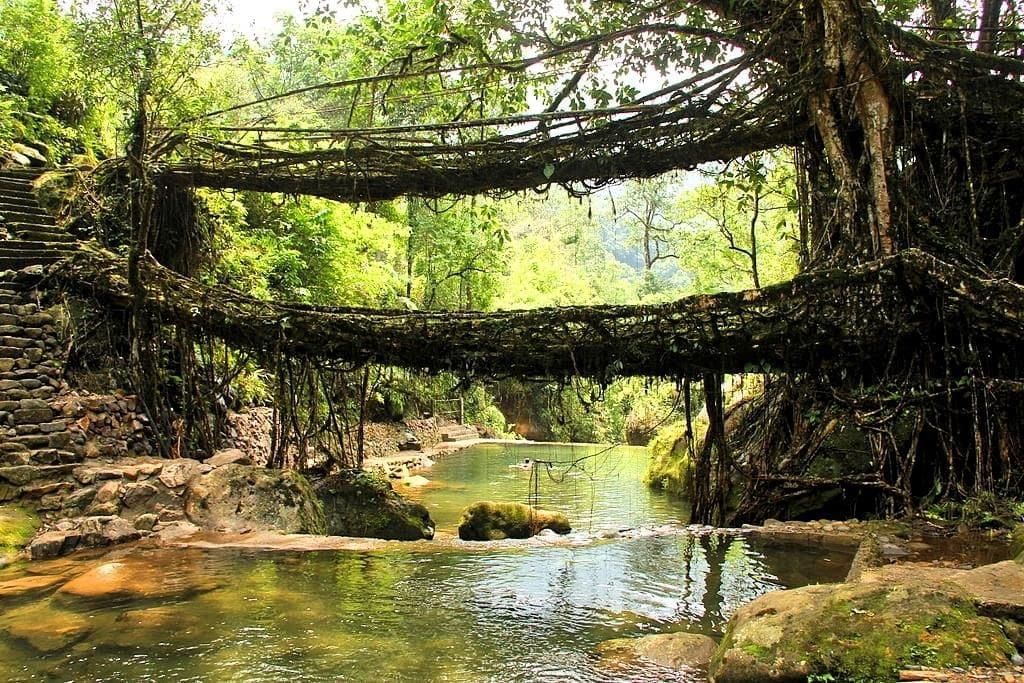
Q2. How are the living root bridges in Meghalaya primarily constructed?
(a) Using cement and stones
b) With intertwined roots of local flora
(c) From bamboo and wood
(d) By carving into the hillside

Q3. What caused the formation of the Lonar Crater Lake in Maharashtra?
(a) A volcanic eruption
(b) A colossal meteorite impact
(c) Heavy monsoon rains
(d) Human excavation

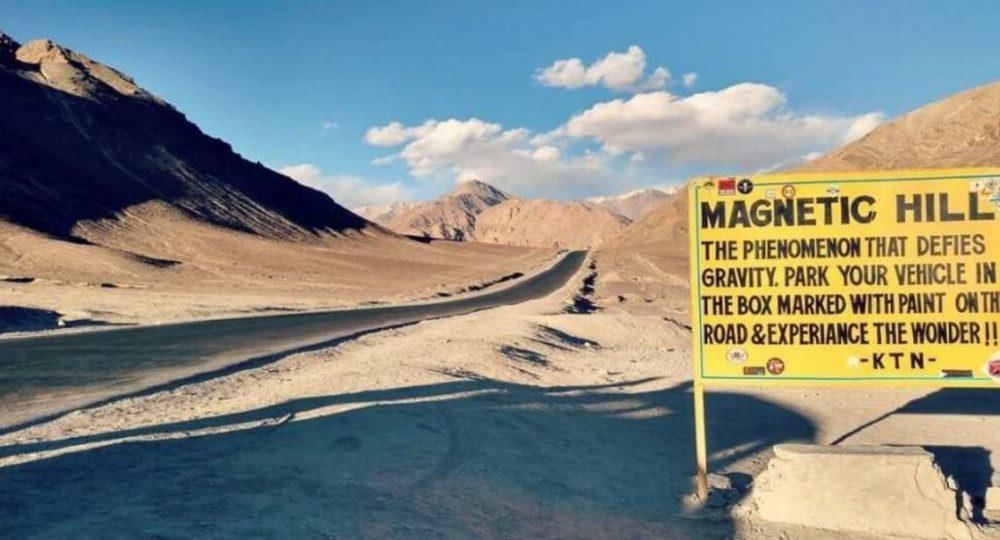
Q4. What creates the optical illusion at the Magnetic Hill in Ladakh?

Magnetic Hill, Ladakh(a) A magnetic force pulling vehicles
(b) The alignment of surrounding slopes and horizon
(c) Bioluminescent organisms
(d) Tidal movements of water

Q5. What is the primary reason for the glowing waters in Kumbalangi, Kerala?
(a) Artificial lights from the village
(b) Bioluminescence from micro-planktons
(c) Reflection of the moon
(d) Chemical pollution in the water

Fill in the Blanks

Instruction: Fill in the blanks with the correct word based on the chapter.

Q1. The Valley of Flowers is located in the ________ district of Uttarakhand.

Q2. The living root bridges in Meghalaya are a ________ UNESCO World Heritage Site.

Q3. The Lonar Crater Lake is unique because it is formed in ________ rock.

Q4. The Sundarbans is a ________ forest in West Bengal.

Q5. The sea at Chandipur Beach retreats by ________ km during ebb tide.

Living Root Bridge, Meghalya

Very Short Answer Questions

Instruction: Answer the following questions in one line.

Q1. Which months are ideal for visiting the Valley of Flowers?

Q2. What is the longest living root bridge in Meghalaya said to be?

Q3. Where is the Lonar Crater Lake located?

Q4. What is the name of the signboard at the Magnetic Hill in Ladakh?

Q5. What type of tourism is Kumbalangi village known for?

Short Answer Questions

Instruction: Answer the following questions in 2–3 lines.

Q1. What types of wildlife can be found in the Valley of Flowers?

Q2. Why were bamboo bridges ineffective in Meghalaya’s waterways?

Q3. What makes the Lonar Crater Lake visually striking?

Q4. How does the Magnetic Hill create a unique experience for visitors?

Q5. What role do the mangrove forests of the Sundarbans play in the environment?

8. The Magic Brush of Dreams – Textbook Worksheet

Multiple Choice Questions (MCQs)

Instruction: Select the correct option for each question.

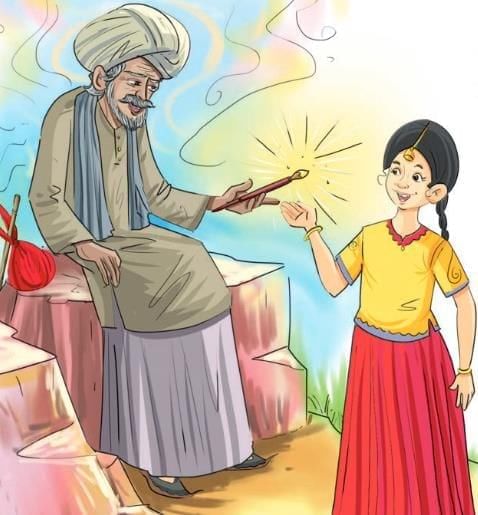
Q1. What was Gopi asked to collect at the beginning of the poem?
(a) Beans, rice, and mangoes
(b) Fruits, flowers, and water
(c) Sticks, leaves, and grass
(d) Wheat, pulses, and oil

Q2. Where was Gopi sitting when she was first seen drawing?
(a) In the fields
(b) Inside her hut
(c) Beneath a banyan tree
(d) Beside a river

Q3. What special gift did Gopi receive from the man with the brush?
(a) A golden bowl
(b) A magic brush
(c) A book of dreams
(d) A bag of treasures

Q4. What rule did the man give Gopi about using the brush?
(a) To paint only for her family
(b) To paint only for the poor
(c) To paint for everyone equally
(d) To paint only during the night

Q5. How did Gopi finally escape from prison?
(a) She painted wings for herself
(b) She painted a horse and a road
(c) The villagers rescued her
(d) The Zamindar set her free

Fill in the Blanks

Instruction: Fill in the blanks with the correct word based on the chapter.

Q1. The mysterious man gave Gopi a __________ to paint.

Q2. Gopi first painted a bowl of _________ for her family.

Q3. The villagers came to see the _________ after hearing the news.

Q4. The greedy _________ ordered Gopi to paint treasures and riches.

Q5. To stop the Zamindar’s men, Gopi painted a mighty _________.

Very Short Answer Questions 

Instruction: Answer the following questions in one line.

Q1. Who was Gopi?

Q2. What happened when Gopi painted food?

Q3. Who spread fear by demanding treasures from Gopi?

Q4. Where was Gopi imprisoned?

Q5. What did Gopi paint to scare the Zamindar at the end?

Short Answer Questions 

Instruction: Answer the following questions in 2–3 lines.

Q1. What was special about the brush given to Gopi?

Q2. How did Gopi use the brush to help the villagers?

Q3. Why did the Zamindar imprison Gopi?

Q4. How did Gopi escape from the prison?

Q5. What lesson does the poem teach us?

7. The Case of the Fifth Word – Textbook Worksheet

Multiple Choice Questions (MCQs)

Instruction: Select the correct option for each question.

Q1. What was Encyclopedia Brown’s real name?
(a) Daniel
(b) Tim
(c) Leroy
(d) Nolan

Q2. Why was Encyclopedia given the nickname “Encyclopedia”?
(a) He loved collecting books.
(b) He remembered all facts he read.
(c) He worked at a library.
(d) He wrote an encyclopedia himself.

Q3. What business did Tim Nolan start in Idaville?
(a) Jewellery shop
(b) Palm-tree nursery
(c) Grocery store
(d) Bookshop

Q4. What did Nolan leave for Davenport in his will?
(a) Jewellery
(b) Palm-tree nursery
(c) House and gold
(d) Only money

Q5. What was the hidden meaning of the four words “Nom Utes Sweden Hurts”?
(a) They were random words.
(b) They were names of countries.
(c) They stood for days of the week.
(d) They were part of a poem.

Fill in the Blanks

Instruction: Fill in the blanks with the correct word based on the chapter.

Q1. Encyclopedia was in the ______ grade.

Q2. Chief Brown was the ______ of Police in Idaville.

Q3. Nolan and Davenport first met while they were in ______.

Q4. The clerk could not testify against Nolan because she was not ______.

Q5. The stolen jewellery was finally found under a young ______ tree.

Very Short Answer Questions 

Instruction: Answer the following questions in one line.

Q1. Who was the Chief of Police in Idaville?

Q2. Who was Nolan’s partner in crime?

Q3. What illness did Nolan suffer from?

Q4. What was clipped to Nolan’s will?

Q5. What did Nolan manage to do just before dying?

Short Answer Questions 

Instruction: Answer the following questions in 2–3 lines.

Q1. Why did Encyclopedia’s father keep his son’s detective skills a secret?

Q2. How did Encyclopedia get clues from his parents’ conversation?

Q3. Why did Chief Brown suspect Nolan and Davenport in the robbery?

Q4. How did Encyclopedia crack the calendar code?

Q5. Where was the jewellery hidden and how did Encyclopedia know?

Match the Following

Instruction: Match Column A with the correct option in Column B.Column AColumn B1. Leroya) Partner in crime with Nolan2. Chief Brownb) Nicknamed Encyclopedia3. Tim Nolanc) Chief of Police in Idaville4. Daniel Davenportd) Started palm-tree nursery5. Fir treee) Jewellery hidden under it

6. Verghese Kurien — I Too Had A Dream – Textbook Worksheet

Multiple Choice Questions (MCQs)

Instruction: Select the correct option for each question.

Q1. What was Verghese Kurien’s main reason for choosing to work in Anand, Gujarat?

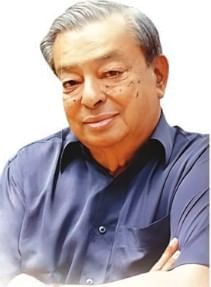
Verghese Kurien

(a) To become a chief executive of a large company
(b) 
To serve the nation’s farmers and contribute to India’s progress
(c) 
To pursue a career in the Indian Army
(d) 
To move to the US as a successful NRI  

Q2. What value did Kurien emphasize as the most important in his life?
(a) Wealth
(b) 
Fame
(c) 
Integrity
(d) 
Ambition  

Q3. What award did Kurien receive in 1999, as mentioned in the chapter?
(a) Bharat Ratna
(b) 
Padma Shri
(c) 
Padma Bhushan
(d) 
Padma Vibhushan  

Q4. How did Kurien’s grandmother contribute to his work in Anand?
(a) She moved to the US to support him financially
(b) 
She supported his choice to live and work in Anand
(c) 
She encouraged him to join the Indian Army
(d) 
She advised him to pursue metallurgy  

Q5. What does Kurien say about failure in the chapter?

(a) Failure is about not succeeding in any task
(b) 
Failure is not trying or contributing to the common good
(c) Failure is about not earning awards
(d) 
Failure is about not being happy  Fill in the Blanks

Instruction: Fill in the blanks with the correct word based on the chapter.

Q1. Kurien started his work soon after India became ________.

Q2. Kurien worked with a small ________ of dairy farmers in Anand.

Q3. Kurien’s mentor in Anand was ________ Patel.

Q4. Kurien dedicated his musings to his grandson ________ and other children.

Q5. Kurien believed that life is a ________ and should not be wasted.Very Short Answer Questions

Instruction: Answer the following questions in one line.

Q1. Where did Kurien choose to work instead of pursuing other careers?

Q2. What was the time period when Kurien began his work, as mentioned in the chapter?

Q3. What did Kurien’s grandmother sacrifice to support his work in Anand?

Q4. What did Kurien say about the rewards of a life well-spent?

Q5. What did Kurien urge Siddharth to earn in his lifetime?
Short Answer Questions

Instruction: Answer the following questions in 2–3 lines.

Q1. Why did Kurien prefer writing a letter to his grandson instead of using a telephone?

Q2. What was Kurien’s dream for India as described in the chapter?

Q3. How did Kurien’s choice to work in Anand change his life?

Q4. What did Kurien learn about happiness from his experiences?

Q5. How did Kurien view the role of personal integrity in his work?

5. Somebody’s Mother – Textbook Worksheet

Multiple Choice Questions (MCQs)

Instruction: Select the correct option for each question.

Q1. Why was the old woman afraid to cross the street?
(a) Because it was too dark
(b) Because the street was slippery with snow
(c) Because there were no traffic lights
(d) Because she had lost her way

Q2. How did the other schoolboys behave towards the old woman?
(a) They teased her.
(b) They quickly helped her.
(c) They ignored her and passed by.
(d) They laughed at her.

Q3. What was the young boy’s attitude after helping the woman?
(a) Angry and upset
(b) Proud and happy
(c) Careless and indifferent
(d) Sad and disappointed

Q4. What prayer did the old woman make for the boy?
(a) That he would become rich
(b) That he would pass his exams
(c) That God be kind to him
(d) That he would become famous

Q5. What does the phrase “Somebody’s mother” mainly highlight?
(a) That the woman was poor
(b) That she was unknown to others but precious to her child
(c) That she had many children
(d) That she was waiting for her son

Fill in the Blanks

Instruction: Fill in the blanks with the correct word based on the chapter.

Q1. The poem Somebody’s Mother was written by __________.

Q2. The boys came out of school like a flock of __________.

Q3. The woman’s feet were described as __________ and slow.

Q4. The boy guided the woman across the __________ street.

Q5. At the end, the woman prayed for the __________ boy.

Very Short Answer Questions

Instruction: Answer the following questions in one line.

Q1. Who is the central character of the poem?

Q2. How did the children react to the old woman at first?

Q3. Who helped the old woman cross the street?

Q4. What was the boy proud of after helping her?

Q5. What quality of the boy does the poem highlight?

Short Answer Questions

Instruction: Answer the following questions in 2–3 lines.

Q1. Describe the condition of the old woman in the poem.

Q2. How does the poet show the difference between the old woman and the schoolboys?

Q3. Why did the boy stop to help the woman?

Q4. What impact did the boy’s act of kindness have on the old woman?

Q5. What message does the poem convey to society?

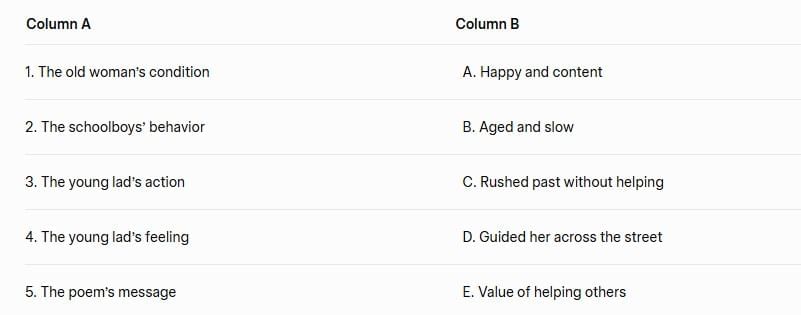
Match the Following

Instruction: Match Column A with the correct option in Column B.