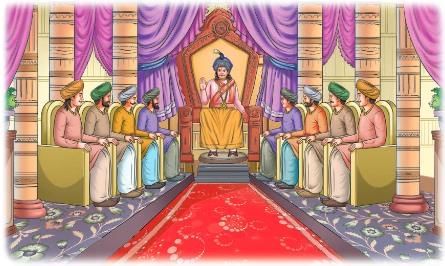
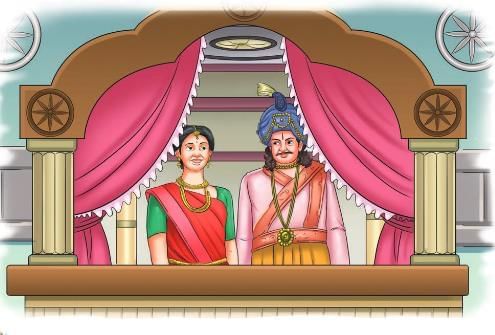
5. Somebody’s Mother – Worksheet Solutions

Multiple Choice Questions (MCQs)

Instruction: Select the correct option for each question.

Q1. Why was the old woman afraid to cross the street?
(a) Because it was too dark
(b) Because the street was slippery with snow
(c) Because there were no traffic lights
(d) Because she had lost her way

Ans: (b) Because the street was slippery with snow
The poem mentions “slippery street” and “carriage wheels or horses’ feet,” showing her fear.
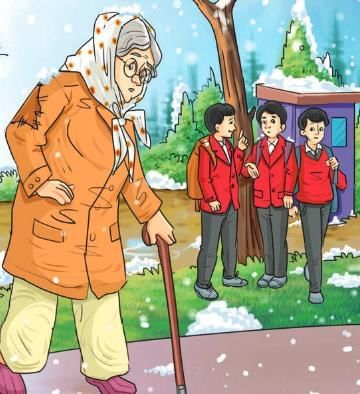
Q2. How did the other schoolboys behave towards the old woman?
(a) They teased her.
(b) They quickly helped her.
(c) They ignored her and passed by.
(d) They laughed at her.

Ans: (c) They ignored her and passed by.
The poem clearly says the children “hastened past” and “nor offered a helping hand.”

Q3. What was the young boy’s attitude after helping the woman?
(a) Angry and upset
(b) Proud and happy
(c) Careless and indifferent
(d) Sad and disappointed

Ans: (b) Proud and happy
The boy’s “young heart happy and well content” shows his pride and joy.

Q4. What prayer did the old woman make for the boy?
(a) That he would become rich
(b) That he would pass his exams
(c) That God be kind to him
(d) That he would become famous

Ans: (c) That God be kind to him
At night she prayed: “God be kind to the noble boy.”

Q5. What does the phrase “Somebody’s mother” mainly highlight?
(a) That the woman was poor
(b) That she was unknown to others but precious to her child
(c) That she had many children
(d) That she was waiting for her son

Ans: (b) That she was unknown to others but precious to her child
The repetition stresses empathy — every mother is precious to someone.

Fill in the Blanks

Instruction: Fill in the blanks with the correct word based on the chapter.

Q1. The poem Somebody’s Mother was written by __________.
Ans: Mary Dow Brine

She is the poet of this touching piece.

Q2. The boys came out of school like a flock of __________.
Ans: sheep

The simile compares the noisy schoolboys to a flock of sheep.

Q3. The woman’s feet were described as __________ and slow.
Ans: aged

This highlights her weakness and helplessness.

Q4. The boy guided the woman across the __________ street.
Ans: slippery

“Slippery street” reflects danger and the woman’s fear.

Q5. At the end, the woman prayed for the __________ boy.
Ans: noble

She called him noble for his kind action.

Very Short Answer Questions

Instruction: Answer the following questions in one line.

Q1. Who is the central character of the poem?
Ans: An old, ragged, and helpless woman.

Q2. How did the children react to the old woman at first?
Ans: They ignored her and hurried away.

Q3. Who helped the old woman cross the street?
Ans: A kind young schoolboy.

Q4. What was the boy proud of after helping her?
Ans: That his strong feet could guide her trembling ones.

Q5. What quality of the boy does the poem highlight?
Ans: His kindness and empathy.

Short Answer Questions

Instruction: Answer the following questions in 2–3 lines.

Q1. Describe the condition of the old woman in the poem.
Ans: The old woman was ragged, grey, and bent with the chill of the winter day. Her feet were aged and slow, making her too weak and fearful to cross the slippery street alone.

Q2. How does the poet show the difference between the old woman and the schoolboys?
Ans: The poet contrasts the timid and helpless woman with the boys who were cheerful, carefree, and energetic after school. While she stood alone and anxious, they rushed past laughing and enjoying the snow.

Q3. Why did the boy stop to help the woman?
Ans: The boy felt deep compassion when he saw her struggling and realized she could not cross by herself. He also thought of his own mother and hoped someone would help her in the same way if she was old and helpless one day.

Q4. What impact did the boy’s act of kindness have on the old woman?
Ans: The woman felt comforted and safe as the boy guided her across the street. That night, touched by his kindness, she prayed for the noble boy’s happiness and asked God to be kind to him.

Q5. What message does the poem convey to society?
Ans: The poem conveys that kindness and empathy are essential values in society. It teaches us to respect and support the elderly and reminds us that helping others today may bring help to our own loved ones tomorrow.

Match the Following
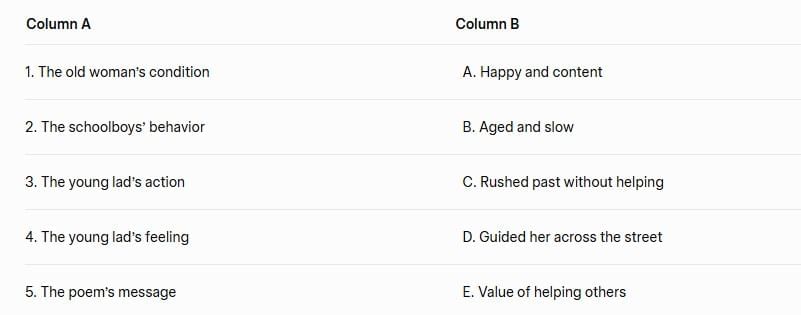
Instruction: Match Column A with the correct option in Column B.

Ans: 

  1. The old woman’s condition → B. Aged and slow
  2. The schoolboys’ behavior → C. Rushed past without helping
  3. The young lad’s action → D. Guided her across the street
  4. The young lad’s feeling → A. Happy and content
  5. The poem’s message → E. Value of helping others
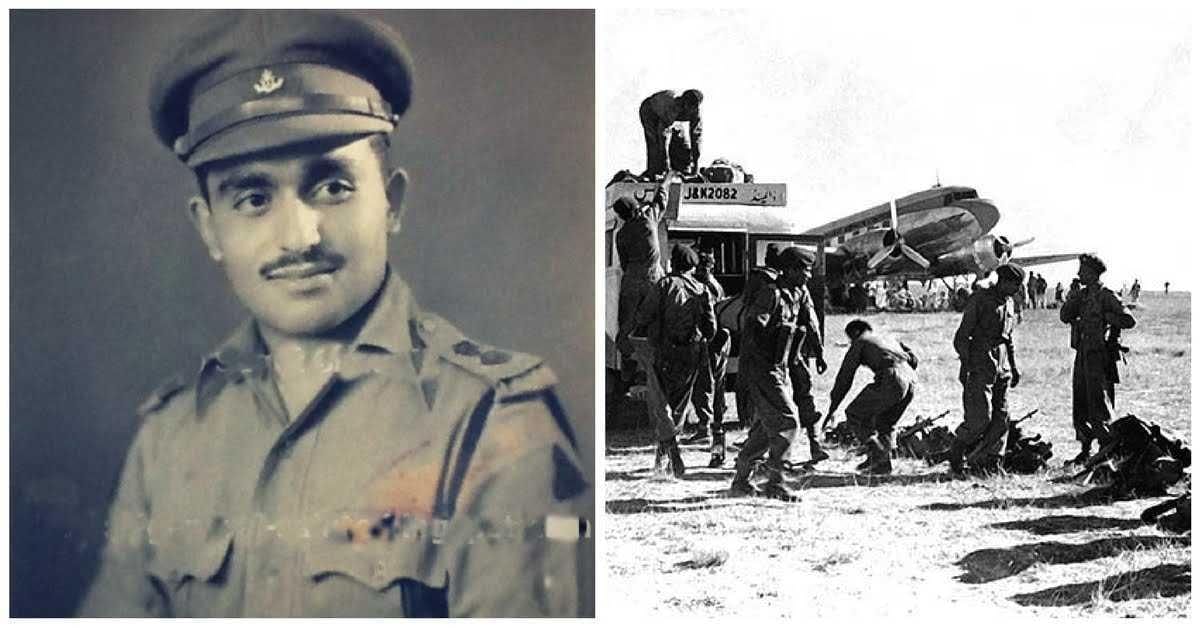
4. A Tale of Valour: Major Somnath Sharma and the Battle of Badgam – Worksheet Solutions

Multiple Choice Questions (MCQs)

Instruction: Select the correct option for each question.

Q1. Major Somnath Sharma was the first recipient of which prestigious award?
(a) Ashoka Chakra
(b) Vir Chakra
(c) Param Vir Chakra
(d) Maha Vir Chakra

Ans: (c) Param Vir Chakra
He was India’s first recipient of the Param Vir Chakra, awarded posthumously for his bravery in the Battle of Badgam.

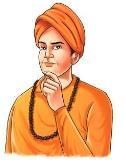
Major Somnath SharmaQ2. The Battle of Badgam took place in which year?
(a) 1942
(b) 1945
(c) 1947
(d) 1950

Ans: (c) 1947
The battle was fought on 3rd November 1947 during the Indo–Pakistan War of 1947–48.

Q3. Who was the ruler of Jammu and Kashmir at the time of Pakistan’s invasion in 1947?
(a) Raja Gulab Singh
(b) Maharaja Hari Singh
(c) Zorawar Singh
(d) General Cariappa

Ans: (b) Maharaja Hari Singh
Maharaja Hari Singh was the ruler when Pakistan launched Operation Gulmarg to annex Kashmir.

Q4. Which regiment did Major Somnath Sharma command during the Battle of Badgam?
(a) 8th Battalion, Hyderabad Regiment
(b) 4th Battalion, Kumaon Regiment
(c) Punjab Regiment
(d) Dogra Regiment

Ans: (b) 4th Battalion, Kumaon Regiment
He led the D Company of the 4th Battalion, Kumaon Regiment in Srinagar.

Q5. What was Major Somnath Sharma’s famous last message to Brigade headquarters?
(a) “I will not retreat; I will fight till the last breath.”
(b) “We shall fight with courage and strength.”
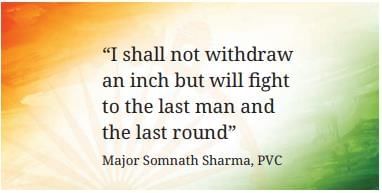
(c) “The enemy is 50 yards from us… I shall not withdraw an inch but fight to the last man and the last round.”
(d) “Victory belongs to those who fight bravely.”

Ans: (c) “The enemy is 50 yards from us… I shall not withdraw an inch but fight to the last man and the last round.”
These were his immortal last words before being killed in action.

Fill in the Blanks

Instruction: Fill in the blanks with the correct word based on the chapter.

Q1. Pakistan launched Operation ________ to annex Kashmir in 1947.
Ans: Gulmarg

Operation Gulmarg was Pakistan’s plan to capture Kashmir by sending trained infiltrators.

Q2. Major Somnath Sharma was born on 31 January ____ in Kangra, Himachal Pradesh.
Ans: 1923

He was born in 1923 in Dadh, Kangra, into a family with a military background.

Q3. The Princely State of Jammu and Kashmir officially became a part of India on __ October 1947.
Ans: 26

On 26 October 1947, Maharaja Hari Singh signed the Instrument of Accession to join India.

Q4. The Indian troops were airlifted to Srinagar on __ October 1947.
Ans: 27

Soldiers were airlifted into Srinagar to quickly respond to the Pakistani invasion.

Q5. Major Somnath Sharma studied at Sherwood College, ______ during his early education.
Ans: Nainital

He completed his schooling at Sherwood College before military training.

Very Short Answer Questions

Instruction: Answer the following questions in one line.

Q1. At what age did Major Somnath Sharma sacrifice his life?
Ans: At the age of 24.

Q2. What was the main objective of the Pakistani invaders in 1947?
Ans: To capture Srinagar and annex Kashmir.

Q3. Which family member inspired Somnath Sharma with tales from the Mahabharata?
Ans: His grandfather.

Q4. Where did Major Somnath Sharma receive his military training?
Ans: At the Royal Military College, Sandhurst.

Q5. Which battalion was awarded the Battle Honour, Srinagar?
Ans: The 4th Kumaon Battalion.

Short Answer Questions

Instruction: Answer the following questions in 1–2 lines.

Q1. Why was the village of Badgam strategically important in 1947?
Ans: Badgam was at a higher altitude near the Srinagar airport. Controlling it was crucial for protecting the airfield and supply lines.

Q2. How did Major Somnath Sharma show commitment despite his injury?
Ans: Even though his left hand was in plaster, he insisted on leading his company into battle, saying his men would not go without him.

Q3. What role did air strikes play in the Battle of Badgam?
Ans: Major Somnath requested air support and marked targets with ground panels, which helped the Indian Air Force strike enemy positions effectively.

Q4. What was the immediate outcome of D Company’s resistance in the battle?
Ans: Their resistance delayed the invaders, allowing reinforcements to arrive and saving Srinagar from falling.

Q5. Why is Major Somnath Sharma remembered as an inspiration?
Ans: His bravery, leadership, and supreme sacrifice embody patriotism and continue to inspire soldiers and citizens alike.

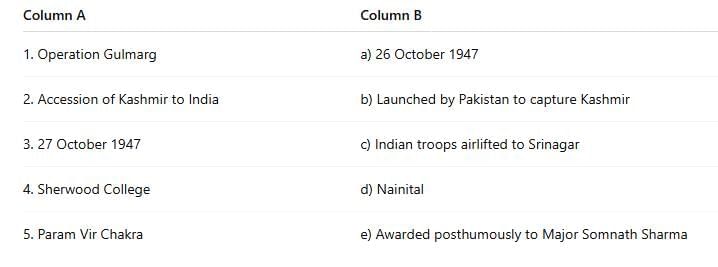
Match the Following

Instruction: Match Column A with the correct option in Column B.

Ans: 1 → b, 2 → a, 3 → c, 4 → d, 5 → e

  • Operation Gulmarg was Pakistan’s plan to invade Kashmir.
  • Kashmir acceded to India on 26 October 1947.
  • Troops were airlifted on 27 October 1947.
  • Somnath studied at Sherwood College, Nainital.
  • He was the first recipient of the Param Vir Chakra.

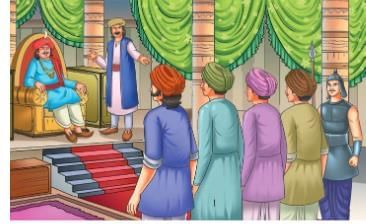
3. Wisdom Paves the Way – Worksheet Solutions

Multiple Choice Questions (MCQs)

Instruction: Select the correct option for each question.

Q1. Where are the four young men traveling to find work?
(a) Delhi
(b) Ujjain
(c) Jaipur
(d) Agra

Ans: (b) Ujjain
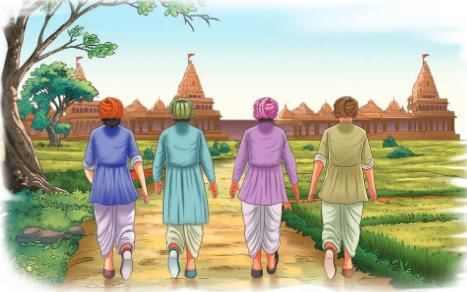
The story begins with Ram Datt, Shiv Datt, Har Datt, and Dev Datt walking along a road to Ujjain, hoping to find jobs in the city.

Q2. What does the merchant accuse the young men of doing?
(a) Stealing his camel
(b) Lying to the King 
(c) Hiding in the forest
(d) Refusing to help him

Ans(a) Stealing his camel
The merchant believes the young men stole his camel because they know specific details about it, like its limp and blindness.

Q3. How does Ram Datt know the camel is lame?
(a) He saw the camel limping
(b) He heard the merchant’s description
(c) He noticed uneven footprints 
(d) He found blood on the road

Ans: (c) He noticed uneven footprints
Ram Datt observes that three footprints are clear but one is faint, indicating the camel limps on one leg.

Q4. What job does the King offer the young men?
(a) Soldiers
(b) Advisers
(c) Merchants
(d) Farmers

Ans: (b) Advisers
Impressed by their wisdom, the King offers the four young men positions as his advisers to guide his decisions.

Q5. What is the main theme of the story?
(a) Importance of wealth
(b) Power of friendship alone 
(c) Need for fast travel
(d) Value of wisdom and observation

Ans(d) Value of wisdom and observation
The story shows how the young men’s careful observations and logical thinking help them prove their innocence and earn the King’s respect.

Fill in the Blanks

Instruction: Fill in the blanks with the correct word based on the chapter.

Q1. The four young men have been traveling for _____ days to reach Ujjain.
Ans: Ten

Ram Datt confirms they have been traveling for ten days, which feels long to them as they search for work.

Q2. The merchant is upset because his _____ is missing.
Ans: Camel

The merchant approaches the young men in distress, asking for help to find his lost camel.

Q3. Shiv Datt deduces the camel is blind in its _____ eye.
Ans: Right

Shiv Datt notices the camel ate leaves only on the left side, indicating it is blind in its right eye.

Q4. The King’s court is decorated with rich _____ and tall pillars.
AnsDraperies

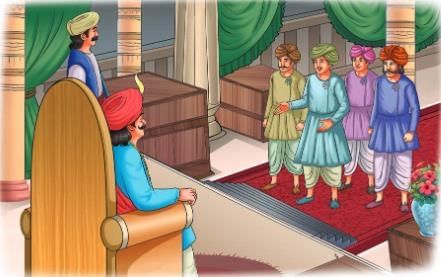
The story describes the King’s court as grand, with rich draperies and tall columns, creating a regal atmosphere.

Q5. The King praises the young men for their _____ after hearing their explanations.
AnsWisdom

The King is impressed by the young men’s logical reasoning and calls them wise, not thieves, as the merchant claimed.

Very Short Answer Questions

Instruction: Answer the following questions in one line.

Q1. What is the name of the city the four young men are traveling to?
AnsUjjain

Q2. Who runs toward the young men asking for help with a lost animal?
Ans: The merchant

Q3. Where do the young men stop to discuss the camel tracks?
AnsUnder a tree

Q4. What does Har Datt notice that suggests the camel has a short tail?
Ans: Blood droplets

Q5. What does the King do after dismissing the merchant’s accusations?
Ans: Offers the young men jobs as advisers

Short Answer Questions

Instruction: Answer the following questions in 2–3 lines.

Q1. Why do the young men want to meet the King of Ujjain?
Ans: The young men hope to meet the King because they believe he will recognize their talents and give them jobs. Ram Datt is confident the King will value their skills.

Q2. How does Dev Datt know the camel has a stomachache?
Ans: Dev Datt notices the camel’s front feet make deep prints, but the back feet prints are faint, showing it moves carefully due to stomach pain.

Q3. Why does the merchant think the young men are thieves?
Ans: The merchant thinks they are thieves because they know details about his camel, like its limp and blindness, but say they haven’t seen it. He believes only thieves would know so much.

Q4. How does the King react to the young men’s explanations?
AnsThe King is amazed by their logical explanations and praises their wisdom. He offers them jobs as his advisers, valuing their smart thinking.

Q5. What lesson does the story teach about observation?
AnsThe story teaches that careful observation and logical thinking can solve problems and earn respect. The young men’s attention to details about the camel proves their innocence and wins them prestigious jobs.

2. A Concrete Example – Worksheet Solutions

Multiple Choice Questions

Instruction: Select the correct option for each question.

Q1. What is the primary material in Mrs. Jones’s garden?
(a) Flowers
(b) Grass
(c) Stones
(d) Trees

Ans: c) Stones
The poem describes Mrs. Jones’s garden as being filled with stones, which is unusual compared to typical gardens with flowers or grass.

Q2. What does the poem suggest about Mrs. Jones’s attitude toward her garden?
(a) She is embarrassed by it
(b) She wants to change it 
(c) She ignores it
(d) She takes pride in it

Ans: (d) She takes pride in it
Mrs. Jones thinks her garden’s features, like the sundial, are “rather nice” and invites the speaker to see it, showing her pride.

Q3. What is the setting of the interaction between the speaker and Mrs. Jones in the third stanza?
(a) A market
(b) Mrs. Jones’s garden
(c) The speaker’s house
(d) A park

Ans: (b) Mrs. Jones’s garden
The third stanza describes the speaker visiting Mrs. Jones’s garden to see her stones and discuss a flower.

Q4. What does the “strange device” on the sundial suggest about Mrs. Jones’s taste?
(a) She prefers modern technology
(b) She likes simple designs
(c) She values unusual features
(d) She dislikes decorative items

Ans: (c) She values unusual features
The sundial’s “strange device” is described as something Mrs. Jones finds “rather nice,” indicating her quirky taste for unusual and unique garden features.

Q5. What creates the ironic moment in the poem’s final stanza?
(a) The speaker steps on the flower he admires
(b) Mrs. Jones forgets about her garden
(c) The speaker buys a plant from Mrs. Jones
(d) Mrs. Jones changes her garden’s design

Ans: (a) The speaker steps on the flower he admires
The irony occurs when the speaker, after praising a flower, is told he is standing on it, highlighting his unawareness in a humorous way.

Fill in the Blanks

Instruction: Fill in the blanks with the correct word based on the chapter.

Q1. Mrs. Jones’s garden has a ______ path that twists and turns.
Ans: crazy

The poem describes the path as “crazy,” meaning it is winding and unusual, reflecting the garden’s unique design.

Q2. The ______ in Mrs. Jones’s garden is a tool that tells time using the sun.
Ans: sundial

The poem mentions a sundial with a strange device, which is a device that uses the sun’s shadow to tell time.

Q3. The speaker finds the tiny plants so small that they seem to have no ______ at all.
Ans: significance

The poem states the plants “don’t mean anything at all,” indicating the speaker thinks they lack importance in garden full of stones.

Q4. Mrs. Jones is described as an ______ gardener who loves her stone garden.
Ans: enthusiastic

The poem shows Mrs. Jones’s enthusiasm through her pride in her garden and inviting the speaker to see it.

Very Short Answer Questions

Instruction: Answer the following questions in one line.

Q1. What is the name of the poet who wrote “A Concrete Example”?
Ans: Reginald Arkell wrote “A Concrete Example.”

Q2. What contains water lilies in Mrs. Jones’s garden?
Ans: The lily pond contains water lilies.

Q3. How long do the speaker and Mrs. Jones talk about the flower?
Ans: They talk about the flower for a quarter of an hour.

Q4. What does Mrs. Jones say when the speaker asks where the flower is?
Ans: She says, “You’re standing on it.”

Q5. What type of garden feature is the rockery in the poem?
Ans: The rockery is a decorative arrangement of stones.

Short Answer Questions

Instruction: Answer the following questions in 2–3 lines.

Q1. How does the poem’s structure contribute to its readability?
Ans: The poem’s three stanzas with six lines each and an AABBCC rhyme scheme create a rhythmic, easy-to-follow structure. This makes it fun and simple to read and enjoy.

Q2. Why does the speaker think the tiny plants are insignificant?
Ans: The speaker thinks the tiny plants are insignificant because they are so small and delicate compared to the large stones. He humorously says they “don’t mean anything at all,” showing his different perspective from Mrs. Jones.

Q3. How does the dialogue in the third stanza make the poem more humorous?
Ans: The dialogue in the third stanza, where the speaker asks, “Where is this lovely thing?” and Mrs. Jones replies, “You’re standing on it,” creates humor by revealing the speaker’s funny mistake. It makes the poem lively by showing a surprising and playful exchange between them.

Q4. How does the poem show Mrs. Jones’s unique taste in gardening?
Ans: Mrs. Jones’s garden, filled with stones and unusual features like a sundial with a strange device, shows her unique taste. Her focus on tiny plants and pride in her stone garden reflect her unconventional style.

Q5. What lesson about perception does the poem teach?
Ans: The poem teaches that perception varies, as Mrs. Jones sees beauty in her stone garden and tiny plants, while the speaker finds them insignificant. This shows Class 8 students that people can view the same thing differently.Match the Following

Instruction: Match Column A with the correct option in Column B.

Ans:

  • a. Crazy path – 2. Winding and unusual: The poem describes the “crazy path” as twisting and turning, indicating an unusual, non-straight design.
  • b. Lily pond – 4. Water feature with lilies: The lily pond is a water feature in the garden, likely containing water lilies, as mentioned in the poem.
  • c. Sundial – 1. Tells time using the sun: The sundial is a device in the garden that uses the sun’s shadow to tell time, noted for its strange design.
  • d. Rockery – 5. Decorative stone arrangement: The rockery is a garden feature made of stones arranged artistically, a key part of Mrs. Jones’s garden.
  • e. Plants – 3. Tiny and delicate: The plants in the poem are described as “delicate and small,” placed between the stones by Mrs. Jones.

1. The Wit that Won Hearts – Worksheet Solutions

Multiple Choice Questions

Instruction: Select the correct option for each question.

Q1. What was the Vijayanagara Empire known for during Krishnadeva Raya’s reign?
(a) Only military strength
(b) Trade with foreign empires
(c) Wealth, splendor, and cultural brilliance
(d) Only agricultural advancements

Ans: (c) Wealth, splendor, and cultural brilliance
The chapter describes the Vijayanagara Empire as flourishing in wealth, splendor, and cultural achievements like art and literature during Krishnadeva Raya’s rule.

Q2. What role did Tenali Ramakrishna primarily play in the king’s court?
(a) Military general
(b) Poet and clever advisor
(c) Palace architect
(d) Royal chef 

Ans: (b) Poet and clever advisor
Tenali Ramakrishna was one of the Ashtadiggajas poets and used his wit to advise the king, as seen in resolving the royal couple’s quarrel.

Q3. Why did Krishnadeva Raya stop speaking to Thirumalambal?
(a) She criticized his poetry
(b) She left the palace
(c) She ignored his orders
(d) She yawned during his poem recitation

Ans: (d) She yawned during his poem recitation
The king felt disrespected when Thirumalambal yawned while he recited his poem, leading to their quarrel.

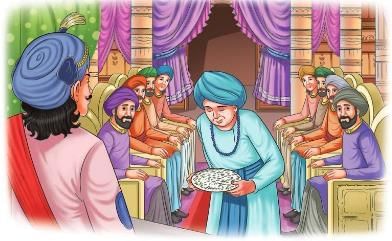
Q4. What did Tenali Ramakrishna bring to the court to present his idea?
(a) A plate of paddy seeds
(b) A musical instrument
(c) A map of the empire
(d) A book of poems 

Ans: (a) A plate of paddy seeds
Tenali used a plate of paddy seeds to make a point about sowing and yawning, cleverly addressing the king’s misunderstanding.

Q5. How did the court react when Tenali mentioned yawning?
(a) They remained silent
(b) They burst into laughter
(c) They became angry
(d) They left the hall

Ans: (b) They burst into laughter
The courtiers laughed when Tenali humorously linked yawning to careless sowing, lightening the court’s mood.

Q6. What did Krishnadeva Raya realize after Tenali’s intervention?
(a) He needed new seeds
(b) He should write clearer poems
(c) He needed better ministers
(d) He had misjudged Thirumalambal

Ans: (d) He had misjudged Thirumalambal
Tenali’s words made the king realize he wrongly took the queen’s yawning as disrespect, prompting his apology.

Fill in the Blanks

Instruction: Fill in the blanks with the correct word based on the chapter.

Q1. Tenali Ramakrishna claimed his seeds could produce a harvest ______ times greater.
Ans: three

Tenali stated that the paddy seeds could yield three times more than the current harvest to make his point.

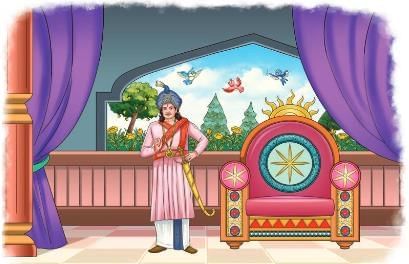
Q2. The king sat on an ______ throne during court discussions.
Ans: ornate

The chapter describes Krishnadeva Raya sitting on an ornate throne, emphasizing the court’s grandeur.

Q3. The queen’s name was ______ in the story.
Ans: Thirumalambal

Thirumalambal is the queen who quarreled with Krishnadeva Raya and sought Tenali’s help.

Q4. The courtiers made ______ remarks about Tenali’s seed claim.
Ans: sarcastic

The chapter notes that courtiers whispered sarcastic comments, like “magic seeds,” mocking Tenali’s claim.

Q5. Krishnadeva Raya’s poem included references to the sun, moon, and ______.
Ans: stars

Thirumalambal told Tenali that the king’s poem was about the sun, moon, and stars but was unclear.

Q6. The palace regained its ______ after the royal couple reconciled.
Ans: joy

After the quarrel was resolved, the palace became joyful and lively again, as per the chapter.

Very Short Answer Questions

Instruction: Answer the following questions in one line.

Q1. What was the name of Krishnadeva Raya’s Sanskrit play?
Ans: Jambavati Parinayam was his Sanskrit play.

Q2. Who was one of the poets in the Ashtadiggajas besides Tenali Ramakrishna?
Ans: Allasani Peddana was another poet in the Ashtadiggajas.

Q3. What natural action did Tenali compare yawning to?
Ans: Tenali compared yawning to breathing.

Q4. What did the royal couple give Tenali after resolving their quarrel?
Ans: They gave him gifts.

Q5. How long did the king avoid speaking to Thirumalambal after their quarrel?
Ans: He avoided her for weeks.

Short Answer Questions

Instruction: Answer the following questions in 2–3 lines.

Q1. What was the Golden Era of the Vijayanagara Empire?
Ans: The Golden Era was the period of Krishnadeva Raya’s reign (1509–1529 CE). It was marked by advancements in art, literature, and architecture, making the empire culturally vibrant.

Q2. Why did the ministers avoid giving feedback on the king’s poem?
Ans: The ministers found the king’s poem unclear and dodged giving feedback with excuses. They likely feared upsetting him due to his pride as a poet.

Q3. How did Tenali Ramakrishna respond when Thirumalambal asked for help?
Ans: Tenali listened thoughtfully and asked for time to devise a strategy. He promised to do his best to resolve the royal couple’s quarrel.

Q4. What practical solutions did the ministers propose for better crop yields?
Ans: The ministers suggested expanding irrigation systems and using better manure. These solutions aimed to improve paddy cultivation in the empire.

Q5. How did Thirumalambal react to the king’s apology?
Ans: Thirumalambal smiled and asked to hear his poem again. She was willing to move past the quarrel, restoring their relationship.Match the Following

Instruction: Match Column A with the correct option in Column B.Column AColumn B1. Krishnadeva RayaA. Resolved royal quarrel2. Tenali RamakrishnaB. Golden Era ruler3. ThirumalambalC. Poet group in court4. AshtadiggajasD. Yawned during poem recitation5. Paddy seedsE. Used in Tenali’s court strategy

Ans:
1-B, 2-A, 3-D, 4-C, 5-E  

  • 1-B: Krishnadeva Raya was the ruler during the Vijayanagara Empire’s Golden Era, known for cultural and literary achievements.  
  • 2-A: Tenali Ramakrishna used his wit to resolve the royal couple’s quarrel, restoring harmony.  
  • 3-D: Thirumalambal yawned during the king’s poem, which he mistook as disrespect, causing their quarrel.  
  • 4-C: The Ashtadiggajas were the eight esteemed poets in Krishnadeva Raya’s court, including Tenali and Allasani Peddana.  
  • 5-E: Tenali used a plate of paddy seeds in his court strategy to make a point about yawning and sowing, prompting the king’s reflection.