02. The Adventures of Toto – Summary

Key Points of the Story 

  • Grandfather’s New Pet: The writer’s grandfather, an animal enthusiast, acquired a mischievous monkey named Toto from a Tonga driver for five rupees. Since the grandmother disapproved of animals, Toto was kept hidden.
  • Toto’s Misbehaviour at Home: Toto was always causing trouble by tearing things apart. Whenever one of the aunts came close, he would grab her dress and rip it, which made Grandfather laugh but upset the rest of the family.
  • Toto’s Train Journey: On a train journey to Saharanpur, Toto poked his head out of the bag and smiled at the ticket-collector. The surprised man quickly decided to treat Toto as a dog and charged an extra fare.
  • Conflict with Other Animals: Even though they tried to make Toto get along with other pets, he often misbehaved, like almost boiling himself in a kettle and stealing food during meals.
  • Return to the Tonga Driver: Grandfather realised they couldn’t afford the constant damage to dishes, clothes, and curtains. So, he found the Tonga driver and sold Toto back for just three rupees.
Detailed Summary

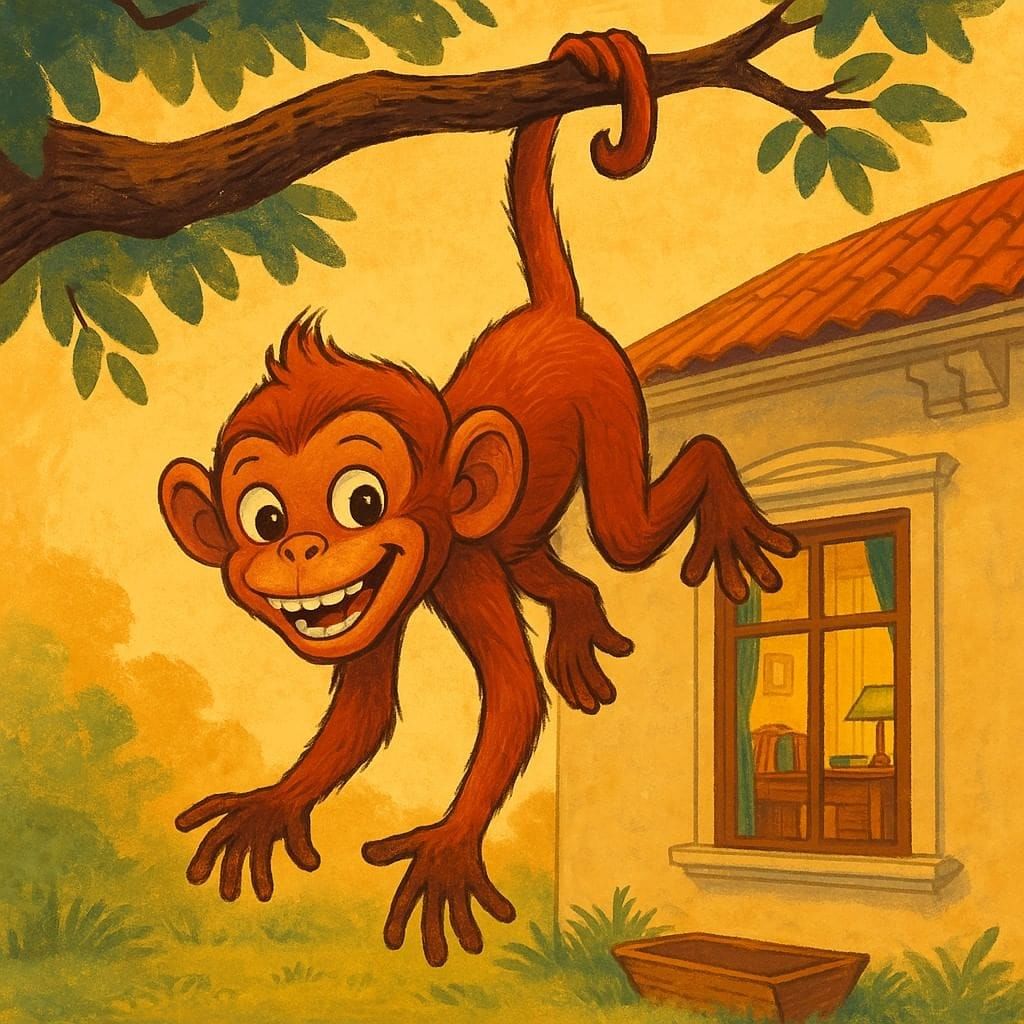
The narrator’s grandfather loved animals and once bought a red baby monkey, Toto, from a tonga driver for five rupees. The tonga driver kept Toto tied to a feeding trough. Toto had a special tail, which acted like a third hand, allowing him to hang from branches and grab things out of reach. Grandfather wanted to add Toto to his personal zoo, but the narrator’s grandmother, who disliked animals, would not be pleased. They decided to keep Toto a secret from her until she was in a good mood.

Since the grandmother didn’t approve of Toto, they hid him at first. Toto was kept in a small closet in the narrator’s bedroom but soon showed his destructive tendencies by tearing the wallpaper and shredding the narrator’s school blazer. Despite his mischief, Grandfather found Toto’s cleverness amusing.

After the closet incident, Toto was moved to a large cage in the servants’ quarters, where other pets were kept, including a tortoise, a pair of rabbits, a tame squirrel, and occasionally, the narrator’s pet goat. However, Toto’s mischievous behaviour disturbed the other animals, preventing them from resting at night. Soon, Grandfather took Toto along on a trip to Saharanpur.

Grandfather put Toto in a black canvas kit bag for the journey to keep him from causing trouble. However, Toto poked his head out, startling the ticket collector, who mistakenly identified Toto as a dog; thus, a fare of three rupees was paid.

After the trip, Toto was placed in the stable with Nana, the family’s female donkey. On the first night, Toto bit Nana’s ears, causing tension between them. Nevertheless, the family accepted Toto’s presence. He even created a bath-time routine, carefully checking the water temperature before jumping in and then rushing to the kitchen fire to dry off.

One day, Toto nearly boiled himself alive by jumping into a kettle of water heating for tea. Fortunately, Grandmother found him just in time. Toto’s destructive behaviour continued—he damaged many household items and once threw food and dishes when caught eating the family’s lunch. In one instance, Toto climbed a tree and refused to come down until he finished eating, eventually throwing the empty dish down and chattering with joy when it shattered into pieces.

The family’s patience with Toto’s constant mischief wore thin. Grandfather ultimately decided that keeping Toto was too troublesome and sold him back to the same tonga driver for three rupees, realising that Toto could not be tamed.

Theme/Message

Theme

  • The chapter highlights the importance of caring for pets and the effort needed to take care of them. Although the narrator’s grandfather tried to include Toto in their family, the naughty monkey had trouble getting along with other animals and caused chaos during their travels.
  • Toto’s troublesome behaviour resulted in damage to the home, specifically the walls, which had been decorated with special paper chosen by Grandfather, now revealed as bare brick and plaster. This made it hard for the family to maintain discipline. The story also shows the challenges of human-animal relationships, indicating that some wild animals are not easily tamed. Despite the grandfather’s patience, Toto’s destructive actions ultimately led to his return to the tonga driver, reminding us to respect nature and the natural behaviour of wildlife.

Message

  • The story teaches us to love and respect animals. When the grandfather sees the monkey with a tonga driver, he wants to provide it with a comfortable life in his zoo, so he buys it as a pet. 
  • However, as a wild animal, the monkey causes trouble, leading the grandfather to realise that it would be happier with the tonga driver. Despite the challenges, the grandfather treats Toto with care and affection, conveying a message about the importance of animal rights and welfare.

Difficult Words

  • feeding-trough: a container containing food for the animals
  • pickled: preserved in vinegar or brine
  • wicked: could create mischief
  • scooping: picking
  • fussed: feeling concerned
  • wrenched: pull out with force
  • shreds: pieces torn apart
  • tame: not dangerous
  • turnstile: exit gate
  • poked: stand out and be visible
  • taken aback: shocked
  • in vain: without success
  • quadruped: any four-footed animal
  • prodded: push with a finger
  • triumphant: successful
  • halter: strap or rope for tying the animal
  • haunches: one of the back legs of a four-legged animal
  • hauled: pull out with force
  • to spite grandmother: to intentionally annoy or upset her
01. The Lost Child – Summary

Key Points of the Story 

  • “The Lost Child” narrates the tale of a child who gets separated from his parents at a fair. Despite being enticed by various attractions like sweets and toys, his primary desire is to be reunited with his parents. He experiences fear and desperation upon realising he’s lost. 
  • A compassionate stranger offers him treats and distractions, but the child’s only wish is to find his family. This story reflects the innocence and dependence of children on their parents for security and happiness. 
  • Mulk Raj Anand‘s narrative underscores the profound bond between children and their caregivers. Through the child’s unwavering longing for his parents, the story emphasises the emotional connection that supersedes material desires.

Detailed Summary In the story, it was springtime, and a child went with his parents to a fair. He was really happy and excited about it. Along the way, he saw toys in the shops and wanted one. His father looked sternly at him, but his mother distracted him by pointing out a beautiful mustard field. The child went into the field to catch dragonflies. When his mother called him, he returned to his parents briefly but soon got distracted by insects on the path.

As they walked, they reached a place where a sweet-seller was selling treats, and the child wanted a ‘burfi’, but he knew his parents wouldn’t buy it. He also saw a flower-seller and colourful balloons, but he knew his parents wouldn’t get them for him. There was a snake-charmer playing a flute, but his parents had forbidden him from listening to such music. Later, he spotted a roundabout in full swing and asked his parents if he could ride it, but they were gone.

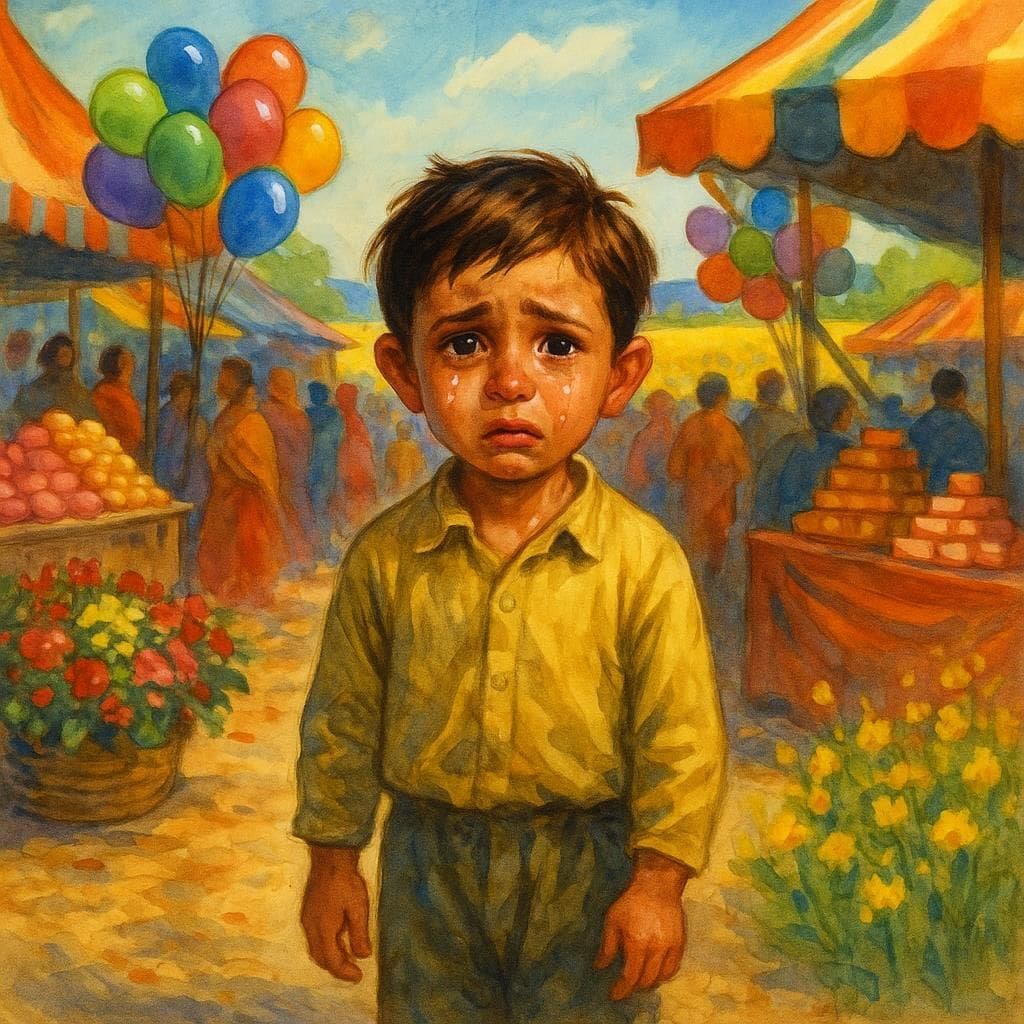
Panicked, he cried and ran around, not knowing where to go. He went to a temple crying for his parents, and a man in the crowd heard him and picked him up. The man tried to cheer him up by taking him to the roundabout, the snake-charmer, the balloon-seller, the flower-seller, and the sweet-shop, tried to comfort him with various attractions, but the child only wanted his parents. 

He lost interest in everything he had wanted before and just wanted to be with his parents. The story teaches us that a child can’t be happy without their parents.

Theme/Message

Theme 

  • The story explores what happens when a lost child yearns for his parents, realising their true importance as he searches desperately for them. Initially, the child is fascinated by many things at the fair and desires to have them all. 
  • However, parents often can’t fulfil these wishes due to financial constraints or concerns for the child’s well-being.  As a result, this might upset the child. 
  • But when separated from his parents, the child comprehends their value and feels a deep longing for them, crying out for their presence above all else.

Message 

  • The story emphasises how children love their parents unconditionally, as seen when a lost child is satisfied with his father’s actions, understanding that his dad won’t give in to his every desire. However, he regrets his decision to stray when he becomes scared and longs for his parents, forgetting about the attractions at the fair. This highlights the importance of parents in our lives.
  • In childhood, we desire many things we encounter daily, but often fail to appreciate the true value of our parents, taking them for granted. It’s only when they’re absent that we realise their significance and yearn for their presence. This realisation dawns on the child when he gets lost at the fair. Despite being tempted by various things, he only desires his parents’ company, showing the depth of parental love.

Try yourself:

What does the lost child realize when he is separated from his parents?

  • A.He understands the importance of his parents.
  • B.He values the fair attractions.
  • C.He wants to play more games.
  • D.He feels happy being alone.

View SolutionWord Meanings

  1. lanes = narrow roads 
  2. alleys = narrow passages 
  3. emerged = to come out of place 
  4. gaily = cheerfully or brightly
  5. clad = dressed 
  6. brimming = to be so full of a liquid 
  7. Lagged behind = to go too slowly 
  8. fascinated = attracted 
  9. lingering = to stay for a time 
  10. receding = to move backwards 
  11. suppress = to put an end to by force 
  12. tyrant = cruel ruler 
  13. tender = have a tender heart 
  14. bustling = moving here and there
  15. gaudy = too bright 
  16. flapping = to swing
  17. abreast = side by side 
  18. teeming = full of 
  19. grove = a group of trees
  20. whirlpool = a place in a river or the sea where strong currents are moving in circles
  21. repelled = pushed away
  22. Murmured = a low sound
  23. overwhelming = very great
  24. possess = to have 
  25. farther = more distant in  space 
  26. shrieked = to give a sudden shout 
  27. dizzy = unable to balance 

09. The Beggar – Worksheet

Q.1. Sergei’s anger had vanished and he now began to feel a little sorry and ashamed of himself for having set a spoiled, drunken, perhaps sick man to work at menial labour in the cold. An hour later Olga came in and announced that the wood had all been chopped.

(i) Why was Sergei angry in the first place?
(ii) What job had Sergei given to the beggar?
(iii) Who was Olga?
(iv) What is the irony in the above lines?

Q.2. What reasons does Lushkoff give to Sergei for telling lies?

Q.3. What job did Sergei assign to Lushkoff that changed his life?

Q.4. Describe Lushkoff’s first attempt to work at Sergei’s.

Q.5. Sergei says, “I am happy that my words have taken effect.” Why does he say so? Is he justified in saying this?

Q.6. “KIND sir, have pity; turn your attention to a poor, hungry man! For three days I have had nothing to eat; I haven’t five copecks for a lodging, I swear it before God. For eight years I was a village schoolteacher and then I lost my place through intrigues. I fell a victim to calumny. It is a year now since I have had anything to do.”

(i) Who is the speaker in the above lines?
(ii) What does the speaker try to do in the above lines?
(iii) Does the speaker get the help that he asks for? Why?
(iv) Pick out the word from the extract which means the same as ‘defamation’.

Q.7. “I wouldn’t refuse to do that, but in these days even skilled wood-cutters find themselves sitting without bread.” – What does this say about Lushkoff?

Q.8. “Here’s for your pains. I see you are sober and have no objection to work.” Why did Sergei say this to Lushkoff?

Q.9. What advice does Sergei give Lushkoff after hearing his reasons for begging?

Q.10. Give a pen-portrait of Olga (Sergei’s cook) in about 100-150 words.

The solutions of the worksheet “Worksheet Solutions: The Beggar

08. A House is not a Home – Worksheet

Q.1. My first year of high school felt awkward. After leaving junior high at the head of my class with all the seniority the upper grade levels could afford me, it felt strange starting over as a freshman. The school was twice as big as my old school, and to make matters worse, my closest friends were sent to a different high school. I felt very isolated. I missed my old teachers so much that I would go back and visit them.

(i) Why was the narrator feeling awkward?
(ii) Why did the narrator feel strange?
(iii) Why was the author sent to a new school?
(iv) How would his old teachers encourage him?

Q.2. What did the author and his mother do on seeing the fire?

Q.3. The author felt isolated and sad in his new school. Why?

Q.4. How did his old teachers encourage and advice the narrator?

Q.5. Describe the reaction of the author and his mother on seeing the fire?

Q.6. My mother. then ran out of the house carrying a small metal box full of important documents. She dropped the case on the lawn and, in a crazed state, ran back into the house. I knew what she was after. My father had died when I was young, and I was certain that she was not going to let his pictures and letters go up in flames. They were the only things that she had to remember him by. Still I screamed at her, “Mom! No!”

(i) What happened to the author’s house?
(ii) Why did the author love his cat so much?
(iii) Why did his mother run out of the house?
(ivWhat things did she want to save from the fire?

Q.7. Why did his mother rush back to the house?

Q.8. What did the author notice when he was sitting in the dining room?

Q.9. What did the author get from his new schoolmates?

Q.10. How did the author’s friends help him in rebuilding his life?

The solutions of the worksheet “Worksheet Solutions: A House is not a Home

07. The Last Leaf – Worksheet

Multiple Choice Questions (MCQs)

Q1: What illness did Johnsy have?
A) Tuberculosis
B) Pneumonia
C) Influenza
D) Malaria

Q2: What did Sue bring into Johnsy’s room to distract her?
A) A guitar
B) A drawing-board
C) A television
D) A book 

Q3: Who lived on the ground floor in the story?
A) The doctor
B) Behrman
C) Johnsy
D) Sue 

Q4: What was Behrman’s lifelong dream?
A) To travel the world
B) To become a doctor
C) To paint a masterpiece
D) To write a book 

Q5: What did Behrman paint on the night the last leaf fell?
A) A portrait
B) A landscape
C) The last leaf on the creeper
D) A self-portrait 

Fill in the Blanks Q1: Sue brought Johnsy a bowl of __________.

Q2: Johnsy thought she would die when the __________ leaf fell.

Q3: Behrman’s masterpiece was the painting of the __________ leaf.

Q4: Johnsy realized that it was a sin to want to __________.

Q5: Sue gave Johnsy lots of hot __________ and a mirror.

True or False

Q1: Johnsy had influenza.

Q2: Sue talked about clothes and fashions to distract Johnsy.

Q3: Behrman was a musician.

Q4: Johnsy wanted to see the last leaf fall before it got dark.

Q5: The doctor was not confident that Johnsy would recover.

Very  Short Answer Questions

Q1: Why does Johnsy keep counting the leaves?

Q2: What did Sue do to distract Johnsy?

Q3: Who painted the last leaf on the ivy creeper?

Q4: What change in Johnsy does the doctor notice after the last leaf doesn’t fall?

Q5: What happened to Behrman after he painted the last leaf?

The solutions of the worksheet “Worksheet Solutions: The Last Leaf

06. Weathering the Storm in Ersama – Worksheet

Q.1. “For the next two days, Prashant sat huddled with his friend’s family in the open on the rooftops. They froze in the cold and incessant rain; the rain water washed away Prashant’s tears. The only thought that flashed through his mind was whether his family had survived the fury of the super cyclone. Was he to be bereaved once again?

(i) What had Prashant done for the next two days?
(ii) What happened to Prashant and his friend’s family?
(iii) What washed away Prashant’s tears?
(iv) What was the only thought that flashed through Prashant’s mind?

Q.2. What happened when Prashant had gone to spend a day with his friend?

Q.3. How did Prashant and his friend’s family take refuge during the cyclone?

Q.4. What made Prashant move after two days?

Q.5. What did Prashant decide after looking at the weird situation of the town?

Q.6. “ On 27october 1999, seven years after his mother’s death, Prashant had gone to the block headquarters of Ersama, a small town in coastal Orissa, some eighteen kilometers from his village, to spend the day with a friend. In the evening, a dark and menacing storm quickly gathered. Winds beat against the houses with a speed and fury that Prashant had never witnessed before.

(i) When did Prashant go to the block headquarters of Ersama?
(ii) Why did Prashant go to Ersama?
(iii) How far was the town from his village?
(iv) What happened in the evening?

Q.7. Describe the furious storm.

Q.8. What thought flashed through Prashant’s mind?

Q.9. What scenes Prashant had to witness as he waded through the waters?

Q.10. “Adversities bring out the heroes”. Describe Prashant’s character with reference to the chapter. What values make an efficient and popular leader?

You can access the solutions to this worksheet here.

05. The Happy Prince – Worksheet

Multiple Choice Questions

Q1: Who came to live with the Prince in the story, The Happy Prince?
(a) 
A sparrow
(b) A stork
(c) A swallow
(d) A swan

Q2: What did the swallow notice while flying over the city?
(a) Many waste things
(b) Many poor people
(c) Many people and their plight
(d) The plight of the poor and greed of the rich

Q3: Who noticed the dull state of the Prince’s statue in the story, The Happy Prince?
(a) 
The Art Professor
(b) The Town Clerk
(c) The Town Councillor
(d) The Mayor

Q4: What did the Prince tell the swallow to give to the seamstress In the story, The Happy Prince?
(a) 
The ruby of his sword’s hilt
(b) The thin leaves of gold from his body
(c) The lead from his heart
(d) The sapphire eyes of his

Q5: The colour of the lips of the writer was red like ________.
(a)
 Cherry
(b) Rose
(c) Apple
(d) Pomegranate

Q6: What was the profession of the woman who was sitting in her cottage with prickled hands?
(a)
 Charwoman
(b) Cake-making
(c) Seamstress
(d) None of these

Q7: What moved Swallow’s heart?
(a) 
Happy Prince
(b) Happy Prince’s kindness
(c) All of these
(d) Happy Prince’s assets

Q8: The little swallow got the ________ bedroom.
(a) 
diamond
(b) silver
(c) muddy
(d) gold

Q9: Shining sapphire stones were placed in the ________ of the happy prince.
(a)
 nose
(b) forehead
(c) sword
(d) eyes

Q10: What was the Prince gilded over with In the story, The Happy Prince?
(a)
 Thin leaves of silver
(b) Thin leaves of copper
(c) Thin leaves of lead
(d) Thin leaves of gold

Very Short AnswerQuestions

Q1: Describe the statue of the Happy Prince.
Q2: Did the swallow belong to the city? How can you tell? Where was it going?
Q3: Where did the bird decide to stay for the night? Why?
Q4: Why did the swallow agree to deliver the ruby even though he wanted to join his friends in Egypt?
Q5: What were the things that the swallow saw on his journey to deliver the ruby?
Short Answer Questions

Q 1: Why did the bird think he had a ‘golden bedroom’?
Q 2: Why was the bird not able to sleep peacefully that first night?
Q3: Why was the statue of the Happy Prince weeping?
Q4: Why did the swallow delay his departure for the second time?
Q5: What did the Prince expect the young playwright to do with the sapphire? Did the swallow willingly agree to the Prince’s request?

Long Answer Questions

Q1: What are the two most precious things that the Angels find in the city?
Q2: Comment on the title of the story. Was the prince really happy?
Q3: Why is the frost called a ‘dreadfully hard frost’?
Q4: Why did the courtiers call the prince the ‘Happy Prince’? Was he really happy? What does he see all around him?
Q5: How do the councillors and Mayor react on seeing the broken statue?

The solutions of the worksheet “Worksheet Solutions: The Happy Prince

04. In the Kingdom of Fools – Worksheet

Multiple Choice Questions

Q1: In the Kingdom of Fools, who were considered fools?

  1. The guru and his disciple
  2. The king and the minister
  3. The rich merchant and the goldsmith
  4. The thief and his brother

Q2: Why did the guru and his disciple decide to leave the Kingdom of Fools?

  1. They were afraid of the king
  2. They were not getting enough to eat
  3. They realized it was a kingdom of fools
  4. They missed their hometown

Q3: What did the guru and his disciple eat every day?

  1. Bananas and ghee
  2. Rice and wheat
  3. Fruits and vegetables
  4. Meat and bread

Q4: Why did the thief break into the rich merchant’s house?

  1. To find food
  2. To seek revenge
  3. To steal valuables
  4. By mistake

Q5: Who was ultimately executed on the stake in the story?

  1. The rich merchant
  2. The guru and his disciple
  3. The goldsmith
  4. The king and his minister

Fill in the Blanks

Q1: The people in the Kingdom of Fools obeyed the king and minister due to fear of __________.

Q2: The disciple stayed in the kingdom because he enjoyed having good and __________ food.

Q3: The thief broke into the rich merchant’s house and got killed when a wall __________ on him.

Q4: The dancing girl’s distraction led to the poor bricklayer building a __________ wall.

Q5: The guru and his disciple were executed on the stake meant for __________.

True or False

Q1: The people in the Kingdom of Fools were awake during the day.

Q2: The guru and his disciple decided to stay in the kingdom due to fear of the king.

Q3: The rich merchant was held responsible for the thief’s death due to a collapsing wall.

Q4: The goldsmith was hiding in the king’s palace when accused of wrongdoing.

Q5: The rich merchant’s father was ultimately found guilty of the crimes.

Match the FollowingColumn AColumn B1. The guru and his disciplea. Ultimately executed on the stake 2. The rich merchantb. Accused of murder3. The goldsmithc. Distracted the bricklayer 4. The dancing girld. Built a weak wall 5. The king and his ministere. Obeyed the king and minister 

The solutions of the worksheet “Worksheet Solutions: In the Kingdom of Fools

03. Iswaran the Storyteller – Worksheet

Multiple Choice Questions 

Q1: Which art helped Iswaran to bring down the beast? 
(a) boxing
(b) wrestling
(c) ju-jitsu
(d) yoga 

Q2: Where did the school boys hide themselves to see the mad elephant?
(a) on trees
(b) in their houses
(c) in their classrooms
(d) in the Headmaster’s room

Q3: What happened to the elephant when Iswaran hit the third toenail of the elephant?
(a) grunted loudly and collapsed on the
(b) ran away from their ground
(c) caught Iswaran in his trunk and threw him
(d) made friendship with Iswaran away

Q4: From where was Iswaran watching this incident
(a) from a room
(b) from the cupboard
(c) from a tree
(d) from the rooftop

Q5: Why did the people run helter-skelter in panic?
(a) to see the tiger
(b) to see a giant
(c) to see a giant
(d) none of these 

Q6: In Iswaran’s story, from where did the tusker escape? 
(a) cage
(b) timber yard
(c) forest
(d) circus

Q7: What was the special feature of his stories? 
(a) light humour
(b) satire on the system
(c) tragic ending
(d) suspense and a surprise ending

Q8: What was Mahindra’s marital status? 
(a) married
(b) widower
(c) engaged and going to be married soon
(d) bachelor

Q9: How did Iswaran say the elephant was revived? 
(a) He said he gave the elephant an injection.
(b) He said he gave the elephant artificial respiration.
(c) He said a veterinary doctor was called there.
(d) He said a man from the zoo helped to revive the elephant.

Q10: What kind of books did Iswaran usually read? 
(a) Some popular Tamil religious book.
(b) Some popular Tamil love story.
(c) Some popular Tamil thriller.
(d) Some popular Tamil folk songs.

Short Answer Questions

Q1: Who is Mahendra in the given story?
Q2: What harm does the elephant cause in the story narrated by Iswaran?
Q3: What happens to Mahendra after hearing Iswaran’s ghost story?
Q4: Explain the daily routine of Mahendra and Iswaran.
Q5: How was Iswaran useful to Mahendra?
Q6: How does Iswaran describe the female ghost to Mahendra?
Q7: Why did the elephant collapse?
Q8: Explain, in brief, why Mahendra resigns from the job and leaves the haunted place.

You can find Worksheets Solutions here: Worksheet Solutions: Iswaran the Storyteller

02. The Adventures of Toto – Worksheet

Multiple Choice Questions

Q1: Why was Toto sold by the narrator’s grandfather?
(a) 
The grandfather detested it.
(b) The monkey was mischievous.
(c) The monkey was not keeping well.
(d) The monkey was trying to escape.

Q2: How much fare was collected by the ticket collector for Toto’s travel?
(a) Seven rupees
(b) One rupee
(c) Three rupees
(d) Ten rupees

Q3: Where did the writer’s Grandfather live?
(a)
 In Mumbai
(b) In Saharanapur
(c) In Dehradun
(d) In Delhi

Q4: Who was Toto?
(a)
 A dog
(b) A monkey
(c) A lamb
(d) A boy

Q5: Which other animal accompanied narrator’s grandfather and Toto to Saharanpur?
(a)
 A cat
(b) A rabbit
(c) A tortoise
(d) A tame squirrel

Q6: How was Toto taken to Saharanpur?
(a) In a canvas kit-bag
(b) In a little cage
(c) In a basket
(d) In a big black plastic bag

Q7: How did Toto prove to other animals?
(a) Careful
(b) Friendly
(c) Soothing
(d) Troublesome

Q8: What did Toto tear into shreds?
(a)
 The author’s school bag
(b) The author’s pant
(c) The author’s school blazer
(d) All of these

Q9: Who brought Toto to the narrator’s house?
(a)
 Author’s grandfather
(b) Author’s grandmother
(c) Author’s mother
(d) Author’s father

Q10: What did Toto do with the writer’s school blazer?
(a)
 He tore it into shreds
(b) He threw it out of the window
(c) He made it into his bedding
(d) He wore it on his back

Very Short Answer Questions

Q1: How much did Grandfather pay for Toto?
Q2: What did Toto do to the walls of the closet?
Q3: Why was Toto considered clever by Grandfather?
Q4: What did Toto do when he was put in the kettle?
Q5: Why did Grandfather sell Toto back to the tonga-driver?

Short Answer Questions

Q1: What did Grandfather buy Toto for?
Q2: How did Toto behave when he was first kept in the closet?
Q3: What happened when Toto was taken on the train?
Q4: Why did Toto and Nana, the donkey, not get along?
Q5: How did the ticket-collector mistake Toto for a dog?

Long Answer Questions

Q1: Describe the character of Toto and how his behavior reflects his mischievous nature. Provide specific examples from his interactions with the family and other animals.
Q2: Discuss the theme of companionship as depicted in the relationship between Toto and the other pets in the household. How does Toto’s behavior affect these relationships?

You can find Worksheets Solutions here: Worksheet Solutions: The Adventures of Toto