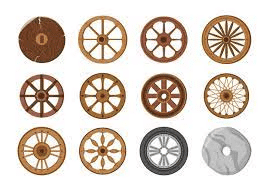
20. Invention of Wheel – Worksheet

Q1: Multiple Choice Questions (MCQs).

(i) What did the invention of the wheel help people do?
(a) 
Fly
(b) Carry heavy things
(c) Swim
(d) Play games

(ii) Where was the wheel first invented?
(a) 
In space
(b) In a jungle
(c) In a cave
(d) In ancient Mesopotamia
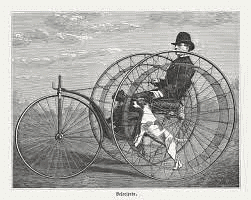
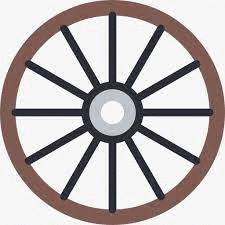
(iii) What is the shape of a wheel?
(a) 
Square
(b) Triangle
(c) Circle
(d) Rectangle

(iv) What did people use before the invention of the wheel to move heavy things?
(a) 
Rockets
(b) Teleportation
(c) Their hands and backs
(d) Magic

(v) Why is the invention of the wheel important?
(a) 
To make ice cream
(b) To build tall buildings
(c) To transport goods and people easily
(d) To fly in the sky
Q2: Fill in the Blanks.

(i) The wheel is usually round or _______ in shape.

(ii) People used their hands and backs to move heavy objects before the invention of the _______.

(iii) The first wheel was invented in ancient _______.

(iv) The invention of the wheel helped people carry heavy _______.

(v) The wheel is important because it made it easier to transport goods and _______.

Q3: Match the Following.

Match the terms on the left with their corresponding descriptions on the right.

Q4: Short Answer Type Questions.

(i) Why was the invention of the wheel important for people in ancient times?

(ii) Where and when was the wheel first invented?

(iii) What shape is a typical wheel?

(iv) What did people use before the wheel to move heavy things?

(v) Give one example of how the invention of the wheel is still important today.

The solutions of the worksheet “Invention of Wheel

19. Safety & First Aid – Worksheet

Multiple Choice Questions (MCQs)

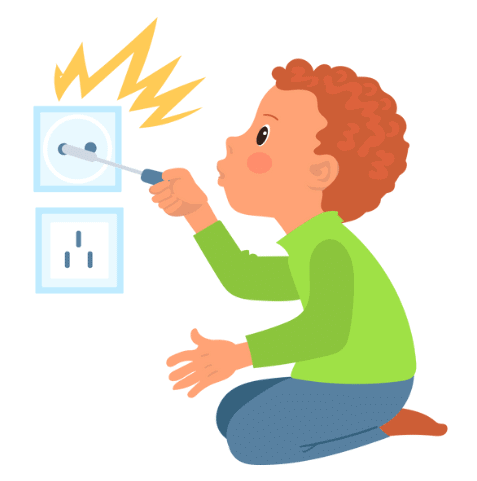
1. Which of these can give you an electric shock?
(a) Matchsticks
(b) Damaged electric wire
(c) Knives and scissors
(d) Medicines

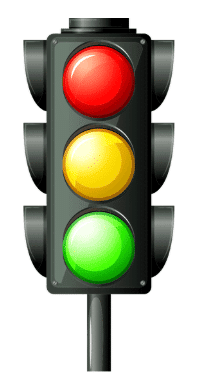
2. Which colour of traffic light tells us to stop?
(a) red
(b) yellow
(c) green
(d) blue

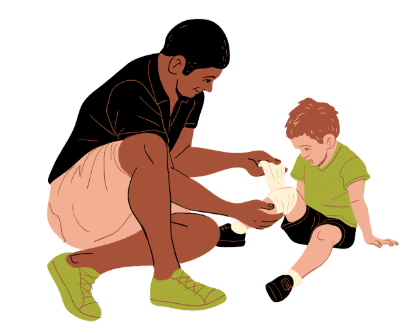
3.  In which of these cases will you take care not to move the injured person?
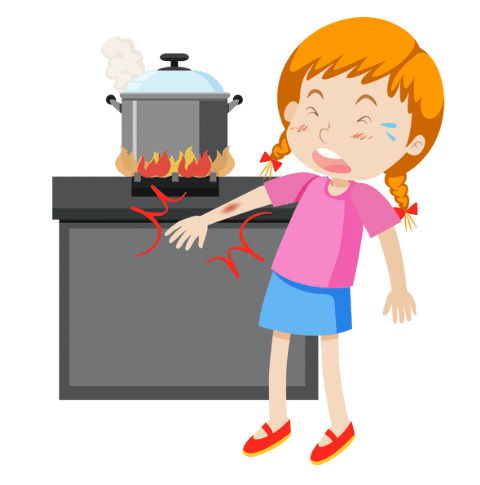
(a) minor burn
(b) minor scratch
(c) broken bone
(d) bleeding wound

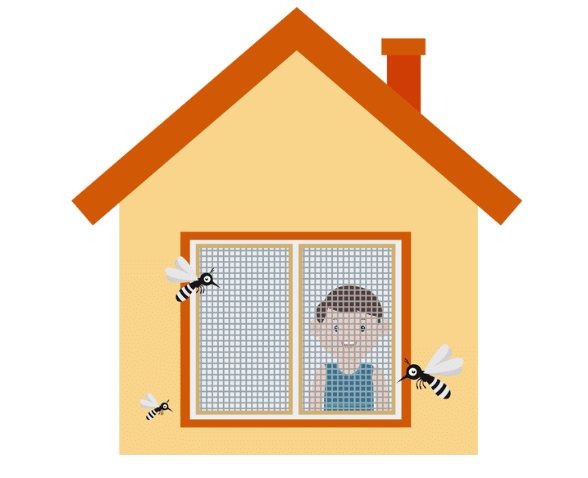
4.  Wire netting is used on doors and windows to keep away
(a) insects
(b) sunshine
(c) polluted air
(d) thieve

5. On which side of the road should you drive your bicycle?
(a) left
(b) right
(c) centre
(d) on the zebra crossing only

Fill in the Blanks 

1. We should never touch a ______ wire as it can give us an electric shock.

2. The first help given to an injured person is called ______.

3. We should always walk on the ______ while going on the road.

4. Windows and sunshine help keep our house clean by killing ______.

5. If someone gets a burn, we should put the burnt area under ______ water.

Name the following

1. You should keep to this side of the road when riding a bicycle. 

2. A useful thing that can give you a dangerous shock if you are not careful with it. 

3. A system which carries away dirty water from the bathroom.  

4. A sharp instrument that must be used carefully. 

5. The first help that an injured person needs. 

True & False

1. You should run in the classroom to reach your desk quickly.

2. Letting sunshine into the rooms is important as it kills germs.

3. The green traffic light tells us to go, while the red light tells us to stop. 

4. If someone has a burn, putting a bandage around the burn will give relief.

5. Germs mainly live and grow in the kitchen, toilets and garbage bins so only these should be cleaned every day.

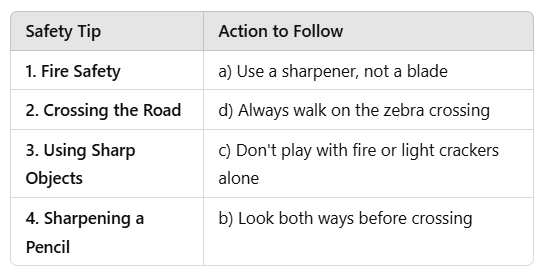
Match the following:

Short Answer Questionsa) List five things in your home that can be dangerous.

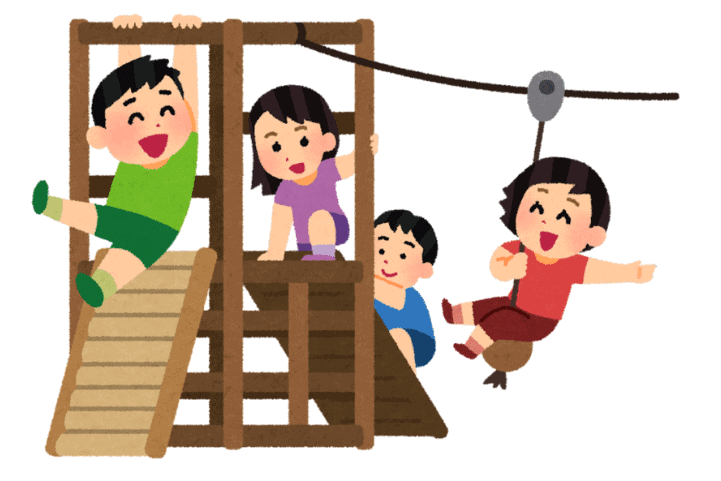
b)  How can you avoid accidents on the playground?

c) Why are the following things important in a house?
(i) Windows

(ii) Proper drainage system

(iii) Open spaces

d) What will you do before crossing a busy road?

e) What will you do if someone is injured in an accident?

You can access the solutions to this worksheet here.

18. World Around Me – 2  Worksheet

Q1: Multiple Choice Questions (MCQs).

(i) What do we call the round, bright object that shines in the night sky?
(a) 
Sun
(b) Moon
(c) Star
(d) Cloud

(ii) Which of the following is a source of drinking water for us?
(a)
 Juice
(b) Milk
(c) River
(d) Chocolate

(iii) What do you wear on your feet to protect them?
(a) 
Hat
(b) Gloves
(c) Shoes
(d) Socks

(iv) Which season is known for colorful leaves falling from trees?
(a) 
Spring
(b) Summer
(c) Autumn
(d) Monsoon

(v) What do we use to carry our books to school?
(a)
 Pencil
(b) Backpack
(c) Eraser
(d) Notebook

Q2: Fill in the Blanks.

(i) Birds have ________ to help them fly.

(ii) In the evening, we see ________ in the sky.

(iii) We use a ________ to tell the time.

(iv) We use a ________ to write and draw.

(v) A rainbow has many ________ colors.

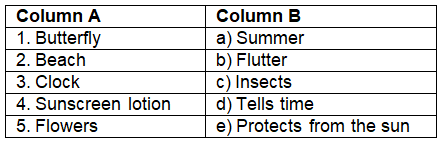
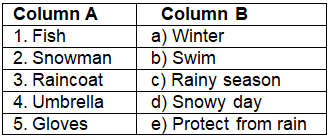
Q3: Match the Following.

Match the items in Column A with the appropriate items in Column B.

Q4: Short Answer Type Questions.

(i) What do we use to write on paper?

(ii) Name a fruit that grows on trees.

(iii) What do you use to protect your eyes from the sun?

(iv) What do you do to water plants?

(v) What season comes after autumn?

You can access the solutions to this worksheet here.

18. World Around Me – 1 Worksheet

Q1: Multiple Choice Questions (MCQs).

(i) What is the main source of light during the day?
(a) 
Moon
(b) Stars
(c) Sun
(d) Streetlights

(ii) Which of the following is a living thing?
(a) 
Car
(b) Tree
(c) Rock
(d) Chair

(iii) Which season comes after winter?
(a) 
Spring
(b) Summer
(c) Autumn
(d) Monsoon

(iv) What do we use to measure temperature?
(a)
 Thermometer
(b) Ruler
(c) Compass
(d) Clock

(v) What do plants need to make their own food?
(a) 
Water and air
(b) Soil and rocks
(c) Toys and books
(d) Sunscreen and hats

Q2: Fill in the Blanks.

(i) We see stars in the ________ at night.

(ii) Birds have ________ to fly.

(iii) We use an umbrella when it’s ________.

(iv) In summer, we like to eat ________ ice cream.

(v) The sun gives us ________ during the day.

Q3: Match the Following.

Match the items in Column A with the appropriate items in Column B.

Q4: Short Answer Type Questions.

(i) What do you wear to stay warm in winter?

(ii) How does a plant get food?

(iii) What do you use to see things that are far away?

(iv) Name one thing that flies in the sky.

(v) What do you do to stay dry when it’s raining?

You can access the solutions to this worksheet here.

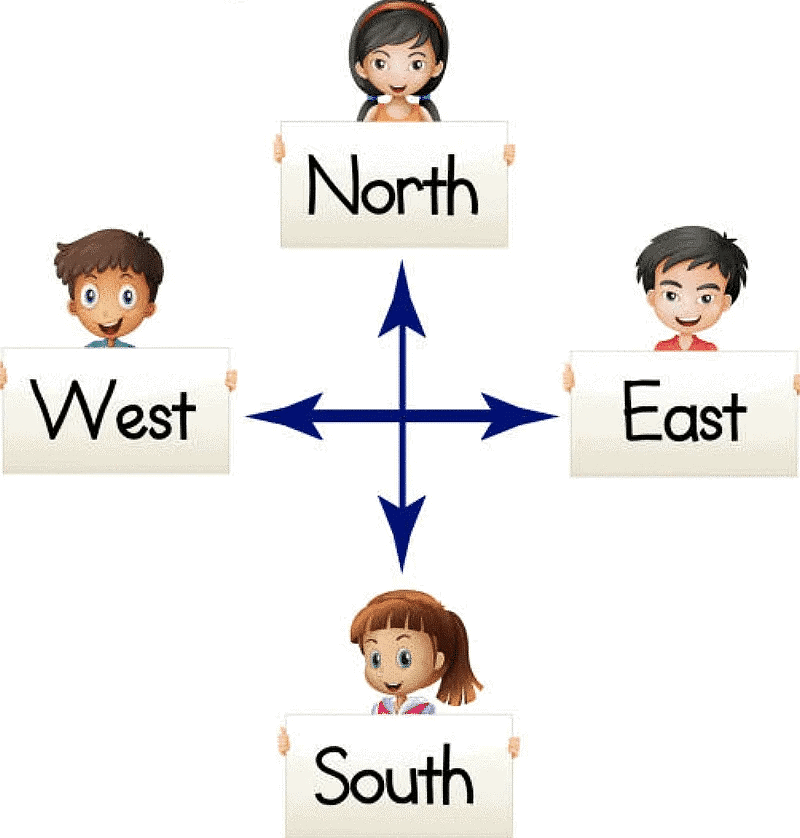
17. Understanding Directions-2                Worksheet

Q1: Multiple Choice Questions (MCQs).

(i) Which direction do we usually see the sunrise?
(a) 
North
(b) East
(c) West
(d) South

(ii) When you face north, which direction will be behind you?
(a)
 East
(b) West
(c) South
(d) North

(iii) What direction do you need to go to reach the park from your house if the park is to the west of your house?
(a) 
East
(b) North
(c) South
(d) West

(iv) If the school is in the north and the market is in the south, which direction is the school from the market?
(a) 
East
(b) West
(c) North
(d) South

(v) When we look up at the sky, what do we see above us?
(a) 
Trees
(b) Birds
(c) Clouds
(d) Flowers

Q2: Fill in the Blanks.

(i) The sun sets in the ________.

(ii) To go to the playground, I need to walk ________ from my house.

(iii) The river flows from the ________ to the ________.

(iv) I live in a house on Maple Street. My friend’s house is on Oak Street. To visit my friend, I need to walk ________ from my house to reach Oak Street.

(v) The wind blows from the ________ to the ________.

Q3: Short Answer Questions.

(i) Explain what you see in the east during sunrise.

(ii) How would you describe the direction you face when you are looking at your school from your home?

(iii) Can you tell me a game or activity you play that involves understanding directions?

(iv) What do you need to do if you want to go from your home to a friend’s house located to the south of your home?

(v) How can you find out which way is north without using a compass?

The solutions of the worksheet “Directions – 2

17.Understanding Directions-1               Worksheet

Multiple Choice Questions

(i) The geographical drawings to show the location of various places is known as
(a) 
map
(b) 
location
(c) 
dictionary
(d) 
atlas

(ii) The sun rises from the
(a) 
west
(b) 
east
(c) 
south
(d) 
north

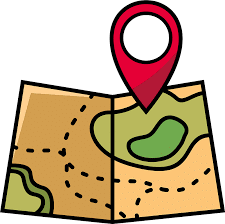
Map

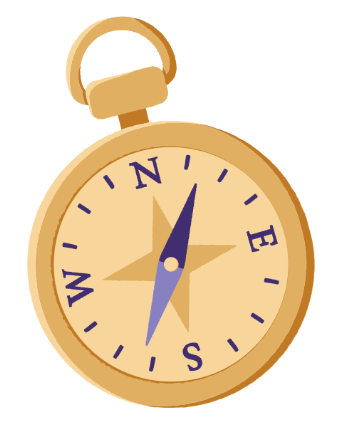
(iii) Which of the following shows directions?
(a) 
Calendar
(b) 
Clock
(c) 
Compass
(d) 
Thermometer

(iv) Which direction is opposite to East?
(a) North
(b) South
(c) West
(d) Down

Fill in the blanks

(i) We can find our way with the help of a __________.  

(ii) If we face the rising sun, North will be on our __________.  

(iii) We can find directions with the help of the rising __________.  

(iv) The sun always rises in the __________.

SunriseTrue and False(i) Sun sets in the West.
(ii) There are mainly three directions.
(iii) The places, that are easily identifiable, work as landmark for us.
(iv) A map helps us know where different places are.

Compass

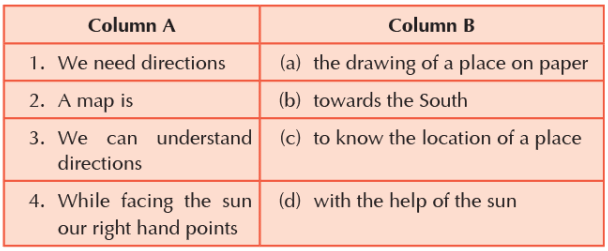
Match the Following

The solutions of the worksheet “Directions – 1

16. Seasons and Weather –  Worksheet

MCQs

Question 1: There are no clouds in the sky. What kind of day it would be?
(a) Rainy day
(b) Cloudy day
(c) Clear day

(d) Foggy day

Question 2: Tiny droplets of water together forms _________ high up in the sky.

(a) rain
(b) cloud
(c) water cycle
(d) water vapour

Question 3: When will the days be shorter?
(a) Winter
(b) Summer
(c) Monsoon
(d) Spring

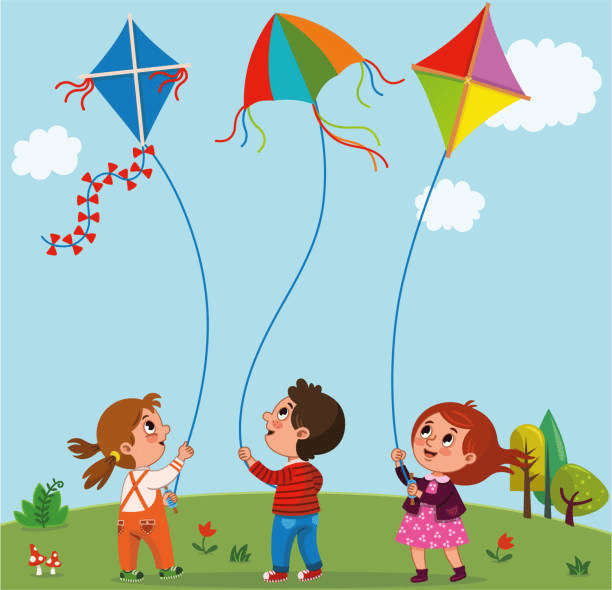
Question 4: Which of the following would be a good day to fly kites?
(a) Still day
(b) Rainy day
(c) Stormy day
(d) Windy day
Question 5: In which of the following season you will wear light cotton clothes?
(a) Winter
(b) Monsoon
(c) Summer
(d) None of these

Unscramble the letters and write the correct words.

Question 6:

(a) Day to day condition of a place. REWAHET _____________

(b) Trees shed leaves in this season. MUTANU _____________

(c) Days are longer in this season. RUSMEM  _____________
(d) Day when it rains a lot. IRYNA  _____________
(e)
 It is a cold season. WRITEN _____________

Write T for True statements and F for False statements.

Question 7:

  • The sun does not affect the weather.
  • Water vapour rises up in the sky.
  • Summer is the hottest season.
  • When wind blows strongly, there is a storm.
  • Autumn comes after winter.

Match the following

Question 8:

(a) Rainy day    (i) Dark woollen clothes

(b) Winter         (ii) Light cotton clothes

(c) Cloud         (iii) Flowers
(d) Summer     (iv) Umbrella
(e) Spring        (v) Rain

Fill in the blanks

Question 9:

(a) When wind does not blow at all, it is a ____________ day.

(b) When water is heated, it changes into  ____________ .  

(c) When the weather remains similar for a few months, we call it a ____________.
(d)The middle of the day is ____________ than mornings and evenings.
(e) When the clouds become heavy, it falls down as  ____________ .

Answer the following questions in brief.

Question 10: What is weather? What are the factors that affect weather of a place?

Question 11: Write any three features of summer season.

Question 12: Draw a well-labelled diagram of the water cycle.

Question 13: How are clouds formed?

Question 14: How can you identify the autumn season?

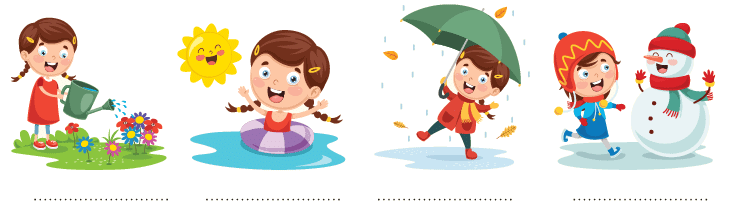
Question 15: Look at the pictures and identify the seasons.

You can access the solutions to this worksheet here.

15. Means of Communication-2      Worksheet 

Q1: Multiple Choice Questions (MCQs).

(i) How do you listen to your favorite songs and stories?
(a)
 Bicycle
(b) Television
(c) Radio
(d) Ball

(ii) What do you use to talk to your friend who is in the same room?
(a) 
Telephone
(b) Computer
(c) Whisper
(d) Telescope

(iii) Which of these is used to send pictures and messages instantly?
(a)
 Mobile phone
(b) Letter
(c) Bicycle
(d) Watch

(iv) What do you write on the envelope before sending a letter?
(a)
 Your name
(b) Your friend’s name
(c) Your favorite cartoon character
(d) A birthday wish

(v) Which of these is a way to send a message when you cannot talk or write?
(a)
 Dancing
(b) Singing
(c) Sign language
(d) Riding a bicycle

Q2: Fill in the Blanks.

(i) We use a _______ to hear news and music on the airwaves.

(ii) To send a letter, we need to put it in an _______.

(iii) We use a _______ to look at far away things closely.

(iv) When we want to tell a secret to a friend, we _______ in their ear.

(v) Sign language uses _______ to communicate.

Q3: Short Answer Type Questions.

(i) What is the purpose of a telescope, and how does it work?

(ii) How is sign language different from speaking or writing?

(iii) What can you do with a radio?

(iv) How do you send a message using sign language?

(v) Why is whispering important sometimes?

You can access the solutions to this worksheet here.

15.Means of Communication-1     Worksheet

Multiple Choice Questions (MCQs)

(i) What is a telephone used for?
(a) 
Playing games
(b) Listening to music
(c) Talking to people
(d) Watching cartoons

(ii) Which of these is NOT a means of communication?
(a) Television
(b) Bicycle
(c) Letter
(d) Computer

(iii) What do you use to send a message to your friend who lives far away?
(a) Mobile phone
(b) Bicycle
(c) Teddy bear
(d) Crayons

(iv) Which of these is a way to send a message quickly?
(a) Sending a letter
(b) Sending an email
(c) Sending a postcard
(d) Sending a gift

(v) What do you use to write a letter to your grandma?
(a) Computer
(b) Bicycle
(c) Television
(d) Football

Fill in the Blanks

(i) We use a _______ to send messages to people who are far away.

(ii) A postman delivers letters to our _______.

(iii) We watch our favorite cartoons on _______.

(iv) To send a quick message, we can use _______.

(v) We write with a _______ on a piece of paper to send a letter.

True or False

(i) A letter can be sent through a mailbox.

(ii) We need an envelope to send an email.

(iii) A message written on paper and sent by post is called a postcard.

(iv) We can only talk on a mobile phone, not send messages.

(v) Computers can help us talk to people using video calls.

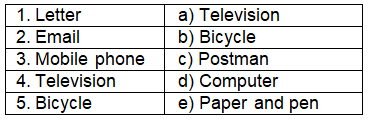
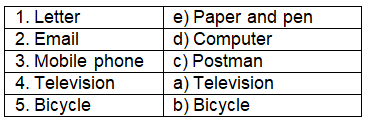
Match the FollowingMatch the items on the left with their corresponding means of communication on the right.

Ans:

Short Answer Type Questions

(i) What is a postman, and what does he do?

(iii) How do you send a message using a mobile phone?

(iv) Name one thing you can watch on television.

(v) What is the difference between a letter and an email?

(vi) Why is a bicycle not a means of communication?

You can access the solutions to this worksheet here.

14. Services In Neighbourhood – 2  Worksheet

Q1: Multiple Choice Questions (MCQs).

(i) Who helps you when you are sick and need medical help?
(a) 
Teacher
(b) Doctor
(c) Grocer
(d) Postman

(ii) Where do you go to borrow books and read them?
(a) 
Police station
(b) Park
(c) Library
(d) Pet shop

(iii) Who delivers letters and packages to your home?
(a) 
Teacher
(b) Postman
(c) Chef
(d) Bus driver

(iv) Where can you buy fruits and vegetables?
(a) 
Bakery
(b) Grocery store
(c) Hospital
(d) Toy shop

(v) Who helps put out fires in case of an emergency?
(a) 
Farmer
(b) Firefighter
(c) Policeman
(d) Barber

Q2: Fill in the Blanks.

(i) We go to the ________ when we need medicine.

(ii) The ________ is where we play and have fun on swings and slides.

(iii) The person who drives the bus is called a ________.

(iv) We get our hair cut at the ________.

(v) The place where you learn and study is called ________.

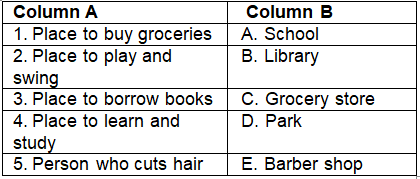
Q3: Match the Following.

Match the items in Column A with the correct items in Column B.

Q4: Short Answer Questions.

(i) What does a doctor do when you visit them?

(ii) Where can you find swings, slides, and a place to play?

(iii) Who delivers letters to your home, and why is it important?

(iv) Where can you go to buy things like bread, milk, and vegetables?

(v) What do firefighters do to help people in emergencies?

The solutions of the worksheet “Our Neighbourhood – 2