10. Solutions: The World of Things

Let’s Take A Look Around Us! (Page 125)

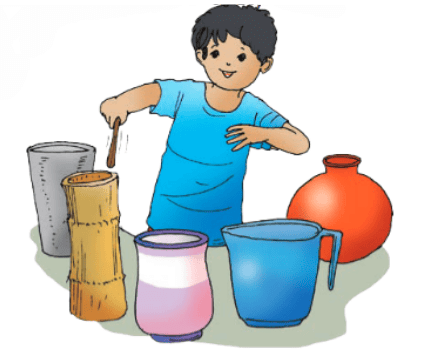
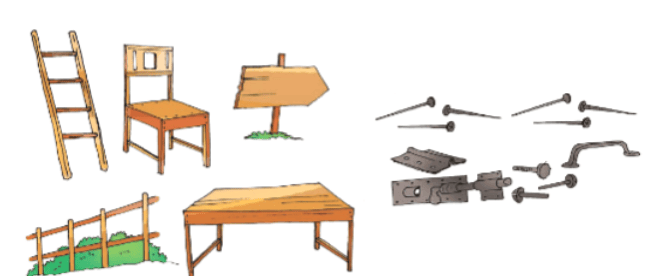
Q: Can you name the things that Khushi has drawn ? Write in the boxes given.
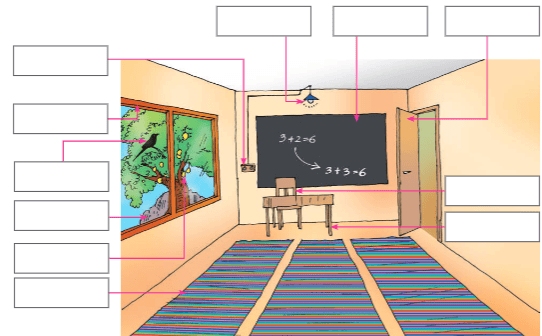
Let`s Take A Look Around Us! (Page 125)

Ans: 

Let`s Take A Look Around Us! (Page 125)

Activity 1 (Page 124)

 Understand your Classroom

Draw a picture of your classroom in your notebook. Label the things that you have drawn.

Khushi is curious, “Where have all these things come from? Who has made them? What are they all made of?” she thought.

Let us help Khushi find out.

The table and chair are made of wood. Where do we get wood from?

The hinges, nails and latches of the door are made of some metals.

 Understand your Classroom

Ans:  Students are encouraged to attempt it on their own.

Activity 2 (Page 125)

Spot the Metals

 Find as many things or parts of things, that are made of metals. Which metals do you recognise around you? If you do not know the name of the metal, ask your friends or an elder. Make a list of these metals in your notebook.

Ans: I looked around and found many things made of metals. Some of the items I found include:

Door hinges – made of iron

Spoon – made of stainless steel

Water tap – made of brass

Coins – made of copper or nickel

Scissors – made of steel Spot the Metals

Activity 3 (Page 126)

Seeing through things

Collect a few small objects of different materials from your surroundings like bottles, papers, cloth, and utensils, etc. Look at a light bulb or a candle flame through them. You can see through some objects very clearly, you can partially see through some others, while you cannot see through some objects at all. Order these objects from those you can see through very clearly, to those you cannot see through at all.

Ans:

See through clearly : Clear glass bottle , Clear Plastic Bottle , Clean Water

See through Partially : Frosted glass, Butter Paper, Thin Fabric

Cannot see through at all : Wooden door , Book, MetalSeeing through things

Activity 4 (Page 127)

Let us colour the world!

Collect two or three see-through bags, bottles or thin cloth of different colours. Look at a sheet of white paper through them.

  • Does the colour of the paper appear to change?
  • Does white paper appear different when you look at it through thin blue plastic or glass? Or, thin yellow plastic or glass?
  • Do the colours of different objects appear to change? How did a blue object look through thin yellow plastic?
  • Have you earlier experienced looking through coloured transparent objects? Try to recall such experiences.

Ans: Students are encouraged to attempt it on their own.

Let us colour the world!

Write (Page 128)

 Chain Game

In the table below, Khushi has grouped objects according to the materials that they are made of. Her list of objects is in the first column of the table. The names of the materials are in the second column. The third column of the table is for you to complete. Here write the names of some objects you have seen that are made from that material. Some objects around you may be made from materials not in this list, e.g., clay and rubber are missing in Khushi’s list. Use one of these to add an additional row in the table.Write (Page 128)

Q: Where do all these materials come from ?  Can you locate their source ?

For Example, Wood – Tree

Metals – ____________ 

Cloth – ______________

Ans: 

Metals — Metals are extracted from ores, which are found in the Earth.

Cloth — Cloth is made from natural fibers like cotton (from plants) or wool (from animals) or synthetic materials such as polyester.

Find out (Page 129)

Talk to your Grandparents

  • In their childhood, were these things made of the same materials?
  • Are there new materials now that they might not have seen before?
  • Are there any materials that they saw in their childhood that are not in use now? Why?

Ans: Yes, materials can differ in various ways, not just how they look. For example, texture, weight, etc.

Find out (Page 129)

Find out

  • What material is your spoon made of?

Ans: My spoon is made up of Steel. 

  • Is it made of metal, wood or some other material? Can you guess?

Ans: Steel is an Alloy.

  • Which of these words or phrases describes the spoon?

Ans: The Spoon is Smooth and Shiny.

Activity 5 (Page 130)

Knock on it and it will speak to you! Orchestra

Take a metal spoon and at least five objects made up of different materials-wood, metal, plastic, cloth and glass. Gently tap the spoon on each of them. Listen to the sound that each of them makes. Make your own words to describe all these different sounds.

Ans: Students are encouraged to attempt it on their own.

Write (Page 130)

Odd Pairs

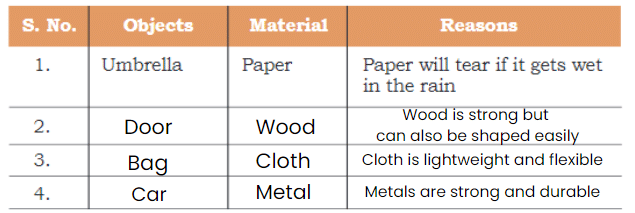
Q: List five objects and pair them with a material that is not suitable for it! Explain why these materials will not work to make these objects. One example is done for you.

Odd Pairs

Ans: 

Activity 6 (Page 132)

Let’s group them another way!

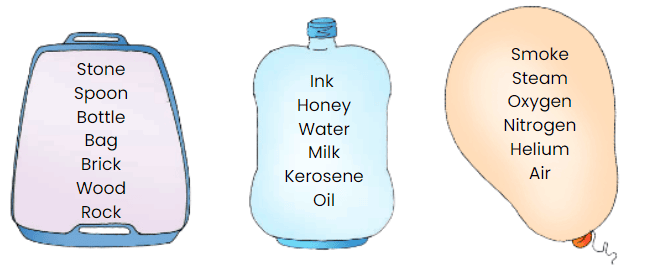
Here are the names of some objects: ink, a stone, smoke, ice, steam, a spoon, honey, a bottle, a bag, and water.

If it is a solid, write its name on the tray; if it is a liquid, write it in the bottle; if it is a gas, write it in the balloon.

Let’s group them another way!

Add some of your objects in the tray, bottle, and balloon.

Ans: 

Q: Some objects could be confusing, such as sand sponge, or clay. Identify more such objects and write the names of at least three of them.

Ans: Cotton Candy , Silica Gel and Pumice Stone

Natural — Artificial (Page 133)

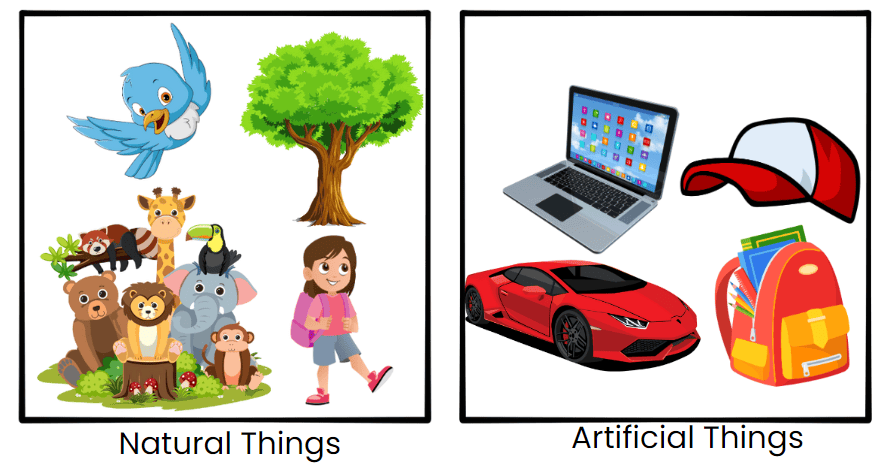
Q: List out five things in each group.

Ans:

  • Natural: Tree, Mango, Bird, Rock, Water
  • Artificial: Clothes, Shoes, Table, Car, BookNatural — Artificial (Page 133)

Find Out

  • Have you seen trees around you that bear flowers and fruits at special times of the year? 

Ans: Yes, I have seen trees that bear flowers and fruits at special times of the year. For example:

(i) Mango trees have flowers in February-March and fruits in June-July.

(ii) Guava trees give fruits in winter (November-December).

(iii) Apple trees grow fruits in summer (July-August).

Different trees have different seasons for flowers and fruits!

  • If you have ever eaten a ripe mango or seen mangoes in the market or watched a mango tree through the year, try to guess— at what time of the year did Khushi draw her picture? 

Ans: Khushi most likely drew her picture in June, because mangoes ripen during the summer season. During this time, mango trees are full of ripe mangoes, and we can see them in the markets.

  • Could it be around January or around June?

Ans: It could be around June because mangoes ripen in the summer season. During this time, mango trees are full of ripe mangoes, and we can see them in the market. In January, mango trees usually have flowers but not ripe fruits.

Let us Reflect (Page 134)

A. Write

Q: Things around us are made of different types of materials. Write down the names of three materials we commonly see around us.

Ans:

  • Wood
  • Metal
  • Plastic

B. Discuss

Q: Suppose you find a shining spoon. You don’t know if it is made of metal or whether it is made of some other material and then painted with shiny paint. How would you find out?

Ans: I would tap the spoon on a hard surface and listen to the sound it makes. A metal spoon would make a distinct ringing sound. I could also check the weight and feel of the spoon, as metal spoons are generally heavier and feel cooler to the touch than painted plastic spoons.

C. Draw

Q: Draw three natural and three artificial things.

Ans:

D. Do it

Q: Match the pairs

Ans:

C. Draw

12. Taking Charge of Waste- Textbook Solutions

Discuss (Page 150)

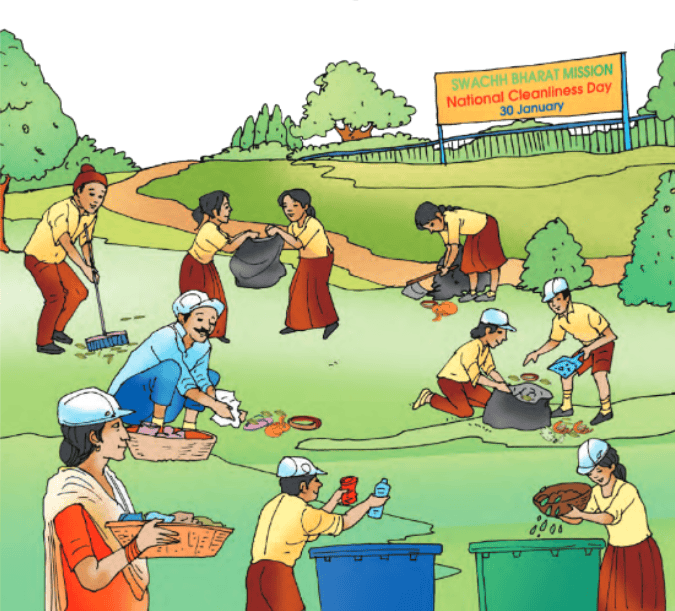
Q1: What are the children and the teacher doing in the picture?
Ans: The children and the teacher are cleaning the park.

Q2: Why are they cleaning the park?
Ans: They are cleaning the park to make it clean and safe for everyone to use and to protect the environment.

Q3: Have you ever seen piles of waste lying around your home or school?
Ans: Yes, I have seen piles of waste lying around my home and school.

Q4: Have you ever thought about how this waste is created?
Ans: Yes, this waste is created from various activities such as eating packaged food, using plastic items, and throwing away things we no longer need.

Activity (Page 150)Q:  Recall different activities that you and your elders do during the day. How do these activities create waste? Finally, what do we do with the waste? Share your findings with your classmates.

Ans: Students are encouraged to attempt this on their own.Discuss (Page 152)

Observe your Surroundings.

Q: How clean are the surroundings of your school?
Ans: The cleanliness of the surroundings of my school can vary. Sometimes it is very clean, but occasionally there is litter around.

Q: Do you find waste lying in or outside your classrooms or on the school grounds?
Ans: Yes, sometimes I find waste lying around both inside and outside the classrooms and on the school grounds.

Draw (Page 153)

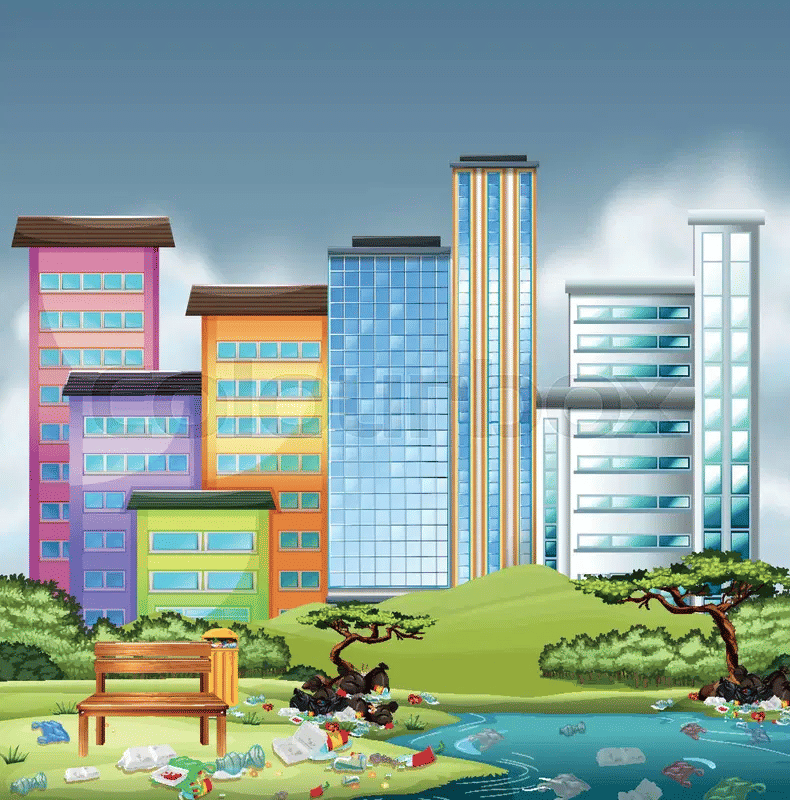
Draw or paste a picture of a locality. Identify the places where there is garbage or wastewater or smoke by circling them in red. Try to find out how the waste gets there.

Ans: Students are encouraged to attempt this on their own.

If you belong to a place that manages its waste well, ask the elders how it is done. Share your findings in the class.

Now let us talk about those people who manage waste well.

Ans: Students are encouraged to attempt this on their own.Activity (Page 153)

How can you help in reducing waste?

Be a part of the Cleanliness Drive by sharing your old toys and books with those who need them but cannot afford to buy them. In what other ways can you help? The more things we buy, the more things we throw away and the more waste gets created. We should try to buy things that we need and use them until they are not usable anymore. We can try to create as little waste as possible.

Ans: We can help reduce waste by sharing old toys and books with those who need them. Additionally, we should only buy things we truly need and use them until they are no longer usable. By reusing items and creating less waste, we can make a big difference.

Activity 4 (Page 155)

How can you Reuse things to reduce waste ? 

You can reuse paper that has been used on one side for rough work. Instead of buying a water bottle, reuse a bottle made of a safe material like steel or copper by refilling it.

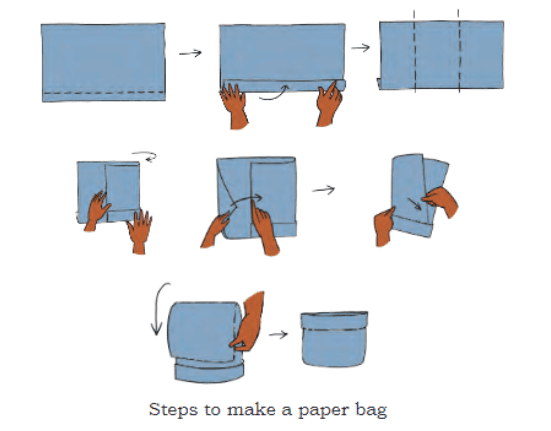
You can make toys or decorative things using old newspapers, old calendars, bottles, boxes, etc. Here is one such idea. All you need is some newspaper. No scissors! No glue! Just paper!

Ans: Students are encouraged to attempt this on their own.

Activity 5 (Page 156)

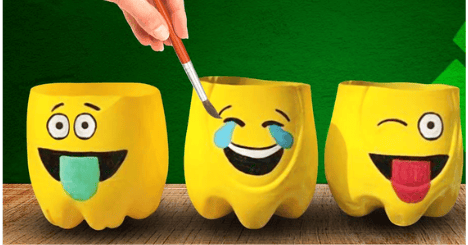
Create an item using waste material that you can give as a gift to someone.

Ans: Students are encouraged to attempt this on their own.

Activity 6 (Page 159)

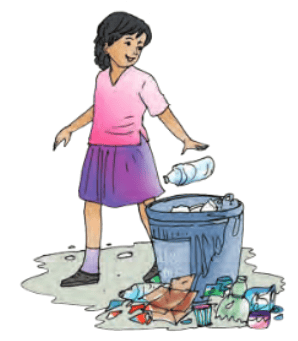
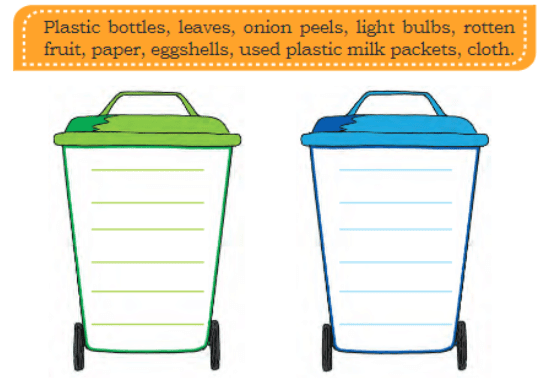
Separate Your Waste 

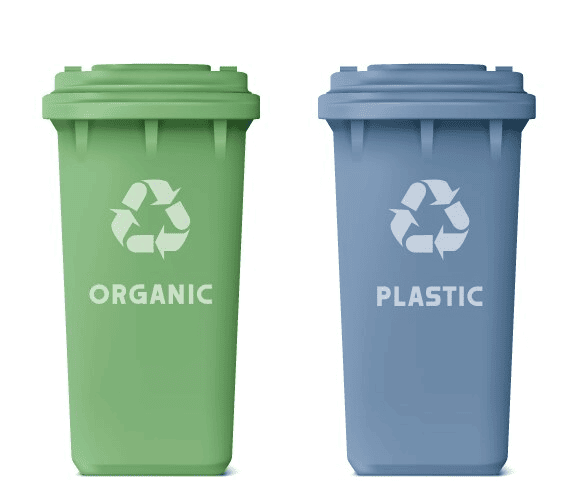
Two dustbins are drawn below. Write the names of the waste material which will go into each of them.

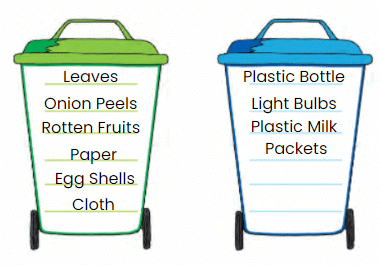
Ans: Write (Page 160)

Q: List the things that you can do to keep your home and classroom clean? Ans:

  • I can keep my room tidy.
  • I can throw trash in the dustbin.
  • I can clean up after eating.
  • I can organize my desk and books.
  • I can help sweep the floor.

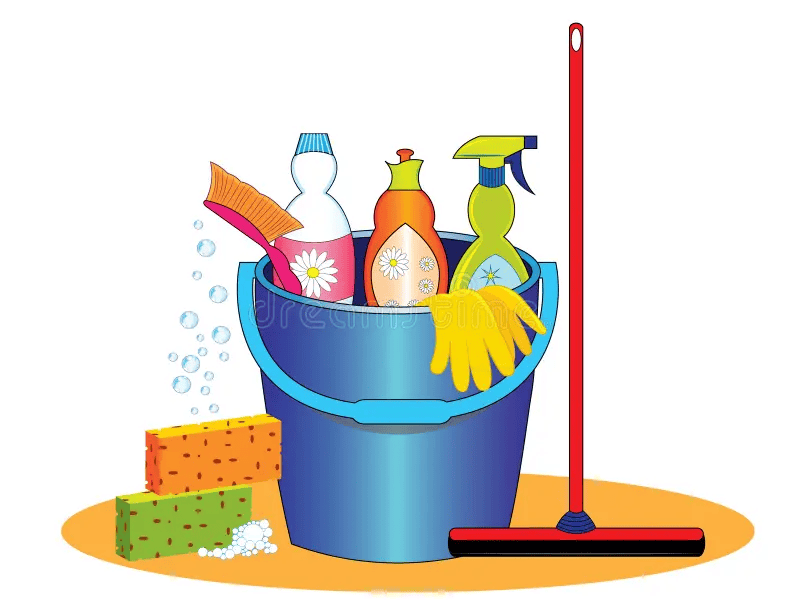
Q: Make a list of tools you have seen being used in your school or neighbourhood for cleaning. Ans:

  • Broom
  • Dustpan
  • Mop
  • Bucket
  • Trash picker

Q: Have you ever observed the tools that are used in your home for cleaning? Make a list of these tools. Ans:

  • Broom
  • Dustpan
  • Mop
  • Vacuum cleaner
  • Cleaning cloths

Draw (Page 160)

Draw pictures of these tools in the box given below.

Let us Reflect (Page 161)

A. Discuss

Q1: How is waste created?
Ans: Waste is created from various activities in our daily lives, such as using packaged products, discarding old clothes, and peeling vegetables and fruits. It also comes from using plastic wrappers, paper, tins, and other items that we throw away.

Q2: How can we manage waste?
Ans: We can manage waste by reducing, reusing, and recycling. Reducing means creating less waste by avoiding single-use items. Reusing involves finding new uses for old items instead of throwing them away. Recycling means processing used materials to make new products.

B. Write

Q1: To avoid the use of plastic bags and bottles, look at your home and school closely. List all the items of plastic material and write how these could be replaced by other safe materials.
Ans:

  • Plastic Bags: Replace with cloth or jute bags.
  • Plastic Bottles: Replace with metal or glass bottles.
  • Plastic Containers: Replace with glass or metal containers.
  • Plastic Wrap: Replace with beeswax wrap or reusable silicone wraps.

Q2: Name three things in your school and home that you would put in the green dustbin and three things that you would put in the blue dustbin.
Ans:

  • Green Dustbin: Fruit peels, vegetable waste, eggshells.
  • Blue Dustbin: Paper, plastic bottles, metal cans.

C. Draw in your notebook

Q1: Make a poster to show a village or town that is managing its waste well. Give your poster a suitable title.
Ans: Students are encouraged to attempt it on their own.

D. Enact in pairs

Q1: You can be a clean town and your partner a dirty town. Engage in a short conversation talking about how you feel about being the way you are.
Ans: Students are encouraged to attempt it on their own. 

E. Think, Reflect and Share

Q1: Imagine you are having a birthday party at your home. What are some of the ways in which you can try to have a zero-waste birthday party? For this, first think about what kind of waste may be created in the birthday party and how you can avoid or reduce it.
Ans: To have a zero-waste birthday party:

  • Use reusable plates, cups, and cutlery instead of disposable ones.
  • Avoid using balloons and plastic decorations; use paper or fabric decorations.
  • Serve homemade snacks and drinks instead of packaged ones.
  • Use cloth napkins instead of paper napkins.
  • Encourage guests to bring reusable bags for gifts.

Q2: Have you seen waste in nature? What do you think happens to the waste of animals, dried leaves, and so on in a forest?
Ans: Yes, I have seen waste in nature. In a forest, the waste from animals and dried leaves decomposes naturally. This waste breaks down and turns into nutrients that enrich the soil, supporting plant growth and maintaining the ecosystem.

11. Making Things- Textbook Solutions

Let’s Take A Look Around Us! (Page 125)

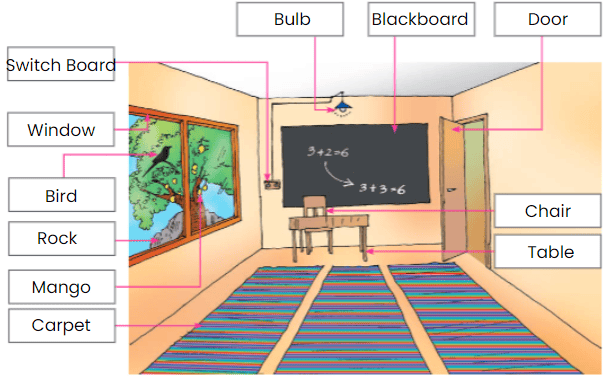
Q: Can you name the things that Khushi has drawn ? Write in the boxes given.

Ans: 
Activity 1 (Page 124)

 Understand your Classroom

Draw a picture of your classroom in your notebook. Label the things that you have drawn.

Khushi is curious, “Where have all these things come from? Who has made them? What are they all made of?” she thought.

Let us help Khushi find out.

The table and chair are made of wood. Where do we get wood from?

The hinges, nails and latches of the door are made of some metals.
Ans:  Students are encouraged to attempt it on their own.

Activity 2 (Page 125)

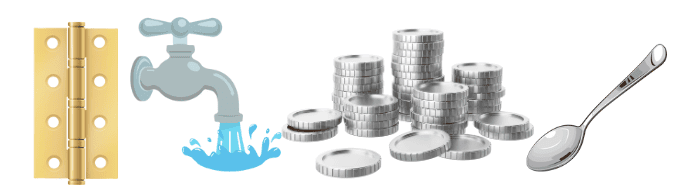
Spot the Metals

 Find as many things or parts of things, that are made of metals. Which metals do you recognise around you? If you do not know the name of the metal, ask your friends or an elder. Make a list of these metals in your notebook.

Ans: I looked around and found many things made of metals. Some of the items I found include:

Door hinges – made of iron

Spoon – made of stainless steel

Water tap – made of brass

Coins – made of copper or nickel

Scissors – made of steel 
Activity 3 (Page 126)

Seeing through things

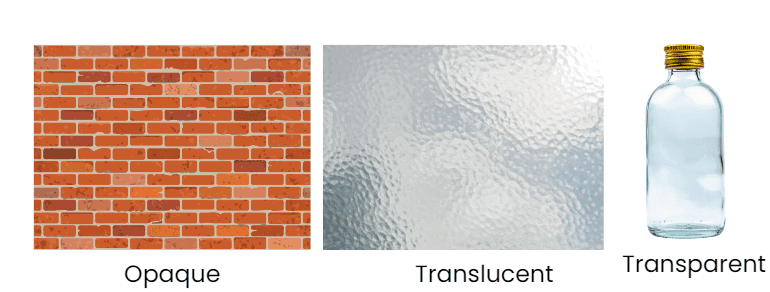
Collect a few small objects of different materials from your surroundings like bottles, papers, cloth, and utensils, etc. Look at a light bulb or a candle flame through them. You can see through some objects very clearly, you can partially see through some others, while you cannot see through some objects at all. Order these objects from those you can see through very clearly, to those you cannot see through at all.

Ans:

See through clearly : Clear glass bottle , Clear Plastic Bottle , Clean Water

See through Partially : Frosted glass, Butter Paper, Thin Fabric

Cannot see through at all : Wooden door , Book, Metal
Activity 4 (Page 127)

Let us colour the world!

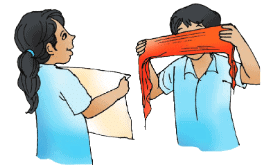
Collect two or three see-through bags, bottles or thin cloth of different colours. Look at a sheet of white paper through them.

  • Does the colour of the paper appear to change?
  • Does white paper appear different when you look at it through thin blue plastic or glass? Or, thin yellow plastic or glass?
  • Do the colours of different objects appear to change? How did a blue object look through thin yellow plastic?
  • Have you earlier experienced looking through coloured transparent objects? Try to recall such experiences.

Ans: Students are encouraged to attempt it on their own.
Write (Page 128) Chain Game

In the table below, Khushi has grouped objects according to the materials that they are made of. Her list of objects is in the first column of the table. The names of the materials are in the second column. The third column of the table is for you to complete. Here write the names of some objects you have seen that are made from that material. Some objects around you may be made from materials not in this list, e.g., clay and rubber are missing in Khushi’s list. Use one of these to add an additional row in the table.
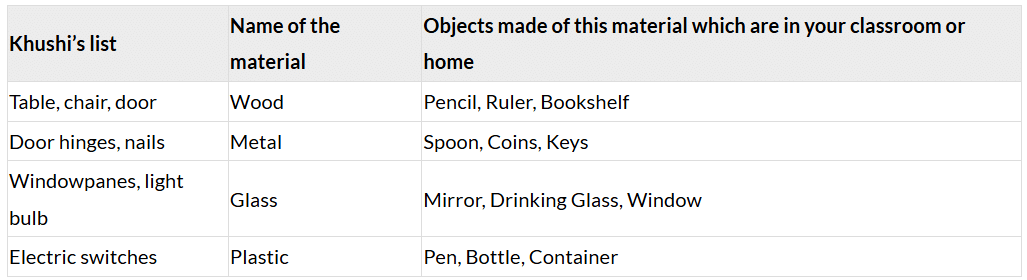
Q: Where do all these materials come from ?  Can you locate their source ?

For Example, Wood – Tree

Metals – ____________ 

Cloth – ______________

Ans: 

Metals — Metals are extracted from ores, which are found in the Earth.

Cloth — Cloth is made from natural fibers like cotton (from plants) or wool (from animals) or synthetic materials such as polyester.

Find out (Page 129)

Talk to your Grandparents

  • In their childhood, were these things made of the same materials?
  • Are there new materials now that they might not have seen before?
  • Are there any materials that they saw in their childhood that are not in use now? Why?

Ans: Yes, materials can differ in various ways, not just how they look. For example, texture, weight, etc.
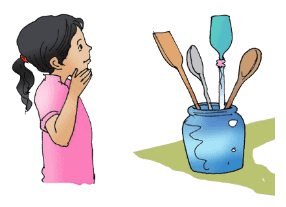
Find out

  • What material is your spoon made of?

Ans: My spoon is made up of Steel. 

  • Is it made of metal, wood or some other material? Can you guess?

Ans: Steel is an Alloy.

  • Which of these words or phrases describes the spoon?

Ans: The Spoon is Smooth and Shiny.

Activity 5 (Page 130)

Knock on it and it will speak to you! Orchestra

Take a metal spoon and at least five objects made up of different materials-wood, metal, plastic, cloth and glass. Gently tap the spoon on each of them. Listen to the sound that each of them makes. Make your own words to describe all these different sounds.

Ans: Students are encouraged to attempt it on their own.

Write (Page 130)

Odd Pairs

Q: List five objects and pair them with a material that is not suitable for it! Explain why these materials will not work to make these objects. One example is done for you.
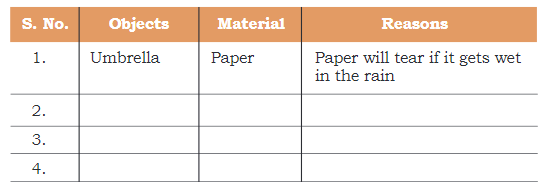
Ans: 

Activity 6 (Page 132)

Let’s group them another way!

Here are the names of some objects: ink, a stone, smoke, ice, steam, a spoon, honey, a bottle, a bag, and water.

If it is a solid, write its name on the tray; if it is a liquid, write it in the bottle; if it is a gas, write it in the balloon.
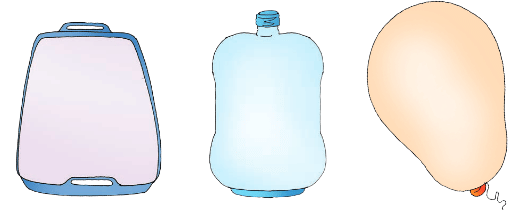
Add some of your objects in the tray, bottle, and balloon.

Ans: 

Q: Some objects could be confusing, such as sand sponge, or clay. Identify more such objects and write the names of at least three of them.

Ans: Cotton Candy , Silica Gel and Pumice Stone

Natural — Artificial (Page 133)

Q: List out five things in each group.

Ans:

  • Natural: Tree, Mango, Bird, Rock, Water
  • Artificial: Clothes, Shoes, Table, Car, Book
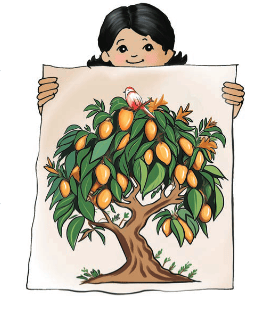
Find Out

  • Have you seen trees around you that bear flowers and fruits at special times of the year? 

Ans: Yes, I have seen trees that bear flowers and fruits at special times of the year. For example:

(i) Mango trees have flowers in February-March and fruits in June-July.

(ii) Guava trees give fruits in winter (November-December).

(iii) Apple trees grow fruits in summer (July-August).

Different trees have different seasons for flowers and fruits!

  • If you have ever eaten a ripe mango or seen mangoes in the market or watched a mango tree through the year, try to guess— at what time of the year did Khushi draw her picture? 

Ans: Khushi most likely drew her picture in June, because mangoes ripen during the summer season. During this time, mango trees are full of ripe mangoes, and we can see them in the markets.

  • Could it be around January or around June?

Ans: It could be around June because mangoes ripen in the summer season. During this time, mango trees are full of ripe mangoes, and we can see them in the market. In January, mango trees usually have flowers but not ripe fruits.

Let us Reflect (Page 134)

A. Write

Q: Things around us are made of different types of materials. Write down the names of three materials we commonly see around us.

Ans:

  • Wood
  • Metal
  • Plastic

B. Discuss

Q: Suppose you find a shining spoon. You don’t know if it is made of metal or whether it is made of some other material and then painted with shiny paint. How would you find out?

Ans: I would tap the spoon on a hard surface and listen to the sound it makes. A metal spoon would make a distinct ringing sound. I could also check the weight and feel of the spoon, as metal spoons are generally heavier and feel cooler to the touch than painted plastic spoons.

C. Draw

Q: Draw three natural and three artificial things.

Ans:

D. Do it

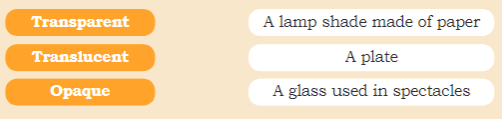
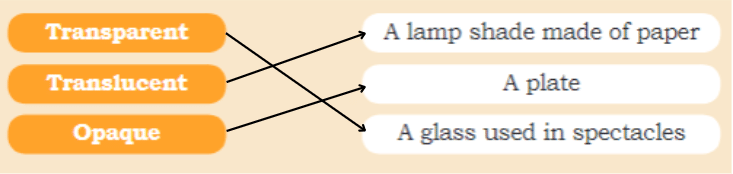
Q: Match the pairs

Ans:
09. Staying Happy and Healthy- Textbook Solutions

Clean and Bright (Page 110)

Ask yourself these questions.

  • Did I brush my teeth today?
  • Did I take a shower?
  • Did I comb my hair?
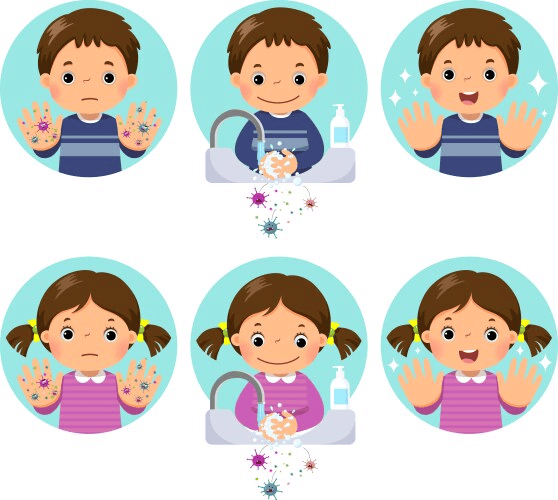
  • Did I wash my hands with soap?
  • Are my nails trimmed and clean?

Ans: Students are encouraged to attempt it on their own. 

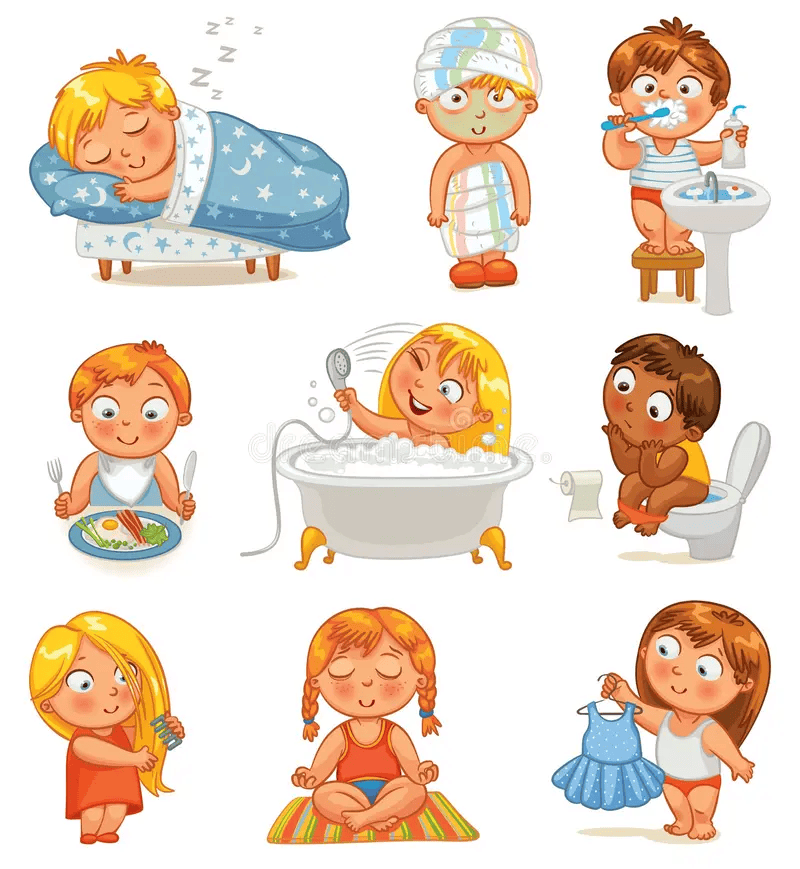
Daily Routine (Page 110)Write Write down the activities that you do every day, from the time you wake up, till you go to sleep. Your list should include the activities below. Remember that you do some of these things more than once in the day:

  • Take a shower
  • Wash your hands with soap
  • Brush your teeth
  • Drink 6–8 glasses of water
  • Eat food
  • Sleep well for at least 8 hours total
  • Play outside

Check your list for these activities

  • Do you brush your teeth twice in the day — once after waking up and once before going to bed?
  • Do you rinse your mouth every time after eating food?
  • Do you wash your hands with soap after using the toilet and after coming home from outdoors?
  • If your answer to any of these questions is “No,” think and discuss how you can make it a habit. Is there anything that makes it difficult for you to follow these routines?

Ans: Students are encouraged to attempt it on their own.

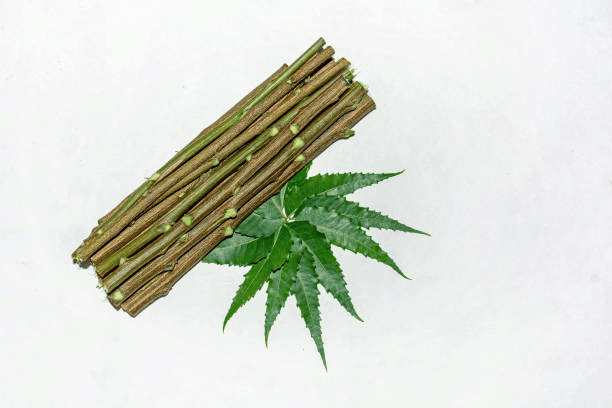
How do we brush our teeth ? (Page 111)Ask your grandparents or any elderly person in your neighbourhood — What did they use to wash their hair, body and clothes and clean their teeth when they were young? Can these things be found now?

Ans: My grandparents used natural things like shikakai or reetha for their hair, clay for washing their body, and neem twigs to clean their teeth. While most people now use soaps and shampoos, these natural items can still be found and are healthy to use.

Activity 1 (Page 112)

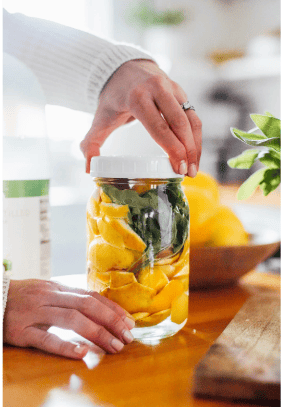
Making a home-cleaner using orange and lemon peels

We use many cleaning agents at home to remove dirt and germs from surfaces like kitchen slabs, furniture and bathrooms. Find out what home-cleaners are used in your home. You can also make your own eco-friendly cleaner! Here is what you need:

Peels of 8–12 oranges or lemons, enough to fill a half-litre transparent container.

Ten whole cloves (laung) or 2–3 bay leaves (tejpatta) (optional).

Two cups of white vinegar, enough to cover the peels or spices.

Now put all these ingredients in a half litre transparent container and close the lid. Keep the container in a sunny area for about two weeks, occasionally shaking the mixture. Strain the liquid after two weeks and your all-purpose cleaner is ready! You can mix a cup of the liquid in one bucket of water to clean floors and bathrooms.

Ans: Students are encouraged to attempt it on their own. 

Activity 2 ( Page 114 )

Hop, skip, jump!

Try the following moves:

Walk like a duck.

Jump like a frog.

Run like a cat.

Which moves did you enjoy the most?

Ans: Students are encouraged to attempt it on their own. 

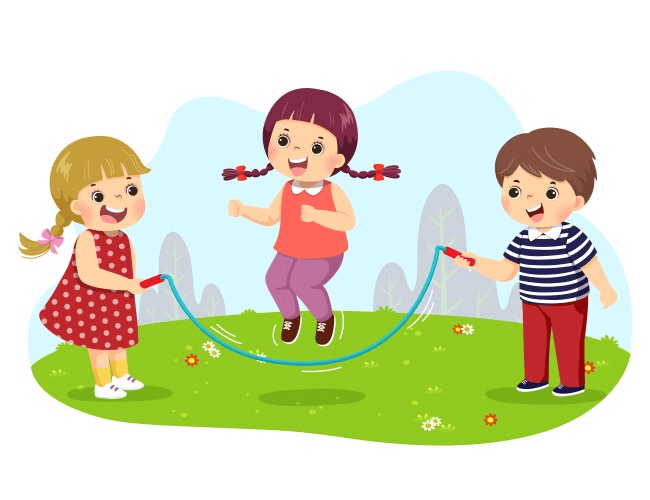
Take a skipping rope and count as you jump. Do this with your friends and see who can jump the maximum number of times.

Then, invite a friend to start jumping after you skip 10 times or after you say a short poem as you skip. For example:

I like roti,

I like ghee,

I want ___________ (name of a friend)

To jump with me!

What other games do you play with a skipping rope? Teach and learn from your friends.

Ans: Students are encouraged to attempt it on their own. 

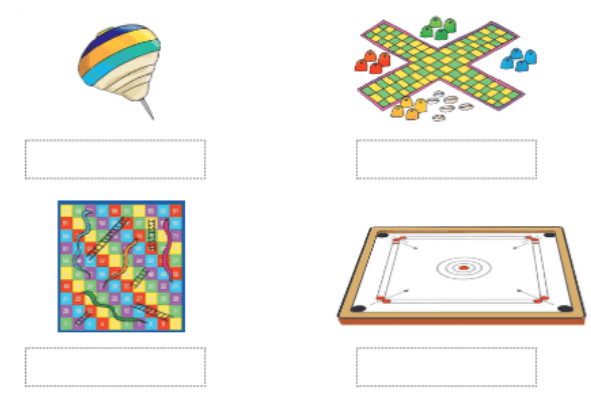
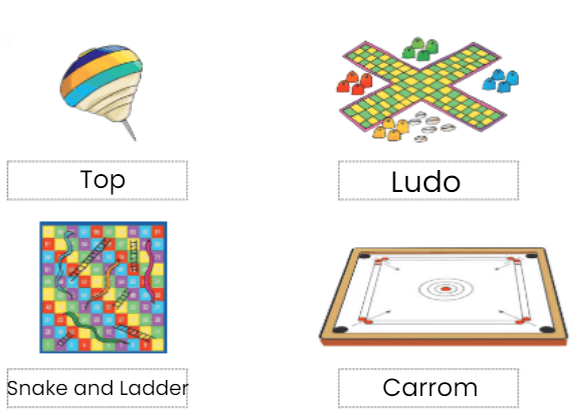
Name The Game ?

What types of games do you like to play outside your home?

Can you identify the games shown here ? Have you played them before ?

Ans:

I Spy ! (Page 116)

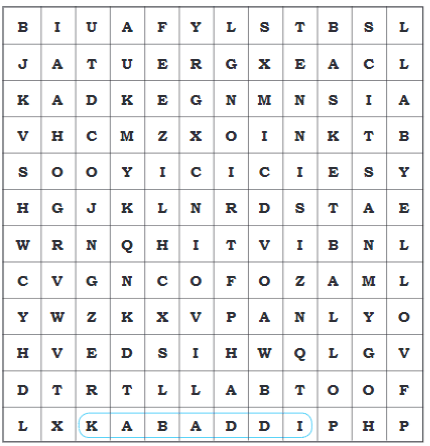
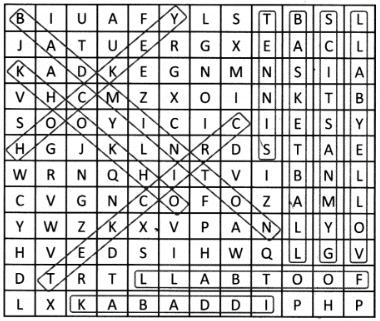
Can you find the names of all the games hidden here ? Are any of these your favourites? One has been done for you.

Ans: 

Playing Safe (Page 117)

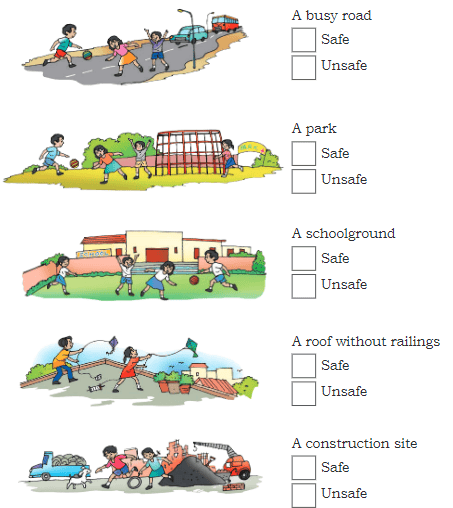
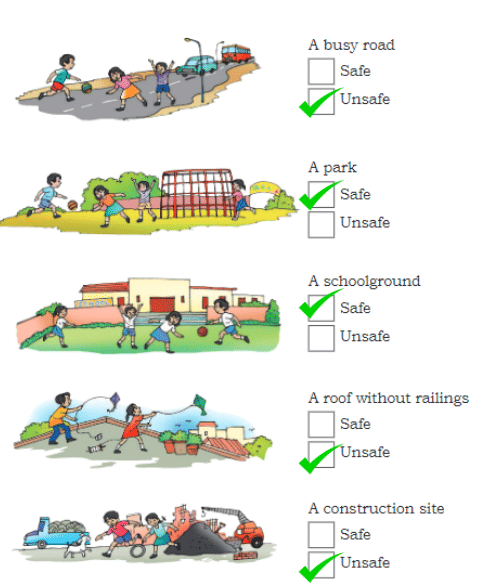
It is important to be safe while having fun. Which of the following places is considered a safe area to play ? Why or Why not ?

Ans: 

Let us reflect (Page 119)

A. Write

 Q1: Make your weekly health table. What makes you feel sleepy, hungry, or tired? Feelings are the body’s way of telling us that something is amiss. We all have different needs. We should each know what is good for our body and mind. For this, track your activities for a week and observe how you feel.

Example of a weekly health table:DayDid I brush my teeth twice?Did I take a shower?Did I use the toilet in the morning?What did I have for breakfast?How much time did I sleep?How long did I play outdoors?How long did I watch TV or play on the phone?How did it make me feel? (Good, okay, not so good, bad)MondayYesYesYesBread and butter8 hours1 hour1 hourGoodTuesdayYesYesYesMilk and cereal8 hours1 hour1 hourGoodWednesdayYesYesYesEggs and toast8 hours1 hour1 hourGoodThursdayYesYesYesParatha and yogurt8 hours1 hour1 hourGoodFridayYesYesYesPancakes8 hours1 hour1 hourGoodSaturdayYesYesYesPoha8 hours2 hours1 hourGoodSundayYesYesYesIdli and sambar8 hours2 hours1 hourGood

B. Draw (Page 120)

1. Draw a big circle in your notebook and divide it into 24 slices. Imagine that each slice is one hour of the day. Now colour these slices differently based on the number of hours you spend doing different activities in one entire day of 24 hours.

Example:

  • Sleeping: 8 hours
  • Eating: 2 hours
  • Studying: 6 hours
  • Playing: 2 hours
  • Helping parents: 2 hours
  • Watching TV: 1 hour
  • Using the toilet: 1 hour
  • Other activities: 2 hours

C. Discuss (Page 120) 

1. Think of one activity you would like to do at least twice a week to improve your stamina. It could be running, jumping, climbing stairs, or anything else. Discuss it with your friends and try doing such activities together.

Ans: 

Students are encouraged to attempt it on their own.

08. Food We Eat- Textbook Solutions

Draw (Page – 100)

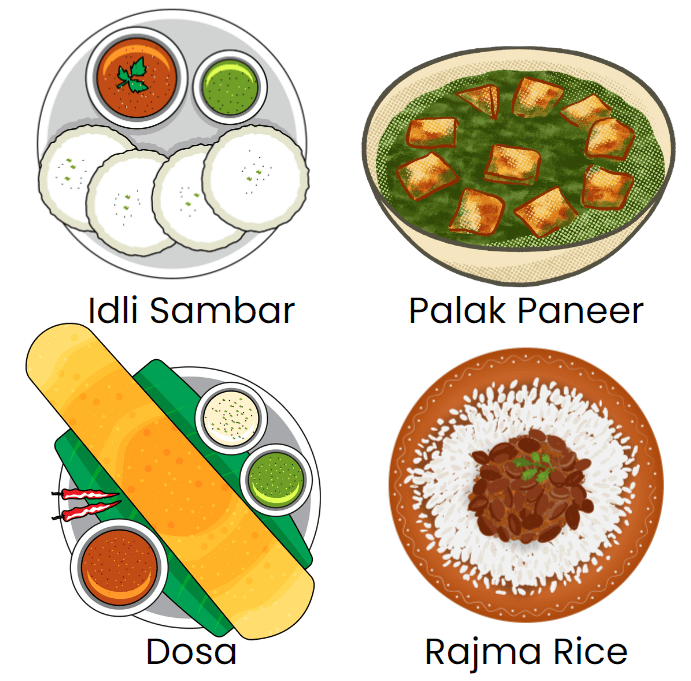
Draw pictures of your favourite homemade food dishes and name them.

Ans:

Activity 1 (Page – 101)

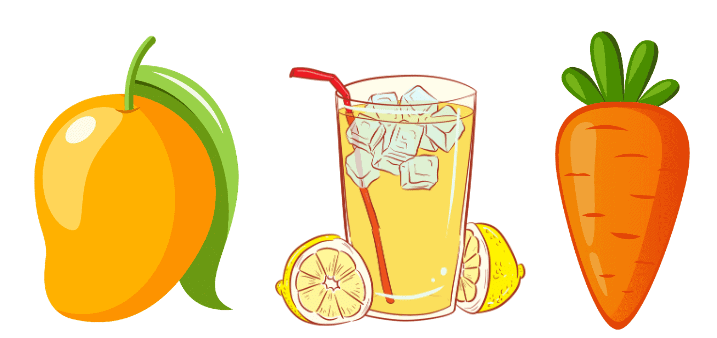
Share your reasons for why you like the food items you have drawn.

We all like to eat and drink different things. Some of these food items are sweet, some are sour, some are spicy and some are bitter. We eat fruits, we eat vegetables and we eat rice, dal or roti. We drink milk, lassi or juice. Have you wondered why we eat and drink?

 Ans: I like the food items I have drawn because they are tasty and make me feel happy. For example, I like eating mangoes because they are sweet, and I like drinking lemonade because it is refreshing in the summer. These foods give me energy and help me stay healthy. I enjoy eating vegetables like carrots because they are crunchy and good for my body. Eating different foods helps me stay strong and active.

Discuss (Page 103)

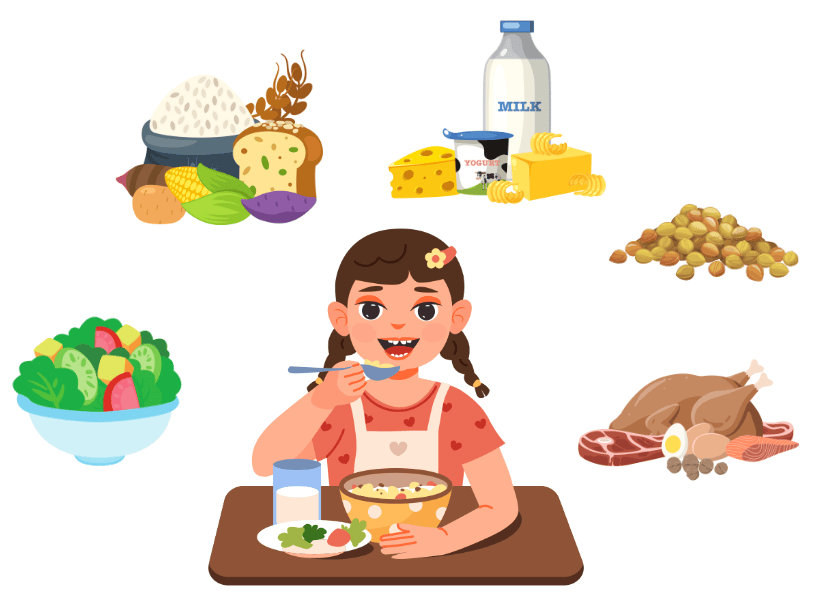
Q1: Why do we need to eat healthy food?

Ans: We need to eat healthy food to stay strong and feel good. Healthy food gives us the important stuff our bodies need to grow and be healthy. It helps us not get sick and have lots of energy to play and learn.Activity 2

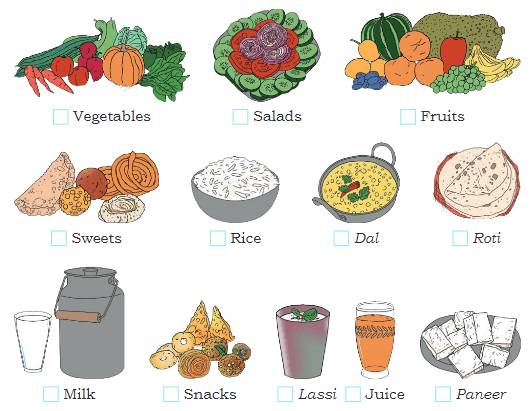
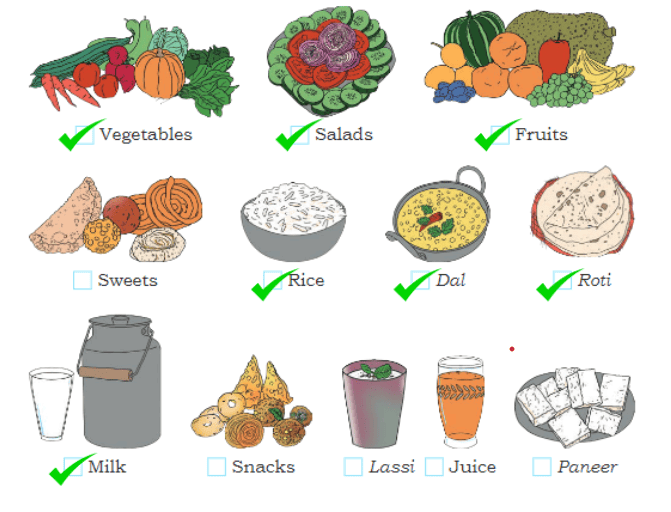
Tick the food items you eat regularly from the pictures given Below.

Which foods above do you think should be part of a balanced diet?

Ans:

I think Vegetables, Salads, Fruits, Rice, Dal, Roti, Milk, Lassi , Paneer should be a part of balanced diet.

We Eat Different Things (Page- 104 )

1. Make a list of fruits and vegetables available and special food items that are prepared in the summer and in the winter.

Ans: Summer Fruits and Vegetables:

  • Mango
  • Watermelon
  • Cucumber
  • Bitter Gourd

Special Summer Foods:

  • Kulfi
  • Ice Cream
  • Aam Panna
  • Sugarcane Juice

Winter Fruits and Vegetables:

  • Apple
  • Orange
  • Carrot
  • Spinach

Special Winter Foods:

  • Gajar ka Halwa
  • Hot Soups
  • Stews
  • Hot Chocolate

Where do food com from (Page –  105)

1. Do you know which foods are grown in the fields? Write a few names of such crops.

Ans: Foods grown in the fields:

  • Rice
  • Wheat
  • Maize (corn)
  • Pulses (like lentils, chickpeas)
  • Vegetables (like potatoes, carrots, tomatoes)

2. Discuss and write down in what form some of these foods are cooked.

Ans: Forms in which these foods are cooked:

  • Rice is boiled and served as plain rice or used in dishes like pulao or biryani.
  • Wheat is ground into flour and used to make chapatis, bread, and biscuits.
  • Maize (corn) is boiled, roasted, or made into corn flour to cook items like cornbread or tortillas.
  • Pulses are cooked as dal or used in soups and stews.
  • Vegetables like potatoes are boiled, fried, or made into curries, while carrots can be eaten raw, boiled, or made into salads and soups.

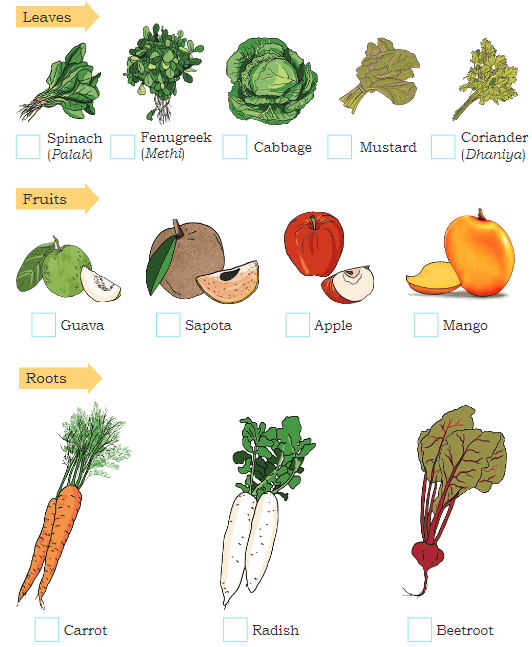
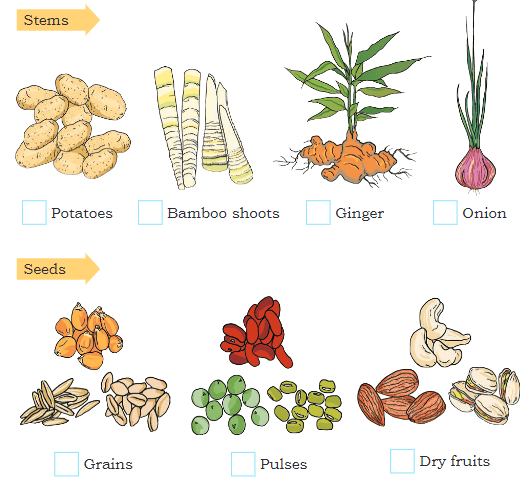
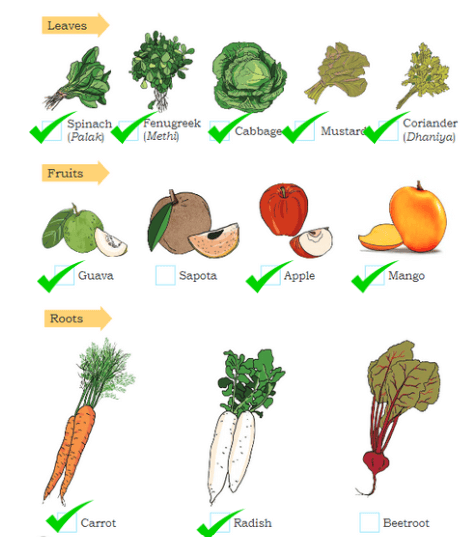
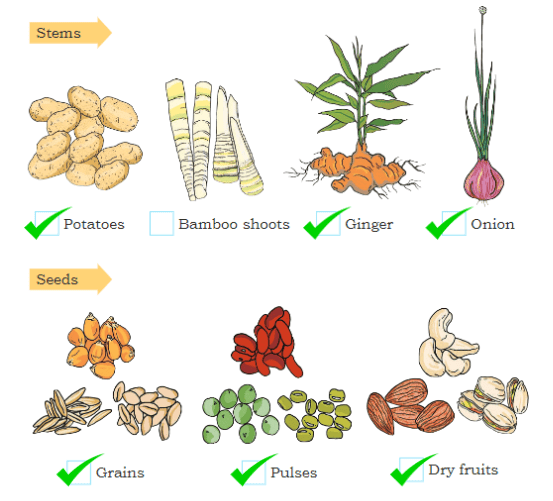
3. We eat different parts of plants. Some examples are given below. Put a tick against the items you eat.

Ans:

Let us reflect (Page 108)

A. Discuss

Q1: Why do we need different kinds of food?
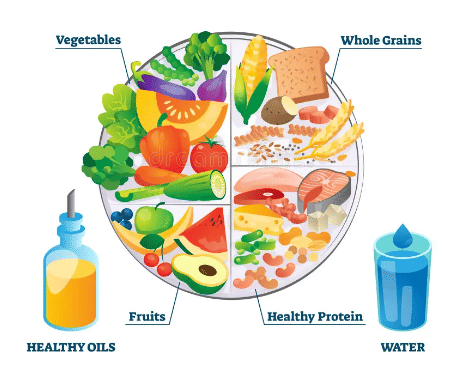
Ans: We need different kinds of food to get all the nutrients our body requires to stay healthy and strong. Different foods provide vitamins, minerals, proteins, carbohydrates, and fats.

Q2: Why do we eat seasonal foods?
Ans: We eat seasonal foods because they are fresher, more nutritious, and taste better. Seasonal foods are also more readily available and often cheaper.

Q3: How can you tell if a food is healthy or unhealthy?
Ans: Healthy foods are fresh, less processed, and rich in nutrients like vitamins and minerals. Unhealthy foods are often high in sugar, salt, and unhealthy fats, and are heavily processed.

Q4: Why is it important to avoid wasting food? Can you think of some ways to reduce food waste at home?
Ans: It is important to avoid wasting food because it conserves resources, saves money, and helps feed others. Ways to reduce food waste include planning meals, storing food properly, using leftovers creatively, and composting scraps.

B. Write

Q1: List the fruits and vegetables eaten in your family.
Ans:

  • Fruits: Apple, Banana, Mango, Orange, Grapes
  • Vegetables: Carrot, Potato, Spinach, Tomato, Cabbage

Q2: Write the recipe of your favourite dish.
Ans:  Recipe for Vegetable Pulao:

  • Ingredients: 1 cup basmati rice, 1 cup mixed vegetables (carrot, peas, beans), 1 onion (sliced), 2 tomatoes (chopped), 2 tbsp oil, 1 tsp cumin seeds, 1 bay leaf, 2-3 cloves, 1-inch cinnamon stick, 1 tsp ginger-garlic paste, salt to taste, water.
  • Method: Wash the rice and soak it for 20 minutes. Heat oil in a pan, add cumin seeds, bay leaf, cloves, and cinnamon stick. Add sliced onion and sauté until golden brown. Add ginger-garlic paste and sauté for a minute. Add chopped tomatoes and cook until soft. Add mixed vegetables, salt, and soaked rice. Mix well. Add 2 cups of water and bring it to a boil. Cover and cook on low flame until the rice is done. Serve hot with raita.

Q3: Write a name of a food item that includes both plant and animal-based ingredients. For example, lassi includes yogurt/curd which is prepared from milk (animal-based ingredient) and sugar which is prepared from sugarcane (a plant-based ingredient).
Ans: Chicken Salad: It includes chicken (animal-based ingredient) and lettuce, tomatoes, and cucumber (plant-based ingredients).

C. Draw

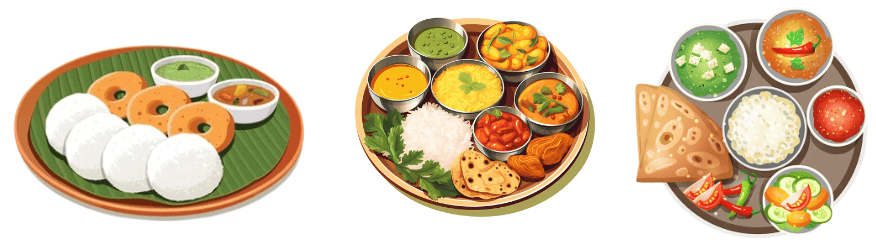
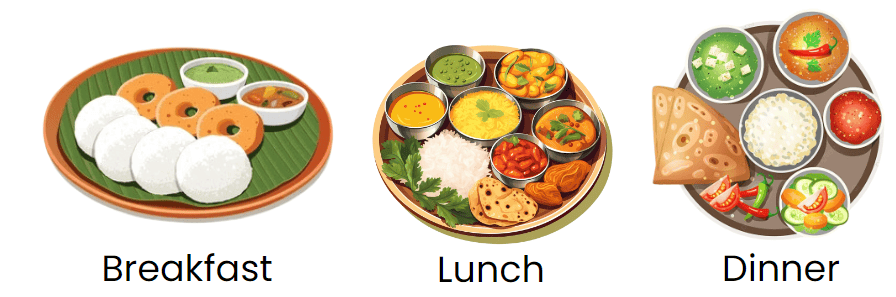
Q1.  Draw three plates or thalis with various food items in your notebook.

Ans:

Q2.  In these plates draw and label food items that you eat in the morning, afternoon and at night.

Ans.

D. Eating Together

Bring any fruit to the class. Prepare a fruit chaat or salad with the help of your teacher. Share it with your home.

Ans: Student is advised to try these at home. 

E. Think 

Imagine you suddenly have a guest visiting your home. What kind of food would you serve them and why?

Ans: Student is advised to try these at home.

07. Water – A Precious Gift Textbook Solutions

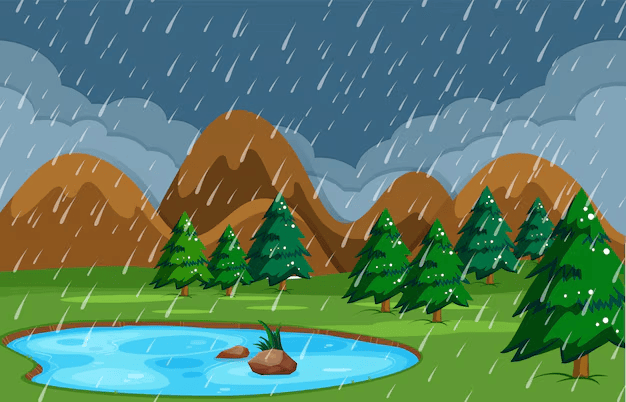
Write  (Page – 87)I think it will rain today because …

(Write at least 2 clues)

Ans: 

1. The sky looks very dark with lots of clouds.

2. I can feel cool wind blowing fast.

I think it will not rain today because…

(Write at least 2 clues)

Ans:

1. The sky is clear and sunny.

2. There are no clouds in the sky.

Activity 1 (Page – 88)

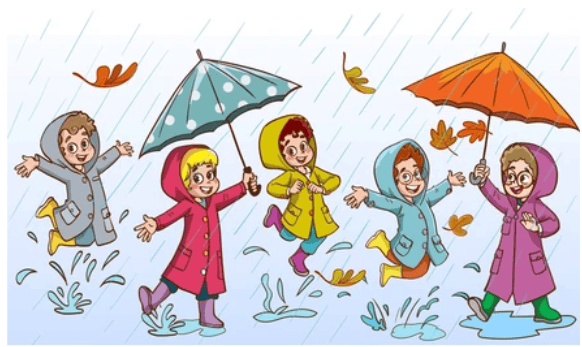
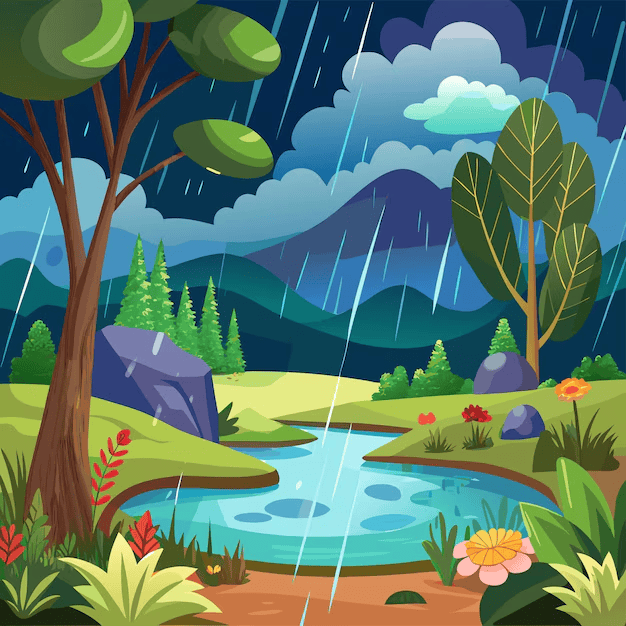
Ask yourself as many questions as you can about the rain.

Is it a heavy rain or a light one?

Are the raindrops big or small?

Do they come down fast or slow?

Is the rain so heavy that you do not see the water drops, but only lines or sheets of water?

Is the rain falling straight down? Is it slanting or changing its direction? Guess why.

Collect the rainwater in a vessel. Does it look clean or dirty?

Ans: Children are advised to do it by themselves.

Draw (Page – 88)

Draw a picture of the rain that you observed.

What happened to the rainwater ? (Page – 90)

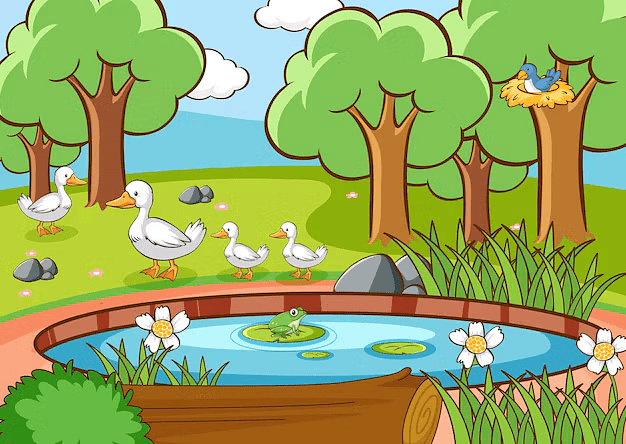
1. Is there a stream, river, pond or lake near your village or city? Find out its name and some information about it. Visit it and draw its picture. Draw any trees, birds or animals that you see around it.

Ans: Children are advised to do it themselves . 

2. Find a poem about a river and sing it in the class.

Ans: 

The little river runs so fast,

Flowing by as it rushes past.

It sings a song, so soft and sweet,

As it moves along the pebbled street.

It sparkles bright under the sun,

Flowing, flowing, never done!

Where do you get water from ? (Page- 91)

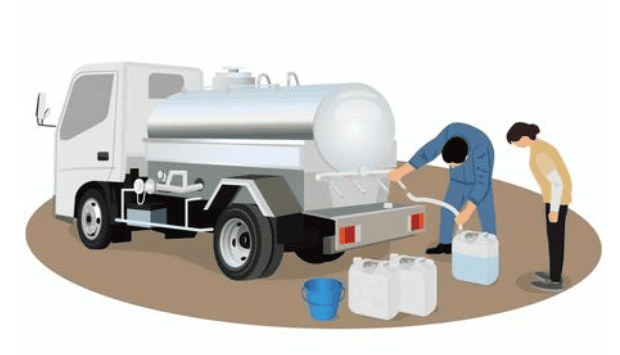
1. Do you get water delivered in a tanker? If yes, find out where the tankers bring water from. Does your water come from a well, river or lake near your village or city?

Ans:  Yes, sometimes we get water delivered in a tanker. The tanker brings water from a nearby river or lake. The water is stored in big tanks, and then it is delivered to homes when we need it.

2. Do you know anyone who faces difficulty in getting water every day?

Ans: I know some people who face difficulty getting water every day. They have to walk long distances to fetch water from wells or rivers.

Water in Our Daily Lives (Page – 92)

Write 

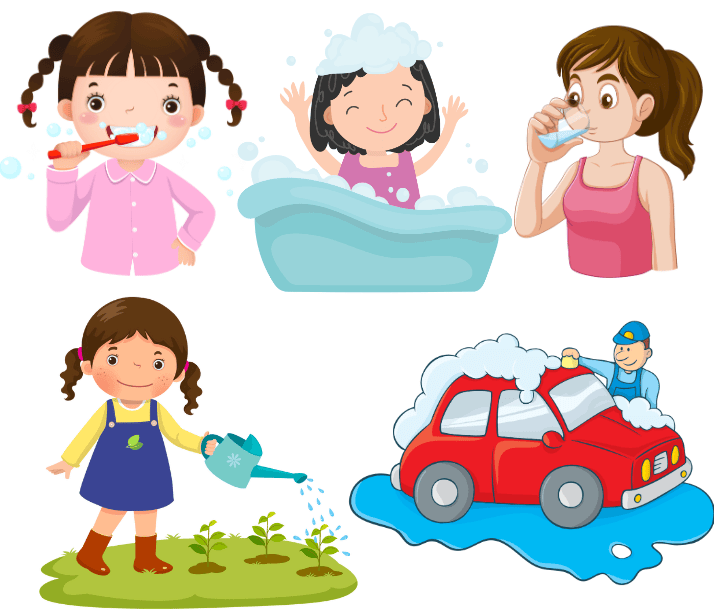
1. List all the activities you can think of for which we need water.

Ans: Drinking, cooking, bathing, washing clothes, cleaning dishes, watering plants, flushing toilets, and cleaning the house.

2. How many mugs of water do you need to brush your teeth? How much water do you use to take a shower?

Ans: I need about one mug of water to brush my teeth and approximately 1 Bucket of water for a shower.

3. Have you ever faced a situation when you did not get any water? What did you do then?

Ans: Yes, there was a time when our water supply was interrupted due to maintenance work. We used stored water,  avoided activities like washing clothes, and fetched additional water from a nearby public tap.

4. Ask your Grandparents or any elder:

How did they get water? Did they use water in the same way as you do ?

Ans: They told me that they did not have taps like we do today. They had to fetch water from a nearby well or river.

How did they store water?

Ans:  They used big pots made of clay to store the water, and they were very careful not to waste it. They  said that they used less water than we do now because it was hard to get.

Write a short story about what you found out?

Ans: My grandparents told me that when they were young, there were no taps at home. Every day, they would walk to a well with pots to fetch water. They used a bucket to pull water from the well and carried it back home.

They stored the water in large clay pots and used it carefully, as getting water took time and effort. This story reminded me how lucky we are to have water so easily today.

Activity 3 (Page 94)

Put up an exhibition

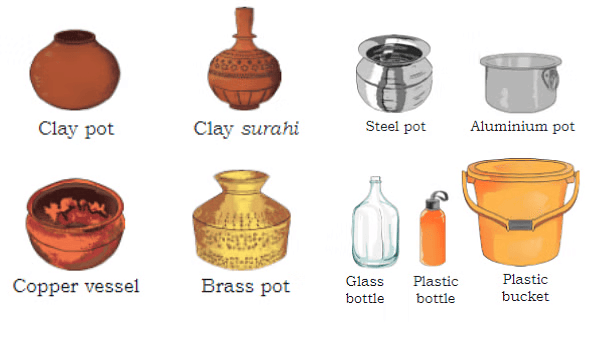
1. Identify different vessels used to keep water in your home.

Ans: In my home, we use plastic buckets, steel containers, and glass bottles to store water.

2. Ask the elders in your family what types of vessels they stored water in. Were they different from what we use now? Did the vessels have different names?

Ans: The elders in my family used clay pots, brass vessels, and copper containers to store water. These vessels were different from what we use now and had names like “ghada” for clay pots and “lota” for brass containers.

3. On a separate sheet of paper, draw a picture of any vessel that you find interesting and write its name in your language.

Ans:
Stop for a Moment and Think ! (Page – 95)

Water comes down to earth as rain.

It slowly fills up our many sources—streams, rivers, ponds, lakes, wells, groundwater, etc.

From these sources we bring water to our homes in many ways.

We store it in many ways.

We use it in many ways.

What happens to water after we use it?

Ans: After we use water, it can become dirty. We should avoid using dirty water for drinking or cooking, but we can reuse it in other ways, like watering plants or flushing toilets. Some of the used water goes into drains and is treated before being released back into the environment. 

Activity 4 (Page -97)

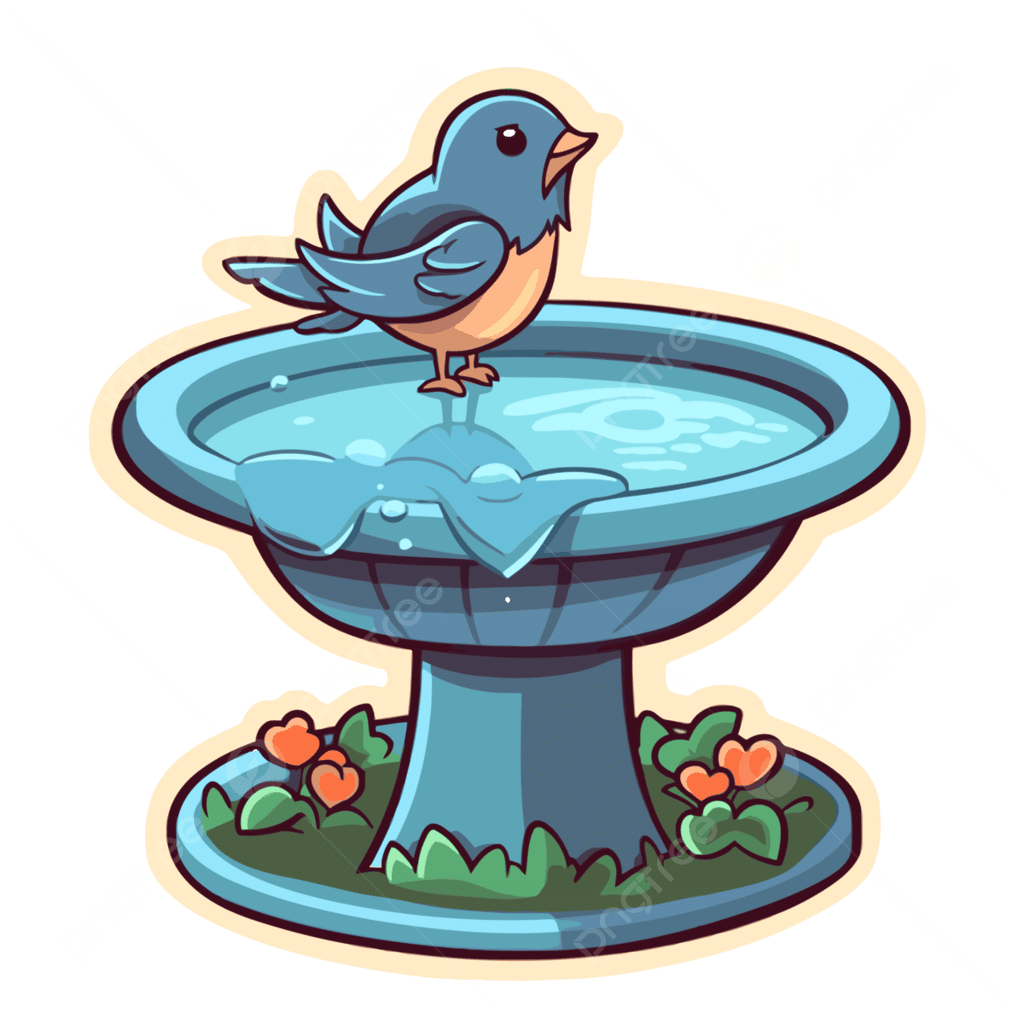
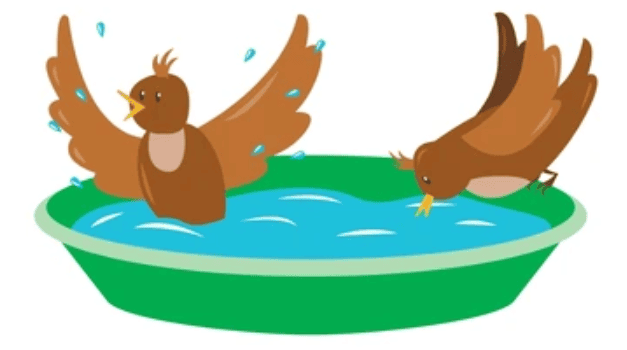
Prepare a birdbath — offer water to birds in the hot summer months.

A birdbath contains water in a shallow plate for birds to drink and cool down.

  • Take a shallow and wide container (an old big bowl or a base of an old pot or a bucket, less than 10 cm deep).
  • Keep some stones in it for birds to perch. You may make the sides sloping by adding some smaller pebbles. Smaller pebbles also help insects to use this water.
  • Add fresh water and keep the bowl in your yard, balcony, or terrace.
  • Change the water frequently.
  • Clean the birdbath with a scrubber twice a week. Do not use this scrubber for kitchen utensils; reserve it for the garden.

Let Us Reflect (Page – 98)

A. Write

1. You waited for rain and watched how raindrops fell to the ground. You collected rainwater and observed if it was clean or dirty. You saw what happened to the rainwater that fell in different places. Now write a few lines on your observations of the rain.

Ans: I observed that the rain started with small droplets, which gradually became larger. The rainwater collected in a clean vessel appeared clear, while the water collected from the ground looked muddy. On different surfaces, the rainwater either formed puddles or was absorbed into the soil. When the sun came out, the puddles slowly dried up, and the absorbed water seemed to disappear into the ground.

2. You found out the name and some information about a stream, river, well, pond, or lake near your place. Write it in a few lines: Is this water used for drinking? If yes, how is this water carried to your home? If it is not used, why not? Was it used in the past?

Ans: Near my place, there is a river called Yamuna. This water is used for drinking after it is treated in a water purification plant. The treated water is then transported through large pipes to water tanks in our locality, from where it is distributed to homes through a network of smaller pipes. In the past, the river water was used directly for drinking, but due to pollution, it now needs to be treated before use.

B. Draw

Draw a picture of your birdbath. Write the names of the birds and insects that come to drink water from your birdbath.

Ans:  The birdbath is a shallow bowl placed on a pedestal in my garden. It is filled with clean water and has a few stones for birds to perch on. The birds that come to drink include sparrows, pigeons, and occasionally a crow. Insects like bees and butterflies are also seen around the birdbath, especially on hot days.

C. Discuss (Page 99)

Water is very precious. We should be cautious about how we use it. We should not waste even a drop of water. Discuss among yourselves and list the activities in your house or outside, due to which water gets polluted or wasted. How can we avoid wastage of water? Think of three solutions with your group and write them in your notebook.

Ans:

Activities that waste water:

  1. Leaving taps running while brushing teeth or washing dishes.
  2. Overwatering gardens and plants.
  3. Using excessive water for washing cars.

Solutions to avoid wastage:

  1. Turn off taps when not in use, like while brushing teeth.
  2. Water plants early in the morning or late in the evening to reduce evaporation.
  3. Use a bucket instead of a hose to wash cars and clean driveways.

06. Living in Harmon noy- Textbook Solutions

Page 73

Discuss

Q1: Do any of these animals, birds, insects, and plants live with you in your house?
Ans: Yes, we have a dog and some house plants like aloe vera and tulsi in our house.

Q2: Do you and your family take care of them?
Ans: Yes, we take care of them by feeding the dog, taking it for walks, and watering the plants regularly.

Find Out

Are there any animals, birds and insects that you have spotted that are not in the picture given on page 72? • Try to find out their names and write them in the table given below. One example has been done for you Name of the animalPlace where you have seen themMonkeyTreeSparrowGardenAntKitchenSquirrelParkButterflyFlower bedPigeonRooftopCatStreetDogHome

These are examples of animals and the places where they can typically be seen.

Page 74

Discuss

Q1: Which are the uninvited animals, birds, and insects that visit your home?
Ans: The uninvited visitors that come to our home include ants, mosquitoes, spiders, pigeons, and stray cats.

Q2: Why do you think they come to your homes?
Ans: They come to our home in search of food, shelter, and sometimes water. For example, ants are attracted to food crumbs, and pigeons look for places to nest.

Q3: How do you feel about their presence in your home?
Ans: I feel annoyed when insects like mosquitoes and ants invade our home because they can be a nuisance. However, I don’t mind seeing pigeons or stray cats occasionally.

Q4: Which of them do you like?
Ans: I like the stray cats because they are often friendly and sometimes playful.

Q5: What do you do when you do not like them?
Ans: When I do not like them, I try to keep the house clean to avoid attracting them. For example, I use mosquito repellents to keep mosquitoes away, and I seal food containers properly to prevent ants from getting in. If necessary, I gently guide the animals or birds outside without harming them.

Page 77Discuss

Q1: How are we dependent on plants and animals?
Ans: We need plants and animals for food, clothes, houses, medicine, and air. Plants give us fruits, vegetables, grains, and oxygen. Animals give us meat, milk, eggs, and wool.

Q2: How do plants help animals?
Ans: Plants give animals food, places to live, and oxygen. Trees and bushes provide fruits, leaves, and nectar for food and places for animals to hide and nest.

Q3: How do animals help plants?
Ans: Animals help plants by spreading their seeds and pollinating flowers. Birds and animals eat fruits and drop seeds elsewhere, and insects like bees help flowers make seeds by pollinating them.

Q4: How do you look after plants and animals in your surroundings?
Ans: I take care of plants by watering them, giving them sunlight, and keeping pests away. I take care of animals by feeding them, giving them water, and making sure they have a safe place to live.

Q5: How do animals and plants depend on us?
Ans: Animals and plants depend on us to protect them, plant them, and give them food and water. We help them by planting trees, keeping gardens, feeding pets, and taking them to the vet if they are sick.Page 78

Write

Write a short description of the animal or bird:

1. Name and describe the animal or bird that you have chosen.
Ans: I have chosen a dog. The dog is medium-sized, with a brown coat, floppy ears, and a wagging tail. 

2. When and where did you first see it?
Ans: I first saw the dog in the park near my house.

3. Was it there alone or with its friends?
Ans: It was there with a group of other dogs.

4. Describe its movement.
Ans: The dog was running around playfully, chasing a ball and wagging its tail.

5. What sounds did it make?
Ans: The dog barked and whined occasionally.

6. Did you see it eating, sleeping, talking to its friends, or maybe fighting sometimes?
Ans: I saw the dog eating some treats, playing with other dogs, and occasionally lying down to rest.

7. Did it do anything that surprised you or made you laugh?
Ans: The dog did a funny trick by rolling over and playing dead, which made me laugh.

8. Share your story with your classmates.

Page 79

Activity 2
Busy, Busy, Busy and Clever Ants!
You may do this activity near your plant friend, in your classroom or at home. Bring small amounts of three types of food from your kitchen:

  • Sweet like sugar or jaggery;
  • Fried like a papad or murukku;
  • Boiled or cooked like bread, chapati, idli, rice or ragi.

Keep these three types of food on the floor in a straight line with one foot distance between them.
Make a Guess:

1. Who will come for the food?
Ans: Ants will come for the food.

2. Which will be their favourite food?
Ans: Their favourite food will likely be the sweet like sugar or jaggery.

3. Will any ants come to your food?
Ans: Yes, ants will come to the food.

4. Where would they come from?
Ans: They will come from nearby ant nests or colonies.

5. Will all the ants look the same?
Ans: Yes, most of the ants will look the same, though there might be some differences in size depending on their roles in the colony.

6. What food item will they go to first?
Ans: They will likely go to the sweet food item first.

7. How many ants will come to the food?
Ans: It is difficult to predict the exact number, but many ants will come as they communicate with each other about the food source.

8. What will they do with the food?
Ans: The ants will carry pieces of the food back to their nest to share with the rest of the colony.

Let us reflect (Page 81)

A. Discuss

1. How are we dependent on plants and animals?
Ans: We depend on plants and animals for food, clothing, shelter, medicine, and companionship. Plants provide oxygen, fruits, vegetables, and herbs, while animals provide meat, milk, eggs, wool, and other products.

2. How should we care for plants and animals in our environment?
Ans: We should care for plants by watering them, ensuring they get enough sunlight, and protecting them from pests. We should care for animals by providing them with food, water, shelter, and medical care when needed.

3. How do plants and animals depend on us?
Ans: Plants and animals depend on us for protection, cultivation, and ensuring their habitats are not destroyed. We also help in spreading seeds and providing care.

B. Write

1. Complete these sentences with the names of plants, birds, animals, or insects:

a. I like looking at _____________ because _______________________
Ans: I like looking at butterflies because they have beautiful, colorful wings.

b. ___________ make me laugh because __________________________
Ans: Monkeys make me laugh because they do funny tricks and make playful faces.

c. My friend ______________ likes ______________ because ____________
Ans: My friend Rohan likes parrots because they can mimic sounds and talk.

d. I would like to take care of _______________ because ______________
Ans: I would like to take care of a dog because they are loyal and friendly.

2. a. Which is your favourite animal, bird, insect, or plant among those you have named above?
Ans: My favourite animal is a dog.

b. Why do you like it?
Ans: I like dogs because they are loyal, friendly, and make great companions.

c. Write down the names of all the animals, birds, insects that you have seen or learned about from the smallest to the largest.
Ans: Ant, Butterfly, Sparrow, Pigeon, Cat, Dog, Monkey, Elephant.

C. Draw

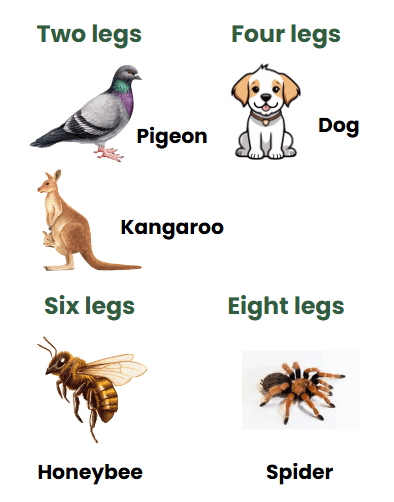
1. Name and draw animals, birds, and insects that have:

a. Two legs

b. Four legs

c. Six legs

d. Eight legs

Ans: 
05. Plants and Animals Live Together- Textbook Solutions

Discuss (Page 64)

Which of the animals shown on page 63 have you seen before? Describe where and how you saw them. Use your fingers, hands, and arms to show how small or big these animals are! 

Q1: Which of the animals shown on page 63 have you seen before?
Ans: I have seen frogs, elephants, squirrels, ants, caterpillars, butterflies, moths, and earthworms.
Q2: Describe where and how you saw them.
Ans:
  • Frogs: I saw them near a pond in my neighborhood.
  • Elephants: I saw them in a wildlife sanctuary during a school trip.
  • Squirrels: I often see them in the park near my home.
  • Ants: I see them in the garden and inside my house.
  • Caterpillars: I found them on plants in the garden.
  • Butterflies: I see them flying around flowers in the garden.
  • Moths: I see them near lights in my house at night.
  • Earthworms: I found them in the soil while gardening.

Activity 1

Pick up a little soil near your plant friend with your hands.

  • How does it look and feel? 
  • Is it dry, damp, rough, smooth, hard or grainy? 
  • Did you find any leaves or insects in the soil? 
  • Now smell this soil and remember it.

Discuss (Page 66)

Disuss

Q1: In the monsoons, you may find many more plants and animals around. Where did these new plants and animals come from? Why could you not see them earlier?
Ans: These new plants grow from seeds that were dormant, and animals like insects emerge due to the rain and humidity. We couldn’t see them earlier because the dry conditions weren’t suitable for their growth and activity.
Activity 2

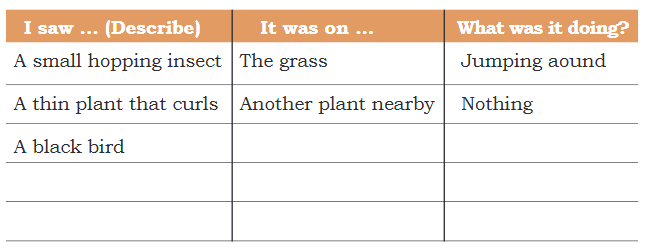
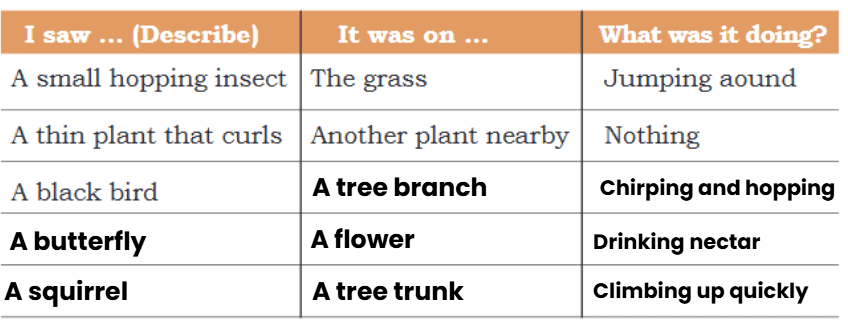
Instructions: Stand near your plant friend and look around. How many different animals can you spot? Describe them in words and fill in the table. You may use the given pictures if needed. 
Ans: 
Page 69

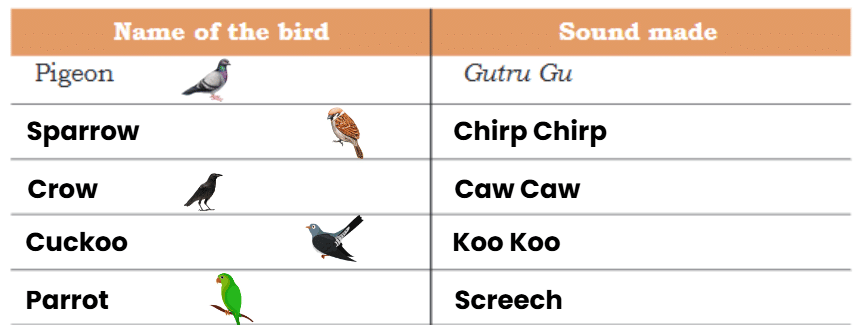
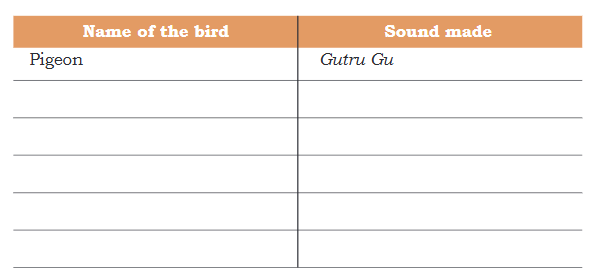
Different birds, different sounds

  • Recall the bird sounds you have listened to. Try to produce the sounds that different birds make.
  • Now try to write down in the following table the sound of any birds you have heard.

Ans:Let us reflect (Page 70)

A. Discuss

Q1: What was the colour and texture of the two soil specimens that you collected during the previous activity? In which month did you pick them up? Did they smell different and can you describe the smells?
Ans: The dry soil was light brown and felt rough and grainy, while the wet soil was dark brown and felt smooth and damp. I collected them in the month of July. The dry soil had a faint earthy smell, while the wet soil had a stronger, fresh earthy smell.

Q2: During which month did fresh new leaves appear on the plant that you were observing?
Ans: Fresh new leaves appeared on the plant in the month of March.

Q3: Which animals, birds, and insects did you notice around plants?
Ans: I noticed squirrels, butterflies, ants, caterpillars, and birds like sparrows and crows around the plants.

Q4: Recall and write about how animals, birds, and insects rely on plants. Which one was your favourite example?
Ans: Animals, birds, and insects rely on plants for food, shelter, and nesting. For example, squirrels eat fruits and use tree hollows to rest. My favourite example is butterflies drinking nectar from flowers.

Q5: What is soil made up of?
Ans: Soil is made up of tiny pieces of rocks, old leaves, roots, stems, and living and dead animals like insects.

B. Write

Q1: Names of two animals that you observed near or on plants. Describe the shape, size, and colours of these animals.
Ans:

  • Squirrel: Small, with a bushy tail, grey fur, and white underbelly.
  • Butterfly: Medium-sized, with colourful wings in shades of yellow and black.

Q2: Guess why these animals were staying near these plants.
Ans: Squirrels stay near plants for food and shelter, while butterflies stay near plants to drink nectar from the flowers.

Q3: What other interesting things did you notice about these animals?
Ans: I noticed that squirrels are very agile and quick in their movements, and butterflies have a delicate way of flapping their wings while hovering around flowers.

C. Draw

Remember you wrote about your plant friend. Now try and draw your plant friend. Use different coloured small dots in your drawing to show the places where you spotted animals, birds, or insects.
Ans: [This requires drawing, so the description has been instead.] Draw the plant with green leaves and show different coloured small dots where you spotted animals like squirrels, butterflies, and ants.

D. Put in order

One day Suma found a caterpillar on a tagar plant. She found it interesting. She observed it for about 10 minutes. It was eating tender leaves continuously. Her mother came close to her. She guided her to observe the caterpillar each day. Suma became more curious. Consult an elder person and organise the following changes in order.

1. The caterpillar formed a cocoon.
2. One day it stopped eating.
3. It came out of the cocoon.
4. Now it was a butterfly.
5. It flew away gently.
Ans:

  1. One day it stopped eating.
  2. The caterpillar formed a cocoon.
  3. It came out of the cocoon.
  4. Now it was a butterfly.
  5. It flew away gently.

04. Getting to Know Plants- Textbook Solutions

Write (Page 49)

Q1: Write the names of trees that you can recognise.  Try to remember where you have seen these trees. Which of these trees have you seen near your home or on your way to school 
Ans: Mango, Coconut, Khejri, Jackfruit, Banyan, Amaltas, Peepal, Chinar. Mango and Jackfruit trees are seen in my backyard. Coconut and Banyan trees are seen in the neighborhood park. Peepal and Amaltas trees are seen on the way to school.

Write (Page 50)

Q1: Write the names of some shrubs. Have you seen any of the shrubs shown in the pictures above?
Ans: Hibiscus, Rose, Holy Basil (Tulsi), Curry leaf. Yes, I have seen Hibiscus, Rose, and Holy Basil (Tulsi) near my home.

Q2: Do you know what they are called in your mother tongue?
Ans: Hibiscus is called “Jaswand,” Rose is called “Gulab,” and Holy Basil (Tulsi) is called “Tulsi” in my mother tongue.

Write (Page 52)

Q1: Write the names of some herbs that you have seen and where have you seen them?
Ans: Mint, Tomato, Coriander, Mustard. Mint and Coriander are grown in our kitchen garden. Tomato and Mustard plants are seen in the nearby vegetable farm.

Page 54

Guess

Q1: Is the snake gourd a creeper or a climber?
Ans: 
The snake gourd is a climber.

Q2: What do you call it in your language?
Ans:
 In Hindi, it is called “Chichinda” or “Padval”. (You can add the name in your preferred language.)

Write

Q1: Write the names of some climbers or creepers that you have seen and where have you seen them? Are any of them in the pictures given on page 53? What are they called in your language?
Ans: Money Plant, Jasmine, Bottle Gourd, Watermelon, Pumpkin. Money Plant is seen in my friend’s house. Jasmine is in our garden. Bottle Gourd, Watermelon, and Pumpkin are seen in the nearby vegetable farm. Yes, Money Plant, Jasmine, and Bottle Gourd are in the pictures given on page 53.  Money Plant is called “Paisa Vel,” Jasmine is called “Jui,” and Bottle Gourd is called “Dudhi” in my language.

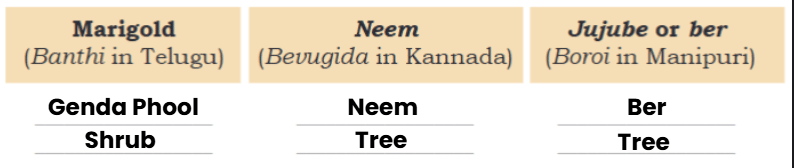
Q2: Name these plants in your language. Say if they are a tree, shrub, climber, or creeper. 

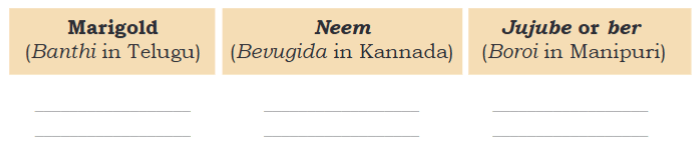
Ans: 

Page 55

Activity 2: Make Friends with a Plant!

Choose one plant, preferably a shrub with a thick stem or a tree that you want to make friends with. You can do this by yourself or with a group of your classmates.
Name your plant, just like you might name a pet. Take care of the plant by watering it each day. Also protect it as your friend.
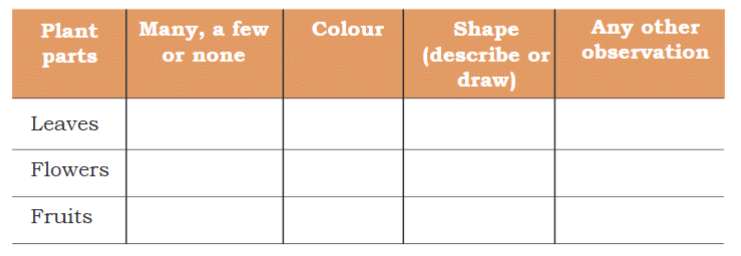
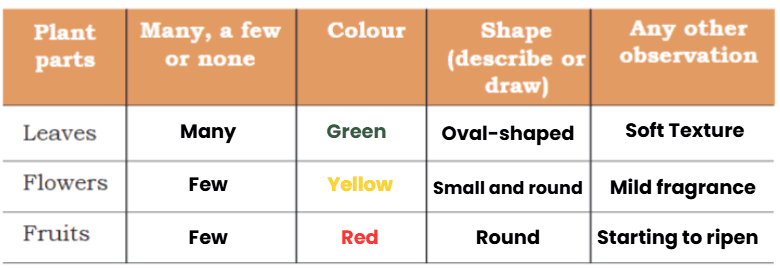
Now observe your plant friend closely. Here are a few things to observe — its leaves, flowers, and fruits. Are there many, a few, or no leaves, flowers, and fruits? Record your observations in the table on the next page.

Time and date of observation: ___________________
Month: ___________________
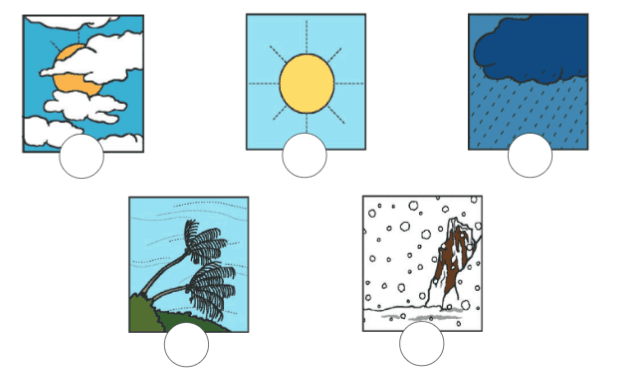
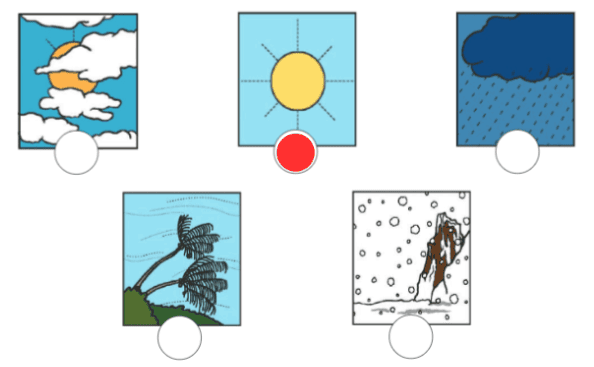
Weather on the day you are recording this information: ___________________

Ans: Time and Date of Observation: 9:00 AM, 14th October 2024
Month: October
Weather on the day you are recording this information: Sunny 

Page 56

Activity 3

  • Do you find new leaves growing on the plant? Do the colours of the leaves change as they grow larger?
    Ans: 
    Yes, I found new leaves growing. The new leaves are light green in color, and as they grow larger, they turn darker green.
  • Do the old brown leaves fall to the ground?
    Ans:
     Yes, I observed that some of the old brown leaves fell to the ground.
  • Do you find flowers appearing or notice any fruit?
    Ans: 
    Yes, a few small yellow flowers have appeared, and I also noticed a few small round fruits starting to grow.
  • What are other observations you have?
    Ans: 
    I observed that the plant is growing taller, and the stem is becoming stronger. The leaves have a soft texture, and the flowers have a mild fragrance.

Page 57

Activity 4

  • Observe the leaves in your surroundings.
  • Draw, colour and label them in your notebook.
  • Describe their colour, shape, size, texture and smell to your friend in the class. 
    Ans: 
    The leaves I observed were dark green in color, oval in shape, and medium-sized. They had a smooth texture and a fresh smell, somewhat like mint.
  • What statements can we make about leaves after doing this activity?
    Ans: 
    Leaves come in many different shapes, sizes, and colors. They can have smooth, rough, or soft textures. Leaves from different plants often have distinct smells. The size of leaves can vary greatly depending on the plant species.

Let us reflect (Page 60)

A. Discuss

Q1: What would happen if there were no plants?
Ans: If there were no plants, there would be no oxygen for us to breathe, no food to eat, and no shelter for many animals. The ecological balance would be disrupted, leading to the extinction of many species, including humans.

Q2: How does the root help a plant to grow?
Ans: The root helps a plant to grow by anchoring it to the soil, absorbing water and nutrients, and storing food.

Q3: What is the role of the stem?
Ans: The stem supports the plant, transports water and nutrients from the roots to other parts of the plant, and carries food produced by the leaves to the roots.

B. Write

Q1: List the names of plants that you have seen in your school, park or near your home. Identify what types of plants they are — tree, shrub, herb, grass, climber or creeper.
Ans:

  • Mango (Tree)
  • Hibiscus (Shrub)
  • Mint (Herb)
  • Bamboo (Grass)
  • Money Plant (Climber)
  • Pumpkin (Creeper)

Q2: Which particular part of the plant helped you to identify the type of the plant?
Ans: The size and structure of the plant helped me identify the type. Trees have a big trunk and branches, shrubs have multiple woody stems, herbs have soft green stems, grasses have hollow stems, climbers have long and flexible stems, and creepers spread on the ground.

Q3: Describe your favourite plant. Why is it your favourite?
Ans: My favorite plant is the Mango tree because it provides delicious fruits, gives shade, and has beautiful green leaves. It is a source of joy during the summer when we get to eat ripe mangoes.

C. Draw

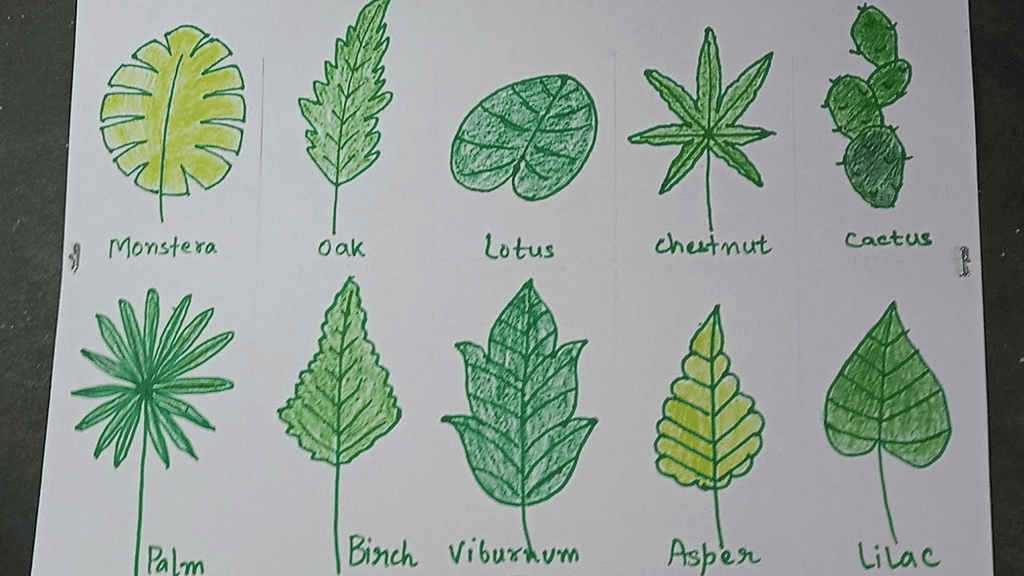
Draw different types of leaves you have seen around you.
Ans: This question is to be attempted by the student themself, a sample has been presented for reference.

03. Celebrating Festivals- Textbook Solutions 

(Page 35)

Q1: Have you ever travelled in a bus? If yes, share the experience with your classmates.
Ans: Yes, I travelled in a bus during a school trip. It was fun with friends, singing songs, and enjoying the beautiful scenery of fields and a river.

Q2: What types of trees and flowers did you see during your trip?
Ans: I saw oak, pine, and mango trees, and flowers like roses, marigolds, sunflowers, and tulips.

Q3: What safety measures should you take while travelling?
Ans: Wear a seatbelt, follow instructions, keep belongings secure, avoid leaning out, stay aware, and carry a first-aid kit.

Q4: What safety measures should you take while riding a bicycle and while walking on the road?
Ans:

  • Bicycle: Wear a helmet, use hand signals, stay in bike lanes, avoid busy roads, and ensure your bike is in good condition.
  • Walking: Use sidewalks, cross at pedestrian crossings, look both ways, avoid distractions, and wear reflective clothing in low light.

Activity 1 (Page 36)

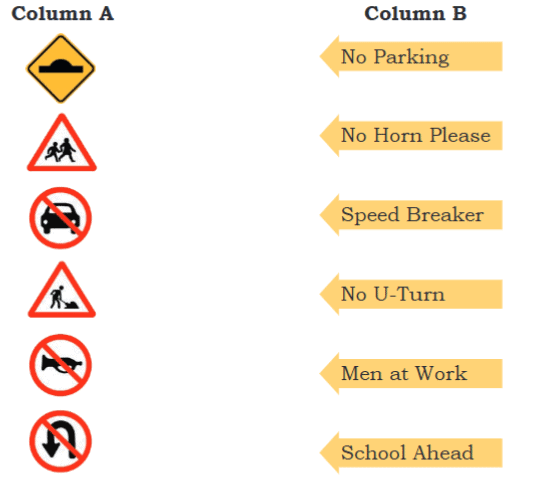
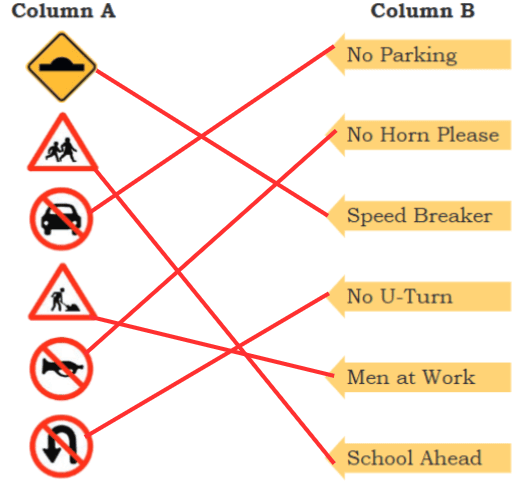
Q1: Match the Column A signboards with their meanings in Column B. Ans: 

Q2: You might have seen many signboards while traveling on the road. Draw and label any three road signboards that are different from the ones shown above.

Ans:

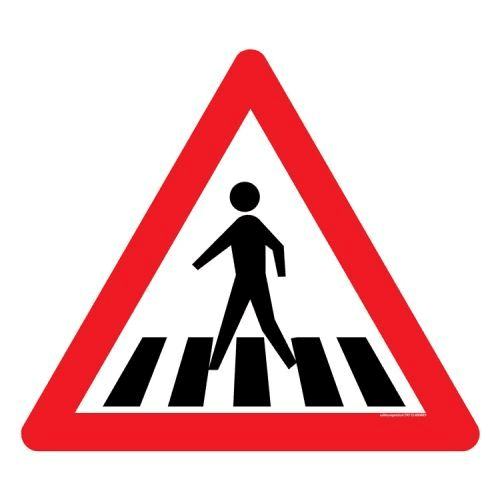
1. Pedestrian crossing sign

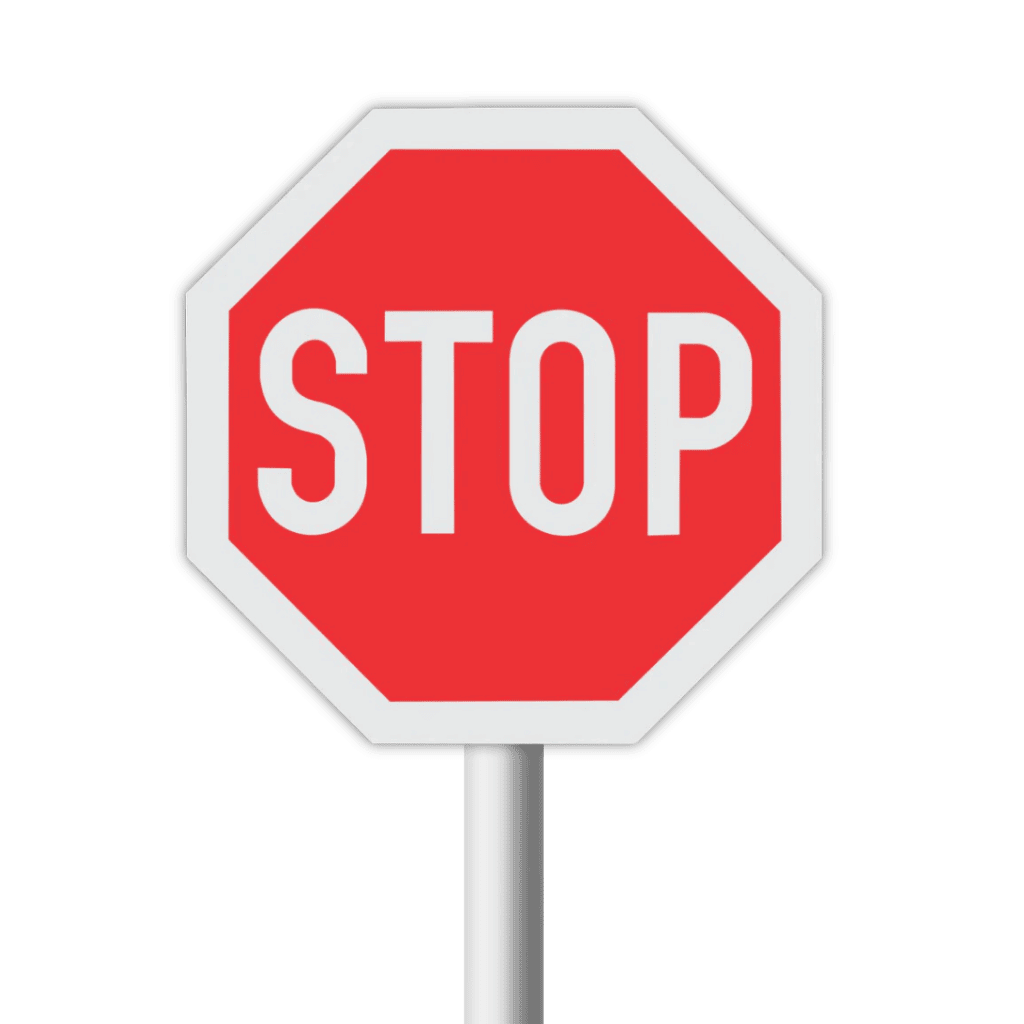
2. Stop Sign

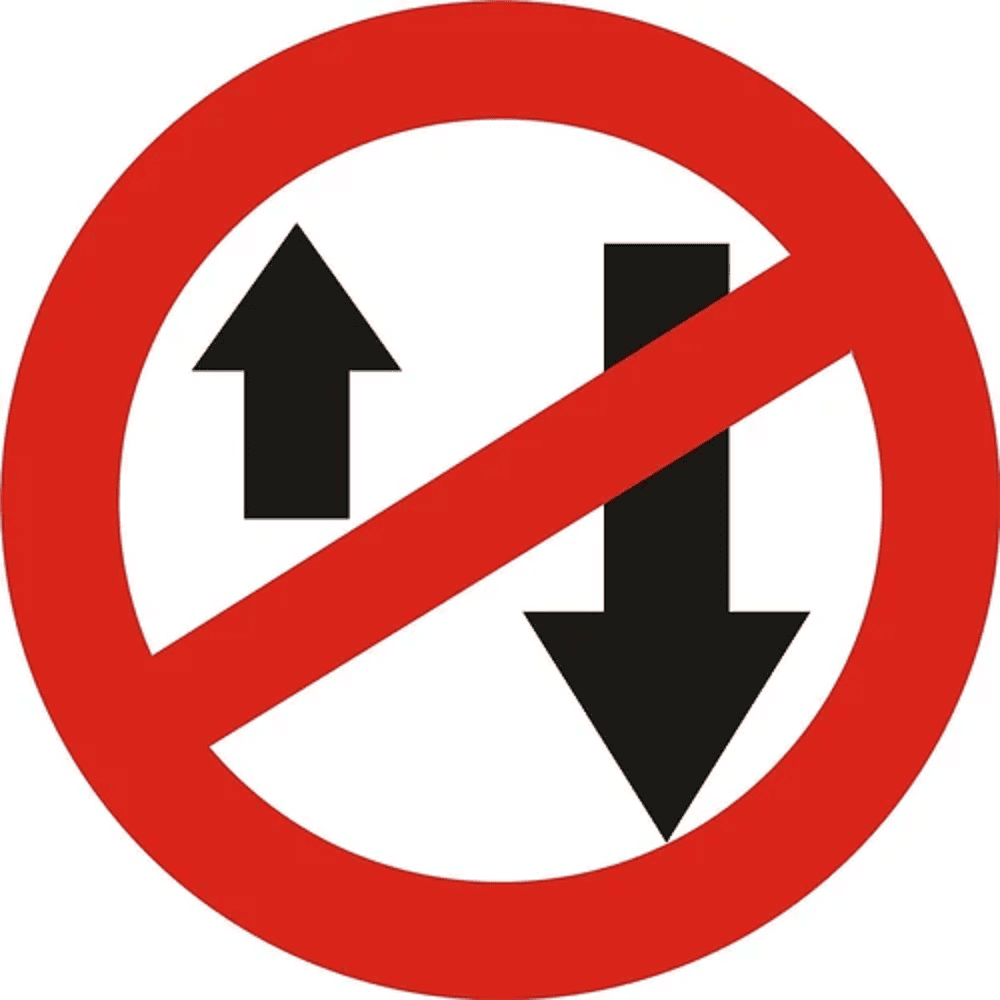
3. One-way traffic sign

Write (Page 40)

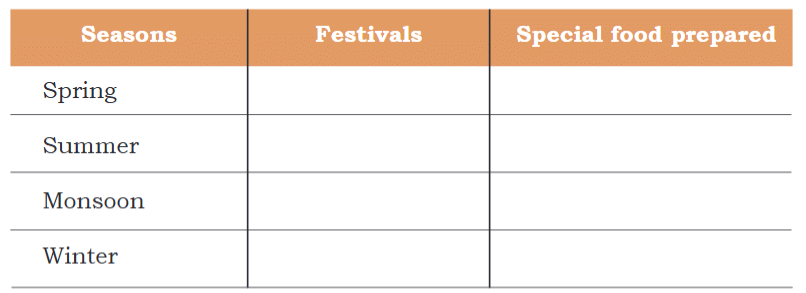
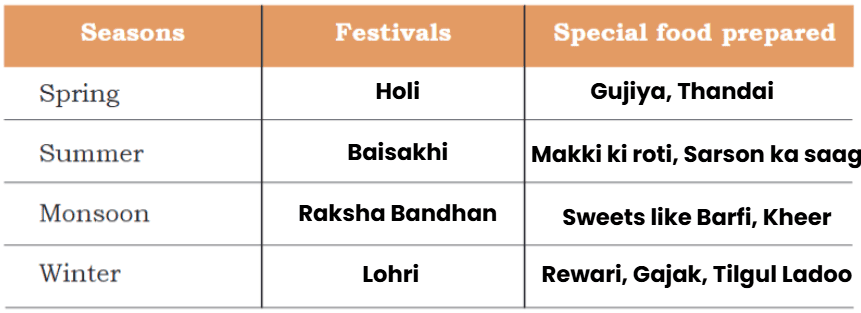
Q1: Ask your elders about the names of festivals celebrated in your locality for each of the seasons given below.

Q2: Make a list of the special food prepared during these festivals.

Ans: 

Q3: What special dresses do you wear during festivals?
Ans: During festivals, I wear traditional dresses such as kurta-pajama, saree, lehenga, and salwar-kameez.Activity 3 (Page 41)

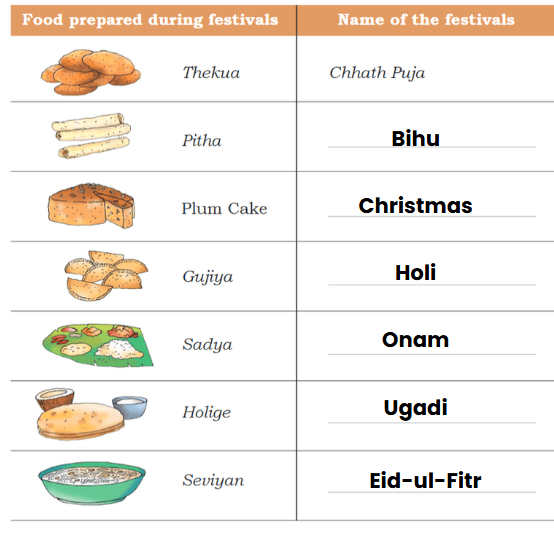
Q: Match the name of the food with the festival from the list given below. 

Ans: 

Let us reflect (Page 42)

A. Discuss

Q1: What are the different modes of transport used during travel?
Ans: The different modes of transport used during travel include cars, buses, trains, airplanes, bicycles, and boats.

Q2: How can one be safe during travels?
Ans: One can be safe during travels by wearing seatbelts, following traffic rules, not distracting the driver, keeping valuables secure, and being aware of the surroundings.

Q3: What special foods are prepared during festivals?
Ans: Special foods prepared during festivals include sweets like laddoos and jalebis, savory dishes like biryani and pulao, and regional specialties like sadya, thekua, and pitha.

Q4: How do festivals and celebrations bring us together?
Ans: Festivals and celebrations bring us together by providing opportunities to spend time with family and friends, share meals, participate in cultural and traditional activities, and foster a sense of community and belonging.

Q5: Do you feel happy spending time in nature? What about nature makes you feel happy?
Ans: Yes, spending time in nature makes me feel happy because it is peaceful and beautiful. The fresh air, greenery, and sounds of birds and animals create a relaxing environment.

B. Write

Q1: Name any two relatives you have visited recently.
Ans: I have recently visited my grandparents and my uncle.

Q2: How do you spend time with your cousins and relatives?
Ans: I spend time with my cousins and relatives by playing games, watching movies, sharing stories, and enjoying meals together.

Fill in the blanks

Q1: Chiya and Nonikaa live in a small village near the ____.
Ans: mountains.

Q2: The bus went along the ____ roads where the hills were covered with colourful flowers.
Ans: hairpin.

Q3: Rishi and his family walked to his Mama’s house through a narrow ____ road.
Ans: mud.

Q4: The red flowers that bloom in spring are called ____.
Ans: buransh.

Q5: ____ is a kind of leafy vegetable eaten with hot rice.
Ans: Haakh.

C. Draw

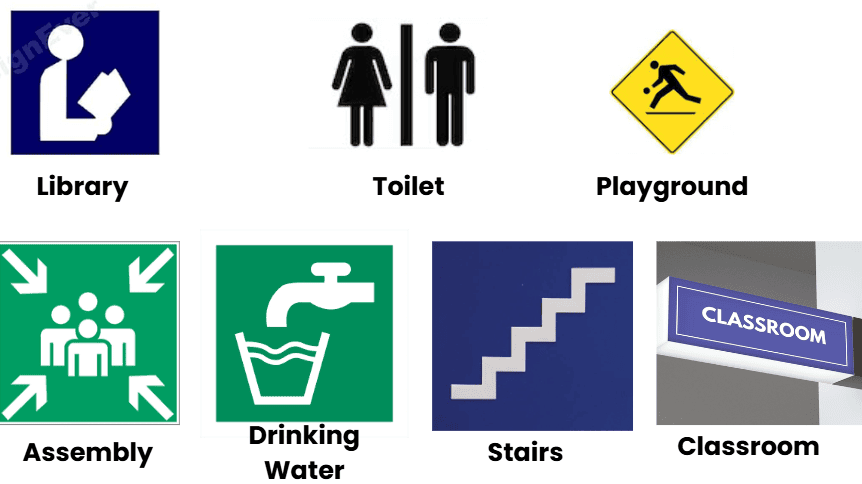
Take a chart paper and draw signboards for the following. You can use any image and colour of your choice for creating the sign boards. Explain what you have created.

  • School library
  • Toilet
  • Assembly
  • Drinking water point
  • Playground
  • My classroom
  • Stairs

Ans: