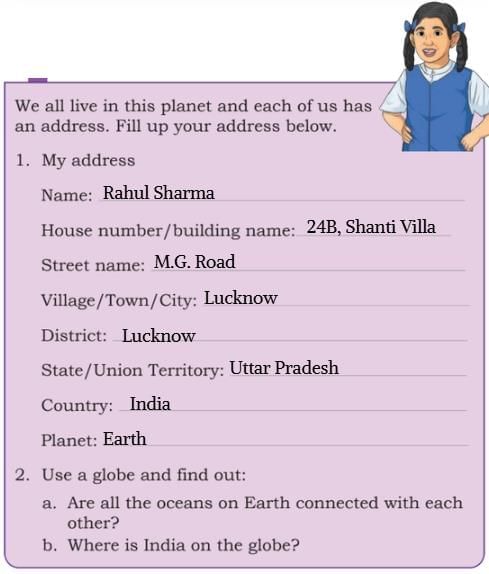
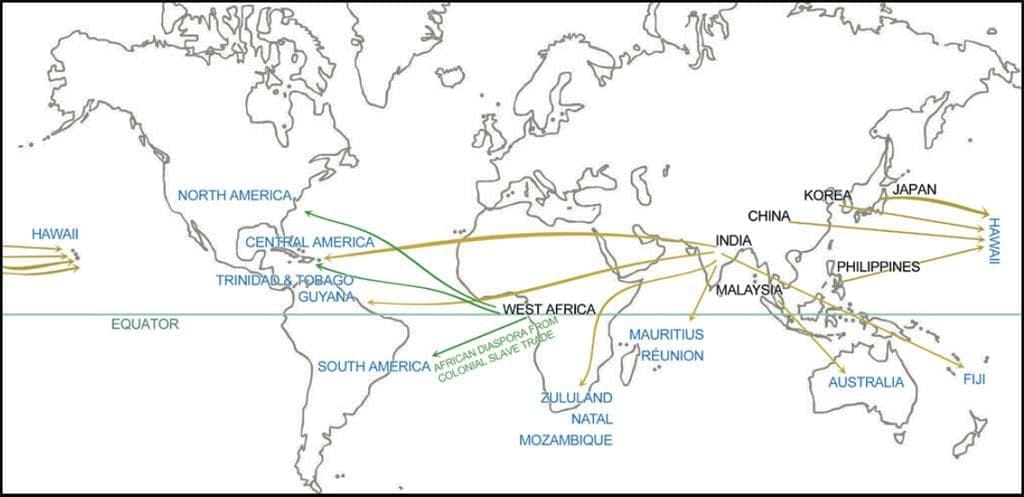
Q2. a. Are all the oceans on Earth connected with each other? Answer: Yes, all the oceans on Earth are connected. The Pacific, Atlantic, Indian, Southern, and Arctic Oceans are joined together, forming a single, large world ocean.
b. Where is India on the globe? Answer: India is located in South Asia, in the northern and eastern hemispheres. On the globe, you can find India between the continents of Africa and Australia, below China, and to the west of the Bay of Bengal and east of the Arabian Sea.
Page 164WriteQ1. Does the rosy starling visit your area? What is it called locally? Answer: Yes, the rosy starling visits many areas in India during winter. Locally, it is called “Gulabi Maina” (गुलाबी मैना).Q2. What does this story tell us about nature? Answer: The story shows how migratory birds connect ecosystems, help control pests, and the importance of respecting and protecting nature’s balance.
Page 165
Activity 2
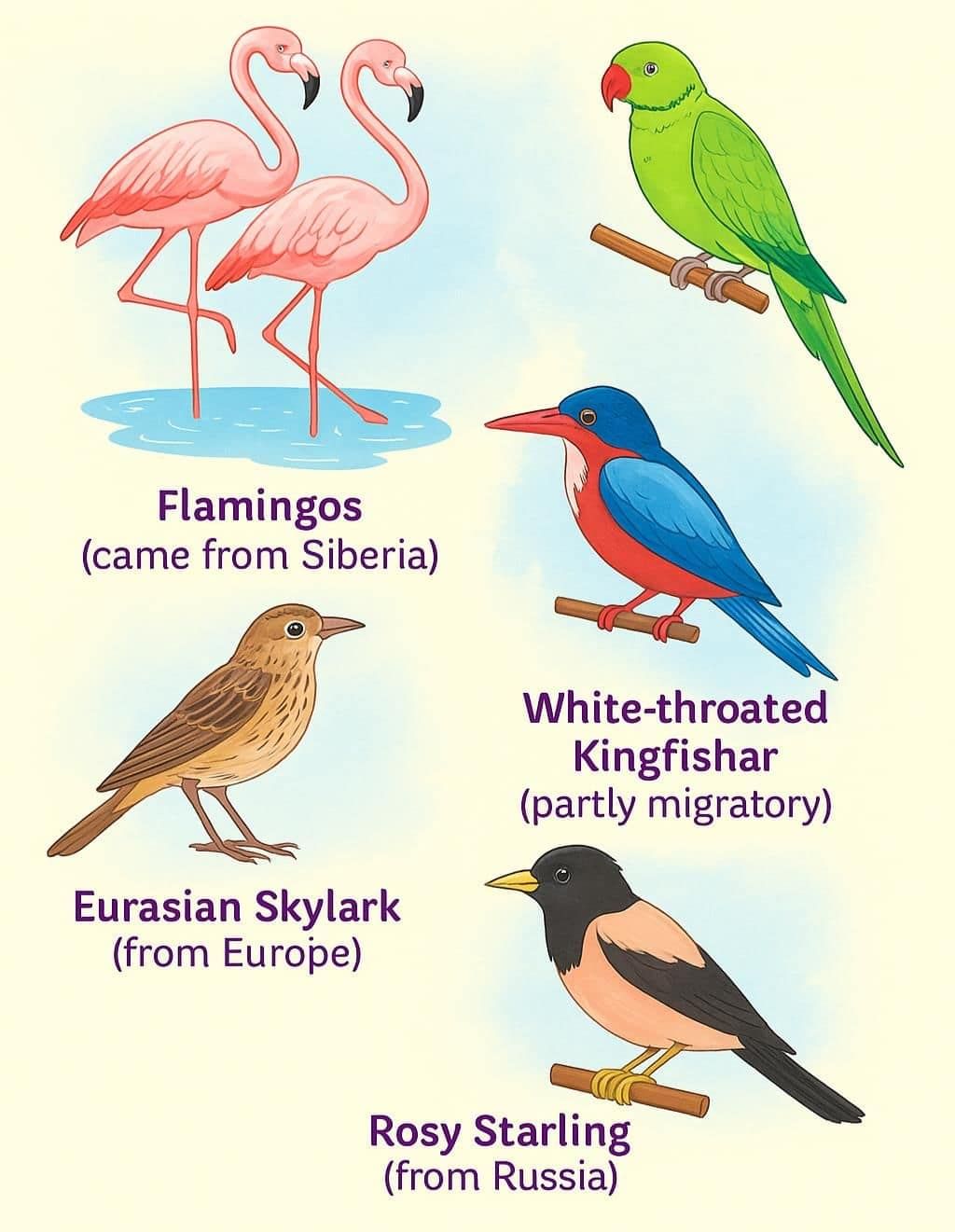
Q1. Make a poster of 5 birds that visit your place in winter. Find out where they come from. Answer: Birds poster: Include Flamingos (came from Siberia), Rose-ringed Parakeet (local), White-throated Kingfisher (partly migratory), Eurasian Skylark (from Europe), Rosy Starling (from Russia).
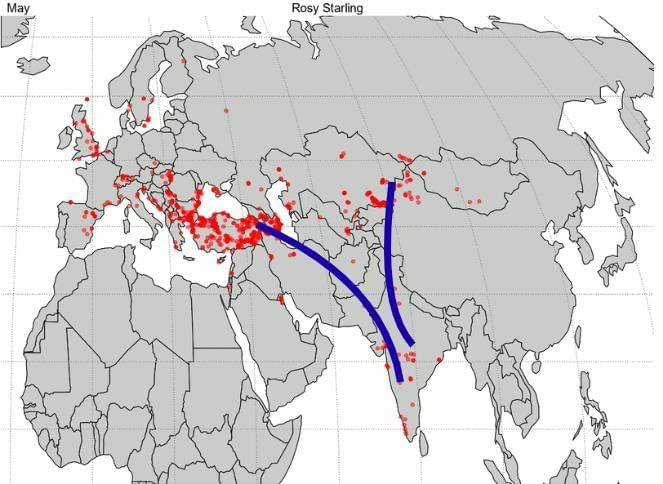
Q2. Using a string, trace the journey on a globe showing the paths rosy starlings take (Russia/Mongolia → India). Answer: Students can watch the birders document birds’ migration. Click here for Rosy Starling
Q3. Imagine you are a bird travelling the world. Write a short postcard or note about what you see and what helps you on your journey (wind, ocean currents, warm weather). Share it with your classmates. Answer: Postcard: “Dear Friend, I am flying from the cold Siberian plains to warm India. The wind helps me glide, and I stop at beautiful places with food and safety. The warm weather in India feels like a welcome hug!”5 WINTER BIRDS.
Write
Q. What does it mean when we say ‘nature has no boundaries’? Answer: It means that natural things like air, water, clouds, seeds, and animals move freely across borders and countries without stopping. Nature connects all living things everywhere, ignoring human-made lines on maps.
Page No. 167
Discuss
Q. Why do you think yoga became popular in so many countries? Answer: Yoga helps keep the body healthy and the mind peaceful. It’s simple exercises and breathing make people feel relaxed and strong, which is why it has spread worldwide. Also, it helps everyone, young or old, and does not require special equipment.
Write
Q. Can you name a yoga pose you have tried or seen? What do you think it helps with? Answer: Pose: Tree Pose (Vrikshasana). Benefit: It helps improve balance and focus.
Page No. 168
Write
Q1. What would happen if chillies disappeared from our kitchens for a week? Answer: Food would taste bland without the spicy flavour chillies provide. Many popular dishes would feel different and less exciting.
Q2. Ask your parents and write down the name of any recipe in which they have used black pepper and not red chillies. Example Answer: Chicken stew uses black pepper for flavour instead of red chillies.
Activity 3
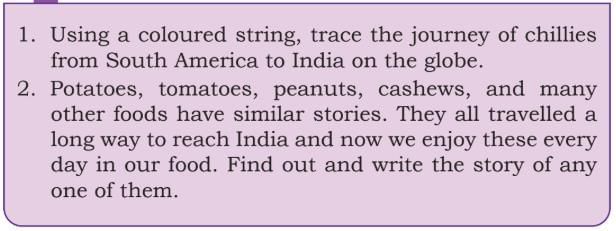
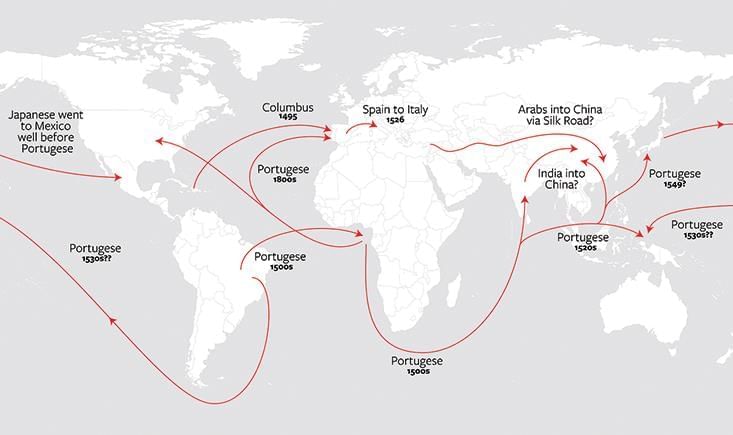
Example answer for Q2: A long time ago, potatoes did not grow in India. They first grew in South America. In the early 1600s, Portuguese traders brought potatoes to India, starting along the western coast, especially in the Malabar area. Later, when the British ruled India, they spread potatoes to other places, like the Nilgiri Hills in the south. At first, people thought potatoes might not grow well here, but they grew just fine in many types of soil and weather. Potatoes became popular because they could be cooked in many ways, were easy to grow, and could be eaten by everyone, no matter their religion. Soon, they became part of many Indian dishes, like Bengal’s aloo posto and South India’s masala dosa. Today, potatoes are grown all over India and are a big part of our daily meals. This story shows how a food from far away travelled across the world, was welcomed by farmers and cooks, and became a favourite in Indian kitchens.
Page No. 169
Discuss
Q1. If you could choose one Indian food to share with the world, what would it be? Example Answer: Biryani, because of its rich flavours and unique cooking style.
Q2. What kind of new food items do you think will travel in the future? Example Answer: Plant-based meat alternatives might travel more as people look for sustainable food.
Page No. 170-172
Write
Q1. Why do you think both Indian and Mexican cultures use marigolds during their festivals? Answer: Marigolds are bright and colourful, which represent joy and celebration. Both cultures feel that these flowers bring warmth and happiness during special occasions.
Q2. Why do you think people in different countries include flowers in their celebrations? Answer: Flowers add beauty and fragrance to celebrations and symbolise respect, purity, or spirituality.
Write
Q. What does this story tell us about animals moving from one place to another?
Answer: Animals like Indian cows can adapt to new places, and they can become very valuable in those countries. This shows how animals help different cultures connect and share resources.
Activity 4
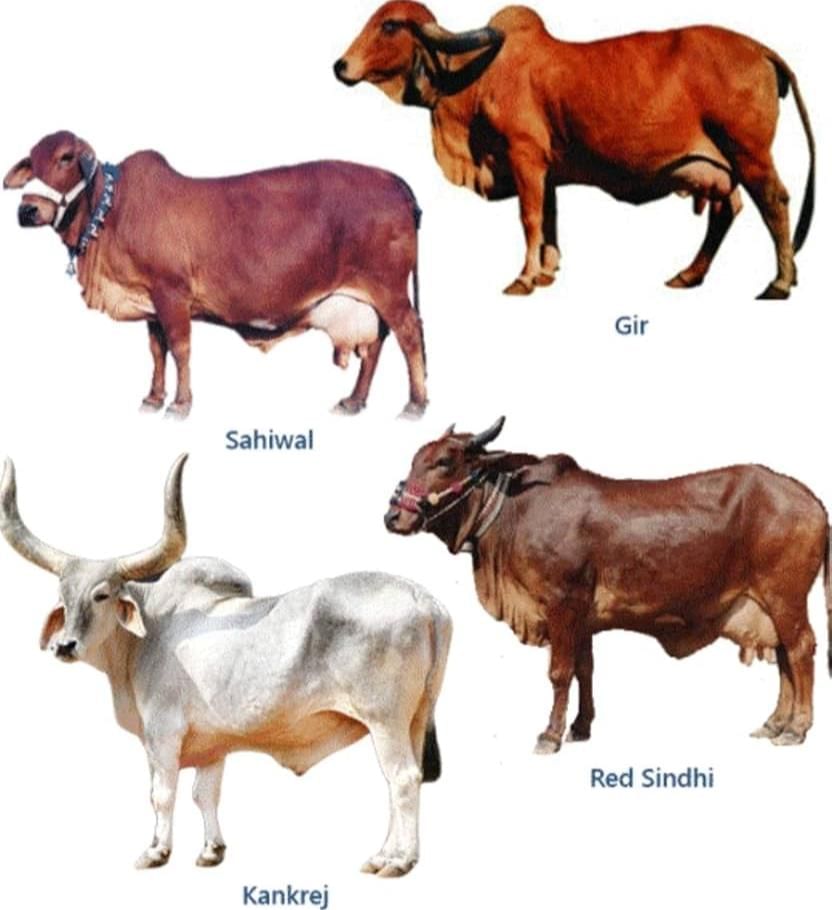
Q1. With the help of your teacher or an elder, find out the names of at least 5 different breeds of cows. Answer: Here are the names of at least five different breeds of cows that you can find out while asking your teacher or an elder: Gir, Sahiwal, Red Sindhi, Kankrej, Holstein, Tharparkar, Ongole, Hariana, Jersey, and Guernsey.
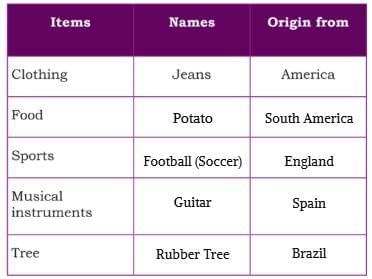
Q2. Make a list of a few things in your house or school that may have come from another part of the world. Find out where they originally came from. Answer:
Page No. 173
Activity 5
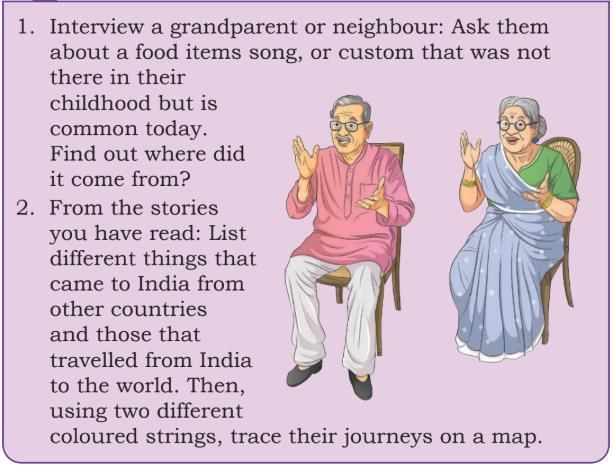
Example answer 1: Grandmother said pizzas weren’t available when she was young. They came from Italy and are now very popular in India.
Answer: To India: Chillies (South America), Potatoes (South America), Dates (Arabia)
From India: Sugar (India → World), Yoga (India → World), Indian cows (India → Brazil)
Pages No. 176
Write
Q1. What does Vasudhaiva Kutumbakam teach us? Answer: It teaches us that the world is one big family, including all people, animals, plants, and nature. We should respect, care for, and live peacefully with each other.
Q2. Write the meaning of Vasudhaiva Kutumbakam in your own words. Answer: The whole Earth and everyone on it are like one family.
Q3. How can we live like one big family, even when we are different? Answer: By respecting differences, helping each other, sharing resources, and protecting the Earth.
Let us reflect
Q1. Pick one of the ideas. Write a short story about how this idea might have travelled from one place to another long ago. Think about how it helped people change their lives or the way they think. Answer: Long ago, people lived in small groups, moving slowly and carrying heavy loads on their backs or with animals. One day, in a faraway land, someone noticed how a round log could roll more easily than being dragged. This idea led to the invention of the wheel. The wheel slowly travelled from that place to others through traders, travellers, and explorers. As it reached new lands, people used wheels to build carts and wagons, making it easier to carry goods and travel longer distances. The wheel changed how people worked and traded by allowing faster movement of food, tools, and other things. It even helped invent other machines and later vehicles. The wheel changed the way people think about transportation and work—it showed how a simple idea could solve big problems and connect communities.
Q2. Write one way you can care for the Earth. Answer: You can care for the Earth by reducing waste. This means reusing things, recycling materials, and avoiding throwing away items that can be repaired or repurposed. By doing this, you help reduce pollution and save natural resources.
Q3. Identify one item that can travel from India to other parts of the world and write about it. Answer: India is famous for its spices like turmeric, cardamom, and pepper. These spices have travelled from India to many countries over centuries through trade routes. They helped people in other places improve food flavour, preserve food, and even use spices in medicines. Indian spices changed cooking styles and health practices worldwide, connecting cultures and enriching diets everywhere.
Q. Can you think of something that takes a long time to change, maybe over the years? Answer: Long-term changes: Mountains growing, trees becoming very big.
Q. What about something that changes within a few years? Answer: A few years change: Building a new house, learning to ride a bicycle.
Q. Are there changes that happen every year? Answer: Yearly changes: Festivals, seasons, school exams.
Q. What changes in just a few minutes or seconds? Answer: Minutes/seconds changes: Sky turning dark when clouds cover the sun, lights turning on at dusk.
Page Nos. 150
Activity
Answer / Steps:
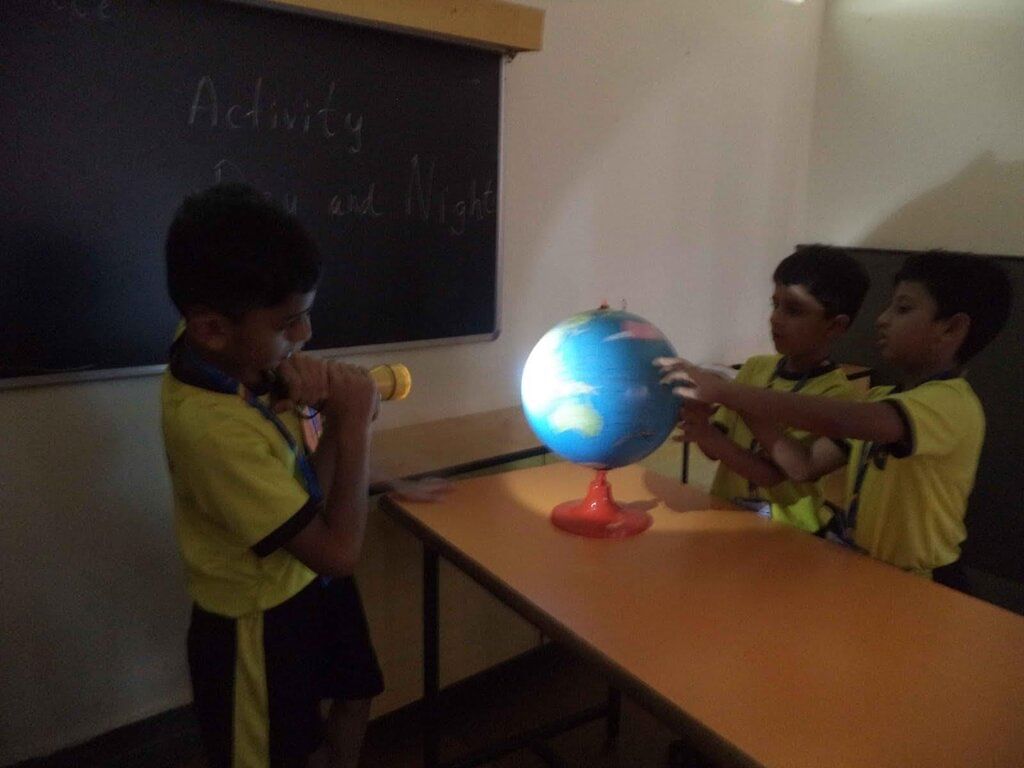
Place a globe on a table, shine a torch on one side. The lit side is day; the shadow side is night.
Slowly rotate the globe to see how day changes to night.
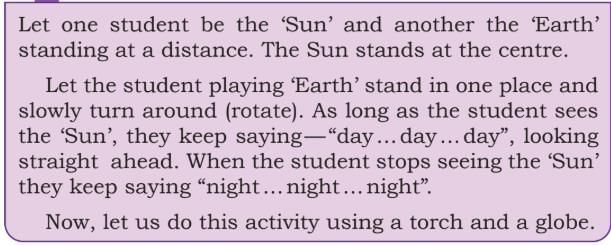
Role-play: One student acts as the ‘Sun’ (torch) and another as the ‘Earth’, rotating and saying “day, day” when facing the sun, and “night, night” when facing away.
Page Nos. 151
Write
Q. Study the globe and write in the space given below, when it is daytime in India, which countries will have night? Answer: When it is daytime in India, countries located roughly on the opposite side of the Earth experience nighttime due to the Earth’s rotation. For example, when India has daylight, countries like the United States, Canada, Brazil, Mexico, and parts of South America, as well as some regions in Australia and South Africa, will have night. This happens because the Earth rotates on its axis, so the side facing the Sun has day, and the opposite side has night. Thus, while India is in daytime, many Western countries in the Americas are in nighttime.
Page No. 157
Write
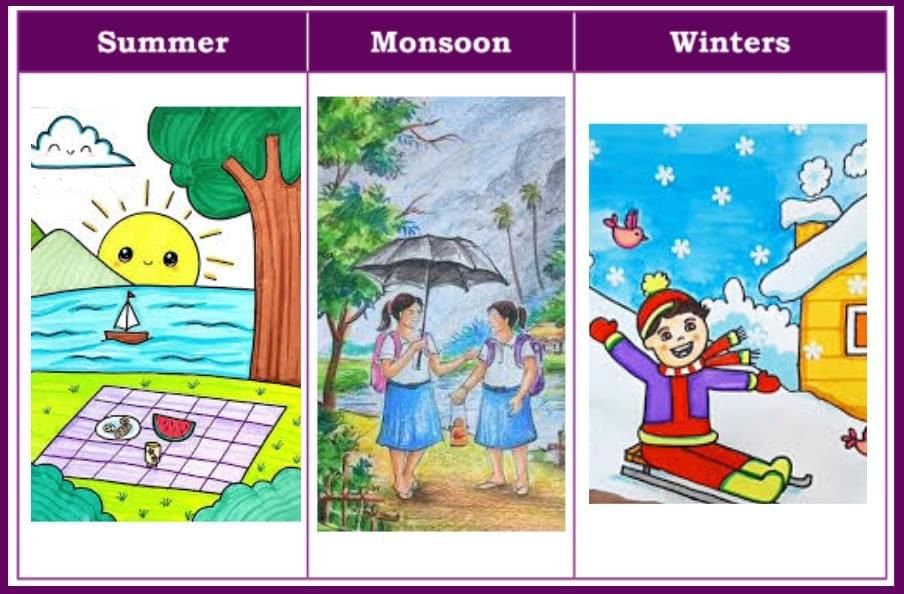
Q. How do you feel when the season changes? Would you like one season to continue all year? Why or why not?
Answer (Sample): All students should write their opinions about how they feel
I feel happy when seasons change because it brings new things like different clothes and foods.
I would not want one season all year because change makes life interesting and helps plants and animals grow properly.
Discuss
Q. Winter in Kerala is different from winter in Kashmir. Monsoon in Assam is different from Rajasthan. Why? Answer:
Kerala is near the equator, so its winters are warm and rainy. Kashmir is in the mountains, so winter is very cold and snowy there.
Assam gets heavy monsoon rains because of its hills and location, but Rajasthan is a desert with very little rain due to its dry climate.
Page No.: 159- 160
Let us reflect
Q1. Narrate your experiences with season changes. Answer (Sample): I notice summer is very hot, so we eat cold foods and wear light clothes; in winter, we wear woollens and eat hot soups.
Q2. Ask family about seasonal changes over the years and write about differences and possible reasons. Answer (Sample): My grandparents say winters were longer when they were young, but now it is shorter, possibly due to climate change or urbanisation.
Q3. Find local names for seasons (Spring, Summer, Monsoon, Autumn, Pre-winter, Winter).
Answer (Sample): Local names I found: Spring: Basant Summer: Grishma Monsoon: Varsha Autumn: Sharad Pre-winter: Hemant Winter: Shishir
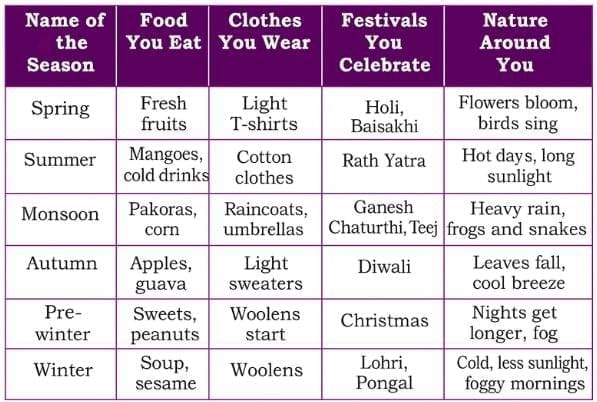
Q4. Fill the table with your observations about food, clothes, festivals, and nature for each season.
Q5. Share your experience of keeping a season’s journal. Answer (Sample): I enjoyed watching how plants and animals changed each month. In summer, butterflies were everywhere, and in monsoon, I saw more frogs and mushrooms in the garden.
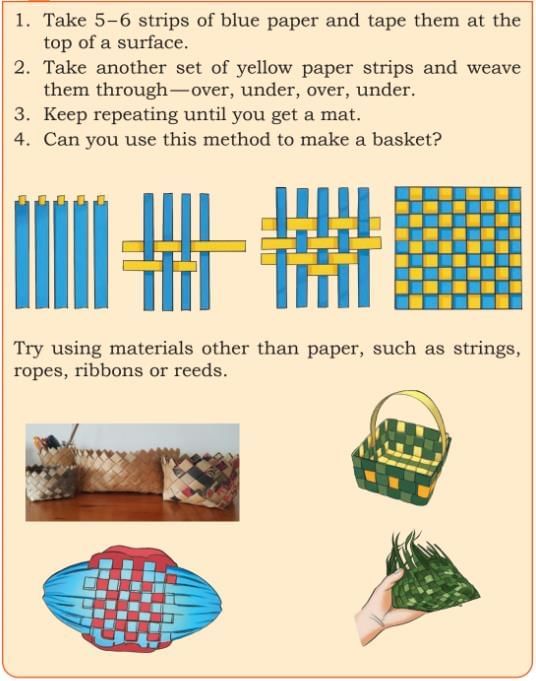
Q. Have you seen products woven out of natural material at home or elsewhere? What are they? Answer: Yes, examples include mats, baskets, sheets made from coconut fibre, palm reeds, bamboo, grass, jute, cotton, or silk.
Activity 1
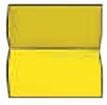
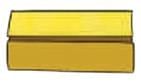
This activity teaches us how to weave by using paper strips. First, I taped 6 blue strips onto my table. Then, I took yellow strips and carefully wove them over and under the blue strips, making a checkered mat. I kept repeating this pattern until my mat was complete.
I learned that weaving means crossing strips over and under each other. This method can be used to make mats, baskets, and many other things. I also saw in the pictures that people use materials like reeds and ribbons to make baskets.
Yes, I tried this weaving activity.
I followed the steps and made a woven mat using blue and yellow paper strips by going over and under each strip, just like in the instructions. It created a checkerboard pattern, and I was surprised how strong the mat felt, even though it was made of paper. After finishing the mat, I realised I could use the same method to make different things, like a simple basket or a decorative piece. It was a fun and creative craft that showed me how weaving can turn plain materials into something useful!
Page No. 134
Think
Q. What can you find in your classroom that is woven? If we weave with threads instead of paper strips, it becomes cloth. Answer: In your classroom, you can find several items that are woven, such as:
Curtains or drapes made of fabric
Your school uniform or the clothes you wear
Bags or backpacks made from fabric
Rugs or mats placed in the room
Pencil cases or cloth pouches
Book covers made from woven cloth
When threads are woven together instead of paper strips, the result is cloth, which is soft, flexible, and used to make many everyday items like clothes, bags, and curtains. This shows how weaving threads creates useful fabrics for daily life!
Activity 2
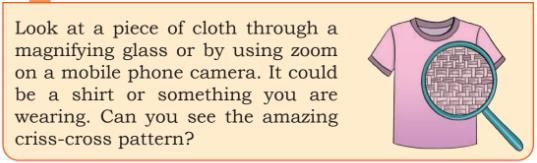
Answer: Yes! When you look closely at a piece of cloth through a magnifying glass or zoom in with a mobile phone camera, you can see the amazing criss-cross pattern formed by threads. This pattern is the result of weaving, where threads are interlaced over and under each other at right angles — some running lengthwise (called the warp) and others running across (called the weft).
This interlacing creates the fabric’s structure, giving it strength and flexibility. You might notice different textures or thicknesses of the threads, and sometimes patterns or colours made by weaving threads of different shades.
This close-up view helps you appreciate how ordinary cloth is made from tiny woven threads working together!
Page No. 136
Activity 3
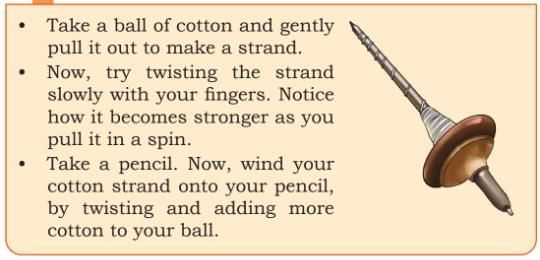
Explanation: 1. Take some cotton and gently pull it so you get a long, thin piece. 2. Twist the cotton strand with your fingers. As you twist, you will see the cotton gets stronger and doesn’t break easily. 3. Wrap the twisted cotton around a pencil, making a small ball. What does this show? When you twist cotton fibres, they stick together and become strong. This is how thread or yarn is made from cotton before it is turned into cloth.
Page No. 138
Activity 4
Page No. 139
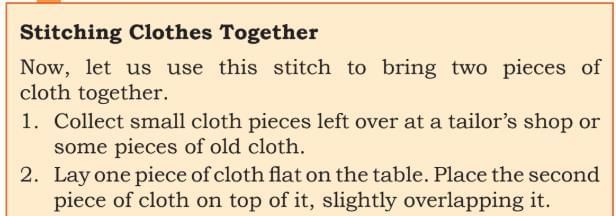
Activity 5
Activity 6
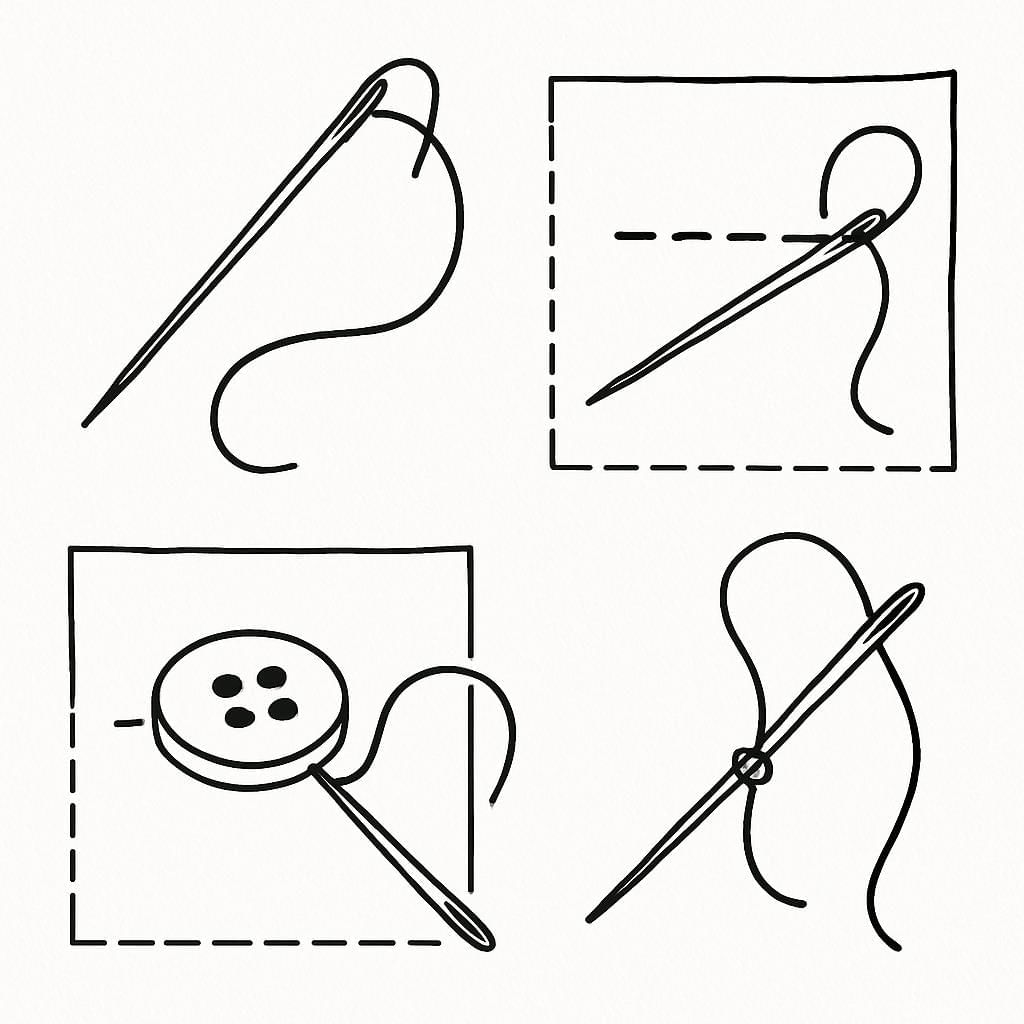
Answer: What is Stitching? Stitching is joining pieces of fabric together by sewing with a needle and thread. It can be used to repair clothes or make new items.
Things You Need:
A needle (a small, sharp tool with a hole called the eye for thread)
Thread (a thin strand of cotton, nylon, or polyester)
A piece of fabric to practice on
A button (if you want to sew one on)
Small scissors to cut the thread
Think
Q. Have you seen someone stitching at home or in your neighbourhood? What were they making or fixing? Answer: My mother is sewing buttons on my kurta (shirt).
Q. Look at your shirt or school bag. Can you find where the pieces have been stitched together? Answer:Yes, pieces are stitched along the edges; seams and hems show stitches.
Page No. 140
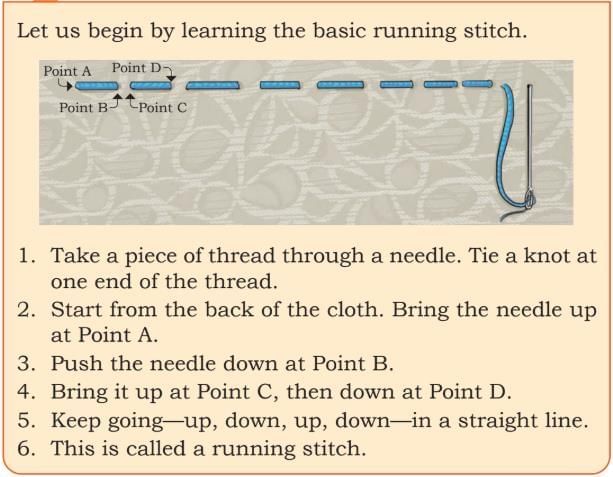
Activity 7
Students are advised to do this under the supervision of parents or teachers.
Page No. 141
Activity 8
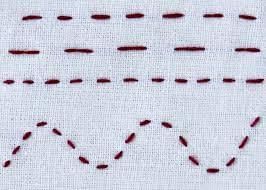
Q. Where else can we use running stitches in daily life? Answer:Running stitches are used daily for simple repairs like fixing small holes in clothes, holding fabric pieces together temporarily, gathering fabric for ruffles, and basic hand embroidery. They are easy, quick, and versatile for both mending and decorative purposes.
Q. If one thread breaks in your stitching, what do you think will happen to the rest? Answer:The stitching may loosen or come apart, showing that every thread is important.
Page 143-144
Let Us Reflect
1. Have you ever reused or recycled an old piece of cloth? What did you or your family make from it? Answer: Yes, old pieces of cloth can be reused or recycled in many ways. For example, families often turn old clothes into cleaning rags, patchwork quilts, cushion covers, bags, or craft items. This helps reduce waste and gives new life to materials that would otherwise be thrown away.
2. If one thread breaks in a stitched cloth or a woven mat, what might happen? Why is each thread important? Answer: If one thread breaks in a stitched cloth or woven mat, the fabric or mat may weaken and could start to come apart at that spot. Each thread is important because all the threads together hold the cloth or mat tightly. When one thread breaks, it reduces the strength and may cause other threads nearby to loosen or break over time.
3. Visit a tailor’s shop or a handloom store with an adult. What tools or machines did you see being used there? Answer: In a tailor’s shop or handloom store, you may see many tools and machines, including:
Sewing machines for stitching clothes quickly and neatly
Scissors and measuring tapes for cutting fabric
Needles and threads used for hand sewing
Handlooms are used to weave fabric by interlacing threads
Ironing or pressing tools to smooth the fabric after sewing
4. Find out what kind of weaving or stitching work is famous in your area or state. Name it. Answer: The famous weaving or stitching work depends on your region. For example, in India, Banarasi silk from Varanasi, Kanjeevaram silk from Tamil Nadu, Phulkari embroidery from Punjab, or Chikankari embroidery from Lucknow are well-known. You can ask locals or visit a handloom store to find out which craft is famous in your area.
5. We should not throw the old clothes away. Why? Answer: We should not throw old clothes away because they can be reused or recycled to make new, useful items, reducing waste. Throwing them away adds to landfill pollution and wastes the resources used to make the fabric. Old clothes can also be donated to help people in need, saving money and protecting the environment.
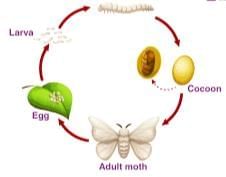
6. Below are the jumbled-up steps of the life cycle of a moth. Read and number them from 1 to 6 in the correct order.
The adult moth comes out of the cocoon.
Eggs hatch into tiny caterpillars.
The silk moth lays eggs.
The cycle begins again.
Caterpillars eat mulberry leaves and grow big.
Caterpillars spin cocoons around themselves.
Answer:
The silk moth lays eggs.
Eggs hatch into tiny caterpillars.
Caterpillars eat mulberry leaves and grow big.
Caterpillars spin cocoons around themselves.
The adult moth comes out of the cocoon.
The cycle begins again.
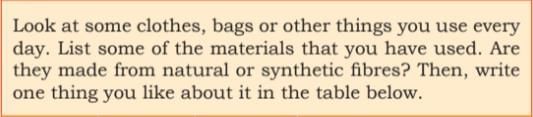
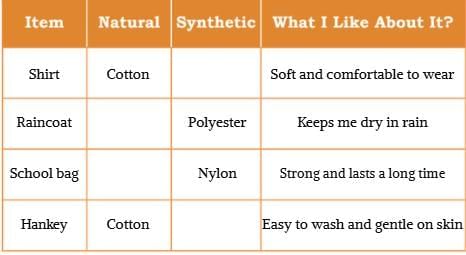
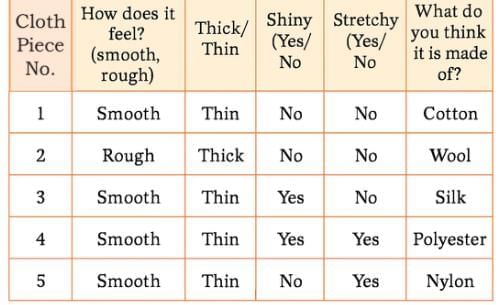
7. Bring 5–6 pieces of different types of clothes from home or nearby tailors (leftover scraps). Observe the material closely and complete the table. Ask an elder or search in your book to find out whether it is made from cotton, wool, silk, jute, polyester or nylon. Answer:
Q. What makes these things move, shine, make a sound or get warm and cold? Answer: Things move, shine, make sounds, or get warm and cold because of energy. Energy is what powers all these actions and changes. It can come from different sources like food for living beings, fuel for machines, electricity for lights and sounds, or heat for warming and cooling. Energy makes everything around us work and change.
Page No. 116
Activity 1
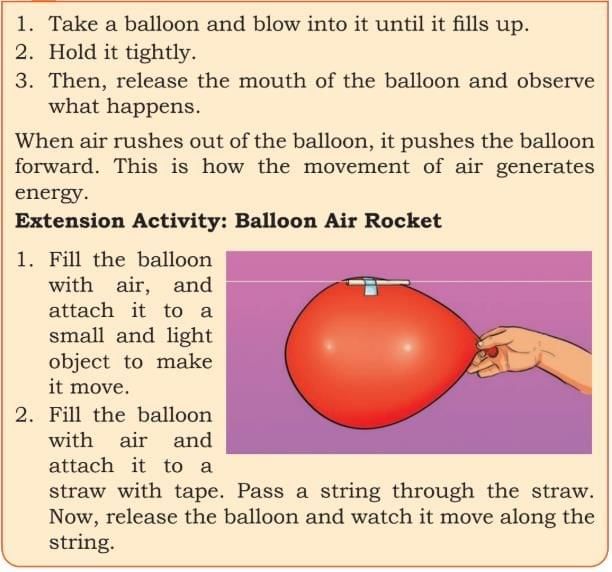
Explanation: When you blow up a balloon and release it, the air rushes out, pushing the balloon forward. This shows that moving air can create energy and cause things to move. The extension activity called the “Balloon Air Rocket” gives ideas to see this effect in another way:
Attach the filled balloon to a small light object to see it move.
Or, attach the balloon to a straw taped to it, thread the straw onto a string, and release the balloon. It will zip along the string, acting like a rocket.
This activity helps you see that air movement can make things move—showing how energy works to push or pull objects.
Think
Q. What would you change in the balloon activity to make the toy move faster or slower?Answer: Blow the balloon bigger and release it with more force for faster movement; use less air or a heavier object for slower.
Page No. 117
Activity 2
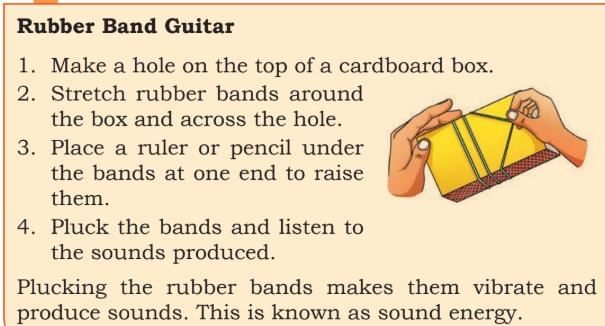
Explanation: This activity shows how to make a rubber band guitar to demonstrate sound energy:
When you pluck the stretched rubber bands, they start to vibrate.
These vibrations travel through the air as sound waves, reaching your ears as sound.
The different thickness and tightness of the bands change the way they vibrate, which changes the sound you hear (high or low notes).
Placing a ruler or pencil under the bands helps them vibrate more freely.
This simple activity helps you see that vibrating objects create sound and that the energy of your plucking is turned into sound energy.
In short, the experiment shows that when rubber bands vibrate, they create sound energy we can hear.
Think
Q. What happens if you use thinner or thicker rubber bands? Do they sound different? Answer: Yes, using thinner or thicker rubber bands will make them sound different when you pluck them. Thinner rubber bands usually make higher-pitched sounds, while thicker rubber bands produce lower-pitched sounds. This is because thinner bands vibrate faster and thicker bands vibrate more slowly, which changes the pitch of the sound you hear. So, by using rubber bands of different thicknesses, you can hear a variety of notes.
Activity 3
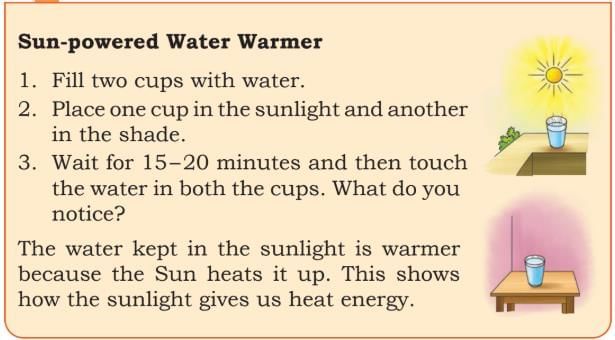
Explanation: Sun-powered Water Warmer This activity shows how sunlight gives us heat energy:
Fill two cups with water.
Place one cup in the sunlight and the other in the shade.
Wait for 15–20 minutes, then touch the water in both cups.
What do you notice? The water kept in the sunlight is warmer because the Sun heats it up. This proves that sunlight gives us heat energy.
Page No. 119
Think
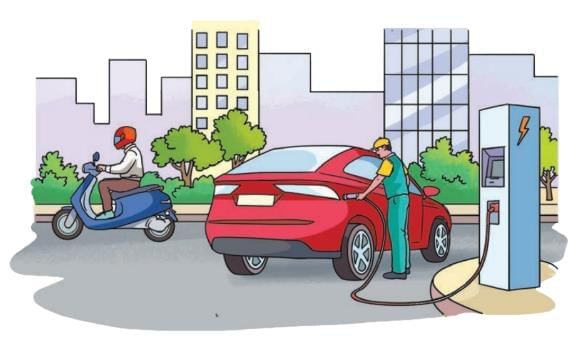
Q. What do cars and scooters need to keep running? Answer: They need fuels such as petrol or diesel.
Write
Q. How is food cooked in your house? Answer: (Can differ according to the students) Food is cooked using LPG gas, electricity, wood, or coal depending on the household.
Page No. 120
Discuss
Q. What kind of fuel do you use at home? Answer: LPG or electric cooking.
Q. What problems arise from using wood or coal? Answer: Problems with wood/coal include smoke, pollution, health issues, and deforestation.
Activity 4
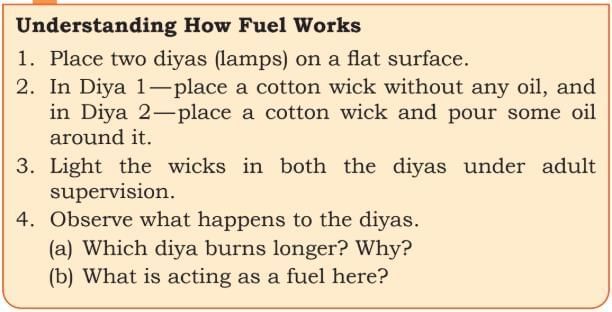
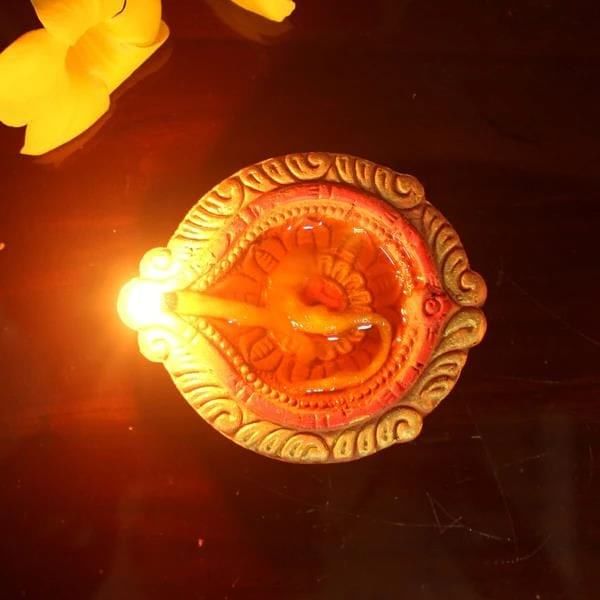
Observation: (a) Which diya burns longer? Why? The diya with the cotton wick and oil (Diya 2) burns longer. This is because the oil acts as a fuel, supplying energy to keep the flame burning. In Diya 1, without oil, the cotton wick burns out quickly as there is no extra fuel to keep it burning.
(b) What is acting as a fuel here? The oil in Diya 2 is acting as the fuel. The cotton wick simply helps in transporting the oil to the flame, but it is the oil that actually burns and keeps the diya alight for a longer time.
Page No.121
Activity 5
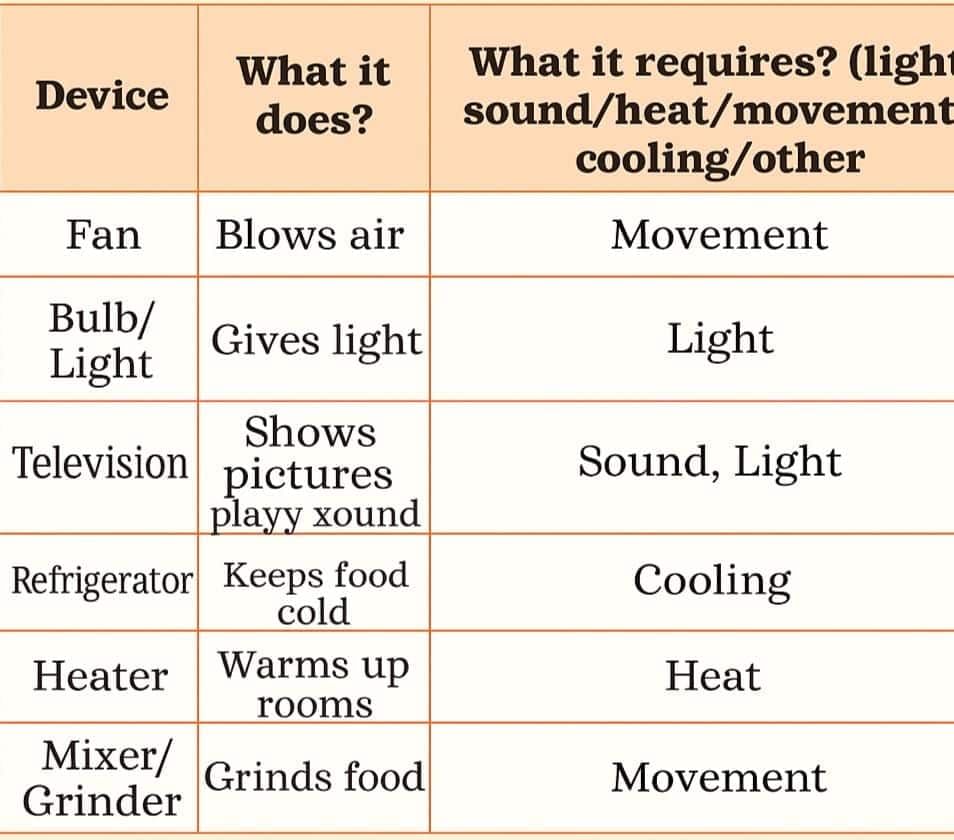
Q. Walk around your home or classroom. Identify five things that run on electricity. Fill in the following table. Students are advised to do this themselves. A sample answer/ findings can be:
Page No. 122
Think
Q. What would your day be like without electricity? Answer: A day without electricity would be very different and challenging.
Without electricity at home or school, everything would be dark once the sun goes down.
Fans and air conditioners would not work, making hot weather feel very uncomfortable.
Devices like televisions, computers, and phones couldn’t be charged or used, which would limit entertainment, communication, and work.
You wouldn’t be able to cook with electric stoves or microwaves, so you might need to use other methods like gas or firewood.
Refrigerators would stop working, leading to the risk of food spoilage.
Daily activities would become slower, and many conveniences we depend on would be gone, highlighting how essential electricity is in our lives.
Page No. 123
Think
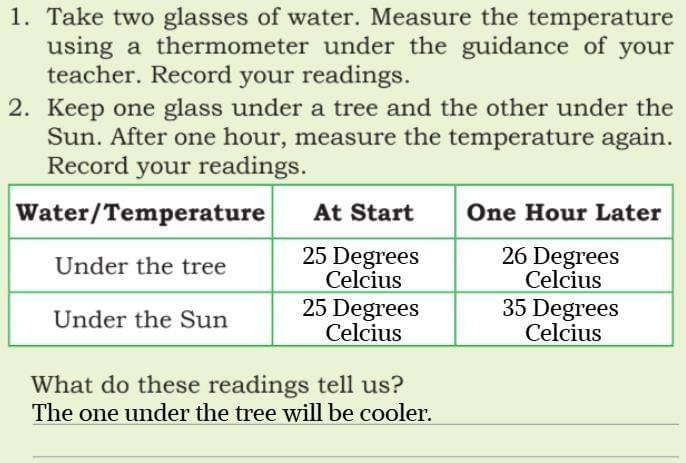
Q. Place one damp cloth in the Sun and another in the shade; which dries first and why?
Answer: The damp cloth placed in the Sun will dry first because the Sun’s heat causes the water in the cloth to evaporate more quickly. In the shade, there is less heat, so the water evaporates slower, making the cloth take longer to dry. Sunlight also helps warm the air around the cloth, speeding up evaporation compared to the cooler, shaded area.Page No. 123-124
Activity 6
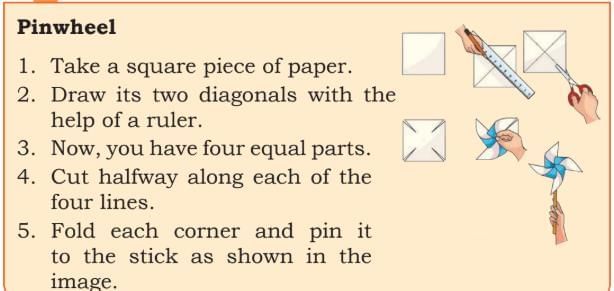
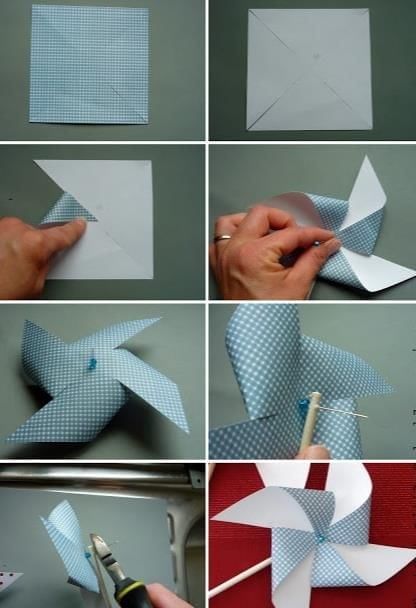
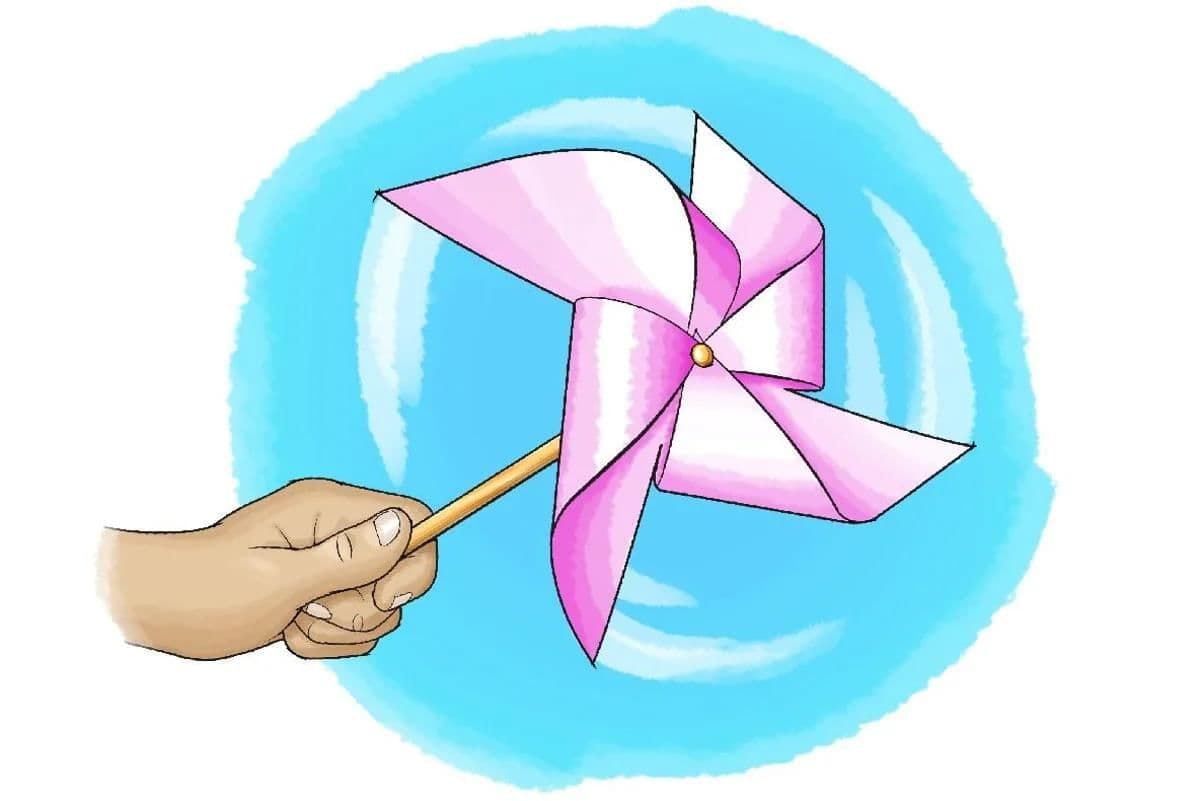
What happens to the pinwheel? When you hold your pinwheel in the wind, or run while holding it, the pinwheel spins quickly. The moving air pushes against the folded parts of the pinwheel, causing it to turn around its pin. This is because wind (or your movement through the air) creates a force that makes the pinwheel spin.
This shows that moving air (wind) has energy and can make objects move. The energy from the wind is used to spin the pinwheel!
Activity 7
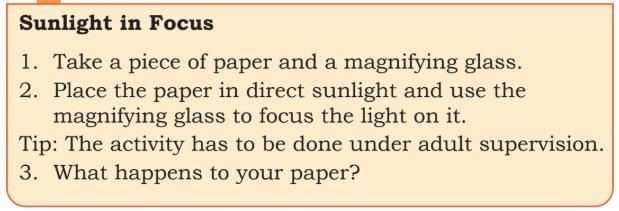
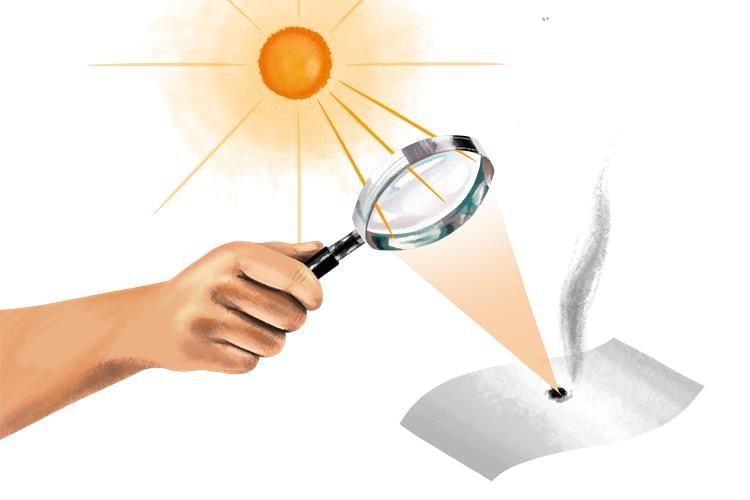
What happens to your paper when you focus sunlight on it with a magnifying glass? When you use the magnifying glass to focus sunlight onto a small spot on the paper, that spot becomes very hot. After some time, the paper at that spot may turn brown, blacken, or even catch fire and start burning.
Why does this happen? The magnifying glass concentrates the sunlight into a tiny area, increasing the amount of heat energy at that point. This extra heat is enough to heat the paper to its burning point. The focused sunlight can make the paper burn or char because the energy from the Sun is concentrated in one small spot! (Remember to always do this experiment safely and with adult supervision.)
Activity 8
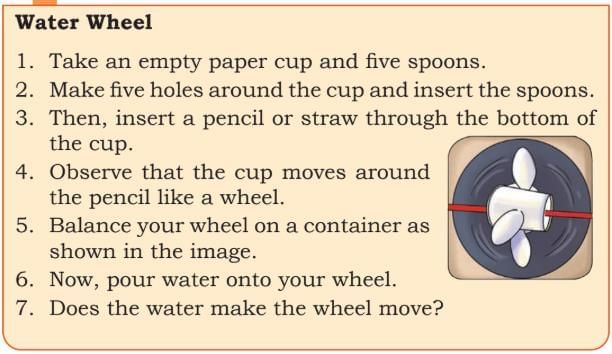
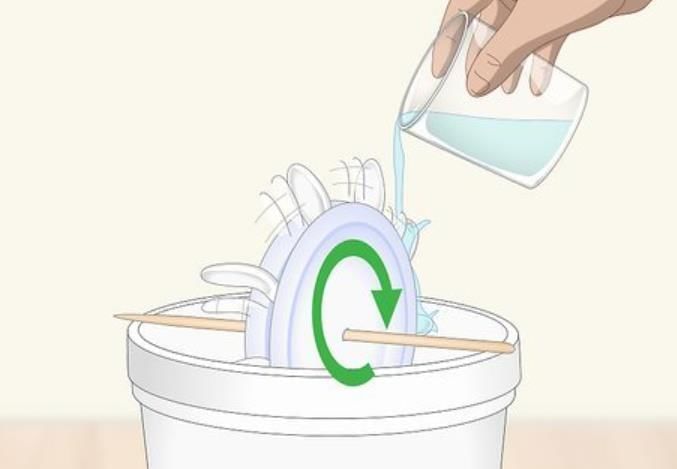
Explanation:When you pour water onto your homemade wheel (paper cup with spoons attached and balanced on a pencil), the water pushes against the spoons. This force causes the wheel to spin around the pencil, just like a water wheel in a mill or a turbine. What does this show?
The moving water has energy.
The energy in water can make things move by pushing and turning the wheel.
Does the water make the wheel move? Yes, pouring water on the wheel makes it spin because water’s energy is transferred to the wheel, causing movement.
Page No. 125
Think
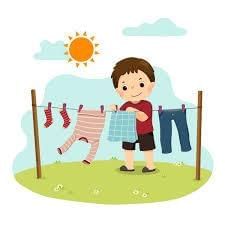
Q. Have you seen papads or clothes drying in the sunlight? Answer: Yes, these use the Sun’s energy to dry.
Write
Q. Can you think of more examples where the Sun, wind, or flowing water are used? Answer: Solar water heaters, sails on boats, water mills for grinding grain.
Page No. 127-128
Write
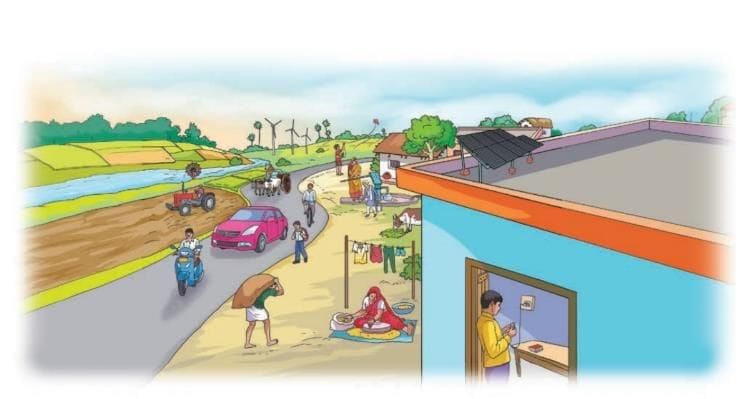
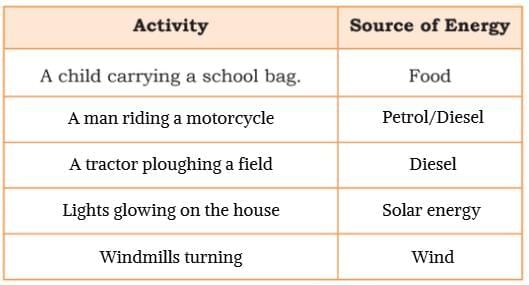
List actions that you see in the picture above and fill in the following table. (Answers may differ as per students’ perspective)
Activity 9
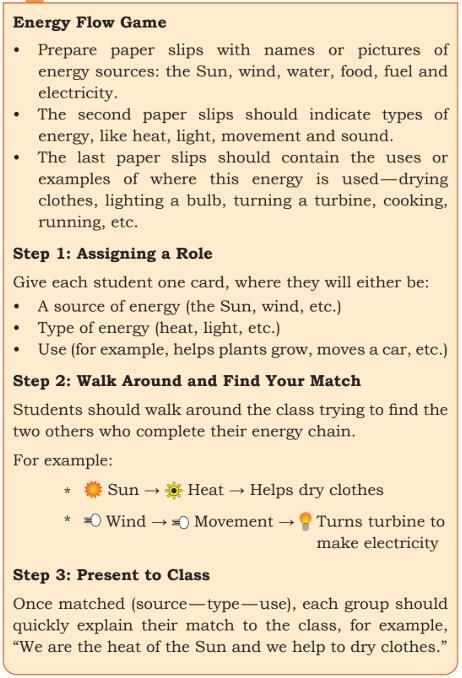
Energy Flow Game: Sample Solutions How the Game Works Students are assigned cards:
Energy source (Sun, wind, battery, food, fuel, electricity)
Type of energy (Heat, movement, light, electricity)
Use of energy (Drying clothes, turning a turbine, powering a torch, running, cooking, lighting a bulb)
Each student finds two others to complete an energy chain (source → type → use).
The group presents a short explanation of their energy chain.
Sample Energy Chains 1. Sun → Heat → Helps dry clothes “We are the heat of the Sun and we help to dry clothes.”
2. Wind → Movement → Turns turbine to make electricity “We are the movement from wind and we help turn turbines to make electricity.”
3. Battery → Electricity → Powers a torch “We are electricity from the battery and we help light up torches.”
4. Food → Movement → Helps a child run “We are movement from the energy in food and we help children run and play.”
5. Fuel → Heat → Used for cooking “We are heat from fuel and we help to cook food.”
6. Electricity → Light → Lights up a bulb “We are light from electricity and we help brighten the room.”
What does this activity show? It helps you understand how energy from different sources changes form and is used in everyday life—for drying, moving things, making sound, and more. This makes learning about energy fun and easy to understand!
Page No. 130
Q1. What will happen if there is no electricity in your house for a day? Answer: If there is no electricity in your house for a day, many things would be affected. You would have no lights when it gets dark, fans and air conditioners wouldn’t work, and electrical devices like televisions, computers, and phones could not be used or charged. Cooking with electric stoves or microwaves would not be possible, and refrigerators would stop cooling, risking food spoilage. Overall, daily activities would slow down and be less convenient.
Q2. Why is it better to use solar or wind energy instead of coal? Answer: It is better to use solar or wind energy instead of coal because solar and wind energy are clean, renewable sources that do not produce harmful pollution or greenhouse gases. Coal, on the other hand, is a fossil fuel that releases carbon dioxide and other pollutants when burned, which harms the environment and contributes to climate change.
Q3. Give two examples where you have seen energy being stored. Answer: Two examples where energy is stored are:
In batteries that store electrical energy to power devices like remote controls and flashlights.
In food, where chemical energy is stored and used by our bodies to do work and stay active.
Q4. What is the one thing you can do at home to save energy? Answer: One thing you can do at home to save energy is to switch off lights, fans, and electrical appliances when they are not in use. This simple habit reduces electricity consumption and helps save energy.
Q5. Find out how many kilometres a vehicle travels per litre of petrol or diesel. Ask about different vehicles. How will you compare them? Answer: The number of kilometres a vehicle travels per litre of petrol or diesel (fuel efficiency) varies by vehicle type. For example, small cars may travel around 15 to 20 km per litre, while larger cars or SUVs may travel about 8 to 12 km per litre. To compare them, you look at the fuel efficiency numbers—the higher the kilometres per litre, the more fuel-efficient the vehicle is, meaning it uses less fuel for the same distance.
Q6. Look around your home or classroom. List any three objects that use energy and mention their source of energy. Answer: Three objects in your home or classroom that use energy and their sources are:
Fan → Electricity
Television → Electricity
Refrigerator → Electricity
Q7. Create and share: (a) Draw or make a simple plan of a ‘clean energy home’ that uses solar, wind or any such source of energy. Answer:
(b) Make ‘my energy diary’ for one day, record the number of times you have used the electricity fuel and so on. Answer:
Q. Look at the map for the southernmost point of India. Answer: Indira Point is the southernmost tip of India.
Q. In which sea are the Andaman and Nicobar Islands located? Answer: They are located in the Bay of Bengal.
Q. Name the other islands you know. Answer: Lakshadweep, Diu, Daman, Majuli (in Assam), Elephanta (near Mumbai).
Page No. 96
Activity 1
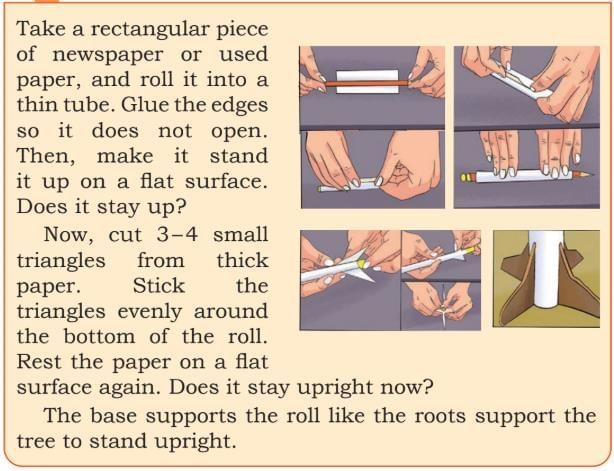
Answer: It shows how support at the base helps an object stand upright — just like roots help a tree stand tall and strong. What the activity teaches:
A simple paper roll (like a tree trunk) can’t stand by itself — it wobbles or falls.
But when you add small triangle “roots” at the bottom (like the roots of a tree), the roll stands firmly.
So, students learn: Roots give support and balance to trees, especially during wind or rain.
Page No. 97-98
Write
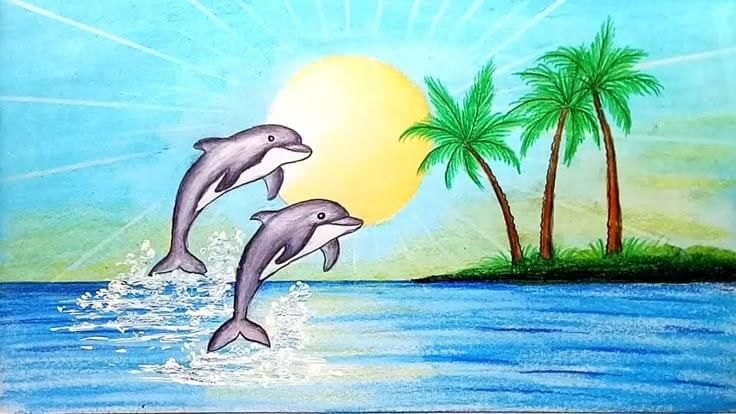
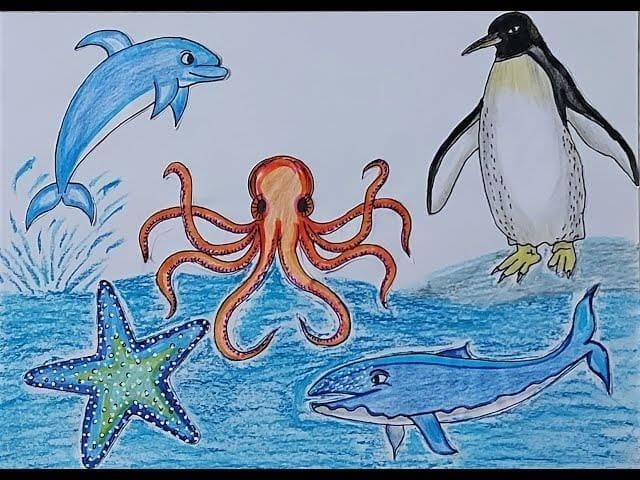
Q. Draw or write about your favourite fish or other sea animal. Answer: Example: My favourite sea animal is the dolphin. Dolphins are friendly, smart, and live in groups called pods.
Q. List at least three living things found in the sea. Answer: Fish, octopus, crab, starfish, sea turtle, jellyfish.
Discuss
Q. Why do you think life under the sea is just as important as life in the forests? Answer: Sea life helps give us oxygen, food, and keeps the water clean. Both are homes for many living things.
Q. How do you think the coral reef helps the fish and other sea creatures? Answer: Coral reefs provide shelter and protection. Many fish find food and hiding places there.
Page No. 99
Write
Q. What do you see in the mangrove forest? List three things that live there. Answer: Mangrove trees, mudskippers, crabs, tigers, crocodiles, birds.
Q. What do you think makes this place different from other forests? Answer: The land is wet, muddy and salty. Trees have special roots that come out of the water.
Page No. 100-101
Write
Q. In what ways do people in Sunderbans depend on the mangrove forests? Answer: People collect honey, wood, fish, and crabs for their needs. The forests protect them from storms.
Discuss
Q. Why do you think it is important to take care of places like the Sundarbans? Answer: Mangroves protect us from storms and floods, provide homes for animals, and give resources to people.
Find out
Q. Look around yourself. Do you see any living thing that has something special to help it live there? What is it? Answer: A cactus has thick skin and long roots to store water and survive in deserts. (Accept any local example, e.g., monkeys have tails to swing from trees.)
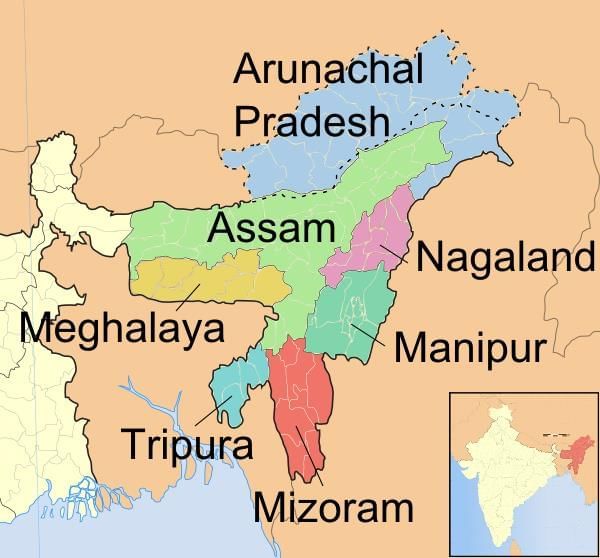
Q. Can you name the seven Northeastern states? Answer: Arunachal Pradesh, Assam, Manipur, Meghalaya, Mizoram, Nagaland, Tripura. (The eighth state included is Sikkim.)
Page No. 102
Write
Q. Look at the picture. Can you spot three things being sold in the market? Answer: Pots, baskets, and clothes.
Q. Can you identify the festival from the above picture? Answer: Common festivals are Bihu and Hornbill festival.
Q. Why do you think the houses are built on bamboo structures? Answer: To keep safe from floods and heavy rain.
Q. What animals can you see in the picture? Answer: Elephant and a Hornbill
Q. What does this picture tell you about the people who live with nature in the Northeast of India? Answer: They use natural materials, live close to forests, and celebrate with dances and crafts.
Page No. 104
Discuss
Q. In small groups, choose an animal or bird near you that needs protection. What can you do to help? Create a protection plan and share it with the class. Answer: Protect sparrows in my area: – By putting water and food in small pots for them – Do not disturb their nests.
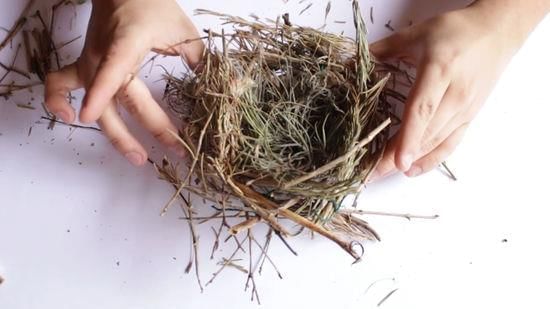
Activity 2
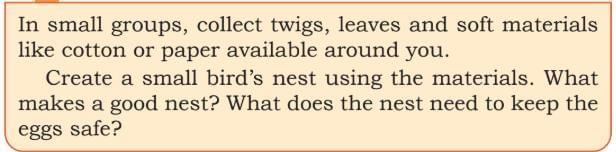
Answer: A good nest is soft inside, strong outside, and safe from rain/wind. It protects eggs and baby birds.
Page No. 105-106
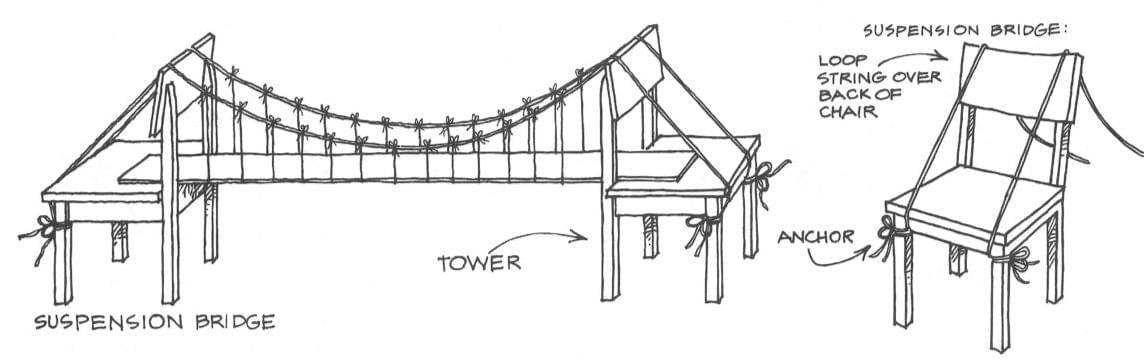
Activity 3
Answer: Yes, by tying a strong string tightly between the chairs, making sure it doesn’t sag. The toy will move if the string is strong and well-tied.
Write
Q. Look at the map, locate the Western Ghats and name the six states it passes through. Answer: Gujarat, Maharashtra, Goa, Karnataka, Kerala, Tamil Nadu.
Q. What animals can you spot in the forest? Answer: Lion-tailed macaque, tigers, elephants, deer, Malabar parakeet.
Q. What are the people doing in the picture given below? Answer: Observing/studying nature, taking notes, or collecting fruits (varies by illustration).
Q. Why do you think forts were built on hilltops instead of flat land? Answer: For better defence and to spot enemies from far away.
Q. Give the names of three rivers that start from the Western Ghats. Answer: Godavari, Krishna, Kaveri.
Page No. 107
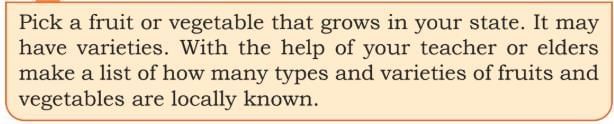
Activity 4
Answer: Example: Mango—Alphonso, Langda, Kesar, Dasheri (answers will depend on local area).
Page No. 109
Write
Q. List three protected areas in the Western Ghats. Answer: Silent Valley National Park, Periyar Wildlife Sanctuary, Bandipur National Park.
Let us reflect
Q1. What surprised you the most about the places visited in this journey across India? Why? Answer: I was surprised by how different and special each place is. For example, the Sundarbans have trees with roots growing out of water, and the Northeast has living root bridges made by growing tree roots. I also found it interesting that some animals and birds live only in these places. It shows how amazing and unique nature is in different parts of India.
Q2. Which place would you like to visit the most, and what would you do there? Answer: I would like to visit the Andaman and Nicobar Islands. I want to see the coral reefs and the special birds like the Andaman hornbill. I would also like to learn more about sea life at the Marine Interpretation Centre.
Q3. How is your region similar to or different from one of the places in the story? Answer: My region is different from the Sundarbans because we don’t have mangrove forests or salty water. But like in the Northeast, people here respect nature and celebrate festivals that are connected to plants and animals around us.
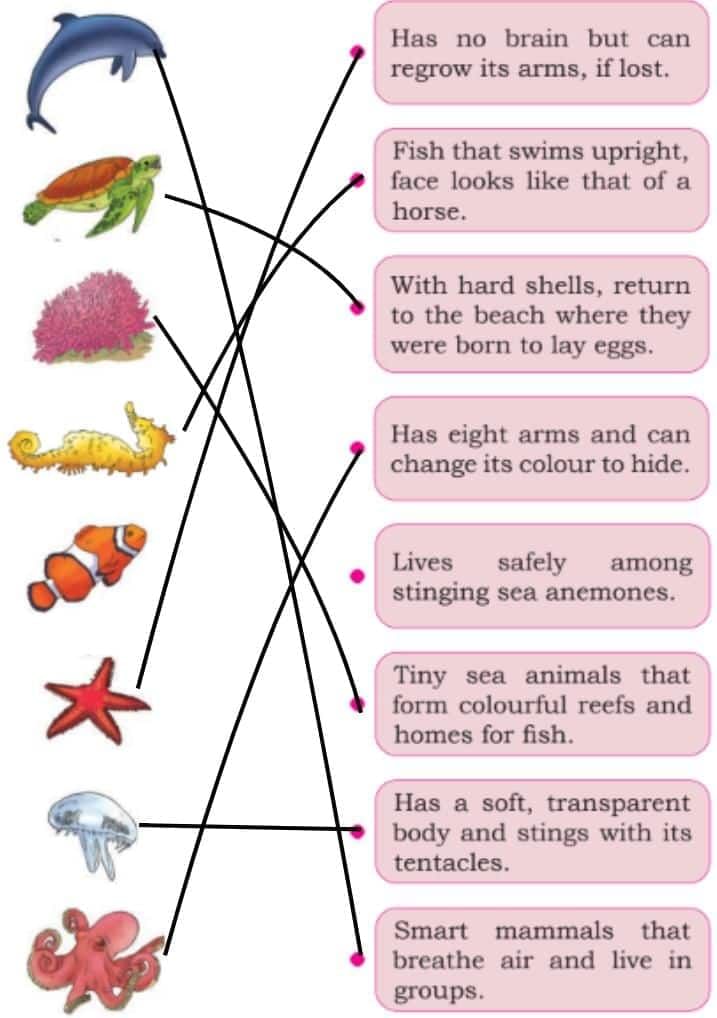
Q4. Match the following aquatic animals with their features:
Q5. What is special about mangroves? Answer: Mangroves grow in muddy and salty water. Their special roots grow out of the water to help them breathe. The roots also hold the soil together and protect the land from being washed away by waves. Mangroves are homes for many animals and help protect people from storms.
Q6. How do people in different regions live in harmony with nature? Answer: People depend on nature in different ways, like living near forests, rivers, and seas. They protect animals like the Hargila bird in the Northeast, use plants for medicine in the Western Ghats, and wear masks in the Sundarbans to stay safe from tigers. They celebrate festivals and take care of the forest and wildlife.
Q7. Make a collage by pasting pictures depicting vibrant India. Answer:
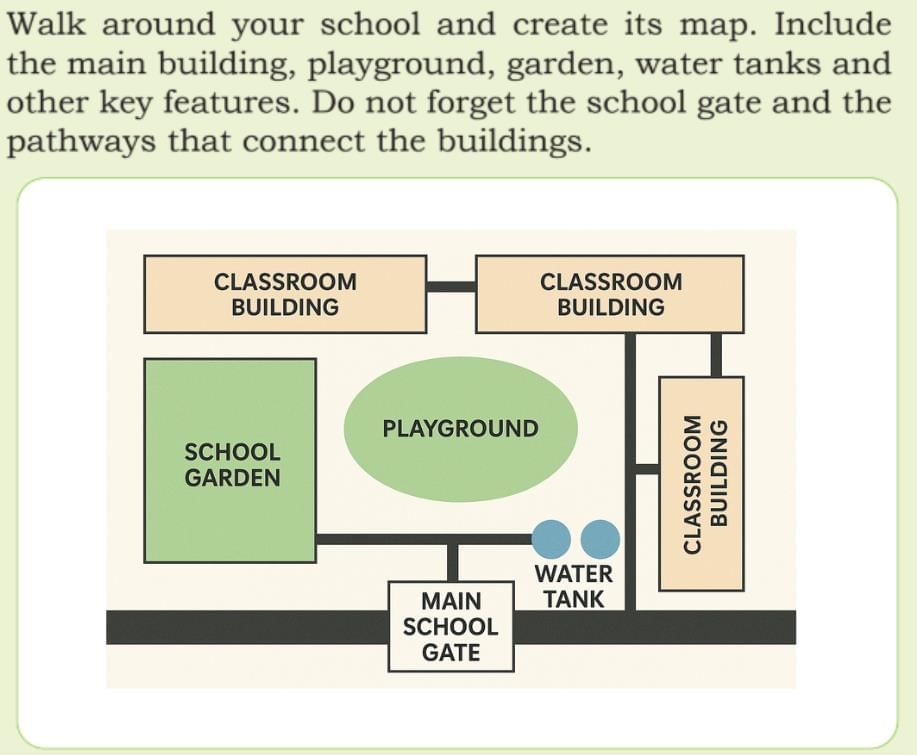
Q1. What do I really like about my school? Answer: I like that my school is clean, has friendly teachers and kind students. I enjoy playing in the playground and learning new things every day.
Q2. How can I make my school greener? Answer: I can plant more trees and flowers, use water carefully, not waste electricity, keep the classroom clean, and encourage others to use dustbins. I can also care for the plants in the school garden.
Q3. In case there is any difficulty at school, to whom do I talk or inform? Answer: I can tell my class teacher, principal, or any school staff member I trust about my problem or difficulty.
Page No. 59
Write
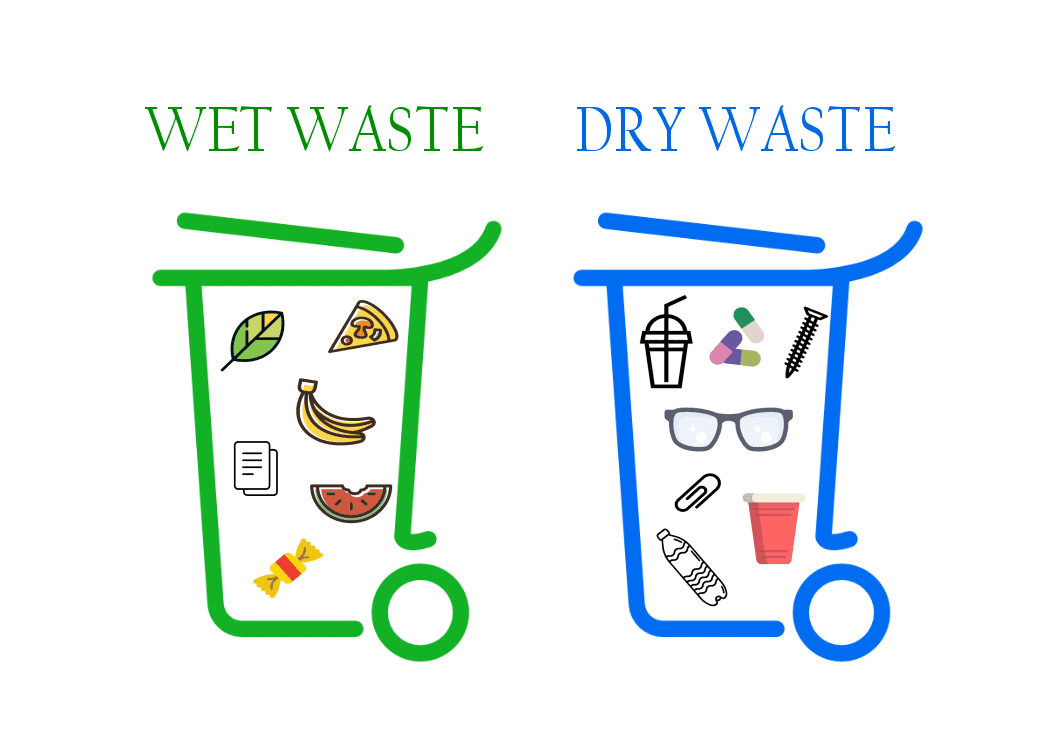
Q. Can you name the colour of the bin used for the following? Answer: Dry waste: Blue bin Wet waste: Green bin
Page No. 60
Write
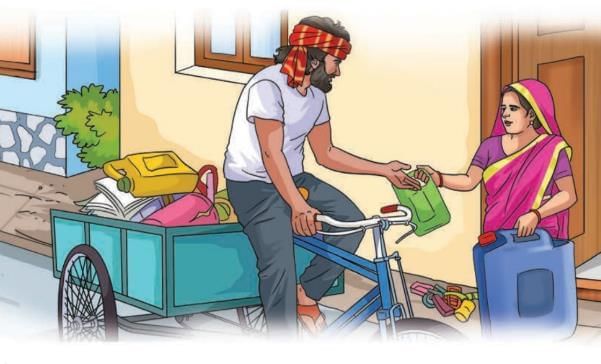
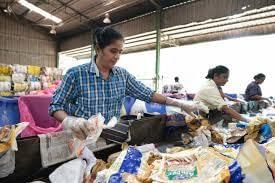
Q1. What things does your school give to recyclers? Answer: Old newspapers, notebooks, paper, plastic bottles, metal cans, and sometimes old equipment or broken furniture.
Q2. Ask your parents and find out if there are any items that they have set aside to give to the recyclers. What are they? Answer: My parents keep old newspapers, glass bottles, cardboard boxes, plastic containers, and metal cans to give to the recycler/kabadiwala.
Find out
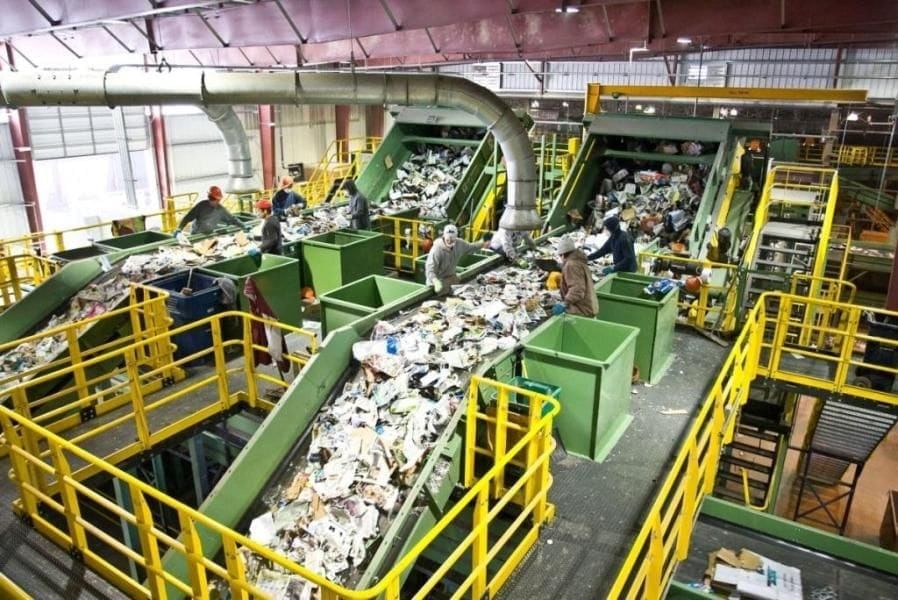
Q. With the help of your teacher, ask a recycler to visit your class and share what they do at work. It will be interesting to find out where these items go and how they can be reused or recycled. Answer: If a recycler visits, ask them questions like:
What kind of materials do you collect?
Where do you take these items after collecting them?
How are these things recycled or reused? You will learn that waste like paper and metal can go to factories to be made into new products.
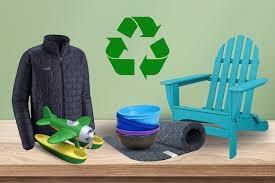
As a recycler, here’s how I handle materials and recycling: Materials collected: I collect various waste materials such as paper, plastic, glass, metal, and sometimes electronic waste. These are common items people throw away, but can be recycled.Where items go: After collection, these materials are taken to recycling centres or facilities. At these centres, the items are sorted, cleaned, and prepared for processing.How recycling/reuse happens:
Paper is pulped and made into new paper products like notebooks and packaging.
Plastic is melted and reshaped to create new containers, bottles, or packaging materials.
Glass is crushed and melted to form new glass bottles or jars.
Metal is melted and recast into new cans, tools, or parts.
Electronic waste is carefully dismantled to recover valuable parts and materials for reuse or proper disposal.
Page No. 61
Activity 2
Segregation Game
How is wet waste managed? 1. In your school 2. In your home
Page No. 62
Discuss Q1. What happens if we do not separate our waste? Answer: If we do not separate waste, it all gets mixed up and is harder to recycle, making the environment dirty. Harmful things can pollute the soil and water, and sanitation workers may face health risks.
Q2. What can we do to make the work of sanitation workers easier and safer? Answer: We must always put waste in the correct bin, avoid throwing sharp or harmful objects with regular waste, and respect and thank the workers for their work. Invite them to share their experience, and learn how to help make their jobs safer.
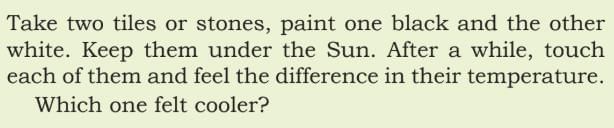
Activity 3
Answer: Paint one stone black and another white. Keep both in the Sun. After some time, touch them. The white stone will feel cooler because it reflects sunlight. The black stone absorbs more heat and feels hotter.
Page No. 63
Write
Q. If you have to paint the roof of your school or home white, what would happen? Answer: The rooms inside would stay cooler in summer because white reflects sunlight and keeps heat out.
Discuss
Q. If your area is getting warmer, what actions can be taken to keep it cool? Answer: Plant more trees and bushes, paint roofs and walls white, use curtains on windows, save water, and encourage everyone to use less electricity by switching off fans and lights when not needed.
Page No. 64
Activity 4
Discuss
Q1. What are some easy things we can do in our school to prevent the wastage of water? Answer: Fix leaking taps, close taps tightly after use, use buckets instead of hoses for cleaning, and tell a teacher if you see water being wasted.
Q2. How can you collect and use rainwater at home or in school? Answer: Place containers under the roof to collect rainwater. This water can be used for gardening or washing. Schools can install rainwater harvesting systems to collect and store rainwater for various uses.
Page No. 65
Write
Q1. Name the trees on your campus or near your school. Answer: Example: Neem, Peepal, Banyan, Mango, Ashoka, Gulmohar, etc.
Q2. Which birds and insects have you seen near the plants or trees on your school campus? Answer: Sparrows, crows, maina, pigeons, butterflies, honeybees, ladybugs, etc.
Page No. 66
Activity 5
Answer: Trees and Plants That Attract Birds and Butterflies With the guidance of our teacher, we identified several trees and plants that are known to attract birds and butterflies.
Plants that attract butterflies Some flowering plants that attract butterflies include Milkweed, Lantana, Marigold, Zinnia, Butterfly Bush (Buddleia), and Sunflower. These plants are rich in nectar and are bright in colour, which helps in drawing butterflies to the garden.
Trees and shrubs that attract birds Birds are attracted to trees that provide food, shelter, and nesting areas. Neem, Peepal, Guava, Indian Coral Tree (Erythrina), Jamun, and Amaltas are some of the trees that attract various species of birds.
Steps to Create a Butterfly Garden in the School
We plan to choose a sunny, open area in the school where we will plant a mix of nectar-rich flowers and native trees.
Some shaded spaces will be included by planting trees along the edges.
Small water trays will be placed for butterflies to drink water.
Fruit or grain trays may also be placed occasionally to attract birds.
We will ensure the garden remains pesticide-free to keep it safe for insects and birds.
Plant name tags will be added to help students identify and learn about them.
Page No. 67
Write
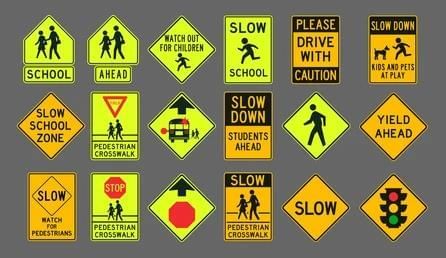
Q1. Find out and write at least three traffic rules.
Stop at red traffic lights.
Always walk on the footpath or the left side of the road.
Do not run or play on the road.
Q2. Think and write about what you saw at the school gate.
I saw many students with their parents, some traffic, and a guard helping children cross safely.
Some cars stopped, but a few did not pay attention to slow down near the school gate.
Now, work in teams to design a signboard for the school gate. Students can take reference from the following:
Page No. 68-69
Discuss
Q. Besides making signboards, what else can we do to improve traffic near the school? Answer: Place speed breakers, have a guard or teacher on duty, educate parents to park properly, have clear road markings, and inform local authorities if needed.
Write
Q1. Where is the fire extinguisher kept in your school? Answer: Near the main entrance or on each floor, sometimes near the staircase or laboratory.
Q2. In case of a fire, where is the assembly point in your school? Answer: Usually in the playground or open field, marked as “Assembly Point.” Ask your teacher for your school’s exact spot.
Q3. What should you do if there is a fire or if you smell smoke? Answer: Do not panic. Quickly walk out by the nearest exit, crawl under the smoke, do not hide, and gather at the assembly point. Inform adults about missing friends or teachers.
Page No. 70
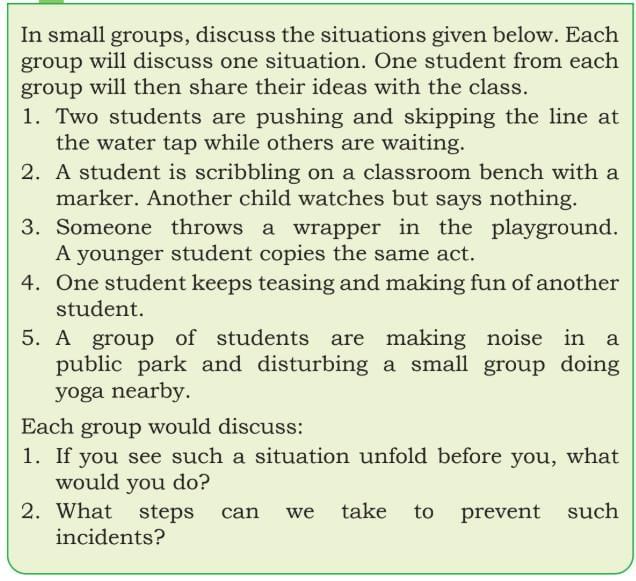
Activity 6
Answer: In groups, act out or discuss: 1. Two students are skipping the line at the water tap. Solution: Politely remind them to wait, and arrange for everyone to take turns.
2. A student scribbles on a bench. Solution: Remind them to keep the class clean and offer to help clean it up.
3. Someone throws a wrapper. Solution: Pick it up and use the dustbin. Teach younger children by example.
4. One student is teasing another. Solution: Stand up for the child being teased and tell a teacher.
5. A group making noise in the park. Solution: Request them to keep quiet so others can do yoga or relax.
Page No. 71-72
Let us reflect
1. Out of all the classrooms in your school, which one do you think is the nicest and why? Answer: I think the science classroom is the nicest in my school.
It has large windows that allow a lot of sunlight to come in, making the room feel bright and cheerful.
The walls are decorated with beautiful charts and models about nature, animals, and plants, which make learning more interesting.
There are plants in the classroom, and sometimes students bring in flowers to add to the decoration.
The teacher keeps the classroom clean, and all the cupboards are neatly organised with science kits.
The atmosphere in the class feels calm, and the teacher encourages us to ask questions and try out experiments.
This environment makes me feel happy and curious to learn new things every day.
2. Create a happiness tree: On a wall or chart paper, draw a large tree with many branches. Each student adds a leaf with one small action written on it that makes the school a happier place (like greeting someone, turning off lights, sharing space, etc.). Answer: Steps to create a happiness tree:
I would start by drawing a large tree with many branches on the wall of our classroom.
Each student will cut out a green paper leaf and write one kind action on it.
For instance, my leaf might say, “I always help a friend find their lost things.”
Other students could write things like: “I greet everyone with a smile,” “I remind others to switch off lights.” “I share my snacks during break.”
We will attach all the leaves to the tree until it looks full and beautiful.
Every time someone does something nice, they can add a new leaf to the tree.
This happiness tree will remind us that even small actions, like giving a compliment, keeping our space clean, or including everyone in games, make our school a happy place.
3. Sharing your feelings is exciting. Write a letter to your teacher on ‘My School—My Happy Place’. Answer: My letter: Dear Teacher,
I am very happy to write to you about why my school is my happy place. My school is not just a building; it is a place where I feel safe and loved. I enjoy meeting my friends every day and learning something new in every class. My school has a big playground where we play different games, and there are many green trees and bright flowers around the campus. Teachers here are always kind and help me when I do not understand something.
I like how our school works hard to keep everything clean and green, and how everyone cares about saving water and electricity. Our classroom projects and activities help me feel like I can make a difference. Coming to school gives me joy and confidence, and I look forward to each day here. Thank you for making my school a place where I feel happy and proud.
Your student, [Your Name]
4. Which actions from the chapter would you extend to your home, neighbourhood, and community to make them happy places for all? Describe any one of these actions in detail. Answer: From the chapter, I would like to extend the action of “waste management” to my home and neighbourhood.
At home, I can make sure to sort my waste into dry and wet categories, just like we do at school.
I can use two dustbins: one for food and kitchen waste, and another for paper, plastic, and other dry items.
I would also encourage my family to collect newspapers and bottles separately.
This way, we can give them to recyclers for proper recycling.
In my neighbourhood, I can speak with my friends and neighbours about the importance of not littering and keeping our surroundings clean.
If we notice any trash, we should pick it up and place it in the right bins.
Occasionally, I can organise small clean-up drives with my friends in the park or around our homes.
Taking such actions will help make our community clean, green, and healthy.
Additionally, our efforts can motivate others to join in and help as well.
5. Imagine a day in school from someone else’s perspective. Choose one:
A student using a wheelchair.
A student who speaks a different mother tongue.
A sanitation worker at school. Write a diary entry from their point of view. What did they feel? What was easy or hard? What made them smile or worry?
Answer: Diary Entry – From a sanitation worker’s perspective:
Dear Diary,
Today was just like any other busy day at school. I arrived early to clean the classrooms and sweep the corridors before the students came. Some areas were messy, especially the playground after lunch, but most children in this school are neat and say “thank you” when I clean their classroom. That makes me smile and feel respected.
The hardest part is when some students throw wrappers on the ground even when dustbins are close by, or when people forget to thank me for my hard work. Carrying heavy trash bags and cleaning the washrooms is also tiring. But I enjoy seeing the school look bright and children playing safely.
The best part of my day was when a group of children greeted me, and one girl helped me carry a waste bag outside. I felt proud when the principal praised my hard work in front of everyone.
I just wish everyone remembered that keeping the school clean is everyone’s job—not just mine.
6. If you were the principal for a day, what three changes would you make to make your school happier, safer, and greener? Answer: If I were the principal for a day:
I would plant more trees and create a “Butterfly Garden” on campus with help from students and teachers. This would make school greener and give everyone a peaceful place to relax.
I would organise weekly “Happiness Hours,” where students could sing, play, share stories, or just talk about their feelings. This would help everyone feel included and happy.
I would put more dustbins all around the campus and start a “Switch Off” campaign for students to check lights and fans before leaving any room, saving electricity and keeping our school safe from fire risks.
These changes would bring students, teachers, and staff together and help everyone care more for the school.
7. In groups of 4–5, act out these scenes: – A student showing kindness in a difficult situation. – A team is solving a school water wastage problem. – A student helping a shy classmate feel included. After each role-play, ask: What did you see? What inspired you? Could this happen in real life? Answer: After acting out all three scenes, I feel inspired by the kindness and teamwork shown.
For example, in the first scene, a student stood up for another who was being bullied and invited them to join a group project.
In the second, a team realised a tap was leaking in school.
Instead of ignoring it, they told a teacher, and together they fixed the problem, saving water.
In the last scene, a new, shy classmate was included in a game, which made them smile and feel welcome.
These stories helped me understand that small, caring actions can create a big impact.
Each role-play felt real to me because I have witnessed or gone through similar experiences.
Yes, acts of kindness and working together can—and should—occur in real life.
I feel motivated to be that helpful person whenever I have the opportunity.
8. Write a one-minute speech for your morning assembly on ‘My Dream School.’ Mention what makes it special, who helps keep it that way, and what every student can do. Answer: Good morning everyone,
Today I want to share my thoughts about “My Dream School.”
My dream school is a place where every child feels safe, joyful, and respected. It has clean classrooms, green gardens, and bright, welcoming teachers and staff. In my dream school, we all take care of our playground and plant trees every year. We save water and electricity, and we never litter our campus.
What makes my dream school special is that everyone helps one another. Teachers encourage us, friends support each other, and sanitation workers are always thanked for their hard work. Students are honest, helpful, and always greet others with a smile. Each of us, whether big or small, does our part to follow rules, care for plants, and keep the school clean. Together, we make our school the happiest place to learn and grow. Thank you!
9. Take a quick survey: Ask five students and one teacher: (a) What is the one thing that makes them feel happy in school? (b) What is one thing that could be improved? (c) What is one kind thing they saw today? Present your findings to the class. What did you learn from others? Answer: Survey Results: (a) One thing that makes them feel happy in school:
All five students said that playing on the playground and spending time with friends made them happy.
The teacher mentioned that helping students learn new things was the happiest part of the day.
(b) One thing that could be improved
Most students felt that there should be more storybooks in the library and more shade trees outside.
The teacher wished there could be more dustbins placed around the school.
(c) A kind thing noticed today:
A girl shared her lunch with a new student.
A boy helped a younger child who had fallen.
Someone picked up litter without being asked.
A friend helped another finish their homework.
A teacher praised a student for being polite.
What I learned: Everyone values kindness and a clean, welcoming environment. Sometimes, even small improvements—like more trees, dustbins, and books—can make a big difference. Most of all, kindness is noticed and remembered by all, making the school a better place for everyone.
Q1. What special events or activities take place at your school on the occasion of Republic Day? Answer: On Republic Day, our school organises flag hoisting, singing of the National Anthem, cultural programs, and sometimes a parade or dance performances.
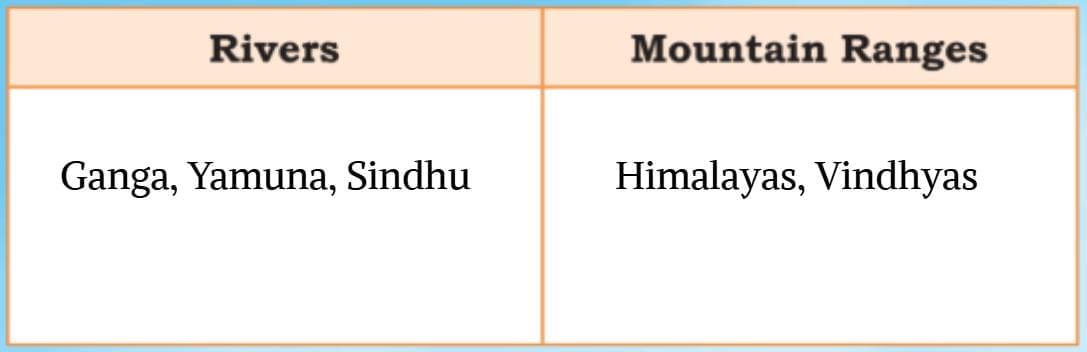
Q2. Can you name some rivers and mountain ranges mentioned in the National Anthem?
Q3. On Republic Day, which activities would you like to participate in? Answer: I would like to participate in singing the National Anthem, take part in cultural programs, and watch the parade.
Q4. Have you ever watched the Republic Day parade in Delhi on television? What did you like the most about it? Answer: Yes, I have watched the parade. I liked the colourful tableaux from different states and the fighter jets flying in the sky the most.
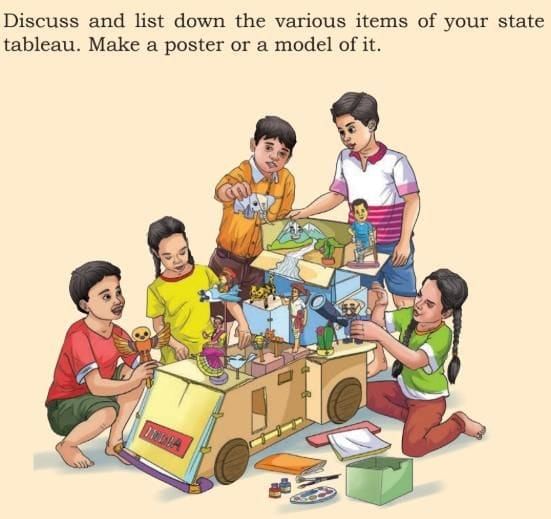
Activity 1
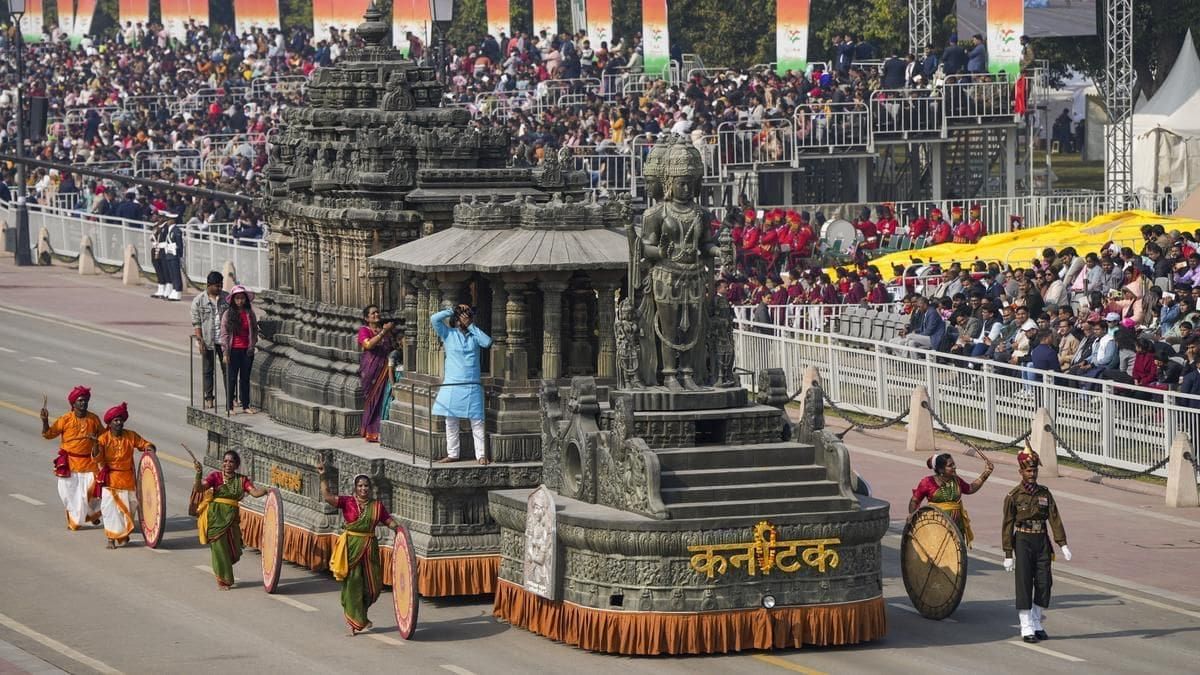
Answer: Karnataka Tableau – Republic Day 2025
Theme: “Lakkundi – The Cradle of Stone Craft”
Focus: Showcased the architectural brilliance of Lakkundi, a historic town in Gadag district
Front Display: Statue of Chaturmukha Brahma from Brahma Jinalaya, Karnataka’s oldest Jain temple
Main Structures: Replicas of
Kashi Vishweshwara Temple
Nanneshwara Temple
Purpose: Highlight Karnataka’s ancient stone carving traditions and religious harmony
National Theme 2025: Swarnim Bharat – Virasat aur Vikas (Golden India – Heritage and Development)
Important Clarification: The Viral image showing Tipu Sultan was from 2014, not 2025
Page No. 79
Write
Q1. What events take place at your school on Independence Day? Answer: On Independence Day, we hoist the flag, sing patriotic songs, remember freedom fighters, and enjoy cultural programs.
Activity 2
Q. Write down five rules that are followed at your school. If you were to make one new rule, what would it be? Answer: Rules followed by my school:
Be punctual.
Wear a school uniform.
Keep the school clean.
Respect teachers and classmates.
No bullying. New Rule: Everyone must help in planting trees around the school.
Page No. 80
Activity3
Page 82
Activity 4
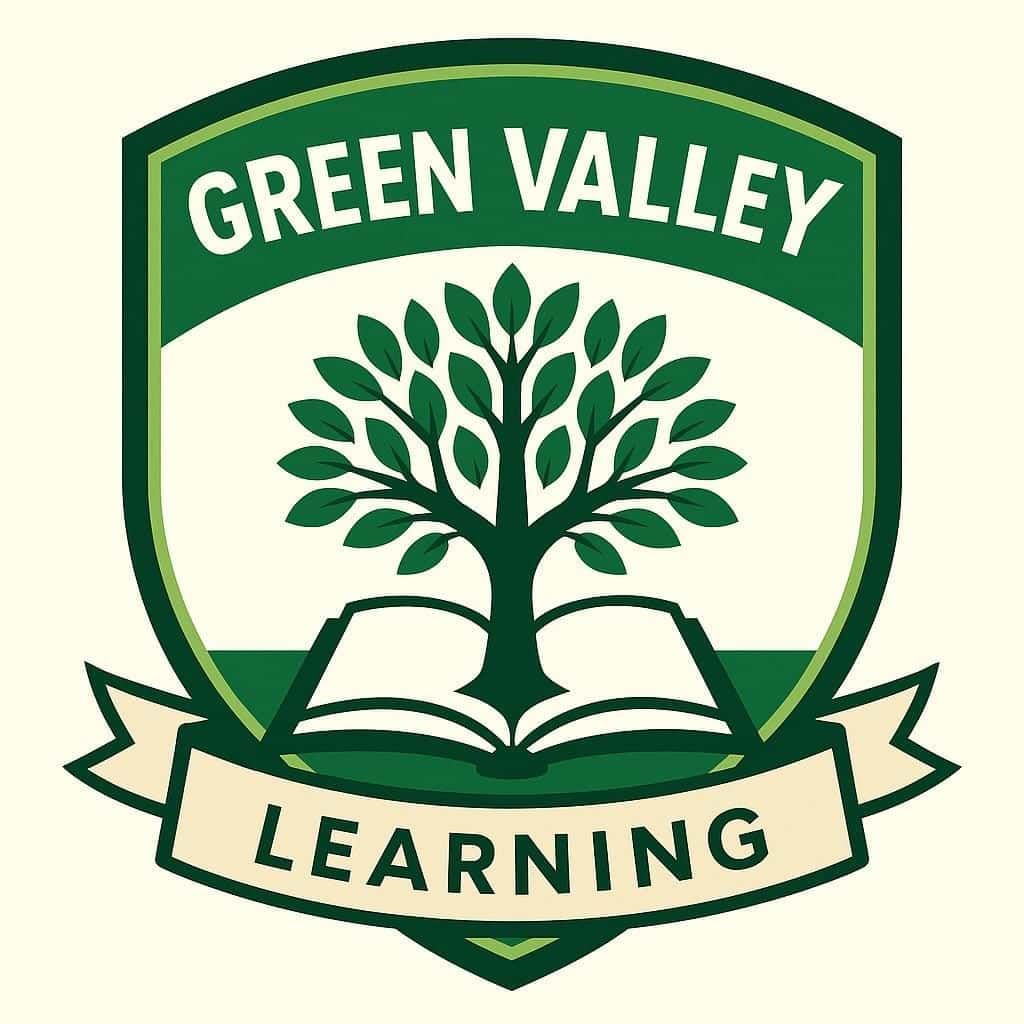
The school emblem of Green Valley Learning likely holds important meanings related to education and growth.
The tree with vibrant green leaves symbolises growth, nature, and vitality, suggesting a caring environment for learning.
The open book placed under the tree represents knowledge, education, and the quest for wisdom.
The green colour used in the emblem emphasises ideas of renewal, harmony, and environmental awareness.
The name Green Valley, along with Learning on the ribbon, suggests a complete approach to education.
This combination may highlight a connection to nature or a valley setting, promoting a supportive and enriching learning community.
Page No. 83
Write:
Discuss
Q. If you were to choose a national fruit, which would it be and why? Answer: Mango, because it is sweet, popular, and grown in many parts of India.
Find out
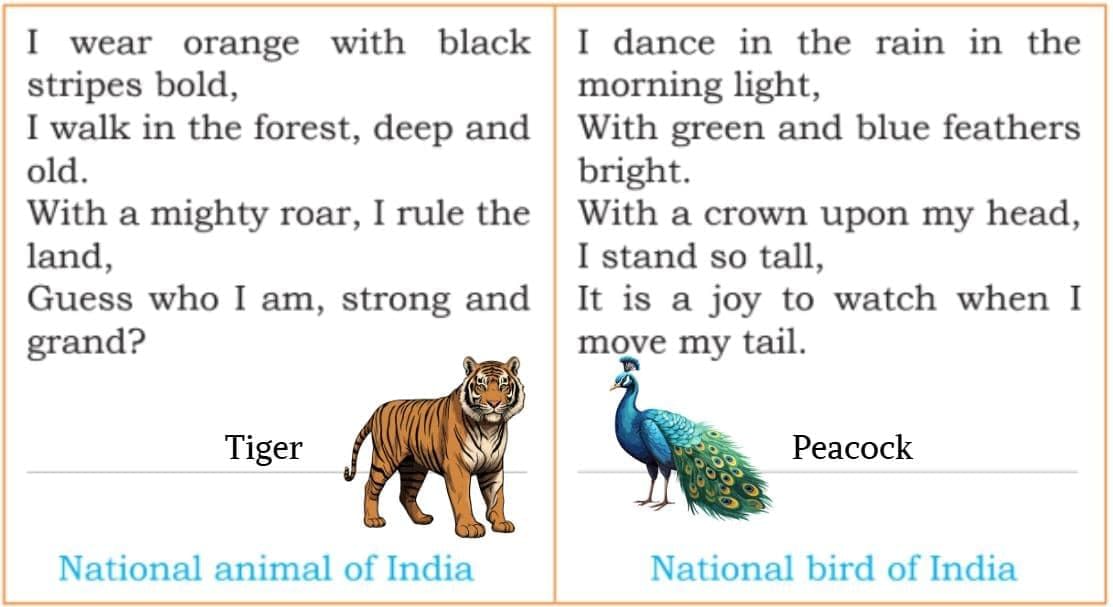
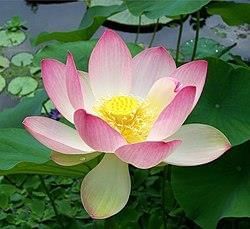
Q. State symbols vary. Find your state’s symbols with the teacher. For Example, Karnataka State The state animal is the Indian elephant The state bird is the Indian roller The state tree is sandalwood (Santalum album)The state flower is the lotus
Page No. 84
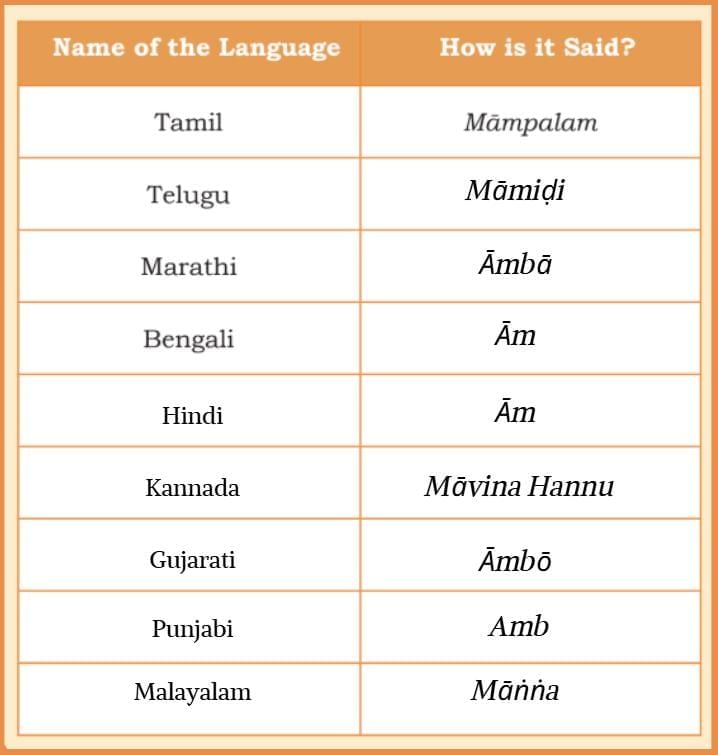
Activity 5
Q1. List the languages spoken in your class. Answer: (Example) Hindi, Tamil, Telugu, Marathi, Bengali.
Q2. Pick a word like “mango” and learn how it is said in these languages.
Page No. 87
Activity 6
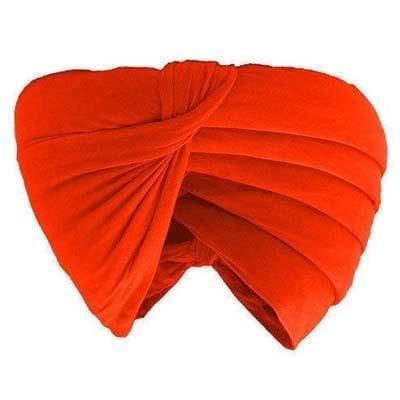
Part 1: Make a Traditional Headgear Using a Dupatta or Scarf What you need:
A dupatta, scarf, or long cloth
A few friends or classmates
A mirror (optional)
Steps: 1. Sit in small groups with your classmates. 2. Take turns helping each other wrap the dupatta or scarf around the head like a traditional turban or headgear. 3. Try styles from different regions—like: Rajasthani pagdi, Sikh turban, South Indian cloth wrap
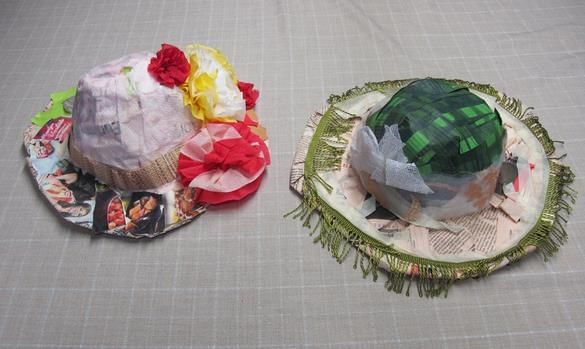
Part 2: Create a Headgear or Cap Using Waste Materials
What you need:
Old newspapers or magazines
Cardboard pieces (like from a cereal box)
Glue or tape
Scissors (with an adult’s help)
Waste cloth, buttons, bottle caps, or old decorations
Steps: 1. Cut cardboard into a circle or cap shape for the base. 2. Use a newspaper to wrap or cover the cap. 3. Decorate with waste materials like: Old fabric pieces, Bottle caps as buttons, Beads or buttons for style 4. Add a paper flower or small flag for fun!
Page No. 89
Activity 7
Write
Q1. Traditional Indian musical instruments that you know. Answer: Tabla, Sitar, Mridangam, Shehnai, Dholak.
Q2. Make a musical instrument using local materials. (Creative task) Answer: Creating a musical instrument from locally available materials is a fun and creative project! Here’s a simple idea to make a homemade drum using common household items:
Materials:
An empty tin can (e.g., a coffee or biscuit tin) or a sturdy plastic container
A balloon or a thin plastic sheet
Rubber bands or string
A wooden spoon or stick (for a drumstick)
Steps:
Prepare the Base: Ensure the tin can or container is clean and dry. Remove any sharp edges.
Create the Drumhead: Cut the balloon or plastic sheet to fit over the open end of the can. Stretch it tightly across the top to act as the drumhead.
Secure It: Use rubber bands or string to hold the balloon/plastic in place around the edges of the can, ensuring it’s taut.
Test It: Use the wooden spoon or stick to gently tap the drumhead. Adjust the tightness if the sound isn’t satisfactory.
Tips:
The sound will vary based on the material and tightness of the drumhead. Experiment with different containers or plastic thicknesses.
Decorate your drum with paint or markers for a personal touch!
Page No. 91-93
Let us reflect
1. If you could learn one more Indian language, which one would you select and why? Answer: I would like to learn Tamil because it is one of the oldest languages in India and has beautiful stories and poems. Learning Tamil can help me understand a different culture and talk to many people.
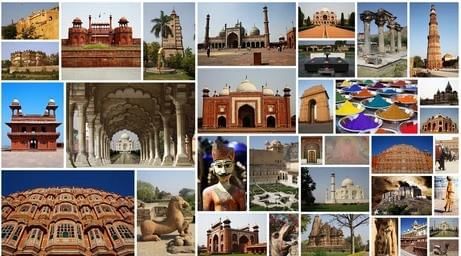
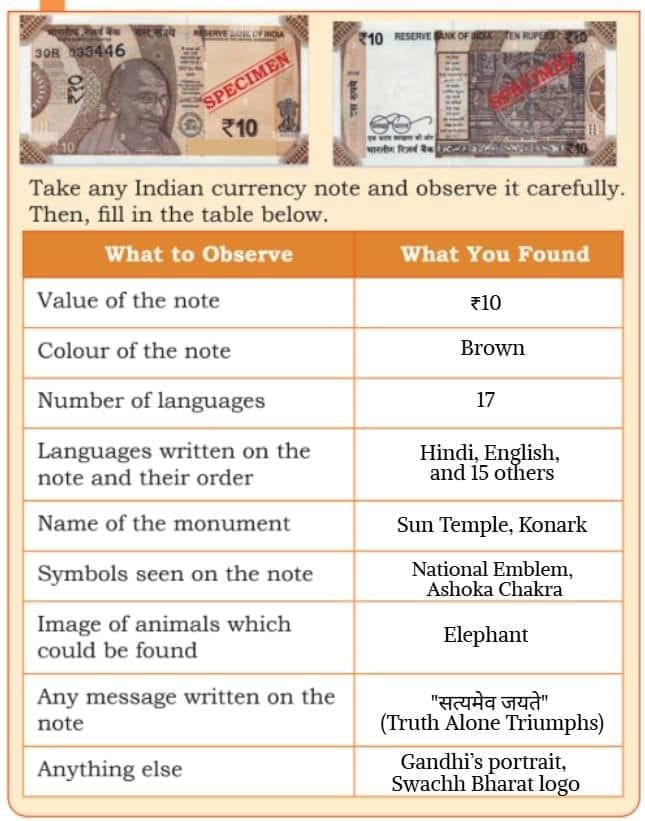
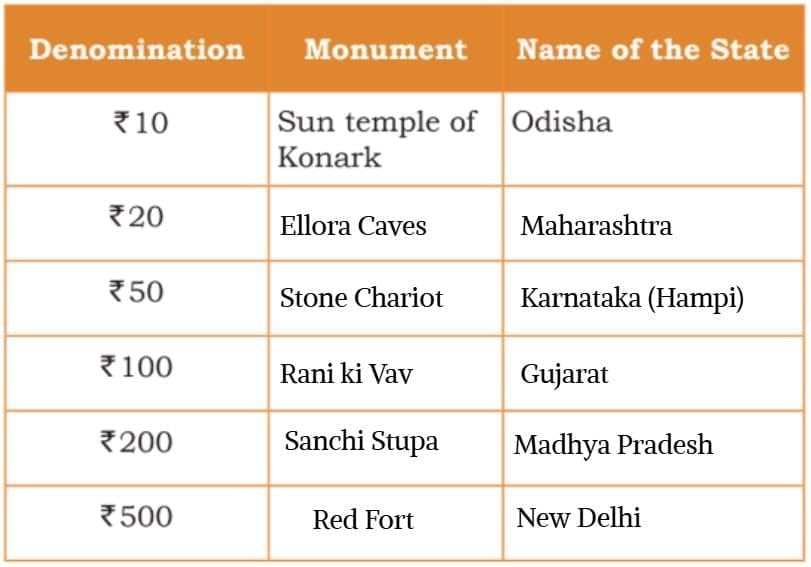
2. Which monuments do you see in different currency notes? Make a table.
Note: Students are encouraged to verify and fill in the details for ₹50, ₹100, and ₹200 based on their observations or guidance from their teacher.
3. Identify the currency symbol of India among these: € $ P₹ ¥ £ Answer: The Indian currency symbol is ₹ (Rupee sign). Others are €, $, ¥ (Yen, Japan/China), £ (Pound, UK).
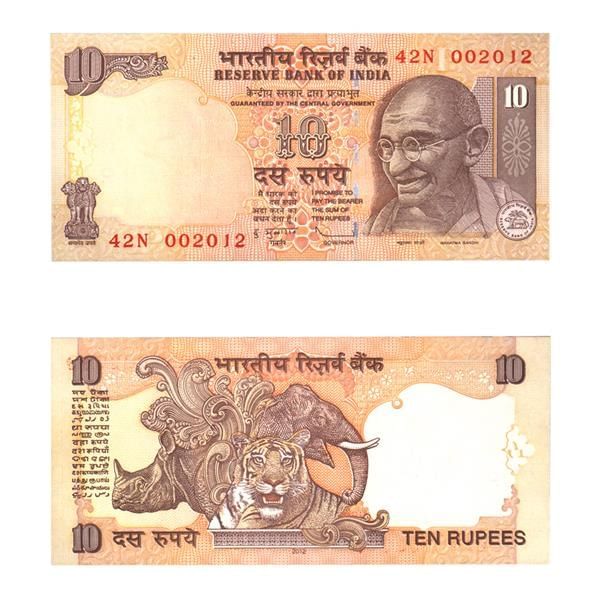
4. Which animals do you see on a ₹10 note? Answer: On the new ₹10 note, there is no animal. However, the old one has a Tiger and an elephant, along with some more.
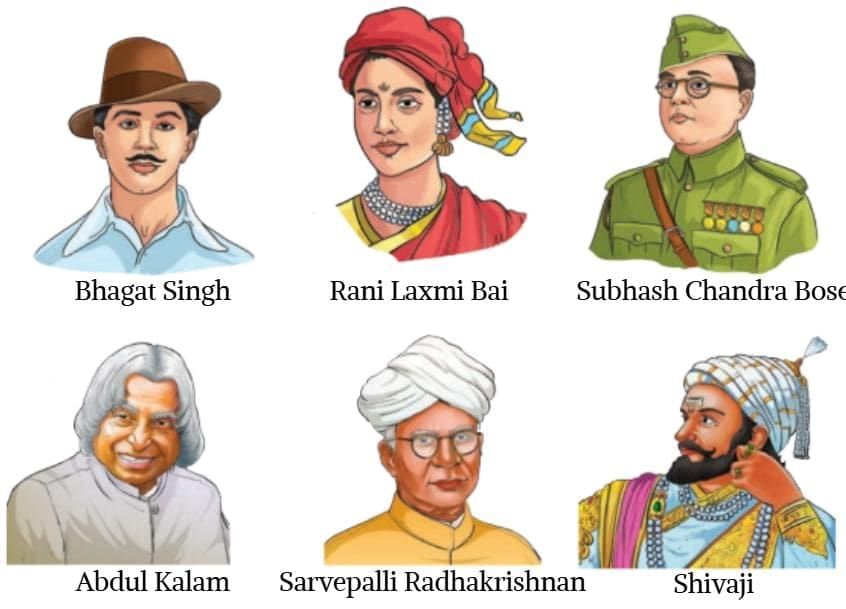
5. You must have seen pictures of a few great people of India in your school or other places. Identify their names and write a few lines about their contributions. Answer:
Mahatma Gandhi: He led India’s freedom struggle peacefully and taught us the importance of non-violence.
Dr. B.R. Ambedkar: He helped write India’s Constitution.
Other famous people could be Rabindranath Tagore, Jawaharlal Nehru, and others, with their respective contributions.
6. Group activity: Find out from your elders about people who have contributed to the nation from your locality or state, and share what you learnt in the classroom. Answer: Students may ask elders about local heroes, freedom fighters, or people who did great work for society. Then, share their names and stories with the class.
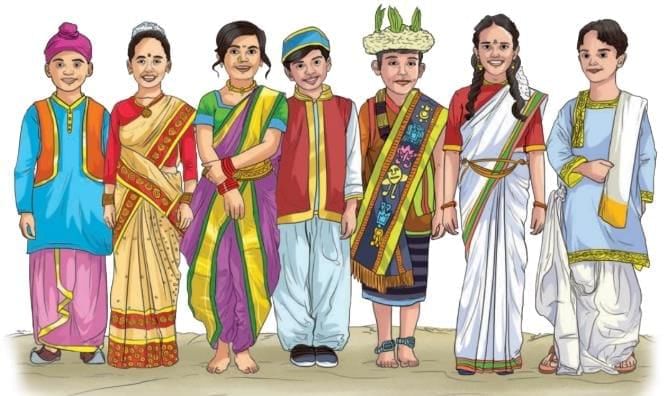
7. Project: Cultural Fair Celebrate the vibrant diversity of India, where every state tells its own colourful story.
Divide the class into groups and assign each group a different state.
Each group explores its state’s traditional dress, food, festivals, language, dance, and music.
Prepare posters or models and set up booths at a cultural fair.
After the fair, discuss the unique features and common values found in each state.
Answer: Cultural Fair Project – Step-by-Step Guide
Step 1: Get into Groups Your teacher will divide the class into small groups. Each group will be assigned a different Indian state.
Step 2: Learn About Your State With your group, gather information about the state. Find out:
Traditional dress
Popular food
Famous festivals
Languages spoken
Dance or music forms
Any interesting facts
Step 3: Make Your Poster or Chart Create a poster or chart to show what you’ve learned. You can draw pictures, use printed photos, or cutouts from magazines.
Step 4: Prepare Your Booth Decorate your booth using your poster, models, cloth pieces, and items related to your state (use waste or recycled materials if possible).
Step 5: Practice Your Script Decide who will talk about which topic. Prepare a short speech about your state so you can tell visitors at your booth.
Step 6: Visit Other Booths Once your booth is ready, take turns visiting other groups’ booths. Ask questions and learn about the other states.
Step 7: Circle Time Discussion After the fair, sit together as a class and discuss:
What was unique about each state?
What similarities or common values did you find?
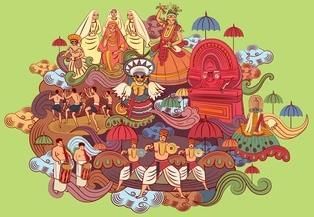
Sample State Booth: Kerala – God’s Own Country Draw or stick a map of Kerala. Mark cities like Kochi, Munnar, and Thiruvananthapuram.
Traditional Dress (Draw or paste photos of traditional clothes.) – Men: Mundu – Women: Kasavu Saree
Popular Food – Idiyappam – Appam with Stew – Sadya (a traditional meal served on a banana leaf)
Festivals – Onam – Vishu (Decorate with a flower rangoli design called Pookalam.)
Language – Malayalam
Dance and Music – Kathakali – Mohiniyattam (Paste pictures or draw masks and musical instruments.)
Sample Script (for you to say at your booth)
Namaste! Welcome to our Kerala booth! Kerala is a beautiful state in the south of India. It is called “God’s Own Country” because of its greenery and backwaters. People here wear traditional white and gold clothes and speak Malayalam. One of the biggest festivals is Onam, where people make flower rangolis and eat a big meal called Sadya. The famous dance of Kerala is Kathakali, with colorful makeup and costumes. Kerala is also known for its spices, coconut trees, and boats. Thank you for visiting our booth!
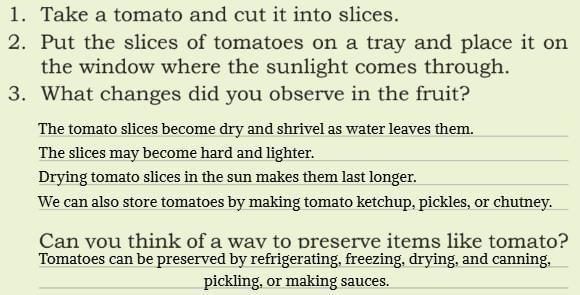
Q. Have you ever had an upset stomach? Do you know what could have caused it? What could happen if spoiled food is eaten by mistake? If yes, what did you do to get well? Answer: Yes, I have had an upset stomach before. It can be caused by eating spoiled or dirty food, or by not washing hands before eating. If spoiled food is eaten by mistake, it can cause stomach pain, vomiting, or loose motions. When I had an upset stomach, I rested, drank plenty of water, and my parents gave me curd or buttermilk. If it was very bad, we went to the doctor.
Write
Q. Why do you think food gets spoiled? Answer: Food gets spoiled because tiny living things called microbes grow on it. Microbes need water, air, and the right temperature to grow. Spoiled food may look or smell bad and is not safe to eat.
Page No. 44
Write
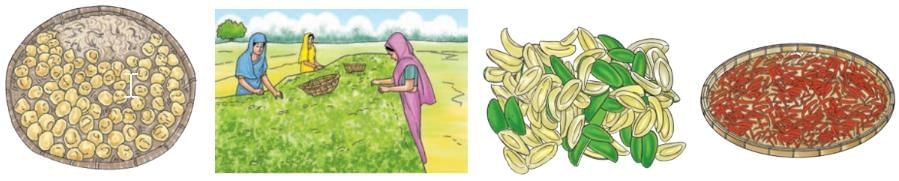
Q. What other things are dried so that they remain unspoilt throughout the year? Answer: Items that are dried to keep them unspoilt include:
Grains (rice, wheat)
Lentils (dal)
Dry fruits (raisins, dates)
Spices (red chillies, turmeric)
Fish and meat (in some places)
Activity 1
Page No. 45
Activity 2
Discuss
Q. What would happen to this pickle if no oil had been added? Answer: If no oil had been added, air would get inside the jar. Microbes would grow quickly, and the pickle would spoil fast. Oil makes a layer that keeps air out and protects the pickle.
Page No. 46
Activity 3
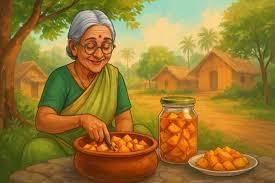
Q. Find out about food preservation practices in your family by asking the elders at home. Write at least one such practice. Answer: My grandmother makes lemon pickle and covers it with oil so it lasts for many months. We also dry coriander leaves or mint to use them later. Sometimes, my mother keeps extra cooked food in the fridge to protect it from spoiling.
Page No. 48
Think
Q. Did you ever have an upset stomach, vomiting or indigestion? Did you use any home remedies? Write about the home remedy given to you. Have your parents given you curd or some product like buttermilk made from it, for an upset stomach? Answer: Yes, when I had indigestion, my mother gave me curd and asked me to drink buttermilk. It helped my stomach feel better. Eating plain rice with curd also helps.
Page 49
Activity 4
Q. Do you ever accompany your elders for buying vegetables and fruits? During such visits, observe how elders select fruits and vegetables in the market. Write one thing that you learnt from your shopping trip and write it as a Finding #9, the way Disha would write. Answer: Finding #9: My grandmother gently presses the fruit to see if it is fresh and firm. She checks the colour and smell. She does not buy very soft fruits or those that have spots or look dull.
Page No. 50
Write
Q. Name three seasonal fruits or vegetables of your region. For example, amla in winter and jamun in summer. Answer: (Any three are enough; the answer depends on your region)
Watermelon (Summer)
Orange (Winter)
Mango (Summer)
Peas (Winter)
Litchi (Summer)
Grapes (Winter)
Activity 5
Page No. 53
Write
Q. How can you avoid choking? Answer: To avoid choking, we should:
Take small bites
Chew food properly before swallowing
Do not talk or laugh when eating
Eat slowly and do not be in a hurry
Page No. 53-54
Let us reflect
1. Why do some food items last for weeks and others spoil in just a few days? Answer:
Some foods last longer because they lack moisture or are kept in ways that prevent air and moisture from reaching microbes.
For instance, pickles in oil, dried foods, and foods stored in the refrigerator tend to have a longer shelf life.
Foods that contain water, are kept in warm temperatures, and are exposed to air spoil quickly.
This is because microbes grow rapidly in conditions that are warm and moist.
2. You are going on a field trip for two days. List five food items you will carry. How will you keep them from getting spoiled? Answer: If I am going on a trip, I will carry these food items:
Dry snacks like biscuits and nuts (packed in airtight containers to keep air and moisture away).
Dried fruits or chips (because they have less water).
Fresh fruits that last longer, such as apples or bananas (keep them in a cool place).
A sandwich wrapped in cling film or kept in a lunchbox.
Bottled water or juice (sealed to avoid contamination)
To keep them from spoiling, I will keep them in airtight containers and avoid keeping them in the sun or warm places.
3. What if food cannot be preserved? Imagine a world without food preservation and discuss the consequences. Answer: If food cannot be preserved, it will spoil quickly and go to waste. The consequences of a world without food preservation:
People would have to eat food immediately after it is harvested or cooked.
There would be a shortage of food, especially during off-seasons, and long-distance transport of food would be difficult.
This would cause hunger and malnutrition since fresh food will not be available throughout the year.
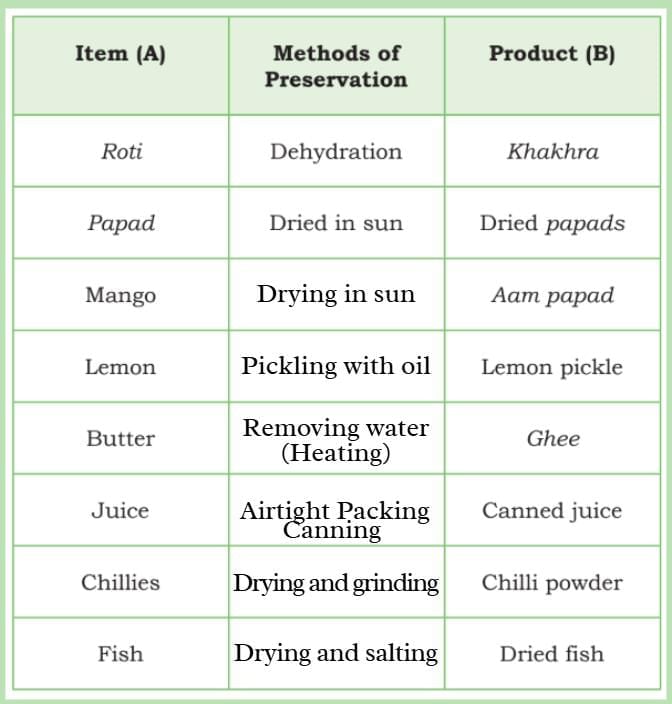
4. Match the following: Which method is used to preserve the following food items (A) to make the final product (B). Answer:
Look at the image given below and answer the following.
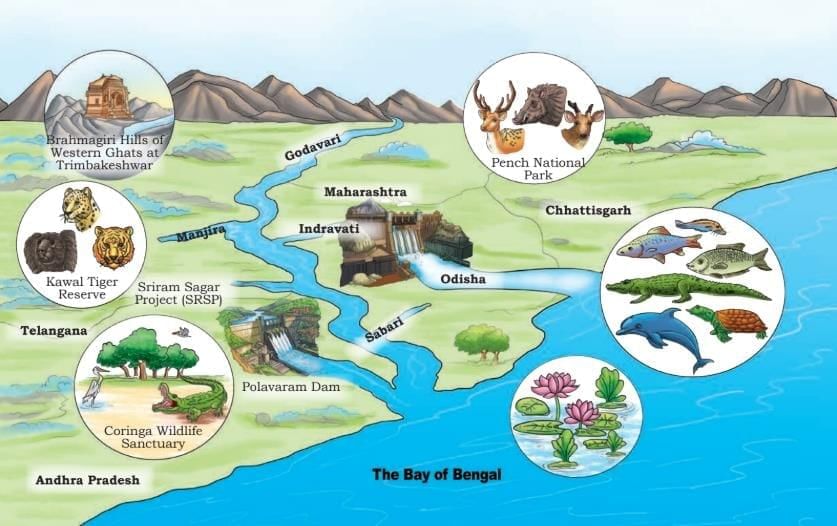
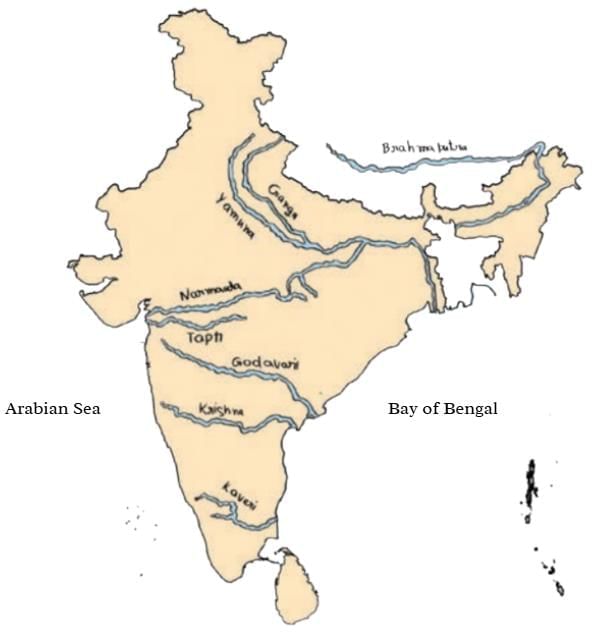
1. Name the states that Godavari flows through. Answer: Maharashtra, Telangana, Chhattisgarh, Andhra Pradesh, Odisha.
2. Name a dam and a wildlife sanctuary along the length of Godavari. Answer: Dam: Polavaram Dam (Andhra Pradesh), Sriram Sagar Project (SRSP, Telangana) Wildlife Sanctuary: Kawal Tiger Reserve (Telangana), Coringa Wildlife Sanctuary (Andhra Pradesh)
3. Which other small rivers join Godavari in its journey? Answer: Manjira, Indravati, Sabari.
Page No. 25
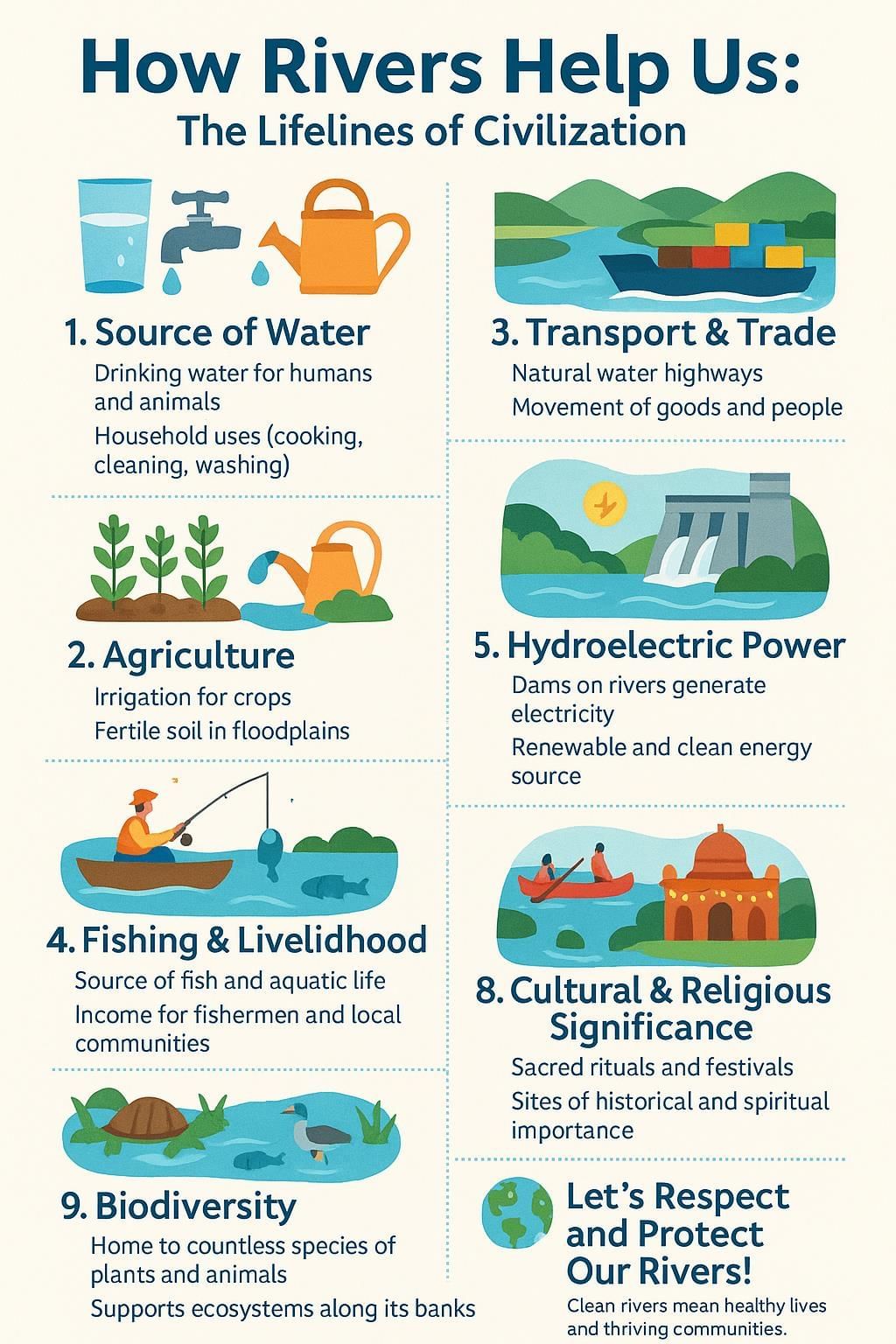
Q. List three ways in which people are dependent on the river Godavari. Answer: 1. The river gives drinking water to people in towns and villages. 2. It provides water for growing crops in fields. 3. It helps people earn a livelihood through fishing, farming, and even ecotourism.
Q. In which occupations are people engaged near the river Godavari? Answer: Farmers, fishermen, factory workers, boatmen, traders, and people working in ecotourism (like guides or in lodges).
Page No. 26
Q. Which crops do you see growing near the Godavari? Answer: Mainly rice (paddy), sugarcane, and banana.
Q. Which crops grow in your region? Where does the water for irrigation come from? Answer: (Sample answer—you fill your own): In my region, I see wheat and cotton growing. The water comes from a nearby river and canals.
Activity 1
Make a poster in your classroom showing all the ways rivers help people. Include drawings of homes, farms, boats, fishermen and more.
Page No. 27
Write
Q. What problems can arise after a dam is built? How can they be solved? Problems:
The land where people and animals live may get flooded.
Forests and wildlife habitats are lost.
People may have to shift homes.
Solutions:
The government should help people find new places to live.
Plant trees and create new homes for animals.
Build dams only after proper study to reduce harm.
Page No. 28
Write
Q. Where do the plastic wrappers and bags that we litter end up? Answer: They often reach rivers and water bodies, either by wind, rain, or through drains. This can pollute water and harm animals that live in and near water.
Q. What kinds of soaps, shampoos or floor cleaners are used in your home? Where does the unclean water go? Answer: We use ready-made soaps, shampoos, and cleaners. The dirty water from cleaning goes down the drain. If it is not cleaned at a treatment plant, it may end up in rivers, harming their water quality and the life inside them.
Discuss
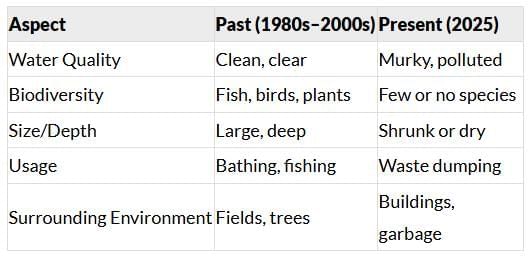
Q. Ask your parents or elders about the condition of water bodies near your home when they were your age. What is the status of those water bodies today? Answer: Conduct the Interview: Ask your parents or elders specific questions about a named water body (e.g., “Ram Talab” near your home) from their childhood. Example questions:
Was the water clean enough to see fish or plants?
What animals or birds did you see?
How was the water body used back then?
Visit or Research the Water Body: Observe its current state or gather information (e.g., through local knowledge or news). Note water clarity, presence of life, size, and usage. Fill the Table (Example Format):
Analyse Changes: Discuss why the water body changed (e.g., pollution, urbanisation), linking to concepts like human impact on the environment.
Page No. 29
Activity 2
Q. List things thrown into the waste bin at home/school. If thrown into a river/pond, how would each harm animals/plants/people? Answer: List of things:
Plastic bags: Can choke and kill fish or birds.
Food waste: Makes water dirty, attracts pests, and can rot.
Broken glass: Can injure animals or people stepping on it.
Old batteries: Release harmful chemicals, poisoning water and living things.
Paper: Can dirty and block water flow.
Clothes: Can tangle and trap fish or birds.
All these can make water unsafe for drinking and harm the river’s life.
Activity 3
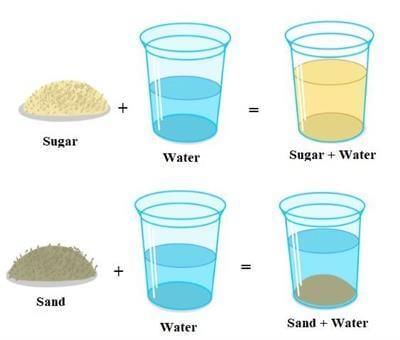
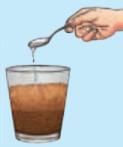
Q. Take two clear glasses of water. Add a spoonful of sugar in one and a spoonful of cooking oil in the other. Stir both well and observe. What do you observe? Which one appears clear? Answer: Dissolve in water: sugar, salt, lemon juice. Do not dissolve in water: oil, sand, plastic bits, small stones.
Page No. 30
Activity 4
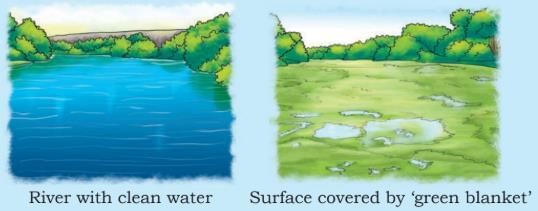
Q. Which river looks healthy and why? What happens when too many plants grow (like a “green blanket”) in a river?
Answer: A river with clean, clear water and fish swimming is healthy because living things can survive there. – Too many plants use up oxygen in the water, making it hard for fish and other animals to breathe. It also blocks sunlight and makes water unsafe for humans.
Page No. 31
Write Q. Three things you can do to protect the water bodies near you: Answer: 1. Never throw plastic, garbage, or chemicals into drains or rivers. 2. Use eco-friendly cleaners and soaps to reduce pollution. 3. Join or start community clean-up efforts for local ponds, lakes, or streams.
Page No. 32
Activity 5
Page No. 33
Activity 6
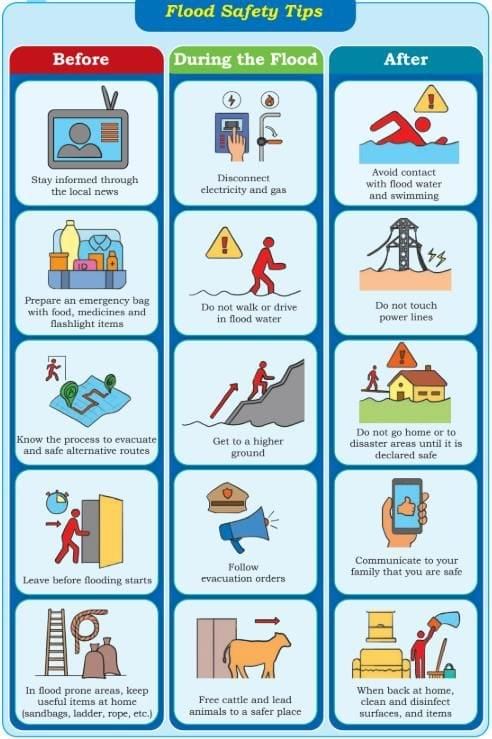
In the time of floods, use these safety tips :
Page No. 34
Discuss
You are the village/city leader. What actions will you take
Build and protect flood barriers and drainage to prevent flooding.
Raise awareness and help the elderly and disabled during floods.
Keep animals safe and sheltered.
Regularly clean drains and riverbanks.
Page No. 35
Q1. What would you do if there was no water in your home for a day or a week? Answer: For a day: Use stored water, ration carefully, maybe borrow from neighbours.
Q2. What if there was no water for a week? How would you bathe, drink, cook or clean? Where would you go to find water? Answer: For a week: Go to public taps, tankers, or relatives. Use water only for essentials. Save rainwater if possible. May have to move if no water at all.
Page No. 37
LET US REFLECT
1. Find out which river(s) flow through your state. (a) What are they used for? (b) Are there any dams on them? Answer: (a) Rivers in a state are commonly used for drinking water.
They are also important for irrigating farms, which helps in growing crops.
Fishing is another activity that relies on rivers for providing food.
Sometimes, rivers are used for transportation, helping move goods and people.
Additionally, rivers can play a role in industry, offering water for various processes.
(b) Many rivers have dams built on them to:
Store water for use during the dry season.
Assist with irrigation for farming.
Generate electricity for homes and businesses.
Supply water to nearby towns and cities.
2. Ask your grandparents or parents to share any story or festival related to rivers in your region and present it in the class. Answer: Many places have unique festivals by rivers that honour the significance of water.
For instance, the Godavari Pushkaram festival, which takes place near the Godavari River, is a time when people gather to bathe in the river’s sacred waters.
Your grandparents or older family members might tell you stories about how rivers were a part of their everyday lives.
They may also share tales of important religious events that were connected to rivers.
3. Ask an elder in your family: (a) What was the condition of rivers when you were a child? (b) What has changed since then? Answer: (a) Rivers were likely cleaner and fuller when more water was flowing through them. People relied heavily on rivers for their daily needs.
(b) Rivers today may be more polluted with plastic waste, sewage, and chemicals. Urbanisation and less care might have reduced water flow or cleanliness.
4. Why do you think people built houses and cities near rivers in the past? Are rivers still important today in the same way? Answer: Rivers have historically provided essential resources such as drinking water, irrigation for farming, cleaning, and fishing.
Because of these resources, many people chose to live near rivers for easy access to these vital needs.
In the present day, rivers continue to be crucial for supplying water, aiding in agriculture, and supporting various forms of wildlife.
However, it is now important to protect rivers from pollution and overuse to ensure they remain healthy and usable for future generations.
5. If you could create one new rule to protect rivers in your city or village, what would it be? Answer: If I could create one rule to protect rivers, i would be to keep it clean by doing the following:
No dumping of plastic or garbage in rivers.
Planting more trees near riverbanks.
Using eco-friendly products to reduce pollution.
Fixing sewage and waste treatment systems to keep the river water clean.
6. Think about a time when you wasted water. What could you have done differently? Answer: Things I could have done differently:
Turning off the tap while brushing teeth.
Using a bucket instead of a hose to water plants.
Fixing a leaking tap.
Reusing water after washing fruits or vegetables for watering plants.
7. Can you design a simple water filter using everyday materials? What would you include and why? Answer: A simple water filter can have different layers, including sand, small stones, grated charcoal, and cloth.
Sand is used to filter out dirt and tiny particles from the water.
Charcoal helps to remove bad smells and some harmful chemicals.
Small stones provide support for the other layers of the filter.
Cloth acts as a barrier to catch bigger particles before the water passes through.
Together, these materials work to make dirty water cleaner and safer for use.
8. Imagine you are planning a new city near a river. What steps would you take to: (a) Keep the river clean (b) Prevent floods during heavy rains (c) Ensure there is always enough water for everyone, even during summer Answer: (a) Keep the river clean
Build proper sewage and waste treatment plants.
Prevent the dumping of garbage in rivers and other places.
Plant trees along riverbanks to help protect the environment.
Create awareness programs to educate people about saving rivers.
(b) Prevent floods during heavy rains
Planting trees helps absorb rainwater, which is beneficial for the environment.
It’s important to build safe flood barriers to protect areas from flooding.
Avoid constructing homes too close to rivers to reduce the risk of flood damage.
Creating soak pits and ponds can effectively soak up excess rainwater.
(c) Ensure there is always enough water for everyone, even during summer
Page No. 4/5. Discuss. Q. Do you think we can drink the water present in the oceans? Answer: No, we cannot drink ocean water because it is salty. Drinking salty water can be harmful to our bodies as it does not quench thirst and can make us sick.
Q. What can ocean water be used for? Answer: Ocean water can be used to extract salt in salt pans (for example, in Gujarat). It is also used for some industrial purposes and supports marine life and shipping.
Activity 1
Page No. 6
Activity 2
(a) Where do these water droplets come from? They come from water vapours in the air, which cools down and condenses on the cold surface of the glass.
(b) What happens to ice cubes after some time? The ice cubes melt and turn into water.
(c) If we heat water, what will happen to it? If we heat water, it will turn into steam (water vapour).
Q. In the above activity, what forms of water do you see? Answer: Solid Form – Ice Liquid form -Water Gaseous form- Vapours
Observing Changes
Page No. 7
Activity 3: Demonstrating the Water Cycle
Take a transparent plastic bag.
Use a marker to draw the sun, clouds, arrows, and trees on it.
Fill one-third of the bag with coloured water and seal it shut.
Place the bag in sunlight and observe changes inside over time.
Notice evaporation, condensation, and precipitation happening inside the bag.
This activity shows how the water cycle operates in nature.
Answer:
Other Observations can be:
Page No. 9
Activity 4
Take a transparent glass.
Fill half of it with soil.
Slowly pour water into the soil using a spoon.
Observe what happens.
Answer:
When you pour water onto the soil in the glass, it soaks down.
This shows how, in nature, rainwater soaks through soil and gets stored underground as groundwater, which can be drawn out by wells and handpumps.
Activity 5
Explanation: The green lawn is the surface that allows rainwater to seep into the ground and helps recharge groundwater. Concrete roads and paved areas do not let water seep in.
Page No. 10
Activity 6
1. What did you observe about the mustard seeds? Answer: The mustard seeds roll down according to the slope of the paper (like water flows downhill).
2. Are they moving in a straight line, or do they spread out in different directions? Answer: They do not move in a straight line but spread out in different directions.
3. Are they collecting in some areas? Do they gather like water gathers in lakes, rivers and so on? Answer: The seeds gather in places where there are dips or valleys, just like water collects in lakes, ponds, or river basins.
Discuss
Q. Based on Activity 6 with mustard seeds, discuss how some rivers flow towards the Arabian Sea while some flow towards the Bay of Bengal. Answer:
The flow of rivers is influenced by the shape of the land and its slope.
Rivers that begin in the western regions, such as the Narmada, move towards the Arabian Sea.
Rivers that start in the north and east, like the Ganga and Godavari, flow towards the Bay of Bengal.
The path of water is determined by various landforms such as mountains, valleys, and slopes.
Each river chooses the route with the lowest slope and eventually flows into seas or marshes.
An example is the Luni, which does not reach the sea but instead ends in the marshes of the Rann of Kutch.
Page No. 13
Activity 7
Follow the Flow! In the map, you can see the rivers flowing in different directions. Some flow into the Bay of Bengal and some into the Arabian Sea.
Observe and fill in the table.
Page No. 15
Q. Discuss the characteristics of animals on land and animals in water. Answer:
Page No. 17-18
Activity 8
Visit a local water body like a pond, lake or aquarium with your teacher or parents, and observe life in and around the water body. 1. Based on your observations, complete the following table.
2. Draw the plants that you saw during the visit and label them with their local name.
Activity 9
1. Take a piece of paper and put a drop of water on it. Observe. 2. Colour the paper with a wax crayon. Now, put a drop of water on it. Do you observe any change?
Answer: Observation.
On plain paper, water soaks in and spreads out.
On wax crayon paper, the water forms a bead and rolls off, as the surface is waterproof.
This is similar to the waxy coating on leaves, which keeps excess water from entering the plant.
Page No. 19
Activity 10
Who Eats Whom?—A River Food Chain Game
Distribute slips of paper to students. Each student writes what they choose to be (for example, small fish, big fish, frog, bird, human, crocodile, otter, etc.)
Ask the students to think about what they eat, and who eats it.
Use a string to connect the students who depend on each other for food.
Discuss what would happen if one animal disappears (for example, what if all the fish are gone?).
Answer: Example of a river food chain:
Plants in water → Small fish → Bigger fish → Bird (like kingfisher) → Human
If all small fish disappear, bigger fish and birds will not get food, breaking the chain.
Every link is important for the balance of the river ecosystem.
Page No. 20
Let us reflect
1. Match the following: Answer:
2. Why do you think most of the water on Earth cannot be used for drinking or farming? Answer:
Most of the water on Earth is in oceans and seas, and this water is salty.
Saltwater cannot be drunk by humans or animals and is not useful for watering crops because the salt harms plants.
Only a small part of the Earth’s water is freshwater found in rivers, lakes, rain, and underground, which we can use for drinking, farming, and other daily needs.
3. A large number of living beings live near water bodies. Why? Answer:
Water bodies such as ponds, lakes, rivers, and wetlands are vital for many living things.
These areas provide animals and plants with the necessary water for their survival.
They offer not just water, but also food, shelter, and a suitable environment for various creatures.
Freshwater is crucial for life, making it essential for many species to live near water sources.
Animals and plants depend on these water bodies to drink, eat, and find a safe place to thrive.
4. What would happen if it did not rain in your region for two years? Answer: If there was no rain for two years:
Rivers, ponds, and lakes might dry up.
The groundwater level would fall since it would not be replenished by rainwater.
Crops and plants would not get water and may die, causing problems for farmers and animals that depend on plants for food.
People might face water shortages for drinking and daily use, leading to hardships and possibly drought conditions.
5. What do you think happens to rainwater in a forest compared to a city? Answer: In a forest, the soil is loose and filled with trees and plants.
This environment allows rainwater to easily soak into the ground.
When rainwater seeps into the soil, it helps to refill the underground water supply, also known as groundwater.
This process is important as it keeps rivers and ponds full of water.
In many cities, a lot of roads and yards are covered with cement or concrete.
This covering prevents rainwater from soaking into the soil.
Instead of being absorbed, water quickly flows away through drains.
Because the water does not go back into the ground, it is hard for groundwater levels to rise.
Sometimes, this situation can lead to water shortages.
6. Can you design a house or school that conserves water wisely? What would it include? Answer: A house or school that saves water can include:
Rainwater harvesting systems collect and store rainwater for future use.
Soak pits or gardens to help water soak into the ground and recharge groundwater.
Water-saving taps, toilets, and faucets that prevent wastage.
Use of water tanks to store and reuse water.
Awareness posters or programs encouraging everyone to use water carefully and not waste it.
Planting many trees and plants around to keep the soil healthy and allow water to soak in.
7. Let us make a fish by folding a piece of paper. Answer: (This is a fun craft activity to make a fish by folding paper following step-by-step instructions. It helps understand the shapes and parts of a fish and connects with studying life in water.)
Step 1: Take a rectangular strip of paper and fold it in half from top to bottom (horizontally), pressing the crease well. Step 2: Unfold and now fold both the top and bottom edges towards the centre crease, creating two flaps. Press the folds neatly.Step 3: Hold both ends of the strip and bring them together downward, so the strip forms a “V” shape (it looks like a folded tunnel from the edge).
Step 4: Continue holding the shape and squeeze the folded ends so that they shift and one edge stands vertically. This forms a fish with a body and a tail.
Step 5: Fold out the two ends (the tail fins) to form a triangle on either side at the tail. The fish now looks more three-dimensional.
Step 6: Draw an eye and some scales on the head part. Your paper fish is now ready!
You can decorate your paper fish however you like! If you want the exact illustrations from the book, you can request help from your teacher. This simple origami craft is easy, fun, and needs only a square piece of paper.