10 Earth — Our Shared Home – Textbook Worksheet

Q1: Choose the correct option for each question.
(i) Who was the first Indian in space?
A. Wing Commander Rakesh Sharma
B. Group Captain Shubhanshu Shukla
C. DIGIPIN
D. None of the above

(ii) What does DIGIPIN help with?
A. Assigning names to schools
B. Helping postmen locate addresses
C. Identifying plants
D. None of the above

(iii) What ancient Indian practice is celebrated on International Day of Yoga?
A. Meditation
B. Dance
C. Yoga
D. Painting

(iv) From where did chillies originally come?
A. India
B. Europe
C. South America
D. Africa

(v) What unique feature do Indian cows in Brazil have?
A. They are used for transportation
B. They are depicted on stamps and coins
C. They are larger than Brazilian cows
D. None of the above

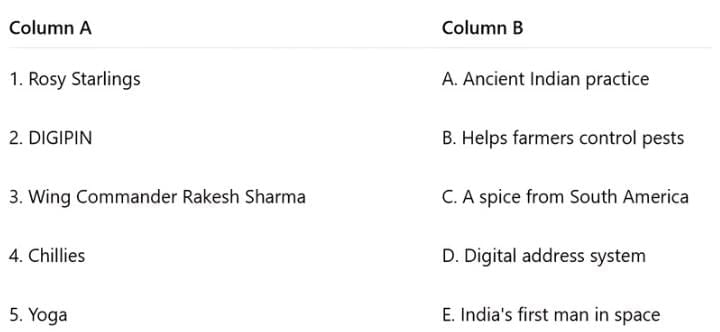
Q2: Match the items in Column A with the correct descriptions in Column B.
Q3: Fill in the blanks with the correct words from the chapter.
(i) The Earth looks like one big home with no visible __________.
(ii) Yoga has been practised in India for more than __________ years.
(iii) The Ministry of __________, Forest and Climate Change logo shows the connection between humans and nature.
(iv) Chillies were brought to India by __________ travellers.
(v) The saying ‘Vasudhaiva Kutumbakam’ means __________ is one family.

Q4: State whether the following statements are True or False. Correct the false statements.
(i) The shape of land and sea is visible from space, but no political boundaries.
(ii) The marigold flower originally comes from India.
(iii) The first Indian in space said India looked “Saare Jahaan Se Achcha” from space.
(iv) Yoga was first shared with the world in the 21st century.
(v) The chillies we grow in India were once a staple item in European kitchens.

Q5: Answer the following questions in 2-3 sentences each.
(i) What does the Earth look like from space?
(ii) How do rosy starlings help farmers in India?
(iii) Why is yoga special and important?
(iv) Where did chillies originally come from?
(v) What does “Vasudhaiva Kutumbakam” mean?

Q6: Answer the following questions in 4-6 sentences each. Use examples from the chapter to support your answers.
(i) Explain how birds like rosy starlings show us that “nature has no boundaries.” What benefits do they provide?
(ii) How did the chilli plant change Indian food culture? Trace its journey from South America to India.
(iii) What does “Vasudhaiva Kutumbakam” mean? How can we live as one family despite our differences?
(iv) Give examples of how India and other countries have shared culture, food, and ideas with each other.

You can find Worksheet Solutions here: Worksheet Solutions: Earth-Our Shared Home
09 Rhythms of Nature – Textbook Worksheet

Q1: Choose the correct option for each question.
(i) What is the name of the place in India known as the ‘First Village of the Sunrise’?
A) Khonoma
B) Dong
C) Thar Desert
D) Arunachal Pradesh

(ii) How many seasons does India have according to the text?
A) Four
B) Five
C) Six
D) Seven

(iii) Which season is associated with the festival of Diwali?
A) Spring
B) Summer
C) Monsoon
D) Autumn

(iv) What activity helps students observe changes in nature throughout the year?
A) Nature Walk
B) Seasons’ Journal
C) Drawing
D) Gardening

(v) What do farmers in Odisha associate with the coming of rains?
A) Singing of the koel bird
B) Arrival of monsoon
C) Blooming of flowers
D) Changes in temperature

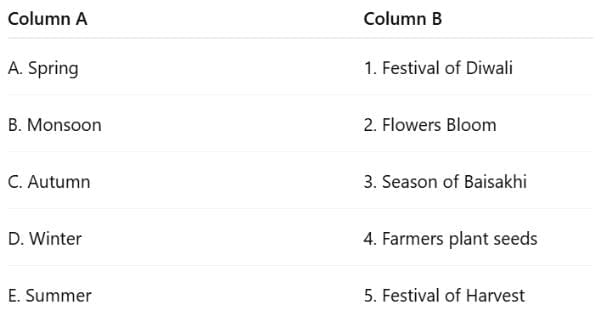
Q2: Match the items in Column A with the correct descriptions in Column B.

Q3: Fill in the blanks with the correct words from the chapter.
(i) The Earth rotates on its _____, causing day and night.
(ii) The _____ rises in the east and sets in the west.
(iii) In India, the season of _____ is when farmers plant seeds based on the koel’s song.
(iv) _____ is celebrated in winter to mark the new year and harvest.
(v) The _____ represents the model of the Earth.

Q4: State whether the following statements are True or False. Correct the false statements.
(i) The sun rises in the west.
(ii) Diwali is a very special festival in India.
(iii) Seasons help us know how plants grow and how animals live.
(iv) There are five seasons recognised in India.
(v) The Thar Desert is known for its high rainfall.

Q5: Answer the following questions in 2-3 sentences each.
(i) What changes did Saba and Aparna notice about themselves and their surroundings?
(ii) How does day change into night and night into day?
(iii) What is the significance of Dong in Arunachal Pradesh?
(iv) How can students observe changes in nature throughout the year?
(v) Why are festivals important in seasons?

Q6: Answer the following questions in 4-6 sentences each. Use examples from the chapter to support your answers.
(i) Explain how day and night occur. What causes this change?
(ii) What are seasons? Name the six seasons of India and explain why seasons are important.
(iii) How do seasons affect human activities? Give examples of food, clothes, and festivals.
(iv) Describe the classroom seasons chart activity. How does it help students understand seasonal changes?

You can find Worksheet Solutions here: Worksheet Solutions: Rhythms of Nature

08 Clothes — How Things are Made – Textbook Worksheet

Q1: Choose the correct option for each question.
(i) What do birds like the male baya weaver build their nests from?
A) Plastic
B) Grass
C) Leaves
D) Twigs

(ii) What tool was used to weave fabrics in India 4,000 years ago?
A) Needle
B) Loom
C) Charkha
D) Spinning Wheel

(iii) Which of the following is a unique handloom tradition of Tamil Nadu?
A) Ikat
B) Pashmina
C) Kanjeevaram
D) Bandhani

(iv) What is the process called when cotton fibres are twisted into thread?
A) Weaving
B) Spinning
C) Knitting
D) Stitching

(v) Which material is used to make Pashmina shawls?
A) Cotton
B) Wool
C) Silk
D) Jute

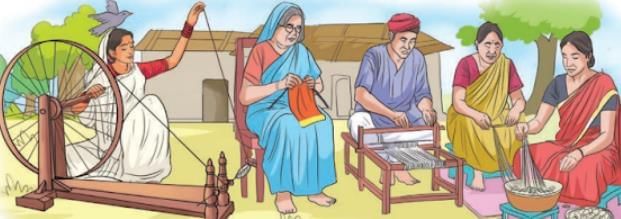
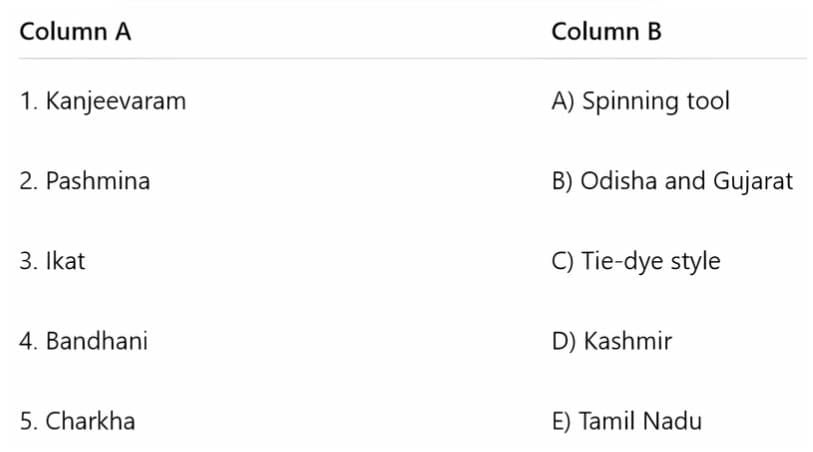
Q2: Match the items in Column A with the correct descriptions in Column B.

Q3: Fill in the blanks with the correct words from the chapter.
(i) The tailorbird stitches big leaves together to make a ______.
(ii) Indian muslin was so fine it was called “woven ______.”
(iii) Weaving supports culture and people’s ______.
(iv) The process of making thread from fibers using a charkha is known as ______.
(v) Old clothes can be turned into ______ by joining small pieces together.

Q4: State whether the following statements are True or False. Correct the false statements.
(i) The Baya weaver is an expert weaver who makes rough nests.
(ii) Handloom weaving requires the use of electricity.
(iii) Both natural and synthetic fibres are used in clothing.
(iv) The tailorbird uses its beak to sew leaves.
(v) India is the largest producer of silk in the world.

Q5: Answer the following questions in 2-3 sentences each.
(i) What do birds like the male baya weaver do to make their nests?
(ii) How do people in India keep the art of weaving alive?
(iii) What is a charkha, and what is it used for?
(iv) What can you do with running stitches?
(v) How do people recycle old clothes in India?

Q6: Answer the following questions in 4-6 sentences each. Use examples from the chapter to support your answers.
(i) Explain the process of making thread from cotton and how it is used to make cloth.
(ii) How do natural and synthetic fibres differ? Give examples of each type.
(iii) Describe the traditional embroidery work done in different parts of India.
(iv) Why should we recycle and reuse old clothes? How can we do this?

You can find Worksheet Solutions here: Worksheet Solutions: Clothes-How Things are Made

07 Energy — How Things Work – Textbook Worksheet

Q1: Choose the correct option for each question.
(i) What is the primary source of energy for life on Earth?
A) Oil
B) The Sun
C) Coal
D) Natural Gas

(ii) Which of the following is a non-renewable energy source?
A) Solar
B) Wind
C) Coal
D) Water

(iii) What type of energy do solar panels convert?
A) Thermal Energy
B) Mechanical Energy
C) Solar Energy
D) Kinetic Energy

(iv) Which energy source is used in cooking gas?
A) Electricity
B) Natural Gas
C) Coal
D) Wood

(v) What do windmills generate?
A) Heat
B) Light
C) Electricity
D) Sound

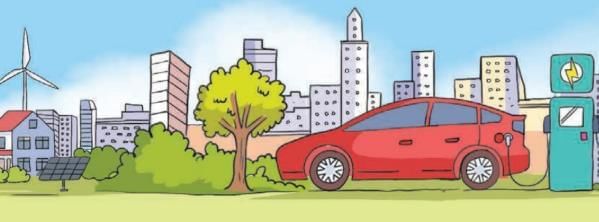
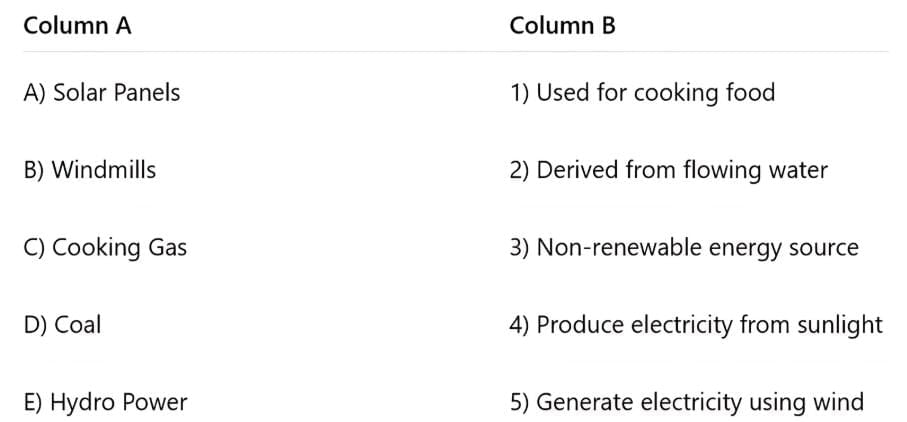
Q2: Match the items in Column A with the correct descriptions in Column B.

Q3: Fill in the blanks with the correct words from the chapter.
(i) The process of converting sunlight into electricity is called __________.
(ii) __________ is a common fuel used in vehicles.
(iii) The __________ is responsible for warming our homes during winter in some regions.
(iv) __________ is a renewable source of energy that can be harnessed by using solar panels.
(v) Electricity is used in homes for lighting, heating, and __________.

Q4: State whether the following statements are True or False. Correct the false statements.
(i) The Sun provides energy only in the form of light.
(ii) Animals do not require energy to move.
(iii) Burning wood produces less pollution than burning coal.
(iv) Solar power is a clean source of energy.
(v) All electricity comes from renewable sources.

Q5: Answer the following questions in 2-3 sentences each.
(i) What is energy?
(ii) How do we get energy from food?
(iii) What are some sources of energy?
(iv) Why is electricity important?
(v) What is clean energy?

Q6: Answer the following questions in 4-6 sentences each. Use examples from the chapter to support your answers.
(i) What is energy, and how do we use it in our daily lives? Give examples.
(ii) Why should we use clean energy sources like solar and wind power instead of coal?
iii) How do different sources provide energy to make things work? Explain with examples.
(iv) What safety rules should we follow while using electricity, and why is energy efficiency important?

You can find Worksheet Solutions here: Worksheet Solutions: Energy-How Things Work

06 Some Unique Places – Textbook Worksheet

Q1: Choose the correct option for each question.
(i) What is the southernmost point of India?
A) Kanyakumari
B) Indira Point
C) Vijaya Puram
D) Sundarbans

(ii) What unique bird is found in the Andaman and Nicobar Islands?
A) Andaman hornbill
B) Greater Adjutant Stork
C) Lion-tailed macaque
D) Bhut Jolokia

(iii) Which forest is known as the largest mangrove forest in the world?
A) Silent Valley
B) Sundarbans
C) Western Ghats
D) Andaman Islands

(iv) What is unique about the roots of mangrove trees?
A) They are long and deep
B) They grow in salty water
C) They have stick-like structures to breathe
D) They do not hold soil

(v) What connects the Seven Sisters in Northeast India?
A) Mountains
B) Rivers
C) States
D) Cities

Q2: Fill in the blanks with the correct words from the chapter.
(i) Shanti’s journey begins in the __________ Islands.
(ii) The __________ is a special forest where the Ganga meets the sea.
(iii) The __________ Stork is a bird that has seen a growth in numbers with community help.
(iv) The Western Ghats are known for their __________-tailed macaques.
(v) __________ Point is the southernmost point of India.

Q3: State whether the following statements are True or False. Correct the false statements.
(i) Shanti visited Kolkata before going to the Sundarbans.
(ii) The Andaman wood pigeon is a common bird found all over India.
(iii) The Silent Valley National Park is located in the Western Ghats.
(iv) Bhut Jolokia is a type of animal found only in Northeast India.
(v) People living near the Sundarbans do not depend on the forest for their daily needs.

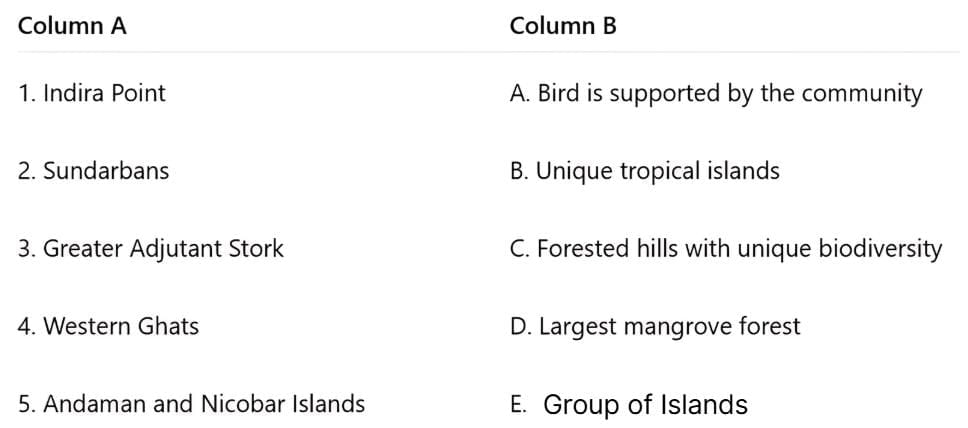
Q4: Match the items in Column A with the correct descriptions in Column B.

Q5: Answer the following questions in 2-3 sentences each.
(i) What is the southernmost point of India that Shanti discovered?
(ii) Why do the roots of mangrove trees help them survive
(iii) What is special about the Greater Adjutant Stork in Northeast India?
(iv) What do people do to avoid tiger attacks in the Sundarbans?
(v) What makes the Western Ghats a special place for plants and animals?

Q6: Answer the following questions in 4-6 sentences each. Use examples from the chapter to support your answers.
(i) What makes the Andaman and Nicobar Islands special?
(ii) Why are mangrove forests important? How do people live with nature in the Sundarbans?
(iii) What is special about Northeast India, and how do people protect nature?
(iv) What makes the Western Ghats special? How do people protect this region?

​You can find Worksheet Solutions here: Worksheet Solutions: Some Unique Places

05 Our Vibrant Country – Textbook Worksheet

Q1: Choose the correct option for each question.
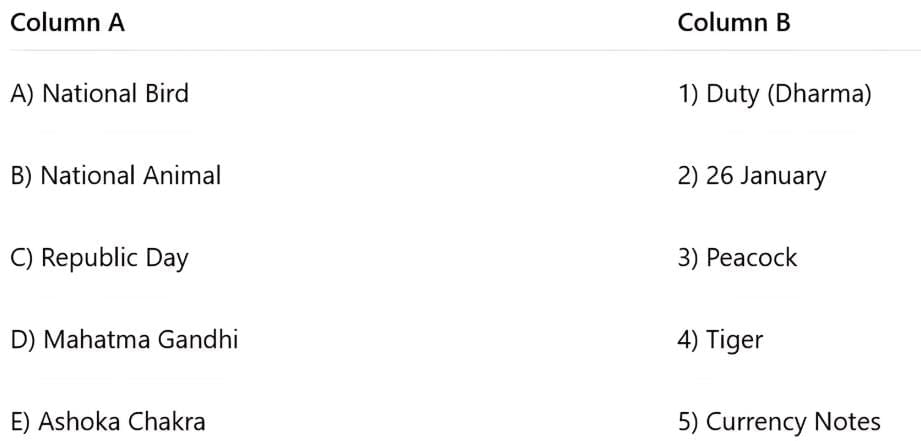
(i) What does the saffron colour in the Indian National Flag represent?
A) Peace and Truth
B) Strength and Courage
C) Growth and Prosperity
D) Duty (Dharma)

(ii) On which date is Republic Day celebrated in India?
A) 15 August
B) 26 January
C) 2 October
D) 1 January

(iii) Who is depicted on the Indian currency notes?
A) Jawaharlal Nehru
B) Mahatma Gandhi
C) Subhas Chandra Bose
D) Sardar Vallabhbhai Patel

(iv) The Ashoka Chakra is found in the centre of which Indian symbol?
A) National Anthem
B) National Flag
C) National Bird
D) Currency Notes

(v) What is the significance of Republic Day?
A) It marks India’s independence.
B) It commemorates the adoption of the Constitution.
C) It celebrates the end of British rule.
D) It honours the Indian Army.

Q2: Fill in the blanks with the correct words from the chapter.
(i)
 The Indian National Flag has three colors: saffron, white, and ______.
(ii) Republic Day is celebrated on ______ every year.
(iii) The ______ Chakra represents duty (dharma) in the Indian National Flag.
(iv) Mahatma Gandhi’s image appears on every Indian ______ note.
(v) India has more than a thousand ______.

Q3: State whether the following statements are True or False. Correct the false statements.
(i) The green stripe in the National Flag represents peace and truth.
(ii) The Republic Day parade showcases the traditions of different states.
(iii) The National Emblem of India shows five lions.
(iv) The ‘Swachh Bharat Abhiyan’ symbol is based on Gandhi ji’s glasses.
(v) The Statue of Unity is located in Gujarat.

Q4: Match the items in Column A with the correct descriptions in Column B.

Q5: Answer the following questions in 2-3 sentences each.
(i) What do the colours of the Indian National Flag represent?
(ii) Why do we celebrate Republic Day on 26 January?
(iii) Who is shown on every Indian currency note?
(iv) What does the National Emblem of India show?
(v) How does India’s diversity make it special?

Q6: Answer the following questions in 4-6 sentences each. Use examples from the chapter to support your answers.
(i) Explain the significance of Republic Day and how it is celebrated in schools. Why is it celebrated on 26th January?
(ii) Describe the various features you can find on Indian currency notes and explain their importance.
(iii) Explain how diversity makes India stronger with examples from different aspects of Indian culture.
(iv) Describe India’s national symbols and explain what they represent about our country.

You can find Worksheet Solutions here: Worksheet Solutions: Our Vibrant Country

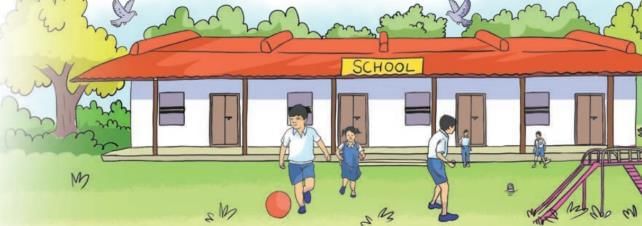
04 Our School — A Happy Place – Textbook Worksheet

Q1: Choose the correct option for each question.
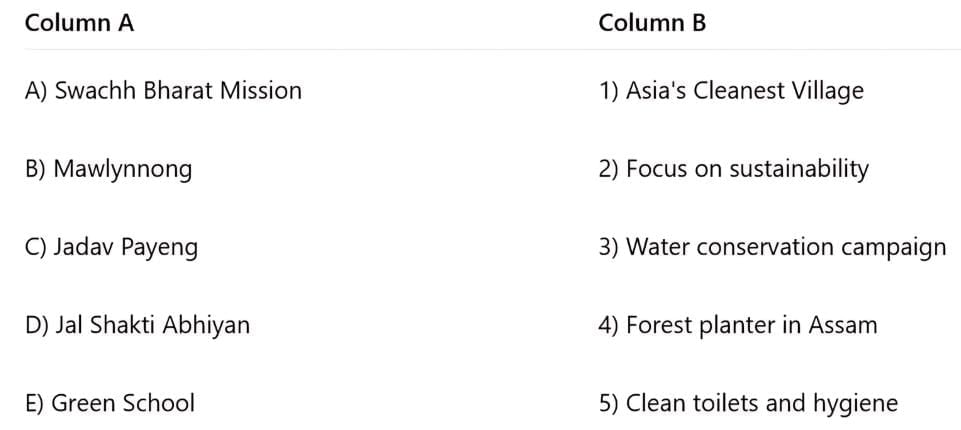
(i) What is a green school focused on?
A) Managing waste and saving water
B) Increasing class sizes
C) Reducing playtime
D) Ignoring environmental issues

(ii) Which of the following is NOT a part of the Swachh Bharat Mission?
A) Clean toilets
B) Safe water
C) Reducing school hours
D) Hygiene education

(iii) Which group is responsible for observing electricity usage?
A) Water Watchers
B) Electricity Savers
C) Waste Warriors
D) Traffic Trackers

(iv) What does the term “wet waste” refer to?
A) Plastic waste
B) Food scraps
C) Paper waste
D) Metal waste

(v) Who takes care of the trees in the school?
A) Only teachers
B) Only students
C) Students and staff
D) No one cares for them

Q2: Fill in the blanks with the correct words from the chapter.
(i) A green school teaches students to care for _______.
(ii) The Swachh Bharat Mission focuses on clean _______.
(iii) Jadav Payeng is known for planting a _______ in Assam.
(iv) Water Watchers check for _______ taps in the school.
(v) The campaign Jal Shakti Abhiyan encourages _______ water.

Q3: State whether the following statements are True or False. Correct the false statements.
(i) Mawlynnong is known as Asia’s Cleanest Village.
(ii) Every child has the right to study in a clean environment.
(iii) Trees do not provide shade.
(iv) Plastic waste is considered dry waste.
(v) The teacher’s name in the text is Anupam.

Q4: Match the items in Column A with the correct descriptions in Column B.

Q5: Answer the following questions in 2-3 sentences each.
(i) What is a green school?
(ii) Why is it important to save water?
(iii) What can students do to help keep the school clean?
(iv) What are some signs of a good school environment?
(v) How can we learn about traffic safety?

Q6: Answer the following questions in 4-6 sentences each. Use examples from the chapter to support your answers.
(i) How can students form School Explorer Teams to improve their school?
(ii) Why is proper waste management important and how should students practice it?
(iii) What are the main safety measures students should know for fire and traffic emergencies?
(iv) How can schools effectively conserve water and electricity?

You can find Worksheet Solutions here: Worksheet Solutions: Our School-A Happy Place

03 The Mystery of Food – Textbook Worksheet

Q1: Choose the correct option for each question.
(i) What causes the coloured patches on Disha’s uttapam?
A) Dust
B) Mould
C) Oil
D) Sugar

(ii) Which method keeps air away from pickles?
A) Drying
B) Pickling
C) Eating
D) Freezing

(iii) What is the role of microbes in food?
A) Spoiling food
B) Making food rise
C) Preparing food
D) All of the above

(iv) Which fruit did Disha’s father bring home?
A) Mango
B) Lychee
C) Banana
D) Apple

(v) What does refrigeration do to microbes?
A) It speeds them up
B) It kills them
C) It slows them down
D) It has no effect

Q2: Fill in the blanks with the correct words from the chapter.
(i) Microbes can be found in __________, water, air, and inside us.
(ii) Drying food removes __________ from it.
(iii) Good microbes help the idli batter __________.
(iv) Eating bad food can cause __________.
(v) Seasonal fruits taste better when they are __________.

Q3: State whether the following statements are True or False. Correct the false statements.
(i) Microbes are only found in soil and water.
(ii) Oil prevents air from reaching pickles.
(iii) Refrigeration is not useful for preserving food.
(iv) Chewing food properly releases saliva.
(v) Eating quickly is safe and doesn’t lead to choking.

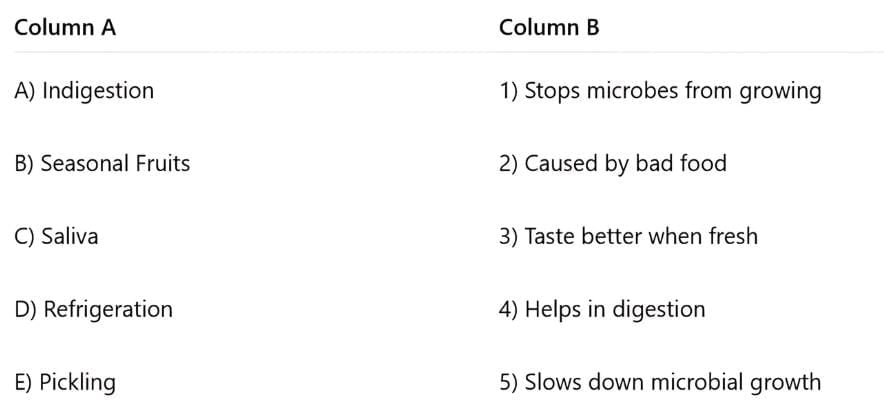
Q4: Match the items in Column A with the correct descriptions in Column B.

Q5: Answer the following questions in 2-3 sentences each.
(i) What causes food to spoil?
(ii) How can we stop food from spoiling?
(iii) Why is it important to chew our food well?
(iv) What should we do to keep our teeth healthy?
(v) What are some foods that help with digestion?

Q6: Answer the following questions in 4-6 sentences each. Use examples from the chapter to support your answers.
(i) Explain how microbes affect our food. Describe both harmful and helpful effects.
(ii) Describe four methods of food preservation and how they work.
(iii) Why is proper chewing important? Explain the role of different teeth and saliva.
(iv) What would happen without food preservation methods? Discuss the problems.

You can find Worksheet Solutions here: Worksheet Solutions: Mystery of Food

02 Journey of a River – Textbook Worksheet

Q1: Choose the correct option for each question.
(i) Where does the Godavari River originate?
A) Bay of Bengal
B) Western Ghats
C) Himalayas
D) Deccan Plateau

(ii) What is the primary use of the water from the Godavari River?
A) Recreation
B) Drinking, cooking, and irrigation
C) Industrial purposes
D) None of the above

(iii) How long is the Godavari River?
A) 1,100 kilometres
B) 1,465 kilometres
C) 2,000 kilometres
D) 800 kilometres

(iv) What is the name of the dam mentioned that affects the Godavari River?
A) Bhakra Nangal Dam
B) Polavaram Dam
C) Hirakud Dam
D) Sardar Sarovar Dam

(v) What is an important reason for keeping the Godavari River clean?
A) To maintain the beauty of the river
B) To ensure the health of people and wildlife
C) To increase tourism
D) To reduce flooding

Q2: Fill in the blanks with the correct words from the chapter.
(i) The Godavari River is also known as ________ Ganga.
(ii) The Godavari River flows into the ________ Sea.
(iii) The Godavari is the ________ longest river in India.
(iv) The Godavari River is a ________ river, meaning it flows all year.
(v) ___________ are smaller rivers that join the Godavari during its journey.

Q3: State whether the following statements are True or False. Correct the false statements.
(i) The Godavari River has several dams built on it for water storage.
(ii) The Godavari River is the longest in India.
(iii) Floods can cause damage to homes and agriculture.
(iv) The Godavari River flows only during the rainy season.
(v) The Godavari River is important

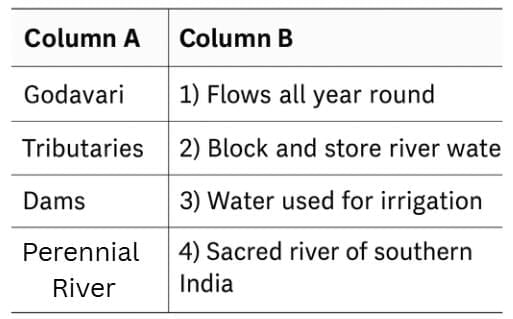
Q4: Match the items in Column A with the correct descriptions in Column B.

Q5: Answer the following questions in 2-3 sentences each.
(i) Where does the Godavari River begin its journey?
(ii) What are tributaries?
(iii) Why is the Godavari River important for people living near it?
(iv) What happens when it rains a lot and the river overflows?
(v) How can we keep rivers clean?

Q6: Answer the following questions in 4-6 sentences each. Use examples from the chapter to support your answers.
(i) Describe the three main stages of a river’s journey, using the Godavari River as an example.
(ii) Explain how the Godavari River supports life and helps people. Give at least three examples.
(iii) What challenges does the Godavari River face, and how do they affect it?
(iv) What is a delta? Describe where the Godavari River forms its delta and why it’s important.You can find Worksheet Solutions here: Worksheet Solutions: Journey of a River

01 Water — The Essence of Life – Textbook Worksheet

Q1: Choose the correct option for each question.
(i) What percentage of Earth’s water is freshwater?

A) 1%
B) 10%
C) 3%
D) 5%

(ii) What is the process called when water turns into vapour?
A) Precipitation
B) Evaporation
C) Condensation
D) Filtration

(iii) Which of the following is NOT a type of freshwater?
A) Pond
B) River
C) Ocean
D) Lake 

(iv) What do we call the water that soaks into the ground?
A) Surface water
B) Groundwater
C) Rainwater
D) Tap water

(v) What is primarily responsible for the water cycle?
A) Wind
B) Sun
C) Trees
D) Animals

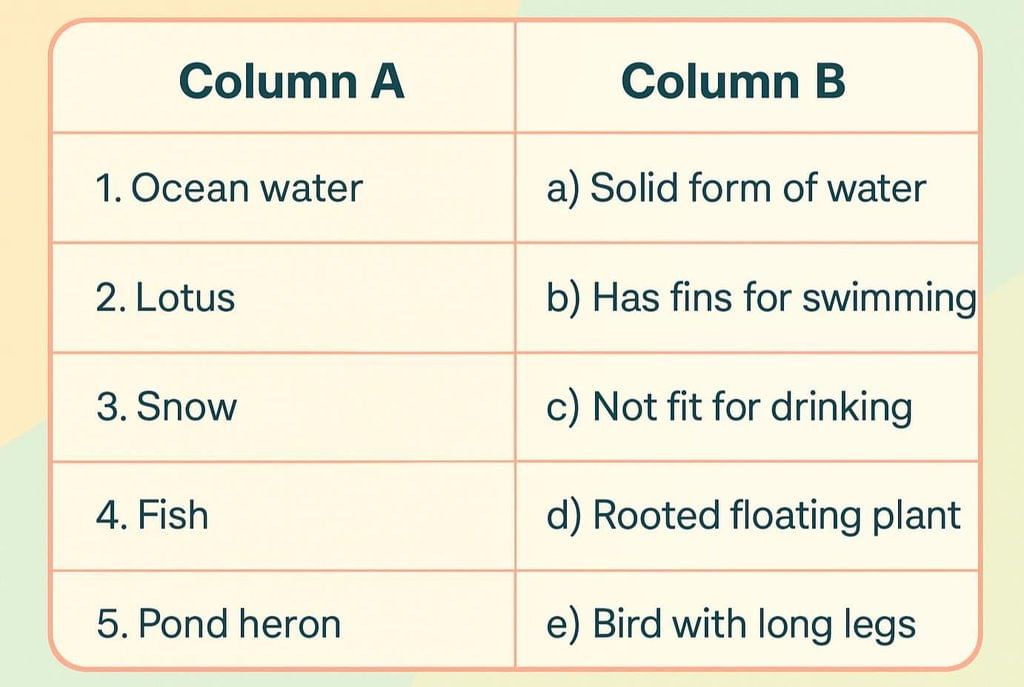
Q2: Match the items in Column A with the correct descriptions in Column B.

Q3: Fill in the blanks with the correct words from the chapter.
(i) The process of water falling to the ground is called __________.
(ii) Water exists in three forms: liquid, solid, and __________.
(iii) Groundwater is obtained by digging __________.
(iv) The __________ River in Rajasthan ends in the Rann of Kutch.
(v) Freshwater plants that float on the surface are called __________ plants.

Q4: State whether the following statements are True or False. Correct the false statements.
(i) Most of the Earth’s water is freshwater.
(ii) Rainwater is a type of surface water.
(iii) Water vapour can form clouds when it cools.
(iv) Water cannot exist in solid form.
(v) Planting trees helps in groundwater recharge.

Q5: Answer the following questions in 2-3 sentences each.

(i) Where does freshwater come from?
(ii) What are the three forms of water?
(iii) What is the water cycle?
(iv) How do we get groundwater?
(v) Why are rivers important?

Q6: Answer the following questions in 4-6 sentences each. Use examples from the chapter to support your answers.
(i) Describe the water cycle in detail, including how water changes forms and moves through nature. Explain why it is important for life on Earth.
(ii)  Explain the difference between freshwater and saltwater sources. Discuss why freshwater is essential for humans, plants, and animals, and what challenges we face in accessing it.
(iii) How do rivers form and flow across the land? Use the mustard seed activity and examples from Indian rivers to describe how they shape the landscape and support ecosystems.
(iv) Why is groundwater recharge important, and what happens if it doesn’t occur properly? Suggest ways to conserve water and protect groundwater in cities and villages.

You can find Worksheet Solutions here: Worksheet Solutions: Water – The Essence of Life