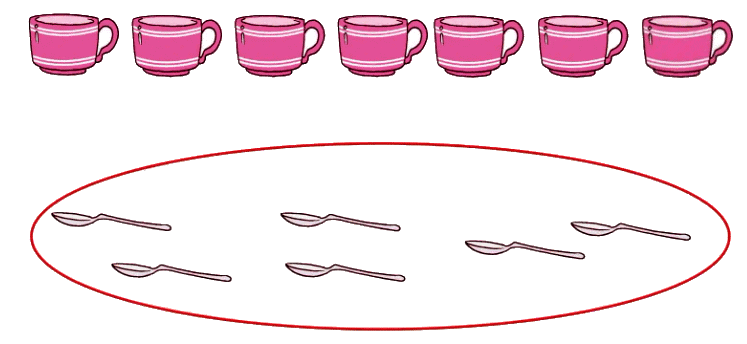
Introduction
- The information that we collect is called Data.
- Data Handling is a process of collecting organising and representing data in various form like graphe, tables, pictographs etc.
- Let us see an example to understand better the concept of data collecting.
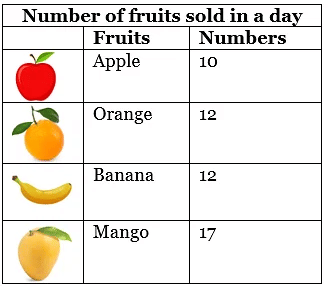
- Look at the table. This table shows the number of fruits sold in a day by a fruit seller.
Do you know?
- Data handling represents data in the form of pictures (called pictograph). These pictographs used by various news channels to display weather report on news.
Real Life Example
- Data Handling is widely used in collection of scores of students in various exams.
- Data handling helps the doctors to keep records of their patients.
- Once we have information data, the next step is to get result from it.
- The information we get from the above data is that Mangoes are sold the most. Apples are sold the least.
Sort and organise
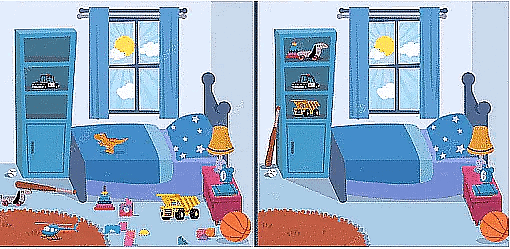
Look at the picture of two rooms, room A and room B.
Which room looks neat and clean?
Room B looks neat and clean as things are properly organised in Room B.
Let us understand how to sort and organise things.
- Sorting: Grouping objects on the basis of common features is called Sorting’.
- Organising: Arranging objects in a proper or systematic manner is called organising.
An organised room or display looks neat and clean. For example room B in above example.
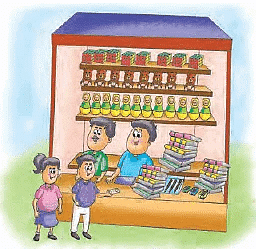
Ramu has opened a new stationery shop. It has pens, pencils, erasers, books, notepads, envelopes, coloured chalks, papers and stickers at one place. How can he neatly arrange everything?
He can sort things and organise them on the basis of their size, shape, colour etc.
We can make a table to help us to sort our things.
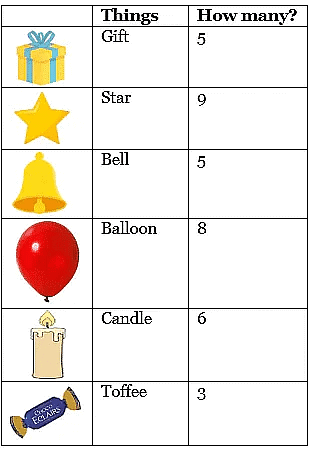
Annie and her friends wants to celebrate Christmas. They want to purchase some items to decorate their Christmas tree. They prepare a list of various items, which are required to decorate the tree. The table given below shows the list of items and the number of items. This list will help Annie and her friends to remember the items to be purchased and their numbers.
Presenting Data
We can present data in the form of table, pictures, graph, bar graphs, etc. Let us understand with the help of an example. We will study graphs, bar graph in the next classes.
This is a collections of Naina’s toys.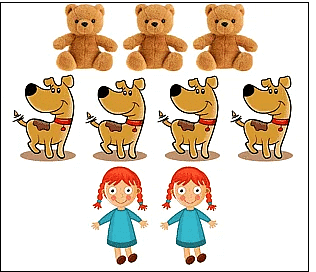
The data for Naina’s toys can be represented as follows.
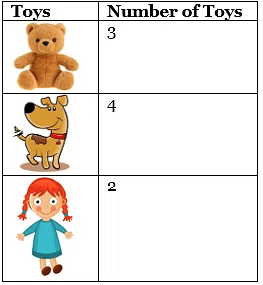
It is easier to know from data representation that there are more number of toy dogs than teddy bears and Barbie dolls.
Greater Than Sign
- The greater than symbol in maths is placed between two values in which the first number is greater than the second number. For example 10 > 5. Here 10 is greater than 5.
- In inequality, greater than symbol is always pointed to the greater value and the symbol consists of two equal length strokes connecting at an acute angle at the right. ( >).
Less Than Sign
- Similarly, a less than symbol is placed between two numbers where the first number is less than the second number. An example for less than the inequality symbol is 5 < 10. It means that 5 is less than 10.
- In inequality, less than symbol points to the smaller value where the two equal length strokes connect at an acute angle at the left (<).
- This greater than less than symbol reduces the time complexity and it makes an easy way for the reader to understand.
Equal To Sign
- The ‘equal to’ sign is used to show the equality between two numbers or values. This sign contradicts both the greater than and less than sign. Even in terms of writing the equations, we use equal to sign. It is denoted by ‘=’.
Example: If a = 10 and b = 10, then a = b.
Summary – All the Symbols
Here, given the list of frequently used symbols in Maths explained along with the examples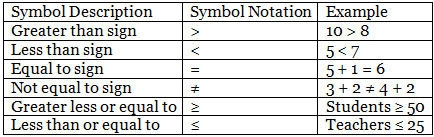

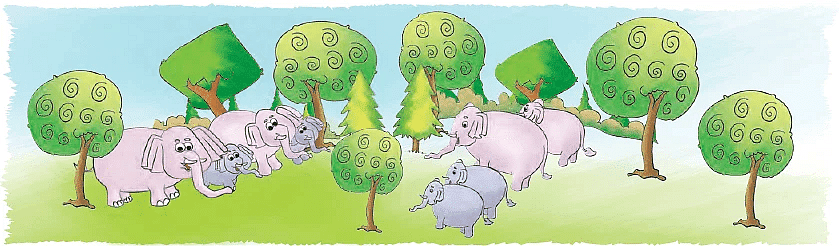 Each family has 4 elephants.We say, there are 4 + 4 = 8 elephants going for a jungle walk.
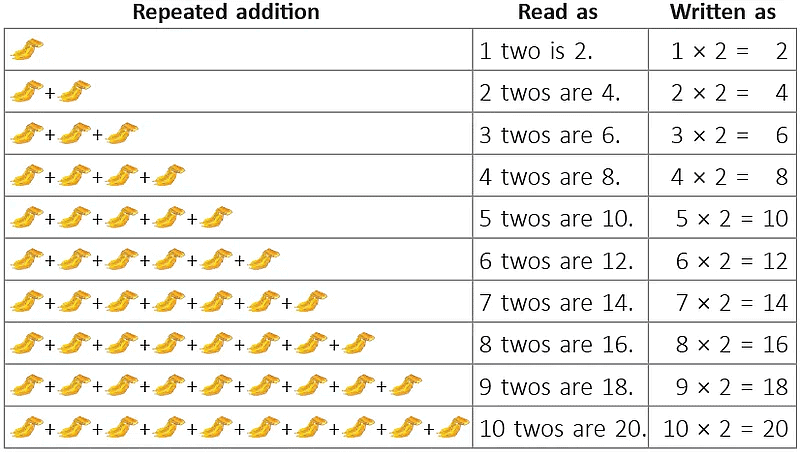
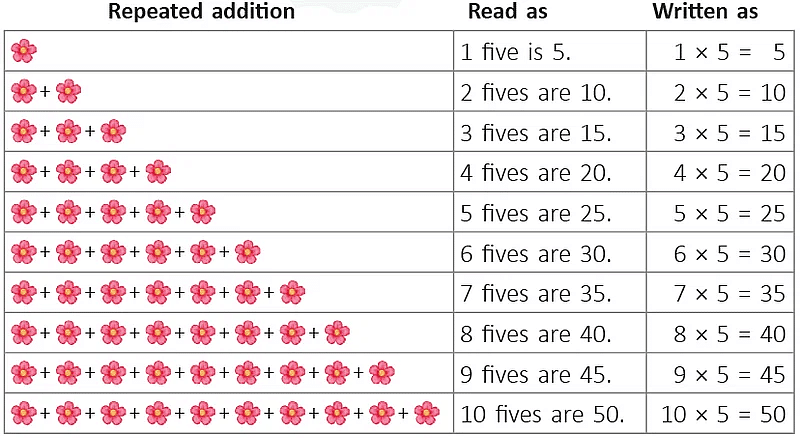
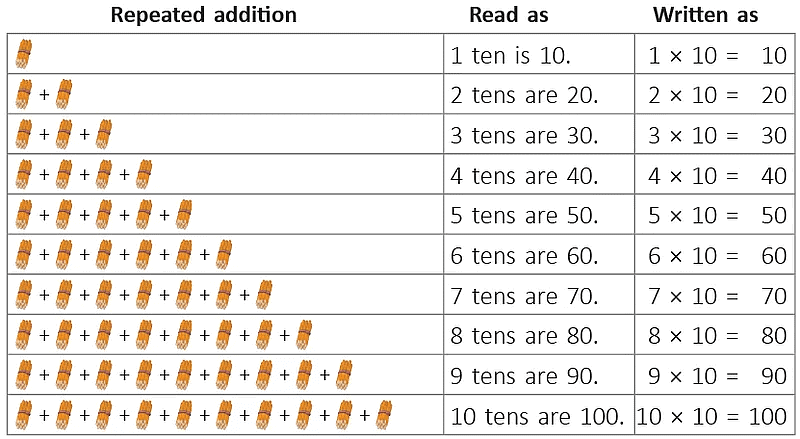
 5 + 5 + 5 + 5 = 20Instead of adding the same number 5 over and over again 4 times, an easier way to get the answer is 4 x 5 = 20.4 x 5 = 20 is read as 4 times 5 is equal to 20.
  Starting from 0, there are 3 jumps and each jump covers 5 units (steps) on the number line.Or3 times 5 units covered.
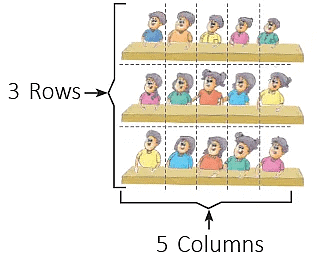 Here, there are 3 equal groups of 5 children.OrThere are 3 x 5 = 15 children in all.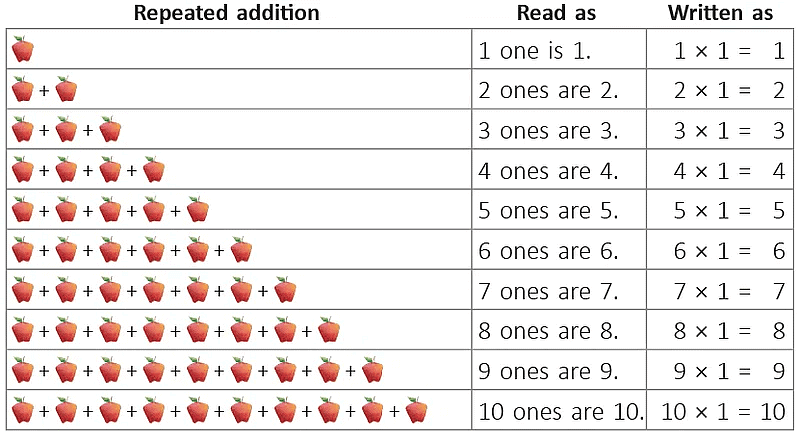
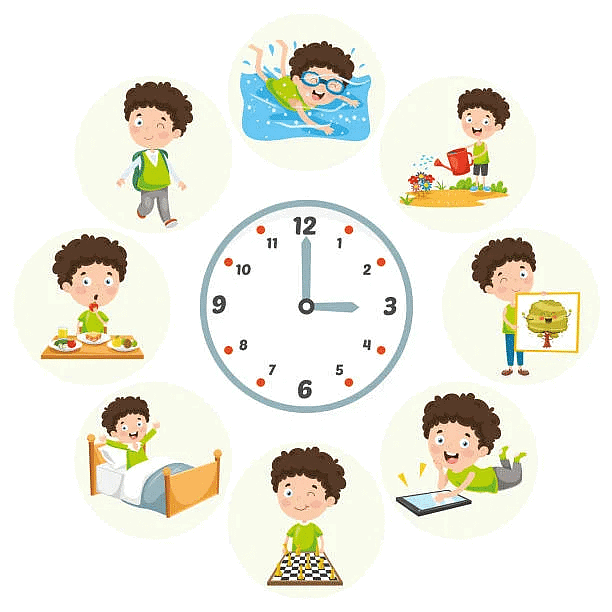
 We wake up in the morning
 We have lunch in the Afternoon
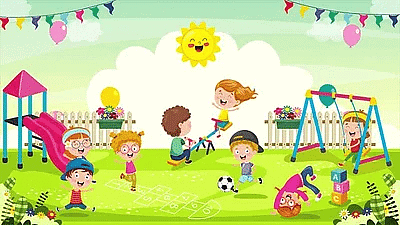 We play in the Evening
 We sleep at Night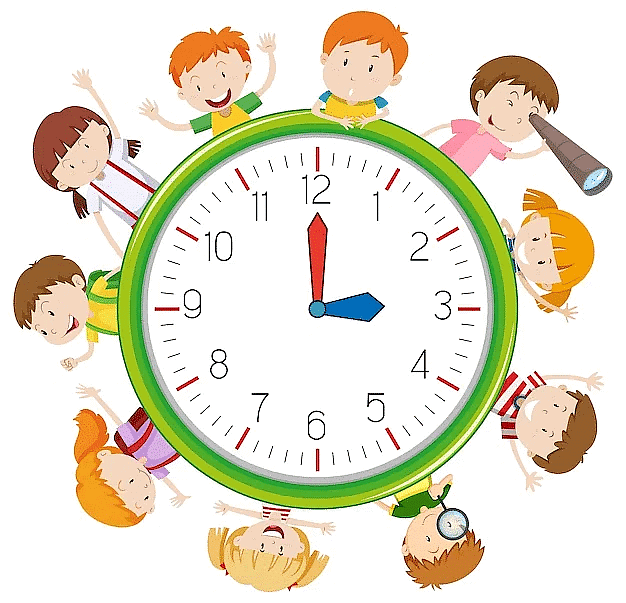





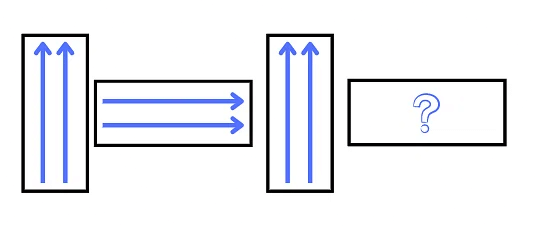
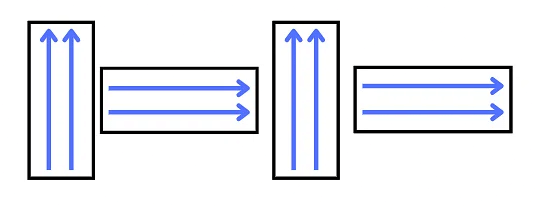
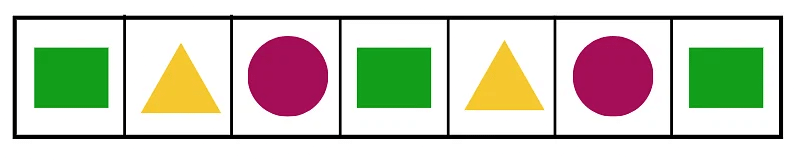
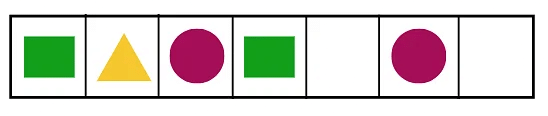 In the first box, we see a rectangle. In the second box, we see a triangle. And in the third box, we see a circle.
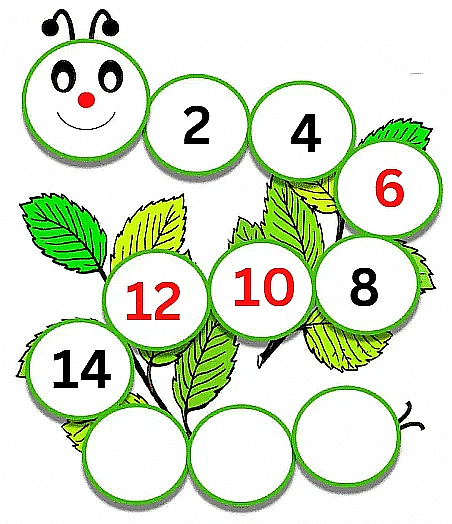
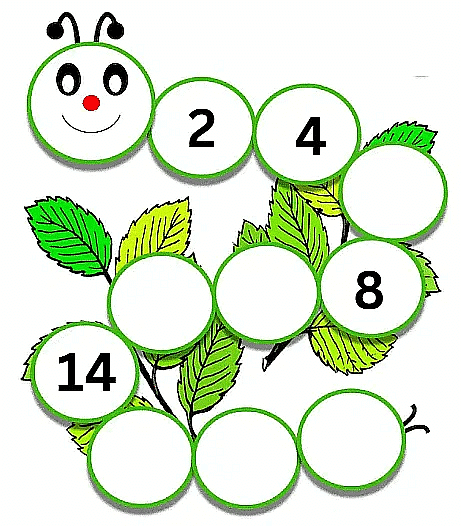 So by looking at the numbers we see that 2 is followed by 4, then there is a missing number which is followed by 8. So what do we get to know about this sequence? We see that 2+2 = 4, 4+2 = 6, 6+2 = 8. So we can see that the missing number is 6. That’s where the missing number went!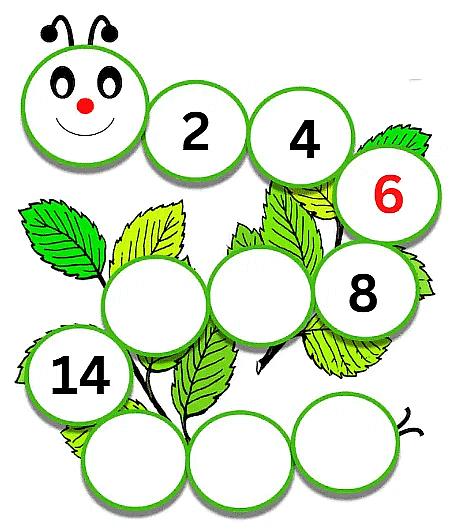
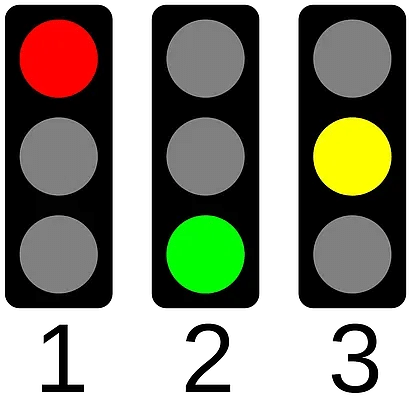 Traffic Lights
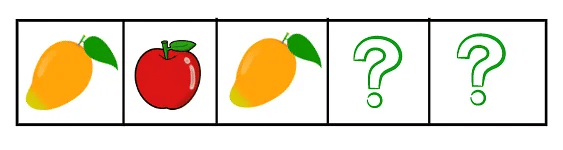
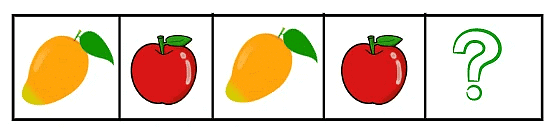
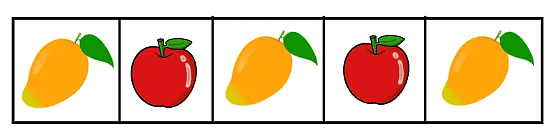
 Now, we need to complete the pattern for the next three empty boxes.



 Example 3:
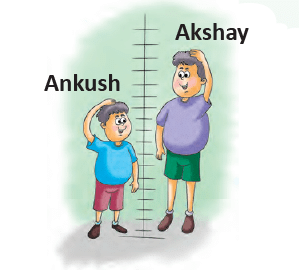 The teacher asks the students to stand heightwise in a line.
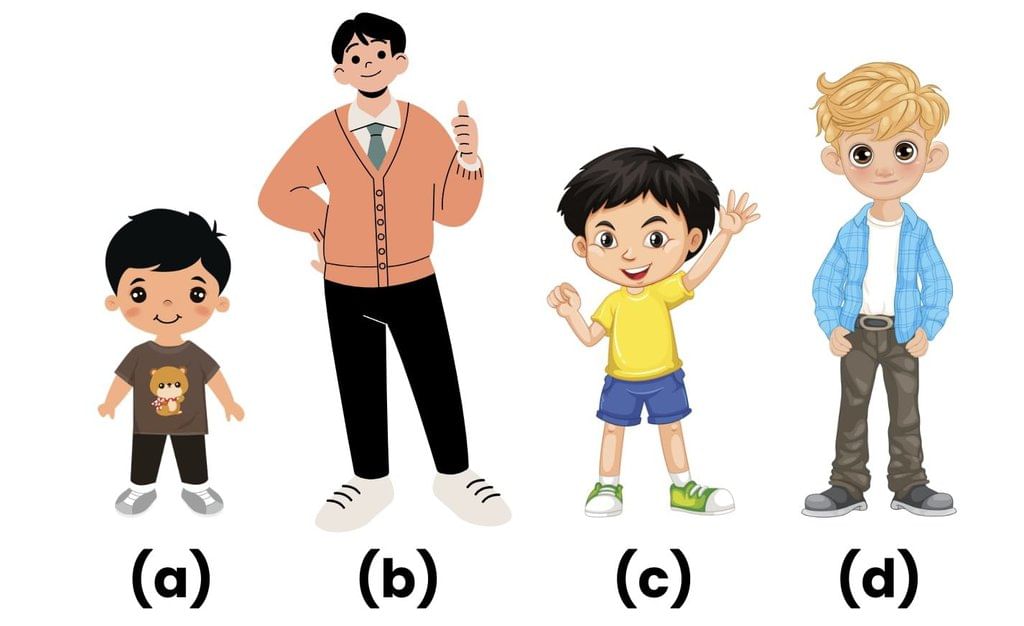
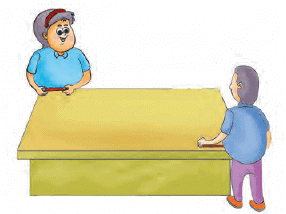 Mohit and Meeta place their pencils along the edge of the tabletop to measure the length of the table.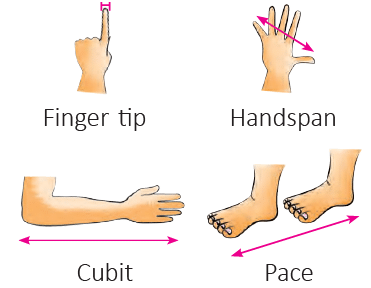
 are playing on a see-saw.
 is light. Ant weighs less. It has less mass.
 is heavy. Elephant weighs more. It has more mass.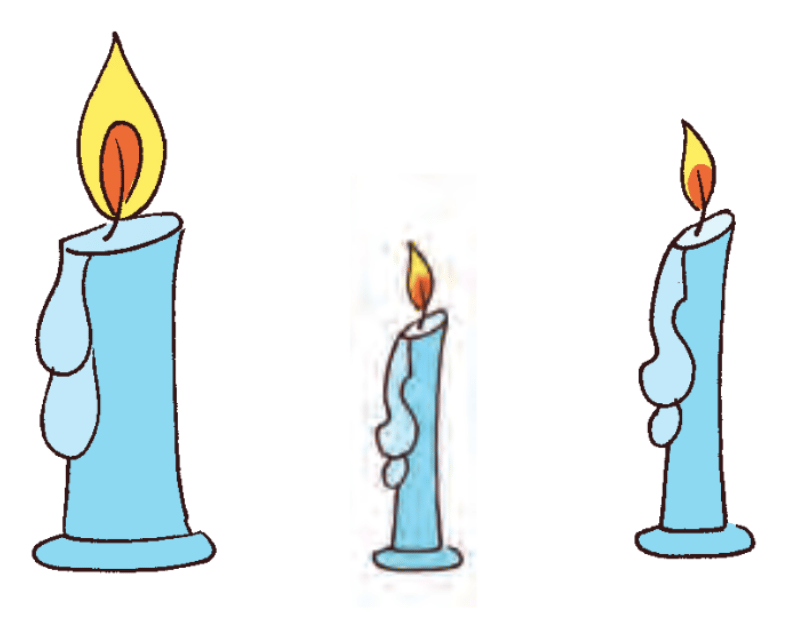
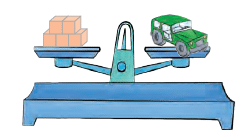 Kripa and Vanshika are playing with their “Toy Balance” and blocks to know how heavy their toys are.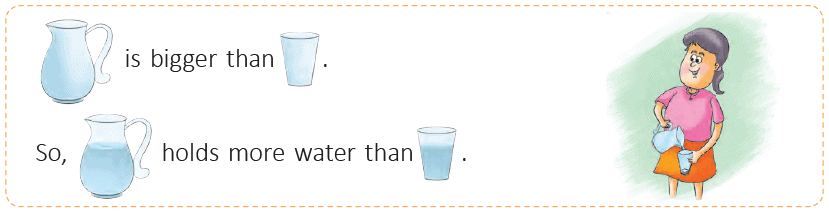
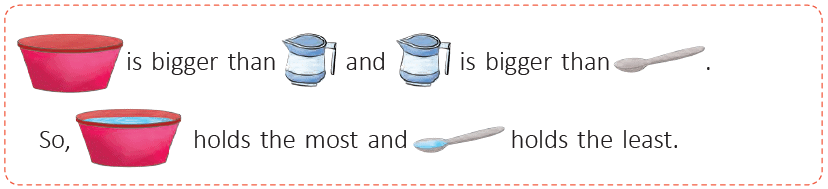
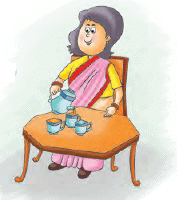 This teapot holds 3 cups of tea. Or we can say that capacity of this teapot is 3 cupfuls.
 We reach at 9. So, 6 + 3 = 9.EduRev Tips: It is easy to add if we start from the bigger number while doing addition by counting forward.Addition on a Number LineTo add 7 and 3, we start from 7 on the number line and move 3 steps (ones) forward.
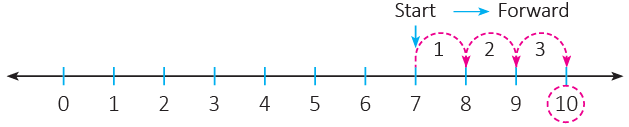 We reach at 10. So, 7 + 3 = 10.Vertical AdditionTo add 6 and 2, we arrange the numbers one below the other and add as we do by forward counting as shown.
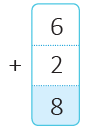 Start from the bigger number 6 and count forward by 2 as:
 So, 6 + 2 = 8.Properties of AdditionLet us look at the following situations to know the properties of addition.1. Adding two numbers by changing their order
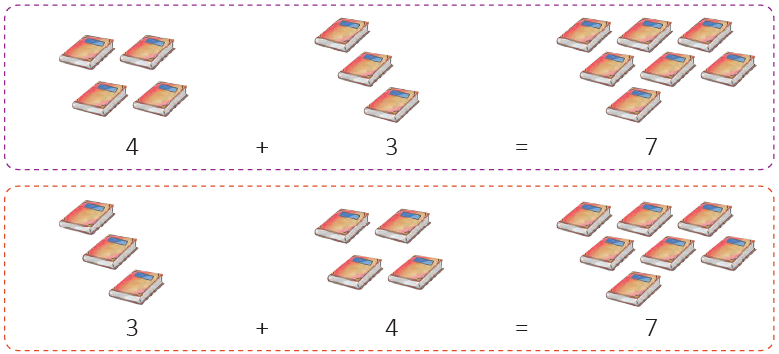 While adding two numbers, the sum does not change, even if we change the order of the numbers.2. Adding 0 to a numberThere are 4 friends playing. No more friends joined them.
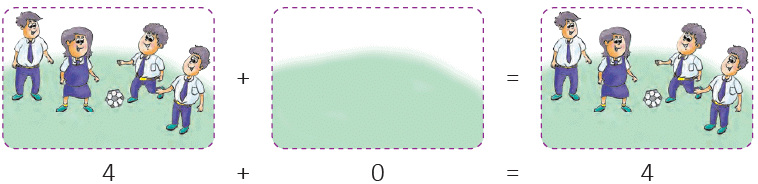 When we add 0 to a number, the sum is the number itself.Addition up to 20Adding 1-digit number to 10
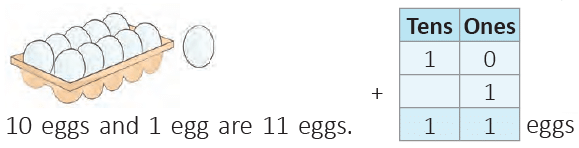 EduRev Tips: To add 1-digit number to 10, just replace the 0 with the number. It becomes the ones place of the ‘sum’.Addition: Counting Together by Making a Group of 10Let us add two single digit numbers say 8 and 5 by making tens. 8 X-mas stars and 5 X-mas stars together give 13 X-mas stars.
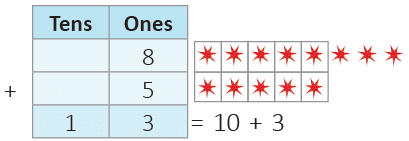 Here’s a fun way to do it:First, try to make a group of 10 stars because it’s easier to count.From the 5 stars, take 2 stars and add them to the 8 stars.Now, you have:8 stars + 2 stars = 10 stars (One group of 10!)You still have 3 stars left from the 5 stars.So, 10 stars + 3 stars = 13 stars.You have 13 Christmas stars in total.So, the sum of 8 and 5 is 13.EduRev Tips: Adding by making a group of 10 changes the question to “adding to 10”.Addition: Counting Together by Adding Ones FirstLet us add a 2-digit number and a 1-digit number say, 12 and 5.
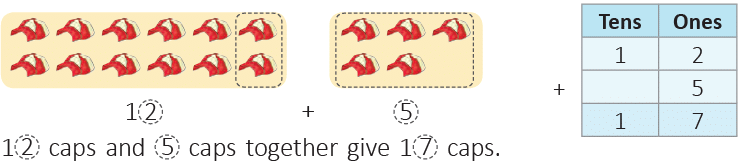 So, the sum of 12 and 5 is 17.Addition: Counting Forward on a Number LineLook at the given number line. It shows the numbers from 0 to 20.
 Let us add 11 and 6 using the number line. To find 11 + 6, start with the bigger number, 11. Now, take 6 steps (ones) forward as shown.
 We reach at 17. So, 11 + 6 = 17.Adding Three Numbers
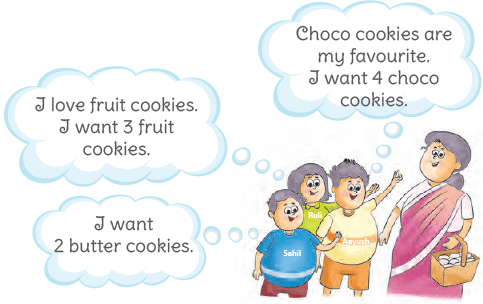 Ms Yashvi is hosting a holiday cookie party for kids. Ms Yashvi helps them in adding the number of cookies they want.
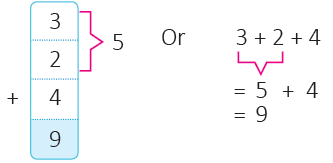 Thus, Ms Yashvi got the answer 9 cookies because 3 + 2 + 4 = 9.EduRev Tips: While adding three numbers, it makes no difference which two numbers are added first.
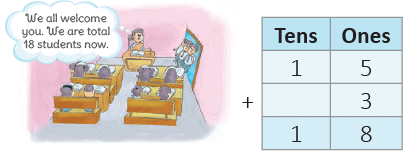 There are 15 + 3 = 18 students in the class now.SubtractionSubtraction by Crossing OutThere are 8 carrots in the basket. A rabbit takes away 3 carrots. How many carrots are left in the basket now?
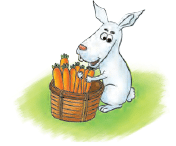 To find how many carrots are left, we cross out 3 carrots and count the remaining uncrossed carrots.
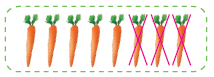 There are 5 uncrossed carrots.So, 5 carrots are left in the basket.We can write it as:8 – 3 = 5 Or
 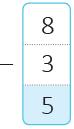 EduRev Tips: When we write the smaller number below the bigger number for subtraction, it is called vertical subtraction.Subtraction by Counting BackwardTo subtract 4 from 7 by backward counting, we start with the bigger number 7 and count backward 4 ones as:
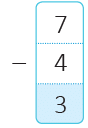 We reach at 3. So, 7 – 4 = 3.EduRev Tips: We count backward by ones to subtract. The number we stop at is the difference.Properties of SubtractionLet us look at the following situations to know the properties of subtraction.1. Subtracting 0 from a numberA monkey has 6 bananas. The monkey ate none. Now, 6 bananas are left with him.
 When 0 is subtracted from a number, the difference is the same number.2. Subtracting 1 from a numberA monkey has 5 bananas. The monkey ate 1 banana. Now, 4 bananas are left with him.
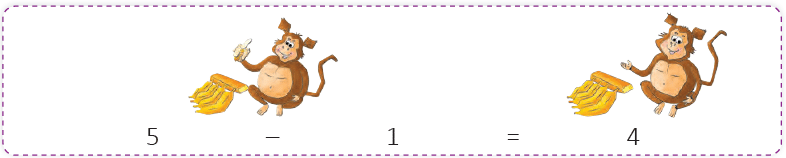 When 1 is subtracted from a number, the difference is the number that is just before it.3. Subtracting a number from itselfA monkey has 4 bananas. The monkey ate all of them. No bananas are left with him now.
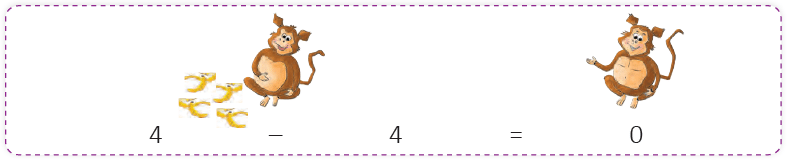 When a number is subtracted from itself the difference is 0.Subtraction Using Backward Counting on a Number LineTo subtract 4 from 10, we first start with the bigger number 10 then move 4 steps (ones) backward as shown.
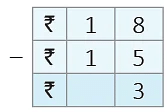
 We reach at 6. So, 10 – 4 = 6.[Question: 777896]Subtracting within 20Subtracting a 1-digit number from a 2-digit numberCase 1: When the ones digit is same in both the numbers.Yajur has 15 paperclips. He lost 5 of them. How many paperclips are left with him?To find how many paperclips are left, we subtract the ones digit first. 5 ones – 5 ones = 0 ones. (As subtracting the number from itself gives 0.)Write tens digit (1) as it is.
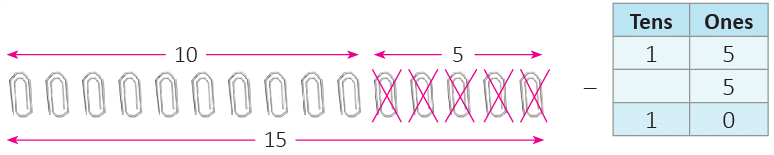 So, 15 – 5 = 10.Case 2: When the ones digit in a 2-digit number is greater than the 1-digit number.There were 16 ants in a line. 4 ants diverged from the line. How many ants are left in the line now?To find how many ants are left in the line, we subtract the ones digit first.6 ones – 4 ones = 2 ones. Write 2 below the ones column.Now, write 1 as it is in the tens place as shown.So, 16 – 4 = 12.
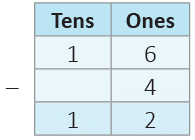 Thus, there are 12 ants left in the line now.Subtracting by Backward CountingTo subtract 5 from 17, we begin at 17 and count 5 ones backward.
 We reach 12. So, 17 – 5 = 12.Subtraction: Backward Counting on a Number LineLook at the number line shown below. It shows the numbers from 0 to 20.
 Let us subtract 6 from 14. We start with the bigger number 14 and jump back 6 steps (ones).
 We reach at 8. So, 14 – 6 = 8.Subtraction Stories in Real-Life Situations
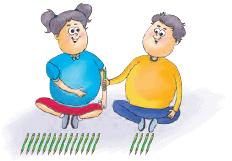 Sheetal has 19 pencils. She gave 5 pencils to her brother Parag.Parag: How many pencils are left with you now?Sheetal: 14Parag: How?Sheetal: I subtracted the pencils given to you from the total number of pencils I had as follows.
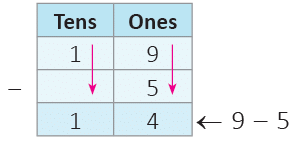 So, 19 – 5 = 14.You can also count backward to subtract. Start from 19 and count back 5 ones as 19, 18, 17, 16, 15, 14.Sheetal: This is how I am left with 14 pencils.Addition and Subtraction RelationshipFor example, in the picture below there are 4 pineapples in the first set and 2 pineapples in the second set, so we say there are 6 pineapples altogether and we can write 4 + 2 = 6.
 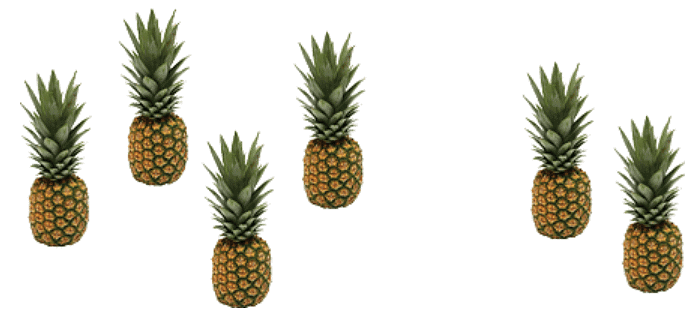 If we start with 6 pineapples and take away 2, we are left with 4. We can write 6 − 2 = 4.
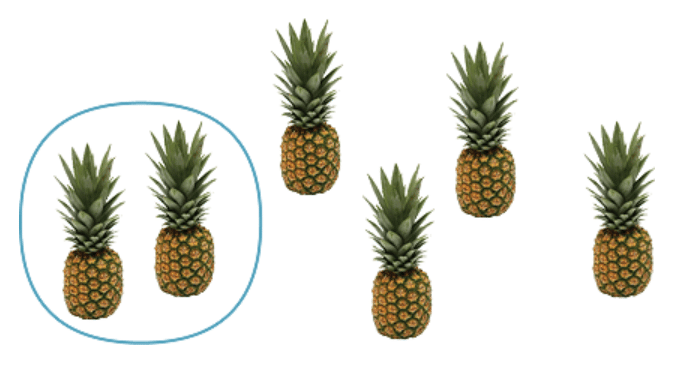 Problem-Solving: Simultaneous Addition and SubtractionLet us look at the following problem:Example: A farmer had 12 mangoes. He sold 4 mangoes. Then he picked 6 more mangoes from his tree. How many mangoes does he have now?Sol: Let’s solve this step-by-step.1. The farmer had 12 mangoes.
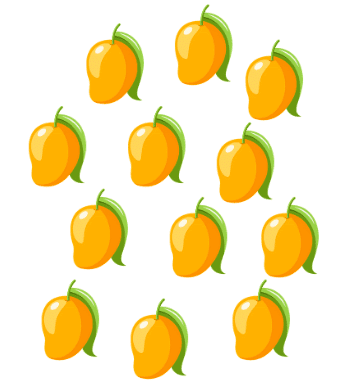 He sold 4 mangoes, so we subtract:12−4=8
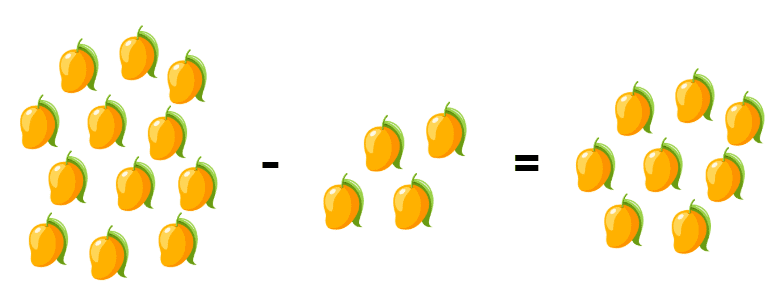 Now he has 8 mangoes.He then picked 6 more mangoes, so we add:8+6=14
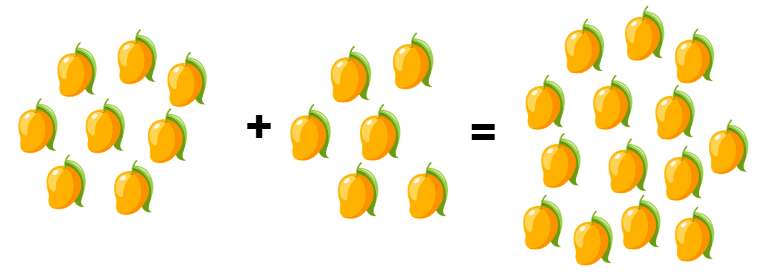 The farmer now has 14 mangoes.
 B: Make some dot designs with objects like tamarind seeds, pebbles, buttons, bindis, etc., and identify the number of dots in each arrangement.
 Ans:
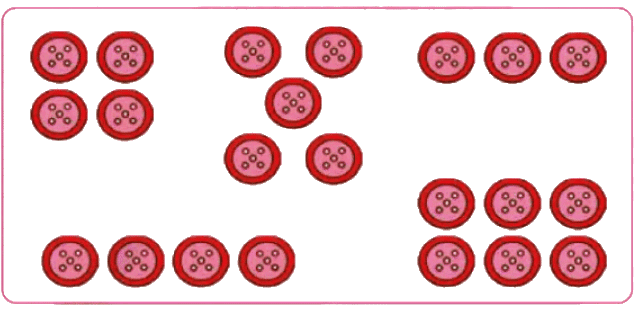
Ans: 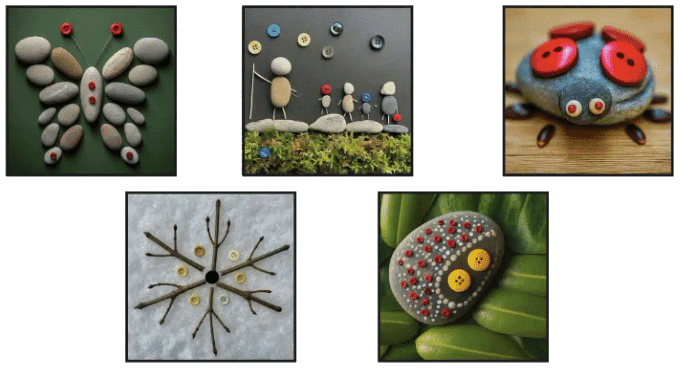 C: Identify and write the numbers formed by the arrangement of the red bindis.
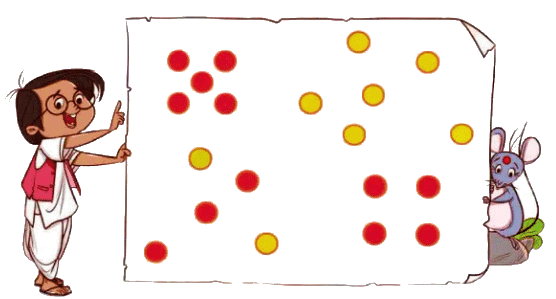 Ans:
Ans: 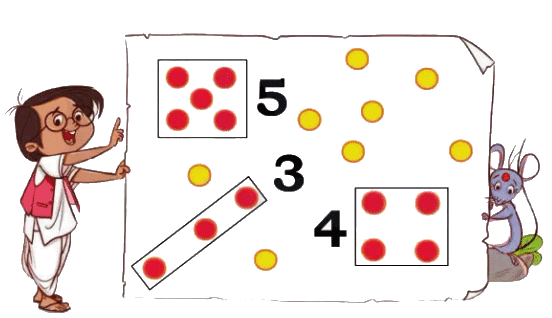 Let us Play
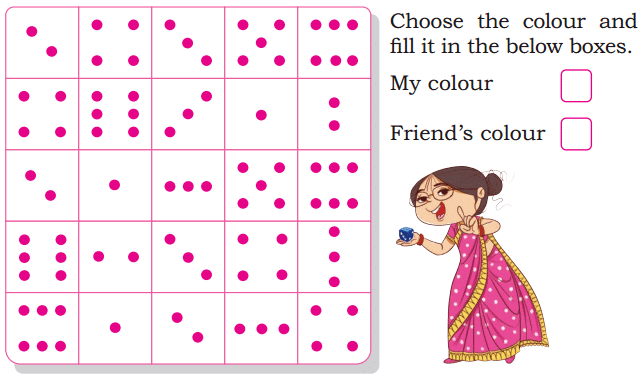
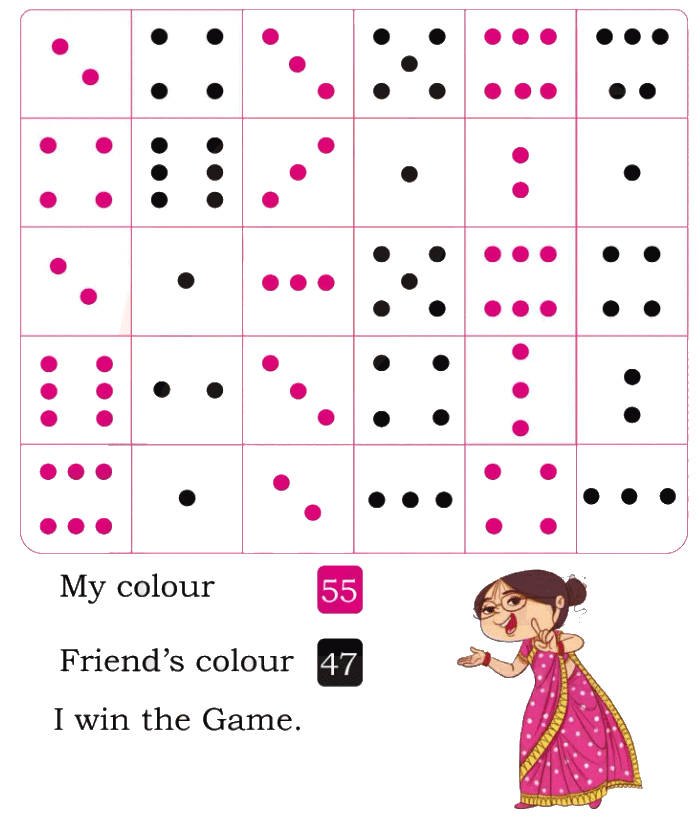 Vanishsing Buttons
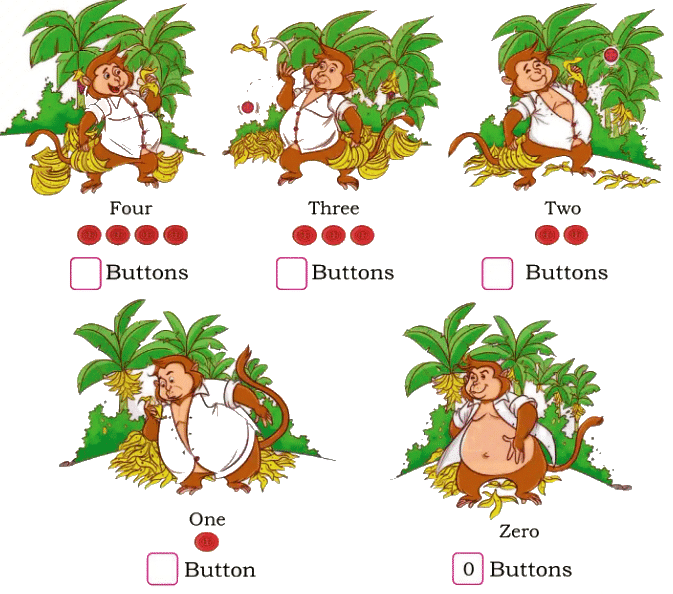
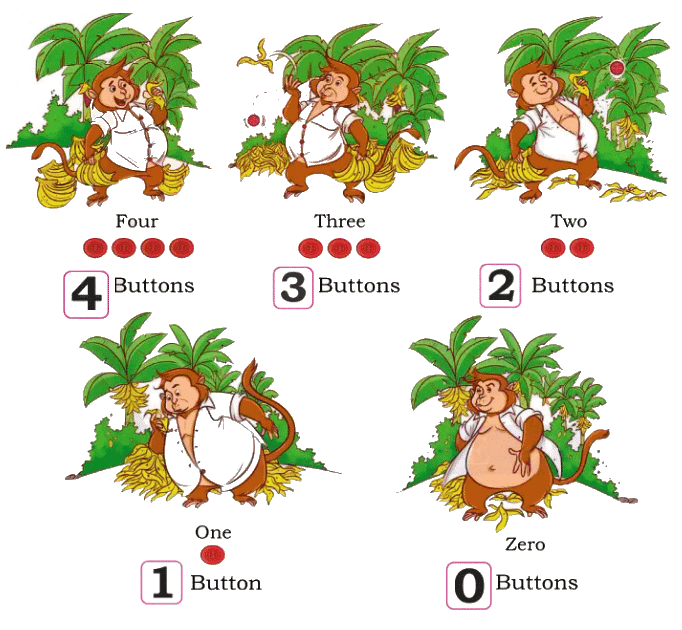 Page No. 36
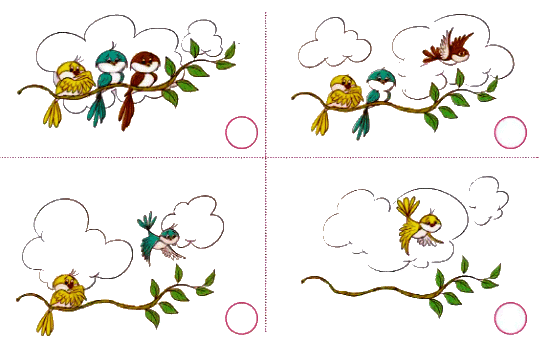
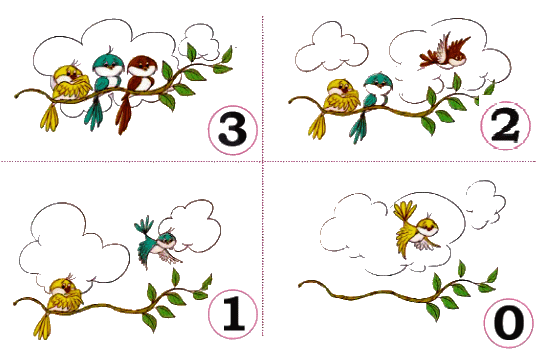 Think and Tell
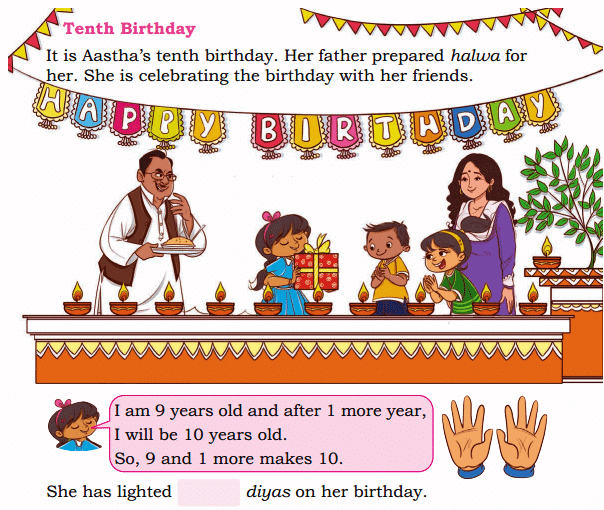 Ans: It is Aastha’s tenth birthday. Her father prepared halwa for her. She is celebrating the birthday with her friends.She has lighted 11 diyas on her birthday.Count and write the number of objects.
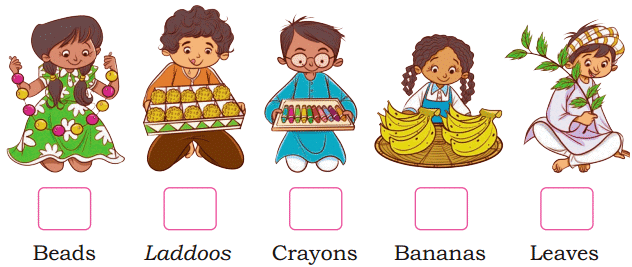 Ans:
Ans: 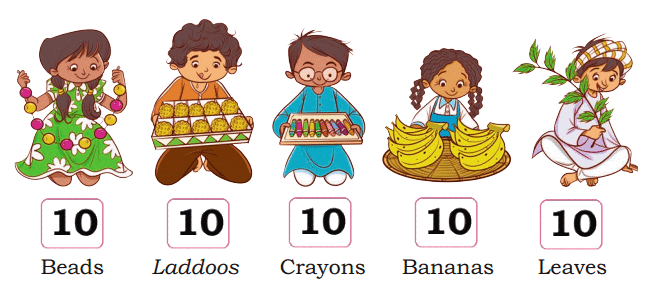 Let us
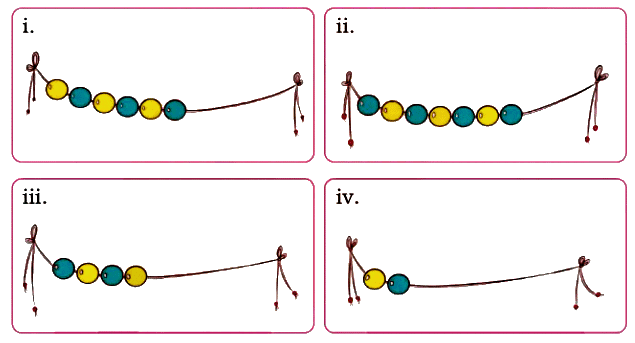
 B: Draw buttons to make a ten frame of buttons.
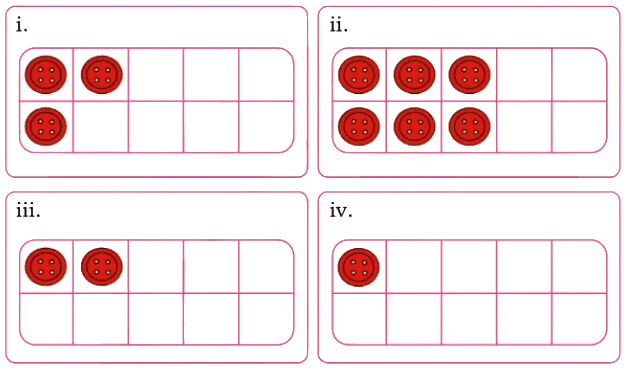 Ans:
Ans: 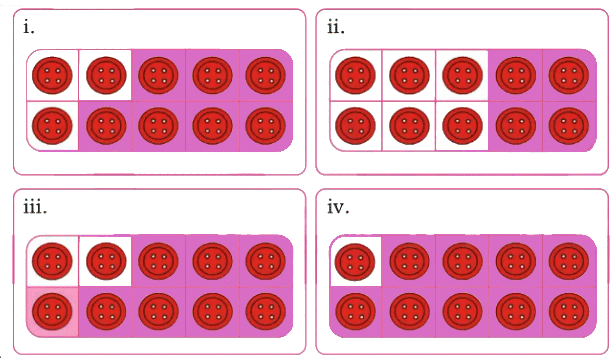 The Handy Five and Ten
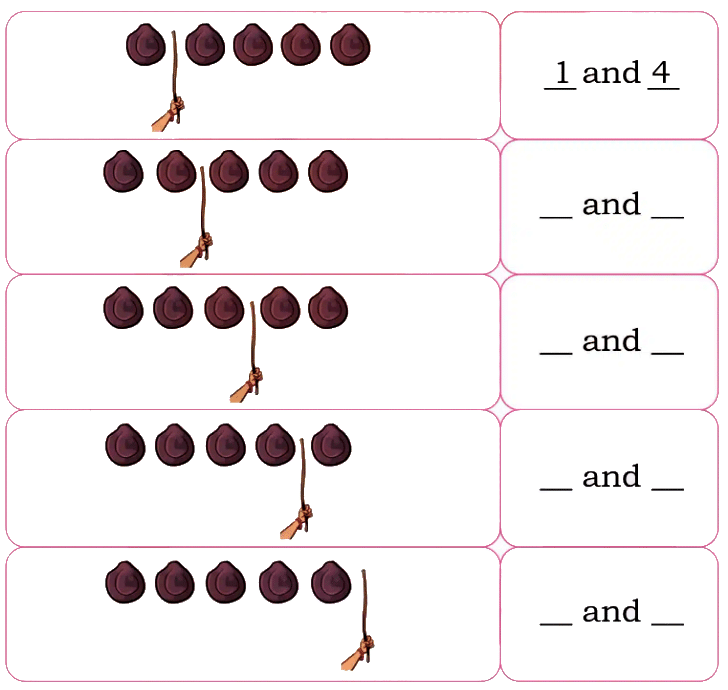
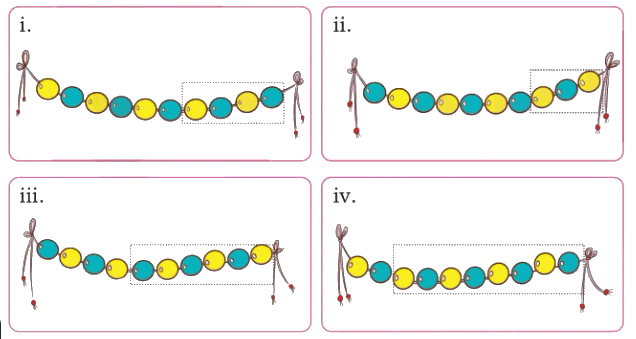
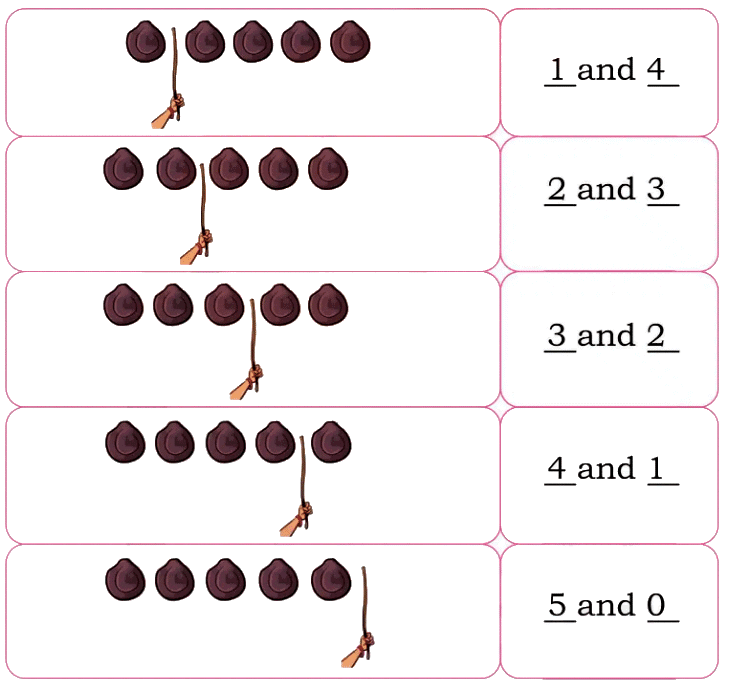 Number Pairs of 10
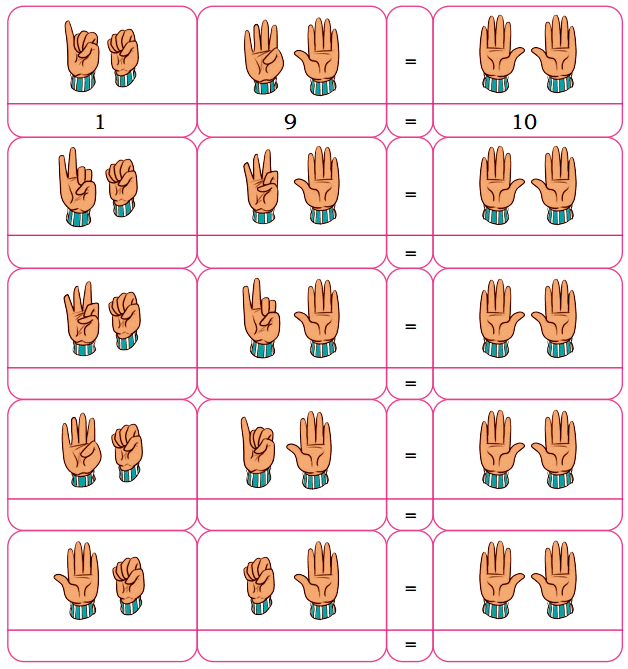 Ans:
Ans: 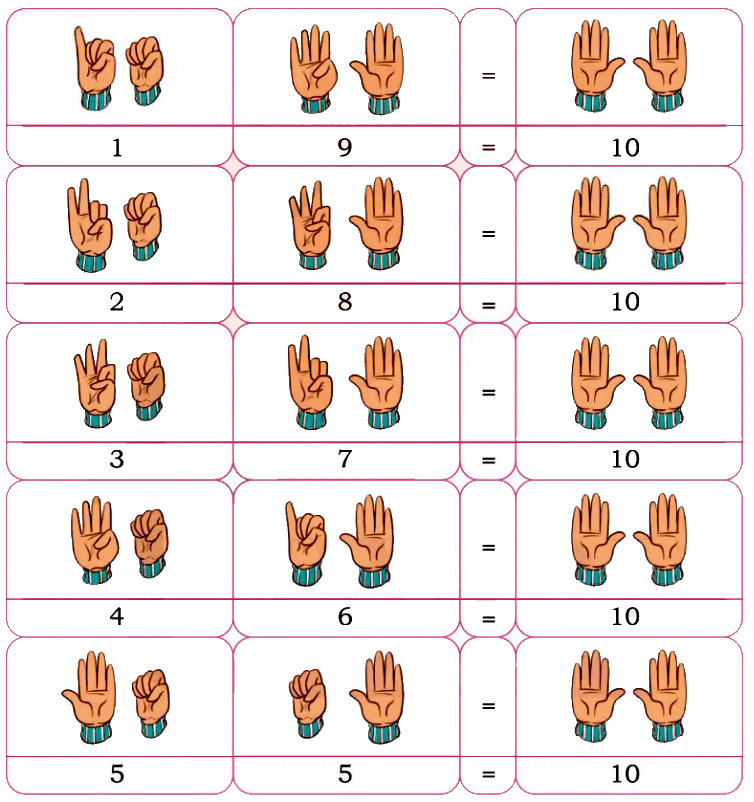
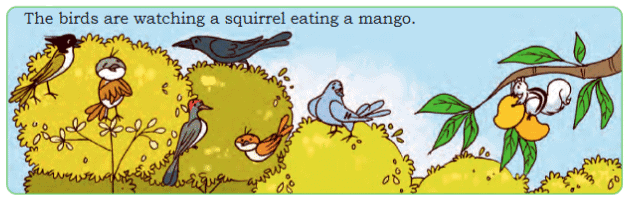
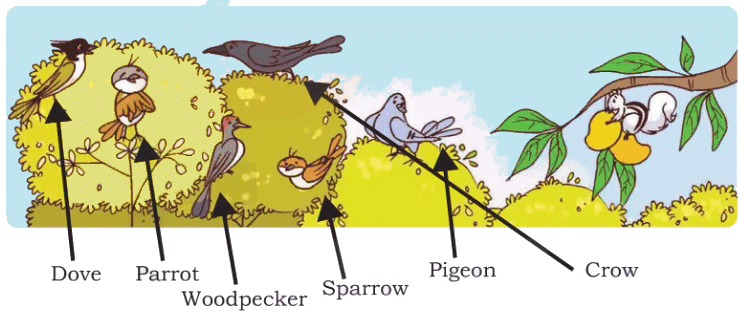 B: How many animals or birds were eating the mango in the beginning?
 C: How many more animals or birds joined every time?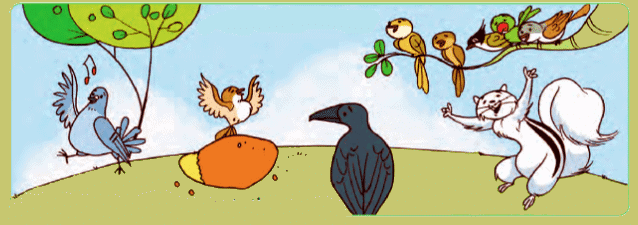
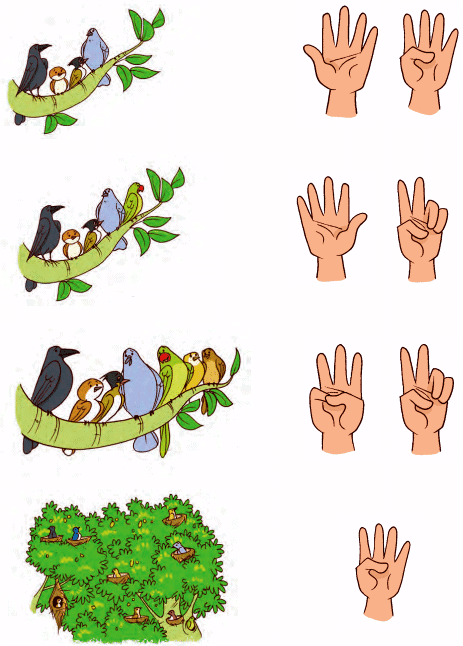 Ans:
Ans: 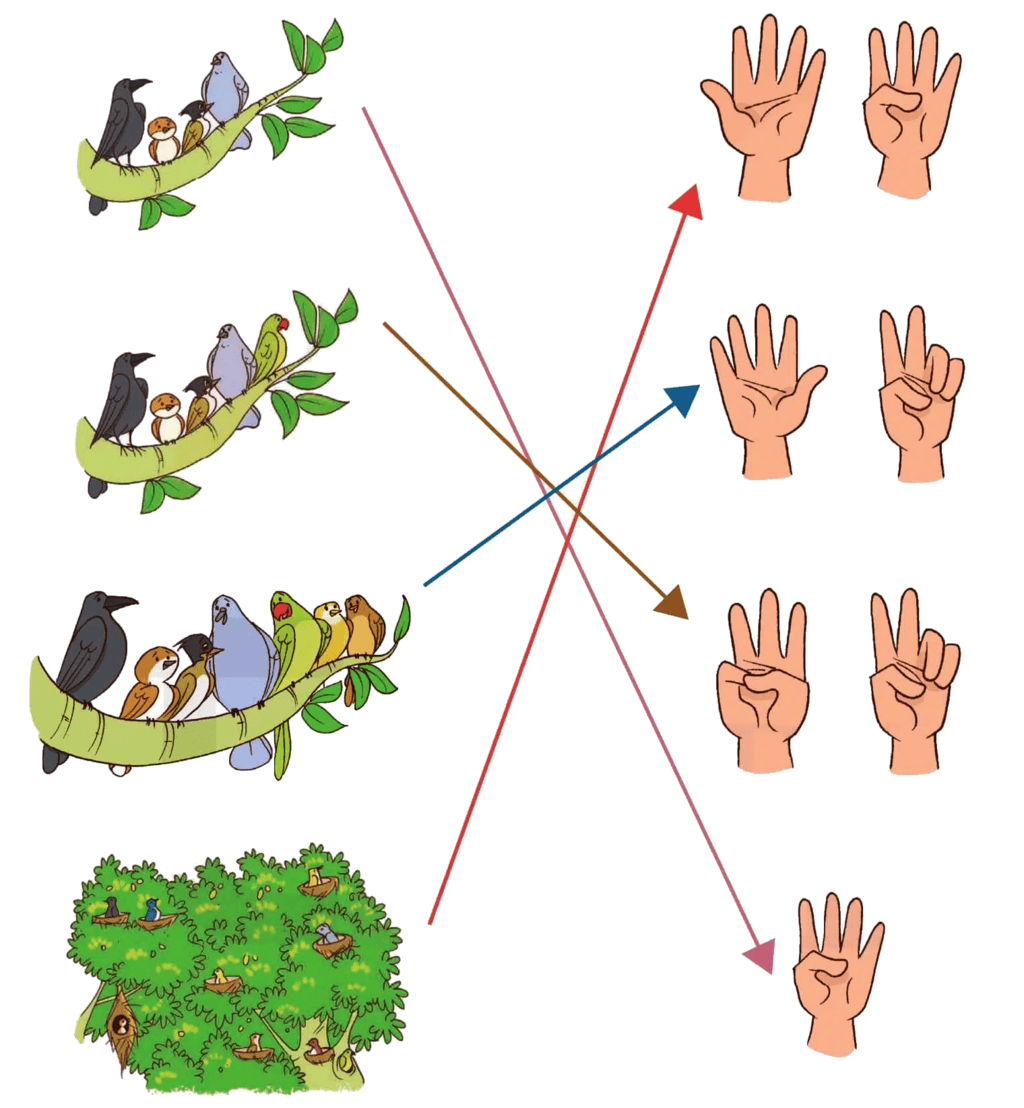 Match the fingers with correct number of dots (one has already been done for you).
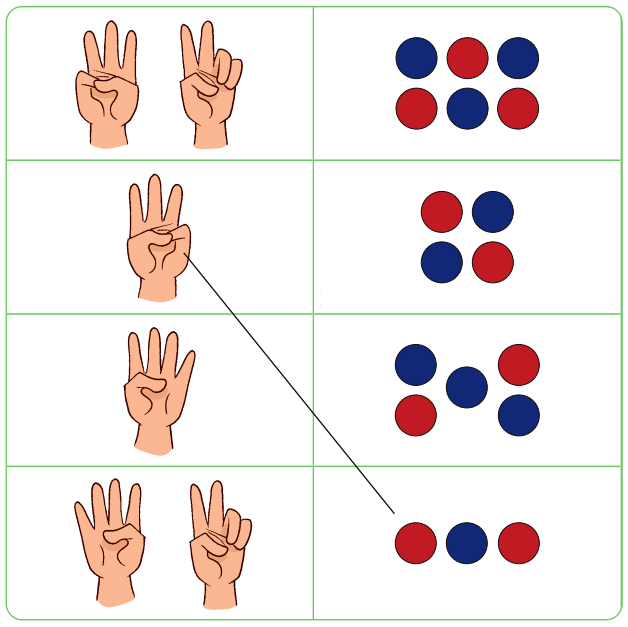 Ans:
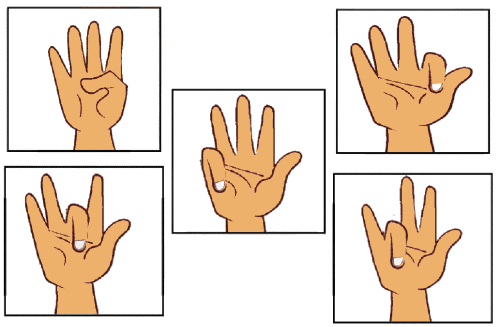
Ans: 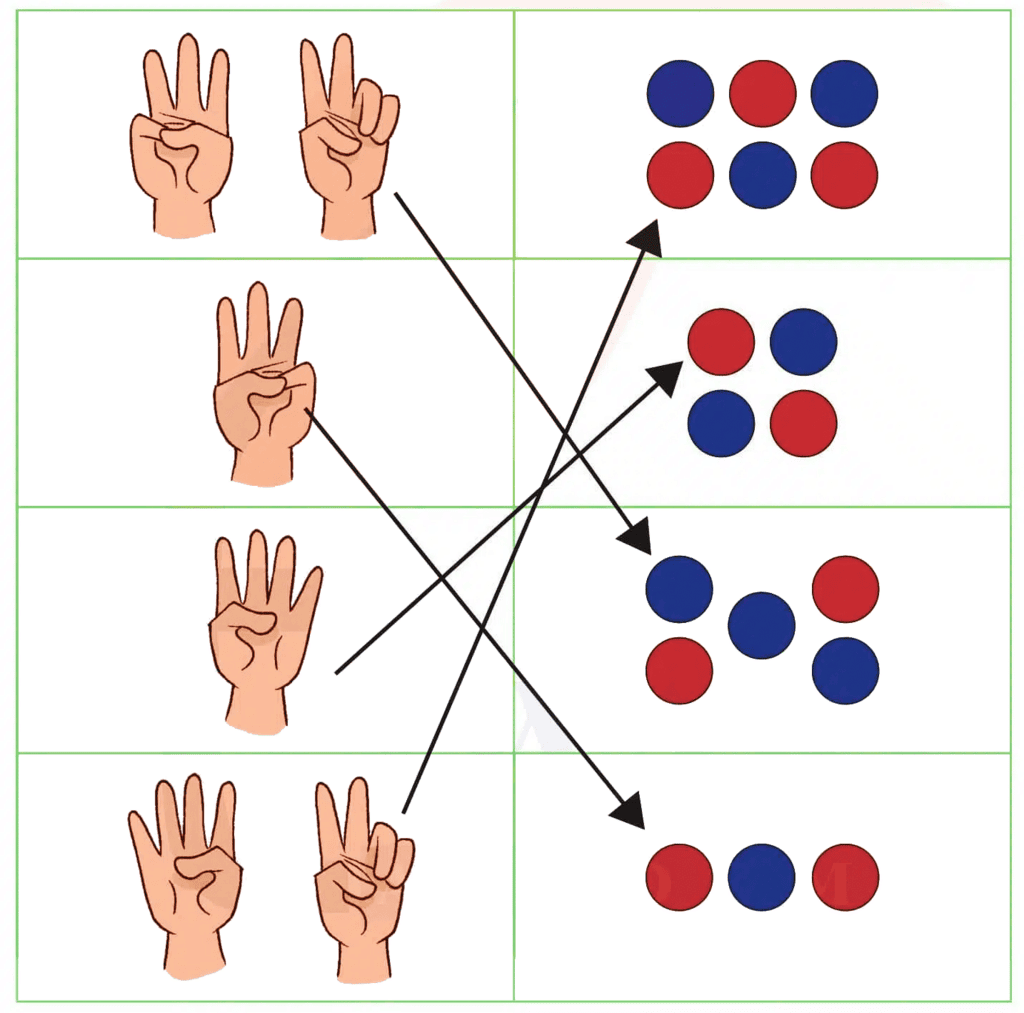 Let Us Play – Mine with FingersPage No. 21
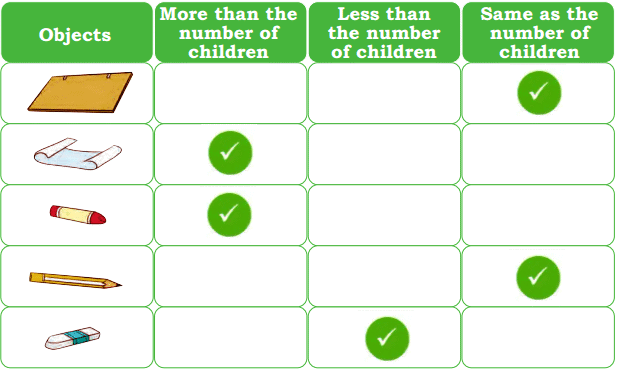
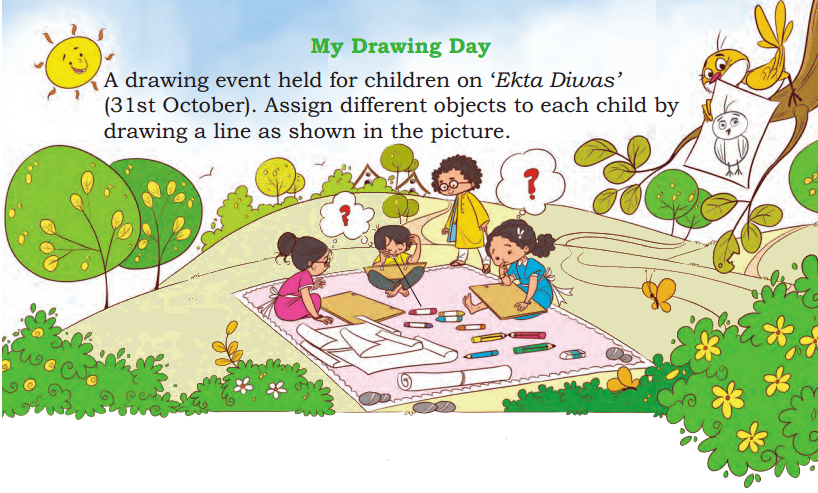 Help them to know if they have enough material.Tick ✅ more or less or equal.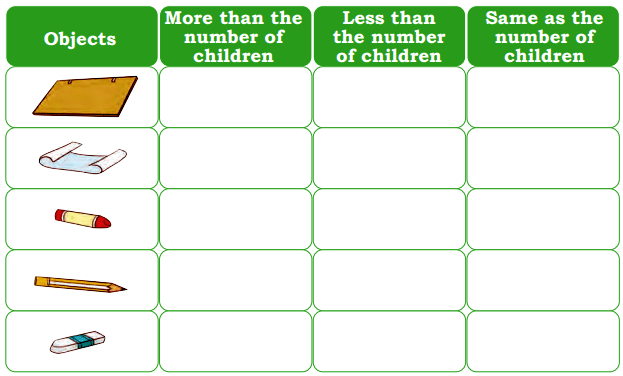
 Let us Do Page No. 24
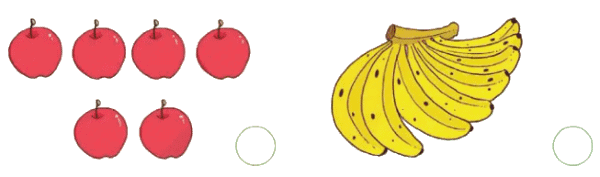
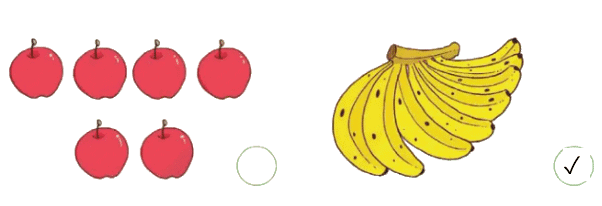 B. Tick ✅ the one which is less in number.
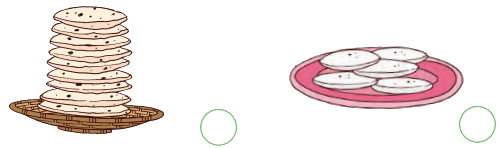 Ans:
Ans: 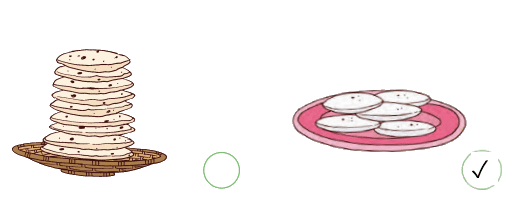 C. Tick ✅ the one which is less in number.
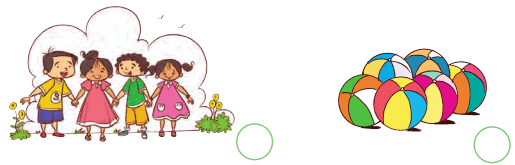 Ans:
Ans: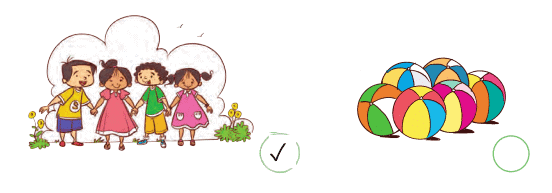 Count and Match
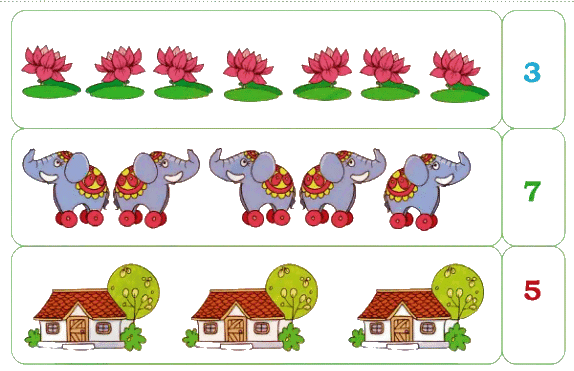 Ans:
Ans: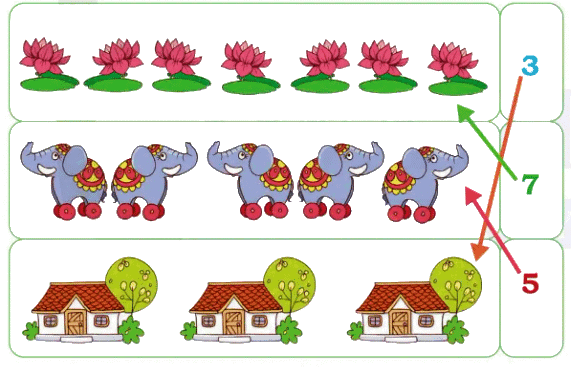 Count and Colour
 Ans:
Ans:  B: Colour 5 flowers
 Ans:
Ans:  C: Colour 6 balls.
 Ans:
Ans:  Join the Numbers in a OrderPage No. 29 – 30
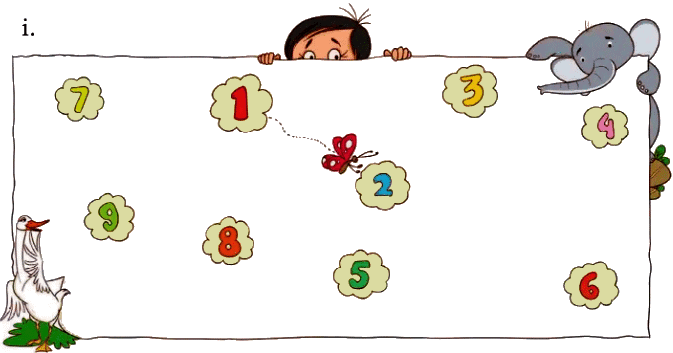 Ans:
Ans: 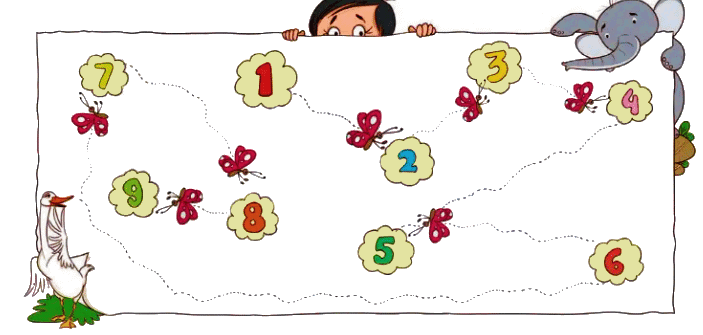
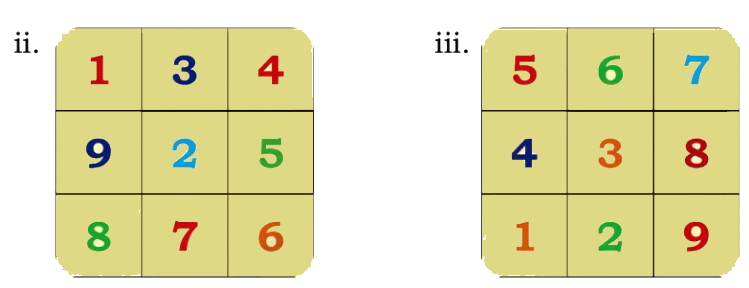 Ans:
Ans: 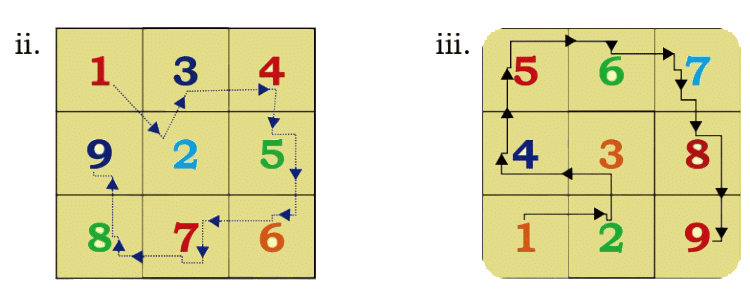 B: A naughty monkey shuffled the number cards. Write them in a correct order from the smallest to the largest.
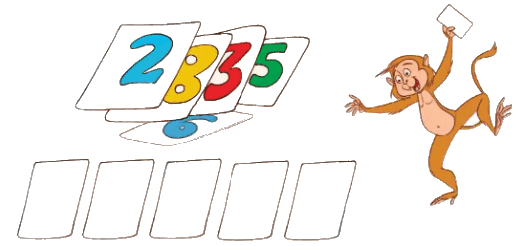 Ans:
Ans: 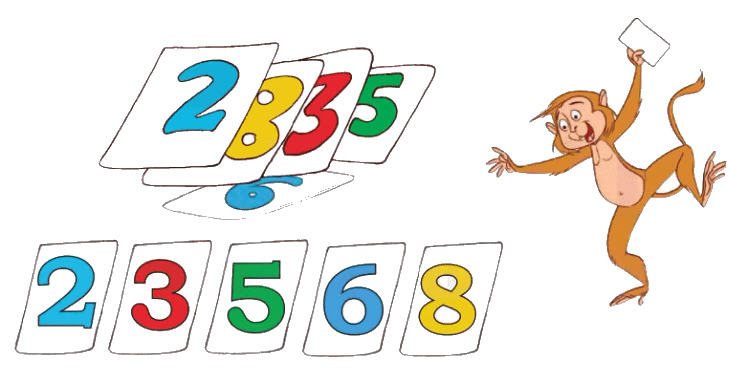 C: The cat has walked all over the worksheet. Write down the missing numbers.
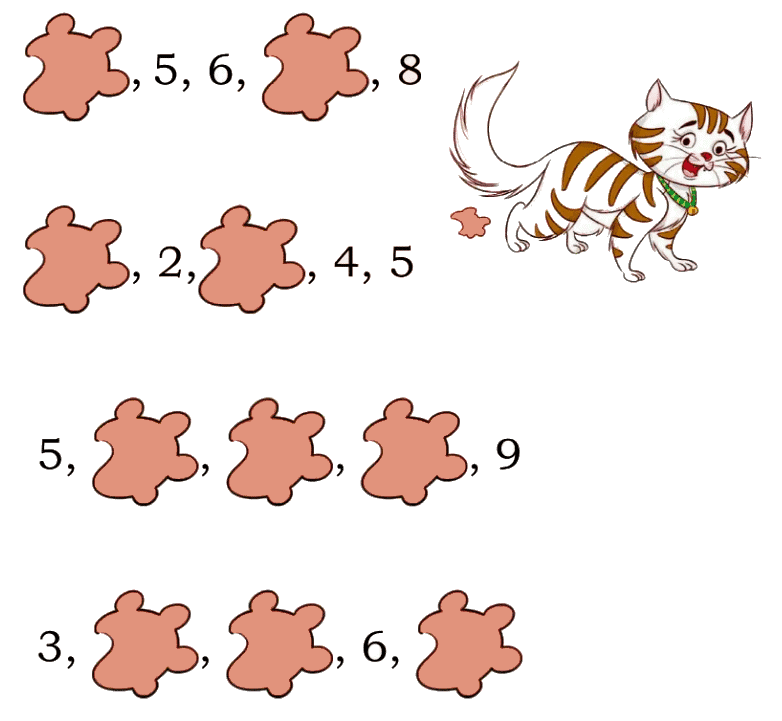 Ans:
Ans: 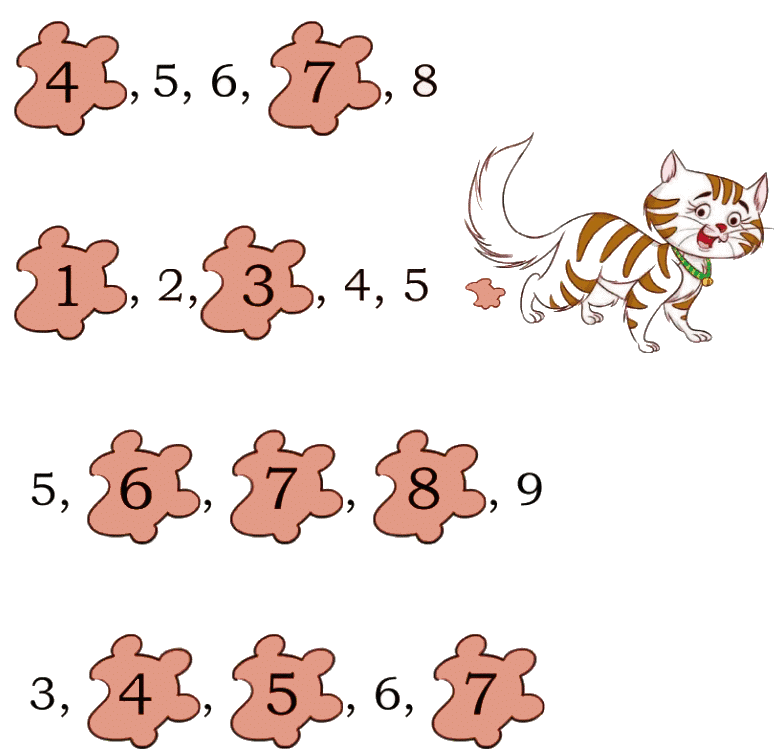 Colour the Biggest Number
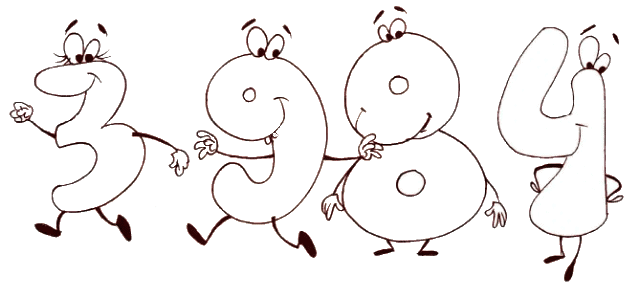 Ans:
Ans: 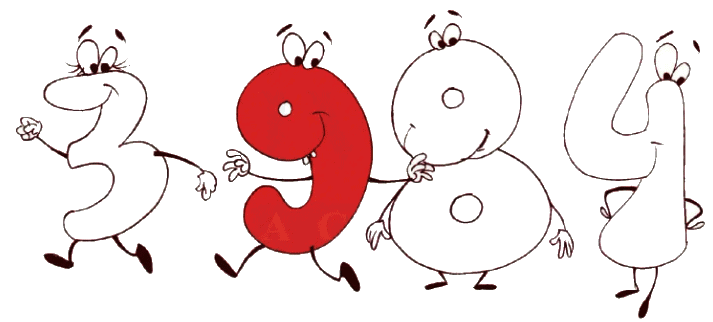 A: How many yellow boxes are there?
 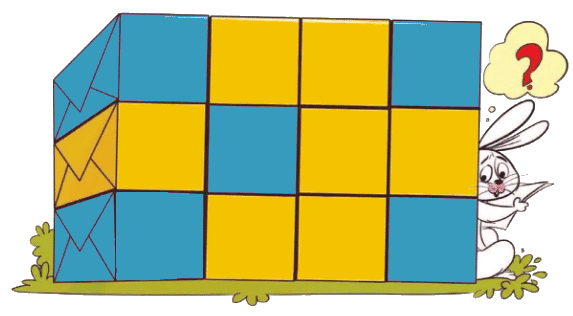 Ans:
Ans: 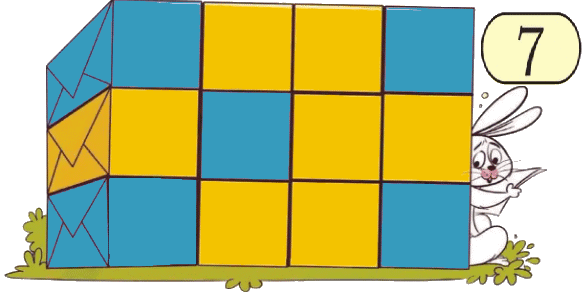 B: How many jamuns are there in the given picture?
 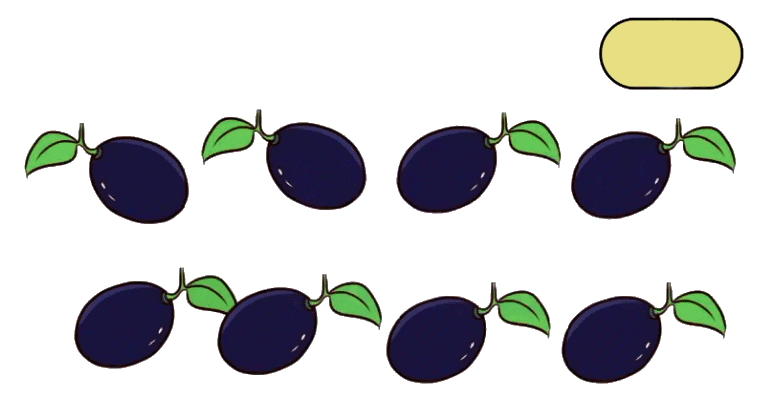 Ans:
Ans: 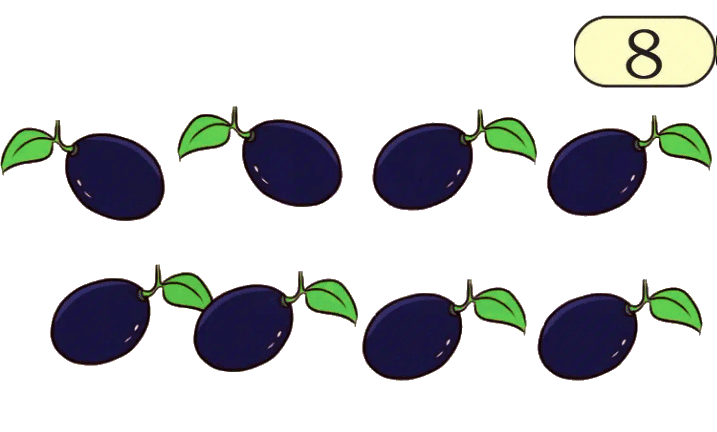 C: Write the number of sheep seen in the picture.
 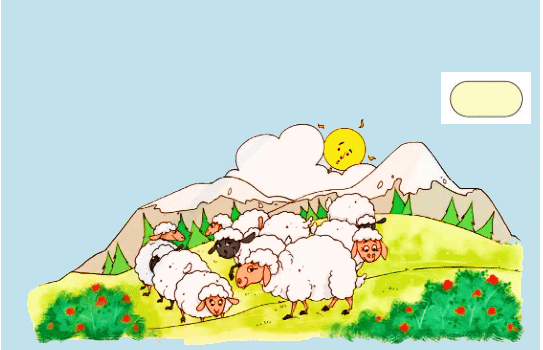 Ans:
Ans: 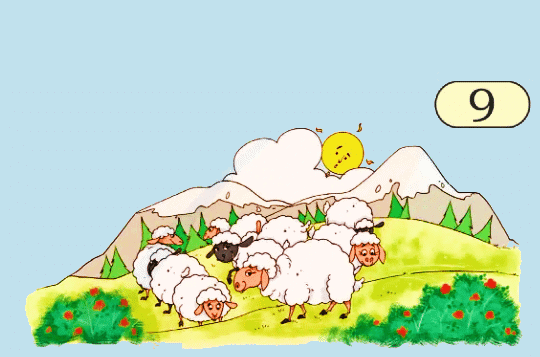 D: Draw any Four Fruits.
 Ans:
Ans: 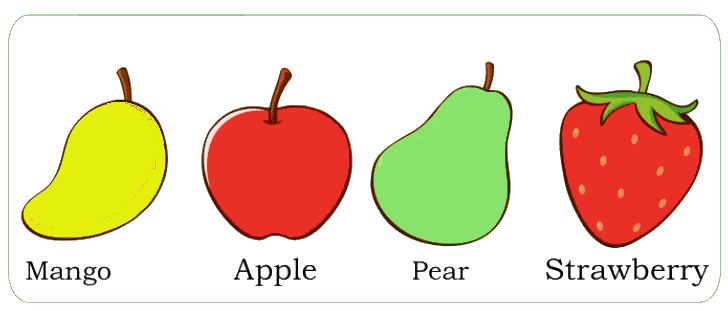 E: Which two groups together have 8 fruits? Encircle them.
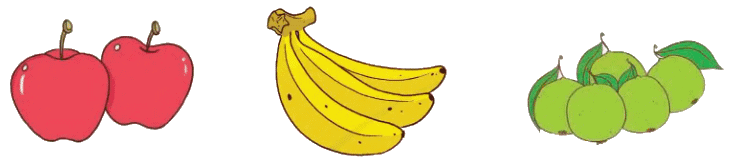 Ans:
Ans: 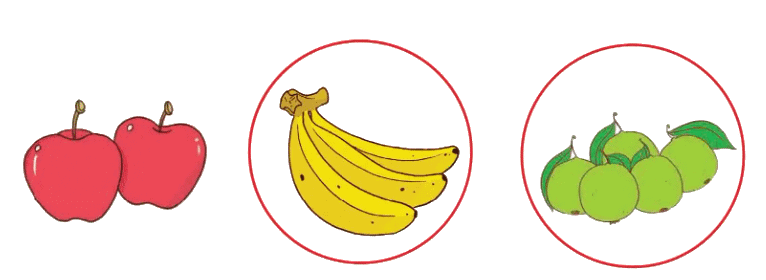 F: Which two groups together have 7 umbrellas? Encircle them.
 Ans:
Ans:  G: Which are less in number? Cups or Spoons? Encircle them.
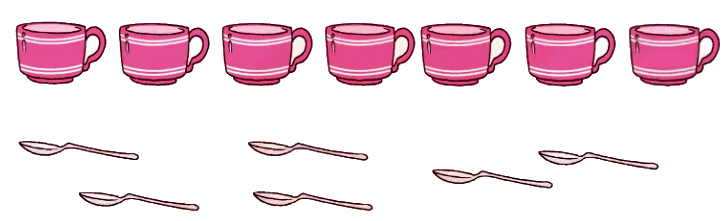 Ans:
Ans: