14. Probability – Chapter Notes

What is Probability?

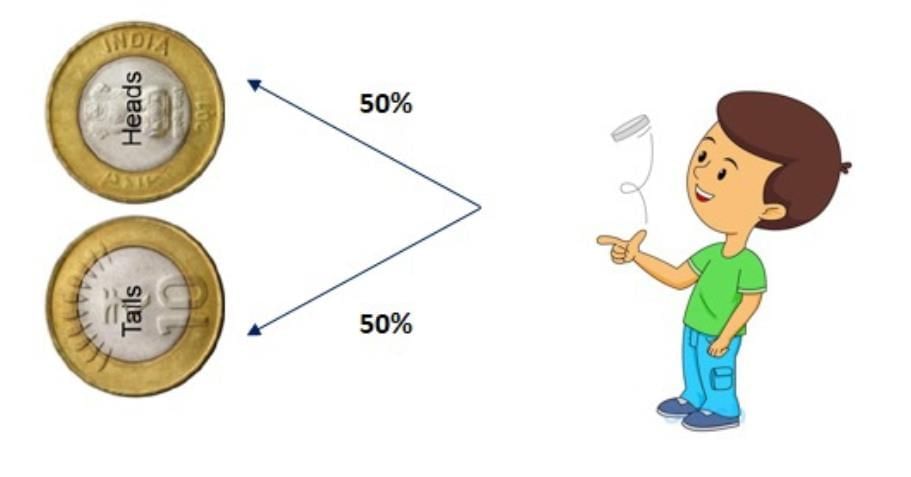
Probability is a way to understand how likely something is to happen using numbers. It’s like measuring how uncertain an event’s outcome is. We use a scale from 0 to 1, where 0 means it can’t happen at all, and 1 means it’s certain to happen. You can also think of this scale as percentages, where 0% means impossible and 100% means certain.

  • For example , if we flip a coin, the chance of getting heads is the same as the chance of getting tails, both 1/2 or 50%. When we add these chances, we get a total probability of 1.
Empirical/ Experimental Probability

In Class IX, we explored experimental (or empirical) probabilities, based on actual experiment results. Empirical probability, also known as experimental probability, is the probability of an event based on actual experiments or observations. It is calculated by conducting an experiment multiple times and recording the outcomes.

Empirical Probability (P) = (Number of Times the Event Occurs) / (Total Number of Trials)

Example: Tossing a coin 1000 times resulted in 455 heads and 545 tails. 

The empirical probability of heads is:

Empirical Probability of Heads: 455/1000 = 0.455

Empirical Probability of Tails: 545/1000 = 0.545

These probabilities are estimates, and outcomes may change with more trials.

Stabilization of Probabilities: As the number of trials increases, the empirical probability tends to stabilize around a certain value. The probability of getting a head in a coin toss tends to approach 0.5 as the number of tosses increases.

Theoretical Probability 

The theoretical probability (also called classical probability) of an event E, written as P(E), is defined as 

p(E) = (Number of outcomes favorable to E) / (Total number of possible outcomes)

For example,
Question 1. What is the probability of getting head when we toss the coin?

Sol: The possible outcomes when tossing a coin are: Head or Tail.

  • Number of possible outcomes = 2.
  • Favourable outcome: Head.  
  • So, there is 1 favourable outcome.

Thus, the probability is:

p(E) = (Number of outcomes favorable to E) / (Total number of possible outcomes) = 1/2

Question 2. A bag contains a red ball, a blue ball, and a yellow ball, all the balls being of the same size. Kritika takes out a ball from the bag without looking into it. What is the probability that she takes out the (i) yellow ball? (ii) red ball? (iii) blue ball?  

Sol: 
(i) Probability of picking a yellow ball:

  • Number of yellow balls = 1
  • Total number of balls = 3

Probability of picking a yellow ball = 1/3

(ii) Probability of picking a red ball:

  • Number of red balls = 1
  • Total number of balls = 3

Probability of picking a red ball = 1/3

(iii) Probability of picking a blue ball:

  • Number of blue balls = 1
  • Total number of balls = 3

Probability of picking a blue ball = 1/3

Remarks:

  • Each event in this example (yellow, red, blue) has only one possible outcome, making them elementary events.
  • The sum of probabilities of all elementary events equals 1: P(Y) + P(R) + P(B) = 1

Try yourself:

What is the probability of getting a red ball when picking one ball from a basket with 5 red balls and 7 blue balls?

  • A.5/12
  • B.7/12
  • C.1/2
  • D.2/5

View Solution

Question 3. Suppose we throw a die once. 
(i) What is the probability of getting a number greater than 4? 
(ii) What is the probability of getting a number less than or equal to 4?  

Sol: 
(i) Probability of getting a number greater than 4:
The numbers greater than 4 on a die are 5 and 6.

  • Favorable outcomes = 2 (5, 6)
  • Total possible outcomes = 6 (1, 2, 3, 4, 5, 6)

Probability = 2/6 = 1/3

(ii) Probability of getting a number less than or equal to 4:
The numbers less than or equal to 4 on a die are 1, 2, 3, and 4.

  • Favorable outcomes = 4 (1, 2, 3, 4)
  • Total possible outcomes = 6

Probability = 4/6 = 2/3

Event and Outcome

An outcome is the result of a random event, like rolling a die and getting a specific number (e.g., a 4). An event, on the other hand, is a collection of such outcomes. For example, rolling a die and hoping for a number less than 5 (which includes 1, 2, 3, and 4) is an event.

Example:

  • Rolling a die and getting a 3 is an outcome.
  • Rolling a die and getting a number less than 5 is an event.

(a) Tossing A Coin

If we toss a coin, it would be head or tail, only two outcomes.

(b) Tossing A Dice

A dice has six outcomes, numbering 1 to 6.

Question: A die is rolled once. What is the probability of getting a number greater than 4?

Sol: Total possible outcomes when rolling a die: 6 (1, 2, 3, 4, 5, 6)
Favorable outcomes for getting a number greater than 4: 5, 6
So, there are 2 favorable outcomes.
Probability P(E) is calculated as:
P(E) = Number of favorable outcomes / Total number of possible outcomes 
= 2/6 
= 1/3

(c) Experiment with a Deck of Cards

A deck of 52 playing cards contains 4 suits: Clubs, Diamonds, Hearts, and Spades.

  • Hearts and Diamonds are red, while Clubs and Spades are black.
  • There are 13 cards in each suit, comprising 26 red cards and 26 black cards.
  • Each suit has 3 face cards: Jack, Queen, and King. So, there are 12 face cards in total (6 red and 6 black).
  • The remaining cards are numbered Ace, 2 to 10.

(d) Example of Experiment: Tossing two dice

Now, there will be 6 outcomes of each dice, multiplied we will get 6×6 = 62 =36 Outcomes. They are:

Question: Find the probability of getting a head when a coin is tossed once. Also

find the probability of getting a tail.

Sol: In the experiment of tossing a coin once, the number of possible outcomes

is two — Head (H) and Tail (T). 

Let E be the event ‘getting a head’. The number of outcomes favourable to E, (i.e., of getting a head) is 1. 

Therefore, P(E) = P (head) = Number of outcomes favourable to E/Number of all possible outcomes 

P(E) =1/2

Similarly, if F is the event ‘getting a tail’, then 

P(F) = P(tail) =1/2

Different Types of Events with Examples

1. Elementary Event

An elementary event refers to a single possible outcome.

Example:

  • Flipping a coin and getting heads is an elementary event because it involves just one outcome.
  • Similarly, rolling a die and getting a 6 is also an elementary event.

Question. If a coin is flipped once, what is the probability of getting tails? 

Sol: Total possible outcomes when flipping a coin: 2 (Heads, Tails)

Favorable outcomes for getting tails: 1

So, there is 1 favorable outcome.

Probability P(T) is calculated as:

P(T) = Number of favorable outcomes / Total number of possible outcomes = 1/2

2. Sum of Probabilities

The sum of probabilities of all possible outcomes of an event must equal 1.

Example: When flipping a coin, the probability of heads is 1/2 and the probability of tails is 1/2. 
Adding these together gives 1/2 + 1/2 = 1, which is the total probability.

Question. A bag contains 1 red ball, 2 blue balls, and 3 green balls. What is the probability of drawing a red ball or a blue ball from the bag?

Sol: Total number of balls: 1 (red) + 2 (blue) + 3 (green) = 6

Favorable outcomes for drawing a red ball or a blue ball: 1 (red) + 2 (blue) = 3

Probability of drawing a red ball or a blue ball P(E) is:

P(E) = Number of favorable outcomes / Total number of possible outcomes 
= 3/6 
= 1/2

3. Impossible and Sure Events

  • An impossible event is one that can never happen, and its probability is 0.
  • Example of Impossible Event: 
    Rolling a 7 on a standard die (since a die only has numbers 1-6) has a probability of 0.
  • A sure event is one that is certain to happen, with a probability of 1.
  • Example of Sure Event: 
    Rolling a number less than 7 on a die has a probability of 1 because all possible outcomes (1-6) are less than 7.

Question: When rolling a standard six-sided die, what is the probability of rolling a number greater than 6? What is the probability of rolling a number less than or equal to 6?

Sol: 
Total possible outcomes when rolling a die: 6 (1, 2, 3, 4, 5, 6)

Favorable outcomes for rolling a number greater than 6: None (as the die only has numbers 1 through 6).

(i) Probability of rolling a number greater than 6:
P(Greater than 6) = 0/6 = 0
(ii) Probability of rolling a number less than or equal to 6:
Favorable outcomes for rolling a number less than or equal to 6: 1, 2, 3, 4, 5, 6 (all outcomes).
P(Less than or equal to 6) = 6/6 = 1

4. Range of Probability

  • Probabilities always fall between 0 and 1.  
  • A probability of 0 means the event is impossible, and a probability of 1 means the event is certain. 
  • Hence, the probability of happening any event lies between 0 and 1
    Let E be the event , then
    0 ≤ P(E) ≤ 1

5. Complementary Events

Complementary events are outcomes that together cover all possibilities. If one event happens, the other cannot.

If E is an event, the event not E (denoted as E’) represents the complement of E.

The sum of the probabilities of an event and its complement is always 1:P(E)+P(not E)=1

Example:
When flipping a coin, the two outcomes—heads and tails—are complementary events. The probability of heads plus the probability of tails equals 1.

Question. A deck of cards has 52 cards, including 4 suits: Hearts, Diamonds, Clubs, and Spades. Each suit has 13 cards. What is the probability of drawing a card that is not a heart? 
Sol:

  • Total number of cards: 52
  • Number of hearts: 13
  • Number of non-heart cards: 52−13=39

Probability of drawing a non-heart card P(E′):
P(E′) = Number of non-heart cards / Total number of cards = 39/52 = 3/4
To confirm, the probability of drawing a heart is:
P(Heart) = 13/52 = 1/4
Since the sum of the probabilities of drawing a heart and not drawing a heart should be 1:
P(Heart) + P(Not Heart) = 1/4 + 3/4 = 4/4 = 1

Some Solved NCERT ExamplesQuestion 1. If P(E) = 0.05, what is the probability of ‘not E’? 

Sol: 

We know that,
P(E)+P(not E) = 1
It is given that, P(E) = 0.05
So, P(not E) = 1 – P(E)
Or, P(not E) = 1 – 0.05
∴ P(not E) = 0.95

Question 2. It is given that in a group of 3 students, the probability of 2 students not having the same birthday is 0.992. What is the probability that the 2 students have the same birthday?

Sol: 
Let the event wherein 2 students having the same birthday be E
Given, P(E) = 0.992
We know,
P(E)+P(not E) = 1
Or, P(not E) = 1–0.992 = 0.008
∴ The probability that the 2 students have the same birthday is 0.008

Question 3. A bag contains 3 red balls and 5 black balls. A ball is drawn at random from the bag. What is the probability that the ball drawn is
(i) red?
(ii) not red?

Sol: The total number of balls = No. of red balls + No. of black balls
So, the total number of balls = 5+3 = 8
We know that the probability of an event is the ratio between the number of favourable outcomes and the total number of outcomes.
P(E) = (Number of favourable outcomes/Total number of outcomes)
(i) Probability of drawing red balls = P (red balls) = (no. of red balls/total no. of balls) = 3/8
(ii) Probability of drawing not red balls = Probability of drawing black balls = P (black balls) = (no. of black balls/total no. of balls) = 5/8

Question 4. A box contains 5 red marbles, 8 white marbles and 4 green marbles. One marble is taken out of the box at random. What is the probability that the marble taken out will be
(i) red?
(ii) white?
(iii) not green?

Sol:
The Total no. of balls = 5+8+4 = 17
P(E) = (Number of favourable outcomes/ Total number of outcomes)
(i) Total number of red balls = 5
P (red ball) = 5/17≈ 0.29
(ii) Total number of white balls = 8
P (white ball) = 8/17  ≈ 0.47
(iii) Total number of green balls = 4
P (green ball) = 4/17 ≈ 0.23
 P (not green) = 1 – P(green ball) = 1 – (4/17) ≈ 0.76
13. Statistics – Chapter Notes

Mean

The mean value of a variable is defined as the sum of all the values of the variable divided by the number of values.

Median

The median of a set of data values is the middle value of the data set when it has been arranged in ascending order.  That is, from the smallest value to the highest value
Median is calculated as:

Where n is the number of values in the data.
If the number of values in the data set is even, then the median is the average of the two middle-value.

Mode

Mode of statistical data is the value of that variable that has the maximum frequency.

Mean for Ungroup Frequency Table

Here is the ungroup frequency table:

Mean is given by:

Greek letter ∑ (capital sigma) means summation.

Mean for Group Frequency Table

In this distribution, it is assumed that the frequency of each class interval is centered around its mid-point i.e class marks.

Mean can be calculated using three methods:

(a) Direct Method
This method can be very calculation-intensive if the values of f and x are large. We have big calculations and chance of making mistake is quite high

Steps involved in finding the mean using Direct Method

  • Prepare a frequency table with the help of class marks
  • Multiply fand  xand find the sum of it.
  • Use the above formula and find the mean.

Example: The following table shows the weights of 10 children: 

Find the mean by using the direct method.
Sol: 
So, Mean would be
=698/10  = 69.8 kg.

(b) Assumed Mean Method

Where
a= Assumed Mean
di = xi –a

This method is quite useful when the values of f and x are large. It makes the calculation easier. In this method, we take some assumed mean calculate the deviation from it and then calculate the mean using the above formula.

Try yourself:

What is the mean value of a variable?

  • A.The sum of all the values of the variable divided by the number of values.
  • B.The middle value of the data set when arranged in ascending order.
  • C.The value of a variable that has the maximum frequency.
  • D.The average of the two middle values in a data set.

View Solution

Steps involved in finding the mean using the Assumed Mean Method

  • Prepare a frequency table.
  • Choose A and take deviations ui = (xi -a)/h of the values of xi .
  • Multiply fi ui and find the sum of it.
  • Use the above formula and find the mean.

Example: The following table shows the weights of 10 children:

Find the mean by using Assumed Mean method.
Sol:
Let the assumed mean = A = 71

So, Mean would be
= 71-12/10  = 69.8 kg
c) Step Deviation Method

Where
a= Assumed mean
ui  = (xi –a)/h
This method is quite useful when the values of f and x are large. It makes the calculation further easier by dividing the deviation from the common factor.

Steps involved in finding the mean using Step Deviation Method

  • Prepare a frequency table.
  • Choose A and h and take ui = (xi –a)/h of the values of xi .
  • Multiply fi u i and find the sum of it.
  • Use the above formula and find the mean.

Example: The following table shows the weights of 10 children: 

Find the mean by using Step Deviation method.
Sol:

Let the assumed mean = A = 71  and h=2

So, Mean would be
=71+ (-6/10) 2  = 69.8 kg

Mode for Grouped Frequency Table

Modal Class: The class interval having highest frequency is called the modal class and Mode is obtained using the modal class
Mode formula is given as

Where
l = lower limit of the modal class,
h = size of the class interval (assuming all class sizes to be equal),
f1 = frequency of the modal class,
f0 = frequency of the class preceding the modal class,
f2 = frequency of the class succeeding the modal class.
Example: The following table shows the ages of the patients admitted in a hospital during a year

Find the mode.
Sol:
Modal class = 35 – 45, l = 35, class width (h) = 10, f1 = 23, f0 = 21 and f2 = 14
Substituting the values in the Mode formula given above we get

Mode= 36.8 year

Cumulative Frequency Chart

The cumulative frequency of a class is the frequency obtained by adding the frequencies of all the classes preceding the given class.
Cumulative Frequency chart will be like

The above table cumulative frequency distribution of the less than type. We can similary make it like below  

The table above is called a cumulative frequency distribution of the more than type.

Median of a Grouped Data Frequency Table

How to find Median of a grouped data frequency table

  • For the given data, we need to have class interval, frequency distribution and cumulative frequency distribution
  • Then we need to find the median class
    How to find the median class
    (a) we find the cumulative frequencies of all the classes and n/2
    (b)We now locate the class whose cumulative frequency is greater than (and nearest to) n/2
    (c)That class is called the median class
  • Median is calculated as per the below formula

Where
l = lower limit of median class,
n = number of observations,
cf = cumulative frequency of class preceding the median class,
f = frequency of median class,
h = class size (assuming class size to be equal)

Example: A survey regarding the heights (in cm) of 60 girls  of a school was conducted and the following data was obtained:

Find the median height.

Sol:
To calculate the median height, we need to find the class intervals and their corresponding frequencies.
The given distribution being of the less than type, 140, 145, 150, . . ., 165 given the upper limits of the corresponding class intervals. So, the classes should be below 140, 140 – 145, 145 – 150, . . ., 160 – 165. Observe that from the given distribution, we find that there are 4 girls with height less than 140, i.e., the frequency of class interval below 140 is 4 . Now, there are 11 girls with heights less than 145 and 4 girls with height less than 140. Therefore, the number of girls with height in the interval 140-145 will be 11-4=7. Similarly, other can be calculated

So, n =60 and n/2=30 And cumulative frequency which is greater than and nearest to 30 is 40 , So median class 150-155
l (the lower limit) = 150,
cf (the cumulative frequency of the class preceding 150 – 155) = 29,
f (the frequency of the median class 150 – 151) = 11,
h (the class size) = 5.
Now by Median Formula

= 150 + [(30-29)/11]5
=150.45 cm

Empirical Formula between Mode, Mean and Median

Empirical Formula between Mode, Mean and Median is given as 3 Median=Mode +2 Mean

Try yourself:What is the formula used to find the mean using the Assumed Mean Method?

  • A.Mean = a + (sum fi · di) / sum fi
  • B.Mean = (sum xi) / n
  • C.Mean = a – (sum fi · di) / sum fi
  • D.Mean = a + sum fi · di

View Solution

Graphical Representation of Cummulative Frequency Distribution

We can represent Cummulative frequency distribution on the graph also. To represent the data in the table graphically, we mark the upper limits of the class intervals on the horizontal axis (x-axis) and their corresponding cumulative frequencies on the vertical axis (y-axis), choosing a convenient scale.

When we draw the graph for the cumulative frequency distribution of the less than type. The curve we get is called a cumulative frequency curve, or an ogive (of the less than type).

When we draw the graph for the cumulative frequency distribution of the more than type. The curve we get is called a cumulative frequency curve, or an ogive (of the more than type).

When we plot both these curve on the same axis, The two ogives will intersect each other at a point. From this point, if we draw a perpendicular on the x-axis, the point at which it cuts the x-axis gives us the median

12. Surface Areas and Volumes – Chapter Notes

Introduction

Imagine you’re on a road trip and you spot a truck carrying a huge container of water. Ever wondered what shape that container is? It’s likely a combination of a cylinder with hemispheres capping each end. Or think about a test tube in your science lab—it’s a perfect blend of a cylinder and a hemisphere. We see these combined shapes all around us, from water tanks to magnificent monuments.

But how do we calculate the surface areas and volumes of these fascinating shapes? In this chapter, we’ll explore the methods to do just that, bringing together the basics you’ve learned about cuboids, cones, cylinders, and spheres to tackle these more complex shapes. Get ready to dive into the world of combined solids!

Surface Area of a Combination of Solids

Surface area is the measurement of the space taken up by a flat two-dimensional surface. This measurement is expressed in terms of square units. For three-dimensional objects, the surface area represents the space occupied by their outer surfaces. Similar to the flat surface area, it is also measured in square units.
In general, there are two types of surface area

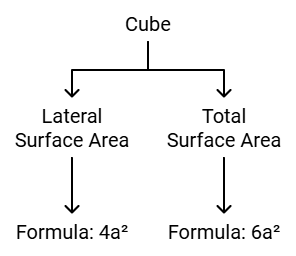
(a) Total Surface Area

  • Total surface area is the combined measurement of an object’s base(s) and the curved portion. 
  • It represents the sum of the object’s surface coverage.
  • In cases where the object’s shape includes both a curved surface and a base, the total surface area is calculated by summing up the measurements of these two areas.

TSA of new solid = CSA of one hemisphere + CSA of cylinder + CSA of other hemisphere 

(b) Curved Surface Area or Lateral Surface Area

  • Curved surface area pertains to the measurement of only the curved portion of a shape, excluding any base(s).
  • This aspect is also referred to as the lateral surface area, particularly for shapes like a cylinder.

Try yourself:What does the “Total Surface Area” of an object include?

  • A.Only the curved portion of the object.
  • B.Only the base of the object.
  • C.The combined measurement of the base(s) and the curved portion of the object.
  • D.The measurement of the object’s height.

View Solution

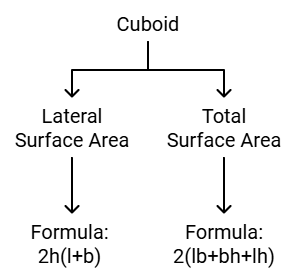
 Formulas for Total Surface Area and Lateral Surface Area 

(i) Surface Area of a Cube

A cube is a solid shape having 6 equal square faces of length a.

(ii) Surface Area of a Cuboid

Cuboid is a solid shape having 6 rectangular faces at a right angle with length l, breadth b and height h.

Example1: Two cubes each of volume 64 cm3 are joined end to end. Find the surface area of the resulting cuboid.

Ans:

Given: The Volume (V) of each cube is = 64 cm3

This implies that a3 = 64 cm3

∴ a = 4 cm

Now, the side of the cube = a = 4 cm

Also, the length and breadth of the resulting cuboid will be 4 cm each, while its height will be 8 cm.

So, the surface area of the cuboid = 2(lb+bh+lh)

substituting the values 

= 2(8×4+4×4+4×8) cm2

= 2(32+16+32) cm2

= (2×80) cm2 = 160 cm2

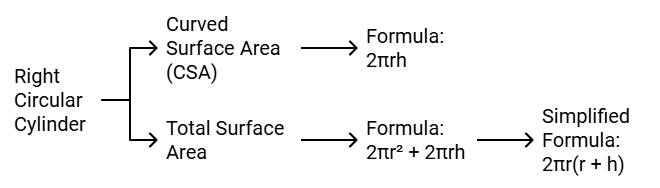
(iii) Surface Area of a Right Circular Cylinder

If we fold a rectangular sheet with one side as its axis then it forms a cylinder. It is the curved surface of the cylinder. And if this curved surface is covered by two parallel circular bases then it forms a right circular cylinder. For a cylinder of height h and with base radius r.

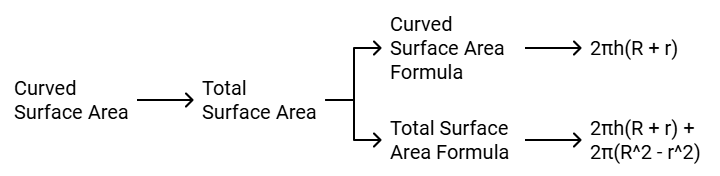
(iv) Surface Area of a Hollow Right Circular Cylinder

If a right circular cylinder is hollow from inside then it has a different curved surface.

Try yourself:

What is the total surface area of a cube with a side length of 5 cm?

  • A.100 cm?
  • B.125 cm?
  • C.150 cm?
  • D.175 cm?

View Solution

(v) Surface Area of a Right Circular Cone

If we revolve a right-angled triangle about one of its sides by taking other as its axis then the solid shape formed is known as a Right Circular Cone.

Curved surface area of a Right Circular Cone = πrl= πrh2+r2
Total surface area of a Right Circular Cone= πr2+πrl [CSA of cone + circular area of base]= πr(r+l) 

(vi) Surface Area of a Sphere

A sphere is a solid shape which is completely round like a ball. It has the same curved and total surface
area.

Curved or Lateral surface area of a Sphere=4πr2
Total surface area of a Sphere=4πr2

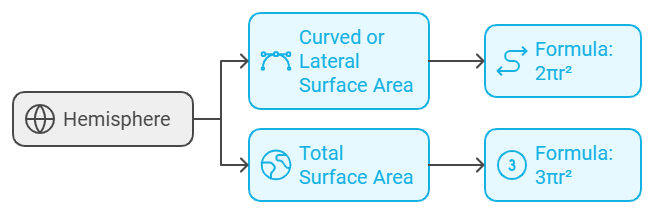
(vii) Surface Area of a Hemisphere

If we cut the sphere in two parts then it is said to be a hemisphere.

Example2: A vessel is in the form of a hollow hemisphere mounted by a hollow cylinder. The diameter of the hemisphere is 14 cm, and the total height of the vessel is 13 cm. Find the inner surface area of the vessel.

Solution:

The diagram is as follows:

Now, the given parameters are:

The diameter of the hemisphere = D = 14 cm

The radius of the hemisphere = r = 7 cm

Also, the height of the cylinder = h = (13-7) = 6 cm

And the radius of the hollow hemisphere = 7 cm

Now, the inner surface area of the vessel = CSA of the cylindrical part + CSA of the hemispherical part

(2πrh+2πr2) cm2 = 2πr(h+r) cm2

2×(22/7)×7(6+7) cm2 = 572 cm2

Example 3: A toy is in the form of a cone of radius 3.5 cm mounted on a hemisphere of the same radius. The total height of the toy is 15.5 cm. Find the total surface area of the toy.

Answer:

The diagram is as follows:

Given that the radius of the cone and the hemisphere (r) = 3.5 cm or 7/2 cm

The total height of the toy is given as 15.5 cm.

So, the height of the cone (h) = 15.5-3.5 = 12 cm

∴ The curved surface area of the cone = πrl

(22/7)×(7/2)×(25/2) = 275/2 cm2

Also, the curved surface area of the hemisphere = 2πr2

2×(22/7)×(7/2)2

= 77 cm2

Now, the Total surface area of the toy = CSA of the cone + CSA of the hemisphere

= (275/2)+77 cm2

= (275+154)/2 cm2

= 429/2 cm2 = 214.5cm2

So, the total surface area (TSA) of the toy is 214.5cm2

Volume of Combination of Solids 
The volume of the solid formed by joining two basic solids will actually be the sum of the volumes of the constituents.

required volume = volume of the cuboid + 1/2 volume of the cylinderFormulas of volume of each figure

(i) Volume of Cube

Volume = a3

Side of Cube = a

(ii) Volume of Cuboid

Volume = lbh

l=length, b= breadth, h=height

(iii) Volume of Cylinder

Volume = πr2h

r = Radius of Cylinder

h = Height of Cylinder

(iv) Volume of Cone

Volume = 1/3πr2h

h= height of cone

r = radius of cone

l = slant height of cone =√ (h2+r2)

Example 4: A vessel is in the form of an inverted cone. Its height is 8 cm and the radius of its top, which is open, is 5 cm. It is filled with water up to the brim. When lead shots, each of which is a sphere of radius 0.5 cm, are dropped into the vessel, one-fourth of the water flows out. Find the number of lead shots dropped in the vessel.

Solution:

For the cone,

Radius = 5 cm,

Height = 8 cm

Also,

Radius of sphere = 0.5 cm

The diagram will be like

It is known that,

The volume of cone = volume of water in the cone

= ⅓πr2h = (200/3)π cm3

Now,

Total volume of water overflown= (¼)×(200/3) π =(50/3)π

The volume of lead shot

= (4/3)πr3

= (1/6) π

Now,

The number of lead shots = Total volume of water overflown/Volume of lead shot

= (50/3)π/(⅙)π

= (50/3)×6 = 100

(v) Volume of Sphere

Volume = 4/3πr3

  r= radius

Try yourself:A cylindrical tank has a radius of 5 meters and a height of 10 meters. What is the total surface area of the tank?

  • A.300π square meters
  • B.400π square meters
  • C.500π square meters
  • D.150π square meters

View Solution

(vi) Volume of Hemi-Sphere

Volume = 2/3πr3

  r= radius

Example 5: A solid is in the shape of a cone standing on a hemisphere, with both their radii being equal to 1 cm and the height of the cone being equal to its radius. Find the volume of the solid in terms of π.

Solution:

Here r = 1 cm and h = 1 cm.

The diagram is as follows.

Now, Volume of solid = Volume of conical part + Volume of hemispherical part

We know the volume of cone = ⅓ πr2h

And,

The volume of the hemisphere = ⅔πr3

So, the volume of the solid will be

= π cm3

Summary

11. Areas Related to Circles – Chapter Notes

Introduction

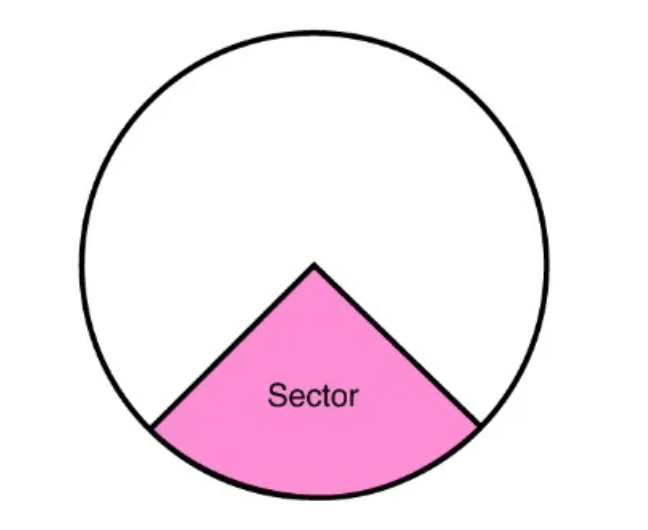
  • A circle can be split into parts called sectors and segments, which are important for understanding areas related to circles.
  • sector is the space between two radii and the arc they create, while a segment is the area found between a chord and the arc.
  • Note: When we mention ‘segment’ and ‘sector’, we refer to the minor segment and minor sector unless specified otherwise.
  • This chapter presents formulas to find the area of a sector, the length of an arc, and the area of a segment, which assist in solving practical problems related to these areas. The area of a segment is calculated as follows: Area of segmentArea of the corresponding sectorArea of the corresponding triangle.
  • Additionally, the distinction between minor and major sectors and segments is highlighted for clarity.

Sector of Circle

The area of a circular region that is bounded by two radii and the arc between them is known as a sector of the circle.

  • The portion OAPB of the circle is called the minor sector and the portion OAQB of the circle is called the major sector. 
  • ∠ AOB is called the angle of the sector.
  • The angle of the major sector can be calculated as 360° minus the angle of the minor sector.

Arc

 An arc is a portion of the circle’s circumference.

Chord

A chord is a line segment that joins any two points on the circle’s circumference.

Segment of Circle

The area of a circular region that lies between a chord and the corresponding arc is referred to as a segment of the circle.

  • A minor segment is made by a minor arc.
  •  A Major segment is made by a major arc of the circle.

Remark: When we mention ‘segment’ or ‘sector’, we are referring to the ‘minor segment’ and the ‘minor sector’ respectively, unless indicated otherwise.

Try yourself:

What is the area of a circular region that is bounded by two radii and the arc between them known as?

  • A.Segment
  • B.Minor sector
  • C.Major segment
  • D.Minor segment

View Solution

Area of a Sector of a Circle

Sector: Sector of a Circle is given as part of a Circle enclosed by 2 radii and an arc.

In the diagram, the shaded area OAB is the sector.
Here, θ is the angle subtended by the arc AB on the center O of the circle.

The area of the Sector is given as  

In the whole circle, the angle θ will be 360°
Area of Circle = πr2
Using Unitary Method
Area represented by 360° = πr2
Area represented by

Length of an Arc of a sector of angle θ = 

Solved Examples

Q1: Calculate the area of a sector with a radius of 20 yards and an angle of 90 degrees.

Ans: here θ = 90º,
 r = 20 yards,
 π = 3.141

= (90º/360º) X 3.141 X (20)2

= (1256.4/4) yards2 

= 314.1 yards2 

Q2:  Calculate the area of a sector of angle 60°. Given, the circle has a radius of 6 cm.
Ans: The angle of the sector = 60°

Using the formula,

The area of the sector = (θ/360°) × π r²

= (60/360) × π r² cm²

Or, area of the sector = 6 × 22/7 cm² = 132/7 cm²

Area of Segment of a circle 

In the diagram Shaded portion represents Segment AMB

Area of Segment AMB = Area of Sector OAB- Area of triangle AOB

Solved Examples 

Q1: A chord subtends an angle of 90°at the centre of a circle whose radius is 20 cm. Compute the area of the corresponding major segment of the circle..

Ans: Area of the sector = θ/360 × π × r²

Base and height of the triangle formed will be = radius of the circle

Area of the minor segment = area of the sector – area of the triangle formed

Area of the major segment = area of the circle – area of the minor segment

Now,

Radius of circle = r = 20 cm and

Angle subtended = θ = 90°

Area of the sector = θ/360 × π × r² = 90/360 × 22/7 × 20²

Or, area of the sector = 314.2 cm²

Area of the triangle = ½ × base × height = ½ × 20 × 20 = 200 cm²

Area of the minor segment = 314.2 – 200 = 114.2 cm²

Area of the circle = π × r² = (22/7) × 20² = 1257.14

Area of the major segment = 1257.14 – 114.2 = 1142.94 cm²

So, the area of the corresponding major segment of the circle = 1142.94 cm²

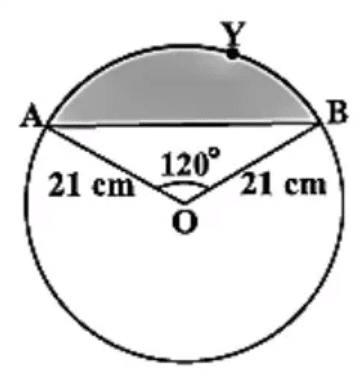
Q2: Find the area of the segment AYB shown in the figure, if the radius of the circle is 21 cm and ∠ AOB = 120°. (Use π = 22/7).

Ans: Area of the segment AYB = Area of sector OAYB – Area of Δ OAB …..(1)

Area of the sector OAYB = (120/360) × (22/7) × 21 × 21 = 462 cm² ……(2)

Draw OM ⊥ AB.

OA = OB (radius)

Therefore, by RHS congruence, Δ AMO ≅ Δ BMO.

M is the mid-point of AB and ∠ AOM = ∠ BOM = (1/2) × 120° = 60°

Let OM = x cm

In triangle OMA,

OM/OA = cos 60°

x/21 = ½

x = 21/2

OM = 21/2 cm

Similarly,

AM/OA = sin 60°

AM/21 = √3/2

AM = 21√3/2 cm

AB = 2 × AM = 2 (21√3/2) = 21√3 cm

Area of triangle OAB = (½) × AB × OM

= (½) × 21√3 × (21/2)

= (441/4)√3 cm² …(3)

From (1), (2), and (3),

Area of the segment AYB = [462 – (441/4)√3] cm²

10. Circles – Chapter Notes

Introduction to Circles 

Circle: It is a closed two-dimensional geometrical figure, such that all points on the surface of a circle are equidistant from the point called the “centre”.
A circle is a locus of a point that moves in such a way that the distance from that point is always fixed.

Parts of a Circle

  • Radius: The constant distance from the centre to the circumference (boundary) of the circle.
  • Secant: A secant is a line that crosses a curve at two or more separate locations. A secant intersects a circle at exactly two locations in the case of a circle. In the figure, the line FG intersects the circle at two points P and Q. FG is the secant of the circle.Secant
  • Chord: Any line segment joining the two points on the circumference of the circle. In the above figure, PQ is a chord.
  • Diameter: The longest distance between the two points on the circumference of the circle. It is the longest chord.Here, AO is the radius of the circle and AB is the diameter of the circle.
  • Tangent: A tangent to a circle is a line that touches the circle at exactly one point. For every point on the circle, there is a unique tangent passing through it.
    Tangent of a Circle
  • Non-intersecting lines: These are made up of two or more lines that do not intersect. The circle and the line AB have no common point. – Lines that do not intersect can never meet.
    – The parallel lines are another name for them.
    – They stay at the same distance from one another at all times. 

Tangent to a Circle

 A tangent to a circle is a line that intersects the circle at only one point.

(i) There is only one tangent at a point of the circle.

(ii) The tangent to a circle is a special case of the secant when the two endpoints of its corresponding chord coincide.
(iii) The common point of the tangent and the circle is called the point of contact and the tangent is said to touch the circle at that point.

Try yourself:

What is the definition of a circle?

  • A.A circle is a closed two-dimensional geometrical figure with all points equidistant from the center.
  • B.A circle is a shape that has three sides and three angles.
  • C.A circle is a line that intersects a curve at two or more separate points.
  • D.A circle is the longest distance between two points on the circumference.

View Solution

Theorem 1

The theorem states that “the tangent to the circle at any point is perpendicular to the radius of the circle that passes through the point of contact”.

According to the theorem, O is the centre and OP⊥XY.
Proof: Let Q be a point on XY.
Connect OQ.
Suppose it touches the circle at R.
Hence,
OQ > OR
OQ > OP (as OP = OR, radius).
The same will be the case for all other points on the circle.
Hence, OP is the smallest line that connects XY.

Thus, OP is the smallest line that connects XY, and the smallest line is perpendicular.
∴ OP ⊥ XY

Note:
1. By the theorem above, we can also conclude that at any point on a circle, there can be one and only one tangent.
2. The line containing the radius through the point of contact is also sometimes called the ‘normal’ to the circle at the point.

Example 1: In the given figure, O is the centre of a circle, AB is a chord and AT is the tangent at A. If ∠AOB = 100°, then calculate ∠BAT.

Solution:

∠1 = ∠2

∠1 + ∠2 + 100° = 180°

∠1 + ∠1 = 80°  (∠1 =∠2, isoceles triangle formed by radius)

⇒ 2∠1 = 80°

⇒ ∠1 = 40°

∠1 + ∠BAT = 90° (the tangent to the circle at any point is perpendicular to the radius of the circle)

∠BAT = 90° – 40° = 50°

Try yourself:What is the relationship between the tangent to a circle at any point and the radius of the circle that passes through the point of contact?

  • A.They are parallel to each other
  • B.They form an acute angle with each other
  • C.They form a right angle with each other
  • D.They form an obtuse angle with each other

View Solution

Number of Tangents from a Point on a Circle

1. There is no tangent to a circle passing through a point lying inside the circle.

If a point lies inside a circle, any line passing through that point will intersect the circle at two points and is called a secant. Therefore, it is not possible to draw a tangent to a circle that passes through a point inside the circle.

2. There is one and only one tangent to a circle passing through a point lying on the circle.

When a point lies on the circle, there is exactly one tangent to a circle that passes through it.

3. There are exactly two tangents to a circle through a point lying outside the circle

If a point is located outside of a circle, then there exist exactly two tangents that can be drawn to the circle passing through the point.

Length of a Tangent

To define the length of a tangent from a point (P) to a circle, we measure the distance from the external point P to the point of tangency “I” on the circle. This distance is known as the tangent length (PI).

Theorem 2

The lengths of tangents drawn from an external point to a circle are equal.

Given:
Let the circle be with center O, and P be a point outside the circle.
PQ and PR are two tangents to the circle intersecting at points Q and R respectively.

To prove:
Lengths of tangents are equal, i.e., PQ = PR.
Construction:
Join OQ, OR, and OP.
Proof:
As PQ is a tangent,
OQ ⊥ PQ
(Tangent at any point of a circle is perpendicular to the radius through the point of contact).
So, ∠OQP = 90°
Hence, ΔOQP is a right triangle.
Similarly,
PR is a tangent,
& OR ⊥ PR
(Tangent at any point of a circle is perpendicular to the radius through the point of contact).
So, ∠ORP = 90°
Hence, ΔORP is a right triangle.
Using Pythagoras theorem:
(Hypotenuse)² = (Height)² + (Base)²

In right-angled triangle ΔOQP:
OP² = PQ² + OQ²
OP² − OQ² = PQ²
PQ² = OP² − OQ² …(1)
In right-angled triangle ΔORP:
OP² = PR² + OR²
OP² = PR² + OQ² (As OQ = OR, both are radii)
OP² − OQ² = PR²
PR² = OP² − OQ² …(2)

Note:

1. The theorem can also be proved by using the Pythagoras Theorem as follows:
PA2 = OP2 – OA2 = OP2 – OB2 = PB2 (As OA = OB) which gives PA = PB.
2. Note also that ∠ OPA = ∠ OPB. Therefore, OP is the angle bisector of ∠ APB,i.e., the centre lies on the bisector of the angle between the two tangents.

Example 2: In the given figure, AB and AC are tangents to the circle with centre O such that ∠BAC = 40°. Then calculate ∠BOC.

Solution:

AB and AC are tangents
∴ ∠ABO = ∠ACO = 90° (the tangent to the circle at any point is perpendicular to the radius of the circle)
In ABOC, 
∠ABO + ∠ACO + ∠BAC + ∠BOC = 360° (Angle Sum Property of Quadrilateral)
90° + 90° + 40° + ∠BOC = 360°
∠BOC = 360° – 220° = 140°

Try yourself:What is the relationship between the tangents drawn from an external point to a circle?

  • A.The lengths of tangents are unequal
  • B.The lengths of tangents are equal
  • C.The lengths of tangents depend on the radius of the circle
  • D.The lengths of tangents depend on the angle between the tangents

View Solution

Example 3: In the given figure, PA and PB are tangents to the circle with centre O. If ∠APB = 60°, then calculate ∠OAB.

Solution:

PA = PB (The lengths of tangents drawn from an external point to a circle are equal.)
∠1 = ∠2
∠1 + ∠2 + ∠APB = 180°
∠1 + ∠1 + 60° = 180° (∠1 = ∠2)
2∠1 = 180° – 60° 
2∠1 = 120°
1
∠1 =  60°
∠1 + ∠OAB = 90° (the tangent to the circle at any point is perpendicular to the radius of the circle)
60° +∠OAB = 90°
∠OAB = 90° – 60° = 30°

Example 4: In the given figure, O is the centre of a circle, PQ is a chord and PT is the tangent at P. If ∠POQ = 70°, then calculate ∠TPQ.

Solution:

In △POQ
∠1 = ∠2 (Isoceles triangle formed by radii of the circle)
∠1 + ∠2 + 70° = 180° (Angle Sum Property)
∠1 + ∠1 = 180° – 70° (∵∠1 = ∠2)
2∠1 = 110° 
⇒ ∠1 = 55°
∠1 + ∠TPQ = 90°
55° + ∠TPQ = 90° (the tangent to the circle at any point is perpendicular to the radius of the circle)
⇒ ∠TPQ = 90° – 55° = 35°

Example 5: In the given figure, PQ R is a tangent at a point C to a circle with centre O. If AB is a diameter and ∠CAB = 30°. Find ∠PCA.

Solution:
∠ACB = 90° (Angle in the semi-circle)
In ∆ABC,
∠CAB + ∠ACB + ∠CBA = 180° (Angle Sum Property)
30 + 90° + ∠CBA = 180°
∠CBA = 180° – 30° – 90° = 60°
∠PCA = ∠CBA (Angle in the alternate segment)
∴ ∠PCA = 60°

Summary

  • A circle is a two-dimensional figure formed by a set of all points equidistant from a fixed point in the same plane.
  • The fixed point is called the centre of the circle, and the fixed distance from the centre is known as the radius.
  • A secant is a line that intersects a circle at two distinct points.
  • A tangent to a circle is a line that touches the circle at exactly one point.
  • The tangent at any point on a circle is perpendicular to the radius drawn to the point of contact.
  • The lengths of tangents drawn from an external point to a circle are equal.

9. Some Applications of Trigonometry – Chapter Notes

Introduction

Trigonometry, the branch of mathematics dealing with the relationships between the angles and sides of triangles, has several practical applications in various fields.
This chapter discusses the practical applications of trigonometry in everyday life. In trigonometry, we  measure sides of triangle, when particular angle is given.

Heights and Distances

Most the buildings, walls, towers we see around are perpendicular to ground. This chapter deals with measurement of heights and distance from certain points with the help of trigonometry if particular angles are known.

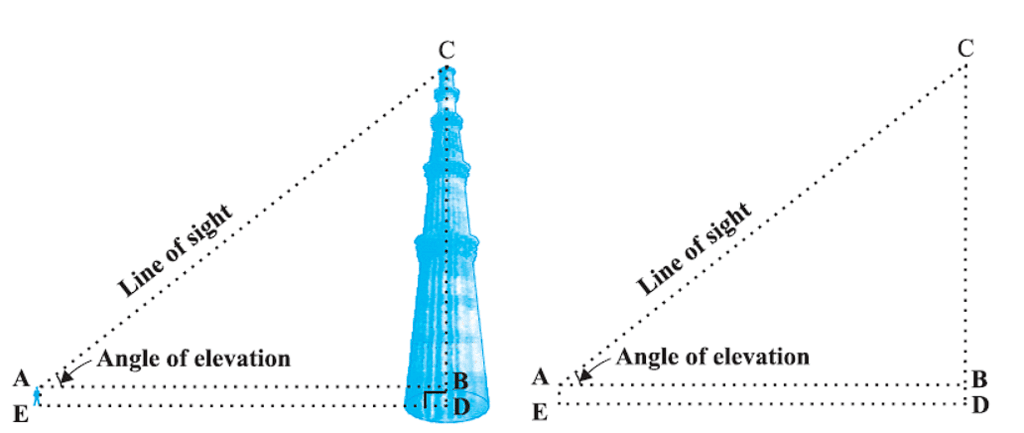
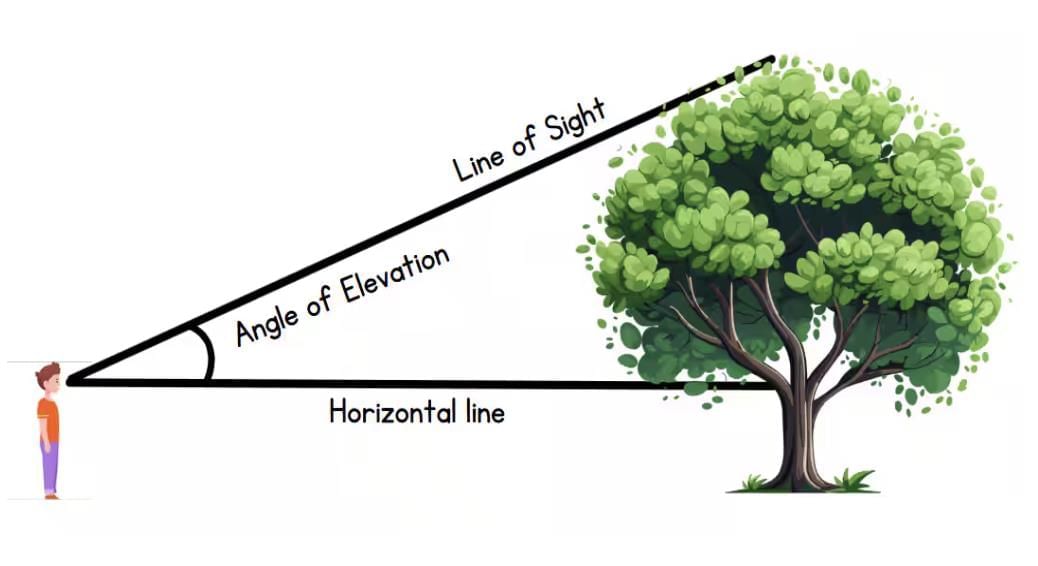
  • In the diagram, the line AC from the student’s eye to the top of a Minar is the line of sight. The angle BAC between the line of sight and the horizontal is the angle of elevation.
  • The line of sight is drawn from an observer’s eye to the object they’re looking at.
  • Angle of elevation is the angle between the line of sight and the horizontal when viewing an object above eye level.
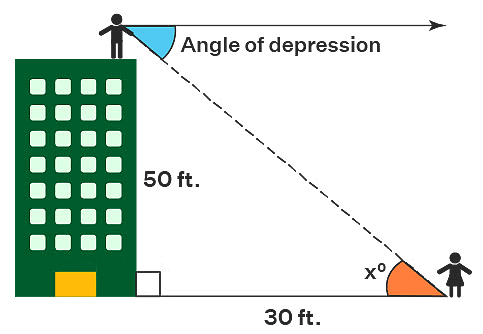
  • Angle of depression is the angle between the line of sight and the horizontal when viewing an object below eye level.

Try yourself:

What is the angle of elevation?

  • A.The angle between the line of sight and the horizontal when viewing an object below eye level.
  • B.The angle between the line of sight and the horizontal when viewing an object above eye level.
  • C.The angle between the line of sight and the vertical when viewing an object below eye level.
  • D.The angle between the line of sight and the vertical when viewing an object above eye level.

View Solution

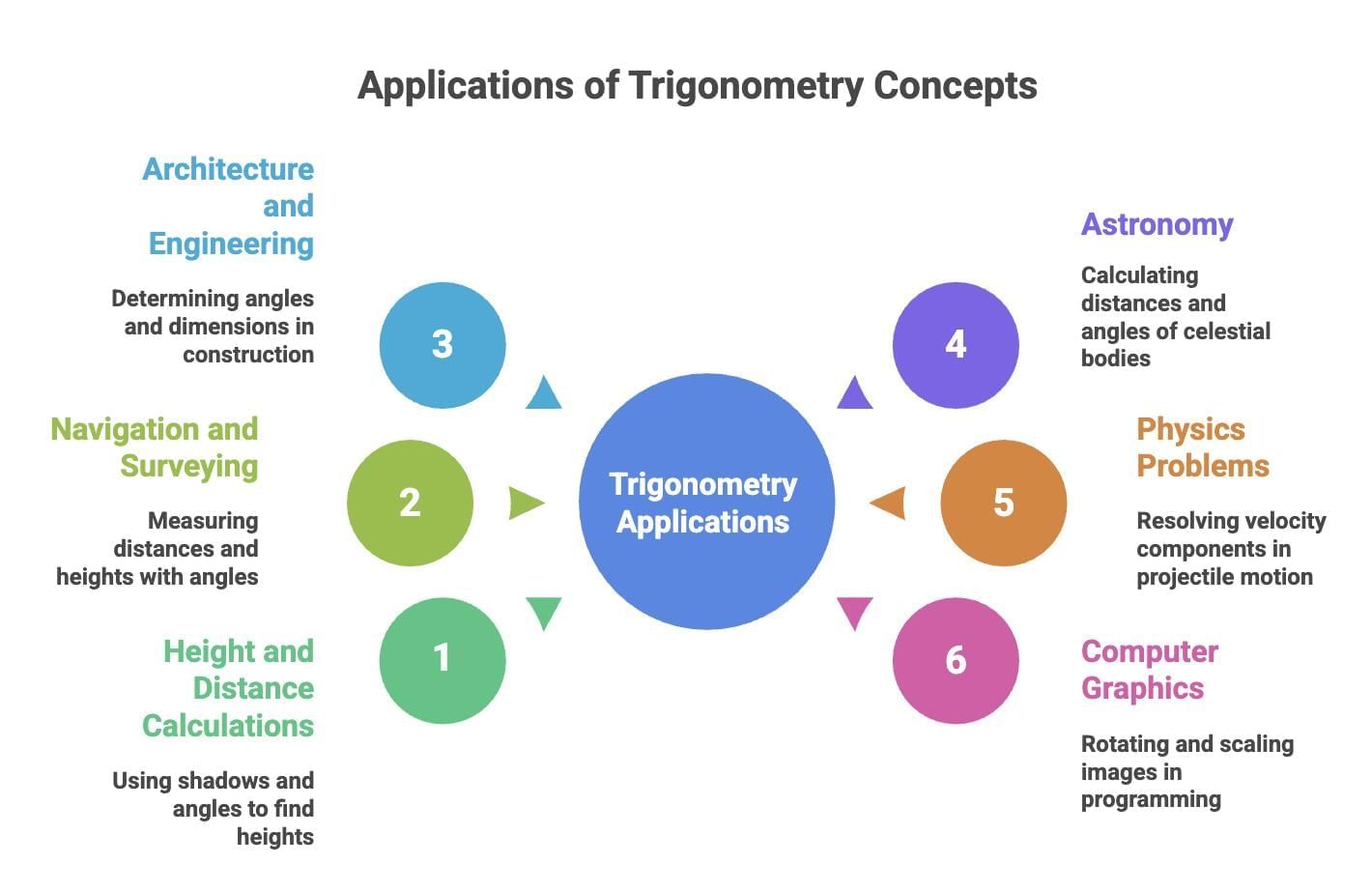
Applications of Trigonometry Concepts

(i) Height and Distance Calculations:- Finding the height of a building using its shadow and the angle of elevation of the sun.

(ii) Navigation and Surveying:- Calculating distances between points or the height of landmarks using angles measured from different locations.

(iii) Architecture and Engineering:- Determining structural angles or dimensions in construction projects.

(iv) Astronomy:-bCalculating the distance between celestial bodies or their angles in the sky.

(v) Physics Problems:- Analysing projectile motion, where trigonometric functions help in resolving velocity components.

(vi) Computer Graphics:- Using trigonometry to rotate or scale images in graphics programming.

Solved Examples

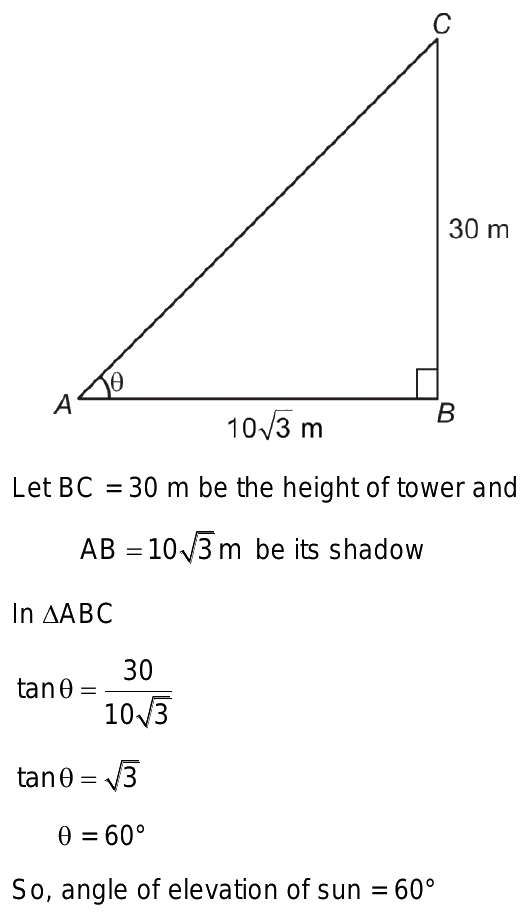
(i) Angle of Elevation Q1: If a tower 30m high casts a shadow 10√3m long on the ground then, what is the angle of elevation of sun?

Solution: 

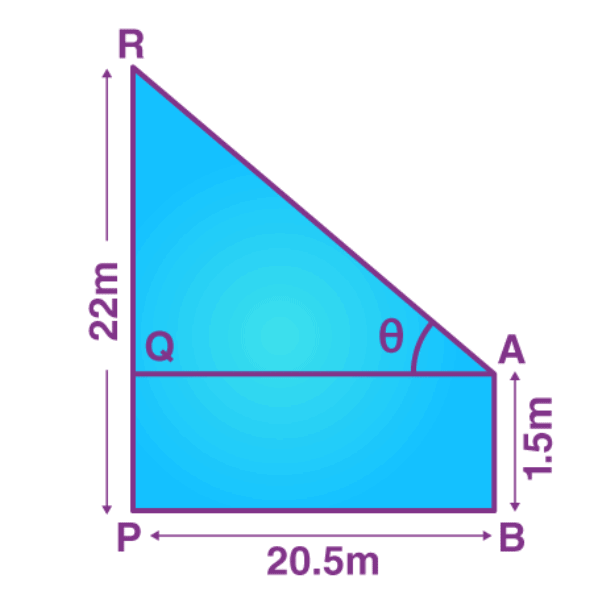
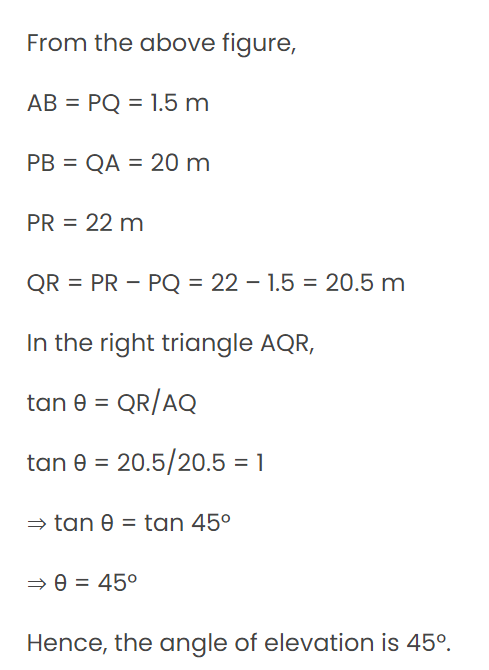
Q2: An observer 1.5 metres tall is 20.5 metres away from a tower 22 metres high. Determine the angle of elevation of the top of the tower from the eye of the observer.

Solution:

Let AB be the height of the observer and PR be the height of the tower.

Also, PB is the distance between the foot of the tower and the observer.

Consider θ as the angle of elevation of the top of the tower from the eye of the observer.

(ii) Calculating heights

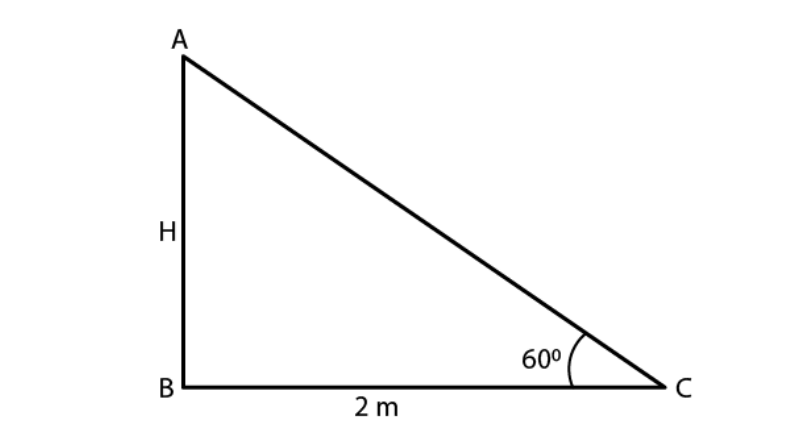
Q 3: A ladder is placed along a wall of a house such that its upper end is touching the top of the wall. The foot of the ladder is 2 m away from the wall and the ladder is making an angle of 60° with the level of the ground. Determine the height of the wall.

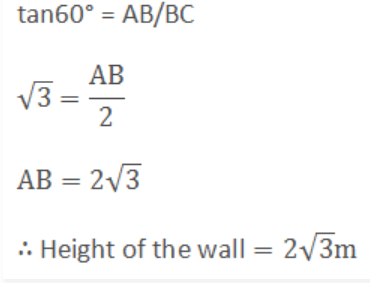
Solution:

Given,

Distance between the wall and the foot of the ladder = 2m = BC

Angle made by ladder with ground (θ) = 60°

Height of the wall (H) = AB

Now, the fig. of ABC forms a right angle triangle.

So, tan θ =Perpendicular/hypotenuse

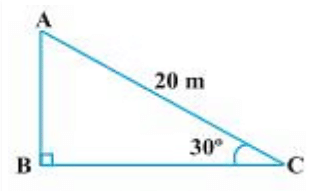
Q4: A circus artist is climbing a 20 m long rope, which is tightly stretched and tied from the top of a vertical pole to the ground. Find the height of the pole, if the angle made by the rope with the ground level is 30°. 

Solution:

Length of the rope is 20 m and angle made by the rope with the ground level is 30°.

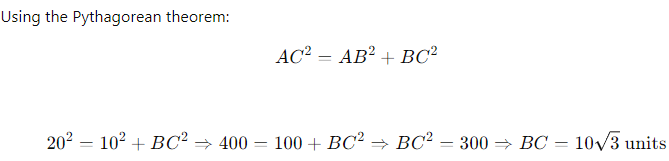
Given: AC = 20 m and angle C = 30°

To Find: Height of the pole

Let AB be the vertical pole

In right ΔABC, using sine formula

sin 30° = AB/AC

Using value of sin 30 degrees is ½, we have

1/2 = AB/20

AB = 20/2

AB = 10

Therefore, the height of the pole is 10 m.

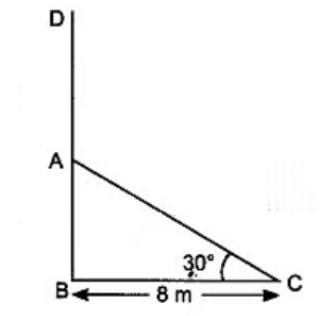
Q5: A tree breaks due to storm and the broken part bends so that the top of the tree touches the ground making an angle 30° with it. The distance between the foot of the tree to the point where the top touches the ground is 8 m. Find the height of the tree.

Solution:

Using given instructions, draw a figure. Let AC be the broken part of the tree. Angle C = 30°

BC = 8 m

To Find: Height of the tree, which was originally BD or AB+AC

AD=AC as  [ tree fall due to storm ]

From figure: Total height of the tree is the sum of AB and AC i.e. AB+AC

In right ΔABC,

Using Cosine and tangent angles,

cos 30° = BC/AC

We know that, cos 30° = √3/2

√3/2 = 8/AC

AC = 16/√3 …(1)

Also,

tan 30° = AB/BC

1/√3 = AB/8

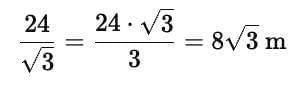
AB = 8/√3 ….(2)

Therefore, total height of the tree = AB + AC = 16/√3 + 8/√3

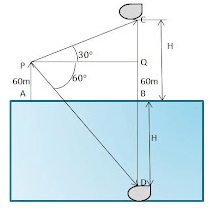
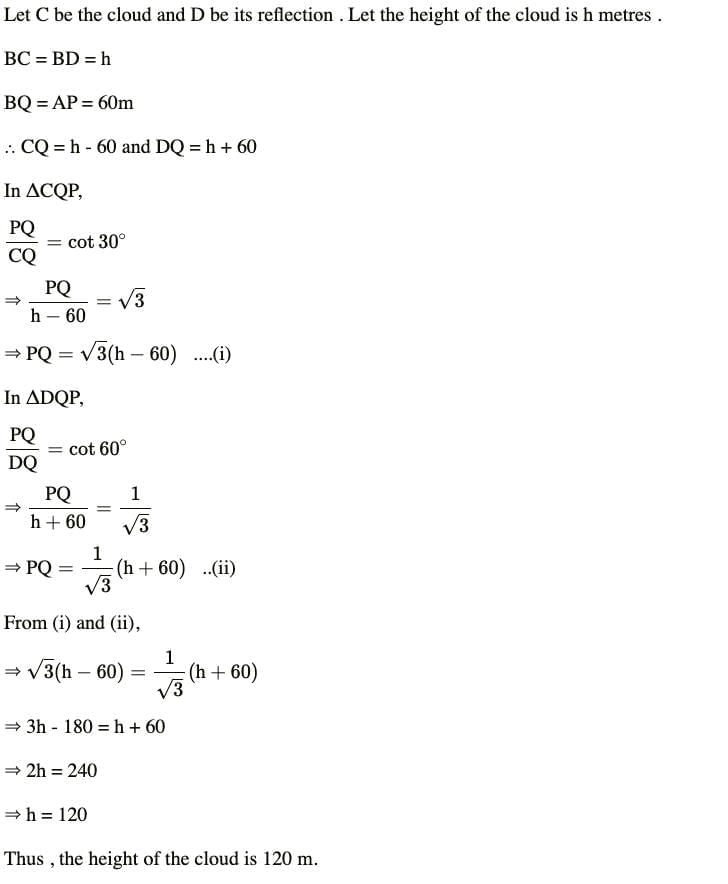
Q6: The angle of elevation of a cloud 60m above a lake is 30° and the angle of reflection of the cloud in the lake is 60°. Find height of the cloud.

Solution: The situation is depicted by the following diagram.

(iii) Calculating lengths

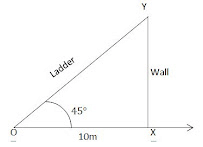
 Q7:The angle of elevation of a ladder leaning against a wall is 45° and foot of the ladder is 10m away from the wall. Find the length of ladder. The following diagram depicts the situation

Solution:Let OY is the ladder. Let OY=l. YX is the wall on which ladder is leaning on. It is given, ladder is leaned at 45°. Also, distance from the wall to foot of ladder is 10m, OX=d=10m. It is given √2=1.414
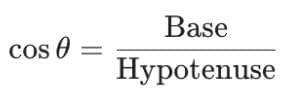
From the diagram,cos 45°= OX/OY 
We know that cos 45° = 1/√2
So, 1/√2 = 10/OY
OY = √2×10 m 
OY= 10√2m = 10×1.414 = 14.14m
So, length of ladder is 14.14m

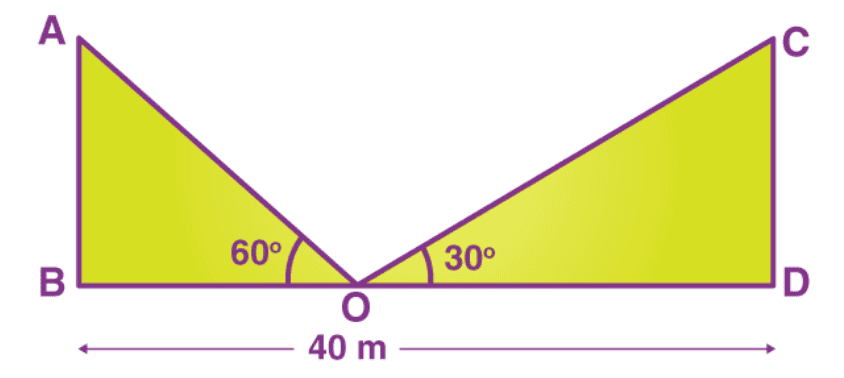
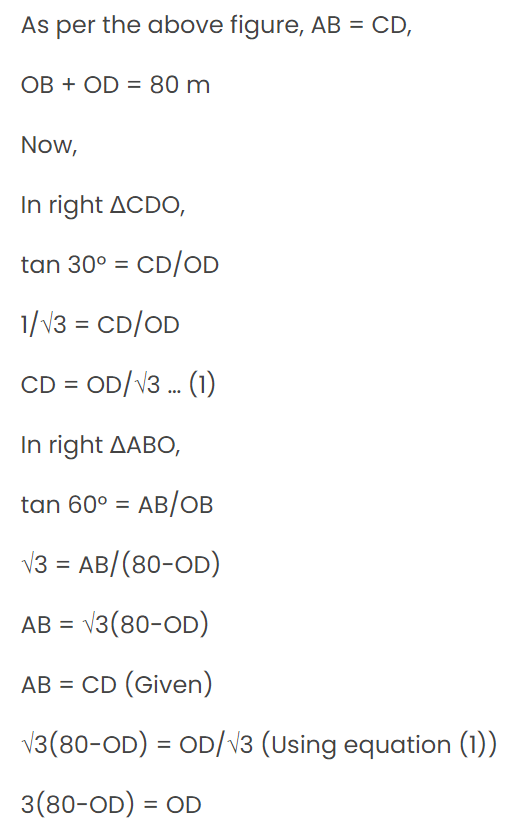
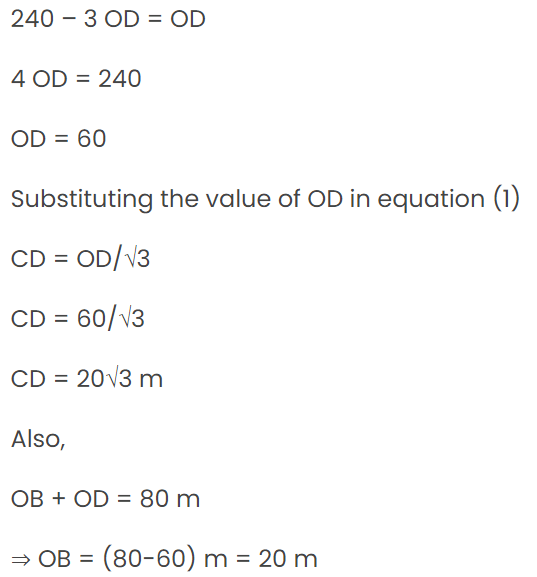
Q8 :- Two poles of equal heights are standing opposite each other on either side of the road, which is 80 m wide. From a point between them on the road, the angles of elevation of the top of the poles are 60° and 30°, respectively. Find the height of the poles and the distances of the point from the poles.

Solution:

Let AB and CD be the poles of equal height.

O is the point between them from where the height of elevation is taken. BD is the distance between the poles.

Therefore, the height of the poles are 20√3 m and the distance from the point of elevation are 20 m and 60 m respectively. 

8. Introduction to Trigonometry – Chapter Notes

Introduction

Trigonometry is a math branch studying relationships between the sides and angles of a triangle

  • The name comes from Greek words meaning three sides and measure.
  • Trigonometry’s roots go back to Egypt and Babylon, where it helped astronomers measure distances to stars. 
  • Today, it’s crucial in Engineering and Physical Sciences.

In this chapter, we will delve into trigonometric ratios, specifically examining the ratios of the sides of a right triangle in relation to its acute angles. Our focus will initially be on acute angles, though these ratios extend to other angle measures as well. We will also introduce trigonometric ratios for angles of 0° and 90°.

Trigonometric Ratios

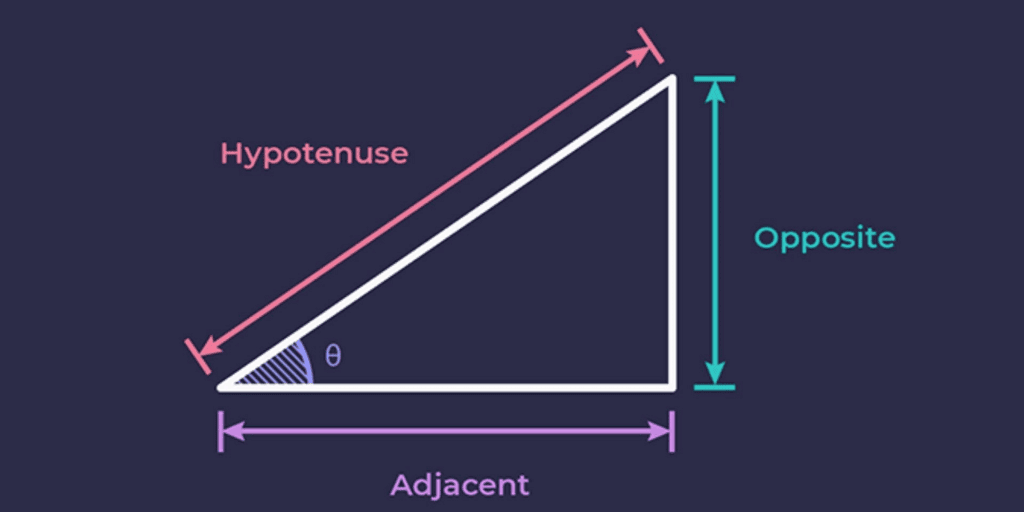
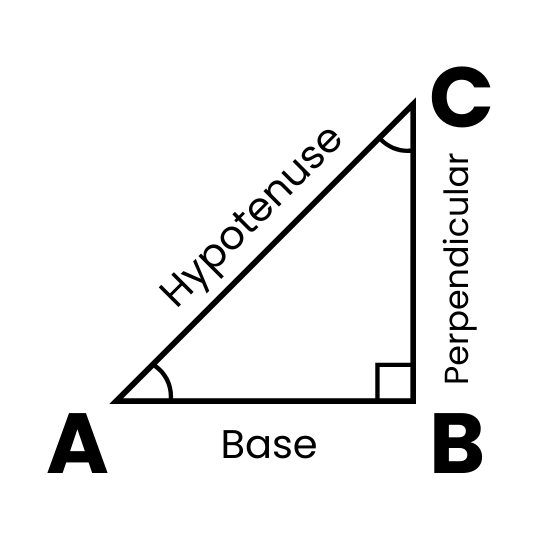
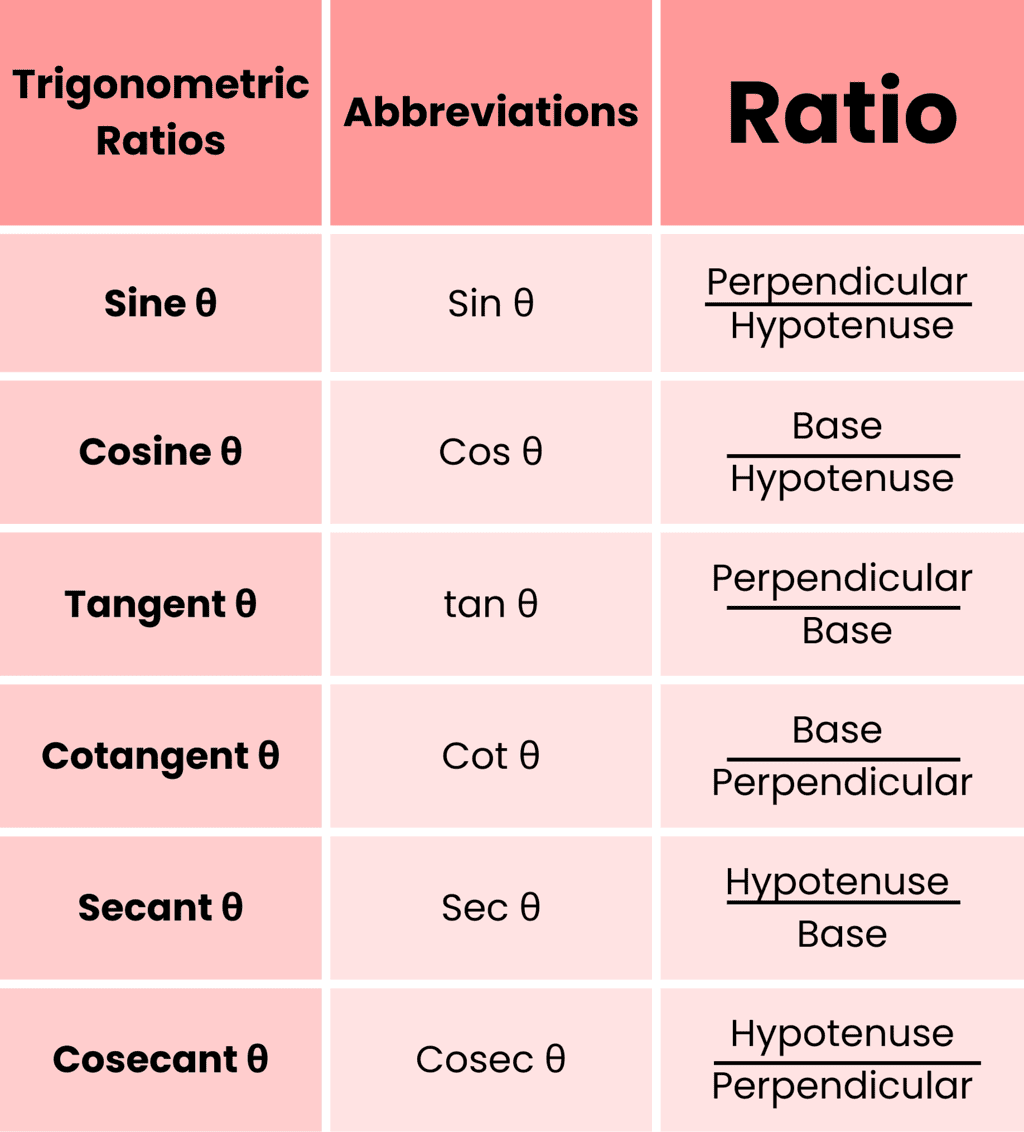
Trigonometric ratios are terms defined for specific ratios of sides. They vary greatly and are used according to the need. Since all of these ratios are defined for right angled triangles, we will define them using name of sides as Hypotenuse, Perpendicular and Base.

Referring to the Right Triangle ABC in the following figure:

Right Triangle ABC

Here, θ is pronounced as theta.

Formulae for Trigonometric Ratios

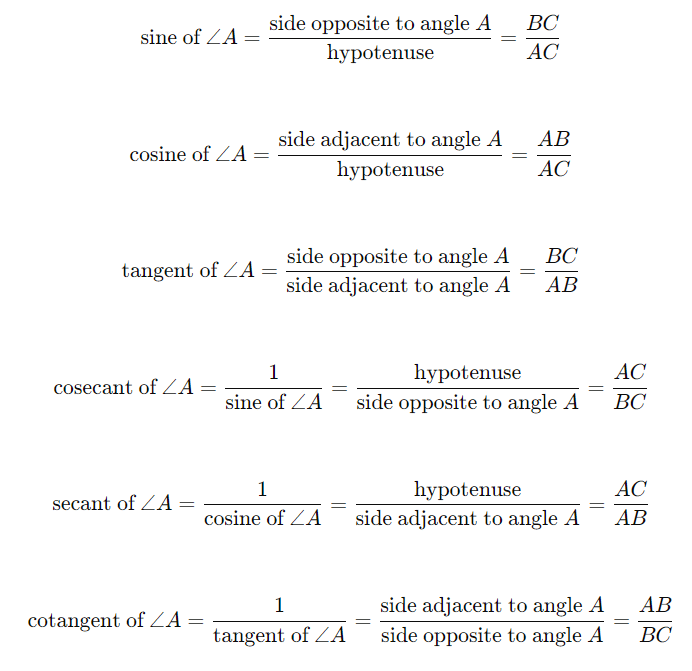
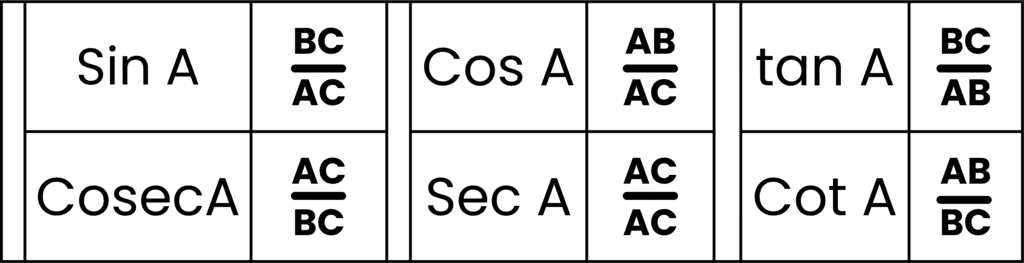
Ratio Formula

Try yourself:Which trigonometric ratio does not involve the hypotenuse of a triangle?

  • A.sin A
  • B.cos A
  • C.tan A
  • D.cosec A

View Solution
Relation between Trigonometric Ratios

  • cosec θ =1/sin θ
  • sec θ = 1/cos θ
  • tan θ = sin θ/cos θ
  • cot θ = cos θ/sin θ=1/tan θ

Example 1: Suppose a right-angled triangle ABC, right-angled at B such that hypotenuse AC = 5 cm, base BC = 3 cm and perpendicular AB = 4 cm. Also, ∠ACB = θ. Find the trigonometric ratios tan θ, sin θ and cos θ.
Solution: Given, in ∆ABC,
Hypotenuse, AC = 5 cm
Base, BC = 3 cm
Perpendicular, AB = 4 cm
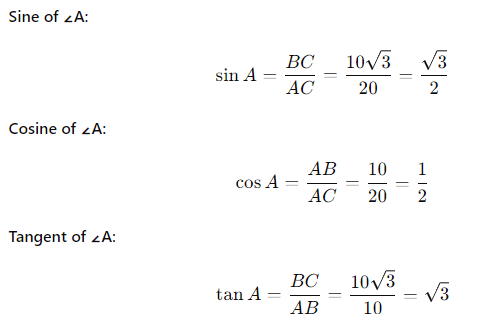
Then, by the trigonometric ratios, we have;
tan θ = Perpendicular/Base = 4/3
Sin θ = Perpendicular/Hypotenuse = AB/AC = 4/5
Cos θ = Base/Hypotenuse = BC/AC = 3/5

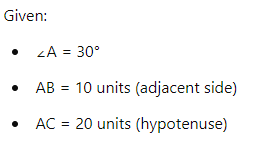
Example 2:

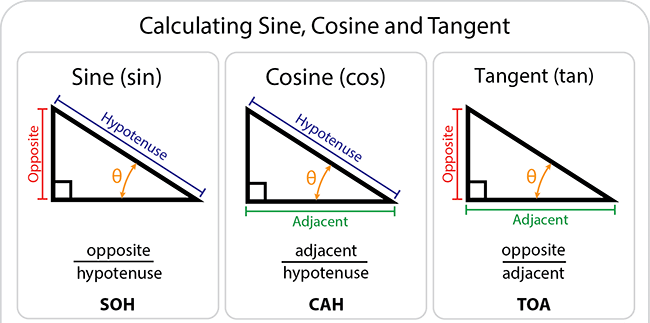
Mnemonic to calculate Sine, Cosine & Tangent

Trigonometric Ratios of Some Specific Angles

In geometry, you’ve already learned how to create angles of 30°, 45°, 60°, and 90°. Now, let us explore the trigonometric ratios’ values for these specific angles and, naturally, for 0°

Hypotenuse is the longest side of a right-angled triangle, opposite the right angle.

Also, by Pythagoras theorem, we know that (Hypotenuse)2 = (Base)+ (Perpendicular)2.

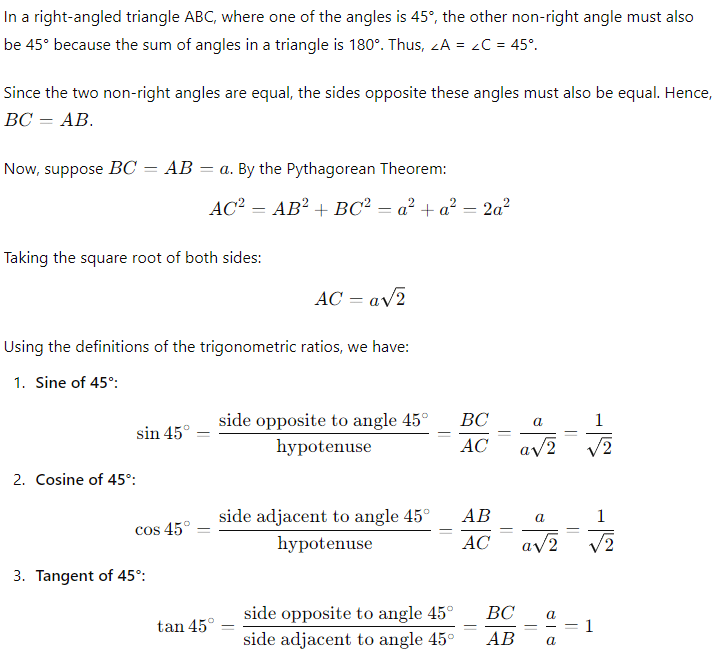
1. Trigonometric Ratios of 45°

If one of the angles of a right-angled triangle is 45°, then another angle will also be equal to 45°.

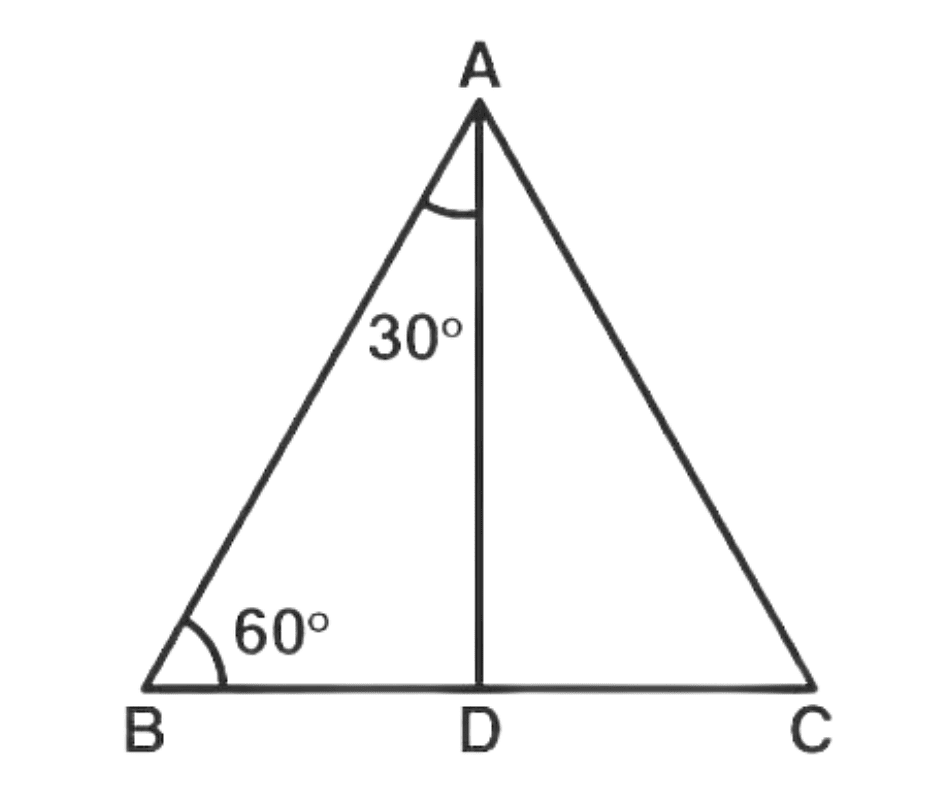
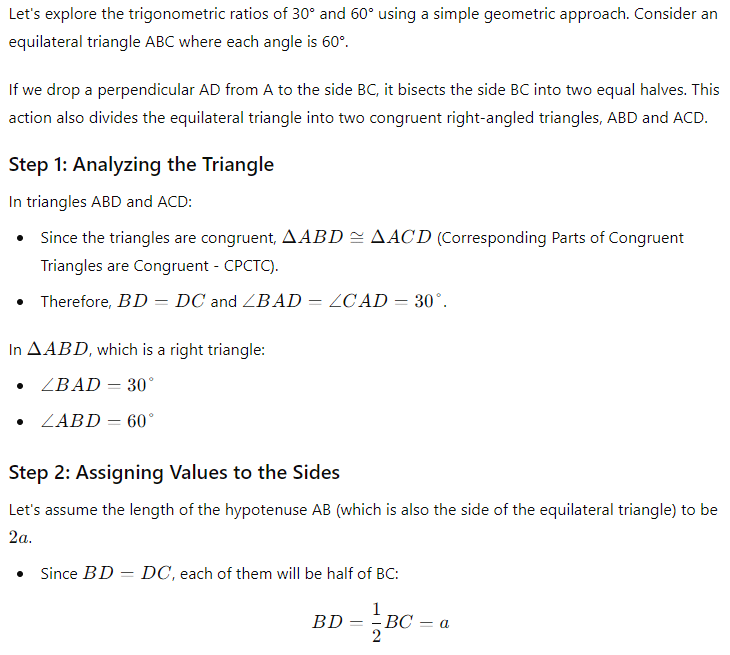
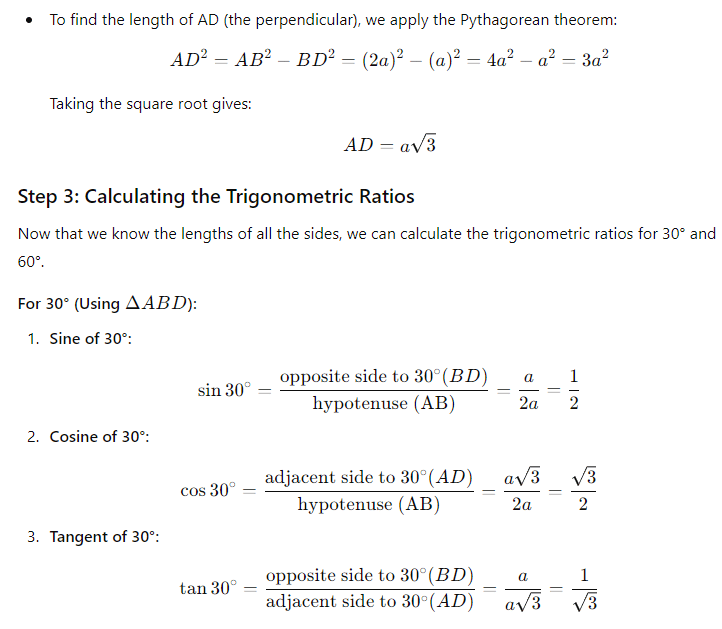
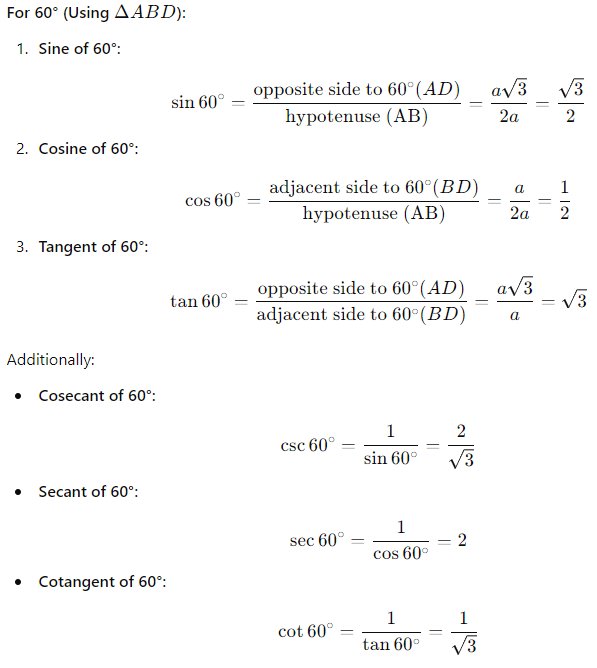
2. Trigonometric Ratios of 30° and 60°Equilateral Triangle

3. Trigonometric Ratios of 0° and 90°

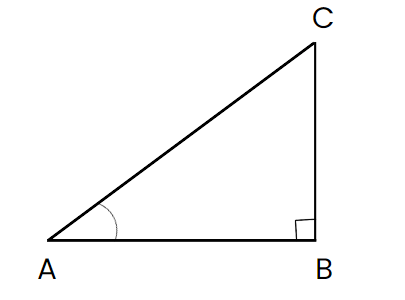
If ABC is a right-angled triangle at B, if ∠A is reduced, then side AC will come near to side AB. So, if ∠ A is nearing 0 degree, then AC becomes almost equal to AB, and BC gets almost equal to 0.

Hence, Sin A = BC /AC = 0
and cos A = AB/AC = 1

tan A = sin A/cos A = 0/1 = 0

Also,
cosec A = 1/sin A = 1/0 = not defined
sec A = 1/cos A = 1/1 = 1
cot A = 1/tan A = 1/0 = not defined

In the same way, we can find the values of trigonometric ratios for a 90-degree angle. Here, angle C is reduced to 0, and the side AB will be nearing side BC such that angle A is almost 90 degrees and AB is almost 0.

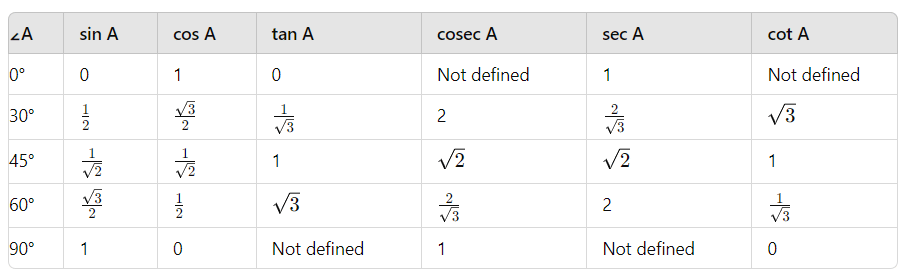
Trigonometric Ratio Table

Standard Values of Trigonometric Ratios

Example 1: Evaluate 2 tan2 45° + cos2 30° – sin2 60°.

Solution: Since we know,
tan 45° = 1
cos 30° = √3/2
sin 60° = √3/2
Therefore, putting these values in the given equation:
2(1)2 + (√3/2)2 – (√3/2)2
= 2 + 0
= 2

Example 2: If tan (A + B) =√3 and tan (A – B) =1/√3, 0° < A + B ≤ 90°; A > B, find A and B.

Solution: Given,
tan (A + B) = √3
As we know, tan 60° = √3
Thus, we can write;
⇒ tan (A + B) = tan 60°
⇒(A + B) = 60° …… (i)
Now again given;
tan (A – B) = 1/√3
Since, tan 30° = 1/√3
Thus, we can write;
⇒ tan (A – B) = tan 30°
⇒(A – B) = 30° ….. (ii)
Adding the equation (i) and (ii), we get;
A + B + A – B = 60° + 30°
2A = 90°
A= 45°
Now, put the value of A in eq. (i) to find the value of B;
45° + B = 60°
B = 60° – 45°
B = 15°
Therefore A = 45° and B = 15°

Example 3: Show that :
(i) tan 48° tan 23° tan 42° tan 67° = 1

(ii) cos 38° cos 52° – sin 38° sin 52° = 0

Solution:
(i) tan 48° tan 23° tan 42° tan 67°
We can also write the above given tan functions in terms of cot functions, such as;
tan 48° = tan (90° – 42°) = cot 42°
tan 23° = tan (90° – 67°) = cot 67°
Hence, substituting these values, we get
= cot 42° cot 67° tan 42° tan 67°
= (cot 42° tan 42°) (cot 67° tan 67°)
= 1 × 1 [since cot A.tan A = 1]
= 1
(ii) cos 38° cos 52° – sin 38° sin 52°
We can also write the given cos functions in terms of sin functions.
cos 38° = cos (90° – 52°) = sin 52°
cos 52°= cos (90° – 38°) = sin 38°
Hence, putting these values in the given equation, we get;
sin 52° sin 38° – sin 38° sin 52° = 0

Example 4: If tan 2A = cot (A – 18°), where 2A is an acute angle, find the value of A.

Solution: Given,
tan 2A = cot (A – 18°)
As we know by trigonometric identities,
tan 2A = cot (90° – 2A)
Substituting the above equation in the given equation, we get;
⇒ cot (90° – 2A) = cot (A – 18°)
Therefore,
⇒ 90° – 2A = A – 18°
⇒ 108° = 3A
A = 108° / 3
Hence, the value of A = 36°

Example 5:  If A, B and C are interior angles of a triangle ABC, then show that sin [(B + C)/2] = cos A/2.

Solution:
As we know, for any given triangle, the sum of all its interior angles is equals to 180°.
Thus,
A + B + C = 180° ….(1)
Now we can write the above equation as;
⇒ B + C = 180° – A
Dividing by 2 on both the sides;
⇒ (B + C)/2 = (180° – A)/2
⇒ (B + C)/2 = 90° – A/2
Now, put sin function on both sides.
⇒ sin (B + C)/2 = sin (90° – A/2)
Since,
sin (90° – A/2) = cos A/2
Therefore,
sin (B + C)/2 = cos A/2

Trigonometric Identities

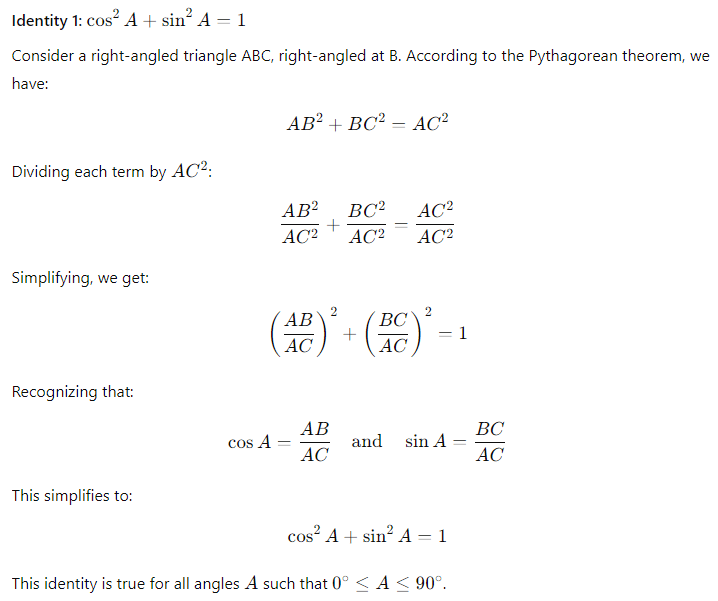
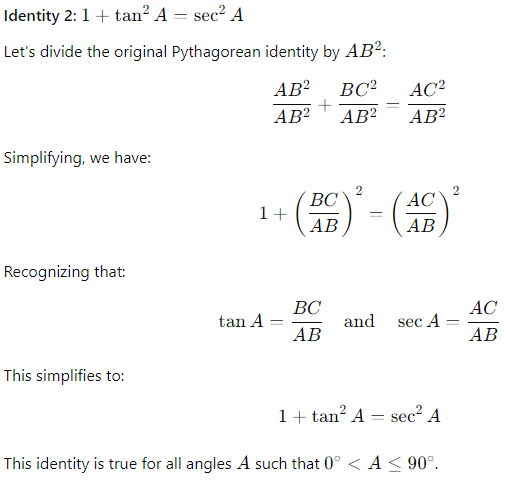
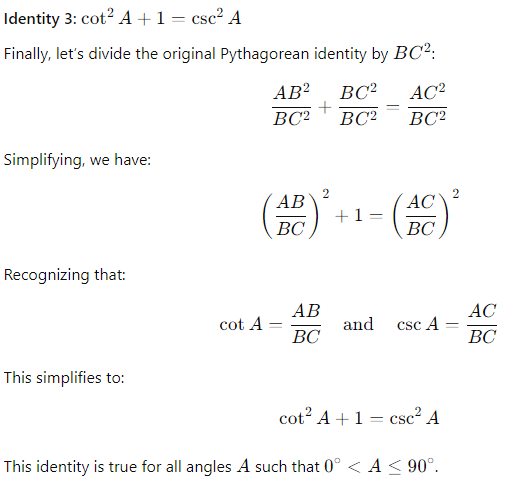
In trigonometry, an equation involving trigonometric ratios of an angle is called a trigonometric identity if it holds true for all values of the angle(s) involved. Let’s prove three fundamental trigonometric identities and understand their significance.Identity 1

Identity 2

Identity 3

Try yourself:If cos X = ⅔ then tan X is equal to:

  • A.5/2
  • B.√(5/2)
  • C.√5/2
  • D.2/√5

View Solution

Example 6: Prove the identities:
(i) √[1 + sinA/1 – sinA] = sec A + tan A

(ii) (1 + tan2A/1 + cot2A) = (1 – tan A/1 – cot A)2 = tan2A

Solution:
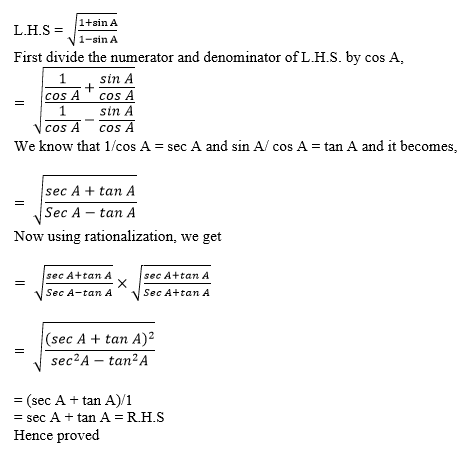
(i) Given:√[1 + sinA/1 – sinA] = sec A + tan A


(ii) Given: (1 + tan2A/1 + cot2A) = (1 – tan A/1 – cot A)2 = tan2A
LHS:
= (1+tan²A) / (1+cot²A)
Using the trigonometric identities we know that 1+tan²A = sec²A and 1+cot²A= cosec²A
= sec²A/ cosec²A
On taking the reciprocals we get

= sin²A/cos²A

= tan²A

RHS:

=(1-tanA)²/(1-cotA)²

Substituting the reciprocal value of tan A and cot A we get,

= (1-sinA/cosA)²/(1-cosA/sinA)²

= [(cosA-sinA)/cosA]²/ [(sinA-cos)/sinA)²] = [(cosA-sinA)²×sin²A] /[cos²A. /(sinA-cosA)²] =  sin²A/cos²A

tan2A

The values of LHS and RHS are the same.

Hence proved.

Example 7: If sin θ + cos θ = √3, then prove that tan θ + cot θ = 1.

Solution:

Given,

sin θ + cos θ = √3

Squaring on both sides,

(sin θ + cos θ)= (√3)2

sin2θ + cos2θ + 2 sin θ cos θ = 3

Using the identity sin2A + cos2A = 1,

1 + 2 sin θ cos θ = 3

2 sin θ cos θ = 3 – 1

2 sin θ cos θ = 2

sin θ cos θ = 1

sin θ cos θ = sin2θ + cos2θ

⇒ (sin2θ + cos2θ)/(sin θ cos θ) = 1

⇒ [sin2θ/(sin θ cos θ)] + [cos2θ/(sin θ cos θ)] = 1

⇒ (sin θ/cos θ) + (cos θ/sin θ) = 1

⇒ tan θ + cot θ = 1

Hence proved.

Example 8: Express cot 85° + cos 75° in terms of trigonometric ratios of angles between 0° and 45°.

Solution:

cot 85° + cos 75° 

= cot (90° – 5°) + cos (90° – 15°) 

We know that cos(90° – A) = sin A and cot(90° – A) = tan A

= tan 5° + sin 15°

Summary

1. Trigonometric Ratios in a Right Triangle:

  • sin A = side opposite to angle A / hypotenuse 
  • cos A = side adjacent to angle A / hypotenuse 
  • tan A = side opposite to angle A / side adjacent to angle A .

2. Reciprocal Trigonometric Ratios:

  • cosec⁡ A = 1/sin⁡ A
  • sec⁡ A = 1/cos A
  • tan⁡ A = 1/cot A
  • tan A = sin A/cos A

3. Relation between Trigonometric Ratios:

  • If one trigonometric ratio of an acute angle is known, the others can be easily determined.

4. Values for Specific Angles:

  • Values of trigonometric ratios for angles 0°, 30°, 45°, 60°, and 90°.

5. Limitations and Inequalities:

  • The value of sin A or cos A never exceeds 1.
  • Wheras, the value of sec A or cosec A is always greater than or equal to 1.

6. Trigonometric Identities:

  • sin⁡2A+cos⁡2A = 1
  • sec⁡2A−tan⁡2A=1 (for 0°≤A<90°)
  • cosec⁡2A=1+cot⁡2A (for 0°<A≤90°)

7. Coordinate Geometry – Chapter Notes

What is a Coordinate System?

Coordinate System is a mathematical framework used to determine the position or location of points in space. It provides a way to describe the position of objects or points using numerical values called coordinates.

  • As shown in the figure, the line XOX′ is known as the X-axis, and YOY′is known as the Y-axis.
  • The point O is called the origin. For any point P (x y), the ordered pair(x,y) is called the coordinate of point P.
  • The distance of a point from the Y-axis is called its abscissa and the distance of a point from the X-axis is called its ordinate.

Distance between Two Points Using Pythagoras’ Theorem

Let P(x1, y1) and Q(x2, y2) be any two points on the cartesian plane.

Draw lines parallel to the axes through P and Q to meet at T.

ΔPTQ is right-angled at T.

By Pythagoras Theorem,

PQ2 = PT2 + QT2

= (x2 – x1)+ (y2 – y1)2

PQ = √[x2 – x1)+ (y2 – y1)2]

Distance Formula

Distance between any two points (x1, y1) and (x2, y2) is given by

d = √[x2 – x1)2+(y2 – y1)2]

Where d is the distance between the points (x1,y1) and (x2,y2).

Note:The distance of any point P(x,y) from the origin O(0,0) is given by:

Example 1: Find the distance between the points D and E, in the given figure.

Solution:

Example 2: What is the distance between two points (2, 3) and (-4, 5) using the distance formula?

Sol: The distance formula is used to calculate the distance between two points in a coordinate plane. It is given as:

d = √[(x2 – x1)² + (y2 – y1)²]

Using this formula, we can find the distance between the points (2, 3) and (-4, 5) as follows:

d = √[(-4 – 2)² + (5 – 3)²]

d = √[(-6)² + (2)²]

d = √[36 + 4]

d = √40

d = 6.32 (approx.)

Therefore, the distance between the points (2, 3) and (-4, 5)is approximately 6.32 units.

Try yourself:What is the distance between points (3,4) and (-2,1)?

  • A.5
  • B.4
  • C.√10
  • D.√34

View Solution

Section Formula

Let P (x,y) be a point on the line segment joining A(x1, y1) and B(x2, y2) such that it divides AB internally in the ratio m:n. The coordinates of the point are given by


This is known as the Section Formula.

Note:

(i) If the point P divides the line segment joining A(x1, y1) and B(x2, y2) internally in the ratio k:1, its coordinates are given by:

Example 3: In what ratio does the point (2,- 5) divide the line segment joining the points A(-3, 5) and B(4, -9)?

Sol: Let the ratio be λ : 1

We have put m = λ and n = 1
or

But, coordinates of point is given as p(2,-5) 

But, coordinates of point is given as p(2,-5) 

4λ – 3 = 2(λ + 1)
⇒ 4λ = 2λ + 2 + 3

⇒ 2λ = 5
⇒ λ = 5/2

The required ratio is 5:2.

Mid -Point Formula

The mid-point of the line joining A(x1, y1) and B(x2, y2) is given as

Example 4: Suppose we have two points A(2, 4) and B(6, 8). We want to find the midpoint of the line segment AB.

Sol:Using the midpoint formula:

Midpoint = ((x1 + x2) / 2, (y1 + y2) / 2)

= ((2 + 6) / 2, (4 + 8) / 2)

= (8 / 2, 12 / 2)

= (4, 6)

Therefore, the midpoint of the line segment AB is M(4, 6).

Some Solved Questions

Q1: Find the distance between the points (3, 5) and (-2, -1) using the distance formula.

Sol:

Using the distance formula:

d = √[(x2 – x1)² + (y2 – y1)²]

Substituting the coordinates:

d = √[(-2 – 3)² + (-1 – 5)²]

d = √[(-5)² + (-6)²]

d = √[25 + 36]

d = √61

Therefore, the distance between the points (3, 5) and (-2, -1) is √61 units.

Q2: Find the coordinates of the midpoint of the line segment joining the points (-3, 2) and (5, -4).

Sol:

Using the midpoint formula:

Midpoint = ((x1 + x2) / 2, (y1 + y2) / 2)

Substituting the coordinates:

Midpoint = ((-3 + 5) / 2, (2 + (-4)) / 2)

Midpoint = (2 / 2, -2 / 2)

Midpoint = (1, -1)
Therefore, the midpoint of the line segment joining (-3, 2) and (5, -4) is (1, -1).

6. Triangles – Chapter Notes

Introduction
In this chapter, we delve into the fascinating realm of figures that share the same shape but may differ in size – these are aptly termed similar figures. Building upon the groundwork laid in Class IX regarding the congruence of triangles, we now explore the concept of similarity. Unlike congruent figures that possess both the same shape and size, similar figures exhibit identical shapes while allowing for variations in size. 

Similar Figures

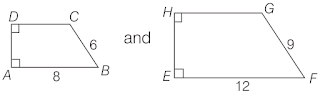
  • Two geometrical figures are said to be similar figures if they have the same shape but not necessarily the same size.
    Or
    A shape is said to be similar to other if the ratio of their corresponding sides is equal and the corresponding angles are equal.
  • Two polygons having the same number of sides are similar, if:
    (i) all the corresponding angles are equal and
    (ii) all the corresponding sides are in the same ratio or proportion.
    If only one condition from (i) and (ii) is true for two polygons, then they cannot be similar.
Similarity of Triangles

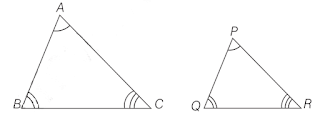
Two triangles are said to be similar triangles if:

  • Their corresponding angles are equal and 
  • their corresponding sides are proportional (i.e., the ratios between the lengths of corresponding sides are equal).  

For example:
If in ∆ABC and ∆PQR
∠A = ∠P, ∠B = ∠Q, ∠C = ∠R and,
AB/PQ = BC/QR = AC/PR
Then, △ABC∼△PQR
where the symbol ∼ is read as ‘is similar to’.
Conversely
If △ABC is similar to △PQR, then
∠A = ∠P, ∠B = ∠Q, ∠C = ∠R and,
AB/PQ = BC/QR = AC/PR

Note: The ratio of any two corresponding sides in two equiangular triangles is always the same.

Theorem 1 ( Thales theorem)

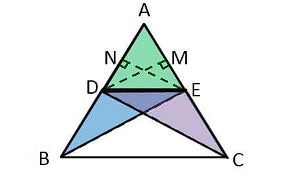
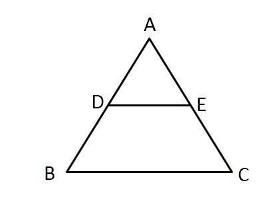
If a line is drawn parallel to one side of a triangle to intersect the other two sides in distinct points, then other two sides are divided in the same ratio.
This theorem is known as the Basic Proportionality Theorem (BPT) or Thales theorem.

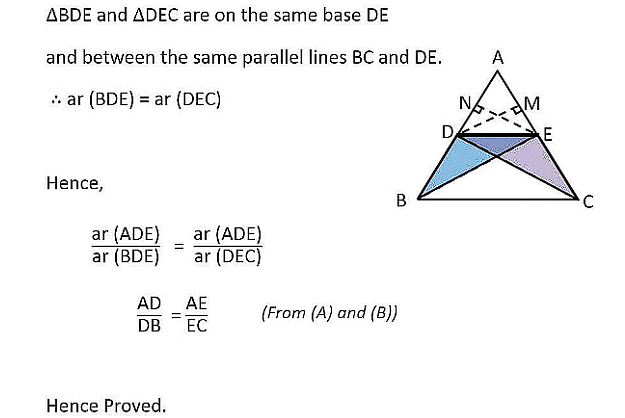
Given: 

To Proof: 

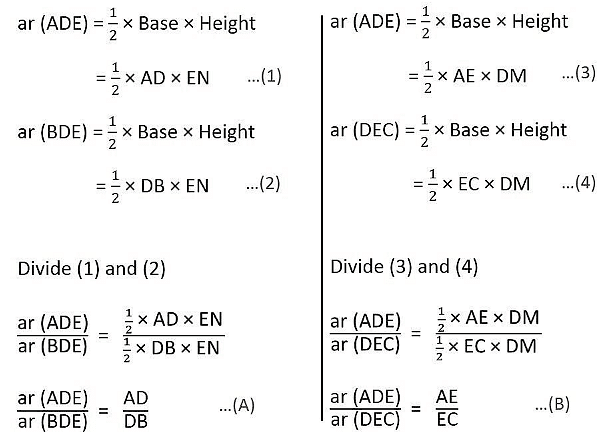
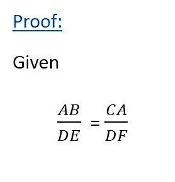
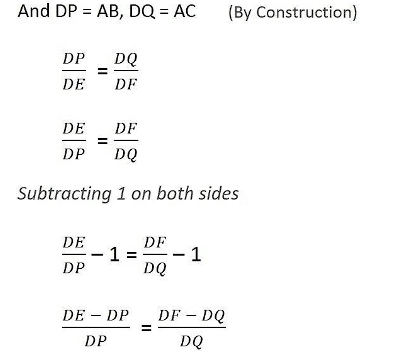
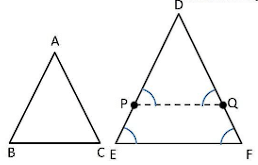
Proof:

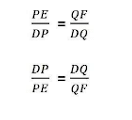
Now, 

Now,

Try yourself:

Which of the following conditions determine if two polygons are similar?

  • A.All corresponding angles are equal.
  • B.All corresponding sides are equal.
  • C.All corresponding angles are equal and all corresponding sides are in the same ratio.
  • D.All corresponding sides are in the same ratio.

View Solution

Theorem 2 ( Converse of Thales theorem)

If a line divides any two sides of a triangle in the same ratio, then the line is parallel to the third side.

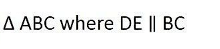
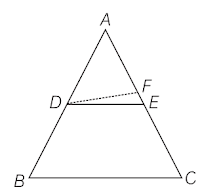
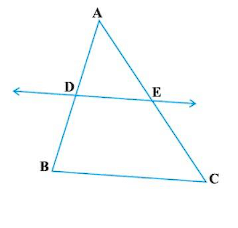
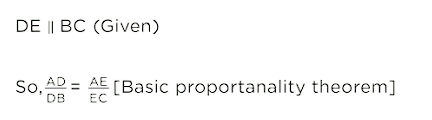
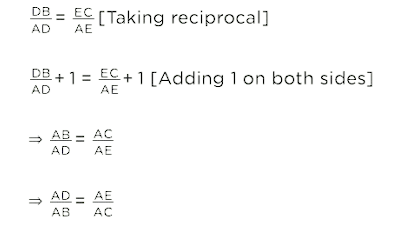
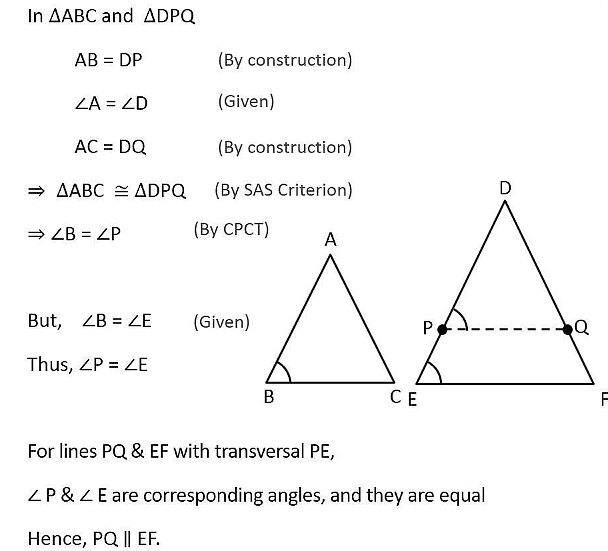
1. Construction: Assume DE is not parallel to BC. Draw DF ∥ BC, meeting AC at F. This is a standard contradiction setup.

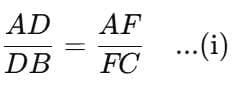
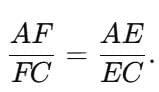
2. Since DF ∥ BC, by BPT:

3. From the given:

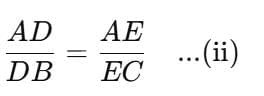
4. From (i) and (ii):

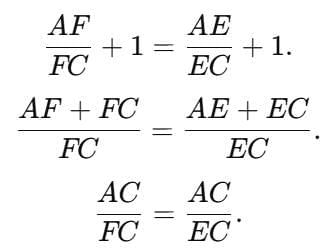
5. Add 1 to both sides:

6. ⇒ FC = EC.  ⇒ F and E must coincide.
Therefore, DF passes through E, meaning DE ∥ BC.

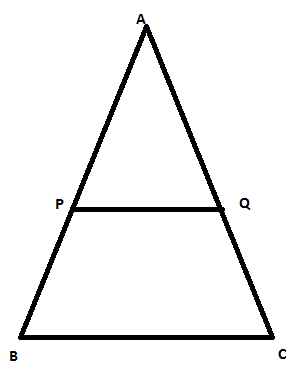
Example 1:  If a line intersects sides AB and AC of a triangle ABC at D and E respectively and is parallel to BC, 

prove that 

Solution: 

 If a line is drawn parallel to one side of a triangle to intersect the other two sides in distinct points, the other two sides are divided in the same ratio.

Criteria For Similarity of Triangles

Two triangles are said to be similar triangles if their corresponding angles are equal and their corresponding sides are proportional (i.e., the ratios between the lengths of corresponding sides are equal).

For example:
If in ∆ABC and ∆PQR

∠A = ∠P, ∠B = ∠Q, ∠C = ∠R and,

AB/PQ = BC/QR = AC/PR

The, △ABC∼△PQR

where, symbol ∼ is read as, ‘is similar to’.

Conversely

If △ABC is similar to △PQR, then

∠A = ∠P, ∠B = ∠Q, ∠C = ∠R and,

AB/PQ = BC/QR = AC/PR

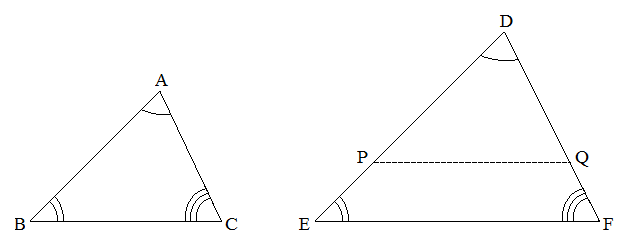
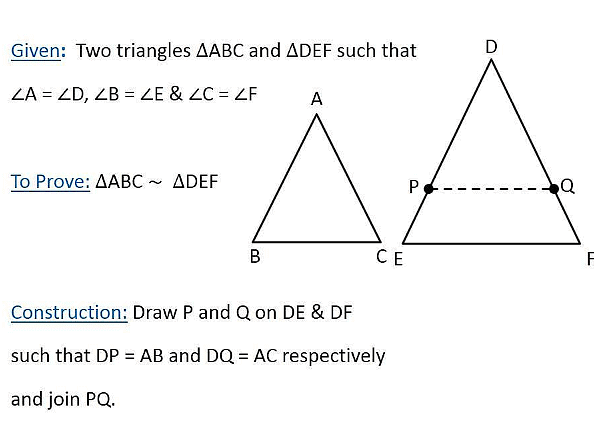
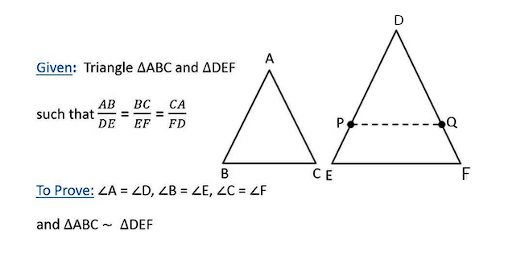
1. AAA Similarity

Theorem 3 : If in two triangles, if corresponding angles are equal, then their corresponding sides are in the same ratio i.e., they are proportional, and hence the two triangles are similar.
This criterion is referred to as the AAA (Angle–Angle–Angle) criterion of similarity of two triangles.

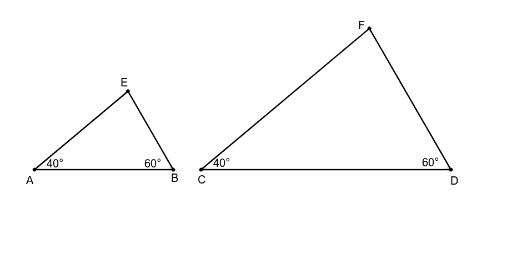
2. AA Similarity
If two angles of one triangle are respectively equal to two angles of another triangle, then the two triangles are similar 

If ∠A=∠C and ∠B=∠D then ABC∼△DEF

Example: In theΔABC length of the sides are given as AP = 5 cm , PB = 10 cm and BC = 20 cm. Also PQ||BC. Find PQ.

Solution: In ΔABC and ΔAPQ, ∠PAQ is common and ∠APQ = ∠ABC (corresponding angles)

⇒ ΔABC ~ ΔAPQ (AA criterion for similar triangles)

⇒ AP/AB = PQ/BC

⇒ 5/15 = PQ/20

⇒ PQ = 20/3 cm

3.  SSS similarity

If in two triangles, sides of one triangle are proportional to (i.e., in the same ratio of ) the sides of the other triangle, then their corresponding angles are equal and hence the two triangles are similiar

This criterion is referred to as the SSS (Side–Side–Side) similarity criterion for two triangles.

Using Theorem: if a line divides two sides of a triangle in the same ratio, then the line is parallel to the third side. This theorem is often referred to as the Basic Proportionality Theorem or Thales’ Theorem.

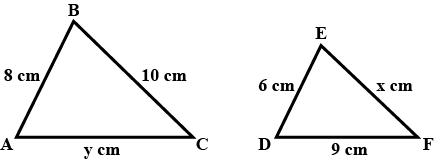
Example: Two triangles ABC and DEF are similar such that AB = 8cm, BC = 10cm, CA =y cm, DE = 6 cm, EF = x cm and FD = 9 cm . Find the Values of x and y?

Solution:  As △ABC∼△DEF  then  AB/DE=AC/DF=BC/EF

So now putting values 8/6=y/9=10/x

8/6=y/9   and 8/6=10/x

4/3=y/9 and 4/3=10/x

4*9=y*3 and 4*x=10*3 (Cross multiplying)

so y comes out to be =12

and x=7.5

4.    SAS Similarity
Theorem:  If one angle of a triangle is equal to one angle of the other triangle and the sides including these angles are proportional, then the two triangles are similar.
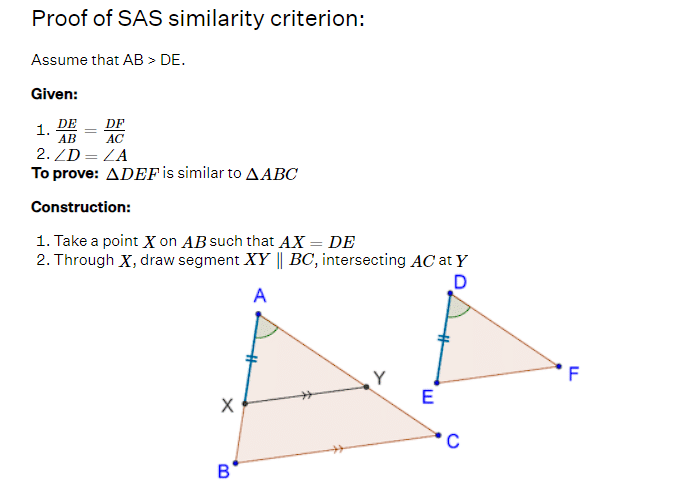
This criterion is referred to as the SAS (Side–Angle–Side) similarity criterion for two triangles.

If AB/ED=BC/EF and ∠B=∠E Then ABC∼△DEF

Example: Determine if the following triangles are similar. If so, write the similarity criteria
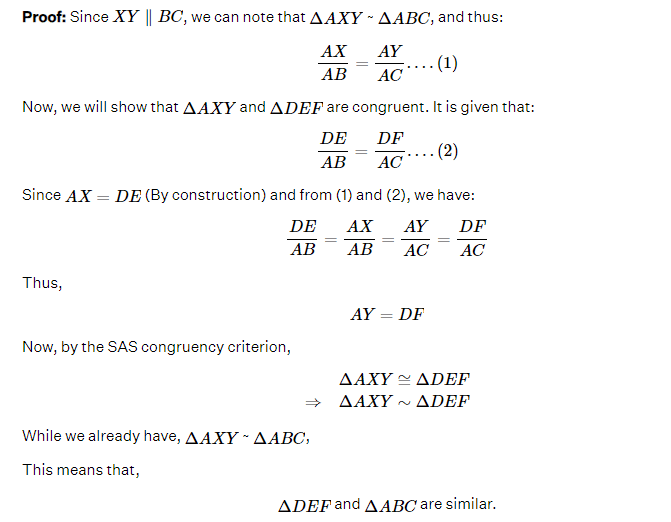
Solution:

We can see that ∠B≅∠F∠B=∠F and these are both included angles. We just have to check that the sides around the angles are proportional.

ABDFBCFE=128=32=2416=32BC/FE=24/16=3/2  and AB/DF=12/8=3/2

Since the ratios are the same ΔABC∼ΔDFEΔABC∼ΔDFE by the SAS Similarity Theorem.

Try yourself:In two triangles, if two angles of one triangle are equal to two angles of the other triangle, which of the following similarity criteria can be used to prove that the triangles are similar?

  • A.AAA similarity
  • B.AA similarity
  • C.SSS similarity
  • D.SAS similarity

View SolutionSummary

  • Similar Figures: Figures with the same shape, regardless of size, are termed similar figures.
  • Congruence vs. Similarity: While all congruent figures are similar, the reverse is not necessarily true.
  • Conditions for Similar Polygons: Two polygons with the same number of sides are similar if their corresponding angles are equal, and their corresponding sides are in proportion.
  • Parallel Lines and Triangle Side Division: Drawing a line parallel to one side of a triangle divides the other two sides in the same ratio.
  • Converse of Triangle Side Division: If a line divides any two sides of a triangle in the same ratio, it is parallel to the third side.
  • AAA Similarity Criterion: If corresponding angles in two triangles are equal, their corresponding sides are in the same ratio, and the triangles are similar.
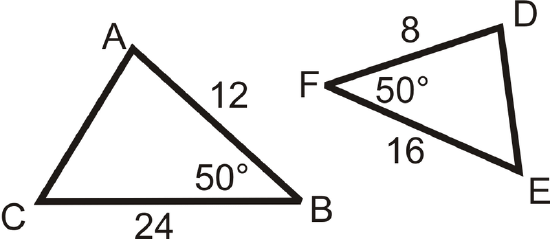
  • AA Similarity Criterion: If two angles in one triangle are respectively equal to two angles in another triangle, the triangles are similar.
  • SSS Similarity Criterion: If corresponding sides in two triangles are in the same ratio, their corresponding angles are equal, leading to similarity.
  • SAS Similarity Criterion: If one angle of a triangle is equal to one angle of another triangle, and the sides including these angles are in proportion, the triangles are similar.
5. Arithmetic Progressions – Chapter Notes

Introduction

Patterns can be observed in our daily lives, even in something as simple as a savings account. For example, if we start with Rs. 2000 and add Rs. 500 each month, the balance follows a predictable pattern: Rs. 2000, Rs. 2500, Rs. 3000, and so on. This is called an Arithmetic progression (AP).

Arithmetic Progressions

Arithmetic Progressions (APs) are sequences of numbers in which the difference between consecutive terms remains constant. This constant difference is called the common difference. In an arithmetic progression, each term can be obtained by adding the common difference to the previous term.

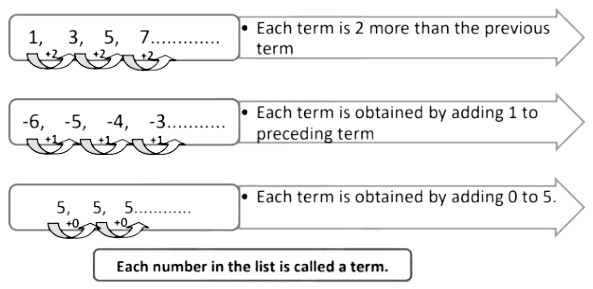
Here is a list of numbers, observe the pattern of the numbers.

  • Here, we see that each successive term is obtained by adding a fixed number to the preceding term except the first term. Such a list of numbers is said to be in arithmetic progression.
  • This fixed number is called the common difference of the AP. This number can be positive, negative, or zero.
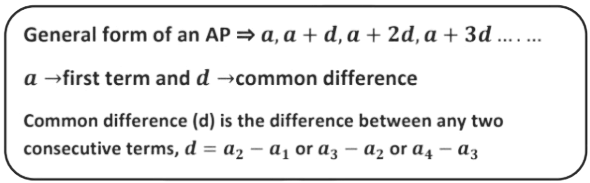
  • Let us denote the first term of an AP by a1, the second term by a2,………nth term by an and the common difference by d. Then the AP becomes a1, a2, a3, … … … … … aₙ.
    So, a1 − a2 = a3 − a2 =………= an − an−1 = d

Arithmetic Progressions (APs) can be categorized as either finite or infinite based on the number of terms they contain.

  • Finite Arithmetic Progression: A finite Arithmetic Progression (AP) refers to a sequence of numbers that has a specific and limited number of terms. The progression stops after a certain term, and there is a finite number of terms in the sequence.
    Example: 229, 329, 429, 529, 629
  • Infinite Arithmetic Progression: In contrast, an infinite Arithmetic Progression (AP) is a sequence of numbers that continues indefinitely without an endpoint. It goes on infinitely, and there is no fixed limit on the number of terms.
    Example: 2, 4, 6, 8, 10, 12, 14, 16, 18…..…

Understanding the distinction between finite and infinite APs helps us analyze different types of sequences and apply appropriate methods and formulas accordingly.

Try yourself:

Which type of arithmetic progression has a fixed and limited number of terms?

  • A.Finite Arithmetic Progression
  • B.Infinite Arithmetic Progression
  • C.Both finite and infinite arithmetic progressions
  • D.None of the above

View Solution

Solved Examples

Example 1: In which of the following situations, does the list of numbers involved make an arithmetic progression, and why? 

a) The cost of digging a well after every meter of digging when it costs Rs. 150 for the first meter and rises by Rs. 50 for each subsequent meter.
Sol: 

Cost of digging the first meter = Rs.150
Cost of digging second metre = Rs.(150 + 50) = Rs.200
Cost of digging third metre = Rs.(150 + 2× 50) = Rs. 250
In this case, each term is obtained by adding Rs. 50 to the preceding term. Hence, they make an AP.

b) The amount of water present in a cylinder when a vacuum pump removes 1⁄4 of the air remaining in the cylinder at a time.

Sol:

Let the amount of air present in the cylinder be x units.
According to the question,
Amount of air left in the cylinder after using vacuum pump first time
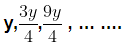
Amount of air left in the cylinder after using vacuum pump the second time=
List of numbers  

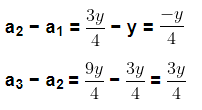
As the common difference of the terms is not the same, they do not form AP.

Example 2: Find the common difference of the AP

Sol:
Common difference (d) = Second Term – First Term

Therefore, common difference = -2

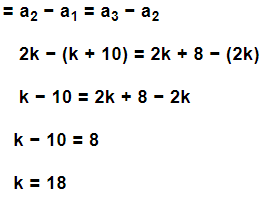
Example 3: For what value of k will k + 10 , 2k, and 2k + 8 are the consecutive terms of an AP.

Sol:

If k + 10 , 2k, and 2k + 8 are in AP then,
a1 = k + 10 , a2 = 2k and a3 = 2k + 8

Common Difference (d)

nth term of an AP
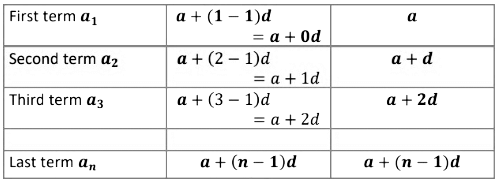
Let a1 , a2, a3, … … … … … an be an AP whose first term a1 is a and the common difference is d.

Then,

The nth term an of the AP with the first term a and common difference d is given by 

an = a + (n − 1)d

Try yourself:

In which of the following situations does the list of numbers involved make an arithmetic progression (AP), and why?

a) The temperature at 9 AM is 15?C, and it decreases by 2?C every hour.

  • A.Yes, it forms an AP.
  • B.No, it does not form an AP.
  • C.Not enough information to determine.
  • D.None of the above.

View Solution

Solved Examples

Example 5: Find the 25th term of the AP: -5, -5/2, 0, 5/2

Sol:

Here, a = −5
Common Difference (d) = a2 − a1

We know, a= a + (n − 1)d

25th term, a25 

25th term of the given AP is 55.

Example 6: For an AP, if a18 − a14 = 36, then find the common difference d.

Sol:

We know, an = a + (n − 1)d
a18 = a + (18 − 1)d = a + 17d
a14 = a + (14 − 1)d = a + 13d
a18 − a14 = 36
a + 17d − (a + 13d) ⇒ a + 17d − a − 13d
4d = 36
d = 9
Therefore, the common difference (d) = 9

Example 7: If an = 6 − 11n, then find the common difference.

Sol:

Given: a= 6 − 11n …………… (1)

Replacing n by n+1 in eq (1) we get

a(n+1) = 6 – 11(n+1)

a(n+1) = 6 – 11n-11

a(n+1) = – 11n – 5

Common difference, d = a(n+1) – an

d= -11n-5 – (6-11n)

d = -11

Example 8: Find the 7th term of the sequence whose nth term is given by an = (−1)n−1. n2

Sol:

Given: an = (−1)n−1. n2
The 7th term of the sequence, a7 = (−1)7−1. 72
= (−1)6. 72 = 49

Example 9: An AP consists of 50 terms of which 3rd term is 12 and the last term is 106. Find the 29th term.

Sol:

Let a be the first term and d be the common difference of the given AP.

Given: a= 12 and a50 = 106

We know, an = a + (n − 1)d
a3 = a + (3 − 1)d ⇒ a3 = a + 2d
a= a + 2d = 12→Eq 1
a50 = a + (50 − 1)d ⇒ a50 = a + 49d
a50 = a + 49d = 106→Eq 2
Subtracting Eq 1 from Eq 2

a + 49d − (a + 2d) = 106 − 12

a + 49d − a − 2d = 94

47d = 94 ⇒ d = 2

Putting the value of d in Eq 1 we get,

a + 2 × 2 = 12

a = 12 − 4 = 8

29th term, a29 = a + 28d = 8 + 28 × 2 = 8 + 56 = 64

Example 10: Find how many two-digit numbers are divisible by 7.

Sol:

Two-digit numbers are 10, 11, 12, 13, ………………97, 98, 99, 100.
Here 14, 21, 28…………………. 91, 98 are divisible by 7.
This list of numbers forms an AP, where a = 14 and
d = 21 − 14 = 7
Let the number of terms be n, then an = 98

98 = 14 + (n − 1)7 ⇒ 98 = 14 + 7n − 7

7n + 7 = 98 ⇒ 7n = 98 − 7

7n = 91

n = 13
Hence, 13 two-digit numbers are divisible by 7.

Try yourself:In an arithmetic progression (AP), if the first term is 2 and the common difference is 4, what is the 7th term of the AP?

  • A.22
  • B.26
  • C.28
  • D.30

View Solution

Sum of first n terms of an  AP

  • One of the most important aspects of AP is finding the sum of its terms. The sum of the first n terms of an AP is a commonly used formula in mathematics. It allows us to quickly find the total sum of a given number of terms in an AP without having to add each term individually.
  • The sum of first n terms of an AP is given by
  • Now, this can also be written as
  • We know an = a + (n − 1)d
  • If  the number of terms in the AP is n then, an is the last term and an = I
    therefore, 
  • This form of the result is useful when only the first and the last term are given and the common difference is not given.

Try yourself:For an arithmetic progression (AP), if the first term is 10 and the common difference is 3, what is the 15th term?

  • A.40
  • B.52
  • C.50
  • D.55

View Solution

Example 11: If the nth term of an AP is (2n + 2), find the sum of first n terms of the AP.

We have,
an = 2n + 2 ⇒ a1 = 2 × 1 + 2 = 4
Therefore, a= a is the first term and an = l is the last term of the AP.
As we know the first and the last term of the AP, the sum of n terms is given by,


Sum of first n terms of the given AP is n[n + 3]

Example 12: Find the sum of the first 25 terms of an AP, whose nth term is given by an = 6 − 3n.

Given: an = 6 − 3n
a1 = 6 − 3 × 1 = 3

a25 = 6 − 3 × 25 = −69
Therefore, a1 = a = 3 is the first term and a25 = l = −69

Therefore, the sum of the first 25 terms of the given AP is -825.

Example 13: Find the sum of all two-digit odd positive numbers.

Two-digit odd positive numbers are 11, 13, 15………………99 which form an AP.
Here, First term a = 11, last term (l) = 99 and common difference (d) = 13 – 11 = 2
Now we have to find the number of terms.

We know, l = an = a + (n − 1)d
99 = 11 + (n − 1) × 2
99 = 11 + 2n − 2 ⇒ 99 = 9 + 2n
99 − 9 = 2n ⇒ 90 = 2n

Therefore, the sum of all two-digit odd positive numbers is 2475.