4. Quadratic Equations – Chapter Notes

What is a Quadratic  Equation?

A Quadratic equation is a second-degree polynomial equation that involves the square of a variable. It can have up to two solutions, which may be real or complex.

Standard Form of a Quadratic equation

The standard form of a quadratic equation is written as ax2 +bx + c=0, where a, b, and c are real numbers, and a ≠ 0. 

This form is crucial for solving quadratic equations, studying their graphs, and understanding their key properties like roots and symmetry.

Solved Examples 

Example 1: Check whether the following are quadratic equations

i) (x + 1)2 = 2(x − 3)
⇒ (x + 1)2 = x2 + 2x + 1
∵ (a + b)2 = a2 + 2ab + b2

⇒ x2 + 2x + 1 = 2(x − 3)
⇒ x2 + 2x + 1 = 2x − 6

⇒ x2 + 2x + 1 − 2x + 6 = 0
⇒ x2 + 2x − 2x + 6 + 1 = 0
x2 + 7 = 0
The above equation is a quadratic equation, where the coefficient of x is zero, i.e. b = 0

ii) x(x + 1)(x + 8) = (x + 2)(x − 2)

LHS
⇒ x(x + 1)(x + 8)
⇒ x(x2 + 8x + x + 8)

⇒ x(x2 + 9x + 8)
⇒ x3 + 9x2 + 8x

RHS
(x + 2)(x − 2)
⇒ x2 − 4
∵ (a + b)(a − b) = a2 − b2
Now, x3 + 9x2 + 8x = x2 − 4
⇒ x3 + 9x2 − x2 + 8x + 4 = 0
x3 + 8x2 + 8x + 4 = 0
It is not a quadratic equation as it is an equation of degree 3.

iii) (x − 2)+ 1 = 2x − 3

LHS
(x − 2)2 + 1 = x2 − 4x + 4 + 1
∵ (a − b)2 = a2 − 2ab + b2
= x2 − 4x + 5
RHS
2x − 3
⇒ x2 − 4x + 5 = 2x − 3
⇒ x2 − 4x − 2x + 5 + 3 = 0
⇒ x2 − 6x + 8 = 0
The above equation is quadratic as it is of the form,
ax2 + bx + c = 0

Example 2: The product of two consecutive positive integers is 420. Form the equation satisfying this scenario.

Let the two consecutive positive integers be x and x + 1 

Product of the two consecutive integers= x(x + 1) = 420

⇒ x2 + x = 420

⇒ x+ x − 420 = 0

x2 + x − 420 = 0, is the required quadratic equation and the two integers satisfy this quadratic equation.

Try yourself:Which of the following is the correct quadratic equation of the expression (x + 3)(x – 2)?

  • A.x2 + x – 6 
  • B.x2 – x – 6
  • C.x2 – x + 6 
  • D.x2 + x + 6 

View Solution

What is the Root of the quadratic Equation?

Let x = α where α is a real number. If α satisfies the Quadratic Equation ax2+ bx + c = 0 such that aα2 + bα + c = 0, then α is the root of the Quadratic Equation.

  • As quadratic polynomials have degree 2, therefore, Quadratic Equations can have two roots.
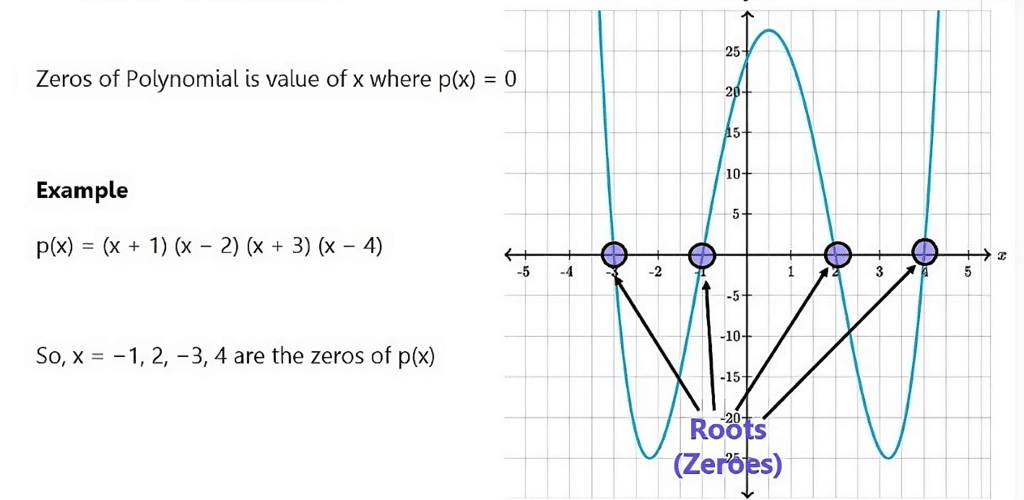
  • So the zeros of quadratic polynomial p(x) = ax2 + bx + c are the same as the roots of the Quadratic Equation ax2 + bx + c = 0.

Methods to solve the Quadratic Equations

1. Factorisation Method

In this method, we factorise the equation into two linear factors and equate each factor to zero to find the roots of the given equation.

Step 1: Given Quadratic Equation in the form of ax2 + bx + c = 0.

Step 2: Split the middle term bx as mx + nx so that the sum of m and n is equal to b and the product of m and n is equal to c.

Step 3: By factorisation we get the two linear factors (x + p) and (x + q)

ax2+ bx + c = 0 = (x + p) (x + q) = 0
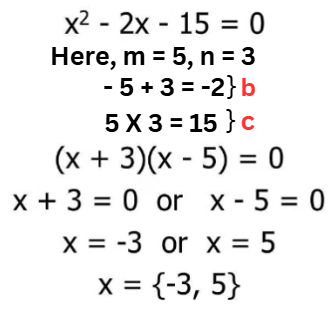
Step 4: Now we have to equate each factor to zero to find the value of x.

These values of x are the two roots of the given Quadratic Equation.

Solved Examples 

Example 1: Solve the following quadratic equation by factorisation method.

i) 4√3x2 + 5x − 2√3 = 0

The given equation is 4√3x2  + 5x − 2√3  = 0

Here, a = 4√3 , b = 5 and c = −2√3 

The product of a and c
= 4√3  × (−2√3 )
= −8 × 3
= −24
Factors of 24 = 3 × 8 and 8 + (−3) = 5
The factors of the equation are 8, − 3
So, the given equation can be written as,

4√3x2 + (8 − 3)x − 2√3 = 0
⇒ 4 √3x2 + 8x − 3x − 2√3  = 0

⇒ 4x( √3x + 2) −√3 (√3 x + 2) = 0
⇒ (4x − √3 )(√3x + 2) = 0
Equating each factor to zero we get,

(4x −√3 )=0 and (√3x + 2) = 0
x =  √34 and x = -2√3
The roots of the equation 4√3x2 + 5x – 2√3 = 0 are: √34 and -2√3

ii)  2x2 – 5x + 2 = 0

The given equation is 2x2 – 5x + 2 = 0
Multiplying the above equation by xwe get,
x2 ( 2x2 – 5x + 2 = 0) ⇒ 2x2x2 – 5x2x + 2x2 = 0

2 – 5x + 2x2 = 0

Here, a = 2, b = −5 and c = 2
The product of a and c = 2 × 2 = 4
The factors of 4 = 4 × 1 and 4 + 1 = 5
2x2 − (4 + 1)x + 2 = 0
⇒ 2x2 − 4x − 1x + 2 = 0
2x(x − 2) − (x − 2) = 0
(2x − 1)(x − 2) = 0
Equating each factor to zero we get,
(2x − 1) = 0 and (x − 2) = 0
x =  1/2 and x = 2

The roots of equation 2x− 5x + 2 = 0 are  1/2  and 2

2.  Quadratic formula method

In this method, we can find the roots by using a quadratic formula. The quadratic formula is

where a, b, and c are the real numbers and b2 – 4ac is called the discriminant.

To find the roots of the equation, put the values of a, b, and c in the quadratic formula.

Nature of Roots

From the quadratic formula, we can see that the two roots of the Quadratic Equation are –

x = -b + √(b2 – 4ac)2a  and  -b – √(b2 – 4ac)2a

or

x = -b ± √D2a

Where D = b2 – 4ac, The nature of the roots of the equation depends upon the value of D, so it is called the discriminant.

Note:
This is called a “discriminant because it discriminates the roots of the quadratic equation based on its sign.

The discriminant is used to find the nature of the roots of a quadratic equation.

  • b2−4ac>0  –  In this case, the quadratic equation has two distinct real roots.
  • b2−4ac=0  –  In this case, the quadratic equation has one repeated real root.
  • b2−4ac<0  –  In this case, the quadratic equation has no real root.

Types of Roots

There are three types of roots of a quadratic equation 

ax2 + bx + c = 0 

Solved Examples

Example 1: Find the roots of the quadratic equation x2– 7x + 10 = 0 using the quadratic formula.

Solution: 

Here, a = 1, b = -7, and c = 10. Then by the quadratic formula:

x =  -(-7) ± √((-7)2 – 4(1)(10))2(1)

= 7 ± √(49 – 40)2

= 7 ± √92

= 7 + 32, 7 – 32

= 102, 42

= 5, 2

Therefore, x = 2, x = 5.

Example 2: 

Elsie has a two-digit secret number. She gives her friend Mia a few hints to crack it. She says, “It is the value of the discriminant of the quadratic equation 

Can you guess the lucky number?

Solution: 

The quadratic equation is:

x2 + 9x + 14 = 0

On comparing it with ax2 + bx + c = 0, we get:

a = 1, b = 9, and c = 14

Let’s use the discriminant formula to find the discriminant:

Discriminant = b2 – 4ac

= 92– 4(1)(14)

= 81 – 56

= 25

The Lucky Number is 25.

Example 3: The altitude of a right-angled triangle is 7 cm less than its base. If the hypotenuse is 13 cm long, then find the other two sides.

Solution

Let the length of the base be x cm, then altitude = x − 7 cm

Hypotenuse = 13 cm

We know, H2 = P2 + B2
132 = (x − 7)2 + x2
⇒ 169 = x2 − 14x + 49 + x2
⇒ x2 − 14x + 49 + x2 = 169
⇒ 2x2 − 14x + 49 − 169 = 0
⇒ 2x2 − 14x − 120 = 0
Dividing the above equation by 2 we get,

x2 − 7x − 60 = 0
Here, a = 1, b = −7 and c = −60
The product of a and c = 1 × (−60) = −60
The factors of 60 = 5 × 12 and −12 + 5 = 7
The given equation can be written as,

x2 − 12x + 5x − 60 = 0
x(x − 12) + 5(x − 12) = 0
⇒ (x + 5)(x − 12) = 0
Equating each factor to zero we get,
(x + 5) = 0 and (x − 12) = 0
⇒ x = −5 and x = 12
The length of the base cannot be negative.
Therefore, Base = 12 cm
Altitude = x − 7 cm = 12 − 7 = 5 cm, Hypotenuse = 13 cm

Try yourself:Which of the following is the solution(s) of the quadratic equation x^2 + 5x + 6 = 0 by factorisation method?

  • A.x = -2 or x = -3
  • B.x = 2 or x = 3
  • C.x = -6 or x = -1
  • D.x = 6 or x = 1

View Solution

Example 4: Find the roots of the equation,

√5x + 7 = (2x – 7) = 0 

Solution: 

The given equation is √5x + 7 = (2x – 7) = 0  

Squaring both sides of the equation we get,(9x + 9)2 = (2x – 7)2 

9x + 9 = 4x2 – 28x + 49

4x2 – 28x + 49 – 9x – 9 = 0

4x2 – 37x + 40 = 0

Here a = 4, b = – 37 and c = 40 

Substituting the value of a, b and c in the quadratic formula

x = -b ± √(b2 – 4ac)2a

x = -(-37) ± √(372 – 4×4×40)8

x = 37 ± √7298

Taking the positive root:

x = 37 + 278 = 648 = 8

Taking the negative root:

x = 37 – 278 = 108 = 54

Thus, the solutions are:

x = 8 and x = 54

Example 5: Find the numerical difference of the roots of the equation x2 − 7x − 30 = 0

Solution: 

The given quadratic equation is x− 7x − 30 = 0

Here a = 1, b = −7 and c = −30

Substituting the value of a, b and c in the quadratic formula

x = -b ± √(b2 – 4ac)2a

Substituting the values:

x = -(-7) ± √(72 – 4 × 1 × (-30))2 × 1

x = 7 ± √(49 + 120)2

x = 7 ± √1692

x = 7 ± 132

Case 1: Taking the positive sign (+):

x = 7 + 132 = 202 = 10

Case 2: Taking the negative sign (-):

x = 7 – 132 = -62 = -3

The two roots are 10 and -3

The difference of the roots= 10 − (−3) = 10 + 3 = 13


Example 6: Find the discriminant of the quadratic equation x2 −4x − 5 = 0

Solution

The given quadratic equation is x2 − 4x − 5 = 0.

On comparing with ax2 + bx + c = 0 we get,

a = 1,b = −4, and c = −5

Discriminant, D = √(b2 – 4ac)

Substituting values:

D = √((-4)2 – 4 × 1 × (-5))

D = √(16 + 20)

D = √36

D = ±6

Example 7: Find the value of p, so that the quadratic equation px(x − 2) + 9 = 0 has equal roots.

Solution

The given quadratic equation is px(x − 2) + 9 = 0
px2 − 2px + 9 = 0

Now comparing with ax2 + bx + c = 0 we get,

a = p, b = −2p and c = 9
Discriminant, D = √(b2 – 4ac)

D = √((-2p)2 – 4 × p × 9)

D = √(4p2 – 36p)

The given quadratic equation will have equal roots if D = 0

D = √(4p2 – 36p) = 0

4p2 – 36p = 0

4p(p – 9) = 0

p = 0 and p − 9 = 0 ⇒ p = 9
p = 0 and p = 9
The value of p cannot be zero as the coefficient of x, (−2p) will become zero.
Therefore, we take the value of p = 9.


Example 8: If x = −1 is a root of the quadratic equations 2x2 +px + 5 = 0 and the quadratic equation p(x2 + x) + k = 0 has equal roots, then find the value of k.

Solution: 

The given quadratic equation is 2x2 + px + 5 = 0. If x = −1 is the root of the equation then,
2(−1)2 + p(−1) + 5 = 0
2 − p + 5 = 0
⇒ −p = −7
p = 7
Putting the value of p in the equation p(x2 + x) + k = 0,
7(x2 + x) + k = 0
⇒ 7x2 + 7x + k = 0
Now comparing with ax2 + bx + c = 0 we get,
a = 7, b = 7 and c = k

Discriminant, D = √(b2 – 4ac)

D = √((7)2 – 4 × 7 × k)

D = √(49 – 28k)

The given quadratic equation will have equal roots if D = 0

D = √(49 – 28k) = 0

 49 – 28k = 0

28k = 49

k = 4928 = 74

Therefore, the value of k is 7/4.

Try yourself:What is the nature of the roots of the quadratic equation 2x² + 5x + 3 = 0?

  • A.Real and equal
  • B.Real and distinct
  • C.Imaginary
  • D.Complex conjugate

View Solution
3. Pair of Linear Equations in Two Variables – Chapter Notes

Introduction

  • Linear equations can be used to represent almost any situation involving an unknown quantity.
  • We apply linear equations in various real-life situations like weather predictions, ingredients of a recipe, our monthly expenditure, predicting profit in business and Government surveys.

Various forms of Linear Equation

  • The general form of a linear equation in two variables is ax + by + c = 0, where a and b cannot be zero simultaneously.

Let us consider an example of a linear equation in two variables, x + 3y = 7.

LHS = x + 3y

If we substitute x=1 and y=2 into the LHS of the equation, we get:

LHS = x+3y = 1+3(2) = 7

Here, LHS = RHS.

Thus, we can conclude that x=1 and y=2 is a solution to the equation x+3y=7.

Now, let’s consider another pair of values for xx and yy.

Substituting  x=2 and y=1 into the LHS of the equation, we get:

LHS = x+3y = 2+3(1) = 5

Here, LHS ≠ RHS.

Therefore, x=2 and y=1 is not a solution to the equation x+3y = 7.

We know that the graph of a linear equation in two variables is a straight line.

If x=1 and y=2 is a solution of x+3y=7, then the point (1,2) lies on the line representing the equation x+3y = 7.

In the case of x=2 and y=1, which is not a solution, the point(2,1) does not lie on the line representing the equation x+3y = 7.

Thus, we conclude that every solution of the equation is a point on the line representing it.

Pair of Linear Equations in Two Variables

The general form for a pair of linear equations in two variables x and y is

A pair of linear equations in two variables can have one of the following types of solutions:

1. Unique Solution

  • When the two equations represent two distinct lines in a coordinate plane, and these lines intersect at a single point, there is a unique solution.
  • Mathematically, this means that the lines are not parallel (their slopes are different), and they are not coincident (they do not represent the same line).

2. Infinitely Many Solutions

  • If the two linear equations represent the same line in a coordinate plane, they have an infinite number of solutions.
  • This occurs when the equations are essentially equivalent, and every point on the common line satisfies both equations.

3. No Solution

  • When the two equations represent parallel lines that do not intersect, there is no solution.
  • Mathematically, this means that the lines have the same slope (their coefficients are proportional), but they have different y-intercepts.

Example:

Try yourself:Which of the following statements is true for a system of linear equations in two variables?

  • A.It can have multiple solutions.
  • B.It can have no solution.
  • C.It can have exactly one solution.
  • D.All of the above.

View Solution
Graphical Representation of Linear Equation

We know that the geometrical representation of linear equations in two variables is a straight line, but when we have a pair of linear equations then there will be two straight lines, which are considered together.

When there are two lines in a plane, one of the following possibilities may arise.

(i) The two lines will intersect

(ii) The two lines are parallel

(iii) Two lines are coincident

Graphical Method of Solution of a Pair of Linear Equations

We know that a pair of linear equations is represented graphically by two straight lines and these lines may be parallel, may intersect or may coincide.

Now, we will consider certain cases here,

  • If the two lines intersect each other at one point only, then we say that there is one and only one solution, that is, a unique solution exists for this pair of linear equations in two variables. Such a pair of linear equations is called a consistent pair of Linear equations.
  • If the two lines are coincident then we say that the pair of linear equations has infinitely many solutions. Such a pair of linear equations is called an consistent pair of Linear equations.
  • If the two lines are parallel to each other, that is, they do not meet at all, and then we say that the two linear equations have no common solution. Such a pair of linear equations is called a dependent pair of Linear equations.

If the lines represented by the equation,

a1x + b1y + c1 = 0
a2x + b2y + c2 = 0 are,

Let us consider some examples here, to understand better the above relations.

Example 1: Solve graphically the pair of linear equations 3x − 4y + 3 = 0 and 3x + 4y − 21 = 0. Find the coordinate of the vertices of the triangular region formed by these lines and X-axis. Also, calculate the area of this triangle.

Sol:

Firstly we will find two solutions for each equation.

(i) Table for 3x − 4y + 3 = 0

Let the points be A (3, 3) and B (-1,0)

(ii) Table for 3x + 4y − 21 = 0

Let the points be C (3, 3) and D (7,0)

Now we will plot these points on a graph paper.

We will join points A and B, A and D respectively.

(Point A and Point C have the same coordinate)

When we join these points we will get a triangle ∆ ABD.

The coordinates of the vertices of ∆ ABD are,

A (3,3), B (-1,0) and D (7,0)

Next, we have to find the area ∆ ABD.

We know,

Area of a triangle =  1/2 × Base × Height

In ∆ ABD,

Base = 8 units

Height = 3 units

Area of ∆ ABD = 1/2 ×BD×AP

=12× 8 ×3 = 12 sq. units

Example 2: Solve the following system of linear equations graphically:
2x − y − 4 = 0
x + y + 1 = 0

Sol:

The pair of linear equations is,

  2x − y − 4 = 0

 x + y + 1 = 0

First, we will find two solutions of each equation.

(i) Table for 2x − y − 4 = 0

Let the points be A(0,-4) and B(2,0)

(ii) Table for x + y + 1 = 0

Let the points be C (0,-1) and D (-1,0)

Now we plot these points on a graph paper.

We have joined points A and B, C and D respectively.
We see that the two lines are intersecting at point P (1, -2).
So the solution of the given pair of equations is x = 1 and y =−2.

Example 3: Form a pair of linear equations in two variables using the following information and solve it graphically. Five years ago, Mayank was twice as old as Rajat. Ten years later, Mayank’s age will be ten years more than Rajat’s age. Find their present ages.

Sol:

Let Mayank’s and Rajat’s present age be x years and y years respectively.

5 years ago,

Mayank’s age was (x − 5) years

Rajat’s age was (y − 5) years

Now it is given that 5 years ago Mayank was twice as old as Rajat.
∴ (x − 5) = 2(y − 5)
x − 5 = 2y − 10
x − 2y = −10 + 5
x − 2y = −5 → Eq.1
10 years later,
Mayank’s age will be (x + 10) years
Rajat’s age was (y + 10) years
It is given that 10 years later, Mayank’s age will be ten years more than Rajat’s age.

∴ (x + 10) = (y + 10) + 10
x + 10 = y + 20
x − y = 10 → Eq.2
We get a pair of linear equations,
x − 2y + 5 = 0
x − y − 10 = 0
Now we draw the graph of Equations 1 and 2.
We will find two solutions of the two equations first
Table for x − 2y + 5 = 0
Let the points be A (5, 5) and B(-5,0)

Table for x − y − 10 = 0
Let the points be C (5,-5) and D (10,0)

Now we plot these points on a graph paper.

Join points A and B to get, line AB

Join points C and D to get, line CD

We see that the lines AB and CD are intersecting at point P. The coordinate of points of P is (25, 15), that is, x = 25 years and y = 15 years

Mayank’s age = 25 years

Rajat’s age = 15 years

Example 4: Check whether the given pair of linear equations is consistent or inconsistent. x + 2y = 4 and 3x + 6y = 12

Sol:

The pair of linear equations is

x + 2y = 4

3x + 6y = 12

The standard form of pair of linear equations is

a1x + b1y + c1 = 0

a2x + b2y + c2 = 0

On comparing the linear equations with the standard form of equations we get,

a1 = 1, b1 = 2 and c1 = 4

a2 = 3, b2 = 6 and c2 = 12

We see that

Therefore, the given pair of linear equations is consistent.

Example 5: Find the value of ‘k’ for which the system of equations kx − 5y = 2 and 6x + 2y = 7 has no solution.

Sol:

The given pair of linear equations is,
kx − 5y = 2
6x + 2y = 7
We know the standard form of pair of linear equations is
a1x + b1y + c1 = 0
a2x + b2y + c2 = 0
On comparing the linear equations with the standard form of equations we get,

a1 = k, b1 = −5 and c1 = 2
a2 = 6, b2 = 2 and c2 = 7

We know that a pair of linear equations has no common solution when,

Algebraic Methods of Solving a Pair of Linear Equations

The graphical method for solving a pair of linear equations is more suitable for integers but for non-integers, it may not be as accurate as we need. So, we use other algebraic methods to solve the pair of linear equations. 

Some of the algebraic methods which we are going to study now are

  • Substitution Method
  • Elimination Method

1. Substitution Method

In the substitution method, we find out the value of one variable in terms of the other variable and then we substitute this value in other equations to get an equation in one variable. Now, this equation can be solved easily.
Let us consider some examples to understand the substitution method better.

Example of Substitution Method 

Example 6: Solve the following pair of linear equations by the substitution method.
0. 2x + 0. 3y = 1. 3 and 0. 6x + 0. 5y = 2. 3

Sol: The given pair of linear equations is
0. 2x + 0. 3y = 1. 3 →Eq 1
0. 6x + 0. 5y = 2. 3 →Eq 2
First, we find the value of variable y in terms of other variables, i.e. x.
From equation (1),


Next, we substitute the value of y in equation (2) From equation (2),

1. 8x + (6. 5 − x) = 2. 3 × 3
1. 8x + 6. 5 − x = 6. 9
0. 8x = 6. 9 − 6. 5
0. 8x = 0. 4
x = 0. 5
Putting the value of x in equation 1, we get
0. 2 × 0. 5 + 0. 3y = 1. 3
0. 3y = 1. 3 − 0. 01
0. 3y = 1. 29
y = 4. 3
Therefore, x = 0. 5 and y = 4. 3

Example 7: Solve 2x + 3y = 11 and 2x − 4y = −24 and hence find the value of m for which y = mx + 3.

Sol: The given pair of linear equations is
2x + 3y = 11 →Eq 1
2x − 4y = −24 →Eq 2
We will first find the value of variable y in terms of variable, x.
From equation (1),

Next substituting this value of y in equation (2), we get

6x − (44 − 8x) = −24 × 3
6x + 8x − 44 = −72
14x = −72 + 44
14x = −28
x = −2
Putting the value of x in equation 1, we get
2 × (−2) − 4y = −24
−4 − 4y = −24
−4y = −24 + 4
−4y = −20
y = 5
Therefore, x = −2 and y = 5
Substituting the value of x and y in the equation
y = mx + 3, we get
5 = −2m + 3
m = −1

Example 8: The difference between the two numbers is 75 and on number is four times the other.

Sol:
Let the two numbers be x and y.
x > y
It is given that the difference between x and y is 75.
x − y = 75 → Eq 1
One number is four times the second number.
x = 4y →Eq 2
Substituting the value of x from Eq 2 in Eq 1, we get
4y − y = 75
3y = 75
y = 25
Substituting the value of y in Eq 2, we get
x = 4 × (25)
x = 100
The two numbers are 100 and 25.

Try yourself:Solve the system of equations using the substitution method:2x + 3y = 9x – y = 2

  • A.(x,y) = (4,2)
  • B.(x,y) = (2,4)
  • C.(x,y) = (3,1)
  • D.(x,y) = (-2,-4)

View Solution
2. Elimination Method

Elimination Method is another method of eliminating one variable but in this method, one variable out of two variables is eliminated by making the coefficient of that variable equal in both the equations.
Now, we will consider some examples:

Example of Elimination Method

Example 9: Use the elimination method to find all possible solutions of the following pair of linear equations.
ax + by − a + b = 0 and bx − ay − a − b = 0

Sol:

Example 10: The sum of the digits of a two-digit number is 6. Also, seventeen times this number is five times the number obtained by reversing the order of the digits. Find the number.

Sol:

Let the digit at the unit place be x and the digit at tens place be y.
The Original two-digit number is 10y + x
The sum of the digits of the original number = 6
∴ y + x = 6
x + y − 6 = 0 → Eq 1
On reversing the order of the two-digit number, we get y at units place and x at the tens place.
∴ The new two-digit number= 10x + y
Seventeen times of the original number is equal to five the reversed number
17(10y + x) = 5(10x + y)
170y + 17x = 50x + 5y
170y − 5y = 50x − 17x
165y = 33x
x = 5y
x − 5y = 0 → Eq 2
On subtracting Eq 2 from Eq 1, we get
x + y − 6 − (x − 5y) = 0

x + y − 6 − x + 5y = 0
6y = 6
y = 1
Substituting y = 1 in Eq 1
 x + 1 − 6 = 0
 x = 5
Therefore, the required two-digit number = 10y + x = 10 × 1 + 5 = 15

Example 11: A fraction becomes 5/7 , if 2 is subtracted to both the numerator and the denominator. If 3 is subtracted to both the numerator and denominator, it becomes 2/3. Find the fraction.

Sol:

Let the fraction be x/y
Subtracting 2 to both the numerator and denominator, we get new fraction 
It is given that the new fraction obtained =5/7

7(x − 2) = 5(y − 2)

7x − 14 = 5y − 10

7x − 5y = 14 − 10

7x − 5y = 4

7x − 5y − 4 = 0 → Eq 1 

Next, we subtract 3 to both the numerator and denominator New fraction 
It is given that the new fraction obtained = 2/3

3(x − 3) = 2(y − 3)
3x − 9 = 2y − 6
3x − 2y = 3
3x − 2y − 3 = 0 → Eq 2
7x − 5y − 4 = 0 → Eq 1
Multiplying Eq 1 by 3 and Eq 2 by 7 to make the coefficient of x equal, we get
21x − 15y − 12 = 0 → Eq 3
21x − 14y − 21 = 0 → Eq 4
Now, on subtracting, we get
21x − 15y − 12 − (21x − 14y − 21) = 0
21x − 15y − 12 − 21x + 14y + 21 = 0
−y + 9 = 0
y − 9 = 0
y = 9
Putting the value of y in Eq 1, we get
7x − 5(9) − 4 = 0
7x − 45 − 4 = 0
7x = 49
x = 7

Therefore, the required fraction is 7/9 .

Example 12: The taxi charges in a city consist of a fixed charge together with the charge for the distance covered. For a distance of 10km, the charge paid is Rs. 110 and for a journey of 15 km the charge paid is Rs.160. What are the fixed charges and the charge per kilometer? How much does a person have to pay for traveling a distance of 25 km?

Sol:

Let fixed charge be Rs. x and charge per kilometer be Rs. y For 10 km distance, Fixed charge + charge per kilometer = Rs. 110
x + 10y = 110
x + 10y − 110 = 0 → Eq 1
For 15 km distance,
Fixed charge + charge per kilometer = Rs. 16
x + 15y = 160
x + 15y − 160 = 0 → Eq 2
Now subtracting Eq 2 from Eq 1 we get,
x + 15y − 160 − (x + 10y − 110) = 0
x + 15y − 160 − x − 10y + 110 = 0
15y − 10y − 50 = 0
5y − 50 = 0
y = 10
Substituting the value of y in Eq 1 we get,
x + 10y − 110 = 0
x + 10(10) − 110 = 0
x + 100 − 110 = 0
x = 10
Therefore, the fixed charge is Rs. 5 and the charge per kilometer is Rs. 10.
For 25 km distance,
Fixed charge + charge per kilometer = Rs. x + 25y
= Rs 10 + 25 (10)
= Rs 260

Try yourself:Solve the system of equations using the elimination method:2x + 3y = 103x – 2y = 2

  • A.(x, y) = (2, 2)
  • B.(x, y) = (1, 2)
  • C.(x, y) = (3, -1)
  • D.(x, y) = (-1, 3)

View Solution
Summary

1. Solving Linear Equations:

  • Linear equations in two variables can be solved through:
    (i) Graphical method
    (ii) Algebraic methods

2. Graphical Method:

  • Graphs of linear equations form lines.
  • If lines intersect, there is a unique solution (consistent).
  • If lines coincide, there are infinitely many solutions (dependent and consistent).
  • If lines are parallel, there is no solution (inconsistent).

3. Algebraic Methods:

  • Solutions can be found through:
    (i) Substitution method
    (ii) Elimination method

4. Pair of Linear Equations:

  • For equations a1x + b1y + c1 = 0 and a2x + b2y + c= 0:
    (i) If a1/a2 ≠ b1/b2, the equations are consistent.
    (ii) If a1/a2 = b1/b2 ≠ c1/c2, the equations are inconsistent.
    (iii) If a1/a2 = b1/b2 = c1/c2, the equations are dependent and consistent.

5. Mathematical Representation:

  • Non-linear situations can be mathematically represented by transforming them into a pair of linear equations.

02. polynomials – Chapter notes

Algebraic Expressions

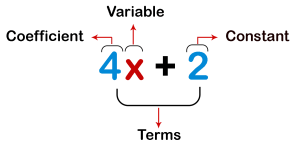
An algebraic expression is a combination of numbers, letters (representing variables), and symbols used for mathematical operations.

Algebraic Expressions

Polynomial

An expression using mathematical operations such as addition, subtraction, multiplication, and division can include fractional exponents.

On the other hand, a polynomial is a mathematical expression consisting of variables and coefficients where the exponent of each variable is a non-negative integer.

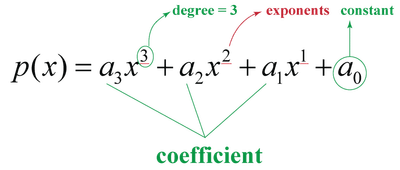
Degree of a Polynomial

For a polynomial in one variable – the highest exponent on the variable in a polynomial is the degree of the polynomial.

Degree of a Polynomial

Types of Polynomials 

a) Monomial – A polynomial with just one term. Example: 2x, 6x2, 9xy

b) Binomial – A polynomial with two unlike terms. Example: 4x2+x, 5x+4

c) Trinomial – A polynomial with three unlike terms. Example: x2+3x+4

Example 1: Write the degree of the following Polynomials.

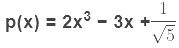
i) 
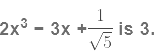
Sol: As the highest power of x in p(x) is 3. The degree of polynomial,
ii) 
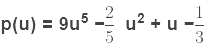
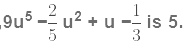
Sol: As the highest power of u in p(u) is 5. The degree of the polynomial, 

Example 2: Identify the type of the Polynomials given below (on the basis of degree)

i) 2y + 6
Sol: Here, the highest power of y in the given polynomial is 1, so it is a Linear Polynomial
ii) √2 + y2 + y
Sol: Here, the highest power of y in the given polynomial is 2, so it is a Quadratic Polynomial.
iii) y3 + 4y2 + 2y + 1
Sol: Here, the highest power of y in the given polynomial is 3, so it is a Cubic Polynomial.

Try yourself: The polynomial equation x (x + 1) + 8 = (x + 2) (x – 2) is

  • A.linear equation
  • B.quadratic equation
  • C.cubic equation
  • D. bi-quadratic equation

View Solution
Zeroes of a Polynomial

If p(x) is a polynomial in x and k is any real number, then the value obtained by replacing x by k in p(x), is called the value of p(x) at x = k, and is denoted by p(k).

Zeroes of a Polynomial

Let us consider the polynomial p(x) = 2x3 − 3x2 + 1
If we put x = 2 in the polynomial, that is, we replace x by 2 in the given polynomial, we get,
p(2) = 2(2)3 − 3(2)2 + 1 = 16 − 12 + 1 = 5
Therefore, the value of the polynomial p(x) at x = 2 is 5, that is, p(2) = 5
Similarly, we can find the value of p(x) at x = 0,
p(0) = 2(0)3 − 3(0)2 + 1 = 0 − 0 + 1 = 1
The value of p(x) at x = 0 is 1, that is, p(0) = 1
Now consider another case where we find the value of p(x) at x = 1
p(1) = 2(1)3 − 3(1)2 + 1 = 2 − 3 + 1 = 3 − 3 = 0
Here, we see that the value of the polynomial p(x) is 0 at x = 1
As p(1) = 0, 1 is called a zero of the polynomial
p(x) = 2x3 − 3x2 + 1
A real number k is said to be a zero of the polynomial p(x) if p(k) = 0.
Now consider a linear polynomial,p(x) = 2x + 1,
If k is a zero of p(x), then p(k) = 0
2k + 1 = 0
2k = −1
k = -1/2
If k is a zero of a polynomial, p(x) = ax + b, then,
p(k) = ak + b = 0
k = -b/a
Therefore, the zero of the polynomial, ax + b = -b/a

Example 3: If 3 is a zero of polynomial,p(x) = 2x2 + 3x − 9a, then find the value of a.

Sol:

If 3 is a zero of the polynomial, p(x) = 2x2 + 3x − 9a then p(3) = 0
Now, p(x) = 2x2 + 3x − 9a
p(3) = 2(3)2 + 3(3) − 9a
Now we will equate p(3) to 0.
2(3)2 + 3(3) − 9a = 0
18 + 9 − 9a = 0
27 − 9a = 0
27 = 9a
a = 3
∴ The value of a = 3.

Example 4: For what value of k, -2 is a zero of the polynomial 3x2 + 4x + 2k.

Sol:

If -2 is a zero of the polynomial, p(x) = 3x2 + 4x + 2k then p(−2) = 0
Now, p(x) = 3x2 + 4x + 2k
As -2 is a zero of p(x), we will replace x by -2 in the given polynomial and equate it to 0.
p(−2) = 3(−2)2 + 4(−2) + 2k = 0
12 − 8 + 2k = 0
2k = −4
k = −2

Example 5: If 1 and 2 are zeroes of a polynomial p(x) = 2x2 − kx + 2m, then find the value of k and m.

Sol:

Here, 1 and 2 are zeroes of the polynomial,
p(x) = 2x2 − kx + 2m
So, p(1) = 2(1)2 − k(1) + 2m = 0
2 − k + 2m = 0
k = 2m + 2 →(i)
Now p(2) = 2(22)− k(2) + 2m = 0
8 − 2k + 2m = 0
Putting the value of k in the above equation, we get
 8 − 2(2m + 2) + 2m = 0
8 − 4m − 4 + 2m = 0
4 − 2m = 0
2m = 4
m = 2
We will now find the value of k by putting m = 2 in equation (i)
k = 2(2) + 2
k = 6
∴ k = 6 and m = 2

Try yourself:What is the relationship between the degree of a polynomial and the number of its zeroes?

  • A.The degree of a polynomial is always equal to the number of its zeroes.
  • B.The number of zeroes of a polynomial is always greater than its degree.
  • C.The number of zeroes of a polynomial is always less than or equal to its degree.
  • D.There is no relationship between the degree of a polynomial and the number of its zeroes.

View Solution
Geometrical Meaning of Zeroes of Polynomial

We know that a real number k is a zero of the polynomial p(x) if p(k) = 0.
A linear polynomial is of the form ax + b where a ≠ 0.
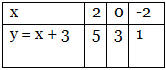
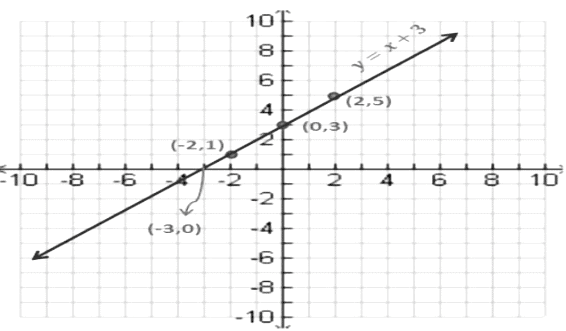
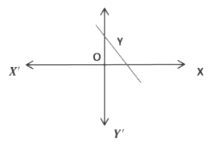
We will first study the graph of a linear polynomial, y = x + 3
If we put x = 2 in the above equation, we get
y = 2 + 3 = 5
Similarly, we can find more values of y by putting different values of x.

Here, we can see that the graph of a linear polynomial is a straight line.
The graph of y = x + 3 intersects the x − axis at x = −3
Thus, −3 is the zero of the linear polynomial, y = x + 3.
Therefore, the zero of the polynomial, x + 3 is the x −coordinate of the point where the graph of y = x + 3 intersects the x-axis.

  • For a linear polynomial ax + b, where a ≠ 0, the graph of y = ax + b is a straight line that intersects the x-axis at exactly one point, that is, (-b/a, 0)
  • Therefore, the linear polynomial ax + b has exactly one zero, namely the x −coordinate of the point where the graph of y = ax + b intersects the x-axis.

Next, we will study the geometrical meaning of a zero of a quadratic polynomial.
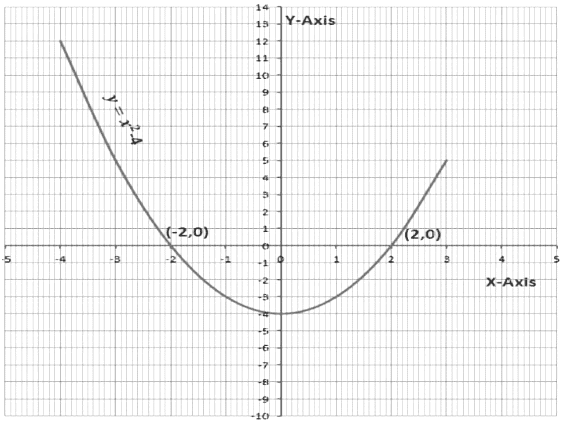
Consider a quadratic polynomial, x2 − 4
First, we will find some values of y = x2 − 4 corresponding to some values of x.
If we plot these points on a graph, this is how the graph will look like.

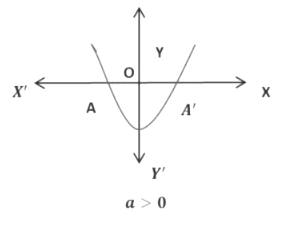
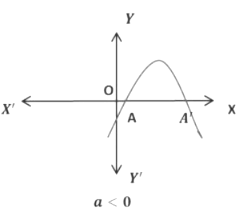
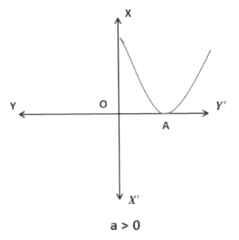
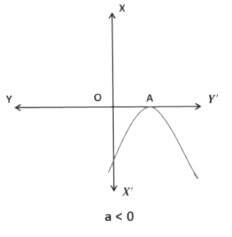
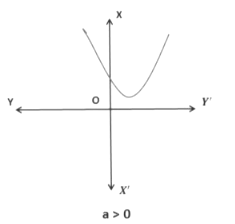
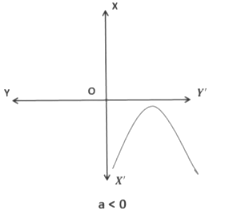
For that matter, any quadratic polynomial y = ax2 + bx + c, where a ≠ 0 the graph will have either one of the two shapes depending on the value of a
i) If a > 0, then the shape is open upwards.
ii) If a < 0, then the shape is open downwards
These curves are called parabolas.
If we see the graph, then -2 and 2 are the points on the x- axis where the graph of y = x2 − 4 intersects the x-axis.
Therefore -2 and 2 are the zeroes of the polynomial x2 − 4.
The zeroes of a quadratic polynomial ax2 + bx + c, a ≠ 0 are the x − coordinates of the point, where the parabola representing y = ax2 + bx + c intersects the x − axis.
According to the shape of the graph of y = ax+ bx + c, the following cases may arise.

Case 1: 
In this case, the graph intersects the x-axis at two distinct points A and A′, then the x- coordinates of A and A′are the two zeroes of the quadratic polynomial ax2 + bx + c.

Case 2:
In this case, the graph cuts the x − axis at exactly one point. Therefore, the two points A and A′of Case 1 coincide here to become one point A.

Here, the x- coordinate of A is the only zero for the quadratic polynomial, ax2 + bx + c.

Case 3:
In the third case, the graph is either completely above x-axis or completely below x-axis. Therefore, the graph does not intersect the x-axis at any point. Thus, the quadratic polynomial has no zero.

So, after studying all the cases we can see that a quadratic polynomial can have,

  • Two distinct zeroes ( shown in case 1)
  • Two equal zeroes or one zero ( shown in case 2)
  • No zero (shown in case 3)

Therefore, geometrically we can see that a quadratic polynomial can have either two distinct zeroes or two equal zeroes that are one zero or no zero. Thus a quadratic polynomial of degree 2 has at most 2 zeroes.
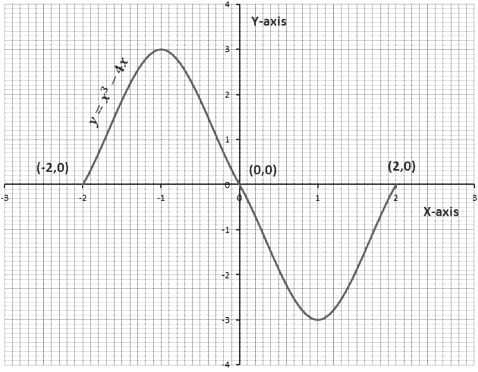
Now we will study the geometrical meaning of the zeroes of a cubic polynomial. Consider a cubic polynomial x3 − 4x. First, we will find some values of y corresponding to a few values of x.
If we plot these points on the graph, the graph will look like this,

If we observe the graph, we see that -2, 0 and 2 are the x-coordinate of the points where the graph of y = x3 − 4x intersect the x-axis. Thus -2, 0 and 2 are the zeroes of the cubic polynomial, y = x3 − 4x.
We will draw the graphs of a few more cubic polynomials.
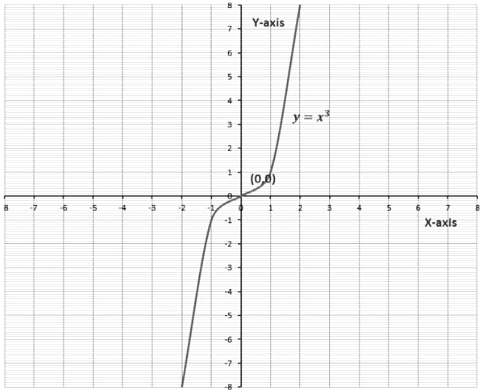
Let us first consider the cubic polynomial, y = x3. We will find a few values of x and y.
If we observe the graph we see that 0 is the only zero of the cubic polynomial, y = x3 as its graph intersects the x-axis at the origin only.
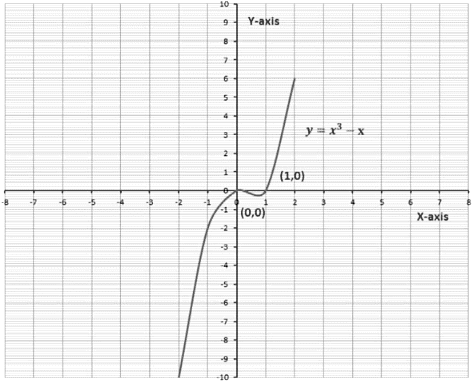
Now consider one more cubic polynomial, y = x3 − x. We will again find a few values of x and y.

Now, we can see in the graph that 0 and 1 are the two zeroes of the cubic polynomial, y = x3 − x as its graph is intersecting the x-axis at (0, 0) and (1, 0).
Therefore, any cubic polynomial can have at most 3 zeroes.

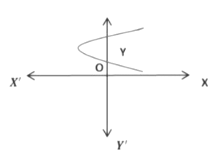
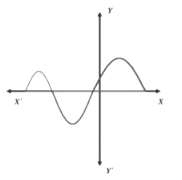
Example 6: The graph of y = p(x) is given, for some polynomials p(x). Find the number of zeroes of p(x) in each case.

Sol:

(a)
This is a graph of a quadratic polynomial. As the graph of y = p(x) does not intersect the x – axis at any point. Thus, it has no zero.
(b)
This is again a graph of a quadratic polynomial. Here, the graph of y = p(x) intersects the x- axis at two points. Hence the number of zeroes is 2.
(c)

This is a graph of a linear polynomial. The number of zeroes is 1. As the graph of y = p(x) is intersecting the x-axis at one point only.
(d)
The given graph is of a cubic polynomial. Here the polynomial y = p(x) is intersecting the x – axis at 3 points. Therefore, the number of zeroes is 3.

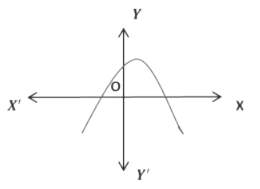
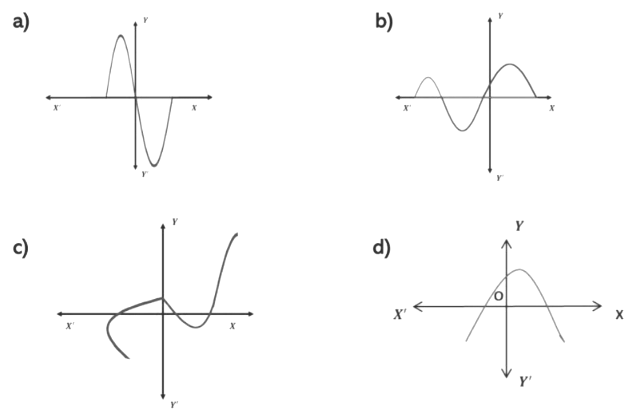
Example 7: Which of the following is not the graph of a cubic polynomial?

Sol:
Option d) is not the graph of a cubic polynomial. It is a graph of a quadratic polynomial, as the graph is in the shape of a parabola which is opening downwards.

Try yourself:Which of the following polynomials represents a geometric shape that has no intercept with the x-axis?

  • A.x2 + 5x + 4
  • B.x2 + 3x + 2
  • C.x2 + 4x + 5
  • D.x2 – 6x – 7

View Solution
Relationship between Zeroes and Coefficients of a Polynomial

We know that a quadratic polynomial is of the form ax2 + bx + c. A quadratic polynomial can have at the most two zeroes.

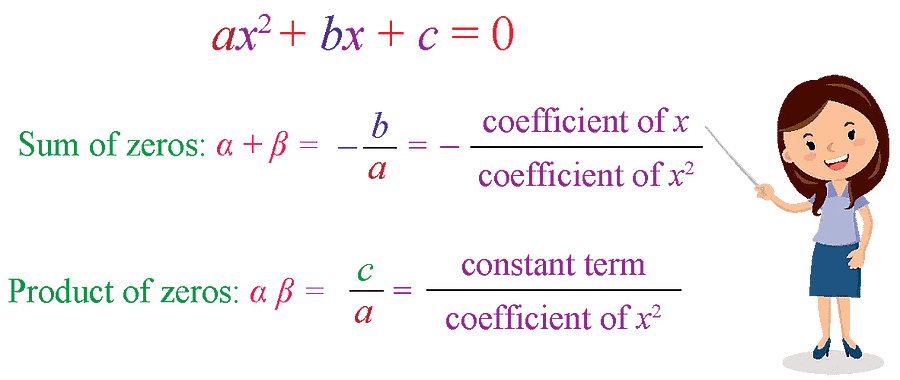
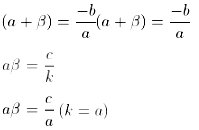
Sum and Product of ZeroesIn general, if α and β are the zeroes of the quadratic polynomial p(x) = ax2 + bx + c, a ≠ 0, then x − α and x − β are the actors of the p(x). Therefore,
ax2 + bx + c = k (x – a) (x – β)
= k(x2 – xβ – ax + aβ)
= [x2 – (β + a)x + aβ)
= kx2 – k (β + a)x + kaβ
Now, comparing the coefficients of x2, x and constant terms on both sides, we get
a = k, b = -k(β + a), c = kaβ
(a + β) = -b/k
Now k = a

Sum of zeroes(α + β)

Product of zeroes(αβ)

Example 8: If one zero of 2x2 − 3x + k is reciprocal to the other, then find the value of k.

Sol:

Let one zero be α, then the other zero will be  1/a
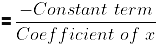
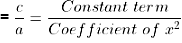
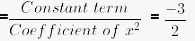
We know that, Product of zeroes(αβ) = c/a = Constant term / Coefficient of x2  

 = c/a = k/2
 K= 2

Example 9: If α and β are zeroes of the polynomial x2 − p(x + 1) + d such that (α + 1)(β + 1) = 0, then find the value of d.

Sol:

The given polynomial is x2 − p(x + 1) + d
x2 − px − p + d
Comparing the above equation with ax2 + bx + c, we get
a = 1, b = −p, c = −p + d
α and β are the zeroes of the polynomial x2 − px − p + d
Sum of zeroes(α + β) 
Product of zeroes(αβ) 
(α + 1)(β + 1) = 0 (given)
αβ + α + β + 1 = 0
Putting (α + β) = p and (αβ) = d − p in the above equation we get,
d − p + p + 1 = 0
d + 1 = 0
d = −1

Example 10: Form a quadratic polynomial, whose one zero is 7 and the product of zeroes is -56.

Sol:

Let the zeroes be α and β.
It is given that the value of one zero is 7, then let us assume that α = 7
Product of zeroes = αβ = 7β
Now, 7β = −56
β = −8
∴ α = 7 and β = −8
(α + β) = 7 − 8 = −1
(αβ) = 7 × (−8) = −56
We know that a quadratic polynomial is 

x2 −(sum of zeroes)x + product of zeroes
x2 − (α + β)x + (αβ)
Putting (α + β) = −1 and (αβ) = −56
x2 + x − 56

Example 11: If the zeroes of the polynomial x2 + px + q are double in value of the zeroes of 2x2 − 5x − 3, then find the value of p and q.

Sol:

Let α and β be the zeroes of 2x2 − 5x − 3.
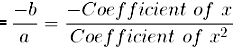
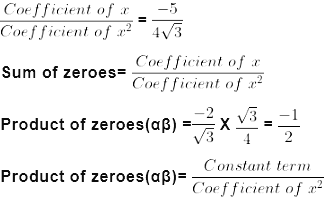
Sum of zeroes(α + β) =−ba 
Product of zeroes(αβ) = c/a = 
As the zeroes of x2 + px + q are double in value. Therefore, 2α and 2β are the zeroes of x2 + px + q
Sum of zeroes(2α + 2β) = 2(α + β) 
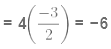
Product of zeroes(2α × 2β) = 4αβ 
We know that a quadratic polynomial is x2 −(sum of zeroes)x + product of zeroes
∴ x2 − (2α + 2β)x + (2α × 2β)
x2 − 5x − 6
Comparing the above equation with x2 + px + q, we get
p = −5, q = −6

Example 12: Find the zeroes of the quadratic polynomial, 4√3x2 + 5x − 2√3 and verify the relationship between the zeroes and the coefficients.

Sol:

Letp(x) = 4√3x2 + 5x − 2√3
By splitting the middle term we get,
p(x) = 4√3x2 + 5x − 2√3
p(x) = 4√3x2 + (8 − 3)x − 2√3
p(x) = 4√3x2 + 8x − 3x − 2√3
p(x) = 4x(√3x + 2) − √3(√3x + 2)
p(x) = (√3x + 2)(4x − √3)
The value of 4√3x2 + 5x − 2√3 is zero, when x =-2/√3 and x = √3/4
Therefore, the zeroes of 4√3x2 + 5x − 2√3 are x = -2/√3 and x = √3/4
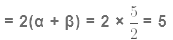
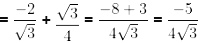
Sum of zeroes(α + β) 

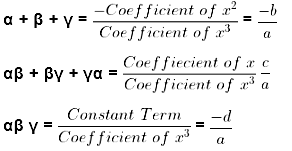
Let α, β, γ be the zeroes of a cubic polynomial
ax3 + bx2 + cx + d

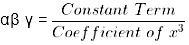
x3 −(sum of zeroes)x2 + (sum of the product of zeroes taking two at a time)x – product of zeroes
x3 +( α + β + γ)x2 + (αβ + βγ + γα)x – αβ γ

Example 13: If two zeroes of the polynomial f(x) = x3 − 4x2 − 3x + 12 are √3 and −√3, then find its third zero.

Sol:

Let α and β be the two roots of the polynomial,
x3 − 4x2 − 3x + 12
Then α = √3 and β = – √3,


√3 – √3 + y = -(4)/1 = 4
γ = 4
Therefore the third zero is 4.

Example 14: If zeroes of the polynomial f(x) = x3 − 3x2 + x + 1 are a − b, a and a + b, then find a and b.

Sol:

Now, a − b, a, and a + b are zeroes of the cubic polynomial
Let α = a − b, β = a and γ = a + b
We know that,

a − b + a + a + b = -(3)/1 = 3
3a = 3 , a = 1 


(a − b)a(a + b) = -(1)/1 = 1
a(a2 − b2) = −1
Putting a = 1 in the above equation
1(1 − b2) = −1
(1 − b2) = −1
b2 = 2
b = ±√2

Try yourself:If the sum of the roots of a quadratic equation is 4 and the product of the roots is 3, then what is the equation?

  • A.x2 – 4x + 3 = 0
  • B.x2 + 4x – 3 = 0
  • C.x2 – 4x – 3 = 0
  • D.x2 + 4x + 3 = 0

View Solution
01. Real Numbers – Chapter Notes

Real Numbers

Real numbers are all the numbers that can be found on the number line. This includes both rational numbers (like 7, -3, 0.5, and 4/3) and irrational numbers (like √2) . They encompass integers, fractions, and decimals, representing a continuous, unbroken set of values. 

Rational numbers such as integers (-2, 0, 1), fractions (1/2, 2.5) and irrational numbers such as √3, π(22/7), etc., are all real numbers. 

Classification of Real Numbers

  1. Natural Numbers: Natural Numbers are a set of counting numbers. They are denoted by N.
    N = {1, 2, 3, 4……….∞}
  2. Whole Numbers: Whole numbers are a set of natural numbers plus zero.
    W = {0, 1, 2, 3 ……… ∞}
  3. Integers: Integers is a set of whole numbers and negative of all natural numbers.
    Z = { -3, -2, -1, 0, 1, 2, 3}
  4. Rational Numbers: All the numbers that can be written in the p/q form where p and q are integers and q ≠ 0 are called rational numbers.
    E.g. 8/11, -3/17
  5. Irrational Numbers: All the numbers that cannot be written in the p/q form are called irrational numbers. All the non-terminating and non-repeating decimal numbers are irrational numbers.
    E.g. √5, √3, √5 + √3, π

Fundamental Theorem of Arithmetic

To understand the fundamental theorem of Arithmetic, first, it is important to know what are composite numbers and prime numbers.

Composite Number

Composite Numbers are those numbers that have at least one factor other than one and the number itself.
Consider a number, 10. Now, the factors of 10 are 1, 2, 5 and 10. So it is a composite number.

Prime Number

Prime Numbers are those numbers that have exactly two factors: 1 and the number itself.
Let us take one more number 23. Now, the factors of 23 are 1 and 23. That means it has two factors 1 and the number itself, which is called a prime number.

Prime and Composite Numbers

Theorem:  Fundamental Theorem of Arithmetic states that every composite number can be expressed as a product of primes, and this factorization is unique, apart from the order in which the prime factors occur.

Any composite number can be written as a product of primes in one way only as long as we are not particular about the order in which the primes occur.
Let us consider an example here: we will use a tree diagram to show the factors of 270.
270 = 2 x 33 x 5
Here, in the prime factorization of 270, the prime numbers appearing in both cases are the same, only the order in which they appear is different.
Therefore, the prime factorization of 270 is unique except for the order in which the primes occur.

Example 1:  Check whether 15n can end with the digit zero for any natural number n.

Sol: 

Example 2: Explain, why (7 × 6 × 5 × 4 × 3 × 2 × 1) + 5 and (3 × 5 × 13 × 46) + 23 is a composite number?

Sol:

HCF and LCM by Prime Factorisation MethodIn this method, we first express the given numbers as a product of prime factors separately. Then, HCF is the product of the smaller power of each common prime factor in the numbers, and LCM is the product of the greatest power of each prime factor involved in the numbers.

For any two positive integers a and b,

HCF (a, b) × LCM (a, b) = a × b


Example 3: Find the LCM and HCF of 120 and 144 by the fundamental arithmetic theorem.

Sol:

120 = 23 × 3 × 5
144 = 2× 32
Now, HCF is the product of the smallest power of each common prime factor in the numbers.
HCF (120, 144) = 23 × 3 = 8 × 3 = 24
LCM is the product of the greatest power of each prime factor involved in the numbers.
LCM (120,144) = 24 × 32 × 5 = 16 × 9 × 5 = 720

Example 4: If two positive integers p and q can be expressed as p = ab2 and q = a3b, where a, b are prime numbers, find the LCM (p, q).

Sol:

Given: p = ab2 and q = a3b
LCM is the product of the greatest power of each prime factor involved in the numbers.
LCM (p, q) = a3 × b2 = a3b2

Example 5: Write the HCF and LCM of the smallest odd composite number and the smallest odd prime number.

Sol:

The smallest odd composite number is 9, and the smallest odd prime number is 3.
9 = 32
3 = 31
Now, the smallest power of the common prime factor is 31.
HCF (9, 3) = 3
The greatest power of the common prime factor is 32.
LCM (9, 3) = 32 = 9

Example 6: If HCF (253,440) = 11 and LCM (253,440)= 253 × R. Find the value of R.

Sol:

We know that,
HCF (a, b) × LCM (a, b) = a × b
∴ HCF (253, 440) × LCM (253, 440) = 253 × 440
11 × 253 × R = 253 × 440
R = 253 x 440 / 253 x 11
R = 40

Example 7: Ravi and Shikha drive around a circular sports field. Ravi takes 16 min to complete one round, while Shikha completes the round in 20 min. If both start at the same point, at the same time, and go in the same direction, then how much time will they meet at the starting point?

Sol:

Time taken by Ravi to drive one round of the circular field = 16 min. Time taken by Shikha to drive one round of the circular field =20 min.
The time after which they will again meet at the starting point will be equal to the LCM of 16 min and 20 min.
16 = 24
20 = 22 × 5
LCM(16, 20) = 24 × 5 = 16 × 5 = 80
Therefore, Ravi and Shikha will meet again at the starting point after 80 min.

Try yourself:According to the Fundamental Theorem of Arithmetic, which of the following statements is true?

  • A.Every prime number can be expressed as a product of composites.
  • B.Every composite number can be expressed as a product of primes, and this factorization is unique.
  • C.Every natural number can be expressed as a product of two prime numbers.
  • D.Every prime number can be expressed as a product of other prime numbers.

View Solution
Revisiting Irrational Numbers

Irrational numbers are those numbers that cannot be written in the form p/q, where p and q are integers and q ≠0. E.g.,√2, √3, √15

The square roots of all the numbers do not give an irrational number.

For example, √2 is an irrational number, but √4 = 2, which is rational.
Therefore, the square roots of all prime numbers are irrational.
If p is a prime number, then √p is an irrational number.

Theorem : If a prime number p divides a2, then p divides a, where a is a positive integer.

Theorem: Prove that √2  is an irrational number.

Sol:

Example 8: Show that 3√2 is an irrational number.

Sol:

Example 9: Show that 5 − √3 is irrational.

Sol: