14. Previous Year Questions: Probability

Previous Year Questions 2025

Q1: If in a lottery, there are 10 prizes and 30 blanks, then the probability of winning a prize is:
(a) 1/4
(b) 1/3
(c) 3/4
(d) 2/3

Hide Answer  

Ans: (a)
Given, number of prizes = 10 
Number of blanks = 30 
Total outcomes= 10 + 30 = 40 
∴ Probability of wining a prize = 10/40 = 1/4


Q2: A die is thrown once. The probability of getting a number which is not a factor of 36, is:
(a) 1/2
(b) 2/3
(c) 1/6
(d) 5/6

Hide Answer  

Ans: (c)
When a die is thrown, possible outcomes are 1, 2, 3, 4, 5 and 6. Out of them factors of 36 are 1, 2, 3, 4 and 6. 
Let E be the event ‘getting a number not a factor of 36. 
∴ E = {5}
∴ P(E) = 1/6


Q3: A card is selected at random from a deck of 52 playing cards. The probability of it being a red face card is:
(a) 3/13
(b) 2/13
(c) 1/2
(d) 3/26

Hide Answer  

Ans: (d)
Total number of cards= 52
Number of red face cards = 6 
∴ P(Red face card) = 6/52 = 3/26


Q4: Assertion (A): The probability of selecting a number at random from the numbers 1 to 20 is 1. 
Reason (R) : For any event E, if P(E) = 1, then E is called a sure event. 
(a) Both Assertion (A) and Reason (R) are true and Reason (R) is the correct explanation of the Assertion (A).
(b) Both Assertion (A) and Reason (R) are true, but Reason (R) is not the correct explanation of the Assertion (A).
(c) Assertion (A) is true, but Reason (R) is false. 
(d) Assertion (A) is false, but Reason (R) is true.

Hide Answer  

Ans: (d)
The probability of selecting a number at random from the numbers 1 to 20 is 1/20.
So, Assertion is false. 
For, P(E) = 1, E is called a sure event. 
So, Reason is true. 
Hence, Assertion is false, but Reason is true. 


Q5: Two coins are tossed simultaneously. The probability of getting at least one head is 
(a) 1/4
(b) 1/2
(c) 3/4
(d) 1

Hide Answer  

Ans:  (c)
Total outcomes on tossing two coins = {(H, H), {H, T), (T, H), (T, T)} 
Favourable outcomes= {{H, H), {H, T), (T, H)} 

Q6: In an experiment of throwing a die,
Assertion (A): Event E1:  getting a number less than 3 and Event E2 : getting a number greater than 3 are complementary events. 
Reason (R): If two events E and Fare complementary events, then P(E) + P(F) = 1.

(a) Both Assertion (A) and Reason (R) are true and Reason (R) is the correct explanation of the Assertion (A). 
(b) Both Assertion (A) and Reason (R) are true, but Reason (R) is not the correct explanation of the Assertion (A). 
(c) Assertion (A) is true, but Reason (R) is false. 
(d) Assertion (A) is false, but Reason (R) Q is true. 

Hide Answer  

Ans: (d)
Clearly, reason is true.
On throwing a die, favourable outcomes are {1, 2, 3, 4, 5, 6}. 
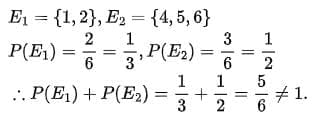
∴ E1 and E2 are not complementary events. 
∴ Assertion is false. 


Q7: The probability of guessing the correct answer of a certain test question is x/12. If the probability of not guessing the correct answer is 5/6, then find the value of x.

Hide Answer  

Ans: Let A be the event of guessing the correct answer and A’ be the event of not guessing the correct answer. 
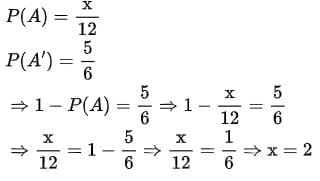

Q8: The number of red balls in a bag is three more than the number of black balls. If the probability of drawing a red ball at random from the given bag is 12/23, find the total number of balls in the given bag.

Hide Answer  

Ans: 
Let the number of black balls be x. 
⇒ Number of red balls= x + 3 
∴ Total balls = x + x + 3 = 2x + 3 
Now, probability of drawing a red ball at random = 12/23
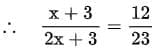
⇒ 23x + 69 = 24x + 36 
⇒ 24x – 23x = 69 – 36 
⇒ x = 33 
∴ Total Balls  = 2 × 33 + 3 = 69


Q9: If 65% of the population has black eyes, 25% have brown eyes and the remaining have blue eyes, what is the probability that a person selected at random has: 
(a) blue eyes? 
(b) brown or black eyes?

Hide Answer  

Ans: Probability that a person has black eyes = 65/100
Probability that a person has brown eyes = 25/100
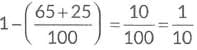
(a) Probability that person selected has blue eyes =
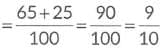
(b) Probability that person selected has brown or black eyes =

Q10: All face cards of spades are removed from a pack of 52 playing cards and the remaining pack is shuffled well. A card is then drawn at random from the remaining pack. Find the probability of getting: 
(a) a face card 
(b) an ace or a jack

Hide Answer  

Ans: 
Total number of cards in a deck = 52 
Number of face cards of spades in a deck = 3 
Number of cards left in the deck = 52 – 3 = 49 
(a) Total number of face cards left in the deck = 12 – 3 = 9 
Probability that the card drawn is a face card= 9/49 

(b) Number of a ace and jack cards left in the deck = 4 + 3 = 7 
Probability that the card drawn is an ace or a jack = 7/49 = 1/7


Q11: Three unbiased coins are tossed simultaneously. Find the probability of getting: 
(a) exactly two tails 
(b) at least one head 
(c) at most two heads

Hide Answer  

Ans: Possible outcomes are: {HHH, HHT, HTT, THT, HTH, TTT, TTH, THH} 
∴ Total number of possible outcomes= 8
(a) Favourable outcomes are {HTT, THT, TTH} i.e., 3 in number
∴ P(exactly two tails) = 3/8

(b) Favourable outcomes are {HTH, HHT, HTT, THT, HTH, TTH, THH} i.e., 7 in number 
∴ P(at least one head) = 7/8
(c) Favourable outcomes are {HHT, HTT, THT, TTT, HTH, TTH, THH} i.e., 7 in number 
∴ P(at most two heads) = 7/8


Q12: Two dice are rolled together. Find the probability of getting: 
(i) a multiple of 2 on one and a multiple of 3 on the other die. 
(ii) the product of two numbers on the top of the two dice is a perfect square number.

Hide Answer  

Ans: 
Total number of possible outcomes= 6 x 6 = 36 
(i) Favourable outcomes are (2, 3), (2, 6), (3, 2), (3, 6), (4, 3), (4, 6), (6, 2), (6, 3), (6, 4), (6, 6). 
∴ Probability of getting a multiple of 2 on one and a multiple of 3 on the other die = 10/36 = 5/18
(ii) Favourable outcomes are (1, 1), (2,2), (3,3), (4,4), (5, 5), (6, 6), (1, 4), (4, 1). · 
Probability of getting the product of two numbers on the top of the two dice is a perfect square number = 8/36 = 2/9


Q13: Two dice are thrown at the same time. Determine the probability that the difference of the numbers on the two dice is 2.

Hide Answer  

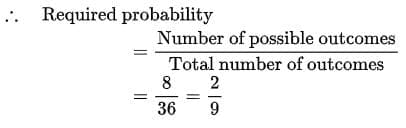
Ans: When two dice are thrown at same time, total number of outcomes = 6 x 6 = 36 
Possible outcomes when difference of numbers on two dice is 2 
= {(1, 3), (2, 4), (3, 1), (3, 5), (4, 2), (4, 6), (5, 3), (6, 4)} 
Number of favourable outcomes= 8 

Q14: A bag contains some red and blue balls. Ten percent of the red balls, when added twenty percent of the blue balls, give a total of 24. If three times the number of red balls exceeds the number of blue balls by 20, find the number of red and blue balls.

Hide Answer  

Ans: Let the number of red balls= x 
and number of blue balls= y 
According to question,
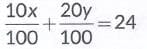
⇒ x + 2y = 240   … (i) 
Also, 3x – y = 20  … (ii) 
Multiply eqn (ii) by 2, then adding to eqn (i), we get 
6x – 2y + x + 2y = 40 + 240 
⇒ 7x = 280 ⇒ x = 40 
Put the value of x in eqn. (i), 
40 + 2y= 240 
⇒ 2y = 200 ⇒ y = 100 
Therefore, number of red balls is 40 and number of blue balls is 100. 

Previous Year Questions 2024

Q1: A bag contains 3 red balls, 5 white balls and 7 black balls. The probability that a ball drawn from the bag at random will be neither red nor black is:     (1 Mark) (CBSE 2024)
(a) 1/3
(b) 1/5
(c) 7/15
(d) 8/15

Hide Answer  

Ans: (a)
No. of red balls = 3 
No. of white balls = 5 
No. of black balls = 7 
Total balls = 15 
Probability that ball drawn is neither red nor black = 5/15 = 1/3


Q2: The probability of getting a bad egg in a lot of 400 eggs is 0.045. The number of good eggs in the lot is:      (1 Mark) (CBSE 2024)
(a) 18
(b) 180
(c) 382
(d) 220

Hide Answer  

Ans: (c)
Probability of getting bad in the lot = 0.045 
Let the no. of bad eggs = x 
∴ Probability of bag eggs 
= No. of bad eggsTotal eggs

⇒ 0.045 = x/400
⇒ x = 400 × 0.045
⇒ x = 18 
No. of bad eggs = 18 
No. of good eggs = 400 – 18 
= 382


Q3: Two dice are thrown together. The probability that they show different numbers is:      (1 Mark) (CBSE 2024)
(a) 1/6
(b) 5/6
(c) 1/3
(d) 2/3

Hide Answer  

Ans: (b)
Total outcomes, when two dice are thrown 
= {(1, 1)(1, 2)(1, 3)(1, 4)(1, 5)(1, 6)
(2, 1)(2, 2)(2, 3)(2, 4)(2, 5)(2, 6)
(3, 1)(3, 2)(3, 3)(3, 4)(3, 5)(3, 6)
(4, 1)(4, 2)(4, 3)(4, 4)(4, 5)(4, 6)
(5, 1)(5, 2)(5, 3)(5, 4)(5, 5)(5, 6)
(6, 1)(6, 2)(6, 3)(6, 4)(6, 5)(6, 6)}
 Outcomes of showing same numbers = {(1, 1), (2, 2), (3, 3), (4, 4), (5, 5), (6, 6)}
No. of favourable outcomes = 36 – 6 = 30
Total outcomes = 36
So, P(E) = 30/36
= 5/6


Q4: Assertion (A): In a cricket match, a batsman hits a boundary 9 times out of 45 balls he plays. The probability that in a given ball, he does not hit the boundary is 4/5.
Reason (R): P(E) + P(not E) = 1.  (1 Mark) (CBSE 2024)
(a) Both assertion (A) and reason (R) are true, and reason (R) is the correct explanation of assertion (A). 
(b) Both assertion (A) and reason (R) are true, but reason (R) is not the correct explanation of assertion (A). 
(c) The assertion (A) is true, but the reason (R) is false. 
(d) The assertion (A) is false, but the reason (R) is true.

Hide Answer  

Ans: (a) Assertion: 
Total balls (outcomes) = 45 
No. of times boundaries hit = 9     
(E = hitting the boundary) = 9/45
= 1/5
∴ P(E= not hitting the boundary)
= 1 – 15 =  45
Reason: This is a fundamental property of probability:

The sum of the probability of an event P(E) and the probability of its complement P(not E) is always equal to 1.

Thus, Reason (R) is also true.

Get additional INR 200 off today with EDUREV200 coupon.

Previous Year Questions 2023

Q5: In a group of 20 people. 5 can’t swim. If one person is selected at random, then the probability that he/she can swim is      (1 Mark) (2023)
(a) 3/4
(b) 1/3
(c) 1
(d) 1/4

Hide Answer  

Ans: (a)
Total number of people = 20
Number of people who can’t swim = 5
Number of people who can swim = 20 – 5 = 15
∴ Required probability = 15/20 = 3/4


Q6: The probability of the occurrence of an event is denoted by p, and the probability of the non-occurrence of the event is denoted by q. The relation between p and q is       (1 Mark) (2023)
(a) p + q = 1
(b) p = 1, q = l
(c) p = q – 1    
(d) p + p + 1 = 0

Hide Answer  

Ans: (a)
Probability of happening of an event + Probability of non – happening of an event
∴ p +q = 1


Q7: A girl calculates that the probability of her winning the first prize in a lottery is 0.08. If 6000 tickets are sold, how many tickets has she bought?      (1 Mark) (2023)
(a) 40
(b) 240
(c) 480
(d) 750

Hide Answer  

Ans: (c)
Probability of winning first prize = Ticket bought by girl  / Total ticket sold
⇒ 0.08 = Ticket bought by girl  / 6000
⇒ Ticket bought by girl = 0.08 x 6000 = 480


Q8: Two dice are thrown together. The probability of getting the difference of numbers on their upper faces equals 3 is 
(1 Mark) (CBSE, 2023)
(a) 1/9
(b) 2/9
(c) 1/6
(d) 1/12

Hide Answer  

Ans: (c)
Total number of outcomes = 6 x 6 = 36
Favourable outcomes are {(1,4), (2, 5), (3, 6), (4, 1), |5. 2), (6.3)} i.e.,  6 in number
∴ Required probability = 6/36 = 1/6


Q9: A card is drawn at random from a well-shuffled pack of 52 cards. The probability that the card drawn is not an ace is   (1 Mark)   (2023)
(a) 1/13
(b) 9/13
(c) 4/13
(d) 12/13

Hide Answer  

Ans: (d)
Total number of cards = 52
Number of ace card =4
∴ Number of non ace card = 52 – 4 = 48
∴ Required probability = 48/52 = 12/13


Q10: DIRECTIONS: In the question, a statement of Assertion (A) is followed by a statement of Reason (R). Choose the correct option out of the following:       (1 Mark) (CBSE 2023)
Assertion (A): The probability that a leap year has 53 Sundays is 2/7.
Reason (R): The probability that a non-leap year has 53 Sundays is 5/7.
(a) Both Assertion (A) and Reason (R) are true, and Reason (R) is the correct explanation of Assertion (A).
(b) Both Assertion (A) and Reason (R) are true, and Reason (R) is not the correct explanation of Assertion (A).
(c) The assertion (A) is true, but the Reason (R) is false.
(d) The assertion (A) is false, but the Reason (R) is true.

Hide Answer  

Ans: (c)
The leap year has 366 days, i.e, 52 weeks and 2 days.
∴ Required probability = 2/7
The non-leap year has 365 days. i.e.. 52 weeks and 1 day.
∴ Required probability = 1/7
Therefore, assertion is true but reason is false.


Q11: A bag contains 5 red balls and n green balls. If the probability of drawing a green ball is three times that of a red ball, then the value of n is      (1 Mark)  (2023)
(a) 18
(b) 15
(c) 10
(d) 20

Hide Answer  

Ans: (b)
Probability of drawing a green ball = 3 x Probability of drawing a red ball

n5 + n = 3 × 55 + n

Since 5+n is common and non-zero, we can cancel it.
n = 3×5∴ n = 15 


Q12: A bag contains 4 red, 3 blue and 2 yellow balls. One ball is drawn at random from the bag. Find the probability that the drawn ball is (i) red and (ii) yellow.       (2 Marks) (2023)

Hide Answer  

Ans: Number of red balls =4
Number of blue balls = 3
Number of yellow balls = 2
Total number of balls = 4 + 3 + 2= 9
(i) P(drawing a red balI) = 4/9
(ii) P(drawing a yellow ball) = 2/9


Q13: If a fair coin is tossed twice, find the probability of getting ‘almost one head. ‘        (2 Marks) (CBSE 2023)

Hide Answer  

Ans: Let A be the event of getting atmost one head, and S be the sample space.

S = (HH, HT, TH, TT) and A = (HT, TH, TT)

⇒ n(S) = 4
Also, n(A) = 3

Required probability = n(A) / n(S)
= 3/4

Previous Year Questions 2022

Q14: The probability of getting two heads when two fair coins are tossed together is       (2022)
(a) 1/3
(b) 1/4
(c) 1/2
(d) 1

Hide Answer  

Ans: (b)
Sample space = {(H,H), (H,T), (T,H), (T,T)}
∴ Number of total outcomes = 4
Favourable outcomes = {(H,H)}
∴ Number of favourable outcomes = 1
∴ Required probability = 1/4


Q15: In a single throw of a die. The probability of getting a composite number is       (2022)
(a) 1/3
(b) 1/2
(c) 2/3
(d) 5/6

Hide Answer  

Ans: (a)
Sample space = (1, 2, 3, 4, 5, 6)
∴ Number of total outcomes = 6
Favourable outcomes = (4, 6)
∴ Number of favourable outcomes = 2
∴ Required probability = 2/6 = 1/3


Q16: The probability that a non-leap year has 53 Wednesdays is       (2022)
(a) 1/7
(b) 2/7
(c) 5/7
(d) 6/7

Hide Answer  

Ans: (a)
We know that there are 52 complete weeks = 364 days
Since, it is non leap year.
So. there will be 52 Wednesdays and remaining 365th day may be any of the days of week
So, total number of ways = 7

∴ Number of favourable outcomes = 1
∴ Required probability = 1/7


Q17: From the letters of the word “MANGO”, a letter is selected at random. The probability that the letter is a vowel is       (2022)
(a) 1/5
(b) 3/5
(c) 2/5
(d) 4/5

Hide Answer  

Ans: (c)
Total number of letters in the word MANGO are 5.
So, number of total outcomes = 5
Vowels in the word ‘MANGO’ are A, O
So, number of favourable outcomes = 2
∴ Required probability  = 2/5

Also read: PPT: Probability

Previous Year Questions 2021

Q18: Case study-based questions are compulsory. Attempt any 4 sub-parts from the question. Each sub-part carries 1 mark.       (2021)
During summer break, Harish wanted to play with his friends, but it was too hot outside, so he decided to play some indoor games with his friends. He collects 20 identical cards and writes the numbers 1 to 20 on them (one number on one card). He puts them in a box. He and his friends make a bet on the chances of drawing various cards out of the box. Each was given a chance to tell the probability of picking one card out of the box.
Based on the above, answer the following questions:
(i) The probability that the number on the card drawn is an odd prime number is
(a) 3/5
(b) 2/5
(c) 9/20
(d) 7/20

Hide Answer  

Ans: (d)
Card numbered from {1,2, 3, …., 20}
Total number of possible outcomes = 20
Odd prime numbers from 1 to 20 = {3, 5, 7, 11,13,17,19)
Total number of favourable outcomes = 7
Hence, the probability that the number on the card drawn is an odd prime number = 7/20

(ii) The probability that the number on the card drawn is a composite number is
(a) 11/20
(b) 3/5
(c) 4/5
(d) 1/2   [2021, 1 Mark]

Hide Answer  

Ans: (a)
Total number of composite numbers between 1 to 20 = [4, 6, 8, 9, 10, 12, 14, 15, 16, 18, 20)
Total number of favourable outcomes = 11
So, the probability that the number on the drawn card is a composite number = 11/20

∴ Required Probability = 11/20

(iii) The probability that the number on the card drawn is a multiple of 3, 6 and 9 Is
(a) 1/20
(b) 1/10
(c) 3/20
(d) 0

Hide Answer  

Ans: (c)
Multiple of 3 = {3, 6, 9,12,15, 18}
Multiple of 6 = (6, 12, 18)
Multiple of 9 = (9, 18)
Total number of favourable outcomes = 1
Hence the probability that the card is a multiple of 3, 6 and 9 = 1/20
∴ Required Probability = 1/20

(iv) The probability that the number on the card drawn is a multiple of 3 and 7 is
(a) 3/10
(b) 1/10
(c) 0
(d) 2/5  [2021, 1 Mark]

Hide Answer  

Ans: (c)
 Multiple of 3 between 1 to 20 = {3, 6, 9, 12,15, 18}
Multiple of 7 between 1 to 20 = (7,14)
∴ Multiple of 3 and 7 = 0
∴ Total number of favourable outcomes = 0/20
∴ Required Probability = 0

(v) If all cards having odd numbers written on them are removed from the lie box and then one card is drawn from the remaining cards, the probability of getting a card having a prime number is
(a) 1/20
(b) 1/10
(c) 0
(d) 1/5

Hide Answer  

Ans: (b)
If all odd number cards are removed then remaining cards which are left = {2,4, 6, 8,10,12,14,16, 18, 20}
Now, prime number cards in remaining cards = 1
So, the probability of getting a prime number from the remaining cards = 1/10

Previous Year Questions 2020

Q19: The probability of an event that is sure to happen is  _______.       (2020)

Hide Answer  

Ans: The probability of an event that is sure to happen is 1.


Q20: If the probability of an event E happening is 0.023, then P(E) = ________. (2020)

Hide Answer  

Ans: Given, P(E) =0.023
P(E) = 1- P(E) = 1 – 0.023 = 0.977


Q21: A letter of the English alphabet Is chosen at random. What Is the probability that the letter is a consonant?       (CBSE 2020)

Hide Answer  

Ans: Total number of English alphabets = 26
Number of consonants = 26 – 5 = 21
∴ Number of favourable outcomes = 21
P (chosen letter is a consonant) = 21/26


Q22: A die is thrown once. What is the probability of getting a number less than 3?        (2020)

Hide Answer  

Ans: Total number of outcomes = 6
Favourable outcomes are {1.2} i.e.. 2 in number
∴ Required probability = 2/6 = 1/3


Q23: If the probability of winning a game is 0.07, what is the probability of losing it?       (2020)

Hide Answer  

Ans: Given, probability of winning a game is 0.07
∴  Probability of losing it = 1 – 0.07 = 0.93


Q24: A jar contains 18 marbles. Some are red, and others are yellow. If a marble is drawn at random from the jar. The probability that it is red is  2/3. Find the number of yellow marbles in the jar.       (2020)

Hide Answer  

Ans: There a re 18 marbles in the jar.
∴ Number of possible outcomes = 18
Let there are x yellow marbles in the jar.
∴ Number of red marbles = 18 – x
⇒ Number of favourable outcomes = (18 – x)
∴ Probability of drawing a red marble = (18 – x) / 18
Now. according to the question, = (18 – x) / 18 = 2/3
⇒ 3(18 – x ) = 2 x 18
⇒ 54 -3x  = 36
⇒ 3x = 18
⇒ x  = 6
So, number of yellow  marbles in jar = 6


Q25: A die is thrown twice. What is the probability that
(i) 5 will come up at least once, and
(ii) 5 will not come up either time?       (2020)

Hide Answer  

Ans: Since, throwing a die twice or throwing two dice simultaneously are same.
Possible outcomes are:

{(1,1), (1,2), (1,3), (1,4), (1,5), (1,6),

(2,1), (2,2), (2,3), (2,4), (2,5), (2,6),

(3,1), (3,2), (3,3), (3,4), (3,5), (3,6),

(4,1), (4,2), (4,3), (4,4), (4,5), (4,6),

(5,1), (5,2), (5,3), (5,4), (5,5), (5,6),

(6,1), (6,2), (6,3), (6,4), (6,5), (6,6)}

(i) Let N be the event that 5 will come up at least once, the number of favourable outcomes:

= 5 + 6

= 11

∴ P(N) = 1136

(ii) Let E be the event that 5 does not come up either time, then the number of favourable outcomes:

= [36 – (5 + 6)]

= 25

∴ P(E) = 2536


Q26: If a number x is chosen at random from the numbers -3, -2, -1, 0, 1, 2, 3. What is the probability that x2 ≤ 4?       (2020)

Hide Answer  

Ans: Total number of outcomes = {-3, -2, -1,0, 1, 2, 3} i.e. 7.
∴ Number of favourable outcomes = (-2, 1, 0, 1, 2) i.e., 5.
∴ Required Probability = 5/7


Q27: Two dice are thrown simultaneously. What is the probability that the product of the numbers appearing on the top is 1? (CBSE 2020)

Hide Answer  

Ans: Total number of possible outcomes = 36 
Only one outcome, i.e., (1, 1) has the product of the two numbers as 1. 
So, the required probability is 1/ 36 .


Q28: A Group Housing Society has 600 members who have their houses on the campus and decided to hold a Tree Plantation Drive on the occasion of the New Year. Each household was given the choice of planting saplings of its choice. The number of different types of saplings planted were: 
(1) Neem – 125 
(2) Peepal – 165 
(3) Creepers – 50 
(4) Fruit plants – 150 
(5) Flowering plants – 110 
At the opening ceremony, one of the plants is selected randomly for a prize. After reading the above passage, answer the following questions.
What is the probability that the selected plant is: 
(A) A fruit plant or a flowering plant? 
(B) either a Neem plant or a Peepal plant? (CBSE 2020)

Hide Answer  

Ans: (A) Of the 600 plants, there are 150 fruit plants and 110 flowering plants.
So, required probability
= (150 + 110)600 = 260600 i.e., 1330
=(B) Of the 600 plants, there are 290 (125 + 165) plants which are either neem plants or peepal plants.
So, required probability = 290/600 i.e., 29/60


Q29: If a number x is chosen at random from the numbers –3, –2, –1, 0, 1, 2, 3. What is the probability that x2 < 4? (CBSE 2020)

Hide Answer  

Ans: All possible outcomes are –3, –2, –1, 0, 1, 2, 3 
Favourable outcomes are – 1, 0, 1 (As x2 < 4) 
So, required probability = 3/7


Q30: Find the probability that a leap year selected at random will contain 53  Sundays and 53 Mondays. (CBSE 2020)

Hide Answer  

Ans: A leap year has 52 complete weeks + 2 days. 
These two days may be 
(Sun, Mon), (Mon, Tue), (Tue, Wed), (Wed, Thu), (Thu, Fri), (Fri, Sat) and (Sat, Sun). 
Of the 7 possible outcomes, only 1 
i.e., (Sun, Mon) is the favourable outcome. 
So, required probability is 1/7


Q31: A game in a booth at a Diwali fair involves using a spinner first. Then, if the spinner stops on an even number, the player is allowed to pick a marble from a bag. The spinner and the marbles in the bag are represented in the figure.
Prizes are given when a black marble is picked. Shweta plays the game once.
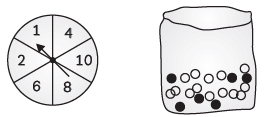
(A) What is the probability that she will be allowed to pick a marble from the bag?
(B) Suppose she is allowed to pick a marble from the bag; what is the probability of getting a prize, when it is given that the bag contains 20 marbles out of which 6 are black? (CBSE 2020)

Hide Answer  

Ans: (A) Shweta will be allowed to pick up a marble, only when the spinner stops on an even number. 
P(getting an even number) = 5 / 6 
Hence, the probability that she will be allowed to pick a marble from the bag is 5 / 6 
(B) P (getting a black marble) = 6 / 20 , or 3 / 10 . 
∴ Probability of getting a prize is 3 / 10 .

Attention!Sale expiring soon, act now & get EduRev Infinity at 40% off!

Previous Year Questions 2019

Q32: Cards numbered 7 to 40 were put in a box. Poonam selects a card at random. What is the probability that Poonam selects a card which is a multiple of 7?       (2019)

Hide Answer  

Ans: Cards are numbered from 7 to 40. i.e. {7,8,9, ……, 40}
So, total number of outcomes = 34
Multiple of 7 lies between 7 to 40 are {7, 14, 21, 28, 35}
∴ Total number of favourable outcomes= 5
∴ Required probability = 5/34


Q33: A card is drawn at random from a pack of 52 playing cards. Find the probability of drawing a card that is neither a spade nor a king.       (2019)

Hide Answer  

Ans: Total number of cards = 52
Total number of spade cards = 13
Total number of king cards = 4
Total number of spade cards and king cards = 13 + 4 – 1 = 16
[One card is subtracted as it is already included as a king of spade]
∴ Probability of drawing a spade or king card = 16/52
So, probability of drawing a card which is neither a spade nor a king = 1- 16/52
= 9/13


Q34: A pair of dice is thrown once. Find the probability of getting
(i) there is an even number on each dice
(ii) a total of 9.       (2019)

Hide Answer  

Ans: If a pair of dice is thrown once, then possible outcomes are:

{(1,1), (1,2), (1,3), (1,4), (1,5), (1,6),

(2,1), (2,2), (2,3), (2,4), (2,5), (2,6),

(3,1), (3,2), (3,3), (3,4), (3,5), (3,6),

(4,1), (4,2), (4,3), (4,4), (4,5), (4,6),

(5,1), (5,2), (5,3), (5,4), (5,5), (5,6),

(6,1), (6,2), (6,3), (6,4), (6,5), (6,6)}
∴ Number of possible outcomes are 36.
(i) Total possible outcomes of getting even number on each die
= {( 2, 2), ( 2, 4 ), ( 2, 6 ), ( 4, 4 ), (4, 6), (6, 6). (6, 2), (6, 4 ), (4, 2)}
Number of favourable outcomes = 9
∴ Required probability of getting an even number on each die = 9/36 = 1/4
(ii) Total possible outcomes of getting a total of 9
= {(3, 6), (4, 5), ( 5, 4), (6, 3)} which are 4 in number.
∴ Probability of getting a total of 9 = 4/36 = 1/9


Q35: A bag contains some balls, of which x are white, 2x are black, and 3x are red. A ball is selected at random. What is the probability that it is       (2019)
(i) not red
(ii) white?

Hide Answer  

Ans: We have, total number of balls = x + 2x + 3x = 6x
Total number of outcomes =6x
 (i) Number of favourable outcomes = 3x
∴ Probability of getting red ball = 3x /6x = 1/2
Now, probability of not getting red ball = 1-1/2 = 1/2
∴ Required probability = 1/2
(ii) Total number of favourable outcomes = x
∴ Probability of getting white ball = x / 6x
∴ Required probability = 1/6


Q36: A die is thrown once. Find the probability of getting a number which
(i) is a prime number
(ii) lies between 2 and 6.       (2019)

Hide Answer  

Ans: Total possible outcomes are f 1, 2, 3, 4, 5, i.e., 6 in number.
(i) Favourable outcomes are {2, 3, 5} i.e.. 3 in number.
∴ P (getting a prime number) = 3/6 = 1/2
(ii) Favourable outcomes are {3, 4, 5} i.e., 3 in number.
∴ P(getting a number lying between 2 and 6) = 3/6 = 1/2


Q37: A game consists of tossing a coin 3 times and noting the outcome each time. If getting the same result in all the tosses is a success, find the probability of losing the game.      (2019)

Hide Answer  

Ans: When a coin is tossed 3 times, then total possible outcomes are 
{HHH, HHT, HTH, THH, HTT, THT, TTH, TTT}
∴ Total number of possible outcomes = 8
Possible outcomes to lose the game are {HHT, HTH, THH, HTT,THT, TTH}
∴ Number of favourable outcomes = 6
∴ Required Probability = 6/8 = 3/4


Q38: Cards marked with numbers 5 to 50 (one number on one card) are placed in a box and mixed thoroughly. One card is drawn at random from the box. Find the probability that the number on the card taken out is
(i) a prime number less than 10,
(ii) a number which is a perfect square.       (2019)

Hide Answer  

Ans: Total number of cards = 50 – 5 + 1 = 46 
∴ Total number of possible outcomes = 46
(i) Prime numbers less than 10 are 5, 7.
So, number of favourable outcomes = 2
∴ P(getting a prime number less than 10) = 2/46 = 1/23
(ii) Perfect squares from 5 to 50 are 9, 16, 25,  36, 49 i.e., 5 in number.
∴ P (getting a number which is a perfect square) =5/46


Q39: A child has a die whose 6 faces show the letters given below:
The die is thrown once: What is the probability of getting (i) A (ii) B?       (2019)

Hide Answer  

Ans: Total number of faces in a die = 6
(i) Number of favourable outcomes = 3
∴ P(getting A) = 3/6 = 1/2
(ii) Number of favourable outcomes = 2
∴ P (getting B)  = 2/6 = 1/3

Previous Year Questions 2017

Q40: A number is selected at random from the natural numbers 1 to 20. Find the probability that the selected number is a prime number. (CBSE 2017)

Hide Answer  

Ans: Total number of outcomes = 20 
Let, E be the event that a number selected is a prime number. 
Since, the prime number between 1 to 20 (or favourable cases) are 2, 3, 5, 7, 11, 13, 17, 19 
∴ Number of favourable outcomes = 8
∴ P(E) = Number of  favourable outcomes /  Total number of outcomes
= 8/20 = 2/5
Hence, the required probability is 2/5


Q41: A number is chosen at random from the numbers –3, –2, –1, 0, 1, 2, 3. What will be the probability that the square of this number is less than or equal to 1? (CBSE 2017)

Hide Answer  

Ans: The given numbers are {–3, –2, –1, 0, 1, 2, 3} 
The square of these numbere are {9, 4, 1, 0, 1, 4, 9} 
∴ Total numbers of outcomes = 7 
The square of numbers that are less than or equal to 1 = {-1, 0, 1}
∴ Number of favourable outcomes = 3 
P(getting a square of a number less than or equal to 1) = 3 / 7 
Hence, the required probability is 3 / 7 .


Q42: A lot consists of 144 ball pens, of which 20 are defective. The customers will buy a ballpoint pen if it is good but will not buy a defective ballpoint pen. The shopkeeper draws one pen at random from the lot and gives it to a customer. What is the probability that 
(A) customer will buy the ball pen? 
(B) customer will not buy the ball pen? (CBSE 2017)

Hide Answer  

Ans: (A) Total number of ball pens = 144 
∴Total number of outcomes is 144. 
Also, the number of defective ball pens = 20 
∴ Non-defective ball pens = 144 – 20 = 124 (A) 
Let E1 be the event that customer will buy a ball pen i.e., ball pen is non-defective. 
∵Total number of non-defective pens = 124
∴ P(E1) = 124144 = 3136
Hence, the probability that customer will buy the ball pen is 31 / 36 .
(B) Probability of not buying the ball pen 
= 1 – Probability of buying the ball pen 
= 1 – P(E1
= 1 – 31 / 36 
= 5 / 36 
Hence, the probability that the customer will not buy the ball pen is 5 / 36


Q43: From a pack of 52 playing cards, Jacks and Kings of red colour and Queens and Aces of black colour are removed. The remaining cards are mixed, and a card is drawn at random. Find the probability that the drawn card is: 
(A) a black queen. 
(B) a card of red colour. 
(C) a Jack of black colour. 
(D) a face card. (CBSE 2017)

Hide Answer  

Ans: Number of cards removed = (2 + 2 + 2 + 2) = 8 
Total number of remaining cards = (52 – 8) = 44 
Now, there are 2 jacks and 2 kings of black colour and 2 queens and 2 aces of red colour left. 
(A) Number of black queens = 0 
∴ P(getting a black queen) = 0 / 44 = 0 
(B) Number of red cards = 26 – 4 = 22 
∴ P(getting a red card) = 22 / 44 = 1/ 2 
(C) Number of jacks of black colour = 2 
∴ P(getting a black jack) = 2 / 44 = 1 / 22
(D) We know that jacks, queens and kings are face cards. 
∴ Number of remaining face cards = (2 + 2 + 2) = 6 
∴ P(getting a face card) = 6/44 = 3 / 22

Also read: PPT: Probability

Previous Year Questions 2016

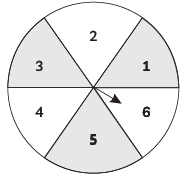
Q44: In the figure, a disc is shown on which a player spins an arrow twice. The function a / b  is formed, where ‘a’ is the number of sectors on which the arrow stops on the first spin and ‘b’ is the number of the sectors in which the arrow stops on the second spin. On each spin, each sector has an equal chance of selection by the arrow. Find the probability that the fraction a / b > 1 (CBSE 2016)
Hide Answer  

Ans:  For a / b > 1, 
When a = 1, b can not take any value. 
When a = 2, b can take one value i.e., 1.
When a = 3, b can take two values i.e., 1, 2. 
When a = 4, b can take three values i.e., 1, 2, 3. 
When a = 5, b can take four values i.e., 1, 2, 3, 4. 
When a = 6, b can take five values i.e., 1, 2, 3, 4, 5. 
Here, total number of possible outcomes is same as when we throw a dice twice. 
∴ Total possible outcomes = 36
∴ P ( ab > 1 ) = 1 + 2 + 3 + 4 + 536

= 15/36
= 5 / 12
Hence, the required probability is 5 / 12

13. Previous Year Questions: Statistics

Previous Year Questions 2025

Q1: The mean of seven observations is 17. If the mean of the first four observations is 15 and that of the last four observations is 18, then the fourth observation is: 
(a) 14
(b) 13
(c) 12
(d) 10

Hide Answer  

Ans: (b)
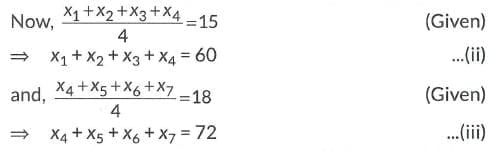
Let x1, x2, x3 , x4, x5, x6 and x7 be first seven observations. 


Adding (ii) and (iii) and then subtract (i), we get
(x1 + x2 + x3 + x4) + (x4 + x5 + x6 + x7) – (x1 + x2 + x3 + x4 + x5 + x6 + x7) = 60 + 72 – 119
⇒ x4 = 13


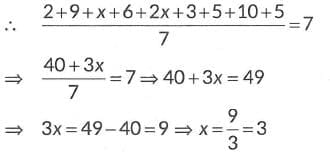
Q2: If the mean of 2, 9, x + 6, 2x + 3, 5, 10, 5 is 7, then the value of x is: 
(a) 9
(c) 5
(b) 6
(d) 3

Hide Answer  

Ans: (d)
Given mean= 7


Q3: If the maximum number of students has obtained 52 marks out of 80, then 
(a) 
52 is the mean of the data. 
(b) 
52 is the median of the data.
(c) 
52 is the mode of the data. 
(d) 
52 is the range of the data.

Hide Answer  

Ans: (c) 


Q4: Mode and Mean of a data are 15x and 18x, respectively. Then the median of the data is : 
(a) x
(b) 11x 
(c) 17x
(d) 34x

Hide Answer  

Ans: (c)
Using empirical formula, 
Mode = 3 Median – 2 Mean 
⇒ 15x = 3 Median – 2(18x) 
⇒ 3 Median = 15x + 36x
⇒ 3 Median = 51x 
⇒ Median= 17x


Q5: If the mode of some observation is 10 and sum of mean and median is 25, then the mean and median respectively are
(a) 12 and 13
(c) 13 and 12
(b) 10 and 15
(d) 15 and 10

Hide Answer  

Ans: (b)
Given, Mode = 10 
Mean+ Median= 25
By Empirical formula, 
Mode = 3 Median – 2 Mean 
⇒ 10 = 3(25 – Mean) – 2 Mean 
⇒ 5 Mean= 65 ⇒ Mean= 13 
∴ Median= 25 – 13 = 12


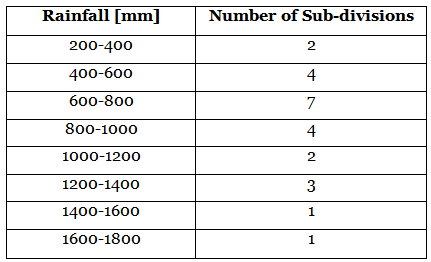
Q6: Case Study: The India Meteorological Department observes seasonal and annual rainfall every year in different sub-divisions of our country. It helps them to compare and analyse the results. 
The table below shows sub-divisions wise seasonal (monsoon) rainfall (in mm) in 2023. 
Based on the information given above, answer the following questions :
(i) Write the modal class.  (1 Mark)
(ii) (a) Find the median of the given data.  (2 Marks)

OR

(b) Find the mean rainfall in the season.  (2 Marks)
(iii) If a sub-division having at least 800 mm rainfall during monsoon season is considered a good rainfall sub-division, then how many sub-divisions had good rainfall ? (1 Mark)

Hide Answer  

Ans: 

(i) Class corresponding to maximum frequency 7 is 600-800 
∴ Modal class is 600-800. 
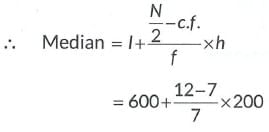
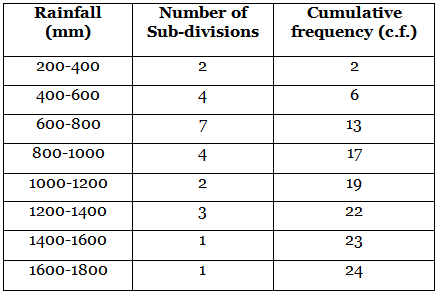
(ii) (a) Here, N/2 = 24/2 = 12
The cumulative frequency just greater than 12 is 14 and corresponding class is 600 – 800. 
∴ Median class is 600-800. 
Here, I= 600, N/2 = 12, f = 7, c.f = 7, h = 200


OR
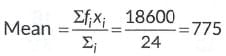
(ii) (b) 
(iii) As a sub-division having at least 800 mm rainfall is considered as a good rain fall. Number of sub divisions that had good rain fall =4+3+3=10


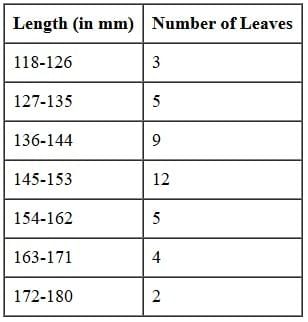
Q7: The lengths of 40 leaves of plant are measured correct to the nearest millimeter, and the data obtained is r epresented in the following table: 
Find the median length of the leaves.

Hide Answer  

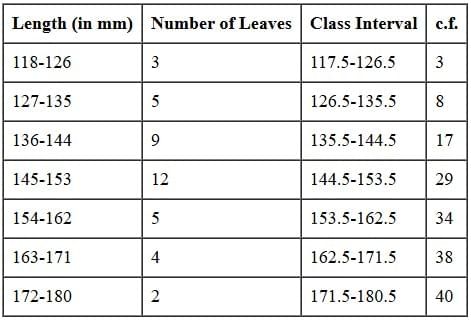
Ans: Here, the class intervals are not in inclusive form. So, we first convert them in inclusive form by subtracting 0.5 from lower limit and adding 0.5 to the upper limit. The given frequency distribution in inclusive form is as follows:
Here, N/2 = 40/2 = 20

⇒ Median class is 144.5-153.5
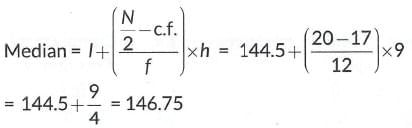
Here, I= 144.5, h = 9, c.f. = 17, f = 12 

Hence, the median length of the leaves is 146.75 mm.


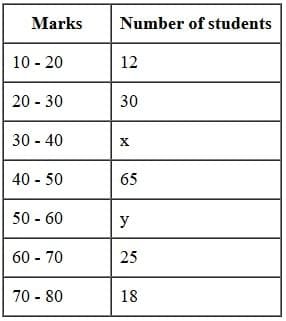
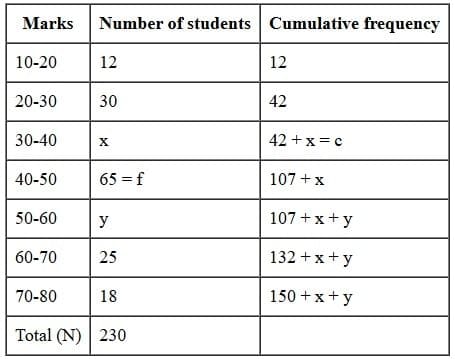
Q8: Following distribution shows the marks of 230 students in a particular subject. If the median marks are 46, then find the values of x and y. 

Hide Answer  

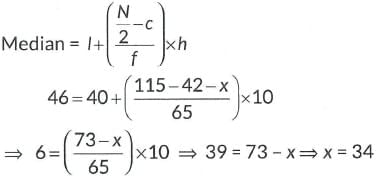
Ans: 
Median= 46, N = 230, h = 10 
∴ Median class= 40 – 50 ⇒ I = 40

∴ 150 + x + y = 230 ⇒ x + y = 80    ..(i)
∴ f = 65 and c = 42 + x

Using equation (i), 
∴ we get y = 80 – 34 = 46 
∴ x = 34 and y = 46

Previous Year Questions 2024

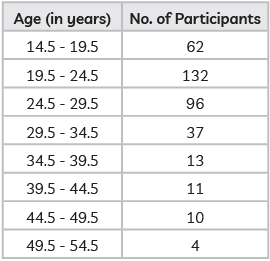
Q1: Vocational training complements traditional education by providing practical skills and 

From the above answer the following questions: (4 & 5 Marks) (CBSE 2024)
(A) What is the lower limit of the modal class of the above data?
(B) Find the median class of the above data.
OR
Find the number of participants of age less than 50 years who undergo vocational training.
(C) Give the empirical relationship between mean, median and mode. 

Hide Answer  

Ans:
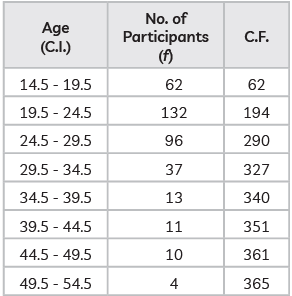
First convert the given table in exclusive form subtract 0.5 from lower limit and add 0.5 to upper limit, so the new table will be:

(i) Modal class is the class with highest frequency, so, it is 19.5 – 24.5. hence, lower limit will be ‘19.5’.
(ii) (a)

N/2 = 365/2 = 182.5
Medium class will be 19.5 – 24.5.
OR
(b) Approx 361 participants are there at Class Interval 44.5-49.5 showing 361 cummulative frequency.
Hence 361 participants are less than 50 year of age who undergo vocational training.
(iii) Empirical relationship between mean, median and mode.
Mode = 3 Median – 2 Mean

Get additional INR 200 off today with EDUREV200 coupon.

Previous Year Questions 2023

Q2: If the value of each observation of statistical data is increased by 3. then the mean of the data   (1 Mark) (2023)
(a) remains unchanged
(b) increases by 3
(c) increases by 6
(d) increases by 3n

Hide Answer  

Ans: (b)
New Mean = Old Mean + 3
If each value of observation is increased by 3. then mean is also increased by 3.


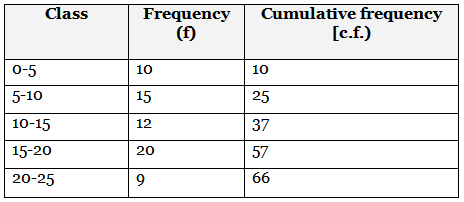
Q3: For the following distribution.    (1 Mark) (2023)

The sum of the lower limits of the median and modal class is
(a) 15
(b) 25
(c) 30
(d) 35

Hide Answer  

Ans: (b)

Here, n/2 = 66/2 = 33
Cumulative frequency just greater than 33 is 37.
So. median class is 10 – 15. Lower limit of median class = 10
Highest frequency is 20 so modal class is 15 – 20.
Sum of the lower limits of the median and modaI class is 10 + 15 = 25 


Q4: India’s meteorological department observes seasonal and annual rainfall every year in different subdivisions of our country.

It helps them to compare and analyse the results. The table given below shows sub-division-wise seasonal (monsoon] rainfall [mm) in 2018:

Based on the above information, answer the following questions.
(I) Write the modal class.
(II) Find the median of the given data.

OR
Find the mean rainfall in this season.
(Ill) If a sub-division having at least 1000 mm rainfall during monsoon season, is considered a good rainfall sub-division, then how many sub-divisions had good rainfall?    (4/5/6 Marks) (2023)

Hide Answer  

Ans:

(i) Here, maximum class frequency is 7 and class corresponding to this frequency is 600-800, so the modal class is 600-800.
(ii) Here n/2 = 24/2 = 12
Class whose cumulative frequency just greater than and nearest to n/2 is called median class.
Here, cf. = 13 (>12) and corresponding class 600 – 800 is : median class.
1 = 600. c.f. = 6,f= 7, h = 200
∴ Median = l + n2 – c.f.f × h

= 600 + 12 – 67 × 200

= 600 + 67 × 200

= 771.429So. the median of the given data is 771.429OR

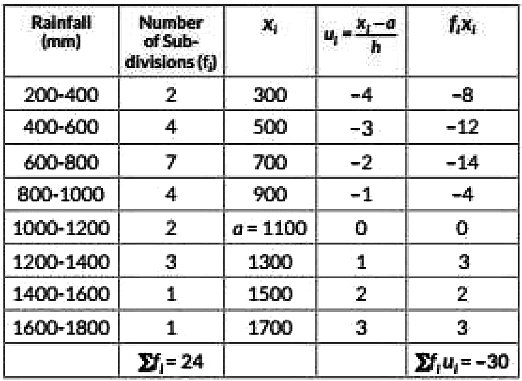
Assumed mean a = 1100 and class size, h = 400 – 200 = 200
∴ Mean = a + h∑ fi [∑ fi ui]

= 1100 + 20024 × (-30)

= 1100 – 600024

= 850So, mean rainfall in the season is 850 mm.
(iii)  Number of sub-division having good rainfall
= 2 + 3 +1 + 1 = 7


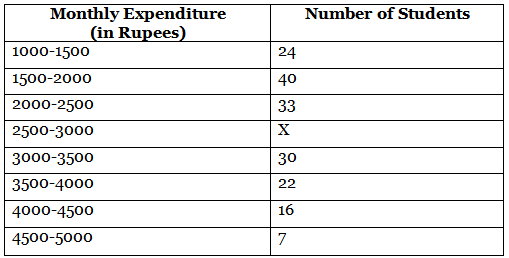
Q5:  The monthly expenditure on milk in 200 families of a Housing Society is given below

Find the value of x and also, find the median and mean expenditure on milk.     (4/5/6 Marks) (CBSE 2023)

Hide Answer  

Ans: 

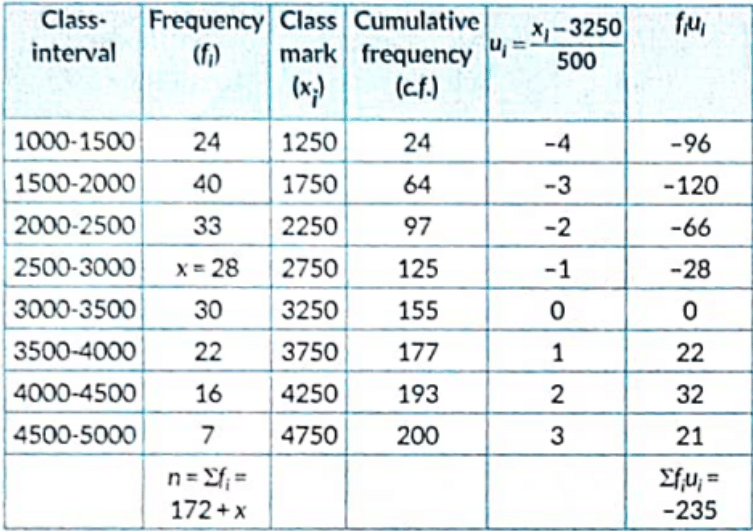
Since, 200 = 172 + x ⇒ x = 28
Let the assumed mean, a = 3250 and class size, h = 500

Mean( x̄ ) = a + h × 1n ∑ fi ui

= 3250 + 500 × 1200 × (-235)

= 3250 – 587.5 = 2,662.5

Mean expenditure = ₹ 2,662.5

Also, we have n/2 = 100, which lies in the class interval 2500 – 3000.

Median class is 2500 – 3000.

Here l = 2500, c.f. = 97, f = 28, h = 500

Median = l + n2 – c.f.f × h

= 2500 + 100 – 9728 × 500

= 2500 + 328 × 500

= 2553.57

∴ Median expenditure = ₹ 2553.57


Q6: For the following distribution:

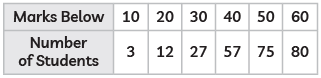
The modal class is: 
(a) 10–20
(b) 20–30
(c) 30–40 
(d) 50–60   (1 Mark) (CBSE 2023)

Hide Answer  

Ans: (c)
Step 1: Identify the Class Intervals
The table provided shows cumulative frequencies for marks below certain values:

  • Marks below 10: 3 students
  • Marks below 20: 12 students
  • Marks below 30: 27 students
  • Marks below 40: 57 students
  • Marks below 50: 75 students
  • Marks below 60: 80 students

To find the frequencies for each class, we calculate the difference between consecutive cumulative frequencies:

  1. 10−20: 12−3=9
  2. 20−30: 27−12=15
  3. 330−40: 57−27=30
  4. 40−50: 75−57=18
  5. 50−60: 80−75=5

So, the frequencies for each interval are:

  • 10−20: 9
  • 20−30: 15
  • 30−40: 30
  • 40−50: 18
  • 550−60: 5

Step 2: Determine the Modal Class
The modal class is the class interval with the highest frequency. From the calculated frequencies, the highest frequency is 30, which corresponds to the class interval 30−40.
The modal class is: (c) 30−40.

Also read: Important Definitions & Formulas: Statistics

Previous Year Questions 2022

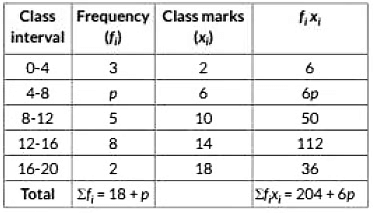
Q7: If the mean of the following frequency distribution is 10.8. then find the value of p:    (2022)

Hide Answer  

Ans: Table for the given data is as follows:

Now Mean =

10.8 = (2 × 3) + (6 × p) + (10 × 5) + (14 × 8) + (18 × 2)3 + p + 5 + 8 + 2

Solving for p:

10.8 = 6 + 6p + 50 + 112 + 3618 + p

10.8 = 204 + 6p18 + p

(10.8)(18 + p) = 204 + 6p

194.4 + 10.8p = 204 + 6p

4.8p = 9.6

p = 9.64.8

p = 2


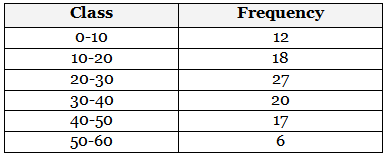
Q8: Find the mean of the following frequency distribution:    (2022)

Hide Answer  

Ans: 

Midpoint = Lower Limit + Upper Limit2

For the given class intervals:

  • Midpoint of 0-10: 0 + 102 = 5
  • Midpoint of 10-20: 10 + 202 = 15
  • Midpoint of 20-30: 20 + 302 = 25
  • Midpoint of 30-40: 30 + 402 = 35
  • Midpoint of 40-50: 40 + 502 = 45
  • Midpoint of 50-60: 50 + 602 = 55

Now, we’ll multiply each midpoint by its corresponding frequency, sum up these products, and divide by the total frequency to find the mean:

Mean = ∑ (Midpoint × Frequency)Total Frequency

So, the mean is:

Mean = (5 × 12) + (15 × 18) + (25 × 27) + (35 × 20) + (45 × 17) + (55 × 6)

= 60 + 270 + 675 + 700 + 765 + 330

Mean = 2800100

Mean = 28


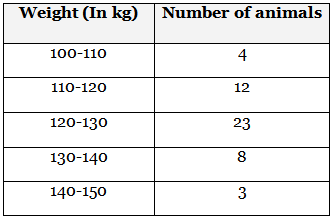
Q9: The weights (in kg) of 50 wild animals of a National Park were recorded and the following data was obtained is

Find the mean weight (in kg) of animals, using the assumed mean method.    (2022)

Hide Answer  

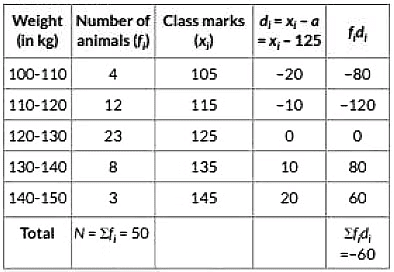
Ans: Let the assumed mean, a = 125 We have the frequency distribution table for the given data as follows :

∴ Mean ( x̄ ) = a + 1N ∑ fi di

= 125 + 150 × (-60)

= 125 – 6050

= 125 – 1.2 = 123.8Hence, mean weight of animals = 123.8 kg.


Q10: The mean of the following frequency distribution is 25. Find the value off.    (2022)

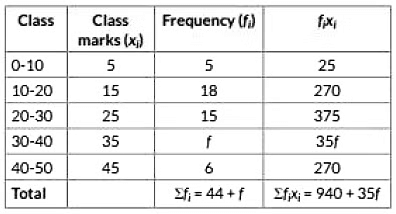
Hide Answer  

Ans: The frequency distribution table from the given data is as follows:

∴ Mean ( x̄ ) = ∑ fi xi∑ fi

⇒ 25 = 940 + 35f44 + f     [∵ Given, mean = 25]

⇒ 25(44 + f) = 940 + 35f

⇒ 1100 + 25f = 940 + 35f

⇒ 10f = 160

⇒ f = 16Hence, the value of f is 16.


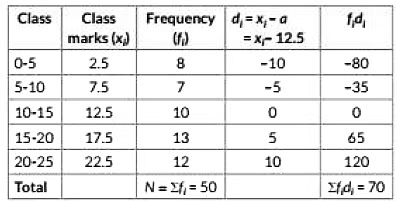
Q11: Find the mean of the following data using the assumed mean method.   [2022, 2 Marks]

Hide Answer  

Ans: Let the assumed mean, a = 12.5 .-. d
⇒ d = xi – a = xi – 12.5  
Now, we have the frequency distribution table as follows:

∴ Mean ( x̄ ) = a + 1N ∑ fi di

= 12.5 + 7050

= 12.5 + 1.4= 13.9


Q12: The mode of a grouped frequency distribution is 75 and the modal class is 65-80. The frequency of the class preceding the modal class is 6 and the frequency of the class succeeding the modal class is 8. Find the frequency of the modal class.     (2022)

Hide Answer  

Ans: We know that

Mode = l + f1 – f02f1 – f0 – f2 × h … (i)

Here given l = 65, f0 = 6, f1 = f, h = 15, f2 = 8 and mode = 75

So, from equation (i), we get

75 = 65 + f – 62f – 6 – 8 × 15

75 = 65 + f – 62f – 14 × 15

75 – 65 = (f – 6) × 152f – 14

(2f – 14) × 10 = 15f – 90

⇒ 20f – 15f = -90 + 140

⇒ 5f = 50

∴ f = 10


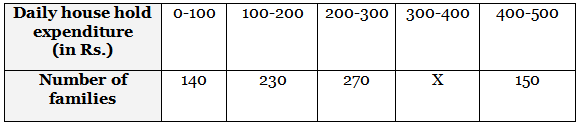
Q13: Find the missing frequency ‘x ‘ of the following data, if its mode is 240:    (2022)

Hide Answer  

Ans: Here the given mode = 240, which lies in interval 200-300.
l = 200, f0 = 230, f1= 270, f2 = x (missing frequency] and h = 100

∴ Mode = l + f1 – f02f1 – f0 – f2 × h

240 = 200 + 270 – 2302 × 270 – 230 – x × 100

240 = 200 + 40310 – x × 100

⇒ 240 – 200 = 4000310 – x

⇒ 40 = 4000310 – x

⇒ 310 – x = 100

⇒ x = 310 – 100 = 210

Missing frequency, x = 210


Q14: If the mode of the following frequency distribution is 55, then find the value of x.     (2022)

Hide Answer  

Ans: Here, mode of the frequency distribution = 55.
which lies in the class interval 45-60.
∴ Modal class is 45 – 60
Lower limit (l) = 45
Class interval (h) = 15
Also, f 0 = 15, f 1 = x and f 2 = 10

Mode = l + f0 – f12f0 – f1 – f2 × h

⇒ 55 = 45 + 15 – x30 – x – 10 × 15

⇒ 55 – 45 = 15(15 – x)30 – x – 10

⇒ 10(30 – x – 10) = 225 – 15x

⇒ 300 – 10x – 100 = 225 – 15x

⇒ 5x = 25
⇒ x = 5


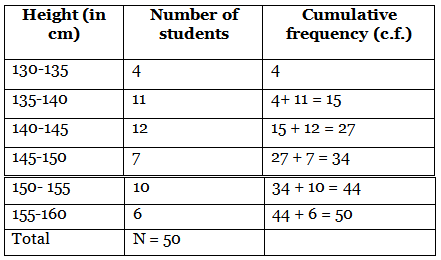
Q15: Heights of 50 students in class X of a school are recorded and the following data is obtained:     (2022)

Find the median height of the students. 

Hide Answer  

Ans: The cumulative frequency distribution table is as follows:


Now, we have N = 50

⇒ N2 = 502 = 25

Since, the cumulative frequency just greater than 25 is 27.

∴ The median class is 140 – 145

And also, l = 140, c.f. = 15, f = 12 and h = 5

∴ Median = l + N2 – c.f.f × h

= 140 + 25 – 1512 × 5

= 140 + 1012 × 5

= 140 + 4.16 = 144.16

∴ Median height of the students = 144.16 cm.


Q16: Health insurance is an agreement whereby the insurance company agrees to undertake a guarantee of compensation for medical expenses in case the insured faffs ill or meets with an accident that leads to the Hospitalisation of the insured. The government also promotes health insurance by providing a deduction from income tax.
An SB I health insurance agent found the following data for the distribution of ages of 100 policyholders.
The health insurance policies are given to persons aged 15 years and onwards briefest than 60 years.

(i) Find the modal age of the policy holders.
(ii) Find the median age of the policy holders.     (2022)

Hide Answer  

Ans: (i) It is clear from the given data, maximum frequency is 33. which lies in 35 – 40
∴ Modal class is 35 – 40.

So, l = 35, f0 = 21, f1 = 33, f2 = 11, and h = 5

∴ Mode = l + f1 – f02f1 – f0 – f2 × h

So, modal age of policy holders

= 35 + 33 – 212 × 33 – 21 – 11 × 5

= 35 + 1234 × 5

= 35 + 6034

= 35 + 1.76

= 36.76 (approx)

So, modal age of policy holders is 37 years approx.

Attention!Sale expiring soon, act now & get EduRev Infinity at 40% off!

Previous Year Questions 2021

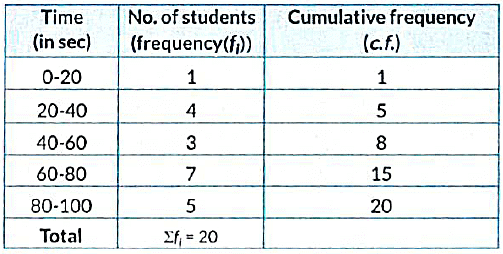
Q17: During the annual sports meet in a school, all the athletes were very enthusiastic. They all wanted to be the winner so that their house could stand first. The instructor noted down the time taken by a group of students to complete a certain race. The data recorded is given below:

Based on the above, answer the following questions:    (2021)

We need to make the following frequency table as follows:

(i) What is the class mark of the modal class?
(a) 60
(b) 70
(c) 80
(d) 140

Hide Answer  

Ans: (b)
Here the greatest frequency is 7, which lies in the interval 60-80.
So, modal class is 60-80.
Class mark of modal class = upper limit + lower limit / 2
= 60 + 80 / 2 = 70
So, class mark of modal class is 70.

(ii) The mode of the given data is
(a) 70-33
(b) 71-33
(c) 72-33
(d) 73-33

Hide Answer  

Ans: (d)

h = 20, l = 60, f1 = 7, f0 = 3, f2 = 5

∴ Mode = l + f1 – f02f1 – f0 – f2 × h

= 60 + 7 – 32 × 7 – 3 – 5 × 20

= 60 + 46 × 20

= 60 + 13.33

Mode = 73.33

(iii) The median class of the given data is
(a) 20-40
(b) 40-60
(c) 80-100  
(d) 60-80

Hide Answer  

Ans: (d)
Here n = 20 ⇒ n /2 = 10
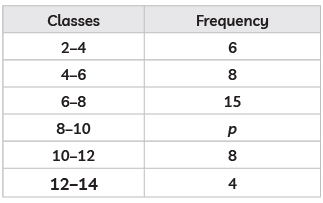
Cumulative frequency just greater than 10 is 15 and corresponding interval is 60-80.
So, median class is 60-80.

(iv) The sum of the lower limits of median class and modal class is 1
(a) 80
(b) 140
(c) 120 
(d) 100

Hide Answer  

Ans: (c)
Median class = 60-80 .
∴ Lower limit of median = 60
Modal class – 60-80 = 120
∴ Lower limit of modal class = 60
So, the sum of lower limit of median and modal class = 60 + 60 = 120

(v) The median time (in seconds) of the given data is
(a) 65-7 
(b) 85-7 
(c) 45-7 
(d) 25-7

Hide Answer  

Ans: (a)
From the above  data, we have
l = 60, f = 7, c.f. = 8, h = 20
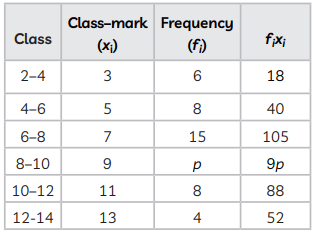
∴ Median = l + n2 – c.f.f × h

= 60 + 202 – 87 × 20

= 60 + 10 – 87 × 20

= 60 + 407

= 60 + 5.714

= 65.71 (approx)

So, median time (in sec) of the given data = 65.7 sec.

Previous Year Questions 2020

Q18: If the mean of the first n natural number, is 15, then find n.    (2020)

Hide Answer  

Ans: Given, mean of first n natural numbers is 15.

⇒ 1 + 2 + 3 + ….. + nn = 15

⇒ 1 + 2 + 3 + ….. + n = 15n

⇒ n(n + 1)2 = 15n

⇒ n² + n = 30n

⇒ n² – 29n = 0

⇒ n(n – 29) = 0

⇒ n = 29 [n ≠ 0]


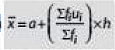
Q19: In the formula  , What is ui?   (2020)

Hide Answer  

Ans: In the formula


where a is assumed mean and h = class size.


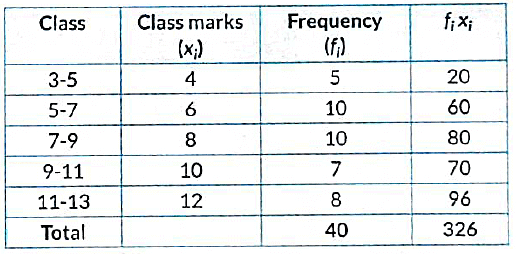
Q20: Find the mean of the following distribution:    (2020)

Hide Answer  

Ans:  The frequency distribution table from the given data can be drawn as :

∴ Mean = 326/40 = 8.15


Q21: Find the mode of the following distribution:     (2020)

Hide Answer  

Ans: From the given data, we have maximum frequency 75. which lies in the interval 20-25.
Modal class is 20-25
So, l = 20, f0= 30, f1 = 75,  f2= 20, h = 5

∴ Mode = l + f1 – f02f1 – f0 – f2 × h

= 20 + 75 – 302(75) – 30 – 20 × 5

= 20 + 45100 × 5
Mode = 20 + 2.25
= 22.25


Q22: Find the mode of the following distribution:     (2020)

Hide Answer  

Ans: From the given data, we have maximum frequency 12.
which lies in the interval 30-40
Modal class is 30-40
So, l = 30, f0= 12, f1 = 7,  f2= 5, h = 10

Mode = l + f1 – f02f1 – f0 – f2 × h

= 30 + 12 – 72 × 12 – 7 – 5 × 10

= 30 + 524 – 12 × 10

= 30 + 5012

= 30 + 4.17

= 34.17


Q23: Find the mode of the following distribution:     (2020)

Hide Answer  

Ans: From the given data, we have maximum frequency 12.
which lies in the interval 60-80.
Modal class is 60-80
So, l = 60, f0= 12, f1 = 10,  f2= 6, h = 20

Mode = l + f1 – f02f1 – f0 – f2 × h

= 60 + 12 – 102 × 12 – 10 – 6 × 20

= 60 + 224 – 16 × 20

= 60 + 28 × 20

= 60 + 5

= 65


Q24: The mean and median of distribution are 14 and 15 respectively. The value of mode is    (2020)
(a) 16
(b) 17
(c) 13
(d) 18 

Hide Answer  

Ans: (b)
We know that Mode = 3 Median – 2 Mean
So, Mode = 3 x  15 – 2 x 14
= 45 – 28 = 17 


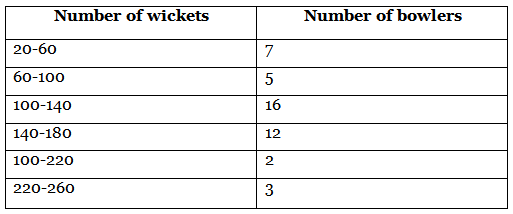
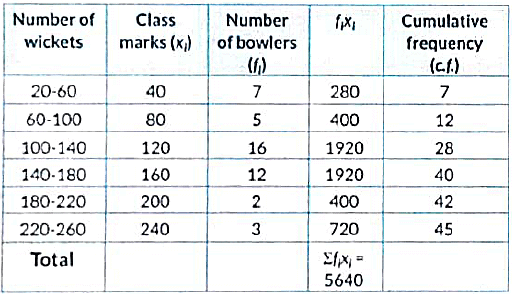
Q25: The distribution given below shows the number of wickets taken by bowlers in one-day cricket matches. Find the mean and the median of the number of wickets taken.     (2020)

Hide Answer  

Ans: The frequency distribution table for the given data can be drawn as:

Mean = ∑ fi xi∑ fi = 564045 = 125.33

Here, N2 = 452 = 22.5

∴ Median class is 100-140.

Also, l = 100, c.f. = 12, f = 16, h = 40

So, Median = l + N2 – c.f.f × h

= 100 + 22.5 – 1216 × 40

= 100 + 10.516 × 40= 100 + 26.25
= 126.25

Hence, mean number of wickets is 125.33 and median number of wickets is 126.25.


Q26: Find the value of p, if the mean of the following distribution is 7.5. (CBSE 2020)

Hide Answer  

Ans: 

Here, Σfi = 41 + p
and Σfixi = 303 + 9p

We know, Mean = ∑ fi xi∑ fi

But, Mean = 7.5 [Given]

∴ 7.5 = 303 + 9p41 + p

⇒ 303 + 9p = 307.5 + 7.5p

⇒ 1.5p = 4.5

⇒ p = 3

Hence, the value of p is 3.

Also read: Important Definitions & Formulas: Statistics

Previous Year Questions 2019

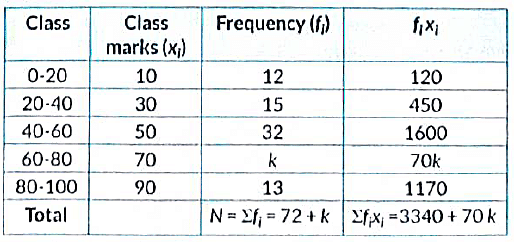
Q27: The arithmetic mean of the following frequency distribution is 53. Find the value of k.     (2019)

Hide Answer  

Ans: The frequency distribution table from the given data is as follows:

Now, mean = ∑ fi xi∑ fi = 53 [Given]

∴ 3340 + 70k72 + k = 53

⇒ 3340 + 70k = 3816 + 53k

⇒ 70k – 53k = 3816 – 3340

⇒ 17k = 476

⇒ k = 28


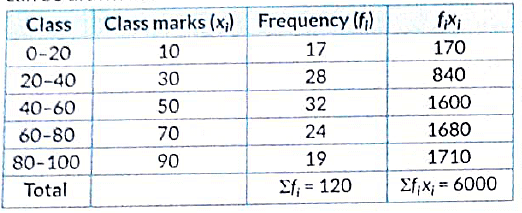
Q28: Find the mean of the following frequency distribution:

Hide Answer  

Ans: he frequency distribution table from the given data is as follows:

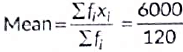
∴ 
= 50


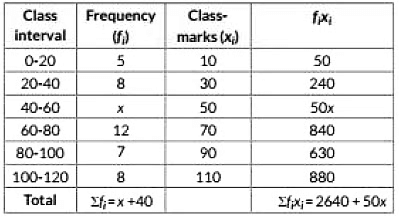
Q29: If the mean of the following frequency distribution is 62.8, then find the missing frequency x:     (2019)

Hide Answer  

Ans: Here h = 20
Let us construct the following table far the given data.

We know that Mean = ∑ fi xi∑ fi

⇒ 62.8 = 2640 + 50×40 + x

⇒ 62.8(40 + x) = 2640 + 50x

⇒ 2512 + 62.8x = 2640 + 50x

⇒ 62.8x – 50x = 2640 – 2512

⇒ 12.8x = 128 ⇒ x = 12812.8


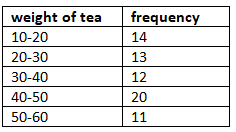
Q30: The weights of tea in 70 packets are given in the following table:     (2019)
Find the modal weight.

Hide Answer  

Ans: From the given data, we observe that, highest frequency is 20,
which lies in the class-interval 40-50.
∴ l = 40, f1 =  20, fo= 12, f2 = 11, h = 10

Mode = l + f1 – f02f1 – f0 – f2 × h

= 40 + 20 – 1240 – 12 – 11 × 10

= 40 + 8017

= 40 + 4.7 = 44.7


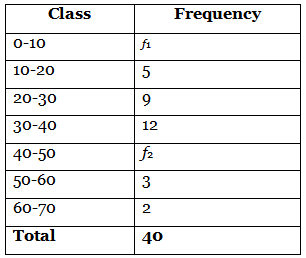
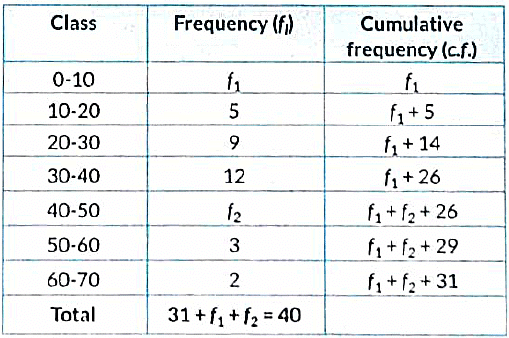
Q31: If the median of the following frequency distribution is 32.5, find the values of f1 and f2.     (2019)

Hide Answer  

Ans: The frequency distribution table for the given data is as follows:

Here, N = 40 ⇒ 31 + f1 + f2 = 40
⇒ f1 + f= 9 …(i)
Given, median = 32.5, which lies in the class interval 30-40.
So, median class is 30-40.
I = 30, h = 10, f = 12, N = 40 and c.f. of preceding class = f1 + 14

Now, median = l + N2 – c.f.f × h

⇒ 32.5 = 30 + 20 – (f1 + 14)12 × 10

⇒ 2.5 = 6 – f112 × 10

⇒ 6 – f1 = 3 ⇒ f1 = 3

From (i), f2 = 9 – 3 = 6


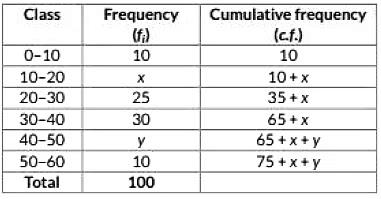
Q32: Find the values of frequencies x and y in the following frequency distribution table, if N = 100 and median is 32.     (2019)

Hide Answer  

Ans: The frequency distribution table for the given data is as follows:

Here. N = 100, median = 32, it lies in the Interval 30 – 40.

∴ Median = l + N2 – c.f.f × h

⇒ 32 = 30 + 50 – (35 + x)30 × 10

⇒ 32 – 30 = 15 – x3

⇒ 15 – x = 6

⇒ x = 9

Also, 75 + x + y = 100

⇒ 75 + 9 + y = 100

⇒ y = 100 – 84 = 16

12. Previous Year Questions: Surface Areas & Volumes

Previous Year Questions 2025

Q1: The radii ‘r’ of a sphere and that of the base of a cone are same. If their volumes are also same, then the height of the cone is:
(a) r
(b) 2r
(c) 3r
(d) 4r

Hide Answer  

Ans: (d)
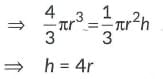
Given, radius of sphere= radius of cone= r 
Also, volume of sphere= volume of cone


Q2: If the volumes of two cubes are in the ratio 8 : 125, then the ratio of their surface areas is :
(a) 8 : 125
(b) 4 : 25
(c) 2 : 5
(d) 16 : 25

Hide Answer  

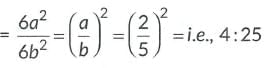
Ans: Let a be side of one cube and b be side of another cube. 
Given, ratio of their volumes= 8:125

Ratio of their surface are 


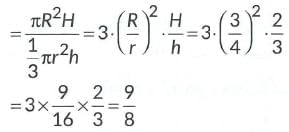
Q3: If the radii of the bases of a cylinder and a cone are in the ratio 3: 4 and their heights are in the ratio 2 : 3, find the ratio of their volumes.  (3 Marks)

Hide Answer  

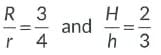
Ans: Let r and R be the radius of cone and cylinder respectively and h and H be the height of cone and cylinder respectively. 
The volume of cylinder (V1) = πR2H
Volume of cone (V2) = Given,

∴  Ratio of their volumes is given by V1/V2

∴ Ratio of their volumes= 9: 8


Q4: Assertion (A) : If we join two hemispheres of same radius along their bases, then we get a sphere. 
Reason (R) : Total surface area of a sphere of radius r is 3πr2.
(a) Both Assertion (A) and Reason (R) are true and Reason (R) is the correct explanation of the Assertion (A). 
(b) Both Assertion (A) and Reason (R) are true, but Reason (R) is not the correct explanation of the Assertion (A). 
(c) Assertion (A) is true, but Reason (R) is false. 
(d) Assertion (A) is false, but Reason (R) 

Hide Answer  

Ans: (c)
Also, total surface area of a sphere of radius r is 4πr2
So, Assertion is true, but Reason is false. 

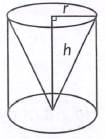
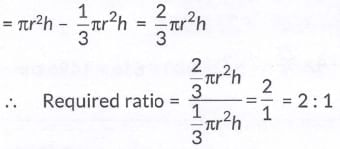
Q5: If a cone of greatest possible volume is hollowed out from a solid wooden cylinder, then the ratio of the volume of remaining wood to the volume of cone hollowed out is 
(a) 1: 1 
(b) 1: 3
(c) 2: 1 
 (d) 3: 1

Hide Answer  

Ans: (c)
Let rand h be the radius and height of cylinder respectively. 

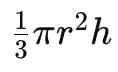
Volume of cone hollowed out = 1/3πr2h
Volume of remaining wood = Volume of cylinder – Volume of cone


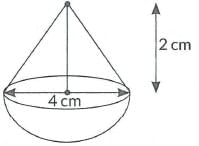
Q6: A solid toy is in the form of a hemisphere surmounted by a right circular cone. The height of the cone is 2 cm and the diameter of the base is 4 cm. Determine the volume of the toy. Also, find the a surface area of the toy. (Take π = 3.14)

Hide Answer  

Ans: Given, diameter of conical part = Diameter of hemispherical part= 4 cm 
Radius of conical part (r) = radius of hemispherical part (r) = 4/2 = 2 cm.

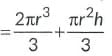
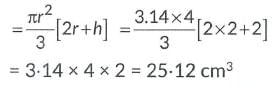
∴ Volume of toy= Volume of hemisphere+ Volume of cone = 

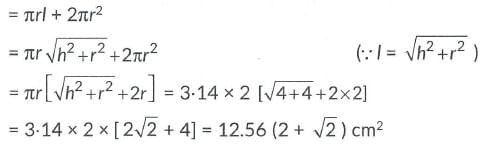
∴ Surface area of toy= Curved surface area of cone+ Curved surface area of hemisphere


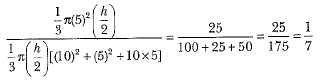
Q7: A vessel is in the form of an inverted cone. Its height is 8 cm and the radius of its top, which is open, is 5 cm. It is filled with water up to the brim. When lead shots, each of which is a sphere of radius 0.5 cm, are dropped into the vessel, one-fourth of the water flows out. Find the number of lead shots dropped in the vessel.

Hide Answer  

Ans: 

As the water is filled up to the brim in the vessel

Volume of water in the vessel = Volume of the conical vessel

On dropping a certain number of lead shots (sphere) into the vessel one-fourth of the water flows out.

Volume of all lead shots dropped into the vessel = 1/4 × Volume of the water in the vessel

Hence,

Number of lead shots = 1/4 × volume of the water in the vessel ÷ volume of each lead shot

We will find the volume of the water in the vessel and lead shot by using formulae;

Volume of the sphere = 4/3 πr3

where r is the radius of the sphere

Volume of the cone = 1/3 πR2h

where R and h are the radius and height of the cone respectively

Height of the conical vessel, h = 8 cm

Radius of the conical vessel, R = 5 cm

Radius of the spherical lead shot, r = 0.5 cm

Number of lead shots = 1/4 × volume of the water in the vessel ÷ volume of each lead shot

= 1 /4 × (1/3) πR2h × 3/4 πr3

= πR2h/12 × 3/4πr3

= R2h / 16r3

= (5cm × 5 cm × 8 cm) / (16 × 0.5 cm × 0.5 cm × 0.5 cm)

= 100

Thus, the number of lead shots dropped in the vessel is 100.


Q8: From one face of a solid cube of side 14 cm, the largest possible cone is carved out. Find the volume and surface area of the remaining solid. (use π = 22/7, √5 = 2.2)

Hide Answer  

Ans: Height of largest cone= Side of cube 
H = 14 cm 
Diameter of largest cone= Side of cube 
∴ 2R = 14cm 
R=7cm 
∴ Volume of the largest cone = 1/3πR2H


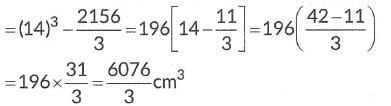
Volume of remaining solid = (side)3 – Volume of cone 

Slant height of cone

L = 15.4 cm 
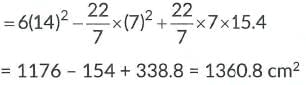
Surface area of remaining solid= 6(side)2 – πR2 + πRL 

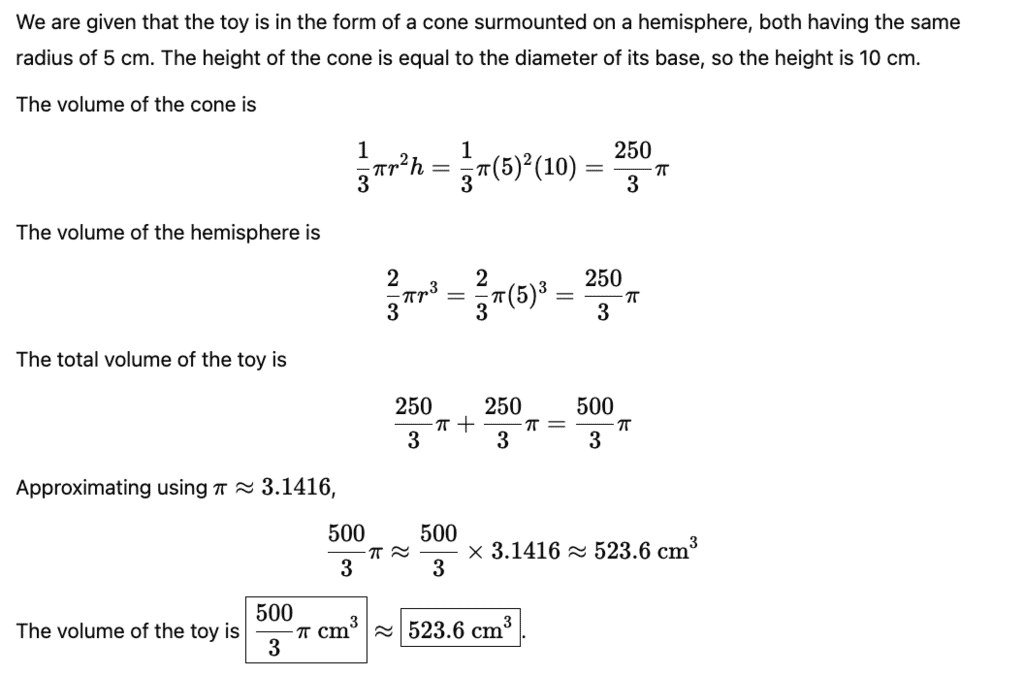
Q9: (a) A toy is in the form of a cone surmounted on a hemisphere. The cone and hemisphere have the same radii. The height of the conical part of the toy is equal to the diameter of its base. If the radius of the conical part is 5 cm, find the volume of the toy.
OR
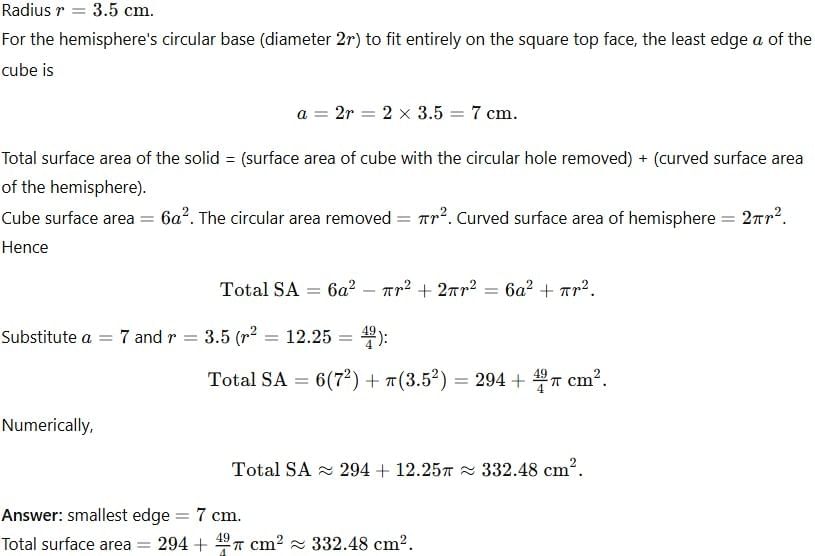
(b) A cubical block is surmounted by a hemisphere of radius 3·5 cm. What is the smallest possible length of the edge of the cube so that the hemisphere can totally lie on the cube ? Find the total surface area of the solid so formed.
(5 Marks) (CBSE 2025)

Hide Answer  

Ans:(a)


(b)

Previous Year Questions 2024

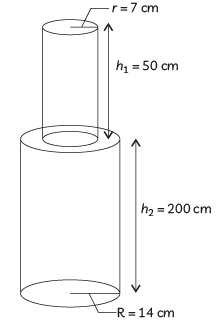
Q3: A solid iron pole consists of a solid cylinder of height 200 cm and base diameter 28 cm, which is surmounted by another cylinder of height 50 cm and radius 7 cm. Find the mass of the pole, given that 1 cm3 of iron has approximately 8 g mass.   

(4 & 5 Marks) (CBSE 2024)

Hide Answer  

Ans:
Here, the height of small cylinder (h1) = 50 cm
Radius of small cylinder r =  7 cm
Height of longer cylinder (h2) = 200 cm
Radius of longer cylinder (R) = 14 cm
Volume of figure = Volume of small cylinder + volume of big cylinder
= πr²h₁ + πr²h₂
= π[r²h₁ + R²h₂]

= 227 [7 × 7 × 50 + 14 × 14 × 200]

= 227 × 49 × 50 [1 + 4]

= 22 × 7 × 50 × 171

= 1,30,900 cm3
Mass = Volume × Density
= 10,47,200 g
≈ 1047.2 kg 


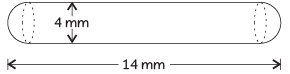
Q4: A medicine capsule is in the shape of a cylinder with two hemispheres stuck to each of its ends. The length of the entire capsule is 14 mm and the diameter of the capsule is 4 mm, find its surface area. Also, find its volume.        (4 & 5 Marks) (CBSE 2024)

Hide Answer  

Ans:
Here, two figures are combined, 2 hemisphere and cylinder.
Radius of cylinder = radius of hemisphere
= 4/2 = 2 mm
Height of cylinder (h) = 14 – (2 + 2)
= 14 – 4 = 10 mm.
Surface area of capsule = curved surface area of two hemispheres + curved surface area of cylinder

= 2 × 2 πr² + 2πrh
= 2πr [2r + h]
= 2 × 227 × 2[4 + 10]

= 887 × 14

= 176 mm²

Volume of capsule = volume of 2 hemispheres + volume of cylinder

= 43 πr³ + πr²h

∴ Volume of 2 hemispheres = volume of a sphere

= πr² 43 (r + h)

= 227 × 2 × 2 × 43 × 2 + 10

= 227 × 4 × 83 + 10

= 227 × 4 × 38

= 88 × 3821 = 334421

= 159.24 mm³

Previous Year Questions 2023

Q5: The curved surface area of a cone having a height of 24 cm and a radius 7 cm, is     (1 Mark) (2023)
(a) 528 cm2 
(b) 1056 cm2
(c) 550 cm2
(d) 500 cm

Hide Answer  

Ans: (c)
We have, the height of cone. h = 24 cm and radius, r = 7 cm.

We know that,

= √625

= 25
Now. curved surface area = πrl
= 22/7 x 7 x 25
= 550 cm2


Q6: The curved surface area of a cylinder of height 5 cm is 94.2 cm2. The radius of the cylinder is (Take π = 3.14) (1 Mark) (2023)
(a) 2 cm
(b) 3 cm
(c) 2.9 cm
(d) 6 cm

Hide Answer  

Ans: (b)
Curved surface area of cylinder = 2πrh
⇒ 94.2 = 2 x 3 .14 x r x 5
⇒ r = 94.22×3.14×5
⇒ r = 3 cm


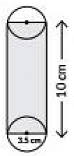
Q7: A wooden article was made by scooping out a hemisphere from each end of a solid cylinder, as shown in the figure. If the height of the cylinder is 10 cm and its base is of radius 3.5 cm. 

Find the total surface area of the article.      (4/5/6 Marks) (CBSE 2023)

Hide Answer  

Ans: 

Radius of the cylinder (r) = 3.5 cm
Height of the cylinder (h) = 10 cm

Curved surface area = 2πrh

= ( 2 × 227 × 3510 × 10 ) cm2

= 220 cm2

Curved surface area of a hemisphere = 2πr2

∴ Curved surface area of both hemispheres
2 × 2πr2 = 4πr2 = ( 4 × 227 × 3510 × 3510 ) cm2

= 154 cm2

Total surface area of the Article

= (220 + 154) cm2

= 374 cm2


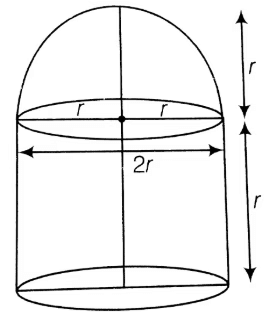
Q8: A room is in the form of a cylinder surmounted by a hemispherical dome. The base radius of the hemisphere is one-half the height of the cylindrical part. Find the total height of the room if it contains ( 140821 ) m3 of air. (Take π = 227 ) (3 Marks) (2023)

Hide Answer  

Ans: Given, volume of the room = 140821 m3,
π = 227

Radius of the hemisphere = r,

Height of the cylindrical part = h = 2r.

Volume of the room = Volume of the cylinder + Volume of the hemisphere

Volume of the cylinder = πr2h = πr2(2r) = 2πr3

Volume of the hemisphere = 23 πr3

Total volume = 2πr3 + 23 πr3 = 83 πr3

Equating total volume to 140821:

83 πr3 = 140821

83 × 227 × r3 = 140821

176r3 = 1408

r3 = 1408176

r3 = 8

r = 2

Total height = h + r = 2r + r = 3r = 3 × 2 = 6 meters

Final Answer:

The total height of the room is 6 meters.


Q9: An empty cone is of radius 3 cm and height 12 cm. Ice cream is filled in it so that the lower part of the cone which is (1/6)th of the volume of the cone is unfilled but the hemisphere is formed on the top. Find the volume of the ice cream. Take (π = 3.14)     (3 Marks) (2023)

Hide Answer  

Ans: Radius of cone, r = 3 cm 
Height of cone, h = 12 cm 
Let x be the volume of unfilled part of cone.

Now, volume of cone, =

13 πr2h = 13 × 3.14 × (3)2 × 12

Volume of filled part of cone = Volume of cone – Volume of unfilled part of cone

= 13 × 3.14 × (3)2 × 12 − 16 × 13 × 3.14 × (3)2 × 12

= 13 × 3.14 × (3)2 × 12 × (1 – 16)

= 56 × 3.14 × (3)2 × 12 = 94.2 cm3

Now, volume of ice-cream = volume of filled part of cone + volume of hemisphere

= 94.2 + 23 × 3.14 × (3)3

= 150.72 cm3

Get additional INR 200 off today with EDUREV200 coupon.

Previous Year Questions 2022

Q10: The radius of the base and the height of a solid right circular cylinder are in the ratio 2:3 and its volume is 1617 cm3. Find the total surface area of the cylinder. Take [π = 22/7] (2022)

Hide Answer  

Ans: Given ratio of radius and height of the right circular cylinder = 2:3
Let radius (r) of the base be 2x and height(h) be 3x.
Volume of cylinder, V = πr2h

1617 = 227 × (2)2 × 3 × 3

⇒ 1617 = 227 × 4x2 × 3 × 3

1617 × 7

22 × 4 × 3 = x3

x3 = 7 × 7 × 72 × 2 × 2 = 72 cm.

Radius r = 2x = 2 × 72 = 7 cm

and height h = 3x = 3 × 72 = 212 cm

Total surface area of cylinder = 2πr (h + r)

= 2 × 22 × 77 × 212 + 7)

= 44 × 352 cm2

= 770 cm2


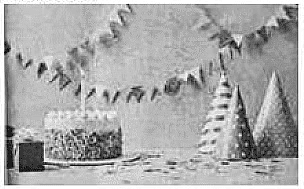
Q11: Case Study : John planned a birthday party for his younger sister with his friends. They decided to make some birthday caps by themselves and to buy a cake from a bakery shop. For these two items they decided on the following dimensions:
Cap : Conical shape with base circumference 44 cm and height 24 cm.
Cake : Cylindrical shape with diameter 24 cm and height 14 cm.

Based on the above information answer the following questions.
(a) How many square cm paper would be used to make 4 such caps?
(b) The bakery shop sells cakes by weight (0.5 kg, 1 kg, 1.5 kg. etc..}. To have the required dimensions how much cake should they order if 650 cm3 equals 100 g of cake?    
   (2022)

Hide Answer  

Ans: Paper required to make four caps is 2,200 sq.cm.
Weight of the cake for required dimensions is 1kg.
Step-by-step explanation:
(a) Given the base circumference of the cone, c = 44 cm
Height of a cone, h = 24 cm.
Base circumference of the cone, c = 2πr = 44 cm
Thus, the radius of the cone is

r = 442 × 227 = 7 cm

The curved surface area of the cone is given by

CSA = πr √ h2 + r2

Substituting the values of h and r,

CSA = 227 × 7 × √ (24)2 + 72

= 22 × √ 576 + 49 = 22 × √ 625

= 22 × 25 = 550 sq. cm
Thus, to make one cap, 550 sq.cm of paper is required.
Then to make four caps, the required paper is
550 x 4 = 2200 sq. cm
Therefore, 2,200 sq.cm of paper is required to make four caps.
(b) Given the diameter of cylindrical shape cake, d = 24 cm
Height of cylindrical shape cake, h = 14 cm.
Radius of the cylindrical shape cake,

r = d2 = 242 = 12 cm

Volume of the cylinder is given by V = πr2h

Substituting the values of h and r,

V = 227 × (12)2 × 14

V = 227 × 144 × 14

= 22 × 144 × 2 = 6,336 cm3

The required volume of the cylindrical shape cake is 6,336 cm3.

Given 650 cm3 equals 100 g of cake.

Then the required weight of the cake is

6336650 × 100 = 974.76 g

Given the bakery shop sells cakes by weight of 0.5 kg, 1 kg, 1.5 kg, etc.

Since, 974.76 g ≈ 1 kg, therefore, the cake of 1 kg should be ordered for required dimensions.


Q12: Three cubes of side 6 cm each, are joined as shown in given figure. Find the total surface area of the resulting cuboid.     (2022)

Hide Answer  

Ans: The dimension of the cuboids so formed are
length = 18 cm
breath = 6 cm and height = 6 cm.
Surface area of cuboids = 2 (l× b + b × h + l × h)
= 2 × (18 × 6 + 6 × 6+ 18 × 6)
= 504 cm2


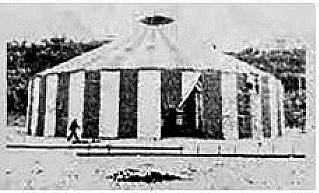
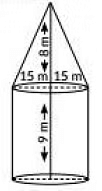
Q13: Case Study : A ‘circus’ is a company of performers who put on shows of acrobats, downs etc to entertain people started around 250 years back, in open fields, now generally performed in tents. One such ‘Circus Tent is shown below.The tent is in the shape of a cylinder surmounted by a conical top. If the height and diameter of cylindrical part are 9 m and 30 m respectively and height of conical part is 8 m with same diameter as that of the cylindrical part, then
find  
(i) the area of the canvas used in making the tent.
(ii) the cost of the canvas bought for the tent at the rate Rs. 200 per sq. m. if 30 sq. m canvas was wasted during stitching.    (CBSE Term-2 2022)

Hide Answer  

Ans: According to given information, we have the following figure.

Clearly, the radius of conical part = radius of cylindrical part = 30/2 = 15 m = r  …(say)
Let h and H be the height of conical and cylindrical part respectively.
Then h = 8 m and H = 9 m

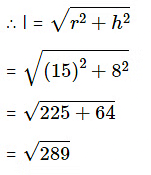
= 17 m

(i) The area of the canvas used in making the tent
= Curved surface area of cone + Curved surface area of cylinder
= πrl + 2πrH
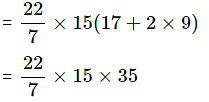
= πr(l + 2H)

= 1650 m2
(ii) Area of canvas bought for the tent
= (1650 + 30) m2
= 1680 m2
Now, this cost of the canvas height for the tent
= ₹ (1680 × 200)
= ₹ 3,36,000

Previous Year Questions 2021

Q14: Water is being pumped out through a circular pipe whose internal diameter is 8 cm. If the rate of flow of water is 80 cm/s. then how many litres of water is being pumped out through this pipe in one hour?    (2021)

Hide Answer  

Ans: Given diameter of circular pipe = 8 cm
So, radius of circular pipe = 4cm
Length of flow of water in one sec = 80 cm
length of flow of water in one hour =  80 x 60 x 60 cm=288000 cm=h
Volume of cylinderical pipe in one hour = πr2h

= 14482.28 litre [approx.]
14482.28 litres of water being pumped out through this pipe in 1 hr.

Also read: Unit Test: Surface Areas and Volumes

Previous Year Questions 2020

Q15: A solid spherical ball fits exactly inside the cubical box of side 2a. The volume of the ball is      (2020)
(a) 163 πr3
(b) 
16 πr3
(c) 
323 πr3
(d) 
43 πr3

Hide Answer  

Ans: (d)

Diameter of sphere = Distance between opposite faces of cube = 2a
Radius of sphere = a
So, volume of spherical ball = 43 πr3
= 43 πr3


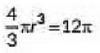
Q16: The radius of a sphere (in cm) whose volume is 12 πcm3, is      (2020)
(a) 3
(b) 3√3
(c) 32/3
(d) 3
1/3

Hide Answer  

Ans: (c)
Let radius of the sphere be r.
According to the question,
⇒ 


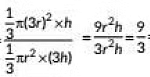
Q17: Two cones have their heights in the ratio 1: 3 and radii in the ratio 3 : 1 . What is the ratio of their volumes?      (2020)

Hide Answer  

Ans: Let height of one cone be h and height of another cone be 3h. Radius, of one cone is 3r and radius of another cone is r.
∴ Ratio o f their volumes = 
= 3 : 1


Q18: How many cubes of side 2 cm can be made from a solid cube of side 10 cm?          (2020)

Hide Answer  

Ans: Let n be the number of solid cubes of  2cm made from a solid cube of side 10 cm.

∴ n x Volume of one small cube = Volume of big cube
⇒ n x (2)3 = (10)3
⇒ 8n = 1000
⇒ n = 1000/8
= 125
Thus, the number of solid cubes formed of side 2 cm each is 125.


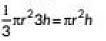
Q19: A cone and a cylinder have the same radii but the height of the cone is 3 times that of the cylinder. Find the ratio of their volumes.          (CBSE 2020)

Hide Answer  

Ans: Let the radius and the height of the cylinder are r and h respectively.
So, radios of t he cone is r and height of the cone is 3h.
∴ Volume of the cylinder = πr2h
So Volume of cone = 
So, require ratio = 
= 1 : 1


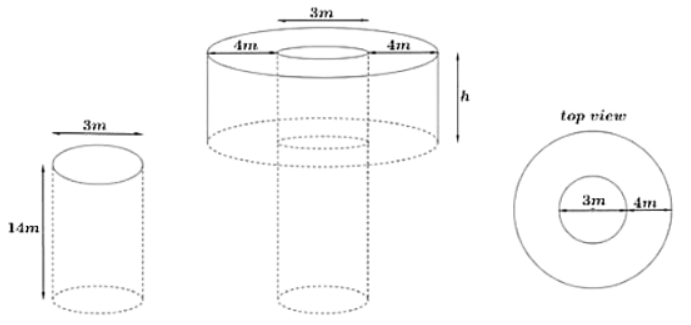
Q20: A well of diameter 3 m is dug 14 m deep. The earth taken out of it has been spread evenly all around it in the shape of a circular ring of width 4 m to form a platform. Find the height of the platform. (Take π = 22/7)      (2020)

Hide Answer  

Ans: Given that, the depth of the well is 14 m and the diameter is 3 m.
The width of the circular ring of the embankment is 4 m.
A figure is drawn below to visualize the shapes.

From the above figure, we can observe that the shape of the well will be cylindrical, and earth evenly spread out to form an embankment around the well in a circular ring will be cylindrical in shape (Hollow cylinder) having outer and inner radius.

Volume of the earth taken out from well = Volume of the earth used to form the embankment

Hence, Volume of the cylindrical well = Volume of the hollow cylindrical embankment

Let us find the volume of the hollow cylindrical embankment by subtracting volume of inner cylinder from volume of the outer cylinder.

Volume of the cylinder = πr2h where r and h are the radius and height of the cylinder respectively.

Depth of the cylindrical well, = h₁ = 14 m

Radius of the cylindrical well, = r = 3/2 m = 1.5 m

Width of embankment = 4 m

Inner radius of the embankment, r = 3/2 m = 1.5 m

Outer radius of the embankment, R = Inner radius + Width

R = 1.5 m + 4 m

= 5.5 m

Let the height of embankment be h

Volume of the cylindrical well = Volume of the hollow cylindrical embankment

πr2h1 = πR2h – πr2h

πr2h1 = πh (R2 – r2)

r2h1 = h (R – r )(R + r)

h = [(r2h1)/(R – r)(R + r)]

h = [((1.5 m)2 × 14 m)/(5.5 m – 1.5 m)(5.5 m + 1.5 m)]

= (2.25 m2 × 14 m)/(4m × 7 m)

= 1.125 m

Therefore, the height of the embankment will be 1.125 m.


Q21: In Figure, a solid toy is in the form of a hemisphere surmounted by a right circular cone. The height of the cone is 2 cm and the diameter of the base is 4 cm. Determine the volume of the toy. [Take π = 3.14]      (2020)

Hide Answer  

Ans: Given diameter of conical part = Diameter of hemispherical part = 4cm
∴ Radios of conical part (r) = Radius of hemispherical part (r) = 4/2 = 2 cm
Height of conical part (h) = 2 cm
∴ Volume of toy = Volume of hemisphere + volume of cone

= 3 .14 x 4(1.33 + 0.66)= 3.14 x 4 x 1.99 cm3
Volume of the toy = 24.99 cm3


Q22: A solid toy is in the form of a hemisphere surmounted by a right circular cone of same radius. The height of the cone is 10 cm and the radius of the base is 7 cm. Determine the volume of the toy. Also find the area of the coloured sheet required to cover the toy. (Use π = 22/7 and √149 = 12.2)       (2020)

Hide Answer  

Ans: Radius of the cone = Radius of the hemisphere = r = 7cm 
Height of the cone, h = 10 cm 
Now, volume of the toy = volume of hemisphere + volume of cone

23 πr3 + 13 πr2 h = πr23 (2r + h)

= 13 × 227 × 7 × 7 (2×7 + 10)

= 22 × 7 × 243

= 1232 cm3

Curved surface area of the toy = Curved surface area of cone + Curved surface area of hemisphere

= πrl + 2πr2

= πr √ h2 + r2 + 2πr2

= 227 × 7 × √ (10)2 + 72 + 2πr2

= 22 × √ 100 + 49 + 14

= 22 × √ 149 + 14

= 22(12.2 + 14)
= 22 x 26.2
= 576.4 cm3


Q23: From a solid right circular cylinder of height 14 cm and base radius 6 cm, a right circular cone of same height and same base radius is removed. Find the volume of the remaining solid. (CBSE 2020)

Hide Answer  

Ans: Radius of cylinder = Radius of cone = r = 6 cm. 
Height of cylinder = Height of cone = h = 14 cm
Volume of remaining solid = πr2h – 1/3πr2h
= 2/3πr2h
= 2/3 x 22/7 x 6 x 6 x 14
= 2 x 22 x 2 x 6 x 2
= 1056cm2
Hence, the volume of the remaining solid is 1056 cm2.

Previous Year Questions 2019

Q24: A solid is in the form of a cylinder with hemispherical ends. The total height of the solid is 20 cm and the diameter of the cylinder is 7 cm. Find the total volume of the solid. (Use π = 22/7).       (2019)

Hide Answer  

Ans: Radius of cylinderical part (r) = Radius of each spherical part(r) = 7/2 cm
Height of cylinderical part (h) = 20 – 7/2 – 7/2 = 13 cm

Now. Volume of the solid = Volume of cylinderical part + Volume of two hemispherical endsVolume of the solid = 

Volume of the solid = 680.17 cm3.


Q25: A juice seller was serving his customers using glasses as shown in the given figure. The inner diameter of the cylindrical glass was 5 cm but bottom of the glass had a hemispherical raised portion which reduced the capacity of the glass. lf the height of the glass was 10 cm, find the apparent and actual capacity of the glass {Use π = 3.14)      (2019)

Hide Answer  

Ans: Base radius = 5/2 = 2.5 cm
Apparent capacity of glass = Volume of cylindrical portion
= πr2h
= 3.14 x (2.5)2 x 10
= 196.25 cm3
Actual capacity of the glass = Volume of cylinder – Volume of hemisphere

= 196.25 – 32.71
= 163.54 cm  

Q26: A bucket open at the top is in the form of a frustum of a cone with a capacity of 12308.8 cm3. The radii of the top and bottom of circular ends of the bucket are 20 cm and 12 cm respectively. Find the height of the bucket and also the area of the metal sheet used in making it. (Use π = 3.14)    [CBSE 2019 (30/1/2)]

Hide Answer  

Ans: r = 12 cm, R = 20 cm, V = 12308.8 cm

Volume of frustum = 13 πh (r2 + R2 + rR)

12308810 = 13 × 314100 × (144 + 400 + 240) × h

h = 123088 × 3 × 10314 × 784

h = 15 cm

l = √(h2 + r2) = √(225 + 64) = √289 = 17 cm
Area of metal sheet used = π(R + r)l + πr
= π(20 + 12) x 17 + π x 144

Hence, the height of the bucket is 15 cm and the area of the metal sheet used is 2160.32 cm2.

Q27:  An open metal bucket is in the shape of a frustum of a cone, mounted on a hollow cylindrical base made of the same metallic sheet (Fig). The diameters of the two circular ends of the bucket are 45 cm and 25 cm, the total vertical height of the bucket is 40 cm and that of the cylindrical base is 6 cm. Find the area of the metallic sheet used to make the bucket, where we do not take into account the handle of the bucket. Also, find the volume of water the bucket can hold.  [CBSE 2019(30/5/1)]

Hide Answer  

Ans: The total height of the bucket = 40 cm, which includes the height of the base. So, the height of the frustum of the cone = (40 – 6) cm = 34 cm.
Therefore, the slant height of the frustum,

l = √(R2 + (r1 – r2)2)

where, r1 = 452 cm = 22.5 cm

r2 = 252 cm = 12.5 cm and h = 34 cm

So, l = √(342 + (22.5 – 12.5)2) = √(342 + 102) = 35.44 cm

Area of the metallic sheet used

Curved surface area of frustum of cone + Area of circular base + Curved surface area of cylinder

= [π × 35.44 (22.5 + 12.5) + π × (12.5)2 + 2π × 12.5 × 6] cm2

= 227 × (1240.4 + 156.25 + 150) cm2

= 4860.9 cm2

Now, the volume of water that the bucket can hold (also, known as the capacity of the bucket)

Volume of frustum:

= 13 π × h (r12 + r22 + r1r2)

= 13 × 227 × 34 × (22.52 + 12.52 + 22.5 × 12.5) cm3

= 13 × 227 × 34 × 943.75 = 33615.48 cm3

= 33.62 litres (approx.)


Q28: A cylindrical bucket, 32 cm high and with a radius of base 18 cm, is filled with sand. This bucket is emptied on the ground and a conical heap of sand is formed. If the height of the conical heap is 24 cm, find the radius and slant height of the heap.
OR
A girl empties a cylindrical bucket, full of sand, of base radius 18 cm and height 32 cm, on the floor to form a conical heap of sand. If the height of this conical heap is 24 cm, then find its slant height correct up to one place of decimal.    
[CBSE (E) 2014, 2019 (30/5/1)] 

Hide Answer  

Ans: We have,
Radius of cylindrical bucket =18 cm
Height of cylindrical bucket = 32 cm
And the height of conical heap = 24 cm
Let the radius of the conical heap be r cm
Volume of the sand = volume of the cylindrical bucket
= πr2h = π x (18)2 x 32
Now, volume of conical heap 
Here, volume of the conical heap will be equal to the volume of sand
∴ 8πr2 = π x (18)2 x 32
⇒ r2 = 18 x 18 x 4 = (18)2 x (2)2
⇒ r2 = (36)2 or r = 36 cm

Attention!Sale expiring soon, act now & get EduRev Infinity at 40% off!

Previous Year Questions 2018

Q29: The diameters of the lower and upper ends of a bucket in the form of a frustum of a cone are 10 cm and 30 cm respectively. If its height is 24 cm, find the area of the metal sheet used to make the bucket. [Use π = 3.14]     [CBSE 2018]

Hide Answer  

Ans: 

For bucket,

Upper diameter (D) = 30 cm

∴ Radius (R) = 302 = 15 cm

Lower diameter (d) = 10 cm

Radius (r) = 102 = 5 cm

Height of bucket (h) = 24 cm

The area of the metal sheet used = CSA of the frustum (bucket) + Area of bottom part (base)

= π(R + r)l + πr2

= π(R + r) × √(h2 + (R – r)2) + πr2

[∵ Slant height (l) = √(h2 + (R – r)2)]

= 3.14 × (15 + 5) × √(242 + (15 – 5)2) + 3.14 × (5)2

= 3.14 × 20 × √(576 + 100) + 3.14 × 25

= 62.8 × √676 + 78.5

= 62.8 × 26 + 78.5

= 1632.8 + 78.5 = 1711.3 cm2

Previous Year Questions 2017

Q30: A metallic right circular cone 20 cm high whose vertical angle is 60° which is cut into two parts at the middle of its height by a plane parallel to its base. If the frustum so obtained be drawn into a wire of diameter 1/16 cm, find the length of the wire.    [NCERT, CBSE (F) 2017]

Hide Answer  

Ans: Let VAB be the metallic right circular cone of height 20 cm. Suppose this cone is cut by a plane parallel to its base at a point O’ such that VO’ = O’ O i.e., O’ is the midpoint of VO.
Let r1 and r2 be the radii of circular ends of the frustum ABB’ A’.
Now, in ΔVOA and VO’ A’, we have

⇒ tan 30° = OAVO and tan 30° = O’A’V’O’

⇒ 1√3 = r120 and 1√3 = r210

⇒ r1 = 20√3 and r2 = 10√3

∴ Volume of the frustum = 13 πh (r12 + r22 + r1r2)

= 13 × π × 10 × [ (20/√3)2 + (10/√3)2 + (20/√3 × 10/√3) ]

= 10π3 × [400/3 + 100/3 + 200/3]

= 10π3 × 7003 cm3

Let the length of wire of diameter 1/16 cm be l cm. Then,

Volume of metal used in wire

= π × (1/32)2× l = πl/1024 cm3

Since the frustum is recast into a wire of length l cm and diameter 1/16 cm,

∴ Volume of the metal used in wire = volume of the frustum

⇒ πl1024 = 7000π9

⇒ l = 7000 × 10249

= 796144.4 cm = 7964.444 m


Q31: A solid metallic cylinder of diameter 12 cm and height 15 cm is melted and recast into toys each in the shape of a cone of radius 3 cm and height 9 cm. Find the number of toys so formed.     [AI 2017 (C)]

Hide Answer  

Ans:  Diameter of metallic cylinder = 12 cm
∴ Radius of metallic cylinder (r) = 6 cm
Height (h) = 15 cm
Volume of cylinder = πr2h = π(6)2 x 15 cm3
Radius of cone = 3 cm
Height of cone = 9 cm
Volume of cone = 1/3 π(3)2 x 9 = 3 x 9π cm3
Number of toys so formed = 
If the question is “A tent is in the form of a cylinder surmounted by a cone. Find the capacity of the tent and the cost of canvas for making the tent at Rs 100 per sq.m.”, then the solution is given as “Tent is a combination of a cylinder and a cone. For capacity
∴ Volume (capacity) of the tent = Volume of the cylindrical part + Volume of the conical part
For the cost of the canvas, we find the total surface area.
Total surface area = Curved area of the cylindrical part + Curved surface area of the conical part
Now, proceed to find its cost.”
Note: Don’t solve as “Total surface area of canvas = Total surface area of cylinder + Total surface area of a cone and proceed further”
This is the wrong solution.


Q32: The 3/4th part of a conical vessel of internal radius 5 cm and height 24 cm is full of water. The water is emptied into a cylindrical vessel with an internal radius of 10 cm. Find the height of water in a cylindrical vessel.    [Delhi 2017]

Hide Answer  

Ans: Radius of conical vessel (r) = 5 cm
Height of conical vessel (h) = 24 cm
Radius of cylindrical vessel (R) = 10 cm

Let H be the height of water in the cylindrical vessel.

Now, the total volume of the conical vessel

= 13 πr2h = 13 × 227 × (5)2 × 24 cm3

= 22 × 25 × 247 × 3 cm3

According to the question,

3/4 of the volume of water from the conical vessel is emptied into the cylindrical vessel.

⇒ 34 × Volume of conical vessel = Volume of water in the cylindrical vessel

⇒ 34 × 22 × 25 × 247 × 3 = πR2H

⇒ 3 × 22 × 25 × 244 × 7 × 3 = 227 × (10)2 × H

⇒ 25 × 6 = 10 × 10 × H

⇒ H1 = 25 × 610 × 10

⇒ H = 1.5 cm

∴ Height of water in the cylindrical vessel = 1.5 cm


Q33: In a rain-water harvesting system, the rainwater from a roof of 22 m x 20 m drains into a cylindrical tank having a diameter of base 2 m and height of 3.5 m. If the tank is full, find the rainfall in cm.    [AI 2017]

Hide Answer  

Ans: Length of roof (l) = 22 m
Breadth of roof (b) = 20 m
Let the height of water column collected on roof= hm
∴ Volume of standing water on rooftop = lbh
= (22 x 20 x h) m3 
This water is taken into a cylindrical tank of diameter of base 2 m and height 3.5 m.
Tank gets completely filled with this amount of water.
⇒ Volume of water from roof-top = Volume of cylinder
Diameter of tank = 2 m
∴ Radius of tank = 2/2 = 1 m

⇒ Volume of tank = πr2h

= 227 × (1)2 × 3.5 m3

A.T.Q.

(22 × 20 × h) m3 = 227 × 1 × 3.5 m3

⇒ h = 22 × 3.57 × 22 × 20

⇒ h = 777 × 22 × 30

= 0.025 m = 2.5 cm
Hence rainfall is 2.5 cm.


Q34: From a solid cylinder whose height is 2.4 cm and diameter 1.4 cm, a conical cavity of the same height and same diameter is hollowed out. Find the total surface area of the remaining solid to the nearest cm2.    [CBSE (AI) 2017]

Hide Answer  

Ans: We have,
Radius of the cylinder = Height of the cylinder = 2.4 cm
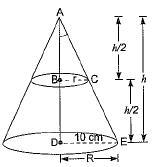
Also, radius of the cone = 0.7 cm and height of the cone = 2.4 cm
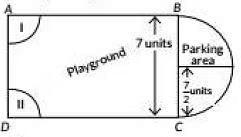
Now, slant height of the cone =


∴ Total surface area of the remaining solid
= curved surface area of cylinder + curved surface area of the cone + area of upper circular base of the cylinder.


Q35: A circus tent is in the shape of a cylinder surmounted by a conical top of the same diameter. If their common diameter is 56 m, the height of the cylindrical part is 6 m and the total height of the tent above the ground is 27 m, find the area of canvas used in making the tent. (CBSE 2017)

Hide Answer  

Ans: 

Total height of the tent above the ground = 27 m

Height of the cylindrical part,

h1 = 6 m

Height of the conical part,

h2 = 21 m

Diameter = 56 m

Radius = 28 m

Curved surface area of the cylinder, CSA1

= 2πrh = 2π × 28 × 6 = 336π

Curved surface area of the cone, CSA2

= πrl = π × 28 × √ h22 + r2

= π × 28 × √ 212 + 282

= 28π × √ 441 + 784

= 28π × 35

= 980π

Total curved surface area = CSA of cylinder + CSA of cone

= CSA1 + CSA2

= 336π + 980π

= 1316π

= 4136 m2

Also read: Unit Test: Surface Areas and Volumes

Previous Year Questions 2016

Q36: A sphere of diameter 12 cm, is dropped in a right circular cylindrical vessel, partly filled with water. If the sphere is completely submerged in water, the water level in the cylindrical vessel rises by  Find the diameter of the cylindrical vessel. [CBSE (AI) 2016]

Hide Answer  

Ans: Volume of sphere = 43 π(6)3 cm3

Volume of water rise in cylinder

= πr2 329 cm3

∴ πr2 329 = 43 π(6)3

⇒ r2 = 4 × 2 × 36 × 932 = 81

⇒ r = 9 cm

Previous Year Questions 2015

Q37: Two spheres of the same metal weigh 1 kg and 7 kg. The radius of the smaller sphere is 3 cm. The two spheres are melted to form a single big sphere. Find the diameter of the new sphere.    [CBSE (F) 2015]

Hide Answer  

Ans: Volume of the smaller sphere

= 43 πr3 = 43 π(3)3 = 43 π(27) = 36π

Volume of smaller sphere × density = mass

∴ 36π (density of metal) = 1

Density of metal = 136π

∴ Volume of bigger sphere × density = mass

= 43 π (R)3 × 136π = 7

R3 = 7 × 36 × 34 = 7 × 9 × 3

(i) Volume of new sphere = volume of smaller sphere + volume of bigger sphere

= 43 π(R’)3 = 43 πr3 + 43 πR3 (where R’ is the radius of the new sphere)

= 43 π(3)3 + 43 π(7 × 9 × 3) [using (i)]

= 43 π [33 + 7 × 9 × 3]


(R’)3 = [33 + 7 x 33]
(R’)3 = 33(l + 7)
(R’)3 = 33 x 8
(R’)3 =  33 x 23
R’ =3 x 2
R’ = 6 cm
∴ Diameter of new sphere =12 cm.

Q38: A hemispherical bowl of internal diameter 36 cm contains liquid. This liquid is filled into 72 cylindrical bottles of diameter 6 cm. Find the height of each bottle, if 10% liquid is wasted in this transfer.   [CBSE (AI) 2015]

Hide Answer  

Ans: Radius of hemispherical bowl, R = 36/2 = 18 cm
Radius of cylindrical bottle, r = 6/2 = 3 cm
Let height of cylindrical bottle = h
Since 10% liquid is wasted, therefore only 90% liquid is filled into 72 cylindrical bottles.
∴ The volume of 72 cylindrical bottles = 90% of the volume in the bowl

⇒ 72 × πr2h = 90% of 23 πR3

72 × π × 3 × 3 × h = 90100 × 23 × π × 18 × 18 × 18

h = 90 × 2 × π × 18 × 18 × 18100 × 3 × π × 72 × 3 × 3

h = 275 = 5.4 cm

Q38: A cone with radius 10 cm is divided into two parts by drawing a plane through the mid-point of its axis, parallel to its base. Compare the volumes of the two parts.    [CBSE (AI) 2015]

Hide Answer  

Ans: Let.BC = r cm, DE = 10 cm
Since B is the mid-point of AD and BC is parallel to DE, therefore C is the mid-point of AE.
∴ AC = CE
Also, ΔABC ~ ΔADE


∴ The required ratio = 1 : 7.

11. Previous Year Questions: Areas Related to Circles

Previous Year Questions 2025

Q1: The diameter of a wheel is 63 cm. The distance travelled by the wheel in 100 revolutions is: 

(a) 99 m
(b) 198 m
(c) 63 m
(d) 136 m

Hide Answer  

Ans: (b)
Given, diameter of wheel = 63 cm
∴ Radius, r = 63/2 = 31.5 cm
Distance travelled by the wheel in one revolution 

∴ Distance travelled by the wheel in 100 revolutions

Q2: If the length of a chord of a circle is equal to its radius, then the angle subtended by chord at the centre is: 
(a) 60° 
(b) 30° 
(c) 120° 
(d) 90°

Hide Answer  

Ans: (a)
Let AB be the chord of a circle centre at O. 
Given AB = radius of circle 
∴ AB = OA = OB 
∴ AOB is an equilateral triangle. So, angle subtended by the chord at the centre of circle is 60°. 

Q3: If the area of a sector of circle of radius 36 cm is 54π cm2, then the length of the corresponding arc of the sector is: 
(a) 8π cm 
(b) 6π cm  
(c) 4π cm 
(d) 3π cm

Hide Answer  

Ans: (d)
Given, radius of circle = 36 cm Area of sector of circle = 54π cm2  

Q4: A piece of wire 20 cm long is bent into the form of an arc of a circle of radius 60/π cm. The angle subtended by the arc at the centre of the circle is:
(a) 30° 
(b) 60° 
(c) 90° 
(d) 50°

Hide Answer  

Ans: (b)
Length of wire = Arc of circle 

Q5: An arc of a circle is of length 5π cm and the sector it bounds has an area of 20π cm². Its radius is: 
(a) 10 cm
(b) 1 cm
(c) 5 cm 
(d) 8 cm

Hide Answer  

Ans: (d) 
Let radius of the circle be rand angle subtended by an arc be θ. 

Q6: A chord of a circle of radius 10 cm subtends a right angle at the centre of the circle. Find the area of the corresponding minor segment. 
[Use π = 3.14]

Hide Answer  

Ans: 

Radius of circle (r) = 10 cm Angle of sector (θ) = 90° 
Area of minor segment ACB  = Area of sector OACB – Area of ΔAOB 

Q7: Case Study: A brooch is a decorative piece often worn on clothing like jackets, blouses or dresses to add elegance. Made from precious metals and decorated with gemstones, brooches come in many shapes and designs.

One such brooch is made with silver wire in the form of a circle with diameter 35 mm. The wire is also used in making 5 diameters which divide the circle into 10 equal sectors as shown in the figure. 

Based on the above given information, answer the following questions: 
(i) Find the central angle of each sector. 
(ii) Find the length of the arc ACB. 
(iii) (a) Find the area of each sector of the brooch. 
OR
(iii) (b) Find the total length of the silver wire used.
 

Hide Answer  

Ans: 
(i) 
Since, the circle is divided into 10 equal sectors, then central angle of each sector 

(ii) 


(iii) 

OR
(iii) (b)
 Total length of wire used = 2πr + 5d 

Q8: Case Study: Anurag purchased a farmhouse which is in the form of a semicircle of diameter 70 m. He divides it into three parts by taking a point P on the semicircle in such a way that ∠PAB = 30° as shown in the following figure, where O is the centre of semicircle.

In part I, he planted saplings of Mango tree, in part II, he grew tomatoes and in part Ill, he grew oranges. Based on given information, answer the following questions. 
(i) What is the measure of ∠POA? 
(ii) Find the length of wire needed to fence entire piece of land. 
(iii) (a) Find the area of region in which saplings of Mango tree are planted. 
OR
(iii) (b) Find the length of wire needed to fence the region III.

Hide Answer  

Ans: 
(i) Join OP.
∴ In ΔAOP,
∠OAP = ∠OPA = 30°     [∵ OA = OP]
∴ ∠POA = 180° – 30° – 30° = 120°
(ii) Length of wire = Perimeter of the land 
= πR + 2R = R(π + 2)

(iii) (a) Area of part I = Area of sector POB – Area of Δ POB

(iii) (b) Length of wire needed to fence the region – III
= Length of arc AP+ AP     ……. (i) 

Previous Year Questions 2024

Q1: The Perimeter of a sector of a circle whose central angle is 90º and radius 7 cm is:     (CBSE 2024)
(a) 35 cm
(b) 11 cm
(c) 22 cm
(d) 25 cm

Hide Answer  

Ans: (d)

Correct answer: 25 cm

Q2: A stable owner has four horses. He usually ties these horses with 7 m long rope to pegs at each corner of a square-shaped grass field of 20 m length, to graze in his farm. But tying with rope sometimes results in injuries to his horses, so he decided to build a fence around the area so that each horse could graze.        (CBSE 2024)

Based on the above, answer the following questions:
(A) Find the area of the square-shaped grass field.
(B) Find the area of the total field in which these horses can graze.
OR
If the length of the rope of each horse is increased from 7 m to 10 m, find the area grazed by one horse.
(Use π = 3.14)
(C) What is the area of the field that is left ungrazed if the length of the rope of each horse is 7 m?

Hide Answer  

Ans:
(A) Area of square shaped field
= 20 × 20
= 400 sq. m.

(B) Area of 4 quadrants

= Area of a circle of radius 7m = πr2

=4 × 14 × 227 × 7 × 7

= 154 m2

OR

New radius = 10 m

So, area grazed by one horse

= 14 (Area of circle with radius 10 m)

= 14 × π × (10)2

= 3.14 × 10 × 104

= 78.5 m2

(C) Area of ungrazed portion

= Area of square field – Area of circle with radius 7 m

= 20 × 20 – 227 × 7 × 7

= 400 – 154

= 246 m2

Get additional INR 200 off today with EDUREV200 coupon.

Previous Year Questions 2023

Q1: What is the area of a semi-circle of diameter ‘d’ ?        (CBSE, 2023)
(a) 1/16πd2
(b) 1/4πd2′
(c) 1/8πd2
(d) 1/2πd2

Hide Answer  

Ans: (c)
Given diameter of semi circle = d


∴ Radius, r = d/2
Area of semi circle

Q2: Case Study:  The Governing council of a local public development authority of Dehradun decided to build an adventurous playground on the top of a bill, which will have adequate space for parking.

After the survey, it was decided to build a rectangular playground with a semi-circular area allotted for parking at one end of the playground. The length and breadth of the rectangular playground are 14 units and 7 units, respectively. There are two quadrants of radius 2 units on one side for special seats. Based on the above information, answer the following questions:

(i) What is the total perimeter of the parking area? 
(ii) What is the total area of parking and the two quadrants? (CBSE 2023)

Hide Answer  

Ans: (i) Length of play ground . AB = 14 units, Breadth of play ground. AD = 7 units
Radius of semi – circular part is 7/2 units
Total perimeter of parking area = πr + 2r

227 × 72 + 2 × 72

= 11 + 7 = 18 Units

(ii) Total area of parking and the two quadrants

= Area of semi-circular region + Area of 2 quadrants

= πR²2 + 2 × 14 × πr²

= π2 [ R² + r² ]

= 227 × 12 × (7/2)² + (2)²

= 117 × 49 + 44

= 117 × (49 + 16)4

= 117 × 654

= 71528

= 25.54 unit² (approx)

Q3: A chord of a circle of radius 14 cm subtends an angle of 60° at the centre. Find the area of the corresponding minor segment of the circle. Also, find the area of the major segment of the circle.         (2023)
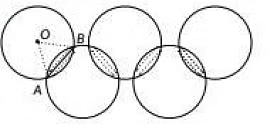
Hide Answer  

Ans: Here, radius t(r) = 14 cm and  Sector angle (θ) = 60°

∴ Area of the sector

= 102.67 cm2

Since ∠O = 60° and OA = OB = 14 cm
∴ AOB is an equilateral triangle.
⇒ AS = 14 cm and ∠A = 60°
Draw OM ⊥ AB.
In ΔAMO

OMOA = sin60° = √32 ⇒ OM = OA × √32 = 14√32 cm = 7√3 cm

Now,

Area of △AOB = 12 × AB × OM

= 12 × 14 × 7√3 cm² = 49√3 cm²

= 49 × 1.732 cm² = 84.87 cm²

Now, area of the minor segment

= (Area of minor sector) – (Area of △AOB)

= 102.67 – 84.87 cm2

= 17.8 cm2

Area of the major segment

= Area of the circle – Area of the minor segment

= πr²1 – 17.8

= 227 × 14 × 14 – 17.8 cm2

= (616 – 17.8) cm2 = 598.2 cm2

Previous Year Questions 2022

Q1: The area swept by a 7 cm long minute band of a clock in 10 minutes is        (CBSE 2022)
(a) 77 cm2
(b) 

(c) 
(d) 

Hide Answer  

Ans: (d)
Angle formed by minute hand of a clock in 60 minutes = 360°
∴ Angle formed by minute hand of a clock in 10 minutes = 10/60 x 360° = 60°
Length of minute hand of a dock = radius = 7 cm
∴ Required area

Q2: Given below is the picture of the Olympic rings made by taking five congruent circles of radius 1 cm each, intersecting in such a way that the chord formed by joining the point of intersection of two circles is also of length 1 cm. The total area of all the dotted regions assuming the thickness of the rings to be negligible is        (2022)
(a) 4 (π12) (√34) cm²
(b) (π6) – (√34) cm²
(c) 4 (π6) – (√34) cm²
(d) 8 (π6) – (√34) cm²

Hide Answer  

Ans: (d)

Let O be the centre of the circle. So. OA = OB = AB = 1 cm
So ΔOAB is an equilateral triangle.
∴ ∠AOB = 60°

∴  Required area = 8 x area of one segment with r = 1 cm,θ = 60°

= 8 x  (area of sector – area of ΔAOB)
= 8 x ( θ360º x πr– √34a2)

Also read: NCERT Textbook: Areas Related to Circles

Previous Year Questions 2020

Q1: A piece of wire 22 cm long is bent into the form of an arc of a circle subtending an angle of 60° at its centre. Find the radius of the circle. [Use π = 22/7]        (2020)

Hide Answer  

Ans: Let AB be the wire of length 22 cm in the form of an art of a circle so blending an ∠AOB – 60° at centre O.

∵ Length of arc = 
⇒ 
= 21 cm
Hence, radius of the circle is 21cm.

Q2: A circular park is surrounded by a road 21 m wide. If the radius of the park is 105 m, find the area of the road. (CBSE 2020)

Hide Answer  

Ans: 

Given: Width of road = 21 m 
Radius of park, r= 105 m  
⇒ Radius of the whole circular portion (park + road) 
r2 = 105 + 21 = 126 m 

So, Area of road = Area of park and road – Area of park

= πr22 – πr12

= π (r22 – r12)

= 227 × [(126)2 – (105)2

= 227 × (126 + 105) (126 – 105)   [∵ a2 – b2 = (a + b)(a – b)]

= 227 × 231 × 21 = 15246

Hence, the area of the road is 15246 m2

Previous Year Questions 2019

Q1: A car has two wipers which do not overlap. Each wiper has a blade of length 21 cm sweeping through an angle 120°. Find the total area cleaned at each sweep of the blades. (Take π = 22/7)       (2019)

Hide Answer  

Ans: Here radius (r) = 21 cm
5ector angle (θ) = 120°
∴ Area cleaned by each sweep of the blades
 [∵ there are 2 blades]

= 22 x 7 x 3 x 2 cm2
= 924 cm2

Q2: Find the area of the segment shown in the given figure, if the radius of the circle is 21 cm and ∠AOB = 120°. (Take π = 22/7)      (2019)

Hide Answer  

Ans: 

Draw OM ⊥ AB.

Area of the minor segment AMBP = Area of sector OAPB – Area of △AOB

Now, area of sector OAPB

= 120°360° × πr2

= 120°360° × 227 × 21 × 21

= 462 cm2

Since, OM ⊥ AB.

∠AOM = ∠BOM = 120°/2 = 60°

[∵ Perpendicular from the centre to the chord bisects the angle subtended by the chord at the centre.]

In △AOM,

sin 60° = AMAO , cos 60° = OMOA

= √32 = AM/21, 12 = OM/21

⇒ AM = 21√32 cm, OM = 212 cm

∴ AB = 2AM = 2 × 21√32 = 21√3 cm

Area of △AOB

= 12 × AB × OM

= 12 × 21√3 × 212

= 441√34 cm2

Hence, required area

= 462 – 441√34

= 462 – 381.92 = 80.08 cm2

Q3: In the given figure, three sectors of a circle of radius 7 cm, making angles of 60°, 80° and 40° at the centre are shaded. Find the area of the shaded region.      (2019)

Hide Answer  

Ans: Radius (r) of circle = 7 cm
Area of shaded region =

π(7)2 × 40°360° + π(7)2 × 60°360° + π(7)2 × 80°360°

[∴ Area of sector = θ360° πr2]

= π(7)2 × 19 + π(7)2 × 16 + π(7)2 × 29

= π(7)2 [1/9 + 1/6 + 2/9]

= 227 × 7 × 7 × 918

= 77 cm2

Attention!Sale expiring soon, act now & get EduRev Infinity at 40% off!

Previous Year Questions 2017

Q1: A chord PQ of a circle of radius 10 cm subtends an angle of 60° at the centre of the circle. Find the area of major and minor segments of the circle.    (Delhi 2017)

Hide Answer  

Ans:  Radius of the circle = 10 cm
Central angle subtended by chord AB = 60°
Area of minor sector OACB

Area of equilateral triangle OAB formed by radii and chord

= √34 a² = √34 × (10)² = 1.7324 × 100 = 43.3 cm2

Area of minor segment ACBD

= Area of sector OACB – Area of triangle OAB

= (52.38 – 43.30) cm2

= 9.08 cm2

Area of circle

∴ Area of circle = πr²

= 227 × (10)² = 22 × 1007

= 314.28 cm2

Area of major segment ADBE

= Area of circle – Area of minor segment

= (314.28 – 9.08) cm2

= 305.20 cm2

Q2: In the given figure, ΔABC is a right-angled triangle in which ∠A is 90°. Semi-circles are drawn on AB, AC and BC as diameters. Find the area of the shaded region.     (Al 2017)

Hide Answer  

Ans: In right triangle ABC.
AB2 + AC2 = BC2
⇒ (3)2 + (4)2 = BC2 ⇒ 9 + 16 = BC2  ⇒ 25 = BC2
∴ BC = 5 cm
Now, 

Area of shaded region = { ar(ΔABC) + ar(semicircle on side AB) + ar(semicircle on side AC) } – ar(semicircle on side BC)

Area of shaded region = [(12 × 3 × 4) + (12 π × (32) 2) + (12 π × (2)2)] – (12 π × (52) 2 cm2)

= 6 + 12 π 94 + 4 – 254 cm2

= 6 cm2

Hence, area of shaded region is 6 cm2

Q3: In the following figure, O is the centre of the circle with AC = 24 cm, AB = 7 cm and ∠BOD = 90°. Find the area of the shaded region.   (CBSE (AI) 2017)

Hide Answer  

Ans: In right angle triangle ABC

Diameter BC = √(242 + 72) = 25 cm

Area ΔCAB = 12 × base × height

= 12 × 24 × 7 = 84 cm2

Area of shaded region = area of semicircle – area of ΔCAB + area of quadrant BOD

= π2 × (252) 2 – 84 + π4 × (252) 2

= (625π8) + (625π16) – 84

= (1875π16) – 84 = (117.18π – 84) = 283.94 cm2

Q4: Two circles touch internally. The sum of their areas is 116π cm2 and the distance between their centres is 6 cm. Find the radii of the circles. (CBSE 2017)

Hide Answer  

Ans: Let ‘r’ and ‘R’ be the radii of the smaller and bigger circles, respectively. 
Then, OO’ = R – r = 6 cm [Given] …(i) 
Also, sum of their areas = 116π cm2
i.e., πR2 + πr2 = 116π

⇒ R2 + r2 = 116 …(ii)
We know, (R – r)2 = R2 + r2 – 2Rr 
⇒ (6)2 = 116 – 2Rr 
⇒ 2Rr = 116 – 36 = 80 
⇒ Rr = 40 …(iii) 
Also, (R + r)2 = R+ r2 + 2Rr = 116 + 2 × 40 [Using (ii) and (iii)] 
⇒ (R + r)2 = 196 
⇒ R + r = 14 …(iv) 
Now, adding equations (i) and (iv), we get 
2R = 20 
⇒ R = 10 cm 
Putting the value of R in equation (i), we get 
r = 4 cm 
Hence, the radii of the bigger and smaller circles are 10 cm and 4 cm, respectively.

Previous Year Questions 2016

Q1: In Fig. 12.34, O is the centre of a circle such that diameter AB =13 cm and AC = 12 cm. BC is joined. Find the area of the shaded region. (Take k = 3.14)    (CBSE (AI) 2016)

Hide Answer  

Ans:  In ΔABC, ∠ACB = 90° (Angle in the semicircle)
∴ BC2 + AC2 = AB2
∴ BC2 = AB2 -AC2
= 169 – 144 = 25
∴ BC = 5 cm
Area of the shaded region = area of semicircle – area of right ΔABC

= 12 πr2 – 12 × BC × AC

= 12 × (3.14) (132) 2 – 12 × 5 × 12

= 66.33 – 30 = 36.33 cm2

Q2: In the given figure, are shown two arcs PAQ and PBQ. Arc PAQ is a part of the circle with centre 0 and radius OP while arc PBQ is a semi-circle drawn on PQ as diameter with centre M.
If OP = PQ = 10 cm show that the area of the shaded region is 25  (CBSE (Delhi) 2016)

Hide Answer  

Ans: Since OP = PQ = QO
⇒ APOQ is an equilateral triangle
∴ ∠POQ = 60°
Area of segment PAQM

= θ360° πr2 – √34 a2

= 60°360° π × 102 – √34 × 102

= 100π6 – 100√34 cm2

Area of Semicircle with M as Centre

= π2 (5)2 = 25π2 cm2

Area of Shaded Region

= 25π2 – (50π3) – 25√3

= 25π2  – 503 π + 25√3

= -25π6  + 25√3

= 25(√3 – π6 ) cm2

Q3: In the figure, the boundary of the shaded region consists of four semicircular arcs, two smallest being equal. If the diameter of the largest is 14 cm and that of the smallest is 3.5 cm, calculate the area of the shaded region. Use π = 22/7   (Foreign 2016)

Hide Answer  

Ans: Given AD = 14 cm, AB = CD = 3.5 cm
∴ BC = 7 cm

Substituting the Values 

Q4: Find the area of the shaded region in Fig. 12.23, where a circular arc of radius 6 cm has been drawn with vertex 0 of an equilateral triangle ΔOAB of side 12 cm as the centre.    (NCERT, CBSE (F) 2016)

Hide Answer  

Ans:

Area of Shaded region = Area of equilateral triangle ABO + Area of Major sector

Area of Equilateral Triangle ABO = √34 × a2 = √34 × 12 × 12 cm2

= 62.352 cm2

Area of major sector = θ360 × π × r2

= 300360 × π × 6 × 6 cm2

= 94.2 cm2

Area of Shaded region = 62.352 + 94.2 = 156.55 cm2

Q5: An elastic belt is placed around the rim of a pulley of radius 5 cm. (Fig. 12.46). From one point C on the belt, the elastic belt is pulled directly away from the centre O of the pulley until it is at P, 10 cm from the point O. Find the length of the belt that is still in contact with the pulley. Also, find the shaded area.  (Use π = 3.14 and √3 = 1.73)    (CBSE Delhi 2016)

Hide Answer  

Ans: In △AOP, cos θ = 510

⇒ cos θ = 12 ⇒ θ = 60°

∴ Reflex ∠AOB = 240°

∴ Length of belt in contact with pulley = θ360° × 2πr

= 2 × 3.14 × 5 × 240360 = 20.93 cm

Now, APOA = tan 60°

PA = 5√3 cm = BP (Tangents from an external point are equal)

Area (△OAP + △OBP) = 2 × 12 × 5 × 5√3 = 25√3 = 43.25 cm2

Area of sector OACB = θ360° πr2 = 240360 × 3.14 × 25 = 26.17 cm2

Shaded area = 43.25 – 26.17 = 17.08 cm2

Q6: In the figure given, a sector OAP of a circle with centre O, containing angle θ. AB is perpendicular to the radius OA and meets OP produced at B. Prove that the perimeter of the shaded region is  (CBSE (AI) 2016)

Hide Answer  

Ans: 

Perimeter of shaded region = AB + PB + arc length AP …(1)

Arc length AP = θ360 × 2πr = πθr180 …(2)

In right-angled △OAB,

tan θ = ABr ⇒ AB = r tan θ …(3)

sec θ = OBr ⇒ OB = r sec θ

OB = OP + PB

∴ r sec θ = r + PB

∴ PB = r sec θ – r …(4)

Substitute (2), (3), and (4) in (1), we get:

Perimeter of shaded region = AB + PB + arc length AP

= r tan θ + r sec θ – r + πθr180

= r [tan θ + sec θ + πθ180 – 1]

Q7: In the figure, AB is a chord of a circle with a centre O and a radius of 10 cm, that subtends a right angle at the centre of the circle. Find the area of the minor segment AQBP. Also, find the area of the major segment ALBQA. (Use π = 3.14) (CBSE 2016)

Hide Answer  

Ans: Given, A circle of radius (r) = 10 cm in which ∠AOB = 90º. 
Area of the minor segment AQBP = Area of sector OAPB – Area of ΔAOB 
= θ / 360° × πr2 – 1 /2 × OA × OB 
= 90 / 360 °  × 3.14 × 10 × 10 – 1/ 2 × 10 × 10 
= 3.14 × 5 × 5 – 5 × 10 
= 78.5 – 50 
= 28.5 cm2 

So, Area of the minor segment AQBP = 28.5 cm2
Area of the major segment ALBQA = Area of circle – Area of minor segment AQBP 
= 3.14 × (10)2 – 28.5 
= 314 – 28.5 
= 285.5 cm2
Area of major segment ALBQA = 285.5 cm2. Hence, the area of the minor segment AQBP is 28.5 cm2 and the area of the major segment ALBQA is 285.5 cm2.

Also read: NCERT Textbook: Areas Related to Circles

Previous Year Questions 2015

Q1:  In the figure, ABCD is a trapezium with AB || DC, AB = 18 cm, DC = 32 cm and distance between AB and DC = 14 cm. If arcs of equal radii 7 cm with centres A, B, C and D have been drawn, then find the area of the shaded region.     (Foreign 2015)

Hide Answer  

Ans: Area of shaded region = area of trapezium – (area of 4 sectors)

Area of trapezium = 12 (sum of parallel sides) × distance between parallel sides

= 12 (18 + 32) × 14 = 12 × 50 × 14 = 350 cm2 …(i)

Area of sector on A = ∠A360° × π(7)2

Area of sector on B = ∠B360° × π(7)2

Area of sector on C = ∠C360° × π(7)2

Area of sector on D = ∠D360° × π(7)2

Total area of all sectors

= ∠A360° × π(7)2 + ∠B360° × π(7)2 + ∠C360° × π(7)2 + ∠D360° × π(7)2

= π360 (7)2(∠A + ∠B + ∠C + ∠D)

= 227 × 360 × 49 × 360° = 154 cm2 …(ii)   [Sum of angles of a quadrilateral is 360°]From (i) and (ii),
Area of shaded region = 350 – 154 = 196 cm2

10. Previous Year Questions: Circles

Previous Year Questions 2025

Q1: In the given figure, PA is a tangent from an external point P to a circle with centre O. If ∠POB = 115°, then ∠APO is equal to:
(a) 25° 
(b) 65°
(c) 90° 
(d) 35°

Hide Answer  

Ans: (a)
∠POB + ∠POA = 180     (Linear Pair)
⇒ 115° + ∠POA = 180°            (∵ ∠POB = 115°)
⇒ ∠POA = 180° – 115° = 65°
Now, OA ⊥ PA (∵ Tangent at any point of a circle is perpendicular to the radius through the point of contact)
⇒ ∠PAO = 90°
In ΔPOA,
∠PAO + ∠AOP + ∠APO = 180°
⇒ 90° + 65° + ∠APO = 180°
⇒ ∠APO = 180° – 90° – 65° = 25°.

Q2: In the adjoining figure, TS is a tangent to a circle with centre O. The value of 2x° is

(a) 22.5°
(b) 45° 
(c) 67.5° 
(d) 90°

Hide Answer  

Ans: (b)
Since, TS is a tangent of circle.
∴ OS ⊥ ST (∵ Tangent is perpendicular to the radius at the point of contact)
∴ ∠OST = 90°
In ΔOST, ∠OST + ∠STO + ∠SOT = 180°
⇒ 3x° + x° + 90° = 180° ⇒ 4x° = 90° ⇒ 2x° = 45°

Q3: In the given figure, PB is a tangent to the circle with centre O at B. AB is a chord of the circle of length 24 cm and at a distance of 5 cm from the centre of the circle. If the length PB of the tangent is 20 cm, find the length of OP. 

Hide Answer  

Ans: 
Given, length of chord AB= 24 cm, 
OM = 5 cm, length of tangent PB = 20 cm 

Construction: Join OB. 
To find: Length of OP. 
Since OM ⊥ AB, M is mid point of AB. 
MB = 1/2 AB = 24/2 = 12 cm 
In right triangle OMB, using Pythagoras theorem 
OB² = OM² + MB² 
⇒ OB² = 5² + (12)² = 169 
⇒ OB = 13 cm 
As, BP is a tangent to circle at B, OB ⊥ BP. So, in right triangle OBP, using Pythagoras theorem 
OP² = PB² + OB² 
⇒ OP² = (20)² + (13)² 
⇒ OP² = 400 + 169 = 569 
⇒ OP = √569 cm

Q4: In the given figure, PC is a tangent to the circle at C. AOB is the diameter which when extended meets the tangent at P. Find ∠CBA and ∠BCO, if ∠PCA = 110°. 

Hide Answer  

Ans: 

Given, PC is a tangent to the circle at C. 
∴ OC ⊥ PC (·.· Tangent at any point of a circle is perpendicular to the radius through point of contact.)
⇒ ∠OCP = 90°
Now, ∠PCA = ∠OCP + ∠ACO 
⇒ 110° = 90° + ∠ACO
[∵ ∠PCA = 110° (Given)]
⇒ ∠ACO = 110° – 90° = 20°
In ΔOAC, OA = OC (Radii of circle)
∴ ∠OAC = ∠OCA = 20°
∴ ∠AOC = 180° – 20° – 20° = 140°
∠BOC + ∠AOC = 180° (Linear pair)
⇒ ∠BOC = 180° – 140° = 40°
In ΔBOC, 
∠BOC + ∠CBO + ∠BCO = 180°
⇒ 40° + ∠CBO + ∠BCO = 180° [∵ OB = OC (Radii of circle) ∴ ∠CBO = ∠BCO]
⇒ 2∠BCO = 140° ⇒ ∠BCO = 70°
∴ ∠CBA = 70°

Q5: In the given figure, O is the centre of the circle and BCD is tangent to it at C. Prove that ∠BAC + ∠ACD = 90°.

Hide Answer  

Ans: 
As OC ⊥ BD 
[∵ tangent at any point of a circle is perpendicular to radius through point of contact] 
Also, OC = OA [Radii of circle] 
∴ ∠OAC = ∠OCA [Angles opposite to equal sides are equal] 
Now, ∠OCO = 90° 
⇒ ∠OCA + ∠ACD = 90° 
⇒ ∠BAC + ∠ACD = 90°

Q6: If tangents PA and PB drawn from an external point P to the circle with centre O are inclined to each other at an angle of 80° as shown in the given figure, then the measure of ∠POA is 
(a) 40° 
(b) 50°
(c) 60° 
(d) 80° 

Hide Answer  

Ans: (b) 
Given, PA and PB are two tangents drawn from external point P. Also, given ∠APB = 80°. We know that tangents are perpendicular to the radius through the point of contact. 
∴ ∠OAP = ∠OBP = 90° 
Since, OP is angle bisector of ∠APB.

In ΔPAO, we have ∠APO + ∠OAP + ∠POA = 180°
⇒ 40° + 90° + ∠POA = 180°
⇒ 130° + ∠POA = 180°
⇒ ∠POA = 180° – 130° = 50°

Q7: Assertion (A): If two tangents are drawn to a circle from an external point, then they subtend equal angles at the centre of the circle. 
Reason (R): A parallelogram circumscribing a circle is a rhombus. 
(a)
 Both Assertion (A) and Reason (R) are true and Reason (R) is the correct explanation of the Assertion (A). 
(b) Both Assertion (A) and Reason (R) are true, but Reason (R) is not the correct explanation of the Assertion (A). 
(c) Assertion (A) is true, but Reason (R) is false.
(d) Assertion (A) is false, but Reason (R) is true.

Hide Answer  

Ans: (b) 

Q8: In the adjoining figure, PA and PB are tangents to a circle with centre O such that ∠P = 90°. If AB = 3√2 cm, then the diameter of the circle is 
(a) 3√2 cm
(b) 6√2 cm
(c) 3 cm 
(d) 6 cm

Hide Answer  

Ans: (d)
Given, ∠P = 90°, AB = 3√2 cm.
PA and PB are tangents.
So, ∠OBP = ∠OAP = 90° and ∠P = 90° ⇒ ∠O = 90°.
⇒ ∠APB is a square.
Since, AB = OA √2
⇒ 3√2 = OA √2 ⇒ OA = 3
⇒ Diameter = 2, OA = 2 × 3 = 6 cm

Q9: For a circle with centre O and radius 5 cm, which of the following statements is true? 
P: Distance between every pair of parallel tangents is 5 cm. 
Q: Distance between every pair of parallel tangents is 10 cm. 
R: Distance between every pair of parallel tangents must be between 5 cm and 10 cm. 
S: There does not exist a point outside the circle from where length of tangent is 5 cm.
(a) P 
(b) Q
(c) R 
(d) S

Hide Answer  

Ans: (b)
Since, parallel tangents are drawn at the end points of the diameter of the circle. 
⇒ Distance between a pair of parallel tangents 
= diameter of circle = 2 x 5 = 10 cm 
Only, statement ‘Q’ is correct. 

Q10: A person is standing at P outside a circular ground at a distance of 26 m from the centre of the ground. He found that his distances from the points A and B on the ground are 10 m (PA and PB are tangents to the circle). Find the radius of the circular ground.

Hide Answer  

Ans: 
QA ⊥AP 
[∵ Tangent at any point of a circle is perpendicular to radius thought point of contact] 
∴ AOP is a right angle triangle 
Using Pythagoras theorem, 
OP2 = OA2 + AP2 ⇒ (26)2 = OA2 + (10)2
⇒ OA2 = 676 – 100 = 576 ⇒ OA = 24 m 
So, radius of circular ground is 24 m. 

Q11: Prove that the tangents drawn at the ends of a diameter of a circle are parallel.

Hide Answer  

Ans: 
Given: A circle C(O, r) with diameter PQ. 
Let AB and CD are two tangents drawn to the circle at point P and Q. 
To prove: AB || CD 

Proof: Since, tangent at a point to a circle is perpendicular to the radius through the point of contact. 
∴ PQ ⊥ AB and PQ ⊥ CD 
∠APO = ∠DQO = 90° 
⇒ ∠APQ = ∠DQP  (Alternate angles) 
∴ AB || CD.

Q12: Prove that opposite sides of a quadrilateral circumscribing a circle subtend supplementary angles at the centre of the circle. 

Hide Answer  

Ans: 


Given: ABCD is a quadrilateral circumscribing a circle whose sides AB, BC, CD and DA touches the circle at P, Q, R and S respectively. 
To prove: ∠AOB + ∠COD = 180° and ∠BOC + ∠ADD= 180° 
Construction: Join OP, OQ, OR and OS. 
Proof: Since we know that tangents drawn from an external point to a circle subtend equal angles at the centre. 
∴ ∠1 = ∠2,
∠3 = ∠4,
∠5 = ∠6 and
∠7 = ∠8
Now, ∠1 + ∠2 + ∠3 + ∠4 + ∠5 + ∠6 + ∠7 + ∠8 = 360°
[Sum of all angles around a point is 360°]
⇒ 2(∠2 + ∠3 + ∠6 + ∠7) = 360° and
2(∠1 + ∠8 + ∠4 + ∠5) = 360°
⇒ (∠2 + ∠3) + (∠6 + ∠7) = 180°
⇒ (∠1 + ∠8) + (∠4 + ∠5) = 180°
⇒ ∠AOB + ∠COD = 180° and ∠AOD + ∠BOC = 180°

Q13: In the adjoining figure, TP and TQ are tangents drawn to a circle with centre O. If ∠OPQ = 15° and ∠PTQ = θ, then find the value of sin 2θ.

Hide Answer  

Ans: 
We have, ∠OPT = 90°
[∵ OP is radius and PT is tangent]
⇒ 15° + ∠QPT = 90° ⇒ ∠QPT = 90° – 15°
⇒ ∠QPT = 75°
∴ ∠TQP = ∠QPT = 75° [∵ TP = TQ]
In ΔTPQ, 
∠PTQ = 180° – ∠TPQ – ∠TQP = 180° – 75° – 75° = 30°
⇒ θ = 30°
∴ sin 2θ = sin 60° = √3/2

Previous Year Questions 2024

Q1: The maximum number of common tangents that can be drawn to two circles intersecting at two distinct points is:     
(1 Mark) (CBSE 2024)
(a) 4
(b) 3
(c) 2
(d) 1

Hide Answer  

Ans: (c)
Here, circle with centre O and O’ are intersecting at two distinct points A and B. So, in this situation PQ, RS are the tangents which can be drawn.
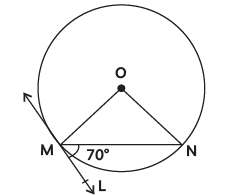
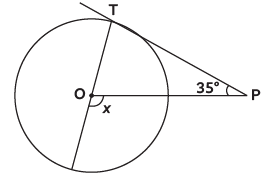
Q2: In the given figure, O is the centre of the circle. MN is the chord and the tangent ML at point M makes an angle of 70° with MN. The measure of ∠MON is:     (1 Mark) (CBSE 2024)

(a) 120º 
(b) 140º 
(c) 70º 
(d) 90º

Hide Answer  

Ans: (b)
OM ⊥ ML [as tangent from centre is ⊥ at point of contact]

∠OML = 90º (∵ The angle between a tangent and a radius at the point of contact is always 90º)
and ∠NML = 70º 
⇒ ∠OMN + ∠NML = 90º 
⇒ ∠OMN = 90º – 70º = 20º 
∵ OM = ON = Radii of same circle 
∴ ∠OMN = ∠ONM = 20º  (Angle opposite to equal sides are equal)
In ∆MON, 
∠OMN + ∠ONM + ∠MON = 180º 
⇒ 20º + 20º + ∠MON = 180º 
⇒ ∠MON = 140º

Q3: In the given figure, if PT is tangent to a circle with centre O and ∠TPO = 35º, then the measure of ∠x is       (1 Mark) (CBSE 2024)
(a) 110º 
(b) 115º 
(c) 120º 
(d) 125º

Hide Answer  

Ans: (d)
∠OTP = 90º [Line from centre is ⊥ to tangent at point of contact] 
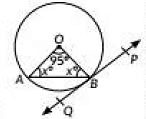
∠x = ∠TPO + ∠OTP [Exterior Angle Property] 
x = 35º + 90º = 125º

Previous Year Questions 2023

Q1: In the given figure, PT is a tangent at T to the circle with centre O. If ∠TPO = 25°, then x is equal to:

(a) 25° 
(b) 65° 
(c) 90°

(d)115°         (1 Mark) (CBSE 2023)

Hide Answer  

Ans: (d)
Since tangent is perpendicular to radius at the point of contact.
∴ ∠PTO = 90°
Hence, by the exterior angle formula, in ΔOTP, we get x = 90° + 25°
= 115°

Q2: In the given figure, PQ is tangent to the circle centred at O. If ∠AOB = 95o, then the measure of ∠ABQ will be (1 Mark) (2023)
(a) 47.5°
(b) 42.5°
(c) 85°
(d) 95°

Hide Answer  

Ans: (a)
We have ∠AOB = 95°
In ΔAOB, ∠OAB = ∠OBA (Angle opposite to equal sides are equal)
Now, ∠OAB + 95° + ∠OBA =180° (Angle sum property of a triangle)
= 2∠OAB = 85° 


∴ ∠OAB = ∠OBA = 42.5° [From (i)]
Now, OB is perpendicular to the tangent line PQ
∠OBQ = 90°
∠ABQ + ∠OBA = ∠OBQ = 90°
∠ABQ = 90° – 42.5°
= 47.5°

Q3: In the given figure. TA is tangent to the circle with centre O such that OT = 4 cm, ∠OTA= 30o, then the length of TA is   
(1 Mark)(2023)
(a) 2√3 cm

(b) 2cm
(c) 2√2 cm
(d) √3 cm

Hide Answer  

Ans: (a)
Draw OA ⊥ TA.

In ΔOTA,
∠OAT = 90° [∵ Tangent to a circle is perpendicular to the radius passing through the point of contact]
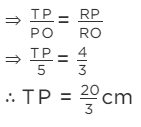
and ∠OTA = 30°


Q4: In the figure, from an external point P, two tangents PQ and PR are drawn to a circle of radius 4 cm with centre O. If  ∠QPR= 90°. then the length of PQ is    (1 Mark) (2023)
(a) 3 cm
(b) 4 cm
(c) 2 cm
(d) 2√2 cm

Hide Answer  

Ans: (b)

Draw a line segment joining the points R and O

Now OQ and OR are equal (Radii of a circle)
∠QPR = 90° (Given)

And ∠OQP = ∠ORP = 90° (Tangents make 90 degree angle with radius)

Now, in Quadrilateral PQOR
Sides OQ = OR (Radii)

and PR = PQ (Tangents from same point)

And ∠QPR = ∠PRO = ∠PQO = 90°

Therefore, Quadrilateral PQOR is a square.

Since, all sides of a square are equal,
⇒ OR = RP = PQ = OQ = 4 cm

Hence, length of PQ is 4 cm.

Q5: The length of tangent drawn to a circle of radius 9 cm from a point 41 cm from the centre is          (1 Mark) (2023)
(a) 40 cm
(b) 9 cm
(c) 41 cm 
(d) 50 cm

Hide Answer  

Ans: (a)
OB ⊥ AB     [∵As tangent to a circle is perpendicular to the radius through the point of the contact]
In ΔOAB,

OA2 = OB2 + AB2 [By Pythagoras theorem]
⇒ (41)2 = 92 + AB2
⇒ AB2 = 412 – 92
= (41 – 9)(41 + 9)
= (32)(50)
= 1600
⇒ AB = 
= 40 cm

Q6: In the given figure. O is the centre of the circle and PQ is the chord. If the tangent PR at P makes an angle of 50° with PQ, then the measure of ∠POQ is           (1 Mark) (2023)
(a) 50°

(b) 40°
(c) 100°
(d) 130°

Hide Answer  

Ans: (c)
PR is tangent which touches circle at point P.
So, ∠OPR = 90°
∠OPQ = 90° – ∠RPQ = 90° –  50° =  40°
In, ΔPOQ,
OP = OQ (Radii of circle)
So, ∠OQP = ∠OPQ=40°
⇒ ∠POQ = 180° – 40° – 40° = 100°

Q7: Case Study: The discus throw is an event in which an athlete attempts to throw a discus. The athlete spins anti-clockwise around one and a half times through a circle, then releases the throw. When released, the discus travels along the tangent to the circular spin-orbit.

In the given figure, AB is one such tangent to a circle of radius 75cm. Point O is the centre of the circle and ∠ABO = 30°. PQ is parallel to OA.

Based on the above information
(a) Find the length of AB.
(b) Find the length of OB.
(c) Find the length of AP.

OR
Find the value of PQ.         (4 Marks) (2023)

Hide Answer  

Ans: 

OR


Q8: Two tangents TP and TQ are drawn to a circle with centre O from an external point T. Prove that ∠PTQ = 2∠OPQ.     
(3 Marks)(2023)

Hide Answer  

Ans: 

We know that the lengths of tangents drawn from an external point to a circle are equal.

∴ TP = TQ … (1)

∴ ∠TQP = ∠TPQ (angles of equal sides are equal) … (2)

Now, PT is tangent, and OP is the radius.

∴ OP ⊥ TP (Tangent at any point of a circle is perpendicular to the radius through the point of contact)

∴ ∠OPT = 90°

or, ∠OPQ + ∠TPQ = 90°

or, ∠TPQ = 90° – ∠OPQ … (3)

In ∆TPQ,

∠TPQ + ∠PQT + ∠QTP = 180° (Sum of angles of a triangle is 180°)

or, 90° – ∠OPQ + ∠TPQ + ∠QTP = 180°

or, 2(90° – ∠OPQ) + ∠TPQ = 180° [from (2) and (3)]

or, 180° – 2∠OPQ + ∠TPQ = 180°

or, 2∠OPQ = ∠TPQ 
Hence Proved

Q9: In the given figure, a circle is inscribed in a quadrilateral ABCD in which ∠B = 90°. If AD = 17 cm, AB = 20 cm and DS = 3 cm, then find the radius of the circle.      (3 Marks) (2023)

Hide Answer  

Ans: 

Given:

∠B = 90° , AD = 17 cm , AB = 20 cm, DS = 3 cm (where S is the point of tangency on side AD)

From the properties of tangents, we know:

  • Tangents drawn from an external point to a circle are equal in length.
  • DS = DR (tangents from point D are equal).
  • AR = AQ (tangents from point A are equal).

Since AD = 17 cm and DS = 3 cm, we calculate AR as:

  • AR = AD – DS = 17 cm – 3 cm = 14 cm
    Thus, AR = 14 cm.

From the property that AR = AQ, we get:

  • AQ = 14 cm.

Since AB = 20 cm and AQ = 14 cm, we calculate BQ as:

  • BQ = AB – AQ = 20 cm – 14 cm = 6 cm.

OQ ⊥ BQ and OP ⊥ BP because a tangent at any point of a circle is perpendicular to the radius at the point of contact.

Since both OQ = BQ and the angles between the tangents are 90°, quadrilateral BQOP must be a square.

Since BQ = OQ = r, the radius of the inscribed circle is:

r = 6 cm.

Q10: From an external point, two tangents are drawn to a circle. Prove that the line joining the external point to the centre of the circle bisects the angle between the two tangents.       (3 Marks) (CBSE 2023)

Hide Answer  

Ans: Let P lie an external point, O be the centre of the circle and PA and PB are two tangents to the circle as shown in  figure.

In ΔOAP and ΔOBP.
OA = OB [Radius of the circle]
OP = OP [common]
PA = PB [∵ Tangents drawn from an external point to a circle are equal]
So, ΔOAP ≅ ΔOPB
So, ∠APO = ∠BPO (By cpct)
 Hence. OP bisects ∠APB

Q11: Two concentric circles are of radii 5 cm and 3 cm. Find the length of the chord of the larger circle which touches the smaller circle.       (3 Marks) (CBSE 2023)

Hide Answer  

Ans: Let the centre of the two concentric circlet is O and AB be the chord of the larger circle which touches the smaller circle at point P as shown in figure.
∴ AB is a tangent to the smaller circle at point P
⇒ OP ⊥  AB
By Pythagoras theorem, in ΔOPA

OA2 = AP2 + OP2
⇒ 52 = AP2 +32
⇒ AP2 =52 – 32 = 25 – 9
⇒ AP2 = 16 ⇒ AP = 4cm
In ΔOPB Since, OP ⊥ AB
AP = PB [∵ Perpendicular drawn from the centre of the circle bisects the chord]
∴ AB = 2AP = 2 x 4 = 8 cm
∴ The length of the chord of the larger circle is 8 cm.

Q12: Prove that the angle between the two tangents drawn from an external point to a circle is supplementary to the angle subtended by the line segment joining the points of contact at the centre.      (3 Marks) (2023)

Hide Answer  

Ans: Let PA and PB are two tangents on a circle from point P as shown in the figure.
Let is known that tangent to a circle is perpendicular to the radius through the point of contact.
∠OAP =∠OBP = 90° ……..(i)
In quadrilateral AOBP,
∠OAP + ∠APB + ∠PBO + ∠BOA = 360°
90° + ∠APB + 90° + ∠BOA = 360°     [Using (i)]
∠APB + ∠BOA = 360° – 180°
∴ ∠APB + ∠BOA = 180°
Hence proved.

Get additional INR 200 off today with EDUREV200 coupon.

Previous Year Questions 2022

Q1: In Fig, AB is the diameter of a circle centred at O. BC is tangent to the circle at B. If OP bisects the chord AD and ∠AOP= 60°, then find m∠C.    (2022)

Hide Answer  

Ans: Since, OP bisects the chord AD, therefore ∠OPA = 90° …. [∵ The line drawn through the centre of a circle to bisect a chord is perpendicular to the chord]
Now, In ΔAOP,
∠A = 180° – 60° – 90°
= 120° – 90°
= 30°
Also, we know that the tangent at any point of a circle is perpendicular to the radius through the point of contact
∴ ∠ABC = 90°
Now, In ΔABC,
∠C = 180° – ∠A – ∠B
= 180° – 30° – 90°
= 150° – 90°
= 60°

Q2: In Fig. XAY is a tangent to the circle centred at 0. If ∠ABO = 40°. Then find ∠BAY and ∠AOB   (2022)

Hide Answer  

Ans: 

Given, ∠ABO = 40°
∠XAO = 90°  …(Angle between radius and tangent)
OA = OB  …(Radii of same circle)
⇒ ∠OAB = ∠OBA
∴  ∠OAB = 40°
Now, applying the linear pair of angles property,
we get
∠BAY + ∠OAB + ∠XAO = 180°
⇒ ∠BAY + 40° + 90° = 180°
⇒ ∠BAY + 130° = 180°
⇒ ∠BAY = 180° – 130°
⇒ ∠BAY = 50°
Now, In ΔAOB,
∠AOB + ∠OAB + ∠OBA = 180°
or, ∠AOB + 40° + 40° = 180°
or, ∠AOB = 180° – 80° = 100°
Hence proved.

Q3: In Figure, two circles with centres at O and O’ of radii 2r and r, respectively, touch each other internally at A. A chord AB of the bigger circle meets the smaller circle at C. Show that C bisects AB.  (2022)

Hide Answer  

Ans: 

Join OA, OC, and OB.

Clearly, ∠OCA is the angle in a semi-circle.∴ ∠OCA=90∘

In right triangles OCA and OCB, we have:OA=OB=r 
∠OCA=∠OCB=90∘ and OC=OC

So, by RHS-criterion of congruence, we get:△OCA≅△OCB 
∴AC = CB

Q4: In Figure, PQ and PR are tangents to the circle centred at O. If ∠OPR = 45°, then prove that ORPQ is a square.   (2022)

Hide Answer  

Ans: It is given that ∠QPR = 90°
We know that the lengths of the tangents drawn from the outer point to the circle are equal.
PQ = PR … (1)
The radius is Perpendicular to the tangent line at the point of contact.
∴ ∠PQO = 90°
and
∠ORP = 90°
In quadrilateral OQPR:
∠QPR + ∠PQO + ∠QOR + ∠ORP = 360°
⇒ 90° + 90° + ∠QOR + 90° = 360°
⇒ ∠QOR = 360° – 270° = 90°
∴ QPR = ∠PQO = ∠QOR = ∠ORP = 90°
It can be concluded that PQOR is a square.

Q5: In Fig., there are two concentric circles with centre O. If ARC and AQB are tangents to the smaller circle from point A lying on the larger circle, find the length of AC if AQ = 5 cm.    (2022)

Hide Answer  

Ans:  

Here, AC and AB are the tangents from external point A to the smaller circle.
∴ AC = AB

Now, AB is the chord of the bigger circle and OQ is the perpendicular bisector of chord AB.
∴ AQ = QB

or, AB = 2AQ

or, AB = 2(5) = 10 cm [Given AQ = 5 cm]

or, AC = 10 cm

Q6: In Figure, O is the centre of the circle. PQ and PR are tangent segments. Show that the quadrilateral PQOR is cyclic.   (2022)

Hide Answer  

Ans: Given: PQ and PR are tangents from an external point P.
To prove: PQOR is a cyclic quadrilateral.
Proof :
OR and OQ are radius of circle centred at O, and PR and PQ are tangents.
∠ORP = 90° and ∠OQP = 90°
In quadrilateral PQOR, we have
∠OQP + ∠QOR + ∠ORP + ∠RPQ = 360°
90° + ∠QOR + 90° + ∠RPQ = 360°
180° + ∠QOR + ∠RPQ = 360°
∠QOR + ∠RPQ = 360° – 180°
So, ∠O + ∠P = 180°
∠P and ∠O are opposite angles of quadrilateraI which are supplementary.
∴ PQOR is a cyclic quadrilateral.

Q7: In Figure O is the centre of a circle of radius 5 cm. PA and BC are tangents to the circle at A and B respectively. If OP = 13 cm. then find the length of tangents PA and BC.   (2022)

Hide Answer  

Ans: 

We are given:

The radius of the circle, OA = 5 cm,
The distance from the external point P to the center O, OP = 13 cm.

Since PA is a tangent to the circle at point A, it is perpendicular to the radius OA. Thus, △OAP is a right triangle.

Using the Pythagorean theorem in △OAP:

OP² = OA² + PA²

Substitute the known values:

13² = 5² + PA²

Simplify:

169 = 25 + PA²

Solve for PA²:

PA² = 169 − 25 = 144
Take the square root:

PA = √144 = 12 cm
Thus, the length of PA is:

PA = 12 cm

In PBC, using Pythagoras theorem
PB=8 cm, BC=x, PC=(12-x), √PBC=90o
So, PB2+BC2=PC

82+x2=(12-x)2

x=10/3=3.33

BC=3.33

Q8: In fig. PQ is a chord of length 8 cm of a circle of radius 5 cm. The tangents at P and Q meet at a point T. Find the length of TP.   (2022)

Hide Answer  

Ans:  In the given figure,
PQ = 8 cm and OP = 5 cm

Join OT.
Let it meet PQ at the point R.

Then ∆TPQ is isosceles and TO is the angle bisector of ∠PTO.
[∴ TP = TQ = Tangents from T upon the circle]

∴ OT ⊥ PQ

∴ OT bisects PQ.

PR = RQ = 4 cm

Now,
OR = √(OP² – PR²) = √(5² – 4²) = 3 cm

Now,
∠TPR + ∠RPO = 90° (∴ TPO = 90°)

= ∠TPR + ∠PTR (∴ TRP = 90°)

∴ ∠RPO = ∠PTR

Now, Right triangle TRP is similar to the right triangle PRO. [By A-A Rule of similar triangles]

[∵Tangents drawn from an external point to a circle are equal in length]

Q9: Prove that a parallelogram circumscribing a circle is a rhombus.   (2022)

Hide Answer  

Ans: Given : A parallelogram ABCD circumscribing a circle with centre O.
To prove : ABCD is a rhombus.
Proof: We know that the tangents drawn to a circle from an external Doint are eaual in length.

⇒ AP = AS  [Tangents drawn from A]    …(i)
⇒ BP = BQ    [Tangents drawn from B]    …(ii)
⇒ CR= CQ    [Tangents drawn from C]    …(iii)
⇒ DR = DS    [Tangents drawn from D]    …(iv)
Adding (i), (ii), (iii) and (iv) we get
AP + BP +  CR + DR = AS + BQ + CQ + DS
= (AP + BP) + (CR + DR) = (AS + DS) + (BQ + CQ)
⇒ AB + CD = AD + BC
⇒ 2AB = 2BC         [Opposite sides of the given parallelogram are equal ∴ AB = DC and AD = BC)
AB = BC = DC = AD
Hence, ABCD is a rhombus.

Q10: In Fig, if a circle touches the side QR of ΔPQR at S and extended sides PQ and PR at M and N, respectively, then 

Prove that     (2022)

Hide Answer  

Ans: Given: A circle is touching a side QR of ΔPQR at point S.
PQ and PR are produced at M and N respectively.
To prove
Proof: PM = PN  …(i) (Tangents drawn from an external point P to a circle are equal)
QM = QS  …(ii) (Tangents drawn from an external point Q to a circle are equal)
RS = RN  …(iii) (Tangents drawn from an external point R to a circle are equal)
Now, 2PM = PM + PM
= PM + PN  …[From equation (i)]
= (PQ + QM) + (PR + RN)
= PQ + QS + PR + RS  …[From equations (i) and (ii)]
= PQ + (QS + SR) + PR
= PQ + QR + PR

Hence proved.

Q11: In the figure, a triangle ABC with ∠B = 90° is shown. Taking AB as diameter, a circle has been drawn intersecting AC at point P. Prove that the tangent drawn at point P bisects BC.          (2022)

Hide Answer  

Ans: 

According to the question,
In a right angle ΔABC is which ∠B = 90°, a circle is drawn with AB as diameter intersecting the hypotenuse AC at P.
Also PQ is a tangent at P
To Prove: PQ bisects BC i.e. BQ = QC
Proof: ∠APB = 90°  …[Angle in a semicircle is a right-angle]
∠BPC = 90° …[Linear Pair]
∠3 + ∠4 = 90° …[1]
Now, ∠ABC = 90°
So in ΔABC
∠ABC + ∠BAC + ∠ACB = 180°
90° + ∠1 + ∠5 = 180°
∠1 + ∠5 = 90°  …[2]
Now, ∠1 = ∠3  …[Angle between tangent and the chord equals angle made by the chord in alternate segment]
Using this in [2] we have
∠3 + ∠5 = 90°  …[3]
From [1] and [3] we have
∠3 + ∠4 = ∠3 + ∠5
∠4 = ∠5
QC = PQ  …[Sides opposite to equal angles are equal]
But also, PQ = BQ  …[Tangents drawn from an external point to a circle are equal]
So, BQ = QC
i.e. PQ bisects BC.

Q12: In the figure, two circles touch externally at P. A common tangent touches them at A and B, and another common tangent is at P, which meets the common tangent AB at C. Prove that ∠APB = 90°.    (2022)

Hide Answer  

Ans: Let common tangent at P meets the tangent AB at C. Since, tangents drawn from an external point to a circle are  equal


∴ AC = CP
and BC = CP
⇒ ∠CAP = ∠CPA = x (say) …(i)
and ∠CBP = ∠CPB = y (say) …(ii)
Now, ∠ACP+ ∠BCP = 180°  [Linear pair] …(*)
In ΔACP, ∠ACP + ∠CPA + ∠CAP = 180° …(iii)
and in ΔBCP, ∠BCP+ ∠CPB + ∠CBP = 180°…(iv)
Adding (iii) and (iv), we get
∠ACP + x + x + ∠BCP + y + y = 360°
∠ACP + ∠BCP + 2x + 2y = 360°   [Using (i) & (ii)]
= 2(x + y) = 360° – 180° = 180°[Using (‘))
⇒ x + y = 90°
i.e., ∠CPA + ∠CPB = 90° => ∠APB = 90°

Previous Year Questions 2021

Q1: In the given figure, PT and PS are tangents to a circle with centre O, from a point P such that PT = 4 cm and ∠TPS = 60°. Find the length of the chord TS.    (2021)

Hide Answer  

Ans: 

Given: PT = 4 cm and ∠TPS = 60°.

To Find: Length of the chord TS and the radius of the circle.

Step 1: In triangle PTS given

PT = 4 cm and PS = 4 cm

Since, PT = PS = 4 cm

Let, ∠PST = ∠PTS = x and as we know ∠TPS = 60°

Now, in triangle PTS

∠PST + ∠PTS + ∠TPS = 180°

x + x + 60° = 180°

2x = 120°

x = 60°

So, ∠PST = ∠PTS = ∠TPS = 60°

Thus, PT = TS = PS = 4 cm
Step 2: An equilateral triangle has equal sides and angles of 60 degrees. Triangle PTS is equilateral, and chord TS = 4 cm.

Step 3: In triangle POS:

OS/PS = tan 30°
OS = P × tan 30°
OS = 4/√3 cm

Hence, the radius of the circle is 4/√3 and chord TS = 4 cm.

Also read: Circle Theorems -1

Previous Year Questions 2020

Q1: In the figure, PQ is tangent to the circle with the centre at O, at the point B. If ∠AOB = 100°, then ∠ABP is equal to   (2020)

(a) 50°
(b) 40°
(c) 60°
(d) 80°     

Hide Answer  

Ans: (a)
Given that
∠ AOB = 100°
Since OA = OB [Radii]
So  ∠ OAB =  ∠ OBA = 40° [Angle opposite the similar sides are equal]
Since PQ is tangent on the circle. So OB is perpendicular to PQ.
So,
∠ OBP = 90° [angle between radii and tangent is 90°]
∠ OBA + ∠ ABP = 90°
∠ ABP  = 90 – ∠ OBA
∴ ∠ ABP  = 90° – 40°
∴ ∠ ABP  = 50°

Q2: In the given figure, PT is a tangent at T to the circle with centre O. If ∠TPO = 25°, then x is equal to   (2020)
(a) 25°
(b) 65°
(c) 90°
(d) 115°

Hide Answer  

Ans: (d)
Since ∠TPO = 25° and ∠OTP  = 90°  [Angle between radii and tangent is 90°]
x = ∠OTP + ∠TPO
= 90° + 25° = 115°
[∵ Radius is perpendicular to the tangent T]

Q3: In the given figure, QR is a common tangent to the given circles, touching externally at point T. The tangent at T meets QR at P  If PT = 3.8 cm, then the length of QR(in cm] is   (2020)
(a) 3.8

(b) 7.6
(c) 5.7
(d) 1.9

Hide Answer  

Ans: (b)
It is known that the length of the tangents drawn from an external point to a circle are equal.
∴ QP = PT= 3.8 cm and PR = PT = 3.8 cm
Now, QR = QP + PR = 3.8cm + 3.8cm = 7.6 cm

Q4: In Figure, if tangents PA and PB from an external point P to a circle with centre O are inclined to each other at an angle of 80° then ∠POA is equal to   (2020)
(a) 50°

(b) 60°
(c) 80°
(d) 100°

Hide Answer  

Ans: (a)

Construction: Join OP
A tangent at any point of a circle is perpendicular to the radius at the point of contact.

In ΔOAP and in ΔOBP:

  • OA = OB (radii of the circle are always equal)
  • AP = BP (length of the tangents)
  • OP = OP (common)

Therefore, by SSS congruency ΔOAP ≅ ΔOBP.

If two triangles are congruent, then their corresponding parts are equal.

Hence:

  • ∠POA = ∠POB
  • ∠OPA = ∠OPB

Therefore, OP is the angle bisector of ∠APB and ∠AOB.

Hence, ∠OPA = ∠OPB = 1/2 (∠APB)
= 1/2 × 80°
= 40°

By the angle sum property of a triangle, in ΔOAP:
∠A + ∠POA + ∠OPA = 180°

OA ⊥ AP (The tangent at any point of a circle is perpendicular to the radius through the point of contact.)

Therefore, ∠A = 90°

90° + ∠POA + 40° = 180°
130° + ∠POA = 180°
∠POA = 180° – 130°
∠POA = 50°

Thus, option (A) 50° is the correct answer.

Q5: In the figure, a quadrilateral ABCD is drawn to circumscribe a circle. Prove that AB + CD = BC + AD.       (2020)

Hide Answer  

Ans: Let the circle touches the sides AB, BC, CD and DA of quadrilateral ABCD at P, Q, R and S respectively Since, lengths of tangents drawn from an external point to the circle are equal.

AP = AS    …(1)    (Tangents drawn from A)
BP = BQ    …(2)    (Tangents drawn from B)
CR = CQ    …(3)    (Tangents drawn from C)
DR = DS    …(4)    (Tangents drawn from D)
Adding (1), (2), (3) and (4), we get
AP + BP + CR + DR = AS + BQ + CQ + DS
⇒ (AP + PB) + (CR + RD) = (AS + SD) + (BQ + QC)
⇒ AB + CD = AD + BC

Q6: In figure, find the perimeter of ΔABC if AP =12 cm.      (2020)

Hide Answer  

Ans: 

Step 1: Identify the Tangents
From the problem, we know that AP and AQ are tangents to the circle from point A, and BC is also a tangent. According to the properties of tangents from an external point, the lengths of the tangents drawn from the same external point to a circle are equal.

Step 2: Set Up the Equations
Since AP = 12 cm, we can conclude that:

  • AP = AQ = 12 cm (Equation 1)

Step 3: Identify Other Tangents
From point B, the tangents BD and BP are equal:

  • BD = BP (Equation 2)

From point C, the tangents CD and CQ are equal:

  • CD = CQ (Equation 3)

Step 4: Express Perimeter of Triangle ABC
The perimeter of triangle ABC can be expressed as:
Perimeter = AB + BC + AC

Step 5: Substitute for BC
Since BC is composed of the tangents from B and C:
BC = BD + CD

Thus, we can rewrite the perimeter as:
Perimeter = AB + (BD + CD) + AC

Step 6: Express AB and AC in Terms of Tangents
From the properties of tangents:

  • AP = AB + BP
  • AQ = AC + CQ

Substituting BP and CQ with BD and CD respectively, we have:

  • AP = AB + BD (Equation 4)
    AQ = AC + CD (Equation 5)

Step 7: Substitute Equations into PerimeterNow, substituting the expressions from Equations 4 and 5 into the perimeter equation:Perimeter = (AP – BD) + (BD + CD) + (AQ – CD)

Step 8: Simplify the Expression
Since AP = AQ and both are equal to 12 cm:
Perimeter = (12 – BD) + (BD + CD) + (12 – CD)

This simplifies to:
Perimeter = 12 + 12 = 24 cm

Previous Year Questions 2019

Q1: In the given figure, a circle is inscribed in a ΔABC having sides BC = 6 cm, AB = 10 cm and AC = 12 cm. Find the lengths BL, CM and AN.    (2019)

Hide Answer  

Ans:  Let BL = x, BN = x

[∵ Tangents drawn from an external point to to the circle are equal in length]
CL = CM = 8 – x    [∵ BC = 8cm]
AN = AM = 10 – x    [∵ AB = 10cm]
But AC= 12cm[Given]
∴ AM + MC = 12
10 – x + 8 – x = 12
⇒ 18 – 2x = 12
⇒ 6 = 2x
⇒  x = 3
Length of BL = 3cm
Length of CM = 8 – 3 = 5 cm
Length of AN = 10 – 3 = 7 cm

Q2: Prove that tangents drawn at the ends of the diameter of a circle are parallel.   (2019)

Hide Answer  

Ans: 

Given : A circle C(O, r)with diameter AB and let PQ and RS be the tangents drawn to the circle at point A and B.
To prove: PQ || RS
Proof: Since tangent at a point to a circle is perpendicular to the radius through the point of contact.
∴ AB ⊥ PQ and AB ⊥ R S
⇒ ∠PAB = 90° and ∠ABS = 90°
⇒ ∠PAB = ∠ABS
⇒ PQ || RS  [∵ ∠PAB and ∠ABS are alternate interior angles]

Attention!Sale expiring soon, act now & get EduRev Infinity at 40% off!

Previous Year Questions 2017

Q1: The difference between the radii of the smaller circle and the larger circle is 7 cm and the difference between the areas of the two circles is 1078 sq. cm. Find the radius of the smaller circle.    [CBSE Delhi 2017 (C)]

Hide Answer  

Ans: Given: r2 – r1 = 7 (r2 > r1) …(i)

 (From equation (i))
 ….. (ii)
Adding (i) and (ii), we get
2r2 = 56
⇒ r2 = 28 cm
Also, r1 = 21 cm (From equation (i))
∴ Radius of simaller circle = 21 cm.

Q2: Prove that the tangent drawn at any point of a circle is perpendicular to the radius through the point of contact.    [AI (C) 2017]

Hide Answer  

Ans: 

Referring to the figure:

OA = OC (Radii of circle)

Now OB = OC + BC

∴ OB > OC (OC being radius and B any point on tangent)

⇒ OA < OB

B is an arbitrary point on the tangent.

Thus, OA is shorter than any other line segment joining O to any point on the tangent.

Shortest distance of a point from a given line is the perpendicular distance from that line.

Hence, the tangent at any point of the circle is perpendicular to the radius.

Q3: In Fig., PQ is a chord of length 8 cm of a circle of radius 5 cm. The tangents drawn at P and Q intersect at T. Find the length of TP.    [AI (C) 2017, Foreign 2015]

Hide Answer  

Ans: Given: PQ is a chord of length 8 cm
Radius OP = 5 cm. PT and QT are tangents to the circle.
To find: TP
OT is perpendicular bisector of PQ
∠ORP = 90°
(Line joining the centre of circle to the common point of two tangents drawn to circle is perpendicular bisector of line joining the point of contact of the tangents.


⇒ 

x2 = 9
⇒ x = 3


(OR + RT)2 = 25 + PT2
(3 + y)2 = 25 + PT2
9 + y2 + 6y = 25 + PT2 …….(i)
In ΔPRT, TP2 = PR2 + RT2
⇒ PT2 = (4)2 + (y)2 …….(ii)
Put value of PT2 in eq (i)
9 + y2 + 6y = 25 + 16 + y2
6y = 25 + 16 – 9
6y = 32
y = 32/6 = 16/3 cm
Putting y = 16/3 cm in eq (ii), we get

Q4: From an external point P, two tangents PA and PB are drawn to the circle with centre O. Prove that OP is the perpendicular bisector of chord AB.  (CBSE 2017)

Hide Answer  

Ans: Join OA and OB.
In ΔOAP and ΔOBP.

OA = OB [Radii of same circle]
PA = PB [Tangents from external point]
OP = OP [Common]
So ΔOAP ≅ ΔOBP (By SSS rule)
∠1 = ∠2 [By C.P.C.T.]
Now, In ΔATP and ΔBTP.

 PA = PB [Tangents from external point]

 AT = BT [By C.P.C.T.] …(1)

 ∠ATP = ∠BTP [By CPCT] …(2)
Since, ATB is a straight line. 
∠ATP + ∠BTP = 180º 
⇒ ∠ATP + ∠ATP = 180º [From (2) ] 
⇒ 2∠ATP = 180º 
⇒ ∠ATP = 90º …(3) 
From (1) and (3) we can say that OP is ⊥ bisector of AB

Q5: In the given figure, PQ is a tangent from an external point P and QOR is a diameter. If ∠POR = 130º and S is a point on the circle, find ∠1 + ∠2. (CBSE 2017)

Hide Answer  

Ans: Given, PQ is a tangent to a circle, and QOR is a diameter of a circle. 
Also, ∠POR = 130º 
Now, ∠RST = 1/ 2 ∠POR
∠2 = 1/ 2 × 130º = 65º …(i) [∠TOR = ∠POR] 

[Since, angle subtended by the arc at centre is twice the angle subtended by it on any remaining part of the circle]
Since, ROQ is the diameter of the circle 
∴ ∠ROT + ∠QOT = 180º 
∠QOT = 180º – 130º = 50º …(ii) 
and ∠PQR = 90º …(iii) [tangent at any point of a circle is perpendicular to the radius through the point of contact]
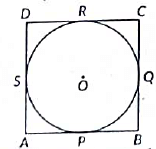
In ΔQOP 
∠QOP + ∠PQO + ∠OPQ = 180º 
⇒ 50º + 90º + ∠1 = 180º [from (ii) and (iii)] 
∠1 = 180º – 140º = 40º …(iv)
∴ ∠1 + ∠2 = 40º + 65º [From (i) and (iv)] 
= 105º 
Hence, the sum of ∠1 + ∠2 is 105º

Q6: In the figure, the radius of the circle of DABC of area 84 cm2 is 4 cm and the lengths of the segments AP and BP into which side AB is divided by the point of contact P are 6 cm and 8 cm. Find the lengths of the sides AC and BC.  (CBSE 2017)

Hide Answer  

Ans: Given: area (∆ABC) = 84 cm2
Radius of circle, r = OP = OQ = OR = 4 cm AP = 6 cm and BP = 8 cm 
Now AP = AR = 6 cm [Q two tangents from an external point to a circle are equal] 
Similarly, BP = BQ = 8 cm 
and QC = RC = x (say) 
AC = 6 + x 
and BC = 8 + x 
Now, area (∆ABC) = area (∆AOB) + area (∆BOC) + area (∆AOC)


⇒ 84 = 28 + (16 + 2x) + (12 + 2x)
⇒ 84 = 56 + 4x 
⇒ 4x = 84 – 56 
⇒ 4x = 28 
⇒ x = 7 
Hence, AC = 6 + 7 = 13 cm 
and BC = 8 + 7 = 15 cm.

Previous Year Questions 2016

Q1: If from an external point P of a circle with centre 0, two tangents PQ and PR are drawn such that QPR = 120°, prove that 2PQ = PO.      [CBSE Delhi (F) 2016]

Hide Answer  

Ans: Given, ∠QPR = 120°
Radius is perpendicular to the tangent at the point of contact.
∠OQP = 90° ⇒ ∠QPO = 60°

(Tangents drawn to a circle from an external point are equally inclined to the segment, joining the centre to that point.)

Q2: In Fig. 8.42, AP and BP are tangents to a circle with centre O, such that AP = 5 cm and ∠APS = 60°. Find the length of chord AB.     [CBSE Delhi 2016]

Hide Answer  

Ans: PA = PB (Tangents from an external point are equal)
and ∠APB = 60°
⇒ ∠PAB = ∠PBA = 60° (Angle opposite to similar sides are equal)
∴ ΔPAB is an equilateral triangle.
Hence AB = PA = 5 cm.

Q3: In Fig. 8.43 from an external point P, two tangents PT and PS are drawn to a circle with centre O and radius r. If OP = 2r, show that ∠OTS = ∠OST = 30°.      [CBSE (AI) 2016]

Hide Answer  

Ans: Let ∠TOP = θ
∴ 
Hence, ∠TOS = 120°
In ∠OTS, OT = OS    (Radii of circle)
⇒ 

Q4: In Fig. 8.44, are two concentric circles of radii 6 cm and 4 cm with centre O. If AP is a tangent to the larger circle and BP to the smaller circle and the length of AP is 8 cm, find the length of BP.     [CBSE (F) 2016]

Hide Answer  

Ans: OA = 6 cm, OB = 4 cm, AP = 8 cm
OP2 = OA2 + AP2 = 36 + 64 = 100 [Pythagoras Theorem]
⇒ OP = 10 cm
Similarly BP2 = OP2 – OB2 = 100 – 16 = 84 [Pythagoras Theorem]
⇒ 

Q5: From an external point P, tangents PA and PR are drawn to a circle with centre O. If ∠PAB = 50°, then find ∠AOB.      [CBSE Delhi 2016]

Hide Answer  

Ans: ∵ PA = PB ⇒ ∠BAP = ∠ABP = 50°
∴  ∠APB = 180° – 50° – 50° = 80°
and ∠AOB = 180° – 80° = 100° [Sum of opposite side of a quadrilateral is 180°]

Q6: In Fig. 8.29, PQ is a tangent at point C to a circle with centre O. If AB is a diameter and ∠CAB = 30°, find ∠PCA.      [CBSE (AI) 2016]

Hide Answer  

Ans: ∠ACB = 90° (Angle in the semicircle)
∠CAB = 30° (given)
In ΔABC,
90° + 30° + ∠ABC = 180°   [Angle sum property]
⇒ ΔABC = 60°
Now, ∠PCA = ∠ABC (Angles in the alternate segment)
∴  ∠PCA = 60°

OR
Construction: Join O to C.
∠PCO = 90° (∵ Line joining centre to point of contact is perpendicular to PQ)
In ΔAOC, OA = OC (Radii of circle)
∴ ∠OAC = ∠OCA = 30° (Equal sides have equal opp. angles)
Now, ∠PCA = ∠PCO – ∠ACO
= 90° – 30° = 60°

Q7: Two tangents PA and PB are drawn to the circle with centre O, such that ∠APB = 120°. Prove that OP = 2AP.       (Foreign 2016)

Hide Answer  

Ans:  Given. A circle C(0, r). PA and PB are tangents to the circle from point P, outside the circle such that ∠APB = 120°. OP is joined.

To Prove. OP = 2AP.
Construction. Join OA and OB.
Proof. Consider Δs PAO and PBO
PA = PB [Tangents to a circle, from a point outside it, are equal.]
OP = OP [Common]
∠OAP = ∠OBP = 90°

Q8: In Fig. 8.62, two equal circles, with centres O and O’, touch each other at X.OO’ produced meets the circle with centre O’ at A. AC is tangent to the circle with centre O, at point C. O’D is perpendicular to AC. Find the value of      [CBSE (AI) 2016]

Hide Answer  

Ans: AC is tangent to circle with centre O.
Thus ∠ACO = 90°
In ΔAO’D and ΔAOC
∠ADO’ = ∠ACO = 90º
∠A = ∠A  (Common)

Q9: In Fig. 8.63, O is the centre of a circle of radius 5 cm. T is a point such that OT = 13 cm and OT intersects the circle at E. If AB is a tangent to the circle at E, find the length of AB, where TP and TQ are two tangents to the circle.     [CBSE Delhi 2016]

Hide Answer  

Ans: 

(Tangents from an external point to a circle are equal)
In right ΔAET.
TA2 = TE2 + EA2
⇒ (12 – x)2 = 64 + x2    ⇒    144 + x2 – 24x = 64 + x2
⇒  x = 80/24    ⇒ x = 3.3 cm
Thus, AB = 6.6 cm

Practice Test: Circles

Previous Year Questions 2015

Q1: In the figure, PQ is a chord of a circle with centre O and PT is a tangent. If ∠QPT = 60°, find ∠PRQ.  (CBSE 2015)

Hide Answer  

Ans: Given, ∠QPT = 60°
So, OP is the radius of the circle. 
Now, ∠OPT = 90° 
∠OPQ = ∠OPT – ∠QPT = 90° – 60° = 30° 
In ΔOPQ, OP = OQ [radii of circle] 
∠OQP = ∠OPQ = 30° [Q Angles opposite to equal sides are equal] 
∠POQ = 180° – (30° + 30°) = 120° 
Reflex ∠POQ = 360° – 120° = 240° 
We know that, angle subtended by an arc at the centres double the angle subtended by it on the remaining part of the circle. 
so, ∠PRQ = 1/ 2 Reflex ∠POQ
Therefore, 240 / 2 ° = 120°

Previous Year Questions 2014

Q1: Prove that the parallelogram circumscribing a circle is a rhombus.      [CBSE Delhi 2014; CBSE 2019 (30/5/1)]

Hide Answer  

Ans: Let ABCD be a parallelogram such that its sides touch a circle with centre O.
We know that the tangents to a circle from an exterior point are equal in length.
Therefore, we have
AP = AS             (Tangents from A)      … (i)
BP = BQ             (Tangents from B)     … (ii)
CR = CQ              (Tangents from C)     … (iii)
And DR = DS      (Tangents from D) … (iv)

Adding (i), (ii), (iii) and (iv), we have
(AP + BP) + (CR + DR) = (AS + DS) + (BQ + CQ)
AB + CD = AD + BC
AB + AB = BC + BC      (∵ ABCD is a parallelogram ∴ AB = CD, BC = DA)
2AB = 2BC ⇒ AB = BC
Thus, AB = BC = CD = AD
Hence, ABCD is a rhombus.

Q2: Prove that the lengths of two tangents drawn from an external point to a circle are equal. [CBSE, Delhi 2014, (F) 2014, Delhi 2016, (AI) 2016, (F) 2016, CBSE Delhi 2017, (AI) 2017, (F) 2017, Delhi 2017 (C)]

Hide Answer  

Ans: Given: AP and AQ are two tangents from a pointed to a circle C (O, r).
To Prove: AP = AQ
Construction: Join OP, OQ and OA.
Proof: In order to prove that AP = AQ, we shall first prove that ΔOPA ≅ ΔOQA.
Since a tangent at any point of a circle is perpendicular to the radius through the point of contact.
∴ OP ⊥ AP and OQ ⊥ AQ
⇒ ∠OPA = ∠OQA = 90°    ……..(i)

Now, in right triangles OPA and OQA, we have
OP = OQ    (Radii of a circle)
∠OPA = ∠OQA    (Each 90°)
and OA = OA    (Common)
So, by RHS-criterion of congruence, we get

Hence, lengths of two tangents from an external point are equal.

09. Previous Year Questions: Some Applications Of Trigonometry

Previous Year Questions 2025

Q1: Assertion (A): A ladder leaning against a wall, stands at a horizontal distance of 6 m from the wall. If the height of the wall up to which the ladder reaches is 8 m, then the length of the ladder is 10 m. 
Reason (R): The ladder makes an angle of 60° with the ground. 
(a) Both Assertion (A) and Reason (R) are true and Reason (R) is the correct explanation of the Assertion (A). 
(b) Both Assertion (A) and Reason (R) are true, but Reason (R) is not the correct explanation of the Assertion (A). 
(c) Assertion (A) is true, but Reason (R) is false. 
(d) Assertion (A) is false, but Reason (R) is true.

Hide Answer  

Ans: (c)

 Let AB be the wall and AC be the ladder 
∴ Reason is false. 
In ΔABC, we have 
(AC)2 = (AB)2 + (BC)2  
= (8)2 + (6)2 = 64 + 36 = 100 
⇒ AC = 10 m 

Hence, length of the ladder is 10 m. 
So, assertion is true. 
Now, if ladder makes angle 60° with ground, then 

∴ Reason is false. 
Hence, assertion (A) is true and reason(R) is false.

Q2: A ladder 14 m long leans against a wall. If the foot of the ladder is 7 m from the wall, then the angle of elevation of the top of the wall is: 
(a) 15° 
(b) 30° 
(c) 45° 
(d) 60° 

Hide Answer  

Ans: (d) 

Let AC be the ladder making angle of elevation of the top of the wall be θ.
ln ΔABC,

Q3: A peacock sitting on the top of a tree of height 10 m observes a snake moving on the ground. If the snake is 10√3 m away from the base of the tree, then angle of depression of the snake from the eye of the peacock is 
(a) 30° 
(b) 45°
(c) 60° 
(d) 90°

Hide Answer  

Ans: (a)

Let PQ = 10 m be a tree, S be a snake at a distance of 10√3 m from the base of tree and θ be the angle of depression from point P.
∴ ∠PSQ = θ
In ΔPSQ,
tan θ = PQ/SQ

⇒ 0 = 30°

Q4: Case Study: A lighthouse stands tall on a cliff by the sea, watching over ships that pass by. One day a ship is seen approaching the shore and from the top of the lighthouse, the angles of depression of the ship are observed to be 30° and 45° as it moves from point P to point Q. The height of the lighthouse is 50 meters. 

Based on the information given above, answer the following questions : 
(i) Find the distance of the ship from the base of the lighthouse when it is at point Q, where the angle of depression is 45°. 
(ii) Find the measures of LPBA and LQBA. 
(iii) (a) Find the distance travelled by the ship between points P and Q. 
OR 
(iii) (b) If the ship continues moving towards the shore and takes 10 minutes to travel from Q to A, calculate the speed of the ship in km/h, from Q to A.

Hide Answer  

Ans: 

(i) Let AB be the light house. 
∴ AB = 50m 
ln ΔABQ,

Hence, distance of ship from base of light house when it is at Q is 50 m. 

(ii) In ∆ABQ, 
∠ABQ + ∠BQ + ∠QAB = 180° 
⇒ ∠ABQ + 45° + 90° = 180° 
⇒ ∠ABQ = 180° – 135° = 45° or ∠QBA = 45° 
⇒ ∠PBQ = 45° – 30° = 15° 
∴ ∠PBA = ∠PBQ + ∠ABQ = 15° + 45° = 60°
(iii) (a) In ∆ABP, 
tan 30° = AB/AP

Now, PQ = AP – AQ = 50√3, – 50 [From part (i), AQ = 50 m] 
⇒ PQ = 50(√3 – 1) m 
OR

(iii) (b) Time taken by ship from Q to A 
= 10 minutes = 1/6 hour
Distance travelled, QA = 50 m = 1/20 km
∴ Speed of ship = Distance/Time 

Q5: Case Study: Amrita stood near the base of a lighthouse, gazing up at its towering height. She measured the angle of elevation to the top and found it to be 60°. Then, she climbed a nearby observation deck, 40 metres higher than her original position and noticed the angle of elevation to the top of lighthouse to be 45°. 

Based on the above given information, answer the following questions: 
(i) If CD is h metres, find the distance BO in terms of ‘h’. 
(ii) Find distance BC in terms of ‘h’. 
(iii) (a) Find the height CE of the lighthouse.
[Use √3 = 1.73] 
OR
(iii) (b) Find distance AE, if AC = 100 m.

Hide Answer  

Ans: 
(i) In ΔBDC, 

(ii) In ΔBDC,

(iii) (a) We have, DE = AB = 40 m 

OR
(iii) (b)
 In ΔAEC, we have AC = 100 m, then 

Q6: Case Study: The Statue of Unity situated in Gujarat is the world’s largest Statue which stands over a 58 m high base. As part of the project, a student constructed an inclinometer and wishes to find the height of Statue of Unity using it. He noted following observation from two places: 
Situation I: The angle of elevation of the top of Statue from Place A which is 80√3° m away from the base of the Statue is found to be 60°.
Situation II: The angle of elevation of the top of Statue from a Place B which is 40 m above the ground is found to be 30° and entire height of the Statue including the base is found to be 240 m.

Based on given information, answer the following questions: 
(i) Represent the Situation – I with the help of a diagram. 
(ii) Represent the Situation – II with the help of a diagram. 
(iii) (a) Calculate the height of Statue excluding the base and also find the height including the base with the help of Situation – I. 
OR 
(iii) (b) Find the horizontal distance of point B (Situation – II) from the Statue and the value of tan α, where α is the angle of elevation of top of base of the Statue from point 8.

Hide Answer  

Ans: (i) Situation – I can be represented as: 

Here, CD is the statue of height h meters and DE is the base over which the statue stands of height 58 meters. 
(ii) Situation – II can be represented as: 

(iii) (a) In situation – I, we have, in ΔAEC, 

∴ Height of statue excluding the base = 182 m and including the base = 240 m 
OR
(iii) (b)
 In situation – II, in ΔBDC, CD = 240 – 40 = 200 m 

Previous Year Questions 2024

Q1: From a point on the ground, which is 30 m away from the foot of a vertical tower, the angle of elevation of the top of the tower is found to be 60º. The height (in metres) of the tower is:    (CBSE 2024)
(a) 10√3
(b) 30√3
(c) 60
(d) 30

Hide Answer  

Ans: (b)
Let BC be the tower and A be the observation point.

AB = 30 m 
∠CAB = 60º 
Let, BC = h m 
In ΔCBA,
tan 60º = BC/AB
⇒ √3 = h/30
⇒ h = 30√3 m

Q2: A man on a cliff observes a boat at an angle of depression of 30º which is approaching the shore to the point immediately beneath the observer with a uniform speed. Six minutes later, the angle of depression of the boat is found to be 60º. Find the time taken by the boat form here to reach the shore.    (CBSE 2024)

Hide Answer  

Ans:
Let AB be the cliff and observer is at point A. Initially the boat is at P after 6 min. it reaches to Q.
∠XAP = ∠APB = 30º
∠XAQ = ∠AQB = 60º
Let the speed of boat be x m/min.
So, distance, PQ = speed × time
= x × 6
= 6x meter
Let it takes t min  to reach from Q to B. So distance
BQ = x × t
= tx meter.
In ΔAB P,

⇒ 
⇒ 
⇒  …(i)
In ΔABQ.

⇒  ….(ii)
From (i) and (ii)

⇒ x(6 + t) = 3xt
⇒ x(6 + t) = 3xt
⇒ t + 6 = 3t
⇒ 2t = 6
⇒ t = 3 min.

Get additional INR 200 off today with EDUREV200 coupon.

Previous Year Questions 2023

Q1: If a pole 6 m high casts a shadow 2√3 m long on the ground, then sun’s elevation is         (CBSE 2023)
(a) 60º
(b) 45º
(c) 30º
(d) 90º

Hide Answer  

Ans: (a)


Let θ be the sun’s elevation.
Then tanθ = BC/AB

Q2: A straight highway leads to the foot of a tower. A man standing on the top of the 75 m high observes two cars at angles of depression of 30° and 60° which are approaching the foot of the tower. If one car is exactly behind the other on the same side of the tower, find the distance between the two cars. (Use √3 = 1.73)         (CBSE 2023)

Hide Answer  

Ans: Let the tower be CD and points A and B be the positions of two cars on the highway.
Height of the tower CD = 75 m.
In ΔDCB,


Now, In ΔACD,

Q3: From the top of a 7 in high building the angle of elevation of the top of a cable tower is 60° and the angle of depression of its foot is 30º. Determine the height of the tower.          (2023)

Hide Answer  

Ans: Let AE be the building with height 7 m and BD be the tower with height h m.
In ΔABC,

  —(i)

From (i) and (ii). we get
BC = 7√3 x √3 = 21m
∴ Height of the tower = 8C + CD
= 21 m + 7 m
= 28 m

Q4: A Ladder set against a wall at an angle 45º to the ground. If the foot of the ladder is pulled away from the wall through a distance of 4 m, its top slides a distance of 3 m down the wall making an angle 30° with the ground. Find the final height of the top of tire ladder from the ground and length of the ladder.      (2023)

Hide Answer  

Ans: Let AE = CD = y be the length of the ladder and h be the final height of the top of the ladder from the ground.
In ΔABE, tan 45o = AB/BE

Previous Year Questions 2022

Q1: Two boats are sailing in the sea 80 m apart from each other towards a cliff AB. The angles of depression of the boats from the top of the cliff are 30º and 45° respectively, as shown in the figure. Find the height of the cliff.      (2022)

Hide Answer  

Ans: Let assume that AB be the cliff of height h m and Let the boats are at C and D.
Now, it is given that the angle of depression from B to C and D are 30° and 45° respectively.
It is also given that CD = 80 m
Let assume that BD = x m
Now, In right-angle triangle ABD

Now, In right-angle triangle ABC


h = 40(√3 + 1)
h = 40(1.732 + 1)
h = 40 x 2.732
⇒ h = 109.28 m

Q2: The angle of elevation of the top of a building from the foot of the tower is 30° and the angle of elevation of the top of the tower from the foot of the building is 60°. If the tower is 50 m high, then find the height of the building.       (2022)

Hide Answer  

Ans: Let AB be the tower of height 50m  and CD be the building of height h m.
Now, in ΔABD,


Now, in ΔBDC,

Thus the height of the building in 16.67m

Q3: In figure, AB is tower of height 50 m. A man standing on its top, observes two cars on the opposite sides of the tower with angles of depression 30° and 45° respectively. Find the distance between the two cars.       (2022)

Hide Answer  

Ans:  C and D be the position of two cars.

In ΔABD, we have

In ΔABC, we have

⇒ BC = AB√3 = 50√3 m  …(ii)
From equations (i) and (ii), we get
CD = BC + BD
= ( 50√3 + 50 ) m
= 50 (√3 + 1 ) m
= 50(1.732 + 1)
= 50 × 2.732
= 136.6 m
Thus, the distance between two cars is 136.6 m.

Q4: An aeroplane when flying at a height of 3125 in from the ground passes vertically below another plane at an instant when the angles of elevation of the two planes from the same point on the ground are 30° and 60° respectively. Find the distance between the two planes at that  instant.       (2022)

Hide Answer  

Ans:  Let A and C be the position of two aeroplanes. Let distance between the two aeroplanes be x m.
In ΔCBD, we have


In ΔABD, we have


⇒ x + 3125 = 9375
⇒ x = 6250
∴ The distance between to planes  at that instant in 6250m

Q5: The shadow of a tower standing on a level ground is found to be 40 m longer when the Sun’s altitude is 30° than when it is 60°. Find the height of the tower.       (2022)

Hide Answer  

Ans: Let AB be the tower of height b m and let shadow of tower when sun’s altitude is 60° is x i.e. BC = x In ΔABC. we have

In ΔABD. we have

Q6: The tops of two poles of heights 20 m and 28 m are connected with a wire. The wire is Inclined to the horizontal at an angle of 30°. Find the length of the wire and the distance between the two poles       (2022)

Hide Answer  

Ans: Let length of the wire be BD and the distance between the two poles be BE Le.. AC = x m
Here, height of the larger pole. CD = 28 m
Height of smaller pole, AB = 20 m
DE = CD – CE
⇒DE = 28 – 20
= 8 m 

In ΔBDE, we have 

= 8 x 1.73
= 13.84
∴ The distance between two planes , BE is 13.84 m.

Q7: Two men on either side of a cliff 75 m high observe the angles of elevation of the top of the cliff to be 30° and 60°. Find the distance between the two men.       (2022)

Hide Answer  

Ans: Given, AB = 75 m be the cliff and C, D be the positions of two men.
Now, in ΔABD,

Q8: From a point on a bridge across a river, the angles of depression of the banks on opposite sides of the river are 30° and 45°. If the bridge is at a height of 8 m from the banks, then find the width of the river.        (2022)

Hide Answer  

Ans: We have, B and D represents points on the bank on opposite sides of the river. Therefore, BD is the width of the river.
Let A be a point on the bridge at a height of 8 m.

In ΔABC, 

In ΔACD, 

Q9: The angle of elevation of the top Q of a vertical tower PQ from a point X on the ground is 60°. From a point Y, 40 m vertically above X, the angle of elevation of the top Q of tower is 45°. Find the height of the tower PQ and the distance PX. (Use √3 = 1.73)       (2022)

Hide Answer  

Ans: 

We have
XY = 40m,∠PXQ = 60° and ∠MYQ = 45°
Let PQ = h
Also, MP = XY = 40m, MQ =  PQ  – MP = h – 40
In ΔMYQ,

⇒ MY = H – 40
⇒ PX = MY = h – 40    …………….(1)
Now , in ΔMXQ,


⇒ h = 20√3 (√3 + 1 )
⇒ h = 60 + 20√3
⇒ h = 60 + 20 × 1.73
⇒ h = 60 + 34.6
∴ h = 94.6m
So, the height of the tower PQ is 94. 6 m.

Q10: The straight highway leads to the foot of a tower. A man standing at the top of the tower observes a car at an angle of depression of 30°. which is approaching the foot of the tower with a uniform speed. Ten seconds later the angle of depression of the car is found to be 60°. Find the time taken by the car to reach the foot of the tower from this point.       (2022)

Hide Answer  

Ans: Let h be the height of the tower and D be the initial position of car and let DB = a, AB = b


Now, in ΔCAD,

Eliminating h, from (i) and (ii). we have

As the car covers distance a i.e.. 2b in 10 seconds.
So. it will take 5 seconds to reach the foot of the tower as covering b distance.

Q11: Case Study: Kite Festival (2022)
Kite festival is celebrated in many countries at different times of the year. In India, every year 14th January is celebrated as International Kite Day. On this day many people visit India and participate in the festival by flying various kinds of kites.
The picture given below shows three kites flying together

In Fig. the angles of elevation of two kites (Points A and B) from the hands of a man (Point C) are found to be 30° and 60° respectively. Taking AD = 50 m and BE = 60 m, find
(i) the lengths of strings used (take them straight) for kites A and B as shown in figure.
(ii) the distance ‘d’ between these two kites

Hide Answer  

Ans: (i) : Given , AD = 50 m. BE = 60 m
Let the lengths of strings used for kite A be AC and for kite B be BC
Now , in ΔADC , 

In ΔBEC, 


Hence, AC = 100 m and BC = 40√3 m

(ii) Since, the distance between these two kites is d.
ΔABC is a right angle triangle (∵∠ACB = 90°)

Now, in ΔABC, by using Pythagoras theorem, we have
BA2 = BC2 + AC2

Hence, the distance between these two kites is 121.65 m.

Also read: Unit Test: Some Applications of Trigonometry

Previous Year Questions 2021

Q1: A man on the top of a vertical tower observes a car moving at a uniform speed coming directly towards it. If it takes 18 minutes for the angle of depression to change from 30o to 60o. How soon after this will the car reach the tower?     (2021)

Hide Answer  

Ans: Let AB be the tower of height h m and D be the initiaI position of the car and C be the position of car after 18 minutes.

Let CD = x and BC = y
In ΔABD, we have

In ΔABC, we have

On comparing (i) and (ii), we have

Distance x is covered by car in 18 minutes. Distance 2y is covered by car in 18 minutes.
Hence, Distance y is covered by car in 9 minutes.

Attention!Sale expiring soon, act now & get EduRev Infinity at 40% off!

Previous Year Questions 2020

Q1: In figure, the angle of elevation of the top of a tower from a point C on the ground, which is 30m away from the foot of the tower, is 30o Find the height of the tower.      (2020)

Hide Answer  

Ans: Here, AB is the tower.

Q2: The ratio of the length of a vertical rod and the length of its shadow is 1: √3. Find the angle of elevation of the Sun at that moment.      (2020)

Hide Answer  

Ans: Let AC be the length of vertical rod, AB be the length of its shadow and 0 be the angle of elevation of the sun.


In ΔABC, 

Q3: The rod AC of a TV disc antenna is fixed at right angles to the wall AB and a rod CD is supporting the disc as shown in the figure. If AC = 1.5 m long and CD = 3 m, then find
(i) tanθ
(ii) secθ + cosecθ     (2020)

Hide Answer  

Ans:

In ΔACD, ∠CAD = 90°AD2 = CD– AC2    [By Pythagoras theorem]
= (3)2 – (1.5)2= 9 – 2.25 = 6.75 m2

Q4: From a point on the ground, the angles of elevation of the bottom and the top of a transmission tower fixed at the top of a 20 m high building are 45° and 60° respectively. Find the height of the tower
(Use √3 = 1.73)     (2020)

Hide Answer  

Ans: Let P be the point of observation. AB is the building of height 20 m and AC is the transmission tower.


⇒ 20+AC = 20√3
⇒ AC = 20√3 – 20 = 20(√3  -1)
⇒ AC=20(1.73 – 1)= 20 x 0.73
⇒AC= 14.6 m
Thus, the height of the tower is 14.6 m.

Q5: A statue 1.6 m tall, stands on the top of a pedestal. From a point on the ground the angle of elevation of the top of the statue is 60° and from the same point the angle of elevation of the top of the pedestal is 45°. Find the height of the pedestal. 
(Use √3 = 1.73)     (CBSE 2020)

Hide Answer  

Ans: In the figure, A represents the point of observation, DC represents the statue and BC represents the pedestal.
Now, in right ΔABC, we have

Thus , the height of the pedestal is 2.19 m.

Previous Year Questions 2019

Q1: The angles of depression of the top and bottom of a 8 m tall building from the top of a tower are 30° and 45° respectively. Find the height of the tower and the distance between the tower and the building.     (2019)

Hide Answer  

Ans: Let AB be the tower at height h m and CD he the building of height 6m and let x m be the distance between the lower and building.

In ΔABD, we have

In ΔAEC, we have

Put x = √3 in (i), we get

From (ii), we have


Now, The height or the Tower AB


and distance between tower and building = x = 4(3 + √3) m

Q2: As observed from the top of a lighthouse, 75 m high from the sea level, the angles of depression of two ships are 30° and 45°. If one ship is exactly behind the other on the same side of the lighthouse, find the distance between the two ships.     (2019)

Hide Answer  

Ans: Let AB be the lighthouse and C and D be the position of two ships.

Now, In ΔABC

Now in ΔABD, we have

Hence, distance between two ships is 75(√3 – 1)

Q3: A man in a boat rowing away from a light house 100 in high takes 2 minutes to change the angle of elevation of the top of the fight house from 60° to 30°. Find the speed of the boat in metres per minute. [Use √3 = 1.732)     (2019)

Hide Answer  

Ans: Let AB = 100 m be the height of the light house.
Let the initial distance be x m and angle is 60°.


In ΔABC,

Now. after two minutes, new distance be y m and angle is 30°.
In ΔABD,


Speed of boat = Distance / Time
= 115.47 / 2
= 57.74 metres/minute

Q4: Amit, standing on a horizontal plane, finds a bird flying at a distance of 200 m from him at an elevation of 30°. Deepak standing on the roof of a 50 m high building. finds the angle of elevation of the same bird to be 45°. Amit and Deepak are on opposite sides of the bird. Find the distance of the bird from Deepak.     (2019)

Hide Answer  

Ans:  Here, A be the position of Amit, B be the position of bird and D be the position of Deepak standing on roof of the building CD of height 50 m.
In ΔAMB, we have


Hence, distance of bird from Deepak is 50√2 m.

Q5: Two poles of equal heights are standing opposite each other on either side of the road, which is 80 m wide. From a point between them on the road, the angles of elevation of the top of the poles are 60° and 30° respectively. Find the height of the poles and the distances of the point from the poles.      (2019)

Hide Answer  

Ans: Let AB and CD be two poles of height hm.
Let P be a point on road such that BP = x so that
PD= BD – BP = (80 – x)m


In ΔABP, h / x = tan60°

In ΔCDP,


Distance of point P from AB = 20 m Distance of point P from
CD = 80- 20 = 60 m
Height of each pole, h =  20 x 1.732 = 34.64 m

Q6:  A boy standing on a horizontal plane finds a bird flying at a distance of 100 m from him at an elevation of 30°. A girl standing on the roof of a 20 m high building, finds the elevation of the same bird to be 45°. The boy and the girl are on the opposite sides of the bird. Find the distance of the bird from the girl. (Given √2= 1.414)      (CBSE 2019)

Hide Answer  

Ans: Let P be the position of Bird B and G he the position of the boy and the girl respectively.
GN be the building at which the girl is standing.

In ΔPMB,

Now. PL = PM – LM = 50 – 20 = 30mIn ΔPLG,

⇒ PG = 30√2 = 30 x 1.414 = 42.42 m
Hence , the bird is flying at a distance of 42 .42 m from the girl.

Q7: The angle of elevation of an aeroplane from point A on the ground is 60°. After a flight of 30 seconds, the angle of elevation changes to 30°. If the plane is flying at a constant height of 3600√3 metres, find the speed of the aeroplane.      (2019)

Hide Answer  

Ans: Let P and Q be the two positions of the aeroplane.
Given, angle of elevation of the aeroplane in two positions P and Q from A is 60° and 30° respectively.

In ΔABP, we have

⇒ AC = 3600 x 3 = 10800 m
∴ Distance covered by aeroplane.
= PQ = BC = AC – AB = 10800 – 3600 = 7200 m
Thus, aeroplane travels 7200m in 30seconds.
Hence, speed of aeroplane = 7200/30
= 240m/ sec.

Q8: A moving boat is observed from the top of a 150 m high cliff, moving away from the cliff. The angle of depression of the boat changes from 60º to 45º in 2 minutes. Find the speed of the boat in m/hr. (CBSE 2019, 17)

Hide Answer  

Ans: Here, AB is the cliff of height 150 m, C and D are the two positions of a boat. 
AB = 150 m, ∠ACB = 60° and ∠ADB = 45° 
Let, the distance BC be ‘x’ m and CD be ‘y’ m.
Now, in ∆ABC,

Using (i), we get

But, the time taken to cover distance ‘y’ or CD is 2 minutes i.e. 2 / 60 hr or, 1 / 30 hr
Then Speed = Distance / Time

Hence, the speed of the boat is 1500 √3  (√3 −1) m/hr

Also read: Unit Test: Some Applications of Trigonometry

Previous Year Questions 2017

Q1: Raju, a painter, has to use a ladder to paint the high walls and ceilings of homes. When Raghu was observing Raju paint his house, he told his friend that he could calculate the height of the wall up to the point where the ladder reached by using his knowledge of trigonometry. 

Raju used a ladder 15 m long that makes an angle of 60° with the wall. Find the height of the point where the ladder touches the wall. (CBSE 2017)

Hide Answer  

Ans: Let AC be the ladder of length 15 m, which is at the height AB i.e., ‘h’ m from the ground. 
The ladder makes an angle of 60° with the wall. 
∴ ∠CAB = 60°
Now, in ∆ABC,

cos 60° = AB / AC
⇒ 1 / 2 = h / 15
⇒ h = 7.5 m
Hence, the height of the point where the ladder touches the wall is 7.5 m.

08.Previous Year Questions: Introduction to Trigonometry

Previous Year Questions 2025

Q1: If tan A+ cot A= 6, then find the value of tan2A + cot2 A – 4. 

Hide Answer  

Ans: We have, tanA + cotA = 6 
On squaring both sides, we get (tanA + cotA)2 = 36 
⇒ tan2A + cot2A + 2 tanA cotA = 36 
Since tan A cot A = 1
⇒ tan2A + cot2A + 2 = 36
⇒ tan 2A + cot 2A = 36 – 2 = 34 
∴ tan2A + cot2A – 4 = 34 – 4 = 30

Q2:  If tan 3θ = √3, then θ/2 equals 
(a) 60° 
(b) 30° 
(c) 20° 
(d) 10°

Hide Answer  

Ans: (d) 
We have, tan3θ = √3 
⇒ tan3θ = tan 60° 

Q3: If sin 4θ = √3/2, then θ/3 equals:
(a) 60° 
(b) 20° 
(c) 15° 
(d) 5° 

Hide Answer  

Ans: (d) 
Given, sin 4θ = √3/2 = sin 60°.
⇒ 4θ = 60°
⇒ θ = 15°.

Q4: If α + β = 90° and α = 2β, then cos2α + sin2β is equal to: 
(a) 0 
(b) 1/2
(c) 1 
(d) 2 

Hide Answer  

Ans: (b) 
α + β = 90° and α = 2β     …(i) 
∴ 2β + β = 90° ⇒ 3β = 90° ⇒ β = 30° 
∴ α = 2 × 30° = 60° [From (i)] 
∴ cos²α + sin²β = cos²60° + sin²30°

Q5:  then x : y =
(a) 1 : 1 
(b) 1 : 2
(c) 2 : 1 
(d) 4: 1

Hide Answer  

Ans: (c) 

Q6: If 4k = tan260° – 2cosec2 30° – 2tan2 30°, then find the value of k. 

Hide Answer  

Ans: Given, 4k = tan260° – 2 cosec230° – 2 tan230° 

Q7: If x cos60° + ycos0° + sin30° – cot45° = 5, then find the value of x + 2y. 

Hide Answer  

Ans: We have, x cos60° + y cos0° + sin30° – cot45° = 5 

Q8: 

Hide Answer  

Ans: 

Q9: 
(a) cot θ
(b) 
(c) 
(d) tan θ

Hide Answer  

Ans: (a) 
We have, 
 [∵ 1 – cos2θ = sin2θ]

Q10:  The value of (tan A cosec A)2 – (sin A sec A)2 is: 
(a) 0 
(b) 1 
(c) -1 
(d) 2

Hide Answer  

Ans: (b) 
We have, 
(tan A · cosec A)2 – (sin A . sec A)2  
Using identities:
tan A = sin A / cos A,
cosec A = 1 / sin A,
sec A = 1 / cos A.
sec² A – tan² A = 1

Q11: (cotθ + tanθ) equals: 
(a) cosecθ secθ 
(b) sinθ secθ
(c) cosθ tanθ 
(d) sinθ cosθ

Hide Answer  

Ans: (a)
We have, cotθ + tanθ 
cot θ = cos θ / sin θ,
tan θ = sin θ / cos θ.

Q12:  The value of 
(a) 1
(b) 0
(c) -1
(d) 2

Hide Answer  

Ans: (c)

Q13: In a right triangle ABC, right-angled at A, if sin B = 1/4 then the value of sec B is 
(a) 4
(b) √15/4
(c) √15
(d) 4/√15

Hide Answer  

Ans: (d) 
Given, sin B = 1/4

Q14: If a secθ + b tan θ = m and b sec θ + a tan θ = n, prove that a2 + n2 = b2 + m2   

Hide Answer  

Ans: 
We have, a sec θ + b tan θ = m
and b sec θ + a tan θ = n
Taking, m² – n²
= (a sec θ + b tan θ)² – (b sec θ + a tan θ)²
= a²sec²θ + b²tan²θ + 2ab tan θ sec θ – b²sec²θ – a²tan²θ – 2ab tan θ sec θ
= a²(sec²θ – tan²θ) + b²(tan²θ – sec²θ)
= a² × 1 + b² × (-1)
= a² – b²
∴ m² – n² = a² – b²
⇒  a² + n² = b² + m²
Hence, proved.

Q15: Use the identity: sin2A + cos2A = 1 to prove that tan2A + 1 = sec2A. Hence, find the value of tan A, where sec A = 5/3, where A is an acute angle.

Hide Answer  

Ans: 
To prove: tan2A + 1 = sec2
Taking L.H.S., tan2 A+ 1 

∴ L.H.S = R.H.S

Q16: Prove that: 

Hide Answer  

Ans: 

Q17: Prove that: 

Hide Answer  

Ans: 


Q18: Prove that: 

Hide Answer  

Ans: 

Q19: 

Hide Answer  

Ans: 

Q20: Given that sinθ + cosθ = x, prove that 

Hide Answer  

Ans: sin θ + cos θ = x …(i) 
Squaring both sides in equation (i), 
sin² θ + cos² θ + 2sin θ cos θ = x² 
2sin θ cos θ = x² – 1 …(ii) 
[∵ sin² θ + cos² θ = 1] 
Also, sin² θ + cos² θ = (sin θ + cos θ)² – 2sin θ cos θ

Q21: Prove that: 

Hide Answer  

Ans: 

Previous Year Questions 2024

Q1: If sin α = √3/2, cos β = √3/2 then tan α. tan β is:    (1 Mark) (CBSE 2024)
(a) √3
(b) 1/√3
(c) 1
(d) 0

Hide Answer  

Ans: (c)
sin α = √3/2, ⇒ sin α  = sin 60º
⇒ α = 60º
∵ cos β = √3/2, 
⇒ cos β = cos 30º 
⇒ β = 30º 
tan α. tan β = tan 60º. tan 30º
= √3 x 1√3

= 1

Q2: Evaluate: 5 tan 60°(sin² 60° + cos² 60°) tan 30°        (3 Marks) (CBSE 2024)

Hide Answer  

Ans:

5 tan 60°(sin² 60° + cos² 60°) tan 30° = 5 × √31 × 1√3

= 5 × √3 × √3

= 5 × 3

= 15

Q3: Prove that: (cosec θ – sin θ) (sec θ – cos θ) (tan θ + cot θ) = 1     (3 Marks) (CBSE 2024)

Hide Answer  

Ans:
L.H.S. = (cosec θ – sin θ) (sec θ – cos θ) (tan θ + cot θ)
= (cosec θ – sin θ) (sec θ – cos θ) (tan θ + cot θ)
Since, cosec θ = 1/sin θ, sec θ =  1/cos θ, tan θ = sin θ/cos θ, cot θ = cos θ/sin θ
= (1/sin θ – sin θ) (1/cos θ – cos θ) (sin θ/cos θ + cos θ/sin θ)

= 1 – sin2θsin θ × 1 – cos2θcos θ × sin2θ + cos2θsin θ . cos θ

= cos2θ × sin2θsin θ × cos θ × 1sin θ . cos θ

= sin θ . cos θ1 × 1sin θ . cos θ    [ : sin2θ + cos2θ = 1 ]

= 1 = R.H.S.
Hence, proved.

Get additional INR 200 off today with EDUREV200 coupon.

Previous Year Questions 2023

Q1: If 2 tan A = 3, then find the value of 4 sin A + 5 cos A6 sin A + 2 cos A  is   (3 Marks)(2023)

Hide Answer  

Ans:

Given:

2 tan A = 3 ⇒ tan A = 3/2

Using sin2 A + cos2 A = 1, let:

sin A = 3/√13, cos A = 2/√13

Substituting in the given expression:

4 sin A + 5 cos A6 sin A + 2 cos A

= 4 × 3/√13 + 5 × 2/√136 × 3/√13 + 2 × 2/√13

= 12/√13 + 10/√1318/√13 + 4/√13

= 22/√1322/√13

= 1

Q2: 5/8 sec260° – tan260° + cos245° is equal to    (1 Mark) (2023)
(a) 5/3
(b) -1/2
(c) 0
(d) -1/4

Hide Answer  

Ans: (c)
Sol:
58 × (2)2 – (√3)2 + (1√2)2 = 5/8 × 4 – 3 + 12 = 0
 

Q3: Evaluate 2 sec2θ + 3 cosec2θ – 2 sin θ cos θ if θ = 45°      (2 Marks) (CBSE 2023)

Hide Answer  

Ans: Since θ = 45°, sec 45° = √2, cosec 45° = √2, sin 45° = 1/√2 cos 45° = 1/√2
2sec2 θ + 3 cosec2 θ – 2 sin θ cos θ
= 2 (√2)2 + 3 (√2)2 – 2 (1√2) × (1√2)

= 2 × 2 + 3 × 2 – 2 × 12

= 4 + 6 – 1

= 9

Q4: Which of the following is true for all values of θ(0o ≤ θ ≤ 90o)? (1 Mark) (2023)
(a) 
cos2θ – sin2θ – 1
(b) 
cosec2θ – sec2θ- 1
(c) 
sec2θ – tan2θ – 1
(d) 
cot2θ- tan2θ = 1

Hide Answer  

Ans: (c)

Option (a): cos²θ – sin²θ – 1
Using the identity: cos²θ – sin²θ = cos 2θ, we get cos²θ – sin²θ – 1 = cos 2θ – 1, which is not always true. So, this option is incorrect.

Option (b): cosec²θ – sec²θ – 1
Using the identities cosec²θ = 1 + cot²θ and sec²θ = 1 + tan²θ, 
we get cosec²θ – sec²θ – 1 = (1 + cot²θ) – (1 + tan²θ) – 1 = cot²θ – tan²θ – 1, which is not always zero. So, this option is incorrect.

Option (c): sec²θ – tan²θ – 1
Using the identity sec²θ = 1 + tan²θ, 
we get sec²θ – tan²θ – 1 = (1 + tan²θ) – tan²θ – 1 = 0, which is always true. 
So, this option is correct.

Option (d): cot²θ – tan²θ = 1
Using the identity cot²θ = 1/tan²θ, we get cot²θ – tan²θ = (1/tan²θ) – tan²θ, which is not always equal to 1. So, this option is incorrect.

Q5: If sinθ +cosθ = √3. then find the value of sinθ. cosθ.   (3 Marks) (2023)

Hide Answer  

Ans: Given, sinθ +cosθ = √3
Squaring both sides, we get (sinθ + cosθ)2 = (√3)2
⇒ sin2θ + cos2θ + 2sinθ cosθ = 3 ( ∵ sin2θ + cos2θ = 1)
⇒ 1 + 2sinθ cosθ = 3 
⇒ 2sinθ cosθ = 3 – 1  
⇒ 2sinθ cosθ = 2
⇒  sinθ cosθ = 1

Q6: If sin α = 1/√2 and cot β = √3, then find the value of cosec α + cosec β.   (3 Marks) (2023)

Hide Answer  

Ans: Given, sin α = 1/√2 and cot β = √3
We know that, cosec α = 1/sinα = √2
Also, 1 + cot2β = cosec2β
⇒ cosec2β = 4
⇒ cosec β = √4 = 2 
Now, cosec α + cosec β = √2 + 2

Q7: Prove that the Following Identities: Sec A (1 + Sin A) ( Sec A – tan A) = 1   (3 Marks) (2023)

Hide Answer  

Ans: LHS = sec A(1 + sin A )( sec A – tan A)

= 1cos A (1 + sin A) 1cos A – sin Acos A

= 1cos A (1 + sin A) (1 – sin Acos A)

= 1 – sin² Acos² A = cos² Acos² A

= 1

= RHS

Hence proved..

Q8: (secθ – 1) (cosec2 θ – 1) is equal to: (1 Mark) (CBSE 2023)
(a) –1 
(b) 1 
(c) 0 
(d) 2 

Hide Answer  

Ans: (b)

(sec²θ – 1) (cosec²θ – 1) = tan²θ . cot²θ

tan²θtan²θ       [ ∵ sec²θ – 1 = tan²θ & cosec²θ – 1 = cot²θ ]

= 1

Q9: If sin θ – cos θ =  0,  then find the value of sin4 θ + cos4 θ.     (2 Marks) (CBSE 2023)

Hide Answer  

Ans: Given, 
sin θ – cos θ = 0 
sin θ = cos θ 
tan θ = 1 
tan θ = tan 45° 
⇒ θ = 45° 
Now, sin4 θ + cos4 θ = sin45° + cos45°

= (1√2)4 + (1√2)4

= 14 + 14 = 12

Q10: Prove that sin A – 2 sin3 A2 cos3 A – cos A = tan A  (4 & 5 Marks) (CBSE 2023)

Hide Answer  

Ans:

LHS = sin A – 2 sin3 A2 cos3 A – cos A

= sin A (1 – 2 sin² A)cos A (2 cos² A – 1)

= sin A (1 – 2 (1 – cos² A)cos A (2 cos² A – 1)

= tan A 1 – 2 + 2 cos² A2 cos² A – 1

= tan A 2 cos² A – 12 cos² A – 1

= tan A

= RHS

Previous Year Questions 2022

Q1: Given that cos θ = √3/2, then the value of  cosec2θ – sec2θcosec2θ + sec2θ3 is  (2022) 
(a) -1
(b) 1
(c) 1/2
(d) -1/2

Hide Answer  

Ans: (c)
Sol:
Given, cosθ = √3/2  = B/H

Let B = √3k and H = 2k

∴ P = √((2k)2 – (√3k)2) [By Pythagoras Theorem]

⇒ k2 = k

∴ cosec θ = H / p = 2k / k = 2

sec θ = H / B = 2k / √3k = 2 / √3

cosec2θ – sec2θ = (2)2 – (2 / √3)24 – 4/3

= 4 – 43 = 83

cosec2θ + sec2θ = (2)2 + (2 / √3)24 + 4/3

= 4 + 43 = 163

Q2: 1cosec θ (1 – cot θ) + 1sec θ (1 – tan θ) is equal to   (2022)
(a) 0
(b) 1
(c) sinθ + cosθ
(d) sinθ – cosθ

Hide Answer  

Ans: (c)
Sol: We have,

1cosec θ (1 – cot θ) + 1sec θ (1 – tan θ)

= sin θcos θ / 1 – cos θsin θ + 1 – sin θ1 – cos θ

= 1cosec θ = sin θcos θ, 1sec θ

= sin2 θcos2 θ = sin2 θ – cos2 θsin θ – cos θ

= sin θ + cos θ

Q3: The value of θ for which 2 sin2θ = 1, is   (2022)
(a) 15° 
(b) 30°
(c) 45° 
(d) 60°

Hide Answer  

Ans: (a)
Sol: Given, 2 sin2θ = 1 ⇒ sin2θ = 1/2
⇒ 2θ = 30°
⇒ θ = 15°

Q4: If sin2θ + sinθ = 1, then find the value of cos2θ + cos4θ is   (2022)
(a) -1
(b) 1
(c) 0
(d) 2

Hide Answer  

Ans: (b)
Sol: Given, sin2θ + sinθ = 1 —(i)
sinθ = 1 – sin2θ
⇒ sinθ = cos2θ —(ii)
∴ cos2θ + cos4θ
= sinθ + sin2θ [From (ii)]
= 1        [From (i)]

Also read: Introduction: Trigonometric Ratios

Previous Year Questions 2021

Q1: If 3 sin A = 1. then find the value of sec A.    (2021 C)

Hide Answer  

Ans: We have, 3 sin A = 1
∴ sin A = 1/3
Now by using cosA = 1 – sin2 A, we get

cos2 A = 1 – 19 = 89
⇒ cos A = 2√23

∴ sec A = 1cos A = 12√2 / 3 = 3√24

Q2: Show that: 1 + cot2θ1 + tan2θ = cot2θ    (2021 C)

Hide Answer  

Ans: We have, L.H.S.
1 + cot2θ1 + tan2θ = cosec2θsec2θ
[By using 1 + tan2θ = sec2θ and 1 + cot2 θ = cosec2θ ]
⇒ 1sin2θ = cos2θsin2θ = cot2θ
Hence,
1 + cot2θ1 + tan2θ = cot2θ 

Attention!Sale expiring soon, act now & get EduRev Infinity at 40% off!

Previous Year Questions 2020

Q1: If sin θ = cos θ, then the value of tan2 θ + cot2 θ is (2020)
(a) 2
(b) 4
(c) 1
(d) 10/3

Hide Answer  

Ans: (a)
Sol: We have, sin θ = cos θ
or sin θ / cos θ = 1
⇒ tan θ = 1 and cot θ = 1     [∵ cot θ = 1/tanθ]
∴ tanθ + cotθ = 1 + 1 = 2
Hence, A option is correct.

Q2: Given 15 cot A = 8, then find the values of sin A and sec A.    (2020)

Hide Answer  

Ans: In right angle ΔABC we have
15 cot A = 8
⇒ cot A = 8/15

Since, cot A = AB/BC
∴ AB/BC = 8/15
Let AB = 8k and BC = 15k
By using Pythagoras theorem, we get
AC= AB2 + BC2
⇒ (8k)2 + (15)2 = 64k2 + 225k2 = 289k2 = (17k)

⇒ AC = √((17k)2) = 17k

∴ sin A = BCAC = 15k17k = 1517

and cos A = ABAC = 8k17k = 817

So, sec A = 1cos A = 178

Q3: Write the value of sin2 30° + cos2 60°.     (2020)

Hide Answer  

Ans:  We have, sin2 30° + cos2 60°

Q4: The distance between the points (a cos θ + b sin θ, 0) and (0, a sin θ − b cos θ) is      (2020)
(a) a+ b2
(b) a + b
(c) 
(d) 

Hide Answer  

Ans: (c)
Sol: Given the point A (cos θ + b sin θ , 0), (0 , a sin θ − b cos θ)
By distance formula,

The distance of

AB = √(x2 – x1)² + (y2 – y1

So,

AB = √(a cos θ + b sin θ – 0)² + (0 – a sin θ + b cos θ)²

= √ a²(sin²θ + cos²θ) + b²(sin²θ + cos²θ)

But according to the trigonometric identity,

sin²θ + cos²θ = 1

Therefore,

AB = √ a² + b²

Q5: 5 tan2θ – 5 sec2θ = ____________.    (2020)

Hide Answer  

Ans: We have 5(tan2θ – sec2θ)
= 5(-1) = – 5 [By using 1 + tan2θ = sec2 θ ⇒ tan2θ – sec2θ = – 1]

Q6: If sinθ + cosθ = √3. then prove that tan θ + cot θ = 1    (2020)

Hide Answer  

Ans: sin θ + cos θ =√3
= (sinθ + cosθ)= (√3)2
= sin2 θ + cos2 θ + 2sin θ cos θ = 3        (Since,sin2θ + cos2θ = 1)
= 1 + 2sin θ cos θ = 3  
⇒ 2sin θ cos θ = 2
⇒ sin θ cos θ = 1
⇒ sin θ cos θ = sin2θ + cos2θ
⇒ 1 = sin2θ + cos2θsin θ cos θ
⇒ tan θ + cot θ = 1

Q7: If x = a sinθ and y = b cosθ, write the value of (b2x2 + a2y2). (CBSE 2020)

Hide Answer  

Ans: Given, x = a sin θ and y = b cos θ 
Putting the values of x and y in  (b2x2 + a2y2)
We get, 
= b2(a sin θ)+ a2(b cos θ)2
= a2b2 [sin2 θ + cos2 θ]   [Also, sin2θ + cos2θ = 1]
= a2b2 [1]  
= a2b2

Q8: Prove that: 2 (sin6 θ + cos6 θ) – 3 (sin4 θ + cos4 θ) + 1 = 0. (CBSE 2020)

Hide Answer  

Ans: We know that, 
sin2 θ + cos2 θ = 1 
So, (sin2 θ + cos2 θ) 2 = 1
⇒ sin4 θ + cosθ + 2sin2 θ cos2 θ = 1 
i.e., sin4 θ + cos4 θ = 1 – 2 sin2 θ cos2 θ …(i) 
Also, (sin2 θ + cos2 θ) 3 = 13
⇒ sin6 θ + cos6 θ + 3 sin2 θ cos2 θ (sin2 θ + cos2 θ) = 1 
⇒ sin6 θ+ cos6 θ+ 3sin2 θ cos2 θ (1) = 1 
i.e., sin6 θ + cos6 θ = 1 – 3 sin2 θ cos2 θ …(ii) 
Now, 
LHS = 2(sin6 θ + cos6 θ) – 3(sin4 θ + cos4 θ) + 1 
= 2(1 – 3 sin2 θ cos2 θ) – 3(1 – 2 sin2 θ cos2 θ) + 1 
= 2 – 3 + 1 
= 0 
Hence, proved.

Q9: Prove that: (sin4 θ – cos4 θ + 1) cosec2 θ = 2.  [CBSE 2020].

Hide Answer  

Ans: L.H.S. = (sin4 θ – cos4 θ + 1) cosec2 θ 
= [(sin2 θ + cos2 θ) (sin2 θ – cos2 θ) + 1] cosec2 θ
[(1) (sin2 θ – cos2 θ) + 1] cosecθ         as [ sin2 θ + cos2 θ = 1] 
= [sin2 θ + (1 – cos2 θ)] cosec2 θ 
= (sinθ + sin2 θ) cosec2θ
= (2 sin2 θ) cosec2 θ

= 2 × 1
= 2 = R.H.S.
Hence, proved.

Previous Year Questions 2019

Q1: If sin x + cos y = 1, x = 30° and y is an acute angle, find the value of y.    (2019)

Hide Answer  

Ans: Given,
⇒ sin x + cos y = 1
⇒ sin 30° + cos y = 1
⇒ 1/2 + cos y = 1
⇒ cos y = 1 – 1/2
⇒ cos y = 1/2
⇒ cos y = cos 60°.
Hence, y = 60°.

Q2: If cosec2 θ (cos θ – 1)(1 + cos θ) = k, then what is the value of k?   (2019)

Hide Answer  

Ans:  Given:
cosec2 θ (cos θ – 1)(1 + cos θ) = k
Concept used:
Cosec α = 1/Sin α
Sin2 α + Cos2 α = 1
(a + b)(a – b) = a2 – b2
Calculation:
cosec2 θ (cos θ – 1)(1 + cos θ) = k
⇒ cosec2 θ (1 – cos θ)(1 + cos θ) = – k
⇒ cosec2 θ (1 – cos2 θ) = -k      [Also, sin2 θ + cos2 θ = 1]
⇒ cosec2 θ × sin2 θ = -k
⇒ 1 = -k
⇒ k = -1
∴ The value of k is (-1).

Q3: The value of ( 1 + cot A − cosec A ) ( 1 + tan A + sec A ) is

Hide Answer  

Ans: 

(1 + cos Asin A – 1sin A ) (1 + sin Acos A + 1cos A )

= sin A + cos A – 1sin A × cos A + sin A + 1cos A

= (sin A + cos A)2 – 1sin A . cos A

= sin2A + cos2A + 2 sin A . cos A – 1sin A . cos A

= sin2A + cos2A – 1 + 2 sin A . cos Asin A . cos A

= 2

Also read: Introduction: Trigonometric Ratios

Previous Year Questions 2013

Q1: If sec θ + tan θ + 1 = 0, then sec θ – tan θ is: 
(a) –1 
(b) 1 
(c) 0 
(d) 2  (CBSE 2013)

Hide Answer  

Ans: (a)

sec θ + tan θ + 1 = 0

⇒ sec θ + tan θ = -1

Multiplying and dividing LHS by sec θ – tan θ, we get

⇒ (sec θ + tan θ) × sec θ – tan θsec θ – tan θ = -1

⇒ sec² θ – tan² θsec θ – tan θ = -1

⇒ 1 + tan² θ – tan² θsec θ – tan θ = -1 (∵ sec² θ = 1 + tan² θ)

⇒ 1sec θ – tan θ = -1

⇒ sec θ – tan θ = -1

Hence, the correct option is (a).

Previous Year Questions: Introduction to Trigonometry

Table of contents
Previous Year Questions 2025
Previous Year Questions 2024
Previous Year Questions 2023
Previous Year Questions 2022
Previous Year Questions 2021
Previous Year Questions 2020

View More

Previous Year Questions 2025

Q1: If tan A+ cot A= 6, then find the value of tan2A + cot2 A – 4. 

Hide Answer  

Ans: We have, tanA + cotA = 6 
On squaring both sides, we get (tanA + cotA)2 = 36 
⇒ tan2A + cot2A + 2 tanA cotA = 36 
Since tan A cot A = 1
⇒ tan2A + cot2A + 2 = 36
⇒ tan 2A + cot 2A = 36 – 2 = 34 
∴ tan2A + cot2A – 4 = 34 – 4 = 30

Q2:  If tan 3θ = √3, then θ/2 equals 
(a) 60° 
(b) 30° 
(c) 20° 
(d) 10°

Hide Answer  

Ans: (d) 
We have, tan3θ = √3 
⇒ tan3θ = tan 60° 

Q3: If sin 4θ = √3/2, then θ/3 equals:
(a) 60° 
(b) 20° 
(c) 15° 
(d) 5° 

Hide Answer  

Ans: (d) 
Given, sin 4θ = √3/2 = sin 60°.
⇒ 4θ = 60°
⇒ θ = 15°.

Q4: If α + β = 90° and α = 2β, then cos2α + sin2β is equal to: 
(a) 0 
(b) 1/2
(c) 1 
(d) 2 

Hide Answer  

Ans: (b) 
α + β = 90° and α = 2β     …(i) 
∴ 2β + β = 90° ⇒ 3β = 90° ⇒ β = 30° 
∴ α = 2 × 30° = 60° [From (i)] 
∴ cos²α + sin²β = cos²60° + sin²30°

Q5:  then x : y =
(a) 1 : 1 
(b) 1 : 2
(c) 2 : 1 
(d) 4: 1

Hide Answer  

Ans: (c) 

Q6: If 4k = tan260° – 2cosec2 30° – 2tan2 30°, then find the value of k. 

Hide Answer  

Ans: Given, 4k = tan260° – 2 cosec230° – 2 tan230° 

Q7: If x cos60° + ycos0° + sin30° – cot45° = 5, then find the value of x + 2y. 

Hide Answer  

Ans: We have, x cos60° + y cos0° + sin30° – cot45° = 5 

Q8: 

Hide Answer  

Ans: 

Q9: 
(a) cot θ
(b) 
(c) 
(d) tan θ

Hide Answer  

Ans: (a) 
We have, 
 [∵ 1 – cos2θ = sin2θ]

Q10:  The value of (tan A cosec A)2 – (sin A sec A)2 is: 
(a) 0 
(b) 1 
(c) -1 
(d) 2

Hide Answer  

Ans: (b) 
We have, 
(tan A · cosec A)2 – (sin A . sec A)2  
Using identities:
tan A = sin A / cos A,
cosec A = 1 / sin A,
sec A = 1 / cos A.
sec² A – tan² A = 1

Q11: (cotθ + tanθ) equals: 
(a) cosecθ secθ 
(b) sinθ secθ
(c) cosθ tanθ 
(d) sinθ cosθ

Hide Answer  

Ans: (a)
We have, cotθ + tanθ 
cot θ = cos θ / sin θ,
tan θ = sin θ / cos θ.

Q12:  The value of 
(a) 1
(b) 0
(c) -1
(d) 2

Hide Answer  

Ans: (c)

Q13: In a right triangle ABC, right-angled at A, if sin B = 1/4 then the value of sec B is 
(a) 4
(b) √15/4
(c) √15
(d) 4/√15

Hide Answer  

Ans: (d) 
Given, sin B = 1/4

Q14: If a secθ + b tan θ = m and b sec θ + a tan θ = n, prove that a2 + n2 = b2 + m2   

Hide Answer  

Ans: 
We have, a sec θ + b tan θ = m
and b sec θ + a tan θ = n
Taking, m² – n²
= (a sec θ + b tan θ)² – (b sec θ + a tan θ)²
= a²sec²θ + b²tan²θ + 2ab tan θ sec θ – b²sec²θ – a²tan²θ – 2ab tan θ sec θ
= a²(sec²θ – tan²θ) + b²(tan²θ – sec²θ)
= a² × 1 + b² × (-1)
= a² – b²
∴ m² – n² = a² – b²
⇒  a² + n² = b² + m²
Hence, proved.

Q15: Use the identity: sin2A + cos2A = 1 to prove that tan2A + 1 = sec2A. Hence, find the value of tan A, where sec A = 5/3, where A is an acute angle.

Hide Answer  

Ans: 
To prove: tan2A + 1 = sec2
Taking L.H.S., tan2 A+ 1 

∴ L.H.S = R.H.S

Q16: Prove that: 

Hide Answer  

Ans: 

Q17: Prove that: 

Hide Answer  

Ans: 


Q18: Prove that: 

Hide Answer  

Ans: 

Q19: 

Hide Answer  

Ans: 

Q20: Given that sinθ + cosθ = x, prove that 

Hide Answer  

Ans: sin θ + cos θ = x …(i) 
Squaring both sides in equation (i), 
sin² θ + cos² θ + 2sin θ cos θ = x² 
2sin θ cos θ = x² – 1 …(ii) 
[∵ sin² θ + cos² θ = 1] 
Also, sin² θ + cos² θ = (sin θ + cos θ)² – 2sin θ cos θ

Q21: Prove that: 

Hide Answer  

Ans: 

Previous Year Questions 2024

Q1: If sin α = √3/2, cos β = √3/2 then tan α. tan β is:    (1 Mark) (CBSE 2024)
(a) √3
(b) 1/√3
(c) 1
(d) 0

Hide Answer  

Ans: (c)
sin α = √3/2, ⇒ sin α  = sin 60º
⇒ α = 60º
∵ cos β = √3/2, 
⇒ cos β = cos 30º 
⇒ β = 30º 
tan α. tan β = tan 60º. tan 30º
= √3 x 1√3

= 1

Q2: Evaluate: 5 tan 60°(sin² 60° + cos² 60°) tan 30°        (3 Marks) (CBSE 2024)

Hide Answer  

Ans:

5 tan 60°(sin² 60° + cos² 60°) tan 30° = 5 × √31 × 1√3

= 5 × √3 × √3

= 5 × 3

= 15

Q3: Prove that: (cosec θ – sin θ) (sec θ – cos θ) (tan θ + cot θ) = 1     (3 Marks) (CBSE 2024)

Hide Answer  

Ans:
L.H.S. = (cosec θ – sin θ) (sec θ – cos θ) (tan θ + cot θ)
= (cosec θ – sin θ) (sec θ – cos θ) (tan θ + cot θ)
Since, cosec θ = 1/sin θ, sec θ =  1/cos θ, tan θ = sin θ/cos θ, cot θ = cos θ/sin θ
= (1/sin θ – sin θ) (1/cos θ – cos θ) (sin θ/cos θ + cos θ/sin θ)

= 1 – sin2θsin θ × 1 – cos2θcos θ × sin2θ + cos2θsin θ . cos θ

= cos2θ × sin2θsin θ × cos θ × 1sin θ . cos θ

= sin θ . cos θ1 × 1sin θ . cos θ    [ : sin2θ + cos2θ = 1 ]

= 1 = R.H.S.
Hence, proved.

Get additional INR 200 off today with EDUREV200 coupon.

Previous Year Questions 2023

Q1: If 2 tan A = 3, then find the value of 4 sin A + 5 cos A6 sin A + 2 cos A  is   (3 Marks)(2023)

Hide Answer  

Ans:

Given:

2 tan A = 3 ⇒ tan A = 3/2

Using sin2 A + cos2 A = 1, let:

sin A = 3/√13, cos A = 2/√13

Substituting in the given expression:

4 sin A + 5 cos A6 sin A + 2 cos A

= 4 × 3/√13 + 5 × 2/√136 × 3/√13 + 2 × 2/√13

= 12/√13 + 10/√1318/√13 + 4/√13

= 22/√1322/√13

= 1

Q2: 5/8 sec260° – tan260° + cos245° is equal to    (1 Mark) (2023)
(a) 5/3
(b) -1/2
(c) 0
(d) -1/4

Hide Answer  

Ans: (c)
Sol:
58 × (2)2 – (√3)2 + (1√2)2 = 5/8 × 4 – 3 + 12 = 0
 

Q3: Evaluate 2 sec2θ + 3 cosec2θ – 2 sin θ cos θ if θ = 45°      (2 Marks) (CBSE 2023)

Hide Answer  

Ans: Since θ = 45°, sec 45° = √2, cosec 45° = √2, sin 45° = 1/√2 cos 45° = 1/√2
2sec2 θ + 3 cosec2 θ – 2 sin θ cos θ
= 2 (√2)2 + 3 (√2)2 – 2 (1√2) × (1√2)

= 2 × 2 + 3 × 2 – 2 × 12

= 4 + 6 – 1

= 9

Q4: Which of the following is true for all values of θ(0o ≤ θ ≤ 90o)? (1 Mark) (2023)
(a) 
cos2θ – sin2θ – 1
(b) 
cosec2θ – sec2θ- 1
(c) 
sec2θ – tan2θ – 1
(d) 
cot2θ- tan2θ = 1

Hide Answer  

Ans: (c)

Option (a): cos²θ – sin²θ – 1
Using the identity: cos²θ – sin²θ = cos 2θ, we get cos²θ – sin²θ – 1 = cos 2θ – 1, which is not always true. So, this option is incorrect.

Option (b): cosec²θ – sec²θ – 1
Using the identities cosec²θ = 1 + cot²θ and sec²θ = 1 + tan²θ, 
we get cosec²θ – sec²θ – 1 = (1 + cot²θ) – (1 + tan²θ) – 1 = cot²θ – tan²θ – 1, which is not always zero. So, this option is incorrect.

Option (c): sec²θ – tan²θ – 1
Using the identity sec²θ = 1 + tan²θ, 
we get sec²θ – tan²θ – 1 = (1 + tan²θ) – tan²θ – 1 = 0, which is always true. 
So, this option is correct.

Option (d): cot²θ – tan²θ = 1
Using the identity cot²θ = 1/tan²θ, we get cot²θ – tan²θ = (1/tan²θ) – tan²θ, which is not always equal to 1. So, this option is incorrect.

Q5: If sinθ +cosθ = √3. then find the value of sinθ. cosθ.   (3 Marks) (2023)

Hide Answer  

Ans: Given, sinθ +cosθ = √3
Squaring both sides, we get (sinθ + cosθ)2 = (√3)2
⇒ sin2θ + cos2θ + 2sinθ cosθ = 3 ( ∵ sin2θ + cos2θ = 1)
⇒ 1 + 2sinθ cosθ = 3 
⇒ 2sinθ cosθ = 3 – 1  
⇒ 2sinθ cosθ = 2
⇒  sinθ cosθ = 1

Q6: If sin α = 1/√2 and cot β = √3, then find the value of cosec α + cosec β.   (3 Marks) (2023)

Hide Answer  

Ans: Given, sin α = 1/√2 and cot β = √3
We know that, cosec α = 1/sinα = √2
Also, 1 + cot2β = cosec2β
⇒ cosec2β = 4
⇒ cosec β = √4 = 2 
Now, cosec α + cosec β = √2 + 2

Q7: Prove that the Following Identities: Sec A (1 + Sin A) ( Sec A – tan A) = 1   (3 Marks) (2023)

Hide Answer  

Ans: LHS = sec A(1 + sin A )( sec A – tan A)

= 1cos A (1 + sin A) 1cos A – sin Acos A

= 1cos A (1 + sin A) (1 – sin Acos A)

= 1 – sin² Acos² A = cos² Acos² A

= 1

= RHS

Hence proved..

Q8: (secθ – 1) (cosec2 θ – 1) is equal to: (1 Mark) (CBSE 2023)
(a) –1 
(b) 1 
(c) 0 
(d) 2 

Hide Answer  

Ans: (b)

(sec²θ – 1) (cosec²θ – 1) = tan²θ . cot²θ

tan²θtan²θ       [ ∵ sec²θ – 1 = tan²θ & cosec²θ – 1 = cot²θ ]

= 1

Q9: If sin θ – cos θ =  0,  then find the value of sin4 θ + cos4 θ.     (2 Marks) (CBSE 2023)

Hide Answer  

Ans: Given, 
sin θ – cos θ = 0 
sin θ = cos θ 
tan θ = 1 
tan θ = tan 45° 
⇒ θ = 45° 
Now, sin4 θ + cos4 θ = sin45° + cos45°

= (1√2)4 + (1√2)4

= 14 + 14 = 12

Q10: Prove that sin A – 2 sin3 A2 cos3 A – cos A = tan A  (4 & 5 Marks) (CBSE 2023)

Hide Answer  

Ans:

LHS = sin A – 2 sin3 A2 cos3 A – cos A

= sin A (1 – 2 sin² A)cos A (2 cos² A – 1)

= sin A (1 – 2 (1 – cos² A)cos A (2 cos² A – 1)

= tan A 1 – 2 + 2 cos² A2 cos² A – 1

= tan A 2 cos² A – 12 cos² A – 1

= tan A

= RHS

Previous Year Questions 2022

Q1: Given that cos θ = √3/2, then the value of  cosec2θ – sec2θcosec2θ + sec2θ3 is  (2022) 
(a) -1
(b) 1
(c) 1/2
(d) -1/2

Hide Answer  

Ans: (c)
Sol:
Given, cosθ = √3/2  = B/H

Let B = √3k and H = 2k

∴ P = √((2k)2 – (√3k)2) [By Pythagoras Theorem]

⇒ k2 = k

∴ cosec θ = H / p = 2k / k = 2

sec θ = H / B = 2k / √3k = 2 / √3

cosec2θ – sec2θ = (2)2 – (2 / √3)24 – 4/3

= 4 – 43 = 83

cosec2θ + sec2θ = (2)2 + (2 / √3)24 + 4/3

= 4 + 43 = 163

Q2: 1cosec θ (1 – cot θ) + 1sec θ (1 – tan θ) is equal to   (2022)
(a) 0
(b) 1
(c) sinθ + cosθ
(d) sinθ – cosθ

Hide Answer  

Ans: (c)
Sol: We have,

1cosec θ (1 – cot θ) + 1sec θ (1 – tan θ)

= sin θcos θ / 1 – cos θsin θ + 1 – sin θ1 – cos θ

= 1cosec θ = sin θcos θ, 1sec θ

= sin2 θcos2 θ = sin2 θ – cos2 θsin θ – cos θ

= sin θ + cos θ

Q3: The value of θ for which 2 sin2θ = 1, is   (2022)
(a) 15° 
(b) 30°
(c) 45° 
(d) 60°

Hide Answer  

Ans: (a)
Sol: Given, 2 sin2θ = 1 ⇒ sin2θ = 1/2
⇒ 2θ = 30°
⇒ θ = 15°

Q4: If sin2θ + sinθ = 1, then find the value of cos2θ + cos4θ is   (2022)
(a) -1
(b) 1
(c) 0
(d) 2

Hide Answer  

Ans: (b)
Sol: Given, sin2θ + sinθ = 1 —(i)
sinθ = 1 – sin2θ
⇒ sinθ = cos2θ —(ii)
∴ cos2θ + cos4θ
= sinθ + sin2θ [From (ii)]
= 1        [From (i)]

Also read: Introduction: Trigonometric Ratios

Previous Year Questions 2021

Q1: If 3 sin A = 1. then find the value of sec A.    (2021 C)

Hide Answer  

Ans: We have, 3 sin A = 1
∴ sin A = 1/3
Now by using cosA = 1 – sin2 A, we get

cos2 A = 1 – 19 = 89
⇒ cos A = 2√23

∴ sec A = 1cos A = 12√2 / 3 = 3√24

Q2: Show that: 1 + cot2θ1 + tan2θ = cot2θ    (2021 C)

Hide Answer  

Ans: We have, L.H.S.
1 + cot2θ1 + tan2θ = cosec2θsec2θ
[By using 1 + tan2θ = sec2θ and 1 + cot2 θ = cosec2θ ]
⇒ 1sin2θ = cos2θsin2θ = cot2θ
Hence,
1 + cot2θ1 + tan2θ = cot2θ 

Attention!Sale expiring soon, act now & get EduRev Infinity at 40% off!

Previous Year Questions 2020

Q1: If sin θ = cos θ, then the value of tan2 θ + cot2 θ is (2020)
(a) 2
(b) 4
(c) 1
(d) 10/3

Hide Answer  

Ans: (a)
Sol: We have, sin θ = cos θ
or sin θ / cos θ = 1
⇒ tan θ = 1 and cot θ = 1     [∵ cot θ = 1/tanθ]
∴ tanθ + cotθ = 1 + 1 = 2
Hence, A option is correct.

Q2: Given 15 cot A = 8, then find the values of sin A and sec A.    (2020)

Hide Answer  

Ans: In right angle ΔABC we have
15 cot A = 8
⇒ cot A = 8/15

Since, cot A = AB/BC
∴ AB/BC = 8/15
Let AB = 8k and BC = 15k
By using Pythagoras theorem, we get
AC= AB2 + BC2
⇒ (8k)2 + (15)2 = 64k2 + 225k2 = 289k2 = (17k)

⇒ AC = √((17k)2) = 17k

∴ sin A = BCAC = 15k17k = 1517

and cos A = ABAC = 8k17k = 817

So, sec A = 1cos A = 178

Q3: Write the value of sin2 30° + cos2 60°.     (2020)

Hide Answer  

Ans:  We have, sin2 30° + cos2 60°

Q4: The distance between the points (a cos θ + b sin θ, 0) and (0, a sin θ − b cos θ) is      (2020)
(a) a+ b2
(b) a + b
(c) 
(d) 

Hide Answer  

Ans: (c)
Sol: Given the point A (cos θ + b sin θ , 0), (0 , a sin θ − b cos θ)
By distance formula,

The distance of

AB = √(x2 – x1)² + (y2 – y1

So,

AB = √(a cos θ + b sin θ – 0)² + (0 – a sin θ + b cos θ)²

= √ a²(sin²θ + cos²θ) + b²(sin²θ + cos²θ)

But according to the trigonometric identity,

sin²θ + cos²θ = 1

Therefore,

AB = √ a² + b²

Q5: 5 tan2θ – 5 sec2θ = ____________.    (2020)

Hide Answer  

Ans: We have 5(tan2θ – sec2θ)
= 5(-1) = – 5 [By using 1 + tan2θ = sec2 θ ⇒ tan2θ – sec2θ = – 1]

Q6: If sinθ + cosθ = √3. then prove that tan θ + cot θ = 1    (2020)

Hide Answer  

Ans: sin θ + cos θ =√3
= (sinθ + cosθ)= (√3)2
= sin2 θ + cos2 θ + 2sin θ cos θ = 3        (Since,sin2θ + cos2θ = 1)
= 1 + 2sin θ cos θ = 3  
⇒ 2sin θ cos θ = 2
⇒ sin θ cos θ = 1
⇒ sin θ cos θ = sin2θ + cos2θ
⇒ 1 = sin2θ + cos2θsin θ cos θ
⇒ tan θ + cot θ = 1

Q7: If x = a sinθ and y = b cosθ, write the value of (b2x2 + a2y2). (CBSE 2020)

Hide Answer  

Ans: Given, x = a sin θ and y = b cos θ 
Putting the values of x and y in  (b2x2 + a2y2)
We get, 
= b2(a sin θ)+ a2(b cos θ)2
= a2b2 [sin2 θ + cos2 θ]   [Also, sin2θ + cos2θ = 1]
= a2b2 [1]  
= a2b2

Q8: Prove that: 2 (sin6 θ + cos6 θ) – 3 (sin4 θ + cos4 θ) + 1 = 0. (CBSE 2020)

Hide Answer  

Ans: We know that, 
sin2 θ + cos2 θ = 1 
So, (sin2 θ + cos2 θ) 2 = 1
⇒ sin4 θ + cosθ + 2sin2 θ cos2 θ = 1 
i.e., sin4 θ + cos4 θ = 1 – 2 sin2 θ cos2 θ …(i) 
Also, (sin2 θ + cos2 θ) 3 = 13
⇒ sin6 θ + cos6 θ + 3 sin2 θ cos2 θ (sin2 θ + cos2 θ) = 1 
⇒ sin6 θ+ cos6 θ+ 3sin2 θ cos2 θ (1) = 1 
i.e., sin6 θ + cos6 θ = 1 – 3 sin2 θ cos2 θ …(ii) 
Now, 
LHS = 2(sin6 θ + cos6 θ) – 3(sin4 θ + cos4 θ) + 1 
= 2(1 – 3 sin2 θ cos2 θ) – 3(1 – 2 sin2 θ cos2 θ) + 1 
= 2 – 3 + 1 
= 0 
Hence, proved.

Q9: Prove that: (sin4 θ – cos4 θ + 1) cosec2 θ = 2.  [CBSE 2020].

Hide Answer  

Ans: L.H.S. = (sin4 θ – cos4 θ + 1) cosec2 θ 
= [(sin2 θ + cos2 θ) (sin2 θ – cos2 θ) + 1] cosec2 θ
[(1) (sin2 θ – cos2 θ) + 1] cosecθ         as [ sin2 θ + cos2 θ = 1] 
= [sin2 θ + (1 – cos2 θ)] cosec2 θ 
= (sinθ + sin2 θ) cosec2θ
= (2 sin2 θ) cosec2 θ

= 2 × 1
= 2 = R.H.S.
Hence, proved.

Previous Year Questions 2019

Q1: If sin x + cos y = 1, x = 30° and y is an acute angle, find the value of y.    (2019)

Hide Answer  

Ans: Given,
⇒ sin x + cos y = 1
⇒ sin 30° + cos y = 1
⇒ 1/2 + cos y = 1
⇒ cos y = 1 – 1/2
⇒ cos y = 1/2
⇒ cos y = cos 60°.
Hence, y = 60°.

Q2: If cosec2 θ (cos θ – 1)(1 + cos θ) = k, then what is the value of k?   (2019)

Hide Answer  

Ans:  Given:
cosec2 θ (cos θ – 1)(1 + cos θ) = k
Concept used:
Cosec α = 1/Sin α
Sin2 α + Cos2 α = 1
(a + b)(a – b) = a2 – b2
Calculation:
cosec2 θ (cos θ – 1)(1 + cos θ) = k
⇒ cosec2 θ (1 – cos θ)(1 + cos θ) = – k
⇒ cosec2 θ (1 – cos2 θ) = -k      [Also, sin2 θ + cos2 θ = 1]
⇒ cosec2 θ × sin2 θ = -k
⇒ 1 = -k
⇒ k = -1
∴ The value of k is (-1).

Q3: The value of ( 1 + cot A − cosec A ) ( 1 + tan A + sec A ) is

Hide Answer  

Ans: 

(1 + cos Asin A – 1sin A ) (1 + sin Acos A + 1cos A )

= sin A + cos A – 1sin A × cos A + sin A + 1cos A

= (sin A + cos A)2 – 1sin A . cos A

= sin2A + cos2A + 2 sin A . cos A – 1sin A . cos A

= sin2A + cos2A – 1 + 2 sin A . cos Asin A . cos A

= 2

Also read: Introduction: Trigonometric Ratios

Previous Year Questions 2013

Q1: If sec θ + tan θ + 1 = 0, then sec θ – tan θ is: 
(a) –1 
(b) 1 
(c) 0 
(d) 2  (CBSE 2013)

Hide Answer  

Ans: (a)

sec θ + tan θ + 1 = 0

⇒ sec θ + tan θ = -1

Multiplying and dividing LHS by sec θ – tan θ, we get

⇒ (sec θ + tan θ) × sec θ – tan θsec θ – tan θ = -1

⇒ sec² θ – tan² θsec θ – tan θ = -1

⇒ 1 + tan² θ – tan² θsec θ – tan θ = -1 (∵ sec² θ = 1 + tan² θ)

⇒ 1sec θ – tan θ = -1

⇒ sec θ – tan θ = -1

Hence, the correct option is (a).

07. Previous Year Questions: Coordinate Geometry

Previous Year Questions 2025

Q1: The distance of the point (4, 0) from x-axis is:
(a) 4 units
(b) 16 units
(c) 0 units
(d) 4√2 units 

Hide Answer  

Ans: (c)
Distance of point (4, 0) from x-axis is 0 units.

Q2: The distance of the point A(-3, -4) from x-axis is 
(a) 3 
(b) 4 
(c) 5 
(d) 7

Hide Answer  

Ans: (b)
Distance of the point A(-3, -4) from x-axis = absolute value of the ordinate = 4 units.

Q3: AOBC is a rectangle whose three vertices are A(0, 2), B(0, 0) and 8(4, 0). The square of the length of its diagonal is equal to:
(a) 36
(b) 20
(c) 16
(d) 4

Hide Answer  

Ans: (b)
In rectangle AOBC, AB is the diagonal, where A(0, 2) and B(4, 0).
∴ By distance formula,

Q4: The coordinates of the centre of a circle are (2a, a – 7). Find the value(s) of ‘a’ if the circle passes through the point (11, -9) and has diameter 10√2 units.

Hide Answer  

Ans: 
Given, diameter 
Since, circle passes through (11, -9)
∴ Using distance formula, we have
(11 – 2a)2 + (-9 – a + 7)= (5√2)2
⇒ 121 + 4a2 – 44a + a2 + 4 + 4a = 50
⇒ 5a² – 40a + 125 – 50 = 0
⇒ 5a² – 40a + 75 = 0
⇒ a² – 8a + 15 = 0
⇒ a² – 3a – 5a + 15 = 0
a(a – 3) – 5(a – 3) = 0
⇒ (a – 3)(a – 5) = 0 ⇒ a = 3 or 5

Q5: Prove that abscissa of a point P which is equidistant from points with coordinates A(7, 1) and B(3, 5) is 2 more than its ordinate. 

Hide Answer  

Ans: Let the point P be (x, y). 
Since, P is equidistant from A(7, 1) and 8(3, 5), we get PA = PB 


Hence, abscissa of point P is 2 more than its ordinate. 

Q6: If the mid-point of the line segment joining the points (a, 4) and (2, 2b) is (2, 6), then the value of (a + b) is given by: 
(a) 6 
(b) 7
(c) 8 
(d) 16

Hide Answer  

Ans: (a)
Let the coordinates be A(a, 4), B(2, 2b) and C(2, 6) respectively.  

On comparing the coordinates, we get 

∴ a + b = 2 + 4 = 6

Q7: Two of the vertices of ΔPQR are P(-1, 5) and Q(5, 2). The coordinates of a point which divides PQ in the ratio 2 : 1 are: 
(a) (3, -3)
(b) (5, 5)
(c) (3,3) 
(d) (5, 1)

Hide Answer  

Ans: (c) 
Let (x, y) be the coordinates of a point that divides P(-1, 5) and Q(5, 2) in the ratio 2:1. 
By section formula,  

∴ Required coordinates are (3, 3).

Q8: The line represented by  intersects x-axis and y-axis respectively at P and Q. The coordinates of the mid-point of line segment PQ are: 
(a) (2, 3) 
(b) (3, 2) 
(c) (2, 0) 
(d) (0, 3) 

Hide Answer  

Ans: (a) 

⇒ 3x + 2y = 12 … (i) 
Put x = 0 in (i), we have 3(0) + 2y = 12 ⇒ y = 12/2 = 6 
Coordinates of Q are (0, 6). 
Put y = 0 in (i), we have 3x + 2(0) = 12 

∴ Coordinates of P are (4, 0) 
∴ Coordinates of mid point of PQ

Q9: The mid-point of the line segment joining the points P(-4, 5) and Q(4, 6) lies on: 
(a) x-axis 
(b) y-axis 
(c) origin 
(d) neither x-axis nor y-axis

Hide Answer  

Ans: (b)
Mid-point of PQ 
Here, x-coordinate is zero. 
So, mid-point lies on y-axis.

Q10: If the mid-point of the line segment joining the points A(3, 4) and B(k, 6) is P(x, y) and x + y – 10 = 0, find the value of k.

Hide Answer  

Ans: By mid point formula 


Now, put y = 5, in x + y – 10 = 0, we have 
⇒ x + 5 – 10 = 0⇒ x=5 

⇒ k = 10 – 3 = 7

Q11: Find the coordinates of the points which divide the line segment joining A(-2, 2) and B(2, 8) into four equal parts.

Hide Answer  

Ans: Let P, Q and R divides the line joining AB into four equal parts. 
Now, point P divides the line segment AB in 1 : 3. 

∴ The coordinates of P are given by

∴ The coordinates of P are 
Point Q divides the line segment in 1:1 i.e., Q is mid point of AB. 

∴ The coordinates of Q are (0, 5). 
Point R divides AB in 3 : 1 
The coordinates of R are given by

∴ The coordinates of R are 

Q12: Find the ratio in which the y-axis divides the line segment joining the points (5, -6) and (-1, -4). Also find the point of intersection.

Hide Answer  

Ans: Let the point P(0, y) on y-axis divides the line segment joining the points A(5, -6) and B(-1, -4) in the ratio k : 1.

∴ By section formula, we have, 
⇒ -k + 5 = 0 ⇒ k = 5 … (i)


Hence, the required point is  and the required ratio is 5 : 1.

Q13: If the points A(6, 1), B(p, 2), C(9, 4) and D(7, q) are the vertices of a parallelogram ABCD, then find the values of p and q. Hence, check whether ABCD is a rectangle or not.

Hide Answer  

Ans: Since, ABCD be a parallelogram. 
∴ Mid-point of AC = Mid-point of BO  


Thus, it is not a rectangle. 

Previous Year Questions 2024

Q1: Assertion (A): The point which divides the line segment joining the points A (1, 2) and B (–1, 1) internally in the ratio 1 : 2 is 
Reason (R): The coordinates of the point which divides the line segment joining the points A(x1, y1) and B(x2, y2) in the ratio m1 : m2 are   (1 Mark) (CBSE 2024)

(a) Both assertion (A) and reason (R) are true and reason (R) is the correct explanation of assertion (A). 

(b) Both assertion (A) and reason (R) are true but reason (R) is not the correct explanation of assertion (A). 

(c) Assertion (A) is true but reason (R) is false. 

(d) Assertion (A) is false but reason (R) is true.

Hide Answer  

Ans: (d)

Assertion says that point ( -13 , 53 ) divides the line joining the points A(1,2) and B(-1,1) in 1:2.

∴ By section formula,

x = m1x2 + m2x1m1 + m2

= 1×(-1) + 2×13 = 13

y = m1y2 + m2y1m1 + m2

= 1×1 + 2×21+2

= 1 + 43

= 53

which is not equal to RHS i.e. 1/3

Q2: Find a relation between x and y such that the point P(x, y) is equidistant from the points A(7, 1) and B(3, 5).    (3 Marks) (CBSE 2024)

Hide Answer  

Ans:
Since, P(x, y) is equidistant from A(7, 1) and B(3, 5)
So, PA = PB
⇒ PA2 = PB2
⇒ (x – 7)2 + (y – 1)2 = (x – 3)2 + (y – 5)2
⇒ x2 + 49 – 14x + y2 + 1 – 2y = x2 + 9 – 6x + y2 + 25 – 10y
⇒ 6x – 14x + 50 – 34 + 10y – 2y = 0
⇒ – 8x + 8y + 16 = 0
⇒ 8x – 8y – 16 = 0
⇒ 8(x – y – 2) = 0
⇒ x – y – 2 = 0
⇒ x – y = 2

Q3: Points A(–1, y) and B(5, 7) lie on a circle with centre O(2, –3y) such that AB is a diameter of the circle. Find the value of y. Also, find the radius of the circle.       (3 Marks) (CBSE 2024)

Hide Answer  

Ans: A (– 1, y); B(5, 7)
Since, AB is a diameter of circle and O is the centre of the circle.
OA = OB i.e., O divides AB in 1 : 1
So m1 : m2 = 1 : 1
So 
⇒ 
⇒ – 6y = y + 7
⇒ – 7y = 7
⇒ y = – 1
Point O = (2, 3), A = (–1, – 1)
Now,


So, radius of circles = 5 units

Q4: Find the ratio in which the line segment joining the points (5, 3) and (–1, 6) is divided by Y-axis.    (3 Marks) (CBSE 2024)

Hide Answer  

Ans:
If y-axis divides points (5, 3) and (–1, 6) then coordinate of that point will be (0, y). Let P(0, y) divides A(5, 3) and B(–1, 6) in k : 1.
m1 : m2 = k : 1

⇒ 0 × (k + 1) = – k + 5
⇒ 0 = – k + 5
⇒ k = 5
So, m1 : m2 = 5 : 1

Get additional INR 200 off today with EDUREV200 coupon.

Previous Year Questions 2023

Q1: The distance of the point (-1, 7) from the x-axis is  (1 Mark) (2023)
(a) -1
(b) 7
(c) 6
(d) √50    [2023, 1 Mark]

Hide Answer  

Ans: (b)
Distance from x-axis = y-coordinate of point = 7 units

Q2: Assertion (A): Point P(0, 2) is  the point of intersection of the y-axis with the line 3x + 2y = 4.   (1 Mark) (2023)
Reason (R): The distance of point P(0, 2) from the x-axis is 2 units.
(a) Both Assertion (A) and Reason (R) are true and Reason (R) is the correct explanation of Assertion (A).
(b) Both Assertion (A) and Reason (R) are true, but Reason (R) is not the correct explanation of the Assertion (A).
(c) Assertion (A) is true, but Reason (R) is false.
(d) Assertion (A) is false but Reason (R) is true. 

Hide Answer  

Ans: (b)

  • Assertion (A):To find the intersection of the y-axis with the line 3x + 2y = 4, set x = 0:3(0) + 2y = 4 ⇒ y = 2. So, the point of intersection is P(0,2).Assertion (A) is true.
  • Reason (R):The distance of point P(0,2) from the x-axis is indeed 2 units.Reason (R) is true.

However, Reason (R) does not explain Assertion (A); it is just a separate true statement.
(b) Both Assertion (A) and Reason (R) are true, but Reason (R) is not the correct explanation of the Assertion (A).

Q3: The distance of the point (-6, 8) from origin is   (1 Mark) (2023)
(a) 6
(b) -6
(c) 8
(d) 10

Hide Answer  

Ans: (d)
Distance of the point (-6, 8) from origin (0, 0)

= 10 Units

Q4: The points (-4, 0), (4, 0) and (0, 3) are the vertices of a   (1 Mark) (CBSE 2023)
(a) right triangle
(b) isosceles triangle
(c) equilateral triangle
(d) scalene triangle 

Hide Answer  

Ans: (b)
The points be A(-4, 0), B(4, 0) and C(0, 3).
Using distance formula


= 8 units


 = 5 units


 = 5 units
And, AB2 ≠  BC2 + CA [∵ BC = CA]
∴ ΔABC is an isosceles triangle.

Q5: The centre of a circle is (2a, a – 7). Find the values of ‘a’ if the circle passes through the point (11, -9). Radius of the circle is 5√2 cm.     (3 Marks) (2023)

Hide Answer  

Ans: Given centre of a circle is(2a, a – 7 )

Radius of the circle is 5√2 cm.
∴ Distance between centre (2a, a – 7) and (11, – 9 ) = radius of circle.

Q6: In what ratio, does the x-axis divide the line segment joining the points A(3, 6) and B(-12, -3) ?   (1 Mark) (2023)
(a) 1 : 2 
(b) 1 : 4
(c) 4 : 1
(d) 2 : 1

Hide Answer  

Ans: (d)
Let the point on the x-axis be (x, 0) which divides the line segment joining the points A(3, 6) and B(-12, -3) in the ratio k : 1

Using section formula, we have

(x, 0) = (-12)k + 3(1)k + 1 , (-3)k + 6(1)k + 1

⇒ -3k + 6k + 1 = 0

⇒ -3k + 6 = 0

⇒ k = 2

Hence, the required ratio is 2 : 1.

Q7: Case Study: Jagdish has a Field which is in the shape of a right angled triangle AQC. He wants to leave a space in the form of a square PQRS inside the field for growing wheat and the remaining for growing vegetables (as shown in the figure). In the field, there is a pole marked as O.   (4/5/6 Marks) (CBSE 2023)

Based on the above information, answer the following questions:
(i) Taking O as origin, coordinates of P are (-200, 0) and of Q are (200, 0). PQRS being a square, what are the coordinates of R and S?
(ii) (a) What is the area of square PQRS?

OR
(b) What is the length of diagonal PR in square PQRS?
(iii) If S divides CA in the ratio K: 1, what is the value of K, where point A is (200, 800)?

Hide Answer  

Ans: (i) We have. P = (-200, 0) and Q = (200, 0)

The coordinates of R and S are (200, 400) and (-200, 400).
(ii) (a) The length PQ = 200 + 200 = 400 units.
Area of square PQRS = 400  x 400 = 160000 sq. units.

OR

(b) Length of diagonal PR = √2  x length of side = 400√2 units.
(iii) Here,

Using section formula, we have
∴ Kx2 + x1K + 1 , Ky2 + y1K + 1 = (-200, 400)

⇒ K(200) + (-600)K + 1 , K(800) + 0K + 1 = (-200, 400)

⇒ 200K – 600K + 1 , 800KK + 1 = (-200, 400)

∴ 800KK + 1 = 400

⇒ 800K = 400K + 400

⇒ 400K = 400

⇒ K = 1

Also read: Important Definitions & Formulas: Coordinate Geometry

Previous Year Questions 2022

Q1: The line represented by 4x – 3y = 9 intersects the y-axis at   (2022)
(a) (0, -3)
(b) (9/4, 0)
(c) (-3, 0)
(d) (0, 9/4)

Hide Answer  

Ans: (a)
Given, the equation of line is 4x- 3y = 9.
Putting x = 0, we get 4x(0) – 3y = 9 ⇒ y =  -3
So, the line 4x – 3y = 9 intersects the y-axis at (0, -3).

Q2: The point on x-axis equidistant from the points P(5, 0) and Q(-1, 0) is   (2022)
(a) (2, 0)
(b) (-2, 0)
(c) (3, 0)
(d) (2, 2)

Hide Answer  

Ans: (a)
Let coordinates of the point on the x-axis be R (x, 0).

√((x – 5)² + (0 – 0)²) = √((x + 1)² + (0 – 0)²)

Simplify:

(x – 5)² = (x + 1)²

Expand:

x² – 10x + 25 = x² + 2x + 1

Solve for x:

-10x + 25 = 2x + 1

⇒ -12x = -24

⇒ x = 2

So, the point is (2, 0).

Q3: The x-coordinate of a point P is twice its y-coordinate. If P is equidistant front Q(2, -5) and R(-3, 6), then the coordinates of P are   (2022)
(a) (8, 16)
(b) (10, 20)
(c) (20, 10)
(d) (16, 8)

Hide Answer  

Ans: (d)
Let coordinate of point P= t
So, .(x-coordinate of point P = 2t  ∴ Point is P (2t, t).
Given, PQ = RP ⇒ PQ2 = RP2
⇒ (2t – 2)2 + (t + 5)2 = (2t + 3)2 + (t – 6)2  [By distance formula]
⇒ 4t– 8t + 4 + t2 + 10t + 25 = 4t2+ 12t + 9  +  t2– 12t + 36
⇒ 2t = 16
t = 8
P = 2t = 2 x 8 = 16
Coordinates of P are (16,  8).

Q4: The ratio in which the point (-4, 6) divides the line segment joining the points A(-6, 10) and B(3, -8) is   (2022)
(a) 2 : 5
(b) 7 : 2
(c) 2 : 7
(d) 5 : 2

Hide Answer  

Ans: (c)
Let point P(-4, 6) divides the line segment AB in the ratio m1: m2.

By section formula, we have

(-4,6) = 3m1 – 6m2m1 + m2 , -8m1 + 10m2m1 + m2

Now, -4 = 3m1 – 6m2m1 + m2

⇒ 3m1 – 6m2 = -4m1 – 4m2

⇒ 7m1 = 2m2 ∴ m1 : m2 = 2:7

Putting the value of m1 : m2 in the y-coordinate, we get

-8m1 +10m1 + m2 = -8 × 27 + 10

-167 + 10 = 6

Hence, the required ratio is 2:7.

Q5: Case Study: Shivani is an interior decorator. To design her own living room, she designed wail shelves. The graph of intersecting wail shelves is given below:   (2022)

Based on the above information, answer the following questions:
(i) If O is the origin, then what are the coordinates of S?
(a) (-6, -4)
(b) (6, 4)
(c) (-6, 4)
(d) (6, -4)

Hide Answer  

Ans: (c)
Coordinates of S are (-6, 4).

(ii) The coordinates of the mid-point of the line segment joining D and H is
(a) 

(b) (3, -1)
(c) (3, 1)
(d) 

Hide Answer  

Ans: (b)
Coordinates of D are (-2, -4) and coordinates of H are (8, 2).
∴ Midpoint of DH = 

(iii) The ratio in which the x-axis divides the line-segment joining the points A and C is
(a) 2 : 3 
(b) 2 : 1
(c) 1 : 2
(d) 1 : 1 

Hide Answer  

Ans: (d)
Coordinates of A are (-2, 4) and coordinates of C are (4, -4).
Let (x, 0) divides the line segment joining the points A and C in the ratio m1 : m2
By section formula, we have

(x, 0) = 4m1 – 2m2m1 + m2 , -4m1 + 4m2m1 + m2

Now, 0 = -4m1 + 4m2m1 + m2

⇒ -4m1 + 4m2 = 0

⇒ m1 : m2 = 1:1

(iv) The distance between the points P and G is
(a) 16 units
(b) 3√74 units
(c) 2√74 units
(d) √74 units

Hide Answer  

Ans: (c)
Coordinates of P are (-6, -4) and coordinates of G are (8, 6).

(v) The coordinates of the vertices of rectangle IJKL are
(a) I(2, 0), J(2, 6), K(8,6), L(8, 2)
(b) I(2, -2), J(2, -6), K(8, – 6), L(8, -2)
(c) I(-2, 0), J(-2, 6), K(-8, 6), L(-8, 2)
(d) I(-2, 0), J(-2, -6), K(-8, -6), L(-8, -2)

Hide Answer  

Ans: (b)
Coordinates of vertices of rectangle IJKL are respectively I(2, -2), J(2, -6), K(8, -6),L(8, -2).

Previous Year Questions 2021

Q1: Case Study : Students of a school are standing in rows and columns in their school playground to celebrate their annual sports day. A, B, C and D are the positions of four students as shown in the figure.    (2021)

Based on the above, answer the following questions:
(i) The figure formed by the four points A, B, C and D is a
(a) square
(b) parallelogram 
(c) rhombus
(d) quadrilateral

Hide Answer  

Ans: (d)
From figure coordinates are A(2, 5), B(5, 7), C(8, 6) and D(6, 3)
Now, 


Clearly, ABCD is a quadrilateral

(ii) If the sports teacher is sitting at the origin, then which of the four students is closest to him?
(a) A
(b) B
(c) C
(d) D

Hide Answer  

Ans: (a)
Here, sports teacher is at O(0,0).
Now, 

∴ OA is the minimum distance
∴ A is closest to sports teacher.

(iii) The distance between A and C is
(a) √37 units
(b) √35 units
(c) 6 units
(d) 5 units

Hide Answer  

Ans: (a)
Required distance = 

(iv) The coordinates of the mid point of line segment AC are
(a) 
(b) 
(c) 
(d) (5, 11)

Hide Answer  

Ans: (c)
 Coordinates of mid-point of AC are

(v) If a point P divides the line segment AD in the ratio 1: 2, then coordinates of P are
(a) 
(b) 
(c) 
(d) 

Hide Answer  

Ans: (b)
 Let point P(x, y) divides the line segment AD in the ration 1: 2.

∴ 1(6) + 2(2)1 + 2 , 1(3) + 2(5)1 + 2

⇒ x = 6 + 43 , y = 3 + 103

⇒ x = 103 , y = 133

∴ Coordinates of P are ( 103 , 133 )

Attention!Sale expiring soon, act now & get EduRev Infinity at 40% off!

Previous Year Questions 2020

Q1: The distance between the points (m, -n) and (-m, n) is    (2020)
(a) 

(b) m + n
(c) 
(d) 

Hide Answer  

Ans: (c)
Required distance

Q2: The distance between t he points (0, 0) and (a – b,  a + b) is    (2020)
(a) 

(b) 
(c) 
(d) 

Hide Answer  

Ans: (d)
Required distance = 

Q3: AOBC is a rectangle whose three vertices are A(0, -3), O(0, 0) and B(4, 0). The length of its diagonal is ______.    (2020)

Hide Answer  

Ans: In rectangle AOBC. AB is a diagonal.

So,

= 5 Units

Q4: Show that the points (7, 10), (-2, 5) and (3, -4) are vertices of an isosceles right triangle.     (2020)

Hide Answer  

Ans: Let the given points be A(7, 10), B(-2, 5) and C(3, – 4].
Using distance Formula, we have 

Also, AB2 + BC2 = 106 + 106 = 212 = AC2
So. ABC is an isosceles right angled triangle with ∠B = 90°.

Q5: The point on the x-axis which is equidistant from (-4, 0) and (10, 0) is    (2020)
(a) (7, 0)
(b) (5, 0)
(c) (0, 0)
(d) (3, 0)

Hide Answer  

Ans: (d)

To find the point on the x-axis equidistant from (-4, 0) and (10, 0), let the point be (x, 0).

Using the distance formula:

√( (x + 4)² ) = √( (x – 10)² )

Square both sides:

(x + 4)² = (x – 10)²

Expand:

x² + 8x + 16 = x² – 20x + 100

Cancel x² and simplify:

8x + 16 = -20x + 100

28x = 84

x = 3

Final Answer:

The point is (3,0).

Q6: If the point P(k, 0) divides the line segment joining the points A(2, -2) and B(-7, 4) in the ratio 1:2 then the value of k is    (2020)
(a) 1
(b) 2
(c) -2
(d) -1 

Hide Answer  

Ans: (d)
Since, the point P(k 0) divides the line segment joining A(2, -2) and B(-7, 4) in the ratio 1 : 2.

Q7: The centre of a circle whose end points of a diameter are (-6, 3) and (6, 4) is    (2020)
(a) (8, -1)
(b) (4, 7)
(c) 

(d)     

Hide Answer  

Ans: (c)
Let the coordinates of centre of the circle be (x, y) and AB be the given diameter.
By Using mid-point formula.

We have,


∴ Coordinates of C are 

Q8: Find the ratio in which the y-axis divides the line segment joining the points (6, -4) and (-2, -7). Also, find the point of intersection.       (2020)

Hide Answer  

Ans: Let the point P(0, y) on y-axis divides the line segment joining the points A(6, -4) and B(-2, -7) in the ratio k : 1.

By section formula, we have

-2k + 6k + 1 = 0

⇒ -2k + 6 = 0 ⇒ k = 3

and

-7k – 4k + 1 = y

⇒ -7(3) – 43 + 1 = y

4y = -21 – 4 = -25

⇒ y = -254

Hence, the required point is (0, -254) and the required ratio is 3:1.

Q9: If the point C(-1, 2) divides internally the line segment joining A(2, 5) and B(x, y) in the ratio 3 : 4, find the coordinates of B.    (2020)

Hide Answer  

Ans: We have, A(2, 5), B(x, y) and C(-1, 2) and point C divides AB in the ratio 3 :4.

∴ -1 = 3x + 87 ⇒ -7 = 3x + 8 ⇒ x = -153 = -5

and

2 = 3y + 207 ⇒ 14 = 3y + 20 ⇒ y = -63 = -2

∴ Coordinates of B = (-5, -2)

Previous Year Questions 2019

Q1: Find the value(s) of x, if the distance between the points 4(0, 0) a nd B(x, – 4) is 5 units.     (2019)

Hide Answer  

Ans:  Given AB = 5 units

Q2: Find the point on y-axis which is equidistant from the points (5,-2) and (-3, 2).      (Delhi 2019)

Hide Answer  

Ans:
Any point on the y-axis has coordinates of the form (0, y).

Set Up the Distance Equation:

The distance from (0, y) to (5, -2) should be equal to the distance from (0, y) to (-3, 2):

√((0 – 5)² + (y – (-2))²) = √((0 – (-3))² + (y – 2)²)

Simplify the equation:

√(25 + (y + 2)²) = √(9 + (y – 2)²)

Square Both Sides:

25 + (y + 2)² = 9 + (y – 2)²

Expand and Simplify:

Expand both sides:

25 + y² + 4y + 4 = 9 + y² – 4y + 4

Simplify:

29 + y² + 4y = 13 + y² – 4y

Subtract y² from both sides:

29 + 4y = 13 – 4y

Add 4y to both sides:

29 + 8y = 13

Subtract 29 from both sides:

8y = -16

Divide by 8:

y = -2

The point on the y-axis that is equidistant from (5,-2) and (-3,2) is (0,-2).

Q3: Find the coordinates of a point A where AB is a diameter of the circle with centre (-2, 2) and B is the point with coordinates (3, 4).    (2019)

Hide Answer  

Ans: Let coordinates of the point A be (x, y) and O is the mid point of AB.

By using mid-point formula,
we have
⇒ -4 = x + 3 and 4 = y + 4
⇒ x = -7 and y = 0
∴ Coordinates of A are (-7, 0).

Q4: In what ratio is the line segment joining the points P(3, -6) and Q(5, 3) divided by x-axis?     (2019)

Hide Answer  

Ans: Let the point R(x, 0) on x-axis divides the line segment PQ in the ratio k: 1.

∴ By section formula, we have

∴ Required ratio is 2 : 1 .

Q5: Find the ratio in which the segment joining the points (1, -3) and (4, 5) is divided by x-axis? Also find the coordinates of this point on x-axis.   (2019)

Hide Answer  

Ans: Let the point P(x, 0) divides the segment joining the points A(1, -3) and B (4, 5) in the ratio k : 1

Coordinates of P are (4k + 1, 5k – 3)k + 1 (By Section Formula)

Since, y-coordinate of P is 0

5k – 3k + 1 = 0 ⇒ 5k – 3 = 0 ⇒ 5k = 3 ⇒ k = 35

Hence, the point P divides the line segment in the ratio 3:5.

Also, x-coordinate of P

= 4k + 1k + 1 = 43/5 + 1 = 178

∴ Coordinates of point P are (17/8, 0)

Q6: The point R divides the line segment AB, where A (- 4, 0) and B(0, 6) such that AR = 3/4 AB.
Find the coordinates of R.    (CBSE 2019)

Hide Answer  

Ans: Given,

AR = 34 AB ⇒ ABAR = 43

⇒ ABAR – 1 = 43 – 1 = 1

⇒ AB – ARAR = 4 – 33 = 13

⇒ BRAR = 13 ⇒ AR : BR = 3:1

∴ Coordinates of R are

( 3(0) + 1(-4)3 + 1 , 3(6) + 1(0)3 + 1 )

= ( -44 , 184 ) = (-1, 92 )

Q7: Find the coordinates of point A, where AB is the diameter of the circle with centre (3, -1) and point B is (2, 6).   [2019, 2 Marks]

Hide Answer  

Ans: Let the coordinates of A be (x, y). Here, 0(3, – 1] is the mid point of AB.

By using mid point formula, we have⇒ x = 4, y = – 8∴ Coordinates of A are (4, – 8).

Q8: The line segment joining the points A(2, 1) and B(5, -8) is trisected at the points P and Q such that P is nearer to A. If P also lies on the line given by 2x – y + k = 0, find the value of k.   (2019)

Hide Answer  

Ans: 
Let P(x1, y1) and Q(x2, y2) are the points of trisection of line segment AB.
∴ AP = PQ = QB
Now. point P divides AB internally in the ratio 1 : 2
∴ By section formula, we have  

Since, point P(3, -2) lies on the line 2x – y + k = 0
⇒ 6 + 2 + k = 0
⇒ k = – 8

Q9: Find the ratio in which the line x – 3y = 0 divides the line segment joining the points (-2, -5) and (6, 3). Find the coordinates of the point of intersection.   (2019)

Hide Answer  

Ans: Let point P(x1, y1) divides the line segment joining the points A(-2, -5) and B(6, 3) in the ratio k: 1

∴ Coordinates of P are

The point P lies on line x – 3y = 0

∴ Required ratio is 13 : 3.Now, coordinates of P are

Q10: In what ratio does the point P(-4, y) divide the line segment joining the points A(-6, 10) and B(3, -8) Hence find the value of y.   (2019)

Hide Answer  

Ans: Let the point P(-4, y) divides the line segment joining the points A and B in the ration k: 1

∴ By section formula, coordinates of P are

∴ Required ratio is 2: 7.

Now,

Also read: Important Definitions & Formulas: Coordinate Geometry

Previous Year Questions 2017

Q1: If two adjacent vertices of a parallelogram are (3, 2) and (–1, 0) and the diagonals intersect at  (2, –5), then find the coordinates of the other two vertices. (CBSE 2017)

Hide Answer  

Ans: Consider a parallelogram ABCD with A(3, 2) and B(–1, 0).

Let two adjacent vertices of a parallelogram be A ≡ (3,2) and B ≡ (-1,0).

Let coordinates of the other two vertices be C (x1, y1) and D (x2, y2).

We know that diagonals of a parallelogram bisect each other.

∴ Midpoint of AC and Midpoint of BD are the same, i.e., point O(2, -5).

∴ 3 + x12 = 2 and 2 + y12 = -5

⇒ x1 = 1 and y1 = -12 ⇒ C ≡ (1, -12)

Also, x2 – 12 = 2 and y2 + 02 = -5

⇒ x2 = 5 and y2 = -10 ⇒ D ≡ (5, -10)

Hence, the remaining vertices are (1, -12) and (5, -10).

Q2: Find the coordinates of the points of trisection of the line segment joining the points (3, –2) and (–3, –4). (CBSE 2017)

Hide Answer  

Ans: The given line segment is A(3, – 2) and B(–3, –4). 
Here, C(x, y) and C'(x’, y’) are the points of trisection of AB. 
Then, AC : CB = 1 : 2 and AC’ : C’B = 2 : 1

By section formula,

C(x, y) = mx2 + nx1m + n , my2 + ny1m + n

Here, m = 1, n = 2

x1 = 3, y1 = -2

x2 = -3, y2 = -4

∴ C(x, y) = 1(-3) + 2×31 + 2 , 1(-4) + 2(-2)1 + 2

= -3 + 63 , -4 – 43

= (1, -8/3)

Now,

C'(x’, y’) = m’x2 + n’x1m’ + n’ , m’y2 + n’y1m’ + n’

Here, m’ = 2, n’ = 1

∴ C'(x’, y’) = 2(-3) + 1×32 + 1 , 2(-4) + 1×(-2)2 + 1

= -6 + 33 , -8 – 23

= (-1, -10/3)

Hence, the coordinates of the points of trisection are (1, -8/3) and (-1, -10/3).

Q3: In the given figure, ∆ABC is an equilateral triangle of side 3 units. Find the coordinates of the other two vertices. (CBSE 2017)

Hide Answer  

Ans: Given an equilateral triangle ABC of side 3 units. 
Also, coordinates of vertex A are (2, 0). 
Let the coordinates of B = (x, 0) and C = (x’, y’). 
Then, using the distance formula,

On squaring both sides, we get
9 = (x – 2)2
x2 + 4 – 4x = 9 
x2 – 4x – 5 = 0 
x2 – 5x + x – 5 = 0
(x – 5) (x + 1) = 0 
x = 5, – 1 But x = – 1 (Neglected , since it lies on positive x-axis) 
Coordinates of B are (5, 0). 
Now, AC = BC [Q Sides of an equilateral triangle are equal] 
or AC2 = BC2
By using the distance formula, 
√(x’ – 2)2 + (y’ – 0)2 = √(x’ – 5)2 + (y’ – 0)2
x’ 2 + 4 – 4x’ + y’ 2 = x’ 2 + 25 – 10x’ + y’ 
6x’ = 21 
x’ = 7 / 2 

Also, AC = 3 units. (given)

√((x – 2)² + (y’ – 0)²) = 3

On squaring both sides:

x² + 4 – 4x + y’² = 9

494 + 4 – 4 × 72 + y’² = 9 [∵ x’ = 72]

⇒ y’² = 9 – 94 = 274

⇒ y’ = √274 = ± 3√32

But, C lies in the first quadrant.

y’ = 3√32

Coordinates of C are ( 72 , 3√32 )

Hence, the coordinates of B and C are (5, 0) and ( 72 , 3√32 ) respectively.

Q4: Show that ∆ABC, where A(–2, 0), B(2, 0), C(0, 2) and ∆PQR where P(–4, 0), Q(4, 0), R(0, 4) are similar triangles. (CBSE 2017)

Hide Answer  

Ans: Given: ∆ABC with vertices A(–2, 0), B(2, 0), C(0, 2) and ∆PQR with vertices P(−4, 0) Q(4, 0) and R(0, 4). 
In ∆ABC, using distance formula,

Similarly, in ∆PQR, using distance formula,

Now,

and 

So, 

Since, the corresponding sides of ΔABC and ΔPQR are proportional,
∴ ∆ABC ~ ∆PQR
Hence, proved.

06. Previous Year Questions: Triangles

Previous Year Questions 2025

Q1: The perimeter of an isosceles triangle is 32 cm. If each equal side is 5th/6  of the base, find the area of the triangle. 

Hide Answer  

Ans: Let ABC be an isosceles triangle with length of base BC = a 
Previous Year Questions 2025
⇒ 16a = 32 × 6 ⇒ a = 12 cm 
∴ BC = 12 cm, AB = 10 cm, AC= 10 cm 
Previous Year Questions 2025

Draw AD ⊥ BC so that BD = DC =  12/2 = 6 cm
ln Δ ABD, 
AD2 = AB2 – BD2 (By Pythagoras theorem) 
⇒ AD2 = 102 – 62 = 100 – 36 
⇒ AD2 = 64 ⇒ AD = 8 cm 
So, height of ΔABD, h = 8 cm 
Previous Year Questions 2025

Q2: The perimeter of a right triangle is 60 cm and its hypotenuse is 25 cm. Find the lengths of other two sides of the triangle.

Hide Answer  

Ans: 
Let ABC be a right angled triangle. Previous Year Questions 2025Since, the perimeter the right triangle is 60 cm, 
AB + BC+ CA = 60 
⇒ AB + BC+ 25 = 60    {∵ AC = 25 cm}
⇒ AB + BC = 35  … (i) 
ln ΔABC, 
AC2 = AB2 + BC2 {By using Pythagoras theorem} 
Note that (AB + BC)2 = AB2 + 2 (AB) (BC) + BC2.
⇒ (25)2 = (AB + BC)2 – 2(AB)(BC) 
⇒ 2(AB)(BC) = (35)2 – (25)2   {∵ Using(i)} 
⇒ (AB)(BC) = 300 … (ii) 
Now, 
(AB – BC)2 = (AB + BC)2 – 4(AB)(BC) 
⇒ (AB – BC)2 = (35)2 – 4 × 300 {∵ Using(i)} 
⇒ AB – BC = √25 = 5 …(iii)

Adding eqn (i) & (iii), we get 
2AB = 40  ⇒ AB = 20 cm 
From (i), AB+ BC= 35 
⇒ BC = 35 – 20 = 15 cm 
Hence, lengths of other two sides of the triangle are 20 cm and 15cm. 

Q3: In the adjoining figure, PQ||XY||BC, AP = 2 cm, PX = 1.5 cm and BX = 4 cm. If QY = 0.75 cm, then AQ + CY = 
(a) 6 cm
(b) 4.5 cm
(c) 3 cm
(d) 5.25 cm

Hide Answer  

Ans: (c) 
Given, PQ ||XY || BC, AP = 2 cm, PX = 1.5 cm, BX = 4 cm and QY = 0.75 cm. 
Previous Year Questions 2025Previous Year Questions 2025

Previous Year Questions 2025

Previous Year Questions 2025So, AQ + CY= 1 + 2 = 3 cm

Q4:  Given ΔABC ∼ ΔPQR, ∠A = 30° and ΔQ = 90°. The value of (∠R +∠B) is 
(a) 90° 
(b) 120° 
(c) 150° 
(d) 180° 

Hide Answer  

Ans: (c)
Given, ΔABC ∼ ΔPQR, ∠A = 30°, ∠Q = 90° 
Since , ΔABC ∼ ΔPQR 
∠A = ∠P = 30°, ∠B = ∠Q = 90° 
So, ∠C = ∠R = 180° – 90° – 30° = 60° 
⇒ Hence, (∠R + ∠B) = 60° + 90° = 150° 

Q5: In the given figure, in ΔABC, DE||BC. If AD = 2.4 cm, DB = 4 cm and AE = 2 cm, then the length of AC is

(a) 10/3 cm
(b) 3/10 cm
(c) 16/3 cm
(d) 1.2 cm

Hide Answer  

Ans: (c) 
In ΔABC, DE||BC
Previous Year Questions 2025By Basic Proportionality Theorem, 
Previous Year Questions 2025

Q6: If a line drawn parallel to one side of triangle intersecting the other two sides in distinct points divides the two sides in the same ratio, then it is parallel to third side. State and prove the converse of the above statement.

Hide Answer  

Ans: Statement: If a line is drawn parallel to one side of a triangle, then it divides the other two sides in the same ratio. 
Previous Year Questions 2025Given: In ΔABC, ∵ IIBC, which intersects AB and AC at ‘D’ and ‘E’ respectively.
To prove:  AD/DB = AE/EC 
Construction: Draw OM ⊥ AC and EN ⊥ AB. Also, join B to E and C to D. 
Previous Year Questions 2025

Q7: If in two triangles ΔDEF and ΔPQR, ∠D = Q and ∠R = E, then which of the following is not true?
(a) DE/QR = DF/PQ
(b) EF/PR = DF/PQ
(c) EF/RP = DE/QR
(d) DE/PQ = EF/RP

Hide Answer  

Ans: (d)
Previous Year Questions 2025Given, in triangles ΔDEF and ΔPQR 
∠D = ∠Q 
∠R =∠E 
ΔDEF ∼ ΔPQR
Previous Year Questions 2025

(If triangles are similar then corresponding sides are proportional) 
Hence, option (d) DE/PQ = EF/RP is not true. 

Q8: The measurements of ΔLMN and ΔABC are shown in the figure given below. The length of side AC is: 
(a) 16cm 
(b) 7cm
(c) 8cm  
(d) 4cm 

Hide Answer  

Ans: (c) 
In ΔLMN, ∠L + ∠M + ∠N = 180°
∠L + 130° + 28° = 180° ⇒ ∠L + 158° = 180°
⇒ ∠L = 22°
In ΔLMN and ΔABC, ∠L = ∠A, ∠M = ∠B
∴ ΔLMN ∼ ΔABC [By AA similarity criterion]
Previous Year Questions 2025

Q9: In the given figure, in ΔABC, AD ⊥ BC and ∠BAC = 90°. If BC = 16 cm and DC = 4 cm, then the value of x is: 
(a) 4 cm 
(b) 5 cm 
(c) 8 cm 
(d) 3 cm

Hide Answer  

Ans: (c)
In ΔABC and ΔDAC
∠BAC = ∠ADC = 90°
∠C = ∠C (Common)
So, ΔABC ∼ ΔADC (By AA similarity)
Previous Year Questions 2025Previous Year Questions 2025
⇒ x2 = 16 × 4 = 64 
⇒ x = 8 cm

Q10: In triangles ABC and DEF, ∠B = ∠E , ∠F = ∠C and AB = 3DE. Then, the two triangles are: 
(a) congruent but not similar 
(b) congruent as well as similar 
(c) neither congruent nor similar 
(d) similar but not congruent 

Hide Answer  

Ans: (d) 
In ΔABC and ΔDEF
∠B = ∠E (Given)
∠C = ∠F (Given)
∴ ΔABC ~ ΔDEF [By AA similarity criterion]

Q11: If ΔABC ~ ΔPQR in which AB = 6 cm, BC = 4 cm, AC = 8 cm and PR = 6 cm, then find the length of (PQ + QR).

Hide Answer  

Ans: 
Since, ΔABC ~ ΔPQR 
Previous Year Questions 2025

Q12:  In the given figure, QR/QS = QT/PR and  ∠1 = ∠2, show that ΔPQs ~ ΔTQR.

Hide Answer  

Ans:
Given,  QR/QS = QT/PQ
and ∠1 = ∠2 … (i)
Since, ∠1 = ∠2 … (ii)
∴ PQ = PR … (iii)
∴ QR/QS = QT/PQ [Using (i) and (iii)]
∴ PS || RT    [By converse of Basic Proportionality Theorem]
∴ ∠QPS = ∠QTR    [Corresponding angles]
and ∠QSP = ∠QRT    [Corresponding angles]
∴ △PQS ~ △TQR    [By AA similarity criterion]
Hence, proved.

Q13: P is a point on the side BC of ΔABC such that ∠APC = ∠BAC. Prove that AC² = BC · CP.

Hide Answer  

Ans: 
Previous Year Questions 2025Given: ∠APC = ∠BAC
In ΔABC and ΔPAC,
∠BAC = ∠APC    (Given)
∠ACB = ∠ACP    (Common)
∴ By AA criterion, ΔABC ~ ΔPAC.
Thus, corresponding sides are proportional.
∴ AC/CP = BC/AC
∴ AC² = BC × CP.
Hence, proved.

Q14: In the given figure, PA, QB and RC are perpendicular to AC. If PA = x units, QB = y units and RC= z units, prove that 

OR
In the given figure, PA, QB and RC are each perpendicular to AC. If AP = x, BQ = y and CR = z, then prove that 1/x + 1/z = 1/y.

Hide Answer  

Ans: 
In ΔAPC and ΔBQC, we have
∠PAC = ∠QBC     (Each 90°)
∠ACP = ∠BCQ  (common) 
∴ ΔAPC ~ ΔBQC     (By AA similarity)
⇒ AP/BQ = AC/BC
⇒ x/y = AC/BC     …(i)
Again, in ΔACR and ΔABQ, we have
∠ACR = ∠ABQ     (Each 90°)
∠CAR = ∠BAQ (Common)
∴ ΔACR ~ ΔABQ     (By AA similarity)
⇒ AC/AB = CR/BQ
⇒ AC/AB = z/y   …(ii)
From (i) and (ii), we have
Previous Year Questions 2025

Previous Year Questions 2025

Hence, proved.

Q15: Sides AB and BC and median AD of a triangle ABC are respectively proportional to sides PQ and QR and median PM of ΔPQR. Show that ΔABC ~ ΔPQR.

Hide Answer  

Ans: Given, ΔABC and ΔPQR in which AD and PM are the medians such that Previous Year Questions 2025
Previous Year Questions 2025Previous Year Questions 2025
∴ ΔABD ~ ΔPQM     [By SSS similarity]
⇒ ∠B = ∠Q
Now, in ΔABC and ΔPQR,
AB/PQ = BC/QR    [Given]
∠B = ∠Q (Proved above)
∴ ΔABC ~ ΔPQR     (By SAS similarity)

Q16: The diagonal BD of a parallelogram ABCD intersects the line segment AE at the point F, where E is any point on the side BC. Prove that DF × EF = FB × FA. 

Hide Answer  

Ans: 
In ΔDAF and ΔBEF,
∠DAF = ∠BEF     [Alternate interior angles]
∠AFD = ∠EFB     [Vertically opposite angles] ∴ ΔDAF ~ ΔBEF     [By AAA similarity criterion]
Previous Year Questions 2025∴ DF/BF = AF/EF [Corresponding sides of similar triangles] 
⇒ DF ×  EF = AF × BF 

Q17: In ΔABC, if AD ⊥ BC and AD2 = BD × DC, then prove that ∠BAC = 90°. 

Hide Answer  

Ans: 

Previous Year Questions 2025Given, In ΔABC, AD ⊥ BC
and AD² = BD × DC
⇒ AD × AD = BD × DC
⇒ AD/BD = DC/AD
In ΔABD and ΔCAD,
AD/BD = DC/AD and ∠ADB = ∠ADC = 90° 
⇒ ΔABD ~ ΔCAD
⇒ ∠BAD = ∠ACD and ∠ABD = ∠CAD
Now, in ΔABD, ∠BAD + ∠CAD = 90°
⇒ ∠BAD + ∠BAD = 90°    [∵ ∠ABD = ∠CAD]
⇒ ∠BAC = 90°

Q18: In the adjoining figure, ΔCAB is a right triangle, right angled at A and AD ⊥ BC. Prove that ΔADB ~ ΔCDA. Further, if BC = 10 cm and CD = 2 cm, find the length of AD.

Hide Answer  

Ans:

In ΔADB and ΔCDA,
∠ADB = ∠CDA     [Each 90°]
∠DAB = ∠DCA     [Each (90° – B)]
∴ ΔADB ~ ΔCDA     [By AA similarity]
Also, AD/CD = BD/AD
⇒ AD² = BD × CD
⇒ AD² = 8 × 2        [∵ BO = BC – CD] 
⇒ AD = 4 cm

Previous Year Questions 2024

Q1: In ΔABC, DE || BC (as shown in the figure). If AD = 2 cm, BD = 3 cm, BC = 7.5 cm, then the length of DE (in cm) is:     (CBSE 2024)
(a) 2.5
(b) 3
(c) 5
(d) 6

Hide Answer  

Ans: (b) 
Previous Year Questions 2024

Consider the triangles ΔADE and ΔABC.

Since DE || BC, the corresponding angles are equal.

Hence, 
∠ADE = ∠ABC

∠AED = ∠ACB

Thus, by AA similarity, we find that ΔADE and ΔABC are similar.

So, ΔADE ~ ΔABC.

When two triangles are similar, their corresponding sides are proportional.

This gives the equation:
AE/AC = DE/BC = AD/AB

From this, we write:
AD/AB = DE/BC

We know that:
AB = AD + BD = 2 + 3 = 5 cm

Substituting values:
2/5 = DE/7.5

Using cross multiplication:
2 × 7.5 = 5 × DE
DE = (15/5)
DE = 3 cm

Q2: In ΔABC, if AD ⊥ BC and AD2 = BD × DC, then prove that ∠BAC = 90º. (CBSE 2024)

Hide Answer  

Ans:
Previous Year Questions 2024Previous Year Questions 2024

Q3: The greater of two supplementary angles exceeds the smaller by 18°. Find the measures of these two angles. (2024)

Hide Answer  

Ans:
Let the measures of the two angles be x° and y° (x > y).
Given:
x + y = 180° …….. (i)     (Sum of Supplementary angles are 180°)
Also, 
x – y = 18°   …….. (ii)      (Given)
Adding both the equations, we get:
2x = 198°
x = 99°
By putting value of x in equation (i)
we get,
 99° + y = 180°
y = 180° – 99° = 81°
Hence, y = 81° and x = 99°.

Q4: If a line is drawn parallel to one side of a triangle to intersect the other two sides in distinct points, then prove that the other two sides are divided in the same ratio. (2024)

Hide Answer  

Ans:

Given: In ΔABC, DE || BC
To Prove: DB/AD =EC/AE

Proof:
In ΔABC and ΔADE

∠AED = ∠ACB (Corresponding angles)
∠ADE = ∠ABC (Corresponding angles)
∠EAD is common to both the triangles 

∴ ΔAED ~ ΔACB by AAA similarity

⇒ AC / AE = AB / AD   ( ∴ corresponding sides of similar triangles are proportional) ……………(i)
⇒ Also, AC = AE + EC and AB = AD + BD
Putting these values in (i), we get

⇒ (AE + EC) / AE = (AD + BD) / AD

⇒ EC / AE = BD / AD

Hence proved.

Q5: Sides AB and BC and median AD of a ΔABC are respectively proportional to sides PQ and QR and median PM of ΔPQR. Show that ΔABC ∼ ΔPQR. (2024)

Hide Answer  

Ans:Previous Year Questions 2024

Since AD and PM are medians of ΔABC and ΔPQR,
∴ BD = 1/2 BC and QM = 1/2 QR ……….(1)

Given that,
AB / PQ = BC / QR = AD / PM ……….(2)

From (1) and (2),
AB / PQ = BD / QM = AD / PM ……….(3)

In ΔABD and ΔPQM,
AB / PQ = BD / QM
By SSS criterion of proportionality,
ΔABD ~ ΔPQM
∴ ∠B = ∠Q (Corresponding Sides of Similar Triangles) ……….(4)

In ΔABC and ΔPQR,
AB / PQ = BC / QR (From 2)
∠B = ∠Q (From 4)
By SAS criterion of proportionality,
ΔABC ~ ΔPQR

Q6: In the given figure, ABCD is a quadrilateral. Diagonal BD bisects ∠B and ∠D both. (2024)
Prove that:
(i) ΔABD ∼ ΔCBD
(ii) AB = BC

Previous Year Questions 2024

Hide Answer  

Ans:

i. Given: diagonal BD bisects ∠B and ∠D

To prove: ΔABD ~ ΔCBD

Proof: In ΔABD and ΔCBD

∠ABD = ∠CBD … (BD bisects ∠B)

∠ADB = ∠CDB … (BD bisects ∠D)

Therefore, ΔABD ~ ΔCBD … (by AA rule)

Hence proved

ii. Since, ΔABD ~ ΔCBD

Therefore, ABBD = BCBD … (by cpst)

Hence, AB = BC

Hence proved.

Q7: In the given figure, PA, QB, and RC are each perpendicular to AC. If AP = x, BQ = y, and CR = z, then prove that (1/x) + (1/z) = (1/y). (CBSE 2024) 

Previous Year Questions 2024

Hide Answer  

Ans:

In ΔCAP and ΔCBQ

∠CAP = ∠CBQ = 90°

∠PCA = ∠QCB (common angle)

So, ΔCAP ~ ΔCBQ … (By AA similarity Rule)

Hence, BQAP = BCAC ⇒ yx = BCAC  … (i)  (Corresponding part of similar triangle)

Now, in ΔACR and ΔABQ

∠ACR = ∠ABQ = 90°

∠QAB = ∠RAC (common angle)

So, ΔACR ~ ΔABQ (By AA similarity Rule)

Hence, BQCR = ABAC ⇒ yz = ABAC … (ii)  (Corresponding part of similar triangle)

On adding eq. (i) and (ii), we get

yx + yz = BCAC + ABAC

⇒ y(1/x + 1/z) = BC + ABAC

⇒ y(1/x + 1/z) = 1

1/x + 1/z = 1/y

Hence proved.

Get additional INR 200 off today with EDUREV200 coupon.Avail Offer

Previous Year Questions 2023

Q1: In ΔABC, PQ || BC If PB = 6 cm, AP = 4 cm, AQ = 8 cm. find the length of AC.   (2023)
(a ) 12 cm 
(b) 20 cm 
(c) 6 cm 
(d) 14 cm

Hide Answer  

Ans: (b)
Sol: Since, PQ || BC

∴ APPB = AQQC ………. (By Proportionality Theorem)
⇒ 46 = 8QC

⇒ QC4 = 8 × 64

= 12 cm
Now length of AC = AQ+QC = 12+8 = 20 cm

Q2: In the given figure, XZ is parallel to BC. AZ = 3 cm, ZC = 2 cm, BM = 3 cm and MC = 5 cm. Find the length of XY.   (2023)

Hide Answer  

Ans:

Given: AZ = 3 cm, ZC = 2 cm, BM = 3 cm, and MC = 5 cm.

Proof

We can calculate the lengths of AC and BC:

  • AC = AZ + ZC = 3 + 2 = 5 cm,
  • BC = BM + MC = 3 + 5 = 8 cm.

Next, in triangles AXY and ABM, we know that:

  • ∠AXY = ∠ABM (corresponding angles since XZ is parallel to BC),
  • ∠XAY = ∠BAM (common angle).

∴ By the AA similarity criterion (Angle-Angle similarity):
ΔAXY ~ ΔABM.

Since these triangles are similar, their corresponding sides are proportional:
AX / AB = XY / BM = AZ / AC.

From the proportionality, we substitute the known values:
AX / AB = AZ / AC, which simplifies to:
XY / BM = AZ / AC.

Substituting the known values of AZ = 3 cm and AC = 5 cm, we get:
XY / 3 = 3 / 5.

Now, solving for XY, we multiply both sides by 3:
XY = (3 × 3) / 5 = 9 / 5 = 1.8 cm.

Thus, the length of XY is 1.8 cm.

Q3: Assertion (A): The perimeter of ΔABC is a rational number.
Reason (R): The sum of the squares of two rational numbers is always rational.   (2023)

(a) Both Assertion (A) and Reason (R) are true and Reason (R) is the correct explanation of Assertion (A).
(b) Both Assertion (A) and Reason (R) are true, but Reason (R) is not the correct explanation of the Assertion (A).
(c) Assertion (A) is true, but Reason (R) is false.
(d) Assertion (A) is false but Reason (R) is true. 

Hide Answer  

Ans: (d)

Previous Year Questions 2023
In ΔABC, AC2 = AB2 + BC2  (Using Pythagoras Theorem)
⇒ AC2 = 22 + 32
⇒ AC2 = 4 + 9
⇒ AC= √13 cm
So, perimeter is (2 + 3 + √13)cm = (5 + √13), which is irrational.
Hence, Assertion in false but Reason is true.

Q4: In a ΔPQR, N is a point on PR, such that QN ⊥ PR. If PN × NR = QN2, prove that ∠PQR = 90°.  (CBSE 2023)

Hide Answer  

Ans:Previous Year Questions 2023

We have, PN . NR = QN²
∴ PN / QN = QN / NR …(i)

In ΔQNP and ΔRNQ,
PN / QN = QN / NR  (from (i))

And ∠PNQ = ∠RNQ (Each equal to 90°)

∴ ΔQNP ~ ΔRNQ [By SAS similarity criterion]
Then, ΔQNP and ΔRNQ are equiangular,
i.e., ∠PQN = ∠QRN
⇒ ∠QRN = ∠QPN

On adding both sides, we get:
∠PQN + ∠QRN = ∠QRN + ∠QPN
⇒ ∠PQR = ∠QRN + ∠QPN …(ii)

We know that the sum of angles of a triangle is 180°.

In ΔPQR,
∠PQR + ∠PQR + ∠QR = 180°
⇒ ∠PQR + ∠QRN + ∠QRN = 180° [∴ ∠PQR = ∠QPN and ∠QRN = ∠QRN]
⇒ 2∠PQR = 180° [Using equation (ii)]

⇒ ∠PQR = 180° / 2 = 90°
∴ ∠PQR = 90°

Hence proved.

Q5: In the given figure, ΔABC and ΔDBC are on the same base BC. If AD intersects BC at O, prove that ar(ΔABC)ar(ΔDBC)= AODO. (CBSE 2023)

Previous Year Questions 2023

Hide Answer  

Ans: Given: ΔABC and ΔDBC are on the same base BC. AD and BC intersect at O. 
To Prove:
ar(ΔABC)ar(ΔDBC)= AODO
Previous Year Questions 2023
Construction: Draw AL ⊥ BC and DM ⊥ BC
Previous Year Questions 2023

Proof:
Now, in ΔALO and ΔDMO, we have 
∠ALO = ∠DMO = 90° 
∠AOL = ∠DOM (Vertically opposite angles) 
Therefore, ΔALO ~ ΔDMO (By AA criterion)

∴ ALDM = AODO (Corresponding sides of similar triangles are proportional)

ar(ΔABC)ar(ΔDBC) = 1/2 × BC × AL1/2 × BC × DM

⇒ ALDM = AODO

Hence, proved.

Q6: In the given figure, PQ || AC. If BP = 4 cm, AP = 2.4 cm, and BQ = 5 cm, then the length of BC is ______.

(a) 8 cm
(b) 3 cm
(c) 0.3 cm
(d) 25/3 cm    (CBSE 2023)

Hide Answer  

Ans: (a)
As PQ || AC by using basic proportionality theorem

⇒ BPPA = BQQC

⇒ 42.4 = 5QC

⇒ QC = 5 × 2.44

⇒ QC = 5 × 0.6

QC = 3 cm
∴ BC = BQ + QC
= 5 + 3
= 8 cm

Also read: NCERT Textbook: Triangles

Previous Year Questions 2022

Q1: In the figure given below, what value of x will make PQ || AB?    (2022)

(a) 2
(b) 3
(c) 4
(d) 5

Hide Answer  

Ans: (a)
Sol: Suppose PQ || AB
By using Proportionality theorem we have

CPPA = CQQB

⇒ x + 33x + 19 = x3x + 4

⇒ 3x² + 19x = 3x² + 9x + 4x + 12

⇒ 6x = 12
⇒ x = 2

Q2: If Δ ABC and Δ PQR are similar triangles such that ∠A = 31° and ∠R = 69°, then ∠Q is :    (2022)
(a) 70°
(b) 100°
(c) 90°
(d) 80°

Hide Answer  

Ans: (d)
Sol: Given Δ ABC and Δ PQR are similar.
Hence, ∠A = ∠P, ∠B = ∠Q and ∠C = ∠R 
We know that, 
∠P + ∠Q + ∠R = 180° 
31° + ∠Q + 69° = 180° 
100° + ∠Q = 180° 
∠Q = 180° – 100° 
∠Q = 80°

Q3: A vertical pole of length 19 m casts a shadow 57 m long on the ground and at the same time a tower casts a shadow 51m long. The height of the tower is    (2022)
(a) 171m
(b) 13 m
(c) 17 m
(d) 117 m

Hide Answer  

Ans: (c)
Sol: Let AB be the pole and PQ be the tower
Let height of tower be h m
Now, ΔABC ∼ ΔPQR

∴ ABPQ = BCQR

⇒ 19h = 5751

⇒ h =  19 x 5157

Previous Year Questions 2022

⇒ h = 17m

Previous Year Questions 2021

Q1: Aman goes 5 metres due west and then 12 metres due North. How far is he from the starting point?    (2021)

Hide Answer  

Ans: 13 m
Let Aman starts from A point and continues 5 m towards west and readied at B point, from which he goes 12 m towards North reached at C point finally.
In ΔABC, we have
Previous Year Questions 2021

AC2 = AB2 + BC2  ………… [By Pythagoras theorem]
AC2 = 52 + 122
AC2 = 25 + 144 = 169
AC = 13m
So, Aman is 13 m away from his starting point.

Attention!Sale expiring soon, act now & get EduRev Infinity at 40% off!Claim Offer

Previous Year Questions 2020

Q1: All concentric circles are ___________ to each other.    (2020)

Hide Answer  

Ans: All concentric circles are similar to each other.

Q2: In figure, PQ || BC, PQ = 3 cm, BC = 9 cm and AC = 7.5 cm. Find the length of AQ.    (2020)

Hide Answer  

Ans: Given, PQIIBC
PQ = 3 cm, BC = 9 cm and AC = 7.5 cm
Since. PQ || BC
∴ ∠APQ = ∠ABC (Corresponding angles are equal)
Now,  in ΔAPQ and ΔABC
∠APQ =∠ABC        (Corresponding angles are equal)
∠A = ∠A                  (Common)
ΔAPQ ∼ ΔABC    (AA similarity)

∴ APAB = AQAC = PQBC

⇒ AQAC = 39

⇒ AQ7.5 = 13

⇒ AQ = 7.53 = 2.5 cm

Q3: In the given figure, EA/EC = EB/ED, prove that ΔEAB ~ ΔECD. (CBSE 2020)

Hide Answer  

Ans: In ΔEAB and  ΔECD

Previous Year Questions 2020

Acc to Converse of basic proportionality theorem, It states that if any line divides any two sides of a triangle in the same ratio, then the line is parallel to the third side.

It is given that

Since, EA/EC = EB/ED 
∠1 = ∠2 [Vertically opposite angles] 
So, by SAS similarity criterion ΔEAB ~ ΔECD 
Hence, proved.

Practice Test: TrianglesStart Test

Previous Year Questions 2019

Q1: In the figure, GC||BD and GE||BF. If AC = 3cm and CD = 7 cm, then find the value of AE / AF.    (2019)

Previous Year Questions 2019

Hide Answer  

Ans: 3/10
Here in the given figure.
GC || BD and GE || BF
AC = 3 cm and CD = 7 cm
By Basic Proportionality theorem.

Previous Year Questions 2019

We get, ACCD = AEEF

∴ AE / EF = 3 / 7
⇒ AF / AE = 7 / 3
⇒ AE + EF / AE = 3 + 7 / 3

⇒ AF / AE = 10 / 3

Thus, AE / AF = 3 / 10.

Q2: The perpendicular from A on the side BC of a ΔABC intersects BC at D, such that DB = 3CD. Prove that 2AB2 = 2AC2 + BC2.    (2019)

Hide Answer  

Ans: 

In ΔABC, AD ⟂ BC and BD = 3CD

BD + CD = BC
3CD + CD = BC
4CD = BC
CD = (1/4) BC …… (1)

and, BD = (3/4) BC …… (2)

In ΔADC, ∠ADC = 90°

AC² = AD² + CD² [Using Pythagoras theorem]
AD² = AC² – CD² ….. (3)

In ΔADB, ∠ADB = 90°

AB² = AD² + BD² [Using Pythagoras theorem]
AB² = AC² – CD² + BD² [from equation (3)]
AB² = AC² + (3/4 BC)² – (1/4 BC)² [from equations (1) and (2)]
AB² = AC² + (9BC² – BC²)/16
AB² = AC² + 8BC²/16
AB² = AC² + 1/2 BC²

Thus, 2AB² = 2AC² + BC²

05. Previous Year Questions: Arithmetic Progressions

Previous Year Questions 2025

Q1: Three numbers in AP have the sum 30. What is its middle term?
(a) 4
(b) 10
(c) 16
(d) 8

Hide Answer  

Ans: (b)
Let the terms in AP be a – d, a and a + d. 
∴ a – d + a + a + d = 30 ⇒ 3a = 30 ⇒ a = 10 
So, middle term is 10. 

Q2: Case Study: A school is organizing a charity run to raise funds for a local hospital. The run is planned as a series of rounds around a track, with each round being 300 metres. To make the event more challenging and engaging, the organizers decide to increase the distance of each subsequent round by 50 metres. For example, the second round will be 350 metres, the third round will be 400 metres and so on. The total number of rounds planned is 10. 
Previous Year Questions 2025

Based on the given information answer the following questions: 
(i) Write the fourth, fifth and sixth term of the Arithmetic Progression so formed. 
(ii) Determine the distance of the 8th round. 
(iii) (a) Find the total distance run after completing all 10 rounds. 

OR 
(iii) (b) If a runner completes only the first 6 rounds, what is the total distance run by the runner?

Hide Answer  

Ans: 
(i) The Arithmetic progression so formed will be 300, 350, 400, 450, ….. up to 10 terms. 
∴ a4 = 450; a5 = 500; a6 = 550 
(ii) Here, a = 300, d = 50, n = 8 

∴ an = a + (n – 1)d 
⇒ a8 = 300 + (8 – 1)50 = 300 + 7(50) = 300 + 350 = 650 
(iii) (a) We have, a = 300, d = 50, n = 10, then total distance run after completing all 10 rounds is given by 
Previous Year Questions 2025

= 5(600 + 450) = 5(1050) = 5250 metres 
(iii) (b) We have, a = 300, d = 50, n = 6 
If a runner completes only first 6 rounds, then total distance run is given by n 

Previous Year Questions 2025
= 3(850) = 2550 metres. 

Q3: Case Study: In order to organise Annual Sports Day, a school prepared an eight lane running track with an integrated football field inside the track area as shown below: 
Previous Year Questions 2025
The length of innermost lane of the track is 400 m and each subsequent lane is 7.6 m longer than the preceding lane. Based on given information, answer the following questions, using concept of Arithmetic Progression. 
(i) What is the length of the 6th lane? 
(ii) How long is the 8th lane than that of 4th lane? 
(iii) (a) While practising for a race, a student took one round each in first six lanes. Find the total distance covered by the student. 
OR 
(iii) (b) A student took one round each in lane 4 to lane 8. Find the total distance covered by the student.

Hide Answer  

Ans: 
(i) We have, a= 400 m, d = 7.6 m 
∴ Length of 6th lane(a6) = a + (6 – 1)d =a + 5d 
= 400 + 5(7.6) = 438 m 
(ii) Length of 8th lane, a8 = a + 7d 
= 400 + 7(7.6) = 453.2 m 

Length of 4th lane, a4 = a+ 3d = 400 + 3(7.6) = 422.8 m 
∴ Difference = (453.2 – 422. 8) m = 30.4 m 
(iii) (a) Total distance covered by a student in first six lanes, is given by, 6 

Previous Year Questions 2025

[∵ a = 400, d = 7.6] 
= 3(800 + 38) = 2514 m 
OR 
(iii) (b) Total distance covered by a student from lane 4 to lane 8, is, S8 – S3   

Previous Year Questions 2025

= 4(2a + 7d) – 3(a+ d) = 8a + 28d – 3a – 3d 
= 5a + 25d = 5(400) + 25(7.6)     [∵ a= 400, d = 7.6] 
= 2000 + 190 = 2190 m

Q4: An AP consists of ‘n ‘ terms whose nth term is 4 and the common difference is 2. If the sum of ‘n’ terms of AP is -14, then find ‘n’. Also, find the sum of the first 20 terms. 

Hide Answer  

Ans: Let a be the first term and d be the common difference and nth term be an of A.P. 
∴ an = a + [n – 1] d
⇒ 4 = a + (n – 1)2    {∵ an = 4, d = 2}
⇒ a + 2n = 6    …(i)
Now, sum of ‘n’ terms of A.P., Sn = – 14 
Previous Year Questions 2025

Q5: The sum of the first six terms of an arithmetic progression is 42. The ratio of the 10th term to the 30th term is 1 : 3. Calculate the first and the thirteenth terms of the AP.

Hide Answer  

Ans: Given, S6 = 42 and a10/a30 = 1/3
As, an = a + (n – 1)d, where a is the first term, d is the common difference, n is the number of terms.
Previous Year Questions 2025
⇒ 3a + 27d  =a + 29d 
⇒ 2a = 2d 
⇒  a = d … (i) 
Now, sum of first six terms of an A.P. (S6) = 42 
Previous Year Questions 2025

⇒ 3[2a + 5d] = 42 [Using (i)] 
⇒ 3 × 7a = 42 
⇒ a = 2 
So, a = d = 2 
∴ a13 = a + (13 – 1)d = 2 + 12 x 2 = 26 
Hence, first term is 2 and thirteenth term is 26. 

Q6: The sum of the third term and the seventh term of an AP is 6 and their product is 8. Find the Q sum of the first sixteen terms of the AP.

Hide Answer  

Ans: Let a be the first term and d be the common difference of an A.P. 
Given, a3 + a7 = 6 
⇒ a + 2d + a + 6d = 6 
⇒  2a + 8d = 6 
⇒  a + 4d = 3     …(i)
Also, aa7 = 8 
⇒  (a + 2d) (a + 6d) = 8 
⇒  ( 3 – 4d + 2d) (3  – 4d + 6d) = 8  (using (i)) 
⇒  ( 3 – 2d) (3 + 2d) = 8
⇒ 9 – 4d2 = 8 
Previous Year Questions 2025

Q7: The minimum age of children eligible to participate in a painting competition is 8 years. It is observed that the age of the youngest boy was 8 years and the ages of the participants, when seated in order of age, have a common difference of 4 months. If the sum of the ages of all the participants is 168 years, find the age of the eldest participant in the painting competition.

Hide Answer  

Ans: Given, first term, a = 8 years 
Common difference, d = 4 months = 1/3 year 
Let there are ‘n’ number of participants. 
∵ S= 168 years 
Previous Year Questions 2025

Previous Year Questions 2024

Q1:  The ratio of the 10th term to its 30th term of an A.P. is 1 : 3 and the sum of its first six terms is 42. Find the first term and the common difference of A.P.       (CBSE 2024)

Hide Answer  

Ans:
Let the AP be a, a + d, a + 2d,………….

T10T30 = 13

⇒ a + 9da + 29d = 13

⇒ 3a + 27d = a + 29d
⇒ 3a – a = 29d – 27d

⇒ 2a – 2d = 0

⇒ 2a = 2d

∴ a = d …(i)

Now, S6 = 42

62 [2a + (6 – 1)d] = 42

⇒ 3[2a + 5d] = 42
⇒ 2a + 5d =14
⇒ 2a + 5a = 14 [From eqn (i)]
⇒ 7a = 14
⇒ a = 14/7
∴ a = 2
So First term = 2
Common difference = 2.

Q2: If the sum of the first 7 terms of an A.P. is 49 and that of the first 17 terms is 289, find the sum of its first 20 terms.   (CBSE 2024)

Hide Answer  

Ans:
S7 = 49

72 [2a + (7-1)d] = 49

⇒ 2a + 6d = 14

⇒ a + 3d = 7 …(i)

S17 = 289

172 [2a + 16d] = 289

⇒ 2a + 16d = 289 × 217

⇒ 2(a + 8d) = 34
⇒(a + 8d) = 34 / 2

⇒ a + 8d = 17 …(ii)

From eqn (i) and (ii):

⇒ -5d = -10

∴ d = 2

Put the value of d in eqn (i):

⇒ a + 3 × 2 = 7

⇒ a + 6 = 7

⇒ a = 7 – 6

⇒ a = 1

∴ S20 = 202 [2(1) + (20 – 1)2]

⇒ 10 [2 + 19 × 2]

⇒ 10 [2 + 38]

⇒ 40 × 10

⇒ 400

Get additional INR 200 off today with EDUREV200 coupon.Avail Offer

Previous Year Questions 2023

Q1: If a, b,  form an A.P. with common difference d. then the value of a – 2b – c is equal to  (2023)
(a) 2a + 4d
(b) 0
(c) -2a- 4d 
(d) -2a – 3d    

Hide Answer  

Ans: (c)
Sol: We have, a, b, c are in A.P.
b = a + d, and c =  a + 2d
Now, a – 2b – c = a – 2(a + d) –  (a + 2d)
= a – 2a – 2d – a – 2d
= -2a- 4d

Q2: If k + 2, 4k – 6. and 3k – 2 are three consecutive terms of an A.P. then the value of k is  (2023)
(a) 3
(b) -3
(c) 4
(d) -4  

Hide Answer  

Ans: (a)
Sol: Since, k + 2, 4k – 6 and 3k – 2 are three consecutive terms of A.P.
a2 – a1 = a3 – a2
⇒ (4k – 6)- (k + 2) = (3k – 2) – (4k – 6)
⇒ 4k -6 – k – 2= 3k – 2 – 4k + 6
⇒ 3k – 8 = -k + 4
⇒ 4k = 12
⇒ k = 3

Q3: How many terms are there in A.P. whose first and fifth terms are -14 and 2, respectively and the last term is 62.    (CBSE 2023)

Hide Answer  

Ans: We have
First term, a1 = – 14
Fifth term, a5 = 2
Last term, an = 62
Let d  be the common difference and n be the number of terms.
∵ a5 = 2
⇒ -14 +(5 – 1)d = 2
⇒  4d = 16
⇒  d =4
Now, a= 62
⇒  -14 + (n – 1)4 = 62
⇒ 4n – 4 = 76
⇒ 4n = 80
⇒ n= 20
There are 20 terms in A.P.

Q4: Which term of the A.P. : 65, 61, 57, 53, _____ is the first negative term?   (CBSE 2023)

Hide Answer  

Ans: Given, A.P. is 65, 61, 57, 53,…..
Here, first term a = 65 and common difference, d = -4
Let the nth term is negative.
Last term, an = a + (n – 1) = 65 + (n – 1)(-4)
= 65 – 4n + 4
= 69 – 4n, which will be negative when n = 18
So, 18th term is the first negative term.

Q5: Assertion:  a, b, c are in AP if and only if 2b = a + c
Reason: The sum of the first n odd natural numbers is n2.    (CBSE 2023)
(a) Both Assertion (A) and Reason (R) are true and Reason (R) is the correct explanation of Assertion (A).
(b) Both Assertion (A) and Reason (R) are true and Reason (R) is not the correct explanation of Assertion (A).
(c) Assertion (A) is true but Reason (R) is false.
(d) Assertion (A) is false but Reason (R) is true.

Hide Answer  

Ans: (b)
Sol: Since, a, b ,c are in A.P. then b – a = c -b
⇒ 2b = a + c
First n odd natural number be 1, 3, 5 ….. (2n – 1).
which form an A.P. with a = 1 and d = 2
Sum of first n odd natural number = n/2[2a + (n -1)d]
= n/2 [2 + (n – 1)2] = n2
Hence, assertion and reason are true but reason is not the correct explanation of assertion.

Q6: The sum of the first 15 terms of an A.P. is 750 and its first term is 15. Find its 20th term.    (2023)

Hide Answer  

Ans: Here, a = 15 and S15 = 750
∵ Sn = n/2[2a + (n -1)d]
∴ S15 = 15/2 [2 x 15 + (15 -1)d] = 750
⇒ 15(15 + 7d) = 750
⇒ 15 + 7d = 50
⇒ 7d = 35
⇒ d = 5
Now, 20th term = a + (n – 1)d
= 15 + (20 – 1) 5
= 15 + 95
= 110

Q7: Rohan repays his total loan of Rs. 1,18,000 by paying every month starting with the first installment of Rs. 1,000. If he increases the installment by Rs. 100 every month. what amount will be paid by him in the 30th installment? What amount of loan has he paid after the 30th installment?   (2023)

Hide Answer  

Ans: Total amount of loan Rohan takes = Rs. 1,18,000
First installment paid by Rohan = Rs. 1000
Second instalment paid by Rohan = 1000 + 100 = Rs. 1100
Third installment paid by Rohan = 1100 + 100 = Rs. 1200 and so on.
Let its 30th installment be n.
Thus, we have 1000,1100,1200, which forms an A.P. with first term (a) = 1000
and common difference (d) = 1100 – 1000 = 100
nth term of an A.P. an= a + (n – 1)d
For 30th installment, a30 = a + (30 – 1)d
= 1000 + (29) 100 = 1000 + 2900 = 3900
So Rs. 3900 will be paid by Rohan in the 30th installment.
Now, we have a = 1000, last term (l)= 3900
Sum of 30 installment, S30 = 30/2[a + 1]
⇒ S30 = 15(1000 + 3900) = Rs. 73500
Total amount he still have to pay after the 30th installment = (Amount of loan) – (Sum of 30 installments)
= Rs. 1,18,000 – Rs. 73,500 = Rs. 44,500
Hence, Rs. 44,500 still has to be paid after the 30th installment.

Q8: The ratio of the 11th term to the 18th term of an AP is 2:3. Find the ratio of the 5th term to the 21st term and also the ratio of the sum of the first five terms to the sum of the first 21 terms.   (2023)

Hide Answer  

Ans: Let a and d be the first term and common difference of an AP.
Given that, a11 : a18 = 2 : 3

⇒ a + 10da + 17d = 23

⇒ 3a + 30d = 2a + 34d
⇒ a = 4d …(i)
Now, a5 = a + 4d = 4d + 4d = 8d [from Eq.(i)]
And a21 = a + 20d = 4d + 20d = 24d [from Eq. (i)]
a5 : a21 = 8d : 24d = 1 : 3
Now, sum of the first five terms, S5 = 5/2 [2a + (5−1)d]
= 5/2 [2(4d) + 4d]   [from Eq.(i)]
= 5/2 (8d + 4d) = 5/2 × 12d = 30d
And, sum of the first 21 terms, S21 = 21/2 [2a + (21−1)d]
= 21/2 [2(4d) + 20d]= 21/2 × 28 d = 294 d from Eq..(i)]
So, ratio of the sum of the first five terms to the sum of the first 21 terms is,
S5 : S21 = 30d : 294d = 5 : 49

Q9: 250 logs are stacked in the following manner: 22 logs in the bottom row, 21 in the next row, 20 in the row next to it and so on (as shown by an example). In how many rows, are the 250 logs placed and how many logs are there in the top row?

Hide Answer  

Ans: Let there be n rows to pile of 250 logs
Here, the bottom row has 22 logs and in next row, 1 log reduces
It means, we get an AP 22, 21, 20, 19, ………………… n with first term or a = 22 and d = -1
Now, we know that total logs are 250 or we can say that,
Sn =250
Since sum of n terms of an A.P. Sn = n/2 (2a + (n-1) d)
= 250 Therefore, n/2 (2 x 22 + (n-1) x (-1))
or 500 = n (44 – (n-1))
500 = n (45- n)
n2 – 45 n + 500 = 0
n2 – 25n – 20n + 500 = 0
n(n – 25) – 20(n – 25) = 0
By solving this, we get (n-20) (n-25) = 0
Since, there are 22 logs in first row and in next row, 1 log reduces, then we can not have more than 22 terms
∴ n ≠ 25
and n = 20
Means, 20th row is the top row of the pile
Now let’s find out number of logs in 20th row
We know that value of nth term of an A.P. = a + (n-1) d
n20 = [22 + (20-1) (-1)]
=(22-19) = 3
Therefore, there are 3 logs in the top row.

Q10: The next term of the A.P.: √7, √28, √63 is: 
(a) √70 
(b) √80 
(c) √97 
(d) √112   (CBSE 2023)

Hide Answer  

Ans: (d)

Given an AP √7, √28, √63, ….
Examine the given conditions.

Therefore,

Hence, the next term i.e., 4th term will be,

⇒ aₙ = a + (n – 1)d
⇒ a₄ = √7 + (4 – 1)√7
⇒ a₄ = √7 + 3√7

Therefore, the next term of an AP
√7, √28, √63, .. is √112.
Hence, the correct option is 4.

Also read: Flashcards: Arithmetic Progressions

Previous Year Questions 2022

Q1: Find a and b so that the numbers a, 7, b,  23 are in A.P.      (2022)

Hide Answer  

Ans: Since a, 7, b,  23 are in A.P.
∴ Common difference is same.
∴ 7 – a = b -7 = 23 – b
Taking second and third terms, we get
b – 7 = 23 – b
⇒ 2b = 30
⇒ b = 15
Taking first and second terms, we get
⇒ 7 – a = b – 7
⇒ 7 – a = 15 – 7
⇒ 7 – a = 8
⇒ a = -1
Hence, a = -1, b = 15.

Q2: Find the number of terms of the A.P. : 293, 235, 177,….., 53      (2022)

Hide Answer  

Ans: 

  • First term (a) = 293
  • Common difference (d) = 235 − 293 = -58
  • Last term (aₙ) = 53

Formula:
aₙ = a + (n – 1)d

Substitute values:
53 = 293 + (n – 1)(-58)
53 = 293 – 58(n – 1)
53 – 293 = -58(n – 1)
-240 = -58(n – 1)

Solve for (n – 1):
n – 1 = (-240) / (-58)
n – 1 = 240 / 58
n – 1 = 120 / 29

Add 1:
n = 1 + 120/29
n = (29 + 120) / 29
n = 149/29

Since n is not an integer, this means 53 is not a term of this A.P. and the question has no natural number solution for n.

Q3: Determine the A.P. whose third term is 5 and the seventh term is 9.     (2022)

Hide Answer  

Ans: Let the first term and common difference of an A.P. be a and d, respectively.
Given a3= 5 and a7 = 9
a + (3 – 1 ) d = 5 and a + (7 – 1)d  =  9
a + 2d = 5 ————–(i)
and a + 6d = 9————–(ii)
On subtracting (i) from (ii), we get
⇒ 4d  = 4
⇒ d = 1
From (i), a + 2(1) = 5 ⇒ a + 2 = 5 ⇒ a = 3
So. required A.P. is a, a + d, a + 2d, a + 3d……
i.e. 3, 3 +1, 3 + 2(1), 3 + 3(1), …..,  i.e.. 3,  4,  5, 6, …..

Previous Year Questions 2020

Q1: If -5/7, a, 2 are consecutive terms in an Arithmetic  Progression, then the value of a’ is    (2020)
(a) 9/7
(b) 9/14
(c) 19/7
(d) 19/14     

Hide Answer  

Ans: (b)
Sol: Given, -5/7, a, 2 are in A.P. therefore common difference is same.
∴ a2 – a1 = a3 – a2
a – -57 = 2 – a

⇒ a + 57 = 2 – a

⇒ 2a = 97

⇒ a = 914

Q2: Which of the following is not an A.P?     (2020)
(a) -1.2, 0.8.2.8, ….
(b) 3, 3+√2, 3+2√2,3 + 3√2,…
(c) 4/3, 7/3, 9/3, 12/3, …

(d) -1/5, -2/5, -3/5,..

Hide Answer  

Ans: (c)
Sol: In option (c), We have

a2 – a1 = 73 = 43 = 33 = 1

a3 – a2 = 93 = 73 = 23
As a2 – a1 ≠  a3– a2 the given list of numbers does not form an A.P.

Q3: The value of x for which 2x, (x + 10) and (3x + 2) are the three consecutive terms of an A.P, is  (2020)
(a) 6
(b) -6
(c) 18
(d) -18

Hide Answer  

Ans: (a)
Sol: Given, 2x, (x + 10) and (3x + 2) are in A.P.
(x + 10) – 2x = (3x + 2) – (x + 10)
⇒ -x + 10= 2x – 8
⇒ – 3x = -18
⇒ x = 6

Q4: Show that (a – b)2, (a2 + b2) and (a + b)2 are in A.P.    (2020)

Hide Answer  

Ans: Let a1 = (a – b)2, a2 = (a2 + b2) and a3= (a + b)2
Now. a2 – a1 = (a2 + b2) – (a – b)2
= a2 + b2 – (a2 + b2 – 2ab)
= a2 + b2– a2– b2 + 2ab = 2ab
Again a– a2 = (a + b)2 – (a2 + b2)
= a2 + b2 + 2ab – a2 – b2 = 2ab
∴ a2 – a1 = a3 – a2
So, (a – b)2, (a2 + b2) and (a + b)2 are in A.P.

Q5: The sum of four consecutive numbers in A.P. is 32 and the ratio of the product of the first and last terms to the product of two middle terms is 7 : 15. Find the numbers.       (2020)

Hide Answer  

Ans: Let the four consecutive numbers be (a – 3d), (a – d), (a + d), (a + 3d).

Sum of four numbers = 32 (Given)
⇒ (a – 3d) + (a – d) + (a + d) + (a + 3d) = 32
⇒ 4a = 32 ⇒  a = 8
Also, (a – 3d)(a + 3d)(a – d)(a + d) = 715

⇒ a2 – 9d2a2 – d2 = 715

⇒ 15a2 – 135d2 = 7a2 – 7d2

⇒ 8a2 = 128d2

⇒ d2 = 8a2128 = 8 × 64128

⇒ d = ± 2

If d = 2. then the numbers are (8 – 6), (8 – 2), (8 + 2) and (8 + 6) i.e., 2,6, 10, 14 .
If d = -2. then the numbers are (8 + 6), (8 + 2), (8 – 2). (8 – 6) i.e.,14 ,10 ,6 ,2 .
Hence, the numbers are 2, 6, 10, 14 or 14, 10, 6, 2.

Q6: Find the sum of the first 100 natural numbers.       (CBSE 2020)

Hide Answer  

Ans: First 100 natural numbers are 1 , 2 , 3 …… 100 which form an A.P. with a = 1, d = 1.
Sum of n terms =Sn = n/2 [2a + (n – 1)d] 

= 100/2 [2 x 1 + (100 – 1) x 1] 
= 50 [2 + 99] = 50 x 101 = 5050

Q7: Find the sum of the first 16 terms of an Arithmetic Progression whose 4th and 9th terms are – 15 and – 30 respectively.   (2020)

Hide Answer  

Ans: Given, a4 = -15 and a9 = -30
a + 3d = – 15  (i)
a + 8d = -30   (ii)
On subtracting (ii)from (i), we have
-5d = 15
⇒ d = – 3
Put d = – 3 in (i), we have
a + 3(-3)= – 15 
⇒ a – 9 = – 15
⇒ a = – 6
Now, Sn = n/2 [2a + (n – 1)d]
⇒ S16 = 16/2 [2(-6) + (16 – 1) (-3)]
= 8 [2(-6) + (15) (-3)] = 8 [-12 – 45] = -456

Q8:  In an A.P. given that the first term (a) = 54. the common difference (d) = -3 and the nth term (an) = 0. Find n and the sum of the first n terms (Sn) of the A.P.       (2020)

Hide Answer  

Ans:  Given, d = – 3, a = 54 and an= 0
Since an = a + (n -1)d
∴ 0 = 54 + (n – 1)(-3)
⇒ 0 = 54 – 3n + 3
⇒  3n = 57
⇒ n = 19
Now,
Sn = n/2 [2a+(n-1)d]
= 19/2 [2 × 54 +(19 – 1)(-3)]
= 19/2 [108 – 54] = 19/2 × 54 = 513

Q9: Find the Sum (−5) + (−8)+ (−11) + … + (−230).      (2020)

Hide Answer  

Ans: (−5) + (−8) + (−11) + … + (−230) .
Common difference of the A.P. (d) = a– a
= -8-(-5)
= -8+5
= -3
So here,
First term (a) = −5
Last term (l) = −230
Common difference (d) = −3
So, here the first step is to find the total number of terms. Let us take the number of terms as n.
Now, as we know,
an = a + (n-1) d
So, for the last term,
– 230 = -5 + ( n-1) (-3)
– 230 = -5 – 3n + 3
-230 + 2 = -3n
– 228/-3 = n
n = 76
Now, using the formula for the sum of n terms, we get
Sn = 76/2 [2(-5) + (76-1)(-3)]
= 38 [-10 + (75)(-3)]
=38 (-10-225)
= 38(-235)
= -8930
Therefore, the sum of the A.P is  Sn = -8930 

Q10: Show that the sum of all terms of an A.P. whose first term is a, the second term is b and the last term is c is equal to  (a + c)(b + c – 2a)2(b – a)   . (CBSE 2020)

Hide Answer  

Ans: Given: first term a1 = a, second term, a2 = b and last term, l = c.  
So, common difference, d = a2 – a1 = b – a  
Let this A.P. contains n terms.          
Then,  l = a + (n – 1)d 
⇒ c = a + (n – 1) (b – a) 
⇒ c – a = (n – 1)(b – a)

⇒ n – 1 = c – ab – a

⇒ n = c – ab – a + 1

⇒ n = c – a + b – ab – a

⇒ n = b + c – 2ab – a …(i)

Now, sum of n terms of A.P. is given by:

Sn = n2 [a + l]

⇒ Sn = 12 [b + c – 2ab – a] [a + c] [Using (i)]

⇒ Sn = (a + c)(b + c – 2a)2(b – a)

Hence, proved.

Attention!Sale expiring soon, act now & get EduRev Infinity at 40% off!Claim Offer

Previous Year Questions 2019

Q1: Write the common difference of A.P.  (2019)
√3, √12, √27, √48, ……

Hide Answer  

Ans: Give A.P. is
√3, √12, √27, √48, ……
or √3, 2√3, 3√3,4√3, …….
∴ d = common difference = 2√3 – √3 = √3

Q2: Which term of the A.P. 10, 7, 4, …is -41?  (2019)

Hide Answer  

Ans:  Let nth term of A.P. 10, 7, 4, …is -41
∴ an = a + (n – 1)d
⇒ – 41 = 10+(n-1)(-3)     [∵ d = 7 – 10 = -3]
⇒ – 41 = 10 – 3n + 3
⇒ -41 = 13 – 3n
⇒ 3n = 54 
⇒ n= 18
∴ 18th term of given A.P. is – 41 

Q3: If in an A.P. a = 15, d = – 3 and an = 0, then find the value of n.  (2019)

Hide Answer  

Ans: Given, a = 15,  d = – 3 and an = 0
∴ an = a + (n – 1)d
⇒ 15 + (n – 1 )(- 3)= 0
⇒ 15  – 3n +3 = 0 
⇒ 18 – 3n = 0 
⇒ – 3n = -18
⇒ n = 6

Q4: How many two-digit numbers are divisible by 3?  (2019)

Hide Answer  

Ans: Two-digit numbers which are divisible by 3 are 12, 15, 13….. 99. which forms an A.P. with first term (a) = 12, common difference (d) = 15 – 12 = 3 and last term (l) or nth term = 99 
a + (n – 1)d = 99
⇒ 12 + (n – 1)3 = 99 
⇒ 3n = 99 – 9
⇒ n = 90/3
⇒ n = 30

Q5: If the 9th term of an AR is zero, then show that its 29th term is double its 19th term.      (2019, 2 Marks)

Hide Answer  

Ans:  Given, a9 = 0 . we have to show that a29 = 2a19
a + 8d = 0
⇒ a = – 8 d
Now, a19 = a + 18d = -8d + 18d = 10d
a29 = a + 28d = -8d + 28d = 20d = 2(10d ) = 2a19
Hence, a29 = 2a19

Q6: Which term of the A.P. 3, 15, 27, 39, … will be 120 more than its 21st term?    (CBSE 2019)

Hide Answer  

Ans:  We have, first term, a = 3, common difference,  d = 15 – 3 =12
nth term of an A.P. is given by an = a + (n – 1)d 
∴ a21 =  3 + (20) x 12 
= 3 + 240 
= 243 
Let the rth term of the AP. be 120 more than the 21st term.
⇒ a + (r – 1) d = 243 + 120
⇒ 3 + (r – 1) 12 = 363
⇒ (r – 1) 12 = 360 
⇒ r – 1= 30 
⇒ r = 31

Q7: If the 17th term of an A.P. exceeds its 10th term by 7, find the common difference.   (2019)

Hide Answer  

Ans:  According to question, a17 – a10 = 7 
i.e. a + 16d- (a + 9d) = 7
where a = first term d = common difference
⇒ 7d = 7
∴ d = 1

Q8: Ramkali would require ₹ 5000 to get her daughter admitted to a school after a year. She saved ₹ 150 in the first month and increased her monthly savings by ₹ 50 every month. Find out if she will be able to arrange the required money after 12 months. Which value is reflected in her efforts? (CBSE 2019, 15)

Hide Answer  

Ans: The saving in first month is₹ 150. 
The saving in second month is 
₹(150 + 50) = ₹ 200 
Similarly, saving goes on increasing every month by ₹ 50.   
Savings = ₹ 150, ₹ 200, ₹ 250, ₹300,….. 
Savings forms an A.P. in which first term (a) = 150 and common difference, (d) = 50 
Then, total savings for 12 months 

S12 = n2 [2a + (n – 1)d]

⇒ S12 = 122 [2 × 150 + (12 – 1) × 50]

⇒ S12 = 6 [300 + 550]

⇒ S12 = 6 × 850 = ₹ 5100

Then, Ramkali would be able to save ₹ 5,100 in 12 months and she needs ₹5,000 to send her daughter to school. 
Hence, Ramkali would be able to send her daughter to school. 
Values: Putting efforts to send her daughter to school shows her awareness regarding girls education and educating a child.

Also read: Flashcards: Arithmetic Progressions

Previous Year Questions 2017

Q1: A sum of ₹ 4,250 is to be used to give 10 cash prizes to students of a school for their overall academic performance. If each prize is ₹ 50 less than its preceding prize, find the value of each of the prizes. (CBSE 2017)

Hide Answer  

Ans: Let the value of first most expensive prize be ₹ a. 
Then, according to the given condition, prizes are a, a – 50, a – 100, a – 150 ……. 
The given series forms an A.P., with a common difference of (– 50). 
Here, first term = a 
Common difference    d = – 50 
Number of terms, n   = 10 and, 
sum of 10 terms, S10 = ₹ 4,250 

By formula, Sn = n2 [2a + (n – 1)d]

⇒ S10 = 102 [2 × a + (10 – 1) × (-50)]

⇒ 4250 = 5(2a – 450)

⇒ 850 = 2a – 450

⇒ a = 13002 = ₹ 650

Hence, the value of the prizes are: ₹ 650, ₹ 600, ₹ 550, ₹ 500, ₹ 450, ₹ 400, ₹ 350, ₹ 300, ₹ 250, ₹ 200.

Q2: A child puts one five-rupee coin of her savings in the piggy bank on the first day. She increases her savings by one five-rupee coin daily. If the piggy bank can hold 190 coins of five rupees in all, find the number of days she can continue to put the five-rupee coins into it and find the total money she saved. Write your views on the habit of saving. (CBSE 2017)

Hide Answer  

Ans: Since, child puts ₹ 5 on 1st day, ₹ 10 (2 × 5) on 
2nd day, ₹ 15(3 × 5) on 3rd day and so on.  
Total savings = 190 coins = 190 × 5 = ₹ 950          
So, the series of her daily savings is, ₹ 5, ₹ 10, ₹ 15, …..         
Clearly, this series is an A.P. 
So, first term, a = 5               
Common difference, d = 5               
Sum of total savings, Sn = 950 
Let, n be the last day when piggy bank becomes full.

∴ Sn = n2 [2a + (n – 1)d]

⇒ 950 = n2 [2 × 5 + (n – 1) × 5]

⇒ 1900 = n[10 + 5n – 5]

⇒ 1900 = n[5n + 5]

⇒ 5n2 + 5n – 1900 = 0

⇒ n2 + n – 380 = 0

⇒ n2 + 20n – 19n – 380 = 0 (on splitting the middle term)

n(n + 20) – 19(n + 20) = 0 
(n – 19) (n + 20) = 0 
n = 19 or – 20          
But ‘n‘ cannot be negative, hence n = 19.          
Hence, she continuous the savings for 19 days and saves ₹ 950.          
Views on habit of saving: 
(1) Child is developing a very good habit of savings.
(2) Consistent saving can create a wonder.

Q3: Write the nth term of the A.P. 1m , 1 + mm , 1 + 2mm, ……. (CBSE 2017)

Hide Answer  

Ans: Given, A.P. is 1m , 1 + mm , 1 + 2mm ……

Here, first term, a = 1/m

Common difference,

d = 1 + mm – 1m = mm = 1

∴ nth term, an = a + (n – 1)d

⇒ an = 1m + (n – 1) × 1

⇒ an = 1m + n – 1

⇒ an = mn – m + 1m

Hence, the nth term of given A.P. is: mn – m + 1m