04. Previous Year Questions: Quadratic Equations

Previous Year Questions 2025

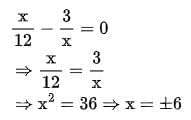
Q1: if then the values of x are: 
(a) 
± 6
(b) 
± 4
(c) 
± 12
(d) 
± 3

Hide Answer  

Ans: (a)
We have
Previous Year Questions 2025


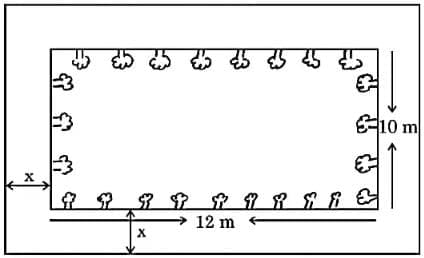
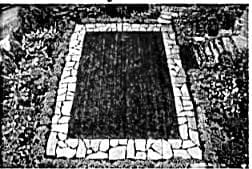
Q2: Case Study: A garden designer is planning a rectangular lawn that is to be surrounded by a uniform walkway. 
Previous Year Questions 2025
Previous Year Questions 2025The total area of the lawn and the walkway is 360 square metres. The width of the walkway is same on all sides. The dimensions of the lawn itself are 12 metres by 10 metres. Based on the information given above, answer the following questions: 
(i) Formulate the quadratic equation representing the total area of the lawn and the walkway, taking width of walkway= x m. 
(ii) (a) Solve the quadratic equation to find the width of the walkway ‘x’. 
OR 
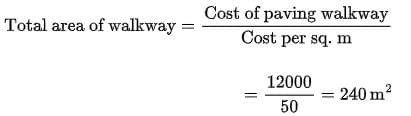
(ii) (b) If the cost of paving the walkway at the rate of ₹ 50 per square metre is ₹ 12,000, calculate the area of the walkway. 
(iii) Find the perimeter of the lawn.

Hide Answer  

Ans: 
(i) Length of rectangular lawn, l = (12 + 2x) m
Breadth of rectangular lawn, b = (10 + 2x) m
∴ Area of rectangular lawn = 360 m2 (given)
⇒ (12 + 2x)(10 + 2x) = 360
⇒ 120 + 24x + 20x + 4x2 = 360
⇒ 4x2 + 44x + 120 = 360
⇒ 4x2 + 44x – 240 = 0
⇒ x2 + 11x – 60 = 0

(ii) (a) Quadratic equation is x2 + 11x – 60 = 0
⇒ x2 + 15x – 4x – 60 = 0
⇒ x(x + 15) – 4(x + 15) = 0
⇒ (x + 15)(x – 4) = 0
⇒ x = -15 or 4
⇒ x = 4  ( x can’t be negative) 
∴ Width of the walkway= 4 m.

OR
(ii) (b)
Previous Year Questions 2025
(iii) Length of lawn , l= 12 m, 
Breadth of lawn, b = 10 m 
∴ Perimeter of lawn= 2(l + b) 
= 2(12 + 10) 
= 2 x 22 = 44 m

Q3: A student scored a total of 32 marks in class tests in Mathematics and Science. Had he scored 2 marks less in Science and 4 marks more in Mathematics, the product of his marks would have been 253. Find his marks in the two subjects.

Hide Answer  

Ans:
Let the marks scored by a student in Mathematics be x and Science be y.
According to question,
x + y = 32 ⇒ y = 32 – x   …(i)
Also, (x + 4)(y – 2) = 253
⇒ xy – 2x + 4y – 8 = 253
⇒ xy – 2x + 4y = 261
⇒ x(32 – x) – 2x + 4(32 – x) = 261  [from(i)]
⇒ 32x – x2 – 2x + 128 – 4x = 261
⇒ 26x -x2 + 128 = 261
⇒ x2 – 26x + 133 = 0
⇒ x2 – 19x – 7x + 133 = 0
⇒ x(x – 19) – 7(x – 19) = 0
⇒ (x – 19)(x – 7) = 0 ⇒ x = 7, 19
From (i) when get y = 25, 13 respectively
if x = 7, then y = 25 and if x = 19, then y = 13.
∴ Marks in mathematics and science are 7 and 25 or 19 and 13 respectively.


Q4: There is a circular park of diameter 65 mas shown in the following figure, where AB is a diameter. 
An entry gate is to be constructed at a point P on the boundary of the park such that distance of P from A is 35 m more than the distance of P from B. Find distance of point P from A and B respectively.

Hide Answer  

Ans: Let the distance of ‘P’ from ‘B’ be x m.
∴ PA = (x + 35)m
In ΔAPB, ∠P = 90°
∴ AB2 = AP2 + PB2 [Using Pythagoras theorem]
(65)2 = (x + 35)2 + x2
⇒ 4225 = x2 + 70x + 1225 + x2
⇒ 2x2 + 70x + 1225 = 4225
⇒ 2x2 + 70x – 3000 = 0
⇒ x2 + 35x – 1500 = 0
⇒ x2 + 60x – 25x – 1500 = 0
⇒ (x + 60)(x – 25) = 0
⇒ x = -60, 25 [∵ Distance can’t be negative]
x = 25
∴ PA = 25 + 35 = 60 m and PB = 25 m.


Q5: The discriminant of the quadratic equation bx2 + ax + c = 0, b ≠ 0 is given by:
(a) b2 – 4ac
(b) 

(c) 

(d) a2 – 4bc

Hide Answer  

Ans: (d)
We have, bx2 + ax + c = 0
On comparing with Ax2 + Bx + C = 0, we get
A = b, B = a and C = c
∴ D = B2 – 4AC = a2 – 4bc  [∵ Discriminant = B2 – 4AC]


Q6: Which of the following quadratic equations has real and equal roots? 
(a) (x + 1)2 = 2x + 1 
(b) x2 +x= 0 
(c) x2 – 4 = 0 
(d) x2+ x + 1= 0

Hide Answer  

Ans: (a)
(x + 1)2 = 2x + 1 
x2 + 2x + 1 = 2x+1 
x2 + 2x + 1 – 2x – 1 = 0
x2 = 0 ⇒ x = 0, 0 
Hence, the given equation has real and equal roots. 


Q7: Find the value(s) of ‘k’ so that the quadratic equation 4x2 + kx + 1 = 0 has real and equal roots. 

Hide Answer  

Ans: Given quadratic equation 4x2 + kx + 1 = 0 has real and equal roots.
Comparing with ax² + bx + c = 0, we have
a = 4, b = k, c = 1
∴ D = b2 – 4ac = k2 – 4(4)(1) = 0
⇒ k2 – 16 = 0 
⇒ k² = 16 
⇒ k = ±4


Q8: Find the smallest value of p for which the quadratic equation x2 – 2(p + 1)x + p2 = 0 has real roots. Hence, find the roots of the  equation so obtained.

Hide Answer  

Ans: Given, x2 – 2(p + 1)x + p2 = 0 has real roots.
Compare it with ax2 + bx + c = 0, we get
a = 1, b = -2(p + 1), c = p2
∴ For real roots, we have D ≥ 0
(-2(p + 1))2 – 4 × 1 × p² ≥ 0
⇒ 4(p2 + 1 + 2p) – 4p2 ≥ 0 ⇒ 4p2 + 4 + 8p – 4p2 ≥ 0
⇒ 8p + 4 ≥ 0 => p ≥ -1/2
∴ Smallest value of p is -1/2.
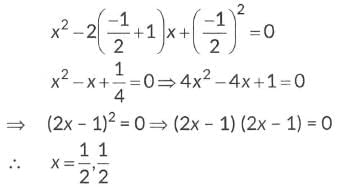
Put value of ‘p’ in given equation,
Previous Year Questions 2025
So, 1/2, 1/2 are the roots.

Previous Year Questions 2024

Q1: In a flight of 2800 km, an aircraft was slowed down due to bad weather. Its average speed is reduced by 100km/h, and by doing so, the time of flight is increased by 30 minutes. Find the original duration of the flight.     (CBSE 2024)

Hide Answer  

Ans:
Let the speed of aircraft be x km/hr.
Time taken to cover 2800 km by speed of x km/hr = 2800/x  hrs.
New speed is (x – 100) km/hr
so time taken to cover 2800 km at the speed of (x – 100) km/hr = 2800x – 100 hrs

ATQ,
2800x – 100 – 2800x = 12

⇒ 2800 (x – x + 100)x (x – 100) = 12

⇒ 100x² – 100x = 12 × 2800

⇒ 560000 = x2 – 100x
⇒ x2 – 100x – 560000 = 0
⇒ x2 – 800x + 700x – 560000 = 0
⇒ x(x – 800) + 700(x – 800) = 0
⇒ (x – 800) (x + 700) = 0
⇒ x = 800, – 700 (Neglect)
⇒ x = 800
Speed = 800 km/hr
Time = 2800/800
= 3 hr 30 min.


Q2: The denominator of a fraction is one more than twice the numerator. If the sum of the fraction and its reciprocal is  found, the fraction.      (CBSE 2024)

Hide Answer  

Ans: 
Let the numerator of the required fraction be x.
Then, its denominator = (2x + 1).

The fraction = x / (2x + 1) and its reciprocal = (2x + 1) / x.
We are given that:
(x / (2x + 1)) + ((2x + 1) / x) = 58 / 21

Multiplying both sides by 21x(2x + 1):
21x [x² + (2x + 1)²] = 58x(2x + 1)
Simplifying this:
21x [5x² + 4x + 1] = 116x² + 58x
Expanding both sides:
11x² – 26x – 21 = 0
This is a quadratic equation.

Solving the quadratic equation:
11x² – 33x + 7x – 21 = 0
11x(x – 3) + 7(x – 3) = 0
(x – 3) (11x + 7) = 0

So, x = 3 or x = -7/11.
Since the numerator cannot be negative, x = 3.

Thus, the required fraction is x / (2x + 1) = 3 / 7.

Q3: If the roots of quadratic equation 4x² – 5x + k = 0 are real and equal, then the value of k is      (CBSE 2024)
(a) 5/4
(b) 25/16
(c) Previous Year Questions 2024
(d) Previous Year Questions 2024

Hide Answer  

Ans: (b) 25/16
Given that,
Roots of quadratic equation 4x2 − 5x + k = 0 are real and equal
On comparing with ax2 + bx + c = 0,
We get, a = 4, b = −5 and c = k
For real and equal roots,
⇒ b2 − 4ac = 0
⇒ (−5)2 − 4(4)(k) = 0
⇒ 16k = 25
⇒ k = 25/16


Q4: A rectangular floor area can be completely tiled with 200 square tiles. If the side length of each tile is increased by 1 unit, it would take only 128 tiles to cover the floor.       (CBSE 2024)
(i) Assuming the original length of each side of a tile is x units, make a quadratic equation from the above information.
(ii) Write the corresponding quadratic equation in standard form. 
(iii) (a) Find the value of x, the length of the side of a tile by factorisation.
OR
(b) Solve the quadratic equation for x using the quadratic formula.

Hide Answer  

Ans: (i) Let the original side length of each tile be x units.
The area of the rectangular floor using 200 tiles = 200 x2 unit
The area with increased side length (each side increased by 1 unit) using 128 tiles
= 128 (x + 1)2 unit2
So, the required quadratic equation is: 200x2 = 128 (x + 1 )2
(ii) We have,
200x2 = 128 (x + 1)2
⇒ 200x2 = 128 (x2 + 2x + 1)
⇒ 200x2 = 128x2 + 256x + 128
⇒ 72x2 − 256x − 128 = 0
which is the quadratic equation is standard form.
(iii) (a) We have,
72x2 − 256x − 128 = 0
or, 9x2 − 32x − 16 = 0
or, 9x2 − 36x + 4x − 16 = 0
or, 9x (x − 4) + 4 (x − 4) = 0
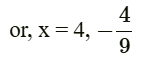
or, (x − 4) (9x + 4) = 0
Previous Year Questions 2024

Since the side cannot be negative, thus x = 4 units.
OR
(b) We have 9x2 − 32x − 16 = 0
On comparing with ax2 + bx + c = 0, we get
a = 9, b = −32 and c = −16
Using quadratic formula,
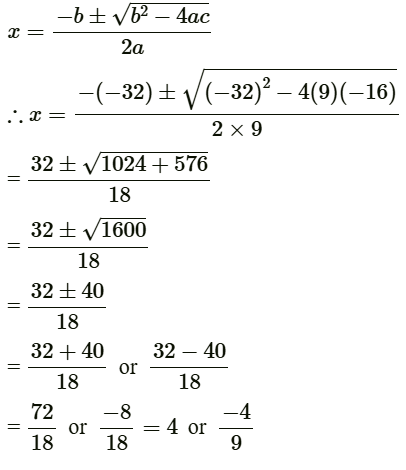
Previous Year Questions 2024

 
Q5: If the roots of equation ax2 + bx + c = 0, a ≠ 0 are real and equal, then which of the following relations is true?       (CBSE 2024)
(a) a = b2/c
(b) b2 = ac
(c) ac = b2/4
(d) c = b2/c 

Hide Answer  

Ans: (c) ac = b2/4
If the discriminant is equal to zero, i.e., b2 − 4ac = 0 where a, b, c are real numbers and a ≠ 0, then roots of the quadratic equation ax2 + bx + c = 0, are real and equal.
Thus, b2 – 4ac = 0 or ac = b2/4

Get additional INR 200 off today with EDUREV200 coupon.Avail Offer

Previous Year Questions 2023

Q6: Find the sum and product of the roots of the quadratic equation 2x2 – 9x + 4 = 0.  (CBSE 2023)

Hide Answer  

Ans: Let α and β be the roots of given quadratic equation  2x2 – 9x + 4 = 0.
Sum of roots = α + β = -b/a = (-9)/2 = 9/2
and Product of roots, αβ = c/a = 4/2 = 2  


Q7: Find the value of p, for which one root of the quadratic equation px2 – 14x + 8 = 0 is 6 times the other.  (CBSE 2023)

Hide Answer  

Ans: Let the first root be α, then the second root will be 6a
Sum of roots  = -b/a
⇒ a + 6a = 14/p
⇒ 7a = 14/p
⇒ a = 2/p
Product of roots = c/a
⇒ a x 6a  = 8/p
⇒ 6a2 = 8/p

⇒ 6(2p)² = 8p

⇒ 6 x 4p² = 8p

⇒ p = 6 x 4/8
⇒ p = 3
Hence, the value of p is 3.


Q8: The least positive value of k for which the quadratic equation 2x2 + kx + 4 = 0 has rational roots is (2023)
(a) ±2√2
(b) 4√2
(c) ±2
(d) √2

Hide Answer  

Ans: (c)
Sol: Put k = 2,

⇒ 2x² + 2x – 4 = 0

⇒ 2x² + 4x – 2x – 4 = 0

⇒ 2x (x + 2) – 2(x + 2) = 0

⇒ x = 1, -2

Put k = -2,

⇒ 2x² – 2x – 4 = 0

⇒ 2x² – 4x + 2x – 4 = 0

⇒ 2x (x – 2) + 2 (x – 2) = 0

⇒ x = -1, 2
Hence, to get the rational values of x, that is, to get rational roots, k must be ±2.


Q9: Find the discriminant of the quadratic equation 4x2 – 5 = 0 and hence comment on the nature of the roots of the equation.  (CBSE 2023)

Hide Answer  

Ans: Given quadratic equation is 4x2 – 5 = 0
Discriminant, D = b2 – 4ac = 02 – 4(4)(-5) = 80 > 0
Hence, the roots of the given quadratic equation are real and distinct.


Q10: Find the value of ‘p’ for which the quadratic equation px(x – 2) + 6 = 0 has two equal real roots.  (2023)

Hide Answer  

Ans: The given quadratic equation is px(x – 2) + 6 = 0
⇒ px2 – 2xp +6 = 0
On comparing with ax2+ bx + c = 0, we get
a = p, b = -2p and c = 6
Since, the quadratic equations has two equal real roots.

∴ Discriminant D = 0
⇒ b2 – 4ac = 0
⇒ (-2p)– 4 x p x 6 = 0
⇒ 4p– 24p = 0
⇒ p2 – 6p = 0
⇒  p(p – 6) = 0
⇒  p = 0 or p = 6
But p ≠ 0 as it does not satisfy equation
Hence, the value of p is 6.


Q11: Case StudyWhile designing the school yearbook, a teacher asked the student that the length and width of a particular photo be increased by n units each to double the area of the photo. The original photo is 18 cm long and 12 cm wide.
Based on the above information. Answer the following Questions:
(i) Write an algebraic equation depicting the above information.
(ii) Write the corresponding quadratic equation in standard form.
(iii) What should be the new dimensions of the enlarged photo?
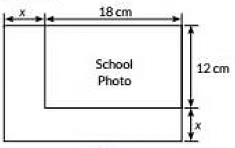
Previous Year Questions 2023OR

Can any rational value of x make the new area equal to 220 cm2?      (2023)

Hide Answer  

Ans: Area = 18 x 12 cm = 216 cm2
Length (l) is increased by x cm
So,  new length =(18 + x ) cm
New width = (12 + x) cm
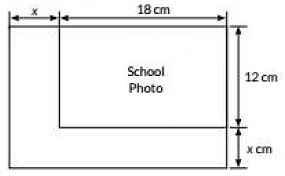
Previous Year Questions 2023

(i) Area of photo after increasing the length and width
= (18 + x)(12 + x) = 2 x 18 x 12
i.e., (18 + x) (12 + x) = 432 is the required algebraic equation.
(ii) From part (i) we get, (18 + x) (12 + x) = 432
⇒ 216 + 18x + 12x + x2 = 432
⇒  x2 + 30x – 216 = 0
(iii)  x2 + 30x – 216 = 0
⇒ x2+ 36x – 6x – 216 = 0
⇒  x(x+ 36) – 6 (x+ 36) = 0 ⇒  x = 6, -36
-36 is not possible.
So, new length = (18 + 6) cm = 24 cm
New width = (12 + 6) cm = 18cm
So. new dimension = 24cm x 18 cmOR

According to question (18 + x) (12 + x) = 220
⇒ 216 + 30x + x2 = 220
⇒  x+ 30x + 216 – 220 = 0
⇒  x2 + 30x – 4 = 0
For rational value of x. discriminant (D) must be perfect square.
So, D = b2 – 4ac
= (30)2 – 4(1)(-4) = 900 + 16 = 916
∴  916 is not a perfect square.
So, no rational value of x is possible.


Q12: The roots of the equation x2 + 3x – 10 = 0 are: 
(a)
 2, –5
(b)
 –2, 
(c)
 2, 5
(d)
 –2, –5     (CBSE 2023)

Hide Answer  

Ans: (a)
To find the roots of the quadratic equation x2 + 3x − 10 = 0, we can use the quadratic formula:
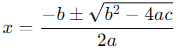
Previous Year Questions 2023

For the equation x2 + 3x − 10 = 0:
a = 1
b = 3
c = −10
Substitute these values into the formula:
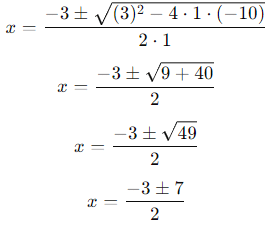
Previous Year Questions 2023

Now, calculate the two roots:

(i) For x = (-3 + 7) / 2 = 4/2 = 2
(ii) For x  = (-3 – 7)/2 = -10/2 = -5

The roots of the equation are 
2 and -5.
So, the correct answer is: (a) 2,−5

Also read: Short Answer Questions: Quadratic Equations

Previous Year Questions 2022

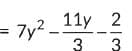
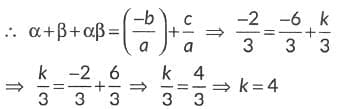
Q13: If the sum of the roots of the quadratic equation ky2 – 11y + (k – 23) = 0 is 13/21 more than the product of the roots, then find the value of k.    (2022)

Hide Answer  

Ans: Given, quadratic equation is ky2 – 11y + (k – 23) = 0
Let the roots of the above quadratic equation be α and β.
Now, Sum of roots, α + β = -(-11)/k = 11/k …(i)
and Product of roots, αβ = (k-23)/k  …(ii)
According to the question,
α + β = αβ + 13/21

∴ 11k = k – 23k + 1321 … [From equations (i) and (ii)]

⇒ 11k = k – 23k + 1321

⇒ 11 – k + 23k = 1321

⇒ 21(34 – k) = 13k
⇒ 714 – 21k = 13k
⇒ 714 = 13k + 21k
⇒ 34k = 714
⇒ k = 714/34
⇒ k = 21


Q14: Solve the following quadratic equation for x: x2 – 2ax – (4b2 – a2) = 0

Hide Answer  

Ans: x2 – 2ax – (4b2 – a2) = 0 
⇒ x2 + (2b – a)x – (2b + a)x – (4b2 – a2) = 0
⇒ x(x + 2b – a) – (2b + a)(x + 2b – a) = 0
⇒ (x + 2b – a)(x – 2b – a) = 0
⇒ (x + 2b – a) = 0, (x – 2b – a) = 0
∴ x = a − 2b, a + 2b 


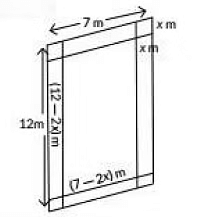
Q15: In the picture given below, one can see a rectangular in-ground swimming pool installed by a family In their backyard. There is a concrete sidewalk around the pool that is width x m. The outside edges of the sidewalk measure 7 m and 12 m. The area of the pool is 36 sq. m.

Based on the information given above, form a quadratic equation in terms of x
Find the width of the sidewalk around the pool.
      (2022)

Hide Answer  

Ans: Given, width of the sidewalk = x m.
Area of the pool = 36 sq.m
∴ Inner length of the pool
= (12 – 2x)m
Inner width of the pool = (7 – 2x)m
∴ Area of the pool = A = l x b
⇒ 36 = (12 – 2x) x  (7 – 2x)
⇒ 36 = 84 – 24x – 14x +4x2
⇒ 4x2 – 38x + 48 = 0
⇒ 2x2 – 19x + 24 = 0, is the required quadratic equation.
Previous Year Questions 2022
Area of the pool given by quadratic equation is 2x2 – 19x + 24 = 0
⇒ 2x2 – 16x – 3x + 24 = 0
⇒  2x(x – 8) – 3(x – 8) = 0
⇒ (x – 8)(2x – 3) = 0
⇒ x = 8 (not possible) 
Hence, x = 3/2 = 1.5
Width of the sidewalk =1.5m


Q16: The sum of two numbers is 34. If 3 Is subtracted from one number and 2 is added to another, the product of these two numbers becomes 260. Find the numbers.      (2022)

Hide Answer  

Ans: Let one number be x and another number be y.
Since, x + y = 34 ⇒  y = 34 – x      (i)
Now. according to the question. (x – 3) (y + 2) = 260       (ii)
Putting the value or y from (i) in (ii), we get
⇒ (x – 3)(34 – x + 2) = 260
⇒ (x – 3)(36 – x) = 260
⇒ 36x – x2 – 108 + 3x = 260
⇒ x– 39x +368 = 0
⇒ x2– 23x – 16x + 368 = 0
⇒ x(x – 23) – 16(x – 23) = 0
⇒ (x – 23)(x – 16) =0
⇒ x = 23 or 16
Hence; when x  = 23 from (i),  y = 34 – 23 = 11
When x = 16. then y = 34 – 16 = 18
Hence the required numbers are 23 and 11 or 16 and 18.


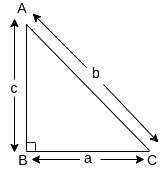
Q17: The hypotenuse (in cm) of a right-angled triangle is 6 cm more than twice the length of the shortest side. If the length of the third side is 6 cm less than thrice the length of the shortest side, then find the dimensions of the triangle.     (2022)

Hide Answer  

Ans: 

Previous Year Questions 2022
Let ΔABC be the right angle triangle, right angled at B, as shown in the figure.
Also, let AB = c cm, BC = a cm and AC = b cm
Then, according to the given information, we have
b = 6 + 2a  …..(i) (Let a be the shortest side)
and c = 3a – 6  …(ii)
We know that, b2 = c2 + a2   …..(Pythagoras Theorem)
Putting the values of b and c from (i) and (ii) in above equation
⇒ (6 + 2a)2 = (3a – 6)2 + a2 …[Using (i) and (ii)]
⇒ 36 + 4a2 + 24a = 9a2 + 36 – 36a + a2
⇒ 60a = 6a2
⇒ 6a = 60  …[∵ a cannot be zero]
⇒ a = 10 cm
Now, putting value of a in equation (i), we get
b = 6 + 2 × 10 = 26
and putting value of a in equation (ii), we get
c = 3 × 10 – 6 = 24
Thus, the dimensions of the triangle are 10 cm, 24 cm and 26 cm.


Q18: Solve the quadratic equation: x2 – 2ax + (a– b2) = 0 for x.     (2022)

Hide Answer  

Ans: We have, x2 – 2ax + (a2 – b2) = 0
⇒ x2 – ((a + b) + (a – b))x + (a2 – b2) = 0
⇒ x2 – (a + b)x – (a – b)x + (a + b)(a – b) = 0  ……[∵ a2 – b2 = (a + b)(a – b)]
⇒ x(x – (a + b)) – (a – b)(x – (a + b)) = 0
⇒ (x – (a + b))(x – (a – b) = 0
⇒ x = a + b, a – b 


Q19: Find the value of m for which the quadratic equation (m – 1) x2 + 2 (m – 1) x + 1 = 0 has two real and equal roots.   (2022)

Hide Answer  

Ans:  We have
(m – 1) x2 + 2 (m – 1) x + 1 = 0 —-(i)
On comparing the given equation with ax2 + bx + c = 0,
we have a = (m – 1), b = 2 (m – 1), c = 1
Discriminant, D = 0
⇒ b2 – 4ac = 0 
⇒ (2 (m – 1))– 4 (m – 1)(1)
⇒ 4m2 + 4 – 8m – 4m + 4 = 0
⇒ 4m2 -12m + 8 = 0
⇒ m2 – 3m + 2 = 0 ⇒ m2 – 2m – m + 2= 0
⇒ m(m – 2) – 1 (m – 2) = 0
⇒ (m – 1)(m – 2) = 0 ⇒ m = 1, 2


Q20: The quadratic equation (1 + a2)x2 + 2abx + (b2 – c2) = 0 has only one root. What is the value of c2(1 + a2)?    (2022)

Hide Answer  

Ans: (1 + a2)x2 + 2abx + (b2 – c2)= 0
Comparing on Ax2 + Bx + C = 0
A = 1 + a2, B = 2ab  &  C = (b2 – c2)
Now, B2 – 4AC = 0
⇒ (2ab)2 – 4 × (1 + a2) × (b2 – c2) = 0
⇒ 4a2b2 – 4(b2 – c2 + a2b– a2c2) = 0
⇒ 4a2b2 – 4b2 + 4c2 – 4a2b2 + 4 a2c2 = 0
⇒ – b2+ c2 + a2c2 = 0
⇒ c2 + a2c2 = b2
∴ c2 (1 + a2) = b2

Previous Year Questions 2021

Q21: Write the quadratic equation in x, whose roots are 2 and -5.     (2021)

Hide Answer  

Ans: Roots of quadratic equation are given as 2 and – 5.
Sum of roots = 2 + (-5) = -3
Product of roots = 2 (-5) = -10
Quadratic equation can he written as
x2 – (sum of roots)x + Product of roots = 0
⇒ x2 + 3x – 10 = 0

Attention!Sale expiring soon, act now & get EduRev Infinity at 40% off!Claim Offer

Previous Year Questions 2020

Q22: Sum of the areas of two squares is 544 m2. If the difference of their perimeters is 32 m, find the sides of the two squares.     (2020)

Hide Answer  

Ans: Let the sides of the two squares be x m and y m, where ; x > y.
Then, their areas are xand y2 and their perimeters are 4x and 4y respectively.
By the given condition, x2 + y= 544 ——–(i)
and 4x – 4y = 32
⇒ x – y = 8
⇒ x = y + 8 ———— (ii)
Substituting the value of x from (ii) in (i) we get
⇒ (y + 8)2 + y2 = 544
⇒ y2 + 64 + 16y + y= 544
⇒ 2y2 + 16y – 480 = 0
⇒ y2 + 8y – 240 = 0
⇒ y2 + 20y – 12y – 240 = 0
⇒ y(y + 20) – 12(y + 20) = 0
⇒ (y – 12) (y + 20) = 0
⇒ y = 12    (∵ y ≠ – 20 as length cannot be negative)
From (ii), x = 12 + 8 = 20 Thus, the sides of the two squares are 20 m and 12 m.


Q23: A motorboat whose speed is 18 km/h in still water takes 1 hour more to go 24 km upstream than to return downstream to the same spot. Find the speed of the stream.     (2020)

Hide Answer  

Ans: 

Speed of boat = 18 km/hr

Distance = 24 km

Let x be the speed of the stream.

Let t1 and t2 be the time for upstream and downstream.

As we know that, SpeedDistance = TimeDistance ⇒ Time = DistanceSpeed

For upstream:

Speed = (18 – x) km/hr

Distance = 24 km

Time = t1

t1 = 2418 – x

For downstream:

Speed = (18 + x) km/hr

Distance = 24 km

Time = t2

t= 2418 + x

Now according to the question:

t1 = t2 + 1

Substitute the values:

2418 – x = 2418 + x + 1

Simplify:

118 – x – 118 + x = 124

Combine the fractions:

(18 + x) – (18 – x)(18 – x)(18 + x) = 124

⇒ 2x(18 – x)(18 + x) = 124

Cross-multiply:

48x(18 – x)(18 + x) = 1
Expand:

48x = 324 + 18x – 18x – x²

x² + 48x – 324 = 0

Rearrange:

x² + 54x – 6x – 324 = 0

(x + 54) – 6(x + 54) = 0

(x + 54)(x – 6) = 0

Solve for x:

x = -54 or x = 6

Since speed cannot be negative:

x = 6


Q24: The value(s) of k for which the quadratic equation 2x2 + kx + 2 = 0 has equal roots, is
(a) 4
(b) ± 4
(c) – 4
(d) 0   (2020, 1 Mark)

Hide Answer  

Ans: (b)
Given Quadratic equation is 2x2 + kx + 2 = 0
Since, the equation has equal roots.
∴ Discriminant = 0
= b2 – 4ac
⇒ k– 4 x 2 x 2 = 0
⇒ k2– 16 = 0
⇒ k2 = 16
⇒ k = ±4


Q25: Solve for x: 1x + 4 – 1x – 7 = 1130, x ≠ -4, 7. (CBSE 2020)

Hide Answer  

Ans: Given, 

⇒ 1x + 4 – 1x – 7 = 1130

⇒ (x -7) – (x + 4)(x + 4)(x – 7) = 1130

⇒ -11(x + 4)(x – 7) = 1130

⇒ (x + 4)(x – 7) = –30 
⇒ (x + 4) (x – 7) + 30 = 0 
⇒ x2 + 4x – 7x – 28 + 30 = 0 
⇒ x2 – 3x – 28 + 30 = 0 
⇒ x2 – 3x + 2 = 0 
⇒ x2 – 2x – x + 2 = 0 
⇒ x(x – 2) – 1(x – 2) = 0 
⇒ (x – 2) (x – 1) = 0 
i.e., x – 1 = 0 or x – 2 = 0 
⇒ x = 1 or 2


Q26: A train covers a distance of 480 km at a uniform speed. If the speed had been 8 km/h less, it would have taken 3 hours more to cover the same distance. Find the original speed of the train. (CBSE 2020)

Hide Answer  

Ans: Let the original speed of the train be x km/h. 
Then, time taken to cover the journey of 480 km , t = 480 / x hours 
Time taken to cover the journey of 480 km with speed of (x – 8) km/h = 480 / x − 8 hours 
Now, according to question,

480x – 8 – 480x = 3

⇒ 480 [x – x + 8x(x – 8)] = 3
⇒ 480 (8) = 3x(x – 8)

⇒ 3x(x – 8) = 3840 
⇒ x(x – 8) = 1280 
⇒ x2 – 8x – 1280 = 0 
⇒ x2 – 40x + 32x – 1280 = 0 
⇒ x(x – 40) + 32(x – 40) = 0 
⇒ (x + 32) (x – 40) = 0 
⇒ x + 32 = 0 or x – 40 = 0 
∴ x = – 32 (not possible) 
∴ x = 40 Thus, the original speed of the train is 40 km/h.

Practice Test: Quadratic EquationsStart Test

Previous Year Questions 2019

Q27: Find the value of k for which x = 2 is a solution of equation kx2 + 2x – 3 = 0.     (CBSE 2019)

Hide Answer  

Ans: Since x = 2 is a solution of kx2 + 2x – 3 = 0
k(2)2 + 2(2) – 3 = 0
= 4k + 4 – 3 = 0
⇒ k = -1/4


Q28: The sum of the areas of two squares is 157 m2. If the sum of their perimeters is 68 m, find the sides of the two squares.    (CBSE 2020)

Hide Answer  

Ans: Let the length of the side of one square be x m and the length of the side of another square be y m.
Given, x2 + y2= 157    _(i)
and 4x + 4y=68    _(ii)
 x + y = 17
y = 17 – x    _(iii)
On putting the value of y in (i), we get
x+ (17 – x)2 = 157
⇒ x2 + 289 + x2 – 34x = 157
=> 2x2 – 34x +132 = 0
⇒ x2 – 17x + 66 = 0
⇒ x2 – 11x – 6x + 66 =0
⇒ x(x – 11) – 6(x – 11) = 0
⇒ (x – 11) (x – 6) = 0
⇒ x = 6 or x = 11
On putting the value of x in (iii), we get
y = 17 – 6 = 11 or y = 17 – 11 = 6
Hence, the sides of the squares be 11 m and 6 m.
03. Previous Year Questions: Pair of Linear Equations in Two Variables

Previous Year Questions 2025

Q1: A system of two linear equations in two variables is inconsistent, if the lines in the graph are: 
(a) coincident 
(b) parallel 
(c) intersecting at one point 
(d) intersecting at right angles 

Hide Answer  

Ans: (b)


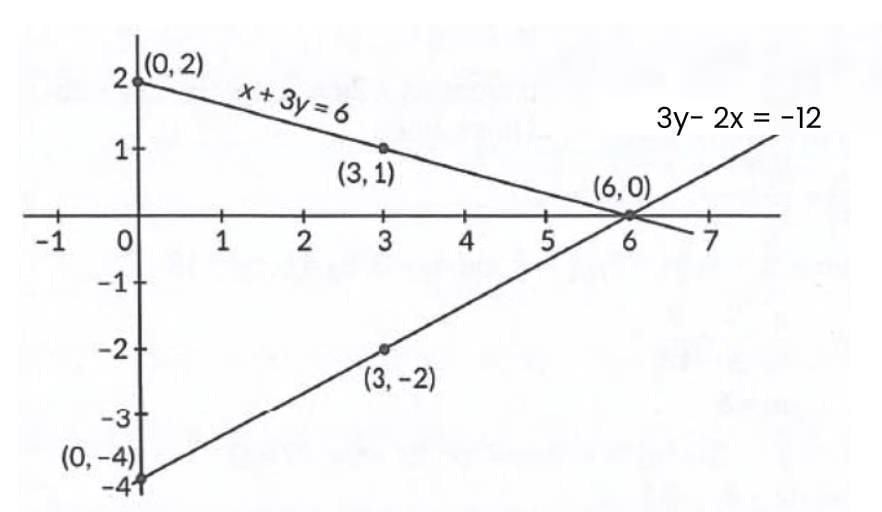
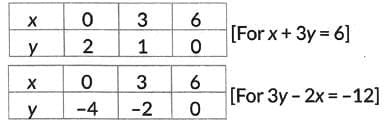
Q2: Check whether the following pair of equations is consistent or not. If consistent, solve graphically 
x+3y=6
3y – 2x = -12

Hide Answer  

Ans: We have, 
x + 3y = 6 
3y- 2x = -12
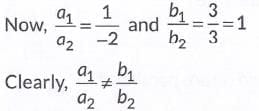
On comparing with general equation, 
we get a1 = 1, b1 = 3, c1 = -6 
a2 = – 2, b2 = 3, c2 = 12 
Previous Year Questions 2025
Hence, the given pair of equations is consistent.
Previous Year Questions 2025

Previous Year Questions 2025Hence, (6, 0) is the solution of given system of equations.

Q3: Solve the following pair of equations algebraically: 
101x + 102y = 304 
102x + 101y = 305

Hide Answer  

Ans: We have,
101x + 102y = 304         …(i)
102x + 101y = 305         …(ii)
Adding equations (i) and (ii), we get
101x + 102y + 102x + 101y = 304 + 305
⇒   203x + 203y = 609
⇒   x + y = 3                …(iii)
Subtracting equation (ii) from (i), we get
101x + 102y – 102x – 101y = 304 – 305
⇒   y – x = -1               …(iv)
Adding equations (iii) and (iv), we get
x + y + y – x = 3 + (-1)
⇒   2y = 2
⇒   y = 1
Substitute of y’ in (iv), we get
1 – x = -1
⇒ x=1 + 1 = 2 
Thus, the solution is x = 2 and y = 1. 


Q4: In a pair of supplementary angles, the greater angle exceeds the smaller by 50°. Express the given situation as a system of linear equations in two variables and hence obtain the measure of each angle.

Hide Answer  

Ans: Let the greater angle be x and smaller angle be y.
Using statement, we have
x + y = 180°               …(i)
x – y = 50°                …(ii)
Adding equations (i) and (ii), we get
x + y + x – y = 180° + 50°
⇒   2x = 230°
⇒   x = 115°
Using equation (i), we get
115° + y = 180°
⇒   y = 180° – 115° = 65°
So, greater angle is 115° and smaller angle is 65°.


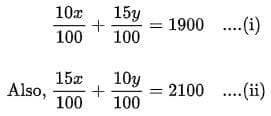
Q5: A man lent a part of his money at 10% p.a. and the rest at 15% p.a. His income at the end of the year is ₹1,900. If he had interchanged the rate of interest on the two sums, he would have earned ₹200 more. Find the amount lent in both cases.

Hide Answer  

Ans: 
Let the amount lent at 10% p.a. = ₹x
Let the amount lent at 15% p.a. = ₹y
According to question,
Previous Year Questions 2025
Adding (i) and (ii), we get
25x + 25y = 400000        
⇒   x + y = 16000          …(iii)
Subtracting eqn. (i) from (ii), we get
5x – 5y = 2000          
⇒   x – y = 4000           …(iv)
adding eqn. (iii) and (iv), we get
2x = 20000
⇒   x = 10000
Put value of x in eqn. (iii), 
we get y = 6000 
Hence, amount lent at 10% p.a. is ₹10000 and amount lent at 15% p.a. is ₹6000.


Q6: Vijay invested certain amounts of money in two schemes A and B, which offer interest at the rate of 8% per annum and 9% per annum, respectively. He received ₹1,860 as the total annual interest. However, had he interchanged the amounts of investments in the two schemes, he would have received ₹ 20 more as annual interest. How much money did he invest in each scheme?

Hide Answer  

Ans: Let the amount invested in scheme A be ₹x and in scheme B be ₹y respectively.
According to question,

Previous Year Questions 2025

⇒ 8x + 9y = 186000       ….(i)

Previous Year Questions 2025

⇒ 9x + 8y = 188000     ….(ii)
On solving equations (i) and (ii), we get
17y = 170000 ⇒ y = 10000
Substituting the value of y in equation (i), we get
8x + 9(10000) = 186000
⇒ 8x = 186000 – 90000
⇒ 8x = 96000
⇒ x = 96000/8
⇒ x = 12000
∴ Vijay invested ₹12000 in scheme A and ₹10000 in scheme B.


Q7: A two-digit number is such that the product of its digits is 12. When 36 is added to this number, the digits interchange their places. Find the number.

Hide Answer  

Ans: Let the tens digit of a number be a and ones digit be b, then two digit number can be written as 10a + b
Given, ab = 12    …(i)
Also, 10a + b + 36 = 10b + a
⇒ 9a – 9b + 36 = 0 ⇒ a – b + 4 = 0
⇒ a – b = -4    …(ii)
Squaring on both sides, we get
(a – b)= 16 ⇒ (a + b)2 – 4ab = 16
⇒ (a + b)2 = 16 + 4(12)
⇒ a + b = ±8   [∴ Using (i)]
When a + b = 8, then a = 2, b = 6  [Using (iii)]
When a + b = -8, then a = -6, b = -2  [Rejected]
Number = 10a + b = 10(2) + 6 = 26


Q8: If x = 1 and y = 2 is a solution of the pair of linear equations 2x – 3y + a= 0 and 2x + 3y – b = 0, then: 
(a) a = 2b 
(b) 2a = b 
(c) a + 2b = 0
(d) 2a + b = 0

Hide Answer  

Ans: (b)
We have, 2x – 3y + a = 0   ..(i)
Put x = 1 and y = 2 in (i), we get 
∴ 2 – 6 + a = 0 ⇒ a = 4
 Put x = 1 and y = 2 in (ii), we get 
Also, given 2x + 3y – b = 0 
∴ 2 + 6 – b = 0 ⇒ b = 8 
⇒ b = 2 * 4 
⇒ b = 2a   [From (i)]


Q9: The value of ‘k’ for which the system of linear equations 6x + y = 3k and 36x + 6y = 3 have infinitely many solution is:
(a) 6
(b) 1/6
(c) 1/2
(d) 1/3

Hide Answer  

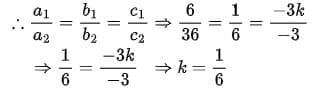
Ans: (b)
Given equations are
6x + y – 3k = 0 
36x + 6y – 3 = 0
Given equations have infinitely many solutions. 
Previous Year Questions 2025


Q10: The system of equations 2x + 1 = 0 and 3y- 5 = 0 has 
(a) unique solution 
(b) two solutions 
(c) no solution 
(d) infinite number of solutions 

Hide Answer  

Ans: (a)
We have, 2x + 1 = 0 and 3y – 5 = 0
⇒ x = -1/2 and y = 5/3
∴ Given system of equations has a unique solution.

Previous Year Questions 2024

Q1: The pair of linear equations x + 2y + 5 = 0 and – 3x = 6y – 1 has.      (CBSE 2024)
(a) unique solution
(b) exactly two solutions
(c) infinitely many solutions
(d) no solutions 

Hide Answer  

Ans: (d)
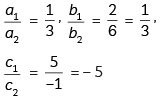
x + 2y + 5 = 0 
On comparing with 
a1x + b1y + c1 = 0, we get a1 = 1, b1 = 2, c1 = 5 – 3x = 6y – 1 
3x + 6y – 1 = 0 
On comparing with a2x + b2y + c2 = 0, we get a2 = 3, b2 = 6, c2 = – 1

a1a2 = 13 , b1b2 = 26 = 13 ,

c1c2 = 5-1 = -5

Here, we get ( a1a2 = b1b2 ≠ c1c2 )


Q2: If 2x + y = 13 and 4x – y = 17, find the value of (x – y).       (CBSE 2024)

Hide Answer  

Ans:
2x + y = 13 …(i)  
4x – y = 17 …(ii)
On adding eqn.(i) and eqn.(ii)
6x = 30
x = 5
Put the value of x in eqn.(i)  
2 × 5 + y = 13
⇒10 + y = 13 
∴ y = 3
So,  x – y = 5 – 3 = 2


Q3: The value of k for which the pair of linear equations 5x + 2y − 7 = 0 and 2x + ky + 1 = 0 do not have a solution is ______.      (CBSE 2024)
(a) 
5
(b) 4/5
(c) 5/4
(d) 5/2

Hide Answer  

Ans: (b) 4/5
Given that,
Pair of linear equations as 5x + 2y − 7 = 0  and 2x + ky + 1 = 0 
For no solution,

→ 52 = 2k ≠ -71

→ 52 = 2k

→ k5 = 45


Q4: Solve the following pair of linear equations for x and y algebraically:
x + 2y = 9 and y − 2x = 2
     (CBSE 2024)

Hide Answer  

Ans: Given the pair of linear equations as,
⇒ x + 2y = 9     …(i)
⇒ y − 2x = 2
⇒ −2x + y = 2    …(ii)
Multiplying eqn (i) by 2 and adding to eqn (ii), we get
⇒ (−2x + y) + ( 2x + 4y) = 2 + 18
⇒ 5y = 20
⇒ y = 4
Putting in eqn (i),
⇒ x + 2(4) = 9
⇒ x = 9 − 8
⇒ x = 1
So, the required solution is x = 1 and y = 4


Q5: Check whether the point (−4, 3) lies on both the lines represented by the linear equations x + y + 1 = 0 and x − y = 1.     (CBSE 2024)

Hide Answer  

Ans: Given the equations of line are
⇒ x + y = −1    …(i)
⇒ x − y = 1    …(ii)
The intersection point of both the lines will be the point that lies on both the lines,
So, adding eqn (i) and (ii),
⇒ (x + y) + (x − y) = −1 + 1
⇒ 2x = 0
⇒ x = 0
Putting in eqn (i),
⇒ 0 + y = −1
⇒ y = −1
So, the point will be (x, y) = (0, −1)
Hence, the point (−4, 3) does not lie on both the lines.


Q6: In the given figure, graphs of two linear equations are shown. The pair of these linear equations is:     (CBSE 2024)

(a) consistent with unique solutions. 
(b) consistent with infinitely many solutions. 
(c) inconsistent. 
(d) inconsistent but can be made consistent by extending these lines. 

Hide Answer  

Ans: (a) consistent with unique solution.


Q7: Solve the following system of linear equations 7x – 2y= 5 and 8x + 7y = 15 and verify your answer.      (CBSE 2024)

Hide Answer  

Ans: Given system of linear equations are 
7x − 2y = 5   …(i)
8x + 7y = 15   …(ii)
By multiplying eq. (i) by 7 and eq. (ii) by 2, we get
49x − 14y = 35
16x + 14y = 30
65x = 65
∴ x = 1
Substituting the value of x is eq (i), we get
7(1) − 2y = 5
or, 7 − 2y = 5
or −2y = −2, or y = 1
Therefore, x = 1 and y = 1


Q8: Three years ago, Rashmi was thrice as old as Nazma. Ten years later, Rashmi will be twice as old as Nazma. How old are Rashmi and Nazma now?      (CBSE 2024)

Hide Answer  

Ans: Let the age of Rashmi = x years
and the age of Nazma = y years
Three years ago,
Rashmi’s age = (x − 3) years
Nazma’s age = (y − 3) years
According to the question,
(x − 3) = 3(y − 3)
⇒ x − 3 = 3y − 9
⇒ x = 3y − 6      …(i)
Ten years later,
Rashmi’s age = x + 10
Nazma’s age= y + 10
According to the question,
(x + 10) = 2(y + 10)
x + 10 = 2y + 20
x = 2y + 10      …(ii)
From eq. (i) and (ii), we get
3y − 6 = 2y + 10
y = 16
Substituting the value of y in eq. (i), we get
x = 3 × 16 − 6 = 48 − 6 = 42
Thus, Rashmi is 42 years old, and Nazma is 16 years old.

Get additional INR 200 off today with EDUREV200 coupon.Avail Offer

Previous Year Questions 2023

Q9: The pair of linear equations 2x = 5y + 6 and 15y = 6x – 18 represents two lines which are   (2023)
(a) intersecting
(b) parallel
(c) coincident
(d) either intersecting or parallel  

Hide Answer  

Ans: (c)
Sol: The given pair of linear equations is 2x = 5y+ 6 and 15y = 6x – 18
i.e ., 2x – 5y – 6 = 0  and 6x- 15y- 18 = 0
As, 2/6 = -5/-15 = -6/-18
i.e.. 1 /3 = 1 / 3 = 1/3
Since, a1/a2=b1/b2=c1/c2
Therefore, the lines are coincident.


Q10: If the pair of linear equations x – y = 1, x + ky = 5 has a unique solution x = 2, y = 1. then the value of k    (2023)
(a) -2
(b) -3
(c) 3
(d) 4

Hide Answer  

Ans: (c)
Sol: x + ky = 5
At x = 2,  y = 1
2 + k(1) = 5
∴ k = 3


Q11: The pair of linear equations x + 2y + 5 = 0 and -3x – 6y + 1 = 0 has   (2023)
(a) A unique solution
(b) Exactly two solutions
(c) Infinitely many solutions
(d) No solution

Hide Answer  

Ans: (d)
x + 2y + 5 = 0 
On comparing with 
a1x + b1y + c1 = 0, In  x + 2y + 5 = 0, we get a1 = 1, b1 = 2, c1 = 5 
Rearranging – 3x = 6y – 1 , We get 3x + 6y – 1 = 0 
On comparing with a2x + b2y + c2 = 0, we get a2 = 3, b2 = 6, c2 = – 1
Previous Year Questions 2023


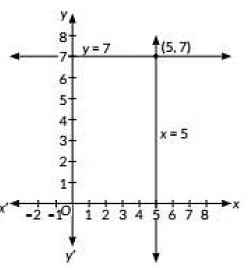
Q12: Solve the pair of equations x = 5 and y = 7 graphically.   (2023)

Hide Answer  

Ans: Given equations are

x = 5 —————(i)
y = 7  —————(ii)
Draw the line x = 5 parallel to the y-axis and y= 7 parallel to the x-axis.
∴ The graph of equation (i) and (ii) is as follows
Previous Year Questions 2023
The lines x = 5 and y = 7 intersect each other at (5, 7).


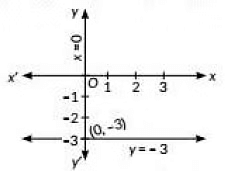
Q13: Using the graphical method, find whether a pair of equations x = 0 and y = -3 is consistent or not.   (2023)

Hide Answer  

Ans: Given pair of equations are

x = 0    ——(i)
and y = -3    ——(ii)
x = 0 means y-axis and draw a line y = -3 parallel to x-axis. The graph of given equations (i) and (ii) is
Previous Year Questions 2023

The lines intersect each other at (0, -3). Therefore, the given pair of equations Is consistent.


Q14: Half of the difference between two numbers is 2. The sum of the greater number and twice the smaller number is 13. Find the numbers.   (2023)

Hide Answer  

Ans: Let x and y be two numbers such that x> y
According to the question,
Previous Year Questions 2023
and x + 2y = 13 —- (ii)
Subtracting (i) from (ii), we get
3y = 9
⇒ y = 3
Substitute y = 3 in (i) we get
x – 3 = 4
⇒  x = 7


Q15: (A) If we add 1 to the numerator and subtract 1 from the denominator, a fraction reduces to 1 It becomes 1/2 if we only add 1 to the denominator. What is the fraction?
OR
(B) For which value of ‘k’ will the following pair of linear equations have no solution?   (2023)
3x + y = 1
(2k – 1)x + (k – 1)y = 2k + 1

Hide Answer  

Ans: (A) Let required fraction be x/y
According to question,

x + 1y – 1 = 1

⇒ x + 1 = y – 1

⇒ x = y – 2 … (i)

Also, xy + 1 = 12

⇒ 2x = y + 1              …(ii)
From equations (i) and (ii), we get
2y — 4 = y + 1
y = 5
∴ x = 3
Required fraction x/y is 3/5
OR
(B) 3x + y = 1
(2k – 1 )x + (k – 1 )y = 2k + 1

For no solution;

⇒ 32k – 1 = 1k – 1 ≠ 12k + 1

2k – 1 = 3k – 3

⇒ k = 2

Also, 1k – 1 ≠ 12k + 1

2k + 1 ≠ k – 1

⇒ k ≠ -2


Q16: Two schools ‘P’ and ‘Q’ decided to award prizes to their students for two games of Hockey Rs. x per student and Cricket Rs. y per student. School ‘P’ decided to award a total of Rs.  9,500 for the two games to 5 and 4 students respectively, while school ‘Q’ decided to award Rs.  7,370 for the two games to 4 and 3 students respectively.

Previous Year Questions 2023

Based on the given information, answer the following questions.
(i) Represent the following information algebraically (in terms of x and y).
(ii) (a) What is the prize amount for hockey?

OR

(b) Prize amount on which game is more and by how much?
(iii) What will be the total prize amount if there are 2 students each from two games?
   (CBSE 2023)

Hide Answer  

Ans: (i) For Hockey, the amount given to per student =  x
For cricket, the amount given to per student = y
From the question,
5x + 4y =9500    (i)
4x + 3y = 7370   (ii)

(ii) (a) Multiply (1) by 3 and (2) by 4 and then subtracting, we get

15x + 12y- (16x + 12y) = 28500 – 29480
⇒ – x = – 980
⇒ x = ₹980
The prize amount given for hockey is Rs. 980 per student
(b) Multiply (1) by 4 and (2) by 5 and then subtracting, we get
20x + 16y- 20x – 15y = 38000 – 36850
⇒ y = 1150
The prize amount given for cricket is more than hockey by (1150 – 980) = 170.
(iii) Total prize amount = 2 x 980 + 2 x 1150
= Rs. (1960 + 2300) = Rs. 4260

Also read: Facts that Matter: Pair of Linear Equations in Two Variables

Previous Year Questions 2022

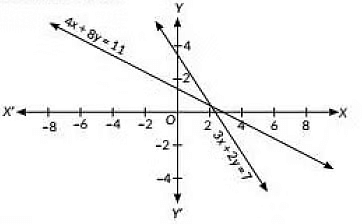
Q17: The pair of lines represented by the linear equations 3x + 2y = 7 and 4x + 8y -11 = 0 are   (2022)
(a) perpendicular
(b) parallel
(c) intersecting 
(d) coincident 

Hide Answer  

Ans: (c)
Sol: 

  • Calculate a1 / a= 3 / 4
  • Calculate b1 / b2 = 2 / 8 = 1 / 4
  • Calculate c1 / c2 = -7 / 11

Comparing the ratios:
a1 / a2 = 3 / 4
b1 / b2 = 1 / 4
c1 / c2 = 7 / 11

Since a1 / a ≠ b1 / b2, the lines are not parallel. Also, since none of the ratios are equal, the lines are not coincident.

Clearly, from the graph, we can see that both lines intersect each other.
Previous Year Questions 2022


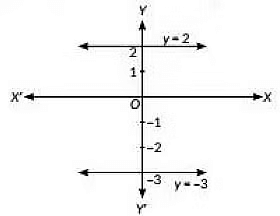
Q18: The pair of equations y = 2 and y = – 3 has    (2022)
(a) one solution
(b) two solutions
(c) infinitely many solutions
(d) no solution 

Hide Answer  

Ans: (d)
Sol: Given equations are, y = 2 and y = – 3.
Previous Year Questions 2022

Clearly, from the graph, we can see that both equations are parallel to each other.
So, there will be no solution.


Q19: A father is three times as old as his son. In 12 years time, he will be twice as old as his son. The sum of the present ages of the father and the son is   (2022)
(a) 36 years
(b) 48 years
(c) 60 years
(d) 42 years

Hide Answer  

Ans: (b)
Sol: Let age of father be ‘x’ years and age of son be ‘y’ years.
According to the question, x = 3y ..(i)
and x + 12 = 2 (y + 12) 
⇒ x – 2y = 12 ..(ii)
From (i) and (ii), we get x = 36, y = 12
∴ x + y = 48 years


Q20: If 17x – 19y = 53 and 19x – 17y = 55, then the value of (x + y) is   (2022)
(a) 1
(b) -1
(c) 3
(d) -3 
 

Hide Answer  

Ans: (a)
Sol: Given,17x – 19y = 53 …(i)
and 19x  – 17y = 55 _(ii)
Multiplying (i) by 19 and (ii) by 17, and by subtracting we get,
323x – 361y -(323x – 289y) = 1007 – 935
⇒ – 72y = 72
⇒ y = – 1
Putting y = – 1 in (i), we get,
17x – 19 (-1) = 53
⇒ 17x = 53 – 19
⇒ 17x = 34
x = 2  
∴ x + y = 2 – 1
= 1

Previous Year Questions 2021

Q21: The value of k. for which the pair of linear equations x + y – 4 = 0, 2x + ky – 3 = 0 have no solution, is (2021)
(a) 0
(b) 2
(c) 6
(d) 8

Hide Answer  

Ans: (b)

Given equations:

x + y − 4 = 0

2x + ky − 3 = 0

The general form of a linear equation is  ax + by + c = 0. So, comparing terms:For the first equation, a1 = 1, b1 = 1, c1 = −4.
For the second equation, a2 = 2, b2 = k, c2= −3.

For the lines to be parallel (and hence have no solution), we need:

a1a2 = b1b2 ≠ c1c2

So, 1/2 = 1/k

Cross-multiplying gives:

k = 2

Now, let’s check the condition for the

c1c2 = -4-3 = 43

Since 1/2 = 1/k when k = 2 but 1/2  ≠ 4/3, the condition for no solution is satisfied.

Thus, the value of kk for which the equations have no solution is: 2
So, the correct answer is (b) 2.


Q22: The solution of the pair of linear equations x = -5 and y = 6 is  (2021)
(a) (-5, 6)
(b) (-5, 0)
(c) (0, 6)
(d) (0, 0)

Hide Answer  

Ans: (a)
Sol: (-5, 6) is the solution of x = -5 and y = 6.


Q23: The value of k for which the pair of linear equations 3x +  5y = 8    and kx + 15y = 24 has infinitely many solutions, is   (2021)
(a) 3
(b) 9
(c) 5
(d) 15

Hide Answer  

Ans: (b)
Sol: For. infinitely many solutions
a1a2 = b1b2 = c1c2

⇒ 3k = 515 = 824

k = 9


Q24: The values of x and y satisfying the two equations 32x + 33y = 34, 33x + 32y = 31 respectively are:  (2021)
(a) -1, 2
(b) -1, 4
(c) 1, -2
(d) -1, -4

Hide Answer  

Ans: (a)
Sol: 32x + 33y = 34 …(i)
33x + 32y = 31 …(ii)
Adding equation (i) and (ii) and subtracting equation (ii) from (i),
we get 65x + 65y = 65 or x + y = 1 …(iii)
and – x + y = 3 …(iv)
Adding equation (iii) and (iv),
we get y = 2
Substituting the value of y in equation (iii),
x = -1


Q25: Two lines are given to be parallel. The equation of one of the lines is 3x – 2y = 5. The equation of the second line can be   (2021)
(a) 9x + 8 y = 7
(b) – 12 x – 8 y = 7
(c) – 12 x + 8y = 7
(d) 12x + 8y = 7

Hide Answer  

Ans: (c)
Sol: If two lines a1x + b1y + c1 = 0 and a2x + b2y + c2 = 0 are parallel, then

a1a2 = b1b2 ≠ c1c2
It can only possible between 3x – 2y = 5 and -12x + 8y = 7.


Q26: The sum of the numerator and the denominator of a fraction is 18. If the denominator is increased by 2, the fraction reduces to 1/3. Find the fraction.  (2021)

Hide Answer  

Ans:  5/13
Let the numerator be x and the denominator be y of the fractions. Then, the fraction = x /y.
Given , x + y = 18 – (i)
and Previous Year Questions 2021
⇒ 3x – y = 2 . . (ii)
Adding (i) and (ii), we get
4x = 20 ⇒ x = 5
Put the value of x in (i), we get
5+ y= 18
⇒ y = 13
∴ The required fraction is 5/13


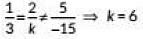
Q27: Find the value of K for which the system of equations x + 2y = 5 and 3x + ky + 15 = 0 has no solution.  (2021)

Hide Answer  

Ans:  Given, the system of equations

x + 2y = 5
3k + ky = – 15 has no solution.
∴ Previous Year Questions 2021
For K = 6 the given system of equations has no solution.


Q28: Case study-based questions are compulsory.
A bookstore shopkeeper gives books on rent for reading. He has a variety of books in his store related to fiction, stories, quizzes etc. He takes a fixed charge for the first two days and an additional charge for subsequent days Amruta paid ₹22 for a book and kept it for 6 days: while Radhika paid ₹16 for keeping the book for 4 days.
Assume that the fixed charge is ₹x and the additional charge (per day) is ₹y.
Based on the above information, answer any four of the following questions.

(i) The situation of the amount paid by Radhika. is algebraically represented by   (2021)
(a) x – 4 y = 16
(b) x + 4 y = 16
(c) x – 2 y = 16
(d) x + 2 y = 16 

Hide Answer  

Ans: (d)
Sol: For Amruta, x + (6 – 2)y = 22
i. e., x + 4y = 22      …(i)
For Radhika, x + (4 – 2)y = 16 i.e.,x + 2y = 16     …(ii)
Solving equation (i) and (ii). we get
x = 10 and y = 3
i.e., Fixed charges (x) = 10       …(iii)
and additional charges per subsequent day
(y) = ₹ 3                …(iv)
x + 2 y = 16  [From equation (ii)]

(ii) The situation of the amount paid by Amruta. is algebraically represented by   (2021)
(a) x – 2y = 11
(b) x – 2y = 22
(c) x + 4 y = 22
(d) x – 4 y = 11 

Hide Answer  

Ans: (c)
Sol: For Amruta, x + (6 – 2)y = 22
i. e., x + 4y = 22      …(i)
For Radhika, x + (4 – 2)y = 16 i.e.,x + 2y = 16     …(ii)
Solving equation (i) and (ii). we get
x = 10 and y = 3
i.e., Fixed charges (x) = 10       …(iii)
and additional charges per subsequent day
(y) = ₹ 3                …(iv)
x + 4 y = 22  [From equation (i)]

(iii) What are the fixed charges for a book?  (2021)
(a) ₹ 9
(b) ₹ 10
(c) ₹ 13
(d) ₹ 15

Hide Answer  

Ans: (b)
Sol: For Amruta, x + (6 – 2)y = 22
i. e., x + 4y = 22      …(i)
For Radhika, x + (4 – 2)y = 16 i.e.,x + 2y = 16     …(ii)
Solving equation (i) and (ii). we get
x = 10 and y = 3
i.e., Fixed charges (x) = 10       …(iii)
and additional charges per subsequent day
y = ₹ 3                …(iv)
x = ₹ 10  [From equation (iii)]

(iv) What are the additional charges for each subsequent day for a book?  (2021)
(a) ₹ 6
(b) ₹ 5
(c) ₹ 4
(d) ₹ 3 

Hide Answer  

Ans: (d)
Sol: For Amruta, x + (6 – 2)y = 22
i. e., x + 4y = 22      …(i)
For Radhika, x + (4 – 2)y = 16 i.e.,x + 2y = 16     …(ii)
Solving equation (i) and (ii). we get
x = 10 and y = 3
i.e., Fixed charges (x) = 10       …(iii)
and additional charges per subsequent day
y = ₹ 3                …(iv)
y = ₹ 3  [From equation (iv)]

(v) What is the total amount paid by both, if both of them have kept the book for 2 more days?  (2021)
(a) ₹ 35
(b) ₹ 52
(c) ₹ 50
(d) ₹ 58

Hide Answer  

Ans: (c)
For Amruta, x + (6 – 2)y = 22
i. e., x + 4y = 22      …(i)
For Radhika, x + (4 – 2)y = 16 i.e.,x + 2y = 16     …(ii)
Solving equation (i) and (ii). we get
x = 10 and y = 3
i.e., Fixed charges (x) = 10       …(iii)
and additional charges per subsequent day
y = ₹ 3                …(iv)
Total amount paid for 2 more days by both
= (x + 4 y) + 2 y + (x + 2y ) + 2 y
= 2 x + 10y
= 2 x 10 + 10 x 3
= ₹ 50

Attention!Sale expiring soon, act now & get EduRev Infinity at 40% off!Claim Offer

Previous Year Questions 2020

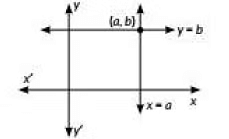
Q29: The pair of equations x = a and y = b graphically represent lines which are    (2020)
(a) Intersecting at (a, b)
(b) Intersecting at (b, a)
(c) Coincident 
(d) Parallel 

Hide Answer  

Ans: (a) 
Sol: The pair of equations x = a and y = b graphically represent lines which are parallel to the y-axis and x-axis respectively.
The lines will intersect each other at (a, b).
Previous Year Questions 2020


Q30: If the equations kx – 2y = 3 and 3x + y = 5 represent two intersecting lines at unique points, then the value of k is _________.    (2020)

Hide Answer  

Ans: For any real number except k = -6
kx – 2y = 3 and 3x + y = 5 represent lines intersecting at a unique point.
⇒ k3 ≠ -21
⇒ k ≠ -6
For any real number except k ≠  -6
The given equation represent two intersecting lines at unique point.


Q31: The value of k for which the system of equations x + y – 4 = 0 and 2x + ky = 3 has no solution. is    (2020)
(a) -2
(b) ≠2
(c) 3
(d) 2

Hide Answer  

Ans: (d)
Sol: For no solution; a1a2 = b1b2 ≠ c1c2

Previous Year Questions 2020

Hence, option (d) is correct


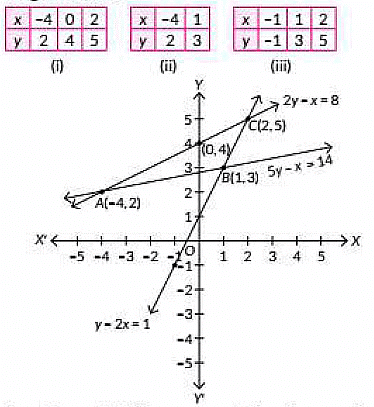
Q32: Determine graphically the coordinates of the vertices of a triangle, the equations of whose sides are given by 2y – x = 8, 5y – x = 14, and y – 2x = 1.    (2020)

Hide Answer  

Ans: Solutions of linear equations

2y – x =  8    ..(i)
5y – x = 14    …(ii)
and  y – 2x =  1    …(iii)
are given below:
Previous Year Questions 2020

From the graph of lines represented by given equations, we observe that
Lines (i) and (iii) intersect each other at C(2, 5),
Lines (ii) and {iii) intersect each other at B(1, 3) and Lines (i) and (ii) intersect each other at 4(-4, 2).
Coordinates of the vertices of the triangle are A(-4, 2), B(1, 3) and C(2, 5).


Q33: Solve the equations x + 2y = 6 and 2x – 5y = 12 graphically.   (2020)

Hide Answer  

Ans: Solution of linear equations

 x + 2y = 6 and 2x – 5y = 12
are given below 

Previous Year Questions 2020

From the graph, the two lines intersect each other at point (6, 0)
∴ x = 6 and y = 0


Q34: A fraction becomes 1/3 when 1 is subtracted from the numerator, and it becomes 1/4 when 8 is added to its denominator. Find the fraction.    (CBSE 2020)

Hide Answer  

Ans: Let the required fraction be x/y.

According to question, we have

x – 1y = 13 … (i)

and

xy + 8 = 14 … (ii)

From (i), 3x – 3 = y

⇒ 3x – y – 3 = 0 … (iii)

From (ii), 4x = y +8
so, 4x – y – 8 = 0  … (iv)
Subtracting (iii) from (iv),
we get x = 5
Substituting the value of x in (iii),
we get y = 12
Thus, the required fraction is 5/12


Q35: The present age of a father is three years more than three times the age of his son. Three years hence, the father’s age will be 10 years more than twice the age of the son. Determine their present ages.    (2020)

Hide Answer  

Ans: Let the present age of son be x years and that of father be y years.

According to question, we have
y = 3x+ 3 ⇒ 3x – y + 3 = 0    (i)
And y + 3 = 2(x + 3) + 10
⇒  y + 3 = 2x + 6 +10
⇒ 2x – y + 13 = 0    (ii)
Subtracting (ii) from (i), we get x = 10
Substituting the value of x in (ii). we get y = 33
So. the present age of the son is 10 years and that of the father is 33 years.


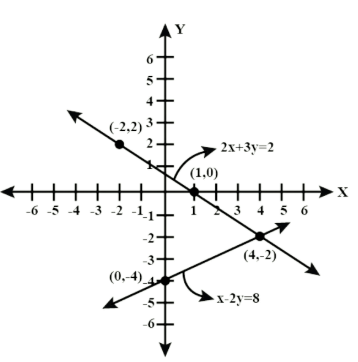
Q36: Solve graphically : 2x + 3y = 2, x – 2y = 8    (2020)

Hide Answer  

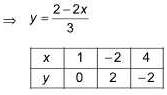
Ans: Given lines are 2x + 3y = 2 and x – 2y = 8
 2x + 3y = 2
Previous Year Questions 2020
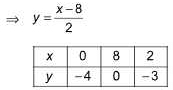
and x – 2y = 8
Previous Year Questions 2020
∴ We will plot the points (1, 0), (-2, 2) and (4, – 2 ) and join them to get the graph of 2x + 3y = 2 and we will plot the points (0, -4), (8, 0) and (2, -3) and join them to get the graph of x – 2y = 8Previous Year Questions 2020


Q37:  A train covered a certain distance at a uniform speed. If the train had been 6 km/hr faster, it would have taken 4 hours less than the scheduled time and if the train were slower by 6 km/hr, it would have taken 6 hours more than the scheduled time. Find the length of the journey. (CBSE 2020)

Hide Answer  

Ans: Let the original uniform speed of the train be x km/hr and the total length of journey be l km. Then, scheduled time taken by the train to cover a distance of l km = l/x hours
Now,

lx + 6 = lx – 4

⇒  lx – lx + 6 = 4

⇒  x + 6 – xx(x + 6) = 4

⇒  6lx(x + 6) = 4

⇒  l = 2x(x + 6)3 … (i)

Also,

lx – 6 = lx + 6

⇒  lx – 6 – lx = 6

⇒  x – x + 6(x – 6)x = 6

⇒  6l(x – 6)x = 6

⇒ l = x(x – 6) … (ii)

From equations (i) and (ii), we have

2x(x + 6)3 = x(x – 6)

⇒ 2x + 12 = 3x – 18

⇒ x = 30

Putting the value of x in eq. (ii), we get
l = 30(30 – 6)
= 30 × 24
= 720
Hence, the length of the journey is 720 km.

Also read: Facts that Matter: Pair of Linear Equations in Two Variables

Previous Year Questions 2019

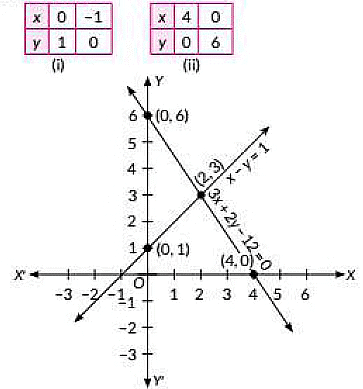
Q38: Draw the graph of the equations x – y + 1 = 0 and 3x + 2y – 12 = 0. Using this graph, find the values of x and y which satisfy both the equations.     (2019)

Hide Answer  

Ans: Solutions of linear equation
x – y + 1 = 0    …(i)
and 3x + 2y – 12 = 0    …(ii)
are given below:
Previous Year Questions 2019

From the graph, the two lines intersect each other at the point (2, 3)
∴ x = 2, y = 3.


Q39: The larger of two supplementary angles exceeds the smaller by 18°. Find the angles.     (2019)
Hide Answer  

Ans: Let the larger angle be x° and the smaller angle be y°. We know that the sum of two supplementary pairs of angles is always 180°.
We have x° + y° = 180°    (i)
and x° – y° = 18°    (ii) [Given]
By (1), we have x° = 180° – y°    _(iii)
Put the value of x° in (ii), we get
180° – y° – y° = 18°
⇒ 162° = 2y°
⇒ y = 81
From (3), we have x° = 180° – 81° = 99°
The angles are 99° and 81°


Q40: Solve the following pair of linear equations: 3x – 5y =4, 2y+ 7 = 9x.      (2019)

Hide Answer  

Ans: Given, pair of linear equations:

3x – 5y = 4,  ……. (i)
2y+ 7 = 9x  
9x – 2y = 7 …….. (ii)
Multiply (i) by 3 and subtract from (ii), as

⇒ 9x – 2y – 9x + 15y = -5 → 13y = -5

⇒ y = -513

Put y = -513 in (i), we get

3x – 5 -513 = 4

⇒ 3x + 2513 = 4

⇒ 3x = 4 – 2513

⇒ x = 2713 × 3 = 913

Hence, x  = 9/13 and y = -5/13


Q41: A father’s age is three times the sum of the ages of his two children. After 5 years his age will be two times the sum of their ages. Find the present age of the father.       (2019)

Hide Answer  

Ans: Let the ages of two children be x and y respectively.

Father’s present age = 3(x +y)
After 5 years, sum of ages of children = x + 5 + y + 5
= x + y + 10
and age of father = 3(x + y) + 5
According to the question,
3(x + y) + 5 = 2(x + y+ 10)
3x + 3y + 5 = 2x + 2y + 20
⇒ x + y = 15
Hence, present age of father = 3(x + y)
= 3 x 15 = 45 years


Q42: A fraction becomes 1/3 when 2 is subtracted from the numerator and will becomes 1/2 when 1 is subtracted from the denominator. Find the fraction.     (2019)

Hide Answer  

Ans: Let the fraction be x/y

Then, according to question.

x – 2y = 13 and xy – 1 = 12

⇒ 3x – 6 = y and 2x = y – 1

⇒ 3x – y – 6 = 0 … (i) and 2x – y + 1 = 0 … (ii)

Subtracting (ii) from (i), we get x – 7 = 0
So, x = 7
From (i) ,3(7) – y – 6 = 0
⇒ 21 – 6 = y
⇒ y = 15
Therefore required fraction is 7/15


Q43:  Find the value(s) of k so that the pair of equations x + 2y = 5 and 3x + ky + 15 = 0 has a unique solution.      (2019)

Hide Answer  

Ans:  The given pair of linear equations is
x + 2y = 5
3x + ky= -15
Since the system of equations has a unique solution

Previous Year Questions 2019

∴ For all values of k except k = 6, the given pair of linear equations will have a unique solution.


Q44: Find the relation between p and q if x = 3 and y = 1 is the solution of the pair of equations x – 4y + p = 0 and 2x + y – q -2 = 0.     (2019)

Hide Answer  

Ans: Given pair of equations are

x – 4y + p = 0    (i)
and 2x + y – q – 2 = 0    (ii)
It is given that x = 3 and y = 1 is the solution of (i) and (ii)
∴ 3 – 4 x 1+ p = 0
⇒ p = 1
and 2 x 3 + 1 – q – 2 = 0
⇒ q = 5  
∴ q = 5p


Q45: For what value of k, does the system of linear equations 2x + 3y=7 and (k – 1)x + (k + 2) y = 3k have an infinite number of solutions? (CBSE 2019)

Hide Answer  

Ans: The given system of linear equations are:      
2x + 3y = 7 
(k – 1)x + (k + 2)y = 3k 
For infinitely many solutions:

a1a2 = b1b2 = c1c2

Here,

a1 = 2, b1 = 3, c1 = -7

a2 = (k – 1), b2 = (k + 2), c2 = -3k

⇒ 2k – 1 = 3k + 2 = -7-3k

⇒ 2(k + 2) = 3(k – 1); 3(3k) = 7(k + 2)

⇒ 2k – 3k = –3 – 4; 9k – 7k = 14 
⇒  –k = –7; 2k = 14 
⇒  k = 7; k = 7 Hence, the value of k is 7

02. Previous Year Questions: Polynomials

Previous Year Questions 2025

Q1: Zeroes of the polynomial p(y)     (2025)
(a) 
(b) 
(c) 
(d) 

Hide Answer  

Ans: (d)
The given polynomial is p(y) Previous Year Questions 2025
Previous Year Questions 2025
For zeroes of the polynomial, put p(y) = 0 
Previous Year Questions 2025

Q2: Zeroes of the polynomial p(x) = x2 – 3√2x + 4 are:     (2025)
(a) 2,√2 
(b) 2√2, √2 
(c) 4√2, -√2 
(d) √2, 2 

Hide Answer  

Ans: (b)
We have, p(x) = x2 – 3√2x + 4 
⇒ p(x) = x2 – 2√2x -√2x + 4 
= x(x – 2√2) – √2(x – 2√2) 
= (x – 2√2)(x – √2) 
For zeroes of the polynomial, put p(x) = 0 
⇒ (x – 2√2)(x -√2) = 0 
∴ x = 2√2, √2 are zeroes of p(x).

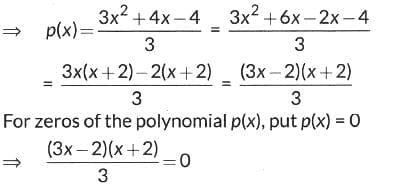
Q3: Find the zeros of the polynomial     (2025)

Hide Answer  

Ans: 
Previous Year Questions 2025
⇒ 3x – 2 = 0 ⇒ x = 2/3 and x + 2 = 0 ⇒ x = -2 

x = -2 and x = 2/3 are zeroes of the given polynomial.

Q4: Two polynomials are shown in the graph below. The number of distinct zeroes of both the polynomials is:     (2025)

(a) 3
(b) 5
(c) 2
(d) 4

Hide Answer  

Ans: (c)
Since both polynomials cut the x-axis at two distinct points each, the total number of distinct zeroes of both the polynomials combined is 2.

Q5: If α and β are the zeroes of the polynomial p(x) = x2 – ax – b, then the value of (α + β + αβ) is equal to:     (2025)
(a) a + b 
(c) a- b 
(b) -a – b 
(d) -a + b

Hide Answer  

Ans: (c)
Given polynomial is p(x) = x2 – ax – b, and α and β are zeroes of p(x) 
∴ Sum of zeroes = α + β =a 
Product of zeroes = αβ = – b  
Now, α + β + αβ = a – b 
Concept Applied
If α and β are the zeroes of quadratic polynomial p(x) = ax2 + bx + c, then α + β = -b/a, αβ = c/a.

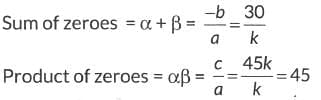
Q6: If α and β are zeroes of the polynomial p(x) = kx2 – 30x + 45k and α +β = αβ, then the value of ‘k’ is:     (2025)
(a) 
(b) 
(c) 3/2
(d) 2/3

Hide Answer  

Ans: (d)
Given, α and β are zeroes of the polynomial p(x) = kx2 – 30x + 45k 
Here, a = k, b = -30, c = 45 k 
Previous Year Questions 2025
∴ α + β = αβ     [Given]
Previous Year Questions 2025

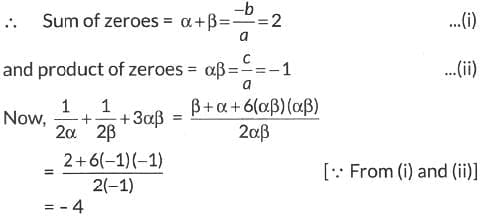
Q7: If α and β are the zeroes of the polynomial 3x2 + 6x + k such that then the value of k is:     (2025)
(a) -8 
(b) 8 
(c) -4 
(d) 4

Hide Answer  

Ans: (d)
Compare 3x2 + 6x + k with ax2 + bx + c, we get a = 3, b = 6 and c = k 
Previous Year Questions 2025

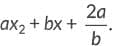
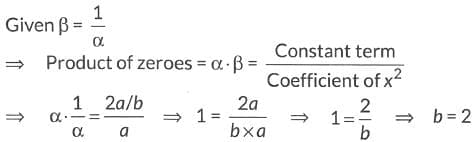
Q8: If the zeroes of the polynomialare reciprocals of each other, then the value of bis     (2025)
(a) 2 
(b) 1/2
(c) -2
(d) 

Hide Answer  

Ans: (a)
Let α and β be the zeroes of the given polynomial Previous Year Questions 2025
Previous Year Questions 2025

Q9:  If the sum of the zeroes of the polynomial p(x) = (p + 1)x2 + (2p + 3) x + (3p + 4) is – 1, then find the value of ‘p’.     (2025)

Hide Answer  

Ans: The given polynomial is  p(x) = (p + 1)x2 + (2p + 3)x + (3p + 4) 
Let α and β are zeroes of given polynomial 
Previous Year Questions 2025
⇒ p + 1 = 2p + 3 
⇒ p = -2 
Hence, the value of p is – 2.

Q10: If α and β are zeroes of the polynomial p(x) = x2 – 2x – 1, then find the value of     (2025)

Hide Answer  

Ans: The given polynomial is p(x) = x2 – 2x – 1; 
If α and β are zeroes of given polynomial 
Previous Year Questions 2025

Q11: If ‘α’ and ‘β’ are the zeroes of the polynomial p(y) = y2 – 5y+ 3, then find the value of α4β3 + α3β4 .     (2025)

Hide Answer  

Ans: 
We have p(y) = y2 – 5y + 3 
Let α and β be zeroes of p(y). 
Given, sum of zeroes= α + β = 5 
Product of zeroes = αβ = 3 
α⁴β³ + α³β⁴ 
= α³β³ (α + β) 
= (αβ)³ (α + β) 
= (3)³ (5) = 27 × 5 = 135

Q12: If the zeroes of the polynomial x2 + ax + b are in the ratio 3 : 4, then prove that 12a2 = 49b.     (2025)

Hide Answer  

Ans: Let the zeroes of the polynomial x2 + ax + b be 3x and 4x. 
Previous Year Questions 2025
⇒ 49b = 12a2. Hence proved. 

Q13: Find the zeroes of the polynomial p(x) = 3x2 – 4x – 4. Hence, write a polynomial whose each of the zeroes is 2 more than the zeroes of p(x).     (2025)

Hide Answer  

Ans: The polynomial is p(x) = 3x2 – 4x – 4. 
The zeroes are given by p(x) = 0 
⇒ 3x2 – 4x – 4 = 0  
⇒ 3x2 – 6x + 2x – 4 = 0 
⇒ 3x(x – 2) + 2(x – 2) = 0  
⇒ (x – 2)(3x + 2) = 0 
⇒ x – 2 = 0 or 3x + 2 = 0 
⇒  x = 2 and -2/3
Thus, zeroes of new polynomial are 
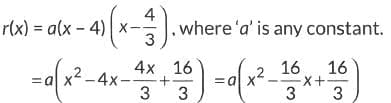
Previous Year Questions 2025
Hence, new polynomial is 
Previous Year Questions 2025
Taking a= 3, r(x) = 3x2 – 16x + 16 
Thus, r(x) = 3x2 – 16x + 16 is the new polynomial with zeroes x = 4 and x = 4/3.

Previous Year Questions 2024

Q1: What should be added from the polynomial x2 – 5x + 4, so that 3 is the zero of the resulting polynomial? (2024)
(a) 1
(b) 2
(c) 4
(d) 5

Hide Answer  

Ans: (b)
Let, f(x) = x2 – 5x + 4 
Let p should be added to f(x) then 3 becomes zero of polynomial.
So, f(3) + p = 0 
⇒ (3)2 – 5 × (3) + 4 + p = 0 
⇒ 9 + 4 – 15 + p = 0 
⇒ – 2 + p = 0 
⇒ p = 2 

So, 2 should be added.

Q2: Find the zeroes of the quadratic polynomial x2 – 15 and verify the relationship between the zeroes and the coefficients of the polynomial.   (2024)

Hide Answer  

Ans:
x– 15 = 0
x2 = 15
x = ± √15
Zeroes will be  α = √15 , β = – √15
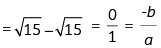
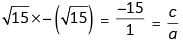
Verification: Given polynomial is x– 15
On comparing above polynomial with
ax2 + bx + c, we have
a = 1, b = 0, c = –15
sum of zeros = α + β 
Previous Year Questions 2024
Product of zeros = αβ 
Previous Year Questions 2024
Hence, verified.

Get additional INR 200 off today with EDUREV200 coupon.Avail Offer

Previous Year Questions 2023

Q1: The graph of y = p(x) is given, for a polynomial p(x). The number of zeroes of p(x) from the graph is  (2023)

(a) 3
(b) 1
(c) 2
(d) 0

Hide Answer  

Ans: (b)
 Here, y = p(x) touches the x-axis at one point
So, number of zeros is one.

Q2: If α, β are the zeroes of a polynomial p(x) = x2 + x – 1, then 1/α + 1/β equals to (2023)
(a) 1
(b) 2
(c) -1
(d) -1/2

Hide Answer  

Ans: (a)

The polynomial is p(x) = x2 + x – 1.

Step 1: The relationships between the zeroes and coefficients:

Sum of zeroes (α + β): – ba = – 11 = -1

Product of zeroes (αβ): ca = -11 = -1

Step 2: Simplify 1α + 1β:

1α + 1β = α + βαβ

Substitute the values:

α + βαβ = -1-1 = 1

Final Answer: (a) 1

Q3: If α, β are the zeroes of a polynomial p(x) = x2 – 1,  then the value of (α + β) is  (2023)
(a) 1
(b) 2
(c) -1
(d) 0 

Hide Answer  

Ans: (d)

The polynomial is p(x) = x2 – 1.

Step 1:  Sum of zeroes (α + β): – ba = – 01

Step 2: Simplify:

– 01 = 0

Final Answer: (d) 0

Q4: If α, β are the zeroes of a polynomial p(x) = 4x2 – 3x – 7, then (1/α + 1/β) is equal to  (2023)
(a) 7/3
(b) -7/3
(c) 3/7
(d) -3/7

Hide Answer  

Ans: (d) 

The polynomial is p(x) = 4x2 – 3x – 7.

Step 1: calculating sum and product of zeroes 

Sum of zeroes (α + β): – ba = – (-3)4  = 34

Product of zeroes (αβ):  ca =  -74

Step 2: Simplify 1α + 1β:

α + βαβ  =  34-74  =  -37

Final Answer: (d) – 37

Q5: If one zero of the polynomial p(x) = 6x2 + 37x – (k – 2) is reciprocal of the other, then find the value of k. (CBSE 2023)

Hide Answer  

Ans: We have,

The polynomial is p(x) = 6x2 + 37x – (k – 2).

Step 1: The relationship between the product of zeroes and coefficients:

Product of zeroes (αβ) =  ca = -(k – 2)6

It is given that αβ = 1. Substitute this:

-(k – 2)6 = 1

Step 2: Solve for k:

Multiply both sides by 6:

-(k – 2) = 6

Simplify:

k – 2 = -6

k = -4

Final Answer: k = – 4

Also read: Important Definitions & Formulas: Polynomials

Previous Year Questions 2022

Q1: If one of the zeroes of a quadratic polynomial ( k – 1 )x+ kx + 1 is – 3, then the value of k is   (2022)
(a) 4/3
(b) -4/3
(c) 2/3
(d) -2/3

Hide Answer  

Ans: (a)
 Given that -3 is a zero of quadratic polynomial (k – 1)2+ kx + 1.
⇒ Putting x = -3 in above equation, we get
∴ (k – 1) (-3)2 + k(-3) +1 = 0
⇒ 9k – 9 – 3k + 1 = 0 ⇒ 6k – 8 = 0
⇒ k = 8/6
⇒ k = 4/3

Q2: If the path traced by the car has zeroes at -1 and 2, then it is given by   (2022)
(a) x2 + x + 2
(b) x2 – x + 2
(c) x– x – 2
(d) x2 + x – 2

Hide Answer  

Ans: (c)

The zeroes of the polynomial are -1 and 2.

Step 1: The polynomial with given zeroes is:

p(x) = a(x – α)(x – β)

Substitute the zeroes α = -1 and β = 2:

p(x) = a(x – (-1))(x – 2) = p(x) = a(x + 1)(x – 2)

Step 2: Expand the polynomial:

p(x) = a[(x)(x) + (x)(-2) + (1)(x) + (1)(-2)]

p(x) = a[x2 – x – 2]

Step 3: Assuming a = 1:

p(x) = x2 – x – 2

Final Answer: (c) x2 – x – 2

Q3: The number of zeroes of the polynomial representing the whole curve, is   (2022)
(a) 4
(b) 3
(c) 2
(d) 1 

Hide Answer  

Ans: (a)
 Given curve cuts the x-axis at four distinct points.
So, number of zeroes will be 4 .

Q4: The distance between C and G is   (2022)

(a) 4 units
(b) 6 units
(c) 8 units
(d) 7 units

Hide Answer  

Ans: (b)
The distance between point C and G is 6 units.

Q5: The quadratic polynomial, the sum of whose zeroes is -5 and their product is 6.   (2022)
(a) x2 + 5x + 6
(b) x2 – 5x + 6
(c) x2 – 5 x – 6
(d) – x2 + 5x + 6 

Hide Answer  

Ans: (a)
 Let α, β be the zeroes of required polynomial p(x).
Given, α + β=-5 and α.β=6
p(x) = x– (Sum of zeros)x + (Product of zeros)
∴ p(x)=k[x– (-5)x + 6] = k[x+ 5x + 6]  
Thus, one of the polynomial which satisfy the given condition is x2+ 5x + 6

Previous Year Questions 2021

Q1: If one zero of the quadratic polynomial x2 + 3x + k is 2 then find the value of k.   (2021)

Hide Answer  

Ans: Given, polynomial is f(x) =x2 + 3x + k
Since, 2 is zero of the polynomial f(x).
∴ f(2) = 0
⇒ f(2) =(2)+ 3 x 2 + k
⇒  4 + 6 + k = 0
⇒ k = -10

Attention!Sale expiring soon, act now & get EduRev Infinity at 40% off!Claim Offer

Previous Year Questions 2020

Q1: The degree of polynomial having zeroes -3 and 4 only is   (2020)
(a) 2
(b) 1
(c) more than 3
(d) 3 

Hide Answer  

Ans: (a)
 Since, the polynomial has two zeroes only. So. the degree of the polynomial is 2.

Q2: If one of the zeroes of the quadratic polynomial x2 + 3x + k is 2. then the value of k is   (2020)
(a) 10
(b) – 10
(c) -7
(d) -2

Hide Answer  

Ans: (b)
 Given, 2 is a zero of the polynomial
p(x) = x2 + 3x + k
∴ p (2) = 0
⇒ (2)2 + 3(2) + k = 0
⇒ 4 + 6 + k = 0 
⇒ 10 + k = 0
⇒ k= -10

Q3: The quadratic polynomial, the sum of whose zeroes is -5 and their product is 6 is ________.  (2020)
(a) x2 + 5x + 6
(b) x2 – 5x + 6
(c) x2– 5x – 6
(d) -x2 + 5x + 6

Hide Answer  

Ans: (a)
 Let α, β be the zeroes of required polynomial p(x)
Given, α+ β = -5 and αβ = 6
p(x) = k[x2 – (- 5)x + 6]
= k[x2 + 5x + 6]
Thus, one of the polynomial which satisfy the given condition is x2 + 5x + 6.

Q4: Form a quadratic polynomial, the sum and product of whose zeroes are (-3) and 2 respectively.   (CBSE 2020) 

Hide Answer  

Ans: Let α, β be the zeroes of required polynomial Given, α + β = -3 and αβ = 2
∴ p(x) = k[x2 – (-3)x + 2] = k(x2 + 3x + 2)
For k = 1 , p (x) = x2 + 3x + 2
Hence, one of the polynomial which satisfy the given condition is x2 + 3x + 2.

Q5: The zeroes of the polynomial x2 – 3x – m(m + 3) are: 
(a) m, m + 3 
(b) –m, m + 3 
(c) m, – (m + 3) 
(d) –m, – (m + 3) (CBSE 2020)

Hide Answer  

Ans: (b)
Given:

x2 − 3x − m(m + 3) = 0
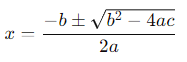
Let’s find the zeroes by applying the quadratic formula:
Previous Year Questions 2020

Substitute into the formula:

Previous Year Questions 2020

Simplify under the square root:

Previous Year Questions 2020

Taking the square root:

Previous Year Questions 2020

So, the zeroes are –m and m + 3.
Thus, the correct answer is (b) –m, m + 3.

Practice Test: PolynomialsStart Test

Previous Year Questions 2019

Q1: Find the value of k such that the polynomial x2 – (k + 6)x + 2(2k – 1) has the sum of its zeroes equal to half of its product.    [Year 2019, 3 Marks] 

Hide Answer  

Ans: 7
The given polynomial is x2 -(k + 6)x + 2(2k – 1)
According to the question
Sum of zeroes = 1/2(Product of Zeroes ):
⇒ k + 6 = 1/2 x 2 (2k – 1)
⇒ k + 6 = 2k – 1
⇒ k = 7

01. Previous Year Questions: Real Numbers

Previous Year Questions 2025

Q1: If (-1)n + (-1)8 = 0, then n is: (2025)
(a) any positive integer 
(b) any negative integer 
(c) any odd number 
(d) any even number 

Hide Answer  

Ans: (c)
We have, 
(-1)n + (-1)8 = 0 ⇒ (-1)n + 1 = 0 ⇒ (-1)n = (-1) 
On comparing the powers, we get n = 1, 3, 5, ………. 
∴ Hence, n is any odd number. 

Q2: Which of the following cannot be the unit digit of 8n, where n is a natural number? (2025) 
(a) 4 
(b) 2 
(c) 0 
(d) 6 

Hide Answer  

Ans: (c)
8n = (2 × 2 × 2)n
Since, factors of 8n do not contain 5 in it. 
So, 8n can’t ends with 0. 
⇒ 0 can’t be the unit digit of 8n.

Q3: If x is the LCM of 4, 6, 8 and y is the LCM of 3, 5, 7 and p is the LCM of x and y, then which of the following is true?    (2025) 
(a) p = 35x 
(b) p = 4y 
(c) p = Bx 
(d) p = 16y

Hide Answer  

Ans: (a)
LCM (4, 6, 8) = x = 24 
LCM (3, 5, 7) = y= 105 
LCM (x, y) = p = LCM (24, 105) = 840 
∴ p = 840 = 35 × 24 = 35x 

Q4: If HCF (98, 28) = m and LCM (98, 28) = n, then the value of n – 7m is:  (2025) 
(a) 0 
(b) 28 
(c) 98
(d) 198

Hide Answer  

Ans: (c)
98 = 2 × 72, 28 = 22 × 7 
∴ LCM (98, 28) = 22 × 72 = 196 
⇒ n = 196 
HCF (98, 28) = 2 × 7 = 14 
⇒ m = 14
∴ n – 7m = 196 – 7 × 14 = 196 – 98 = 98 

Q5: The greatest number which divides 70 and 125, leaving remainders 5 and 8 respectively, is:    (2025) 
(a) 13 
(b) 65 
(c) 875 
(d) 1750

Hide Answer  

Ans: (a)
We have to find the H.C.F of 70 – 5 = 65 and 125 – 8 = 117. 
∴ 65 = 5 × 13, 117 = 32 × 13 
⇒ HCF (65, 117) = 13 
∴ Required greatest number = 13. 

Q6: Assertion (A): For any two prime numbers p and q, their HCF is 1 and LCM is p + q. 
Reason (R): For any two natural numbers, HCF x LCM = product of numbers. 
(a) Both Assertion (A) and Reason (R) are true and Reason (R) is correct explanation of Assertion (A). 
(b) Both Assertion (A) and Reason (R) are true, but Reason (R) is not the correct explanation of Assertion (A). 
(c) Assertion (A) is true, but Reason (R) is false. 
(d) Assertion (A) is false, but Reason (R) (ii) is true.    (2025)

Hide Answer  

Ans: (d)
Clearly, reason is true. 
For any two primes p and q. 
HCF (p, q) = 1 
LCM (p, q) = p × q 
∴ Assertion is false. 

Q7: Find the smallest number that is divisible by both 644 and 462.    (2025) 

Hide Answer  

Ans: 
The smallest number divisible by both 644 and 462 is LCM of 644 and 462. 
644 = 2 × 2 × 7 × 23 
462 = 2 × 3 × 7 × 11
∴ LCM (644,462) = 2 × 2 × 3 × 7 × 11 × 23 = 21252 

Q8: Two numbers are in the ratio 4: 5 and their HCF is 11. Find the LCM of these numbers.    (2025)

Hide Answer  Ans: Let two numbers be 4x and 5x. 
HCF (4x, 5x) = 11 
∴ Numbers are 4 × 11 = 44 and 5 × 11 = 55 
Since, product of two numbers= HCF × LCM 
⇒ 44 × 55 = 11 × LCM 
Previous Year Questions 2025

Q9: Three sets of Physics, Chemistry and Mathematics books have to be stacked in such a way that all the books are stored subject-wise and the height of each stack is the same. The number of Physics books is 144, the number of Chemistry books is 180 and the number of Mathematics books is 192. Assuming that the books are of same thickness,determine the number of stacks of Physics, Chemistry and Mathematics books.    (2025)

Hide Answer  

Ans: 
Number of Physics books = 144 
Number of Chemistry books = 180 
Number of Mathematics books = 192 
Since, 180 = 2 × 2 × 3 × 3 × 5 
144 = 2 × 2 × 2 × 2 × 3 × 3 
192 = 2 × 2 × 2 × 2 × 2 × 2 × 3 
∴ HCF(180, 144, 192) = 2 x 2 x 3 = 12
∴ Number of stacks of Physics books = 144/12 = 12
Number of stacks of Chemistry books = 180/12 = 15
Number of stacks of Mathematics books = 192/12 = 16

Q10: Let p, q and r be three distinct prime numbers. 
Check whether p·q·r + q is a composite number or not. 
Further, give an example for 3 distinct primes p, q, r such that 
(i) p·q·r + 1 is a composite number. 
(ii) p·q·r + 1 is a prime number.    (2025) 

Hide Answer  

Ans: 
Given: p, q, r be distinct prime numbers. 
We have, pqr + q = q(pr + 1) 
Here, q is a prime number and pr+ 1 > 1, 
Thus, pqr + q has factors 1, q, (pr+ 1) and q(pr + 1). 
Hence, pqr + q is a composite number. …(i) 
(i) Take p = 3, q = 5 and r = 7, we have 
pqr + 1 = 3 × 5 × 7 + 1 = 105 + 1 = 106 
Thus, pqr + 1 is a composite number for p = 3, q = 5 and r = 7. 
(ii) Take p = 2, q = 3 and r = 5, we have 
pqr + 1 = 2 × 3 × 5 + 1 = 30 + 1 = 31 
Thus, pqr + 1 is a prime number for p = 2, q = 3 and r = 5.

Q11:is a/an     (2025)
(a) natural number 
(b) integer 
(c) rational number 
(d) irrational number  

Hide Answer  

Ans: (d)
Previous Year Questions 2025
∵ 2 is a rational number andPrevious Year Questions 2025is an irrational number. 
∴ Previous Year Questions 2025is an irrational number.

Q12: Which of the following is a rational number between √3 and √5?     (2025)
(a) 1.4142387954012. … 
(b) 

(c) π 
(d) 1.857142

Hide Answer  

Ans: (d)
√3 is approximately equals to 1.7320. 
√5 is approximately equals to 2.2360. 
Here 1.857142 lies between √3 and √5. 

Q13: Prove thatis an irrational number given that √3 is an irrational number.    (2025)

Hide Answer  

Ans: It is given that, √3 is an irrational number. 
We have to prove that Previous Year Questions 2025 is an irrational number. 3

Let us assume Previous Year Questions 2025be a rational number.
Then, Previous Year Questions 2025 where b ≠ 0 and a, b are co-prime integers.
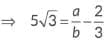
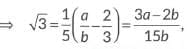
Previous Year Questions 2025
Previous Year Questions 2025which is a rational number.
⇒ √3 is a rational number. 
But √3 is an irrational number. So, our assumption is wrong.
Hence, Previous Year Questions 2025 is an irrational number.

Q14: Prove thatis an irrational number given that √2 is an irrational number.    (2025)  

Hide Answer  

Ans: 
It is given that, √2 is an irrational number. 
We have to prove that Previous Year Questions 2025is an irrational number.

Let us assume Previous Year Questions 2025be a rational number.
Previous Year Questions 2025
⇒√2 is a rational number. 
But √2 is an irrational number. So, our assumption is wrong. 
Hence,Previous Year Questions 2025is an irrational number.

Previous Year Questions 2024

Q1: The smallest irrational number by which √20 should be multipled so as to get a rational number, is:    (CBSE 2024) 
(a) √20
(b) √2
(c) 5
(d) √5

Hide Answer  

Ans: (d)

Previous Year Questions 2024

Q2: The LCM of two prime numbers p and q (p > q) is 221. Then the value of 3p – q is:     (CBSE 2024) 
(a) 4
(b) 28
(c) 38
(d) 48

Hide Answer  

Ans: (c)
The numbers p and q are prime numbers, 
∴ HCF (p, q) = 1 
Here, LCM(p, q) = 221 
∴ As, p > q
p = 17, q = 13 
(As p × q = 221) 
Now, 3p – q = 3 × 17 – 13 
= 51 – 13
= 38

Q3: A pair of irrational numbers whose product is a rational number is     (CBSE 2024) 
(a) (√16, √4)
(b) (√5, √2)
(c) (√3, √27)
(d) (√36, √2)

Hide Answer  

Ans:(c)
Here √3 and √27 both are irrational numbers.
The product of √3 x √27 = 3 x 27

= √81
= 9 ,= pq;q ≠ 0
∴ 9 is a rational number.

Q4: Given HCF (2520, 6600) = 40, LCM (2520, 6600) = 252 × k, then the value of k is:     (CBSE 2024) 
(a) 1650
(b) 1600
(c) 165
(d) 1625

Hide Answer  

Ans:(a)
HCF(2520, 6600) = 40
LCM(2520, 6600) = 252 × k 
∴ HCF × LCM = Ist No. × IInd No. 
∴ 40 × 252 × k = 2520 × 6600
⇒ k = 2520 x 660040 x 252
⇒ k = 1650

Q5: Teaching Mathematics through activities is a powerful approach that enhances students’ understanding and engagement. Keeping this in mind, Ms. Mukta planned a prime number game for class 5 students. She announced the number 2 in her class and asked the first student to multiply it by a prime number and then pass it to the second student. The second student also multiplied it by a prime number and passed it to the third student. In this way by multiplying by a prime number, the last student got 173250.
Now, Mukta asked some questions as given below to the students:       (CBSE 2024) 
(A) What is the least prime number used by students?
(B) How many students are in the class?
OR
What is the highest prime number used by students?
(C) Which prime number has been used maximum times?

Hide Answer  

Ans:
(A)
Previous Year Questions 2024
So least prime no. used by students = 3(because 2 is announced by the teacher, so the least number used by the students is 3)
(B)As the last student got  173250 = 2 × 3 × 3 × 5 × 5 × 5 × 7 × 11
there are 7 factors other than 2, which is announced by teacher. So, Number of student = 7
OR
Highest prime number used by student = 11
(C)Prime number 5 is used maximum times i.e., 3 times.

Q6: LCM (850, 500) is:   (CBSE 2024) 
(a) 
850 × 50 
(b) 17 x 500 
(c) 17 x 52 x 22
(d) 17 × 53 × 2 

Hide Answer  

Ans: (b) 17 x 500 
Previous Year Questions 2024
850 = 17 × 52 × 2
500 = 53 × 22
LCM (850, 500) = 17 × 53 × 22
= 17 × 500
=8500

Q7: Prove that 6 – 4√5 is an irrational number, given that √5 is an irrational number.   (CBSE 2024) 

Hide Answer  

Ans: Let us assume that 6 – 4√5 be a rational number
Let Previous Year Questions 2024 …[b ≠ 0; a and b are integers]
Previous Year Questions 2024
We know that,
Previous Year Questions 2024is a rational number.
But this contradicts the fact that √5 is an irrational number.
So, our assumption is wrong.
Therefore,  6 – 4√5 is an irrational number.

Q8: Show that 11 × 19 × 23 + 3 × 11 is not a prime number.   (CBSE 2024) 

Hide Answer  

Ans: We have
11 × 19 × 23 + 3 × 11
⇒ 11(19 × 23 + 3)
⇒ 11(437 + 3)
⇒ 11(440)
⇒ 11(2 × 2 × 2 × 5 × 11)
⇒ 2 × 2 × 2 × 5 × 11 × 11
As it can be represented as a product of more than two primes (1 and number itself). So, it is not a prime number.

Q9: If two positive integers p and q can be expressed as p = 18 a²b¹ and q=20 a³b², where a and b are prime numbers, then LCM (p, q) is:    (CBSE 2024) 
(a) 
2 a²b² 
(b) 180 a²b² 
(c) 12 a²b² 
(d) 180 a³b²

Hide Answer  

Ans: (d) 180 a3b2
Given,
p = 18 a2b1 and
q = 20 a3b2
LCM (p, q) = LCM (18 a2b1, 20 a3b2)
= 180 a3b2

Q10: Prove that 5 – 2√3 is an irrational number. It is given that √3 is an irrational number.  (CBSE 2024) 

Hide Answer  

Ans: Assuming 5 – 2√3 to be a rational number. 
Previous Year Questions 2024 
Here RHS is rational but LHS is irrational.  
Therefore our assumption is wrong.  
Hence, 5 – 2√3 is an irrational number. 

Q11: Show that the number 5 × 11 × 17 + 3 × 11 is a composite number.  (CBSE 2024) 

Hide Answer  

Ans: The numbers are prime numbers and composite numbers.
Prime numbers can be divided by 1 and itself. A composite number has factors other than 1 and itself.
(5 × 11 × 17) + (3 × 11)
= (85 × 11) + (3 × 11)
= 11 × (85 + 3)
= 11 × 88
= 11 × 11 × 8
= 2 × 2 × 2 × 11 × 11
The given expression has 2 and 11 as its factors. Therefore, it is a composite number.

Q12:  In a teachers’ workshop, the number of teachers teaching French, Hindi and English are 48, 80 and 144 respectively. Find the minimum number of rooms required if in each room the same number of teachers are seated and all of them are of the same subject.  (CBSE 2024) 

Hide Answer  

Ans: The number of rooms will be minimum if each room accommodates a maximum number of teachers. Since in each room the same number of teachers are to be seated and all of them must be of the same subject. Therefore, the number of teachers in each room must be HCF of 48, 80, and 144.
The prime factorisations of 48, 80 and 144 are as under 
48 = 24 × 31
80 = 24 × 51
144 = 24 × 32
∴ HCF of 48, 80 and 144 = 16
Therefore, in each room 16 teachers can be seated.
Previous Year Questions 2024

Q13: Directions: Assertion (A) is followed by a statement of Reason (R). Select the correct option from the following options: 
(a) Both, Assertion (A) and Reason (R) are true. Reason (R) explains Assertion (A) completely. 
(b) Both, Assertion (A) and Reason (R) are true. Reason (R) does not explain Assertion (A). 
(c) Assertion (A) is true but Reason (R) is false. 
(d) Assertion (A) is false but Reason (R) is true. 
Assertion (A): If the graph of a polynomial touches x-axis at only one point, then the polynomial cannot be a quadratic polynomial. 
Reason (R): A polynomial of degree n(n >1) can have at most n zeroes.
    (CBSE 2024) 

Hide Answer  

Ans: Assertion (A): “If the graph of a polynomial touches the x-axis at only one point, then the polynomial cannot be a quadratic polynomial.”
A quadratic polynomial is of the form ax2 + bx + c. It can have two real roots, one real root (if the discriminant is zero), or no real roots (if the discriminant is negative).
If the graph of a quadratic polynomial touches the x-axis at exactly one point, this means it has a repeated real root (a double root), which is possible for quadratic polynomials. Hence, the assertion is false.
Reason (R): “A polynomial of degree n (n > 1) can have at most n zeroes.”
A polynomial of degree n can have at most n real or complex zeroes. This is a true statement, so the reason is true.
Given the above analysis, the correct answer is: (d) Assertion (A) is false but Reason (R) is true.

Get additional INR 200 off today with EDUREV200 coupon.Avail Offer

Previous Year Questions 2023

Q1: The ratio of HCF to LCM of the least composite number and the least prime number is  (2023)
(a) 1 : 2   
(b) 2 : 1
(c) 1 : 1
(d) 1 : 3  

Hide Answer  

Ans:(a)

Sol: Least composite number = 4
Least prime number = 2
∴ HCF = 2, LCM = 4
∴ Required ratio = HCF / LCM = 2/4
i.e. 1 : 2

Q2: Find the least number which when divided by 12, 16, and 24 leaves the remainder 7 in each case.  (2023)

Hide Answer  

Ans: 55

Given, least number which when divided by 12, 16 and 24 leaves remainder 7 in each case
∴  Least number = LCM(12, 16, 24) + 7
= 48 + 7
= 55

Q3: Two numbers are in the ratio 2 : 3 and their LCM is 180. What is the HCF of these numbers? (2023)

Hide Answer  

Ans:30

Let the two numbers be 2x and 3x
LCM of 2x and 3x = 6x, HCF(2x, 3x) = x
Now, 6x = 180
⇒ x = 180/6
x = 30

Q4: Prove that √3 is an irrational number. (2023)

Hide Answer  

Ans: Let us assume that √3 is a rational number.

Then √3 = a/b; where a and b ( ≠ 0) are co-prime positive integers.
Squaring on both sides, we get
3 = a2/b2
⇒ a2 = 3b
⇒ 3 divides a2
⇒ 3 divides a   _________(i)
= a = 3c, where c is an integer
Again, squaring on both sides, we get
a2 = 9c2
⇒3b2 = 9c2
⇒b2 = 3c2
⇒ 3 divides b2
⇒ 3 divides b   _________(ii)
From (i) and (ii), we get 3 divides both a and b.
⇒ a and b are not co- prime integers.
This contradicts the fact that a and b are co-primes.
Hence,  √3 is an irrational number.

Also read: Short Answer Questions: Real Numbers – 1

Previous Year Questions 2022

Q1: Two positive numbers have their HCF as 12 and their product as 6336. The number of pairs possible for the numbers is   (2022)
(a) 2
(b) 3
(c) 4
(d) 1

Hide Answer  

Ans:(a)
Sol: Given, HCF = 12
Let two numbers be 12a and 12b
So. 12a x 12b = 6336 
⇒ ab = 44
We can write 44 as product of two numbers in these ways:
ab = 1 x 44 = 2 x 22 = 4x  11
Here, we will take a = 1 and b = 44 ; a = 4 and b = 11.
We do not take ab = 2  x 22 because 2 and 22 are not co-prime to each other.

For a = 1 and b = 44, 1st no. = 12a = 12, 2nd no. = 12b = 528
For a = 4 and b = 11, 1st no. = 12a = 48, 2nd no. = 12b = 132
Hence, we get two pairs of numbers, (12, 528) and (48, 132).

Q2: If ‘n’ is any natural number, then (12)n cannot end with the digit    (2022)
(a) 2
(b) 4
(c) 8
(d) 0

Hide Answer  

Ans: (d)
Sol: 

  • For any natural number n, the expression (12)n cannot end with the digit 0.
  • This is because the number 12 does not contain the prime factor 5, which is necessary for a number to end in 0.
  • Thus, regardless of the value of n, (12)n will never end with 0.

Q3: The number 385 can be expressed as the product of prime factors as   (2022)
(a) 5 x 11 x 13
(b) 5 x  7 x 11
(c) 5 x 7 x 13
(d) 5  x  11 x 17

Hide Answer  

Ans: (b)
Sol: We have,

Previous Year Questions 2022
∴ Prime factorisation of 385 = 5 x 7 x 11

Previous Year Questions 2021

Q1: Explain why 2 x 3 x 5 + 5 and 5 x 7 x 11 + 7 x 5 are composite numbers.   (2021)

Hide Answer  

Ans: We have, 2 x 3 x 5 + 5 and 5 x 7 x 11 + 7 x 5.
We can write these numbers as:
2 x 3 x 5 + 5 = 5(2 x 3 + 1)
= 1 x 5 x 7
and 5 x 7 x 11 + 7 x 5 = 5 x 7(11 + 1)
= 5 x 7 x 12 = 1 x 5 x 7 x 12
Since, on simplifying. we find that both the numbers have more than two factors. 
So. these are composite numbers.

Attention!Sale expiring soon, act now & get EduRev Infinity at 40% off!Claim Offer

Previous Year Questions 2020

Q1: The HCF and the LCM of 12, 21 and 15 respectively, are   (2020)
(a) 3, 140
(b) 12, 420
(c) 3, 420
(d) 420, 3

Hide Answer  

Ans: (c)
Sol:We have, 
12 = 2 x 2 x 3 = 2x 3
21= 3 x 7
15 = 3 x 5
∴ HCF (12, 21, 15) = 3
and LCM (12, 21 ,15 ) = 22 x 3 x 5 x 7
= 420

Q2: The LCM of two numbers is 182 and their HCF is 13. If one of the numbers is 26. find the other.   (2020)

Hide Answer  

Ans: Let the other number be x
As, HCF (a, b) x  LCM (a, b) = a  x  b
⇒ 13  x  182= 26x
⇒ x = 13 x 182 / 26
= 91
Hence, other number is 91.

Q3: Given that HCF (135, 225) = 45, find the LCM (135, 225). (CBSE 2020)

Hide Answer  

Ans: We know that
LCM × HCF = Product of two numbers
∴ LCM (135, 225) = Product of 135 and 225 / HCF(135, 225)
= 135 x 225 / 45
= 675
So, LCM (135, 225) = 675

Also read: Short Answer Questions: Real Numbers – 1

Previous Year Questions 2019

Q1: If HCF (336, 54) = 6. find LCM (336, 54).   (2019)

Hide Answer  

Ans: Using the formula:  HCF (a, b) x LCM (a, b) = a x b
∴ HCF (336, 54) x  LCM (336, 54) = 336 x 54
⇒ 6 x LCM(336, 54) = 18144
⇒ LCM (336, 54) = 18144 / 6
= 3024

Q2: The HCF of two numbers a and b is 5 and their LCM is 200. Find the product of ab.  (2019)

Hide Answer  

Ans: We know that HCF (a, b) x  LCM (a, b)=a x b
⇒ 5 x 200 = ab
⇒  ab = 1000

Q3: If HCF of 65 and 117 is expressible in the form 65n – 117, then find the value of n.   (2019)

Hide Answer  

Ans: Since, HCF (65 ,117) = 13
Given HCF ( 65, 117 ) = 65n – 117
13 = 65n – 117
⇒  65n = 13 +117
⇒  n = 2

Q4: Find the HCF of 612 and 1314 using prime factorization.   (2019)

Hide Answer  

Ans: Prime factorisation of 612 and 1314 are
612 = 2 x 2 x 3 x 3 x 17
1314 = 2 x 3 x 3 x 73
∴ HCF (612, 1314) = 2 x 3 x 3
= 18

Q5: Prove that √5 is an irrational number.   (2019)

Hide Answer  

Ans: Let us assume that 5 is a rational number.
Then 5 = a/b where a and b (≠ 0} are co-prime integers,
if Squaring on both sides, we get
5 = a2b2 ⇒ a2 = 5b2
⇒ 5 divides a2
⇒ 5 divides a  ———-(i)
⇒ a = 5c, where c is an integer
Again, squaring on both sides, we get
a2 = 25c2
⇒ 5b2 = 25c2  
⇒ b2 = 5c2
⇒ 5 divides b2 ———-(ii)
⇒ 5 divides b
From (i) and {ii), we get 5 divides both a and b.
⇒  a and b are not co-prime integers.
Hence, our supposition is wrong.
Thus, 5 is an irrational number.

Q6: Prove that √2 is an irrational number.   (2019)

Hide Answer  

Ans: Let us assume 2 be a rational number.
Then, 2 = p/q where p, q (q ≠ 0) are integers and co-prime. ;
On squaring both sides. we get
2 = p2q2 ⇒ p2 = 2q2 ————(i)
⇒ 2 divides p2
⇒ 2 divides p ———–(ii)
So, p = 2a, where a is some integer.
Again squaring on both sides, we get
p2 = 4a2
⇒ 2q2 = 4a2 (using (i))
⇒ q2 = 2a2
⇒ 2 divides q2
⇒ 2 divides q       ———–(iii)
From (ii) and (iii), we get
2 divides both p and q.
∴ p and q are not co-prime integers.
Hence, our assumption is wrong.
Thus 2 is an irrational number.

Q7: Prove that 2 + 5√3 is an irrational number given that √3 is an irrational number.   (2019)

Hide Answer  

Ans: Suppose 2 + 53 is a rational number.
We can find two integers a, b (b ≠ 0) such that
2 + 53 = a/b, where a and b are co -prime integers.
5√3 = ab – 2 ⇒ √3 = 15 [ a b – 2]
⇒ 3 is a rational number.

[ ∵ a, b are integers, so  15 [ a b – 2] is a rational number]
But this contradicts the fact that 3 is an irrational number.
Hence, our assumption is wrong.
Thus, 2 + 53 is an irrational number.

Q8: Write the smallest number which is divisible by both 306 and 657. (CBSE 2019)

Hide Answer  

Ans: Given numbers are 306 and 657. 
The smallest number divisible by 306 and 657 = LCM(306, 657) 
Prime factors of 306 = 2 × 3 × 3 × 17 
Prime factors of 657 = 3 × 3 × 73 
LCM of (306, 657) = 2 × 3 × 3 × 17 × 73 
= 22338 
Hence, the smallest number divisible by 306 and 657 is 22,338.