14. Probability – Worksheet

Multiple Choice Questions
Q1: The probability of an impossible event is
(a) 0.01
(b) 100
(c) zero
(d) 1

Q2: The probability that a leap year will have 53 Sundays or 53 Mondays is
(a) 4/7
(b) 2/7
(c) 1/7
(c) 3/7

Q3: A game of chance consists of spinning an arrow which comes to rest pointing at one of the numbers 1, 2, 3, 4, 5, 6, 7, 8, 9, 10 and these values are equally likely outcomes. The probability that it will point at a number greater than 5 is
(a) 1/2
(b) 1/4
(c) 1/5
(d) 1/3

Q4: The probability of an impossible event is
(a) 0.01
(b) 100
(c) zero
(d) 1

Q5: Cards marked with numbers 1, 2, 3, ______, 25 are placed in a box and mixed thoroughly and one card is drawn at random from the box. The probability that the number on the card is a multiple of 3 and 5 is
(a) 12/25
(b) 4/25
(c) 1/25
(d) 8/25

Q6: A game of chance consists of spinning an arrow which comes to rest pointing at one of the numbers 1, 2, 3, 4, 5, 6, 7, 8, 9, 10 and these values are equally likely outcomes. The probability that it will point at a number greater than 5 is
(a) 1/2
(b) 1/4
(c) 1/5
(d) 1/3

Very Short Answer Questions
Q7: A bag contains cards which are numbered from 2 to 90. A card is drawn at random from the bag. Find the probability that it bears a two digit number

Q8: A card is drawn from a pack of 52 cards. Find the probability of getting a king of red colour

Q9: A bag contains 40 balls out of which some are red, some are blue and remaining are black. If the probability of drawing a red ball is 11/20 and that of blue ball is 1/5 , then what is the no. of black balls?

Short Answer Questions
Q10: A card is drawn at random from a well-shuffled pack of 52 cards. Find the probability that the drawn card is neither a king nor a queen. 

Q11: Two unbiased dice are thrown. Find the probability that the total of the numbers on the dice is greater than 10. 

Q12: Three unbiased coins are tossed together. Find the probability of getting at least two heads? 

Q13: Cards marked with numbers 5 to 50 are placed in a box and mixed thoroughly. A card is drawn from the box at random. Find the probability that the number on the taken out card is
(1) a prime number less than 10

(2) a number which is a perfect square.

Q14: Why is tossing a coin considered as the way of deciding which team should get the ball at the beginning of a football match?

Q15: Two coins are tossed together. Find the probability of getting both heads or both tails.

Q16: A bag contains, white, black and red balls only. A ball is drawn at random from the bag. If the probability of getting a white ball is 3/10 and that of a black ball is , 2/5 then find the probability of getting a red ball. If the bag contains 20 black balls, then find the total number of balls in the bag.

Q17: A box contains 90 discs which are numbered 1 to 90. If one disc is drawn at random from the box, find the probability that it bears
(1) a two digit number,
(2) number divisible by 5.

Long Questions Answer
Q18: A box contains cards bearing numbers 6 to 70. If one cards is drawn at random from the box, find the probability that it bears
(1) a one digit number.
(2) a number divisible by 5,
(3) an odd number less than 30,

Q19: All red face cards are removed from a pack of playing cards. The remaining cards are well-shuffled and then a card is drawn at random from them. Find the probability that the drawn card is
(1) a red card,
(2) a face card,
(3) a card of clubs.

Q20: Cards numbered 11 to 60 are kept in a box. If a card is drawn at random from the box, find the probability that the number on the drawn card is (i) an odd number, (ii) a perfect square number, (iii) divisible by 5, (iv) a prime number less than 20.

You can access the solutions to this worksheet here

13. Statistics – Worksheet

Multiple Choice Questions

1. If x1, x2, x3,….., xn are the observations of a given data. Then the mean of the observations will be:
(a) Sum of observations/Total number of observations
(b) Total number of observations/Sum of observations
(c) Sum of observations +Total number of observations
(d) None of the above

Q2: If the mean of frequency distribution is 7.5 and ∑fi xi = 120 + 3k, ∑fi = 30, then k is equal to:
(a) 40
(b) 35
(c) 50
(d) 45

Q3: The mode and mean is given by 7 and 8, respectively. Then the median is:
(a) 1/13
(b) 13/3
(c) 23/3
(d) 33

Q4: The mean of the data: 4, 10, 5, 9, 12 is;
(a) 8
(b) 10
(c) 9
(d) 15

Q5: The median of the data 13, 15, 16, 17, 19, 20 is:
(a) 30/2
(b) 31/2
(c) 33/2
(d) 35/2
Q6: If the mean of first n natural numbers is 3n/5, then the value of n is:
(a) 3
(b) 4
(c) 5
(d) 6

Q7: If AM of a, a+3, a+6, a+9 and a+12 is 10, then a is equal to;
(a) 1
(b) 2
(c) 3
(d) 4

Q8: The class interval of a given observation is 10 to 15, then the class mark for this interval will be:
(a) 11.5
(b) 12.5
(c) 12
(d) 14

Q9: If the sum of frequencies is 24, then the value of x in the observation: x, 5,6,1,2, will be;
(a) 4
(b) 6
(c) 8
(d) 10

Q10: The abscissa of the point of intersection of the less than type and of the more than type cumulative frequency curves of a grouped data gives its
(a) mean
(b) median
(c) mode
(d) all the three above

Solve the following Questions

Q1: The class marks of a distribution are 13, 17,21, 25 and 29. Find the true class limits.

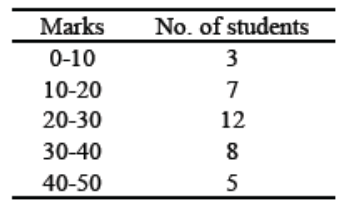
Q2: Convert the given simple frequency series into a:
(i) Less than cumulative frequency series.
(ii) More than cumulative frequency series.

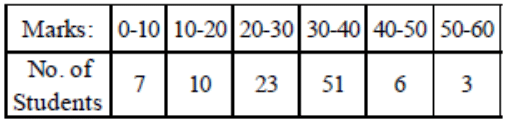
Q3: Drawn ogive for the following frequency distribution by less than method.
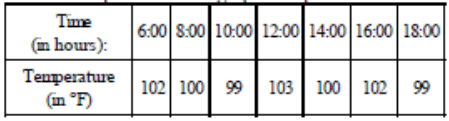
Q4: The temperature of a patient, admitted in a hospital with typhoid fever, taken at different times of the day are given below. Draw the temperature-time graph to reprents the data:
Q5: The class marks of a distribution are 82, 88, 94, 100, 106, 112 and 118. Determine the class size and the classes.

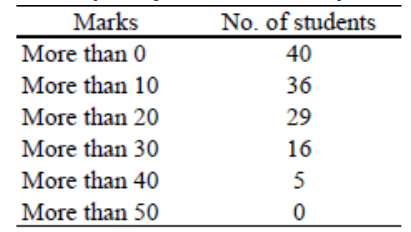
Q6: Convert the following more than cumulative frequency series into simple frequency series.
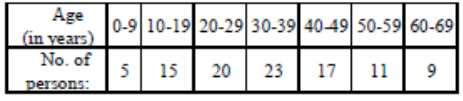
Q7: Draw a cumulative frequency curve for the following frequency distribution by less than method.

You can access the solutions to this worksheet here.
12. Surface Areas and Volumes – Worksheet

Multiple Choice Questions
Q1: A bucket is in the form of a frustum of a cone ad holds 28.490 liters of water. The radii of the top and bottom are 28cm and 21cm respectively. Find the height of the bucket.
(a) 20 cm
(b) 15 cm
(c) 10 cm
(d) None of the above

Q2: Lead spheres of diameter 6cm are dropped into a cylindrical beaker containing some water and are fully submerged. If the diameter of the beaker is 18cm and water rises by 40cm. find the no. of lead sphere dropped in the water.
(a) 90
(b) 150
(c) 100
(d) 80

Short Answer Questions
Q3: A cone, a hemisphere and a cylinder stand on equal bases and have the same height. Show that their volumes are in the ratio 1: 2: 3.

Q4: Prove that the surface area of a sphere is equal to the curved surface area of the circumscribed cylinder.

Q5: 500 persons are taking a dip into a cuboidal pond which is 80 m long and 50 m broad. What is the rise of water level in the pond, if the average displacement of the water by a person is 0.04m3?

Q6: The radii of the basses of two right circular solid cones of same height are r1 and r2 respectively. The cones are melted and recast into a solid sphere of radius R. Show that the height of each cone is given by

Q7: The slant height of the frustum of a cone is 4cm, and the perimeter of its circular bases is 18cm and 6cm respectively. Find the curved surface area of the frustum ?

Q8: A bucket of height 8cm and made up of copper sheet is in the form of frustum of a right circular cone with radii of its lower and upper ends as 3cm and 9m respectively.
Calculate –

(a) the height of cone of which the bucket is a part.
(b) the volume of water which can be filled in the bucket.
(c) the area of copper shut required to make the bucket.

You can access the solutions to this worksheet here

11. Areas Related to Circles – Worksheet

Multiple Choice Questions
Q1: The part of the circular region enclosed by a chord and the corresponding arc of a circle is called
(a) a segment
(b) a diameter
(c) a radius
(d) a sector

Q2: If ‘r’ is the radius of a circle, then it’s circumference is given by
(a) 2πr
(b) None of these
(c) πr
(d) 2πd

Q3: The angle described by the minute hand between 4.00 pm and 4.25 pm is
(a) 900
(b) 1500
(c) 1250
(d) 1000

Q4: If a line meets the circle in two distinct points, it is called
(a) a chord
(b) a radius
(c) secant
(d) a tangent

Q5: The perimeter of a protractor is
(a) πr
(b) πr+2r
(c) π+r
(d) π+2r

Q6: The perimeter of a circle having radius 5cm is equal to:
(a) 30 cm
(b) 3.14 cm
(c) 31.4 cm
(d) 40 cm

Q7: Area of the circle with radius 5cm is equal to:
(a) 60 sq.cm
(b) 75.5 sq.cm
(c) 78.5 sq.cm
(d) 10.5 sq.cm

Q8: The largest triangle inscribed in a semi-circle of radius r, then the area of that triangle is;
(a) r2
(b) 1/2r2
(c) 2r2
(d) √2r2

Q9: If the perimeter of the circle and square are equal, then the ratio of their areas will be equal to:
(a) 14:11
(b) 22:7
(c) 7:22
(d) 11:14

Q10: The area of the circle that can be inscribed in a square of side 8 cm is
(a) 36 π cm2
(b) 16 π cm2
(c) 12 π cm2
(d) 9 π cm2

Very Short Answer Question

Q1: A bicycle wheel makes 5000 revolutions in moving 11km.Find the diameter of the wheel.

Q2: A chord AB of a circle of radius 10 cm makes a right angle at the centre of the circle. Find the area of the minor and major segments.

Q3: Find the difference of the areas of a sector of angle 1200 and its corresponding major sector of a circle of radius 21 cm.

Q4: A boy is cycling such that the wheels of the cycle are making 140 revolutions per minute. If the diameter of the wheel is 60cm, calculate the speed per hour with which the boy is cycling

Long Question Answer

Q1: On a square cardboard sheet of area 784 cm2, four circular plates of maximum size are placed such that each circular plate touches the other two plates and each side of the square sheet is tangent to circular plates. Find the area of the square sheet not covered by the circular plates.

You can access the solutions to this worksheet here.
10. Circles – Worksheet

Multiple Choice Question
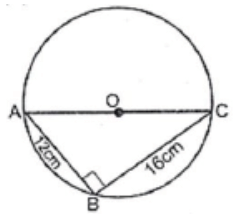
Q1: If AB = 12 cm, BC = 16 cm and AB is perpendicular to BC, then the radius of the circle passing through the points A, B and C is:


(a) 6 cm
(b) 8 cm
(c) 10 cm
(d) 12 cm

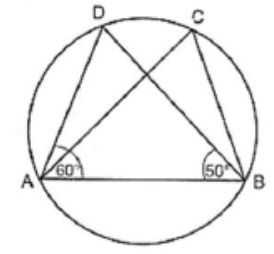
Q2: In Fig, if ∠DAB = 60º, ∠ABD = 50º, then ∠ACB is equal to:


(a) 60º
(b) 50º
(c) 70º
(d) 80º

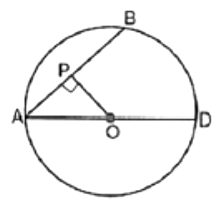
Q3: AD is a diameter of a circle and AB is a chord. If AD = 34 cm, AB = 30 cm, the distance of AB from the centre of the circle is:


(a) 17 cm
(b) 15 cm
(c) 4 cm
(d) 8 cm

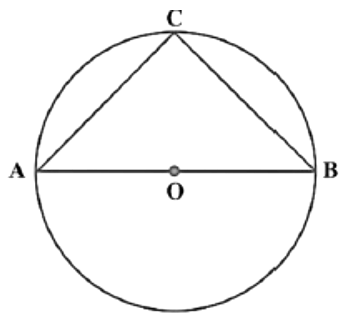
Q4: In Fig, if AOB is a diameter of the circle and AC = BC, then ∠CAB is equal to:


(a) 30º
(b) 60º
(c) 90º
(d) 45º

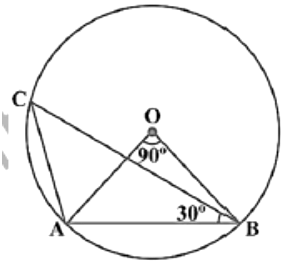
Q5: In Fig, ∠AOB = 90º and ∠ABC = 30º, then ∠CAO is equal to:


(a) 30º
(b) 45º
(c) 90º
(d) 60º

True or False

Q6: Through three collinear points a circle can be drawn.

Q7: If A, B, C, D are four points such that ∠BAC = 30° and ∠BDC = 60°, then D is the centre of the circle through A, B and C.

Q8: Two chords AB and AC of a circle with centre O are on the opposite sides of OA.
Then ∠OAB = ∠OAC.

Q9. If AOB is a diameter of a circle and C is a point on the circle, then AC2 + BC2 = AB2

You can access the solutions to this worksheet here.
9. Some Applications of Trigonometry – Worksheet

Multiple Choice Questions

Q1: If the length of the shadow of a tree is decreasing then the angle of elevation is:
(a) Increasing
(b) Decreasing
(c) Remains the same
(d) None of the above
Q2. The angle of elevation of the top of a building from a point on the ground, which is 30 m away from the foot of the building, is 30°. The height of the building is:
(a) 10 m
(b) 30/√3 m
(c) √3/10 m
(d) 30 m

Q3: If the height of the building and distance from the building foot’s to a point is increased by 20%, then the angle of elevation on the top of the building:
(a) Increases
(b) Decreases
(c) Do not change
(d) None of the above

Q4: If a tower 6m high casts a shadow of 2√3 m long on the ground, then the sun’s elevation is:
(a) 60°
(b) 45°
(c) 30°
(d) 90°
Q5: The angle of elevation of the top of a building 30 m high from the foot of another building in the same plane is 60°, and also the angle of elevation of the top of the second tower from the foot of the first tower is 30°, then the distance between the two buildings is:
(a) 10√3 m
(b) 15√3 m
(c) 12√3 m
(d) 36 m
Q6: The angle formed by the line of sight with the horizontal when the point is below the horizontal level is called:
(a) Angle of elevation
(b) Angle of depression
(c) No such angle is formed
(d) None of the above

Q7: The angle formed by the line of sight with the horizontal when the point being viewed is above the horizontal level is called:
(a) Angle of elevation
(b) Angle of depression
(c) No such angle is formed
(d) None of the above

Q8: From a point on the ground, which is 15 m away from the foot of the tower, the angle of elevation of the top of the tower is found to be 60°. The height of the tower (in m) standing straight is:
(a) 15√3
(b) 10√3
(c) 12√3
(d) 20√3
Q9: The line drawn from the eye of an observer to the point in the object viewed by the observer is said to be
(a) Angle of elevation
(b) Angle of depression
(c) Line of sight
(d) None of the above

Q10: The height or length of an object or the distance between two distant objects can be determined with the help of:
(a) Trigonometry angles
(b) Trigonometry ratios
(c) Trigonometry identities
(d) None of the above

Solve the following Questions

Q1: Two poles of equal heights are standing opposite to each other on either side of the road which is 80m wide. From a point between them on the road the angles of elevation of the top of the poles are 60°and 30°.find the height of the poles and the distances of the point from the poles.

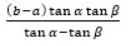
Q2: A tree standing on a horizontal plane leaning towards east. At two points situated at distances a and b exactly due west on it, the angles of elevation of the top are respectively α and β .Prove that the height of the top from the ground is .

Q3: A man sitting at a height of 20m on a tall tree on a small island in the middle of the river observes two poles directly opposite to each other on the two banks of the river and in line with the foot of tree. If the angles depression of the feet of the poles from a point at which the man is sitting on the tree on either side of the river are 60° and 30° respectively. Find the width of the river.

Q4: Consider right triangle ABC, right angled at B. If AC = 17 units and BC = 8 units determine all the trigonometric ratios of angle C.

Q5: If C and Z are acute angles and that cos C = cos Z prove that ∠C = ∠Z.

Q6: In triangle ABC, right angled at B if sin A = 1/2 . Find the value of
1. sin C cos A – cos C sin A
2. cos A cos C + sin A sin C

Q7: In triangle ABC right angled at B, AB = 12cm and ∠CAB = 60°. Determine the lengths of the other two sides.

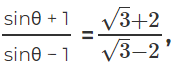
Q8: If θ is an acute angle and find θ.

Q9: Find the value of x in each of the following.

(i) cosec 3x = 
(ii) cos x = 2 sin 45° cos 45° – sin 30°

Q10: Given sin A = 12/37, find cos A and tan A.

You can access the solutions to this worksheet here.
8. Introduction to Trigonometry – Worksheet

True and False

Q1: cosA = 4/3 for some angle A.

Q2: tanA = sinA/cosA

Q3: secA = 1cosA, for an acute angle

Q4: sin60º = 2sin30º

Q5: SinA + CosA = 1Short Answer Questions

Q6: Write the values cos 0°, cos 45°, cos 60° and cos 90°. What happens to the values of cos as angle increases from 0° to 90°?

Q7: Write the values of tan 0°,tan 30°, tan 45°, tan 60° and tan 90°. What happens to the values of tan as angle increases from 0° to 90°?

Q8: If cosec A = √10 . find other five trigonometric ratios.

Q9: The value of (sin 30 + cos 30) − (sin 60 + cos 60) is

Q10: Evaluate the following: 2sin2 30 − 3cos245 + tan260

Q11: Evaluate:
cot230∘  − 2cos260 − 3/ 4sec245 − 4sec230

Q12: Write the values of sin 0°, sin 30°, sin 45°, sin 60° and sin 90°. What happens to the values of sin as angle increases from 0° to 90°?

Q13: If sin A = 3/5 .find cos A and tan A.

Q14: In a right triangle ABC right angled at B if sinA = 3/5. find all the six trigonometric ratios of C.

Q15: If sinB = 1/2 , show that 3 cosB − 4 cos3B = 0

You can access the solutions to this worksheet here.
7. Coordinate Geometry – Worksheet

Multiple choice Questions
Q1: Find the centroid of the triangle XYZ whose vertices are X (3, – 5) Y (- 3, 4) and Z (9, – 2).
(a) (0, 0)
(b) (3, 1)
(c) (2, 3)
(d) (3,-1)

Q2: If the mid-point of the line segment joining the points A (3, 4) and B (a, 4) is P (x, y) and x + y – 20 = 0, then find the value of a
(a) 0
(b) 1
(c) 40
(d) 45

Q3: Determine the ratio in which the line 2x + y – 4 = 0 divides the line segment joining the points A (2, – 2) and B (3, 7).
(a) 2:9
(b) 1:9
(c)1:2
(d) 2:3

Short Answer type
Q4: The coordinates of one end point of a diameter of a circle are (4, -1) and the co-ordinates of the centre of the circle are (1, -3). Find the co- ordinates of the other end of the diameter.

Q5: If the mid- point of the line joining (3, 4) and (z, 7) is (x, y) and 2x + 2y + 1 = 0 find the value of z.

Long Answer Type
Q6: Find the centre of the circle passing through (6, -6), (3, -7) and (3, 3) 

Q7: Prove that the points (3, 0), (4, 5), (-1, 4) and (-2, -1), taken in order, form a rhombus. Also, find its area.

Q8: Two opposite vertices of a square are (-1, 2) and (3, 2). Find thee co-ordinates of other two vertices.

Q9: Find a point on y – axis which is equidistant from the points (5, -2) and (-3, 2).

Q10: If the coordinates of the mid points of the sides of a triangle are (1, 2), (0, -1) and (2, -1). Find the coordinates of its vertices.

You can access the solutions to this worksheet here.

6. Triangles – Worksheet

Multiple Choice Questions

Q1: Which of the following triangles have the same side lengths?
(a) Scalene
(b) Isosceles
(c) Equilateral
(d) None of these

Q2: Area of an equilateral triangle with side length a is equal to:
(a) (√3/2)a
(b) (√3/2)a2
(c) (√3/4) a2
(d) (√3/4) a

Q3: D and E are the midpoints of side AB and AC of a triangle ABC, respectively, and BC = 6 cm. If DE || BC, then the length (in cm) of DE is:
(a) 2.5
(b) 3
(c) 5
(d) 6
Q4: The diagonals of a rhombus are 16 cm and 12 cm, in length. The side of the rhombus in length is:
(a) 20 cm
(b) 8 cm
(c) 10 cm
(d) 9 cm

Q5: Corresponding sides of two similar triangles are in the ratio of 2:3. If the area of the small triangle is 48 sq.cm, then the area of the large triangle is:
(a) 230 sq.cm.
(b) 106 sq.cm
(c) 107 sq.cm.
(d) 108 sq.cm

Q6: If the perimeter of a triangle is 100 cm and the length of two sides are 30 cm and 40 cm, the length of the third side will be:
(a) 30 cm
(b) 40 cm
(c) 50 cm
(d) 60 cm

Q7: If triangles ABC and DEF are similar and AB = 4 cm, DE = 6 cm, EF = 9 cm, and FD = 12 cm, the perimeter of triangle ABC is:
(a) 22 cm
(b) 20 cm
(c) 21 cm
(d) 18 cm

Q8: The height of an equilateral triangle of side 5 cm is:
(a) 4.33 cm
(b) 3.9 cm
(c) 5 cm
(d) 4 cm

Q9: If ABC and DEF are two triangles and AB/DE = BC/FD, then the two triangles are similar if
(a) ∠A = ∠F
(b) ∠B = ∠D
(c) ∠A = ∠D
(d) ∠B = ∠E

Q10: Sides of two similar triangles are in the ratio 4: 9. Areas of these triangles are in the ratio
(a) 2: 3
(b) 4: 9
(c) 81: 16
(d) 16: 81

Solve the following Questions

Q1: The areas of two similar triangles ABC and PQR are in the ratio 9 : 16. If BC = 4.5 cm, find the length of QR.

Q2: Determine whether the triangle having sides (b − 1) cm, 2√b cm and (b + 1) cm is a right angled triangle.

Q3: Sides of triangles are given below. Determine which of them are right triangles.In case of a right triangle, write the length of its hypotenuse.
(i) 7 cm, 24 cm, 25 cm
(ii) 3 cm,4 cm,5 cm
(iii) 40 cm, 80 cm, 100 cm
(iv) 13 cm, 12 cm, 5 cm

Q4: In ΔABC, AD is perpendicular to BC. Prove that:
a. AB2 + CD2 = AC2 + BD2 
b. AB2 − BD2 = AC2 − CD2

Q5: Triangle ABC is right- angled at B and D is the mid – point of BC.
Prove that: AC= 4AD2 − 3AB2

Q6: ABC is an isosceles triangle, right -angled at C. Prove that AB2 = 2BC2 .

Q7: A vertical pole of length 6 m casts a shadow 4 m long on the ground and at the same time a tower casts a shadow 28 m long. Find the height of the tower.

Q8: The foot of a ladder is 6 m away from a wall and its top reaches a window 8 m above the ground. If the ladder is shifted in such a way that its foot is 8 m away from the wall, to what height does its tip reach?

Q9: The areas of two similar triangles are 121 cm2 and 64 cm2 respectively. If the median of the first triangle is 12.1 cm, find the corresponding median of the other.

Q10: DEF is an equilateral triangle of side 2b. Find each of its altitudes.

You can access the solutions to this worksheet here.
5. Arithmetic Progressions – Worksheet

Multiple Choice Questions
Q1: For what value of a, are (2a – 1), 7 and 3a three consecutive terms of an A.P?
(a) 6
(b) 3
(c) 2
(d) 8

Q2: Find the value of p, so that (3p + 7), (2p + 5), (2p + 7) are in A.P
(a) 5
(b) -5
(c) 4
(d) -4

Q3: Solve the equation: 
1 + 4 + 7 + 10 + . . . + x = 287
(a) 40
(b) 41 
(c) 59 
(d) 54

Q4: Find the sum
..upto 11 terms
(a) 
(b) 
(c) 
(d) 

Ans: (d)


Q5: How many multiples of 4 lie between 10 and 250?
(a) 66
(b) 65
(c) 60
(d) 64

Short Answer Questions
Q6: Find the value of the middle most term (s) of the AP
-11, -7, -3,…, 49

Q7: The 4th term of an A.P is equal to 3 times the first term and the 7th term exceeds twice the 3rd term by 1. Find the A.P

Q8: The angles of a triangle are in A.P, the least being half the greatest. Find the angles

Long Answer Question
Q9: Find the sum of all three digit numbers which leave the remainder 3 when divided by 5.

Q10: The sum of the 4th and 8th terms of an AP is 24 and the sum of the 6th and the 10th terms is 44. Find the first three terms of the AP.

You can access the solutions to this worksheet here.