Q.1.A natural number, when increased by 12, equals 160 times its reciprocal. Find the number.
Ans: Given, a natural number increased by 12 equals to 160 times its reciprocal. We have to find the natural number. Let the natural number be x. So, x + 12 = 160(1/x) On transposing 1/x to L.H.S ,
we get, x2 + 12x = 160 x2 + 12x – 160 = 0 On factoring, x2 + 20x – 8x – 160 = 0 x(x + 20) – 8(x + 20) = 0 (x – 8)(x + 20) = 0 Now, x – 8 = 0 x = 8 Also, x + 20 = 0 x = -20 Since a negative number cannot be negative, x = -20 is neglected. Therefore, the natural number is x = 8.
Q.2. By increasing the list price of a book by ₹ 10, a person can buy 10 books less for ₹ 1200. Find the original list price of the book.
Ans: Let original book price = X Number of books that can be bought in 1200 =1200/x Suppose price increases by 10. New price = x + 10 No of books that can be bought in new price = 1200/(x + 10) Now, this number is 10 less than the no of books that can be bought in 1200 at ‘x’ price.We are given that, 1200/x−(1200/x+10)=10 ⇒1200×10=10x(x+10) ⇒x2+10x−1200=0 ⇒x2+40x−30x−1200=0 ⇒x(x+40)−30(x+40)=0 ⇒(x+40)(x−30)=0 ⇒x=−40,30 This is a quadratic equation having two solutions, 30 & -40. Ignoring negative value the answer is x = 30 So original book price is Rs 30
Q.3.The hypotenuse of a right-angled triangle is 1 cm more than twice the shortest side. If the third side is 2 cm less than the hypotenuse, find the sides of the triangle.
Ans:Let the shortest side of the right triangle be x m Then, Hypotenuse = (2x – 1) m And Third side = (x + 1) m Using Pythagoras Theorem Hypotenuse² = (Side 1)² + (Side2)² (2x – 1)² = x² + (x + 1)² 4x² – 4x + 1 = x² + x² + 2x + 1 4x² – 4x + 1 = 2x² + 2x + 1 ⇒ 4x² – 2x² – 4x – 2x + 1 – 1 = 0 ⇒ 2x² – 6x = 0 ⇒ 2x (x – 3) = 0 ⇒ 2x = 0 or x – 3 = 0 ⇒ x = 0 or x = 3 ⇒ x = 3 [ By rejecting x = 0 Since , Side cannot be 0 ] Thus, x = 3 ⇒ 2x – 1 = 2(3) – 1 = 5 { Hypotenuse } ⇒ x + 1 = 3 + 1 = 4 { Third side } Obviously x = 0 cm is not a realistic answer in this case. The only acceptable answer is x = 8 cm The two shorter sides are 8, 15 and the hypotenuse is 17 cm.
Q.4. A passenger train takes 2 hours less for a journey of 300 km, if its speed is increased by 5 km/hr from its usual speed. Find its usual speed.
Ans: Given: A train takes two hours less for a journey of 300 km Formula Used: Distance = Speed × Time Calculation: Suppose the usual speed of the train = x km/hr According to the question 300/x – 300/(x + 5) = 2 ⇒ 300x + 1500 – 300x = 2x2 + 10x ⇒ 2x2 + 10x – 1500 = 0 ⇒ 2x2 + 60x – 50x – 1500 = 0 ⇒ 2x (x + 30) – 50(x + 30) = 0 ⇒ (x + 30) (2x – 50) = 0 ⇒ x = 25 (As negative value of x is not possible) ∴ Usual speed of train is 25 km/hr.
Q.5. The numerator of a fraction is one less than its denominator. If three is added to each of the numerator and denominator, the fraction is increased by 3/28. Find the fraction.
Ans: Let the denominator = x Given that numerator is one less than the denominator ⇒ numerator = x – 1 So, the fraction = (x – 1)/x According to the question,
Q.6.The difference of squares of two natural numbers is 45. The square of the smaller number is four times the larger number. Find the numbers
Ans: Let the smaller natural number be x and larger natural number be y Hence x2 = 4y → (1) Given y2 – x2 = 45 ⇒ y2 – 4y = 45 ⇒ y2 – 4y – 45 = 0 ⇒ y2 – 9y + 5y – 45 = 0 ⇒ y ( y – 9 ) + 5 ( y – 9 ) = 0 ⇒ ( y – 9 ) ( y + 5 ) = 0 ⇒ ( y – 9 ) = 0 o r ( y + 5 ) = 0 ∴ y = 9 o r y = − 5 But y is natural number, hence y ≠ – 5 Therefore, y = 9 Equation (1) becomes, x2 = 4 (9) = 36 ∴ x = 6 Thus the two natural numbers are 6 and 9.
Q.7.Solve: x2 + 5√5x – 70 = 0
Ans: Given, the equation is x2 + 5√5x – 70 = 0 We have to find whether the equation has real roots or not. A quadratic equation ax2 + bx + c = 0 has 2 distinct real roots when the discriminant of the equation is greater than zero. Discriminant = b2 – 4ac Here, a = 1, b = 5√5 and c = -70 So, b2 – 4ac = (5√5)2 – 4(1)(-70) = 125 + 280 = 405 > 0 So, the equation has 2 distinct real roots. By using the quadratic formula, x = [-b ± √b2 – 4ac]/2a x = (-5√5 ± √405)/2(1) = (-5√5 ± 9√5)/2 Now, x = (-5√5 + 9√5)/2 = 4√5/2 = 2√5 x = (-5√5 – 9√5)/2 = -14√5/2 = -7√5 Therefore, the roots of the equation are –7√5 and 2√5.
Q.8.A train travels a distance of 300 km at a uniform speed. If the speed of the train is increased by 5 km an hour, the journey would have taken two hours less. Find the original speed of the train.
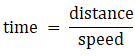
Ans: Total distance travelled = 300 km Let the speed of train = x km/hr We know that,
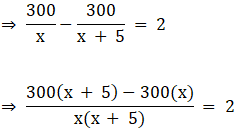
Hence, time taken by train = 300/x According to the question, Speed of the train is increased by 5km an hour ∴ the new speed of the train = (x + 5)km/hr Time taken to cover 300km = 300/(x + 5) Given that time taken is 2hrs less from the previous time
⇒ 300x + 1500 – 300x = 2x (x + 5) ⇒ 1500 = 2x2 + 10x ⇒ 750 = x2 + 5x ⇒ x2 + 5x – 750 = 0 ⇒ x2 + 30x – 25x – 750 = 0 ⇒ x (x + 30) – 25 (x + 30) = 0 ⇒ (x – 25) (x + 30) = 0 ⇒ (x – 25) = 0 or (x + 30) = 0 ∴ x = 25 or x = – 30 Since, speed can’t be negative. Hence, the speed of the train is 25km/hr
Q.9.The speed of a boat in still water is 11 km/ hr. It can go 12 km upstream and returns downstream to the original point in 2 hours 45 minutes. Find the speed of the stream.
Ans: Let the speed of the stream be x km/hr Given that, the speed boat in still water is 11 km/hr. ⇒ speed of the boat upstream = (11 – x) km/hr ⇒ speed of the boat downstream = (11 + x) km/hr It is mentioned that the boat can go 12 km upstream and return downstream to its original point in 2 hr 45 min. ⇒ One-way Distance traveled by boat (d) = 12 km ⇒ Tupstream + Tdownstream = 2 hr 45 min = (2 + 3/4) hr = 11/4 hr ⇒ [distance / upstream speed ] + [distance / downstream speed] = 11/4 ⇒ [ 12/ (11-x) ] + [ 12/ (11+x) ] = 11/4 ⇒ 12 [ 1/ (11-x) + 1/(11+x) ] = 11/4 ⇒ 12 [ {11 – x + 11 + x} / {121 – x2} ] = 11/4 ⇒ 12 [ {22} / {121 – x2} ] = 11/4 ⇒ 12 [ 2 / {121 – x2} ] = 1/4 ⇒ 24 / {121 – x2} = 1/4 ⇒ 24 (4) = {121 – x2} ⇒ 96 = 121 – x2 ⇒ x2 = 121 – 96 ⇒ x2 = 25 ⇒ x = + 5 or -5 As speed to stream can never be negative, we consider the speed of the stream(x) as 5 km/hr. Thus, the speed of the stream is 5 km/hr.
Q.10. Determine the value of k for which the quadratic equation 4x2 – 3kx + 1 = 0 has equal roots.
Ans: The given equation 4x2 – 3kx + 1 = 0 is in the form of ax2 + bx + c = 0 Where a = 4, b = -3k, c = 1 For the equation to have real and equal roots, the condition is D = b2 – 4ac = 0 ⇒ (-3k)2 – 4(4)(1) = 0 ⇒ 9k2 – 16 = 0
Q.11. Using quadratic formula, solve the following equation for ‘x’: ab x2 + (b2 – ac) x – bc = 0
⇒ x = −(b² − ac) ± (b² + ac)2ab or −(b² − ac) ± (b² − ac)2ab
⇒ x = 2ac2ab or −2b²2ab
⇒ x = cb or −ba
Q.12. The sum of the numerator and the denominator of a fraction is 12. If the denominator is increased by 3, the fraction becomes 1/2. Find the fraction.
Ans: Let’s assume the numerator of the fraction to be x and the denominator of the fraction to be y. So, the required fraction is x/y. From the question it’s given as, The sum of the numerator and denominator of the fraction is 12. Thus, the equation so formed is, x + y = 12 ⇒ x + y – 12 = 0 And also it’s given in the question as, If the denominator is increased by 3, the fraction becomes 1/2. Putting this as an equation, we get x/ (y + 3) = 1/2 ⇒ 2x = (y + 3) ⇒ 2x – y – 3 = 0 The two equations are, x + y – 12 = 0…… (i) 2x – y – 3 = 0…….. (ii) Adding (i) and (ii), we get x + y – 12 + (2x – y – 3) = 0 ⇒ 3x -15 = 0 ⇒ x = 5 Using x = 5 in (i), we find y 5 + y – 12 = 0 ⇒ y = 7 Therefore, the required fraction is 5/7.
Q.13. Rewrite the following as a quadratic equation in x and then solve for x:
Ans: Given expression is
Solve the above expression
Cross multiplying the above equation (4 – 3x) (2x + 3) = 5x 8x + 12 – 6x2 – 9x = 5x – 6x2 + 8x – 9x – 5x + 12 = 0 – 6x2 – 6x + 12 = 0 Divide the above equation by -6 we get x2 + x – 2 = 0 By following factorization method x2 + 2x – x – 2 = 0 x (x + 2) -1(x + 2) = 0 (x + 2)(x – 1) = 0 x + 2 = 0 or x – 1= 0 x = –2, 1 The solution of the given expression is x = -2 and x = 1
Q.14. A two digit number is such that the product of its digits is 18. When 63 is subtracted from the number, the digits interchange their places. Find the number.
Ans: Let us consider, one’s digit of a two digit number = x and Ten’s digit = y The number is x + 10y After interchanging the digits One’s digit = y Ten’s digit = x The number is y + 10x As per the statement, xy = 18 ………(1) And, x + 10y -63 = y + 10x 9y – 9x – y – 10x = 63 y – x = 7 …..(2) using algebraic identity: (x + y)2 = (x – y)2 + 4xy (x + y)2 = (-7)2 + 4(18) = 121 (Using (1)) (x + y)2 = 112 or x + y = 11 …..(3) Add (1) and (2) 2y = 18 or y = 9 From (1): xy = 18 9x = 18 x = 2 Answer: The number is: x + 10y = 2 + 10(9) = 92
Q.15.A train covers a distance of 90 km at a uniform speed. Had the speed been 15 km/ hr more, it would have taken 30 minutes less for the journey. Find the original speed of the train.
Ans: Let the original speed of the train be x km/hr. According to the question:
90x − 90x + 15 = 12
⇒ 90(x + 15) − 90xx(x + 15) = 12
⇒ 90x + 1350 − 90xx² + 15x = 12
⇒ 1350x² + 15x = 12
⇒ 2700 = x² + 15x
⇒ x² + 15x − 2700 = 0
⇒ x² + (60 − 45)x − 2700 = 0
⇒ x(x + 60) − 45(x + 60) = 0
⇒ (x + 60)(x − 45) = 0
⇒ x = −60 or x = 45
x cannot be negative; therefore, the original speed of train is 45 km/hr.
Substituting values, we get: x = 9(a + b) ± √[9(a − b)²]2 × 9
⇒ x = 3(a + b) ± 3(a − b)6
Simplifying, we get: x = (2a + 4b)6 or (a + 2b)3
Hence, x = 2a + b3 and x = a + 2b3 are the required solutions.
Q.18. A number consisting of two digits is seven times the sum of its digits. When 27 is subtracted from the number, the digits are reversed. Find the number.
Ans: Let the tens and the units digits of the required number be x and y, respectively. Required number = (10x + y) 10x + y = 7(x + y) 10x + 7y = 7x + 7y or 3x – 6y = 0 ……….(i) Number obtained on reversing its digits = (10y + x) (10x + y) – 27 = (10y + x) ⇒ 10x – x + y – 10y = 27 ⇒ 9x – 9y = 27 ⇒9(x – y) = 27 ⇒ x – y = 3 ……..(ii) On multiplying (ii) by 6, we get: 6x – 6y = 18 ………(iii) On subtracting (i) from (ii), we get: 3x = 18 ⇒ x = 6 On substituting x = 6 in (i) we get 3 × 6 – 6y = 0 ⇒ 18 – 6y = 0 ⇒ 6y = 18 ⇒ y = 3 Number = (10x + y) = 10 × 6 + 3 = 60 + 3 = 63 Hence, the required number is 63.
Q.19.The sum of the squares of two consecutive odd numbers is 394. Find the numbers.
Ans: Let the two consecutive odd numbers be x and x + 2. ∴ x2 + (x + 2)2 = 394 ⇒ x2 + x2 + 4x + 4 = 394 ⇒ 2x2 + 4x – 390 = 0 ⇒ x2 + 2x – 195 = 0 ⇒ x2 + 15x – 13x – 195 = 0 or x(x + 15) – 13(x + 15) = 0 ⇒ x= 13 or x = – 15 ∴ For x = 13, x + 2 = 13 + 2 = 15 Thus, the required numbers are 13 and 15.
Q.20.Find the number which exceeds its positive square root by 20.
Ans: Let the Number be x According to the given Question √x + 20 = x √x = x – 20 Squaring both the sides x = x2 + 400 – 40x [(a – b)2 = a2 – 2ab + b2] x2 – 41x + 400 = 0 x2 – 16x – 25x + 400 = 0 x(x – 16) – 25(x – 16) = 0 (x – 16)(x – 25) = 0 Ans = x is equal to 25 or 16 both are correct answers
Q.21.A two digit number is such that the product of its digits is 14. If 45 is added to the number, the digits interchange their places. Find the number.
Ans: Let the no be ‘xy’ with x × y = 14 As xy + 45 = yx(x, y > 0) ⇒ (10x + y) + 45 = 10y + x ⇒ 9x − 9y + 45 = 0 ⇒ x − y + 5 = 0 & x × y = 14 ⇒ x− 14/x + 5 = 0 ⇒ x − 14/x + 5 = 0 ⇒ x2 + 5x − 14 = 0 ⇒ x = 2,−7 & y = 7, −2 Ad x, y > 0 ⇒ no is 27
Q.22. A two digit number is such that the product of its digits is 20. If 9 is added to the number, the digits interchange their places. Find the number.
Ans: Let the one’s digit be ‘a’ and ten’s digit be ‘b’. Given, two – digit number is such that the product of its digits is 20. ⇒ ab = 20 —– (1) Also, If 9 is added to the number, the digits interchange their places. ⇒ 10b + a + 9 = 10a + b ⇒ a – b = 1 —– (2) Substituting value of a from eq1 in to eq2 ⇒ 20/b – b = 1 ⇒ b2 + b – 20 = 0 ⇒ (b + 5)(b – 4) = 0 Thus, b = 4 and a = b + 1 = 5 Number is 45.
Q.23.A two digit number is such that the product of its digits is 15. If 8 is added to the number, the digits interchange their places. Find the number.
Ans: Let the ten’s digit be x and one’s digit be y. The number will be 10x + y. Given product of its digits is 15 xy = 15 y = 15/x — (1). Given that when 18 is added to the number the digits get interchanged. 10x + y + 18 = 10y + x 9x – 9y + 18 = 0 x – y + 2 = 0 ——- (2) Substitute (1) in (2), we get x – (15/x) + 2 = 0 x2 + 2x – 15 = 0 x2 + 5x – 3x – 15 = 0 x(x + 5) – 3(x + 5) = 0 (x + 5)(x – 3) = 0 x = -5, 3. Since the digits cannot be negative, x = 3. Substitute x = 3 in (1) y = 15/3 = 5. The number = 10x + y = 10 * 3 + 5 = 30 + 5 = 35.
Q.24.Solve for x: abx2 + (b2 − ac) x − bc = 0
Ans: We have: abx2 + (b2 − ac)x − bc = 0
Here, A = ab, B = b2 − ac, C = −bc
Using the quadratic formula: x = −B ± √(B2 − 4AC)2A
Q.25.The sum of two numbers is 18. The sum of their reciprocals is 1/4. Find the numbers.
Ans: Let The numbers be x and 18 – x
According to the given hypothesis: 1x + 118 − x = 14
⇒ 18 − x + xx(18 − x) = 14
⇒ 72 = 18x − x2
⇒ x2 − 18x − 72 = 0
Factorizing: x2 − 6x − 12x − 72 = 0
⇒ x(x − 6) − 12(x − 6) = 0
⇒ (x − 6)(x − 12) = 0
⇒ x = 6 or x = 12
∴ The two numbers are 6 and 12.
Q.26.The sum of two numbers ‘a’ and ‘b’ is 15, and sum of their reciprocals 1/a and 1/b is 3/10. Find the numbers ‘a’ and ‘b’.
Ans: The two numbers are a and b According to the question, ⇒ a + b = 15 ⇒ a = 15 − b —- ( 1 ) ⇒ 1/a + 1/b = 3/10 ⇒ 1/15−b + 1/b = 3/10 ⇒ b + 15 − b/b(15 − b) = 3/10 ⇒ 150 = 3b(15−b) ⇒ 50 = b(15 − b) ⇒ 50 = 15b − b2 ⇒ b2 − 15b + 50 = 0 ⇒ b2 − 10b − 5b + 50 = 0 ⇒ b(b − 10) − 5(b − 10) = 0 ⇒ (b − 10)(b − 5) = 0 ∴ b = 5 or b = 10 Putting both values of b in equation ( 1), ⇒ a = 15 − 5 or a = 15 − 10 ∴ a = 10 or a = 5
Q.27.Find the roots of the following quadratic equation:
Ans: Given, 2/5 x2 – x – 3/5 = 0 ⇒ 2x2 – 5x – 3 = 0 By splitting the middle term, ⇒ 2x2 – 6x + x – 3 = 0 Taking common in the expression, ⇒ 2x (x – 3) + 1 (x – 3) = 0 ⇒ (2x + 1) (x – 3) = 0 ∴ 2x + 1 = 0 and ∴ x – 3 = 0 ∴ x = -1/2 and ∴ x = 3
Q.28. A natural number when subtracted from 28, becomes equal to 160 times its reciprocal.
Find the number.
Ans: Let the number be x Now, (28 – x) = 160 / x 28x – x2 = 160 x2 – 28x + 160 = 0 x2 – 20x – 8x + 160 = 0 x(x – 20) – 8(x – 20) = 0 (x – 8)(x – 20) = 0 x = 8 , 20
Q.29. Find two consecutive odd positive integers, sum of whose squares is 290.
Ans: Let one of the odd positive integer be x then the other odd positive integer is x + 2 their sum of squares = x2 + (x + 2)2 = x2 + x2 + 4x + 4 = 2x2 + 4x + 4 Given that their sum of squares = 290 2x2 + 4x + 4 = 290 2x2 + 4x = 286 2x2 + 4x − 286 = 0 x2 + 2x − 143 = 0 x2 + 13x − 11x − 143 = 0 x(x + 13) − 11(x + 13) = 0 (x − 11) = 0,(x + 13) = 0 Therefore, x = 11 or −13 We always take positive value of x So, x = 11 and (x + 2) = 11 + 2 = 13 Therefore , the odd positive integers are 11 and 13
Q.30. Find the values of k for which the quadratic equation (k + 4) x2 + (k + 1) x + 1 = 0 has equal roots.
Ans: In factorization, we write the middle term of the quadratic equation either as a sum of two numbers or difference of two numbers such that the equation can be factorized.
Q.33.Find the value of k, for which one root of quadratic equation kx2 – 14x + 8 = 0 is six times the other.
Ans: Let one root = α Other root = 6α
Sum of roots = α + 6α = 14k
Or, 7α = 14k ⇒ α = 2k (i)
Product of roots: α × 6α = 8k
Or, 6α2 = 8k (ii)
Solving (i) and (ii):
6 × (2/k)28/k
⇒ 6 × 4k2 = 8k
⇒ 3k2 = 1k
Or, 3k = k2
Or, k(3 − k) = 0
⇒ k = 0 or k = 3
k = 0 is not possible.
Hence, k = 3
Q.34.If x = 2/3 and x = –3 are roots of the quadratic equation ax2 + 7x + b = 0, find the value of a and b.
Ans: Let us assume the quadratic equation be, Ax2 + Bx + C = 0. Sum of the roots = -B/A
Given:
Sum of roots = -7a = 23
Multiply both sides by a, we get:
-7 = 2a3
Solving for a:
a = 3
Product of roots = CA
Given:
ba = 23 × (-3)
Simplify:
b = -6
Q.35.If –5 is a root of the quadratic equation 2x2 + px – 15 = 0 and the quadratic equation p (x2 + x) + k = 0 has equal roots, find the value of k.
Ans: Given: -5 is a root of the quadratic equation 2x2 + px – 15 = 0 Substitute the value of x = -5 2(-5)2 + p(-5) – 15 = 0 50 – 5p – 15 = 0 35 – 5p = 0 p = 7 Again, In quadratic equation p(x2 + x) + k = 0 7 (x2 + x) + k = 0 (put value of p = 7) 7x2 + 7x + k = 0 Compare given equation with the general form of quadratic equation, which is ax2 + bx + c = 0 a = 7, b = 7, c = k Find Discriminant: D = b2 – 4ac = (7)2 – 4 x 7 x k = 49 – 28k Since roots are real and equal, put D = 0 49 – 28k = 0 28k = 49 k = 7 / 4 The value of k is 7/4.
A. Multiple Choice Questions Q1: A pair of linear equations which have a unique solution x = 2, y = – 3 is: (a) 2x – 3y = – 5, x + y = – 1 (b) 2x + 5y + 11 = 0, 4x + 10y + 22 = 0 (c) x – 4y – 14 = 0, 5x – y – 13 = 0 (d) 2x – y = 1, 3x + 2y = 0
Q2: If a system of a pair of linear equations in two unknowns is consistent, then the lines representing the system will be (a) Parallel (b) Always coincident (c) Always intersecting (d) Intersecting or coincident
Q3: The pair of equations x = 0 and y = 0 has (a) One solution (b) Two solutions (c) Infinitely many solutions (d) No solution
Q4: A pair of system of equations x = 2, y = -2; x = 3, y = – 3 when represented graphically enclose (a) Square (b) Trapezium (c) Rectangle (d) Triangle
Q5: If two lines are parallel to each other then the system of equations is (a) Consistent (b) Inconsistent (c) Consistent dependent (d) (a) and (c) both B. Fill in the blanks
Q6:If in a system of equations corresponding to coefficients of member, equations are proportional then the system has ______________ solution (s).
Q7: A pair of linear equations is said to be inconsistent if its graph lines are ____________.
Q8:A pair of linear equations is said to be ____________ if its graph lines intersect or coincide.
Q9: A consistent system of equations where straight lines fall on each other is also called _____________ system of equations.
Q10:Solution of linear equations representing 2x – y = 0, 8x + y = 25 is ____________ .
C. Very Short Answer Questions
Q11:In Fig., ABCD is a rectangle. Find the values of x and y.
Q12: Graphically, determine whether the following pair of equations has no solution, a unique solution, or infinitely many solutions: (1) 2x – 3y + 4 = 0 (2) 4x – 6y + 8 = 0
Q13: If 51x + 23y = 116 and 23x + 51y = 106, then find the value of (x – y).
Q14: For what value of V does the point (3, a) lie on the line represented by 2x – 3y = 5?
Q15: Determine whether the following system of linear equations is inconsistent or not. 3x – 5y = 20 6x – 10y = -40
D. Short Answer Type Questions
Q16: The father’s age is six times his son’s age. Four years hence, the age of the father will be four times his son’s age. Find the present ages of the son and the father.
Q17: If the lines x + 2y + 7 = 0 and 2x + ky + 18 = 0 intersect at a point, then find the value of k.
Q18: Find the value of k for which the system of equations x + 2y -3 = 0 and ky + 5x + 7 = 0 has a unique solution.
Q19: Find the values of a and b for which the following system of linear equations has an infinite number of solutions: 2x + 3 y = 7 2αx + (a + b) y = 28
Q20: In a cyclic quadrilateral ABCD, Find the four angles. a. ∠A = (2 x + 4), ∠B = (y + 3), ∠C = (2y + 10) , ∠D = (4x − 5) . b. ∠A = (2 x − 1) , ∠ B = (y + 5) , ∠C = (2 y + 15) and ∠D = (4 x − 7)
E. Long Answer Type Questions
Q21:Draw the graph of 2x + y = 6 and 2x – y + 2 = 0. Shade the region bounded by these lines and the x-axis. Find the area of the shaded region.
Q22: Draw the graphs of the following equations: 2x – y = 1, x + 2y = 13 (i) Find the solution of the equations from the graph. (ii) Shade the triangular region formed by lines and the y-axis.
Q23: A man travels 370 km partly by train and partly by car. If he covers 250 km by train and the rest by car, it takes him 4 hours. But, if he travels 130 km by train and the rest by car, he takes 18 minutes longer. Find the speed of the train and that of the car.
Q24: The taxi charges in a city comprise a fixed charge together with the charge for the distance covered. For a journey of 10 km, the charge paid is ₹75 and for a journey of 15 km, the charge paid is ₹110. What will a person have to pay for traveling a distance of 25 km?
Q25: Solve the following system by drawing their graph: (3/2)x – (5/4)y = 6, 6x – 6y = 20. Determine whether these are consistent, inconsistent, or dependent.
You can access the solutions to this worksheet here.
Q1: If a and b are roots of the equation x2 + 7 x + 7 . Find the value of a-1 + b−1 − 2αb.
Q2: If the zeroes of the quadratic polynomial x2 + (α + 1 ) x + b are 2 and -3, then find the value of a and b.
Q.3. If a and b are zeroes of the polynomial f (x) = 2x2 − 7x + 3, find the value of α2 + b2.
Q.4: Find the zeroes of the quadratic polynomial x2 + x − 12 and verify the relationship between the zeroes and the coefficients.
Q5: If p and q are zeroes of f (x) = x2 − 5x + k, such that p − q = 1 , find the value of k.
Q6: Given that two of the zeroes of the cubic polynomial αx3 + bx2 + cx + d are 0, then find the third zero.
Q.7. If one of the zeroes of the cubic polynomial x3 + αx2 + bx + c is -1, then find the product of the other two zeroes.
Q8: If a-b, a a+b , are zeroes of x3 − 6x2 + 8x , then find the value of b
Q9: Quadratic polynomial 4x2 + 12x + 9 has zeroes as p and q . Now form a quadratic polynomial whose zeroes are p − 1 and q − 1
Long Answer Type Questions
Q10: p and q are zeroes of the quadratic polynomial x2 − (k + 6 ) x + 2(2 k − 1) . Find the value of k if 2(p + q) = p q
Q11: Given that the zeroes of the cubic polynomial x3 − 6 x2 + 3 x + 10 are of the form a, a + b, a + 2b for some real numbers a and b, find the values of a and b as well as the zeroes of the given polynomial.
Q12: If one zero of the polynomial 2x2−5x−(2k + 1) is twice the other, find both the zeroes of the polynomial and the value of k.
Q.13: Using division show that 3y2 + 5 is a factor of 6y5 + 15y4 + 16y3 + 4y2 + 10y − 35 .
Q14: If (x – 2) and [x – 1/2 ] are the factors of the polynomials qx2 + 5x + r prove that q = r.
Q15: Find k so that the polynomial x2 + 2x + k is a factor of polynomial 2x4 + x3 – 14x2 + 5x + 6. Also, find all the zeroes of the two polynomials.
You can access the solutions to this worksheet here.
Multiple Choice Questions Q1: The probability of an impossible event is (a) 0.01 (b) 100 (c) zero (d) 1
Q2: The probability that a leap year will have 53 Sundays or 53 Mondays is (a) 4/7 (b) 2/7 (c) 1/7 (c) 3/7
Q3: A game of chance consists of spinning an arrow which comes to rest pointing at one of the numbers 1, 2, 3, 4, 5, 6, 7, 8, 9, 10 and these values are equally likely outcomes. The probability that it will point at a number greater than 5 is (a) 1/2 (b) 1/4 (c) 1/5 (d) 1/3
Q4: The probability of an impossible event is (a) 0.01 (b) 100 (c) zero (d) 1
Q5: Cards marked with numbers 1, 2, 3, ______, 25 are placed in a box and mixed thoroughly and one card is drawn at random from the box. The probability that the number on the card is a multiple of 3 and 5 is (a) 12/25 (b) 4/25 (c) 1/25 (d) 8/25
Q6: A game of chance consists of spinning an arrow which comes to rest pointing at one of the numbers 1, 2, 3, 4, 5, 6, 7, 8, 9, 10 and these values are equally likely outcomes. The probability that it will point at a number greater than 5 is (a) 1/2 (b) 1/4 (c) 1/5 (d) 1/3
Very Short Answer Questions Q7: A bag contains cards which are numbered from 2 to 90. A card is drawn at random from the bag. Find the probability that it bears a two digit number
Q8: A card is drawn from a pack of 52 cards. Find the probability of getting a king of red colour
Q9: A bag contains 40 balls out of which some are red, some are blue and remaining are black. If the probability of drawing a red ball is 11/20 and that of blue ball is 1/5 , then what is the no. of black balls?
Short Answer Questions Q10: A card is drawn at random from a well-shuffled pack of 52 cards. Find the probability that the drawn card is neither a king nor a queen.
Q11: Two unbiased dice are thrown. Find the probability that the total of the numbers on the dice is greater than 10.
Q12: Three unbiased coins are tossed together. Find the probability of getting at least two heads?
Q13: Cards marked with numbers 5 to 50 are placed in a box and mixed thoroughly. A card is drawn from the box at random. Find the probability that the number on the taken out card is (1) a prime number less than 10 (2) a number which is a perfect square.
Q14: Why is tossing a coin considered as the way of deciding which team should get the ball at the beginning of a football match?
Q15: Two coins are tossed together. Find the probability of getting both heads or both tails.
Q16: A bag contains, white, black and red balls only. A ball is drawn at random from the bag. If the probability of getting a white ball is 3/10 and that of a black ball is , 2/5 then find the probability of getting a red ball. If the bag contains 20 black balls, then find the total number of balls in the bag.
Q17: A box contains 90 discs which are numbered 1 to 90. If one disc is drawn at random from the box, find the probability that it bears (1) a two digit number, (2) number divisible by 5.
Long Questions Answer Q18: A box contains cards bearing numbers 6 to 70. If one cards is drawn at random from the box, find the probability that it bears (1) a one digit number. (2) a number divisible by 5, (3) an odd number less than 30,
Q19: All red face cards are removed from a pack of playing cards. The remaining cards are well-shuffled and then a card is drawn at random from them. Find the probability that the drawn card is (1) a red card, (2) a face card, (3) a card of clubs.
Q20: Cards numbered 11 to 60 are kept in a box. If a card is drawn at random from the box, find the probability that the number on the drawn card is (i) an odd number, (ii) a perfect square number, (iii) divisible by 5, (iv) a prime number less than 20.
You can access the solutions to this worksheet here.