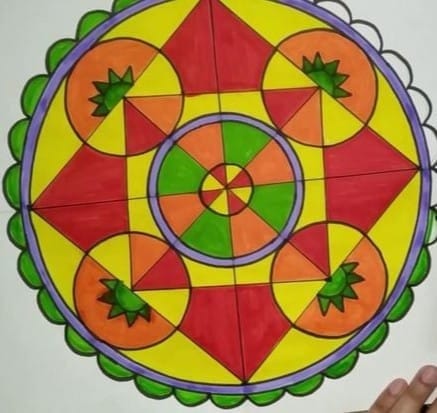
Q1: Look at the design shown. Does the design show symmetry? If yes, describe where the line of symmetry will be.
Ans: Yes, the design shows symmetry. A line of symmetry can be drawn in the middle, dividing the design into two equal left and right parts.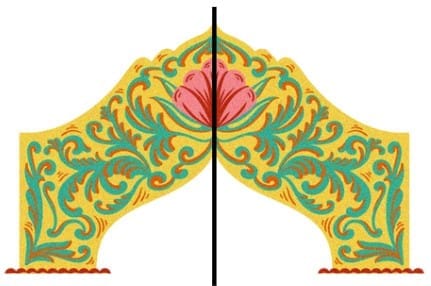
Q2: A necklace is made using 12 beads. How many beads should be placed on each side of the centre to make the necklace symmetrical? Explain.
Ans: To make the necklace symmetrical, the beads must be equally placed on both sides of the centre. So, 6 beads should be placed on each side.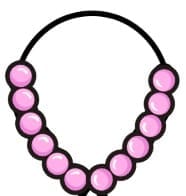
Q3: Four patterns are shown. Only two of the patterns are symmetrical. Identify them and give one reason for each.
Ans: The first design and the third design are symmetrical.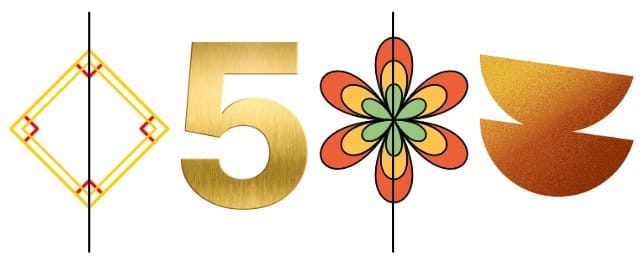
Q4: A design is symmetrical along a vertical line. Which part of the design must be repeated on the other side to complete it?
Ans: The same shapes, colours, and positions on one side of the vertical line must be repeated on the other side in the same order.
Q5: Look at the shapes placed on a dot grid. Which of these shapes can be completed to make a symmetrical figure?
Ans: The shapes that can be divided into two halves along a line can be completed to make symmetrical figures.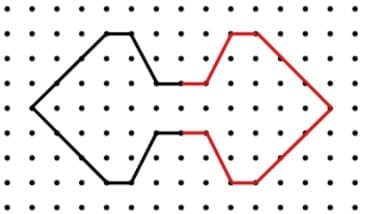
Q6: Two masks are shown. A child says both masks are symmetrical because they look similar. Do you agree? Give a mathematical reason.
Ans: No, both masks are not symmetrical. A mask is symmetrical only if both sides are exactly the same in shape and size. Looking similar is not enough for symmetry.
Q7: Objects are placed on one side of a line. Where should the objects be placed on the other side so that the arrangement becomes a mirror image?
Ans: The objects should be placed at the same distance from the line on the opposite side, in exactly opposite positions, to form a mirror image.
Q8: Some tiles are missing from the floor pattern. Choose the correct shape of tile to fill the gaps so that the pattern is completed without gaps or overlaps. Explain your choice.
Ans: The correct tile is the one that fits exactly into the gap without leaving spaces or overlapping other tiles and follows the pattern.
Q9: Look at the following signs. Guess what each sign means and write one place where you might see it.
Ans: These signs give information about the Parking and Hospital
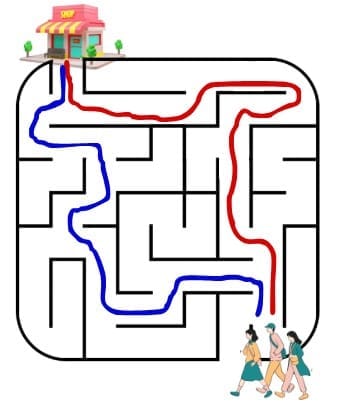
Q10: Two different paths can be used to reach the same shop. How can both paths be correct? What does this tell you about finding routes?
Ans: Both paths are correct because they lead to the same place, even though they are different. This shows that there can be more than one way to reach a place.