03. Fun with Numbers (Numbers 1 to 100)-     Chapter Notes

What are Numbers?

  • A number is a value used for counting and calculating.
  • Numbers can be shown in different ways: as words (one, two, three) or figures (like 1, 2, 3).
  • There are different kinds of numbers based on how many digits they have.
  • Single-digit numbers have only one digit, like 1, 2, 3, and so on.
  • Two-digit numbers have two digits, like 10, 25, 99, and so on.
  • Three-digit numbers have three digits, like 100, 345, 897, and so on.

Now, students, can you count how many flowers there are?

By counting these, we can see that there are a total of 36 flowers

Step Counting

Let us now read an interesting story!

Once upon a time, there was a little kangaroo named Skip who loved counting. But regular counting bored him. So, he invented step counting! 

Instead of going one by one, he jumped ahead or backwards by a special number each time.

His friends loved it, and soon, everyone in the jungle was step counting their way through numbers, making counting fun and fast!

What is Step Counting?

  • Step counting means counting numbers by adding the same amount each time. Instead of going one by one, you skip ahead by a certain number each time. It’s a great way to count big numbers quickly or make cool patterns with numbers.
  • Backwards skip counting is like counting in reverse. Instead of going forward, you start from a larger number and subtract a certain amount each time to reach the next number. It’s just like walking backwards but with numbers.
  • Now, let us play the game of step counting and see how this is done.

Forward Step Counting

Let us understand how to skip count. 

Skip count by 2

  • Start at zero, then continue to add 2.
  • 0+2 = 2. So now from 0, we have reached 2.
  • Now we will again add 2 in the number 2. 
  • 2 +2 = 4
  • Now that we have reached 4, we again add 2.
  • 4+2=6
  • Now we again add 2 in 6
  • 6+2= 8
  • Continue this process until you reach 12
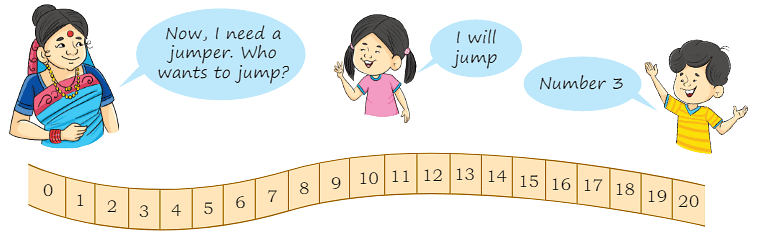
  • We have represented the same on the number line. 
  • You can skip count starting at any number.
  • For example, skip count by 2 starting at 5.
  • 5, 7, 9,11, 13…

Skip count by 5

  • In skip counting by 5, we add 5 in each number and move forward. 
  • Students, let’s play a tough game. 
  • What numbers will the kangaroo reach if he starts from number 5 and skips by 5?
  • We have done the same for you on the number line given below.
  • Skip, the kangaroo, will start from 5, then reach 10, 15 and 20. 
  • 5 +5 = 10, 10+5=15, 15+5=20

Skip Count by 10

  • Let us play another game.
  • The kangaroo is shown skipping ahead in this picture. Can you complete the pattern by looking at the picture? 
  • How can you find out the pattern?
  • We can see that the kangaroo first jumps from 0 to 10. Then 10 to 20.
  • We will use the method of subtraction here to find the pattern and then complete the series.
  • We will first subtract 10 from 20. 20-10= 10
  • Now, 10-0= 10.
  • We can see that the difference is of 10. 
  • Hence, to complete the series we need to add 10 to each number and move forward.
  • The complete series will be: 0, 10, 20, 30, 40, 50, 60, 70, 80, 90,100.

Backward Skip Counting

  • What we have learned so far is called forward skip counting, which implies we are counting in the forward direction and adding a certain number to each previous number to obtain the next number in the series. 
  • Now, we will discuss backward skip counting. 
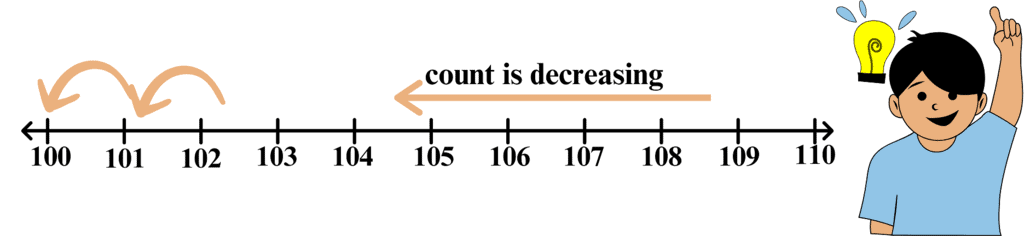
  • Backwards skip counting is a way of counting numbers in reverse order by skipping a certain amount each time. Instead of starting from a lower number and counting up, you start from a higher number and count down. For example, if you’re skip counting backward by 3s from 10, it would go like this: 10, 7, 4, 1. 

Backwards Skip Count by 3

  • To do so, we subtract 3 from each previous number to obtain the next number in the series. Suppose we start with the number 100, so to obtain the next number in the series, we subtract 3 from it. 100 – 3 = 97. Continuing in the same manner, we have
  • 97 – 3 = 94
  • 94 – 3= 91
  • 91 – 3 = 88, and so on.
  • So, the series obtained looks like 100, 97, 94, 91, 88 and so on.
  • Here the numbers are in descending order.

Backwards Skip Count by 20

  • Let’s imagine we’re on a backwards adventure, counting by 20s. Instead of walking forward, we’re taking big jumps backwards, like going down a staircase in giant steps.
  • So, let’s start at a big number, like 100. Now, instead of counting down by 1, we’re going to count backward by 20. It’s like taking a step back in time, but in numbers!
  • 100 (start)80 (we took one step back, like a giant leap!)
    60 (another big step backward)
    40 (we’re really moving now!)
    20 (almost there!)
    0 (and we’ve reached the end of our backward journey!)

Guess My Place

  • Now, let us play an interesting game in which we have to guess the place of the ants.
  • Look at the number line, and answer the following questions:
    (a) Which number is the red ant sitting on?
    (b) Which number is the blue ant sitting on?
    (c) Which number is Brown Ant sitting on?
  • To answer these questions, let us first fill the number line with numbers.
  • Since we have to go from 10 to 110 and have 9 places to fill, let’s take a guess and fill them up with the gap of 10. 
  • So, 10, 20, 30, 40, 50, 60, 70, 80, 90,100, 110.
  • Answers:
    (a) Red ant is sitting at number 20.
    (b) Blue ant is sitting at 50.
    (c) Brown ant is sitting on number 90.

Exploring Patterns

Q: Look at the number chart and write down the answers.
__9___ comes just before 10
__19___ comes just before 20
__29___ comes just before 30
__39___ comes just before 40

What is the pattern here?
Ans: Let us subtract 19-9 = 10
29-19 = 10
39-29 = 10
We can clearly see that the difference is of 10.
The pattern can be completed: 9, 19, 29, 39, 49, 59, and so on…


Q: Now, look at the numbers coloured purple in the number chart. Write them.

7, 16, 25, ____, ____, ____, ____, ____, ____, ____

Ans: 7, 16, 25, 34, 43, 52, 61.


Q: What is the pattern?

Ans: The difference is of 9.
9 has been added to each number.

Look at this fun number window.

Now, using this concept, we will move forward to a fun game 

Fill in the blocks given below:

Now, observe how these blocks are placed on the basis of the number given and extend the pattern further.

To find the block above 55 we have to subtract 10 from 55, which gives us 45.

To find out the block below 55, we need to add 10 to 55, which gives us 65.

Now, moving on to the above row, we have found the middle block, which is 45. To find out the block on its left, we need to subtract 1 from it.
45-1 = 44
To find out the number on its right, we need to add 1 to 45 which gives us 46.
Similarly, we find out the numbers in the last row.

Let’s look at some more examples of numbers grids:

1. 

Using the same logic as above, let’s add numbers to this grid:

2. 

Let’s fill up this magic grid:

Hope you enjoyed playing with numbersand exploring different games. Keep practicing and having fun!
14. The Surajkund Fair- Chapter Notes

IntroductionImagine you’re exploring a world full of shapes, patterns, and fun designs. 

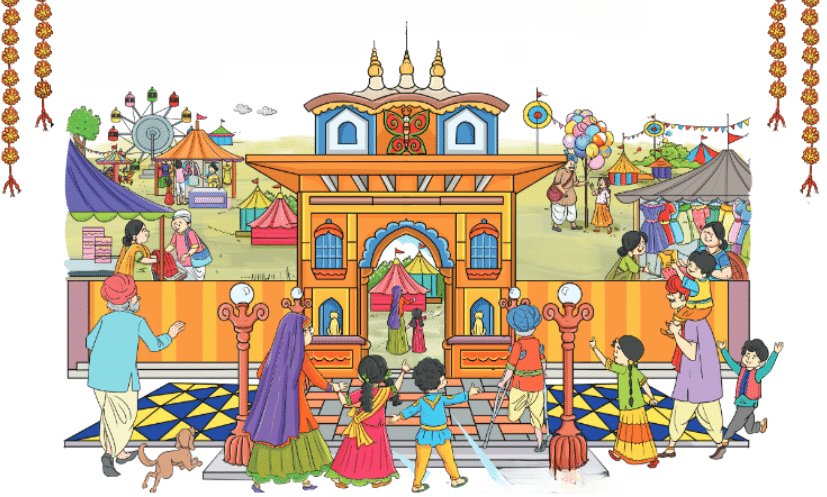
Soni and Avi are going to the famous Surajkund fair in Faridabad with their grandparents, where the fair is filled with exciting stalls, games, and activities. In this chapter, we will learn about the things they see at the fair, like symmetrical objects, patterns, and making malas, while also discovering the magic of shapes and directions that make everything more organised and exciting! 

In this chapter, we will learn about symmetry, patterns, and how to read maps—just like Soni and Avi!

Understanding Symmetry

Soni: “Dadaji, look at that butterfly! Its wings look exactly the same!”
Dadaji: “That’s because it is symmetrical, Soni! If you draw a line down the middle, both sides will match like a mirror image.”

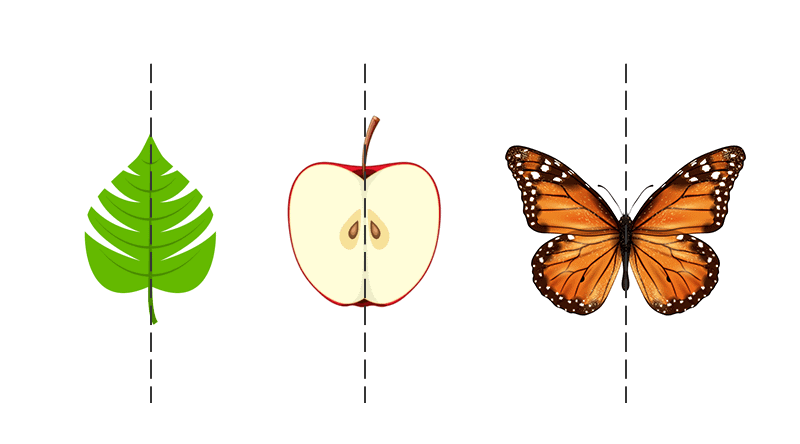
Now, let’s understand What is Symmetry?Symmetry means that a shape can be divided into two identical parts, like a mirror image.

Example:

  • A butterfly – If you draw a line down the middle, both wings look the same.
  • An apple  – If you cut an apple, both halves look the same.

Try out yourself:
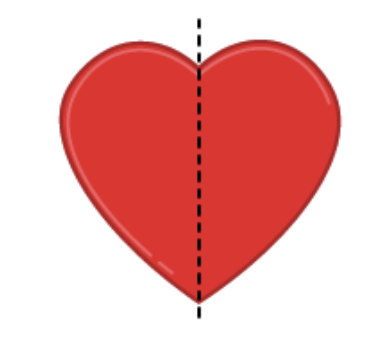
Look at the shape of a heart. If you draw a line down the middle, what do you notice? Do both sides of the heart look the same?

Solution:

When you draw a line down the middle of the heart, you’ll see that both sides of the heart look identical. This shows symmetry, as the two halves are mirror images of each other!

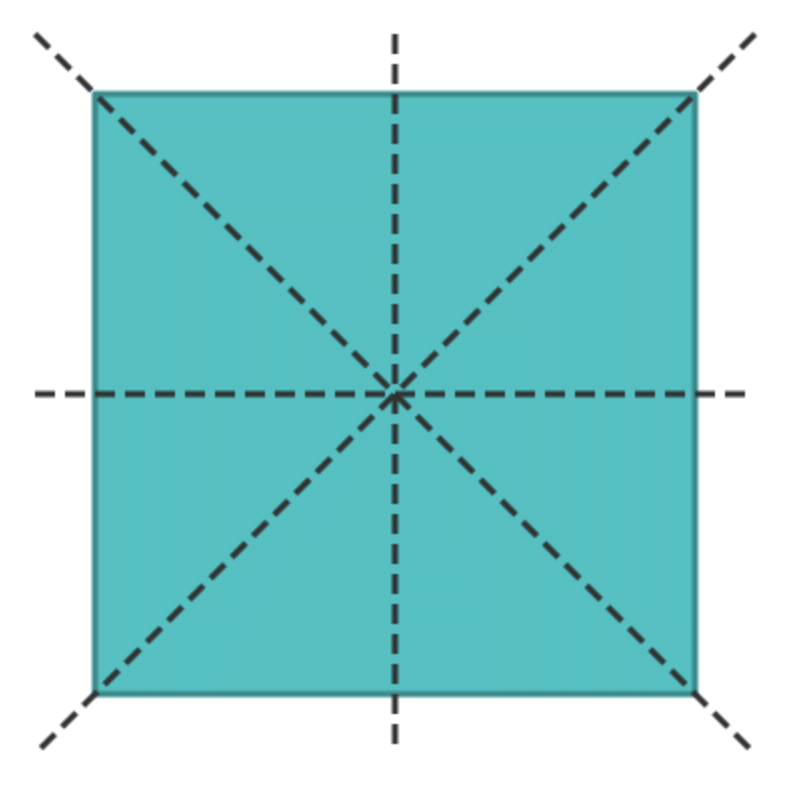
Line of Symmetry:line of symmetry is an invisible line that splits a shape into two equal halves.

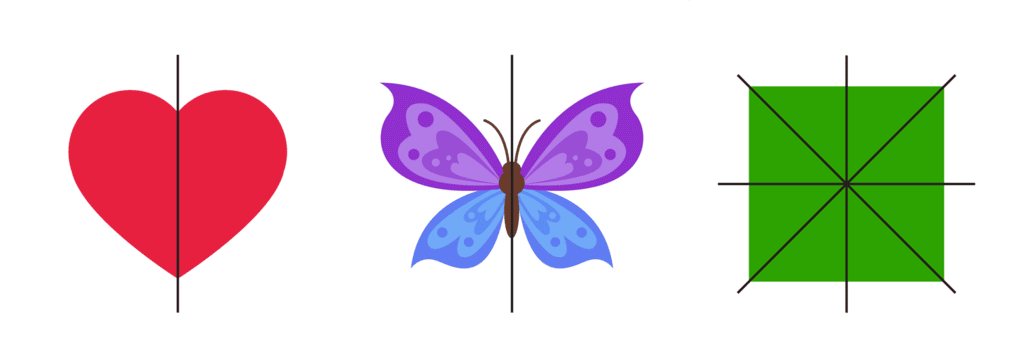
Fun Fact: Some shapes have more than one line of symmetry!

For Example:

  • Square: Has four lines of symmetry.
  • Heart: Has one line of symmetry.
  • Butterfly: Has one line of symmetry.

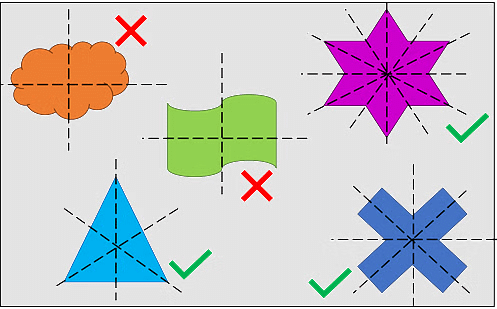
Let’s explore more objects and understand their symmetry.

  • So, the three figures in the images above are symmetric, meaning that if cut along the dotted line, both halves will match when folded.
  • While two figures when cut along the dotted line and the parts do not align when folded so they are asymmetric.

Try yourself:Which of the following shapes has three lines of symmetry?

  • A.Square
  • B.Rectangle
  • C.Equilateral Triangle
  • D.Circle

View Solution

Mirror Images

When we look into a mirror, we see our reflection! The right side of our body appears on the left, and the left side appears on the right.

 Try This: Stand in front of a mirror and raise your right hand. What happens? The mirror shows it as your left hand!

Mirror Images of Capital Letters and Numbers

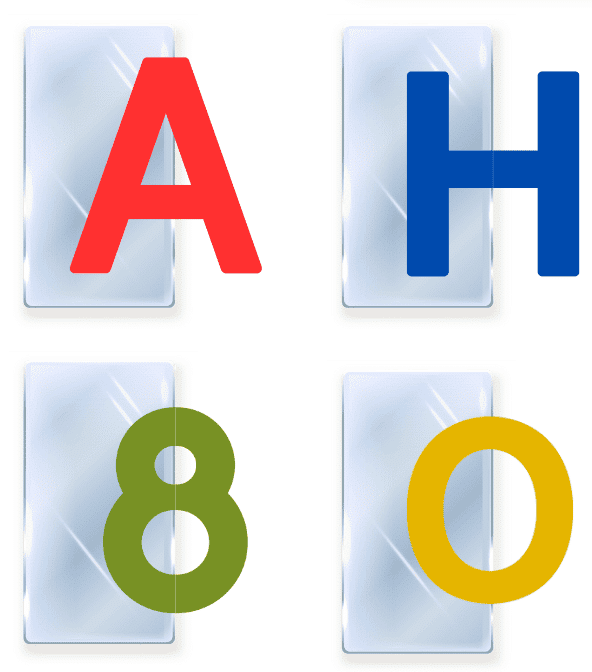
  1. Certain letters and numbers have mirror images that look exactly like their originals.
  2. For example, letters like A, H, M, and numbers like 0 and 8 have mirror images that are the same as their original forms.
  • The key concept is that if an object will be symmetric, its two halves will be identical or mirror each other.

Examples of Non-Symmetrical Letters and Numbers

  • Not all letters and numbers have symmetrical mirror images.
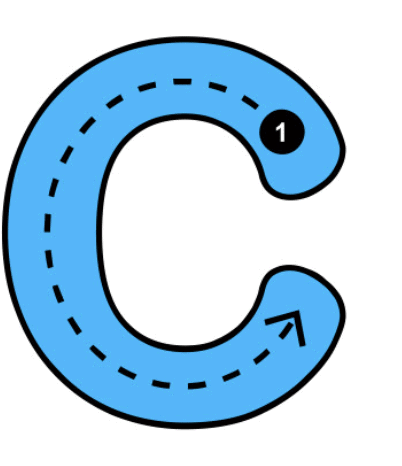
  • For instance, letters like B, C, D and numbers like 2, 3, 5 do not have mirror images resembling their original forms.

This contrast helps clarify the idea of symmetry.

Try out yourself:
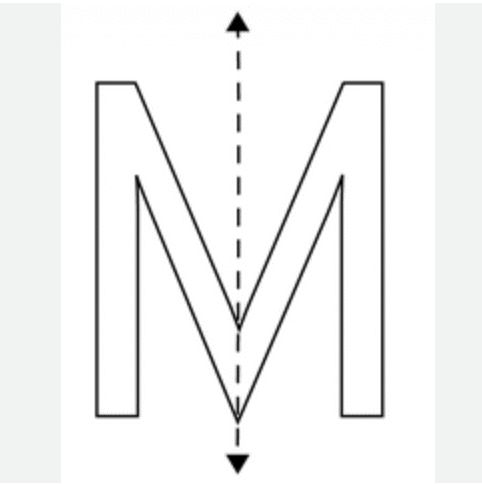
Is the letter “M” symmetrical when you look at it in the mirror? What about the letter “C”?

Solution:
The letter “M” looks the same in the mirror, as it has symmetrical mirror images. However, the letter “C” does not look the same in the mirror, showing that “C” is not symmetrical.

Making Malas (Bead Necklaces)

At a bead stall, Soni and Avi see a man and a woman making beautiful malas  (necklaces).

Question:
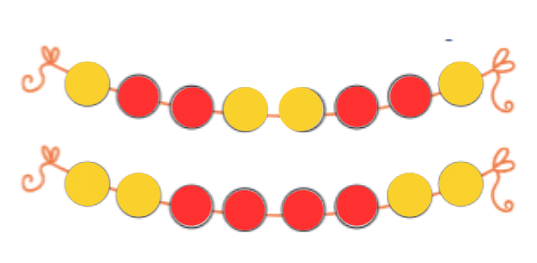
How can you make a simple mala (necklace) using 8 beads?

Solution:

To make a simple mala, take 8 beads—4 of one color and 4 of another. String them in a pattern like red-blue-red-blue, and tie a knot. Your mala is ready to wear!

Rangolis and PatternsSoni and Avi arrive at a stall from Tamil Nadu, where they see lovely kolam designs being created. Kolam is a traditional art that involves drawing detailed patterns on the ground, often using rice flour. They notice that some of the rangolis are symmetrical, while others are not. They learn to make their own symmetrical rangolis by drawing lines that split the designs into two matching halves.

Try yourself:

Which of the following letters has a mirror image that looks the same as its original form?

  • A.B
  • B.D
  • C.A
  • D.G

View Solution

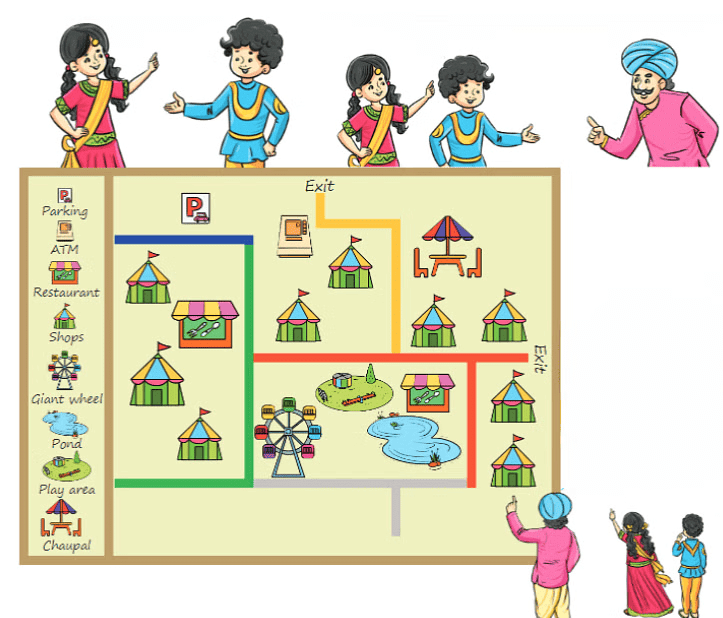
Exploring the Fair with a Map

Soni and Avi are visiting Surajkund in the Faridabad district of Haryana. This chapter teaches how to use maps effectively. Soni and Avi navigate the fair using a map, learning to interpret signs and symbols to find places like the restaurant, shops, and play area.

Let’s Understand using an example:

While enjoying the Surajkund fair, Soni and Avi realised they had lost track of their Dada and Dadi. Suddenly, they heard an announcement: “Soni and Avi’s Dada and Dadi are waiting at the Chaupal for them.”

Excited to reunite, Soni and Avi decided to follow the directions on the map to reach the Chaupal.

  • They started by walking on the blue lane.
  • Next, they turned right onto the green lane.
  • Soon, they saw a restaurant on their right, but they remembered not to stop there.
  • They took a left towards the red lane.
  • After that, they found the golden lane and took the first left turn, passing colourful stalls selling exciting items.
  • Continuing past the stalls, they aimed to find the Chaupal and meet Dada and Dadi.

Soni and Avi’s visit to the Surajkund fair was not just enjoyable but also a valuable learning experience. They explored concepts like symmetry, pattern making, and using maps for navigation. The fair was vibrant and thrilling, showcasing the beauty of symmetry in their surroundings.

Let’s Practise

1.Which of the following objects has more than one line of symmetry?

(a) Heart
(b) Butterfly
(c) Square
(d) Letter B

Answer: c) Square (A square has four lines of symmetry.)

2.What happens when you look at your reflection in a mirror?

(a) Your image flips upside down
(b) Your left side appears on the right and vice versa
(c) Your size changes
(d) The reflection looks exactly like the original without any change

Answer: b) Your left side appears on the right and vice versa (A mirror reverses left and right, not upside down.)

3.Which of these letters has a symmetrical mirror image?

(a) R
(b) M
(c) G
(d) P

Answer: b) M (Letters like A, H, M have symmetrical mirror images.)

4.What is the correct sequence to create a symmetrical bead mala?

(a) Red, Red, Blue, Blue, Red, Red, Blue, Blue

(b) Red, Blue, Red, Blue, Red, Blue, Red, Blue

(c) Red, Red, Red, Blue, Blue, Blue, Red, Blue

(d) Blue, Blue, Red, Red, Blue, Red, Blue, Red

Answer: b) Red, Blue, Red, Blue, Red, Blue, Red, Blue (This pattern is symmetrical because it repeats evenly on both sides.)

5. How did Soni and Avi find their way to the Chaupal at the fair?

(a) By asking people for directions

(b) By following a map and recognizing symbols

(c) By walking randomly until they found it

(d) By using a mobile GPS

Answer: b) By following a map and recognizing symbols (They used a map to navigate the fair.)

13. Time Goes on

Chapter notes

Introduction

Imagine you’re getting ready for school, the sun shining brightly outside. Have you ever wondered how we know what time it is? Well, today, we’re going to learn all about it in our chapter, “Time Goes On.” We’ll talk about calendars, and birthdays. Let’s explore time together and have lots of fun!Let’s Understand With a Story

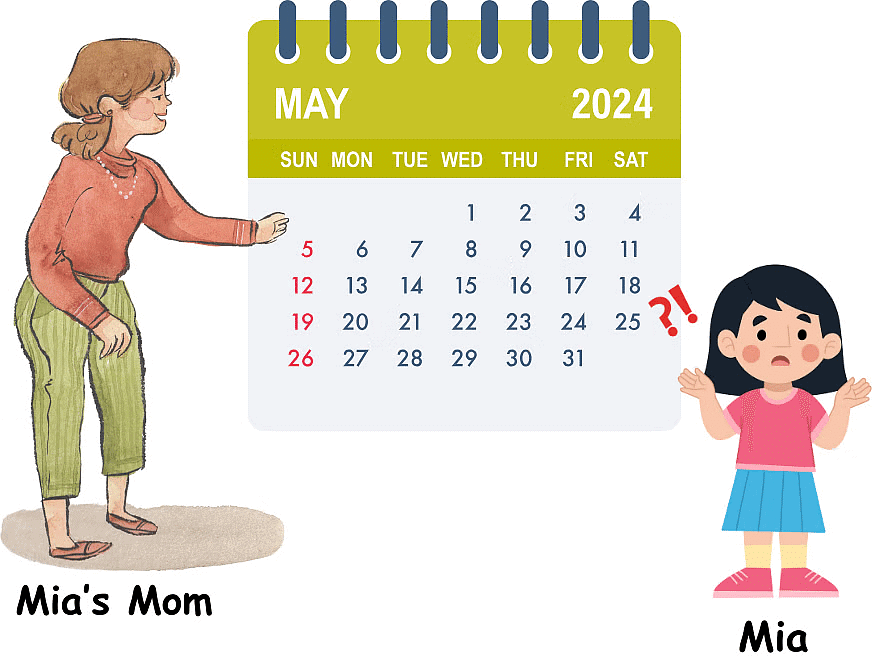
Once upon a time, there was a little girl named Mia. Mia loved playing outside with her friends and going on adventures. One day, her mom said they were going to have a special picnic in the park on Wednesday.

“But how will we remember when Wednesday is?” Mia asked, looking puzzled. Mom smiled and pointed to a colourful calendar hanging on the wall. “We’ll use this!” she said.

 She showed Mia the days of the week and the names of the months. Then Mom circled “Wednesday, 22nd May” on the calendar.”Now we know when our picnic is!” Mom said cheerfully. And so, Mia learned that the calendar was like a magical guide that helped her family plan fun adventures together.

Try yourself:What is one of the key functions of a calendar?

  • A.Keeping track of important dates and events
  • B.Predicting the weather
  • C.Calculating mathematical equations
  • D.Planning grocery shopping trips

View SolutionUnderstanding Calendars

Imagine you have a special book that helps you know what day it is, plan events, and remember important dates like birthdays and holidays. This special book is called a calendar!

Days and Months

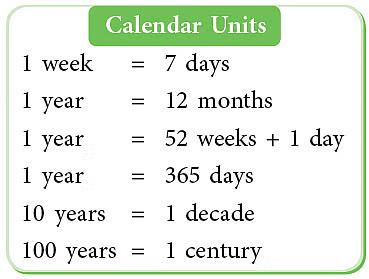
  • year has 365 days, but a leap year has 366 days (every fourth year).
  • In a leap year, February has 29 days instead of 28.
  • There are 12 months in a year and they may have 28,29,30 or 31 days.
  • Months with 31 days are: January, March, May, July, August, October, and December. 
  • Months with 30 days are: April, June, September, and November.
  • February: 28 days (29 days in a leap year).
  • year has 52 weeks.
  • Each week has 7 days:Sunday, Monday, Tuesday, Wednesday, Thursday, Friday, Saturday.

Writing Dates

  • When we write a date, we first write the number of the day, then the name of the month, and finally the year
  • We call this the day-month-year format.
  • We can use dots or slashes to separate them.
    For example, if it’s May 6, 2024, we can write it as 6.05.2024 or 6/05/2024.

Examples

  • If someone tells you to meet them on 25th June, you’ll know it’s the 25th day of June.
  • On your birthday, your family might write the date like this: 10.12.2013 (10th December 2013) to remember your special day!

Isn’t it cool how the calendar helps us keep track of time and remember special moments?Age Fun

Family Ages

Let’s talk about Mia’s family.

  • Mia is 8 years old, and her mom is 32 years old. 
  • When Mia’s mom was born, her grandma was already 50 years old. Can you guess her grandma’s age?
  • Yes, you guessed it right! Mia’s grandma is 58 years old now!
  • When Mia was born her Grandma was 50 years old , now her age will be 50 + 8 = 58 years old.

Siblings’ Ages

Consider Lily and her brother. 

  • Lily is 10 years old. If she is twice as old as her brother, can you guess the age of his brother?
  • Since Lily is twice as old as her brother, her brother is half her age. That means her brother is 5 years old.

Lily’s Birth Certificate

Birth Certificate is a special document which contains important information about Lily’s birth, like her birth date and her parents’ names, making it a special keepsake for her family.

  • Lily was born on 9th May 2014. 
  • To find out her age on her birthday in 2024, we count the years from when she was born to 2024. That’s 10 years!
  • To find out her age in 2030, we count the years from when she was born to 2030. That’s 16 years!
  • Lily’s birth certificate was issued 9 days after she was born, on 18th May 2014.

These simple examples help us understand how ages are connected within families and how we can figure out different ages and dates using basic math.Time

Time is a way to measure and quantify the duration or sequence of events. It’s a concept that helps us understand when things happen, how long they last, and in what order they occur.

Try yourself:

What is the total number of days in a leap year?

  • A.365 days
  • B.366 days
  • C.364 days
  • D.367 days

View SolutionWhat is a Clock?

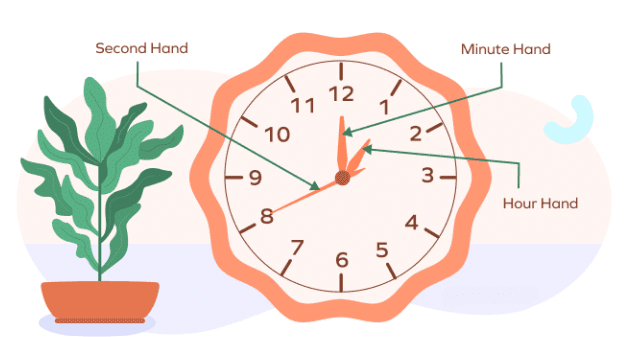
A clock is used to measure time. A clock has two hands— the short hand called the hour hand and the long hand called the minute hand.

  • An hour (h) and minute (min) are the standard units for the measurement of time.
  • The hour hand shows the hour and the minute hand shows the minutes before and after the hour.
  • The minute hand goes around the clock once in 1 hour. The hour hand goes around the clock once in 12 hours.
  • When the minute hand moves all the way round the clock, i.e., from 12 to 12, an hour passes.
    Always remember that:

60 minutes = 1 hour  
1 day = 24 hours

Telling Time to the Half-Hour

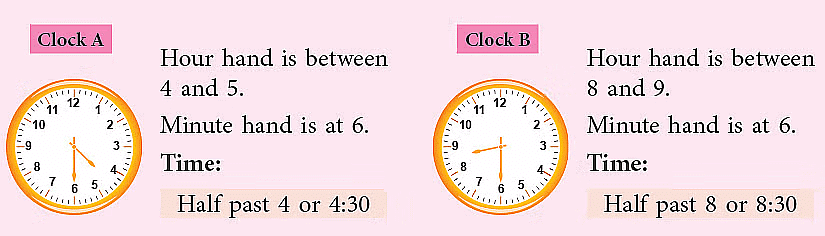
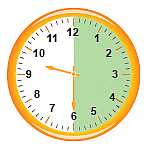
In the clock shown alongside, the hour hand is between 9 and 10 and the minute hand points to 6. The coloured part shows that the long hand or minute hand has moved halfway round.
When the minute hand moves half way round the face of the clock, half an hour has passed and we say that it is half past nine.∴ Half past nine can also be written as 9:30.

60 minutes = 1 hour
30 minutes = One-half of an hour

Observe the following clocks

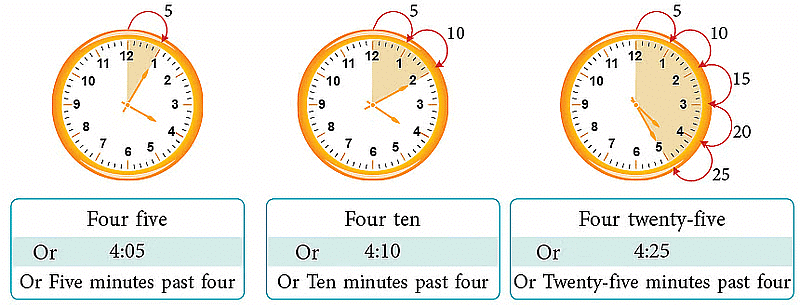
Telling Time to the Nearest Five Minutes

  • When the hour hand (short hand) moves from one digit to the other, 1 hour passes.
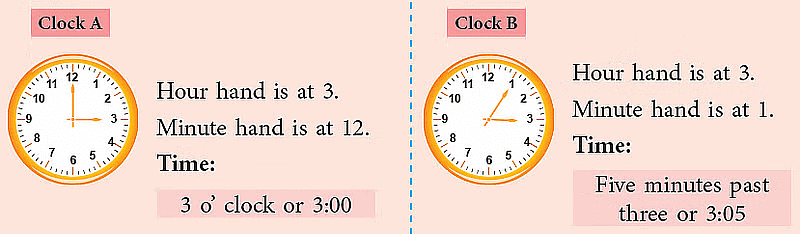
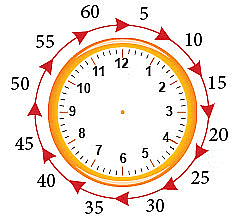
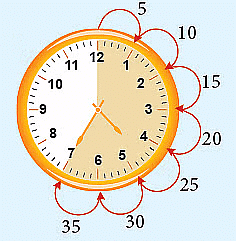
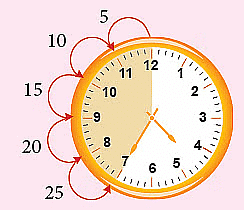
  • When the minute hand (long hand) moves from one digit to the other, 5 minutes pass.
  • Count the minutes all around the clock by 5s, starting at 12.
    The numbers outside the clock show the count.
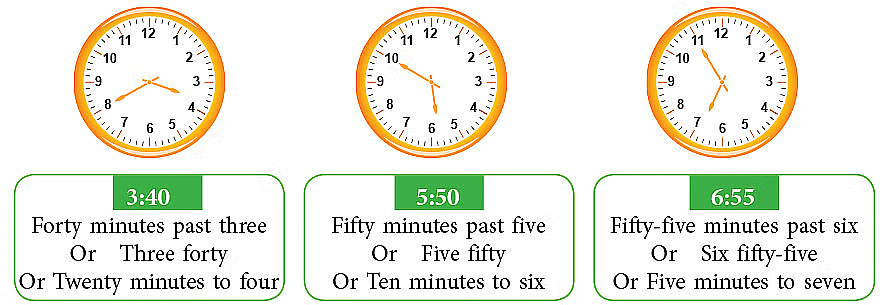
  • So, we skip count by 5s to find the time to the nearest five minutes. There are many ways of reading and telling the time.

When the minute hand has moved past 6, we say the time in the following two ways:

1. First Way : The hour hand is between 4 and 5, so  the time is after 4 o’ clock. The minute hand is at 7. Starting at 12 and counting ahead by 5s to 7, we get 35 minutes.Thirty-five minutes past 4 or 4:35
So, we say that the clock shows the time 35 minutes after 4 or 35 minutes past 4.

2. Second Way: The hour hand is between 4 and 5, so the time is before 5 o’ clock. The minute hand is at 7. Starting at 12 and counting back by 5s to 7, we get 25 minutes. We write 25 minutes to 5 to tell the time because there are 25 minutes left to 5 o’ clock.Twenty-five minutes to 5

Examples:

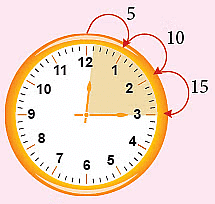
Telling Time to the Quarter Hour

Let us read time on the clocks given below:
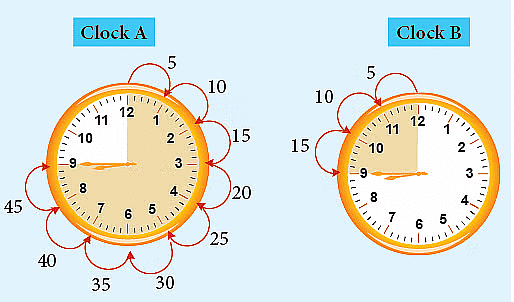
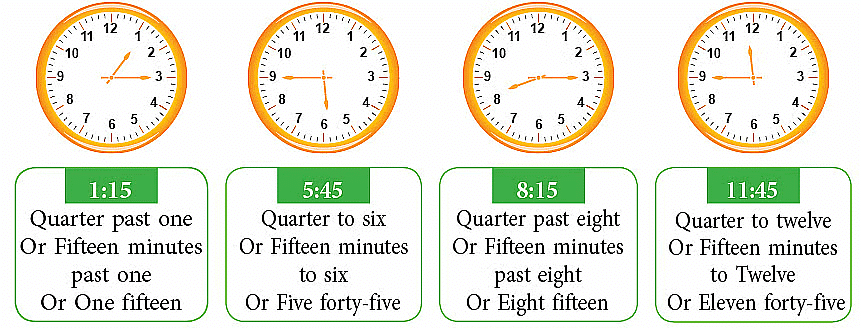
The minute hand has moved one quarter (one-fourth) of the circle in moving from 12 to 3. So, 1 / 4 of an hour = 15 minutes.

  • The time shown on the clock is 12:15 or Fifteen minutes past twelve, which we generally read as quarter past twelve.
  • Both the clocks A and B given show the same time which can be read in clock A as: 8:45 or Forty-five minutes past 8.
  • In clock B, the same time can be read as: Fifteen minutes to nine or Quarter to nine.

Examples:

Try yourself:What time is shown on the clock when the minute hand is at 9 and the hour hand is between 2 and 3?

  • A.2:45
  • B.3:15
  • C.2:30
  • D.3:30

View SolutionLet’s Practice

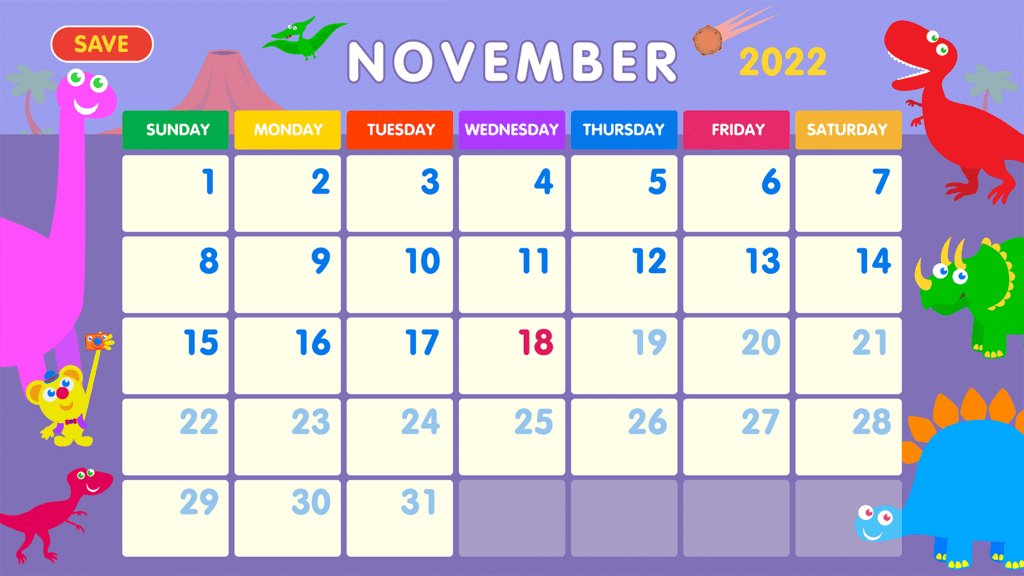
1. Observing the calendar of month November 2022 given below, Can you answer the following questions:

(i) Total number of Sundays in November month  ______________________________.
(ii) 
Write the dates in this month that fall on Thursday ___________________________.
(iii) 
Three days after 22nd November  is  _________________November . The day on this date is _____________________.
(iv) 
A school closes on November 7 for 15 days. The date on which the school will open is _____________________.

Answer:

(i) No. of Sundays = 5
(ii) The dates that fall on Thursday in this month are 5, 12, 19, 26.
(iii) Three days after 22nd November is 25th November , and the day on this date is Wednesday.
(iv) A school closes on November 7th for 15 days. The date on which the school will open is 22th November .

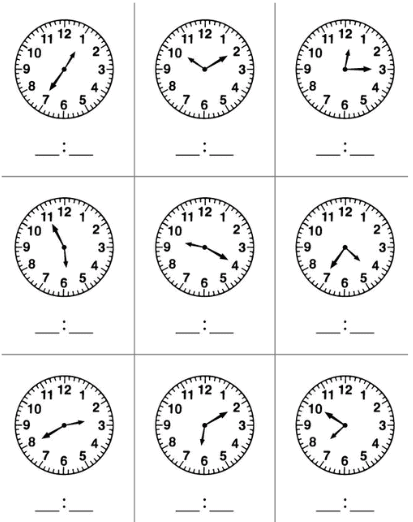
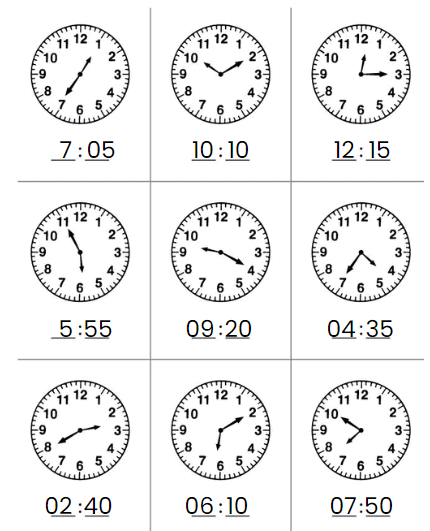
2. Write the time that is shown in each clock :

Answer

In summary, understanding the structure of a year, months, and weeks , knowing about time , age helps us organize time efficiently and recognize important patterns like leap years, which occur every four years.

12. Give and Take- Chapter Notes

Introduction 

Imagine you are helping your family with a garden.  You might be counting the number of saplings of plants or you could be using your pocket money to buy your favorite snacks. 

How do you keep track of everything? 

This is where addition and subtraction come to the rescue!—our “give and take” math heroes!  In this chapter, we will learn how adding and subtracting can help us solve problems we face every day. Whether it’s counting saplings, managing money, or figuring out how much more we need to finish a task. 

Let’s start this exciting journey where numbers become our friends. 

Together, we will discover the magic of give and take! 

Let’s try to understand this using an example:

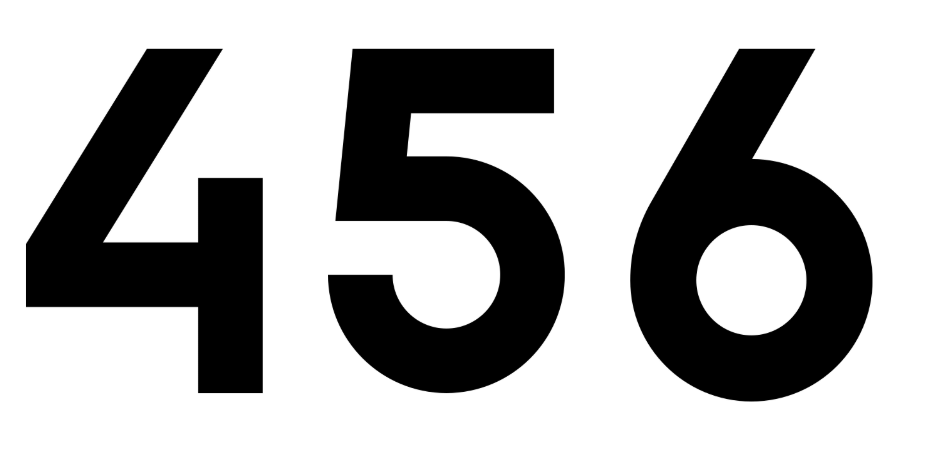
Once upon a time in a colourful village, there lived a farmer named Kishan.  Kishan loved taking care of plants and had a big nursery where he grew beautiful saplings. In the month of August, he had 456 saplings of various plants ready to be shared with the villagers. The villagers often visited Kishan to get saplings for their gardens.

One sunny day, Kishan decided to distribute some of his saplings to help his friends in the village. He happily gave away 63 saplings to those who needed them. Kishan was excited to see his friends so happy, but he also wanted to know how many saplings he had left in his nursery after giving some away.

To find out how many saplings Kishan has left,  Here’s how we can solve it step by step:

  • Kishan started with 456 saplings.
  • He distributed 63 saplings to his friends.
  • So to find out how many saplings are left, we need to subtract the saplings given away from the total saplings:
    456 − 63
    =393 Saplings

Kishan felt happy knowing that he could still take care of many more plants while helping his friends grow their gardens. And so, he continued to nurture his nursery, always ready to share the beauty of nature with others.

Try yourself:

What is the result of subtracting 29 from 87?

  • A.56
  • B.58
  • C.58
  • D.60

View Solution

Concept of Addition and Subtraction Using Box Diagram

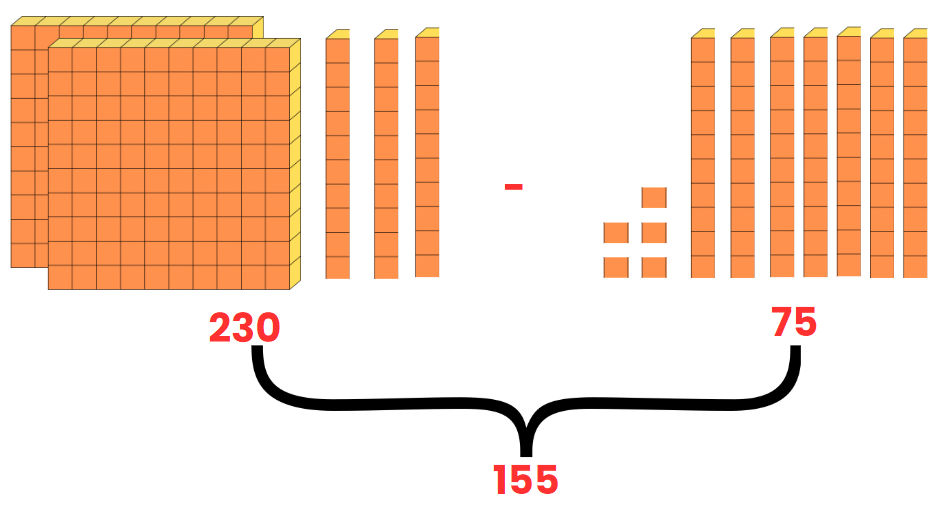
Kishan got an order of 230 saplings from a school. He packed 75 saplings. How many Saplings more do he need to pack ?

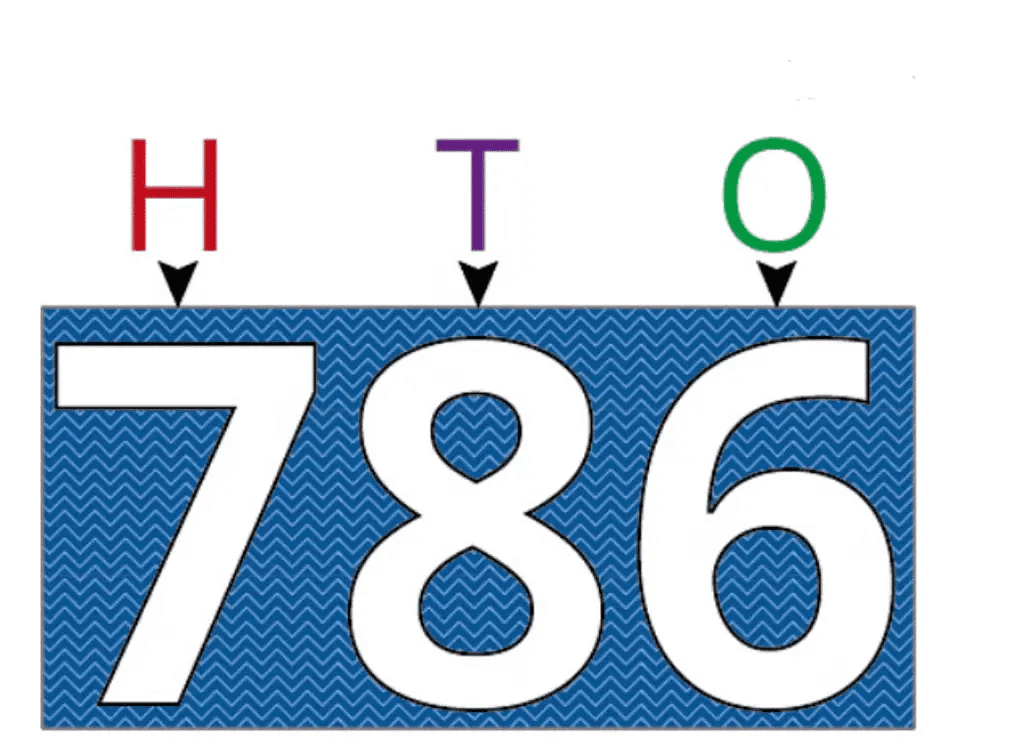
For finding the saplings he is left with we will subtract 75 from 230 using the Hundreds (H), Tens (T), and Ones (O) columns.

Step 1: Draw a Box Diagram
In the box diagram, we’ll break down the numbers into Hundreds (H), Tens (T), and Ones (O).
Total saplings ordered: 230
Saplings already packed: 75

Step 2: Perform Subtraction Using the Box Diagram

1. Start with the Ones column:
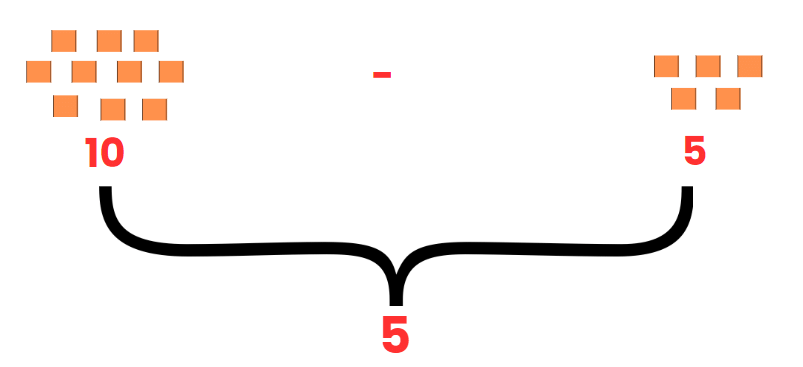
We cannot subtract 5 from 0 (0 < 5), so we borrow 1 ten from the Tens column.
The 3 tens become 2 tens, and now we have 10 ones in the Ones column.
Now, subtract the Ones:
10 ones − 5 ones = 5 ones

2. Move to the Tens column:
After borrowing, we have 2 tens. Now, we subtract 7 tens from 2 tens.
Since 2 tens are smaller than 7 tens, we borrow 1 hundred from the Hundreds column.
The 2 hundreds become 1 hundred, and now we have 12 tens.
Now, subtract the Tens:
12 tens − 7 tens = 5 tens

3. Move to the Hundreds column:

We now have 1 hundred left, and since there’s nothing to subtract from it, it stays the same.

Step 3: Final Box Diagram
Combining all above steps we get 1 Hundred , 5 Tens , 5 ones which makes 155 Saplings . Hence Kishan needs to pack 155 saplings more to complete the order of 230 saplings.

Try yourself:

Kishan got an order of 320 pens from a store. He already packed 145 pens. How many more pens does he need to pack?

  • A.175 pens
  • B.185 pens
  • C.135 pens
  • D.165 pens

View Solution

Concept of Addition and Subtraction Using Number Line

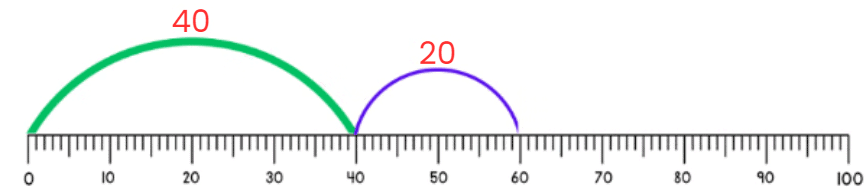
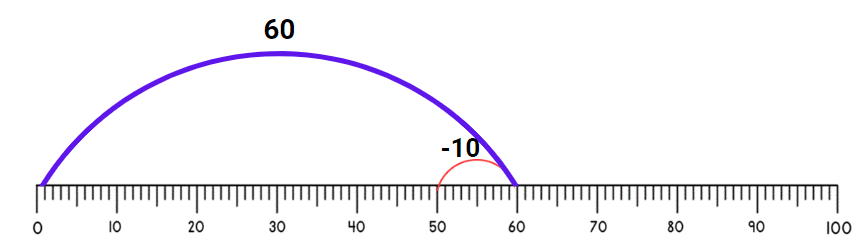
One sunny day, Ria went to the orchard with a basket to collect fruits. First, she picked 40 apples and put them in her basket. Then, she found a tree with juicy oranges and picked 20 more. She wanted to know how many fruits she had in total.

She sat under the tree and used her number line to find out:

  • She started at 40 and took a big jump of 20 to reach 60 .
  • Ria happily counted, “Wow! I now have 60 fruits in my basket!”

Later, Ria decided to share some of her fruits with her little brother. She gave him 10 fruits. To figure out how many fruits were left, she used her number line again:

  • She started at 60 and jumped back 10 to 50.
  • Ria smiled and said, “I have 50 fruits left now!”

And with that, Ria and her brother enjoyed their delicious fruit feast!

Money and Real – Life Transactions 

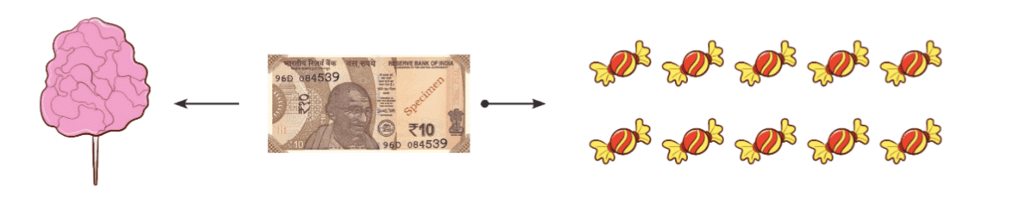
These days we use money in exchange for things we need. Notes and coins come in different values which are used to buy different things.

For example:  one 10-rupee note can buy one Hawa Mithai or ten toffees.

Therefore,  one hawa mithai costs more than a toffee.

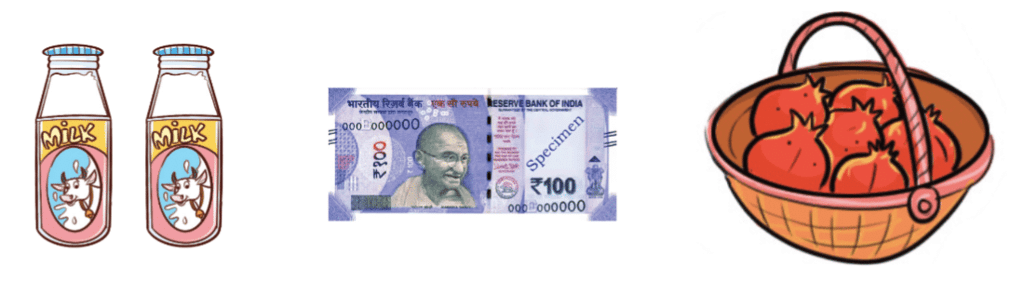
Salma buys two bottles of milk for ₹ 100. Kiran buys a basket of pomegranates for ₹ 100.

Can you estimate what costs more, a milk bottle or a pomegranate?

Raman is a friendly shopkeeper in the village who loves helping his customers. One day, his regular customer, Meera, came to his shop to buy some groceries.

Meera picked up the following items:

  • A packet of rice for ₹50
  • A bottle of oil for ₹30

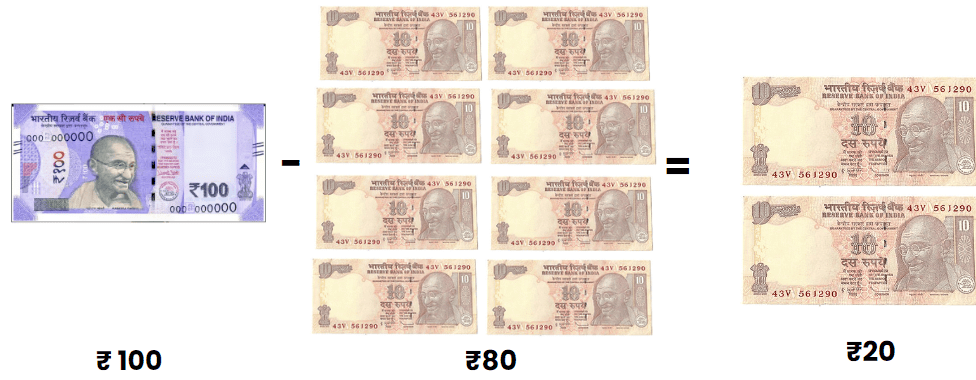
Meera happily gave Raman a ₹100 note. Now, she wanted to know how much change she would get back.

Raman calculated using notes again:

He first took ₹80 from the ₹100 note, using:

8 ten-rupee notes (₹80)

The remaining change was ₹20, which he gave back to Meera in: 2 ten-rupee notes (₹20)

“Here’s your change of ₹20, Meera!” Raman said with a smile.

Estimation

Estimating values is important because it helps us quickly understand and make decisions about quantities without needing exact numbers, making math and real-life situations easier to handle.
Let’s take a number : 156 + 34

To estimate the sum of 156 and 34, we can round the numbers to the nearest ten and then add them. Here’s how to do it step by step:

Steps to Estimate:

1. Round 156: The nearest ten is 160 (because 156 is closer to 160 than to 150).

2. Round 34: The nearest ten is 30 (because 34 is closer to 30 than to 40).

3. Add the Rounded Numbers: Now we add the rounded numbers: 160 + 30

4. Calculate: 160 + 30 = 190

Try yourself:Estimate the sum of 78 and 25.

  • A.90
  • B.110
  • C.100
  • D.120

View Solution

Comparing Numbers

Comparing different problem statements helps us understand relationships between numbers without necessarily calculating their exact values. This skill is useful for estimating and making decisions based on the information given.

Let’s Understand comparing using an example:

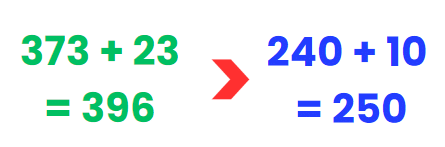
  • 373 + 23  and  240 + 10

After Adding Both the Numbers we get, 

373 +23 = 396

and 240 + 10 = 250, which shows 373 + 23 is more than 240 + 10

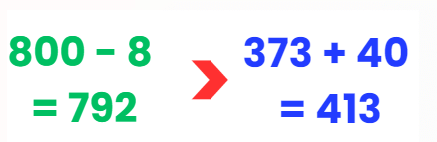
  • 800 – 8 and  373 + 40

After solving Both the Numbers we get, 

800 – 8 = 792

and 373 + 40 = 413 , which shows 800 – 8 is more than 373 + 40

In conclusion, the chapter “Give and Take” highlights the practical application of addition and subtraction in everyday transactions, particularly in managing money. Beyond shopping, these operations are essential for budgeting, calculating distances, tracking time, and solving problems in various contexts, empowering us to make accurate calculations in our daily lives.

11. Filling and Lifting –

Chapter notes

IntroductionImagine you’re at home, maybe in your kitchen, surrounded by cups, bowls, and bottles. Have you ever wondered how much water each one can hold? That’s what we’re going to explore in “Filling and Lifting”! We’ll learn about measuring how much liquid containers can hold and how heavy things are. Let’s get ready for a fun learning adventure!

Let’s Understand With a Story

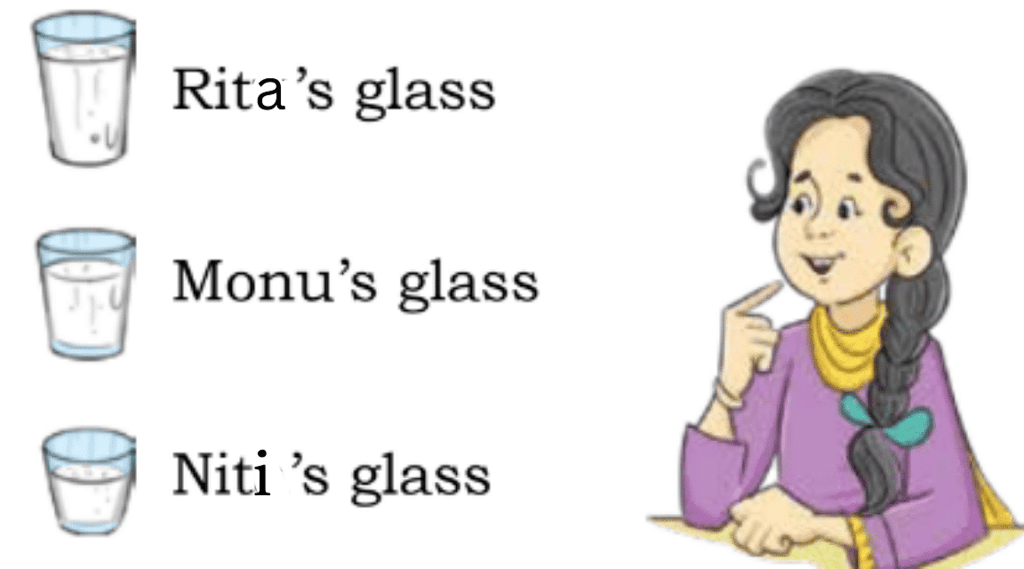
Once upon a time, in Maya’s house, there was a special milk party. Rita, Monu, and Niti gathered around the table, each with their own glass of juice. 

  • Rita’s glass was big and round, like a bright sun.
  • Monu’s glass was medium-sized, like a glowing moon. 
  • Niti ‘s glass was small and cute, like a twinkling star.

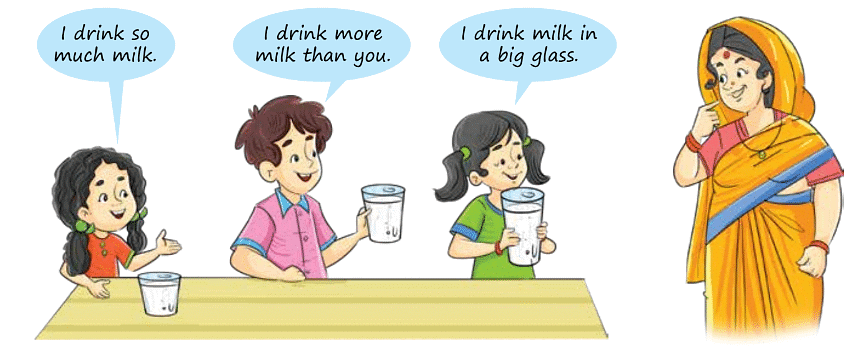
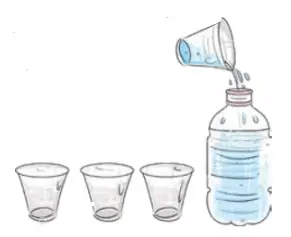
After finishing their milk, Rita’s clever sister had an idea. She poured the milk from each glass into three identical glasses. What a surprise! Even though the glasses looked the same, they didn’t all hold the same amount of milk!

  • Rita’s big glass poured the most milk,  Monu’s glass had a good amount of milk too, but Niti’s glass had the least amount of milk.
  • Ritu smiled proudly, “I drink so much milk!” Monu grinned and said, “I drink more milk than you!” Niti laughed and said, “I drink milk in a big glass!”
  • And that’s how they found out who drank the most milk. It was a fun milk adventure they would always remember with laughter.

Measuring Capacity – “How much?”

  • When we talk about how much liquid a container can hold, we call it its capacity
  • We measure capacity in two main ways: litres and millilitres.

Imagine you have a big bottle of juice.
The amount of juice it can hold is measured in litres, written as “L”. But if you look closely at a bottle of medicine or a juice box, you might see a number followed by “mL”. That stands for millilitres, which is a smaller unit of measurement.

  •  1 litre is the same as 1000 millilitres! So, if you have a litre of juice, that’s like having 1000 tiny millilitres.
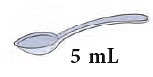
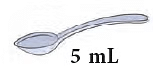
  • To understand how small a millilitre is, think about a teaspoon. It can hold about 5 millilitres of liquid. 

Teaspoon

And a tablespoon can hold about 10 millilitres!

Tablespoon

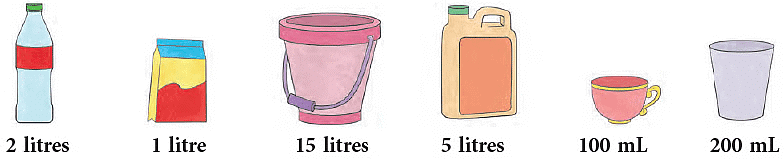
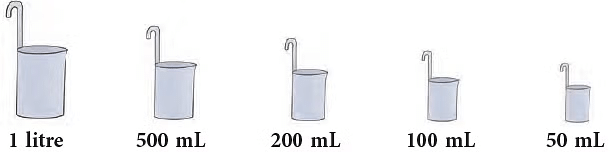
The standard-sized containers used for measuring liquids are shown.

So, next time you see a jug marked with litres or a bottle with millilitres, you’ll know exactly how much liquid it can hold. It’s like solving a fun puzzle about liquids!

Understanding More Than and Less Than

To understand more than and less than in terms of volume or capacity, think about it like this:

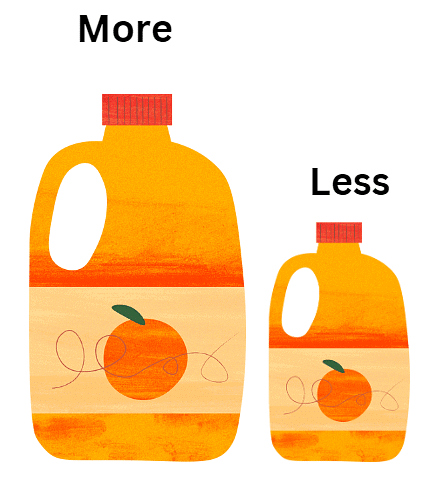
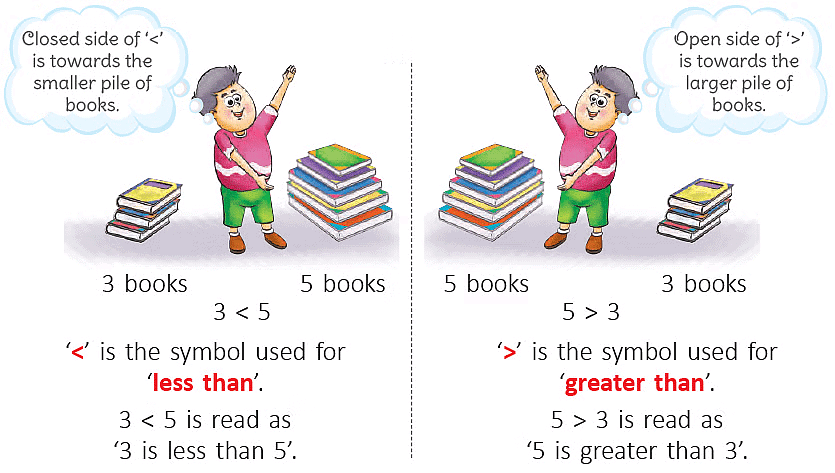
  • More than (>) means the first container can hold a larger amount of water compared to the second container.
  • Less than (<) means the first container can hold a smaller amount of water compared to the second container.

More Than

Imagine you have two containers, one labeled A and the other labeled B. Let’s say container A can hold 500 milliliters (ml) of water, and container B can hold 750 ml of water.

  • If we say that container B can hold more water than container A, it means that the capacity of container B (750 ml) is greater than the capacity of container A (500 ml).
  • In this case, we can write it as: 750>500or “750 milliliters is more than 500 milliliters.”

Less Than 

Now, let’s reverse the situation. Suppose container A can hold 1 liter of water (1000 ml), and container B can hold 750 ml of water.

  • If we say that container B can hold less water than container A, it means that the capacity of container B (750 ml) is smaller than the capacity of container A (1000 ml or 1 liter).
  • In this case, we can write it as: 750<1000 or “750 milliliters is less than 1000 milliliters (1 liter).”

These concepts help us compare the capacity of different containers or quantities of liquid, which is important in many everyday activities like cooking, measuring drinks, or understanding the size of containers.

Measuring Weight – “Heavy or Light?”

Imagine Chintu holding three heavy textbooks, each weighing 1 kilogram, and a light pencil box weighing 500 grams. His hand with the textbooks goes lower because they’re heavier. This is how we can compare things like to see which is heavier or lighter.Long ago, people didn’t have fancy scales to measure the weights of things, like today. They used rocks or stones to measure weight! They added or took away rocks until things balanced 0.

But now, we have grams and kilograms

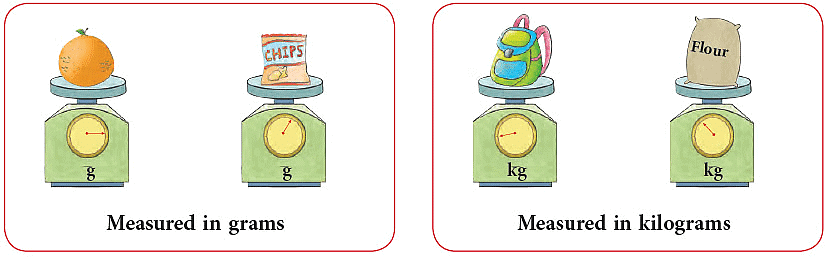
  • Grams, which is the standard unit of weight in the metric system, are for small things, like toys or fruit, and 
  • Kilograms are for big things, like people or bags of rice.

Please note that, 1 kilogram = 1000 grams.

Some standard weights are given as follows:-

Try yourself:

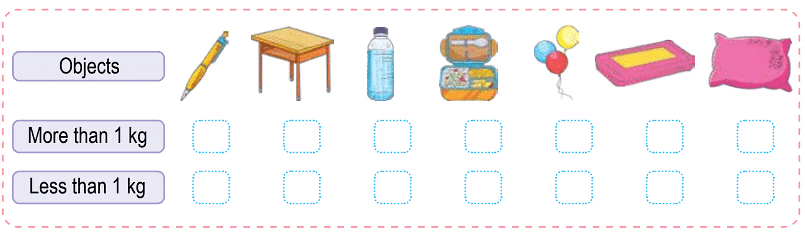
Which of the following items might weigh more or less than 1 kilogram?

  • A.A small apple
  • B.A bag of rice
  • C.A pencil
  • D.A small book

View Solution

Understanding “More Than” and “Less Than” in Weight

To understand more than and less than in terms of weight or mass, think about it like this:

  • More than (>) means the first object has a higher weight compared to the second object.
  • Less than (<) means the first object has a lower weight compared to the second object.

These concepts help us compare the weights of different objects, which is important in various activities like measuring ingredients in cooking, comparing the weight of items in a store, or understanding the capacity of different vehicles to carry weight.

More Than in Weight/Mass:

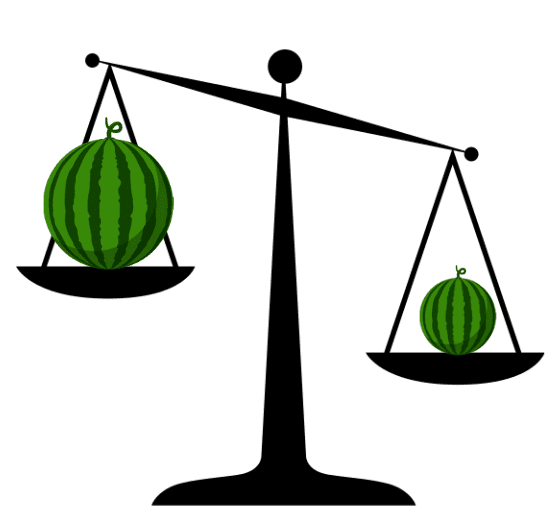
Imagine you have two Watermelon. Let’s say one  watermelon  weighs 500 grams, and other weighs 750 grams.

  • If we say that second watermelon weighs more than first one, it means that the weight of second watermelon (750 grams) is greater than the weight of first watermelon (500 grams).
  • In this case, we can write it as: 750>500 or “750 grams is more than 500 grams.

Less Than in Weight/Mass:

Now, let’s reverse the situation. Suppose a watermelon weighs 1 kilogram (1000 grams), and a bag of rice weighs 750 grams.

  • If we say that watermelon  weighs less than Bag of rice , it means that the weight of watermelon (750 grams) is smaller than the weight of Bag of rice  (1000 grams or 1 kilogram).
  • In this case, we can write it as: 750<1000 or “750 grams is less than 1000 grams (1 kilogram)

Let’s Practice!

Question: Look at the picture and tick the appropriate word.

(a) The mug holds a litre/half litre water.

(b) The glass holds a litre/half litre/quarter litre of water.  View Answer

Question: Can you guess which of these things might weigh more or less than 1 kilogram? Put a check mark (✔️) in the right box.  View Answer

10. Fun at Class Party!  Chapter Notes

Introduction

Imagine a world full of measuring tools and colorful adventures! In this chapter, we’ll learn how to measure using our hands, feet, and special tools like metre ropes. Get ready to compare lengths, guess distances, and have a fun as we explore the exciting world of measurement together!

Let’s Understand With a Story

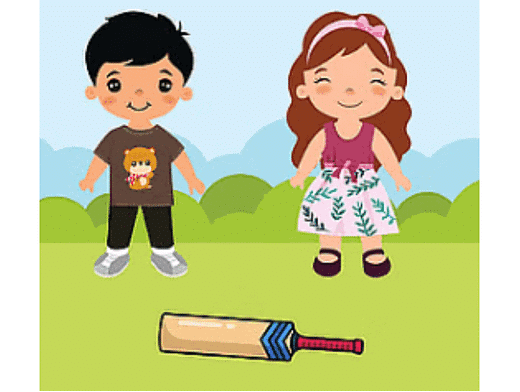
Once there were two friends, Riya and Aryan. They loved playing cricket. One day, they wanted to know how long their cricket bat was.

Riya & Aryan

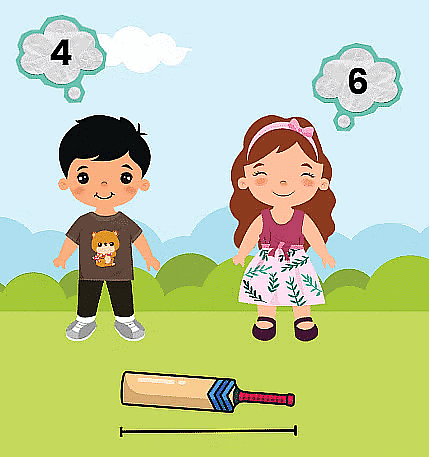
Aryan tried to measure it using his hands and said it was 4 hand lengths long. 

Then, Riya tried and said it was 6 hand lengths long for her.

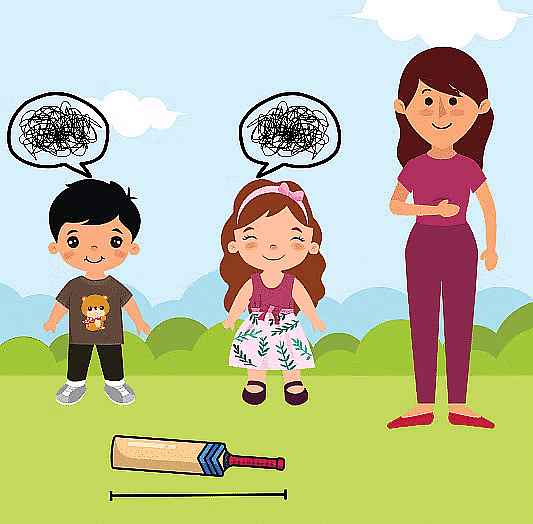
They were confused why the bat was different lengths for each of them. 

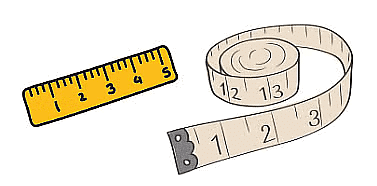
Their mom explained, “Your hands are different sizes, so using hand length isn’t a good way to measure. You should use a ruler or a measuring tape. They give the same answer for everyone.”

Riya and Aryan understood and learned that using the right tools helps us measure things correctly. 

From that day on, they always used a ruler or measuring tape to measure things accurately.

Ruler & Measuring Tape

Now that we know why and how measurement is important, let’s understand different types of measurements.

Try yourself:

What is the most accurate way to measure the length of an object?

  • A.Using hand lengths
  • B.Using a ruler or measuring tape
  • C.Guessing the length
  • D.Comparing with other objects

View Solution

Measurement of Length – “How long?”

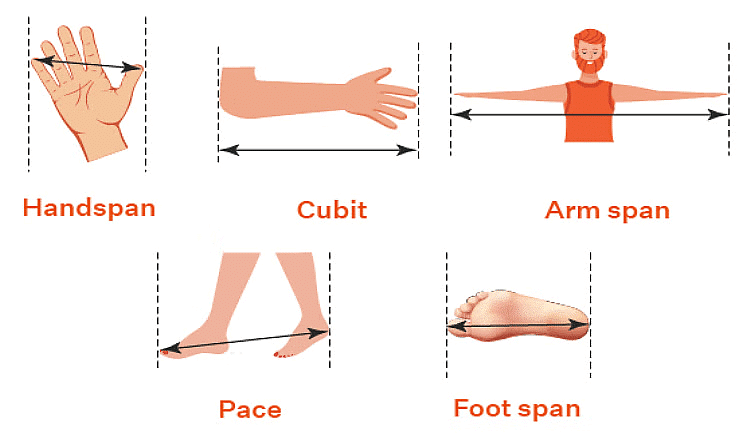
Have you ever wondered how people measured things long ago? They didn’t have rulers like we do now. Instead, they used parts of their bodies! Here are some of the parts they used:

  • hand span is the distance from the tip of the thumb to the tip of the little finger when the fingers are spread apart.
  • cubit is the distance from the elbow to the tip of the middle finger when the hand is stretched out.

But here’s the thing: everyone’s hand span and cubit are different like we saw in the story given above.
So when they measure something, they don’t always get the same answer. That’s why mathematicians decided to create standard units of length.Foot Scale

  • In many parts of the world, people used units like inches, feet, and yards. 
  • 12 inches make one foot and 3 feet (plural of foot) make 1 yard.
  • But now, we mostly use the Metric system. 
  • The standard unit for measuring length is called a meter, and we write it as ‘m’. 
  • Longer distances are measured in kilometers (km), and smaller lengths in centimeters (cm).

So, even though people used to measure with their hands and arms, now we use meters and centimeters to measure things accurately!

For measuring lengths, we use:

  • a Meter rod,
  • a Measuring tape
  • a Ruler.

Different tools for Measuring Lengths

A cloth merchant measures cloth by iron rod called the meter rod.

Metre Rod

15 cm Ruler

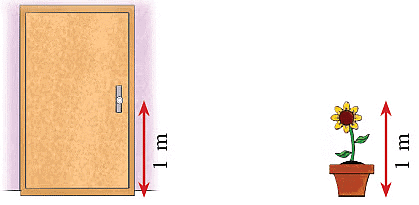
Here, the distance from the floor to a door knob is about 1 meter and the height of the plant is also about 1 meter.
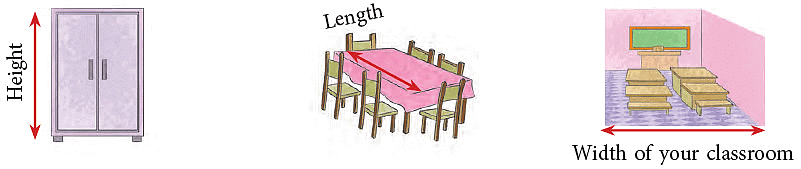
There are certain things such as the following that are more than a meter long.
There are certain things like those shown below that are less than a meter long.
We use meter to measure long length and centimeter to measure short length.

Measurement of Length Using Centimeter Scale

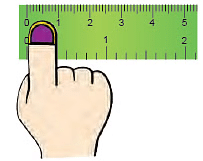
Your finger is about 1 centimeter wide.
This will help you to estimate length in centimeter. A 15 cm or 30 cm ruler is used to measure lengths in centimeter.
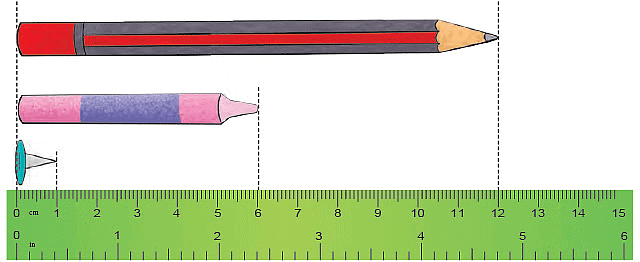
To measure the length of an object, say, a sharpener, line up one of the sharpener end at the 0 mark of the ruler. The other end, touches the 2 cm mark of the ruler, so it is 2 cm long.
Similarly, we can measure the length of the following objects

  • The length of the pencil is 12 cm.
  • The length of the crayon is 6 cm.
  • The length of the board pin is 1 cm. 

Try yourself:

What is the standard unit for measuring length in the Metric system?

  • A.Inch
  • B.Foot
  • C.Meter
  • D.Yard

View Solution

Measuring Distances – “How far?”

Measuring distance is like counting steps or jumps to find out how far things are from each other on a grid or map. We use units of distance, like meters, feet, km to measure the length or distance between two points.

Long distances measured using kilometers that is represented by km.

1 kilometer is about 1000 meters.

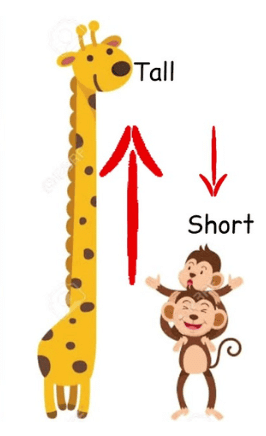
Measuring Heights – “How Tall?”

“How Tall?” is about measuring how high or tall something or someone is, like a tree or a person. We use units of measurement, like meters or feet, to find out the height from the ground to the top of the object or person.

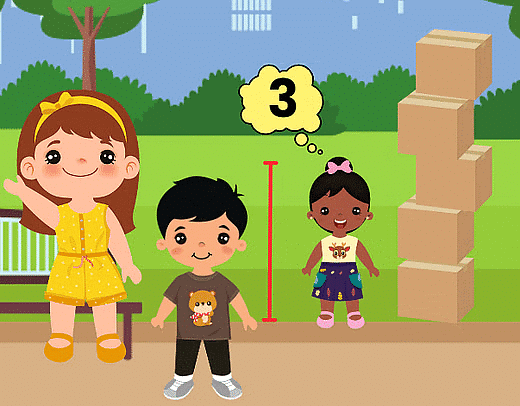
Story Time: How tall we are?

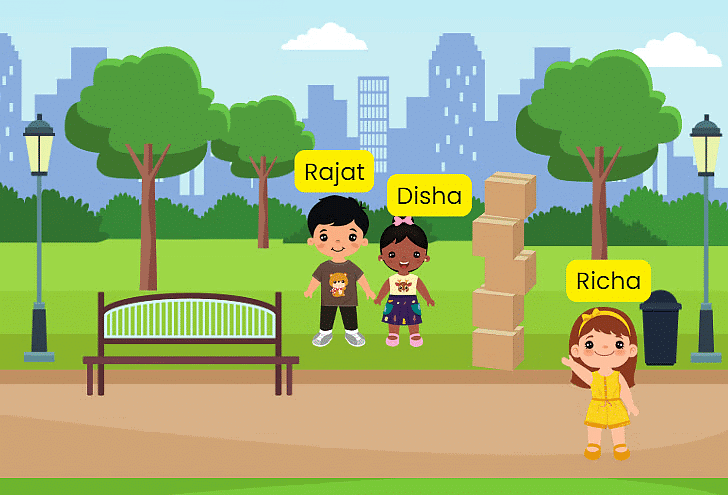
Once upon a time in a park, there were boxes of flowers piled up high, forming a huge tower. 

  • All the kids gathered around to see how tall they were compared to the tower. 
  • Rajat stood next to the tower and found out he was 4 boxes tall.
    Rajat is 4 boxes tall
  • Richa then stood beside Rajat and discovered she was 5 boxes tall. 
    Richa is 5 boxes tall
  • Finally, Disha joined them and realized she was 3 boxes tall.
    Disha is 3 boxes tall

  • The kids were amazed to see how the tower helped them understand their heights in a fun way. 
  • They learned that comparing our height to something else, like a tower or a tree, can show us how high or tall we are.
    Height is usually measured in meters. 
    1 m = 100 cm

Let’s Practice

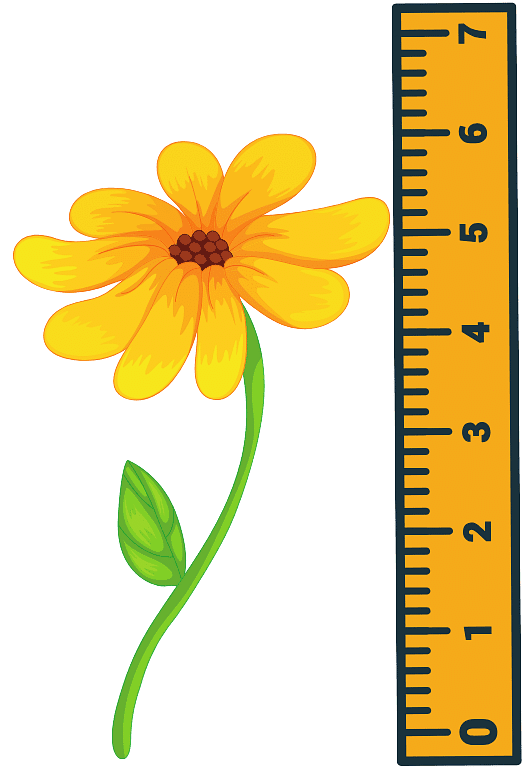
Question: Look at the picture of the flower below.  Can you guess the height of the flower with the help of the ruler given:  View Answer

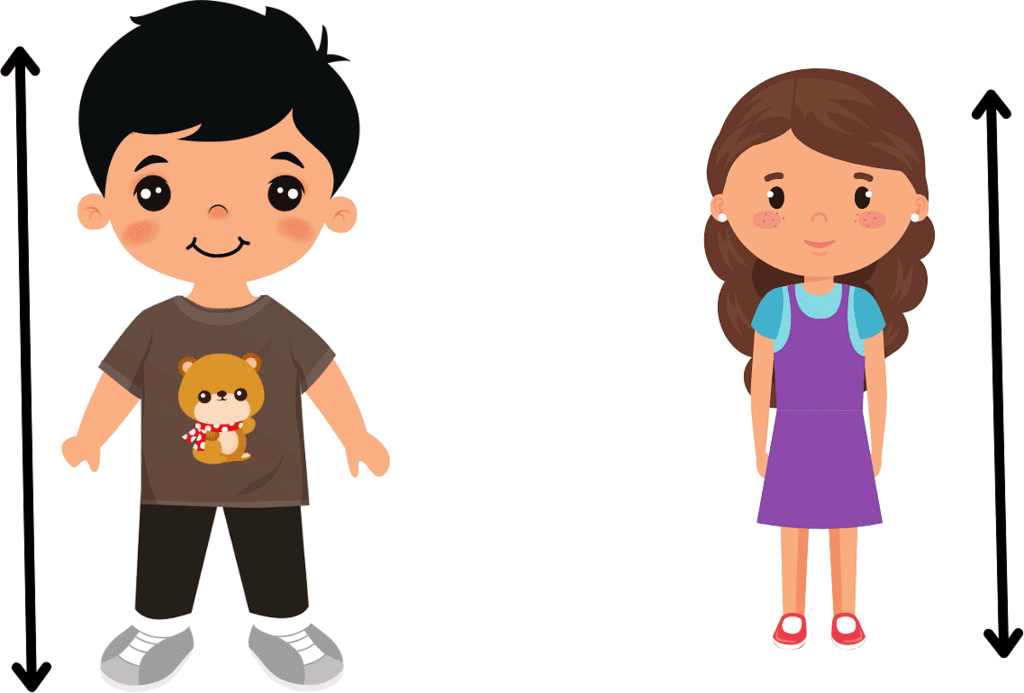
Question: Upon looking at the following image, can you tell which one of the following kid is taller?  View Answer

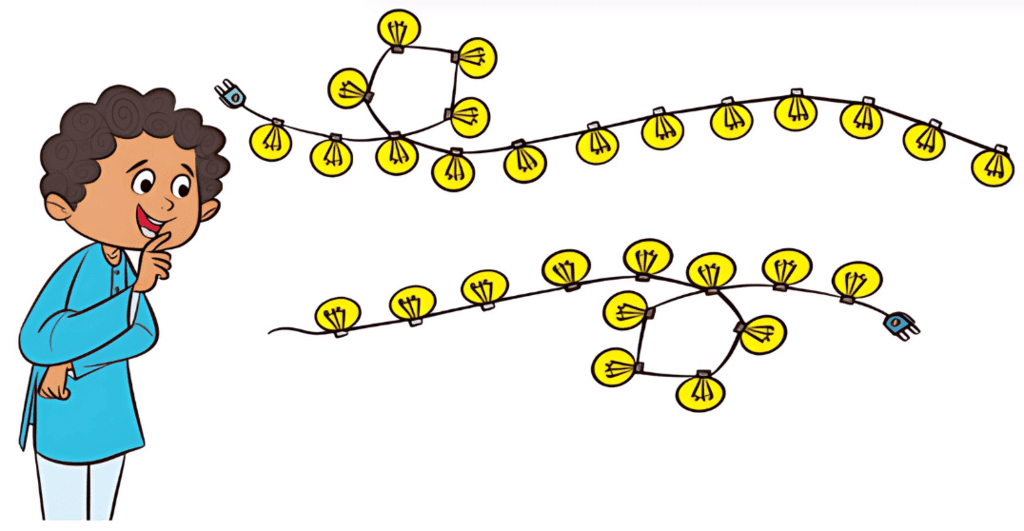
Question: Look at the strings and help Arjun choose the longest one. How did you find out? Discuss.  View Answer

In Summary, Measurement helps us find out how long, heavy, or full something is. We use units like centimeters (cm), meters (m) and kilometers (km) to measure lengths. Always remember that:

  • 1 m = 100 cm
  • 1 km = 1000 m

09. House of Hundreds – II Chapter Notes

Introduction

Welcome to the “House of Hundreds,” where we learn about three-digit numbers. In this chapter, we’ll learn about counting, make fun number patterns, and solve puzzles together. Get ready to discover the secrets of numbers and become counting champions!

Let’s Know the number neighbours

Imagine you have the number 234. We’re going to find the numbers that are close to 234, but in terms of hundreds, 50s, and 10s. Let’s break it down step-by-step.Neighbouring Hundreds

Neighbouring hundreds are the closest multiples of 100 around your number. For 234, we look for the nearest hundreds before and after it.

  • Lower neighbouring hundred: The closest multiple of 100 before 234 is 200.
  • Upper neighbouring hundred: The closest multiple of 100 after 234 is 300.

So, the neighbouring hundreds of 234 are 200 and 300.

Try yourself:

What are the neighboring hundreds of the number 589?

  • A.500 and 600
  • B.400 and 700
  • C.550 and 650
  • D.450 and 550

View SolutionNeighbouring 50s

Neighbouring 50s are the closest multiples of 50 around your number. For 234, we look for the nearest 50s before and after it.

  • Lower neighboring 50: The closest multiple of 50 before 234 is 200. (Though 200 is also a neighboring hundred, it can also be considered here.)
  • Upper neighboring 50: The next multiple of 50 after 234 is 250.

So, the neighbouring 50s of 234 are 200 and 250.

Neighbouring 10s

Neighbouring 10s are the closest multiples of 10 around your number. For 234, we look for the nearest 10s before and after it.

  • Lower neighbouring 10: The closest multiple of 10 before 234 is 230.
  • Upper neighbouring 10: The closest multiple of 10 after 234 is 240.

So, the neighbouring 10s of 234 are 230 and 240.

Different Ways of Representing Numbers

Let’s explore different ways to represent the numbers. 

Let’s take a number, 456. Here are various ways to write or represent it:Using “more than” a base number:

  • 156 more than 300

Breaking it down into place values:

  • 4 hundreds, 5 tens, 6 ones

As a single number:

  • 456

As a sum of its place values:

  • 400 + 50 + 6

Using “less than” a base number:

  • 44 less than 500

As a subtraction from a nearby higher number:

  • 500 – 44

Try yourself:

What are the neighboring 100s of the number 789?

  • A.700 and 800
  • B.650 and 850
  • C.750 and 850
  • D.700 and 900

View SolutionLet’s Practice: 

  1. 68 more than 300:
    • 368 (68 + 300)
  2. Breaking it down into place values:
    • 3 hundreds, 6 tens, and 8 ones
  3. As a single number:
    • 368
  4. As a sum of its place values:
    • 300 + 60 + 8
  5. 32 less than 400:
    • 32 less than 400 is 368
  6. As a subtraction from a nearby higher number:
    • 400 – 32

By understanding these different representations, you can see how the number 456 can be expressed in multiple ways, making it easier to understand its value and position within different contexts.


What Are Number Patterns?

Number patterns are sequences of numbers that follow a specific rule or set of rules. These rules can involve adding or subtracting a certain number repeatedly to get the next number in the sequence.

Example 1: Adding 20 each time or Skip by 20 

  • Starting number: 450
  • Rule: Add 20

Sequence: 450, 470, 490, 510, 530, 550, …

Here’s how it works:

  • Start with 450.
  • Add 20 to 450 to get 470
  • Add 20 to 470 to get 490
  • Add 20 to 490 to get 510
  • Continue this pattern to get the next numbers.

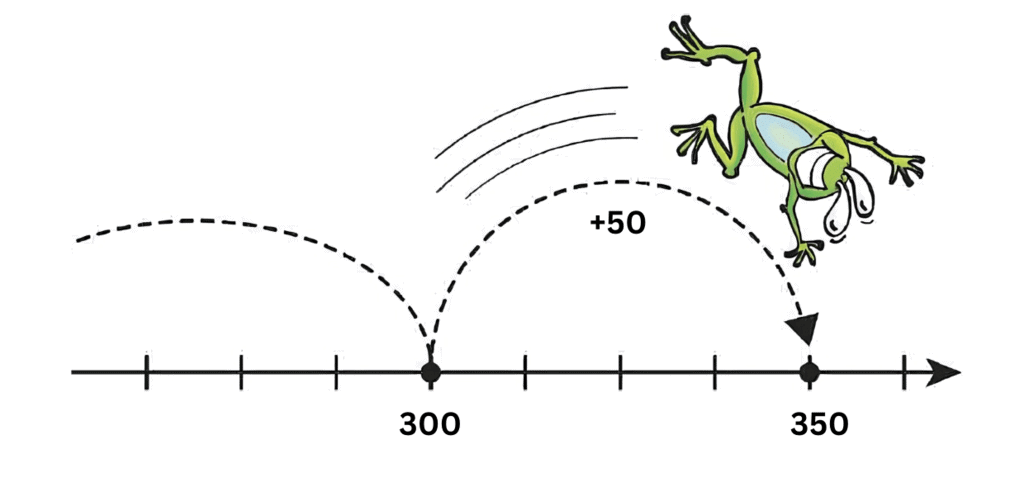
Example 2: Adding 50 each time or Skip by 50

  • Starting number: 300
  • Rule: Add 50

Sequence: 300, 350, 400, 450, 500, 550, …

Here’s how it works:

  • Start with 300.
  • Add 50 to 300 to get 350
  • Add 50 to 350 to get 400
  • Add 50 to 400 to get 450
  • Continue this pattern to get the next numbers.

Number Patterns with Subtraction

When creating a number pattern using subtraction with bigger numbers, we’ll subtract a fixed number of tens each time to get the next number in the sequence.

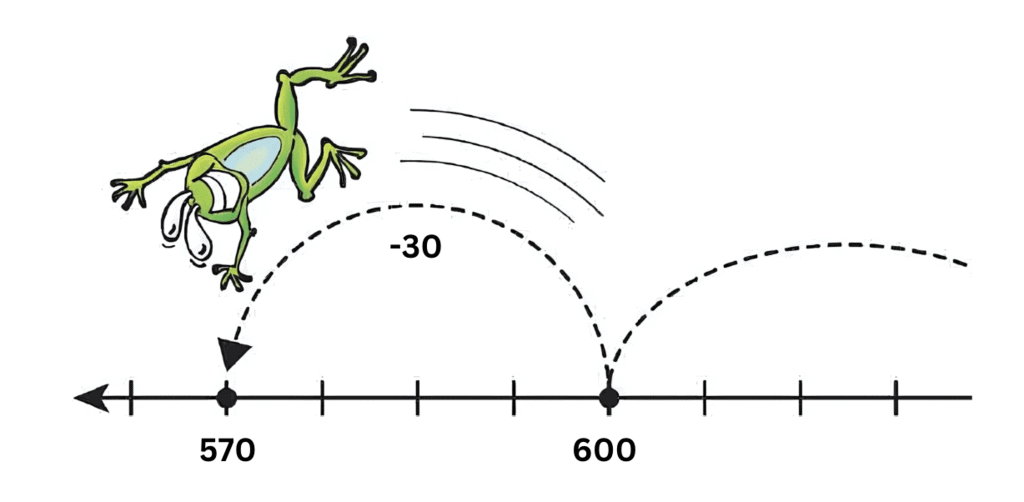
Example 1: Subtracting 30 each time

  • Starting number: 600
  • Rule: Subtract 30

Sequence: 600, 570, 540, 510, 480, 450, …

Here’s how it works:

  • Start with 600.
  • Subtract 30 from 600 to get 570
  • Subtract 30 from 570 to get 540
  • Subtract 30 from 540 to get 510
  • Continue this pattern to get the next numbers.

Example 2: Subtracting 40 each time

  • Starting number: 800
  • Rule: Subtract 40

Sequence: 800, 760, 720, 680, 640, 600, …

Here’s how it works:

  • Start with 800.
  • Subtract 40 from 800 to get 760
  • Subtract 40 from 760 to get 720
  • Subtract 40 from 720 to get 680
  • Continue this pattern to get the next numbers.

Identifying the Rule in Larger Number Patterns

To identify the rule in a number pattern with larger numbers, look at the differences between consecutive numbers:

Example 1:  Pattern: 450, 470, 490, 510, 530, …

  • Find the difference between each pair of numbers:
    • 470 – 450 = 20
    • 490 – 470 = 20
    • 510 – 490 = 20
    • 530 – 510 = 20

The rule here is to add 20 each time.

Example 2:  Pattern: 900, 870, 840, 810, 780, …Find the difference between each pair of numbers:

  • 900 – 870 = 30
  •  870 – 840 = 30
  • 840 – 810 = 30
  • 810 – 780 = 30

The rule here is to subtract 30 each time.

Try yourself:

What is the next number in the pattern 700, 680, 660, 640, …?

  • A.620
  • B.600
  • C.610
  • D.630

View SolutionCreating Your Own Patterns

You can create your own number patterns with larger numbers by choosing a starting number and a rule (either addition or subtraction by tens). For example:

  1. Starting number: 650, Rule: Add 40
    • Sequence: 650, 690, 730, 770, 810, …
  2. Starting number: 1000, Rule: Subtract 50
    • Sequence: 1000, 950, 900, 850, 800, …

By understanding and practicing number patterns with addition and subtraction using larger numbers, you’ll be able to recognize and create sequences that follow specific rules.

Learn with Story

Once upon a time in the town of Mathville, there lived a young detective named Noah. Noah was not an ordinary detective; he was a number detective, solving mysteries using his keen understanding of numbers and patterns.

One sunny day, Noah received a mysterious letter with a series of number riddles. Each riddle presented a clue about a specific number, and Noah’s task was to decipher these clues and find the hidden numbers. Excited for the challenge, Noah put on his detective hat and got to work.

Riddle 1: “I have 2 zeroes as digits and am very close to 99.”

Noah quickly realized that a number with two zeroes and close to 99 had to be 100. The zeroes in 100 act as placeholders, making it very close to 99.

Riddle 2: “I have 1 nine as a digit and is just 2 less than 300.”

This clue pointed to the number 298. It has one zero in the tens place and is just 2 less than 300.

Riddle 3: “I have 2 hundreds, 9 tens, and 8 ones.”

Noah recognized this as the number 298, as it has 2 hundreds (200), 9 tens (90), and 8 ones (8).

Riddle 4: “I have 2 tens and 5 ones, I am between 500 and 550, and my hundreds digit is 5.”

This described the number 525. It has 5 tens and 2 ones, is between 500 and 550, and the hundreds digit is 5.

Noah continued solving each riddle with enthusiasm, using his knowledge of place value and number sense to crack the codes. After solving all the riddles, he realized that the final mystery number was hidden in a clue about centuries and half centuries.

Riddle 5: “I am century + half century.”

This clue referred to the number 150. A century is 100, and half a century is 50. When you add them together, you get 150.

Noah felt proud of his detective skills and decided to share his solutions with the people of Mathville. 

You can also solve the number riddles just by understanding numbers more. 

Making numbers

To create a number in the hundreds using different numbers, we can break down the number into its place values and then fill in the blanks with appropriate numbers. Let’s use the example of making the number 789 using six different numbers:

  1. Identify the Place Values of the Number:
    • Hundreds place: 700
    • Tens place: 80
    • Ones place: 9
  2. Fill in the Blanks with Different Numbers:
    • To make 700, we can use 300 + 200 + 200
    • To make 80, we can use 40 + 40
    • To make 9, we can use 4 + 4 + 1

Putting these numbers together: 

  • 700=300+200+200
  • 80=40+40
  • 9=4+4+1

So, to create the number 789 using six different numbers, we can use: 300+200+200+40+40+4+4+1=789300+200+200+40+40+4+4+1=789

This breakdown shows how we can represent a number in hundreds using various numbers that add up to the desired value. You can do similar to all numbers. 

In summary, we explored how numbers can be represented in various ways and learned about number patterns. We also discussed how to create number patterns using operations such as addition and subtraction. You are encouraged to try additional examples to deepen your understanding and become more familiar with these concepts.

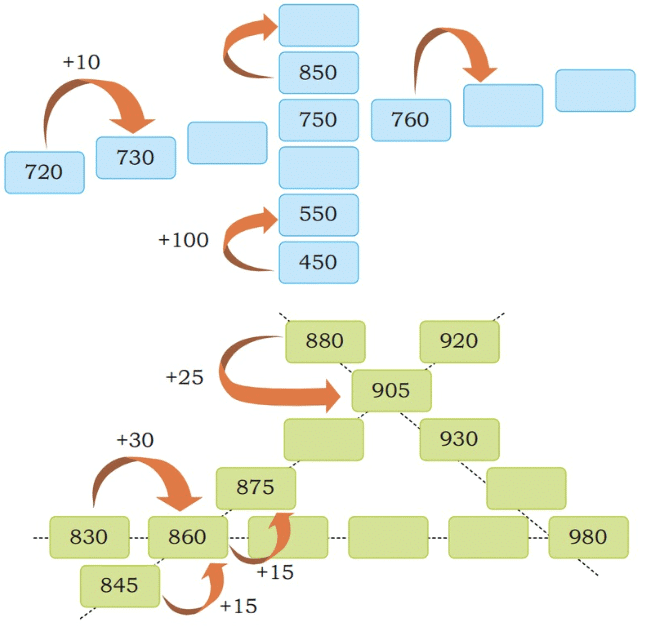
Let’s Practice Question 1: Milin and Aditya are resting. Shubh asks them to complete the number patterns. Let us help them fill in the empty boxes.

  View Answer

08. Fair Share- Chapter Notes

Introduction

Imagine you have a yummy chocolate bar, and you want to share it with your friend. But wait! How do you make sure you both get an equal piece? That’s what we’ll learn in our exciting chapter on “Fair Share.” We’ll explore fun ways to divide treats like chocolates and parathas equally, making sharing fair and enjoyable for everyone. Sharing Things Equally

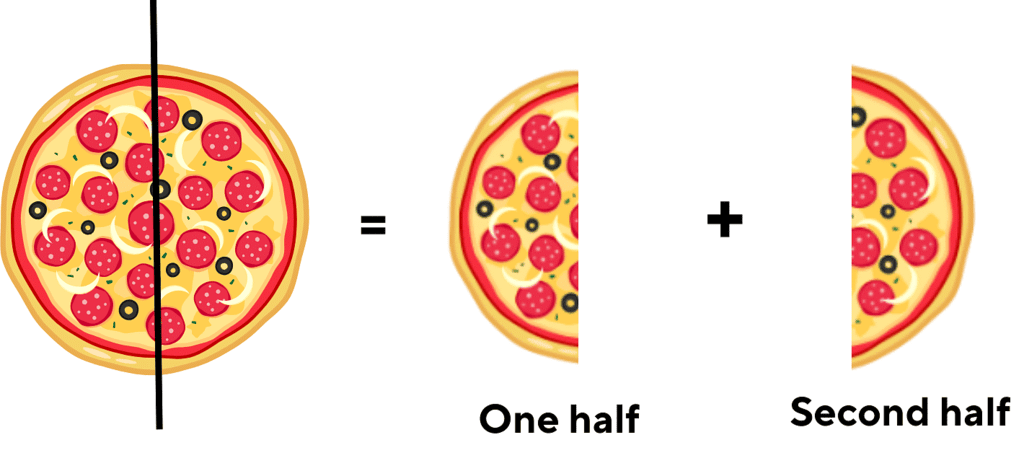
Imagine your summer vacations are going on and your best friend came to your house for a visit. Your mom prepared you a pizza and asked to share the yummy pizza with your friend. But how would you do so?

Yes, you guessed right! You’ll cut the pizza in a way that you and your friend get equal share of the pizza.

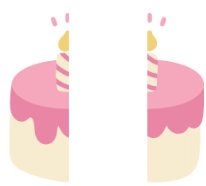
  • When you cut the pizza right down the middle, you make two parts that are exactly the same size. 
  • Each of these parts is called a “half” because it’s one of the two equal pieces.
  • Now, if you take one of these halves, you have half of the pizza. But what about the other half? It’s still there, right? That’s what we call the “full” pizza. 
  • When you put both halves together, you have the full pizza again!

So, what do we learnt from here?  When 1 whole is shared equally between 2 people, each share is called a half!

Try yourself:

What do we call each share when 1 whole is divided equally between 2 people?

  • A.Quarter
  • B.Half
  • C.Full
  • D.Third

View Solution

That’s how we understand the concepts of half and full—dividing things equally and knowing how the parts fit together to make the whole.

Let’s Practice!

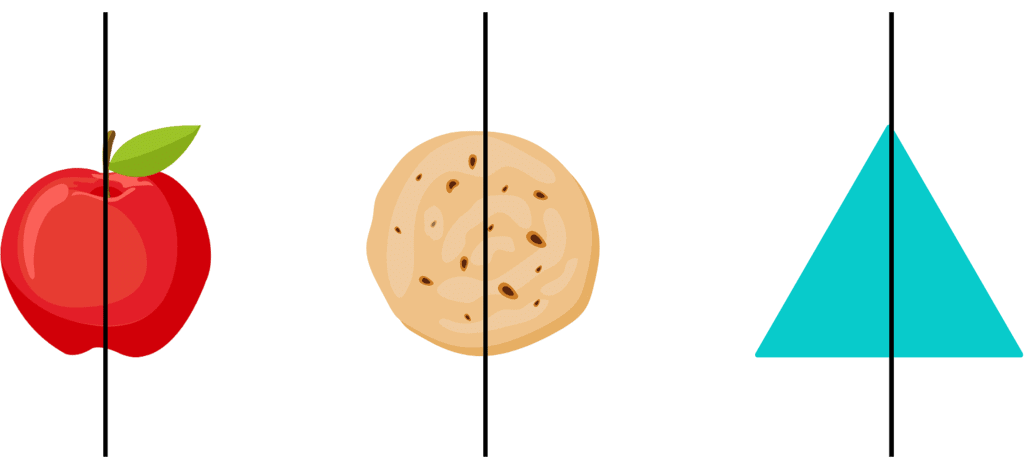
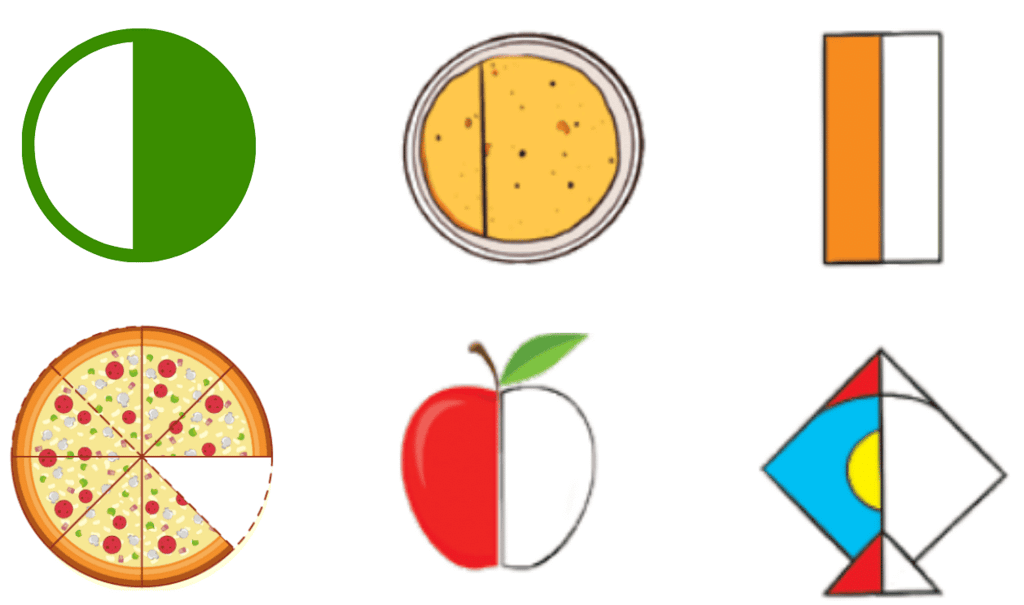
1. You’ve  been given some shapes and you’re required to divide each shape into two equal halves using a line.

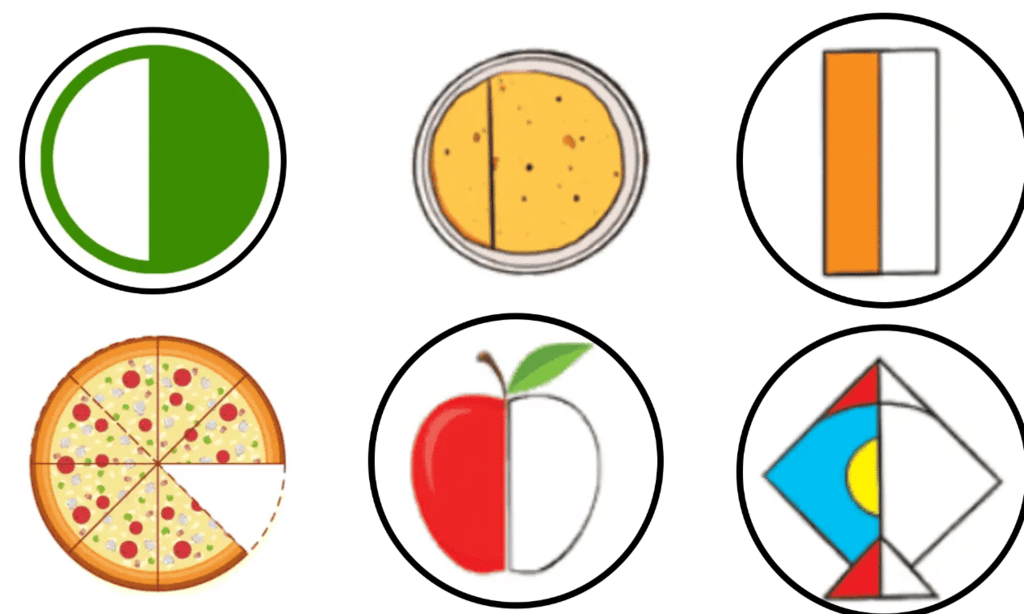
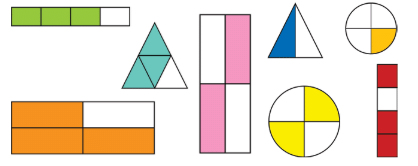
After dividing the shapes into equal halves, they would look something like :2. You’ve been given some shapes with some of their part shaded. You’re identify which one is equally shared and circle them.

The circled shapes below are the ones which are equally shared (equally halved):

Here, we haven’t circled the pizza and the paratha because:

  • Pizza is not equally halved, but contains more than half of the whole.
  • Paratha is not exactly halved, one half is bigger than the other half.

Great job! Now you know how to share things fairly and understand what halves are all about. You also learned how to tell when exactly half of something is shaded.Understanding Halves and Doubles 

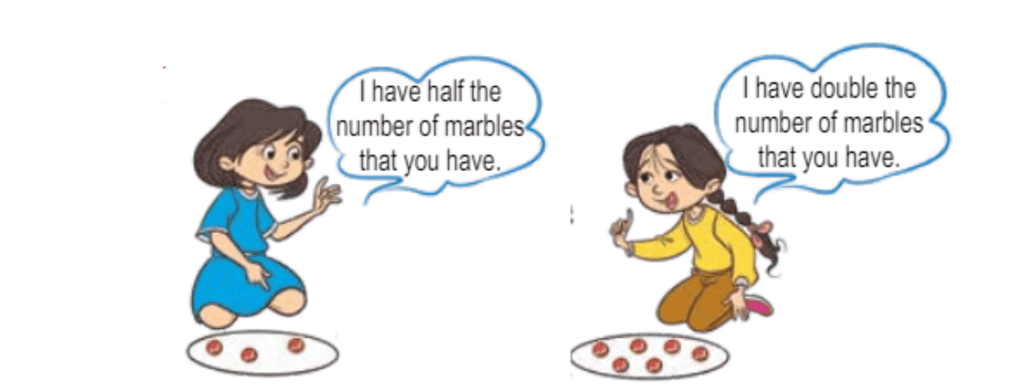
Imagine you and your friend have some marbles. You count them and find that you have 3 marbles, while your friend has 6. That’s a lot more!

Now, let’s see what’s happening here. 

  • When you have marbles and your friend has 6, you can say that your 3 marbles are half of your friend’s 6 marbles.
  • It’s like saying your friend has double the number of chocolates you have—twice as much!

Understanding halves and doubles helps us compare quantities. It shows how things can be divided equally or doubled up.

Learn with Stories

Once upon a time, there were two best friends named Mia and Leo. They loved spending time together, especially when it involved yummy treats. One sunny afternoon, Mia’s mom baked a delicious round cake for them to share.

  • Mia and Leo sat down at the table, excited to enjoy the cake. Mia said, “Let’s cut the cake into halves so we both get an equal piece.”
  • Leo asked, “What does cutting the cake into halves mean?”
  • Mia smiled and explained, “Cutting the cake into halves means we divide it into two equal parts. It’s like drawing a line down the middle so we each get the same amount.”
  • Mia carefully took a knife and cut the cake straight down the middle, creating two equal halves. Each half looked exactly the same, and Mia and Leo each got one half of the cake.
  • Later, Mia’s mom brought out another cake, but this time it was a rectangular cake. Leo said, “Let’s try doubling this cake!”
  • Mia was curious and asked, “What do you mean by doubling the cake?”
  • Leo explained, “Doubling the cake means we take what we have and make it twice as big. If we have one cake, doubling it would give us two cakes.”
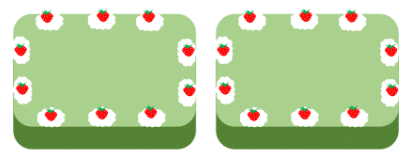
  • Mia and Leo pretended they had another identical rectangular cake. They placed the two cakes side by side and noticed that the area covered by both cakes together was double the area of one cake.
  • Leo said, “So, halving means cutting something into two equal parts, like when we split the round cake into halves. And doubling means making it twice as big, like imagining we have two rectangular cakes instead of one.”

Try yourself:

What does it mean to double a quantity?

  • A.Dividing it into two equal parts
  • B.Making it twice as big
  • C.Adding one more to it
  • D.Subtracting half of it

View Solution

Mia and Leo enjoyed their cakes, feeling happy and full, and they both learned a fun and delicious lesson about halves and doubles.

Understanding Halves and Quarters 

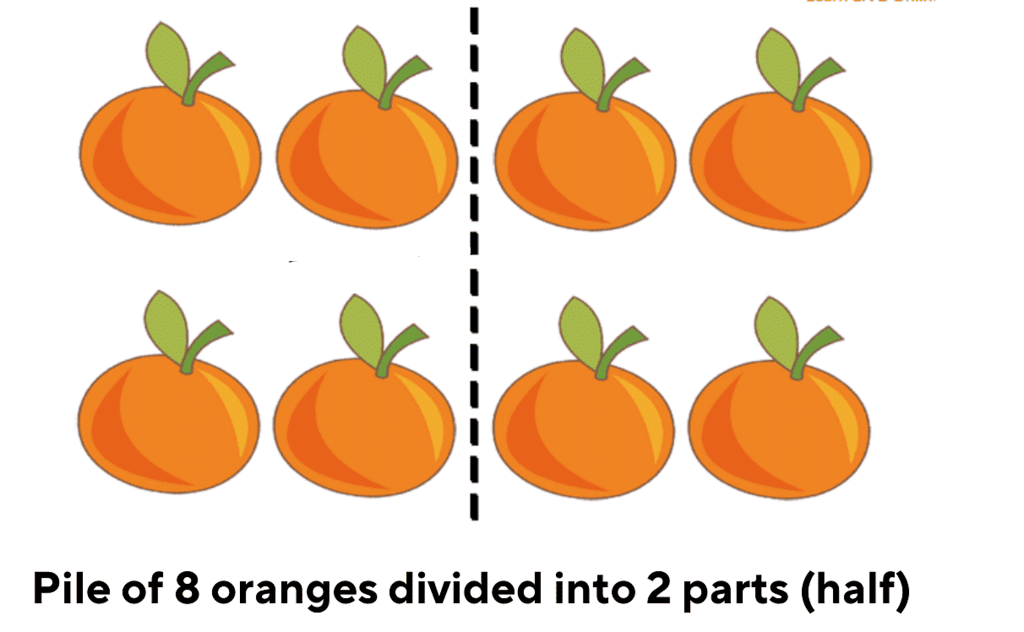
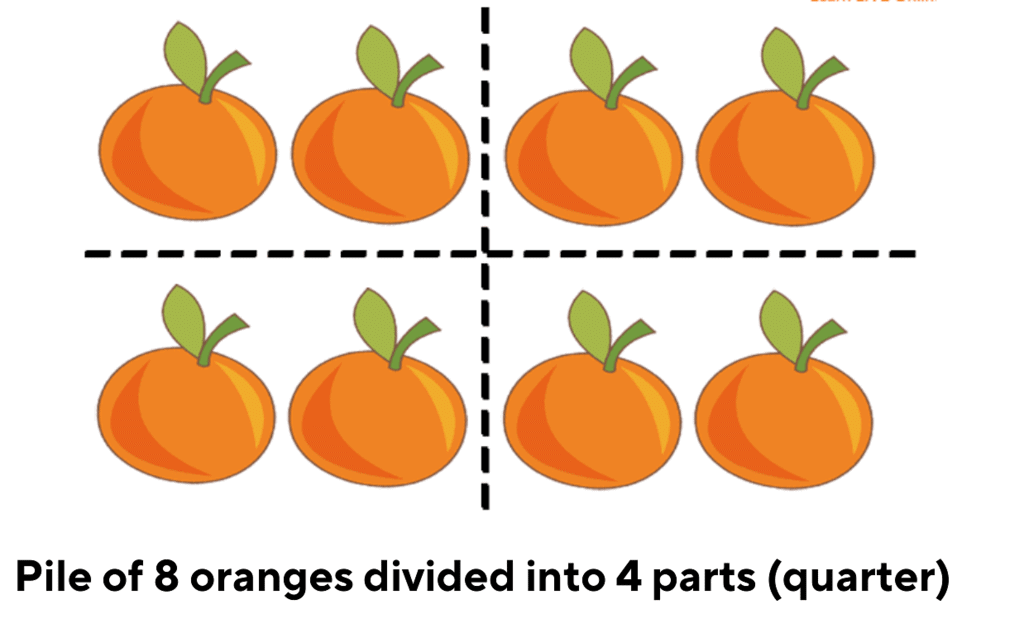
Imagine you have big pile of oranges.

  • half means dividing them into two equal parts. It is written as 1/2.

So, if you have 8 oranges and want to find half of them, you just need to share them equally. That means each half will have 8/2 =4 oranges.Now, let’s say you need to share your oranges with a friend, and you have to give a quarter of them.

  •  A quarter means dividing them into four equal parts. It is written as 1/4.

So, if you have 8 oranges, you divide them into 4 equal parts. Each part will have 8/4 =2 oranges.  So, when you give your friend a quarter of your oranges, you’re giving them 2 oranges.
Understanding about halves and quarters helps us share things fairly and divide them equally. Whether it’s sharing oranges or anything else, learning about halves and quarters makes numbers more fun to understand!

Understanding Quarters and Wholes

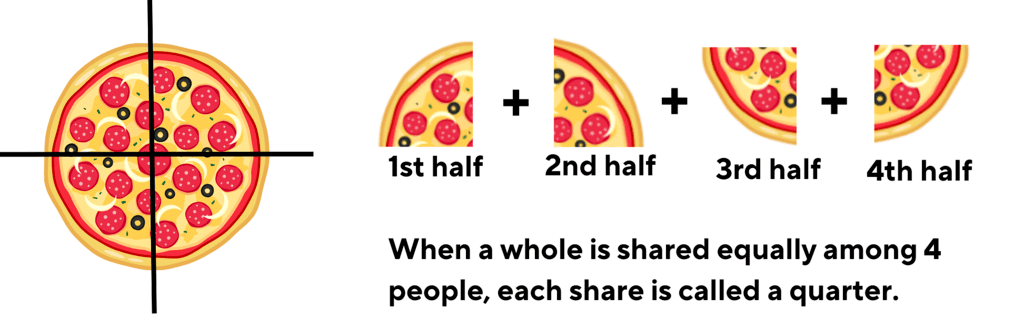
Imagine you have a delicious pizza. 

As you’ve already understood about quarters,

  • When we talk about quarters, we’re talking about cutting that pizza into 4 equal parts, just like four slices.

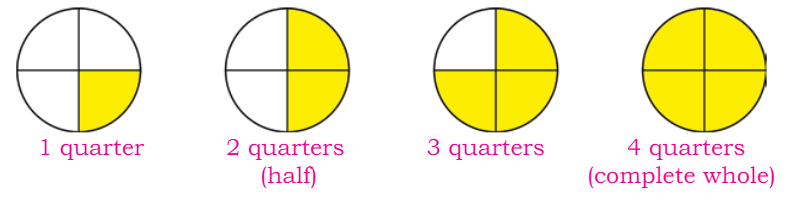
 Each slice is called a quarter. So, if you cut your pizza into four slices, each slice is one quarter of the whole pizza.Now, when we say “wholes,” we mean the complete pizza i.e. 4 slices put together. So, if you have all four quarters of the pizza, you have the complete pizza—a whole pizza!

And mathematically, we can say that:
1 quarter + 1 quarter + 1 quarter + 1 quarter = 4 quarters = 1 whole

So, 4 quarters make a whole pizza!

Edurev Tip: 

Let’s Practice 

Question: Use the clues to find the correct option. Also, Tick the correct option:
“I have less than double of 3 marbles.
I have more than half of 8 marbles.”

  View Answer

Question: You’ve  been given some shapes and you’re required to make a quarter of a whole using a line.  View Answer

Question: You’ve  been given some shapes and you’re required to tick mark the shapes which show three-quarters.  View Answer

Question: Show quarters and halves in different ways in the grids given below.   View Answer

07. Raksha Bandhan- Chapter Notes

Understanding Multiplication

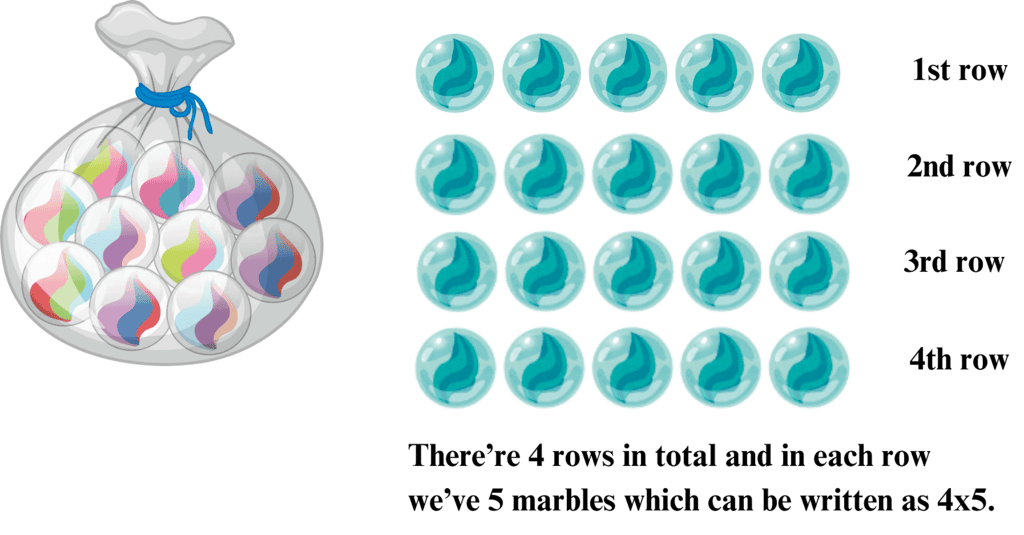
Imagine you have a basket full of colourful marbles. You want to find out how many marbles are in the basket. You see that there are 4 rows of marbles as given in picture below, with each row containing 5 marbles:

  1. 5 marbles in the first row,
  2. 5 marbles in the second row,
  3. 5 marbles in the third row, and
  4. 5 marbles in the fourth row.

Instead of counting each row individually, you can use multiplication to find the total number of marbles. Multiply the number of rows (4) by the number of marbles in each row (5): 4 × 5, which equals 20.

So, there are 20 marbles in the basket!

Seeing Patterns in Multiplication Tables

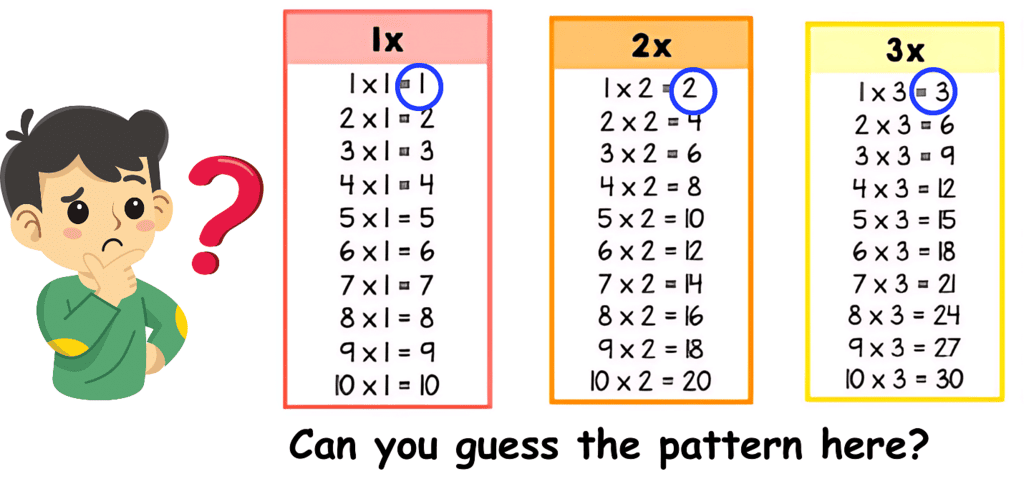
Multiplication is not just about memorizing numbers—it’s also about spotting patterns.

Let’s take the 5-times table as an example:

  • 1 × 5 = 5
  • 2 × 5 = 10
  • 3 × 5 = 15
  • 4 × 5 = 20
  • 5 × 5 = 25

What patterns do you see?

  • The last digits keep repeating5, 0, 5, 0, 5, 0…
  • All the answers end in either 0 or 5.

Now, can you guess the last digits of 11 × 5 and 12 × 5?

  • 11 × 5 = 55 → ends in 5
  • 12 × 5 = 60 → ends in 0

By noticing patterns, we can predict answers without fully calculating. This makes multiplication easier and more logical.

Try yourself:

What is the result of 6 multiplied by 3?

  • A.12
  • B.18
  • C.15
  • D.24

View SolutionUnderstanding Division

Division is a method of sharing things equally among a specific number of people. It also helps us find out how many times one number goes into another.

  • Imagine you have a big box of delicious kaju katlis to share with your friends.
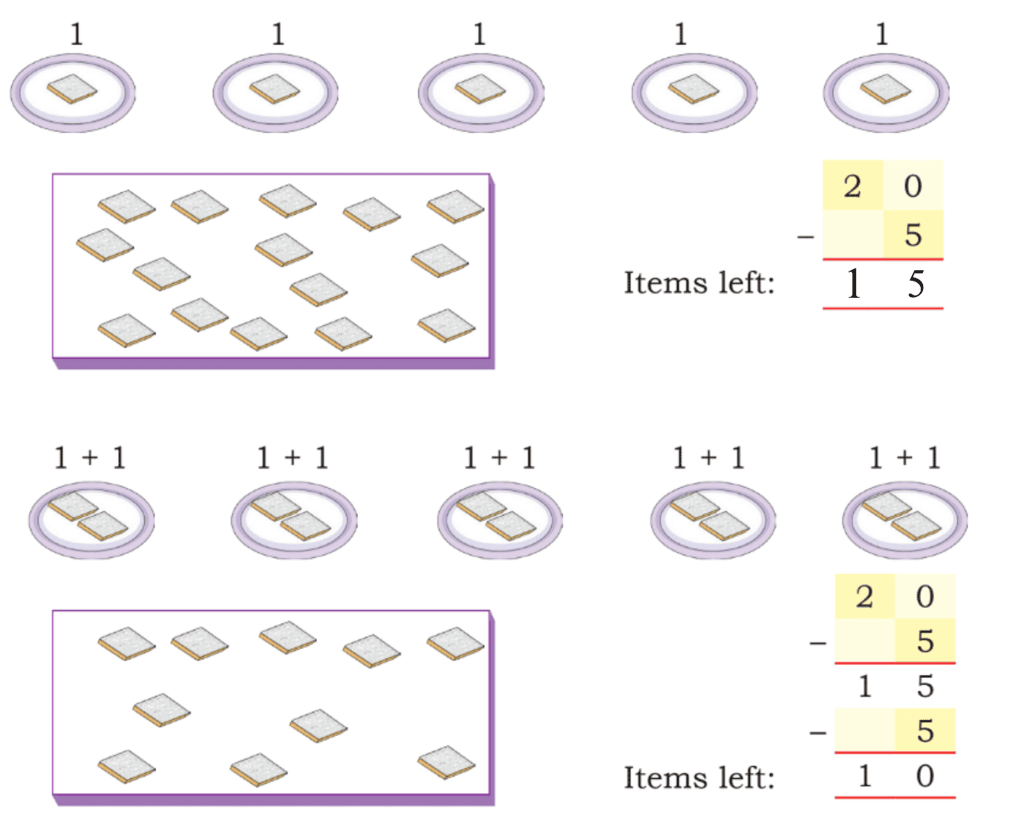
  • Suppose you have 20 kaju katlis and 5 friends to share with.
  • Instead of giving them out one by one, we can use division to see how many each friend gets.
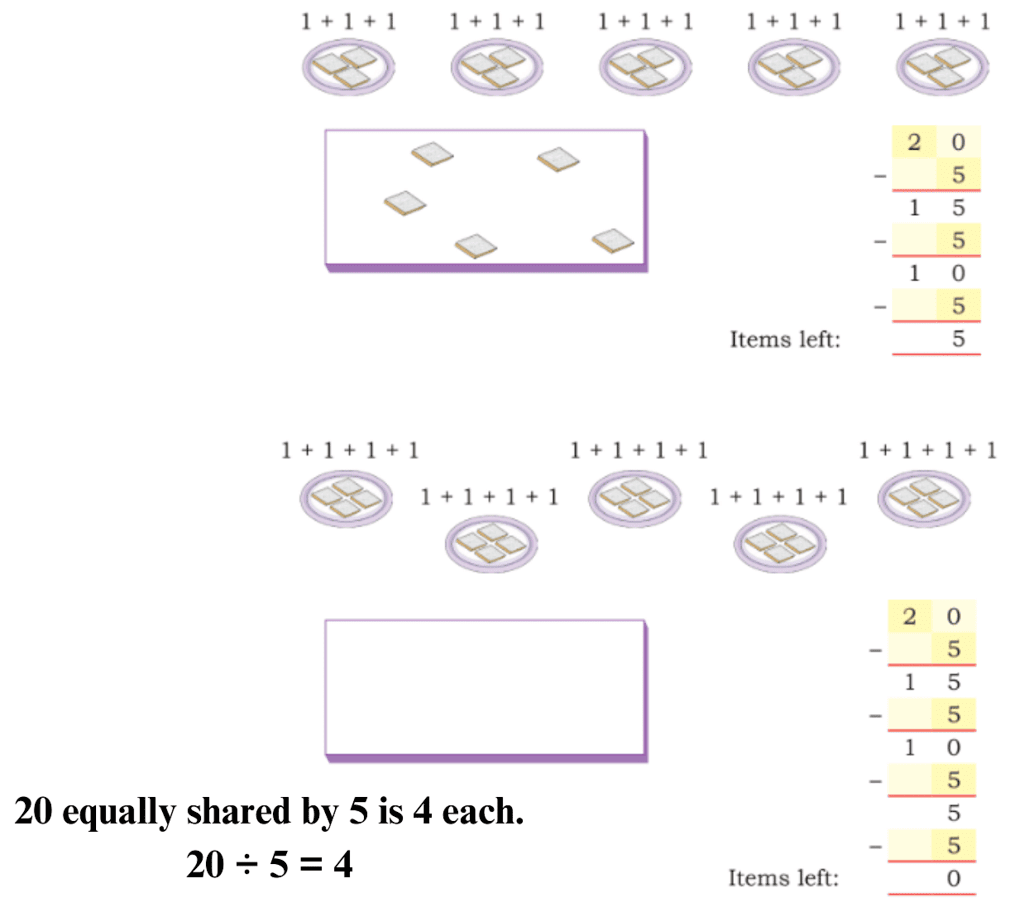
  • We start with the total number of kaju katlis, which is 20, and divide it by the number of friends, which is 5, i.e., 20 ÷ 5 = 4.
  • This division can also be seen as repeated subtraction. We subtract 5 kaju katlis each time until we have none left. After the first subtraction, we have 15 kaju katlis: 20 – 5 = 15. Then, subtracting another 5 leaves us with 10 kaju katlis: 15 – 5 = 10.
  • This continues until we subtract the last 5 kaju katlis, resulting in 0 kaju katlis.
  • Each time we subtract 5, we count it as one friend’s share. So, from 20 shared by 5, each person gets 4 kaju katlis.

Remainders in Division

  • Sometimes, if the total doesn’t divide evenly, we might have a remainder. For instance, if you had 22 kaju katlis and 5 friends, each friend would still get 4, but there would be 2 kaju katlis left over.

This is how division helps us share items fairly among a group, ensuring everyone receives their fair portion.

Learning with Story: Raksha Bandhan

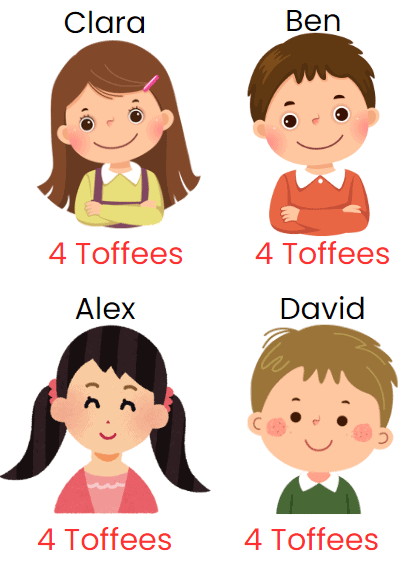
Once upon a time, during the festive occasion of Raksha Bandhan, in a cosy little house, there lived a girl named Sara. Sara loved her four cousins: Alex, Ben, Clara, and David. One sunny afternoon, their grandma gave Sara a bag of 12 toffees to share equally with her cousins. Sara wanted to make sure each cousin got the same number of toffees, so she needed to figure out how to do this.

Sara decided to use a method she learned in school called division. Division helps us find out how to split something into equal parts. Here’s how Sara did it:

  1. Count the Total Number of Toffees: Sara counted the toffees in the bag and found there were 12 toffees.
  2. Count the Number of Cousins: Sara counted her cousins: Alex, Ben, Clara, and David. There were 4 cousins.

Sara realised she needed to divide the total number of toffees (12) by the number of cousins (4) to ensure fairness in sharing. She remembered the division symbol (÷) and set up her problem:

12 ÷ 4 = ?

To figure this out, Sara thought about it like this: if she gives 1 toffee to each cousin, she would have given out 4 toffees in total (because there are 4 cousins). She kept giving each cousin 1 toffee until all the toffees were gone.

Here’s how she did it step-by-step:

  1. She gave 1 toffee to each cousin, so 4 toffees were given out (12 – 4 = 8).
  2. She gave another 1 toffee to each cousin, so another 4 toffees were given out (8 – 4 = 4).
  3. She gave 1 more toffee to each cousin, giving out the remaining 4 toffees (4 – 4 = 0).

Sara saw that each cousin received 3 toffees. She checked her work: 3 toffees per cousin times 4 cousins equals 12 toffees.

So, the division was correct:

12 ÷ 4 = 3

Sara was happy that each of her cousins got an equal share of toffees, and they all enjoyed their sweet treat together.

Try yourself:What is the result of dividing 16 cookies equally among 4 friends?

  • A.3
  • B.4
  • C.5
  • D.6

View SolutionWays of Grouping

Let’s talk about a fun way to count things! Imagine you have a bunch of your favorite candies. How would you count them? There are many ways, and we’ll explore some exciting methods together!

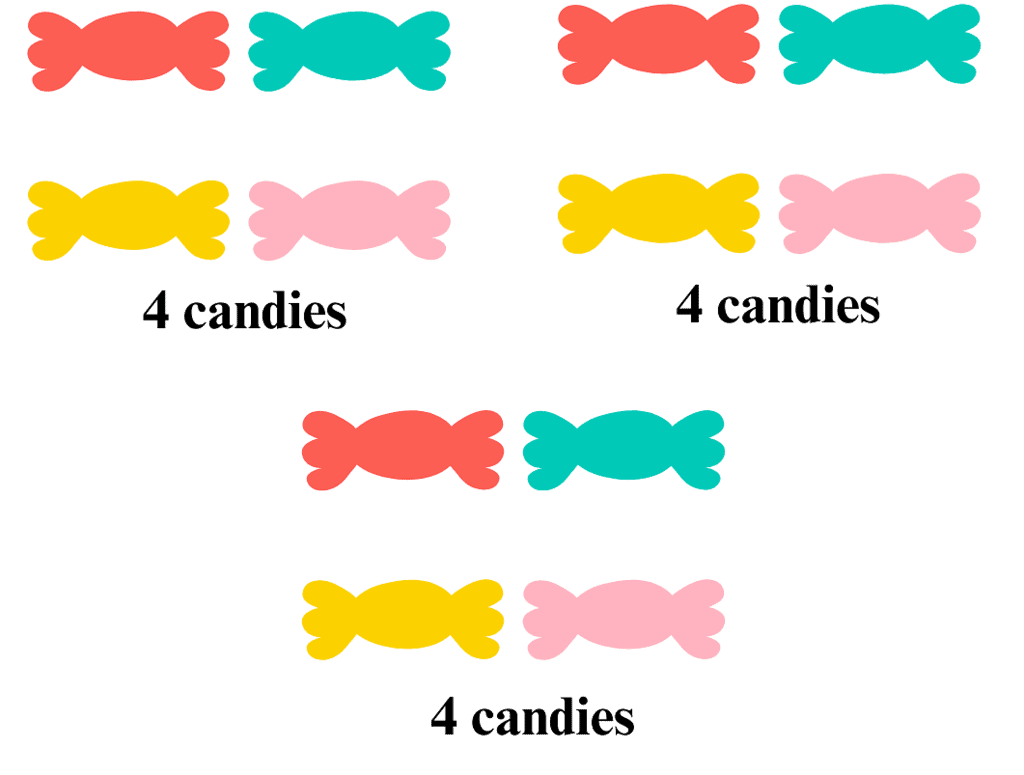
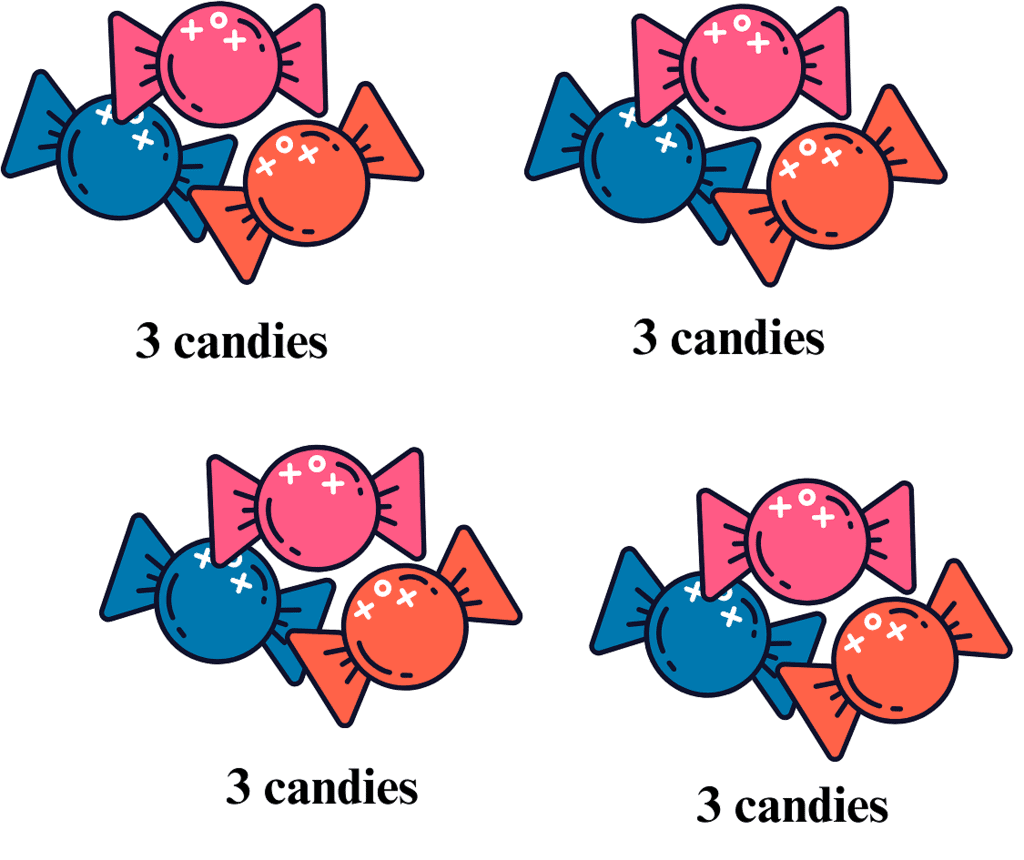
  • Think about your candies . You can put them in groups to count them easily. For example, let’s say you have 12 toys. You can make 3 groups with 4 candies in each group. So, you have 3 groups of 4 candies each. That’s one way to count them! 
  • Now, let’s try another way. Instead of 3 groups, let’s make 4 groups, each with 3 candies. So, now you have 4 groups of 3 candies each. That’s another way to count them! 
  • Whether you make 3 groups of 4 candies or 4 groups of 3 candies, you still have the same total number of candies, which is 12.

This shows us that we can count things by grouping them in different ways, but the total remains the same! It makes counting even more fun!Number Line Skip

In the evening, the family visits the playing field. Maya and her mother discover an exciting game called “Number Line Skip.” Atya uses a stick to draw a winding number path on the ground. She asks Dhara to write the numbers starting from 0. Dhara is SKIP JUMPING BY 3.

As they played, they noticed something amazing! Starting from 0, Dhara jumps to 3. From 3, she goes to 6. From 6, she continues to 9. They realised that by adding the same number, they could predict the next jump. Let’s look at Dhara’s jumps:

  • 1 jump → 3
  • 2 jumps → 3 + 3 = 6 = 2 x 3
  • 3 jumps → 3 + 3 + 3 = 9 = 3 x 3
  • 4 jumps → 3 + 3 + 3 + 3 = 12 = 4 x 3, and so on.

They also had a fun challenge: “Guess and write the next number she will jump to.” Atya places a flower on 12. “Skip jump with equal steps to reach the flower,” she instructs. No direct jumping to the flower is allowed.

Now, they hopped and laughed, discovering the wonders of numbers. The one who reaches the flower in the smallest number of jumps wins!Writing Tables

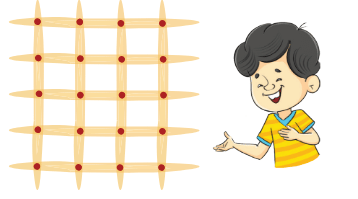
In the Fun Way of Writing Tables game, a little boy Aryan and his friends found a cool way to learn their times tables using sticks. They made a grid with sticks and counted where they crossed to figure out the answers.

Here’s how they did it:

  • Aryan lined up sticks in rows and columns to make a big square grid. 
  • Then, he counted where the sticks crossed to find the answer to different multiplication questions. For example, to find out what 5 times 3 is, she counted where the row labelled “3” and the column labelled “5” crossed.
  • He noticed a pattern in the answers, like how the last numbers repeated in some of them. This helped her understand how numbers work together.
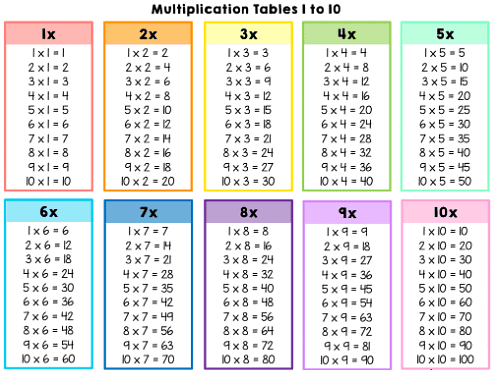
  • Following the same pattern, they discovered some other tables as well,which are shown below: 
  • Aryan and his friends also saw something cool when they looked at the tables for 2, 3, and 5. They noticed that some numbers had a special connection with others. This made them curious, and they wanted to explore more!
  • As you can see, when we multiply 1 with 2, we get 2; when we multiply 1 with 3, we get 3 and when we multiply 1 with 5, we get 5.
  • So, we can say that any number multiplied to 1 results in the same number.

By playing this game, Aryan and his friends had fun while learning about multiplication tables and discovering new patterns in numbers. Math became an exciting adventure for them!

Try yourself:

What is the result when 4 is multiplied by 7?

  • A.24
  • B.28
  • C.30
  • D.32

View SolutionWord Problems

Word problems play a crucial role in mathematics as they enable students to use their knowledge of basic arithmetic like additionsubtractionmultiplication, and division in everyday situations. Here are some examples of these types of problems.

Examples of Word Problems

1. There are 5 fruits in each basket. If there are 9 baskets filled with fruits, how many fruits are there in total?
Solution: Number of fruits in one basket = 5
Number of baskets = 9
Total fruits = Fruits per basket × Number of baskets = 5 × 9 = 45
Therefore, there are 45 fruits altogether.

2. Donald, the duck can see 60 legs in a cow shed. How many cows are there in the shed?
Solution: Total number of legs = 60
Number of legs per cow = 4
Total number of cows in the shed = 60 / 4 = 15
So, there are 15 cows in the shed.

By working through these examples, you can become more comfortable with division and multiplication.

Let’s Practice

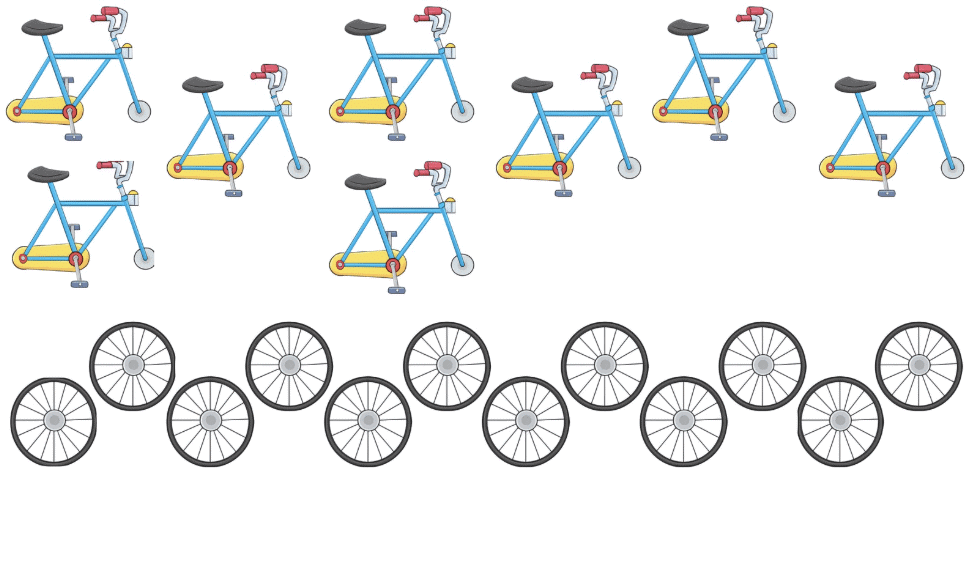
Question: Each cycle needs 2 wheels. How many cycles can be fitted with 12 wheels?

  View Answer

06. House of Hundreds – I Chapter Notes

Introductions

Let’s Understand with Story

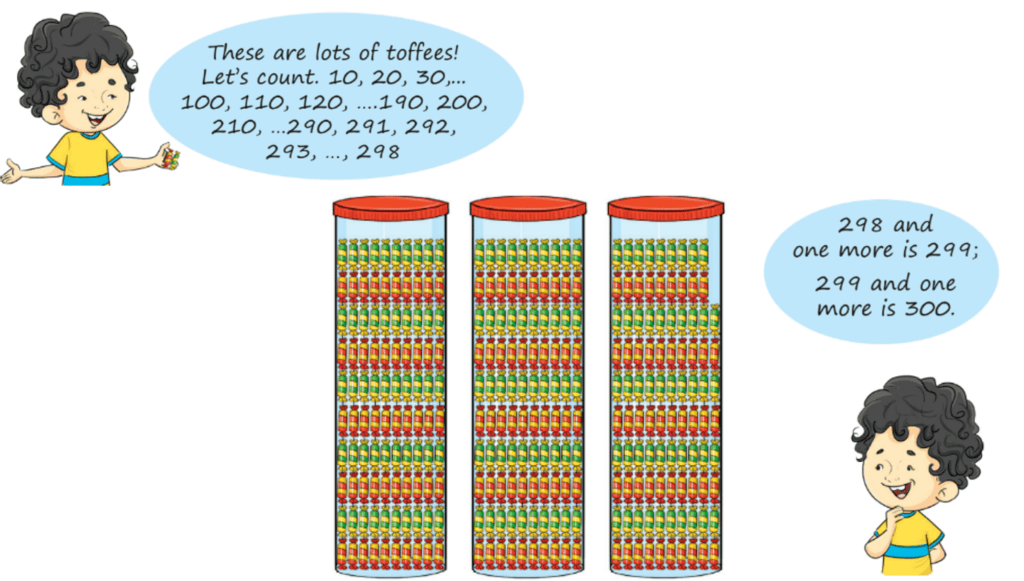
On a bright sunny day at the busy carnival, Ajit, Tom, and Joy came across a stall filled with yummy toffees. Joy quickly picked up two toffees, which led to a fun guessing game among the friends. “Guess how many toffees are in the boxes. Count and check.” This began a sweet journey of counting and discovery.
To count the toffees easily, they began with these numbers: 10, 20, 30, … 100, 110, 120, … 190, 200, 210, … 290, 291, 292, 293, 298. Jojo has 2 toffees in his hand. How many toffees do they have altogether? 298 plus one more makes 299; 299 plus one more makes 300.

  • How many more triangles are needed to make 300?
  • How many bangles are there less than 300?
  • Which is more: bangles or triangles?

Guessing and Counting Toffees

  • Jojo starts with two toffees in his hand and checks the boxes.
  • They counted: 10, 20, 30, … 100, 110, 120, … 190, 200, 210, … 290, 291, 292, 293, 298.
  • In total, they counted 298 toffees; adding one gives 299.
  • Joy smiled and said, “299 and one more is 300!”
  • They celebrated reaching the magical number of 300 toffees.

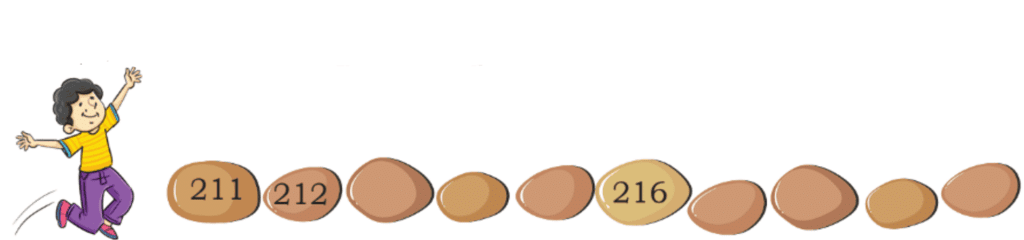
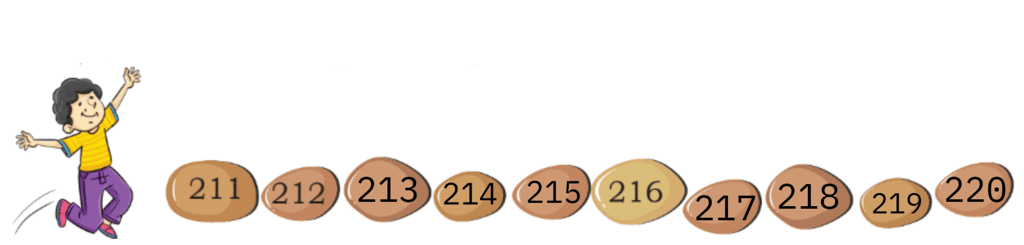
1. Joy is hopping on the tiles at the fair. Can you guess the missing numbers below:

Have you tried guessing the numbers yet? If not, that’s okay! The missing numbers have been given below for you:

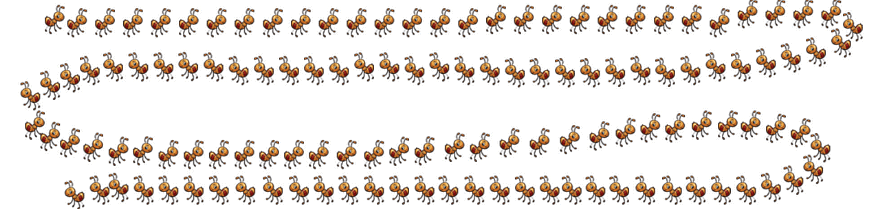
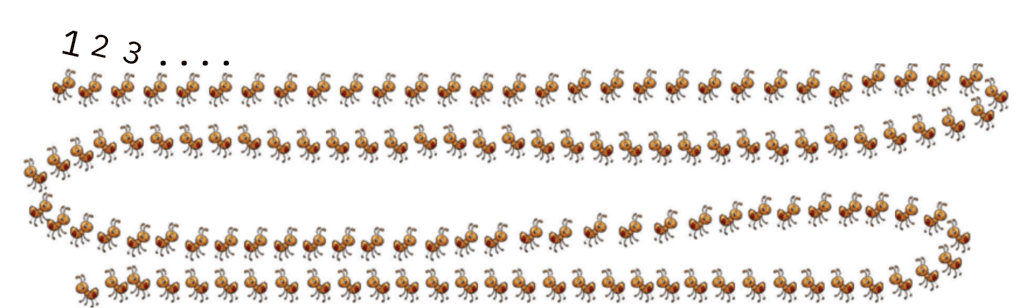
2. Imagine there are some ants on the ground that found some food. Can you guess how many ants there might be? After making a guess, let’s count them together to see if our guess was correct.

Hint:

Well done! You’ve guessed the right number. So, the total number of ants are 127. 

Try yourself:Joy has 4 boxes of candies. If the first box has 72 candies, the second box has 85 candies, and the third box has 67 candies, how many candies are in the fourth box if the total number of candies is 282?

  • A.40
  • B.75
  • C.86
  • D.58

View SolutionWriting Number Sentences

To help children in developing a method for counting accurately, we can use matchsticks to visualise numbers. For instance, we can create large numbers using matchsticks or any other common materials found at home and bring them to school.

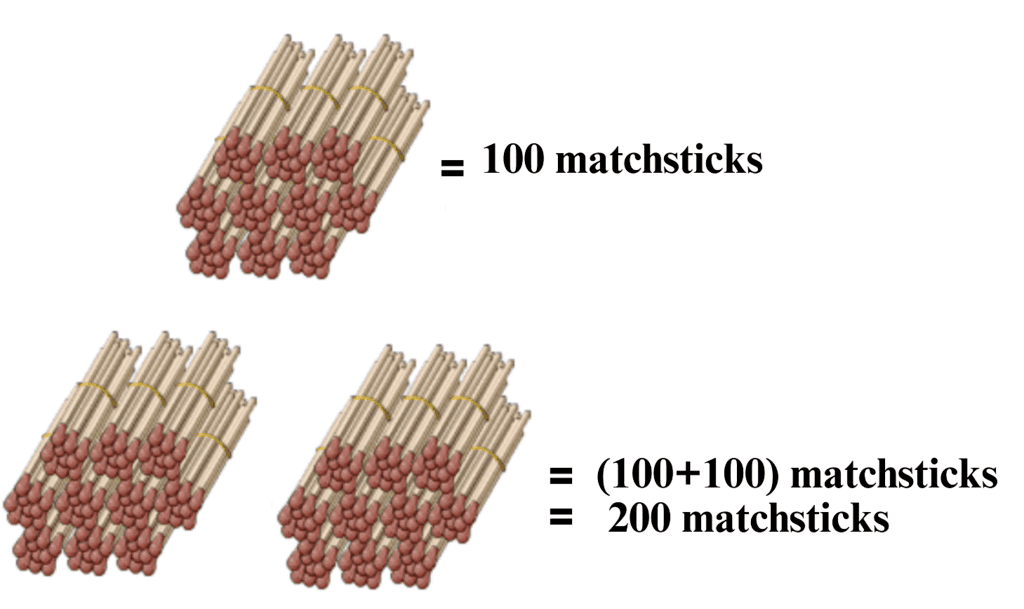
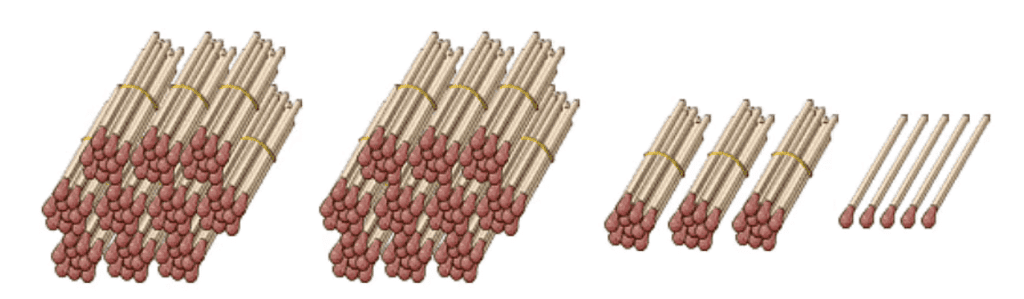
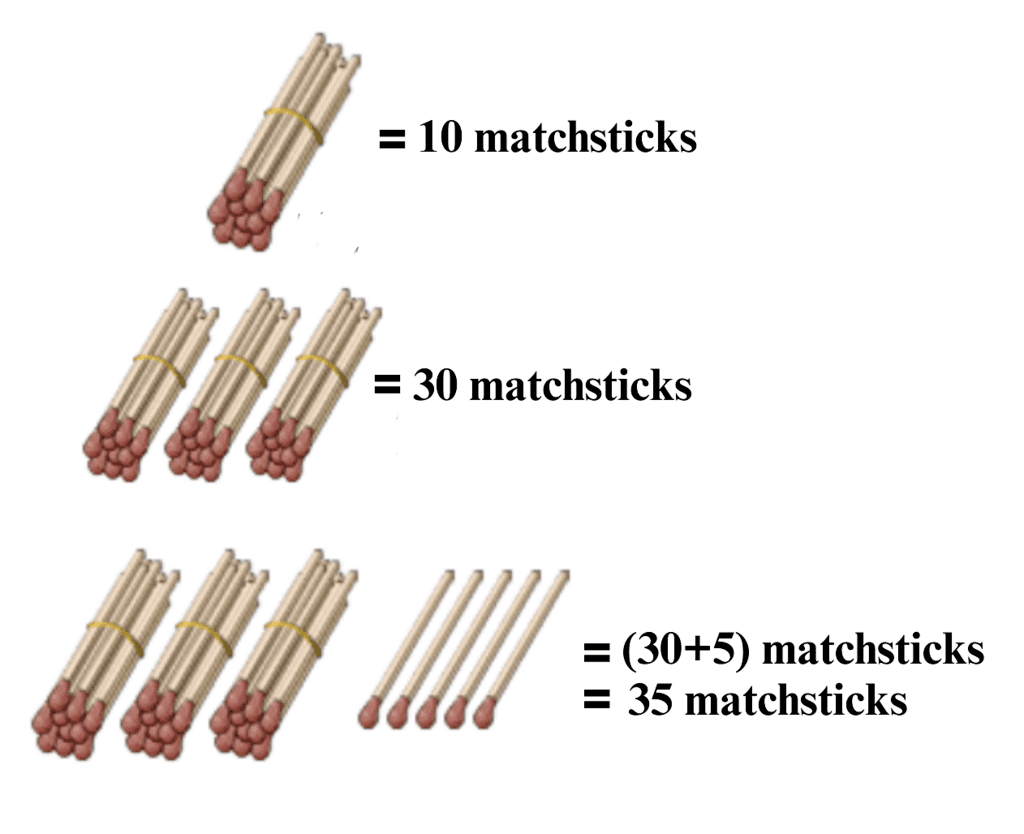
Consider two large bundles of matchsticks. Each large bundle contains 10 smaller bundles, and each of these smaller bundles has 10 matchsticks. To calculate how many matchsticks are in one large bundle, we multiply: 10 (small bundles) x 10 (matchsticks in each small bundle) = 100 matchsticks in one large bundle. Since we have two large bundles, we multiply 100 (matchsticks in one large bundle) x 2 (large bundles) = 200 matchsticks in total from the large bundles.

Now, we have 3 small bundles left over along with 5 extra matchsticks. Each of these small bundles has 10 matchsticks, so we multiply: 3 (extra small bundles) x 10 (matchsticks in each small bundle) = 30 matchsticks from the extra small bundles. Adding the 5 extra matchsticks gives us 30 + 5 = 35 matchsticks. Therefore, in total, we have 200 matchsticks from the large bundles and 35 matchsticks from the small bundles and extra matchsticks, resulting in a total of 235 matchsticks.

We can express the number 235 in the following ways:

  • 200 and 35 more (200 + 35)
  • 15 less than 250 (250 – 15)

Number Fun: Up and Down We Go!

Once upon a time, there were five friends named Jack, Lily, Ben, Mia, and Sam. They were all going on a camping trip together.

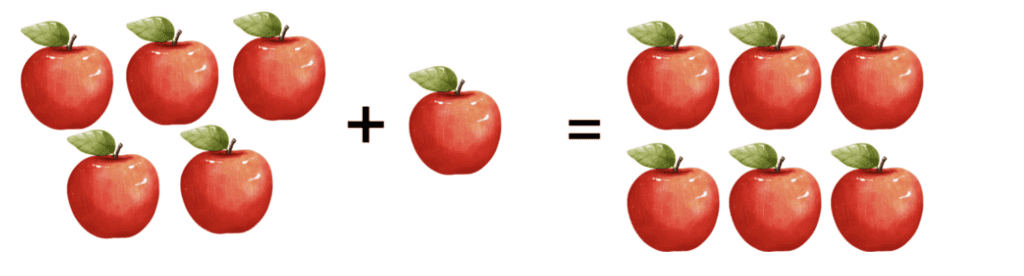
  • Jack brought 5 apples for everyone to share. He gave one apple to Lily, so they had 5 apples in total. Adding 1 made the number of apples bigger.
  • Meanwhile, Ben had 10 marshmallows to roast over the campfire. But Sam accidentally dropped 2 into the fire, leaving them with only 8 marshmallows. Taking away 2 made the number of marshmallows smaller.

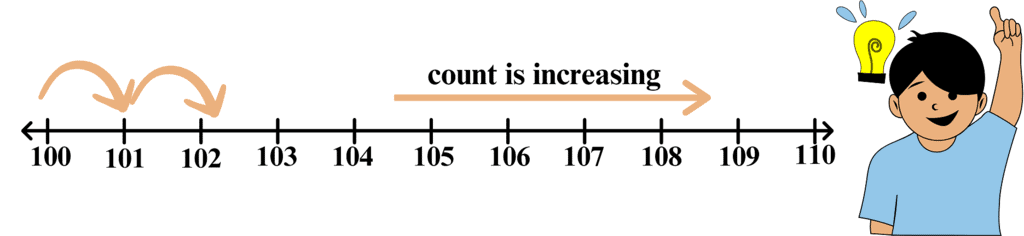
By adding more or taking some away, the number of items they had changed during their camping adventure! Now, let’s explore numbers! We’ll learn how to increase or decrease them.

Increasing and Decreasing Numbers

  • 285 – increase the number by one
    Sol: To make the number bigger, we add one: 285 + 1. This gives us 286.
  • 147 – increase the number by ten
    Sol: To increase the number, we add ten: 147 + 10. This results in 157.
  • 367 – decrease the number by 2
    Sol: To make the number a bit smaller, we take away 2: 367 – 2. This gives us 365.
  • 289 – decrease the number by 10
    Sol: To reduce the number, we take away 10: 289 – 10. This results in 279.
  • 290 – increase the number by 20
    Sol: To make the number bigger, we add 20: 290 + 20. This gives us 310.

Now, let’s compare some numbers using the signs (> or <) to=”” see=”” which=”” is=”” greater=”” or=””>

  • 199 < 221
  • 285 > 275

Yay! You’ve learnt how to make numbers bigger and smaller. Well done!

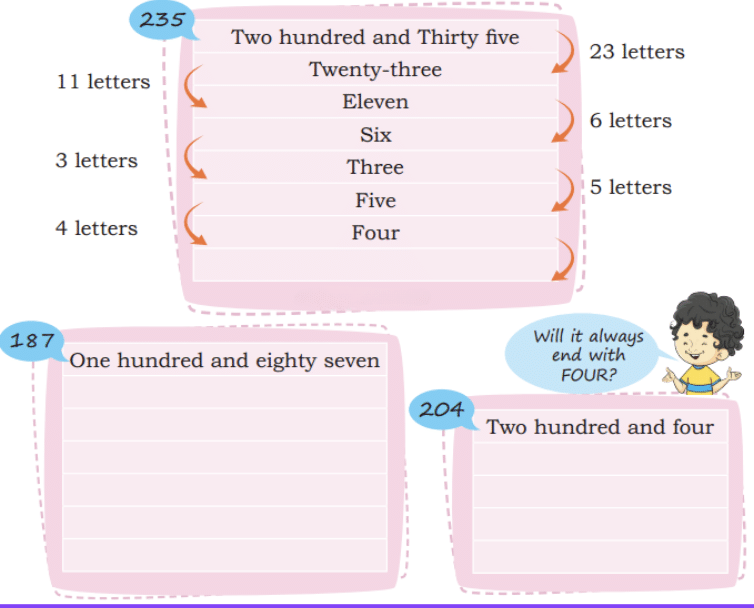
Counting the Number of Letters in Number Names

Counting the letters in number names is an enjoyable way to practise counting. Here’s how you can do it:

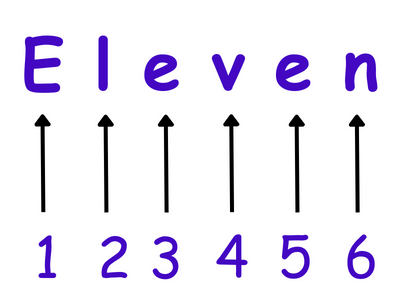
  • Write Down the Number: Begin by writing the number you want to count the letters for. For example, let’s use the number “Eleven.”
  • Spell Out the Number: Write the number in words. “Eleven” is spelled E-L-E-V-E-N.
  • Count the Letters: Count each letter in the word. “Eleven” has six letters: E-L-E-V-E-N.
  • Repeat for Other Numbers: You can do this for other numbers too. For instance, “three” has five letters (T-H-R-E-E), “seven” has five letters (S-E-V-E-N), and “twenty” has six letters (T-W-E-N-T-Y).

Magical Count: Write down any number name. Count the letters in that name and then write down the new number name. Keep repeating. 

Writing Numbers in Sentences

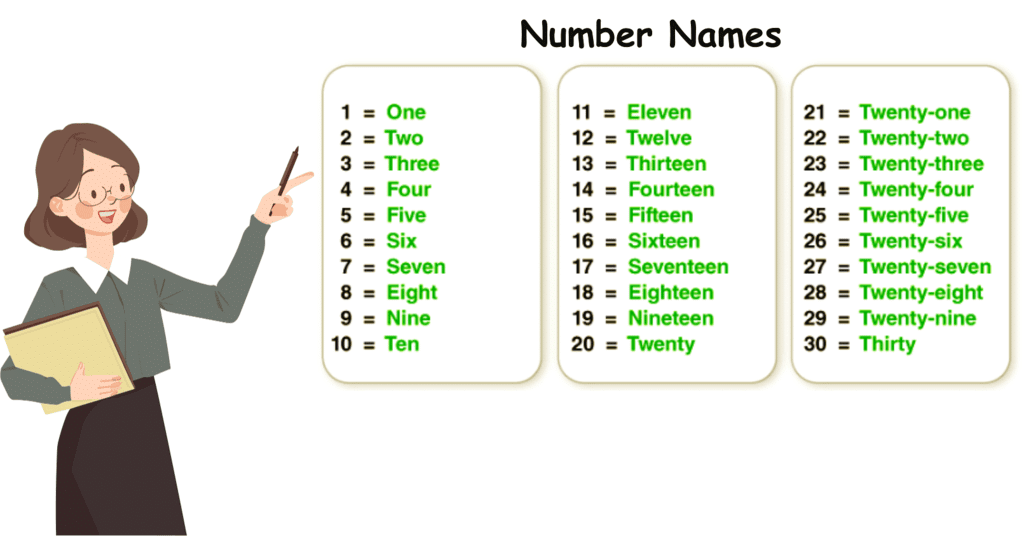
  • When we count or discuss numbers, we use special words known as number names.
  • These help us express numbers in words rather than just digits. Let’s explore how to write number names for three-digit numbers.
  • Three-digit numbers consist of three digits. We read them from left to right, just like reading words in a book.
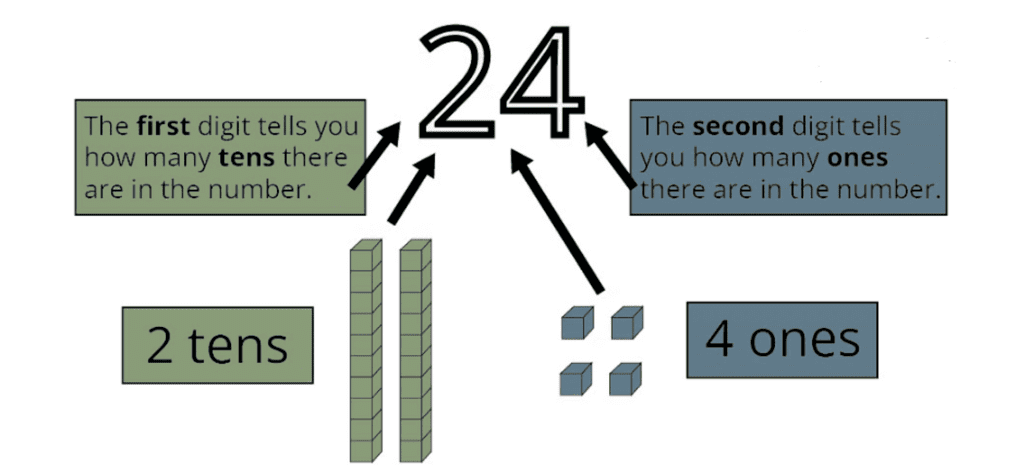
  • The number 123 contains three digits: 1, 2, and 3. Each digit has its own place: hundreds, tens, and ones.
  • To write three-digit numbers in words, we start by stating how many hundreds, then how many tens, and finally how many ones. For example: The number 123 is written as “one hundred twenty-three.”
  • We say (i) “one hundred” for the hundreds place , (ii) “twenty” for the tens place , and (iii) “three” for the ones place.

Let’s look at some examples of three-digit numbers:

  • 256: This is read as “two hundred fifty-six.”
  • 378: This is read as “three hundred seventy-eight.”
  • 429: This is read as “four hundred twenty-nine.”

Counting the Letters

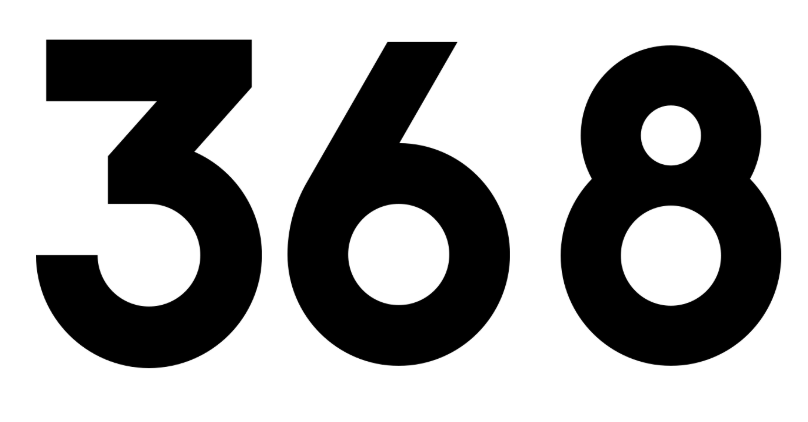
  • In the colorful land of Numerica, there were three best friends: Two-hundred and Thirteen, Three Hundred and Sixty Seven, and One Hundred and Ten. They wanted to know whose name was the longest, so they decided to count the letters in their names
  • They gathered around a magical counting tree, where each leaf had a letter written on it. (i)  Two-hundred and Thirteen suggested they count the letters in their names. (ii)Three Hundred and Sixty Seven suggested they take turns counting each other’s letters to make sure they didn’t miss any.
  • They started with Number Two-hundred and Thirteen and counted 21 letters.
  • Then, they counted 23 letters in Number Three hundred and Sixty Seven. 
  • Finally, they counted 16 letters in Number One Hundred and Ten
  • They discovered that Number Three hundred and Sixty Seven had the longest name with 25 letters.

They agreed that each of their names was unique and special. They were happy to learn how to count the letters in their names.

Try yourself:Which number name has the most letters in it?

  • A.Two hundred and thirteen
  • B.Three hundred and sixty seven
  • C.One hundred and ten
  • D.Four hundred and fifty two

View SolutionCounting Numbers on a Number Line

Number Line

A number line is a helpful way to show numbers in order from the smallest to the largest. It helps us see how numbers relate to one another. The number line includes positive numbersnegative numbers, and zero.

Picture yourself at one end of the number line. As you move along it, you’ll notice the numbers increase. If you go the opposite way, the numbers decrease.

Counting on a number line is similar to taking steps. For instance, if we count from 100 to 110:

  • Start at 100
  • Step to 101
  • Then to 102
  • Next to 103
  • Finally, reach 110

The number line also includes zero, an important number that acts as a middle point. To the left of zero, we have negative numbers which are less than zero, such as:

  • -1
  • -2
  • -3

So, number lines help us understand how numbers are arranged and how we can move between them. Grasping both positive and negative numbers on the number line is essential for understanding basic mathematical ideas.Understanding Place Value

  • In maths, every number consists of different parts known as digits.
  • Each digit has a specific value depending on its position in the number, which we call place value.
    For example, consider the number 786. In this number:
    • The digit 7 is in the hundreds place, giving it a value of 700.
    • The digit 8 is in the tens place, making its value 80.
    • The digit 6 is in the ones place, so its value is just 6.

Together, these values add up: 700 (from 7 hundreds) + 80 (from 8 tens) + 6 (from 6 ones) equals 786. Understanding place value helps us grasp the value of larger numbers.

Now let’s take the number 24 as an example.

  • It has two digits.
  • The digit 4 represents four single items, and it’s placed in the ones position.
  • The digit 2 in the tens place represents two bundles of ten items each, which makes twenty.
  • So, when we combine the value of 20 with the value of 4, we get the number 24.

Comparing Numbers

 ‘=’ is the symbol used for ‘equal to‘.

  • 3 = 3 is read as ‘3 is equal to 3’.
  • Look at the numbers from 11 to 20 in order.  The number 13 is to the left of 14. So, 13 < 14. The number 14 is to the right of 13. So, 14 > 13. Every number is equal to itself. 14 = 14, 15 = 15, 16 = 16, etc.
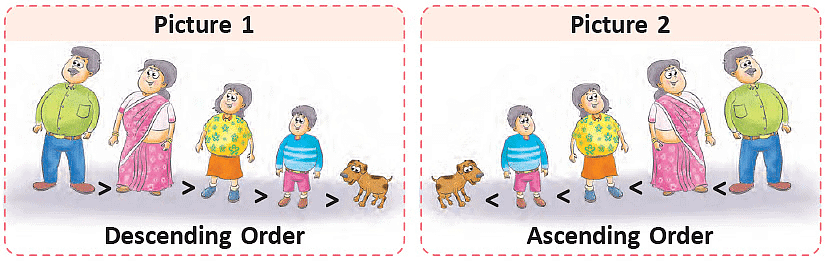
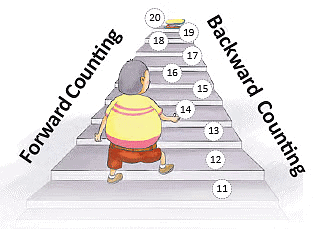

Note:

  • When comparing two numbers, help children focus on the quantities that the numbers represent.
  • Use Dienes block representation to show that 1 H is more than 1 T and 1 O. Similarly, 1 T is more than 1 O.

Comparing 3-digit Numbers

  • To compare numbers, we check their hundredstens, and ones places.
  • If the hundreds places are the same, we move to the tens. If those are equal, we then look at the ones place.
  • Encourage children to think about what the numbers actually represent.
  • Use Dienes blocks to illustrate that 1 H is greater than 1 T and 1 O, and that 1 T is greater than 1 O.
  • Examples: (i) 329 and 392: Both have three hundreds, but 329 has 2 tens while 392 has 9. Thus, 392 is greater. (ii) 235 and 523: 235 has 2 hundreds and 3 tens, while 523 has 5 hundreds. So, 523 is greater. (iii) 157 and 153: 157 has 7 ones, while 153 has 3. Therefore, 157 is greater. (iv) 432 and 423: Both have four hundreds, but 432 has 3 tens compared to 2 in 423. Thus, 432 is greater.

Ascending and Descending Orders

When it comes to numbers, putting them in order from the largest to the smallest is called descending order or decreasing order. On the other hand, putting them in order from the smallest to the largest is called ascending order or increasing order.

  • Moving from the largest number to the smallest is known as descending order.
  • Moving from the smallest number to the largest is known as ascending order.

For instance, the numbers 2, 4, 5, 8, and 9 are arranged in ascending order, while 9, 8, 5, 4, and 2 are in descending order.

To compare numbers, we use the symbols > (greater than) and < (less= than)=”” to=”” indicate=”” their=”” relationships.=”” for=””>

  • 199 < 201, which means 199 is less than 201.
  • 285 > 275, indicating that 285 is greater than 275.

Now, let’s compare the following numbers and use the symbols > and <>

  1. 185 < 211.
  2. 295 > 265.

Consider these examples:

  • 432 is > 423 because both have four hundreds, but 432 has 3 tens while 423 has 2 tens.
  • 329 is < 392 because both have three hundreds, but 329 has 2 tens while 392 has 9 tens.
  • 110 is > 11 because 110 has 1 hundred while 11 has no hundreds (zero hundreds).

Try yourself:What is the ascending order of the numbers 456, 564, 645, and 546?

  • A.456, 546, 564, 645
  • B.456, 564, 546, 645
  • C.645, 564, 546, 456
  • D.546, 564, 645, 456

View SolutionUse of > or < in Forward and Backward Counting

  • Jiya starts climbing the stairs from stair number 11. She has to reach stair number 20 to pick up her pencil pouch that she dropped there.
  • As she climbs up, she counts upwards as 111213141516171819, and 20. On her way down with the pencil pouch, she counts backwards as 201918171615141312, and 11.
  • 11 < 12 < 13 < 14 < 15 < 16 < 17 < 18 < 19 < 20 shows the ascending order of numbers from 11 to 2020 > 19 > 18 > 17 > 16 > 15 > 14 > 13 > 12 > 11 shows the descending order from 20 to 11.

Numbers get “bigger/greater” when counting forward and “smaller/lesser” when counting backward.Forming 3-Digit Numbers

Sometimes, we are given certain digits and asked to make the smallest and greatest 3-digit numbers without using any digit more than once.

Forming the Greatest Number

  • To create the greatest number, arrange the digits in descending order, starting from the hundreds place.
  • Select the largest digit for the hundreds place, the next largest for the tens place, and the smallest for the ones place.

Forming the Smallest Number

  • To create the smallest number, arrange the digits in ascending order, starting from the hundreds place.
  • Choose the smallest non-zero digit for the hundreds place, the next smallest for the tens place, and the largest for the ones place.

Examples:

  • Digits: 3, 7, 2
    Greatest 3-digit Number: 732 (Descending order: 7 > 3 > 2)
    Smallest 3-digit Number: 237 (Ascending order: 2 < 3=””><>
  • Digits: 5, 6, 2
    Greatest Number: 652 (Descending order: 6 > 5 > 2)
    Smallest Number: 256 (Ascending order: 2 < 5=””><>

Let’s Practice!

Question 1: Fill these:

  View Answer

Question 2: Write down any number name. Count the number of letters in that number name and write the name of that new number down. Keep repeating — what happens?

  View Answer