In this chapter, we will learn about measuring how far or how near things are. We will also learn about different units we use to measure length and how they are related to each other.Let Us Find
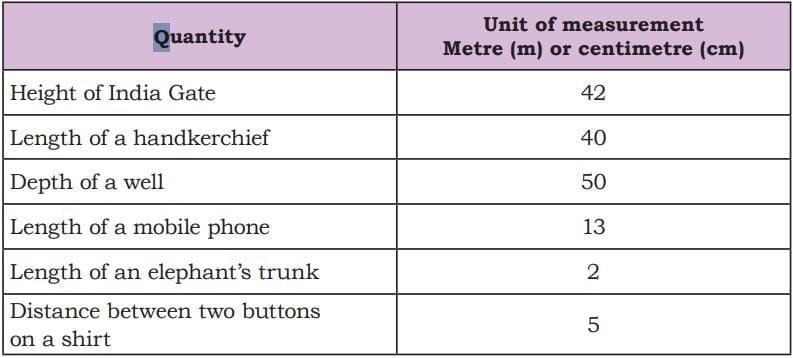
Identify the appropriate units for measuring each of the following.
We use different units to measure different lengths. For example, we use metre (m) or centimetre (cm).
Height of India Gate: This is a big structure, so we use metre (m).
Length of a handkerchief: This is small, so we use centimetre (cm). cm)
Depth of a well: This can be deep, so we use metre (m).
Length of a mobile phone: This is small, so we use centimetre (cm). (
Length of an elephant’s trunk: This is quite long, so we use metre (m).
Distance between two buttons on a shirt: This is very small, so we use centimetre (cm).
Different Units but Same Measure
Sometimes, the same length can be written using different units. Let’s see how Shikha and Sonu are measuring saris and stoles.
We can use a double number line to understand this better. Remember, 1 metre (m) = 100 centimetres (cm).
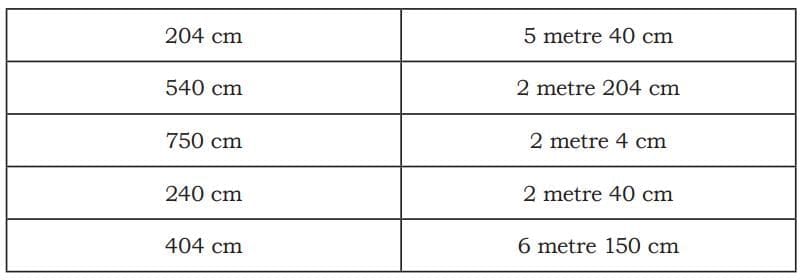
Let’s match the measures:
Let Us Compare
Let’s compare different lengths using the signs < (less than), > (greater than), or = (equal to).
Remember: 1 m = 100 cm
Comparing lengths of rods:
(a) 456 cm ____ 5 m Convert 5 m to cm: 5 m = 5 x 100 cm = 500 cm. So, 456 cm < 500 cm.
(b) 55 cm 200 cm ____ 200 cm 54 cm Left side: 55 cm + 200 cm = 255 cm. Right side: 200 cm + 54 cm = 254 cm. So, 255 cm > 254 cm.
(c) 6 m 5 cm ___ 6 m 50 cm Here, metres are the same (6 m). Compare the centimetres: 5 cm and 50 cm. So, 6 m 5 cm < 6 m 50 cm.
(d) 2 m 150 cm ___ 3 m 50 cm Convert 150 cm to metres: 150 cm = 1 m 50 cm. So, 2 m 150 cm = 2 m + 1 m 50 cm = 3 m 50 cm. So, 3 m 50 cm = 3 m 50 cm.
(e) 238 cm ____ 138 cm 1 m Convert 1 m to cm: 1 m = 100 cm. Right side: 138 cm + 100 cm = 238 cm. So, 238 cm = 238 cm.
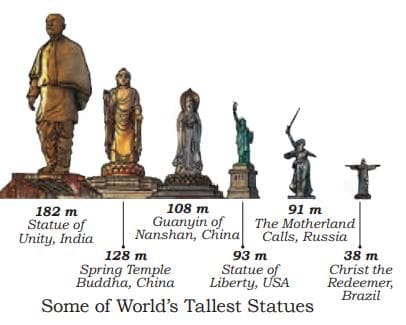
World’s tallest statue comparison:
Statue of Unity, India: 182 m
Spring Temple Buddha, China: 128 m
Statue of Guanyin of Nanshan, China: 108 m
Statue of Liberty, USA: 93 m
The Motherland Calls, Russia: 91 m
Christ the Redeemer, Brazil: 38 m
Measuring Long Distances
For very long distances, we use special tools and units. We often use kilometre (km) for long distances.
Here are some ways to measure long distances:
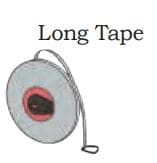
• Long Tape: A very long measuring tape.
• Rangefinder: A device that measures distance to a target.
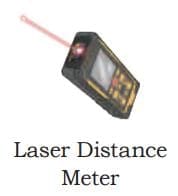
• Laser Distance Meter: Uses a laser to measure distance.
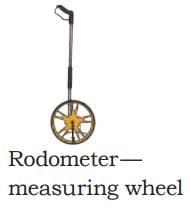
• Rodometer (measuring wheel): A wheel that measures distance as it rolls.
Try yourself:
What unit do we often use for long distances?
A.Meter
B.Centimetre
C.Mile
D.Kilometre
View SolutionKilometre Race
Sheena and Jennifer are organising a 3-km race. Let’s help them!
Remember: 3 km = 3 x 1000 m = 3000 m
1. Water stations are to be arranged after every 500 m. How many water stations must be set up? At what positions from the starting point will these water stations be placed?
Total distance = 3000 m.
Water stations every 500 m.
Number of stations = 3000 m ÷ 500 m = 6 stations.
Positions: 500 m, 1000 m, 1500 m, 2000 m, 2500 m, 3000 m (finish line).
2. Children need to stand at an interval of 300 mto direct the runners. How many children are needed? At what positions from the starting point will the children be standing?
Total distance = 3000 m.
Children every 300 m.
Number of children = 3000 m ÷ 300 m = 10 children.
Positions: 300 m, 600 m, 900 m, 1200 m, 1500 m, 1800 m, 2100 m, 2400 m, 2700 m, 3000 m.
3. Red and blue flags are to be placed alternately at every 50 m. How many red and blue flags are needed till the finish line?
Total distance = 3000 m.
Flags every 50 m.
Number of flag positions = 3000 m ÷ 50 m = 60 positions.
Since flags are placed alternately (red, blue, red, blue…), half will be red and half will be blue.
Number of red flags = 60 ÷ 2 = 30 red flags.
Number of blue flags = 60 ÷ 2 = 30 blue flags.
The World of Small Things
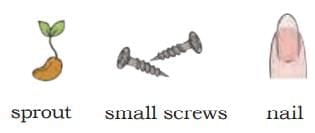
How do we measure very small things like a sprout, small screws, or a nail?
Small Things
We use a smaller unit called millimetre (mm).
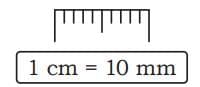
Look at your scale. You will see small marks between 1 cm and 2 cm. If you count them, there are ten small marks.
Each of these small parts is called 1 millimetre (mm).
So, 1 centimetre (cm) = 10 millimetres (mm).
These small marks help us measure very small lengths accurately.
Relationships between Different Units
Let’s summarise the relationships between different units of length:
• 10 mm = 1 cm (Millimetre to Centimetre)
• 100 cm = 1 m (Centimetre to Metre)
• 1,000 m = 1 km (Metre to Kilometre)
Try yourself:
How many millimeters are in one centimeter?
A.15 mm
B.20 mm
C.10 mm
D.5 mm
View SolutionAdding and Subtracting Lengths
We can add and subtract lengths just like we add and subtract numbers. We need to be careful with units.
Example 1: Saji’s walk
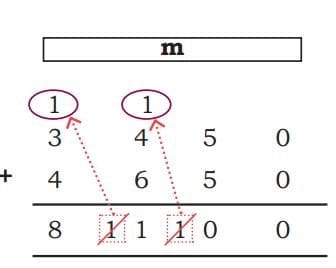
Saji walked 3 km 450 m in the morning and 4 km 650 m in the evening. How much did he walk in total?
Method 1: Adding km and m separately
Add kilometres: 3 km + 4 km = 7 km.
Add metres: 450 m + 650 m = 1100 m.
Convert 1100 m to km and m: 1100 m = 1000 m + 100 m = 1 km100 m.
Add the converted metres to kilometres: 7 km + 1 km 100 m = 8 km 100 m.
Method 2: Convert everything to metres and then add
3 km 450 m = 3 x 1000 m + 450 m = 3000 m + 450 m = 3450 m.
4 km650 m = 4 x 1000 m + 650 m = 4000 m + 650 m = 4650 m.
Total distance = 3450 m + 4650 m = 8100 m.
Convert 8100 m to km and m: 8100 m = 8000 m + 100 m = 8 km 100 m.
Example 2: Cable left
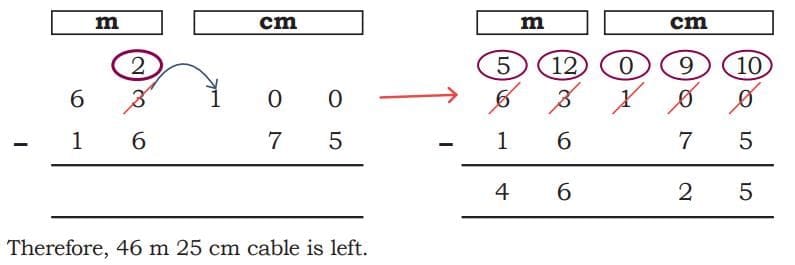
Electricians need 63 m of cable. They used 16 m 75 cm in the first room. What is the length of cable left?
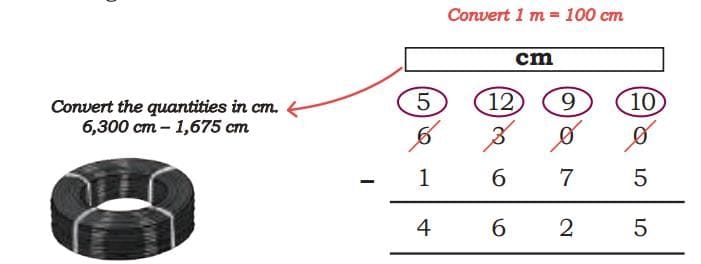
Method 1: Convert everything to cm and then subtract
Total cable needed: 63 m = 63 x 100 cm = 6300 cm.
Cable used: 16 m 75 cm = 16 x 100 cm + 75 cm = 1600 cm + 75 cm = 1675 cm.
Cable left = 6300 cm – 1675 cm = 4625 cm.
Convert 4625 cm to m and cm: 4625 cm = 4600 cm + 25 cm = 46 m 25 cm.
Method 2: Subtracting m and cm separately (with borrowing)
Multiplying and Dividing Lengths
We can also multiply and divide lengths.
Example 1: Cloth for shirts
We need 1 m 80 cm cloth for one shirt. How much cloth is needed for 20 children?
Method 1: Multiply m and cm separately
Multiply metres: 20 x 1 m = 20 m.
Multiply centimetres: 20 x 80 cm = 1600 cm.
Convert 1600 cm to metres: 1600 cm = 16 x 100 cm = 16 m.
Add the metres: 20 m + 16 m = 36 m.
Method 2: Convert everything to cm and then multiply
1 m 80 cm = 100 cm + 80 cm = 180 cm.
Total cloth = 20 x 180 cm = 3600 cm.
Convert 3600 cm to metres: 3600 cm = 36 x 100 cm = 36 m.
Example 2: Cost of cloth
A shop sells cloth for ₹100 for 5 m. How much money is needed to buy 1 m cloth?
Cost of 5 m cloth = ₹100.
Cost of 1 m cloth = ₹100 ÷ 5 = ₹20.
Example 3: Embroidery thread
Anita needs a 1 m long thread to embroider a 50 cm sari. How much thread would she need for a 5 m sari border?
For 50 cm sari, thread needed = 1 m.
5 m sari = 500 cm sari.
Number of 50 cm sections in 500 cm = 500 cm ÷ 50 cm = 10 sections.
Thread needed = 10 x 1 m = 10 m.
If a 1 m long thread costs ₹50, how much money will be needed to buy 10 m thread?
Cost of 1 m thread = ₹50.
Cost of 10 m thread = 10 x ₹50 = ₹500.
Example 4: Road laying work
A road 12 km 600 m long is being laid. Workers complete the work in 6 days, laying an equal length each day. How much road-laying work is done each day?
Total length of road = 12 km 600 m.
Number of days = 6.
Convert total length to metres: 12 km 600 m = 12 x 1000 m + 600 m = 12000 m + 600 m = 12600 m.
Road laid each day = 12600 m ÷ 6 = 2100 m.
Convert 2100 m to km and m: 2100 m = 2000 m + 100 m = 2 km 100 m.
Try yourself:
How much cloth is needed for 20 children if one shirt requires 1 m 80 cm?
A.20 m
B.36 m
C.10 m
D.30 m
View SolutionLet Us Estimate
Estimating means making a good guess about a measurement without actually measuring it. We use things we already know as a reference.
Height of a single-storeyed house: You can estimate it to be around 3-4 metres.
Height of an electric pole: You can estimate it to be around 8-10 metres.
The height of the tallest building in your neighbourhood. What did you use as a reference to estimate the height?
Example: If you know a 2-storey house is about 6 metres tall, you can use that to guess the height of a taller building.
The height of the tallest tree in your neighbourhood. What did you use as a reference?
Example: You can compare it to the height of a building or a known object.
The depth of a well or swimming pool in your neighbourhood. How did you find out?
Example: You can drop a stone and listen for the splash, or compare it to your own height.
Let Us Explore (Feet and Inches)
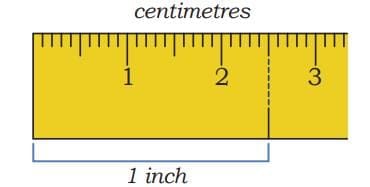
In daily life, we also use other units for measuring length, especially for height. These are feet (ft) and inches (in).
Look at your ruler. Some rulers also have inches marked on them.
Namaste, little travellers! In this chapter, we are going to learn some super interesting things about numbers and how they help us in our daily lives, especially when we are travelling! We will explore how to make sums equal, understand how fuel works for vehicles, and even learn about big numbers and how to add and subtract them. So, get ready for an exciting journey with numbers!
Making Sums Equal
You have two groups of numbers. The two groups have numbers in them, and each group has a total. But the totals are not the same.
Your goal: Swap some numbers between the groups so that both groups add up to the same total.
You should try to do this by moving as few numbers as possible!
Let’s look at the groups one by one:
(a)
Group 1: 1, 2, 7, 9
Group 2: 3, 4, 5, 9
(b)
Group 1: 5, 7, 12, 15
Group 2: 9, 11, 13, 14
(c)
Group 1: 11, 15, 19, 23
Group 2: 13, 17, 21, 25
(d)
Group 1: 77, 78, 79, 80
Group 2: 81, 82, 83, 84
2. Add Up Each Group
Use your fingers or a calculator if needed!
(a)
Group 1: 1 + 2 + 7 + 9 = 19
Group 2: 3 + 4 + 5 + 9 = 21
Difference is 2.
(b)
Group 1: 5 + 7 + 12 + 15 = 39
Group 2: 9 + 11 + 13 + 14 = 47
Difference is 8.
(c)
Group 1: 11 + 15 + 19 + 23 = 68
Group 2: 13 + 17 + 21 + 25 = 76
Difference is 8.
(d)
Group 1: 77 + 78 + 79 + 80 = 314
Group 2: 81 + 82 + 83 + 84 = 330
Difference is 16.
3. Swap Numbers to Make Sums
Your goal is to swap numbers between the groups so both add up to the same.
How to Swap:
The best swap is when the difference between the two numbers you trade is half the difference between the group sums!
Example: If groups differ by 8, try to swap numbers whose difference is 4.
Let’s Try: (a) Difference is 2. Swap numbers with a difference of 1.
Swap 2 (Group 1) and 3 (Group 2):
New Group 1: 1, 3, 7, 9 = 20
New Group 2: 2, 4, 5, 9 = 20
Now both groups have 20!
(b) Difference is 8. Swap numbers with a difference of 4.
Swap 7 (Group 1) and 11 (Group 2):
New Group 1: 5, 11, 12, 15 = 43
New Group 2: 7, 9, 13, 14 = 43
Now both groups have 43!
(c) Difference is 8. Swap numbers with a difference of 4.
Swap 15 (Group 1) and 17 (Group 2):
New Group 1: 11, 17, 19, 23 = 70
New Group 2: 13, 15, 21, 25 = 70
Now both groups have 70!
(d) Difference is 16. Swap numbers with a difference of 8.
Swap 80 (Group 1) and 84 (Group 2):
New Group 1: 77, 78, 79, 84 = 318
New Group 2: 81, 82, 83, 80 = 326
Still not equal, try another pair: swap 78 (Group 1) and 86 (not present). Since numbers go up by 1, try swapping 79 (Group 1) and 87 (not present). Instead, swap two pairs:
Swap 77, 78 (Group 1) with 83, 84 (Group 2)
New Group 1: 79, 80, 83, 84 = 326
New Group 2: 77, 78, 81, 82 = 318
Now, both are 326 and 318. This puzzle needs two swaps, or adjust till both sums match.
The main idea here is to understand that when you swapnumbers, the sums of the groups change. You need to find the right swap to make them equal! This is like a fun puzzle where you use addition and a little bit of trial and error.
Fuel Arithmetic
Have you ever wondered how cars, bikes, and buses run? They need fuel! Just like we need food to get energy, vehicles need fuel to move. Different vehicles need different amounts of fuel.
Motorbikes: Usually need a small amount, like 5 to 15 litres.
Cars: Need a bit more, around 15 to 50 litres.
Lorries and Trucks: These are big vehicles, so they need a lot more fuel, from 150 to 500 litres.
Trains: Imagine how big a train is! They need a huge amount, like 5,000 litres!
Remember: Fuel is a limited resource, which means it will not last forever. So, we must save fuel! Saving fuel also helps to keep our air clean and reduce pollution. That’s why electric vehicles are becoming popular, as they don’t use natural fuel and help keep our environment healthy.
Let’s solve some problems related to fuel:
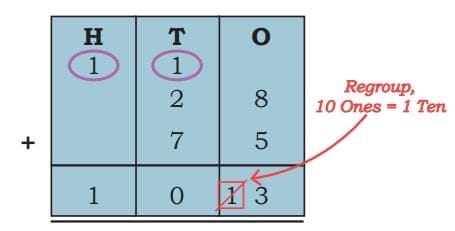
A lorry has 28 litres of fuel in its tank. An additional 75 litres is filled. What is the total quantity of fuel in the lorry? To find the total quantity, we need to add the fuel already in the tank and the additional fuel filled.Total quantity of fuel = 28 litres + 75 litresDo you remember how to add two numbers using place value? Let’s do it step-by-step:Explanation:
Step 1: Add the Ones place. 8 Ones + 5 Ones = 13 Ones. We know that 10 Ones make 1 Ten. So, 13 Ones is 1 Ten and 3 Ones. Write down 3 in the Ones place and carry over 1 (Ten) to the Tens place.
Step 2: Add the Tens place. 1 (carried over) + 2 Tens + 7 Tens = 10 Tens. We know that 10 Tens make 1 Hundred. So, 10 Tens is 1 Hundred and 0 Tens. Write down 0 in the Tens place and carry over 1 (Hundred) to the Hundreds place.
Step 3: Add the Hundreds place. 1 (carried over) + 0 Hundreds = 1 Hundred. Write down 1 in the Hundreds place.
So, the total quantity of fuel in the lorry is 103 litres.
Try yourself:
What do vehicles need to move?
A.Food
B.Fuel
C.Water
D.Air
View Solution
Relationship Between Addition and Subtraction
Addition and subtraction are like best friends! They are closely related. If you know an addition fact, you can easily find two subtraction facts from it. And if you know a subtraction fact, you can find an addition fact!
Let’s look at some examples to understand this better:
1. Find the relationship between the numbers in the given statements and fill in the blanks appropriately.
(a) If 46 + 21 = 67, then,
67 – 21 = 46
67 – 46 = 21
Think: If you add 46 and 21 to get 67, then if you take away 21 from 67, you will get 46. And if you take away 46 from 67, you will get 21. It’s like undoing the addition!
(b) If 198 – 98 = 100, then,
100 + 98 = 198
198 – 100 = 98
Think
: If you subtract 98 from 198 to get 100, then if you add 100 and 98, you will get 198. Also, if you take away 100 from 198, you will get 98.
(c) If 189 + 98 = 287, then,
287 – 98 = 189
287 – 189 = 98
(d) If 872 – 672 = 200, then,
200 + 672 = 872
872 – 200 = 672
2. In each of the following, write the subtraction and addition sentences that follow from the given sentence.
(a) If 78 + 164 = 242, then,
242 – 78 = 164
242 – 164 = 78
(b) If 462 + 839 = 1301, then,
1301 – 462 = 839
1301 – 839 = 462
(c) If 921 – 137 = 784, then,
784 + 137 = 921
921 – 784 = 137
(d) If 824 – 234 = 590, then,
590 + 234 = 824
824 – 590 = 234
More Fuel ArithmeticFuel Problems with Subtraction
Let’s go back to our fuel problems, but this time, we will use subtraction!
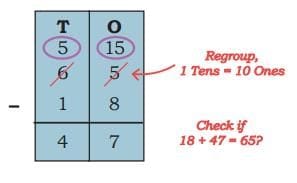
A minibus has 18 litres of fuel left. After refuelling, the fuel meter indicates 65 litres. How much fuel has been filled in the fuel tank of the minibus?
To find out how much fuel was filled, we need to subtract the fuel that was already there from the total fuel after refuelling.
Quantity of fuel filled = 65 litres – 18 litres
Do you remember how to subtract numbers using place value? Let’s do it step-by-step:
Explanation:
Step 1: Subtract the Ones place. We cannot subtract 8 from 5. So, we need to regroup from the Tens place. Borrow 1 Ten (which is 10 Ones) from the 6 Tens. Now, we have 5 Tens left in the Tens place, and 5 10 = 15 Ones in the Ones place. Now, 15 Ones – 8 Ones = 7 Ones. Write 7 in the Ones place.
Step 2: Subtract the Tens place. Now we have 5 Tens (because we borrowed 1 Ten) – 1 Ten = 4 Tens. Write 4 in the Tens place.
So, 47 litres of fuel has been filled in the fuel tank of the minibus.
Check your answer: Is 18 + 47 = 65? Yes, it is! So our answer is correct.
Sums of Consecutive Numbers
What are consecutive numbers?
They are numbers that follow each other in order, one after another, without skipping any number. It’s like counting! For example:
1, 2, 3, 4, 5 are consecutive numbers.
29, 30, 31, 32 are consecutive numbers.
512, 513 are consecutive numbers.
2023, 2024, 2025 are consecutive numbers.
Now, let’s look at adding these consecutive numbers and see what interesting patterns we find!
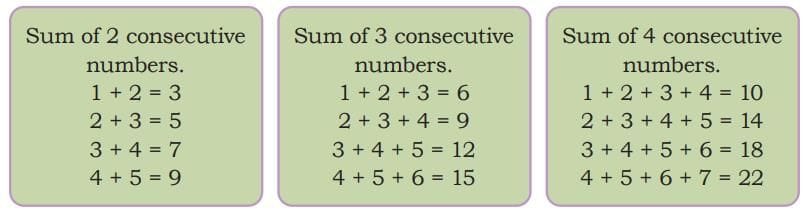
In each of the boxes above, state whether the sums are even or odd. Explain why this is happening.
Sum of 2 consecutive numbers: The sums are 3, 5, 7, 9. All these are odd numbers.
Why? When you add an odd number and an even number, the result is always odd. In any pair of consecutive numbers, one will be odd and the other will be even (e.g., 1 and 2, 2 and 3, 3 and 4). So, the sum is always odd.
Sum of 3 consecutive numbers: The sums are 6, 9, 12, 15. These sums are sometimes even and sometimes odd.
Why? If you have three consecutive numbers, you will either have:
Odd + Even + Odd = Even (e.g., 123 = 6, 345 = 12)
Even + Odd + Even = Odd (e.g., 234 = 9, 456 = 15)
Sum of 4 consecutive numbers: The sums are 10, 14, 18, 22. All these are even numbers.
Why? When you add four consecutive numbers, you will always have two odd numbers and two even numbers. The sum of two odd numbers is always even, and the sum of two even numbers is always even. So, even + even = even. That’s why the sum of four consecutive numbers is always even.
What is the difference between two successive sums in each box? Is it the same throughout?
Sum of 2 consecutive numbers:
5 – 3 = 2
7 – 5 = 2
9 – 7 = 2
Yes, the difference is 2 and it is the same throughout.
Sum of 3 consecutive numbers:
9 – 6 = 3
12 – 9 = 3
15 – 12 = 3
Yes, the difference is 3 and it is the same throughout.
Sum of 4 consecutive numbers:
14 – 10 = 4
18 – 14 = 4
22 – 18 = 4
Yes, the difference is 4 and it is the same throughout.
What will be the difference between two successive sums for —
(a) 5 consecutive numbers: Based on the pattern we saw (2 for 2 numbers, 3 for 3 numbers, 4 for 4 numbers), the difference between two successive sums for 5 consecutive numbers will be 5.
(b) 6 consecutive numbers: Following the same pattern, the difference between two successive sums for 6 consecutive numbers will be 6.
For 3 consecutive numbers:
1 + 2 + 3 = 6 (Here, the middle number is 2, and 2 x 3 = 6)
2 + 3 + 4 = 9 (Here, the middle number is 3, and 3 x 3 = 9)
3 + 4 + 5 = 12 (Here, the middle number is 4, and 4 x 3 = 12)
Pattern: For 3 consecutive numbers, the sum is the middle number multiplied by 3.
For 4 consecutive numbers:
1 + 2 + 3 + 4 = 10 (The numbers are 1, 2, 3, 4. The sum of the first and last number is 1 + 4 = 5. The sum of the two middle numbers is 2 + 3 = 5. And 5 + 5 = 10. Also, notice that the sum is 2 times the sum of the middle two numbers divided by 2, or (first + last) * (number of terms / 2) = (1 + 4) * (4/2) = 5 * 2 = 10. Or, (first + last) * 2 = 10. Another way to think is that the average of the two middle numbers is 2.5, and 2.5 * 4 = 10.)
Pattern: For 4 consecutive numbers, the sum is 2 times the sum of the first and last number (or 2 times the sum of the two middle numbers).
For 5 consecutive numbers:
1 + 2 + 3 + 4 + 5 = 15 (Middle number is 3, and 3 x 5 = 15)
2 + 3 + 4 + 5 + 6 = 20 (Middle number is 4, and 4 x 5 = 20)
3 + 4 + 5 + 6 + 7 = 25 (Middle number is 5, and 5 x 5 = 25)
Pattern: For 5 consecutive numbers, the sum is the middle number multiplied by 5.
Now, use your understanding to find the following sums without adding the numbers directly:
(a) 67 + 68 + 69: This is a sum of 3 consecutive numbers. The middle number is 68. Sum = 68 x 3 = 204
(b) 24 + 25 + 26 + 27: This is a sum of 4 consecutive numbers. The sum of the first and last number is 24 + 27 = 51. Sum = 51 x 2 = 102
(c) 48 + 49 + 50 + 51 + 52: This is a sum of 5 consecutive numbers. The middle number is 50. Sum = 50 x 5 = 250
(d) 237 + 238 + 239 + 240 + 241 + 242: This is a sum of 6 consecutive numbers. For 6 consecutive numbers, you can add the first and last number, and multiply by 3 (because there are 3 pairs). First + Last = 237 + 242 = 479. Sum = 479 x 3 = 1437
Quick Tip:
For an odd number of consecutive numbers, the sum is the middle number multiplied by the count of numbers. For an even number of consecutive numbers, the sum is the (first number + last number) multiplied by (count of numbers / 2).
Try yourself:What do sums of consecutive numbers refer to?A.Dividing numbers by their totalB.Subtracting numbers from each otherC.Multiplying numbers togetherD.Adding numbers in a sequenceView Solution
The Longest Land Route — Adding Large Numbers
Imagine travelling really, really far! The longest road trip you can take on Earth is between a place called Talon in Russia and Sagres in Portugal. This road is super long, about 15,150 kilometres!
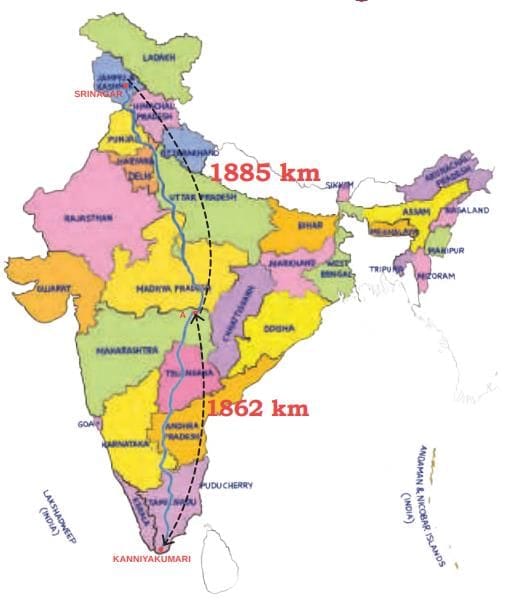
Now, let’s talk about India. In 2019, we had a very long road called the North–South Corridor. It started from Srinagar in Jammu and Kashmir and went all the way down to Kanniyakumari in Tamil Nadu. How long was it?
Your textbook tells us about a place on this corridor that was 1,855 km from Srinagar and 1,862 km from Kanniyakumari.
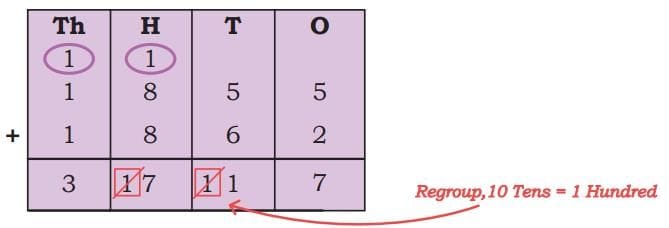
To find the total length of the North–South Corridor in 2019, we need to add these two distances:
Total length = 1,855 km + 1,862 km
Do you remember how to add large numbers? It’s just like adding smaller numbers, but with more digits! We use place values like Thousands, Hundreds, Tens, and Ones.
Explanation:
Step 1: Add the Ones place. 5 Ones + 2 Ones = 7 Ones. Write 7 in the Ones place.
Step 2: Add the Tens place. 5 Tens + 6 Tens = 11 Tens. We regroup 10 Tens as 1 Hundred. So, we have 1 Ten left. Write 1 in the Tens place and carry over 1 to the Hundreds place.
Step 3: Add the Hundreds place. 1 (carried over) + 8 Hundreds + 8 Hundreds = 17 Hundreds. We regroup 10 Hundreds as 1 Thousand. So, we have 7 Hundreds left. Write 7 in the Hundreds place and carry over 1 to the Thousands place.
Step 4: Add the Thousands place. 1 (carried over) + 1 Thousand + 1 Thousand = 3 Thousands. Write 3 in the Thousands place.
So, the total length of the North–South Corridor was 3,717 km in 2019.
Now, let us try finding the sum of 5-digit numbers.
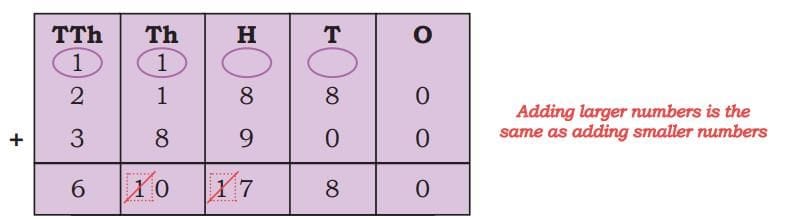
Mahesh and his family decided to drive from Srinagar to Kanniyakumari. This is a very long journey! He spent ₹21,880 on fuel and toll tax and ₹38,900 on other expenses during this trip. How much did he spend in total?
To find the total money spent, we need to add these two amounts:
Total spent = ₹21,880 + ₹38,900
Adding larger numbers is the same as adding smaller numbers. Just make sure to align the digits properly: Ones below Ones, Tens below Tens, and so on.
Explanation:
Step 1: Add the Ones place. 0 + 0 = 0. Write 0.
Step 2: Add the Tens place. 8 + 0 = 8. Write 8.
Step 3: Add the Hundreds place. 8 + 9 = 17. Write 7, carry over 1.
Step 4: Add the Thousands place. 1 (carried over) + 1 + 8 = 10. Write 0, carry over 1.
Step 5: Add the Ten Thousands place. 1 (carried over) + 2 + 3 = 6. Write 6.
So, Mahesh spent a total of ₹60,780 on his journey.
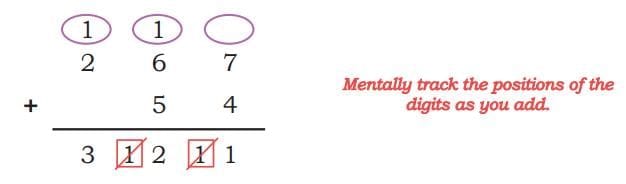
Important Tip: When adding large numbers, if you keep the digits aligned (Ones below Ones, Tens below Tens, etc.), you don’t always need to write the place value labels (TTh, Th, H, T, O) at the top. You can mentally keep track of the positions of the digits as you add.
Just like we add large numbers, we can also subtract them! It’s very useful in real life, especially when you want to find out how much is left or the difference between two big numbers.
Important Places for Travel
A bus stand or bus station is where passengers get on a bus.
A railway station is where people get on trains.
A port is where people get on ships.
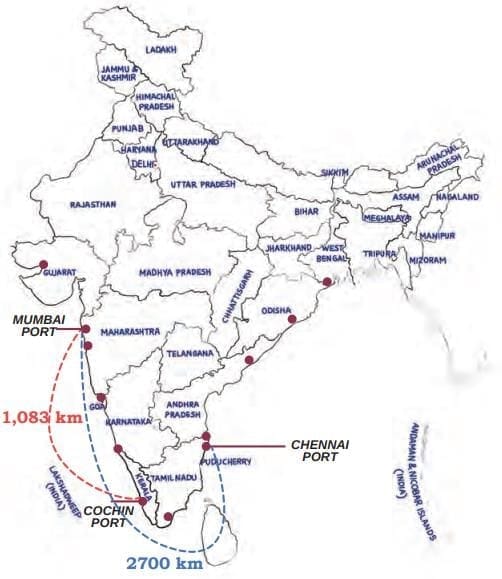
Your textbook talks about the ports of Mumbai and Chennai, which are very important in India. Ships travelling from Mumbai to Chennai pass by another important port called Cochin Port. You can spot these places on the map of India!
Distance Calculation
The total distance of the sea route from Mumbai to Chennai is 2,700 km. A ship starting from Mumbai first reaches the Cochin port, travelling 1,083 km by sea. How much more distance does it have to travel to reach the Chennai port?
To find the remaining distance, we need to subtract the distance already travelled from the total distance:
Remaining distance = 2,700 km – 1,083 km
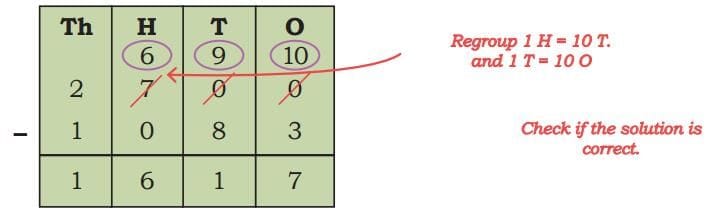
Subtraction Steps Using Place Value
Let’s do it step-by-step:
Explanation
Step 1: Subtract the Ones place. We cannot subtract 3 from 0. We need to regroup. There are no Tens to borrow from, so we go to the Hundreds place. Borrow 1 Hundred (which is 10 Tens) from the 7 Hundreds. Now, we have 6 Hundreds left, and 10 Tens in the Tens place. Now, borrow 1 Ten (which is 10 Ones) from the 10 Tens. Now, we have 9 Tens left, and 0 + 10 = 10 Ones in the Ones place. Now, 10 Ones – 3 Ones = 7 Ones. Write 7 in the Ones place.
Step 2: Subtract the Tens place. Now we have 9 Tens (because we borrowed 1 Ten) – 8 Tens = 1 Ten. Write 1 in the Tens place.
Step 3: Subtract the Hundreds place. Now we have 6 Hundreds (because we borrowed 1 Hundred) – 0 Hundreds = 6 Hundreds. Write 6 in the Hundreds place.
Step 4: Subtract the Thousands place. 2 Thousands – 1 Thousand = 1 Thousand. Write 1 in the Thousands place.
So, the ship has to travel 1,617 km more to reach Chennai.
Check if the solution is correct: Add the answer to the number subtracted: 1,617 + 1,083 = 2,700. Yes, it is correct!
Longest Land Route
As you learned earlier, the longest land route is 15,150 km between Talon (Russia) and Sagres (Portugal). The longest highway in Africa is 10,228 km long, connecting the cities of Cairo, in Egypt and Cape Town, in South Africa.
How much longer is the land route between Talon and Sagres compared to the highway between Cairo and Cape Town?
To find out how much longer one route is than the other, we need to find the difference between their lengths. This means we subtract the smaller length from the larger length.
Difference = 15,150 km – 10,228 km
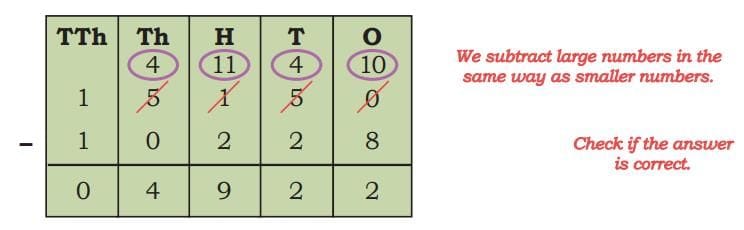
Subtraction Steps for Route Lengths
Explanation
Step 1: Subtract the Ones place. We cannot subtract 8 from 0. Regroup from the Tens place. 5 Tens becomes 4 Tens, and 0 Ones becomes 10 Ones. 10 Ones – 8 Ones = 2 Ones. Write 2.
Step 5: Subtract the Ten Thousands place. 1 Ten Thousand – 1 Ten Thousand = 0 Ten Thousands. Write 0 (or leave it blank if it’s the first digit).
So, the land route connecting Talon and Sagres is 4,922 km longer than the road connecting Cairo and Cape Town.
Check if the answer is correct: Add the answer to the number subtracted: 4,922 + 10,228 = 15,150. Yes, it is correct!
Try yourself:
What is the first step in subtracting large numbers?
A.Multiply the numbers
B.Line up the digits
C.Ignore the smallest number
D.Add the numbers
View Solution
Mental Subtraction
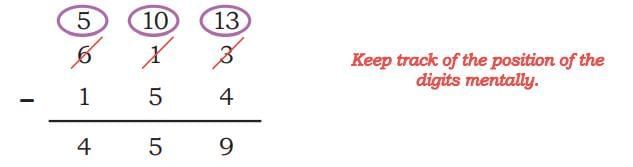
Like addition, here too we can try not to write the positions of the digits and align the numbers appropriately. You can mentally keep track of the position of the digits.
For example:
Here, you mentally subtract 4 from 3 (regroup), then 5 from 0 (regroup), then 1 from 5.
Quick Sums and Differences
Sometimes, we need to find missing numbers in sums or differences quickly. Let’s look at some fun ways to do this!
Sukanta’s Challenge
Sukanta likes the numbers 10, 100, 1,000, and 10,000. He wants to figure out what number he should add to a given number such that the sum is 100 or 1,000. Let’s help him fill in the blanks!
32 _______ = 100
To find the missing number, you can think: “How much more do I need to add to 32 to reach 100?” This is a subtraction problem: 100 – 32 = 68.
Piku’s Method
Sukanta’s friend Piku shows him an interesting way to solve these problems:
Then, add 1 to the sum:
This method is a bit tricky. Let’s understand it better. Piku is trying to make the number easier to work with by getting it close to 100. If you add 67 to 32, you get 99. Then, adding 1 more makes it 100. So the missing number = 68.
Trying Piku’s Method
Do you think this method will always work? Let’s try this method for the number 59:
59 _______ = 100
Using Piku’s method:
Then, add 1 to the sum:
So, the missing number is = 100
Piku’s Method Explained
This method works by finding the difference to the next multiple of 10, then to 100. For example, for 32 to reach 100: 32 + 8 = 40, then 40 + 60 = 100. So 8 +60 = 68.
Piku’s method is a variation of this, where you try to reach 99 first, and then add 1.
Units Digit is 0
Will this method work if the units digit is 0? What do you think?
Let’s try with numbers ending in 0:
(a) 180 ________ = 1,000 If we use Piku’s method, we would try to reach 999. But 180 already ends in 0. It’s easier to just subtract: 1,000 – 180 = 820. So, 180 + 820 = 1,000.
The simplest method is always to subtract the given number from the target sum. For example, to find the missing number in A ? = B, you just calculate B – A = ?.
Namita’s Challenge
Namita likes the number 9. She wants to subtract 9 or 99 from any number. Let’s find a way to quickly subtract 9 or 99 from any number.
Now, use the above solutions to find answers to the following problems. Do not calculate again.
Namita wonders if she can get 9 or 99 as the answer to any subtraction problem. Find a way to get the desired answer.
(a) 32 – ________ = 9 We know that 32 – 23 = 9. So the missing number is 23. (Think: 32 – 9 = 23)
(b) 56 – ________ = 9 We know that 56 – 47 = 9. So the missing number is 47. (Think: 56 – 9 = 47)
(c) 877 – ________ = 99 We know that 877 – 778 = 99. So the missing number is 778. (Think: 877 – 99 = 778)
(d) 666 – ________ = 99 We know that 666 – 567 = 99. So the missing number is 567. (Think: 666 – 99 = 567)
Even and Odd Numbers
Even Numbers:
These are numbers that can be divided into two equal groups without anything left over. They always end in 0, 2, 4, 6, or 8.
Examples: 2, 4, 6, 8, 10, 12, 14, 16, 18, 20…
Odd Numbers:
These are numbers that cannot be divided into two equal groups. When you try to divide them by 2, there’s always 1 left over. They always end in 1, 3, 5, 7, or 9.
Examples: 1, 3, 5, 7, 9, 11, 13, 15, 17, 19…
1. Circle the numbers that are even.
Let’s go through the list and identify the even numbers:
(a) 297 – Ends in 7, so it’s Odd.
(b) 498 – Ends in 8, so it’s Even.
(c) 724 – Ends in 4, so it’s Even.
(d) 100 – Ends in 0, so it’s Even.
(e) 199 – Ends in 9, so it’s Odd.
(f) 789 – Ends in 9, so it’s Odd.
(g) 49 – Ends in 9, so it’s Odd.
(h) 6,893 – Ends in 3, so it’s Odd.
(i) 846 – Ends in 6, so it’s Even.
(j) 111 – Ends in 1, so it’s Odd.
(k) 222 – Ends in 2, so it’s Even.
(l) 1,023 – Ends in 3, so it’s Odd.
So, the even numbers are: 498, 724, 100, 846, 222.
2. Observe the given arrangement.
This figure shows a paired arrangement for numbers. This means arranging items in pairs to see if any are left over.
Paired arrangement for 18: If you arrange 18 items in pairs, you will have 9 pairs, and nothing will be left over. This shows 18 is an even number.
Paired arrangement for 23: If you arrange 23 items in pairs, you will have 11 pairs, and 1 item will be left over. This shows 23 is an odd number.
Add 2 to 18. What changes or does not change in the arrangement?
If you add 2 to 18, you get 20. When you arrange 20 items in pairs, you will still have no items left over. So, adding 2 to an even number keeps it an even number. The arrangement will still be perfectly paired.
Add 2 to 23. What changes or does not change in the arrangement?
If you add 2 to 23, you get 25. When you arrange 25 items in pairs, you will still have 1 item left over. So, adding 2 to an odd number keeps it an odd number. The arrangement will still have one item left over.
What do you notice about the sums in each of the following cases?
Do you think it will be true for all pairs of such numbers? Explain your observations. You may use the paired arrangement to explain your thinking.
(a) 12 and 6 are a pair of even numbers.
Choose 5 such pairs of even numbers. Add the numbers in each of the pairs.
12 + 6 = 18 (Even)
4 + 8 = 12 (Even)
10 + 2 = 12 (Even)
20 + 14 = 34 (Even)
30 + 10 = 40 (Even)
Observation: When you add two even numbers, the sum is always an even number.
Explanation: An even number means there are no items left over when paired. If you combine two groups that both have no items left over, the combined group will also have no items left over. So, Even + Even = Even.
(b) 13 and 9 are a pair of odd numbers.
Choose 5 such pairs of odd numbers. Add the numbers in each of the pairs.
13 + 9 = 22 (Even)
5 + 3 = 8 (Even)
7 + 1 = 8 (Even)
11 + 15 = 26 (Even)
21 + 23 = 44 (Even)
Observation: When you add two odd numbers, the sum is always an even number.
Explanation: An odd number means there is 1 item left over when paired. If you combine two groups that each have 1 item left over, those two leftover items can form a new pair. So, Odd + Odd = Even.
(c) 7 and 12 are a pair of odd and even numbers.
Choose 5 such pairs of odd and even numbers. Add the numbers in each of the pairs.
7 + 12 = 19 (Odd)
3 + 6 = 9 (Odd)
9 + 2 = 11 (Odd)
15 + 10 = 25 (Odd)
21 + 4 = 25 (Odd)
Observation: When you add an odd number and an even number, the sum is always an odd number.
Explanation: An odd number has 1 item left over when paired, and an even number has no items left over. If you combine these two groups, the 1 leftover item from the odd number will still be left over in the combined group. So, Odd + Even = Odd.
Have you ever noticed how things move around you? Like a fan spinning, or a door opening? All these movements involve ‘turns’, and these turns help us understand ‘angles’. Let’s explore this fun topic together!
What is a Turn?
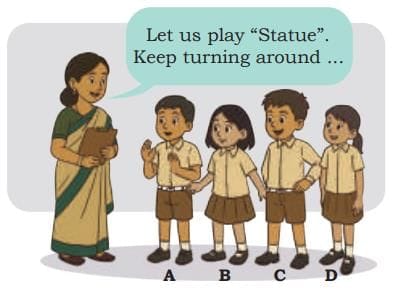
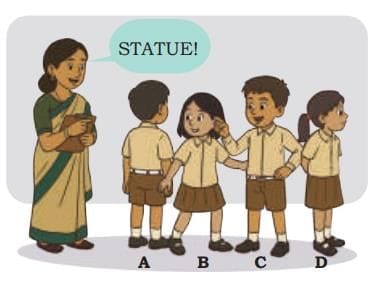
Can you recognise the child in the picture who has made a full turn? Who has made a half turn? How do you know?
The child in the picture that has made a full turn is “C” and the child in the picture who has made a half turn is “A”
Lets see how we know this.
Turns
When you spin all the way around and come back to where you started, that’s a full turn. Think about the minute hand of a clock. When it goes all the way around from 12 and comes back to 12, it has made a full turn.
Example: A giant wheel makes a full turn when it comes back to its starting position.
If you spin halfway around, so you are facing the opposite direction, that’s a half turn.
Example: If Reema takes two half turns in the same direction, it’s like she has made a full turn.
If you spin just a little bit, like turning to face the side, that’s a quarter turn. A quarter turn is one-fourth of a full turn.
Example: If Reema takes 2 quarter turns in the same direction, it’s like she has made a half turn. If she takes 4 quarter turns in the same direction, it’s like she has made a full turn.
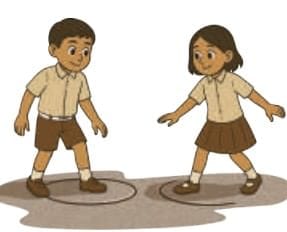
Ashutosh and Sahana are making circles, each having one foot fixed and rotating at one spot on the ground.
Ashutosh made a complete circle by making a full turn. Sahana is making a half-moon shape with a half turn.
Everyday Objects and Turns
Taps: When you open or close a tap, you turn it.
Doors with hinges: Doors swing open and close, making turns.
Scissors: When you open and close scissors, they make turns.
Clothes clip: When you open a clothes clip, it makes a turn.
Think about the maximum turn these objects can make. Some can make a quarter turn, some a half turn, and some even a full turn!
Try yourself:
What is a full turn?
A.Turning halfway around
B.Spinning all the way around
C.Turning to the side
D.Making a half-moon shape
View Solution
Different Types of Angles
Angles are formed when two lines or objects meet at a point and turn. Let’s learn about different types of angles using the example of Pragya and her straws.
Pragya joined a green and yellow straw with paper clips. She holds the green straw steady and turns the yellow straw around. Observe different turns of the yellow straw:
Right Angle
When the yellow straw makes a quarter (1/4) of a full turn, it looks like a right angle. A right angle is like the corner of a square or a book. It looks like an ‘L’ shape.
Acute Angle
If the yellow straw makes less than a quarter turn, it looks like an acute angle. Acute angles are smaller than a right angle. Think of a sharp point, like the tip of a pencil.
Obtuse Angle
When the yellow straw makes more than a quarter turn but less than a half turn, it looks like an obtuse angle. Obtuse angles are bigger than a right angle but smaller than a straight angle.
Straight Angle
If the yellow straw makes two quarter turns (which is the same as a half turn), it forms a straight angle. A straight angle looks like a straight line.
Angles arise in situations that involve a turn.
Angle Measuring Tool
Measuring Turns and Angles
Wouldn’t it be great if we could measure turns and angles? Well, we can! Let’s make our own tool to measure turns.
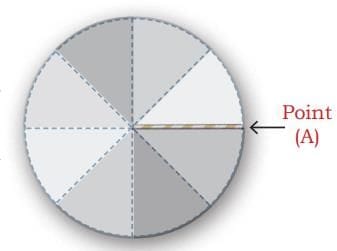
(a) Making Your Tool
Take a tracing paper and cut out a circle from it.
Fold the circle carefully to make 8 equal parts. Imagine folding it in half, then in half again, and then in half one more time.
Attach a straw to the very center of the circle.
Mark a starting point on the edge of the circle.
Now you have your very own angle measuring tool!
(b) Using Your Tool
Let’s try using your new tool to understand turns:
Show a 1/8 turn: Move the straw from the starting point to the first fold line. That’s a 1/8 turn.
Show a 2/8 turn (which is 1/4 turn): Move the straw to the second fold line. This is a quarter turn, or a right angle!
Show a 3/8 turn: Move the straw to the third fold line.
Show a 4/8 turn (which is 1/2 turn): Move the straw to the fourth fold line. This is a half turn, or a straight angle!
Keep turning the straw by 5/8, 6/8, 7/8, and 8/8. When you reach 8/8, you have completed a full turn!
Making a Permanent Tool
You can cut out parts of your folded circle (like 1/8 part and 2/8 parts and paste them on a thicker paper or board. These can be used as handy angle measuring tools.
Try yourself:
What is an angle measuring tool used for?
A.Drawing
B.Cooking
C.Measuring angles
D.Writing
View Solution
Which Direction?
When things turn, they turn in a certain direction. There are two main directions of turning:
Clockwise Movement
Think about how the hands of a clock move. They move from 12 to 1, then to 2, and so on. This direction of movement is called clockwise movement.
Anti-clockwise Movement
The opposite of clockwise movement is called anti-clockwise movement. If you move your hand from 12 to 11, then to 10, that would be anti-clockwise.
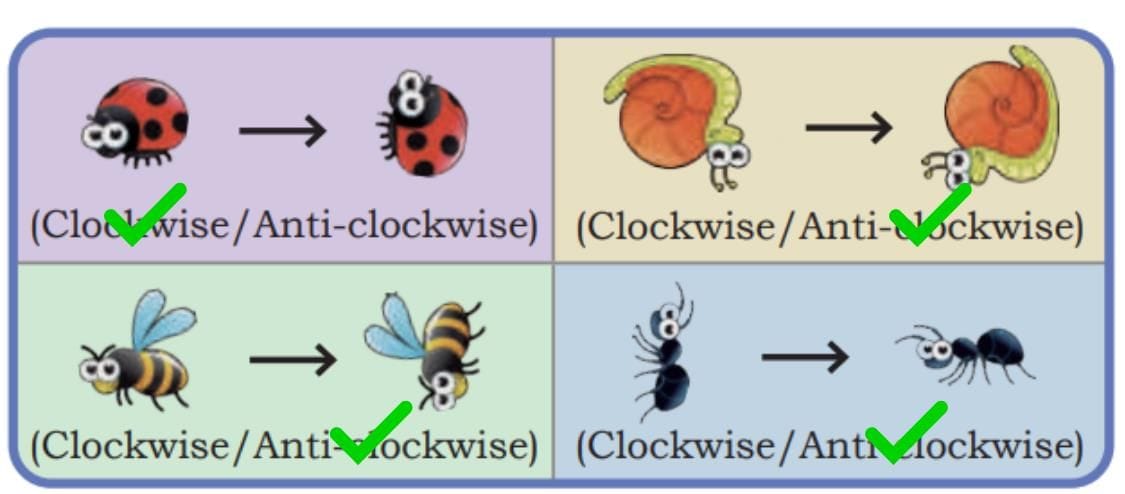
The creatures below have made a quarter turn once. Tick the direction in which they have moved.
Fun with Turns
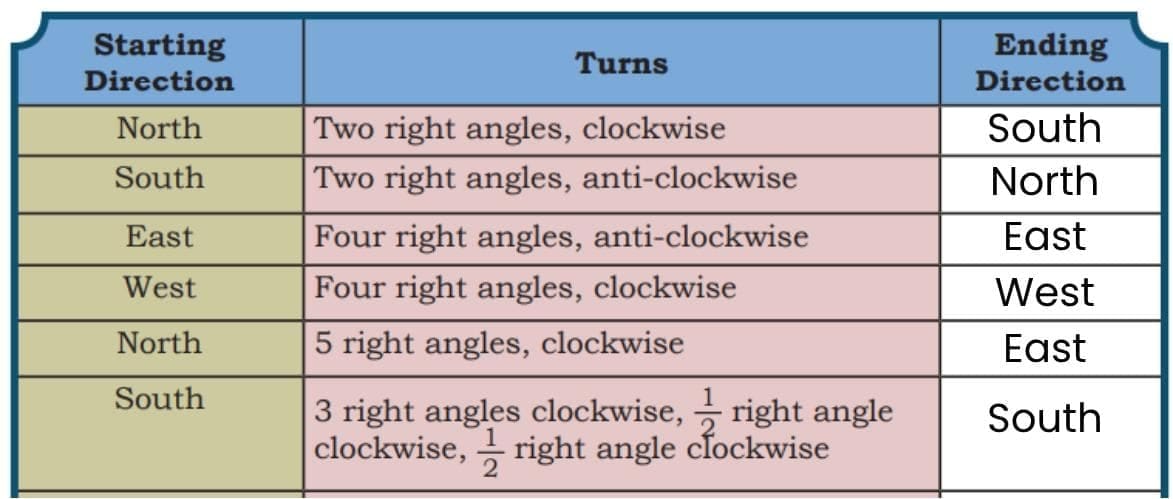
1. The children in a class are playing a game in which the teacher tells them the direction in which they should rotate. Complete the table by filling the direction the children will face on completing the given turns. The starting direction is given in the table.
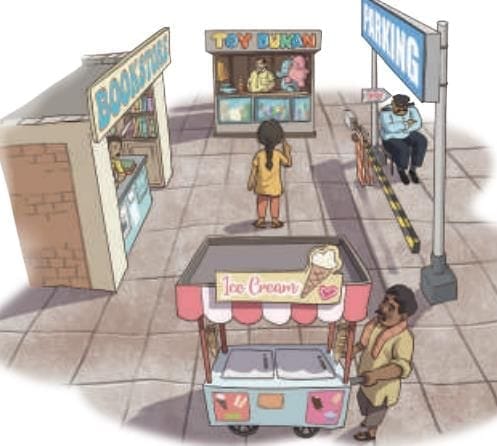
2. Padma is facing the toy shop. What place will she face if she takes a half turn clockwise?
She will face the ice cream side
What other way can she turn to face the same place?
She can turn a half turn anti clockwise to face the same side.
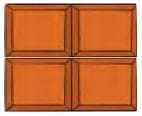
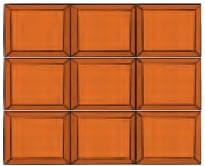
Tamanna is a student of Grade 5. She has two chocolates of different sizes. She says that of chocolate 1 is bigger than of the chocolate 2.
Chocolate 1 Chocolate 2
Is that correct?
We can see that chocolate 2 is alot bigger than chocolate 1, they are of different sizes, so we cant really compare them both
Let’s learn about fractions to understand this!
When we compare fractions, we need to make sure the chocolates (wholes) are the same size.
If Tamanna’s chocolates are different sizes, then of a bigger chocolate can indeed be larger than of a smaller chocolate!
To compare two fractions of two wholes, the wholes from which the fractions are made must be the same.
Playing with a Grid
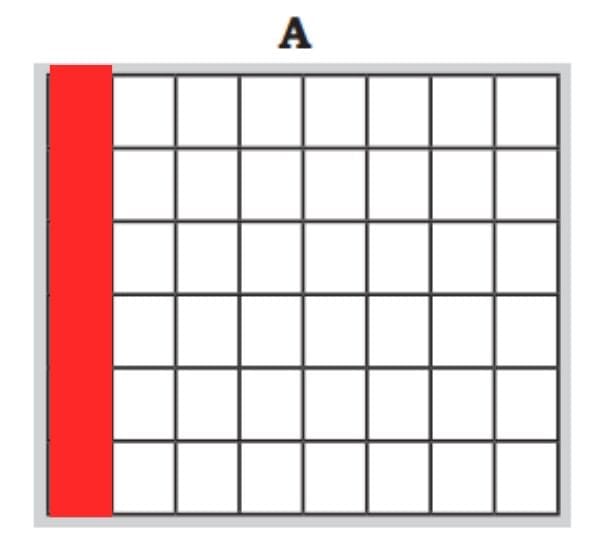
Let’s understand fractions by shading grids. This activity helps us visualise what fractions look like:
Grid A:
Total squares = 48
Shade 1/8 in red (shade 1 square out of 8)
This means we divide the grid into 8 equal parts and colour 1 part
Understanding Equivalent Fractions Is equal to ?
In this picture we can see that, 2 parts out of 6 are shaded.
Now, lets divide the same picture in three equal parts
In this picture, we can see that, 1 part out of 3 is shaded.
So, when we look at both the pictures showing the same shaded area, we can see that = . These are called equivalent fractions.
Equivalent fractions are fractions that represent the same part of a whole but are written differently.
Fun with Fraction Kit
Using a fraction kit helps us understand how fractions work. A fraction kit contains strips divided into equal parts.
Activity 1: Making a Whole
How many 1/5 pieces do you need to make a whole? Answer: 5 pieces
How many 1/8 pieces do you need to make a whole? Answer: 8 pieces
How many 1/3 pieces do you need to make a whole? Answer: 3 pieces
Activity 2: Combining Different Pieces
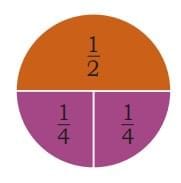
One piece of 1/2 and two pieces of 1/4 make a whole
This shows us: 1/2 + 1/4 + 1/4 = 1 whole
Also: 1/2 = 2/4 (equivalent fractions)
Understanding the Pattern: When a 1/2 piece is broken into 2 equal parts, each part becomes 1/4. So 2 pieces of 1/4 equal 1/2.
Lets see some more combinations:
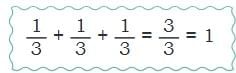
1/3 + 1/3 + 1/3 = 1 whole
1/6 + 1/6 + 1/6 + 1/6 + 1/6 + 1/6 = 1 whole
1/4 + 1/4 = 1/2
Try yourself:
What do you need to make a whole using 1/5 pieces?
A.3 pieces
B.5 pieces
C.8 pieces
D.2 pieces
View Solution
Making Equivalent Fractions
What are Equivalent Fractions?
Equivalent fractions are different fractions that show the same part of a whole.
Example: , , , all represent the same amount even though they look different.
Sameer shaded one-third () of some shapes.
When he split the shapes into smaller equal parts by drawing lines, he found fractions like:
, , – all exactly cover the same shaded area as 1/3.
This means = = =
These are equivalent fractions.
How to check if two fractions are equivalent?
If you multiply or divide both the top number (numerator) and the bottom number (denominator) of one fraction by the same number, you get an equivalent fraction.
For example:
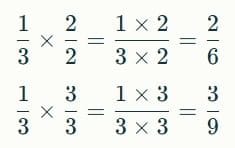
In short, to get equivalent fractions, multiply or divide numerator and denominator by the same number.
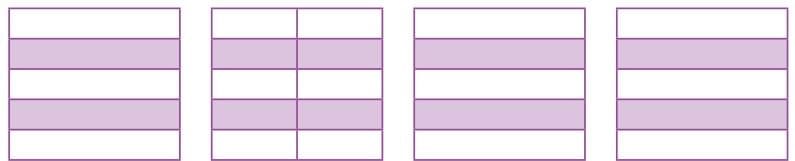
Look at figures showing shaded.
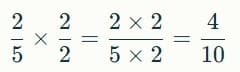
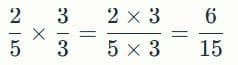
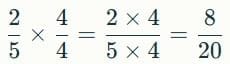
Lets find equivalent fractions of using this:
Multiply numerator and denominator by 2
Multiply numerator and denominator by 3:
Multiply numerator and denominator by 4:
These all represent the same part of the whole as .
When fractions have the same denominator (bottom number), we compare the numerators (top numbers). This is like comparing pieces of the same size.
Comparing Fractions—Same Denominator
Fractions have two parts: numerator (top number) and denominator (bottom number).
When fractions have the same denominator, it means the whole is divided into the same number of equal parts.
To compare such fractions, we only need to look at the numerators.
Example: Sevi and Shami sharing a chikki
The whole chikki is divided into 3 equal parts (denominator is 3).
Sevi ate 1 part → 13
Shami ate 2 parts → 23
Since the denominator is the same (3), compare numerators:
Numerator 1 (Sevi) and Numerator 2 (Shami)
2 is greater than 1, so Shami ate more chikki than Sevi.
Comparing Fractions – Same Numerator
What does it mean to compare fractions with the same numerator?
When fractions have the same numerator (same number of parts), but different denominators (different total parts), the bigger fraction is the one with the smaller denominator.
This is because smaller parts make each piece bigger.
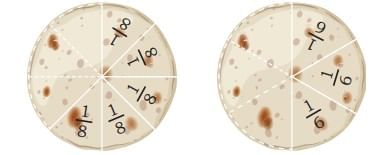
Example: Comparing who ate more paratha
Suppose:
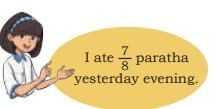
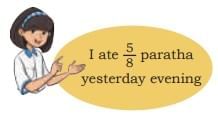
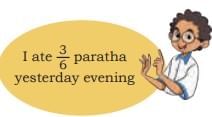
You ate 13 paratha yesterday evening.
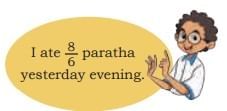
Your friend ate 14 paratha yesterday evening.
Both have the numerator 1 (one piece), but denominators are different (3 and 4).
Since 3 is smaller than 4, 13 is bigger than 14.
So, you ate more paratha than your friend.
Rule: When numerators are the same, the fraction with the smaller denominator is bigger.
Try yourself:
What do we compare when fractions have the same numerator?
A.Values
B.Denominators
C.Sizes
D.Numerators
View Solution
Fractions Greater Than 1
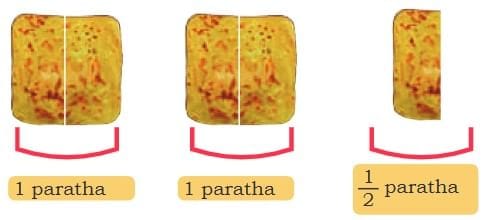
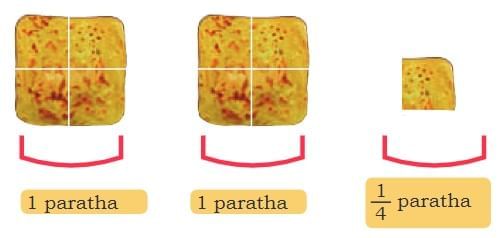
We know, a fraction tells us how many parts of a whole we have. For example, if a paratha (a soft flatbread) is cut into equal parts:
12 (one-half) means the paratha is cut into 2 equal parts, and you have one of those parts.
14(one-fourth or a quarter) means the paratha is cut into 4 equal parts, and you have one of those parts.
Sometimes, you can eat more than one whole paratha. This happens when you eat many pieces of paratha, so the total amount is more than one whole. This is called a “fraction greater than 1.”
Let’s see this with some examples.
Example 1: Eating Halves (12’s)
Imagine Raman’s father cuts parathas into halves (2 equal parts each).
If Maa took 5 pieces of 12 paratha, how many whole parathas did she eat?
Since 2 halves make 1 whole paratha, 5 halves are:
5×12=52=212 (which means 2 whole parathas and half of another one)
So, Maa ate 2 and a half parathas.
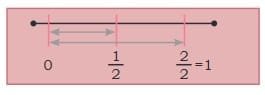
Using a Number Line to Understand
If you draw a line and divide the space between 0 and 1 into 2 equal parts (because halves),
Then each part is 12.
Moving 5 steps of 12 along the line gets you to 2 and 12.
Example 2: Radhika’s halves
Radhika took 6 pieces of 12 paratha.
Number Line method
62=3 parathas
So, she ate 3 whole parathas.
Dadiji took 7 pieces of 12 paratha = 72=312 parathas
Raman ate 6 pieces of 12 paratha = 3 parathas
Dadaji ate 7 pieces of 12 paratha = 3 and 12parathas
Baba ate 5 pieces of 12 paratha = 2 and 12 parathas
To find how many parathas were made on that day, add all these fractions.
Now, some day, all parathas were cut into 4 pieces each (fourths).
Dadaji took 9 pieces of 14 paratha. How many parathas did he eat
Since 4 fourths make 1 whole paratha, 9 pieces are:
2 + 14
= 214
So, he ate 2 and one-fourth parathas.
Example 4: Sharing Pizzas
The family ordered 2 pizzas, and each pizza is cut into 3 equal slices.
Total slices = 2 pizzas × 3 slices = 6 slices
6 family members need 1 slice each.
Dadiji and Dadaji gave their slices to Raman.
Maa and Baba gave theirs to Radhika.
That means:
Raman gets his slice + 2 slices from Dadiji and Dadaji = 3 slices
Radhika gets her slice + 2 slices from Maa and Baba = 3 slices
Each slice is:
13 (one slice out of 3)
So,
Raman’s total pizza =
Radhika’s total pizza =
When Raman gave 1 slice of pizza to Radhika
Raman eats 2 slices = 2×13=23 pizza
Radhika had 3 slices, now gets 1 more slice from Raman
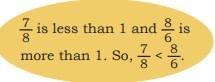
Comparing Fractions With Reference to 1
Let us compare some more fractions. Between Sevi and Shami can you tell who ate less?
Have you ever gone on a long trip and wondered how far you travelled or how long it took? Think about where you went, how you got there, and how different your journey would have been a hundred or even a thousand years ago.
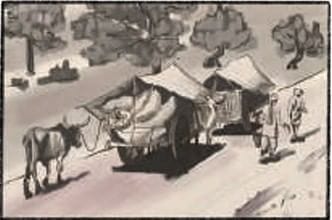
Bullock Carts
Human beings have always been curious explorers. Since ancient times, they have travelled great distances—initially on foot, then using animals like horses, camels, or bullocks. One of the earliest inventions in transport was the boat, even before bullock carts became common. Boats helped early humans cross rivers, lakes, and seas, opening up new lands and trade routes.
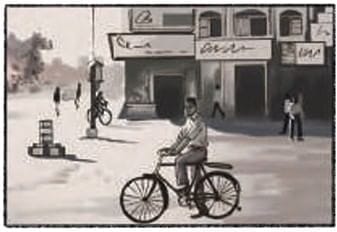
Bicycle
About a hundred years ago, the number of vehicles was very small. People mostly used animal-drawn carts, simple cars, and trains. But over the years, the modes of transport have changed drastically. Today, we have millions of vehicles—cars, buses, motorcycles, airplanes, ships—and this number continues to rise every day.
Reading and Writing Large Numbers
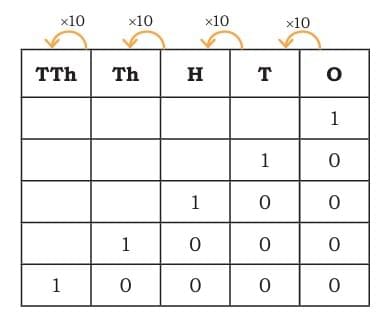
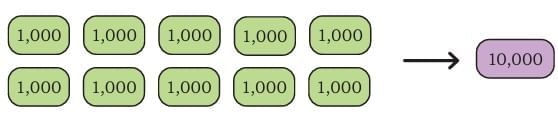
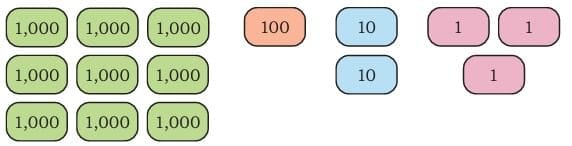
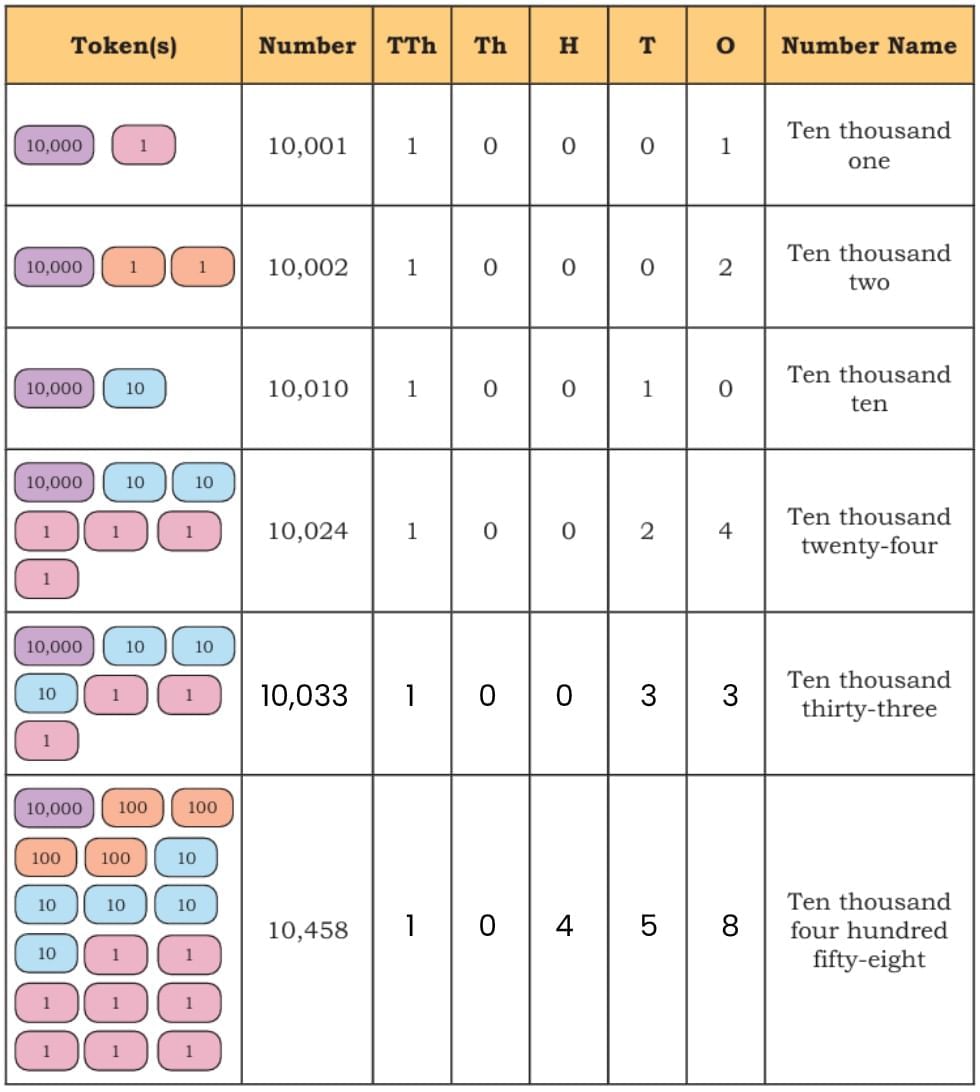
Imagine you have a lot of things, like thousands of candies! How do we write such big numbers? Let’s start with 1,000. What numbers do we get when we keep adding a thousand? If we keep adding 1,000, we get these numbersWhat happens when we add 1,000 to 9,000? We get Ten Thousand, which is written as 10,000.
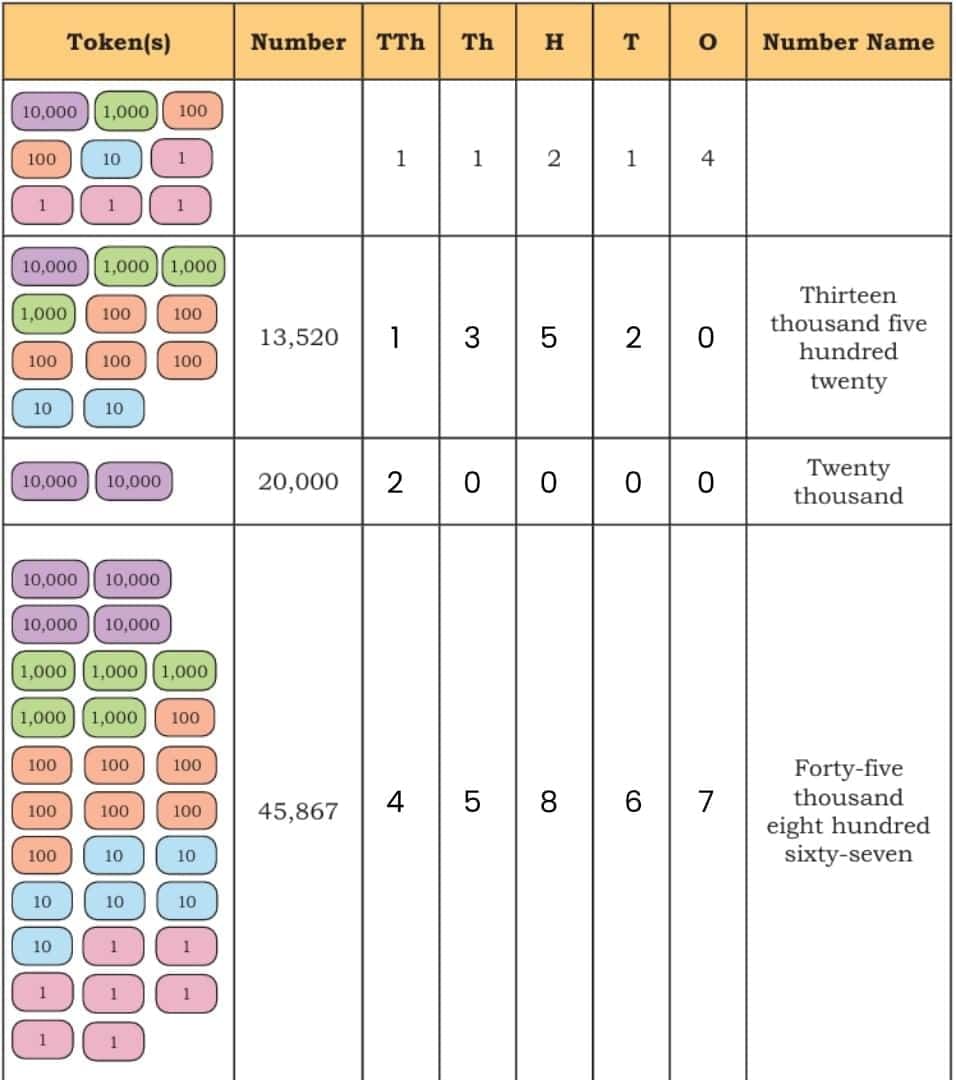
To understand big numbers, we use something called a Place Value Chart. It helps us know the value of each digit in a number. Look at the table below and notice the pattern of writing numbers. Place Value ChartWe add a new column called TTh, which stands for Ten Thousand.
Here’s how it works:
This is 1
• 10 Ones make 1 Ten (10)
• 10 Tens make 1 Hundred (100)
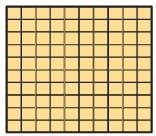
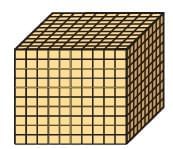
• 10 Hundreds make 1 Thousand (1,000)
• 10 Thousands make 1 Ten Thousand (10,000)
We use commas to make large numbers easier to read. For example, 10,000 is read as “Ten Thousand.”
We use the digits from 0 to 9 in different places to write even larger numbers. For example:
Let us see how we write numbers beyond 10,000 and how we name them. We write them in the same way as numbers below 9,999.
Nearest Tens (10s), Hundreds (100s), and Thousands (1,000s)
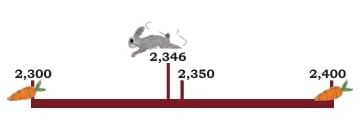
Imagine a rabbit trying to find its food! The rabbit needs to go to the nearest place where its food is kept.
Let’s help a rabbit find its food by understanding how to round numbers to the nearest tens, hundreds, and thousands.
Part 1: Nearest Tens of 2,346
Situation:
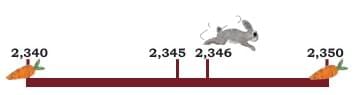
The rabbit is standing at 2,346.
The food is kept at the neighbouring tens — these are the numbers that are 10 apart from 2,346.
The two closest tens are:
2,340 (just before 2,346)
2,350 (just after 2,346)
What to do:
We check which one is closer to 2,346.
From 2,346 to 2,340: 6 jumps back
From 2,346 to 2,350: 4 jumps forward
Answer:
2,350 is the nearest ten to 2,346
It will need 4 jumps to reach 2,350
Part 2: Nearest Hundreds of 2,346
Situation:
The rabbit is still at 2,346
The food is now kept at neighbouring hundreds
The two closest hundreds are:
2,300
2,400
What to do:
We check which one is closer to 2,346.
From 2,346 to 2,300: 46 jumps back
From 2,346 to 2,400: 54 jumps forward
Answer:
2,300 is the nearest hundred to 2,346
It will need 46 jumps to reach 2,300
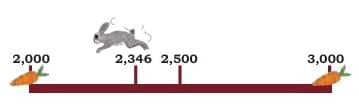
Part 3: Nearest Thousands of 2,346
Situation:
The rabbit is still at 2,346
The food is now kept at neighbouring thousands
The two closest thousands are:
2,000
3,000
What to do:
We check which one is closer to 2,346.
From 2,346 to 2,000: 346 jumps back
From 2,346 to 3,000: 654 jumps forward
Answer:
2,000 is the nearest thousand to 2,346
It will need 346 jumps to reach 2,000
Travelling, Now and Then
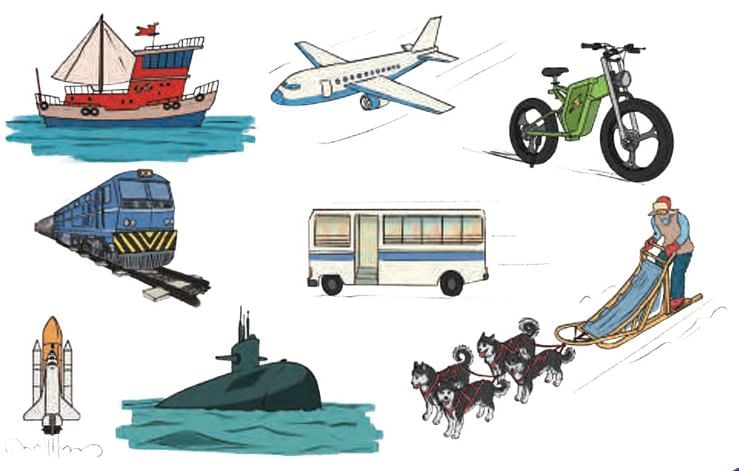
Means of Transport
We learnt that people in the past travelled on foot, on animals, and used boats and sailing ships.
The animals that have been used for travelling include bullocks, horses, donkeys, mules, and elephants.
In hilly and snow-covered regions, yaks, dogs, and reindeers have been used, while camels have been used in deserts.
Now, people use bicycles, motorbikes, cars, buses, trains, ships, and aeroplanes to travel from one place to another.
Submarines are used to go deep under water.
Humans are also using spacecraft to travel to outer space.
In an hour a person can generally travel:
On foot: 3 – 5 km
On horseback: 10 – 15 km
By cycle: 12 – 20 km
By motorbike: 40 – 60 km
By train: 40 – 160 km
By ship: 25 – 45 km
By aircraft: 750 – 920 km
By spacecraft: minimum 28,000 km
Finding Large Numbers Around Us
We saw that the distance (in kilometre) covered by different means of transport in an hour can range from a 1-digit number to a 5-digit number.
Can we find other contexts around us that contain numbers in this range?
Let us consider the situation below.
A book has around 200 pages, and each page has about 50 words.
The book therefore has about 10,000 words in all.
Usually, we measure distances in sea and air using nautical miles. For now, we will use 1 km = 1,000 m. By now, you know different units of measuring length. We will study the units for measuring length, kilometre, in detail in a later chapter.
Pastime Mathematics
Math can be fun, even when you are just passing time! Here are some puzzles that involve numbers and logical thinking.
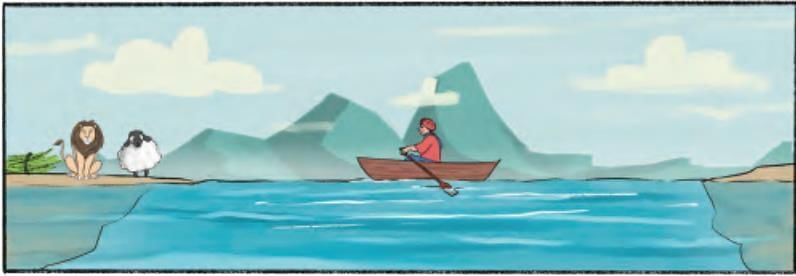
The River Crossing Puzzle
Sanju & Mira in a trainSanju and Mira are sitting in a train. They want to have fun, so they start playing games. Mira gives Sanju a puzzle called the “river crossing puzzle”.
The Puzzle
There is a boatman who wants to cross a river using a small boat. He has three things with him:
Boatman
A lion
A sheep
A bundle of grass
The boat is very small. It can carry only one thing at a time with the boatman.
But there are two problems:
If the sheep and grass are left alone on the riverbank, the sheep will eat the grass.
If the lion and sheep are left alone on the riverbank, the lion will eat the sheep.
So the boatman has to be very careful about what he leaves behind when he takes something across.
Goal
Help the boatman take all three — the lion, the sheep, and the grass — to the other side of the river safely.
No one should get eaten, and he should do it in the least number of trips.
Step-by-Step Solution
Let’s go step by step:
First Trip: The boatman takes the sheep across the river and leaves it on the other side. Now:
Other side: Sheep
Starting side: Lion, Grass
Nothing gets eaten
Second Trip: He comes back alone and then takes the lion across the river. But this time, he does not leave the lion. Instead, he brings the sheep back with him.
Now:
Other side: Lion
Starting side: Grass
Boat: Boatman and Sheep
Third Trip: He drops the sheep back on the starting side and takes the grass across the river. Now:
Other side: Lion and Grass
Starting side: Sheep
Fourth Trip: He comes back alone and finally takes the sheep across.
Final Result
All three — lion, sheep, and grass — are safely on the other side.
No one got eaten.
It took the boatman 7 trips total:
4 trips with passengers
3 trips coming back alone or with the sheep
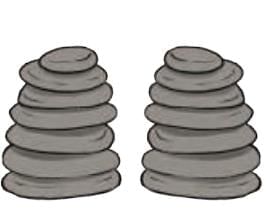
Pile of Pebbles Game
Sanju and Mira are still traveling on the train. Now Sanju teaches Mira a new game called the “Pile of Pebbles.”
How to Play the Game
There are two piles of pebbles.
Each pile has 7 pebbles at the beginning.
Rules of the Game:
Two players take turns.
On your turn, you can pick any number of pebbles (1 or more) but only from one pile.
You cannot pick pebbles from both piles in the same turn.
The player who picks the last pebble — that is, there are no pebbles left in both piles after their move — wins the game.
What’s the Challenge?
Mira asks: “How can I make sure I win this game?”
Sanju tells her: “Try playing the game with smaller numbers of pebbles, like 1 in each pile, then 2 in each pile, and so on. Look for a pattern to find a winning strategy.”
Let’s Try Small Examples First
Example 1: 1 pebble in each pile (1, 1)
Player 1 takes all the pebbles from one pile.
Player 2 takes the last pebble from the other pile — and wins.
So, if it starts at (1, 1), the second player wins.
Example 2: 2 pebbles in each pile (2, 2)
Player 1 takes 2 from one pile → (0, 2)
Player 2 takes 2 from the other pile → (0, 0) → Player 2 wins again
Again, (2, 2) is a losing position for the first player.
Example 3: 3 in each pile (3, 3)
Same pattern continues. If both piles are equal, the second player can always copy what the first player does, and win.
What Pattern Do We See?
If the two piles have the same number of pebbles, then the second player can always win by copying the first player’s moves.
But if the two piles have different numbers, then the first player can win if they know what to do.
Winning Strategy
To win the game:
Try to leave the piles in a position where both piles have the same number of pebbles for your opponent.
Then, whatever number they take from one pile, you take the same number from the other pile.
Keep copying their move until you get the last pebble.
In Our Case (7, 7)
The game starts with 7 pebbles in each pile.
If you go second, you can win by copying your opponent’s moves.
If you go first, you should try to make the piles equal after your move, so the second player cannot copy you and win.
The Number Puzzle
Now it’s Mira’s turn to give a puzzle to Sanju. She gives him a fun number puzzle that looks simple at first, but has an amazing surprise in the end.
How to Play the Puzzle
Let’s understand the steps clearly:
Step 1:
Pick any two different digits. For example: 3 and 7
Step 2:
Make two 2-digit numbers using those digits. You can make:
37 (3 first, 7 second)
73 (7 first, 3 second)
Step 3:
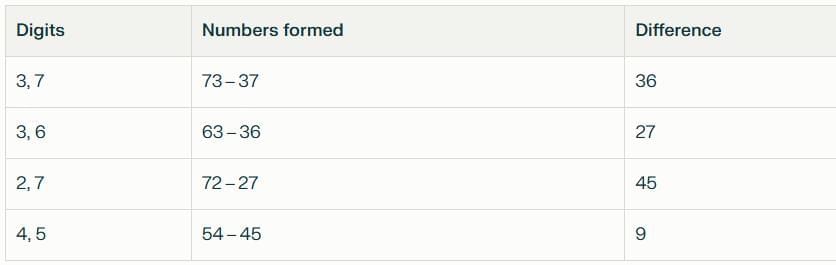
Subtract the smaller number from the bigger number. Here: 73 – 37 = 36
Step 4:
Now use the two digits of the result (which is 3 and 6) and repeat Steps 2 and 3.
Let’s do it:
36 and 63
63 – 36 = 27
Use 2 and 7 now:
27 and 72
72 – 27 = 45
Use 4 and 5:
45 and 54
54 – 45 = 9
Now we got a single-digit number — 9.
Mira’s Surprise
Mira says: “No matter which two digits you start with, you will always end up with 9.”
The whole process will look as shown below.
This makes the puzzle magical and fun. But how did she know that?
Let’s Explore the Pattern
Let’s take a closer look at the examples:
Look at the differences: 36 → 27 → 45 → 9
Each time, we use the digits from the result and continue.
Eventually, we reach 9, a single-digit number.
Try with Other Digits
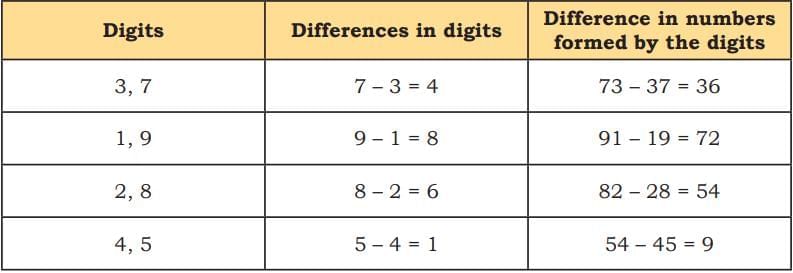
Let’s try starting with 1 and 9:
91 – 19 = 72
Use 7 and 2 → 72 – 27 = 45
Use 5 and 4 → 54 – 45 = 9
Again, we get 9.
What’s the Trick or Pattern?
Look at this:
Now look at the relationship:
36 ÷ 4 = 9
72 ÷ 8 = 9
54 ÷ 6 = 9
9 ÷ 1 = 9
So, the difference between the two numbers is always a multiple of 9.
That’s how Mira knew that the process will always end at 9.
Try This Yourself
Try different starting digits and make your own table:
Choose digits so that the difference between the numbers is 2, 3, 5, or 7.
See what pairs of digits give you 9 in just one or two steps.
See which pairs take the longest time (most steps) to reach 9.
King’s Horses
There was once a king who loved horses a lot. He had 20 beautiful horses. The king kept his horses in a big building called a stable. There, a man called a caretaker took care of the horses for the king.
One day, a thief sneaked in at night and stole one horse! Now there were only 19 horses left. The caretaker was scared that the king would be angry if he found out a horse was missing.
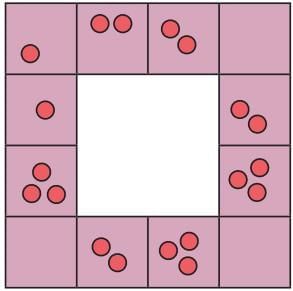
So, the clever caretaker tried to trick the king! He arranged the horses in a way so that when the king looked, he saw 5 horses on each side of the stables, and there are 4 sides. The king counted: 5 on this side, 5 on that side, 5 on another, and 5 on the last, which makes 20 horses. The king thought all the horses were there and went away happy.
But there really weren’t 20 horses left!
If you count the horses one by one, you’ll see there are only 19 horses. So, what was the caretaker’s trick?
Here’s the trick: The caretaker put some horses at the corners of the square. These corner horses are counted on both sides — for both sides they are on! For example, if there’s a horse in the left corner, you might count it for the left and the top sides.
So, the king was counting the same horse twice for two sides!
The next night, the thief came again and took one more horse. Now only 18 horses were left. The caretaker moved the horses again, so the king saw 5 horses on each side the next day.






 of a bigger chocolate can indeed be larger than
  of a smaller chocolate!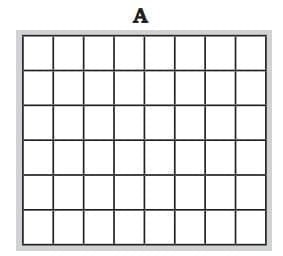







 Example: , , , all represent the same amount even though they look different.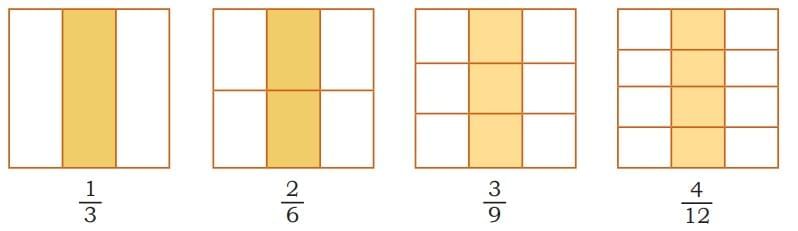
 Look at figures showing shaded.