9. Coconut Farm – Worksheet Solutions

Multiple Choice Questions

Q1: What is the number to be divided called?

(a) Divisor
(b) Quotient
(c) Dividend
(d) Remainder

Ans: (c) Dividend

The number to be divided in a division operation is called the Dividend. For example, in 114 ÷ 8, the number 114 is the dividend.

Q2: What is the result of the division called?

(a) Dividend
(b) Divisor
(c) Quotient
(d) Remainder

Ans: (c) Quotient . 

                                                                             .        The result of a division operation is called the Quotient. For example, in 114 ÷ 8, the number 14 is the quotient.

Q3: Which of the following statements is true about dividing a number by itself?

(a) The result is the number itself.
(b) The result is always 1.
(c) The result is zero.
(d)The result is the dividend.

Ans: (b) The result is always 1
When a number is divided by itself (except zero), the result is always 1. For instance, 8÷8 = 1.

Q4: What happens when you divide zero by a non-zero number?

(a) The result is 1.
(b) The result is 0.
(c) The result is undefined.
(d) The result is the divisor.

Ans: (b) The result is 0.
When zero is divided by any non-zero number, the result is always 0. For example, 0÷5 = 0.

Q5: What is the remainder when 10 is divided by 3?

(a) 1
(b)  2
(c) 3
(d) 0

Ans: (a) 1
When 10 is divided by 3, the division gives a quotient of 3 and a remainder of 1. This is because 10 = (3×3) + 1.


Fill in the Blanks

Q1: The number left after division is called __________.

Ans: “Remainder”

Q2: When dividing a number by 1, the quotient is __________.

Ans: “The number itself”

Q3: The formula to verify division is __________.

Ans: “Divisor × Quotient + Remainder = Dividend”

Q4: The quotient of any number divided by itself is __________.

Ans: “1”

Q5: If you divide zero by a number, the result is __________.

Ans: “0”


True or False

Q1: Division by zero is defined. 

Ans: “False”
Division by zero is not defined because no number can be divided by zero in mathematics. It leads to an undefined result. Hence, the statement is False.

Q2: The remainder can be equal to the divisor. 

Ans: “False”
The remainder in a division operation is always less than the divisor. For example, in 10÷3, the remainder is 1, which is less than 3. Hence, the statement is False.

Q3: Division of a number by 1 always results in the number itself. 

Ans: “True”

Q4: The quotient of any number divided by itself is always greater than one. 

Ans: “False”
When a number is divided by itself (except zero), the quotient is always 1. For instance, 5÷5=1, which is not greater than one. Hence, the statement is False.

Q5: To divide by 10, you remove the last digit. __________

Ans: “True”

Answer the following questions

Q1: I want to distribute Rs 3,600 among 8 persons. How many rupees will each person get?
Ans:
Total Rs. = 3600
To be distributed among = 8 persons
3600 ÷ 8 = 450 Rs. per person

Q2: In a division, divisor = 100, quotient = 25 and remainder = 75, find the dividend.
Ans:
Divisor = 100, Quotient = 25 and Remainder = 75
Dividend = Quotient x Divisor + Remainder.
Dividend = 25 x 100 + 75 = 25075

Q3: In a division, remainder is always ______ than the divisor.
Ans: The remainder is always less than the divisor. If the remainder is greater than the divisor, it means that the division is incomplete. It can be greater than or lesser than the quotient.

Q4: 6308 ÷ 100 gives quotient = ______ and remainder = ______.
Ans: 6308 ÷ 100 gives quotient = 63 and remainder = 08.

Q5: Manish has Rs 84. The cost of one pencil box is Rs 14 How many pencil boxes can Manish buy for Rs 84?
Ans:

  • Total money = RS 84
  • Cost of 1 pencil box = RS 14
  • Then cost of x pencil boxes is = 84 ÷ 14 = 6
  • So, x = 6

6. The Dairy Farm – Worksheet Solutions

Q1: Find the following products

(i) 38 x 9 
Ans: 38 x 9 = 342

(ii) 80 x 5
Ans: 80 x 5 = 400

(iii) 53 x 8
Ans: 53 x 8 = 424

Q2: Multiply

(i) 4,032 by 198
Ans:

 
=  4,032 x 198 = 798336

(ii) 3,647 by 245
Ans: 


3,647 x  245 = 893515

(iii) 501 by 123
Ans:


= 501 x 123 = 61623

Q3: Fill in the blanks

(i) 2,586 x ______ = 2,586
Ans: 2,586 x = 2,586
(Identity Property: The product of any number with 1 is as same as the number itself.)

(ii) 624 x ______ = 38 x 624
Ans: 624 x 38 = 38 x 624
(Commutative property of multiplication is a math rule that says you can multiply numbers in any order, and the result will be the same.)

(iii) 600 x ______ = 0.
Ans: 600 x 0 = 0
(Zero property of multiplication is a fundamental rule in mathematics that states that any number multiplied by zero is equal to zero.)

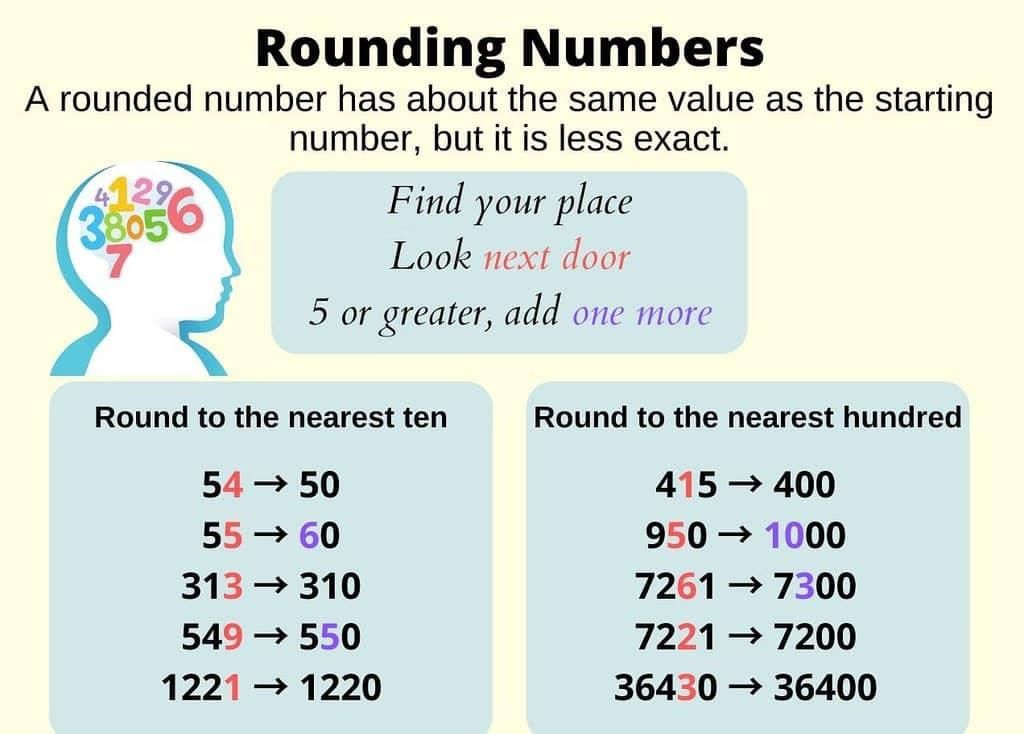
Q4: Round off the following numbers to the nearest tens

(i) 13,528
Ans: Here’s the general rule for rounding:

  • Number >= 5: If the number you are rounding is followed by 5, 6, 7, 8, or 9, round the number up. Example: 38 rounded to the nearest ten is 40.
  • Number < 5: If the number you are rounding is followed by 0, 1, 2, 3, or 4, round the number down. Example: 33 rounded to the nearest ten is 30.

Therefore, applying these rules, we get:
13,528 = 13,530

(ii) 3,542
Ans: Here’s the general rule for rounding:

  • Number >= 5: If the number you are rounding is followed by 5, 6, 7, 8, or 9, round the number up. Example: 38 rounded to the nearest ten is 40.
  • Number < 5: If the number you are rounding is followed by 0, 1, 2, 3, or 4, round the number down. Example: 33 rounded to the nearest ten is 30.

Therefore, applying these rules, we get:
3,542 = 3,540

(iii) 174
Ans: Here’s the general rule for rounding:

  • Number >= 5: If the number you are rounding is followed by 5, 6, 7, 8, or 9, round the number up. Example: 38 rounded to the nearest ten is 40.
  • Number < 5: If the number you are rounding is followed by 0, 1, 2, 3, or 4, round the number down. Example: 33 rounded to the nearest ten is 30.

Therefore, applying these rules, we get:
174 = 170

Q5: Estimate Products by rounding each number to the nearest Tens

​(Find an approximate answer for each multiplication problem by rounding both numbers to the nearest tens place first, then multiplying the rounded numbers.
(i) 52 x 43
Ans: Here’s the general rule for rounding:

  • Number >= 5: If the number you are rounding is followed by 5, 6, 7, 8, or 9, round the number up. Example: 38 rounded to the nearest ten is 40.
  • Number < 5: If the number you are rounding is followed by 0, 1, 2, 3, or 4, round the number down. Example: 33 rounded to the nearest ten is 30.

Therefore, applying these rules, we get:
52 x 43 = 50 x 40 = 2000

(ii) 63 x 52
Ans: Here’s the general rule for rounding:

  • Number >= 5: If the number you are rounding is followed by 5, 6, 7, 8, or 9, round the number up. Example: 38 rounded to the nearest ten is 40.
  • Number < 5: If the number you are rounding is followed by 0, 1, 2, 3, or 4, round the number down. Example: 33 rounded to the nearest ten is 30.

Therefore, applying these rules, we get:
63 x 52 = 60 x 50 = 3000

Q6: Answer the following Questions

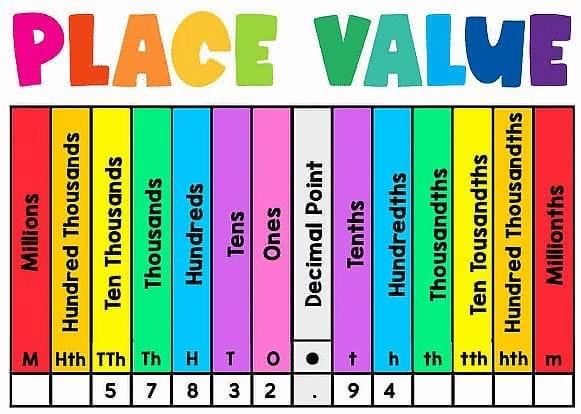
(i) Calculate the product of the place values of the two 6s in the number 6,965.

Ans: The place value of 1st 6 in 6,965 is at thousand’s place.
=> First place value of 6 = 6000
The place value of 2nd 6 in 6,965 is at ten’s place.
=> Second place value of 6 = 6000
Product of the place values of 6 in the number 6,965 = 6000 x 60 = 360000

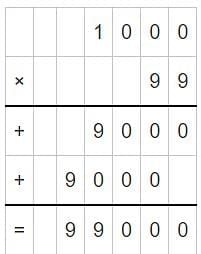
(ii) Find the product of the greatest 2-digit number and the smallest 4-digit number ______.
Ans: Greatest 2-digit no. = 99
Smallest 4-digit no. = 1000
Therefore, the product of the greatest 2-digit number and the smallest 4-digit number = 1000 x 99 = 99000.

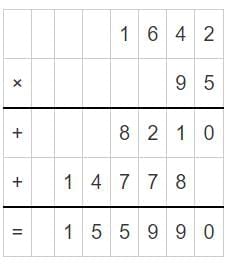
(iii) A transistor costs Rs. 1,642. Find the cost of 95 such transistors. 

Ans: Cost of one Transistor = Rs 1,642
Total number of transistors = 95
Cost of 95 Transistors = 1642 x 95 = 155,990

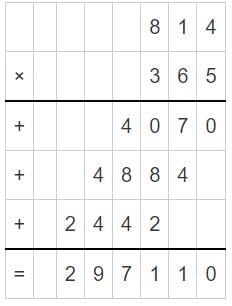
(iv) A candle factory produced 814 candles in a day. How many candles will this factory produce in a year?

Ans: A candle factory produces candles in a day = 814
Total  number of days in a leap year = 365
Candles this factory will produce in one year = 814 x 365 = 2,97,110

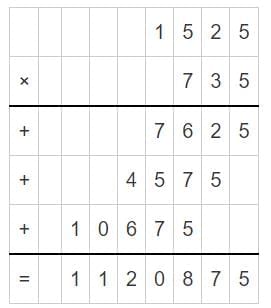
(v) A farmer produced 735 quintals of rice. He sold it at the rate of Rs 1525 per quintal. How much money did he get?
Ans: A farmer produced rice = 735 quintals
Cost per quintal = Rs. 1525
Money he got = 1525 x 735 = Rs. 1,120,875

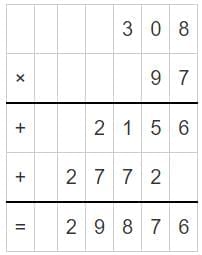
(vi) The cost of a pack of Ghee is Rs. 308 Find the cost of 97 such packs.
Ans: The cost of 1 pack of Ghee = Rs. 308
Total number of packs = 97
Therefore, Total Cost of 97 packs of Ghee = 308 x 97 = 29,876

1. We the Travellers — I            – Worksheet Solutions

Q1: Multiple Choice Questions (MCQs)

(i) What is the place value of 5 in 1536?
(a)
 5
(b) 50
(c) 500
(d) 5000

Ans: (c) 500
 The place value of 5 is 500. (Hundred)

Here are the values of each number:

(ii) Which number comes first in ascending order?  
7308, 7038, 7348, 7304
(a) 7308
(b) 7038
(c) 7348
(d) 7304 

Ans: (b) 7038

(iii) What is the short form of 8,00,000 + 2,000 + 30 + 6?
(a)
 80,236
(b) 8,20,036
(c) 8,02,036
(d) 8,20,306

Ans: (c) 8,02,036
8,00,000 + 2,000 + 30 + 6 = 8,02,036
We start by adding the place values together:

  • 8,00,000 (Lakhs place)
  • 2,000 (Thousands place)
  • 30 (Tens place)
  • 6 (Ones place)
  • When we put these values together in one number, we get 8,02,036.


(iv) Which is the largest number in this group? 7,20,163; 7,20,136; 7,02,163; 7,02,613
(a) 
7,20,136
(b) 7,02,613
(c) 7,02,163
(d) 7,20,163

Ans: (d) 7,20,163

(v) Which is the smallest 4-digit number amongst the following?

(a) 1303

(b) 1234

(c) 0132

(d) 0142

Ans: (b) 1234


Q2: True or False

(i) The place value of 4 in 3,49,026 is 4,000.
Ans:
 False

(ii) In the number 8036, 3 is in the hundreds place.
Ans: False

(iii) The number 1,25,471 is smaller than 61,832.
Ans: 
False

(iv) The smallest whole number is 0.
Ans:
 True

(v) 7,36,000 is the predecessor of 7,35,999.
Ans:
 False


Q3: Fill in the Blanks

(i) In 1042, 2 is at the _____ place.
Ans:
 Ones

(ii) The place value of 6 in 6,00,087 is _____.
Ans: 6,00,000 (Lakhs)

(iii) The first six multiples of 4 are ____, ____, ____, ____, ____, and ____.
Ans: 
4, 8, 12, 16, 20, 24

(iv) Arrange the numbers 62,917; 1,00,008; 45,132; 36,472 in descending order:
Ans:
 1,00,008; 62,917; 45,132; 36,472

(v) The predecessor of the smallest 6-digit number is ____.
Ans:
 99,999


Q4: Answer the Following Questions

(i) Write the place value of 2 in 7,52,693.
Ans: 2,000 (Thousands)

(ii) Which is greater: 3,69,501 or 3,69,510?
Ans: 
3,69,510

(iii) Write the short form of: 9,00,000 + 4,000 + 200.
Ans: 
9,04,200

(iv) Arrange the numbers 4526, 4256, 4569, 4325 in ascending order.
Ans: 
4256, 4325, 4526, 4569

(v) Write the number name for 4,65,009.
Ans:
 Four lakh sixty-five thousand and nine


Q5: Find the place-value of 6 in each of the following numbers:

(a) 19,356 
Ans: The place value of 6 is 6 (ones)

(b) 6,00,087
Ans: The place value of 6 is 600000 (lakhs)


Q6:  Write the number names for each of the following numbers: 

(a) 2,50,006 
Ans: Two lakh fifty thousand and six.

(b) 4,65,009 
Ans: Four lakh sixty five thousand and nine.