Q1: The distributive property of multiplication over addition is written as: a(b + c) = ______.
Q2: 12(x + 4) = ______ + ______.
Q3: (2x + 7)(x + 3) expands to ______.
Q4: The perimeter of a rectangle with length (3x + 5) and breadth (x + 2) is ______.
Q5: The total number of pencils in (x + 3) boxes, each having (2x + 4) pencils, is ______.
State True or False
Q1: The degree of a constant term is 0
Q2: A school buys (3x + 1) books, each having (x + 2) pages. A student claims the total pages are 3x² + 7x + 1.
Q3: 1 is an algebraic expression
Q4: A fruit seller sells (2x + 5) apples every day for 12 days. He says the total apples are 24x + 60.
Q5: In like terms, the numerical coefficients should also be the same
Answer the following questions
Q1: The volume of a rectangular box where length, breadth, and height are 2a, 4b, 8crespectively. Q2: Carry out the multiplication of the expressions in each of the following pairs. (i) p − q, 9pq² (ii) b² − 16, 5b
Q3: Simplify x(2x−1)+5 and find its value at x=−3 Q4:A shopkeeper sells (x + 4) pens at ₹15 each and (2x + 3) pencils at ₹5 each. Find the total money he earns. Q5: Add: x(x − y), y(y − z), and z(z − x)
Q6: Multiply: (m² + 3n²) × (2m − n)
Q7: A fruit seller sells (2x + 5) apples every day for 12 days. Each apple costs ₹(x + 2). Find the total cost.
Q8 Simplify the expression and evaluate them as directed:4y(3y – 2) + 5(y + 3) – 12for y = -1
Q1: Which of the following is not a property of a square? (a) All angles are 90° (b) Opposite sides are parallel (c) Only one pair of sides is equal
Q2: What will be the sum of interior angles of a polygon having 8 sides? (a) 720° (b) 1080° (c) 1260° (d) 1440°
Q3: Which quadrilateral has exactly two distinct consecutive pairs of equal sides? (a) Kite (b) Rhombus (c) Trapezium (d) Square
Q4: The sides of a quadrilateral are in the ratio of 2:5:4:1. Find out the sum of the smallest and largest angles. (a) 120° (b) 180° (c) 240° (d) 360°
Q5: If the area of a square field is 144 sq m, then find the perimeter. (a) 24 m (b) 36 m (c) 48 m (d) 60 m
Q6: If the base of a triangle is 3 cm and the height is 6 cm, then find the area. (a) 6 sq cm (b) 9 sq cm (c) 12 sq cm (d) 18 sq cm
Q7: An isosceles trapezium has: (a) Both pairs of opposite sides parallel (b) Non-parallel sides equal in length (c) Diagonals equal and perpendicular (d) All sides equal in length
Q8: In a parallelogram: (a) Only one pair of sides is parallel (b) Opposite sides are equal (c) Diagonals are always equal in length (d) All angles are 90°
Q9: If the three angles of a quadrilateral are 70°, 90° and 120°, then find the measure of the fourth angle. (a) 100° (b) 75° (c) 80° (d) 60°
Q10: The measure of two adjacent angles of a parallelogram are in the ratio 2:3. Find the measure of each of the angles of a parallelogram. (a) 72°, 108° (b) 54°, 112° (c) 68°, 99° (d) 86°, 114°
2. True/FalseQ1: A kite has all four sides equal.
Q2: A square is a special type of rectangle and parallelogram.
Q3: The sum of the smallest and largest angles of a quadrilateral, with sides in the ratio 2:5:4:1, is 240°.
Q4: The perimeter of a square field, with an area of 144 sq m, is 48 m.
Q5: The area of a triangle with a base of 3 cm and height of 6 cm is 9 sq cm. 3. Fill in the Blanks
Q1: A polygon in which all sides and all angles are equal is called a __________ polygon.
Q2: The diagonals of a rectangle are equal in length and __________ each other.
Q3: In a parallelogram, adjacent angles are __________.
Q4: The diagonals of a rhombus bisect each other at __________ degrees.
Q5: A trapezium has at least __________ pair of opposite sides parallel.
4. Very Short Answer QuestionsQ1: Can all the angles of a quadrilateral be right angles?
Q2: The sum of all angles in a quadrilateral is equal to_____ right angles.
Q3: Name the quadrilateral whose diagonals are equal.
Q4: Each angle of a square measures ___°.
Q5: How many parallel lines are in a trapezium?
Q6: Which figure is equiangular and equilateral polygons?
Q7: It rhombus also satisfied the properties of a_______.
Q8: If the diagonals of a quadrilateral are perpendicular bisectors of each other then it is always a______.
5. Answer the following questions: Q1: A room has a length of 10 m, breadth of 5m and height of 8 m. Find out the area of the room.
Q2: The length of one side of a rhombus is 6.5 centimeters and its altitude is 10 centimeter. if the length of one side of its diagonals is 26 centimeter find the length of the other diagonal.
Q3: If three angles of a trapezium is 50°, 130° and 120°. Then find the other angle.
Q4: If two adjacent angles of a parallelogram are in the ratio 2:3 Find all the angles of the parallelogram.
Q5: if the angles of a quadrilateral are in the ratio 3:6:8:13. The largest angle is?
Q6: diagonals of a quadrilateral ABCD bisect each other. If A=45°. Then B=?
Q7: The angles of a quadrilateral are x°, x+5°, x+10°, x+25°. Then find the value of x.
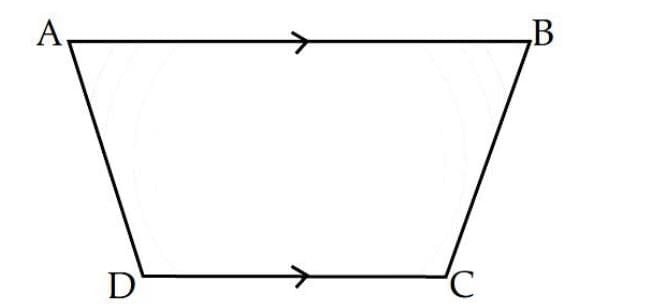
Q8: ABCD is a trapezium such that AB || CD, ∠A : ∠D = 2 : 1, ∠B : ∠C = 7 : 5, find the angles of the trapezium.
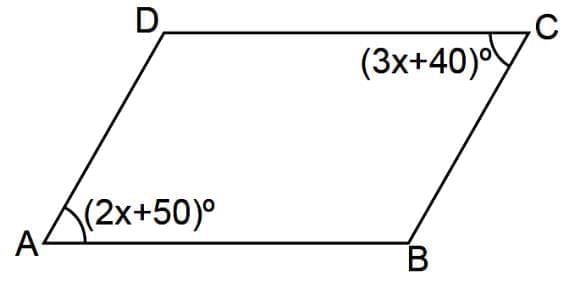
Q9: ABCD is a parallelogram where m∠A = (2x + 50°) and m∠C = (3x + 40°). (i) Find the value of x. (ii) Find the measure of each angle.
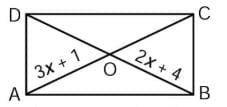
Q10: In the below figure, ABCD is a rectangle. Its diagonals meet at O. Find x, if OA = 3x + 1 and OB = 2x + 4.
You can access the solutions to this unit test here.
Q1: In the Roman numeral system, what number does MCMXLIV represent? a) 1944 b) 1444 c) 1949 d) 1494 Answer: a) 1944
Q2: If the base of a number system is 7, what is the 4th landmark number after 1? a) 28 b) 49 c) 343 d) 7 Answer: b) 49
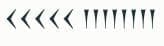
Q3: Symbolis representation for which number?
a) 60 b) 360 c) 3600 d) any multiple of 60
Answer: a) 60
Q4: In a base-8 system, what is the value of the number 345 (base 8) in base-10? a) 229 b) 228 c) 230 d) 231 Answer: a) 229
Q5: In a base-5 system, the third landmark number after 1 is: a) 15 b) 25 c) 20 d) 30 Answer: b) 25
2. True / False
Q1: The Bakhshali manuscript contains the earliest known example of the number zero written as a dot.
Ans: True
Q2: Roman numerals can easily be used for multiplication and division.
Ans: False
Q3:The Gumulgal people counted numbers in groups of 2.
Ans: True
Q4: The Lebombo bone is believed to be younger than the Ishango bone.
Ans: False
Q5: In the Egyptian number system, each landmark number is 10 times the previous one.
Ans: True
3. Fill in the blanks
Q1: The ancient counting device made of a frame with rods and beads is called an __________. Ans: abacus
Q2: In the Roman numeral system, C represents the number __________. Ans: 100
Q3: The Roman numeral for 1000 is represented as __________. Ans: M
Q4: The Roman numeral for 50 is represented as __________. Ans: L
Q5: A number system in which each landmark number is obtained by multiplying the previous landmark number by a fixed number n is called a __________ system. Ans: base-n
4. Answer the following Questions
Q1. Represent the following numbers in the Roman system.
(i) 1444
Ans: Break it down: 1000 + 400 + 40 + 4 = M + CD + XL + IV
Answer: MCDXLIV
(ii) 1867
Ans: Break it down: 1000 + 800 + 60 + 7 = M + DCCC + LX + VII
Answer: MDCCCLXVII
(iii) 2539
Ans: Break it down: 2000 + 500 + 30 + 9 = MM + D + XXX + IX
Answer: MMDXXXIX
(iv) 948
Ans: Break it down: 900 + 40 + 8 = CM + XL + VIII
Answer: CMXLVIII
Q2. Consider the extension of the Gumulgal number system beyond 6 in the same way of counting by 2s. Come up with ways of performing the different arithmetic operations (+, –, ×, ÷) for numbers occurring in this system, without using Hindu numerals. Use this to evaluate the following:
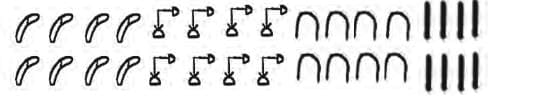
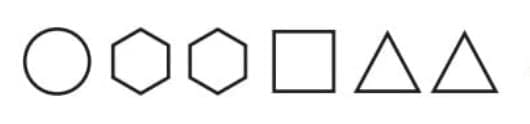
Q9. Add the following numerals that are in the base-5 system that we created:
Remember that in this system, 5 times a landmark number gives the next one!
Ans: Let’s convert this to numerals
First numeral (left side)
This is: 1 circle, 2 hexagons, 1 square, 2 triangles
Value:
1 × 125 = 125
2 × 25 = 50
1 × 5 = 5
2 × 1 = 2
Sum: 125 + 50 + 5 + 2 = 182
Second numeral (right side):
Value:
3 × 125 = 375
1 × 25 = 25
2 × 5 = 10
2 × 1 = 2
Sum: 375 + 25 + 10 + 2 = 412
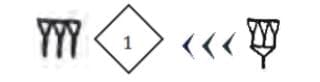
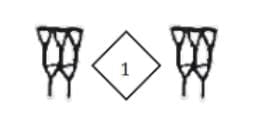
Q10: How would the Mesopotamians have written 20, 50, 100?
Ans: The Mesopotamian (Babylonian) system was a base-60 positional system using symbols for 1 (⟐) and 10 (⟐). Numbers were grouped into powers of 60, with a placeholder for zero in later periods. Assuming the simplified notation from Section 3.4:
20: 20 = 20 × 1 = ⟐⟐ (two 10s).
50: 50 = 5 × 10 = ⟐⟐⟐⟐⟐ (five 10s).
100: 100 = 1 × 60 + 40 × 1 = ⟐,⟐⟐⟐⟐ (one 60 and four 10s).
Multiple Choice QuestionsQ1: Cube root of the expression 1252 (a) 5 (b) 25 (c) 10 (d) 125
Q2: Which of the following is not a perfect square number?
(a) 1156 (b) 4657 (c) 4624 (d) 7056
Q3: Which of these is not a perfect cube but a perfect square of a number (a) 729 (b) 2197 (c) -1331 (d) 169
Q4: Which of these is a perfect cube (a) 216 (b) 392 (c) 8640 (d) 243
Q5: √0.09 is (a) 0.3 (b) 0.03 (c) 0.9 (d) 0.33
Q6: The sum of first n odd natural numbers is (a) n2 (b) 2n (c) n2+1 (d) n2−1
Q7: The one’s digit of the cube of 53 is:
(a) 9 (b) 3 (c) 7 (d) 1
Q8: The volume of the cube is 5832m3 , the side is (a) 18m (b) 16 m (c) 28 m (d) 19m
Q9:A perfect square can never have the following digit in its ones place (a) 8 (b) 4 (c) 0 (d) 1
Q10: Which of the following expressions is not a perfect cube (a) 27 x 125 x 64 (b) 1331 x 125 x 8 (c) 15 x 8 x 25 x 9 (d) None of these
True and FalseQ1: 648 is not a perfect cube.
Q2: 999 is a perfect cube.
Q3: The square of a number is positive, so the cube of that number will also be positive.
Q4: 125×8×27 is a perfect cube.
Q5: For an integer p, p3 is always greater than p2.
Q6: 83 = 5.12
Fill in the blanks
Q1: The square of an even number is _____
Q2: The least number by which 72 be multiplied to make it a perfect cube is __________.
Q3: √4096 is ____
Q4: If 8x3=216, then x ix ____
Q5: The cube of .5 is _____
Q6: There are _________ perfect cubes between 1 and 1000.
Q7: The digit at the ones place of 233 is ____
Q8: The cube of the even natural number is ____
Find the cube roots by prime factorization method
Q1: 15625
Q2: 2744
Q3: 125/2197
Q4: 5832
Q5: 64000
Find the square roots by prime factorization method
Q1: 144
Q2: 3600
Q3: 2025
Q4: 81/256
Q5: 1024
Q6: 3844
Answer the following questions
Q1: Is 256 a perfect cube? If not, find the smallest number by which it should be divided to get a perfect cube. Q2: What could be the possible ‘one’s’ digits of the square root of each of the following numbers? (i) 1801 (ii) 856 (iii) 1008001 (iv) 6577525 Q3: Three numbers are in the ratio 1:2:3 and the sum of their cubes is 4500. Find the numbers.
Q4: Find the smallest number by which following number must be divided to get a perfect square. Also, find the square root of the perfect square so obtained. (i)600 (ii)2904
Q5: Find the smallest number by which following number must be multiplied to get a perfect square. Also, find the square root of the perfect square so obtained. (i) 1008 (ii) 1280 (iii) 1875
You can access the solutions to this Unit Test here.