7. Proportional Reasoning-1   – Worksheet Solutions

Multiple Choice Questions (MCQs)

Q1. Simplify the ratio 56 : 72.
a) 14 : 18
b) 7 : 9
c) 28 : 36
d) 8 : 9

Answer: b) 7 : 9

Q2. If a : b = 2 : 3 and b : c = 3 : 5, then a : b : c = ?
a) 2 : 3 : 5
b) 2 : 3 : 9
c) 2 : 3 : 5
d) 2 : 3 : 7.5

Answer: a) 2 : 3 : 5

Q3. A sum of $600 is divided in the ratio 3 : 5. The smaller share is:
a) $225
b) $200
c) $250
d) $180

Answer: b) $225

Q4. If 6 pencils cost $24, the cost of 9 pencils is:
a) $28
b) $30
c) $36
d) $32

Answer: c) $36

Q5. The fourth proportion of 3, 9, and 12 is:
a) 27
b) 36
c) 24
d) 18

Answer: a) 27

Q6. The third proportion of 12 and 18 is:
a) 24
b) 27
c) 36
d) 30

Answer: b) 27Fill in the Blanks

Q1: The ratio of 75 cm to 2.5 m is ___ : ___.
(Answer: 3 : 10)

Q2: If 4 pens cost $20, then the cost of 10 pens is ___.
(Answer: $50)

Q4: The ratio of 1 hour to 45 minutes is ___ : ___.
(Answer: 4 : 3)

Q5: If 7 : x = 21 : 63, then x = ___.
(Answer: 21)​

Q6: The third proportion of 8 and 12 is ___.
(Answer: 18)

Q7: If a : b = 5 : 7, then b : a = ___ : ___.
(Answer: 7 : 5)Answer the following Questions: 

Q1. Simplify the ratio 42 : 63

Find HCF of 42 and 63 → HCF = 21

Divide both terms:
42 ÷ 21 = 2,   63 ÷ 21 = 3
Simplified ratio = 2 : 3

Q2. Ron gets 20% more marks than John. Find the ratio of their marks.

Let John’s marks = 100

Ron’s marks = 100 + 20% of 100 = 120

Ratio (Ron : John) = 120 : 100 = 6 : 5
Ratio = 6 : 5

Q3. Divide $490 in the ratio 4 : 3

Total parts = 4 + 3 = 7

Value of 1 part = 490 ÷ 7 = 70

  • Shares:
  • First part = 4 × 70 = 280
  • Second part = 3 × 70 = 210
    Division = $280 and $210

Q4. A man distributes $4000 among three sons in the ratio 4 : 3 : 3. Find amount for first son.

Total parts = 4 + 3 + 3 = 10

Value of 1 part = 4000 ÷ 10 = 400

First son’s share = 4 × 400 = 1600
First son receives = $1600

Q5. If the ratio a : b = 2 : 3, and b : c = 3 : 4. Find the ratio a : c.

a : b = 2 : 3 → a = 2k, b = 3k

b : c = 3 : 4 → b = 3m, c = 4m

To combine, make b equal. LCM of 3 and 3 = 3
So, let b = 3 (common)
Then a = 2 (from first ratio), c = 4 (from second ratio)

Ratio a : c = 2 : 4 = 1 : 2

Answer: 1 : 2

Q6. Two numbers: Five times the first = Four times the second. Find ratio.

Let first = x, second = y

5x = 4y

x / y = 4 / 5

Ratio = 4 : 5

Answer: 4 : 5

Q7. Find the fourth proportion of 4, 9, and 12.

Fourth proportion = (9 × 12) ÷ 4
= 108 ÷ 4
= 27

Answer: 27 (option d)

Q8. Find the third proportion of 16 and 36.

Third proportion of a and b = (b²) ÷ a

Here a = 16, b = 36

Third proportion = (36²) ÷ 16
= 1296 ÷ 16
= 81

6. We Distribute, Yet Things Multiply – Worksheet Solutions

Fill in the blanks

Q1: Terms with the same algebraic factors are called ____________ terms.
Ans:
 Like

Explanation: Like terms have the same variables raised to the same powers (e.g., 3x and 5x).

Q2: A ________________ can take any value and ________________ has a fixed value.
Ans:
 Variable, constant 

Explanation: A variable changes (e.g., x), a constant stays the same (e.g., 5).

Q3: An expression with one or more terms is called _____________
Ans
: Algebraic expression

Explanation: An algebraic expression is a combination of variables and constants.

Examples:

  • 2x+3 → algebraic expression

Q4: An expression with one term is called __________________ with two terms is ______________ and with three terms is _______________
Ans
: Monomial, binomial, trinomial 

Explanation:

  • 1 term = monomial (e.g., 4x)
  • 2 terms = binomial (e.g., x + y)
  • 3 terms = trinomial (e.g., x² + 2x + 3)

Q5: An algebraic expression with equality sign is called ______________
Ans
: Equation 

Explanation: An equation has an equals (=) sign between two expressions.

State True or False

Q1: The degree of a constant term is 0
Ans:
 True

Explanation: A constant term (like 3, −7, or 100) has no variable.
It can be written as: 3 = 3 × x⁰

Q2: The difference between two like terms is a like term.
Ans: 
True

Explanation: Like terms have the same variables and powers.
For example: 6x and 4x are like terms.

  • Their difference: 6x − 4x = 2x

Q3: 1 is an algebraic expression
Ans:
 True

Explanation:
An algebraic expression can include: constants, variables, or both.
The number 1 is a constant, so it’s a valid algebraic expression.

Q4: The expression x + y + 5x is a trinomial.
Ans
: False

Explanation: Before deciding the number of terms, we must combine like terms.
Here, x and 5x are like terms.
x + y + 5x = 6x + y → Only 2 terms 
→ It’s a binomialnot a trinomial.

Q5: In like terms, the numerical coefficients should also be the same
Ans:
 False

Explanation: Like terms need to have the same variables with the same powers, but the coefficients can be different.

For example: 2xy and 7xy are like terms (same variables, different coefficients)

Answer the following questions

Q1: The volume of a rectangular box where length, breadth, and height are 2a,4b,8crespectively.
Ans:
 Given: Length of a rectangular box, l=2a
Breadth of rectangular box, b=4b
Height of rectangular box, h=8c
We need to find the volume of the rectangular box with the given dimensions.
We know, 
The volume of a cuboid =l×b×h
=2a × 4b × 8c
=64abc
Q2: Carry out the multiplication of the expressions in each of the following pairs.
(i) ​​​​p − q, 9pq²
(ii) b² − 16, 5b

Ans: (i) (p − q) × 9pq²

We multiply each term of the bracket (p and −q) with 9pq²:
= p × 9pq² − q × 9pq²
= 9p²q² − 9pq³

(ii) (b² − 16) × 5b

Multiply each term in the bracket by 5b:
= b² × 5b − 16 × 5b
= 5b³ − 80b

Q3: Simplify x(2x−1)+5 and find its value at x=−3
Ans:
Given: x(2x−1)+5
We need to find the value of the given expression at x=−3
We will substitute x=−3 in the given expression. 
Therefore, the expression after simplifying will be
2(−3)2−(−3)+5
=2(9)+3+5
=18+8
=26
Q4: Simplify the expression and evaluate them as directed:  2x(x + 5) – 3(x – 4) + 7 for x = 2

Ans: Simplify 2x(x + 5) – 3(x – 4) + 7:
= 2x2 + 10x – 3x + 12 + 7
= 2x2 + 7x + 19
For x = 2 :
2(2)2 + 7(2) + 19 
= 2(4) + 14 + 19
= 8 + 14 + 19 = 41
Q5: Add: x(x − y), y(y − z), and z(z − x)
Ans: x(x − y) + y(y − z) + z(z − x)
First expand each expression:
1. x(x−y)=x2−xy
2. y(y−z)=y2−yz
3. z(z−x)=z2−zx

Add all the expressions: 
x− xy + y2− yz +z− zx
Rearrange like terms:
x2+ y2+ z2– xy -yz -zx

Q6: Multiply: (m² + 3n²) × (2m − n)

Sol: (m² + 3n²) × (2m − n)
= m² × (2m − n) + 3n² × (2m − n)
= 2m³ − m²n + 6mn² − 3n³

Q7: From the sum of 3a−b+9 and −b−9, subtract 3a−b−9
Ans:
 Given: expressions 3a−b+9, −b−9, 3a−b−9
We need to subtract 3a−b−9
from the sum of 3a−b+9
and −b−9
The sum of the first two terms, −b−9
and 3a−b+9
will be
3a−b+9+(−b−9)=3a−b+9−b−9=3a−2b
Now subtracting 3a−b+9
from 3a−2b, we get
3a−2b−(3a−b−9)=3a−2b−3a+b+9=−b+9

Q8 Simplify the expression and evaluate them as directed:4y(3y – 2) + 5(y + 3) – 12for y = -1

Ans: Simplify 4y(3y – 2) + 5(y + 3) – 12

= 12y2 – 8y + 5y + 15 – 12
= 12y2 – 3y + 3

For y = -1:

12(-1)2 – 3(-1) + 3
= 12(1) + 3 + 3
= 12 + 3 + 3 = 18

Q9:Add 4x(2x + 3) and 5x2 – 7x + 10.

Ans: 
1. Expand 4x(2x + 3):

4x(2x + 3) = 8x2 + 12x

2. Add 8x2 + 12x to 5x2– 7x + 10:

(8x2 + 12x) + (5x2 – 7x + 10)

3. Combine like terms:

8x2 + 5x2 + 12x – 7x + 10 = 13x2 + 5x + 10

The result is 13x2 + 5x + 10.

Q10: Simplify (x2−3x+2)(5x−2)−(3x2+4x−5)(2x−1)
Ans:Given: (x2−3x+2) (5x−2) − (3x2+4x−5) (2x−1)
We need to simplify the given expression.
First simplifying, (x2−3x+2) (5x−2),
we will get
(x2−3x+2)(5x−2)

=5x3−15x2+10x−2x2+6x−4

=5x3−17x2+16x−4 ……………….(1)
Now simplifying, (3x2+4x−5)(2x−1), we will get
(3x2+4x−5)(2x−1)

=6x3+8x2−10x−3x2−4x+5

=6x3+5x2−14x+5 ………………(2)
Subtract (1)−(2) to get the result
(x2−3x+2)(5x−2)−(3x2+4x−5)(2x−1)

=5x3−17x2+16x−4−[6x3+5x2−14x+5]

=5x3−17x2+16x−4−6x3−5x2+14x−5

=−x3−22x2+30x−9

5. Number Play – Worksheet Solutions

Multiple Choice Questions (MCQs)

Q1. Which of the following natural numbers cannot be expressed as a sum of consecutive natural numbers?

  • a) 15
  • b) 12
  • c) 8
  • d) 9
  • Solution: c) 8 (Powers of 2 like 8 cannot be expressed as sums of consecutive natural numbers, as per the chapter.)

Q2. For four consecutive numbers n, n+1, n+2, n+3 with + and – signs between them, how many expressions are possible?

  • a) 4
  • b) 6
  • c) 8
  • d) 16
  • Solution: c) 8 (There are 3 positions for signs, each can be + or -, so 2^3 = 8 expressions.)

Q3. According to parity rules, what is the result of Odd + Odd?

  • a) Odd
  • b) Even
  • c) Depends on the numbers
  • d) Always multiple of 3
  • Solution: b) Even (Odd ± Odd = Even, as per the parity rules in the chapter.)

4. Which expression always results in an even number for any integer values?

  • a) 3g + 5h
  • b) b²
  • c) x + 1
  • d) 2a + 2b
  • Solution: d) 2a + 2b (Both terms are multiples of 2, so always even; other options can be odd depending on values.)

5. If a number is divisible by both 9 and 4, it must be divisible by:

  • a) 12
  • b) 18
  • c) 36
  • d) 72
  • Solution: c) 36 (LCM of 9 and 4 is 36, as stated in the chapter.)

6. What is the general form of numbers that give a remainder of 3 when divided by 5?

  • a) 5k + 2
  • b) 5k + 3
  • c) 5k – 1
  • d) 5k
  • Solution: b) 5k + 3 (As explained, numbers like 3, 8, 13 are 5k + 3.)

7. For divisibility by 4, which part of the number must be checked?

  • a) Units digit only
  • b) Last two digits
  • c) Sum of all digits
  • d) Last three digits
  • Solution: b) Last two digits (The last two digits must form a number divisible by 4.)

8. A number is divisible by 11 if:

  • a) The sum of its digits is divisible by 11
  • b) The difference between the sum of odd and even positioned digits is divisible by 11
  • c) The last digit is 0 or 5
  • d) The number is even
  • Solution: b) The difference between the sum of odd and even positioned digits is divisible by 11 (As per the divisibility rule for 11 in the chapter.)

9. The digital root of a multiple of 9 is always:

  • a) 0
  • b) 3
  • c) 6
  • d) 9
  • Solution: d) 9 (For non-zero multiples of 9, the digital root is 9.)

10. In cryptarithms, if PQ × 8 = RS where both are 2-digit numbers with distinct digits, what is the solution?

  • a) 10 × 8 = 80
  • b) 11 × 8 = 88
  • c) 12 × 8 = 96
  • d) 13 × 8 = 104
  • Solution: c) 12 × 8 = 96 (It fits the rules: 2-digit, distinct digits, and product is 2-digit.)
  • True/False Questions

1. Every natural number can be written as a sum of consecutive natural numbers.

  • True/False
  • Solution: False (Not all can; e.g., powers of 2 like 2, 4, 8 cannot.)

2. Powers of 2, like 4 and 8, can be expressed as sums of consecutive natural numbers.

  • True/False
  • Solution: False (Powers of 2 cannot be expressed this way.)

3. All even numbers can be written as a sum of consecutive natural numbers.

  • True/False
  • Solution: False (Not all; e.g., 2 cannot.)

4. Zero can be written as a sum of consecutive numbers using negative numbers, such as -1 + 0 + 1.

  • True/False
  • Solution: True (As given in the chapter: -1 + 0 + 1 = 0.)

5. When placing + or – signs between four consecutive numbers, all resulting expressions have the same parity.

  • True/False
  • Solution: True (All have the same parity, either all even or all odd; for consecutive, they are even.)

6. Changing a sign in an expression like a + b – c – d always changes the result by an odd number.

  • True/False
  • Solution: False (It changes by an even number, like 2b.)

7. The expression 3g + 5h always results in an even number for any integers g and h.

  • True/False
  • Solution: False (Can be odd or even; e.g., g=2, h=1: 6+5=11, odd.)

8. If 8 divides two numbers separately, it always divides their sum.

  • True/False
  • Solution: True (Sum of multiples of 8 is a multiple of 8.)

9. If a number is divisible by 8, then any two numbers that add up to it are also divisible by 8.

  • True/False
  • Solution: False (Not always; e.g., 30 + 10 = 40, 40 div by 8, but 30 and 10 not.)

10. A number is divisible by 3 if the sum of its digits is divisible by 3.

  • True/False
  • Solution: True (Divisibility rule for 3.)

11. Adding an odd number to an even number can result in a multiple of 6.

  • True/False
  • Solution: False (Never; sum is odd, multiples of 6 are even.)

12. For divisibility by 5, the units digit must be 0 or 5.

  • True/False
  • Solution: True (Divisibility rule for 5.)

13. The digital root of 489710 is 2.

  • True/False
  • Solution: True (4+8+9+7+1+0=29, 2+9=11, 1+1=2.)

14. In cryptarithms, the first digit of a number can be 0.

  • True/False
  • Solution: False (First digit ≠ 0.)

15. Numbers divisible by 9 are always divisible by 3, but not vice versa.

  • True/False
  • Solution: True (All div by 9 are div by 3; reverse not true, e.g., 15 div by 3 not 9.)
  • Fill in the Blanks

1. Numbers like 15 can be written as sums of consecutive numbers in ________ ways.

  • Solution: multiple (As stated in the chapter.)

2. For four consecutive numbers, all 8 expressions with + and – signs result in ________ numbers.

  • Solution: even (All results are even numbers.)

3. According to parity rules, Even × Any Number = ________.

  • Solution: Even (Even × Anything = Even.)

4. The expression 4m + 2n can be rewritten as 2(________), showing it is always even.

  • Solution: 2m + n (2(2m + n).)

5. If a number is divisible by both 6 and 4, it must be divisible by ________ (their LCM).

  • Solution: 24 (LCM of 6 and 4 is 24.)

6. Numbers that leave a remainder of 3 when divided by 5 can be written as 5k + ________.

  • Solution: 3 (5k + 3.)

7. A number is divisible by 8 if the number formed by its last ________ digits is divisible by 8.

  • Solution: three (Last three digits.)

8. For divisibility by 9, the ________ of its digits must be divisible by 9.

  • Solution: sum (Sum of digits.)

9. The digital roots of multiples of 3 cycle as 3, 6, ________, 3, 6, …

  • Solution: 9 (3, 6, 9 cycle.)

10. In the divisibility rule for 11, calculate the difference between the sum of digits in ________ positions and even positions.

  • Solution: odd (Sum odd positions – sum even positions.)

11. A number is divisible by 6 if it is divisible by both 2 and ________.

  • Solution: 3 (Div by 2 and 3.)

12. The remainder when a power of 10 is divided by 9 is always ________.

  • Solution: 1 (10^n ≡ 1 mod 9.)

13. Aryabhata II used the ________ root method for checking arithmetic calculations.

  • Solution: digital (Digital root.)

14. In cryptarithms, each letter represents ________ digit, and no digit is repeated for different letters.

  • Solution: one (Each letter = one digit.)

15. For divisibility by 24, check divisibility by 3 and ________ instead of 4 and 6.

  • Solution: 8 (3 and 8, as 24=3×8 and co-prime.)

Numerical Questions

1. Find a set of three consecutive natural numbers whose sum is 18.

Solution: Let the numbers be n, n+1, n+2. Their sum is n + (n+1) + (n+2) = 3n + 3 = 18. Solving, 3n = 15, so n = 5. The numbers are 5, 6, 7.

2. Using four consecutive numbers starting from 5 (i.e., 5, 6, 7, 8), calculate the value of the expression 5 + 6 – 7 – 8.

Solution: Compute 5 + 6 – 7 – 8 = 11 – 7 – 8 = 4 – 8 = -4.

3. Evaluate the expression 43 + 37 and determine if the result is even or odd.

Solution: 43 + 37 = 80. Since 80 is divisible by 2, it is even.

4. For integers m = 3 and n = -2, compute the value of 4m + 2n.

Solution: 4m + 2n = 4(3) + 2(-2) = 12 – 4 = 8.

5. Find the least common multiple (LCM) of 9 and 4.

Solution: Prime factors: 9 = 3², 4 = 2². LCM = 2² × 3² = 4 × 9 = 36.

6. Find the smallest positive number of the form 5k + 3 that is greater than 20.

Solution: Solve 5k + 3 > 20. Then, 5k > 17, k > 3.4. Since k is a whole number, try k = 4: 5(4) + 3 = 20 + 3 = 23.

7. Determine the number formed by the last two digits of 5678 and check if it is divisible by 4.

Solution: Last two digits: 78. Check: 78 ÷ 4 = 19.5, not an integer, so not divisible by 4.

8. For the number 462, calculate the difference between the sum of digits in odd and even positions to check divisibility by 11.

Solution: Digits: 4, 6, 2. Odd positions (1st, 3rd): 4 + 2 = 6. Even position (2nd): 6. Difference: 6 – 6 = 0. Since 0 is divisible by 11, 462 is divisible by 11.

9. Calculate the digital root of 729.

Solution: Sum digits: 7 + 2 + 9 = 18. Sum again: 1 + 8 = 9. Digital root is 9.

10. In the cryptarithm PQ × 8 = RS, where PQ and RS are two-digit numbers with distinct digits, compute the product for PQ = 12.

Solution: PQ = 12, so 12 × 8 = 96. Thus, RS = 96.

11. Find the sum of the digits of 99009 and check if it is divisible by 9.

Solution: Digits: 9 + 9 + 0 + 0 + 9 = 27. Check: 27 ÷ 9 = 3, so divisible by 9.

12. Compute the remainder when 427 is divided by 9 using the sum of its digits.

Solution: Digits: 4 + 2 + 7 = 13. Sum again: 1 + 3 = 4. Remainder is 4.

13. For the number 186, check if it is divisible by 6 by testing divisibility by 2 and 3.

Solution: Div by 2: 186 ends in 6 (even), so divisible. Div by 3: 1 + 8 + 6 = 15, 15 ÷ 3 = 5, so divisible. Thus, 186 is divisible by 6.

14. If two numbers, 24 and 40, are both divisible by 8, compute their difference and check if it is divisible by 8.

Solution: Difference: 40 – 24 = 16. Check: 16 ÷ 8 = 2, so divisible by 8.

15. Find the digital root of the 6th multiple of 3.

Solution: 6th multiple: 3 × 6 = 18. Sum digits: 1 + 8 = 9. Digital root is 9.

4. Quadrilaterals – Worksheet Solutions

1. Multiple Choice Questions (MCQs)Q1: Which of the following is not a property of a square?
(a) All angles are 90°
(b) Opposite sides are parallel
(c) Only one pair of sides is equal
(d) Diagonals bisect each other at 90°

Ans: (c)

Q2: What will be the sum of interior angles of a polygon having 8 sides?
(a) 720°
(b) 1080°
(c) 1260°
(d) 1440°
Ans: (d) 

Q3: Which quadrilateral has exactly two distinct consecutive pairs of equal sides?
(a) Kite
(b) Rhombus
(c) Trapezium
(d) Square
Ans:
 (a)

Q4: The sides of a quadrilateral are in the ratio of 2:5:4:1. Find out the sum of the smallest and largest angles.
(a) 120°
(b) 180°
(c) 240°
(d) 360°

Ans: (c) 

Q5: If the area of a square field is 144 sq m, then find the perimeter.
(a) 24 m
(b) 36 m
(c) 48 m
(d) 60 m
Ans: (a) 

Q6: If the base of a triangle is 3 cm and the height is 6 cm, then find the area.
(a) 6 sq cm
(b) 9 sq cm
(c) 12 sq cm
(d) 18 sq cm

Ans: (b)

Q7: An isosceles trapezium has:
(a) Both pairs of opposite sides parallel
(b) Non-parallel sides equal in length
(c) Diagonals equal and perpendicular
(d) All sides equal in length
Ans: 
(b)

Q8: In a parallelogram:
(a) Only one pair of sides is parallel
(b) Opposite sides are equal
(c) Diagonals are always equal in length
(d) All angles are 90°

Ans: (b)

Q9: If the three angles of a quadrilateral are 70°, 90° and 120°, then find the measure of the fourth angle.
(a) 100° 
(b) 75° 
(c) 80° 
(d) 60°
Ans: (c) 80°
Sum of all angles of a quadrilateral = 360°
Let fourth angle = x°
70° + 90° +120° + x = 360°
⇒ 280° + x = 360°
⇒ x = 360° – 280°

Q10: The measure of two adjacent angles of a parallelogram are in the ratio 2:3. Find the measure of each of the angles of a parallelogram.
(a) 72°, 108° 
(b) 54°, 112° 
(c) 68°, 99° 
(d) 86°, 114°
Ans: (a) 72°, 108°
Let the two adjacent angles of parallelogram be 2x, and 3x
Sum of adjacent angles of a parallelogram, 2x + 3x = 180°
⇒ 5x = 180°
⇒ x = 36°
First angle = 2 × 36° = 72°
Second angle = 3 × 36° = 108°
Third angle = 72° and fourth angle = 108°

2. True/False
Q1: A kite has all four sides equal.
Ans: False

Q2: A square is a special type of rectangle and parallelogram.
Ans: True

Q3: The sum of the smallest and largest angles of a quadrilateral, with sides in the ratio 2:5:4:1, is 240°. 
Ans: True

Q4: The perimeter of a square field, with an area of 144 sq m, is 48 m. 
Ans: True

Q5: The area of a triangle with a base of 3 cm and height of 6 cm is 9 sq cm. 
Ans: True3. Fill in the Blanks

Q1: A polygon in which all sides and all angles are equal is called a __________ polygon.
Ans: regular

Q2: The diagonals of a rectangle are equal in length and __________ each other.
Ans: bisect

Q3: In a parallelogram, adjacent angles are __________.
Ans: supplementary

Q4: The diagonals of a rhombus bisect each other at __________ degrees.
Ans: 90

Q5: A trapezium has at least __________ pair of opposite sides parallel.
Ans: one

4. Very Short Answer QuestionsQ1: Can all the angles of a quadrilateral be right angles?
Ans: Yes, all the angles of a quadrilateral can be right angles.

Q2: The sum of all angles in a quadrilateral is equal to_____ right angles.
Ans: 4

Q3:  Name the quadrilateral whose diagonals are equal.
Ans: Square, rectangles

Q4: Each angle of a square measures ___°.
Ans: 90°

Q5: How many parallel lines are in a trapezium?
Ans: 2

Q6: Which figure is equiangular and equilateral polygons?
Ans: Square

Q7: It rhombus also satisfied the properties of a_______.
Ans: Parallelogram

Q8: If the diagonals of a quadrilateral are perpendicular bisectors of each other then it is always a______.
Ans: Rhombus

5. Answer the following questions: Q1: A room has a length of 10 m, breadth of 5m and height of 8 m. Find out the area of the room.
Ans: 2×(10+15)×8 sq m
= 400 cm sq

Q2: The length of one side of a rhombus is 6.5 centimeters and its altitude is 10 centimeter. if the length of one side of its diagonals is 26 centimeter find the length of the other diagonal.
Ans: Area = 6.5 × 10 cm sq
= 65sq. Cm
Let, other diagonal = x cm
So, ½ × x ×26 = 65
X=5cm.

Q3: If three angles of a trapezium is 50°, 130° and 120°. Then find the other angle.
Ans: 360°- (50+130+120)°
= 60°

Q4: If two adjacent angles of a parallelogram are in the ratio 2:3 Find all the angles of the parallelogram.
Ans: P = 2x
Q = 3x
So, 5x = 180°
Therefore x = 36°
So, P = 72° and Q = 108°
So R = 72° {opposite of P}
S = 108° {opposite of Q}

Q5: if the angles of a quadrilateral are in the ratio 3 : 6 : 8 : 13. The largest angle is?
Ans: 3x + 6x + 8x + 13x = 360
13X = 150°

Q6: diagonals of a quadrilateral ABCD bisect each other. If A=45°. Then B=?
Ans: A + B = 180°
45° + B = 180°
So, B = 135°

Q7: The angles of a quadrilateral are x°, x+5°, x+10°, x+25°. Then find the value of x.
Ans: X + (x + 5) + (x + 10) + (x + 25) = 360
X=80°

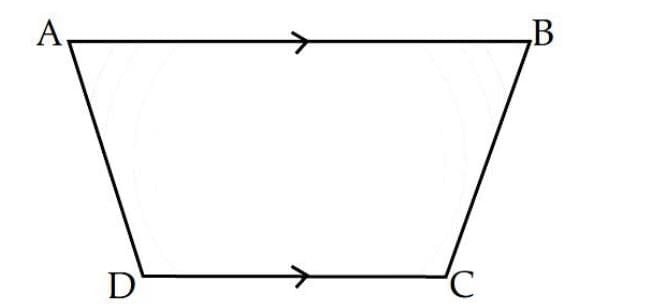
Q8: ABCD is a trapezium such that AB || CD, ∠A : ∠D = 2 : 1, ∠B : ∠C = 7 : 5, find the angles of the trapezium.

Ans: Let angles ∠A and ∠D be 2x and x.
2x + x = 180°
⇒ 3x = 180°
⇒ x = 60°
∴ ∠A = 2x = 120°
and ∠D = x = 60°
Now, ∠B : ∠C = 7:4
Let ∠A and ∠C be 7x and 5x.
7x + 5x = 180°
⇒ 12x = 180/12 = 15°
∴ ∠B = 7 × 15° = 105°
and ∠C = 5 × 15° = 75°

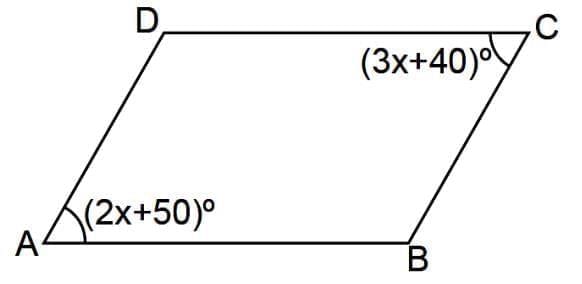
Q9: ABCD is a parallelogram where m∠A = (2x + 50°) and m∠C = (3x + 40°).
(i) Find the value of x.
(ii) Find the measure of each angle.

Ans: (i) We know that opposite angles of a parallelogram are equal in measure.
∴ m∠A = m∠C
⇒ 2x + 50° = 3x + 40°
⇒ 2x – 3x = 40° – 50°
⇒ -x = -10° ⇒ x = 10°
(ii) Since x = 10°, then m∠A = 2x + 50° = 2(10°) + 50° = 20° + 50° = 70°
m∠C = 3x + 40° = 3(10°) + 40° = 30° + 40° = 70°
Also m∠A + m∠B = 180° [∵ Sum of the interior angles on the same side of the transversal is 180°]
⇒ 70° + m∠B = 180°
⇒ m∠B = 180° – 70° = 110°
Now m∠B = m∠D [∵ Opposite angles of a parallelogram are equal]
As m∠B = 110°, so m∠D = 110°

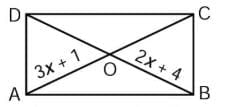
Q10: In the below figure, ABCD is a rectangle. Its diagonals meet at O. Find x, if OA = 3x + 1 and OB = 2x + 4.

Ans: Since, the diagonals of a rectangle are equal, therefore, AC = BD. ..(i)
The diagonals of a rectangle bisect each other at O.
Therefore, OA = 1/2 × AC and OB = 1/2 × BD …(ii)
From (i) and (ii), we get OA = OB
⇒ 3x + 1 = 2x + 4
⇒ 3x – 2x = 4 – 1 ⇒ x = 3

3. A Story of Numbers – Worksheet Solutions

1. MCQs

Q1: In the Roman numeral system, what number does MCMXLIV represent?
a) 
1944
b) 1444
c) 1949
d) 1494
Answer: a) 1944

Q2: If the base of a number system is 7, what is the 4th landmark number after 1?
a)
 28
b) 49
c) 343
d) 7
Answer: b) 49

Q3: Symbolis representation for which number?

a) 60
b) 
360
c) 
3600
d) 
any multiple of 60

Answer: a) 60

Q4: In a base-8 system, what is the value of the number 345 (base 8) in base-10?
a)
 229
b) 228
c) 230
d) 231
Answer: a) 229

Q5: In a base-5 system, the third landmark number after 1 is:
a)
 15
b) 25
c) 20
d) 30
Answer: b) 25

2. True / False

Q1: The Bakhshali manuscript contains the earliest known example of the number zero written as a dot. 

Ans: True

Q2: Roman numerals can easily be used for multiplication and division. 

Ans: False

Q3:The Gumulgal people counted numbers in groups of 2. 

Ans: True

Q4: The Lebombo bone is believed to be younger than the Ishango bone. 

Ans: False

Q5: In the Egyptian number system, each landmark number is 10 times the previous one. 

Ans: True

3. Fill in the blanks

Q1: The ancient counting device made of a frame with rods and beads is called an __________.
Ans: abacus

Q2: In the Roman numeral system, C represents the number __________.
Ans: 100

Q3: The Roman numeral for 1000 is represented as __________.
Ans: M

Q4: The Roman numeral for 50 is represented as __________.
Ans: L

Q5: A number system in which each landmark number is obtained by multiplying the previous landmark number by a fixed number n is called a __________ system.
Ans: base-n

4. Answer the following Questions

Q1. Represent the following numbers in the Roman system.

(i) 1444

Ans: Break it down:
1000 + 400 + 40 + 4 = M + CD + XL + IV

Answer: MCDXLIV

(ii) 1867

Ans: Break it down:
1000 + 800 + 60 + 7 = M + DCCC + LX + VII

Answer: MDCCCLXVII

(iii) 2539

Ans: Break it down:
2000 + 500 + 30 + 9 = MM + D + XXX + IX

Answer: MMDXXXIX

(iv) 948

Ans: Break it down:
900 + 40 + 8 = CM + XL + VIII

Answer: CMXLVIII

Q2. Consider the extension of the Gumulgal number system beyond 6 in the same way of counting by 2s. Come up with ways of performing the different arithmetic operations (+, –, ×, ÷) for numbers occurring in this system, without using Hindu numerals. Use this to evaluate the following:

(i) (ukasar-ukasar-ukasar-urapon) + (ukasar-urapon)

Ans:Break it down:
(2 + 2 + 2 + 1) + (2 + 1) = 7 + 3 = 10

(Gumulgal): ukasar-ukasar-ukasar-ukasar-ukasar
(= ukasar repeated 5 times → 2×5 = 10)

(ii) (ukasar-ukasar-ukasar-ukasar-urapon) − (ukasar-ukasar-urapon)

Ans: Break it down:
(2+2+2+2+1) − (2+2+1) = 9 − 5 = 4

(Gumulgal): ukasar-ukasar
(= 2 + 2 = 4)

(iii) (ukasar-ukasar-ukasar) × (ukasar-urapon)

Ans: Break it down:
(2+2+2) × (2+1) = 6 × 3 = 18

(Gumulgal): (ukasar repeated 9 times)
= 9×2 = 18 → write ukasar nine times:

ukasar-ukasar-ukasar-ukasar-ukasar-ukasar-ukasar-ukasar-ukasar

(iv) (ukasar-ukasar-ukasar-ukasar-ukasar-ukasar) ÷ (ukasar-ukasar)

Break it down:
(2+2+2+2+2+2) ÷ (2+2) = 12 ÷ 4 = 3

(Gumulgal): ukasar-urapon
(= 3)

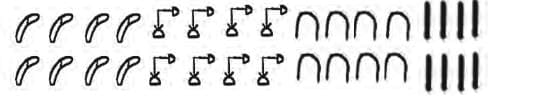
Q3: Represent the following numbers in the Egyptian system:

(i) 54321

(ii) 8888

​(iii) 26005

​Ans:

(i) 

​(ii) 

​(iii) 

Q4: Express the number 87 in this base-5 symbolic system.

Ans: Start grouping with the largest landmark number smaller than 87, which is 5² = 25.
We get:

87 = 25 + 25 + 25 + 5 + 5 + 1 + 1

Using the standard symbols:

  • 5⁰ = 1 → ▲
  • 5¹ = 5 → ■
  • 5² = 25 → ⬡

So the number 87 in the new system is:

⬡ ⬡ ⬡ ■ ■ ▲ ▲

Q5: Add : XLVIII + XXXVI

Ans: Step 1: Write all symbols together:
X + L + V + I + I + I + X + X + X + V + I

Step 2: Group and simplify:

  • I + I + I + I = IV → but keep as V when grouped
  • V + V = X
  • X + X + X + X = XL

So the final result is LXXXIV.

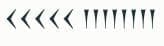
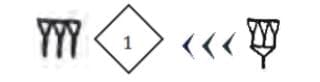
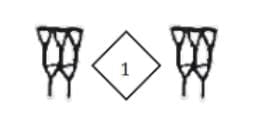
Q6: Write Mesopotamian symbol representation for each number.

(i) 58

(ii) 214

(iii) 305

(iv) 499

(v) 7,281

Ans: 

(i) 58

​(ii) 214

​(iii) 305

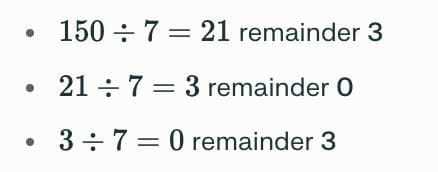
Q7: Convert the decimal number 150 to its base-7 representation. Show your working and write the answer using digits from 0 to 6.

Ans:  To convert decimal 150 to base-7 :

Write the remainders in reverse order: 3 0 3

Q8: Express the number 999 in this new system.

Ans: Largest landmark number smaller than 999 is 5⁴ = 625.
We get:

999 = 625 + 125 + 125 + 125 + (–1) + … wait, no, careful:

Step-by-step:

999 – 625 = 374
Largest ≤ 374 is 125:
374 – 125 = 249

Another 125:
249 – 125 = 124
Largest ≤ 124 is 25:
124 – 25 = 99

Another 25:
99 – 25 = 74

Another 25:
74 – 25 = 49

Another 25:
49 – 25 = 24

Largest ≤ 24 is 5:
24 – 5 = 19

Another 5:
19 – 5 = 14

Another 5:
14 – 5 = 9

Another 5:
9 – 5 = 4

Largest ≤ 4 is 1:
4 – 1 = 3

Another 1:
3 – 1 = 2

Another 1:
2 – 1 = 1

Another 1:
1 – 1 = 0

So:
625 (5⁴) + 125 (5³) × 2 + 25 (5²) × 4 + 5 (5¹) × 4 + 1 (5⁰) × 4

Symbols:
~ ○ ○ ⬡ ⬡ ⬡ ⬡ ■ ■ ■ ■ ▲ ▲ ▲ ▲

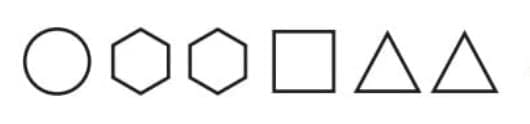
Q9. Add the following numerals that are in the base-5 system that we created:

Remember that in this system, 5 times a landmark number gives the next one!

Ans: Let’s convert this to numerals

First numeral (left side)

This is: 1 circle, 2 hexagons, 1 square, 2 triangles

Value:

  • 1 × 125 = 125
  • 2 × 25 = 50
  • 1 × 5 = 5
  • 2 × 1 = 2

Sum: 125 + 50 + 5 + 2 = 182

Second numeral (right side):

Value:

  • 3 × 125 = 375
  • 1 × 25 = 25
  • 2 × 5 = 10
  • 2 × 1 = 2

Sum: 375 + 25 + 10 + 2 = 412

Q10: How would the Mesopotamians have written 20, 50, 100?

Ans: The Mesopotamian (Babylonian) system was a base-60 positional system using symbols for 1 (⟐) and 10 (⟐). Numbers were grouped into powers of 60, with a placeholder for zero in later periods. 
Assuming the simplified notation from Section 3.4:

  • 20: 20 = 20 × 1 = ⟐⟐ (two 10s).
  • 50: 50 = 5 × 10 = ⟐⟐⟐⟐⟐ (five 10s).
  • 100: 100 = 1 × 60 + 40 × 1 = ⟐,⟐⟐⟐⟐ (one 60 and four 10s). 

2. Power Play – Worksheet Solutions

1. Multiple Choice Questions

Q1: What is the base of the exponent 69?
(a) 6
(b) 2
(c) 9
(d) None
Ans: 
(a)

The base of the exponent 69 is 6

Q2: Find the missing number 

(a) 2
(b) −5
(c) 1
(d) None

Ans: (b)

The missing number should be  −5
So the answer will be 75 = 

Q3: Find the value of  (52)2
(a) 125
(b) 625
(c) 25
(d) 0
Ans: 
(b)

The solution will be
(52)2=54
(52)2=5×5×5×5
(52)2= 625

Q4: In prime factorization, 3600 can be written as:
(a) 2⁴ × 3² × 5²
(b) 2³ × 3³ × 5²
(c) 2⁴ × 3² × 5³
(d) 2² × 3⁴ × 5²

Answer: (a) 

3600 = 2 × 2 × 2 × 2 × 3 × 3 × 5 × 5

Q5: Find the value of x, when 2x=44
(a) x=6
(b) x=2
(c) x=8
(d) x=−5
Ans:
 (c)

The solution will be
2x=44
2x=(22)4
2x=28
2x=28
x=8
So the answer will be x=8

Q5: Which rule of exponents is used in the expression (3²)⁴ = 3⁸?
(a) 
Product Rule
(b) Power of a Power Rule
(c) Quotient Rule
(d) Negative Exponent Rule

Answer: (b)

Q6: Which of the following is the usual form of 5.8 × 10¹²?
(a) 5800000000000
(b) 580000000000
(c) 0.0000000000058
(d) 5.8 × 1000000000
Answer: (a) 5800000000000

Q7: Which of the following is the correct result of 2³ × 5³?
(a) 10³
(b) 7³
(c) 1000
(d) Both (a) and (c)

Answer: (d) 

2³ × 5³ = (2 × 5)³ = 10³ = 1000

Q8: If a password can be made using 26 letters and has 4 characters, the total number of possible passwords is:
(a) 264
(b) 426
(c) 26 × 4
(d) 4262

Answer: (a)

26 choices for each of 4 positions.

Q9: The scientific notation of 9540000000000000 is:
(a) 9.54 × 10¹⁵
(b) 95.4 × 10¹⁴
(c) 0.954 × 10¹⁶
(d) 9.54 × 10¹⁴

Answer: (a) 9.54 × 10¹⁵

Q10: Find the value of (211+62−51)0= ?
(a) 0
(b) −1
(c) 1
(d) None
Ans: 
(c)

The solution will be
(211+62−51)0=(anything)0
(211+62−51)0=1
So the solution will be
(211+62−51)0=1

2. State true or false

Q1:  (100+120)(160+120)=82
Ans: False

Sol: (Anything)=1  therefore, LHS= 1 

RHS= 82 = 64 

hence false 

Q2: (34)2=38
Ans: True

Sol: LHS = (34)= (3)8

RHS =  (3)8

Q3: According to the product rule of exponents, 3² × 3⁵ = 3¹⁰.
Ans: 
False

Sol: It should be 3(2+5) = 37.

Q4: Among 27,32,42, and 63, 6is the greatest.
Ans: True

Sol: Since we have
27 = 2 × 2 × 2 × 2 × 2 × 2 × 2 = 128
32 = 3 × 3 = 9
42 = 4 × 4 = 16
63 = 6 × 6 × 6 = 216
In this, 63 is greater. 

Q5: Linear growth means multiplying by a fixed factor at each step.
Ans: False 

Sol: The statement describes exponential growth; linear growth adds a fixed amount.

Q6: The zero exponent rule states that 0ⁿ = 1 for all values of n.
Ans: False 

Sol: The zero exponent rule applies only when the base is not zero.

3. Fill in the Blanks 

Q1: The power of a power rule states that (nᵃ)ᵇ =________.
Ans: n⁽ᵃ×ᵇ⁾

Q2: Using the quotient rule: 7⁹ ÷ 7⁴ = ________.
Ans:  7⁵

Q3: The negative exponent rule says 3⁻² = _______.
Ans:  1/9

Q4: Prime factorization of 81 in exponential form is _______.
Ans: 3⁴

Q5: A number in scientific notation is written as x × 10ᵃ where 1 ≤ x < _______.
Ans: 10

6. Answer the following Questions

Q1: Follow the pattern and complete

Ans: The pattern for the solution is square root of the numbers which continue as
1234321=11112
123454321=111112

Q2: If 2× 5x=1000 then x=?
Ans: 
For solving we will just factorise
2x ×5x=1000
2× 5x = 5 × 5 × 5 × 2 × 2 × 2
2x × 5x = 23 × 53
x = 3

Q3: Find 33+ 43 + 53 and give the answers in cube
Ans:
 Solve the expression
33+43+5= 27+64+125
33+43+5= 216
33+43+5= 6×6×6
33+43+5= 63

Q4: Find the missing number x in  52+x2=132
Ans: 
Solve the expression
52+x2=132
25+x2=169
x2=144
x=√144
x=12

Q5: Simplify in exponent form (34× 32)÷ 3−4
Ans: 
Solving the expression


Q6: Expand
(a) 1526.26
(b) 8379
Using exponents

Ans: Solve in exponential form
(a) 1526.26 = 1×10³+5×10²+2×101+6×10+2×10⁻¹ + 6×10⁻²
(b) 8379 = 8×10³+3×10²+7×101+9×100

Q7: Express the following number as a product of powers of prime factors.
(a) 1225
(b) 3600
Ans: 
Solve in exponential form
(a) 1225=5×5×7×7
1225=52×72
(b) 3600=2×2×2×2×3×3×5×5
3600=24×32×52

Q8: Express the following large no’s in its scientific notation.
(a)
 491200000
(b) 301000000
Ans: 
Solve in exponential form
(a) 491200000, move the decimal point 8 places to the left: 4.912×10⁸
(b) 9540000000000000, move the decimal point 15 places to the left: 9.54 × 10¹⁵

Q9: Express the following in usual form
(a) 3.02 ×10⁻⁶
(b) 5.8 × 10¹²
Ans: (a)
 3.02 ×10⁻⁶
To convert a smaller number(negative powers of 10) to its usual form shift the decimal towards the left by the number of places equivalent to the power of 10.
3.02 × 10−6 = 3.02/1000000
∴ its usual form is 0.00000302
(b) 5.8 × 1012 = 5800000000000 [Moving the decimal towards the right by 12 places]
∴ its usual form is 5800000000000


Q10: Prove that 

Ans: Solve the left hand side and equate with the right