Q1. Why is the Earth’s crust important for life despite being so thin? The Earth’s crust provides air, water, soil, and minerals needed for life. It also gives us resources like timber, rocks, and metals to build and survive. Without the crust, no plants, animals, or humans could exist.
Q2. How do false colour satellite images help scientists? False colour images use special colours to show details not visible to the naked eye. They help scientists study landforms, water bodies, plant growth, and environmental changes more clearly.
Q3. How does the greenhouse effect on Earth differ from that on Venus? On Venus, the thick carbon dioxide atmosphere traps extreme heat, making it the hottest planet. On Earth, the greenhouse effect is milder, trapping just enough heat to keep temperatures suitable for life.
Q4. Why is the Earth’s position in the Solar System called the “Goldilocks Zone”? Earth is at the right distance from the Sun—neither too hot nor too cold. This allows water to stay mostly in liquid form, which is essential for life.
Q5. What makes Earth’s size suitable for life? Earth’s size creates enough gravity to hold its atmosphere without crushing living beings. If it were smaller, gases would escape; if it were much bigger, gravity could be too strong for life.
Q6. What was the purpose of India’s Mangalyaan mission? Mangalyaan studied Mars’ atmosphere and surface. It searched for signs of past water and explored whether Mars could have supported life.
Q7. How does the Earth’s magnetic field protect life? The magnetic field deflects harmful charged particles from space, such as solar wind and cosmic rays. This protects our atmosphere and living beings from radiation damage.
Q8. How do air, water, and sunlight work together to support life? Plants use sunlight, water, and carbon dioxide to make food through photosynthesis. Animals breathe the oxygen plants release and drink water for survival. This cycle keeps life on Earth balanced.
Q9. Why is soil considered an active part of life on Earth? Soil provides nutrients for plants, which feed most other living things. It is formed from rocks and dead organisms and plays a vital role in supporting ecosystems.
Q10. How are plants, animals, and microorganisms connected in the biosphere? Plants produce food, animals depend on plants or other animals for energy, and decomposers recycle nutrients from dead organisms. This interconnected network keeps ecosystems balanced.
Q11. What human actions are causing biodiversity loss? Cutting forests, draining wetlands, and destroying habitats reduce the number of plants and animals. This breaks food chains and weakens ecosystems.
Q12. How can local communities help protect the environment? Local communities can manage resources like water, soil, and forests wisely. They can reduce waste, prevent pollution, and protect wildlife to keep ecosystems healthy.
Long Answer Questions
Q1. Explain how the thin crust of Earth supports life and why it is compared to the skin of an apple. Ans:
The Earth’s crust is the outermost and thinnest layer where all known life exists. Although it is very thin compared to the rest of the planet, it contains the soil, water, air, and minerals needed for plants, animals, and humans to survive.
Just like the thin skin of an apple protects and covers the fruit, the crust supports and protects life. Beneath it are deeper layers like the mantle and core which do not support life. The crust provides essential resources such as timber, metals, and building materials. Without this layer, life as we know it could not exist.
Q2. Describe the difference between rocky planets and gas giants in our Solar System. Ans:
The Solar System’s planets are divided into two main types—rocky planets (Mercury, Venus, Earth, and Mars) and gas giants (Jupiter, Saturn, Uranus, and Neptune). Rocky planets are smaller, have solid surfaces, and are made mostly of rock and metal. Gas giants are much larger, made mostly of gases like hydrogen and helium, and do not have a solid surface.
Rocky planets are closer to the Sun, while gas giants are farther away. Each type has unique characteristics that affect temperature, atmosphere, and the possibility of life. Studying these planets helps scientists understand Earth’s place in the Solar System.
Q3. Why is Earth’s orbit shape important for maintaining suitable living conditions? Ans:
Earth moves around the Sun in a nearly circular orbit, which keeps sunlight and temperatures relatively steady throughout the year. This prevents extreme temperature changes that could make survival difficult for most living things. If Earth’s orbit were more oval-shaped, some areas would become extremely hot while others would freeze.
The steady climate created by this orbit allows plants to grow and animals to adapt naturally. Along with other factors, the orbit helps maintain the balance of seasons and supports the diversity of life. This stability is one reason Earth can sustain life while other planets cannot.
Q4. How does the magnetic field of Earth act as a shield for life? Ans:
Earth’s magnetic field is created by the movement of molten iron in its core. This invisible field surrounds the planet and deflects harmful charged particles from the Sun (solar wind) and from space (cosmic rays). Without this shield, these particles could strip away parts of the atmosphere and damage living cells.
The magnetic field also helps protect the ozone layer, which blocks dangerous ultraviolet rays. This protection allows life to survive without being exposed to extreme radiation. In short, Earth’s magnetic field is one of the planet’s most important safety features.
Q5. Discuss how water in different forms supports life on Earth. Ans:
Water covers about 70% of Earth’s surface and exists in oceans, rivers, lakes, groundwater, ice, and water vapour in the air. Oceans and seas are home to countless marine species, while freshwater bodies provide drinking water and support farming. Water helps plants absorb nutrients and animals regulate body temperature.
Water vapour forms clouds, leading to rain and snow that refill water sources. Even ice is important—it reflects sunlight and keeps Earth’s climate balanced. Without the continuous movement and recycling of water, life on Earth would not survive.
Q6. Explain the role of microorganisms in maintaining life on Earth. Ans:
Microorganisms like bacteria and fungi are small but play a big role in the Earth’s ecosystems. They act as decomposers, breaking down the remains of dead plants and animals into nutrients that enrich the soil.
Some bacteria help in processes like nitrogen fixation, which makes nutrients available to plants. Microorganisms also form part of the food chain, supporting larger life forms. Without them, waste and dead matter would pile up, and nutrients would not be recycled. Their work ensures that ecosystems stay productive and balanced.
Q1. What does it mean that nature is interconnected? Nature is interconnected means plants, animals, humans, water, and air all affect each other through many links. A change in one part can cause changes in many other parts.
Q2. How can a small change cause big effects in an ecosystem? A small change, like less rainfall, can reduce plant growth and then reduce food for animals. This can push animals to move and disturb nearby farms and villages.
Q3. Why do organisms adapt to their habitats? Organisms adapt so they can survive better in the conditions of their home, like temperature, water, and food. Adaptations help them find shelter, breathe, and get food.
Q4. How do different species share the same habitat without direct conflict? Species can use resources at different times or in different ways, like one being active at night and another in the day. This reduces competition and helps both survive.
Q5. What is resource competition and why is it important? Resource competition is when organisms try to use the same limited food, water, space, or light. It helps control population sizes and keeps balance in the ecosystem.
Q6. What is a niche in a community? A niche is the role an organism plays, including what it eats, where it lives, and when it is active. Clear niches reduce conflict and support harmony.
Q7. How do abiotic factors influence a habitat’s conditions? Abiotic factors like sunlight, temperature, water, and soil shape how organisms live and grow. They decide which plants and animals can survive in that place.
Q8. How do abiotic components interact with each other? Sunlight can warm air and water, changing temperature and speeding evaporation. Wind can move air and water, forming waves and spreading moisture.
Q9. Why are food webs more realistic than food chains? Food webs show that most organisms eat and are eaten by more than one species. This makes the network of feeding relationships more accurate and stable.
Q10. How do migratory birds support ecosystems? Migratory birds help pollinate flowers and spread seeds between faraway places. They also eat pests, which helps farmers protect crops.
Q11. How can human actions disturb ecological balance? Activities like overfishing, pollution, and cutting forests remove key species and damage habitats. This can cause population explosions or crashes and harm people’s livelihoods.
Q12. What steps can communities take to protect ecosystems? Communities can reduce pollution, save water, and protect local green areas and wetlands. They can also support protected areas and use resources wisely to keep nature balanced.
Long Answer Questions
Q1. Explain how biotic and abiotic components interact in an ecosystem. Give suitable examples. Ans:
Biotic components are the living parts of an ecosystem, while abiotic components are the non-living parts. These two are closely linked and depend on each other for survival.
For example, plants (biotic) need sunlight, water, and soil (abiotic) to grow. Animals eat plants or other animals for food, but they also depend on water, air, and temperature for survival.
In a pond, fish (biotic) need oxygen dissolved in water (abiotic) to live. Without these interactions, life processes cannot continue and ecosystems would not be balanced.
Q2. Why is balance in nature important, and what are the effects when it is disturbed? Ans:
Balance in nature means that the number of plants, animals, and other organisms remains stable over time. This happens when resources like food, water, and shelter are used sustainably, and no species grows uncontrollably.
If the balance is disturbed, such as by cutting forests or overfishing, it can start a chain reaction affecting many other species. For instance, removing too many fish can increase insect numbers, reduce pollinators, and lower plant growth.
Human activities like pollution and habitat destruction often cause such imbalances. Restoring balance takes time and careful conservation efforts.
Q3. Describe the roles of producers, consumers, and decomposers in an ecosystem. Ans:
Producers, such as green plants, make their own food using sunlight through photosynthesis. Consumers depend on others for food—herbivores eat plants, carnivores eat animals, and omnivores eat both.
Decomposers like fungi and bacteria break down dead plants and animals into simpler substances, returning nutrients to the soil. This cycle ensures that energy and matter are reused in the ecosystem.
Without producers, there would be no source of energy for other organisms. Without decomposers, waste and dead material would pile up, and nutrients would not return to the soil for plants to use.
Q4. Differentiate between a food chain and a food web with examples.
Ans:
A food chain is a simple, linear sequence showing “who eats whom” in an ecosystem, such as grass → grasshopper → frog → snake → eagle. Each organism passes energy to the next in the chain. A food web is more complex and shows how different food chains are interconnected.
For example, grass may be eaten by rabbits or mice, and mice can be eaten by snakes or owls. This network of feeding relationships makes ecosystems more stable because organisms have multiple food sources. If one food source is removed, others can still sustain the population.
Q5. Explain with an example how a small change in an ecosystem can cause a chain reaction. Ans:
In nature, every part is connected, so even a small change can affect many others. For example, if pollution kills plants in a pond, the oxygen level decreases.
This causes fish populations to drop because they need oxygen to survive. With fewer fish, insect numbers may grow rapidly because fish are their predators.
These insects can damage nearby crops, leading farmers to use more pesticides. Such pesticides harm the environment further, showing how one change spreads through the ecosystem in a series of reactions.
Q6. How do migratory birds contribute to ecosystem balance and why do they migrate?
Ans:
Migratory birds travel long distances to avoid harsh weather and find food. They play important roles in maintaining ecosystem balance. Many act as pollinators, helping flowers reproduce, and as seed dispersers, spreading plant species over wide areas. They also feed on pests like insects, helping farmers reduce crop damage.
For example, the Demoiselle Cranes visit Khichan village in Rajasthan every winter, adding beauty and ecological value. By linking distant habitats, migratory birds ensure that ecosystems remain interconnected across regions.
Q7. Discuss the threats faced by the Sundarbans and why its conservation is important. Ans:
The Sundarbans is the world’s largest mangrove forest and protects coastal areas from floods and storms. It is home to endangered species and supports rich biodiversity. However, it faces threats from deforestation, illegal hunting, overuse of forest resources, and pollution from industries. Cutting mangroves weakens natural flood protection and harms wildlife.
Since the Sundarbans also absorb large amounts of carbon dioxide, their loss would contribute to climate change. Protecting this ecosystem is important not just for local communities but also for global environmental health.
Q8. What are the harmful effects of unsustainable farming practices and how can they be avoided? Ans:
Unsustainable farming practices include overusing chemical fertilizers, monoculture (growing only one crop), and excessive irrigation. These harm the soil by reducing organic matter and killing beneficial microorganisms. Soil erosion increases without humus, and pests may become resistant to pesticides.
Such practices also disturb natural predators and pollinators, reducing biodiversity. To avoid these problems, farmers can use organic manure, rotate crops, and adopt natural pest control methods. Sustainable farming helps maintain soil fertility and keeps ecosystems healthy for future generations.
Q1. How does the Moon’s position in the sky change each day? Ans: The Moon’s position shifts slightly eastward each day, so it is not in the same place at the same time. This is why its rise and set times also change daily.
Q2. Why does the Moon sometimes appear in the daylight? Ans: The Moon can rise before sunset, sometimes in the afternoon. In such cases, it is visible in the sky while the Sun is still up.
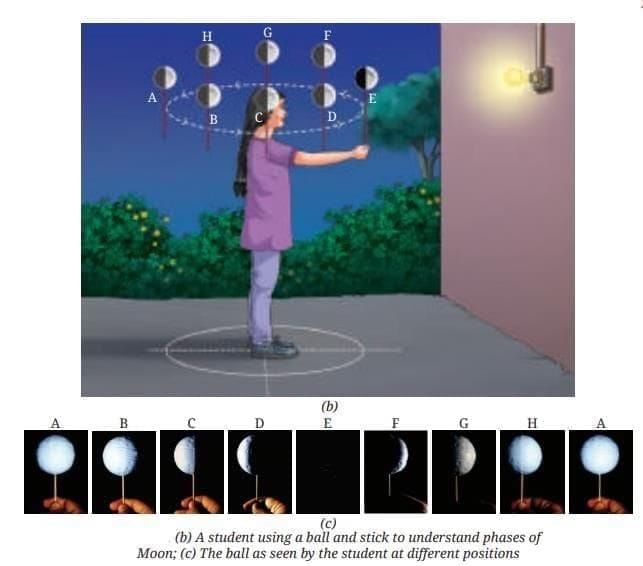
Q3. What does the simple ball-and-lamp model of the Moon help us understand? Ans: The model shows how sunlight falls on the Moon and creates different phases. By turning with the ball, we can see changes in the illuminated portion, similar to what happens in reality.
Q4. Why is the line between the bright and dark portions of the Moon always curved? Ans: The Moon is spherical, so the dividing line between sunlight and shadow is curved. This curve is visible from Earth during all phases.
Q5. Why are Moon phases not caused by Earth’s shadow? Ans: Moon phases happen because we see varying parts of its sunlit side as it orbits Earth. Earth’s shadow only causes a lunar eclipse, which is rare.
Q6. Why don’t we have eclipses every full Moon or new Moon? Ans: The Moon’s orbit is tilted compared to Earth’s orbit. This tilt means the Sun, Earth, and Moon usually don’t line up perfectly.
Q7. How does the Sun’s apparent motion help us measure a day? Ans: The Sun appears to move across the sky because Earth rotates on its axis. From one midday to the next takes about 24 hours, which we call a day.
Q8. What is the difference between a lunar year and a solar year? Ans: A lunar year, based on 12 Moon cycles, is about 354 days. A solar year, based on Earth’s revolution around the Sun, is about 365¼ days.
Q9. How do luni-solar calendars align with the solar year? Ans: They add an extra month every 2–3 years. This keeps lunar months in sync with the seasons of the solar year.
Q10. Why do solar festivals like Makar Sankranti slowly shift dates over centuries? Ans: The sidereal year used in some calendars is slightly longer than the tropical year. This difference causes the date to drift by one day roughly every 71 years.
Q11. How does a satellite like Cartosat help in disaster management? Ans: Cartosat provides high-quality images of Earth’s surface. These images help detect changes and assess damage during events like floods or cyclones.
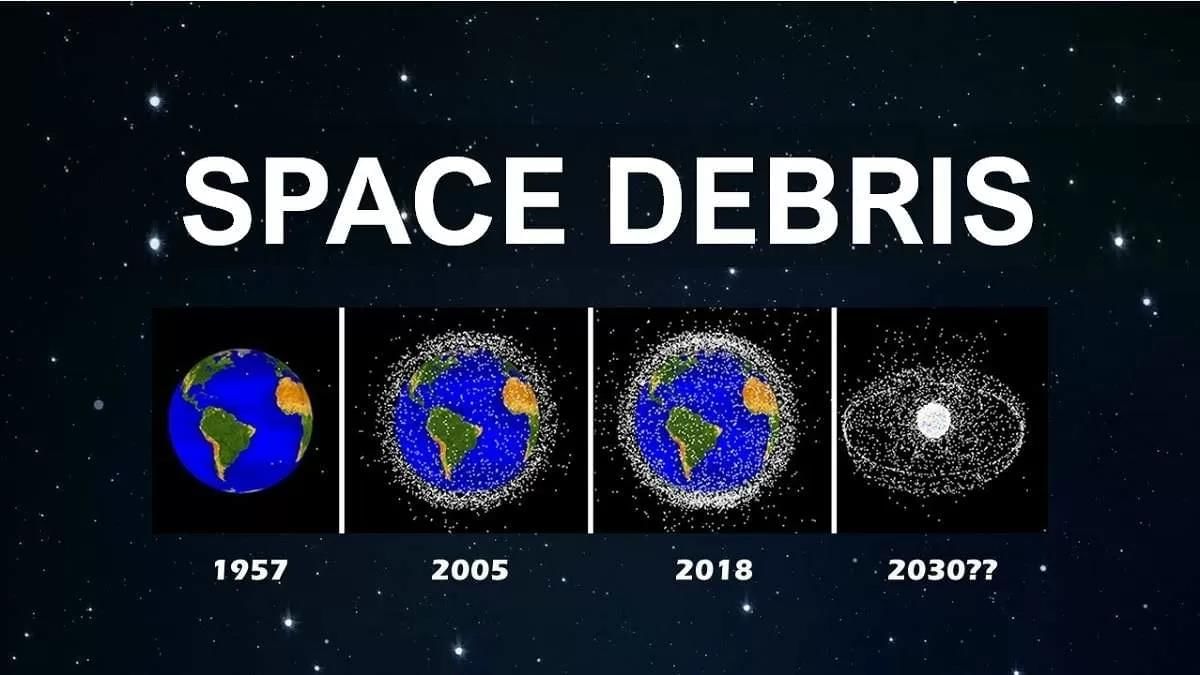
Q12. What is space debris and why is it a concern? Ans: Space debris is non-functional satellites or rocket parts left in orbit. It can collide with working satellites and create hazards in space.
Long Answer Questions
Q1. Explain the waxing and waning periods of the Moon and how they form a monthly cycle. Ans:
The waxing period is when the bright portion of the Moon increases, starting from the new Moon and becoming full in about two weeks. The waning period is when the bright portion decreases, starting from the full Moon and becoming new Moon in about two weeks.
Together, waxing and waning make a repeating cycle every month. This cycle takes about 29.5 days from one full Moon to the next.
These changes occur because of the Moon’s revolution around Earth and the changing angle between the Sun, Earth, and Moon.
Q2. Describe the difference between crescent and gibbous phases of the Moon, and how they appear. Ans:
A crescent Moon appears when less than half of the Moon’s visible surface is illuminated. It can occur during both waxing and waning periods.
A gibbous Moon appears when more than half, but not all, of the surface is lit. This also happens during both waxing and waning. These appearances change gradually as the Moon moves in its orbit around Earth.
Q3. How can a simple ball-and-lamp model help explain the phases of the Moon? Ans:
In this model, the ball represents the Moon, the lamp represents the Sun, and the observer’s head represents Earth. Holding the ball and moving in a circle around your head changes the portion of the ball lit by the lamp that you can see.
When the ball is opposite the lamp, the lit side faces you completely, like a full Moon. When the ball is between your head and the lamp, the dark side faces you, like a new Moon. At other positions, you see partly lit shapes such as crescents or gibbous phases.
Q4. Why do eclipses not happen every new Moon or full Moon? Ans:
Although full Moons and new Moons happen every month, eclipses are rare. This is because the Moon’s orbit is slightly tilted compared to Earth’s orbit around the Sun.
Most of the time, the Sun, Earth, and Moon are not perfectly aligned. A lunar eclipse can only happen when Earth’s shadow falls on the Moon, and a solar eclipse happens only when the Moon’s shadow falls on Earth. These alignments occur only a few times a year.
Q5. Explain how the motion of the Sun in the sky helps in measuring a day. Ans:
The Sun appears to rise in the east, move across the sky, and set in the west because Earth rotates on its axis. The highest position of the Sun in the sky, when shadows are shortest, marks noon.
The time from one noon to the next is called a mean solar day. This length is about 24 hours, which is the basic unit for measuring time in days. This daily cycle has been used since ancient times to keep track of time.
Q6. Compare the main features of lunar, solar, and luni-solar calendars. Ans:
A lunar calendar is based on the Moon’s phases, with each month about 29.5 days and a year about 354 days. A solar calendar is based on Earth’s revolution around the Sun, giving a year of about 365 days, with leap years to adjust for the extra ¼ day.
A luni-solar calendar combines lunar months with extra months added every few years to match the solar year. India uses luni-solar calendars for many festivals. Each system reflects the natural cycles of the Sun or Moon.
Q7. How are Indian festivals linked to astronomical events and calendar systems? Ans:
Many Indian festivals are set according to the phases of the Moon, such as Diwali on the new Moon and Holi on the full Moon. Others are based on solar positions, such as Makar Sankranti, which marks the Sun’s northward movement.
Luni-solar calendars adjust dates to match both Moon phases and seasonal cycles. This is why festival dates change in the Gregorian calendar each year. These links show how culture and astronomy are closely connected.
Q8. Describe the uses of artificial satellites and give examples of Indian space missions. Ans:
Artificial satellites help in communication, navigation, weather monitoring, disaster management, and space research. Satellites like Cartosat provide high-quality images for mapping and disaster response.
India’s space agency ISRO has launched missions like Chandrayaan for Moon study, Aditya-L1 for Sun research, and Mangalyaan for Mars exploration. AstroSat studies stars and galaxies, while student-built satellites encourage learning.
These satellites are vital for science, safety, and everyday technology.
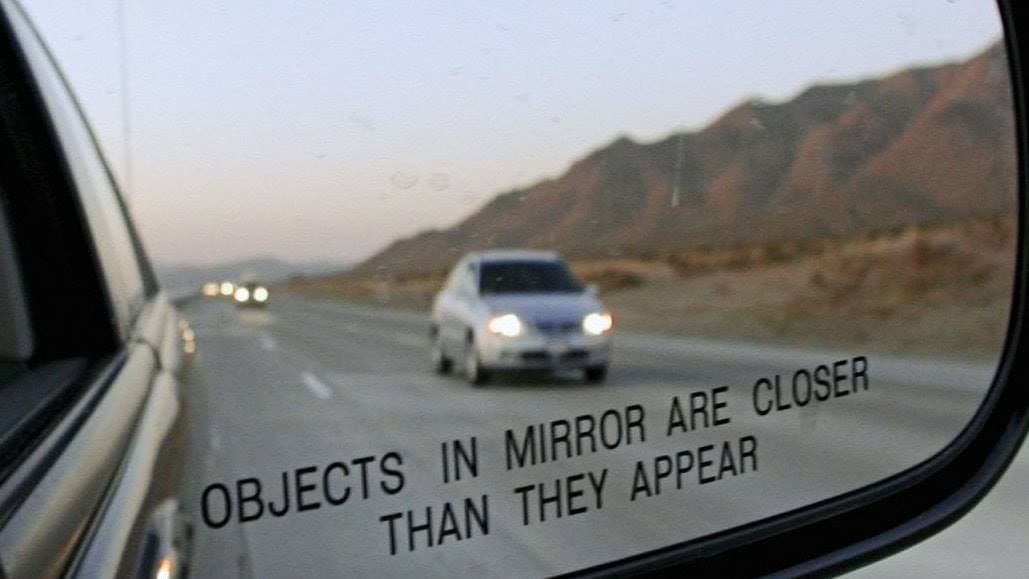
Q1. Why does the warning “Objects in mirror are closer than they appear” appear on vehicle side mirrors? Ans: Side mirrors in vehicles are usually convex mirrors. They make images smaller than the actual object size, so the objects seem farther away than they really are. The warning is to remind drivers about this illusion for safety.
Q2. How can you tell if a mirror is concave, convex, or plane just by looking at its image? Ans: A concave mirror shows a large upright image when close and an inverted one when far. A convex mirror always shows a smaller upright image. A plane mirror always shows an upright image of the same size.
Q3. Why are convex mirrors useful at road intersections? Ans: Convex mirrors give a wider field of view than plane mirrors. At intersections, they help drivers see vehicles coming from different directions, reducing the risk of accidents.
Q4. How are spherical mirrors shaped during manufacturing? Ans: They start as flat glass pieces that are ground and polished into a curved shape. Then a thin reflective coating, like aluminum, is added to make them work as mirrors.
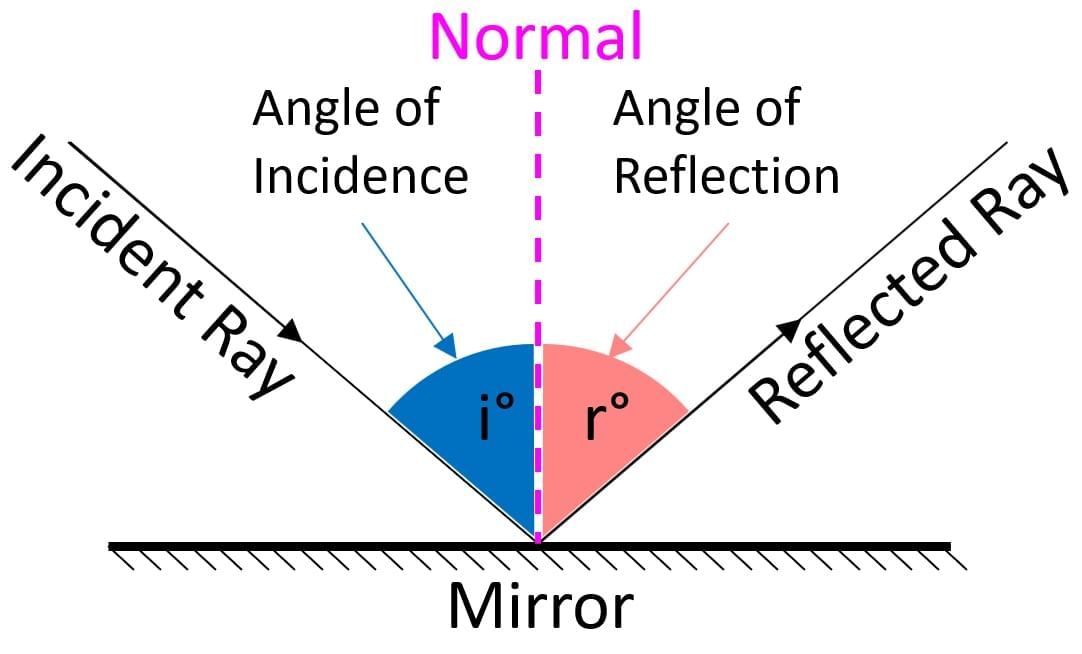
Q5. What happens if a beam of light strikes a mirror along the normal? Ans: The light is reflected back along the same path. In this case, both the angle of incidence and reflection are zero.
Q6. How do laws of reflection apply to spherical mirrors? Ans: The laws work for each ray of light, even if the mirror surface is curved. In concave mirrors, parallel rays converge, while in convex mirrors, parallel rays diverge, but each ray still obeys the reflection rules.
Laws of Reflection
Q7. Why is it dangerous to look at the Sun through a concave mirror? Ans: A concave mirror focuses sunlight into a small spot. The intense light and heat can damage the eyes permanently.
Q8. Why does the size of an image change when the object distance changes for a convex lens? Ans: Changing the object’s distance changes the point where light rays meet after passing through the lens. This changes whether the image is upright or inverted and also its size.
Q9. How can you differentiate a convex lens from a concave lens by just touching it? Ans: A convex lens feels thicker in the middle and thinner at the edges. A concave lens feels thinner in the middle and thicker at the edges.
Q10. Why does a convex lens focus sunlight to a hot point? Ans: A convex lens converges parallel rays from the Sun to a single spot. This concentrated light produces heat that can burn paper.
Q12. How does the human eye’s lens help us see both near and far objects? Ans: The eye’s natural convex lens changes shape to adjust focus. It becomes thicker for near objects and thinner for far objects, so we can see both clearly.
Long Answer Questions
Q1. Explain how spherical mirrors are made and how the placement of the reflective coating determines the type of mirror. Ans:
Spherical mirrors are made by grinding and polishing a flat piece of glass into a curved shape. A thin reflective coating, such as aluminum, is then applied to make it work as a mirror.
If the coating is placed on the outer curved surface, the mirror becomes a concave mirror. If the coating is placed on the inner curved surface, it becomes a convex mirror.
The curvature of the surface changes how light is reflected. This is why the same manufacturing process can produce two different types of mirrors.
Q2. Describe in detail the differences in image formation between plane mirrors and spherical mirrors. Ans:
Plane mirrors always form erect images that are the same size as the object, regardless of the object’s distance. In contrast, the size and orientation of images in spherical mirrors depend on distance.
A concave mirror can produce enlarged or diminished images, which may be upright or inverted depending on the object’s position. A convex mirror always produces small, upright images.
Lateral inversion happens in all mirror types. These differences arise because of the way the surfaces reflect light rays.
Q3. How do concave and convex mirrors differently direct parallel rays of light? Explain why. Ans:
A concave mirror reflects parallel rays towards a single point called the focus, which means it converges light. A convex mirror reflects parallel rays outwards so that they spread apart, meaning it diverges light.
This happens because of the way the curved surfaces bend the paths of the light rays. In concave mirrors, the inward curve bends light inward. In convex mirrors, the outward curve bends light away from each other. This property is important in deciding their uses in real life.
Q4. Explain the role of the two laws of reflection when light strikes spherical mirrors. Ans:
The first law says that the angle of incidence equals the angle of reflection, and this holds true for every ray on the mirror’s surface. The second law says that the incident ray, the normal at the point of incidence, and the reflected ray all lie in the same plane.
These laws apply to all mirrors, whether plane, concave, or convex. In concave mirrors, the curve makes the reflected rays converge. In convex mirrors, the curve makes the rays diverge. Even though their paths differ, each ray still follows the reflection laws exactly.
Q5. How can a concave mirror be used to demonstrate the focusing of sunlight, and why is it potentially dangerous? Ans:
To demonstrate, you can use a concave mirror on a sunny day, facing it towards the Sun and holding a piece of paper at different distances from the mirror.
When the paper is at the focal point, a small bright spot appears. This spot is concentrated sunlight, and after a few seconds, the heat can ignite the paper. It is potentially dangerous because the intense light and heat can also damage skin or eyes if focused on them.
That’s why such demonstrations must be done with caution. This property is used in solar cookers and concentrators.
Q6. Explain why a water droplet can act as a simple lens, using the experiment described. Ans:
A water droplet has a curved surface that makes it behave like a convex lens. When placed on a transparent surface over printed text, it bends the light passing through.
This bending causes the letters underneath to appear larger than their actual size. The curve of the droplet focuses the light, similar to a magnifying glass.
This simple experiment shows how lenses work to change the appearance of objects. It’s an easy demonstration of refraction and magnification.
Q7. How does the image formation in a convex lens change as the distance between the object and lens changes? Ans:
When the object is close to a convex lens, the image formed is upright and larger than the object. As the object moves further away, the light rays from it meet differently after passing through the lens.
This results in the image becoming inverted. The size of the image also reduces as the object distance increases. At certain distances, the image size can become smaller than the object.
This is why convex lenses are used for both magnifying and focusing purposes.
Q8. Compare the effect of a convex lens and a concave lens on parallel beams of light. Ans:
A convex lens bends parallel beams inward until they meet at a focal point, making it a converging lens. A concave lens bends parallel beams outward, making them spread apart; this is why it is called a diverging lens.
In both cases, the bending is due to refraction caused by the lens’ curved surfaces. Convex lenses can focus light to form real images on a screen.
Concave lenses cannot form real images because they never make the rays meet. These properties decide their use in instruments like cameras, eyeglasses, and telescopes.
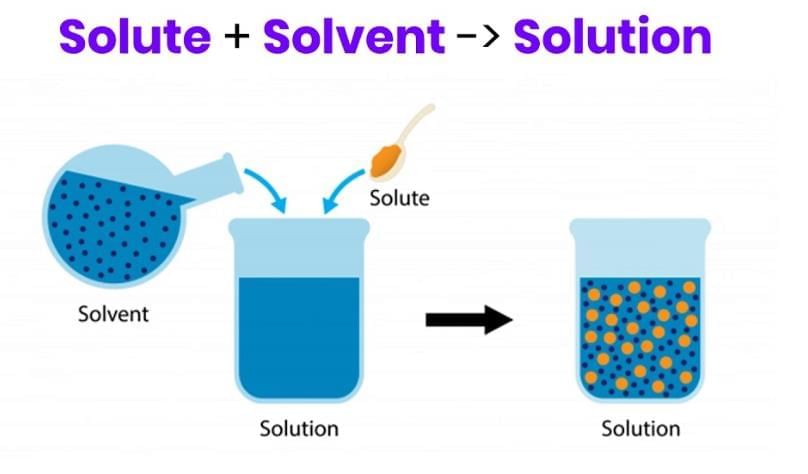
Q1. What makes a mixture a solution rather than just a mixture of substances? Answer: A solution is a homogeneous mixture where the solute particles are evenly spread in the solvent and cannot be seen or separated easily.
Q2. How do you decide which liquid is the solute and which is the solvent when two liquids mix? Answer: The component present in the smaller amount is the solute, and the component in the larger amount is the solvent.
Q3. Why does sugar dissolve in water but sand does not form a solution? Answer: Sugar particles interact with water and disperse evenly to form a clear solution, while sand does not dissolve and settles at the bottom.
Q4. What does it mean when a solution becomes saturated? Answer: A saturated solution has dissolved the maximum amount of solute at that temperature, so any extra solute remains undissolved.
Q5. How do we compare dilute and concentrated solutions in simple terms? Answer: A dilute solution has less solute in a given amount of solvent, while a concentrated solution has more solute in the same amount of solvent.
Q6. How can heating turn a saturated solution into an unsaturated one? Answer: Heating usually increases solubility for many solids, so the solvent can dissolve more solute and the previously saturated solution becomes unsaturated.
Q7. Why is air called a gaseous solution, and which gas acts as the solvent? Answer: Air is a uniform mixture of gases, and nitrogen acts as the solvent because it is present in the largest amount.
Q8. Why do aquatic animals need cold water more than warm water for breathing? Answer: Gases like oxygen dissolve better in cold water, so there is more dissolved oxygen available for aquatic life in colder water.
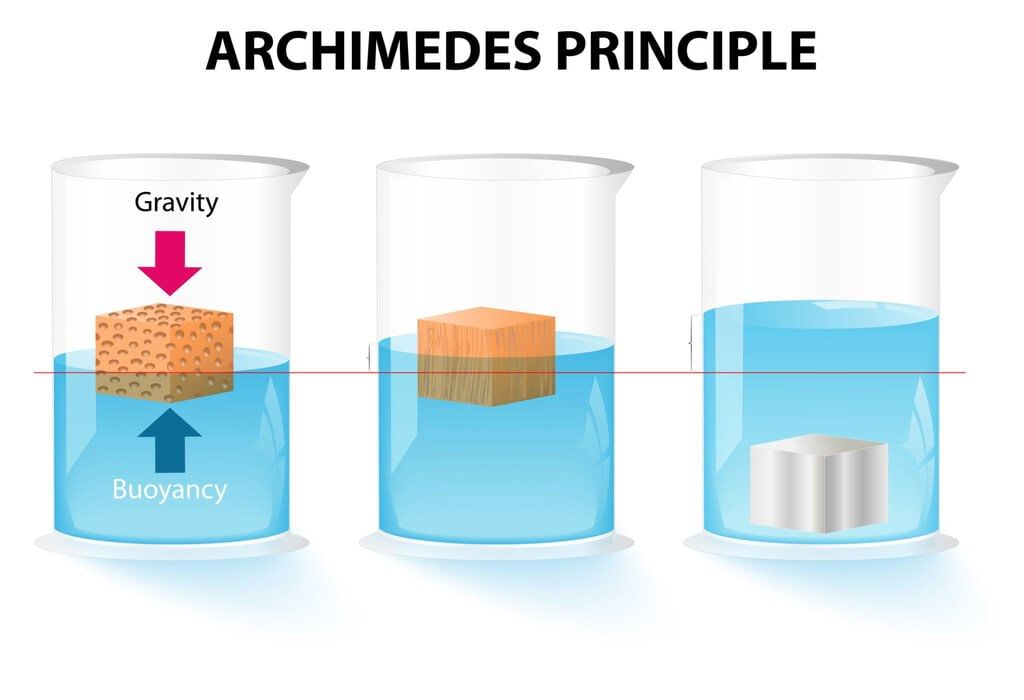
Q9. What is density and how does it help explain floating and sinking? Answer: Density is mass per unit volume; objects with lower density than the liquid float, while those with higher density sink.
Q10. How can you measure the density of a small stone in the school lab? Answer: Measure its mass using a balance, find its volume by water displacement in a measuring cylinder, then calculate density using Density = Mass/Volume.
Q11. Why does ice float on water even though both are made of the same substance? Answer: When water freezes, its structure expands and its volume increases, making ice less dense than liquid water, so it floats.
Q12. Why do we read the bottom of the meniscus when measuring water in a cylinder? Answer: Water curves at the surface, so reading the bottom of the meniscus at eye level gives an accurate volume measurement.
Long Answer Questions
Q1. Explain how particles behave at the microscopic level when a solute dissolves in a solvent, and why the mixture looks clear. Answer:
When a solute dissolves, its tiny particles spread out evenly between the solvent particles due to mixing and attraction. These particles become so small and uniformly distributed that they cannot be seen even with a hand lens.
Because light passes through without scattering much, the mixture looks clear. This even spreading is why a true solution is homogeneous. The uniformity remains stable as long as conditions do not change.
Q2. Explain with an example how the same substances can form different types of mixtures depending on proportion, and how to identify them. Answer:
Oil and water usually form a non-uniform mixture with separate layers when oil is added in ordinary amounts, so it is not a solution.
However, a very small amount of acetic acid in water forms vinegar, which is a true solution because it is uniform and clear.
To identify them, look for clarity, absence of layers, and particles that do not settle on standing. If the mixture is cloudy or separates, it is not a true solution. If it remains clear and uniform, it is a solution.
Q4. Discuss why some saturated solutions crystallize on cooling and what this shows about solubility and temperature. Answer:
When a hot saturated solution cools, the solvent’s capacity to keep the solute dissolved decreases. The extra solute that can no longer stay dissolved comes out as crystals, showing that solubility has dropped with lower temperature.
The size and shape of crystals depend on cooling speed and purity. Slow cooling often forms larger, well-shaped crystals. This behavior demonstrates the relationship between temperature and solubility for many solids.
Q5. Explain how relative density helps predict floating and sinking better than mass alone, using two same-sized objects made of different materials. Answer:
Mass alone can be misleading because it does not consider volume, but relative density compares a material’s density to water. If a same-sized wooden block and an iron block are placed in water, the wood floats and iron sinks because wood’s density is less than water’s, while iron’s is greater.
Relative density less than 1 means it will float in water; greater than 1 means it will sink. Thus, relative density accurately predicts behavior in a liquid.
Q6. Describe a step-by-step method to determine the density of an irregular solid in the lab and explain how to reduce errors. Answer:
First, measure the mass of the dry solid using a digital balance and note it. Next, partially fill a measuring cylinder with water and record the initial volume at the bottom of the meniscus.
Carefully lower the solid tied to a thread into the water and record the new volume; the volume difference gives the solid’s volume. Calculate density using Density = Mass/Volume.
To reduce errors, remove trapped air bubbles, read at eye level, and use a suitably sized cylinder for better accuracy.
Q7. Explain how temperature changes can create convection in liquids and gases due to density differences, and give one everyday example for each. Answer:
Heating a region of a liquid or gas makes particles move apart, increasing volume and lowering density there. The warmer, less dense part rises, while the cooler, denser part sinks, creating a convection current.
In liquids, heating water from below in a pot sets up rising warm currents and sinking cool currents. In gases, warm air rising from a heater or sun-warmed ground creates upward motion and draws in cooler air, helping circulate room air naturally.
Q8. Discuss how solvents are chosen in traditional and modern extraction of useful plant compounds, and why solvent choice matters. Answer:
In both traditional systems and modern chemistry, the solvent is chosen based on its ability to dissolve the desired compounds without damaging them.
Water, alcohol-water mixtures, oils, or milk may be used to extract different types of molecules depending on their solubility. The right solvent improves yield, purity, and safety of the extract.
It also affects taste, storage, and how the extract is used as a medicine. Careful selection ensures effective and consistent preparation.
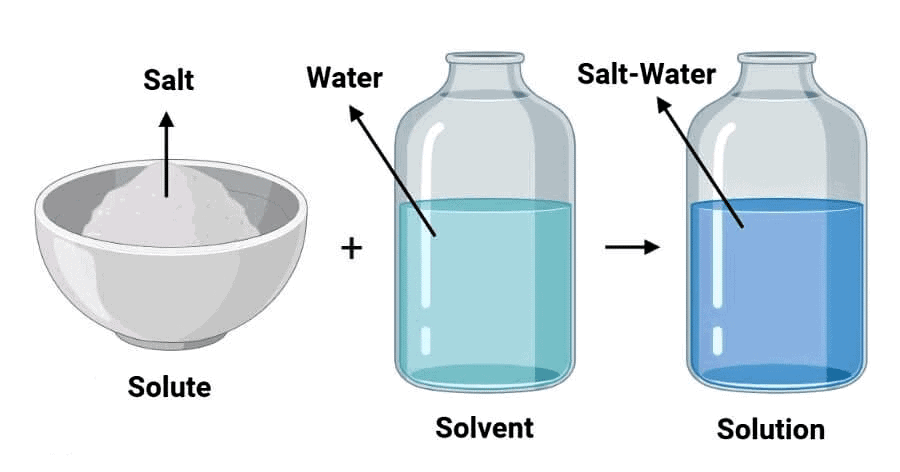
A solvent is the substance in a solution that dissolves the solute. Example: In a saltwater solution, water is the solvent.
Q2. Define solute.
A solute is the substance that gets dissolved in a solvent to form a solution. Example: In a saltwater solution, salt is the solute.
Q3. What is ‘tincture of iodine’?
A solution of iodine in alcohol is known as tincture of iodine. It has iodine (solid) as the solute and alcohol (liquid) as the solvent.
Q4. What are alloys?
Alloys are mixtures of two or more metals, or a metal and a non-metal. They cannot be separated into their individual components through physical methods. Example: Steel is an alloy of iron and carbon.
Q5. Give one example of a gas in a liquid solution.
In cold drinks, carbon dioxide gas is the solute and water is the solvent.
Q6. How can a solution be dilute or concentrated?
A solution is dilute if it contains a small amount of solute in the solvent, and concentrated if it contains a large amount of solute in the solvent.
Q7. What is “concentration of a solution”?
The concentration of a solution refers to the amount of solute present in a given amount of solvent or solution. It indicates how concentrated or dilute a solution is.
Q8. State the difference between aqueous and non-aqueous solutions.
Aqueous solutions use water as the solvent, while non-aqueous solutions do not contain water as the solvent.
Q9. What is the “solubility” of a solute?
The amount of a solute that can dissolve in a given amount of solvent at a specific temperature is known as its solubility.
Q10. What is a saturated solution?
A saturated solution is one in which the maximum amount of solute is dissolved in a solvent at a given temperature, and no more solute can dissolve further.
Q11. What is an unsaturated solution?
An unsaturated solution contains less solute than the maximum amount it can dissolve at a given temperature.
Q12. How can you convert the saturated solution into an unsaturated one or vice versa?
A saturated solution can be converted to an unsaturated solution by:
To convert a saturated solution into an unsaturated one, heat the solution so more solute can dissolve.
To convert an unsaturated solution into a saturated one, cool the solution or add more solute until no more dissolves.
Q13. Why is water called a universal solvent?
Water is called a universal solvent because:
It can dissolve a wide variety of substances due to its polar nature, which allows different molecules to interact with it effectively.
Example: In our body, water dissolves salts, sugars, and gases to help with digestion, transport, and cell functions.
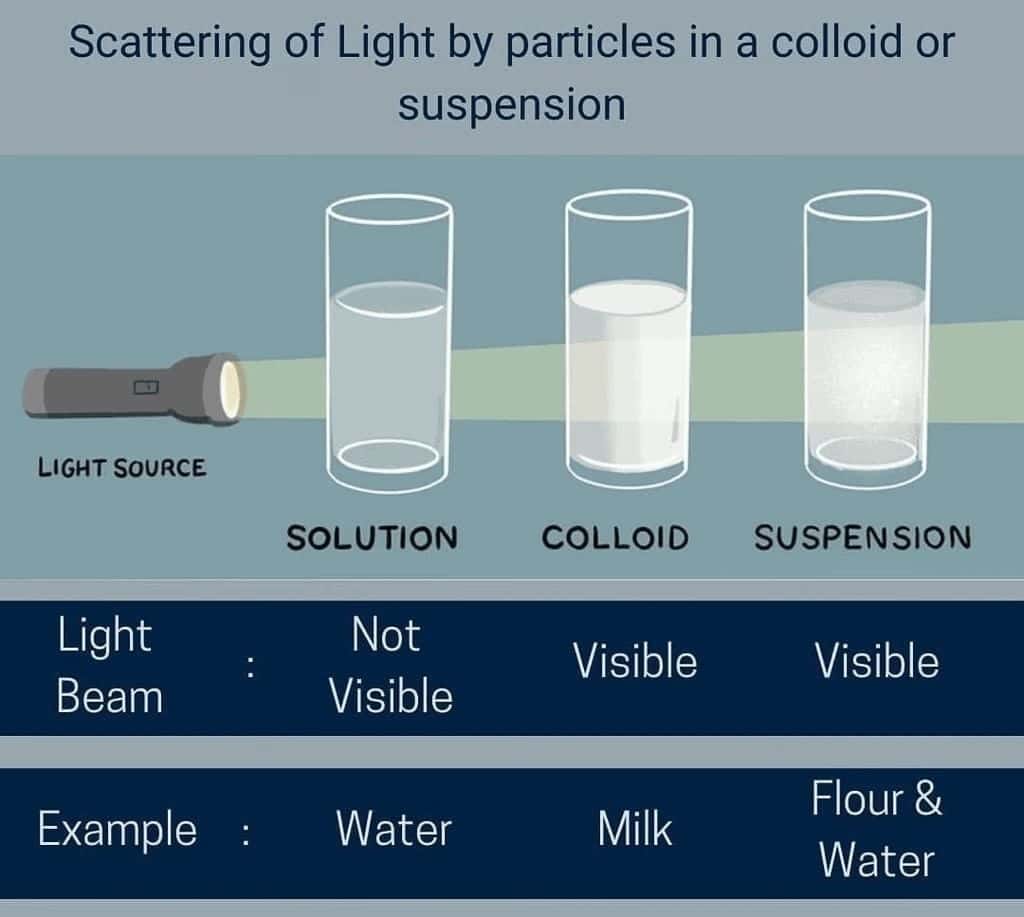
Q14. What is the Tyndall effect?
The scattering of light by colloidal particles is known as Tyndall effect.
Q15. How can we separate colloidal mixtures?
Colloidal mixtures can be separated using centrifugation. This process involves:
Placing the colloidal solution in a test tube.
Rotating the test tube rapidly in a centrifuge machine.
Utilising centrifugal force to separate the colloidal particles from the mixture.
Q16. What is an emulsion?
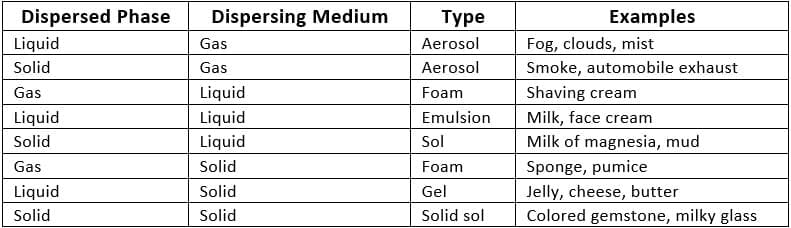
An emulsion is a mixture where both the dispersed phase and the dispersing medium are liquids. Example: Milk, Face Cream.
Q17. What is aerosol?
An aerosol is a mixture where solid or liquid particles are dispersed in a gas. Example: Smoke, Fog.
Q18. What is the principle for the separation of immiscible liquids?
The principle of separation of immiscible liquids is based on their density differences. The less dense liquid collects at the top, and the denser one settles at the bottom.
Q19. How can you separate two liquids that have less than 25 K difference of boiling points?
To separate a mixture of two or more miscible liquids with a boiling point difference of less than 25 K, the method used is fractional distillation.
Q20. What is crystallisation?
When a saturated solution is heated and then allowed to cool slowly, crystals of the dissolved solute separate out. This process, called crystallisation, is used to purify solids.
Short Answer Type Questions
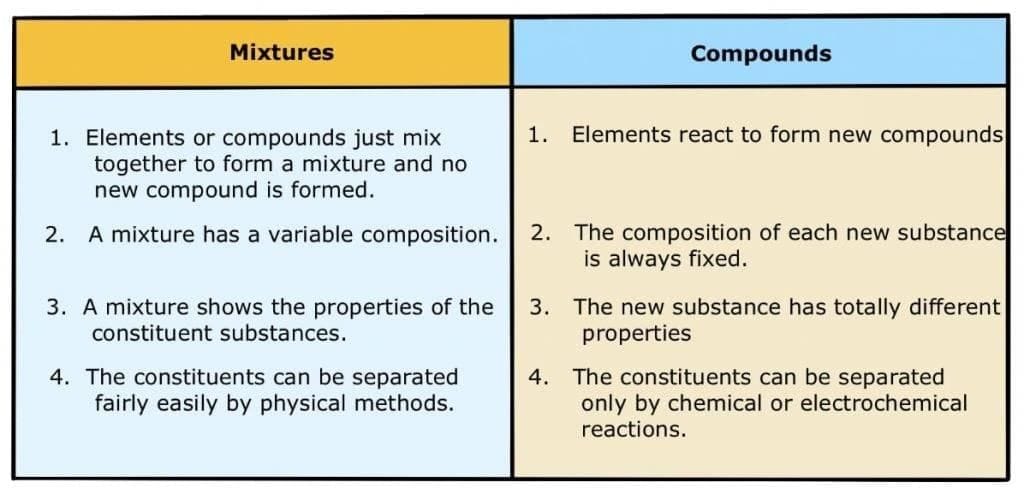
Q1. Why is a mixture called an impure substance?
A mixture is called an impure substance because it contains different components that:
Retain their individual properties
Can be easily separated by physical processes
Unlike pure substances, which have a uniform composition, mixtures consist of two or more pure substances combined together.
Q2. Give the differences between a mixture and a compound.
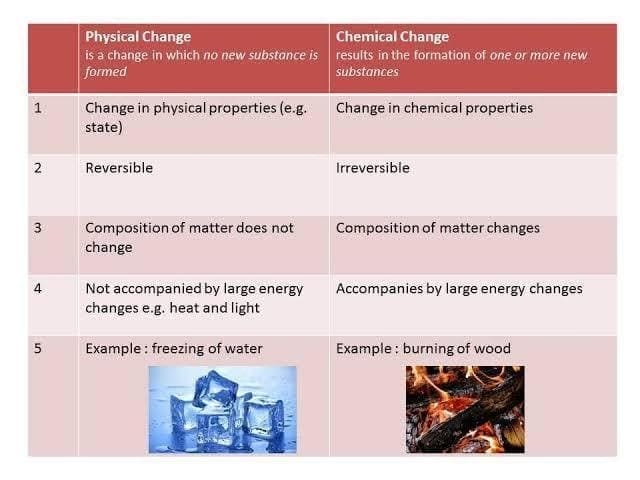
Q3. Distinguish between a physical change and a chemical change.
Q4. State the properties of a solution.
Properties of a solution are:
A solution is a homogeneous mixture.
Particles in a solution are smaller than 1 nm and are invisible to the naked eye.
They do not scatter a beam of light, making the path of light invisible.
Solute particles cannot be separated by filtration, indicating that a solution is stable.
Q5. State the properties of a suspension.
Properties of a Suspension:
Heterogeneous mixture: A suspension consists of different components that are not uniformly mixed.
Visible particles: The particles in a suspension can be seen with the naked eye.
Tyndall effect: When light passes through a suspension, it scatters, making the path of the light visible.
Unstable: The particles will eventually settle at the bottom if left undisturbed, indicating that a suspension is not stable.
Separation: The components can be separated using filtration.
Q6. What is a colloidal solution?
A colloidal solution is a type of heterogeneous mixture that looks homogeneous. Its particles are very small, typically less than 1 micrometre, making them invisible to the naked eye. However, these particles remain suspended and do not settle. Example: Milk and Blood.
Q7. State the properties of a colloidal solution.
Properties of colloidal solution:
A colloidal solution is a heterogeneous mixture with particle sizes ranging from 1 nm to 100 nm.
The particles are so small that they cannot be seen with the naked eye.
Colloidal solutions can scatter light, which is known as the Tyndall effect.
They are stable because the particles do not settle when undisturbed.
Q8. Give the applications of centrifugation.
Applications of centrifugation are:
Centrifugation is used in diagnostic laboratories for blood and urine tests.
It is applied in dairies and at home to separate butter from cream.
It is also used in washing machines to remove water from wet clothes.
Q9. Why is crystallisation better than evaporation?
Crystallisation is a process that separates a pure solid in the form of its crystals from a solution. It is often preferred over evaporation for the following reasons:
During evaporation, some solids may decompose or, like sugar, become charred when heated to dryness.
Some impurities can remain dissolved in the solution, which may contaminate the solid after evaporation.
Q10. A student is given a mixture of naphthalene balls’ powder and common salt. He needs to separate this mixture. How will he do this?
The properties of both naphthalene and common salt should be known before we choose the separation technique.
Naphthalene is a sublimate which on heating changes to gaseous state directly. Hence to separate a volatile compound (sublimate) from a non-volatile compound (non-sublimate), the sublimation process is used. Sublimation of Naphthalene
In a China dish, the mixture is kept and is placed on a stand. An inverted funnel is kept over the mixture in China dish with plugged stem. The sublimate on heating gets collected on the funnel and common salt remains in the China dish.
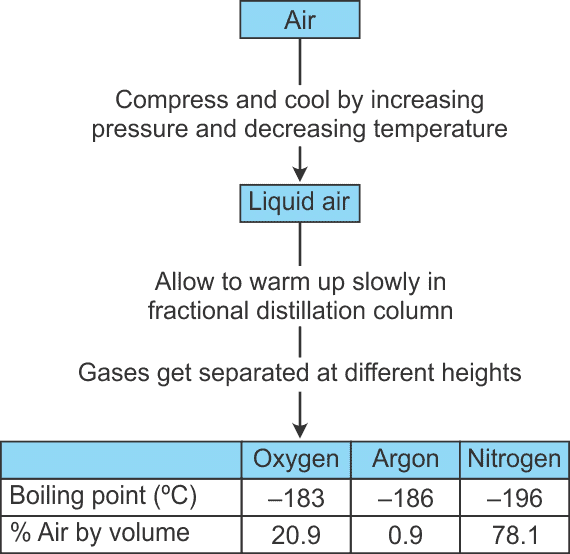
Q11. How can we obtain different gases from the air?
Air is a mixture of gases, and we can separate its components using fractional distillation. This process involves:
Cooling air to a liquid state.
Gradually warming the liquid to allow different gases to evaporate at their specific boiling points.
Collecting the gases separately.
Below is a flow diagram illustrating the steps involved in this process:
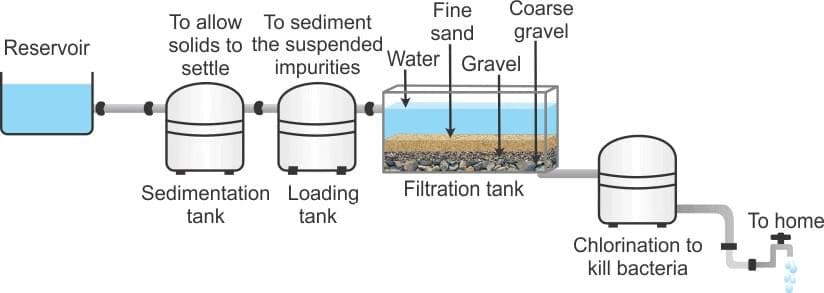
Q12. Draw a flow diagram to show the water purification system in waterworks.
The water purification process involves several key steps:
Collection: Water is collected in a reservoir.
Sedimentation: Water is sent to a sedimentation tank where solids settle at the bottom.
Loading Tank: The water moves to a loading tank, allowing suspended impurities to settle as sediment.
Filtration: Water passes through a filtration tank, where it goes through layers of sand and gravel to remove impurities.
Chlorination: The clear water is mixed with chlorine or bleaching powder in a chlorinated tank to kill bacteria.
Distribution: Finally, the purified water is supplied to homes.
Q13. Why is air considered a mixture and not a compound?
Air is considered as a mixture because it exhibits following properties:
1. Each component present in air retains its properties.
2. Each component can be separated by simple physical processes.
3. The components do not have any fixed proportion. All gases are present in different amount. Example: In greener area—more oxygen and water vapour is present; near industrial area—air consists of a lot of impurities and smoke suspended in it.
Q14. How can you prove that water is a compound?
Water is a compound because if we pass electricity through it then at two different electrodes, we get two different gases i.e., oxygen and hydrogen during the electrolysis of water. The ratio of oxygen: hydrogen is 1: 2 by number of molecules. (i) The properties of oxygen and hydrogen gases are entirely different from liquid water. (ii) The ratio of oxygen: hydrogen combination is always constant i.e., 1: 2 by volume. (iii) To separate the components of water, we need electrolytic cell, and it is not a simple process.
Q15. How can we convert a saturated solution into an unsaturated one by heating?
A saturated solution contains the maximum amount of solute that can dissolve at a specific temperature. When heated:
The solvent molecules gain kinetic energy.
They vibrate and move apart, creating more space.
This allows additional solute particles to dissolve.
As a result, the solution becomes unsaturated.
Thus, heating a saturated solution enables it to accommodate more solute, transforming it into an unsaturated solution.
Q16. What is the difference between fog and smoke?
Fog is a colloidal solution consisting of tiny liquid droplets suspended in gas. In contrast, smoke is a colloidal solution made up of tiny solid particles dispersed in gas.
Fog: Liquid droplets in gas.
Smoke: Solid particles in gas.
Q17: If 20g of salt is present in 220 g of solution, calculate the concentration of the solution.
Concentration of solution = Mass of solute/(Mass of solute + Mass of solvent) × 100 Mass Solute = 20g Mass of solute + solvent = 220g ∴ Concentration of solution = 20/220 × 100 = 9.09%
Long Answer Type Questions
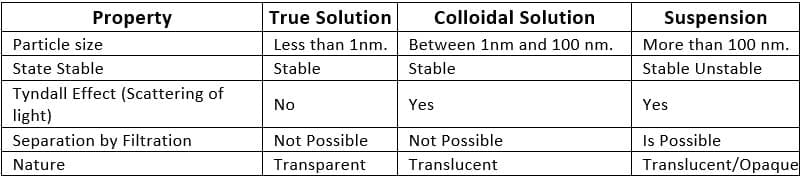
Q1. Give the difference between a true solution, a colloidal solution and a suspension.
The difference between true solution, colloidal solution and suspension
Q2. State the different types of colloids with examples.
Q3. (a) Define solution. (b) Give different types of solutions with one example each.
(a)Solution: It is a homogeneous mixture of two or more substances. It consists of solute and solvent. (b) Different types of solution:
Based on solvent—Aqueous and non-aqueous Aqueous solution has water as solvent (sugar + water) Non-aqueous solution has some other solvent but not water. Example: (sulphur + carbon disulphide)
Depending on the amount of solute dissolved in solvent—Dilute solution and concentrated solution.
Dilute solution—Less amount of solute particles are present in a solvent. Concentrated solution—Amount of solute present in its maximum capacity in a solvent.
Amount of solute present in its maximum capacity at a given temperature—Saturated and unsaturated solution.
Saturated Solution—It is a solution in which no more solute can further dissolve in a given solvent at a given temperature.
Unsaturated Solution—It is a solution in which some more solute can dissolve in a solvent at a given temperature.
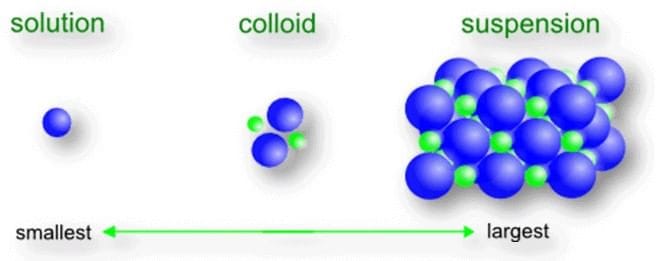
Depending on the size of solute particles: (i)True solution Size is very small and particles cannot be seen through naked eyes (ii) Suspension Size is very big and can be seen through naked eyes (iii) Colloid Size is intermediate between true solution and suspension
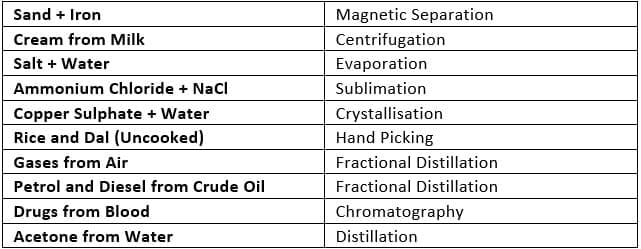
Q4. How can you separate the following mixtures? (a) Sand + iron (b)Cream from milk (c) Salt + water (d) Ammonium chloride + NaCl (e) Copper sulphate + water (f) Rice and dal (uncooked) (g) Gases from air (h) Petrol and diesel from crude oil (i) Drugs from blood (j) Acetone from water
Value-Based Questions
Q1. Anil’s sister accidentally added some water to the bottle containing olive oil, and she was afraid of the scolded. Anil helped his sister and separated the water from the olive oil using a bottle as a separating funnel. (a) What is the principle of using and working of a separating funnel? (b) Suggest two separation techniques used to separate liquid mixtures. (c) What value of Anil is seen in the above case?
(a) The principle of the separating funnel is the difference in the densities of two immiscible liquids. (b) Liquid mixtures can be separated by distillation and fractional distillation. (c) Anil showed the value of helping, caring and responsible behaviour.
Q2. Preeti saw a labourer entering the sewage manhole immediately after removing the lid. She promptly stopped the labour from entering the manhole and told him to wait for some time before he entered it. (a) What will happen if the labourer immediately enters the manhole for cleaning after removing the lid? (b) Name the main gases that are released from the manhole. (c) What value of Preeti is seen in the above act?
(a) He could die from suffocation due to inhalation of poisonous gases released from sewage. (b) Gases released from the sewage manhole are methane, carbon dioxide and hydrogen sulphide. (c) Preeti showed moral responsibility and awareness as a citizen.
Q3. Prasanna wanted to buy a deodorant from the shop. While buying a bottle, he felt that it was slightly heavier than the usual deodorant bottle that he purchased every time. He read the weight mentioned on the bottle and told the shopkeeper to weigh the same. He found the bottle was heavy, and on opening the deodorant bottle, he found it half-filled with water. He complained about the matter to the consumer authority. (a) Define density. (b) Apart from water, what is the other substance that some shopkeepers add to the deodorant? (c) What value of Prasanna is reflected in this act?
(a) Density of any substance is defined to be the mass of the substance per unit volume. (b) One can add some cheap gases or compressed air in the deodorant bottles. (c) Prasanna showed leadership, awareness of consumer rights, and responsibility.
Q4. Rita’s father always got his vehicle checked for pollution control. He got it tested for the aerosol if released by his car. He also uses unleaded petrol and makes use of public transport wherever possible. He sparingly uses his car. (a) What is aerosol? (b) What happens when smoke released from a vehicle mixes with fog? (c) What values of Rita’s father are reflected here?
(a) An aerosol is a colloid in which solid or liquid particles are dispersed in a gas. Example: Smoke. (b) When smoke mixes with fog it forms smog. (c) Rita’s father reflects environmental awareness, responsibility, and good citizenship.
Q.1. Define matter. Ans. Anything that occupies space and has mass is called matter.
Q.2. State different states of matter with an example. Ans. The matter has 3 different states
Q.3. What is diffusion? Ans. Diffusion is the process where particles of one substance mix with those of another.
Diffusion Q.4. What happens to the rate of diffusion if the temperature is increased? Ans. With increased temperature, the rate of diffusion also increases as the particles gain energy and vibrate more.
Q.5. Name the state of matter that has the tendency to maintain its shape when subjected to outside force. Ans. A solid maintains its shape when force is applied. Examples include items like a pen, book, or wooden stick.
Q.6. Define melting point. Ans. The melting point is the temperature at which a solid turns into a liquid under normal atmospheric pressure.
Q.7. Define boiling point. Ans. The boiling point is the temperature at which a liquid begins to change into gas at normal atmospheric pressure.
Q.8. Define latent heat of vaporization. Ans. Latent heat of vaporization is the heat energy required to change 1 kg of a liquid to gas at atmospheric pressure at its boiling point.
Q.9. Define latent heat of fusion. Ans.Latent heat of vaporization is the amount of heat energy needed to convert 1 kg of a liquid into gas at its boiling point, under atmospheric pressure.
Q.10. Define sublimation. Ans. Sublimation is the process where a solid changes directly into a gas without becoming a liquid. This can also occur in reverse, where a gas turns into a solid without passing through the liquid state.
SublimationQ.11. What is dry ice? Ans. Solid carbon dioxide is obtained by cooling and applying pressure on carbon dioxide gas. It does not melt, so it is called dry ice.
Q.12. What is humidity? Ans.Humidity refers to the amount of water vapour present in the air. When air contains a significant amount of water vapour, it is described as humid air.
Q.13. Give two properties of a solid. Ans. (i) Solids have fixed shapes and are rigid. (ii) Solids cannot be compressed.
Q.14. What will happen if the pressure is reduced on solid carbon dioxide (dry ice)? Ans. If the pressure is reduced on solid carbon dioxide, it will directly change into a gaseous state without melting.
Q.15. Name any three substances that show sublimation. Ans.Ammonium chloride, camphor, and naphthalene are three substances that undergo sublimation.
Q.16. Sponge is solid, but we can still compress it. Why? Ans. A sponge is a solid that contains tiny holes, which trap air. When we compress the sponge, the air in these pores is pushed out, allowing the sponge to become smaller in size. This is why we can compress it despite it being a solid.
Q.17. What is normal atmospheric pressure? Ans. The normal atmospheric pressure at sea level is defined as:
1 atmosphere (atm)
This is equivalent to 101,325 pascals (Pa).
Thus, the standard measure of atmospheric pressure is 1 atm at sea level.
Q.18. What is Kelvin? Ans. Kelvin is the SI unit of temperature.
0°C is equivalent to 273 K.
To convert from Kelvin to Celsius, subtract 273.
To convert from Celsius to Kelvin, add 273.
Temperature Scale in Degree and Kelvin
Q.19. Give two examples of diffusion. Ans.Examples of diffusion:
Milk drops dissolving in water.
Perfume sprayed in a room.
Q.20. Give the temperature at which water exists in two different phases/states. Ans. (i) At 0°C, water can be in a solid or in liquid state. (ii) At 100°C, water can be in liquid or in a gaseous state.
Short Answer Type Questions
Q.1. Why do we see water droplets collected on the outer surface of a glass container containing ice? Ans. The water vapor present in the air comes in contact with the cold outer surface of the container, thereby condensing it to form water droplets.
Q.2. Explain why solids have a fixed shape but liquids and gases do not have a fixed shape. Ans.Solids maintain a fixed shape because of strong intermolecular forces that hold their particles tightly together. In contrast:
Liquids have weaker intermolecular forces, allowing their particles to move freely. This enables them to flow and take the shape of their container.
Gases have even weaker forces, resulting in particles that are far apart and move rapidly. They expand to fill any available space.
Thus, solids are rigid and retain their shape, while liquids and gases are fluid and adaptable to their surroundings.
Q.3. Liquids and gases can be compressed but it is difficult to compress solids. Why? Ans. Liquids and gases can be compressed, while solids cannot. This is due to the following reasons:
Intermolecular space: Liquids and gases have space between their molecules, allowing them to be pushed closer together when pressure is applied.
Solid structure: Solids have tightly packed molecules with little to no space between them, making it difficult to compress.
In summary, the lack of intermolecular space in solids prevents them from being compressed effectively.
Q.4. A balloon, when kept in the sun, bursts after some time. Why? Ans. The balloon contains air, which heats up when exposed to sunlight. As the temperature rises:
The air molecules gain energy.
They vibrate faster and expand.
This expansion exerts increased pressure on the walls of the balloon.
Eventually, the pressure becomes too much, causing the balloon to burst.
Q.5. Why do people perspire a lot on a hot, humid day? Ans. On a hot, humid day, people perspire more because:
The body sweats to cool down through evaporation.
In humid conditions, the air is already saturated with moisture.
This prevents sweat from evaporating efficiently, leading to visible perspiration.
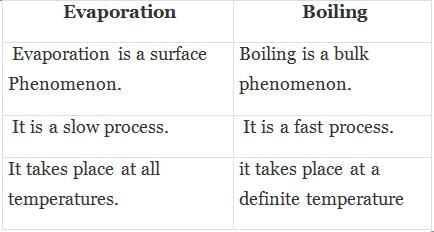
Q.6. Distinguish between evaporation and boiling. Ans. Q.7. Why is it advisable to use a pressure cooker at higher altitudes? Ans. At higher altitudes, the atmospheric pressure is low, and the water boils very fast and evaporates at a faster rate therefore, the pressure is required to increase the cooking process, and this is done by using a pressure cooker, which increases the pressure inside the container and cooks food faster.
Q.8. What are fluids? Ans. Fluids are substances that can flow and take the shape of their container. They include:
Liquids – Have a definite volume but no fixed shape.
Gases – Have neither a fixed shape nor a fixed volume.
This ability to flow is due to the weaker intermolecular forces present in these states of matter.
Q.9. One kg cotton and one kg sand, which is more denser? Why? Ans. One kg of sand is denser than 1 kg of cotton because Density = Mass/Volume The volume required by cotton is more than the sand, and density and volume are inversely proportional.
Q.10. Why is water liquid at room temperature? Ans. At room temperature, water remains a liquid because:
The molecules of water are held together by intermolecular forces.
Room temperature does not provide enough energy for these molecules to overcome their attraction.
As a result, they stay in the liquid phase.
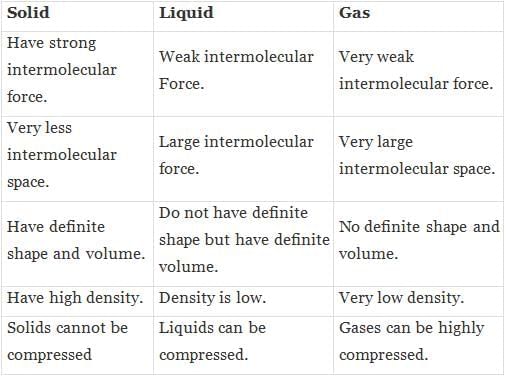
Q.11. State the differences between solid, liquid and gas. Ans.
Q.12. Cotton is solid but it floats on water. Why? Ans. Cotton has a large number of pores in which air is trapped. Reducing its density and increasing its volume. Therefore, cotton floats on water. But when these pores get filled with water, it starts sinking.
Q.13. Why are solids generally denser than liquids and gases? Ans. The density of a substance is calculated using the formula: mass/volume. Here’s why solids are generally denser than liquids and gases:
Solids have molecules that are tightly packed together.
This packing results in a large mass being concentrated in a small volume.
In contrast, liquids and gases have more intermolecular space.
This means their mass is not concentrated in a small volume, leading to lower density.
Therefore, solids typically have a higher density than both liquids and gases.
Q.14. On a hot sunny day, why do people sprinkle water on the roof or open ground? Ans. On hot sunny days, people sprinkle water on roofs or open ground for several reasons:
The surface absorbs a lot of heat, making it very hot.
When water is sprinkled, it absorbs heat from the surface due to its latent heat of vaporisation.
This process allows the hot surface to cool down effectively.
Q.15. On a hot sunny day, why do we feel pleasant sitting under a tree? Ans. A tree provides a pleasant experience on a hot sunny day due to the following reasons:
The numerous leaves of the tree engage in a process called transpiration.
During transpiration, water is released from tiny pores in the leaves known as stomata.
This water evaporates, creating a cooling effect in the surrounding air.
As a result, sitting under a tree helps us feel more comfortable and refreshed on warm days.
Q.16. The temperature at which liquids change into vapors is very high, for example, if water evaporates at 100°C, then how is water to evaporate at room temperature or at other temperatures? Ans. The molecules of water at the surface of a liquid can evaporate even at room temperature. This occurs because:
Surface molecules gain energy from the surroundings.
These molecules achieve higher kinetic energy, allowing them to overcome the forces holding them in the liquid state.
This process, where liquid changes to vapour below its boiling point, is known as evaporation.
Examples of evaporation in everyday life include:
Water left uncovered slowly turns into vapour.
Wet clothes dry as water evaporates from their surface.
Q.17. Name the factors that affect evaporation. Ans. The rate of evaporation is influenced by several factors:
Surface area: A larger surface area increases the rate of evaporation.
Temperature: Higher temperatures provide more energy, leading to faster evaporation.
Humidity: Lower humidity levels allow for more evaporation, as the air can hold less water vapour.
Wind speed: Increased wind speed helps remove water vapour from the surface, enhancing evaporation.
Q.18. The melting point of ice is 273.16 K. What does this mean? Explain in detail. Ans.The melting point of ice is 273.15 K, which is equivalent to 0°C. This temperature indicates that:
At 0°C, ice exists in a solid state.
The molecules in ice are tightly packed and held together by attractive forces.
When heat is applied, the ice absorbs this energy, but the temperature remains constant until all ice has melted.
This absorbed heat is used to overcome the attractive forces between the molecules, allowing them to move more freely.
Once these forces are overcome, the ice transitions to a liquid state at the same temperature of 273 K.
The process of melting is known as fusion, and during this phase change, the temperature does not increase despite the continuous heat supply.
Q.19. How is the high compressibility property of gas useful to us? Ans. The high compressibility of gases is beneficial in several ways:
It allows large volumes of gas to be stored in small cylinders, making transportation easier.
Compressed gases, like liquefied petroleum gas (LPG) and compressed natural gas (CNG), are used as fuels.
This property enables efficient use of space in various applications, such as in medical oxygen cylinders.
Q.20. With the help of an example, explain how diffusion of gases in water is essential. Ans. The diffusion of gases in water is crucial for aquatic life. Here’s how:
Oxygen from the atmosphere dissolves in water, allowing aquatic animals to breathe.
Carbon dioxide also dissolves in water, which is essential for plants during photosynthesis.
These processes support the survival of both aquatic animals and plants.
Long Answer Type Questions
Q.1. Pressure and temperature determine the state of a substance. Explain this in detail. Ans. (a) Any matter i.e., solid, liquid, or gas, that experiences an increase in temperature and then changes its state.Take ice cubes in a beaker or heat them slowly. The temperature increases, and the ice melts to form a liquid. Heat this liquid further it will become steam. (b) On lowering the temperature of any matter, show a change in their state.Take the steam that is coming out of boiling water and allow it to cool down; it condenses to form water and on further cooling of this water, we get ice. (c) On applying pressure and reducing temperature, we can liquefy gases or change them into solids. Example: Take carbon dioxide gas, reduce its temperature, and apply a lot of pressure on it so that it changes into solid carbon dioxide, called dry ice, which is used as refrigerant for cooling. If the pressure on it is decreased it directly changes into gas. In LPG cylinders, the petroleum gas is cooled and, with a lot of pressure, changes it into the liquid state. While using this LPG, we release the pressure exerted on it and hence, it comes out in the form of gas.
Q.2. Explain, giving examples, the various factors on which the rate of evaporation depends. Ans. The rate of evaporation depends on the following factors:
Surface area: If the surface area is increased, the rate of evaporation also increases. (a) To dry the clothes, we spread them to dry faster. (b) Tea in a saucer cools faster than in a cup.
Temperature: If the temperature is increased, the rate of evaporation also increases. Due to an increase in temperature, the particles gain more kinetic energy and change their phase from liquid to gaseous. Water will evaporate faster in the sun than in the shade.
Humidity: It is the amount of water vapor present in the air. The air can hold a definite amount of water vapor at a given temperature. If the amount of water vapor is high in the air, then the rate of evaporation decreases. On hot and humid days, desert coolers are not effective as the air cannot hold any more moisture to get the cooling effect.
Wind speed: With the increase in wind speed, the rate of evaporation increases. The particles of water vapor move away with the wind, decreasing the amount of water vapor in the surroundings.
Value-Based Answer Type Questions
Q.1. Adil parked his bicycle on a sunny day in a parking stand on his school campus. When the school got over, Adil saw his burst cycle type. Thereafter, he kept less air in his cycle types and did not inflate them fully. (a) Why did the tyre burst? (b) Why is air compressible? (c) What value of Adil is reflected in the above act? Ans. (a) The tyre burst because the air inside the tyre got heated and therefore exerted pressure on the walls of the tyre. (b) Air is compressible because it has large intermolecular space. (c) Adil showed the value of intelligence, awareness and self-responsibility.
Q.2. Akshay’s friend visited his house in Mumbai and he was surprised to see air conditioners installed in all of his rooms. His friend advised Akshay to use water coolers and save electricity. On this, Akshay told him that the water-cooler is not at all effective in coastal areas. (a) Why are water-coolers not effective in coastal areas? (b) What are the other two factors on which evaporation of water depends? (c) What value of Akshay’s friend is seen in this act? Ans. (a) Water coolers are not effective in coastal areas due to the high rate of humidity. (b) The other two factors on which evaporation of water depends are temperature and surface area. (c) Akshay’s friend showed the value of concerned citizens, morally responsible and friendly in nature.
Q.3. Sita lived in a village and could not afford a refrigerator in her house. She knew how to keep water cold and preserve all perishable items in her house. She kept an ivet cloth surrounding the earthen pot to keep water cool. She also kept vegetables fresh by keeping them in wet gunny bags and sprinkled water over them in a timely manner. (a) Why did Sita keep wet cloth surrounding the earthen pot? (b) Suggest one more method of keeping the house cool in summer. (c) What value of Sita is reflected in the above case? Ans. (a) The wet cloth gave a cooling effect to the pot, as the water in the cloth evaporated and evaporation caused a cooling effect. (b) By sprinkling some water on the lawn/veranda of the house can keep the house cool. (c) Sita showed the value of responsible behavior.
Q.4. Shreya commutes in a CNG-fitted van to school every day along with many other students. She told the van driver to get the CNG connection certified and timely check it for any leakage or loose connection of pipes. She told the driver to be more careful during summer. (a) What is CNG? (b) Why should one be more careful with CNG cylinders during summer? (c) What value of Shreya is seen in the above act? Ans. (a) CNG is Compressed Natural Gas used as fuel. (b) During summers, the CNG connections and cylinder need to be checked because the gas expands due to heat and if there is any leakage, then it would cause a fire in the vehicle. (c) Shreya showed the value of being a concerned citizen and morally responsible behavior.
Q1. Why does increasing the contact area reduce pressure in everyday situations like carrying bags? Answer: Pressure equals force divided by area, so spreading the same force over a larger area reduces pressure on the surface. That is why wide straps or a cloth pad under a load feel more comfortable.
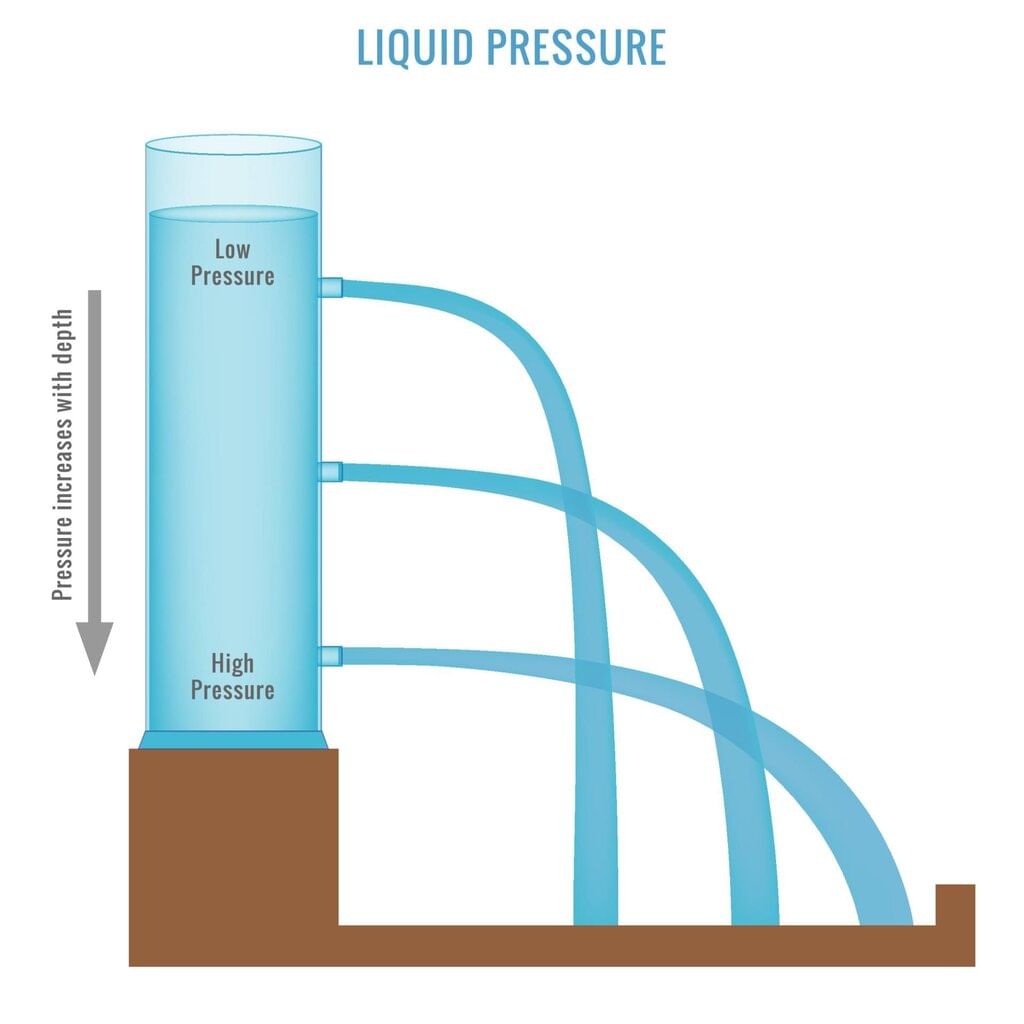
Q2. How can you demonstrate at home that liquid pressure depends on depth? Answer: Make small holes at different heights on the side of a water bottle and fill it; the lowest hole shoots water the farthest. This shows pressure increases with depth due to the taller water column above that point.
Q3. Why do overhead water tanks provide stronger water flow to taps than ground tanks? Answer: A higher tank creates a taller water column, which increases water pressure at the outlet. Greater pressure pushes water through pipes more forcefully.
Q4. How do we know that air presses on surfaces even when we cannot see it? Answer: A rubber sucker sticks to a smooth surface because air outside pushes it on when the inside air is removed. Similarly, an inflated balloon keeps its shape because air inside pushes outward in all directions.
Q5. Why are dams built broader at the base using the idea of pressure distribution? Answer: Water pressure on the wall increases with depth, so the base faces the largest sideways force. A broader, stronger base resists this greater pressure safely.
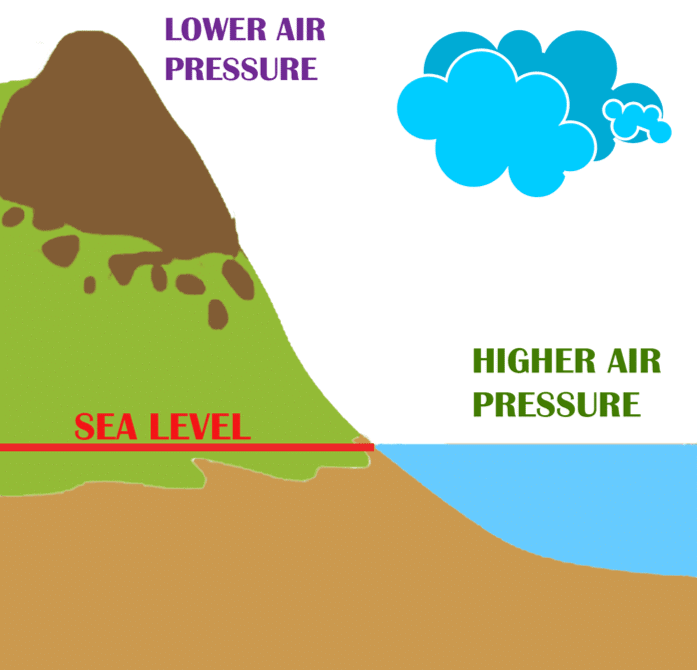
Q6. How do differences in air pressure cause winds to blow? Answer: Air naturally moves from regions of higher pressure to regions of lower pressure to balance pressure differences. The bigger the pressure difference, the stronger the wind.
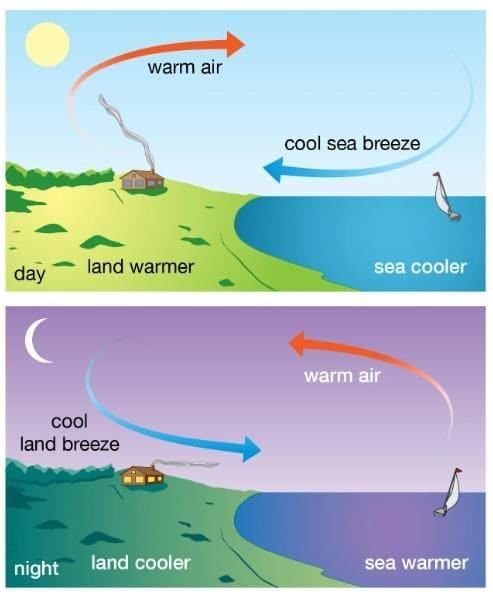
Q7. What is the difference between a sea breeze and a land breeze in terms of heating and pressure? Answer: During the day, land heats faster and creates low pressure so cooler sea air moves toward land (sea breeze). At night, land cools faster and air moves from land to sea (land breeze) due to the new pressure pattern.
Land and Sea Breeze
Q8. Why can fast-moving air lower pressure and create surprising effects like balloons moving together? Answer: When air speeds up between objects, the pressure there drops compared to the outside. The higher outside pressure then pushes the objects toward the low-pressure region.
Q9. How do thunderstorms produce lightning through charge separation? Answer: Strong updrafts and downdrafts make water droplets and ice rub and become charged, with opposite charges separating within the cloud. When the charge difference becomes very large, a sudden discharge occurs as lightning.
Q10. How does a lightning conductor protect a building during a storm? Answer: The pointed metal rod provides an easy path for the electric charge to travel safely into the ground. This prevents the current from passing through and damaging the building.
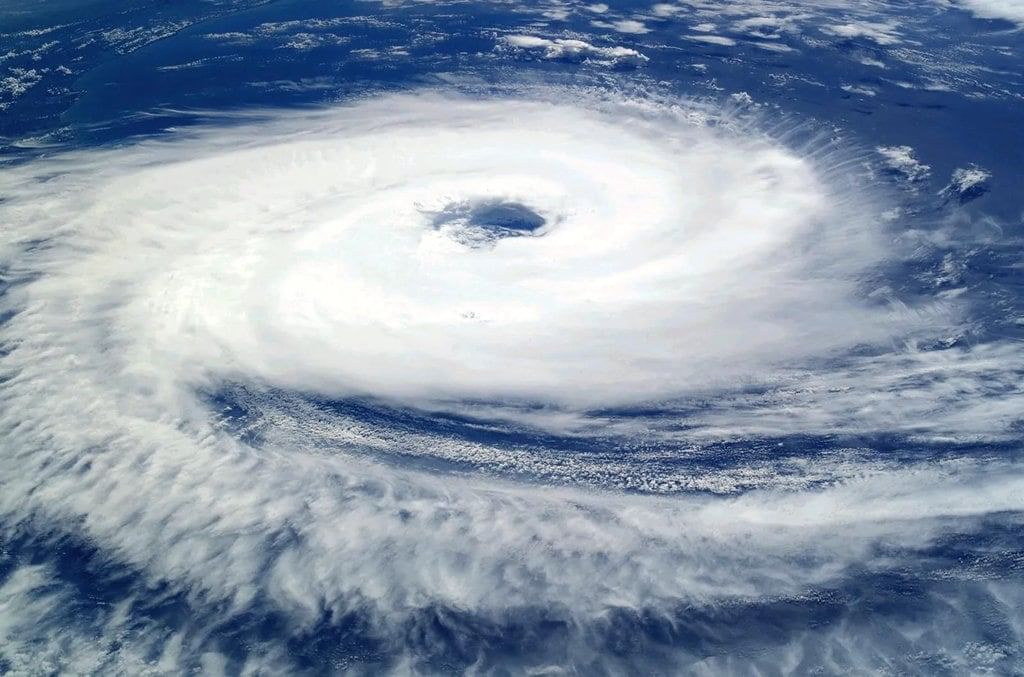
Q11. What makes cyclones intensify over the ocean but weaken over land? Answer: Over warm seas, rising moist air and heat released during condensation strengthen the low-pressure system and winds. After landfall, the cyclone loses moist air supply and friction increases, so it weakens.
Q12. Why is a storm surge one of the most dangerous parts of a cyclone? Answer: Strong winds push seawater toward land, raising water levels into a tall, fast-moving wall that floods coastal areas. This surge can destroy homes, contaminate water, and block rescue efforts.
Cyclone
Long Answer Questions
Q1. Explain how pressure depends on force and area, and describe two design choices in everyday tools that use this idea to work better. Answer:
Pressure increases when the same force acts on a smaller area and decreases when spread over a larger area. Sharp tools like knives and nails have small contact areas, so they create high pressure and cut or pierce easily.
Broad straps or handles spread force over more area, lowering pressure and reducing pain. Engineers use this concept to design comfortable backpacks and effective cutting tools.
Understanding this helps us choose the right tool for the right job.
Q2. Describe an investigation to show that liquid pressure increases with depth and acts in all directions, and explain what the results mean. Answer:
Take a plastic bottle and make three small holes at different heights on one side, then fill it with water. You will see jets from the lower holes shoot farther, proving pressure increases with depth.
Also, water flows sideways from the holes, showing pressure acts in all directions, not just downward. This explains why deep parts of dams face stronger sideways pushes. It also shows why taps connected to higher tanks give stronger flow.
Q3. Explain the concept of atmospheric pressure and how simple activities demonstrate its strength and direction. Answer:
Atmospheric pressure is the push from air molecules on surfaces in all directions. A rubber sucker sticks to glass because removing air underneath creates lower pressure inside, while higher outside pressure holds it tightly.
An inflated balloon keeps its shape because air inside presses outward equally in all directions. We are not crushed because internal body fluids exert pressure that balances outside air pressure.
These examples show air pressure is real, strong, and acts everywhere.
Atmospheric Pressure
Q4. Discuss how pressure differences create winds and compare calm conditions with strong wind conditions using clear examples. Answer:
Air moves from high-pressure regions to low-pressure regions to balance pressures. On calm days, the pressure difference is small, so air moves gently and we feel a breeze.
During strong winds, the pressure difference is large, so air rushes quickly, sometimes causing damage. A sea breeze forms in the day as cool, high-pressure sea air moves toward warm, low-pressure land, while a land breeze forms at night in the opposite direction. These patterns come from how heating changes pressure.
Q5. Explain why high-speed winds lower air pressure locally and describe two real-life effects this can cause. Answer:
When air speeds up, its pressure drops in that region compared to the still air around it. Blowing between two hanging balloons makes the pressure between them lower, so higher outside pressure pushes them together.
During storms, fast wind over a roof creates low pressure above, while higher indoor pressure can push the roof upward. This effect also helps planes lift because fast air over the wing lowers pressure on top. Lower pressure zones guide how winds move and interact.
Q6. Describe step by step how thunderstorms form and how charge separation leads to lightning and thunder. Answer:
Warm, moist air rises quickly and cools, forming tall clouds with strong updrafts and downdrafts. Water droplets and ice particles rub and become charged, with positive charges gathering near the top and negative charges near the bottom.
When the charge difference becomes very large, air breaks down as an insulator, and a sudden discharge occurs as lightning. Lightning rapidly heats air, causing it to expand and produce thunder. This process can repeat within a cloud, between clouds, or between a cloud and the ground.
Q7. Explain the life cycle of a cyclone from formation over warm oceans to weakening over land, and relate it to pressure changes. Answer:
Over warm seas, moist air heats, rises, and creates a low-pressure center at the surface. As water vapor condenses into rain, heat is released, making air rise more and lowering pressure further.
Surrounding air rushes in and spins due to Earth’s rotation, building a powerful system with an eye of very low pressure. Around the eye, winds are strongest and rain is heavy. After landfall, the cyclone loses warm, moist air and weakens due to friction and lack of fuel.
Q8. Describe a safety and preparedness plan for cyclones and thunderstorms, explaining why each step reduces risk to people and property. Answer:
Staying informed through IMD warnings helps families act before danger arrives. Keeping an emergency kit with water, food, medicines, and a flashlight supports survival during power cuts and blocked roads.
Moving to strong shelters or cyclone centers reduces the risk from high winds and storm surges. During lightning, avoiding tall objects and metal and staying in vehicles or indoors lowers the chance of strikes.
Proper building features like lightning conductors and strong roofs further protect life and property.
Q1. How does cycling uphill and downhill illustrate the role of different forces? Answer: Uphill, gravity and friction oppose motion making it harder to pedal, while downhill gravity helps motion and friction is smaller, so the cycle speeds up easily.
Q2. Why do we say forces arise from interactions between two objects? Answer: A force needs two partners, like a hand pushing a table or a bat hitting a ball, because one object acts on another to create the push or pull.
Q3. How can balanced and unbalanced forces explain why an object stays at rest or starts moving? Answer: If forces are balanced, there is no change in motion and the object stays at rest or moves steadily; if they are unbalanced, the object speeds up, slows down, or changes direction.
Q4. How can you show in class that a force can change the shape of an object? Answer: You can stretch a rubber band or squeeze clay to show that applying a force changes the object’s shape without necessarily moving it.
Q5. What everyday observations show that friction depends on the nature of surfaces? Answer: A box slides farther on a smooth tile than on rough carpet because smooth surfaces have less friction and rough surfaces have more friction.
Q6. How does air or water resistance affect moving objects like cyclists or boats? Answer: Air and water push back against motion as drag, so cyclists and boats go faster when they are streamlined to reduce this resisting force.
Q7. How can you identify the type of force acting in a given situation: contact or non-contact? Answer: If objects touch, like pushing a door or rubbing hands, it is a contact force; if they act without touching, like magnets attracting or gravity pulling, it is a non-contact force.
Q8. How can a spring balance be used to compare the weights of two objects? Answer: Hang each object on the hook one by one and read the scale in newtons; the object that stretches the spring more and gives a higher reading has greater weight.
Q9. Why is “10 kg” not a correct scientific way to report weight and what should we use instead? Answer: Kilogram is a unit of mass, while weight is a force and should be reported in newtons; for example, a 10 kg mass weighs about 98–100 N on Earth.
Q10. What factors decide whether an object will float or sink in water? Answer: If the buoyant force equals or exceeds the object’s weight, it floats; if the weight is greater than the buoyant force, it sinks.
Q11. How does Archimedes’ principle help explain floating? Answer: It states that the upward buoyant force equals the weight of the displaced liquid, so an object floats when it displaces water weighing as much as the object itself.
Q12. Why can some rocks like pumice float on water even though most rocks sink? Answer: Pumice contains many air pockets that make it less dense than water, so the buoyant force balances its weight and it floats.
Long Answer Questions
Q1. Explain with examples how forces can act together on an object and still produce no change in motion, and describe what happens when this balance is disturbed. Answer:
When equal and opposite forces act on an object, they are balanced and cause no change in motion; for example, a book resting on a table has its weight balanced by the table’s upward push.
A cyclist moving at a steady speed also experiences balanced forces, as the push from pedaling matches friction and air resistance. If the cyclist pedals harder, the forward force becomes larger than resistive forces, and speed increases.
If the cyclist stops pedaling, resistive forces become greater and the cycle slows down. Therefore, any change in balance leads to acceleration or deceleration.
Q2. Describe an investigation to show that friction depends on the nature of surfaces and how adding weight affects friction, including steps and observations. Answer:
Place a wooden block on a smooth tile and pull it with a spring balance to start motion, noting the reading. Repeat on a rough surface like sandpaper and observe that a larger force is needed on the rough surface.
Next, add weights on the block and repeat on the same surface; the spring balance shows higher readings as weight increases. Record all values in a table to compare how surface type and load change friction.
This shows friction increases with roughness and with greater normal force due to added weight.
Q3. Explain how direction changes in motion are caused by forces, using at least two real-world examples without changing speed much. Answer:
A force can change direction even if speed stays nearly the same, like when turning a bicycle’s handle around a bend. The rider applies a sideways force through the handle and tires on the road, causing the cycle to curve.
In cricket, a fielder deflects a fast-moving ball with a gentle push to guide it toward the stumps without greatly changing its speed. Similarly, a car’s tires provide lateral frictional force to take a turn safely.
These examples show that force is needed to change direction, not just speed.
Q4. Compare and contrast contact forces and non-contact forces by explaining how they act, the conditions needed, and their effects in everyday situations. Answer:
Contact forces require touching, like muscular force pushing a cart or friction slowing a sliding box; they arise from interactions between surfaces or through tools.
Non-contact forces act at a distance, such as magnetic force attracting pins, electrostatic force pulling paper bits to a charged comb, or gravity pulling objects downward.
Contact forces often depend on surface properties and pressure, while non-contact forces depend on material properties and distance. In daily life, opening a drawer uses contact force, while a magnet on a fridge shows non-contact force. Both kinds can start motion, stop motion, or change direction.
Q5. Explain how to read range and least count on a spring balance and why selecting the right range matters for accurate measurements. Answer:
The range is the maximum weight a spring balance can measure, such as 0–10 N, and using a load beyond it can damage the spring. The least count is the smallest division you can read; if 1 N is divided into 5 parts, the least count is 0.2 N.
Choosing the right range ensures the pointer stays within the scale and improves accuracy. A balance with a smaller least count lets you measure small differences more precisely.
Proper selection and reading help compare weights reliably in experiments.
Q6. Discuss how mass and weight differ and why the same object can have different weights on different planets while its mass remains unchanged. Answer:
Mass is the amount of matter in an object and does not change with location, while weight is the force due to gravity and depends on the planet’s gravitational pull.
On Earth, a 1 kg mass weighs about 10 N, but on the Moon it weighs about 1.6 N because gravity is weaker there. On Jupiter, the same 1 kg mass would weigh much more due to stronger gravity.
Scientists use kilograms (kg) for mass and newtons (N) for weight to avoid confusion. This distinction is important in scientific measurements and space exploration.
Q7. Describe the forces acting on an object floating in water and explain how changing the object’s shape can affect floating using the idea of displaced liquid. Answer:
A floating object experiences gravity downward and an upward buoyant force from the water; at float, these forces balance. Archimedes’ principle states the buoyant force equals the weight of the displaced water.
By changing shape to increase volume without much change in mass, the object displaces more water and can float better, like a flat boat-shaped sheet versus a tight ball of the same material.
This is why ships made of metal can float—they displace a lot of water due to their hollow shape. The balance of weight and displaced water decides floating.
Q8. Explain with examples how multiple forces can act simultaneously in motion, such as during cycling on a windy day, and how net force determines the outcome. Answer:
While cycling, the rider’s push provides a forward force, friction at the tires helps grip and move, air resistance opposes motion, and gravity acts downward with the road pushing upward.
On a windy day, wind can add a backward or forward force depending on its direction. The combined effect of all these forces creates a net force, which decides if the cyclist speeds up, slows down, or maintains speed.
If the rider’s push plus helpful wind is greater than resistive forces, speed increases; if not, the cycle slows. Understanding net force helps explain real-life motion in changing conditions.
Q1. How can you tell that an electric current is flowing even without a bulb in the circuit? Answer: You can place a magnetic compass near the wire and look for a needle deflection, or feel gentle warming of a high-resistance wire, showing current flow.
Q2. What does a magnetic field around a current-carrying wire mean in practical terms? Answer: It means the wire behaves like a weak magnet, which can influence a nearby compass or interact with other magnetic materials.
Q3. How did Oersted’s experiment change our understanding of science? Answer: Oersted showed that electricity and magnetism are connected, which led to new technologies like electromagnets and electric motors.
Q4. Why is soft iron used as the core in an electromagnet instead of steel? Answer: Soft iron magnetizes and demagnetizes quickly, so the magnet turns on and off easily with current, while steel tends to stay magnetized.
Q5. How can you safely test the polarity (north and south poles) of an electromagnet you built? Answer: Bring a compass near each end of the coil and observe which way the needle points, then reverse the battery connections to see the poles swap.
Q6. Why are more turns of wire in a coil better for making a strong electromagnet? Answer: More turns concentrate the magnetic effect, increasing the field strength for the same current.
Q7. Why are lifting electromagnets preferred over permanent magnets in scrap yards? Answer: They can be switched on to pick up metal and switched off to drop it, making sorting and moving heavy metal easy and controlled.
Q8. What everyday signs show the heating effect of electric current? Answer: Devices like irons, kettles, and heaters become hot when switched on because their elements convert electrical energy into heat.
Q9. Why do longer and thinner wires get hotter than shorter and thicker ones with the same current? Answer: Longer and thinner wires have higher resistance, so more electrical energy is converted to heat in them.
Q10. What are two safety steps to prevent overheating in home circuits? Answer: Use wires and plugs with correct current ratings and install protective devices like fuses or circuit breakers.
Q11. How does a simple lemon cell demonstrate the idea of chemical energy changing to electrical energy? Answer: The lemon’s acid acts as an electrolyte and the two metals act as electrodes, creating a chemical reaction that pushes electrons through a circuit.
Q12. Why are lithium-ion batteries widely used in phones and laptops instead of ordinary dry cells? Answer: Lithium-ion batteries are rechargeable, store more energy for their size, and provide steady power over many cycles, reducing waste.
Long Answer Questions
Q1. Explain how a magnetic compass can be used to map the shape and direction of the magnetic field around a straight current-carrying wire. Answer:
Place a board with a straight wire passing through its center and sprinkle small compass needles or iron filings around it. When current flows, observe that the compass needles align in circular paths around the wire, showing the field’s shape.
Reverse the current and note that all needles flip direction, proving field direction depends on current direction. Mark the needle directions to draw concentric circles indicating magnetic lines of force. This activity shows both the pattern and the direction of the magnetic field created by current.
Q2. Describe how the magnetic field changes around a coil (solenoid) compared to a straight wire, and what this tells us about making stronger electromagnets. Answer:
A straight wire makes circular fields around it, but a coil (solenoid) concentrates the field inside, making it stronger and more uniform. The coil’s field resembles a bar magnet with a clear north and south pole.
Inserting a soft iron core inside the coil further increases the field strength by channeling the magnetic lines. Increasing the number of turns or the current also strengthens the field. This shows why solenoids with iron cores are used to make powerful electromagnets.
Q3. Explain the role of materials in heating elements and why nichrome is preferred over copper for appliances like irons and heaters. Answer:
Heating elements need materials with high electrical resistance so that more electrical energy converts into heat. Nichrome has higher resistance than copper and can tolerate high temperatures without melting or oxidizing quickly. It also maintains a stable resistance over time, giving steady heating performance.
Copper, though an excellent conductor, produces little heat and can overheat dangerously at high currents. Therefore, nichrome provides safe, efficient, and durable heating in appliances.
Q4. Discuss the balance between useful heating and energy loss in electric circuits, and suggest ways to reduce unwanted heating at home. Answer:
Heating is useful in devices like heaters and kettles, but in regular wires it wastes energy and can be risky. Unwanted heating comes from resistance in wires, loose connections, and overloading circuits.
Using proper wire thickness and high-quality plugs reduces resistance and heat buildup. Keeping connections tight and clean lowers energy loss. Distributing heavy appliances across circuits and using circuit breakers helps prevent overheating and improves safety.
Q5. Describe a classroom investigation to compare how wire length and thickness affect heating, including the steps, variables, and observations. Answer:
Set up a simple circuit with a cell, switch, and replaceable test wires of the same material but different lengths and thicknesses. Keep the cell and time constant, and change only one factor at a time (length first, then thickness).
After switching on for a fixed time, feel carefully or use a thermometer/IR sensor to note temperature rise. Record results to compare which wire heats more. You will observe that longer and thinner wires heat more due to higher resistance.
Q6. Explain how connecting cells in series or parallel changes the performance of an electromagnet or a small motor, and why. Answer:
Cells in series add their voltages, increasing the current in the circuit for the same resistance, which strengthens an electromagnet or speeds a motor. Cells in parallel keep the same voltage but provide more total charge, allowing the device to run longer at the same power. For quick, strong magnetic pull, series connection is helpful.
For longer operation without frequent cell changes, parallel connection helps. Choosing series or parallel depends on whether you need more strength or more duration.
Q7. Describe the working differences between a dry cell and a rechargeable battery in terms of chemistry and practical use. Answer:
A dry cell uses a chemical reaction that is mostly one-way, so when its reactants are used up, it becomes a dead cell and must be discarded. A rechargeable battery uses reversible chemical reactions, so applying an external current restores the original chemicals for reuse.
In daily life, dry cells are simple and cheap for low-power devices, while rechargeables reduce waste and cost over time for frequent use. Rechargeables also provide steadier voltage over many cycles. Their design supports repeated charging and discharging without quick damage.
Q8. Explain how the Earth’s magnetic field interacts with currents and magnets, and describe one real-life use of this knowledge. Answer:
The Earth’s magnetic field surrounds us and sets a preferred direction for compass needles. When a current flows near a compass, the local magnetic field from the wire competes with Earth’s field, causing needle deflection.
Engineers design instruments considering Earth’s field to avoid false readings, placing sensitive circuits away from strong currents or magnets. One real-life use is in navigation tools and smartphone compasses, which calibrate sensors to subtract Earth’s field and nearby magnetic interference. This ensures accurate direction finding for maps and travel.