06. Worksheet Solutions: Tissues

Multiple Choice Questions (MCQs)

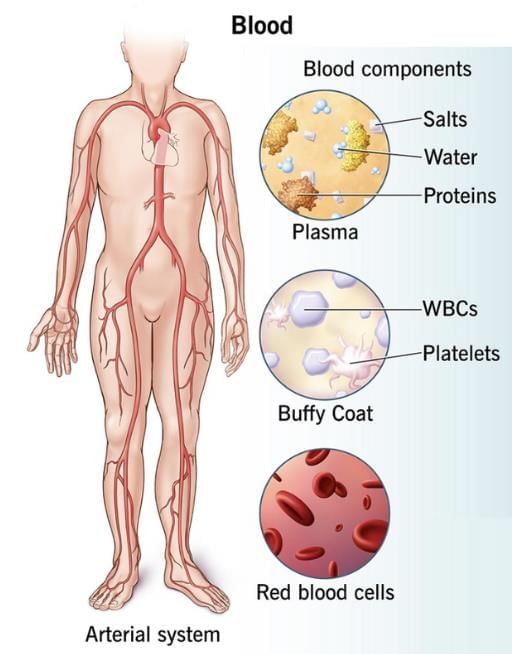
Q1. Which of the following is a type of connective tissue that transports substances in the body?
(a) Bone
(b) Blood
(c) Cartilage
(d) Tendon

(b) Blood

Solution: Blood is a connective tissue that transports gases, nutrients, hormones, and waste materials throughout the body.Multiple Choice Questions (MCQs)


Q2. What is the main function of ligaments in the body?
(a) Connect muscles to bones
(b) Provide flexibility to bones
(c) Connect bones to other bones
(d) Store minerals like calcium and phosphorus

(c)  Connect bones to other bones

Solution: Ligaments are a type of connective tissue that is highly elastic and helps in connecting one bone to another, providing strength and stability to joints.


Q3. Which of the following tissues is responsible for the transport of water and minerals in plants?

(a) Phloem
(b) Parenchyma
(c) Collenchyma
(d) Xylem

(d) Xylem
Solution: 
Xylem consists of tubular structures like tracheids and vessels, which transport water and minerals from the roots to other parts of the plant.

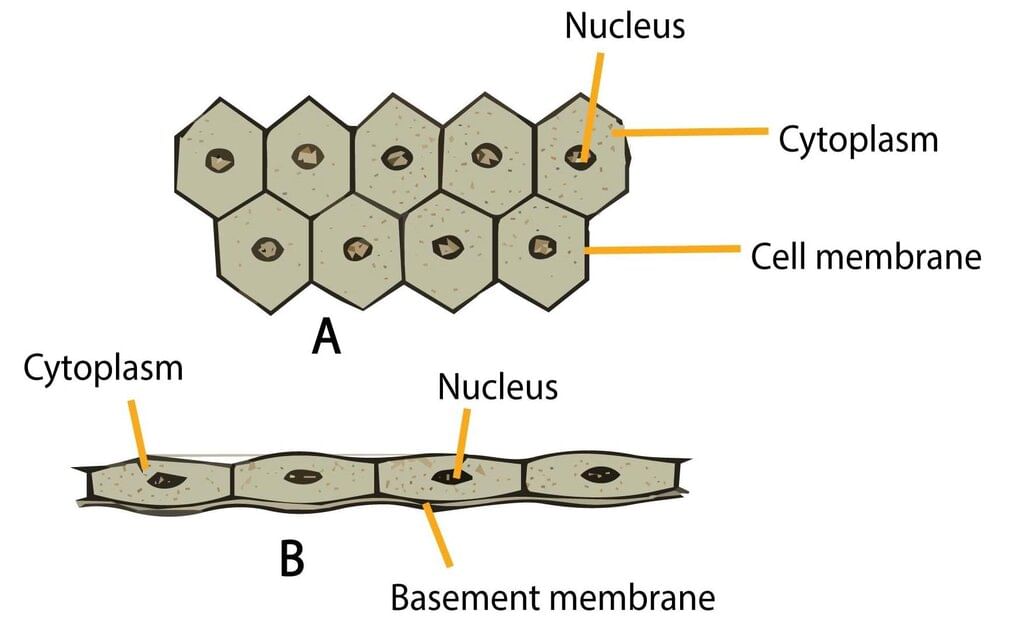
Q4. Which of the following tissues provides protection to organs and forms a barrier in the body?

(a) Muscular tissue
(b) Nervous tissue
(c) Epithelial tissue
(d) Connective tissue

(c) Epithelial tissue
Solution: Epithelial tissue covers organs and cavities in the body, forming a continuous sheet that acts as a protective barrier and regulates material exchange.
Multiple Choice Questions (MCQs)

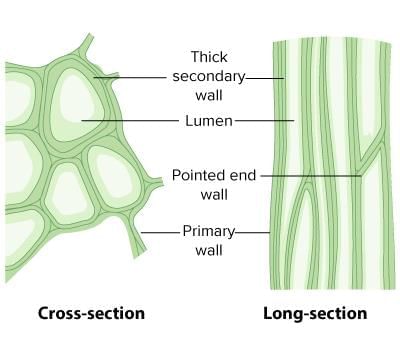
Q5. Which of the following tissues makes the plant hard and stiff, and is found in the husk of a coconut?

(a) Parenchyma
(b) Collenchyma
(c) Sclerenchyma
(d) Phloem

(c) Sclerenchyma
Solution: Sclerenchyma is a type of permanent tissue that provides strength and stiffness to plant parts. Its cells are dead with thick lignified walls, and it is found in stems, around vascular bundles, and in hard coverings like the husk of a coconut.
Multiple Choice Questions (MCQs)

Fill in the blanks

(i)  ________________ tissue is found between the skin and muscles, around blood vessels and nerves and in the bone marrow.

Areolar connective

(ii) The signal that passes along the nerve fibre is called a  _______________.

nerve impulse

(iii) Xylem and phloem together form a __________ in plants.

vascular bundle

(iv) __________ is the most common simple permanent tissue, consisting of unspecialized cells with thin cell walls.

Parenchyma

(v) The flexibility in plants is due to permanent tissue named ____________.

 collenchyma

Short Answer Questions

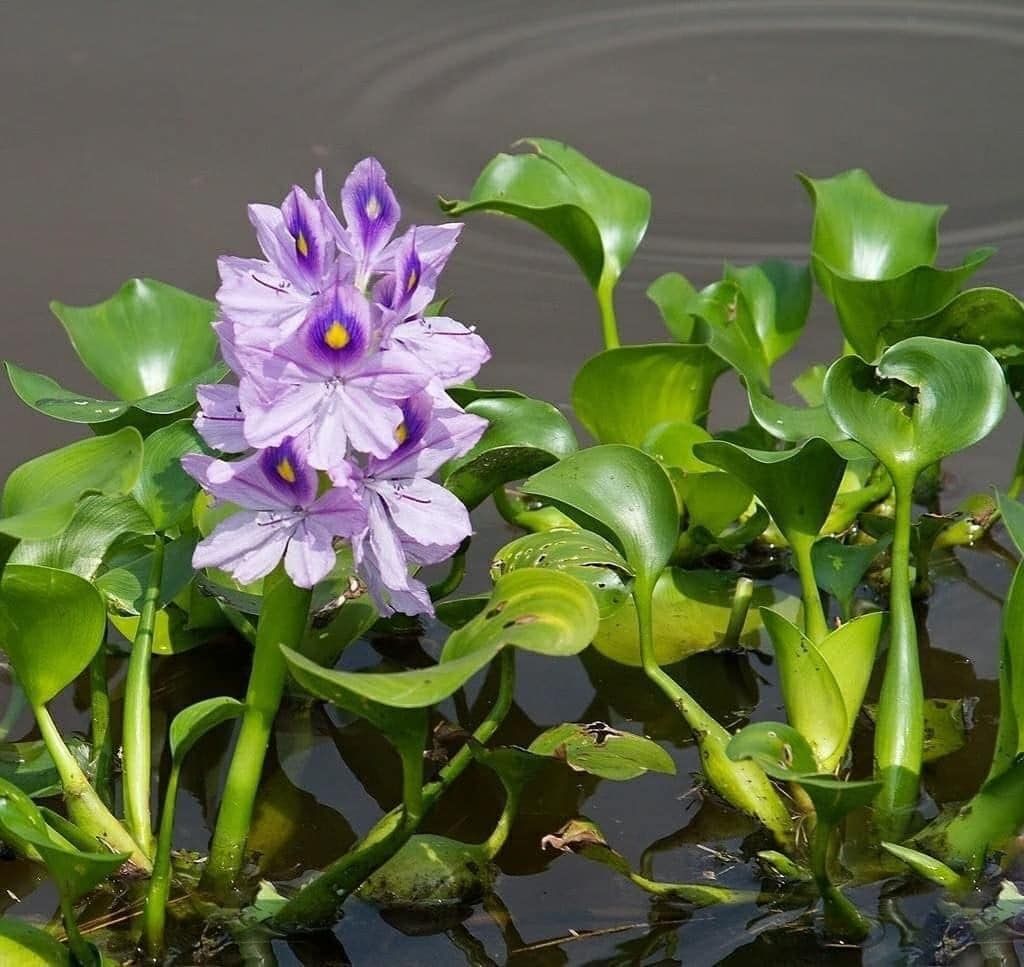
Q1. Water hyacinth floats on the water surface. Explain.

Water hyacinth floats on the surface of water due to presence of aerenchyma. It is modified form of parenchyma, which contains  large air cavities. It provides buoyancy which helps water hyacinth in floating.Short Answer Questions

Q2. What are the different types of connective tissue?

  • Blood – It has a fluid matrix (plasma) and transports gases, food, hormones, and waste materials.
  • Bone – A strong, non-flexible tissue that supports the body, anchors muscles, and protects organs.
  • Ligament – Connects bones to bones; it is elastic and strong with very little matrix.
  • Tendon – Connects muscles to bones; it is strong and fibrous but has limited flexibility.
  • Cartilage – Has a solid matrix of proteins and sugars; provides smoothness at joints and is found in the nose, ear, trachea, and larynx.
  • Areolar tissue – Found between skin and muscles and around organs; fills spaces and helps in repair.
  • Adipose tissue – Stores fat under the skin and around internal organs; also acts as an insulator.


Q3. Define the process of differentiation.

In a multicellular organism, cells become specialized to perform different functions.  They take up a specific role and lose the ability to divide. As a result, they form a permanent tissue. This process of taking up a permanent shape, size, and a function is called differentiation. Differentiation leads to the development of various types of permanent tissues.


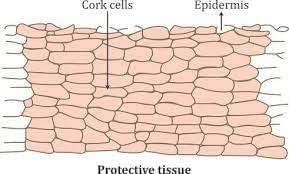
Q4. How does the cork act as a protective tissue?

In plants the secondary meristem cuts off many external layers of cells that are dead and arranged in a compact manner. Such layers together make cork. They have deposition of suberin which is very hard and impermeable hence protects plants from unfavorable conditions and microbial attack etc.Short Answer Questions

Q5. What are complex permanent tissues? Name their types and describe their functions.

Ans: Complex permanent tissues are made up of more than one type of cell that work together to perform a specific function. The two main types are xylem and phloem.

  • Xylem transports water and minerals vertically and is made of tracheids, vessels, xylem parenchyma, and xylem fibres.
  • Phloem transports food from leaves to other parts of the plant and is made of sieve cells, sieve tubes, companion cells, phloem fibres, and phloem parenchyma.


Q6. If a potted plant is covered with a glass jar, water vapour appears on the wall of the glass jar. Explain why?

Plant always loose water from the surface of leaves. This process is known as transpiration. Water reaches leaves by xylem vessels, where evaporation takes place by stomata.


Q7. What is the utility of tissues in multicellular organisms?

There is a clear cut division of labour in multicellular organisms i.e. different parts of the body of a multicellular organism perform specific functions. For example, brain controls all other parts of body, heart pumps blood to all parts of body, kidneys remove waste materials from body, sense organs collect information from external sources for sensory perception etc. All these functions would never be possible without formation of tissues in multicellular organisms.


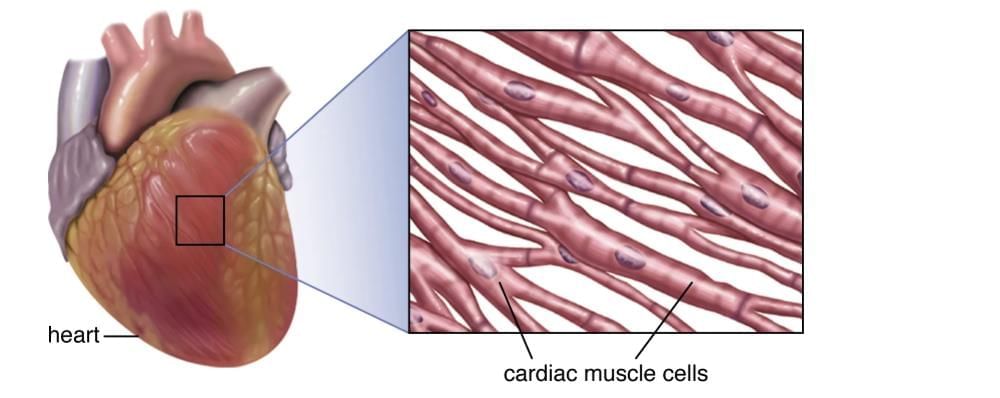
Q8. Give three features of cardiac muscles. 

(1) Cardiac muscles are involuntary i.e. they don’t work under our will.
(2) Its cells are cylindrical, branched, striated and uninucleate.
(3) It shows rhythmic contraction and relaxation throughout the person’s life.Short Answer Questions

Q9: What is glandular epithelium, and how is it formed?

Glandular epithelium is a type of epithelial tissue specialised to secrete substances. It is formed when a portion of the epithelial tissue folds inward to create a multicellular gland.

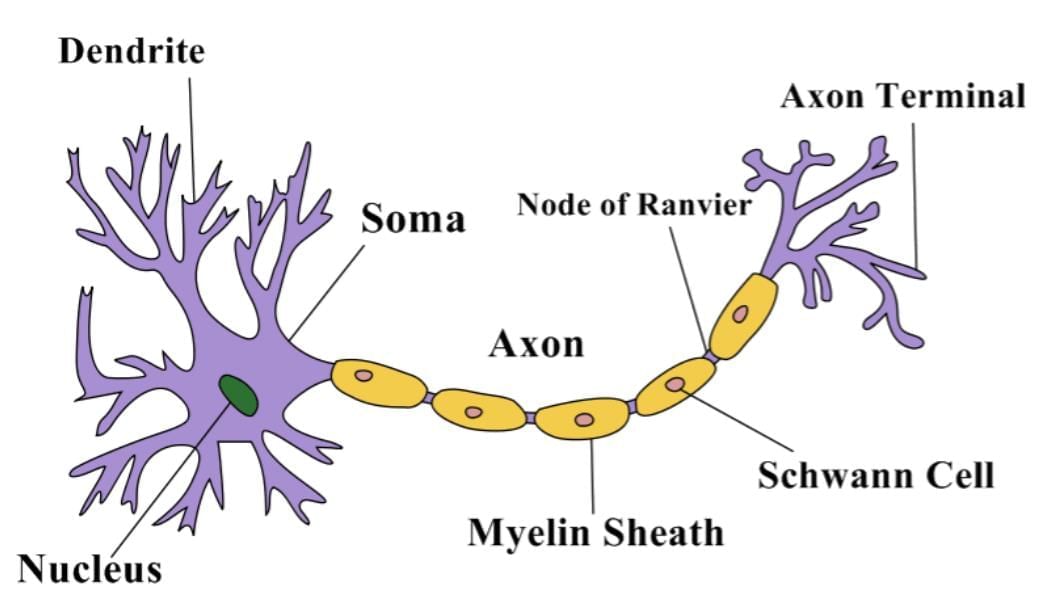
Q10. Draw a labelled diagram of a Neuron.
Short Answer Questions

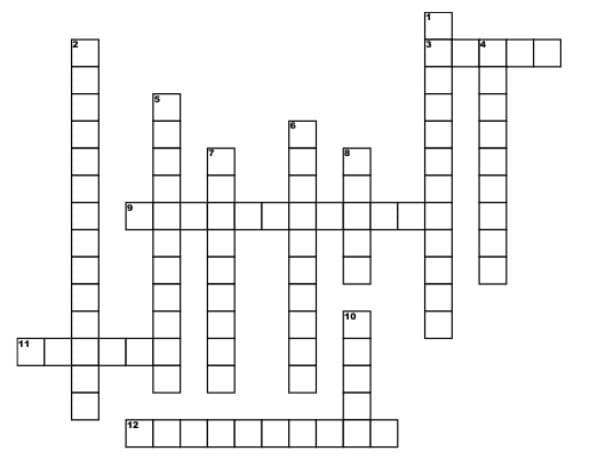
Crossword Puzzle

Crossword Puzzle

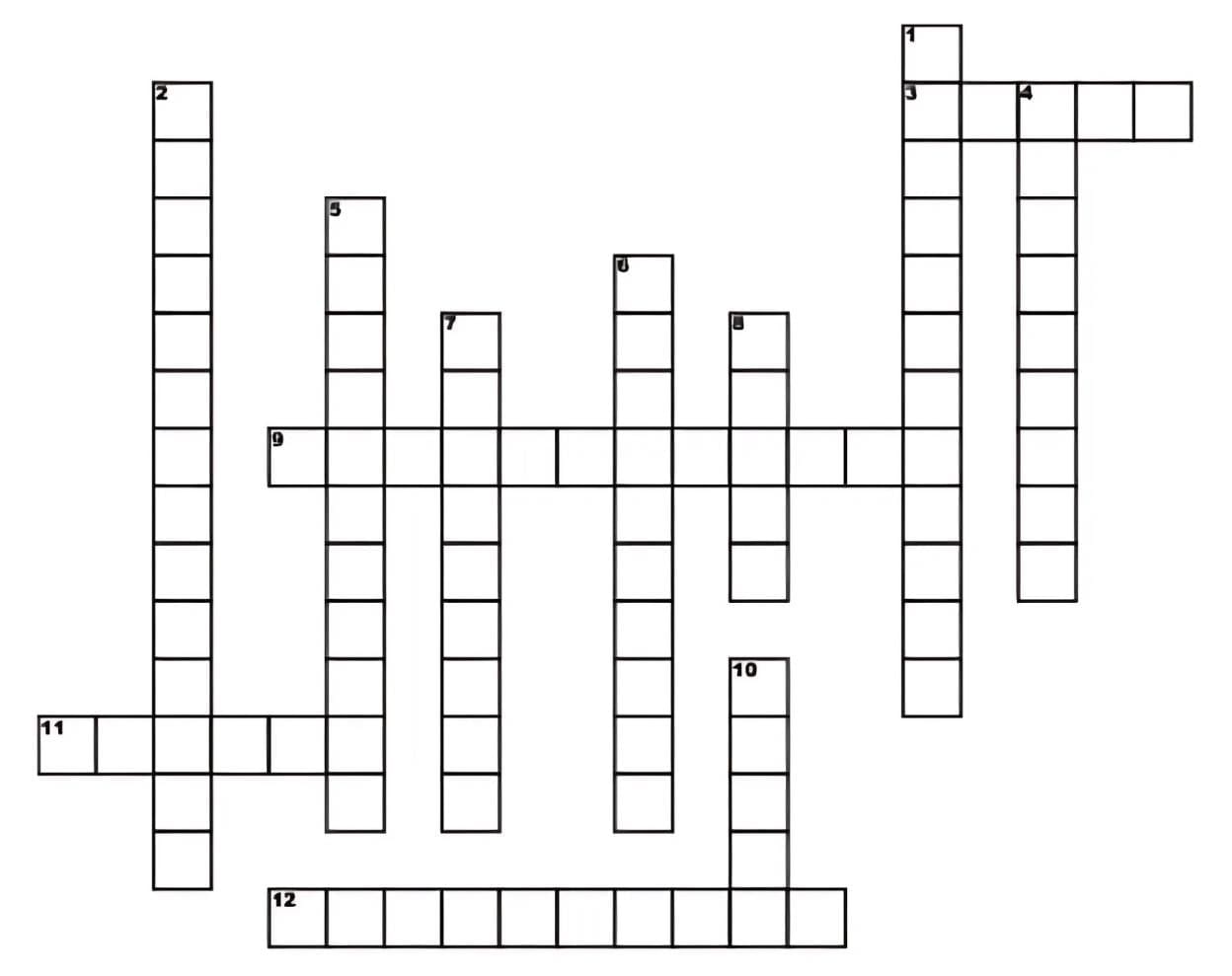
Across Clues

3. A component of the waxy outer coating of aquatic plant leaves.

9. Tissue responsible only for growth.

11. Conducts dissolved food materials produced by photosynthesis.

12. Most abundant of the cell types found in the major parts of higher plants.

Down Clues

1. Thick, tough secondary walls impregnated with lignin

2. Certain cells are associated with the sieve tube

4. Tubes with pits rather than openings at the ends

5. Provide flexible support for growing and mature plant organs. An extra primary wall in the corners

6. Parenchyma tissue with connected air spaces

7. Outermost layer of cells

8. Pairs of cells that border stomata

10. Chief conducting tissue of water and minerals

Answer

Across
3. Cutin
9. Meristem
11. Phloem
12. Parenchyma

Down

1. Sclerenchyma

2. Companion

4. Tracheids

5. Collenchyma

6. Aerenchyma

7. Epidermis

8. Guard cells

10. Xylem

06. Worksheet: Tissues

Multiple Choice Questions (MCQs)

Q 1. Which of the following is a type of connective tissue that transports substances in the body?
(a) Bone
(b) Blood
(c) Cartilage
(d) Tendon

Q 2. What is the main function of ligaments in the body?
(a) Connect muscles to bones
(b) Provide flexibility to bones
(c) Connect bones to other bones
(d) Store minerals like calcium and phosphorus

Q 3. Which of the following tissues is responsible for the transport of water and minerals in plants?

(a) Phloem
(b) Parenchyma
(c) Collenchyma
(d) Xylem

Q4. Which of the following tissues provides protection to organs and forms a barrier in the body?

(a) Muscular tissue
(b) Nervous tissue
(c) Epithelial tissue
(d) Connective tissue

Q5. Which of the following tissues makes the plant hard and stiff, and is found in the husk of a coconut?

(a) Parenchyma
(b) Collenchyma
(c) Sclerenchyma
(d) Phloem

Fill in the blanks

(i)  ________________ tissue is found between the skin and muscles, around blood vessels and nerves and in the bone marrow.

(ii) The signal that passes along the nerve fibre is called a  _______________.

(iii) Xylem and phloem together form a __________ in plants.

(iv) __________ is the most common simple permanent tissue, consisting of unspecialized cells with thin cell walls.

(v) The flexibility in plants is due to permanent tissue named ____________.

Short Answer Questions

Q1. Water hyacinth floats on the water surface. Explain.

Q2. What are the different types of connective tissue?

Q3. Define the process of differentiation.

Q4. How does the cork act as a protective tissue?

Q5. What are complex permanent tissues? Name their types and describe their functions.

Q6. If a potted plant is covered with a glass jar, water vapour appears on the wall of the glass jar. Explain why?

Q7. What is the utility of tissues in multicellular organisms?

Q8. Give three features of cardiac muscles. 

Q9: What is glandular epithelium, and how is it formed?

Q10. Draw a labelled diagram of a Neuron.

Crossword Puzzle
Crossword Puzzle

Across Clues

3. A component of the waxy outer coating of aquatic plant leaves.

9. Tissue is only meant for growth.

11. Conducts dissolved food materials produced by photosynthesis.

12. Most abundant of the cell types found in the major parts of higher plants.

Down Clues

1. Thick, tough secondary walls impregnated with lignin

2. Certain cells are associated with the sieve tube

4. Tubes with pits rather than openings at the ends

5. Provide flexible support for growing and mature plant organs. An extra primary wall in the corners

6. Parenchyma tissue with connected air spaces

7. Outermost layer of cells

8. Pairs of cells that border stomata

10. Chief conducting tissue of water and minerals

05. Worksheet Solutions: The Fundamental Unit of Life

Multiple Choice Questions

Q1: Cells were first discovered by _____.
(a) Chadwick
(b) Dalton
(c) Robert Hooke
(d) None of these
Ans:  (c)

In 1665, Robert Hooke observed cork cells under a microscope and coined the term “cell”.

Q2: Amoeba acquires its food through _____.
(a) endocytosis
(b) plasmolysis
(c) cell organelles
(d) None of these
Ans: (a)

Endocytosis is the process by which Amoeba engulfs food particles by surrounding them with its cell membrane and forming a food vacuole.

Q3: _______ impart beautiful colours to flowers to attract insects for pollination.
(a) Centrosome
(b) Chromoplasts
(c) Plastids
(d) Vacuole
Ans: (b)

Chromoplasts are a type of plastid responsible for the bright red, yellow, and orange pigments in flowers and fruits, which help attract pollinators.

Q4: Ribosomes carry out _____ synthesis.
(a) Protein
(b) Lipids
(c) Enzymes
(d) All of these
Ans: (a)

Ribosomes are tiny organelles present in both prokaryotic and eukaryotic cells that synthesize proteins, which are essential for various cellular functions.

Fill in the blanks

(i) The movement of water through a selectively permeable membrane is called osmosis.
(ii)  The cell is the basic structural and functional unit of life.
(iii) Protoplasm is commonly called the physical basis of life.
(iv) Cell division for growth and repair is called mitosis.
(v) Transporting channel of the cell is endoplasmic reticulum.

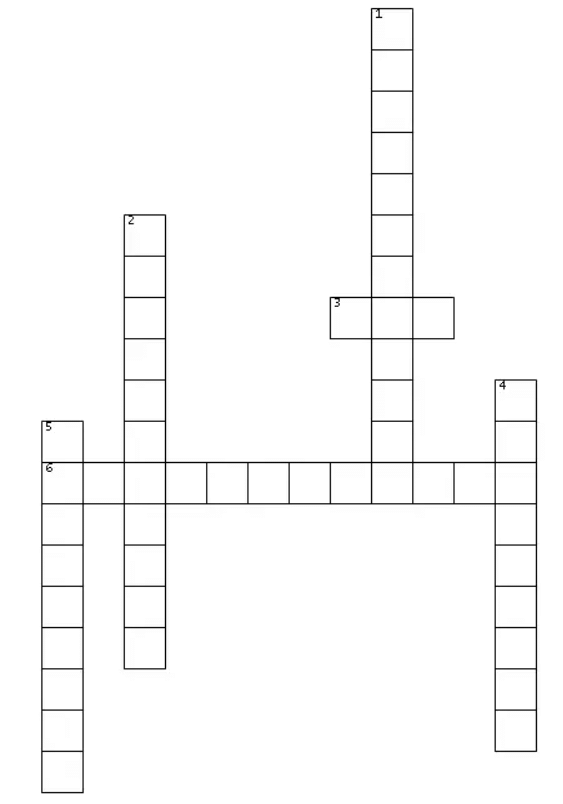
Crossword Puzzle

Q1:

ACROSS

3. ___stands DeoxyriboNucleic Acid
6. These are important for photosynthesis in plants

DOWN

1. They are the powerhouses of the cell
2. Paramoecium is a ____________ organisms
4. It is a kind of waste disposal system of the cell
5. One of the biologists who presented the cell theory

Ans:
(1) Mitochondria
(2) unicellular
(3) DNA
(4) Lysosomes
(5) Schleiden
(6) Chloroplasts

Very Short Answer Questions

Q1: Where are proteins synthesised inside the cell?
Ans: Ribosomes are the sites for protein synthesis inside the cell.

Q2: Which organelle is known as the powerhouse of the cell? Why? 
Ans: It is the Mitochondria of the cell also known as the powerhouse of the cell because it synthesizes energy in the form of ATP during respiration which is vital for various life activities.

Q3: Why are lysosomes known as suicide bags?
Ans: Lysosomes are cell organelles filled with hydrolytic(digestive) enzymes. When a cell is damaged, its lysosomes may burst and its enzymes digest the cell’s contents. Due to this, we can say that lysosomes are suicide bags.

Q4: If the organisation of a cell is destroyed due to some physical or chemical influence, what will happen? 
Ans: If the organisation of a cell is destroyed due to some physical or chemical influence then such cell would not survive any more as its lysosomes digest up all components of that cell.

Q5: Where do lipids and proteins get synthesized?
Ans: Lipids get synthesized in the smooth endoplasmic reticulum and proteins get synthesised in the ribosome and rough endoplasmic reticulum.

Q6: What would happen if the plasma membrane breaks down?
Ans: If the plasma membrane breaks down, substances will move freely in and out of the cell, disturbing the internal environment, and the cell will not survive.

Short Answer Questions

Q1: Who discovered cells in living organisms? Give an example of the unicellular organism.

Ans: Leeuwenhoek (1674) was the first to observe the free living cells in pond water. Examples of unicellular organisms: Amoeba, Chlamydomonas, Paramoecium, Bacteria, etc.

Q2: Why is the cell called the structural and functional unit of life?
Ans: All living organisms are made up of cells so the cell is the basic building unit of a living organism and all the activities performed by a living organism are the sum total of activities performed by its cells hence cell is called the structural and functional unit of life.

Q3: What is the function of plastids?
Ans: Plastids are present only in plant cells. There are two types of plastids chromoplast (coloured plastids) and leucoplasts (white or colourless). Chromoplast: Consists of coloured pigments and gives different colours to flowers, fruits and leaves. The green colour pigment present in the leaf is called chlorophyll which helps in photosynthesis and a plastid with chlorophyll is called chloroplast. Leucoplast: It stores starch, oil and protein granules in it.

Q4: Why do mitochondria have largely folded inner membranes?
Ans: Mitochondria have a largely folded inner membrane which provides the increased surface area for ATP-generating chemical reactions. Mitochondria is the site for cellular respiration and provides energy to the cell.

05. Worksheet: The Fundamental Unit of Life

Multiple Choice Questions

Q.1.Cells were first discovered by _____. 
(a) Chadwick
(b) Dalton
(c) Robert Hooke
(d) None of these 

Q.2. Amoeba acquires its food through _____.
(a) Endocytosis
(b) Plasmolysis
(c) Cell organelles
(d) None of these

Q.3. _______ impart beautiful colors to flowers to attract insects for pollination. 
(a) Centrosome
(b) Chromoplasts
(c) Plastids
(d) Vacuole

Q.4. Ribosomes carry out _____ synthesis.
(a) Protein
(b) Lipids
(c) Enzymes
(d) All of these 

Fill in the blanks

(i) The movement of water through a selectively permeable membrane is called ______.
(ii) ___ is the basic structural and functional unit of life.
(iii) ____ is commonly called the physical basis of life.
(iv) Cell division for growth and repair is called ______.
(v) Transporting channel of the cell is______.

Crossword Puzzle

Q1:

ACROSS

3. ___stands DeoxyriboNucleic Acid

6. These are important for photosynthesis in plants

DOWN

1. They are the powerhouses of the cell

2. Paramoecium is a ____________ organisms

4. It is a kind of waste disposal system of the cell

5. One of the biologists who presented the cell theory

Very Short Answer Questions

Q1: Where are proteins synthesized inside the cell?
Q2: Which organelle is known as the powerhouse of the cell? Why?
Q3: Why are lysosomes known as suicide bags?
Q4: If the organization of a cell is destroyed due to some physical or chemical influence, what will happen?
Q5: Where do lipids and proteins get synthesized?
Q6: What would happen if the plasma membrane breaks down?

Short Answer Questions

Q1: Who discovered cells in living organisms? Give an example of the unicellular organism.
Q2: Why is the cell called the structural and functional unit of life?
Q3: What is the function of plastids?
Q4: Why do mitochondria have a largely folded inner membrane?

04. Worksheet Solutions: Structure of the Atom

Multiple Choice Questions

Q1: The nucleus of an atom consists of ______.
(a) Protons
(b) Electrons and neutrons
(c) Protons and neutrons
(d) Neutrons 
Ans: (c)

The nucleus contains protons (+) and neutrons (0); together they’re called nucleons.

Q2: What is the maximum number of electrons which can be present in K and L shells in an atom?
(a) 2 and 8
(b) 2 and 18
(c) 2 and 32
(d) 8 and 18

Ans: (a)

The K shell can hold a maximum of 2 electrons. The L shell can accommodate up to 8 electrons.

Q3: Rutherford’s alpha-particle scattering experiment was responsible for the discovery of
(a) Atomic Nucleus
(b) Electron
(c) Proton
(d) Neutron
Ans: (a)

Rutherford’s alpha-particle scattering experiment led to the discovery of the atomic nucleus. Key findings from the experiment include:

  • Most alpha particles passed through the gold foil, indicating that atoms are mostly empty space.
  • Only a few particles were deflected, suggesting that the positive charge of the atom is concentrated in a small area.
  • A small fraction of particles rebounded, showing that the positive charge and mass are located in the nucleus.

This experiment fundamentally changed our understanding of atomic structure.

Q4: Isotopes of element have:
(a) The same physical properties
(b) Different chemical properties
(c) Different number of neutrons
(d) Different atomic numbers

Ans: (c)

Isotopes are atoms of the same element. They have the same atomic number but different mass numbers. This difference is due to varying numbers of neutrons.

Q5: Number of valence electrons in Cl ion are:
(a) 16
(b) 8
(c) 17
(d) 18

Ans:  (b)

 Cl Ion has 18 electrons (17+1). Hence the number of valence electrons in Cl ion is 8. Electronic distribution:
Cl – 2, 8, 7
Cl – 2, 8, 8

Q6: An element with configuration 2,8,4 will tend to show valency
(a) 3
(b) 2
(c) 4
(d) 5
Ans: (c)

Electronic configuration 2,8,4 ⇒ outermost shell has 4 electrons.
To reach a stable octet, the atom needs 4 more (or would have to lose 4), so its valency = 4.
(Example: Silicon, Z = 14, commonly shows valency 4 by sharing electrons.)

Q7: Amongst element X (2,8,6) and Y (2,8,8) which is more reactive and why ?
(a) X because it is a metal
(b) Y because it is non metal
(c) X because it has 6 valence electrons
(d) Y because it is gas
Ans: (c)

Element X is more reactive due to its 6 valence electrons. This means it is more likely to gain 2 electrons to achieve a stable octet configuration.

  • X has 6 valence electrons.
  • It tends to gain 2 electrons.
  • This helps it achieve a stable octet.

Q8: The nucleus of the hydrogen atom is called as
(a) Neutron
(b) Electron
(c) Proton
(d) Nucleons
Ans: (c)

The nucleus of a hydrogen atom contains a single proton.

Q9: Cathode rays get deflected in a electric field towards
(a) Positive plate
(b) Negative Plate
(c) No deflection takes place
(d) First towards negative plate and then towards positive plate
Ans: (a)

Cathode rays are negatively charged particles. They are attracted to the positive plate in an electric field. This attraction occurs because opposite charges attract each other.

Q10: The atomic number of an element ‘y’ is 20. The electronic configuration of the ion having inert gas configuration is
(a) 2,8,10
(b) 2,18
(c) 2,10,8
(d) 2,8,8
Ans: (d)

The ion with an inert gas configuration has lost 2 electrons. This results in an electronic configuration of 2, 8, 8.

Fill in the Blank

Q1: According to Bohr–Bury rules, the maximum number of electrons in the K-shell is ________ and in the L-shell is ________.
Ans: 
According to Bohr–Bury rules, the maximum number of electrons in the K-shell is 2 and in the L-shell is 8.

Q2: An atom is the smallest unit of an element which takes part in a _________.
Ans: 
An atom is the smallest unit of an element which takes part in a Chemical reaction.

Q3: Mass of an electron is 1/2000 times less than the mass of one atom of__________.
Ans:
 Mass of an electron is 1/2000 times less than the mass of one atom of hydrogen.

Q4: The K-shell of any atom cannot have more than _________ electrons.
Ans: 
The K-shell of any atom cannot have more than two electrons.

Q5: Isotopes are the atoms of ___________ element, having same atomic number but different mass number.
Ans: 
Isotopes are the atoms of the same element, having same atomic number but different mass number.

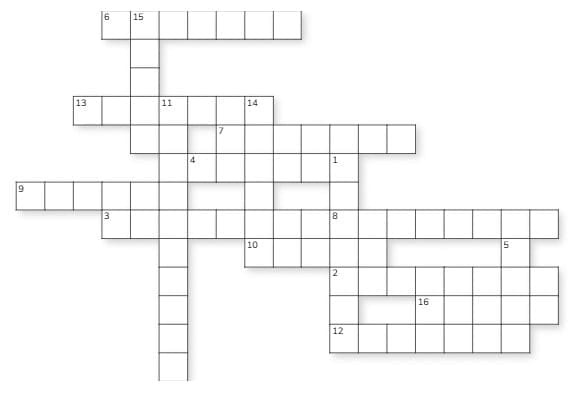
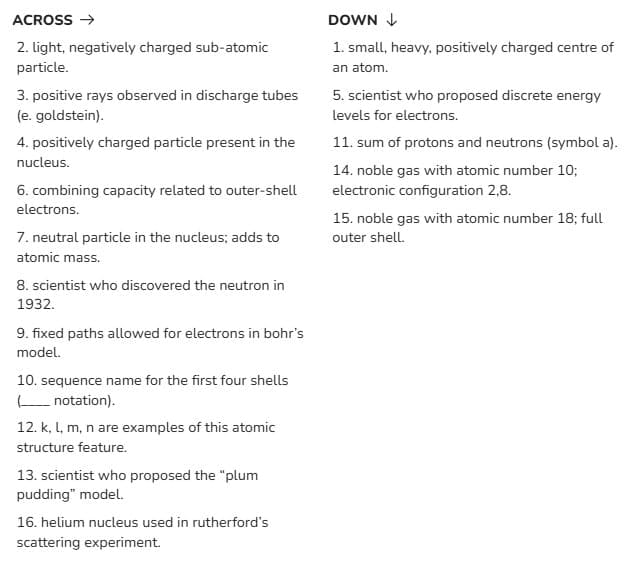
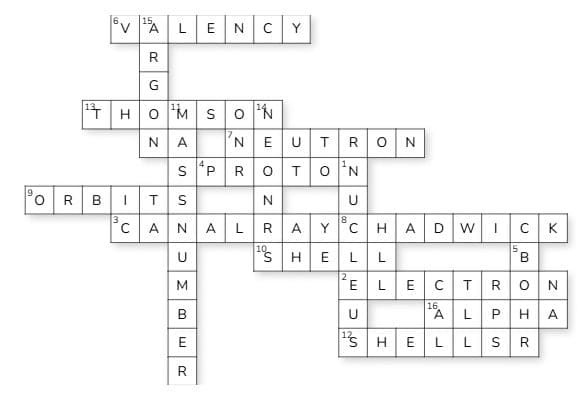
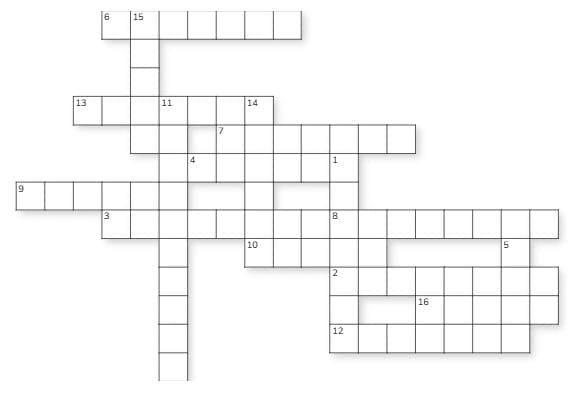
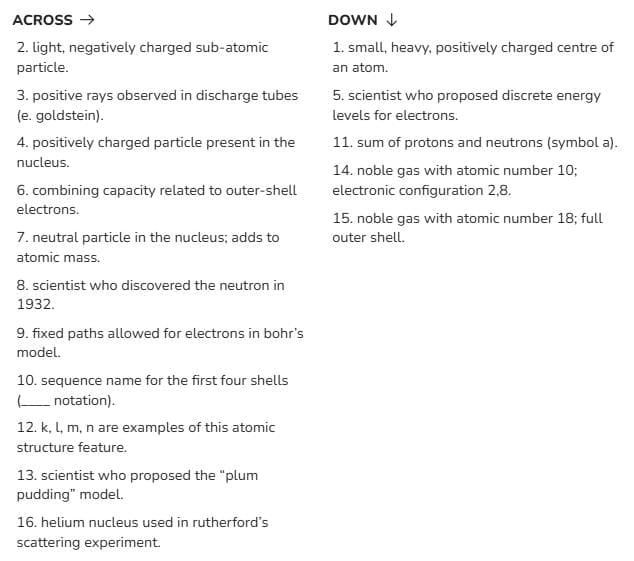
Crossword Puzzle

Ans: 

Very Short Answer Questions

Q1: Out of proton and neutron, which is heavier?
Ans: Neutron is slightly heavier (1.675 × 10⁻²⁷ kg) than proton (1.67 × 10⁻²⁷ kg).

Q2: Were neutrons known at the time Rutherford performed the scattering experiment?
Ans: No, neutrons were not known when Rutherford conducted his scattering experiment. They were discovered later by Chadwick in 1932. Rutherford’s experiment took place in 1911.

Q3: Who discovered canal rays and what do they indicate?
Ans: E. Goldstein discovered canal rays; they are positively charged radiations (led to proton concept).

Q4: What is the number of electrons in the valence shell of chlorine (Z = 17)?
Ans: 7 valence electrons (Cl: 2,8,7).

Q5. What is the basic difference between the isotopes of an element?
Ans: Isotopes have the same atomic number but different mass numbers (different neutrons).

Short Answer Questions

Q1: How will you find the valency of chlorine, sulphur and magnesium?
Ans: The valency of an element is determined by the number of valence electrons in its outermost shell. Here’s how to find the valency for chlorine, sulphur, and magnesium:

Chlorine (Cl):

  • Atomic number: 17 (electron configuration: 2, 8, 7)
  • Valence electrons: 7
  • Needs 1 more electron to complete its octet (8).
  • Valency: 1

Sulphur (S):

  • Atomic number: 16 (electron configuration: 2, 8, 6)
  • Valence electrons: 6
  • Needs 2 more electrons to complete its octet (8).
  • Valency: 2

Magnesium (Mg):

  • Atomic number: 12 (electron configuration: 2, 8, 2)
  • Valence electrons: 2
  • It is easier for magnesium to lose its 2 valence electrons than to gain 6.
  • Valency: 2

Q2: Describe Bohr’s model of the atom.
Ans:  The special features of Bohr’s model are given below:
(1) An electron revolves in the orbit of atom with well-defined energy.
(2) Energy of orbits increases from inner shell to the outer shells i.e. energy for orbit nearest the nucleus is lowest.
(3) If energy is supplied then electron moves from lower orbit to the higher orbit and if an electron jumps from higher orbit (energy level) to the lower orbit (energy level) then energy is radiated as electromagnetic waves.
(4) Each orbit or shell represents an energy level. Such orbits are represented as K,L,M,N,O……….. and named from centre to outwards.
(5) The shell or orbits are associated with certain amount of energy and energy of orbits/shells increases from inward to outwards.eg K<L<M<N<O…………

Q3: What are the limitations of Rutherford’s model of the atom?
Ans: Limitations of Rutherford’s Model of the Atom

  • The model does not explain the stability of the atom.
  • According to the model, electrons orbiting the nucleus should emit energy due to acceleration.
  • This energy loss would cause the electrons to spiral inward and eventually collide with the nucleus, leading to an unstable atom.
  • However, we observe that atoms are generally quite stable.

Q4: Write the postulates of Bohr theory?
Ans: The postulates of Bohr’s theory are:

  • Electrons move around the nucleus in specific circular paths known as orbits.
  • Each orbit is linked to a fixed amount of energy.
  • The larger the radius of the orbit, the greater the energy of the electrons.
  • Electrons can transition between orbits by gaining or losing a specific amount of energy.

Q5: Explain, with examples, how atoms achieve an octet by losing, gaining, or sharing electrons.
Ans: By losing electrons (cations, metals):

  • Atoms with 1–3 valence e⁻ lose them to get nearest noble-gas configuration.
  • Examples: Na (2,8,1) → Na⁺ (2,8); Mg (2,8,2) → Mg²⁺ (2,8).

By gaining electrons (anions, non-metals):

  • Atoms with 5–7 valence e⁻ gain electrons to complete 8.
  • Examples: Cl (2,8,7) + e⁻ → Cl⁻ (2,8,8); O (2,6) + 2e⁻ → O²⁻ (2,8).

By sharing electrons (covalent bonds, non-metals):

  • Atoms share pairs of e⁻ so each gets octet (H gets a duet).
  • Examples: H₂ (duet for H), O₂ (double bond → octet), H₂O (O shares with 2H → octet), CH₄ (C shares 4 → octet).

04. Worksheet: Structure of the Atom

Multiple Choice Questions

Q1: The nucleus of an atom consists of ______. 
(a) Protons
(b) Electrons and neutrons
(c) Protons and neutrons
(d) Neutrons

Q2: What is the maximum number of electrons which can be present in K and L shells in an atom?
(a) 2 and 8
(b) 2 and 18
(c) 2 and 32
(d) 8 and 18

Q3: Rutherford’s alpha-particle scattering experiment was responsible for the discovery of
(a) Atomic Nucleus
(b) Electron
(c) Proton
(d) Neutron

Q4: Isotopes of element have:
(a) The same physical properties
(b) Different chemical properties
(c) Different number of neutrons
(d) Different atomic numbers

Q5: Number of valence electrons in Cl ion are:
(a) 16
(b) 8
(c) 17
(d) 18

Q6: An element with configuration 2,8,4 will tend to show valency
(a) 3
(b) 2
(c) 4
(d) 5

Q7: Amongst element X (2,8,6) and Y (2,8,8) which is more reactive and why ?
(a) X because it is a metal
(b) Y because it is non metal
(c) X because it has 6 valence electrons
(d) Y because it is gas

Q8: The nucleus of the hydrogen atom is called as
(a) Neutron
(b) Electron
(c) Proton
(d) Nucleons

Q9: Cathode rays get deflected in an electric field towards
(a) Positive plate
(b) Negative Plate
(c) No deflection takes place
(d) First towards negative plate and then towards positive plate

Q10: The atomic number of an element ‘y’ is 20. The electronic configuration of the ion having inert gas configuration is
(a) 2,8,10
(b) 2,18
(c) 2,10,8
(d) 2,8,8

Fill in the Blank

Q1: According to Bohr–Bury rules, the maximum number of electrons in the K-shell is ________ and in the L-shell is ________.
Q2: An atom is the smallest unit of an element which takes part in a _________.
Q3: Mass of an electron is 1/2000 times less than the mass of one atom of__________.
Q4: The K-shell of any atom cannot have more than _________ electrons.
Q5: Isotopes are the atoms of ___________ element, having same atomic number but different mass number.

Also read: Worksheet Solutions: Structure of the Atom

Crossword Puzzle

Very Short Answer Questions

Q1: Out of proton and neutron, which is heavier?
Q2: Were neutrons known at the time Rutherford performed the scattering experiment?
Q3: Who discovered canal rays and what do they indicate?
Q4: What is the number of electrons in the valence shell of chlorine (Z = 17)?
Q5: What is the basic difference between the isotopes of an element?

Short Answer Questions

Q1: How will you find the valency of chlorine, sulphur and magnesium?
Q2: Describe Bohr’s model of the atom.
Q3: What are the limitations of Rutherford’s model of the atom?
Q4: Write the postulates of Bohr theory?
Q5: Explain, with examples, how atoms achieve an octet by losing, gaining, or sharing electrons.

03. Worksheet Solutions: Atoms and Molecules

Q.1. The maximum number of electrons in L shell is
(a) 8
(b) 
18
(c) 
28
(d) 
38 

Correct Answer is Option (a)
The L shell can accommodate a maximum of 8 electrons. This limit is determined by the 2n² rule, where n represents the shell number.


Q.2. Which of the following statements is correct?
(a) Cathode rays travel in straight line and have momentum.
(b) Cathode rays travel in straight line and have no momentum
(c) Cathode rays do not travel in straight line but have Momentum.
(d) Cathode rays do not travel in straight line and have no momentum. 

Correct Answer is Option (a)

  • Cathode rays are streams of electrons.
  • They travel in straight lines.
  • Cathode rays carry momentum because they have mass.


Q.3. Oxygen is – 
(a) Monovalent
(b) Bivalent
(c) Trivalent
(d) Tetravalent

Correct Answer is Option (b)

Oxygen is a bivalent element.

  • It has a valency of 2.
  • This means it can form bonds with two other atoms.


Q.4. Molecular mass of water (H2O) is
(a) 18g
(b) 8g
(c) 33g
(d) 34g

Correct Answer is Option (a)

The molecular mass of water (H2O) is calculated by adding the atomic masses of its constituent atoms:

  • Each hydrogen atom has an atomic mass of 1 u.
  • Oxygen has an atomic mass of 16 u.
  • Water consists of two hydrogen atoms and one oxygen atom.

Therefore, the molecular mass of water is: 2 × 1 + 1 × 16 = 18 u. Thus, the correct answer is option (a).


Q.5. Atomicity of chlorine and Argon is
(a) Diatomic and Monoatomic
(b) Monoatomic and Diatomic
(c) Monoatomic and Monoatomic
(d) Diatomic and Diatomic

Correct Answer is Option (a)

  • Chlorine is a diatomic molecule, meaning it consists of two atoms (Cl2).
  • Argon is monoatomic, consisting of a single atom (Ar).

Thus, the atomicity of chlorine and argon is:

  • Chlorine: Diatomic
  • Argon: Monoatomic


Q.6. State the properties of cathode rays? 

Properties of cathode rays are:
(1) They travel in straight line
(2) They have momentum and energy
(3) They are deflected by electric and magnetic fields.


Q.7. Define the terms: 
(a) Atomic number 
(b) Mass number 

Atomic Number is defined as the total number of protons present in an atom. Mass number is defined as the sum total of number of protons and the number of neutrons present in an atom.


Q.8. State the law of constant Proportion? 

According to law of constant proportion, whatever the method of its formation, a chemical compound in its pure state will always contain the same elements combined together in the fixed ratio by mass.


Q.9. Which postulate of Dalton’s atomic theory can explain the law of definite proportions?

The postulate of Dalton’s atomic theory which explains the law of definite proportions is “Atoms combine in the ratio of small whole numbers to form compounds and the relative number and kinds of atoms are constant in a given compound.”


Q.10. Which element will be more reactive and why → the element whose atomic number is 10 or the one whose atomic number is 11?

Element with atomic number 11 is more reactive than the one with atomic number 10 because electronic configuration of atomic number 11 will be 2, 8, 1 so, it has to loose only 1e- from its outermost shall to be stable which is more easy than the element with atomic number 10 because its electronic configuration is 2, 8 and has 8e- in the outermost shell and hence is already stable.


Q.11. What is the mass of 0.2 mole of oxygen atoms?

0.2 mole of oxygen atoms
Mass of 1 mole of oxygen (O) atoms = 16 g
Mass of 0.2 mole of oxygen (O) atoms = 0.2 × 16 = 3.2 g


Q.12. The mass of an atom of element (X) is 2.0 × 10⁻²³ g. Calculate its atomic mass.

One atom of element (X) has mass = 2.0 × 10⁻²³ g.
6.022 × 10²³ atoms of element (X) will have mass 
= (2.0 × 10⁻²³ g) × (6.022 × 1023
= 12.044 ≈ 12.0 u


Q.13. Calculate the molar mass of Nitric acid.

Chemical formula of Nitric acid is (HNO3)
Molar mass of HNO3 = (1 × atomic mass of H) + (1 × atomic mass of N) + (3 × atomic mass of O) 
= (1 × 1u) + (1 × 14u) + (3 × 16u) = 63u


Q.14. Explain why the number of atoms in one mole of hydrogen gas is double the number of atoms in one mole of helium gas.

Hydrogen gas is diatomic in nature (H2) while helium gas is monoatomic (He). As a result, the number of atoms in one mole of hydrogen is (2 × NA) which is double as compared to number of atoms in one mole of helium (NA)


Q.15. If the valency of carbon is 4 and that of sulphur is 2, what is the chemical formula and name of the compound formed between carbon and sulphur atoms?

The chemical formula of compound can be written by exchanging the valencies (cross-over). Therefore, the expected formula is C2S4 or CS2. The compound is called carbon disulphide.

03. Worksheet: Atoms and Molecules

Q.1. The maximum number of electrons in L shell is
(a) 
8 
(b) 
18 
(c) 
28 
(d) 
38

Q.2. Which of the following statements is correct? 
(a) Cathode rays travel in straight line and have momentum.
(b) Cathode rays travel in straight line and have no momentum
(c) Cathode rays do not travel in straight line but have Momentum.
(d) Cathode rays do not travel in straight line and have no momentum.

Q.3. Oxygen is – 
(a) Monovalent
(b) Bivalent
(c) Trivalent
(d) Tetravalent

Q.4. Molecular mass of water (H2O) is
(a) 18g
(b) 8g
(c) 33g
(d) 34g

Q.5. Atomicity of chlorine and Argon is
(a) Diatomic and Monoatomic
(b) Monoatomic and Diatomic
(c) Monoatomic and Monoatomic
(d) Diatomic and Diatomic 

Q.6. Stat the properties of cathode rays?

Q.7. Define the terms:
(a) Atomic number
(b) Mass number
 

Q.8. State the law of constant Proportion?

Q.9. Which postulate of Dalton’s atomic theory can explain the law of definite proportions? 

Q.10. Which element will be more reactive and why → the element whose atomic number is 10 or the one whose atomic number is 11?

Q.11. What is the mass of 0.2 mole of oxygen atoms?

Q.12. The mass of an atom of element (X) is 2.0 × 10⁻²³ g. Calculate its atomic mass.

Q.13. Calculate the molar mass of Nitric acid.

Q.14. Explain why the number of atoms in one mole of hydrogen gas is double the number of atoms in one mole of helium gas.

Q.15. If the valency of carbon is 4 and that of sulphur is 2, what is the chemical formula and name of the compound formed between carbon and sulphur atoms?

02. Worksheet Solutions: Is Matter Around Us Pure

Multiple Choice Questions

Q.1. Kerosene and Petrol are miscible liquids. The difference between their boiling points is more than 25°C. The two liquids can be separated from each other by _____. 
(a) Simple distillation
(b) Steam distillation
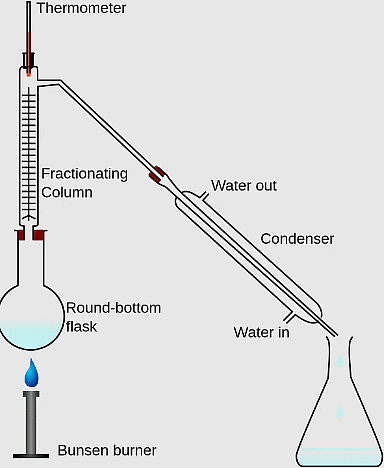
(c) Fractional distillation
(d) Any of these

Correct Answer is Option (a)
By simple distillation. Vapours of the liquid which has low boiling point will be formed first and collected. The liquid having higher boiling point will remain in the vessel.


Q.2. How can a saturated solution be made unsaturated?
(a) By heating the solution
(b) By cooling the solution
(c) By increasing the amount of solute
(d) By centrifugation of the solution

Correct Answer is Option (a)
A saturated solution can be made unsaturated by increasing the temperature of solution by heating it or by increasing the amount of solvent in the solution i.e. diluting it.


Q.3. The cause of Brownian movement is:
(a) Heat changes in liquid state
(b) Convection currents
(c) Impact of molecules of dispersion medium on on dispersed phase
(d) Attractive forces between the particles of dispersed phase and dispersion medium.

Correct Answer is Option (c)
Zig-zag path of colloidal particles is called Brownian Movement. Zig-zag path of particles is due to collision of particles of dispersed phase and dispersion medium.


Q.4. In which of the following, dispersed phase is a liquid and dispersion medium is a gas? 
(a) Cloud
(b) Smoke
(c) Gel
(d) Soap bubble

Correct Answer is Option (a)

  • In a cloud, tiny water droplets are suspended in air.
  • This makes it an example of a liquid dispersed phase in a gas dispersion medium.


Q.5. At room temperature, a non-metal which is a liquid is: 
(a) Sulphur
(a) Bromine
(a) Chlorine
(a) Nitrogen 

Correct Answer is Option (b)

Bromine is the only non-metal that exists in liquid form at room temperature. Here are some key points:

  • It is a reddish-brown liquid.
  • Bromine has a strong, unpleasant odour.
  • It is used in various applications, including flame retardants and pesticides.

Fill in the Blanks

1. Common salt is _________.

Ans: Compound
Common salt, chemically known as sodium chloride (NaCl), is a compound formed from the chemical combination of sodium and chlorine.

2. A mixture contains more than ______ substance mixed in ______ proportion.

Ans:  One, any
A mixture is defined as a combination of two or more substances that can be present in any proportion.


3. Properties of a __________ are different from its constituent elements, whereas a _______

 shows the properties of its constituting elements.

Ans: Compound, mixture
A compound has distinct properties that differ from those of its individual elements, while a mixture retains the properties of its components.


4. A solution is defined as a mixture that is_________

Ans: Homogeneous
A homogeneous mixture has a uniform composition throughout, meaning the components are evenly distributed.


5. We can remove salts from a solution by using the process of _________

Ans: Evaporation
Evaporation is a method used to separate a solute from a solvent by heating the solution until the solvent turns into vapor.


6. A pure substance has a fixed__________ or ______ at constant temperature.

Ans: Melting Point, Boiling Point
A pure substance has specific melting and boiling points that do not change under constant temperature conditions.


7. An element is made up of only one kind of _________.

Ans: Atoms
Elements consist of only one type of atom, which defines their unique properties.


8. Miscible liquids are separated by ________ .

Ans: Fractional distillation
Fractional distillation is a technique used to separate miscible liquids based on their different boiling points.

 
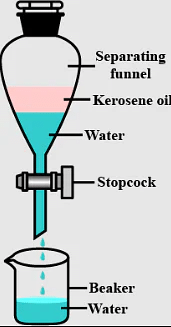
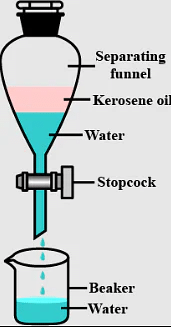
9. Immiscible liquids are separated by using a _______.

Ans: Separating funnel
A separating funnel is used to separate immiscible liquids based on their different densities.

10. Filtered tea is a _________ mixture.

Ans: Homogeneous
Filtered tea is homogeneous because it has a uniform composition throughout after the solid tea leaves are removed.


11. Alloy is a _______.

Ans: Solid solution
An alloy is a solid solution of two or more metals, which results in improved properties compared to the individual metals.


12. Sublimation of camphor is a _________ change.

Ans: Physical
Sublimation is a physical change where a substance transitions directly from solid to gas without passing through the liquid state.


13. Most common chemical change we observe in our routine life is rusting of______.

Ans: Iron
Rusting is a chemical reaction that occurs when iron reacts with oxygen and moisture, forming iron oxide.

Very Short Answer Question 

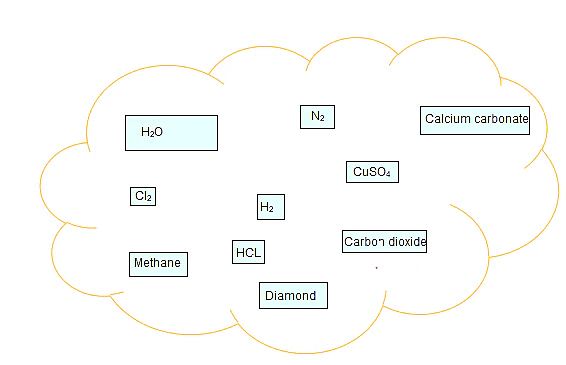
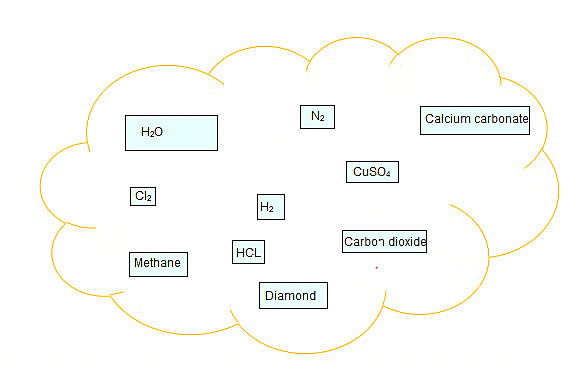
Q.1. Classify the substances given in below figure into elements and compounds

Ans: 

Q.2. Give one example each of homogeneous and heterogeneous mixture.

Ans:  Homogeneous mixture: An example is brass, which is a uniform mixture of metals. Heterogeneous mixture: An example is sand and water, where the components remain distinct and easily separable.


Q.3. Name the apparatus by which mixture of oil and water can be separated.

Ans: Separating funnel is the apparatus used to separate a mixture of oil and water.

Q.4. Is brass a mixture or a compound?
Ans: Brass is classified as a mixture rather than a compound. This is due to the following reasons:

  • Brass is made up of approximately 30% zinc and 70% copper.
  • In a mixture, the individual components retain their own properties.
  • Brass is a mixture because its composition can vary and its constituents retain their properties.


Q.5. What type of solution is an alloy? Liquid solution or solid solution

Ans: Alloy is a type of solid solution. Key points:

  • An alloy consists of two or more metals or a metal and a non-metal.
  • It cannot be separated into its components by physical methods.
  • Alloys exhibit the properties of their constituent materials.
  • For example, brass is made of approximately 30% zinc and 70% copper.


Q.6. A mixture consisting of two miscible liquids ‘A’ and ‘B’ whose boiling points differ by
 50 C can be separated by which process?

Ans: Fractional distillation is the process used to separate a mixture of two miscible liquids, ‘A’ and ‘B’, when their boiling points differ by 50°C.

 
Q.7. Give one example of solid- liquid homogeneous mixture.

Ans:  Salt in water solution


Q.8. What is a Aqua regia?

Ans: Aqua regia is a highly-corrosive mixture of – nitric acid and hydrochloric acid. The mixture is formed by freshly mixing concentrated nitric acid and hydrochloric acid, usually in a volume ratio of 1:3


Q.9. Which method is used to separate two immiscible liquids?

Ans: Separating two immiscible liquids can be effectively achieved using a separating funnel.

  • The separating funnel allows the two liquids to separate based on their density.
  • Each liquid forms a distinct layer, making it easy to pour out one layer while leaving the other behind.
  • This method is commonly used in laboratories for liquid-liquid extractions.


Q.10. Name two elements which are in liquid state at room temperature?

Ans: The only liquid elements at standard temperature and pressure arebromine (Br) and mercury (Hg). Although, elements caesium (Cs),rubidium (Rb), Francium (Fr) and Gallium (Ga) become liquid at or just above room temperature.

Short Answer Types QuestionsQ.1. Try segregating the things around you as pure substances or mixtures.

You can separate materials around you into pure substances or mixtures by performing simple experiments. Here’s how:

  • Mix chalk powder with water.
  • Observe that the chalk powder does not dissolve.
  • Let the mixture settle; the chalk will form a layer at the bottom.
  • Carefully pour off the water to separate the chalk.

This method demonstrates how mixtures can be separated into their individual components.


Q.2. What is meant by a substance? 

substance is a type of matter that consists of particles that cannot be separated by any physical process. Key characteristics include:

  • All particles have similar chemical properties.
  • Substances can be classified as either elements or compounds.
  • Elements cannot be broken down into simpler substances.
  • Compounds consist of two or more different elements chemically combined.

In summary, a substance is a pure form of matter with consistent properties throughout.


Q.3. What type of mixtures are separated by the technique of crystallisation? 

From impure samples of solids, pure solid crystals can be obtained by the method of crystallization for eg to obtain pure sugar from impure sample of the same.


Q.4. What is tyndall effect? Which kinds of solution show it?

The Tyndall effect is the scattering of light by particles in a solution. This effect occurs when light passes through a medium containing small particles, making the path of the light visible. Solutions that exhibit the Tyndall effect include:

  • Colloidal solutions: These contain particles that are larger than those in true solutions but smaller than those in suspensions.
  • Examples: Milk and fog show the Tyndall effect due to their dispersed particles.


Q.5. What is centrifugation? Where it is used?

Centrifugation is a technique used to separate components of a mixture based on their density. It works by spinning the mixture rapidly, causing denser particles to settle at the bottom while lighter ones rise to the top.

  • Commonly used to separate cream from milk.
  • Also applied in laboratories for separating blood components.
  • Used in various industries, including pharmaceuticals and biotechnology.


Q.6. What is crystallization? Where is it used? Why is this better than simple evaporation technique?

Crystallization is a process that separates a pure solid in the form of crystals from its solution. It is used to purify solids. For e.g. salt from sea water is purified using crystallization.
It is a better technique than simple evaporation because:
(a) Some solid may decompose or get charred on heating to dryness during evaporation.
(b) On evaporation, some of the impurities still remain dissolved in the solution.


Q.7. What is a colloid? What are its various properties?

Colloids are heterogeneous mixtures where the particles are too small to be seen with the naked eye. Their properties include:

  • Heterogeneous mixture: Although they are heterogeneous, they often appear homogeneous.
  • Particle size: The particles are too small to be individually visible.
  • Tyndall effect: They scatter light, making the path of a beam visible.
  • Stability: The particles do not settle when left undisturbed.


Q.8. Write a method to separate different gases from air.

Air is a homogeneous mixture of various gases. It can be separated into its components using fractional distillation. The process involves the following steps:

  • Compress and cool the air by increasing pressure and decreasing temperature.
  • This produces liquid air. Allow the liquid air to warm up slowly in a fractional distillation column.
  • The gases will separate according to their boiling points at different heights in the column.


Q.9. Explain the following giving examples. 
(a) saturated solution 
(b) pure substance 
(c) colloid 
(d) suspension 

(a) saturated solution: It is a solution in which no more solute particles can be dissolved at a particular temperature.
(b) pure substance: Such substance that has a uniform composition i.e. has particles with identical properties is called pure substance eg sugar, salt, water, nitrogen etc.
(c) colloid: It is a kind of heterogeneous mixture/solution in which particle size is between 1nm and 1000nm. Colloids have dispersion medium and dispersed phase.eg smoke, milk, shaving cream, jelly, cheese etc.
(d) suspension: It is a kind of heterogeneous mixture in which insoluble solid particles remain suspended in the medium and dispersion particles are visible to the unaided eyes.eg muddy river water, chalk powder in water, dust storm, sand in water etc.


Q.10. Write the steps you would use for making tea. Use the words solution, solvent, solute, dissolve, soluble, insoluble, filtrate and residue.

To make tea, follow these steps:

  • Start by heating a sufficient amount of solvent (water) in a pan.
  • Once heated, add a small amount of solute (sugar) to the water. The sugar will dissolve completely, forming a true solution.
  • Add tea leaves, which are insoluble, along with a soluble liquid (milk).
  • Boil the mixture to enhance flavour.
  • After boiling, use a sieve to filter the mixture. The liquid that passes through is the filtrate, which is your tea.
  • The leftover tea leaves in the sieve are the residue and should be discarded.

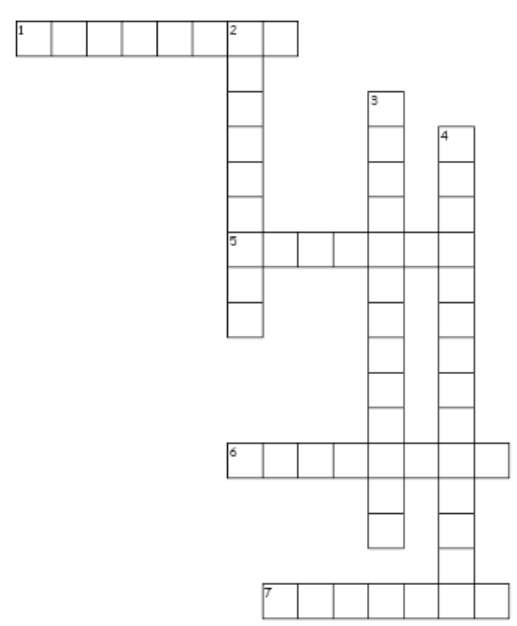
Crossword Puzzle

Across
1. hydrogen ______ is a color gas with a smell of rotten eggs
5. The major components in solution
6. Melting point and boiling point are _______ properties
7. Two elements are liquid at room temperature are mercury and _______
Down
2. In colloids ,The particles are called the ______ phase and the medium in which they are distributed is called the dispersion medium.
3. amount of solute present per unit volume or mass of the solution or solvent
4. denser particles are forced to the bottom and the lighter particles stay at the top when spun rapidly

Ans: 
1. sulphide
2. dispersed
3. concentration
4.centrifugation
5. solvent
6. physical
7. bromin

02. Worksheet: Is Matter Around Us Pure

Multiple Choice Questions

Q.1. Kerosene and Petrol are miscible liquids. The difference between their boiling points is more than 25°C. The two liquids can be separated from each other by _____. 

(a) Simple distillation

(b) Steam distillation

(c) Fractional distillation

(d) Any of these

Q.2. How can a saturated solution be made unsaturated?
(a) By heating the solution
(b) By cooling the solution
(c) By increasing the amount of solute
(d) By centrifugation of the solution

Q.3. The cause of Brownian movement is:
(a) Heat changes in liquid state
(b) Convection currents
(c) Impact of molecules of dispersion medium on on dispersed phase
(d) Attractive forces between the particles of dispersed phase and dispersion medium.

Q.4. In which of the following, dispersed phase is a liquid and dispersion medium is a gas? 
(a) Cloud
(b) Smoke
(c) Gel
(d) Soap bubble

Q.5. At room temperature, a non-metal which is a liquid is: 
(a) Sulphur
(a) Bromine
(a) Chlorine
(a) Nitrogen

Fill in the Blanks

1. Common salt is _________.

2. A mixture contains more than ______ substance mixed in ______ proportion.
3. Properties of a __________ are different from its constituent elements, whereas a _______ shows the properties of its constituting elements.
4. A solution is defined as a mixture that is_________
5. We can remove salts from a solution by using the process of _________
6. A pure substance has a fixed__________ or ______ at constant temperature.
7. An element is made up of only one kind of _________.
8. Miscible liquids are separated by ________ .
9. Immiscible liquids are separated by using a _______.
10. Filtered tea is a _________ mixture.
11. Alloy is a _______.
12. Sublimation of camphor is a _________ change.
13. Most common chemical change we observe in our routine life is rusting of______.

Very Short Answer Question 

Q.1. Classify the substances given in below figure into elements and compounds

Q.2. Give one example each of homogeneous and heterogeneous mixture.
Q.3. Name the apparatus by which mixture of oil and water can be separated.
Q.4. Is brass a mixture or a compound?
Q.5. What type of solution is an alloy? Liquid solution or solid solution
Q.6. A mixture consisting of two miscible liquids ‘A’ and ‘B’ whose boiling points differ by 50 C can be separated by which process?
Q.7. Give one example of solid- liquid homogeneous mixture.
Q.8. What is a Aqua regia?
Q.9. Which method is used to separate two immiscible liquids?
Q.10. Name two elements which are in liquid state at room temperature? 

Short Answer Types Questions

Q.1. Try segregating the things around you as pure substances or mixtures. 

Q.2. What is meant by a substance? 

Q.3. What type of mixtures are separated by the technique of crystallisation? 

Q.4. What is tyndall effect? Which kinds of solution show it?

Q.5. What is centrifugation? Where it is used?

Q.6. What is crystallization? Where is it used? Why is this better than simple evaporation technique?

Q.7. What is a colloid? What are its various properties?

Q.8. Write a method to separate different gases from air.

Q.9. Explain the following giving examples. 
(a) saturated solution 
(b) pure substance 
(c) colloid 
(d) suspension

Q.10. Write the steps you would use for making tea. Use the words solution, solvent, solute, dissolve, soluble, insoluble, filtrate and residue.

Also read: Worksheet Solutions: Is Matter Around Us Pure

Crossword Puzzle

Across
1. hydrogen ______ is a color gas with a smell of rotten eggs
5. The major components in solution
6. Melting point and boiling point are _______ properties
7. Two elements are liquid at room temperature are mercury and _______
Down
2. In colloids ,The particles are called the ______ phase and the medium in which they are distributed is called the dispersion medium.
3. amount of solute present per unit volume or mass of the solution or solvent
4. denser particles are forced to the bottom and the lighter particles stay at the top when spun rapidly