1.Natural Resources and Their Use – Long Question answer

Q1: What is a resource? What are the criteria for any substance to become a resource?
Ans: All those substances which have some utility or usability are resources for us.

The different criteria required for anything to be resource for us are:

  • Utility or usability
  • Economic value or any other value
  • Time and technology inherent, which can make the substance important for present or future requirements  of the people. For example, Discovery of fire led to the practice of cooking, Invention of wheel ultimately resulted in the development of newer modes of transport etc.
Q2: Describe the different types of Natural resources.

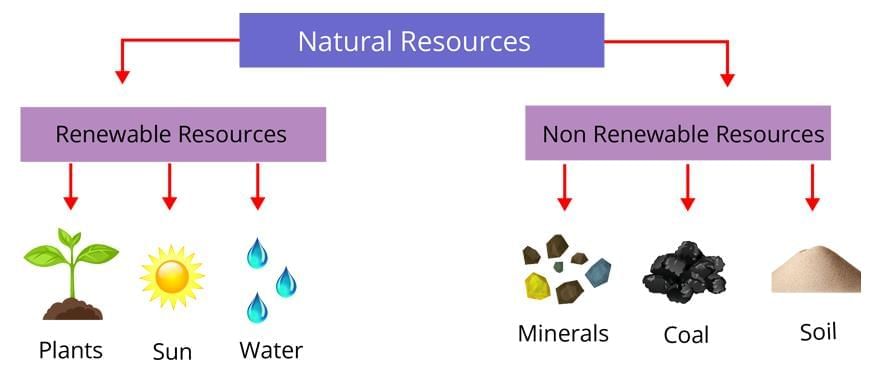
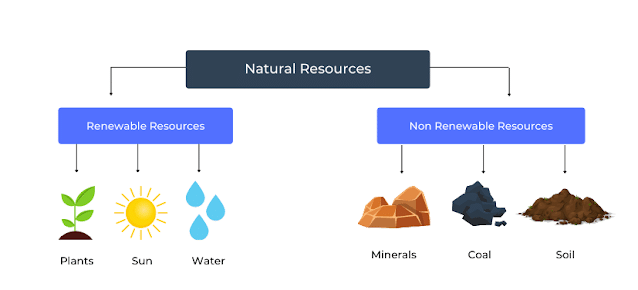
Ans: Natural resources are categorised in two types – 

  • Renewable Resources– Resources which do not depend on human consumption are called renewable resources. These resources get renewed with the use of humans. But there are some kinds of renewable resources that are affected by human consumption such as water, soil and forest.
  • Non-renewable Resources- Resources whose stock are limited are called as non-renewable resources. These resources decrease with human consumption. These resources take thousands of years to renew. Examples of such kinds of resources are coal and Petroleum.
Q3: As human beings, how can we ensure sustainable development?

Ans: We can ensure sustainable development by ensuring that:

  • The usage of renewable resources is sustainable,
  • The diversity of life on earth is maintained,
  • The damage caused to nature by our activities is as low as possible.

Q4: Explain the concept of natural resources, including the conditions required for an element of nature to become a resource. Provide examples from the chapter and discuss how human actions can affect their availability.

Answer

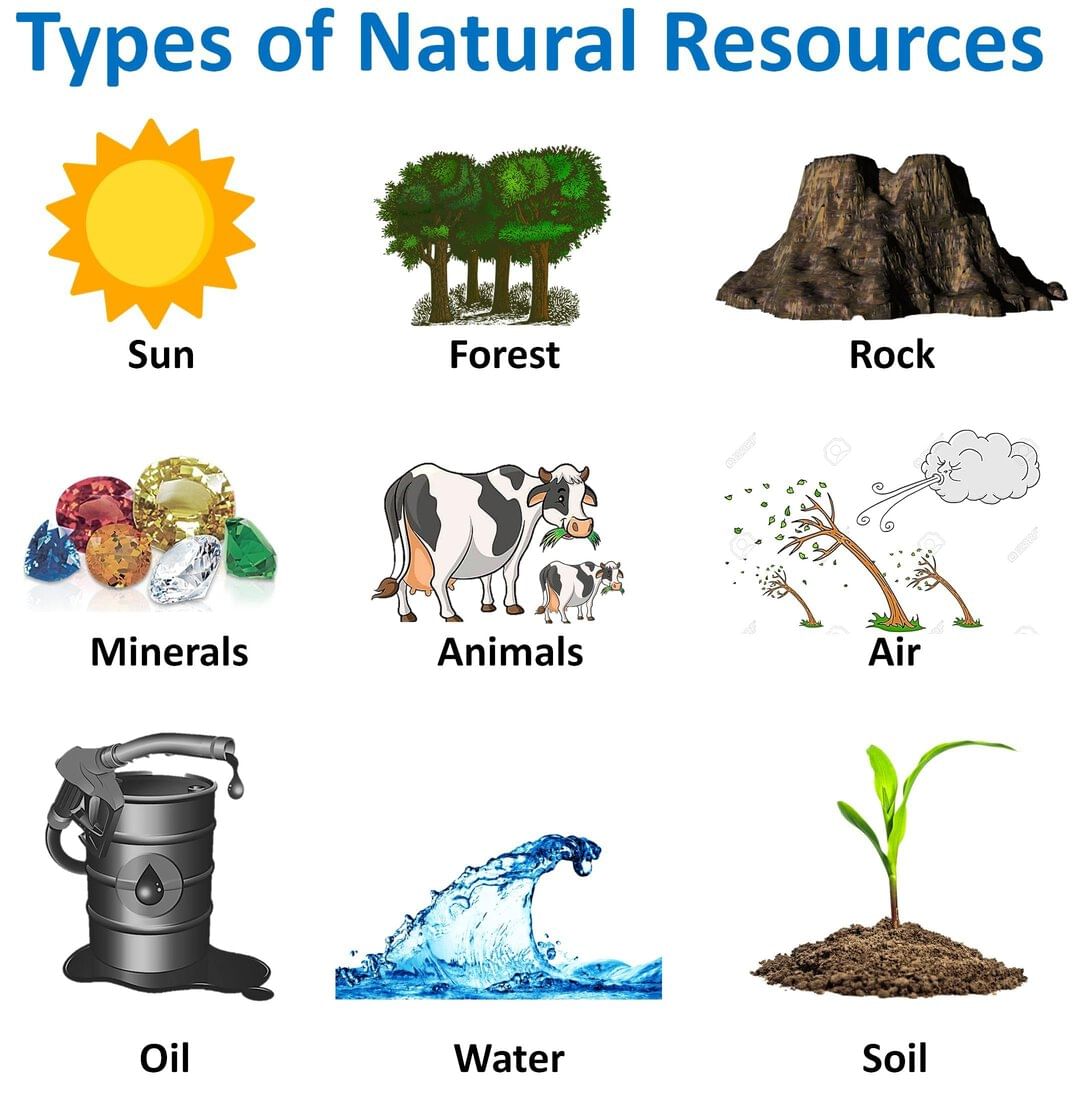
  • Natural resources are materials and substances from nature that are valuable to humans, such as water, air, soil, coal, and timber. 
  • For an element to become a resource, it must be technologically accessible (e.g., extracting petroleum from under the ocean), economically feasible (cost-effective to extract), and culturally acceptable (not violating sacred sites like groves). 
  • Examples include trees becoming timber for furniture or flowing water generating hydroelectricity. 
  • Human actions like overexploitation (e.g., deforestation faster than regeneration) or pollution from industries can disrupt natural cycles, leading to depletion, as seen in melting glaciers due to industrialization and deforestation affecting water security.

Q5: Explain the terms resource conservation and sustainable development.

Ans: Resource conservation is the concept of using resources carefully so that they do not end up quickly. The future generations also need the resources, but if we keep using them at a fast pace, they may end up, thus posing problems for the future. We should use resources in such a balanced way that we satisfy our needs as well as conserve them for future. This concept is called sustainable development.

Q6: What is sustainable development? Mention some of its principles.

Ans: Sustainable development is a utilising resource in such a way that we not only think of meeting our own requirements of the present but also we are aware of their conservation for our future generations.

Some principles of sustainable development:

  • Respect and care for all forms of life.
  • Improve the quality of human life.
  • Conserve the earth’s vitality and diversity.
  • Minimise the depletion of natural resources.
  • Change personal attitude and practices towards the environment.
  • Enable communities to care for their own environment.

Q7: Mention our duty to maintain and preserve the life support system that nature provides us.

Ans: The future of our planet and its people is linked with our ability to maintain and preserve the life support system that nature provides. Therefore, it is our duty to ensure that.

  • all uses of renewable resources are sustainable
  • the diversity of life on the earth is conserved
  • the damage to natural environmental system is minimised.

Q8: What is the significance of time and technology in making a substance a resource?

Ans: Time and technology are two important factors that can change substances into resources. Each discovery or invention leads to many others. The discovery of fire led to the practice of cooking and other processes while the invention of the wheel ultimately resulted in development of newer modes of transport. The technology to create hydroelectricity has turned energy in fast flowing water into an important resource.

Q9. Discuss the uneven distribution of natural resources and its implications on human settlements, trade, conflicts, and the ‘natural resource curse’. Use examples from India and suggest ways to overcome these challenges.

Ans

  • Natural resources are unevenly distributed, shaping settlements (e.g., industries near coal in Jharia create jobs and towns), trade (e.g., Wootz steel from Indian resources fueled empires), and conflicts (e.g., Kaveri River water sharing among Karnataka, Tamil Nadu, Kerala, Puducherry). 
  • Internationally, wars occur over resources like the Brahmaputra. The ‘natural resource curse’ occurs when resource-rich areas experience slow growth due to reliance on raw exports without value-added industries. 
  • In India, this is avoided by developing processing industries. To overcome, invest in technology, skills, and governance for sustainable extraction, fair sharing agreements, and diversification beyond raw resources.

Q10. Elaborate on the responsible stewardship of natural resources, including strategies for restoration of renewables and judicious use of non-renewables. Include case studies from the chapter like Punjab, Sikkim, and the International Solar Alliance.

Answer

  • Stewardship involves using resources wisely for regeneration of renewables (e.g., replenishing groundwater through rainwater harvesting, traditional practices like mulching for soil health) and stretching non-renewables (e.g., transitioning to solar from coal). 
  • In Punjab, overexploitation during the Green Revolution led to depleted aquifers and chemical pollution; solutions include crop diversification and recharge initiatives. 
  • Sikkim’s 2016 shift to 100% organic farming restored biodiversity, boosted incomes, and used natural pest repellents. The International Solar Alliance (launched 2015 by India and France) promotes solar in sunny countries, exemplified by Bhadla Solar Park in Rajasthan, reflecting India’s sustainable energy leadership.

Q11. Analyze the role of traditional knowledge and cultural practices in sustainable resource use, with references to Vṛkṣāyurveda, ecosystem services, and concepts from Indian texts like the Bhagavad Gita.

Answer

  • Traditional knowledge views nature as sacred (e.g., Tulasi puja for wellbeing, arghyam to the sun), promoting mindful use. Vṛkṣāyurveda, an ancient science, recommends soil-specific planting, natural pest management, crop rotation, and moisture-retaining ploughing for sustainable agriculture. 
  • Ecosystem services, like trees producing 275 liters of oxygen daily or forests filtering water, benefit humans. The Bhagavad Gita’s lokasangraha urges acting for collective wellbeing, transcending greed. 
  • These practices counter modern issues like cement pollution (addressed by eco-materials) and overfishing (traditional spawning bans), ensuring restoration, regeneration, and equitable access to resources like clean air and water.

1️⃣ Natural Resources and Their Use – Short Answer Questions

Q1: What is a Resource? Give two examples.
Ans: Everything available in our environment that can be used to satisfy our needs, provided it is technologically accessible, economically feasible, and culturally acceptable, can be termed a resource. Examples include coal, water, air, minerals, etc.

Q2: What are renewable resources? Give two examples.
Ans: Renewable resources are those that can be renewed or replenished naturally through physical, chemical, or mechanical processes. Examples include solar energy, wind energy, water, forests, and wildlife. Renewable resources may be further classified as continuous or flow resources.

Q3: Explain the relationship between nature, technology and institutions.
Ans: 
Nature provides resources that are transformed into usable forms with the help of technology. Humans interact with nature using technology and create institutions to organise this interaction and accelerate economic development.

Q4: What are ecosystem services? Give two examples mentioned in the chapter.
Ans:
 Ecosystem services are natural processes that benefit humans by supporting life and economic activities. For example, forests filter water, ensuring clean drinking water, and trees produce around 275 litres of oxygen daily, essential for human survival. Other services include pollination and soil retention, which sustain agriculture and ecosystems. Forests also prevent soil erosion, thereby protecting farmland.

Q5: Name one cultural practice in India that promotes mindful use of natural resources and explain its significance.
Ans:
 Tulasi puja, a practice honouring the sacred tulsi plant, promotes mindful use of natural resources by fostering reverence for nature. This ritual encourages communities to value plants and avoid wasteful exploitation. It reflects traditional wisdom that views nature as a nurturer and supports sustainable practices, helping maintain ecological balance and conserve resources.

Q6: What is the ‘natural resource curse,’ and how has India attempted to avoid it?
Ans:
 The natural resource curse is when resource-rich regions experience slow economic growth due to excessive dependence on raw material exports. India has countered this by investing in industries that process resources, such as steel production from iron ore, adding value and creating jobs. This approach reduces reliance on raw exports and promotes development. Strategic planning and good governance further support this effort.

Q7: ‘India has enormous diversity in the availability of resources.’ Explain.
Or
“India is rich in certain types of resources but deficient in some other resources.” Support your answer with examples.
Ans: 
(i) The states of Jharkhand, Chhattisgarh, and Madhya Pradesh are rich in mineral resources but lack industrialisation.
(ii) Arunachal Pradesh has abundant water resources but lacks infrastructural development. Rajasthan is well endowed with solar and wind energy, but suffers from water scarcity. The cold desert area of Ladakh is relatively isolated due to poor means of transportation and communication.
(iii) Most North-Eastern states have rich natural vegetation but lack fertile soil.

Q8: ‘The availability of resources is the only condition for the development of any region’. What is your opinion on the statement?
Or
Mention any three necessary conditions for the development of resources.
Ans: 
(i) Resources contribute to development only when supported by appropriate technological advancement and institutional changes.
(ii) Skilled human resources are needed to convert natural resources into more usable forms.
(iii) Capital investment is required to develop technology and infrastructure for resource utilisation.

Q9: How does the overexploitation of groundwater in Punjab affect sustainability?
Ans:
 Overexploitation of groundwater in Punjab, mainly due to irrigation for high-yielding crops since the 1960s, has led to a decline of groundwater levels to depths of around 30 metres, threatening water security. This unsustainable practice is worsened by free electricity for farmers, causing increased water usage. It has led to health issues from chemical runoff and endangers long-term agricultural sustainability. Restoration methods like rainwater harvesting are now critical for sustainability.

Q10: What is one recommendation fromVr̥kṣāyurvedafor sustainable agriculture?
Ans:
 Vṛkṣāyurveda recommends crop rotation to maintain soil health by preventing nutrient depletion and supporting soil organisms like earthworms. This practice ensures long-term soil fertility and reduces dependence on chemical fertilisers. It promotes sustainable agriculture by mimicking natural cycles, aligning well with modern organic farming methods.

7️⃣ Factors of Production – HOTS

Q1. Which of the following best explains why land is considered a factor of production?
(a) It only refers to soil used in farming
(b) It includes all natural resources that support production
(c) It is important only for agricultural activities
(d) It represents only geographical space

Ans: (b) It includes all natural resources that support production
The land is not just soil but all natural resources like forests, water, and minerals used in production, making it a key factor across industries.

Q2. A farmer buys a tractor to increase output. In terms of factors of production, this tractor is an example of:
(a) Land
(b) Capital
(c) Labour
(d) Entrepreneurship

Ans: (b) Capital
The capital is a durable asset, like machinery and tools, such as a tractor, that is used to enhance production.

Q3. Which of the following situations highlights the role of human capital?
(a) A fertile piece of land lying unused
(b) A machine kept in a warehouse without operators
(c) A skilled worker using knowledge to improve productivity
(d) A bank providing money for investment

Ans: (c) A skilled worker using knowledge to improve productivity
Human capital is skills and knowledge that enhance labour’s effectiveness, exemplified by a skilled worker improving productivity.

Q4. An entrepreneur sets up a new solar energy company. Which factor of production is he most directly contributing to?
(a) Land
(b) Capital
(c) Organisation and risk-taking
(d) Labour

Ans: (c) Organisation and risk-taking
Entrepreneurship is organising resources and taking risks to start a business, as seen in setting up a solar energy company.

Q5. Which of these reflects a business ignoring its responsibility towards factors of production?
(a) Ensuring fair wages for workers
(b) Polluting rivers to cut costs
(c) Training employees for new technology
(d) Using renewable energy in factories

Ans: (b) Polluting rivers to cut costs
The businesses’ responsibility to protect natural resources, noting that polluting rivers, like leather factories in Tamil Nadu, harms the environment.

Q6. Why do economists say that factors of production are interdependent? Use an example to justify your answer.
Ans: Factors of production work together, each relying on the others to create goods effectively. A mobile phone factory in India (2025’s second-largest globally) requires minerals from land for components, skilled labour for assembly, capital for advanced machinery, and entrepreneurship to innovate and manage operations. If any factor, like labour or capital, is missing, production halts, showing their interdependence, as disruptions during COVID-19 highlighted when supply chain issues stopped manufacturing.

Q7. Compare the role of physical labour and human capital in today’s knowledge-based economy. Which do you think is more important, and why?
Ans: Human capital drives innovation, surpassing physical labour in a knowledge-based economy.  

  • Physical Labour: Essential for labour-intensive tasks like construction or farming, but less impactful in tech-driven industries requiring specialised skills, as seen in India’s young workforce.  
  • Human Capital: Involves skills and knowledge, like engineers designing mobile phones or using SWAYAM courses, fueling innovation and efficiency in modern economies like India’s tech sector.  
  • More Important: Human capital is more critical, as skills drive technological advancements, economic growth, and global competitiveness, leveraging India’s 65% youth population for a demographic dividend.

Q8. If technology replaces certain kinds of labour, does that mean workers are no longer important in production? Discuss with reasons.
Ans: Technology reduces some labour needs, but workers remain vital for production.  

  • Replacement: Technologies like drones for farming or robots in surgery reduce manual labour, increasing efficiency in repetitive tasks.  
  • Worker Importance: Workers provide human capital, like engineers managing robots or scientists innovating, essential for creativity, supervision, and adapting technologies to new challenges.  
  • Reason: Human effort is crucial at every stage, from designing to improving products, ensuring workers remain indispensable despite automation, as seen in India’s mobile phone industry.

Q9. Analyse how entrepreneurship acts as the driving force among all factors of production. Give a real-life example to support your answer.
Ans: Entrepreneurship orchestrates resources to innovate and solve problems effectively.  

  • Role: Entrepreneurs combine land, labour, and capital, take risks, and make strategic decisions, as seen in J.R.D. Tata founded Tata Airlines (now Air India) in 1932, securing resources and creating jobs.  
  • Driving Force: They identify market needs, innovate products, and ensure efficient resource use, benefiting society through economic growth and job creation, as Tata did for India’s industries.  
  • Example: Tata’s vision expanded steel, cars, and power, improving worker conditions and serving society, embodying entrepreneurship’s role in coordinating production factors.

Q10. Suppose a business only focuses on profit and ignores fair treatment of workers. What long-term consequences might arise?
Ans: Prioritising profits over worker welfare leads to significant long-term challenges.  

  • Low Productivity: Unfair wages and poor conditions demotivate workers, reducing output and quality, and fair pay’s role in productivity.  
  • High Turnover: Workers may leave, increasing hiring and training costs, disrupting production continuity, and affecting business efficiency over time.  
  • Reputation Damage: Ignoring CSR harms the brand, reducing customer trust and market share, as society values businesses that respect workers and communities.

Q11. Evaluate how India’s tradition of valuing “work as worship” can shape modern attitudes towards labour and productivity.
Ans: India’s “work as worship” tradition fosters a culture of dedication and excellence.  

  • Positive Attitudes: Viewing work as sacred, as in the Shilpa Shastras, encourages commitment and quality, boosting productivity in modern industries like mobile phone manufacturing.  
  • Skill Development: It promotes continuous learning, like ancient artisans mastering techniques, aligning with modern needs for training via platforms like SWAYAM for India’s youth.  
  • Social Impact: It fosters respect for all labour, enhancing workplace harmony and supporting India’s 65% young workforce to drive economic growth with a strong work ethic.

Q12. How does the use of natural resources in production create both opportunities and responsibilities for businesses?
Ans: Natural resources fuel production but require responsible management to avoid harm.  

  • Opportunities: Resources like minerals enable industries, such as India’s mobile phone sector, to drive economic growth and job creation through efficient resource use.  
  • Responsibilities: Overuse, like river pollution by Tamil Nadu’s leather factories, harms ecosystems, requiring businesses to adopt sustainable practices like wastewater recycling to protect nature and communities.  
  • Balance: CSR ensures resources meet current needs without compromising future generations, promoting sustainable growth while maintaining societal and environmental well-being.

Q13. Imagine you are asked to design a factory where all four factors of production are used efficiently. What would be your plan?
Ans: An efficient factory optimises all production factors for sustainability and productivity.  

  • Land: Use sustainable resources like solar energy to power operations, minimising environmental impact, as seen in modern eco-friendly production models.  
  • Labour: Train workers via programs like SWAYAM to master advanced skills, ensuring high productivity and adaptability to new technologies in the factory.  
  • Capital: Invest in cutting-edge machinery, like robots for precision manufacturing, to boost efficiency and reduce waste.  
  • Entrepreneurship: Innovate products and streamline processes, inspired by J.R.D. Tata’s vision, to stay competitive and meet market demands effectively.

Q14. Many people argue that innovation and knowledge will be more valuable than land or machinery in the future. Do you agree? Why or why not?
Ans: Innovation and knowledge are increasingly critical, but complement land and machinery.  

  • Agree: Human capital, through platforms like SWAYAM, drives technological advancements, like India’s mobile phone industry, outpacing static resources in a knowledge-based economy.  
  • Reason: Knowledge fuels innovation, enabling efficient resource use and global competitiveness, while land and machinery rely on skilled application to remain relevant.  
  • Counterpoint: Land and machinery are vital for physical production, like mineral extraction or factory operations, but their value depends on innovative use by skilled workers.

Q15. If you had to choose one factor of production to invest in for India’s future growth, which would you pick and why?
Ans: Human capital is the most critical investment for India’s future economic growth.  

  • Choice: Human capital leverages India’s young population (65% under 35), driving innovation and productivity through education and training, as seen in the mobile phone industry.  
  • Why: Skilled workers, via platforms like NCS and SWAYAM, ensure competitiveness, create jobs, and support a demographic dividend, boosting industries and living standards.  
  • Impact: Investing in skills addresses literacy gaps (85% male, 70% female) and prepares India for a tech-driven future, maximising economic potential across sectors.

6️⃣ The Parliamentary System: Legislature and Executive – HOTS

Q1. The Rajya Sabha was created to represent the states in Parliament. Which of the following best explains why this is important in India’s federal system?
(a) It allows the President to control state governments
(b) It ensures that states’ interests are considered in national lawmaking
(c) It reduces the power of the Lok Sabha
(d) It avoids conflicts between the Prime Minister and Chief Ministers

Ans: (b) It ensures that states’ interests are considered in national lawmaking
The Rajya Sabha represents states in India’s federal system, ensuring state interests are balanced with national priorities in lawmaking, supporting federalism.

Q2. Suppose the Parliament wants to pass a law on public health. Which list in the Constitution gives it the power?
(a) Union List
(b) State List
(c) Concurrent List
(d) Presidential List

Ans: (c) Concurrent List
Public health is on the Concurrent List, allowing both Parliament and state legislatures to make laws, with Union law prevailing in case of conflict.

Q3. Why are Money Bills allowed to be introduced only in the Lok Sabha?
(a) Because the Lok Sabha represents the people directly
(b) Because the Rajya Sabha has fewer members
(c) Because the Prime Minister sits only in the Lok Sabha
(d) Because the President does not approve Rajya Sabha bills

Ans: (a) Because the Lok Sabha represents the people directly
Money Bills, dealing with taxation and spending, are introduced only in the Lok Sabha, reflecting its direct representation of the people.

Q4. The Right to Education Act (2009) went through several stages before becoming law. What does this process show about Parliament?
(a) Laws are passed quickly in India
(b) Laws must balance discussion, consensus, and accountability
(c) The Rajya Sabha is more powerful than the Lok Sabha
(d) The President alone can create laws

Ans: (b) Laws must balance discussion, consensus, and accountability
The RTE Act’s legislative process, involving discussions, committee reviews, and votes, shows Parliament’s commitment to thorough, accountable lawmaking.

Q5. A state government wants to make its law on forests, but Parliament has already passed a law on the same subject. What will happen?
(a) The state law will always prevail
(b) The central law will always prevail
(c) Both laws will be applied equally
(d) The President will decide which law applies

Ans: (b) The central law will always prevail
For Concurrent List subjects like forests, if a conflict arises, the Union law prevails over the state law.

Q6. Why do you think the makers of the Constitution chose a bicameral system for India instead of a single house?
Ans: A bicameral system was chosen to balance India’s diverse national and state interests effectively.  

  • Federal Representation: The Rajya Sabha ensures states’ voices in national lawmaking, supporting federalism by representing state-specific concerns in Parliament.  
  • Balanced Lawmaking: Two houses allow thorough review of bills, preventing hasty decisions, as seen in the RTE Act’s process, drawing from global models like Britain.  
  • Diversity Management: India’s vast linguistic, cultural, and regional diversity required dual representation to address varied needs, unlike a single house that might overlook state concerns.

Q7. Parliament is often called the “heart of democracy.” Analyse this statement with reference to its legislative, executive, and financial functions.
Ans: Parliament’s multifaceted roles make it central to India’s democratic system.  

  • Legislative Function: It creates laws like the RTE Act through rigorous debate and consensus, ensuring rules reflect public needs across India’s diverse population.  
  • Executive Accountability: Through Question Hour and committees, it holds the Council of Ministers accountable, ensuring transparent governance and responsiveness to public issues.  
  • Financial Oversight: By approving budgets and scrutinizing spending, it ensures responsible use of public funds, reinforcing democratic fairness and equitable resource allocation.

Q8. If translation services were not provided in the Indian Parliament, how might it affect the working of democracy in a diverse country like India?
Ans: Lack of translation services would hinder inclusive participation in India’s diverse democracy.  

  • Language Barriers: MPs from non-Hindi/English regions (e.g., Tamil, Assamese) would struggle to participate, reducing representation of diverse linguistic groups in national lawmaking.  
  • Weakened Debates: Limited communication would stifle effective lawmaking discussions, undermining the quality of laws like the RTE Act, which required a broad consensus.  
  • Exclusion Risk: Marginalized linguistic communities would feel excluded, weakening democratic inclusivity and federalism, critical for India’s diverse governance structure.

Q9. Compare and evaluate the roles of the Speaker of the Lok Sabha and the Chairperson of the Rajya Sabha in ensuring fairness during debates.
Ans: Both leaders maintain order, but their roles differ in scope and context.  

  • Speaker (Lok Sabha): Manages a larger, directly elected house, ensuring fair debates, discipline, and rule adherence, with authority to suspend disruptive MPs for orderly proceedings.  
  • Chairperson (Rajya Sabha): The Vice President oversees a smaller, state-representing house, maintaining fairness in debates on state issues, with less intense public pressure.  
  • Evaluation: The Speaker faces greater challenges due to the Lok Sabha’s size and direct accountability, but both ensure democratic fairness through impartial moderation.

Q10. Explain how the Question Hour helps strengthen executive accountability. Do you think disruptions in Question Hour weaken democracy? Why?
Ans: Question Hour ensures the executive answers the people’s representatives effectively.  

  • Accountability Mechanism: MPs question ministers on policies, ensuring transparency and responsiveness, as exemplified by Lal Bahadur Shastri’s accountability for railway issues in 1956.  
  • Disruptions’ Impact: Interruptions prevent scrutiny, delaying accountability and eroding public trust in governance, weakening democratic processes and effective policy oversight.  
  • Reason: Disruptions limit Parliament’s ability to address public concerns, reducing its role as the “heart of democracy” in holding the executive accountable.

Q11. The President usually acts on the advice of the Council of Ministers. Imagine a situation where the President refuses to follow this advice. What problems could arise?
Ans: Presidential refusal to follow ministerial advice could disrupt India’s democratic balance.  

  • Constitutional Crisis: Defying the Council could stall lawmaking (e.g., bill assent) or governance, creating political instability and confusion across government functions.  
  • Power Imbalance: It might undermine the elected government’s authority, weakening the Lok Sabha’s accountability to the people, central to parliamentary democracy principles.  
  • Public Trust: Such actions could erode confidence in institutions, escalating tensions, especially in hung Parliament scenarios where the President’s discretion is critical.

Q12. Using the Right to Education Act as an example, explain why the legislative process requires multiple discussions and reviews before passing a law.
Ans: Multiple reviews ensure laws are well-considered and effective, as seen with the RTE Act.  

  • Thorough Scrutiny: The RTE Act’s decade-long process involved debates and committee reviews to address funding and implementation, ensuring feasibility for millions of children.  
  • Consensus Building: Discussions reconciled diverse views, like state vs. Union roles, ensuring broad support for Article 21A’s mandate for free education.  
  • Accountability: Multiple stages, including Presidential assent, ensured the law was robust, benefiting millions with schools, books, and uniforms nationwide.

Q13. “Checks and balances stop any one part of government from becoming too powerful.” Apply this idea to the relationship between Parliament, the Executive, and the Judiciary.
Ans: Checks and balances maintain democratic equilibrium across India’s government branches.  

  • Parliament: Makes laws (e.g., RTE Act) but is checked by the Judiciary, which ensures constitutionality, maintaining legal integrity and fairness in lawmaking.  
  • Executive: Implements laws but is accountable to Parliament via Question Hour, ensuring transparency, while the President’s assent is required for bills.  
  • Judiciary: Reviews laws and executive actions, protecting Fundamental Rights, ensuring no branch oversteps, and maintaining fairness in India’s diverse democracy.

Q14. Some sessions of Parliament are criticised for heated arguments, walkouts, or a lack of serious debate. How does this affect the effectiveness of the legislature? Suggest ways to improve it.
Ans: Disruptions reduce Parliament’s effectiveness, hindering its democratic role.  

  • Impact: Walkouts and arguments delay lawmaking, disrupt Question Hour, and erode public trust, stalling critical policies like budgets and national development plans.  
  • Solutions: Enforce stricter rules for conduct, promote constructive dialogue via MP training, and use technology for virtual sessions to maintain productivity despite disruptions.  
  • Benefit: These measures would enhance lawmaking efficiency, ensure robust debates, and boost public confidence in Parliament’s role as a democratic institution.

Q15. Media and citizens play an important role in making Parliament effective. Imagine you are a young citizen. What three creative ways would you suggest to make people more engaged with Parliament’s work?
Ans: Engaging citizens creatively can strengthen Parliament’s democratic impact.  

  • Interactive Apps: Develop apps streaming live Parliament sessions with simplified explanations, encouraging youth participation and awareness of legislative processes.  
  • School Campaigns: Introduce Parliament-focused debates in schools, fostering understanding of lawmaking, like the RTE Act, among future voters to build civic responsibility.  
  • Social Media Challenges: Launch campaigns like “Know Your MP” to share MPs’ work, boosting public interest and accountability through accessible, engaging platforms.

5️⃣ Universal Franchise and India’s Electoral System – HOTS

Q1. Which of the following best explains why a universal adult franchise is important in a democracy?
(a) It allows only educated citizens to vote
(b) It ensures every citizen has an equal voice in governance
(c) It reduces the number of political parties
(d) It prevents elections from being expensive

Ans: (b) It ensures every citizen has an equal voice in governance
The universal adult franchise, as stipulated in Article 326, grants every citizen aged 18 and above one vote of equal value, regardless of caste, creed, or educational background, thereby promoting equality and strengthening democracy.

Q2. A 22-year-old citizen wants to contest the Lok Sabha elections. What will happen?
(a) He can contest, as he is above 18
(b) He cannot contest, as the minimum age is 25
(c) He can contest only from his home constituency
(d) He must be a graduate to contest

Ans: (b) He cannot contest, as the minimum age is 25
The constitutional rules require candidates for the Lok Sabha to be at least 25 years old, preventing a 22-year-old from contesting.

Q3. The “First-Past-the-Post” system in India often results in:
(a) Candidates winning without a majority of votes
(b) Every candidate needs 51% of the votes
(c) Parties are always forming coalition governments
(d) Voting is being conducted in multiple rounds

Ans: (a) Candidates winning without a majority of votes
The First-Past-the-Post system, the candidate with the most votes in a constituency wins, even if they don’t secure 50% of the votes, unlike systems requiring a majority.

Q4. The Election Commission enforces the Model Code of Conduct during elections to:
(a) Restrict the number of candidates contesting
(b) Ensure fair play and prevent misuse of power
(c) Select political parties for government formation
(d) Decide election results in case of disputes

Ans: (b) Ensure fair play and prevent misuse of power
The Model Code of Conduct (MCC) sets rules to prevent misuse of government resources and ensure fair elections, as seen in guidelines against announcing new schemes during elections.

Q5. Which of the following elections in India uses an indirect method of voting?
(a) Lok Sabha elections
(b) Rajya Sabha elections
(c) State Legislative Assembly elections
(d) Gram Panchayat elections

Ans: (b) Rajya Sabha elections
The Rajya Sabha members are elected indirectly by elected MLAs using the single transferable vote system, unlike the direct voting in Lok Sabha, state assemblies, and local elections.

Q6. Imagine you are a citizen of India in 1951, when the first general elections were held. What challenges do you think the Election Commission faced in conducting elections at that time?
Ans: The ECI faced significant logistical and social hurdles in 1951 due to India’s vast and diverse population.  

  • Vast Population and Illiteracy: Managing millions of voters, many illiterate, required creating voter lists and educating them on voting processes.  
  • Geographic Barriers: Reaching remote areas with limited infrastructure, like roads, was difficult in India’s diverse geography.  
  • Logistical Issues: Setting up polling stations across 543 constituencies with minimal technology posed a massive challenge for the newly formed ECI in 1951–52.

Q7. Analyse how the universal adult franchise strengthened India’s democracy, especially compared to societies where voting rights were restricted.
Ans: Universal adult franchise has been a cornerstone of India’s inclusive democracy.  

  • Equal Voice: Article 326 grants every citizen aged 18 and above an equal vote, promoting equality across caste, gender, and religion, unlike societies (e.g., pre-1971 Switzerland) where women or minorities were excluded.  
  • Inclusivity: It empowered marginalized groups, like the Scheduled Castes and Tribes, with reserved seats, ensuring their representation, unlike restrictive systems that favored elites.  
  • Strengthened Democracy: By allowing 980 million voters in 2024 to choose leaders, it fosters accountability, contrasting with restricted systems where power concentrates among a few.

Q8. Do you think the “First-Past-the-Post” system is always the best way to represent people’s choice? Suggest an alternative and justify your view.
Ans: The First-Past-the-Post system has limitations in reflecting diverse voter preferences.  

  • Critique: Candidates can win with less than 50% votes, potentially sidelining diverse preferences in India’s varied electorate.  
  • Alternative: Proportional representation allocates seats based on vote share, ensuring fairer representation of smaller parties and diverse groups.  
  • Justification: This aligns with India’s diversity, ensuring broader representation, emphasizing inclusivity through reserved seats.

Q9. Evaluate the role of the Election Commission in ensuring free and fair elections. Why is its independence crucial for democracy?
Ans: The ECI plays a pivotal role in maintaining democratic integrity through robust oversight.  

  • Role: The ECI enforces the Model Code of Conduct, implements accessibility measures like braille voter cards, and ensures fairness for 980 million voters.  
  • Independence: As an autonomous body since 1950, the ECI prevents government interference, as seen in T.N. Seshan’s reforms, like voter IDs, ensuring impartiality.  
  • Importance: Independence upholds public trust and ensures elections reflect the people’s will without bias.

Q10. Imagine India decided to restrict voting rights only to taxpayers. What impact would this have on democracy and equality?
Ans: Restricting voting to taxpayers would undermine India’s democratic principles and equality.  

  • Impact on Democracy: Excluding non-taxpayers, especially low-income groups, would weaken the universal franchise, limiting representation for 980 million voters.  
  • Impact on Equality: It would favor wealthier citizens, contradicting Article 326’s equal voting rights, creating inequality akin to pre-independence elite systems.  
  • Consequences: Voter apathy could rise, and marginalized groups, like the Scheduled Castes, would lose influence, threatening democratic fairness.

Q11. Compare elections for the Lok Sabha and Rajya Sabha. How do these differences reflect the balance between people’s representation and state representation?
Ans: Lok Sabha and Rajya Sabha elections differ in their methods and purposes, balancing direct and state representation.  

  • Lok Sabha Elections: Direct elections by citizens in 543 constituencies using First-Past-the-Post reflect people’s direct choice of MPs.  
  • Rajya Sabha Elections: Indirect elections by elected MLAs using the single transferable vote ensure state representation based on population.  
  • Balance: Lok Sabha represents the people’s will, while Rajya Sabha, as the Permanent House, balances state interests, ensuring smaller states have a voice.

Q12. The Model Code of Conduct prevents parties from offering gifts or bribes to voters. Do you think stricter punishments are required to make it effective? Give reasons.
Ans: Stricter punishments are needed to enhance the MCC’s effectiveness in curbing electoral malpractices.  

  • Need for Stricter Punishments: The MCC bans bribes, but violations persist due to money power, requiring penalties like candidate disqualification.  
  • Reasons: Strong punishments ensure fairness, protect voter choice, and maintain trust in the ECI, as seen in T.N. Seshan’s crackdowns.

Q13. In a country as diverse as India, what challenges does the Election Commission face in making elections accessible to all? Suggest practical solutions.
Ans: India’s diversity poses significant accessibility challenges for the ECI, requiring innovative solutions.  

  • Challenges: Geographic diversity, a 980 million voter base, and disabilities hinder access, alongside illiteracy and voter apathy.  
  • Solutions: Expand home voting for the elderly and disabled, increase mobile polling stations in remote areas, and use multilingual voter education campaigns.

Q14. Suppose India introduced compulsory voting. How would this change elections, political campaigns, and voter behaviour?
Ans: Compulsory voting would transform India’s electoral landscape by boosting participation.  

  • Elections: Increased turnout would reduce urban voter apathy, ensuring broader representation across 543 constituencies.  
  • Political Campaigns: Parties would target all voters, leading to inclusive campaigns, unlike the current focus on select groups.  
  • Voter Behaviour: Citizens would engage more, seeking information, but forced voting might lead to uninformed choices.

Q15. Imagine you are designing an “ideal” election system for India in the future. What changes would you propose in terms of voting technology, representation, or transparency?
Ans: An ideal election system would modernize and enhance fairness in India’s elections.  

  • Voting Technology: Introduce secure online voting with biometric verification to increase accessibility, building on ECI’s assistive technologies.  
  • Representation: Adopt proportional representation alongside First-Past-the-Post to reflect diverse voter preferences, ensuring smaller parties gain seats.  
  • Transparency: Mandate real-time campaign funding disclosure and stricter MCC enforcement with live monitoring to enhance trust.

4️⃣ The Colonial Era in India – HOTS

Q1. Which of the following best explains why European powers were motivated to establish colonies?
(a) To protect local traditions and cultures
(b) To gain access to resources, markets, and trade routes
(c) To create opportunities for mutual cultural exchange
(d) To avoid conflicts with other European countries  

Ans: (b) To gain access to resources, markets, and trade routes
The European powers competed for global influence to control land, resources, markets, and trade routes, often through plundering local wealth. This economic motive was primary, alongside secondary goals like spreading Christianity, unlike the other options.

Q2. Rani Abbakka of Ullal became a symbol of resistance against the Portuguese because she:
(a) Accepted Portuguese authority peacefully
(b) Converted to Christianity to secure her throne
(c) Successfully resisted multiple invasions through alliances
(d) Fled Ullal and sought asylum in Travancore  

Ans: (c) Successfully resisted multiple invasions through alliances
Rani Abbakka I of Ullal resisted multiple Portuguese attempts to control her region by forming alliances with neighboring kingdoms, cementing her legacy as a resistance symbol, unlike the other options.

Q3. The Dutch defeat at the Battle of Colachel (1741) was significant because it:
(a) Marked the first victory of the British over a European power in India
(b) Proved that Asian powers could decisively defeat Europeans
(c) Led to the expansion of French influence in Malabar
(d) Forced the Portuguese to abandon Goa permanently  

Ans: (b) Proved that Asian powers could decisively defeat Europeans
The Dutch defeat at Colachel in 1741 by Travancore’s forces under Marthanda Varma as a rare victory of an Asian power over a European one, weakening Dutch control in India, making this the correct choice.

Q4. The Bengal Famine of 1770 was worsened by:
(a) Repeated invasions by the French
(b) Portuguese naval blockades
(c) High land taxes imposed despite crop failure
(d) Absence of rivers for irrigation  

Ans: (c) High land taxes imposed despite crop failure
The Bengal Famine of 1770–1772 was exacerbated by the British East India Company’s harsh tax demands on farmers, requiring cash payments despite crop failures, leading to about 10 million deaths, unlike the other options.

Q5. Which of the following was a direct result of Macaulay’s education policy in India?
(a) Promotion of village schools across Bengal
(b) Growth of Sanskrit and Arabic scholarship
(c) Creation of a class of English-educated Indians
(d) Revival of traditional pathashalas and madrasas  

Ans: (c) Creation of a class of English-educated Indians
Macaulay’s 1835 education policy aimed to create Indians “English in taste, opinions, morals, and intellect,” leading to a class of English-educated Indians to serve as colonial clerks, not promoting traditional education systems.

Q6. The Portuguese enforced a cartaz (pass) system to control the Indian Ocean trade. Imagine you are a local Indian trader at that time. What strategies might you adopt to survive and continue trading under such restrictions?  
Ans: As a local Indian trader under the Portuguese cartaz system, I would adopt the following strategies to survive and continue trading:  

  • Obtain Cartaz: To avoid seizure, I would purchase Portuguese passes; ships without permits were confiscated, ensuring safe passage for my goods, like spices or textiles.  
  • Form Alliances: Inspired by Rani Abbakka’s resistance, I would ally with local rulers or anti-Portuguese powers like the Marathas, who challenged European naval control, to secure trade routes or protection.  
  • Diversify Routes: I would explore alternative trade routes, such as overland networks or less-controlled eastern ports like Masulipatnam, to bypass Portuguese-dominated Arabian Sea routes, as noted in India’s pre-colonial trade networks.  
  • Engage in Smuggling: To evade high cartaz costs, I might resort to clandestine trade, using smaller vessels or nighttime operations to avoid Portuguese patrols, a risky but viable tactic given their focus on major ports like Goa.  
  • Leverage Local Knowledge: Using my understanding of coastal geography, I would navigate less-patrolled routes, similar to how Maratha naval tactics exploited terrain, to maintain trade with ports like Mocha or Malacca.

Q7. Analyse how the policy of “divide and rule” helped the British expand political power in India. Can you think of examples from present-day politics where similar strategies of division are used?  
Ans: British “Divide and Rule” in India: The British used “divide and rule” to expand power by exploiting rivalries between Indian rulers and fostering religious or familial tensions. At the Battle of Plassey (1757), Robert Clive conspired with Mir Jafar to betray Nawab Siraj-ud-daulah, securing Bengal with a smaller force. The subsidiary alliance system placed British Residents in Indian courts, controlling foreign relations and weakening rulers, as seen with Hyderabad in 1798. The Doctrine of Lapse annexed states without natural heirs, ignoring Hindu traditions, fueling unrest that led to the 1857 Rebellion. These tactics fragmented Indian unity, enabling British control without direct rule.  

Present-Day Examples:  

  • Political Polarization: In modern democracies, parties often exploit ethnic or religious divisions to gain votes, similar to the British encouragement of communal tensions. For instance, polarizing rhetoric during elections in some countries pits communities against each other to consolidate voter bases.  
  • Regional Rivalries: Governments may favor certain regions or groups to weaken unified opposition, akin to British manipulation of princely states. In some nations, resource allocation favors allied regions, creating divisions that maintain central control.

Q8. The British justified their presence in India as a “civilising mission.” Evaluate this claim with examples from the chapter.  
Ans: The British claim of a “civilising mission” was largely a pretext for exploitation:  

  • Claim of Progress: The colonizers portrayed natives as “savage” or “primitive,” justifying their rule as bringing progress. The British introduced railways and telegraphs, claiming these modernized India.  
  • Reality of Exploitation: Railways primarily served British interests, moving raw materials for export and troops to suppress rebellions, funded by Indian taxes. The Bengal Famine (1770) saw the British raise taxes despite crop failures, causing 10 million deaths, contradicting any humanitarian mission.  
  • Cultural Disruption: Macaulay’s 1835 education policy dismissed Indian literature, aiming to create “Brown Englishmen” for colonial administration, undermining pathashalas and madrasas. The destruction of India’s textile industry, as noted with William Bentinck’s comment on weavers’ plight, prioritized British economic gain over Indian welfare.  
  • Selective Benefits: While the British documented Indian geography and restored some monuments, they stole countless artifacts, as noted, benefiting European collections rather than India.

Q9. Compare the resistance strategies of tribal uprisings (like the Santhal rebellion) and peasants’ movements (like the Indigo revolt). What do their differences reveal about the nature of colonial exploitation?  
Ans: Tribal Uprisings (Santhal Rebellion, 1855–1856):  

  • Strategies: The Santhals, led by Sidhu and Kanhu Murmu, declared their own government and fought moneylenders and landlords backed by the British. They used traditional weapons and collective action to briefly control areas, aiming to reclaim land and forest rights.  
  • Nature of Exploitation: British policies restricted tribal forest access, imposed cash taxes, and labeled tribes as “criminal,” disrupting their self-sufficient lifestyles.

Peasant Uprisings (Indigo Revolt, 1859–1862):  

  • Strategies: The peasants targeted European indigo planters, who forced them to grow indigo instead of food crops. Supported by educated Bengalis and the press, they used protests and refusals to plant, forcing reforms to curb abuses.  
  • Nature of Exploitation: Peasants faced economic coercion through debt traps and torture for refusing indigo, reflecting British prioritization of export crops over local food security.

Differences and Insights:  

  • Scope: Tribal uprisings aimed for autonomy and land reclamation, reflecting their isolation in forests, while peasant revolts focused on economic relief within the colonial system, indicating integration into market economies.  
  • Allies: Peasants gained urban and press support, unlike tribals, who relied on community strength, showing urban-rural divides in colonial impact.  
  • Exploitation Nature: Tribal exploitation targeted land and cultural identity, while peasant exploitation centered on economic oppression through forced crops, revealing diverse colonial strategies to maximize resource extraction.

Q10. The Bengal Famine (1770) and the Great Famine (1876–78) both occurred under British rule. If you were a colonial administrator, what different policies could have been taken to reduce the suffering of people?  
Ans: As a colonial administrator, I would implement the following policies to reduce famine suffering:

  • Lower Taxes During Crises: Unlike the British, who raised taxes during the 1770 famine, I would suspend or reduce land taxes during crop failures to prevent farmers from selling cattle, tools, or seed grain, as noted by W.W. Hunter.  
  • Regulate Food Prices: Countering the 1876–1878 famine’s “free market” policy under Lord Lytton, I would control food prices and prevent hoarding by Indian traders to ensure affordability, avoiding starvation from eating leaves or grass.  
  • Increase Relief Efforts: Instead of inadequate relief camps, I would establish well-supplied camps with food, water, and medical aid, ensuring accessibility to prevent cities from being overwhelmed by starving people.  
  • Halt Grain Exports: The British rice exports during the 1876–1878 famine. I would prioritize local food distribution over exports to Britain, preserving stocks for famine-hit regions.  
  • Invest in Irrigation: To address drought-related crop failures, I would fund irrigation projects like canals, building on India’s pre-colonial systems, to stabilize agriculture long-term.

Q11. “The drain of wealth from India fuelled the Industrial Revolution in Britain.” Critically analyse this statement concerning the chapter.  
Ans: The statement can be supported by:  

  • Supporting Evidence: U.S. historian Brooks Adams linking the “Bengal plunder” post-Plassey (1757) to Britain’s Industrial Revolution from 1760, describing it as highly profitable. Will Durant calls it “stolen wealth,” extracted through taxes, railway costs, and British war expenses. Utsa Patnaik estimates 45 trillion U.S. dollars (today’s value) drained from 1765 to 1938, fueling British industries. The collapse of India’s textile industry, as noted, supplied raw materials for British factories while flooding India with British goods.  
  • Critical Analysis: The drain was systematic, with Indian tax revenue funding colonial infrastructure like railways, which served British interests, not local development. However, India’s pre-colonial wealth (one-fourth of global GDP) indicates some economic resilience, and cultural exchanges (e.g., translations) show indirect benefits. Yet, the scale of extraction, leaving India’s GDP at 5% by Independence, confirms the drain’s devastating impact.  
  • Counterpoint: Some British investments, like railways, aided connectivity, but these primarily served imperial needs, not Indian welfare, reinforcing the drain’s role in British industrialization.

Q12. The Great Rebellion of 1857 failed due to a lack of unity and coordination. Propose an alternative strategy the rebels could have used to increase their chances of success.  
Ans: To increase the chances of success in the 1857 Rebellion, the rebels could have adopted the following strategy:  

  • Unified Command Structure: The lack of a unified command structure. Establishing a central leadership council, including figures like Bahadur Shah Zafar, Nana Saheb, and Rani Lakshmibai, could coordinate military efforts across regions like Delhi, Kanpur, and Lucknow.  
  • Alliance Building: Instead of relying solely on sepoys, rebels could form alliances with princely states and tribal groups, leveraging their resources and local support, similar to Nana Phadnavis’ later anti-British coalition.  
  • Strategic Communication: Using existing trade networks, as noted in pre-colonial India, rebels could establish secret communication channels to synchronize attacks and share intelligence, avoiding isolated uprisings like Meerut.  
  • Target British Infrastructure: Rebels could disrupt railways and telegraphs, built for British troop movement, to delay reinforcements, unlike the uncoordinated city captures described.  
  • Propaganda Campaign: Inspired by the Vande Mataram song’s later impact, rebels could use pamphlets or oral traditions to rally broader civilian support, countering British divide-and-rule tactics.

Q13. Rani Lakshmibai and Begum Hazrat Mahal are remembered as heroines of the 1857 Rebellion. In your view, what qualities made their leadership remarkable in the context of colonial resistance?
Ans: Rani Lakshmibai and Begum Hazrat Mahal’s leadership was remarkable due to:

  • Courage and Defiance: Rani Lakshmibai’s valiant defense of Jhansi, escaping a British siege and capturing Gwalior, dying in battle in 1858. Begum Hazrat Mahal led Lucknow’s defense, refusing British surrender offers and fleeing to Nepal, showcasing resolute defiance.
  • Strategic Acumen: Lakshmibai collaborated with Tatia Tope to seize Gwalior’s arsenal, while Hazrat Mahal organized military resistance in Awadh, demonstrating tactical skill against a superior British force.
  • Inspirational Leadership: Lakshmibai’s bravery earned British praise as the “best and bravest” rebel, inspiring troops. Hazrat Mahal’s counter-proclamation to Queen Victoria’s 1858 reforms rallied Indian skepticism, galvanizing resistance.
  • Cultural Symbolism: Both women embodied resistance to British annexation (Jhansi via Doctrine of Lapse, Awadh via direct takeover), symbolizing Indian sovereignty and inspiring future struggles.

Q14. Imagine you are a historian writing about colonial India. How would you balance the narrative between stories of exploitation and stories of resistance?
Ans: As a historian, I would balance the narrative of colonial India by:

  • Exploitation Narrative: Highlight British economic drain, as noted by Utsa Patnaik’s 45-trillion-dollar estimate, and the Bengal Famine (1770), where harsh taxes killed 10 million. The destruction of India’s textile industry and Macaulay’s education policy, which eroded traditional systems, would underscore systemic subjugation.
  • Resistance Narrative: Emphasize early resistance like Rani Abbakka’s alliances against the Portuguese, the Santhal Rebellion’s fight for land rights, and the 1857 Rebellion led by figures like Rani Lakshmibai and Begum Hazrat Mahal. Vande Mataram’s inspiration would show cultural resistance fueling later freedom struggles.
  • Balancing Approach: Weave these narratives chronologically, showing exploitation (e.g., Plassey’s plunder) sparking resistance (e.g., 1857 Rebellion). Use personal stories, like famine victims eating grass or Lakshmibai’s battlefield valor, to humanize both aspects. Acknowledge cultural exchanges, like Sanskrit translations, to show complexity without diluting exploitation’s severity.
  • Perspective: Present Indian voices, like Dadabhai Naoroji’s critiques, alongside British accounts, like W.W. Hunter’s famine observations, to ensure a multi-perspective narrative.

Q15. Cultural exchange during colonial times was not one-sided; Indian ideas also influenced Europe. Analyse one way in which Indian thought, art, or literature shaped European culture, and explain why such exchanges remain important today.
Ans: Indian Influence on Europe: 
British, French, and German translations of Sanskrit texts, like the Upanishads, were described by Georg Hegel as the “discovery of a new continent.” These translations influenced 19th-century European philosophers, poets, and writers, such as Arthur Schopenhauer, whose philosophy of pessimism drew heavily on Upanishadic concepts of detachment and the illusory nature of the world. His work, in turn, shaped European literature and thought, inspiring figures like Nietzsche and Wagner.
Why Exchanges Matter Today: Such exchanges foster mutual understanding, breaking down cultural stereotypes and promoting global cooperation. In a world facing challenges like climate change and cultural conflicts, historical examples of Indian ideas enriching European thought underscore the value of cross-cultural dialogue, encouraging collaborative solutions and respect for diverse perspectives.

3️⃣ The Rise of the Marathas – HOTS

Q1. Shivaji’s decision to build a strong navy was unique in his time. Which of the following had the broader impact on the Maratha power?
(a) It allowed them to dominate inland trade routes
(b) It helped them resist European naval dominance on the west coast
(c) It strengthened their ties with the Delhi Sultanate
(d) It enabled them to abandon guerrilla warfare  

Ans: (b) It helped them resist European naval dominance on the west coast
Shivaji built a navy to secure the west coast, where the Mughals and Bijapur had weak or no navies. Under Kanhoji Angre, the Maratha navy challenged European trade control by demanding passes (cartaz), frustrating powers like the Portuguese and English, thus resisting their naval dominance.

Q2. Which of the following best reflects how the Bhakti movement contributed to the rise of Maratha power?
(a) It provided military strategies against the Mughals
(b) It promoted cultural unity through accessible devotional literature
(c) It encouraged the Marathas to build forts for defense
(d) It helped Shivaji establish trade relations with Europe  

Ans: (b) It promoted cultural unity through accessible devotional literature
The Bhakti movement, through saints like Dnyaneshwar and Tukaram, translated holy texts into Marathi, fostering cultural unity. This provided a strong cultural foundation, enabling the Marathas to unite politically under Shivaji’s leadership.

Q3. Why was Shivaji’s coronation at Raigad Fort in 1674 symbolically important?
(a) It marked the end of Mughal power in the Deccan
(b) It legitimised Maratha rule with traditional Hindu rituals
(c) It established a democratic council for administration
(d) It created an alliance between the Marathas and the Dutch  

Ans: (b) It legitimised Maratha rule with traditional Hindu rituals
Shivaji’s 1674 coronation at Raigad Fort with Vedic rites, starting the Rajyabhisheka Shaka era. This event symbolized the establishment of a sovereign Maratha state rooted in Hindu traditions, legitimizing his rule as Chhatrapati.

Q4. If you were a Maratha chief during Tarabai’s leadership, which strategy would best reflect her vision?
(a) Staying defensive within forts
(b) Expanding aggressively into northern Mughal territories
(c) Negotiating peace and reducing warfare
(d) Seeking European alliances over Indian ones 

Ans: (b) Expanding aggressively into northern Mughal territories
Tarabai’s bold leadership after Rajaram’s death, as she launched campaigns into Mughal territories, exploiting Aurangzeb’s focus on the Deccan. Her vision involved aggressive expansion to maintain and grow Maratha power.

Q5. Shivaji’s raid on Surat spared religious places and kind individuals like Mohandas Parekh. What does this suggest about his leadership?
(a) He valued wealth over religion
(b) He sought to gain legitimacy and moral authority
(c) He was dependent on the Mughals for cultural guidance
(d) He discouraged trade with wealthy ports 

Ans: (b) He sought to gain legitimacy and moral authority
Shivaji looted Surat but spared religious places and kind individuals like Mohandas Parekh, earning fame in newspapers like the London Gazette. This selective approach suggests he aimed to project moral authority and gain legitimacy as a just ruler, not just a plunderer.

Q6. How did the cultural contributions of saints like Dnyaneshwar and Tukaram indirectly prepare the ground for Maratha political unity under Shivaji?  
Ans: The cultural contributions of Bhakti saints like Dnyaneshwar and Tukaram fostered Maratha unity by creating a shared cultural identity. The saints translated sacred texts like the Upanishads and Bhagavad Gita into Marathi, making them accessible to common people. Their devotional poetry and songs in Marathi, spread from the 7th to 17th centuries, emphasized devotion and social awareness, uniting diverse communities. This cultural cohesion, as noted, provided a strong foundation for Shivaji’s vision of Swarajya, enabling him to rally Marathas politically against Mughal and Sultanate rule by leveraging a shared sense of identity and purpose.

Q7. “Forts are the foundation of a strong state.” — Evaluate this statement in the context of Maratha administration and military strategy.  
Ans: The statement, attributed to Shivaji’s minister Ramachandrapant Amatya in the Adnyapatra, is highly applicable to Maratha success. Forts were central to Maratha military strategy, as noted, controlling key routes and serving as bases for guerrilla warfare. Shivaji captured forts like Pratapgad to defeat enemies like Afzal Khan, and forts enabled the Marathas to withstand Mughal assaults under Aurangzeb, unlike Bijapur and Golconda. Administratively, forts were governance hubs, supporting local administration and tax collection (e.g., chauth). However, reliance on forts limited mobility in open battles, as seen in the defeat at Panipat (1761). Overall, forts were foundational to Maratha resilience, enabling defense and strategic control, though not sufficient alone for empire-wide dominance.

Q8. Compare Shivaji’s guerrilla warfare tactics to modern-day military strategies like “surgical strikes.” What similarities and differences can you identify?  
Ans: Similarities:  

  • Precision and Speed: Shivaji’s guerrilla tactics are described like the night raid on Shaista Khan’s camp, as quick, targeted attacks with small groups, similar to modern surgical strikes that aim for precise, high-impact operations with minimal collateral damage.  
  • Surprise Element: Both rely on surprise, as seen in Shivaji’s Pratapgad ambush of Afzal Khan, akin to surgical strikes using stealth to catch enemies off-guard.  
  • Limited Resources: Shivaji used small, mobile units to defeat larger armies, much like surgical strikes leverage specialized teams for efficiency.

Differences:  

  • Technology: Shivaji’s tactics used swords, lances, and wāgh nakh, while surgical strikes employ advanced technology like drones and precision-guided munitions.  
  • Scale and Scope: Guerrilla warfare was a sustained campaign across terrains, like forests and forts, while surgical strikes are typically one-off operations targeting specific sites.  
  • Objective: Shivaji aimed for territorial control and Swarajya, whereas surgical strikes often focus on deterrence or retaliation without territorial goals.

Q9. Imagine you are a Mughal official at Aurangzeb’s court. How would you evaluate Shivaji’s daring escape from Agra? Would you view it as a failure of Mughal power or the brilliance of Maratha planning? Justify.  
Ans: As a Mughal official, I would view Shivaji’s escape from Agra as a brilliance of Maratha planning, though it exposes a lapse in Mughal vigilance. Shivaji, humiliated at Aurangzeb’s court, escaped by hiding in gift baskets, showcasing his cunning and strategic foresight. This daring act required meticulous planning, exploiting Mughal trust in routine gift exchanges. While it highlights a failure in our security—failing to monitor a known rebel closely—it primarily underscores Shivaji’s resourcefulness, as his escape strengthened Maratha morale and resistance. His ability to outwit our forces, despite our superior resources, demands respect and calls for tighter surveillance in future dealings with such a crafty foe.

Q10. Discuss how Tarabai and Ahilyabai Holkar redefined the role of women in leadership and governance during the Maratha period.  

Ans: Tarabai and Ahilyabai Holkar reshaped women’s roles in Maratha leadership:  

  • Tarabai: She is a bold warrior queen who, after Rajaram’s death, led Maratha campaigns against Mughals, exploiting Aurangzeb’s Deccan focus to conquer northern territories. Her strategic leadership in warfare and expansion challenged traditional gender roles, proving women could lead militarily and politically during crises, sustaining Maratha power.  
  • Ahilyabai Holkar: Governing the Holkar dynasty for three decades, Ahilyabai ruled with wisdom and compassion, as noted. She rebuilt temples like Kashi Vishwanath, supported public welfare, and revived Maheshwar’s handloom tradition. Her administrative skill and cultural patronage showed women could excel in governance and cultural leadership, leaving a lasting legacy.
    Conclusion: Both women defied norms, with Tarabai leading militarily and Ahilyabai excelling in administration and culture, expanding the scope of women’s leadership in the Maratha Empire.

Q11. The Marathas challenged European trade control by demanding passes (cartaz) from them. In what way did this policy reverse traditional power dynamics?  
Ans: The Maratha policy of demanding cartaz from Europeans, led by Kanhoji Angre, reversed traditional power dynamics by shifting control from European naval powers to an Indian state. Europeans typically forced Indian ships to buy trade passes, asserting dominance over maritime routes. By demanding passes from Europeans, the Marathas challenged this hierarchy, compelling powers like the Portuguese and English to negotiate with an Indian navy. This frustrated Europeans, earning Angre the “pirate” label, and asserted Maratha sovereignty over the west coast, reversing the dynamic where Indian powers were subordinate to European trade control.

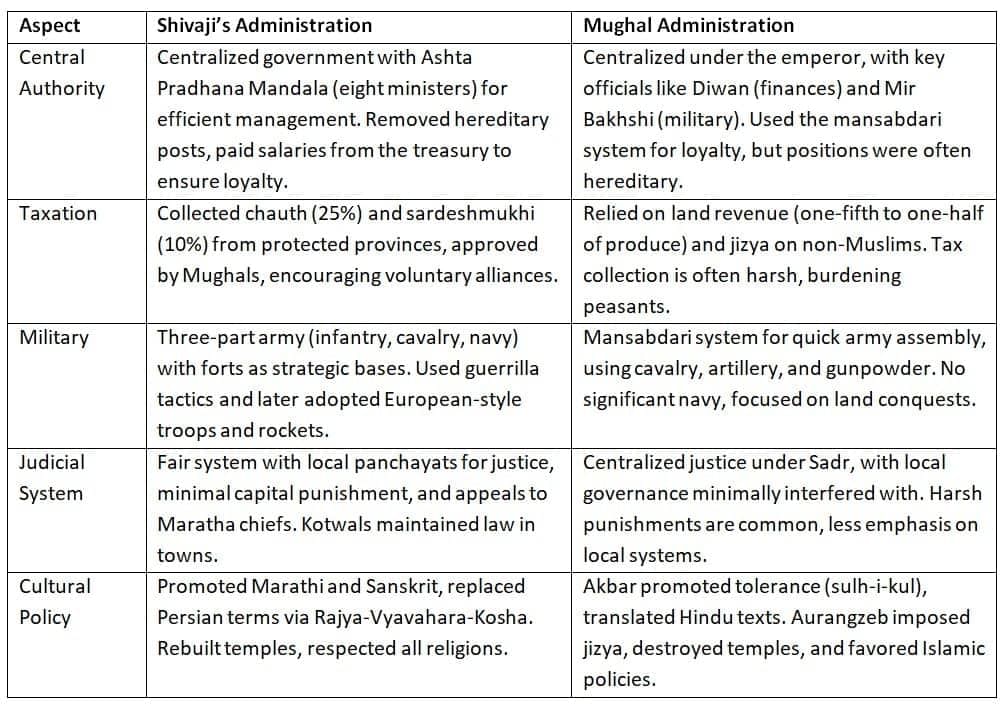
Q12. Create a comparative chart of Shivaji’s administration and that of the Mughals. In what ways did Shivaji innovate while still borrowing elements from older systems?  
Ans:  

Innovations by Shivaji:  

  • Navy Creation: Unlike the Mughals, Shivaji built a navy to secure the west coast, challenging European dominance, a unique innovation.  
  • Non-Hereditary Posts: Removing hereditary positions and paying salaries prevented power consolidation, unlike Mughal reliance on hereditary mansabdars.  
  • Cultural Revival: His use of Sanskrit seals and Marathi texts broke from Mughal Persian dominance, fostering local identity.
    Borrowed Elements:  
  • Taxation Model: Chauth and Sardeshmukhi mirrored Mughal revenue systems but were adapted to encourage alliances.  
  • Council Structure: The Ashta Pradhana Mandala was inspired by Mughal ministerial councils but tailored for centralized control.
    Conclusion: Shivaji innovated with a navy, non-hereditary governance, and cultural revival, while adapting Mughal taxation and council structures to suit his vision of Swarajya.

Q13. The Marathas are often credited with planting the early seeds of Indian nationalism. Critically evaluate this statement with examples from their cultural and political legacy.  
Ans: The Marathas contributed to early Indian nationalism, but the claim requires nuance:  

  • Supporting Nationalism:
    • Swarajya Vision: Shivaji’s concept of self-rule inspired resistance against Mughal domination, fostering a sense of Indian sovereignty. His coronation and Sanskrit seal emphasized local governance over foreign rule.  
    • Cultural Revival: By promoting Marathi, Sanskrit, and Hindu traditions, Shivaji and successors like the Bhonsles (e.g., reviving Jagannath worship in Puri) strengthened regional identities, a precursor to national unity.  
    • Anti-Foreign Resistance: Nana Phadnavis’ pan-Indian alliance with Hyder Ali and the Nizam against the British, showing early coalition-building against foreign rule, a hallmark of nationalism.
  • Limitations:
    • Regional Focus: Maratha power was rooted in Maharashtra, with campaigns (e.g., in Bengal) sometimes causing harm, as noted, limiting broader Indian unity.  
    • Decentralized Rule: The Peshwas and regional chiefs gained power, leading to internal disunity, which weakened a unified national vision.  
    • Religious Emphasis: While Shivaji respected all religions, the Hindu-centric revival might not have fully embraced India’s diverse faiths, a key aspect of later nationalism.
      Conclusion: The Marathas planted seeds of nationalism through Swarajya, cultural revival, and anti-British alliances, but their regional focus and internal disunity limited a fully cohesive national identity.

Q14. Imagine Shivaji had lived 20 more years. Predict how this might have changed Maratha-British or Maratha-Mughal relations in the late 17th century.  
Ans: If Shivaji lived until 1700:  
Maratha-Mughal Relations: 

  • Shivaji’s guerrilla tactics and fort-based strategy would likely intensify resistance against Aurangzeb, preventing Mughal control of the Deccan. His conquests in Tamil Nadu and Karnataka suggest he could expand further, weakening the Mughal hold on southern India.  
  • His diplomatic skills, seen in sparing Mohandas Parekh, might lead to strategic alliances with weaker Mughal factions, delaying Aurangzeb’s conquests of Bijapur and Golconda.

Maratha-British Relations: 

  •  Shivaji’s navy challenged European trade control. A longer reign could strengthen his fleet, disrupting British East India Company trade routes, as his ships reached Muscat.  
  • His ban on Dutch slave trading suggests he would resist British exploitation, potentially delaying their early foothold in Bombay and Surat through naval and diplomatic pressure.

Overall Impact: Shivaji’s leadership would likely consolidate Maratha power, delaying Mughal decline and British expansion. His vision of Swarajya could inspire broader resistance, altering the trajectory of colonial influence in India.

Q15. Evaluate the successes and failures of the Peshwa leadership after Shivaji’s death. How did their strategies both expand and weaken the Maratha Empire?  
Ans: Successes of Peshwa Leadership:  

  • Expansion: Bajirao I and Nanasaheb Peshwa expanded Maratha control to Lahore, Attock, and Peshawar, creating a vast confederacy. Their campaigns, building on Tarabai’s northern invasions, made the Marathas the largest Indian empire before British rule.  
  • Military Modernization: Mahadji Shinde’s adoption of European-style troops and artillery, including metal tube rockets, strengthened Maratha forces, enabling Delhi’s recapture in 1771.  
  • Anti-British Alliances: Nana Phadnavis’ pan-Indian alliance with Hyder Ali and the Nizam, as noted, challenged British expansion, showing diplomatic foresight.

Failures of Peshwa Leadership:  

  • Internal Disunity: The regional chiefs gaining power, diluting centralized control, and deviating from Shivaji’s values, as seen in the harmful Bengal campaigns. This weakened cohesion.  
  • Panipat Defeat (1761): The loss to Afghans, due to overambitious expansion, drained resources and morale, exposing strategic overreach.  
  • British Defeat: Internal disunity and British technological advantages led to Maratha losses in the Anglo-Maratha wars (1775–1818), ending their dominance.

Impact of Strategies:  

  • Expansion Success: Aggressive campaigns expanded Maratha influence, leveraging forts and cavalry, but overstretched resources.  
  • Weakening Factors: Decentralization and reliance on regional chiefs fostered disunity, making the empire vulnerable to British organization.

2️⃣ Reshaping India’s Political Map – HOTS

Q1. India attracted many foreign invaders during the medieval period. Which of the following was the most important reason?
(a) Lack of strong rulers
(b) Rich natural resources and wealth
(c) Geographical isolation
(d) Small population  

Ans: (b) Rich natural resources and wealth
India’s wealth, including gold, silver, and thriving trade (e.g., textiles), made it a prime target for invaders like the Turks, Afghans, and Mughals. While weak rulers and political instability contributed, the primary lure was India’s immense economic prosperity.

Q2. Muhammad bin Tughlaq shifted his capital from Delhi to Daulatabad. Which skill of governance was most tested by this decision?
(a) Military strength
(b) Administrative planning
(c) Trade control
(d) Religious tolerance 

Ans: (b) Administrative planning
The shift to Daulatabad required extensive logistical planning to relocate people and resources over 1,000 km. This was a poorly executed reform, causing hardship, testing Tughlaq’s administrative capabilities, not military strength, trade, or religious policy.

Q3. The Battle of Talikota (1565) was a turning point in South Indian history. If Vijayanagara had won, which of the following might have happened?
(a) The Deccan Sultanates would have united
(b) Vijayanagara’s cultural patronage might have continued longer
(c) The Mughal Empire would not expand in North India
(d) British trade would have ended 

Ans: (b) Vijayanagara’s cultural patronage might have continued longer
Krishnadevaraya’s reign saw a cultural renaissance with the patronage of arts, literature, and temples. A victory at Talikota could have sustained Vijayanagara’s dominance and cultural contributions. The other options are less plausible: the Deccan Sultanates united against Vijayanagara, Mughal expansion was unrelated to Talikota, and British trade was not yet significant.

Q4. Which of these best explains why Akbar’s rule is often called a “golden age” of the Mughal Empire?
(a) Constant military conquests
(b) Harsh tax collection system
(c) Policies of tolerance and inclusion
(d) Aurangzeb’s religious reforms 

Ans: (c) Policies of tolerance and inclusion
Akbar’s policies, like abolishing the jizya tax, promoting sulh-i-kul (peace with all), and integrating Rajputs through marriage alliances and appointments, fostered stability and cultural growth, marking his reign as a golden age, unlike the other options.

Q5. Which of these groups used their geographical advantage most effectively to resist powerful empires?
(a) Rajputs of Mewar
(b) Portuguese in Goa
(c) Mughals in Delhi
(d) British in Bengal 

Ans: (a) Rajputs of Mewar
The Rajputs, particularly under Maharana Pratap, used the Aravalli hills for guerrilla warfare to resist Mughal control. The rugged terrain and support from the Bhil tribes made Mewar a stronghold. The Portuguese relied on naval power, the Mughals were invaders, and the British used political strategies, not geography, in Bengal.

Q6. Ala-ud-din Khilji introduced price control measures. Do you think these policies would work in today’s world? Why or why not?  
Ans: Ala-ud-din Khilji’s price control measures aimed to regulate markets by setting fixed prices for goods to support his military and ensure affordability. In today’s complex, globalized economy, such policies would likely face challenges:  

  • Modern economies are driven by supply and demand, with global trade and inflation affecting prices. Fixed prices could lead to shortages, black markets, or reduced production.  
  • Today’s interconnected markets, with millions of goods and services, make centralized price controls impractical and prone to inefficiencies.  
  • Modern economies involve private corporations and international trade agreements, limiting the government’s ability to enforce such policies without resistance.

Potential for Limited Success: In specific contexts, like wartime or crisis, price controls can stabilize markets temporarily, but sustained controls often distort markets.

Q7. “Muhammad bin Tughlaq was ahead of his time, yet unsuccessful.” Do you agree with this statement? Give reasons.  
Ans: I partially agree. Muhammad bin Tughlaq’s reforms were visionary but poorly executed:  
Ahead of His Time:  

  • His token currency (copper coins equal to silver or gold) resembled modern fiat currency, an innovative idea.  
  • Moving the capital to Daulatabad aimed to centralize control, a forward-thinking administrative idea.  
  • Uniting most of the subcontinent was ambitious and rare for his era.

Reasons for Unsuccess:  

  • The capital shift caused hardship due to poor planning, forcing people to travel 1,000 km, only to be reversed.  
  • The token currency led to counterfeiting, collapsing trade, and the economy.  
  • His grand ideas outpaced the administrative and technological capabilities of the time, alienating subjects.

Q8. Compare the resistance strategies of the Ahoms in Assam and the Rajputs in Rajasthan. What made them successful in protecting their independence?  
Ans: Both the Ahoms and Rajputs resisted powerful empires (Mughals and Delhi Sultanate) effectively, leveraging geography, military tactics, and cultural unity, but their strategies differed:  
Ahom Resistance Strategies:  

  • Used Assam’s dense forests, hills, and Brahmaputra River to hinder Mughal advances (e.g., Battle of Saraighat, 1671).  
  • Employed guerrilla tactics and river-based warfare under Lachit Borphukan.  
  • The paik system ensured a flexible, large force without a standing army.  
  • Integrated local cultures, strengthening community support.

Rajput Resistance Strategies:  

  • Used forts like Kumbhalgarh and Chittorgarh in the Aravalli hills for defense.  
  • Maharana Pratap employed guerrilla tactics with Bhil tribal support post-Haldighati (1576).  
  • Leaders like Rana Sanga unified Rajput clans for collective resistance.  
  • Warrior traditions and jauhar fueled their resolve.

What Made Them Successful:  

  • Terrain knowledge (Assam’s rivers, Rajasthan’s hills) offset numerical disadvantages.  
  • Community support (Ahom’s paik system, Rajput clan unity) strengthened resolve.  
  • Adaptive guerrilla tactics suited smaller forces against empires.  
  • Strong leadership (Lachit Borphukan, Maharana Pratap) inspired innovation.

Q9. If you were an artisan in the Vijayanagara Empire, how would wars and invasions have affected your life and work?  
Ans: As an artisan in Vijayanagara, wars and invasions would profoundly impact my life:  

  • Economic Disruption: Frequent wars with the Deccan Sultanates and Gajapatis disrupted trade routes and markets, reducing demand for goods (e.g., jewelry, temple carvings). The sack of Vijayanagara post-Talikota (1565) would destroy workshops and markets.  
  • Personal Safety and Displacement: The sacking of Hampi destroyed homes and shops, forcing me to flee, face enslavement, or die. Constant conflicts would create fear, disrupting craftsmanship.  
  • Patronage Loss: Krishnadevaraya’s patronage supported artisans through temple endowments. Wars and the empire’s decline would reduce funding, limiting projects like temple sculptures.  
  • Cultural Impact: I might adapt by incorporating new styles from invaders or traders, but temple destruction would limit religious art, forcing a shift to secular crafts.

Q10. Akbar and Aurangzeb followed very different religious policies. Analyse how these differences affected the stability of the Mughal Empire.  
Ans: Akbar and Aurangzeb’s contrasting religious policies impacted Mughal stability:  
Akbar’s Policies (Tolerance and Inclusion):  

  • Abolished jizya, promoted sulh-i-kul, and integrated Rajputs through marriages and appointments.  
  • Fostered unity, reduced rebellions, and ensured a peaceful middle period (1556–1605), strengthening the empire.

Aurangzeb’s Policies (Orthodox and Intolerant):  

  • Reimposed jizya, banned music, and destroyed Hindu, Jain, and Sikh temples (e.g., Banaras, Mathura).  
  • Sparked rebellions (Rajputs, Sikhs, Jats) and drained resources through Deccan campaigns, leading to decline post-1707.

Comparative Impact: Akbar’s tolerance built alliances and stability; Aurangzeb’s intolerance alienated groups and overextended the empire, weakening governance.

Q11. Imagine you are a court historian in Vijayanagara. How would you record the destruction of Hampi after the Battle of Talikota?  
Ans: Chronicle of Vijayanagara, Year 1565
In the year of our Lord Vitthala, tragedy befell our radiant capital, Hampi. Under Ramaraya, our forces met the Deccan Sultanates at Talikota. Despite courage, treachery, and numbers overwhelmed us. The Sultanate armies ravaged Hampi for months, reducing palaces and temples to rubble. The Vitthala temple’s sanctuaries were defiled, markets plundered, and thousands perished. Hampi lies in ruins, but Vijayanagara’s spirit endures in its scattered Nayakas, who vow to rebuild. I weep for Hampi but record its legacy of art, faith, and valor.

Q12. Many rulers destroyed the temples of their rivals during the medieval period. Do you think these actions were more political or religious? Support your view.  
Ans: Temple destruction was primarily political:  

  • Political Motives: Rulers like Ala-ud-din Khilji and Timur plundered temples for wealth to fund campaigns and assert dominance. Destroying temples undermined rivals’ cultural legitimacy.  
  • Religious Motives: Some, like Aurangzeb, destroyed temples due to iconoclasm, pressuring conversions via jizya.  
  • Why Political Dominates: Looting for wealth and targeting temples to weaken rivals were primary, with religious motives as justification.

Q13. “Trade and commerce continued to flourish even during political instability.” Explain this statement concerning the hundi system.  
Ans: India’s economy thrived despite instability due to agriculture, crafts, and trade. The hundi system, a written order to pay money, enabled merchants to transfer funds safely across kingdoms, operating independently of rulers. Coastal towns like Calicut exported textiles, and temples facilitated trade. The hundi’s flexibility ensured commerce persisted, supporting merchants like Marwaris across regimes.  

Q14. Evaluate the contributions of regional kingdoms like the Hoysalas, Eastern Gangas, and Mewar to India’s cultural and political history.  
Ans: The Hoysalas, Eastern Gangas, and Mewar enriched India:  

  • Hoysalas: Built intricate temples (Belur, Halebid), resisted the Delhi Sultanate, preserving southern autonomy.  
  • Eastern Gangas: Constructed Konark’s Sūrya temple, repelled Sultanate invasions, and enriched Odisha’s heritage.  
  • Mewar: Built Kumbhalgarh Fort, resisted Mughals under Rana Kumbha and Maharana Pratap, maintaining Rajput independence.

Q15. Imagine that the Delhi Sultanate had successfully unified all of India. How might India’s cultural and political landscape look different today?  
Ans: If the Delhi Sultanate unified India:  

  • Cultural Landscape: Stronger Islamic influence with more Indo-Islamic architecture, but reduced regional diversity (e.g., fewer Hoysala or Konark temples). Syncretism might increase, but Hindu/Jain texts could diminish.  
  • Political Landscape: Centralized governance might reduce regional autonomy, delaying Sikh or Maratha powers. A stronger military could have resisted British colonization, altering modern boundaries.  
  • Modern Implications: A less pluralistic India with fewer linguistic states, though rebellions might still fragment the state.

1️⃣Natural Resources and Their Use – HOTS

Q1. If groundwater continues to be overused in Punjab, which of the following will be the MOST immediate effect?
(a) Decrease in coal reserves
(b) Falling water table levels
(c) Increase in rainfall
(d) Rise in forest cover

Ans: (b) Falling water table levels
The Punjab caselet states that overusing groundwater for crops lowers the water table (e.g., to ~30 meters deep in 80% of Punjab), making it the most immediate effect.

Q2. Which of the following BEST explains why coal is considered a non-renewable resource?
(a) It is very expensive
(b) It pollutes the air
(c) It takes millions of years to form
(d) It is found only in India

Ans: (c) It takes millions of years to form
Non-renewable resources like coal form over millions of years and cannot be replenished quickly, unlike renewable resources.

Q3. When communities stopped fishing during spawning seasons, their main aim was:
(a) To punish fishermen
(b) To increase the fish trade
(c) To allow fish populations to grow back
(d) To avoid water pollution

Ans: (c) To allow fish populations to grow back
The communities historically stopped fishing during spawning seasons to help fish populations (e.g., tuna) regenerate, preventing depletion.

Q4. Which of the following situations BEST shows fair access to resources?
(a) A city giving 24-hour water to luxury apartments but limited supply to slums
(b) Villagers and towns sharing the same river water through agreed-upon timings
(c) A factory using all groundwater for industry
(d) Farmers cutting down sacred groves for cultivation

Ans: (b) Villagers and towns sharing the same river water through agreed-upon timings
The fair access to resources like water through stewardship, as equitable sharing reflects responsible management, unlike unequal or exploitative practices.

Q5. Which of the following is the MOST sustainable practice?
(a) Mining coal rapidly for export profits
(b) Using solar energy in place of diesel generators
(c) Building factories in forests
(d) Throwing untreated waste in rivers

Ans: (b) Using solar energy in place of diesel generators
Solar energy (e.g., Bhadla Solar Park) is a renewable, sustainable alternative to polluting fossil fuels, unlike other environmentally harmful options.

Q6. Why does nature become a “resource” only when humans know how to use it?
Ans: Nature becomes a resource when humans use its elements (e.g., trees, water) for purposes like living or making things, requiring knowledge of how to access and apply them. This involves three conditions: technological accessibility (e.g., machines to cut wood), economic feasibility (affordable extraction), and cultural acceptability (e.g., respecting sacred groves).
The natural elements like trees or rivers are not resources until humans know how to use them (e.g., wood for furniture, water for farming).

Q7. “Sikkim’s organic farming journey is both an environmental and economic success.” Analyse.
Ans:  

  • Environmental Success: Sikkim’s 100% organic farming (since 2016) restored biodiversity (e.g., more insects and birds) by using natural fertilisers like compost and neem-based pest repellents, avoiding chemical pollution and supporting ecosystem services like soil health.  
  • Economic Success: Organic farming increased farmers’ incomes by 20% on average and boosted tourism, as visitors were attracted to Sikkim’s sustainable model.  
  • Analysis: By adopting traditional practices like multi-cropping, Sikkim balanced environmental health with economic growth, making it a global model for sustainability.
    The Sikkim caselet highlights how organic farming reversed low yields and debts, benefiting both nature and the economy.

Q8. If you were in charge of reducing cement pollution in India, what two measures would you take? Why?
Ans: 1. Enforce Central Pollution Control Board Guidelines: Strictly implement guidelines to minimise cement factory dust, which harms lungs, plants, and soil. This reduces pollution and protects ecosystems.
2. Promote Sustainable Materials: Encourage using mud, sandstone, or recycled plastic for construction, as seen in Auroville and Jaisalmer Fort, to lower environmental impact.
Why: These measures address health and ecological risks while promoting sustainable alternatives that focus on responsible resource use.
The cement’s pollution suggests traditional materials to reduce environmental harm.

Q9. Compare renewable and non-renewable resources. Which is more threatened today?
Ans: The careless use of renewables (e.g., water drying up) risks depletion, while non-renewables are inherently limited.

  • Renewable Resources: Can be replenished naturally in a short time (e.g., solar energy, forests) if nature’s cycles are maintained. Overuse, like deforestation, can deplete them.  
  • Non-Renewable Resources: Formed over millions of years (e.g., coal, petroleum) and cannot be replenished quickly, with coal reserves potentially lasting only 50 years.  
  • Comparison: Renewables are sustainable with proper management; non-renewables are finite and deplete with use.  
  • More Threatened: Renewable resources are more threatened today because human actions (e.g., overusing groundwater in Punjab, deforestation) disrupt their regeneration cycles, making them behave like non-renewables.

Q10. How can the uneven distribution of natural resources lead to cooperation and conflict?
Ans: The uneven distribution shapes trade and conflicts, emphasising the need for fair resource management.

  • Cooperation: Uneven resource distribution encourages trade and collaboration. For example, resource-rich areas (e.g., Jharkhand’s coal) trade with resource-scarce areas, fostering economic growth and job creation, as seen with India’s Wootz steel trade historically.  
  • Conflict: Resources like water crossing borders (e.g., Kaveri River disputes among Karnataka, Tamil Nadu, Kerala, and Puducherry) cause tensions when access is unequal. Sacred sites or land lost to mining can also spark protests.  
  • Solution: Fair management and negotiations can promote peace and equitable sharing.

Q11. “Overuse of renewable resources can make them behave like non-renewable resources.” Explain.
Ans: Renewable resources (e.g., water, forests) can regenerate naturally if used sustainably, but overuse disrupts their cycles, making them behave like non-renewable resources, which deplete permanently. For example, overharvesting timber faster than forests regrow leads to forest loss. Similarly, overusing groundwater in Punjab lowers water tables, reducing availability, as seen in the caselet. Sustainable practices like rainwater harvesting are needed to maintain renewability.

Q12. How is the idea of lokasangraha useful in resource use?
Ans: Lokasangraha, from the Bhagavad Gita, means working for the good of all, not just oneself. In resource use, it encourages responsible stewardship by promoting fair access to resources (e.g., clean water, air) and sustainable practices. For example, sharing river water equitably (like the Brahmaputra example) or adopting organic farming in Sikkim ensures resources benefit everyone and last for future generations. It discourages selfish exploitation and calls for collective responsibility.

Q13. Punjab groundwater case: What were the short-term benefits and long-term harms?
Ans: The Punjab caselet highlights how groundwater overuse provided immediate food security but caused long-term environmental and health damage.

  • Short-Term Benefits: In the 1960s, Punjab’s farmers used groundwater for high-yielding crops, supported by free electricity, ensuring food security and increased agricultural output.  
  • Long-Term Harms: Over-pumping lowered water tables to ~30 meters deep in 80% of Punjab, marked as “overexploited.” Chemical fertilisers polluted groundwater, posing health risks and reducing sustainability, as water became scarce for future use. 

Q14. Design a school awareness campaign on sustainable resource use.
Ans: Campaign Name: “Green Today, Thriving Tomorrow”  
Activities:

  • Workshops: Educate students on sustainable practices like rainwater harvesting and organic farming (e.g., Sikkim’s model), using posters and videos.  
  • Tree-Planting Drive: Plant trees to promote ecosystem services like oxygen production, inspired by the chapter’s example of trees producing 275 litres of oxygen daily.  
  • Recycle Club: Encourage reducing, reusing, and recycling to mimic nature’s no-waste cycles, as described in the chapter.
  • Goal: Raise awareness about responsible resource use, emphasising stewardship and sustainability.

Q15. What if India had not invested in renewable energy like solar parks?
Ans: If India had not invested in renewable energy like solar parks (e.g., Bhadla Solar Park), several consequences would arise:  

  • Increased Non-Renewable Depletion: India would rely more on coal and petroleum, depleting reserves faster (e.g., coal may last only 50 years) and increasing import costs for oil.  
  • Environmental Damage: Greater fossil fuel use would worsen pollution and climate change, accelerating Himalayan glacier melting, threatening water security for rivers like the Brahmaputra.  
  • Economic Challenges: Without solar energy’s job creation and cheaper electricity (e.g., Bhadla meets ~15% of Rajasthan’s needs), India would face higher energy costs and slower economic growth.  
  • Missed Global Leadership: India’s role in the International Solar Alliance (ISA) would weaken, reducing its influence in promoting clean energy globally.  
  • Sustainability Risks: Overuse of non-renewables would harm ecosystems, reducing services like oxygen production and soil health, making sustainable development harder.

Conclusion: Investing in renewables has reduced environmental harm, supported economic growth, and ensured long-term resource availability emphasis on stewardship.