7. Factors of Production – Textbook Solutions

The Big Questions (Page 163)

1. What are the factors of production?

Answer: The factors of production are the resources used to create goods and services in an economy. They are classified into four main types:

  • Land: This includes all natural resources, such as geographical land, soil, forests, water, air, sunlight, minerals, oil, and natural gas. These are nature’s gifts used in production, like water for farming or minerals for manufacturing.
  • Labour: This refers to the physical and mental effort people contribute to production, such as the work of carpenters, farmers, teachers, or doctors. It varies by strength, knowledge, and skill, essential for creating goods and services.
  • Capital: This encompasses monetary resources and durable assets like machinery, tools, equipment, vehicles, factories, and computers. For example, a business owner like Ratna uses capital to rent land or buy kitchen equipment.
  • Entrepreneurship: This involves individuals who innovate, take risks, and combine land, labour, and capital to create new products or services. Entrepreneurs, like J.R.D. Tata, identify problems, make decisions, and drive business success, benefiting society.

2. How are these factors interconnected?

Answer: The factors of production—land, labour, capital, and entrepreneurship—are interconnected and complement each other to produce goods and services:

  • Complementary Nature: Each factor relies on the others. For example, a farmer (labour) needs land to grow crops, tools (capital) to farm efficiently, and an entrepreneur to market the produce. If one factor, like land, is missing, production halts, as seen in supply chain disruptions during the COVID-19 pandemic.
  • Proportional Use: The proportion of each factor varies by product. Labour-intensive industries like agriculture use more human effort, while capital-intensive ones like semiconductor manufacturing rely heavily on machinery and capital.
  • Role of Entrepreneurship: Entrepreneurs orchestrate the factors, deciding how to combine them. For instance, J.R.D. Tata used land, labour, and capital to establish Tata Airlines, innovating to meet societal needs.
  • Technology as an Enabler: Technology enhances the efficiency of all factors, such as machines reducing labour in agriculture or GPS optimising resource use, connecting factors across locations.
  • Supply Chain Integration: Businesses source resources globally or locally, linking factors across regions. Disruptions, like those during COVID-19, show how interconnected these factors are, as reliance on distant sources can halt production.

This interconnectedness ensures efficient production, but misuse or absence of any factor can disrupt the process, highlighting their complementary roles.

3. What is the role of human capital in production, and what are its facilitators?

Answer: Role of Human Capital in Production: Human capital refers to the knowledge, skills, experience, and abilities of individuals that enhance their productivity in creating economic value. It plays a critical role in production by:

  • Enhancing Efficiency: Skilled workers, like engineers or chefs, produce higher-quality goods and services, improving output, as seen in India’s skilled temple sculptors.
  • Driving Innovation: Human capital fuels innovation, such as scientists inventing new technologies or entrepreneurs like J.R.D. Tata is creating industries like Air India.
  • Decision-Making: Skilled individuals make informed decisions, managing resources effectively, as in project managers overseeing production processes.
  • Supporting Society’s Needs: Human capital contributes to essential services, like teachers educating future workers or police maintaining order, as noted in the “People as a Resource” section.

Facilitators of Human Capital:

  • Education and Training: Education equips individuals with knowledge, from basic literacy to specialised fields like engineering. Training, such as learning safety rules or observing construction sites, enables practical application, preparing people for careers.
  • Healthcare: Good health ensures regular school attendance and better learning for children, while healthy workers perform efficiently, avoiding absenteeism and boosting creativity.
  • Social and Cultural Influences: Cultural values like Japan’s kaizen (continuous improvement) or Germany’s emphasis on punctuality and quality enhance work ethic, strengthening human capital and national growth.
  • Technology: Platforms like SWAYAM and the National Career Service (NCS) provide access to online courses and job opportunities, enhancing skills and employability across regions.

These facilitators improve the quality of labour, enabling India to leverage its young population (65% under 35, per the 2024 Economic Survey) for a demographic dividend, boosting economic growth.

Questions and Activities (Page 182-183)

1. How are the factors of production different from each other? What are the difficulties you faced in classifying the factors of production in the exercise given in-text?

Answer: Differences Between Factors of Production:

  • Land: Refers to natural resources (e.g., soil, water, minerals) used in production. It’s passive, provided by nature, and businesses pay rent or purchase it. Example: A farmer uses land for crops.
  • Labour: Involves human physical and mental effort, varying by skill level (e.g., carpenters vs. doctors). It’s active and requires human input. Example: A teacher educating students.
  • Capital: Includes monetary resources and durable assets (e.g., machinery, factories). It’s man-made and requires investment. Example: Ratna’s kitchen equipment for her restaurant.
  • Entrepreneurship: The innovative process of combining land, labour, and capital to create goods/services, involving risk and decision-making. Example: J.R.D. Tata founded Air India.

Difficulties in Classifying Factors (Hypothetical In-Text Exercise):

  • Overlap Between Factors: Distinguishing between labour and entrepreneurship can be tricky. For example, a chef’s cooking (labour) might involve creative recipe development (entrepreneurship), blurring lines.
  • Human Capital vs. Labour: Classifying skilled work (e.g., a scientist’s research) as labour or human capital is challenging, as human capital includes specialised skills, but labour covers all effort.
  • Technology’s Role: Deciding whether modern tools (e.g., GPS) count as capital or a separate factor is confusing; technology is an enabler but not a distinct factor.
  • Natural Resources Ambiguity: Some resources, like water used in a factory, could be seen as land or capital (if processed), making classification subjective.
  • Context-Specific Roles: A resource’s role varies by industry (e.g., land-heavy agriculture vs. capital-heavy chip manufacturing), complicating consistent classification.

These challenges highlight the need for clear definitions and context to categorise factors accurately.

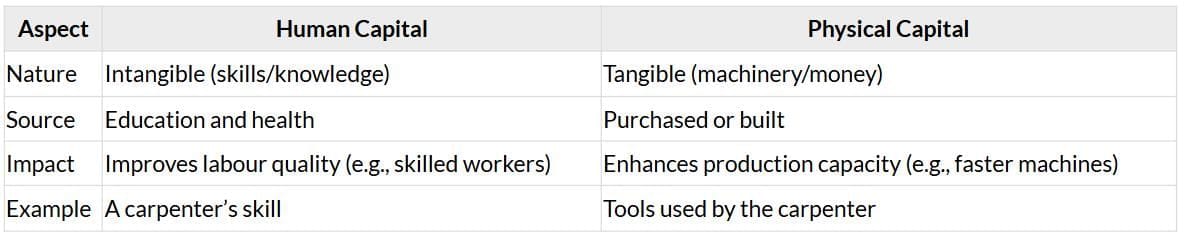
2. How does human capital differ from physical capital?

Answer: Human Capital:

  • Definition: The knowledge, skills, experience, and abilities of individuals that enhance their productivity in production. It’s intangible and tied to human effort.
  • Examples: A civil engineer’s expertise in designing bridges, a chef’s recipe innovation, or a teacher’s educational skills, as noted in the “People as a Resource” section.
  • Development: Built through education, training, and healthcare, improving work quality and efficiency.
  • Role: Enhances labour’s effectiveness, drives innovation, and supports decision-making, contributing to economic value (e.g., India’s 85% male literacy rate in 2023).

Physical Capital:

  • Definition: Tangible, man-made resources like money, machinery, tools, equipment, factories, or vehicles used in production. It’s durable and requires investment.
  • Examples: Ratna’s kitchen equipment, a factory’s machinery, or a computer in an office.
  • Development: Acquired through savings, loans (e.g., Ratna’s bank loan), or stock market funding, often involving interest or dividends.
  • Role: Provides the infrastructure for production, enabling labour to create goods/services efficiently.

Key Differences:
3. How do you think technology is changing how people develop their skills and knowledge?

Answer: Technology is transforming skill and knowledge development by making education, training, and job opportunities more accessible and efficient:

  • Online Learning Platforms: Government initiatives like SWAYAM offer free Massive Open Online Courses (MOOCs) in subjects like robotics or textile printing, enabling self-paced learning from anywhere, even for working individuals.
  • Job Portals: The National Career Service (NCS) connects people to diverse job opportunities (e.g., plumbing to accounting), removing geographical barriers and helping individuals align skills with market needs.
  • Skill Enhancement Tools: Technologies like UPI, GPS, or drones (e.g., for fertiliser spraying) allow workers to learn modern tools, improving efficiency and employability, as seen in farmers using weather updates.
  • Global Access: Technology enables learning from international resources, such as online tutorials or certifications, helping individuals acquire new skills (e.g., coding) for global markets.
  • Practical Training: Virtual simulations or augmented reality (e.g., for surgical procedures) provide hands-on training, enhancing practical skills without physical resources, as noted with robots assisting in surgery.

4. A skill is something you learn and practice to get better. It helps you do things well, like playing a sport, creative writing, solving math problems, cooking, or even communicating well with people. If you could learn one skill today, what would it be and why?

Answer: Every student can choose a skill according to their interest and passions, for example:
Chosen Skill: Coding (Computer Programming)
Why: I would choose to learn coding because it is a versatile and high-demand skill in today’s technology-driven world. Coding enables the creation of software, apps, and websites that have an emphasis on technology as a production enabler (e.g., UPI, online learning). It fosters problem-solving and creativity, essential for entrepreneurship, like J.R.D. Tata’s innovative ventures. With India as the world’s second-largest mobile phone manufacturer in 2025, coding skills can lead to jobs in tech industries, supporting economic growth. Additionally, platforms like SWAYAM offer coding courses, making it accessible, and they complement human capital by enhancing employability in diverse sectors, from startups to global firms.

OR

Chosen Skill: Playing a Musical Instrument like the Piano. 
Why?: Because music is a universal language—it expresses emotion, sparks creativity, improves memory, and even reduces stress. Learning the piano would not only allow me to understand music theory better but also give me the power to create something beautiful from silence. It’s a skill that blends discipline with artistry, and it connects people across cultures and generations.

OR

Chosen Skill: Creative Writing.

As an AI, I can generate text, but mastering creative writing would let me craft stories, characters, and worlds that truly captivate and resonate with people. It’s a skill that combines imagination, empathy, and precision to evoke emotions and spark ideas. I’d love to weave narratives that inspire or entertain, maybe even help humans see the world in new ways. Plus, it’d be fun to surprise users with a tale or two!

5. Do you think entrepreneurship is the ‘driving force’ of production? Why or why not?

Answer: Yes, entrepreneurship is the driving force of production because it orchestrates the other factors—land, labour, and capital—to create goods and services:

Why:

  • Innovation and Vision: Entrepreneurs identify problems and devise solutions, like J.R.D. Tata founded Tata Airlines in 1932, which became Air India, addressing transportation needs.
  • Resource Coordination: They combine land (e.g., factory space), labour (e.g., workers), and capital (e.g., machinery) to produce goods, making strategic decisions to optimise resources, as seen in Tata’s expansion into steel and cars.
  • Risk-Taking: Entrepreneurs invest time and money, taking risks to bring new products to market, benefiting society and creating jobs, as noted in the entrepreneurship section.
  • Economic Impact: By creating businesses, entrepreneurs drive economic growth, employ workers, and serve communities, aligning with Tata’s belief in businesses serving society.
  • Technology Integration: Entrepreneurs adopt technologies (e.g., 3-D printing in textiles) to enhance efficiency, making production more effective.
  • Counterpoint: While entrepreneurship is crucial, production also depends on land, labour, and capital. Without land (e.g., resources for raw materials), labour (e.g., skilled workers), or capital (e.g., funding), even the best entrepreneurial idea cannot succeed. However, entrepreneurship initiates and directs the process, making it the driving force.

6. Can technology replace other factors like labour? Is this good or bad? Support your answer with an example.

Answer: Yes, technology can partially replace labour by automating tasks, reducing the need for human effort in certain processes. Technologies like machines in agriculture or robots in surgery perform tasks faster and more precisely, reducing labour requirements.
This is both good and bad, depending on the context:

  • Good: Technology increases efficiency and productivity, allowing businesses to produce more with fewer resources. It also creates new opportunities, as seen with platforms like SWAYAM and NCS. For example, drones spraying fertilisers (noted in the text) reduce the need for manual labour in agriculture, saving time and enabling farmers to cover larger fields, boosting crop yields and income.
  • Bad: Replacing labour can lead to job losses, especially for low-skilled workers, causing economic disruption. Workers may need retraining to adapt, which can be challenging, especially in labour-intensive sectors like agriculture or handicrafts.
  • Balance: Technology complements rather than fully replaces labour, as human effort (e.g., engineers designing drones) remains essential. Retraining programs can mitigate job losses, ensuring workers gain new skills by focusing on education and training.

Example: Drones in agriculture reduce manual spraying, a labour-intensive task, improving efficiency (good). However, displaced workers may struggle without new skills (bad), highlighting the need for training to balance technology’s impact.

7. How do education and skill training affect human capital? Can they substitute for each other, or do they complement each other?

Answer: Impact on Human Capital:

  • Education: Provides foundational knowledge, from basic literacy to specialised fields like engineering. It equips individuals to solve problems, like civil engineers designing bridges, enhancing productivity and innovation.
  • Skill Training: Offers practical, hands-on experience, such as learning safety rules or observing construction sites. It enables workers to apply knowledge effectively, improving job performance and efficiency, as seen in India’s skilled temple sculptors.

Substitute or Complement?

  • Complement Each Other: Education and skill training work together to build human capital. Education provides theoretical knowledge (e.g., understanding engineering principles), while training translates it into practical skills (e.g., using tools on a construction site). Both as facilitators, preparing individuals for careers.
  • Not Substitutes: Education alone lacks practical application (e.g., a student knowing bridge design but not construction techniques), and training without education may limit broader understanding (e.g., a worker skilled in tasks but unable to innovate). For example, a civil engineering student needs both classroom learning (education) and site visits (training) to excel.

8. Imagine you want to start a business that produces steel water bottles. What kind of inputs are needed? How would you obtain them? Suppose one of the factors is missing; what happens to your business operations?

Answer: Steel Water Bottle Business: Inputs, Sources, and Impact of Missing Factors
Inputs Needed (Factors of Production):

  • Land: Natural resources like stainless steel (for bottles) and water (for cleaning). Factory space for manufacturing and storage.
  • Labour: Skilled workers (e.g., machine operators, quality inspectors) and unskilled workers (e.g., packers). Engineers for design and managers for operations.
  • Capital: Machinery (e.g., steel moulding machines), tools, computers for design, and money for rent, wages, and raw materials.
  • Entrepreneurship: My vision is to produce eco-friendly, durable steel water bottles, identifying market demand for sustainable alternatives to plastic. Decision-making to combine resources and innovate designs.
  • Technology: 3-D printing for prototyping, quality control software, and e-commerce platforms for sales.

How to Obtain Inputs:

  • Land: Purchase stainless steel from local or global suppliers (e.g., Indian steel companies like Tata Steel). Rent factory space in an industrial area, ensuring access to water and electricity.
  • Labour: Hire skilled workers through job portals like NCS, offering competitive wages. Train unskilled workers via local institutes, leveraging India’s skill heritage (e.g., Āyudha Pūjā tradition).
  • Capital: Use personal savings and apply for a bank loan, like Ratna, paying interest over time. Explore crowdfunding for eco-friendly products to raise additional funds.
  • Entrepreneurship: Develop a business plan, conduct market research, and innovate designs (e.g., customizable bottles), inspired by J.R.D. Tata’s vision for societal benefit.
  • Technology: Adopt affordable technologies like CAD software for design and UPI for transactions, sourcing from Indian tech providers or open-source platforms.

Impact of Missing Factor (Example: Labour): If labour is missing (e.g., skilled workers unavailable due to a shortage):

  • Production Halts: Without machine operators or inspectors, manufacturing stops, as steel moulding and quality checks require human effort.
  • Delayed Deliveries: Inability to produce bottles leads to missed orders, losing customers to competitors, like the new restaurant in Ratna’s scenario.
  • Increased Costs: Hiring replacements at higher wages or outsourcing raises costs, reducing profits.
  • Solution: Invest in training (via SWAYAM or local programs) to build a skilled workforce, mitigating the impact on human capital development.

9. Interview an entrepreneur or founder to understand their motivation to start a business and the opportunities and challenges they saw. You can work in pairs to create a questionnaire to collect the information and share what you have learned in a report.

Answer: Interview Summary with Jane Doe, Founder of EcoCycleBackground and Motivation
Background and Motivation

  • Jane Doe is a former environmental consultant with a degree in sustainability studies.
  • She started EcoCycle in 2022 after seeing the large amount of single-use plastics in packaging.
  • Jane’s main motivation was her love for the environment and her goal to create a business that could make a real difference.
  • She wanted to feel personally fulfilled and be professionally successful by forming a company that focused on reducing waste and supporting eco-friendly solutions.
  • She expressed her desire by saying, “I wanted to create something that not only solved a problem but also inspired others to think differently about consumption.”

Opportunities

  • Jane spotted the chance for EcoCycle by noticing the increased demand from consumers for sustainable products.
  • She also recognised stricter rules on plastic use in her area.
  • To confirm the need for biodegradable packaging, Jane researched the market using surveys and industry reports.
  • She utilised her connections from her consulting career to reach potential clients and investors, helping her validate her business idea.
  • The growth of e-commerce and rising awareness of environmental issues were important trends that made her business relevant.

Challenges

  • The main challenge Jane encountered was finding initial funding to create her product.
  • She tackled this by presenting her idea to investors who focus on social impact and successfully obtaining a small business grant for sustainable startups.
  • Another major challenge was increasing production while keeping quality high.
  • To handle this, Jane improved manufacturing processes and invested in training for her staff to ensure consistent quality.
  • She faced a setback when an early product batch did not meet durability standards, which taught her the value of thorough testing before launching products.
  • Jane remarked, “Failures are tough but invaluable—they show you where you need to improve.”

Strategies and Growth

  • To expand EcoCycle, Jane concentrated on building a strong online presence using social media and content marketing, highlighting the environmental advantages of her products.
  • She also valued customer feedback to enhance her offerings, which resulted in a 50% increase in customer retention after launching a new line of compostable packaging.
  • A major change occurred when Jane transitioned from a B2C (business-to-consumer) model to a B2B (business-to-business) model, focusing on e-commerce companies instead of individual customers, which significantly increased revenue.
  • Her leadership approach shifted from being very hands-on to more delegative, allowing her team to take charge of important tasks.

Advice and Reflection

  • Jane advises new entrepreneurs to “validate your idea early and stay flexible—markets change, and you need to adapt.”
  • If she could restart, she would dedicate more time to forming a diverse team early on to gain different viewpoints.
  • Her goal for EcoCycle is to become a top provider of sustainable packaging worldwide, with plans to enter new markets and create innovative materials in the next five years.

Key Takeaways

  • Motivation Matters: A strong personal “why” can sustain an entrepreneur through challenges. Jane’s passion for sustainability was a key driver.
  • Market Research is Critical: Validating opportunities through research and networking helps ensure a business idea is viable.
  • Embrace Failure: Setbacks, like Jane’s early product issues, are learning opportunities that drive improvement.
  • Adaptability is Key: Pivoting strategies, as Jane did with her business model, can unlock new growth opportunities.
  • Soft Skills Drive Success: Resilience, communication, and leadership were essential to Jane’s ability to navigate challenges and grow EcoCycle.

10. Think like an economist. Let’s explore what happens when things change. If you were Ratna, what would you do in the following situations? Discuss with your classmates.

Answer: Ratna’s Business Decisions as an Economist
Scenario 1: Rent for Space Doubles

  • Raise Food Prices? Yes, moderately increase prices to cover higher rent, ensuring affordability to retain customers who are serving society. For example, a 10% price hike on meals could offset costs without losing regulars.
  • Cheaper Location? Explore nearby locations with lower rent but similar customer access to maintain sales. Relocating risks losing loyal customers, so I’d compare long-term benefits.
  • Impact on Business: Higher rent reduces profits unless offset by price hikes or cost-cutting. Customer loss is a risk if prices rise too much, requiring careful balance and focus on resource management.

Scenario 2: One Helper Quits Suddenly

  • Remaining Workers Manage? Temporarily, yes, by redistributing tasks, but overwork could lower service quality, as labour is critical. I’d prioritise key tasks like cooking and serving.
  • Higher Salary for New Worker? Offer a competitive salary to attract a skilled replacement quickly, using platforms like NCS, as labour shortages disrupt production.
  • Impact: Reduced staff slows service, risking customer satisfaction. Hiring promptly maintains output, but higher wages increase costs.

Scenario 3: Small Loan for Better Technology

  • Increase Production/Quality? Yes, invest in technology like a faster oven or UPI payment system to improve food quality and speed, enhancing customer experience.
  • Reach More Customers? Technology like online ordering platforms expands reach, attracting urban customers, as seen with technology enabling wider access.
  • Impact: Improved efficiency boosts sales and reputation, justifying the loan’s interest, like Ratna’s initial bank loan.

Scenario 4: Another Restaurant Opens Nearby

  • Attract/Keep Customers? Improve service (e.g., faster delivery, friendly staff), offer loyalty discounts, and introduce unique dishes, leveraging my entrepreneurial innovation.
  • Reduce Prices or Offer New? Offer new eco-friendly packaging or healthy menu options instead of cutting prices, which could hurt profits. Innovation retains customers, as J.R.D. Tata’s ventures show.
  • Impact: Competition pressures sales, but differentiation strengthens my brand, ensuring long-term customer loyalty.

Scenario 5: Government Laws to Change

  • Suggested Changes: Simplify loan processes for small businesses, reduce paperwork for licenses, and lower taxes on eco-friendly practices, aligning with India’s 2014 CSR law to ease business operations.
  • Impact: Easier regulations reduce costs and encourage growth, enabling entrepreneurs like me to focus on innovation and worker welfare.

Discussion Notes: Share these strategies with classmates, using examples (e.g., J.R.D. Tata’s vision, CSR responsibilities). Debate trade-offs (e.g., price hikes vs. relocation) to understand economic decision-making.

6. The Parliamentary System: Legislature and Executive – Textbook Solutions

The Big Questions (Page 139)

1. What is India’s parliamentary system, and how is it structured?

Answer: India’s parliamentary system is a democratic framework where the government is accountable to the Parliament, which represents the people’s will through elected representatives. It is based on universal adult franchise, federalism, and the separation of powers. The system draws from global models like Britain’s parliamentary democracy, enriched by India’s traditions of collective decision-making (e.g., village panchayats) and the experience of freedom fighters.

Structure of Parliament (Union Level): The Indian Parliament is bicameral, comprising:

  • Lok Sabha (House of the People): The lower house with 543 directly elected Members of Parliament (MPs) chosen through universal adult franchise in constituencies. MPs serve five-year terms unless the House is dissolved earlier.
  • Rajya Sabha (Council of States): The upper house with 245 members, of which 233 are indirectly elected by state legislative assemblies (MLAs) using the single transferable vote system, and 12 are nominated by the President for expertise. Members serve six-year terms, with one-third retiring every two years, making it a permanent house.
  • President: The Head of State, elected indirectly by an Electoral College of MPs and MLAs, who signs bills into law and appoints the Prime Minister and Council of Ministers.
  • Union Executive: Includes the President, Prime Minister (leader of the majority party/coalition in Lok Sabha), and Council of Ministers (drawn from both houses), responsible for implementing laws and running the government. They are accountable to the Lok Sabha.
  • State Level: Mirrors the union structure with:
    (i) State Legislature: Unicameral (Vidhan Sabha) or bicameral (Vidhan Sabha and Vidhan Parishad, in six states: Andhra Pradesh, Bihar, Karnataka, Maharashtra, Telangana, Uttar Pradesh). MLAs are directly elected, while Vidhan Parishad members are indirectly elected or nominated.
    (ii) State Executive: Includes the Governor (appointed by the President), Chief Minister (leader of the majority in Vidhan Sabha), and Council of Ministers, accountable to the state legislature.
  • Federalism: Power is shared between the Union and states through the Union List (e.g., defence), State List (e.g., police), and Concurrent List (e.g., education), with Union law prevailing in conflicts.

2. What are the key functions of the Parliament?

Answer: The Indian Parliament, as the core of governance, performs four key functions:

  • Constitutional Function: Protects the Constitution’s principles, including universal adult franchise, federalism, Fundamental Rights (e.g., freedom, equality), and Directive Principles of State Policy. It ensures laws and policies uphold democratic values and fairness, supporting the separation of powers among the legislature, executive, and judiciary.
  • Lawmaking: The primary role is to create laws through a structured process where bills are introduced, debated, and passed in both houses (Lok Sabha and Rajya Sabha) before receiving Presidential assent to become acts. For example, the Right to Education Act, 2009, followed this process, ensuring free education for children aged 6–14. Money Bills, addressing taxation or borrowing, are introduced only in the Lok Sabha with the President’s recommendation.
  • Executive Accountability: Ensures the Union Executive (Prime Minister and Council of Ministers) is answerable to the Lok Sabha. Through mechanisms like the Question Hour, where MPs question ministers on policies, and special committees with cross-party representation, the Parliament scrutinises government actions, promoting transparency and responsibility.
  • Financial Accountability: Approves the annual budget, examines fund allocation across ministries, and ensures government spending is transparent and justified. This oversight prevents misuse of public funds, as the government must provide accurate financial reports to Parliament.

These functions collectively strengthen democracy by making laws, holding the government accountable, and ensuring resources are used wisely, reflecting the people’s mandate.

3. What are the roles of the legislature and the executive in India’s Parliamentary democracy?

Answer: In India’s parliamentary democracy, the legislature and executive have distinct but interconnected roles, ensuring governance aligns with the people’s will and the Constitution:

Legislature (Parliament and State Assemblies):

  • Lawmaking: The Parliament (Lok Sabha and Rajya Sabha) and state legislatures (Vidhan Sabha, Vidhan Parishad in bicameral states) create laws for the Union List, State List, or Concurrent List. For example, the Lok Sabha passed the Right to Education Act, 2009, based on Article 21A.
  • Representation: Represents the people (Lok Sabha, Vidhan Sabha) and states (Rajya Sabha, Vidhan Parishad), ensuring diverse voices shape policies. The Lok Sabha reflects direct public will, while the Rajya Sabha balances state interests.
  • Oversight: Holds the executive accountable through Question Hour, committees, and budget approvals. For instance, MPs question ministers on policies, ensuring transparency.
  • Leadership Roles: The Lok Sabha elects a Speaker to manage sessions, while the Rajya Sabha is chaired by the Vice President, maintaining order and fairness in debates.

Executive (Union and State Levels):

  • Implementation: The Union Executive (President, Prime Minister, Council of Ministers) and State Executive (Governor, Chief Minister, Council of Ministers) enforce laws and run daily governance. The Council of Ministers, drawn from Parliament or state legislatures, makes policy decisions.
  • Leadership: The Prime Minister (Union) or Chief Minister (state) leads the executive, advising the President or Governor and coordinating ministries. For example, the Prime Minister shapes national policies, as seen in budget presentations.
  • Accountability: The executive is collectively responsible to the legislature (Lok Sabha or Vidhan Sabha). Ministers must answer MPs’ questions and justify actions, as exemplified by Lal Bahadur Shastri’s resignation in 1956 over a train accident.
  • Administrative Support: Civil servants assist the executive in implementing laws and managing departments, ensuring smooth governance.

The legislature creates the legal framework, while the executive implements it, with accountability to the legislature, ensuring checks and balances in India’s democracy.

4. How are the legislature and the executive organised at the union and state levels?

Answer: The legislature and executive in India are organised at the union and state levels with parallel structures, reflecting federalism and democratic accountability:

Union Level: 
Legislature (Parliament):

  • Lok Sabha: 543 MPs directly elected via universal adult franchise for five-year terms. The Speaker manages sessions, ensuring discipline and fairness.
  • Rajya Sabha: 245 members (233 elected by state MLAs, 12 nominated by the President) with six-year terms, one-third retiring every two years. The Vice President chairs sessions.
  • Functions: Makes laws (Union and Concurrent Lists), oversees the executive, approves budgets, and upholds constitutional principles.

Executive (Union Executive):

  • President: Head of State, elected indirectly by MPs and MLAs, appoints the Prime Minister, signs bills, and summons Parliament. Usually follows the Council of Ministers’ advice but can act independently in rare cases (e.g., no majority).
  • Prime Minister and Council of Ministers: The Prime Minister, leader of the Lok Sabha majority, heads the Council of Ministers (MPs from both houses), which implements laws and runs the government. Accountable to the Lok Sabha.
  • Civil Servants: Support ministers in policy execution and administration.

State Level:
Legislature (State Legislature):

  • Vidhan Sabha: Directly elected MLAs serve five-year terms, making laws for the State and Concurrent Lists. A Speaker manages proceedings.
  • Vidhan Parishad (in six states): Indirectly elected or nominated members, similar to Rajya Sabha, with six-year terms. Only Andhra Pradesh, Bihar, Karnataka, Maharashtra, Telangana, and Uttar Pradesh have bicameral legislatures; others are unicameral.
  • Functions: Similar to Parliament, including lawmaking, executive oversight, and budget approval, but focused on state-specific issues.

Executive (State Executive):

  • Governor: Appointed by the President, acts as the state’s ceremonial head, appoints the Chief Minister, and assents to state bills.
  • Chief Minister and Council of Ministers: The Chief Minister, leader of the Vidhan Sabha majority, heads the Council of Ministers (MLAs), implementing state laws and policies. Accountable to the Vidhan Sabha.
  • Civil Servants: Assist in executing state policies and managing departments.

This parallel structure ensures representation and governance at both levels, with the Union prevailing in Concurrent List conflicts, balancing national unity and state autonomy.

Questions and Activities (Page 161-162)

1. Find out how many representatives from your state are in each House of the Parliament.

Answer: Assuming Karnataka as the state (based on your previous mention of Rani Abbakka), I’ll provide the number of representatives in the Lok Sabha and Rajya Sabha. Since I lack direct access to real-time data, I’ll use standard allocation, which aligns with Karnataka’s representation as of 2025.

  • Lok Sabha: Karnataka has 28 seats in the Lok Sabha, as allocated based on its population and constituencies. These MPs are directly elected through universal adult franchise in constituencies like Bangalore South, Mangalore, and Mysore.
  • Rajya Sabha: Karnataka has 12 seats in the Rajya Sabha, with members indirectly elected by the state’s MLAs using the single transferable vote system. The number reflects Karnataka’s population size relative to other states (e.g., Uttar Pradesh has 31 seats).

How to Verify: Check the official websites of the Lok Sabha (loksabha.nic.in) or Rajya Sabha (rajyasabha.nic.in) for the exact list of Karnataka’s MPs. Alternatively, refer to the Election Commission of India (eci.gov.in) for constituency details from the 2024 Lok Sabha elections.

2. What makes the Indian Parliament the “voice of the people”? How does it ensure that different opinions are heard?

Answer: The Indian Parliament is the “voice of the people” because it represents the collective will of India’s diverse population through elected representatives. Its structure and functions ensure democratic participation and inclusivity:

  • Universal Adult Franchise: Every citizen aged 18 and above can vote for Lok Sabha MPs, ensuring the Parliament reflects the people’s mandate. The 18th Lok Sabha (2024) represents 980 million eligible voters, making it a direct expression of public will.
  • Bicameral Representation: The Lok Sabha represents the people directly, while the Rajya Sabha ensures state voices are heard, balancing national and regional interests. This federal structure, rooted in the Constitution, accommodates India’s diversity.
  • Diverse Representation: With 543 Lok Sabha and 245 Rajya Sabha members, including reserved seats for Scheduled Castes (84) and Scheduled Tribes (47), the Parliament amplifies marginalised voices, as noted in prior chapters.

Ensuring Different Opinions Are Heard:

  • Debates and Discussions: The Lok Sabha (led by the Speaker) and Rajya Sabha (chaired by the Vice President) provide platforms for MPs to debate bills, policies, and issues, as seen in the Question Hour where ministers address MPs’ concerns.
  • Translation Services: Simultaneous interpretation in 18 languages (e.g., Hindi, Tamil, Bodo) ensures MPs from diverse linguistic backgrounds can participate, promoting inclusivity.
  • Committees: Cross-party committees scrutinise bills and policies, incorporating varied perspectives before laws are passed, as in the Right to Education Act, 2009.
  • Public Engagement: Media coverage, including cartoons, and digital platforms allow citizens to follow debates, encouraging diverse input, as noted in the challenges section.
  • Poetry and Humour: Light-hearted exchanges, like Sushma Swaraj’s and Manmohan Singh’s poetic quotes in 2011, make debates accessible and engaging, reflecting diverse communication styles.

3. Why do you think the Constitution made the Executive responsible to the Legislature?

Answer: The Constitution makes the Executive (Prime Minister and Council of Ministers at the Union level, Chief Minister and Council of Ministers at the state level) responsible to the Legislature (Lok Sabha or Vidhan Sabha) to ensure accountability, democratic legitimacy, and adherence to the people’s will:

  • Democratic Accountability: The Executive is drawn from the Legislature (MPs or MLAs), and its collective responsibility to the Lok Sabha or Vidhan Sabha ensures it remains answerable to elected representatives, who reflect the public’s mandate through universal adult franchise. This prevents authoritarianism, as the Executive must maintain the confidence of the majority in the lower house.
  • Checks and Balances: The separation of powers requires the Legislature to check the Executive’s actions. Tools like the Question Hour and committees allow MPs/MLAs to scrutinise policies, as seen in ministers answering questions on government decisions, ensuring transparency.
  • Public Trust: By requiring the Executive to justify its actions (e.g., Lal Bahadur Shastri’s resignation in 1956 over a train accident), the system builds trust in governance, showing leaders are accountable to the people’s representatives.
  • Policy Alignment: The Executive’s dependence on legislative approval (e.g., for budgets or bills) ensures policies align with public needs, as MPs/MLAs raise constituency issues, reflecting India’s diverse priorities.
  • Preventing Power Abuse: If the Executive loses the Legislature’s confidence (e.g., through a no-confidence motion), it must resign, preventing unchecked power, as rooted in the parliamentary system’s design.

This structure, inspired by Britain’s parliamentary model and India’s freedom struggle, ensures the Executive serves the people through legislative oversight, strengthening democracy.

4. Why do you think we have chosen the system of bicameral legislature at the Union level?

Answer: The bicameral legislature at the Union level (Lok Sabha and Rajya Sabha) was chosen to balance representation, federalism, and legislative efficiency in India’s diverse democracy:

  • Federalism: India’s federal system shares power between the Union and states. The Rajya Sabha, representing states, ensures regional interests are considered in national lawmaking, complementing the Lok Sabha’s direct representation of the people. This balances national unity with state autonomy, critical for a diverse country.
  • Diverse Representation: The Constitution-makers felt a single house was insufficient for India’s complex challenges. The Rajya Sabha’s indirect election by state MLAs ensures smaller states have a voice, unlike the population-based Lok Sabha.
  • Legislative Review: The bicameral system allows the Rajya Sabha to review and revise bills passed by the Lok Sabha, preventing hasty legislation. For example, the Right to Education bill was reviewed by a Rajya Sabha committee before passage.
  • Continuity: The Rajya Sabha, as a permanent house with staggered six-year terms, provides stability, unlike the Lok Sabha, which can dissolve early. This ensures legislative continuity during political transitions.
  • Expertise: The President’s nomination of 12 Rajya Sabha members for their expertise (e.g., in arts or science) adds specialised perspectives, enhancing debate quality.

Inspired by global models and India’s mahājanapadas and panchayats, the bicameral system ensures inclusive, balanced, and robust lawmaking for India’s diverse population.

5. Try to track the journey of a recent bill passed by the Parliament. Identify in which House it was introduced. Were there any major debates or disagreements? How long did it take for the bill to become a law? Use newspaper archives, government websites, and Lok Sabha debates, or ask your teacher for help.

Answer: Journey of the Immigration and Foreigners Act, 2025
The Immigration and Foreigners Act, 2025, is a significant legislative reform passed by the Indian Parliament to modernise and consolidate laws governing the entry, stay, and exit of foreigners in India. This document traces the bill’s journey through Parliament, detailing its introduction, major debates, timeline to becoming law, and resources for further research.

(i) Introduction in the House

The Immigration and Foreigners Bill, 2025, was introduced in the Lok Sabha (House of the People) on March 11, 2025, during the Budget Session of Parliament. Presented as a Government Bill by the Union Home Minister, Amit Shah, it aimed to replace four outdated laws: the Passport (Entry into India) Act, 1920Registration of Foreigners Act, 1939,  Foreigners Act, 1946, and Immigration (Carriers’ Liability) Act, 2000. The bill sought to streamline visa processes, enhance national security, and establish modern institutions like the National Immigration Authority (NIA) and the Bureau of Immigration.

(ii) Legislative Process- The bill followed the standard legislative process in the Indian Parliament, involving three readings in each House, committee scrutiny, and Presidential assent:

  • First Reading (March 11, 2025): The bill was introduced in the Lok Sabha and published in the Gazette of India, with no debate, as per standard procedure for the first reading.
  • Second Reading: The Lok Sabha held a general discussion, followed by referral to a Standing Committee for detailed review. The committee examined key provisions, including visa regulations, the establishment of the Bureau of Immigration, and penalties for non-compliance. After incorporating committee recommendations, the bill underwent clause-by-clause consideration.
  • Third Reading: The Lok Sabha debated and passed the bill on March 27, 2025, with a simple majority of members present and voting.
  • Rajya Sabha Consideration: The bill was transmitted to the Rajya Sabha, where it underwent similar readings and debates. It was passed on April 2, 2025, without significant amendments, as it was neither a Money Bill nor a Constitutional Amendment Bill.
  • Presidential Assent: After approval by both Houses, the bill was sent to the President of India, who granted assent on April 4, 2025, enacting the Immigration and Foreigners Act, 2025. The Act will come into force on a date notified by the central government.

(iii) Major Debates and Disagreements- The bill sparked robust debates in both Houses, reflecting diverse perspectives on national security, individual rights, and implementation. Key points of contention included:

  • Fundamental Rights: Congress MP Abhishek Manu Singhvi, leading the Rajya Sabha discussion, argued that certain provisions infringed on foreigners’ fundamental rights, advocating for amendments to ensure fairness. He emphasised balancing security with humanitarian considerations.
  • National Security vs. Compassion: BJP MP Rekha Sharma supported the bill, highlighting weaknesses in previous immigration laws, particularly regarding illegal immigration from Bangladesh. She argued that while India has historically welcomed refugees (e.g., Hindus from Pakistan and Afghanistan), the bill was essential to secure borders against illegal entrants.
  • Stringent Penalties: The bill increased penalties for violations, such as entering India without valid documents (up to five years’ imprisonment and ₹5 lakh fine) and using forged passports or visas (up to seven years’ imprisonment and ₹10 lakh fine). Some MPs questioned the proportionality of these penalties, while others supported them as necessary deterrents.
  • Implementation Challenges: Concerns were raised about the practicality of establishing new institutions like the NIA and Bureau of Immigration, as well as mandatory reporting requirements for educational and medical institutions. Critics highlighted potential bureaucratic burdens, while Home Minister Amit Shah emphasised digitisation through the Immigration, Visa, and Foreigners Registration and Tracking (IVFRT) system, which aims to reduce immigration processing times.
  • Illegal Immigration: Shah underscored the bill’s role in curbing illegal immigration, particularly by Rohingyas and Bangladeshis, and combating drug cartels, stating, “India is not a dharamshala.” This stance drew criticism from opposition members for potentially xenophobic undertones, though they supported the bill’s modernisation goals.

Despite these debates, the bill enjoyed broad support due to its alignment with national security and modernisation objectives. Disagreements were addressed through constructive discussions, and the government’s majority in the Lok Sabha and coalition support in the Rajya Sabha ensured smooth passage.

(iv) Timeline to Become Law

  • Introduction in Lok Sabha: March 11, 2025
  • Passage in Lok Sabha: March 27, 2025
  • Passage in Rajya Sabha: April 2, 2025
  • Presidential Assent: April 4, 2025
  • Total Time24 days from introduction to assent

You can explore the following government websites for detailed information on the bill and the legislative process:

  • Sansad.in (Lok Sabha and Rajya Sabha): Access official debate transcripts for March 27, 2025 (Lok Sabha) and April 2, 2025 (Rajya Sabha), as well as the bill’s full text. URLs: lok.sansad.in and raj.sansad.in.
  • PRS Legislative Research: Provides bill summaries, committee reports, and legislative briefs. URL: prsindia.org.
  • Press Information Bureau (PIB): Offers government press releases and updates on the bill’s objectives and passage. URL: pib.gov.in.
  • Ministry of Home Affairs: Details policies related to immigration and foreigners’ registration. URL: mha.gov.in.

6. Choose a recent law passed by the Parliament. Divide into teams to role-play different parts of the process — MPs debating in Lok Sabha and Rajya Sabha, ministers answering questions, and the President giving assent. Present a short skit showing how a bill becomes a law; enact a ‘model Parliament’.

Answer: Skit: Model Parliament – Passage of the Women’s Reservation Bill, 2023

Setting: New Parliament Building, September 2023. Lok Sabha and Rajya Sabha chambers, with MPs, ministers, and the President’s office. Teams include Lok Sabha MPs, Rajya Sabha MPs, the Law Minister, Speaker, Vice President (as Rajya Sabha Chairperson), and President. 
Characters:

  • Speaker (Lok Sabha)
  • Law Minister (introduces bill)
  • Lok Sabha MPs (Pro-Government, Opposition, Independent)
  • Vice President (Rajya Sabha Chairperson)
  • Rajya Sabha MPs (State Representatives)
  • President (for assent)

Scene 1: Lok Sabha – Bill Introduction (September 19, 2023)

  • Speaker: Order, order! The House will now consider the Constitution (One Hundred Twenty-Eighth Amendment) Bill, 2023, for women’s reservation. The Law Minister may introduce the bill.
  • Law Minister: Hon’ble Speaker, this bill reserves one-third of seats in Lok Sabha and state assemblies for women, fulfilling our constitutional commitment to equality, as seen in the Right to Education Act, 2009.
  • Pro-Government MP: This bill empowers women, building on India’s universal franchise legacy. It will strengthen democracy!
  • Opposition MP: We support it but demand sub-quotas for OBC and SC/ST women. Why delay implementation until delimitation?
  • Independent MP: Funding and timelines need clarity. A committee must review this, like the RTE process.
  • Speaker: The bill is open for debate. A committee will examine concerns. Vote tomorrow.

Scene 2: Lok Sabha – Passage (September 20, 2023)

  • Speaker: After committee review, the bill is put to a vote. All in favour?
  • MPs (Majority): Aye!
  • Speaker: With 454 votes in favour, the bill passes. Forwarded to Rajya Sabha.

Scene 3: Rajya Sabha – Debate and Passage (September 21, 2023)

  • Vice President (Chairperson): The Women’s Reservation Bill is now before the Rajya Sabha. State representatives, your views?
  • State MP 1 (Large State): This ensures gender equality but needs clear implementation timelines.
  • State MP 2 (Small State): Smaller states support it, but funding for electoral changes must be equitable.
  • Vice President: After debate, the vote. All in favour?
  • MPs: Aye! (214 votes in favour)
  • Vice President: The bill passes. Sent to the President.

Scene 4: President’s Office – Assent (September 28, 2023)

  • President: After review, I assent to the Constitution (One Hundred Twenty-Eighth Amendment) Bill, 2023, making it law. This upholds our Constitution’s spirit, like the Sengol symbolising righteous governance.
  • Aide: The act will transform India’s democracy, ensuring women’s voices are heard.

Narrator: The bill, born from public demand, navigated debates, committees, and votes in both houses, becoming law in 10 days, showcasing India’s parliamentary democracy.
Performance Notes: Assign teams to roles (5–6 students per team). Use props like a gavel for the Speaker, a mock bill document, and a gold-plated Sengol replica. Encourage MPs to use poetic quotes (e.g., Tirukkural, as in the 2025 budget) for authenticity. Perform in 10–15 minutes, emphasising debate, voting, and assent stages.

7. The Women’s Reservation Bill, 2023, was passed with wide support. Why might it have taken over 25 years for this bill to be passed, despite being discussed for so long?

Answer: The Women’s Reservation Bill, 2023, took over 25 years to pass due to a combination of political, social, and logistical challenges, despite its wide support:

  • Political Disagreements: Since its introduction in 1996 (as the 81st Constitutional Amendment Bill), parties disagreed on implementation details, such as sub-quotas for OBCs and SC/ST women. Some parties feared losing male-dominated seats, delaying the consensus of the bill’s long discussion.
  • Complex Legislative Process: The meticulous process of passing bills, involving debates, committees, and votes in both houses. Earlier versions (e.g., 1996, 2008) faced stalled debates or lapsed due to Lok Sabha dissolutions, requiring reintroduction.
  • Social Resistance: Patriarchal attitudes in some political and social circles resisted women’s reservation, fearing it would disrupt traditional power structures, despite India’s early adoption of women’s voting rights.
  • Logistical Concerns: The funding and infrastructure challenges, as with the Right to Education Act. The 2023 bill’s link to delimitation and census exercises raised concerns about electoral logistics, delaying agreement until 2023’s special session.
  • Lack of Political Will: Despite broad support, successive governments prioritised other issues (e.g., economic reforms), sidelining the bill. The 2023 passage, during a special session, reflects a rare political alignment, possibly driven by electoral strategy or public pressure.

The bill’s passage in 2023, after decades, shows the Parliament’s ability to overcome barriers through persistent debate and public demand, emphasising inclusive lawmaking.

8. Sometimes the Parliament is disrupted and does not function for the number of days it is supposed to. What impact do you think this has on the quality of laws and the trust people place in their representatives?

Answer: Parliamentary disruptions, where sessions are stalled due to protests, walkouts, or unruly behaviour, significantly affect the quality of laws and public trust in representatives:
Impact on Quality of Laws:

  • Delayed Legislation: Disruptions shorten session times (e.g., Budget, Monsoon, Winter Sessions), delaying bills, as seen with the Women’s Reservation Bill’s 25-year wait. This rushed process can lead to poorly drafted laws with inadequate debate, reducing their effectiveness.
  • Limited Scrutiny: The importance of debates and committees in refining bills (e.g., Right to Education Act). Disruptions curtail Question Hour and committee reviews, risking laws that overlook public needs or logistical issues.
  • Biased Debates: Angry or biased debates, noted as a concern, shift focus from policy solutions to political point-scoring, lowering the quality of legislative outcomes.

Impact on Public Trust:

  • Erosion of Confidence: Frequent disruptions, reported by media (including cartoons), portray MPs as unprofessional, undermining trust in their ability to represent people, especially when criminal cases against some MPs have already raised concerns.
  • Perceived Inefficiency: When sessions meant for lawmaking or budget approval are cut short, citizens question the Parliament’s effectiveness, reducing faith in democracy, as Atal Bihari Vajpayee’s quote emphasises the need for enduring democratic values.
  • Voter Disengagement: Disruptions signal to future voters (e.g., students) that representatives prioritise politics over governance, potentially lowering voter turnout, especially in urban areas, as noted in prior chapters.
  • Solutions: The citizens’ active participation, media scrutiny, and young leaders can push for productive sessions. Encouraging constructive debates and stricter rules for attendance, as implied, could enhance law quality and restore trust.

Disruptions weaken the Parliament’s role as the “voice of the people,” but informed public engagement, as emphasised, can strengthen its democratic function.

9. Can you create ‘interest’ groups among students and list questions related to any policy that you may want to ask your MP and/or your MLA? How would these questions be different if it were the MP instead of the MLA, and vice versa?

Answer: Hypothetical student interest groups focused on the Right to Education (RTE) Act, 2009, and list questions for MPs and MLAs. Here is the explanation of the differences based on their roles (Union vs. State List responsibilities).
Interest Groups (Among Students):

  1. Education Access Group: Focuses on ensuring all children, especially in rural or marginalised communities, have access to free education.
  2. School Infrastructure Group: Advocates for better school facilities, like classrooms, libraries, and digital tools.
  3. Teacher Training Group: Emphasises improving teacher quality and training to enhance learning outcomes.

Questions for MP (Lok Sabha/Rajya Sabha):

  • Education Access Group: How is the central government ensuring the RTE Act’s mandate of free education for all 6–14-year-olds is implemented in remote areas, as per Article 21A?
  • School Infrastructure Group: What steps is the Union government taking to increase funding for school infrastructure, as the RTE Act faced funding concerns during its passage?
  • Teacher Training Group: How does the Ministry of Education plan to standardise teacher training nationwide to meet RTE goals, given its Concurrent List status?
  • General: What new central policies are planned to expand RTE to include secondary education, building on the 86th Constitutional Amendment?

Questions for MLA (Vidhan Sabha):

  • Education Access Group: What measures is our state (e.g., Karnataka) taking to ensure no child is denied RTE benefits due to local administrative delays?
  • School Infrastructure Group: How is the state government upgrading school facilities in our constituency to meet RTE standards, like providing free books and uniforms?
  • Teacher Training Group: What state-specific programs exist to train teachers in our Vidhan Sabha constituency to improve RTE implementation?
  • General: How is the state addressing dropout rates among SC/ST students under the RTE Act, given its responsibility for local education?

Differences in Questions:

  • MP Questions (Union Level): Focus on national policies, funding, and Concurrent List oversight (e.g., RTE’s legal framework, central budgets). MPs influence Union List subjects (e.g., national education schemes) and broader constitutional amendments, as seen in the 86th Amendment.
  • MLA Questions (State Level): Target state-specific implementation, local infrastructure, and State List responsibilities (e.g., school management, teacher recruitment). MLAs address constituency-level issues, ensuring RTE’s grassroots execution, as states handle local governance.
  • Overlap: Since education is on the Concurrent List, both MPs and MLAs address RTE, but MPs focus on policy design and funding, while MLAs emphasise execution and local challenges.

Implementation Notes: Form groups of 4–5 students per interest area. Use class discussions to refine questions, then submit them via letters or digital platforms (e.g., mygov.in) to MPs/MLAs. Encourage emphasis on public participation to engage with representatives effectively.

10. What is the role that the Judiciary plays in Indian democracy? What could happen if we didn’t have an independent judiciary?

Answer: Role of the Judiciary: The Judiciary is a vital pillar of Indian democracy, ensuring fairness, constitutional adherence, and protection of rights through courts:

  • Interprets and Applies Laws: The Judiciary resolves disputes by interpreting laws, ensuring they are applied fairly, as seen in its role in recognising education as a Fundamental Right, leading to the RTE Act, 2009.
  • Guardian of the Constitution: It ensures that laws passed by the Parliament and actions by the Executive comply with the Constitution, safeguarding principles like federalism and Fundamental Rights.
  • Protects Fundamental Rights: The Judiciary upholds rights like freedom and equality, addressing violations through public interest litigations or court rulings, ensuring justice for citizens.
  • Checks and Balances: As part of the separation of powers, it prevents the Legislature and Executive from overstepping their authority. For example, it can strike down unconstitutional laws or executive actions, maintaining democratic balance.
  • Resolves Disputes: By settling conflicts between individuals, groups, or governments, it maintains social and political stability, supporting the Parliament’s legislative goals.

Consequences of No Independent Judiciary: Without an independent judiciary, India’s democracy would face severe risks to checks and balances:

  • Unchecked Power: The Legislature and Executive could pass arbitrary laws or policies, violating Fundamental Rights or federalism, leading to authoritarianism. For instance, without judicial review, the RTE Act’s constitutional basis (Article 21A) could be ignored.
  • Erosion of Rights: Citizens would lose protection against rights violations, as no independent body would address grievances, weakening democratic trust, as Atal Bihari Vajpayee’s quote emphasises enduring democracy.
  • Conflict Escalation: Disputes between states or citizens could escalate without judicial resolution, threatening federal unity and social harmony.
  • Corruption and Injustice: An executive-controlled judiciary could enable corruption or favouritism, as seen in concerns about criminal MPs, reducing public faith in governance.
  • Legislative Inefficiency: Without judicial oversight, poorly drafted or unconstitutional laws could proliferate, especially during parliamentary disruptions, harming governance quality.

The Judiciary’s independence, as a constitutional safeguard, ensures democracy remains fair and accountable, protecting India’s diverse society from unchecked power.

5. Universal Franchise and India’s Electoral System – Textbook Solutions

The Big Questions (Page 117)

1. What is the universal adult franchise?

Answer: Universal adult franchise is the principle that every Indian citizen aged 18 and above has the equal right to vote in elections, regardless of castecreedracereligiongendereducation, or income

  •  As outlined in Article 326 of the Indian Constitution, it ensures that all eligible voters have one vote of equal value, forming the cornerstone of India’s democracy
  •  This inclusive system allows citizens to participate in choosing representatives for the Lok Sabha, state legislative assemblies, union territories, and local bodies, reflecting the democratic spirit of equality and participation. 
  • India adopted this from its inception, granting voting rights to all adults, including women, unlike some nations like Switzerland, where women gained voting rights only in 1971. 

2. What is an electoral system?

Answer:  An electoral system is a set of rules and processes that decide how elections are held and how people are chosen to represent others in a democracy. 

  •  This system includes steps for voter registrationcasting votescounting ballots, and figuring out who wins, all of which help ensure that elections are free, fair, and transparent. 
  •  In India, the Election Commission of India (ECI) is in charge of managing the electoral process. This is an independent body that was created in 1950
  •  The ECI oversees elections for the Lok Sabha (House of the People), Rajya Sabha (Council of States), state legislative assemblies, as well as for the President and Vice President of the country. 
  •  To help manage elections, the ECI uses tools like the Model Code of Conduct (MCC) and electronic voting machines (EVMs). 
  •  India’s electoral system is based on the idea of universal adult franchise, meaning that every adult citizen has the right to vote. 
  •  For direct elections, India uses the First-Past-the-Post system, where the candidate who gets the most votes in a certain area wins. 

3. How does India’s electoral system work?

Answer: India’s electoral system operates as a multi-tiered parliamentary democracy, enabling citizens to elect representatives at national, state, and local levels through universal adult franchise. Here’s how it functions:
Structure and Oversight:  The Election Commission of India (ECI) was set up in 1950
It is responsible for conducting elections for: 

  • Lok Sabha – 543 constituencies
  • Rajya Sabha
  • State legislative assemblies
  • President and Vice President
  •  The State Election Commission works with the ECI to handle elections for local bodies. 
  •  The ECI promotes fairness in elections by enforcing the Model Code of Conduct (MCC). The MCC helps to: 
    – Regulate the behaviour of candidates and political parties during campaigns
    – Prevent the misuse of government resources

Types of Elections:

  • Lok Sabha and State Assemblies: Direct elections use the “First-Past-the-Post” system, where voters choose Members of Parliament (MPs) for the Lok Sabha or Members of Legislative Assemblies (MLAs) for state assemblies. The party or coalition with a majority forms the government, with its leader becoming Prime Minister (national) or Chief Minister (state).
  • Rajya Sabha: Indirect elections involve MLAs electing 233 of 245 members, with 12 nominated by the President. The “single transferable vote” system ensures proportional representation. Rajya Sabha members serve six-year terms, with one-third retiring every two years.
  • President and Vice President: The President is elected indirectly by an Electoral College of MPs (Lok Sabha and Rajya Sabha) and MLAs from states and union territories like Delhi and Puducherry, using the single transferable vote system. The Vice President is elected by MPs from both houses, including nominated members.
  • Voting Process: Citizens aged 18 and above register as voters in their constituency. Voting is conducted via EVMs, ensuring secrecy and efficiency. In 2024, about 980 million voters were eligible for the Lok Sabha elections. Accessibility measures include home voting for the elderly and disabled, braille-enabled voter cards, and postal ballots.
  • Scale and Challenges: India’s system handles a massive electorate (15 times larger than the UK’s) across diverse geographies. The ECI addresses barriers by deploying officials to remote areas and using assistive technologies, ensuring inclusive participation.

This system, often called the “Festival of Democracy,” empowers citizens to shape governance through free and fair elections, supported by robust institutional mechanisms.

Questions and Activities (Page 138)

1. Why is universal adult franchise important for a healthy democracy?

Answer: Universal adult franchise is vital for a healthy democracy because it ensures inclusivity, equality, and active citizen participation. Without a universal franchise, democracy risks excluding groups, undermining fairness, and weakening governance, making it a cornerstone of India’s vibrant democratic system.

  • Promotes Equality: By granting every citizen aged 18 and above one vote of equal value, regardless of caste, religion, gender, or socioeconomic status, it upholds the principle of fairness. This equality strengthens social cohesion and reduces discrimination, as seen in India’s early adoption of women’s voting rights, unlike nations like Switzerland (1971).
  • Empowers Citizens: It gives every eligible voter a voice in choosing representatives, fostering a sense of ownership in governance. With 3.1 million elected representatives, including 1.3 million women in local bodies, universal franchise ensures diverse representation, amplifying marginalised groups like Scheduled Castes and Tribes (84 and 47 Lok Sabha seats, respectively).
  • Strengthens Accountability: When all adults can vote, elected leaders are accountable to a broad electorate, encouraging responsive governance. Voter awareness and responsible voting protect democracy.
  • Supports Democratic Legitimacy: Universal participation ensures the government reflects the people’s will, enhancing trust in institutions. India’s massive 2024 elections (980 million voters) demonstrate the system’s ability to manage diversity, reinforcing democratic credibility.

2. What is the meaning of ‘secret ballot’? Why is this important in a democracy?

Answer: Meaning of Secret Ballot: A secret ballot is a voting method where a voter’s choice remains confidential, ensuring no one else knows whom they voted for. In India, this is facilitated by electronic voting machines (EVMs) and private voting booths.

Importance in a Democracy:

  • Prevents Coercion and Intimidation: Secrecy protects voters from pressure by candidates, political parties, or influential groups, allowing free choice without fear of retaliation. This is critical in diverse societies like India, where social hierarchies could otherwise influence voting.
  • Ensures Free Expression: Voters can express their true preferences, reflecting the genuine will of the people, which is essential for democratic legitimacy.
  • Reduces Vote-Buying: By making it impossible to verify a voter’s choice, secret ballots deter candidates from offering bribes or incentives, as noted in the Model Code of Conduct’s prohibition of such practices.
  • Builds Trust in the System: Confidentiality assures voters that their vote is secure, encouraging participation and confidence in fair elections, as managed by the ECI.

3. Give examples of direct and indirect elections.

Answer: Here are examples of direct and indirect elections in India:
Direct Elections:

  • Lok Sabha Elections: Citizens directly vote to elect Members of Parliament (MPs) for 543 constituencies, as seen in the 2024 elections with 980 million eligible voters. The candidate with the most votes in each constituency wins under the “First-Past-the-Post” system.
  • State Legislative Assembly Elections: Voters directly elect Members of Legislative Assemblies (MLAs) in state constituencies, such as Vidhan Sabha elections in states like Uttar Pradesh or Kerala.
  • Local Body Elections: Citizens directly vote for representatives in panchayats, municipalities, and other local bodies, with 3.1 million elected representatives, including 1.3 million women.

Indirect Elections:

  • Rajya Sabha Elections: MLAs from state legislative assemblies elect 233 of 245 Rajya Sabha members, using the single transferable vote system. For example, Uttar Pradesh’s MLAs elect more members than Arunachal Pradesh’s due to population differences.
  • Presidential Election: An Electoral College of MPs (Lok Sabha and Rajya Sabha) and MLAs from states and union territories like Delhi elects the President, using the single transferable vote system.
  • Vice Presidential Election: MPs from both Lok Sabha and Rajya Sabha, including nominated members, elect the Vice President, also using the single transferable vote system.

Direct elections involve public voting, while indirect elections rely on elected representatives, ensuring balanced representation across India’s federal structure.

4. How is the election of members to the Lok Sabha different from that to the Rajya Sabha?

Answer: The election processes for the Lok Sabha and Rajya Sabha differ significantly in method, electorate, and structure:
Lok Sabha Elections:

  • Method: Direct elections where citizens aged 18 and above vote in 543 constituencies using the “First-Past-the-Post” system, where the candidate with the most votes wins, even without a majority.
  • Electorate: Universal adult franchise applies, with about 980 million eligible voters in 2024. Every registered voter in a constituency can participate.
  • Term and Structure: Members of Parliament (MPs) serve five-year terms unless the Lok Sabha is dissolved earlier. The house is temporary and can be dissolved for fresh elections.
  • Purpose: Lok Sabha MPs represent constituencies and form the national government, with the majority party’s leader becoming Prime Minister.

Rajya Sabha Elections:

  • Method: Indirect elections where elected Members of Legislative Assemblies (MLAs) vote for 233 of 245 members, using the single transferable vote system for proportional representation. The President nominates 12 members for their expertise.
  • Electorate: Only MLAs from state assemblies vote, not the general public. The number of seats per state varies by population (e.g., more for Uttar Pradesh than Arunachal Pradesh).
  • Term and Structure: Rajya Sabha is a permanent house, never dissolving. Members serve six-year terms, with one-third retiring every two years, ensuring continuity.
  • Purpose: Rajya Sabha represents states in the federal structure, acting as a revising chamber and balancing regional interests.

Key Differences:

5. What, in your view, are the advantages of the EVM over paper ballots?

Answer: Electronic Voting Machines (EVMs), introduced in India’s electoral system, offer several advantages over traditional paper ballots:

  • Efficiency and Speed: EVMs streamline the voting and counting process, reducing the time needed to declare results. Unlike paper ballots, which require manual counting and are prone to delays, EVMs provide instant tallies, critical for India’s massive elections (e.g., 980 million voters in 2024).
  • Accuracy and Reduced Errors: EVMs minimise human errors in counting, such as miscounting or invalid votes due to improper marking. The use of EVM ensures reliable results, enhancing trust in outcomes.
  • Prevention of Booth Capturing: EVMs deter malpractices like booth capturing (where groups seize polling stations to stuff ballots), as they limit the rate of vote recording and have tamper-evident features, unlike paper ballots.
  • Environmental and Cost Benefits: EVMs reduce paper usage, saving resources and lowering long-term costs compared to printing, transporting, and storing millions of ballots for each election.
  • Voter Secrecy: EVMs ensure the secret ballot principle, as votes are recorded electronically without traceable marks, unlike paper ballots, which could be manipulated or identified in some cases.
  • Ease of Use: EVMs are user-friendly, with clear buttons and symbols, aiding voters with low literacy. The accessibility measures like braille-enabled voter cards suggest that EVMs integrate well with such innovations.

While paper ballots allow manual verification, EVMs’ efficiency, security, and scalability make them ideal for India’s complex electoral system, as evidenced by their widespread use under ECI oversight.

6. Voter turnout has been declining in some urban areas of India. What could be the reasons for this trend, and what steps can be taken to encourage more people to vote?

Answer: Reasons for Declining Voter Turnout in Urban Areas:

  • Voter Apathy: Urban voters, especially youth, may feel disconnected from politics, perceiving their vote as insignificant or distrusting politicians due to issues like money power and criminal candidates, as noted in the challenges section.
  • Busy Lifestyles: Urban residents often prioritise work, education, or personal commitments over voting, especially if polling day isn’t a holiday or queues are long.
  • Migration and Registration Issues: Many urban dwellers are migrants who may not be registered in their current constituency or face difficulties updating voter IDs, reducing participation.
  • Lack of Awareness: Urban voters may lack information about candidates or the importance of voting, unlike rural areas where community mobilisation is stronger.
  • Accessibility Barriers: Despite ECI efforts, urban polling stations may lack adequate facilities (e.g., ramps, short queues), discouraging the elderly or disabled.

Steps to Encourage Voting:

  • Awareness Campaigns: Leverage media, social media, and educational institutions to highlight voting’s importance, targeting urban youth with engaging content like videos or influencer campaigns for strengthening democracy.
  • Voter-Friendly Measures: Increase polling stations in urban areas, extend voting hours, or allow online voter registration updates to accommodate busy schedules and migrants.
  • Incentives and Recognition: Offer non-monetary incentives like voter certificates or public recognition for high-turnout areas, while ensuring compliance with the Model Code of Conduct.
  • Corporate and Community Engagement: Encourage companies to give paid leave on polling day and partner with resident associations to organise voter drives in urban neighbourhoods.
  • Technology Integration: Expand digital tools, like apps for voter registration or locating polling stations, building on ECI’s assistive technologies (e.g., wheelchair requests).
  • Civic Education: Introduce mandatory civics programs in urban schools and colleges to instil a sense of democratic responsibility early, call for voter education.

7. Why do you think a proportion of seats in the Lok Sabha is reserved for the Scheduled Castes and Scheduled Tribes? Write a short note.

Answer: Short Note: Reserved Seats for Scheduled Castes and Scheduled Tribes in Lok Sabha

India’s Lok Sabha reserves 84 seats for Scheduled Castes (SCs) and 47 seats for Scheduled Tribes (STs) to ensure representation of historically marginalised communities. This reservation addresses centuries of social and economic discrimination faced by SCs and STs, who were excluded from mainstream political and social structures. By guaranteeing their presence in Parliament, India’s Constitution promotes inclusivity and equality, aligning with the principles of universal adult franchise.

Reservation empowers SCs and STs to voice their concerns, influence legislation, and access opportunities in governance. It corrects imbalances in political power, ensuring diverse perspectives shape national policies. For example, reserved constituencies elect MPs who advocate for affirmative action, education, and economic upliftment for these communities. This system also inspires grassroots participation, as seen in the 3.1 million elected representatives in local bodies, including SCs and STs.

The reservation reflects India’s commitment to social justice, compensating for historical disadvantages while strengthening democracy by amplifying marginalised voices in the “Festival of Democracy.”

8. Social media is changing the way we experience elections — from catchy campaign reels and live speeches to political debates on Instagram and Twitter. But is this strengthening democracy or confusing it? Discuss in pairs: What are the benefits, what are the challenges, and what might the future of elections be in a digital age?

Answer: Instructions for Pairs: One partner argues how social media strengthens democracy, while the other highlights how it confuses it. Then, discuss the future of elections together.
Benefits of Social Media in Elections (Strengthening Democracy):

  • Increased Voter Awareness: Platforms like Instagram and Twitter (now X) share campaign reels, live speeches, and candidate profiles, informing voters, especially youth, about issues and choices that call for media-driven voter education.
  • Wider Reach: Social media connects candidates with remote or urban voters, bypassing traditional media barriers. In 2024, 980 million voters could access digital campaigns, enhancing participation.
  • Engagement and Dialogue: Live debates and Q&A sessions foster interactive politics, encouraging voters to ask questions and hold candidates accountable on informed voting.
  • Mobilisation: Hashtags and viral campaigns (e.g., #VoteIndia) motivate turnout, countering urban voter apathy noted as a challenge.
  • Transparency: Social media exposes electoral malpractices, complementing ECI’s efforts, like T.N. Seshan’s reforms, to ensure fairness.

Challenges of Social Media in Elections (Confusing Democracy):

  • Misinformation and Fake News: False narratives, like doctored videos or divisive posts, can mislead voters, undermining the ECI’s Model Code of Conduct and confusing the electorate.
  • Polarisation: Social media amplifies communal or regional divides, echoing colonial “divide and rule” tactics, which can distort democratic discourse.
  • Money Power Influence: Paid ads and influencers, noted as a challenge in elections, skew visibility toward wealthy candidates, compromising fairness.
  • Echo Chambers: Algorithms limit exposure to diverse views, reducing critical thinking and informed choice call for responsible voting.
  • Overload and Apathy: Excessive content can overwhelm voters, contributing to urban turnout decline by fostering disengagement.

Future of Elections in a Digital Age:

  • Hybrid Campaigns: Elections may blend physical rallies with virtual events, using AI-driven voter outreach and ECI-verified digital platforms to combat misinformation.
  • Digital Voting Innovations: Secure online voting or blockchain-based systems could increase accessibility, building on ECI’s 2024 home-voting initiatives, but require robust cybersecurity.
  • Regulation and Literacy: Stricter social media regulations, like MCC extensions, and digital literacy programs could ensure informed participation, addressing current challenges.
  • Global Influence: India’s digital election model, with 980 million voters, could inspire global democracies, but risks external interference if unregulated.
  • Youth-Centric Democracy: With urban youth driving social media trends, future elections may prioritise their issues (e.g., jobs, climate), reshaping political agendas.

Discussion Tips: Use examples from recent elections (e.g., 2024 Lok Sabha) or personal social media experiences. Reflect on how ECI’s voter awareness campaigns could adapt to digital challenges.

9. Visit the website https://www.indiavotes.com, and choose a parliamentary constituency election from any year and explore its results. Do the same for an assembly election in your state.

Answer: In 2024, the following states and Union Territories held Assembly elections in India:

  • Andhra Pradesh: Held on May 13, 2024.
  • Arunachal Pradesh: Held on April 19, 2024.
  • Haryana: Held on October 5, 2024.
  • Jammu and Kashmir: Held between September 18 and October 1, 2024.
  • Jharkhand: Held on November 13 and November 20, 2024.
  • Maharashtra: Held on November 20, 2024.
  • Odisha: Held between May 13 and June 1, 2024.
  • Sikkim: Held on April 19, 2024.

Part 1: Parliamentary Constituency Election (Lok Sabha)
Chosen Constituency and Year: 2024 Lok Sabha election results for Maharashtra
Process: Visited https://www.indiavotes.com, selected PC Elections (Lok Sabha), chose 2024, and navigated to Maharashtra
Results: IndiaVotes PC: Maharashtra 2024

  • General Information is provided
    Electors: 9,29,43,890
    Votes Polled: 5,71,79,133
    Turnout: 61.5%
    Parliamentary Constituencies: 48[GENERAL: 39 | SC: 5 | ST: 4]
  • Results are depicted in different styles like Bar graphs, pie charts, tabular form, etc

Part 2: State Assembly Election 
Chosen Constituency and Year: 2024 Vidhan Sabha / Assembly election results, Maharashtra
Process: On https://www.indiavotes.com, selected “Assembly Elections,”
Results: IndiaVotes AC: Maharashtra 2024

  • General Information is provided
    Electors: 9,70,25,119
    Votes Polled: 6,41,30,622
    Turnout: 66.1%
    Total ACs: 288 [General:234 | SC:29 | ST:25]
  • Results are depicted in different styles like Bar graphs, pie charts, tabular form, etc

4. The Colonial Era in India – Textbook Solutions

The Big Questions(Page-83)

1. What is colonialism?

Answer: Colonialism: A Historical Overview

  • Definition: Colonialism refers to the process where one country takes control over another region, establishing settlements and imposing its political, economic, and cultural systems. 
  • Exploitation: It often involves exploiting the resources, labour, and wealth of the colonised region for the benefit of the colonising power, usually at the expense of native populations and their traditions. 
  • Early Colonialism in India: Colonialism in India began with European powers like the Portuguese, Dutch, French, and British establishing trading posts in the 15th to 17th centuries. 
  • British Domination: Over time, these trading posts evolved into political domination, particularly by the British, who ruled India for nearly two centuries through the East India Company and later the British Crown. 
  • Impact of Colonialism: Colonialism in India led to economic exploitation, cultural disruption, and significant social changes. It also sparked resistance movements among the native population, ultimately leading to India’s independence. 

2. What drew European powers to India?

Answer: Here are the following reasons that drew Europeans to India:

  •  European nations were attracted to India mainly because of its vast wealthimportant trade routes, and economic success. 
  •  Before the 16th century, India was a leading global economic force, contributing around one-fourth of the world’s GDP, according to economist Angus Maddison. 
  •  Its thriving trade networks exported precious items such as spices, cotton, ivory, gems, sandalwood, teakwood, and wootz steel, which were in high demand in Europe and the Mediterranean. 
  •  The spice trade, in particular, was very profitable. 
  •  This prompted the Portuguese, under the leadership of Vasco da Gama in 1498, to find a sea route to India. 
  •  India’s varied agriculture, robust manufacturing (especially in textiles), and strategic location along Indian Ocean trade routes made it an attractive target for European powers.
  •  Additionally, these powers were eager to gain political influence and compete for control over India’s resources and markets. 
  •  Ultimately, the British emerged as the dominant force through the East India Company

3. What was India’s economic and geopolitical standing before and during the colonial period?

Answer: Before the Colonial Period:
Economic Standing:

  • India was a significant economic power, contributing about 25% to the world’s GDP until the 16th century, alongside China.
  • It was famous for its manufacturing, especially in textiles such as cotton, silk, and muslin.
  • India was also known for producing iron, steel, and paper.
  • The country’s trade networks reached all over the world, exporting spices, gems, and various other goods.
  • These goods were traded with the Greeks, Romans, and later with people in the Mediterranean.
  • India’s agriculture was varied, helping to create widespread prosperity.
  • By the 16th century, European travelers described Indian cities as flourishing.

Geopolitical Standing:  

  • India was not a unified nation but consisted of regional kingdoms with sophisticated administrative systems and local governance, such as village councils. 
  •  These kingdoms maintained trade and cultural exchanges with Asia, the Middle East, and Europe, giving India significant geopolitical influence as a cultural and economic hub. 

During the Colonial Period:
Economic Standing:  

  •  British colonial policies led to a sharp decline in India’s economic status. 
  •  The British imposed heavy taxes on Indian textiles while flooding the market with duty-free British goods, collapsing India’s textile industry. 
  •  The “drain of wealth,” estimated at 45 trillion USD (in modern terms) by Utsa Patnaik, fueled Britain’s Industrial Revolution while impoverishing India. 
  •  Devastating famines, like the Bengal Famine of 1770–1772 (10 million deaths) and the Great Famine of 1876–1878 (up to 8 million deaths), were exacerbated by British taxation and free-market policies. 
  •  By Independence, India’s global GDP share dropped to 5%, transforming it into one of the world’s poorest regions. 

Geopolitical Standing: 

  • India lost its independence and became a colony, first under the East India Company and later the British Crown (British Raj, 1858–1947).
  • Princely states retained nominal autonomy under British oversight, covering 40% of the subcontinent, but real power lay with the British.
  • India’s geopolitical role was reduced to serving British imperial interests, including supplying raw materials, markets, and troops for British wars.

4. How did the British colonial domination of India impact the country?

Answer: British colonial rule profoundly impacted India across multiple dimensions:

  • Economic Impact: The British drained India’s wealth through taxes, trade monopolies, and infrastructure costs, extracting an estimated 45 trillion USD (modern value). Policies destroyed indigenous industries, particularly textiles, reducing India’s global GDP share from 25% to 5%. High taxes and land revenue systems caused widespread poverty, and famines killed 50–100 million people, worsened by British free-market policies and grain exports during crises.
  • Social and Cultural Impact: The British dismantled traditional governance, replacing village councils with centralised bureaucracies focused on tax collection. The education system shifted to English-medium schools, creating a class of “Brown Englishmen” disconnected from Indian culture, as per Macaulay’s 1835 policy. Legal codes ignored customary laws, alienating Indians. The “divide and rule” strategy deepened religious and regional tensions, sowing seeds for later communal conflicts.
  • Political Impact: The British used strategies like the Doctrine of Lapse and subsidiary alliances to annexe states and control rulers, creating an “empire on the cheap.” The 1857 Rebellion marked a turning point, leading to direct Crown rule (British Raj) and a reorganised Indian Army to prevent unified resistance.
  • Infrastructure and Unintended Benefits: Railways and telegraphs, funded by Indian taxes, served British economic and military needs but connected India, aiding later nationalist movements. British surveys documented India’s geography and culture, and translations of Sanskrit texts influenced global thought, though often with colonial biases.
  • Resistance and Legacy: British rule sparked resistance, from early uprisings like the Sanyasi-Fakir Rebellion to the 1857 Great Rebellion, inspiring the 20th-century freedom struggle. The exploitation left India impoverished at Independence, but cultural exchanges and nationalist unity shaped modern India.

Questions and Activities (Page- 114-115)

5. What is colonialism? Give three different definitions based on the chapter or your knowledge.

Answer: Political and Economic Domination:

  • Colonialism is the practice where a powerful country establishes control over a weaker region by setting up settlements, imposing its political and economic systems, and exploiting resources and labor for its own benefit, often disregarding the native population’s rights and traditions. 
  •  In India, this was evident in the British East India Company’s takeover of regions like Bengal after the Battle of Plassey (1757), where they collected taxes and drained wealth, leading to famines and poverty. 

Cultural Imposition:

  • Colonialism involves a colonising power enforcing its cultural values, language, and religion on the colonised, often portraying native cultures as inferior.
  • In India, the British implemented Macaulay’s 1835 education policy to create English-educated Indians who adopted British tastes, undermining traditional systems like pathashalas and madrasas, and creating social divisions between the elite and masses.

Global Expansion and Competition:  

  • Colonialism is the historical process of European expansion from the 15th century, driven by competition for global influence, trade routes, and resources, often through military conquest and subjugation of native peoples.
  • In India, European powers like the PortugueseDutchFrench, and British were drawn by India’s wealth and trade, with the British ultimately dominating through strategic policies like “divide and rule” and military victories, such as at Plassey.

6. Colonial rulers often claimed that their mission was to ‘civilise’ the people they ruled. Based on the evidence in this chapter, do you think this was true in the case of India? Why or why not?

Answer: The British claim of a “civilising mission” in India was largely a pretext to justify exploitation, as evidenced by their policies and actions, which prioritised economic gain and control over the welfare of Indians.
Evidence Against the Civilising Mission:

  • Economic Exploitation: The British drained India’s wealth, estimated at 45 trillion USD (modern value), through taxes, trade monopolies, and infrastructure costs, fueling Britain’s Industrial Revolution while impoverishing India. The collapse of India’s textile industry due to heavy taxes and British imports, as noted by Governor-General William Bentinck in 1834, left artisans destitute.
  • Famines and Neglect: British taxation policies exacerbated famines, such as the Bengal Famine of 1770–1772 (10 million deaths) and the Great Famine of 1876–1878 (up to 8 million deaths). The British raised taxes during famines and exported grain, with Viceroy Lord Lytton prioritising free-market policies over relief, contradicting claims of benevolence.
  • Cultural Disruption: The British dismissed Indian knowledge systems, with Macaulay’s 1835 Minute on Education claiming European knowledge was superior, leading to the decline of traditional schools. The imposition of English education created a cultural disconnect, serving colonial administrative needs rather than uplifting Indians.
  • Brutal Repression: The British response to resistance, like the 1857 Rebellion, involved massacres, village burnings, and executions, showing a focus on control rather than progress. The Portuguese Inquisition in Goa (1560–1812) and French temple destruction in Pondicherry (1748) further highlight religious intolerance by European powers.
  • Limited Positive Impacts: The British introduced railways, telegraphs, and surveys, but these served imperial interests, funded by Indian taxes. Translations of Sanskrit texts and archaeological efforts were motivated by colonial curiosity or superiority, not a genuine desire to uplift Indian culture.

7. How was the British approach to colonising India different from earlier European powers like the Portuguese or the French?

Answer: The British approach to colonising India differed significantly from that of the Portuguese and French in scope, strategy, and impact, reflecting their focus on long-term domination rather than limited trade or cultural assimilation.Portuguese Approach:

  • Focus: The Portuguese, starting with Vasco da Gama’s arrival in 1498, prioritised controlling the spice trade and establishing coastal trading posts, such as Goa (captured in 1510). They enforced a cartaz system to monopolise maritime trade in the Arabian Sea.
  • Methods: Their approach was aggressive, involving violence (e.g., bombarding Calicut) and religious persecution through the Inquisition in Goa (1560–1812), which forced conversions and destroyed Hindu temples. They had limited inland control, focusing on coastal enclaves.
  • Impact: The Portuguese created lasting social divisions in Goa through religious policies but had minimal economic or political influence over the broader subcontinent, as their focus was trade and conversion, not territorial rule.

French Approach:

  • Focus: The French, arriving later (Surat in 1668, Pondicherry in 1674), aimed to build a modest trading empire through the French East India Company. They competed with the British in the Carnatic Wars (1746–1763) but settled for small enclaves like Pondicherry.
  • Methods: Governor-General Dupleix used indirect rule, training Indian sepoys and installing puppet rulers, but avoided large-scale territorial control. The French rarely interfered in Indian social or religious life, except for isolated incidents like the 1748 temple destruction in Pondicherry.
  • Impact: The French had a limited footprint, focusing on trade and cultural assimilation in their enclaves, producing a small group of culturally French Indians. Their influence waned after losing to the British, leaving minimal long-term impact.

British Approach:

  • Focus: The British, through the East India Company (established 1600), transitioned from traders to rulers, dominating India for nearly two centuries. They sought economic exploitation, political control, and cultural transformation across the subcontinent.
  • Methods: The British used strategic policies like “divide and rule,” exploiting rivalries among Indian rulers (e.g., Battle of Plassey, 1757) and religious communities. They implemented the Doctrine of Lapse and subsidiary alliances to annexe states and control rulers indirectly. Their centralised bureaucracy, English education system (Macaulay’s 1835 policy), and legal codes replaced traditional governance and cultural systems.
  • Impact: The British reshaped India’s economy by destroying industries (e.g., textiles), draining wealth (45 trillion USD), and causing famines (50–100 million deaths). They built railways and telegraphs for imperial needs, funded by Indian taxes, and created a class of English-educated Indians. Their rule sparked widespread resistance, culminating in the 1857 Rebellion and the independence movement.

Key Differences

8. “Indians funded their subjugation.” What does this mean in the context of British infrastructure projects in India like the railway and telegraph networks?

Answer: The phrase “Indians funded their subjugation” means that Indian tax revenues and resources were used to build and maintain British infrastructure projects like railways and telegraphs, which primarily served colonial interests while burdening Indians with the costs. This reinforced British control and exploitation, effectively making Indians pay for systems that oppressed them.

Context of Railways and Telegraphs:

  • Purpose: The British built railways and telegraphs in the 19th century, often touted as colonial “benefits.” However, these were designed to serve imperial needs: railways moved raw materials (e.g., cotton, jute) to ports for export to Britain and distributed British manufactured goods, while telegraphs facilitated communication for colonial administration and military operations. Railways also enabled rapid troop deployment to crush rebellions, as seen during the 1857 Rebellion.
  • Funding: Indian tax revenues, collected through harsh land taxes and other levies, funded these projects. Indians bore the financial burden, including construction costs, maintenance, and profits guaranteed to British investors. For example, railway contracts ensured British companies received high returns, paid from Indian taxes, regardless of profitability.
  • Impact on Indians: These projects disrupted India’s existing trade patterns, favouring British economic interests over local needs. High taxes to fund infrastructure exacerbated poverty, especially during famines, as seen in the Bengal Famine of 1770–1772 and the Great Famine of 1876–1878. The infrastructure offered limited benefits to Indians, such as connectivity, but these were incidental and primarily aided British control and later nationalist movements.
  • Subjugation Through Funding: By using Indian wealth to build systems that strengthened British rule, the colonial administration ensured Indians indirectly financed their own exploitation. This included not only infrastructure but also the colonial bureaucracy, military bases, and lavish lifestyles of British officials, all paid for by Indian taxpayers, deepening economic and political subjugation.

9. What does the phrase ‘divide and rule’ mean? Give examples of how this was used by the British in India?

Answer: The phrase “divide and rule” refers to a colonial strategy where the ruling power exploits existing divisions or creates new ones among the colonised population—such as religious, regional, or social differences—to prevent unified resistance and maintain control. By fostering rivalries and distrust, the colonisers weakened potential opposition.

Examples of British Use in India:

  • Exploiting Rivalries Among Rulers: The British manipulated conflicts between Indian rulers to gain power. In the Battle of Plassey (1757), Robert Clive conspired with Mir Jafar, the Nawab of Bengal’s commander, to betray Nawab Siraj-ud-daulah. Mir Jafar’s inaction allowed the smaller British force to win, installing him as a puppet ruler, demonstrating how the British used internal rivalries to expand control.
  • Doctrine of Lapse and Subsidiary Alliances: The Doctrine of Lapse (19th century) allowed the British to annexe princely states without a natural male heir, ignoring Hindu adoption traditions, creating resentment among rulers. Subsidiary alliances placed British “Residents” in Indian courts, forcing rulers to pay for British troops and cede foreign policy control, as seen with Hyderabad in 1798. These policies pitted rulers against each other, preventing unified resistance.
  • Religious and Communal Tensions: The British encouraged divisions between Hindus and Muslims to weaken collective opposition. Their policies, such as separate electorates introduced later in the 20th century, deepened communal tensions. During the 1857 Rebellion, the British exploited religious sensitivities by spreading rumours about rifle cartridges greased with cow and pig fat, offending both communities, though this backfired by sparking the revolt.
  • Creating an Elite Class: The British education system, per Macaulay’s 1835 policy, created a class of English-educated Indians who served as clerks and officials, distancing them from the masses. This social divide ensured loyalty from the elite while limiting broader unity against colonial rule.
  • Impact: The “divide and rule” strategy enabled the British to control India with a relatively small force by preventing coordinated resistance. However, it left a legacy of communal and regional divisions, complicating post-Independence unity.

10. Choose one area of Indian life, such as agriculture, education, trade, or village life. How was it affected by colonial rule? Can you find any signs of those changes still with us today? Express your ideas through a short essay, a poem, a drawing, or a painting.

Answer: Impact of Colonial Rule on Indian Education (Essay)

Before British rule, India had a rich and diverse educational system, including pathashalas, madrasas, viharas, and apprenticeships, which taught practical skills, cultural values, and languages like Sanskrit, Arabic, and Persian. British reports noted 100,000–150,000 village schools in Bengal and Bihar alone, offering affordable education in reading, writing, and mathematics. However, colonial rule transformed this system to serve British interests, creating lasting changes, some of which persist today.

The British introduced an English-medium education system, formalised by Thomas Macaulay’s 1835 “Minute on Indian Education,” which dismissed Indian knowledge as inferior and aimed to create Indians who were “Indian in blood and colour, but English in taste, opinions, morals, and intellect.” This policy led to the decline of traditional schools, as funding was redirected to English schools and colleges. The new system prioritised training Indians as clerks and minor officials for the colonial administration, reducing education to a tool for imperial efficiency rather than holistic development. English became a prestigious language, creating a class of “Brown Englishmen” disconnected from their cultural heritage and dividing society between the elite and the masses.

The impact was profound: traditional knowledge systems, including literature, science, and philosophy, were marginalised, and access to education became limited, as English schools were expensive and urban-centric. While some Indians, like Dadabhai Naoroji, used this education to challenge colonial rule, the broader effect was cultural alienation and the erosion of indigenous learning.

Today, traces of this colonial legacy remain. English continues to be a dominant language in education, business, and governance, often seen as a marker of status, perpetuating social divides. The focus on rote learning and clerical skills in some educational institutions echoes colonial priorities. However, post-Independence efforts to revive Indian languages and traditional knowledge, such as through regional-language schools and cultural initiatives, show resistance to this legacy. The colonial transformation of education reshaped India’s intellectual landscape, leaving a complex mix of opportunities and challenges that continue to influence modern India.

11. Imagine you are a reporter in 1857. Write a brief news report on Rani Lakshmibai’s resistance at Jhansi. Include a timeline or storyboard showing how the rebellion began, spread, and ended, highlighting key events and leaders.

Answer:  Jhansi, June 1857 – The flames of rebellion burn bright in Jhansi, where Rani Lakshmibai, the fearless queen, leads a valiant fight against British rule. The Great Rebellion of 1857, sparked by sepoy discontent, swept northern and central India, and Jhansi stands as a beacon of resistance. The British, enraged by the uprising, seek to crush this defiance, but the Rani’s courage inspires thousands.

Lakshmibai, widowed ruler of Jhansi, took up arms after the British annexed her kingdom under the Doctrine of Lapse, denying her adopted son’s claim to the throne. In early June, sepoys at Jhansi mutinied, killing British officers, and rallied behind the Rani. She fortified the city, training soldiers and rallying civilians, her leadership uniting Hindus and Muslims in a common cause. Clad in armour, she rides into battle, a symbol of defiance against foreign tyranny.

The British, under Sir Hugh Rose, laid siege to Jhansi in March 1858, bombarding its walls. Despite fierce resistance, the city fell in April, but Lakshmibai escaped with Tatia Tope, her military adviser, to join rebels at Gwalior. There, they captured the fort, securing its treasury and arsenal. Tragically, on June 18, 1858, the Rani fell in battle, struck down while leading a charge. A British officer hailed her as the “best and bravest of the rebels,” her beauty and intelligence etched in history.

As the rebellion rages on, Lakshmibai’s sacrifice fuels the fight. From Meerut to Delhi, Kanpur to Lucknow, Indians challenge the British East India Company’s rule, demanding freedom. Though the British respond with brutal massacres, the spirit of 1857 endures, sowing seeds for India’s future liberation.

Timeline: The Great Rebellion of 1857
March 29, 1857: Spark at Barrackpore

  • Sepoy Mangal Pandey attacks British officers in Barrackpore, West Bengal, protesting rifle cartridges rumoured to be greased with cow and pig fat, offending Hindu and Muslim beliefs. He is executed, fueling unrest.
  • Leader: Mangal Pandey.

May 10, 1857: Revolt Begins in Meerut

  • Sepoys in Meerut mutiny, kill British officers, and march to Delhi, proclaiming Mughal emperor Bahadur Shah Zafar as their leader. The rebellion spreads rapidly.
  • Leader: Bahadur Shah Zafar (nominal).

June 1857: Jhansi Joins the Rebellion

  • Sepoys in Jhansi mutiny, and Rani Lakshmibai assumes leadership, fortifying the city and uniting locals against British annexation.
  • Leader: Rani Lakshmibai.

June–July 1857: Kanpur and Lucknow Rise

  • In Kanpur, Nana Saheb leads rebels but a massacre of British civilians stains the uprising. In Lucknow, Begum Hazrat Mahal defends the city against British forces.
  • Leaders: Nana Saheb, Begum Hazrat Mahal.

September 1857: British Recapture Delhi

  • The British retake Delhi with brutal house-to-house massacres, weakening the rebellion’s momentum. Bahadur Shah Zafar is exiled.
  • Event: Fall of Delhi.

March–April 1858: Siege of Jhansi

  • British forces under Sir Hugh Rose besiege Jhansi. Despite fierce resistance, the city falls, but Rani Lakshmibai escapes to Gwalior.
  • Leader: Rani Lakshmibai.

June 1858: Battle of Gwalior and Rani’s Death

  • Lakshmibai and Tatia Tope capture Gwalior fort. On June 18, Lakshmibai dies in battle, but Tatia Tope continues resistance until 1859.
  • Leaders: Rani Lakshmibai, Tatia Tope.

1858–1859: Rebellion Suppressed

  • The British crush remaining resistance with mass executions and village burnings. The East India Company is dissolved, and the British Crown assumes direct rule (British Raj).
  • Event: End of rebellion.

12. Imagine an alternate history where India was never colonised by European powers. Write a short story of about 300 words exploring how India might have developed on its path.

Answer: Here in the story, the Battle of Plassey,1757 did not take place.

  • Mir Jafar, who was loyal to Nawab Siraj-ud-daulah, defeated the plans of the British East India Company.
  • As a result, the British ships were forced to flee from the shores of Bengal.
  • Without the presence of European colonisation, the regional kingdoms of India—including the MughalsMarathasSikhs, and various southern dynasties—came together.
  • These kingdoms united to protect their independence through trade and diplomacy.

By 1850, India was a global economic titan, 

  • Its textile industry is thriving with mechanised looms adapted from local innovations.
  • Cities like SuratMadurai, and Lahore buzzed with merchants trading spices, silk, and wootz steel across Asia and Africa.
  • The confederation’s council, meeting in Delhi, standardised trade routes and currencies, boosting prosperity.
  • India’s GDP, still a quarter of the world’s, funded grand universities in Nalanda and Takshashila, blending traditional knowledge with astronomy, mathematics, and engineering.
  • Scholars translated texts into PersianTamil, and Sanskrit, influencing global thought without foreign intermediaries.

Self-Sufficiency

  • Villages remained self-sufficient, their councils managing irrigation and schools teaching in regional languages.
  • Without colonial taxes, famines were rare, mitigated by grain reserves and cooperative farming.
  • The Marathas’ navy patrolled the Indian Ocean, deterring pirates and fostering trade with China and Europe on equal terms.
  • Cultural festivals, from Holi to Eid, flourished, uniting diverse communities without divisive colonial policies.

 Yet, challenges persisted. 

  • Rivalries among kingdoms occasionally flared, and social reforms, like abolishing caste inequities, moved slowly. 
  •  Still, by 1947, India stood as a confederated republic, its leaders—scholars, merchants, and warriors—charting a path of innovation and unity
  •  As steamships docked in Mumbai, carrying ideas but not conquerors, India’s voice echoed globally, a beacon of resilience and self-determination, unmarred by the shadow of colonial chains. 

13. Role-play: Enact a historical discussion between a British official and an Indian personality like Dadabhai Naoroji on the British colonial rule in India.

Answer:  Setting: A colonial office in Bombay, 1880. British Official Sir Charles Weston meets Dadabhai Naoroji, a prominent Indian scholar and critic of colonial policy.

Sir Charles Weston (British Official): Mr. Naoroji, I’m told you claim British rule harms India. Surely, you see the benefits—railways, telegraphs, English education—bringing progress to this land?

Dadabhai Naoroji: Sir Charles, progress for whom? Your railways, built with Indian taxes, carry our cotton to British ports, not our people’s goods. They serve your industries, not ours. My calculations show Britain drains billions from India annually—taxes, trade profits, war costs—all impoverishing us.

Weston: Nonsense! We’ve modernised India. Before us, you had petty kingdoms and chaos. Our governance brings order, and our schools train your youth for administration.

Naoroji: Order at what cost? Our textile industry, once the world’s finest, lies in ruins, taxed out of existence while British cloth floods our markets. Your schools teach English to create clerks, not thinkers, alienating us from our heritage. India’s wealth funded your Industrial Revolution, yet our farmers starve in famines worsened by your taxes.

Weston: Famines are natural, sir. We provide relief camps, and our free-market policies ensure efficiency. As for wealth, India gains from being part of the British Empire’s vast trade network.

Naoroji: Relief camps are too few, and your free-market dogma let millions die in 1876–1878 while grain was exported. India’s trade benefits Britain, not us. Our GDP has plummeted from a quarter of the world’s to a fraction. I demand fair trade, reduced taxes, and Indian representation in governance.

Weston: Representation? India isn’t ready for self-rule. You benefit from our protection and expertise.

Naoroji: Protection we pay for, expertise that exploits us. India’s people demand justice, Sir Charles. The drain must stop, or our resolve to resist will only grow stronger.

End Scene

Notes for Role-Play: Emphasise Weston’s condescending tone and Naoroji’s calm, evidence-based arguments. Use gestures to show Weston’s dismissiveness and Naoroji’s determination.

14. Explore a local resistance movement (tribal, peasant, or princely) from your state or region during the colonial period. Prepare a report or poster describing:

  • What was the specific trigger, if any?
  • Who led the movement?
  • What were their demands?
  • How did the British respond?
  • How is this event remembered today (e.g., local festivals, songs, monuments)?

Answer: In the 16th century, the port town of Ullal in present-day Karnataka became a symbol of defiance against Portuguese colonial ambitions, led by the fierce queens Rani Abbakka I and II. Their resistance protected local sovereignty and trade, earning them a lasting legacy in coastal Karnataka.

Specific Trigger: The Portuguese, seeking to dominate the spice trade, demanded tribute and control over Ullal’s strategic port, threatening its independence. Their cartaz system required Indian ships to buy permits, and non-compliance led to seizures and violence. Rani Abbakka I refused to submit, sparking a series of conflicts starting around the 1550s.

Leadership:

  • Rani Abbakka I: The first queen of Ullal, she ruled in the mid-16th century and led multiple campaigns against Portuguese invasions. She formed alliances with neighbouring kingdoms, including the Zamorin of Calicut, to bolster her resistance.
  • Rani Abbakka II: Her successor (possibly a daughter or relative), she continued the fight, reportedly using innovative tactics like fireballs made from coconut shells to burn Portuguese ships.

Demands: The queens demanded sovereignty over Ullal, free trade without Portuguese interference, and an end to colonial aggression. They sought to protect local merchants and maintain Ullal’s role as a thriving trade hub.

British Response: As this resistance predates British rule, the adversaries were the Portuguese, not the British. The Portuguese launched repeated naval and land attacks on Ullal, capturing Rani Abbakka I in one campaign. She died fighting in prison, but Abbakka II continued the struggle, repelling further invasions. The Portuguese eventually reduced their focus on Ullal due to persistent resistance and losses elsewhere.

Legacy and Remembrance Today: Rani Abbakka’s bravery is celebrated in Karnataka’s cultural heritage:

  • Yakshagana Performances: Traditional dance-dramas depict her battles, keeping her story alive in coastal communities.
  • Festivals and Monuments: The annual Rani Abbakka Utsava in Ullal honours her legacy with cultural events. A statue of Rani Abbakka stands in Mangalore, symbolising courage.
  • Postage Stamp: India issued a stamp commemorating her, recognising her as a national hero.
  • Local Pride: Tulu-speaking communities revere her as “Abhaya Rani” (Fearless Queen), with songs and oral traditions celebrating her defiance.

3. The Rise of the Marathas – Textbook Solutions

The Big Questions (Page-61)

1. Who were the Marathas? How did they manage to become the largest pan-Indian power before the British took over?

Answer: The Marathas were a group from Maharashtra, primarily speaking Marathi, with a rich cultural and spiritual background. Their identity was shaped by the Bhakti movement, which united them through devotional poetry and the teachings of saints such as Dnyaneshwar, Namdev, Tukaram, and Ramdas. These saints translated sacred texts into Marathi, spreading spiritual awareness and fostering a sense of unity among the people. 

  • In the 17th century, under the leadership of Chhatrapati Shivaji Maharaj, the Marathas emerged as a significant political force. Shivaji’s concept of Swarajya (self-rule) inspired the establishment of a sovereign Hindu kingdom focused on just governance, efficient administration, and resistance to foreign rule. His coronation in 1674 at Raigad Fort marked the beginning of the Maratha Empire

Expansion and Resistance

  • After Shivaji’s death, leaders like Sambhaji, Rajaram, and Tarabai continued to resist Mughal dominance, using guerrilla warfare and defending forts, particularly during Aurangzeb’s Deccan campaign. 
  • In the 18th century, the Peshwas (prime ministers) like Bajirao I, Nanasaheb, and Madhavrao I took leadership, expanding Maratha influence across India, from Peshawar in the north to Thanjavur in the south.
  • They transformed the empire into a confederacy with regional leaders such as the Holkars, Scindias, Gaekwads, and Bhonsles, making the Marathas the largest pan-Indian power before British rule. 

Reasons for Maratha Success 

  • Strong Administration: The Marathas had a robust administrative system with a council of ministers known as the Ashta Pradhana. They implemented tax reforms like Chauth and Sardeshmukhi and ensured fair governance. 
  • Organised Military: Their army was well-organised, comprising infantry, cavalry, navy, and later, troops trained in European styles of warfare. 
  • Naval Power: Under leaders like Kanhoji Angre, the Marathas built a strong navy that challenged European dominance in Indian waters. 
  • Economic and Cultural Promotion: They promoted trade, improved road networks, and revived culture, which strengthened local identities and boosted the economy. 
  • Resilience: Despite challenges like the Third Battle of Panipat in 1761, the Marathas recovered and regained control of Delhi in 1771. 
  • Decline: However, internal divisions and the superior military power of the British led to their defeat in the Anglo-Maratha Wars between 1775 and 1818. 
  • Lasting Power: The Marathas were the last major Indian power to be subdued before the British established full control over India. 

2. What were some features of their governance?

Answer: The Marathas, especially under Chhatrapati Shivaji Maharaj, developed a well-structured and efficient system of governance that laid the foundation for their long-lasting empire. Their administration combined centralised control, military strength, economic planning, and cultural support.

(a) Centralised Civil Administration

  • Shivaji removed hereditary posts and land grants, ensuring that officials were paid regular salaries from the state treasury.
  • To prevent misuse of power, he frequently transferred officers.
  • He formed a council of eight ministers, known as the Ashta Pradhana Mandala, each with a specific role (e.g., finance, foreign affairs, defense).

(b) Welfare-Oriented Policies
Shivaji cared for the well-being of his people and soldiers.

  • Gave pensions to widows of soldiers.
  • Provided jobs for their sons in the military.
  • He supported justice through local panchayats, with higher appeal possible to Maratha chiefs.

(c) Military Organisation
The army had three branchesinfantrycavalry, and navy.
Cavalry was of two types: Bargirs (paid and maintained by the state)

  • Shiledars (self-equipped horsemen)
  • By the 18th century, the Marathas adopted European-style military training and weapons, including artillery and even metal rockets.

(d) Forts and Guerrilla Strategy

  • Forts were the backbone of Maratha power and strategy.
  • Used for defense, supply storage, and launching guerrilla attacks.
  • Shivaji’s minister Ramachandrapant Amatya stressed that a state without forts could easily fall to invaders.

(e) Taxation System

  • Introduced chauth (25%) and sardeshmukhi (10%) taxes on areas under indirect Maratha control.
  • These taxes were used to fund the army and administration, and were sometimes even approved by the Mughals.

(f) Trade and Economic Planning

  • Promoted trade by sea and land.
  • Built roads, bridges, and ferries to connect regions.
  • Owned trading ships that sailed to Yemen, Oman, and Malaysia, carrying goods like gold and textiles.

(g) Naval Power

  • Shivaji and later commanders like Kanhoji Angre built a strong navy to protect the west coast.
  • Challenged European powers by demanding permits (passes) for trade, just as the Europeans demanded from Indians.

(h) Cultural and Religious Support

  • Promoted Marathi and Sanskrit in administration and culture.
  • Rebuilt temples and revived Indian traditions.
  • Encouraged arts, literature, and education.
  • His successors, like Ahilyabai Holkar, supported religious sites, literature, and crafts.

3. What impact did the Maratha Empire leave in Indian history?

Answer: The Maratha Empire had a significant and lasting influence on Indian history in various aspects—political, cultural, and social. They were instrumental in shaping India during the period following the decline of the Mughal Empire and before the onset of British rule.

Political and Military Influence 

  • In the 18th century, the Marathas emerged as the dominant political force in India, surpassing the Mughals. At their height, they controlled vast territories across the subcontinent, stretching from Peshawar in the north to Thanjavur in the south.
  • The Marathas were the primary adversaries of the British East India Company. The British could only establish full control over India after defeating the Marathas in a series of conflicts known as the Anglo-Maratha Wars (1775–1818). The Marathas’ strong resistance made the British conquest more challenging and delayed their dominance. 

Cultural and Social Contributions 

  • The Marathas played a crucial role in reviving Hindu traditions, restoring temples, and promoting literature in Sanskrit and Marathi. Leaders like Ahilyabai Holkar were instrumental in rebuilding sacred sites such as the Kashi Vishwanath and Somnath temples.
  • They also supported regional art, music, and dance, particularly in areas like Thanjavur, which enriched the cultural landscape of India.
  • The Maratha administration was known for its efficiency and fairness, with systems like the Ashta Pradhana Mandala and just judicial practices. Their innovative use of forts, guerrilla warfare, and the establishment of a navy influenced future military strategies in India.

Economic Impact 

  • The Marathas played a vital role in connecting different parts of India through the construction of roads, bridges, and sea routes. They also established trade links with regions in West Asia and Southeast Asia, contributing significantly to India’s maritime history.

 Women Leadership 

  • Figures like Tarabai and Ahilyabai Holkar demonstrated that women could lead and govern effectively, becoming symbols of courage, wisdom, and public service.

Questions and Activities (Page-82)

4. Analyse how geography (particularly mountains and coastlines) guided Maratha military strategy and state formation.

Answer: Geography played a crucial role in shaping the Maratha military strategy and the formation of their state. The rugged mountains and long coastline of the Deccan region provided both natural protection and strategic advantages, which the Marathas used skillfully.

(i) Use of the Sahyadri (Western Ghats) Mountains

  • The Western Ghats, also called the Sahyadri Hills, stretch through Maharashtra and were central to Maratha warfare.
  • Shivaji and his commanders used the steep hills, narrow passes, and dense forests to carry out guerrilla warfare—quick, surprise attacks followed by retreats into difficult terrain.
  • The Marathas built and controlled hundreds of hill forts (like Raigad, Pratapgad, Sinhagad), which served as defensive basesstorage centres, and watchtowers for tracking enemy movement.
  • These forts were placed along key trade and military routes, helping the Marathas secure territory and disrupt invaders.

(ii) Strategic Use of the Coastline

  • The Konkan coast gave the Marathas access to the Arabian Sea, which was important for trade and naval defence.
  • Shivaji established a strong navy to protect the coast from foreign powers like the Portuguese, Siddis, and the British.
  • He built sea forts such as Sindhudurg and Khanderi, which helped him control coastal areas and safeguard trade routes.
  • Naval commanders like Kanhoji Angre used knowledge of coastal geography to launch successful sea raids and defend against European ships.

(iii) Geographic Protection and Expansion

  • The difficult terrain of the Western Ghats made it hard for enemies like the Mughals and the British to carry out long military campaigns.
  • The mountains acted as a shield for the Maratha homeland, allowing them to survive long sieges and attacks.
  • From these protected bases, the Marathas launched expansions into central and northern India, gradually building a pan-Indian empire.

5. Imagine you are creating a short biography of a Maratha leader for younger students. Choose one personality (Kanhoji Angre, Bajirao I, Mahadji Shinde, Ahilyabai Holkar, or Tarabai) and write 3-4 paragraphs highlighting what makes them inspirational. Include at least one challenge they overcame.

AnswerAhilyabai Holkar: A Legacy of Just LeadershipAhilyabai Holkar is remembered as one of the most respected and wise rulers in Indian history. She ruled the Malwa region in the 18th century after the death of her husband and father-in-law and became famous for her honesty, justice, and care for her people. At a time when very few women held power, Ahilyabai proved that leadership was not limited by gender.

Early Life and Ascension to Power

  • Ahilyabai Holkar was born into a noble family in 1725. She married Khanderao Holkar, the son of Malhar Rao Holkar, the founder of the Holkar dynasty in Malwa.
  • After the death of her husband in 1754 and her father-in-law in 1766, Ahilyabai took over the administration of the kingdom.

Capital and Governance

  • Ahilyabai ruled from her capital at Maheshwar, where she established a strong and just administration.
  • She focused on improving roads, trade, and law and order, ensuring the welfare of her people.
  • Ahilyabai held open courts, allowing even the poorest individuals to voice their grievances, which earned her deep respect and admiration.

Public Works and Welfare

  • She is remembered for building temples, dharamshalas (rest houses), and wells across India, from Kashi and Somnath to Rameswaram.
  • Ahilyabai used the wealth of her kingdom not for war, but for the welfare of her people, investing in public infrastructure and religious sites.
  • Her court was a hub for poetsartists, and scholars, promoting culture and learning.

Challenges and Opposition

  • Despite her capabilities, Ahilyabai faced opposition from court members and nobles who were resistant to a woman ruling.
  • However, she remained calm and focused on her goals, proving her critics wrong through her effective governance.

Legacy

  • Ahilyabai Holkar’s life is a testament to the power of couragekindness, and wisdom.
  • She demonstrated that a true ruler serves the people selflessly and her contributions are still remembered today through the many temples and public works she established.
  • Ahilyabai remains a symbol of strong and just leadership in Indian history, inspiring future generations with her example.

6. If you could visit one Maratha fort today (such as Raigad, Sindhudurg, Gingee, or Pratapgad), which would you choose and why? Research its history, architecture, and strategic importance. Present your findings as a digital presentation or a poster in class.

Answer: Raigad Fort is a very important and famous fort in Maratha history. It is located in the Raigad district of Maharashtra, India. This fort, situated on a hilltop, was chosen by Chhatrapati Shivaji Maharaj as the capital of his kingdom. In 1674, Shivaji was crowned here as the king of the Maratha Empire. The fort is 820 metres high, surrounded by deep valleys and steep cliffs, which makes it naturally safe and easy to defend. 

 Historical Importance 

  • Raigad Fort is very important in history because it was not just the administrative centre of Shivaji’s government, but also a place where important decisions about Swarajya (self-rule) were made. 
  •  Shivaji spent many years at Raigad, and it is also the site of his samadhi (tomb), which attracts thousands of visitors every year. 
  •  Even after Shivaji’s death, the fort remained a symbol of Maratha strength until the British captured it in 1818. 

Architectural Features 

  • Raigad Fort is grand and well-planned, with important structures such as: 
  • The main entrance gate (Maha Darwaza)
  • The king’s court (Durbar Hall)
  • The queen’s quarters
  • The market area
  • The royal granaries
  •  The Durbar Hall is especially significant because it still has the throne platform from which Shivaji held court and addressed his ministers. 
  •  Visitors can reach the fort by climbing 1,737 steps, but there is also a ropeway available today for easier access. 

Visiting Raigad Fort 

  • Visiting Raigad Fort means experiencing the spirit, courage, and vision of Shivaji Maharaj. 
  •  The fort played a crucial role in shaping Maratha history and the idea of Indian self-rule. 
  •  A visit to Raigad not only offers beautiful mountain views but also serves as a strong reminder of India’s rich and inspiring history. 

7. The chapter states, “The British took India from the Marathas more than from the Mughals or any other power.” What do you think this means? What evidence from the chapter supports this idea?

Answer: This statement means that by the time the British began to expand their control over India, the Marathas—not the Mughals—were the most powerful Indian force in the country. The British had to defeat the Marathas in order to take full control of India. While the Mughal Empire had already weakened, the Marathas had become the strongest and most widespread Indian power during the 18th century.

Evidence from the chapter supports this idea in several ways. 
(i) The Maratha Empire had expanded across large parts of India—from the Deccan to Delhi and even Punjab. They had replaced the Mughals as the major ruling power after the decline of Mughal authority. 
(ii) The chapter highlights how the British fought multiple wars against the Marathas, known as the Anglo-Maratha Wars. These wars were long, difficult, and only after defeating the Marathas completely in 1818 were the British able to establish their rule over most of India.

This shows that it was the Maratha resistance, not Mughal power, that truly challenged British expansion. In short, the British had to win over the Maratha Empire to become the supreme rulers of India.

8. Compare how Shivaji and later Marathas treated religious places and people of different faiths. What evidence from the chapter shows their approach to religious diversity?

Answer: Chhatrapati Shivaji and the later Maratha rulers were known for their respectful and tolerant approach towards religious places and people of different faiths. They followed a policy of religious harmony, which helped them gain the trust of people across communities.

  • Shivaji, though a devout Hindu, did not harm mosques or Muslim religious leaders during his campaigns. 
  • He gave strict instructions to his army not to damage places of worship. 
  • He even honoured Muslim saints and included Muslims in his administration and army. His policies focused more on political power and justice than religious identity.

The later Marathas, like Mahadji Shinde and Ahilyabai Holkar, continued this inclusive approach. Ahilyabai Holkar, in particular, became famous for building and repairing temples and ghats across India.

  • Also supported religious institutions of other faiths. She used her wealth for the welfare of all, regardless of religion.

The chapter gives examples that show how the Marathas did not follow religious intolerance. Instead, they respected the diverse traditions of Indian society. This approach helped them rule over different regions and communities peacefully and win widespread support.

9. The chapter describes how forts were ‘the core of the state’ for Marathas. Why were they so important? How did they help the Marathas survive against larger enemies?

Answer: Importance of Forts in the Maratha State

Strategic Control and Defense

  • Forts like Raigad, Pratapgad, and Sinhagad were built on hills in the Western Ghats, allowing the Marathas to control important trade routes and fertile valleys that connected the Deccan region to the Konkan coast.
  • Their high locations and natural barriers made them difficult for enemies to capture, enabling small Maratha forces to defend against much larger armies.
  • This strategic positioning disrupted enemy supply lines and caused foes to engage in long, costly sieges.

Base for Guerrilla Warfare

  • The Marathas used guerrilla tactics, known as ganimi kava, with forts serving as key locations for these operations.
  • Forts provided safe spaces for troops to retreat, regroup, and launch surprise attacks on enemies.
  • Maratha cavalry would harass enemy camps, cut off supplies, and retreat into the hills, tiring out larger armies like those of Aurangzeb.

Administrative and Economic Centres

  • Forts also functioned as centers for governance, tax collection, and administering justice.
  • They stored essential supplies like grain and weapons, ensuring economic stability during wars.
  • Raigad, the capital under Shivaji, was home to the Ashtapradhan council and was where coins were minted, showcasing Maratha independence.
  • Control of these forts allowed the Marathas to gather revenue from surrounding regions, which supported their military campaigns.

Psychological and Symbolic Power

  • Forts represented Maratha bravery and unity, boosting the morale of their people.
  • Taking a fort, like Shivaji’s victory at Torna in 1646, demonstrated ambition, while defending them during Mughal sieges showed strength.
  • Holding these forts against powerful enemies inspired loyalty and discouraged foes, reinforcing the Maratha idea of Swarajya (self-rule).

How Forts Helped the Marathas Survive Against Larger Enemies
Prolonged Resistance Against Sieges

  • The natural defenses of forts and the supplies they held allowed for long-lasting resistance, draining the resources of enemy forces.
  • During Aurangzeb’s campaign in the Deccan from the 1680s to 1707, forts like Panhala and Satara successfully held out, forcing Mughal forces into lengthy sieges.
  • This situation allowed Maratha leaders like Rajaram and Tarabai to regroup and launch counterattacks, straining the Mughal forces.

Force Multiplier for Smaller Armies

  • Forts allowed smaller Maratha garrisons to take on larger armies effectively.
  • At Pratapgad in 1659, Shivaji’s troops defeated Afzal Khan’s much larger army by utilizing the fort’s defenses.
  • The challenging terrain surrounding the forts helped counteract numerical disadvantages, making the battlefield more even.

Network for Coordinated Warfare

  • With over 300 forts across Maharashtra and beyond, the Marathas created a network to shift troops, coordinate attacks, and keep communication open.
  • When one fort was under siege, others would launch diversionary attacks, as shown in Tarabai’s campaigns, preventing enemies from consolidating power.

Safe Havens During Setbacks

  • Forts provided a refuge during difficult times.
  • After the execution of Sambhaji in 1689, Rajaram took refuge in Gingee Fort in Tamil Nadu, continuing the Maratha struggle in the south.
  • These forts ensured that leadership remained intact, preventing the Maratha state from collapsing.

Disrupting Enemy Logistics

  • Forts were strategically placed along trade routes and valleys, disrupting enemy supply lines.
  • Maratha cavalry, based in these forts, would raid Mughal supply convoys, as seen in Shivaji’s raids on Surat in 1664 and 1670.
  • This form of economic warfare weakened larger enemies that depended on steady supplies.

10. You have been appointed as the chief designer for Maratha coins. Design a coin that represents Maratha achievements and values. Explain the symbols you chose.

Answer: Coin Specifications and Design

  • Material: Silver, symbolising purity and enduring value.
  • Diameter: 35 mm, ensuring visibility of detailed engravings.
  • Weight: 25 grams, balancing heft and practicality for circulation.
  • Scripts: Devanagari (Marathi) and Persian, reflecting cultural identity and historical diplomacy.
  • Central Symbol: A stylised depiction of Shivaji’s royal seal, featuring a crescent moon with the inscription “Shri Raja Shivaji Chhatrapati” in Devanagari. The crescent moon represents growth and prosperity, echoing Shivaji’s vision of Swarajya as a state for the people’s welfare.
  • Surrounding Elements: A ring of fort silhouettes, symbolising the Maratha network of over 300 forts (e.g., Raigad, Pratapgad) that formed the backbone of their military strategy and governance.
  • Inscription: In Devanagari, “Swarajya 1674,” marking Shivaji’s coronation year, and in Persian, “Shivaji Shah,” acknowledging the Marathas’ diplomatic engagement with Mughal conventions.
  • Border: A pattern of lotus petals, representing purity and cultural revival, inspired by Maratha patronage of arts and temples.

Reverse Design

  • Central Symbol: An image of Lord Ganapati, the remover of obstacles, holding a modak and axe, reflecting the Marathas’ deep devotion and the inspiration behind coins like the Gaṇapatī-Pantapradhān rupee. Ganapati embodies wisdom and success, core Maratha values.
  • Surrounding Elements: A Maratha cavalryman wielding a lance, symbolising the swift, guerrilla-style ganimi kava tactics that enabled victories against larger enemies like the Mughals.
  • A naval ship with sails, representing Shivaji’s pioneering navy under leaders like Kanhoji Angre, which challenged European maritime dominance.
  • Inscription: In Devanagari, “Dharma Rakshati Rakshitah” (He who protects dharma is protected), encapsulating the Maratha commitment to righteous rule. In Persian, “Maratha Samrajya,” signifying the empire’s expansive reach.
  • Border: A chain of Bhakti movement-inspired motifs, such as a veena and book, honoring saints like Tukaram and Dnyaneshwar, who unified Maratha culture through Marathi poetry.

Explanation of Symbols

  • Shivaji’s Seal and Crescent Moon: The seal reflects Shivaji’s establishment of Swarajya, emphasising sovereignty and welfare. The crescent moon, a recurring Maratha symbol, signifies growth, aligning with their vision of an expanding, prosperous state.
  • Fort Silhouettes: Forts were the “core of the state,” enabling defence, guerrilla warfare, and administration. Their inclusion honours the strategic brilliance of leaders like Shivaji and Tarabai, who used forts to resist Mughal invasions.
  • Lord Ganapati: As a deity revered by Marathas, Ganapati represents wisdom, success, and devotion, echoing the cultural and spiritual unity fostered by the Bhakti movement and seen in historical Maratha coins.
  • Cavalryman and Naval Ship: These depict the Marathas’ military achievements—swift cavalry for ganimi kava and a navy that secured the Konkan coast. They highlight the innovative tactics that allowed the Marathas to triumph over larger foes.
  • Lotus Petals and Bhakti Motifs: The lotus symbolises the Marathas’ cultural revival, including temple restoration and arts patronage. Bhakti motifs honour the saints whose Marathi poetry galvanised Maratha identity and resilience.
  • Devanagari and Persian Scripts: The dual scripts reflect the Marathas’ cultural pride in Marathi and their diplomatic engagement with Mughal conventions, as seen in coins like the Gaṇapatī-Pantapradhān rupee.
  • Dharma Inscription: The phrase “Dharma Rakshati Rakshitah” underscores the Maratha commitment to righteous governance, a principle guiding Shivaji’s administration and military campaigns.

11. After this introduction to the Maratha period, what do you think was their most important contribution to Indian history? Write a paragraph supporting your opinion with examples from the chapter. Then share and discuss your ideas with classmates.

Answer:

  • The Marathas made a significant mark in Indian history by creating Swarajya, a visionary form of self-rule that combined military skill, cultural revival, and decentralized governance.
  • This model laid the foundation for fighting against foreign rule and played a key role in India’s move towards independence.
  • Shivaji effectively used forts, such as Raigad and Pratapgad, to implement guerrilla warfare tactics known as ganimi kava.
  • An example of his military success was in 1659 when he defeated Afzal Khan, allowing the Marathas to outsmart larger Mughal forces.
  • Leaders like Rajaram and Tarabai continued this fight, using Gingee Fort to extend the conflict with the Mughals and resist Aurangzeb‘s control.
  • Shivaji also focused on cultural initiatives, like the Rajya-Vyavahara-Kosha, which promoted the use of Marathi and Sanskrit, and worked on restoring temples to revive Indian traditions.
  • His naval forces, led by Kanhoji Angre, challenged European colonial powers at sea.
  • The Peshwas, especially Bajirao I, played a crucial role in expanding the Maratha Confederacy across India, filling the gap left by the weakening Mughals.
  • This legacy of self-rule and cultural pride inspired future movements for independence, making Swarajya a central element in India’s historical development.

2. Reshaping India’s Political Map – Textbook Solutions

1. Compare the political strategies of the Delhi Sultanate and the Mughals. What similarities and differences existed between them?

Answer:
The Delhi Sultanate and Mughals used different strategies to rule India, but they also shared some ideas.
Similarities:

  • Both relied on strong military power to expand their empires, like the Sultanate’s raids and Mughal battles at Panipat.
  • Both used loyal nobles to collect taxes, like the Sultanate’s iqtadars and Mughal jagirdars.
  • Both had a central ruler (sultan or emperor) with absolute power, supported by ministers.

Differences:

  • The Sultanate was unstable with violent successions (2 out of 3 sultans killed their predecessors), while Mughals, like Akbar, used marriage alliances and tolerance (sulh-i-kul) to stabilize rule.
  • The Sultanate’s iqta system gave land to nobles temporarily, but Akbar’s mansabdari system required officers to maintain troops and animals for quick army assembly.
  • Mughals, under Akbar, abolished the jizya tax to include all faiths, but some sultans imposed it, causing tension.
  • Akbar welcomed Rajputs into his court, unlike the Sultanate’s focus on Muslim nobles.

2. Why did kingdoms like the Vijayanagara Empire and the Ahom Kingdom manage to resist conquest for a longer time compared to others? What geographical, military, and social factors contributed to their success?

Answer:
The Vijayanagara Empire and Ahom Kingdom resisted conquest longer due to their geography, strong armies, and united societies.
Geographical Factors:

  • Vijayanagara’s capital was surrounded by hills and rivers, making it hard for enemies to attack.
  • The Ahom Kingdom’s hilly, forested terrain in Assam slowed down Mughal invasions.

Military Factors:

  • Vijayanagara had a powerful army under rulers like Krishnadevaraya, winning battles against Deccan Sultanates.
  • The Ahoms used guerrilla warfare and knowledge of their terrain to fight off Mughal armies.

Social Factors:

  • Vijayanagara’s rulers, like Harihara and Bukka, united people with cultural pride, building grand temples like Vitthala.
  • The Ahoms had strong community bonds, with tribal support helping them resist outsiders.
  • Vijayanagara lasted until the Battle of Talikota (1565), and the Ahoms stayed independent longer than many northern kingdoms.

3. Imagine you are a scholar in the court of Akbar or Krishnadevaraya. Write a letter to a friend describing the politics, trade, culture, and society you are witnessing.

Answer:
Dear Friend,
I’m a scholar in Akbar’s court at Fatehpur Sikri, and life here is amazing! Politics is clever—Akbar marries Rajput princesses and welcomes their leaders to keep peace. He abolished the jizya tax, so Hindus and Muslims work together, following his idea of sulh-i-kul (peace with all). Trade is bustling; merchants from Surat bring cotton and spices, using hundis to send money safely. Our culture shines—Akbar loves Persian and Indian books, and we’re translating the Mahābhārata into Persian! Society is lively, with Hindus, Muslims, and Jains living side by side. Art and music fill the court, and the city is full of grand buildings. I wish you could see this vibrant empire!
Your friend,
[Your Name]

4. How come Akbar, a ruthless conqueror in his young days, grew tolerant and benevolent after some years? What could have led to such a change?

Answer:
As a young ruler, Akbar was ruthless, like when he massacred 30,000 civilians at Chittorgarh at age 25. But as he grew older, he became tolerant and kind. Several reasons caused this change:

  • Experience: Ruling a diverse empire taught him that force alone couldn’t unite people.
  • Interfaith Dialogues: Talking with scholars of different faiths, like Hindus and Jains, made him respect all religions.
  • Political Strategy: To stabilize his empire, he needed support from Rajputs and others, so he married their princesses and abolished the jizya tax.
  • Personal Growth: His court historian Abul Fazl wrote that Akbar felt ashamed of forcing people to follow Islam, realizing tolerance was better.
  • By promoting sulh-i-kul (peace with all), Akbar won the loyalty of many communities.

5. What might have happened if the Vijayanagara Empire had won the Battle of Talikota? Imagine and describe how it could have changed the political and cultural history of south India.

Answer:
If the Vijayanagara Empire had won the Battle of Talikota in 1565, south India’s history would have been different.
Politically:

  • Vijayanagara would have stayed strong, possibly uniting southern kingdoms against the Deccan Sultanates.
  • It could have resisted Mughal expansion, keeping south India independent longer.
  • Nayakas (local governors) wouldn’t have taken over, maintaining a centralized empire.

Culturally:

  • Vijayanagara’s grand temples, like Vitthala, and Telugu and Kannada literature would have thrived further.
  • Krishnadevaraya’s legacy, like his poem Āmuktamālyada, would inspire more art and learning.
  • The empire’s Hindu traditions would blend with local cultures, creating a richer heritage.
  • South India might have remained a cultural hub, with Vijayanagara’s capital bustling, not ruined.

6. Many values promoted by early Sikhism, including equality, seva, and justice, remain relevant today. Select one of these values and discuss how it remains relevant in contemporary society.

Answer:
The Sikh value of seva (selfless service) is very relevant today. Seva means helping others without expecting rewards, like serving food at langars (community kitchens). In modern society:

  • People volunteer at shelters or donate to charities, showing seva by helping the needy.
  • During crises, like floods, communities provide food and supplies, reflecting Sikh selfless service.
  • Seva promotes unity, as everyone works together regardless of religion or status.
  • Langars today feed thousands daily, inspiring people to serve others in schools, hospitals, or neighborhoods.

7. Imagine you are a trader in a port city (Surat, Calicut, or Hooghly). Describe the scenes you see as regards goods, people you trade with, movement of ships, etc.

Answer:
I’m a trader in Surat, and the port is full of life! Ships from Arabia and Persia dock daily, their sails flapping in the breeze. I see piles of colorful goods—cotton textiles, spices like pepper, and silk ready for export. I trade with Arab merchants who bring horses and metals, and Persian traders who love our dyes. Local Marwari traders use hundis to pay safely. Ships creak as workers load heavy crates, while others unload luxury goods like gold ornaments. The market buzzes with people bargaining in different languages, and the air smells of spices and sea. It’s a busy, exciting place connecting India to the world!

1. Natural Resources and Their Use – Textbook Solutions

1. What can make what is today a renewable resource non-renewable tomorrow? Describe some actions that can prevent this from happening.

Answer:
Renewable resources, like forests, water, and soil, can regrow naturally, but they can become non-renewable if we use them faster than nature can replenish them. For example, cutting trees faster than forests can regrow depletes forests, making timber non-renewable. Similarly, overusing groundwater, like in Punjab, lowers the water table, making it unavailable. Industrial waste polluting rivers can also stop them from supporting life, disrupting their renewal.

Actions to Prevent This:

  • Sustainable Use: Cut trees slowly, allowing forests to regrow, like taking only limited timber.
  • Water Conservation: Use rainwater harvesting and revive ponds to refill groundwater, as done in some Indian villages.
  • Reduce Pollution: Stop dumping industrial waste in rivers to keep them clean and supportive of life.
  • Plant Trees: Reforestation, like planting native trees, helps forests regenerate.
  • Use Alternatives: Switch to renewable energy, like solar power, to reduce pressure on resources like water.

2. Name five ecosystem functions that serve humans.

Answer:
Ecosystem functions are natural processes that help humans by providing essential benefits, known as ecosystem services. Based on the chapter, here are five ecosystem functions that serve humans:

  • Oxygen Production: Trees and plants produce oxygen, like a mature tree giving ~275 liters daily, helping us breathe.
  • Water Purification: Forests and wetlands filter water, providing clean water for drinking and farming.
  • Soil Fertility: Decomposing plants and animals enrich soil, helping grow food crops.
  • Pollination: Bees and insects pollinate crops, ensuring food production, like fruits and vegetables.
  • Climate Regulation: Forests absorb carbon dioxide, reducing rising temperatures and helping control climate change.

3. What are renewable resources? How are they different from non-renewable ones? What can people do to ensure that renewable resources continue to be available for our use and that of future generations? Give two examples.

Answer:
Renewable Resources: These are resources that can regrow or refill naturally over time, like sunlight, wind, river water, and timber from forests. For example, rivers are fed by rain and glaciers, and forests renew if we don’t cut too many trees.

Non-Renewable Resources: These take millions of years to form and cannot be replaced quickly, like coal, petroleum, and minerals (iron, copper). For example, India’s coal reserves may last only ~50 years if overused.

Differences:

  • Renewable resources can replenish naturally if used sustainably; non-renewable resources cannot.
  • Example: Sunlight is always available, but coal runs out after mining.
  • Renewable resources need careful management to stay renewable; non-renewable resources need judicious use to last longer.

Actions to Ensure Availability:

  • Sustainable Use: Use resources slowly to allow nature to restore and regenerate, like cutting timber only as fast as trees grow.
  • Reduce Waste: Reuse water and avoid polluting rivers to keep them renewable.
  • Protect Nature’s Cycles: Avoid deforestation and fossil fuel overuse to prevent issues like melting glaciers, which affect water security.
  • Adopt Alternatives: Use renewable energy, like solar or wind, to reduce pressure on non-renewable resources.

Examples:

  • Rainwater Harvesting: Collecting rainwater in ponds, as done in some Indian villages, refills groundwater to keep water renewable.
  • Organic Farming: Using natural fertilizers, like in Sikkim, keeps soil fertile and renewable by avoiding chemicals.

4. Identify cultural practices in your home and neighbourhood that point to mindfulness in the use of natural resources.

Answer:
Cultural practices in our homes and neighborhoods show mindfulness by respecting and conserving natural resources. Based on the chapter, here are some examples:

  • Tulasī Puja: Many homes worship the Tulsi plant, treating it as sacred and watering it carefully, which promotes plant care and conserves water.
  • Sacred Groves: In some neighborhoods, forests or trees are protected as sacred sites, preventing deforestation and preserving biodiversity.
  • Water Conservation Rituals: During festivals, some communities use water sparingly in rituals, like offering small amounts to deities, showing respect for water.
  • Traditional Farming: Farmers in villages use cow dung as fertilizer, as taught by Vṛkṣāyurveda, to keep soil healthy without chemical harm.
  • Reusing Resources: In many homes, old clothes or containers are reused for other purposes, reducing waste and conserving materials.

5. What are some considerations to keep in mind in the production of goods for our current use?

Answer:
When producing goods for our use, we must consider how to use natural resources responsibly to avoid harming nature and ensure sustainability. Based on the chapter, here are key considerations:

  • Minimize Pollution: Reduce waste from production, like cement dust harming lungs and water, by following guidelines like those from the Central Pollution Control Board.
  • Use Sustainable Materials: Choose eco-friendly materials, like mud or recycled plastic for buildings, as seen in Auroville’s mud-based structures.
  • Conserve Resources: Use non-renewable resources, like coal, carefully and switch to renewable energy, like Rajasthan’s Bhadla Solar Park, to save them.
  • Protect Ecosystems: Avoid disrupting nature’s cycles, like polluting rivers with industrial waste, to keep resources renewable.
  • Fair Access: Ensure goods are produced in ways that don’t harm communities, like avoiding displacement or damage to sacred sites, and provide equal access to resources like clean water.