4. Globalisation and the Indian Economy – Long Answer Questions

Q1: What is Globalisation? Explain how it has affected the Indian economy.
Ans: 
Globalisation is the process of rapid integration or interconnection between countries. It has been facilitated by improvements in transportation and communication technology. In terms of the Indian economy, globalisation has had several effects. Firstly, it has led to an increase in the volume of trade in goods and services. Due to globalisation, Indian companies are able to export their products to various parts of the world, and likewise, Indian consumers have access to a variety of goods and services from around the globe. Secondly, globalisation has resulted in a significant increase in foreign investment in India, which has boosted economic growth and development. Thirdly, it has led to a transfer of technology and skills, which has helped to improve productivity and efficiency in the Indian economy. However, globalisation has also had some negative effects, such as increasing income inequality and the risk of economic instability due to external shocks.

Q2: Describe the impact of globalisation on Indian agriculture.
Ans: 
Globalisation has had a profound impact on Indian agriculture. Firstly, it has led to a shift in the types of crops grown. Due to global trade, farmers are encouraged to shift from subsistence crops to cash crops, which can be exported. Secondly, globalisation has led to the introduction of new agricultural technologies, which has helped to increase productivity. However, this has also led to an increase in the cost of farming, as these technologies are often expensive. Thirdly, globalisation has increased competition for Indian farmers, as they now have to compete with farmers from around the world. This has led to increased pressure on farmers to reduce costs and improve efficiency. Lastly, globalisation has also led to issues related to food security, as the shift towards cash crops can reduce the availability of staple food crops.

Q3: How has liberalisation policy affected Indian industries?
Ans:
 The liberalisation policy introduced in 1991 has had a significant impact on Indian industries. It resulted in the removal of various restrictions on industries, such as licensing requirements, and allowed for increased competition. This has led to improvements in efficiency and productivity, as companies have had to innovate and improve in order to compete. Additionally, liberalisation has led to an increase in foreign investment in Indian industries, which has provided much-needed capital for growth and development. However, the increased competition has also led to challenges for some sectors of Indian industry. For instance, small-scale industries have found it difficult to compete with larger, more efficient foreign companies.

Q4: Discuss the role of Multinational Corporations (MNCs) in the Indian Economy.
Ans:
 Multinational Corporations (MNCs) play a crucial role in the Indian economy. They contribute significantly to India’s GDP, provide employment opportunities, and help in the transfer of technology. MNCs invest in India due to the availability of a large market, low-cost labour, and favourable government policies. They stimulate competition, leading to improvements in product quality and a reduction in prices. However, MNCs also have some negative impacts. They often outcompete local businesses, leading to job losses. They may also exploit workers and natural resources, and their operations can lead to environmental degradation.

Q5: What are the benefits and drawbacks of globalisation for the Indian economy?
Ans: 
The benefits of globalisation for the Indian economy include increased access to global markets, improved technology, and increased foreign direct investment. This has led to economic growth, job creation, and improved product quality and variety for consumers. However, there are also drawbacks. Globalisation has led to increased competition, which can harm small-scale industries and lead to job losses. It can cause income inequality, with the rich benefitting more than the poor. There are also concerns about cultural homogenisation, as globalisation can lead to the spread of Western culture at the expense of local cultures. Furthermore, globalisation can lead to environmental degradation, as increased production and consumption can strain natural resources.

Q6: Discuss the role of the World Trade Organization (WTO) in promoting global trade and its implications for India.
Ans:
 The World Trade Organization (WTO) plays a crucial role in promoting global trade by establishing rules and regulations for international trade among member countries. Its primary objective is to ensure that trade flows as smoothly, predictably, and freely as possible. India is a member of the WTO and has both benefitted and faced challenges due to its involvement. One positive aspect is that WTO membership has allowed India to access larger markets for its goods and services, contributing to economic growth. However, India has also faced challenges, particularly in terms of agricultural subsidies. The Agreement on Agriculture under the WTO has led to concerns about unfair competition for Indian farmers due to agricultural subsidies in developed countries. Thus, while the WTO has facilitated global trade, India has had to navigate its impact on various sectors of the economy.

Q7: Describe the impact of globalization on employment patterns in India.
Ans:
 Globalization has brought about changes in employment patterns in India. On the one hand, the growth of industries and the influx of foreign investment have created job opportunities, particularly in sectors like IT, telecommunications, and manufacturing. However, globalization has also led to challenges. The domestic industries have faced competition from cheaper imported goods, leading to closures and job losses in traditional sectors. Additionally, the informal sector, which includes small-scale industries and self-employed workers, has expanded due to increased economic activities. This informalization of employment poses issues related to job security, social benefits, and working conditions. In summary, globalization has brought a mix of positive and negative impacts on employment patterns in India.

Q8: Discuss the challenges faced by Indian farmers in the context of globalization and suggest measures to address them.
Ans:
 Indian farmers have encountered several challenges in the wake of globalization. The liberalization of the agricultural sector has exposed them to international competition, making it difficult for some to compete with cheaper imported agricultural products. Additionally, agricultural subsidies provided by developed countries distort global markets, affecting the prices of agricultural commodities. This can negatively impact Indian farmers’ income and livelihoods. To address these challenges, the Indian government can take various measures. Strengthening agricultural infrastructure, providing access to advanced farming techniques, and promoting diversification of crops can enhance the competitiveness of Indian farmers. Moreover, policies that support fair trade practices and negotiate for better terms in international agreements can help protect the interests of Indian agricultural producers.

Q9: Explain the concept of ‘trade barriers’ and discuss their impact on global trade and the Indian economy.
Ans: 
Trade barriers refer to government-imposed restrictions that hinder the free flow of goods and services between countries. These barriers can be in the form of tariffs (taxes on imports), quotas (limits on the quantity of imports), and non-tariff barriers (such as licensing requirements or technical standards). The impact of trade barriers on global trade and the Indian economy is significant. Trade barriers can reduce the volume of international trade by making imports more expensive or restricting their entry, affecting both exporters and consumers. In the context of the Indian economy, trade barriers can protect domestic industries from foreign competition, but they can also limit access to international markets for Indian goods. India has experienced both positive and negative consequences due to trade barriers. While protectionist measures can shield certain industries, they can also hinder the growth of other sectors and limit consumer choices. As India has embraced globalization, it has gradually reduced trade barriers to promote greater economic integration and enhance overall competitiveness.

Q10: Evaluate the role of technology in the context of globalization and its implications for the Indian economy.
Ans: 
Technology has played a pivotal role in the process of globalization and has far-reaching implications for the Indian economy. With the advancement of communication and information technology, the world has become more interconnected, facilitating the rapid exchange of information, goods, and services across borders. In the Indian context, technology has led to several positive outcomes. The IT sector, for instance, has witnessed significant growth due to globalization, with India becoming a hub for software development and IT services. This has contributed to job creation, foreign exchange earnings, and economic growth. Moreover, technology has enabled easier access to global markets for Indian products, allowing businesses to expand their reach and scale. However, there are also challenges. While technology has provided opportunities, it has also increased competition from global players. Moreover, there are concerns about the digital divide, where not all segments of the population have equal access to technology and its benefits. To harness the positive effects of technology while mitigating its challenges, India needs to focus on skill development, digital literacy, and inclusive policies that ensure equitable access to technological advancements.
3. Money and Credit – Long Answer Questions

Q1: Explain the concept of “credit” and its importance in modern economies. Compare and contrast formal credit and informal credit, highlighting their advantages and disadvantages.
Ans:
 Credit refers to the borrowing of funds by individuals or businesses for various purposes. It is crucial for economic development as it facilitates investment, consumption, and entrepreneurship. Formal credit is obtained from institutions like banks and cooperatives, offering regulated terms, lower interest rates, and protection for borrowers. Informal credit involves borrowing from sources like moneylenders, friends, or relatives, often with flexible terms but higher risks. Formal credit encourages financial discipline, provides legal recourse, and supports larger investments. However, informal credit might be more accessible for marginalized sections. The drawback of informal credit is the risk of exploitation and higher interest rates, while formal credit might involve complex procedures and stringent eligibility criteria.

Q2: Describe the working of the modern banking system and the role of commercial banks in creating credit. Discuss the concept of “money multiplier” and its significance in money supply.
Ans: 
Modern banking involves a fractional reserve system where commercial banks create credit by lending out a portion of the deposits they receive. When a person deposits money in a bank, the bank holds a fraction as reserve and lends out the rest. This process continues, leading to the creation of multiple layers of credit in the economy. The concept of the “money multiplier” refers to the potential expansion of the money supply based on the reserve ratio. If the reserve ratio is 10%, a deposit of Rs. 10,000 can create a potential credit of Rs. 90,000. This process influences the money supply, impacting inflation and economic growth. The money multiplier highlights the interconnectedness of deposits, lending, and money creation within the banking system.

Q3: Examine the advantages and disadvantages of digital payments and online banking. How do they contribute to financial inclusion and promote a cashless economy?
Ans: 
Digital payments and online banking offer convenience, speed, and efficiency in financial transactions. They eliminate the need for physical currency, reducing the risks associated with carrying cash. Digital payments enable quick transfers, bill payments, and purchases, enhancing financial accessibility and transparency. Online banking allows individuals to manage their accounts and transactions remotely, saving time and effort. Additionally, these technologies promote financial inclusion by reaching remote areas where traditional banking infrastructure is lacking. However, the reliance on digital platforms might exclude those without access to technology or digital literacy. Also, concerns about cybersecurity and data privacy must be addressed to ensure the secure adoption of these methods.

Q4: Discuss the concept of ‘barter system’ and its limitations. How does the introduction of money overcome these limitations and improve the efficiency of exchange in an economy?
Ans:
 The barter system involves the direct exchange of goods and services without using money. While it worked in simple societies, it had limitations like the double coincidence of wants, lack of a common measure of value, and difficulty in storing value. The introduction of money overcame these limitations and improved exchange efficiency. Money serves as a medium of exchange, eliminating the need for direct swaps. It provides a standardized measure of value, making comparisons and calculations easier. Money also acts as a store of value, allowing people to save for future needs. For example, in a barter system, a farmer needing shoes had to find a cobbler who wanted vegetables. With money, the farmer can sell vegetables for money and buy shoes from any cobbler, regardless of their immediate needs.

Q5: Explain the concept of “creditworthiness” and its significance in borrowing. How do lenders assess the creditworthiness of borrowers, and what factors influence their decisions to lend?
Ans: 
Creditworthiness refers to a borrower’s ability and willingness to repay borrowed funds. Lenders assess this before extending credit. They consider various factors such as the borrower’s income, employment stability, credit history, and collateral. A higher creditworthiness indicates a lower risk of default and enhances the borrower’s chances of obtaining favorable terms. Lenders analyze credit scores, which are numerical representations of a borrower’s creditworthiness based on their financial behavior and repayment history. Other factors influencing lending decisions include the purpose of the loan, the borrower’s debt-to-income ratio, and prevailing economic conditions. A borrower with a stable income, good credit history, and valuable collateral is likely to be seen as more creditworthy and thus eligible for better loan terms.

Q6: Explain the two different credit situations and their impact on the borrowers in rural areas.
Ans: 

  • Credit in rural areas is provided by formal and informal sources. Formal sources include banks and cooperatives, and informal sources include moneylenders, traders, employers, relatives, and friends.
  • In the first situation, where credit is taken from formal sources, the borrowers have to provide collateral and the rate of interest is also low. This makes repayment easier for the borrower and reduces the chances of falling into a debt trap.
  • In the second situation, where credit is taken from informal sources, the rate of interest is very high and there is no requirement for collateral. This makes repayment very difficult for the borrower and increases the risk of falling into a debt trap. In some cases, the borrowers may end up losing the collateral they pledged for taking credit.

Q7: Explain the role of credit in development.
Ans: 
Credit plays a crucial role in a country’s development. It helps in the growth of an economy by providing the necessary financial resources for different sectors of the economy such as agriculture, industry, and services. It enables entrepreneurs to start new businesses, which leads to the creation of employment opportunities. It also facilitates technological upgradation, thereby increasing the productivity of various sectors. Credit helps in maintaining the economic stability of a country by smoothening the income and consumption patterns of individuals and firms. However, the distribution of credit should be fair and inclusive for it to contribute to a country’s development.

Q8: Discuss the terms of credit with respect to interest rate, collateral and documentation, and mode of repayment.
Ans: 
The terms of credit refer to the conditions under which credit is lent.
These include:

  • Interest Rate: The interest rate is the cost of borrowing. It is the amount charged by the lender to the borrower for the use of assets. The interest rate is usually expressed as a percentage of the principal amount.
  • Collateral: Collateral is an asset that the borrower owns (like land, building, vehicle, livestock, deposits with banks) and uses this as a guarantee to a lender until the loan is repaid.
  • Documentation: Documentation involves the preparation and submission of necessary papers related to the credit. These may include proof of identity, proof of residence, income certificate, etc.
  • Mode of Repayment: The mode of repayment refers to the way in which the loan is to be repaid. It could be in the form of monthly installments or a lump sum amount at the end of the loan period.


Q9: What is a Self Help Group (SHG)? Discuss its functioning.
Ans: 
A Self Help Group (SHG) is a small voluntary association of poor people, preferably from the same socio-economic background. They come together for the purpose of solving their common problems through self-help and mutual help.
The SHG promotes small savings among its members. The savings are kept with a bank. This common fund is in the name of the SHG. Usually, the number of members in one SHG does not exceed twenty. The functioning of an SHG involves regular meetings, savings by members, credit from the bank, and repayment of loans.

Q10: What are the advantages of formal sources of credit over informal sources?
Ans: Formal sources of credit have several advantages over informal sources:

  • Lower Interest Rates: The rate of interest charged by formal sources of credit is usually lower compared to that charged by informal sources.
  • Regulated by the RBI: Formal sources of credit are regulated by the Reserve Bank of India, which lays down the rules and guidelines for their functioning. This ensures that the borrowers are not exploited.
  • Avoidance of Debt Trap: Since the formal sources of credit provide loans at reasonable interest rates, the borrowers are less likely to fall into a debt trap.
  • Encourages Rural Development: Banks and cooperatives provide credit facilities in the rural areas, which promotes rural development.
  • Collateral and Documentation: Formal sources of credit require collateral and proper documentation, which protects the interests of both the lender and the borrower.

2. Sectors of the Indian Economy – Long Answer Questions

Q1. Give a few examples of public sector activities and explain why the government has taken them up.

Public Sector Organisations in India

Construction of roads, bridges, railways, harbors, generating electricity, providing irrigation through dams, health, education, etc. are a few examples of public sector activities Government has taken up these activities because these activities require a huge amount of investment, which is beyond the capacity of the private sector and several things needed by the society as a whole which the private sector will not provide at a reasonable cost. Even if they do provide these things, they would charge a high rate for their use.m, Let us further understand this with the help of an example. Selling electricity at a price that covers the full cost of generation may push up the cost of production in industries. Many units, especially small-scale units, might have to shut down. The government here steps in by producing and supplying electricity at rates that these industries can afford. So, the government has to bear a part of the cost.

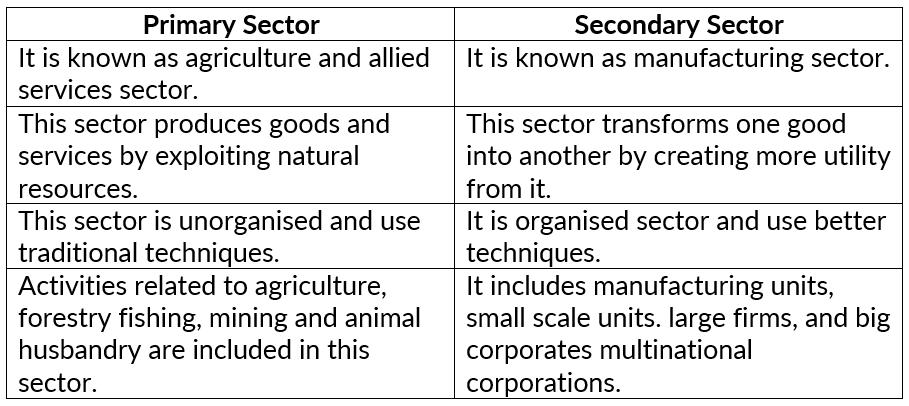
Q2. Distinguish between the primary sector and the secondary sector by stating four points of distinction.

1. Development – Long Answer Questions

Q1. Why do we use averages? Are there any limitations to their use? Illustrate with your own example related to development.

Ans: Averages are commonly used for making comparisons between different groups or classes. However, they have some limitations:

  • Averages only reflect the mean value, which can obscure significant disparities.
  • For example, consider two countries, A and B, each with four citizens:

In Country A: Two citizens are illiterate or have only primary education. The other two hold doctorates or postgraduate degrees.

In Country B: All citizens have graduate-level education. Despite both countries having the same average education level, there are stark differences:

Country A has a wide range of educational attainment. Country B shows less disparity among its citizens. Thus, while averages are useful for comparison, they do not reveal the full picture of inequality within a population.

Q2. List a few examples of environmental degradation that you may have observed around you.

Ans: Examples of Environmental Degradation:

  • Groundwater depletion: In India, many areas are facing serious threats from overuse of groundwater. Approximately 300 districts have seen water levels drop by over 4 metres in the past 20 years.
  • Water scarcity: If current usage continues, it is predicted that in 25 years, 60% of the country will be overusing groundwater.
  • Pollution: Urban and industrial pollution is exceeding the Earth’s capacity to absorb it, affecting air and water quality globally.
  • Resource overexploitation: The excessive extraction of minerals, such as crude oil, impacts not only local environments but also has global repercussions.

These examples illustrate that environmental degradation is a global issue, not confined to specific regions.

Q3. Differentiate between renewable and non-renewable energy resources. Find out the present resources of energy in India.

Ans: Renewable energy resources are those that are naturally replenished and can be used repeatedly. Examples include:

  • Solar energy
  • Wind energy
  • Groundwater

In contrast, non-renewable energy resources are finite and will eventually be depleted. Examples include:

  • Crude oil
  • Coal

In India, current energy resources include:

  • Crude oil
  • Coal
  • Thermal power plants

These resources are projected to last for approximately 43 years. It is essential to explore alternative energy sources that are environmentally friendly.

Q3. (a) What does Human Development Index (HDI) indicate? (b) By whom HDI is prepared?

Ans: (a) Human Development Index (HDI) is a measure that rates countries on a scale from 0 to 1. A score of 0 represents the lowest level of human development, while a score of 1 indicates the highest. Key points about HDI include:

  • It assesses relative human development rather than absolute levels.
  • HDI focuses on three main goals: longevityknowledge, and standard of living, which is reflected in real per capita income.

(b) The United Nations Development Programme (UNDP) has been responsible for preparing the HDI since 1990.

Q4. “Money cannot buy all the goods and services that one needs to live well.” Explain.

Ans: Money cannot buy everything needed for a good life. Here are some key points:

  • A decent income may still require government support for basic needs like education and healthcare.
  • Money cannot purchase respectpeace of mind, or freedom, which are essential for a fulfilling life.
  • It does not guarantee a clean environment or access to safe medicines.
  • Many important aspects of life, such as friendships and community support, cannot be measured in monetary terms.
  • Collective efforts often provide essential services more effectively than individual wealth.

In summary, while money is important, it is not the sole factor in achieving a good quality of life.

Q5. Mention any three characteristics of Development.

Ans: Three characteristics of Development are:

  • The desire to improve one’s current situation drives development. This involves considering ways to enhance our present conditions.
  • Development goals can vary significantly among individuals. For example, your sister’s career aspirations may differ from yours.
  • Different development goals can sometimes conflict. For instance, while a dam may benefit industrialists, it could hinder the development goals of villagers displaced by its construction.

Q6. Explain the two basic tools used to compare an underdeveloped country with a developed country?

Ans: The two basic tools used to compare an underdeveloped country with a developed country are:

  • Per Capita Income: This measures the average income per person in a country. In 2012, countries with a per capita income of USD 12,616 or more were classified as developed, while those earning USD 1,035 or less were considered underdeveloped. The World Bank uses this tool for country comparisons.
  • Human Development Index (HDI): This index ranks countries based on factors such as life expectancy, literacy rates, and overall health. Countries with high life expectancy and literacy are deemed developed, while those with lower rates are classified as underdeveloped. The United Nations employs this tool for comparisons.

Q7. How does the National Development of a country depend on the availability of public facilities?

Ans: National development relies heavily on the availability of public facilities. These facilities help to create equality within the economy, particularly for those who cannot access services from the private sector. Key aspects include:

  • The government often collaborates with private firms to provide essential services like health care and education at reduced rates or for free.
  • In India, the Public Distribution System ensures that food grains and other necessities reach people living below the poverty line.
  • Health care services, including free immunisation and subsidised hospitalisation, are available to support the development of weaker sections of society.

Overall, the provision of these facilities is crucial for fostering a more equitable and developed nation.

Q8. “The Earth has enough for everyone’s needs but not for everyone’s greed.” Explain the need for sustainable development in the context of the above statement.

Ans: The statement, “The Earth has enough for everyone’s needs but not for everyone’s greed,” highlights the issue of overusing natural resources in the name of development. Sustainable development aims to address this by ensuring that:

  • Development occurs without harming the environment.
  • The needs of the current generation are met.
  • Natural resources are conserved for future generations.

By adopting sustainable practices, we can ensure a balance between growth and environmental health.