05. Forest Society and Colonialism – Chapter Notes

Introduction

  • Forests give us many useful things like paper, wood for furniture and doors, spices, dyes, rubber, gum, honey, tea, coffee, tendu leaves (for bidis), sal seed oil (used in chocolates), and medicinal herbs.
  • They also provide bamboo, firewood, grass, charcoal, fruits, flowers, and shelter for animals and birds.
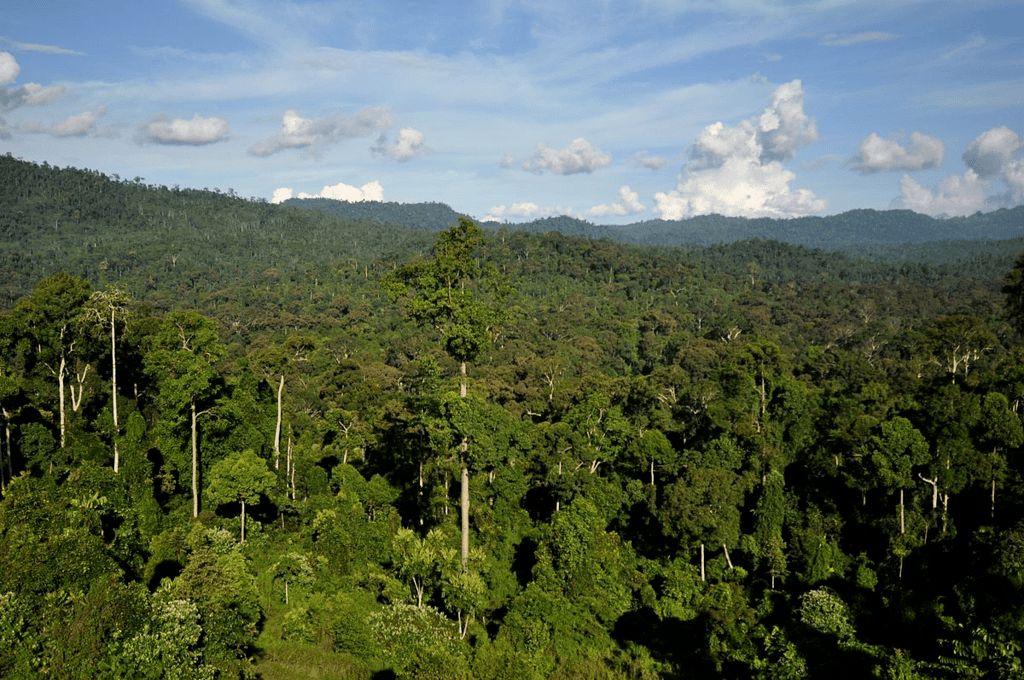
  • Some forests like those in the Amazon and the Western Ghats are very rich in biodiversity, with up to 500 plant species found in a single patch.
  • However, due to industrialisation, about 13.9 million sq km of forest area (or 9.3% of the world’s land) was cleared between 1700 and 1995 for farming, industries, grazing, and collecting firewood.

Try yourself:What is one of the major roles played by forests in the environment?

  • A.Providing a habitat for wildlife
  • B.Generating electricity
  • C.Producing plastic
  • D.Manufacturing cars

View Solution

Why Deforestation?

Deforestation means the cutting down or clearing of forests.

  • It is not a new problem—it started many centuries ago.
  • However, during colonial rule, deforestation became more systematic and happened on a larger scale.

Deforestation

Land to be Improved

  • In 1600, about one-sixth of India’s land was used for farming.
  • Today, nearly half of the land is under cultivation.
  • As population increased, more food was needed, so peasants cleared forests to grow crops.
  • During British rule, cultivation increased rapidly due to several reasons:
    1. The British encouraged the growing of commercial crops like jute, sugar, wheat, and cotton to meet European demand for food and raw materials.
    2. The colonial government believed forests were unproductive and preferred to turn forest land into farmland to earn more revenue.When the valleys were full. 
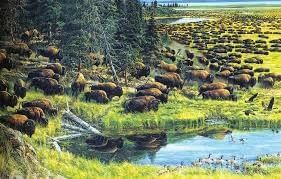
    Painting by John Dawson
  • Between 1880 and 1920, the area under cultivation increased by 6.7 million hectares.
  • While cultivation is often seen as progress, we must remember that it led to large-scale deforestation.

Sleepers on the Tracks
Timber for Ships (Early 19th Century):

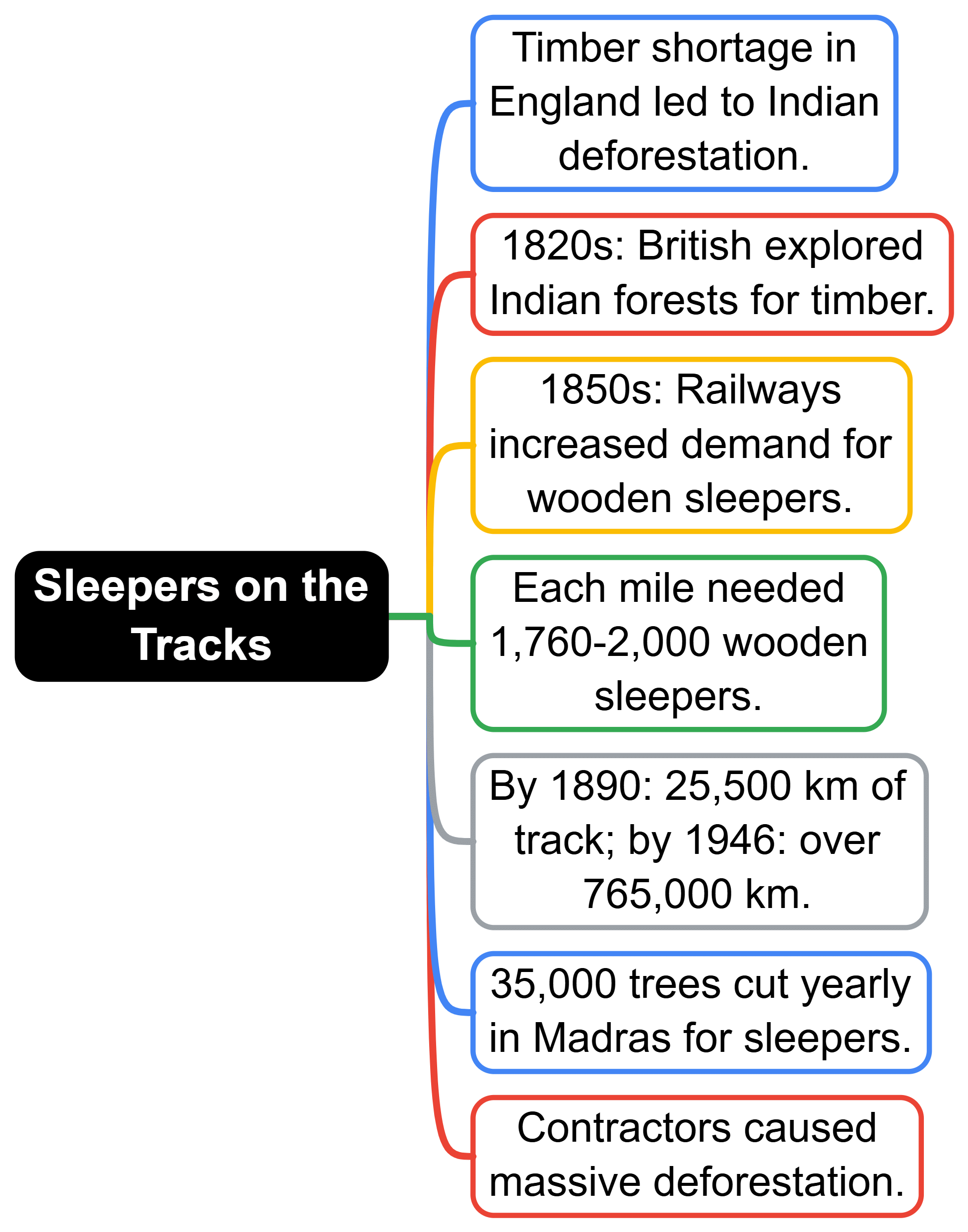
  • By the early 1800s, oak forests in England were disappearing.
  • This caused a shortage of timber for building ships for the Royal Navy.
  • Without strong timber, British ships and their imperial power were at risk.
  • So, by the 1820s, the British started searching Indian forests for timber.
  • Within 10 years, large-scale tree cutting began, and timber was exported from India.

Timber for Railways (From 1850s):

  • Railways were important for colonial trade and military movement.
  • Wood was used as fuel for engines, and wooden sleepers were needed to hold railway tracks.
  • Each mile of track needed 1,760–2,000 sleepers.
  • From the 1860s, railways expanded quickly:
    a) By 1890: ~25,500 km of tracks laid
    b) By 1946: over 765,000 km of tracks laid
  • To meet timber needs:
    a) Thousands of trees were cut—e.g., 35,000 trees per year in Madras Presidency by the 1850s.
    b) The government gave contracts to individuals for timber supply.
    c) Contractors cut trees carelessly, leading to rapid deforestation, especially near railway tracks.
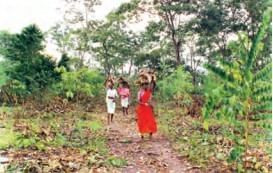
Women returning home after collecting fuelwood.

Plantations

  • Natural forests were cleared to create tea, coffee, and rubber plantations.
  • This was done to meet Europe’s growing demand for these goods.
  • The colonial government took control of forest lands and gave large areas to European planters at cheap prices.
  • These lands were enclosed, forests were cut down, and tea or coffee plants were grown instead.
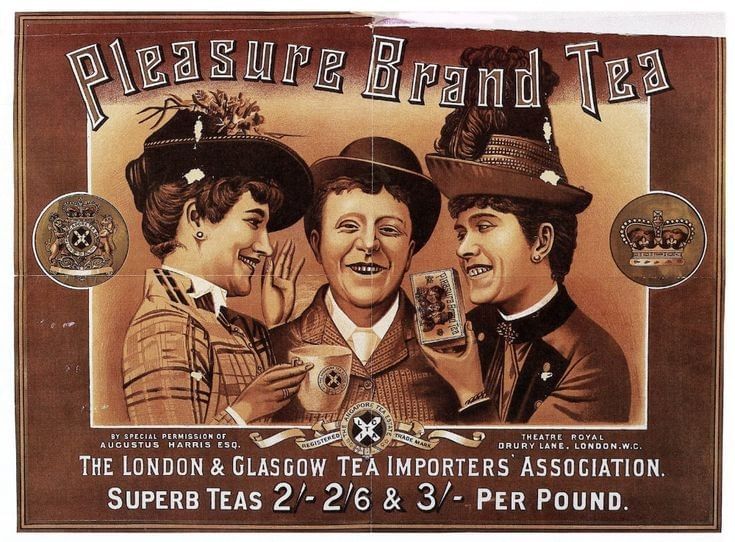
Pleasure Brand Tea

Try yourself:

What was one of the major reasons for deforestation in India during the colonial period?

  • A.Expansion of cultivation for commercial crops.
  • B.Increase in population and demand for food.
  • C.Search for alternatives to oak timber in England.
  • D.Establishment of plantations for tea and coffee.

View Solution

The Rise of Commercial Forestry

  • The British needed forests for ships and railways.
  • They feared that local people and traders would destroy forests through excessive tree cutting.
  • So, they invited Dietrich Brandis, a German forest expert, and made him the first Inspector General of Forests in India.
  • Brandis introduced a forest management system and trained people in forest conservation.
  • He set up the Indian Forest Service in 1864.
  • He helped create the Indian Forest Act in 1865, which was later amended in 1878 and 1927.
  • The Imperial Forest Research Institute was established at Dehradun in 1906.
The Imperial Forest School, Dehra Dun, India. (The first forestry school to be inaugurated in the British Empire)

  • In this system, natural forests with many types of trees were cut down.
  • Instead, only one type of tree was planted in straight rows — this is called a plantation.
  • Forest officials made working plans to decide how much area to cut and replant every year.

Forest Act of 1878:

Forests were divided into three types:

  1. Reserved Forests – Most strictly controlled; villagers were not allowed to take anything.
  2. Protected Forests – Some access allowed to locals.
  3. Village Forests – Local people could collect wood for fuel or house-building.

Try yourself:Indian Forest Service was set up in the year….? 

  • A.1865
  • B.1864
  • C.1854
  • D.1884

View Solution

How were the Lives of People Affected?

Different Ideas of a Good Forest:

  • Villagers wanted forests with a mix of trees to meet their daily needs like fuel, fodder, food, and leaves.
  • The British forest department only wanted tall, straight trees like teak and sal that were useful for making ships and railway sleepers.
  • So, only selected species were planted, and other trees were cut down.

How Villagers Used Forests:

  • Villagers collected roots, leaves, fruits, and tubers for food, especially during monsoon before harvest.
  • Herbs were used as medicine.
  • Wood was used to make farming tools like ploughs and yokes.
  • Bamboo was used for fences, baskets, and umbrellas.
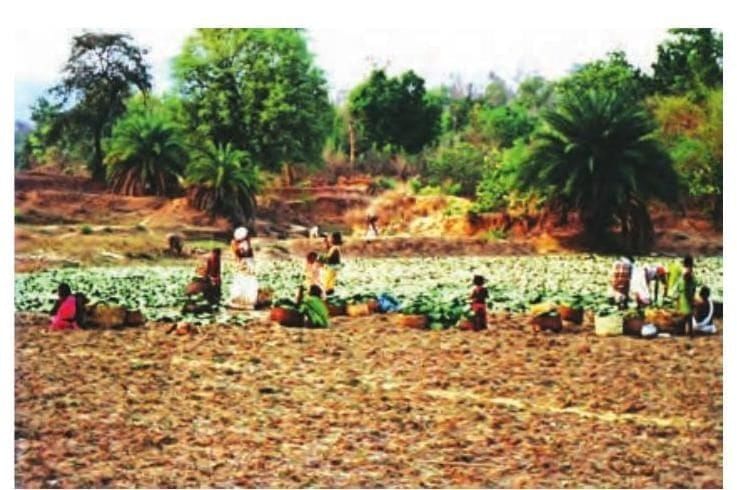
Drying tendu leaves

  • A dried gourd was used as a water bottle.
  • Leaves were stitched into plates and cups.
  • The siadi creeper was used to make ropes.
  • The semur tree bark was used to grate vegetables.
  • Mahua fruit was used to make cooking oil and lamp oil.

Impact of the Forest Act on Villagers:

  • The Forest Act made all traditional activities illegal — cutting wood, grazing cattle, collecting fruits, roots, and hunting.
  • People were forced to steal wood, and forest guards took bribes if they were caught.
  • Women, who collected fuelwood, were especially affected and harassed.
  • Forest guards and police often demanded free food and troubled villagers.
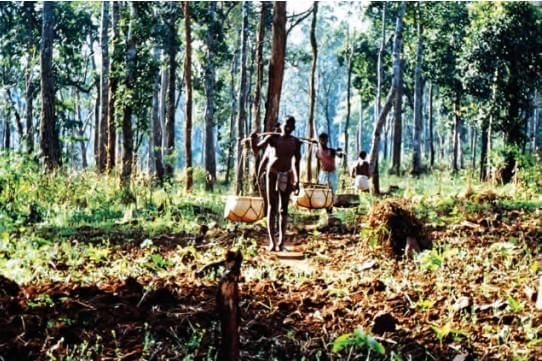
Bringing grain from the threshing grounds to the field.

How did Forest Rules Affect Cultivation?

  • Shifting cultivation (swidden agriculture) is a traditional farming method used in Asia, Africa, and South America.
  • In this method, forest land is cut and burnt, and seeds are sown in the ashes after the first monsoon rains.
  • Crops are harvested by October–November, and the land is left fallow for 12 to 18 years to allow forests to grow back.
  • Mixed crops are grown, such as millets in central India and Africa, manioc in Brazil, and maize and beans in Latin America.
  • Local names for this practice include lading (Southeast Asia), milpa (Central America), chitemene/tavy (Africa), chena (Sri Lanka), and dhya, jhum, podu, kumri in India.
  • British foresters disliked shifting cultivation because they thought it damaged forests and destroyed valuable timber.
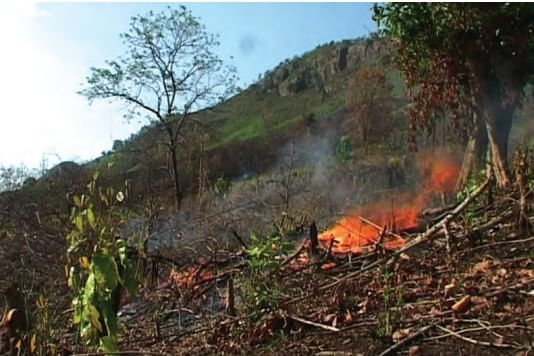
Burning the forest penda or podu plot.

  • It also made tax collection difficult, as the land was not permanently used.
  • So, the British government banned shifting cultivation.
  • This led to displacement of tribal communities and forced many to change their way of life or occupation.
  • Some communities resisted the ban through revolts and protests.

Who could Hunt?

  • Before forest laws, many people living near forests hunted animals like deer and birds for survival.
  • After the forest laws were introduced, hunting was banned, and those caught were punished for poaching.
  • At the same time, British officials and Indian kings hunted big animals like tigers and leopards for sport.
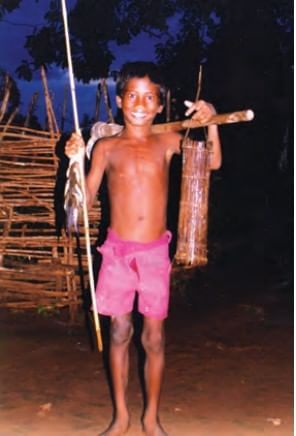
The little fisherman

  • Hunting was a royal tradition in India, especially among Mughal rulers, but under British rule, the scale of hunting increased greatly.
  • The British saw large wild animals as dangerous and savage, and believed that killing them would civilise India.
  • Rewards were given for killing wild animals like tigers, wolves, and leopards to protect farmers.
  • Between 1875 and 1925, over 80,000 tigers, 150,000 leopards, and 200,000 wolves were killed.
  • The Maharaja of Sarguja alone killed 1,157 tigers and 2,000 leopards by 1957.
  • A British officer, George Yule, killed 400 tigers.
  • Some forests were reserved only for hunting by rulers and officials.
  • Only later did environmentalists and conservationists begin to argue that these animals should be protected, not hunted.

New Trades, New Employment and New Services

  • After the forest department took control, many people lost their traditional rights, but some gained from new trade opportunities.
  • Several communities gave up their old occupations and started trading in forest products.
  • This change happened not just in India, but around the world.
  • For example, in Brazil, the Mundurucu people shifted from farming manioc to collecting latex from wild rubber trees to supply traders. They later moved to trading posts and became dependent on traders.
  • In India, trade in forest products like elephants, hides, horns, silk cocoons, ivory, bamboo, spices, gums and resins was already present during the medieval period, often through Banjaras (a nomadic trading community).
  • Under British rule, forest trade was strictly controlled:
    – The government gave European trading companies the exclusive right to trade in certain forest areas.
    – Local people’s activities, like grazing and hunting, were restricted.
  • As a result, pastoral and nomadic groups like KoravaKaracha, and Yerukula in the Madras Presidency lost their livelihoods. Some were even labelled as ‘criminal tribes’ and were forced to work in factories, mines, or plantations.
  • New job opportunities did not always improve people’s lives. In AssamSanthalsOraons, and Gonds were recruited to work on tea plantations.
  • They were paid very low wages, worked in bad conditions, and could not easily return to their home villages.

Rebellion in the Forest

  • In many parts of India and the world, forest communities rebelled against the new changes brought by the British.
  • These rebellions were led by local heroes, who are still remembered today in songs and stories. Examples include Siddhu and Kanu in the Santhal Parganas, Birsa Munda of Chhotanagpur and Alluri Sitarama Raju of Andhra Pradesh.
  • One major rebellion took place in Bastar (present-day Chhattisgarh) in 1910.

The People of Bastar

  • Bastar is located in the southernmost part of Chhattisgarh, bordering Andhra Pradesh, Odisha, and Maharashtra.
  • The central part of Bastar lies on a plateau.
    – To the north is the Chhattisgarh plain.
    – To the south is the Godavari plain.
    – The Indrawati River flows from east to west through Bastar.
  • Bastar is home to many communities such as the Maria and Muria Gonds, Dhurwas, Bhatras, and Halbas.
  • These groups speak different languages but share common customs and beliefs.
  • People believe that the Earth gave land to each village, so they honour the Earth with offerings during agricultural festivals.
  • They also respect the spirits of rivers, forests, and mountains.
  • Each village has clearly known boundaries and takes care of the natural resources within them.
    – If villagers need wood from another village’s forest, they pay a small fee called devsaridand, or man.
    – Some villages hire watchmen to protect the forests, and each household contributes grain to support them.
  • Every year, a big hunt is organised where village headmen from a pargana (cluster of villages) gather to discuss important matters, including forest concerns.

People of BastarThe Fears of the People

  • 1905 Proposal: The British colonial government proposed reserving two-thirds of the forest, which included stopping shifting cultivation, hunting, and collection of forest produce.
  • Impact on Villagers: Villages within reserved forests were forced to work for the forest department, becoming ‘forest villages’. Other villages were displaced without compensation.
  • Economic Hardship: Increased land rents, demands for free labor and goods, and famines in 1899-1900 and 1907-1908 exacerbated the villagers’ suffering.
  • Resistance: Villagers, led by figures like Gunda Dhur, organized a rebellion using symbols like mango boughs and arrows. They looted bazaars, attacked colonial officials, and redistributed grain.
  • British Response: The British sent troops to suppress the rebellion, leading to severe reprisals including flogging and burning of villages. Gunda Dhur evaded capture, and the rebellion temporarily halted reservation work and reduced the reserved area by half.
  • Forest Reservation: After Independence, the practice of reserving forests for industrial use continued. In the 1970s, a proposal to replace natural sal forests with tropical pine for paper production was halted only after local protests.
  • Comparison: Similar issues of forest reservation and local resistance occurred in other parts of Asia, such as Indonesia.

Try yourself:

What was the primary reason for the rebellion in the forests of Bastar?

  • A.Loss of traditional hunting rights
  • B.Forced labor for the forest department
  • C.The proposal to reserve two-thirds of the forests
  • D.Increase in land rents and demands for free labor

View Solution

Forest Transformations in Java

  • Java, now well known for rice production, was once largely covered with forests.
  • The Dutch were the colonial rulers in Indonesia, and their forest control laws were quite similar to those in British India.
  • Java was the place where the Dutch initiated forest management in Indonesia.
  • Like the British in India, the Dutch wanted timber from Java to build ships. Around the year 1600, Java had an estimated population of 3.4 million.
  • While many villages existed in the fertile plains, several communities also lived in the mountains and practised shifting cultivation.

The Woodcutters of Java

  • The Kalangs of Java were a community known for their skill in forest cutting and shifting cultivation.
  • In 1755, when the Mataram kingdom split, the 6,000 Kalang families were divided equally between the two new kingdoms due to their importance.
  • Their expertise was essential for harvesting teak and constructing royal palaces.
  • In the eighteenth century, as the Dutch took control of forests, they attempted to force the Kalangs to work for them.
  • In 1770, the Kalangs resisted this control by attacking a Dutch fort at Joana, but their rebellion was suppressed.

Dutch Scientific Forestry

  • In the 19th century, the Dutch began to focus on controlling forest territory in Java, not just the people.
  • They enacted forest laws that restricted villagers’ access to the forests.
  • Wood could only be cut for specific purposes like building boats or houses, and only from designated forests under strict supervision.
  • Villagers were punished for grazing cattle in young forest areas, transporting wood without a permit, or travelling on forest roads with carts or cattle.
  • Like in India, the Dutch needed timber for shipbuilding and railways, which led to the creation of a forest service.
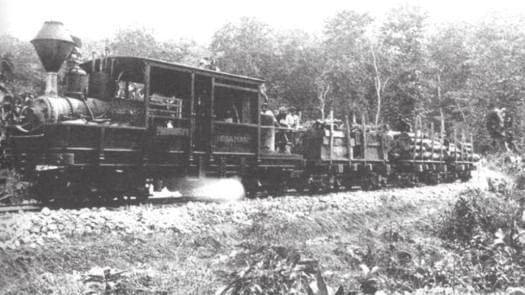
Train transporting teak out of the forest – late colonial period.

  • In 1882 alone, 280,000 sleepers were exported from Java.
  • This timber production required a large amount of labour for cutting, transporting, and processing the logs.
  • The Dutch imposed rents on land cultivated in forests, but later exempted some villages if they supplied free labour and buffaloes—this system was called blandongdiensten.
  • Eventually, the Dutch paid small wages to the forest villagers instead of giving rent exemptions, but continued to restrict their right to cultivate forest land.

Samin’s Challenge

  • Around 1890, Surontiko Samin from Randublatung, a village in a teak forest area, began to question the state’s ownership of the forest.
  • He argued that since the state did not create natural elements like wind, water, earth, and wood, it had no right to own them.
  • A widespread movement soon developed around his ideas.
  • Samin’s sons-in-law were among the people who helped organise the movement.
  • By 1907, around 3,000 families had started following Samin’s ideas.
  • Some Saminists protested by lying down on their land when Dutch officials came to survey it.

 War and Deforestation

  • The First and Second World Wars had a major impact on forests.
  • In India, forest working plans were abandoned, and the forest department cut trees freely to meet British war demands.
  • In Java, before the Japanese occupation, the Dutch adopted a ‘scorched earth’ policy by destroying sawmills and burning large teak log piles to prevent them from falling into Japanese hands.
  • After taking over, the Japanese exploited the forests heavily for their war industries.
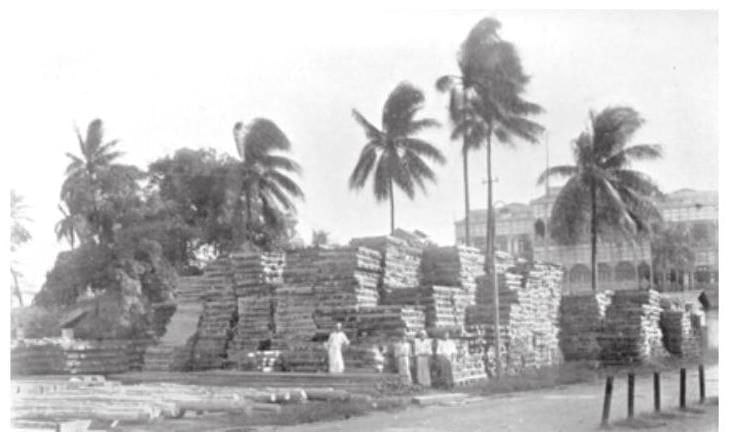
Indian Munitions Board, War Timber Sleepers piled at Soolay pagoda ready for shipment,1917.

  • They forced forest villagers to cut down trees for them.
  • Many villagers took this chance to clear more forest land for cultivation.
  • After the war, the Indonesian forest service found it difficult to reclaim this land.
  • Like in India, the growing need for agricultural land led to conflict between local people and the forest department, which wanted to control and restrict access to forests.

New Developments in Forestry

  • Since the 1980s, many governments in Asia and Africa have realised that scientific forestry and excluding forest communities have led to conflicts.
  • Conservation of forests has become more important than just collecting timber.
  • Governments now understand that involving people living near forests is essential for forest conservation.
  • In India, dense forests have often survived because local villages protected them as sacred groves, called sarnas, devarakudu, kan, rai, and others.
  • Some villages manage their forests by patrolling them themselves, with each household taking turns, rather than relying on forest guards.
  • Today, local communities and environmentalists are exploring new ways to manage forests together.

Try yourself:The Kalangs resisted the Dutch in

  • A.1700
  • B.1750
  • C.1770
  • D.1800

View Solution

Key Terms

  1. Colonialism – The policy of acquiring and maintaining colonies, typically for economic exploitation.
  2. Deforestation – The action of clearing a wide area of trees.
  3. Exploitation – The action of making use of and benefiting from resources.
  4. Ecological – Relating to or concerned with the relation of living organisms to one another and to their physical surroundings.
  5. Monopoly – The exclusive possession or control of the supply or trade in a commodity or service.
  6. Surplus – An amount of something left over when requirements have been met.
  7. Displacement – The forced movement of people from their locality or environment.
  8. Indentured – Bound by a formal agreement to work for a specific period in exchange for passage to a new country.
  9. Commercial – Concerned with or engaged in commerce.
  10. Subordination – The action or state of being lower in rank or position.
  11. Revenues – Income generated from normal business operations.
  12. Bureaucracy – A system of government in which most of the important decisions are made by state officials rather than by elected representatives.
  13. Cultivation – The action of cultivating land or crops.
  14. Incentives – Things that motivate or encourage someone to do something.
  15. Epidemics – Widespread occurrences of infectious diseases in a community at a particular time.
  16. Eviction – The action of expelling someone from a property.
  17. Prohibited – Formally forbidden by law, rule, or other authority.

04 . Pastoralists in the Modern World – Chapter Notes

Introduction

Nomads form a unique group characterized by their mobile lifestyle, continuously moving in search of livelihood. 

  • Nomad people depend primarily on animal rearingGoats, sheep, camels, and buffaloes are the main animals reared by the nomads. Some of the nomads also cultivate crops.

Sheep grazing on the Bugyals of Eastern Garhwal

  • Movements: Nomads do not move randomly across the landscape but have a strong sense of territoriality. They are aware of the physical and cultural characteristics of the region of their movement.
  •  Food: Pastoral nomads consume mostly grain rather than meat. They consume wheat, rice, bajra, and maize. Some of the food grains are grown by themselves, and some are arranged from the path of their movement.
  • Economic life: Most of the nomadic people follow a barter system, though some use money also. They exchange animals for food or grains.
  • Selection of animal: Nomads select the type and number of animals for the herd according to local cultural and physical characteristics. The choice depends on the relative prestige of animals and the ability of species to adapt to particular climates and vegetation. The camel is most frequently desired in North Africa and the Middle East, followed by sheep and goats.

In this chapter you will see how pastoralism has been important in societies like India and Africa.

Try yourself:

Which animals are most frequently desired by nomads in North Africa and the Middle East?

  • A.Cows
  • B.Buffaloes
  • C.Camels
  • D.Horses

View Solution

Pastoral Nomads and their MovementsIn the MountainsThe Gujjar Bakarwals:

  • Traditionally herders of goats and sheep, known for their nomadic lifestyle.
  • Migrated to Jammu and Kashmir in the 19th century in search of better pastures.
  • Followed a cyclical migration pattern, moving between summer and winter grazing grounds.
  • Spent winters in the low hills of the Siwalik range, where dry scrub forests provided grazing land.
  • By late April, they migrated northward in groups (called kafilas) to their summer pastures in the lush green mountains of Kashmir, benefiting from the nutritious grasses.
  • Returned to their winter grazing grounds by late September as the mountains became snow-covered.

A Gujjar Mandap on the high mountains in central Garhwal. 

The Gaddi shepherds: 

  • Winter Grazing: Gaddi shepherds of Himachal Pradesh spent their winter in the low hills of the Shiwalik range, grazing their flocks in scrub forests.
  • Summer Movement: By April, they moved north to spend the summer in Lahul and Spiti. When the snow melted and the high passes were clear, they moved to higher mountain meadows.
  • Harvesting and Sowing: By September, they began their return journey, stopping in the villages of Lahul and Spiti to reap their summer harvest and sow their winter crop.
  • Return to Winter Grounds:  Descended to their winter grazing grounds in the Siwalik hills, repeating the cycle annually.

Movement in Garhwal and Kumaon: 

  • Migrated from Jammu to the hills of Uttar Pradesh (now Uttarakhand) in the 19th century in search of good pastures.
  • Wintered in the dry forests of the bhabar region.
  • In summer, moved to the high-altitude meadows, known as bugyals, where their cattle grazed on the rich alpine vegetation.

Other Pastoral nomads: 

  • Other pastoral groups like the BhotiyasSherpas, and Kinnauris followed similar patterns of cyclical migration.
  • Seasonal movement was essential for adapting to changing climatic conditions and making the best use of available pastures in different regions.
  • When pastures were depleted or unusable in one area, they moved to new regions, allowing the grasslands to recover and preventing overgrazing.

Let’s Revise 

Q: Describe the migration pattern of the Gujjar Bakarwals and explain how it was adapted to seasonal changes.

View Answer  

Q: How did the Gaddi shepherds manage their livelihood through seasonal migration?

View Answer  

On the Plateaus, Plains and Deserts

The Dhangars: 

  • Important pastoral community with a population of approximately 467,000 in the early 20th century.
  • Primarily shepherds, but some were blanket weavers and buffalo herders.
  • Stayed in the semi-arid central plateau of Maharashtra during the monsoon, grazing their flocks on bajra fields.
  • By October, they migrated west to the Konkan region, a fertile agricultural area with high rainfall.
  • Their sheep manured the fields after the kharif harvest, preparing them for rabi crops, and in return, they received rice from Konkani peasants.
  • Returned to the plateau before the onset of the next monsoon as their sheep couldn’t tolerate wet conditions.

Raika camels grazing on the Thar desert in western Rajasthan. 

The Gollas, Kurmas, and Kurubas: 

  • In Karnataka and Andhra Pradesh, the dry central plateau was covered with grass inhabited by cattlegoat, and sheep herders.
  • Gollas: Cattle herders.
  • Kurumas and Kurubas: Sheep and goat rearers, also known for weaving and selling blankets.
  • Lived near woods, cultivated small land patches, and engaged in various trades.
  • Seasonal migration driven by the monsoon cycle: moved to coastal regions in the dry season and returned to the plateau during the wet monsoon.

Banjaras:Banjaras

  • Well-known group of graziers found in Uttar Pradesh, Punjab, Rajasthan, Madhya Pradesh, and Maharashtra.
  • Nomadic, traveled long distances in search of good pastures for their cattle.
  • Engaged in trade, selling plough cattle and goods in exchange for grain and fodder.

The Raikas

  • Raikas were the nomads of Rajasthan. They were divided into two groups. One group of Raikas-known as the Maru Raikas-herded camels, and another group reared sheep and goats. Cultivation and pastoralism were their primary activities. 
  • During the monsoon, they stayed in their home villages where pasture was available. 
  • By October, when these grazing grounds were dry and exhausted, they moved out in search of other pastures and water.

Let’s Revise

Q: How did the Dhangars of Maharashtra adapt their lifestyle to the seasonal changes in their environment?

View Answer  

Q: Describe the livelihood strategies of the Raikas of Rajasthan.

View Answer  

Life of Pastoral Groups

  • Sustained by consideration of factors like duration in one area, water, and pasture.
  • Calculated movement timing, and established relationships with farmers for grazing.
  • Engaged in cultivation, trade, and herding for livelihood.

Colonial Rule and Pastoral Life 

Transformation of Grazing Lands

  • Colonial state sought to transform grazing lands into cultivated farms to increase land revenue.
  • Waste Land Rules” were enacted from the mid-19th century, converting uncultivated lands (often used by pastoralists) into agricultural lands.
  • Decline in pastures due to expansion of cultivation created challenges for pastoral communities.

Forest Acts

  • Forests were classified as “Reserved” or “Protected,” restricting pastoralists‘ access.
  • Customary grazing rights were limited, and movement within forests was regulated.
  • Officials believed grazing harmed tree growth, affecting pastoralists who relied on forest forage.

Regulation of Pastoral Movements

  • Forest Department permits controlled pastoralists’ entry, specifying timing and duration.
  • Pastoralists faced fines if they overstayed, disrupting their traditional mobility for grazing.

Try yourself:What factors sustained the life of pastoral groups?

  • A.Duration in one area, water, and pasture
  • B.Access to forests, trade, and cultivation
  • C.Colonial rule, forest acts, and waste land rules
  • D. Dependence on seasonal crops, settled farming, and use of stored food reserves

View Solution

Waste Land Rules

Under the Waste Land Rule, uncultivated land was brought under cultivation. The basic aim was to increase land revenue because by expanding cultivation, the Government could increase its revenue collection. Crops like jute, cotton, and indigo were used as raw materials in England. So, the British government wanted to bring more and more areas under these crops.

WasteLand 

Impact on the lives of the pastoralists:

(i) After the Act, pastoral movements were restricted.

(ii) Under the Act, the grazing land was given to big landlords. Due to this, nomads’ grazing grounds shrank.

(iii) Due to shrinking grazing grounds, the agricultural stock of the nomads declined, and their trade and crafts were adversely affected.

Settlement Policies

  • British officials preferred settled populations, distrusting nomadic lifestyles.
  • The Criminal Tribes Act (1871) classified mobile communities as criminal, restricting their movement.

Pastoralists in India 

Criminal Tribes Act

  • In 1871, the colonial government in India passed the Criminal Tribes Act. By this Act, many communities of craftsmen, traders, and pastoralists were classified as Criminal tribes. 
  • They were stated to be criminals by nature and birth. Once this Act came into force, these communities were expected to live only in notified village settlements
  • They were not allowed to move out without a permit. The village police kept a continuous watch on them. This restricted their grazing grounds. 
  • Their agricultural stock declined, and their trades and crafts were adversely affected.

Taxation Policies

  • The colonial government imposed taxes on various resources, including land, water, salt, trade goods, and animals.
  • Pastoralists faced grazing taxes, auctioned to contractors in the mid-19th century, and later collected directly by the government.

Grazing Tax

  • Imposed on pastoralists: Pastoralists had to pay tax on every animal they grazed on the pastures.
  • Introduction: A grazing tax was introduced in the mid-nineteenth century.
  • Tax increase: The tax per head of cattle went up rapidly, and the system of collection was made increasingly efficient.
  • Contractor system: Between the 1850s and 1880s, the right to collect the tax was auctioned out to contractors.
  • Profit extraction: Contractors tried to extract as high a tax as they could to recover the money paid to the state and earn as much profit as possible.
  • Direct collection: By the 1880s, the government began collecting taxes directly from the pastoralists.
  • Pass system: Each pastoralist was given a pass. To enter a grazing tract, a cattle herder had to show the pass and pay the tax. The number of cattle heads and the amount of tax paid was recorded on the pass.

Try yourself:

What was the purpose of implementing the Waste Land Rule in India during British colonial rule?

  • A.To restrict pastoral movements and limit grazing grounds.
  • B.To increase land revenue by expanding cultivation of crops like jute, cotton, and indigo.
  • C.To classify mobile communities as criminal and restrict their movement.
  • D.To impose taxes on various resources, including land, water, salt, trade goods, and animals.

View Solution

How Did These Changes Affect the Lives of Pastoralists? 

– Shortage of Pastures:

  • Grazing lands were reduced as they were converted into cultivated fields.
  • Forest reservation restricted pastoralists’ access to previously available forest pastures.

– Intensive Grazing:

  • With fewer grazing areas available, pastoralists were forced to continuously graze their animals on limited land.
  • Lack of movement opportunities disrupted the natural recovery of vegetation, leading to overgrazing and depletion of pasture quality.

– Decline in Animal Stock:

  • Continuous grazing on diminished pastures led to a shortage of forage.
  • Weakened animals faced higher mortality rates, particularly during times of scarcity and famine, further diminishing livestock numbers.

How Did the Pastoralists Cope with These Changes?

1. Reduction in Herd Size:

  • Pastoralists faced with limited pasture reduced the number of cattle in their herds.
  • The scarcity of grazing lands influenced their decision to downsize their herds.

2. Exploration of New Pastures:

  • Pastoralists sought new grazing areas when traditional grounds became inaccessible due to various reasons, such as political boundaries.
  • For example, camel and sheep herding Raikas had to find alternative places for grazing after 1947 due to new political boundaries between India and Pakistan.

3. Shift to Sedentary Life:

  • Some wealthier pastoralists opted for settled life by purchasing land and abandoning their nomadic lifestyle.
  • This transition included becoming settled peasants engaged in cultivation or taking up extensive trading.

4. Financial Adaptations:

  • Poor pastoralists faced financial challenges and often borrowed money from moneylenders to survive.
  • At times, they lost their livestock, forcing them to become laborers working in fields or small towns.

5. Adaptation and Diversification:

  • Despite challenges, pastoralists adapted by changing the direction of their movement and reducing herd sizes.
  • They combined pastoral activities with other forms of income to adapt to changes in the modern world.
  • Ecologists argue that pastoralism remains ecologically viable, especially in dry regions and mountains.

Try yourself:

How did the reduction in available pasture affect the lives of pastoralists?

  • A.It led to an increase in the quality of remaining pastures.
  • B.It resulted in a decrease in the number of cattle in their herds.
  • C.It allowed pastoralists to explore new opportunities for trade.
  • D.It had no significant impact on the lives of pastoralists.

View Solution

Pastoralism in Africa

  • Over half of the world’s pastoral population resides in Africa.
  • Presently, more than 22 million Africans depend on pastoral activities for their livelihoods.
  • Communities such as Bedouins, Berbers, Maasai, Somali, Boran, and Turkana engage in pastoral activities.
  • The majority of African pastoralists inhabit semi-arid grasslands or arid deserts where rainfed agriculture is challenging.
  • African pastoralists raise a variety of animals, including cattle, camels, goats, sheep, and donkeys.
  • They derive livelihood by selling products like milk, meat, animal skin, and wool.
  • Pastoralists employ diverse economic strategies, combining pastoral activities with agriculture, engaging in trade and transport, and taking up odd jobs to supplement income.

Pastoral Communities in Africa

Where have the Grazing Lands Gone?

  • Colonial Partition (1885): Maasailand split between British Kenya and German Tanganyika.
  • 60% Land Loss: Maasai lost 60% of their pre-colonial lands.
  • Forced Relocation: Maasai were pushed into arid areas with poor rainfall.
  • White Settlements: Fertile grazing lands taken over by European settlers.
  • Shrinking Territory: Maasai confined to small areas in southern Kenya and northern Tanzania.
  • Peasant Expansion: Colonial government promoted cultivation, converting grazing lands to farmland.
  • Loss of Dominance: Maasai’s economic and political power declined due to land loss.
  • Creation of Game Reserves: Large grazing areas turned into reserves like Maasai Mara and Serengeti.
  • Restricted Access: Maasai were banned from reserves, losing grazing and hunting rights.
  • Impact of Serengeti Park: Serengeti National Park took over 14,760 km² of Maasai land.
  • Deteriorating Pastures: Overgrazing in small areas led to pasture degradation.
  • Fodder Shortages: Reduced grazing lands created persistent fodder shortages.
  • Feeding Struggles: Cattle suffered from lack of sufficient grazing and water resources.
  • Increased Pressure: Limited land availability led to resource pressure and environmental decline.
  • Pastoralists were barred from white areas’ markets and often restricted from trade, perceived as dangerous by settlers.
  • Despite attempts to isolate, complete separation was impractical due to reliance on black labour.
  • Territorial boundaries and restrictions significantly disrupted pastoralists’ lives, affecting both herding and trading activities.
  • Pastoralists, once engaged in both activities, faced limitations on trade under colonial rule.

Try yourself:

What is the primary livelihood of over 22 million Africans?

  • A.Rainfed agriculture
  • B.Pastoral activities
  • C.Trade and transport
  • D.Odd jobs

View Solution

The Borders are Closed

  • Colonial Restrictions: African pastoralists faced mobility restrictions imposed by colonial governments in the late 19th century.
  • Confinement to Reserves: Pastoralists, including the Maasai, were forced to live within special reserves, limiting their movement.
  • Permit System: Movement outside reserves required difficult-to-obtain permits, with punishments for violations.
  • Market and Trade Restrictions: Pastoralists were banned from white-settler markets and faced limitations on trade.
  • Impact on Livelihood: These restrictions disrupted pastoral and trading activities, significantly altering their way of life.

When Pastures Dry 

  • Drought Effects: Drought causes cattle starvation when pastures are dry.
  • Nomadic Survival: Traditional nomadism helps pastoralists find forage.
  • Colonial Constraints: Colonial restrictions confined Maasai to fixed reserves.
  • Decline in Livestock: Shrinking grazing lands worsened the impact of droughts.

Pastoral community in Kenya at high risk from climate change

  • Confinement: Increased vulnerability, leading to cattle losses in severe droughts, with a substantial decline in the Maasai livestock population.
  • 1930 Inquiry: Showed the Maasai in Kenya had substantial livestock, but severe drought in 1933 and 1934 resulted in the death of over half the cattle in the Maasai Reserve.
  • Grazing Lands: Reduction in grazing lands intensified the adverse impact of droughts, contributing to a steady decline in pastoralists’ animal stock.

Not All were Equally Affected

  • Impact Variance: In Maasailand, as in other parts of Africa, the impact of colonial changes varied among pastoralists.
  • Social Categories: Pre-colonial Maasai society had two main social categories: elders and warriors, with elders in a ruling role and warriors responsible for defense and cattle raids.
  • British Measures: The British introduced measures, appointing chiefs for sub-groups, imposing restrictions on raiding and warfare, affecting the traditional authority of both elders and warriors.
  • Wealth Disparity: Chiefs appointed by the colonial government often accumulated wealth, had regular income, engaged in trade, and lived in towns, while their families managed the villages.
  • Poor Pastoralists: Struggled during wars and famines, losing everything. Many had to seek work in towns, engaging in activities like charcoal burning or odd jobs.
  • Social Changes: Occurred on two levels: disruption of traditional age-based distinctions and the emergence of a new divide between wealthy and poor pastoralists in Maasai society.

Let’s Revise: How did colonial policies affect the mobility and livelihood of African pastoralists like the Maasai?

View Answer  

Conclusion

  • Global Impact: Pastoral communities worldwide face varied impacts from modern changes.
  • Movement Restrictions: New laws and borders restrict pastoralist mobility.
  • Grazing Issues: Disappearing pastures and overgrazing lead to deteriorated grazing conditions.
  • Drought Crisis: Droughts cause significant cattle losses.
  • Adaptation: Pastoralists adjust by changing movement paths, reducing cattle numbers, and seeking rights and support.
  • Modern Relevance: Pastoral nomadism is increasingly recognized as viable for many dry and hilly regions.

Difficult Words

  1. Pastoralists – People who raise livestock and move with their herds in search of fresh pastures.
  2. Nomadic – Moving from one place to another rather than living in one place all the time.
  3. Transhumance – The practice of moving livestock from one grazing ground to another in a seasonal cycle.
  4. Colonialism – The policy or practice of acquiring full or partial control over another country, occupying it with settlers, and exploiting it economically.
  5. Territories – Areas of land under the jurisdiction of a ruler or state.
  6. Grazing – The act of animals eating grass in a pasture.
  7. Subsistence – The action or fact of maintaining or supporting oneself at a minimum level.
  8. Revenue – Income, especially when of a company or organization and of a substantial nature.
  9. Commercialization – The process of managing or running something principally for financial gain.
  10. Fluctuations – Irregular rising and falling in number or amount; variations.
  11. Encroachment – Intrusion on a person’s territory, rights, etc.
  12. Tribal – Relating to a group of people who are united by ties of descent from a common ancestor.
  13. Scattered – Spread or thrown over a wide area.
  14. Perennial – Lasting or existing for a long or apparently infinite time.
  15. Reclamation – The process of claiming something back or reasserting a right.
  16. Migration – Seasonal movement of animals from one region to another.
  17. Subsistence Economy – An economy in which people make just enough to survive and nothing more.

03. Nazism and the Rise of Hitler – Chapter Notes

Introduction

  • In spring 1945, eleven-year-old Helmuth overheard his parents having a serious conversation about the possibility of killing the family or his father committing suicide alone.
  • His father, a prominent physician, feared revenge from the Allies, believing they would retaliate as the Germans did to the Jews and the disabled.
  • The next day, Helmuth and his father spent their last happy moments in the woods before his father shot himself.
  • Helmuth was deeply traumatized by these events and refused to eat at home for nine years, fearing his mother might poison him.
  • Helmuth’s father was a Nazi and a supporter of Adolf Hitler, who aimed to make Germany a mighty power and conquer Europe.
  • Nazism was a structured system of ideas about the world and politics, not just isolated actions.
  • In May 1945, Germany surrendered to the Allies after Hitler, Goebbels, and his family committed suicide in April 1945.

Genocidal War

  • Nazi Germany’s actions led to the mass murder of millions, including around 6 million Jews200,000 Gypsies1 million Polish civilians, and 70,000 Germans who were viewed as mentally or physically disabled, along with countless political opponents.
  • The Nazis created a new method of killing, especially through gassing at extermination camps like Auschwitz.

Nuremberg Tribunal

  • The Nuremberg Tribunal was set up to try Nazi war criminals for Crimes against PeaceWar Crimes, and Crimes Against Humanity.
  • It sentenced only eleven top Nazis to death, while many others received life imprisonment.
  • Although some justice was served, the punishments were much less than the scale of their crimes. 
  • The Allies aimed to be less harsh on the defeated Germany compared to the aftermath of the First World War.

Rise of Nazism

  • The rise of Nazi Germany can be partly traced back to Germany’s experiences following World War I.
  • This time of instability and resentment helped Nazism gain support among the German people.

Birth of the Weimar Republic

  • In the early 1900s, Germany was a powerful empire.
  • During World War I (1914–1918), Germany fought alongside the Austrian Empire and against countries like England, France, and Russia (the Allies).
  • All countries joined the war excitedly, expecting a quick win.
  • But the war continued for years and used up a lot of Europe’s resources.
  • Germany first gained some areas like France and Belgium.
  • In 1917, the USA joined the Allies, which helped them win the war.
  • Germany and its partner countries (the Central Powers) were defeated in November 1918.

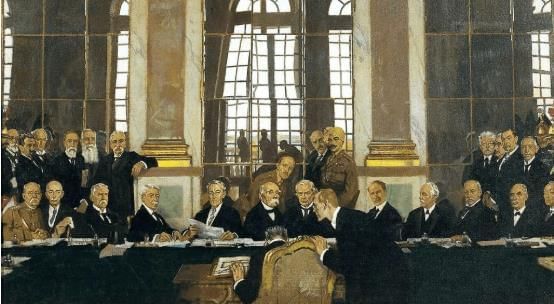
Treaty of Versailles Coming into Effect

  • After Germany’s defeat, the German emperor gave up his throne.
  • A new democratic government was formed in the town of Weimar — known as the Weimar Republic.
  • A new constitution was made with a federal system.
  • All adults, including women, could now vote to choose members of the German Parliament (Reichstag).

Let’s Revise: Explain the causes and consequences of the rise of Nazism in Germany after World War I.

View Answer  

  • However, many Germans did not like the new Weimar Republic.
  • This was because the peace treaty signed at Versailles after the war was very harsh on Germany.
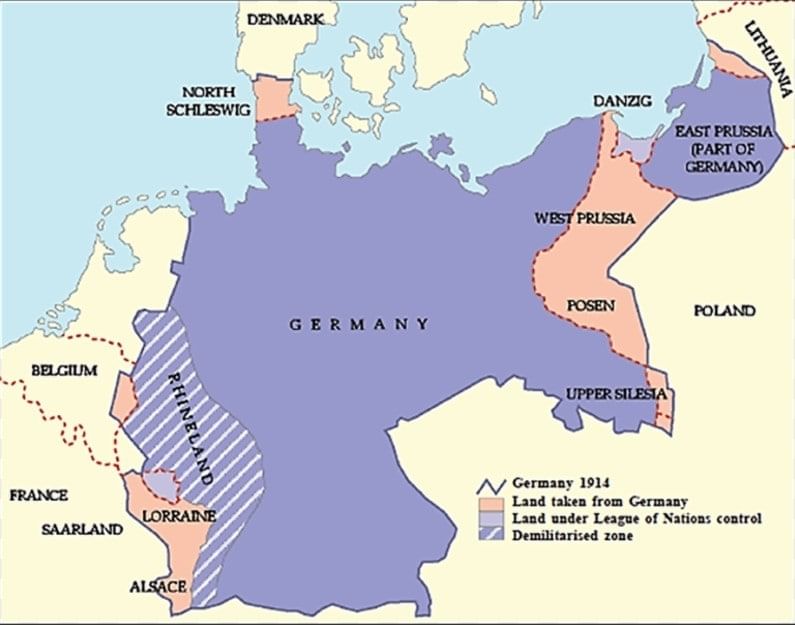
  • Under the Treaty of Versailles:
    – Germany lost its overseas colonies.
    – It lost 10% of its population and 13% of its land.
    – 75% of its iron and 26% of its coal went to countries like France, Poland, Denmark, and Lithuania.
    – Germany’s army was reduced to weaken its power.
    – The War Guilt Clause blamed Germany for starting the war.
    – Germany had to pay £6 billion as punishment.
    – The Allies occupied the rich Rhineland area in Germany during the 1920s.

Parts of Territory that Germany lost after the Treaty of Versailles

  • Many Germans blamed the Weimar Republic for Germany’s defeat and the shameful treaty.

The Effects of the War

  • The war had a devastating impact on Europe, affecting the continent both psychologically and financially.
  • Europe changed from a continent of creditors to one of debtors.
  • The young Weimar Republic was made to pay for the mistakes of the old empire.
  • The republic bore the weight of war guilt and national humiliation, and was financially crippled by compensation payments.
  • Germany lost its overseas colonies, a tenth of its population, 13 percent of its territories, 75 percent of its iron, and 26 percent of its coal to France, Poland, Denmark, and Lithuania.
  • The Allied Powers demilitarised Germany to weaken its power.
  • Supporters of the Weimar Republic, such as Socialists, Catholics, and Democrats, became easy targets for attacks in conservative nationalist circles.
  • They were mockingly called the ‘November criminals’. This hostile attitude influenced political developments in the early 1930s.
  • The First World War left a deep mark on European society and politics.
  • Soldiers were placed above civilians, with emphasis on men being aggressive, strong, and masculine.
  • The media glorified trench life, but the reality was that soldiers lived miserable lives in these trenches.
  • They faced rats, poisonous gas, and enemy shelling, witnessing their ranks diminish rapidly.
  • After the war, war propaganda and national pride dominated public life.
  • Support increased for conservative dictators, while democracy remained unstable in interwar Europe.

Political Radicalism and Economic Crisis

  • The Weimar Republic was created in response to the revolutionary uprising by the Spartacist League, which took inspiration from the Bolshevik Revolution in Russia. 
  • In many cities, Soviets of workers and sailors were set up, and there were calls for Soviet-style governance in Berlin. 
  • Those opposed to this movement, including Socialists, Democrats, and Catholics, gathered in Weimar to form the democratic republic. 
  • The Weimar Republic suppressed the uprising with aid from the Free Corps, a group of war veterans. 
  • In their despair, the Spartacists later established the Communist Party of Germany. This led to a bitter divide, making it impossible for Communists and Socialists to unite against Hitler.
  • Political radicalisation increased due to the economic crisis of 1923. Germany had financed much of the war through loans and was required to pay war reparations in gold, which drained its gold reserves.
  • When Germany refused to pay in 1923, the French occupied the Ruhr industrial area to seize coal. 

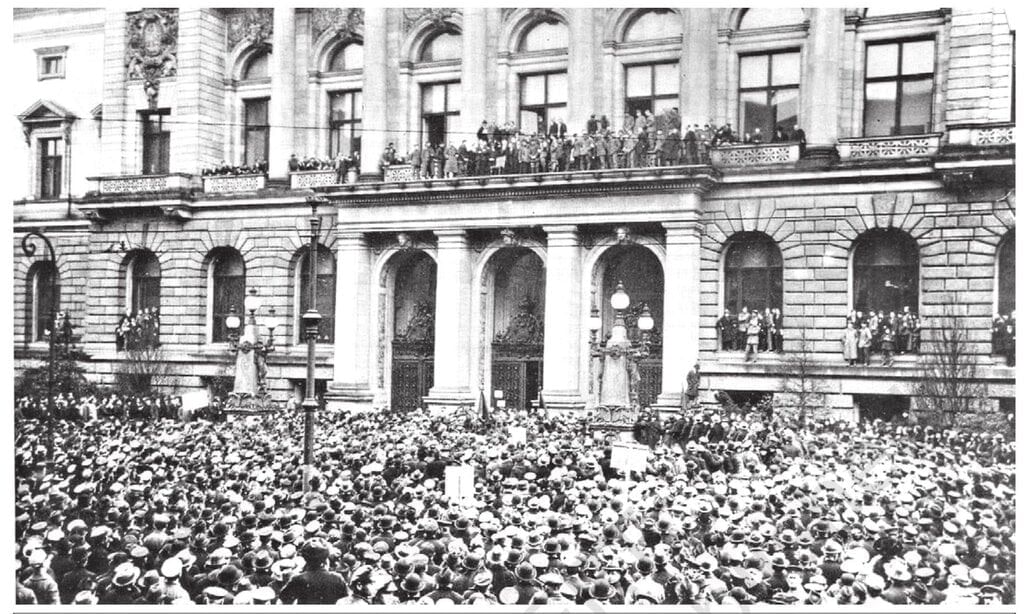
This is a rally organised by the radical group known as the Spartacist League.

  • In response, Germany resorted to passive resistance and started printing money without restraint, resulting in hyperinflation. 
  • The value of the German mark plummeted dramatically:
    – April 1923: 1 US dollar = 24,000 marks
    – July 1923: 1 US dollar = 353,000 marks
    – August 1923: 1 US dollar = 4,621,000 marks
    – December 1923: 1 US dollar = 98,860,000 marks
  • This situation gained widespread attention, drawing international sympathy. This period became known as hyperinflation, a time of extreme price increases. 
  • Ultimately, the Americans intervened and assisted Germany by implementing the Dawes Plan, which revised the reparation terms to alleviate the financial strain on the German people.

Let’s Revise: What led to the political radicalism in the Weimar Republic during the early 1920s?

View Answer  

The Years of Depression

  • The period from 1924 to 1928 brought some stability, but it was built on fragile foundations. 
  • Germany’s investments and industrial recovery relied heavily on short-term loans from the USA. This support vanished after the Wall Street Crash in 1929. 
  • On 24 October 1929, 13 million shares were sold in a panic, signalling the beginning of the Great Economic Depression.
  • Over the next three years, from 1929 to 1932, the national income of the USA halved. Factories closed, exports fell, farmers suffered greatly, and investors pulled their money from the market. 
  • The repercussions of the US recession were felt globally, with Germany being the most severely affected. By 1932, industrial production in Germany had plummeted to 40% of the 1929 level. 
  • The unemployment rate soared to an unprecedented 6 million. 
  • On the streets, men held signs reading, ‘Willing to do any work,’ while unemployed youths often played cards, loitered in corners, or queued at job centres.

Sleeping on the line. During the great depression, the unemployed could not hope for either wage or shelter

  • As employment opportunities dwindled, some youths turned to crime, and despair became widespread. 
  • The economic crisis caused fear and stress among people in Germany. Middle-class people, like salaried employees and pensioners, saw their savings lose value due to inflation.
  • Many feared becoming poor or unemployed — this fear is called proletarianisation. Organised workers managed slightly better, but unemployment reduced their power to ask for better wages.
  • Farmers were badly affected because the prices of crops dropped sharply.
  • Women struggled to feed their families, leading to despair and hardship.
  • The Weimar Republic was also politically unstable. The constitution had serious flaws that made the government weak.
  • One problem was proportional representation, which made it difficult for any one party to win a majority. This led to unstable coalition governments that kept changing.
  • Another problem was Article 48, which gave the President the power to rule without Parliament during emergencies. Frequent use of Article 48 and constant government changes made people lose trust in democracy.
  • Many felt that the democratic system could not solve Germany’s problems.

Let’s Revise: How did the Great Depression impact Germany and its political stability?

View Answer  

Hitler’s Rise to Power

Background of Hitler’s Rise

  • The economic, social, and political crisis in Germany helped Hitler rise to power.
  • Hitler was born in 1889 in Austria and spent his youth in poverty.
  • During World War I, he served in the German army as a messenger, became a corporal, and received medals for bravery.
  • Germany’s defeat in the war and the Treaty of Versailles deeply angered him.Hitler being greeted at the Party Congress in Nuremberg in 1938.
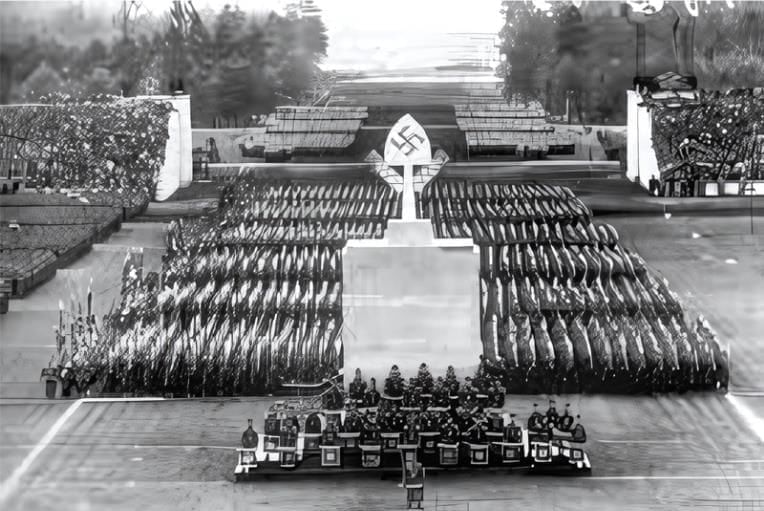
Formation of the Nazi Party

  • In 1919, Hitler joined a small group called the German Workers’ Party.
  • He soon took over the group and renamed it the National Socialist German Workers’ Party (Nazi Party).
  • In 1923, he tried to take over the government in Bavaria but failed and was arrested for treason.
  • He was later released from jail, but the Nazi Party gained little public support until the early 1930s.

Nazi Growth During the Great Depression

  • After the Great Depression began in 1929, German banks collapsed and businesses shut down.
  • Unemployment rose, and the middle class faced poverty, making people desperate for change.
  • Nazi propaganda gave people hope for a better future.

Hitler’s Rise to Popularity

  • In 1928, the Nazi Party got only 2.6% votes in the German Parliament (Reichstag).
  • By 1932, it had become the largest party with 37% of the votes.
  • Hitler was a powerful speaker who inspired people with his emotional speeches.
  • He promised:
    – To build a strong Germany
    – To cancel the Versailles Treaty
    – To give jobs and secure the future of the youth
    – To protect Germany from foreign enemies and influences

Nazi Propaganda and Mass Mobilisation

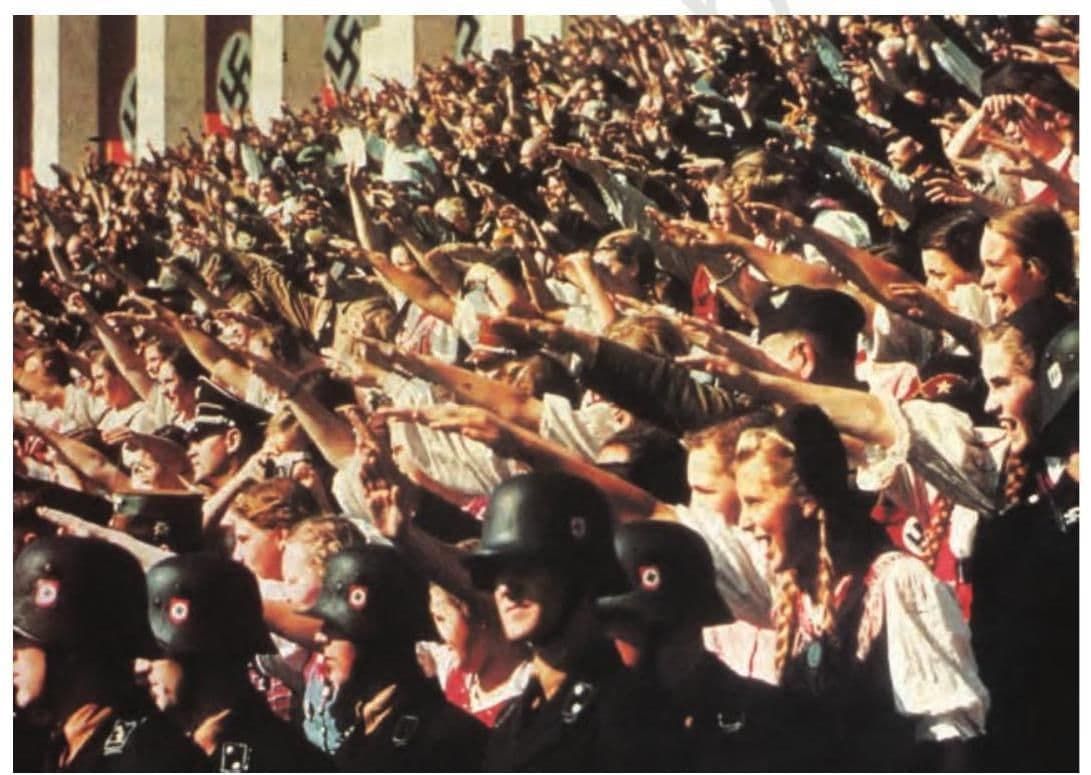
  • Hitler introduced a new style of politics focused on rituals, symbols, and public displays of power.
  • The Nazis held huge rallies and public meetings to show unity and support.
  • Symbols like the red banners with the swastikaNazi salute, and loud applause after speeches created a strong visual impact.
  • Nazi propaganda showed Hitler as a saviour who would rescue Germany from crisis.
  • This image appealed to people who had lost their pride and dignity and were suffering due to poverty and instability. Hitler addressing SA and SS columns. 
    Notice the sweeping and straight columns of people. Such photographs were intended to show the grandeur and power of the Nazi movement

Let’s Revise: How did Nazi propaganda and political strategy help Hitler gain popular support?

View Answer  

The Destruction of Democracy

  • On 30 January 1933, President Hindenburg appointed Hitler as Chancellor, the top role in the cabinet.
  • The Nazis had successfully gained support from conservatives.
  • After taking power, Hitler began to dismantle democratic structures.
  • A mysterious fire in the German Parliament in February helped his cause.
  • The Fire Decree of 28 February 1933 suspended civil rights, such as freedom of speech, press, and assembly, which were protected by the Weimar constitution.
  • The Weimar Republic experienced instability with twenty different cabinets, averaging just 239 days in office.
  • Article 48 was misused, allowing the President to impose emergency powers.
  • Hitler targeted his main opponents, the Communists, many of whom were sent to newly formed concentration camps.
  • The repression of Communists was intense, with 1,440 of 6,808 arrest files in Duesseldorf alone being for Communists.
  • On 3 March 1933, the Enabling Act was passed, establishing a dictatorship in Germany.
  • This act allowed Hitler to bypass Parliament and rule by decree.
  • All political parties and trade unions were banned except for the Nazi Party.
  • The government took control of the economy, media, military, and judiciary.
  • New security forces were formed, including:
    – Regular police (in green uniform)
    – SA (Storm Troopers)
    – Gestapo (secret state police)
    – SS (protection squads)
    – Criminal police
    – Security Service (SD)
  • These forces contributed to the Nazi state’s reputation as a feared regime.
  • People could be detained, tortured, or arrested without legal procedures.
  • The police operated without accountability.

Reconstruction

  • Hitler appointed economist Hjalmar Schacht to lead economic recovery.
  • This resulted in full production and employment through a state-funded work programme, which included:
    – Construction of the German superhighways
    – Creation of the VolkswagenThe poster announces: ‘Your volkswagen’
  • In foreign policy, Hitler quickly achieved significant milestones:
    – Withdrew from the League of Nations in 1933
    – Reoccupied the Rhineland in 1936
    – Unified Austria and Germany in 1938 under the slogan “One people, One empire, One leader”
    – Annexed the German-speaking Sudetenland from Czechoslovakia and later the entire country
  • Hitler received tacit support from England, which felt the Versailles treaty was too severe.
  • Despite Schacht’s warnings against large-scale rearmament, Hitler opted for war to address the economic crisis.
  • Puppet regimes loyal to Nazi Germany were set up throughout Europe.
  • By the end of 1940, Hitler had reached the peak of his power.
  • Hitler wanted to conquer Eastern Europe to get more food and living space for Germans.
  • In June 1941, he attacked the Soviet Union — a big mistake. This exposed Germany to British air attacks in the west and strong Soviet forces in the east.
  • The Soviet Red Army defeated Germany badly at the Battle of Stalingrad.
  • After that, the Soviet Army chased German soldiers back to Berlin.
  • This led to Soviet control over Eastern Europe for the next 50 years.
  • The USA at first did not want to join the war due to past economic troubles.
  • Meanwhile, Japan was growing stronger in Asia and had taken over French Indo-China. Japan planned to attack US naval bases and bombed Pearl Harbor.
  • After this, the USA joined the war. The war ended in May 1945:
    – Hitler was defeated.
    – The USA dropped atomic bombs on Hiroshima (and later Nagasaki) in Japan.
  • After understanding these events, we return to the story of Helmuth and his father, which shows the brutal crimes committed by the Nazis during the war.

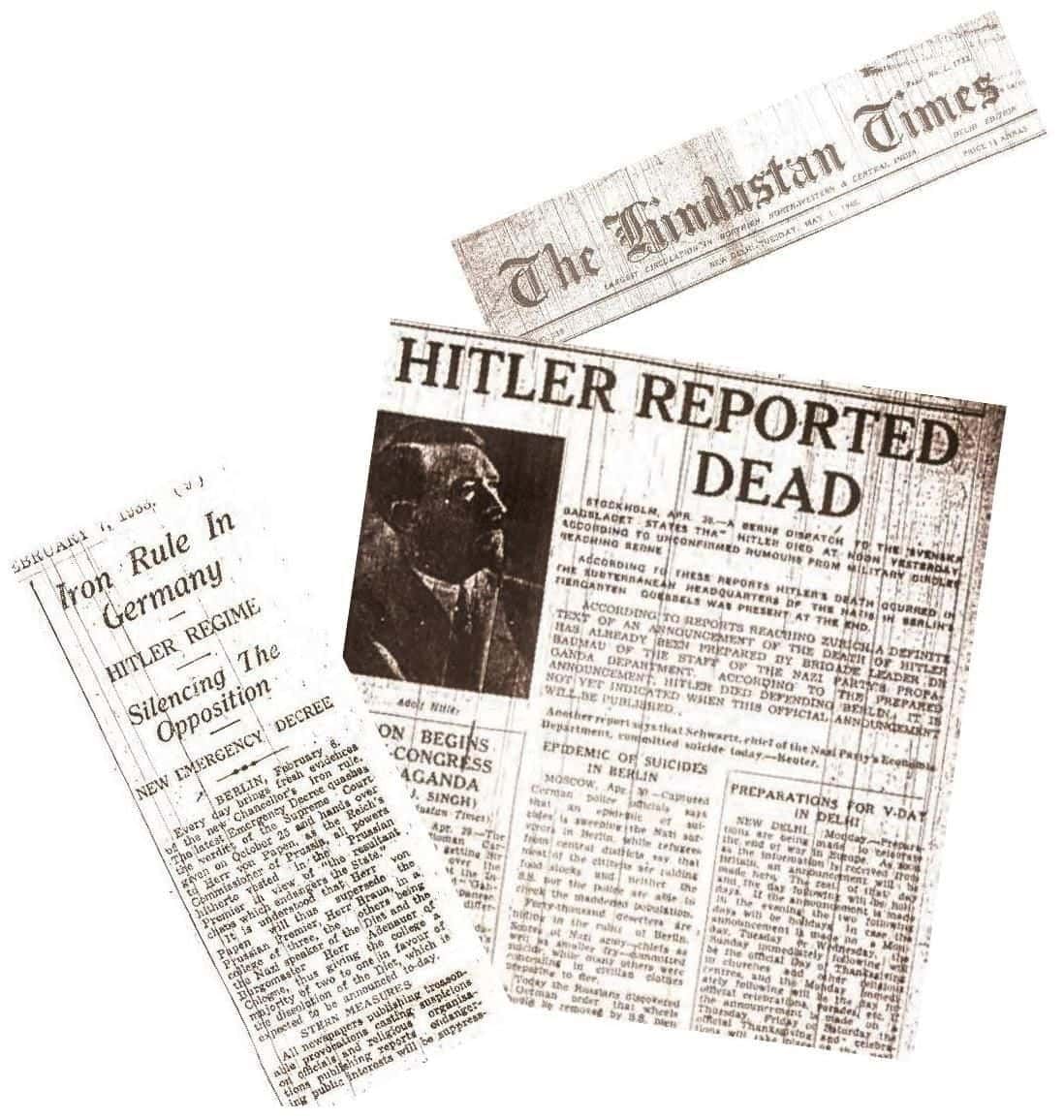
Newspapers in India track the developments in Germany.

Try yourself:When did Hitler become the Chancellor of Germany?

  • A.January 30, 1923
  • B.January 30, 1929
  • C.January 30, 1933
  • D.March 3, 1933

View Solution

The Nazi Worldview

Understanding the link between Nazi crimes and their belief system is essential. Hitler’s worldview, which shaped Nazi ideology, was based on a strict racial hierarchy. At the top were the blond, blue-eyed Nordic Aryans, who were deemed the superior race. At the bottom of this hierarchy were the Jews, viewed as an anti-race and the main enemies of the Aryans. Other racial groups were ranked in between, based on their physical traits and perceived racial characteristics.

Influence of Darwin and Spencer on Hitler’s Racism

  • Hitler’s racism was shaped by the ideas of Charles Darwin and Herbert Spencer.
  • Darwin introduced concepts of evolution and natural selection, explaining the development of living things.
  • Spencer contributed the idea of survival of the fittest, suggesting that only adaptable species would thrive.
  • Although Darwin did not endorse human intervention in natural selection, his ideas were misused by racist thinkers to justify imperial rule over conquered peoples.
  • The Nazis adopted the belief that the strongest race would survive and that weaker races would perish.
  • They believed the Aryan race was the strongest and needed to maintain its purity to dominate the world.

Hitler’s Concept of Lebensraum

  • A significant aspect of Hitler’s ideology was the idea of Lebensraum, meaning living space.
  • He believed that new territories needed to be acquired for settlement.
  • Hitler aimed to expand German borders by moving eastward, viewing Poland as a testing ground for this idea.
  • Poland became the laboratory for this experimentation.
  • Hitler stated, “The primary right of this world is the right to life, so far as one possesses the strength for this.”

Establishment of the Racial State

  • After coming to power, the Nazis tried to create a “pure German” society by removing people they thought were “undesirable”.
  • They wanted only “pure and healthy Nordic Aryans” in Germany and its empire.
  • Anyone who was different—like people with mental or physical disabilities—was seen as not fit to live.
  • Under the “Euthanasia Programme,” even German citizens, like Helmuth’s father, were killed for being mentally or physically unfit.
  • The Nazis didn’t only target Jews. Other groups like Gypsies, Black people, Russians, and Poles were also seen as racially inferior.
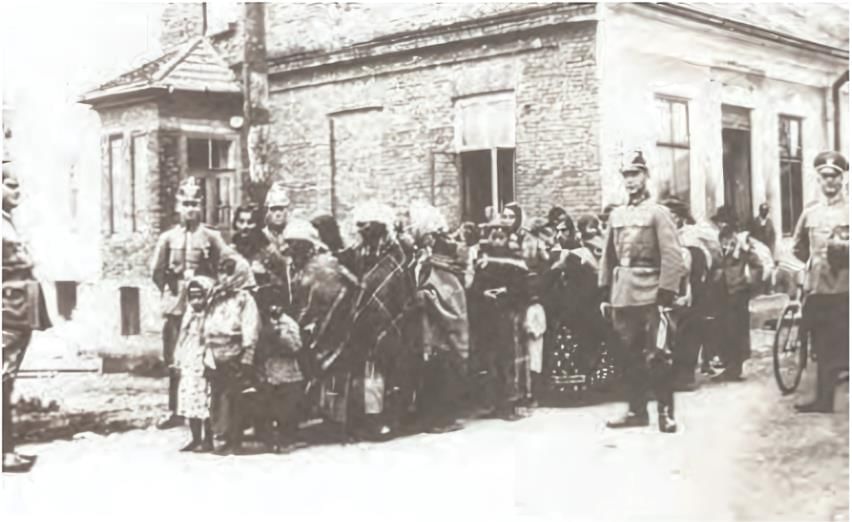
  • These groups were mistreated, forced into hard labour, and many died from overwork and hunger.Police escorting gypsies who are being deported to Auschwitz, 1943-1944.
  • Jews were the most targeted group:
    – Hatred towards Jews had existed in Europe even before Hitler, especially in Christian beliefs.
    – Jews were wrongly blamed for killing Christ and were banned from owning land, so they often worked in trade and moneylending.
    – They were forced to live in separate areas called ghettos and were often attacked or forced to leave their homes.
  • Hitler’s hatred of Jews was based on false racial science.
    – He believed that converting to Christianity would not solve the “Jewish problem”.
    – He wanted to completely eliminate all Jews.
  • From 1933 to 1938, Nazis:
    – Scared and isolated Jews,
    – Took away their wealth and rights,
    – Forced them to leave Germany.
  • From 1939 to 1945, the plan became more violent:
    – Jews were collected into specific areas.
    – Many were killed in gas chambers, especially in Poland.

The Racial Utopia

  • During the war, Nazis began putting their racist and murderous plans into action.
  • Genocide (mass killing) and war went hand in hand under Nazi rule.
  • Poland was divided — north-western Poland became part of Germany.
  • Polish people were forced to leave their homes, which were given to ethnic Germans.
  • Remaining Poles were sent to an area called the General Government, treated badly like animals.
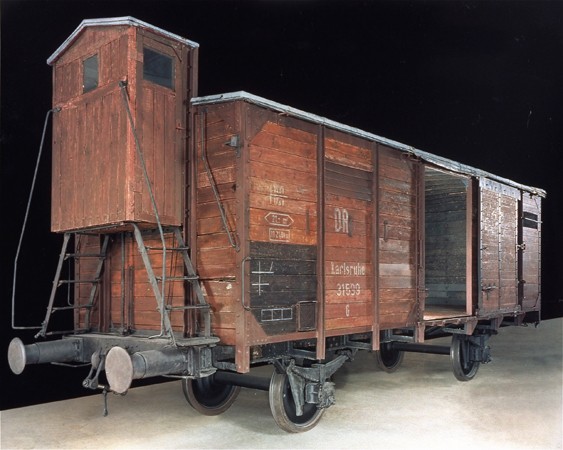
  • Educated Polish people were killed in large numbers so that others would not resist Nazi control.This is one of the freight cars used to deport Jews to the death chambers.
  • Polish children who looked like Aryans were taken from their families.
  • If they passed racial tests, they were raised in German families.
  • If not, they were sent to orphanages, where many died.
  • The General Government area had huge ghettos and gas chambers where millions of Jews were killed.

Let’s Revise

Q: How did Hitler’s racial worldview shape Nazi ideology and policies?

View Answer  

Q: What was the concept of Lebensraum and how did it influence Nazi expansionist policies?

View Answer  

Youth in Nazi Germany

  • Hitler aimed to create a powerful Nazi society by teaching children Nazi beliefs both in school and beyond.
  • Changes in Schools:
    – Schools were ‘cleansed’ of Jews and teachers who were seen as politically unreliable.
    – Children were separated by race; Jews and other ‘undesirable’ children (such as those who were physically disabled or Gypsies) were expelled.
    – Eventually, in the 1940s, these groups were taken to gas chambers.

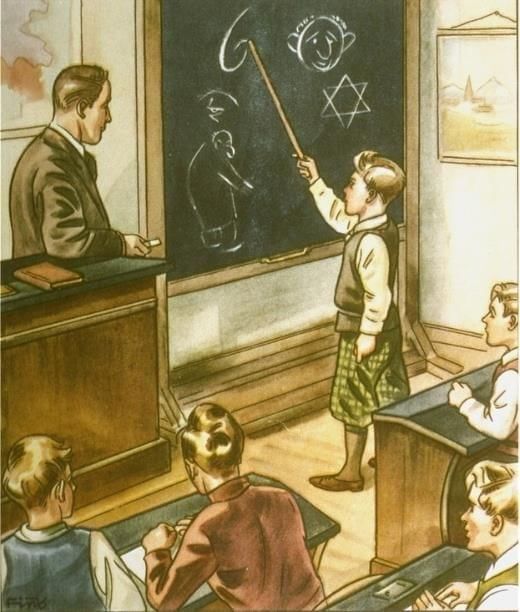
Classroom scene depicting a lesson on racial anti-Semitism.

  • Nazi Schooling:
    – Textbooks were rewritten to support Nazi racial ideas.
    – Racial science was introduced, promoting negative stereotypes about Jews, even in maths lessons.
    – Children were taught to be loyal and obedient, to hate Jews, and to idolise Hitler. Sports were used to instil a sense of violence and aggression; Hitler believed boxing could make children strong and masculine.
  • Youth Organizations:
    – Jungvolk: Boys could join at the age of 10.
    – Hitler Youth: Mandatory for boys aged 14; the focus was on glorifying war, aggression, and Nazism while rejecting democracy and those seen as ‘undesirable.’
    – After training, youths were sent to the Labour Service, military, or Nazi organisations.
  • Formation and Control:
    – The Nazi Youth League was established in 1922 and was renamed Hitler Youth four years later.
    – All other youth organisations were systematically dissolved and banned to ensure control was consolidated.

Desirable Children that Hitler wanted to see multiplied

Try yourself:

What was one of the key beliefs that shaped Hitler’s ideology?

  • A.The promotion of democracy and equality for all races.
  • B.The establishment of a multicultural society.
  • C.The implementation of a strict racial hierarchy.
  • D.The advocacy for international cooperation and peace.

View Solution

The Nazi Cult of Motherhood

  • In Nazi Germany, children were taught that women were fundamentally different from men.
  • The movement for equality between men and women was seen as a threat to society.
  • Boys were trained to be strong, masculine, and unemotional.
  • Girls were taught to be dedicated mothers responsible for raising pure-blooded Aryan children.
  • Women were expected to maintain racial purity, avoid contact with Jews, and pass on Nazi values to their children.
  • Hitler stated in 1933, “In my state the mother is the most important citizen.
  • However, not all mothers received equal treatment in Nazi Germany.
  • Women who had racially undesirable children faced penalties, while those with racially desirable children were rewarded. Rewards included:
    – Preferential treatment in hospitals.
    – Concessions in shops.
    – Discounts on theatre tickets and railway fares.
  • To encourage higher birth rates, the Honour Crosses were introduced:
    – A bronze cross for four children.
    – A silver cross for six children.
    – A gold cross for eight or more children.
  • Aryan women who did not follow Nazi rules faced public shame and harsh punishments. Those who associated with Jews, Poles, or Russians were publicly humiliated:
    – Paraded through towns with shaved heads and blackened faces.
    – Held placards saying, “I have sullied the honour of the nation.
  • Many faced jail time and lost their social standing, including their families, for this ‘criminal offence.’

Try yourself:In what ways did the First World War leave a deep imprint on European society and polity?

  • A.Soldiers were put above civilians, trench-life was glorified
  • B.Politicians and publicists laid stress on men to be aggressive and masculine
  • C.Aggressive war propaganda and national honour were given the most support and Conservative dictatorships were welcomed
  • D.All the above

View Solution

The Art of Propaganda

  • Nazis used euphemisms for mass killings, calling them special treatmentfinal solution (for Jews), euthanasia (for the disabled), selection, and disinfection.
  • ‘Evacuation’ referred to deportations to gas chambers.

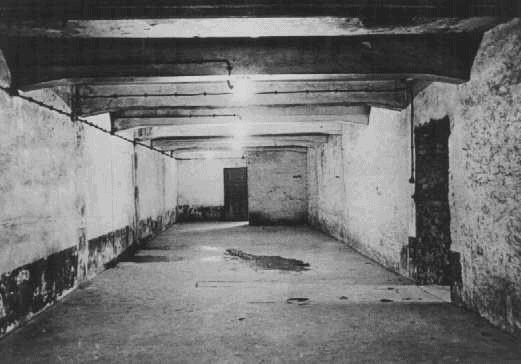
Gas Chamber

  • Gas chambers were disguised as ‘disinfection areas‘ and made to look like bathrooms with fake showerheads.
  • Nazi ideas spread through various media:
    – Visual images.
    – Films.
    – Radio broadcasts.
    – Posters.
    – Catchy slogans and leaflets.
  • Propaganda films, like The Eternal Jew, aimed to create hatred towards Jews.
  • Orthodox Jews were often portrayed as vermin, rats, and pests in these materials.
  • The Nazis targeted specific groups in their propaganda, claiming they alone could fix the issues facing Germany.A Concentration Camp

Ordinary People and the Crimes Against Humanity

People’s responses to Nazism in Germany varied widely:

  • Many Germans accepted Nazi beliefs, adopting its language and ideas. They expressed hatred towards Jews, marked their homes, and reported neighbours they considered suspicious, genuinely believing that Nazism would lead to prosperity.
  • Some organised active resistance against Nazism, risking police repression and death.
  • However, most Germans remained passive observers, choosing to ignore the situation. They were often too afraid to act, protest, or stand out. Pastor Niemoeller, a resistance fighter, noted this silence in the face of Nazi crimes, regretting that people did not speak out until it was too late.
  • The lack of resistance was not only due to fear. As Erna Kranz, a German who lived through the 1930s, pointed out, many people welcomed the apparent economic recovery under the Nazis, feeling downtrodden.
  • In Nazi Germany, Jews suffered many forms of death even before reaching the gas chambers. The psychological torment began long before many were sent to their deaths, causing them to endure repeated suffering.

Knowledge about the Holocaust

  • During the last years of Nazi rule, some information about their cruel actions started to spread outside Germany.
  • But the real horrors were known only after Germany was defeated in World War II.
  • The Germans were mainly focused on rebuilding their country after the war.
  • But the Jews wanted the world to remember their suffering during the Nazi killings (known as the Holocaust).
  • In ghettos (Jewish areas), some people wished to survive the war just to be able to tell others what happened.
  • Many people in camps and ghettos wrote diaries, kept notes, and saved documents to record their painful experiences.
  • When the war was about to be lost, Nazi leaders tried to destroy all evidence by giving petrol to their workers to burn official records.
  • Even today, the memory of the Holocaust is kept alive through stories, movies, poems, museums, and memorials.
  • These works are:
    – A tribute to those who fought back
    – A shameful reminder to those who helped the Nazis
    – A warning to those who stayed silent during the cruelty.

Try yourself:

What was the primary role assigned to girls in Nazi Germany according to the passage?

  • A.To become aggressive and emotionally hardened
  • B.To resist the Nazi regime actively
  • C.To become devoted mothers responsible for raising pure-blooded Aryan children
  • D.To maintain contact with Jews, Poles, or Russians

View Solution

Difficult Words

  1. Weimar Republic: The democratic government founded in Germany following the abdication of Emperor Wilhelm II in 1918, which lasted until 1933 when the Nazis came to power.
  2. Treaty of Versailles: The peace treaty that ended World War I between Germany and the Allied Powers, which imposed heavy reparations and territorial losses on Germany.
  3. War Guilt Clause: Article 231 of the Treaty of Versailles, which assigned blame for World War I solely to Germany and its allies, making them responsible for all damages.
  4. Hyperinflation: A very high and typically accelerating rate of inflation, often exceeding 50% per month, leading to the rapid erosion of the real value of local currency, as the prices of all goods increase.
  5. Proportional Representation: An electoral system in which parties gain seats in proportion to the number of votes cast for them.
  6. Article 48: A clause in the Weimar Constitution that allowed the President, under certain circumstances, to take emergency measures without the prior consent of the Reichstag.
  7. Chancellorship: The position of the Chancellor, a senior official (often the prime minister) in some countries, responsible for leading the executive branch and the government.
  8. Enabling Act: A 1933 Weimar Constitution amendment that gave the German Cabinet — in effect, Chancellor Adolf Hitler — the power to enact laws without the involvement of the Reichstag.
  9. Euthanasia Programme: A program during Nazi Germany aiming at the systematic killing of the mentally and physically disabled and sick, considered by the Nazis as “life unworthy of life.”
  10. Lebensraum: A Nazi policy and ideology of territorial expansion, based on the notion of natural rights to land believed necessary for national survival and growth.
  11. Racial Hygiene: The set of eugenic policies embraced by the Nazis to “improve” the genetic quality of a race, primarily aimed at increasing the reproduction of characteristics deemed desirable.
  12. Genocide: The intentional action to destroy a people—usually defined as an ethnic, national, racial, or religious group—in whole or in part.
  13. Orthodox Jews: Adherents to a traditional form of Judaism which strictly observes religious laws and practices.
  14. Propaganda: Information, especially of a biased or misleading nature, used to promote a political cause or point of view.
  15. Holocaust: The genocide of six million Jews and the persecution and murder of other minority and dissenting groups by the Nazis during World War II.
  16. Concentration camp: A camp where people were isolated and detained without due process of law. Typically, it was surrounded by electrified barbed wire fences.
  17. Proletarianisation: To become impoverished to the level of working classes.
  18. Nordic German Aryans: One branch of those classified as Aryans. They lived in north European countries and had German or related origin
  19. Gypsy: The groups that were classified as ‘gypsy’ had their own community identity. Sinti and Roma were two such communities. Many of them traced their origin to India. 
  20. Pauperised: Reduce to absolute poverty 
  21. Persecution: Systematic, organised punishment of those belonging to a group or religion
  22. Usurers: Moneylenders charging excessive interest; often used as a term of abuse
  23. Jungvolk: Nazi youth groups for children below 14 years of age.

Some important dates

  • August 1, 1914: First World War begins. 
  • November 9, 1918: Germany capitulates, ending the war. 
  • November 9, 1918: Proclamation of the Weimar Republic. 
  • June 28, 1919: Treaty of Versailles. 
  • January 30, 1933: Hitler becomes Chancellor of Germany. 
  • September 1, 1939: Germany invades Poland. Beginning of the Second World War. 
  • June 22, 1941: Germany invades the USSR. 
  • June 23, 1941: Mass murder of the Jews begins.
  • December 8, 1941: The United States joins Second World War. 
  • January 27, 1945: Soviet troops liberate Auschwitz. 
  • May 8, 1945: Allied victory in Europe.

02. Socialism in Europe and the Russian Revolution – Chapter Notes

The Age of Social Change

  • In the last chapter, you learned how the French Revolution spread strong ideas about freedom and equality across Europe. This revolution made people think that it was possible to completely change the way society worked.
  • Before the 1700s, society in Europe was mainly divided into groups called estates or orders, where the aristocrats (nobles) and the church had most of the power and wealth. But after the French Revolution, people began to believe that this unfair system could be changed.
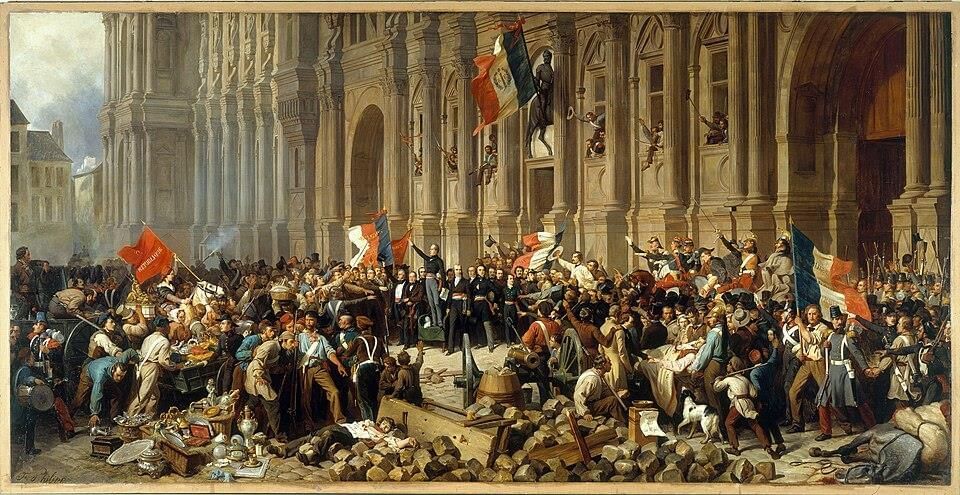
    French Revolution
  • However, not everyone in Europe agreed on how much change was needed. Some people thought a little change was okay, and it should happen slowly. Others believed society needed big changes immediately. People with different views were given different names:
    – Conservatives wanted to keep things mostly the same. 
    – Liberals wanted change, but in a peaceful and gradual way.
    – Radicals wanted quick and major changes.

In this chapter, you’ll learn about some important political ideas from the 19th century and how they led to social changes. Then we’ll study one major event — the Russian Revolution — where people tried to change society completely. This revolution helped spread the idea of socialism, which became very powerful in the 20th century.

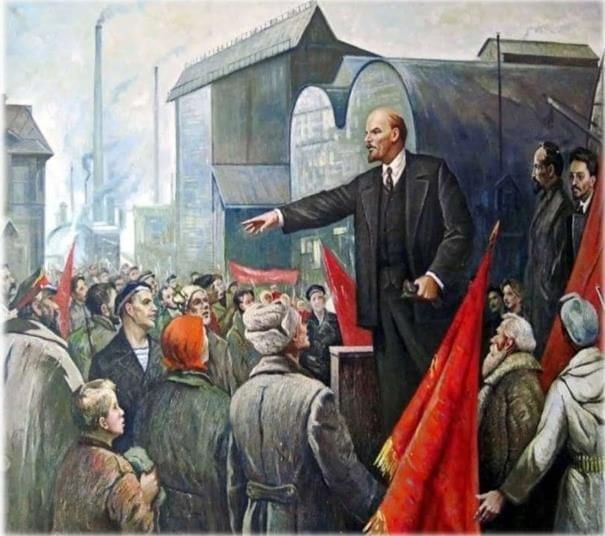
Lenin addressing workers during the Russian Revolution, symbolizing the rise of socialism and workers’ rights.

Liberals, Radicals, and Conservatives

During the nineteenth century, various groups in Europe had different ideas for bringing about change in society. These included liberalsradicals, and conservatives. Their beliefs and goals often clashed, especially in the period following the French Revolution.

One group that wanted to change society was called the liberals.

  • They believed in religious tolerance, meaning all religions should be treated equally. At that time, many countries supported only one religion (e.g., Britain supported the Church of England, Austria and Spain supported the Catholic Church).
  • Liberals were against the unlimited power of kings and dynasties.
  • They wanted to protect individual rights.
  • They supported the idea of a parliament elected by the people.
  • They wanted clear laws and fair judges, not rulers controlling everything.
  • However, liberals did not support democracy for all:
    (a) They believed only men with property should be allowed to vote.
    (b) They were against giving voting rights to women.

Radicals wanted deeper and more extensive changes in society. They believed:

  • The government should represent the majority of the population.
  • Women should have the right to vote, and many radicals supported women’s suffrage movements.
  • The power of rich landowners and factory owners should be questioned.
  • They supported private property but were against too much wealth being held by a few people.

Conservatives opposed both liberals and radicals. However, their views changed over time:

  • In the eighteenth century, conservatives were strongly against any change and wanted to preserve the traditional order.
  • After the French Revolution, even conservatives began to see the need for reform.
  • By the nineteenth century, they accepted that some change was necessary, but believed it should happen gradually and with respect for traditions from the past.

These different political ideas led to various social and political conflicts in nineteenth-century Europe. 

Industrial Society and Social Change

This period saw significant social and economic transformations. There was a rise of new cities, growth in industrial regions, expansion of railways, and the start of the Industrial Revolution.

  • Industrialisation Problems: As industrialisation took off, many people, including men, women, and children, moved near factories. However, this progress came with serious drawbacks. Working hours were long, and wages were low. Unemployment was common, especially during times when demand for industrial goods was low. The rapid growth of towns led to urgent challenges regarding housing and sanitation.

An image of Russian Industrial Workers in the 1890s

  • Solution by Radicals and Liberals: In response to the issues caused by industrialisation, liberals and radicals got together to look for solutions. They believed in supporting individual hard work and business, as an educated and healthy workforce would help society grow. This thinking attracted more support from the working class.
  • Effects on the World: The ideas of radicals, liberals, and conservatives strongly shaped 19th-century society and politics. Their clashes and actions led to revolutions and national changes, which defined these movements and their limits.

Many nationalists and liberals aimed to change the governments set up in Europe after 1815. In countries like FranceItalyGermany, and Russia, they became revolutionaries, seeking to overthrow the existing monarchs. Nationalists spoke of revolutions that would create ‘nations’ where all citizens enjoyed equal rights. After 1815, Giuseppe Mazzini, an Italian nationalist, worked with others to achieve this in Italy. Nationalists in other regions, including India, read his writings.

Try yourself:What did the liberals advocate for in society during the Age of Social Change?

  • A.Corruption
  • B.Limited power of dynastic rulers
  • C.No Voting Rights
  • D.None of the above

View Solution

The Coming of Socialism to Europe

One of the most powerful and far-reaching ideas for changing society in the 19th century was socialism. By the mid-1800s, socialism had become a well-known and widely discussed idea in Europe.

What Did Socialists Believe?

Socialists strongly opposed private property. They believed that private property was the main reason for many social problems at that time. This is because property—such as land, factories, and machines—was owned by a few individuals who focused only on earning personal profit. They paid little attention to the needs and welfare of the workers who actually helped make the property productive.

Socialists believed that if property was owned and managed by society as a whole, then more attention would be paid to the well-being of everyone, not just a few individuals. They wanted to build a system where the focus was on the collective good of all people. To bring this change, they campaigned and shared their ideas widely.

Different Visions Within Socialism

Not all socialists agreed on how a socialist society should be created. They had different ideas about how to achieve this goal.

Robert Owen’s Idea of Cooperative Society

Robert Owen (1771–1858) was a well-known English manufacturer. He believed in creating cooperative communities, where people would live and work together and share the profits. He tried to build such a community called New Harmony in Indiana, USA.

​Louis Blanc and Government Support for Cooperatives

Louis Blanc (1813–1882), a socialist thinker from France, had a different view. He believed that cooperative societies could not be set up on a large scale by individuals alone. He argued that the government should take the lead in promoting cooperatives and replacing capitalist businesses. In his view, cooperatives should be groups of people working together to produce goods and sharing profits based on the work each member contributed.

Louis Blanc

Karl Marx and Friedrich Engels: A Radical View

Karl Marx (1818–1883) and Friedrich Engels (1820–1895) introduced a more radical version of socialism. Marx believed that industrial society was based on capitalism, where capitalists (the factory and property owners) invested money and made profits from the hard work of laborers.

Marx argued that workers would never be able to improve their condition as long as capitalists continued to earn profits from their labour. The only way to bring change, according to him, was for workers to overthrow the capitalist system and end private ownership of property.

He believed that a truly fair society could only be created when all property was collectively owned and managed by society. Marx called this ideal a communist society. In such a society, there would be no private property, no exploitation, and everyone would have equal rights. 

In conclusion, socialism introduced a new way to think about society. It questioned private ownership and suggested sharing resources and profits for everyone’s benefit. These ideas inspired many political movements, and events like the Russian Revolution made socialism a major force in the 20th century.

Support for Socialism

By the 1870s, socialist ideas were spreading across Europe. An international organisation called the Second International was formed. Workers in England and Germany began establishing associations to campaign for better living and working conditions. They set up funds to assist members in times of need and demanded:

  • A reduction in working hours
  • The right to vote

In Germany, the Social Democratic Party gained parliamentary seats. By 1905, socialists and trade unionists had established a Labour Party in Britain and a Socialist Party in France. While their ideas influenced legislation, governments continued to be led by conservatives, liberals, and radicals.

Try yourself:

What were the main beliefs of liberals during the Age of Social Change?

  • A.Religious tolerance and safeguarding individual rights against the government.
  • B.Formation of a government based on majority support of the population.
  • C.Opposition to the privileges of wealthy landowners and support for women’s rights.
  • D.Preservation of the past and slow change in the system.

View Solution

The Russian Revolution

Russia was one of the least industrialised countries in Europe, but something unusual happened there. In 1917, the socialists took control of the government during what is known as the October Revolution. Earlier that same year, the Russian king (Tsar) had lost his throne in February. These two big events—the fall of the monarchy in February and the socialist takeover in October—are together known as the Russian Revolution. 

But how did all this happen? What was life like in Russia before the revolution? Let’s find out by looking at the conditions in Russia a few years earlier.

The Russian Empire in 1914

  • In 1914, Tsar Nicholas II ruled over Russia and its large empire. This included areas around Moscow, as well as present-day Finland, Latvia, Lithuania, Estonia, parts of Poland, Ukraine, and Belarus. The empire stretched to the Pacific Ocean and included today’s Central Asian nations, along with Georgia, Armenia, and Azerbaijan. 
  • The main religion was Russian Orthodox Christianity, which evolved from the Greek Orthodox Church, but there were also followers of Catholicism, Protestantism, Islam, and Buddhism.
  • Russia followed the Julian calendar until 1st February 1918. The country then switched to the Gregorian calendar, which is the standard today. 
  • The Gregorian dates are 13 days ahead of the Julian dates, meaning the ‘February’ Revolution happened on 12th March, and the ‘October’ Revolution occurred on 7th November.
  • Russia was an autocracy. Unlike many other European leaders at the beginning of the 20th century, the Tsar was not accountable to a parliament. This lack of political representation played a significant role in the unrest that led to the revolution.

Economy and Society

  • Agriculture Dominance: In the early 20th century, around 85% of the population worked in agriculture. Russia had a larger share of people reliant on farming compared to most European nations.
  • Industrial Development: Industrialisation was primarily found in cities like St Petersburg and Moscow. Both craftsmen and large factories existed side by side, with significant factory growth in the 1890s. Russia became a leading exporter of grain. The expansion of the railway system and foreign investments during the 1890s boosted industrial growth, with coal production doubling and iron and steel output increasing fourfold. 
  • Working Conditions: Most industries were owned by private individuals. The government attempted to ensure minimum wages and limit working hours, but factory inspectors often faced challenges enforcing these rules. Many workers dealt with long hours, and living conditions varied greatly. 
  • Social Divisions Among Workers: The year 1904 was very difficult for Russian workers. Prices of basic goods rose fast, and real wages fell by 20%. Workers were socially divided based on their village ties, how long they had lived in cities, and their skill levels. Women constituted 31% of the workforce, yet earned less than their male counterparts. Some workers formed associations to support each other during times of unemployment or financial struggles, but these were few in number. Even with social differences, workers often came together to strike over job losses or poor working conditions. Frequent strikes occurred in the textile industry during 1896-1897 and in the metal industry in 1902.
  • Peasant Conditions: Many unemployed peasants relied on charitable kitchens for food and lived in poor conditions. The poor living situations of peasants contributed to the social unrest that started the revolution.
  • Impact of World War I: Initially, the war was popular in Russia, with people supporting Tsar Nicholas II. However, as the conflict dragged on, the Tsar’s refusal to consult the main political parties in the Duma led to growing dissatisfaction among the general population.

Russian Empire in 1914

  • Peasants and Land Ownership:
    a) Peasants worked the majority of the land, while large estates were owned by the nobility, the crown, and the Orthodox Church.
    b) Russian peasants were very religious, but they generally had no respect for the nobility, who gained their power through their services to the Tsar, not through local popularity.
    c) They demanded land redistribution and often refused to pay rent, with some even resorting to murdering landlords. This trend became widespread in southern Russia in 1902 and spread across the country in 1905.
    d) Unlike other European peasants, Russian peasants periodically pooled their land together, and their commune (mir) allocated it based on the needs of individual families.

Socialism in Russia

  • Before 1914, the government in Russia banned all political parties, forcing the Russian Social Democratic Workers Party (RSDWP) to function as an illegal group.
  • The RSDWP was established in 1898 by socialists who followed Marx’s principles, organising strikes, mobilising workers secretly, and creating a newspaper.
  • Some socialists viewed Russian peasants, with their tradition of sharing land, as natural socialists who could lead the revolution.
  • This belief led to the formation of the Socialist Revolutionary Party in 1900, which advocated for peasant rights and land redistribution from nobles to peasants.
  • The Socialist Revolutionary Party focused on issues affecting peasants, while Lenin and the Social Democrats believed peasants were divided.
  • Lenin argued that differences among peasants, such as wealth and roles in labour, prevented them from being a unified revolutionary force.
  • Lenin’s Bolsheviks preferred a tightly controlled, disciplined party to withstand Tsarist repression.
  • In contrast, the Mensheviks supported a more open membership model like that of the German socialist movement.

A Turbulent Time: The 1905 Revolution

  • Russia was an autocracy, with the Tsar holding all power. 
  • In 1905, liberals, socialists, peasants, and workers united to demand a constitution. Rising prices and falling wages in 1904 worsened worker struggles. They gained support from nationalists in the empire, such as poland and Muslim reformers. 
  • In the Bloody Sunday incident, police and Cossacks attacked unarmed workers led by Father Gapon, resulting in over 100 deaths and around 300 injuries.
  • The 1905 Revolution sparked widespread unrest, including strikes, student walkouts, and the formation of the Union of Unions, which called for a constituent assembly.
  • The Tsar temporarily allowed the formation of a consultative Parliament (Duma) and permitted trade unions and factory committees to operate briefly.
  • After the revolution, the Tsar limited the Duma, dismissing the first two within months and altering voting laws to ensure a conservative majority in the third Duma.
  • Political repression resumed, with the Tsar banning most political activities to silence liberals and revolutionaries.

The First World War and the Russian Empire

  • In 1914, a war began in Europe between two groups of countries: Germany, Austria, and Turkey on one side, and France, Britain, and Russia on the other.
  • Later, countries like Italy and Romania also joined the war, which was fought in many parts of the world due to the European colonies.
  • This global conflict came to be known as the First World War.
  • In Russia, many people initially supported the war and hoped it would make their country proud.
  • However, the Tsar (King of Russia) took all major decisions himself without consulting the Duma (the elected Parliament), which made people unhappy.
  • Anti-German feelings grew strong in Russia, so the capital city’s name was changed from St Petersburg (which sounded German) to Petrograd.
  • The Tsarina (queen), Alexandra, was German by birth. Her close friendship with a monk named Rasputin, who influenced royal decisions, made the royal family very unpopular.
  • On the western front of the war (in places like France), soldiers stayed in deep trenches and fought from there.
  • On the eastern front (Russia’s side), armies moved around more, and there were very heavy losses.
  • Between 1914 and 1916, the Russian army suffered huge defeats from Germany and Austria.
  • Over 7 million Russian soldiers were killed, wounded, or taken as prisoners of war by 1917.
  • As Russian troops retreated, they destroyed crops and buildings so that the enemy could not use them, which led to more than 3 million people becoming homeless refugees.
  • These disasters made the Russian people very angry with their government.
  • Most soldiers had lost the will to fight and no longer believed in the war.
  • Russia had very few industries, and during the war, it could not get help from its allies because Germany blocked trade routes like the Baltic Sea.
  • As a result, machines broke down quickly and were not repaired or replaced.
  • By 1916, the railway system in Russia had started to fail.
  • Many workers were sent to fight in the army, so there were not enough people left to run the factories.
  • Small workshops and industries had to close down due to a shortage of workers and materials.
  • Grain was being sent mainly to feed the soldiers at the front, leaving people in the cities with very little food.
  • By the winter of 1916, there was so little bread and flour available that people were rioting outside bread shops.

Try yourself:

What percentage of Russia’s population was engaged in agriculture in the early 20th century?

  • A.75%
  • B.85%
  • C.95%
  • D.65%

View Solution

The February Revolution in Petrograd

  • The winter of 1917 was tough for the people of Petrograd. The city was divided, with workers living in the poorer areas on the right bank of the River Neva, while the left bank had the more affluent districts, the Winter Palace, and government buildings, including where the Duma met.
  • Food shortages were a major issue, especially in the workers’ areas. The effects of World War I had severely disrupted grain supplies, resulting in a lack of bread and flour. By winter 1916, riots over bread were common.
  • Tensions rose as the government faced opposition from parliament members who wanted to maintain the elected government, while the Tsar aimed to dissolve the Duma.
  • On 22 February, there was a lockout at a factory on the right bank. The next day, workers from fifty factories went on strike in support. Women were prominent in these protests; at the Lorenz telephone factory, Marfa Vasileva played a key role in organising a successful strike. In honour of International Women’s Day, women workers gave red bows to their male colleagues, motivating them.
  • After the initial protests, demonstrators regrouped on the 24th and 25th. On 25 February, the government suspended the Duma, leading to a resurgence of protests on the left bank of Petrograd the next day, with people demanding better conditions.
  • On 27 February, the Police Headquarters was attacked, and the streets were filled with calls for breadwages, better working hours, and democracy. Despite government attempts to suppress the protests, the cavalry refused to attack the demonstrators. This change in loyalty was crucial; when the Imperial Russian army began to support the revolutionaries, the Tsarist regime fell apart.
  • Eventually, soldiers and striking workers united to form a council called the Petrograd Soviet in the same building where the Duma convened. Military leaders urged the Tsar to step down, which he did on 2 March.
  • Leaders from the Soviet and the Duma created a Provisional Government to manage the country, effectively ending the monarchy in what is known as the February Revolution. The future of Russia would be determined by a constituent assembly elected based on universal adult suffrage.

Russian Provisional Government in March 1917

Try yourself:Tsarina Alexandra was of the

  • A.German origin
  • B.French origin
  • C.Russian origin
  • D.Dutch origin

View Solution

After February

  • Army officials, landowners, and industrialists held significant power in the Provisional Government. However, both the liberals and socialists among them aimed for an elected government.
  • Restrictions on public meetings and associations were lifted.
  • In April 1917, Vladimir Lenin, the leader of the Bolsheviks, returned to Russia from exile.
  • He and the Bolsheviks had been against the war since 1914.
  • Lenin announced his ‘April Theses’, which called for an end to the war, land to be given to the peasants, and the nationalisation of banks. These were Lenin’s core demands.
  • Initially, most in the Bolshevik Party were taken aback by the April Theses. They believed it was too early for a socialist revolution and that the Provisional Government should be supported. However, events in the following months shifted their views.
  • The workers’ movement continued to grow throughout the summer, leading to the creation of factory committees and trade unions, as well as soldier committees within the army.
  • In June, approximately 500 Soviets sent delegates to an All-Russian Congress of Soviets. There was no uniform system of election for these Soviets.
  • As Bolshevik influence expanded and the Provisional Government weakened, the latter took harsh actions against the rising discontent, arresting leaders and resisting workers’ attempts to manage factories.
  • In July 1917, the Bolsheviks organised popular demonstrations that were seemingly suppressed, forcing many of their leaders to go into hiding or flee.

The Revolution of October 1917

  • Lenin grew increasingly worried that the Provisional Government might establish a dictatorship as tensions between them and the Bolsheviks heightened.
  • In September, he began preparations for a rebellion against the government, rallying Bolshevik supporters from the army, Soviets, and factories.
  • On 16 October 1917, Lenin convinced the Petrograd Soviet and the Bolshevik Party to endorse a socialist seizure of power. A Military Revolutionary Committee was appointed by the Soviet, led by Leon Trotskii, to plan the takeover. The date of the uprising was kept secret.
  • The uprising commenced on 24 October. Anticipating unrest, Prime Minister Kerenskii left the city to call for troops. At dawn, military forces loyal to the government captured the offices of two Bolshevik newspapers.
  • Government troops were dispatched to seize telephone and telegraph offices and to guard the Winter Palace.
  • Later that day, the ship Aurora bombarded the Winter Palace, allowing the committee to capture the city and leading to the ministers’ surrender.
  • During a Petrograd meeting of the All-Russian Congress of Soviets, the majority supported the Bolshevik actions.
  • Uprisings also occurred in other cities, with intense fighting, particularly in Moscow.
  • By December, the Bolsheviks had gained control over the Moscow-Petrograd region.

The Petrograd Soviet, the banner on the left reads, “Down with Lenin and Co.”

Try yourself:What was the main difference between the Mensheviks and the Bolsheviks?

  • A.The Mensheviks were led by Lenin, while the Bolsheviks were led by Plekhanov.
  • B.The Mensheviks favored peaceful and constitutional means, while the Bolsheviks were extreme socialists. 
  • C.The Mensheviks supported the parliamentary system of government, while the Bolsheviks wanted to establish an autocracy.
  • D.The Mensheviks operated as an illegal organization, while the Bolsheviks worked legally.

View Solution

What Changed After October?

  • Private property was strongly opposed by the Bolsheviks (This was in alignment with Marxist ideology), who nationalised most industries and banks in November 1917. They also allowed peasants to take land from the nobility.
  • They enforced the division of large homes in cities and prohibited the use of aristocratic titles.
  • The army and officials received new uniforms to signify the change.
  • The Bolshevik Party was renamed the Russian Communist Party (Bolshevik). In November 1917, they held elections for the Constituent Assembly but did not secure majority support.
  • The Assembly rejected Bolshevik proposals, resulting in its dismissal by Lenin in January 1918.
  • Despite opposition from political allies, the Bolsheviks signed a peace treaty with Germany at Brest Litovsk in March 1918.
  • In the following years, the Bolsheviks became the only party to participate in elections for the All Russian Congress of Soviets, which evolved into the country’s Parliament, establishing Russia as a one-party state.

The Civil War

A Red Army Unit marches through Kharkiv during the Civil War 

  • After the Bolsheviks ordered land redistribution, the Russian army broke apart, with soldiers—mostly peasants—deserting the army to return home and claim redistributed land.
  • Opponents of the Bolsheviks—like other socialists, liberals, and royalists—rejected the uprising. Their leaders gathered in southern Russia to form armies against the Bolsheviks, with support from France, America, Britain, and Japan, who feared the spread of socialism.
  • During 1918 and 1919, the Socialist Revolutionaries (known as “greens”) and pro-Tsarists (referred to as “whites”) controlled most of the Russian empire. As these troops fought the Bolsheviks in a civil war, looting, banditry, and famine became widespread.
  • Supporters of private property among the “whites” took severe actions against peasants who had seized land, leading to a loss of popular support for the non-Bolsheviks.
  • By January 1920, the Bolsheviks had taken control of most of the former Russian empire. To gain support, they granted political autonomy to non-Russian nationalities in the Soviet Union (USSR), established by the Bolsheviks from the Russian empire in December 1922. However, their attempts to win over different nationalities were only partially successful, as they enforced unpopular policies on local governments, such as the harsh discouragement of nomadism.

Try yourself:

What was the main objective of the Bolsheviks after the October Revolution?

  • A.To establish a democratic government
  • B.To nationalize industries and banks
  • C.To restore the monarchy
  • D.To promote private property rights

View Solution

Making a Socialist Society

  • During the civil war, the Bolsheviks kept control over industries and banks by nationalising them (bringing them under government control).
  • Peasants were allowed to farm on the land that had been taken over by the government (socialised land).
  • The confiscated land was used to show how people could work together (collective farming).
  • The government started centralised planning, where officials decided how the economy should function and set goals for five years at a time.
  • These goals were known as Five Year Plans.
  • The government fixed prices of goods to encourage faster industrial growth, especially during the first two plans (1927–1932 and 1933–1938).
  • This type of planning led to economic growth. For example, production of oil, coal, and steel doubled between 1929 and 1933.
  • Many new industrial cities were built.
  • However, because construction was done quickly, working conditions were poor.
  • In the new city of Magnitogorsk, a steel plant was built in just three years, but workers faced a lot of hardship.
  • In the first year alone, there were 550 strikes due to poor conditions.
  • Living conditions were also tough — in winter, people had to go outside in freezing cold (–40°C) just to use the toilet.
  • The government started schools and gave opportunities for workers and peasants to go to universities.
  • Childcare centres (crèches) were set up in factories for children of women workers.
  • Low-cost public health care was provided.
  • Model homes were made for workers.
  • But not everyone benefited equally because government funds were limited, so the results were uneven.

Stalinism and Collectivization

  • Context of Early Planned Economy: In the late 1920s, Soviet towns faced serious grain shortages as government price controls led peasants to withhold their grain, showing the flaws in early Soviet economic policies.
  • Stalin’s Emergency Measures: After Lenin’s death, Stalin took over and blamed wealthy peasants, or “kulaks”, for hoarding grain. He enforced strict grain collections, with party members raiding kulaks to obtain food supplies.
  • The Collectivization Program: It was argued that grain shortages were partly due to the small size of holdings. Stalin launched collectivization in 1929, forcing peasants into state-controlled farms (kolkhozes) to modernise agriculture. Peasants shared land, tools, and profits under state supervision.
  • Resistance and Consequences: Many peasants resisted collectivization by destroying their livestock, leading to a significant drop in cattle numbers. Resistance was met with harsh punishment, and independent farming was pushed to the margins.
  • Impact, Criticism, and Repression: Collectivization resulted in a devastating famine (1930-1933), causing millions of deaths. Criticism within the party arose, but Stalin responded with severe repression, imprisoning or executing over 2 million people by 1939.

The Global Influence of the Russian Revolution and the USSR

  • Many socialist parties in Europe did not fully support the way the Bolsheviks took and held power in Russia.
  • Despite this, the idea of a government run by workers excited people across the world.
  • This led to the formation of communist parties in different countries, such as the Communist Party of Great Britain.
  • The Bolsheviks encouraged people in colonies to try similar revolutions.
  • People from outside Russia attended events like the Conference of the Peoples of the East (1920) and joined the Comintern – a worldwide organisation of pro-Bolshevik socialist parties.
  • Some non-Russian supporters studied in the Communist University of the Workers of the East, located in the USSR.
  • By the time World War II began, the USSR had become a symbol of socialism worldwide.
  • However, by the 1950s, people in the USSR began to realise that their government did not fully follow the values of the Russian Revolution.
  • Around the world, socialist supporters also noticed that things were not ideal in the Soviet Union.
  • The USSR had transformed from a poor country into a powerful nation.
  • It improved its industries and farming, and provided food for the poor.
  • But the government took away basic freedoms and used harsh methods to carry out development.
  • By the late 20th century, the USSR’s global image as a socialist country had weakened.
  • Still, socialist ideas remained popular among many people.
  • Different countries began thinking about socialism in their own unique ways.

Difficult Words

  • Suffragette movement: A movement to give women the right to vote.
  • Jadidists: Muslim reformers within the Russian Empire.
  • Real wage: Reflects the amounts of goods that wages can buy.
  • Autonomy: The right to govern themselves.
  • Nomadism: A lifestyle of people who move from place to place to earn a living.
  • Deported: Forcibly removed from one’s own country.
  • Exiled: Forced to live away from one’s own country.
  • Aristocracy: A class of people with special rank and privileges, especially the hereditary nobility.
  • Dynastic: Related to a dynasty, a sequence of rulers from the same family.
  • Franchise: The right to vote in public elections.
  • Judiciary: The judges of a country; judicial authorities collectively.
  • Cooperatives: Enterprises owned by and operated for the benefit of those using their services.
  • Autocracy: A government system where one person has absolute power.
  • Provisional: Existing for the present, possibly to change later.
  • Soviet: A governing council in the former Soviet Union, usually elected from workplaces or army units.
  • Constituent: A part of a whole; a component.
  • Kulaks: Wealthy peasants in the Soviet Union who owned larger farms and used hired labour; they were targeted during Stalin’s forced collectivisation.
  • Collective farms (kolkhoz): Agricultural cooperatives in the Soviet Union where land and equipment were pooled for collective farming.
  • Planned Economy: An economic system where the government controls and regulates production, distribution, and prices.

Some Important Dates

  • 1850s – 1880s: Debates over socialism in Russia.
  • 1898: Formation of the Russian Social Democratic Workers Party.
  • 1905: Bloody Sunday and the Revolution of 1905.
  • 1917: 2nd March – Abdication of the Tsar; 24th October – Bolshevik uprising in Petrograd.
  • 1918-20: The Civil War.
  • 1919: Formation of the Comintern.
  • 1929: Beginning of Collectivisation.

Note on Calendar Change: Russia followed the Julian calendar until 1 February 1918. It then changed to the Gregorian calendar, which is used everywhere today. The Gregorian dates are 13 days ahead of the Julian dates. Thus, according to our calendar, the ‘February’ Revolution took place on 12th March and the ‘October’ Revolution on 7th November.

Context on Conditions in 1904: The year 1904 was particularly difficult for Russian workers. Prices of essential goods rose quickly, leading to a 20% decline in real wages.

01. The French Revolution – Chapter Notes

The French Revolution

The French Revolution is seen as a pivotal moment in human history. It began in 1789, dismantling existing political structures, overthrowing the French Monarchy, and striving to create a fair society with accountable governance.

Key Events Leading to the Revolution

  • On 14 July 1789, Paris was in a state of panic as the king ordered troops into the city, leading to fears that the army would attack the citizens.
  • In response to the perceived threat, about 7,000 concerned citizens formed a militia and marched towards the Bastille, a fortress-prison symbolising the king’s oppressive power.
  • Their bold attack aimed at seizing weapons and ammunition resulted in a fierce battle, where the commander of the Bastille was killed, and although only seven prisoners were freed, it was a significant moment.
  • The fall of the Bastille, combined with soaring bread prices and widespread dissatisfaction, triggered a series of revolutionary events that eventually led to the king’s execution. The fortress was destroyed, and its rubble was sold as souvenirs.

Illustration of Storming of the Bastille Prison

French Society During The Late Eighteenth Century

  • In 1774, Louis XVI, a young king married to Marie Antoinette, inherited a France in serious financial trouble. The country was deeply in debt due to long wars and the extravagant costs of the lavish court at Versailles.
  •  France’s support for the American colonies in their fight against Britain only worsened the financial strain, increasing the debt to over 3 billion livres and leading to high interest rates on loans.
  • To cover with expenses like the army, government, and court, the king had to raise taxes. However, only the common people, or the Third Estate, paid these taxes.  
  • The term ‘Old Regime’ is usually used to describe the society and institutions of France before 1789
  • French society before 1789 was divided into three estates, known as a society of estates or feudalism.
    The estates are constituted as follows:
    (a) The First Estate consisted of the clergy.
    The clergy were exempted from paying taxes to the king.
    (b) The Second Estate consisted of nobility and was also exempted from taxes.
    The nobles further enjoyed feudal privileges, which included feudal dues that they extracted from the peasants.
    (c) The Third Estate consisted of big businessmenmerchantscourt officialslawyerspeasants and artisanslandless labourservants, etc. The Third Estate comprised both rich and poor persons.

The Church too extracted its share of taxes called tithes from the peasants, and finally, all members of the third estate had to pay taxes to the state. These included a direct tax, called taille, and a number of indirect taxes which were levied on articles of everyday consumption like salt or tobacco. The burden of financing activities of the state through taxes was borne by the third estate alone.

The Struggle to Survive

  • From 1715 to 1789, France’s population grew from about 23 million to 28 million. This rapid increase led to a surge in demand for food, especially bread, which was a staple for most people. 
  • However, grain production could not keep up with this rising demand, causing bread prices to soar. Workers, mainly employed in workshops with fixed wages, saw their earnings fall behind the rising cost of living.
  •  As a result, the gap between the rich and the poor widened. Conditions worsened further when poor harvests due to droughts or hail hit, leading to frequent subsistence crises during the Old Regime.

Try yourself:What was the main cause of the rising discontent among the common people in French society before 1789?

  • A.Exemption of the clergy from paying taxes
  • B.Feudal privileges enjoyed by the nobility
  • C.High interest rates on loans due to the country’s debt
  • D.Soaring bread prices and falling wages

View Solution

How a Subsistence  Crisis Happens

Subsistence Crisis

Growing Middle Class Envisages an End to Privileges

  • Peasant and Worker Revolts: In the past, peasants and workers protested against rising taxes and food shortages. However, they lacked the means and proper programmes to bring about significant social or economic changes.
  • Rise of the Middle Class: During the eighteenth century, a new social group called the middle class emerged. These individuals earned wealth through overseas trade and the manufacture of goods like woollen, and silk textiles. This group became prosperous and educated, and they rejected the idea of privilege by birth.
  • Merchants, Lawyers, and Professionals: The third estate also included merchants, manufacturers, lawyers, and administrative officials. They believed that social status should depend on a person’s merit rather than their birth.
  • Philosophical Influence
    John Locke: In Two Treatises of Government, Locke challenged the idea of the divine and absolute right of kings.
    Jean-Jacques Rousseau: He proposed a government based on a social contract between people and their representatives.
    Montesquieu: In The Spirit of the Laws, Montesquieu suggested the division of power into the legislative, executive, and judicial branches. This idea later influenced the US constitution.
  • Spread of Ideas: The ideas of these philosophers were discussed in salons and coffee-houses, and circulated through books and newspapers. Many people, even those who couldn’t read, had access to these ideas as they were often read aloud in groups.
  • Anger Against Privilege: News that Louis XVI intended to impose more taxes to cover state expenses caused widespread anger and protest against the privileges of the aristocracy.

The Outbreak of the Revolution

Key Events which lead to Outbreak of French Revolution

a) Taxation: Faced with financial difficulties, Louis XVI needed to increase taxes but lacked the power to impose them unilaterally.

b) Estates General

  • Role: A political body representing three estates: First Estate (clergy), Second Estate (nobility), and Third Estate (commoners).
  • Meeting Call: Louis XVI summoned the Estates General on May 5, 1789, for the first time since 1614 to address the tax issue.

c) Assembly Setup: First and Second Estates had 300 representatives each. Third Estate had 600 representatives, seated separately and at a disadvantage. Third Estate included prosperous and educated members, while peasants, artisans, and women were excluded but submitted grievances through letters.

d) Voting Dispute:

  • Traditional Voting: Each estate had one vote.
  • Third Estate’s Demand: Voting by individual members, reflecting democratic principles as proposed by Rousseau.
  • Outcome: Louis XVI rejected the proposal, leading the Third Estate to walk out.

e) Formation of the National Assembly

  • Declaration: On June 20, 1789, the Third Estate declared itself the National Assembly in the tennis court at Versailles.
  • Objective: To draft a constitution limiting the monarch’s power.

Leaders:

  • Mirabeau: Noble, advocated for dismantling feudal privileges, gave influential speeches.
  • Abbé Sieyès: Priest, authored the pamphlet “What is the Third Estate?

The Tennis Court Oath

f) Popular Uprisings:

  • Economic Crisis: Poor harvests and high bread prices led to public unrest in France.
  • Bastille Storming: On July 14, 1789, the crowd attacked the Bastille, symbolizing the start of widespread revolt.
  • Peasant Revolts: Rumors of brigands led to attacks on chateaux, looting, and burning of manorial records.

g) Royal Response and Reforms:

  • Recognition of National Assembly: Louis XVI accepted the National Assembly’s authority.
  • August 4, 1789 Decree: Abolition of feudal obligations and privileges, including:
    (i) Feudal System: Eliminated feudal dues and taxes
    (ii) Clergy Privileges: Tithes abolished, Church lands confiscated.
    (iii) Government Assets: Acquired assets worth at least 2 billion livres.

Try yourself:

What event led to the formation of the National Assembly during the French Revolution?

  • A.The storming of the Bastille
  • B.The meeting of the Estates General
  • C.The passing of the decree abolishing feudal privileges
  • D.The outbreak of widespread riots and attacks

View SolutionFrance Becomes a Constitutional Monarchy

  • The National Assembly completed the drafting of the constitution in 1791
  • Power was now separated and assigned to different institutions- the legislature, executive, and judiciary making France a constitutional monarchy.
  • The Constitution of 1791 vested the power to make laws in the National Assembly, which was indirectly elected.
  • The Constitution began with a Declaration of the Rights of Man and Citizen. Rights such as the right to life, freedom of speech, freedom of opinion, and equality before the law are recognized as ‘natural and inalienable’ rights.

The Political System under the Constitution of 1791

The Declaration of Rights of Man and Citizen

Declaration of Rights of Man and Citizen

  • Equality and Natural Rights
    Men are born and remain free and have equal rights. The aim of every political association is the preservation of the natural and inalienable rights of man, which include liberty, property, security, and resistance to oppression.
  • Sovereignty and Authority
    The source of all sovereignty resides in the nation. No group or individual may exercise authority that does not come from the people.

Declaration of rights of man and citizens.

  • Liberty and the Law
    Liberty consists of the power to do whatever is not injurious to others. The law has the right to forbid only actions that are injurious to society. Law is the expression of the general will. All citizens have the right to participate in its formation, personally or through their representatives, and all citizens are equal before it.
  • Legal Protections and Freedoms
    No man is accused, arrested, or detained except in cases determined by the law. Every citizen may speak, write, and print freely, taking responsibility for the abuse of such liberty in cases determined by the law.
  • Taxation and Property Rights
    For the maintenance of the public force and the expenses of administration, a common tax is indispensable; it must be assessed equally on all citizens in proportion to their means. Since property is a sacred and inviolable right, no one may be deprived of it unless a legally established public necessity requires it, and just compensation must be given in advance.

The majority of people at that time could not read and write, so he used many symbols to convey the content of the Declaration of rights:

  • The broken chain: Stands for the act of becoming free.
  • The bundle of rods: It implies that strength lies in unity as one can be easily broken but not an entire bundle.
  • The eye within a triangle radiating light: The eye stands for knowledge. The rays of the sun will drive away from the clouds of ignorance.
  • Sceptre: It is a symbol of royal power.
  • The snake biting its tail to form a ring, a symbol of eternity.
  • Red cap: A cap is worn by a slave upon becoming free.
  • Blue, White, and Red: These are the National colours of France.
  • Winged woman: Personification of the law.
  • The law tablet: The law is the same for all.

France Abolishes Monarchy and Becomes a Republic

  • Although Louis XVI had signed the Constitution, he entered into secret negotiations with the King of Prussia.

Proclamation of the abolition of the monarchy 

  • The National Assembly voted in April 1792 to declare war against Prussia and Austria. People saw this as a war of the people against kings and aristocracies all over Europe.
  • The revolutionary wars brought losses and economic difficulties to the people. 
  • Political clubs became an important rallying point for people who wished to discuss government policies and plan their own forms of action. 
  • The most successful of these clubs was that of the Jacobins, which got its name from the former convent of St. Jacob in Paris.
  • In the summer of 1792, the Jacobins planned an insurrection of a large number of Parisians who were angered by the short supplies and high prices of food. On the morning of August 10, they stormed the Palace of the Tuileries and took the king hostage for several hours.
  • Elections were held. The newly elected assembly was called the Convention. On 21 September 1792, it abolished the monarchy and declared France a Republic.
  • Louis XVI was sentenced to death by a court on charges of treason. On 21 January 1793, he was executed publicly at the Place de la Concorde.

(a) The Reign of Terror

The period between 1793-94 is referred to as the “Reign of Terror”.

  • During this period, Robespierre followed a severe control and punishment policy.
  • Ex-nobles and clergy, even members of his own party who did not agree with his methods were arrested and imprisoned.
  • France witnessed the guillotine of thousands of nobles and innocent men. The guillotine is a device consisting of two poles and a blade with which a person is beheaded. 
  • Robespierre issued laws placing a maximum ceiling on prices. Churches were shut down.
  • Finally, Robespierre was guillotined in July 1794.

(b) A Directory Rules France

  • The reign of terror ended in 1794. The Jacobin government fell, and a new constitution was prepared by an elected convention providing for a republican form of government with a legislature and an executive body called the Directory. 
  • The Directory was an executive made up of five members. Directors often clashed with the legislative councils, who then sought to dismiss them. 
  • The political instability of the Directory paved the way for the rise of a military dictator, Napoleon Bonaparte.

Did Women Have a Revolution?

  • Most women of the third estate had to work for a living, and did not have access to education or job training. Working women had to for their families; their wages were lower than those of men.
  • In order to discuss and voice their interests, women started their own political clubs and newspapers. About sixty women’s clubs came up in different French cities. One of their main demands was that women enjoy the same political rights as men.
    Women’s Club during French Revolution
  • The early revolutionary government implemented several laws that significantly improved the lives of women. These included the establishment of state schools and compulsory education for all girls. Women could no longer be forced into marriage against their will, and both men and women were granted the right to file for divorce. Additionally, women were now able to receive job training, pursue careers as artists, or even run their own small businesses.
  • During the  Reign of Terror, the new government-issued laws ordered the closure of women’s clubs and banning their political activities.
  • The fight for the vote was carried out through an International suffrage movement during the late nineteenth and early twentieth centuries. It was finally in 1946 that women in France won the right to vote.

Some of the basic rights set forth in Olympe de Gouges’ Declaration. 

  1. Equality: Women are born free and have equal rights to men.
  2. Political Purpose: Political associations should protect the natural rights of both women and men, including liberty, property, security, and resistance to oppression.
  3. Sovereignty: Sovereignty belongs to the nation, which consists of both women and men.
  4. Legal Equality: Laws must reflect the general will, apply equally to all citizens, and allow everyone to participate in their creation. Citizens should access honors and public positions based on merit.
  5. Legal Accountability: Women, like men, are subject to the law and must adhere to it.

Try yourself:Which group played an important role in the French Revolution by demanding for the abolition of special rights and drafting a constitution to limit the monarch’s power? 

  • A.The clergy
  • B.The nobility
  • C.The Third Estate
  • D.The military

View Solution

The Abolition of Slavery

  • One of the most significant social reforms of the Jacobin regime was the abolition of slavery in French colonies. The Caribbean colonies—Martinique, Guadeloupe, and Saint-Domingue—were crucial for producing goods like tobacco, indigo, sugar, and coffee.
  • A shortage of European labor in these distant lands resulted in the establishment of a triangular slave trade between Europe, Africa, and the Americas starting in the seventeenth century.
  • French merchants from ports like Bordeaux and Nantes engaged with local chieftains in Africa to acquire slaves, reflecting a complicated network of trade relationships. These slaves were then shipped across the Atlantic to the Caribbean under harsh conditions and sold to plantation owners.
  • Slave labor was essential for meeting the European demand for sugar, coffee, and indigo, contributing to the economic prosperity of French port cities.
  • Throughout the eighteenth century, slavery faced little opposition in France. Although the National Assembly debated extending human rights to all French subjects, including those in the colonies, it avoided passing any laws due to pressure from business interests reliant on the slave trade.
  • It was only in 1794 that the Convention legislated the abolition of slavery in French colonies. However, this abolition was temporary, as Napoleon reinstated slavery in 1804.
  • Plantation owners understood their freedom as including the right to enslave African Negroes in pursuit of their economic interests. It wasn’t until 1848 that slavery was permanently abolished in the French colonies.

The Revolution and Everyday Life

  • Political Influence on Daily Life
    The years following 1789 in France saw significant changes in the lives of men, women, and children. The revolutionary governments passed laws to translate the ideals of liberty and equality into everyday practice.
  • Abolition of Censorship
    One important law enacted after the storming of the Bastille in 1789 was the abolition of censorship. In the Old Regime, all written material and cultural activities could only be published or performed after approval by the king’s censors.
  • Freedom of Speech and Expression
    The Declaration of the Rights of Man and Citizen proclaimed freedom of speech and expression as a natural right. This led to a flood of newspapers, pamphlets, books, and printed pictures that spread rapidly from towns to the countryside, discussing the events and changes taking place in France.
  • Diverse Opinions and Press Freedom
    Freedom of the press meant that opposing views could be expressed. Different sides sought to convince others of their positions through print media, which enabled a broader exchange of ideas and opinions
  • Cultural Engagement and Public Participation
    Plays, songs, and festive processions attracted large audiences, allowing people to grasp and identify with revolutionary ideas like liberty and justice. This public engagement helped to disseminate political philosophies to a wider audience beyond the educated elite.

Conclusion: The Rise And Fall Of Napoleon

  • In 1804, Napoleon Bonaparte declared himself Emperor of France.
    Napoleon Bonaparte
  • He embarked on a campaign to conquer neighboring European countries, dispossessing dynasties and creating kingdoms where he placed members of his family. Napoleon saw his role as a Moderniser of Europe. 
  • He introduced many laws such as the protection of private property and a uniform system of weight and measures provided by the decimal system. 
  • Initially, many saw Napoleon as a liberator who would bring freedom to the people. Soon, however, the Napoleonic armies came to be viewed everywhere as an invading force.

Old NCERT

Causes of the French Revolution

1. Political Causes

  • The political structure of the French state was highly unpopular with the people who were burdened with heavy taxes and insecure conditions of life and property.
  • The extravagance and inefficiency of the Bourbon Kings exacerbated the despotism and tyranny associated with the divine rights of the kings.
  • Louis XV indulged in a life of ease and pleasure and was not interested in administrative reforms or the welfare of the people.
  • Louis XVI though good-natured was completely under the influence of incompetent and corrupt ministers and a domineering queen of Austria, Marie Antoinette.
  • There was an absence of any representative body to voice the needs of the people. Local bodies called Parliament were courts of justice rather than voices of the people.

2. Social Forces

  • The unfair division of French society and its feudal nature was also responsible for the revolution.

Clergymen and Nobles compressing Commoners

  • The first two estates enjoyed all the privileges and benefits in society whereas the third estate was fraught with inequalities and discrimination. Most of the burden of taxation was borne by the least privileged and most impoverished third estate.
  • The middle class was most receptive to new ideas and values because they were educated and had a broader outlook. They denied the traditional ideas of rights and privileges based solely on birth and instead favored merit-based criteria.

3. Economic Unrest

  • In the 18th century the condition of the common man had become pathetic, the problem of subsistence was due to the failure of crops and an increase in the prices of food grains.
  • In the second half of the 18th century, the French economy had started expanding, but its financial impact was uneven, the hardest hit was the Third Estate.

Subsistence Crisis

  • Between 1689 and 1783 France fought several long and exhausting wars which proved to be disastrous both in terms of French Manpower and finances, not only leading to mounting debts but interest on these debts also multiplied.
  • To meet its mounting costs, the government increased taxes. The peasantry was the hardest hit who owned the minimum land and paid the maximum taxes.
  • Taxes were called “Taille” the direct land tax, a salt tax known as Gabelle, feudal dues or payments were taken by nobility and taxes known as Tithe was taken by the Church.
https://youtube.com/watch?v=g2EWN2Tzs_w%3Fwmode%3Dopaque

Effects of the French Revolution

(a) Effect on France

  • The French Revolution put an end to the arbitrary rule in France and paved the way for the establishment of a republic there. 
  • The special privileges of the high order were abolished and led to the regeneration of France on the basis of social equality. 
  • The Declaration of the Rights of Man and of the Citizen granted freedom and individual liberty to all without any distinction of class or creed. Many reforms were introduced in the administration. 
  • The higher and more important posts in the state were opened to talented people. All were granted religious freedom. 
  • The Napoleonic Code introduced a uniform system of weights and measures based on the decimal system, making it clear and simple.

(b) Effects on Europe

  • Equality: The French Revolution had a great influence on Europe. Equality was one of the main principles of the French Revolution. it implied the equality of all before the law and the abolition of privileges enjoyed by the upper order in society. It established social, economic, and political equality in European countries.
  • Liberty: The revolutionary idea of liberty was hailed all over Europe. it implied social, political, and religious freedom. The declaration of rights made people understand the importance of personal liberty and rights.
  • Sovereignty: The French Revolution emphasized the fact that sovereignty resides in the general public and law should be based on the will of the people. It infused the spirit of nationalism and patriotism in the people.

(c) Global Impact

  • The French Revolution had a global impact which fostered equality in India.
  • The UN Charter of Human Rights also embodies the principles of the French Revolution as laid down in the Declaration of Rights of Man and Citizens.

Difficult Words

  • Livre – A unit of currency in France, discontinued in 1794
  • Clergy – A group of persons with special roles in the church
  • Tithe – A tax imposed by the church, equal to one-tenth of the agricultural produce
  • Taille – A tax paid directly to the state
  • Subsistence crisis – An extreme situation where basic means of livelihood are threatened
  • Anonymous – Someone whose name is not known
  • Chateau – A castle or grand residence owned by a king or noble
  • Manor – An estate that includes the lord’s lands and his mansion
  • Convent – A building where a community lives a religious life
  • Treason – The act of betraying one’s country or government
  • Negroes – A term previously used for indigenous people of Africa south of the Sahara; now considered derogatory.
  • Emancipation – The act of freeing someone

Some Important Dates

  • 1774: Louis XVI becomes king of France, facing an empty treasury and increasing discontent in society.
  • 1789: The Estates General is called, the Third Estate forms the National Assembly, the Bastille is stormed, and peasant revolts occur in the countryside.
  • 1791: A constitution is created to limit the king’s powers and guarantee basic rights for all.
  • 1792-93: France becomes a republic, and the king is executed. The Jacobin republic is overthrown, leading to rule by a Directory.
  • 1804: Napoleon becomes emperor of France and annexes large parts of Europe.
  • 1815: Napoleon is defeated at Waterloo.