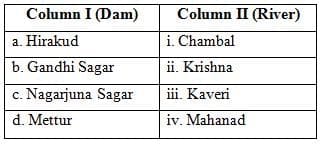
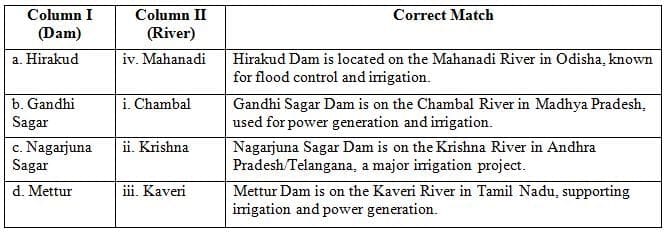
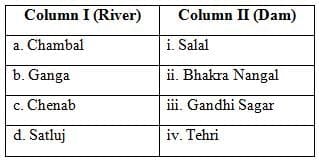
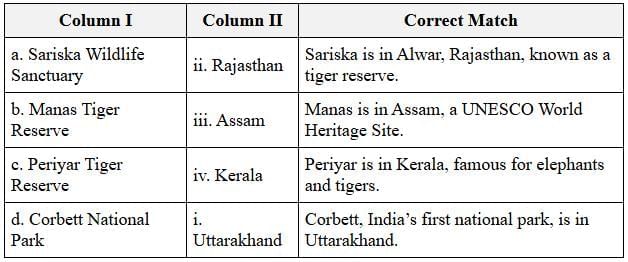
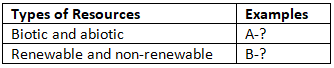
07. Previous Year Questions: Lifelines of National Economy

Previous Year Questions 2025

Q1: How did improvement in transportation technology stimulate the globalisation process? Explain.  (2 Marks) 

Hide Answer  

Ans: 

  • Improvement in transportation technology made the movement of goods and services faster, cheaper, and more efficient across countries.
  • Modern means of transport such as roadways, railways, airways, and waterways reduced time and distance barriers, expanding trade beyond limited spaces and turning the world into a “large village,” thereby accelerating the process of globalisation.


Q2: Attempt any three questions:  (3 Marks)
(i) Name the eastern terminal station of the East-West Corridor.
(ii) Name the leading state in coffee production.
(iii) Name the place where nuclear power plant is located in Uttar Pradesh.
(iv) Name the place where a major sea port is located in Odisha.  

Hide Answer  

Ans:
(i) The eastern terminal station of the East-West Corridor is Silchar in Assam.
(ii) The leading state in coffee production is Karnataka.
(iii) The place where a nuclear power plant is located in Uttar Pradesh is Narora.
(iv) The place where a major sea port is located in Odisha is Paradwip.


Q3: Attempt any three questions:  (3 Marks)
(i) 
Name the place where an international airport is located in West Bengal.
(ii) Name the place where a software technology park is located in Karnataka.
(iii) Name the place where a nuclear power plant is located in Maharashtra.
(iv) Name the place where a major sea port is located in Odisha.  

Hide Answer  

Ans:
(i) The place where an international airport is located in West Bengal is Kolkata.
(ii) The place where a software technology park is located in Karnataka is Bengaluru.
(iii) The place where a nuclear power plant is located in Maharashtra is Tarapur.
(iv) The place where a major sea port is located in Odisha is Paradwip.


Q4: Attempt any three questions:  (3 Marks)
(a)
 Name the place where the major dam is located on the Chenab river.
(b) Name the place where Nuclear Power Plant is located in Uttar Pradesh.
(c) Name the place where a major Software Technology Park is located in Karnataka.
(d) Name the place where a major Sea Port is located in Odisha.  

Hide Answer  

Ans: 
(a) The major dam located on the Chenab River is the Salal Dam in Jammu and Kashmir.
(b) The Nuclear Power Plant located in Uttar Pradesh is at Narora.
(c) The major Software Technology Park in Karnataka is located at Bengaluru.
(d) The major Sea Port located in Odisha is Paradwip.

Q5: Attempt any three questions:  (3 Marks)
(i) Name the leading state in production of rice.
(ii) Name the place where coal-mines are located in Tamil Nadu.
(iii) Name the place where major sea port is located in Karnataka.
(iv) Name the oil field located in Maharashtra.

Hide Answer  

Ans: 
(i) The leading state in the production of rice is West Bengal.
(ii) The place where coal mines are located in Tamil Nadu is Neyveli.
(iii) The major sea port located in Karnataka is New Mangalore Port.
(iv) The oil field located in Maharashtra is Mumbai High.

Q6: Attempt any three questions:  (3 Marks)
(i) Name the place where an International Airport is located in Punjab.
(ii) Name the place where major sea port is located in Gujarat.
(iii) Name an oil field of India located in Arabian Sea.
(iv) Name the place where nuclear power plant is located in Uttar Pradesh.

Hide Answer  

Ans:
(i) The place where an international airport is located in Punjab is Amritsar.
(ii) The major sea port located in Gujarat is Deendayal Port (Kandla).
(iii) The oil field of India located in the Arabian Sea is Mumbai High.
(iv) The nuclear power plant located in Uttar Pradesh is Narora.

Previous Year Questions 2023

Q1: How are waterways an important mode of transport for both passenger and cargo traffic in India? Explain. (2023)

Hide Answer  

Ans: Waterways is an important mode of transport for both passenger and cargo traffic in India.
(i) The most ancient mode of water transport includes rivers, canals, lakes and coastal areas. Cargo as well as passenger was transported from one place to another through boats and steamers.
(ii) Heavy and bulky goods being exported or imported are easier for trans-shipment from water ways to ship on the coast as the waterways led to ports.
(iii) Inland waterways are the only means of transport in dense forests. Also, heavy cargo goods like coal, cement, timber and metallic ores can be transported through this mode.
(iv) It is fuel efficient and environment friendly mode of transport, so it most suitable for carrying heavy and bulky goods and people over long distance.
(v) Its importance has been recognised in the developed world for both domestic and international trade. Efforts have been made to modify rivers to enhance navigability by dredging, stabilising river banks, and building dams and barrages for better regulation of water flow.


Q2: Explain the important features of Air Transport in India. (2023)

Hide Answer  

Ans: (i) The air travel, today, is the fastest, most comfortable and prestigious mode of transport.
(ii) It can cover very difficult terrains like high mountains, dreary deserts, dense forests, and long oceanic stretches with great ease, serving India (varied relief and terrain) adequately.
(iii) In India, it is because of air travel that visits to the north-eastern part of the country marked by dissected relief, big rivers, dense forests, frequent floods and international frontiers has become much convenient and easier,
(iv) Air transport is essential in providing for import and export of various goods.
(v) It also provides for quick relief measures and rescue operations in difficult times of natural calamities and disasters.
The advancement in the means of air transport has proved to be of great importance to the efficiency of the Indian economy as a whole. From increasing the popularity of tourist destinations to the role of a lifesaver during emergency situations, it has significantly added to the vitality of the Indian Economy.

Get additional INR 200 off today with EDUREV200 coupon.

Previous Year Questions 2022

Q3: Read the following table and answer the question that follow:
The Indian Railway nework
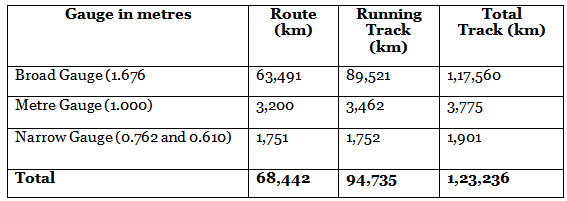
(I) Which gauge covers maximum of track length in hilly areas in India? 
(II) Which gauge has the highest length in India?    (2022)

Hide Answer  

Ans: 


Q4: Read the source given below carefully and answer the questions that follow: 
Lifelines of National Economy 
For a long time, trade and transport were restricted to a limited space. With the development in science and technology, the area of influence of trade and transport expanded far and wide. Today, the world has been converted into a large village with the help of efficient and fast moving transport. Transport has been able to achieve this with the help of equally developed communication system. Therefore, transport, communication and trade are complementary to each other. Today, India is well linked with the rest of the world despite its vast size, diversity and linguistic and socio-cultural plurality. Railways, airways, waterways, newspapers, radio, television, cinema and internet, etc. have been contributing to its socioeconomic progress in many ways. The trades from local to international levels have added to the vitality of its economy. It has enriched our life and added substantially to growing amenities and facilities for the comforts of life.
(i) How is science an important factor in the development of transport?
(ii) How has transport integrated socio-cultural plurality? Explain.
(iii) Analyse the significance of communication for a nation.  (Term-2,2021-22)

Hide Answer  

Ans: (i) Today transport is cheaper, carries goods farther and get us to our destination easily. It is an outcome of science that improved and developed the operational characteristics such as speed, affordability, price, etc.
(ii) Transport integrated the socio-cultural plurality by efficiently moving goods and people from one place to another.
(iii) Communication helps in quick transmission of ideas, information and messages from person to person and from one place to another. It has connected all regions of a nation and all nation with the world. Well-developed communication also gives boost to transport system of a nation.


Q5: Read the following source and answer the questions that follows:
Tourism
Tourism in India has grown substantially over the last three decades. More than 15 million people are directly engaged in the tourism industry. Tourism also promotes national integration, provides support to international understanding about our culture and heritage. Foreign tourists visit India for heritage tourism, eco tourism, adventure tourism, cultural tourism, medical tourism and business tourism. There is a vast potential for development of tourism in all parts of the country. Efforts are being made to promote different types of tourism for this upcoming industry.
(i) Explain the importance of tourism. 
(ii) Give an example of ‘Heritage tourism’.
(iii) Assess the benefits of improving tourism in India.  (Term-2,2021-22)

Hide Answer  

Ans: (i) Tourism boosts the revenue of the economy, creates thousands of jobs, develops the infrastructures of a country, and plants a sense of cultural exchange between foreigners and citizens.
(ii) Monuments like Qutub minar, Taj mahal, etc. are examples of cultural heritage.
(iii) Tourism has great capacity to create large scale employment of diverse kind – from the most specialised to the unskilled. Tourism can only be sustainable when it is carefully managed. It helps to preserve several places which are of historical importance by declaring them as heritage site. Tourism can also help in conserving the natural habitats of many endangered species.

Previous Year Questions 2021

Q6: Match the following and select the correct option:


(a) I – 1, II – 2, III – 3, IV – 4
(b) I – 2, II – 3, III – 1, IV – 4
(c) I – 4, II – 3, III – 2, IV -1
(d) I – 4, II – 3, III – 1, IV – 2

Hide Answer  

Ans: (c)
I – 4, II – 3, III – 2, IV -1

  • Kandla (I) is located in Gujarat (4), and it’s one of the major ports on the west coast of India.
  • Tuticorin (II) is in Tamil Nadu (3) and serves as an important port for trade and fishing.
  • Paradwip (III) is located in Odisha (2) and is known for its deep-water harbor, primarily used for exporting iron ore.
  • Haldia (IV) is in West Bengal (1) and is a significant port for handling cargo and shipping.
Also read: NCERT Textbook: Lifelines of National Economy

Previous Year Questions 2020

Q7: Which is the oldest artificial sea port of India? (Delhi 2020)

Hide Answer  

Ans: Chennai


Q8: Name the first major sea port developed soon after Independence on the Western Coast. (2020)

Hide Answer  

Ans: Kandla port was developed soon after independence, jion the western coast.


Q9: Name the inland riverine major sea port of India. (2020)

Hide Answer  

Ans: Kolkata port is the inland riverine major port of India.


Q10: Which is the deepest, landlocked and well-protected sea port of India? (Delhi 2020)

Hide Answer  

Ans: Visakhapatnam


Q11: Which organization is responsible for constructing and maintaining State Highways in India? (2020)

Hide Answer  

Ans: Border roads have improved the accessibility in areas of strategic importance and of difficult terrain. They also helped in the economic development of these areas.


Q12: Name the organization that constructs and maintains the District Roads. (2020)

Hide Answer  

Ans: State Public Works Department (SPWD)


Q13: Suggest any one way to enhance pilgrimage tourism through Indian Railways. (Delhi 2020)

Hide Answer  

Ans: Railways for enhancing pilgrimage -Pilgrim special tourist train, by providing tourist packages, by making different boarding and de-boarding stations.


Q14: “Rail transport suffers from certain problems in India.” Support the statement with examples. (2020)

Hide Answer  

Ans: Problems faced by railway transport:-
(i) Indian railway receives low investment as compared to other departments.
(ii) It has also faced a problem as sinking of track in some stretches and land slides.
(iii) Poor infrastructure such as old track, poor quality of food etc.


Q15: “Efficient means of transport are pre-requisites for fast development.” Express your views in favor of this statement. (2020, Delhi 2016)

Hide Answer  

Ans: We need various things to sustain our lives in the form of goods, services and support systems. The same applies to all occupational activities. Each of the requirements cannot be in the close vicinity of our place of living. We need to move the goods and services from the supply localities to the demand localities and this is done by the transportation system. We also need efficient transportation for people to reach their places of work, play and learning efficiently. All these activities, which are integral in the economic growth of the local population and the country as a whole is greatly dependent on the transport sector. Thus a dense and efficient network of transportation is a pre-requisite for local and national development. Examples are as follows:
(i) Fast and efficiently moving transport is required for traded items to reach their destinations on time, otherwise business will suffer.
(ii) Transport is required to carry raw materials to production centres.
(iii) From manufacturing hubs to market particularly for perishable goods.


Q16: Describe the growing importance of road transport. (2020)

Hide Answer  

Ans: The growing importance of road transport:
(i) Construction cost of roads is much lower than that of railway lines.
(ii) Roads can traverse comparatively more dissected and undulating topography.
(iii) Roads can negotiate higher gradients of slopes and as such can traverse mountains such as the Himalayas.
(iv) Road transport is economical in transportation of few persons and relatively smaller amount of goods over short distances. (v) It also provides door-to-door service, thus the cost of loading and unloading is much lower.


Q17: Suggest any one way to improve the postal system in India. (2020)

Hide Answer  

Ans: Use of technology in the postal system, such as digitalization, automation, and online tracking services.


Q18: “Communication provides entertainment and creates awareness among masses”. Justify the statement. (2020 C)

Hide Answer  

Ans: Communication refers to convey messages and ideas between individuals or masses. They provide entertainment and create awareness among the masses and integrated the people in the following ways:
(i) Everyday at regular intervals, we hear or watch the news on the radio and television.
(ii) News are given on variety of subjects and topics and people come to know what is happening in the society, politics and economy.
(iii) Doordarshan, the national television channel of India, is one of the largest terrestrial networks in the world. It broadcasts a variety of programmes for entertainment, educational, sport etc. for people of different age groups.
(iv) People are entertaining through watching videos, feature films and short films.
(v) India is one the fastest growing mobile networks in the world. Mobile phones have change the way of business. Now, even low-income group people like vegetable vendors, plumbers and carpenters do better businesses because they are connected through mobile phones.


Q19: “Tourism in India provides large amount of employment and promotes national integration.” Justify the statement. (2020 C)

Hide Answer  

Ans: There has been a sustained growth in tourism in India over the last three decades. More than 15 million people are directly engaged in the tourism industry. Over 10 million foreign tourists arrived in India in 2017. Tourism also promotes national integration, provides support to local handicrafts and cultural pursuits. It also helps in the development of international understanding about our culture and heritage. Foreign tourists visit India for heritage tourism, eco- tourism, adventure tourism, cultural tourism, medical tourism and business tourism.

Attention!Sale expiring soon, act now & get EduRev Infinity at 40% off!

Previous Year Questions 2019

Q20: “Roadways still have an edge over railways in India.” Support the statement with examples. (2020 C, Delhi 2019, Al 2016)

Hide Answer  

Ans: Roadways still have an edge over the railways. This is because: 
(i) 
Construction cost of roads is much lower than that of railway lines and construction time is also comparatively less.
(ii) Roads can traverse comparatively more dissected and undulating topography which is a limitation in case of railways.
(iii) Roads can negotiate higher gradients of slopes and as such can traverse mountains like the Himalayas, whereas the mountainous regions are unfavourable for the construction of railway lines due to high relief. Similarly it is difficult to lay railway lines on the sandy plains in the deserts, swampy or forested tracks.
(iv) Road transport is economical in transportation of few persons and relatively smaller amount of goods over short distances, whereas railways are suitable for transportation of large number of people and goods in bulk, especially over long distances.
(v) Roadways provide the “last mile connectivity” and provide the door to door service, thus the cost of loading and unloading is much lower.
(vi) Road transport is the idea to feeder mode of transport to other modes of transport such as they provide a link between railway stations, air and seaports.


Q21: Highlight the significance of pipelines as a means of transportation, with suitable examples. (2019 C)

Hide Answer  

Ans: Pipeline transport is the transportation of goods or materials through a pipe. In the past, pipes were used to transport water to cities and industries. Now, these are also used for transporting crude oil, petroleum products and natural gas from oil and natural gas fields to refineries, fertiliser factories and big thermal power plants. Solids can also be transported through a pipeline when converted into slurry.
The far inland locations of refineries like Barauni, Mathura, Panipat and gas based fertiliser plants have been functioning only because of pipelines. Initial cost of laying pipelines is high but subsequent running costs are minimal. It rules out trans-shipment losses or delays.


Q22: Highlight any five major problems faced by road transport in India. (2019 C)

Hide Answer  

Ans: Road transportation in India faces a number of problems. Keeping in view the volume of traffic and passengers, the road network is inadequate. About half of the roads are unmetalled and this limits their usage during the rainy season.
The National Highways are inadequate too. Moreover, the roadways are highly congested in cities and most of the bridges and culverts are old and narrow.


Q23: Why is air travel preferred in North-Eastern States of India? Explain with examples. (2019 C)

Hide Answer  

Ans: Factors that made air travel prominence in North- Eastern states in India.
(i) It can cover difficult terrains area like high mountains which are, by road difficult to reach.
(ii) The north-eastern part of the country marked with the presence of big rivers, dense forest and frequent floods and international frontiers has made the air travel important.
(iii) As per the geographical location of north-eastern states, the area known by road can be accessed to siliguri corridor (Sikkim) is the only route to connect with other parts of India. In this scenario, air travel is placed on utmost importance.


Q24: Describe any five benefits of tourism in India. (Al 2019)

Hide Answer  

Ans: Tourism is very important for the Indian economy:
(i) According to the World Travel and Tourism Council tourism generated US$230 billion or 9.4% of the nation’s GDP in 2017 and supported 41.622 million jobs, 8% of its total employment. Over 10 million foreign tourists arrived in India in 2017.
(ii) Tourism also promotes national integration, provides support to local handicrafts and cultural pursuits.
(iii) It also helps in the development of international understanding about our culture and heritage. Foreign tourists visit India for heritage tourism, eco-tourism, adventure tourism, cultural tourism, medical tourism and business tourism.
(iv) The various industries that benefit from tourism are handicraft industry, sculpture, sea-shell, regional handloom etc.
(v) Hospitality is another sector that benefits tremendously from tourism. So does the transport sector including air, railways and road transport.

Previous Year Questions 2018

Q25: Recognize the form of power sharing which is represented by the Community Government in Belgium. (CBSE 2018)

Hide Answer  

Ans: The community government represented power sharing among different social groups like the religious and linguistic groups.

Also read: NCERT Textbook: Lifelines of National Economy

2017 & Rest of Years Questions

Q26: Name the river related to National Waterways No. 2. (Al 2017)

Hide Answer  

Ans: The Brahmaputra river between Sadiya and Dhubri (891km)


Q27: Name the river which is related to National Waterways No. 1. (Al 2017)

Hide Answer  

Ans: The Ganga river between Allahabad and Haldia (1620 km)


Q28: Name the state related to National Waterways No. 3. (Foreign 2017)

Hide Answer  

Ans: Kerala

Q29: Examine with an example the role of means of transport and communication in making our life prosperous and comfortable. (Al 2017)

Hide Answer  

Ans: Means of transport and communication play a crucial role in improving our lives and contributing to prosperity and comfort. Here’s an example to illustrate this:
Example: Online shopping and doorstep delivery
The advent of e-commerce platforms and efficient means of transportation have revolutionized the way we shop. Online shopping allows us to browse through a wide range of products from the comfort of our homes and make purchases with just a few clicks. The role of transportation in this context is to ensure the timely delivery of these products to our doorsteps.
Benefits:
1. Convenience: Online shopping eliminates the need to visit physical stores, saving time and effort. We can shop at any time, from anywhere, and have the products delivered to our desired location.
2. Wide selection: E-commerce platforms offer a vast range of products, giving us access to items that may not be available locally. This expands our choices and allows us to find specific products that meet our needs and preferences.
3. Competitive pricing: Online shopping often offers competitive prices and discounts compared to traditional retail stores. This enables us to find better deals and save money on our purchases.
4. Comfortable experience: By eliminating the need to travel and navigate crowded stores, online shopping provides a more comfortable and stress-free shopping experience. We can avoid long queues, parking hassles, and the physical strain of carrying heavy shopping bags.
Transportation and communication play a crucial role in the success of online shopping. Efficient transport systems ensure the timely delivery of products, while communication networks enable us to track our orders, receive notifications, and communicate with sellers if needed. This integration of transport and communication enhances the overall shopping experience, making our lives more prosperous and comfortable.


Q30: What is a new arrival on the transportation map of India? (2016)

Hide Answer  

Ans: Pipeline transportation network, which transports gas, liquids, and solids in slurry form.


Q31: Elaborate any three advantages of railways in India. (2016)

Hide Answer  

Ans: Railways in India offer several advantages that contribute to the country’s development. Here are three key advantages:
1. Efficient long-distance travel: Railways provide a reliable and efficient mode of transportation for long-distance travel. They offer comfortable and affordable options for individuals to commute between cities and towns.
2. Freight transportation: Railways are instrumental in transporting bulky goods and raw materials across the country. They have a higher carrying capacity compared to other modes of transport, making them ideal for the movement of heavy cargo.
3. Employment generation: The railway sector provides significant employment opportunities. From train operations to maintenance and infrastructure development, railways create jobs for a diverse range of professionals and laborers, contributing to economic growth and livelihoods.


Q32: What is pipeline transportation? Write two merits and demerits of the same. (2016)

Hide Answer  

Ans: Pipeline transportation is a mode of transport that involves the movement of liquids, gases, or slurry through pipelines. Here are two merits and two demerits of pipeline transportation:
Merits:
1. Cost-effective: Once the pipeline network is established, the running costs are relatively low compared to other modes of transport. It requires minimal human intervention for operation.
2. Safety and efficiency: Pipelines offer a safe and reliable way to transport liquids and gases, minimizing the risk of accidents and spillage. They also provide a continuous flow of materials without delays or trans-shipment losses.
Demerits:
1. High initial investment: The construction and establishment of pipeline networks require substantial upfront investment. This can be a significant financial barrier, especially for developing countries.
2. Limited versatility: Pipelines are primarily designed for the transportation of specific materials, such as oil, gas, or water. They may not be suitable for transporting a wide variety of goods, limiting their applicability in certain industries or regions.


Q33: How do modern means of transport serve as lifelines for our nation? Explain. (2016)

Hide Answer  

Ans: Modern means of transport serve as lifelines for our nation in the following ways:
(i) Economic development: Transport and communication networks are essential for the economic development of a region or country. They connect areas of production with areas of consumption, facilitate the movement of goods and services, and support industrial growth.
(ii) Accessibility and connectivity: Modern means of transport provide accessibility and connectivity to remote areas, ensuring their integration into the national economy. They link villages with towns, connect agricultural areas with industrial centers, and enable trade and commerce across regions.
(iii) Social integration: Transport networks promote social integration by facilitating the movement of people, goods, and ideas. They enable cultural exchange, tourism, and the sharing of knowledge and experiences.
(iv) Emergency response: Modern means of transport play a crucial role in emergency response and disaster management. They enable the quick transportation of relief materials, rescue operations, and the evacuation of affected populations during natural calamities.
(v) National defense: Transport networks are vital for national defense and security. They ensure the rapid movement of troops, equipment, and supplies during times of war or crisis.
(vi) Employment generation: The transport sector creates employment opportunities in various fields, including logistics, maintenance, and administration. It contributes to both formal and informal sectors, supporting livelihoods and economic growth.


Q34: What is the major objective to develop superhighways? (2015)

Hide Answer  

Ans: The major objective behind developing superhighways is to reduce the distance and travel time between large cities in India.


Q35: Why was Jawaharlal Nehru port developed? (2015)

Hide Answer  

Ans: Jawaharlal Nehru port was developed to decongest the Mumbai port and serve as a hub for the region.


Q36: Why was the Haldia seaport set up? (2015)

Hide Answer  

Ans: The Haldia seaport was set up as a subsidiary port to reduce the load on the Kolkata port.


Q37: Describe the rural roads in India. (2015)

Hide Answer  

Ans: Rural roads in India are crucial for connecting rural areas and villages with important towns and cities. Here are some key features of rural roads in India:
1. Pradhan Mantri Gram Sadak Yojana (PMGSY): The government of India launched the PMGSY to improve rural connectivity. Under this scheme, efforts are made to provide all-weather motorable roads to every village, ensuring accessibility throughout the year.
2. Connectivity: Rural roads aim to connect remote and isolated areas with major towns and cities. They promote accessibility to essential services such as healthcare, education, and markets.
3. Infrastructure: Rural roads are often built using cost-effective materials like gravel, crushed stone, or bitumen. They are designed to withstand the local weather conditions and accommodate the transportation needs of rural communities.


Q38: Describe any three features of waterways in India. (AI 2015)

Hide Answer  

Ans: Waterways in India have unique features that make them an important mode of transport. Here are three key features of waterways in India:
1. Extensive network: India has a vast network of waterways, including rivers, canals, and coastal areas. These waterways cover a significant portion of the country, providing connectivity to various regions.
2. Cost-effective: Waterways are known for their cost-effectiveness, especially for bulk transportation. Compared to other modes of transport, such as road or rail, water transport is relatively cheaper, making it suitable for carrying heavy and bulky goods.
3. Environment-friendly: Water transport has a lower carbon footprint compared to road or air transport. It is considered a more sustainable mode of transportation as it reduces greenhouse gas emissions and minimizes fuel consumption.


Q39: Describe any three factors that accord prominence to airways as a mode of transportation. (2015)

Hide Answer  

Ans: Airways, or air transport, have several factors that make them prominent in the transportation sector. Here are three key factors:
1. Speed and efficiency: Airways are the fastest mode of transportation, allowing people and goods to reach their destinations quickly. Air travel significantly reduces travel time and enables businesses to operate more efficiently.
2. Accessibility to remote areas: Air transport plays a vital role in connecting remote and inaccessible areas. It allows people living in remote regions to access essential services and facilitates economic development in these areas.
3. Emergency response: Airways play a crucial role in emergency situations like natural disasters or medical emergencies. The ability to quickly transport relief materials, medical supplies, and personnel to affected areas can save lives and provide timely assistance.


Q40: Why are metalled roads better than unmetalled roads? What is the role of border roads and national highways in transportation? (2015)

Hide Answer  

Ans: Metalled roads, also known as paved roads, offer several advantages over unmetalled roads. Here’s why metalled roads are better:
1. Durability: Metalled roads are made with materials like concrete, asphalt, or bitumen, making them more durable and resistant to wear and tear caused by traffic and weather conditions. They have a longer lifespan compared to unmetalled roads.
2. All-weather usability: Metalled roads can be used year-round, regardless of weather conditions. They can withstand heavy rains, floods, and other adverse weather events, providing reliable transportation throughout the year.
Border roads and national highways play vital roles in transportation:
1. Border roads: Border roads connect strategically important and challenging areas along the country’s borders. They aid in the movement of defense personnel, supplies, and equipment, ensuring the security and accessibility of border regions.
2. National highways: National highways are primary road networks that connect major cities, towns, and industrial centers across the country. They facilitate the movement of goods, services, and people on a large scale, supporting economic development and regional integration.


Q41: “Road transport and Rail transport in India are not competitive but complementary to each other.” Justify the statement. (Foreign 2015)

Hide Answer  

Ans: Road transport and rail transport in India are not competitive but complementary to each other due to the following reasons:
(i) Different capacities: Road transport is suitable for smaller amounts of goods and a few passengers over short distances, while rail transport is more efficient for bulk transportation and long-distance travel.
(ii) Accessibility and connectivity: Road transport provides last-mile connectivity, linking rural areas and towns to railway stations and other modes of transport. It acts as a feeder route for rail transport, ensuring accessibility to remote areas.
(iii) Flexibility: Road transport offers flexibility in terms of routes and schedules, allowing for quick and customized transportation. Rail transport, on the other hand, provides a fixed and reliable schedule for mass transportation.
(iv) Perishable goods: Road transport is ideal for the transportation of perishable goods over short distances, ensuring their freshness and quality. Rail transport is more suitable for non-perishable goods and bulk commodities.
(v) Cost-effectiveness: Road transport has lower construction and maintenance costs compared to rail transport. It is more economical for transportation over shorter distances and smaller quantities of goods.
(vi) Urban congestion: Road transport helps alleviate urban congestion by providing local transportation within cities and towns. It reduces the burden on rail transport in heavily populated areas.
(vii) Intermodal connectivity: Both road transport and rail transport are essential for intermodal connectivity, facilitating the seamless movement of goods and passengers between different modes of transport, such as ports, airports, and railway stations.

06. Previous Year Questions: Manufacturing Industries

Previous Year Questions 2025

Q1: Explain the role of industries in increasing air pollution and suggest any three measures to reduce air pollution.  (5 Marks)

Hide Answer  

Ans: Industries are one of the main causes of air pollution. Many factories release harmful gases and smoke into the air. The presence of gases like sulphur dioxide and carbon monoxide makes the air impure and dangerous for living beings. Smoke from chemical and paper factories, brick kilns, refineries, and smelting plants, as well as from the burning of fossil fuels in factories, adds to the problem. These industries also release tiny solid and liquid particles such as dust, sprays, mist, and smoke into the atmosphere. This polluted air affects human health, damages plants and buildings, and harms the environment as a whole.

To reduce air pollution caused by industries, the following measures can be taken:

  • Install smoke stacks with devices such as electrostatic precipitators, fabric filters, scrubbers, and inertial separators to trap dust and harmful particles before releasing gases into the air.
  • Use cleaner fuels like oil or gas instead of coal in factories to reduce smoke and soot.
  • Plant green belts around industrial areas to absorb pollutants and maintain clean air.

By adopting these steps, industries can help reduce air pollution and protect the environment.

Q2: Explain the role of industries in increasing water pollution and suggest any three measures to reduce water pollution.  (5 Marks)

Hide Answer  

Ans: 

Role of industries in increasing water pollution:

  • Industries release organic and inorganic wastes such as dyes, detergents, acids, salts, and heavy metals like lead and mercury into rivers and ponds.
  • Paper, pulp, chemical, textile, dyeing, petroleum refineries, tanneries, and electroplating industries are the main sources of water pollution.
  • These pollutants make water unsafe for drinking and harmful to aquatic life.
  • Thermal power plants discharge hot water into rivers and ponds without cooling, causing thermal pollution, which affects aquatic organisms.
  • Soil and water pollution are closely related, as rainwater carries pollutants from the soil into groundwater.

Measures to reduce water pollution:

  • Treat industrial effluents before releasing them into water bodies through primary, secondary, and tertiary treatment.
  • Reuse and recycle water in different stages of production to minimise wastage.
  • Harvest rainwater to meet water needs and reduce dependence on polluted or underground sources.

By applying these measures, industries can help reduce water pollution and protect the environment.

Q3: “Manufacturing industries are considered the backbone of the economic development of a country.” Justify the statement.  (5 Marks)

Hide Answer  

Ans: Manufacturing industries are known as the backbone of economic development because they play a key role in the progress of a country.

  • Manufacturing industries help in modernising agriculture, which is the main occupation in India. They produce machines, irrigation pumps, fertilisers, pesticides, and tools that increase agricultural productivity and make farming more efficient.
  • These industries reduce dependence on agriculture by providing employment to many people in factories and service-related sectors. This helps in reducing unemployment and poverty in the country.
  • The growth of industries helps to reduce regional disparities by setting up factories in tribal and backward areas, thus promoting balanced regional development.
  • By exporting manufactured goods, the country earns valuable foreign exchange which strengthens trade and commerce.
  • Countries that convert their raw materials into a wide range of finished goods become more prosperous because finished products have higher value.

Therefore, manufacturing industries are essential for India’s growth as they support agriculture, create jobs, promote balanced development, and make the country economically strong.

Q4: “Agriculture and industries complement each other.” Justify the statement.  (5 Marks)

Hide Answer  

Ans: Agriculture and industries complement each other by providing raw materials, markets, employment, and supporting economic development.

  • Raw Materials for Industries: Agriculture supplies raw materials like cotton, jute, and sugarcane to industries such as textiles, jute, and sugar, as emphasized in the chapter.
  • Market for Industrial Goods: Agricultural communities create demand for industrial products like fertilizers, pesticides, and machinery, boosting industrial growth.
  • Employment Opportunities: Both sectors generate jobs; agriculture supports rural livelihoods, while agro-based industries (e.g., food processing) employ both rural and urban workers.
  • Economic Development: The interdependence of agriculture and industry drives economic growth by ensuring a steady supply of raw materials and markets, as discussed in the chapter.

Q5: Explain the measures taken by ‘National Thermal Power Corporation’ to prevent environmental degradation.  (5 Marks) 

Hide Answer  

Ans: The National Thermal Power Corporation (NTPC) has taken several important steps to prevent environmental degradation while generating power. It has also received ISO certification for Environment Management System (EMS 14001) for its efforts.

  1. NTPC follows a proactive approach to preserve natural resources such as water, oil, gas, and fuel in the areas where its power plants are located.
  2. It ensures the optimum use of equipment by adopting the latest technology and upgrading existing machinery to improve efficiency and reduce pollution.
  3. The corporation focuses on minimising waste generation and promotes maximum utilisation of ash produced in thermal power plants.
  4. NTPC has developed green belts around its plants to maintain ecological balance and support afforestation.
  5. It also works to reduce environmental pollution through ash pond management, ash water recycling systems, and liquid waste management.
  6. NTPC conducts ecological monitoring and maintains an online database for all its power stations to ensure environmental standards are met.

Through these measures, NTPC has set an example of how industrial growth can be achieved along with environmental protection.

Q6: Explain the importance of the manufacturing industry in the Indian economy.  (5 Marks)

Hide Answer  

Ans: The manufacturing industry plays a very important role in the growth and development of the Indian economy. It is considered the backbone of economic progress because of the following reasons:

  • Modernises agriculture: The manufacturing sector supports agriculture by producing machines, fertilisers, pesticides, irrigation pumps, and other tools that help farmers increase productivity and make farming more efficient.
  • Reduces dependence on agriculture: It provides jobs to a large number of people in the secondary and tertiary sectors, thus reducing the heavy dependence on agricultural income and helping to remove unemployment and poverty.
  • Promotes regional development: By setting up industries in tribal and backward areas, it helps reduce regional disparities and promotes balanced regional growth across the country.
  • Boosts foreign trade: The export of manufactured goods expands trade and brings in valuable foreign exchange, strengthening the country’s position in global markets.
  • Adds value to raw materials: Manufacturing converts raw materials into finished goods of higher value, which increases national income and prosperity.

Hence, the manufacturing industry is vital for India’s progress as it supports agriculture, creates employment, promotes regional balance, enhances exports, and strengthens the overall economy.

Q7: How do industries increase thermal pollution? Suggest any three measures to reduce thermal pollution.  (5 Marks)

Hide Answer  

Ans: How industries increase thermal pollution:

  • Industries and thermal power plants often release hot water into rivers, ponds, and lakes without cooling it first.
  • This increases the temperature of water bodies, reducing the amount of dissolved oxygen in the water.
  • As a result, aquatic life such as fish and plants are harmed or even destroyed due to sudden temperature changes.
  • Continuous discharge of hot water disturbs the natural balance of aquatic ecosystems.

Measures to reduce thermal pollution:

  • Cool hot water before discharge — Industries should cool or treat hot water before releasing it into water bodies.
  • Reuse and recycle water — Water should be reused in different stages of industrial processes to reduce the amount of heated water being released.
  • Use modern and efficient equipment — Adopting advanced technologies and energy-efficient machinery can help reduce the generation of excess heat.

By following these measures, industries can significantly reduce thermal pollution and protect aquatic ecosystems.

Q8: Two statements are given below. They are Assertion (A) and Reason (R). Read both the statements and choose the correct option:
Assertion (A): Most of the jute industry in India is located in a narrow belt along the banks of Hugli river.
Reason (R): India is the second largest exporter of jute.  (1 Mark)
(a)
 Both (A) and (R) are true and (R) is the correct explanation of (A).
(b) Both (A) and (R) are true, but (R) is not the correct explanation of (A).
(c) (A) is true, but (R) is false.
(d) (A) is false, but (R) is true.

Hide Answer  

Ans: (b) Both (A) and (R) are true, but (R) is not the correct explanation of (A).

It is true that most of the jute industry in India is located along the banks of the Hugli river in West Bengal. This is because of the availability of raw jute, cheap labour, water transport, rail and road connectivity, and abundant water for processing.
It is also true that India is the second largest exporter of jute, but this is not the reason for the industry’s location along the Hugli river.

Q9: On the same political outline map of India, locate and label any three of the following with suitable symbols :   (3 Marks)
(i) Leading state in production of Jute  
(ii) Atomic Power Plant located in Gujarat  
(iii) Iron and Steel Plant located in Jharkhand  
(iv) Sri Guru Ram Das Jee International Airport

Political Map of India

Ans: 

Hide Answer  

Leading state in production of Jute: West Bengal

  • The chapter highlights that West Bengal is the leading state in jute production and jute-based industries, particularly due to its proximity to jute-growing areas and the availability of water for processing. Kolkata and its surrounding areas host major jute mills.

Atomic Power Plant located in Gujarat: Kakrapar

  • The Kakrapar Atomic Power Station is a well-known nuclear power plant in Gujarat, located near Surat.

Iron and Steel Plant located in Jharkhand: Bokaro

  •  The chapter specifically mentions the Bokaro Steel Plant in Jharkhand as a major iron and steel plant, part of the Steel Authority of India Limited (SAIL), located in the Chhota Nagpur plateau region, rich in mineral resources.

Sri Guru Ram Das Jee International Airport

  • Sri Guru Ram Das Jee International Airport (Amritsar) is the third-largest airport in Northern India.

Previous Year Questions 2024

Q1: “The development process of India has experienced transformation due to the significant influence of Information Technology (IT) and Electronic Industry.” Explain the statement with examples.   (CBSE 2024)

Hide Answer  

Ans: 

Hide Answer  

(1) Products in the electronics sector range widely, from cell phones to televisions, and India’s development in these products and services has been significantly shaped by the Information Technology (IT) and electronics industry.
(2) India’s economy has changed and its GDP has increased dramatically as a result of the country’s emergence as a major global center for IT, especially in cities like Bangalore, Hyderabad, and Pune.
(3) The IT industry has boosted India’s reputation as a leading global technology destination and directly or indirectly generated millions of jobs. This growth was further accelerated by the “Make in India” initiative, which attracted foreign investments in the electronic sector and promoted domestic manufacturing.
(4) The rapidly expanding Business Process Outsourcing (BPO) sector in this industry has made it a significant source of foreign exchange earnings over the past two or three years.
(5) India’s competitiveness in the international market has increased as a result of the growth of the information technology and electronics industry.

IT Innovation

Previous Year Questions 2023

Q2: Why does the textile industry occupy a unique position in the Indian economy? Explain. (2023)

Hide Answer  

Ans: The textile industry holds a unique position in the Indian economy for several reasons:

  • It is the only industry that is self-reliant and complete in the value chain, covering everything from raw materials to finished products.
  • The industry generates demand for various sectors, including chemicals, dyes, packaging materials, and engineering.
  • It significantly contributes to industrial production, employment, and foreign exchange earnings.

Overall, the textile industry is vital for the growth and sustainability of the Indian economy.


Q3: Explain any three ways through which industrial pollution can be reduced. (2023)

Hide Answer  

Ans: Three ways through which industrial pollution can be reduced are:

  • Use of Efficient Machinery: Equipping machinery and generators with silencers to reduce noise pollution.
  • Recycling Waste: Treat and recycle waste and effluents using biological and mechanical processes.
  • Install Pollution Control Devices: Fit factories with smoke screens, electrostatic precipitators, and scrubbers to minimise emissions.


Q4:  “Agriculture and industry move hand in hand.” Support the statement with examples. (CBSE 2023)

Hide Answer  

Ans: The agro-industries significantly enhance agriculture by boosting productivity. 
Here are some key points:

  • Supply of Inputs: Agro-industries provide essential tools and materials like irrigation pumps, fertilisers, insecticides, and machinery, enabling farmers to increase food production.
  • Transportation: These industries assist in transporting agricultural goods to markets and also consume these products.
  • Job Creation: Manufacturing industries modernise agriculture and create jobs in secondary and tertiary sectors, reducing reliance on agricultural income.
Get additional INR 200 off today with EDUREV200 coupon.

Previous Year Questions 2022

Q5: Why is the iron and steel industry called the ‘basic industry’? Explain. (Term-ll, 2021-22 C)

Hide Answer  

Ans: The iron and steel industry is referred to as a basic industry because:

  • It provides essential materials for various sectors.
  • It is crucial for producing engineering goods.
  • It supplies materials for constructiondefence, and medical equipment.
  • It supports the manufacturing of telephonic and scientific equipment.
  • It is a key component in creating a wide range of consumer goods.

Overall, the production and consumption of steel reflect a country’s development.


Q6: Explain the importance of the ‘cement’ industry. (Term-ll, 2021-22 C)

Hide Answer  

Ans: The cement industry is crucial for various reasons:

  • Construction: It is vital for building homes, factories, bridges, and roads.
  • Economic Growth: With rising government spending, this industry significantly contributes to development.
  • Diverse Production: It produces various types of cement to meet different construction needs.


Q7: Read the case given below carefully and answer the questions that follow:      (2022)
NTPC shows the way

NTPC is a major power providing corporation in India. It has ISO certification for EMS (Environmental  Management System) 14001. The corporation has a pro-active approach for preserving the natural environment and resources like water, oil, gas and fuels in places where it is setting up power plants. This has been possible through
(a) Optimum utilisation of equipment adopting latest techniques and upgrading existing equipment.
(b) Minimising waste generation by maximising ash utilisation.
(c) Providing green belts for nurturing ecological balance and addressing the question of special purpose vehicles for afforestation.
(i) Which is the major power providing corporation in India?
(ii) Name the institution which issues ISO certification for Environment Management System.
(iii) Explain the pro-active approach of NTPC for preserving the natural environment. 

Hide Answer  

Ans: (i) NTPC is the major power providing corporation in India, which is expanded as National Thermal Power Corporation.
(ii) An ISO certification in India can be issued by a third party certification body that is accredited by the National Accreditation Board of certification.
(iii) (a) Optimum utilisation of equipment adopting latest techniques and upgrading existing equipment,
(b) Minimising waste generation by maximising ash utilisation.
(c) Providing green belts for nurturing ecological balance and addressing the question of special purpose vehicles for afforestation.


Q8: How can the industrial pollution of fresh water be reduced?  (CBSE Term-2 2022)

Hide Answer  

Ans: Industrial pollution of fresh water can be reduced by taking the following measures: 
(1) Minimise the usage of water by reusing and recycling it through multiple successive stages. 
(2) Compulsory treatment of hot water and effluents before releasing them in rivers and ponds.


Q9: Classify industries on the basis of raw materials.  (CBSE Term-2 2022)

Hide Answer  

Ans: Industries can be classified based on the raw materials they use. 
The main categories are:

  • Agro-Based Industries: These industries rely on agricultural products, such as textiles, sugar, and edible oils.
  • Mineral-Based Industries: These industries use minerals and metals, including iron, steel, and cement.

Previous Year Questions 2021

Q10: “Manufacturing sector is considered as the backbone of economic development of a country.” Support the statement with examples. (2021 C, Foreign 2017)

Hide Answer  

Ans: 

The manufacturing sector is considered the backbone of economic development.

Hide Answer  

  • Support for Agriculture: The manufacturing sector provides essential inputs for agriculture, such as tractors, harvesting machines, and fertilizers, which modernise farming practices.
  • Employment Opportunities: Establishing industries in tribal and backward areas creates jobs, improving the economic status of local communities.
  • Value Addition: The sector enhances employment by adding value to goods. For instance, countries like the USA export finished products rather than raw materials.
  • Trade Expansion: Exporting manufactured goods boosts trade and generates foreign exchange, contributing to national prosperity.
  • Interdependence: Agriculture and industry complement each other. Agro-industries rely on agricultural raw materials and provide products that enhance farming efficiency.

Agro-Industrial Growth

Previous Year Questions 2020

Q11: Which of the following industries use bauxite as a raw material?   (2020)
(a) 
Cement
(b) Aluminium smelting
(c) Iron and steel
(d) Chemical   

Hide Answer  

Ans: (b)
Bauxite is primarily used as a raw material in the production of aluminum through a process called smelting. It is rich in aluminum oxide, which is extracted to produce aluminum metal, making it essential for the aluminum industry. Other industries like cement and iron and steel do not use bauxite as their primary raw material.


Q12: Fill in the blank:
(i)  ___________ industry is used for manufacturing aircraft, utensils, and wires. (Delhi 2020)

Hide Answer  

Ans: Aluminium industry.

(ii) Limestone, silica, alumina, and gypsum are the raw materials of ___________ industry. (2020)

Hide Answer  

Ans: Cement industry.


Q13: Suggest any one measure to promote handspun khadi in India. (Delhi 2020)

Hide Answer  

Ans: Schemes for promoting khadi: Government should promote it by reducing cost of khadi.


Q14: Explain the ways through which the industrial pollution of fresh water can be reduced. (2020)

Hide Answer  

Ans: When an industry discharges one litre of polluted water without any proper treatment, it can pollute at least eight times the quantity of freshwater. 
To reduce the pollution of water bodies the following action should be taken:
(i) Minimising water use for processing by reusing and recycling it in two or more successive stages.
(ii) Harvesting of rainwater to meet water requirements.
(iii) Treating hot water and other effluents before releasing them in water bodies.
(iv) Overdrawing of ground water reserves by industry or even for agricultural purposes need to be regulated and a viable solution needs to be implemented.


Q15: Which one of the following is a private sector industry? 
(a) BHEL 
(b) TISCO 
(c) OIL 
(d) SAIL (CBSE 2020, 12)

Hide Answer  

Ans: (b)
(a) BHEL (Bharat Heavy Electricals Limited): This is a public sector company owned by the Government of India.
(b) TISCO (Tata Iron and Steel Company, now Tata Steel): This is a private sector industry owned by the Tata Group.
(c) OIL (Oil India Limited): This is a public sector company.
(d) SAIL (Steel Authority of India Limited): This is also a public sector company.
Therefore, the correct answer is (b) TISCO, as it is a private sector industry.

Also read: Infographics: Manufacturing Industries

Previous Year Questions 2019

Q16: Describe any five factors responsible for the concentration of iron and steel industry in and around Chota Nagpur Plateau region. (2019,2014)

Hide Answer  

Ans: Iron and steel Industry called as the ‘basic industry’ because it is needed to manufacture a variety of engineering goods, construction materials, defence, medical, telephonic, scientific equipments and a variety of consumer goods.


Q17: How are industries responsible for environmental degradation in India? Explain with examples. (Delhi 2019)

Hide Answer  

Ans: Industries are responsible for environmental degradation in the following ways: 
(i) Many times pollution norms are not followed by the industries. The effluents are not treated before they discharge into air or water bodies. 
(ii) Toxic gas leaks can be very hazardous with long-term effects; as happened after the Bhopal Gas tragedy. Hence meticulous maintenance of equipment is necessary. 
(iii) Thermal pollution of water occurs when hot water from factories and thermal plants is drained into rivers and ponds before cooling; this greatly harms the aquatic plants and animals. 
(iv) They release toxic dyes, detergents, acids, salts and heavy metals like lead and mercury, various pesticides, fertilisers, synthetic chemicals, plastics and rubber etc., into the water bodies. 
(v) Mismanagement of wastes from nuclear power plants can cause cancers and birth defects.


Q18: Describe the importance of manufacturing industries as a backbone of economic development of the country. (CBSE 2019)

Hide Answer  

Ans: The manufacturing sector is considered as the backbone of economic development of a country because: 
(1) The manufacturing sector provides employment to a large number of people in the industrial as well as service sectors. 
(2) It helps in increasing agricultural productivity by modernising agriculture. 
(3) It also helps in minimising regional disparities by setting up industries in tribal and backward areas of the country.


Q19: ‘The challenge of sustainable development requires control over industrial pollution.’ Substantiate the statement with examples. (CBSE 2019)

Hide Answer  

Ans: (1) On one hand, Industries lead to extensive growth and expansion, on the other hand, these are also the cause of environmental degeneration. 
(2) There is an urgent need or requirement to use a more sustainable model.
(3) Industries must produce eco-friendly products and dump wastes responsibly. 
(4) Use of latest technology can help industries to control pollution and lead towards sustainable mode of operation.
(5) If necessary, dump waste in specified places, away from the land and water sources. Before dumping, treat well and make useful for other than drinking purpose, stop using thermal plants in some of the locations.

Previous Year Questions 2018

Q20: Why is economic strength of a country measured by the development of manufacturing industries? (2018, Delhi 2016) 

Hide Answer  

Ans: The economic strength of a country is measured by the development of manufacturing industries because manufacturing plays a crucial role in the overall growth and development of an economy. Manufacturing industries contribute to several key aspects: 
1. Utilization of Natural Resources: The development of manufacturing industries allows for the efficient utilization of a country’s natural resources, leading to increased production and economic growth. 
2. Balanced Sectoral Development: Manufacturing industries help achieve a balanced sectoral development by reducing the over-dependence on the agricultural sector. This diversification strengthens the economy and reduces vulnerability. 
3. Enhanced Capital Formation: The growth of manufacturing industries leads to an increase in investment and capital formation. This, in turn, boosts economic growth and development. 
4. Increase in National Income and Foreign Exchange: Manufacturing industries contribute significantly to the national income of a country. Additionally, export-oriented manufacturing sectors generate foreign exchange, which strengthens the overall economy. 
5. Job Creation: The development of manufacturing industries creates job opportunities for a large section of the population, thereby reducing unemployment and poverty.

Previous Year Questions 2017

Q21: Analyze the role of chemical industries in the Indian economy. (AI 2017) 

Hide Answer  

Ans: The chemical industry plays a vital role in the Indian economy due to the following reasons: 
1. Contribution to GDP: The chemical industry is one of the fastest-growing sectors in India and contributes significantly to the country’s Gross Domestic Product (GDP). It provides employment opportunities and generates income, contributing to economic growth. 
2. Export and Import: India ranks 9th in exports and 6th in imports of chemicals globally. The chemical industry contributes to foreign exchange earnings through exports of various chemical products. 
3. Diversification: The chemical industry in India is diversifying rapidly, with growth observed in both organic and inorganic sectors. It includes the production of petrochemicals, fertilizers, synthetic fibers, plastics, adhesives, and paints. This diversification strengthens the industrial base and promotes economic development. 
4. Value Addition: The chemical industry is a significant consumer of its own products. Value addition through various chemical processes adds to the overall economic output of the country. 
5. Employment Generation: The chemical industry provides direct and indirect employment opportunities to a large number of people. It supports various ancillary industries and contributes to job creation, reducing unemployment rates. 


Q22: Explain the contribution of the textile industry to the Indian economy. (Foreign 2017) 

Hide Answer  

Ans: The textile industry has a significant contribution to the Indian economy in the following ways: 
1. Industrial Production: The textile industry is one of the largest contributors to industrial production in India. It encompasses various stages of the textile value chain, including spinning, weaving, dyeing, printing, and garment manufacturing. 
2. Employment Generation: The textile industry is a labor-intensive sector and provides employment to a large number of people, particularly in rural areas. It contributes to income generation and poverty reduction. 
3. Export Earnings: The textile industry is a major earner of foreign exchange through exports. India is one of the largest exporters of textiles globally. The industry’s export earnings help improve the country’s balance of trade. 
4. Market Demand: In a developing country like India, the textile industry plays a crucial role in meeting the domestic demand for clothing and textiles. It caters to the diverse needs of the population, providing affordable and fashionable clothing options. 
5. Ancillary Industries: The textile industry supports various ancillary industries such as cotton farming, dyeing, printing, packaging, and garment accessories. These industries contribute to the overall growth and development of the economy.


Q23: Explain with examples the interdependence of agriculture and industries. (CBSE 2017)

Hide Answer  

Ans: The interdependence of agriculture and industries is based on many factors, such as adequate rainfall and good crops. Some examples are:
(i) When the rain fails and the crops fail, the industries suffer, and there are losses in businesses as the purchasing power falls.
(ii) If the cotton crops fail, the clothing industries suffer, and other industries also suffer.
(iii) If poultry farms do not produce enough eggs, the bakery industries that use eggs as their important ingredient also suffer.
(iv) Thus, the success and growth of agriculture are closely linked to the success and growth of industries.


Q24: How do industrial units cause air pollution? Explain. (CBSE 2017, 15)

Hide Answer  

Ans: Industrial units cause air pollution in the following ways: 
(1) Industries that ignore pollution norms cause air pollution. They release high proportions of gases. 
(2) Air borne particulate materials contain both solid and liquid particles, which get released into the atmosphere during production. 
(3) Smoke is emitted by chemical and paper factories, brick kilns, refineries and smelting plants and burning of fossil fuels belong to the major polluting industries.

Attention!Sale expiring soon, act now & get EduRev Infinity at 40% off!

Previous Year Questions 2016

Q25: Classify industries on the basis of the source of raw materials. How are they different from each other? (2016)

Hide Answer  

Ans: On the basis of the sources of raw materials, industries are classified as:
(i) Agro-based Industries: These industries draw their raw materials from agricultural products. For example, textiles, sugar, coffee, tea, and edible oil.
(ii) Mineral-based Industries: These industries draw their raw materials from minerals. For example, iron and steel industries, cement, petrochemicals, etc.
While in agro-based industries, value addition is done at every stage; in the case of mineral-based industries, refining is a more important activity.


Q26: “The textile industry is the only industry in the country which is self-reliant and complete in the value chain.” Justify the statement. (Delhi 2016)

Hide Answer  

Ans: The textile industry is considered self-reliant because products produced at each stage are used as raw materials for the next stage of production. The value chain refers to a number of activities that the industry performs right from the production of raw materials to the delivery of finished products. The textile industry completes this value chain within the country itself, without relying on imports or outsourcing. This self-reliance helps the industry maintain control over quality, costs, and timelines.


Q27: Classify industries on the basis of their main role. How are they different from each other? (Foreign 2016)

Hide Answer  

Ans: Industries can be classified according to the role they play in the economy of the country. They are:
(i) Basic or Key Industries: These industries supply their products or raw materials to manufacture other goods. For example, iron and steel and copper smelting, aluminum smelting. These industries help in the establishment of other industries.
(ii) Consumer Industries: These industries produce goods for direct use by consumers. Examples include sugar, toothpaste, paper, sewing machines, electric fans, etc.
The main difference between these two types of industries lies in their target market and the purpose of their production.


Q28: Classify industries on the basis of capital investment. How are they different from one another? Explain with examples. (2016)

Hide Answer  

Ans:
(i) Small Scale Industry: These industries employ fewer people and less capital. Most of the work is done by small machines and manpower. They use fewer raw materials and produce less. Examples include radio, TV making, agricultural implements, etc.
(ii) Large Scale Industry: These industries employ a large number of people and more capital. Work is done by large machines and manpower. They use a large amount of raw materials and produce more products. Examples include the textile industry, steel industry, etc.
The main difference between these two types of industries lies in their scale of operations, investment, and production capacity.


Q29: Suggest any three steps to minimize the environmental degradation caused by industrial development in India. (Al2016)

Hide Answer  

Ans: Three steps to minimize environmental degradation caused by industrial development in India are:
(i) Minimizing the use of water for processing by reusing and recycling it in two or more successive stages.
(ii) Harvesting rainwater to meet water requirements and reduce the strain on natural resources.
(iii) Treating hot water and effluents before releasing them into rivers and ponds to prevent water pollution.
(iv) Implementing measures to reduce air pollution, such as fitting smokestacks with electrostatic precipitators, fabric filters, scrubbers, and inertial separators.
(v) Encouraging the use of cleaner fuels, such as oil or gas instead of coal, in industries.
(vi) Redesigning machinery to increase energy efficiency and reduce noise pollution. 

Previous Year Questions 2015

Q30: Why has the ‘National Manufacturing i Competitiveness Council’ been set-up? (2015)

Hide Answer  

Ans: The ‘National Manufacturing Competitiveness Council’ was set up to improve the productivity of the industrial sector. However, this council was wound up in March 2016.


Q31: Explain with examples, how do industries give a boost to the agriculture sector. (CBSE 2015)

Hide Answer  

Ans: The agro-industries give a major boost to agriculture by raising its productivity: 
(1) These industries supply irrigation pumps, fertilisers, insecticides, pesticides, plastic and PVC pipes, machines and tools, etc. to the farmers which helps them grow more food. 
(2) Industries help in transporting the goods produced to the markets. They also consume these products themselves. 
(3) Manufacturing industries help in modernising agriculture. They reduce the heavy dependence of people on agricultural income by providing them jobs in secondary and tertiary sectors.

Previous Year Questions 2014

Q32: Why is the ‘least cost’ known as a decision-making factor for the ideal location of an industry? (2014)

Hide Answer  

Ans: The ‘least cost’ is known as a decision-making factor for the ideal location of an industry because it considers factors such as the availability of raw materials, labor, capital, power, and market at a lower cost. By choosing a location that minimizes these costs, the industry can ensure that its production costs are low and maximize its profitability.

Also read: Infographics: Manufacturing Industries

Previous Year Questions 2012

Q33: What are software technology parks? State any two of its features. (CBSE 2012)

Hide Answer  

Ans: Software technology parks provide single window service and high data communication facilities to software experts. Transistor sets, televisions, phones, cellular telecom, telephone exchanges, radars, computers, and many other items needed by the telecommunications sector are all included in the broad spectrum of goods produced by the electronics and IT industry. 

Key features of software technology parks include:

  • Employment generation: The IT sector employs over one million people.
  • Location: Major parks are situated in cities like BangaloreNoidaMumbaiChennaiHyderabad, and Pune.
  • Growth: Continuous advancements in hardware and software drive the success of the IT industry in India.

Previous Year Questions 2011

Q34: Mention any two factors that have contributed to a healthy growth of the automobile industry in India. Name two centres where the industry is located. (CBSE 2011)

Hide Answer  

Ans: Two factors that have contributed to a healthy growth of the automobile industry in India are: 

  • The introduction of new and contemporary models stimulated the demand for vehicles in the market. 
  • Foreign Direct Investment (FDI) has brought in new technology. 

Globalisation has led to a heavy rise in demand of these vehicles since products from around the world can be ordered at one click. The two centres of automobile industry are Jamshedpur and Gurgaon.

05. Previous Year Questions: Minerals & Energy Resources

Previous Year Questions 2025

Q1: Two statements are given below. They are Assertion (A) and Reason (R). Read both the statements carefully and choose the correct option:  (1 Mark)
Assertion (A): Minerals are an indispensable part of our lives.
Reason (R): All living things need minerals.
Options:
(a) Both (A) and (R) are true and (R) is the correct explanation of (A).
(b) Both (A) and (R) are true, but (R) is not the correct explanation of (A).
(c) (A) is true, but (R) is false.
(d) (A) is false, but (R) is true.

Hide Answer  

Ans: (a)

Minerals are indeed indispensable to our lives because everything we use — from buildings to vehicles and even the food we eat — contains minerals. Moreover, all living things need minerals for vital life processes, making the reason a correct explanation of the assertion.


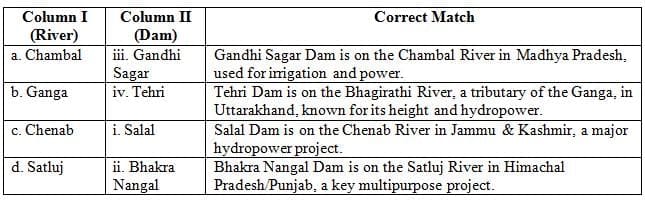
Q2: Match Column I with Column II and choose the correct option:  (1 Mark)Options:
(a) a-iii, b-i, c-iv, d-ii
(b) a-iii, b-i, c-ii, d-iv
(c) a-ii, b-iii, c-i, d-iv
(d) a-ii, b-iii, c-iv, d-i

Hide Answer  

Ans: (a)

  • Iron ore → Chandrapur (iii) — found in Durg-Bastar-Chandrapur belt of Chhattisgarh and Maharashtra.
  • Mica → Gaya (i) — major mica belt lies in Koderma–Gaya–Hazaribagh region of Jharkhand.
  • Bauxite → Maikala (iv) — bauxite deposits occur in the Maikal Hills and Amarkantak Plateau.
  • Coal → Singrauli (ii) — important coalfield located in Madhya Pradesh and Uttar Pradesh.

Thus, the correct option is (a) a-iii, b-i, c-iv, d-ii.

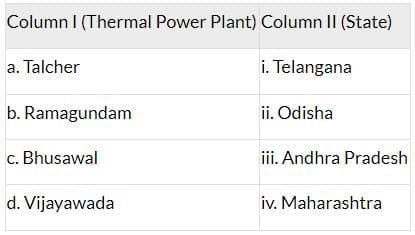
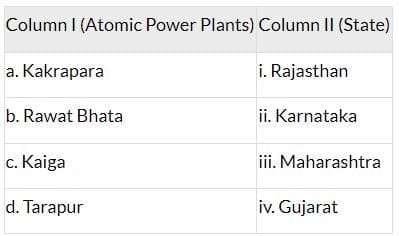
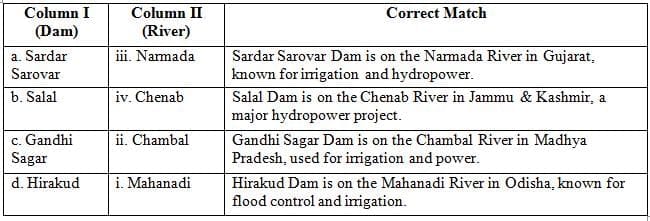
Q3: Match Column I with Column II and choose the correct option:  (1 Mark)

(A) a-ii, b-i, c-iv, d-iii
(B) a-iii, b-iv, c-i, d-ii
(C) a-iv, b-iii, c-ii, d-i
(D) a-ii, b-i, c-iii, d-iv

Hide Answer  

Ans: (A) a-ii, b-i, c-iv, d-iii

  • Talcher → Odisha (ii) — an important thermal power plant located in Odisha.
  • Ramagundam → Telangana (i) — one of India’s largest thermal power stations.
  • Bhusawal → Maharashtra (iv) — located in Jalgaon district, Maharashtra.
  • Vijayawada → Andhra Pradesh (iii) — a major thermal power station in Andhra Pradesh.


Q4: Read the given source and answer the questions that follow:  (4 Marks)
Iron Ore
Iron ore is the basic mineral and the backbone of industrial development. India is endowed with fairly abundant resources of iron ore. India is rich in good quality iron ores. Magnetite is the finest iron ore with a very high content of iron up to 70 per cent. It has excellent magnetic qualities, especially valuable in the electrical industry. Hematite ore is the most important industrial iron ore in terms of the quantity used, but has a slightly lower iron content than magnetite (50 – 60 per cent). In 2018 – 19, almost the entire production of iron ore (97%) accrued from Odisha, Chhattisgarh, Karnataka, and Jharkhand. The remaining production (3%) was from other states.

(i) In which iron ore is the maximum iron content found? (1 Mark)

Hide Answer  

Ans: The maximum iron content is found in Magnetite, which contains up to 70% iron.

(ii) Which is the most important industrial iron ore? (1 Mark)

Hide Answer  

Ans: The most important industrial iron ore is Hematite

(iii) “Iron ore is a basic mineral.” Support the statement. (2 Marks)

Hide Answer  

Ans: Iron ore is a basic mineral because it forms the backbone of industrial development. It is the raw material for producing steel, which is essential for manufacturing machinery, tools, vehicles, buildings, railways, and other industrial goods. Thus, iron ore supports the growth of almost all major industries in India. 


Q5: Match Column I with Column II and choose the correct option:  (1 Mark)

(a) A-i, B-iii, C-iv, D-ii
(b) A-ii, B-iv, C-iii, D-i
(c) A-iv, B-ii, C-iii, D-i
(d) A-iii, B-iv, C-ii, D-i

Hide Answer  

Ans: (d) A-iii, B-iv, C-ii, D-i

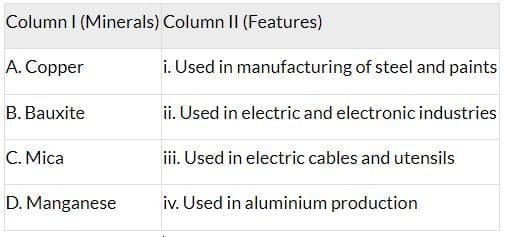
  • Copper → (ii) Used in electric cables and utensils because it is a good conductor of electricity and heat.
  • Bauxite → (iv) Used in aluminium production as aluminium is extracted from bauxite ore.
  • Mica → (iii) Used in electric and electronic industries due to its insulating properties and heat resistance.
  • Manganese → (i) Used in manufacturing of steel and paints and also for making ferro-manganese alloys.


Q6: “It would be beneficial to develop sustainable ways to meet the growing energy demand in India.” Support the statement by giving suitable arguments.  (5 Marks)

Hide Answer  

Ans: Yes, it is beneficial to develop sustainable waysto meet the growing energy demand in India because of the following reasons:

  1. Limited and Exhaustible Conventional Resources:
    Most of India’s energy resources like coal, petroleum, and natural gas are non-renewable and getting depleted rapidly. The geological formation of these resources takes millions of years, but they are being consumed much faster.
  2. Environmental Concerns:
    Burning fossil fuels causes air pollution, global warming, and acid rain, leading to serious environmental problems. Sustainable energy sources like solar, wind, and biogas are clean and eco-friendly.
  3. Energy Security and Self-Reliance:
    India imports a large amount of petroleum and natural gas. Developing renewable sources will reduce dependence on imports and strengthen the country’s energy security.
  4. Economic Development:
    Non-conventional sources such as solar and wind energy have low recurring costs once established. Promoting these will create new employment opportunities and support rural electrification.
  5. Future Sustainability:
    Using renewable energy ensures that future generations also have access to energy resources. Energy saved is energy produced, so promoting energy conservation and efficient use supports sustainable development.

Conclusion:
Therefore, developing sustainable and renewable energy sources is essential to ensure environmental protectioneconomic stability, and long-term energy security for India.


Q7: “We have to use a planned and sustainable manner to conserve our minerals.” Support the statement by giving suitable arguments.  (5 Marks)

Hide Answer  

Ans: Yes, it is essential to use our minerals in a planned and sustainable manner, because mineral resources are finite and non-renewable. The following points support this statement:

  • Limited Availability:
    The total volume of workable mineral deposits is only about 1% of the Earth’s crust. Minerals take millions of years to form, but they are being extracted and consumed rapidly, making them exhaustible resources.
  • Slow Rate of Formation:
    The geological processes of mineral formation are extremely slow, so replenishment cannot match the present rate of consumption. Once exhausted, these resources cannot be replaced easily.
  • Increasing Extraction Costs:
    Continuous mining leads to the depletion of high-grade ores, forcing extraction from greater depths or lower-grade deposits, which increases costs and environmental degradation.
  • Environmental Impact:
    Mining causes land degradation, deforestation, water pollution, and air contamination. Sustainable use helps reduce environmental damage and maintain ecological balance.
  • Need for Future Generations:
    To ensure that future generations also benefit from these valuable resources, we must recycle metalsuse scrap, and develop substitute materials where possible.


Q8: Study the given table and answer the question that follows:  (1 Mark)
CRUDE OIL RESERVES

Read the following possible outcomes from the table and choose the correct option:
I. If crude oil continues to be extracted at the present pace, it would be exhausted in about 50 years.
II. In Middle Eastern Countries it may take longer than average of the world.
III. To ensure the availability of crude oil in future, its reuse and recycle policy should be adopted.
IV. In United States of America, Crude oil is likely to run out in just about 10 years.
(a) 
Only I, III and IV are correct.
(b) Only I, II and III are correct.
(c) Only II, III and IV are correct.
(d) Only I, II and IV are correct.

Hide Answer  

Ans: (B) Only I, II and III are correct.

  • Statement I is correct — The world average shows crude oil reserves will last about 50 years.
  • Statement II is correct — The Middle East has reserves lasting 70 years, which is longer than the world average.
  • Statement III is correct — To ensure future availability, a reuse and recycle policy should be adopted.
  • Statement IV is incorrect — Though the USA’s reserves may last about 10 years, the statement says “just about 10 years” without context, and the focus of the question is on sustainability and average trends.


Q9: Two statements are given below. They are Assertion (A) and Reason (R). Read both the statements and choose the correct option:
Assertion (A): Certain minerals may occur as alluvial deposits in sands of valley floors and the base of hills.
Reason (R): These are usually minerals, that are not corroded by water.  (1 Mark)
(A)
 Both (A) and (R) are true and (R) is the correct explanation of (A). 
(B) Both (A) and (R) are true but (R) is not the correct explanation of (A).
(C) (A) is true but (R) is false.
(D) (A) is false but (R) is true.

Hide Answer  

Ans: (A) Both (A) and (R) are true and (R) is the correct explanation of (A).

  • Certain minerals occur as alluvial or placer deposits in the sands of valley floors and at the base of hills. These minerals, such as gold, silver, tin, and platinum, are not corroded by water, which explains why they accumulate in such deposits. Hence, both the Assertion and the Reason are true, and the Reason correctly explains the Assertion.

Therefore, option (A) is correct.


Q10: Match Column I with Column II and choose the correct option:  (1 Mark)

(A) a-i, b-ii, c-iii, d-iv
(B) a-ii, b-iii, c-iv, d-i
(C) a-iv, b-i, c-ii, d-iii
(D) a-iv, b-i, c-iii, d-ii

Hide Answer  

Ans: (C) a-iv, b-i, c-ii, d-iii

The table below shows the correct matching of atomic power plants with their states:

Thus, option (C) is correct.


Q11: Read the characteristics given in the box and identify the type of coal from the options given below:  (1 Mark)
This is low grade brown coal.
The principal reserves are in Neyveli in Tamil Nadu.
It is soft with high moisture content.
(A)
 Pit Coal
(B) Anthracite Coal
(C) Lignite Coal
(D) Bituminous Coal

Hide Answer  

Ans: (C) Lignite Coal

According to the chapter, Lignite is a low-grade brown coal, soft in texture, and has a high moisture content. Its principal reserves are found in Neyveli, Tamil Nadu, where it is mainly used for electricity generation.


Q12: Why is the conservation of conventional sources of energy significant? Explain any two reasons.  (2 Marks)

Hide Answer  

Ans: The conservation of conventional sources of energy is significant because:

  • They are non-renewable and exhaustible:
    Conventional sources like coal, petroleum, and natural gas take millions of years to form. Their reserves are limited and may get exhausted soon if overused.
  • They cause environmental pollution:
    Excessive use of these fuels leads to air pollution, global warming, and ecological imbalance. Conserving them reduces environmental damage and helps maintain a clean and sustainable environment.


Q13: Why is it necessary to adopt non-conventional sources of energy? Explain.  (2 Marks)

Hide Answer  

Ans: It is necessary to adopt non-conventional sources of energy because:

  • Exhaustion of conventional resources:
    Conventional energy sources like coal, petroleum, and natural gas are limited and non-renewable. To meet the growing energy demand sustainably, we must use renewable alternatives such as solar, wind, and biogas.
  • Environment-friendly and sustainable:
    Non-conventional sources are clean and pollution-free, reducing problems like air pollution and global warming. They ensure a sustainable and eco-friendly supply of energy for the future.


Q14: Suggest any two ways for the conservation of minerals.  (2 Marks)

Hide Answer  

Ans: Two ways for the conservation of minerals are:

  • Recycling and reuse of metals:
    Scrap metals and used materials should be recycled and reused to reduce the need for new mineral extraction.
  • Use of substitutes and improved technology:
    Developing substitute materials and using improved mining technologies help in reducing wastage and allow the use of low-grade ores efficiently.

Previous Year Questions 2024

Q1: Match Column-I with Column-II and choose the correct option.    (CBSE 2024)
(a) (A)-(II), (B)-(IV), (C)-(III), (D)-(I)
(b) (A)-(IV), (B)-(III), (C)-(II), (D)-(I)
(c) (A)-(I), (B)-(II), (C)-(IV), (D)-(III)
(d) (A)-(III), (B)-(IV), (C)-(II), (D)-(I)

Hide Answer  

Ans: (b)

(A) Ferrous matches with (IV) Cobalt, as ferrous materials are related to iron and cobalt is a metal used in various alloys.

(B) Non-Ferrous matches with (III) Bauxite, since bauxite is a non-ferrous ore primarily used to produce aluminum.

(C) Non-Metallic matches with (II) Granite, because granite is a type of rock and not a metal.

(D) Energy matches with (I) Coal, as coal is a major source of energy.


Q2: (A) How is energy a basic requirement for economic development? Explain.    (CBSE 2024)
OR 
(B) How are conventional sources of energy different from non- conventional sources? Explain. 

Hide Answer  

Ans: (A) Energy is a fundamental requirement for economic development because it powers industries, transportation, communication, and daily life. 
Here’s how energy drives economic growth:

  • Industrial Growth: Industries rely on energy to operate machinery, manufacture goods, and process raw materials. Without a stable energy supply, industrial productivity declines, hindering economic growth.
  • Infrastructure Development: Energy is essential for building and maintaining infrastructure such as roads, bridges, and buildings. Construction equipment and materials production depend heavily on energy.
  • Transportation and Trade: Energy fuels transportation systems, including cars, trucks, ships, and airplanes, enabling the movement of goods and people. Efficient transportation networks are vital for trade and commerce, which are key components of economic development.
  • Technological Advancement: Modern technologies, including computers, telecommunications, and medical equipment, require energy to function. Technological innovation drives productivity and economic growth, making energy indispensable.
  • Agriculture and Food Production: Energy is crucial for agricultural activities, such as irrigation, harvesting, and food processing. It also powers the transportation and storage of food, ensuring food security and supporting rural economies.
  • Employment and Income Generation: The energy sector itself creates jobs in production, distribution, and maintenance. Additionally, reliable energy access enables the growth of other sectors, leading to increased employment opportunities and income generation.
  • Quality of Life: Energy improves the quality of life by powering homes, schools, hospitals, and public services. Access to electricity enhances education, healthcare, and overall well-being, which are essential for a productive workforce.

In summary, energy is a cornerstone of economic development as it supports industrial activities, infrastructure, transportation, technology, agriculture, employment, and quality of life. Without adequate and reliable energy, economic progress would be severely constrained.
OR
(B) 
Conventional sources of energy and non-conventional sources of energy are different in the following ways:
1. Source:

  • Conventional Sources: These are traditional sources of energy that have been used for a long time, such as coal, petroleum (oil), natural gas, and hydropower.
  • Non-Conventional Sources: These are newer or alternative sources of energy that are not widely used yet, like solar energy, wind energy, biomass, tidal energy, and geothermal energy.

2. Renewability:

  • Conventional Sources: These sources are mostly non-renewable, meaning they are finite and can run out over time. For example, coal and petroleum are limited and take millions of years to form.
  • Non-Conventional Sources: These are usually renewable, meaning they can be replenished naturally and are not likely to run out, like solar and wind energy.

3. Environmental Impact:

  • Conventional Sources: They often cause pollution and harm the environment. Burning fossil fuels like coal and petroleum releases harmful gases, contributing to air pollution and climate change.
  • Non-Conventional Sources: These sources are generally cleaner and have less impact on the environment. Solar and wind energy, for example, produce little to no pollution.

4. Availability:

  • Conventional Sources: These sources are available in specific regions. For example, coal is found in large quantities in some countries, while oil is concentrated in others.
  • Non-Conventional Sources: These sources can be found anywhere, as long as the natural conditions are right, like sunlight for solar energy or wind for wind energy.

5. Cost:

  • Conventional Sources: They tend to be cheaper initially but can lead to higher long-term costs due to pollution, health effects, and resource depletion.
  • Non-Conventional Sources: They may be expensive to set up initially (like installing solar panels or wind turbines), but they have lower operational costs and are more sustainable in the long run.

In summary, conventional sources are traditional, non-renewable, and polluting, while non-conventional sources are modern, renewable, and environmentally friendly.

Sustainable Energy

Get additional INR 200 off today with EDUREV200 coupon.

Previous Year Questions 2023

Q3: Which one of the following is an example of the Ferrous Metal?       (CBSE 2023)
(a) 
Copper
(b) 
Tin
(c) 
Bauxite
(d
) Nickel

Hide Answer  

Ans: (d)
Nickel is considered a ferrous metal because it is often used in the production of alloys with iron, which enhances the strength and resistance of steel. In contrast, copper and tin are non-ferrous metals, and bauxite is an ore of aluminum, not a metal itself.


Q4: Read the given case and answer the questions that follow:       (2023)
CONSERVATION OF ENERGY RESOURCES
Energy is a basic requirement for economic development. Every sector of the national economy – agriculture, industry, transport, commercial and domestic – needs inputs of energy. The economic development plans implemented since independence necessarily required increasing amounts of energy to remain operational. As a result, consumption of energy In all forms has been steadily rising all over the country. In this background, there is an urgent need to develop a sustainable path of energy development. Promotion of energy conservation and increased use of renewable energy sources are the twin planks of sustainable energy. India is presently one of the least energy-efficient countries in the world. We have to adopt a cautious approach for the judicious use of our limited energy resources. For example, as concerned citizens, we can do our bit by using public transport systems instead of individual vehicles; switching off electricity when not in use, using power-saving devices and using non-conventional sources of energy. At last “Energy Saved is energy produced”.
(i) Why is sustainable energy a key to sustainable development?
(ii) Why is consumption of energy rising in all over India?
(iii) Explain ‘Energy saved is energy produced.’

Hide Answer  

Ans: 
(i) Sustainable energy is a key to sustainable development, as sustainability demands that resource reserves including exhaustible, natural and environmental resources, be maintained.
(ii) After getting independence development of all sectors like agriculture, industry, transport, domestic needs etc. necessarily required to remain in operation, hence consumption of energy in all forms has increased all over India.
(iii) Energy saved is energy produced. We cannot keep on producing non-renewable energy like petrol, diesel and electricity. So the need of the hour is the better utilisation of existing resources. We have to adopt cautions approach for the judicious use of our limited energy resources.

Previous Year Questions 2020

Q5: Classify metallic minerals with an example of each. (2020 C)

Hide Answer  

Ans:

  • Ferrous minerals: Iron ore, manganese
  • Non-ferrous minerals: Copper, lead, bauxite
  • Precious minerals: Gold, silver, platinum


Q6: “Minerals occur in various forms”. Support this statement with examples. (2020)

Hide Answer  

Ans:

  • Minerals can occur in igneous and metamorphic rocks as veins and lodes. Examples include tin, copper, zinc, and lead.
  • Minerals can also occur in sedimentary rocks as beds or layers. Examples include gypsum, potash salt, and sodium salt.
  • Some minerals are formed through the decomposition of surface rocks, leaving behind residual material. Bauxite is an example.
  • Alluvial deposits in sands can also contain minerals. Gold, silver, tin, and platinum are examples.


Q7: “Minerals are an indispensable part of our lives”. Support this statement with examples. (2020)

Hide Answer  

Ans:

  • Minerals are used in the construction of buildings and infrastructure, such as iron ore for steel.
  • Minerals are used in transportation systems, such as copper for electrical wiring.
  • Minerals are used in electronic devices, such as lithium for batteries.
  • Minerals are used in everyday items, such as gold and silver for jewelry.

Minerals
Q8: Differentiate between anthracite and bituminous coal on the basis of quality. (2020 C)

Hide Answer  

Ans:

  • Anthracite coal is of higher quality, while bituminous coal is comparatively lower grade in quality.
  • Anthracite coal has a higher carbon content, causing less pollution compared to bituminous coal.
  • Anthracite coal is available in small quantities in India, while bituminous coal is available in abundance.


Q9: In which of the following states is Kalpakkam nuclear power plant located ?      (2020)
(a) 
Gujarat
(b) Odisha
(c) Kerala
(d) Tamil Nadu

Hide Answer  

Ans: (d)
The Kalpakkam nuclear power plant is located in Tamil Nadu, near the town of Kalpakkam, which is close to Chennai. This plant is significant as it contributes to India’s energy needs by generating electricity through nuclear power.


Q10: In which of the following States is Narora Nuclear Power Plant located?     (2020)
(a) 
Karnataka
(b) Kerala
(c) Tamil Nadu
(d) Uttar Pradesh

Hide Answer  

Ans: (d)
The Narora Nuclear Power Plant is located in Uttar Pradesh, near the town of Narora, which is about 200 kilometers from Delhi. This plant plays an important role in generating nuclear energy to meet the electricity demands of the region.


Q11: Fill in the blank: ________ is well known for effective use of wind energy in Rajasthan.     (2020)

Hide Answer  

Ans: Jaisalmer is well known for the effective use of wind energy in Rajasthan.


Q12: Suggest any one way to enhance the use of natural gas in India.     (2020)

Hide Answer  

Ans: Use of natural gas:
Making people aware about the importance of using this clean energy resources because this gas is considered environment friendly.


Q13:  Fill in the blanks: ‘Gobar gas plants’ provide twin benefits to the farmers in the form of_______and________     (2020)

Hide Answer  

Ans: ‘Gobar gas plants’ provide twin benefits to the farmers in the form of energy and manure.


Q14: Suggest any one way to maximize the use of nuclear energy in the field of medicine.     (2020)

Hide Answer  

Ans: Nuclear medicine use radio-active substances, mostly to diagnose cancer as well as cardiac and other diseases.

Also read: Infographics: Rocks and Minerals

Previous Year Questions 2019

Q15: In which of the following state is the Narora Nuclear Power Plant located ? 
(a) Karnataka 
(b) Kerala 
(c) Tamil Nadu 
(d) Uttar Pradesh (CBSE 2019)

Hide Answer  

Ans: (d)
The Narora Nuclear Power Plant is located in the state of Uttar Pradesh in India. It is situated on the banks of the Ganges River in the Bulandshahr district. This plant is one of India’s key nuclear power facilities, generating electricity through nuclear energy.
Thus, the correct answer is (d) Uttar Pradesh.


Q16: “India has fairly rich and varied mineral resources across different regions”. Support the statement with examples. (CBSE 2019)
OR
“Minerals occur in various forms.” Support this statement with examples. (CBSE 2019)

Hide Answer  

Ans: (1) Minerals occur in the cracks, crevices, faults or joints in igneous rocks and metamorphic rocks in the form of small occurrences of veins and large occurrences called lodes. Tin and zinc are obtained from veins and lodes. 
(2) Sedimentary Rocks are found in nodes and layers. Minerals like gypsum, coal, iron ore are formed. 
(3) Minerals are also formed by decomposition of surface rocks, and the removal of soluble constituents, leaving a residual mass of weathered material containing ores. For example, bauxite


Q17: ‘Energy saved is energy produced.’ Assess the statement. (CBSE 2019, 17)

Hide Answer  

Ans: This statement can be supported in the following ways: 
(1) Promotion of energy conservation and increased use of renewable energy sources is an important measure to save resources for the upcoming generations. 
(2) A judicious use in using our limited energy resources is of utmost significance to encourage development without any threat to survival in the future generations. 
(3) Public transport systems can help save fuel and other important energy resources. Fuel will last for a longer time. 
(4) Using power-saving devices and using nonconventional sources of energy helps in preventing excessive usage of conventional energy resources.

Attention!Sale expiring soon, act now & get EduRev Infinity at 40% off!

Previous Year Questions 2017

Q18: Describe any three characteristics of the Ballari-Chitradurga, Chikkamagaluru-Tumakuru iron-ore belt in India. (Foreign 2017)

Hide Answer  

Ans:

  • The Ballari-Chitradurga, Chikkamagaluru-Tumakuru iron-ore belt is located in Karnataka.
  • The Kudremukh mines in this belt, located in the Western Ghats, are a 100% export unit.
  • The Kudremukh deposits are known to be one of the largest in the world.
  • The ore from these mines is transported as slurry through a pipeline to a port near Mangaluru.


Q19: Describe any three characteristics of the Durg-Bastar-Chandrapur iron-ore belt in India. (AI 2017)

Hide Answer  

Ans:

  • The Durg-Bastar-Chandrapur iron-ore belt is located in Chhattisgarh and Maharashtra.
  • It provides very high-grade hematite iron ore from the famous Bailadila range of hills in the Bastar district of Chhattisgarh.
  • The iron ore deposits in this belt have the best physical properties needed for steel making.
  • Iron ore from these mines is exported to Japan and South Korea via Vishakhapatnam port.


Q20: Describe any three characteristics of the ‘Odisha-Jharkhand belt’ of iron ore in India. (Delhi 2017)

Hide Answer  

Ans:

  • The Odisha-Jharkhand belt is known for high-grade haematite ore.
  • In Odisha, the iron ore is found in Badampahar mines in the Mayurbhanj and Kendujhar districts.
  • In Jharkhand, haematite iron ore is mined in Gua and Noamundi.
  • These mines supply iron ore to the steel industry in the eastern and other parts of India.


Q21: Why is it necessary to conserve mineral resources? Explain any four ways to conserve mineral resources.  (AI2017)

Hide Answer  

Ans: It is necessary to conserve mineral resources because they are limited in availability and the process of mineral formation is slow. Additionally, minerals are non-renewable and exhaustible.
Four ways to conserve mineral resources are:
1. Using minerals in a planned and sustainable manner.
2. Evolving improved technology to allow the use of low-grade ore at a low cost.
3. Practicing recycling of minerals.
4. Using alternative renewable substitutes.


Q22: ‘Energy saved is energy produced.’ Assess the statement. (2017)

Hide Answer  

Ans: The statement “Energy saved is energy produced” emphasizes the importance of conserving energy. By reducing energy wastage and using energy-efficient practices, we can save energy and reduce the need for additional energy production. This approach is beneficial for the environment as it reduces the consumption of fossil fuels and decreases greenhouse gas emissions.


Q23: Why should we use renewable energy resources? Explain with arguments. (Foreign 2017)

Hide Answer  

Ans: There are several reasons why we should use renewable energy resources:
1. Non-renewable resources are limited and will eventually get exhausted. In contrast, renewable energy resources such as solar power and wind energy are inexhaustible, making them a sustainable choice for long-term energy needs.
2. The depletion of non-renewable resources like coal and petroleum has taken millions of years to occur. By using renewable energy resources, we can avoid further depletion and preserve these non-renewable resources for future generations.
3. Fossil fuels, which are non-renewable resources, contribute to pollution and environmental degradation. Renewable energy sources, on the other hand, are cleaner and emit fewer greenhouse gases, thus mitigating the impact of climate change.
4. The cost of extracting and using non-renewable resources is increasing as these resources become harder to find. In contrast, the cost of renewable energy technologies, such as solar panels and wind turbines, has been decreasing over time. Investing in renewable energy can help reduce energy costs in the long run.


Q24: Why is energy needed? Write one reason. (CBSE 2017)

Hide Answer  

Ans: Energy is required for all kinds of activities like cooking, lighting and heating, propelling vehicles and enabling smooth working of machinery in industries.


Q25: “Natural gas is an important source of energy.” Support the statement. (CBSE 2017)

Ans: Natural gas is an important source of energy because: 
(1) It is an industrial raw material in the petrochemical industry.
(2) It helps build fertiliser plants and encourages the use of fertilisers. It can boost agricultural production. 
(3) It can be easily transported through pipelines


Q26: Which state is the largest producer of manganese in India? Mention any two uses of manganese. (CBSE 2017)

Hide Answer  

Ans: The nation’s top producer of manganese is Madhya Pradesh. 
(1) Manganese manufactures steel and ferro-manganese alloy. Nearly 10 kgs of manganese is used in manufacturing one tonne of steel. 
(2) It is used in the production of bleaching powder, insecticides and paints


Q27: “Minerals are an indispensable part of our lives.” Support the statement with examples.  (CBSE 2017)

Hide Answer  

Ans: (1) Minerals are used to create or produce almost everything we use everyday. This includes our technology, equipment etc., which are made of steel, silicon, aluminium, copper, gold, silver. Needles, Utensils, Clothes, Jewellery, and containers are all made of minerals. 
(2) Transportation was made possible because of minerals. The railway lines and tarmac (paving) of the roads, cars, buses, trains, airplanes are manufactured from minerals. 
(3) Even the food that we eat contains minerals. Minerals are produced when we digest it and even when we excrete it.


Q28: “There is a pressing need for using renewable energy sources in India.” Justify the statement.  (CBSE 2017)

Hide Answer  

Ans: There is a pressing need to use renewable energy resources because: 
(1) The growing consumption of energy has resulted in the country becoming increasingly dependent on fossil fuels such as coal, oil and gas.
(2) The rising prices of oil and gas and their potential shortages have raised uncertainties about the security of energy supply in future. 
(3) It has serious repercussions on the growth of the national economy. 
(4) The increasing use of fossil fuels also causes serious environmental problems. 
(5) Non-renewable energy resources take millions of years to regenerate.

Previous Year Questions 2016

Q29: Why are there a wide range of colours, hardness, crystal forms, lustre and density found in minerals?   (Delhi 2016)

Hide Answer  

Ans: The varied colours, hardness, crystal forms, lustre, and density found in minerals are due to their chemical composition and the parameters such as temperature, pressure, rate of cooling, etc., present during their formation.


Q30: How is iron-ore transported from Kudremukh mines to a port near Mangaluru?  (CBSE 2016)

Hide Answer  

Ans: Iron ore is transported from Kudremukh mines to a port near Mangaluru as slurry through pipelines.


Q31: Why should the use of cattle cake as fuel be discouraged?   (Al 2016)

Hide Answer  

Ans: The use of cattle cake as fuel should be discouraged because it creates pollution and by burning it, a valuable manure resource is destroyed, which could otherwise improve soil fertility.


Q32: How are ‘Gobar Gas Plants’ beneficial to the farmers?   (CBSE 2016)

Hide Answer  

Ans: ‘Gobar Gas Plants’ are beneficial to the farmers in two ways. Firstly, they provide a clean fuel for domestic cooking and lighting. Secondly, they produce high-quality manure that can be used to enhance soil fertility.


Q33: “India is an important iron and steel producing country in the world. Yet we are not able to perform to our full potential.” Suggest and explain any three measures to reach our full potential. (Foreign 2016)

Hide Answer  

Ans:

  • Modernizing technology and machinery in the iron and steel industry to improve efficiency and productivity.
  • Streamlining the supply of inputs such as iron ore and coke to ensure a steady and sufficient availability.
  • Developing a supportive infrastructure, such as adequate electricity capacity, to meet the demands of the industry.
  • Implementing effective customer demand and supply management strategies to optimize production and distribution.


Q34: ‘Consumption of energy in all forms has been rising all over the country. There is an urgent need to develop a sustainable path of energy development and energy saving.’ Suggest and explain any three measures to solve this burning problem. (AI 2016)

Hide Answer  

Ans:

  • Increase the use of renewable energy resources like solar power, wind power, biogas, tidal energy, and geothermal energy. This will reduce dependence on non-renewable sources and promote sustainable energy development.
  • Promote energy conservation by encouraging the judicious use of energy resources. This can be achieved through awareness campaigns, energy-efficient practices, and the use of power-saving devices.
  • Improve energy efficiency in industries, transportation, and buildings by adopting energy-saving technologies and practices. This can be done through government regulations, incentives, and public-private partnerships.


Q35: “There is a pressing need to use renewable energy resources.” Justify the statement with suitable arguments. (AI 2016)

Hide Answer  

Ans:

  • The growing consumption of energy has led to increased dependence on fossil fuels like coal, oil, and gas, which are finite resources. The use of renewable energy resources can help reduce this dependence and ensure a sustainable energy future.
  • Rising prices and potential shortages of fossil fuels have raised concerns about the security of energy supply. Renewable energy resources are more abundant and can provide a more reliable and secure source of energy.
  • The use of renewable energy resources can help mitigate the adverse environmental impacts of fossil fuel use, such as air pollution and greenhouse gas emissions. Renewable energy sources like solar, wind, and hydroelectric power are cleaner and have a lower carbon footprint.
  • Investing in renewable energy technologies can stimulate economic growth and create jobs in sectors like manufacturing, installation, and maintenance.


Q36: Which minerals are used to obtain nuclear energy? Name all the six nuclear power stations of India. (AI 2016)

Hide Answer  

Ans:

  • The minerals used to obtain nuclear energy are uranium and thorium.
  • The six nuclear power stations in India are: Narora Nuclear Power Station, Kakrapara Nuclear Power Station, Tarapur Nuclear Power Station, Kaiga Nuclear Power Station, Rawat Bhata Nuclear Power Station, and Kalpakkam Nuclear Power Station.


Q37: Explain the importance of conservation of minerals. Highlight any three measures to conserve them. (AI2016)

Hide Answer  

Ans: Conservation of minerals is important for the following reasons:
1. Minerals are the backbone of the economy and are essential for various industries.
2. The total volume of workable mineral deposits is very limited, representing only 1% of the Earth’s crust.
3. Mineral resources are being consumed at a rapid rate, while the geological processes of mineral formation are slow. This means that the rate of consumption far exceeds the rate of replenishment.
Three measures to conserve minerals are:
1. Using minerals in a sustainable manner by planning their extraction and usage.
2. Developing improved technologies that allow the use of low-grade ore at a lower cost.
3. Promoting recycling and reuse of minerals to reduce the demand for new extraction.


Q38: Highlight the importance of petroleum. Explain the occurrence of petroleum in India. (CBSE 2016)

Hide Answer  

Ans: The importance of petroleum can be highlighted as follows:
1. Petroleum is a major source of energy in India, providing fuel for heat, lighting, and transportation.
2. It serves as a lubricant for machinery, ensuring their smooth operation.
3. Petroleum is a crucial raw material for various manufacturing industries.
4. Petroleum refineries play a significant role in supporting industries such as synthetic, textile, fertilizer, and chemical industries.
In India, petroleum occurs in the following ways:
1. Most petroleum reserves in India are associated with anticlines and fault traps.
2. In regions of folding anticlines or domes, petroleum is trapped in the crust of the upfold.
3. Petroleum is also found in fault traps between porous and non-porous rocks.


Q39: Suggest and explain any three measures through which every citizen can help to conserve energy resources. (CBSE 2016)

Hide Answer  

Ans: Three ways in which citizens can help conserve energy resources are: 
(1) Reduction in usage of individual vehicles. 
(2) Minimisation of electricity usage.
(3) Reduction in usage of water resources

Also read: Infographics: Rocks and Minerals

Previous Year Questions 2015

Q40: Why does aluminium metal have great importance?  (2015)

Hide Answer  

Ans: Aluminium metal has great importance because it combines the properties of great strength, lightness, malleability, and conductivity.


Q41: “Natural gas is considered an environment-friendly fuel.” Explain the statement in two points. (AI 2015)

Hide Answer  

Ans:

  • Natural gas is considered an environment-friendly fuel because it causes less pollution compared to other fossil fuels like coal and oil. It has a lower carbon content and emits fewer greenhouse gases when burned, reducing the impact on climate change.
  • Natural gas is a clean-burning fuel that produces fewer air pollutants such as sulfur dioxide, nitrogen oxide, and particulate matter. This improves air quality and reduces the health risks associated with pollution.


Q42: How is geothermal energy produced? Explain. (AI 2015)

Hide Answer  

Ans:

  • Geothermal energy is produced by harnessing the heat from the Earth’s interior.
  • In areas with high geothermal gradients, where temperatures increase with depth, groundwater absorbs heat from the rocks and becomes hot.
  • This hot water or steam rises to the Earth’s surface and can be used to drive turbines and generate electricity.


Q43: How can biogas solve the energy problem mainly in rural India? Give your suggestions. (AI 2015)

Hide Answer  

Ans:

  • Biogas can solve the energy problem in rural India by providing a renewable source of energy that is readily available.
  • The raw materials for biogas production, such as agricultural waste, animal manure, and kitchen waste, are abundant in rural areas.
  • By promoting the use of biogas plants, rural communities can generate their own energy for cooking, lighting, and other domestic uses, reducing their dependence on traditional sources like firewood and kerosene.
  • Biogas production also has environmental benefits, as it helps in waste management by converting organic waste into a useful energy resource and reducing greenhouse gas emissions.

Biogas Energy


Q44: Describe any three features of ferrous minerals found in India. (Foreign 2015)

Hide Answer  

Ans:

  • Ferrous minerals in India account for approximately three-fourths of the total value of metallic mineral production.
  • They provide a strong foundation for the expansion of metallurgical industries in the country.
  • India is a leading exporter of ferrous minerals, with magnetite and hematite being some of the common ferrous minerals.
  • States like Odisha, Chhattisgarh, and Maharashtra are rich in ferrous mineral deposits.


Q45: How is the mining activity injurious to the health of the miners and the environment? Explain. (Delhi 2015)

Hide Answer  

Ans:

  • Mining activities can lead to respiratory diseases and other health issues for miners due to the inhalation of dust and toxic fumes.
  • The roofs and walls of mines can pose a risk of collapsing, leading to accidents and injuries.
  • Flooding and fire hazards are common risks in mining operations.
  • Mining can result in the contamination of water bodies with mineral dust, affecting aquatic life and human consumption.
  • The dumping of waste and slurry from mining operations can degrade the land and contribute to environmental pollution.


Q46: How can solar energy solve the energy problem to some extent in India? Give your opinion. (CBSE 2015)

Hide Answer  

Ans: Solar energy can contribute to solving the energy problem in India in the following ways:
1. India receives abundant sunlight throughout the year, especially in rural and remote areas. Harnessing solar energy through solar panels and solar power plants can provide a reliable source of electricity in these areas.
2. Establishing solar plants in rural and remote areas can help minimize the dependence on traditional sources of energy such as firewood and dung cakes. This, in turn, contributes to environmental conservation and reduces indoor air pollution.
3. Solar energy can provide electricity for various applications, including lighting, cooking, and powering electronic devices. By utilizing solar energy, India can reduce its reliance on fossil fuels and decrease greenhouse gas emissions, thereby mitigating climate change.

04. Previous Year Questions: Agriculture

Previous Year Questions 2025

Q1: Imagine you are travelling from Delhi to Chandigarh to attend a wedding, by road in January. Which of the following crops will you notice prominently in the fields during the journey? (1 Mark)
(a) Paddy
(b) Maize
(c) Wheat
(d) Jowar

Hide Answer  

Ans: (c) Wheat
In January, the rabi crops are growing in the fields. Wheat is a major rabi crop cultivated in Punjab and Haryana, the region between Delhi and Chandigarh.


Q2: Read the story of Rinjha and answer the question that follows:  (3 Mark)

Rinjha lived with her family in a small village at the outskirts of Diph in Assam. She enjoys watching her family members clearing, slashing and burning a patch of land for cultivation. She often helps them in irrigating the fields with water running through a bamboo canal from the nearby spring. She loves the surroundings and wants to stay here as long as she can, but this little girl has no idea about the declining fertility of the soil and her family’s search for a fresh patch of land in the next season.

What type of farming is Rinjha’s family doing? Describe any two of its characteristics.

Hide Answer  

Ans: Rinjha’s family is practising Primitive Subsistence Farming, also known as ‘slash and burn’ agriculture or Jhumming in Assam.

Two characteristics:

  1. Use of primitive tools: It is practised with the help of simple tools like hoe, dao, and digging sticks using family or community labour.
  2. Shifting cultivation: Farmers clear a patch of land, burn it, and grow crops for some time. When the soil fertility decreases, they shift to a new patch of land, allowing the old one to regain fertility naturally.


Q3: Mrs. Monica, along with her family, clears a piece of land and grows grain and other food crops to feed her family. When the soil’s fertility decreases, she prepares another piece of land for agriculture. Which of the following methods of agriculture does she use?  (1 Mark)
(a) Plantation farming
(b) Slash and burn farming
(c) Intensive subsistence farming
(d) Commercial farming

Hide Answer  

Ans: (b) Slash and burn farming

Mrs. Monica practises Primitive Subsistence Farming, also called ‘slash and burn’ agriculture, in which farmers clear a patch of land, grow food mainly for their family, and when the soil loses fertility, they shift to a new patch for cultivation.

Q4: Read the given source and answer the questions that follow:  (4 Marks)
Primitive Subsistence Farming
It is a ‘slash and burn’ agriculture. Farmers clear a patch of land and produce cereals and other food crops to sustain their family. When the soil fertility decreases, the farmers shift and clear a fresh patch of land for cultivation. This type of shifting allows Nature to replenish the fertility of the soil through natural processes; land productivity in this type of agriculture is low as the farmer does not use fertilisers or other modern inputs. It is known by different names in different parts of the country. It is jhumming in north-eastern states like Assam, Meghalaya, Mizoram, and Nagaland; Pamlou in Manipur, Dipa in Bastar district of Chhattisgarh, and in Andaman and Nicobar Islands.

(i) ‘Slash and Burn’ system of agriculture comes under which type of farming?
(ii) Why is productivity low in ‘Slash and Burn’ system?
(iii) Describe any two features of ‘Slash and Burn’ system of agriculture.

Hide Answer  

Ans:

(i) The ‘Slash and Burn’ system of agriculture comes under Primitive Subsistence Farming.
(ii) Productivity is low in this system because farmers do not use fertilizers or modern inputs, and the land is cultivated only for a short period before shifting.
(iii) Two features of this system are:

  • Farmers clear and burn a patch of land to grow cereals and food crops for their family’s use.
  • When soil fertility decreases, they shift to a new patch of land, allowing the old one to regain fertility naturally.


Q5: Swapna is a small farmer. Swapna wants to cultivate cotton. What kind of geographical conditions will be suitable for this? Choose the most appropriate option.  (1 Mark)
(a) Laterite soil, Moderate rainfall, Low temperature and Bright sunshine
(b) Black soil, Light rainfall, High temperature and Bright sunshine
(c) Laterite soil, Light rainfall, High temperature and Moderate sunshine
(d) Black soil, High rainfall, Low temperature and Moderate sunshine

Hide Answer  

Ans: (b) Black soil, Light rainfall, High temperature and Bright sunshine

Cotton grows well in the drier parts of the black cotton soil of the Deccan Plateau and requires high temperaturelight rainfall or irrigation, and bright sunshine for its growth.


Q6: Identify the crop with the help of the below information:  (1 Mark)

– This crop is a major cash crop in India.
– It is cultivated mainly in the states of Karnataka and Tamil Nadu.
– It is known for its aroma.
(a) 
Tea
(b) Coffee
(c) Jute
(d) Cotton

Hide Answer  

Ans: (b) Coffee

Coffee is a major cash crop grown mainly in Karnataka and Tamil Nadu, known for its aroma and high-quality Arabica variety originally brought from Yemen.


Q7: With the help of following information identify the agricultural crop from the given options:  (1 Mark)
I. It requires more than 200 cm rainfall and temperature above 25°C.
II. It is mainly used as raw material in industries.
III. It is primarily a crop of the equatorial region.
(a) 
Cotton
(b) Rubber
(c) Groundnut
(d) Mustard

Hide Answer  

Ans: (b) Rubber

Rubber is an equatorial crop that requires a moist and humid climaterainfall above 200 cm, and temperature above 25°C, and it serves as an important industrial raw material.


Q8: Which among the following crop is known as ‘Golden Fibre’?  (1 Mark)
(a) Cotton
(b) Wool
(c) Jute
(d) Silk

Hide Answer  

Ans: (c) Jute

Jute is called the ‘Golden Fibre’ because of its shiny appearance and high economic value. It is used to make gunny bags, ropes, mats, carpets, and other artefacts.


Q9: Examine the measures taken by the government to make agriculture profitable in India.  (3 Marks)

Hide Answer  

Ans: The government has taken several measures to make agriculture more profitable in India. These include:

  • Institutional Reforms: Steps like abolition of zamindariconsolidation of holdings, and promotion of cooperative societies and Grameen banks to support farmers.
  • Technological Reforms: Introduction of the Green Revolution and White Revolution (Operation Flood) to increase production.
  • Farmer Welfare Schemes: Launch of Kisan Credit Card (KCC)Personal Accident Insurance Scheme (PAIS)crop insurance, and announcement of minimum support prices to protect farmers from exploitation and losses.


Q10: Explain any three features of intensive subsistence farming.  (3 Marks)

Hide Answer  

Ans: Three features of Intensive Subsistence Farmingare:

  • It is labour-intensive farming, where a large amount of human labour is used to cultivate small plots of land.
  • High doses of biochemical inputs such as fertilisers and irrigation are used to obtain higher productivity.
  • Due to high population pressure on land and lack of alternative livelihoods, farmers try to produce maximum output from their small holdings, even though the land size is uneconomical.


Q11: Mention any three features of commercial farming.  (3 Marks)

Hide Answer  

Ans: Three features of Commercial Farming are:

  • It involves the use of modern inputs like HYV seeds, chemical fertilisers, insecticides, and pesticides to achieve high productivity.
  • The degree of commercialisation varies by region — for example, rice is commercial in Punjab and Haryana but a subsistence crop in Odisha.
  • It is market-oriented farming, where crops are grown mainly for sale and profit rather than for family consumption.


Q12: Explain any three features of Plantation Agriculture.   (3 Marks)

Hide Answer  

Ans: Three features of Plantation Agriculture are:

  • It involves the cultivation of a single crop on a large area, such as tea, coffee, rubber, sugarcane, or banana.
  • It uses capital-intensive inputs and migrant labourers, showing an interface between agriculture and industry.
  • The entire produce is used as raw material in industries, and a well-developed network of transport and communication connects plantations with processing units and markets.


Q13: The Government of India has invited some suggestions for institutional reforms in agriculture. Propose any five institutional reforms to the Government for the betterment of agriculture.  (5 Marks)

Hide Answer  

Ans: Some important institutional reforms that can help improve agriculture in India are as follows:

  • The government should ensure proper land reforms so that land is fairly distributed and small fragmented holdings are consolidated, allowing farmers to use their land more efficiently.
  • The abolition of the zamindari system should be strictly implemented so that farmers become the real owners of the land they cultivate and can get the full benefit of their work.
  • More cooperative societies and Grameen banks should be established to provide farmers with easy loans at low interest rates, reducing their dependence on moneylenders.
  • The minimum support price (MSP) and procurement system should be strengthened so that farmers always get fair and guaranteed prices for their crops.
  • Farmers should be given better insurance and credit facilities, such as Kisan Credit Cards (KCC) and Personal Accident Insurance Scheme (PAIS), to protect them from losses caused by droughts, floods, or other natural disasters.


Q14: Suppose you are a farmer. You want to cultivate rice in India. Describe any three geographical conditions which will be suitable for rice cultivation in India and write the names of two leading rice-producing states of India.  (5 Marks)

Hide Answer  

Ans: Rice is the staple food crop of most Indians and requires specific geographical conditions for its cultivation.

  • Rice needs a high temperature of more than 25°C throughout its growing season for proper growth.
  • It requires high humidity and heavy rainfall of more than 100 cm annually, though in areas with less rainfall, it can be grown with the help of irrigation.
  • Rice grows well in alluvial soil found in the plains and deltaic regions, and it also needs standing water during its early stages of growth.

The two leading rice-producing states in India are West Bengal and Uttar Pradesh.


Q15: The Government of India has invited some suggestions for technological reforms in agriculture. Propose any five technological reforms to the Government for the betterment of agriculture.  (5 Marks)

Hide Answer  

Ans: Some important technological reforms that can improve agriculture in India are as follows:

  • The government should promote the use of High Yielding Variety (HYV) seeds to increase the production of food grains and ensure better productivity.
  • Greater use of chemical fertilisers, insecticides, and pesticides should be encouraged to protect crops and enhance yield, while maintaining soil health carefully.
  • Expansion of irrigation facilities such as canals and tube wells should be prioritised so that farmers are not fully dependent on the monsoon.
  • More awareness and access to modern agricultural equipment and machinery, like tractors, threshers, and harvesters, should be provided to reduce labour and increase efficiency.
  • The government should continue to support programmes like the Green Revolution and White Revolution (Operation Flood) to raise both crop and milk production, ensuring food security and rural income growth.


Q16: Suppose you are a farmer. You want to cultivate rice in India. Describe any three geographical conditions which will be suitable for rice cultivation in India and write the names of two leading rice producing states of India.  (5 Marks)

Hide Answer  

Ans: Rice is the most important food crop of India and needs specific natural conditions for its successful cultivation.

  • It requires a high temperature of above 25°C throughout the growing period, as rice is a crop of warm and humid regions.
  • The crop grows best in areas of high humidity and heavy rainfall, receiving more than 100 cm of annual rainfall. In regions of lesser rainfall, rice is grown with the help of irrigation.
  • Rice grows well in fertile alluvial soil found in plains and deltaic regions and needs standing water during the early stages of its growth.

The two leading rice-producing states in India are West Bengal and Uttar Pradesh.


Q17: Describe the features of cropping patterns in India.  (5 Marks)

Hide Answer  

Ans: India has diverse physical conditions and cultural practices, which are reflected in its cropping patterns. The main features of cropping patterns in India are as follows:

  • India has three main cropping seasons — Rabi, Kharif, and Zaid, based on temperature and rainfall conditions.
  • Rabi crops like wheat, gram, barley, and mustard are sown in winter (October–December) and harvested in summer (April–June), mainly in Punjab, Haryana, and Uttar Pradesh.
  • Kharif crops like paddy, maize, jowar, bajra, cotton, and soyabean are sown with the onset of monsoon and harvested around September–October.
  • The Zaid season falls between the rabi and kharif seasons, during summer months, when crops like watermelon, cucumber, and fodder crops are grown.
  • The variety in soil, climate, and rainfall across India leads to regional diversity in crops, making India one of the world’s largest producers of both food and cash crops.


Q18: Describe the main characteristics of major millet crops grown in India.  (5 Marks)

Hide Answer  

Ans: Millets are important coarse grains grown in India and are known for their high nutritional value. The main millet crops are jowar, bajra, and ragi, and their main characteristics are as follows:

  • Jowar is the third most important food crop in India. It is a rain-fed crop grown mostly in moist areas and does not require irrigation. The major jowar-producing states are Maharashtra, Karnataka, Andhra Pradesh, and Madhya Pradesh.
  • Bajra grows well on sandy soils and shallow black soils. It is mainly cultivated in Rajasthan, Uttar Pradesh, Maharashtra, Gujarat, and Haryana.
  • Ragi is a crop of dry regions and grows well on red, black, sandy, loamy, and shallow black soils. It is rich in iron, calcium, and roughage, making it a very nutritious food. The major producing states are Karnataka, Tamil Nadu, Himachal Pradesh, Uttarakhand, and Jharkhand.
  • Millets are known as coarse grains, but they are extremely valuable for health and play a vital role in ensuring food security in dry and semi-arid regions.

Previous Year Questions 2024

Q1: Read the following information and identify the crop.   
(I) It is the staple food crop of majority of people in India.
(II) India is the second largest producer of this crop.
(III) It is a Kharif crop.
(IV) It requires high humidity with 100 cm of annual rainfall.    (CBSE 2024)
Crops:
(a) 
Ragi
(b) Bajra
(c) Wheat
(d) Rice

Hide Answer  

Ans: (d)
Rice is the staple food for most people in India, making it essential for daily meals. India is the second-largest producer of rice in the world, and it is classified as a Kharif crop, which means it is grown during the monsoon season when conditions are humid and rainfall is abundant.Rice Farming


Q2: Explain the initiation taken by the government to ensure the increase in agriculture production.    (CBSE 2024)

Hide Answer  

Ans: India is essentially an agricultural country where two-third of its total population are engaged in agricultural activities. Considering, the importance of agriculture in India, following steps have been taken by the government to increase its production:
(1) Governments has established Indian Council of Agricultural Research.
(2) The government has founded veterinary clinics, animal breeding facilities, and agricultural universities.
(3) It has prioritised the advancement of meteorology and weather forecasting research and development.
(4) The infrastructure in rural areas has been enhanced.
(5) Indian farmers now have access to lowcost finance to purchase essential inputs like machinery, fertiliser, seeds, etc.

Get additional INR 200 off today with EDUREV200 coupon.

Previous Year Questions 2023

Q3: Explain any two features of Intensive Subsistence farming.    (2023)

Hide Answer  

Ans: Two features of Intensive Subsistence farming are:
(i) It is practiced in densely populated area.
(ii) It involves high degree of use of bio-chemical inputs and irrigation.


Q4: Identify the crop with the help of the following information and choose the correct option.     (2023)

  • This is the second most important Cereal Crop. 
  • This a Rabi crop. 
  • It requires a cool growing season and bright sunshine at the time of ripening. 
  • It requires 50 to 75 cm annual rainfall. 

(a) Wheat
(b) 
Maize
(c) 
Rice
(d)
 Sugarcane

Hide Answer  

Ans: (a)
Wheat is the second most important cereal crop in India, following rice. It is classified as a Rabi crop, which means it is sown in the winter and harvested in the spring. Wheat thrives in a cool growing season and needs plenty of sunshine during ripening, along with an annual rainfall of 50 to 75 cm for optimal growth.

Q5: Explain any three institutional reforms taken for the development of Indian agriculture.    (CBSE 2023)

Hide Answer  

Ans: The institutional reforms introduced by the Government, to help the farmers are given below.
(i) Crop insurance was provided for disease, fire, cyclone, flood, and drought.
(ii) To provide loans to farmers at low interest rates, banks, cooperative societies, grameen banks were established.
(iii) For the benefit of farmers, some of the schemes introduced were the Personal Accident Insurance Scheme (PAIS), Kissan Credit Card (KCC).
(iv) To help the farmers, special agricultural programmes and special weather bulletins were introduced on television and radio.
(v) To check exploitation of farmers by middlemen and speculators, procurement and remunerative prices, minimum support price was introduced by the Government for many important crops

Previous Year Questions 2021

Q6: Which of the following is not a characteristic of ‘Intensive Subsistence Farming’?      (2021)
(a) 
This is practised in areas of high population.
(b) 
It is an example of labour-intensive farming.
(c) 
High doses of biochemical inputs are used,
(d) 
It is an example of commercial farming

Hide Answer  

Ans: (d)
Intensive subsistence farming is not considered commercial farming because it primarily focuses on producing enough food for the farmer’s family rather than for sale. This type of farming typically occurs in densely populated areas and relies heavily on labor and biochemical inputs to maximize crop yields.


Q7: Read the following passages and answer the questions that follow:
Jhumming : The ‘slash and burn’ agriculture is known as ‘Milpa’ in Mexico and Central America, ‘Conuco’ in Venezuela, ‘Roca’ in Brazil, ‘Masole’ in Central Africa, ‘Ladang’ in Indonesia, ‘Ray’ in Vietnam. In India, this primitive form of cultivation is called ‘Bewar’ or ‘Dahiya’ in Madhya Pradesh, ‘Podu’ or ‘Penda’ in Andhra Pradesh, ‘Pama Dabi’ or ‘Koman’ or ‘Bringa’ in Odisha, ‘Kumari’ in Western Ghats, ‘Valre’ or ‘Waltre’ in South-eastern Rajasthan, ‘Khil’ in the Himalayan belt, ‘Kuruwa’ in Jharkhand, and ‘Jhumming’ in the North-eastern region. 
(i) How is Primitive Subsistence Agriculture related to Jhumming? 
(a) It is based on shifting cultivation. 
(b) It is intensive in nature. 
(c) It is based on plantation cultivation. 
(d) It depends upon the cash crop.   (CBSE 2021)

Hide Answer  

Ans: (a)
Primitive Subsistence Agriculture, also known as shifting cultivation, is a type of farming where farmers clear a patch of land, cultivate it for a few years, and then move to a new area once the soil fertility declines. Jhumming is a traditional form of shifting cultivation practiced in various parts of India, especially in the northeastern states. In this method, a piece of land is cleared by cutting and burning vegetation, crops are grown for a few seasons, and then the land is left fallow to regain fertility.
Thus, the correct answer is (a) It is based on shifting cultivation.

(ii) Identify the major problem of Jhumming cultivation. 
(a) Single crop dominance 
(b) Modern inputs 
(c) High cost 
(d) Low production 

Hide Answer  

Ans: (d)
Jhumming Cultivation or the primitive subsistence agriculture is practised on small patches of land with the help of primitive tools like hoe, dao and digging sticks, and family/community labour. This type of farming depends upon monsoon, natural fertility of the soil and suitability of other environmental conditions to the crops grown. Hence, the crop production is low.

(iii) In India ‘slash and burn’ agriculture is known as ‘Bewar’, in which one of the following States? 
(a) Andhra Pradesh 
(b) Madhya Pradesh 
(c) Rajasthan 
(d) Jharkhand 

Hide Answer  

Ans: (b)
In India, slash and burn agriculture is known by different names in various regions. In Madhya Pradesh, this form of agriculture is called Bewar (or sometimes Dahiya). It involves clearing a patch of land by cutting and burning vegetation, then cultivating it for a few seasons before moving to a new plot when the soil loses fertility.
Thus, the correct answer is (b) Madhya Pradesh.

(iv) Match Column (A) with Column (B) and choose the correct options :

(a) (A)–(III) (B)–(IV ) (C)–(II) (D)–(I) 
(b) (A)–(I) (B)–(II) (C)–(III) (D)–(IV ) 
(c) (A)–(II) (B)–(I) (C)–(IV ) (D)–(III) 
(d) (A)–(IV ) (B)–(III) (C)–(I) (D)–(II)

Hide Answer  

Ans: (a)
The practice of slash and burn agriculture is given different names as mentioned in the question. Apart from them, this practice of farming is also known as jhumming in north-eastern states like Assam, Meghalaya, Mizoram and Nagaland; Pamlou in Manipur, Dipa in Bastar district of Chhattisgarh, and in Andaman and Nicobar Islands.

Also read: Mind Map: Agriculture

Previous Year Questions 2020

Q8: Describe any three main features of ‘Rabi crop season.’   (Delhi 2020, 2019)

Hide Answer  

Ans: (a) Rabi crops are also known as winter crops. They are sown from October to December and harvested from April to June.
(b) Wheat, barley, pea, gram and mustard are the important rabi crops. Punjab, Haryana, Himachal Pradesh, Jammu & Kashmir, Uttarakhand and Uttar Pradesh are the important producers of rabi crops.
(c) Availability of precipitation during winter months due to the western disturbances helps in the success i of these crops. However, the success of the green revolution in Punjab, Haryana, western Uttar Pradesh ; and parts of Rajasthan has also been an important factor in the growth of the above mentioned rabi crops.

Rabi Crops
Q9: Analyse any five features of Commercial Farming.    (2020)

Hide Answer  

Ans:
(i) In commercial farming, most of the produce is sold in the market to earn money (as opposed to subsistence farming).
(ii) In this system, farmers use inputs like irrigation, chemical fertilisers, insecticides, pesticides, and high yielding varieties of seeds, etc.
(iii) Some of the major commercial crops grown in different parts of India are cotton, jute, sugarcane, groundnut, etc.
(iv) Rice farming in Haryana is mainly for commercial purpose as people of this area are predominantly wheat eaters.
(v) However, in East and North-Eastern states of India, rice cultivation would be largely of subsistence type.

Q10: Write the temperature requirement of Maize crop.   (CBSE 2020)

Hide Answer  

Ans: It requires the temperature range between 21°C – 27°C.

Q11: Complete the following table with correct information for A and B:    (2020)

Hide Answer  

Ans: A-75cm to 100 cm
B-21° to 27°C

Q12: Why is agriculture called the backbone of the Indian economy? Explain.   (Delhi 2020)

Hide Answer  

Ans: Agriculture is called the backbone of the Indian economy due to the following reasons:

  • It is the main occupation of the majority of people in India, providing employment to a significant portion of the population.
  • Agriculture provides raw materials to the manufacturing sector, supporting industrial development.
  • It ensures food security by producing food grains for the growing population.
  • Agriculture contributes to the development of the tertiary sector, as it requires services like transportation, storage, and marketing of agricultural produce.
  • It is the main source of the country’s national income, contributing to the GDP.
  • Agriculture also plays a crucial role in the country’s export sector, earning foreign exchange.
  • It helps in the overall development of rural areas and contributes to poverty alleviation.

Q13: There are two statements marked as Assertion (A) and Reason (R). Mark your answer as per the codes provided below: 
Assertion (A): The Government of India buys wheat and rice from farmers at a fair price.
Reason ( R): The public sector contributes to economic development.
(a) Both (A) and (R) are true and (R) is the correct explanation of (A). 
(b) Both (A) and (R) are true but (R) is not the correct explanation of (A). 
(c) (A) is correct but (R) is wrong. 
(d) (A) is wrong but (R) is correct.    (CBSE 2020)

Hide Answer  

Ans: (b)
Assertion (A): The statement is true. The Government of India buys wheat and rice from farmers at a fair price, known as the Minimum Support Price (MSP), to ensure farmers get a stable income and are protected from market fluctuations.
Reason (R): This statement is also true. The public sector contributes to economic development by providing essential services, stabilizing prices, and supporting various sectors, including agriculture.
However, (R) is not the correct explanation of (A). The government’s action of buying wheat and rice at a fair price is more specifically aimed at supporting farmers and ensuring food security, rather than being solely about the public sector’s contribution to economic development.
Thus, the correct answer is (b) Both (A) and (R) are true but (R) is not the correct explanation of (A).

Q14: Write the amount of annual rainfall required for the cultivation of wheat. (CBSE 2020, 11)

Hide Answer  

Ans: 50-75 cm of rainfall is the amount of rainfall required for the cultivation of wheat.

Q15: Describe the technological reforms taken by the Indian Government in the field of agriculture. (CBSE 2020)

Hide Answer  

Ans: To improve the Indian agriculture, the government of India began introducing technological reforms in the 1960s. Some of them have been listed below: 
(1) Widespread use of radio and television for providing knowledge to farmers about new and improved techniques of cultivation and introduction of special weather bulletins. 
(2) The Green Revolution based on the use of package technology was one of the best strategies of government to improve agriculture sector. 
(3) The White Revolution with some technical innovation increased the production in dairy industry which somehow give a direct boost to the Indian agriculture sector.

Q16: Describe any five features of primitive subsistence farming. (CBSE 2020, 12)

Hide Answer  

Ans: The features of primitive subsistence farming are: 
(1) Primitive subsistence farming is a type of farming practice in which the farmer and his family raise crops for home consumption and not trade. 
(2) This is practiced with the help of primitive tools like hoe, dao and digging sticks. The farming totally depends on the monsoon and natural fertility of the soil. 
(3) It is done on small areas of land and is labour intensive. 
(4) It is practiced as a ‘slash and burn’ agriculture. Farmers clear a patch of land and produce crops for their sustenance. 
(5) Land productivity is low. No artificial fertilisers are used.

Previous Year Questions 2019

Q17: Describe any three main features of ‘Rabi crop season.’   (Delhi 2020, 2019)

Hide Answer  

Ans: (a) Rabi crops are also known as winter crops. They are sown from October to December and harvested from April to June.
(b) Wheat, barley, pea, gram and mustard are the important rabi crops. Punjab, Haryana, Himachal Pradesh, Jammu & Kashmir, Uttarakhand and Uttar Pradesh are the important producers of rabi crops.
(c) Availability of precipitation during winter months due to the western disturbances helps in the success i of these crops. However, the success of the green revolution in Punjab, Haryana, western Uttar Pradesh ; and parts of Rajasthan has also been an important factor in the growth of the above mentioned rabi crops.

Q18: Describe any three main features of ‘Kharif crop season.’   (Delhi 2019)

Hide Answer  

Ans: (i) Kharif crops are also known as summer crops. They are sown at the beginning of monsoon and harvested in September-October.
(ii) Paddy, maize, jowar, bajra, tur, moong, urad, cotton, jute, groundnut and soybean are important kharif crops. Assam, West Bengal, coastal regions of Odisha, Andhra Pradesh, Tamil Nadu, Kerala, Maharashtra, Uttar Pradesh and Bihar are important rice growing states.
(iii) In Assam, West Bengal and Odisha; three crops of paddy are grown in a year. These are called Aus, Aman and Boro.

Q19: Describe the geographical conditions required for rubber cultivation.  (2019 C)

Hide Answer  

Ans: Rubber is a crop that is primarily grown in equatorial regions, but it can also be cultivated in tropical and subtropical regions. The geographical conditions required for rubber cultivation are as follows:

  • Moist and humid climate: Rubber plants thrive in areas with high humidity and abundant rainfall. The annual rainfall should be more than 200 cm.
  • Temperature: Rubber cultivation requires a temperature range above 25°C. It cannot withstand extreme cold temperatures.
  • Soil: Rubber plants prefer well-drained, fertile soil. Sandy loam and laterite soils are suitable for rubber cultivation.
  • Growing regions in India: Rubber is mainly grown in Kerala, Tamil Nadu, Karnataka, and Andaman & Nicobar Islands. The Garo hills of Meghalaya also have rubber plantations.

Q20: Categorise the following as ‘Rabi crops’ and ‘Zaid crops’:  (Al 2019)

Hide Answer  

Ans: 
(i) Wheat – Rabi crop
(ii) Watermelon – Zaid crop
(iii) Fodder crops – Rabi crop
(iv) Mustard – Rabi crop
(v) Cucumber – Zaid crop
(vi) Peas – Rabi crop

Q21:  Describe the geographical conditions required for tea cultivation.   (2019 C)

Hide Answer  

Ans: The geographical conditions required for tea cultivation are as follows:
(a) Temperature: Tea bushes require a hot and wet climate. The ideal temperature range for their growth is between 20°C to 30°C. Extreme temperatures below 10°C and above 35°C can be harmful to the plants.
(b) Rainfall: Tea plants need a good amount of rainfall ranging between 150-300 cm. The annual rainfall should be well-distributed throughout the year, as long dry spells can be detrimental to tea cultivation
(c) Soil: Tea bushes thrive in well-drained, deep, and loamy soil. The presence of humus and iron content in the soil is beneficial for tea cultivation. Shady areas with trees are preferred for tea plantations.

Q22: Describe the geographical conditions required for the growth of ‘wheat’ in India. (2019 C, 2014)

Hide Answer  

Ans: The geographical conditions required for the growth of wheat in India are as follows:

  • Cool growing season: Wheat requires a cool growing season and bright sunshine during the ripening period.
  • Rainfall: Wheat cultivation requires an annual rainfall of 50 to 75 cm, which should be evenly distributed throughout the growing season.
  • Soil: Wheat grows well in fertile alluvial soil or mixed soil. Well-drained plain lands or gentle slopes are ideal for wheat cultivation.
  • Growing regions in India: The major wheat-producing regions in India are the Ganga-Satluj plains in the northwest and the black soil region of the Deccan. The states of Punjab, Haryana, Uttar Pradesh, Bihar, Rajasthan, and parts of Madhya Pradesh are the main wheat-producing states.

Q23: Name the two major beverage crops grown in India. Describe their growing areas.   (2019)

Hide Answer  

Ans: The two major beverage crops grown in India are tea and coffee.
Tea cultivation is mainly done in Assam, West Bengal, Tamil Nadu, and Kerala. Himachal Pradesh, Uttarakhand, Meghalaya, Andhra Pradesh, and Tripura are also tea-producing states in the country. India is the second-largest producer of tea after China.
Coffee cultivation is confined to the Nilgiri in Karnataka, Kerala, and Tamil Nadu. Karnataka accounts for 70% of the coffee produced in India.


Q24: Name the two major fibre crops grown in India. Describe the conditions required for the growth of these two crops with their growing areas.   (2019)

Hide Answer  

Ans: The two major fibre crops grown in India are cotton and jute.
Conditions required for cotton:

  • Temperature: Cotton is the crop of tropical and subtropical areas and requires uniformly high temperature varying between 21°C and 30°C.
  • Rainfall: It grows mostly in the areas having at least 210 frost-free days in a year. It requires a modest amount of rainfall of 50 to 100 cm.
  • Soil: Cotton cultivation is closely related to Black soils of Deccan and Malwa plateau.

Conditions required for jute:

  • Jute grows well on well-drained fertile soils in the flood plains where soils are renewed every year.
  • High temperature is required during the time of growth.

Q25: Categorise the following as kharif crops and rabi crops: 
(I) Wheat  
(II) Maize 
(III) Barley  
(IV) Peas  
(V) Bajra 
(VI) Tur (arhar)    (CBSE 2019)

Ans: 
(I)
 Wheat – Rabi crop
(II) Maize – Kharif crop
(III) Barley – Rabi crop
(IV) Peas – Rabi crop
(V) Bajra – Kharif crop
(VI) Tur (arhar) – Kharif crop

Attention!Sale expiring soon, act now & get EduRev Infinity at 40% off!

Previous Year Questions 2018

Q26: The government of India has introduced various institutional and technological reforms to improve agriculture in the 1980s and 1990s. Support this statement with examples.   (Delhi 2018)

Hide Answer  

Ans: The government of India introduced various institutional and technological reforms to improve agriculture in the 1980s and 1990s. Some examples of these reforms are:

  • Provision for crop insurance against drought, flood, cyclone, and disease to protect farmers from crop losses.
  • Establishment of Grameen banks, cooperative societies, and banks for providing loan facilities to farmers at lower interest rates.
  • Introduction of Kisan Credit Card (KCC) and Personal Accident Insurance Scheme (PAIS) to provide financial support and insurance coverage to farmers.
  • Special weather bulletins and agricultural programs for farmers on radio and television to provide them with timely information and guidance.
  • Announcement of minimum support price (MSP) and remunerative prices for important crops to ensure fair prices for farmers’ produce and protect them from exploitation by intermediaries.
  • Promotion of technological advancements in agriculture, such as the use of improved seeds, fertilizers, pesticides, and irrigation techniques to increase productivity.


Q27: Explain any three steps for agriculture reforms taken by the Government of India, after the independence.  (Delhi 2018)

Hide Answer  

Ans: Three steps taken for agriculture reforms by the Government of India after independence are as follows: (i) From the earliest days, agriculture was given great importance in the “five year plans”. Other important steps included: (ii) Abolishment of zamindari system. The right to own the land was given to the actual cultivators which then led to an increase in the production. (iii) Cooperative societies were formed which provided quality seeds and fertilizers to farmers at a low price. (iv) Another act called ‘land ceiling act’ was passed, according to which the land could not be held by a person beyond a defined limit.


Q28: Compare ‘intensive subsistence farming’ with that of ‘commercial farming’ practiced in India.   (CBSE 2018)

Hide Answer  

Ans: ‘Intensive Subsistence farming’ and ‘Commercial farming’ can be compared and described using these points: 
(1) In regions of intensive subsistence farming, pressure of population on land is high whereas in commercial farming, population density is low. 
(2) In intensive subsistence farming, farming is labour-intensive whereas in commercial farming, mechanised form of farming is used. 
(3) In intensive subsistence farming, there is low capital investment whereas in commercial farming, high capital investment is seen. 
(4) In intensive subsistence farming, farmers produce for their own consumption whereas in commercial farming, production is mainly for the market. 
(5) In intensive subsistence farming, processing industries are not associated with farms whereas in commercial farming, processing industries are associated with plantations.

Previous Year Questions 2017

Q29: By which name is specialised cultivation of fruits and vegetables known?    (2017)

Hide Answer  

Ans: Horticulture


Q30: Describe ‘Jhumming cultivation’ in one sentence.    (2017)

Hide Answer  

Ans: Jhumming cultivation, also known as the slash and burn agriculture, is the process of growing crops by first clearing the land of trees and vegetation and burning them thereafter.


Q31: Which factors has helped Punjab and Haryana to grow more and more of rice?   (2017)

Hide Answer  

Ans:  Development of dense canal network and inputs like fertilisers and pesticides.


Q32: What is the importance of pulses in our country? Why are pulses grown as a rotation crop?   (2017)

Hide Answer  

Ans: Pulses hold great importance in our country due to the following reasons:

  • Protein source: Pulses are rich in proteins and serve as a significant source of protein in the Indian diet. They are the second most important constituent after cereals.
  • Soil fertility: Pulses are grown as rotation crops because they help in restoring soil fertility. Being leguminous crops, they have the ability to fix nitrogen from the air, which improves soil health.
  • Water requirement: Pulses require less moisture compared to other crops, making them suitable for dry conditions.
  • Major pulse-producing states: Madhya Pradesh and Uttar Pradesh are the major pulse-producing states in India.


Q33: Name any four oilseeds produced in India. Explain the importance of oilseeds in our day to day life.   (CBSE 2017)

Hide Answer  

Ans: Four oilseeds produced in India are groundnut, mustard, coconut, and sesamum.
Importance of oilseeds:

  • Most of these oilseeds are edible in the form of oil, which is an essential ingredient in cooking.
  • They are used as raw materials for manufacturing paints, varnishes, soaps, perfumes, etc.
  • Oil cake, the by-product of oilseeds, is used as cattle feed and fertilizer.


Q34: What are millets? Give a brief description of the climatic conditions and producing states of the millets grown in India.   (2017)

Hide Answer  

Ans: Millets are coarse grains that have high nutritional value, such as ragi, which is rich in iron and calcium.

  • (i) Jowar: It is a rain-fed crop that mostly grows in moist areas. It is grown in states like Rajasthan, Maharashtra, Gujarat, Haryana, and Uttar Pradesh.
  • (ii) Bajra: It grows well on sandy soils and shallow black soil. It is grown in states like Rajasthan, Maharashtra, Gujarat, Haryana, and Uttar Pradesh.
  • (iii) Ragi: It grows well in dry regions on red, black, sandy, and loamy soils. It is grown in states like Tamil Nadu, Himachal Pradesh, Uttarakhand, and Sikkim.


Q35: Explain any five initiatives taken by the government to ensure an increase in agricultural production.   (2017)

Hide Answer  

Ans: Five initiatives taken by the government to ensure an increase in agricultural production are:

  • Land reforms: The government implemented collectivization, consolidation of land holdings, cooperation, and abolition of zamindari to improve land productivity and reduce inequalities.
  • Agricultural reforms: The introduction of the Green Revolution and White Revolution (Operation Flood) aimed at increasing agricultural productivity and promoting dairy farming.
  • Land development programs: The government provided crop insurance against drought, flood, cyclone, etc., and established Grameen banks, cooperative societies, and banks to provide financial support and loans to farmers.
  • Introduction of schemes like Kisan Credit Card (KCC) and Personal Accident Insurance Scheme (PAIS) to provide financial assistance and insurance coverage to farmers.
  • Promotion of modern agricultural practices and technologies such as soil testing facilities, cold storage, and transportation to improve agricultural productivity and reduce post-harvest losses.
Also read: Mind Map: Agriculture

Previous Year Questions 2016

Q36: Which is the leading coffee producing state in India?   (2016)

Hide Answer  

Ans: Karnataka


Q37: What is the importance of millets?   (2016)

Hide Answer  

Ans: In addition to their good nutritional value, an important feature of these crops is that they require much less water to grow than rice and wheat. They can be successfully cultivated in semi-arid tropics and on poor soils


Q38: Which crop is known as the ‘golden fibre’? Explain any two geographical conditions essential for the cultivation of this crop. Mention its any four uses.   (2016)

Hide Answer  

Ans:
(i) Jute is known as the ‘golden fibre’.
(ii) Geographical conditions required for the cultivation of jute:

  • It grows well in drained fertile soil of the flood plains where the soil is renewed every year.
  • High temperature is required during the time of growth.

Uses of jute:

  • Jute can be used to manufacture gunny bags, mats, ropes, yarn, carpets, and other artifacts.

Previous Year Questions 2015

Q39: What are the growing conditions required for the main staple food crop of India? Mention the main growing regions.   (2015)

Hide Answer  

Ans: The main staple food crop of India is rice. The growing conditions required for rice cultivation are as follows:
(a) High temperature: Rice is a Kharif crop and requires high temperatures above 25°C for its growth.
(b) High humidity and rainfall: Rice cultivation requires high humidity and an annual rainfall of over 100 cm. It thrives in areas with a high water table or near river valleys.
(c) Main growing regions: Rice is grown in various regions of India, including the northern plains, northeastern India, coastal areas, deltaic plains, and river valleys.


Q40: How many cropping seasons are found in India? Name them and write a short note on each. (CBSE 2015, 2014)

Hide Answer  

Ans: India has three cropping seasons, namely:
(i) Rabi: The rabi season begins with the onset of winter in October-November and lasts until March-April. It is characterized by low-temperature conditions, which are suitable for the cultivation of temperate and subtropical crops. Major rabi crops include wheat, gram, and mustard.
(ii) Kharif: The kharif season largely coincides with the southwest monsoon, which provides the necessary water for cultivation. It is suitable for the cultivation of tropical crops such as rice, cotton, jute, jowar, bajra, and tur.
(iii) Zaid: The zaid season is a short-duration summer cropping season that begins after the harvesting of rabi crops. It includes crops such as watermelon, cucumber, and other vegetables that can be grown during the summer months. 


Q41: Mention any two geographical conditions required for the growth of the maize crop in India. Describe any three factors that have contributed to an increase in maize production.   (2015)

Hide Answer  

Ans: Geographical conditions required for the growth of the maize crop in India:

  • It is a kharif crop that requires a temperature between 21°C to 27°C.
  • It grows well in alluvial soil.

Factors contributing to the increase in maize production:

  • Use of modern inputs such as high-yielding variety (HYV) seeds, fertilizers, and irrigation.
  • Adoption of improved farming techniques and practices.
  • Government support through subsidies and incentives to maize farmers.


Q42: Explain any three geographical conditions required for the growth of rice in India. How is it possible to grow rice in areas of less rainfall? Explain with examples.   (2015)

Hide Answer  

Ans: Three geographical conditions required for the growth of rice in India:

  • High temperature (above 25°C)
  • Annual rainfall above 100 cm
  • High humidity

Rice can be grown in areas of less rainfall with the help of irrigation. For example, in Punjab and Haryana, rice cultivation is possible despite receiving less rainfall because these states have a well-developed canal irrigation system. Water is supplied to the fields through canals, ensuring sufficient moisture for rice cultivation.

03. Previous Year Questions: Water Resources

Previous Year Questions 2025

Q1: Match Column I with Column II and choose the correct option:  (1 Mark)

(a) a-iv, b-i, c-iii, d-ii
(b) a-i, b-ii, c-iv, d-iii
(c) a-iv, b-i, c-ii, d-iii
(d) a-i, b-ii, c-iii, d-iv

Hide Answer  

Ans: (c) a-iv, b-i, c-ii, d-iii
The table below shows the correct matching of dams with their respective rivers:

Correct Matches:

  • a-iv (Hirakud – Mahanadi)
  • b-i (Gandhi Sagar – Chambal)
  • c-ii (Nagarjuna Sagar – Krishna)
  • d-iii (Mettur – Kaveri)

Thus, option (C) is correct.


Q2: Choose the correct option regarding major states involved in the Krishna-Godavari issue:  (1 Mark)
(a)
 Karnataka, Kerala, and Tamil Nadu
(b) Maharashtra, Karnataka, and Andhra Pradesh
(c) Gujarat, Maharashtra, and Madhya Pradesh
(d) Jharkhand, Andhra Pradesh, and Odisha

Hide Answer  

Ans: (b) Maharashtra, Karnataka, and Andhra Pradesh

The Krishna–Godavari dispute arose because Maharashtra diverted more water at Koyna for a multipurpose project, to which Karnataka and Andhra Pradesh raised objections.


Q3: Match Column I with Column II and choose the correct option:  (1 Mark)

(a) a-ii, b-iii, c-i, d-iv
(b) a-ii, b-iii, c-iv, d-i
(c) a-iii, b-iv, c-i, d-ii
(d) a-iii, b-iv, c-ii, d-i

Hide Answer  

Ans: (c) a-iii, b-iv, c-i, d-ii

The table below shows the correct matching of rivers with their respective dams:

Correct Matches:

  • a-iii (Chambal – Gandhi Sagar)
  • b-iv (Ganga – Tehri)
  • c-i (Chenab – Salal)
  • d-ii (Satluj – Bhakra Nangal)

Thus, option (C) is correct.


Q4: Choose the correct option of the states that have been majorly benefitted by the Sardar Sarovar Dam.  (1 Mark)
Options:
(a) 
Rajasthan, Gujarat, Punjab, and Haryana
(b) Maharashtra, Madhya Pradesh, Gujarat, and Rajasthan
(c) Maharashtra, Madhya Pradesh, Telangana, and Andhra Pradesh
(d) Madhya Pradesh, Rajasthan, Karnataka, and Chhattisgarh

Hide Answer  

Ans: (b) Maharashtra, Madhya Pradesh, Gujarat, and Rajasthan

The Sardar Sarovar Dam is built on the Narmada River in Gujarat. It covers four states — Maharashtra, Madhya Pradesh, Gujarat, and Rajasthan — providing irrigation facilities, drinking water, and drought-proofing especially in arid regions like Barmer and Jalore in Rajasthan.


Q5: How has the overuse of underground water created a serious crisis in many parts of India? Explain with examples in the context of sustainable development. (5 Marks)

Hide Answer  

Ans: 

The overuse of underground water has created a serious problem in many parts of India:

  1. Declining Water Table – Farmers use their own wells and tube-wells to irrigate crops. This has caused the groundwater level to fall rapidly.
  2. Food Security at Risk – Over-exploitation of water for irrigation reduces availability in the future and may threaten food production.
  3. Urban Areas – In many cities, housing societies depend on private pumps. This leads to depletion of fragile water resources.
  4. Industrialisation – Industries use huge amounts of water and also pollute it, further reducing usable freshwater.
  5. Need for Sustainable Use – Government programmes like Jal Jeevan Mission and Atal Bhujal Yojana promote conservation and smart management to protect this resource.

Hence, overuse of groundwater has caused a serious water crisis and can only be solved through conservation and sustainable development.


Q6: How have industrialization and urbanization impacted water supply? Explain.  (3 Marks)

Hide Answer  

Ans: 

Industrialisation and urbanisation have put immense pressure on water supply in India:

  1. Industrial Use – Industries are heavy users of water and also need large amounts of power, much of which comes from hydroelectric sources.
  2. Pollution of Water – Many industries discharge wastes, chemicals, and effluents, making freshwater hazardous for use.
  3. Urban Overuse – Rapid growth of cities with dense populations has increased demand. Most colonies have their own pumps, leading to over-exploitation and depletion of fragile groundwater resources.

Thus, industrialisation and urbanisation have worsened the problem of water scarcity.


Q7: Explain any three aims of Jal Jeevan Mission (JJM).  (3 Marks)

Hide Answer  

Ans: The Jal Jeevan Mission (JJM) was started by the Government of India with the goal of providing safe water in rural areas. Its aims are:

  • Assured Water Supply – To provide every rural household with a regular supply of potable piped water.
  • Service Level – To ensure at least 55 litres per person per day is available.
  • Long-term Functionality – To make sure tap connections remain functional on a long-term basis.

Thus, JJM focuses on improving the quality of life and ensuring safe drinking water for all rural households.


Q8: Choose the correct option to fill the blank.  
An artificial lake built in the 11th century for water conservation is:  (1 Mark)
(a)
 Sambhar Lake
(b) Wular Lake
(c) Bhopal Lake
(d) Chilka Lake

Hide Answer  

Ans: (c) Bhopal Lake

The Bhopal Lake, built in the 11th century, was one of the largest artificial lakes of its time for water conservation.


Q9: Match Column I with Column II and choose the correct option:  (1 Mark)

(a) a-ii, b-i, c-iv, d-iii
(b) a-iii, b-iv, c-i, d-ii
(c) a-iii, b-iv, c-ii, d-i
(d) a-i, b-iii, c-iv, d-ii

Hide Answer  

Ans: (c) a-iii, b-iv, c-ii, d-i

The table below shows the correct matching of dams with their respective rivers:

Thus, option (C) is correct.

Previous Year Questions 2024

Q1: Which one of the following is the irrigation system in Meghalaya?   (CBSE 2024)
(a) 
To irrigate land only during rainy season.
(b) To use large volumes of water for irrigation.
(c) To remove water from soil.
(d) To use bamboo drip irrigation system.

Hide Answer  

Ans: (d)
In Meghalaya, farmers use a unique method called bamboo drip irrigation, which involves directing water through bamboo tubes to irrigate their fields. This traditional system is efficient and well-suited to the hilly terrain of the region, allowing for sustainable agriculture even in areas with limited water resources.

Get additional INR 200 off today with EDUREV200 coupon.

Previous Year Questions 2023

Q2: In which of the following States Tungabhadra Dam is located?    (2023)
(a) Tamil Nadu
(b) Kerala
(c) Andhra Pradesh
(d) Karnataka

Hide Answer  

Ans: (d)
The Tungabhadra Dam is located in the state of Karnataka. Therefore, the correct answer is (d) Karnataka. 


Q3: Read the given source and answer the questions that follow:    (2023)
RAINWATER HARVESTING
Many thought that, given the disadvantages and rising resistance against the multi-purpose projects, the water harvesting system was a viable alternative, both socio-economically and environmentally. In ancient India, along with the sophisticated hydraulic structures, there existed an extraordinary tradition of water harvesting systems. People had in-depth knowledge of rainfall regimes and soil types and developed wide-ranging techniques to harvest rainwater, groundwater, river water and flood water in keeping with the local ecological conditions and their water needs. In hill and mountainous regions, people built diversion channels like the ‘guls’ or ‘kuls’ of the Western Himalayas for agriculture. ‘Rooftop rainwater harvesting’ was commonly practised to store drinking water, particularly in Rajasthan. In the floodplains of Bengal, people developed inundation channels to irrigate their fields. In arid and semi-arid regions, agricultural fields were converted into rain-fed storage structures that allowed the water to stand and moisten the soil like the ‘khadins’ in Jaisalmer and ‘Johads’ in other parts of Rajasthan.
(i) Why is water harvesting system a viable alternative?
(ii) Describe the process of ‘rooftop rainwater harvesting.’
(iii) Mention any two methods adopted by ancient India for water conservation.

Hide Answer  

Ans: (i) The water harvesting system emerges as a viable alternative due to its dual benefits—socio-economic and environmental friendliness.
(ii) ‘Rooftop Rainwater Harvesting’ involves capturing rainwater from the roof, storing it in reservoirs, and providing a sustainable source of drinking water, especially notable in Rajasthan.
(iii) Ancient India employed diverse water conservation methods, such as building diversion channels like ‘guls’ or ‘kuls’ in the Western Himalayas for agriculture and creating rainfed storage structures like ‘Khadins’ in Jaisalmer and ‘Johads’ in Rajasthan’s other regions.

Previous Year Questions 2022

Q4: Which one of the following factors is mainly responsible for declining water level in India?    (2022)
(a) Irrigation
(b) Industrialisation
(c) Urbanisation
(d) Over-utilisation

Hide Answer  

Ans: (d)
Over-utilisation is mainly responsible for declining water level in India. A s the population increases, the consumption of water also increases.

Also watch: Quick Revision: Water Resources

Previous Year Questions 2019

Q5: How are traditional rainwater harvesting methods being carried out to conserve water resources in different regions? Explain with examples.    (2019 C)

Hide Answer  

Ans: (i) In hilly regions, people engineered diversion channels like ‘guls’ or ‘kuls’ in the Western Himalayas to support agriculture.

(ii) ‘Rooftop rainwater harvesting’ was a common practice in Rajasthan for storing drinking water.

(iii) In Bengal’s floodplains, people ingeniously developed inundation channels for field irrigation.

(iv) Arid and semi-arid regions transformed agricultural fields into rainfed storage structures like ‘Khadins’ in Jaisalmer and ‘Johads’ in Rajasthan, while regions like Bikaner, Phalodi, and Barmer adopted underground tanks for drinking water.

Q6: “Archaeological and historical records show that from ancient times we have been constructing sophisticated hydraulic structures in India.” Substantiate the statement by giving three pieces of evidence.   (2019 C)

Hide Answer  

Ans: Archaeological and historical records reveal India’s rich tradition of sophisticated hydraulic structures:

  • In the 1st century B.C., Sringaverapura near Allahabad showcased advanced water harvesting, channeling Ganga’s floodwaters.
  • During Chandragupta Maurya’s rule, extensive construction of dams, lakes, and irrigation systems occurred.
  • Evidence of sophisticated irrigation works is found in places like Kalinga, Nagarjunakonda, Bennur, and Kolhapur. In the 11th century, the construction of Bhopal Lake and the 14th-century tank in Hauz Khas, Delhi, further demonstrates India’s historical prowess in hydraulic engineering.


Q7: “Water scarcity may be an outcome of large and growing population in India.” Analyse the statement.    (Delhi 2019)

Hide Answer  

Ans:  Water scarcity in India is exacerbated by its large and growing population:

  • Greater demands for water arise not only from domestic use but also from increased food production.
  • Densely populated areas experience groundwater over-exploitation, significantly lowering water tables.
  • Industrial demands and associated pollution further strain freshwater resources, contributing to water scarcity in many Indian cities.


Q8: “Multi-purpose projects and large dams have been the cause of many new social movements.” Highlight the concerns related to such movements.    (2019)

Hide Answer  

Ans: Resistance to these projects (Narmada Bachao Andolan and Tehri Dam Andolan) has primarily been due to the large-scale displacement of local communities. So, if the local people are not benefiting from such projects then who is benefited? With abundance of water many farmers shifting to water intensive and commercial crops. This has great ecological consequences like salinization of the soil. It has transformed the social landscape i.e. increasing the social gap between the richer landowners and the landless poor.


Q9: “Urbanisation has added to water scarcity.” Support the statement with arguments.  (Al 2019)

Hide Answer  

Ans: Urbanization exacerbates water scarcity in India due to:

  • Increased water demand for personal use in densely populated urban centers.
  • Over-exploitation of groundwater by housing societies and colonies.
  • Industries in urban areas contribute to water stress through high consumption and pollution.


Q10: “The dams that were constructed to control floods have triggered floods.” Analyze the statement.    (2019)

Hide Answer  

Ans: Damming of rivers affects their natural flow causing poor sediment flow and excessive sedimentation at the bottom of the reservoir, and poorer habitat for the rivers’ aquatic life. Dams also fragment rivers making it difficult for aquatic fauna to migrate, especially for spawning. Reservoirs created on the floodplains also submerge the existing vegetation and soil leading to its decomposition.


Q11: “Water harvesting system is an effective measure to reduce the problem of water scarcity.” Justify the statement.    (Al 2019)

Hide Answer  

Ans: A large amount of this precious water just drains away. The only way to save this water from wastage is by rainwater harvesting. In its simplest form it involves storing the rainwater in tanks, or by making embankments etc. The different methods of rainwater harvesting used in India have been as follows:
(a) Guls or Kuls in the Western Himalayas.
(b) Rooftop rainwater harvesting in Rajasthan associated with tankas. Khadins in Jaisalmer and Johads in other parts of Rajasthan were also popular.
(c) Inundation channels in West Bengal
(d) In Meghalaya which gets copious rain, rainwater harvesting is commonly practiced.
(e) In modern civil construction and housing societies provision for rainwater harvesting.


Q12: How has Shillong solved the problem of acute shortage of water ?   (2019)

Hide Answer  

Ans: In Meghalaya, a system of tapping stream and spring water by using bamboo pipes is prevalent. This system solved the problem of acute shortage of water, to some extent.


Q13: How has Tamil Nadu solved the problem of acute shortage of water ?   (2019)

Hide Answer  

Ans: Tamil Nadu has made roof top rainwater harvesting structure compulsory to all the houses across the state. This provision helped the state Tamil Nadu to solve the problem of acute shortage of water.

Previous Year Questions 2018

Q14: Explain any three reasons for which the multi-purpose projects and large dams have come under great scrutiny and opposition in the recent years.     (CBSE 2018)

Hide Answer  

Ans: (a) Regulating and damming of rivers affect their natural flow causing poor sediment flow and excessive sedimentation at the bottom of the reservoir, resulting in rockier stream beds and poorer habitats for the rivers’ aquatic life.
(b) Dams also fragment rivers making it difficult for aquatic fauna to migrate, especially for spawning.
(c) The reservoirs that are created on the floodplains also submerge the existing vegetation and soil leading to its decomposition over a period of time.

Attention!Sale expiring soon, act now & get EduRev Infinity at 40% off!

Previous Year Questions 2017

Q15: Water scarcity in most cases is caused by over-exploitation, excessive use and unequal access to water among different social groups.” Explain the meaning of statement with the help of examples.     (CBSE 2016-17)

Hide Answer  

Ans: Water scarcity in most cases results from over-exploitation, excessive use, and unequal access among social groups:

  • Over-exploitation is evident through extensive tubewell use for irrigation and industrial purposes.
  • Excessive use is seen in urban areas where water is wasted due to inadequate recycling.
  • Unequal access is apparent with affluent individuals having ample water while the poor face limited supply.


Q16: What is rainwater harvesting ?
Or
How is rainwater harvesting carried out in semi-arid regions of Rajasthan ? 
Explain.      (CBSE 2016-17)

Hide Answer  

Ans: (a) Rainwater harvesting is a technique of increasing the recharge of groundwater by capturing and storing rainwater by constructing structures, such as dugwells, percolation pits, checkdams.
(b) (i) In arid and semi-arid regions, agricultural fields were converted into rain fed storage structures that allowed the water to stand and moisten the soil like the ‘Khadins’ in Jaisalmer and ‘Johads’ in other parts of Rajasthan.
(ii) In Bikaner, Phalodi and Banner, almost all the houses had underground tanks for storing drinking water.

Previous Year Questions 2015

Q17: “India has a monsoon type of climate, even then it faces water scarcity in many parts of the country”. Elucidate the given sentence by providing some examples. 
OR

What is water scarcity? Write the main reasons for water scarcity.   (CBSE 2015)

Hide Answer  

Ans: Water scarcity means shortage of water. It is usually associated with regions having low ground water but it can also be about inferior quality of the water available. There are many other reasons which can cause scarcity of water. 
India has a monsoon type of climate which guarantees appropriate rainfall, yet it has water scarcity because: 
(1) 
The availability of water resources varies over space and time, mainly due to the variations in seasonal and annual precipitation. 
(2) Over-exploitation, excessive use and unequal access to water among different social groups of citizens also causes scarcity. 
(3) Water scarcity may be an outcome of a large and growing population and consequent greater demand for water. 
(4) Most farmers have their personal wells and tubewells in their farms for irrigation to increase their production. Excessive exploitation of groundwater can cause water scarcity. 
(5) Water scarcity can also be caused due to availability of inferior quality of water. This happens because industrial and domestic waste are released into water bodies making them unfit for use.

Also watch: Quick Revision: Water Resources

Previous Year Questions 2012

Q18: How has intensive industrialisation and urbanisation posed a great pressure on existing fresh water resources in India? Explain with two examples for each.   (CBSE 2012)

Hide Answer  

Ans: Intensive industrialisation and urbanisation has put greater pressure on existing fresh water resources as: 
(1) With the rising number of industries, the demand for water, as a consequence, has grown tremendously. 
(2) Industries are heavy users of fresh water as water is required for cooling the machines and processing of goods. 
(3) The untreated industrial effluents which are discharged into water bodies pollute the water making it hazardous for human consumption causing qualitative scarcity. 
(4) Urban lifestyles have further aggravated the problem. Urban population overdraws the groundwater by using their own groundwater pumping devices. 
(5) Large populations have greater demand of water for consumption and domestic purposes which in turn has increased the stress on water bodies in regions surrounding them.

02. Previous Year Questions: Forest and Wildlife Resources

Previous Year Questions 2025

Q1: Which of the following characteristics of the Indian Wild Life (Protection) Act are correct?  (1 Mark)
Characteristics:
I. To make provisions for habitat for wild animals.
II. To publish list of protected species.
III. To ban hunting to save endangered species.
IV. To include important subjects like forests and wildlife in the Union List.
(a) 
Only I, II and III are correct.
(b) Only I, II and IV are correct.
(c) Only II, III and IV are correct.
(d) Only I, III and IV are correct.  

Hide Answer  

Ans: (a) Only I, II and III are correct.  
The Indian Wildlife (Protection) Act, 1972 provided provisions for protecting habitats, published an all-India list of protected species, and banned hunting to save endangered species. But forests and wildlife are not mentioned in the Act as Union List subjects in the chapter.


Q2: Choose the correctly matched pair from the following:  (1 Mark)

Hide Answer  

Ans: (d) Manas Tiger Reserve – Assam  

  • Manas Tiger Reserve is located in Assam. The other pairs are incorrectly matched:
    • Corbett National Park → Uttarakhand
    • Sunderban National Park → West Bengal
    • Bandhavgarh National Park → Madhya Pradesh

Or

Choose the correctly matched pair:  (1 Mark)

Hide Answer  

Ans: (d) Manas Tiger Reserve – Assam  


Q3: Match Column I with Column II and choose the correct option:   (1 Mark)

(a) a-i, b-ii, c-iii, d-iv
(b) a-ii, b-iii, c-iv, d-i
(c) a-iv, b-i, c-iii, d-ii
(d) a-ii, b-i, c-iv, d-iii  

Hide Answer  

Ans: (b) a-ii, b-iii, c-iv, d-i  
The table below shows the correct matching of each national park or wildlife sanctuary with its respective state:  

The correct mapping is:  

  • a-ii (Sariska – Rajasthan)  
  • b-iii (Manas – Assam)  
  • c-iv (Periyar – Kerala)  
  • d-i (Corbett – Uttarakhand)

Thus, option (b) is correct.


Q4: Read the given source and answer the questions that follow:  (4 Marks)
Sacred Groves – a wealth of diverse and rare species
Nature worship is an age-old tribal belief based on the premise that all creations of nature have to be protected. Such beliefs have preserved several virgin forests in pristine form called Sacred Groves (the forests of God and Goddesses). These patches of forest or parts of large forests have been left untouched by the local people and any interference with them is banned. Certain societies revere a particular tree which they have preserved from time immemorial. The Mundas and the Santhal of Chota Nagpur region worship mahua (Bassia latifolia) and kadamba (Anthocaphalus cadamba) trees, and the tribals of Odisha and Bihar worship the tamarind (Tamarindus indica) and mango (Mangifera indica) trees during weddings. To many of us, peepal and banyan trees are considered sacred. Indian society comprises several cultures, each with its own set of traditional methods of conserving nature and its creations. Sacred qualities are often ascribed to springs, mountain peaks, plants, and animals which are closely protected. You will find troops of macaques and langurs around many temples. They are fed daily and treated as a part of temple devotees. In and around Bishnoi villages in Rajasthan, herds of blackbuck (chinkara), nilgai, and peacocks can be seen as an integral part of the community and nobody harms them.  

(i) How do sacred groves show the inter-connectivity of spirituality and ecology?  (1 Mark)

Hide Answer  

Ans: 

(i) Sacred groves show the inter-connectivity of spirituality and ecology because nature is worshipped as divine, leading to protection of forests, trees, springs, plants, and animals.

(ii) How do tribal practices promote conservation of forests?  (1 Mark)

Hide Answer  

Ans: (ii) Tribal practices promote conservation as communities like Mundas, Santhals, and tribals of Odisha and Bihar preserve and worship trees like mahua, kadamba, tamarind, and mango, leaving forests untouched and banning interference. 

(iii) Why is conservation of wildlife important for all of us? Explain.  (2 Marks)

Hide Answer  

Ans: Conservation of wildlife is important because it preserves ecological diversity and life-support systems (water, air, soil). It also maintains genetic diversity of plants and animals, supporting agriculture, fisheries, and overall human survival.


Q5: Which state of India has the maximum area under permanent forest?  (1 Mark)
(a)
 Haryana
(b) Himachal Pradesh
(c) Punjab
(d) Madhya Pradesh  

Hide Answer  

Ans: (d) Madhya Pradesh  

Madhya Pradesh has the largest area under permanent forests, constituting about 75% of its total forest area.

Previous Year Questions 2024

Q1: Read the following passages and answer the questions that follow:   (CBSE 2024)
Nature worship is an age-old tribal belief based on the premise that all creations of nature have to be protected. Such beliefs have preserved several virgin forests in pristine form called Sacred Groves (the forests of God and Goddesses). These patches of forest or parts of large forests have been left untouched by the local people and any interference with them is banned. Certain societies revere a particular tree which they have preserved from time immemorial. The Mundas and the Santhal of Chota Nagpur region worship mahua (Bassia latifolia) and kadamba (Anthocaphalus cadamba) trees, and the tribals of Odisha and Bihar worship the tamarind (Tamarindus indica) and mango (Mangifera indica) trees during weddings. To many of us, peepal and banyan trees are considered sacred. Indian society comprises several cultures, each with its own set of traditional methods of conserving nature and its creations. Sacred qualities are often ascribed to springs, mountain peaks, plants and animals which are closely protected. You will find troops of macaques and langurs around many temples. They are fed daily and treated as a part of temple devotees. In and around Bishnoi villages in Rajasthan, herds of blackbuck, (chinkara), nilgai and peacocks can be seen as an integral part of the community and nobody harms them.

(i) How does the sacred grove relate to the belief in nature worship?

Hide Answer  

Ans: Many cultures, especially Indian tribal communities, hold sacred groves in high regard as places where the natural world’s divinity is recognised and honored. These groves serve as physical representations of the idea that all natural objects are sacred and deserve preservation.

(ii) How do communities incorporate trees into their cultural practices? Explain with an example. 

Hide Answer  

Ans: Communities include trees in their cultural practices in a variety of ways, primarily by giving sacred or symbolic meaning. For example, certain trees, like the tamarind, mango, kadamba, and mahua, have great significance and are worshipped during weddings and other ceremonies in many Indian tribal communities. Similarly, sacred trees like banyan and peepal are frequently connected to places of worship like temples.

(iii) Explain the cultural values that contribute to the coexistence of nature.

Hide Answer  

Ans: (1) Numerous societies have customs regarding the preservation of particular natural regions, like sacred woods, where particular species of trees or ecosystems are respected. These places hold rituals and ceremonies that uphold the cultural value of honoring and protecting the natural world.
(2) Natural elements such as trees, animals, and other features are frequently symbolic in cultural belief systems. For instance, groups of macaques and langurs that surround numerous temples receive daily food and are regarded as members of the temple community. Herds of blackbuck, nilgai, and peacocks are regarded as essential members of the community in certain villages of Rajasthan.
This perspective demonstrates a shared understanding of how crucial it is to coexist with nature.

Get additional INR 200 off today with EDUREV200 coupon.

Previous Year Questions 2023

Q2: Which of the following options represent potential measures that can be taken to mitigate the threats posed on the tiger population and biodiversity?
(I) Banning hunting, giving legal protection to their habitats, and restricting trade in wildlife.
(II) Prohibiting the visit of public into forest area.
(III) Establishing wildlife sanctuaries and National Parks.
(IV) Converting forests into Reserved and Protected forests.  (CBSE SQP 2023)
Options:
(a)
 Statements (I) and (II) are correct.
(b) Statements (II), (III) and (IV) are correct.
(c) Statement (II) is correct.
(d) Statements (I), (III), and (IV) are correct.

Hide Answer  

Ans: (d)

Statement (I) suggests banning hunting and protecting tiger habitats, which helps in conserving the tiger population and maintaining biodiversity.
Statement (III) about establishing wildlife sanctuaries and national parks provides safe areas for tigers and other wildlife to thrive, promoting biodiversity.
Statement (IV) on converting forests into reserved and protected forests ensures that these areas are safeguarded from exploitation and development.
Statement (II), which proposes prohibiting public visits to forest areas, might not be practical or beneficial for conservation efforts. Allowing controlled visits can raise awareness and support for wildlife protection.

Previous Year Questions 2022

Q3: Which of the following descriptions of forest is NOT correct?   (2022)
(a) Reserved Forest – Reservation of more than half of forests
(b) Protected Forest – Reservation of 1/3 of the forests
(c) Unclassed Forest – Reservation of forest under government and private individuals.
(d) Permanent Forest – Reserved and unclassed forest for the production of timber.

Hide Answer  

Ans: (d)
Reserved and protected forests are referred to as permanent forest. It is maintained for the purpose of prod ucing ti mber and ot her forest product. 


Q4: Match the items in Column A with those of Column B.  (Delhi Gov. SQP 2022)
(a)
 (A)-(III), (B)-(I), (C)-(IV), (D)-(II)
(b) (A)-(II), (B)-(III), (C)-(IV), (D)-(I)
(c) (A)-(II), (B)-(IV), (C)-(I), (D)-(III)
(d) (A)-(III), (B)-(IV), (C)-(II), (D)-(I)

Hide Answer  

Ans: (c)

(A) Sariska Tiger Reserve is located in (II) Rajasthan. It is a well-known tiger reserve famous for its tiger population.

(B) Bhairodev Dakav ‘Sonchuri‘ is in (IV) Alwar, which is part of Rajasthan, and this area is noted for its unique wildlife and conservation efforts.

(C) Chipko movement began in (I) Uttarakhand as a grassroots movement to protect trees and forests.

(D) Navdanya is an organization that promotes biodiversity and organic farming, and it is associated with (III) Karnataka.


Q5: How do human beings influence the ecology of a region?  (Delhi Gov. SQP 2022)

Hide Answer  

Ans: Human beings influence the ecology of a region in several ways:

  • Breathing: Humans inhale oxygen and exhale carbon dioxide, which are essential for plant life.
  • Anthropogenic activities: Actions such as agriculture, grazing, and industrial development permanently alter the ecology of a region.
  • Consumption: Humans use various products from plants and animals, affecting their demand and consequently altering ecosystems.


Q6: What is a wildlife sanctuary? How is it different from national parks?  (Delhi Gov. SQP 2022)

Hide Answer  

Ans: A protected area set aside for the preservation and conservation of wildlife and their habitats is known as a wildlife sanctuary. Governments or private organisations created these areas with the intention of protecting biodiversity, fostering ecological balance, and offering refuge to threatened or endangered species.
The difference between wildlife sanctuaries and national parks are:


Q7: The destruction of forests and wildlife is not just a biological issue. The biological loss is strongly correlated with the loss of cultural diversity.” Explain the statement by giving relevant examples.   (Delhi Gov. SQP 2022)

Hide Answer  

Ans: The destruction of forests and wildlife is not just a biological issue. The biological loss is strongly correlated with the loss of cultural diversity.

This can be proved using the following points:

  • Marginalisation: The loss of biological diversity has pushed many native and forest communities into poverty, as they rely on forests for food, shelter, and livelihoods.
  • Cultural Impact: These communities have lifestyles and cultures that are deeply tied to the forests. When forests disappear, their cultures are directly affected.
  • Gender Disparity: Women, who are primarily responsible for gathering produce, fuel, fodder, and water, face greater challenges. Their increased workload affects their health and family roles.
  • Generational Loss: As women struggle, they may neglect their children, leading to a loss of cultural transmission and values.
  • Traditional Practices: Many communities have unique rituals linked to forests, such as worship and marriage ceremonies. The loss of forests can mean the disappearance of these important traditions.
Also read: Mnemonics: Forest and Wildlife Resources

Previous Year Questions 2017

Q8: In which year was the ‘Indian Wildlife Protection Act’ implemented in India? Describe the main thrust area of this program.  (2017)

Hide Answer  

Ans: (i) In the 1960s and 1970s, the conservationists demanded some rules to protect the wildlife. Conceding to their demand, the government enacted the Indian Wildlife (Protection) Act 1972. Under this act, an all-India list of protected species was published.
(ii) Hunting was banned to protect the remaining population of some endangered species.
(iii) Trade in wildlife was restricted and the habitats of wildlife were given legal protection. Many national parks and wildlife sanctuaries were established by central state governments and the state governments.
(iv) Several projects were announced for protecting specific animals, e.g. Project Tiger. Project Tiger was launched in 1973 to protect tigers from becoming extinct.


Q9: What is biodiversity? Why is biodiversity important for human lives? Analyse.  (2017)

Hide Answer  

Ans: Biodiversity refers to diverse flora and fauna that exist in a given area. Plants, animals and human beings are interdependent. It is necessary for human beings as we get fresh air, water, food etc., from them. Thus, the existence of human beings depends on them.
Biodiversity boosts ecosystem productivity where each species, no matter how small, all have an important role to play. For example, a larger number of plant species means a greater variety of crops. Greater species diversity ensures natural sustainability for all life forms. Healthy ecosystems can better withstand and recover from a variety of disasters. And so, while we dominate this planet, we still need to preserve the diversity in wildlife. Each species depends on the services provided by other species to ensure survival. It is a type of cooperation based on mutual survival that is provided by a balanced eco system. That is why when the ecosystem is disturbed survival of the species becomes difficult.

Attention!Sale expiring soon, act now & get EduRev Infinity at 40% off!

Previous Year Questions 2016

Q10: ‘Forests and wildlife are vital to the quality of life and environment’. Justify the statement by giving three reasons.    (2016)

Hide Answer  

Ans: Forests and wildlife are vital to the quality of life and environment. This is because the destruction of forests and wildlife leads to:

  • Loss of cultural diversity: Communities relying on forest products suffer greatly due to the decline of flora and fauna.
  • Impact on women: In rural areas, women are responsible for gathering firewood, fodder, and water. The depletion of these resources increases their workload and can lead to health issues.
  • Poverty: When tribal populations cannot access basic supplies, they must purchase them, creating greater economic strain.


Q11: ‘Large-scale development projects have also contributed significantly to the loss of forests’. Justify this statement with relevant examples.    (2016)

Hide Answer  

Ans: (i) Since 1951, over 5000 sq km of forest was cleared for River Valley Projects.
(ii) Clearing of forests is still continuing with projects like the Narmada Sagar Project in Madhya Pradesh which would inundate 40,000 hectares of forest.
(iii) Mining is another important factor behind deforestation.

Previous Year Questions 2015

Q12: Analyse any four reasons for the depletion of forest resources in India.    (2015)

Hide Answer  

Ans: Reasons for the depletion of forest resources in India are:
(i) Extensive use of forest products such as wood, barks, leaves, rubber, medicines, dyes, food, fuel, fodder, manure etc.
(ii) Agricultural expansion, development of railways, mining, commercial and social forestry.
(iii) Substantial forests in the tribal belts of northeastern states have been degraded by shifting cultivation (Jhumming) or slash and burn agriculture.
(iv) Large scale developmental projects like Narmada Sagar Project of Madhya Pradesh which would inundate 40,000 hectares of forests.
(v) Mining is another important factor, as in the Buxa Tiger Reserve in West Bengal is seriously threatened by dolomite mining. It has disturbed the natural habitat of many species and migration route of animals, especially the great Indian elephant.


Q13: Describe the steps taken to conserve the flora and fauna of the country.   (2015,2014)

Hide Answer  

Ans: The various steps taken to conserve the flora and fauna of the country include:

  • Implementation of the Indian Wildlife Protection Act 1972.
  • Controlling deforestation and promoting afforestation programmes.
  • Providing legal protection to animals by enforcing laws against hunting and poaching.
  • Raising public awareness about the importance of forests and their biodiversity.
  • Establishing biosphere reserves; India has set up 18 such reserves.
  • Offering financial and technical support to various botanical gardens.
  • Implementing focused projects like Project Tiger, Project Rhino, and Project Great Indian Bustard.
  • Creating 106 national parks and 565 wildlife sanctuaries to protect natural heritage.
Important Questions (1 Mark): Forest & Wildlife Resources

Previous Year Questions 2014

Q14: Explain any three factors responsible for the depletion of flora and fauna in India.  (2014)

Hide Answer  

Ans: Three major reasons which are responsible for the depletion of flora and fauna in India: 

(i) Agricultural expansion: After Independence agricultural expansion became the major cause of depletion of forest resources. Between 1951 and 1980, according to the Forest Survey of India, over 26,200 sq. km of fore are was converted into agricultural land all over India
(ii) Mining: It is another major factor responsible for deforestation, eg. dolomite mining has been seriously three attended the Buxa Tiger Reserve in West Bengal. This ongoing mining has disturbed the natural habitat and blocked the migration route of a great Indian elephant.
(iii) Large-scale development projects: Since 1951, over 5000 sq km of forest was cleared for River Valley Projects Large hydro projects have inundated large forest areas.

01. Previous Year Questions: Resources & Development

Previous Year Questions 2025

Q1: Explain any two problems of the ‘global ecology’ arising due to indiscriminate use of resources.  (2 Marks)

Hide Answer  

Ans: Two problems of global ecology arising due to indiscriminate use of resources are:

  • Global warming – Excessive exploitation of resources has increased greenhouse gases, leading to rise in global temperatures.
  • Ozone layer depletion – Indiscriminate use of resources has resulted in emissions that damage the ozone layer, affecting ecological balance.


Q2: “The development goals of different categories of people may differ.” Evaluate the statement.  (5 Marks)

Hide Answer  

Ans: The development goals of different categories of people may differ because:

  • Different needs: A rich farmer may want better irrigation, electricity and fair prices for crops, while a landless labourer may need more days of work and higher wages.
  • Different occupations: An industrialist may aim for more profits and cheap raw materials, but factory workers may want better working conditions and higher income.
  • Economic status: Rich people may focus on expanding their wealth, while poor people may aim to fulfil basic needs like food, clothing, shelter and education.
  • Living conditions: Urban people may demand better transport, education and health facilities, while rural people may focus on land, water and agricultural development.
  • Social position: Different social groups also set different goals depending on their culture, traditions and opportunities available to them.

Thus, development has different meanings for different people according to their situation.


Q3: Why is planning necessary for judicious use of resources? Explain.  (2 Marks)

Hide Answer  

Ans: Planning is necessary for judicious use of resources because resources are unevenly distributed in our country, some regions have plenty while others face shortages. Proper planning helps in balanced development, avoids over-exploitation, and ensures resources are used carefully to meet present as well as future needs.

Or

“Planning is the widely accepted strategy for judicious use of resources.” Explain the statement.  (2 Marks)

Hide Answer  

Ans: Planning is the widely accepted strategy for judicious use of resources because it helps in proper utilisation of resources according to the needs of different regions. Some areas are rich in certain resources while others face shortages, so planning ensures balanced development, prevents wastage and over-exploitation, and supports sustainable growth.


Q4. Describe any two measures to solve the problem of land degradation.  (2 Marks)

Hide Answer  

Ans: Two measures to solve the problem of land degradation are:

  • Afforestation and proper management of grazing can help to restore the land and check further damage.
  • Control of mining activities and proper disposal of industrial effluents after treatment can reduce land and water pollution.


Q5: Two statements are given below. They are Assertion (a) and Reason (R). Read both the statements and choose the correct option:
Assertion (a): India has enormous possibilities of production of solar energy.
Reason (R): Most of the land area of India falls under the cold zone.  (1 Mark)
(a) 
Both (a) and (R) are true and (R) is the correct explanation of (a).
(b) Both (a) and (R) are true, but (R) is not the correct explanation of (a).
(c) (a) is true, but (R) is false.
(d) (a) is false, but (R) is true.

Hide Answer  

Ans: (c) (a) is true, but (R) is false.

  • India has great potential for solar energy because it receives abundant sunlight, but most of its land area does not fall under the cold zone.


Q6: Describe any two features of ‘arid soils’.  (2 Marks)

Hide Answer  

Ans: Two features of arid soilsare:

  1. They are sandy in texture, red to brown in colour, and generally saline in nature.
  2. They lack humus and moisture due to dry climate and high temperature, but with proper irrigation they can be made cultivable.


Q7: Describe any two features of ‘forest soils’. (2 Marks)

Hide Answer  

Ans: Two features of forest soils are:

  1. They are found in hilly and mountainous areas and their texture varies – loamy and silty in valleys, coarse grained on upper slopes.
  2. In snow-covered areas of Himalayas, these soils are acidic with low humus, but in river terraces and alluvial fans they are fertile.


Q8: A researcher is examining a soil type which is formed by the weathering of volcanic rock and is rich in minerals. Which one of the following soils is it?  (1 Mark)
(a)
 Laterite soil
(b) Alluvial soil
(c) Black soil
(d) Desert soil

Hide Answer  

Ans: (c) Black soil

Black soil (also called regur soil) is formed from volcanic rock (basalt), is rich in minerals, and is ideal for cotton cultivation.


Q9: “An equitable distribution of resources has become essential for a sustained quality of human life.” Explain the statement.  (2 Marks)

Hide Answer  

Ans: An equitable distribution of resources is essential because if resources are used only by a few individuals or countries, it leads to division of society into rich and poor and causes over-exploitation. Fair sharing of resources ensures a sustained quality of life for all and maintains global peace and environmental balance.


Q10: Describe two main characteristics of ‘Alluvial Soil’.  (2 Marks)

Hide Answer  

Ans: Two main characteristics of alluvial soil are:

  1. It is very fertile, containing adequate amounts of potash, phosphoric acid and lime, suitable for crops like sugarcane, paddy and wheat.
  2. It consists of sand, silt and clay in different proportions, and is found mainly in the northern plains and river deltas.


Q11: Explain the main features of alluvial soil.  (5 Marks)

Hide Answer  

Ans: The main features of alluvial soilare:

  1. Widespread distribution: Alluvial soil is the most important and widely spread soil in India. It is mainly found in the northern plains, Rajasthan and Gujarat, and in the deltas of rivers like the Mahanadi, Godavari, Krishna and Kaveri.
  2. Composition: It is made up of sand, silt and clay in varying proportions. Coarse particles are found near river valleys, while fine particles are found in the plains.
  3. Classification by age: It is divided into Bangar (old alluvial) and Khadar (new alluvial). Bangar has more kankar nodules and is less fertile, while Khadar is finer and more fertile.
  4. Fertility: It is very fertile and rich in potash, phosphoric acid and lime, which makes it suitable for crops like sugarcane, paddy, wheat and pulses.
  5. Cultivation and population: Due to its high fertility, areas with alluvial soils are densely populated and intensively cultivated.

Thus, alluvial soil is the backbone of Indian agriculture.


Q12: Describe any two characteristics of laterite soil.  (2 Marks)

Hide Answer  

Ans: Two characteristics of laterite soilare:

  1. It develops in areas of tropical and subtropical climate with heavy rainfall and alternate wet and dry seasons, leading to intense leaching.
  2. It is generally acidic, nutrient-poor and prone to erosion, but with proper conservation it is suitable for crops like tea, coffee and cashew nut.


Q13: Explain the various stages of resource planning and its need in India.  (5 Marks)

Hide Answer  

Ans: 

Need of Resource Planning in India:
Resources in India are not evenly distributed. Some states like Jharkhand and Chhattisgarh are rich in minerals, while Rajasthan has solar and wind energy but lacks water. Arunachal Pradesh has water resources but poor infrastructure. Hence, resource planning is needed to ensure balanced development and sustainable use of resources.

Stages of Resource Planning:

  • Identification and inventory of resources – This includes surveying, mapping, and qualitative and quantitative estimation of resources in different regions.
  • Evolving a planning structure – Developing a framework with appropriate technology, skill and institutions to implement resource development plans.
  • Matching with national plans – The resource development plans must be linked with the overall national development goals for effective use.

Thus, resource planning in India is essential to avoid resource misuse, achieve balanced growth, and secure resources for future generations.

Previous Year Questions 2024

Q1: Choose the correctly matched pair.    (CBSE 2024)
(a) 
Ferrous – Natural Gas 
(b) Non-Ferrous – Nickel 
(c) Non-Metallic Minerals – Limestone 
(d) Energy Minerals – Cobalt 

Hide Answer  

Ans: (b) Non-Ferrous – Nickel
(a) Ferrous – Natural Gas: This is incorrect. Ferrous refers to metals that contain iron, such as iron and steel. Natural gas is a fossil fuel, not a metal, so this pair is not correctly matched.
(b) Non-Ferrous – Nickel: This is correct. Non-ferrous metals are those that do not contain iron. Nickel is a non-ferrous metal, often used in making alloys like stainless steel, so this is the correctly matched pair.
(c) Non-Metallic Minerals – Limestone: This is incorrect. Non-metallic minerals are minerals that do not have metallic properties. Limestone is indeed a non-metallic mineral, but it’s typically classified under building materials rather than a generic category like non-metallic minerals. However, it’s not the best answer in this list.
(d) Energy Minerals – Cobalt: This is incorrect. Energy minerals are minerals used for energy production, like coal, oil, and natural gas. Cobalt is a metal used in alloys and electronics, not primarily as an energy mineral.
So, the correct pair is (b) Non-Ferrous – Nickel.

Q2: Suggest any two ways to solve the problem of land degradation.    (CBSE 2024)

Hide Answer  

Ans: There are two ways to address the issue of land degradation:
(1) Planting more trees and managing grazing activity can both help to some extent.
(2) In arid regions, planting plant shelter belts and stabilising sand dunes with thorny bushes are two of the most effective techniques.
(3) In industrial and suburban areas, wasteland management,  control of mining activity, and control of industrial effluent disposal and discharge will all help to lessen land degradation.

Previous Year Questions 2023

Q3: Match the column – 1 with column – 2 and choose the correct option:    (2023)
(a) 
I,1 – II,3 – III,2
(b) 
I,3 – II,2 – III,1
(c) 
I,2 – II,3 – III,1
(d)
 I,1 – II,2 – III,3

Hide Answer  

Ans: (c)

(I) Biological matches with 2. Wildlife because wildlife includes living organisms, which are biological resources.

(II) Renewable matches with 3. Solar Energy since solar energy can be replenished naturally and is sustainable.

(III) Non-renewable matches with 1. Coal because coal is a fossil fuel that cannot be replaced once used.


Q4: Which of the following is correctly matched?    (2023)
(a) Alluvial Soil – Gangetic plain
(b) Black Soil – Himalayan Region
(c) Arid Soil  – Western Ghats
(d) Laterite Soil – Desert Area

Hide Answer  

Ans: (a)
Alluvial soil is formed by the deposition of fine particles such as silt, clay, and sand carried by rivers and streams. The Gangetic plain, which includes regions around the Ganges and its tributaries, is known for having extensive deposits of alluvial soil. This type of soil is fertile and supports agriculture, making it suitable for the cultivation of various crops.
On the other hand, the other options do not represent accurate soil-geography matches:
(b) Black Soil is commonly found in the Deccan Plateau, not the Himalayan Region.
(c) Arid Soil is typically found in arid and semi-arid regions, not in the Western Ghats.
(d) Laterite Soil is often found in tropical regions with high rainfall and temperature, such as parts of the Western Ghats, but it is not associated with desert areas.
Therefore, the correct answer is (a) Alluvial Soil – Gangetic plain.


Q5: Which of the following is correctly matched?     (CBSE 2023)
(a) Alluvial Soil – Consists of sand and silt
(b) Black Soil – Salt content is high
(c) Arid Soil – Diffusion of iron in crystalline
(d) Laterite Soil – Made up of Lava flows

Hide Answer  

Ans: (a)
(a) Alluvial Soil consists of sand, silt, and clay, as it is formed by the deposition of sediments carried by rivers and streams. This type of soil is typically fertile and well-drained, making it suitable for agriculture.
(b) Black Soil is characterised by its high clay content, not high salt content. It is known for its moisture retention and nutrient richness, including calcium carbonate and potash.
(c) Arid Soil is associated with arid and semi-arid regions and is characterized by low organic content and high salinity, but the diffusion of iron in crystalline is not a defining characteristic of arid soil.
(d) Laterite Soil is formed through the weathering of rocks and typically contains high amounts of iron and aluminum oxides. It is not directly made up of lava flows.
Therefore, the correct answer is (a) Alluvial Soil – Consist of sand and silt.

Get additional INR 200 off today with EDUREV200 coupon.

Previous Year Questions 2022

Q6: Which among the following is NOT a problem of resource development?     (2022)  [Old NCERT]
(a) Depletion of resources to satisfy the greed of a few individuals
(b) Accumulation of resources in a few hands
(c) Indiscriminate exploitation of resources
(d) An equitable distribution of resources      
      

Hide Answer  

Ans: (d)

Equitable distribution of resources is essential for effective resource development.

  • It ensures that all communities benefit from available resources.
  • Without equity, some regions may remain underdeveloped despite having resources.
  • Fair distribution helps in reducing economic disparities.


Q7: In which one of the following states overgrazing is the main reason for land degradation?      (2022)
(a) Maharashtra
(b) Punjab
(c) Haryana
(d) Uttar Pradesh

Hide Answer  

Ans: (a)
 Overgrazing is the main cause of land degradation in states like, Maharashtra, Madhya Pradesh, Rajasthan and Gujarat


Q8: Deforestation due to mining has caused severe land degradation in which one of the following states?      (2022)
(a) Odisha
(b) Tamil Nadu 
(c) Kerala
(d) Gujarat

Hide Answer  

Ans: (a)
 Mining sites are abandoned after excavation work is complete leaving deep scars and traces of overburdening. This is a major cause of land degradation in Odisha.


Q9: Which one of the following human activities has contributed most in land degradation?      (2022)
(a) Deforestation
(b) Overgrazing
(c) Mining
(d) Over-irrigation

Hide Answer  

Ans: (a)
 Deforestation has contributed most in land degradation. It makes the soil infertile for any use therefore it causes droughts and land pollutions.


Q10: Two statements are given below as Assertion (A) and Reason (R). Read the statements and choose the most appropriate option.     (2022)
Assertion (A): Indian farmers should diversify their cropping pattern from cereals to high-value crops. 
Reason (R): This will increase income and reduce environmental degradation simultaneously. 
(a) Both A and R are correct, and R is the correct explanation of the A.
(b) Both A and R are correct, but R is not the correct explanation of the A.
(c) A is correct, but R is incorrect.
(d) A is incorrect, but R is correct.
 

Hide Answer  

Ans: (a)
Indian farmers should diversify their cropping pattern from cereals to high-value crops. This will increase income and reduce environmental degradation simultaneously. Because fruits, medicinal herbs, flowers, vegetables, bio-diesel crops like jatropha and jojoba need much less irrigation than rice or sugarcane. India’s diverse climate can be harnessed to grow ranges of high-value crops.


Q11: Identify the soil which ranges from red to brown in colour and saline in nature.     (2022)
(a) Red soil
(b) Laterite soil
(c) Arid soil
(d) Alluvial soil

Hide Answer  

Ans: (c)
Arid soil is red to brown in colour and saline in nature. It is sandy in texture and lacks humus and moisture.


Q12: Which one of the following forces leads to maximum soil erosion in plains?     (2022)
(a) Wind
(b) Glacier
(c) Running water
(d) Earthquake

Hide Answer  

Ans: (c)
Running water leads to the maximum soil erosion in plains. It is of different types like gully erosion and sheet erosion.

Previous Year Questions 2021

Q13: Read the source given below and answer the questions that follow:    (2021 C)
Mining sites are abandoned after excavation work is complete leaving deep scars and traces of overburdening. In states like Jharkhand, Chhattisgarh, Madhya Pradesh and Odisha, deforestation due to mining have caused severe land degradation. In states like Gujarat, Rajasthan, Madhya Pradesh and Maharashtra, overgrazing is one of the main reasons for land degradation. In the states of Punjab, Haryana, Western Uttar Pradesh, over-irrigation is responsible for land degradation due to water logging leading to increase in salinity and alkalinity in the soil. The mineral processing like grinding of limestone for cement industry and calcite and soapstone for ceramic industry generates huge quantity of dust in the atmosphere. It retards the process of infiltration of water into the soil after it settles down on the land. In recent years, industrial effluents as waste have become a major source of land and water pollution in many parts of the country.
Answer the following MCQs by choosing the most appropriate option:
(i) In which one of the following states is over grazing the main reason for ‘land degradation’?
(a) Gujarat
(b) Himachal Pradesh
(c) Punjab
(d) Madhya Pradesh

Hide Answer  

Ans: Both (a) & (d)

Overgrazing is a significant cause of land degradation in several states. The states primarily affected include:

  • Maharashtra
  • Madhya Pradesh
  • Rajasthan
  • Gujarat

These areas experience severe land degradation due to excessive grazing by livestock.

(ii) Which one of the following is a major source of water pollution?
(a) Rainfall
(b) Landslide
(c) Over-irrigation
(d) Industrial waste

Hide Answer  

Ans: (d)  Industrial waste
Industrial waste is a significant contributor to water pollution. It introduces harmful substances into water bodies through improper disposal.

(iii) Why is ‘over-irrigation’ responsible for land degradation?
(a) Increases the salinity of soil
(b) Decreases the water absorption capacity of soil
(c) Increases landslides
(d) Decreases the fertility of soil

Hide Answer  

Ans: (d) Decreases the fertility of soil
Over-irrigation leads to land degradation by (d) decreasing the fertility of soil through leaching away essential nutrients.

(iv) Which one of the following is the main reason of ‘land degradation’ in Jharkhand?
(a) Overgrazing
(b) Over-irrigation
(c) Industrial waste
(d) Mining

Hide Answer  

Ans: (d) Mining
The main reason for ‘land degradation’ in Jharkhand is (d) Mining.


Q14: Which among the following is not a problem of resource development ? 
(a) Depletion of resources for satisfying the greed of few individuals 
(b) Accumulation of resources in few hands 
(c) Indiscriminate exploitation of resources 
(d) An equitable distribution of resources (CBSE Term-1 2021)  [Old NCERT]

Hide Answer  

Ans: (d)
The problems of resource development include:
(a) Depletion of resources for satisfying the greed of a few individuals: This leads to unsustainable resource use.
(b) Accumulation of resources in a few hands: This creates inequality and limits access for the broader population.
(c) Indiscriminate exploitation of resources: This results in environmental degradation and resource depletion.
However, (d) An equitable distribution of resources is not a problem; rather, it is a solution or goal for fair and sustainable resource development. Equitable distribution ensures that resources are accessible to all and are used responsibly.
Thus, the correct answer is (d) An equitable distribution of resources.

Also read: Worksheet: Resources and Development

Previous Year Questions 2020

Q15: Fill in the blanks of the following table with suitable information:   (2020)
Resource on the basis of exhaustibility

Hide Answer  

Ans: (A) – Renewable (B) – Non-renewable


Q16: Fill in the blanks.    (Delhi 2020)

Hide Answer  

Ans: (A) – Fishery, Water (B) – Water, Fossil fuels


Q17: Fill in the blanks of the following table with suitable information.     (2020)
Type of resources: On the basis of ownership

Hide Answer  

Ans: (A) – Community owned resources (B) – Individual resource


Q18: Describe the importance of judicious use of resources.   (2020)

Hide Answer  

Ans: The importance of judicious use of resources includes:

  • Sustainability: It helps maintain the availability of resources for future generations.
  • Limited Availability: Resources are finite and must be used wisely.
  • Development: Resources are essential for any developmental activities.


Q19: Describe the different steps of ‘resource planning”.    (2020,2017,2014)

Hide Answer  

Ans: The different steps of resource planning are:
(i) Identification and inventory of resources across the regions of the country.
(ii) Evolving a planning structure endowed with appropriate technology, skill and institutional set-up.
(iii) Matching the resource development plans with overall national development plans.


Q20: “Resource Planning is essential for the sustainable existence of all forms of life.” Support the statement with examples.  (2020 C)

Hide Answer  

Ans: Resource planning is crucial for the sustainable existence of all forms of life. It plays a key role in managing resources effectively. 
Here are some important points:

  • Identification of Resources: Resource planning helps to identify various resources available in different regions.
  • Reducing Waste: It aids in minimising the wastage of resources, ensuring they are used efficiently.
  • Equal Distribution: It promotes fair distribution of resources, especially in areas facing shortages.


Q21: How much percentage of forest area is desired in a geographical area to maintain ecological balance as outlined in the National Forest Policy?   (2020 C)

Hide Answer  

Ans: 33%

According to India’s National Forest Policy, it is desirable to have 33% of the geographical area under forest cover to maintain ecological balance. This target aims to ensure environmental stability, preserve biodiversity, and support sustainable development.


Q22: Explain with examples, the ways to solve the problem of land degradation in the Himalayan region.  (2020 C)

Hide Answer  

Ans: Ways to solve the problem of land degradation in Himalayan region.
(i) Afforestation is the solution for any kind of land degradation.
(ii) Proper management of grazing. It is the one of the main reasons of land degradation in hilly areas.
(iii) Adopting terrace farming in hilly areas, as it increase water retention capacity of soil.


Q23: Read the following features of a soil and name the related soil:    (2020)
(a) Develops in high rainfall area
(b) Intense leaching process takes place.
(c) Humus content is low.

Hide Answer  

Ans: Laterite soil

Develops in high rainfall areas: Laterite soil forms in regions with heavy rainfall and high temperatures, which accelerate the process of leaching.

Intense leaching process takes place: Due to heavy rainfall, soluble minerals are washed away, leaving the soil poor in essential nutrients.

Humus content is low: The leaching process also reduces the organic content in the soil, resulting in low humus.

These characteristics are typical of Laterite soil, which is commonly found in parts of India with tropical monsoon climates, such as Kerala, Karnataka, and parts of Maharashtra.


Q24: Give one example of the main commercial crop cultivable in laterite soil.    (2020)

Hide Answer  

Ans: Tea, coffee, and cashew nut are the main commercial crops that thrive in laterite soil.

  • Tea is widely cultivated in regions with suitable rainfall.
  • Coffee grows well in the hilly areas of Karnataka and Kerala.
  • Cashew nut is primarily found in Tamil Nadu and Andhra Pradesh.


Q25: Why is the issue of sustainability important for development? Explain. (CBSE 2020)

Hide Answer  

Ans: Sustainable economic development means development that is viable keeping the requirements of both the present and future generations in mind. 
(1) It is a development that doesn’t compromise with the environment, provides equal opportunities to grow, utilise resources for both the present and upcoming generations. 
(2) The issue of sustainability is important for development because without the same, man will use resources without care, destroying the environment, preventing all chances of survival and development in future. 
(3) If not for sustainability, people would start exploiting finitely available resources and end up finishing them soon, thus destroying Earth’s balance


Q26: Describe the importance of judicious use of resources.  (CBSE 2020)

Hide Answer  

Ans: The importance of judicious use of resources are : 
(1) Multiple environmental and socioeconomic problems may arise if resources are used in an indiscriminate manner. 
(2) Most of the resources are non-renewable. The continuous usage of these resources may result in exhaustion of the resources. This may stunt development and growth of the people. 
(3) It will enhance the status of a person and would not impede development in general for future generations. They have to be used with caution.


Q27: Read the features of a soil and name the related soil: 
(1) This soil ranges from red to brown in colour. 
(2) It is generally sandy in texture and is saline. 
(3) It lacks humus and moisture.
  (CBSE 2020, 14)

Hide Answer  

Ans: Arid soil is characterised by the following features:

  • Ranges in colour from red to brown.
  • Generally has a sandy texture and is saline.
  • Lacks humus and moisture.

This type of soil is typically found in dry regions and can be made cultivable with proper irrigation.

Previous Year Questions 2019

Q28: How is over irrigation responsible for land degradation in Punjab?    (Delhi 2019)

Hide Answer  

Ans: Over irrigation in Punjab leads to significant land degradation through the following processes:

  • Water logging: Excessive irrigation saturates the soil, preventing proper drainage.
  • Increased salinity: Water logging raises the salt concentration in the soil, harming plant growth.
  • Alkalinity issues: The accumulation of alkaline substances further reduces soil fertility.

These factors collectively lower the soil’s fertility, making it less suitable for agriculture.


Q29: How is cement industry responsible for land, degradation?    (Delhi 2019)

Hide Answer  

Ans: Grinding and crushing of limestone for the cement industry generate a large amount of dust. As the dust settles down on the soil it reduces the process of infiltration of water into the soil.


Q30: Highlight the importance of contour ploughing.    (AI 2019)

Hide Answer  

Ans: Contour ploughing is a vital agricultural practice that involves tilling sloped land along lines of consistent elevation. 
Its importance includes:

  • Water conservation: Helps to retain rainwater, reducing runoff.
  • Soil erosion reduction: Minimises soil loss from surface erosion.
  • Improved crop yield: Enhances soil moisture retention, benefiting crops.

By following the natural contours of the land, contour ploughing effectively slows down water flow, preventing erosion and promoting sustainable farming.


Q31: Which type of soil is most suitable for growing the crop of cashew nut?    (2019)

Hide Answer  

Ans: Laterite soil is the most suitable type for growing cashew nuts. 
Key characteristics include:

  • Develops in tropical and subtropical climates.
  • Forms due to intense leaching from heavy rainfall.
  • Typically deep and acidic (pH < 6.0).
  • Commonly found in southern states, especially in the Western Ghats.
  • Rich in humus where vegetation is dense; otherwise, it can be nutrient-poor.

In regions like Tamil Nadu, Andhra Pradesh, and Kerala, red laterite soils are particularly favourable for cashew cultivation.


Q32: Which soil type is the most widely spread and important soil in India?    (2019,2015)

Hide Answer  

Ans: Alluvial soil is the most widely spread and significant type of soil in India.

  • It covers the entire northern plains, formed by deposits from three major Himalayan river systems: the Indus, the Ganga, and the Brahmaputra.
  • Alluvial soil also extends into Rajasthan and Gujarat through a narrow corridor.
  • In the eastern coastal plains, it is found particularly in the deltas of the Mahanadi, Godavari, Krishna, and Kaveri rivers.

This soil is known for its high fertility, making it ideal for growing crops like:

  • Sugarcane
  • Paddy
  • Wheat
  • Other cereals and pulses

Regions with alluvial soil are often intensively cultivated and densely populated due to their agricultural productivity.


Q33: Describe any three main features of ‘Alluvial soil’ found in India.    (2019)

Hide Answer  

Ans: Alluvial soil is a significant type of soil found in India, characterised by the following features:

  • Widespread Presence: Alluvial soil is the most important and widely distributed soil type across India.
  • Fertility: It contains essential nutrients like potash, phosphoric acid, and lime, making it ideal for crops such as sugarcane, paddy, and wheat.
  • High Productivity: Regions with alluvial soil are highly fertile, leading to intensive cultivation and dense populations. In drier areas, the soil can be treated and irrigated to enhance productivity.


Q34: Describe any three main features of the black soil.    (CBSE 2019, 32/2/3)

Hide Answer  

Ans: Black soil has several important features:

  • Composition: It consists of very fine, clayey material.
  • Moisture retention: This soil is known for its ability to hold moisture effectively.
  • Nutrient-rich: It contains essential nutrients like calcium carbonate, magnesium, potash, and lime.
  • Aeration: During hot weather, it develops deep cracks, which aids in soil aeration.


Q35: Which one of the following is an example of Cultivable Wasteland? 
(a) Gross cropped Area 
(b) Uncultivable Land 
(c) Barren Wasteland 
(d) Current fallow Land   (CBSE 2019)

Hide Answer  

Ans: (b)

Cultivable wasteland refers to land that has the potential for cultivation but has not been farmed for at least five years. 
Key points include:

  • This land may be fallow or overgrown with shrubs, making it currently unused for agriculture.
  • With appropriate efforts, it can be converted into productive agricultural land.
  • Therefore, uncultivated land can be considered an example of cultivable wasteland if it has the potential for farming.


Q36: Highlight the importance of Contour ploughing.  (CBSE 2019)

Hide Answer  

Ans: Contour ploughing is essential for maintaining soil health and preventing erosion. 
Here are its key benefits:

  • Reduces soil erosion caused by wind and water.
  • Helps retain moisture in the soil, promoting better crop growth.
  • Improves soil structure, making it more fertile.
  • Minimises runoff, allowing water to soak into the ground.

By following the natural contours of the land, contour ploughing effectively slows down water flow and protects the soil.


Q37: How are mining activities responsible for land degradation in Jharkhand?  (CBSE 2019)

Hide Answer  

Ans: Mining activities are responsible for land degradation in Jharkhand due to several factors:

  • Mining sites are often abandoned after excavation, leaving behind deep scars on the landscape.
  • This abandonment leads to significant land disruption and loss of vegetation.
  • Deforestation caused by mining further exacerbates the problem, contributing to severe land degradation.


Q38: Why should we use natural resources properly and judiciously? Explain your views.  (CBSE 2019)

Hide Answer  

Ans: The importance of judicious use of resources are: 
(1) Multiple environmental and socioeconomic problems may arise if resources are used in an indiscriminate manner. 
(2) Most of the resources are non-renewable. The continuous usage of these resources may result in exhaustion of the resources. This may stunt development and growth of the people. 
(3) It will enhance the status of a person and would not impede development in general for future generations. They have to be used with caution.

Previous Year Questions 2018

Q39: Classify resources based on origin. [2018,2015,2014]

Hide Answer  

Ans: Resources can be categorised on the basis of origin:

  • Abiotic resources: These are non-living elements, including landwaterair, and minerals.
  • Biotic resources: These come from the biosphere and include living things such as humansplants, and animals.


Q40: ‘Sustainable Development is a crucial step for the development of a country’. Explain with suitable examples. (CBSE 2018)

Hide Answer  

Ans: Sustainable development is crucial for development of a country as it: 
(1) Promotes use of renewable resources like solar energy, tidal energy, etc. 
(2) Puts a check on over usage of resources. 
(3) Promotes protection and conservation of resources for future generation

Attention!Sale expiring soon, act now & get EduRev Infinity at 40% off!

Previous Year Questions 2017

Q41: Explain the three stages of Resource Planning in India.    (CBSE 2017-16)

Hide Answer  

Ans: Three stages of Resource Planning in India are as given below:
(a) Identification and inventory of resources across the regions of the country. This involves surveying, mapping and qualitative and quantitative estimation and measurement of resources.
(b) Evolving a planning structure endowed with appropriate technology, skill and institutional set up for implementing resource development plans.
(c) Matching the resource development plans with overall national development plans.


Q42: What are the three stages of resource planning in India? Why is it essential to have resource planning?    (2017,2014)

Hide Answer  

Ans: 

The three stages of resource planning in India are:

  • Identification and inventory of resources: This includes surveying, mapping, and estimating the resources available across the country.
  • Planning structure: Developing a framework that incorporates appropriate technology, skills, and institutions to implement resource development plans.
  • Matching plans: Aligning resource development strategies with national development goals.

Resource planning is essential because:

  • Resources are limited, so planning ensures their proper use and conservation for future generations.
  • Resources are unevenly distributed across the country, necessitating careful planning.
  • It helps in the production of resources and protects them from over-exploitation.


Q43: Name the soil type which is widely found in western Rajasthan. Explain two important characteristics of the soil type which makes it unsuitable for cultivation.   (CBSE 2017)

Hide Answer  

Ans: Arid Soil is commonly found in Western Rajasthan. 
Its two main characteristics that make it unsuitable for cultivation are:

  • Sandy texture: The soil is primarily sandy, which leads to poor water retention.
  • High salt content: It has a high level of salinity, making it difficult for most plants to grow.

Previous Year Questions 2016

Q44: Give one difference between renewable and nonrenewable resources.    (2016)

Hide Answer  

Ans: Renewable: Replenished by nature e.g., crops and plants.
Non-renewable: Resources which get exhausted after years of use, e.g., crude oil.


Q45: What is Agenda 21? List its two principles.    (2016)

Hide Answer  

Ans: Agenda 21 was adopted at first International Earth Summit held in 1992 at Rio de Janeiro, Brazil. 
The two principles are as follows:
(i) Combat environmental damage, poverty, and disease through global cooperation, focusing on common interests and shared responsibilities.
(ii) Each local government should create its own local Agenda 21.


Q46: Classify the resources on the basis of exhaustibility. State two characteristics of each.    (2016)

Hide Answer  

Ans: (i) Renewable Resources: Resources that can be replenished after a short period of time are called renewable resources.
For example: agricultural crops, wind energy, water, forest, wildlife, etc.
(ii) Non-renewable Resources: Resources which take million years of time to replenish are called non-renewable resources.
For example: fossil fuels. We must remember that some resources like metals are recyclable.


Q47: “In India, some regions are rich in certain types of resources but deficient in some other resources”. Do you agree with the statement? Support your answer with any three examples.    (CBSE 2016)

Hide Answer  

Ans: Yes, there are regions which are rich in certain types of resources but are deficient in some other resources.
(i) Jharkhand, Chhattisgarh and Madhya Pradesh are rich in minerals and coal deposits.
(ii) Arunachal Pradesh has abundance of water resources but lacks in infrastructural development.
(iii) Rajasthan is endowed with solar and wind energy but lacks in water resources.
(iv) Ladakh has rich cultural heritage but lacks in water resources and infrastructure.


Q48: Explain the two types of soil erosion mostly observed in India. Explain three human activities responsible for soil erosion.   (CBSE 2016)

Hide Answer  

Ans: Types of soil erosion:

  • Gully erosion: This occurs when running water cuts through clayey soil, forming deep channels known as gullies. The affected land becomes unfit for cultivation and is referred to as badland or ravines.
  • Sheet erosion: In this type, water flows as a sheet over large areas, washing away the topsoil.

Human activities causing soil erosion:

  • Deforestation: The removal of trees leads to a loss of soil stability.
  • Over-grazing: Excessive grazing by livestock can strip the land of vegetation.
  • Mining: Excavation activities disturb the soil and leave it vulnerable to erosion.
Important Questions (1 Mark): Resources & Development

Previous Year Questions 2015

Q49: Which is the most widespread relief feature of India?    (CBSE 2015)

Hide Answer  

Ans: Plains are the most widespread relief feature of India.


Q50: Suggest any six measures to solve the problem of land degradation.    (CBSE 2015)

Hide Answer  

Ans: The problem of land degradation can be addressed through several effective measures:

  • Afforestation: Planting trees to restore forest cover.
  • Thorny bushes: Growing these in arid areas to combat desertification.
  • Grazing management: Implementing proper practices on permanent pastures.
  • Industrial waste disposal: Ensuring safe disposal of industrial waste.
  • Shelter belts: Planting rows of trees to protect against wind erosion.
  • Mining control: Regulating mining activities to prevent land damage.

Land Degradation


Q51: Discuss the factors responsible for land degradation in India.  (2015,2014)

Hide Answer  

Ans: The important factors responsible for land degradation in India are as follows:
(i) Deforestation: By an estimate over one million hectares of forest is lost every year in India.
(ii) Erosion: Loss of vegetation cover makes land more susceptible to erosion. Wind and water have left vast tracts of land barren. Water erodes top soil to an extent of around 12,000 million tons per annum
(iii) Over-irrigation : Successive cropping and overirrigation, leads to water-logging and consequent salinisation and alkalisation. This situation mainly arises due to poor drainage.
(iv) Floods and Droughts : Drought is both man-made and environment-induced. Man has played a key role in the creation of drought-prone areas by over-exploitation of natural resources like forests, degradation by grazing, excessive withdrawal of ground water, silting of tanks, rivers, etc. Floods, on the other hand, are caused by heavy rains in a very short period. Each situation could have been altered had there been good vegetation cover. Vegetation helps in reducing run-off, increasing infiltration and reducing soil erosion.
(v) Over-grazing : India has the worlds largest cattle population, but not enough pasture land. This has led to serious problems as animals have encroached into forest lands and even agricultural lands. Land degradation due to over-grazing leads to desert like conditions.
(vi) Pollution : Pollution of land is caused by disposal of solid waste, leftover from domestic, industrial and agricultural sectors. Another major source of land pollution is the creation of derelict land due to mining particularly due to surface and underground mining activities.


Q52: Consequences of environmental degradation do not respect national or state boundaries. Support the statements with examples.    (CBSE 2015)

Hide Answer  

Ans: Environmental degradation has far-reaching consequences that cross national and state boundaries. 
Here are some examples:

  • Air Pollution: Emissions from factories in one country can affect air quality in neighbouring countries, leading to health issues.
  • Water Contamination: Rivers that flow across borders can carry pollutants from one nation to another, impacting the health of communities downstream.
  • Climate Change: Greenhouse gas emissions from one country contribute to global warming, affecting weather patterns and ecosystems worldwide.
  • Deforestation: Logging activities in one region can lead to loss of biodiversity and disrupt ecosystems in adjacent areas, impacting wildlife and local communities.

These examples illustrate how environmental issues are interconnected and require cooperative international efforts for effective management.


Q53: Describe any five distinct characteristics of ‘Arid soils.    (CBSE 2015)

Hide Answer  

Ans: 

  • Colour: Arid soils vary from red to brown.
  • Texture: They are typically sandy and saline.
  • Evaporation: High temperatures lead to faster evaporation, resulting in low humus and moisture.
  • Kankar: The soil often contains Kankar, a layer that forms due to calcium accumulation.
  • Water Infiltration: The Kankar layer restricts the infiltration of water.


Q54: Why is soil considered as a resource? Explain with five arguments.    (CBSE 2015)

Hide Answer  

Ans: Soil is considered a resource for several reasons:

  • Essential for survival: Soil is vital for fulfilling our basic needs.
  • Renewable resource: It is the most important renewable natural resource.
  • Supports plant growth: Soil serves as the medium for plants, containing both organic (humus) and inorganic materials.
  • Habitat for organisms: It supports various living organisms on Earth.
  • Foundation of life: Soil is fundamental to our existence.

Previous Year Questions 2013

Q55: How is the cement industry responsible for land degradation?  (CBSE 2013)

Hide Answer  

Ans: The cement industry is responsible for land degradation in various ways:

  • It generates a significant amount of dirt and dust that accumulates on the ground.
  • This dust obstructs the infiltration of water into the soil.
  • Consequently, it hampers proper percolation of water, which negatively impacts soil health.

7. Life Lines of National Economy – Worksheet Solutions

Q1: The National Highway No. 1 is also known as _____ .
(a) Mahatma Gandhi Marg
(b) Sher Shah Suri Marg
(c) Golden Quadrilateral
(d) Jawaharlal Nehru Road
Ans:  

Q2: The biggest port is
(a) Mumbai port
(b) Marmagao port
(c) New Mangalore port
(d) Kandla port
Ans: 
 A

Q3: Tourism help in the development of international understanding and ______
(a) Brotherhood
(b) National pride
(c) Culture and heritage
(d) Handicrafts
Ans:
  C

Q4: What locations are connected by the longest National Highway-7?
(a) Delhi and Kanyakumari
(b) Delhi and Mumbai
(c) Jabalpur and Madurai
(d) Varanasi and Kanyakumari
Ans:
  D

 Q5: Which two of the following extreme locations are connected by the East-West Corridors?
(a) Srinagar and Kanyakumari
(b) Silcher and Porbandar
(c) Mumbai and Kolkata
(d) Nagpur and Siligudi
Ans:
  B

 Q6: The main type of water transport is:
(a) ocean
(b) inland waterways
(c) both (a) and (b)
(d) none of these
Ans: 
 A

Q7: Countries like Nepal and Bhutan are called:
(a) coastal countries
(b) landlocked countries
(c) gulf countries
(d) none of these
Ans:  B

Q8: ______ has one of the largest road networks in the world, aggregating to about 2.3 million km at present.
(a) India
(b) China
(c) Bangladesh
(d) Nepal
Ans:  
A

Q9: Which of the following corridors links Srinagar and Kanyakumari?
(a) North-South corridor
(b) East-West corridor
(c) North-East corridor
(d) Sout-West corridor

Ans:  A

Q10: Which of the following roads received special impetus under the Pradhan Mantri Grameen Sadal Yojana?
(a) Rural roads
(b) Urban roads
(c) District roads
(d) National Highways
Ans:
  A

Fill In The Blank

Direction : Complete the following statements with appropriate words.
Q1: The first port developed soon after independence is  ______ .
Ans:  Kandla

Q2: ______ are the cheapest means of transport.
Ans:
 Waterways

Q3: With the development in ______ and ______ , the area of influence of trade and transport, expanded far and wide.
Ans: 
science, technology

True/False
Direction: Read each of the following statements and write if it is true or false.

Q1: The Ganga river between Allahabad and Haldia is National Waterway No. 1.
Ans
:  True

Q2: Pawanhans Helicopters Ltd. provides helicopter services to oil and Natural Gas Corporation in its offshore operations to inaccessible areas.
Ans:
  True

Q3: Marmagao port is the premier iron ore exporting port  of the country.
Ans:
  True

Q4: Air travel is transport in north-eastern parts of India due to less expensive mode of transport. (True/False)
Ans:
  True

Q5: Super highways are six lane highways connecting major cities and ports of the country for speedy movement of goods and passengers. (True/False)
Ans
:  True

Q6: BOT stands for Build, Operate and Transfer. It means that after realising cost and profit for certain period, the roads will be transferred to the govt. as their rightful owners. (True/False)
Ans: 
 True

Q7: Railways can transport larger number of goods and passengers over long distances at economical cost. (True/False)
Ans:
  True

Q8: Express or freeways are the national highways with 4 to 6 lanes meant to meet the requirement of fast traffic movement across the country. (True/False)
Ans:  
True

Assertion And Reason Questions
DIRECTION : In the following questions, a statement of assertion is followed by a statement of reason. Mark the correct choice as :

Q1: Assertion : Road transportation in India faces a number of problems.
Reason : Roads are unmetalied, their network is adequate.
(a) If Both assertion and reason are true and reason is the correct explanation of assertion.
(b) If Both assertion and reason are true but reason is not the correct explanation of assertion.
(c) If Assertion is true but reason is false.
(d) If Both assertion and reason are false.
Ans:
 (a) Both assertion and reason are true and reason is the correct explanation of assertion.
Density of all roads varies, keeping in view the volume of traffic and passengers, the road network is inadequate, they are unmetalled and unfit for use, posing a lot of problems for transportation.

Q2: Assertion : Waterways are the cheapest means of transport.
Reason : It is a fuel-efficient and environment friendly mode of transport.
(a) If Both assertion and reason are true and reason is the correct explanation of assertion.
(b) If Both assertion and reason are true but reason is not the correct explanation of assertion.
(c) If Assertion is true but reason is false.
(d) If Both assertion and reason are false.
Ans:
 (a) Both assertion and reason are true and reason is the correct explanation of assertion.
The reason justifies the Assertion. 

Q3: Assertion : International trade has undergone a sea of changes in the last decades.
Reason: Exchange of commodities and goods have been superseded by the exchange of information and knowledge
(a) If Both assertion and reason are true and reason is the correct explanation of assertion.
(b) If Both assertion and reason are true but reason is not the correct explanation of assertion.
(c) If Assertion is true but reason is false.
(d) If Both assertion and reason are false.
Ans:
 (a) Both assertion and reason are true and reason is the correct explanation of assertion.
India has emerged as a software giant at the international level and it is earning large foreign exchange through the export of information technology.

Q4: Assertion : Transport and communications are called lifelines of our economy.
Reason : Transport and communications do not help in easy movement of goods and materials between countries.
(a) If Both assertion and reason are true and reason is the correct explanation of assertion.
(b) If Both assertion and reason are true but reason is not the correct explanation of assertion.
(c) If Assertion is true but reason is false.
(d) If Both assertion and reason are false.

Ans: (c) Assertion is true but reason is false.

Transport and communications are called lifelines of our economy as they reduces distances, brings people close to another by promoting interdependence among themselves and mainly helps in trade and commerce within the country. Thus the reason is false. 

Q5: Assertion : Mass communication promotes national integration and provides entertainment.
Reason : It strengthens democracy in the country by providing news to the masses. They feel attached to the country and a feeling of Nationalism arises in them.
(a) If Both assertion and reason are true and reason is the correct explanation of assertion.
(b) If Both assertion and reason are true but reason is not the correct explanation of assertion.
(c) If Assertion is true but reason is false.
(d) If Both assertion and reason are false.
Ans
: (a) Both assertion and reason are true and reason is the correct explanation of assertion.
Mass communication provides entertainment and helps in creating awareness among people. The reason justifies the assertion.

Q6: Assertion : Trade is considered as the economic barometer of the country.
Reason : Trading helps largely in developing countries like India. Advancement of trade is an index to its economic prosperity.
(a) If Both assertion and reason are true and reason is the correct explanation of assertion.
(b) If Both assertion and reason are true but reason is not the correct explanation of assertion.
(c) If Assertion is true but reason is false.
(d) If Both assertion and reason are false.
Ans:
 (a) The reason explains the assertion.

Q7: Assertion : Road transportation in India faces a number of problems.
Reason : Roads are unmetalled, their network is adequate.
(a) If Both assertion and reason are true and reason is the correct explanation of assertion.
(b) If Both assertion and reason are true but reason is not the correct explanation of assertion.
(c) If Assertion is true but reason is false.
(d) If Both assertion and reason are false.
Ans: 
(a) Density of all roads varies, keeping in view the volume of traffic and passengers, the road network is inadequate, they are unmetalled and unfit for use, posing a lot of problems for transportation.

Q8: Assertion : International trade has undergone a sea of changes in the last decades.
Reason : Exchange of commodities and goods have been superseded by the exchange of information and knowledge
(a) If Both assertion and reason are true and reason is the correct explanation of assertion.
(b) If Both assertion and reason are true but reason is not the correct explanation of assertion.
(c) If Assertion is true but reason is false.
(d) If Both assertion and reason are false.
Ans: 
(a) India has emerged as a software giant at the international level and it is earning large foreign exchange through the export of information technology.

Q9: Assertion : Communication is unessential requirement of human life.
Reason : Communication between people does not create awareness.
(a) If Both assertion and reason are true and reason is the correct explanation of assertion.
(b) If Both assertion and reason are true but reason is not the correct explanation of assertion.
(c) If Assertion is true but reason is false.
(d) If Both assertion and reason are false.
Ans: 
(d) The increase in population and the change in the modes of communication are the result of increased human movement and transport of materials and goods. These provide healthy entertainment. They are thus essential in life, thus both Assertion and reason are false.

Q10: Assertion : Cost of laying pipelines is less but subsequent running costs are maximum
Reason : Pipelines do not facilitate easy transportation of goods.
(a) If Both assertion and reason are true and reason is the correct explanation of assertion.
(b) If Both assertion and reason are true but reason is not the correct explanation of assertion.
(c) If Assertion is true but reason is false.
(d) If Both assertion and reason are false.
Ans:
 (d) Initial cost of laying pipelines is high but subsequent running costs are minimal. It rules out transshipment losses and delays.
Very Short Questions
Q1: Which is the deepest landlocked and well protected port?

Ans:  Visakhapatnam is the deepest landlocked and well protected port. 

Q2: Why was Haldia port developed?
Ans:
  Haldia port was developed as a subsidiary port, in order to relieve growing pressure on the Kolkata port.

Q3: What is the major objective of the super Highways?
Ans:
  The major objective of the Super Highways is to reduce the time and distance between the mega cities of India.

Q4: Why was Border Roads Organisation established in 1960?
Ans:  
It was established for the development of the roads of strategic importance in the northern and north-eastern border areas.

Q5: Why are metalled roads called all weather roads.
Ans: 
 Metalled roads are made of cement, concrete or even belumen of coal. They do not go out of use in the rainy season. Therefore, they are called all weather roads.

Q6: Which port was the first port developed soon after the independence of India?
Ans:  Kandla in Kuchchh was the first port developed soon after the independence of India.

Q7: Where is New Mangalore port located?
Ans: 
 This port is located is Karnataka.

Q8: What is the major objective to develop Super Highways?
Ans: 
The major objective of developing Super Highways is to reduce the time and distance between the mega -cities of India.

 Q9: What is a new arrival on the transportation map of India? 
Ans: Pipeline transport network used for transportation of liquids as well as solids in slurry form.

 Q10: Which means of transport is a new arrival on the map of India? 
Ans:  Pipeline is the latest means of transport on the map of India.

Short Questions

Q1: What is pipeline transportation? Write two merits and demerits of the same.
Ans:
 Pipeline transport network is the new mode of transport these days. In the past, pipelines were used to transport water to cities and industries. Now, these are used for transporting crude oil, petroleum products and natural gas from oil and natural gas fields to refineries, fertilizer factories and big thermal power plants. Solids can also be transported through a pipeline when converted into slurry.
Merits:
a. Useful in transporting liquids and solid slurry from far away locations.
b. Subsequent running costs after laying down the network are minimal.
c. It rules out transshipment losses or delays.
Demerits:
a. Initial cost of laying pipelines is high.
b. Pipelines can burst or can have leakage leading to wastage of valuable resource like water, mineral oil, etc.

Q2: ‘‘The pace of change in the communication sector has been rapid in modern times.’’ Support the statement with examples.
Ans: The pace of change in the communication sector has been rapid in modern times because of following reasons:
(i) As the pace of change has been rapid in modern times, long distance communication has become far easier without physical movement of the communicator or receiver. Personal communication has immensely improved. The Indian Postal Network, handles parcels as well as personal written communications. Cards, mails, book packets, registered newspapers and periodicals are all carried through various means of transport. Mail Channels such as Rajdhani Channel, Metro Channel etc. have introduced to facilitate quick delivery of mails in large towns and cities.
(ii) The Subscriber Trunk Dialing (STD) telephone facility has marked as evolution in strengthening telecom networks in India by integrating the development in space technology with communication technology.
(iii) Mass Communication, a means of entertainment as well as a medium of creating awareness covers a wide range including radio, television, newspapers, magazines, books, and films.
Example: All India Radio (Akashvani), Doordarshan.

Q3: Why waterways are important ?
Ans: India has been one of the sea facing countries. Its importance can be judged based on the following reasons :
(i) Waterways are the cheapest means of transport.
(ii) They are most suitable for carrying heavy and bulky goods.
(iii) It is a fuel efficient and environment friendly mode of transport.
(iv) India’s trade with foreign countries is carried out through the ports located along the coast.
(v) 95% of the country’s trade is moved by sea.

Q4: What is the significance of the title ‘Lifelines of National economy’ ?
OR
Why are the means of transportation and communication known as the lifeline of a nation and its economy ?
Ans: 
The pace of development of any country depends upon the production of goods and services as well as their movement over space. Movement of these goods and service can be over three domains of earth i.e., land, water and air. Therefore, efficient means of transport are pre-requisites for fast development. They connect one part of the country to the other part and help the industries to get the raw materials as well as the finished products. It also develops a nexus among different cultures and religions. Agriculture also depends on transportation. Thus, they are known as the lifeline of an economy.

Q5: “The distribution pattern of the railway network in India has been mainly influenced by physiographic and economic factors,” Support the statement with suitable examples.
OR
Explain with example the condition responsible for in even distribution pattern of the following network in India.

Ans: The distribution pattern of the railway network in the country is largely influenced by physiographic, economic and administrative factors :
(i) The northern plains, with their vast stretch of level land, high density of population and rich agricultural resources, provide favourable conditions for the development of railway network. Construction of bridges over wide river beds sometimes is a hurdle.
(ii) In the hilly terrains of the peninsular region, railway tracks are laid through low hills, gaps or tunnels. However, the entire peninsular region, and Jharkhand and Chhattisgarh are mineral belts of India. This encourages the development of railway tracks for transport of minerals to the industries and also commutation of labourers.
(iii) The laying of railway tracks over the Himalayan belt is difficult because of the high relief, sparse population and lack of economic opportunities.
(iv) In sandy plains of Rajasthan, swamps of Gujarat and forested tracks of Madhya Pradesh, Chhattisgarh, Odisha and Jharkhand also it is difficult to lay down railway tracks.
(v) The railway tracks can pass only through gaps or passes in the Sahyadri.
(vi) The Konkan railway facilitates transport of passengers and goods in the most important economic region of India.

Q6: What problems are faced by the railways ?
Ans: Today, the railways have become more important in our national economy than all other means of transport put together. However, railway transport suffers from certain problems as well.
(i) Many passengers travel without tickets.
(ii) Thefts and damaging of railway property has not yet stopped completely.
(iii) People stop the trains by pulling chains unnecessarily and this causes heavy damage to railways.

Q7: Why are transport, trade and communication complementary to each other ?
Ans:
 (i) For a long time, trade and transport were restricted to a limited space.
(ii) With the development of science and technology, the area of influence of trade and transport expanded far and wide.
(iii) Today, the world has been converted into a large village with the help of efficient and fast moving transport.
(iv) With the help of an advanced communication system, transport has become even faster in the recent time.

Q8: Mention the three important networks of pipeline transportation in the country.
Ans: 
There are three important networks of pipeline transportation in the country.
(i) From oil field in upper Assam to Kanpur, via Guwahati, Barauni and Allahabad. It has branches from Barauni to Haldia, via Rajbandh, Rajbandh to Maurigram and Guwahati to Siliguri.
(ii) From Salaya in Gujarat to Jalandhar in Punjab, via Viramgam, Mathura, Delhi and Sonipat. It has branches to connect Koyali, Ckakshu and other places.
(iii) Gas pipeline from Hazira in Gujarat connects Jagdishpur in Uttar Pradesh, via Vijaipur in Madhya Pradesh. It has branches to Kota in Rajasthan, Shahjahanpur, Babrala and other places in Uttar Pradesh.

Q9: What is communication ? What are the two major means of communication ?
Ans: 
Communication is a process of exchanging information, ideas, thoughts, feelings and emotions through speech, signals, writing, or behaviour.
The two major means of communication are :
(i) Personal communication including letter, e-mail, telephone, etc.
(ii) Mass communication including television, radio, press, films, etc.

Q10: ‘‘Roadways have an edge over Railways.’’ Support the statement with examples.
Ans: Roadways have an edge over Railways because of following reason:
(i) Road transport operating cost is cheaper than rail transport.
(ii) Road transport is easy to access in hilly areas whereas in rail transport it’s difficult to reach such places.
(iii) Door to door transportation can only be provided by roadways.
(iv) Construction and maintenance cost is less in road transport whereas it’s more in rail transport.
(v) Road transport is better than rail transport to transport goods for short distance.

Long Questions Answers

Q1: Describe any five points of importance of mass communication. 
Ans: Mass communication refers to imparting and exchanging information on a large scale to a wide range of people. The significance of mass communication is shown in the following points:
i. Mass communication helps to spread the information up to the grassroots level.
Therefore, the government has made a special provision to extend 24 hours of STD facility to every village in the country.
ii. All India Radio (Akashvani) broadcasts a variety of programmes in national, regional and local languages for all people spread over different parts of the country.
iii. Doordarshan broadcasts a variety of programmes for entertainment, educational programmes to sports, etc., for people of different age groups.
iv. India publishes a large number of newspapers and periodicals in many vernacular languages that helps in nurturing the Indian culture.
v. India is the largest producer of feature films in the world. It produces short films and feature films almost in all regional languages.

Q2: Describe the significance of pipelines in India.
Ans: The significance of pipelines in India are stated as follows :
(i) They are used for transporting crude oil, petroleum products and natural gas from oil fields and natural gas fields to refineries, fertiliser factories and big thermal power plants.
(ii) Solids can also be transported through a pipeline when converted into slurry.
(iii) Because of pipelines, refineries at Barauni, Mathura, Panipat and gas based fertiliser plants, could be located in the interiors of India.
(iv) Initial cost of laying pipelines is high but subsequent running costs are minimal.
(v) Pipelines rules out transshipment (during transportation) losses or delays.

Q3: Mention any two inland waterways of India. Write three characteristic of each.
Ans: 
Two inland waterways of India are :
(i) The Brahmaputra river between Sadiya and Dhubri.
(ii) The West-Coast canal in Kerala.
Characteristics of Brahmaputra river between Sadiya and Dhubri are as follows :
(i) The waterway is 891 km long on river Brahmaputra.
(ii) Long cruise tourist vessels make voyages between Sivsagar and Dibrugarh continuously.
Thus, making it a commercially beneficial inland waterway.
(iii) Border security force deployed on this inland waterway is proving to be important base for defense of the country.
Characteristics of West-Coast canal in India are as follows :
(i) The waterway is 205 km long on the canals of Kerala.
(ii) The backwaters of Kerala prove to be cheap means of transport attracting tourists.

Q4: Define the term ‘tourism’ known as a trade ? Explain.
Ans: Tourism is defined as a visit to various places by people for cultural, recreational or commercial reasons. Tourism may be domestic or international.
Due to the following reasons tourism known as trade:
(i) Tourism plays an important role in the growth of national income. Only foreign tourists contribute 21828 crore rupees of foreign exchange.
(ii) Tourism in India has grown substantially over the last three decades. More than 15 million people are directly engaged in the tourism industry.
(iii) Tourism also promotes national integration, provides support to local handicrafts and cultural pursuits.
(iv) Tourism also helps in the development of international understanding about our culture and heritage. Foreign tourists visit India for heritage tourism, eco tourism

Q5: “Efficient means of transport and communication has converted the world into a large village”. Explain this statement with the help of examples.
Ans: Efficient means of transport and communication has coverted the world into a larger village which can be understood through following points.
(i) Through transport and communication, we are well-linked with the rest of the world.
(ii) India is united despite its vast size, diversity and linguistic, and socio-cultural plurality.
(iii) Railways, airways, waterways, newspapers, radio, television, cinema and internet, etc., lead to India’s socio-economic progress in many ways.
(iv) The trades from local to international levels have added to the strength of our economy.
(v) It has enriched our life and molded the socioeconomic life of the nation.

Q6: “Roadways have an edge over the railways in India.” Support the statement with example.
Ans: The roadways have an edge over the railways in India because of the ease with which they can be built and maintained.
(i) Roads can traverse comparatively more dissected and undulating topography. Roads can negotiate higher gradients of slopes and can traverse mountains such as the Himalayas. Construction of railway lines in the Himalayan mountainous regions is unfavourable because of high relief, sparse population and lack of economic opportunities. Construction of railway bridges across wide river beds sometimes cause problems, such as sinking of track, landlslides, etc.
(ii) Roadways provide door-to-door service, thus the cost of loading and unloading is much lower. This facility is not possible in railways.
(iii) Construction cost of roadways is much lower than that of railway lines. Construction of railway lines over mountain belts, rivers, plateaus is difficult and becomes costly.
(iv) Road transport is economical in transportation of few persons and relatively smaller amount of goods over short distances. Railways are suitable for mass transportation of goods and people. It is not economically viable for short distance travel.
(v) Road transport is also used as a feeder to other modes of transport, like it may provide a link between railway stations, air and sea ports. Railways always may not provide such a link.

Q7: Give a detailed study of Mass Communication.
Ans: 
Mass communication provides entertainment and creates awareness among people about various national programmes and policies. It is the means through which one can communicate with several people at the same time.
(i) It includes radio, television, newspapers, magazines, books and films.
(ii) All India Radio (Akash Vani or Voice from the Sky) broadcasts a variety of programmes in national,regional and local languages for various categories of people spread over different parts of the country.
(iii) Doordarshan, the national television channel of India, is one of the largest terrestrial networks in the world.
(iv) Doordarshan broadcasts a variety of programmes from entertainment, educational to sports, etc., for people of different age groups.

Q8: Why is air travel more popular in the North-Eastern states of India ? Explain.
Ans: Air travel is more popular in the North-Eastern states of India due to following reasons:
(i) It can cover very difficult terrains like high mountains, lifeless deserts, dense forests and also long oceanic stretches with great ease.
(ii) North-eastern part of the country is marked with the presence of big rivers, dissected relief, dense forests and frequent floods, etc. In the absence of air transport, living in this part of India is difficult.
(iii) There are international frontiers in this part of India which requires regular surveillance. So, a developed air transport is essential.
(iv) Air travel is not within the reach of the common people. It is only in the north-eastern states that special provisions are made to extend the services to the common people.

Q9: On what basis roads are classified in India ?
Ans: In India, roads are classified into the following six classes according to their capacity.
(i) Golden Quadrilateral Super Highways : The government has launched a major road development project linking Delhi-Kolkata- Chennai-Mumbai and Delhi by six lane Super Highways.
(ii) National Highways : National Highways link extreme parts of the country. These are the primary road systems and are laid and maintained by the Central Public Works Department (CPWD). The historical Sher Shah Suri Marg is called National Highway No.1, between Delhi and Amritsar.
(iii) State Highways : Roads linking a state capital with different district headquarters are known as State Highways. These roads are constructed and maintained by the State Public Works Department (PWD) in state and Union territories.
(iv) District Roads : District Roads connect the district headquarters with other places of the district. These roads are maintained by the Zila Parishad.
(v) Other Roads : Rural roads, which link rural areas and villages with towns, are classified under this category.
(vi) Border Roads : Border Roads Organization, a Government of India undertaking constructs and maintains border roads.

Q10: Highlight any five features of Hazira- Vijaipur- Jagdishpur gas pipeline. 
Ans: a. This pipeline is about 1700 km. long.
b. Hazira-Vijaipur-Jagdishpur cross country gas pipeline links Mumbai High and Bassien with the fertilizer, power and industrial complexes in western and northern India.
c. This artery has provided an impetus to India’s gas production.
d. The power and fertilizer industries are the key users of natural gas.
e. Use of Compressed Natural Gas (CNG) for vehicles to replace liquid fuels is gaining wide popularity in the country.

6. Manufacturing Industries – Worksheet Solutions

MCQ
Q1: Which one of the following industries uses limestone as a raw material?
(a) Aluminum
(b) Cement
(c) Plastic
(d) Automobile
Ans: 
B

Q2: Which one of the following agencies markets steel for the public sector plants?
(a) HAIL
(b) SAIL
(c) TATA Steel
(d) MNCC
Ans:
 B

Q3: Whjch one of the following industries uses bauxite as a raw material?
(a) Aluminum smelting
(b) Cement
(c) Paper
(d) Steel
Ans: 
A

Q4: Which one of the following industries manufactures telephones, computers etc?
(a) Steel
(b) Electronic
(c) Aluminium smelting
(d) Information Technology
Ans:
 B

Q5: Most of the integrated steel plants in India are located in :-
(a) Malwa Plateau
(b) Bundelkhand Plateau
(c) Meghalaya Plateau
(d) Chotanagpur Plateau
Ans:
 D

Q6: Tools, implements, fertilisers, tractors, etc are supplied by:
(a) Government
(b) Industry
(c) People
(d) None of these
Ans: 
B

Q7: Which are the two prime factors for the location of aluminium industry?
(a) Market and cheap labour
(b) Transport network and unlimited water supply
(c) Regular supply of electricity and an assured source of raw material
(d) None of the above
Ans: 
C

Q8: _________pollution of water occurs when hot water from factories and thermal plants is drained into rivers and ponds before cooling.
(a) Thermal
(b) Industrial
(c) Noise
(d) Air
Ans: 
A

Q9: India is the largest producer of raw jute and jute goods at second place as an exporter after _________.
(a) Bangladesh
(b) Pakistan
(c) China
(d) Sri Lanka
Ans:
 A

Q10: Which one of the following organizations is responsible for the marketing of steel of the public sector undertaking?
(a) TISCO
(b) IISCO
(c) BHEL
(d) SAIL
Ans:
 D

Short Answer Type Questions

Q1: “Manufacturing sector is considered as the backbone of economic development of a country.” Support the statement with examples.
Ans: Industrial sector provides the basic inputs to the agricultural sector such as tractors, harvesting machines, fertilizers etc., that make the basic inputs for the sector. It helps in modernization of the agricultural activity. The industrial sector provides employment to a large number of people and improves their economic status. These people in turn are able to buy more of the agricultural products such as food items, clothes etc. Thus the industrial sector improves employment. Because of industrial sector value is added to goods. The country can export products instead of raw materials.

Q2: Analyse the role of chemical industries in the Indian economy.
Ans: 
(i) It contributes approximately 3% of the GDP.
(ii) It is the 3rd largest in Asia and occupies the 6th place in the world.
(iii) It consists both large and small scale manufacturing units.
(iv) Rapid growth has been recorded in both inorganic and organic sector. Organic chemicals include petrochemicals which are used for manufacturing of synthetic fibers, rubber, plastics, and dye stuffs. Inorganic chemicals include sulphuric acid, fertilizers, synthetic fibers, plastics, adhesives, paints, etc.
(v) The chemical industry is its own largest consumer with value addition.

Q3: “The economic strength of a country is measured by the development of manufacturing industries.” Support the statement with arguments.
Ans: 
Manufacturing sector is considered the backbone of an economy because of the following reasons:
(a) Utilization of Natural Resources: Utilization of huge volume of natural resources has become possible with the development of industries in the country.
(b) Balanced Sectoral Development: Growth of Industrialization in the country can attain balanced sectoral development and it can reduce the too much dependence of the economy on the agricultural sector.
(c) Enhanced Capital Formation: Increasing volume of investment in industries has led to enhancement in the rate of capital formation in the country.
(d) Increase in National Income and Foreign Exchange: Industries contribute a good portion of the total national income of our country.
(e) Increase in Job Opportunities: It Increases the job opportunities for a large section of population of the country.
(f ) Development of Industries brings down regional economic and social disparities as incomes rise and people from different strata of the society work together.

Q4: Name three states where spinning of yarn continues to be centralised.
Ans:
 Maharashtra, Gujarat and Tamil Nadu.

Q5: How many jute mills are there in India? Where are most of them located?
Ans: 
There are about 70 jute mills in India. Most of them are located in west Bengal, mainly along the banks of the High river, in a narrow belt.

Q6: What is the key to the success of IT Industry in India?
Ans: 
The continuing growth in the hardware and software is the key to success of IT industry in India.

Q7: What is NTPC?
Ans:
 NTPC i.e. National Thermal Power Corporation is a major power providing corporations in India.

Q8: Mention one challenge faced by the jute industry.
Ans: 
Stiff competition in the international market from synthetic substitutes and from other competitions like Bangladesh.

Q9: How many sugar mills are there in India? Where are they located?
Ans: 
There are over 460 super mills in India. They are located in Uttar Pradesh, Bihar, Maharashtra, Karnataka, Tamil Nadu, Andhra Pradesh and Gujarat along with Punjab, Haryana and Madhya Pradesh.

Q10: What is steel used for?
Ans: 
Steel is used for manufacturing a variety of engineering goods, construction material, defense, medical, telephone, scientific equipment and a variety of consumer goods.

Q11: What is regarded as the index of a country’s development?
Ans: 
Production and consumption of steel is regarded as the index of a country’s development.

Q12: Name the important raw materials used in the manufacturing of cement.
Ans: Cement is used for construction activity such as building houses, factories, bridges, roads, airports, dams and for other commercial establishments. These industries use bulky and heavy raw materials like limestone, silica, alumina and gypsum.

Q13: Why does the textile industry occupy a unique position in the Indian economy?
Ans: (i) The textile industry contributes significantly to industrial production. i.e. 14%.
(ii) 35 million persons are directly engaged in this industry. Thus, it is the second largest industry after agriculture in employment generation.
(iii) It contributes 4% towards GDP.
(iv) It is the only industry in India which is self-reliant and complete in the value chain, i.e. from raw material to the highest value added products.

Q14: What were the major objections of the National Jute Policy 2005? Why has been the internal demand for jute on the increase?
Ans: In 2005, National Jute Policy was formulated with the following objectives:
(i) To increase productivity
(ii) To improve quality
(iii) To ensure good prices to the jute farmers
(iv) To enhance the field per hectare

The internal demand for jute has been on the increase because of the following reasons:
(i) The Government of India has made the use of jute packaging mandating.
(ii) The growing global concern for environment friendly biodegradable materials has once again opened the opportunity for jute products.

Long Questions Answers
Q1: Differentiate between ago based and mineral-based industries.
Ans: 
Agro based industries are those industries in which agricultural products are used as raw materials. e.g. cotton, jute, silk, sugarcane and vegetable oil industries are agro-based industries where as Mineral-based industries are those industries in which minerals are used as raw materials. Iron and Steel, Cement and Chemical industries are mineral-based industries.

Q2: How are industries classified according to their main role in economy?
Ans:

i. Basic or key Industries: These industries provide basic materials for other industries like iron and steel, copper smelting and aluminium smelting.
ii. Consumer industries: These industries produce goods for direct use by consumers. E.g. sugar, toothpaste, paper, sewing machine, fans etc.

Q3: Describe the importance of cotton textile industries in India? Where is it distributed?
Ans:
 Importance:
(a) It is the largest industry in India. It gives employment to over 1.5 million people, which is about 20% of the industrial labour force in India.
(b) There are about 1600 cotton and human made fibre textile mills in the country, of this 79% are in the private sector, the rest in the public and co- operative sectors.
(c) This industry support many other industries like chemical and dyes, packing material and engineering works.
Distribution:
(a) There are about 1946 cotton and human made fibre textile mills in the country as on 30th November 2011 , of this 80% are in the private sector, the rest in the public and cooperative sectors.
(b) Cotton textile industries are spread over 80 towns and cities in India, but most of them are concentrated in Maharashtra, Gujarat, West Bengal, Uttar Pradesh, Madhya Pradesh and Tamil Nadu.
(c) While spinning continued to be concentrated in Maharashtra, Gujarat, and Tamil Nadu weaving is in decentralized sector.

Q4: State any two factors contributed towards the localization of cotton textile mills in India. Examine
some of the problems faced by the cotton textile industries today.
Ans:

(a) Wide demand or market and it is one of the traditional occupation.
(b) Better transport facilities including accessible port facilities,
(c) Adequate banking facilities and moist climate.
(d) Availability of raw cotton, electricity, labour and capital contributed towards the localization of cotton textile industries in India
(e) There are about 1600 cotton and human made fibre textile mills in the country, of this 80% are in the private sector, the rest in the public and co- operative sectors.
Problems faced by the cotton textile industries:
(a) Scarcity of good quality of cotton.
(b) Obsolete machinery.
(c) Erratic powers supply.
(d) Low productivity of labour and
(e) Stiff competitions with synthetic fibre industry are the problems faced by the cotton textile industries in India.

Q5: Why are the jute textile mills concentrated along the Hughli River? Explain by giving four examples. What are the challenges facing jute industry in India?
Ans:
(a) Jute producing areas are located at the bank of the river Hughli and the textile mills should be closer to the producing areas.
(b) Hughli River is used for inexpensive transportation supported by a good network of railways and roadways to help movement of raw materials and finished products.
(c) Jute mills required a lot of water for processing jute. It is available here.
(d) Cheap labour is available in West Bengal and the neighbouring states of Bihar, Orissa and Uttar Pradesh.
(e) Banking facilities are adequate.
(f) Port facility and banking facilities are also available in West Bengal.
Challenges of jute industries:
(a) Demand for jute carpets and packing materials declined in the international market.
(b) Cost of production has increased.
(c) Stiff competition in international markets especially from Bangladesh, Brazil, Philippines, Egypt and Thailand reduced overall demand for Indian jute products.
(d) Synthetic substitutes also posing threat to jute industry.

Q6: Why are sugar industries located near to sugarcane producing areas? Why are sugar industries migrating to South India? Name the sugar producing states in India.
Ans:

  • Sugar industries are based on sugarcane as the raw material, which is very heavy. So industries are close to its producing areas.
  • More over sugarcane is a perishable and weight losing products.
  • It should be processed without delay to prevent losing of sugar content.
  • Therefore, industries are located very close to its producing areas.

Sugar industries are migrating to South India due to the following reasons:
i. The sugar content in the sugarcane in south India is more than that of north India. So it is more profitable there.
ii. The cooler climate in this region ensures a longer crushing season.
iii. The cooperative societies are more successful in south India.
iv. Sugarcane requires a lot of water for its processing. It is available in south India.
v. Sugar industry is a labour intensive industry it requires a lot of cheap labour, which is available in south India. Hence, sugar industry is migrating to south India.
(a) There are over 662 sugar mills in the country in 2010-11. About 60% of them are located in Uttar
Pradesh and Bihar. Maharashtra, Karnataka, Tamil Nadu, Andhra Pradesh Gujarat, Punjab, Haryana, and Madhya Pradesh also produce sugar.

Q7: Why are iron and steel plants located in the north eastern and southern part of Indian Peninsula?
Or
What are the relative advantage of the Chhotanagpur plateau for the development of iron and steel industry?
Ans:

  • Iron and steel industry requires low cost iron ore, high-grade coal, limestone and manganese ore as raw materials.
  • It also demands cheap labour and wide market. These are available in the north eastern and southern part of Indian peninsula.
  • Since raw materials and finished products are heavy good transport system is required for its distribution.
  • These areas have inland waterways and good network of roads. Except Vishakapatanam steel plants, all steel plants are located to in the mineral rich northeastern and southern part of Indian peninsula.
  • These industries make use of sea ports of the Indian peninsula like, Haldia, Paradip, Vishakapatnam,Chennai etc.

Q8: What is manufacturing? What is the importance of manufacturing?
Or Why is manufacturing considered the backbone of economic development of the country?
Ans:

(i) Production of goods in large number by using machines is called manufacturing.
(ii) Raw materials are converted into usable goods in this process.
(iii) We manufacture cloth from cotton, sugar from sugarcane, paper from wood etc.
The importance of manufacturing is the following:
(i) Industries play an important role in the economy of a country. The economic strength of a country is judged by the development of manufacturing industries.
(ii) Industries provide employment opportunities and reduce poverty in India. Thus, solve unemployment problem. It helps reduce dependence of people on agriculture and provide them job in secondary and tertiary activities.
(iii) Industries bring foreign exchange. Export of manufactured goods expands trade and commerce and brings in much needed foreign exchange.
(iv) It provides tools and implements for agriculture.
(v) It brings down regional differences by establishing industries to tribal and backward areas.

Q9: How are industries and agriculture complimentary to each other?
Ans:
 i. The industries in India have given a boost to agriculture by raising its productivity. It supplies irrigation pumps, fertilizers, insecticides, machines and tools, and pipes to farmers, thus increases its efficiency.
ii. Agriculture provides raw materials to agro based industries. It provides jute for jute industries, cotton for cotton textile industries, and sugar cane for sugar industries.

Q10: Name the physical and human factors that affect location of industries.
Or
Explain any four factors which influence the industrial location.

Ans:
i. Availability of raw materials, power resources, water facilities, and favourable climatic condition are the physical factors that affect the location of industries.
ii. The human factors that control the location of industries are labourers, transport facilities,market, capital, banking facilities and government policies.
iii. Many industries tend to come together to make use of the advantages offered by the urban centres known as agglomeration economies.
iv. Least cost of production, Government policies and availability of specialized labour also influence location of industries.

5. Minerals and Energy Resources – Worksheet Solutions

Multiple choice Questions
Q1: Which is the oldest oil producing state of India ?
(a) Assam
(b) Gujarat
(c) Maharashtra
(d) Odisha (Orissa)
Ans:
 A

Q2: What percentage of total minerals areutilised by us ?
(a) 0.1%
(b) 0.2%
(c) 0.3%
(d) 0.4%
Ans:
 C

Q3: Which is the finest iron ore with 70% of iron ?
(a) Magnetite
(b) Hematite
(c) Bauxite
(d) All of these
Ans: 
A

Q4: Hydroelectricity is generated by :
(a) Water
(b) Coal
(c) Petroleum
(d) Natural gas
Ans:
 A

Q5: Monazite sands of Kerala is rich in :
(a) Uranium
(b) Barium
(c) Thorium
(d) Coal
Ans:
 C

Q6: Arrange the following states in sequence according to their share per cent of iron ore production in the year 2016- 2017 :
(i) Chhattisgarh
(ii) Karnataka
(iii) Odisha
(iv) Jharkhand
Options :
(a) (i)-(iv)-(ii)-(iii)
(b) (iii)-(i)-(ii)-(iv)
(c) (iv)-(ii)-(iii)-(i)
(d) (i)-(ii)-(iv)-(iii)
Ans:
 B

Q7: In which of the following states is Kalpakkam Nuclear power plant located ?
(a) Gujarat
(b) Odisha
(c) Kerala
(d) Tamil Nadu
Ans:
 D

Q8: India is highly dependent on ______ for meeting its commercial energy requirements.
(a) water
(b) nuclear
(c) tidal energy
(d) coal
Ans: D

Q9: Complete the statement with appropriate word. After all, “energy saved is energy ______”.
(a) produced
(b) conserved
(c) used
(d) polluted
Ans:
 A

Q10: India is highly dependent on ______ for meeting its commercial energy requirements.
(a) water
(b) nuclear
(c) tidal energy
(d) coal
Ans: 
D

Assertion and Reasoning Based Questions
Mark the option which is most suitable:
Q1: Assertion : Most nuclear power stations in India have been constructed near water sources.
Reason : These power stations require a lot of water for cooling purposes.
(a) Both A and R are true and R is the correct explanation of A.
(b) Both A and R are true but R is not the correct explanation of A.
(c) A is true but R is false.
(d) A is false but R is true.
Ans: 
(a) Both A and R are true, and R is the correct explanation of A.

Q2: Assertion : Uses of iron brought a radical change in human life.
Reason : Different kinds of tools where invented by using minerals.
(a) Both A and R are true and R is the correct explanation of A.
(b) Both A and R are true but R is not the correct explanation of A.
(c) A is true but R is false.
(d) A is false but R is true.

Ans: (a) Both A and R are true, and R is the correct explanation of A.

Q3: Assertion : Conservation of energy resources is essential.
Reason : Energy is a basic requirement for economic development.
(a) Both A and R are true and R is the correct explanation of A.
(b) Both A and R are true but R is not the correct explanation of A.
(c) A is true but R is false.
(d) A is false but R is true.

Ans: (a) Both A and R are true, and R is the correct explanation of A.

Q4: Assertion : Mica is a metallic mineral.
Reason : Mica mineral is the basic raw material for electric and electronic industries.
(a) Both A and R are true and R is the correct explanation of A.
(b) Both A and R are true but R is not the correct explanation of A.
(c) A is true but R is false.
(d) A is false but R is true.
Ans:
 (d) A is false but R is true.

Very Short Questions
Q1: Why should the use of cattle cake as fuel be discouraged?
Ans: 
 (a) It creates pollution (b) By burning a manure resource is destroyed, which can improve soil fertility. 

Q2: Mention any four conventional sources of energy.
Ans: 
Firewood, cattle dung cake, coal and natural gas are conventional sources of energy. 

Q3: Mention any four unconventional sources of energy.
Ans:
 Solar, wind, tidal and bio-gas are the unconventional sources of energy. 

Q4: Which is the most abundantly available fossil fuel?
Ans: 
Coal is the most abundantly available fossil fuel. 

Q5: How is coal formed?
Ans:
 Coal is formed due to the compression of plant material over millions of years. 

Q6: Which is the most popular coal for commercial use?
Ans:
 Among the four forms of coal the most popular coal for commercial use is bituminous.

Q7: Which kind of mineral is found in Rajasthan?
Ans:
 Non-ferrous minerals are found in Rajasthan.

Q8: In which form minerals are found ?
Ans: 
Minerals are found in varied forms in nature, ranging from the hardest diamond to the softest talc.

Q9: Which is an important mineral for the industries ?
Ans: 
Iron ore is the basic mineral and the backbone of industrial development. India is endowed with fairly abundant resources of iron ore.

Q10: Which are the major iron ore belts in India ?
Ans: 
The major iron ore belts in India are –
(i) Odisha-Jharkhand belt,
(ii) Durg-Bastar-Chandrapur belt,
(iii) Ballari-Chitradurga-Chikkamagaluru-Tumakuru and
(iv) Maharashtra-Goa belt.

Short Questions for Class 10 Social Science Minerals and Energy Resources

Q1: Describe any three characteristics of ‘Odisha-Jharkhand belt’ of iron ore in India.
Ans: The Odisha-Jharkhand Belt has the following characteristics :
(i) Odisha is rich in hematite ore of high grade.
(ii) Hematite ore is found in the Badampahar mines, which are located in the Mayurbhanj and Kendujhar districts.
(iii) Hematite iron ore is also found in the Gua and Noamundi mines, which are located in the Singbhum district of Jharkhand. 

Q2: Which is the next major energy source in India after coal and why ? Name its most important its source in India ?
Ans:
 Petroleum or mineral oil is the next major energy source in India after coal. It provides fuel for heat and lighting, lubricants for machinery and raw materials for a number of manufacturing industries. Petroleum refineries act as a ‘nodal industry’ for synthetic textile, fertiliser and numerous chemical industries.
Mumbai High is the most important oil field of India which produces two-thirds of India’s petroleum. Other oil fields are Ankeleshwar in Gujarat and Digboi, Naharkatiya, Moran-Hugrijan in Assam. 

Q3: How is coal important to industries ?
Ans: 
Coal is an important resource for industries :
(i) It is an indispensable raw material for iron and steel.
(ii) It is also a raw material for chemical industries and synthetic textile industries.
(iii) Many coal based products are processed in industries e.g., coal tar, graphite, soft coke, etc.
(iv) Power generation industry is mainly based on this fossil fuel. 

Q4: What are the different types of coal ?
Ans: 
The different types of coal are :
(i) Anthracite
(ii) Bituminous
(iii) Lignite
(iv) Peat 

Q5: What are the two main ways of generating electricity ?
Ans:
 Electricity has such a wide range of application in today’s world that its precipitate consumption is considered as an index of development. Electricity is generated mainly in two ways : by running water which drives hydroturbines to generate hydroelectricity; and by burning other fuels such as coal, petroleum and natural gas to drive turbines to produce thermal power. 

Q6: Why heavy industries and thermal power stations should be located on or near the coal fields ?
Ans:
 In India, coal is the most abundantly available fossil fuel. It provides a substantial part of the nation’s energy needs. It is used for power generation, to supply energy to industry, as well as for domestic needs. India is highly dependent on coal for meeting its commercial energy requirements. Coal is formed due to the compression of plant material over millions of years. Coal is therefore found in a variety of forms. It is a bulky material, which loses weight on use as it is reduced to ashes. Hence, heavy industries and thermal power stations should be located on or near the coal fields. 

Q7: India now ranks as a “wind super power” in the world. Explain.
Ans: 
India is blessed with an abundance of sunlight, water, wind and biomass. It has the largest programmes for the development of these renewable energy resources. The largest wind farm cluster is located in Tamil Nadu from Nagarcoil to Madurai. Apart from this region, Andhra Pradesh, Karnataka, Gujarat, Kerala, Maharashtra and Lakshyadweep have important wind farms. Nagarcoil and Jaisalmer are also well known for effective use of wind energy in the country. Therefore, India now ranks as a ‘wind super power; in the world.

Q8: Write about the formation of tidal energy.
Ans: 
To generate tidal energy oceanic tides are used. Floodgates dams are built across inlets. During high tide water flows into the inlet and gets trapped when the gate is  closed. After the tide falls outside the floodgate, the water retained by the floodgate flows back to the sea via pipes that carries it through a power-generating turbine. 

Q9: Explain with an example that aluminum was widely used by the emperors of France.
Ans: 
After the discovery of aluminium, it was widely used by the emporors of France.
i. Emperor Napoleon III wore buttons and hooks on his clothes made of aluminium.
ii. Food was served to his more illustrious guests in aluminium utensils and the less honorable ones were served in gold and silver utensils.
iii. Thirty years after this incident aluminium bowls were most common with the beggars in Paris.

Q10: Why should we use renewable energy resource? Explain with arguments.
Ans: 
 In the present circumstances particularly in India there is a pressing need to use renewable energy resources because :
1. Non-renewable resources are limited and will get exhausted in few decades, thus there is a need to use inexhaustible energy resources such as solar power, for sustainable development.
2. There has been a rapid depletion of nonrenewable resources like coal, gasoline, petroleum that took millions of years to form. Thus, it makes immense sense to use renewable nonpolluting energy resources.
3. Fossil fuels like coal, petroleum products etc., create pollution which has resulted in environmental degradation making clean energy an urgent requirement.
4. Newer sources of fossil fuels are becoming more and more difficult to find hence they have become more expensive. Thus, it again points to adaptation to renewable energy sources like solar, geothermal wind energy etc.

Long Questions Answers
Q1: How is iron ore distributed in India?
Ans: 
(i) Odisha Jharkhand belt : In Odisha, high grade hematite ore is found in Badampahar mines in the Mayurbhanj and Kendujhar districts. In the adjoining Singbhum district of Jharkhand, hematite iron ore is mined in Gua and Noamundi.
(ii) Durg-Bastar-Chandrapur belt : It lies in Chhattisgarh and Maharashtra. Very high grade hematites are found in the famous Bailadila range of hills in the Bastar district of Chhattisgarh. The ranges of hills comprise 14 deposits of super high grade hematite iron ore. It has the best physical properties needed for steel making.
(iii) Ballari-Chitradurga-Chikkamagaluru-Tumakuru belt : Karnataka has large reserves of iron ore. The Kudremukh mines located in the Western Ghats of Karnataka are a 100 per cent export unit. Kudremukh deposits are known to be one of the largest in the world.
(iv) Maharashtra-Goa belt : It includes the state of Goa and Ratnagiri district of Maharashtra. Though, the ores are not of very high quality, yet they are efficiently exploited. 

Q2: What is Geothermal energy ?
Ans: 
Geothermal energy refers to the heat and electricity produced by using the heat from the interior of the Earth. Geothermal energy exists because; the Earth grows progressively hotter with increasing depth. Where the geothermal gradient is high, high temperatures are found at shallow depths. Groundwater in such areas absorbs heat from the rocks and becomes hot. It is so hot that when it rises to the earth’s surface, it turns into steam. This steam is used to drive turbines and generate electricity. There are several hundred hot springs in India, which could be used to generate electricity. Two experimental projects have been set up in India to harness geothermal energy. One is located in the Parvati valley near Manikarn in Himachal Pradesh and the other is located in the Puga valley, Ladakh. 

Q3: What are the benefits of using non-conventional sources of energy ? What sense of duty it promotes ?
Ans: 
The benefits of using non-conventional sources of energy are enumerated as follows :
(i) Reduces pollution.
(ii) Reduces burden on conventional sources.
(iii) Environmental friendly.
It promotes the following sense of duties :
(i) Concern for future generation.
(ii) Thoughtfulness about resources.
(iii) Lends hand to sustainable development.

Q4: We use different things in our daily life made from metal. List a number of 10 items used in your house made of metals.
Ans: 
Ten items used in a household which are made of metals are :
(i) Gas stove
(ii) Lighter
(iii) Television
(iv) Fridge
(v) Mixer grinder
(vi) Iron
(vii) Juicer
(viii) Utensils
(ix) Almirah
(x) Washing machine

Q5: What are the different forms of coal ? Which is the highest quality coal ?
Ans:
 In India, coal is the most abundantly available fossil fuel. It provides a substantial part of the nation’s energy needs.
Different forms of coal are :
(i) Peat : Decaying plants in swamps produce peat which has a low carbon and high moisture contents and low heating capacity.
(ii) Lignite : It is a low grade brown coal, which is soft with high moisture content. The principal lignite reserves are in Neyveli in Tamil Nadu and are used for the generation of electricity.
(iii) Bituminous : Coal that has been buried deep and subjected to increased temperature is bituminous coal. It is the most popular coal in commercial use. Metallurgical coal is high grade bituminous coal which has a special value for smelting iron in blast furnaces.
(iv) Anthracite : It is the highest quality hard coal and contains 80% of carbon. 

Q6: ‘Consumption of energy in all forms has been rising all over the country. There is an urgent need to develop a sustainable path of energy development and energy saving’. Suggest and explain any three measures to solve this burning problem.
Ans: 
Energy is a basic requirement for economic development. The strategy of economic development that India adopted since Independence necessarily required increasing amount of energy consumption. As a result, consumption of energy in all forms has been rising. To take care of this concern various measures that need to be adopted are as follows :
(i) We need to increase the use of renewable energy resources like solar, wind power, biogas, tidal energy and geothermal energy. This will decrease the dependence on non-renewable energy resources.
(ii) We have to adopt a cautious approach for judicious use of our limited energy resources. For example, as a concerned citizen, we can use public transport system in place of individual vehicle.
(iii) Another measure that needs to be adopted is promotion of energy conservation, e.g., switching off electrical devices when not in use, using power saving devices. 

Q7: Explain any five points of significance of bio-gas generation in the rural areas of India.
Ans: 
(i) Biogas is produced from shrubs, farm waste, animal and human wastes. It is mostly used for domestic consumption in rural areas.
(ii) Decomposition of organic matter yields gas, which has higher thermal efficiency in comparison to kerosene, dung cake and charcoal.
(iii) Biogas plants are set up at municipal, cooperative and individual levels. Biogas plants using cattle dung are known as Gobar gas plants in rural India.
(iv) These provide twin benefits to the farmer in the form of energy and improved quality of manure.
(v) Biogas makes the most efficient use of cattle dung.
(vi) It prevents the loss of trees and manure due to burning of fuel wood and cow dung cakes. 

Q8: Highlight the importance of petroleum. Explain the occurrence of petroleum in India.
Ans: 
 Importance of Petroleum are as follows :
(i) Petroleum is the major energy source in India.
(ii) It provides fuel for heat and lighting.
(iii) It provides lubricant for machinery.
(iv) It provides raw material for a number of manufacturing industries.
(v) Petroleum refineries act as core industry for synthetic, textile, fertilizer and chemical industries. Availability :
(i) Most of the petroleum reserves in India are associated with anticlines and fault traps.
(ii) In regions of folding anticline or domes, it occurs where oil is trapped in the crust of the upfold.
(iii) Petroleum is also found in fault traps between porous and non-porous rocks. 

Q9: “Minerals are unevenly distributed in India.” Support the statement with examples.
Ans: 
(I) India is fortunate to have fairly rich and varied mineral resources. However, they are unevenly distributed.
(II) Peninsular rocks contain most of the reserves of coal, metallic minerals, mica and many other one metallic minerals.
(III) Sedimentary rocks on the Western and eastern flanks of peninsula, in Gujarat and assam have most of the petroleum deposits.
(IV) Rajasthan with the rock system of the peninsula has reserve of many now ferrous minerals.
(V) The vast alluvial plains of North India are almost devoid of economic minerals.

Q10: Highlight the importance of petroleum. Explain the occurrence of petroleum in India.
Ans:
 Importance of petroleum:
(1)Petroleum is the major energy source in India.
(2) Provide fuel for heat and lightning.
(3) Provide lubricant for machinery.
(4) Provide raw material for a number of manufacturing industries.
(5) Petroleum refineries act as nodal industry for synthetic, textile, fertilizer and chemical industries.
Its occurrence:
1. Most of the petroleum occurrence in India are associated with Anticlines and fault traps.
2. In regions of folding, anticline or domes, it occurs where oil is trapped in the crest of the upfold.