7. Life Lines of National Economy – Short Answer Questions

Q1: What is the significance of airways as a mode of transport? Mention two merits and one demerit of airways.
Ans : Airways are the fastest and most comfortable mode of transport, easily crossing geographical boundaries and challenging terrains. They facilitate rapid international travel and play a crucial role in disaster relief, rescue operations, and quick response during calamities. A notable merit is their speed, covering vast distances within hours, but a drawback is the high cost, making air travel less accessible to the common people. 


Q2 :  Which are the three important networks of pipeline transportation in the country? What is the significance of developing pipeline transportation in India?
Ans : Three key Indian pipelines are: 

(a) Assam to Kanpur, connecting upper Assam oil fields to Kanpur via Guwahati, Barauni, and Allahabad, with branches to Haldia, Maurigram, and Siliguri. 

(b) Salaya to Jalandhar, running from Gujarat to Punjab via Viramgam, Mathura, Delhi, and Sonipat, with branches to Koyali, Chakshu, and other locations. 

(c) Gas pipeline from Hazira in Gujarat to Jagdishpur in Uttar Pradesh, passing through Bijapur in Madhya Pradesh, with branches to Kota in Rajasthan, Shahjahanpur, Babrala, and other places. These pipelines boost inland refineries like Barauni, Mathura, and Panipat, meeting inland market demands and facilitating gas-based fertilizer plants in agricultural regions through efficient transport.

Q3 : What are the advantages of waterways as a means of transport? Mention the names of three National Waterways in India.
Ans : Waterways are the cheapest mode of transport. Neither construction cost, nor maintenance cost is required for the waterways as they use the rivers, lakes, seas and oceans as highways. They are suited for the transport of bulky and heavy raw materials. Waterways is a fuel-efficient and environment-friendly mode of transportation. The boats and steamers, even if mechanised, consume much less fuel and do not pollute the surroundings.

Indian National Waterways

The following waterways have been declared as the National Waterways by the Government :
(a) The Ganga river between Allahabad and Haldia (1620 km) – National Waterway No. 1.
(b) The Brahmaputra river between Sadiya and Dhubri (891 km) – National Waterway No. 2.
(c) The West-Coast Canal in Kerala (Kottapuram – Komman, Udyogamandal and Champakkara canals – 205 km) – National Waterway No. 3.

Q4 : Which two modes of transport are widely used within the northeastern states of India? Why?

Ans : In the northeastern states of India, characterized by challenging terrain, dense forests, numerous rivers, and international borders, road and rail infrastructure is limited. To overcome this, inland waterways, primarily utilizing the Brahmaputra and its tributaries, serve as a cost-effective and convenient means of transportation. The Brahmaputra river segment between Sadiya and Dhubri in Assam is designated as National Waterways No. 2. 

Additionally, air travel is a preferred mode, especially during heavy rainfall and floods, as it easily navigates geographical obstacles. Subsidies and special provisions in air transport benefit the people in these northeastern states.

Q5: Which port serves the rich hinterland of the Ganga-Brahamputra basin? Write a short note on this port. What is the significance of the ports in India’s economy?
Ans : The Kolkata port, located inland on the left bank of the River Hooghly in West Bengal, serves the Ganga-Brahmaputra basin states like West Bengal, Assam, Bihar, and eastern Uttar Pradesh. Notable exports from this region include tea, jute, cotton textiles, coal, lac, and engineering goods. Despite being an inland tidal port, it faces siltation issues, necessitating constant dredging. As the most crucial port in the eastern region, Kolkata port plays a significant role in India’s international trade, with ports holding immense economic importance, handling 95% of the country’s trade volume and 68% in terms of value through ocean routes.
6. Manufacturing Industries – Short Answer Questions

Q.1. ‘Agriculture and industry move hand in hand.’ Elucidate.
                                                                  OR
 ‘Agriculture and industry are complimentary to each other.’ Justify the statement.

Ans. A close relationship exists between agriculture and manufacturing industries. Each of them compliment each other. Each of them serves as market for goods produced by the other and in the process raises demand for each other’s goods.

For example, the agro-based industries like textiles, sugar, etc. depend upon agriculture for raw materials. These industries have given a major boost to agriculture by raising their demand and hence, productivity. Manufacturing industries sell the products such as irrigation pumps, fertilisers, insecticides, pesticides, plastic and PVC pipes, agricultural machineries and tools, etc. to the farmers. Agriculture serves as their market and effects their development. These inputs from industries assists agriculturists in increasing productivity as well as have made the production processes very efficient.

Q.2. Why did the traditional cotton textile industry of India receive a setback during the colonial period?

Ans. The traditional cotton textile industry of India suffered a setback during the colonial period because of competition from mill-made cloth from England. In England cotton textiles were produced in large quantities with the help of powerloom. The surplus was sold in India for profit as India was then a colony of England. Mill-made cloth was cheaper on account of large scale production. On the other hand, our traditional textiles used ancient techniques like hand spinning and handloom weaving. Hence, its production could not compete with mill-made cloth of England.

Q.3. What is the ideal location for sugar mills? Why is this industry ideally suited to the cooperative sector?

Ans. Sugarcane, the raw material used in sugar industry, is bulky, and its sugar content reduces in haulage and time lag between reaping and sugar production. Therefore, the ideal location for sugar mills is in close proximity of sugarcane producing areas. The sugar industry is seasonal in nature and so is ideally suited to the cooperative sector. For entire year the farmers are engaged in producing sugarcane as it is an annual crop. When the crop is reaped, the farmers pool together their resources, set up mills within the sugarcane producing areas and produce sugar. The seasonal nature of the sugar industry is combated by setting up cooperative where farmers share the profits and losses.

Q.4. Which factors are responsible for shifting of sugar mills to southern and western states? Mention two challenges faced by the industry.

Ans. In recent years, there is a tendency among the sugar mills to shift and concentrate in the southern and western states, especially Maharashtra because
(i) the cane produced here has higher sucrose content and yields greater quantity of sugar.
(ii) the cooler climate here ensures longer crushing season as it prevents drying of cane.
(iii) cooperatives are more successful in these states.
Two challenges faced by sugar industry are :
(a) Seasonal nature of the industry.
(b) Old and inefficient methods of production.

Q.5. Why does the north eastern part of the Peninsular Plateau region have the maximum concentration of iron and steel industries?

Ans. The north-eastern part of the Peninsular plateau, the Chhota nagpur plateau region, has the maximum concentration of iron and steel industries because of the following  reasons :
(a) The region has rich reserves of iron ore of mainly hematite variety. Availability of good quality of iron ore at low cost, provides ideal location for setting up of iron and steel industries.
(b) High grade coking coal is available from the coalfields of Jharkhand and West Bengal.
(c) High quality manganese and limestone is available in proximity.
(d) The surrounding densely populated region supply cheap labour.
(e) The vast growth potential in the home market is an additional advantage.

Local market for the finished goods are provided by other industries using steel as raw material. Good linkage of roads and railways helps in distribution of finished products all over the country.
As iron and steel is a heavy industry, availability of raw materials like iron ore, coking coal and limestone, all of which are bulky, as well as market within easy reach has provided the region ideal location for setting up of iron and steel industries.

Q.6. What are the prime factors in location of aluminium smelting industries? Where are the main aluminium smelting plants of the country located?

Ans. The prime factors in location of aluminium smelting industries are as follows :
(i) Assured source of raw material, bauxite, at minimum cost as it is a bulky material at 4 to 6 tonnes of bauxite are required to manufacture 1 tonne of aluminium.
(ii) 18600 kWh of electricity is required per ton of ore for smelting of aluminium. Hence, regular supply of power is another important factor for location of the industry. Orissa produces about 45 per cent of the India’s bauxite. Hence, aluminium smelting plants are located in Orissa. Also, the Hirakud dam provides cheap hydroelectricity for the development of the aluminium industry in the state.

West Bengal, Kerala, Uttar Pradesh, Chhattisgarh, Maharashtra, and Tamil Nadu, are other states where aluminium smelting plants are located. INDAL, HINDALCO, MALCO, NALCO and Aluminium Corporation of India are names of the major smelting plants.

Q.7. What is the ideal location for setting up a cement factory? In which state does cement industry have strategically located plants? Write about the present position of cement industry in India.

Ans. Cement industry requires bulky and heavy raw materials like limestone, silica, alumina and gypsum. Heavy costs are involved in the haulage of the raw materials. Hence, economically, the ideal location for cement factories are near the sources of raw materials. Apart from raw materials, coal and electric power is needed to provide energy for working of the plants.

Nearness to rail transportation for supplying the bulky, finished products to the market is another important locational factor.

The cement industry has strategically located plants in Gujarat that have suitable access to the market in the Gulf countries. Dwarka, Porbandar, Veraval, Sikka and Bhavnagar, where cement factories are set up in this state, lie along the coast. This facilitates the export of cement to the Gulf countries in the west.

Decontrol of price and distribution since 1989 and some other policy reforms led the cement industry to make rapid strides in capacity, process, technology and production. As a result, now there are 128 large cement plants and 332 mini cement plants in India, producing a variety of cement.

Improvement in the quality has provided the cement industry a ready market in East Asia, Middle East and Africa along with the large demand in the domestic market. The industry is doing well in terms of production. Its export is providing the country with substantial foreign exchange.

5. Minerals and Energy Resources – Short Answer Questions

Q.1. What are minerals? How are they classified?

Ans. Minerals are natural resources which are obtained from rocks. Geologists define a mineral as a “homogeneous, naturally occurring substance with a definable internal structure.” They are normally found in solid, liquid and gaseous states. They have a definite chemical composition and crystalline structure. A particular mineral that will be formed from a single or certain combination of elements depends upon the physical and chemical conditions under which the material forms. Minerals are classified into metallic and non-metallic minerals and energy resources.

(a) Metals are obtained from metallic minerals. They are further subdivided into

(i) ferrous minerals containing iron, i.g. iron-ore manganese, nickel, cobalt, etc.
(ii) Non-ferrous minerals, e.g. copper, lead, tin, bauxite, etc. that do not contain iron.
(iii) Precious minerals, e.g. gold, silver, platinum.

(b) Non-metals, e.g. mica, salt, potash, sulphur, granite, limestone, dolamite, gypsum, marble, etc. lack the lustre and hardness of metals.

(c) Energy minerals are fossil fuels, e.g. coal, petroleum, natural gas used to generate energy.

Q.2. (i) What are ores? Give example.
 (ii) What are ‘placer deposits’? Give examples of minerals found in such deposits. (2010)

Ans.

(i) The term ore is used to describe an accumulation of any mineral mixed with other elements. Minerals are usually found in ores. Metals are extracted from the ores after removing the impurities. Iron ore, bauxite (ore of aluminium), copper ore are examples of ores, from which iron, aluminium and copper are derived respectively.
(ii) Certain minerals may occur as alluvial deposits in sands of valley floors and base of hills. These deposits are called ‘placer deposits’. They generally contain minerals which are not corroded by water. Gold, silver, tin and platinum are examples of some important minerals found in ‘placer deposits’.

Q.3.  What is rat-hole mining and where in India is this type of mining done?

Ans. Rat-hole mining is a local form of coal mining prevalent in tribal areas of the north-east where some minerals like coal, iron ore, limestone and dolomite are owned by individuals and communities. In Jowai and Cherrapunji in Meghalaya, coal mining is done by family members of the tribal community in form of a long narrow tunnel. This is known as rat-hole mining.

Q.4. Why is there a pressing need to use non-conventional sources of energy in India? Explain any three reasons.
Ans.

  1. The growing consumption of energy has resulted in India becoming increasingly dependent on fossil fuels such as coal, oil and gas which are found in limited quantity on the earth.
  2. Rising prices of oil and gas and their potential shortages have raised uncertainties about the security of energy supply in future, which in turn has serious repercussions on the growth of the national economy.
  3. Increasing use of fossil fuels also causes serious environmental degradation like air pollution, water pollution etc.

So there is an urgent need to use sustainable energy resources like solar, water, wind, tide biomass etc.

Q.5. Which types of minerals have provided a strong base for development of metallurgical industries in India ? Which particular mineral is termed as the backbone of industrial development and why?

Ans. Ferrous minerals like iron ore, manganese etc., account for about three-fourth of the total value of the production of metallic minerals in India. As such, ferrous minerals provide a strong base for the development of metallurgical industries in India. These industries extract and purify the metals and produce them in usable forms for their application in various other industries. Iron ore, a ferrous mineral, is the basic mineral and the backbone of industrial development. It is the key to progress in the present mechanical civilisation. Iron and steel made from iron ore and its alloys is used to make machines. Machines determine the development of industries. As the basic tools, implements and machines required in the industries are made of iron, industrial development is determined by iron.

Q.6. Why is mica considered to be an indispensable mineral for the electronics industry? Mention the names of the main mica-producing areas of India.

Ans. Mica is a non-conductor of electricity. Due to its excellent di-electric strength, low power loss factor, insulating properties and resistance to high voltage, mica is an indispensable mineral for the electrical and electronics industries. Koderma-Gaya-Hazaribagh belt of Jharkhand is the leading mica-producing area of India. In Rajasthan, the major mica-producing area is around Ajmer. In Andhra Pradesh, the Nellore mica belt is an important mica-producing area.

Q.7. Why are petroleum refineries termed as ‘nodal industries’?

Ans. Petroleum refineries act as a ‘nodal industry’ for synthetic textile, fertiliser and numerous chemical industries. During fractional distillation of mineral oil, apart from petrol, diesel and kerosene which act as fuel, a number of byproducts like naptha, phyneyl, paraffin wax, asphalt or tar and a number of petrochemicals are obtained. Chemical fertilisers, insecticides and chemicals, artificial fibres and artificial rubber are products of petrochemicals. Thus, petrochemicals, provide raw materials for fertilisers, numerous chemicals, synthetic textiles, synthetic rubber and plastic industries.

4. Agriculture – Short Answer Questions

Q1. Define agriculture. Why have cultivation methods changed significantly over years?

Ans: Agriculture is the art and science of cultivating soil, raising crops, and livestock. It meets basic human needs for food and clothing, and is one of the oldest human activities.

Over the years, cultivation methods have changed significantly due to:

  • Physical environment: Variations in climate and soil types.
  • Technological advancements: Improved tools and techniques.
  • Socio-cultural practices: Changes in community needs and traditions.

Q2. What is plantation farming? What are its main characteristics? Name some plantation crops.

Ans: Plantation farming is a form of commercial agriculture where a single crop is cultivated on a large scale for sale. This farming method is primarily found in tropical and sub-tropical regions. In India, it was introduced by the British.

The main characteristics of plantation farming include:

  • A single crop is grown over extensive land. It requires capital-intensive inputs.
  • Employs cheap local and migrant labour.
  • Needs a well-developed transport network.
  • Produces market-oriented products.

In India, important plantation crops include: Tea, Coffee, Rubber, Sugarcane, Banana.

Q3. What are millets? Why are millets very important food crops in India? 
OR 
Write a short note on the important millets grown in India.

Ans: Millets are important food crops in India, primarily including jowarbajra, and ragi. They thrive in harsh climates with low rainfall and poor soil conditions.

Key points about millets:

  • Known as coarse grains, they have high nutritional value.
  • They are considered the poor man’s cereal due to their affordability.
  • It is a rain-fed Kharif crop, mainly grown in moist regions, requiring little irrigation.
  • Major producers of jowar include MaharashtraKarnatakaAndhra Pradesh, and Madhya Pradesh.

Q4. Why are some pulses known as leguminous crops? Why are they grown in rotation with other crops? Name the major pulses grown in India and the states leading in their production.

Ans: Pulses are classified as leguminous crops because their seeds grow inside pods, and their roots can fix nitrogen in the soil. This ability helps restore soil fertility, making them beneficial for crop rotation.

  • Major pulses grown in India include: Urad, Moong, Masur, Peas, Gram, Tur (Arhar).
  • The leading states in pulse production are: Madhya Pradesh, Uttar Pradesh, Rajasthan, Maharashtra, Karnataka.

Q5. Define sericulture and horticulture. What is India’s position in the production of horticulture crops?

Ans: Sericulture refers to the farming of silk, specifically the rearing of silkworms to produce silk fibre. The process involves:

  • Planting mulberry trees to feed the silkworms.
  • Harvesting silk from the cocoons of the silkworms.

Horticulture is a branch of agriculture focused on growing garden plants, including: Fruits, Vegetables, Flowers and ornamental plants for landscaping. India holds a significant position in the global production of horticultural crops:

  • It is the largest producer of fruits and vegetables worldwide.
  • Approximately 13% of the world’s vegetables are produced in India. Key vegetable crops include peascaulifloweronions, and potatoes.

Commercial Horticulture

3. Water Resources – Short Answer Questions

Q1: What is hydrological cycle? What is its importance?

Ans: The continuous movement of water on, above and below the surface of earth is known as hydrological cycle. The freshwater is mainly obtained from surface run off and ground water that is continually being renewed and recharged through the hydrological cycle. All water moves within the hydrological cycle ensuring that water is a renewable resource.

Q2: Why should we conserve and manage our water resources? How can we control overexploitation and mismanagement of water resources? State any two points that should be kept in mind for efficient management of water.

Ans: To safeguard against health hazards, ensure food security, and sustain livelihoods, it’s crucial to conserve and manage water resources, given the current issues of water scarcity and decreasing freshwater availability. Over-exploitation and mismanagement can be addressed through effective conservation practices, preventing ecosystem degradation and ecological crises. Key strategies include preventing water pollution and adopting integrated water resource management, incorporating water-saving technologies, recycling, reuse, and promoting rainwater harvesting. 

Q3: Mention a negative effect of irrigation. How can irrigation transform the social landscape?

Ans: Irrigation has changed the cropping pattern of many regions with farmers shifting to the cultivation of water-intensive and commercial crops. This has great ecological consequences. It leads to waterlogging and consequent salinisation of the soil. This is a negative effect of irrigation. As rich farmers have better access to irrigation they have earned more money due to the production of commercial crops. On the other hand, the landless poor who couldn’t avail of its benefit became poorer. Thus, irrigation has transformed the social landscape by increasing the social gap between rich landowners and the landless poor farmers.

Q4: Give examples of traditional water harvesting systems prevalent in various parts of India.

Ans: Traditional water harvesting methods in India include diversion channels like ‘guls’ and ‘kuls’ in the Western Himalayas for hilly agriculture. Meghalaya employs bamboo-drip irrigation in its hilly areas. Bengal uses inundation channels for floodplain agriculture. Rajasthan practices rainfed storage with ‘Khadins’ in Jaisalmer and ‘Johads’ elsewhere. Rooftop rainwater harvesting, common in Rajasthan, involves underground ‘tankas’ for drinking water storage in semi-arid regions like Bikaner, Phalodi, and Barmer. 

Q5: What is rainwater harvesting? State the objectives of rainwater harvesting.

 Ans: Rainwater harvesting is an efficient method of water conservation and management. The technique of collecting and storing rainwater directly or recharging it into the ground through artificial means to improve groundwater storage is called rainwater harvesting. Conversion of agricultural fields into rainfed storage structures locally known as ‘Khadins’ and ‘Johads’ in Rajasthan
Rooftop rainwater harvesting to store drinking water in tanks or sumps for direct usage and to recharge and use groundwater for household purposes through abandoned wells or check dams, or through hand pumps during the dry season.

The objectives of rainwater harvesting are:

  • To prevent wastage and pollution of the monsoon rains.
  • To reduce runoff and control the flooding of roads.
  • To recharge and improve the quality of groundwater storage and raise the water table.
  • To meet the demands of domestic water requirements during the dry season.
  • To solve the problem of drinking water shortage especially in regions receiving less rainfall.

Q6: Why has the water shortage problem aggravated in post-independence India?

Ans: Post-independence India has experienced intensive industrialization and urbanization, straining freshwater resources. Industries, urban centers, and modern lifestyles demand extensive water for production, cooling, and power, exacerbating the depletion of sources. In addition, agricultural progress has further intensified water scarcity. The collective impact of these factors underscores a pressing issue of water shortage in post-independence India.

Q7: How has agriculture aggravated the problem of water scarcity in India Explain. 

Ans: 
(i) Water is a basic input in agriculture. It is used for irrigation.
(ii) HYV seeds needs more water as compared to traditional seeds.
(iii) Commercialisation of agriculture has also lead to withdrawal of groundwater at a large scale.
(iv) Overuse of groundwater is another problem associated with agriculture. The water table has lowered in many parts of India due to its overuse.

Q8:  Is it possible that an area or region may have ample water resources but is still facing water scarcity Explain with the help of three relevant examples. 

Ans: 
Yes, it is possible that an area or region may have ample water resources but is still facing water scarcity. Most of our cities are facing this problem.
(i) In most of our cities there is no shortage of water but the water is unfit for consumption.
(ii) Most of our cities are in the banks of rivers, but rivers have been turned into toxic streams.
(iii) The ever increasing population, industries and vehicles has made matter worse by exerting pressure on existing freshwater resources.

Q9: How does an increasing number of industries exert pressure on existing freshwater resources 

Ans: 
(i) Industries use water as coolant, raw material, solvent, etc.
(ii) Industries release harmful chemicals which contaminates water.
(iii) Most of the Indian rivers are polluted due to toxic chemicals which are released by industries.

Q10: What are dams? How do these help to conserve and manage water?

Ans:
A dam is a barrier across flowing water that obstructs, directs or retards the flow often creating a reservoir, lake or impoundment.
(i) Dams were traditionally built to impound rivers and rainwater that could be used later to irrigate agricultural fields.
(ii) Dams are also source of perennial canals.

2. Forest and Wildlife Resources – Short Answer Questions

Q1. Write a short note on India’s biodiversity. What are main factors responsible for India’s biodiversity?

India is one of the world’s richest countries in terms of its vast array of biological diversity. India has nearly 8 percent of the total number of species in the world which is estimated to be 1.6 million. A large number of species are yet to be discovered. Over 81,000 species of fauna (animals) and 47,000 species of flora (plants) are found in India.
A variety of topographical or physical features and differences in climatic conditions found in India have provided a wide variety of habitats and influenced the survival of different species of plants and animals in different parts of India. Vast biodiversity with plants and animals unique to different areas is a consequence of the variety of physical and climatic conditions prevailing in India.


Q2. Distinguish between extinct species and endangered species. Give examples.

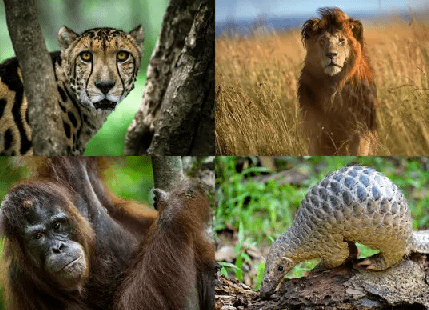
Extinct species are those species which are not found after searches of known or likely areas where they may occur. A species may be extinct from a local area, region, country, continent or the entire earth. Examples of such species are the Asiatic cheetah, pink-headed duck. Endangered species are those species which are in danger of extinction. The survival of such species is difficult if the negative factors that have led to a decline in their population continue to operate. The examples of such species are black buck, crocodile, Indian rhino, Indian wild ass, lion-tailed, a macaque, sangai, etc. Special measures are taken to protect endangered species, for example, hunting of such animals is banned under Wildlife Protection Act.  Endangered Species

Q3. Differentiate between endemic species and rare species. Give examples.

Endemic species are found in some particular areas, usually isolated by natural or geographical barriers, for example, islands. The examples of birds and animals belonging to such species are the Andaman teal, Andaman wild pig, Nicobar pigeon and mithun in Arunachal Pradesh. Uncommon species which are seldom found are called rare species. These species are small in number and are found scattered in some distant areas because their number has depleted due to negative factors. The small population of rare species may soon fall in the category of endangered or vulnerable species if the negative factors are not controlled. Examples of rare species are the Himalayan brown bear, wild Asiatic buffalo, desert fox, hornbill, etc.


Q4. What steps have been adopted under the Indian Wildlife Act to protect the endangered species of animals?

Under the Indian Wildlife (Protection) Act, implemented in 1972 several programmes were adopted to protect the remaining population of certain endangered species.The steps taken in this regard include:

  • banning hunting and poaching,
  • giving legal protection to the habitats of the endangered species and
  • restricting trade in wildlife 

Subsequently, central and many states, governments established national parks and wildlife sanctuaries. The central government has undertaken several projects for protecting specific animals that are gravely threatened like the tiger, the one-horned rhinoceros, the Asiatic lion, the Kashmir stag or hangul and three types of crocodile.

Q5. Large-scale development projects and mining have contributed significantly to the loss of forests. Give reasons to support this statement.

Large scale development projects and mining have contributed significantly to the loss of forests.Since 1951, over 5000 sq. km. of forests have been cleared for river valley projects. Clearing of the forest is still continuing with projects like the Narmada Sagar Project in Madhya Pradesh, which would inundate 40,000 hectares of forest. Mining for the purpose of industrial development is another major factor behind deforestation. The Buxa Tiger Reserve in West Bengal is seriously threatened by the ongoing dolomite mining. It has disturbed the natural habitat of many species and blocked the migration route of several others, including the great Indian elephant.

1. Resources and Development – Short Answer Questions

Q1. Distinguish between Potential Resource and Stock with the help of examples.

Example of Potential Resources

Ans: Potential Resource: potential resource refers to resources that exist in a region but are not currently utilised. They may be:

  • Not easily accessible
  • Not fully developed for present use

Examples of Potential Resources:

  • The states of Rajasthan and Gujarat have significant potential for wind and solar energy, yet these resources remain underdeveloped.
  • The hot springs in the Himalayan region could provide geothermal energy, but development is lacking. Additionally, mineral deposits are buried in mountains and oceans, awaiting exploitation.

Stocks: Stocks are materials in the environment that can satisfy human needs, but we currently lack the technology to access them.

Examples of Stocks:

  • Water is made up of hydrogen and oxygen, which could be a rich energy source. However, we do not yet have the technical knowledge to utilise these gases effectively.
  • With advancements in desalination technology, ocean water could become drinkable. Yet, we currently lack the expertise and funding for such projects.

Q2. What does the term ‘sustainable economic development’ mean? How can we eradicate irrational consumption and over-utilization of resources?

Ans: Sustainable economic development refers to growth that meets the needs of the present without harming the environment or compromising the ability of future generations to meet their own needs.

To eliminate irrational consumption and the overuse of resources, we can:

  • Focus on the conservation of resources.
  • Recognise that irrational consumption leads to various socio-economic and environmental issues.
  • Implement proper management strategies to ensure resources are preserved for future generations.

Try yourself:

What is the difference between a potential resource and a stock?

  • A.Potential resources are materials that have the capacity to fulfill human needs but have not been utilized yet, while stocks are materials that are easily accessible but not utilized due to lack of technology.
  • B.Potential resources are materials that are easily accessible but not utilized due to lack of technology, while stocks are materials that have the capacity to fulfill human needs but have not been utilized yet.
  • C.Potential resources and stocks are both materials that have the capacity to fulfill human needs but have not been utilized yet.
  • D.Potential resources and stocks are both materials that are easily accessible but not utilized due to lack of technology.

View Solution

Q3. List the problems caused due to the indiscriminate use of resources by human beings.

Ans: Indiscriminate use of resources by humans has resulted in several significant problems:

  • Depletion of resources to satisfy the greed of a few individuals.
  • Wealth accumulation in the hands of a few, leading to a divide in society between the rich and the poor.
  • Uncontrolled exploitation of resources has caused serious ecological issues, including global warming, ozone layer depletion, environmental pollution, and land degradation.

Q4. Why does the pattern of the net sown area vary from one state to another?

Ans: The pattern of the net sown area varies significantly across different states in India:

  • In Punjab and Haryana, over 80% of the total area is cultivated, benefiting from favourable geographical conditions such as climate and soil.
  • The Green Revolution has also contributed to increased cultivation in these regions.
  • Conversely, states like ManipurMizoramArunachal Pradesh, and the Andaman and Nicobar Islands have less than 10% of their area under cultivation.
  • The low net sown area in these states is due to:
    • Topographical constraints
    • Unfavourable climate
    • Socio-economic factors

Q5. Analyze the four main factors which help in the formation of soil.

Ans: Relief, nature of parent rock, climate, vegetation, and time are key factors in the formation of soil.

These factors contribute to the weathering of parent rocks through:

  • Climatic factors: Changes in temperature, wind, frost action, and rainfall.
  • Natural forces: Actions of running water, wind, and glaciers.

The four main factors of soil formation are:

  • Relief: Influences weathering and erosion.
  • Climate: Affects the rate of rock denudation and influences weathering.
  • Nature of parent rock: Determines soil colour, texture, and mineral content.
  • Time: Influences soil maturity, often taking millions of years to form just a few centimetres.

Q6. What is the main cause of land degradation in Gujarat, Rajasthan and Madhya Pradesh? How can it be checked?

Ans: The main cause of land degradation in Gujarat, Rajasthan, and Madhya Pradesh is primarily due to overgrazing by a large population of cattle. This practice has led to significant damage to the grasslands in these regions.

To address this issue, several measures can be implemented:

  • Planting trees and managing grazing areas effectively.
  • Implementing controls on grazing by designating specific areas for this purpose.

Q7. Where was Agenda 21 signed? What were the main provisions of Agenda 21?

Ans: Agenda 21 was signed in 1992 at the United Nations Conference on Environment and Development (UNCED) in Rio de Janeiro, Brazil. The main provisions of Agenda 21 include:

  • Elimination of poverty and hunger worldwide.
  • Improvement of health and education, particularly in literacy.
  • Protection and restoration of ecosystems that support life.

Q8. Do you think the future generation may not have sufficient resources as compared to the present generations? Why?

Ans: Yes, the future generation may not have sufficient resources compared to the present generations.

  • This is largely due to human activities such as deforestation and increased agriculture and mining.
  • These activities lead to the degradation of land and the environment.
  • The rapid consumption of fossil fuels may result in their depletion, as they are non-renewable.
  • If we continue at this pace, there may not be enough resources left for future generations.