06. Population – Chapter Notes

Introduction

The people are crucial for the development of the economy and society. They make and use resources and are themselves resources with varying qualities. 

  • For example, coal was merely a piece of rock until people invented technology to obtain and make it a valuable resource. 
  • Hence, the population is the pivotal element in social studies, serving as the point of reference from which all other elements are observed and derive significance and meaning. 
  • The numbers, distribution, growth, and characteristics of the population provide the basic background for understanding and appreciating all aspects of the environment. 
  • Human beings are both producers and consumers of the earth’s resources. 
  • Therefore, it is important to know how many people are in a country, where they live, how and why their numbers are increasing, and their characteristics. 

Three major aspects of the population are of primary concern:

  • Population size and distribution: How many people are there and where are they located?
  • Population growth and processes of population change: How has the population grown and changed through time?
  • Characteristics or qualities of the population: What are their age, sex-composition literacy levels, occupational structure and health conditions?

Try yourself:What are the major aspects of population that are of primary concern?

  • A.Population size and distribution
  • B.Population growth and processes of population change
  • C.Characteristics or qualities of the population
  • D.All of these

View Solution

Census: A census is an official enumeration of the population done periodically. In India, the first census was held in 1872. The first complete census however was taken in the year 1881. Since then, censuses have been held regularly every tenth year. The Indian census is the most comprehensive source of demographic, social and economic data.

Population Size and DistributionIndia’s Population Size and Distribution by Numbers

  • India’s Population Size: As of March 2011, India’s population was 1,210.6 million, accounting for over 17% of the world’s population.
  • Geographical Distribution: India covers an area of 3.28 million square km, which is 2.4% of the world’s total area.
  • Most Populous States:
    – Uttar Pradesh is the most populous state with a population of 199 million, making up about 16% of India’s population.
    – Almost half of India’s population lives in just five states: Uttar Pradesh, Maharashtra, Bihar, West Bengal, and Andhra Pradesh.
  • Least Populous States
    – Sikkim has a population of approximately 0.6 million.
    – Lakshadweep has a population of 64,429.

Indian’s Population Distribution by Density

Population density is calculated as the number of persons per unit area. India is one of the most densely populated countries in the world. The population density of India in the year 2011 was 382 persons per sq. km. Densities vary from 1,106 persons per sq. km in Bihar to only 17 persons per sq km in Arunachal Pradesh.

Try yourself:What is the population density of India?

  • A.1210.6 million people
  • B.382 persons per sq. km
  • C.17 persons per sq. km
  • D.5.5 per cent of the total population of India

View Solution

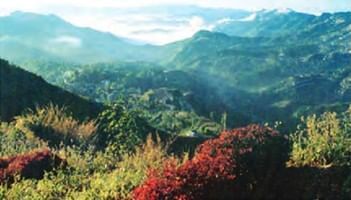
  • Low Density: The states of Jammu and Kashmir, Himachal Pradesh, Uttaranchal, Arunachal Pradesh, Nagaland, Manipur, Tripura, Meghalaya, Rajasthan And Madhya Pradesh Have Very Low Population Density. Rugged terrain and unfavorable climatic conditions are mainly responsible for the sparse population in these areas.
  • Moderate Density: The bulk of the peninsula blocks and Assam have a moderate density of population. The distribution of population is influenced here by the rocky nature of the terrain, low to moderate rain, and shallow and less fertile soil.
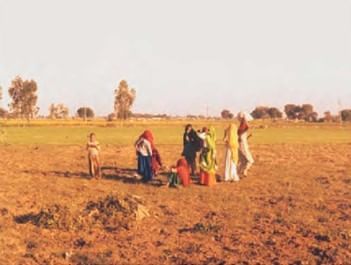
  • High density: The Northern Plains, Tamil Nadu and Kerala have a high to very high density of population because of the plain terrain, rice and fertile soil, abundant rainfall and moderate climate.

Population Growth and Processes of Population Change

The population is a dynamic phenomenon. The numbers, distribution and composition of the population are constantly changing. This is the influence of the three processes, namely – births, deaths and migrations.

Population Growth

Population growth refers to the change in the number of inhabitants over a specific period, such as a decade.

  • It can be expressed in absolute numbers (magnitude of increase) or as a percentage change per year (annual growth rate).
  • Absolute Increase: Absolute increase is calculated by subtracting the earlier population figure from the later figure (e.g., population in 2001 from 2011).
    Example: India’s population increased from 361 million in 1951 to 1210 million in 2011.
  • Annual Growth Rate: The annual growth rate is expressed as a percentage and represents the rate of increase per year (e.g., a 2% growth rate means an addition of two people for every 100 in the base population).
  • Historical Trends:
    – From 1951 to 1981, India experienced a steady increase in the annual rate of population growth, with the population rising from 361 million to 683 million.
    – Since 1981, the growth rate has been gradually declining, largely due to a decrease in birth rates.
    – Despite this decline, the 1990s saw an addition of 182 million people, reflecting a high absolute increase.
  • Current Situation:
    – India’s large population means that even a low annual growth rate results in a substantial absolute increase.
    – As of 2023, India has overtaken China to become the most populous country in the world.
    – The large annual increase continues to challenge efforts to conserve resources and protect the environment.

Try yourself:

What is the definition of population growth?

  • A.The change in the number of inhabitants of a country/territory during a specific period of time.
  • B.The number of people living in a country.
  • C.The rate at which the population density increases.
  • D.The distribution of population across different regions.

View Solution

Processes of Population Change / Growth

There are three main processes of population change. They are:
The natural increase in population is the difference between birth rates and death rates.

1. Birth rate: Birth rate indicates the number of births in a country during a year per 1,000 population.

2. Death rate: 

  • Death rate indicates the number of deaths in a country during a year per 1,000 population. 
  • The main cause of the rapid rate of growth of the Indian population is the fast decline in death rates. 
  • Since 1980, birth rates have started declining gradually, resulting in a gradual decline in the rate of population growth.
    The reasons for this trend are:
    (i) Most people, especially in urban areas, have adopted the two-child norm.
    (ii) The birth rate has also declined at a faster rate.
    (iii) Standard of living has increased considerably.
    (iv) Women folk are more conscious of their health.
    (v) Family Welfare Schemes are being adopted in a big way.
    (vi) The Muslim population is also trying to keep their family small.

3. Migration

Migration means the movement of people across regions and territories. 

  • Migration can be internal or international. 
  • In India, most migrations have been from rural to urban areas because of the ‘push’ factor in rural areas. 
  • These are adverse conditions of poverty and unemployment in the rural areas and the ‘pull’ of the city in terms of increased employment opportunities and better living conditions. 
  • Migration is an important determinant of population change. 
  • It changes not only the population size but also the population composition of urban and rural populations in terms of age and sex composition. 
  • In India, the rural-urban migration has resulted in a steady increase in the percentage of the population in cities and towns. 
  • The urban population increased from 17.29 percent of the total population in 1951 to  31.80 percent in 2011
  • There has been a significant increase in the number of ‘million-plus cities’ from 35 to 53 in just one decade, i.e. 2001 to 2011.

Adolescent Population

  • The most significant feature of the Indian population is the size of its adolescent population. 
  • It constitutes one-fifth of the total population of India. 
  • Adolescents are generally grouped in the age group of 10 to 19 years
  • They are the most important resource for the future. 
  • The nutrition requirements of adolescents are higher than those of a normal child or adult. 
  • Poor nutrition can lead to deficiency and stunted growth. 
  • The diet available to adolescents is inadequate in all nutrients. 
  • A large number of adolescent girls suffer from anemia. 
  • Their problems have so far not received adequate attention in the process of development.

Try yourself:

What is the term used to describe the movement of people across regions and territories?

  • A.Immigration
  • B.Emigration
  • C.Migration
  • D.Evacuation

View Solution

National Population Policy

Recognizing that the planning of families would improve health and welfare, the Government of India initiated the comprehensive Family Planning Programme in 1952. The Family Welfare Programme has sought to promote responsible and planned parenthood on a voluntary basis.

Major features of NPP 2000:

  • The NPP 200 provides a policy framework for imparting free and compulsory school education to children up to 14 years of age.
  • It aims to reduce infant mortality to below 30 per 1000 live births. Another aim is to achieve universal immunization of children against all vaccine-preventable diseases.
  • Promotion of delayed marriage for girls.
  • It also aims at making family welfare a people-centred programme.

Conclusion

This chapter underscores the significance of understanding population dynamics to comprehend the broader socio-economic and environmental context. Population growth, distribution, and density are key indicators of a nation’s development and influence resource utilization and policy-making. The chapter highlights the interdependence between population characteristics and various factors such as healtheducation, and employment. Recognizing these aspects enables us to appreciate the challenges and opportunities that come with managing a growing population. Ultimately, informed population management is crucial for sustainable development and improving the quality of life for all.Difficult Words

  1. Population Dynamics – The study of how and why populations change in size and structure over time.
  2. Socio-economic – Relating to or concerned with the interaction of social and economic factors.
  3. Environmental Context – The conditions or surroundings in which an organism, system, or process operates.
  4. Population Growth – The increase in the number of individuals in a population.
  5. Distribution – How something is shared among a group or spread over an area.
  6. Density – The number of people living per unit of an area (e.g., per square kilometre).
  7. Resource Utilization – The way resources are used or consumed.
  8. Policy-making – The process of creating laws, regulations, and guidelines.
  9. Population Characteristics – The attributes or features of a population, such as age, gender, and health status.
  10. Interdependence – Mutual dependence between things.
  11. Sustainable Development – Economic development that is conducted without depletion of natural resources.
05. Natural Vegetation and Wildlife – Chapter Notes

Introduction

India is one of the twelve mega biodiversity countries of the world. With about 47,000 plant species, India occupies tenth place in the world and fourth in Asia in plant diversity. 

  • There are about 15,000 flowering plants in India which account for 6 percent of the world’s total number of flowering plants. The country has many non-flowering plants such as ferns, algae, and fungi. 
  • India also has 90,000 species of animals, as well as a rich variety of fish in its fresh and marine waters.

What is Natural Vegetation?

Natural Vegetation refers to a plant community that has grown naturally without human aid and has been left undisturbed by humans for a long time. This is also termed virgin vegetation

Note: Crops, orchards, and plantation trees are not considered part of natural vegetation. 

  • Flora: The term flora is used to denote plants of a particular region or period.
  • Fauna: The species of animals are referred to as fauna.

Try yourself:Which term is used for the original plant cover of an area which has grown naturally?

  • A.Garden
  • B.Agriculture
  • C.Virgin Vegetation
  • D.Indigenous species

View Solution

Types of Vegetation

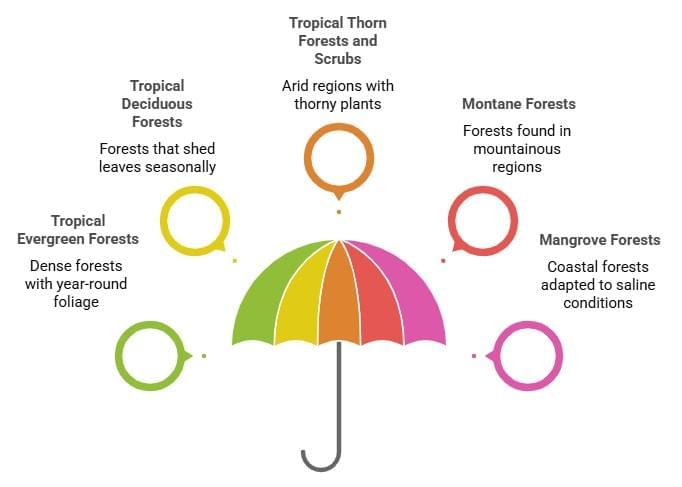
India’s diverse climate and geography support a wide variety of vegetation types, ranging from tropical rainforests to desert shrubs, reflecting the country’s rich ecological diversity. 

Let’s discuss the Types of Vegetation in India in detail below: 

Types of Vegetation

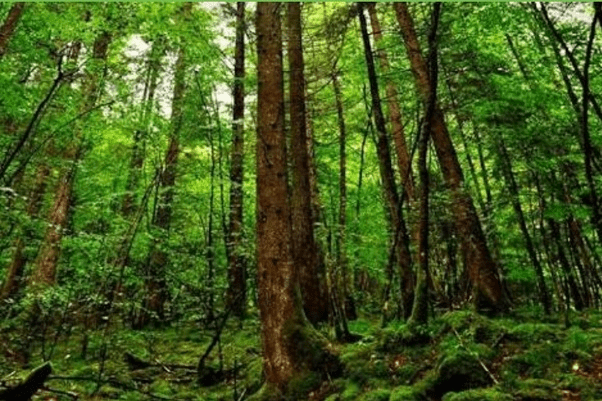
Tropical Evergreen Forests

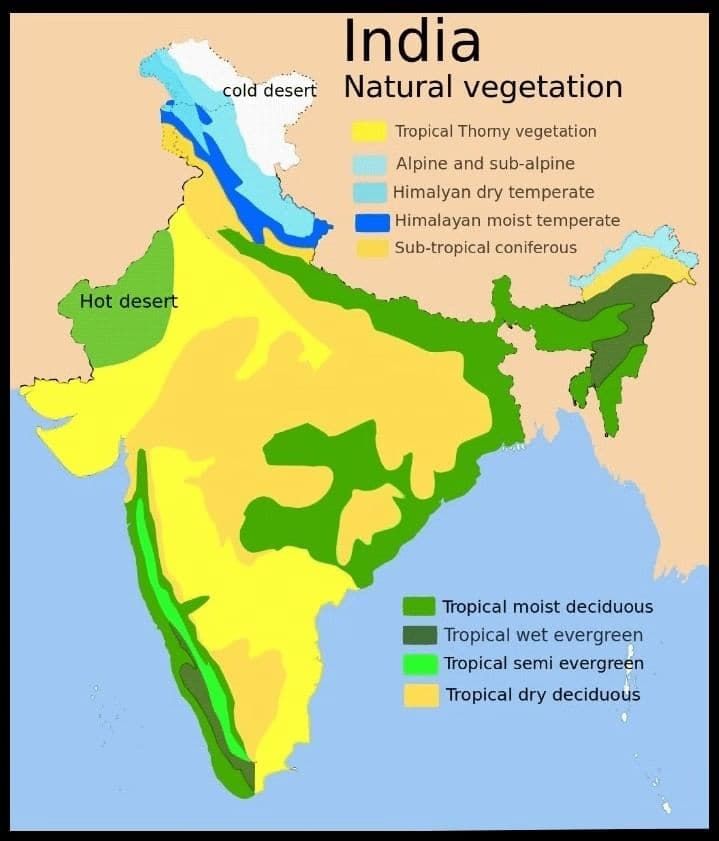
  • Found in: Western Ghats, Andaman & Nicobar Islands, Lakshadweep, upper Assam, and parts of the Tamil Nadu coast.
  • Rainfall: Above 200 cm, short dry season.
  • Features:
    – Trees grow up to 60 metres or more.
    – No specific leaf-shedding season; remains green year-round.
    – Multilayered vegetation: trees, shrubs, and creepers.

Tropical Evergreen Forest

  • These forests yield hardwood trees.
  • Ebony, Mahogany, Rosewood, Rubber, and Cinchona are some of the important trees.
  • In these forests, a large number of plant species are found in one place. It creates difficulty in their commercial exploitation.
  • Elephants, monkeys, lemur, and deer are some common animals found in these forests.

Tropical Deciduous Forests

  • These are the most widespread forests of India. 
  • They are also called the monsoon forests and spread over the region, receiving rainfall between 200 cm and 70 cm
  • Trees of this forest type shed their leaves for about six to eight weeks in dry summer.

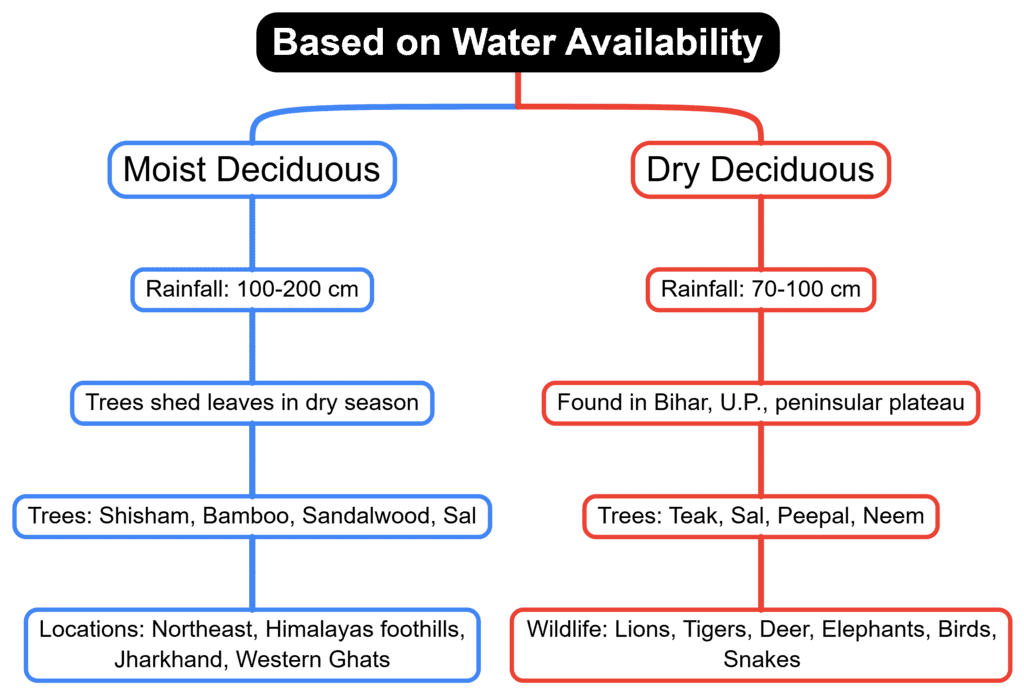
Based on the availability of water, these forests are further divided into:(a) Moist Deciduous

  • These forests are found in areas of 100 cm to 200 cm of rainfall.
  • Due to the long dry period, the trees shed their leaves.
  • Shisham, Bamboo, Sandalwood, Khair, Kusum, Arjun, Mulberry, and Sal are the common trees found in these forests.
  • These forests cover a vast area of the country. Northeastern states, along the foothills of the Himalayas, Jharkhand, West Orissa, and Chhattisgarh, and on the Eastern slopes of the Western Ghats.

(b) Dry Deciduous

  • These are found in areas having rainfall between 70 cm to 100 cm.
  • These are found in the rainier part of the peninsular plateau and the plains of Bihar and U.P.
  • These are open stretches in which Teak, Sal, Peepal, and Neem grow.
  • Most of these forests have been cleared for cultivation.
  • In these forests, the common animals found are lions, tigers, pigs, deer, and elephants. A huge variety of birds, lizards, snakes, and tortoises are also found here.

The Thorn Forests and Shrubs

  • Tropical thorn forests occur in areas that receive rainfall of less than 70 cm
  • These consist of a variety of grasses and shrubs. Thorn Forest and Shrubs
  • It includes semi-arid areas of Punjab, Haryana, Rajasthan, Gujarat, Madhya Pradesh, and Uttar Pradesh. 
  • In these forests, plants remain leafless for the most part of the year and give an expression of shrub vegetation. 
  • Important species found are babul, Kher and wild Date palm, Kikar, Neem, Khejri, Palas, etc.

Natural Vegetation in India

Montane Forests

In mountainous areas, the decrease in temperature with increasing altitude leads to the corresponding change in natural vegetation:

  • The wet temperate type of forest is between a height of 1000 and 2000 meters. Evergreen broad-leaf trees such as oaks and chestnuts predominate.
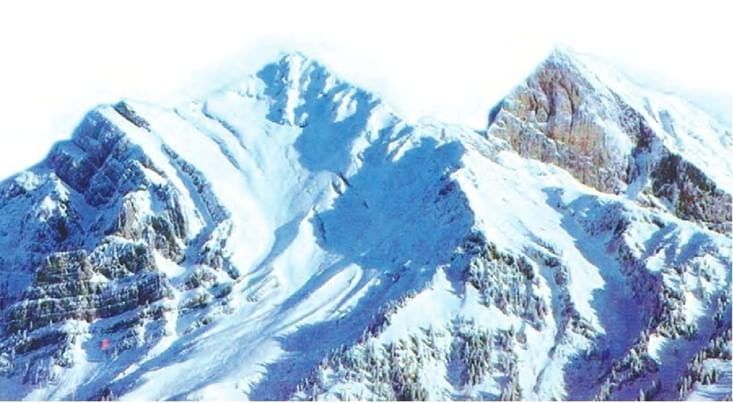
  • Between 1500 and 3000 meters, temperate forests containing coniferous trees like pine, deodar, silver fir, spruce, and cedar are found. These forests cover mostly the Himalayas’ southern slopes, places with high altitudes in southern and northeast India. At higher elevations, temperate grasslands are common.Distribution of Mountain Forest
  • At high altitudes, generally more than 3600 meters above sea level, temperate forests and grasslands give way to the Alpine vegetation. Silver fir, junipers, pines, and birches are the common trees of these forests.
  • Above the Alpine vegetation, Alpine grasslands are found. These are used extensively for grazing by nomadic tribes like the Gujjars and the Bakarwals. At higher altitudes, mosses and lichens form part of tundra vegetation.
  • The common animals found in these forests are Kashmir stag, spotted deer, wild sheep, jackrabbit, Tibetan antelope, yak, snow leopard, squirrels, shaggy horned wild ibex, deer, and rare red panda, sheep, and goats with thick hair.

Try yourself:Why is the southern slopes in Himalayan region covered with thick vegetation?

  • A.On account of more exposure to sunlight
  • B.On account of more precipitation
  • C.On account of less exposure to colder winds
  • D.All the above

View Solution

Mangrove Forests

  • These are found in the areas that are under the influence of tides, having accumulated mud and silt. 
  • Dense mangroves are the common varieties with roots of plants submerged underwater. Mangrove Forest
  • These forests are found in the deltas of the Ganga, Mahanadi, Godavari, and Kaveri. 
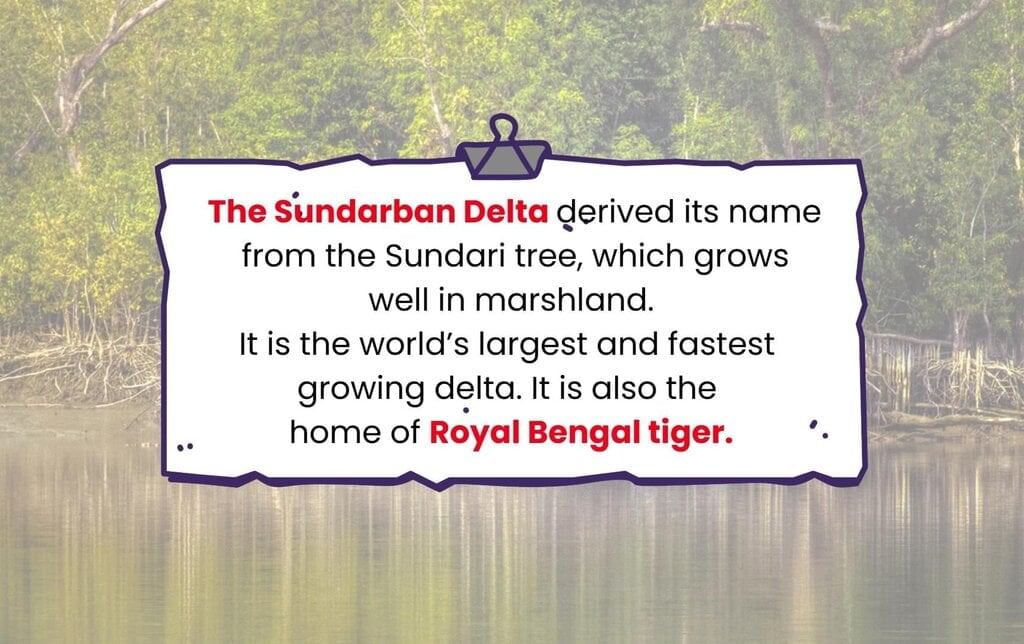
  • The most important tree is the Sundari tree, after which the Sunderbans are named. 
  • The tree provides hard, durable, and strong wood, which is used for building boats and boxes. 
  • Royal Bengal Tiger is a famous animal in these forests. Turtles, crocodiles, gharials, and snakes are also found in these forests.

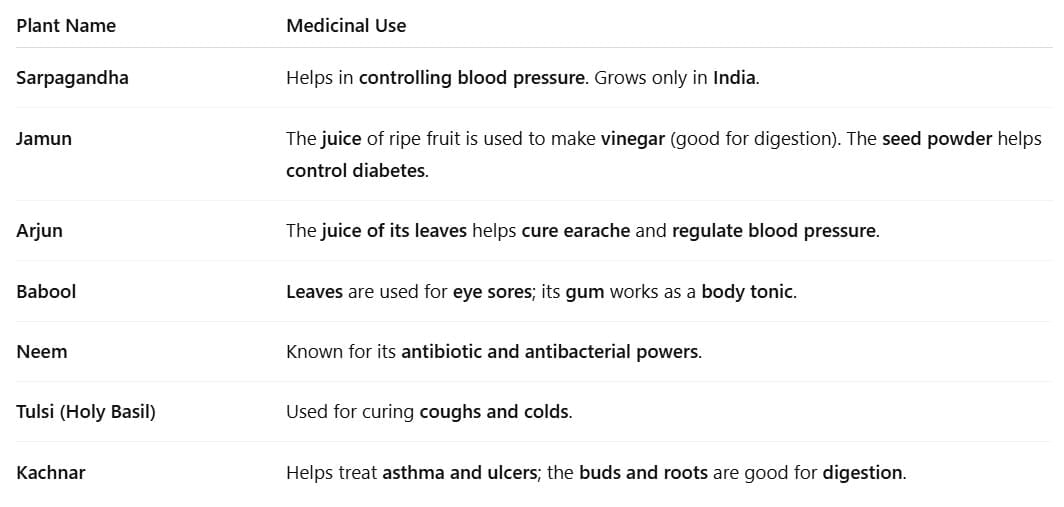
Medicinal Plants

  • India’s Rich Heritage: Known for herbs and spices from ancient times. Around 2,000 plants have been described in Ayurveda, with at least 500 in regular use.
  • Conservation Concern: The World Conservation Union’s Red List identifies 352 medicinal plants as threatened, of which 52 are critically threatened and 49 are endangered.

Common Medicinal Plants and Their Uses:

Try yourself:Ebony, mahogany and rosewood trees are grown in which type of the forests?

  • A.Coniferous forest
  • B.Tropical rainforest
  • C.Tropical thorn forest
  • D.None of these

View Solution

Wildlife

  • India has a diverse and rich wildlife with approximately 90,000 animal species.
  • The country is home to around 2,000 species of birds, accounting for 13% of the world’s total.
  • India also has a significant number of fish species, with 2,546 types, which make up a considerable portion of the world’s fish population.
  • The country shares 5 to 8% of the world’s amphibians, reptiles, and mammals.

Biodiversity in India

India is home to an incredibly rich and diverse array of flora and fauna, making it one of the world’s most biodiverse countries, with habitats ranging from tropical forests to arid deserts and high-altitude regions like the Himalayas.

  • Elephants thrive in the hot and wet forests of Assam, Karnataka, and Kerala.
  • One-horned rhinoceroses inhabit swampy and marshy lands in Assam and West Bengal.
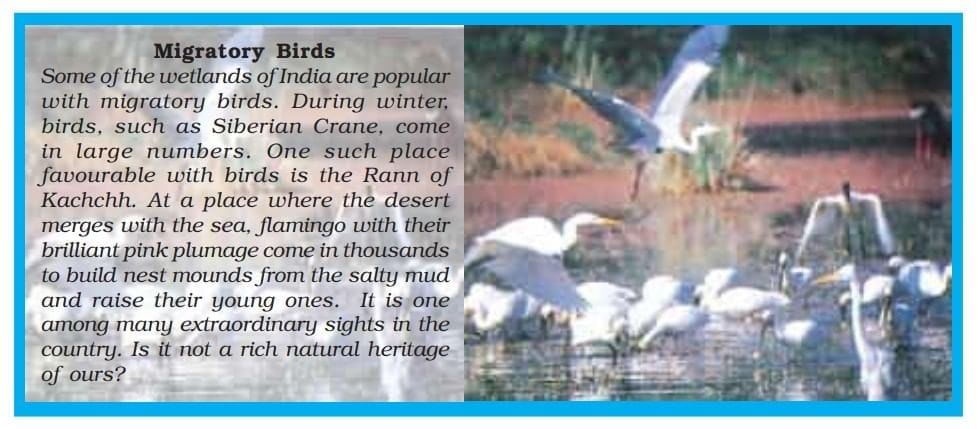
  • Wild ass and camels are native to the arid regions of the Rann of Kachchh and the Thar Desert, respectively.
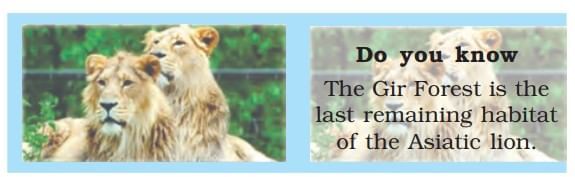
  • Indian bisonnilgai (blue bull), chousingha (four-horned antelope), gazelle, various species of deer, and different types of monkeys are found across India. Indian lions are found in the Gir forest of Gujarat.
  • Tigers inhabit the forests of Madhya Pradesh, the Sundarbans in West Bengal, and the Himalayan region.
  • Leopards,  important members of the cat family, are widespread predators in India.
  • Crops in India have been selected from the rich biodiversity, including both edible and medicinal plants.
  • Animals have been domesticated from nature, providing draft powertransportationmeat, and other resources.
  • Fish serve as a nutritious food source, while insects play vital roles in pollination and the biological control of crops.

Wildlife Conservation in India 

  • Conservation is essential as the ecosystem has been disturbed due to excessive exploitation of plant and animal resources. 
  • Around 1,300 plant species and some animal species are endangered or extinct.
  • The main causes of this threat to nature are hunting for commercial purposes, pollution from chemical and industrial waste, the introduction of alien species, and deforestation for cultivation and habitation.
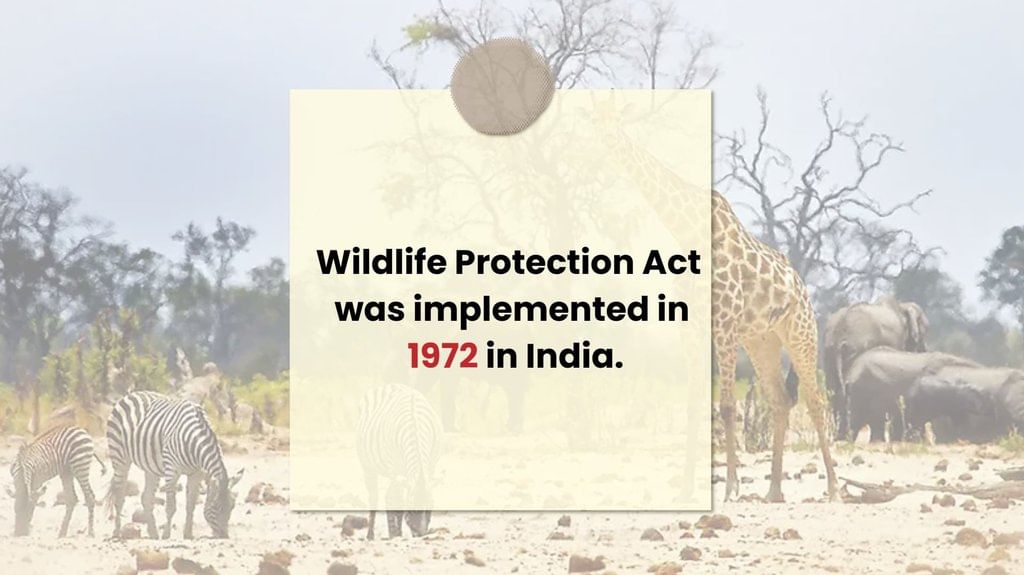
  • The government has implemented various measures to protect the flora and fauna of the country.
  • Eighteen biosphere reserves have been established, including the Sundarbans, Nanda Devi, Gulf of Mannar, Nilgiri, Nokrek, Great Nicobar, Simlipal, Pachmarhi, Achanakmar-Amarkantak, Agasthyamalai, Kangchendzonga, and Panna. These reserves are also included in the world network of biosphere reserves.
  • The government has provided financial and technical assistance to several botanical gardens since 1992.
  • Initiatives like Project Tiger, Project Rhino, Project Great Indian Bustard, and other eco-developmental projects have been introduced.
  • The country has 106 National Parks573 Wildlife Sanctuaries, and Zoological Gardens to preserve the natural heritage.
  •  It is crucial for everyone to understand the importance of the natural ecosystem for our survival. 
  • Immediate action is required to prevent the destruction of the natural environment.

Try yourself:Which one of the following bio-reserves of India is not included in the world network of bio-reserve?

  • A.Manas
  • B.Nilgiri
  • C.Gulf of Mannar
  • D.Nanda Devi

View Solution

Difficult Words

  1. Conserving – Protecting from loss or harm; preserving.
  2. Vegetation – Plants considered collectively, especially those found in a particular area or habitat.
  3. Ecological Balance – A stable state in which natural communities of organisms interact with their environment.
  4. Interdependence – Mutual reliance between two or more groups.
  5. Species – A group of living organisms consisting of similar individuals capable of exchanging genes or interbreeding.
  6. Habitats – The natural environment in which an organism lives.
  7. Sustainable Practices – Methods of using resources that do not deplete them or cause long-term environmental harm.
  8. Biodiversity – The variety of plant and animal life in a particular habitat or the world as a whole.
  9. Conservation – The action of conserving something, especially the environment.
  10. Resources – Supplies of materials or assets that can be drawn on in order to function effectively.
  11. Sustaining – Strengthening or supporting physically or mentally.
  12. Well-being – The state of being comfortable, healthy, or happy.

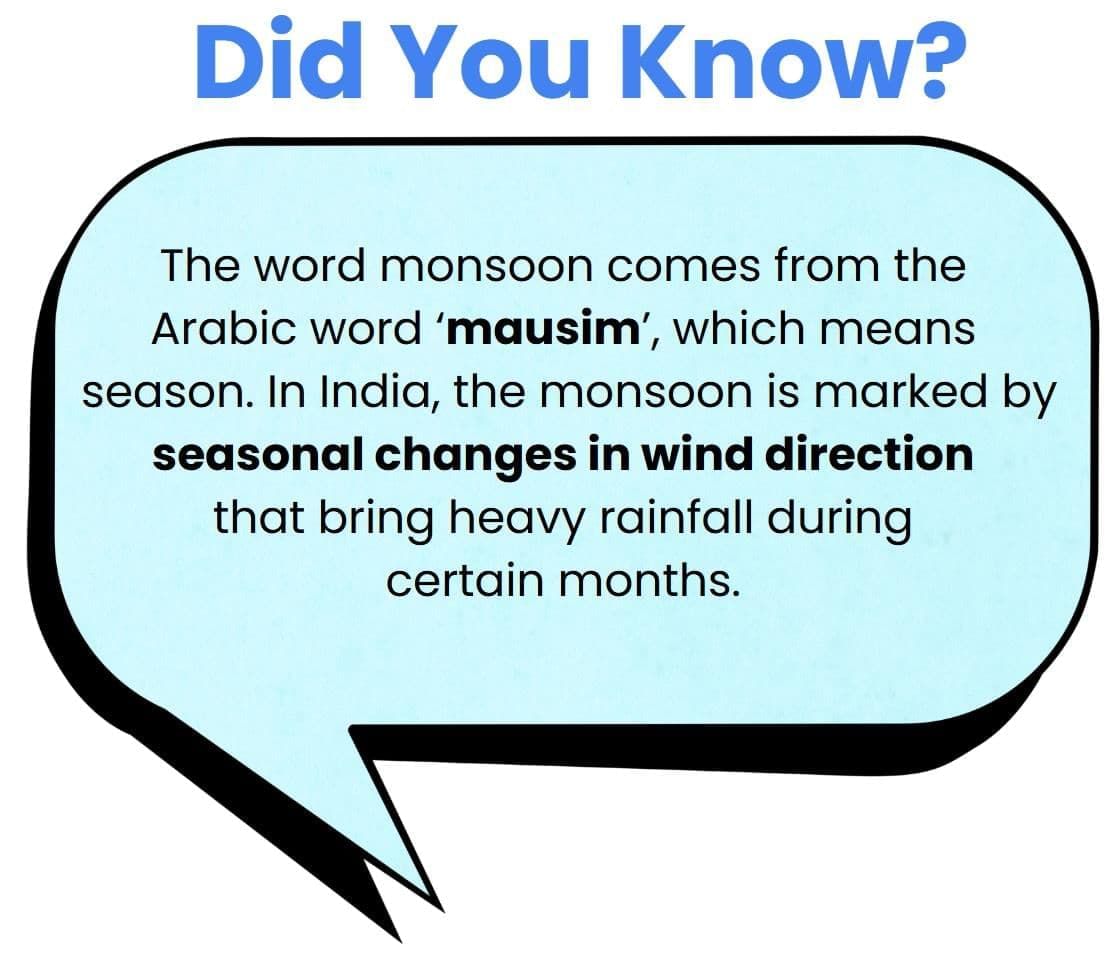
04.  Climate – 2                Chapter Notes

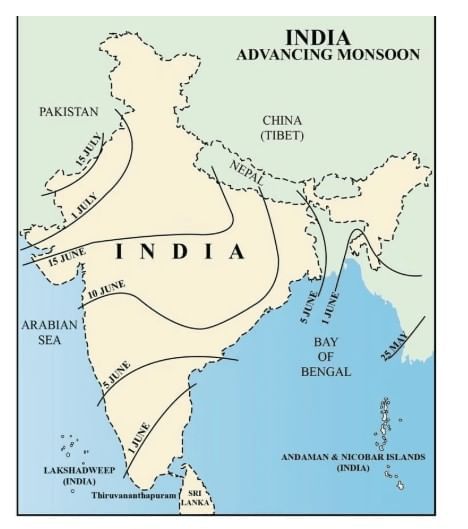
Advancing Monsoon (The Rainy Season)

Formation and Movement

  • By early June, an intense low-pressure area forms over the northern plains of India.
  • This attracts southeast trade winds from the southern hemisphere.
  • These winds cross the equator and turn into southwest monsoon winds.
  • As they pass over warm oceans, they collect a lot of moisture.
  • These winds are strong, blowing at about 30 km/h.
  • They cover most of India within a month, except the far northwest.

The Onset of South West MonsoonRainfall During Southwest Monsoon

  • Brings a complete change in weather across India.
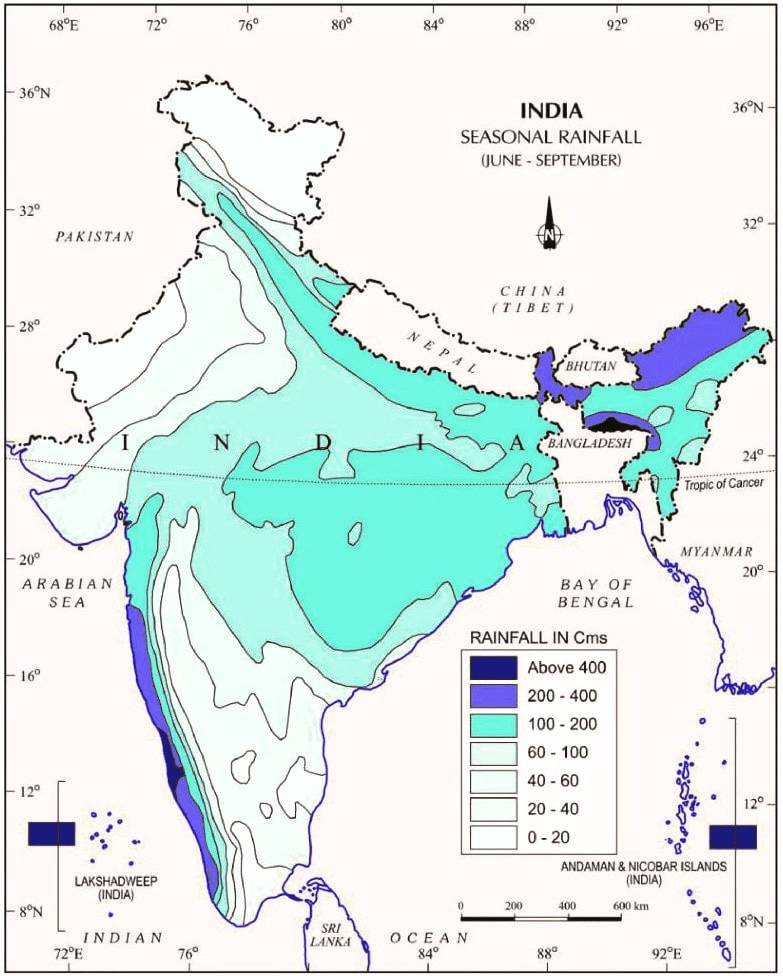
  • Western Ghats receive very heavy rainfall (more than 250 cm) on the wind-facing side.
  • Deccan Plateau and Madhya Pradesh also get some rain, even though they lie in rain shadow areas.
  • The northeastern region gets the most rainfall in the country.
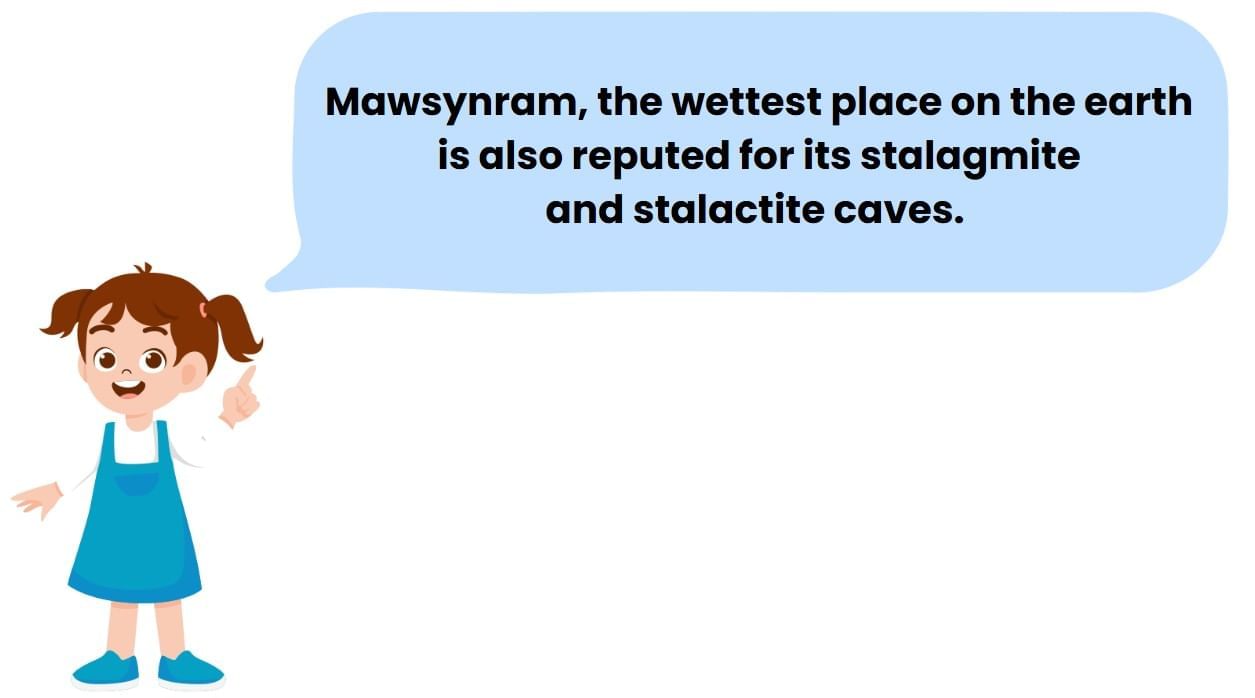
  • Mawsynram in the Khasi Hills receives the highest average rainfall in the world.
  • Rainfall in the Ganga valley decreases from east to west.
  • Rajasthan and parts of Gujarat receive very little rain.

Breaks in Monsoon

  • The monsoon has wet and dry spells, called monsoon breaks.
  • Rain doesn’t fall every day—it comes in intervals.
  • These breaks are caused by the movement of the monsoon trough (a low-pressure zone).
    – When the trough is over the plains, those areas get good rain.
    – When it shifts closer to the Himalayas, the plains stay dry and mountain areas get heavy rain.
  • Heavy rains in mountain areas can cause floods in the plains.

Role of Tropical Depressions

  • Tropical depressions form in the Bay of Bengal and move along the monsoon trough.
  • These systems affect the amount and duration of rainfall.
  • They can cause floods in some areas and droughts in others.

Uncertainty of Monsoon

  • The monsoon is unpredictable and irregular in timing, strength and duration.
  • Causes floods in one region and drought in another.
  • Its irregular pattern often disrupts the farming schedule of millions of Indian farmers.

Try yourself:Which winds brings widespread rainfall over the mainland of India?

  • A.Sea breeze
  • B.North easterly
  • C.Southwest monsoon winds
  • D.None of these

View Solution

Retreating/Post-Monsoons (The Transition Season)

Monsoon Withdrawal

  • In October-November, as the sun shifts southward, the monsoon trough weakens over the northern plains, leading to the development of a high-pressure system.
  • The southwest monsoon winds gradually diminish, causing the monsoon to withdraw from the Northern Plains.
  • October and November signify a transition from the rainy season to drier winter conditions, marked by clear skies and a shift to drier weather patterns.

Retreating Monsoon

October Heat

  • During October, India experiences high temperatures and humidity, known as the ‘October heat’ phenomenon, which can make the weather oppressively hot.

Cyclonic Activity

  • In late October, temperatures in northern India begin to decrease rapidly as low-pressure conditions move from northwestern India towards the Bay of Bengal.
  • By early November, low-pressure conditions in the Bay of Bengal lead to the formation of cyclonic depressions over the Andaman Sea.
  • These cyclones often cross the eastern coasts of India, bringing heavy rain and causing significant damage.

Impact of Cyclones

  • The deltas of the Godavari, Krishna, and Kaveri rivers, as well as the coastal areas of Odisha, West Bengal, and Bangladesh, are frequently affected by cyclones, leading to substantial destruction of life and property.
  • The Coromandel Coast relies significantly on depressions and cyclones for its rainfall, which plays a crucial role in shaping the region’s weather patterns.

Distribution of Rainfall

High Rainfall Areas

  • The western coast and northeastern India receive more than 400 cm of rainfall annually.

Low Rainfall Areas

  • Western Rajasthan, parts of Gujarat, Haryana, and Punjab experience less than 60 cm of rainfall each year.
  • The interior of the Deccan Plateau and the eastern side of the Sahyadris also receive low precipitation.
  • Leh in Jammu and Kashmir is another area with very low rainfall.

Seasonal Rainfall

Low Rainfall Areas

  • Western Rajasthan, parts of Gujarat, Haryana, and Punjab experience less than 60 cm of rainfall each year.
  • The interior of the Deccan Plateau and the eastern side of the Sahyadris also receive low precipitation.
  • Leh in Jammu and Kashmir is another area with very low rainfall.

Moderate Rainfall Areas

  • Most of the rest of the country receives moderate rainfall.
  • Snowfall is generally limited to the Himalayan region.

Rainfall Variability and Its Impacts

  • Annual rainfall varies significantly across the country due to the nature of the monsoons.
  • High rainfall regions are prone to flooding, while low rainfall areas are susceptible to drought conditions.

Try yourself:

Which region receives more than 400 cm of rainfall annually?

  • A.Western Rajasthan
  • B.Leh in Jammu and Kashmir
  • C.Haryana
  • D.Northeastern India

View Solution

Monsoon As A Unifying Bond

  • The Himalayas block the cold winds from Central Asia, which helps northern India stay warmer than other places at the same latitude.
  • The Peninsular Plateau, surrounded by the sea on three sides, has moderate temperatures due to the influence of the sea.
  • Even with these natural effects, there are still large differences in temperature in different parts of the country.
  • The monsoon winds bring a shared weather pattern to the whole country.
  • These winds change with the seasons and create a regular cycle of different weather conditions.
  • Though the rainfall is not always regular or evenly spread, this variation is a common feature of the monsoons.
  • The monsoon plays an important role in shaping India’s land, plants, animals, farming schedule, and festivals.
  • People across India eagerly wait every year for the monsoon to arrive.
  • The rain brought by the monsoon helps start farming activities all over the country.
  • The rivers that carry this rainwater connect various regions and support agriculture across India.

Key Terms

  1. Weather vs. Climate: Weather describes the short-term atmospheric conditions in a specific place at a specific time, while climate refers to the average long-term weather patterns over a significant period, typically 30 years. This distinction helps in understanding daily weather forecasts versus long-term climate patterns.
  2. Temperature Variations: The significant differences in temperature across various regions due to factors like geographical location, altitude, and proximity to water bodies. For example, Rajasthan experiences extreme heat, while Pahalgam in Jammu and Kashmir has moderate summer temperatures.
  3. Precipitation Variations: Differences in the amount and type of precipitation (rain, snow, sleet) that different regions receive based on their climate zones. High variability affects agriculture, water resources, and overall weather patterns.
  4. Climatic Controls: Factors that influence a region’s climate, including latitude, altitude, pressure and wind systems, distance from the sea, ocean currents, and relief features. Each of these factors contributes differently to shaping the local climate by affecting temperature, humidity, and precipitation.
  5. Latitude and Climate: The position of a place on the Earth’s surface in relation to the equator (latitude) affects its solar radiation intake, influencing its overall climate. Tropical regions near the equator receive more sunlight and have warmer climates compared to polar regions near the poles.
  6. Altitude’s Impact on Climate: Higher altitudes are characterized by thinner air, which can hold less heat, leading to cooler temperatures. This is why mountainous regions typically have colder climates than areas at sea level.
  7. Pressure and Wind Systems: The movement and interaction of different air pressure systems across the Earth influence weather patterns and climatic conditions. For example, high-pressure systems are generally associated with stable and dry weather, while low-pressure systems can lead to storms and rainfall.
  8. Continentality (Distance from the Sea): The effect of an area’s distance from the sea on its climate, where areas closer to the sea have milder climates and smaller temperature fluctuations compared to inland areas.
  9. Ocean Currents: Streams of seawater moved by various global wind systems that can significantly influence coastal climates by carrying warm or cold water across different parts of the globe.
  10. Relief Features: Geographic features like mountains that affect climate by blocking wind and precipitation, creating varied weather patterns on their windward and leeward sides.
  11. Monsoon: A seasonal wind system that dramatically influences the climate of regions like India by bringing heavy rains during the summer months. The monsoon is crucial for agriculture but also causes significant weather-related challenges like flooding.
  12. Cyclonic Depressions: Low-pressure areas in the atmosphere that can lead to severe weather conditions, including storms and heavy rainfall, particularly impactful in shaping the seasonal weather patterns in regions like India.

04. Climate – 1                  Chapter Notes

In the last two chapters, you learned about the physical features and rivers of India—both are important parts of the natural environment. Now, it’s time to explore the third major element: atmospheric conditions, or simply, the climate.

Have you ever wondered:

  • Why do we wear warm clothes in December?
  • Why does it get extremely hot in May?
  • Why do we get heavy rains during June and July?

The answers lie in understanding India’s climate.

What is Climate?

Climate means the average weather conditions of a place over a long period (usually more than 30 years). Weather, on the other hand, is the condition of the atmosphere at a particular moment. Both include elements like temperature, wind, humidity, rainfall, and atmospheric pressure.

You may have noticed that the weather can change within a single day. However, over weeks and months, we see patterns—for example, some months are hot and dry, others are cool and wet. Based on these patterns, the year is divided into different seasons such as summer, winter, and rainy season.

The world is divided into various climatic zones. But do you know what kind of climate India has? It is known as the monsoon type of climate.

Even though there’s a general pattern to the Indian climate, there are clear regional differences:

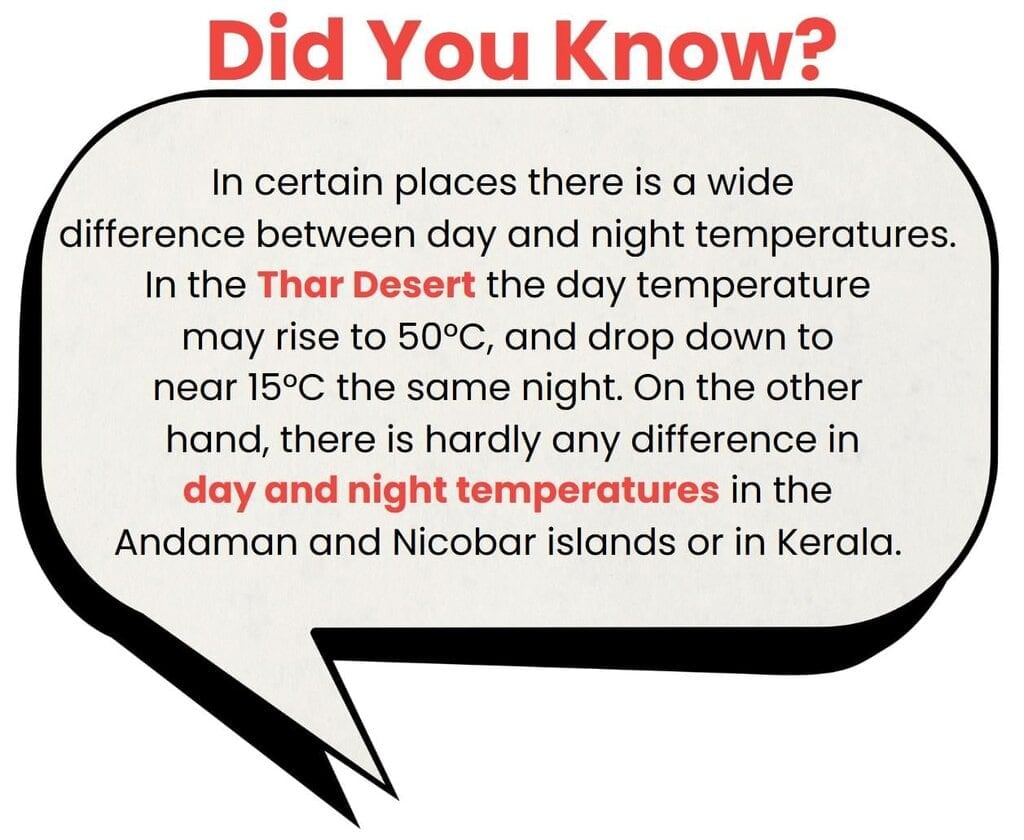
  • Temperature variations: In summer, it can be 50°C in Rajasthan and only 20°C in Kashmir. In winter, Drass (J&K) can drop to –45°C, while Thiruvananthapuram stays around 22°C.
  • Rainfall differences: Rainfall is not the same everywhere. While Meghalaya receives over 400 cm of rainfall, Ladakh and Western Rajasthan get less than 10 cm. Most places get rain between June and September, but Tamil Nadu receives most of its rain during October and November.

Generally, coastal areas have mild temperature changes, while inland areas have more extreme seasonal differences. Rainfall usually decreases from east to west in the Northern Plains.

These climate differences influence how people live—from the clothes they wear to the food they eat and the houses they build.

Different Climatic Zones in India

Try yourself:Most parts of India receive rainfall during which of the following months?

  • A.June to September
  • B.May to July
  • C.September to March
  • D.None of these

View Solution

Climatic Controls

The climate of any place on Earth is influenced by several key natural factors, known as climatic controls. There are six major controls that work together to shape the temperature, rainfall, and overall weather pattern of a region:

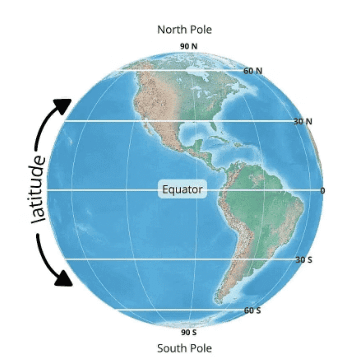
  1. Latitude: The Earth is curved, so sunlight does not reach all parts equally. Places near the equator get more direct sunlight and are usually warmer. As you move towards the poles, the sunlight is less intense, making those areas cooler.Latitudes
  2. Altitude (Height above sea level): As we go higher above the Earth’s surface (like climbing a mountain), the air becomes thinner and cooler. This is why hills and mountains are cooler than the plains, especially in summer.
  3. Pressure and Wind System: The movement of air pressure and wind patterns depends on the latitude and altitude of a place. These wind systems affect both temperature and rainfall in different regions.
  4. Distance from the Sea (Continentality): Places close to the sea have more moderate temperatures, meaning they don’t get too hot or too cold. However, places that are far from the sea experience extreme weather—very hot summers and very cold winters. This effect is called continentality.
  5. Ocean Currents: The movement of warm or cold ocean water near the coast also affects the climate. For example, if warm ocean currents flow near a coastal area, they raise the temperature, while cold currents lower it—especially when winds blow from the sea to the land.
  6. Relief (Landforms like mountains): Mountains can block winds and affect rainfall. For example, if rain-bearing winds hit a mountain, they rise and cool, causing rainfall on one side (the windward side). The other side (called the leeward side) receives very little rain and stays dry.

Factors Affecting India’s Climate

Latitude

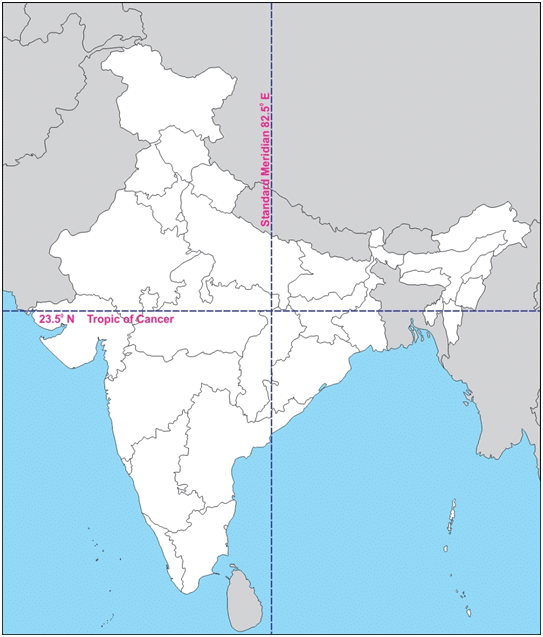
The Tropic of Cancer runs through the middle of India—from the Rann of Kutch in the west to Mizoram in the east. This divides the country into two parts:

  • The southern part lies in the tropical zone, which is generally hot and humid.
  • The northern part lies in the subtropical zone, where temperatures are a bit cooler.

So, India has both tropical and subtropical climate features because of its location.

Altitude (Height above sea level)

India has the Himalayan mountains in the north with an average height of about 6,000 metres, and low-lying coastal areas with elevations of only around 30 metres.

The Himalayas play an important role in controlling India’s climate:

  • They block cold winds from Central Asia during winter.
  • As a result, India has milder winters compared to other places at the same latitude, like Central Asia.

Pressure and Winds

India’s climate and weather are mainly controlled by three important atmospheric factors:

  • Pressure and surface winds
  • Air movement in the upper atmosphere
  • Western cyclones and tropical storms

Regular Wind Pattern:

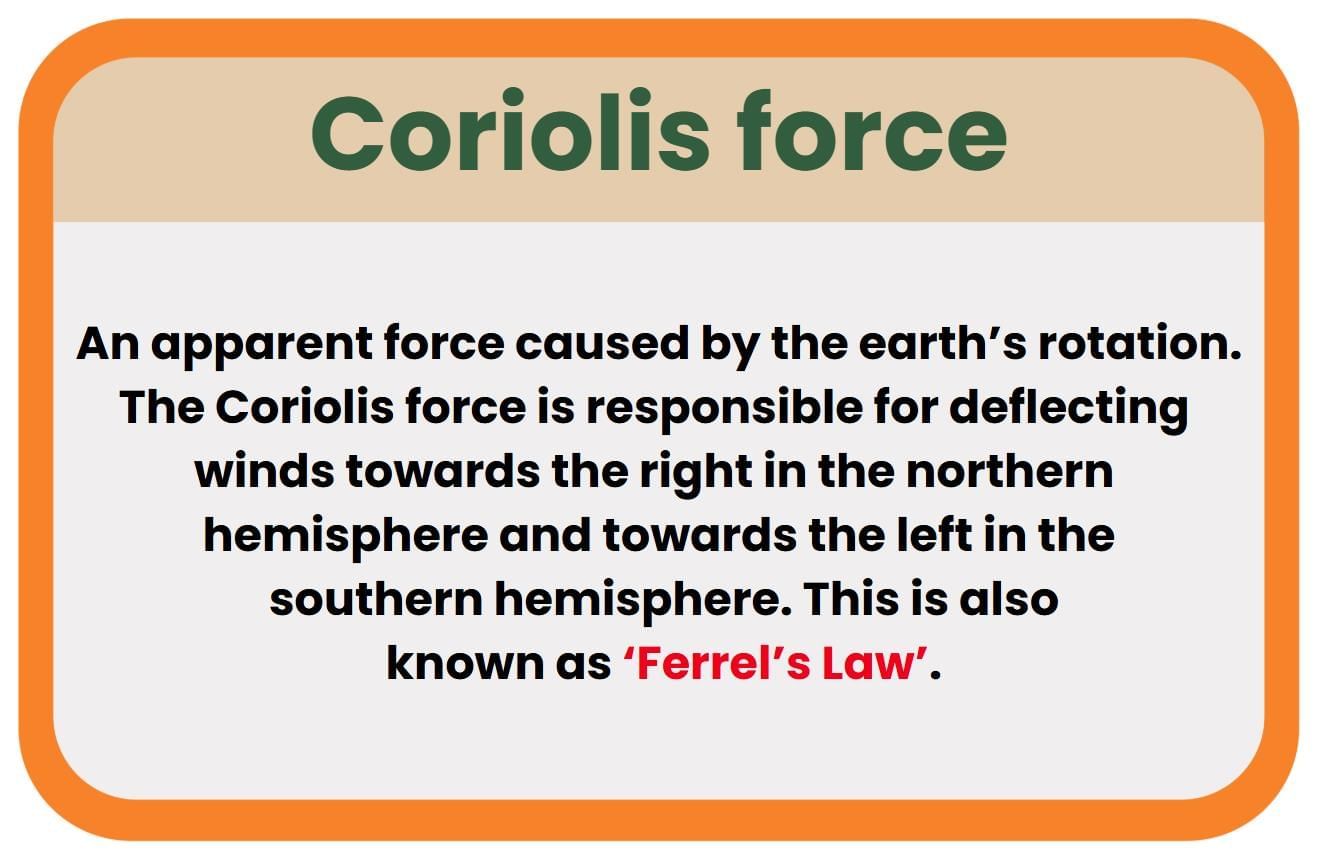
India lies in a region where northeast winds blow. These winds start from a high-pressure area in the northern hemisphere and move towards the equator, where there is low pressure. Because of the Coriolis effect (caused by Earth’s rotation), these winds bend to the right.

These winds come from land and carry very little moisture, so they don’t bring much rain. Based on this, India should have been a dry land—but it is not. Why?

Unique Pressure and Wind Conditions in India:

  • In Winter:
    A high-pressure area forms north of the Himalayas. From here, cold and dry winds blow towards the south, where the pressure is low (over the oceans). These winds don’t bring rain.
  • In Summer:
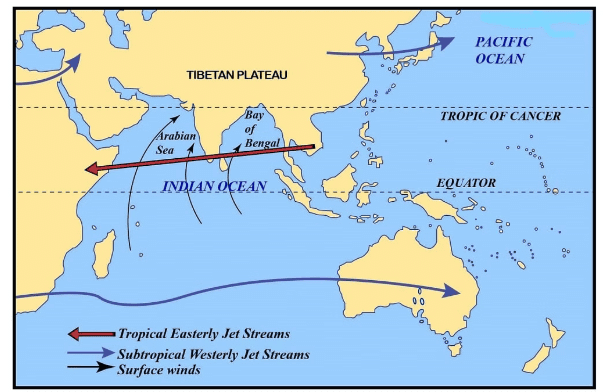
    A low-pressure area develops over northwest India and central Asia due to intense heat. At the same time, a high-pressure area exists over the southern Indian Ocean. This leads to a complete change in wind direction:
    a) Winds blow from the Indian Ocean towards India.
    b) They move in a southeasterly direction, cross the equator, and turn southwest due to the Coriolis effect.
    c) These are called the Southwest Monsoon Winds.

These monsoon winds blow over warm oceans, collect a lot of moisture, and bring heavy rainfall to most parts of India.

The Seasons

India has a monsoon-type climate, which means the weather changes clearly from one season to another. These changes are more noticeable in the inland areas of the country. In coastal regions, the temperature stays more or less the same, but the amount of rainfall can vary.

Have you ever thought about how many seasons your region experiences?

In general, India goes through four main seasons:

  1. Cold Weather Season (Winter)
  2. Hot Weather Season (Summer)
  3. Advancing Monsoon (Rainy Season)
  4. Retreating Monsoon (Post-Monsoon Season)

These seasons may feel a bit different in different parts of the country, but this is the overall seasonal pattern across India.

Try yourself:Which one of the following causes rainfall during winters in north-western part of India?

  • A.Cyclonic depression
  • B.Retreating monsoon
  • C.Western disturbances
  • D.Southwest monsoon

View Solution

The Cold Weather Season (Winter)

  • The cold weather season in northern India lasts from mid-November to February, with December and January being the coldest months.
  • Temperatures drop from south to north in India. For example, Chennai on the eastern coast has an average temperature of 24-25°C, while the northern plains see temperatures between 10°C and 15°C. Days tend to be warm, but nights get quite cold during this season.
  • Frost is common in the north, and the higher Himalayan slopes see snowfall.
  • During this time, the northeast trade winds dominate the country, blowing from land to sea, leading to a mostly dry season. However, some rainfall occurs on the Tamil Nadu coast as these winds blow from sea to land.
  • In northern India, there is a slight variation in rainfall patterns during winter.
  • A notable aspect of the cold weather season in the northern plains is the arrival of cyclonic disturbances from the west and northwest. These low-pressure systems come from the Mediterranean Sea and western Asia, moving into India and bringing essential winter rains to the plains and snowfall to the mountains.
  • Though the total winter rainfall, locally called ‘mahawat’, is small, it is very important for the growth of ‘rabi’ crops.
  • The peninsular region does not experience a distinct cold season, as there is hardly any noticeable change in temperature during winter due to the influence of the sea.

The Hot Weather Season (Summer)

From March to May, most parts of India experience the hot weather season. This happens because the sun appears to move northward, and the heat belt (the hottest part of Earth) also shifts north. This leads to a rise in temperatures across the country.

  • In March, the Deccan Plateau records high temperatures of around 38°C.
  • In April, places like Gujarat and Madhya Pradesh see temperatures reaching 42°C.
  • In May, the temperature in northwestern India often reaches 45°C or more.
  • Peninsular India (southern part) stays a bit cooler because of the cooling effect of the nearby seas and oceans.

As summer progresses:

  • Temperatures rise and air pressure drops in northern India.
  • By late May, a low-pressure area forms from the Thar Desert in the northwest to Patna and the Chotanagpur Plateau in the east. This leads to air circulation in the region.

Special Weather Features of Summer:

  • Loo: These are hot, dry, and strong winds that blow during the day, especially in north and northwest India. They can be very dangerous and sometimes even life-threatening.
  • Dust Storms: Common in May, these storms bring cool breezes and light rain, giving temporary relief from the heat.
  • Local Thunderstorms: These sudden and violent storms bring heavy rain, strong winds, and sometimes hail. In West Bengal, they are known as ‘Kaal Baisakhi’.
  • Mango Showers: Towards the end of summer, states like Kerala and Karnataka get early rain showers. These are called pre-monsoon showers and help in ripening mangoes, so they are also called ‘mango showers’.

Atmospheric Conditions over the Indian Subcontinent in the Month of June

Try yourself:What causes rainfall in West Bengal during the hot weather season?

  • A.Kal Baishakhi
  • B.Southwest monsoon
  • C.Retreating Monsoon
  • D.None of these

View Solution

Advancing Monsoon (The Rainy Season)By the beginning of June, the low-pressure area over the northern plains becomes stronger. This low pressure pulls in the southeast trade winds from the southern hemisphere. These winds start from the warm oceans in the south, cross the equator, and turn into southwest monsoon winds as they enter India.

Since these winds travel over the warm oceans, they carry a lot of moisture and bring heavy rainfall to the Indian subcontinent. They are strong winds, blowing at about 30 km/h. Except for the northwestern desert areas, these monsoon winds cover almost the entire country within a month.

Where Does It Rain the Most?

  • The western side of the Western Ghats (mountains along the west coast) gets very heavy rain—more than 250 cm.
  • The Deccan Plateau and Madhya Pradesh, though in the rain shadow area, still receive some rainfall.
  • The northeastern part of India gets the maximum rainfall, especially Mawsynram in Meghalaya, which receives the highest average rainfall in the world.
  • In the Ganga Valley, rainfall decreases from east to west.
  • Rajasthan and Gujarat get very little rain.

Breaks in the Monsoon

The monsoon doesn’t bring rain every day. It often comes in spells—there are a few wet days, followed by dry days. These are called ‘breaks’ in the monsoon.

This happens because of the movement of a low-pressure area called the monsoon trough. When this trough is over the plains, these areas get good rain. But when it moves north towards the Himalayas, the plains become dry, and heavy rains occur in the hills, sometimes causing floods.

Tropical Depressions and Uncertainty

  • The amount and duration of rainfall also depends on tropical depressions—low-pressure systems that form over the Bay of Bengal and move inland.
  • These depressions follow the monsoon trough and play a key role in how much rain falls in different parts of India.

Why Is the Monsoon Unpredictable?

  • The monsoon is not regular. It can bring floods in one region and drought in another.
  • Its arrival and retreat are often delayed or early.
  • Because of this uncertainty, it affects the farming calendar and creates difficulties for millions of farmers across the country.

Retreating/Post Monsoons (The Transition Season)

During October and November, the sun starts moving southward, and the low-pressure area over the northern plains becomes weaker. It is slowly replaced by a high-pressure area, and the southwest monsoon winds begin to retreat (move back).
By early October, the monsoon completely withdraws from the Northern Plains.

Changing Weather in October-November

This time is a transition between the rainy season and the winter season.

  • The weather becomes clearer, and the sky is mostly blue.
  • Daytime temperatures are still high, but the nights become cooler and more pleasant.
  • The land is still moist from the rains, and because of the mix of heat and humidity, the weather feels hot and uncomfortable during the day. This is called ‘October Heat’.
  • By late October, temperatures in northern India start to drop quickly.

Cyclones and Rainfall

In early November, the low-pressure area over northwest India shifts to the Bay of Bengal. This leads to the formation of cyclonic storms over the Andaman Sea.

  • These cyclones usually move towards the eastern coast of India and bring heavy rainfall.
  • They can be very dangerous and often cause serious damage in densely populated coastal areas.
  • The deltas of the Godavari, Krishna, and Kaveri rivers are especially affected.
  • Sometimes, the coasts of Odisha, West Bengal, and even Bangladesh are hit.
  • The Coromandel Coast (along Tamil Nadu) gets most of its rainfall during this season, mainly from these cyclonic storms.

Try yourself:

What are ‘mango showers’?

  • A.Storms in West Bengal
  • B.Dust storms in May
  • C.Rain showers in Kerala
  • D.Strong winds in the north

View Solution

Distribution of Rainfall

Some parts of India get a lot of rainfall, while others get very little.

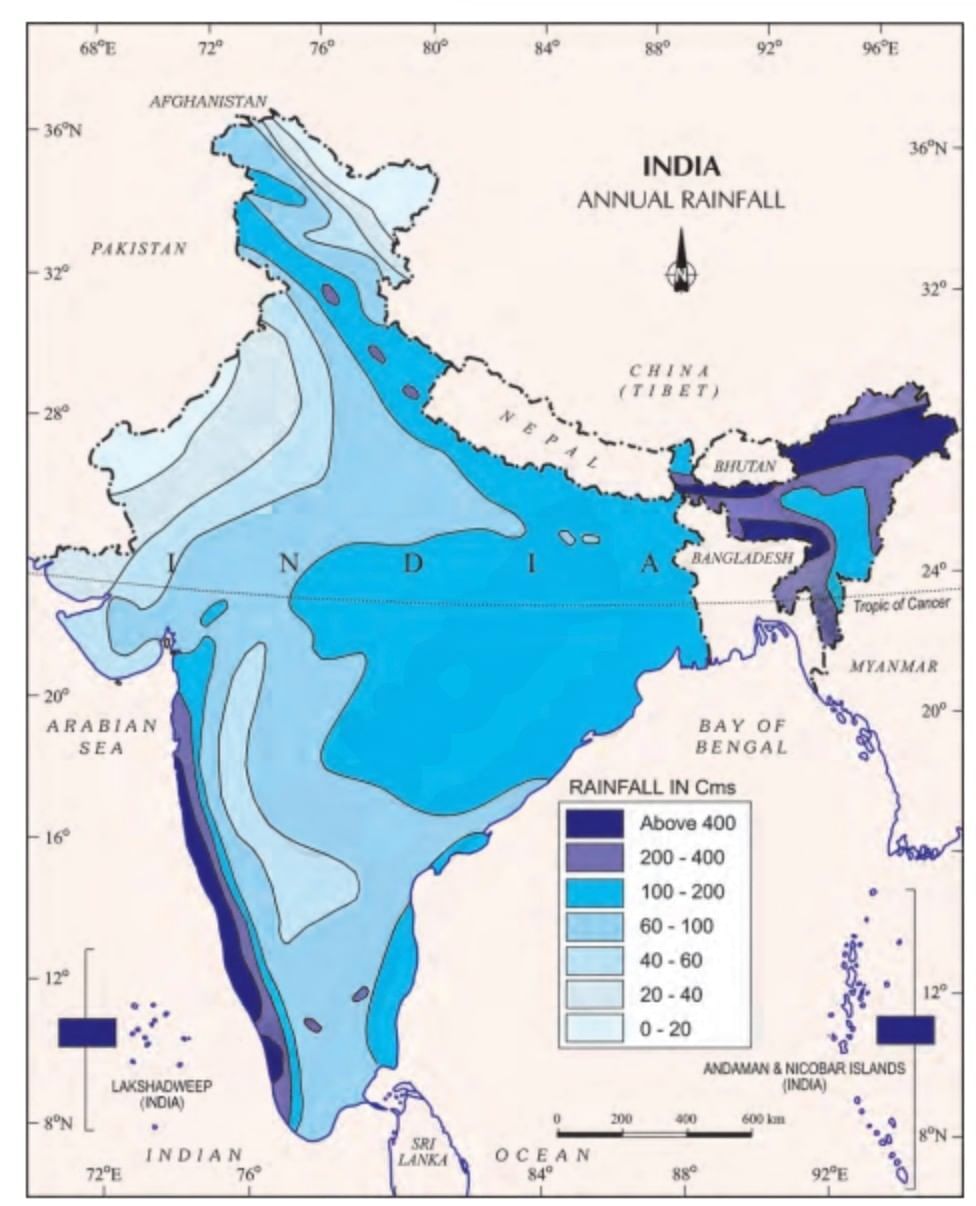
  • The western coast (like Kerala and coastal Karnataka) and the northeastern states (like Meghalaya and Assam) get more than 400 cm of rain every year.
  • But areas like western Rajasthan, parts of Gujarat, Haryana, and Punjab get less than 60 cm of rain annually.
  • Central parts of the Deccan Plateau and areas east of the Sahyadri Hills also get very little rainfall. Do you know why? These places lie in the rain shadow region, so rain clouds do not reach them easily.
  • Another dry area is Leh in Jammu and Kashmir, where rainfall is also very low.
  • Most other parts of India receive moderate rainfallSnowfall mostly happens in the Himalayan region only.
  • Because monsoons are not regular, the amount of rain changes from year to year.
  • In places where rainfall is usually low (like parts of Rajasthan, Gujarat, and the back side of the Western Ghats), this change is very unpredictable.
  • As a result:
    – Areas with too much rain may face floods.
    – Areas with very little rain may suffer from droughts.Annual Rainfall

Monsoon as a Unifying Bond

The Himalayas protect India from the icy cold winds of Central Asia, so northern India stays warmer than other places at the same distance from the equator. The Peninsular Plateau, surrounded by the sea on three sides, has moderate (not too hot or cold) temperatures.

Even with these factors, there are big temperature differences in different regions. Still, the monsoon brings unity to the whole country.

The changing monsoon winds and their weather create a regular cycle of seasons. Though the rains may come late, early, or unevenly, this is a special feature of Indian monsoons.

Everything in India — from the landscape, plants, and animals to farming, festivals, and daily life — depends on the monsoon. Every year, people all over India wait for the rains to begin farming.

The monsoon winds give water that helps start agriculture, and the rivers that carry this water help connect different parts of the country, just like one big family.

Try yourself:

What does the monsoon represent in the text?

  • A.A period of drought
  • B.A time for festivals
  • C.A unifying bond
  • D.A season of rain

View Solution

03. Drainage – Chapter Notes

Introduction

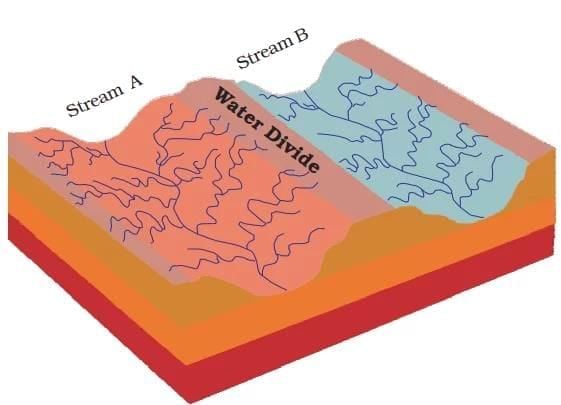
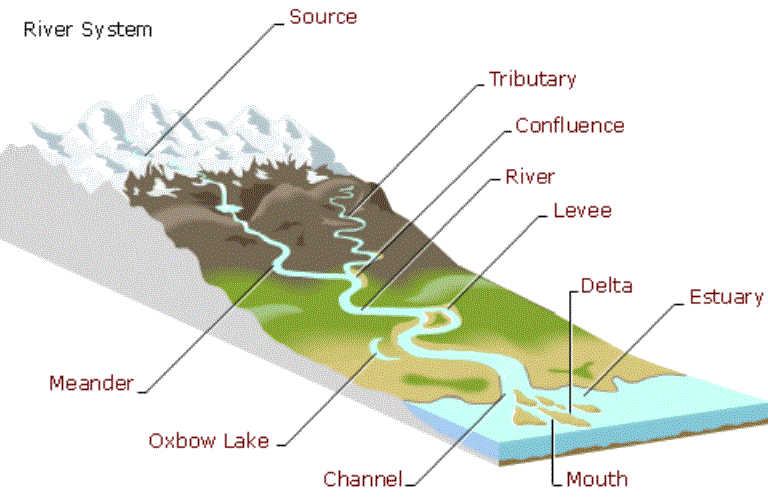
The term drainage refers to the system of rivers in a given area. When you look at a physical map, you can see how small streams from various directions merge to form the main river, which eventually flows into a larger body of water like a lake, sea, or ocean. The region serviced by a single river system is called a drainage basin. If you examine a map closely, you will find that any elevated region, such as a mountain or hill, separates two drainage basins. This elevated area is known as a water divide.Water Divide

Drainage Systems in India

The drainage systems of India are mainly shaped by the large landforms of the subcontinent. Accordingly, the Indian rivers can be divided into two main categories:

  • The Himalayan Rivers
  • The Peninsular Rivers

These rivers start from two different regions—Himalayan rivers begin in the mountains of the north, while Peninsular rivers begin in the southern part of India. They are quite different from each other.

Himalayan Rivers:

  • These rivers flow all year round. This is because they get water from both rainfall and melting snow from the mountains.
  • Two main rivers from the Himalayas are the Indus and the Brahmaputra. They start from the north of the mountain ranges and cut deep valleys called gorges.
  • These rivers travel long distances from the mountains to the sea.
  • In the upper part of their journey, they erode a lot of soil and rocks and carry large amounts of silt and sand.
  • In the middle and lower parts, they form features like meanders (curvy paths), oxbow lakes, and floodplains.
  • They also form big deltas near the sea.

Gorge

Peninsular Rivers:

  • Most of these rivers depend on rain, so they are seasonal—they have less water during the dry season.
  • They don’t travel as far as the Himalayan rivers and have shorter and shallower paths.
  • Some Peninsular rivers start from the Central Highlands and flow westward.
  • But most Peninsular rivers begin in the Western Ghats and flow eastward into the Bay of Bengal.

Some features made by Rivers

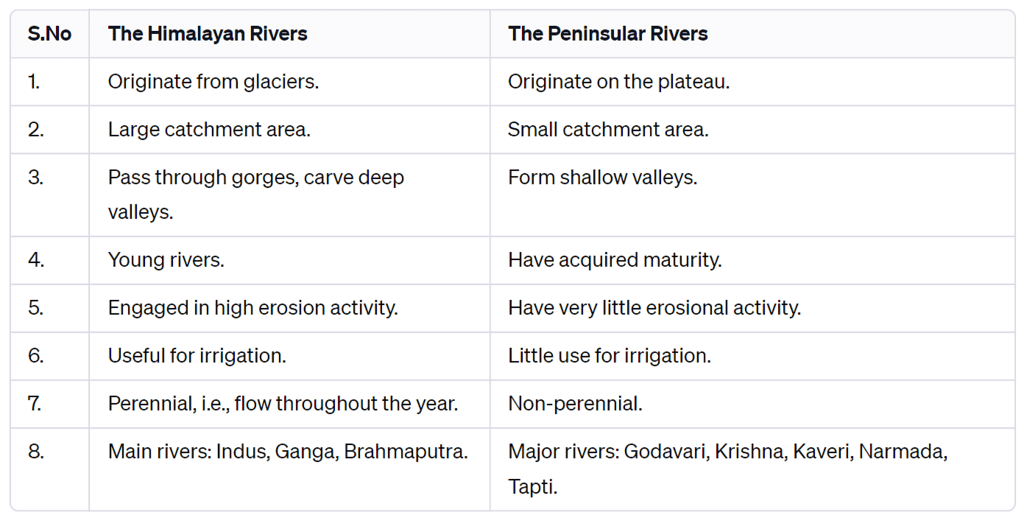
To summarise, the table is given below –

The Himalayan Rivers

The main rivers of the Himalayas are the IndusGanga, and Brahmaputra. These rivers are very long and have many smaller rivers flowing into them. These smaller rivers are called tributaries. Together, a main river and its tributaries form a river system.

1. The Indus River System

  • The Indus River starts in Tibet, near Lake Mansarowar.
  • It flows westward and enters India through Ladakh.
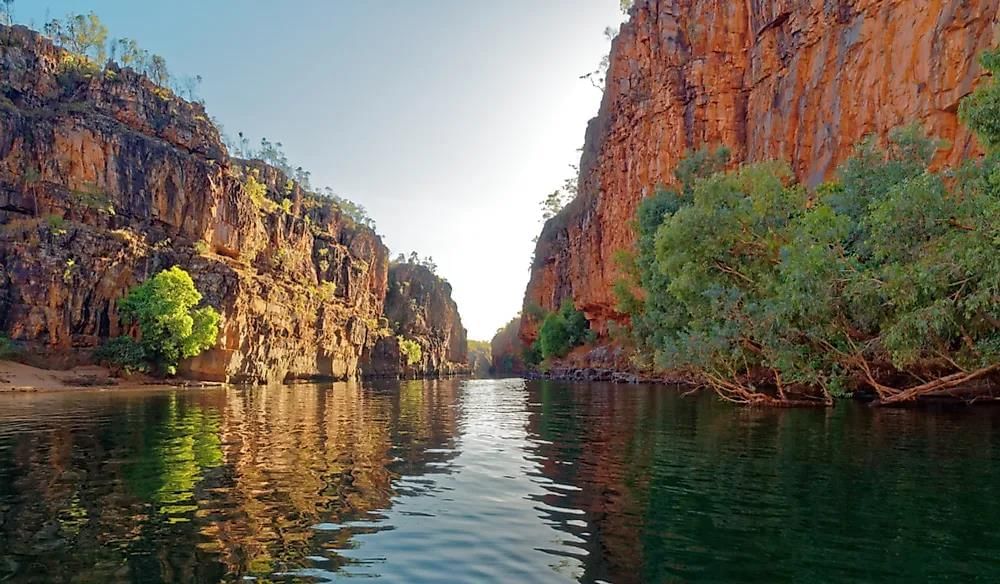
  • In Ladakh, the river forms a beautiful gorge (deep valley).
  • In the Kashmir region, the Indus is joined by several tributaries: the Zaskar, the Nubra, the Shyok and the Hunza.
  • The river then flows through Baltistan and Gilgit.
  • It comes out of the mountains at Attock.
  • Later, five important rivers join the Indus near Mithankot in PakistanThSatluj, the Beas, the Ravi, the Chenab and the Jhelum.Indus River System
  • After this, the Indus flows southwards and reaches the Arabian Sea, east of Karachi.
  • The Indus plain (the area around the river) has a very gentle slope.
  • The total length of the Indus is about 2900 km, making it one of the longest rivers in the world.
  • About one-third of the Indus River Basin lies in India, covering: Ladakh, Jammu and Kashmir, Himachal Pradesh and Punjab.
  • The rest of the basin is located in Pakistan.

2. The Ganga River System

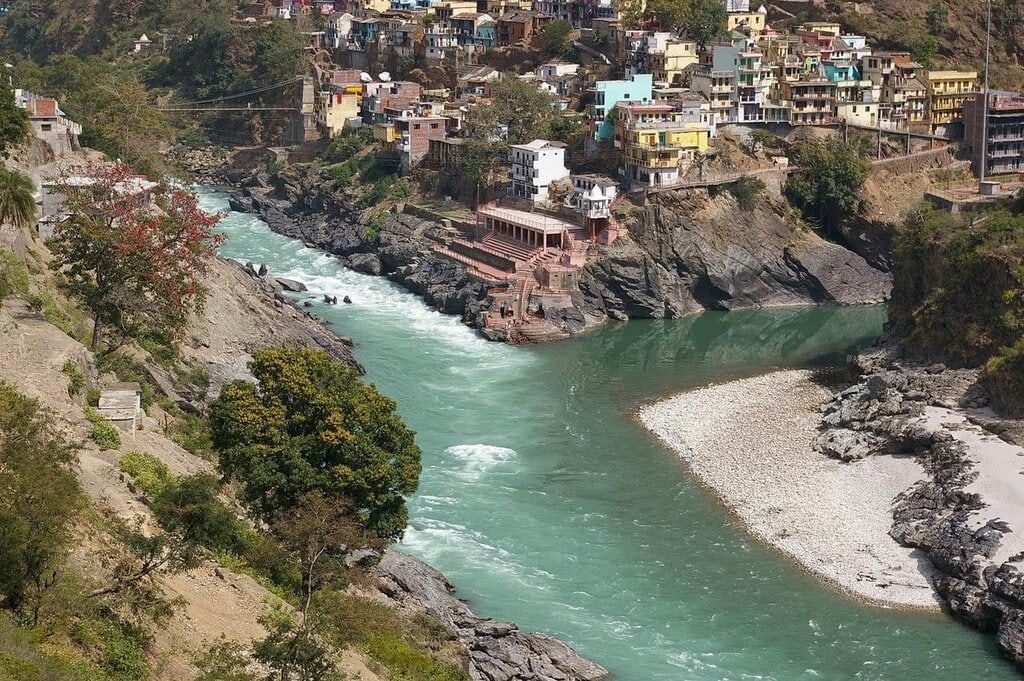
  • The source of the Ganga, called the ‘Bhagirathi,’ is fed by the Gangotri Glacier and meets the Alaknanda at Devprayag in Uttarakhand. It is only after Devprayag that the water body is known as Ganga. At Haridwar, the Ganga flows from the mountains to the plains.
  • The Ganga is joined by several tributaries from the Himalayas, including the YamunaGhagharaGandak, and Kosi. The Yamuna rises from the Yamunotri Glacier in the Himalayas and joins the Ganga at Allahabad. The Ghaghara, Gandak, and Kosi also originate in the Nepal Himalaya.Confluence of Bhagirathi and Alaknanda at Devaprayag
  • Main tributaries from the peninsular uplands include the Chambal, the Betwa, and the Son.
  • The Ganga flows east to Farakka in West Bengal, the northernmost point of the Ganga delta. Here, it splits; the Bhagirathi-Hooghly flows south through the deltaic plains to the Bay of Bengal. The main river continues south into Bangladesh, where it meets the Brahmaputra. Further downstream, it is called the Meghna and ultimately flows into the Bay of Bengal. The delta formed by these rivers is known as the Sunderban Delta, which is vital for its biodiversity and ecological significance.
  • The Ganga River is more than 2500 km long.
  • Ambala is a place that lies on the water divide between the Indus and Ganga river systems. This means it separates the flow of water into two different river systems.
  • The plains from Ambala to the Sunderbans are about 1800 km long.
  • But the total slope or height drop in this long stretch is only about 300 metres.
  • That means the land slopes down very gently—just 1 metre drop in height every 6 km.
  • Because of this gentle slope, the Ganga river forms large meanders (big curves or bends in the river).

3. The Brahmaputra River System

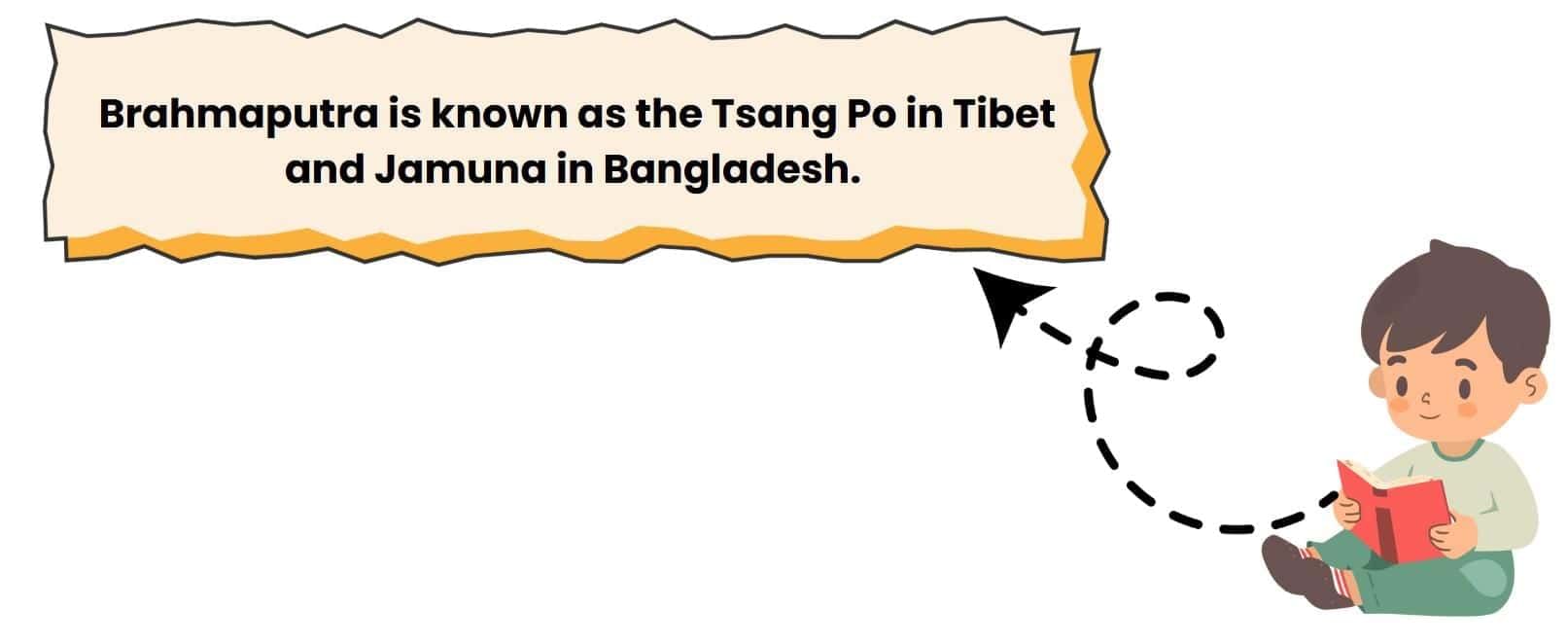
  • The Brahmaputra rises in Tibet, east of Mansarovar Lake. It is slightly longer than the Indus and flows east alongside the Himalayas.
  • Upon reaching Namcha Barwa (7757 m), it makes a ‘U’ turn and enters India in Arunachal Pradesh through a gorge, where it is known as the Dihang. It is joined by the DibangLohit, and many other tributaries, forming the Brahmaputra in Assam.
  • In India, it flows through a high rainfall area, carrying a large volume of water and significant amounts of silt. The Brahmaputra has a braided channel throughout Assam, creating many river islands, with Majuli being the largest inhabited river island in the world.
  • During the monsoon season, the river can overflow its banks, causing extensive flooding in Assam and Bangladesh. The riverbed accumulates large amounts of silt, which can raise the riverbed and shift its channel frequently.

Try yourself:

What is the term used to describe the river system within a specific area?

  • A.Tributaries
  • B.Drainage basin
  • C.Convergence
  • D.Relief features

View Solution

The Peninsular Rivers

The Peninsular drainage system is older than the Himalayan drainage system. This is shown by the wide, mostly flat valleys and the well-developed rivers. Peninsular rivers have a fixed path, do not meander, have small drainage areas, and flow non-continuously. The main water divide in Peninsular India is formed by the Western Ghats, which stretch from north to south near the western coast. Most major rivers in this region, such as the Mahanadi, the Godavari, the Krishna, and the Kaveri, flow eastwards into the Bay of Bengal and form deltas at their mouths. 

Additionally, there are many small streams flowing west of the Western Ghats. The Narmada and Tapi are the only long rivers that flow westward and create esturies. The drainage basins of these rivers are generally smaller compared to those of the Himalayan rivers.

1. The Narmada Basin

The Narmada River starts from the Amarkantak hills in Madhya Pradesh. It flows westward through a rift valley, which was formed because of cracks (faults) in the Earth’s surface.

  • As it moves towards the sea, the Narmada creates many beautiful spots.
  • One famous place is the ‘Marble Rocks’ near Jabalpur, where the river flows through a deep valley.
  • Another is the ‘Dhuadhar Falls’, where the river falls down over steep rocks, making a loud sound and a scenic view.

The river’s tributaries (smaller rivers that join it) are quite short and most of them join the Narmada at right angles. The Narmada river basin includes parts of Madhya Pradesh and Gujarat.

2. The Tapi Basin

The Tapi River starts in the Satpura ranges in the Betul district of Madhya Pradesh. It flows through a rift valley, just like the Narmada, but it is much shorter in length. The Tapi basin covers parts of Madhya Pradesh, Gujarat, and Maharashtra. The coastal plains between the Western Ghats and the Arabian Sea are very narrow, which is why the coastal rivers in this region are short. Some of the main west-flowing rivers include the Sabarmati, Mahi, Bharathpuzha, and Periyar. 

3. The Godavari Basin

The Godavari is the largest river system in the peninsula, rising from the slopes of the Western Ghats in the Nasik district of Maharashtra. It is around 1,500 km long, and due to its size, it is often called the Dakshin Ganga. The Godavari’s drainage basin is the largest among the peninsular rivers, covering parts of:

  • Maharashtra (about 50 percent of the basin area)
  • Madhya Pradesh
  • Odisha
  • Andhra Pradesh

The Godavari is joined by several tributaries, including the Purna, the Wardha, the Pranhita, the Manjra, the Wainganga, and the Penganga. It ultimately drains into the Bay of Bengal.

4. The Mahanadi Basin

The Mahanadi rises in the highlands of Chhattisgarh near Sihawa and flows through Odisha to reach the Bay of Bengal. Fifty-three percent of its drainage basin is in Maharashtra and Chhattisgarh, while 47 percent is in Odisha. Its length is approximately 860 km.

5. The Krishna Basin

The Krishna is the second-largest east-flowing river in the peninsula, rising near Mahabaleshwar in the Sahyadri range. It flows for about 1,400 km and has several tributaries, including the Tungabhadra, the Koyana, the Ghatprabha, the Musi, and the Bhima.

6. The Kaveri Basin

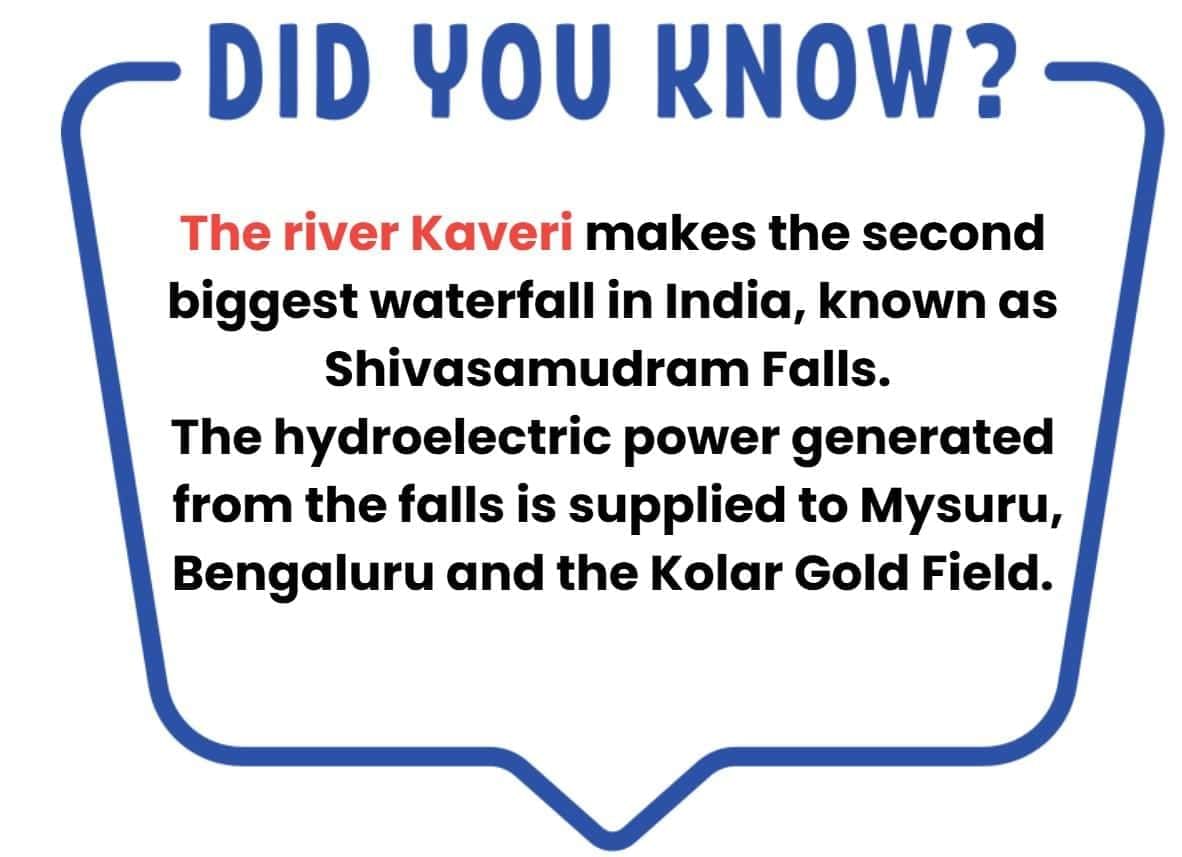
The Kaveri River starts in the Brahmagri range of the Western Ghats and flows into the Bay of Bengal south of Cuddalore in Tamil Nadu. The total length of the river is about 760 km. Its main tributaries are the Amravati, Bhavani, Hemavati, and Kabini rivers. The Kaveri Basin covers parts of Karnataka, Kerala, and Tamil Nadu.

Besides these major rivers, there are some smaller rivers that flow towards the east. Some well-known examples are the Damoder, Brahmani, Baitarni, and Subarnrekha rivers. 

Try yourself:

Which river is known as the Dakshin Ganga?

  • A.Godavari
  • B.Mahanadi
  • C.Krishna
  • D.Kaveri

View Solution

Lakes

You might have heard of the Kashmir valley and the famous Dal Lake, where people enjoy houseboats and shikaras (small boats). These things attract thousands of tourists every year. Lakes make tourist places more attractive and fun to visit. But lakes are not just for tourists—they are also very useful to people in many other ways.

  • India has many lakes. They are different in size and how they were formed.
  • Most lakes are permanent, meaning they have water all year.
  • Some lakes have water only in the rainy season, especially in dry areas (semi-arid regions). These are found in inland drainage basins.
  • Some lakes were formed by glaciers and ice sheets.
  • Others were made by wind, rivers, or even human activities.
  • Sometimes, a meandering river (a river with many curves) cuts off a bend, which later becomes an ox-bow lake.
  • In coastal areas, spits and bars (sand formations) can block water and form lagoons. Examples: the Chilika Lake, the Pulicat Lake, the Kolleru Lake
  • Lakes in inland drainage areas can be seasonal (have water only in some seasons). Example: Sambhar Lake in Rajasthan is a salt water lake, and its water is used to make salt.
  • Most freshwater lakes are in the Himalayas.
  • They were formed when glaciers dug a hole (a basin), which later filled with melted snow.
  • Example:
    (i) Wular Lake in Jammu and Kashmir is a tectonic lake (formed due to movement in the Earth’s crust). It is the largest freshwater lake in India.
    (ii) Other famous freshwater lakes: Dal Lake, Bhimtal, Nainital, Loktak, and Barapani.
  • When we build dams on rivers to produce hydroelectric (hydel) power, lakes are also formed.
  • Example: Guru Gobind Sagar Lake (formed by the Bhakra Nangal Dam).

Importance of Lakes

  • Lakes are essential for regulating rivers, preventing floods during heavy rainfall, and maintaining a steady water flow in dry periods.
  • They provide sources of hydropower and freshwater, and help moderate the climate.
  • Lakes support diverse ecosystems, enhance natural beauty, and offer recreational activities, making them vital and multifunctional parts of the environment.

Try yourself:What is the main cause of river pollution mentioned in the passage?

  • A.Flood
  • B.Disposal of untreated sewage and industrial effluents
  • C.Heavy rainfall
  • D.Climate change

View Solution

Role of Rivers in the Economy

Rivers have always played an important role in human life. The water from rivers is a natural resource that people need for many daily activities. That’s why people have been settling near rivers since ancient times, and many of those old settlements have now grown into big cities.

Rivers are also very useful for farming (irrigation), transportation (navigation), and producing electricity (hydro-power). This is especially important for a country like India, where most people depend on farming for their livelihood.

River Pollution

  • The increasing demand for water from rivers due to domestic, municipal, industrial, and agricultural needs is impacting water quality.
  • This demand leads to more water being taken from rivers, which decreases their flow.
  • At the same time, untreated sewage and industrial waste are being discharged into these rivers.
  • This not only deteriorates water quality but also reduces the river’s ability to cleanse itself.
  • For instance, when there is enough water flow, the Ganga can dilute and manage pollution within 20 km of large cities.
  • However, growing urban and industrial activities obstruct this natural process, resulting in higher pollution levels in many rivers.
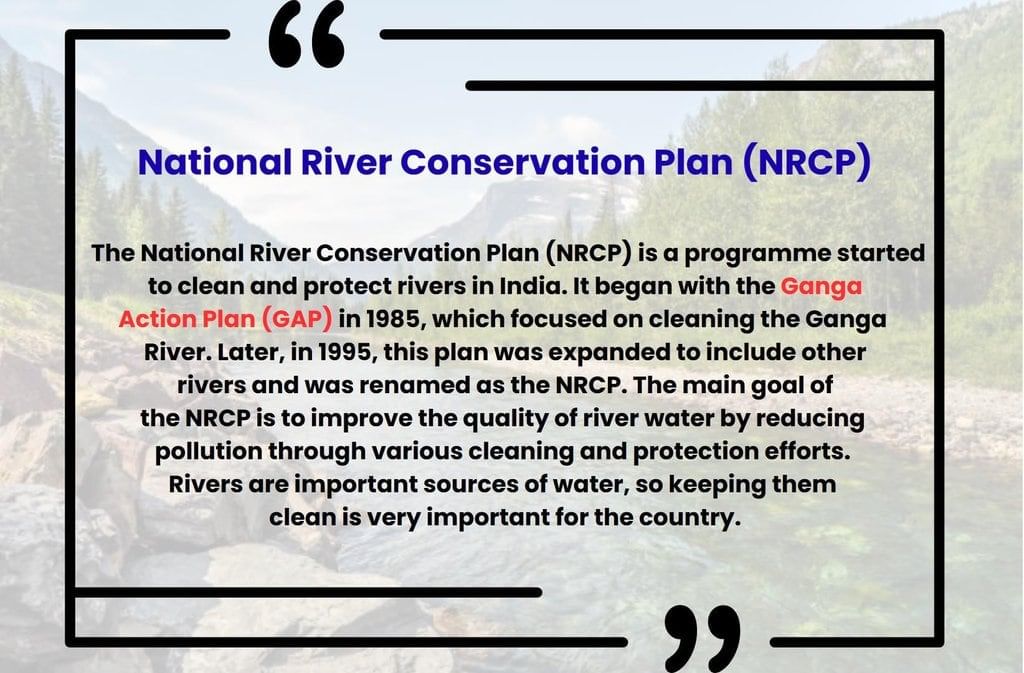
  • The rising pollution levels have prompted the initiation of various action plans aimed at cleaning the rivers.

Try yourself:

What is the world’s largest and fastest-growing delta?

  • A.The Sundarban Delta
  • B.The River Amazon
  • C.The Brahmaputra River
  • D.The Kaveri River

View Solution

For a detailed understanding of this chapter, check the video below.

https://youtube.com/watch?v=96irIFmvIng%3Fwmode%3Dopaque

Difficult Words

  • Drainage Basin: The area drained by a single river system where precipitation collects and drains off into a common outlet, such as into a river, bay, or other body of water.
  • Tributary: A river or stream flowing into a larger river or lake.
  • Water Divide: An elevated area, such as a mountain or upland, that separates two drainage basins.
  • Rift Valley: A large elongated depression with steep walls formed by the downward displacement of a block of the earth’s surface between nearly parallel faults or fault systems.
  • Braided Channel: A network of river channels separated by small, often temporary, islands called braid bars. These typically form in rivers with high sediment loads and strong currents.
  • Riverine Island: An island formed by the course of a river. Majuli in the Brahmaputra River is an example of such an island.
  • Alluvial Soil: Soil deposited by rivers. It is typically fertile and good for agriculture.
  • Peninsular Plateau: A plateau in India making up the majority of the southern part of the country. It is bordered by two mountain ranges, the Eastern and Western Ghats.
  • Sundarban Delta: The large delta formed at the mouth of the Ganges and Brahmaputra River systems. It is noted for its wide mangrove forests and is home to the Royal Bengal Tiger.
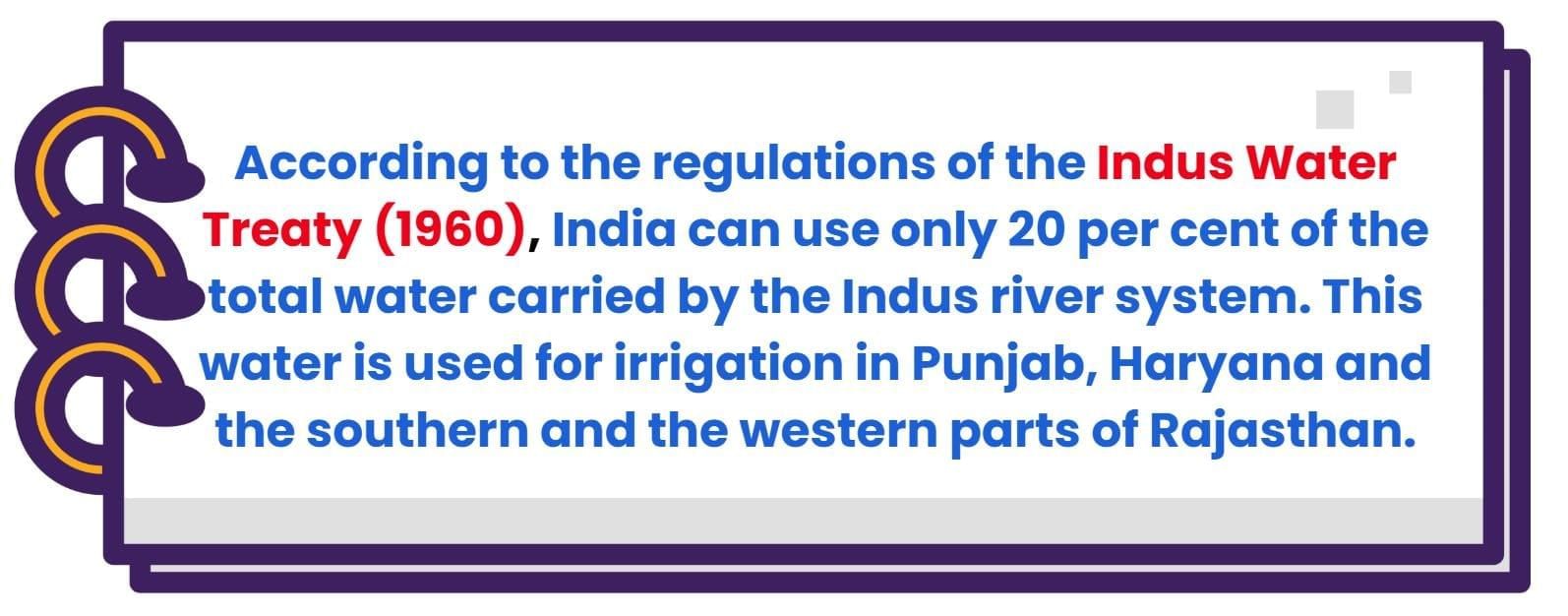
  • Indus Water Treaty: A water-distribution treaty between India and Pakistan, brokered by the World Bank, to use the water available in the Indus River and its tributaries.

02. Physical Features of India – Chapter Notes

India’s diverse landscape includes mountains, plateaus, deserts, plains, and islands. The Peninsular Plateau is one of the India’s oldest landforms, while the Himalayas and Northern Plains are more recent. The Himalayas are geologically active with high peaks and fast-flowing rivers, while the Northern Plains are shaped by alluvial deposits. The Peninsular Plateau features ancient rocks, gentle hills, and wide valleys.

Major Physiographic Divisions

India’s major physiographic divisions include distinct landforms such as mountains, plateaus, plains, deserts, and coastal regions, each contributing to the country’s diverse geography.

The physical features of India can be grouped into the following divisions:

  1. The Himalayan Mountains
  2. The Northern Plains
  3. The Peninsular Plateau
  4. The Indian Desert
  5. The Coastal Plains
  6. The Islands

1. The Himalayan Mountains

The Himalayas are young fold mountains located in northern India. They stretch in a west-east direction from the Indus River to the Brahmaputra River. The range forms an arc covering about 2,400 km. The width varies, being 400 km in Kashmir and narrowing to 150 km in Arunachal Pradesh.

Himalayas on mapThree Parallel Ranges

The Himalayas consist of three main parallel ranges:

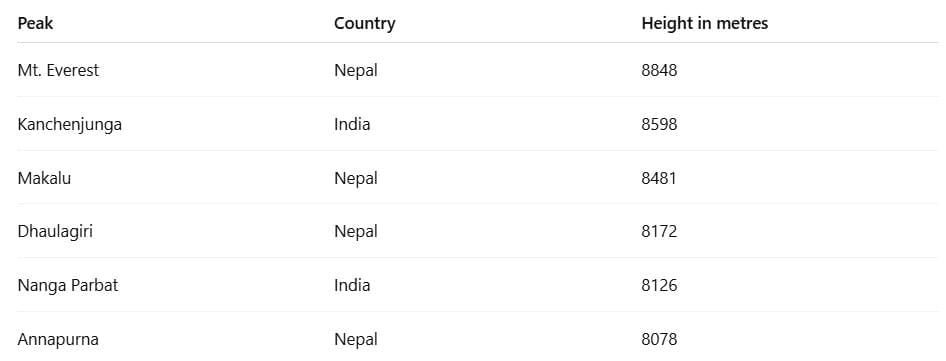
  • The northernmost range is known as the Great Himalayas or Inner Himalayas, also called the Himadri. It is the longest range and has the highest peaks, with an average height of 6,000 metres.
  • The Lesser Himalayas (Himachal) are made up of compressed and altered rocks.
  • The Shiwaliks are the outermost range, formed by sediments carried by rivers.

Between the Lesser Himalayas and Shiwaliks are the valleys known as Duns, which are fertile areas.Some Highest Peaks of Himalayas

The Himalayas are divided into various regions based on river valleys, including PunjabKashmirHimachalKumaonNepal, and Assam. There are also regional names within these broad categories.The Himalayas

Eastern Extension (Purvachal Hills)

  • The Brahmaputra River marks the eastern boundary.
  • Beyond the Dihang Gorge, the range curves south, forming the Purvachal hills, which include the Patkai, Naga, Mizo, and Manipur hills. These hills, found in the north-eastern states, are primarily composed of sedimentary rocks known as strong sandstones. They are covered in dense forests and mainly run as parallel ranges with valleys.Mizo Hills

Try yourself:Which mountain range forms the outermost range of the Himalayas?

  • A.Great Himalayas
  • B.Himachal Himalayas
  • C.Shiwalik Range
  • D.Eastern Himalayas

View Solution

2. The Northern Plain

The Northern Plain has been shaped by the interaction of three major river systems: the Indus, the Ganga, and the Brahmaputra, along with their tributaries. This area consists of alluvial soil, which has formed from the accumulation of alluvium over millions of years in a vast basin at the base of the Himalayas. It covers about 7 lakh sq. km, stretching around 2400 km long and between 240 to 320 km wide. This region is heavily populated and very productive for agriculture due to its rich soil, sufficient water supply, and favourable climate.The Northern Plains

The largest section of the Northern Plain is made up of older alluvium known as Bhangar, which is located above the river floodplains and has a terrace-like appearance. The soil here contains calcareous deposits, called Kankar. The newer deposits found in the floodplains are referred to as Khadar. These deposits are refreshed almost every year, making them very fertile and ideal for intensive farming. 

Sections of the Northern Plain

The Northern Plains can be divided into three main sections:

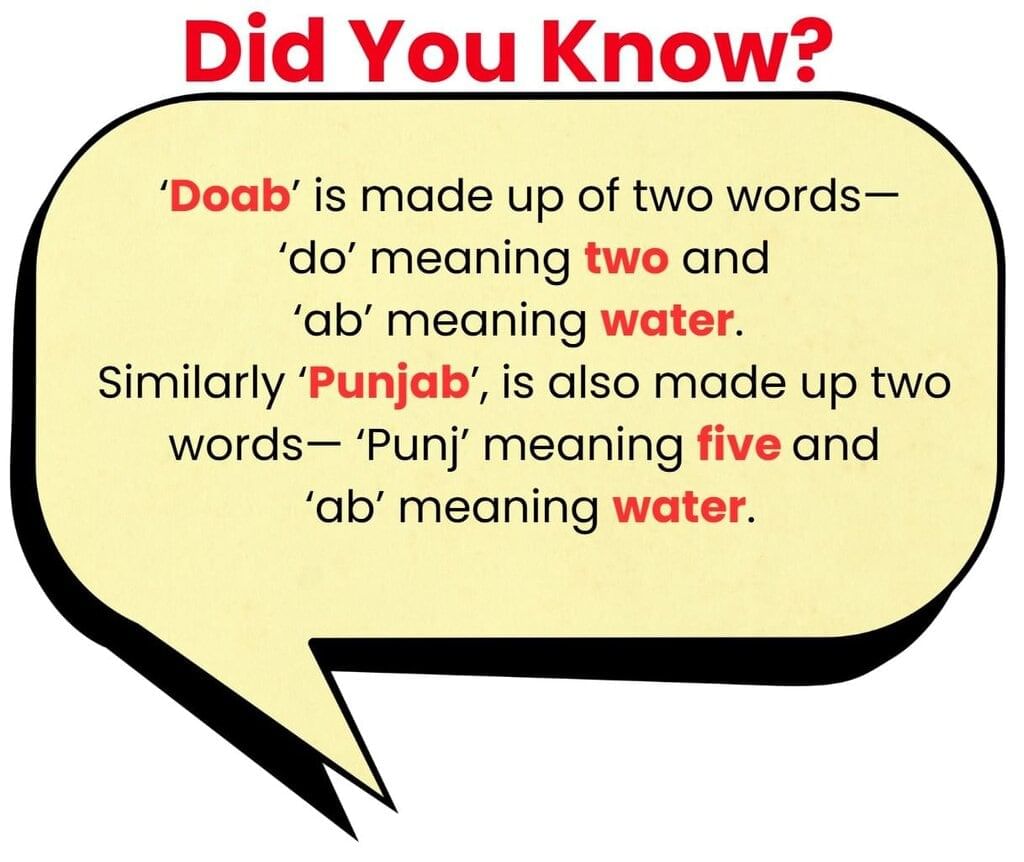
(i) Punjab Plains: This is the western part of the Northern Plain, created by the Indus and its tributaries. A significant portion of this plain is in Pakistan. The Indus and its tributaries—the JhelumChenabRaviBeas, and Satluj—originate in the Himalayas. This area is marked by the presence of doabs.

(ii) Ganga Plain: This section lies between the Ghaggar and Teesta rivers, covering parts of North India including HaryanaDelhiU.P.Bihar, parts of Jharkhand, and West Bengal.

(iii) Brahmaputra Plain: Located to the east of the Ganga Plain, especially in Assam.

Divisions of Northern Plains

The Northern Plains do not have a completely flat landscape; they show various relief features. Based on these features, the plains can be categorised into four distinct regions according to river deposits and landforms:

  • Bhabar Belt: A narrow strip where rivers deposit pebbles, located at the foothills of the Himalayas. Here, streams formed during the rainy season quickly disappear into the sand, as they do not have sufficient volume to reach the sea.
  • Terai Region: To the south of the Bhabar is the Terai, a wet and marshy area that was once a dense forest teeming with wildlife. It has largely been cleared for farming, and Dudhwa National Park is found here.
  • Bhangar: This is the region of older alluvium, which includes calcareous deposits known as Kankar.
  • Khadar: The fertile floodplains of rivers, which are refreshed nearly every year, making them very suitable for agriculture.

In summary, the Northern Plain is an important geographical area in India, known for its extensive alluvial deposits, agricultural productivity, and varied landforms.

Try yourself:Which region of the Northern Plains is formed by older alluvium and contains calcareous deposits locally known as kankar?

  • A.Bhabar
  • B.Terai
  • C.Bhangar
  • D.Khaddar

View Solution

3. The Peninsular Plateau

The Peninsular Plateau is a flat area made up of old crystallineigneous, and metamorphic rocks. It was created when the Gondwana land broke apart, making it one of the oldest landmasses. The plateau features wide, shallow valleys and rounded hills. It can be divided into two main parts: the Central Highlands and the Deccan Plateau. 

The Central Highlands

  • Location and Boundaries: The Central Highlands are situated north of the Narmada River and include the Malwa Plateau. They are bordered by the Vindhyan Range to the north, the Satpura Range to the south, and the Aravalli Range to the northwest. The Aravalli Hills are heavily eroded, appearing as broken hills stretching from Gujarat to Delhi in a southwest-northeast direction.
  • Slope and River Flow: The slope of the Central Highlands goes from southwest to northeast, as shown by the rivers flowing in that direction. The highlands are broader in the west and become narrower towards the east.
  • Extensions of the Central Highlands: The Bundelkhand and Baghelkhand areas are the eastern extensions of this region. The Chotanagpur Plateau, located further east, is drained by the Damodar River.

The Deccan Plateau

  • Location and Boundaries: The Deccan Plateau is found south of the Narmada River, bordered by the Satpura Range in the north. The plateau has a gentle slope towards the east and is higher in the west.
  • Northeastern Extensions: The Meghalaya, Karbi-Anglong Plateau, and North Cachar Hills are the northeastern extensions of the Deccan Plateau. The prominent hill ranges in this area are the Garo, Khasi, and Jaintia Hills.
  • Western and Eastern Edges: The Western Ghats and Eastern Ghats form the western and eastern borders of the Deccan Plateau, respectively. The Eastern Ghats are not continuous.
  • Deccan Trap: A notable feature of the Deccan Plateau is the black soil area known as the Deccan Trap, which is of volcanic origin. The rocks here are igneous and have eroded over time, leading to the formation of black soil.

Try yourself:

Which major physiographic division in India is composed of old crystalline, igneous, and metamorphic rocks?

  • A.The Himalayan Mountains
  • B.The Northern Plain
  • C.The Peninsular Plateau
  • D.The Eastern Ghats

View Solution

4. The Indian Desert

The Indian desert is found at the western edge of the Aravalli Hills. It is a sandy plain with many sand dunes. This area gets very little rainfall, under 150 mm a year, and has a dry climate with sparse vegetation.

  • The desert has a dry climate with little vegetation. Streams form during the rainy season but quickly vanish into the sand because they lack enough water to reach the sea.
  • Luni is the only major river in this area.
  • Barchans (crescent-shaped dunes) are widespread, while longitudinal dunes are more common near the Indo-Pakistan border.

5. The Coastal Plains

The Peninsular plateau is flanked by narrow coastal strips on the Arabian Sea and Bay of Bengal. The western coast consists of three sections: Konkan, Kannad Plain, and Malabar coast.

  • The plains along the Bay of Bengal are wide and level.
  • The northern part is called the Northern Circar and the southern part is known as the Coromandel Coast.
  • Large rivers such as Mahanadi, Godavari, Krishna, and Kaveri have formed extensive deltas on this coast.
  • Lake Chilika is an important feature along the eastern coast.

The Coastal Plains

Try yourself:

Which river is the only large river in the Indian Desert region?

  • A.Mahanadi
  • B.Godavari
  • C.Krishna
  • D.Luni

View Solution

6. The Islands

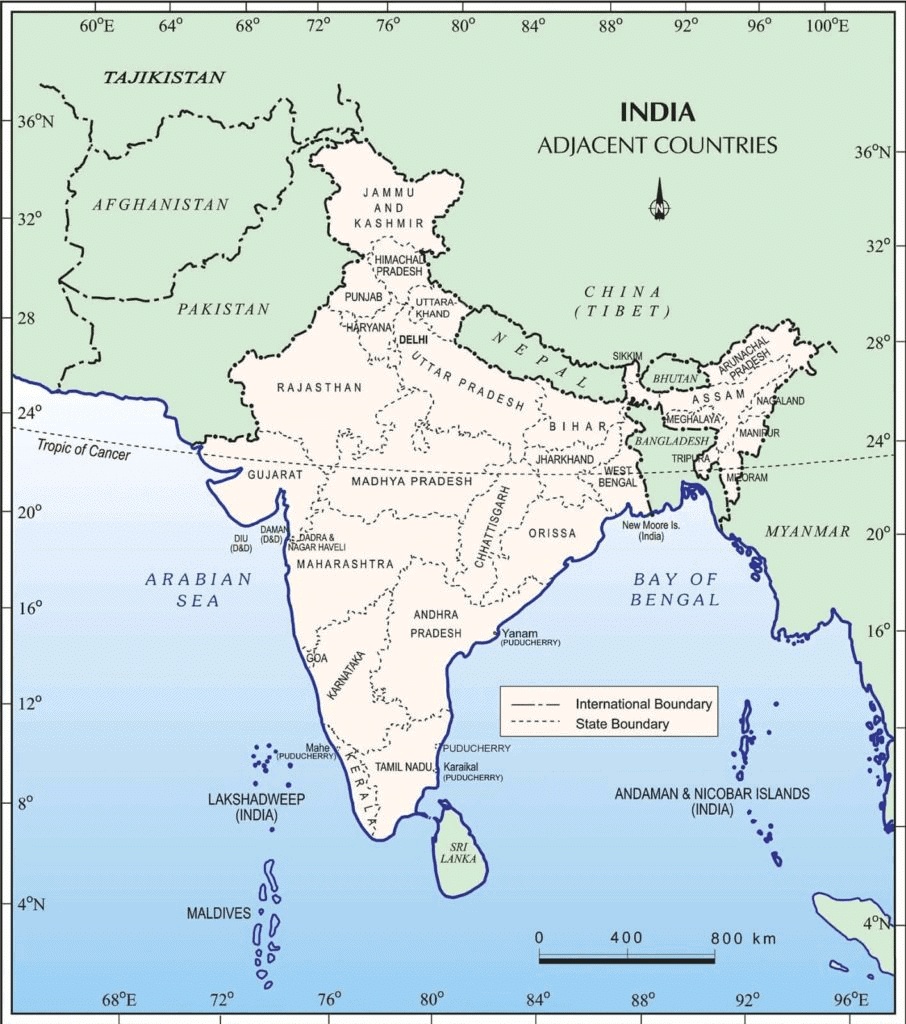
  • India has a large mainland and two groups of islands. The Lakshadweep Islands group, previously called Laccadive, Minicoy, and Amindive, is situated near the Malabar coast of Kerala. 
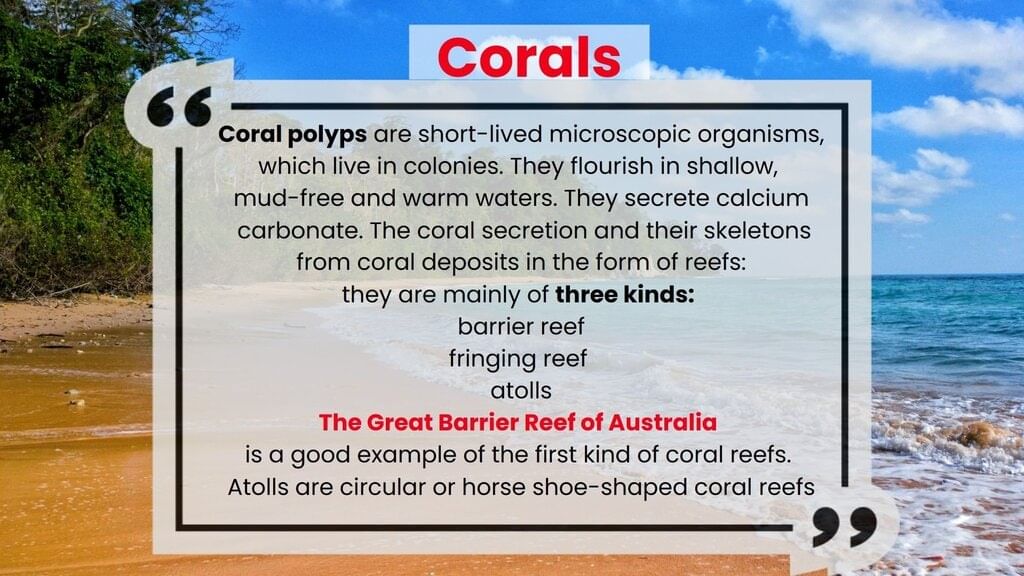
  • This group consists of small coral islands that cover a total area of 32 sq km. Kavaratti Island is the administrative centre of Lakshadweep. 
  • The Andaman and Nicobar Islands are larger and more spread out, found in the Bay of Bengal, with the Andaman Islands located in the north and the Nicobar Islands in the south.
  • The Andaman and Nicobar Islands have a great diversity of flora and faunaPitti Island, which is uninhabited, has a bird sanctuary, highlighting the ecological importance of the Lakshadweep Islands.
  • Both island groups are strategically important due to their location and resources.

Key Terms

  1. Igneous and Metamorphic Rocks: Igneous rocks are formed from the solidification of molten magma. Metamorphic rocks have been transformed by heat, pressure, or other natural processes from another type of rock.
  2. Tableland: A plateau or a flat-topped area that is elevated significantly above the surrounding area.
  3. Gondwana Land: A supercontinent that existed from the Late Paleozoic into the Mesozoic era. It later broke up to form continents including Africa, South America, Australia, and India.
  4. Bhabar and Terai: Bhabar refers to a narrow belt of land at the foothills of the Himalayas along the Ganges River, characterized by pebbles and porous soil. Terai is the marshy land just south of the Bhabar belt, known for its rich biodiversity and fertile soil.
  5. Deccan Trap: A large igneous province located on the Deccan Plateau of west-central India and one of the largest volcanic features on Earth. It consists of multiple layers of solidified flood basalt that are more than 2,000 meters thick over an area of 500,000 square kilometers.
  6. Aravalli Range: One of the oldest mountain ranges in India, running northeast to southwest across Rajasthan in western India.
  7. Duns: Valleys lying between the Lesser Himalayas and the Shiwaliks, filled with alluvial deposits.
  8. Kankar: Calcareous or calcite nodules found in the alluvial or sedimentary soils in the dryer parts of India.
  9. Coromandel Coast: The southeastern coast of India along the Bay of Bengal, from Cape Comorin (Kanyakumari) in the south to False Divi Point in the north in Andhra Pradesh.
  10. Coral Islands: Islands formed from coral detritus and associated organic material. They typically occur in tropical and subtropical areas, such as the Lakshadweep Islands off the southwest coast of India.

01. India – Size and Location – Chapter Notes

Introduction

India is one of the ancient civilisations in the world. It has moved forward, displaying remarkable progress in the field of agriculture, industry, technology, and overall economic development. India has also contributed significantly to the making of world history.
In this Chapter, India – Size and Location, you will learn about India’s extent and standard meridian, India’s contact with the world through the International Highway of Trade and Commerce, and India’s neighbors.

Location of India

  • India is a vast country. Lying entirely in the northern hemisphere, the mainland extends between latitudes 8°4’ N and 37°6’ N and longitudes 68°7’ E 97°25’ E. Latitudinal and Longitudinal Extent of India​
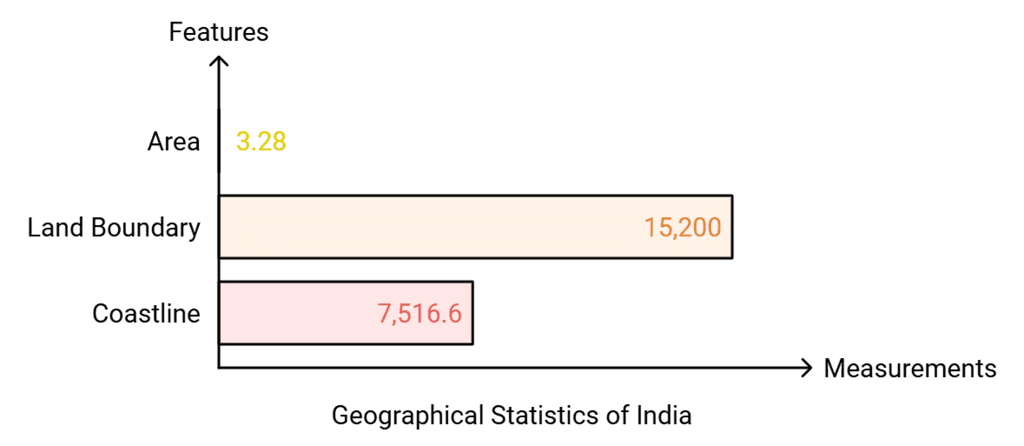
  • The Tropic of Cancer (23°30′ N) nearly divides the country into two equal parts. Southeast of the mainland are the Andaman and Nicobar Islands in the Bay of Bengal, while to the southwest lie the Lakshadweep Islands in the Arabian Sea.

Try yourself:Which line divides India into approximately two equal parts?

  • A.Equator
  • B.Tropic of Cancer
  • C.Tropic of Capricorn
  • D.None of these

View Solution


Size of India

India covers an area of 3.28 million square kilometers, which constitutes about 2.4% of the world’s total land area.  It is the seventh-largest country in the world.

  • Land Boundary: Approximately 15,200 kilometers.
  • Coastline: The total length of the coastline, including the Andaman & Nicobar Islands and Lakshadweep, is 7,516.6 kilometers.
  • Northern Boundary: India is bordered by young fold mountains to the northwest, north, and northeast.
  • Southern Boundary: Below about 22° north latitude, India narrows and extends towards the Indian Ocean, splitting it into two seas: the Arabian Sea to the west and the Bay of Bengal to the east.
  • North-South Extent of India: The north-south extent of India is larger than its east-west extent even though the country’s latitudinal and longitudinal extent in degrees is of the same value.

Impact of India’s Geographic Extent

  • Longitudinal Impact: India spans about 30° of longitude, resulting in a two-hour time difference from Gujarat in the west to Arunachal Pradesh in the east. To standardize time across the country, India uses the Standard Meridian (82°30’Epassing through Mirzapur in Uttar Pradesh. This meridian ensures a uniform time reference for the entire country.
  • Latitudinal Impact: The latitudinal extent of India affects the duration of day and night. In Kanyakumari, near the Equator, day and night lengths are nearly equal with only a 45-minute difference. However, as you move northward, this difference increases significantly, reaching up to 5 hours in northern Kashmir.

Try yourself:What is the position of India in the world in respect of area?

  • A.8th position
  • B.7th position
  • C.6th position
  • D.2nd position

View Solution

India and the World

India’s proximity to densely populated regions such as China, Japan, and Southeast Asia has significantly contributed to fostering strong trade ties and cultural relations with these nations.

India on World Map

India’s location offers several strategic advantages: 

  • Proximity to Oil-Rich Persian Gulf: India is located near the oil-rich countries of the Persian Gulf, from which it receives the majority of its energy supplies.
  • Strategic Position in the Indian Ocean: Situated at the head of the Indian Ocean, India enjoys a commercially advantageous location, connecting Africa, Asia, and Australia.
  • Suez Sea Route: The Suez Canal provides India with the shortest sea route to industrialized Europe and the Americas, further boosting trade.
  • Air Route Connectivity: India’s central position in global air routes connects it to Europe and America on one side, and East Asia, Southeast Asia, and Australia on the other.
  • Indian Ocean’s Name: The third-largest ocean is named the Indian Ocean, highlighting India’s dominant position at its head. Historically, India was a preferred destination for global traders.

Indian Ocean

India’s Contacts with the Outside World in Ancient and Medieval Times

India’s location at the head of the Indian Ocean enabled it to establish maritime routes to East Africa, West Asia, South and Southeast Asia, and East Asia, fostering close cultural and commercial relationships.

Historical Exchanges:

  • Ideas and Commodities: India has a long history of exchanging ideas and goods. Ancient texts like the Upanishads, the Ramayana, and the Panchatantra, as well as innovations such as Indian numerals and the decimal system, spread across the world.
  • Goods and Trade: Indian spices, muslin, and other goods were traded widely, influencing global markets.
  • Cultural Influences: Greek sculpture and architectural styles, such as domes and minarets from West Asia, have left a mark on Indian art and architecture.

India on International highway of trade and commerce

India’s Neighbours

  • To the north of India are China, Nepal, and Bhutan, and to the east, Bangladesh and Myanmar, to the west and northwest are Pakistan and Afghanistan.

    India and Its Neighbouring Countries
  • In the south, separated from India by the Palk Strait, lies the island country of Sri Lanka. 
  • To the south of Lakshadweep lies the Maldives, not far from the Andaman and Nicobar islands lie our closest South-East Asian neighbors: Indonesia, Malaysia, and Thailand.

The Indian Subcontinent

India is called a subcontinent because of its vastness and distinct physical and cultural identity. The countries that form the Indian subcontinent are Pakistan in the northwest, India at the core, Nepal in the north, Bhutan in the northeast, and Bangladesh in the east.

Some Interesting Knowledge
(i) The southernmost point of the Indian Union – ‘Indira Point’ got submerged under the sea water in 2004 during the Tsunami.
(ii) Since the opening of the Suez Canal in 1869, India’s distance from Europe has been reduced by 7000 km.
(iii) Before 1947, there were two types of states in India – the provinces and the princely states. Provinces were ruled directly by British officials who were appointed by the Viceroy. 

Princely states were ruled by local, hereditary rulers, who acknowledged sovereignty in return for local autonomy.

Watch the video below for detailed explanation:

https://youtube.com/watch?v=VuDbizd_W6k%3Fwmode%3Dopaque

Key Terms

  1. Standard Meridian: A meridian that is used as a reference line from which time zones are calculated. In India, the Standard Meridian is 82°30′ E, which passes through Mirzapur in Uttar Pradesh.
  2. Latitudinal and Longitudinal Extent: These refer to the measurements in degrees of latitude and longitude that define the borders of a geographic area or country. For India, it ranges from 8°4′ N to 37°6′ N latitude and from 68°7′ E to 97°25′ E longitude.
  3. Tropic of Cancer: A circle of latitude located at approximately 23°30′ N, marking the most northerly position at which the sun may appear directly overhead at noon. It divides India into almost two equal parts.
  4. Suez Canal: An artificial sea-level waterway in Egypt, connecting the Mediterranean Sea to the Red Sea through the Isthmus of Suez. It opened in 1869 and significantly reduces the maritime journey between Europe and South, Southeast, and East Asia.
  5. Decimal System: A positional numeral system using the base ten. It is the standard system for denoting integer and non-integer numbers. It is important to note that the concept of zero and the place-value system were developed in India.
  6. Indira Point: The southernmost point of the Indian Union, located in the Nicobar Islands, which was submerged underwater after the 2004 Tsunami.
  7. Palk Strait: A strait between the Tamil Nadu state of India and the Jaffna District of the Northern Province of the island nation of Sri Lanka.
  8. Princely States: Various territories within India during the British Empire that were not directly governed by the British, but rather by their own local rulers under a form of indirect rule.
  9. Provinces: In the context of British India, these were regions administered directly by a British governor on behalf of the British crown.
  10. Subcontinent: A subcontinent is a large, distinct landmass that is smaller than a continent but still significant in size and cultural identity. It often has unique geographical features and is characterized by its own cultural, historical, and social aspects. An example of a subcontinent is South Asia, which includes countries like India, Pakistan, and Bangladesh.