06. Population – Long Question answer

Q1. What are the main causes of rapid population growth in India? Explain any three. (CBSE 2010)

Ans: India’s population has experienced significant growth due to various factors:

  • High Birth Rates:
    • Historically, India has maintained high fertility rates.
    • This has been a major contributor to the overall population increase.
  • Declining Death Rates:
    • Improvements in medical facilities and public health have led to a decline in death rates.
    • Factors such as lower infant mortality and improved nutrition have also played a role.
    • The significant difference between birth and death rates has resulted in natural population growth.
  • Migration:
    • Migration involves the movement of people, either within the country or internationally.
    • Internal migration affects population distribution rather than overall size.
    • In India, there is considerable rural-to-urban migration due to poverty and unemployment in rural areas.

Q2. Describe three methods to show how the population of a nation can be planned.

Ans: Methods to show how the population of a nation can be planned are as follows:

1. Managing Birth and Death Rates

  • Utilise Medical Advancements: Use medical progress to reduce death rates.
  • Focus on Birth Rate Reduction: Manage birth rates to ease resource strain and socio-economic issues.

2. National Policies and Programs

  • Implement Family Planning Initiatives: Promote effective family planning through national policies.
  • Adopt Population Control Policies: Create strategies to manage population growth.

3.  Promoting Social Changes

  • Encourage Delayed Marriage: Advocate for postponing marriage and childbirth to prevent unplanned pregnancies.
  • Legal Measures: Strengthen laws to prevent child marriages and support population control.

Q3. What is the importance of family planning? Discuss how it can help the country.

Ans: Family planning is a vital strategy for managing population growth, first introduced by the Government of India in 1952 to enhance individual health and welfare.

  • The key goals of family planning include: Reducing the birth rate by promoting the idea of a small family size. Providing essential supplies and services for birth control.
  • In a country like India, with its high population density, family planning is crucial for: Controlling population growth. Reducing pressure on limited natural resources.
  • The family welfare programme encourages responsible and voluntary family planning, allowing families to: Ensure better education and healthcare for their children. Improve overall nutrition, living standards, and health.
  • By adopting family planning, the government can alleviate issues such as: Poverty, Unemployment, Malnutrition, Shortages of essential resources like food, water, and housing.

Q4. Define the terms, age structure, death rate and birth rate. (V. Important)

Ans: Age Structure: The age structure of a population refers to how people are grouped by age. It includes:

  • Child population: Ages 0–14 years.
  • Working population: Ages 15–59 years.
  • Aged population: Ages 60 years and above.

An age structure diagram, known as an age-sex pyramid, visually represents these age groups using back-to-back bar graphs.

Death Rate: The death rate is the number of deaths per thousand persons in a year.

Birth Rate: The birth rate is the number of live births per thousand persons in a year. Both the birth rate and death rate are crucial for understanding population growth, as their difference indicates the natural increase in a country’s population.

Q5. What are the main features of the National Population Policy 2000 ?

Ans: The National Population Policy 2000 in India aims to improve the population’s quality through several strategic initiatives:

  • Policy Objectives:
    • Reducing Infant Mortality Rate: Target to lower the rate to below 30 per 1000 live births.
    • Universal Immunisation: Aim for complete immunisation of children against all vaccine-preventable diseases.
    • Education for All: Provide free and compulsory education for children up to 14 years.
    • Promoting Social Change: Encourage delayed marriage and childbearing among girls.
    • Community-Centric Approach: Shift family welfare to a people-centred programme, enhancing public participation.

Focus Areas: Adolescent Health: Focus on nutrition and sexual health protection for adolescents to ensure their future well-being.

Q6. Write a note on the adolescent population of India. (Important) 
OR 
Give one health problem which is common among adolescent girls. Explain the needs of adolescents which the National Population Policy 2000 focuses on.

Ans: The adolescent population in India is significant, making up one-fifth of the total population. This group, aged between 10 to 19 years, is crucial for the nation’s future development.

Adolescents have higher nutritional needs than both children and adults. However, many face dietary deficiencies, leading to issues like anaemia, especially among girls. Improving literacy and education for adolescent girls is essential to address their health and nutritional needs effectively.

The National Population Policy 2000 focuses on several key needs of adolescents:

  • Providing free and compulsory education for children up to 14 years.
  • Reducing the infant mortality rate to below 30 per 1000 live births.
  • Achieving universal immunisation against vaccine-preventable diseases.
  • Promoting delayed marriage for girls to support their health.

Q7. Why is the study of age composition of population important? Write a brief note.

Ans: The age composition of a population refers to how people are distributed across various age groups. This characteristic is vital for understanding social and economic dynamics.

  • Economic Impact: Age influences an individual’s role as a consumer and producer, making it essential for economic analysis.
  • Policy Development: Understanding age composition helps in creating effective policies for social welfare, healthcare, and education.

Impact on Economic Prosperity: A large working-age population suggests a higher potential for economic growth. These individuals are productive and contribute to the economy, driving progress.

Dependency Ratio Considerations: The number of children and elderly affects the dependency ratio, as they rely on the working-age population. A higher number of dependents increases the burden on workers, who must provide for their needs.

Developmental Implications: The age distribution significantly influences a country’s development level. A balanced age composition, especially with a strong working-age group, fosters economic development. Disparities in age distribution may require targeted policies to address specific challenges.

Q8. Discuss the factors responsible for distribution of population in India.

Ans: The distribution of population in India is uneven, with significant variations across states. For instance:

  • Uttar Pradesh has a population of approximately 199 million, making it the most populous state.
  • Sikkim, in contrast, has a much smaller population of around 0.6 million.
  • Rajasthan, the largest state by area, contains only 5.5% of India’s total population.

The key factors influencing this uneven distribution include:

  • Climate: Regions with a favourable climate and high rainfall, such as the coastal plains and Northern Plains, support higher population densities due to agricultural prosperity. 
  • Relief: The varied terrain affects population distribution. The flat, fertile Northern Plains and coastal areas have high densities, while hilly and rugged regions, particularly in the north and northeast, are sparsely populated.
  • Soil: Fertile alluvial soil in the plains promotes agriculture and sustains larger populations, whereas areas with shallow or less fertile soil tend to have fewer inhabitants.

Q9. Discuss the advantage of having a healthy population.

Ans: Having a healthy population offers several advantages:

  • Economic Productivity: A healthy population is more productive and can work harder, leading to increased earnings and economic growth.
  • Poverty Reduction: Healthy individuals can better support their families, which helps to reduce poverty and improve living standards.
  • Social Engagement: Healthy people tend to be more socially active and capable of reasoning, enabling them to address social issues and promote progress.
  • Resource Allocation: Governments can focus on development projects instead of spending heavily on healthcare for the sick, allowing for better resource management.

Q10. Discuss the advantage of having a higher percentage of young people in a country.

Ans: Advantages of having a higher percentage of young people in a country:

  • Economic Growth: Young people are crucial for the workforce, driving economic development and enhancing productivity.
  • Innovation: Their creativity leads to technological advancements, shaping the future of the nation.
  • Social Change: The youth often lead movements for reform, challenging outdated norms and promoting societal progress.
  • Health Benefits: A younger population typically results in a healthier society, reducing healthcare costs.
  • Future Resources: Young people represent the most productive segment, ensuring a continuous supply of future human resources.
05. Natural Vegetation and Wildlife – Long Question answer

Q.1. Describe the major vegetation types found in the Himalayas.
 OR
 Why does mountain vegetation change with altitude ? Explain with example .  (CBSE 2010)

Ans. In mountainous areas, the decrease in temperature with increase in altitude leads to corresponding changes in natural vegetation. As such, there is a succession of vegetation and a distinct arrangement ranging from the tropical to the tundra region in the montane forests of hilly and mountainous regions of the Himalayas. Tropical evergreen forests with rosewood, ebony and ironwood are found in rainier parts of the foothills and in higher altitudes upto above 1000 metres. Tropical deciduous forests of sal, teak, palas and bamboo are found in the foothills upto a height of 1000 metres. Wet temperate forests with evergreen broad-leafed trees like oaks and chestnut predominate between a height of 1000 and 2000 metres. Temperate coniferous forests with softwood trees like pine, deodas silver fir, spruce and cedar grow at altitude between 1500 and 3000 metres. They are followed by temperate grasslands at higher elevation. At high altitude of more than 3600 metres temperate forests and grasslands give way to alpine vegetation. Silver fir, junipers, pines and birches are common trees. As they approach the snowline they get progressively stunted. Shrubs, scrubs and then alpine grasslands are found at higher elevations. At still higher altitudes in shaded slopes, moss and lichens, typical of Tundra vegetation, grow.

Q.2. Describe how rainfall and relief influence the vegetation of an area.

Ans. Factors like rainfall and relief influence the natural vegetation of an area

Rainfall : Climate plays an important role in determining the natural vegetation of a region.

Rainfall determines the type, character and extent of vegetation in an area. Areas of heavy rainfall have dense vegetation with rich forests while arid areas and semi-arid areas with less rainfall have thorny and scrub vegetation. Areas with more than 200 cm of annual rainfall have tropical evergreen rainforests. Tropical moist deciduous forests are found in areas with 100 to 200 cm of rainfall. Tropical dry deciduous forests are found in areas receiving rainfall between 100 cm and 70 cm. In regions with less than 70 cm of rainfall the natural vegetation consists of thorny trees and bushes.

Relief : The type of vegetation found in an area depends upon the relief or landform of the area. The fertile level lands of plains are generally devoted to agriculture. Much of the natural vegetation is cleared or altered in such areas. Grasslands and woodlands develop in areas with undulating and rough terrains. Mountainous areas have succession of vegetation types according to the altitude of the area.

Relief and Rainfall. Windward slopes of Western Ghats are covered with thick forests because they receive heavy rainfall. The eastern slopes do not have thick forests because they are on the leeward side and receive less rainfall.

Q.3. Give a brief account about the wildlife of India.

Ans. Our country, India, has a rich natural heritage of fauna – 89,000 animal species, 1200 species of birds, 2500 species of marine and freshwater fish and 5 to 8 per cent of the world’s amphibians, reptiles and mammals are found in India.

The wildlife in the different natural habitats are varied and rich. They include :

(i) The majestic Indian lions found in the Gir forest of Gujarat, the last remaining habitat of Asiatic Lion. India is the only country in the world that has both lions and tigers.

(ii) Tigers found in the national parks and wildlife sanctuaries in the forests of Madhya Pradesh, the Sunderbans of West Bengal and Himalayan region.

(iii) The large Asian elephants of the hot wet forests of Assam, Karnataka and Kerala.

(iv) The endangered one-horned rhinoceroses found in the swampy and marshy lands of Assam and West Bengal.

(v) Indian wild ass of the Rann of Kachchh.

(vi) Camels found in Thar desert.

(vii) Ladakh’s freezing high altitudes are home to yak, the shaggy horned wild ox, the Tibetan antelope, the bharal (blue sheep), wild sheep and the kiang (Tibetan wild ass), ibex, bear, snow leopard and rare red panda are found in some areas of the Himalayas.

(viii) Indian bison, nilgai, chousingha (four-horned antelope), gazel, different species of deer and several species of monkeys are found in India.

(ix) Many colourful birds, including peacock which is our national bird, are found in India.

(x) Turtles, crocodiles and gharials are found in rivers, lakes and coastal areas. Snakes like cobras and others are found in different areas.

Q.4. Why are some of the animals and plants endangered in India? How can they be protected? (Important)
 OR
 What steps have been taken by the government to protect flora and fauna of the country. (CBSE 2010)

OR
 Write three measures to protect wildlife.  (CBSE 2010)

OR
 Write any three measures to conserve ecosystem. (CBSE 2010)

Ans. Endangered species are those species of flora and fauna which are in the danger of extinction. In India, about 1,300 plant species are endangered. Quite a few animal species, like the onehorned rhino, Indian tiger, Indian wild ass, black buck, red panda, Asiatic elephants, Indian bustard, are endangered.

The main causes that have lead to threat upon. India’s flora and fauna, endangering many species are :

(i) Hunting and poaching for illegal trade of animal tusks, horns, bones, skin, etc.

(ii) Reckless cutting of forests to bring land under cultivation and settlement have destructed the natural habitats of wild creatures and wiped off valuable species of trees.

(iii) Pollution due to chemical and industrial waste, acid deposits, have brought down numbers of plants and animals.

(iv) Introduction of alien species that may be hostile to existing species. Understanding the grave threat, conservation of forests and wildlife have been taken up.

Government, NGOs, wildlife organisations and volunteers have taken up activities to protect wildlife and plants. They include :

(i) Fourteen biosphere reserves to protect biodiversity.

(ii) Project Tiger, Project Rhino, Project Great Indian Bustard and other eco-development projects to protect endangered species.

(iii) Setting up of 89 National Parks, 492 Wildlife Sanctuaries, Zoological Gardens, Protected and Reserved Forests, Botanical Gardens to protect the endangered species along with other types of flora and fauna.

(iv) Wildlife Protection Acts to safeguard wildlife.

(v) Affortestation, social programmes and awareness campaigns can also help to protect endangered species.

Q.5. Write a note on the formation and distribution of mangrove forests in India. (Important)
 OR
 Mention two regions in India where you will find mangrove forests. What are the features of the mangrove forests? (CBSE 2010)

Ans. The mangrove or tidal forests are found in coastal areas under the influence of tides. The deltaic areas with clayey soil and saline water during tides have mangrove forests. The plants of these areas have adapted themselves to the alteration of freshwater and saline water as well as to the sticky mud and silt. The roots of these plants are submerged under water. They have breathing roots protruding on the surface. The trees have stilt like roots to support the trunk of the tree in the wet soil.

The forest are dense with hardwood trees like sundari, keora, agar, palm and coconut in some parts. The mangrove forests are found in :

(i) The Ganga-Brahmaputra delta which are known as Sunderbans on account of the sundari trees that predominate here. It provides durable hard timber.

(ii) Deltas of the rivers Mahanadi, Godavari, Krishna and Kaveri on the east coast of India.

Q.6. Write a note on the importance of biosphere reserve. What are its objectives?

Ans. Biosphere reserves are a series of multipurpose protected areas linked through a global network, intended to demonstrate the relationship between conservation and developement. Their sole purpose is conservation of flora and fauna.

The biosphere reserves play an important role in maintaining the ecological balance in the ecosystem. In the biosphere, all living beings are interrelated and interdependant on each other for survival. This life supporting system is called ecosystem. Vegetation and wildlife are two valuable resources of the biosphere. The biosphere reserves are set up to protect them and maintain diversity.

The main objectives of the biosphere reserves are :

(i) to protect and conserve the biological diversity, i.e., preserving plant and animal species of the area in natural forms.

(ii) to protect flora and fauna from over-exploitation.

(iii) to undertake research and experimentation in forestry.

(iv) to save endangered species and prevent extinction of valuable species. There are fourteen such biosphere reserves in India.

Q.7. Give the main causes for depletion of biodiversity in India. (CBSE 2010)

Ans. The varied climate and landform of India support of rich variety of natural vegetation. But only about 23 per cent of the land area of India is at present under forests. It is far lower than the desired 33 per cent outlined in the National Forest Policy.

The main reasons behind the reduction of the natural vegetation of India are as follows :

(i) Deforestation. Large areas of forests have been recklessly cleared by man due to the following reasons :

(a) to meet the growing demand for cultivated land,
(b) to acquire land for setting up industries,
(c) to provide land for settlement and urbanisation.

(ii) Shifting cultivation in hilly areas of northeast and Central India.

(iii) Mining. Large areas are cleared of natural vegetation for the purpose of mining.

(iv) Constructional activities like building of dams submerge areas of valuable forests and destruct the natural vegetation.

(v) Natural hazards like forest fires and landslides affect natural vegetation in hilly areas. The Tsunami of 2004.

(vi) Cyclonic storms affect plant cover of the areas where they strike. Overgrazing of pastures.

(vii) Wiped off valuable rainforests in the Andaman and Nicobar Islands. These above mentioned human-made and natural factors have accelerated the process of extinction of natural vegetation in India.

Q.8. What type of dangers does the wildlife sanctuaries of India face? How can they be protected better? Write a brief note on each.

Ans. 492 Wildlife Sanctuaries have been set up in India to protect and conserve wildlife. The government has demarcated them and maintains them. But certain external factors and loopholes in internal management of these areas creates problems and affect their purpose.

Dangers faced by wildlife sanctuaries of India are as follows :

(i) Poaching or illegal killing of animals for trade of their hides, skins, tusk, horns and bones.

(ii) Hunting of animals for game.

(iii) Killing of animals by villagers in instances of migration of animals to inhabitated areas during floods. In North Bengal often elephants move out from the forests to cultivated fields and are killed by the villagers.

(iv) Shortage of trained personnel to take care of the animals within the sanctuaries. This leads to death of sick animals.

(v) Shortage of funds for management of the sanctuaries.

The wildlife sanctuaries can be protected better in the following ways :

(i) Strict vigilance of the areas within the sanctuaries.

(ii) Enforcing strict measures against people encroaching the wildlife sanctuaries without proper permission.

(iii) Making laws against poaching and hunting more strict and punishing people who dare to destroy the sanctity of the wildlife sanctuaries.

(iv) Training the personnel to take proper care of animals within the wildlife sanctuary.

(v) Creating a proper, protected boundary for the wildlife sanctuaries.

(vi) Creating public awareness regarding the need of wildlife sanctuaries.

04. Climate – Long Question answer

Q.1. Describe the major vegetation types found in the Himalayas.
 OR
 Why does mountain vegetation change with altitude ? Explain with example .  (CBSE 2010)

Ans. In mountainous areas, the decrease in temperature with increase in altitude leads to corresponding changes in natural vegetation. As such, there is a succession of vegetation and a distinct arrangement ranging from the tropical to the tundra region in the montane forests of hilly and mountainous regions of the Himalayas. Tropical evergreen forests with rosewood, ebony and ironwood are found in rainier parts of the foothills and in higher altitudes upto above 1000 metres. Tropical deciduous forests of sal, teak, palas and bamboo are found in the foothills upto a height of 1000 metres. Wet temperate forests with evergreen broad-leafed trees like oaks and chestnut predominate between a height of 1000 and 2000 metres. Temperate coniferous forests with softwood trees like pine, deodas silver fir, spruce and cedar grow at altitude between 1500 and 3000 metres. They are followed by temperate grasslands at higher elevation. At high altitude of more than 3600 metres temperate forests and grasslands give way to alpine vegetation. Silver fir, junipers, pines and birches are common trees. As they approach the snowline they get progressively stunted. Shrubs, scrubs and then alpine grasslands are found at higher elevations. At still higher altitudes in shaded slopes, moss and lichens, typical of Tundra vegetation, grow.

Q.2. Describe how rainfall and relief influence the vegetation of an area.

Ans. Factors like rainfall and relief influence the natural vegetation of an area

Rainfall : Climate plays an important role in determining the natural vegetation of a region.

Rainfall determines the type, character and extent of vegetation in an area. Areas of heavy rainfall have dense vegetation with rich forests while arid areas and semi-arid areas with less rainfall have thorny and scrub vegetation. Areas with more than 200 cm of annual rainfall have tropical evergreen rainforests. Tropical moist deciduous forests are found in areas with 100 to 200 cm of rainfall. Tropical dry deciduous forests are found in areas receiving rainfall between 100 cm and 70 cm. In regions with less than 70 cm of rainfall the natural vegetation consists of thorny trees and bushes.

Relief : The type of vegetation found in an area depends upon the relief or landform of the area. The fertile level lands of plains are generally devoted to agriculture. Much of the natural vegetation is cleared or altered in such areas. Grasslands and woodlands develop in areas with undulating and rough terrains. Mountainous areas have succession of vegetation types according to the altitude of the area.

Relief and Rainfall. Windward slopes of Western Ghats are covered with thick forests because they receive heavy rainfall. The eastern slopes do not have thick forests because they are on the leeward side and receive less rainfall.

Q.3. Give a brief account about the wildlife of India.

Ans. Our country, India, has a rich natural heritage of fauna – 89,000 animal species, 1200 species of birds, 2500 species of marine and freshwater fish and 5 to 8 per cent of the world’s amphibians, reptiles and mammals are found in India.

The wildlife in the different natural habitats are varied and rich. They include :

(i) The majestic Indian lions found in the Gir forest of Gujarat, the last remaining habitat of Asiatic Lion. India is the only country in the world that has both lions and tigers.

(ii) Tigers found in the national parks and wildlife sanctuaries in the forests of Madhya Pradesh, the Sunderbans of West Bengal and Himalayan region.

(iii) The large Asian elephants of the hot wet forests of Assam, Karnataka and Kerala.

(iv) The endangered one-horned rhinoceroses found in the swampy and marshy lands of Assam and West Bengal.

(v) Indian wild ass of the Rann of Kachchh.

(vi) Camels found in Thar desert.

(vii) Ladakh’s freezing high altitudes are home to yak, the shaggy horned wild ox, the Tibetan antelope, the bharal (blue sheep), wild sheep and the kiang (Tibetan wild ass), ibex, bear, snow leopard and rare red panda are found in some areas of the Himalayas.

(viii) Indian bison, nilgai, chousingha (four-horned antelope), gazel, different species of deer and several species of monkeys are found in India.

(ix) Many colourful birds, including peacock which is our national bird, are found in India.

(x) Turtles, crocodiles and gharials are found in rivers, lakes and coastal areas. Snakes like cobras and others are found in different areas.

Q.4. Why are some of the animals and plants endangered in India? How can they be protected? (Important)
 OR
 What steps have been taken by the government to protect flora and fauna of the country. (CBSE 2010)

OR
 Write three measures to protect wildlife.  (CBSE 2010)

OR
 Write any three measures to conserve ecosystem. (CBSE 2010)

Ans. Endangered species are those species of flora and fauna which are in the danger of extinction. In India, about 1,300 plant species are endangered. Quite a few animal species, like the onehorned rhino, Indian tiger, Indian wild ass, black buck, red panda, Asiatic elephants, Indian bustard, are endangered.

The main causes that have lead to threat upon. India’s flora and fauna, endangering many species are :

(i) Hunting and poaching for illegal trade of animal tusks, horns, bones, skin, etc.

(ii) Reckless cutting of forests to bring land under cultivation and settlement have destructed the natural habitats of wild creatures and wiped off valuable species of trees.

(iii) Pollution due to chemical and industrial waste, acid deposits, have brought down numbers of plants and animals.

(iv) Introduction of alien species that may be hostile to existing species. Understanding the grave threat, conservation of forests and wildlife have been taken up.

Government, NGOs, wildlife organisations and volunteers have taken up activities to protect wildlife and plants. They include :

(i) Fourteen biosphere reserves to protect biodiversity.

(ii) Project Tiger, Project Rhino, Project Great Indian Bustard and other eco-development projects to protect endangered species.

(iii) Setting up of 89 National Parks, 492 Wildlife Sanctuaries, Zoological Gardens, Protected and Reserved Forests, Botanical Gardens to protect the endangered species along with other types of flora and fauna.

(iv) Wildlife Protection Acts to safeguard wildlife.

(v) Affortestation, social programmes and awareness campaigns can also help to protect endangered species.

Q.5. Write a note on the formation and distribution of mangrove forests in India. (Important)
 OR
 Mention two regions in India where you will find mangrove forests. What are the features of the mangrove forests? (CBSE 2010)

Ans. The mangrove or tidal forests are found in coastal areas under the influence of tides. The deltaic areas with clayey soil and saline water during tides have mangrove forests. The plants of these areas have adapted themselves to the alteration of freshwater and saline water as well as to the sticky mud and silt. The roots of these plants are submerged under water. They have breathing roots protruding on the surface. The trees have stilt like roots to support the trunk of the tree in the wet soil.

The forest are dense with hardwood trees like sundari, keora, agar, palm and coconut in some parts. The mangrove forests are found in :

(i) The Ganga-Brahmaputra delta which are known as Sunderbans on account of the sundari trees that predominate here. It provides durable hard timber.

(ii) Deltas of the rivers Mahanadi, Godavari, Krishna and Kaveri on the east coast of India.

Q.6. Write a note on the importance of biosphere reserve. What are its objectives?

Ans. Biosphere reserves are a series of multipurpose protected areas linked through a global network, intended to demonstrate the relationship between conservation and developement. Their sole purpose is conservation of flora and fauna.

The biosphere reserves play an important role in maintaining the ecological balance in the ecosystem. In the biosphere, all living beings are interrelated and interdependant on each other for survival. This life supporting system is called ecosystem. Vegetation and wildlife are two valuable resources of the biosphere. The biosphere reserves are set up to protect them and maintain diversity.

The main objectives of the biosphere reserves are :

(i) to protect and conserve the biological diversity, i.e., preserving plant and animal species of the area in natural forms.

(ii) to protect flora and fauna from over-exploitation.

(iii) to undertake research and experimentation in forestry.

(iv) to save endangered species and prevent extinction of valuable species. There are fourteen such biosphere reserves in India.

Q.7. Give the main causes for depletion of biodiversity in India. (CBSE 2010)

Ans. The varied climate and landform of India support of rich variety of natural vegetation. But only about 23 per cent of the land area of India is at present under forests. It is far lower than the desired 33 per cent outlined in the National Forest Policy.

The main reasons behind the reduction of the natural vegetation of India are as follows :

(i) Deforestation. Large areas of forests have been recklessly cleared by man due to the following reasons :

(a) to meet the growing demand for cultivated land,
(b) to acquire land for setting up industries,
(c) to provide land for settlement and urbanisation.

(ii) Shifting cultivation in hilly areas of northeast and Central India.

(iii) Mining. Large areas are cleared of natural vegetation for the purpose of mining.

(iv) Constructional activities like building of dams submerge areas of valuable forests and destruct the natural vegetation.

(v) Natural hazards like forest fires and landslides affect natural vegetation in hilly areas. The Tsunami of 2004.

(vi) Cyclonic storms affect plant cover of the areas where they strike. Overgrazing of pastures.

(vii) Wiped off valuable rainforests in the Andaman and Nicobar Islands. These above mentioned human-made and natural factors have accelerated the process of extinction of natural vegetation in India.

Q.8. What type of dangers does the wildlife sanctuaries of India face? How can they be protected better? Write a brief note on each.

Ans. 492 Wildlife Sanctuaries have been set up in India to protect and conserve wildlife. The government has demarcated them and maintains them. But certain external factors and loopholes in internal management of these areas creates problems and affect their purpose.

Dangers faced by wildlife sanctuaries of India are as follows :

(i) Poaching or illegal killing of animals for trade of their hides, skins, tusk, horns and bones.

(ii) Hunting of animals for game.

(iii) Killing of animals by villagers in instances of migration of animals to inhabitated areas during floods. In North Bengal often elephants move out from the forests to cultivated fields and are killed by the villagers.

(iv) Shortage of trained personnel to take care of the animals within the sanctuaries. This leads to death of sick animals.

(v) Shortage of funds for management of the sanctuaries.

The wildlife sanctuaries can be protected better in the following ways :

(i) Strict vigilance of the areas within the sanctuaries.

(ii) Enforcing strict measures against people encroaching the wildlife sanctuaries without proper permission.

(iii) Making laws against poaching and hunting more strict and punishing people who dare to destroy the sanctity of the wildlife sanctuaries.

(iv) Training the personnel to take proper care of animals within the wildlife sanctuary.

(v) Creating a proper, protected boundary for the wildlife sanctuaries.

(vi) Creating public awareness regarding the need of wildlife sanctuaries.

03. Drainage – Long Question answer

Q1. What are the differences between the Himalayan rivers and the Peninsular rivers? (Important)

Ans: The differences between the Himalayan rivers and the Peninsular rivers are as follows:


Q2. Write a note on the Indus Drainage System.

Ans: The Indus River is one of the world’s longest rivers, stretching approximately 2900 km. It begins near Lake Mansarovar in Tibet and flows westward, entering India in Ladakh, where it creates a stunning gorge.

Several tributaries join the Indus in the Kashmir region, including:

  • Zaskar
  • Nubra
  • Shyok
  • Hunza

The river continues through Baltistan and Gilgit, emerging at Attock. Its major tributaries, such as the JhelumChenabRaviBeas, and Satluj, converge near Mithankot in Pakistan.

From there, the Indus flows southward, ultimately reaching the Arabian Sea, east of Karachi. The Indus basin spans parts of Jammu and KashmirHimachal Pradesh, and Punjab in India, with the majority located in Pakistan. The plain of the Indus has a very gentle slope.

Q3. Write a note on the Brahmaputra Drainage System. OR Name any two major river systems of the Himalayan region. Describe any one in detail.

Ans: The Brahmaputra is one of the longest rivers in the world, originating in Tibet near Mansarovar Lake, where it is known as Tsangpo. It flows eastward alongside the Himalayas in a cold, dry region, resulting in lower water and silt levels.

Key features of the Brahmaputra include:

  • At Namcha Barwa (7757 m), the river makes a U-turn and enters Arunachal Pradesh, where it is called Dihang.
  • It is joined by several tributaries, including the DibangLohit, and Kenula, increasing its volume as it flows into Assam.
  • During the monsoon season, heavy rainfall raises its water and silt content, leading to severe floods in Assam and Bangladesh.
  • The river creates braided channels and riverine islands, such as Majuli, the largest riverine island globally.
  • In Bangladesh, it is referred to as Jamuna and merges with the Ganga (Padma) to form the Ganga-Brahmaputra Delta (Sunderbans), before flowing into the Bay of Bengal.

Q4. Write a note on the Ganga Drainage System. (Important)

Ans: The Ganga is the longest river in India, stretching over 2500 km. Its basin primarily lies in India, with a portion in Bangladesh. Key features of the Ganga Drainage System include:

  • The river originates as the Bhagirathi from the Gangotri Glacier and merges with the Alaknanda at Devaprayag.
  • It enters the plains at Haridwarand is joined by several tributaries, including:
    • Yamuna (right bank) from the Yamunotri Glacier at Allahabad.
    • Left bank tributaries: GhaghraGandakKosi, and Sarda.
    • Right bank tributaries: ChambalBetwa, and Son.
  • The Ganga and its tributaries create the fertile northern plains, essential for agriculture.
  • As it flows eastwards, the river increases in volume until it reaches Farakka in West Bengal, where it bifurcates.
  • In Bangladesh, it merges with the Brahmaputra to form the Ganga-Brahmaputra Delta, known as the Sundarbans, the world’s largest and fastest-growing delta.

Q5. Write a note on the east-flowing and the west-flowing rivers of Peninsular India.

Ans: Peninsular India features a variety of rivers that flow in two main directions: east and west.

East-flowing rivers include:

  • Mahanadi
  • Godavari
  • Krishna
  • Kaveri

These rivers:

  • Originate from the Western Ghats or the Deccan Plateau
  • Flow eastward into the Bay of Bengal
  • Have wide basins and create large deltas at their mouths

West-flowing rivers include:

  • Narmada
  • Tapi
  • Others like SabarmatiMahiBharathpuzha, and Periyar

These rivers:

  • Originate from the Satpura Range and Amarkantak Hills
  • Flow westward into the Arabian Sea
  • Have shorter, swifter courses and form estuaries rather than deltas

Q6. Why are rivers important for a country’s economy?

Ans: Rivers play a crucial role in a country’s economy due to several key benefits:

  • Fertile Land: Rivers create alluvial plains that support agriculture.
  • Water Supply: They provide essential water for domestic, agricultural, and industrial use.
  • Irrigation: Rivers facilitate irrigation, which is vital for crop production, especially in countries like India.
  • Transportation: They offer a cost-effective means of transport for goods via inland navigation.
  • Hydroelectric Power: Rivers are a source of hydroelectric power, benefiting industries and households.
  • River Valley Projects: Initiatives like dam construction enhance water management for irrigation, power generation, fishing, and recreation.

Overall, rivers are integral to economic development and sustainability.

02. Physical Features of India – Long Question answer

Q1. Describe the Important features of the Peninsular Plateau. 

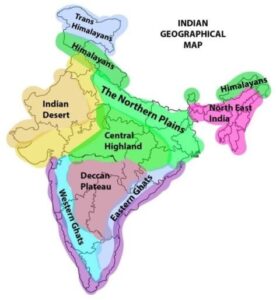
Ans: The Peninsular Plateau of India lies to the south of the Northern Plains and extends up to the tip of the Indian peninsula. It is a tableland with gently rising, rounded hills and broad, shallow valleys.

The Peninsular Plateau of India is a triangular-shaped landmass composed of ancient igneous and metamorphic rocks. It has two main parts:

1. Central Highlands (north of the Narmada River) – includes the Malwa Plateau, Bundelkhand, Baghelkhand, and the Vindhya Range. It extends eastward to the Chhota Nagpur Plateau. The Aravalli Hills, old and worn down, lie to the west and northwest.

2. Deccan Plateau (south of the Narmada River) – has a broad base in the north and narrows towards the south. It is formed from volcanic lava, mostly made of basalt rocks. The Satpura Range is to its north, while the Mahadev, Kaimur, and Maikal hills extend to the east. It is bordered by the Western Ghats (900-1600 meters high) and the Eastern Ghats (600 meters high). The plateau slopes from west to east. The black soil area here is called the Deccan Trap.

Q2. Write a note on the different parts of the Great Himalayan range.

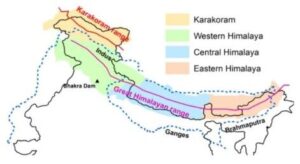
Ans: The Himalayas are one of the highest and roughest mountain ranges in the world. They stretch from the Indus River in the west to the Brahmaputra River in the east, forming India’s northern border.

The Himalayan region has three main mountain ranges running parallel from west to east:

1. Greater or Inner Himalayas (Himadri):

  • This is the northernmost and highest section, with an average height of 6000 meters.
  • It is covered in snow and glaciers, containing the tallest peaks like Mount Everest (8848 m) etc

2. Lesser Himalayas (Himachal):

  • Located south of Himadri, these rugged ranges have an average height of 3700-4500 meters.
  • Important ranges include Pir Panjal, Dhaula Dhar, and the Mahabharat ranges, with valleys like Kashmir, Kangra, and Kullu.

3. Outer Himalayas (Shivaliks):

  • The outermost and youngest range, with a height of 900-1100 meters.
  • These ranges are made of loose sediments, with valleys called “duns” like Dehra Dun lying between them and the Lesser Himalayas.

Q3. Explain about Barchans. 

Ans: Barchans are crescent-shaped dunes that form in arid or desert regions with a predominant wind direction. They have the following characteristics:

  • Shape and Formation: Barchans have a curved or crescent shape, with the open side facing the direction of the prevailing wind. They form when the wind blows consistently from one direction, causing sand to accumulate on the leeward side of an obstacle or in a region where the wind’s speed decreases.
  • Movement: Barchans migrate slowly across the desert as the wind continually moves sand from the windward side to the leeward side. The movement is gradual and can lead to the shifting of these dunes over time.
  • Size and Scale: Barchans can vary in size from small hills to large dunes. Their size and shape are influenced by the availability of sand and the intensity of the wind.

Q4. Describe the causes of the Shiwalik Ranges’ vulnerability to earthquakes and landslides.

Ans: The Shiwalik Ranges are particularly prone to landslides and earthquakes due to several factors:

  • Tectonic Activity: The Shiwalik Ranges lie at the boundary between the Indo-Gangetic Plain and the Himalayan foothills. This region is tectonically active due to the ongoing collision between the Indian Plate and the Eurasian Plate, which causes significant seismic activity. The tectonic movements and fault lines in this region increase the likelihood of earthquakes.
  • Geological Composition: The Shiwalik Ranges are composed of loose, unconsolidated sediments and debris. This loose material is less stable compared to solid rock, making it more susceptible to erosion and landslides, especially during periods of heavy rainfall or seismic activity.
  • Steep Slopes: The steep slopes and rugged terrain increase landslide risk. Rainfall can cause the soil to become saturated, increasing its weight and reducing stability, leading to landslides.
  • Human Activities: Deforestation, construction, and other human activities in the region disturb the natural stability of the slopes. These activities can weaken the ground and trigger landslides, particularly in areas where the natural vegetation has been removed.

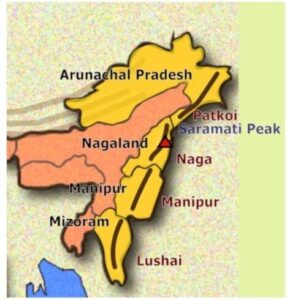
Q5. Which part of the Himalayas is known as Purvanchal? Write a short note on the Purvanchal Himalayas. (Important) 

Ans: The eastern hills and mountains of the Himalayas running along the eastern boundary of India are known as Purvanchal.

  • They are located in the northeastern states of India. The river Brahmaputra marks the easternmost boundary of the Himalayas. Beyond the Dihang gorge, the Himalayas bend sharply to the south and spread along India’s eastern border. They are known as Purvanchal. 
  • They run mostly as parallel ranges with valleys in between. They are mostly composed of strong sandstone, a sedimentary rock. The Purvanchal are less spectacular than the Himalayas and are of medium height. The hills and ranges are covered with dense forests.
  • Some important hills of the Purvanchal are:
    (i) the Patkai Bum and Naga hills.
    (ii) the Mizo hills and Manipur hills.
    (iii) the Garo, Khasi and Jaintia hills along the Meghalaya-Bangladesh border.

01. India – Size and Location – Long Question answer

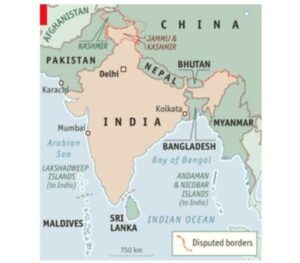
Q1. Which are the countries with which India shares land boundaries? Write a short note about India’s position among its neighbours.

Fig: Neighbours of India

Ans: India shares its land boundaries with:

  • Pakistan and Afghanistan in the northwest
  • China (Tibet), Nepal, and Bhutan in the north
  • Myanmar and Bangladesh in the east

The geographical position of India among its neighbours is significant:

  • The Himalayas provide a natural barrier to the north and northwest.
  • India holds a prominent position in the Indian subcontinent.
  • Strong geographical and historical links exist with neighbouring countries.

India maintains robust relationships with its neighbours:

Q2. Write a note on the location and size of India [Important]

Ans: Location

  • India is a vast country located in South Asia.
  • It lies entirely in the Northern Hemisphere, extending from 8°04’N to 37°06’N latitude.
  • The Tropic of Cancer (23°30’N) runs through the middle of the country.
  • From west to east, India spans 68°07’E to 97°25’E longitude.
  • To the southeast, the Andaman and Nicobar Islands are located in the Bay of Bengal, while the Lakshadweep Islands are in the Arabian Sea.

Size

  • India covers an area of 3.28 million square km, making it the seventh-largest country in the world.
  • This area represents about 2.4% of the world’s total geographical area.
  • The country has an east-west extent of 2,933 km (from Arunachal Pradesh to Kachchh) and a north-south extent of 3,214 km (from Kashmir to Kanniyakumari).
  • India’s land boundary measures approximately 15,200 km, with a coastline of 7,516.6 km, including the islands.

Geographically, India is bordered by the Himalayas to the northwest, north, and northeast. The southern region forms a peninsula that tapers towards the Indian Ocean, with the Arabian Sea on the southwest and the Bay of Bengal on the southeast.

With a population exceeding 1 billion, India is the second-most populous country in the world, following China.

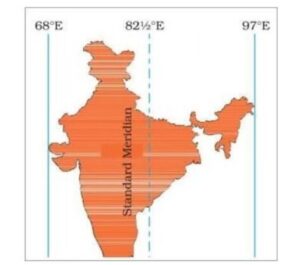
Q3. Write a note on the Indian Standard Time? Why is there a time difference of almost 2 hours from Arunachal Pradesh to Gujarat? [Important]

Fig: Indian standard time

Ans: The vast longitudinal extent of India results in a time difference of nearly two hours between its eastern and western regions. To simplify this, a single standard time is used across the country.

The Standard Meridian of India is set at 82°30’E, which runs through Mirzapur in Uttar Pradesh. This time zone is calculated as:

  • 82°30′ × 4 minutes = 330 minutes
  • Which equals 5 hours and 30 minutes ahead of GMT (Greenwich Mean Time).

India’s longitudinal range exceeds 29°, from 68°07’E in Gujarat to 97°25’E in Arunachal Pradesh. The calculation for the time difference is as follows:

  • For each degree of longitude, there is a time difference of 4 minutes.
  • Thus, for 29°: 4 minutes × 29° = 116 minutes, or approximately 2 hours.

Consequently, the sun rises nearly two hours earlier in Arunachal Pradesh compared to Gujarat, despite both regions observing the same standard time.

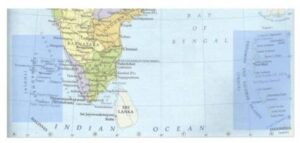
Q5. What are the two groups of Indian islands? Write a note on each, describing its geographic position with relation to India.

Fig: Andaman & Nicobar island and Lakshadweep island

Ans: The two groups of islands that are part of the Indian Union are the Andaman & Nicobar Islands and the Lakshadweep Islands.

  • Andaman & Nicobar Islands:
    • Located to the southeast of the Indian mainland in the Bay of Bengal.
    • Comprises the Great Andamans and Little Andamans in the north, and Nicobar Islands in the south.
    • Includes numerous large and small islands, with Port Blair as the official headquarters.
    • Strategically important, lying close to the equator with an equatorial climate.
    • Located along the trans-Indian Ocean route, near south and southeast Asia.
    • The southernmost point of India is found here.
  • Lakshadweep Islands:
    • Situated in the Arabian Sea to the southwest of India’s mainland, near the Malabar coast of Kerala.
    • Consists of small coral islands, covering an area of just 32 square kilometres.
    • Kavaratti Island serves as the administrative headquarters.

Both island groups are rich in flora and fauna, contributing to India’s natural beauty and geographical diversity.

Q6. How has India’s geographic location aided the nation?

Ans: India’s geographic location has significantly aided its development in various ways:

  • India is a southward extension of the Asian continent, centrally located between East and West Asia.
  • The Himalayas to the north act as a natural barrier, facilitating cultural and commodity exchanges through ancient land routes.
  • The Deccan Peninsula extends into the Indian Ocean, enhancing opportunities for maritime trade.
  • Trans-Indian Ocean routes connect India with Europe and East Asia, providing a strategic position for trade.
  • India maintains close contacts with oil-rich countries in West Asia and regions in Africa and Europe via the Arabian Sea.
  • The Suez Canal offers the shortest maritime route to industrial Europe and America.
  • From its eastern coast, India has favorable trade links with Southeast Asia, East Asia, and Australia via the Bay of Bengal.
  • Proximity to densely populated countries in Southeast Asia and China boosts trade and cultural relations.

Overall, India’s geographical location has played a crucial role in its progress and development.