06. Population – Short and Long Question answer

Q1. What are the processes of population change or growth? Describe them.

Ans: Population change occurs through three main processes:

  • Birth rates: This is the number of live births per thousand people in a year. In India, birth rates have historically been higher than death rates, contributing significantly to population growth.
  • Death rates: This refers to the number of deaths per thousand people in a year. The decline in death rates has been a key factor in the growth of India’s population.
  • Migration: This involves the movement of people, either within the country (internal migration) or across borders (international migration). While internal migration does not change the overall population size, it affects how people are distributed across regions.

Q2. “Distribution of population is uneven in India”. Describe the factors responsible for it.

Ans: Uneven population distribution in India is marked by significant differences in population density across various regions. The factors contributing to this uneven distribution include:

  • Climate: The western part of Rajasthan has low population density due to extreme temperatures and low rainfall, making it inhospitable. Similarly, cities like PatnaKanpur, and Kolkata, provide essential resources like drinking water and fertile soil.
  • Economic Opportunities: Industrial hubs such as BengaluruDelhi, and Mumbai attract large populations due to better job prospects. In contrast, areas lacking industries tend to have lower populations.
  • Transport Connectivity: Regions with well-developed transport systems, including roadways, railways, and waterways, tend to be more densely populated. Efficient transport facilitates the movement and distribution of people.

Q3. Which regions of India have moderate population densities and which regions have high to very high population densities? Why?

Ans: Assam and most of the peninsular states of India have moderate population densities. The following factors contribute to this:

  • Hilly and rocky terrain
  • Low to moderate rainfall
  • Shallow and less fertile soils

In contrast, the Northern plains and Kerala in the south experience high to very high population densities due to:

  • Flat plains with fertile soils
  • Abundant rainfall

Q4. The substantial improvement in the health conditions of the Indian population is the result of many factors. What are these factors?

Ans: Health is an important component of population composition, influencing development. Significant improvements in the health conditions of the Indian population are attributed to various factors:

  • Improvement in public health initiatives.
  • Prevention of infectious diseases through vaccination and awareness.
  • Application of modern medical practices for diagnosing and treating ailments.

Q5. What did the National Population policy 2000 do for the adolescent population of India?

Ans: The National Population Policy 2000 recognised adolescents as a crucial demographic requiring focused attention. Key aspects of the policy include:

  • Nutritional needs: Emphasised the importance of adequate nutrition for adolescents.
  • Delayed marriage: Promoted programmes encouraging delayed marriage and childbearing.
  • Sex education: Aimed to educate adolescents about the risks of unprotected sex.
  • Contraceptive access: Made contraceptive services more accessible and affordable.

Q6. Write a note on India’s population distribution by density.

Ans: Population density gives insight into the uneven distribution of people across India. It is calculated as the number of individuals per unit area. Key points about India’s population density:

  • India is among the most densely populated countries globally.
  • In 2011, the population density was 382 persons per sq. km.
  • Density varies significantly across states: Bihar: 1,102 persons per sq. km, Arunachal Pradesh: only 17 persons per sq. km.

Q7. Look at the following table carefully. What does it indicate? What can be done to turn the sex ratio in favour of females? The Magnitude and Rate of India’s Population Growth

Ans: The table indicates that the sex ratio in India has consistently been unfavourable to females. In 1951, there were 946 females for every 1000 males. This number has declined over the decades, reaching 940 females per 1000 males in 2011. This trend reflects a patriarchal mindset prevalent in society.

To improve the sex ratio in favour of females, the following actions can be taken:

  • Promote education across all regions of the country.
  • Encourage awareness about the value of female children.
  • Implement strict laws against gender discrimination.
  • Support community programmes that empower women.

Q8. Why is the health situation still in matter of major concern for India?

Ans: Despite significant progress in health conditions in India, several issues remain a major concern:

  • Low calorie consumption: The average per capita calorie intake is well below recommended levels, leading to widespread malnutrition.
  • Limited access to clean water: Only one-third of the rural population has access to safe drinking water and basic sanitation.
  • Healthcare shortages: Many areas lack an adequate number of doctors and nurses, and hospitals are often in poor condition.

05. Natural Vegetation and Wildlife – Short and Long Question answer

Q1: How is soil an important factor for vegetation?
Ans: Soil plays a crucial role in determining the type of vegetation that can thrive in a particular area.

  • Different types of soils provide the foundation for different types of vegetation. For instance, sandy soils in deserts support cacti and thorny bushes, while marshy deltaic soils support mangroves and deltaic vegetation.
  • The composition, texture, and fertility of soil influence the types of plants that can grow. Well-drained and nutrient-rich soils support lush vegetation, while poor soils may restrict plant growth.


Q2: How do human beings influence the ecology of a region?
Ans: Human activities significantly impact the ecology of a region:

  • Human beings often utilize vegetation and wildlife resources for various purposes, leading to overexploitation and habitat destruction.
  • Deforestation, habitat destruction, and pollution caused by human activities disrupt ecosystems and lead to ecological imbalances.
  • Unregulated hunting, poaching, and pollution can lead to the extinction of plant and animal species.
  • Urbanization, industrialization, and agriculture can alter landscapes, disrupt natural habitats, and affect the overall ecological balance.


Q3: Divide the tropical deciduous forests based on the availability of water. Give a brief description of each of them.
Ans:
Moist Deciduous Forests:

  • Found in areas with rainfall between 200 and 100 cm.
  • Common in the eastern part of India, along the foothills of the Himalayas, and parts of central India.
  • Dominated by trees like teak, sal, bamboo, shisham, and sandalwood.
  • Dry Deciduous Forests:
  • Found in areas with rainfall between 100 and 70 cm.
  • Common in the rainier parts of the peninsular plateau and the plains of Bihar and Uttar Pradesh.
  • Trees include teak, sal, peepal, and mem.


Q4: Give a brief description of the wildlife found in the tropical evergreen and tropical deciduous forests.
Ans:

Tropical Evergreen Forests:

  • Common animals: Elephants, monkeys, lemurs, deer.
  • One-horned rhinoceroses are found in Assam and West Bengal.
  • Abundance of birds, bats, sloths, scorpions, and snails.

Tropical Deciduous Forests:

  • Common animals: Lions, tigers, pigs, deer, elephants.
  • Variety of birds, lizards, snakes, and tortoises.


Q5: Describe the vegetation and wildlife found in mangrove forests.
Ans:

Vegetation:

  • Mangrove tidal forests grow in coastal areas influenced by tides.
  • Trees like sundari, palm, coconut, keora, and agar are found in deltas of rivers like the Ganga, Mahanadi, Krishna, Godavari, and Kaveri.

Wildlife:

  • Royal Bengal Tiger is a prominent animal in mangrove forests.
  • Presence of turtles, crocodiles, gharials, and snakes.
  • Mangrove ecosystems provide critical breeding and nesting habitats for various species.


Q6: Write briefly about Indian migrating birds.
Ans:

  • India hosts numerous migratory bird species during both summer and winter.
  • Over a hundred species migrate to India, either for feeding or to escape the harsh winter in their native habitats.
  • During winter, species like the Siberian Crane and flamingos migrate to India.
  • Places like the Rann of Kachchh serve as important feeding and breeding grounds for these migratory birds.


Q7: What are the characteristics of trees in deciduous forests?
Ans:

  • Deciduous forests are found in areas with rainfall between 200 cm and 70 cm, with distinct dry seasons.
  • Trees in these forests shed their leaves for about six to eight weeks during the dry summer.
  • These trees typically have wide-spreading branches, like neem and mango trees.
  • Leaves are smaller in size compared to rainforests, helping to reduce transpiration.
  • Common trees include teak, sal, shisham, and peepal, among others.


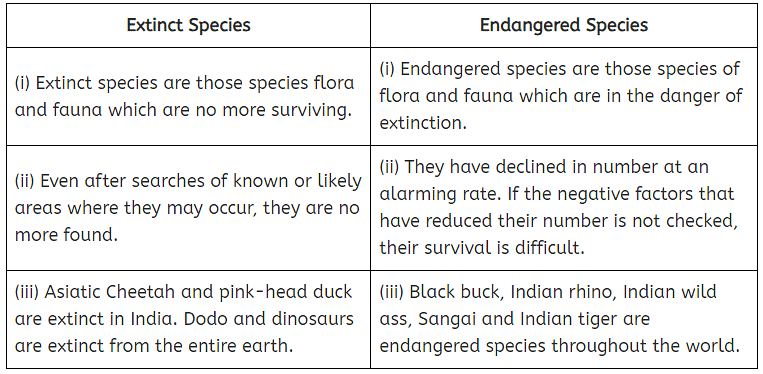
Q8: Distinguish between extinct and endangered species.
Write three main characteristics of tropical decidous forests.


Q9: Give five characteristics of the Montane forests.
Ans:

  • Altitude-Based Distribution: Montane forests are found in mountainous areas and are characterized by different vegetation belts based on altitude.
  • Vegetation Zones: There is a succession of vegetation belts as altitude increases, similar to the transition from tropical to tundra regions. Different types of forests and grasslands are encountered at different altitudes.
  • Wet Temperate Forests: Between 1000 and 2000 meters, wet temperate forests are prevalent. These forests feature evergreen broad-leaf trees like oaks and chestnuts.
  • Coniferous Forests: At altitudes of 1500 to 3000 meters, temperate forests with coniferous trees such as pine, deodar, and silver fir dominate. These forests are common on southern slopes of the Himalayas and high-altitude areas of southern and northeastern India.
  • Alpine Vegetation: Above 3600 meters, temperate forests and grasslands give way to Alpine vegetation. Trees like silver fir, junipers, pines, and birches are found, but they become progressively stunted as they approach the snow line. Mosses and lichens dominate at even higher altitudes.

Q10: Describe the characteristics of the tropical evergreen forests of India.
Ans:

  • Rainfall Requirement: Tropical evergreen forests thrive in areas with heavy rainfall, typically exceeding 200 cm annually. These forests experience a short dry season.
  • Tall Trees and Multilayered Structure: Trees in these forests can reach great heights, often surpassing 60 meters. The forest structure is multilayered, with various plant types, including trees, shrubs, and creepers.
  • Year-Round Greenery: Due to the absence of a definite leaf-shedding period, these forests maintain their green appearance throughout the year.
  • Rich Biodiversity: These forests are home to a wide range of flora and fauna. Commercially valuable trees like ebony, mahogany, rosewood, rubber, and cinchona are found here.
  • Diverse Wildlife: Animals such as elephants, monkeys, lemurs, deer, and one-horned rhinoceroses inhabit these forests. Birds, bats, sloths, scorpions, and snails are also present in abundance.


Q11: Give a brief account of the wildlife found in India.
Ans:

  • Rich Fauna: India boasts a diverse range of fauna, with around 90,000 animal species. The country is home to approximately 2,000 species of birds and 2,546 species of fish.
  • Iconic Animals: Elephants are found in the wet forests of Assam, Karnataka, and Kerala. The one-horned rhinoceros inhabits swampy lands in Assam and West Bengal.
  • Desert and Grassland Species: The Rann of Kachchh and Thar Desert are habitats for wild ass and camels respectively. Bison, nilgai, chousingha, gazelle, and various species of deer are also present. Different species of monkeys are widespread.
  • Himalayan Diversity: The Himalayas host a variety of animals, including the yak, Tibetan antelope, bharal (blue sheep), and wild sheep. High-altitude areas also support species like the shaggy-horned wild ox and Tibetan wild ass.
  • Aquatic and Avian Life: Rivers, lakes, and coastal areas are home to turtles, crocodiles, and gharials. Birds such as peacocks, pheasants, ducks, cranes, and pigeons are prominent in forests and wetlands.


Q12: In which regions are the thorny forests and scrubs found in India? Mention the characteristics of such type of vegetation.
Ans: 
Thorny forests and scrubs are found in regions with arid and semi-arid conditions, typically receiving less than 70 cm of annual rainfall. These regions include the northwestern part of India, comprising states like Gujarat, Rajasthan, Madhya Pradesh, Chhattisgarh, Uttar Pradesh, and Haryana.
Characteristics of Thorny Forests and Scrubs:

  • Scattered Trees: Trees in these regions are widely spaced due to water scarcity. Their roots penetrate deep into the soil to access moisture.
  • Succulent Stems: Many plant species have succulent stems, which store water to survive in arid conditions.
  • Small, Thick Leaves: Leaves are often small and thick, reducing water loss through transpiration.
  • Xerophytic Adaptations: The plants have xerophytic adaptations to cope with water scarcity, such as reduced leaf surface area and thick cuticles.
  • Thorny Shrubs: Many shrubs and bushes have thorns as a defense mechanism against herbivores.
  • These vegetation types are well-adapted to the challenging climatic conditions of arid and semi-arid regions.

04. Climate – Short and Long Question answer

Q1: Distinguish between weather and climate.
Ans: The difference between weather and climate is a measure of time.

  • Weather refers to the atmospheric conditions of a specific place over a short period of time, usually 24 hours.
  • Climate refers to the average atmospheric conditions over a relatively long period of time, usually 30 years.
  • Weather can change from hour to hour and day to day, but climate represents the long-term patterns and trends of temperature, precipitation, humidity, and other atmospheric factors.

Q2: What are western cyclonic disturbances?
Ans: 
Western cyclonic disturbances are weather phenomena that occur during the winter months and are brought in by westerly flow from the Mediterranean region. These disturbances usually influence the weather of the north and northwestern regions of India. They are characterized by the movement of low-pressure systems in the upper troposphere and are associated with cloudiness, rain, and sometimes snowfall in the northern parts of India.

Q3: What is known as the Southern Oscillation or SO? Mention the feature connected with it.
Ans:
 The Southern Oscillation (SO) refers to the periodic change in pressure conditions over the southern oceans, particularly the tropical eastern South Pacific Ocean and the tropical eastern Indian Ocean. It is characterized by the reversal of pressure conditions, where the eastern Pacific experiences lower pressure compared to the eastern Indian Ocean. This phenomenon is connected with the El Niño-Southern Oscillation (ENSO), where warm ocean currents replace cold currents along the Peruvian coast, leading to changes in global weather patterns.

Q4: Withdrawal of the monsoon is a gradual process. Explain.
Ans: The withdrawal of the monsoon is a gradual process that begins in the northwestern states of India by early September. By mid-October, it withdraws completely from the northern half of the peninsula. The withdrawal from the southern half of the peninsula is fairly rapid, and by early December, the monsoon has withdrawn from the rest of the country. This gradual retreat is influenced by the movement of the monsoon trough and the changing pressure systems.

Q5: The breaks in the monsoon are related to the movement of the monsoon trough. Explain.
Ans: The breaks in the monsoon are related to the movement of the monsoon trough, which is an elongated low-pressure area in the lower troposphere. The axis of the monsoon trough can shift northward or southward, influencing the spatial distribution of rainfall. When the trough’s axis lies over the plains, there is good rainfall in those areas. However, when the axis shifts closer to the Himalayas, dry spells occur in the plains, while rainfall increases in the mountainous catchment areas of the Himalayan rivers.

Q6: How do the frequency and intensity of tropical depressions determine the amount and duration of monsoon rains?
Ans: 
Tropical depressions, which form over the Bay of Bengal, play a significant role in the monsoon rains. These depressions follow the axis of the monsoon trough and bring moisture-laden winds from the ocean. The frequency and intensity of these depressions can influence the amount and duration of monsoon rains. More frequent and intense depressions can lead to heavy rainfall, while their absence or weaker formation can result in dry spells and drought conditions during the monsoon season.

Q7: Give a brief description of the distribution of rainfall in India.
Ans: 
The distribution of rainfall in India is uneven:

  • Western coast and northeastern India receive over 400 cm of rainfall annually.
  • Rainfall is less than 60 cm in western Rajasthan, parts of Gujarat, Haryana, and Punjab.
  • The interior of the Deccan plateau and the east of the Sahyadris also receive low rainfall.
  • Some areas, like Leh in Jammu and Kashmir, receive low precipitation.
  • The rest of the country receives moderate rainfall, with snowfall occurring mainly in the Himalayan region.

Q8: What do you mean by the southwest monsoon? Explain in brief.
Ans: 
The southwest monsoon refers to the seasonal wind pattern that brings moist air from the Indian Ocean to the Indian subcontinent during the summer months. The intense heating of the Thar Desert and adjoining areas leads to the formation of a low-pressure area, drawing moisture-laden winds from the ocean. These winds are blocked by the Himalayas, causing them to rise, cool, and condense, leading to precipitation. The south-west monsoon is responsible for the majority of India’s rainfall.

Q9: What is known as the North East Monsoon or Retreating Monsoon? Explain in brief.
Ans:
 The North East Monsoon, also known as the Retreating Monsoon, occurs around September when the northern landmass of the Indian subcontinent begins to cool rapidly. Cold winds from the Himalayas and Indo-Gangetic Plain sweep down towards the Indian Ocean south of the Deccan peninsula. This wind pattern brings rainfall to the southeastern coast of India, particularly Tamil Nadu, during the retreating monsoon period.

Q10: What are the characteristic features of retreating monsoon?
Ans:

Following are the characteristics features of retreating monsoon:

  • During October-November, with the apparent movement of the sun towards the south, the monsoon trough or the low-pressure trough over the northern plains becomes weaker. This is gradually replaced by a high-pressure system. The southwest monsoon winds weaken and start withdrawing gradually. By the beginning of October, the monsoon withdraws from the northern plains.
  • The months of October-November are a period of transition from hot-rainy season to dry winter conditions. The retreat of the monsoon is marked by clear skies and a rise in temperature.
  • While day temperatures are high, nights are cool and pleasant. The land is still moist. Owing to the conditions of high temperature and humidity, the weather becomes rather oppressive
  • during the day. In the second half of October, the mercury begins to fall rapidly in northern India.
  • The low-pressure conditions over north-western India get transferred to the Bay of Bengal by early November. This shift is associated with the occurrence of cyclonic depressions, which originate over the Andaman Sea. These cyclones generally cross the eastern coasts of India and cause heavy and widespread rain.


Q11: Describe briefly what you know about the onset of monsoon and its withdrawal.
Ans:

  • The climate of India is described as the monsoon type. The monsoons are not steady winds but are pulsating in nature, affected by different atmospheric conditions encountered by it, on its way over the warm tropical seas. The duration of the monsoon is between 100—120 days from early June to mid-September.
  • The monsoon generally arrives at the southern tip of the Indian peninsula by the first week of June. Subsequently, it proceeds into two—the Arabian Sea branch and the Bay of Bengal branch.
  • The Arabian Sea branch reaches Mumbai about ten days later, on approximately the 10th of June. This is a fairly rapid advance. The Bay of Bengal branch also advances rapidly and arrives in Assam in the first week of June. The lofty mountains cause the monsoon winds to deflect towards the west over the Ganga plains.
  • By mid-June, the Arabian Sea branch of the monsoon arrives over Saurashtra-Kuchchh and the central part of the country.
  • The Arabian Sea and the Bay of Bengal branches of the monsoon merge over the northwestern part of the Ganga plains and cause rainfall. By mid-July, the monsoon reaches Himachal Pradesh
  • and the rest of the country.
  • The withdrawal of the monsoon begins in the north-western states of India by early September. By mid-October, it withdraws completely from the northern half of the peninsula. 


Q12: What are the factors that affect India’s climate? Describe them.
Ans:

The factors affecting the climate of India are—latitude, altitude pressure and winds. Here is a brief description of these factors:

  • Latitude: India’s climate has characteristics of tropical as well as sub-tropical climates. The Tropic of Cancer passes through the middle of the country. Almost half of the country, lying south of the Tropic of Cancer, belongs to the tropical area. All the remaining area, north of the Tropic, lies in the sub-tropics.
  • Altitudes: The Himalayas prevent the cold winds from Central Asia from entering the subcontinent. It is because of these mountains that this sub-continent experiences comparatively milder winters than Central Asia.
  • Pressure and winds: The pressure and wind conditions over India are unique. During winter, there is a high-pressure area north of the Himalayas. Cold, dry winds blow from this region to the low-pressure areas over the oceans to the south. In summer, a low-pressure area develops over interior Asia as well as over northwestern India. This causes a complete reversal of the direction of winds during summer.

Air moves from the high-pressure area over the southern Indian Ocean, in a south-easterly direction, crosses the equator, and turns right towards the low-pressure areas over the Indian subcontinent. These are known as the southwest monsoon winds, which bring widespread rainfall over the mainland of India. The upper air circulation, western cyclonic disturbances and tropical cyclones also affect India’s climate.

Q13: Give a brief description of the controls that affect India’s climate.
Ans:

There are six major controls that affect the climate of India—latitude, altitude, pressure, and wind system, distance from the sea, ocean currents, and relief features. Here is a brief description of all these climatic controls:

  • Latitude: Due to the curvature of the earth, the amount of solar energy received varies according to latitude. As a result, air temperature generally decreases from the equator towards the poles.
  • Altitude: At higher altitudes, the atmosphere becomes less dense, and temperature decreases. The hills are, therefore, cooler during summer.
  • Pressure and wind system: It depends on the latitude and altitude of the place. Thus, it influences the temperature and rainfall pattern.
  • Distance from the sea: The sea exerts a moderating influence on climate. As the distance from the sea increases, its moderating influence decreases, and people experience extreme weather conditions.
  • Ocean currents: Ocean currents, along with onshore winds, affect the climate of the coastal areas. For example, any coastal area with warm or cold currents flowing past it will be warmed or cooled if the winds are onshore.
  • Relief: It also determines the climate of a plane. High mountains act as barriers to cold or hot winds; they may also cause precipitation if they are high enough and lie in the path of rain-bearing winds. The leeward side of the mountains remains relatively dry.


Q14: State the factors that help in understanding the mechanism of monsoon.
Ans:

The following factors help us understand the mechanism of monsoon:

  • The differential heating and cooling of land and water creates low pressure on India’s landmass while the seas around experience comparatively high pressure.
  • The shift of the position of the Inter Tropical Convergence Zone (ITCZ) over the Ganga plain in summer. This is the equatorial trough normally positioned about 5°N of the equator. It is also known as the monsoon trough during the monsoon season.
  • The presence of the high-pressure area, east of Madagascar, approximately 20°S over the Indian Ocean. The intensity and position of this high-pressure area affects the Indian monsoon.
  • The Tibetan plateau gets intensely heated during summer, which results in strong vertical air currents and the formation of low pressure over the plateau at about 9 km above sea level.
  • The movement of the westerly jet stream to the north of the Himalayas and the presence of the tropical easterly jet stream over the Indian peninsula during summer.
  • The changes in pressure conditions over the southern oceans also affect the monsoons.


Q15: Differentiate between southwest monsoon and northeast monsoon.
Ans:

  • The south-west summer monsoons occur from July through September. The Thar Desert and adjoining areas of the northern and central Indian subcontinent heat up considerably during the hot summers.
  • This causes a low-pressure area over the northern and central Indian sub-continent. To fill this void, the moisture-laden winds from the Indian Ocean rush into the subcontinent.
  • These winds, rich in moisture, are drawn towards the Himalayas, which block the winds passing into Central Asia and force them to rise. As the clouds rise, their temperature drops and precipitation occurs. Some areas of the subcontinent receive up to 10,000 mm of rain annually.

03. Drainage – Short and Long Question answer

Q1: Why are the Peninsular rivers seasonal in nature?
Ans:
 The Peninsular rivers are seasonal in nature because their flow is highly dependent on rainfall unlike the Himalayan rivers which are perennial. Most of the peninsular rivers flow through the plateaus and low hills devoid of snow. The peninsular rivers have shorter and shallower courses as compared to the Himalayan rivers. Such rivers fail to contain water for longer periods. When it rains good, they have ample water but when it is dry season, even the large rivers have reduced flow of water in their channels.

Q2: Give the features of the Himalayan rivers.
Ans: 
Most of the Himalayan rivers are perennial. It means that they have water throughout the year. The Himalayan rivers have long courses from their source to the sea. They perform intensive erosional activity in their upper courses and carry huge loads of silt and sand. In the middle and lower courses, these rivers form meanders, Ox-bow lakes and many other depositional features in their floodplain. They also have well-developed deltas.

Q3: Give some of the similarities between the Himalayan rivers and Peninsular rivers.
Ans:
 Although the Himalayan rivers differ from the Peninsular rivers in many ways, they have some similarities too:

  • Both the river systems have their large drainage basins.
  • Both make deltas at their mouths.
  • The rivers of both the regions are joined by many tributaries as a result of which the main river gets ample water and silt.


Q4: Describe the following drainage patterns of streams:
(i) Radial
(ii) Dendrite
(iii) Trellis
(iv) Rectangular
Ans:

  • Radial: The radial pattern develops when streams flow in different directions from a central peak or dome-like structure.
  • Dendrite: The dendritic pattern develops where the river channel follows the slope of the terrain. The stream with its tributaries resembles the branches of a tree, thus the name dendritic.
  • Trellis: A trellis drainage pattern develops where hard and soft rocks exist parallel to each other. A river joined by its tributaries, at approximately right angles, develops a trellis pattern.
  • Rectangular: A rectangular drainage pattern develops on a strongly jointed rocky terrain.


Q5: Which three river systems form the Himalayan river system? Describe briefly any one of them.
Ans:
 The three river systems that form the Himalayan river system are:

  • The Indus river system
  • The Ganga river system
  • The Brahmaputra river system
  • The Brahmaputra rises in Tibet, east of Mansarovar lake very close to the sources of the Indus and the Satluj. Most of its course lies outside India. It flows eastwards parallel to the Himalayas. It enters India in Arunachal Pradesh through a gorge. Here, it is joined by several tributaries such as the Dibang, the Lohit to form the Brahmaputra in Assam. In the Indian part, the river passes through a region of high rainfall and therefore it carries a large volume of water and silt. It has a braided channel in its entire length in Assam and forms many riverine islands. Every year during the rainy season, the river overflows its banks, causing widespread devastation due to floods in Assam and Bangladesh.


Q6: Where does river Brahmaputra rise? Where does it enter into India? Name two of its tributaries.
Ans: 
River Brahmaputra rises in Tibet, east of Mansarovar lake very close to the sources of the Indus and the Satluj. It enters India in Arunachal Pradesh through a gorge. Two of its tributaries are—The Dibang and the Lohit.

Q7: What is the difference between tributary and distributary? Write any three points of distinction.
Ans:

  • A tributary and a distributary are both bodies of freshwater that eventually meet with or diverge from rivers, but they differ in the direction that they flow.
  • A tributary is a stream that flows into a larger river. A distributary is a stream that splits off from a larger river and flows in a different direction.
  • A tributary increases the volume of water of the main river whereas a distributary decreases the volume of water of the main river. Example: the Yamuna is the tributary of the Ganga, whereas the Hooghly is the distributary of the Ganga.


Q8: Describe three important characteristics of Sundarbans Delta.
Ans:

  • It is the world’s largest and fastest-growing delta.
  • It is also the home of Royal Bengal tigers.
  • Sundarbans Delta derived its name from the Sundari tree which grows well in marshland.


Q9: Describe the three main features of the Narmada basin.
Ans:

  • It flows towards the west in a rift valley formed due to faulting. On its way to the sea, the Narmada creates many picturesque locations.
  • All the tributaries of the Narmada are very short and most of these join the main stream at right angles.
  • The Narmada basin extends over states of Madhya Pradesh and Gujarat. It is bounded by the Vindhyas on the north, by the Maikala range on the east, by the Satpuras on the south and by the Arabian Sea on the west.


Q10: Define drainage basin and describe two patterns of drainage in India.
Ans:

  • Drainage basin: The area drained by a single river system is called a drainage basin.
  • Radial: The radial pattern develops when streams flow in different directions from a central peak or dome-like structure.
  • Dendritic: The dendritic pattern develops where the river channel follows the slope of the terrain. The stream with its tributaries resembles the branches of a tree, thus the name dendritic.


Q11: Where does the river Narmada originate? Name any two picturesque locations formed by it.
Ans: The Narmada rises in the Amarkantak hills in Madhya Pradesh. It flows towards the west in a rift valley formed due to faulting. The ‘Marble rocks’ near Jabalpur where the Narmada flows through a deep gorge, and the ‘Dhuadhar falls’ where the river plunges over steep rocks, are some of notable picturesque locations.

Q12: Where does the river Indus rise from? What is its length? Write any two tributaries of river Indus.
Ans: 
The river Indus rises in Tibet, near lake Mansarovar, flowing west, it enters India in the Ladakh district of Jammu and Kashmir. The total length of the river is 2900 km. Two tributaries of the Indus are – the Zaskar and the Nubra.

Q13: Where does the river Tapi originate? Write its main features.
Ans:

  • The Tapi is one of the major peninsular rivers which rises in the Satpura ranges, in the Betul district of Madhya Pradesh. The main features of this river basin are given below:
  • It flows in a rift valley parallel to the Narmada but it is much shorter in length. Its basin covers parts of Madhya Pradesh, Gujarat, and Maharashtra.
  • It has two well-defined physical regions, i.e., the hilly regions and the plains. The hilly regions are well-forested while the plains are broad and fertile areas suitable for cultivation.


Q14: Describe important features of the Mahanadi basin. Give three factual pieces of information about the Mahanadi basin.
Ans:
 The Mahanadi is one of the major peninsular rivers which rise in the highlands of Chhattisgarh. It flows through Odisha to reach the Bay of Bengal. The total length of the river is about 860 km. Its drainage basin is shared by Maharashtra, Chhattisgarh, Jharkhand, and Odisha.

Q15: Where does the river Kaveri originate? What is its total length? Name its main tributaries.
Ans:
 The Kaveri rises in the Brahmagri range of the Western Ghats and it reaches the Bay of Bengal in the south of Cuddalore, in Tamil Nadu. The total length of the river is about 760 km. The main tributaries of this river are—Amravati, Bhavani, Hemavati, and Kabini. Its basin drains parts of Karnataka, Kerala, and Tamil Nadu.

Q16: Describe important features of the Krishna basin.
Ans: 
The Krishna is an important peninsular river. It rises from a spring near Mahabaleshwar and flows for about 1400 km and drains into the Bay of Bengal. The Tungabhadra, the Koyana, the Ghatprabha, the Musi, and the Bhima are some of its tributaries. Its drainage basin is shared by Maharashtra, Karnataka, and Andhra Pradesh.

Q17: Which two peninsular rivers form estuaries? Name the states in which these rivers drain the water.
Ans: 
The two peninsular rivers that form estuaries are the Narmada and the Tapi. The Narmada drains into Madhya Pradesh and Gujarat. The Tapi drains into Madhya Pradesh, Gujarat, and Maharashtra.

Q18: Why do the Himalayan rivers get flooded every year? Mention the main advantages of these rivers.
Ans: 
The Himalayan rivers are perennial having water throughout the year. These rivers receive water from melted snow from the lofty mountains. They also receive abundant water from rainfall during the rainy season. So, they get flooded every year. The Himalayan rivers have great advantages:

  • They have longer courses and they carry more sediments in them enriching the soil of the northern plains for extensive agriculture.
  • They have great potential for hydro power making irrigation and navigation easy.


Q19: Why are the peninsular rivers not navigable?
Ans: 
The Peninsular rivers are mostly seasonal in nature. The flow of these rivers depends upon rainfall and they usually get dried up in the summer. River beds are uneven, rocky, and have sharp slopes. Dams cannot be constructed on these rivers. These reasons make peninsular rivers not navigable.

Q20: Give a brief description of freshwater lakes found in India.
Ans: 
Most of the freshwater lakes are located in the Himalayan regions. They are of glacial origin. They formed when glaciers dug out a basin, which was later filled with snowmelt. The Wular lake in Jammu and Kashmir is the largest freshwater lake in India. It is the result of tectonic activity. The Dal lake, Bhimtal, Nainital, Loktak, and Barapani are some other important freshwater lakes in our country.

Q21: Describe how the lakes found in India differ from each other in size, and other characteristics.
Ans:

There are many lakes in India. These differ from each other in size, and other characteristics:

  • Most lakes are permanent while some contain water only during the rainy season, like the lakes in the basins of inland drainage of semi-arid regions.
  • Some lakes are the result of the action of glaciers and ice-sheets; while the others have been formed by wind, river action, and human activities.
  • A meandering river across a floodplain forms cut-offs that later develop into Ox-box lakes.


Q22: Which is the largest peninsular river? Describe some of its important features.
Ans:

The Godavari is the largest peninsular river. Some of its important features are:

  • It rises from the slopes of the Western Ghats in the Nasik district of Maharashtra. Its length is about 1500 km.
  • It drains into the Bay of Bengal. Its drainage basin also the largest among the peninsular rivers.
  • The basin covers parts of Maharashtra, Madhya Pradesh, Odisha and Andhra Pradesh.
  • The Godavari is joined by a number of tributaries such as the Puma, the Wardha, the Pranhita, the Manjra, the Wainganga and the Penganga. The last three tributaries are very large.
  • The Godavari river is also known as the ‘Dakshin Ganga’ since it is largest Peninsular river like the large Himalayan river. It is like the Ganga river in the south so it is also called he ‘Dakshin Ganga’.


Q23: Describe the important characteristics of the Brahmaputra river system.
Ans:

The three river systems that form the Himalayan river system are:

  • The Indus river system
  • The Ganga river system
  • The Brahmaputra river system

The Brahmaputra rises in the Tibet, east of Mansarovar lake very close to the sources of the Indus and the Satluj. Most of its course lies outside India. It flows eastwards parallel to the Himalayas. It enters India in Arunachal Pradesh through a gorge. Here, it is joined by several tributaries such as the Dibang, the Lohit to form the Brahmaputra in Assam.
In Indian part, the river passes through a region of high rainfall and therefore it carries a large volume of water and silt. It has a branded channel in its entire length in Assam and forms many riverine islands. Every year during the rainy season, the river overflows its banks, causing widespread devastation due to floods in Assam and Bangladesh.

Q24: Give the main features of the Ganga river system.
Ans:

The Ganga river system consists of the master river Ganga and a large number of its tributaries such as the Yamuna, the Ghaghara, the Gandak and the Kosi. The main features of this river system are:

  • This system drains a very large area comprising the middle part of the Himalayas in the north, the northern part of the India plateau in the south and the Ganga plain in between Needless to say that the Ganga plain is one of the most fertile plains of the world.
  • The Ganga originates as Bhagirathi from the Gangotri glacier in Uttar Kashi district of Uttarakhand at an elevation of 7,010 m. Alaknanda joins it at Devaprayag.
  • After travelling 280 km from its source, the Ganga reaches Haridwar, debouches from the hills and enters plain area. From here it flows in south and south-east direction for a distance of 770 km to reach Allahabad. Here it is joined by the Yamuna which is the main tributary.
  • Enlarged with the waters from its right and left bank tributaries, The Ganga flows eastwards till Farakka in West Bengal. Subsequently, It flows southwards into Bangladesh and is joined by the Brahmaputra. Further down stream, it is known as the Meghna. This mighty river, with waters from the Ganga and the Brahmaputra, flows into the Bay of Bengal.
  •  The length of the Ganga is over 2500 km. Its basis is the most heavily populated in the world with over 400 million people living here.


Q25: Which are the major Himalayan rivers? Give a brief description of the Indus river system.
Ans:

  • The major Himalayan rivers are the Indus, the Ganga and the Brahmaputra. The Indus river is one of the beautiful rivers of India. Together with its tributaries such as the Satluj, the Beas, the Ravi, the Chenab and the Jhelum, the Indus river forms an important river system, which helps in the development of Indian economy.
  • The river Indus originates near the Mansarovar lake in the Tibetan plateau, on the northern slopes of the Kailash mountain range. Flowing west, it enters India in the Ladakh district of Jammu and Kashmir. Subsequently, the river gets into Pakistan through Balistan and Gilgit, running across the north in a southward route down the entire span of Pakistan, to join the Arabian Sea, east of Karachi, The Indus plain has a very gentle slope.
  • The total length of the river is 2900 km. It is also the longest river in Pakistan. A little over a third of the Indus basin is located in India in the states of Jammu and Kashmir, Himachal Pradesh and the Punjab and the rest is in Pakistan.

02. Physical Features of India – Short and Long Question answer

Q1: “The land of India displays great physical variations”.Justify the Statement. 
Ans: The land of India exhibits significant physical variationsacross its regions:

  • The Himalayas: These mountains are vital sources of water and forest resources.
  • The Northern Plains: Known for their fertile land, they support early civilisations and intensive agriculture.
  • The Plateau: Rich in minerals, it has been crucial for the country’s industrialisation.
  • The Coastal Plains: These areas are important for fishing and port activities.

Each of these regions contributes uniquely to India’s diverse geography and resources.


Q2: Describe the Formation of the Northern Plains?
Ans: 
The Northern Plainsof India were formed through a combination of geological processes:

  • The uplift of the Himalayas from the Tethys Sea created a large basin in the northern region.
  • Over centuries, this basin filled with sediments deposited by rivers flowing from the northern mountains and the Peninsular Plateau.
  • This led to the creation of a flat land rich in alluvial deposits, resulting in the fertile Northern Plains.

The plains cover an area of approximately 7 lakh sq. km, stretching about 2400 km in length and 240 to 320 km in width.


Q3: Mention any four features of Peninsular Plateau.
Ans: 
The Peninsular Plateau has several distinct features:

  • Old Rocks: It consists of ancient crystalline, igneous, and metamorphic rocks.
  • Geological Formation: Formed from the breaking and drifting of the Gondwana land, making it one of the oldest landmasses.
  • Topography: Characterised by broad, shallow valleys and rounded hills.
  • Divisions: It is divided into two main parts: the Central Highlands and the Deccan Plateau.

Q4: What are the features of Western Ghats?
Ans: 
Features of the Western Ghats:

  • Located on the west coast of India.
  • Narrow and unbroken range.
  • Highest peak is Anai Mudi.
  • Source of major rivers like KrishnaGodavari, and Kaveri.
  • Continuous range crossed only through passes.


Q5: Explain the formation of Himalayas.
Ans: 
The Himalayas were formed through a process called continental collision. This occurred when the Indian plate collided with the Eurasian plate, leading to the following key points:

  • The collision began around 50 million years ago and continues today.
  • This process caused the land to fold and uplift, creating the mountain range.
  • The Himalayas are primarily composed of sedimentary rocks that were pushed upwards.
  • They stretch approximately 2,400 kilometres from west to east.
  • The range includes several parallel ranges, with the Great Himalayas being the highest.
  • These mountains are home to some of the world’s tallest peaks, including Mount Everest.

In summary, the formation of the Himalayas is a result of tectonic activity that continues to shape this majestic mountain range.

Q6: Name any three features of Central Highlands?
Ans: 
Features of Central Highlands:

  • The Vindhyan Range is located to the south of the Central Highlands, while the Aravalis are to the northwest.
  • The Central Highlands are narrower in the east and wider in the west.
  • The Chota Nagpur Plateau is the eastern extension of this region, drained by the Damodar River.


Q7: Name any three features of Coastal Plains.
Ans: 
Features of Coastal Plains:

  • The Western coast is a narrow plain located between the Western Ghats and the Arabian Sea, divided into three sections.
  • The northern section is known as Konkan, the central part is called Kannad, and the southern section is referred to as Malabar.
  • Lake Chilika is the largest saltwater lake in India and an important feature along the eastern coast.

Q8: Name any four features of Lakshadweep Islands.
Ans: 
Features of the Lakshadweep Islands:

  • The Lakshadweep Islands consist of a group of small coral islands.
  • Previously known as Laccadive, Minicoy, and Amindive, they were renamed Lakshadweep in 1973.
  • This island group covers a small area of 32 sq km.
  • Pitti Island is uninhabited and features a bird sanctuary.


Q9: Describe how the northern plains of India were formed.
Ans: 
The northern plainsof India were formed through a combination of geological processes:

  • The uplift of the Himalayas from the Tethys Sea created a large basin.
  • This basin gradually filled with sediments deposited by rivers flowing from the Himalayas and the peninsular plateau.
  • Over time, these deposits formed a flat expanse of alluvial soil, resulting in the fertile northern plains.

The plains cover an area of approximately 7 lakh square kilometres and are vital for agriculture due to their rich soil and water supply.


Q10: Describe physical variations that the land of India displays.
Ans: 
The land of India showcases a remarkable variety of physical features, including:

  • Mountains: The Himalayas are young, fold mountains that stretch across the northern border, featuring high peaks, deep valleys, and fast-flowing rivers.
  • Plains: The Northern Plains are formed from alluvial deposits, making them fertile and densely populated.
  • Plateaus: The Peninsular Plateau consists of ancient igneous and metamorphic rocks, characterised by gently rising hills and wide valleys.
  • Deserts: The Great Indian Desert is an undulating sandy plain, known for its sand dunes.
  • Coastal Plains: These plains border the Arabian Sea on the west and the Bay of Bengal on the east, featuring rich biodiversity.
  • Islands: India has two main groups of islands: the Lakshadweep Islands and the Andaman and Nicobar Islands, which have unique ecosystems.

Each of these features contributes to India’s diverse geography and rich natural resources.


Q11: Give some prominent features of the Himalayan mountains.
Ans: 
The Himalayas are a young and rugged mountain range located along the northern borders of India. Here are some of their key features:

  • They stretch approximately 2,400 km from west to east, with varying widths.
  • The average height of the peaks in the Great Himalayas is around 6,000 metres.
  • The Himalayas consist of three main ranges: the Great Himalayas, the Lesser Himalayas, and the Shiwaliks.
  • They are home to some of the world’s highest peaks, including Mount Everest and Kanchenjunga.
  • The region features deep valleys and fast-flowing rivers, contributing to its youthful topography.


Q12: What are the features of the Great or Inner Himalayas or the Himadri?
Ans: 
The northernmost range of the Himalayas is known as the Great Himalayas or Himadri. Its features include:

  • The most continuous range, featuring the highest peaks with an average height of 6,000 metres. It includes all the prominent Himalayan peaks.
  • The folds of the Great Himalayas are asymmetrical in nature, with a core primarily made of granite.
  • This range is perennially snowbound, and numerous glaciers descend from it.


Q13: What is known as Himachal or lesser Himalaya? Mention some of the features of this mountain system.
Ans: 
The mountain range located south of the Himadri is referred to as the Himachal or lesser Himalaya. Key features of this mountain system include:

  • The ranges are primarily made up of highly compressed and altered rocks.
  • Altitude ranges from 3,700 to 4,500 metres, with an average width of 50 km.
  • The Pir Panjal range is the longest and most significant range, alongside the Dhaula Dhar and Mahabharat ranges.
  • This region encompasses the famous Kashmir Valley, as well as the Kangra and Kullu Valleys in Himachal Pradesh, known for their hill stations.


Q14: Mention some of the features of the Shivalik Hills.
Ans: 
The Shivalik Hills is a mountain range that forms part of the outer Himalayas. Here are some key features of this range:

  • The Shivalik Hills extend approximately 2,400 km, starting near the Indus River and ending close to the Brahmaputra, with a 90 km gap between the Teesta and Raidak rivers in Assam.
  • They vary in width from 10 to 50 km and have an average elevation of 1,500 to 2,000 m.
  • The hills are primarily made up of unconsolidated sediments that have been deposited by rivers flowing from the main Himalayan ranges to the north.
  • The valleys in this region are covered with thick layers of gravel and alluvium.
  • Longitudinal valleys between the Lesser Himalaya and the Shivalik are known as Duns, with notable examples including Dehra Dun, Kotli Dun, and Patli Dun.


Q15: Into which three sections is the northern plain divided? Describe them briefly.
Ans: 
The northern plain is divided into three main sections:

  • The Punjab Plains: This region is located in the western part of the northern plain. It is formed by the Indus River and its tributaries, including the JhelumChenabBeasRavi, and Satluj. Most of this plain is situated in Pakistan and is characterised by the presence of doabs.
  • The Ganga Plains: This section stretches between the Ghaggar and Teesta rivers. It covers several states in North India, including HaryanaDelhiUttar PradeshBihar, parts of Jharkhand, and West Bengal.
  • The Brahmaputra Plains: Located in the eastern part of the northern plain, this area is primarily found in Assam.


Q16: Which group of islands is located in the Arabian Sea? Give features of these islands.
Ans: 
The Lakshadweep Islands group is situated in the Arabian Sea and consists of several notable features:

  • Composition: The group comprises 36 islands, previously known as Laccadive, Minicoy, and Amindive, before being renamed Lakshadweep in 1973.
  • Location: These islands are located near the Malabar coast of Kerala and are primarily small coral islands.
  • Area: The total area of Lakshadweep is approximately 32 sq km, with Kavaratti serving as the administrative headquarters.
  • Diversity: The islands boast a rich variety of flora and fauna. Notably, Pitti Island, which is uninhabited, features a bird sanctuary.


Q17: How are coral reefs formed? Give examples.
Ans: 
Coral reefs are formed by marine invertebrates known as coral polyps, which live in large colonies. These organisms thrive in:

  • Shallow, warm waters free of mud.
  • They secrete a hard substance called calcium carbonate.
  • Their secretions and skeletons accumulate to create coral deposits.

There are three main types of coral reefs:

  • Barrier reefs
  • Fringing reefs
  • Atolls

A notable example is the Great Barrier Reef in Australia, which is the largest living structure on Earth and can even be seen from space. Atolls are typically circular or horse-shoe shaped coral formations.


Q18: Write a brief note on the Deccan Trap.
Ans: 
The Deccan Traprefers to a significant geological feature in India, primarily known for its black soil. Here are some key points:

  • The Deccan Traps are a vast igneous province located on the Deccan Plateau in west-central India.
  • It is one of the largest volcanic features on Earth, consisting of multiple layers of solidified flood basalt.
  • The thickness of these layers exceeds 2,000 metres, covering an area of approximately 500,000 km².
  • The total volume of the Deccan Traps is around 512,000 km³.


Q19: What is the peninsular plateau? Describe it highlighting its features.
Ans:
 The peninsular plateau is a tableland. It is composed of the old crystalline, igneous and metamorphic rocks. It is considered the oldest landmass as it was formed due to the drifting of the Gondwana land. The plateau consists of broad and shallow valleys and rounded hills.
The peninsular plateau can be divided into two regions:

(i) The Central Highlands
(ii) The Deccan Plateau

(i) The Central Highlands:

  • Located north of the Narmada river, this area includes a significant part of the Malwa plateau.
  • It is bordered by the Vindhya range to the south and the Aravalis to the northwest, merging into the sandy and rocky desert of Rajasthan to the west.
  • The rivers in this region, including the ChambalSindBetwa, and Ken, flow from southwest to northeast, indicating the slope.
  • The Central Highlands are wider in the west and narrower in the east.
  • The eastern section is known as the Chotanagpur plateau, through which the Damodar river flows.

(ii) The Deccan Plateau:

  • This triangular landmass lies south of the Narmada river, with the Godavari river and its tributaries draining most of its northern part.
  • The Satpura range forms its northern base, while the MahadevKaimur hills, and Maikal range extend to the east.
  • The Deccan Plateau is higher in the west and gently slopes eastwards.
  • The Western Ghats and Eastern Ghats define its western and eastern boundaries, respectively. The Western Ghats run parallel to the western coast and are continuous, accessible only through passes.
  • A notable feature of the peninsular plateau is the black soil area known as the Deccan Trap, which is of volcanic origin.


Q20: Explain the main features of the Deccan plateau.
Ans: 
The Deccan Plateau is a significant geographical feature in India, characterised by its unique structure and composition.

  • Triangular Landmass: The plateau is shaped like a triangle and is located south of the Narmada River.
  • Drainage: Most of the northern area is drained by the Godavari River and its tributaries, which originate in the Western Ghats and flow east towards the Bay of Bengal.
  • Surrounding Ranges: The northern base is flanked by the Satpura Range, while the MahadevKaimur Hills, and Maikal Range extend to the east.
  • Elevation: The plateau is higher in the west and gradually slopes down towards the east.
  • Ghats: The Western Ghats and Eastern Ghats define the western and eastern boundaries, respectively. The Western Ghats run parallel to the western coast and are continuous, with only a few passes for crossing.
  • Soil Type: A notable feature of the plateau is the black soil region known as the Deccan Trap, which is of volcanic origin.


Q21: Compare Western and Eastern Himalayas.
Ans: 
Comparison of Western and Eastern Himalayas

  • Height: The Western Himalayas are generally higher than the Eastern Himalayas.
  • Precipitation: The Eastern Himalayas receive significantly more rainfall, resulting in greater greenery.
  • Geographical Spread: The Western Himalayas cover states like Jammu and KashmirHimachal PradeshUttarakhand, and Uttar Pradesh. In contrast, the Eastern Himalayas span states such as West BengalSikkim, and Arunachal Pradesh.
  • Hill Stations: Popular hill stations in the Western Himalayas include ShimlaKullu Manali, and Srinagar. The Eastern Himalayas are known for Darjeeling and Shillong.
  • Natural Disasters: Earthquakes and landslides are more frequent in the Eastern Himalayas compared to the Western Himalayas.
  • Main Rivers: The Indus and Satluj rivers flow through the Western Himalayas, draining into the Arabian Sea. The Brahmaputra is the primary river of the Eastern Himalayas, flowing into the Bay of Bengal.


Q22: Describe the division of the Himalayas on the basis of regions from west to east.
Ans: 
The Himalayas are divided into distinct regions from west to east, primarily based on river valleys:

  • Punjab Himalaya: This region lies between the Indus and Satluj rivers. It is also known as Kashmir in the west and Himachal Himalaya in the east.
  • Kumaon Himalayas: Located between the Satluj and Kali rivers, this area is known for its scenic beauty.
  • Nepal Himalayas: This section is defined by the Kali and Teesta rivers.
  • Assam Himalayas: Found between the Teesta and Dihang rivers, this region is rich in biodiversity.
  • Purvachal: The easternmost part of the Himalayas, marked by the Brahmaputra river. Beyond the Dihang gorge, the mountains curve southward and are referred to as the Purvachal or the Eastern hills and mountains. This area includes the PatkaiNagaManipur, and Mizo hills.


Q23: Describe the longitudinal divisions of the Himalayas.
Ans: 
The Himalayas are divided into three main longitudinal ranges:

  • Great Himalayas (Himadri)
    • It is the highest range, with peaks averaging 6,000 metres.
    • Contains all significant Himalayan peaks.
    • The folds are asymmetrical, primarily composed of granite.
    • This range is covered in snow year-round, with numerous glaciers.
  • Himachal (Lesser Himalayas)
    • Composed of highly compressed and altered rocks.
    • Altitude ranges from 3,700 to 4,500 metres, with an average width of 50 km.
    • The Pir Panjal range is the longest and most significant.
    • Includes famous valleys like KashmirKangra, and Kullu, known for their hill stations.
  • Shivalik Hills (Outer Himalayas)
    • This range stretches approximately 2,400 km from the Indus to the Brahmaputra.
    • Width varies from 10 to 50 km, with an elevation of 1,500 to 2,000 m.
    • Composed of unconsolidated sediments from rivers flowing from the higher ranges.
    • Valleys here, known as Duns, include Dehra Dun, Kotli Dun, and Patli Dun.

In addition to these divisions, the Himalayas are also categorised regionally based on river valleys:

  • The section between the Indus and Satluj rivers is called the Punjab Himalaya.
  • The area between the Satluj and Kali rivers is known as the Kumaon Himalayas.
  • The Kali and Teesta rivers mark the boundary of the Nepal Himalayas.
  • Beyond the Dihang gorge, the Himalayas bend southward, forming the Purvachal or Eastern hills.
01. India – Size and Location – Short and Long Question answer

Short Answer Type Question.                              Q1. How did India’s contact with the rest of the world contribute to the exchanging of ideas and commodities? Explain.
Ans: India’s interactions with the world have greatly influenced the exchange of ideas and commodities. Key contributions include:

  • The teachings of the UpanishadsRamayana, and Gita have spread globally.
  • Indian numerals and the decimal system were introduced to Europe through Arab traders.
  • Ancient land routes facilitated the exchange of various goods, including spices and textiles.
  • Influences from other cultures, such as Greek sculpture and architectural styles, have enriched Indian heritage.

Q2. Why has India adopted a standard meridian of India with an odd value of 82°30’E?
Ans: The Standard Meridian of India is set at 82°30’E for several reasons:

  • It is located nearly in the centre of India.
  • This meridian divides the country into two time zones of about 7°30′ each, which is a common practice worldwide.
  • Using this standard ensures a uniform time across the nation.

Q3. Explain why Ahmedabad and Kolkata can see the noon sun exactly overhead in a year but not Delhi?
Ans: Ahmedabad and Kolkata can experience the noon sun directly overhead, while Delhi cannot. This is due to their different latitudes:

  • Ahmedabad: 23°N
  • Kolkata: 22.5°N
  • Delhi: 28°N

Both Ahmedabad and Kolkata are located within the Tropic of Cancer, where the sun is directly overhead during the Northern solstice. In contrast, Delhi’s higher latitude means the sun is never directly overhead there.

Q4. Why is the Indian Ocean named after India? Give three reasons.
Ans: India is linked to the Indian Ocean for several key reasons:

  • Long coastline: India has the longest coastline along the Indian Ocean compared to any other country.
  • Strategic location: Its central position in Asia makes India strategically important for trade and navigation.
  • Geographical significance: The Deccan Plateau extends into the Indian Ocean, further enhancing its importance.

Q5. What is the latitudinal extent of India? What are its implications?
Ans: The Indian Union extends from approximately 8°04’N to 37°06’N latitude. Implications of this latitudinal extent include:

  • The southern region receives more sunlight than the northern areas.
  • Annual rainfall is generally lower in the south compared to the north.
  • There is a time difference of two hours from Gujarat to Arunachal Pradesh.
  • The duration of day and night varies as one moves from south to north.

Q6. How India’s longitudinal extent is helpful for India?
Ans: India’s geographical location plays a vital role in its maritime trade:

  • It is centrally positioned in the eastern hemisphere, along major trade routes.
  • This location has encouraged strong cultural and commercial links with various Asian countries.
  • India’s extensive coastline along the Indian Ocean improves its connectivity with regions such as West Asia, Africa, and Europe.

Q7. Why is the difference between the durations of day and night hardly felt at Koodankulam but not in Kashmir?
Ans: Koodankulam, located just  from the equator, experiences minimal variation in the duration of day and night. This is because the equator receives direct sunlight throughout the year.

In contrast, Kashmir, situated 37° from the equator, has a significant difference in day and night durations, averaging about 5 hours variation.

Q8. State the reason for the time lag between sunrise on the easternmost and the westernmost horizons of India.
Ans: The easternmost longitude of India is 97° 25′ E in Arunachal Pradesh, while the westernmost is 68° 7′ E in Gujarat. This creates a longitudinal span of approximately 30°, which means about 30 longitudes stretch from east to west across India.

  • There is a time difference of 4 minutes for each consecutive longitude.
  • For 30 longitudes, the total time difference is 30 x 4 = 120 minutes or 2 hours.
  • As a result, there is a time lag of two hours in local time between Arunachal Pradesh and Gujarat.

Q9. Give a brief description of India’s neighbours.
Ans: India shares its land borders with:

  • Pakistan and Afghanistan in the northwest,
  • China (Tibet), Nepal, and Bhutan in the north,
  • Myanmar and Bangladesh in the east.

To the south, across the sea, India has two island neighbours:

  • Sri Lanka, separated by the Palk Strait and the Gulf of Mannar,
  • Maldives, located south of the Lakshadweep Islands.

Q10. Give a brief description of the size of India’s landmass.
Ans: The land mass of India spans an area of 3.28 million square km, which is about 2.4% of the world’s total geographical area. This makes India the seventh-largest country in the world.

  • India has a land boundary of approximately 15,200 km.
  • The total length of the coastline, including the Andaman and Nicobar Islands and Lakshadweep, is 7,516.6 km.
  • From north to south, India measures 3,214 km, and from east to west, it measures 2,933 km.

Q11. How would you justify the naming of the Indian Ocean after India?
Ans: The naming of the Indian Ocean after India can be justified by several key points:

  • The Indian landmass is centrally located between East and West Asia.
  • The Deccan Peninsula extends into the Indian Ocean, promoting close contact with regions like West AsiaAfrica, and Europe to the west, as well as Southeast and East Asia to the east.
  • India has the longest coastline along the Indian Ocean, underscoring its significant geographical position.

Q12. Describe the Location of India.
Ans: India is located entirely in the Northern Hemisphere. Its mainland extends between:

  • Latitudes: 8° 4′ N to 37° 6′ N
  • Longitudes: 68° 7′ E to 97° 25′ E

The Tropic of Cancer at 23° 30′ N nearly divides the country into two equal halves. The following islands are near the mainland:

  • Andaman and Nicobar Islands to the southeast
  • Lakshadweep Islands to the southwest

These islands are located in the Bay of Bengal and the Arabian Sea, respectively.

Long Answer Type Question

Q1. Describe the geographical importance of India.
Ans: India holds a significant geographical position at the crossroads of four continents: Asia, Europe, Africa, and Australia. This location provides several advantages:

  • Access to the Indian Ocean: With a long coastline, India benefits from extensive maritime trade.
  • Control of Trade Routes: Its strategic position allows India to oversee important sea routes.
  • Climate Regulation: The Himalayas block cold northern winds, moderating winter temperatures and influencing monsoon patterns.
  • Military Strength: Natural features like the Himalayas and the Indian Ocean enhance India’s military and naval capabilities.

Overall, India’s unique geographical location supports trade, climate stability, and national defence.

Q2. What was the significance of India’s central location in ancient times?
Ans: The central location of India at the head of the Indian Ocean is significant for several reasons:

  • India is strategically positioned along the Trans Indian Ocean routes, connecting Europe to East Asia.
  • The Deccan Peninsula extends into the Indian Ocean, enhancing contact with West Asia, Africa, and Europe from the west, and with Southeast and East Asia from the east.
  • India boasts the longest coastline along the Indian Ocean, underscoring its prominent regional position.
  • Historical connections with the world have been strong, with land routes established before maritime links.
  • Mountain passes in the north facilitated ancient travel, while oceans limited interactions for a long time.
  • These routes enabled the exchange of ideas and goods, spreading concepts like the Upanishads, the Ramayana, and the decimal system globally.
  • India exported spices, muslin, and other goods, while also absorbing influences from cultures such as Greek sculpture and architectural styles from West Asia.

Q3. Describe the location and size of India.
Ans: Location and Size of India

  • India covers a land area of 3.28 million square kilometres.
  • This is about 2.4% of the world’s total geographical area.
  • It is the seventh largest country in the world.
  • India has a land boundary of approximately 15,200 km.
  • The total length of the coastline, including the Andaman and Nicobar Islands and Lakshadweep, is 7,516.6 km.

Geographically:

  • India measures 3,214 km from north to south and 2,933 km from east to west.
  • The country lies entirely in the Northern Hemisphere.
  • It extends between latitudes 8°04’N and 37°06’N, and longitudes 68°07’E and 97°25’E.
  • The Tropic of Cancer (23°30’N) divides India into almost two equal parts.

Q4. Write a note on the location and size of India?
Ans: Location:

  • India is a vast country situated in the eastern hemisphere.
  • The mainland extends from latitudes 8°04’N to 37°06’N and longitudes 68°07’E to 97°25’E.
  • The Tropic of Cancer (23°30’N) divides the country into two nearly equal halves.
  • To the southeast and southwest, you will find the Andaman and Nicobar Islands and the Lakshadweep Islands.

Size:

  • India covers a total land area of 3.28 million square kilometres.
  • This accounts for about 2.4% of the world’s total land area.
  • It is the seventh largest country globally.
  • India has a land boundary of approximately 15,200 km.
  • The total length of the coastline, including islands, is 7,516.6 km.