Q.1. How was printing culture influenced by the spread of cities and urban culture in China?
Ans. With the spread of urban culture, the uses of print became diversified. Now only officials did not need print. Print was used in trade to help the merchants to collect trade information. People started reading a lot in their leisure time. The new readership now preferred reading novels, poetry, autobiographies, romantic plays and anthologies of literary masterpieces. Women became involved not only in reading but also in writing. They started writing poetry, plays, autobiographies. Rich women read a lot and their work was published also. Wives of scholar-officials published their works and so did the courtesans who wrote autobiographies.
Q.2. Mention some new interesting practices used in Japan.
Ans. The urban culture affected Japan also in the late 18th century. It flourished in Edo (later known as Tokyo) and it depicted the elegant culture. It had an interesting collection of paintings depicting lives of artists, courtesans and teahouse gatherings. Women, musical instruments, calculations, tea ceremony, flower arrangements, proper social behaviour (etiquette), cooking and famous people were the subjects of print material. Libraries and book stores were packed with hand-printed materials of various kinds.
Q.3. What did the spread of print culture in the 19th century do to :
(a) children
(b) women and
(c) workers in Europe?
Ans.
(a) As primary education became compulsory in late 19th century, children became an important category of readers. Therefore,
Production of textbooks became important for publishing industry.
A children’s press, for producing only children’s books, was set up in France in 1857.
The press published fairytales and folktales. Grimm Brothers of Germany collected many stories from villages and edited them, before publishing them in 1812. Anything unsuitable for children was not published.
(b) Women became not only important readers but writers also. Special magazines were printed for women which catered to their tastes. Penny magazines of England taught etiquette and house-keeping. Women became voracious readers of novels when they appeared and some of the best novelists of this period were women — Jane Austen, the Bronte sisters and George Eliot. They portrayed a different woman — strong, independent, determined, and able to think.
(c) The white collar workers of England became members of lending libraries and read a lot. Workers, artisans and lower middle-class people educated themselves with the help of these libraries. In the mid-19th century, the working day was shortened and workers had more time for self-improvement. They not only read but started writing also — mostly political pamphlets and autobiographies.
Q.4. Why did the Ulema oppose English culture? What step did they take to counter the impact?
Ans. The Muslim dynasties had collapsed in India by the end of the 19th century. The Ulema were scared of the impact of colonial culture on Muslims. They were afraid that the British would change Muslim Personal Law and encourage conversion from Islam to Christianity. To counter this, they used cheap lithographic presses, to publish Persian and Urdu translation of the holy scriptures. They printed religious newspapers and tracts. The Deoband Seminary was founded in 1867 to safeguard the interests of the Muslims. They published thousands and thousands of fatwas for the Muslims. These fatwas directed the Muslims to conduct their life according to the strict Muslim laws. In the 19th century, many Muslim sects appeared for the cause of Muslim religion. Urdu printing also helped them to fight against English influence. Urdu print helped them to fight these battles in public.
Q.5. How did Hindu religious texts benefit from printing?
Ans. Printing brought a remarkable change in the religious texts of the Hindus. In 1810, the first printed edition of Tulsidas’s Ramcharitmanas (a 16th century text) came out from Calcutta. Cheap lithographic editions flooded the North Indian markets by mid-nineteenth century. The Naval Kishore Press of Lucknow and Shri Venkateshwara Press in Bombay published numerous religious books in vernacular. Printed and portable forms of such books helped the religious people to read them anywhere any time. Women benefited the most as religious text reached a very wide circle of people. Discussions, debates and controversies within and among different religious sects also started.
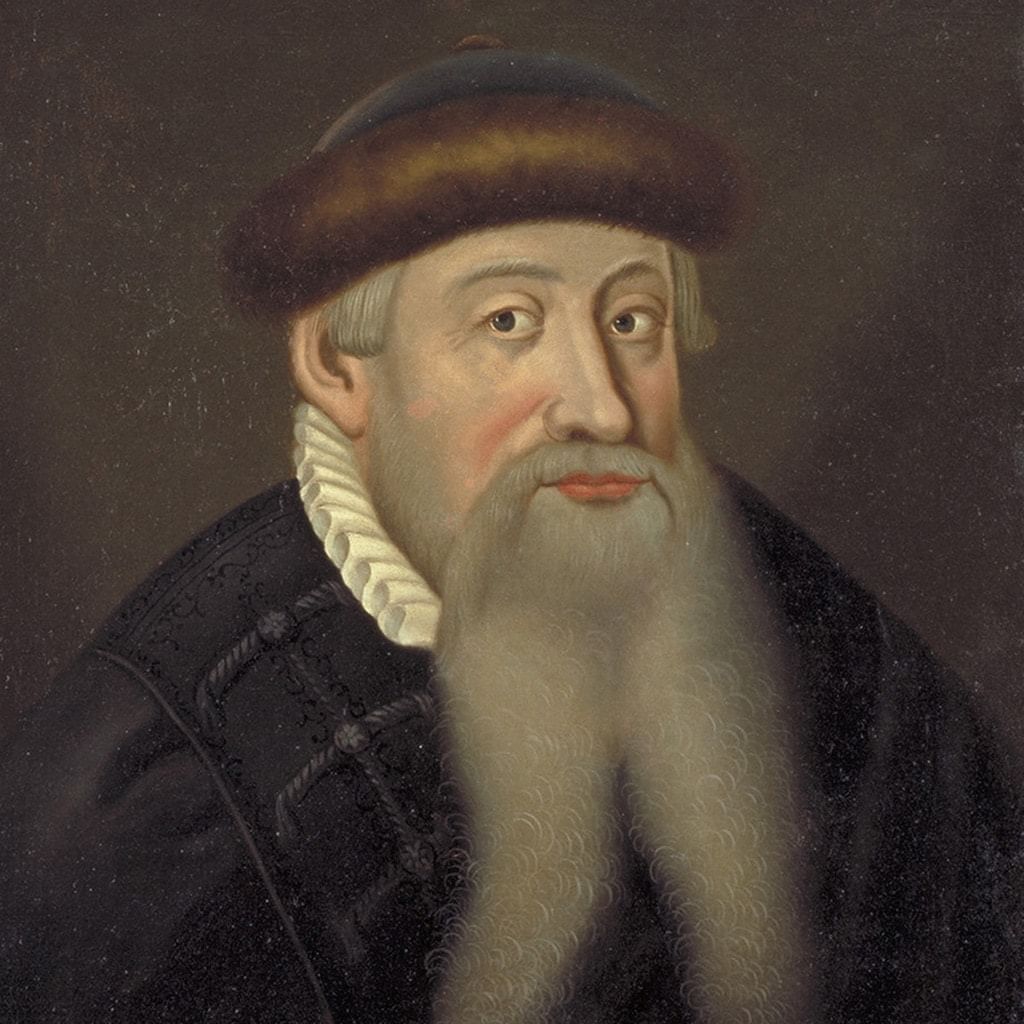
Q.6. Give a short sketch of Johann Gutenberg.
Ans. Johann Gutenberg was born in the town of Strassburg in Germany. He was the son of a merchant and brought up in a large agricultural estate. As an adolescent, he learnt how to polish precious stones, and became a skilled goldsmith as he grew up. He also became an expert at making lead moulds which ultimately led to his invention of the printing press. He used the lead moulds to cast the letters of the alphabets into metal types. His invention of the printing press brought about a revolution in the spread of books and book reading all over Europe. The first book he printed was the Bible and it took three years to print 180 copies. His invention brought about a revolution in print culture as there was a shift from hand printing to mechanical printing.
Johann Gutenberg
Q.7. Discuss the growth of printing presses in Europe from the 15th to the 16th century.
Ans. In 100 years (1450-1550), the print culture had spread from Germany to all over Europe. Printers from Germany travelled all over Europe looking for jobs. They set up presses in most European countries. By 1470, Rome, France and Holland had printing presses. In the second half of the 15th century, 20 million books were printed. By the end of the 16th century, there were 200 million printed copies flooding Europe.
Q.1. Give two examples of modern development associated with progress but which also led to problems.
Ans.
(i) Environment : The phenomenon called the global warming is a direct product of excessive emission of chlorofluorocarbons and other harmful gases, including burning of fossil fuels (coal, petrol, shale oil) which supply nearly 90% of all the energy used by industrially developed nations. This will cause large-scale natural destruction by rising oceans and pollution.
(ii) Nuclear weapons and diseases : Nuclear weapons are mankind’s worst invention in the name of progress, as witnessed in the atomic bombing of Hiroshima and Nagasaki Japan during the Second World War. Its after effects are even worse with long-term consequences of radiation and diseases.
Q.2. Explain why the seventeenth century merchants from towns in Europe began employing peasants and artisans within the village.
Ans. Merchants preferred employing peasants and artisans within the village because it was difficult to open new businesses in towns and cities where the guilds were very much organised. They restricted new merchants and regulated their competition. Therefore, they preferred the countryside to set up new businesses. The relationship between the new merchants and farmers were closer even though they lived in different environments.
Q.3. Describe the nexus of merchants and cotton textile producers in proto-industry.
Ans. In the proto-industrial stage, cotton was produced in the following ways: (i) Merchant clothier bought wool from stapler, the person who sorted wool according to its fibres. (ii) Then he took the wool to spinners to produce spun yarns. (iii) Yarn (threads) were finally given to the weavers for weaving and the fullers who gathered cloths by pleating and finally sent to dyers for colouring. As a result, a close relationship between town and countryside developed in which a network of commercial exchange existed between merchants and farmers.
Q.4. Give reasons for the increase in production of cotton textile.
Ans. Reasons for increase in cotton textiles were : (i) Inventions of eighteenth century, e.g. cotton mill by Richard Arkwright. (ii) Enhanced output per worker by machines like cotton mills. (iii) Quality products with stronger threads, etc. (iv) Maintenance of Mills made easier if located in one place. (v) Efficient management due to regulations.
Q.5. What do you understand by the term “Industrial Revolution”?
Ans. Industrial Revolution is the period in history when production process was changed from manual to mechanised one due to many technological inventions and building of infrastructure. It is said to have begun in England and spread to other European nations in different times and degrees. The invention of cotton mill or factory system, spinning jenny, steam engine, telegraphs and railways, etc, brought Industrial Revolution in Europe. It spread to other parts of the world much later.
Industrial Revolution
Q.6. Discuss the changes brought by the age of industries in India giving appropriate examples.
Ans. The age of industries brought major technological changes, growth of factories and the making of new industrial labour forces. Indian industries grew out of the necessities and as a consequence of the colonial economy. For example, Europeans who invested on cash crops (tea, jute, cotton) and minerals like coal, copper, etc, needed railways. Therefore, steam-run trains were introduced connecting different parts of India. Then, telegraphs were also introduced for communication and security reasons. During the war time, India benefited by getting some concessions and protection from the government. The industries also diversified in their products especially due to war needs.
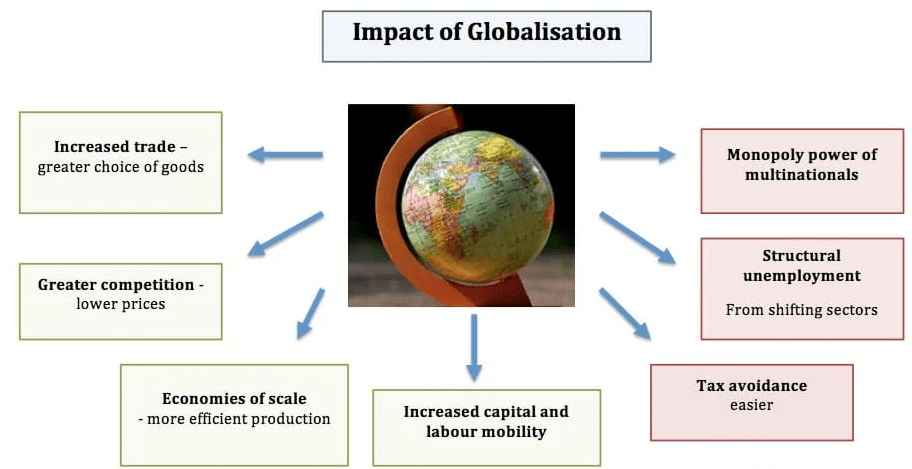
Ans. Globalisation is generally associated with economy as the free movement of capital, goods, technology, ideas and people across the globe. Globalisation in a broader sense also includes cultural exchanges between different countries of the world. In modern world, globalisation has acquired special significance due to development of Internet technology and tele-communication. Therefore, globalisation involves the following features:
(i) Economic freedom to trade internationally. (ii) Migration in search of employment and a better life. (iii) Cultural exchange like the spread of Buddhism and knowledge.
The interlinking of the world is a continuous process from the past. In the past, interlinking involved only a few travellers, traders, priests and pilgrims who travelled vast distances in search of knowledge, opportunity, spiritual fulfillments or to escape persecution. In modern days, interlinking is faster and involves more people. In other words, the world is shrinking in terms of communication and trade.
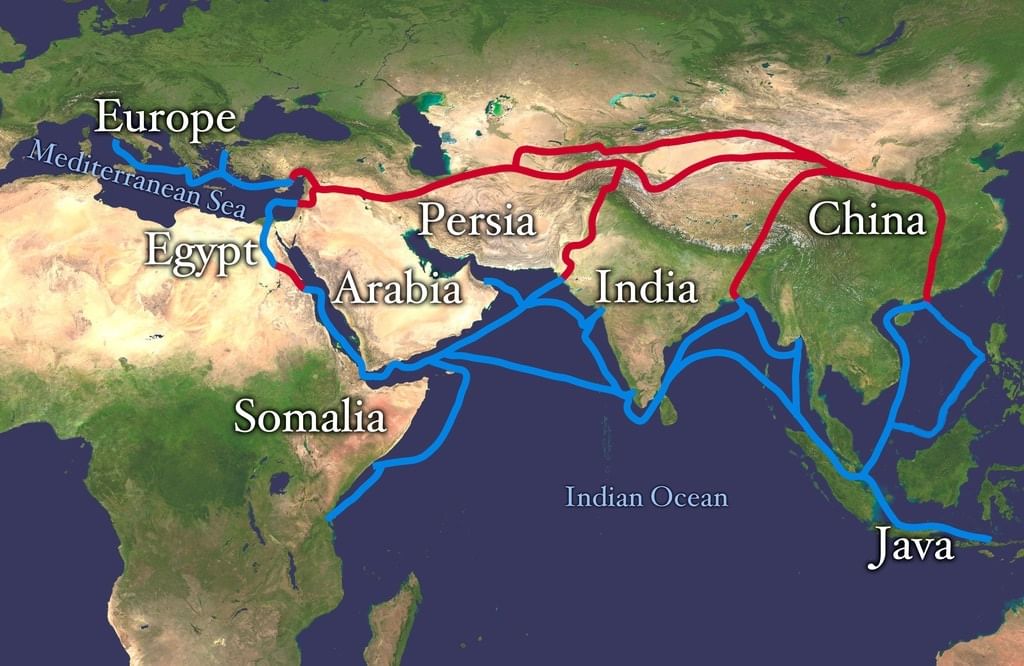
Q2. Trace the origin of Silk Route and its significance.
Ans. The Silk Route is one of the world’s oldest and historically most important trade route which affected the cultures of China, Central Asia and the West. It had many branches leading to different regions, including ancient India. It played an important role as a means of pre-modern trade and cultural exchange between different regions. The Romans learned about the Silk Route from the Parthians around 53 B.C.E. They used the word “Seres”or the silk people to refer to the Chinese. The modern word “Silk Route” was coined by a German scholar, Von Richthofen, in the nineteenth century. Silk was considered the most precious by the Romans even though it was only one of the many commodities that was traded between China and the world through this route.
The Silk Route
Q3. How is culture a great agent of globalisation? Explain with example.
Ans. Trade and cultural exchange went hand in hand. Religion was perhaps one of the most important commodities carried along the Silk Route. Buddhism reached China from India along the northern branch of the route. The Karakorum passes were used as a means to explore the faiths and scriptures by the missionaries. Art, literature and philosophical ideas were exchanged and in the process, it affected the cultures of different countries to which the route branched out. Even Christian missionaries travelled along the Silk Route to Asia, followed by Muslim preachers a few centuries later. The long rule of British in India also left an indelible western influence in different ways.
Q4. Explain how Europe was able to leap ahead of other continents by the 18th century.
Ans. Europe made a leap ahead of others due to scientific and revolutionary ideas rooted in different developments.
(i) Renaissance or rebirth of knowledge in which classical Greek and Roman art, architecture, literature were rediscovered.
(ii) The Industrial Revolution, leading to new inventions and technology.
(iii) Ideas and principles influenced by the American Revolution and French Revolution in the form of democracy, liberty, capitalism, nationalism etc.
Q5. Discuss why the Europeans were motivated to establish colonies.
Ans. Europe became the centre of world trade by the nineteenth century, mainly sustained by colonies. Colonisation of Americas were motivated more by the greed of wealth and search for a better life. On the other hand, colonisation of Asian and African countries was also motivated by conditions in Europe, caused by the Industrial Revolution and greed for economic and political dominance of the world.
Many factors motivated the Europeans to establish colonies:
(i) Some Europeans left for America seeking better life and some were dissenters (those who refuses to accept established beliefs and practices) and prisoners. (ii) The Industrial Revolution created the need for unlimited resources and cheap labour. They needed raw materials to feed the growing industries. They also needed markets for distribution.They needed colonies.
(iii) Missionary zeal of the Jesuits and nationalism inspired further exploration, conversion and territorial expansion.
Q6. Discuss one of the important causes and effects of the development of global agriculture.
Ans. Cause : The abolition of Corn Laws led to the import of cheap agricultural products in England. Unable to compete with imports, many left agricultural activities and flocked to the cities. This led to large scale migration of people to cities and overseas. This indirectly led to global agriculture and rapid urbanisation, a prerequisite of industrial growth. Countries like Eastern Europe, Russia, America and Australia increased their food productivity to meet the British needs and in the process, slowly became industrialised to different degrees.
Effects : Nearly 50 million people migrated from Europe to America and Australia in the nineteenth century. Another estimate was the migration of about 150 millions of the world population, mostly from Europe, who crossed the oceans for a better life. By the end of the nineteenth century, a global agricultural economy replaced the earlier self-sufficient economy. Industries and factories helped in a better flow of capital and technologies. Colonies were firmly established and they provided cheap raw materials and labour, who manned most of the railways in Southern Europe, Asia, Africa and the Caribbean.
Q7. What were the effects of colonialism on Indian agricultural export in the nineteenth century?
Ans. The effects of colonialism in Indian agriculture was the destruction of self-sufficiency in rural areas. Some of the important features are listed below:
(i) The traditional cotton handlooms and products could not compete with the industrial manufactured cotton textiles from Britain.
(ii) High tariff on Indian textiles and import taxes on Indian goods entering Britain severely affected Indian farmers.
(iii) Indigo plantation and other cash crops replaced food crops, leading to shortage of food, especially during famines, etc.
(iv) Moneylenders and landlords exploited farmers who were indebted to them and many became landless labourers.
Q8. Explain how the world was transformed after the World War (1914-1918).
Ans. The Great War transformed the world drastically with the adoption of a new mode of warfare based on modern weapons of mass destruction. They used machine guns, tanks, aircraft, chemical weapons, etc. on a mass scale. The number of deaths reached up to 9 million and of the injured reached upto 20 million at the end of the war. Most of the victims belonged to young generations or the workforce. As a result, it reduced the workforce in Europe, thereby reducing household income.
Economic transformation was in the form of shift in investment and capital distribution. The wartime situations encouraged production of war-related goods. Society also reorganised to meet wartime challenges, such as the increasing role played by women in areas previously predominated by men.
Politically, the war also brought new allies and new enemies between powerful countries. The war in Europe transformed the US from being an international debtor to international creditor. Russian revolution of 1917 also affected global relations when the first communist government was established under the leadership of Vladimir Lenin. Colonies changed hands while some new nations emerged.
Q9. What were the immediate effects of the World War on European agriculture?
Ans.
Europe paid a heavy price during and after the World War, especially in terms of economic status.
(i) America, Australia and Canada became main exporters of agricultural and manufactured goods during the war. For example, Eastern Europe was a major supplier of wheat products in pre-war time. Their production ceased during the wartime and Europe depended on wheat imports from USA, Canada and Australia.
(ii) There were shortage of food during the war as all form of production ceased during the war. The countryside were especially hit due to bad crops and ravages of war.
(iii) In Russia, the war expenses and death tolls at the front led to an uprising which became the Russian Revolution of 1917. It led to the foundation of Communism.
(iv) When the war ended, Eastern Europe revived its wheat production, leading to a glut in the economy. In other words, grain prices fell as a result of over-production or excess in supply. Rural incomes declined and farmers fell deeper into debts.
Q10. Trace the different stages of development of the assembly line production.
Ans. Henry Ford, the pioneer of the assembly line production, was inspired by the assembly line of a Chicago slaughter house which he adapted to his new car plant in Detroit. Accordingly, the workers were forced to repeat a single task mechanically and continuously, standing in front of a conveyer belt with no respite or break to delay the motions. As a result, Ford cars came out of the assembly line at three minute intervals, much faster than any other methods. The TModel Ford was the world’s first mass-produced car.
The stress and the pressure of working monotonous led many workers to quit their jobs. Henry Ford doubled the daily wages to five dollars in January 1914. He banned trade unions from operating in his plants. He was able to recover his wages by repeatedly speeding up the production line and forcing the workers to work even harder.
Q11. Who profits from jute cultivation according to the jute growers’ lament? Explain.
Ans. The impact of the Great Depression in India was felt especially in the agricultural sector.
(i) It was evident that Indian economy was closely becoming integrated to global economy. India was a British colony and it exported agricultural goods and imported manufactured goods. The depression affected the Indian trade as India’s exports and imports declined extensively between 1928 and 1934. As international prices fell, prices in India also fell.
(ii) The jute growers of Bengal lamented that the traders sitting at home benefited from growing jute while the peasants suffered from rising cost of production and debts. Despite the falling prices of agricultural goods, the colonial power refused to reduce the revenue demands in cash. Peasants and farmers involved in cash crops were worst hit.
(iii) The urban salaried class and the landlords benefited from the falling prices of agricultural products and the value of rent increased. Large scale migration from villages to towns and cities also affected the urban life-styles.
Q12. Write down important causes and effects of the Second World War.
Ans. The Second World War started in 1939 and continued up to 1945. The two warring camps were : (i) The Allies consisting of Britain, France, Russia and the USA. (ii) The Axis powers consisting of Germany, Japan and Italy.
Causes :
Many factors caused the Second World War. The Great Depression of 1929, failure of the League of Nations, rise of dictatorship in Germany and Italy under the Nazis and Mussolini respectively were some of the important causes.
Effects :
(i) About 3 per cent of the world’s population perished. (ii) Two crucial developments shaped the post-war scenario. They were:
(a) The emergence of USA and the USSR as superpowers. At least 6 million people died, millions more were injured. Most of the deaths took place outside the battlefields. More civilians than fighting soldiers died. Vast parts of Europe and Asia were devastated and several cities destroyed by aerial bombings. It caused enormous economic devastation and social disruption. Reconstruction was long and difficult.
(b) The establishment of international organisations like the UNO and others to maintain peace and stability.
Q13. Discuss some important features of the International Monetary Fund and the World Bank.
Ans.
Role : The IMF was to deal with external surpluses and deficits of its member nations. The World Bank was an international bank for reconstruction and development aimed to finance the post-war reconstruction.
The IMF and the World Bank commenced financial operations in 1947.
Features :
(i) The western powers and especially the USA controlled the decision-making provisions such as the right to veto. (ii) The international monetary system was to link national currencies and monetary system. (iii) The Bretton Woods system was based on a fixed exchange rate whereby national currencies were pegged to the American dollar at a fixed rate. The dollar was anchored to gold at a fixed price of $35 per ounce of gold.
Q14. Explain the impact of the Great Depression on the Indian economy. Or Explain the impact of the Great Depression on Indian farmers in the early twentieth century. Ans. (i) Impact on trade: The depression immediately affected Indian trade. India’s exports and imports nearly halved between 1928 and 1934. As international prices crashed, prices in India plunged. Between 1928 and 1934 wheat prices in India fell by about 50 per cent. (ii) Impact on farmers: The fall in prices had a deep impact on the poor farmers. Though agricultural prices fell sharply, but the colonial government refused to give any relief to the farmers in taxes. Peasants producing tor the world market were the worst hit.
(iii) Impact on Urban India: The depression proved less grim for urban India. Because of falling prices those with fixed income- say town-dwelling landowners, who received rents and middle-class salaried employees now found themselves better off. Every thing low cost. (iv) High Industrial investment: Industrial investment also grew as the government extended tariff protection to industries, under the pressure of nationalist opinion. (v) Political Impact: The Great Depression paved way for Gandhiji to launch the Civil Disobedience movement.
Q15. What is meant by the Bretton Woods Agreement Explain. Ans. The Bretton Woods Conference took place in the July of 1944 at Bretton Woods in New Hamsphire, USA. Under this system, the International Monetary Fund (IMP) and the International Bank for Reconstruction and Development (IBRD) were established. The main terms of this agreement were: (i) Formation of IMF and IBRD (also called the World Bank). (ii) To establish monetary cooperation amongst the member countries. (iii) Adjustable peg foreign exchange rates system was followed, i. the exchange rates were fixed, with the provision of changing them if necessary. Currencies were required to be convertible for trade related and other current account transactions. The governments, however, had the power to regulate capital flows. (iv) All member countries were required to subscribe to the IMF’s capital.
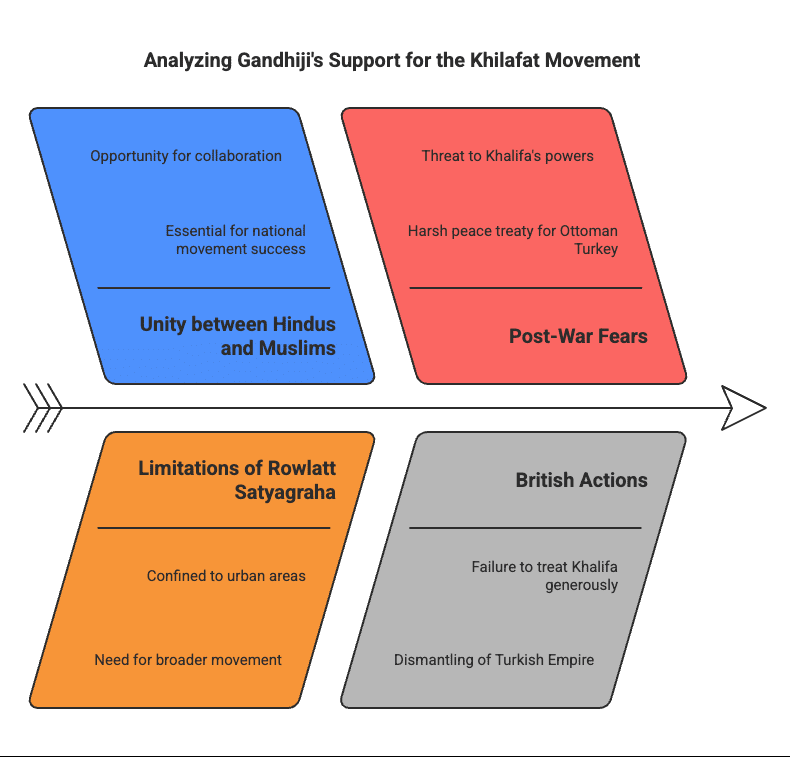
Q1. What what the main issue behind the Khilafat Movement? Why did Gandhiji support this?
Ans: Gandhiji’s support for the Khilafat Movement was driven by his desire to broaden his Satyagraha movement. He believed that unity between Hindus and Muslims was essential for a successful national movement. The Khilafat issue presented an opportunity for this unity.
Background of the Khilafat Issue:
The First World War severely weakened the Ottoman Empire in Turkey.
The British had promised to treat the Khalifa, the spiritual leader of Muslims, generously but failed to fulfil this promise.
By 1920, the British had dismantled the Turkish Empire completely.
Gandhiji’s support for the Khilafat Movement helped to strengthen it. The reasons for his support included:
The limitations of the Rowlatt Satyagraha, which was largely confined to urban areas, highlighted the need for a broader movement.
Gandhiji aimed to unite Hindus and Muslims, believing their collaboration would enhance the nationalist movement.
After the war, there were fears of a harsh peace treaty for Ottoman Turkey, threatening the Khalifa’s powers.
Q2. Why did Gandhi choose “Non-Cooperation” as a method of fighting colonial rule? Explain his method.
Ans: The Non-Cooperation movement was initiated in 1920 and lasted for two years. Gandhi’s core idea was that the British ruled India because the people cooperated with them. He believed that if Indians stopped cooperating, British rule would collapse, paving the way for Swaraj (self-rule).
The movement unfolded in several stages:
Surrender of Titles: Indians were to give up all titles and honours granted by the British.
Boycott of Government Services: This included civil services, police, and the army.
Boycott of Courts and Legislative Councils: Indians refused to participate in judicial and legislative functions under British rule.
Civil Disobedience: If the government repressed the movement, a full civil disobedience campaign would be launched.
Q3. Explain the term “Swaraj” and its changed meaning in this period.
Ans: Swaraj means “self-rule” or “self-governance.” Its meaning evolved during the Indian freedom struggle:
Original Meaning: Initially, Swaraj referred to political independence from British rule.
Broader Meaning:Different groups interpreted Swaraj in various ways:
For peasants, it meant lower taxes and fair treatment from landlords.
For workers, it signified better pay and working conditions.
For businessmen, it represented freedom from British economic control and opportunities for growth.
Symbol of Freedom: Swaraj came to symbolise liberation from all forms of oppression, including social and economic injustices.
Unity and Identity: It united various groups across India with a common goal, fostering a sense of national identity despite differing needs.
Overall, Swaraj transformed from a political demand into a broader concept encompassing the hopes and aspirations of many Indians.
Q4. Why did different social groups join the Non-Cooperation Movement?
Ans: Different social groups joined the Non-Cooperation Movement for various reasons, each reflecting their unique struggles:
Middle Class in Cities: Inspired by the call for Swaraj and discontent with British rule. Students left schools, teachers resigned, and lawyers stopped working, boycotting foreign goods and government services.
Peasants: Frustrated with high taxes and unfair land practices. Organised protests against landlords and refused to pay taxes.
Tribal Groups: Anger over restrictions on accessing forests for traditional activities. Some resorted to violence to protest these restrictions.
Workers: Faced low wages and poor working conditions. Boycotted foreign goods and organised strikes.
Business Class: Wanted fewer restrictions on businesses and opposed British economic policies. Funded the movement and refused to trade in British goods.
Economic Effects: The import of foreign cloth halved from Rs 102 crore to Rs 57 crore between 1921 and 1922. Increased demand for Indian textiles as foreign cloth was boycotted.Khadi was often more expensive than mass-produced cloth, making it hard for the poor to afford. Many students and workers returned to British-run institutions due to a lack of alternatives.
Q5. Why were the hill people of Andhra aggrieved by colonial rule?
Ans: The hill people of Andhra Pradesh, particularly in the Gudem Hills, were deeply aggrieved by colonial rule due to several oppressive policies imposed by the British:
Restrictions on Forest Access: The colonial government limited their access to forests, which hindered essential activities like grazing cattle, collecting firewood, and gathering fruits. This loss of traditional rights led to widespread discontent.
Forced Labour (Begar): The British compelled the hill people to provide unpaid labour for road construction.
Features of the Gudem Rebellion:
Militant Guerrilla Movement: The Gudem rebellion was a militant guerrilla movement against the British, employing hit-and-run tactics to attack police stations and government officials.
Leadership of Alluri Sitaram Raju: The rebellion was led by Alluri Sitaram Raju, a charismatic figure who claimed to have special powers, such as making accurate predictions and surviving bullet wounds. .
Inspiration from Non-Cooperation Movement: Although the rebellion involved armed struggle, it was inspired by Mahatma Gandhi’s Non-Cooperation Movement.
Repression by the British: The British responded with severe repression, deploying military forces to suppress the rebellion.
Unity for Freedom
Q6. What is the importance of the Non-Cooperation Movement in India’s struggle for independence?
Ans: The Non-Cooperation Movement (NCM) marked the first all-India mass struggle against British rule and significantly transformed the national movement. It mobilized peasants, students, women, and the working class, bringing them into the fight for independence. The Indian National Congress (INC) evolved into a mass organization, shedding its elitist image. Fear of British rule diminished as people witnessed the British struggle against Gandhiji’s leadership, emboldening Indians nationwide.
Women’s active participation in the movement also advanced social change. The movement introduced new methods like boycotts, resignations, and peaceful arrests while spreadingnationalism to both urban and rural areas. Gandhiji’s call for Swaraj, defined as self-rule, inspired hope, transforming despair into excitement for freedom. The NCM unified Indians across regions, fostering a sense of pride and determination to end British rule.
Q7. How did the different social groups that participated in the Civil Disobedience Movement look at it? What was their attitude towards its aim?
Ans: Different social groups had varying perspectives on the Civil Disobedience Movement and its aims:
Rich Peasants: Communities like the Patidars of Gujarat and the Jats of Uttar Pradesh were heavily affected by the trade depression and falling prices.
Poor Peasants: Small tenants, who rented land from landlords, participated because they could not pay their rent due to the ongoing economic depression.
Merchants and Industrialists: This group protested against colonial policies that hindered their businesses. T
Industrial Workers: Workers joined the movement to advocate for better wages and working conditions.
Despite their initial enthusiasm, all four groups faced disappointment: They lost interest when the movement was suspended in 1931 without any changes to revenue rates, leading many to abstain from the resumed movement in 1932. They felt let down as the Congress did not support their ‘no rent’ campaigns. They grew disillusioned with the rise of militant activities and the increasing socialist influence within the Congress, which did not align with their business interests.
Q8. Compare the image of Bharat Mata with the image of Germania. Do you find any similarities? Why do you think these images of Bharat Mata will not appeal to all castes and communities?
Ans: Bharat Mata
The image of Bharat Mata was created by Abanindranath Tagore and represents India.
She is depicted as an ascetic figure, symbolising calmness, spirituality, and divinity.
In various portrayals, she embodies learning, food, and clothing, with a mala that highlights her aesthetic quality.
Some images include symbols of power such as a trishul, lion, and elephant.
Germania
The image of Germania was painted by Philip Veit, representing Germany.
Initially depicted holding a sword in a feminine manner, she later was redrawn by Lorenz Clasen, wielding a sword and shield.
Germania embodies the strength of the German Empire.
While both images serve as national symbols, they may not appeal to all castes and communities due to:
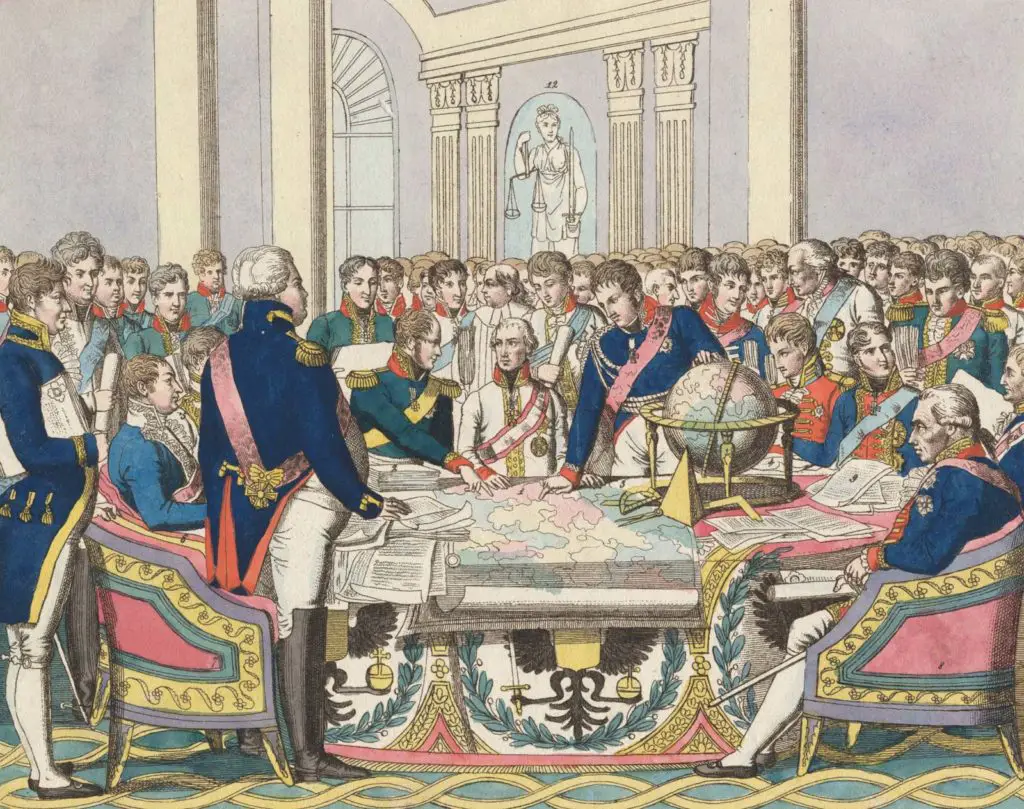
Q1: How did the French territory change due to the Treaty of Vienna in 1815? Ans: Representatives of European powers, i.e. Austria, Britain, Russia and Prussia, met at Vienna in 1815 after having defeated Napoleon. The Austrian Chancellor Duke Metternich was the head of the Congress. Here the Treaty of Vienna of 1815 was drawn to undo the changes after the Napoleonic wars.
Thus the Bourbon dynasty, deposed during the French Revolution, was put back in power even as France lost the territories it had annexed under Napoleon.
To prevent every future expansion of France, many states were set up on France’s boundaries. So the kingdom of Netherlands including Belgium came up in the north, while Genoa came together with Piedmont in the south.
Prussia received some important new territories on its western frontiers.
Austria gained control of northern Italy.
The 39 states in the German Confederation as set up by Napoleon did not change. In the east, Russia received a part of Poland and Prussia received a part of Saxony.
The objective was to restore the monarchies overthrown by Napoleon and create a new conservative order in Europe.
Q2: Discuss the lives of the aristocrats and the new middle class in the 19th century Europe. Ans: In the 19th-century Europe, the landed aristocracy dominated all social and political spheres. They were united by a common lifestyle. They owned huge estates in the countryside and some had large townhouses too. Their spoken language was French, both in high society and in diplomatic circles. Most of the aristocratic families were connected by marriage. The aristocrats formed a small group but held a lot of power. Peasantry comprised the larger group of the population. To the west, most of the land was farmed by small owners and tenants. In eastern and central Europe, the pattern of landholding was characterized by vast estates cultivated by the serfs. In the western and some parts of central Europe industrial production and trade was on the rise and with them towns grew and the commercial classes emerged. Their existence was based on the production for the market. Industrialization took birth in England in the 1850s but France and Germany experienced it only during the 19th century. This caused the emergence of new social groups — working class and middle class. The latter comprised industrialists, businessmen and professionals. These groups were not many in central and eastern Europe. So it was the liberal, educated middle class which encouraged national unity after aristocratic privileges were abolished.
Q3: What views did the conservatives hold? Ans: Napoleon was defeated in 1815 and soon European governments adopted the idea of conservatism. The conservatives held the belief that established traditional institutions of state and society like monarchy, church, social hierarchies, property and family must be protected and preserved. They never proposed a pre-revolutionary period to return to but they knew that as Napoleon had carried out changes, modernization would in fact contribute to a strong monarchy. They believed that it would strengthen the power of the state and make it much more effective. For them it was a firm belief that aristocratic monarchies of Europe would gain much from a modern army, an efficient bureaucracy, a dynamic economy, the abolition of feudalism and serfdom.
Q4: Friedrich List, Professor of Economics at the University of Tubingen in Germany, wrote in 1834. “The aim of the Zollverein is to bind the Germans economically into a nation. It will strengthen the nation materially as much by protecting its interests externally as by stimulating its internal productivity. It ought to awaken and raise national sentiment through a fusion of individual and provincial interests. The German people have realized that a free economic system is the only means to engender national feelings.” Read the statement by Professor List and discuss what political ends he hoped, would be achieved by economic measures. Ans: Professor List was sure that economic measures could result in certain political ends: (a) A national economy binds the nation together. For example, Zollverein abolished tariff barriers. It also reduced the currencies from thirty to two. This economic union was joined by most of the German states and brought them together and created a national feeling. (b) It also promoted internal productivity, for example, to help trade growth, a network of railways was needed for increased mobility. This also brought people together. (c) Economic measures like the Zollverein also protected nation’s external interests (the use of common currency and abolishing of tariffs). This fusion of individual and provincial interests aroused national sentiments in people.
Q5: The French philosopher Ernst Renan (1823-92) outlined his understanding of a nation in the following way: “A nation is the result of a long past of endeavors, sacrifice and devotion. A heroic past, great men, glory, that is the social capital upon which one bases a national idea. To have common glories in the past, to have a common will in the present, to have performed great deeds together, to wish to perform still more, these are the essential conditions of being a people. A nation is, therefore, large-scale solidarity … Its existence is a daily plebiscite … A province is its inhabitants; if anyone has the right to be consulted, it is the inhabitants. A nation never has any real interest in annexing or holding on to a country against its will. The existence of nations is a good thing, a necessity even. Their existence is a guarantee of liberty, which would be lost if the world had only one law and only one master.” (a) What, according to Renan, are the attributes of a nation? (b) Why does he think nations are important? (c) How is his idea different from others? Do you agree with him? Ans: (a) According to Renan, a nation must have people who have shared “a glorious past,” and have a desire, a will to perform deeds together for the glory of the country in the present and in the future also. There is solidarity. They belong to the nation and have to be consulted on any issue, they exercise their rights daily. A nation does not want to grab territories, it does not want to conquer any country or dominate it against the will of the people. (b) A nation is necessary because it guarantees freedom to every citizen. This liberty (individual) would be lost, if there was a uniform law for everyone and only one ruler. (c) He differs from others as he does not believe that a nation speaks the same language, follow the same religion, belongs to the same race and occupies the same territory. I agree with him. India is a nation made of different races, different religions, we speak different languages, follow different cultures. Yet, we have unity in diversity as we have a common past and a desire to live together.
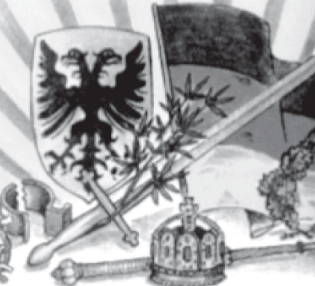
Q6: What is the significance of the symbols given in this picture? Ans: Each symbol has meaning and significance. (a) The broken chains represent freedom, freedom from slavery. (b) The breastplate with an eagle on it represents the German Empire and its strength (the eagle is a strong bird). (c) The tricolour — black, red and gold — was the flag of liberal nationalists in 1848. It was banned by Dukes of the German states. A flag always unites people and arouses national feelings. (d) The sword symbolises a readiness to fight. The German nation was ever ready to fight for its honour. (e) The crown of oak leaves stands for courage, bravery and heroism. (f) The olive branches around the sword show that Germans are as eager for peace as they are eager to fight. (g) The rays of the rising sun symbolizes the beginning of a new era as a united German nation.
Q7: Read the two opinions about the role of women in society: 1. Carl Welcker: A liberal politician member of the Frankfurt Parliament: ‘Nature has created men and women to cany out different functions … Man, the stronger, the bolder and peer of the two, has been designated as protector of the family, its provider, meant for public tasks in the domain of law, production, defence. Woman, the weaker, dependent and timid, requires the protection of man. Her sphere is the home, the care of the children, the nurturing of the family … Do we require any father proof that given such differences, equality’ between the sexes would only endanger harmony and destroy the dignity of the family?’ 2. Louise Otto Peters, a political activist, wrote in a journal (21 April, JS4Q): ‘Let us ask how many men, possessed by thoughts of Iriing and dying for the sake of Liberty, would be prepared to fight for the freedom of the entire people, of all human beings? When asked this question, they would all too easily respond with a “Yes”, though their untiring efforts are intended for the benefit of only one half of humanity— men. But Liberty is mdnisible’ Free men therefore must not tolerate to be surrounded by the unfree.
(a) What according to Carl Welcker is a woman’s function? Does he think women should be given equality and liberty? (b) Louise Otto Peters asks a question in his article. What is the significance of his question? How does he define liberty? Ans: (a) A woman, according to Carl Welcker, is weak, timid and needs the protection of the strong, bold, free man. He confines the woman to the kitchen, home and children. He does not support equality and liberty for women. A woman must remain subservient to a man. (b) Louise Otto Peters is certainly a feminist. Does he want to know whether men are prepared to fight for “freedom of the entire people, all human beings”? His question is significant because though the men will unanimously answer “yes” but they are not ready to grant this freedom to women, who constitute half the population of the world. For him Liberty is indivisible, it cannot be given to some and not to others. He certainly holds a totally different view from Carl Welcker, who is a male chauvinist!
Q8: How was the history of nationalism in Britain, unlike the rest of Europe?
OR How was the formation of the nation-state the result of a long drawn-out process in Britain? Explain. Ans: In Britain, the formation of the nation-state was not the result of a sudden upheaval or revolution. It was the result of a long-drawn-out process. There was no British nation prior to the eighteenth century. All the ethnic groups had their own cultural and political traditions. But as the English nation steadily grew in wealth, importance and power, it extended influence over other nations of the island. The English parliament, which had seized power from the monarchy in 1688 at the end of a protracted conflict, was the instrument through which a nation-state, with England at its centre, came to be forged. The Act of Union (1707) between England and Scotland that resulted in the formation of the ‘United Kingdom of Great Britain’ meant, in effect, that England was able to impose its influence on Scotland. The British parliament was henceforth dominated by its English members. The growth of a British identity meant that Scotland’s distinctive culture and political institutions were systematically suppressed. Ireland suffered a similar fate. It was a country deeply divided between Catholics and Protestants. The English helped the Protestants of Ireland to establish their dominance over a largely Catholic country. Catholic revolts against the British dominance were suppressed.
Q9: Analyse the measures and practices introduced by the French revolutionaries to create a sense of collective identity amongst the French people. Ans: The measures and practices introduced by the French revolutionaries to create a sense of collective identity among the French people were as follows.
The idea of la patrie (the fatherland) and le citoyen (the citizen) emphasised the idea of united people enjoying equal rights under a constitution.
A new French flag, the tricolour, was chosen to replace the former royal standard.
The Estates General was elected by the active citizens and renamed the National Assembly.
New hymns were composed, oaths taken and martyrs commemorated in the name of nation.
Regional dialects were discouraged and French, as it was spoken and written in Paris, became the common language of the nation.
A centralised administrative system was put in practice and it formulated uniform laws for all citizens within its territory.
Internal customs duties and dues were abolished and a uniform system of weights and measures was adopted.
Q10: ‘Nationalism no longer retained its idealistic liberal democratic sentiments by the last quarter of the 19th century in Europe’. Analyse the statement with examples. Ans:
Towards the end of the 19th century, nationalism became a narrow belief with inadequate ends.
This period saw nationalist groups becoming increasingly prejudiced against each other and ready to wage a war at the slightest pretext.
Nationalism was now identified with increasing one’s sphere of influence, by establishing control over more territories. Balkan states became jealous of each other and entered into a conflict to establish more control and power in the region at the cost of others.
The chief European authorities saw this as an opportunity and manipulated the nationalist desires of the subject peoples.
European powers were keen on countering the hold of other powers over the Balkans. They did nothing serious to solve the Balkan issue but rather watched the situation to turn fruitful for them.The most severe tensions emerge after 1871, leading to a series of wars and ultimately led to the First World War in 1914.