5. Print Culture and the Modern World – Short Answer Questions

Q1. Why was China a major producer of printed material for a long time?

Ans: China was a major producer of printed material due to several key factors:

  • To support candidates, a large number of textbooks were printed, sponsored by the imperial state.
  • From the 16th century onwards, the number of examination candidates increased, leading to a surge in printed materials.
  • By the 17th century, as urban culture flourished, print became more diverse, reaching beyond scholar-officials to include merchants and leisure readers.
  • New genres emerged, such as fiction, poetry, and autobiographies, attracting a wider audience, including women.

Q2. Who were the people who employed scribes to write in the 14th century?

Ans: In the 14th century, the following groups employed scribes to write:

  • Wealthy individuals – The rich could afford the high costs of handwritten books.
  • Aristocrats – Nobility often commissioned scribes for their literary needs.
  • The Church – Religious institutions required scribes for manuscripts.

However, the production of manuscripts was slow and costly, leading to a shift towards woodblock printing, which made books more accessible.

Medieval Scribe

Q2. State the limitations of handwritten books. OR Why were Manuscripts not used widely in everyday life before the age of print in India?

Ans: Limitations of Handwritten Books

  • Costly and time-consuming to produce.
  • Copying manuscripts was expensive and required a lot of effort.
  • Manuscripts were fragile and could easily be damaged.
  • Their size and weight made them cumbersome to transport.
  • Limited circulation meant they were often unaffordable for the middle class.

Q3. Write a short note on the developments or innovations in printing technology in the 19th century. 
OR 
Give three methods by which printed books became more accessible to people. OR Describe the development of the printing press after Gutenberg.

Ans: In the 19th century, several significant innovations in printing technology emerged:

  • Richard M. Hoe from New York developed the power-driven cylindrical press, which could print 8,000 sheets per hour. This was particularly beneficial for newspaper printing.
  • The late 19th century saw the introduction of the offset press, capable of printing up to six colours simultaneously.
  • By the early 20th century, electrically-operated presses further increased printing speeds.
  • Improvements included better paper feeding methods, enhanced plate quality, and the introduction of automatic paper reels and photoelectric controls for colour registration.

Q4. Write a short note on how the printing press came to India.

Ans: The printing press was introduced to India by Jesuit missionaries in the mid-sixteenth century. Key developments include:

  • Jesuit priests arrived in Goa, where they learned Konkani and printed various tracts.
  • By 1674, around 50 books were printed in Konkani and Kanarese languages.
  • The first book in Tamil was published in 1579 at Cochin by Catholic priests.
  • In 1713, the first book in Malayalam was printed.
  • By 1710, Dutch Protestant missionaries had printed 72 Tamil books, mostly translations.
  • By the end of the 18th century, newspapers began to emerge in various Indian languages.

Q5. What were the difficulties faced by manuscripts in India?

Ans: Manuscripts in India faced several difficulties, including:

  • High Cost: Handwritten books were expensive to produce.
  • Fragility: Manuscripts were delicate and required careful handling.
  • Limited Accessibility: Their size and weight made them hard to carry and read.
  • Complex Scripts: Varied writing styles complicated reading.
  • Teaching Methods: Students often learned by writing down texts dictated from memory, rather than reading them.

Q6. Explain the terms Ulema and Fatwas.

Ans: Ulema: These are the scholars of Islam who specialise in Sharia, the body of Islamic law. They are learned individuals and are recognised as experts in religious matters.

Fatwa: This is a religious edict issued by a qualified authority, known as a Mufti. A fatwa clarifies specific points about Islam or provides guidance on how Muslims should act in particular situations.

Q7. Who were the dissenters? Why did they object to women being educated?

Ans: There were dissenters among both Hindus and Muslims regarding women’s education:

  • Many Hindus held the superstitious belief that educating women would lead to their widowhood.
  • Muslims feared that women would be corrupted by reading Urdu romances.

Q8. What was the role of cartoons and caricatures in new forms of publications?

Ans: By the 1870s, cartoons and caricatures were common in journals and newspapers, addressing social and political issues. Their roles included:

  • Critiquing the educated Indians’ fascination with Western styles and customs.
  • Expressing fears regarding social change.
  • Mocking the behaviour of imperial rulers and their attitudes.
  • Nationalists also used caricatures to criticise imperial rule.

This form of art sparked public debate and encouraged people to reflect on societal norms and the role of imperialism.
4. The Age of Industrialisation – Short Answer Questions

Q1. What factors were responsible for increasing demand for goods? Give an example.

Ans: The demand for goods increased due to several key factors:

  • Expansion of trade: The growth of international trade networks allowed for a greater exchange of goods.
  • Acquisition of colonies: European powers established colonies, providing new resources and markets.
  • Increased production: As colonies were developed, they contributed to a rise in the volume of trade.

For example, during the eighteenth century, the establishment of colonies enabled Europeans to access more resources, which significantly boosted trade.

Q2. What were the first symbols of industrialisation?

Ans: Cotton and metal production, particularly iron and steel, were the first symbols of industrialisation. Key points include:

  • Factories in England began emerging in the 1730s.
  • The number of factories steadily increased over time.
  • Production processes evolved to include cardingtwistingspinning, and rolling.

Q3. Write a short note on trade guilds.

Ans: Trade guilds were associations of producers that played a significant role in regulating various trades. They had several key functions:

  • Trained craftspeople and artists in their respective trades.
  • Controlled production by managing competition and setting prices.
  • Restricted the entry of new individuals into the trade.
  • Were often granted the exclusive right to produce certain goods by their rulers.

As a result, these guilds made it challenging for new merchants to establish businesses in towns.

Q4. What other sectors of production benefited from ordinary inventions?

Ans: Cotton and metal industries were powered by steam, but many ordinary inventions also aided various non-mechanised sectors. These sectors include:

  • Food processing
  • Building
  • Pottery
  • Glasswork
  • Tanning
  • Furniture-making
  • Production of implements

These innovations significantly improved efficiency and productivity across these industries.

Q5. What is the most recent views regarding industrial revolution of the eighteenth and mid-nineteenth centuries?

Ans: Modern historians now acknowledge the significant role of traditional craftspersons and labourers during the mid-nineteenth century. Key points include:

  • Technological changes were slow and costly, limiting their effectiveness.
  • Merchants and manufacturers were cautious about adopting new technologies due to concerns over cost and maintenance.
  • By the mid-nineteenth century, most workers were not machine operators but rather skilled craftspersons.

This recognition highlights the complexity of the industrial revolution and the importance of human labour in this transformative period.

Q6. Write a short note on the condition of a labour’s life in Victorian Britain.

Ans: In Victorian Britain, the life of labourers was challenging due to several factors:

  • Many poor peasants and vagrants migrated to cities seeking work.
  • This influx led to low wages as the supply of labour exceeded demand.
  • Workers were often exploited by industrialists, who preferred to hire seasonal labour.
  • Industries like gas works and breweries required more workers during peak seasons, leading to temporary employment.
  • Despite some wage increases, the real value of earnings often declined due to rising prices.
  • During economic slumps, unemployment rates could reach as high as 75% in certain areas.

The overall condition of labourers reflected a struggle for survival amidst economic challenges.

Q7. Explain why machines did not necessarily affect the employment of labours.

Ans: Machines required large capital investments. Their introduction did not immediately change traditional production methods. Key reasons include:

  • The need for machines depended on the availability of labour.
  • In areas with abundant labour, wages remained low.
  • Many industries preferred hand labour due to its flexibility and lower costs.

Q8. What were the limits of machine-made products?

Ans: Machines had several limitations when it came to production:

  • They could only create uniform, standardised products.
  • Machines were designed for mass markets, not for unique items.
  • Many consumers preferred goods with intricate designs and specific shapes.
  • In mid-nineteenth-century Britain, for example, a large variety of tools required human skill rather than mechanical technology.

Q9. Who invented the Spinning Jenny? How did it work?

Ans: The Spinning Jenny was invented by James Hargreaves in 1764. This innovative machine:

  • Increased the speed of the spinning process.
  • Reduced the amount of labour needed.
  • Allowed one worker to operate multiple spindles simultaneously.
  • Enabled the spinning of several threads of yarn with a single turn of the wheel.

Q10. What is the monopoly of trade?

Ans: Monopoly of trade refers to a situation where a country establishes control over trade, effectively eliminating competition.

  • This allows the country to manage costs efficiently.
  • It ensures a steady supply of goods in the market.
  • For instance, British colonisers monopolised products like silk and cotton in India.

Q11. How did the Indian weavers react to the monopoly of cotton production?

Ans: Indian weavers reacted strongly to the monopoly of cotton production. Their responses included:

  • Increased reliance on income from raw cotton sales, which reduced their independence and bargaining power.
  • Many weavers in Carnatic and Bengal deserted their villages and migrated.
  • Some joined local traders in revolting against Company officials.
  • Over time, many weavers refused loans, closed their workshops, and turned to agricultural labour.

Q12. Discuss the impact of the Indian national movement on Indian entrepreneurs.

Ans: During the Indian national movement in the early twentieth century:

  • Swadeshi activists boycotted and burned foreign goods.
  • Indigenous industrialists organised to demand tariff protection and government grants.
  • During wartime, Indian industries diversified into products like war goods, steel, and iron.
  • As British mills focused on war production, imports into India declined, creating a vast home market.
  • Indian factories supplied various war needs, leading to the establishment of new factories.

3. The Making of a Global World – Short Answer Questions

Q1. What role did the silk route play between the Chinese and the Romans?
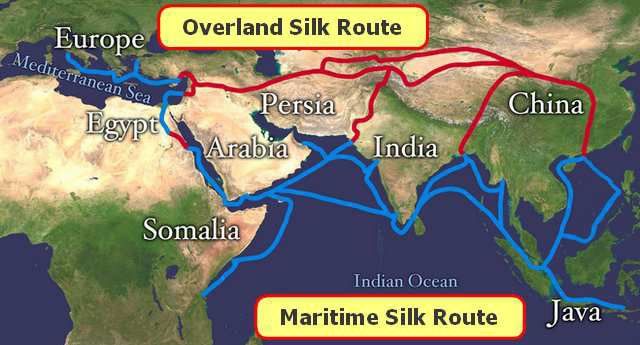
Ans. The Romans learned about the silk route from the Parthians around 53 B.C.E. They used the word “Seres” or the silk people to refer to the Chinese.  Although there is no direct evidence of Roman merchants or Chinese traders in each other’s civilizations, silk was highly prized in Rome, and Roman items were also popular in China.

Silk Route

Q2. Explain how food habits are good indicators of globalization.
Ans. The exchange of food crops and habits between different regions and their adoption by different societies was a good indicator of globalization.
Example: The Europeans benefited from the introduction of potatoes with good nutrients and health. Thousands perished in the 1840s during the Irish Potato Famine.


Q3. Describe in a few words how Europe changed at the end of the eighteenth century. 
Ans. By the end of the 1700s, new scientific and revolutionary ideas changed how Europeans thought and acted. The Industrial Revolution started in England and spread to other European countries. The Reformation, led by Martin Luther, boosted capitalism and scientific thinking

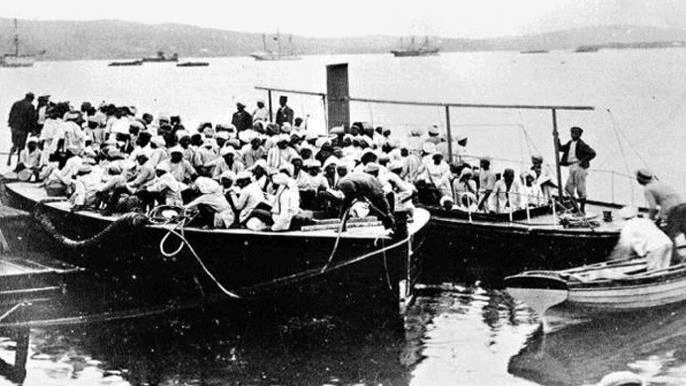
Q4. Who were the indentured labourers? Which states of India produced the largest number of indentured labour? 
Ans. Indentured labourers were bonded labourers who were transferable to any country on contract for a specific amount of wage and time. Most of the labourers were from Uttar Pradesh, Bihar, Central India and certain districts of Tamil Nadu.

Indian Indentured Labourers

Q5. Describe some technological developments of the nineteenth century that affected industrial growth.
Ans. Railways were needed to link agricultural regions to the ports. Shipbuilding became an important industry and countries competed to control the trade routes on seas. The invention of the steam engine made it possible for steamships and railways to carry large volumes of trading materials between long and inaccessible distances.

Q6. What was the new system of slavery in the nineteenth century? 
OR
Nineteenth-Century indenture has been described as a new system of slavery. Explain any three points.
Ans. Nineteenth-Century indenture has been described as a new system of slavery in following ways:

  • The poor labours recruited as indentured labours were often cheated by the agents and employers alike.
  • Some were forcibly taken, while some were not even told of their final destinations.
  • They were treated miserably. Such practices led some historians to refer to it as ‘a new system of slavery.’


Q7. How was the USA able to recover from the post–World War economic crisis? 
Ans. USA able to recover from the post–World War economic crisis in following way:

  • The USA was able to recover from the post-war crisis at a great speed. Its economy resumed its strong growth in the early 1920s. 
  • An important factor was the introduction of mass production. Henry Ford, the owner of the Ford Company, was the first man to start using a new system of production, known as assembly line production
  • Others included large foreign investment and war-time loans as well as agricultural exports.

Q8. Describe how the Great Depression spread from the USA to other countries of the world. 
Ans.  The Great Depression spread from the USA to other countries of the world as follows:

  • American crisis affected other countries in Europe and elsewhere by virtue of their being dependent on her overseas capital investment and loans. Then, their own internal weaknesses made the conditions worse. 
  • Many factors were responsible including lack of confidence and panic among the investors. 
  • Britain also decided to return to the gold standard ratio of US dollar 4.86 to 1 pound sterling which was the pre-World War I level.

Q9. Write a short note on the effects of the Second World War. 
Ans. The effects of the Second World War are as follows:

  • The Second World War was more devastating than the first. About 3% of the world’s population perished, more civilians died than the fighting soldiers. 
  • Two crucial developments shaped the post-war scenario of which the first one was the emergence of the USA and the USSR as superpowers. 
  • The second was the establishment of international organizations like the UNO and others to maintain peace and stability.


Q10. Briefly summarise the two lessons learned by the economists and politicians from the post-war economic experience.
Ans.  In the post-war system two lessons learned by economists and politicians were:

  • One was to ensure mass consumption in industrial society by high and stable income.
  • Another one was to ensure full employment and government control of flows of goods, capital and labour.

Therefore, they aimed to establish a stable economy and provide full employment in the industrial nations through the Bretton Woods institutions, namely, the IMF and the World Bank.


Q11. How did silk routes link the world? Explain with three suitable examples. 
OR
Explain any three characteristics of the Silk Route. 
Ans. Pre-modern trade and cultural links between distant places were established by the Silk Routes.  

  • The silk route linked the West and China as silk cargoes were carried along this route. Historians have mentioned and identified several silk routes over land and by sea which brought together vast areas of Asia and linked Asia with Europe and Northern Africa.
  • Chinese pottery travelled to India through these routes, even before the Christian era, and textiles and spices from India and South-East Asia; precious metals, like gold and silver, flowed from Europe to Asia.
  • Trade and cultural exchange took place at the same time. Buddhism emerged from eastern India and spread in several directions through the silk route. Christian missionaries travelled through these routes to Asia, as did the early Muslim preachers a few centuries later.


Q12. “The First World War was fought between two power blocs.” Explain.
Ans: The First World War was fought from 1914 – 1918. On the one side were the Allies – Britain. France and Russia (later joined by the US): and on the opposite side were the Central Powers – Germany. Austria – Hungary and Ottoman Turkey.

2. Nationalism in India – Short Answer Questions

Q.1. What is meant by the idea of Satyagraha?
 OR
Gandhiji said ‘Satyagraha’ was active resistance. How?
 OR
Explain the idea of Satyagraha.
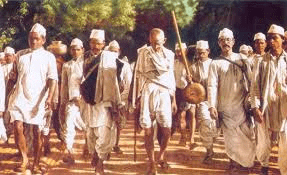
Ans. Gandhiji said ‘Satyagraha’ was not passive resistance but it called for intensive activity. Physical force was not used against the oppressor, nor vengeance was sought. Only through the power of truth and non-violence, an appeal was made to the conscience of the oppressor. Persuasion, not force, would make the oppressor realise the truth. This ‘dharma’ of non-violence and truth united people against the oppressor and made them realise the truth.  

Satyagrah Movement

Q.2. Why were Indians outraged by the Rowlatt Act?
Ans. The Rowlatt Act was passed hurriedly by the Imperial Legislative Council in 1919. It was opposed by all its Indian members. The government assumed enormous powers through this Act as they could detain political prisoners without trial for two years. Gandhiji decided to launch a ‘Hartal’ on 6 April against the Rowlatt Act.


Q.3. Give one example to prove that Non-Cooperation Movement was more successful on the economic front.
Ans. One example is boycott of foreign goods. The import of foreign textile cloth became half of what it was, between 1921–1922. It fell from 102 crores to 57 crores.


Q.4. Which party did not support the boycott of council elections during the movement and why.
Ans. The Justice Party of Madras decided not to boycott Council elections. The Justice Party members were non-Brahmins and so far had not been able to win elections, as the Brahman candidates always won. They thought it was a golden opportunity for them to enter the Councils.


Q.5. Why did Gandhiji call off the Non-Cooperation Movement?
Ans. The Chauri Chaura incident near Gorakhpur made him to do so. A peaceful procession turned violent and burnt a police chowki at Chauri Chaura and 22 policemen were burnt alive. Gandhiji, an apostle of non-violence, was shocked and immediately called off the movement.


Q.6. What was the cause of disagreement between the Congress-led Non-Cooperation Movement and the peasants’ and workers’ movements?
Ans. The Congress under Gandhiji believed in achieving ‘Swaraj’ by peaceful means and total non-violence. The peasants and workers, though believers in Gandhi’s Swaraj, khadi and boycott, did not believe in non-violence. They turned violent to gain their aims, which went against the Congress creed.


Q.7. What was the Inland Emigration Act of 1859?
Ans. The British government had passed this Act to prevent the plantation workers to leave the plantations and go back to their villages in Assam. They were forced to remain at the plantations and not leave them without permission. The permission to leave was seldom granted.


Q.8. Explain the two important factors that shaped Indian politics towards 1920’s. [2011(T-2)]
 OR
 Mention two factors which influenced Indian politics in the late 1920s. [2011(T-2)]

Ans. (i) The first was the worldwide economic depression which brought the agricultural prices crashing down in India. Farmers could not sell their produces and the whole country-side was in turmoil.

(ii) The British constituted a statutes commission in 1927 under Sir John Simon. The aim was to diffuse nationalism aroused by the Non-Cooperation Movement. The Commission was to look into the functioning of the constitutional system in India. It was an all-white commission, with not a single Indian member in it. It set the political world in India on fire and led to Gandhiji starting the Civil Disobedience Movement.


Q.9. Explain the difference in the objectives of the Non-Cooperation Movement and the Civil Disobedience Movement.
 OR
 How was the civil disobedience movement different from the Non-Cooperation Movement.

Ans. Non-Coorporation Movement (1920-22) wanted to bring the Government to a standstill by refusing to cooperate with it; Civil Disobedience Movement (1930-34) wanted to paralyse the government by performing illegal acts like violating the laws.


Q.10. Why did Gandhiji choose ‘Salt’ as the symbol of his Civil Disobedience Movement?
Ans. Salt is consumed by both the poor and the rich, and is one of the most essential items of food everywhere in the world. The British government had the monopoly on the production of salt in India. By imposing a ‘salt tax’ the government hit both the rich and the poor, specially the poor. Gandhiji thought it was the most repressive Act of the British government and chose to defy it by breaking the “Salt Law”.


Q.11. How did the British Government react to the “Salt March” of Gandhiji?
Ans. A frightened and shaken British government responded with a policy of brutal repression. About 100,000 people were arrested. Gandhiji was arrested on 4th May, 1930. The government also tried to diffuse the situation by releasing Gandhiji and making him sign the Gandhi-Irwin Pact (the then Viceroy of India) on 5th March, 1931. But the failure of the Second Round Table Conference in 1931 led the Government to begin its repressive measures in 1932 again. Congress was declared illegal and Nehru and Abdul Ghaffar Khan were arrested. All boycotts, meetings and demonstrations were banned by the British.


Q.12. Why did the industrialists and industrial workers lose interest in the Civil Disobedience Movement?
 OR
 Why did the initial enthusiasm of the merchants and industrialists fade away during the later stage of the civil disobedience movement?

Ans. The industrialists were perturbed by the increasing influence of socialism among the younger members of the Congress. They were also worried by the long-drawn militant activities and were worried about the harm done by it to their business interests.


Q.13. How and when nationalism captures the hearts and minds of the people ?
Ans. When people begin to believe strongly that they are part of the same nation. Also, when they discover common bonds that unite them, when they share the same struggles and have a common folklore, history and culture, then nationalism grips their hearts and minds.


Q14. What is the significance of 13th April, 1919?
Ans. April 13, 1919, is significant for the Jallianwala Bagh massacre, where British troops killed hundreds of people in a crowd in Amritsar. The massacre sparked widespread unrest and led Mahatma Gandhi to end the Satyagraha movement in response to the severe repression by the British government. 

1. The Rise of Nationalism in Europe –  Short Answer Questions

Q 1. What views did Giuseppe Mazzini have about Italy?

Giuseppe Mazzini

Ans: Mazzini believed that God had intended nations to be the natural units of mankind. So Italy could not continue to be a patchwork of small states and kingdoms. Italy had to be forged into a single unified republic within a wider alliance of nations. This unification from above could be the basis of Italian unity.

Q 2. What was the reaction to the Napoleonic Code? 

Ans: Initially many people welcomed French armies as harbingers of liberty. But the initial enthusiasm soon turned to hostility, as it became clear that the new administrative arrangements did not go hand in hand with political freedom. Increased taxation and censorship, and forced conscription into the French armies as required to conquer the rest of Europe all seemed to outweigh the advantages of the administrative changes.

Q 3. What kind of life did the aristocrats lead?

Ans: Socially and politically, a landed aristocracy was the dominant class on the European continent. The members of this class were united by a common way of life that cut across regional divisions. They owned estates in the countryside and also townhouses. They spoke French for purposes of diplomacy and in high society. Their families were often connected by the ties of marriage. This powerful aristocracy was, however, a numerically small group.

Q 4. What was understood by the term ‘liberalism’?

Ans: The term ‘liberalism’ derives from the Latin root liberal meaning free. For the new middle classes, liberalism stood for freedom for the individual and equality of all before the law. Politically, it emphasized the concept of government by consent. Since the French Revolution, liberalism has stood for the end of autocracy and clerical privileges, a constitution, and representative government through Parliament. Nineteenth-century liberals also stressed the inviolability of private property.

Q 5. When and why was the Zollverein formed?

Ans: In 1834, a customs union, or Zollverein was formed at the initiative of Prussia and joined by most of the German States. The union abolished tariff barriers and reduced the number of currencies from over thirty to two. The creation of a network of railways further stimulated mobility, harnessing economic interests to national unification. A wave of economic nationalism strengthened the wider nationalist sentiments growing at the time.

Q 6. How did the Treaty of Vienna (1815) come into being?

Ans: In 1815, representatives of the European powers – Britain, Russia, Prussia, and Austria – who had collectively defeated Napoleon, met at Vienna to draw up a settlement for Europe. The Congress was hosted by the Austrian Chancellor Duke Metternich.Signing of Treaty of Vienna

The delegates drew up the Treaty of Vienna of 1815 with the object of undoing most of the changes that had come about in Europe during the Napoleonic wars.

Q 7. What was the nature of conservative regimes set up in 1815?
OR
Enumerate any three features of conservative regimes set up in Europe following the defeat of Napoleon in 1815.

Ans: The conservative regimes set up in 1815 were autocratic. They did not tolerate criticism and dissent and sought to curb activities that questioned the legitimacy of autocratic governments. Most of them imposed censorship laws to control what was said in newspapers, books, plays, and songs and reflected ideas of liberty and freedom associated with the French Revolution.

Q 8. What led to the rise of the revolutionaries?

Ans: During the years following 1815, the fear of repression drove many liberal nationalists underground. Secret societies sprang up in many European states to train revolutionaries and spread their ideas. To be revolutionary at this time meant a commitment to oppose monarchical forms that had been established after the Vienna Congress and to fight for liberty and freedom. Most of these revolutionaries also saw the creation of nation-states as a necessary part of this struggle for freedom.

Q 9. Write briefly about conditions in Europe in the 1870s.

Ans: By the last quarter of the 19th Century, nationalism did not have its idealistic liberal-democratic sentiment of the first half of the century. Nationalism had become a narrow creed with limited ends. Nationalist groups were no longer trusting nor tolerant of each other. They were always at each other’s throats. The major European powers manipulated the nationalist aspirations of the
subject people in Europe to further their imperialist aims. The most serious source of nationalist tension in 1871 was in the Balkans.

Q 10. What has made the Balkan a source of nationalist tension?

Ans: The most serious source of nationalist tension in Europe after 1871 was the area called the Balkans. The region had geographical and ethnic varieties. The Balkans included Romania, Bulgaria, Albania, Greece, Macedonia, Croatia, Bosnia-Herzegovina, Slovenia, Serbia and Montenegro. The inhabitants of the Balkan regions were called Slavs. Most of the Balkan region was under Ottoman rule. The spread of the ideas of romantic nationalism in the Balkans, together with the disintegration of the Ottoman Empire, made this region very explosive.

Q 11. How had the female figures become an allegory of the nation during the 19th century in Europe? Analyse.

Ans: In the 19th century in Europe, the female figures became an allegory of the nation in the following ways:

  • The artists, in the 18th and 19th centuries in Europe, wanted to represent a country, as if it was a person. In other words, they wanted to personify the nation. Nations were represented as female figures. The female form did not belong to any particular woman in real life. It was an abstract idea, which gave the nation a concrete form. The female figure became an allegory of a nation.
  • In France, the female form was given the name of Marianne, which represented the nation. Her characteristics were a red cap, the tricolor, and the cockade, drawn from those of Liberty and the Republic.
  • Similarly, Germany became the allegory of the German nation. Germania wears a crown of oak leaves because oak stands for heroism.

Q 12. ‘The decade of 1830 had brought great economic hardships in Europe’. Support the statement with arguments.

Ans: The first half of the nineteenth century saw an increase in population, all over Europe. There was a scarcity of jobs and few employment opportunities. Population from rural areas migrated to the cities in search of jobs. They lived in overcrowded slums. Small producers in towns faced stiff competition from imports of cheap machine goods from England. In those parts of Europe where aristocracy was strong and enjoyed enormous powers, the peasants groaned under the burden of feudal dues and taxation. The rise of food prices or a year of bad harvest added to the miseries of the common man.