5. Print Culture and the Modern World – Textbook Worksheet

Objective type Questions
Q1: Vellum is :
(a) metal frame in which the types are laid and the text compressed
(b) a parchment made from the skin of animals
(c) the art of beautiful and stylised writing
(d) a historical account or folk tale in verse, usually sung or recited

Q2: The earliest print technology was developed in :
(a) China, Japan and Korea
(b) France, China and India
(c) Germany, Korea, Vietnam
(d) China, Japan and Germany

Q3: Who were deeply anxious about the collapse of Muslim dynasties ?

(a) Jesuit priests
(b) Hindus
(c) The Ulama
(d) Portuguese missionaries

Q4: This city became the hub of the new print culture, catering to the Western-style schools :
(a) Mumbai
(b) Tokyo
(c) Shanghai
(d) New York

Q5: He developed the first-known Printing Press in the 1430s :
(a) Martin Luther
(b) Marco Polo
(c) Warren Hastings
(d) Johann Gutenberg

Q6: Which one of the following was NOT the reason for the popularity of scientific ideas among the common people in eighteenth century Europe ?
(a) Printing of idea of Isaac Newton
(b) Development of printing press
(c) Interest of people in science and reason
(d) Traditional aristocratic groups supported it.

Q7: Who wrote Ramcharitmanas ?
(a) Tulsidas
(b) Gangadhar Bhattacharya
(c) Kashibaba
(d) Ram Chaddha

Q8: Calligraphy is :
(a) the art of making ceramics
(b) the art of making pottery
(c) a style of music
(d) the art of beautiful and stylised writing

Q9: When was the Vernacular Press Act passed ?
(a) 1820
(b) 1878
(c) 1857
(d) 1907

Q10: It is a historical account or folk tale in verse, usually sung or recited :
(a) Taverns
(b) Vellum
(c) Ballad
(d) Galley


True or False

Q1: Dr.Ambedkar was also known as ‘Periyar’. (True/False)

Q2: Those people who believed in the teachings of the Church were known as heretics. (True/False)

Q3: Print popularised the ideas of the enlightenment thinkers. (True/False)

Q4: Manuscripts in India were cheap and durable. (True/False)

Q5: The Vernacular Press Act was passed in 1878. (True/False)

Assertion and Reasoning Based Questions

Q1: Assertion : As literacy and schools spread in African countries, there was a virtual reading mania. 
Reason : Churches of different denominations set up schools in villages, carrying literacy to tribals.
(a) If both assertion and reason are true and reason is the correct explanation of assertion.
(b) If both assertion and reason are true and reason is not the correct explanation of assertion.
(c) If assertion is true but reason is false.
(d) If both assertion and reason are false.

Q2: Assertion : The new reading culture was accompanied by a new technology.
Reason :
 From hand printing there was a gradual shift to mechanical printing.
(a) If both assertion and reason are true and reason is the correct explanation of assertion.
(b) If both assertion and reason are true and reason is not the correct explanation of assertion.
(c) If assertion is true but reason is false.
(d) If both assertion and reason are false.

Q3: Assertion : The first book that Gutenberg printed was the Bible. 
Reason :
 About 500 copies were printed and it took two years to produce them.
(a) If both assertion and reason are true and reason is the correct explanation of assertion.
(b) If both assertion and reason are true and reason is not the correct explanation of assertion.
(c) If assertion is true but reason is false.
(d) If both assertion and reason are false.

Q4: Assertion : Children became an important category of readers.
Reason : 
Primary education became compulsory from the late nineteenth century.
(a) If both assertion and reason are true and reason is the correct explanation of assertion.
(b) If both assertion and reason are true and reason is not the correct explanation of assertion.
(c) If assertion is true but reason is false.
(d) If both assertion and reason are false.

Q5: Assertion : In 1517, the religious reformer Martin Luther wrote Ninety Five Theses criticising many of the practices and rituals of the Roman Catholic Church.
Reason : 
This led to a division within the Church and to the beginning of the Protestant Reformation.
(a) If both assertion and reason are true and reason is the correct explanation of assertion.
(b) If both assertion and reason are true and reason is not the correct explanation of assertion.
(c) If assertion is true but reason is false.
(d) If both assertion and reason are false.

Q6: Assertion : Print and popular religious literature stimulated many distinctive individual interpretations of faith even among little-educated working people.
Reason : 
Through the seventeenth and eighteenth centuries, literacy rates went up in most parts of Europe.
(a) If both assertion and reason are true and reason is the correct explanation of assertion.
(b) If both assertion and reason are true and reason is not the correct explanation of assertion.
(c) If assertion is true but reason is false.
(d) If both assertion and reason are false.

Q7: Assertion : There was intense controversy between social and religious reformers and the Hindu orthodoxy over matters like widow immolation, monotheism, Brahmanical priesthood and idolatory.
Reason : 
The Deoband Seminary founded in 1867, published thousands of fatwas telling Muslim readers how to conduct themselves in everyday lives, and explaining the meaning of Islamic doctrines.
(a) If both assertion and reason are true and reason is the correct explanation of assertion.
(b) If both assertion and reason are true and reason is not the correct explanation of assertion.
(c) If assertion is true but reason is false.
(d) If both assertion and reason are false.

Q8: Assertion : The production of handwritten manuscripts could not satisfy the ever-increasing demand for books. 
Reason : 
Chinese paper reached Europe via the silk route.
(a) If both assertion and reason are true and reason is the correct explanation of assertion.
(b) If both assertion and reason are true and reason is not the correct explanation of assertion.
(c) If assertion is true but reason is false.
(d) If both assertion and reason are false.


Very Short Answer Type Questions 

Q1: What were almanacs ?

Q2: How had hand printing technology introduced in Japan?

Q3: How many copies of the Bible were printed by Johannes Gutenberg in Europe ?

Q4: How was Biliotheque Bleue different from Penny Chapbooks ?

Q5: Who invented printing press and when ?

Q6: Who wrote ‘My Childhood and My University’ ?

Q7: Who was Johannes Gutenberg ?

Q8: Why was printing of textbooks sponsored by the Imperial State in China ?

Q9: What was woodblock printing ?

Q10: What led to the schism within the Catholic Church and the birth of the Protestant Reformation movement in Germany ?

Short Answer Type Questions

Q1: Who brought the printing technology to British India and how ?

Q2: How had the Imperial State in China been the major producer of printed material for a long time? Explain with examples.

Q3: Give reasons for the statement : ‘Woodblock print only came to Europe after 1295’.

Q4: Write the name of any two women writers of India in nineteenth century and highlights their contribution.

Q5: Write briefly on the Vernacular Press Act. (NCERT)

Q6: How did print culture affect women in the nineteenth century ?

Q7: Print created the possibility of wide circulation of ideas and introduced a new world of debate discussion.’’ Analyse the statement in the context of religion in Europe.

Q8: Write short notes to show what you know about the Gutenberg Press.

Q9: Why did British government curb the freedom of the Indian press after the revolt of 1857 ?

Q10: Write a note on Erasmus’s idea of a printed book.

Long Answer Type Questions

Q1: Why did the Roman Catholic Church begin keeping an Index of Prohibited Books from the mid-sixteenth century ? Explain by giving five reasons.

Q2: Describe three shortcomings of manuscripts that were overcome by the printing press.

Q3: Explain how print culture assisted the growth of nationalism in India.

Q4: How were ideas and information written before the age of print in India ? How did the printing technique begin in India ?

Q5: Why did some people in eighteenth century Europe think that print culture would bring enlightenment and end despotism ?

Q6: What was the attitude of people in India in the nineteenth century towards women reading ? How did women respond to this ?

The solutions of the worksheet “Worksheet Solutions: Print Culture and the Modern World

4. The Age of Industrialisation – Textbook Worksheet

Timeline of Events

  • 1600: The East India company was established
  • 1730: The earliest factories in England were setup
  • 1760: Britian imported New cotton to feed its cotton industry
  • 1764: James Hargreaves, devised spinning Jenny
  • 1767: Richard Arkwright established the cotton mill
  • 1781: James watt improvised steam engine & patented it
  • 1785: Cart wright invented the powerloom which used steam power for spinning & weaving
  • 1830-1840: Dwarkanath Tagore setup 6 joint stock companies in Bengal
  • 1840: Cotton was the leading sector in the first phase of Industrialisation in Britain.
  • 1850 : Railway station developed all over London
  • 1854: The first cotton mill was established in Bombay
  • 1855: The first Jute Mill was set up in Bengal
  • 1860: The supply of cotton reduced because of American Civil War
  • 1860: Elgin Mill was started in Kanpur
  • 1861: The first cotton mill was setup in Ahmedabad
  • 1873: Britain exported Iron & Steel
  • 1874: The first spinning & weaving mill & Madras began its production
  • 1900: E.T paul music company published “Dawn of Century”
  • 1912: J.N. Tata set up first Iron & Steel works in Jameshedpur
  • 1917: Seth Hukumchand set up first Jute Mill in Calcutta
  • 1941: use of Fly shuttle in more than 35 looms

Points to be Remember

  • Orient-The countries of the East especially East Asia
  • Capital-That part of money when invested is used for trade purpose.
  • Socialism- Where factors of production are held by the government.
  • Spenning Jenny-Invented by James Hargreaves in 1764. It accelerated production.
  • Staples: A person who ‘Staples’ or sorts wool according to fibre.
  • Fuller: A person who ‘Fulls’ that it gathers cloth by pleating.
  • Carding: The process in when fibres such as cotton or wool are prepared prior to spinning.
  • Fly shuttle was a mechanical device used for weaving moved by means of ropes and pullies.
  • First Jute Mill was established in Calcutica, in India
  • James Watt invented Steam Engine.
  • In India first cotton mill eastablished in 1854.
  • Portuguese were the first Europeans to come India.


Multiple Choice Questions

Q1: Who invented steam engine
(a) James Watt
(b) New Comen
(c) Richard Arpwright
(d) E.T. Paull

Q2: Which of the following were the most dynamic industries of the Great Britain?
(a) Cotton and Metal Industry
(b) Metal & Agrobased industries
(c) Cotton and Sugar Industry
(d) Ship & Cotton

Q3: Dwarkanath Tagore was a ___________
(a) Indusrialist
(b) Painter
(c) Philosopher
(d) Social Reformer

Q4: Which is associated with Gomasthas?
(a) Traders
(b) Servant
(c) Businessman
(d) Supervisor appointed by company

Q5: When did the exports of British cotton increase dramatically?
(a) In the early 17th century
(b) In the early 18 century
(c) In early 19 century
(d) In early 20 century

Q6: Koshtis were
(a) A community of Weavers
(b) Weavers
(c) Cotton Weavers
(d) Landless Labourer

Q7: Which of the following were the Pre-colonial ports of India
(a) Surat & Masulispatnam
(b) Madras & Hoogly
(c) Madras & Bombay
(d) Bombay & Hoogly

Q8: Who were Jobbers?
(a) A person employed by industrialist to new recruits
(b) A paid servant of East India company
(c) A person employed by farmer to sell their products
(d) A person doing most important job in a factory

Q9: In 1911, 67 of the large industries were located in one of the following places in India
(a) Surat & Ahemdabad
(b) Bengal & Bombay
(c) Patna & Lucknow
(d) Delhi & Bombay

Q10: The Nationalist message of swadeshi was spread
(a) Tariffs
(b) Advertisements
(c) Force
(d) Low prices

Fill in the Blank

Q1: Proto-industrialisation was a phase when there was large-scale industrial production for an international market which was not based on ___________.

Q2: Richard Arkwright created the __________ mill.

Q3: The pace of industrialisation was hindered by technological changes occurring slowly because the new technology was expensive, machines often broke down, and repair was ____________.
Q4: After the East India Company established political power, they appointed a paid servant called the __________ to supervise weavers, collect supplies, and examine the quality of cloth.

Q5: By the end of the nineteenth century, factories in India began production, flooding the market with machine-made goods, creating a problem for ____________.

One Mark Questions

Q1: In the 19th industrialist in which country started using machines.

Q2: In which decade factories opened in England ?

Q3: Who were Gomashtas ?

Q4: Which methods were adopted to create new consumers ?

Q5: In the initial phase of Industrialisation.

Q6: How did spinning Jenny accelerated production ?

Q7: What kind of products introduced European Managing Agencies ?

Q8: How do Urban producers control production ?

Q9: Why industrialist were reluctant to use machines ?

Q10: Name two most important industries of Europe ?

3/5 Marks Questions

Q1: How did the advent of Manchester create problems for Indian Weavers?

Q2: What were the reasons for increase in production during WWI ?

Q3: What were the reasons for great economic depression of 1930 ?

Q4: Why it was difficult for new merchants to establish trade in towns ?

Q5: Why new industrialist could not displace traditional industries ?

Q6: The network of Indian Merchants started break down why ?

Q7: Why did East India Company employ Gomashtas ?

Q8: Who were Jobbers ? What was their role ?

Q9: How did British manufactures captured Indian market through advertisement ?

Q10: How did increase Labour affect lines of workers ?

Very Short Answer Type Questions

Q1: Who patened the steam engine in 1781 produced by Newcowman? Who manufactured its new model?

Q2: Name two new ports which grew in importance after the decline of Surat and Hooghly.

Q3: What is meant by ‘Proto-Industrialisation’?

Q4: What do you understand about Orient?

 Q5: What were ‘guilds’?
Short Answer Type Questions

Q1: What was the impact of new trade network on weavers introduced by East India Company in India?

Q2: How did jobbers misuse his position and power? Explain. 

 Q3: How the Proto-Industrial system did develop a close relation between towns and countries?

Q4: ‘Proto-industrial system was thus part of a network of commercial exchanges’. Give reasons.

Q5: Why did the poor peasants and artisans of Europe agree to work for the merchants?

Q6: Discuss about the employment conditions in Victorian Britain after 1840.

Q7: Give a brief account of Indian textile industry before the age of machine industries developed in Europe.

Long Answer Type Questions

Q1: Describe any five major problems faced by new European merchants in setting up their industries in towns before the industrial revolution.

 Q2: Describe the main features of the picture on the cover page of the Music book ‘Dawn of the Century’ published by E.T. Paul Music Co in 1900.

Q3: Point out the significance of the picture ‘Two Magicians’ published in Inland printers in 1901.
OR
‘The glorification of machines and technology is even more marked in a picture which appeared on the pages of a trade magazine over a hundred years ago”? Support your answer with suitable examples.
OR
“The history of industrialisation thus becomes simply a story of development, and the modern age appears as a wonderful time of technological progress”. Justify.

Q4: Why did the merchants of Europe move to the country side for goods in 19th Century?

Q5: How had a series of inventions in the eighteenth century increased the efficacy of each step of the production process in the cotton textile industry? Explain.

Q6: “Historians now have come to increasingly recognise that the typical worker in the midnineteenth century was not a machine operator but the traditional craftsperson and labourer”. Justify.

Q7: Why did some industrialists in the 19th century Europe prefer hand labour over machines?
OR
Why did the upper class people prefer to use hand products in the Victorian period?

Q8: Discuss the life of the workers of 19th century European cities with suitable examples.

Q9: ‘‘Industrialization has changed the form of Urbanization in the modern period.’’ Analyse the statement with special reference of London.

Q10: Describe the life of Workers during the nineteenth century in England.

The solutions of the worksheet “Worksheet Solutions: The Age of Industrialisation

3. The Making of a Global World – Textbook Worksheet  – 2

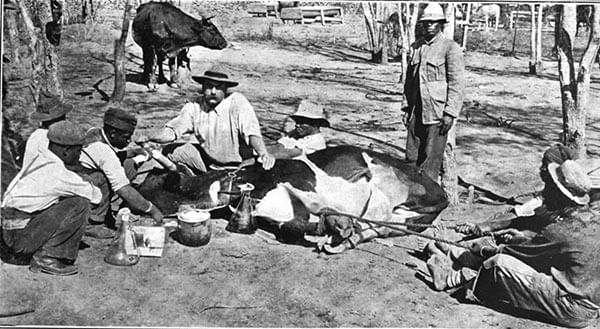
Q.1. Describe the impact of ‘Rinderpest’ on people’s livelihoods and local economy in Africa in the 1890s?  
OR
How did Rinderpest become instrumental in subjugating the Africans?

OR
Write a note to explain the effects of the coming of Rinderpest to Africa. 

Ans. Impact of Rinderpest:
(i) Rinderpest killed 90% of cattle in Africa.
(ii) The loss of cattle destroyed African livelihoods.
(iii) Planters, mine owners, and colonial governments took control of the limited cattle resources to boost their power and force Africans into the labor market.
(iv) Controlling cattle resources helped European colonists conquer and dominate Africa.  (Any three)

Q.2. Read the sources given below and answer the questions that follow:
SOURCE A:
 Silk Routes Link the World [NCERT History Ch. 3 Page 54] The silk routes are a good example of vibrant pre-modern trade and cultural links between distant parts of the world. The name ‘silk routes’ points to the importance of West-bound Chinese silk cargoes along this route. Historians have identified several silk routes, overland and by sea, knitting together vast regions of Asia, and linking Asia with Europe and northern Africa. They are known to have existed since before the Christian Era and thrived almost till the fifteenth century. But Chinese pottery also travelled the same route, as did textiles and spices from India and Southeast Asia. In return, precious metals – gold and silver – flowed from Europe to Asia.
SOURCE B: Late Nineteenth-Century Colonialism [NCERT History Ch. 3 Page 60] trade flourished and markets expanded in the late nineteenth century. But this was not only a period of expanding trade and increased prosperity. It is important to realize that there was a darker side to this process. In many parts of the world, the expansion of trade and a closer relationship with the world economy also meant a loss of freedoms and livelihoods. Late nineteenth-century European conquests produced many painful economic, social and ecological changes through which the colonized societies were brought into the world economy.
SOURCE C: Rinderpest, or the Cattle Plague [NCERT History Ch. 3 Page 62] In Africa, in the 1890s, a fast-spreading disease of cattle plague or Rinderpest had a terrifying impact on people’s livelihoods and the local economy. This is a good example of the widespread European imperial impact on colonized societies. It shows how in this era of conquest, even a disease affecting cattle reshaped the lives and fortunes of thousands of people and their relations with the rest of the world.
Historically, Africa had abundant land and a relatively small population. For centuries, land and livestock sustained African livelihoods, and people rarely worked for a wage. In late nineteenth-century Africa, there were few consumer goods that wages could buy. If you had been an African possessing land and livestock – and there was plenty of both – you too would have seen little reason to work for a wage.

The Cattle Plague

Questions: SOURCE A: Silk Routes Link the World
(i) Enlist the major items which travelled through the silk routes.
SOURCE B: Late Nineteenth-Century Colonialism
(ii) What was the negative impact of the expansion of trade and a closer relationship with the world economy in many parts of the world?
SOURCE C: Rinderpest, or the Cattle Plague
(iii) In your opinion, why were the Africans not interested in working for wages?
Ans.
 (i) Chinese pottery, textiles and spices from India and Southeast Asia and precious metals–gold and silver–from Europe to Asia were a few major items which travelled through the silk routes.
(ii) In many parts of the world, the expansion of trade and a closer relationship with the world economy also meant a loss of freedoms and livelihoods. Late nineteenth-century European conquests produced many painful economic, social and ecological changes through which the colonized societies were brought into the world economy.
(iii) Land and livestock were abundant, and the population was less, this was sufficient for the Africans to sustain their livelihood. This, in my opinion, could be a major reason for which they were not interested in working for wages.

Q.3. Critically examine the expansion of trade facilities in the 19th century. 
Ans. Expansion of trade facilities in the 19th century:
(i) In many parts of the world, these developments meant loss of freedom and livelihoods.(ii) In the late 19th century, European conquest brought about many destructive economic, social and ecological changes in the colonies.
(iii) In Africa, in the 1890s, a fast spreading disease of cattle plague or Rinderpest had a terrifying impact on people’s livelihoods and the local economy.
(iv) The example of indentured labour migration.
(v) Great misery and poverty for others.
(vi) New forms of coercion in Asia and Africa. (Any five)

Q.4. After the 19th century, how did the indentured labourers discover their own ways of survival? Explain.
Ans. 

(i) Initially, indentured laborers struggled with the harsh conditions on the plantations, but they soon found new ways to adapt.
(ii) They created new forms of self-expression, blending old and new art and cultural traditions.
(iii) In Trinidad, the Muharram procession evolved into a lively carnival called ‘Hosay,’ where people of all races and religions participated.
(iv) The protest religion Rastafarianism is believed to have links to Indian migrations to the Caribbean.
(v) Chutney music, popular in Trinidad and Guyana, is another form of creative expression from the post-indentured period.

Q.5. Explain the three types of flows within the international economy in exchanges. 
OR
Mention the three types of flows within international economic exchanges during the 19th century.
Ans. (i) Flow of Trade: Trade flow of goods, e.g. cloth or wheat, in which goods are exchanged at long and short distances. For example, Indian weavers produced fine quality cotton cloth and exported it to European countries. But post industrial revolution due to tariff barriers this changed drastically.
(ii) Flow of Labour: The migration of people in search of employment is called ‘Flow of Labour’. Nearly 50 million people emigrated from Europe to America and Australia in the 19th century. All over the world, some 150 million people are estimated to have left their homes, crossed oceans and vast distances over land in search of a better future.
(iii) Flow of Capital Investment for short-term or long-term investment: In this, movement of resources from one country to another takes place through loans or business investments. The British transferred a lot of capital from India to England before independence. All three are closely associated and affected the lives of people in the nineteenth century.

Q.6. What were the ‘Corn Laws’? How was it abolished?
OR
What were the Corn Laws? Why were the Corn Laws abolished? What was the result of the abolishing of Laws?

Ans. (i) The laws allowing the British Government to restrict the import of corn is known as the “Corn Laws”.
(ii) These laws were abolished because the industrialists and urban dwellers were unhappy with high food prices; as a result of which they forced the abolition of the Corn Laws.
Result: Food could be imported into Britain at a much cheaper rate. The immediate effect of the British Government’s decision to abolish the Corn Laws was the inflow of cheaper agricultural crops from America and Australia. Many English farmers left their profession and migrated to towns and cities.

Q.7. Describe three major consequences of the Second World War. 
Ans. Major consequences of the Second World War are as follows:
(i) The death toll from the war was enormous, with around 60 million people, or about 3 percent of the world’s 1939 population, believed to have died due to the conflict.
(ii) Millions more were injured, with most deaths occurring outside the battlefield, affecting civilians more than soldiers.
(iii) Large areas of Europe and Asia were devastated, and many cities were destroyed by bombing and artillery attacks.
(iv) The war led to significant economic and social damage, and rebuilding was expected to be long and challenging. (Any three)

Q.8. Explain how the global transfer of disease in the pre-modern world helped in the colonisation of the Americas?
Ans.
 Global transfer of disease in the pre-modern world helped in the colorization of the Americans:
(i) America was not conquered and colonised by Europeans with the help of superior fire power alone.
(ii) Germs, such as those of smallpox were helpful to a great extent.
(iii) Americans had no immunity against them as a result of long isolation. Once introduced, the germs spread deep into the continent decimating whole communities and paving way for conquest.

Q.9. Mention the two key lessons learnt from the inter-war economic experiences by the economists and politicians after the Second World War.
Ans. 
The two lessons learnt by the economists and politicians during the Second World War were:
First: An industrial society based on mass production needs mass consumption. For mass consumption, steady income was necessary and for stable income, full employment was necessary. For this, the government has to take steps to minimise the fluctuation of price, production and employment. Hence, economic stability could be ensured by the government intervention.
Second: They understood that international cooperation and economic integration were essential to avoid trade wars and economic conflicts that could lead to global instability.

Q.10. The First World War was a war like no other before. Explain any three features about the war that supports the statement. 
Ans. The three features of the war that supports the statements are:
(i) It involved the world’s leading industrial nations.
(ii) This war was the first modern industrial war. Machine guns, tanks, aircraft, chemical weapons, were used on a massive scale.
(iii) Most of those who were killed and aimed were men of working age. The scale of death and destruction was great. These deaths and injuries reduced the workforce.
(iv) Industries during the war were restructured to produce war-related products.
(v) The war led to the snapping of economic links between the world’s largest economic powers which were now fighting with each other to pay for them. The war transformed the US from being an international debtor to an international creditor. (Any three)

Q.11. How did the use of technology transform food availability in Europe?

OR
What was the impact of technology on food availability? Explain with the help of examples.
Ans. (i) Faster railways, lighter wagons and larger ships helped food to reach more cheaply and quickly from faraway farms to markets.
(ii) Earlier the animals were shipped live from America to Europe, many died on the way or became unfit to eat. Thus meat became expensive.
(iii) Refrigerated ships: The animals could be slaughtered at the starting point of America, Australia or New Zealand and transported to Europe as frozen meat.
(iv) This reduced the shipping cost and lowered prices in Europe.
(v) The poor could add variety to their food and it improved their living conditions.

Objective Type Question 
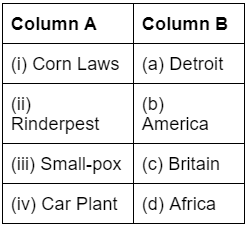
Q.12. Match the following:


Ans. (i)-(c), (ii)-(d), (iii)-(b), (iv)-(a)

Q.13. Arrange the following in the correct sequence:
(i) The Second World War
(ii) The Great Depression
(iii) The Chinese Revolution
(iv) The IMF and the World Bank Commenced financial operations
Options:
(a)
 (i) – (iii) – (iv) – (ii)
(b) (iii) – (iv) – (ii) – (i)
(c) (iv) – (ii) – (i) – (iii)
(d) (ii) – (i) – (iv) – (iii)
Ans. (d)

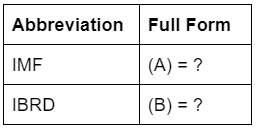
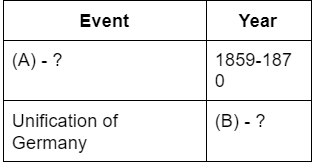
Q.14. Complete the following table related to resources on the basis of exhaustibility:


Ans.
 (A)  –  International Monetary Fund
(B) – International Bank for Reconstruction and Development

Q.15. In Trinidad what was referred to as Hosay?
(a) 
Annual Muharram procession marking a Carnival.
(b) Christmas celebration
(c) Easter festival
(d) New Year celebration
Ans. (c)

Q.16. Until the 18th century, which two countries were considered the richest in the world?
(a)
 China and Japan
(b) England and France
(c) India and China
(d) England and Italy
Ans. (b)

Q.17. What is the meaning of ‘cultural fusion’? Give two examples how the indentured labour system led to cultural fusion. 
OR
“The indentured labour gave rise to a new culture in the Caribbean islands.” Justify this statement with suitable examples.
Ans. (i) Cultural fusion happens when two or more cultures mix and create a new culture.
(ii) Indentured labourers used to live and work in very harsh conditions. This pushed them to find new ways to relax and find comfort, which led to a mix of different cultural forms.
(iii) Examples:
(a) Hosay: In Trinidad, the annual Muharram procession was transformed into a riotous carnival called ‘Hosay’ in which workers of all races and religions joined.
(b) Chutney Music: ‘Chutney music’ is another creative contemporary expression of the post indentured experience.
(c) Rastafarianism: The protest religion of ‘Rastafarianism’ is also said to reflect social and cultural links with Indian migrants to the Caribbean. (Any two)

Q.18. Describe the social and economic effects of the World War on England and the USA. 
Ans. Social Effects:
(i) Most of those killed or injured were working-age people, which impacted the workforce in England.
(ii) Household income declined and women stepped in to take up jobs.
(iii) Role and position of women changed forever in England.
Economic Effects:
(i) Economic links between some of the major economic powers of the world were snapped.
(ii) England borrowed large sums of money from the US Banks.
(iii) USA emerged as an international creditor.
(iv) USA owned more assets in foreign countries than foreign countries owned in the USA. (Any two)

Q.19. ‘China became an attraction destination for investment by foreign MNCs in the 19th and 20th centuries.’ Justify the statement.
Ans.
 China became an attraction destination for investment by foreign MNCs in the 19th and 20th centuries because:
(i) Wages were relatively low in countries like China.
(ii) This was because of the low cost structure of the Chinese economy, most importantly its low wages.
(iii) TVs, mobile phones and toys were seen in the shops that seem to be made in China.

Q.20. Explain any five factors that led to the Great Depression of 1929.
OR
What do you know about the Great Depression? Write any two causes of it.
Ans. The Great Depression began around 1929 and lasted till the mid 1930s. During this period, most parts of the world experienced decline in production, employment, incomes and trade. Agricultural regions and communities were amongst the most affected.
Causes of Great Depression:
(i) Post-world war economy of the world was fragile. Agricultural overproduction was a problem. As prices slumped, farm produce rotted.
(ii) Many countries financed loans from the US.
(iii) US overseas lenders panicked at the sign of financial crisis.
(iv) Thus, banks were bankrupt and were forced to close down in Europe and in the US because they were unable to recover investments, collect loans and repay depositors.
(v) American capitalists stopped all loans.

3. The Making of a Global World – Textbook Worksheet  -1

Q1. Why did Europeans flee to America in the nineteenth century? Explain. Marks 3
OR

State three reasons why Europeans fled to America in the 19th century.

Ans. Europeans fled to America in the 19th century because:

  • Until the 19th century, poverty and hunger were common in Europe.
  • Cities were crowded, and deadly diseases were widespread.
  • Religious conflicts were common and religious dissenters were persecuted.
  • Scrapping of Corn Laws, led to the inability of British agriculture to compete with imports.
  • Thousands of people were left unemployed due to agricultural land lying uncultivated. So, people migrated in thousands, crossed oceans to find employment and a better future.
  • In America, plantations were growing cotton and sugar for the European market. These plantations were worked on by slaves. (Any three)


Q2. “Indian trade had played a crucial role in the late nineteenth-century world economy”. Analyze the statement.  Marks 5

Ans. Indian trade played a crucial role in the late nineteenth-century world economy. This statement can be analyzed through the following facts:

  • Trade Surplus: Britain had a trade surplus with India, i.e., a situation under which the value of exports is more than the imports. Britain used this surplus to balance its trade deficit with other countries.
  • Home charges: Britain’s trade surplus in India also helped to pay the so-called ‘home charges’ that included private remittances home by British officials and traders, interest payments on India’s external debts and pensions of the British officials in India.
  • Major supplier of cotton: India remained a major supplier of raw cotton to Britain, which was required to feed the cotton textile industry of Britain.
  • Supplier of indentured workers: Many indentured workers from Bihar, Uttar Pradesh, Central India migrated to other countries to work in mines and plantations.


Q3. Describe the economic conditions of Britain after the ‘First World War’. Marks 3
OR

Explain the impact of the First World War on the British economy. 

OR
Explain the three impacts of the First World War on the British economy.

Ans. Economic conditions of Britain after the First World War: After the First World War, Britain found it difficult to recapture its earlier position. Britain was burdened with huge external debts. The war had led to an economic boom, a large increase in demand, production and employment. When the war boom ended, production contracted and unemployment increased. At the same time, the government reduced bloated war expenditures to bring them into line with peace time revenues. These debts led to huge job losses. Many agricultural economists were also in crisis. Note: If a candidate writes in points, it is also to be considered.


Q4. Read the sources given below and answer the questions that follows:

SOURCE A: Wartime Transformations [NCERT History Ch. 3 Page 68] The First World War, as you know, was fought between two power blocs. On the one side were the Allies – Britain, France and Russia (later joined by the US); and on the opposite side were the Central Powers – Germany, Austria-Hungary and Ottoman Turkey. When the war began in August 1914, many governments thought it would be over by Christmas. It lasted more than four years. The First World War was a war like no other before. The fighting involved the world’s leading industrial nations which now harnessed the vast powers of modern industry to inflict the greatest possible destruction on their enemies.
SOURCE B: Post-War Recovery [NCERT History Ch. 3 Page 69] Post-War economic recovery proved difficult. Britain, which was the world’s leading economy in the pre-war period, in particular faced a prolonged crisis. While Britain was preoccupied with war, industries had developed in India and Japan. After the war, Britain found it difficult to recapture its earlier position of dominance in the Indian market, and to compete with Japan internationally. Moreover, to finance war expenditures Britain had borrowed liberally from the US. This meant that at the end of the war Britain was burdened with huge external debts. The war had led to an economic boom, that is, to a large increase in demand, production and employment. When the war boom ended, production contracted and unemployment increased. At the same time the government reduced bloated war expenditures to bring them into line with peacetime revenues. These developments led to huge job losses – in 1921 one in every five British workers was out of work. Indeed, anxiety and uncertainty about work became an enduring part of the post-war scenario.
SOURCE C: Rise of Mass-Production and Consumption [NCERT History Ch. 3 Page 69-70] In the US, recovery was quicker. We have already seen how the war helped boost the US economy. After a short period of economic trouble in the years after the war, the US economy resumed its strong growth in the early 1920s. One important feature of the US economy of the 1920s was mass production. The move towards mass production had begun in the late nineteenth century, but in the 1920s it became a characteristic feature of industrial production in the US. A well-known pioneer of mass production was the car manufacturer Henry Ford. He adapted the assembly line of a Chicago slaughterhouse (in which slaughtered animals were picked apart by butchers as they came down a conveyor belt) to his new car plant in Detroit. He realised that the ‘assembly line’ method would allow a faster and cheaper way of producing vehicles. The assembly line forced workers to repeat a single task mechanically and continuously – such as fitting a particular part to the car – at a pace dictated by the conveyor belt. This was a way of increasing the output per worker by speeding up the pace of work. Standing in front of a conveyor belt no worker could afford to delay the motions, take a break, or even have a friendly word with a workmate. As a result, Henry Ford’s cars came off the assembly line at three-minute intervals, a speed much faster than that achieved by previous methods. The T-Model Ford was the world’s first mass-produced car.

SOURCE A: Wartime Transformations
(i) Which were the two power blocs in the First World War?
SOURCE B: Post-War Recovery
(ii) Britain, which was the world’s leading economy in the pre-war period, in particular faced a prolonged crisis. Comment on this statement.
SOURCE C: Rise of Mass-Production and Consumption
(iii) The ‘assembly line’ method would allow a faster and cheaper way of producing vehicles. How?

Ans. (i) Two power blocs in the First World War were: On the one side were the Allies – Britain, France and Russia (later joined by the US); and on the opposite side were the Central Powers – Germany, Austria-Hungary and Ottoman Turkey.

(ii) While Britain was preoccupied with war, industries had developed in India and Japan. After the war Britain found it difficult to recapture its earlier position of dominance in the Indian market, and to compete with Japan internationally. Moreover, to finance war expenditures Britain had borrowed liberally from the US. This meant that at the end of the war Britain was burdened with huge external debts.

(iii) The assembly line forced workers to repeat a single task mechanically and continuously – such as fitting a particular part to the car – at a pace dictated by the conveyor belt. This was a way of increasing the output per worker by speeding up the pace of work. Standing in front of a conveyor belt no worker could afford to delay the motions, take a break, or even have a friendly word with a workmate.


Q5. Mention three reasons for the creation of the International Monetary Fund and the World Bank. 
Ans. 

  • The International Monetary Fund and the World Bank were created to meet the financial needs of the industrial countries.
  • When Japan and Europe rapidly rebuilt economies, they became less dependent on the IMF and the World Bank.
  • Thus, from the late 1950s the Bretton Woods institutions, World Bank and IMF, began to turn their attention towards newly developing countries.
  • The newly independent countries facing problems of poverty came under the guidance of international agencies dominated by the former colonial powers. (Any three)


Q6. What do G-77 countries want to gain from the New International Economic Order? Describe. 
OR
What is G-77? What were its demands?
OR
Explain what is referred to as the G-77 countries. In what ways can G-77 be seen as a reaction to the activities of the Bretton Woods twins?
Ans. G-77 or Group of 77 refers to the seventy seven developing countries that did not benefit from the fast growth western economies experienced in 1950s and 1960s. So, they organized themselves into G-77. They demanded: 

  1. A new international economic order that would give them real control over their natural resources.
  2. More development assistance.
  3. Fairer prices for raw material.
  4. Better access for their manufactured goods in developed countries’ markets.


Analyze the information given below, considering one of the following correct options:

Q7. Consider the jute producers of Bengal. They grew raw jute that was processed in factories for export in the form of gunny bags. But as gunny exports collapsed, the price of raw jute crashed more than 60 per cent. Peasants who borrowed in the hope of better times or to increase output in the hope of higher incomes faced ever lower prices, and fell deeper and deeper into debt. Thus the Bengal jute growers’ lament: Grow more jute, brothers, with the hope of greater cash. Costs and debts of jute will make your hopes get dashed. When you have spent all your money and got the crop off the ground,… traders, sitting at home, will pay only Rs 5 a maund.
(a) The Great Depression
(b) India and the Great Depression
(c) Post-War Recovery
(d) Rise of mass Production and Consumption

Ans. (b) India and the Great Depression

Answer in one word/one sentence:

Q8. What do ‘Silk Routes refer to?
Ans. Network of routes connecting Asia with Europe and Northern Africa.


Q9. Who discovered the continent of America?
Ans. Christopher Columbus.


Q10. Who was a well-known Pioneer of mass production?
Ans. Henry Ford

Fill in the blanks:

Q11. ______ was a Nobel Prize winning writer who was a descendant of indentured labour from India.
Ans. V.S. Naipaul


Q12. ______ discovered the American Continent.
Ans. Christopher Columbus


Q13. Britain and Russia were known as ______ powers in the First World War.
Ans. Allied


Q14. Explain the destruction caused during the Second World War. Mention two crucial influences which shaped post-war reconstruction.
Ans. 

  • Unlike earlier wars, most of the deaths took place outside the battlefields.
  • More civilians than soldiers died from war.
  • Vast parts of Asia and Europe were devastated.
  • Cities were destroyed.
  • There was an immense amount of economic devastation.

Two crucial influences:
First: U.S’s emergence as military power in the western world.
Second: Dominance of the Soviet Union.


Q15. Elucidate any three factors that led to the Great Depression.
Ans. 

  • Agricultural overproduction remained a problem and it was made worse by falling agricultural prices.
  • As prices slumped and agricultural incomes declined, farmers tried to expand production and bring a large volume of produce to the market but it pushed down prices.
  • In the mid-1920s, many countries financed their investments through loans from the US, it was extremely easy to raise loans in the US.
  • But in the first half of the 1920s, countries that depend crucially on US loans faced an acute crisis.
  • The withdrawal of the US loans affected the rest of the world in different ways. In Europe, it led to the failure of small major banks and the collapse of currencies such as the British Pound Sterling. (Any three)

2. Nationalism in India – Textbook Worksheet – 2

Q.1. Evaluate the role of business classes in the ‘Civil Disobedience Movement’. Marks 3
Ans.
 Role of Business class in ‘Civil Disobedience Movement’:
(i) The business class reached against policies that restricted business activities.
(ii) They wanted protection against imports of foreign goods and a rupee-sterling foreign exchange ratio that would discourage imports.
(iii) In order to organise business interest, they formed the Indian Industrial and Commercial Congress in 1920 and the Federation of the Indian Chamber of Commerce and Industries (FICCI) in 1927.
(iv) They gave financial assistance for the movement.
(v) They refused to buy and sell imported goods. (Any other relevant point)

Q.2. Who had organized the dalits into the ‘Depressed classes Association in 1930’? Describe his achievements. Marks 5
Ans. 
Depressed Classes Association was organized by Dr. B. R. Ambedkar in 1930. Achievements:
(i) Dr. B. R. Ambedkar raised the demand of a separate electorate for Dalits.
(ii) British government conceded Ambedkar’s demand of separate electorates for Dalits
(iii) The depressed classes got reservation of seats in provincial and Central Legislative Councils.
(iv) Ambedkar accepted Gandhi’s position and as the result Poona Pact was signed. (Any other relevant point)

Q.3. Why did Mahatma Gandhi relaunch the Civil Disobedience Movement with great apprehension? Explain. Marks 5
Ans. Mahatma Gandhi relaunched the Civil Disobedience Movement with great apprehension:
(i) In December, 1931 Gandhiji went to London for the Round Table Conference, but the negotiations broke down and he returned disappointed.
(ii) In India, he discovered that the government had begun a new cycle of repression.
(iii) Abdul Ghaffar Khan and Jawaharlal Nehru were both in jail.
(iv) The Congress had been declared illegal.
(v) A series of measures had been imposed to prevent meetings, demonstrations and boycotts.

Q.4. Why did Mahatma Gandhi find in ‘Salt’ a powerful symbol that could unite the nation? Explain. Marks 5
Ans. Mahatma Gandhi found ‘Salt’ a powerful symbol : Gandhiji sent a letter to Viceroy Irwin starting eleven demands on 31st January, 1930. The most stirring of all was to abolish the salt tax. Salt was one of the most essential items of foods. It was consumed both by rich and poor alike. He urged them to peacefully defy the tax imposed on salt. On 6th April he reached Dandi and violated the law.

Q.5. Critically examine the main aspects of Indian National Movement during the period between 1920 and 1935. Marks 5
Ans. 
Following are the main aspects of the Indian National Movement between 1920-1935:
(i) Beginning of Mass Movement after Jallianwala Bagh Massacre.
(ii) Application of satyagraha to mass movement, new methods to protest, boycott, picketing, renunciation of titles, and non-payment of taxes.
(iii) People of different sections and parts shared a common bond of resistance—united in their hatred against the British rule.
(iv) Industrialists led by Purshottamdas Thakurdas and G. D. Birla criticised colonialism.

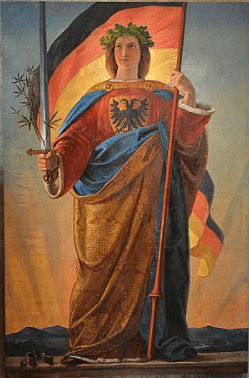
Q.6. Compare the images of Bharat Mata in this chapter with the image of Germania in Chapter 1. Marks 3
Ans. (i) The image of Bharat Mata created by Abanindranath Tagore is portrayed as an ascetic figure. She is calm, composed, divine and spiritual. Another image of Bharat Mata is shown with a trishul, standing beside a lion and an elephant both are the symbols of power and authority.
(ii) Germania was the symbol of the German nation. She is depicted as a female figure standing against a background where beams of sunlight shine through the tricolour fabric of the national flag. Germania is wearing a crown of oak leaves, as the German oak stands for heroism.

Analyze the information given below, considering one of the following correct options:
Q.7. Mahatma Gandhi’s letter was, in a way, an ultimatum. If the demands were not fulfilled by 11 March, the letter stated, the Congress would launch a Civil Disobedience Campaign. Irwin was unwilling to negotiate. So Mahatma Gandhi started his famous salt march accompanied by 78 of his trusted volunteers. The march was over 240 miles, from Gandhiji’s ashram in Sabarmati to the Gujarati coastal town of Dandi. The volunteers walked for 24 days, about 10 miles a day. Thousands came to hear Mahatma Gandhi wherever he stopped, and he told them what he meant by swaraj and urged them to peacefully defy the British. On 6 April, he reached Dandi, and ceremonially violated the law, manufacturing salt by boiling sea water.
(a) Non-Cooperation Movement
(b) Salt March
(c) Khilafat Movement
(d) Rowlatt Act
Ans. b

Answer in one word/one sentence:
Q.8.Trace the reason because of which Gandhiji started Satyagraha in 1919.
Ans. To protest against the Rowlatt Act

Fill in the blanks:
Q.9. In Lahore, the resolution of ______ was adopted in 1929.
Ans.
 Purna Swaraj

Q.10. Assertion and Reason Type Questions :the question given below, there are two statements. One is marked as Assertion (A) and other as Reason (R). Read the statements and choose the correct option:
Assertion:
 It was declared that 26th January, 1930 would be celebrated as Independence Day when people were to take a pledge to struggle for Complete Independence.
Reason: Mahatma Gandhi had to find a way to relate this abstract idea of freedom to more concrete issues of everyday life.
(a) Both (A) and (R) are true and (R) is the correct explanation of (A).
(b) Both (A) and (R) are true but (R) is not the correct explanation of (A).
(c) (A) is correct but (R) is wrong.
(d) (A) is wrong but (R) is correct.
Ans. a

Q.11. Explain the issue behind the Khilafat Movement. Marks 3
OR
What was the Khilafat Agitation? Why did Gandhiji give support to this agitation?
Ans.
Khilafat Agitation:
(i) The Khilafat movement (1919–1924) initiated by Muhammad Ali and Shaukat Ali was a mass movement against the reduction of temporal powers of Caliph after defeat of Ottoman-Turkey in the First World War.
(ii) To defend Khalifa’s temporal powers, the Khilafat Committee was formed in 1919 as he was considered as the spiritual head of Muslims.
(iii) Gandhiji supported it because he saw it as an opportunity to bring Muslims under the umbrella of a unified National Movement

Q.12. Describe the spread of Non-Cooperation Movement in the countryside. Marks 3
Ans.
 Non-Cooperation Movement spread in the countryside
(i) In Awadh, peasants were led by Baba Ramchandra. Here the movement was against talukdars and landlords who demanded from peasants exorbitantly high rents and a variety of other cesses.
(ii) Peasants had to beg and work at landlords’ farms without any payments. As tenants, they had no security of tenure and were regularly evicted so that they have no right over the leased land.
(iii) The peasant movement demanded reduction of revenue, abolition of begar and social boycott of oppressive landlords. In the meantime, Jawaharlal Nehru began going around the villages in Awadh.
(iv) The Awadh Kisan Sabha was set up in the villages. The peasant movement, however, developed in forms that the Congress leadership was unhappy with.
(v) As the movement spread, the houses of talukdars and merchants were attacked: bazaars were looted and grain hoards were taken over. (Any three)

Q.13. How had the First World War created a new economic situation in India? Explain with three examples. Marks 3
Ans. Three points on the First World War’s impact on the economic situation in India are given below:
(i) It led to a huge rise in the defence expenditure of the Government of India.
(ii) Custom duties were increased and income tax was introduced.
(iii) The prices of the goods doubled between 1913-1918 and created hardships for the people.
(iv) Forced recruitment was carried out and men from the villages were forced to become soldiers.

Q.14. How did Mahatma Gandhi successfully organise Satyagraha Movement in various places just after arriving in India? Explain by giving three examples. Marks 3
Ans. After arriving in India, Mahatma Gandhi successfully organised Satyagraha Movement in various places:
(i) In 1916, he travelled to Champaran in Bihar to inspire the peasants to struggle against the oppressive plantation of Indigo.
(ii) In 1917, he organised a Satyagraha to support the peasants of the Kheda district of Gujarat who were affected by crop failure and plague epidemic and could not pay the revenue.
(iii) In 1918, Mahatma Gandhi went to Ahmedabad to organize the Satyagraha Movement amongst cotton mill workers.

Q.15. How did Gandhiji convert the National Movement into a mass movement? Marks 5
Ans. 
Gandhiji converted the National Movement into a mass movement by:
(i) His simple and saintly lifestyle and style of convincing the masses made him popular.
(ii) His undisputed leadership and magnetic personality.
(iii) His policy of non-violent satyagraha.
(iv) His programmes of social reforms like fighting against untouchability.
(v) His commitment to Hindu-Muslim unity.

Q.16. Describe the main features of ‘Poona Pact‘. Marks 3
Ans. The main features of ‘Poona Pact’ were:
(i) The Poona Pact (September 1932) gave Depressed Classes (later to be known as Scheduled Caste) reserved seats in provincial and central legislative councils.
(ii) They were to be voted in by the general electorate.
(iii) The Act came into force due to Gandhi’s fast unto death.
(iv) Dr. B. R. Ambedkar ultimately accepted Gandhiji’s stand. (Any three)

Q.17. Explain the grievances of the peasants against the government. What steps were taken to organise the Peasant Movement to fulfil their demands during colonial rule? Marks 5
Ans. Reasons of grievances of the peasants against the government were:
(i) Due to forest laws of the colonial government.
(ii) Depriving them of the traditional rights of entering the forest to graze their cattle or to collect fuelwood and fruits.
(iii) High land revenues.
(iv) Forced to perform begar. (Any three)
Steps taken to organise Peasant Movement:
(i) Many kisan sabhas were organised.
(ii) Organised guerrilla militant movement.
(iii) Attacked police stations and attempted to kill British police officials.
(iv) Gandhiji declared that no tax to be paid. (Any two)

Q.18. Read the sources given below and answer the questions that follows:
SOURCE A : The Salt March and the Civil Disobedience Movement [NCERT History Ch. 2 Page 40] Worried by the developments, the colonial government began arresting the Congress leaders one by one. This led to violent clashes in many places. When Abdul Ghaffar Khan, a devout disciple of Mahatma Gandhi, was arrested in April 1930, angry crowds demonstrated in the streets of Peshawar, facing armoured cars and police firing. Many were killed. A month later, when Mahatma Gandhi himself was arrested, industrial workers in Solapur attacked police posts, municipal buildings, law courts and railway stations – all structures that symbolised British rule. A frightened government responded with a policy of brutal repression. Peaceful satyagrahis were attacked, women and children were beaten, and about 100,000 people were arrested.
SOURCE B : How Participants saw the Movement [NCERT History Ch. 2 Page 41] The industrial working classes did not participate in the Civil Disobedience Movement in large numbers, except in the Nagpur region. As the industrialists came closer to the Congress, workers stayed aloof. But in spite of that, some workers did participate in the Civil Disobedience Movement, selectively adopting some of the ideas of the Gandhian programme, like boycott of foreign goods, as part of their own movements against low wages and poor working conditions. There were strikes by railway workers in 1930 and dockworkers in 1932. In 1930 thousands of workers in Chhotanagpur tin mines wore Gandhi caps and participated in protest rallies and boycott campaigns. But the Congress was reluctant to include workers’ demands as part of its programme of struggle. It felt that this would alienate industrialists and divide the anti-imperial forces.
SOURCE C : The Sense of Collective Belonging The identity of the nation, as you know is most often symbolised in a figure or image. This helps create an image with which people can identify the nation. It was in the twentieth century, with the growth of nationalism, that the identity of India came to be visually associated with the image of Bharat Mata. The image was first created by Bankim Chandra Chattopadhyay. In the 1870s he wrote ‘Vande Mataram’ as a hymn to the motherland. Later it was included in his novel Anandamath and widely sung during the Swadeshi Movement in Bengal. Moved by the Swadeshi movement, Abanindranath Tagore painted his famous image of Bharat Mata. In this painting Bharat Mata is portrayed as an ascetic figure; she is calm, composed, divine and spiritual. In subsequent years, the image of Bharat Mata acquired many different forms, as it circulated in popular prints, and was painted by different artists. Devotion to this mother figure came to be seen as evidence of one’s nationalism.
Questions : SOURCE A:
(i) What happened when Abdul Ghaffar Khan was arrested ?
SOURCE B:
(ii) What did the workers in Chhotanagpur tin mines do ?
SOURCE C:
(iii) What were Bankim Chandra Chattopadhyay’s contributions in nationalism of India?

Ans. (i) When Abdul Ghaffar was arrested in April 1930, angry crowds demonstrated in the streets of Peshawar, facing armoured cars and police firing. Many were killed.
(ii) In 1930 thousands of workers in Chhotanagpur tin mines wore Gandhi caps and participated in protest rallies and boycott campaigns.
(iii) The image of Bharat Mata was created by Bankim Chandra Chattopadhyay. In 1870, he wrote ‘Vande Mataram’ as a hymn to the Motherland. Later it was sung during the Swadeshi Movement in Bengal.

Q.19. How was the sense of collective belonging developed during the freedom movement ? Explain. Marks 5
OR
How did a variety of cultural processes play an important role in the making of nationalism in India? Explain with examples.
OR
How did people belonging to different communities, regions or language groups develop a sense of collective belonging?

Ans. (i) This sense of collective belonging came partly through the experience of united struggles and growing anger among people against the colonial government.
(ii) But there were also a variety of cultural processes through which nationalism captured people‘s imagination:
(a) The identity of the nation symbolised in a figure or image of Bharat Mata created through literature, songs, paintings, etc.
(b) Movement to revive Indian folklore to enhance nationalist sentiments.
(c) Role of icons and symbols in unifying people and inspiring in them a feeling of nationalism.
(d) Creating a feeling of nationalism was through reinterpretation of history.

Q.20. Explain any three features of the Peasant Movement organised in Awadh in the second decade of 20th century. Marks 3
Ans. (i) In the second decade of the 20th century, a Peasant Movement started against exploitation of talukdars and landlords.
(ii) The movement was led by Baba Ramchandra who was earlier a Sanyasi.
(iii) The peasants through this movement demanded reduction of revenue, abolition of ‘begar’ and social boycott of oppressive landlords.

2. Nationalism in India – Textbook Worksheet – 1

Q.1. Describe the role of Alluri Sitaram Raju in Andhra Pradesh during 1920s. Marks 3
Ans. Role of Alluri Sitaram Raju in the Gudem hills of Andhra Pradesh:
(i) Alluri Sitaram Raju claimed that he had a variety of special powers like making astrological predictions, healing people and surviving bullet shots.
(ii) The rebels proclaimed him as an incarnation of God.
(iii) Raju was inspired by Gandhi’s Non-Cooperation Movement.
(iv) Persuaded people to wear khadi and give up drinking.
(v) But at the same time he asserted that India could be liberated only by the use of force, not non-violence.
(vi) Used guerrilla warfare for achieving swaraj. (To be assessed as whole)

Q.2. Why did Gandhiji decide to launch a nationwide ‘Satyagraha’ against the proposed Rowlatt Act (1919)? How was it opposed? Explain. Marks 5
Ans.
 Gandhi ji decided to launch a nation-wide Satyagraha:

(i) This Act had been hurriedly passed through the Imperial Legislative Council.
(ii) Indian members opposed the Act.
(iii) It gave the government enormous powers to repress political activities.
(iv) It allowed detention of political prisoners without trial for two years. (Any two points to be explained)
It opposed in the following ways: (i) Rallies were organised in various cities.
(ii) Workers went on strike.
(iii) Shops were closed.
(iv) Communication, railway, telegraphs lines were disrupted. (Any other relevant point) (Any three)
Q.3. “British rule in India would have collapsed if Indians had not cooperated.” How did this statement help in starting a mass movement in India against the British rule? 
Ans. (i) Mahatma Gandhi declared that British rule was established in India with the cooperation of Indian and if Indians had refused to cooperate, British rule in India would have collapsed within a year.
(ii) He proposed that the movement should unfold in stages.
(iii) It should begin with the surrendering of titles that the government had awarded to the Indians.
(iv) A boycott of civil services, army, police, courts and legislative assemblies, schools and foreign goods would show their non-cooperation to the British empire.
(v) Mahatma Gandhi felt that in case the government used repression, a full civil disobedience campaign would be launched. (Any three)

Q.4. Explain the effects of the First World War on India. Marks 5

OR
How did the ‘First World War’ create new economic and political situations in India? Explain with examples. 
OR
Explain any five major problems posed by the First World War in India. 
OR
Examine the effects of the First World War on the National Movement of India.
OR
Explain How the First World War helped in the growth of the National Movement in India. [NCERT]
Ans. (i) The war created a new economic and political situation.

(ii) It led to a huge increase in defence expenditure which was financed by war loans.

(iii) To fulfil the loan demands taxes were increased, custom duties were raised. Not only this, a new tax in the form of income tax was also introduced.

(iv) Prices increased, doubling between 1913 and 1918. This hit the common people.

(v) Villagers were asked to supply soldiers and through force recruitment in rural areas.

(vi) During 1918-19, crops failed in many parts of India which created a shortage of food.

(vii) Spread of influenza epidemic and death of 12 to 13 million people. (Any five)

Q.5. Define the term ‘Civil Disobedience Movement’. Describe the participation of rich and poor peasant communities in the ‘Civil Disobedience Movement’. Marks 5
Ans. 
Civil Disobedience Movement: To disobey the rules of the British Government.

Participation of rich and poor peasants:
(i) In the countryside, rich peasant communities like patidars of Gujarat and Jats of U.P. were active inmovement.
(ii) Rich peasants participated in the movement as a struggle against high revenue demand.
(iii) Rich peasants organized their community to support the Civil Disobedience Movement.
(iv) The poor peasants participated as they wanted their unpaid rent to be remitted. (Any other relevant point)

Detailed Answer: Definition of Civil Disobedience Movement: Civil Disobedience Movement refers to the act by a group of people by refusing to obey laws or pay taxes, as a peaceful way of expressing their disapproval of those laws or taxes and in order to persuade the government to change them. Gandhiji and Martin Luther King both conducted Civil Disobedience Movements in their respective countries to get rid of the exploitation and oppression offered by their colonial rulers.
(i) Rich Peasants: Depression and fall in prices affected them badly. They demanded reduction in land revenue. Swaraj meant reduction of taxes for them. They were disappointed when the movement was called off.
(ii) Poor Peasants: Depression affected them badly. They demanded reduction in rent. Swaraj meant reduction of rent for them. They joined Communist and revolutionary movements.

Q.6. Explain in brief the ‘Dandi March’. Marks 3
OR
Describe the main features of the ‘Salt March’. 

Ans. (i) Mahatma Gandhi started his famous ‘Salt March’ or ‘Dandi March’ on 11th March, 1930 accompanied by 78 of his trusted volunteers.
(ii) The march was to cover 240 miles from Gandhi’s ashram in Sabarmati to the Gujarati Coastal town of Dandi.
(iii) On 6th April, 1930, he reached Dandi and ceremonially violated the law by manufacturing salt by boiling sea water.
(iv) This marked the beginning of the Civil Disobedience Movement. (Any three)

Correct the following statement and rewrite:
Q.7. The import of foreign cloth doubled between 1921 and 1922, its value increasing from ₹ 102 Crore to ₹ 200 Crore.

Ans. The import of foreign cloth halved between 1921 and 1922, its value dropping from ₹102 Crore to ₹57 Crore.

Q.8. In 1928, the Hindustan Socialist Republician Army (HSRA) was founded at a meeting in Ferozeshah Kotla ground in Kolkata.
Ans.
 In 1928, the Hindustan Socialist Republician Army (HSRA) was founded at a meeting in Ferozeshah Kotla ground in Delhi.

Find the incorrect option:
Q.9. (a) In 1928, Vallabhbhai Patel led the peasant movement in Bardoli, a taluka in Gujarat.
(b) It was against enhancement of land revenue, known as the Civil Disobedience Movement.
(c) This movement was a success under the able leadership of Vallabhbhai Patel.
(d) The struggle was widely publicized and generated immense sympathy in many parts of India.
Ans.
 The Incorrect option is (b): It was against enhancement of land revenue, known as the Civil Disobedience Movement.

Correct answer is: It was against enhancement of land revenue, known as Bardoli Satyagraha.

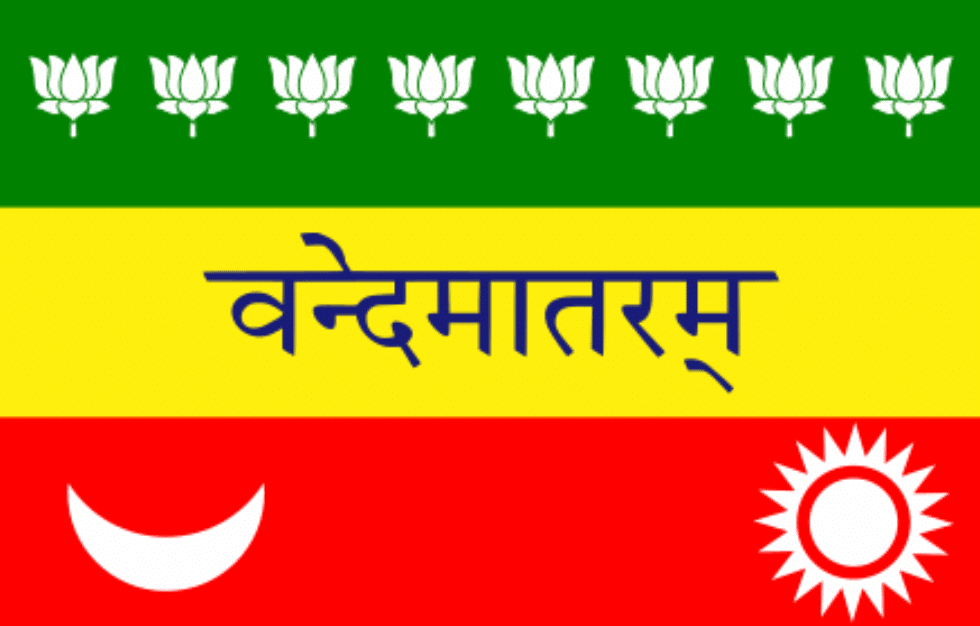
Q.10. What type of flag was designed during the ‘Swadeshi Movement’ in Bengal? Explain its main features. Marks 3
Ans. During the “Swadeshi Movement” in Bengal the flag was designed as a Tricolour Flag.
The two features of the flag were:
(i) The colour of the flag was Red, Green and Yellow.
(ii) It had eight lotuses representing eight provinces in British India.
(iii) It had a crescent moon representing Hindus and Muslims. (Any two)

Q.11. Explain any five factors which gave rise to the Civil Disobedience Movement of 1930. Marks 5
Ans. Factors that gave rise to the Civil Disobedience Movement were:

(i) The problem with the Simon Commission.
(ii) Irwin’s vague offer of dominion status for India in an unspecified future.
(iii) Salt Law (iv) Negligence of eleven demands of Gandhiji by the British.
(v) Lahore Session of INC (1929)

Q.12. Explain the attitude of the Indian merchants and the industrialists towards the ‘Civil Disobedience Movement’. Marks 5
Ans. The attitude of the Indian merchants and the industrialists towards the Civil Disobedience Movement: 
(i) During the First World War, Indian merchants and industrialists had made huge profits and became powerful.
(ii) They wanted protection against imports of foreign goods and a Rupee-Sterling Foreign Exchange ratio that would discourage import.
(iii) To organise business interest they formed the Indian Industrial and Commercial Congress (in 1920) and the Federation of Indian Chamber of Commerce and Industries—FICCI ( in 1927).
(iv) They gave financial assistance and refused to buy or sell imported goods.
(v) Most businessmen came to see ‘Swaraj’ as a time when colonial restrictions on business would no longer exist and trade and industry would flourish without constraints.(vi) After the failure of the Round Table Conference business groups were no longer uniformly enthusiastic.

(vii) They were apprehensive of the spread of militant activities and worried about prolonged disruption of business. (Any five)

Q.13. How did the Civil Disobedience Movement come into force in various parts of the country? Explain with examples.  Marks 5
Ans.
 The Civil Disobedience Movement came into force in various parts of the country :
(i) Gandhi led the Salt March from Sabarmati Ashram to Dandi with his followers starting the Civil Disobedience Movement.
(ii) Thousands in different parts of the country broke the Salt Law, manufactured salt and demonstrated in front of government salt factories.
(iii) In the countryside like the rich Patidars of Gujarat and Jats of Uttar Pradesh were active in the movement.
(iv) As rich peasant communities were very hard hit by the trade depression and falling prices, they became enthusiastic supporters of the Civil Disobedience Movement.
(v) As the depression continued and the cash invoice dwindled, the small tenants found it difficult to pay the rent. They wanted the unpaid rent to the landlords to be remitted and thus they joined the movement.
(vi) Merchants and industrialists supported the movement by giving financial assistance and refused to buy and sell the imported goods.
(vii) The industrial working class of Nagpur region participated in the Civil Disobedience Movement (CDM).
(viii) Railway workers, dock workers, coal mine workers of Chhota Nagpur, etc. participated in protest rallies and boycott campaigns.
(ix) Women also participated in large numbers. (Any five)

Q.14. Read the sources given below and answer the questions that follows:
SOURCE A : Towards Civil Disobedience [NCERT History Ch. 2 Page 38] In February 1922, Mahatma Gandhi decided to withdraw the Non-Cooperation Movement. He felt the movement was turning violent in many places and satyagrahis needed to be properly trained before they would be ready for mass struggles. Within the Congress, some leaders were by now tired of mass struggles and wanted to participate in elections to the provincial councils that had been set up by the Government of India Act of 1919. They felt that it was important to oppose British policies within the councils, argue for reform and also demonstrate that these councils were not truly democratic. C. R. Das and Motilal Nehru formed the Swaraj Party within the Congress to argue for a return to council politics. But younger leaders like Jawaharlal Nehru and Subhas Chandra Bose pressed for more radical mass agitation and for full independence.
SOURCE B : The Independence Day Pledge, 26 January, 1930 [NCERT History Ch. 2 Page 39] ‘We believe that it is the inalienable right of the Indian people, as of any other people, to have freedom and to enjoy the fruits of their toil and have the necessities of life, so that they may have full opportunities of growth. We believe also that if any government deprives a people of these rights and oppresses them, the people have a further right to alter it or to abolish it. The British Government in India has not only deprived the Indian people of their freedom but has based itself on the exploitation of the masses, and has ruined India economically, politically, culturally, and spiritually. We believe, therefore, that India must sever the British connection and attain Purna Swaraj or Complete Independence.’
SOURCE C : The Salt March and the Civil Disobedience Movement [NCERT History Ch. 2 Page 39] Mahatma Gandhi found in salt a powerful symbol that could unite the nation. On 31 January 1930, he sent a letter to Viceroy Irwin starting eleven demands. Some of these were of general interest; others were specific demands of different classes, from industrialists to peasants. The idea was to make the demands wide-ranging, so that all classes within Indian society could identify with them and everyone could be brought together in a united campaign. The most stirring of all was the demand to abolish the salt tax. Salt was something consumed by the rich and the poor alike, and it was one of the most essential items of food. The tax on salt and the government monopoly over its production, Mahatma Gandhi declared, revealed the most oppressive face of British rule. Marks 3
Question : SOURCE A : Towards Civil Disobedience
(i) What was the major reason behind the formation of the Swaraj Party?
SOURCE B : The Independence Day Pledge, 26 January, 1930
(ii) What was the negative impact of the British rule in India?
SOURCE C : The Salt March and the Civil Disobedience Movement
(iii) In Mahatma Gandhi’s opinion, what revealed the true oppressive face of the British government?
Ans. 
(i) C. R. Das and Motilal Nehru formed the Swaraj Party within the Congress to argue for a return to council politics.
(ii) Negative impact of the British rule in India: The British Government in India had not only deprived the Indian people of their freedom but had also based itself on the exploitation of the masses, and had ruined India economically, politically, culturally, and spiritually.
(iii) Salt was something consumed by the rich and the poor alike, and it was one of the most essential items of food. The tax on salt and the government monopoly over its production, Mahatma Gandhi declared, revealed the most oppressive face of British rule.

Q.15. Why was the ‘Salt March’ considered an effective symbol of resistance against colonialism? Explain. Marks 5
Ans. Salt March:
(i) Salt was consumed by all the sections of the society.
(ii) It was the most essential item of food.
(iii) The tax on salt and the government monopoly over production.
(iv) Gandhiji found salt as a powerful symbol that could unite the nation.
(v) On 31st January 1930, he sent a letter to Viceroy Irwin starting eleven demands.
(vi) The idea was to make the demands wide ranging, so that all classes within Indian society could identify with them and everyone could be brought together in a united campaign.
(vii) The most stirring of all was the demand to abolish the salt tax. (Any five)

1. The Rise of Nationalism in Europe – Textbook Worksheet – 3

Q.1. Why in the years after 1848, the autocrats of Central and Eastern Europe began to introduce the changes that had already taken place in Western Europe before 1815? Explain. Marks 3
OR
What forced the monarchs to introduce reforms in the society?
Ans. Though conservative forces were able to suppress liberal movements in 1848, they could not restore the old order. Monarchs were beginning to realise that the cycles of revolution and repression could only be ended by granting concessions to the liberal-nationalist revolutionaries. Hence, in the years after 1848, the autocratic monarchies of Central and Eastern Europe began to introduce the changes that had already taken place in Western Europe before 1815. Thus, serfdom and bonded labour were abolished both in the Habsburg dominations and in Russia. The Habsburg rulers granted more autonomy to the Hungarians in 1867.

Q.2. Who hosted ‘Vienna Congress’ in 1815? Analyse the main changes brought by the ‘Vienna Treaty.’ Marks 5
Ans. 
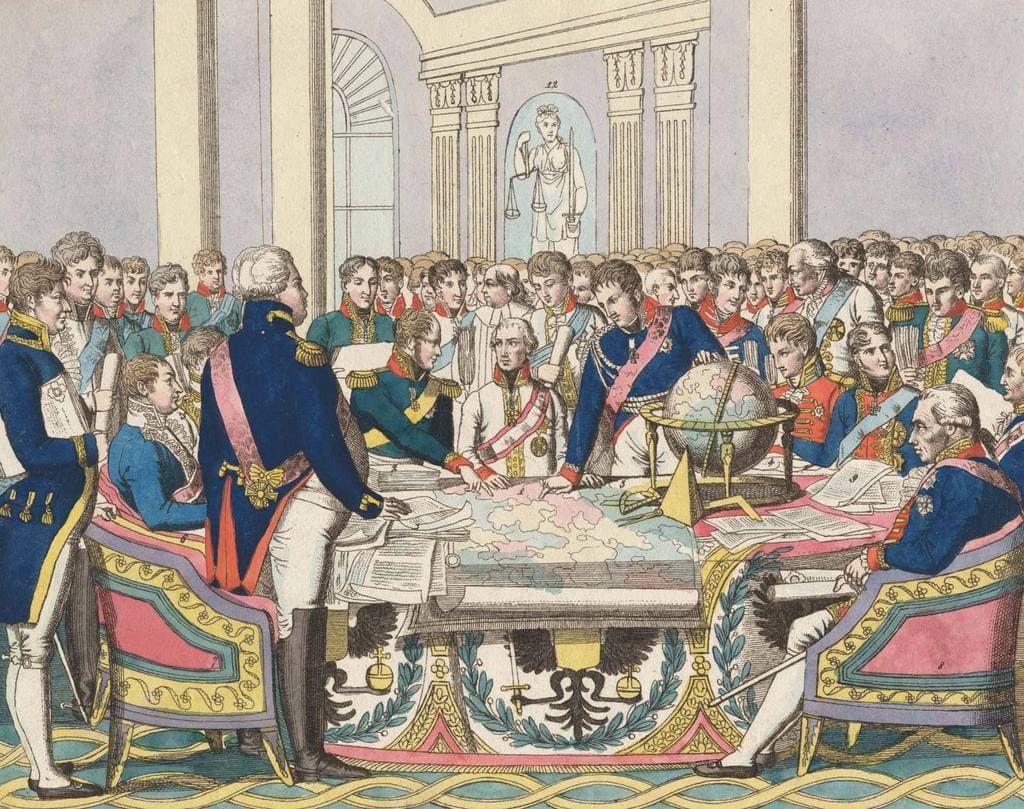
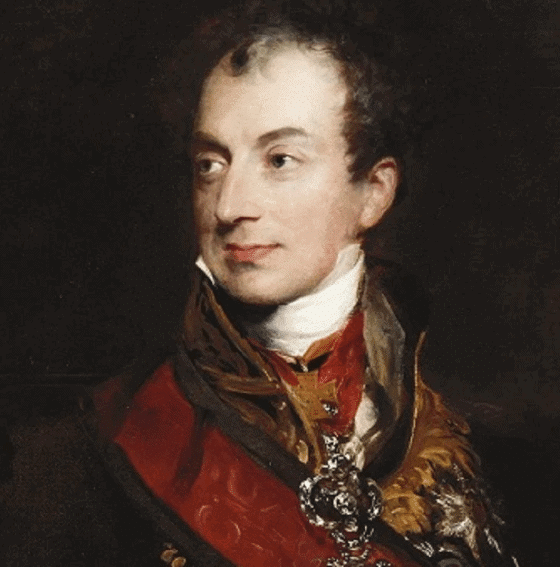
Congress of Vienna was hosted by Austrian Chancellor Duke Metternich in 1815. The following changes were made:
(i) The Bourbon Dynasty, which had been deposed during the French Revolution, was restored to power and France lost the territories it had annexed.
(ii) A series of states were set up on the boundaries of France to prevent the French expansion in future. Thus, the kingdom of the Netherlands, which included Belgium, was set up in the north and Genoa was added to Piedmont in the south.
(iii) Prussia was given important new territories on its  western frontiers, while Austria was given control of northern Italy.
(iv) The German confederation of 39 states that had been set up by Napoleon was left untouched.

Congress of Vienna

Q.3. How had revolutionaries spread their ideas in many European states after 1815? Explain with examples. Marks 3
Ans: (i) After 1815, many liberal nationalists went underground for the fear of repression. Secret societies emerged in many European states to train revolutionaries and spread their ideas. Giuseppe Mazzini, an Italian revolutionary, founded two underground societies—first, Young Italy in Marseilles and then, Young Europe in Berne. Following the footsteps of Mazzini, many secret societies were set up in Germany, France, Switzerland and Poland.
(ii) Romanticism was a cultural movement which sought to develop a particular form of nationalist sentiment. The romantics used folk songs, folk poetry and folk dances to popularize the true spirit of the nation. For example, Karol Kurpinski celebrated the national struggle through his operas and music in Poland. He turned folk dances like polonaise and mazurka into nationalist symbols.
(iii) Language also played an important role in developing nationalist sentiments. For example, it was mainly used as a weapon of national resistance when the Polish language was forced out of schools and the Russian language was imposed everywhere in Poland.

Q.4. Assertion and Reason Type Questions: the question given below, there are two statements. One is marked as Assertion (A) and other as Reason (R). Read the statements and choose the correct option:
Assertion: Giuseppe Garibaldi was an Italian General, politician and nationalist who played a large role in the history of Italy.
Reason: He was the architect in the process of nation – building.
(a) Both (A) and (R) are true and (R) is the correct explanation of (A).
(b) Both (A) and (R) are true but (R) is not the correct explanation of (A).
(c) (A) is correct but (R) is wrong.
(d) (A) is wrong but (R) is correct.
Ans. c

Correct the following statement and rewrite:
Q.5. The concept of nationalism emerged in Europe during the eighteenth century.
Ans. The concept of nationalism emerged in Europe during the nineteenth century.

Find the incorrect option:
Q.6. (a) 
During the years following 1815, the fear of repression drove many liberal-nationalists underground.
(b) Secret Societies Sprang up in many Indian states to train revolutionaries and spread their ideas.
(c) To be a revolutionary at this time meant a commitment to oppose monarchical forms that had been established after the Vienna Congress, and to fight for liberty and freedom.
(d) Most of these revolutionaries also saw the creation of nation states as a necessary part of this struggle for freedom.
Ans. b
Solution: Secret Societies sprang up in many Indian states to train revolutionaries and spread their ideas.
Correct answer is: Secret Societies sprang up in many European states to train revolutionaries and spread their ideas.

Q.7. Arrange the following in the correct sequence:
(i) Treaty of Constantinople
(ii) First upheaval took place in France
(iii) Lord Byron died
(iv) Greek Struggle for independence begins
Option:

(a) (i) – (ii) – (iii) – (iv)
(b) (ii) – (iv) – (i) – (iii)
(c) (iv) – (iii) – (ii) – (i)
(d) (iii) – (iv) – (ii) – (i)
Ans. c

Q.8. Complete the following table with the happening of two events and the respective years in which they took place.

Ans. (A) – Unification of Italy (B) – 1866-71

Multiple Choice Questions
Q.9. Study the picture and answer the question that follows:

Which of the following aspects best signifies this image of Germania”?


(a) Heroism and Justice
(b) Folk and Cultural Tradition
(c) Austerity and Asceticism
(d) Revenge and Vengeance
Ans. a

Q.10. Analyse the information given below, considering one of the following correct options:
He was perhaps the most celebrated of Italian freedom fighters. He came from a family engaged in coastal trade and was a sailor in the merchant navy. In 1833, he met Mazzini, joined the Young Italy movement and participated in a republican uprising in Piedmont in 1834.
(a) Otto von Bismarck
(b) Giuseppe Mazzini
(c) Count Camillio de Cavour
(d) Giuseppe Garibaldi
Ans. d

Q.11. Describe any five measures introduced by the French revolutionaries to create a sense of collective identity amongst the French people. Marks 5
Ans. The following measures were introduced by the French revolutionaries to create a sense of collective identity:
(i) The ideas of la patrie (the fatherland) and le citoyen (the citizen) were emphasised as the notion of a united community enjoying equal rights under a constitution.
(ii) A new French flag, the tricolour, was chosen to replace the former royal standard.
(iii) The Estates General was elected by the body of active citizens and renamed the National Assembly.
(iv) New hymns were composed, oaths taken and martyrs commemorated, all in the name of the nation.
(v) A centralised administrative system was put in place and it formulated uniform laws for all citizens within its territory.
(vi) Internal custom duties and dues were abolished and a uniform system of weights and measures were adopted.
(vii) Regional dialects were discouraged and French, as it was spoken and written in Paris, became the common language of the nation. (Any five points to be described)

Q.12. Describe the process of unification of Italy. Marks 5
Ans. Unification of Italy: (i) During the middle of the 19th century, Italy was divided into seven states of which only one, Sardinia-Piedmont, was ruled by an Italian princely house.(ii) The unification process was led by three revolutionaries—Giuseppe Mazzini, Count Camillo de Cavour, and Giuseppe Garibaldi During 1830, Mazzini decided to unite Italy. He had formed a secret society ‘Young Italy’ to achieve his goal.
(iii) After earlier failures in 1831 and 1848, King Victor Emmanuel II took to unify the Italian states through wars.
(iv) Through a tactful diplomatic alliance with France by Cavour, Sardinia-Piedmont succeeded in defeating the Austrian forces in 1859.
(v) After earlier failures in 1831 and 1848, King Victor Emmanuel II took to unify the Italian states through wars.
(vi) Through a tactful diplomatic alliance with France by Cavour, Sardinia-Piedmont succeeded in defeating the Austrian forces in 1859.
(vii) Under the leadership of Garibaldi armed volunteers marched into South Italy in 1860 and the Kingdom of the Two Sicilies and succeeded in winning the support of the local peasants in order to drive out the Spanish rulers.
(viii) In 1861, Victor Emmanuel II was proclaimed king of united Italy. (Any five)

Q.13. Name the female allegory who represents France. Describe her main characteristics. Marks 3
Ans. Marianne was the female allegory who represented France.
Her characteristics were drawn from:
(i) Those of liberty and republic.
(ii) These were the red cap, the tricolour, the cockade.
(iii) Statues of Marianne were erected in public squares to remind the public of the national symbol of unity and to persuade them to identify with it.
(iv) Her images were marked on coins and stamps of 1850. (Any three)

Q.14. Read the sources given below and answer the questions that follows:
SOURCE A : Visualising the Nation [NCERT History Ch. 1 Page 23] ou will Recall that during the French Revolution artists used the female allegory to portray ideas such as Liberty, Justice and the Republic. These ideals were represented through specific objects or symbols. As you would remember, the attributes of Liberty are the red cap, or the broken chain, while Justice is generally a blindfolded woman carrying a pair of weighing scales.
SOURCE B : Nationalism and Imperialism [NCERT History Ch. 1 Page 26] The most serious source of nationalist tension in Europe after 1871 was the area called the Balkans. The Balkans was a region of geographical and ethnic variation comprising modern-day Romania, Bulgaria, Albania, Greece, Macedonia, Croatia, Bosnia-Herzegovina, Slovenia, Serbia and Montenegro whose inhabitants were broadly known as the Slavs. A large part of the Balkans was under the control of the Ottoman Empire. The spread of the ideas of romantic nationalism in the Balkans together with the disintegration of the Ottoman Empire made this region very explosive. All through the nineteenth century the Ottoman Empire had sought to strengthen itself through modernisation and internal reforms but with very little success. One by one, its European subject nationalities broke away from its control and declared independence. The Balkan peoples based their claims for independence or political rights on nationality and used history to prove that they had once been independent but had subsequently been subjugated by foreign powers. Hence the rebellious nationalities in the Balkans thought of their struggles as attempts to win back their long-lost independence.
SOURCE C : Visualising the Nation [NCERT History Ch. 1 Page 23] While it is easy enough to represent a ruler through a portrait or a statue, how does one go about giving a face to a nation? Artists in the eighteenth and nineteenth centuries found a way out by personifying a nation. In other words, they represented a country as if it were a person. Nations were then portrayed as female figures. The female form that was chosen to personify the nation did not stand for any particular woman in real life; rather it sought to give the abstract idea of the nation a concrete form. That is, the female figure became an allegory of the nation. Marks 3
Questions: SOURCE A : Visualising the Nation
(i) What are the attributes of Liberty and Justice according to French Revolution artists?SOURCE B : Nationalism and Imperialism
(ii) Who were Slavs ?
SOURCE C : Visualising the Nation
(iii) Why was the female form chosen to portray a nation by the French Revolution artists?

Ans. (i) The attributes of Liberty are the red cap or the broken chain, while Justice is generally a blindfolded woman carrying a pair of weighing scales.
(ii) The inhabitants of Balkans were broadly known as the Slavs. It was a region of geographical and ethnic variation comprising modern–day Romania, Bulgaria, Albania, Greece, Macedonia, Slovenia, Serbia and Montenegro.
(iii) Artists in the eighteenth and nineteenth Centuries found a way out by personifying a nation. They represented a Country as if it were a person. Nations were then portrayed by female figures because the female form that was chosen to personify the nation did not stand for any particular woman in real life; rather it was brought to give the abstract idea of the nation’s concrete form. That is, the female figure became an allegory of the nation.

Analyse the information given below, considering one of the following correct options:
Q.15. While it is easy enough to represent a ruler through a portrait or a statue, how does one go about giving a face to a nation? Artists in the eighteenth and nineteenth centuries found a way out by personifying a nation. In other words they represented a country as if it were a person.
(a) Portrait of a nation
(b) idol of a nation
(c) Personification of a nation
(d) Visualising a nation
Ans. d
Solution: Concept of liberalization in the field of Economic Sphere:
In the economic sphere, liberalization stood for freedom of market and the abolition of state-imposed restrictions on the movement of goods and capital.

Q.16. “Nationalism no longer retained its idealistic liberal democratic sentiment by the last quarter of the nineteenth century in Europe.” Analyse the statement with examples. Marks 5

OR
“The idealistic liberal-democratic sentiment of nationalism in the first half of the nineteenth century became a narrow creed with limited ends.“ Examine the statement.
Ans.
 Sentiment of Nationalism in the first half of the 19th century:
(i) Towards the last quarter of the 19th century, nationalism could not retain its idealistic liberal-democratic sentiments of the first half of the century but became a narrow belief with inadequate ends.
(ii) Nationalist groups became increasingly intolerant, which led to war.
(iii) Major European powers manipulated the nationalist aspirations to further their own imperialist aims.
(iv) Source of nationalist tension in Europe was the area called the Balkans.
(v) Idea of romantic nationalism in the Balkan together with the disintegration of the Ottoman Empire made this region very explosive.
(vi) One by one, European nationalities broke away from its control and declared independence.
(vii) The Balkan people based their claims for independence or political rights on nationality to prove that they were once independent but were subjugated by a foreign power.
(viii) Slavic nationalities struggled to define their identity and independence. Hence, the Balkan area became an area of intense conflict. (Any five)

Q.17. How did the Balkan issue become one of the major factors responsible for the First World War? Marks 3
Ans. (i) The spread of the ideas of romantic nationalism in the Balkans together with the disintegration of the Ottoman Empire made this region very explosive.
(ii) The Balkan area became an area of intense conflict as different Slavic nationalities struggled for their independence.
(iii) It became the source of big power rivalry among the European powers over trade, colonies and military might.

Q.18. How did the Balkan region become a source of nationalist tension in Europe after 1871? Marks 3
Ans. (i) The Balkans was a region of geographical and ethnic variations comprising modern-day Romania, Bulgaria, Albania, Greece, Macedonia, Croatia, Bosnia-Herzegovina, Slovenia, Serbia and Montenegro.
(ii) The inhabitants of these regions were known as Slavs.
(iii) A large part of the Balkans was under the control of the Ottoman Empire.
(iv) As the different Slavic nationalities struggled to define their identity and independence, the Balkan area became an area of intense conflict.
(v) The Balkan states were fiercely jealous of each other and each hoped to gain more territory at the expense of others (Any three)

Q.19. Examine the conditions of Italy before unification. Marks 3
Ans.
 Conditions of Italy before unification:
(i) The greatest problem in the unification of Italy was its fragmentation into several political units, each under a different authority.
(ii) Italians were scattered over several dynastic states as well as the multinational Habsburg Empire.
(iii) During the middle of the 19th century, Italy was divided into seven states.
(iv) Out of seven, only one Sardinia-Piedmont was ruled by an Italian princely house.
(v) The north was under Austrian Habsburgs.
(vi) The centre was ruled by the Pope.
(vii) Southern regions were under the Bourbon kings of Spain.
(viii) The Italian language had not acquired one common form. It still had many regional and local variations. (Any six)

Q.20. “In Britain, the formation of the nation-state was not the result of a sudden upheaval or revolution.” Validate the statement with relevant arguments? Marks 5
Ans. In Britain, the formation of the nation–state was not the result of a sudden upheaval or revolution. It was the result of a long-drawn-out process.
(i) The primary identities of the people who inhabited the British Isles were ethnic ones–such as English, Welsh, Scot or Irish. There was no British nation prior to the 18th century
(ii) All of these ethnic groups had their own cultural and political traditions.
(iii) Because of steady growth of the English nation in case of wealth, importance and power, it was able to extend its influence over the other nations of the islands.
(iv) The Act of Union 1707 between England and Scotland resulted in the formation of the ‘United Kingdom of Great Britain’. It meant that England was able to impose its influence on Scotland.
(v) The English parliament, which had seized power from the monarchy in 1688 at the end of a protracted conflict, was the instrument through which a nation-state with England at its centre, came to be forged.
(vi) The growth of the British identity meant that Scotland‘s distinctive culture and political institutions were systematically suppressed.
(vii) The Scottish Highlanders were forbidden to speak their Gaelic language or wear their national dress, and large numbers were forcibly driven out of their homeland. (Any five)

1. The Rise of Nationalism in Europe – Textbook Worksheet – 2

Table of contents

Multiple Choice Questions
Q1: Romanticism refers to
(a) cultural movement
(b) religious movement
(c) political movement
(d) literary movement

Ans: (a)

Romanticism was a cultural movement that originated in the late 18th century in Europe. It emphasized emotion, individualism, nature, and glorified the past, especially the medieval era, opposing the rationalism of the Enlightenment.


Q2: In Prussia, who was referred to as ‘Junkers’?
(a) Military officials
(b) Large landowners
(c) Factory owners
(d) Aristocratic nobles

Ans:  (b)

The term ‘Junkers’ was used for the wealthy, conservative landowning class in Prussia. They held significant political power and supported the monarchy and military traditions.


Q3: Who among the following was proclaimed the first King of United Italy?
(a) Nicholas II
(b) King George II
(c) Wilhelm IV
(d) Victor Emmanuel II

Ans: (d)

Victor Emmanuel II was the King of Sardinia-Piedmont and became the first King of a unified Italy in 1861. He played a key role in the Italian unification movement.


Q4: A large number of people were hostile to the Napoleonic code because
(a) it was not suitable for all.
(b) it destroyed the special privileges of the rulers.
(c) administrative changes did not go hand-in-hand with political freedom.
(d) none of the above.
Ans: (c)

Although the Napoleonic Code introduced modern laws and administrative reforms, it often ignored democratic principles. People resented the lack of political freedom and imposition of French control.


Q5: Who, among the following, hosted the Congress at Vienna in 1815?
(a) King of the Netherlands
(b) Giuseppe Mazzini
(c) Duke Metternich
(d) Otto von Bismarck
Ans: (c)

The Congress of Vienna was hosted by Duke Metternich. It aimed to restore monarchies and balance power in Europe after Napoleon’s defeat.

Very Short Answer Questions

Q1: Who remarked, “When France sneezes, the rest of Europe catches a cold”. 
Ans: Duke Metternich.

Q2: Name the Treaty of 1832 that recognised Greece as an independent nation. 
Ans: 
Treaty of Constantinople (1832).

Q3: What was the main aim of the revolutionaries of Europe during the years following 1815? 
Ans: To oppose monarchical forms of government. 

Q4: Who was proclaimed German Emperor in a ceremony held at Versailles in January 1871? 
Ans: Kaiser William I of Prussia was proclaimed German Emperor in a ceremony held at Versailles in January 1871. 

Q5: Name the event that mobilised nationalist feelings among the educated elite across Europe in 1830-1848
Ans: The Greek War of Independence in 1821. 

Short Answer Type Questions
Q1: Explain the contribution of Otto von Bismarck to German unification.
Ans: Otto von Bismarck played a significant role in the German unification process as nationalist sentiments gained traction among middle-class Germans in 1848. During this period, there was a concerted effort to unite various regions of the German Confederation into a single nation-state, aiming for a government with elected representatives. Unfortunately, this liberal movement faced suppression from a coalition of monarchy and military forces, backed by Prussian landowners. 


Q2: Describe any three reforms introduced by Napoleon in the territories he conquered.
Ans: 
Napoleon implemented three key reforms in the territories he conquered:

  1. The Napoleonic Code: This legal framework eliminated birth-based privileges, ensuring equality before the law and safeguarding property rights.
  2. Administrative Simplification: Napoleon streamlined administrative divisions, abolished the feudal system, and emancipated peasants from serfdom and manorial dues.
  3. Standardization Measures: He established uniform laws, standardized weights and measures, and introduced a common national currency to facilitate the seamless movement and exchange of goods and capital across different regions.

Q3: How did nationalism develop through culture in Europe? Explain. 
                                                                              Or
Describe the role of culture in shaping the feelings of nationalism in Europe from 1830 to the end of the 19th century.

Ans:(i) Culture played a pivotal role in fostering nationalist sentiments, with art, poetry, and music serving as mediums for expressing such feelings. The cultural movement of Romanticism, which prioritized emotions over reason, played a significant role in shaping nationalist ideals.
(ii) Language also played a crucial role in nurturing nationalism. In the face of Russian occupation, the Polish resistance adopted language as a tool of national defiance after an armed rebellion against Russian rule in 1831.
(iii) Additionally, music and dance played a role in popularizing the spirit of the nation. Romantics like the German philosopher Herder emphasized the importance of discovering true national culture among the common people, or “das volk,” through folk songs, poetry, and dances.


Q4: Explain the conditions that were viewed as obstacles to the economic exchange and growth by the new commercial classes during the nineteenth century in Europe. 
Ans: 

  • Liberalism in the economic sphere championed free markets and the removal of state-imposed restrictions on the movement of goods and capital.
  • In the 19th century, Napoleon’s administrative measures consolidated numerous small principalities into a confederation of 39 states.
  • Each state had its currency, weights, and measures, creating a fragmented economic landscape.
  • Merchants travelling from Hamburg to Nuremberg, for example, encountered 11 custom barriers, with a 5% duty at each checkpoint.
  • Diverse regional systems of weights and measures added complexity, requiring time-consuming calculations.
  • The new commercial classes saw these conditions as impediments to economic growth and exchange.
  • Advocates argued for the establishment of a unified economic territory to enable the free movement of goods, people, and capital.


Q5: Describe three economic hardships faced by Europe in the 1830s.
Ans:  In the 1830s, Europe faced significant economic hardships, which can be summarised as follows:

  • Widespread Unemployment: Many countries experienced a surplus of job seekers, leading to high levels of unemployment. Urban areas became overcrowded as people migrated from rural regions in search of work.
  • Intense Competition: Small producers struggled against cheap, machine-made goods imported from England. The rapid industrialisation in England, particularly in textile production, outpaced the capabilities of local producers on the continent.
  • Feudal Burdens: In areas where the aristocracy held power, peasants were burdened by feudal dues and obligations. Rising food prices and poor harvests worsened their situation, contributing to widespread poverty.

 Long Answer Type Questions
Q1: Describe the ideology of liberalism during the early 19th century.
Ans: Liberalism in the early 19th century represented a significant shift in political thought, particularly for the new middle classes. It was characterised by several key principles:

  • Individual Freedom: Liberalism advocated for the freedom of the individual and equality before the law.
  • Government by Consent: It emphasised that governments should operate with the consent of the governed.
  • End of Autocracy: The ideology called for the abolition of autocratic rule and clerical privileges.
  • Property Rights: It upheld the inviolability of private property and supported free markets without state restrictions.

The term ‘liberalism’ comes from the Latin word liber, meaning ‘free’. For the middle classes, it symbolised:

  • A demand for political rights, although initially limited to property-owning men, excluding the lower classes and women.
  • Inspiration from the French Revolution, which highlighted the need for constitutional and representative government.

Despite its focus on equality, liberalism did not advocate for universal suffrage. The right to vote was primarily reserved for men with property, reflecting the social hierarchies of the time. Overall, early 19th-century liberalism laid the groundwork for modern democratic principles, influencing future movements for broader political rights.


Q2: What was the status of France as a state before 1789? Which two political and constitutional changes came in the wake of the French Revolution?
Ans.  Before 1789, France was a territorial state governed by an absolute monarch.

  • The French Revolution shifted power from the monarchy to the citizens of France.
  • It established that the people would now form the nation and determine its future.

The revolutionaries introduced several key changes:

  • They fostered a sense of collective identity among the French.
  • They promoted the ideas of la patrie (the fatherland) and le citoyen (the citizen), highlighting equal rights.
  • A new national flag, the tricolour, replaced the royal standard.
  • The Estates General was reformed into the National Assembly, elected by active citizens.
  • New hymns and oaths were created, commemorating martyrs in the name of the nation.
  • A centralised administration was established, implementing uniform laws across the territory.
  • Internal customs duties were abolished, and a standard system of weights and measures was adopted.
  • Regional dialects were discouraged, promoting the use of French as the common language.


Q3: What happened during the year following 1815 when the fear of repression drove many liberal nationalists underground? Explain. 
Ans:
 (i) Secret societies sprang up in many European states to train revolutionaries and spread their ideas.
(ii) To be revolutionary at this time meant a commitment to oppose monarchical forms that had been established after the Vienna Congress, and to fight for liberty and freedom.
(iii) Most of these revolutionaries also saw the creation of nation-states as a necessary part of this struggle for freedom. One such individual was the Italian revolutionary Giuseppe Mazzini.
(iv) He subsequently founded two more underground societies, first, Young Italy in Marseilles, and then, Young Europe in Berne, whose members were like-minded young men from Poland, France, Italy, and the German states.
(v) Mazzini believed that God had intended nations to be the natural units of mankind. So, Italy could not continue to be a patchwork of small states and kingdoms. It had to be forged into a single unified republic within a wider alliance of nations.
(vi) This unification alone could be the basis of Italian liberty. Following his model, secret societies were set up in Germany, France, Switzerland, and Poland.
(vii) Mazzini‘s relentless opposition to monarchy and his vision of democratic republics frightened the conservatives. Metternich described him as ‘the most dangerous enemy of our social order’.

Q4:Explain the process of unification of Italy. 
Ans: 

  • Italy had a history of political fragmentation, with Italians scattered across dynastic states and the Habsburg Empire.
  • The country was divided into seven states, and the Italian language lacked a common form.
  • Giuseppe Mazzini played a key role in unification, forming the secret society ‘Young Italy’ to promote his goal of a unified republic.
  • Mazzini believed that Italy should not remain a patchwork of small states and needed to be forged into a single, unified republic.
  • After unsuccessful uprisings in 1831 and 1848, the responsibility for unification shifted to Sardinia-Piedmont under Emmanuel II.
  • Chief Minister Cavour, under Emmanuel II’s rule, successfully defeated Austrian forces in 1859.
  • Cavour, through diplomatic alliances with France, overcame Austrian forces, and Giuseppe Garibaldi also joined the cause.
  • In 1860, they marched towards South Italy and the Kingdom of the Two Sicilies, with local peasant support, driving out the Spanish rulers.
  • In 1861, Victor Emmanuel II was proclaimed the King of a United Italy.

Q5: Describe the process of the Unification of Britain.
                                      Or
How has Britain come into existence? Explain. 
Ans: Nationalism in Britain differed from that in the rest of Europe in several key aspects:

  1. Gradual Evolution: Unlike many European nations, British nationalism did not emerge suddenly through uprisings or revolutions but developed over an extended period.
  2. Ethnic Diversity: Before the 18th century, there was no unified British nation; instead, the British Isles housed distinct ethnic groups such as the English, Welsh, Scots, and Irish. The English, gaining wealth and influence, gradually extended their dominance over other nations, including Scotland.
  3. English Dominance: The British Parliament, largely composed of English members, sought to suppress Scotland’s unique culture and political institutions. This led to restrictions on language, dress, and the expulsion of many Scots.
  4. Bloodless Revolution: In 1688, a bloodless revolution saw the English Parliament wrest power from the monarchy, establishing itself as the focal point of a nation-state.
  5. Incorporation of Scotland and Ireland: The Act of Union in 1707 brought Scotland into the United Kingdom, while Ireland, despite opposition, was forcibly incorporated in 1801.
  6. Parliamentary Action: The formation of the British nation was achieved primarily through parliamentary actions rather than through revolutions or wars.
  7. Cultural Propagation: The creation of a new ‘British Nation’ involved the promotion of English culture. Symbols like the Union Jack, the national anthem “God Save Our Noble King,” and the English language were emphasized, with the older nations becoming subordinate partners in the Union.

Passage

Q6: Read the extract and answer the questions that follow.
By the last quarter of the nineteenth century, nationalism no longer retained its idealistic liberal democratic sentiment of the first half of the century but became a narrow creed with limited ends. During this period nationalist groups became increasingly intolerant of each other and ever ready to go to war. The major European powers, in turn, manipulated the nationalist aspirations of the subject peoples in Europe to further their imperialist aims. The most serious source of nationalist tension in Europe after 1871 was the area called the Balkans. The Balkans was a region of geographical and ethnic variation comprising modern-day Romania, Bulgaria, Albania, Greece, Macedonia, Croatia, Bosnia-Herzegovina, Slovenia, Serbia and Montenegro, whose inhabitants were broadly known as the Slavs. A large part of the Balkans was under the control of the Ottoman Empire. The spread of the ideas of romantic nationalism in the Balkans, together with the disintegration of the Ottoman Empire, made this region very explosive. All through the nineteenth century the Ottoman Empire had sought to strengthen itself through modernization and internal reforms but with very little success. One by one, its European subject nationalities broke away from its control and declared independence. The Balkan peoples based their claims for independence or political rights on nationality and used history to prove that they had once been independent but had subsequently been subjugated by foreign powers. Hence the rebellious nationalities in the Balkans thought of their struggles as attempts to win back their long-lost independence. As the different Slavic nationalities struggled to define their identity and independence, the Balkan area became an area of intense conflict. The Balkan states were fiercely jealous of each other and each hoped to gain more territory at the expense of the others. Matters were further complicated because the Balkans also became the scene of big power rivalry. During this period, there was intense rivalry among the European powers over trade and colonies as well as naval and military might. These rivalries were very evident in the way the Balkan problem unfolded. Each power – Russia, Germany, England, and Austro-Hungary – was keen on countering the hold of other powers over the Balkans and extending its control over the area. This led to a series of wars in the region and finally the First World War.
Questions: (i) Why did the major European powers manipulate the nationalist aspirations of the subject peoples in Europe by the last quarter of the nineteenth century?
(ii) What was the basis of the Balkan people regarding their claim for independence?
(iii) State any two reasons that led to a series of wars in the Balkan region and finally the First World War.
Ans.
 (i) The major European powers manipulated the nationalist aspirations of the subject people in Europe by the last quarter of the nineteenth century to fulfill their imperialistic aims.
(ii) The Balkan peoples based their claims for independence or political rights on nationality and used history to prove that they had once been independent but had subsequently been subjugated by foreign powers. Hence, the rebellious nationalities in the Balkans thought of their struggles to win back their long-lost independence.
(iii) Two major reasons that led to a series of wars in the Balkan region and finally the
First World War: 
(a) The Balkan area had become an area of intense conflict. The Balkan states were fiercely jealous of each other and each hoped to gain more territory at the expense of the others. Matters were further complicated because the Balkans also became the scene of big power rivalry.
(b) During this period, there was intense rivalry among the European powers over trade and colonies as well as naval and military might. These rivalries were very evident in the way the Balkan problem unfolded. Each power was keen on countering the hold of other powers over the Balkans and extending its control over the area.

1. The Rise of Nationalism in Europe – Textbook Worksheet – 1

Q.1. How had the Napoleonic Code been exported to the other regions under French control? Explain with examples. (3 Marks)

Ans. The Napoleonic Code was exported to the regions under French Control:
(i) In the Dutch Republic, in Switzerland, in Italy, and in Germany, Napoleon simplified administrative divisions, abolished the feudal system, and freed peasants from seldom and manorial dues.
(ii) In the towns too, guild restrictions were removed. Transport and communication systems were improved. Peasants, artisans, workers, and new businessmen enjoyed newfound freedom.
(iii) Businessmen and small-scale producers of goods, in particular, began to realise that uniform laws, standardised weights, and measures, and a common national currency would facilitate the movement and exchange of goods and capital from one region to another.

Q.2. What was the impact of the Treaty of Vienna (1815) on European people? Write any three points. (3 Marks)
Ans. Provisions of Treaty of Vienna (1815):

  • Bourbon Dynasty was restored to power in France. France lost the territories it had annexed under Napoleon.
  • The kingdom of the Netherlands was set up in the north and Genoa was added to Piedmont in the south.
  • Prussia was given new territories on its western frontiers. Austria was given control of Northern Italy.
  • Russia was given a part of Poland and Prussia was given a part of Saxony.

Q.3. Describe the events of the French Revolution which had influenced the people belonging to other parts of Europe.     (3 Marks)
Ans. 
The events of the French Revolution which had influenced the people belonging to other parts of Europe:
(i) Students and other members of the educated middle class began to set up Jacobin clubs.
(ii) Their activities and campaigns paved the way for the French armies which moved into Holland, Belgium, Switzerland and large parts of Italy.
(iii) Due to the outbreak of various revolutionary wars the French armies began to carry the idea of nationalism abroad. Thus, a sense of collective identity was brought in.


Q.4. Describe the role of Giuseppe Mazzini as an Italian revolutionary. (3 Marks)
Ans.
 The role of Giuseppe Mazzini as an Italian revolutionary:

  • He founded two secret societies—Young Italy in Marseilles and Young Europe in Berne.
  • Members of these societies were like-minded young men from Poland, France, Italy, and the German states.
  • Mazzini believed that God had intended nations to be the natural units of mankind. 
  • Mazzini’s relentless opposition to monarchy and his vision of a democratic republic frightened the conservatives. (Any three)


Q.5. Why was the period of 1848 considered the phase of the revolution of the Liberals in Europe? Explain.     (5 Marks)
Ans. The period of 1848 was considered as phase of the revolution of the Liberals in Europe because of the following reasons:

  • Germany, Italy, Poland, the Austro-Hungarian Empire – men and women of the liberal middle classes combined their demands for constitutionalism with national unification.
  • They took advantage of the growing popular unrest to push their demands for the creation of a nation-state on parliamentary principles – a constitution, freedom of the press and freedom of association.
  • In the German regions, a large number of political associations whose members were middle-class professionals, businessmen and prosperous artisans came together in the city of Frankfurt and decided to vote for an all-German National Assembly.
  • Women had formed their own political associations, founded newspapers and taken part in political meetings and demonstrations. 

Q.6. Write a note on the role of women in nationalist struggles. (3 Marks)
Ans.
 The role of women in nationalist struggles are as follows:

  • Women had formed their own political associations. 
  • They took part in political meetings and demonstrations. 
  • They attended the Frankfurt Parliament also, though as observers, since the right to vote was not given to them.
  • They also participated in large numbers in the liberal movement.

Q.7. ‘While it is easy enough to represent a ruler through a portrait or a statue, how does one go about giving a face to a nation.” Examine this statement in the context of European nationalism in five points. (5 Marks)
Ans. European nationalism are as follows:
(i) In olden times, the best way to present an idea was through symbolic personifications. This was the most common and appealing way to invite people’s attention.
(ii) From 1789, females appeared in paintings as a symbol of liberty and revolution.
(iii) During the French Revolution, many symbolic personifications of ‘Liberty’ and ‘Reason’ appeared. Marianne was the female figure invented by artists in the nineteenth century to represent the French nation. Her characteristics were drawn from those of Liberty and the Republic—the red cap, the tricolour, the cockade.
(iv) Statues of Marianne were erected in public places to remind the public of the national symbol of unity and to persuade them to identify with it.
(v) Marianne images were marked on coins and stamps.


Q.8. Arrange the following in the correct sequence:
(i) Slav nationalism went there in the Habsburg and Ottoman Empires.
(ii) Unification of Germany.
(iii) Victor Emmanuel II was declared as the king of united Italy and Rome was declared the capital of Italy. 
(iv) The Prussian King, William I was proclaimed the German Emperor.
Option:

(a) (iv) – (ii) – (iii) – (i)
(b) (iii) – (iv) – (ii) – (i)
(c) (iii) – (ii) – (iv) – (i)
(d) (i) – (ii) – (iii) – (iv)
Ans. c

Q.9. Answer in one word/one sentence: Who was called as the architect of Germany’s Unification? 
Ans
. Otto von Bismarck

Q.10. ______ means ‘Rebirth’.
Ans.
 Renaissance

Q.11. The Civil Code of 1804 is also known as the ______. 
Ans.
 Napoleonic Code

Q.12. In the question given below, there are two statements. One is marked as Assertion (A) and the other as Reason (R). Read the statements and choose the correct option.
Assertion: The French Revolution was an influential event that marked the age of revolutions in Europe.
Reason: The French Revolution transferred the sovereignty from the people to the monarch.
(a) Both (A) and (R) are true and (R) is the correct explanation of (A).
(b) Both (A) and (R) are true but (R) is not the correct explanation of (A).
(c) (A) is correct but (R) is wrong.
(d) (A) is wrong but (R) is correct.
Ans. (c)


Q.13. Otto von Bismarck was the architect of ‘German Unification’. Explain. 

OR

Examine the main features of the process of German unification under the leadership of Otto von Bismarck.        (5 Marks)
Ans. Otto von Bismarck was the true architect of Germany who played an important role in the unification of the country. He is known for his policy of ‘Blood and Iron’.
(i) The middle-class Germans in 1848 tried to unite the different regions of the German confederation into a nation-state.
(ii) Prussian Chief Minister, Otto von Bismarck, with the help of the army and bureaucracy, carried out the task of unification.
(iii) Three wars over seven years with Austria, Denmark and France ended in Prussian victory and completed the process of unification.
(iv) On 18th January 1871, the Prussian King, Kaiser William I was proclaimed German Emperor in a ceremony held at Versailles in the presence of important officials, army representatives and Otto von Bismarck.


Q.14. Briefly describe the process of German unification. 

OR

Briefly trace the process of German unification. [NCERT]     (3 Marks)
Ans. 
The process of German unification as follows:
(i) In the 1800s, nationalist feelings were strong in the hearts of middle-class Germans.
(ii) During the Vienna Congress in 1815, Germany was identified as a loose confederation of 39 states.
(iii) They united in 1848 to create a nation-state out of the numerous German states.
(iv) Prussia soon became the leader of the German unification movement.
(v) Chief Minister of Prussia Otto von Bismarck was the architect of the process with support from the Prussian army and bureaucracy.


Q.15. Read the extract and answer the questions that follow.
In the German regions a large number of political associations whose members were middle-class professionals, businessmen and prosperous artisans came together in the city of Frankfurt and decided to vote for an all-German National Assembly. On 18 May 1848, 831 elected representatives marched in a festive procession to take their places in the Frankfurt parliament convened in the Church of St Paul. They drafted a constitution for a German nation to be headed by a monarchy subject to a parliament. When the deputies offered the crown on these terms to Friedrich Wilhelm IV, King of Prussia, he rejected it and joined other monarchs to oppose the elected assembly. While the opposition of the aristocracy and military became stronger, the social basis of parliament eroded. The parliament was dominated by the middle classes who resisted the demands of workers and artisans and consequently lost their support. In the end troops were called in and the assembly was forced to disband. The issue of extending political rights to women was a controversial one within the liberal movement, in which large numbers of women had participated actively over the years. Women had formed their own political associations, founded newspapers and taken part in political meetings and demonstrations. Despite this they were denied suffrage rights during the election of the Assembly. When the Frankfurt parliament convened in the Church of St Paul, women were admitted only as observers to stand in the visitors’ gallery.
(i) People from which classes mainly constituted the members of many political associations in the German region?
(ii) What was Wilhelm IV’s reaction when he was offered the crown on certain terms by the deputies?
(iii) In what ways were the women active in the political sphere? (3 Marks)
Ans.
(i)
 Middle-class professionals, businessmen, and prosperous artisans were the classes that mainly constituted the members of many political associations in the German region.
(ii) When the deputies offered the crown on these terms to Friedrich Wilhelm IV, King of Prussia, he rejected it and joined other monarchs to oppose the elected assembly.
(iii) Women actively participated in large numbers in the liberal movement over the years. Women had formed their own political associations, founded newspapers, and taken part in political meetings and demonstrations.

Q.16. Describe the great economic hardship that prevailed in Europe during the 1930s. 

OR

Describe any three economic hardships faced by Europe in the 1830s.

OR

“The decade of 1830 had brought great economic hardship in Europe.” Support the statement with arguments.      (3 Marks)
Ans. The decade of 1830 had brought great economic hardship or crisis in Europe due to the following reasons:
(i) There was an enormous increase in population all over Europe.
(ii) There were more job seekers than employment opportunities. The migration of rural people to the cities further made the situation worse.
(iii) Small scale producers in towns sometimes faced with stiff competition from imports of cheap machine-made goods from England.
(iv) Due to the increased population, the demand for food increased. It led to the rise in food prices. This led to an increase in the prices and there was widespread pauperism in the entire country. (Any three points)


Q.17. Write a note on the Greek War of Independence.     (3 Marks)
Ans. The Greek War of Independence are as follows

  • Greece had been a part of the Ottoman Empire since the 15th century.
  • Struggle for independence began in 1821.
  • Greece got support from Greeks living in exile and West-Europeans who had sympathies for ancient Greek culture.
  • Poets and artists lauded Greece as the cradle of European civilisation and mobilised public opinion to support its fight against Muslim empire.
  • The English poet Lord Byron, organised funds, fought in war and died of fever in 1824
  • The Treaty of Constantinople of 1832 recognized Greece as an independent nation. (Any five)


Q.18. “Napoleon had destroyed democracy in France but in the administrative field, he had incorporated revolutionary principles in order to make the whole system more rational and efficient.” Analyse the statement with arguments.      (5 Marks)
Ans.  
Napoleon had destroyed democracy in France but in the administrative field, he had incorporated revolutionary principles in order to make the whole system more rational and efficient:

  • All privileges based on birth were removed. He established equality before law.
  • Right to property was given. He simplified administrative divisions.
  • Feudal system was abolished and peasants were freed from serfdom and manorial dues.
  • Guild restrictions were removed.
  • Transport and communication systems were improved.